EP2249073A1 - Steckverbindungsanordnung - Google Patents
Steckverbindungsanordnung Download PDFInfo
- Publication number
- EP2249073A1 EP2249073A1 EP20100160660 EP10160660A EP2249073A1 EP 2249073 A1 EP2249073 A1 EP 2249073A1 EP 20100160660 EP20100160660 EP 20100160660 EP 10160660 A EP10160660 A EP 10160660A EP 2249073 A1 EP2249073 A1 EP 2249073A1
- Authority
- EP
- European Patent Office
- Prior art keywords
- hollow body
- clamp
- assembly
- final
- radial
- Prior art date
- Legal status (The legal status is an assumption and is not a legal conclusion. Google has not performed a legal analysis and makes no representation as to the accuracy of the status listed.)
- Granted
Links
- 238000000034 method Methods 0.000 claims abstract description 5
- 230000002093 peripheral effect Effects 0.000 claims description 8
- 238000007789 sealing Methods 0.000 claims description 6
- 210000002105 tongue Anatomy 0.000 description 29
- 230000000694 effects Effects 0.000 description 2
- 239000007787 solid Substances 0.000 description 2
- 150000001875 compounds Chemical class 0.000 description 1
- 239000012530 fluid Substances 0.000 description 1
- 238000003780 insertion Methods 0.000 description 1
- 230000037431 insertion Effects 0.000 description 1
- 238000007689 inspection Methods 0.000 description 1
- 238000002955 isolation Methods 0.000 description 1
- 230000003584 silencer Effects 0.000 description 1
Images

Classifications
-
- F—MECHANICAL ENGINEERING; LIGHTING; HEATING; WEAPONS; BLASTING
- F16—ENGINEERING ELEMENTS AND UNITS; GENERAL MEASURES FOR PRODUCING AND MAINTAINING EFFECTIVE FUNCTIONING OF MACHINES OR INSTALLATIONS; THERMAL INSULATION IN GENERAL
- F16L—PIPES; JOINTS OR FITTINGS FOR PIPES; SUPPORTS FOR PIPES, CABLES OR PROTECTIVE TUBING; MEANS FOR THERMAL INSULATION IN GENERAL
- F16L55/00—Devices or appurtenances for use in, or in connection with, pipes or pipe systems
- F16L55/10—Means for stopping flow in pipes or hoses
- F16L55/11—Plugs
- F16L55/1141—Plugs the plug being made of elastic material
-
- F—MECHANICAL ENGINEERING; LIGHTING; HEATING; WEAPONS; BLASTING
- F02—COMBUSTION ENGINES; HOT-GAS OR COMBUSTION-PRODUCT ENGINE PLANTS
- F02M—SUPPLYING COMBUSTION ENGINES IN GENERAL WITH COMBUSTIBLE MIXTURES OR CONSTITUENTS THEREOF
- F02M35/00—Combustion-air cleaners, air intakes, intake silencers, or induction systems specially adapted for, or arranged on, internal-combustion engines
- F02M35/10—Air intakes; Induction systems
- F02M35/1015—Air intakes; Induction systems characterised by the engine type
- F02M35/10157—Supercharged engines
-
- F—MECHANICAL ENGINEERING; LIGHTING; HEATING; WEAPONS; BLASTING
- F02—COMBUSTION ENGINES; HOT-GAS OR COMBUSTION-PRODUCT ENGINE PLANTS
- F02M—SUPPLYING COMBUSTION ENGINES IN GENERAL WITH COMBUSTIBLE MIXTURES OR CONSTITUENTS THEREOF
- F02M35/00—Combustion-air cleaners, air intakes, intake silencers, or induction systems specially adapted for, or arranged on, internal-combustion engines
- F02M35/10—Air intakes; Induction systems
- F02M35/10091—Air intakes; Induction systems characterised by details of intake ducts: shapes; connections; arrangements
- F02M35/10144—Connections of intake ducts to each other or to another device
-
- F—MECHANICAL ENGINEERING; LIGHTING; HEATING; WEAPONS; BLASTING
- F02—COMBUSTION ENGINES; HOT-GAS OR COMBUSTION-PRODUCT ENGINE PLANTS
- F02M—SUPPLYING COMBUSTION ENGINES IN GENERAL WITH COMBUSTIBLE MIXTURES OR CONSTITUENTS THEREOF
- F02M35/00—Combustion-air cleaners, air intakes, intake silencers, or induction systems specially adapted for, or arranged on, internal-combustion engines
- F02M35/10—Air intakes; Induction systems
- F02M35/1034—Manufacturing and assembling intake systems
- F02M35/10354—Joining multiple sections together
-
- F—MECHANICAL ENGINEERING; LIGHTING; HEATING; WEAPONS; BLASTING
- F16—ENGINEERING ELEMENTS AND UNITS; GENERAL MEASURES FOR PRODUCING AND MAINTAINING EFFECTIVE FUNCTIONING OF MACHINES OR INSTALLATIONS; THERMAL INSULATION IN GENERAL
- F16L—PIPES; JOINTS OR FITTINGS FOR PIPES; SUPPORTS FOR PIPES, CABLES OR PROTECTIVE TUBING; MEANS FOR THERMAL INSULATION IN GENERAL
- F16L33/00—Arrangements for connecting hoses to rigid members; Rigid hose-connectors, i.e. single members engaging both hoses
- F16L33/02—Hose-clips
- F16L33/025—Hose-clips tightened by deforming radially extending loops or folds
-
- F—MECHANICAL ENGINEERING; LIGHTING; HEATING; WEAPONS; BLASTING
- F16—ENGINEERING ELEMENTS AND UNITS; GENERAL MEASURES FOR PRODUCING AND MAINTAINING EFFECTIVE FUNCTIONING OF MACHINES OR INSTALLATIONS; THERMAL INSULATION IN GENERAL
- F16L—PIPES; JOINTS OR FITTINGS FOR PIPES; SUPPORTS FOR PIPES, CABLES OR PROTECTIVE TUBING; MEANS FOR THERMAL INSULATION IN GENERAL
- F16L37/00—Couplings of the quick-acting type
- F16L37/08—Couplings of the quick-acting type in which the connection between abutting or axially overlapping ends is maintained by locking members
- F16L37/10—Couplings of the quick-acting type in which the connection between abutting or axially overlapping ends is maintained by locking members using a rotary external sleeve or ring on one part
- F16L37/101—Couplings of the quick-acting type in which the connection between abutting or axially overlapping ends is maintained by locking members using a rotary external sleeve or ring on one part in which the coupling is coaxial with the pipe
-
- F—MECHANICAL ENGINEERING; LIGHTING; HEATING; WEAPONS; BLASTING
- F16—ENGINEERING ELEMENTS AND UNITS; GENERAL MEASURES FOR PRODUCING AND MAINTAINING EFFECTIVE FUNCTIONING OF MACHINES OR INSTALLATIONS; THERMAL INSULATION IN GENERAL
- F16L—PIPES; JOINTS OR FITTINGS FOR PIPES; SUPPORTS FOR PIPES, CABLES OR PROTECTIVE TUBING; MEANS FOR THERMAL INSULATION IN GENERAL
- F16L37/00—Couplings of the quick-acting type
- F16L37/08—Couplings of the quick-acting type in which the connection between abutting or axially overlapping ends is maintained by locking members
- F16L37/12—Couplings of the quick-acting type in which the connection between abutting or axially overlapping ends is maintained by locking members using hooks, pawls, or other movable or insertable locking members
- F16L37/1225—Couplings of the quick-acting type in which the connection between abutting or axially overlapping ends is maintained by locking members using hooks, pawls, or other movable or insertable locking members using a retaining member the extremities of which, e.g. in the form of a U, engage behind a shoulder of both parts
-
- F—MECHANICAL ENGINEERING; LIGHTING; HEATING; WEAPONS; BLASTING
- F02—COMBUSTION ENGINES; HOT-GAS OR COMBUSTION-PRODUCT ENGINE PLANTS
- F02B—INTERNAL-COMBUSTION PISTON ENGINES; COMBUSTION ENGINES IN GENERAL
- F02B33/00—Engines characterised by provision of pumps for charging or scavenging
- F02B33/44—Passages conducting the charge from the pump to the engine inlet, e.g. reservoirs
-
- Y—GENERAL TAGGING OF NEW TECHNOLOGICAL DEVELOPMENTS; GENERAL TAGGING OF CROSS-SECTIONAL TECHNOLOGIES SPANNING OVER SEVERAL SECTIONS OF THE IPC; TECHNICAL SUBJECTS COVERED BY FORMER USPC CROSS-REFERENCE ART COLLECTIONS [XRACs] AND DIGESTS
- Y02—TECHNOLOGIES OR APPLICATIONS FOR MITIGATION OR ADAPTATION AGAINST CLIMATE CHANGE
- Y02T—CLIMATE CHANGE MITIGATION TECHNOLOGIES RELATED TO TRANSPORTATION
- Y02T10/00—Road transport of goods or passengers
- Y02T10/10—Internal combustion engine [ICE] based vehicles
- Y02T10/12—Improving ICE efficiencies
-
- Y—GENERAL TAGGING OF NEW TECHNOLOGICAL DEVELOPMENTS; GENERAL TAGGING OF CROSS-SECTIONAL TECHNOLOGIES SPANNING OVER SEVERAL SECTIONS OF THE IPC; TECHNICAL SUBJECTS COVERED BY FORMER USPC CROSS-REFERENCE ART COLLECTIONS [XRACs] AND DIGESTS
- Y10—TECHNICAL SUBJECTS COVERED BY FORMER USPC
- Y10T—TECHNICAL SUBJECTS COVERED BY FORMER US CLASSIFICATION
- Y10T137/00—Fluid handling
- Y10T137/0318—Processes
- Y10T137/0402—Cleaning, repairing, or assembling
- Y10T137/0441—Repairing, securing, replacing, or servicing pipe joint, valve, or tank
Definitions
- the present invention relates to a connector assembly for connecting a first hollow body such as a pipe socket with a second hollow body such as a hose by means of a clamp, wherein the first hollow body has a pre-assembly on which the clamp is preassembled in a pre-assembly, and wherein the first hollow body has a final assembly has, on which the clamp for the connection of the first hollow body with the second hollow body is fixed in a final assembly position.
- Such a connector assembly is from the document DE 196 21 670 A1 known.
- the DE 196 21 670 A1 shows a connector assembly for connecting a hose end with pipe socket, wherein on the pipe socket a clamp is pre-assembled, which is displaced axially when pushing the hose end into a final assembly position. In the final assembly position, the clamp in the axial direction is positively connected to the pipe socket and frictionally connected to the hose end.
- a connector assembly is known in which a spring clamp is widened under tension and is held in this state by means of a clamp. In this pre-assembly position, the spring clip can also be fixed to a retaining ring, which is connected to the pipe socket.
- the document DE 10 2006 047 882 B3 discloses another connector assembly in which a sleeve is clamped to a hose end.
- a connecting ring is locked in a pre-assembly with the sleeve.
- the connecting ring When sliding the hose end onto a socket, the connecting ring also engages in a circumferential groove on the outer circumference of the nozzle.
- an object of the invention is to provide an improved connector assembly, in particular allows a simple and secure final assembly for connection of the two hollow body.
- the present invention is further achieved by a method for connecting a first hollow body such as a pipe socket to a second hollow body such as a hose by means of a clamp, comprising the steps of preassembling the clamp to a pre-assembly portion of the first hollow body, the first and the axially insert the second hollow body into each other, and finally to rotate the clamp relative to the first hollow body, so that the clamp passes into a final assembly position.
- the connector assembly can be realized with few components.
- the final assembly can be done by a simple twisting of the clamp. Furthermore, a safer pre-assembly of the clamp on the first hollow body can be achieved thereby.
- the pre-assembly section has a larger outer diameter than the final assembly section, so that the second hollow body can be pushed axially onto the first hollow body such that at least a portion of the second hollow body is arranged radially inside the clamp.
- the hollow body can be easily inserted into each other, and the clamp can then attack on the outer circumference of the second hollow body to produce the connector.
- pre-assembly section and the final assembly section are connected to each other in the circumferential direction via a peripheral contour.
- the turning process for setting up the final assembly position can be influenced in a targeted manner via the peripheral contour.
- the circumferential contour is further preferably formed continuously, so that no purely radially extending paragraphs or the like are included. This allows for greater control during the twisting process.
- the securing portion has a larger outer diameter than the pre-assembly.
- the securing portion can be realized structurally in a simple manner, in particular as part of the peripheral contour.
- the clamp is also preferably a spring clip, which is tensioned by radial expansion.
- the clamp may initially be radially expanded from its relaxed state to be placed in the preassembly position. In the preassembly position, the spring clip is then held by a radially inwardly acting elastic restoring force.
- the spring clip is in the pre-assembly under tension.
- the clamp has at least one first radial tongue which engages in the preassembly position and / or in the final assembly position in a circumferential groove of the first hollow body.
- the clamp is secured in the pre-assembly and / or in the final assembly position in the axial direction of the first hollow body. If the clamp is a spring clip, the radial tongue is also pressed elastically into the circumferential groove, so that the transport safety can be further increased.
- first radial tongue In general, it is conceivable that only a single first radial tongue is provided, e.g. can extend up to 180 ° over the circumference. However, it is particularly preferred if a plurality of first radial tongues distributed over the circumference are provided on the clamp.
- the clamp has at least one first radial tongue which engages in the preassembly position and / or in the final assembly position in a circumferential groove of the first hollow body, wherein the clamp further comprises at least one second radial tongue which engages in the final assembly position in a radial groove of the second hollow body.
- the connector assembly can have a high connection security.
- the second radial tongue may be formed as a single radial tongue, as described above.
- a plurality of second radial tongues is also provided in this case, which are arranged distributed over the circumference of the clamp.
- the second radial tongue is shorter than the first radial tongue.
- first and / or the second hollow body has a circumferential groove, in which a sealing ring is inserted and which is covered in the final assembly state of the other hollow body to seal the interior of the hollow body relative to the environment.
- the present connector assembly is preferably used for plug-in connection of two hollow body through which preferably a fluid such as charge air is feasible
- the connector according to the invention is equally applicable to compounds of solid bodies.
- the first hollow body and / or the second hollow body may be formed as a solid body, wherein one of the bodies, for example, has an annular flange portion which is pushed onto a corresponding receiving portion of the other body.
- the presently used term of the hollow body is therefore to be understood expanded in this sense.
- the connector assembly according to the invention also allows a safe inspection of the finished connection, depending on the embodiment. In other words, it can be detected from the outside relatively easily whether the clamp is in the correct final assembly position. This is especially true when a first and a second radial tongue in corresponding grooves of the first hollow body or the grab the second hollow body. This is easily recognizable from the outside and can therefore easily be checked.
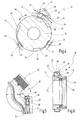
- a connector assembly is generally designated 10.
- the connector assembly 10 includes a pipe socket 12, which may be part of a turbocharger, for example. Furthermore, the connector assembly 10 has a hose 14, which may be, for example, a charge air line. The connector assembly 10 further includes a spring clip 16, by means of which the pipe socket 12 and the hose 14 can be fixed in the nested state.
- the pipe socket 12 in this case has an outer diameter which is adapted to the inner diameter of the hose 14 so that the hose 14 can be slid over the pipe socket 12 in the axial direction.
- the pipe socket 12 has a pre-assembly section 18, on which the spring clip 16 is fixed in a preassembly position, as in Fig. 1 is shown.
- the pre-assembly portion 18 may be formed by a separate, attached to the outer circumference of the pipe socket 12 component, but may also be integrally formed with the pipe socket 12.
- the spring clip 16 has distributed over the circumference of a plurality, in the illustrated embodiment, four holding portions 20, which are offset by 90 ° from each other, as in Fig. 3 is shown. In Fig. 1 two of the holding portions 20 are shown. Each holding section has a first radial tongue 22 which engages in a circumferential groove 24 of the pre-assembly section 18. As a result, the spring clip 16 is axially fixed to the pipe socket 12 in the pre-assembly shown. The spring clip 16 is radially expanded for this purpose to then insert the first radial tabs 22 in the circumferential groove 24, wherein the spring clip 16 is biased in the preassembly.
- the holding portions 20 each further include a second radial tongue 26, which are arranged offset in the axial direction towards the free end of the pipe socket 12.
- the second radial tongues 26 are arranged so that at least a portion of the tube 14, which is pushed onto the pipe socket 12, in the radial Direction within the first Radialzept 22 is located.
- the second radial tongues 26 are preferably shorter than the first radial tongues 22.
- the second radial tongues 26 are in the in Fig. 1 shown pre-assembly positioned so that the tube 14 can be guided past the second radial tongues 26 substantially non-contact.
- a radial groove 28 is formed, in which the second radial tongues 26 engage when the spring clamp 16 is in a final assembly position, as in Fig. 2 is shown.
- the pipe socket 12 and the hose 14 can be positively connected to each other in the axial direction via the spring clip 16.
- Both in the pre-assembly and in the final assembly position acts while a radially inwardly facing spring tension 30, which holds the spring clamp 16 on the one hand in the circumferential groove 24 and the radial groove 28 and on the other hand exerts a radial force on the portion in which the Hose 14, the pipe socket 12 overlaps. Consequently, both an axial positive engagement and a certain sealing effect can be achieved.
- the spring clip 16 may be formed in the circumferential direction 38 substantially continuously from one piece.
- the spring clip 16 in this case has a first clip end and a second clip end, which overlap in the circumferential direction 38, so that an expansion of the spring clip 16 for insertion into the preassembly position by compressing the clip ends is possible.
- FIG. 4 Such an embodiment is in Fig. 4 shown.
- the connector assembly 10 of Fig. 4 corresponds in terms of design and operation generally the connector assembly 10 of Fig. 1 to 3 , The same elements therefore have the same reference numerals. The following section essentially explains the differences.
- the spring clip 16 of Fig. 4 has a first clip end 40 and a second clip end 42 that overlap one another.
- a collet or other gripping device 44 By means of a collet or other gripping device 44, the clamp ends 40, 42 can be grasped and compressed, as indicated by a Aufweitkraft 46.
- the spring clip 16 is widened in the radial direction, so that it can be brought into the pre-assembly position on the pipe socket 12.
- the circumferential groove 24 is in the connector assembly 10 of the Fig. 4 not circumferentially formed in the circumferential direction 38 but divided into a plurality of sections. The number of sections corresponds to the number of holding sections 20; in the presentation of the Fig. 4 There are three holding sections, which are offset by about 120 ° to each other.
- the spring clip 16 is formed from a spring band extending in the circumferential direction 38, wherein a holding portion 20 is formed on the first clip end 40.
- the second clamp end 42 penetrates in the radial direction in Fig. 4 not shown recess of the first clamp end 40, so that the collet 44 can easily attack on the clamp ends 40, 42.
- FIGS. 5 and 6 a further embodiment of a connector assembly 10 is shown, with respect to the structure and operation generally of the connector assembly of Fig. 1 to 3 equivalent.
- the same elements are therefore provided with the same reference numerals. In the following, only the differences will be explained.
- Fig. 5 For one thing is in Fig. 5 to recognize that the pipe socket 12 according to Fig. 5 Part of a pipe 50, which in turn may be part of a turbocharger charge air arrangement.
- the tube 50 when it is connected via the connector assembly 10 with the second hollow body 14, form a silencer.
- the pipe socket 12 on its outer circumference on a circumferential groove 54 into which a sealing ring 52 is inserted as an O-ring.
- the circumferential groove 54 and the inserted therein sealing ring 52 are covered by the tube portion which is pushed onto the pipe socket 12.
- the seal can be achieved by the spring tension 30 acting in the final assembly position (in Fig. 6 not shown).
- the hose 14 is dimensioned so that it axially against a in Fig. 6 unspecified annular shoulder of the pipe socket 12 abuts. In this position, the radial groove 28 is within the second radial tongues 26, so that, starting from the in Fig. 6 shown pre-assembly, the final assembly position can be easily set by turning the spring clip 16.
- the spring clip is pre-mounted on a pipe socket, it is also possible to pre-assemble the spring clip to the hose. In the same way it is possible to connect two pipe sockets or two hoses instead of a hose and a pipe socket with each other, wherein the spring clip can be pre-assembled in each case on one of the two elements.
Landscapes
- Engineering & Computer Science (AREA)
- General Engineering & Computer Science (AREA)
- Mechanical Engineering (AREA)
- Chemical & Material Sciences (AREA)
- Combustion & Propulsion (AREA)
- Manufacturing & Machinery (AREA)
- Quick-Acting Or Multi-Walled Pipe Joints (AREA)
Abstract
Description
- Die vorliegende Erfindung betrifft eine Steckverbindungsanordnung zur Verbindung eines ersten Hohlkörpers wie eines Rohrstutzens mit einem zweiten Hohlkörper wie einem Schlauch mittels einer Schelle, wobei der erste Hohlkörper einen Vormontageabschnitt aufweist, an dem die Schelle in einer Vormontageposition vormontierbar ist, und wobei der erste Hohlkörper einen Endmontageabschnitt aufweist, an dem die Schelle zur Verbindung des ersten Hohlkörpers mit dem zweiten Hohlkörper in einer Endmontageposition festlegt ist.
- Eine derartige Steckverbindungsanordnung ist aus dem Dokument
DE 196 21 670 A1 bekannt. - Die
DE 196 21 670 A1 zeigt eine Steckverbindungsanordnung zur Verbindung eines Schlauchendes mit Rohrstutzen, wobei an dem Rohrstutzen eine Schelle vormontiert ist, die beim Aufschieben des Schlauchendes axial in eine Endmontageposition versetzt wird. In der Endmontageposition ist die Schelle in axialer Richtung formschlüssig mit dem Rohrstutzen und kraftschlüssig mit dem Schlauchende verbunden. - Aus der
DE 195 06 144 C1 ist eine Steckverbindungsanordnung bekannt, bei der eine Federschelle unter Spannung aufgeweitet wird und in diesem Zustand mittels einer Klammer gehalten wird. In dieser Vormontageposition kann die Federklemme ferner an einem Sicherungsring festgelegt sein, der mit dem Rohrstutzen verbunden ist. - Das Dokument
DE 10 2006 047 882 B3 offenbart eine weitere Steckverbindungsanordnung, bei der eine Hülse mit einem Schlauchende klemmend verbunden ist. Ein Verbindungsring ist in einer Vormontageposition mit der Hülse verrastet. Beim Aufschieben des Schlauchendes auf einen Stutzen rastet der Verbindungsring ferner in eine Umfangsnut am Außenumfang des Stutzens. - Vor dem obigen Hintergrund besteht eine Aufgabe der Erfindung darin, eine verbesserte Steckverbindungsanordnung anzugeben, die insbesondere eine einfache und sichere Endmontage zur Verbindung der zwei Hohlkörper ermöglicht.
- Diese Aufgabe wird bei der eingangs genannten Steckverbindungsanordnung dadurch gelöst, dass der Vormontageabschnitt und der Endmontageabschnitt in Umfangsrichtung des ersten Hohlkörpers versetzt angeordnet sind, so dass die Schelle durch Verdrehen gegenüber dem ersten Hohlkörper von der Vormontageposition in die Endmontageposition versetzbar ist.
- Die vorliegende Erfindung wird ferner gelöst durch ein Verfahren zum Verbinden eines ersten Hohlkörpers wie eines Rohrstutzens mit einem zweiten Hohlkörper wie einem Schlauch mittels einer Schelle, mit den Schritten, die Schelle an einem Vormontageabschnitt des ersten Hohlkörpers vorzumontieren, den ersten und den zweiten Hohlkörper axial ineinander zu stecken, und schließlich die Schelle relativ zu dem ersten Hohlkörper zu verdrehen, so dass die Schelle in eine Endmontageposition gelangt.
- Die Steckverbindungsanordnung kann mit wenigen Bauteilen realisiert werden. Die Endmontage kann durch einen einfachen Verdrehvorgang der Schelle erfolgen. Ferner kann hierdurch eine sicherere Vormontage der Schelle an dem ersten Hohlkörper erzielt werden.
- Die Aufgabe wird somit vollkommen gelöst.
- Von besonderem Vorzug ist es, wenn der Vormontageabschnitt einen größeren Außendurchmesser aufweist als der Endmontageabschnitt, so dass der zweite Hohlkörper auf den ersten Hohlkörper derart axial aufgeschoben werden kann, dass zumindest ein Abschnitt des zweiten Hohlkörpers radial innerhalb der Schelle angeordnet ist.
- Hierdurch können die Hohlkörper einfach ineinander geschoben werden, und die Schelle kann anschließend an dem Außenumfang des zweiten Hohlkörpers angreifen, um die Steckverbindung herzustellen.
- Ferner ist es vorteilhaft, wenn der Vormontageabschnitt und der Endmontageabschnitt in Umfangsrichtung über eine Umfangskontur miteinander verbunden sind.
- Hierdurch kann der Verdrehvorgang zum Einrichten der Endmontageposition gezielt über die Umfangskontur beeinflusst werden. Die Umfangskontur ist ferner bevorzugt stetig ausgebildet, so dass keine rein radial verlaufenden Absätze oder dergleichen enthalten sind. Dies ermöglicht eine größere Kontrolle während des Verdrehvorgangs.
- Dabei ist es von besonderem Vorzug, wenn die Umfangskontur zwischen dem Vormontageabschnitt und dem Endmontageabschnitt einen Sicherungsabschnitt aufweist.
- Hierdurch kann gewährleistet werden, dass die Schelle sich beispielsweise während eines Transportes nicht versehentlich aus der Vormontageposition lösen kann. Insbesondere kann hierdurch verhindert werden, dass die Schelle während eines solchen Transportes oder dergleichen versehentlich bereits in die Endmontageposition gelangt.
- Dabei ist es von besonderem Vorzug, wenn der Sicherungsabschnitt einen größeren Außendurchmesser aufweist als der Vormontageabschnitt.
- Hierdurch kann der Sicherungsabschnitt konstruktiv auf einfache Weise realisiert werden, insbesondere als Teil der Umfangskontur.
- Die Schelle ist ferner vorzugsweise eine Federschelle, die durch radiales Aufweiten gespannt wird.
- Bei dieser Ausführungsform kann die Schelle aus ihrem entspannten Zustand zunächst radial aufgeweitet werden, um in die Vormontageposition versetzt zu werden. In der Vormontageposition wird die Federschelle dann durch eine radial nach innen wirkende elastische Rückstellkraft gehalten.
- Demzufolge ist es bevorzugt, wenn die Federschelle in der Vormontageposition unter Spannung steht.
- Insgesamt ist es ferner vorteilhaft, wenn die Schelle wenigstens eine erste Radialzunge aufweist, die in der Vormontageposition und/oder in der Endmontageposition in eine Umfangsnut des ersten Hohlkörpers greift.
- Durch diese Maßnahme kann gewährleistet werden, dass die Schelle in der Vormontageposition und/oder in der Endmontageposition in axialer Richtung an dem ersten Hohlkörper gesichert ist. Wenn die Schelle eine Federschelle ist, wird die Radialzunge zudem in die Umfangsnut elastisch eingedrückt, so dass die Transportsicherheit noch weiter erhöht werden kann.
- Generell ist es denkbar, dass nur eine einzelne erste Radialzunge vorgesehen ist, die sich z.B. bis zu 180° über den Umfang erstrecken kann. Besonders bevorzugt ist es jedoch, wenn eine Mehrzahl erster Radialzungen über den Umfang verteilt an der Schelle vorgesehen sind.
- Gemäß einer weiteren bevorzugten Ausführungsform, die vorliegend in Verbindung mit der eingangs genannten Steckverbindungsanordnung eine eigene Erfindung darstellt, weist die Schelle wenigstens eine erste Radialzunge auf, die in der Vormontageposition und/oder in der Endmontageposition in eine Umfangsnut des ersten Hohlkörpers greift, wobei die Schelle ferner wenigstens eine zweite Radialzunge aufweist, die in der Endmontageposition in eine Radialnut des zweiten Hohlkörpers greift.
- Bei dieser Ausführungsform kann insbesondere dann, wenn die erste Radialzunge zumindest in der Endmontageposition in eine Umfangsnut des ersten Hohlkörpers greift, über die Schelle eine formschlüssige Verbindung in axialer Richtung zwischen dem ersten Hohlkörper und dem zweiten Hohlkörper eingerichtet werden. Demzufolge kann die Steckverbindungsanordnung eine hohe Verbindungssicherheit aufweisen.
- Auch die zweite Radialzunge kann als einzelne Radialzunge ausgebildet sein, wie oben beschrieben. Bevorzugt ist jedoch auch in diesem Fall eine Mehrzahl von zweiten Radialzungen vorgesehen, die über den Umfang der Schelle verteilt angeordnet sind.
- Von besonderem Vorzug ist es dabei, wenn die zweite Radialzunge kürzer ist als die erste Radialzunge.
- Hierdurch wird es vereinfacht, die Hohlkörper ineinander zu stecken, bevor die Schelle von der Vormontageposition in die Endmontageposition versetzt, insbesondere verdreht wird.
- Insgesamt ist es ferner vorteilhaft, wenn der erste und/oder der zweite Hohlkörper eine Umfangsnut aufweist, in die ein Dichtungsring eingelegt ist und die in dem Endmontagezustand von dem anderen Hohlkörper überdeckt ist, um das Innere der Hohlkörper gegenüber der Umgebung abzudichten.
- Hierdurch kann eine unmittelbare Dichtwirkung zwischen dem ersten Hohlkörper und dem zweiten Hohlkörper eingerichtet werden, so dass eine hohe Dichtigkeit erzielt werden kann.
- Obgleich die vorliegende Steckverbindungsanordnung vorzugsweise zur Steckverbindung zweier Hohlkörper dient, durch die hindurch bevorzugt ein Fluid wie Ladeluft führbar ist, ist die erfindungsgemäße Steckverbindung in gleicher Weise anwendbar auf Verbindungen von Vollkörpern. Somit kann der erste Hohlkörper und/oder der zweite Hohlkörper als Vollkörper ausgebildet sein, wobei einer der Körper beispielsweise einen Ringflanschabschnitt aufweist, der auf einen entsprechenden Aufnahmeabschnitt des anderen Körpers geschoben wird. Der vorliegend verwendete Begriff des Hohlkörpers ist daher in diesem Sinne erweitert zu verstehen.
- Ferner ermöglicht die erfindungsgemäße Steckverbindungsanordnung je nach Ausführungsform auch eine sichere Inspektion der fertiggestellten Verbindung. Mit anderen Worten kann relativ leicht von außen erfasst werden, ob die Schelle in der korrekten Endmontageposition ist. Dies gilt insbesondere dann, wenn eine erste und eine zweite Radialzunge in entsprechende Nuten des ersten Hohlkörpers bzw. des zweiten Hohlkörpers greifen. Dies ist von außen gut erkennbar und kann daher leicht überprüft werden.
- Es versteht sich, dass die vorstehend genannten und die nachstehend noch zu erläuternden Merkmale nicht nur in der jeweils angegebenen Kombination, sondern auch in anderen Kombinationen oder in Alleinstellung verwendbar sind, ohne den Rahmen der vorliegenden Erfindung zu verlassen.
- Ausführungsbeispiele der Erfindung sind in der Zeichnung dargestellt und werden in der nachfolgenden Beschreibung näher erläutert. Es zeigen:
- Fig. 1
- eine schematische Längsschnittansicht einer Ausführungsform einer er- findungsgemäßen Steckverbindungsanordnung mit einer Schelle in einer Vormontageposition;
- Fig. 2
- die Steckverbindungsanordnung der
Fig. 1 mit der Schelle in einer End- montageposition; - Fig. 3
- eine Schnittansicht entlang der Linie III-III der
Fig. 1 ; - Fig. 4
- eine schematische Querschnittsansicht durch eine Steckverbindungs- anordnung gemäß einer weiteren Ausführungsform der Erfindung;
- Fig. 5
- eine Draufsicht auf eine Steckverbindungsanordnung gemäß einer weite- ren Ausführungsform der Erfindung; und
- Fig. 6
- eine Längsschnittansicht durch die Steckverbindungsanordnung der
Fig. 5 . - In den
Figuren 1 bis 3 ist eine Steckverbindungsanordnung generell mit 10 bezeichnet. - Die Steckverbindungsanordnung 10 beinhaltet einen Rohrstutzen 12, der beispielsweise Teil eines Turboladers sein kann. Ferner weist die Steckverbindungsanordnung 10 einen Schlauch 14 auf, bei dem es sich beispielsweise um eine Ladeluftleitung handeln kann. Die Steckverbindungsanordnung 10 beinhaltet ferner eine Federschelle 16, mittels der der Rohrstutzen 12 und der Schlauch 14 im ineinandergesteckten Zustand fixiert werden können.
- Der Rohrstutzen 12 weist dabei einen Außendurchmesser auf, der an den Innendurchmesser des Schlauches 14 angepasst ist, so dass sich der Schlauch 14 in axialer Richtung über den Rohrstutzen 12 schieben lässt.
- Der Rohrstutzen 12 weist einen Vormontageabschnitt 18 auf, an dem die Federschelle 16 in einer Vormontageposition festgelegt ist, wie es in
Fig. 1 dargestellt ist. Der Vormontageabschnitt 18 kann durch ein separates, am Außenumfang des Rohrstutzens 12 befestigtes Bauteil gebildet sein, kann jedoch auch einstückig mit dem Rohrstutzen 12 ausgebildet sein. - Die Federschelle 16 weist über den Umfang verteilt eine Mehrzahl, in der dargestellten Ausführungsform vier Halteabschnitte 20 auf, die jeweils um 90° versetzt gegeneinander angeordnet sind, wie es in
Fig. 3 gezeigt ist. InFig. 1 sind zwei der Halteabschnitte 20 gezeigt. Jeder Halteabschnitt weist eine erste Radialzunge 22 auf, die in eine Umfangsnut 24 des Vormontageabschnittes 18 greift. Hierdurch wird die Federschelle 16 an dem Rohrstutzen 12 in der gezeigten Vormontageposition axial fixiert. Die Federschelle 16 wird hierzu radial aufgeweitet, um die ersten Radialzungen 22 anschließend in die Umfangsnut 24 einzuführen, wobei die Federschelle 16 in der Vormontageposition unter Vorspannung steht. - Die Halteabschnitte 20 beinhalten ferner jeweils eine zweite Radialzunge 26, die in axialer Richtung hin zu dem freien Ende des Rohrstutzens 12 versetzt angeordnet sind. Die zweiten Radialzungen 26 sind dabei so angeordnet, dass zumindest ein Abschnitt des Schlauches 14, der auf den Rohrstutzen 12 aufgeschoben ist, in radialer Richtung innerhalb der ersten Radialzungen 22 liegt. Die zweiten Radialzungen 26 sind vorzugsweise kürzer als die ersten Radialzungen 22. Ferner sind die zweiten Radialzungen 26 in der in
Fig. 1 gezeigten Vormontageposition so angeordnet, dass der Schlauch 14 im Wesentlichen berührungsfrei an den zweiten Radialzungen 26 vorbeigeführt werden kann. - An dem Außenumfang des Schlauches 24 ist eine Radialnut 28 ausgebildet, in die die zweiten Radialzungen 26 greifen, wenn die Federschelle 16 sich in einer Endmontageposition befindet, wie sie in
Fig. 2 gezeigt ist. - Hierdurch können der Rohrstutzen 12 und der Schlauch 14 in axialer Richtung über die Federschelle 16 formschlüssig miteinander verbunden werden. Sowohl in der Vormontageposition als auch in der Endmontageposition wirkt dabei eine in radialer Richtung nach innen weisende Federspannung 30, die die Federschelle 16 zum einen in der Umfangsnut 24 bzw. der Radialnut 28 hält und zum anderen eine Radialkraft auf den Abschnitt ausübt, bei dem der Schlauch 14 den Rohrstutzen 12 übergreift. Folglich kann hierdurch sowohl ein axialer Formschluss als auch eine gewisse Dichtwirkung erzielt werden.
- Wie es insbesondere in
Fig. 3 zu sehen ist, bildet der Boden der Umfangsnut 24 eine Umfangskontur 32. Die Umfangskontur 32 weist dabei über den Umfang verteilt vier Vormontageabschnitte 18 mit einem relativ großen Außendurchmesser auf. Ferner weist die Umfangskontur 32 dazwischenliegend vier Endmontageabschnitte 36 mit einem deutlich kleineren Außendurchmesser auf. Zwischen den Vormontageabschnitten 18 und den Endmontageabschnitten 36 ist jeweils ein Sicherungsabschnitt 34 vorgesehen, der einen noch größeren Außendurchmesser als der Vormontageabschnitt 18 aufweist. Demzufolge wird die Federschelle 16 in der inFig. 1 und 3 gezeigten Vormontageposition auch in der Umfangsrichtung 38 gehalten. - Um die Federschelle 16 von der Vormontageposition, die in
Fig. 1 und 3 gezeigt ist, in die Endmontageposition zu verbringen, die inFig. 2 gezeigt ist, ist es lediglich notwendig, die Federschelle 16 in Bezug auf den Rohrstutzen 12 zu verdrehen. Dabei fahren die ersten Radialzungen 22 mit ihrem Innenumfang entlang der Umfangskontur 32. Hierbei wird zunächst jeweils ein Sicherungsabschnitt 34 von den ersten Radialzungen 22 überfahren. Dabei weitet sich die Federschelle 16 radial auf, so dass ein etwas erhöhter Kraftaufwand hierzu notwendig ist. Anschließend werden die ersten Radialzungen 22 durch die Federspannung 30 in die Endmontageabschnitte 36 gedrückt, was inFig. 3 für zwei der Radialzungen 22 gestrichelt dargestellt ist. Ein Schnitt entlang der Linie II-II inFig. 3 entspricht der Darstellung derFig. 2 . - Die Federschelle 16 kann in Umfangsrichtung 38 im Wesentlichen durchgehend aus einem Stück ausgebildet sein. Bevorzugt weist die Federschelle 16 dabei ein erstes Schellenende und ein zweites Schellenende auf, die sich in Umfangsrichtung 38 überlappen, so dass ein Aufweiten der Federschelle 16 zum Einsetzen in die Vormontageposition durch Zusammendrücken der Schellenenden möglich ist.
- Eine derartige Ausführungsform ist in
Fig. 4 gezeigt. Die Steckverbindungsanordnung 10 derFig. 4 entspricht hinsichtlich Aufbau und Funktionsweise generell der Steckverbindungsanordnung 10 derFig. 1 bis 3 . Gleiche Elemente weisen daher gleiche Bezugsziffern auf. Im Folgenden werden im Wesentlichen die Unterschiede erläutert. - Die Federschelle 16 der
Fig. 4 weist ein erstes Schellenende 40 und ein zweites Schellenende 42 auf, die einander überlappen. Mittels einer Spannzange oder einer sonstigen Greifvorrichtung 44 können die Schellenenden 40, 42 ergriffen und zusammengedrückt werden, wie es durch eine Aufweitkraft 46 angedeutet ist. Hierdurch wird die Federschelle 16 in radialer Richtung aufgeweitet, so dass sie in die Vormontageposition an dem Rohrstutzen 12 verbringbar ist. - Dabei weist der Rohrstutzen 12 für jeden der Halteabschnitte 20, der jeweils eine erste Radialzunge 22 und eine zweite Radialzunge 26 aufweist, jeweils eine Axialnut 48 auf, so dass die ersten Radialzungen 22 relativ einfach in die Umfangsnut 24 eingeführt werden können. Die Umfangsnut 24 ist bei der Steckverbindungsanordnung 10 der
Fig. 4 in Umfangsrichtung 38 nicht durchgehend ausgebildet sondern in eine Mehrzahl von Abschnitten unterteilt. Die Anzahl der Abschnitte entspricht der Anzahl der Halteabschnitte 20; in der Darstellung derFig. 4 sind es drei Halteabschnitte, die jeweils etwa um 120° gegeneinander versetzt sind. - Die Federschelle 16 ist aus einem sich in Umfangsrichtung 38 erstreckenden Federband gebildet, wobei ein Halteabschnitt 20 an dem ersten Schellenende 40 ausgebildet ist. Das zweite Schellenende 42 durchsetzt in radialer Richtung eine in
Fig. 4 nicht näher dargestellte Ausnehmung des ersten Schellenendes 40, so dass die Spannzange 44 leicht an den Schellenenden 40, 42 angreifen kann. - In den
Fig. 5 und 6 ist eine weitere Ausführungsform einer Steckverbindungsanordnung 10 gezeigt, die hinsichtlich Aufbau und Funktionsweise generell der Steckverbindungsanordnung derFig. 1 bis 3 entspricht. Gleiche Elemente sind daher mit gleichen Bezugsziffern versehen. Im Folgenden werden im Wesentlichen lediglich die Unterschiede erläutert. - Zum einen ist in
Fig. 5 zu erkennen, dass der Rohrstutzen 12 gemäßFig. 5 Teil eines Rohrs 50 ist, das wiederum Teil einer Ladeluftanordnung für Turbolader sein kann. Alternativ hierzu kann das Rohr 50 dann, wenn es über die Steckverbindungsanordnung 10 mit dem zweiten Hohlkörper 14 verbunden ist, einen Schalldämpfer bilden. - Wie es in
Fig. 6 gezeigt ist, weist der Rohrstutzen 12 an seinem Außenumfang eine Umfangsnut 54 auf, in die ein Dichtungsring 52 wie ein O-Ring eingesetzt ist. Die Umfangsnut 54 und der darin eingelegte Dichtungsring 52 werden von dem Schlauchabschnitt überdeckt, der auf den Rohrstutzen 12 aufgeschoben ist. Demzufolge kann eine direkte Abdichtung zwischen dem Schlauch 14 und dem Rohrstutzen 12 erzielt werden. Die Abdichtung kann durch die in der Endmontageposition wirkende Federspannung 30 (inFig. 6 nicht dargestellt) erhöht werden. - Der Schlauch 14 ist so dimensioniert, dass er axial gegen eine in
Fig. 6 nicht näher bezeichnete Ringschulter des Rohrstutzens 12 anschlägt. In dieser Position liegt die Radialnut 28 innerhalb der zweiten Radialzungen 26, so dass, ausgehend von der inFig. 6 gezeigten Vormontageposition, die Endmontageposition leicht durch Verdrehen der Federschelle 16 eingerichtet werden kann. - Obgleich in den oben beschriebenen Ausführungsformen die Federschelle an einem Rohrstutzen vormontiert ist, ist es auch möglich, die Federschelle an dem Schlauch vorzumontieren. In gleicher Weise ist es möglich, anstelle eines Schlauches und eines Rohrstutzens zwei Rohrstutzen oder zwei Schläuche miteinander zu verbinden, wobei die Federschelle jeweils an einem der zwei Elemente vormontiert sein kann.
- Schließlich ist es auch denkbar, eine Federschelle 16 ohne zweite Radialzungen 26 auszubilden. In diesem Fall kann der Außenumfang des Schlauches 14 auch ohne Radialnut 28 ausgebildet sein. Hier wird die Verbindung zwischen dem Rohrstutzen 12 und dem Schlauch 14 im Wesentlichen kraftschlüssig über die Federschelle 16 eingerichtet, und zwar mittels der Federspannung 30.
Claims (12)
- Steckverbindungsanordnung (10) zur Verbindung eines ersten Hohlkörpers (12) wie eines Rohrstutzens mit einem zweiten Hohlkörper (14) wie einem Schlauch mittels einer Schelle (16), wobei der erste Hohlkörper (12) einen Vormontageabschnitt (18) aufweist, an dem die Schelle (16) in einer Vormontageposition vormontierbar ist, und wobei der erste Hohlkörper (12) einen Endmontageabschnitt (36) aufweist, an dem die Schelle (16) zur Verbindung des ersten Hohlkörpers (12) mit dem zweiten Hohlkörper (14) in einer Endmontageposition festgelegt ist,
dadurch gekennzeichnet, dass
der Vormontageabschnitt (18) und der Endmontageabschnitt (36) in Umfangsrichtung (38) des ersten Hohlkörpers (12) versetzt angeordnet sind, so dass die Schelle (16) durch Verdrehen gegenüber dem ersten Hohlkörper (12) von der Vormontageposition in die Endmontageposition versetzbar ist. - Steckverbindungsanordnung nach Anspruch 1, dadurch gekennzeichnet, dass der Vormontageabschnitt (18) einen größeren Außendurchmesser aufweist als der Endmontageabschnitt (36), so dass der zweite Hohlkörper (14) auf den ersten Hohlkörper (12) derart axial aufgeschoben werden kann, dass zumindest ein Abschnitt des zweiten Hohlkörpers (14) radial innerhalb der in der Vormontageposition befindlichen Schelle (16) angeordnet ist.
- Steckverbindungsanordnung nach Anspruch 1 oder 2, dadurch gekennzeichnet, dass der Vormontageabschnitt (18) und der Endmontageabschnitt (36) in Umfangsrichtung über eine Umfangskontur (32) miteinander verbunden sind.
- Steckverbindungsanordnung nach Anspruch 3, dadurch gekennzeichnet, dass die Umfangskontur (32) zwischen dem Vormontageabschnitt (18) und dem Endmontageabschnitt (36) einen Sicherungsabschnitt (34) aufweist.
- Steckverbindungsanordnung nach Anspruch 4, dadurch gekennzeichnet, dass der Sicherungsabschnitt (34) einen größeren Außendurchmesser aufweist als der Vormontageabschnitt (18).
- Steckverbindungsanordnung nach einem der Ansprüche 1 bis 5, dadurch gekennzeichnet, dass die Schelle (16) eine Federschelle ist, die durch radiales Aufweiten gespannt wird.
- Steckverbindungsanordnung nach Anspruch 6, dadurch gekennzeichnet, dass die Federschelle (16) in der Vormontageposition unter Spannung steht.
- Steckverbindungsanordnung nach einem der Ansprüche 1 bis 7, dadurch gekennzeichnet, dass die Schelle (16) wenigstens eine erste Radialzunge (22) aufweist, die in der Vormontageposition und/oder in der Endmontageposition in eine Umfangsnut (24) des ersten Hohlkörpers (12) greift.
- Steckverbindungsanordnung nach einem der Ansprüche 1 bis 7 oder nach dem Oberbegriff des Anspruchs 1, dadurch gekennzeichnet, dass die Schelle (16) wenigstens eine erste Radialzunge (22) aufweist, die in der Vormontageposition und/oder in der Endmontageposition in eine Umfangsnut (24) des ersten Hohlkörpers (12) greift, wobei die Schelle (16) ferner wenigstens eine zweite Radialzunge (26) aufweist, die in der Endmontageposition in eine Radialnut (28) des zweiten Hohlkörpers (14) greift.
- Steckverbindungsanordnung nach Anspruch 9, dadurch gekennzeichnet, dass die zweite Radialzunge (26) kürzer ist als die erste Radialzunge (22).
- Steckverbindungsanordnung nach einem der Ansprüche 1 bis 10, dadurch gekennzeichnet, dass der erste und/oder der zweite Hohlkörper (12) eine Umfangsnut (54) aufweist, in die ein Dichtungsring (52) eingelegt ist und die in dem Endmontagezustand von dem anderen Hohlkörper (14) überdeckt ist, um das Innere der Hohlkörper (12, 14) gegenüber der Umgebung abzudichten.
- Verfahren zum Verbinden eines ersten Hohlkörpers (12) wie eines Rohrstutzens mit einem zweiten Hohlkörper (14) wie einem Schlauch mittels einer Schelle (16), mit den Schritten:- Vormontieren der Schelle (16) an einem Vormontageabschnitt (18) des ersten Hohlkörpers (12),- axiales Ineinanderstecken des ersten und des zweiten Hohlkörpers (12, 14), und- Verdrehen der Schelle (16) relativ zu dem ersten Hohlkörper (12), so dass die Schelle in eine Endmontageposition gelangt.
Applications Claiming Priority (1)
| Application Number | Priority Date | Filing Date | Title |
|---|---|---|---|
| DE200910020577 DE102009020577A1 (de) | 2009-05-09 | 2009-05-09 | Steckverbindungsanordnung |
Publications (2)
| Publication Number | Publication Date |
|---|---|
| EP2249073A1 true EP2249073A1 (de) | 2010-11-10 |
| EP2249073B1 EP2249073B1 (de) | 2013-06-19 |
Family
ID=42214406
Family Applications (1)
| Application Number | Title | Priority Date | Filing Date |
|---|---|---|---|
| EP20100160660 Not-in-force EP2249073B1 (de) | 2009-05-09 | 2010-04-22 | Steckverbindungsanordnung |
Country Status (5)
| Country | Link |
|---|---|
| US (1) | US8419076B2 (de) |
| EP (1) | EP2249073B1 (de) |
| KR (1) | KR20100121576A (de) |
| DE (1) | DE102009020577A1 (de) |
| ES (1) | ES2417811T3 (de) |
Families Citing this family (9)
| Publication number | Priority date | Publication date | Assignee | Title |
|---|---|---|---|---|
| DE102008005619A1 (de) * | 2008-01-23 | 2009-07-30 | GM Global Technology Operations, Inc., Detroit | Schnellverschluss |
| DE102011121828A1 (de) * | 2011-12-21 | 2013-06-27 | Veritas Ag | Steckverbindungsanordnung für Fluidleitungen |
| US9664321B2 (en) * | 2013-05-20 | 2017-05-30 | Steere Enterprises, Inc. | Clean air duct and retaining clip and assembly thereof |
| US10859194B2 (en) | 2013-05-20 | 2020-12-08 | Steere Enterprises, Inc. | Clean air duct and retaining clip and assembly thereof |
| US10359221B2 (en) * | 2014-10-15 | 2019-07-23 | Mpi Corporation | Working fluid output device for temperature control system |
| US9671052B2 (en) * | 2015-10-27 | 2017-06-06 | Whirlpool Corporation | Collet securing device for joining two fluid lines and providing lateral support at the connection of the two fluid lines |
| JP7097110B1 (ja) * | 2021-03-31 | 2022-07-07 | 株式会社トヨックス | 管継手 |
| CN114352447B (zh) * | 2021-12-31 | 2023-04-28 | 安徽美瑞尔滤清器有限公司 | 一种汽车滤清器装配结构 |
| US20250230826A1 (en) * | 2024-01-11 | 2025-07-17 | Tymphany Hk Limited | Quick release structure |
Citations (8)
| Publication number | Priority date | Publication date | Assignee | Title |
|---|---|---|---|---|
| US1477440A (en) * | 1920-09-11 | 1923-12-11 | Jr Frederick A Grier | Coupling device |
| EP0452172A1 (de) * | 1990-03-29 | 1991-10-16 | Hutchinson S.A. | Schnellmontageclip für Wärmetauscher an Kraftfahrzeugen |
| DE19506144C1 (de) | 1995-02-22 | 1996-05-30 | Rasmussen Gmbh | Vorrichtung zum Festklemmen eines auf einem Rohrendabschnitt aufgeschobenen Schlauchendabschnitts |
| DE19621670A1 (de) | 1996-05-30 | 1997-12-04 | Henn Gmbh & Co Kg | Schelle mit axialer Haltevorrichtung |
| EP0924453A1 (de) * | 1997-12-20 | 1999-06-23 | DaimlerChrysler AG | Lösbare Rohrverbindung, insbesondere für luftführende Rohre |
| DE102006047882B3 (de) | 2006-10-10 | 2007-08-02 | Rasmussen Gmbh | Steckverbindungsanordnung für einen Schlauch und ein Rohr |
| EP1821022A1 (de) * | 2006-02-21 | 2007-08-22 | Societe Des Polymeres Barre Thomas | Schnelleinschnappkupplung |
| DE102007045023A1 (de) * | 2007-09-19 | 2009-04-02 | Norma Germany Gmbh | Steckverbindungsanordnung für Fluidleitungen |
Family Cites Families (9)
| Publication number | Priority date | Publication date | Assignee | Title |
|---|---|---|---|---|
| US373292A (en) * | 1887-11-15 | Coupling for hose | ||
| US747412A (en) * | 1903-10-24 | 1903-12-22 | August Henry Getz | Hose-coupling. |
| US1069904A (en) * | 1913-02-06 | 1913-08-12 | William E Sanders | Fire-hose connection. |
| US1369304A (en) * | 1919-10-13 | 1921-02-22 | Schram Carl | Coupling |
| US1544004A (en) * | 1924-07-10 | 1925-06-30 | Henderson Albert | Pipe coupling |
| US2004967A (en) * | 1934-07-24 | 1935-06-18 | Ideal Hose Coupling Company | Hose coupling |
| DK0401083T3 (da) * | 1989-05-29 | 1994-04-25 | Autobrevets | Indretning for tilvejebringelse af en tæt samling mellem et rør og en slange |
| FR2863683B1 (fr) * | 2003-12-10 | 2006-02-17 | Legris Sa | Dispositif de raccordement instantane |
| DE102008005619A1 (de) * | 2008-01-23 | 2009-07-30 | GM Global Technology Operations, Inc., Detroit | Schnellverschluss |
-
2009
- 2009-05-09 DE DE200910020577 patent/DE102009020577A1/de not_active Withdrawn
-
2010
- 2010-04-22 EP EP20100160660 patent/EP2249073B1/de not_active Not-in-force
- 2010-04-22 ES ES10160660T patent/ES2417811T3/es active Active
- 2010-04-29 US US12/769,684 patent/US8419076B2/en not_active Expired - Fee Related
- 2010-05-07 KR KR1020100042872A patent/KR20100121576A/ko not_active Withdrawn
Patent Citations (8)
| Publication number | Priority date | Publication date | Assignee | Title |
|---|---|---|---|---|
| US1477440A (en) * | 1920-09-11 | 1923-12-11 | Jr Frederick A Grier | Coupling device |
| EP0452172A1 (de) * | 1990-03-29 | 1991-10-16 | Hutchinson S.A. | Schnellmontageclip für Wärmetauscher an Kraftfahrzeugen |
| DE19506144C1 (de) | 1995-02-22 | 1996-05-30 | Rasmussen Gmbh | Vorrichtung zum Festklemmen eines auf einem Rohrendabschnitt aufgeschobenen Schlauchendabschnitts |
| DE19621670A1 (de) | 1996-05-30 | 1997-12-04 | Henn Gmbh & Co Kg | Schelle mit axialer Haltevorrichtung |
| EP0924453A1 (de) * | 1997-12-20 | 1999-06-23 | DaimlerChrysler AG | Lösbare Rohrverbindung, insbesondere für luftführende Rohre |
| EP1821022A1 (de) * | 2006-02-21 | 2007-08-22 | Societe Des Polymeres Barre Thomas | Schnelleinschnappkupplung |
| DE102006047882B3 (de) | 2006-10-10 | 2007-08-02 | Rasmussen Gmbh | Steckverbindungsanordnung für einen Schlauch und ein Rohr |
| DE102007045023A1 (de) * | 2007-09-19 | 2009-04-02 | Norma Germany Gmbh | Steckverbindungsanordnung für Fluidleitungen |
Also Published As
| Publication number | Publication date |
|---|---|
| KR20100121576A (ko) | 2010-11-18 |
| ES2417811T3 (es) | 2013-08-09 |
| EP2249073B1 (de) | 2013-06-19 |
| US8419076B2 (en) | 2013-04-16 |
| US20100282329A1 (en) | 2010-11-11 |
| DE102009020577A1 (de) | 2010-11-11 |
Similar Documents
| Publication | Publication Date | Title |
|---|---|---|
| EP2249073B1 (de) | Steckverbindungsanordnung | |
| DE69209919T2 (de) | Anzeigevorrichtung für eine Schnellverschlusskupplung | |
| DE102007008066B4 (de) | Fitting | |
| EP1805447B1 (de) | Zugfeste steckkupplung | |
| DE69201673T2 (de) | Verbindungselement zur Schnellkupplung eines Rohres. | |
| DE2652207A1 (de) | Rohrschnellkupplung | |
| DE2534956A1 (de) | Rohrkupplung | |
| EP2880349A1 (de) | Schnellverbindungsanordnung zur lösbaren verbindung einer medienleitung mit einem stutzen | |
| DE69622346T2 (de) | Verbindungs- und Verstellvorrichtung für zwei Teile eines Bowdenzuges und Verfahren zum Zusammenbau | |
| EP3526507B1 (de) | Verbinder und verbinderbaugruppe und verfahren zur herstellung eines verbinders | |
| DE102012106232B3 (de) | Rohrverbinder, Abgasrohrsystem sowie Montageverfahren | |
| DE29900796U1 (de) | Vorrichtung zum Verbinden eines Rohrstutzens, rohrförmigen Armaturenteils oder Fittings mit einem Rohr | |
| EP0615089A1 (de) | Lösbare Steckverbindung für Hochdruckleitungen | |
| DE69507100T2 (de) | Verschlussstopfen für eine Schnellverbindung | |
| DE10347927B4 (de) | Verfahren und Vorrichtung zur Herstellung einer Rohrpressverbindung an einer Steckverbindung | |
| DE112014003608B4 (de) | Schnellverbinder | |
| AT523394B1 (de) | Kopplungsverfahren von Steckverbindern zu einer Steckerbaugruppe und Steckerbaugruppe | |
| DE69401385T2 (de) | Schnellkupplung | |
| DE3741250A1 (de) | Vorrichtung zum gegenseitigen verbinden von zwei leitungen, insbesondere kraftstoffleitungen | |
| DE3705610A1 (de) | Loesbare steckverbindung fuer rohrleitungen | |
| CH581273A5 (en) | Snap connection between hose ends - has inner and outer sleeves with O-ring seal and finger with ridge and groove | |
| EP2568207B1 (de) | Rohrverbinder | |
| DE102020100096A1 (de) | Fitting | |
| WO2018210622A1 (de) | Anschlussvorrichtung | |
| DE102007056882A1 (de) | Sicherungselement |
Legal Events
| Date | Code | Title | Description |
|---|---|---|---|
| PUAI | Public reference made under article 153(3) epc to a published international application that has entered the european phase |
Free format text: ORIGINAL CODE: 0009012 |
|
| AK | Designated contracting states |
Kind code of ref document: A1 Designated state(s): AT BE BG CH CY CZ DE DK EE ES FI FR GB GR HR HU IE IS IT LI LT LU LV MC MK MT NL NO PL PT RO SE SI SK SM TR |
|
| AX | Request for extension of the european patent |
Extension state: AL BA ME RS |
|
| 17P | Request for examination filed |
Effective date: 20110509 |
|
| 17Q | First examination report despatched |
Effective date: 20120621 |
|
| GRAP | Despatch of communication of intention to grant a patent |
Free format text: ORIGINAL CODE: EPIDOSNIGR1 |
|
| RIC1 | Information provided on ipc code assigned before grant |
Ipc: F16L 37/10 20060101AFI20121121BHEP Ipc: F16L 37/12 20060101ALI20121121BHEP Ipc: F16L 21/08 20060101ALI20121121BHEP |
|
| GRAS | Grant fee paid |
Free format text: ORIGINAL CODE: EPIDOSNIGR3 |
|
| GRAA | (expected) grant |
Free format text: ORIGINAL CODE: 0009210 |
|
| AK | Designated contracting states |
Kind code of ref document: B1 Designated state(s): AT BE BG CH CY CZ DE DK EE ES FI FR GB GR HR HU IE IS IT LI LT LU LV MC MK MT NL NO PL PT RO SE SI SK SM TR |
|
| REG | Reference to a national code |
Ref country code: GB Ref legal event code: FG4D Free format text: NOT ENGLISH |
|
| REG | Reference to a national code |
Ref country code: CH Ref legal event code: EP |
|
| REG | Reference to a national code |
Ref country code: AT Ref legal event code: REF Ref document number: 617864 Country of ref document: AT Kind code of ref document: T Effective date: 20130715 |
|
| REG | Reference to a national code |
Ref country code: IE Ref legal event code: FG4D Free format text: LANGUAGE OF EP DOCUMENT: GERMAN |
|
| REG | Reference to a national code |
Ref country code: ES Ref legal event code: FG2A Ref document number: 2417811 Country of ref document: ES Kind code of ref document: T3 Effective date: 20130809 |
|
| REG | Reference to a national code |
Ref country code: DE Ref legal event code: R096 Ref document number: 502010003694 Country of ref document: DE Effective date: 20130814 |
|
| PG25 | Lapsed in a contracting state [announced via postgrant information from national office to epo] |
Ref country code: SE Free format text: LAPSE BECAUSE OF FAILURE TO SUBMIT A TRANSLATION OF THE DESCRIPTION OR TO PAY THE FEE WITHIN THE PRESCRIBED TIME-LIMIT Effective date: 20130619 Ref country code: LT Free format text: LAPSE BECAUSE OF FAILURE TO SUBMIT A TRANSLATION OF THE DESCRIPTION OR TO PAY THE FEE WITHIN THE PRESCRIBED TIME-LIMIT Effective date: 20130619 Ref country code: FI Free format text: LAPSE BECAUSE OF FAILURE TO SUBMIT A TRANSLATION OF THE DESCRIPTION OR TO PAY THE FEE WITHIN THE PRESCRIBED TIME-LIMIT Effective date: 20130619 Ref country code: SI Free format text: LAPSE BECAUSE OF FAILURE TO SUBMIT A TRANSLATION OF THE DESCRIPTION OR TO PAY THE FEE WITHIN THE PRESCRIBED TIME-LIMIT Effective date: 20130619 Ref country code: NO Free format text: LAPSE BECAUSE OF FAILURE TO SUBMIT A TRANSLATION OF THE DESCRIPTION OR TO PAY THE FEE WITHIN THE PRESCRIBED TIME-LIMIT Effective date: 20130919 Ref country code: GR Free format text: LAPSE BECAUSE OF FAILURE TO SUBMIT A TRANSLATION OF THE DESCRIPTION OR TO PAY THE FEE WITHIN THE PRESCRIBED TIME-LIMIT Effective date: 20130920 |
|
| REG | Reference to a national code |
Ref country code: LT Ref legal event code: MG4D |
|
| PG25 | Lapsed in a contracting state [announced via postgrant information from national office to epo] |
Ref country code: BG Free format text: LAPSE BECAUSE OF FAILURE TO SUBMIT A TRANSLATION OF THE DESCRIPTION OR TO PAY THE FEE WITHIN THE PRESCRIBED TIME-LIMIT Effective date: 20130919 Ref country code: HR Free format text: LAPSE BECAUSE OF FAILURE TO SUBMIT A TRANSLATION OF THE DESCRIPTION OR TO PAY THE FEE WITHIN THE PRESCRIBED TIME-LIMIT Effective date: 20130619 |
|
| REG | Reference to a national code |
Ref country code: NL Ref legal event code: VDEP Effective date: 20130619 |
|
| PG25 | Lapsed in a contracting state [announced via postgrant information from national office to epo] |
Ref country code: LV Free format text: LAPSE BECAUSE OF FAILURE TO SUBMIT A TRANSLATION OF THE DESCRIPTION OR TO PAY THE FEE WITHIN THE PRESCRIBED TIME-LIMIT Effective date: 20130619 |
|
| PG25 | Lapsed in a contracting state [announced via postgrant information from national office to epo] |
Ref country code: SK Free format text: LAPSE BECAUSE OF FAILURE TO SUBMIT A TRANSLATION OF THE DESCRIPTION OR TO PAY THE FEE WITHIN THE PRESCRIBED TIME-LIMIT Effective date: 20130619 Ref country code: CY Free format text: LAPSE BECAUSE OF FAILURE TO SUBMIT A TRANSLATION OF THE DESCRIPTION OR TO PAY THE FEE WITHIN THE PRESCRIBED TIME-LIMIT Effective date: 20130911 Ref country code: PT Free format text: LAPSE BECAUSE OF FAILURE TO SUBMIT A TRANSLATION OF THE DESCRIPTION OR TO PAY THE FEE WITHIN THE PRESCRIBED TIME-LIMIT Effective date: 20131021 Ref country code: EE Free format text: LAPSE BECAUSE OF FAILURE TO SUBMIT A TRANSLATION OF THE DESCRIPTION OR TO PAY THE FEE WITHIN THE PRESCRIBED TIME-LIMIT Effective date: 20130619 Ref country code: IS Free format text: LAPSE BECAUSE OF FAILURE TO SUBMIT A TRANSLATION OF THE DESCRIPTION OR TO PAY THE FEE WITHIN THE PRESCRIBED TIME-LIMIT Effective date: 20131019 Ref country code: CZ Free format text: LAPSE BECAUSE OF FAILURE TO SUBMIT A TRANSLATION OF THE DESCRIPTION OR TO PAY THE FEE WITHIN THE PRESCRIBED TIME-LIMIT Effective date: 20130619 |
|
| PG25 | Lapsed in a contracting state [announced via postgrant information from national office to epo] |
Ref country code: NL Free format text: LAPSE BECAUSE OF FAILURE TO SUBMIT A TRANSLATION OF THE DESCRIPTION OR TO PAY THE FEE WITHIN THE PRESCRIBED TIME-LIMIT Effective date: 20130619 Ref country code: PL Free format text: LAPSE BECAUSE OF FAILURE TO SUBMIT A TRANSLATION OF THE DESCRIPTION OR TO PAY THE FEE WITHIN THE PRESCRIBED TIME-LIMIT Effective date: 20130619 Ref country code: RO Free format text: LAPSE BECAUSE OF FAILURE TO SUBMIT A TRANSLATION OF THE DESCRIPTION OR TO PAY THE FEE WITHIN THE PRESCRIBED TIME-LIMIT Effective date: 20130619 |
|
| PG25 | Lapsed in a contracting state [announced via postgrant information from national office to epo] |
Ref country code: CY Free format text: LAPSE BECAUSE OF FAILURE TO SUBMIT A TRANSLATION OF THE DESCRIPTION OR TO PAY THE FEE WITHIN THE PRESCRIBED TIME-LIMIT Effective date: 20130619 |
|
| PLBE | No opposition filed within time limit |
Free format text: ORIGINAL CODE: 0009261 |
|
| STAA | Information on the status of an ep patent application or granted ep patent |
Free format text: STATUS: NO OPPOSITION FILED WITHIN TIME LIMIT |
|
| PG25 | Lapsed in a contracting state [announced via postgrant information from national office to epo] |
Ref country code: DK Free format text: LAPSE BECAUSE OF FAILURE TO SUBMIT A TRANSLATION OF THE DESCRIPTION OR TO PAY THE FEE WITHIN THE PRESCRIBED TIME-LIMIT Effective date: 20130619 |
|
| 26N | No opposition filed |
Effective date: 20140320 |
|
| REG | Reference to a national code |
Ref country code: DE Ref legal event code: R097 Ref document number: 502010003694 Country of ref document: DE Effective date: 20140320 |
|
| PG25 | Lapsed in a contracting state [announced via postgrant information from national office to epo] |
Ref country code: MC Free format text: LAPSE BECAUSE OF FAILURE TO SUBMIT A TRANSLATION OF THE DESCRIPTION OR TO PAY THE FEE WITHIN THE PRESCRIBED TIME-LIMIT Effective date: 20130619 Ref country code: LU Free format text: LAPSE BECAUSE OF FAILURE TO SUBMIT A TRANSLATION OF THE DESCRIPTION OR TO PAY THE FEE WITHIN THE PRESCRIBED TIME-LIMIT Effective date: 20140422 |
|
| REG | Reference to a national code |
Ref country code: CH Ref legal event code: PL |
|
| REG | Reference to a national code |
Ref country code: IE Ref legal event code: MM4A |
|
| PG25 | Lapsed in a contracting state [announced via postgrant information from national office to epo] |
Ref country code: LI Free format text: LAPSE BECAUSE OF NON-PAYMENT OF DUE FEES Effective date: 20140430 Ref country code: CH Free format text: LAPSE BECAUSE OF NON-PAYMENT OF DUE FEES Effective date: 20140430 |
|
| REG | Reference to a national code |
Ref country code: FR Ref legal event code: PLFP Year of fee payment: 6 |
|
| PG25 | Lapsed in a contracting state [announced via postgrant information from national office to epo] |
Ref country code: IE Free format text: LAPSE BECAUSE OF NON-PAYMENT OF DUE FEES Effective date: 20140422 |
|
| PGFP | Annual fee paid to national office [announced via postgrant information from national office to epo] |
Ref country code: GB Payment date: 20150420 Year of fee payment: 6 Ref country code: ES Payment date: 20150427 Year of fee payment: 6 |
|
| PGFP | Annual fee paid to national office [announced via postgrant information from national office to epo] |
Ref country code: FR Payment date: 20150421 Year of fee payment: 6 Ref country code: IT Payment date: 20150422 Year of fee payment: 6 |
|
| PG25 | Lapsed in a contracting state [announced via postgrant information from national office to epo] |
Ref country code: MT Free format text: LAPSE BECAUSE OF FAILURE TO SUBMIT A TRANSLATION OF THE DESCRIPTION OR TO PAY THE FEE WITHIN THE PRESCRIBED TIME-LIMIT Effective date: 20130619 |
|
| PG25 | Lapsed in a contracting state [announced via postgrant information from national office to epo] |
Ref country code: SM Free format text: LAPSE BECAUSE OF FAILURE TO SUBMIT A TRANSLATION OF THE DESCRIPTION OR TO PAY THE FEE WITHIN THE PRESCRIBED TIME-LIMIT Effective date: 20130619 |
|
| REG | Reference to a national code |
Ref country code: AT Ref legal event code: MM01 Ref document number: 617864 Country of ref document: AT Kind code of ref document: T Effective date: 20150422 |
|
| PG25 | Lapsed in a contracting state [announced via postgrant information from national office to epo] |
Ref country code: TR Free format text: LAPSE BECAUSE OF FAILURE TO SUBMIT A TRANSLATION OF THE DESCRIPTION OR TO PAY THE FEE WITHIN THE PRESCRIBED TIME-LIMIT Effective date: 20130619 Ref country code: BE Free format text: LAPSE BECAUSE OF FAILURE TO SUBMIT A TRANSLATION OF THE DESCRIPTION OR TO PAY THE FEE WITHIN THE PRESCRIBED TIME-LIMIT Effective date: 20140430 Ref country code: HU Free format text: LAPSE BECAUSE OF FAILURE TO SUBMIT A TRANSLATION OF THE DESCRIPTION OR TO PAY THE FEE WITHIN THE PRESCRIBED TIME-LIMIT; INVALID AB INITIO Effective date: 20100422 |
|
| PG25 | Lapsed in a contracting state [announced via postgrant information from national office to epo] |
Ref country code: AT Free format text: LAPSE BECAUSE OF NON-PAYMENT OF DUE FEES Effective date: 20150422 |
|
| GBPC | Gb: european patent ceased through non-payment of renewal fee |
Effective date: 20160422 |
|
| REG | Reference to a national code |
Ref country code: FR Ref legal event code: ST Effective date: 20161230 |
|
| PG25 | Lapsed in a contracting state [announced via postgrant information from national office to epo] |
Ref country code: FR Free format text: LAPSE BECAUSE OF NON-PAYMENT OF DUE FEES Effective date: 20160502 Ref country code: GB Free format text: LAPSE BECAUSE OF NON-PAYMENT OF DUE FEES Effective date: 20160422 |
|
| PG25 | Lapsed in a contracting state [announced via postgrant information from national office to epo] |
Ref country code: IT Free format text: LAPSE BECAUSE OF NON-PAYMENT OF DUE FEES Effective date: 20160422 |
|
| PGFP | Annual fee paid to national office [announced via postgrant information from national office to epo] |
Ref country code: DE Payment date: 20170601 Year of fee payment: 8 |
|
| REG | Reference to a national code |
Ref country code: DE Ref legal event code: R082 Ref document number: 502010003694 Country of ref document: DE Representative=s name: PATENTSHIP PATENTANWALTSGESELLSCHAFT MBH, DE |
|
| PG25 | Lapsed in a contracting state [announced via postgrant information from national office to epo] |
Ref country code: ES Free format text: LAPSE BECAUSE OF NON-PAYMENT OF DUE FEES Effective date: 20160423 |
|
| PG25 | Lapsed in a contracting state [announced via postgrant information from national office to epo] |
Ref country code: MK Free format text: LAPSE BECAUSE OF FAILURE TO SUBMIT A TRANSLATION OF THE DESCRIPTION OR TO PAY THE FEE WITHIN THE PRESCRIBED TIME-LIMIT Effective date: 20130619 |
|
| REG | Reference to a national code |
Ref country code: DE Ref legal event code: R119 Ref document number: 502010003694 Country of ref document: DE |
|
| REG | Reference to a national code |
Ref country code: ES Ref legal event code: FD2A Effective date: 20181122 |
|
| PG25 | Lapsed in a contracting state [announced via postgrant information from national office to epo] |
Ref country code: DE Free format text: LAPSE BECAUSE OF NON-PAYMENT OF DUE FEES Effective date: 20181101 |