EP2244229A2 - Erzeugung von kubischen Bézier-Kontrollpunkten in Computergrafiksystemen - Google Patents
Erzeugung von kubischen Bézier-Kontrollpunkten in Computergrafiksystemen Download PDFInfo
- Publication number
- EP2244229A2 EP2244229A2 EP10003624A EP10003624A EP2244229A2 EP 2244229 A2 EP2244229 A2 EP 2244229A2 EP 10003624 A EP10003624 A EP 10003624A EP 10003624 A EP10003624 A EP 10003624A EP 2244229 A2 EP2244229 A2 EP 2244229A2
- Authority
- EP
- European Patent Office
- Prior art keywords
- points
- point
- computer
- series
- bezier curve
- Prior art date
- Legal status (The legal status is an assumption and is not a legal conclusion. Google has not performed a legal analysis and makes no representation as to the accuracy of the status listed.)
- Granted
Links
Images




Classifications
-
- G06T11/23—
Definitions
- this disclosure relates to a computer-implemented method and apparatus for computer graphics, and, more particularly, to the generation of cubic Bezier control points from a series of points in a computer graphics system.
- a Bezier curve is a parametric curve used in computer graphics systems to model curves.
- a cubic Bezier curve from point P 0 to point P 3 is defined by those points, along with two control points P 1 and P 2 .
- the tangent of the curve at point P 0 is in the direction of control point P 1 and the tangent of the curve at point P 3 is in the direction of point P 2 .
- Some interactive computer graphics applications enable a user to define a Bezier curve by using a mouse.
- the user can click and hold the mouse button to identify a point P 0 and then drag the mouse while still holding the button to point to the desired location of control point P 1 .
- the current pointer location becomes control point P 1 .
- This process continues to define points P 3 (by pointing to the desired location, clicking, and holding) and P 2 (by dragging the mouse to the desired location, and releasing the mouse button). In this manner, a user may define a Bezier curve.
- some interactive computer graphics applications enable a user to manipulate a defined Bezier curve by clicking and dragging points P 0 and P 3 , as well as control points P 1 and P 2 . In this manner, a user may refine curves to achieve the desired shapes.
- the click-and-drag approach to point and control point identification is largely dissimilar to freehand drawing, and may be cumbersome to some, dampening creativity.
- the system include means for data logic processing, input means for receiving user input, and a computer-readable medium.
- a series of points is received by the input means and is transferred to the computer-readable medium for processing by the means for data logic processing.
- the means for data logic processing retrieves points of the series of points from the computer-readable medium and calculates control points corresponding to one or more points according to the relative distance between successive points of the series.
- the means for data processing generates a Bezier curve using the calculated control points and the series of points and stores the generated Bezier curve in the computer-readable medium.
- RA
- RC
- the input means may be implemented as a computer keyboard, a computer pointing device (e.g ., a mouse), and the like.
- a user points and clicks using a mouse to define successive points in the series, and the resulting series of points are transformed into a Bezier curve according to the relative positions of successive points in the series.
- Generated Bezier curves may be stored, for example, in a computer-readable medium for further processing and/or display.
- a method for defining Bezier curves in a graphical user interface of an interactive computer graphics system including receiving a first point A, a second point B, and a third point C, each identified by a user through the graphical user interface of the interactive computer graphics system.
- ), and R C
- the system is further configured to generate a Bezier curve data structure storing point A, point B, and point C, and storing, associated with point B, the first control point and the second control point associated with point B.
- the Bezier curve data structure defines a curve that may be rendered for display by the computer graphics system and manipulated by a user.
- a system that includes means for data logic processing, a computer-readable medium, and an input device that receives path data and stores the path data on the computer-readable medium.
- a series of points is identified from the path data and stored on the computer-readable medium for processing by the means for data logic processing.
- the means for data logic processing retrieves points of the identified series of points from the computer-readable medium and calculates control points corresponding to one or more points according to the relative distance between successive points of the identified series of points.
- the means for data processing generates a Bezier curve using the calculated control points and the identified series of points, and the generated Bezier curve is stored in the computer-readable medium.
- the series of points may be identified from the path data, for example, according to a predetermined interval, which may be distance-based, time-based, feature-based, and the like.
- the input device may receive path data in any manner, including, for example, through a user input device such as a mouse, touch screen, or the like, or through a computer-readable medium, such as, a memory, a storage device, a network interface, and the like.
- this specification sets forth various techniques for generating a Bezier curve from a series of points. These techniques may be used, for example, in an interactive computer graphics application (e.g ., vector-based computer drawing tools, computer-aided design tools, visualization tools, computer animation tools, graphic design tools, and the like).
- a user may insert a Bezier curve in a document of an interactive computer graphics application using an improved graphical user interface by simply pointing and clicking to define successive points in a series of points on the desired Bezier curve.
- the series of points is transformed into a Bezier curve, for example, (i) as each successive point is entered, or (ii) after the entire sequence of points has been entered.
- a Bezier curve may be defined by a user without requiring the user to specify control points.
- Control points are automatically defined based on the relative distances between certain points.
- the techniques described herein allow extrapolation of control points from the relative positions of two adjacent points, and provides stable control points regardless of their positions. These techniques strike a balance between simplicity and mathematical completeness.
- Bezier curve should not be limited to only those curves defined by the formula set forth in the Background section of this specification. Rather, applicant uses the phrase “Bezier curve” more broadly so as to encompass, for example, a single Bezier curve segment, as well as a series of Bezier curve segments connected end-to-end (sometimes referred to as a Bezier spline).
- a Bezier curve may be created from the three points shown in FIG. 1A : point A 12; point B 14; and point C 16 by generating control points based on the relative position of adjacent points so as to create a series of cubic Bezier segments which are reasonably smoothly connected.
- control points corresponding to point B 14 we describe the generation of control points corresponding to point B 14 as follows.
- the control points adjacent to point B 14 may be generated based on the relative positions of point A 12 and point C 16.
- Cubic Bezier curve segments are defined by two endpoints and two control points that define the tangents at each endpoint. This technique extrapolates the control points at point B 14 which contribute to the two cubic Bezier segments AB and BC through which point B 14 is shared.
- the control points are extrapolated from the positions of A, B, and C are P ABB and P BBC .
- the position of the control points depends on the ratio of distance between AB and BC.
- are the length of the line segment AB and BC.
- FIG. 1B shows a distance
- is 5.06.
- the vectors form a smooth tangent at point B 14.
- the resulting Bezier curve 22 corresponding to control points 20 and 18, and points A 12, B 14, and C 16 is shown in FIG. 1D
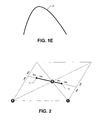
- the Bezier curve 22 is shown in FIG. 1E as it would be rendered in a computer graphics application.
- a user may be provided with an intuitive interface to facilitate, by way of example, the freehand creation of computer graphics.
- the resulting endpoints and control points can then be manipulated in a conventional manner to refine the Bezier curve as desired by the user. This technique may be applied to each point in the sequence.
- the techniques described above may be modified to handle the first and last points in a sequence.
- the control point associated with the first point and the control point associated with the last point may be set to the points themselves.
- the techniques described above may be used in a wide variety of computer-implemented systems including, for example, computer-aided design tools, graphics editors, word processors, entertainment software, and the like.
- FIG. 2 illustrates the relative positions of control points 24 and 26 with respect to the relative position of points A and B.
- control point 24 lies on a line between vectors (B-C) and (A-B). The direction of this line is determined by the ratio
- the position of control point 26 is falls along the same such line in the opposite direction with respect to point B.
- the tangent at point B is continuous for any ratio
- the computer system 30 includes a bus 32 connecting a processor 34, a memory 38, data storage 40, a display 36, and an input device 38.
- a bus 32 connecting a processor 34, a memory 38, data storage 40, a display 36, and an input device 38.
- the computer system 30 includes instructions stored in data storage 40, or on any other computer-readable medium. When executed, these instructions configure the computer system 30 to enable the processor 34 to transform a series of points stored in memory 38 into a Bezier curve and to store the Bezier curve in memory 38.
- the processor 34 displays the Bezier curve stored in memory 38 by rendering the curve in a conventional manner. Such rendered curve may be viewed using display 36.
- points are a series and are entered using a mouse, a keyboard, and/or some combination thereof.
- the input device 38 may be embodied as one or more of the following: a keyboard, a mouse, a trackball, a track pad, a gyroscopic pointing device, and the like.
- the processor 34 includes any device capable of executing instructions to convert a series of points into a Bezier curve, such as, for example, those processors commonly used in personal computers, laptops, and/or mobile devices. Furthermore, the processor 34 may include multiple cores for simultaneous and parallel execution.
- FIG. 4 there is shown a method for generating a Bezier curve from a series of points beginning at the first point in the sequence.
- This technique uses the relative positions of the point located before and the point located after a current point of interest; however, for the first point, there is no previous point in the sequence. Accordingly, the corresponding control point can either remain undefined or the control point may be set to the same location as the first point.
- the process continues by moving to the next point sequence (42). In this case, the second point of the sequence.
- the process iterates through intermediate points in the series, calculating associated control points for each.
- the process ends (44).
- the process continues by calculating control points for the current point in sequence (46).
- the process goes to the next point in the sequence (42), continuing iteratively until the last point in sequence is reached.
- a control point associated with the last point in sequence may remain undefined, or it may be set to the same location as the first point in sequence.
- This process may be performed once all points have been entered, or it may be performed sequentially as points are being entered.
- the user may click on a first point and a second point.
- the control points corresponding to the second point may be calculated, and the display updated to show a Bezier curve beginning at the first point, traveling through the second point according to the control points, and ending at the third point.
- the second point and the fourth point may be used to set the control points corresponding to the third point, and the display may be updated accordingly.
- This process may be used to generate a Bezier curve from a series of points, for example, in a computer graphics system.
- the system enables a user to define a Bezier curve by pointing a cursor to the desired location of a point on the Bezier curve and clicking a mouse button to capture that location. Points are entered consecutively in this manner until the last point is reached. The user indicates that the last point in sequence has been reached such as, for example, by clicking on the last point again, by pressing a button on a keyboard, by clicking a mouse button, or the like.
- a user creates a path consisting of a series of points connected to one another in a particular order or sequence. Once a path has been created, the user may select a menu item to convert the path into a Bezier curve. Once a Bezier curve is generated, a user may modify control points and endpoints in a conventional manner.
- software for converting a series of points into a Bezier curve includes an operating system 52 providing an environment for a process module 54 to interact with various components and peripherals of the system.
- the process module 54, the input module 56, and the display module 58 each interact with the operating system 52 and each other so as to convert a series of points 60 into a Bezier curve 62.
- the process module 54 implements a graphical user interface.
- User input is received by the operating system 52 and processed by the input module 56 to identify points in a sequence. For example, when a user moves a mouse, the operating system 52 processes the movement and displays a pointer on the display.
- the input module 56 receives and processes the input, and the process module 54 updates data structures appropriately.
- Points in a series 60 are stored on a computer-readable medium, such as, for example, random-access memory, a hard drive, flash memory, or the like.
- the memory can be located either locally or remotely to the system.
- the process module 54 retrieves the series of points 60 and calculates control points for a Bezier curve in the manner set forth above. The resulting control points are stored together with endpoints defining Bezier curve 62.
- the Bezier curve 62 may be stored as a data structure, such as that set forth in FIG. 6 .
- the Bezier Curve data structure 64 includes a data element called ptSequence of type Bezier Point 66 which identifies the first point in a sequence of points.
- Data type Bezier Point 66 includes data elements as follows: (i) "loc" of type point to indicate the coordinates of the Bezier endpoint; (ii) "next" and "prev” of type bezierPoint to indicate the next Bezier point in sequence and the previous Bezier point in sequence, respectively; and (iii) control points "ptABB" and "ptBBC" of type Point to identify the coordinates of control points.
- Data element ptABB is the control point at B corresponding to segment AB
- data element ptBBC is the control point at B corresponding to segment BC.
- the bezierCurve data structure 64 may be generated by process logic in the course of calculating control points in the manner discussed above.
- FIG. 7A shows an exemplary path 70 to be converted into a Bezier curve.
- the path 70 can be generated using an input device, such as, for example, a touch screen, a pen tablet, a mouse, a track ball, a motion sensor, a gyroscopic controller, and the like.
- Points 72 can be selected using at least three different approaches: (1) a time-based interval; (2) a distance-based interval; or (3) a feature-based interval.
- path 70 is sampled as it is received ( e.g ., from an input device).
- Periodically e.g ., every N seconds
- points 72 are then used to create a Bezier curve.
- points 72 are selected at a regular distance interval along the path 70. For example, points 72 may be identified every N inches (or any other measure of distance) along the path 70.
- the resulting points 72 are then used to create a Bezier curve.
- points 72 are identified more frequently at or near identified features of the path 70.
- points along path 70 may be identified periodically, such as by using a predetermined time interval or distance interval. Then, the vector from one identified point to the next is determined. Successive vectors can be compared and used to identify a feature. The more successive vectors differ, the more useful additional points 72 may be. Points 72 are identified such that a greater frequency of points 72 along features of the path 70. Conversely, the more regular a path 70 is, fewer points are needed to represent it.
- a Bezier curve may be created from those points 72 in the manner set forth above with respect to FIGS. 1A-1E .
- the resulting Bezier curve provides a compact representation of the original path 70.
- the path 70 may be represented as a compact series of points 72 defining a Bezier curve, resulting in significant data compression.
- a Bezier curve can be represented as a series of points 72 without associated control points, as control points may be generated, when desired, using the technique described above with respect to FIGS. 1A-1E .
- a Bezier curve is stored as a series of points without explicit representation of corresponding control points. Control points are determined when such a curve is rendered for display (or as otherwise desirable). So long as control points are not modified, it is not necessary to explicitly represent them, resulting in a compressed representation.
Landscapes
- Image Generation (AREA)
- Processing Or Creating Images (AREA)
Priority Applications (1)
| Application Number | Priority Date | Filing Date | Title |
|---|---|---|---|
| EP13003811.0A EP2667357A3 (de) | 2009-04-21 | 2010-03-31 | Erzeugung von kubischen Bézier-Kontrollpunkten in Computergrafiksystemen |
Applications Claiming Priority (1)
| Application Number | Priority Date | Filing Date | Title |
|---|---|---|---|
| US12/427,524 US8248419B2 (en) | 2009-04-21 | 2009-04-21 | Generation of cubic Bezier control points in computer graphics systems |
Related Child Applications (2)
| Application Number | Title | Priority Date | Filing Date |
|---|---|---|---|
| EP13003811.0A Division EP2667357A3 (de) | 2009-04-21 | 2010-03-31 | Erzeugung von kubischen Bézier-Kontrollpunkten in Computergrafiksystemen |
| EP13003811.0 Division-Into | 2013-07-31 |
Publications (3)
| Publication Number | Publication Date |
|---|---|
| EP2244229A2 true EP2244229A2 (de) | 2010-10-27 |
| EP2244229A3 EP2244229A3 (de) | 2011-03-02 |
| EP2244229B1 EP2244229B1 (de) | 2013-09-18 |
Family
ID=42321204
Family Applications (2)
| Application Number | Title | Priority Date | Filing Date |
|---|---|---|---|
| EP13003811.0A Withdrawn EP2667357A3 (de) | 2009-04-21 | 2010-03-31 | Erzeugung von kubischen Bézier-Kontrollpunkten in Computergrafiksystemen |
| EP10003624.3A Active EP2244229B1 (de) | 2009-04-21 | 2010-03-31 | Erzeugung von kubischen Bézier-Kontrollpunkten in Computergrafiksystemen |
Family Applications Before (1)
| Application Number | Title | Priority Date | Filing Date |
|---|---|---|---|
| EP13003811.0A Withdrawn EP2667357A3 (de) | 2009-04-21 | 2010-03-31 | Erzeugung von kubischen Bézier-Kontrollpunkten in Computergrafiksystemen |
Country Status (6)
| Country | Link |
|---|---|
| US (1) | US8248419B2 (de) |
| EP (2) | EP2667357A3 (de) |
| JP (1) | JP5033216B2 (de) |
| KR (1) | KR20100116133A (de) |
| CN (1) | CN101923725B (de) |
| TW (1) | TWI427553B (de) |
Cited By (1)
| Publication number | Priority date | Publication date | Assignee | Title |
|---|---|---|---|---|
| WO2014099536A1 (en) * | 2012-12-21 | 2014-06-26 | Citrix Systems, Inc. | Systems and methods for presenting a free-form drawing |
Families Citing this family (13)
| Publication number | Priority date | Publication date | Assignee | Title |
|---|---|---|---|---|
| US9448706B2 (en) * | 2009-07-29 | 2016-09-20 | Synopsys, Inc. | Loop removal in electronic design automation |
| WO2011061624A2 (en) * | 2009-11-19 | 2011-05-26 | Ocali Bilisim Teknolojileri Yazilim Donanim San. Tic. A.S. | Direct 3-d drawing by employing camera view constraints |
| GB2490272B (en) * | 2009-12-21 | 2014-08-06 | Promethean Ltd | Multi-point contacts with pressure data on an interactive surface |
| US20120050293A1 (en) * | 2010-08-25 | 2012-03-01 | Apple, Inc. | Dynamically smoothing a curve |
| CN102663384B (zh) * | 2012-03-31 | 2014-01-22 | 北京智安邦科技有限公司 | 基于贝塞尔控制点搜索的曲线识别方法及装置 |
| JP6028486B2 (ja) * | 2012-09-20 | 2016-11-16 | カシオ計算機株式会社 | 情報処理装置、情報処理方法、及びプログラム |
| CN104463789A (zh) * | 2013-09-12 | 2015-03-25 | 广东福地新视野光电技术有限公司 | 一种校正光学相干断层扫描图像边缘线的方法和装置 |
| CN103971101A (zh) * | 2014-05-21 | 2014-08-06 | 国家电网公司 | 一种基于贝塞尔控制点搜索的曲线识别方法 |
| TW201629839A (zh) * | 2015-02-07 | 2016-08-16 | 阿里巴巴集團服務有限公司 | 用於提供使用者設備的安全資訊的方法及設備 |
| CA3014173A1 (en) | 2016-02-12 | 2017-08-17 | Communications Systems, Inc. | Cable spool and storage |
| CN110363828A (zh) * | 2019-06-18 | 2019-10-22 | 深圳壹账通智能科技有限公司 | 一种绘制流程图的方法及绘制流程图的设备 |
| CN113961008A (zh) * | 2021-10-25 | 2022-01-21 | 上海同普电力技术有限公司 | 一种应用于agv曲线路径导航跟随方法 |
| CN117195408A (zh) * | 2023-09-19 | 2023-12-08 | 洛阳双瑞风电叶片有限公司 | 一种钝尾缘翼型参数化建模及交互式设计方法 |
Family Cites Families (18)
| Publication number | Priority date | Publication date | Assignee | Title |
|---|---|---|---|---|
| US5241654A (en) * | 1988-12-28 | 1993-08-31 | Kabushiki Kaisha Toshiba | Apparatus for generating an arbitrary parameter curve represented as an n-th order Bezier curve |
| KR930002339B1 (ko) | 1989-04-20 | 1993-03-29 | 가부시기가이샤 도시바 | 짧은 직선 벡터의 곡선 세그멘트에 3차 베지어(Bzxier)곡선을 정합시키는 방법 |
| JP3339648B2 (ja) | 1993-06-28 | 2002-10-28 | 株式会社ジャストシステム | 情報処理装置及び描画方法 |
| JP3341548B2 (ja) | 1995-11-14 | 2002-11-05 | ミノルタ株式会社 | 3次元形状データの生成方法及び処理装置 |
| US6850249B1 (en) * | 1998-04-03 | 2005-02-01 | Da Vinci Systems, Inc. | Automatic region of interest tracking for a color correction system |
| US6304677B1 (en) * | 1998-04-07 | 2001-10-16 | Adobe Systems Incorporated | Smoothing and fitting point sequences |
| US6677944B1 (en) * | 1998-04-14 | 2004-01-13 | Shima Seiki Manufacturing Limited | Three-dimensional image generating apparatus that creates a three-dimensional model from a two-dimensional image by image processing |
| JPH11345344A (ja) | 1998-06-01 | 1999-12-14 | Matsushita Electric Ind Co Ltd | 3次曲線を与える方法及び装置 |
| JP4066585B2 (ja) * | 2000-01-24 | 2008-03-26 | 株式会社日立製作所 | 図形作成方法 |
| CA2380105A1 (en) * | 2002-04-09 | 2003-10-09 | Nicholas Routhier | Process and system for encoding and playback of stereoscopic video sequences |
| JP2004295317A (ja) * | 2003-03-26 | 2004-10-21 | Just Syst Corp | 情報処理装置、描画方法およびその方法をコンピュータに実行させるプログラム |
| US20050007369A1 (en) * | 2003-07-07 | 2005-01-13 | Jiangen Cao | Graphic engine for approximating a quadratic Bezier curve in a resource-constrained device |
| GB2406028A (en) | 2003-09-11 | 2005-03-16 | Autodesk Canada Inc | Tangent handle adjustment for Bezier curves |
| US7116327B2 (en) | 2004-08-31 | 2006-10-03 | A{grave over (g)}fa Corporation | Methods for generating control points for cubic bezier curves |
| WO2007032215A1 (ja) * | 2005-09-12 | 2007-03-22 | Fujifilm Corporation | 感光性組成物、パターン形成材料、感光性積層体、並びにパターン形成装置及びパターン形成方法 |
| TWI310326B (en) * | 2005-10-11 | 2009-06-01 | Gsi Group Corp | Optical metrological scale and laser-based manufacturing method therefor |
| US7782324B2 (en) * | 2005-11-23 | 2010-08-24 | Dreamworks Animation Llc | Non-hierarchical unchained kinematic rigging technique and system for animation |
| JP2007287114A (ja) | 2006-04-19 | 2007-11-01 | Yasushi Suga | 三次ベジェ曲線入力プログラム |
-
2009
- 2009-04-21 US US12/427,524 patent/US8248419B2/en active Active
-
2010
- 2010-03-31 EP EP13003811.0A patent/EP2667357A3/de not_active Withdrawn
- 2010-03-31 EP EP10003624.3A patent/EP2244229B1/de active Active
- 2010-04-19 KR KR1020100035704A patent/KR20100116133A/ko not_active Ceased
- 2010-04-21 TW TW099112558A patent/TWI427553B/zh active
- 2010-04-21 CN CN201010170511XA patent/CN101923725B/zh active Active
- 2010-04-21 JP JP2010098109A patent/JP5033216B2/ja active Active
Non-Patent Citations (1)
| Title |
|---|
| None |
Cited By (2)
| Publication number | Priority date | Publication date | Assignee | Title |
|---|---|---|---|---|
| WO2014099536A1 (en) * | 2012-12-21 | 2014-06-26 | Citrix Systems, Inc. | Systems and methods for presenting a free-form drawing |
| US9224219B2 (en) | 2012-12-21 | 2015-12-29 | Citrix Systems, Inc. | Systems and methods for presenting a free-form drawing |
Also Published As
| Publication number | Publication date |
|---|---|
| CN101923725B (zh) | 2013-03-27 |
| TW201044313A (en) | 2010-12-16 |
| CN101923725A (zh) | 2010-12-22 |
| EP2244229B1 (de) | 2013-09-18 |
| EP2244229A3 (de) | 2011-03-02 |
| US20100265255A1 (en) | 2010-10-21 |
| JP5033216B2 (ja) | 2012-09-26 |
| EP2667357A3 (de) | 2014-01-15 |
| EP2667357A2 (de) | 2013-11-27 |
| KR20100116133A (ko) | 2010-10-29 |
| US8248419B2 (en) | 2012-08-21 |
| TWI427553B (zh) | 2014-02-21 |
| JP2010257460A (ja) | 2010-11-11 |
Similar Documents
| Publication | Publication Date | Title |
|---|---|---|
| EP2244229B1 (de) | Erzeugung von kubischen Bézier-Kontrollpunkten in Computergrafiksystemen | |
| US8584044B2 (en) | Localized thumbnail preview of related content during spatial browsing | |
| CN104423795B (zh) | 使用最大曲率来拟合参数曲线 | |
| US20090276194A1 (en) | Route curve generation system, method and storage medium | |
| JP2011129092A (ja) | 描画処理システム、サーバ装置、ユーザ端末、描画処理方法、プログラム及び記録媒体 | |
| TWI501144B (zh) | 用於資料視覺化平台性能最佳化之方法、系統及電腦可讀取媒體 | |
| US8947429B2 (en) | Gestures and tools for creating and editing solid models | |
| Johnson et al. | Bento box: An interactive and zoomable small multiples technique for visualizing 4d simulation ensembles in virtual reality | |
| WO2015096205A1 (zh) | 图表分析系统及图表分析方法 | |
| US9471150B1 (en) | Optimized gestures for zoom functionality on touch-based device | |
| US9311755B2 (en) | Self-disclosing control points | |
| KR102092979B1 (ko) | 링크의 곡률의 대화형 제어 기법 | |
| US20210019947A1 (en) | Creation authoring point tool utility to recreate equipment | |
| JP4909755B2 (ja) | 画像処理装置、画像処理方法および画像処理プログラム | |
| WO2021014532A1 (ja) | 情報処理装置、制御方法及び記憶媒体 | |
| Nuntawisuttiwong et al. | Approximating handwritten curve by using progressive-iterative approximation | |
| US20120223949A1 (en) | Systems and methods for interactive vectorization | |
| US9472024B2 (en) | Computer-implemented method for designing a three-dimensional modeled object | |
| JP2002123288A (ja) | 携帯電話、ユーザインタフェース装置、コンテンツ表示方法、記憶媒体 | |
| CN112686948A (zh) | 编辑器操作方法、装置和电子设备 | |
| CN110162251B (zh) | 图像缩放方法及装置、存储介质、电子设备 | |
| JP2008003825A (ja) | 線形状処理装置、線形状処理方法、ならびに、プログラム | |
| US7046241B2 (en) | Oriented three-dimensional editing glyphs | |
| US20200293183A1 (en) | Methods and Devices for Capturing Heuristic Information via a Weighting Tool | |
| US10613722B1 (en) | Distorting a graph on a computer display to improve the computer's ability to display the graph to, and interact with, a user |
Legal Events
| Date | Code | Title | Description |
|---|---|---|---|
| PUAI | Public reference made under article 153(3) epc to a published international application that has entered the european phase |
Free format text: ORIGINAL CODE: 0009012 |
|
| AK | Designated contracting states |
Kind code of ref document: A2 Designated state(s): AT BE BG CH CY CZ DE DK EE ES FI FR GB GR HR HU IE IS IT LI LT LU LV MC MK MT NL NO PL PT RO SE SI SK SM TR |
|
| AX | Request for extension of the european patent |
Extension state: AL BA ME RS |
|
| PUAL | Search report despatched |
Free format text: ORIGINAL CODE: 0009013 |
|
| AK | Designated contracting states |
Kind code of ref document: A3 Designated state(s): AT BE BG CH CY CZ DE DK EE ES FI FR GB GR HR HU IE IS IT LI LT LU LV MC MK MT NL NO PL PT RO SE SI SK SM TR |
|
| AX | Request for extension of the european patent |
Extension state: AL BA ME RS |
|
| 17P | Request for examination filed |
Effective date: 20110808 |
|
| 17Q | First examination report despatched |
Effective date: 20111014 |
|
| GRAP | Despatch of communication of intention to grant a patent |
Free format text: ORIGINAL CODE: EPIDOSNIGR1 |
|
| INTG | Intention to grant announced |
Effective date: 20130408 |
|
| RAP1 | Party data changed (applicant data changed or rights of an application transferred) |
Owner name: SONY COMPUTER ENTERTAINMENT INCORPORATED |
|
| RAP1 | Party data changed (applicant data changed or rights of an application transferred) |
Owner name: SONY COMPUTER ENTERTAINMENT INC. |
|
| GRAS | Grant fee paid |
Free format text: ORIGINAL CODE: EPIDOSNIGR3 |
|
| GRAA | (expected) grant |
Free format text: ORIGINAL CODE: 0009210 |
|
| AK | Designated contracting states |
Kind code of ref document: B1 Designated state(s): AT BE BG CH CY CZ DE DK EE ES FI FR GB GR HR HU IE IS IT LI LT LU LV MC MK MT NL NO PL PT RO SE SI SK SM TR |
|
| REG | Reference to a national code |
Ref country code: GB Ref legal event code: FG4D |
|
| REG | Reference to a national code |
Ref country code: CH Ref legal event code: EP |
|
| REG | Reference to a national code |
Ref country code: IE Ref legal event code: FG4D |
|
| REG | Reference to a national code |
Ref country code: AT Ref legal event code: REF Ref document number: 633125 Country of ref document: AT Kind code of ref document: T Effective date: 20131015 |
|
| REG | Reference to a national code |
Ref country code: DE Ref legal event code: R096 Ref document number: 602010010291 Country of ref document: DE Effective date: 20131114 |
|
| PG25 | Lapsed in a contracting state [announced via postgrant information from national office to epo] |
Ref country code: SE Free format text: LAPSE BECAUSE OF FAILURE TO SUBMIT A TRANSLATION OF THE DESCRIPTION OR TO PAY THE FEE WITHIN THE PRESCRIBED TIME-LIMIT Effective date: 20130918 Ref country code: HR Free format text: LAPSE BECAUSE OF FAILURE TO SUBMIT A TRANSLATION OF THE DESCRIPTION OR TO PAY THE FEE WITHIN THE PRESCRIBED TIME-LIMIT Effective date: 20130918 Ref country code: CY Free format text: LAPSE BECAUSE OF FAILURE TO SUBMIT A TRANSLATION OF THE DESCRIPTION OR TO PAY THE FEE WITHIN THE PRESCRIBED TIME-LIMIT Effective date: 20130710 Ref country code: NO Free format text: LAPSE BECAUSE OF FAILURE TO SUBMIT A TRANSLATION OF THE DESCRIPTION OR TO PAY THE FEE WITHIN THE PRESCRIBED TIME-LIMIT Effective date: 20131218 Ref country code: LT Free format text: LAPSE BECAUSE OF FAILURE TO SUBMIT A TRANSLATION OF THE DESCRIPTION OR TO PAY THE FEE WITHIN THE PRESCRIBED TIME-LIMIT Effective date: 20130918 |
|
| REG | Reference to a national code |
Ref country code: NL Ref legal event code: VDEP Effective date: 20130918 |
|
| REG | Reference to a national code |
Ref country code: AT Ref legal event code: MK05 Ref document number: 633125 Country of ref document: AT Kind code of ref document: T Effective date: 20130918 |
|
| REG | Reference to a national code |
Ref country code: LT Ref legal event code: MG4D |
|
| PG25 | Lapsed in a contracting state [announced via postgrant information from national office to epo] |
Ref country code: GR Free format text: LAPSE BECAUSE OF FAILURE TO SUBMIT A TRANSLATION OF THE DESCRIPTION OR TO PAY THE FEE WITHIN THE PRESCRIBED TIME-LIMIT Effective date: 20131219 Ref country code: FI Free format text: LAPSE BECAUSE OF FAILURE TO SUBMIT A TRANSLATION OF THE DESCRIPTION OR TO PAY THE FEE WITHIN THE PRESCRIBED TIME-LIMIT Effective date: 20130918 Ref country code: SI Free format text: LAPSE BECAUSE OF FAILURE TO SUBMIT A TRANSLATION OF THE DESCRIPTION OR TO PAY THE FEE WITHIN THE PRESCRIBED TIME-LIMIT Effective date: 20130918 Ref country code: LV Free format text: LAPSE BECAUSE OF FAILURE TO SUBMIT A TRANSLATION OF THE DESCRIPTION OR TO PAY THE FEE WITHIN THE PRESCRIBED TIME-LIMIT Effective date: 20130918 |
|
| PG25 | Lapsed in a contracting state [announced via postgrant information from national office to epo] |
Ref country code: BE Free format text: LAPSE BECAUSE OF FAILURE TO SUBMIT A TRANSLATION OF THE DESCRIPTION OR TO PAY THE FEE WITHIN THE PRESCRIBED TIME-LIMIT Effective date: 20130918 Ref country code: CY Free format text: LAPSE BECAUSE OF FAILURE TO SUBMIT A TRANSLATION OF THE DESCRIPTION OR TO PAY THE FEE WITHIN THE PRESCRIBED TIME-LIMIT Effective date: 20130918 |
|
| PG25 | Lapsed in a contracting state [announced via postgrant information from national office to epo] |
Ref country code: EE Free format text: LAPSE BECAUSE OF FAILURE TO SUBMIT A TRANSLATION OF THE DESCRIPTION OR TO PAY THE FEE WITHIN THE PRESCRIBED TIME-LIMIT Effective date: 20130918 Ref country code: NL Free format text: LAPSE BECAUSE OF FAILURE TO SUBMIT A TRANSLATION OF THE DESCRIPTION OR TO PAY THE FEE WITHIN THE PRESCRIBED TIME-LIMIT Effective date: 20130918 Ref country code: CZ Free format text: LAPSE BECAUSE OF FAILURE TO SUBMIT A TRANSLATION OF THE DESCRIPTION OR TO PAY THE FEE WITHIN THE PRESCRIBED TIME-LIMIT Effective date: 20130918 Ref country code: SK Free format text: LAPSE BECAUSE OF FAILURE TO SUBMIT A TRANSLATION OF THE DESCRIPTION OR TO PAY THE FEE WITHIN THE PRESCRIBED TIME-LIMIT Effective date: 20130918 Ref country code: IS Free format text: LAPSE BECAUSE OF FAILURE TO SUBMIT A TRANSLATION OF THE DESCRIPTION OR TO PAY THE FEE WITHIN THE PRESCRIBED TIME-LIMIT Effective date: 20140118 |
|
| PG25 | Lapsed in a contracting state [announced via postgrant information from national office to epo] |
Ref country code: ES Free format text: LAPSE BECAUSE OF FAILURE TO SUBMIT A TRANSLATION OF THE DESCRIPTION OR TO PAY THE FEE WITHIN THE PRESCRIBED TIME-LIMIT Effective date: 20130918 Ref country code: PL Free format text: LAPSE BECAUSE OF FAILURE TO SUBMIT A TRANSLATION OF THE DESCRIPTION OR TO PAY THE FEE WITHIN THE PRESCRIBED TIME-LIMIT Effective date: 20130918 Ref country code: AT Free format text: LAPSE BECAUSE OF FAILURE TO SUBMIT A TRANSLATION OF THE DESCRIPTION OR TO PAY THE FEE WITHIN THE PRESCRIBED TIME-LIMIT Effective date: 20130918 |
|
| REG | Reference to a national code |
Ref country code: DE Ref legal event code: R097 Ref document number: 602010010291 Country of ref document: DE |
|
| PG25 | Lapsed in a contracting state [announced via postgrant information from national office to epo] |
Ref country code: PT Free format text: LAPSE BECAUSE OF FAILURE TO SUBMIT A TRANSLATION OF THE DESCRIPTION OR TO PAY THE FEE WITHIN THE PRESCRIBED TIME-LIMIT Effective date: 20140120 |
|
| PLBE | No opposition filed within time limit |
Free format text: ORIGINAL CODE: 0009261 |
|
| STAA | Information on the status of an ep patent application or granted ep patent |
Free format text: STATUS: NO OPPOSITION FILED WITHIN TIME LIMIT |
|
| 26N | No opposition filed |
Effective date: 20140619 |
|
| PG25 | Lapsed in a contracting state [announced via postgrant information from national office to epo] |
Ref country code: IT Free format text: LAPSE BECAUSE OF FAILURE TO SUBMIT A TRANSLATION OF THE DESCRIPTION OR TO PAY THE FEE WITHIN THE PRESCRIBED TIME-LIMIT Effective date: 20130918 |
|
| PG25 | Lapsed in a contracting state [announced via postgrant information from national office to epo] |
Ref country code: DK Free format text: LAPSE BECAUSE OF FAILURE TO SUBMIT A TRANSLATION OF THE DESCRIPTION OR TO PAY THE FEE WITHIN THE PRESCRIBED TIME-LIMIT Effective date: 20130918 |
|
| REG | Reference to a national code |
Ref country code: DE Ref legal event code: R097 Ref document number: 602010010291 Country of ref document: DE Effective date: 20140619 |
|
| PG25 | Lapsed in a contracting state [announced via postgrant information from national office to epo] |
Ref country code: LU Free format text: LAPSE BECAUSE OF FAILURE TO SUBMIT A TRANSLATION OF THE DESCRIPTION OR TO PAY THE FEE WITHIN THE PRESCRIBED TIME-LIMIT Effective date: 20140331 |
|
| REG | Reference to a national code |
Ref country code: CH Ref legal event code: PL |
|
| REG | Reference to a national code |
Ref country code: IE Ref legal event code: MM4A |
|
| PG25 | Lapsed in a contracting state [announced via postgrant information from national office to epo] |
Ref country code: IE Free format text: LAPSE BECAUSE OF NON-PAYMENT OF DUE FEES Effective date: 20140331 Ref country code: LI Free format text: LAPSE BECAUSE OF NON-PAYMENT OF DUE FEES Effective date: 20140331 Ref country code: CH Free format text: LAPSE BECAUSE OF NON-PAYMENT OF DUE FEES Effective date: 20140331 |
|
| PG25 | Lapsed in a contracting state [announced via postgrant information from national office to epo] |
Ref country code: MT Free format text: LAPSE BECAUSE OF FAILURE TO SUBMIT A TRANSLATION OF THE DESCRIPTION OR TO PAY THE FEE WITHIN THE PRESCRIBED TIME-LIMIT Effective date: 20130918 |
|
| REG | Reference to a national code |
Ref country code: FR Ref legal event code: PLFP Year of fee payment: 7 |
|
| PG25 | Lapsed in a contracting state [announced via postgrant information from national office to epo] |
Ref country code: SM Free format text: LAPSE BECAUSE OF FAILURE TO SUBMIT A TRANSLATION OF THE DESCRIPTION OR TO PAY THE FEE WITHIN THE PRESCRIBED TIME-LIMIT Effective date: 20130918 |
|
| PG25 | Lapsed in a contracting state [announced via postgrant information from national office to epo] |
Ref country code: MC Free format text: LAPSE BECAUSE OF FAILURE TO SUBMIT A TRANSLATION OF THE DESCRIPTION OR TO PAY THE FEE WITHIN THE PRESCRIBED TIME-LIMIT Effective date: 20130918 Ref country code: RO Free format text: LAPSE BECAUSE OF FAILURE TO SUBMIT A TRANSLATION OF THE DESCRIPTION OR TO PAY THE FEE WITHIN THE PRESCRIBED TIME-LIMIT Effective date: 20130918 |
|
| PG25 | Lapsed in a contracting state [announced via postgrant information from national office to epo] |
Ref country code: BG Free format text: LAPSE BECAUSE OF FAILURE TO SUBMIT A TRANSLATION OF THE DESCRIPTION OR TO PAY THE FEE WITHIN THE PRESCRIBED TIME-LIMIT Effective date: 20130918 |
|
| PG25 | Lapsed in a contracting state [announced via postgrant information from national office to epo] |
Ref country code: TR Free format text: LAPSE BECAUSE OF FAILURE TO SUBMIT A TRANSLATION OF THE DESCRIPTION OR TO PAY THE FEE WITHIN THE PRESCRIBED TIME-LIMIT Effective date: 20130918 Ref country code: HU Free format text: LAPSE BECAUSE OF FAILURE TO SUBMIT A TRANSLATION OF THE DESCRIPTION OR TO PAY THE FEE WITHIN THE PRESCRIBED TIME-LIMIT; INVALID AB INITIO Effective date: 20100331 |
|
| REG | Reference to a national code |
Ref country code: FR Ref legal event code: PLFP Year of fee payment: 8 |
|
| REG | Reference to a national code |
Ref country code: FR Ref legal event code: PLFP Year of fee payment: 9 |
|
| PG25 | Lapsed in a contracting state [announced via postgrant information from national office to epo] |
Ref country code: MK Free format text: LAPSE BECAUSE OF FAILURE TO SUBMIT A TRANSLATION OF THE DESCRIPTION OR TO PAY THE FEE WITHIN THE PRESCRIBED TIME-LIMIT Effective date: 20130918 |
|
| P01 | Opt-out of the competence of the unified patent court (upc) registered |
Effective date: 20230519 |
|
| P02 | Opt-out of the competence of the unified patent court (upc) changed |
Effective date: 20230527 |
|
| PGFP | Annual fee paid to national office [announced via postgrant information from national office to epo] |
Ref country code: DE Payment date: 20250218 Year of fee payment: 16 |
|
| PGFP | Annual fee paid to national office [announced via postgrant information from national office to epo] |
Ref country code: FR Payment date: 20250218 Year of fee payment: 16 |
|
| PGFP | Annual fee paid to national office [announced via postgrant information from national office to epo] |
Ref country code: GB Payment date: 20250221 Year of fee payment: 16 |