EP2203072B1 - Verfahren zum trocknen von teigwaren - Google Patents
Verfahren zum trocknen von teigwaren Download PDFInfo
- Publication number
- EP2203072B1 EP2203072B1 EP09761754A EP09761754A EP2203072B1 EP 2203072 B1 EP2203072 B1 EP 2203072B1 EP 09761754 A EP09761754 A EP 09761754A EP 09761754 A EP09761754 A EP 09761754A EP 2203072 B1 EP2203072 B1 EP 2203072B1
- Authority
- EP
- European Patent Office
- Prior art keywords
- temperature
- drying
- moisture
- glass transition
- raw pasta
- Prior art date
- Legal status (The legal status is an assumption and is not a legal conclusion. Google has not performed a legal analysis and makes no representation as to the accuracy of the status listed.)
- Active
Links
Images

Classifications
-
- F—MECHANICAL ENGINEERING; LIGHTING; HEATING; WEAPONS; BLASTING
- F26—DRYING
- F26B—DRYING SOLID MATERIALS OR OBJECTS BY REMOVING LIQUID THEREFROM
- F26B25/00—Details of general application not covered by group F26B21/00 or F26B23/00
- F26B25/22—Controlling the drying process in dependence on liquid content of solid materials or objects
-
- A—HUMAN NECESSITIES
- A21—BAKING; EDIBLE DOUGHS
- A21C—MACHINES OR EQUIPMENT FOR MAKING OR PROCESSING DOUGHS; HANDLING BAKED ARTICLES MADE FROM DOUGH
- A21C9/00—Other apparatus for handling dough or dough pieces
-
- A—HUMAN NECESSITIES
- A23—FOODS OR FOODSTUFFS; TREATMENT THEREOF, NOT COVERED BY OTHER CLASSES
- A23L—FOODS, FOODSTUFFS OR NON-ALCOHOLIC BEVERAGES, NOT OTHERWISE PROVIDED FOR; PREPARATION OR TREATMENT THEREOF
- A23L7/00—Cereal-derived products; Malt products; Preparation or treatment thereof
- A23L7/10—Cereal-derived products
- A23L7/109—Types of pasta, e.g. macaroni or noodles
Definitions
- the invention relates to a method and an apparatus for drying pasta.
- Pasta can e.g. by mixing and kneading raw materials and water into a raw dough, transforming the raw dough into raw dough forms and then drying the raw dough pieces.
- the invention has for its object to produce dried pasta of the highest quality, in particular without undesirable deformations, cracks and excessive discoloration in the shortest possible time, especially with significantly shortened drying process. This object is achieved according to the invention with the method and the device according to the independent claims.
- the pasta present as a raw dough product undergoes states on the surface during the drying process which have different pairs of values from the temperature of the surface and moisture of the surface.
- At least a partial area, preferably the entire surface of the raw dough structures remains in a viscoelastic state during at least part of the drying process, preferably during the entire drying process, in which a diagram shows the temperature of the surface of the raw dough structure and moisture of the surface of the raw dough.
- the temperature of the surface of the dough sheet is not more than 40 ° C above the temperature on the glass transition curve of the dough in the same moisture content of the surface, preferably not more than 30 ° C, more preferably not more than 20 ° C; and / or b) the moisture content of the surface of the dough sheet is not more than 20% higher than the moisture on the glass transition curve of the dough at the same temperature of the surface, preferably not more than 15%, more preferably not more than 10%.
- the surface of the raw dough structures passes through states which have different temperature / humidity value pairs, wherein the passing through of these states takes place by increasing the temperature of the surface and decreasing the moisture of the surface.
- the surface of the raw dough structures are always within a defined bandwidth above the glass transition curve.
- the glass transition temperature is understood here to mean the temperature at which a material has the greatest change in the deformability. Below the glass transition temperature, the material behaves brittle and above viscoelastic. The viscoelasticity is characterized by a partially elastic, partially viscous behavior. The material relaxes only incompletely after removal of the external force, the remaining energy is dissipated in the form of flow processes (retardation).
- the term glass transition temperature as used herein refers macroscopically to the raw dough structure as a whole and not to individual microscopic constituents thereof.
- the moisture, ie the water content, of a raw dough decreases, its glass transition temperature increases. If the glass transition temperature is then measured for a raw dough at different humidities and this is entered in a temperature / humidity diagram, a glass transition curve is obtained for this raw dough.
- an equilibrium temperature and humidity is established on the surface of the raw dough structure.
- This equilibrium temperature and humidity of the surface can be controlled or controlled so as to minimize the drying time. This minimization is achieved by aiming for the lowest possible equilibrium moisture content of the pasta surface as quickly as possible. This is done by the appropriate choice of the drying air temperature and / or humidity below the condition that the surface remains in the viscoelastic state (not embrittled).
- a glass transition curve in the temperature / humidity diagram (T / U diagram) of the raw dough structure is provided for the method.
- the measurement of the glass transition curve is carried out by means of known measuring methods such as DMTA (dynamic mechanical thermal analysis); also a measurement by means of DSC (differential scanning calorimetry) is possible. It is important that the measurement is carried out on a homogeneous raw dough, so that the transition curve as possible the reproducibility of the entire Roh annoying-structure reproduced and not just individual microscopic components; therefore the measurement by DMTA is preferred.
- moisture equilibrium is monitored at the surface of the dough forms.
- the temperature / humidity value pairs of the surface of the raw dough structures are controlled or regulated in such a way that the glass transition curve in a diagram of temperature of the surface and moisture of the surface is not undershot into the glassy region.
- the equilibrium moisture U at the surface of the raw dough structure is monitored. It is the moisture on the surface of the dough pieces. This surface moisture is impressed on the raw dough forms by the surrounding drying climate and forms one of the boundary conditions (gas temperature, water vapor partial pressure) for the moisture gradient which occurs during drying inside the raw dough formations.
- the humidities U are given as (mass of the water in the product) / (total mass of the hydrous product).
- the drying climate is preferably an air atmosphere with defined air temperature and defined relative humidity. If required, it is also possible to work with other gases, in particular oxygen-free or oxygen-poor inert gases, as drying climate.
- the gases are nitrogen or carbon dioxide and mixtures of these with a defined partial pressure or molar fraction of water vapor contained therein.
- Ug parallel to the moisture axis U (weight% water / total weight of the dough forms) of the temperature / humidity diagram have.
- the minimum distance is preferably in the range 0.5% ⁇ U min ⁇ 5%, more preferably in the range 1% ⁇ U min ⁇ 3.5% and most preferably in the range 1.5% ⁇ U min ⁇ 2.5%.
- T / U temperature / humidity diagram
- the minimum distance is in the range 1K ⁇ T min ⁇ 10K, and more preferably in the range 1K ⁇ T min ⁇ 5K.
- T / U temperature / humidity
- the maximum distance is preferably in the range 10K ⁇ T max ⁇ 40K and more preferably in the range 10K ⁇ T max ⁇ 30K.
- the glass transition curve in the temperature / humidity (T / U) plot of the present raw dough material is provided by measurements on samples of raw dough before and / or during drying.
- the necessary sampling and measurements can be carried out online or offline.
- Moistures and / or temperatures are determined on the samples, which are the homogeneous moisture or homogeneous temperature in the entire volume of the sample taken, after the moisture and temperature gradients present at the time of sampling have degraded within the sample.
- the required glass transition curve in the temperature / humidity (T / U) plot of the present raw dough material can be provided from a library in which glass transition data and raw dough recipe data are provided.
- the determination of the glass transitions in the samples can be carried out by DSC measurements or DMTA measurements familiar to the person skilled in the art.
- the relative humidity and / or the temperature of the drying environment of the raw dough structures is controlled or regulated such that at least in partial areas of the surface of the dough forms a glass transition from the viscoelastic state is prevented in the glassy state.
- the transfer to the glass area is prevented by controlling the relative humidity of the drying climate at any temperature during the drying process.
- the raw dough forms are prevented from passing into the glass area by controlling the relative humidity and / or the temperature of the drying climate during the entire drying process. Preferably, this is prevented for at least 90% and more preferably for at least 95% of the total duration of the drying process. This should be the case for at least 80% of the total surface of the dough pieces. It is particularly advantageous if the partial surface not present in the glassy state is at least 90% and more preferably at least 95% of the total surface area of the raw dough structure.
- the relative humidity of the drying environment is maintained below 98%, preferably 95%, more preferably 92%, and most preferably below 89%. This reduces the risk of condensation effects, which can lead to undesirable adhesion of the dough pieces during the drying process. In addition, this also has a positive influence on the drying kinetics.
- a large part of the volume, preferably the entire volume, or at least the entire surface of the raw dough structures is in a viscoelastic state beyond the glass transition of the raw dough material. It is particularly preferred if, during the entire period of the drying process, the raw dough structures have a viscoelastic state beyond the glass transition. Preferably, only at the end of the drying process should the rapid cooling of the dried raw dough structure to ambient temperature make the glass transition to the glassy state go below.
- the temperature T is kept below 150 ° C during drying, and preferably below 120 ° C. This prevents Maillard reactions in the raw dough forms and thus excessive discoloration during drying.
- the total time t tot of drying is kept below 280 minutes, more preferably below 240 minutes, even more preferably below 200 minutes, and preferably below 180 minutes. Even with a total duration t tot less than 160 min, good results are possible. In the process according to the invention, this is sufficient for complete drying from an initial moisture content after extrusion to a final moisture content after drying and enables energy-saving drying.
- the time integral of the temporal temperature curve T (t) (in ° C) over the total drying time t tot is less than 20 ⁇ 10 3 min ° C and preferably less than 15 ⁇ 10 3 min ° C. This also contributes to the prevention of discoloration caused by drying and makes it possible to keep the drying energy expenditure low and still avoid falling below the glass transition in the glassy state during drying.
- the raw dough forms may be moved relative to each other during the drying process and / or kept relatively spaced. As a result, bonds between the dough pieces are prevented from each other.
- the dough forms may be long products (e.g., spaghetti), donrdashery (e.g., spirals), or special formats (e.g., Nidi).
- the long goods are suspended on rods spaced apart from each other during the drying process, wherein the suspended long goods are easily offset during the drying process in phase-displaced oscillations with its suspension point as a fulcrum.
- the Vietnameserdashery are moved during the drying process by means of a vibrating bottom and / or fluidized by means of a gas flow.
- both the surface and the interior of the pasta remain in a visco-elastic, ie non-vitreous, state until the midpoint during the entire drying process, ie during the so-called predrying, main drying and stabilization.
- a higher drying speed or a faster drying saturation Since there is no glass transition, there is no risk of cracking in the pasta.
- the surface and interior or center of the pasta when dry, will reach the moisture content in equilibrium with the surrounding air. Thus, a humidification is unnecessary in the stabilization step.
- An apparatus according to the invention for drying pasta according to a method described above comprises at least one temperature sensor and at least one moisture sensor for determining the temperature and the humidity of the drying climate.
- the at least one temperature sensor and humidity sensor is assigned a control unit or control unit which is programmed or programmable such that the drying of pasta according to the method described above is enabled.
- a library may be connected or connectable to the control unit or the control unit, in which glass transition data and raw dough data, in particular glass transition data, of raw doughs are provided.
- a further, non-inventive aspect relates to a method for operating a device as described above, wherein the device is controlled or regulated so that when intended Use of the apparatus for drying raw dough forms with a maximum thickness of ⁇ 2 mm and / or a maximum wall thickness of ⁇ 1.75 mm a total time t tot of the drying process of less than 280 min, preferably less than 200 min, more preferably less than 160 min results.
- Table 1 shows drying conditions that can be applied in a drying plant according to the invention.
- Table 1 Condition of the surface of the dough pieces T [° C] 1 RF [%] 1 t [min] Condition in T / U diagram according to Fig. 1 and 2 viscoelastic 50 88 8th A viscoelastic 55 86 8th Transition A-> B viscoelastic 60 84.5 8th Transition A-> B viscoelastic 65 83 8th Transition A-> B viscoelastic 70 82 8th Transition A-> B viscoelastic 75 80 8th Transition A-> B viscoelastic 80 77 8th Transition A-> B viscoelastic 90 71 8th Studentsqanq A-> B viscoelastic 95 66 8th Transition A-> B viscoelastic 97 63 35 B viscoelastic 90 80 45 C 1 based on the conditioned air before flowing through the product space
- the pasta mentioned in this example was made from commercial durum wheat semolina at a water content of 31g / 100g total weight in a suitable pasta extrusion line for spaghetti format using a pasta shape (hole diameter 1.75mm).
- the pressed and hung on bars pasta was transferred to the drying plant, in which by means of convective drying with conditioned air, the drying was accomplished.
- the conditions of this drying air (temperature T and relative humidity RH) were applied over the total drying time of 152 minutes according to the set values given in the table.
- the total drying time is the sum of the residence times t (see 3rd column of the table) for each climate (T / RF combination, see column 1 and column 2 of the table).
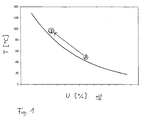
- FIG. 1 a glass transition curve in a temperature / humidity diagram is exemplified.
- the temperature T of the surface of the raw dough structure is plotted against the equilibrium moisture U of the surface of the raw dough structure, stated in percent by weight based on the total weight of the raw dough structure.
- the glass transition temperature decreases.
- raw dough formations having a surface in the temperature / moisture state A are brought into the first treatment zone.
- the dough forms are gradually brought into the temperature / humidity state B.
- the drying climate maintains the equilibrium moisture content of the surface of the dough pieces above the glass transition curve.
- the surface of the raw dough pieces is kept for a long time in the temperature / humidity state B. Because the surface remains in the viscoelastic state, the moisture contained in the dough forms can diffuse particularly well to and pass through the surface.
- FIG. 2 is opposite FIG. 1 additionally a final step of the stabilization of the raw dough structures shown, in which the surface of the dough forms is held for a long time in the temperature / humidity state C. This serves to standardize the moisture over the entire thickness of the raw dough-structure.
Landscapes
- Engineering & Computer Science (AREA)
- Life Sciences & Earth Sciences (AREA)
- Food Science & Technology (AREA)
- Mechanical Engineering (AREA)
- General Engineering & Computer Science (AREA)
- Health & Medical Sciences (AREA)
- Nutrition Science (AREA)
- Chemical & Material Sciences (AREA)
- Polymers & Plastics (AREA)
- Noodles (AREA)
- Drying Of Solid Materials (AREA)
Description
- Die Erfindung betrifft ein Verfahren sowie eine Vorrichtung zum Trocknen von Teigwaren.
- Teigwaren können z.B. durch Mischen und Kneten von Rohmaterialien und Wasser zu einem Rohteig, Umformen des Rohteigs zu Rohteig-Gebilden und anschliessendes Trocknen der Rohteig-Gebilde hergestellt werden.
- Beim Trocknen von Teigwaren ist besonders darauf zu achten, dass die Rohteig-Gebilde während des Trocknungsvorgangs keine negativen Beeinträchtigungen wie Rissbildung und/oder zu starke Verfärbungen erfahren.
- Ein zu starkes und schnelles Trocknen bei hoher Temperatur, niedriger relativer Luftfeuchtigkeit und starker Luftumwälzung (hohe Trocknungsleistung) verursacht Schwindungsspannungen, die in der Regel zu Verformungen, Rissen oder Sprüngen in den Teigwaren während oder nach deren Trocknung führen. Auf diese Weise getrocknete Teigwaren Zerfallen dann beim Kochen leicht in Einzelstücke.
- Darüber hinaus werden durch eine derartig "aggressive" Trocknung Maillard-Reaktionen an den Teigwaren während ihres Trocknens begünstigt, wodurch die erwähnten Verfärbungen entstehen. Ausserdem sind die bisher erzielten Trocknungszeiten bei der Teigwarenherstellung immer noch unbefriedigend lang. Dokument
DE 10 2005 038 990 A1 offenbart Verfahren zum Trocknen von Reis und Teigwaren. Dort wurde erkannt, dass die Feuchtig- keit im Produkt ausgeglichen und die viskosen Spannungen abgebaut werden müssen, damit keine Risse entstehen. Unter anderem wird ein Verfahren zum Trocknen von Reis beschrieben, bei dem die Temperatur in den Trocknungsstufen von 90 °C auf 30 °C sinkt. InEP 129 892 A2 - Der Erfindung liegt die Aufgabe zugrunde, getrocknete Teigwaren höchster Qualität, insbesondere ohne unerwünschte Verformungen, Risse und zu starke Verfärbungen, in möglichst kurzer Zeit, insbesondere mit markant verkürztem Trocknungsvorgang, herzustellen. Diese Aufgabe wird erfindungsgemäss mit dem Verfahren und der Vorrichtung gemäss den unabhängigen Patentansprüchen gelöst.
- Bei dem erfindungsgemässen Verfahren zum Trocknen von Teigwaren durchlaufen die als Rohteig-Gebilde vorliegenden Teigwaren während des Trocknungsvorgangs Zustände an der Oberfläche, die verschiedene Wertepaare aus Temperatur der Oberfläche und Feuchtigkeit der Oberfläche aufweisen. Zumindest ein Teilbereich, vorzugsweise die gesamte Oberfläche der Rohteig-Gebilde bleibt während mindestens eines Teils des Trocknungsvorgangs, vorzugsweise während des gesamten Trocknungsvorgangs in einem viskoelastischen Zustand, bei welchem in einem Diagramm aus Temperatur der Oberfläche des Rohteig-Gebildes und Feuchtigkeit der Oberfläche des Rohteig-Gebildes a) die Temperatur der Oberfläche des Rohteig-Gebildes nicht mehr als 40°C über der Temperatur auf der Glasübergangskurve des Rohteigs im Punkt gleicher Feuchtigkeit der Oberfläche liegt, vorzugsweise nicht mehr als 30°C, besonders bevorzugt nicht mehr als 20°C; und/oder b) die Feuchtigkeit der Oberfläche des Rohteig-Gebildes nicht mehr als 20% über der Feuchtigkeit auf der Glasübergangskurve des Rohteigs im Punkt gleicher Temperatur der Oberfläche liegt, vorzugsweise nicht mehr als 15%, besonders bevorzugt nicht mehr als 10%.
- Dadurch lässt sich nicht nur das Ausmass von Schwindungsspannungen und von Maillard-Reaktionen während des Trocknungsvorgangs verringern, so dass die derart hergestellten Trocken-Teigwaren keine Risse und keine Verformungen aufweisen, sondern man erreicht auch eine deutliche Verkürzung der Dauer des Trocknungsvorgangs.
- Erfindungsgemäss durchläuft die Oberfläche der Rohteig-Gebilde während des Trocknungsvorgangs Zustände, die verschiedene Temperatur-/Feuchtigkeitswertepaare aufweisen, wobei das Durchlaufen dieser Zustände unter Erhöhung der Temperatur der Oberfläche und Abnahme der Feuchtigkeit der Oberfläche erfolgt.
- Die Temperatur / Feuchtigkeits-Zustände der Oberfläche der Rohteig-Gebilde befinden sich demnach immer innerhalb einer definierten Bandbreite oberhalb der Glasübergangskurve.
- Als Glasübergangstemperatur wird hier die Temperatur verstanden, bei der ein Material die grösste Änderung der Verformungsfähigkeit aufweist. Unterhalb der Glastemperatur verhält sich das Material spröde und oberhalb viskoelastisch. Die Viskoelastizität ist durch ein teilweise elastisches, teilweise viskoses Verhalten geprägt. Das Material relaxiert nach Entfernen der externen Kraft nur unvollständig, die verbleibende Energie wird in Form von Fließvorgängen (Retardation) abgebaut. Der hier verwendete Begriff Glasübergangstemperatur bezieht sich makroskopisch auf das Rohteig-Gebilde als ganzes und nicht auf einzelne mikroskopische Bestandteile desselben.
- Nimmt die Feuchtigkeit, also der Wassergehalt, eines Rohteigs ab, so steigt dessen Glasübergangstemperatur. Wird nun bei einem Rohteig bei verschiedenen Feuchtigkeiten die Glasübergangstemperatur gemessen und diese in einem Temperatur / Feuchtigkeitsdiagramm eingetragen, erhält man für diesen Rohteig eine Glasübergangskurve.
- Wenn die Umgebungsluft eines Rohteig-Gebildes eine andere Temperatur und/oder Feuchtigkeit aufweist als der Rohteig, stellt sich auf der Oberfläche des Rohteig-Gebildes eine Gleichgewichtstemperatur und -feuchtigkeit ein. Diese Gleichgewichtstemperatur und -feuchtigkeit der Oberfläche kann derart gesteuert oder geregelt werden, dass die Trocknungszeit minimiert wird. Diese Minimierung wird erreicht, indem möglichst schnell eine geringstmögliche Gleichgewichtsfeuchtigkeit der Teigwarenoberfläche angestrebt wird. Dies geschieht durch die entsprechende Wahl der Trocknungslufttemperatur und/oder -feuchtigkeit unter der Voraussetzung, dass die Oberfläche im viskoelastischen Zustand verbleibt (nicht versprödet).
- Vorzugsweise wird für das Verfahren eine Glasübergangskurve im Temperatur/Feuchtigkeits-Diagramm (T/U-Diagramm) des Rohteig-Gebildes bereitgestellt. Die Messung der Glasübergangskurve erfolgt dabei mittels bekannter Messverfahren wie DMTA (dynamic mechanical thermal analysis); auch eine Messung mittels DSC (differential scanning calorimetry) ist möglich. Wichtig dabei ist, dass die Messung an einem homogenen Rohteig erfolgt, damit die Übergangskurve möglichst die Verformungsfähigkeit des gesamten Rohteig-Gebildes wiedergibt und nicht nur einzelner mikroskopischer Bestandteile; daher ist die Messung mittels DMTA bevorzugt.
- Vorzugsweise wird beim Trocknen die Gleichgewichtsfeuchtigkeit an der Oberfläche der Rohteig-Gebilde überwacht.
- Besonders vorteilhaft ist es, wenn während der Trocknung die Temperatur/Feuchtigkeits-Wertepaare der Oberfläche der Rohteig-Gebilde derart gesteuert oder geregelt werden, dass die Glasübergangskurve in einem Diagramm aus Temperatur der Oberfläche und Feuchtigkeit der Oberfläche nicht in den glasartigen Bereich unterschritten wird.
- Besonders vorteilhaft ist es, wenn beim Trocknen (nur) die Gleichgewichtsfeuchtigkeit U an der Oberfläche der Rohteig-Gebilde überwacht wird. Dabei handelt es sich um die Feuchtigkeit an der Oberfläche der Rohteig-Gebilde. Diese Oberflächen-Feuchtigkeit wird den Rohteig-Gebilden durch das sie umgebende Trocknungsklima aufgeprägt und bildet eine der Randbedingungen (Gastemperatur, Wasserdampf-Partialdruck) für den sich während der Trocknung im Innern der Rohteig-Gebilde einstellenden Feuchtigkeits-Gradienten. Die Feuchtigkeiten U werden angegeben als (Masse des Wassers im Produkt) / (Gesamtmasse des wasserhaltigen Produkts).
- Das Trocknungsklima ist vorzugsweise eine Luftatmosphäre mit definierter Lufttemperatur und definierter relativer Luftfeuchtigkeit. Bei Bedarf kann auch mit anderen Gasen, insbesondere sauerstofffreien oder sauerstoffarmen Inertgasen, als Trocknungsklima gearbeitet werden. Vorteilhaft sind die Gase Stickstoff oder Kohlendioxid sowie aus diesen bestehende Mischungen mit einem definierten Partialdruck bzw. molarem Anteil an darin enthaltenem Wasserdampf.
- Der beim Trocknen der Rohteig-Gebilde auftretende viskoelastische Zustand (Tv;Uv) bei einer Temperatur T und einer Feuchtigkeit U sollte von einem Zustand am Glasübergang (Tg;Ug) der Rohteig-Gebilde einen Minimalabstand ΔUmin = Uv - Ug parallel zur Feuchtigkeits-Achse U (Gew.% Wasser / Gesamtgewicht der Rohteig-Gebilde) des Temperatur/Feuchtigkeits-Diagramms haben.
- Während des Trocknens "reitet" man auf der Glasübergangskurve im T/U-Diagramm. Überraschenderweise hat sich gezeigt, dass dadurch kurze Trocknungszeiten mit geringem Energieeinsatz und ohne Beeinträchtigung der eingangs genannten Produkteigenschaften erzielt werden.
- Vorzugsweise liegt der Minimalabstand im Bereich 0.5% < ΔUmin < 5%, noch bevorzugter im Bereich 1 % < ΔUmin < 3.5% und am bevorzugtesten im Bereich 1.5% < ΔUmin < 2.5%. Dies gewährleistet im Temperatur/Feuchtigkeits-Diagramm (T/U) einen Sicherheitsabstand zur Glasübergangskurve, deren Übertreten in den Glaszustand zumindest während einer Teilzeitdauer des Trocknungsvorgangs verhindert werden soll. Bei Bedarf und zum richtigen Zeitpunkt während des Trocknens (insbesondere zum Abschluss des Trocknungsvorgangs) kann ggf. ein kontrolliertes und zeitlich begrenztes Übertreten in den Glaszustand ermöglicht werden.
- Der beim Trocknen der Rohteig-Gebilde auftretende viskoelastische Zustand (Tv;Uv) bei einer Temperatur T und einer Feuchtigkeit U sollte von einem Zustand am Glasübergang (Tg;Ug) einen Minimalabstand ΔTmin = Tv - Tg parallel zur Temperaturachse T (in Grad Kelvin) des Temperatur/Feuchtigkeits-Diagramms haben.
- Vorzugsweise liegt der Minimalabstand im Bereich 1K < ΔTmin < 10K und noch bevorzugter im Bereich 1K < ΔTmin < 5K. Auch dies gewährleistet im Temperatur/Feuchtigkeits-Diagramm (T/U) einen Sicherheitsabstand zur Glasübergangskurve, deren Übertreten in den Glaszustand zumindest während einer Teilzeitdauer des Trocknungsvorgangs verhindert werden soll, wobei bei Bedarf und zum richtigen Zeitpunkt während des Trocknens ggf. ein kontrolliertes und zeitlich begrenztes Übertreten in den Glasübergang ermöglicht werden kann.
- Der beim Trocknen der Rohteig-Gebilde auftretende viskoelastische (Tv;Uv) bei einer Temperatur T und einer Feuchtigkeit U sollte von einem Zustand am Glasübergang (Tg; Ug) einen Maximalabstand ΔUmax = Uv - Ug parallel zur Feuchtigkeits-Achse U (Gew.% Wasser / Gesamtgewicht der Rohteig-Gebilde) des Temperatur/Feuchtigkeits-Diagramms nicht überschreiten.
- Vorzugsweise liegt der Maximalabstand im Bereich 5% < ΔUmax < 20% und noch bevorzugter im Bereich 5% < ΔUmax < 10%.
- Der beim Trocknen der Rohteig-Gebilde auftretende viskoelastische bzw. gummiartige Zustand (Tv;Uv) bei einer Temperatur T und einer Feuchtigkeit U sollte von einem Zustand am Glasübergang (Tg;Ug) einen Maximalabstand ΔTMax = Tv - Tg parallel zur Temperatur-Achse T (in Grad Kelvin) des Temperatur / Feuchtigkeits-Diagramms nicht überschreiten.
- Vorzugsweise liegt der Maximalabstand im Bereich 10K < ΔTmax < 40K und noch bevorzugter im Bereich 10K < ΔTmax < 30K.
- Vorzugsweise wird die Glasübergangskurve im Temperatur / Feuchtigkeits-Diagramm (T/U-Diagramm) des vorliegenden Rohteig-Materials durch Messungen an Proben des Rohteigs vor und/oder während des Trocknens bereitgestellt. Die hierfür nötigen Probennahmen und Messungen können online oder offline durchgeführt werden. Dabei werden an den Proben Feuchtigkeiten und/oder Temperaturen bestimmt, bei denen es sich um die homogene Feuchtigkeit bzw. homogene Temperatur im gesamten Volumen der entnommenen Probe handelt, nachdem sich die zum Zeitpunkt der Probenentnahmen vorhandenen Feuchtigkeits- und Temperaturgradienten innerhalb der Probe abgebaut haben.
- Alternativ oder komplementär kann die benötigte Glasübergangskurve im Temperatur / Feuchtigkeits-Diagramm (T/U-Diagramm) des vorliegenden Rohteig-Materials aus einer Bibliothek bereitgestellt werden, in der Glasübergangs-Daten und Rohteig-Rezeptdaten bereitgestellt sind.
- Die Bestimmung der Glasübergänge in den Proben kann durch dem Fachmann geläufige DSC-Messungen oder DMTA-Messungen erfolgen.
- Vorzugsweise wird während mindestens eines Teils des Trocknungsvorgangs die relative Feuchtigkeit und/oder die Temperatur der Trocknungsumgebung der Rohteig-Gebilde derart gesteuert oder geregelt, dass zumindest in Teilbereichen der Oberfläche der Rohteig-Gebilde eine Glasumwandlung vom viskoelastischen Zustand in den glasartigen Zustand verhindert wird. In den Bereichen, in denen die zu trocknenden Rohteig-Gebilde nicht im glasartigen Zustand vorliegen, können Wassermoleküle schneller (ca. 5 bis 10 mal schneller) diffundieren, so dass das Abführen von Wasser und somit das Trocknen der Gebilde insgesamt schneller erfolgt. Idealerweise wird dabei der Übertritt in den Glasbereich durch Steuerung der relativen Feuchtigkeit des Trocknungsklimas bei jeder Temperatur während des Trocknungsvorgangs verhindert.
- Besonders vorteilhaft ist es, wenn bei den Rohteig-Gebilden ein Übertritt in den Glasbereich durch Steuerung der relativen Feuchtigkeit und/oder der Temperatur des Trocknungsklimas während des gesamten Trocknungsvorgangs verhindert wird. Vorzugsweise wird dies während mindestens 90% und noch bevorzugter während mindestens 95% der gesamten Zeitdauer des Trocknungsvorgangs verhindert. Dies sollte bei mindestens 80% der Gesamtoberfläche der Rohteig-Gebilde der Fall sein. Besonders vorteilhaft ist es, wenn die nicht im glasartigen Zustand vorliegende Teiloberfläche mindestens 90% und noch bevorzugter mindestens 95% der Gesamtoberfläche der Rohteig-Gebilde beträgt.
- Zweckmässigerweise wird die relative Feuchtigkeit des Trocknungsklimas unter 98%, bevorzugt 95%, bevorzugter 92% und am bevorzugtesten unter 89% gehalten. Dadurch wird die Gefahr von Kondensationseffekten verringert, welche zu unerwünschten Verklebungen der Rohteig-Gebilde während des Trocknungsvorganges führen können. Zudem wird dadurch unter anderem die Trocknungskinetik positiv beeinflusst.
- Zweckmässigerweise befindet sich beim Trocknen ein Grossteil des Volumens, vorzugsweise das gesamte Volumen, oder zumindest die gesamte Oberfläche der Rohteig-Gebilde in einem viskoelastischen Zustand jenseits des Glasübergangs des Rohteig-Materials. Besonders bevorzugt ist es dabei, wenn während der gesamten Zeitdauer des Trocknungsvorgangs die Rohteig-Gebilde einen viskoelastischen Zustand jenseits des Glasübergangs aufweisen. Vorzugsweise sollte nur am Ende des Trocknungsvorgangs beim raschen Abkühlen der getrockneten Rohteig-Gebilde auf Umgebungstemperatur der Glasübergang zum glasartigen Zustand hin unterschritten werden.
- Zweckmässigerweise wird die Temperatur T während des Trocknens unter 150°C und vorzugsweise unter 120°C gehalten. Dadurch werden Maillard-Reaktionen in den Rohteig-Gebilden und somit zu starke Verfärbungen während des Trocknens verhindert.
- Zweckmässigerweise wird die Gesamtdauer ttot des Trocknens unter 280 min, bevorzugter unter 240 min, noch bevorzugter unter 200 min und vorzugsweise unter 180 min gehalten. Selbst bei einer Gesamtdauer ttot unter 160 min sind gute Resultate möglich. Dies reicht bei dem erfindungsgemässen Verfahren für eine vollständige Trocknung von einem Anfangs-Feuchtegehalt nach der Extrusion bis auf einen End-Feuchtegehait nach der Trocknung und ermöglicht ein energiesparendes Trocknen.
- Bei einer besonders vorteilhaften Ausführung des erfindungsgemässen Verfahrens ist das Zeit-Integral des zeitlichen Temperaturverlaufs T(t) (in °C) über die Trocknungs-Gesamtdauder ttot kleiner als 20 x 103 min °C und vorzugsweise kleiner als 15 x 103 min °C. Auch dies trägt zur Verhinderung trocknungsbedingter Verfärbungen bei und ermöglicht es, den Trocknungs-Energieaufwand gering zu halten und dennoch ein Unterschreiten des Glasübergangs in den glasartigen Zustand während des Trocknens zu vermeiden.
- Wenn der Zustand der Oberfläche der Rohteig-Gebilde kurzzeitig (einige Sekunden bis einige Minuten) den Glasübergang in den glasartigen Zustand unterschreitet, ist dies umso unbedenklicher je früher im Trocknungsvorgang dies stattfindet. Insbesondere ist ein kurzzeitiges Unterschreiten des Glasübergangs während des Transfers der frisch geformten Rohteig-Gebilde zur Trocknungsstufe unbedenklich.
- Die Rohteig-Gebilde können während des Trocknungsvorgangs relativ zueinander bewegt werden und/oder relativ zueinander beabstandet gehalten werden. Dadurch werden Verklebungen der Rohteig-Gebilde untereinander verhindert.
- Bei den Rohteig-Gebilden kann es sich um Langwaren (z.B. Spaghetti), um Kurzwaren (z.B. Spiralen) oder um Spezialformate (z.B. Nidi) handeln.
- Vorzugsweise sind die Langwaren während des Trocknungsvorgangs auf Stäben beabstandet voneinander aufgehängt, wobei die aufgehängten Langwaren während des Trocknungsvorgangs leicht in phasenversetzte Pendelbewegungen mit ihrem Aufhängungspunkt als Drehpunkt versetzt werden.
- Vorzugsweise werden die Kurzwaren während des Trocknungsvorgangs mittels eines vibrierenden Bodens bewegt und/oder mittels einer Gasströmung fluidisiert.
- Idealerweise bleiben bei der Erfindung sowohl die Oberfläche als auch das Innere der Teigwaren bis zum Mittelpunkt während des gesamten Trocknungsvorgangs, also während der sog. Vortrocknung, Haupttrocknung und Stabilisierung, in einem viskoeslastischen, d.h. nicht glasartigen Zustand. Dies führt dazu, dass der Feuchtigkeitstransport vom Innern bzw. vom Mittelpunkt der Teigwaren zu deren Oberfläche sowie von deren Oberfläche in die umgebende Trocknungsluft rasch erfolgt. Man erreicht somit eine höhere Trocknungsgeschwindigkeit bzw. eine schnellere Trocknungs-Sättigung. Da kein Glasübergang stattfindet, besteht keine Gefahr der Rissbildung in den Teigwaren.
- Die Oberfläche und das Innere bzw. der Mittelpunkt der Teigwaren erreichen beim Trocknen den Feuchtigkeitsgehalt im Gleichgewicht mit der umgebenden Luft. Somit erübrigt sich auch eine Befeuchtung im Stabilisierungsschritt.
- Die eingangs genannte Aufgabe wird ferner mit einer Vorrichtung mit den Merkmalen des unabhängigen Vorrichtungsanspruchs gelöst.
- Eine erfindungsgemässe Vorrichtung zum Trocknen von Teigwaren gemäss einem vorstehend beschriebenen Verfahren umfasst wenigstens einen Temperatur-Sensor und wenigstens einen Feuchtigkeits-Sensor zum Bestimmen der Temperatur und der Feuchtigkeit des Trocknungsklimas.
- Erfindungsgemäss ist dem wenigstens einen Temperatur-Sensor und Feuchtigkeits-Sensor eine Steuerungseinheit oder Regelungseinheit zugeordnet, die derart programmiert oder programmierbar ist, dass das Trocknen von Teigwaren gemäss dem vorstehend beschriebenen Verfahren ermöglicht ist. Mit der Steuerungseinheit oder der Regelungseinheit kann eine Bibliothek verbunden oder verbindbar sein, in der Glasübergangs-Daten und Rohteig-Daten, insbesondere Glasübergangs-Daten von Rohteigen bereitgestellt sind.
- Ein weiterer, nicht erfindungsgemässer Aspekt betrifft ein Verfahren zum Betreiben einer Vorrichtung wie vorstehend beschrieben, wobei die Vorrichtung derart gesteuert oder geregelt wird, dass bei bestimmungsgemässem Gebrauch der Vorrichtung zur Trocknung von Rohteig-Gebilden mit einer maximalen Dicke von < 2 mm und/oder einer maximalen Wandstärke von < 1,75 mm eine Gesamtdauer ttot des Trocknungsvorgangs von unter 280 min, vorzugsweise unter 200 min, besonders bevorzugt unter 160 min resultiert.
- Tabelle 1 zeigt Trocknungsbedingungen, die in einer erfindungsgemässen Trocknungsanlage appliziert werden können.
Tabelle 1: Zustand der Oberfläche der Rohteig-Gebilde T [°C]1 RF [%]1 t [min] Zustand in T/U Diagramm gemäss Fig. 1 und2 viskoelastisch 50 88 8 A viskoelastisch 55 86 8 Übergang A->B viskoelastisch 60 84.5 8 Übergang A->B viskoelastisch 65 83 8 Übergang A->B viskoelastisch 70 82 8 Übergang A->B viskoelastisch 75 80 8 Übergang A->B viskoelastisch 80 77 8 Übergang A->B viskoelastisch 90 71 8 Überqanq A->B viskoelastisch 95 66 8 Übergang A->B viskoelastisch 97 63 35 B viskoelastisch 90 80 45 C 1 bezogen auf die konditionierte Luft vor Durchströmen des Produktraumes - Die in diesem Beispiel angeführten Teigwaren wurden aus handelsüblichem Hartweizengriess bei einem Wassergehalt von 31g / 100g Gesamtgewicht in einer dafür geeigneten Teigwaren-Extrusionsanlage zum Format von Spaghetti unter Verwendung einer Teigwarenform (Lochdurchmesser 1,75 mm) hergestellt. Die verpressten und auf Stangen gehängten Teigwaren wurden in die Trocknungsanlage überführt, in welcher mittels konvektiver Trocknung mit konditionierter Luft die Trocknung bewerkstelligt wurde. Die Bedingungen dieser Trocknungsluft (Temperatur T und relative Luftfeuchtigkeit RF) wurden über die Gesamttrocknungsdauer von 152 min gemäss den in der Tabelle angegebenen Sollwerten appliziert. Die Gesamttrocknungsdauer ist die Summe der Verweilzeiten t (siehe 3. Spalte der Tabelle) bei einem jeweiligen Klima (T/RF-Kombination, siehe Spalte 1 und Spalte 2 der Tabelle).
- In
Figur 1 ist eine Glasübergangskurve in einem Temperatur /Feuchtigkeitsdiagramm exemplarisch dargestellt. Aufgetragen ist die Temperatur T der Oberfläche des Rohteig-Gebildes gegen die Gleichgewichtsfeuchtigkeit U der Oberfläche des Rohteig-Gebildes, angegeben in Gewichtsprozent bezogen auf das Gesamtgewicht des Rohteig-Gebildes. Mit zunehmender Feuchtigkeit nimmt die Glasübergangstemperatur ab. Beim erfindungsgemässen Verfahren werden Rohteig-Gebilde mit einer Oberfläche im Temperatur /Feuchtigkeitszustand A in die erste Behandlungszone gebracht. In dieser Zone werden die Rohteig-Gebilde schrittweise in den Temperatur / Feuchtigkeitszustand B gebracht. Dabei wird durch Anpassen der Temperatur und Feuchtigkeit das Trocknungsklimas die Gleichgewichtsfeuchtigkeit der Oberfläche der Rohteig-Gebilde oberhalb der Glasübergangskurve gehalten. Im der zweiten Behandlungszone wird die Oberfläche der Rohteig-Gebilde über längere Zeit im Temperatur / Feuchtigkeitszustand B gehalten. Weil die Oberfläche im viskoelastischen Zustand verbleibt, kann die in den Rohteig-Gebilden enthaltene Feuchtigkeit besonders gut an die Oberfläche diffundieren und durch diese hindurchtreten. - In
Figur 2 ist gegenüberFigur 1 zusätzlich ein abschliessender Schritt der Stabilisation der Rohteig-Gebilde gezeigt, bei welchem die Oberfläche der Rohteig-Gebilde über längere Zeit im Temperatur / Feuchtigkeitszustand C gehalten wird. Dies dient der Vereinheitlichung der Feuchtigkeit über die gesamte Dicke des Rohteig-Gebildes.
Claims (11)
- Verfahren zum Trocknen von Teigwaren, bei welchem die als Rohteig-Gebilde vorliegenden Teigwaren während des Trocknungsvorgangs Zustände an der Oberfläche durchlaufen, die verschiedene Wertepaare aus Temperatur (T) der Oberfläche und Feuchtigkeit (U) der Oberfläche aufweisen, und wobei zumindest ein Teilbereich, vorzugsweise die gesamte Oberfläche der Rohteig-Gebilde während mindestens eines Teils des Trocknungsvorgangs, vorzugsweise während des gesamten Trocknungsvorgangs in einem viskoelastischen Zustand bleibt, bei welchem in einem Diagramm aus Temperatur (T) der Oberfläche des Rohteig-Gebildes und Feuchtigkeit (U) der Oberfläche des Rohteig-Gebildesa) die Temperatur (Tv) der Oberfläche des Rohteig-Gebildes nicht mehr als 40°C über der Temperatur (Tg) auf der Glasübergangskurve, des Rohteigs im Punkt gleicher Feuchtigkeit der Oberfläche liegt, vorzugsweise nicht mehr als 30°C, besonders bevorzugt nicht mehr als 20°C;
und/oderb) die Feuchtigkeit (Uv) der Oberfläche des Rohteig-Gebildes nicht mehr als 20% über der Feuchtigkeit auf der Glasübergangskurve des Rohteigs im Punkt gleicher Temperatur der Oberfläche liegt, vorzugsweise nicht mehr als 15%, besonders bevorzugt nicht mehr als 10%wobei die Oberfläche der Rohteig-Gebilde während des Trocknungsvorgangs Zustände durchläuft, die verschiedene Temperatur-/ Feuchtigkeitswertepaare (T; U) aufweisen, wobei das Durchlaufen dieser Zustände unter Erhöhung der Temperatur der Oberfläche und Abnahme der Feuchtigkeit der Oberfläche erfolgt. - Verfahren nach Anspruch 1, dadurch gekennzeichnet, dass die Temperatur und Feuchtigkeit der Oberfläche der Rohteig-Gebilde während des Trocknungsvorgangs derart gesteuert oder geregelt werden, dass der Zeitbedarf des gesamten Trocknungsvorgangs minimiert wird.
- Verfahren nach einem der Ansprüche 1 bis 2, dadurch gekennzeichnet, dass zur Steuerung oder Regelung des Verfahrens eine Glasübergangskurve in einem Diagramm aus Temperatur (T) und Feuchtigkeit (U) der Oberfläche des Rohteig-Gebildes verwendet wird.
- Verfahren nach einem der Ansprüche 1 bis 3, dadurch gekennzeichnet, dass beim Trocknungsvorgang der Rohteig-Gebilde durchlaufene viskoelastische Zustände, bei welchen die Rohteiggebilde Temperaturen (Tv) der Oberfläche und Feuchtigkeiten (Uv) der Oberfläche aufweisen, von Zuständen am Glasübergang mit Glasübergangstemperaturen (Tg) und Glasübergangsfeuchtigkeiten (Ug) Minimalabstände ΔUmin = Uv - Ug parallel zur Feuchtigkeits-Achse U aufweisen in einem Diagramm aus Temperatur (T) und Feuchtigkeit (U) der Oberfläche der Rohteig-Gebilde, wobei für ΔUmin gilt: 0.5% < ΔUmin < 5%.
- Verfahren nach einem der Ansprüche 1 bis 4, dadurch gekennzeichnet, dass beim Trocknungsvorgang der Rohteig-Gebilde durchlaufene viskoelastische Zustände, bei welchen die Rohteiggebilde Temperaturen (Tv) der Oberfläche und Feuchtigkeiten (Uv) der Oberfläche aufweisen, von Zuständen am Glasübergang mit Glasübergangstemperaturen (Tg) und Glasübergangsfeuchtigkeiten (Ug) Minimalabstände ΔTmin = Tv - Tg parallel zur Temperatur-Achse aufweisen in einem Diagramm aus Temperatur (T) und Feuchtigkeit (U) der Oberfläche der Rohteig-Gebilde, wobei für ΔTmin gilt: 1K < ΔTmin < 10K.
- Verfahren nach wenigstens einem der Ansprüche 1 bis 5, dadurch gekennzeichnet, dass beim Trocknungsvorgang der Rohteig-Gebilde durchlaufene viskoelastische Zustände, bei welchen die Rohteiggebilde Temperaturen (Tv) der Oberfläche und Feuchtigkeiten (Uv) der Oberfläche aufweisen, von Zuständen am Glasübergang mit Glasübergangstemperaturen (Tg) und Glasübergangsfeuchtigkeiten (Ug) Maximalabstände ΔUmax = Uv - Ug parallel zur Feuchtigkeits-Achse U aufweisen in einem Diagramm aus Temperatur (T) und Feuchtigkeit (U) der Oberfläche der Rohteig-Gebilde, wobei für ΔUmax gilt: 5% < ΔUmax < 20%.
- Verfahren nach einem der Ansprüche 1 bis 6, dadurch gekennzeichnet, dass beim Trocknungsvorgang der Rohteig-Gebilde durchlaufene viskoelastische Zustände, bei welchen die Rohteiggebilde Temperaturen (Tv) der Oberfläche und Feuchtigkeiten (Uv) der Oberfläche aufweisen, von Zuständen am Glasübergang mit Glasübergangstemperaturen (Tg) und Glasübergangsfeuchtigkeiten (Ug) Maximalabstände ΔTmax = Tv - Tg parallel zur Temperatur-Achse aufweisen in einem Diagramm aus Temperatur (T) und Feuchtigkeit (U) der Oberfläche der Rohteig-Gebilde, wobei für ΔTmax gilt: 10K < ΔTmax < 40K.
- Verfahren nach einem der Ansprüche 1 bis 7, dadurch gekennzeichnet, dass das Zeit-Integral des Verlaufs der Temperatur T(t) in °C über die Trocknungs-Gesamtdauer ttot kleiner als 20 x 103 min °C ist.
- Verfahren nach Anspruch 8, dadurch gekennzeichnet, dass das Zeit-Integral des Verlaufs der Temperatur T(t) in °C über die Trocknungs-Gesamtdauer ttot kleiner als 15 x 103 min °C ist.
- Verfahren nach einem der Ansprüche 1 bis 9, dadurch gekennzeichnet, dass während mindestens eines Teils, vorzugsweise während des gesamten Trocknungsvorgangs die relative Feuchtigkeit der Trocknungsumgebung und/oder die Temperatur der Trocknungsumgebung der Rohteig-Gebilde derart gesteuert oder geregelt werden, dass zumindest ein Teilbereich der Oberfläche, vorzugsweise die gesamte Oberfläche der Rohteig-Gebilde nicht versprödet, sondern in einem viskoelastischen Zustand verbleibt.
- Vorrichtung zum Trocknen von Teigwaren umfassend wenigstens einen Temperatur-Sensor und wenigstens einen Feuchtigkeits-Sensor zum Bestimmen der Temperatur und der Feuchtigkeit des Trocknungsklimas, dadurch gekennzeichnet, dass dem wenigstens einen Temperatur-Sensor und Feuchtigkeits-Sensor eine Steuerungseinheit oder Regelungseinheit zugeordnet ist, die derart programmiert ist, dass das Trocknen von Teigwaren gemäss einem Verfahren nach einem der Ansprüche 1 bis 10 ermöglicht ist.
Applications Claiming Priority (2)
| Application Number | Priority Date | Filing Date | Title |
|---|---|---|---|
| DE102008002334A DE102008002334A1 (de) | 2008-06-10 | 2008-06-10 | Verfahren zum Herstellen von Teigwaren |
| PCT/EP2009/057218 WO2009150192A2 (de) | 2008-06-10 | 2009-06-10 | Verfahren zum trocknen von teigwaren |
Publications (2)
| Publication Number | Publication Date |
|---|---|
| EP2203072A2 EP2203072A2 (de) | 2010-07-07 |
| EP2203072B1 true EP2203072B1 (de) | 2012-10-24 |
Family
ID=41278821
Family Applications (1)
| Application Number | Title | Priority Date | Filing Date |
|---|---|---|---|
| EP09761754A Active EP2203072B1 (de) | 2008-06-10 | 2009-06-10 | Verfahren zum trocknen von teigwaren |
Country Status (5)
| Country | Link |
|---|---|
| US (1) | US20110117260A1 (de) |
| EP (1) | EP2203072B1 (de) |
| BR (1) | BRPI0915022B1 (de) |
| DE (1) | DE102008002334A1 (de) |
| WO (1) | WO2009150192A2 (de) |
Families Citing this family (4)
| Publication number | Priority date | Publication date | Assignee | Title |
|---|---|---|---|---|
| DE102009014020A1 (de) | 2009-03-23 | 2010-09-30 | Bühler AG | Verfahren und Vorrichtung zum Trocknen von Gütern |
| CH700876A1 (de) | 2009-04-24 | 2010-10-29 | Buehler Ag | Verfahren zum Herstellen von Reis. |
| WO2013124140A1 (de) | 2012-02-22 | 2013-08-29 | Bühler AG | Trocknung von lebensmitteln, insbesondere von teigwaren |
| WO2014177574A1 (de) | 2013-04-30 | 2014-11-06 | Bühler AG | Vorrichtung und verfahren zum trocknen von trocknungsgütern, insbesondere lebensmitteln |
Family Cites Families (14)
| Publication number | Priority date | Publication date | Assignee | Title |
|---|---|---|---|---|
| DE613604C (de) * | 1932-05-22 | 1935-05-22 | Otto Johannes Fischer | Trockenvorrichtung fuer stangen- und roehrenfoermige Teigwaren |
| CH303652A (de) * | 1950-01-07 | 1954-12-15 | Gmbh Padix | Verfahren zur Überführung von feuchten, stärkehaltigen, plastischen Massen, wie Teigwaren, in einen getrockneten, haltbaren Zustand und Einrichtung zur Durchführung des Verfahrens. |
| US3178829A (en) * | 1962-05-25 | 1965-04-20 | J P Devine Mfg Company | Process and apparatus for freeze dehydrating of food material |
| US3482993A (en) * | 1965-06-02 | 1969-12-09 | Gen Foods Corp | Process for preparing a quick-cooking pasta product |
| US5309827A (en) * | 1983-06-24 | 1994-05-10 | Buehler Ag | Apparatus for producing long pasta products including an improved drier |
| DE3400300C2 (de) * | 1983-06-24 | 1986-01-23 | Gebrüder Bühler AG, Uzwil | Verfahren zur Herstellung von langen Teigwaren und Vorrichtung zur Durchführung eines solchen Verfahrens |
| US4566612A (en) * | 1983-09-15 | 1986-01-28 | Popsicle Industries, Inc. | Apparatus for dispensing flowable material |
| JPS6296053A (ja) * | 1985-10-22 | 1987-05-02 | Ajinomoto Co Inc | 麺帯の製造法 |
| DE10045878A1 (de) * | 2000-09-14 | 2002-03-28 | Buehler Ag | Doppelhüllen-Trockner |
| DE10058253C2 (de) * | 2000-09-18 | 2002-10-31 | Lohmann Therapie Syst Lts | Vorrichtung und Verfahren zur gleichmäßigen Trocknung von bahnförmigen, durch Beschichtung hergestellten Produkten |
| DE10158446A1 (de) * | 2001-11-30 | 2003-06-12 | Buehler Ag | Trockner für die Durchlauftrocknung von Lebensmittelprodukten |
| DE10222548A1 (de) * | 2002-05-17 | 2003-11-27 | Buehler Ag | Teigwarentrockner |
| DE102005038990A1 (de) * | 2005-08-16 | 2007-02-22 | Bühler AG | Verfahren zur Behandlung von Reis oder Teigwaren |
| DE102006011362A1 (de) * | 2006-03-09 | 2007-09-27 | Bühler AG | Herstellung von Artikeln mit verschiedenem Gehalt an Zusatzstoffen |
-
2008
- 2008-06-10 DE DE102008002334A patent/DE102008002334A1/de not_active Withdrawn
-
2009
- 2009-06-10 US US12/996,099 patent/US20110117260A1/en not_active Abandoned
- 2009-06-10 EP EP09761754A patent/EP2203072B1/de active Active
- 2009-06-10 WO PCT/EP2009/057218 patent/WO2009150192A2/de not_active Ceased
- 2009-06-10 BR BRPI0915022-6A patent/BRPI0915022B1/pt active IP Right Grant
Also Published As
| Publication number | Publication date |
|---|---|
| WO2009150192A3 (de) | 2010-10-07 |
| BRPI0915022A2 (pt) | 2015-08-11 |
| US20110117260A1 (en) | 2011-05-19 |
| BRPI0915022B1 (pt) | 2017-12-19 |
| EP2203072A2 (de) | 2010-07-07 |
| WO2009150192A2 (de) | 2009-12-17 |
| DE102008002334A1 (de) | 2009-12-17 |
Similar Documents
| Publication | Publication Date | Title |
|---|---|---|
| WO2010122166A1 (de) | Verfahren zum trocknen von reis | |
| DE2402538A1 (de) | Verfahren und vorrichtung zum konditionieren von tabak | |
| EP1080333B1 (de) | Vorrichtung und verfahren zum vakuumtrocknen | |
| EP0129892A2 (de) | Verfahren zur Herstellung von langen Teigwaren und Vorrichtung zur Durchführung eines solchen Verfahrens | |
| EP3994444B1 (de) | Verfahren zur bestimmung von kenngrössen von superabsorbern, verwendung und vorrichtung | |
| WO1992018864A1 (de) | Verfahren und vorrichtung zur in-line nir-messung von schüttfähigen nahrungsmitteln | |
| DE69328785T2 (de) | Angekochtes reisprodukt und verfahren zur herstellung | |
| WO1985004957A1 (fr) | Installation de mesure aux infrarouges pour l'analyse continue de produits moulus | |
| US20110006461A1 (en) | System and method for measuring ceramic-forming batch moisture content | |
| WO2009150192A2 (de) | Verfahren zum trocknen von teigwaren | |
| Ryu et al. | Effects of Some Baking Ingredients on Physical and Structural Properties | |
| EP2947998A2 (de) | Verfahren und vorrichtung zum trocknen und/oder rösten eines lebensmittels | |
| Gonçalves et al. | Infrared (IR) thermography applied in the freeze-drying of gelatin model solutions added with ethanol and carrier agents | |
| CN110477079A (zh) | 一种巴旦木酥饼的生产设备及其生产工艺 | |
| DE68910371T2 (de) | Verfahren zum kontinuierlichen Herstellen von sterilen gekochten oder teilweise gekochten Teigwaren. | |
| EP1800817B1 (de) | Verfahren und Vorrichtung zur Qualitätskontrolle eines Prozesses zur Herstellung von Betonwarenprodukten | |
| Chua et al. | On the experimental study of a pressure regulatory system for bioproducts dehydration | |
| DE102021000618B4 (de) | Verfahren zur Regelung eines Trocknungsverlaufes eines Produktes in einem Trockner | |
| DE3042665A1 (de) | Teigware und verfahren zu ihrer herstellung | |
| Kriaa et al. | Study of gala apples (Malus pumila) thin-layer microwave drying: drying kinetics, diffusivity, structure and color | |
| Zhang et al. | Measurement of internal shrinkage distribution in spaghetti during drying by X-ray μCT | |
| DE60316162T2 (de) | Verfahren zur ozonbehandlung von pflanzenmaterialien | |
| Singh et al. | Effect of dough properties on extrusion-formed and baked snacks | |
| EP1144660B1 (de) | Glasnudel | |
| DE69717111T2 (de) | Vorgebackene geformte getreidenahrungsmittel und deren herstellung |
Legal Events
| Date | Code | Title | Description |
|---|---|---|---|
| PUAI | Public reference made under article 153(3) epc to a published international application that has entered the european phase |
Free format text: ORIGINAL CODE: 0009012 |
|
| 17P | Request for examination filed |
Effective date: 20100426 |
|
| AK | Designated contracting states |
Kind code of ref document: A2 Designated state(s): AT BE BG CH CY CZ DE DK EE ES FI FR GB GR HR HU IE IS IT LI LT LU LV MC MK MT NL NO PL PT RO SE SI SK TR |
|
| AX | Request for extension of the european patent |
Extension state: AL BA RS |
|
| R17D | Deferred search report published (corrected) |
Effective date: 20101007 |
|
| RIN1 | Information on inventor provided before grant (corrected) |
Inventor name: ZAMPROGNA, ELIANA Inventor name: MUEHLHERR, CHRISTIAN Inventor name: KRATZER, ANDREAS Inventor name: LISNER, JOCHEN |
|
| 17Q | First examination report despatched |
Effective date: 20110527 |
|
| DAX | Request for extension of the european patent (deleted) | ||
| GRAP | Despatch of communication of intention to grant a patent |
Free format text: ORIGINAL CODE: EPIDOSNIGR1 |
|
| GRAS | Grant fee paid |
Free format text: ORIGINAL CODE: EPIDOSNIGR3 |
|
| GRAA | (expected) grant |
Free format text: ORIGINAL CODE: 0009210 |
|
| AK | Designated contracting states |
Kind code of ref document: B1 Designated state(s): AT BE BG CH CY CZ DE DK EE ES FI FR GB GR HR HU IE IS IT LI LT LU LV MC MK MT NL NO PL PT RO SE SI SK TR |
|
| REG | Reference to a national code |
Ref country code: GB Ref legal event code: FG4D Free format text: NOT ENGLISH |
|
| REG | Reference to a national code |
Ref country code: CH Ref legal event code: EP |
|
| REG | Reference to a national code |
Ref country code: AT Ref legal event code: REF Ref document number: 580415 Country of ref document: AT Kind code of ref document: T Effective date: 20121115 |
|
| REG | Reference to a national code |
Ref country code: IE Ref legal event code: FG4D Free format text: LANGUAGE OF EP DOCUMENT: GERMAN |
|
| REG | Reference to a national code |
Ref country code: DE Ref legal event code: R096 Ref document number: 502009005191 Country of ref document: DE Effective date: 20121220 |
|
| REG | Reference to a national code |
Ref country code: NL Ref legal event code: VDEP Effective date: 20121024 |
|
| PG25 | Lapsed in a contracting state [announced via postgrant information from national office to epo] |
Ref country code: SE Free format text: LAPSE BECAUSE OF FAILURE TO SUBMIT A TRANSLATION OF THE DESCRIPTION OR TO PAY THE FEE WITHIN THE PRESCRIBED TIME-LIMIT Effective date: 20121024 Ref country code: NL Free format text: LAPSE BECAUSE OF FAILURE TO SUBMIT A TRANSLATION OF THE DESCRIPTION OR TO PAY THE FEE WITHIN THE PRESCRIBED TIME-LIMIT Effective date: 20121024 Ref country code: IS Free format text: LAPSE BECAUSE OF FAILURE TO SUBMIT A TRANSLATION OF THE DESCRIPTION OR TO PAY THE FEE WITHIN THE PRESCRIBED TIME-LIMIT Effective date: 20130224 Ref country code: FI Free format text: LAPSE BECAUSE OF FAILURE TO SUBMIT A TRANSLATION OF THE DESCRIPTION OR TO PAY THE FEE WITHIN THE PRESCRIBED TIME-LIMIT Effective date: 20121024 Ref country code: NO Free format text: LAPSE BECAUSE OF FAILURE TO SUBMIT A TRANSLATION OF THE DESCRIPTION OR TO PAY THE FEE WITHIN THE PRESCRIBED TIME-LIMIT Effective date: 20130124 Ref country code: HR Free format text: LAPSE BECAUSE OF FAILURE TO SUBMIT A TRANSLATION OF THE DESCRIPTION OR TO PAY THE FEE WITHIN THE PRESCRIBED TIME-LIMIT Effective date: 20121024 |
|
| PG25 | Lapsed in a contracting state [announced via postgrant information from national office to epo] |
Ref country code: PT Free format text: LAPSE BECAUSE OF FAILURE TO SUBMIT A TRANSLATION OF THE DESCRIPTION OR TO PAY THE FEE WITHIN THE PRESCRIBED TIME-LIMIT Effective date: 20130225 Ref country code: SI Free format text: LAPSE BECAUSE OF FAILURE TO SUBMIT A TRANSLATION OF THE DESCRIPTION OR TO PAY THE FEE WITHIN THE PRESCRIBED TIME-LIMIT Effective date: 20121024 Ref country code: LV Free format text: LAPSE BECAUSE OF FAILURE TO SUBMIT A TRANSLATION OF THE DESCRIPTION OR TO PAY THE FEE WITHIN THE PRESCRIBED TIME-LIMIT Effective date: 20121024 Ref country code: GR Free format text: LAPSE BECAUSE OF FAILURE TO SUBMIT A TRANSLATION OF THE DESCRIPTION OR TO PAY THE FEE WITHIN THE PRESCRIBED TIME-LIMIT Effective date: 20130125 Ref country code: PL Free format text: LAPSE BECAUSE OF FAILURE TO SUBMIT A TRANSLATION OF THE DESCRIPTION OR TO PAY THE FEE WITHIN THE PRESCRIBED TIME-LIMIT Effective date: 20121024 |
|
| PG25 | Lapsed in a contracting state [announced via postgrant information from national office to epo] |
Ref country code: DK Free format text: LAPSE BECAUSE OF FAILURE TO SUBMIT A TRANSLATION OF THE DESCRIPTION OR TO PAY THE FEE WITHIN THE PRESCRIBED TIME-LIMIT Effective date: 20121024 Ref country code: CZ Free format text: LAPSE BECAUSE OF FAILURE TO SUBMIT A TRANSLATION OF THE DESCRIPTION OR TO PAY THE FEE WITHIN THE PRESCRIBED TIME-LIMIT Effective date: 20121024 Ref country code: SK Free format text: LAPSE BECAUSE OF FAILURE TO SUBMIT A TRANSLATION OF THE DESCRIPTION OR TO PAY THE FEE WITHIN THE PRESCRIBED TIME-LIMIT Effective date: 20121024 Ref country code: EE Free format text: LAPSE BECAUSE OF FAILURE TO SUBMIT A TRANSLATION OF THE DESCRIPTION OR TO PAY THE FEE WITHIN THE PRESCRIBED TIME-LIMIT Effective date: 20121024 Ref country code: BG Free format text: LAPSE BECAUSE OF FAILURE TO SUBMIT A TRANSLATION OF THE DESCRIPTION OR TO PAY THE FEE WITHIN THE PRESCRIBED TIME-LIMIT Effective date: 20130124 |
|
| PG25 | Lapsed in a contracting state [announced via postgrant information from national office to epo] |
Ref country code: RO Free format text: LAPSE BECAUSE OF FAILURE TO SUBMIT A TRANSLATION OF THE DESCRIPTION OR TO PAY THE FEE WITHIN THE PRESCRIBED TIME-LIMIT Effective date: 20121024 |
|
| PLBE | No opposition filed within time limit |
Free format text: ORIGINAL CODE: 0009261 |
|
| STAA | Information on the status of an ep patent application or granted ep patent |
Free format text: STATUS: NO OPPOSITION FILED WITHIN TIME LIMIT |
|
| 26N | No opposition filed |
Effective date: 20130725 |
|
| PG25 | Lapsed in a contracting state [announced via postgrant information from national office to epo] |
Ref country code: ES Free format text: LAPSE BECAUSE OF FAILURE TO SUBMIT A TRANSLATION OF THE DESCRIPTION OR TO PAY THE FEE WITHIN THE PRESCRIBED TIME-LIMIT Effective date: 20130204 |
|
| REG | Reference to a national code |
Ref country code: DE Ref legal event code: R097 Ref document number: 502009005191 Country of ref document: DE Effective date: 20130725 |
|
| PG25 | Lapsed in a contracting state [announced via postgrant information from national office to epo] |
Ref country code: CY Free format text: LAPSE BECAUSE OF FAILURE TO SUBMIT A TRANSLATION OF THE DESCRIPTION OR TO PAY THE FEE WITHIN THE PRESCRIBED TIME-LIMIT Effective date: 20121024 |
|
| BERE | Be: lapsed |
Owner name: BUHLER A.G. Effective date: 20130630 |
|
| PG25 | Lapsed in a contracting state [announced via postgrant information from national office to epo] |
Ref country code: MC Free format text: LAPSE BECAUSE OF FAILURE TO SUBMIT A TRANSLATION OF THE DESCRIPTION OR TO PAY THE FEE WITHIN THE PRESCRIBED TIME-LIMIT Effective date: 20121024 |
|
| REG | Reference to a national code |
Ref country code: CH Ref legal event code: PL |
|
| GBPC | Gb: european patent ceased through non-payment of renewal fee |
Effective date: 20130610 |
|
| REG | Reference to a national code |
Ref country code: IE Ref legal event code: MM4A |
|
| PG25 | Lapsed in a contracting state [announced via postgrant information from national office to epo] |
Ref country code: BE Free format text: LAPSE BECAUSE OF NON-PAYMENT OF DUE FEES Effective date: 20130630 |
|
| PG25 | Lapsed in a contracting state [announced via postgrant information from national office to epo] |
Ref country code: CH Free format text: LAPSE BECAUSE OF NON-PAYMENT OF DUE FEES Effective date: 20130630 Ref country code: LI Free format text: LAPSE BECAUSE OF NON-PAYMENT OF DUE FEES Effective date: 20130630 Ref country code: IE Free format text: LAPSE BECAUSE OF NON-PAYMENT OF DUE FEES Effective date: 20130610 Ref country code: GB Free format text: LAPSE BECAUSE OF NON-PAYMENT OF DUE FEES Effective date: 20130610 |
|
| PG25 | Lapsed in a contracting state [announced via postgrant information from national office to epo] |
Ref country code: LT Free format text: LAPSE BECAUSE OF FAILURE TO SUBMIT A TRANSLATION OF THE DESCRIPTION OR TO PAY THE FEE WITHIN THE PRESCRIBED TIME-LIMIT Effective date: 20121024 |
|
| PG25 | Lapsed in a contracting state [announced via postgrant information from national office to epo] |
Ref country code: MT Free format text: LAPSE BECAUSE OF FAILURE TO SUBMIT A TRANSLATION OF THE DESCRIPTION OR TO PAY THE FEE WITHIN THE PRESCRIBED TIME-LIMIT Effective date: 20121024 |
|
| PG25 | Lapsed in a contracting state [announced via postgrant information from national office to epo] |
Ref country code: MK Free format text: LAPSE BECAUSE OF FAILURE TO SUBMIT A TRANSLATION OF THE DESCRIPTION OR TO PAY THE FEE WITHIN THE PRESCRIBED TIME-LIMIT Effective date: 20121024 Ref country code: LU Free format text: LAPSE BECAUSE OF NON-PAYMENT OF DUE FEES Effective date: 20130610 Ref country code: HU Free format text: LAPSE BECAUSE OF FAILURE TO SUBMIT A TRANSLATION OF THE DESCRIPTION OR TO PAY THE FEE WITHIN THE PRESCRIBED TIME-LIMIT; INVALID AB INITIO Effective date: 20090610 |
|
| REG | Reference to a national code |
Ref country code: AT Ref legal event code: MM01 Ref document number: 580415 Country of ref document: AT Kind code of ref document: T Effective date: 20140610 |
|
| PG25 | Lapsed in a contracting state [announced via postgrant information from national office to epo] |
Ref country code: AT Free format text: LAPSE BECAUSE OF NON-PAYMENT OF DUE FEES Effective date: 20140610 |
|
| REG | Reference to a national code |
Ref country code: DE Ref legal event code: R079 Ref document number: 502009005191 Country of ref document: DE Free format text: PREVIOUS MAIN CLASS: A23L0001160000 Ipc: A23L0007109000 |
|
| REG | Reference to a national code |
Ref country code: FR Ref legal event code: PLFP Year of fee payment: 8 |
|
| REG | Reference to a national code |
Ref country code: FR Ref legal event code: PLFP Year of fee payment: 9 |
|
| REG | Reference to a national code |
Ref country code: FR Ref legal event code: PLFP Year of fee payment: 10 |
|
| P01 | Opt-out of the competence of the unified patent court (upc) registered |
Effective date: 20230523 |
|
| PGFP | Annual fee paid to national office [announced via postgrant information from national office to epo] |
Ref country code: DE Payment date: 20250618 Year of fee payment: 17 |
|
| PGFP | Annual fee paid to national office [announced via postgrant information from national office to epo] |
Ref country code: FR Payment date: 20250626 Year of fee payment: 17 |
|
| PGFP | Annual fee paid to national office [announced via postgrant information from national office to epo] |
Ref country code: TR Payment date: 20250604 Year of fee payment: 17 |
|
| PGFP | Annual fee paid to national office [announced via postgrant information from national office to epo] |
Ref country code: IT Payment date: 20250630 Year of fee payment: 17 |