EP2199751B1 - Kapazitiver Drehwinkelsensor - Google Patents
Kapazitiver Drehwinkelsensor Download PDFInfo
- Publication number
- EP2199751B1 EP2199751B1 EP08022133A EP08022133A EP2199751B1 EP 2199751 B1 EP2199751 B1 EP 2199751B1 EP 08022133 A EP08022133 A EP 08022133A EP 08022133 A EP08022133 A EP 08022133A EP 2199751 B1 EP2199751 B1 EP 2199751B1
- Authority
- EP
- European Patent Office
- Prior art keywords
- capacitor electrodes
- angle sensor
- rotation angle
- eccentric
- axis
- Prior art date
- Legal status (The legal status is an assumption and is not a legal conclusion. Google has not performed a legal analysis and makes no representation as to the accuracy of the status listed.)
- Not-in-force
Links
- 239000003990 capacitor Substances 0.000 claims description 78
- 238000011156 evaluation Methods 0.000 claims description 21
- 239000002184 metal Substances 0.000 claims 1
- 238000004519 manufacturing process Methods 0.000 description 4
- 238000010586 diagram Methods 0.000 description 3
- 238000010276 construction Methods 0.000 description 2
- 230000008878 coupling Effects 0.000 description 1
- 238000010168 coupling process Methods 0.000 description 1
- 238000005859 coupling reaction Methods 0.000 description 1
- 230000007423 decrease Effects 0.000 description 1
- 230000001419 dependent effect Effects 0.000 description 1
- 230000005284 excitation Effects 0.000 description 1
- 230000036316 preload Effects 0.000 description 1
- 239000007787 solid Substances 0.000 description 1
- 125000006850 spacer group Chemical group 0.000 description 1
Images



Classifications
-
- G—PHYSICS
- G01—MEASURING; TESTING
- G01D—MEASURING NOT SPECIALLY ADAPTED FOR A SPECIFIC VARIABLE; ARRANGEMENTS FOR MEASURING TWO OR MORE VARIABLES NOT COVERED IN A SINGLE OTHER SUBCLASS; TARIFF METERING APPARATUS; MEASURING OR TESTING NOT OTHERWISE PROVIDED FOR
- G01D5/00—Mechanical means for transferring the output of a sensing member; Means for converting the output of a sensing member to another variable where the form or nature of the sensing member does not constrain the means for converting; Transducers not specially adapted for a specific variable
- G01D5/12—Mechanical means for transferring the output of a sensing member; Means for converting the output of a sensing member to another variable where the form or nature of the sensing member does not constrain the means for converting; Transducers not specially adapted for a specific variable using electric or magnetic means
- G01D5/14—Mechanical means for transferring the output of a sensing member; Means for converting the output of a sensing member to another variable where the form or nature of the sensing member does not constrain the means for converting; Transducers not specially adapted for a specific variable using electric or magnetic means influencing the magnitude of a current or voltage
- G01D5/24—Mechanical means for transferring the output of a sensing member; Means for converting the output of a sensing member to another variable where the form or nature of the sensing member does not constrain the means for converting; Transducers not specially adapted for a specific variable using electric or magnetic means influencing the magnitude of a current or voltage by varying capacitance
- G01D5/241—Mechanical means for transferring the output of a sensing member; Means for converting the output of a sensing member to another variable where the form or nature of the sensing member does not constrain the means for converting; Transducers not specially adapted for a specific variable using electric or magnetic means influencing the magnitude of a current or voltage by varying capacitance by relative movement of capacitor electrodes
- G01D5/2412—Mechanical means for transferring the output of a sensing member; Means for converting the output of a sensing member to another variable where the form or nature of the sensing member does not constrain the means for converting; Transducers not specially adapted for a specific variable using electric or magnetic means influencing the magnitude of a current or voltage by varying capacitance by relative movement of capacitor electrodes by varying overlap
- G01D5/2415—Mechanical means for transferring the output of a sensing member; Means for converting the output of a sensing member to another variable where the form or nature of the sensing member does not constrain the means for converting; Transducers not specially adapted for a specific variable using electric or magnetic means influencing the magnitude of a current or voltage by varying capacitance by relative movement of capacitor electrodes by varying overlap adapted for encoders
-
- G—PHYSICS
- G01—MEASURING; TESTING
- G01D—MEASURING NOT SPECIALLY ADAPTED FOR A SPECIFIC VARIABLE; ARRANGEMENTS FOR MEASURING TWO OR MORE VARIABLES NOT COVERED IN A SINGLE OTHER SUBCLASS; TARIFF METERING APPARATUS; MEASURING OR TESTING NOT OTHERWISE PROVIDED FOR
- G01D5/00—Mechanical means for transferring the output of a sensing member; Means for converting the output of a sensing member to another variable where the form or nature of the sensing member does not constrain the means for converting; Transducers not specially adapted for a specific variable
- G01D5/12—Mechanical means for transferring the output of a sensing member; Means for converting the output of a sensing member to another variable where the form or nature of the sensing member does not constrain the means for converting; Transducers not specially adapted for a specific variable using electric or magnetic means
- G01D5/14—Mechanical means for transferring the output of a sensing member; Means for converting the output of a sensing member to another variable where the form or nature of the sensing member does not constrain the means for converting; Transducers not specially adapted for a specific variable using electric or magnetic means influencing the magnitude of a current or voltage
- G01D5/24—Mechanical means for transferring the output of a sensing member; Means for converting the output of a sensing member to another variable where the form or nature of the sensing member does not constrain the means for converting; Transducers not specially adapted for a specific variable using electric or magnetic means influencing the magnitude of a current or voltage by varying capacitance
- G01D5/2403—Mechanical means for transferring the output of a sensing member; Means for converting the output of a sensing member to another variable where the form or nature of the sensing member does not constrain the means for converting; Transducers not specially adapted for a specific variable using electric or magnetic means influencing the magnitude of a current or voltage by varying capacitance by moving plates, not forming part of the capacitor itself, e.g. shields
Definitions
- the invention relates to a capacitive rotation angle sensor according to the preamble of claim 1.
- a capacitive absolute position measuring device for rotary motion is known.
- the position measuring device consists of an electronic control and evaluation circuit.
- a stator plate and a rotor plate which are axially opposed.
- reference potential electrodes On the stator plate are reference potential electrodes, in which the drive circuit, a voltage is fed, which is alternately switched between two reference potentials. From located on the rotor plate sensor electrodes, an AC voltage for determining the rotational position is tapped.
- a change in the injected voltage or the distance from sensor electrodes to reference potential electrodes can lead to significant changes in the tapped AC voltages representing the rotational position, which is why a second stator plate is used in the known position measuring device.
- This expansion is complex and leads u.a. for additional wiring and larger external dimensions of the position measuring device.
- Such a designed electrode layout is expensive to manufacture, since the shape of the stator and rotor electrodes must be coordinated. Further, for the purpose of evaluation, additional coupling electrodes arranged annularly around the stator and rotor electrodes are used, the production of which both increases the arrangement spatially and makes the production costs more expensive.
- a rotary encoder in which signals can be generated on segments of a field element by means of an electronic signal source, which can be received by a segment overlapping the receiver segment, wherein the receiver segment is connected to a signal processing circuit for evaluating the rotational angular position between excitation element and receiver segment.
- the object of the invention is to provide a capacitive rotary encoder according to the preamble of claim 1, which is simple in construction and also allows more flexible applications despite its simple structure.
- a capacitive rotary encoder which comprises a first and a second part.
- the first part is about an axis of rotation relative to the second part rotatably movable, and the second part has at least three facing the first part, mutually insulated, spaced apart in the direction of rotational movement of the axis of rotation capacitor electrodes on.
- the capacitor electrodes of the second part are at least partially overlapping with each other with the first part.
- the first part is a floating potential donor element for the capacitor electrodes in the form of a metallic eccentric. Floating potential in this context means that no voltage is impressed from the outside via a connected voltage source.
- the eccentric is easy to manufacture and not bound to any solid form depending on the shape of the capacitor electrodes.
- the condition with regard to the shape of the eccentric is that the eccentric has at least partially overlapped or swept over each of the at least three capacitor electrodes during a full rotation about the axis of rotation.
- the distance between the eccentric in the direction of the axis of rotation or along this between the capacitor electrodes and the eccentric can be varied, so that diverse and flexible applications of the rotary encoder exist.
- rotational movements and compressive or tensile movements can be detected in the direction of the axis of rotation.
- the position of the eccentric can be detected in an absolute three-dimensional manner.
- the capacitor electrodes are each connected via a tap line with an evaluation device for determining the charge amount of each capacitor electrode.
- the evaluation device generates a signal representative of the absolute position of the second part to the first part, wherein the distance between the eccentric and capacitor electrodes is taken into account with respect to the axis of rotation.
- the capacitor electrodes are formed flat on a flat surface in a plane, and the eccentric has a capacitor electrode facing parallel surface, so that a very accurate indication of the absolute position of the eccentric is made possible with respect to the capacitor electrodes.
- capacitor electrodes these are arranged in sections around the axis of rotation annular. Uniform sections are preferred so that each capacitor electrode has a substantially equal area so that a reference value of the same value can be used for each capacitor electrode.
- the use of uniform capacitor electrodes simplifies the evaluation, since different forms of the capacitor electrodes and a corresponding different capacitance behavior need not be taken into account.
- the first part can be latched at different predetermined distances from the first part with a latching device, so that discrete distances of the eccentric from the capacitor electrodes can be determined.
- a latching device By locking a "haptic" feedback when operating in the direction of the axis of rotation during tensile or compressive movements is also possible.
- the first part may be spring-biased with respect to the direction along the axis of rotation to the first part, so that there is a resistance to move the eccentric in the direction along the axis of rotation.
- the resistance or the spring preload may be such that the eccentric returns by the spring bias to its original position with respect to the distance to the capacitor electrodes after application of a force in the direction of the axis of rotation, as soon as the exercise is completed.
- a summation element is provided for adding up the charge quantities of the capacitor electrodes.
- a comparison element determines the distance between the first and the second part on the basis of the determined sum of the charge quantities.
- the capacitor electrodes are arranged on a circuit board, which forms a boundary surface of a housing for the rotation angle sensor.
- a circuit board which forms a boundary surface of a housing for the rotation angle sensor.
- interfaces are provided for the tapped lines and / or the evaluation.
- the board is completely enclosed by a housing and just is not part of the housing.
- the evaluation device is designed as a microcontroller.
- a capacitive rotation angle sensor according to the invention is shown in a partial section.
- the rotation angle sensor comprises a first part 1 and a second part 2.
- the first part 1 is rotatable about an axis of rotation relative to the first part.
- the axis of rotation is formed by a shaft 3.
- the second part 2 is firmly installed in a housing 9.
- the first part 1 is formed as a fixed to the shaft 3 metallic eccentric.
- the shaft 3 is rotatably mounted with the eccentric as the first part 1 via a spacer 10 and a nut 11 in the housing 9.
- capacitor electrodes 4 of the illustrated embodiment cover an angular range of approximately 120 ° and are formed annularly around the axis of rotation or shaft 3.
- the capacitor electrodes 4 have substantially the same area and are designed in their shape almost identical, each in the form of a circular ring segment.
- the capacitor electrodes 4 are formed on a planar surface, which is formed by a circuit board 6, flat in a plane, and the eccentric has a capacitor electrodes 4 facing, substantially parallel to these aligned surface.
- the designed as an eccentric first part 1 covers during a rotational movement, the capacitor electrodes 4 at least partially.
- the first part 1 overlaps a portion of the capacitor electrodes 4 and forms an overlapping area that varies with the rotational movement of the first part 1.
- the configured as an eccentric attached to the shaft 3 first part 1 is located on a floating potential donor element for the capacitor electrodes 4, which means that the first part 1 is connected to any voltage source which impresses the first part 1, an electrical voltage. Instead, the first part 1 is connected to ground or electrically isolated from the environment.
- Fig. 3 are the signals of the three capacitor electrodes 4 of the rotation angle sensor according to Fig. 1 shown.
- the signals are sinusoidal and shifted by 124 ° corresponding to a full revolution of 360 ° by the number of capacitor electrodes. Accordingly, the position of the eccentric on the capacitor electrodes 4 can be calculated back.
- the signals of the four equal-area capacitor electrodes 4 are shifted by 90 °.
- the distance of the first part 1 in the direction along the axis of rotation of the capacitor electrodes 4 is variable or changeable.
- the in Fig. 1 illustrated embodiment a spring 5, which biases the eccentric as a first part 1 relative to the second part 2, on which the capacitor electrodes 4 are formed. A pressure must be applied against the spring 5 so that the distance between the eccentric as the first part 1 and the capacitor electrodes 4 formed on the second part 2 decreases.
- a user operable handpiece fastened, with which the user can both rotate the shaft 3, and can exert tension or pressure on the shaft 3 in the direction along the shaft 3.
- latching elements may be provided to lock the eccentric at predetermined distances from the capacitor electrodes 4.
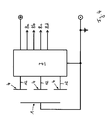
- each capacitor electrode 4 For evaluating the position of the first part 1 relative to the second part 2 formed with the capacitor electrodes 4, a tap line 12 is provided on each capacitor electrode 4, which connects the capacitor electrode 4 to an evaluation device 7 (cf. Fig. 4 ).
- the evaluation device 7 determines the charge quantity of each capacitor electrode 4 and generates at least one signal representative of the absolute position of the second part 2 to the first part 1.
- the comparison of the amount of charge on each capacitor electrode 4 can be made via a reference capacitor with a defined amount of charge.
- Fig. 4 shows a schematic diagram for an interconnection of the eccentric and the capacitor electrodes 4 with the evaluation device 7.
- At outputs 8a, 8b, 8c, 8d is at least one representative of the absolute position of the second part 2 to the first part 1 signal.
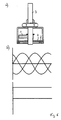
- Fig. 5a is the rotation angle sensor according to Fig. 1 shown schematically in a first position.
- Fig. 5b shows by way of example the signals generated by the evaluation device 7 at the outputs 8a, 8b and 8c from top to bottom.
- the signals applied to the outputs 8a and 8b indicate the absolute position of the eccentric relative to the three capacitor electrodes 4 relative to the direction of rotation about the axis of rotation or shaft 3.
- the signal at the output 8c is used to indicate the distance between the eccentric and the capacitor electrodes 4 along the axis of rotation.
- a summation element for adding up the charge quantities of the capacitor electrodes 4 used.
- the added charge amount of the capacitor electrodes 4 is compared with a comparison element for the determination of the distance between the eccentric and capacitor elements 4 and generates a corresponding signal at the output 8c.
- Fig. 6a the angle of rotation sensor is shown in a second position, in which the distance between the eccentric and the capacitor electrodes 4 has been reduced with respect to the in Fig. 5a shown position.
- Fig. 6b shows signals 8a, 8b and 8c generated by the evaluation device 7 at the time in Fig. 6a shown position. It can be seen that the signals at the outputs 8a and 8b have not changed, since the eccentric was not rotated, but only the distance between the eccentric and capacitor electrodes 4 has been changed. The sum of the charge quantities has changed. By reducing the distance of the eccentric from the capacitor electrodes 4, the sum of the amounts of charge on the capacitor electrodes 4 has become larger. The distance of the eccentric from the capacitor electrodes 4 can be determined absolutely on the basis of the signal applied to the output 8c.
- the angle (the rotary operation of the shaft 3) and the distance between the eccentric and capacitor electrodes 4 (the tensile or pressure actuation of the shaft 3) can be absolutely determined or measured.
- the evaluation device 7 may be designed as a microcontroller, which is arranged on the designed as a board 6 surface for the capacitor electrodes 4. According to Fig. 1 the board 6 forms a boundary surface of the housing 9 for the capacitive rotation angle sensor. On the capacitor electrodes 4th By using the circuit board 6 as a boundary surface of the housing 9 of the capacitive rotation angle sensor, a compact design is possible.
Landscapes
- Engineering & Computer Science (AREA)
- Power Engineering (AREA)
- Physics & Mathematics (AREA)
- General Physics & Mathematics (AREA)
- Transmission And Conversion Of Sensor Element Output (AREA)
- Measurement Of Length, Angles, Or The Like Using Electric Or Magnetic Means (AREA)
Description
- Die Erfindung betrifft einen kapazitiven Drehwinkelsensor nach dem Oberbegriff des Anspruchs 1.
- Aus
DE 37 11 062 A1 ist eine kapazitive absolute Positionsmessvorrichtung für Drehbewegungen bekannt. Die Positionsmessvorrichtung besteht aus einer elektronischen Ansteuer- und Auswerteschaltung. Es ist eine Statorplatte und eine Rotorplatte vorgesehen, die sich axial gegenüberstehen. Auf der Statorplatte befinden sich Referenzpotenzialelektroden, in die von der Ansteuerschaltung eine Spannung eingespeist wird, die abwechselnd zwischen zwei Referenzpotenzialen umgeschaltet wird. Von auf der Rotorplatte befindlichen Sensorelektroden wird eine Wechselspannung zur Bestimmung der Drehposition abgegriffen. - Eine Veränderung der eingespeisten Spannung oder des Abstands von Sensorelektroden zu Referenzpotenzialelektroden kann zu erheblichen Änderungen der abgegriffenen Wechselspannungen, die die Drehposition repräsentieren, führen, weshalb in der bekannten Positionsmessvorrichtung eine zweite Statorplatte verwendet wird. Dieser Ausbau ist aufwändig und führt u.a. zu einer zusätzlichen Verkabelung und größeren Außenabmessungen der Positionsmessvorrichtung.
- Aus
DE 42 32 116 C2 ist eine Anordnung für einen kapazitiven Drehwinkelsensor bekannt, die ein spezielles Elektrodenlayout verwendet. Mit dem speziellen Elektrodenlayout, bei dem die von der Drehachse in Umfangsrichtung gerichtete Begrenzung von Stator- und Rotorelektroden in einer radial von der Drehachse ausgehenden Linie gestuft geformt ist, wird erreicht, dass ein mittlerer Elektrodenabstand unabhängig vom Drehwinkel konstant bleibt, da er aus Flächenanteilen gebildet wird, die in der Summe gleichzeitig alle Gebiete der kapazitiven Fläche erfassen. - Ein derartig ausgebildetes Elektrodenlayout ist aufwändig in der Herstellung, da die Form der Stator- und Rotorelektroden aufeinander abgestimmt sein muss. Ferner werden zur Auswertung zusätzliche, um Stator- und Rotorelektrode ringförmig angeordnete Koppelelektroden verwendet, deren Herstellung die Anordnung sowohl räumlich vergrößern als auch die Herstellungskosten teurer werden lässt.
- Aus
WO 03/023329 A1 - Aus
US 6 492 911 B1 ist ein kapazitiver Drehwinkelgeber nach dem Oberbegriff des Anspruchs 1 bekannt. - Aufgabe der Erfindung ist es, einen kapazitiven Drehwinkelgeber nach dem Oberbegriff des Anspruchs 1 zu schaffen, der einfach aufgebaut ist und zudem flexiblere Einsatzmöglichkeiten trotz seines einfachen Aufbaus ermöglicht.
- Die Aufgabe wird gemäß den Merkmalen des Anspruchs 1 gelöst.
- Hierdurch wird ein kapazitiver Drehwinkelgeber geschaffen, der ein erstes und ein zweites Teil umfasst. Das erste Teil ist um eine Drehachse relativ zum zweiten Teil drehbar beweglich, und das zweite Teil weist mindestens drei dem ersten Teil zugewandte, voneinander isolierte, in Richtung der Drehbewegung der Drehachse voneinander beabstandete Kondensatorelektroden auf. Die Kondensatorelektroden des zweiten Teils sind mit dem ersten Teil zumindest teilweise miteinander in Überlappung bringbar. Das erste Teil ist ein auf schwebendem Potenzial befindliches Geberelementfürdie Kondensatorelektroden in Form eines metallischen Exzenters. Schwebendes Potenzial bedeutet in diesem Zusammenhang, dass keine Spannung von außen über eine angeschlossene Spannungsquelle aufgeprägt wird. Der Exzenter ist einfach herstellbar und an keine feste Form in Abhängigkeit der Form der Kondensatorelektroden gebunden. Die Bedingung hinsichtlich der Form des Exzenters ist die, dass der Exzenter bei einem vollen Umlauf um die Drehachse jede der mindestens drei Kondensatorelektroden zumindest teilweise überlappt bzw. überstrichen hat. Der Abstand des Exzenters in Richtung zur Drehachse bzw. entlang dieser zwischen den Kondensatorelektroden und dem Exzenter ist variierbar, so dass vielfältigste und flexible Einsatzmöglichkeiten des Drehwinkelgebers bestehen. Neben Drehbewegungen können auch Druck- oder Zugbewegungen in Richtung der Drehachse detektiert werden. Die Lage des Exzenters ist auf absolute Weise dreidimensional erfassbar. Die Kondensatorelektroden sind jeweils über eine Abgriffleitung mit einer Auswerteeinrichtung verbunden zur Bestimmung der Ladungsmenge jeder Kondensatorelektrode. Die Auswerteeinrichtung erzeugt ein die absolute Position des zweiten Teils zum ersten Teil repräsentatives Signal, wobei auch der Abstand zwischen Exzenter und Kondensatorelektroden bezogen auf die Drehachse berücksichtigt wird. Über die Betrachtung eines Vergleichs der Ladungsmenge der einzelnen Kondensatorelektroden ist eine einfache Bestimmung der Position des Exzenters möglich.
- Bevorzugt sind die Kondensatorelektroden auf einer planen Oberfläche flächig in einer Ebene ausgebildet, und der Exzenter weist eine den Kondensatorelektroden zugewandte parallele Fläche auf, so dass eine sehr genaue Angabe der absoluten Lage des Exzenters in Bezug auf die Kondensatorelektroden ermöglicht ist.
- Für eine besonders einfache Ausgestaltung der Kondensatorelektroden sind diese um die Drehachse abschnittsweise ringförmig angeordnet. Gleichförmige Abschnitte sind bevorzugt, so dass jede Kondensatorelektrode einen im wesentlichen gleichen Flächeninhalt aufweist, so dass für jede Kondensatorelektrode eine vom Wert her gleiche Referenzladung verwendet werden kann. Die Verwendung gleichförmiger Kondensatorelektroden vereinfacht die Auswertung, da verschiedene Formen der Kondensatorelektroden und ein entsprechendes unterschiedliches Kapazitätsverhalten nicht berücksichtigt werden müssen.
- Bevorzugt ist das erste Teil in verschiedenen vorbestimmten Abständen zum ersten Teil mit einer Rasteinrichtung verrastbar, so dass diskrete Abstände des Exzenters von den Kondensatorelektroden ermittelt werden können. Durch die Verrastung ist zudem eine "haptische" Rückmeldung bei der Betätigung in Richtung der Drehachse bei Zug- oder Druckbewegungen möglich.
- Vorzugsweise kann das erste Teil bezogen auf die Richtung längs der Drehachse zum ersten Teil federvorgespannt sein, so dass ein Widerstand vorliegt, den Exzenter in Richtung längs der Drehachse zu bewegen. Der Widerstand bzw. die Federvorspannung kann derart sein, dass der Exzenter durch die Federvorspannung in seine ursprüngliche Lage hinsichtlich des Abstands zu den Kondensatorelektroden nach Beaufschlagung mit einer Kraft in Richtung der Drehachse zurückkehrt, sobald die Kraftausübung beendet ist.
- Zur vereinfachten Bestimmung des Abstands des ersten Teils vom zweiten Teil, auf dem die Kondensatorelektroden angeordnet sind, ist ein Summationselement zum Aufaddieren der Ladungsmengen der Kondensatorelektroden vorgesehen. Ein Vergleichselement bestimmt den Abstand zwischen erstem und zweitem Teil anhand der ermittelten Summe der Ladungsmengen. Damit ist eine einfache Bestimmung der dreidimensionalen Lage des ersten Teils bezogen auf das zweite Teil möglich, da sich bei einer Änderung des Abstands längs der Drehachse von Exzenter und Kondensatorelementen die Summe der Ladungsmengen ändert, das Verhältnis der Ladungsmengen der Kondensatorelektroden jedoch nicht.
- Zur Erzielung einer besonders kompakten und einfachen Bauweise des Drehwinkelsensors sind die Kondensatorelektroden auf einer Platine angeordnet, die eine Begrenzungsfläche eines Gehäuses für den Drehwinkelsensor bildet. Auf der den Kondensatorelektroden gegenüberliegenden Seite der Platine sind Schnittstellen vorgesehen für die Abgriffleitungen und/oder die Auswerteeinrichtung. Um einen Schutz für die Platine vorzusehen, kann es aber auch vorgesehen sein, dass die Platine vollständig von einem Gehäuse umschlossen ist und gerade nicht ein Bestandteil des Gehäuses ist.
- Für eine flexible Gestaltung und eine einfache Bereitstellung von Schnittstellen eventuell für eine Programmierung der Auswerteeinrichtung ist die Auswerteeinrichtung als Mikrocontroller ausgeführt.
- Weitere Ausgestaltungen der Erfindung sind der nachfolgenden Beschreibung und den Unteransprüchen zu entnehmen.
- Die Erfindung wird nachstehend anhand eines in den beigefügten schematischen Abbildungen dargestellten Ausführungsbeispiels näher erläutert.
-
Fig. 1 zeigt eine schematische Darstellung eines erfindungsgemäßen kapazitiven Drehwinkelsensors in einem teilweisen Schnitt; -
Fig. 2 zeigt eine schematische Darstellung von Kondensatorelektroden gemäß der inFig. 1 gezeigten Ausführungsform; -
Fig. 3 zeigt ein Signaldiagramm der Kondensatorelektroden bei einer 360°-Umdrehung für den Drehwinkelsensor ausFig. 1 ; -
Fig. 4 zeigt eine Verschaltung in einer schematischen Prinzipdarstellung; -
Fig. 5a zeigt den Drehwinkelsensor gemäßFig. 1 in einer ersten Stellung; -
Fig. 5b zeigt von einer Auswerteschaltung erzeugte Signale bei der inFig. 5a gezeigten Stellung; -
Fig. 6a zeigt den Drehwinkelsensor gemäßFig. 1 in einer zweiten Stellung; -
Fig. 6b zeigt von einer Auswerteschaltung erzeugte Signale bei der inFig. 6a gezeigten Stellung. - In
Fig. 1 ist ein erfindungsgemäßer kapazitiver Drehwinkelsensor in einem teilweisen Schnitt gezeigt. Der Drehwinkelsensor umfasst ein erstes Teil 1 und ein zweites Teil 2. Das erste Teil 1 ist um eine Drehachse relativ zum ersten Teil drehbar beweglich. Die Drehachse wird durch eine Welle 3 gebildet. Das zweite Teil 2 ist fest in einem Gehäuse 9 eingebaut. Das erste Teil 1 ist als ein an der Welle 3 befestigter metallischer Exzenter ausgebildet. - Für eine Drehbewegung ist die Welle 3 mit dem Exzenter als erstem Teil 1 über ein Distanzstück 10 und eine Mutter 11 in dem Gehäuse 9 drehbar befestigt.
- Auf dem zweiten Teil 2 sind gemäß
Fig. 2 drei dem ersten Teil 1 zugewandte, voneinander isolierte, in Richtung der Drehbewegung der Welle 3 voneinander beabstandete Kondensatorelektroden 4 angeordnet. Die Kondensatorelektroden 4 der dargestellten Ausführungsform überdecken einen Winkelbereich von annähernd 120° und sind ringförmig um die Drehachse bzw. Welle 3 ausgebildet. Die Kondensatorelektroden 4 weisen im wesentlichen die gleiche Fläche auf und sind in ihrer Form nahezu identisch jeweils in Form eines Kreisringsegments ausgestaltet. - Die Kondensatorelektroden 4 sind auf einer planen Oberfläche, die durch eine Platine 6 gebildet wird, flächig in einer Ebene ausgebildet, und der Exzenter weist eine den Kondensatorelektroden 4 zugewandte, im wesentlichen parallel zu diesen ausgerichtete Fläche auf.
- Das als Exzenter ausgestaltete erste Teil 1 überdeckt bei einer Drehbewegung die Kondensatorelektroden 4 zumindest teilweise. Das erste Teil 1 überlappt einen Bereich der Kondensatorelektroden 4 und bildet einen Überlappungsbereich, der mit der Drehbewegung des ersten Teils 1 variiert.
- Das als Exzenter ausgestaltete an der Welle 3 befestigte erste Teil 1 ist ein auf schwebendem Potenzial befindliches Geberelement für die Kondensatorelektroden 4, was bedeutet, dass das erste Teil 1 mit keiner Spannungsquelle verbunden ist, die dem ersten Teil 1 eine elektrische Spannung aufgeprägt. Statt dessen ist das erste Teil 1 mit Masse verbunden oder elektrisch isoliert gegenüber der Umgebung.
- In
Fig. 3 sind die Signale der drei Kondensatorelektroden 4 des Drehwinkelsensors gemäßFig. 1 gezeigt. Die Signale sind sinusförmig und um 124° entsprechend einer Vollumdrehung von 360° durch die Anzahl der Kondensatorelektroden verschoben. Dementsprechend lässt sich die Stellung des Exzenters über den Kondensatorelektroden 4 zurückrechnen. - Sofern bei einer nicht dargestellten Ausführungsform vier gleiche kreisringsegmentförmige Kondensatorelektroden 4 verwendet werden, so sind die Signale der vier gleichflächigen Kondensatorelektroden 4 um 90° verschoben.
- Der Abstand des ersten Teils 1 in Richtung längs der Drehachse von den Kondensatorelektroden 4 ist variierbar bzw. veränderbar. Dazu weist die in
Fig. 1 dargestellte Ausführungsform eine Feder 5 auf, die den Exzenter als erstes Teil 1 gegenüber dem zweiten Teil 2, auf dem die Kondensatorelektroden 4 ausgebildet sind, vorspannt. Gegen die Feder 5 muss ein Druck aufgewendet werden, damit sich der Abstand zwischen dem Exzenter als erstem Teil 1 und den auf dem zweiten Teil 2 ausgebildeten Kondensatorelektroden 4 verringert. - An der Welle 3 ist ein durch einen Benutzer betätigbares Handstück vorgesehen bzw. befestigt, mit dem der Benutzer die Welle 3 sowohl drehen, als auch Zug bzw. Druck auf die Welle 3 in Richtung längs der Welle 3 ausüben kann.
- In einer nicht dargestellten Ausführungsform können Verrastungselemente vorgesehen sein, um den Exzenter in vorbestimmten Abständen gegenüber den Kondensatorelektroden 4 zu verrasten.
- Zur Auswertung der Position des ersten Teils 1 bezogen auf das mit den Kondensatorelektroden 4 ausgebildete zweite Teil 2 ist an jeder Kondensatorelektrode 4 eine Abgriffleitung 12 vorgesehen, die die Kondensatorelektrode 4 mit einer Auswerteeinrichtung 7 verbindet (vgl.
Fig. 4 ). Die Auswerteeinrichtung 7 bestimmt die Ladungsmenge jeder Kondensatorelektrode 4 und erzeugt mindestens ein für die absolute Position des zweiten Teils 2 zum ersten Teil 1 repräsentatives Signal. Der Vergleich der Ladungsmenge auf jeder Kondensatorelektrode 4 kann über einen Referenzkondensator mit definierter Ladungsmenge erfolgen. -
Fig. 4 zeigt ein Prinzipschaltbild für eine Verschaltung des Exzenters und der Kondensatorelektroden 4 mit der Auswerteeinrichtung 7. An Ausgängen 8a, 8b, 8c, 8d liegt mindestens ein für die absolute Position des zweiten Teils 2 zum ersten Teil 1 repräsentatives Signal an. - In
Fig. 5a ist der Drehwinkelsensor gemäßFig. 1 in einer ersten Stellung schematisch gezeigt.Fig. 5b zeigt beispielhaft die von der Auswerteeinrichtung 7 erzeugten Signale an den Ausgängen 8a, 8b und 8c von oben nach unten. Die an den Ausgängen 8a und 8b anliegenden Signale geben die absolute Position des Exzenters gegenüber den drei Kondensatorelektroden 4 bezogen auf die Drehrichtung um die Drehachse bzw. Welle 3 an. Das Signal am Ausgang 8c wird verwendet, um den Abstand zwischen dem Exzenter und den Kondensatorelektroden 4 längs der Drehachse anzugeben. Dazu wird in der Auswerteeinrichtung 7 ein Summationselement zum Aufaddieren der Ladungsmengen der Kondensatorelektroden 4 verwendet. Die aufaddierte Ladungsmenge der Kondensatorelektroden 4 wird mit einem Vergleichselement für die Bestimmung des Abstands zwischen Exzenter und Kondensatorelementen 4 verglichen und ein entsprechendes Signal am Ausgang 8c erzeugt. - Beim Drehen des Exzenters um die Welle 3 ändert sich das Signal auf den Kondensatorelektroden 4. Die Summe der Ladungsmengen bleibt jedoch konstant.
- In
Fig. 6a ist der Drehwinkelsensor in einer zweiten Stellung gezeigt, in der der Abstand zwischen dem Exzenter und den Kondensatorelektroden 4 verringert wurde bezogen auf die inFig. 5a gezeigte Stellung. -
Fig. 6b zeigt von der Auswerteeinrichtung 7 erzeugte Signale 8a, 8b und 8c bei der inFig. 6a gezeigten Stellung. Es ist zu erkennen, dass die Signale an den Ausgängen 8a und 8b sich nicht verändert haben, da der Exzenter nicht gedreht wurde, sondern nur der Abstand zwischen Exzenter und Kondensatorelektroden 4 verändert wurde. Die Summe der Ladungsmengen hat sich verändert. Durch die Verringerung des Abstands des Exzenters von den Kondensatorelektroden 4 ist die Summe der Ladungsmengen auf den Kondensatorelektroden 4 größer geworden. Der Abstand des Exzenters von den Kondensatorelektroden 4 ist anhand des an Ausgang 8c anliegenden Signals absolut bestimmbar. - Mit dem dargestellten Ausführungsbeispiel lässt sich der Winkel (die Drehbetätigung der Welle 3) sowie der Abstand zwischen Exzenter und Kondensatorelektroden 4 (die Zug- bzw. Druckbetätigung der Welle 3) absolut bestimmen bzw. messen.
- Die Auswerteeinrichtung 7 kann als Mikrocontroller ausgeführt sein, der auf der als Platine 6 ausgestalteten Fläche für die Kondensatorelektroden 4 angeordnet ist. Gemäß
Fig. 1 bildet die Platine 6 eine Begrenzungsfläche des Gehäuses 9 für den kapazitiven Drehwinkelsensor. Auf der den Kondensatorelektroden 4 gegenüberliegenden Seite der Platine 6 sind Schnittstellen vorgesehen für die Abgriffleitungen 12 der Kondensatorelektroden 4 und/oder die Auswerteeinrichtung 7. Durch die Verwendung der Platine 6 als eine Begrenzungsfläche des Gehäuses 9 des kapazitiven Drehwinkelsensors ist eine kompakte Bauform möglich.
Claims (8)
- Kapazitiver Drehwinkelsensor umfassend ein erstes und ein zweites Teil (1, 2), von denen das erste Teil (1) um eine Welle (3) als Drehachse relativ zum zweiten Teil (2) drehbar beweglich ist, und das zweite Teil (2) mindestens drei dem ersten Teil (1) zugewandte, voneinander isolierte, in Richtung der Drehbewegung der Drehachse voneinander beabstandete Kondensatorelektroden (4) aufweist, die mit dem ersten Teil (1) zumindest teilweise miteinander in Überlappung bringbar sind, und die Überlappung mit der Drehbewegung variierbar ist, wobei das erste Teil (1) ein auf schwebendem Potenzial befindliches Geberelement für die Kondensatorelektroden (4) in Form eines metallischen Exzenters ist, der an der Welle befestigt ist, und die Kondensatorelektroden (4) jeweils über eine Abgriffleitung (12) mit einer Auswerteeinrichtung (7) verbunden sind zur Bestimmung der Ladungsmenge jeder Kondensatorelektrode (4), und durch die Auswerteeinrichtung (7) ein die absolute Position des zweiten Teils (2) zum ersten Teil (1) repräsentatives Signal erzeugbar ist, dadurch gekennzeichnet, dass der Abstand zwischen dem Exzenter und den Kondensatorelektroden (4) längs der Drehachse variierbar ist.
- Kapazitiver Drehwinkelsensor nach Anspruch 1, dadurch gekennzeichnet, dass das erste Teil (1) in verschiedenen vorbestimmten Abständen bezogen auf die Richtung längs der Drehachse zum zweiten Teil (2) mit einer Rasteinrichtung verrastbar ist.
- Kapazitiver Drehwinkelsensor nach Anspruch 1 oder 2, dadurch gekennzeichnet, dass die Kondensatorelektroden (4) auf einer planen Oberfläche flächig in einer Ebene ausgebildet sind und der Exzenter eine den Kondensatorelektroden (4) zugewandte, parallel zu diesen ausgerichtete Fläche aufweist.
- Kapazitiver Drehwinkelsensor nach einem der Ansprüche 1 bis 3, dadurch gekennzeichnet, dass die Kondensatorelektroden (4) zumindest abschnittsweise ringförmig um die Drehachse angeordnet sind und jeweils gleiche Flächeninhalte aufweisen.
- Kapazitiver Drehwinkelsensor nach einem der Ansprüche 1 bis 4, dadurch gekennzeichnet, dass das erste Teil (1) bezogen auf die Richtung längs der Drehachse zum zweiten Teil (2) federvorgespannt ist.
- Kapazitiver Drehwinkelsensor nach einem der Ansprüche 1 bis 5, dadurch gekennzeichnet, dass ein Summationselement zum Aufaddieren der Ladungsmengen der Kondensatorelektroden (4) und ein Vergleichselement für die Bestimmung des Abstands zwischen Exzenter und Kondensatorelementen (4) vorgesehen sind.
- Kapazitiver Drehwinkelsensor nach einem der Ansprüche 1 bis 6, dadurch gekennzeichnet, dass die Kondensatorelektroden (4) auf einer Platine (6) angeordnet sind, und auf der den Kondensatorelektroden (4) gegenüberliegenden Seite der Platine (6) Schnittstellen vorgesehen sind für die Abgriffleitungen (12) und/oder die Auswerteeinrichtung (7).
- Kapazitiver Drehwinkelsensor nach einem der Ansprüche 1 bis 7, dadurch gekennzeichnet, dass die Auswerteeinrichtung (7) ein Mikrocontroller ist.
Priority Applications (1)
| Application Number | Priority Date | Filing Date | Title |
|---|---|---|---|
| EP08022133A EP2199751B1 (de) | 2008-12-19 | 2008-12-19 | Kapazitiver Drehwinkelsensor |
Applications Claiming Priority (1)
| Application Number | Priority Date | Filing Date | Title |
|---|---|---|---|
| EP08022133A EP2199751B1 (de) | 2008-12-19 | 2008-12-19 | Kapazitiver Drehwinkelsensor |
Publications (2)
| Publication Number | Publication Date |
|---|---|
| EP2199751A1 EP2199751A1 (de) | 2010-06-23 |
| EP2199751B1 true EP2199751B1 (de) | 2012-08-08 |
Family
ID=41376295
Family Applications (1)
| Application Number | Title | Priority Date | Filing Date |
|---|---|---|---|
| EP08022133A Not-in-force EP2199751B1 (de) | 2008-12-19 | 2008-12-19 | Kapazitiver Drehwinkelsensor |
Country Status (1)
| Country | Link |
|---|---|
| EP (1) | EP2199751B1 (de) |
Family Cites Families (4)
| Publication number | Priority date | Publication date | Assignee | Title |
|---|---|---|---|---|
| DE3711062A1 (de) | 1987-04-02 | 1988-10-20 | Herbert Leypold | Kapazitive absolute positionsmessvorrichtung |
| DE4232116C2 (de) * | 1992-09-25 | 1999-03-18 | Mannesmann Vdo Ag | Anordnung für einen kapazitiven Drehwinkelsensor |
| US6492911B1 (en) * | 1999-04-19 | 2002-12-10 | Netzer Motion Sensors Ltd. | Capacitive displacement encoder |
| NL1018908C2 (nl) * | 2001-09-07 | 2003-03-11 | Skf Ab | Absolute-hoek-codeerinrichting. |
-
2008
- 2008-12-19 EP EP08022133A patent/EP2199751B1/de not_active Not-in-force
Also Published As
| Publication number | Publication date |
|---|---|
| EP2199751A1 (de) | 2010-06-23 |
Similar Documents
| Publication | Publication Date | Title |
|---|---|---|
| EP2782810B1 (de) | Drehwinkelsensor | |
| DE60222356T2 (de) | Drehwinkelsensor, Drehmomentsensor und Lenkvorrichtung | |
| DE102008008835B4 (de) | Vorrichtung zum Ermitteln eines Drehmoments | |
| EP2026366B1 (de) | Drehwähler | |
| DE102013224098A1 (de) | Sensoranordnung zur Erfassung von Drehwinkeln an einem rotierenden Bauteil in einem Fahrzeug | |
| DE102008059775A1 (de) | Absolut messende Lenkwinkelsensoranordnung | |
| DE102007014751A1 (de) | Potentiometer | |
| EP2449346A2 (de) | Winkelsensor | |
| DE102009027191A1 (de) | Vorrichtung zum Bestimmen eines Drehmomentes und/oder eines Drehwinkels einer Welle | |
| EP1925533B1 (de) | Kombinierter Lenkwinkel- und Drehmomentsensor | |
| DE102018120575A1 (de) | Eingabevorrichtung mit beweglicher Handhabe auf kapazitiver Detektionsfläche und kapazitiven Koppeleinrichtungen | |
| WO2021052651A1 (de) | Messeinrichtung | |
| EP3918453B1 (de) | Eingabevorrichtung mit beweglicher handhabe auf kapazitiver detektionsfläche und kapazitiven koppeleinrichtungen | |
| DE4234016C2 (de) | Positionsmessvorrichtung für Drehbewegungen mit einem kapazitiv arbeitenden Drehstellungssensor | |
| DE102019122188A1 (de) | Winkelsensorsystem | |
| EP1960733A1 (de) | Drehwinkelsensor und drehwinkelsensorsystem | |
| DE10348914A1 (de) | Vorrichtung zum Messen des Drehwinkels eines Drehkörpers | |
| WO2018206680A1 (de) | Sensor mit einer magnetbaugruppe | |
| EP2199751A1 (de) | Kapazitiver Drehwinkelsensor | |
| DE102007010737A1 (de) | Vorrichtung zur Erfassung des absoluten Drehwinkels einer Welle | |
| EP3427010A1 (de) | Kipptoleranter wegsensor | |
| DE102005035107A1 (de) | Mess- bzw. Gebervorrichtung | |
| DE4125482C2 (de) | ||
| DE19931809C2 (de) | Lenkwinkelsensor für ein Kraftfahrzeug | |
| DE102007011952A1 (de) | Bewegungsmessvorrichtung, insbesondere Drehwinkelgeber |
Legal Events
| Date | Code | Title | Description |
|---|---|---|---|
| PUAI | Public reference made under article 153(3) epc to a published international application that has entered the european phase |
Free format text: ORIGINAL CODE: 0009012 |
|
| AK | Designated contracting states |
Kind code of ref document: A1 Designated state(s): AT BE BG CH CY CZ DE DK EE ES FI FR GB GR HR HU IE IS IT LI LT LU LV MC MT NL NO PL PT RO SE SI SK TR |
|
| AX | Request for extension of the european patent |
Extension state: AL BA MK RS |
|
| 17P | Request for examination filed |
Effective date: 20101220 |
|
| AKX | Designation fees paid |
Designated state(s): DE FR GB IT |
|
| GRAP | Despatch of communication of intention to grant a patent |
Free format text: ORIGINAL CODE: EPIDOSNIGR1 |
|
| RIC1 | Information provided on ipc code assigned before grant |
Ipc: G01D 5/241 20060101AFI20120207BHEP |
|
| GRAS | Grant fee paid |
Free format text: ORIGINAL CODE: EPIDOSNIGR3 |
|
| GRAA | (expected) grant |
Free format text: ORIGINAL CODE: 0009210 |
|
| AK | Designated contracting states |
Kind code of ref document: B1 Designated state(s): DE FR GB IT |
|
| REG | Reference to a national code |
Ref country code: GB Ref legal event code: FG4D Free format text: NOT ENGLISH |
|
| REG | Reference to a national code |
Ref country code: DE Ref legal event code: R096 Ref document number: 502008007871 Country of ref document: DE Effective date: 20121004 |
|
| PG25 | Lapsed in a contracting state [announced via postgrant information from national office to epo] |
Ref country code: IT Free format text: LAPSE BECAUSE OF FAILURE TO SUBMIT A TRANSLATION OF THE DESCRIPTION OR TO PAY THE FEE WITHIN THE PRESCRIBED TIME-LIMIT Effective date: 20120808 |
|
| PLBE | No opposition filed within time limit |
Free format text: ORIGINAL CODE: 0009261 |
|
| STAA | Information on the status of an ep patent application or granted ep patent |
Free format text: STATUS: NO OPPOSITION FILED WITHIN TIME LIMIT |
|
| 26N | No opposition filed |
Effective date: 20130510 |
|
| GBPC | Gb: european patent ceased through non-payment of renewal fee |
Effective date: 20121219 |
|
| REG | Reference to a national code |
Ref country code: DE Ref legal event code: R097 Ref document number: 502008007871 Country of ref document: DE Effective date: 20130510 |
|
| REG | Reference to a national code |
Ref country code: FR Ref legal event code: ST Effective date: 20130830 |
|
| PG25 | Lapsed in a contracting state [announced via postgrant information from national office to epo] |
Ref country code: GB Free format text: LAPSE BECAUSE OF NON-PAYMENT OF DUE FEES Effective date: 20121219 Ref country code: FR Free format text: LAPSE BECAUSE OF NON-PAYMENT OF DUE FEES Effective date: 20130102 |
|
| REG | Reference to a national code |
Ref country code: DE Ref legal event code: R082 Ref document number: 502008007871 Country of ref document: DE |
|
| REG | Reference to a national code |
Ref country code: DE Ref legal event code: R081 Ref document number: 502008007871 Country of ref document: DE Owner name: TUEBLUEKER, HUESEYIN, DE Free format text: FORMER OWNER: MENTOR GMBH & CO PRAEZISIONS-BAUTEILE KG, 40699 ERKRATH, DE Effective date: 20140225 |
|
| PGFP | Annual fee paid to national office [announced via postgrant information from national office to epo] |
Ref country code: DE Payment date: 20180625 Year of fee payment: 10 |
|
| REG | Reference to a national code |
Ref country code: DE Ref legal event code: R119 Ref document number: 502008007871 Country of ref document: DE |
|
| PG25 | Lapsed in a contracting state [announced via postgrant information from national office to epo] |
Ref country code: DE Free format text: LAPSE BECAUSE OF NON-PAYMENT OF DUE FEES Effective date: 20190702 |