EP2197675B2 - Low blush gelcoats having high color fastness - Google Patents
Low blush gelcoats having high color fastness Download PDFInfo
- Publication number
- EP2197675B2 EP2197675B2 EP08828926.9A EP08828926A EP2197675B2 EP 2197675 B2 EP2197675 B2 EP 2197675B2 EP 08828926 A EP08828926 A EP 08828926A EP 2197675 B2 EP2197675 B2 EP 2197675B2
- Authority
- EP
- European Patent Office
- Prior art keywords
- gelcoat
- dimethacrylate
- composition
- styrene
- methacrylate
- Prior art date
- Legal status (The legal status is an assumption and is not a legal conclusion. Google has not performed a legal analysis and makes no representation as to the accuracy of the status listed.)
- Active
Links
Images
Classifications
-
- C—CHEMISTRY; METALLURGY
- C09—DYES; PAINTS; POLISHES; NATURAL RESINS; ADHESIVES; COMPOSITIONS NOT OTHERWISE PROVIDED FOR; APPLICATIONS OF MATERIALS NOT OTHERWISE PROVIDED FOR
- C09D—COATING COMPOSITIONS, e.g. PAINTS, VARNISHES OR LACQUERS; FILLING PASTES; CHEMICAL PAINT OR INK REMOVERS; INKS; CORRECTING FLUIDS; WOODSTAINS; PASTES OR SOLIDS FOR COLOURING OR PRINTING; USE OF MATERIALS THEREFOR
- C09D151/00—Coating compositions based on graft polymers in which the grafted component is obtained by reactions only involving carbon-to-carbon unsaturated bonds; Coating compositions based on derivatives of such polymers
-
- C—CHEMISTRY; METALLURGY
- C09—DYES; PAINTS; POLISHES; NATURAL RESINS; ADHESIVES; COMPOSITIONS NOT OTHERWISE PROVIDED FOR; APPLICATIONS OF MATERIALS NOT OTHERWISE PROVIDED FOR
- C09D—COATING COMPOSITIONS, e.g. PAINTS, VARNISHES OR LACQUERS; FILLING PASTES; CHEMICAL PAINT OR INK REMOVERS; INKS; CORRECTING FLUIDS; WOODSTAINS; PASTES OR SOLIDS FOR COLOURING OR PRINTING; USE OF MATERIALS THEREFOR
- C09D153/00—Coating compositions based on block copolymers containing at least one sequence of a polymer obtained by reactions only involving carbon-to-carbon unsaturated bonds; Coating compositions based on derivatives of such polymers
-
- C—CHEMISTRY; METALLURGY
- C09—DYES; PAINTS; POLISHES; NATURAL RESINS; ADHESIVES; COMPOSITIONS NOT OTHERWISE PROVIDED FOR; APPLICATIONS OF MATERIALS NOT OTHERWISE PROVIDED FOR
- C09D—COATING COMPOSITIONS, e.g. PAINTS, VARNISHES OR LACQUERS; FILLING PASTES; CHEMICAL PAINT OR INK REMOVERS; INKS; CORRECTING FLUIDS; WOODSTAINS; PASTES OR SOLIDS FOR COLOURING OR PRINTING; USE OF MATERIALS THEREFOR
- C09D4/00—Coating compositions, e.g. paints, varnishes or lacquers, based on organic non-macromolecular compounds having at least one polymerisable carbon-to-carbon unsaturated bond ; Coating compositions, based on monomers of macromolecular compounds of groups C09D183/00 - C09D183/16
- C09D4/06—Organic non-macromolecular compounds having at least one polymerisable carbon-to-carbon unsaturated bond in combination with a macromolecular compound other than an unsaturated polymer of groups C09D159/00 - C09D187/00
-
- B—PERFORMING OPERATIONS; TRANSPORTING
- B29—WORKING OF PLASTICS; WORKING OF SUBSTANCES IN A PLASTIC STATE IN GENERAL
- B29C—SHAPING OR JOINING OF PLASTICS; SHAPING OF MATERIAL IN A PLASTIC STATE, NOT OTHERWISE PROVIDED FOR; AFTER-TREATMENT OF THE SHAPED PRODUCTS, e.g. REPAIRING
- B29C37/00—Component parts, details, accessories or auxiliary operations, not covered by group B29C33/00 or B29C35/00
- B29C37/0025—Applying surface layers, e.g. coatings, decorative layers, printed layers, to articles during shaping, e.g. in-mould printing
- B29C37/0028—In-mould coating, e.g. by introducing the coating material into the mould after forming the article
- B29C37/0032—In-mould coating, e.g. by introducing the coating material into the mould after forming the article the coating being applied upon the mould surface before introducing the moulding compound, e.g. applying a gelcoat
Definitions
- the invention concerns gelcoat compositions according to claims 1 to 8 comprising a base resin which is an unsaturated polyester, a reactive diluent component comprising styrene and one or more alternative diluents, a pigment and inorganic extended fillers.
- the gel coat compositions may further comprise promoters, accelerators, thixotropic agents, promoters, inhibitors, air release agents, flow and leveling agents, dispersing aids.
- the gelcoat composition is particularly useful in the manufacture of marine equipment, such as pleasure watercraft, like boats, yachts, jet skis and other personal watercraft.
- fiber-reinforced components or parts are often coated or "gelcoated" to improve the overall quality of the part.
- the fiber-reinforced components are manufactured by initially coating the interior of a mold, which is the negative image or shape of the final part, using a gelcoat.
- the gelcoat is applied in a relatively thick layer of from 10 to 40 thousandths of an inch, typically using spray gun technology. In some instances, it is applied using brushing or hand lay-up.
- the gelcoat After the gelcoat is allowed to solidify or cure, it is reinforced using a fiber-reinforced laminating resin that is applied using various techniques (brushing, spraying, hand lay-up).
- the laminating resin is allowed to cure and the final part is removed from the mold. As the laminating resin is curing, the resin will shrink around the fibers and a fiber pattern will appear. The appearance of the fiber pattern is often referred to as "print-through".
- the gelcoat is applied in part to hide the print-through, which allows the final part to have a high quality surface appearance.
- a gelcoat can provide a high quality cosmetic appearance.
- the gelcoat also serves as a barrier against water, wear, and weathering.
- pigmented gelcoat is used heavily in the manufacture of various types of composite pleasure craft, examples of which include speed boats and yachts.
- consumers are demanding composite boats with color composite parts having greater color and gloss retention or fastness over time.
- Conventional gelcoats pigmented to other colors, especially dark colors, were not traditionally used below the water line because the pigmented gelcoat would become lighter in color or "blush” due to exposure to the marine environment.
- white pigmented gelcoats have been predominately used for composite boat applications, especially below the water line.
- the boat manufacturing industry is responding to consumer demand by placing higher performance requirements on gelcoat in terms of gloss retention and color fastness as a function of exposure time to the marine/aquatic environment.
- White gelcoats do not tend to color change due to blushing, however white material, particularly in a marine environment, suffers from gloss loss and yellowing due to environmental exposure. Thus, non-pigmented, or white, gelcoats that do not experience gloss loss and yellowing are also desired by the boat manufacturing industry.
- Gelcoat is mainly made from an unsaturated polyester base resin, promoters, accelerators, inorganic extender fillers, reactive diluents such as styrene, and pigments. It is said in U.S. Published Application 2007/0001343 that drastically reducing the inorganic extender filler level to about 2 wt% or less can reduce "blushing". However, reducing the filler level in a gelcoat causes problems in processing and application. Two problems typically associated with gelcoats containing low amounts of filler are sagging and porosity. Sagging occurs when a gelcoat is sprayed onto the vertical surface of a mold and, due to gravity, the gelcoat begins to slowly sag. This negatively impacts final part quality and is unacceptable to the boat manufacturer.
- Porosity is the result of air voids being trapped permanently in the gelcoat during the cure cycle.
- Boat manufacturers often have to repair hulls of boats because of damage suffered at the manufacturing facility or in the field. Therefore, being able to repair a boat is critical to the boat manufacturer. Repairing involves sanding, patching, and buffing the damaged area of the hull. Voids trapped beneath the surface of the gelcoat make the repair process very difficult and is unacceptable to boat manufacturers.
- JP 3 0707019 A , US 6 617 417 B , US 2005/159551 A , US 5891942 A and US 2005/048214 A also describe gel coats based on a base resin styrene and a range of different reactive diluents.
- Porosity in gelcoats comprising a relatively low amount of fill can typically be eliminated by including materials that increase the level of hazardous air pollutants ("HAPS") in the formulation, such as styrene and methylmethacrylate.
- HAPS hazardous air pollutants
- MACT Maximum Achievable Control Technology
- the invention provides for the use of alternative monomers, i.e. alternative reactive diluents according to claim 1, in gelcoat compositions with a commensurate reduction of styrene and the use of relatively larger amounts of filler, such as more filler than that allowed for in U.S. Published Application 2007/0001343 .
- the gelcoat compositions are either white or pigmented and are MACT compliant, with excellent color fastness and decreased sagging and porosity. In aspects of the invention, sagging and porosity is eliminated.
- the gel coat composition comprises a reactive diluent comprising styrene and one or more alternative diluents.
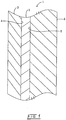
- FIG.1 is a cross-sectional view of a laminated reinforced compound compromising the gelcoat composition in accordance with an embodiment of the invention.
- the gelcoat compositions comprise a base resin which is an unsaturated polyester resin, reactive diluent comprising styrene and one or more alternative diluents, pigment and inorganic extended fillers and may further comprise one or more of promoters, accelerators, thixotropic agents, inhibitors, air release agents, flow and leveling agents and dispersing aids.
- the gelcoat compositions may comprise 40% to 80%, preferably from about 50% to 70%, base resin; 10% to 45% reactive diluents; up to 20%. such as 1% to 20%, pigment and more than 2% inorganic extended fillers.
- the gel coat composition may further comprise up to about 1%, preferably from 0.1% to 1%, promoters; up to 1%, preferably from 0.1% to 1%, accelerators; up to 1%, preferably from 0.1% to 1%, thixotropic agents; up to 1%, preferably from 0.1% to 1%, inhibitors; up to 1%, preferably from 0.1% to 1%, air release agents, up to 1%, preferably from 0.1% to 1%, flow and leveling agents and up to 1%, preferably from 0.1% to about 1%, dispersing aids
- the gelcoat compositions can be applied in methods for making composite materials, such as boat hulls and other parts for marine equipment, typically parts that will be partially or completely submerged in water.
- the base resins useful in the invention include unsaturated polyester resin.
- the polyester resins used herein can be prepared from the condensation of one or more carboxylic acids, such as mono-, di-, or polyfunctional unsaturated or saturated carboxylic acids or their corresponding anhydrides, and one or more mono-, di-, or other polyfunctional alcohols.
- Representative unsaturated carboxylic acids and their corresponding anhydrides include maleic acid, fumaric acid, chloromaleic acid, itaconic acid, citraconic acid, methylene glutaric acid, mesaconic acid, acrylic acid, methacrylic acid, and mixtures thereof.
- saturated carboxylic acids and their corresponding anhydrides include succinic acid, glutaric acid, d-methyl glutaric acid, adipic acid, sebacic acid, pimelic acid, phthalic anhydride, o-phthalic anhydride, isophthalic acid, terephthalic acid, and mixtures thereof.
- Representative alcohols for use in making the unsaturated polyester resins include alkanediols and oxa-alkanediols such as ethylene glycol, 1,2-propylene glycol, propane-3-diol, 1,3-butylene glycol, butene-1,4-diol, hexane-1,6-diol, diethylene glycol, triethylene glycol, polyethylene glycol, cyclohexane-1,2-diol, 5-norbornene-2,2-dimethylol, 2,3-norbornene diol, cyclohexane dimethanol,1,2-propanediol, 2-methy 1-,3-propanediol, pentaerythritol and mixtures thereof.
- alkanediols and oxa-alkanediols such as ethylene glycol, 1,2-propylene glycol, propane-3-diol, 1,3-buty
- Representative monofunctional alcohols that can be used in limited amounts, such as 0.5% to 10%, include benzyl alcohol, cyclohexanol, 2-ethyhexyl alcohol, 2-cyclohexyl ethanol, lauryl alcohol and mixtures thereof.
- the base resins used in the gelcoat compositions can be prepared by techniques familiar to those skilled in the art.
- the unsaturated polyester resins useful in the gelcoat compositions described herein can be prepared by common esterification techniques where the carboxylic acid or corresponding anhydride is reacted with a polyol, usually in the presence of a catalyst to a predetermined acid number.
- the base resin is typically diluted in the reactive diluent.
- styrene is the monomer used as the diluent.
- Styrene is a hazardous air pollutant (HAPS) and reduction of elimination of styrene is desired.
- HAPS hazardous air pollutant
- alternative reactive diluents are used to replace some of the styrene in the reactive diluent component of the composition, processes and methods of the invention.
- the alternative reactive diluents used in this invention are linear or branched acrylics selected from the group consisting of butyl methacrylate, butyl acrylate, hexyl acrylate, 2-ethylhexyl acrylate, lauryl acrylate, 1,4-butanediol diacrylate and dimethacrylate, 1,6-hexanediol diacrylate and dimethacrylate, 1,12-dodecanediol dimethacrylate, 2-ethylhexyl methacrylate, hexyl methacrylate, lauryl methacrylate, polyethylene glycol diacrylate, polyethylene glycol dimethacrylate, polypropylene glycol diacrylate, polypropylene glycol dimethacrylate and combinations thereof.
- the ability to replace some of the styrene is a function of the nature of the base resin.
- some of styrene conventionally used for making gelcoat compositions can be replaced with other types of reactive diluents.
- the replacement diluent level used in lieu of styrene is limited to about 20%.
- the styrene level of pigmented gelcoats is preferably limited to about 40 wt% styrene or less due to emission regulations.
- the invention compromises an improved method for making a gel coat composition wherein the improvement compromises replacing some of styrene in a reactive diluent component with one or more alternative reactive diluents.
- the method compromises the steps of combining a base resin, such as about 40% to about 80%, preferably about 50% to about 70 % base resin, with a reactive diluent component having one or more reactive diluents discussed herein.
- a base resin such as about 40% to about 80%, preferably about 50% to about 70 % base resin
- a reactive diluent component having one or more reactive diluents discussed herein.
- other materials may be added such as inorganic extended fillers, other fillers, pigments, and other materials as described herein.
- the method comprises inclusion of more than about 2%, such as more than about 3% percent or about 4%, like at least about 5%, typically at least about 7%, and preferably about 5% to about 40%, most preferably about 10% to about 30% or about 5% to about 20% inorganic extended filler.
- the components of the gelcoat composition may be blended by processes that should be familiar to one skilled in the art.
- the overall composition may comprise styrene because the base resin may comprise styrene.
- UPR base resin comprises styrene, as much as up to about 29% styrene.
- Inorganic extender fillers used in the gelcoat compositions (formulations), methods and processes described herein, include chopped or milled fiberglass, talc, silicon dioxide, titanium dioxide, wollastonite, mica, alumina trihydrate, clay, calcium carbonate, magnesium carbonate and calcium carbonate, and combinations thereof.
- the fillers can be used as is or be modified through surface treatment, an example of which is talc that has been surface treated to have vinyl groups.
- the filler is present in amounts of more than about 2%, such as more than about 3% or about 4%, like at least about 5%, typically at least about 7%, and preferably about 10% to about 45%, most preferably about 10% to about 30% or about 5% to about 20%, based on the total weight of the gelcoat formulation.
- Pigments used in the gelcoat compositions, methods, and processes impart color and opacity to the gelcoat composition.
- pigments include treated or untreated organic or inorganic pigments and mixtures thereof, such as titanium dioxide, carbon black, iron oxide black, phthalo blue, phthalo green, quinacridone magenta, LF orange, arylide red, quinacridone red, red oxide and other pigments familiar to those skilled in the art.
- Pigments are used in an amount sufficient to provide an opaque cured coating composition at the desired thickness level. Combinations of pigments may be used.
- Promoters used in the gelcoat compositions, methods and processes of the invention are generally any electron donating species that facilitates in the decomposition of an initiator and may also help in decomposition of any catalyst.
- An accelerator when used in the gelcoat compositions may also have the same function.
- Suitable promoters include metal compounds, for example cobalt, manganese, potassium, iron, vanadium, copper and aluminum salts of organic acids; amines, for example dimethylaniline, diethylaniline, phenyl diethanolamine, dimethyl paratoluidine, 2-aminopyridine; amides, for example dimethyl acetoamide, diethyl acetoamide; Lewis acids, for example boron fluoride dehydrate, ferric chloride; bases, for example tetramethyl ammonium hydroxide; quaternary ammonium salts for example trimethyl benzyl ammonium chloride, tetrakismethylol phosphonium chloride; sulfur compounds, for example dodecyl mercaptan, 2- mercaptoethanol; dimethyl acetoacetamide; ethyl acetoacetate; and methyl acetoacetate. Combinations of promoters and accelerators may be used.
- Thixotropic agents useful in the gelcoat compositions, methods, and processes include silica compounds and/or inorganic clays.
- the silica compounds may be selected from the group consisting of fumed silica, hydrophilic fumed silica, hydrophobic fumed silica, precipitated silica and combinations thereof.
- Useful inorganic clays include bentonite clay, garamite clay, hectorite clay and the combinations thereof.
- Inhibitors such as, free-radical inhibitors/scavengers may be included in the gelcoat compositions and applied in the methods and processes described herein.
- the inhibitors may maintain an acceptable shelf life for the composition.
- suitable inhibitors include quinones, for example hydroquinone, toluhydroquinone, mono-tertiary-butyl hydroquinone, di tertiary-butyl hydroquinone, napthaquinone, monomethyl ether hydroquinone; butylated hydroxy toluene and tertiary butyl catechol. Combinations of inhibitors may be used.
- Air release agents also known as defoamers, will enhance the ability of the gelcoat composition to be free of trapped air, i.e. porosity. These agents may be silicone based or non-silicone based and includes acrylic polymer, hydrophobic solids, mineral oils. Air release agents available from BYK Chemie, GmbH, Wesel, Germany ("BYK Chemie") under the designations BYK-066, BYK-077, BYK-500, BYK-501, BYK-515, and BYK-555 may be used. Combinations of air release agents may be used.
- Silicone surfactants that may be used in the invention include dimethyl silicones, liquid condensation products of dimethylsilane diol, methyl hydrogen polysiloxanes, liquid condensation products of methyl hydrogen silane diols, dimethysilicones, aminopropyltriethoxysilane, methyl hydrogen polysiloxanes and combinations thereof.
- Suitable fluorocarbon surfactants include fluorinated potassium alkyl carboxylates, fluorinated alkyl quaternary ammonium iodides, ammonium perfluoroalkyl carboxylates, fluorinated alkyl polyoxyethylene ethanol, fluorinated alkyl alkoxylates, fluorinated alkyl esters, ammonium perfluoroalkyl sulfonate and the like and combinations thereof.
- Dispersing aids prevent the sedimentation of mineral fillers, such as talc, aluminum trihydrate, and the flocculation of organic and inorganic pigments.
- Typical dispersing aids useful in the invention are surfactant polymers, for example polyester and polysiloxane copolymers, alkylol ammonium salts, and salts of unsaturated polyamine amides and acidic polyesters and the like and combinations thereof.
- Dispersing aids available from BYK Chemie under the designation BYK-940 may be used.
- Catalysts may include materials that are inert in the gelcoat composition but become active during the application process, such as radiation-activated initiators and heat activated catalysts.
- catalysts such as free radical catalysts like peroxide catalysts or azoalkane-type catalysts, may be used with the gelcoat compositions at the time of application.
- the gelcoats can be prepared according to claim 9 by any known means for example by blending the base resin with the remaining ingredients in any convenient order and such blending preparation may be applied in the improved methods and processes discussed herein.
- the gelcoat compositions described herein can be used to provide blush free parts for marine/aquatic applications.
- the gelcoat compositions described herein are used in conjunction with structural materials, such as fiber glass and laminating resin to make fiber reinforced components or parts, for use in making items.
- structural materials such as fiber glass and laminating resin to make fiber reinforced components or parts, for use in making items.
- One item particularly suitable for the gelcoat compositions is fiber reinforced components for watercraft, such as yachts, boats, jet skis, particularly hulls or other parts of watercraft that are fully or partially submerged in water.
- Other items which may comprise fiber reinforced components comprising the gelcoat compositions described herein include recreational vehicles, trailers, and outdoor signage.
- Methods for making watercraft according to claims 10 to 12 with the gelcoats of the invention will generally compromise the steps of applying the gelcoat compositions described herein to an inner surface of a watercraft mold, at least partially curing the gelcoat composition, applying reinforcing material and laminating resin to the gelcoat composition within the mold to form a plastic support adjacent to the gelcoat and curing the plastic support within the mold to form a laminated fiber reinforced component comprising a fully cured gelcoat and a plastic support and demolding the laminated reinforced component.
- the laminated reinforced component 1 within the mold 2 is shown in Fig. 1 comprising the gelcoat composition 3 having a first side 4 adjacent to the mold 2 and a second side 5 having adjacent thereto the plastic support 6.
- the gelcoat composition is fully cured before the reinforcing material and laminating resin are applied.
- the gel coat compositions comprising colored pigment (i.e. colored gel coats as opposed to white gel coats) of the invention will have lower blush values than corresponding gel coats that do not compromise the alternative reactive diluents as described herein.
- the colored gel coat compositions will have a blush (DE) after being submerged in water of about 65° for about 6 hours then remaining in the water for about 14 hours as the water cools to room temperature of less than about 2.20, such as less than about 1.5 and typically less than about 0.95.
- the colored gel coat compositions may have a blush of about 0.1 to about 2, such as about 0.5 to about 1.5, including ranges of about 0.10 to about 0.90, about 0.10 to about 0.65, and about 0.20 to about 0.50 after being submerged in water of about 65° for about 6 hours then remaining in the water for about 14 hours as the water cools to room temperature.
- White gel coats in accordance with the invention will have yellowing (Db) of less than 3.15, such as about 1.0 to about 3.0 or about 2.0, typically about 1.2 to about 1.5, measured after being subjected to about 2,500 hours of QUV accelerated weathering performed in accordance with ASTM standard G153.
- incorporation of the alternative reactive monomers reduces the HAPS level of the gel coat composition to less than about 30%.
- the HAPS level of colored gel coat composition may be less than about 28%, such as about 10% to about 25% and typically about 15% to about 20%.
- the HAPS levels are decreased to less than 30%, such as less than about 25%, for example, from about 15% to about 25%.
- the gel coat composition comprises a reactive diluent component which comprises and/or contains one or more alternative reactive diluent monomers and/or styrene (which may form part of the reactive diluent component).
- the invention requires less styrene in the reactive diluent component than if the styrene is the only reactive monomer.
- the alternative reactive diluent monomer(s) substitute all or part of the amount of styrene that would be necessary in the reactive diluent component if the only monomer used as a reactive monomer is styrene.
- Gelcoat compositions having the compositions set forth in Table 1 were prepared for this example. All amounts in Table 1 are in weight percent based on the total weight of the gelcoat composition, except where noted.
- the alternative reactive diluent monomers used in the gelcoat compositions in place of the styrene as reactive diluent in this example are methymethacrylate, 1,6-hexanediol diacrylate, 1,6-hexanediol dimethacrylate, n-butylmethacrylate, n-butyl acrylate, cyclohexylmethacrylate, 2-ethylhexylmethacrylate, tetrahydrofurfuryl-methacrylate, isobornyl acrylate, and isobornyl methacrylate.
- E1 is a control with only styrene used as a reactive diluent and all other formulations are experimental.
- Examples E2, E7, E9 E10 and E11 are comparative formulations.
- E3,E4,E5,E6 and E8 are examples according to the invention.
- Each formulation contains 64 wt% of an end-capped unsaturated polyester resin (S876) diluted in about 30 wt% styrene, that is the base resin comprises 30% styrene.
- the unsaturated polyester resin is derived from neopentyl glycol, 2-butyl-2-ethyl-1,3-propanediol, propylene glycol, isophthalic acid, and maleic anhydride.
- each gelcoat formulation contains 1.80 wt% fumed silica, 16.7 wt% aluminum trihydrate (ATH) and 10 wt% of LP6303 which is a dark phthalo blue pigment with a low molecular weight unsaturated polyester resin grinding vehicle. The grinding vehicle is based upon dipropylene glycol and maleic anhydride.
- the gelcoat formulations were prepared by, first, mixing, with a high speed mixer equipped with a cowles blade the base resin, first reactive diluent charge, inhibitor solution, and dispersing aid. After thorough mixing, the fillers were added and the high speed mixing continued until a temperature between (100 °F) 38 °C and (120°F) 49 °C was reached. The dispersion of the fillers was checked using a Hegman grind bar which provides a measurement of the largest filler particle size. When the largest filler particle size was determined to be below about 50 microns, the remaining components of the formulations were added and mixed according to the formulation order. When building a gelcoat batch, a critical step is dispersing the fillers.
- the reactive diluent charge is split with some of the reactive diluent being added to the base resin. If some of the reactive diluent is not added to the base resin, when the fillers are being dispersed the viscosity will become too high to mix. If all of the reactive diluent is added to the base resin before dispersing the fillers, the viscosity will be too low and the fillers will not disperse well. Splitting the reactive diluent charge as shown in Table I below is a common practice in the manufacture of gelcoat formulations.
- All of the gelcoat formulations were sprayed onto a glass plate at a thickness of about 20 thousandths of an inch (2,54 cm) and allowed to cure. After curing, the gelcoat was reinforced with 3 plies of chopped glass fiber and a commercially available resin, AROPOLTM 8028, from Ashland Inc., Dublin, Ohio.
- the unsaturated oligomer in this resin which is diluted with styrene at about 33 wt%, is primarily comprised of dicylopentadiene, maleic anhydride, ethylene glycol, and diethylene glycol.
- the laminating resin was allowed to cure at room temperature.
- the gelcoated composite while still attached to the glass, was placed in an oven and post-cured for 4 hrs at 71° C. After post-curing, the composite panel was allowed to cool to room temperature and removed from the glass plate. The gelcoat was a dark blue color.
- the panel was cut into two (2" X 2") 5.08 X 5.08 cm squares and initial color readings were taken using a color spectrophotometer.
- the samples were submerged into a 65° C water bath for 6 hrs and, with the samples still submerged in it, the water bath was allowed to cool to room temperature over approximately 14 hours. Next, the samples were removed from the room temperature bath and patted dry with a towel. After sitting for 4 hrs at room temperature, two experiments were conducted on the samples as noted in Table 1 to ascertain the difference in color change (L, a, b) or blush is reported as DE. The larger the DE value the more the sample has lightened in color or blushed.
- total styrene level was calculated based on the amount of styrene in the base resin, which in this case was about 29 wt%, plus any additional styrene that was added.
- Gelcoat compositions compromising reactive diluent monomers, as set forth in Table II were prepared for this example. All amounts in Table II are in weight percent based on the total weight of the gelcoat composition, except where noted.
- the alternative reactive diluent monomer used in the gelcoat compositions in place of the styrene in this example is 1,6-hexanediol diacrylate (HDDA).
- Formulations E1 and E2 contain about 64 wt% of the same unsaturated polyester resin (S876) used in Example 1, and formulation E3 contains about 59 wt%.
- E1 is a control having only styrene as the reactive diluent and E2 and E3 are experimental using the 1,6-hexanediol diacrylate (HDDA).
- each gelcoat formulation contains 1.80 wt% fumed silica, 16.7 wt% aluminum trihydrate (ATH), and 10 wt% of LP6303 which is a dark phthalo blue pigment with a low molecular weight unsaturated polyester resin grinding vehicle.
- Example 2 The gelcoat formulations and cured test panels were prepared as set forth in Example 1. Also, blush testing was completed using the same procedure as applied in Example 1. The data in Table II demonstrates that increasing the level of HDDA from 5 to 20 wt% reduces blush by greater than 50%.
- the alternative reactive monomers used in the gelcoat formulations in place of the styrene in this example are 1,6-hexanediol diacrylate (HDDA) and n-butylmethacrylate (n-BMA).
- HDDA 1,6-hexanediol diacrylate
- n-BMA n-butylmethacrylate
- E1 is a control with only styrene used as a reactive diluent and all other formulations (E2 and E3) are experimental.
- Each formulation contains 51.2 wt% of an end-capped unsaturated polyester resin (S570) diluted in about 30 wt% styrene.
- the unsaturated polyester resin is derived from neopentyl glycol, 2-butyl-2-ethyl-1,3-propanediol, propylene glycol, isophthalic acid, and maleic anhydride. Also, each gelcoat formulation contains 1.5 wt% fumed silica, 18.0 wt% titanium dioxide, 6.0 wt% aluminum trihydrate, and 6.0 wt% talc.
- gelcoat formulations in Table III were prepared using the same procedure as set forth in Example 1. Also, gelcoated panels were prepared and post-cured for testing using the laminating procedure applied in Example 1.
- the formulations containing the two alternative monomers (E2 and E3) improved the gloss retention and yellowing (Db) relative to the control sample (E1) after 3,000 hrs of weathering.
- the two experimental formulations (E2 and E3) were sprayed to 40 thousandths of an inch in thickness and checked for porosity and resistance to sag. It was observed that the cured films did not sag and after sanding into the films for 120 seconds no porosity was observed.
Landscapes
- Chemical & Material Sciences (AREA)
- Life Sciences & Earth Sciences (AREA)
- Engineering & Computer Science (AREA)
- Materials Engineering (AREA)
- Wood Science & Technology (AREA)
- Organic Chemistry (AREA)
- Chemical Kinetics & Catalysis (AREA)
- Paints Or Removers (AREA)
- Macromonomer-Based Addition Polymer (AREA)
Priority Applications (1)
| Application Number | Priority Date | Filing Date | Title |
|---|---|---|---|
| PL08828926T PL2197675T5 (pl) | 2007-08-30 | 2008-08-15 | Niskoblaknące żelkoty o dobrej trwałości koloru |
Applications Claiming Priority (2)
| Application Number | Priority Date | Filing Date | Title |
|---|---|---|---|
| US96680207P | 2007-08-30 | 2007-08-30 | |
| PCT/US2008/009764 WO2009032056A1 (en) | 2007-08-30 | 2008-08-15 | Low blush gelcoats having high color fastness |
Publications (4)
| Publication Number | Publication Date |
|---|---|
| EP2197675A1 EP2197675A1 (en) | 2010-06-23 |
| EP2197675A4 EP2197675A4 (en) | 2011-03-30 |
| EP2197675B1 EP2197675B1 (en) | 2016-10-05 |
| EP2197675B2 true EP2197675B2 (en) | 2020-04-08 |
Family
ID=40429168
Family Applications (1)
| Application Number | Title | Priority Date | Filing Date |
|---|---|---|---|
| EP08828926.9A Active EP2197675B2 (en) | 2007-08-30 | 2008-08-15 | Low blush gelcoats having high color fastness |
Country Status (7)
| Country | Link |
|---|---|
| US (1) | US20090137728A1 (pl) |
| EP (1) | EP2197675B2 (pl) |
| CN (1) | CN101790457A (pl) |
| BR (1) | BRPI0815847A2 (pl) |
| CA (1) | CA2695242C (pl) |
| PL (1) | PL2197675T5 (pl) |
| WO (1) | WO2009032056A1 (pl) |
Families Citing this family (8)
| Publication number | Priority date | Publication date | Assignee | Title |
|---|---|---|---|---|
| US8906502B2 (en) * | 2006-12-29 | 2014-12-09 | Ccp Composites Us Llc | Organic powder useful as the replacement of mineral filler in composites |
| US8221874B1 (en) * | 2009-09-23 | 2012-07-17 | Crane Composites Inc. | Durable glass fiber reinforced panel |
| ES2653617T3 (es) * | 2011-02-02 | 2018-02-08 | Ashland Licensing And Intellectual Property, Llc | Recubrimiento de gel resistente al rayado |
| US20120202024A1 (en) * | 2011-02-08 | 2012-08-09 | Vincent Paul Self | Product Compositions, Product Walls, And Molding Processes |
| EP2912112B1 (en) * | 2012-10-29 | 2019-12-18 | Ashland Licensing and Intellectual Property LLC | Resin compositions |
| CN107083164B (zh) * | 2017-05-12 | 2020-02-21 | 宁波沃腾玛尔洁具有限公司 | 一种涂层及卫浴用品制作方法 |
| DE102021134231B4 (de) * | 2021-12-22 | 2025-06-18 | Impreg Gmbh | Einlegeschlauch zum Auskleiden von Rohrleitungen oder Kanälen |
| CN116731602B (zh) * | 2023-04-23 | 2025-03-25 | 中国舰船研究设计中心 | 一种耐磨抗冲击热固性胶衣树脂及其制备方法和应用 |
Citations (13)
| Publication number | Priority date | Publication date | Assignee | Title |
|---|---|---|---|---|
| US4742121A (en) † | 1985-04-29 | 1988-05-03 | The Glidden Company | Acrylate resin gel coat composition |
| CA2179243A1 (en) † | 1996-06-17 | 1997-12-18 | Anthony S. Scheibelhoffer | Low voc unsaturated polyester systems and uses thereof |
| WO1998020052A1 (en) † | 1996-11-01 | 1998-05-14 | Cook Composites And Polymers Company | New polymers, process for making them and coating compositions containing them, especially thermosetting acrylic gel coat compositions |
| EP0854157A1 (en) † | 1997-01-17 | 1998-07-22 | Gencorp Inc. | In-mold coating compositions, their preparation and use |
| WO2000023495A1 (en) † | 1998-10-19 | 2000-04-27 | Dynea Chemicals Oy | Unsaturated polyester resins |
| WO2000046297A1 (en) † | 1999-02-02 | 2000-08-10 | Ashland Inc. | Unsaturated polyester resin compositions |
| US6200686B1 (en) † | 1998-11-17 | 2001-03-13 | Nippon Shokubai Co., Ltd. | Unsaturated polyester resin composition, molding using the same, and production process thereof |
| WO2003070834A1 (en) † | 2002-02-19 | 2003-08-28 | Verdant Technologies | Sprayable low volatility in-mold gel coat compositions |
| WO2003101918A2 (en) † | 2002-05-29 | 2003-12-11 | Valspar Sourcing, Inc. | Low-hap and zero-hap polyester systems and articles |
| WO2004013236A2 (en) † | 2002-08-01 | 2004-02-12 | General Motors Corporation | Gel coat composition for in mold finish process |
| US6808821B2 (en) † | 2000-09-05 | 2004-10-26 | Dainippon Ink And Chemicals, Inc. | Unsaturated polyester resin composition |
| WO2006091446A1 (en) † | 2005-02-18 | 2006-08-31 | Valspar Sourcing, Inc. | Blush-resistant marine gel coat composition |
| WO2006130193A2 (en) † | 2005-05-27 | 2006-12-07 | Safas Corporation | Sprayable coating composition |
Family Cites Families (4)
| Publication number | Priority date | Publication date | Assignee | Title |
|---|---|---|---|---|
| JP2906467B2 (ja) * | 1989-08-10 | 1999-06-21 | 大日本インキ化学工業株式会社 | 成形物及びその成形物の高速製造方法 |
| US5891942A (en) | 1997-05-01 | 1999-04-06 | Fibre Glass-Evercoat Company, Inc. | Coating composition with improved water and mar resistance |
| US7431789B2 (en) | 2003-07-15 | 2008-10-07 | Vrac, Llc | Covalently compatible in-mold coating compositions for use with epoxy |
| US7390763B2 (en) * | 2003-10-31 | 2008-06-24 | Chevron U.S.A. Inc. | Preparing small crystal SSZ-32 and its use in a hydrocarbon conversion process |
-
2008
- 2008-08-15 CN CN200880104523A patent/CN101790457A/zh active Pending
- 2008-08-15 CA CA2695242A patent/CA2695242C/en not_active Expired - Fee Related
- 2008-08-15 US US12/228,820 patent/US20090137728A1/en not_active Abandoned
- 2008-08-15 BR BRPI0815847-9A patent/BRPI0815847A2/pt not_active Application Discontinuation
- 2008-08-15 PL PL08828926T patent/PL2197675T5/pl unknown
- 2008-08-15 WO PCT/US2008/009764 patent/WO2009032056A1/en not_active Ceased
- 2008-08-15 EP EP08828926.9A patent/EP2197675B2/en active Active
Patent Citations (13)
| Publication number | Priority date | Publication date | Assignee | Title |
|---|---|---|---|---|
| US4742121A (en) † | 1985-04-29 | 1988-05-03 | The Glidden Company | Acrylate resin gel coat composition |
| CA2179243A1 (en) † | 1996-06-17 | 1997-12-18 | Anthony S. Scheibelhoffer | Low voc unsaturated polyester systems and uses thereof |
| WO1998020052A1 (en) † | 1996-11-01 | 1998-05-14 | Cook Composites And Polymers Company | New polymers, process for making them and coating compositions containing them, especially thermosetting acrylic gel coat compositions |
| EP0854157A1 (en) † | 1997-01-17 | 1998-07-22 | Gencorp Inc. | In-mold coating compositions, their preparation and use |
| WO2000023495A1 (en) † | 1998-10-19 | 2000-04-27 | Dynea Chemicals Oy | Unsaturated polyester resins |
| US6200686B1 (en) † | 1998-11-17 | 2001-03-13 | Nippon Shokubai Co., Ltd. | Unsaturated polyester resin composition, molding using the same, and production process thereof |
| WO2000046297A1 (en) † | 1999-02-02 | 2000-08-10 | Ashland Inc. | Unsaturated polyester resin compositions |
| US6808821B2 (en) † | 2000-09-05 | 2004-10-26 | Dainippon Ink And Chemicals, Inc. | Unsaturated polyester resin composition |
| WO2003070834A1 (en) † | 2002-02-19 | 2003-08-28 | Verdant Technologies | Sprayable low volatility in-mold gel coat compositions |
| WO2003101918A2 (en) † | 2002-05-29 | 2003-12-11 | Valspar Sourcing, Inc. | Low-hap and zero-hap polyester systems and articles |
| WO2004013236A2 (en) † | 2002-08-01 | 2004-02-12 | General Motors Corporation | Gel coat composition for in mold finish process |
| WO2006091446A1 (en) † | 2005-02-18 | 2006-08-31 | Valspar Sourcing, Inc. | Blush-resistant marine gel coat composition |
| WO2006130193A2 (en) † | 2005-05-27 | 2006-12-07 | Safas Corporation | Sprayable coating composition |
Non-Patent Citations (6)
| Title |
|---|
| EISENBERG, P. ET AL: "Unsaturated Polyesters: Influence of the Molar Mass on the Cure with Styrene and the Properties of the Resulting Networks", J APPL. POLYM. SCI., vol. 65, 1997, pages 755 - 760 † |
| G151-00 STANDARD PRACTICE FOR EXPOSING NONMETALLIC MATERIALS IN ACCELERATED TEST DEVICES THAT USE LABORATORY LIGHT SOURCES, June 2000 (2000-06-01), pages 1 - 11 † |
| G153-04 STANDARD PRACTICE FOR OPERATING ENCLOSED CARBON ARC LIGHT APPARATUS FOR EXPOSURE OF NONMETALLIC MATERIALS PUBLISHED DECEMBER 2010, 1 January 2010 (2010-01-01), pages 1 - 8 † |
| GEORGE LUBIN: "Handbook of Composites", 1 January 1982, article "Processing Methods", pages: 344 - 346 † |
| H.S. KATZ: "Handbook of Fillers for Plastics", 1987, MILEWSKI, article "Synthetic Silicas", pages: 179 † |
| PARKER, E. E., IND. ENG. CHEM., vol. 58, no. 4, 1966, pages 53 - 58 † |
Also Published As
| Publication number | Publication date |
|---|---|
| CA2695242C (en) | 2015-05-26 |
| EP2197675B1 (en) | 2016-10-05 |
| PL2197675T3 (pl) | 2017-04-28 |
| PL2197675T5 (pl) | 2020-11-02 |
| BRPI0815847A2 (pt) | 2015-08-25 |
| CA2695242A1 (en) | 2009-03-12 |
| WO2009032056A1 (en) | 2009-03-12 |
| EP2197675A1 (en) | 2010-06-23 |
| US20090137728A1 (en) | 2009-05-28 |
| CN101790457A (zh) | 2010-07-28 |
| EP2197675A4 (en) | 2011-03-30 |
Similar Documents
| Publication | Publication Date | Title |
|---|---|---|
| EP2197675B2 (en) | Low blush gelcoats having high color fastness | |
| KR100655765B1 (ko) | 불포화 폴리에스테르 수지 조성물 | |
| EP1851260B1 (en) | Blush-resistant marine gel coat composition | |
| EP2670803B1 (en) | Scratch resistant gelcoat | |
| US7329713B2 (en) | Coating, laminating, and casting compositions and methods of producing and curing same | |
| JP2002370288A (ja) | 繊維強化プラスチック成形品、その製造方法及びそれを用いた成形用型 | |
| AU2024100049A4 (en) | Composite slab comprising recycled glass | |
| EP1400546A1 (en) | Curable unsaturated resin composition | |
| JP3021493B2 (ja) | 不飽和ポリエステル樹脂組成物およびパテ塗料 | |
| JP3145144B2 (ja) | 型内被覆組成物 | |
| JP4102379B2 (ja) | 不飽和ポリエステル樹脂組成物およびその硬化体 | |
| JP4246953B2 (ja) | 水性上塗り1コート塗料組成物及びこれを用いた塗膜形成方法 | |
| KR102400413B1 (ko) | 충전제 | |
| JP2002155122A (ja) | 不飽和ポリエステル樹脂組成物 | |
| JP7687653B2 (ja) | ゲルコート用樹脂組成物 | |
| JPH07331049A (ja) | 硬化性樹脂組成物 | |
| CN1109406A (zh) | 具有高质初始光泽及光泽耐久的高强度胶质覆层的模制物件的制作方法 |
Legal Events
| Date | Code | Title | Description |
|---|---|---|---|
| PUAI | Public reference made under article 153(3) epc to a published international application that has entered the european phase |
Free format text: ORIGINAL CODE: 0009012 |
|
| 17P | Request for examination filed |
Effective date: 20100330 |
|
| AK | Designated contracting states |
Kind code of ref document: A1 Designated state(s): AT BE BG CH CY CZ DE DK EE ES FI FR GB GR HR HU IE IS IT LI LT LU LV MC MT NL NO PL PT RO SE SI SK TR |
|
| AX | Request for extension of the european patent |
Extension state: AL BA MK RS |
|
| A4 | Supplementary search report drawn up and despatched |
Effective date: 20110301 |
|
| RIC1 | Information provided on ipc code assigned before grant |
Ipc: C09D 133/00 20060101ALI20110223BHEP Ipc: C09D 4/06 20060101ALI20110223BHEP Ipc: B32B 37/00 20060101AFI20090324BHEP |
|
| GRAP | Despatch of communication of intention to grant a patent |
Free format text: ORIGINAL CODE: EPIDOSNIGR1 |
|
| INTG | Intention to grant announced |
Effective date: 20160509 |
|
| GRAS | Grant fee paid |
Free format text: ORIGINAL CODE: EPIDOSNIGR3 |
|
| GRAA | (expected) grant |
Free format text: ORIGINAL CODE: 0009210 |
|
| AK | Designated contracting states |
Kind code of ref document: B1 Designated state(s): AT BE BG CH CY CZ DE DK EE ES FI FR GB GR HR HU IE IS IT LI LT LU LV MC MT NL NO PL PT RO SE SI SK TR |
|
| AX | Request for extension of the european patent |
Extension state: AL BA MK RS |
|
| REG | Reference to a national code |
Ref country code: GB Ref legal event code: FG4D |
|
| REG | Reference to a national code |
Ref country code: CH Ref legal event code: EP |
|
| REG | Reference to a national code |
Ref country code: AT Ref legal event code: REF Ref document number: 834262 Country of ref document: AT Kind code of ref document: T Effective date: 20161015 |
|
| REG | Reference to a national code |
Ref country code: IE Ref legal event code: FG4D |
|
| REG | Reference to a national code |
Ref country code: DE Ref legal event code: R096 Ref document number: 602008046708 Country of ref document: DE |
|
| REG | Reference to a national code |
Ref country code: NL Ref legal event code: MP Effective date: 20161005 |
|
| REG | Reference to a national code |
Ref country code: LT Ref legal event code: MG4D |
|
| PG25 | Lapsed in a contracting state [announced via postgrant information from national office to epo] |
Ref country code: LV Free format text: LAPSE BECAUSE OF FAILURE TO SUBMIT A TRANSLATION OF THE DESCRIPTION OR TO PAY THE FEE WITHIN THE PRESCRIBED TIME-LIMIT Effective date: 20161005 |
|
| REG | Reference to a national code |
Ref country code: AT Ref legal event code: MK05 Ref document number: 834262 Country of ref document: AT Kind code of ref document: T Effective date: 20161005 |
|
| PG25 | Lapsed in a contracting state [announced via postgrant information from national office to epo] |
Ref country code: NO Free format text: LAPSE BECAUSE OF FAILURE TO SUBMIT A TRANSLATION OF THE DESCRIPTION OR TO PAY THE FEE WITHIN THE PRESCRIBED TIME-LIMIT Effective date: 20170105 Ref country code: GR Free format text: LAPSE BECAUSE OF FAILURE TO SUBMIT A TRANSLATION OF THE DESCRIPTION OR TO PAY THE FEE WITHIN THE PRESCRIBED TIME-LIMIT Effective date: 20170106 Ref country code: LT Free format text: LAPSE BECAUSE OF FAILURE TO SUBMIT A TRANSLATION OF THE DESCRIPTION OR TO PAY THE FEE WITHIN THE PRESCRIBED TIME-LIMIT Effective date: 20161005 Ref country code: SE Free format text: LAPSE BECAUSE OF FAILURE TO SUBMIT A TRANSLATION OF THE DESCRIPTION OR TO PAY THE FEE WITHIN THE PRESCRIBED TIME-LIMIT Effective date: 20161005 |
|
| PG25 | Lapsed in a contracting state [announced via postgrant information from national office to epo] |
Ref country code: IS Free format text: LAPSE BECAUSE OF FAILURE TO SUBMIT A TRANSLATION OF THE DESCRIPTION OR TO PAY THE FEE WITHIN THE PRESCRIBED TIME-LIMIT Effective date: 20170205 Ref country code: PT Free format text: LAPSE BECAUSE OF FAILURE TO SUBMIT A TRANSLATION OF THE DESCRIPTION OR TO PAY THE FEE WITHIN THE PRESCRIBED TIME-LIMIT Effective date: 20170206 Ref country code: AT Free format text: LAPSE BECAUSE OF FAILURE TO SUBMIT A TRANSLATION OF THE DESCRIPTION OR TO PAY THE FEE WITHIN THE PRESCRIBED TIME-LIMIT Effective date: 20161005 Ref country code: BE Free format text: LAPSE BECAUSE OF FAILURE TO SUBMIT A TRANSLATION OF THE DESCRIPTION OR TO PAY THE FEE WITHIN THE PRESCRIBED TIME-LIMIT Effective date: 20161005 Ref country code: NL Free format text: LAPSE BECAUSE OF FAILURE TO SUBMIT A TRANSLATION OF THE DESCRIPTION OR TO PAY THE FEE WITHIN THE PRESCRIBED TIME-LIMIT Effective date: 20161005 Ref country code: HR Free format text: LAPSE BECAUSE OF FAILURE TO SUBMIT A TRANSLATION OF THE DESCRIPTION OR TO PAY THE FEE WITHIN THE PRESCRIBED TIME-LIMIT Effective date: 20161005 Ref country code: ES Free format text: LAPSE BECAUSE OF FAILURE TO SUBMIT A TRANSLATION OF THE DESCRIPTION OR TO PAY THE FEE WITHIN THE PRESCRIBED TIME-LIMIT Effective date: 20161005 |
|
| REG | Reference to a national code |
Ref country code: DE Ref legal event code: R026 Ref document number: 602008046708 Country of ref document: DE |
|
| PLBI | Opposition filed |
Free format text: ORIGINAL CODE: 0009260 |
|
| PG25 | Lapsed in a contracting state [announced via postgrant information from national office to epo] |
Ref country code: SK Free format text: LAPSE BECAUSE OF FAILURE TO SUBMIT A TRANSLATION OF THE DESCRIPTION OR TO PAY THE FEE WITHIN THE PRESCRIBED TIME-LIMIT Effective date: 20161005 Ref country code: EE Free format text: LAPSE BECAUSE OF FAILURE TO SUBMIT A TRANSLATION OF THE DESCRIPTION OR TO PAY THE FEE WITHIN THE PRESCRIBED TIME-LIMIT Effective date: 20161005 Ref country code: RO Free format text: LAPSE BECAUSE OF FAILURE TO SUBMIT A TRANSLATION OF THE DESCRIPTION OR TO PAY THE FEE WITHIN THE PRESCRIBED TIME-LIMIT Effective date: 20161005 Ref country code: DK Free format text: LAPSE BECAUSE OF FAILURE TO SUBMIT A TRANSLATION OF THE DESCRIPTION OR TO PAY THE FEE WITHIN THE PRESCRIBED TIME-LIMIT Effective date: 20161005 Ref country code: CZ Free format text: LAPSE BECAUSE OF FAILURE TO SUBMIT A TRANSLATION OF THE DESCRIPTION OR TO PAY THE FEE WITHIN THE PRESCRIBED TIME-LIMIT Effective date: 20161005 |
|
| PLAX | Notice of opposition and request to file observation + time limit sent |
Free format text: ORIGINAL CODE: EPIDOSNOBS2 |
|
| 26 | Opposition filed |
Opponent name: ALIANCYS AG Effective date: 20170704 |
|
| REG | Reference to a national code |
Ref country code: FR Ref legal event code: PLFP Year of fee payment: 10 |
|
| PG25 | Lapsed in a contracting state [announced via postgrant information from national office to epo] |
Ref country code: BG Free format text: LAPSE BECAUSE OF FAILURE TO SUBMIT A TRANSLATION OF THE DESCRIPTION OR TO PAY THE FEE WITHIN THE PRESCRIBED TIME-LIMIT Effective date: 20170105 |
|
| PG25 | Lapsed in a contracting state [announced via postgrant information from national office to epo] |
Ref country code: SI Free format text: LAPSE BECAUSE OF FAILURE TO SUBMIT A TRANSLATION OF THE DESCRIPTION OR TO PAY THE FEE WITHIN THE PRESCRIBED TIME-LIMIT Effective date: 20161005 |
|
| PLBB | Reply of patent proprietor to notice(s) of opposition received |
Free format text: ORIGINAL CODE: EPIDOSNOBS3 |
|
| REG | Reference to a national code |
Ref country code: CH Ref legal event code: PL |
|
| PG25 | Lapsed in a contracting state [announced via postgrant information from national office to epo] |
Ref country code: MC Free format text: LAPSE BECAUSE OF FAILURE TO SUBMIT A TRANSLATION OF THE DESCRIPTION OR TO PAY THE FEE WITHIN THE PRESCRIBED TIME-LIMIT Effective date: 20161005 |
|
| PG25 | Lapsed in a contracting state [announced via postgrant information from national office to epo] |
Ref country code: CH Free format text: LAPSE BECAUSE OF NON-PAYMENT OF DUE FEES Effective date: 20170831 Ref country code: LI Free format text: LAPSE BECAUSE OF NON-PAYMENT OF DUE FEES Effective date: 20170831 |
|
| REG | Reference to a national code |
Ref country code: IE Ref legal event code: MM4A |
|
| PG25 | Lapsed in a contracting state [announced via postgrant information from national office to epo] |
Ref country code: LU Free format text: LAPSE BECAUSE OF NON-PAYMENT OF DUE FEES Effective date: 20170815 |
|
| PG25 | Lapsed in a contracting state [announced via postgrant information from national office to epo] |
Ref country code: IE Free format text: LAPSE BECAUSE OF NON-PAYMENT OF DUE FEES Effective date: 20170815 |
|
| REG | Reference to a national code |
Ref country code: FR Ref legal event code: PLFP Year of fee payment: 11 |
|
| PG25 | Lapsed in a contracting state [announced via postgrant information from national office to epo] |
Ref country code: MT Free format text: LAPSE BECAUSE OF NON-PAYMENT OF DUE FEES Effective date: 20170815 |
|
| PG25 | Lapsed in a contracting state [announced via postgrant information from national office to epo] |
Ref country code: HU Free format text: LAPSE BECAUSE OF FAILURE TO SUBMIT A TRANSLATION OF THE DESCRIPTION OR TO PAY THE FEE WITHIN THE PRESCRIBED TIME-LIMIT; INVALID AB INITIO Effective date: 20080815 |
|
| PG25 | Lapsed in a contracting state [announced via postgrant information from national office to epo] |
Ref country code: CY Free format text: LAPSE BECAUSE OF NON-PAYMENT OF DUE FEES Effective date: 20161005 |
|
| PUAH | Patent maintained in amended form |
Free format text: ORIGINAL CODE: 0009272 |
|
| STAA | Information on the status of an ep patent application or granted ep patent |
Free format text: STATUS: PATENT MAINTAINED AS AMENDED |
|
| PG25 | Lapsed in a contracting state [announced via postgrant information from national office to epo] |
Ref country code: TR Free format text: LAPSE BECAUSE OF FAILURE TO SUBMIT A TRANSLATION OF THE DESCRIPTION OR TO PAY THE FEE WITHIN THE PRESCRIBED TIME-LIMIT Effective date: 20161005 |
|
| 27A | Patent maintained in amended form |
Effective date: 20200408 |
|
| AK | Designated contracting states |
Kind code of ref document: B2 Designated state(s): AT BE BG CH CY CZ DE DK EE ES FI FR GB GR HR HU IE IS IT LI LT LU LV MC MT NL NO PL PT RO SE SI SK TR |
|
| AX | Request for extension of the european patent |
Extension state: AL BA MK RS |
|
| REG | Reference to a national code |
Ref country code: DE Ref legal event code: R102 Ref document number: 602008046708 Country of ref document: DE |
|
| P01 | Opt-out of the competence of the unified patent court (upc) registered |
Effective date: 20230518 |
|
| PGFP | Annual fee paid to national office [announced via postgrant information from national office to epo] |
Ref country code: FI Payment date: 20250825 Year of fee payment: 18 |
|
| PGFP | Annual fee paid to national office [announced via postgrant information from national office to epo] |
Ref country code: DE Payment date: 20250827 Year of fee payment: 18 |
|
| PGFP | Annual fee paid to national office [announced via postgrant information from national office to epo] |
Ref country code: PL Payment date: 20250805 Year of fee payment: 18 Ref country code: IT Payment date: 20250820 Year of fee payment: 18 |
|
| PGFP | Annual fee paid to national office [announced via postgrant information from national office to epo] |
Ref country code: GB Payment date: 20250827 Year of fee payment: 18 |
|
| PGFP | Annual fee paid to national office [announced via postgrant information from national office to epo] |
Ref country code: FR Payment date: 20250825 Year of fee payment: 18 |