EP2192182B1 - Primer set and probe for detection of human papillomavirus - Google Patents
Primer set and probe for detection of human papillomavirus Download PDFInfo
- Publication number
- EP2192182B1 EP2192182B1 EP08792119.3A EP08792119A EP2192182B1 EP 2192182 B1 EP2192182 B1 EP 2192182B1 EP 08792119 A EP08792119 A EP 08792119A EP 2192182 B1 EP2192182 B1 EP 2192182B1
- Authority
- EP
- European Patent Office
- Prior art keywords
- base sequence
- seq
- probe
- sequence shown
- primer
- Prior art date
- Legal status (The legal status is an assumption and is not a legal conclusion. Google has not performed a legal analysis and makes no representation as to the accuracy of the status listed.)
- Not-in-force
Links
- 239000000523 sample Substances 0.000 title claims description 685
- 238000001514 detection method Methods 0.000 title claims description 96
- 241000701806 Human papillomavirus Species 0.000 title claims description 93
- 230000000295 complement effect Effects 0.000 claims description 290
- 108020004414 DNA Proteins 0.000 claims description 171
- 239000002773 nucleotide Substances 0.000 claims description 100
- 125000003729 nucleotide group Chemical group 0.000 claims description 100
- 238000000034 method Methods 0.000 claims description 68
- FWMNVWWHGCHHJJ-SKKKGAJSSA-N 4-amino-1-[(2r)-6-amino-2-[[(2r)-2-[[(2r)-2-[[(2r)-2-amino-3-phenylpropanoyl]amino]-3-phenylpropanoyl]amino]-4-methylpentanoyl]amino]hexanoyl]piperidine-4-carboxylic acid Chemical compound C([C@H](C(=O)N[C@H](CC(C)C)C(=O)N[C@H](CCCCN)C(=O)N1CCC(N)(CC1)C(O)=O)NC(=O)[C@H](N)CC=1C=CC=CC=1)C1=CC=CC=C1 FWMNVWWHGCHHJJ-SKKKGAJSSA-N 0.000 claims description 8
- 102000053602 DNA Human genes 0.000 claims description 6
- 108020004682 Single-Stranded DNA Proteins 0.000 claims description 2
- 238000012545 processing Methods 0.000 claims description 2
- 239000002585 base Substances 0.000 description 618
- 108090000623 proteins and genes Proteins 0.000 description 165
- 238000003752 polymerase chain reaction Methods 0.000 description 135
- 230000004544 DNA amplification Effects 0.000 description 51
- 238000006243 chemical reaction Methods 0.000 description 30
- 238000009396 hybridization Methods 0.000 description 28
- 101150112014 Gapdh gene Proteins 0.000 description 24
- 230000035945 sensitivity Effects 0.000 description 21
- 238000000018 DNA microarray Methods 0.000 description 19
- 230000003321 amplification Effects 0.000 description 19
- 238000003199 nucleic acid amplification method Methods 0.000 description 19
- 108091034117 Oligonucleotide Proteins 0.000 description 18
- 239000000243 solution Substances 0.000 description 18
- 239000000203 mixture Substances 0.000 description 17
- 241000341655 Human papillomavirus type 16 Species 0.000 description 15
- YBJHBAHKTGYVGT-ZKWXMUAHSA-N (+)-Biotin Chemical compound N1C(=O)N[C@@H]2[C@H](CCCCC(=O)O)SC[C@@H]21 YBJHBAHKTGYVGT-ZKWXMUAHSA-N 0.000 description 14
- 239000011324 bead Substances 0.000 description 14
- 206010008342 Cervix carcinoma Diseases 0.000 description 11
- 208000006105 Uterine Cervical Neoplasms Diseases 0.000 description 11
- 239000000872 buffer Substances 0.000 description 11
- 201000010881 cervical cancer Diseases 0.000 description 11
- 238000002372 labelling Methods 0.000 description 10
- 238000012408 PCR amplification Methods 0.000 description 9
- 241000700605 Viruses Species 0.000 description 9
- 230000000692 anti-sense effect Effects 0.000 description 9
- 108090000790 Enzymes Proteins 0.000 description 8
- 102000004190 Enzymes Human genes 0.000 description 8
- 238000002493 microarray Methods 0.000 description 8
- 108091081021 Sense strand Proteins 0.000 description 7
- 239000011616 biotin Substances 0.000 description 7
- 229960002685 biotin Drugs 0.000 description 7
- 235000020958 biotin Nutrition 0.000 description 7
- 210000004027 cell Anatomy 0.000 description 7
- 238000002955 isolation Methods 0.000 description 7
- HEMHJVSKTPXQMS-UHFFFAOYSA-M Sodium hydroxide Chemical compound [OH-].[Na+] HEMHJVSKTPXQMS-UHFFFAOYSA-M 0.000 description 6
- 239000012154 double-distilled water Substances 0.000 description 6
- 239000000126 substance Substances 0.000 description 6
- DBMJMQXJHONAFJ-UHFFFAOYSA-M Sodium laurylsulphate Chemical compound [Na+].CCCCCCCCCCCCOS([O-])(=O)=O DBMJMQXJHONAFJ-UHFFFAOYSA-M 0.000 description 5
- 108010006785 Taq Polymerase Proteins 0.000 description 5
- 239000011159 matrix material Substances 0.000 description 5
- 239000013612 plasmid Substances 0.000 description 5
- 229940083575 sodium dodecyl sulfate Drugs 0.000 description 5
- 235000019333 sodium laurylsulphate Nutrition 0.000 description 5
- 108010014303 DNA-directed DNA polymerase Proteins 0.000 description 4
- 102000016928 DNA-directed DNA polymerase Human genes 0.000 description 4
- 206010028980 Neoplasm Diseases 0.000 description 4
- 208000009608 Papillomavirus Infections Diseases 0.000 description 4
- 239000003153 chemical reaction reagent Substances 0.000 description 4
- 230000000694 effects Effects 0.000 description 4
- 238000010448 genetic screening Methods 0.000 description 4
- 239000011521 glass Substances 0.000 description 4
- 238000012360 testing method Methods 0.000 description 4
- 206010058314 Dysplasia Diseases 0.000 description 3
- 238000000246 agarose gel electrophoresis Methods 0.000 description 3
- 239000003513 alkali Substances 0.000 description 3
- 230000015572 biosynthetic process Effects 0.000 description 3
- 238000013461 design Methods 0.000 description 3
- 238000003745 diagnosis Methods 0.000 description 3
- BFMYDTVEBKDAKJ-UHFFFAOYSA-L disodium;(2',7'-dibromo-3',6'-dioxido-3-oxospiro[2-benzofuran-1,9'-xanthene]-4'-yl)mercury;hydrate Chemical compound O.[Na+].[Na+].O1C(=O)C2=CC=CC=C2C21C1=CC(Br)=C([O-])C([Hg])=C1OC1=C2C=C(Br)C([O-])=C1 BFMYDTVEBKDAKJ-UHFFFAOYSA-L 0.000 description 3
- 238000001962 electrophoresis Methods 0.000 description 3
- 238000000605 extraction Methods 0.000 description 3
- 230000003902 lesion Effects 0.000 description 3
- 238000007403 mPCR Methods 0.000 description 3
- 230000003287 optical effect Effects 0.000 description 3
- 238000004321 preservation Methods 0.000 description 3
- 238000003786 synthesis reaction Methods 0.000 description 3
- 206010059313 Anogenital warts Diseases 0.000 description 2
- HEDRZPFGACZZDS-UHFFFAOYSA-N Chloroform Chemical compound ClC(Cl)Cl HEDRZPFGACZZDS-UHFFFAOYSA-N 0.000 description 2
- 101710088194 Dehydrogenase Proteins 0.000 description 2
- 108020004518 RNA Probes Proteins 0.000 description 2
- 239000003391 RNA probe Substances 0.000 description 2
- FAPWRFPIFSIZLT-UHFFFAOYSA-M Sodium chloride Chemical compound [Na+].[Cl-] FAPWRFPIFSIZLT-UHFFFAOYSA-M 0.000 description 2
- 208000000260 Warts Diseases 0.000 description 2
- 239000002253 acid Substances 0.000 description 2
- 150000007513 acids Chemical class 0.000 description 2
- 125000003275 alpha amino acid group Chemical group 0.000 description 2
- 230000003466 anti-cipated effect Effects 0.000 description 2
- 201000011510 cancer Diseases 0.000 description 2
- 239000007979 citrate buffer Substances 0.000 description 2
- SUYVUBYJARFZHO-RRKCRQDMSA-N dATP Chemical compound C1=NC=2C(N)=NC=NC=2N1[C@H]1C[C@H](O)[C@@H](COP(O)(=O)OP(O)(=O)OP(O)(O)=O)O1 SUYVUBYJARFZHO-RRKCRQDMSA-N 0.000 description 2
- SUYVUBYJARFZHO-UHFFFAOYSA-N dATP Natural products C1=NC=2C(N)=NC=NC=2N1C1CC(O)C(COP(O)(=O)OP(O)(=O)OP(O)(O)=O)O1 SUYVUBYJARFZHO-UHFFFAOYSA-N 0.000 description 2
- RGWHQCVHVJXOKC-SHYZEUOFSA-J dCTP(4-) Chemical compound O=C1N=C(N)C=CN1[C@@H]1O[C@H](COP([O-])(=O)OP([O-])(=O)OP([O-])([O-])=O)[C@@H](O)C1 RGWHQCVHVJXOKC-SHYZEUOFSA-J 0.000 description 2
- HAAZLUGHYHWQIW-KVQBGUIXSA-N dGTP Chemical compound C1=NC=2C(=O)NC(N)=NC=2N1[C@H]1C[C@H](O)[C@@H](COP(O)(=O)OP(O)(=O)OP(O)(O)=O)O1 HAAZLUGHYHWQIW-KVQBGUIXSA-N 0.000 description 2
- NHVNXKFIZYSCEB-XLPZGREQSA-N dTTP Chemical compound O=C1NC(=O)C(C)=CN1[C@@H]1O[C@H](COP(O)(=O)OP(O)(=O)OP(O)(O)=O)[C@@H](O)C1 NHVNXKFIZYSCEB-XLPZGREQSA-N 0.000 description 2
- 238000004519 manufacturing process Methods 0.000 description 2
- 238000002844 melting Methods 0.000 description 2
- 230000008018 melting Effects 0.000 description 2
- 239000012528 membrane Substances 0.000 description 2
- 210000004877 mucosa Anatomy 0.000 description 2
- 229920000729 poly(L-lysine) polymer Polymers 0.000 description 2
- 238000002360 preparation method Methods 0.000 description 2
- 238000011321 prophylaxis Methods 0.000 description 2
- 201000010153 skin papilloma Diseases 0.000 description 2
- 238000011895 specific detection Methods 0.000 description 2
- 239000000758 substrate Substances 0.000 description 2
- 239000004094 surface-active agent Substances 0.000 description 2
- 230000002194 synthesizing effect Effects 0.000 description 2
- 238000011282 treatment Methods 0.000 description 2
- XLYOFNOQVPJJNP-UHFFFAOYSA-N water Chemical compound O XLYOFNOQVPJJNP-UHFFFAOYSA-N 0.000 description 2
- CZWUESRDTYLNDE-UHFFFAOYSA-N (2z)-2-[(2e,4e,6e)-7-[1-(5-carboxypentyl)-3,3-dimethyl-5-sulfoindol-1-ium-2-yl]hepta-2,4,6-trienylidene]-1-ethyl-3,3-dimethylindole-5-sulfonate Chemical compound CC1(C)C2=CC(S([O-])(=O)=O)=CC=C2N(CC)\C1=C/C=C/C=C/C=C/C1=[N+](CCCCCC(O)=O)C2=CC=C(S(O)(=O)=O)C=C2C1(C)C CZWUESRDTYLNDE-UHFFFAOYSA-N 0.000 description 1
- OWEFQTXQEHYDEJ-UHFFFAOYSA-N 2,3-dihydroxypropanal diphosphono hydrogen phosphate Chemical compound OCC(O)C=O.OP(O)(=O)OP(O)(=O)OP(O)(O)=O OWEFQTXQEHYDEJ-UHFFFAOYSA-N 0.000 description 1
- QKNYBSVHEMOAJP-UHFFFAOYSA-N 2-amino-2-(hydroxymethyl)propane-1,3-diol;hydron;chloride Chemical compound Cl.OCC(N)(CO)CO QKNYBSVHEMOAJP-UHFFFAOYSA-N 0.000 description 1
- ZPZDIFSPRVHGIF-UHFFFAOYSA-N 3-aminopropylsilicon Chemical compound NCCC[Si] ZPZDIFSPRVHGIF-UHFFFAOYSA-N 0.000 description 1
- WCKQPPQRFNHPRJ-UHFFFAOYSA-N 4-[[4-(dimethylamino)phenyl]diazenyl]benzoic acid Chemical compound C1=CC(N(C)C)=CC=C1N=NC1=CC=C(C(O)=O)C=C1 WCKQPPQRFNHPRJ-UHFFFAOYSA-N 0.000 description 1
- LIZDKDDCWIEQIN-UHFFFAOYSA-N 6-[2-[5-(3-ethyl-1,1-dimethyl-6,8-disulfobenzo[e]indol-2-ylidene)penta-1,3-dienyl]-1,1-dimethyl-6,8-disulfobenzo[e]indol-3-ium-3-yl]hexanoate Chemical compound C1=CC2=C(S(O)(=O)=O)C=C(S(O)(=O)=O)C=C2C(C2(C)C)=C1N(CC)\C2=C\C=C\C=C\C1=[N+](CCCCCC([O-])=O)C2=CC=C(C(=CC(=C3)S(O)(=O)=O)S(O)(=O)=O)C3=C2C1(C)C LIZDKDDCWIEQIN-UHFFFAOYSA-N 0.000 description 1
- XZIIFPSPUDAGJM-UHFFFAOYSA-N 6-chloro-2-n,2-n-diethylpyrimidine-2,4-diamine Chemical compound CCN(CC)C1=NC(N)=CC(Cl)=N1 XZIIFPSPUDAGJM-UHFFFAOYSA-N 0.000 description 1
- 102000007469 Actins Human genes 0.000 description 1
- 108010085238 Actins Proteins 0.000 description 1
- 108700028369 Alleles Proteins 0.000 description 1
- IJGRMHOSHXDMSA-UHFFFAOYSA-N Atomic nitrogen Chemical compound N#N IJGRMHOSHXDMSA-UHFFFAOYSA-N 0.000 description 1
- BTBUEUYNUDRHOZ-UHFFFAOYSA-N Borate Chemical compound [O-]B([O-])[O-] BTBUEUYNUDRHOZ-UHFFFAOYSA-N 0.000 description 1
- 208000009458 Carcinoma in Situ Diseases 0.000 description 1
- 239000004971 Cross linker Substances 0.000 description 1
- 108020003215 DNA Probes Proteins 0.000 description 1
- 238000007400 DNA extraction Methods 0.000 description 1
- 239000003298 DNA probe Substances 0.000 description 1
- 230000006820 DNA synthesis Effects 0.000 description 1
- KCXVZYZYPLLWCC-UHFFFAOYSA-N EDTA Chemical compound OC(=O)CN(CC(O)=O)CCN(CC(O)=O)CC(O)=O KCXVZYZYPLLWCC-UHFFFAOYSA-N 0.000 description 1
- 108700039887 Essential Genes Proteins 0.000 description 1
- 239000006173 Good's buffer Substances 0.000 description 1
- 206010025323 Lymphomas Diseases 0.000 description 1
- 208000032271 Malignant tumor of penis Diseases 0.000 description 1
- 239000000020 Nitrocellulose Substances 0.000 description 1
- 239000004677 Nylon Substances 0.000 description 1
- 108020005187 Oligonucleotide Probes Proteins 0.000 description 1
- 206010031096 Oropharyngeal cancer Diseases 0.000 description 1
- 206010057444 Oropharyngeal neoplasm Diseases 0.000 description 1
- 238000009004 PCR Kit Methods 0.000 description 1
- 208000002471 Penile Neoplasms Diseases 0.000 description 1
- 206010034299 Penile cancer Diseases 0.000 description 1
- ISWSIDIOOBJBQZ-UHFFFAOYSA-N Phenol Chemical compound OC1=CC=CC=C1 ISWSIDIOOBJBQZ-UHFFFAOYSA-N 0.000 description 1
- 239000004698 Polyethylene Substances 0.000 description 1
- 229920001213 Polysorbate 20 Polymers 0.000 description 1
- XUIMIQQOPSSXEZ-UHFFFAOYSA-N Silicon Chemical compound [Si] XUIMIQQOPSSXEZ-UHFFFAOYSA-N 0.000 description 1
- 208000000453 Skin Neoplasms Diseases 0.000 description 1
- 108010090804 Streptavidin Proteins 0.000 description 1
- 239000007983 Tris buffer Substances 0.000 description 1
- BDKZHNJTLHOSDW-UHFFFAOYSA-N [Na].CC(O)=O Chemical compound [Na].CC(O)=O BDKZHNJTLHOSDW-UHFFFAOYSA-N 0.000 description 1
- 238000000137 annealing Methods 0.000 description 1
- 239000007864 aqueous solution Substances 0.000 description 1
- 238000003556 assay Methods 0.000 description 1
- 210000003050 axon Anatomy 0.000 description 1
- 239000012472 biological sample Substances 0.000 description 1
- 229920001222 biopolymer Polymers 0.000 description 1
- 238000001574 biopsy Methods 0.000 description 1
- 239000008280 blood Substances 0.000 description 1
- 210000004369 blood Anatomy 0.000 description 1
- 208000035269 cancer or benign tumor Diseases 0.000 description 1
- 239000000969 carrier Substances 0.000 description 1
- 230000003196 chaotropic effect Effects 0.000 description 1
- 239000003795 chemical substances by application Substances 0.000 description 1
- 238000003776 cleavage reaction Methods 0.000 description 1
- 150000001875 compounds Chemical class 0.000 description 1
- 238000012790 confirmation Methods 0.000 description 1
- 238000011109 contamination Methods 0.000 description 1
- 210000004748 cultured cell Anatomy 0.000 description 1
- 125000004122 cyclic group Chemical group 0.000 description 1
- 230000002380 cytological effect Effects 0.000 description 1
- 230000007547 defect Effects 0.000 description 1
- 238000004925 denaturation Methods 0.000 description 1
- 230000036425 denaturation Effects 0.000 description 1
- 238000000432 density-gradient centrifugation Methods 0.000 description 1
- 239000003599 detergent Substances 0.000 description 1
- 229910001873 dinitrogen Inorganic materials 0.000 description 1
- 201000010099 disease Diseases 0.000 description 1
- 208000037265 diseases, disorders, signs and symptoms Diseases 0.000 description 1
- MHMNJMPURVTYEJ-UHFFFAOYSA-N fluorescein-5-isothiocyanate Chemical compound O1C(=O)C2=CC(N=C=S)=CC=C2C21C1=CC=C(O)C=C1OC1=CC(O)=CC=C21 MHMNJMPURVTYEJ-UHFFFAOYSA-N 0.000 description 1
- 239000007850 fluorescent dye Substances 0.000 description 1
- 238000001215 fluorescent labelling Methods 0.000 description 1
- 239000000499 gel Substances 0.000 description 1
- 210000004392 genitalia Anatomy 0.000 description 1
- MNQZXJOMYWMBOU-UHFFFAOYSA-N glyceraldehyde Chemical class OCC(O)C=O MNQZXJOMYWMBOU-UHFFFAOYSA-N 0.000 description 1
- 238000010438 heat treatment Methods 0.000 description 1
- 238000003018 immunoassay Methods 0.000 description 1
- 238000010348 incorporation Methods 0.000 description 1
- 208000015181 infectious disease Diseases 0.000 description 1
- 208000020082 intraepithelial neoplasia Diseases 0.000 description 1
- 208000032839 leukemia Diseases 0.000 description 1
- 230000000873 masking effect Effects 0.000 description 1
- 239000011259 mixed solution Substances 0.000 description 1
- 238000010369 molecular cloning Methods 0.000 description 1
- 210000004400 mucous membrane Anatomy 0.000 description 1
- 229920001220 nitrocellulos Polymers 0.000 description 1
- 229920001778 nylon Polymers 0.000 description 1
- 239000002751 oligonucleotide probe Substances 0.000 description 1
- 201000006958 oropharynx cancer Diseases 0.000 description 1
- 208000003154 papilloma Diseases 0.000 description 1
- 239000008363 phosphate buffer Substances 0.000 description 1
- 238000000206 photolithography Methods 0.000 description 1
- 239000004033 plastic Substances 0.000 description 1
- 229920003023 plastic Polymers 0.000 description 1
- 229920002401 polyacrylamide Polymers 0.000 description 1
- -1 polyethylene Polymers 0.000 description 1
- 229920000573 polyethylene Polymers 0.000 description 1
- 235000010486 polyoxyethylene sorbitan monolaurate Nutrition 0.000 description 1
- 239000000256 polyoxyethylene sorbitan monolaurate Substances 0.000 description 1
- 229920000136 polysorbate Polymers 0.000 description 1
- 239000013641 positive control Substances 0.000 description 1
- 125000006239 protecting group Chemical group 0.000 description 1
- 238000000746 purification Methods 0.000 description 1
- 239000011541 reaction mixture Substances 0.000 description 1
- 108091008146 restriction endonucleases Proteins 0.000 description 1
- PYWVYCXTNDRMGF-UHFFFAOYSA-N rhodamine B Chemical compound [Cl-].C=12C=CC(=[N+](CC)CC)C=C2OC2=CC(N(CC)CC)=CC=C2C=1C1=CC=CC=C1C(O)=O PYWVYCXTNDRMGF-UHFFFAOYSA-N 0.000 description 1
- 150000003839 salts Chemical class 0.000 description 1
- 230000007017 scission Effects 0.000 description 1
- 239000004065 semiconductor Substances 0.000 description 1
- 238000011896 sensitive detection Methods 0.000 description 1
- 239000010703 silicon Substances 0.000 description 1
- 229910052710 silicon Inorganic materials 0.000 description 1
- 201000000849 skin cancer Diseases 0.000 description 1
- 231100000444 skin lesion Toxicity 0.000 description 1
- 206010040882 skin lesion Diseases 0.000 description 1
- 239000011780 sodium chloride Substances 0.000 description 1
- 239000007790 solid phase Substances 0.000 description 1
- 238000010532 solid phase synthesis reaction Methods 0.000 description 1
- 229940035044 sorbitan monolaurate Drugs 0.000 description 1
- 238000001179 sorption measurement Methods 0.000 description 1
- 125000006850 spacer group Chemical group 0.000 description 1
- ABZLKHKQJHEPAX-UHFFFAOYSA-N tetramethylrhodamine Chemical compound C=12C=CC(N(C)C)=CC2=[O+]C2=CC(N(C)C)=CC=C2C=1C1=CC=CC=C1C([O-])=O ABZLKHKQJHEPAX-UHFFFAOYSA-N 0.000 description 1
- MPLHNVLQVRSVEE-UHFFFAOYSA-N texas red Chemical compound [O-]S(=O)(=O)C1=CC(S(Cl)(=O)=O)=CC=C1C(C1=CC=2CCCN3CCCC(C=23)=C1O1)=C2C1=C(CCC1)C3=[N+]1CCCC3=C2 MPLHNVLQVRSVEE-UHFFFAOYSA-N 0.000 description 1
- 210000001519 tissue Anatomy 0.000 description 1
- UNXRWKVEANCORM-UHFFFAOYSA-N triphosphoric acid Chemical compound OP(O)(=O)OP(O)(=O)OP(O)(O)=O UNXRWKVEANCORM-UHFFFAOYSA-N 0.000 description 1
- 229940048102 triphosphoric acid Drugs 0.000 description 1
- LENZDBCJOHFCAS-UHFFFAOYSA-N tris Chemical compound OCC(N)(CO)CO LENZDBCJOHFCAS-UHFFFAOYSA-N 0.000 description 1
- 238000005406 washing Methods 0.000 description 1
- 230000005186 women's health Effects 0.000 description 1
Images


Classifications
-
- C—CHEMISTRY; METALLURGY
- C12—BIOCHEMISTRY; BEER; SPIRITS; WINE; VINEGAR; MICROBIOLOGY; ENZYMOLOGY; MUTATION OR GENETIC ENGINEERING
- C12Q—MEASURING OR TESTING PROCESSES INVOLVING ENZYMES, NUCLEIC ACIDS OR MICROORGANISMS; COMPOSITIONS OR TEST PAPERS THEREFOR; PROCESSES OF PREPARING SUCH COMPOSITIONS; CONDITION-RESPONSIVE CONTROL IN MICROBIOLOGICAL OR ENZYMOLOGICAL PROCESSES
- C12Q1/00—Measuring or testing processes involving enzymes, nucleic acids or microorganisms; Compositions therefor; Processes of preparing such compositions
- C12Q1/70—Measuring or testing processes involving enzymes, nucleic acids or microorganisms; Compositions therefor; Processes of preparing such compositions involving virus or bacteriophage
- C12Q1/701—Specific hybridization probes
- C12Q1/708—Specific hybridization probes for papilloma
Definitions
- the present invention relates to primer set and probe for specific detection of human papillomavirus.
- the present invention also relates to a method for specific detection of human papillomavirus using the same.
- HPV Human papillomavirus
- mucosa tropic HPV is divided into a high-risk type (HPV16, HPV18 etc.) involved in cancers such as cervical cancer, perianal cancer, penile cancer and the like, and a low-risk type (HPV6, HPV11 etc.) involved in benign condyloma acuminatum and the like.
- HPV16, HPV18 etc. a high-risk type
- HPV6, HPV11 etc. a low-risk type involved in benign condyloma acuminatum and the like.
- WHO estimates that HPV infection is involved in 11% of malignant tumors of women around the world or about 450,000 people, and there are 300 million HPV infection carriers in the world, suggesting that HPV is an ordinary virus.
- HPV is almost always detected in cervical cancer patients.
- Cervical cancer is the second highest in number among the cancers of women in the world, and about 250,000 people in the world, and about 2500 people in Japan die of cervical cancer annually.
- the prophylaxis, diagnosis, and treatment of cervical cancer have been recognized as highly important issues for the women's health.
- prophylaxis of cervical cancer is possible.
- dysplasia which is a precancerous lesion of cervical cancer, can be found by cytological diagnosis and the like, and dysplasia can be cured by a simple treatment. Since dysplasia is caused by HPV infection, the importance of HPV genetic screening, which enables earlier and more certain discovery of cervical cancer or precancerous lesion, has been increasingly recognized.
- the method of HPV genetic screening is largely divided into a method including direct detection of HPV DNA, and a method including amplification of HPV DNA by polymerase chain reaction (PCR) before detection of the DNA.
- PCR polymerase chain reaction
- a representative method without using PCR is a hybrid capture method.
- RNA probe is hybridized with HPV DNA in a sample, and the resulting DNA/RNA hybrid is detected by immunoassay using an antibody.
- this method is currently a main method for HPV genetic screening.
- the method has low reliability due to low sensitivity, low stability caused by the use of RNA probe, and uneliminatable possibility of contamination.
- this method can be used to identify whether the infected HPV is of a high-risk type or a low-risk type, it cannot identify its subtype.
- amplified DNA is detected by a method including cleavage with a restriction enzyme and electrophoresis to detect bands, or a method including hybridization with a probe on DNA microarray for detection.
- the former detection method utilizing electrophoresis can be performed in a general laboratory facility and is superior in the economic aspect. As defects, however, it requires complicated processes and incompletely identifies subtypes.
- the latter detection method utilizing hybridization with a probe shows high detection sensitivity and high specificity of subtype identification. However, it has problems in the rapidness and the economic aspect.
- DNA is amplified by PCR using a type-specific primer.
- the amplified DNA is subjected to hybridization with DNA microarray in patent document 1 using an amplified double stranded DNA per se as a probe, and subjected to electrophoresis in patent document 2 to detect presence or absence of HPV DNA.
- These methods achieve amplification with high specificity and high sensitivity by the use of a type-specific primer. Even when a mixture of primers is used, they can specifically detect a particular type of HPV.
- HPV DNA is amplified using a non-type-specific primer, and hybridized with DNA microarray using a short single strand oligo DNA as a probe to detect HPV DNA. Since this method uses a common primer, it is advantageous in the synthesis cost and easiness of design. However, overall sensitivity is low even if low specificity and low sensitivity in PCR are overcome to a certain degree by increasing the specificity of hybridization by the use of a short probe. Even though a primer is prepared for each HPV type in the method disclosed in patent document 4, since the respective primer sequences are almost the same, the method of preparing the primers is considered to be almost the same as in patent document 3.
- the present invention aims to provide primer sets and probes for detection of multiple types of HPV with high specificity and high sensitivity.
- the present invention also aims to provide a method for the detection of multiple types of HPV with high specificity and high sensitivity utilizing the aforementioned primer sets and probes.
- the present inventors have taken note of a detection method of HPV gene, comprising amplifying HPV gene by PCR using a type-specific primer and hybridizing a PCR amplification product with DNA microarray for the detection, and conducted intensive studies. As a result, they have found that multiple types of HPV can be detected rapidly and conveniently with high specificity and high sensitivity by the use of the primer sets and probes of the present invention, which resulted in the completion of the present invention.
- the present invention provides the following.
- the present invention provides primer sets and probes capable of rapidly and conveniently detecting multiple types of HPV with high specificity and high sensitivity.
- the present invention also provides a method capable of rapidly and conveniently detecting multiple types of HPV with high specificity and high sensitivity by utilizing the aforementioned primer sets and probes.
- the present invention provides PCR primer sets for amplifying HPV genes, particularly type-specific primer sets.
- primer sets include primer sets shown in the following (1) to (23).
- primer set 1 mean the same as the "oligonucleotide consisting of the base sequence shown by SEQ ID NO: 1" and “oligonucleotide consisting ofthe base sequence shown by SEQ ID NO: 2", respectively, and are hereinafter also conveniently referred to as "the primer of SEQ ID NO: 1" and “the primer of SEQ ID NO: 2", respectively.
- Primer set 1 consists of the "primer of SEQ ID NO: 1" and the "primer of SEQ ID NO: 2"
- primer set 2 consists of "the primer of SEQ ID NO: 3" and “the primer of SEQ ID NO: 4" and can amplify a particular region of HPV11 gene
- primer set 3 consists of "the primer of SEQ ID NO: 5" and “the primer of SEQ ID NO: 6”, and can amplify a particular region of HPV16 gene
- primer set 4 consists of "the primer of SEQ ID NO: 7" and “the primer of SEQ ID NO: 8” , and can amplify a particular region of HPV18 gene
- primer set 5 consists of "the primer of SEQ ID NO: 9" and “the primer of SEQ ID NO: 10”
- primer set 6 consists of "the primer of SEQ ID NO: 11” and “the primer of SEQ ID NO: 12” , and can amplify a particular region of HPV31 gene
- primer set 7 consists of "the primer of SEQ ID NO: 11" and “the primer of SEQ ID NO: 12" , and can ampli
- each primer set is shown in Table 1.
- a primer set for amplifying G3PDH (glyceraldehyde triphosphoric acid dehydrogenase) gene to be utilized as the internal standard can be optionally used.
- the primer set (primer set 24) for amplifying the G3PDH gene consists of a primer consisting of the base sequence shown by SEQ ID NO: 47 and a primer consisting ofthe base sequence shown by SEQ ID NO: 48.
- primer set virus type * primer sequence (5' ⁇ 3') SEQ ID NO: position ** (nt) Tm (°C) size of PCR product (bp) 1 HPV6 F TCTGCTGCCCCTAAACGTAAG 1 7251 65 423 R GGTGGAAAGTGTATGCCAAGG 2 7673 65 2 HPV11 F CGTTTTCGGTTGCCCTTAC 3 7594 64 200 R ACCTTTGGCTGCAATCCAC 4 7793 65 3 HPV16 F CGGTTGCATGCTTTTTGG 5 7458 65 238 R CAGCGGTATGTAAGGCGTTG 6 7695 65 4 HPV18 F CTGCACCGGCTGAAAATAAG 7 6910 64 467 R ATAGCCCAACAAGCAACACC 8 7376 64 5 HPV30 F ACTAAGGTGCGGTTGTGTCC 9 7324 64 314 R ATAAGGCGAGGCGTCTTACG 10 7637 65 6 HPV31 F GGGCGTCTGCAACTACTACTTC 11 5186 64 276 R
- the position (nt) on the genome of each virus type and G3PHD, to which each primer binds is the position in the gene sequence under the accession number in the GenBank (NCBI; National Center for Biotechnology Information) of each gene shown in Table 2.
- the primer of the present invention is designed to increase specificity to each HPV gene (100% complementarity), not to have a sequence having high homology with other types of HPV, and to show Tm value closer between primer sets. Therefore, when multiplex PCR of a mixture of these is performed in one test tube, a particular type of HPV gene present in a sample can be specifically amplified.
- the homology (%) can be determined using, as an initial setting, a homology search program (e.g., BLAST, FASTA etc.) conventionally used in the art.
- the homology (%) can be determined using any algorithm known in the art, for example, algorithm of Needleman et al. (1970) (J. Mol. Biol. 48: 444-453 ), Myers and Miller (CABIOS, 1988, 4: 11-17 ) and the like.
- the homology (%) can be determined using, for example, BLOSUM 62 matrix or PAM250 matrix, and gap weight: 16, 14, 12, 10, 8, 6 or 4, and length weight: any of 1, 2, 3, 4, 5 or 6.
- the algorithm of Myers and Miller is incorporated into ALIGN program, a part of a GCG sequence alignment software package. When the ALIGN program is utilized for comparison of amino acid sequences, for example, PAM120 weight residue table, gap length penalty 12, and gap penalty 4 can be used.
- Each nucleotide of the primer set in the present invention can be chemically synthesized using, for example, a general DNA synthesizer (e.g., Model 394 manufactured by Applied Biosystems). Oligonucleotide may be synthesized using any other method well known in the art.
- a general DNA synthesizer e.g., Model 394 manufactured by Applied Biosystems.
- Oligonucleotide may be synthesized using any other method well known in the art.
- the present invention also provides probes that specifically hybridize with the aforementioned PCR amplification products.
- the probe is a single strand DNA contained in the base sequence of each PCR amplification product, and may be either a sense strand DNA or an antisense strand DNA. Specific examples thereof include the following probes (1) to (23).
- probe consisting ofthe base sequence shown by SEQ ID NO: 49 in probe 1 means the same as the "oligonucleotide consisting ofthe base sequence shown by SEQ ID NO: 49", and is hereinafter also conveniently referred to as "the probe of SEQ ID NO: 49".
- the "probe consisting ofthe base sequence complementary to the base sequence shown by SEQ ID NO: 49” means the same as an "oligonucleotide consisting of the base sequence complementary to the base sequence shown by SEQ ID NO: 49", and is hereinafter also conveniently referred to as "the probe complementary to SEQ ID NO: 49".
- a "variant" of the probe is preferably the original oligonucleotide wherein one nucleotide is substituted, deleted, inserted or added within the range its function as a probe is maintained.
- the stringency in hybridization is known to be a function of temperature, salt concentration, chain length of probe, GC content of nucleotide sequence of probe and concentration of chaotropic agent in hybridization buffer.
- As the stringent conditions for example, the conditions described in Sambrook, J. et al. (1998) Molecular Cloning: A Laboratory Manual (2nd ed.), Cold Spring Harbor Laboratory Press, New York , and the like can be used.
- the stringent temperature condition is about 30°C or above, more preferably about 37°C or above, most preferably about 42°C or above.
- Other conditions are hybridization time, concentration of detergent (e.g., SDS), presence or absence of carrier DNA and the like, and various stringencies can be set by combining these conditions.
- Those of ordinary skill in the art can appropriately determine the conditions for obtaining a variant having a function as a probe for detection of desired HPV gene.
- Probe 1 is any of "the probe of SEQ ID NO: 49", “a variant of the probe of SEQ ID NO: 49”, “the probe complementary to SEQ ID NO: 49” and “a variant of the probe complementary to SEQ ID NO: 49", preferably "the probe of SEQ ID NO: 49” or "the probe complementary to SEQ ID NO: 49".
- Probes 2 to 23 can be defined in the same manner as probe 1.
- probe 2 is any of "the probe of SEQ ID NO: 50", “a variant of the probe of SEQ ID NO: 50", “the probe complementary to SEQ ID NO: 50” and “a variant of the probe complementary to SEQ ID NO: 50", preferably “the probe of SEQ ID NO: 50” or “the probe complementary to SEQ ID NO: 50", and can detect a particular region of HPV11 gene
- probe 3 is any of "the probe of SEQ ID NO: 51”, “a variant of the probe of SEQ ID NO: 51”, “the probe complementary to SEQ ID NO: 51” and “a variant of the probe complementary to SEQ ID NO: 51”, preferably "the probe of SEQ ID NO: 51” or “the probe complementary to SEQ ID NO: 51", and can detect a particular region of HPV16 gene
- probe 4 is any of "the probe of SEQ ID NO: 52", “a variant of the probe of SEQ ID NO: 52", “the probe complementary to SEQ ID NO: 52
- each probe when it is sense strand DNA is shown in Table 3.
- a probe for detecting G3PDH gene to be utilized as the internal standard can be optionally used.
- the probe (probe 24) for detecting the G3PDH gene is a probe consisting of the base sequence having a homology of not less than 95% with the base sequence shown by SEQ ID NO: 72, or a probe consisting of the base sequence having a homology of not less than 95% with the base sequence complementary to the base sequence shown by SEQ ID NO: 72
- the position (nt) is shown by the position (5' ⁇ 3') on the genome of each virus type and G3PDH, of the probe, a sense strand DNA.
- the position corresponds to that in the gene sequence under the GenBank accession number of each gene shown in Table 2.
- the probe has a comparatively short length of 69 - 71 bp, and is designed not to have a sequence having high homology with other types of HPV. Therefore, it hybridizes with each PCR amplification product with extremely high specificity. For example, the presence or absence of each HPV in a sample can be detected by hybridizing a PCR amplification product with DNA microarray for the detection wherein a probe specific to each HPV is immobilized on a support.
- the sequence of the variant of each probe can be designed based on the information of each probe described in Table 3.
- a variant of the probe of SEQ ID NO: 49 is designed to be an oligonucleotide having high homology permitting hybridization with an oligonucleotide comprising the base sequence complementary to the 7519th - 7588th base sequence on HPV6 genome under stringent conditions. The level of the homology is not less than 95%.
- the probe of SEQ ID NO: 49 corresponds to the 7519th - 7588th region on HPV6 (GenBank accession number: AF092932) genome. As long as the HPV6 gene can be specifically detected, the 5' terminal side and the 3' terminal side may be shifted by ⁇ 50 positions, preferably ⁇ 20 positions, particularly preferably ⁇ 10 positions.
- a desired HPV type-specific probe can be designed based on the sequence complementary to each HPV gene specific sequence as described in Table 3.
- the homology (%) can be determined using, as an initial setting, a homology search program (e.g., BLAST, FASTA etc.) conventionally used in the art.
- the homology (%) can be determined using any algorithm known in the art, for example, algorithm of Needleman et al. (1970) (J. Mol. Biol. 48: 444-453 ), Myers and Miller (CABIOS, 1988, 4: 11-17 ) and the like.
- the homology (%) can be determined using, for example, BLOSUM 62 matrix or PAM250 matrix, and gap weight: 16, 14, 12, 10, 8, 6 or 4, and length weight: any of 1, 2, 3, 4, 5 or 6.
- the algorithm of Myers and Miller are incorporated into ALIGN program, a part of a GCG sequence alignment software package. When the ALIGN program is utilized for comparison of amino acid sequences, for example, PAM120 weight residue table, gap length penalty 12, and gap penalty 4 can be used.
- Each nucleotide of the probes can be chemically synthesized using, for example, a general DNA synthesizer (e.g., Model 394 manufactured by Applied Biosystems). Oligonucleotide may be synthesized using any other method well known in the art.
- a general DNA synthesizer e.g., Model 394 manufactured by Applied Biosystems.
- Oligonucleotide may be synthesized using any other method well known in the art.
- a kit for HPV detection which comprises a combination of primer set 3 and probe 3 and a combination of primer set 4 and probe 4 Detection of HPV using the kit includes PCR using the type-specific primer sets to amplify HPV genes of the corresponding types, and detection of the presence of HPV using the probes that specifically hybridize with each amplification product.
- the primer sets of the present invention are designed to show approximate Tm values, and therefore, are particularly preferable for multiplex PCR reaction using a mixture of multiple primer sets.
- the PCR amplification products obtained by primer sets 1 - 23 are each detected type-specifically by probes 1 - 23.
- probe 1 is used for the detection of the PCR amplification product thereof.
- DNA in a sample is extracted, and the DNA is subjected to PCR using the aforementioned primer set.
- tissue sample, biopsy, smear and the like obtained from a test subject suspected to be infected with HPV can be used.
- cervical squamous cells generally infected with HPV may be concentrated from the collected cells by density gradient centrifugation operation and used.
- cultured cells such as HeLa cell and the like may be used.
- Target diseases for which detection of the presence of HPV gene according to the present invention is considered useful includes wart, intraepithelial neoplasm, skin cancer, mouth cavity/oropharyngeal cancer, genital neoplasm, cervical cancer, condyloma, papilloma and the like.
- a method of extracting DNA from a sample is well known in the art and, for example, extraction with phenol and chloroform, or extraction using a commercially available DNA extraction reagent can be performed. Alternatively, extraction may be performed using a column kit (GENERATION (registered trade mark) Capture Column Kit Gentra).
- PCR is performed using the aforementioned primer set to amplify each type of HPV gene.
- the method of PCR itself is well known in the art ( Saiki et al., Science, 239: 487-491, 1988 ), and is performed using a primer hybridizing to a sense strand (reverse primer) and a primer hybridizing to an antisense strand (forward primer) by repeating a cycle of annealing, elongation and denaturation steps about 20 times to 40 times in the presence of these primers, template DNA (i.e., HPV gene) and heat-resistant DNA polymerase.
- the kit of the present invention for example, FastStart Taq DNA Polymerase (Roche), Ex Taq (registered trade mark, Takara), Z-Taq, AccuPrime Taq DNA Polymerase, polymerase contained in M-PCR kit (QIAGEN) and the like can be used as the aforementioned DNA polymerase.
- a method of selecting suitable PCR reaction conditions based on the Tm value of primer is well known in the art, and those of ordinary skill in the art can select optimal conditions based on the length of primer, GC content, objective specificity and sensitivity, property of polymerase to be used, and the like.
- PCR was performed by 30 cycles of 95°C for 4 min, then 95°C for 30 sec, 60°C for 30 sec and 72°C for 1 min, and then 72°C for 7 min.
- the amount of the primer contained in the PCR solution can be appropriately adjusted to achieve desired detection sensitivity and decrease variation in the detection sensitivity depending on virus types.
- the DNA product amplified by PCR is subjected to a hybridization reaction using the probe of the present invention capable of detecting HPV in a corresponding type-specific manner.
- the hybridization can be performed conveniently and with high accuracy by, for example, using labeling probe and microarray.
- a hybridization method using a labeled DNA probe specifically, for example, known methods such as Allele-specific Oligonucleotide Probe method, Oligonucleotide Ligation Assay method, Invader method and the like can be employed.
- diagnosis by microarray can be performed, for example, as in the following.
- DNA isolated from a biological sample (for example, blood etc.) of a test subject is amplified by PCR (DNA amplification product) using each type-specific primer set.
- a labeled dNTP is incorporated to give a labeled DNA.
- the labeled DNA is contacted with microarray, and DNA that hybridized with a probe immobilized in advance on the microarray is detected.
- the hybridization can be performed by dispensing an aqueous solution of the labeled DNA to a 0.2 ml or 1.5 ml plastic tube, and spot dropping the solution on the microarray.
- the amount of the spot drop can be about 5 - 100 ⁇ l.
- the hybridization is preferably performed within the temperature range of room temperature - 70°C for 0.5 - 20 hr.
- a surfactant sodium dodecylsulfate (SDS) or polyethylene 20 sorbitan monolaurate (Tween 20) is preferably used.
- SDS sodium dodecylsulfate
- Tween 20 polyethylene 20 sorbitan monolaurate
- citrate buffer, phosphate buffer, borate buffer, tris buffer, Good's buffer and the like can be used, with preference given to citrate buffer.
- a DNA microarray for detection of HPV may have at least one kind, preferably 2 or more, selected from the group consisting of probes 1 - 23 immobilized.
- the DNA microarray may contain probe 24 immobilized as an internal standard.
- a preparation method of a microarray a method including directly synthesizing oligonucleotide on a support surface (on-chip method), and a method including fixing oligonucleotide prepared in advance on a support surface are known. While the microarray can be produced according to any of these methods, a convenient method is the latter.
- the on-chip method a method including selective synthesis in a given region of a small matrix by combining use of a protecting group that can be selectively removed by light irradiation, and a photolithography technique utilized for semiconductor production and a solid phase synthesis technique (masking technique: e.g., Fodor, S.P.A. Science 251: 767, 1991) and the like can be performed.
- oligonucleotide when an oligonucleotide prepared in advance is immobilized on a solid phase carrier surface, the oligonucleotide is spot dropped on the surface of a surface-treated support, and ion-bonded or covalent-bonded (e.g., Lamture, J.B. et al. Nucl. Acids Res. 22: 2121-2125, 1994 ; Guo, Z. et al. Nucl. Acids Res. 22: 5456-5465, 1994 ). Oligonucleotide is generally covalent-bonded on a surface-treated support via a spacer or crosslinker.
- a method including aligning small pieces of polyacrylamide gel on a glass surface, and covalent-bonding synthetic oligonucleotide thereto is also known ( Yershov, G. et al. Proc. Natl. Acad. Sci. USA 94:4913, 1996 ).
- a glass surface coated with poly-L-lysine or aminopropylsilane can also be used as a support.
- the support include nylon membrane, nitrocellulose membrane, glass, silicon chip and the like.
- a probe can be immobilized by any method utilized in the art, and generally, DNA may be immobilized on a support using a spotter and the like.
- amplified DNA products are preferably labeled in advance before subjecting to hybridization, and labeling during amplification is particularly preferable.
- the labeling method include two methods: a method including preparing, for production of PCR amplification product, 4 kinds of deoxynucleotides ATCG (dATP, dCTP, dGTP, dTTP: collectively dNTP) and labeled deoxynucleotides (e.g., Cy3-dUTP) to be the substrates of DNA polymerase enzyme to adjust the final concentration of each dNTP to the same level, and allowing incorporation of the labeled deoxynucleotide into the amplification product to be prepared, and a method including PCR reaction using a primer labeled in advance to label DNA.
- a labeling substance preferably contains any one of a fluorescent substance and biotin, from the aspects of detection sensitivity and convenient of labeling.
- the fluorescent substance include FITC, FAM, Cy3, Cy5, Cy5.5, Cy7, TAMRA, Dabcyl, ROX, TET, Rhodamine, Texas Red, HEX, Cyber Green and the like, and a particularly preferable fluorescent substance is Cy3.
- various biotin-binding labeling enzyme proteins are reacted, and detection can be performed using the enzyme activity of such labeling enzyme proteins as indices.
- Various fluorescent substances to be utilized upon fluorescence labeling enable highly sensitive detection by utilizing an optical detection means for observing fluorescence intensity derived from such fluorescent substances.
- the aforementioned detection method using the enzyme activity of labeling enzyme protein as an index can also utilize an optical detection means when the enzyme activity utilizes various chromogenic reactions, and enables detection with high sensitivity.
- the fluorescence intensity value can be read using a focal, non-confocal laser scanner or CCD scanner as the optical detection means.
- a double stranded DNA product When an amplification product is hybridized with a DNA microarray, a double stranded DNA product may be subjected to a hybridization reaction with a DNA microarray, or a step of isolating a single strand DNA from an amplified double stranded DNA product before hybridization reaction may be added. From the aspect of detection sensitivity, a step of isolating a single strand DNA is preferably added.
- the method of isolating a single strand DNA from a double strand DNA is not particularly limited and, for example, the method disclosed in JP-A-2006-230342 can be mentioned.
- a single strand DNA can be isolated by the following procedure.
- the 5'-end of a primer for synthesizing a tag chain on the non-detection side is labeled with biotin.
- biotin is bonded to streptavidin-immobilized magnetic beads to form an amplified DNA product-magnetic bead complex.
- the complex is reacted with an alkali solution such as aqueous NaOH solution and the like, whereby the double strand of the amplified DNA product is dissociated to single strands.
- the magnetic beads are adsorbed to a magnet, whereby only a single strand DNA elongated by primer not labeled with biotin can be selectively isolated.
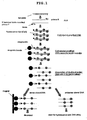
- the outline of the steps for isolation of antisense strand DNA using magnetic beads is shown in Fig. 1 .
- isolation of sense strand DNA using magnetic beads can also be performed in the same manner.
- the internal standard gene in the present specification is a gene to be subjected to multiplex PCR together with a DNA derived from a sample, hybridized with a probe that recognizes an amplification product and detected for detection of a false negative reaction.
- a house keeping gene is often utilized, which is expressed in a comparatively high amount in a cell and shows less variation thereof.
- Specific examples include G3PDH, ⁇ -actin and the like.
- the kit of the present invention can adopt G3PDH as an internal standard, and optionally contains a combination of a primer set (primer set 24) and a probe (probe 24) for G3PDH (see the above-mentioned Table 1 and Table 3).
- the combination of the primer set and the probe is designed to amplify or hybridize simultaneously with and at the same efficiency as amplification reactions or hybridization reactions of various types of HPV genes.
- the kit of the present invention contains, from among the aforementioned 24 kinds of combinations of primer sets and probes, a combination of primer set 3 and probe 3, a combination of primer set 4 and probe 4, and optionally a combination of primer set 24 and probe 24.
- the kit can detect HPV16 and HPV18. These HPV subtypes have a particularly high risk of the onset of cervical cancer.
- the kit of the present invention contains, from among the aforementioned 24 kinds of combinations of primer sets and probes, a combination of primer set 3 and probe 3, a combination of primer set 4 and probe 4, a combination of primer set 5 and probe 5, a combination of primer set 6 and probe 6, a combination of primer set 7 and probe 7, a combination of primer set 9 and probe 9, a combination of primer set 10 and probe 10, a combination of primer set 13 and probe 13, a combination of primer set 14 and probe 14, a combination of primer set 15 and probe 15, a combination of primer set 18 and probe 18, a combination of primer set 19 and probe 19, a combination of primer set 20 and probe 20, a combination of primer set 23 and probe 23, and optionally a combination of primer set 24 and probe 24.
- the kit can detect HPV16, HPV18, HPV30, HPV31, HPV33, HPV35, HPV39, HPV45, HPV51, HPV52, HPV56, HPV58, HPV59 and HPV68. These HPV subtypes are classified to have a high risk of the onset of cervical cancer.
- the kit of the present invention contains all the aforementioned 23 kinds of combinations of primer set and probe for the detection of HPV, and optionally a combination of primer set 24 and probe 24.
- the kit of the present invention can contain, besides each of the aforementioned combinations of primer set and probe, a combination of all the following reagents or an optional combination thereof, and other reagents: buffer, heat-resistant DNA polymerase, positive control HPV DNA, non HPV DNA, internal standard G3PDH DNA, dNTP, fluorochrome labeled base (e.g., Cy3-dUTP), and streptavidin-immobilized magnetic beads.
- buffer heat-resistant DNA polymerase
- positive control HPV DNA positive control HPV DNA
- non HPV DNA non HPV DNA
- internal standard G3PDH DNA dNTP
- fluorochrome labeled base e.g., Cy3-dUTP
- streptavidin-immobilized magnetic beads e.g., streptavidin-immobilized magnetic beads.
- a method of type-specifically detecting the presence or absence of HPV in a sample using the aforementioned kit of the present invention includes a step of performing PCR using DNA extracted from a sample as a template and the aforementioned primer set, and a step of detecting an amplified DNA product.
- the method includes a step of performing PCR using DNA extracted from a sample as a template and the aforementioned primer set, a step of isolating an amplified DNA product as a single strand, and a step of detection by hybridizing the single strand DNA with the aforementioned probe. While the actual procedures of each step are not particularly limited, the method described for explanation of the kit is preferably used as appropriate.
- respective reagents buffer, enzyme, solution, compound etc.
- buffer, enzyme, solution, compound etc. are those generally used in the art, and are commercially available or can be prepared as reported earlier.
- HPV and G3PDH glycoceraldehydes triphosphoric acid dehydrogenase
- GenBank accession numbers of the 24 kinds of gene sequences used in the present invention are shown in Table 2.
- a primer set satisfying the following criteria was designed based on the sequence of each gene:
- the melting temperature (Tm) is within the range of 60 - 70°C (when the Nearest Neighbor method is used. Na + Conc.: 50 mM); the length of amplification product is within the range of 100 - 500 bp; the GC content is within the range of 50 - 60%; it does not contain a sequence having high homology with other kinds of HPV; it does not form a secondary structure in a molecule; and primers do not hybridize with each other.
- primer sets specific to each of HPV and G3PDH were designed.
- Oligonucleotide DNA was synthesized by a DNA synthesizer based on the sequences of the primer set shown in Table 1.
- DNAs encoding HPV6, HPV11, HPV16, HPV18, HPV30, HPV31, HPV33, HPV34, HPV35, HPV39, HPV40, HPV42, HPV45, HPV51, HPV52, HPV53, HPV54, HPV56, HPV58, HPV59, HPV61, HPV66 or HPV68 were each introduced into plasmid pUC18 to give plasmids for 23 kinds of templates.
- each DNA of 23 kinds of the plasmids for HPV templates and the genome derived from Jurkat cell (human leukemia T lymphoma) were respectively subjected to PCR reaction using each primer set produced as mentioned above.
- the composition of the reaction solution is as follows: [Table 4] 10 ⁇ PCR buffer 2 ⁇ L 2.5 mM dNTP 0.4 ⁇ L primer F (4 ⁇ M) 0.5 ⁇ L primer R (4 ⁇ M) 0.5 ⁇ L DNA Taq polymerase 0.16 ⁇ L DDW (double distilled water) 15.44 ⁇ L template (1 ⁇ 10 6 copies) 1 ⁇ L Total 20 ⁇ L
- the reaction conditions of PCR employed were as follows: 30 cycles of 95°C for 4 min, then 95°C for 30 sec, 60°C for 30 sec and 72°C for 1 min, and then 72°C for 7 min, followed by preservation at 4°C.
- the obtained amplified DNA product was separated by agarose gel electrophoresis. An amplification product having an anticipated length was obtained for every primer set, and the absence of contaminating amplified product caused by non-specific hybridization was confirmed.
- the composition of the reaction solution was as follows. [Table 5] 10 ⁇ PCR buffer 2 ⁇ L 2.5 mM dNTP 0.4 ⁇ L primer mixture 1 ⁇ L (final concentration: 0.05 ⁇ M or 0.1 ⁇ M) DNA Taq polymerase 0.16 ⁇ L DDW 15.44 ⁇ L template (1 ⁇ 10 6 copies) 1 ⁇ L Total 20 ⁇ L
- the reaction conditions of PCR employed were as follows: 30 cycles of 95°C for 4 min, then 95°C for 30 sec, 60°C for 30 sec and 72°C for 1 min, and then 72°C for 7 min, followed by preservation at 4°C.
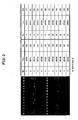
- the obtained amplified DNA product was separated by agarose gel electrophoresis. The results are shown in Fig. 2 . An amplification product having an anticipated length was obtained for every template, and therefore, the absence of contaminating amplified product caused by non-specific hybridization was confirmed even when the primers were mixed.
- a probe (sense strand DNA) satisfying the following criteria was designed within each PCR amplification region of the 23 kinds of HPV and G3PDH:
- the melting temperature (Tm) is within the range of 72 - 78°C (when the GC% method is used. Na + Conc.: 50 mM); the length of probe is within the range of 69 - 71 bp; the GC content is within the range of 45 - 55%; it does not contain a sequence having high homology with other types of HPV; and it does not form a secondary structure in a molecule.
- probes specific to each of HPV and G3PDH were designed (Table 3).
- Oligonucleotide DNA was synthesized by a DNA synthesizer based on the sequence of the probe shown in Table 3.
- probes synthesized in Example 2 were mixed in the composition shown in Table 6, spotted on a glass substrate coated with poly-L-lysine with a commercially available contact or non-contact type spotter (SpotArray or Piezorray: PerkinElmer) in the arrangement shown in Fig. 3 (2 spots for each probe) to give a DNA microarray for detection.
- spotArray or Piezorray: PerkinElmer commercially available contact or non-contact type spotter
- reaction conditions of PCR were as follows: 30 cycles of 95°C for 4 min, then 95°C for 30 sec, 60°C for 30 sec and 72°C for 1 min, and then 72°C for 7 min, followed by preservation at 4°C.
- Cy3-labeled amplified DNA product was blended with the hybridization solution described in Table 8, and denatured by heating at 95°C for 2 min, and the mixture was left standing on ice for 3 min, and 8 ⁇ L thereof was used for hybridization with DNA microarray.
- Table 8 Cy3-labeled amplified DNA product 3.1 ⁇ L 20 ⁇ SSC 2.5 ⁇ L 50 ⁇ Denhardt's solution 0.8 ⁇ L 4% Tween solution 0.5 ⁇ L DDW 3.1 ⁇ L Total 10 ⁇ L
- the hybridization reaction was performed according to the method described in JP-B-3860174 in a thermostatic tank at 65°C for 1 hr.
- the DNA microarray was washed with 2 ⁇ SSC-0.1% SDS solution and 0.2 ⁇ SSC-0.1% SDS solution each for 5 min, rinsed with 0.2 ⁇ SSC and 0.05 ⁇ SSC, and dried with a nitrogen gas air gun or slide centrifuge.
- a fluorescence spot caused by non-specific hybridization was not detected for any template, and it was confirmed that a fluorescence spot can be detected HPV type-specifically.
- Example 5 Detection of HPV additionally including isolation step of single strand DNA using magnetic beads (see Fig. 1)
- primer Fs were newly produced by adding biotin to the 5' end.
- An order for actual synthesis was placed to a DNA synthesis contractor maker, and the primers were chemically synthesized using a general DNA synthesizer.
- the amplification and labeling steps of HPV and G3PDH as described in Example 4(1) were performed in the same manner using the primers to give a Cy3-labeled amplified DNA product.
- reaction solution was completely removed while allowing adsorption of the complex to the magnet. Then, the magnet was removed, a 0.1N NaOH (alkali) solution (10 ⁇ L) was added to the complex, and the mixture was reacted for 10 min to dissociate the double strand of the amplified DNA product to a single strand. Thereafter, only the sense strand (single strand) DNA elongated by primer F in the PCR reaction in Table 1 was adsorbed again to the magnet, and the alkali solution was harvested, whereby only the antisense strand DNA elongated by primer R in the PCR reaction was selectively isolated. The isolated antisense strand (single strand) DNA was neutralized with 3M sodium acetic acid (1 ⁇ L) and left standing on ice for 5 min.
- Example 4(2) the isolated antisense strand (single strand) DNA was used for the hybridization reaction with DNA microarray described in Example 4(2).
- the reaction was performed in the same manner as in Example 4(2) except that the Cy3-labeled amplified DNA product in the reaction composition described in Table 8 was replaced by the antisense strand (single strand) DNA.
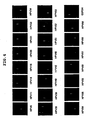
- the scan images are shown in Fig. 4 .
- a fluorescence spot caused by non-specific hybridization was not detected for any template, and it was confirmed that a fluorescence spot can be detected HPV type-specifically. Furthermore, it could be confirmed that the detection with higher sensitively is possible for any template as compared to Example 4, which results from the addition of the isolation step of single strand DNA using magnetic beads ( Fig. 5 ).
- the present invention provides primer sets and probes which can rapidly and conveniently detect multiple types of HPV with high specificity and high sensitivity.
- the present invention also provides a method capable of rapidly and conveniently detecting multiple types of HPV with high specificity and high sensitivity by utilizing the aforementioned primer sets and probes.
Landscapes
- Chemical & Material Sciences (AREA)
- Life Sciences & Earth Sciences (AREA)
- Health & Medical Sciences (AREA)
- Organic Chemistry (AREA)
- Zoology (AREA)
- Engineering & Computer Science (AREA)
- Immunology (AREA)
- Wood Science & Technology (AREA)
- Proteomics, Peptides & Aminoacids (AREA)
- Virology (AREA)
- Biochemistry (AREA)
- Microbiology (AREA)
- Molecular Biology (AREA)
- Physics & Mathematics (AREA)
- Biophysics (AREA)
- Analytical Chemistry (AREA)
- Biotechnology (AREA)
- Bioinformatics & Cheminformatics (AREA)
- General Engineering & Computer Science (AREA)
- General Health & Medical Sciences (AREA)
- Genetics & Genomics (AREA)
- Measuring Or Testing Involving Enzymes Or Micro-Organisms (AREA)
- Apparatus Associated With Microorganisms And Enzymes (AREA)
Applications Claiming Priority (2)
| Application Number | Priority Date | Filing Date | Title |
|---|---|---|---|
| JP2007203677A JP5302519B2 (ja) | 2007-08-03 | 2007-08-03 | ヒトパピローマウイルスを検出するためのプライマーセット及びプローブ |
| PCT/JP2008/063906 WO2009020079A1 (ja) | 2007-08-03 | 2008-08-01 | ヒトパピローマウイルスを検出するためのプライマーセット及びプローブ |
Publications (3)
| Publication Number | Publication Date |
|---|---|
| EP2192182A1 EP2192182A1 (en) | 2010-06-02 |
| EP2192182A4 EP2192182A4 (en) | 2010-09-08 |
| EP2192182B1 true EP2192182B1 (en) | 2014-10-08 |
Family
ID=40341313
Family Applications (1)
| Application Number | Title | Priority Date | Filing Date |
|---|---|---|---|
| EP08792119.3A Not-in-force EP2192182B1 (en) | 2007-08-03 | 2008-08-01 | Primer set and probe for detection of human papillomavirus |
Country Status (5)
| Country | Link |
|---|---|
| US (1) | US8455632B2 (enExample) |
| EP (1) | EP2192182B1 (enExample) |
| JP (1) | JP5302519B2 (enExample) |
| CN (1) | CN101918550B (enExample) |
| WO (1) | WO2009020079A1 (enExample) |
Families Citing this family (9)
| Publication number | Priority date | Publication date | Assignee | Title |
|---|---|---|---|---|
| US9120855B2 (en) | 2010-02-10 | 2015-09-01 | Novartis Ag | Biologic compounds directed against death receptor 5 |
| KR101239387B1 (ko) * | 2010-06-17 | 2013-03-11 | 문우철 | 인유두종바이러스의 유전자형 분석용 dna 칩, 이를 포함하는 키트 및 유전자형 분석방법 |
| JP5651029B2 (ja) * | 2010-09-09 | 2015-01-07 | 邦明 成澤 | 発がん性ヒトパピローマウイルス遺伝子型を同定するための混合プライマーセット及び同定方法 |
| CN102409110B (zh) * | 2011-12-12 | 2013-08-14 | 泰普生物科学(中国)有限公司 | 一种人乳头瘤病毒型原位杂交检测试剂盒及其方法 |
| WO2013168832A1 (ko) * | 2012-05-08 | 2013-11-14 | (주)진매트릭스 | 고위험군 인유두종바이러스 유전자 분석용 키트 및 그 분석방법 |
| CN103409560A (zh) * | 2013-08-19 | 2013-11-27 | 潘晓静 | 一种广谱、高效、经济的高危人乳头状瘤病毒的pcr检测方法 |
| CN104561385A (zh) * | 2015-01-24 | 2015-04-29 | 中国农业科学院兰州兽医研究所 | 检测乳头瘤状病毒hpv6型的pcr试剂盒 |
| WO2022136286A1 (en) * | 2020-12-22 | 2022-06-30 | F. Hoffmann-La Roche Ag | Automated clinical diagnostic system and method |
| CN112921033A (zh) * | 2021-04-07 | 2021-06-08 | 深圳市刚竹医疗科技有限公司 | 核酸组合物和检测试剂盒 |
Family Cites Families (9)
| Publication number | Priority date | Publication date | Assignee | Title |
|---|---|---|---|---|
| US6001612A (en) * | 1998-11-06 | 1999-12-14 | Yang; Robert Che-An | Heteroduplex PCR cloning |
| KR100452163B1 (ko) * | 2001-09-14 | 2004-10-12 | 주식회사 바이오메드랩 | 인유두종 바이러스의 감염을 진단하기 위한 유전형 분석키트 |
| HUP0200981A3 (en) | 2002-03-14 | 2004-06-28 | Genoid Kft | Pcr reactions with hybridizing probes using primers with broad genotype-specificity for detection of human papilloma-viruses and typing amplificates by using specifically hybridizing oligonucleotides |
| JP3600616B2 (ja) * | 2002-09-12 | 2004-12-15 | 株式会社ジェネティックラボ | ヒトパピローマウイルスを検出するためのプライマーセット、検出方法および検出用dnaアレイ |
| WO2005033333A2 (en) * | 2003-10-07 | 2005-04-14 | Dako Denmark A/S | Methods and compositions for the diagnosis of cancer |
| GB0500996D0 (en) * | 2005-01-18 | 2005-02-23 | Delfts Diagnostic Labaratory B | Detection method and materials therefor |
| JP4225986B2 (ja) | 2005-06-17 | 2009-02-18 | 株式会社ジェネティックラボ | ヒトパピローマウイルスを検出するためのプライマーセット |
| CN100582239C (zh) * | 2005-10-10 | 2010-01-20 | 上海透景生命科技有限公司 | 一种人乳头瘤病毒检测分型试剂盒 |
| US7910719B2 (en) * | 2005-12-08 | 2011-03-22 | Kabushiki Kaisha Toshiba | Method of detecting human papilloma virus by using nucleic acid amplification method and nucleic acid chain-immobilized carrier |
-
2007
- 2007-08-03 JP JP2007203677A patent/JP5302519B2/ja not_active Expired - Fee Related
-
2008
- 2008-08-01 EP EP08792119.3A patent/EP2192182B1/en not_active Not-in-force
- 2008-08-01 WO PCT/JP2008/063906 patent/WO2009020079A1/ja not_active Ceased
- 2008-08-01 US US12/671,851 patent/US8455632B2/en not_active Expired - Fee Related
- 2008-08-01 CN CN2008801096555A patent/CN101918550B/zh not_active Expired - Fee Related
Also Published As
| Publication number | Publication date |
|---|---|
| HK1151828A1 (en) | 2012-02-10 |
| CN101918550A (zh) | 2010-12-15 |
| CN101918550B (zh) | 2013-12-25 |
| HK1144205A1 (en) | 2011-02-02 |
| WO2009020079A1 (ja) | 2009-02-12 |
| US8455632B2 (en) | 2013-06-04 |
| EP2192182A1 (en) | 2010-06-02 |
| JP2009034081A (ja) | 2009-02-19 |
| US20100240553A1 (en) | 2010-09-23 |
| EP2192182A4 (en) | 2010-09-08 |
| JP5302519B2 (ja) | 2013-10-02 |
Similar Documents
| Publication | Publication Date | Title |
|---|---|---|
| US8455632B2 (en) | Primer set and probe for detection of human papillomavirus | |
| US7393633B1 (en) | Genotyping kit for diagnosis of human papillomavirus infection | |
| CN103210091B (zh) | 用于检测人乳头瘤病毒的基因型的dna芯片、含有该芯片的试剂盒及检测hpv的基因型的方法 | |
| JPH09509062A (ja) | 普遍プライマーを用いる核酸増幅方法によるヒト乳頭腫ウィルス検出 | |
| EP1294939B1 (en) | Detection and typing of human papillomavirus using pna probes | |
| JP2005503177A (ja) | ヒト乳頭腫ウイルスの感染を診断するための遺伝子型同定キット | |
| AU2013205122B2 (en) | Compositions and Methods for Detecting Human Papillomavirus Nucleic Acid | |
| US8399652B2 (en) | Primers and probes for detecting genital HPV genotypes | |
| EP1499749B1 (en) | Human papilloma virus detection with dna microarray | |
| US20030143529A1 (en) | Detection and typing of human papillomavirus using PNA probes | |
| US6902899B2 (en) | Detection of human papillomaviruses | |
| KR101018407B1 (ko) | 인유두종 바이러스 진단용 프로브 및 그 유전자형 확인방법 | |
| HK1144205B (en) | Primer set and probe for detection of human papillomavirus | |
| EP1403384A1 (en) | Method for detecting and typing of cutaneous HPV and primers and probes for use therein | |
| JP3600616B2 (ja) | ヒトパピローマウイルスを検出するためのプライマーセット、検出方法および検出用dnaアレイ | |
| HK1151828B (en) | Primer set and probe for detection of human papillomavirus | |
| EP2362916B1 (en) | Hpv types and variants associated with cervical cancer and the uses thereof | |
| JP2001321168A (ja) | Hpv感染型の同定方法 | |
| KR20090118777A (ko) | 인유두종바이러스의 유전자형 검출을 위한 ρνα 프로브,키트 및 방법 | |
| HK1074221B (en) | Genotyping kit for diagnosis of human papilloma virus infection | |
| MX2008006322A (es) | Èmetodo para detectar patògenos |
Legal Events
| Date | Code | Title | Description |
|---|---|---|---|
| PUAI | Public reference made under article 153(3) epc to a published international application that has entered the european phase |
Free format text: ORIGINAL CODE: 0009012 |
|
| 17P | Request for examination filed |
Effective date: 20100303 |
|
| AK | Designated contracting states |
Kind code of ref document: A1 Designated state(s): AT BE BG CH CY CZ DE DK EE ES FI FR GB GR HR HU IE IS IT LI LT LU LV MC MT NL NO PL PT RO SE SI SK TR |
|
| AX | Request for extension of the european patent |
Extension state: AL BA MK RS |
|
| A4 | Supplementary search report drawn up and despatched |
Effective date: 20100805 |
|
| DAX | Request for extension of the european patent (deleted) | ||
| REG | Reference to a national code |
Ref country code: HK Ref legal event code: DE Ref document number: 1144205 Country of ref document: HK |
|
| 17Q | First examination report despatched |
Effective date: 20110628 |
|
| REG | Reference to a national code |
Ref country code: DE Ref legal event code: R079 Ref document number: 602008034800 Country of ref document: DE Free format text: PREVIOUS MAIN CLASS: C12N0015090000 Ipc: C12Q0001700000 |
|
| RIC1 | Information provided on ipc code assigned before grant |
Ipc: C12Q 1/70 20060101AFI20140120BHEP |
|
| GRAP | Despatch of communication of intention to grant a patent |
Free format text: ORIGINAL CODE: EPIDOSNIGR1 |
|
| INTG | Intention to grant announced |
Effective date: 20140428 |
|
| GRAS | Grant fee paid |
Free format text: ORIGINAL CODE: EPIDOSNIGR3 |
|
| RIN1 | Information on inventor provided before grant (corrected) |
Inventor name: KOGOH, KAZUHIKO Inventor name: KAWAKAMI, AKIKO Inventor name: MORISHITA, ATSUSHI Inventor name: MIYAGAWA, ISAO Inventor name: OGAWA, NAOKI |
|
| GRAA | (expected) grant |
Free format text: ORIGINAL CODE: 0009210 |
|
| RIN1 | Information on inventor provided before grant (corrected) |
Inventor name: KOGOH, KAZUHIKO Inventor name: MORISHITA, ATSUSHI Inventor name: OGAWA, NAOKI Inventor name: MIYAGAWA, ISAO Inventor name: KAWAKAMI, AKIKO |
|
| AK | Designated contracting states |
Kind code of ref document: B1 Designated state(s): AT BE BG CH CY CZ DE DK EE ES FI FR GB GR HR HU IE IS IT LI LT LU LV MC MT NL NO PL PT RO SE SI SK TR |
|
| REG | Reference to a national code |
Ref country code: GB Ref legal event code: FG4D |
|
| REG | Reference to a national code |
Ref country code: AT Ref legal event code: REF Ref document number: 690655 Country of ref document: AT Kind code of ref document: T Effective date: 20141015 Ref country code: CH Ref legal event code: EP |
|
| REG | Reference to a national code |
Ref country code: IE Ref legal event code: FG4D |
|
| REG | Reference to a national code |
Ref country code: DE Ref legal event code: R096 Ref document number: 602008034800 Country of ref document: DE Effective date: 20141120 |
|
| REG | Reference to a national code |
Ref country code: NL Ref legal event code: VDEP Effective date: 20141008 |
|
| REG | Reference to a national code |
Ref country code: AT Ref legal event code: MK05 Ref document number: 690655 Country of ref document: AT Kind code of ref document: T Effective date: 20141008 |
|
| REG | Reference to a national code |
Ref country code: LT Ref legal event code: MG4D |
|
| PG25 | Lapsed in a contracting state [announced via postgrant information from national office to epo] |
Ref country code: NL Free format text: LAPSE BECAUSE OF FAILURE TO SUBMIT A TRANSLATION OF THE DESCRIPTION OR TO PAY THE FEE WITHIN THE PRESCRIBED TIME-LIMIT Effective date: 20141008 |
|
| PG25 | Lapsed in a contracting state [announced via postgrant information from national office to epo] |
Ref country code: ES Free format text: LAPSE BECAUSE OF FAILURE TO SUBMIT A TRANSLATION OF THE DESCRIPTION OR TO PAY THE FEE WITHIN THE PRESCRIBED TIME-LIMIT Effective date: 20141008 Ref country code: NO Free format text: LAPSE BECAUSE OF FAILURE TO SUBMIT A TRANSLATION OF THE DESCRIPTION OR TO PAY THE FEE WITHIN THE PRESCRIBED TIME-LIMIT Effective date: 20150108 Ref country code: PT Free format text: LAPSE BECAUSE OF FAILURE TO SUBMIT A TRANSLATION OF THE DESCRIPTION OR TO PAY THE FEE WITHIN THE PRESCRIBED TIME-LIMIT Effective date: 20150209 Ref country code: IS Free format text: LAPSE BECAUSE OF FAILURE TO SUBMIT A TRANSLATION OF THE DESCRIPTION OR TO PAY THE FEE WITHIN THE PRESCRIBED TIME-LIMIT Effective date: 20150208 Ref country code: FI Free format text: LAPSE BECAUSE OF FAILURE TO SUBMIT A TRANSLATION OF THE DESCRIPTION OR TO PAY THE FEE WITHIN THE PRESCRIBED TIME-LIMIT Effective date: 20141008 Ref country code: LT Free format text: LAPSE BECAUSE OF FAILURE TO SUBMIT A TRANSLATION OF THE DESCRIPTION OR TO PAY THE FEE WITHIN THE PRESCRIBED TIME-LIMIT Effective date: 20141008 |
|
| REG | Reference to a national code |
Ref country code: HK Ref legal event code: GR Ref document number: 1144205 Country of ref document: HK |
|
| PG25 | Lapsed in a contracting state [announced via postgrant information from national office to epo] |
Ref country code: SE Free format text: LAPSE BECAUSE OF FAILURE TO SUBMIT A TRANSLATION OF THE DESCRIPTION OR TO PAY THE FEE WITHIN THE PRESCRIBED TIME-LIMIT Effective date: 20141008 Ref country code: HR Free format text: LAPSE BECAUSE OF FAILURE TO SUBMIT A TRANSLATION OF THE DESCRIPTION OR TO PAY THE FEE WITHIN THE PRESCRIBED TIME-LIMIT Effective date: 20141008 Ref country code: LV Free format text: LAPSE BECAUSE OF FAILURE TO SUBMIT A TRANSLATION OF THE DESCRIPTION OR TO PAY THE FEE WITHIN THE PRESCRIBED TIME-LIMIT Effective date: 20141008 Ref country code: AT Free format text: LAPSE BECAUSE OF FAILURE TO SUBMIT A TRANSLATION OF THE DESCRIPTION OR TO PAY THE FEE WITHIN THE PRESCRIBED TIME-LIMIT Effective date: 20141008 Ref country code: GR Free format text: LAPSE BECAUSE OF FAILURE TO SUBMIT A TRANSLATION OF THE DESCRIPTION OR TO PAY THE FEE WITHIN THE PRESCRIBED TIME-LIMIT Effective date: 20150109 Ref country code: CY Free format text: LAPSE BECAUSE OF FAILURE TO SUBMIT A TRANSLATION OF THE DESCRIPTION OR TO PAY THE FEE WITHIN THE PRESCRIBED TIME-LIMIT Effective date: 20141008 Ref country code: PL Free format text: LAPSE BECAUSE OF FAILURE TO SUBMIT A TRANSLATION OF THE DESCRIPTION OR TO PAY THE FEE WITHIN THE PRESCRIBED TIME-LIMIT Effective date: 20141008 |
|
| REG | Reference to a national code |
Ref country code: DE Ref legal event code: R097 Ref document number: 602008034800 Country of ref document: DE |
|
| PG25 | Lapsed in a contracting state [announced via postgrant information from national office to epo] |
Ref country code: RO Free format text: LAPSE BECAUSE OF FAILURE TO SUBMIT A TRANSLATION OF THE DESCRIPTION OR TO PAY THE FEE WITHIN THE PRESCRIBED TIME-LIMIT Effective date: 20141008 Ref country code: DK Free format text: LAPSE BECAUSE OF FAILURE TO SUBMIT A TRANSLATION OF THE DESCRIPTION OR TO PAY THE FEE WITHIN THE PRESCRIBED TIME-LIMIT Effective date: 20141008 Ref country code: CZ Free format text: LAPSE BECAUSE OF FAILURE TO SUBMIT A TRANSLATION OF THE DESCRIPTION OR TO PAY THE FEE WITHIN THE PRESCRIBED TIME-LIMIT Effective date: 20141008 Ref country code: SK Free format text: LAPSE BECAUSE OF FAILURE TO SUBMIT A TRANSLATION OF THE DESCRIPTION OR TO PAY THE FEE WITHIN THE PRESCRIBED TIME-LIMIT Effective date: 20141008 Ref country code: EE Free format text: LAPSE BECAUSE OF FAILURE TO SUBMIT A TRANSLATION OF THE DESCRIPTION OR TO PAY THE FEE WITHIN THE PRESCRIBED TIME-LIMIT Effective date: 20141008 |
|
| PLBE | No opposition filed within time limit |
Free format text: ORIGINAL CODE: 0009261 |
|
| STAA | Information on the status of an ep patent application or granted ep patent |
Free format text: STATUS: NO OPPOSITION FILED WITHIN TIME LIMIT |
|
| PG25 | Lapsed in a contracting state [announced via postgrant information from national office to epo] |
Ref country code: IT Free format text: LAPSE BECAUSE OF FAILURE TO SUBMIT A TRANSLATION OF THE DESCRIPTION OR TO PAY THE FEE WITHIN THE PRESCRIBED TIME-LIMIT Effective date: 20141008 |
|
| 26N | No opposition filed |
Effective date: 20150709 |
|
| PG25 | Lapsed in a contracting state [announced via postgrant information from national office to epo] |
Ref country code: SI Free format text: LAPSE BECAUSE OF FAILURE TO SUBMIT A TRANSLATION OF THE DESCRIPTION OR TO PAY THE FEE WITHIN THE PRESCRIBED TIME-LIMIT Effective date: 20141008 |
|
| PG25 | Lapsed in a contracting state [announced via postgrant information from national office to epo] |
Ref country code: LU Free format text: LAPSE BECAUSE OF FAILURE TO SUBMIT A TRANSLATION OF THE DESCRIPTION OR TO PAY THE FEE WITHIN THE PRESCRIBED TIME-LIMIT Effective date: 20150801 Ref country code: MC Free format text: LAPSE BECAUSE OF FAILURE TO SUBMIT A TRANSLATION OF THE DESCRIPTION OR TO PAY THE FEE WITHIN THE PRESCRIBED TIME-LIMIT Effective date: 20141008 |
|
| REG | Reference to a national code |
Ref country code: CH Ref legal event code: PL |
|
| PG25 | Lapsed in a contracting state [announced via postgrant information from national office to epo] |
Ref country code: CH Free format text: LAPSE BECAUSE OF NON-PAYMENT OF DUE FEES Effective date: 20150831 Ref country code: LI Free format text: LAPSE BECAUSE OF NON-PAYMENT OF DUE FEES Effective date: 20150831 |
|
| REG | Reference to a national code |
Ref country code: IE Ref legal event code: MM4A |
|
| PG25 | Lapsed in a contracting state [announced via postgrant information from national office to epo] |
Ref country code: IE Free format text: LAPSE BECAUSE OF NON-PAYMENT OF DUE FEES Effective date: 20150801 |
|
| REG | Reference to a national code |
Ref country code: FR Ref legal event code: PLFP Year of fee payment: 9 |
|
| PG25 | Lapsed in a contracting state [announced via postgrant information from national office to epo] |
Ref country code: MT Free format text: LAPSE BECAUSE OF FAILURE TO SUBMIT A TRANSLATION OF THE DESCRIPTION OR TO PAY THE FEE WITHIN THE PRESCRIBED TIME-LIMIT Effective date: 20141008 |
|
| PG25 | Lapsed in a contracting state [announced via postgrant information from national office to epo] |
Ref country code: BG Free format text: LAPSE BECAUSE OF FAILURE TO SUBMIT A TRANSLATION OF THE DESCRIPTION OR TO PAY THE FEE WITHIN THE PRESCRIBED TIME-LIMIT Effective date: 20141008 Ref country code: HU Free format text: LAPSE BECAUSE OF FAILURE TO SUBMIT A TRANSLATION OF THE DESCRIPTION OR TO PAY THE FEE WITHIN THE PRESCRIBED TIME-LIMIT; INVALID AB INITIO Effective date: 20080801 |
|
| REG | Reference to a national code |
Ref country code: FR Ref legal event code: PLFP Year of fee payment: 10 |
|
| PG25 | Lapsed in a contracting state [announced via postgrant information from national office to epo] |
Ref country code: TR Free format text: LAPSE BECAUSE OF FAILURE TO SUBMIT A TRANSLATION OF THE DESCRIPTION OR TO PAY THE FEE WITHIN THE PRESCRIBED TIME-LIMIT Effective date: 20141008 |
|
| PG25 | Lapsed in a contracting state [announced via postgrant information from national office to epo] |
Ref country code: BE Free format text: LAPSE BECAUSE OF FAILURE TO SUBMIT A TRANSLATION OF THE DESCRIPTION OR TO PAY THE FEE WITHIN THE PRESCRIBED TIME-LIMIT Effective date: 20141008 |
|
| REG | Reference to a national code |
Ref country code: FR Ref legal event code: PLFP Year of fee payment: 11 |
|
| PGFP | Annual fee paid to national office [announced via postgrant information from national office to epo] |
Ref country code: GB Payment date: 20200722 Year of fee payment: 13 Ref country code: FR Payment date: 20200810 Year of fee payment: 13 Ref country code: DE Payment date: 20200831 Year of fee payment: 13 |
|
| REG | Reference to a national code |
Ref country code: DE Ref legal event code: R119 Ref document number: 602008034800 Country of ref document: DE |
|
| GBPC | Gb: european patent ceased through non-payment of renewal fee |
Effective date: 20210801 |
|
| PG25 | Lapsed in a contracting state [announced via postgrant information from national office to epo] |
Ref country code: GB Free format text: LAPSE BECAUSE OF NON-PAYMENT OF DUE FEES Effective date: 20210801 Ref country code: FR Free format text: LAPSE BECAUSE OF NON-PAYMENT OF DUE FEES Effective date: 20210831 Ref country code: DE Free format text: LAPSE BECAUSE OF NON-PAYMENT OF DUE FEES Effective date: 20220301 |