EP2190498B1 - Vorrichtung zur einsparung von diafiltrat - Google Patents
Vorrichtung zur einsparung von diafiltrat Download PDFInfo
- Publication number
- EP2190498B1 EP2190498B1 EP08787309.7A EP08787309A EP2190498B1 EP 2190498 B1 EP2190498 B1 EP 2190498B1 EP 08787309 A EP08787309 A EP 08787309A EP 2190498 B1 EP2190498 B1 EP 2190498B1
- Authority
- EP
- European Patent Office
- Prior art keywords
- dialysate
- adsorber
- diafiltrate
- membrane filter
- regeneration loop
- Prior art date
- Legal status (The legal status is an assumption and is not a legal conclusion. Google has not performed a legal analysis and makes no representation as to the accuracy of the status listed.)
- Active
Links
Images




Classifications
-
- A—HUMAN NECESSITIES
- A61—MEDICAL OR VETERINARY SCIENCE; HYGIENE
- A61M—DEVICES FOR INTRODUCING MEDIA INTO, OR ONTO, THE BODY; DEVICES FOR TRANSDUCING BODY MEDIA OR FOR TAKING MEDIA FROM THE BODY; DEVICES FOR PRODUCING OR ENDING SLEEP OR STUPOR
- A61M1/00—Suction or pumping devices for medical purposes; Devices for carrying-off, for treatment of, or for carrying-over, body-liquids; Drainage systems
- A61M1/14—Dialysis systems; Artificial kidneys; Blood oxygenators ; Reciprocating systems for treatment of body fluids, e.g. single needle systems for hemofiltration or pheresis
- A61M1/16—Dialysis systems; Artificial kidneys; Blood oxygenators ; Reciprocating systems for treatment of body fluids, e.g. single needle systems for hemofiltration or pheresis with membranes
- A61M1/1694—Dialysis systems; Artificial kidneys; Blood oxygenators ; Reciprocating systems for treatment of body fluids, e.g. single needle systems for hemofiltration or pheresis with membranes with recirculating dialysing liquid
- A61M1/1696—Dialysis systems; Artificial kidneys; Blood oxygenators ; Reciprocating systems for treatment of body fluids, e.g. single needle systems for hemofiltration or pheresis with membranes with recirculating dialysing liquid with dialysate regeneration
-
- A—HUMAN NECESSITIES
- A61—MEDICAL OR VETERINARY SCIENCE; HYGIENE
- A61M—DEVICES FOR INTRODUCING MEDIA INTO, OR ONTO, THE BODY; DEVICES FOR TRANSDUCING BODY MEDIA OR FOR TAKING MEDIA FROM THE BODY; DEVICES FOR PRODUCING OR ENDING SLEEP OR STUPOR
- A61M1/00—Suction or pumping devices for medical purposes; Devices for carrying-off, for treatment of, or for carrying-over, body-liquids; Drainage systems
- A61M1/34—Filtering material out of the blood by passing it through a membrane, i.e. hemofiltration or diafiltration
- A61M1/342—Adding solutions to the blood, e.g. substitution solutions
- A61M1/3424—Substitution fluid path
- A61M1/3431—Substitution fluid path upstream of the filter
-
- A—HUMAN NECESSITIES
- A61—MEDICAL OR VETERINARY SCIENCE; HYGIENE
- A61M—DEVICES FOR INTRODUCING MEDIA INTO, OR ONTO, THE BODY; DEVICES FOR TRANSDUCING BODY MEDIA OR FOR TAKING MEDIA FROM THE BODY; DEVICES FOR PRODUCING OR ENDING SLEEP OR STUPOR
- A61M1/00—Suction or pumping devices for medical purposes; Devices for carrying-off, for treatment of, or for carrying-over, body-liquids; Drainage systems
- A61M1/34—Filtering material out of the blood by passing it through a membrane, i.e. hemofiltration or diafiltration
- A61M1/342—Adding solutions to the blood, e.g. substitution solutions
- A61M1/3424—Substitution fluid path
- A61M1/3431—Substitution fluid path upstream of the filter
- A61M1/3434—Substitution fluid path upstream of the filter with pre-dilution and post-dilution
-
- A—HUMAN NECESSITIES
- A61—MEDICAL OR VETERINARY SCIENCE; HYGIENE
- A61M—DEVICES FOR INTRODUCING MEDIA INTO, OR ONTO, THE BODY; DEVICES FOR TRANSDUCING BODY MEDIA OR FOR TAKING MEDIA FROM THE BODY; DEVICES FOR PRODUCING OR ENDING SLEEP OR STUPOR
- A61M1/00—Suction or pumping devices for medical purposes; Devices for carrying-off, for treatment of, or for carrying-over, body-liquids; Drainage systems
- A61M1/34—Filtering material out of the blood by passing it through a membrane, i.e. hemofiltration or diafiltration
- A61M1/342—Adding solutions to the blood, e.g. substitution solutions
- A61M1/3424—Substitution fluid path
- A61M1/3437—Substitution fluid path downstream of the filter, e.g. post-dilution with filtrate
-
- A—HUMAN NECESSITIES
- A61—MEDICAL OR VETERINARY SCIENCE; HYGIENE
- A61M—DEVICES FOR INTRODUCING MEDIA INTO, OR ONTO, THE BODY; DEVICES FOR TRANSDUCING BODY MEDIA OR FOR TAKING MEDIA FROM THE BODY; DEVICES FOR PRODUCING OR ENDING SLEEP OR STUPOR
- A61M1/00—Suction or pumping devices for medical purposes; Devices for carrying-off, for treatment of, or for carrying-over, body-liquids; Drainage systems
- A61M1/34—Filtering material out of the blood by passing it through a membrane, i.e. hemofiltration or diafiltration
- A61M1/342—Adding solutions to the blood, e.g. substitution solutions
- A61M1/3441—Substitution rate control as a function of the ultrafiltration rate
-
- A—HUMAN NECESSITIES
- A61—MEDICAL OR VETERINARY SCIENCE; HYGIENE
- A61M—DEVICES FOR INTRODUCING MEDIA INTO, OR ONTO, THE BODY; DEVICES FOR TRANSDUCING BODY MEDIA OR FOR TAKING MEDIA FROM THE BODY; DEVICES FOR PRODUCING OR ENDING SLEEP OR STUPOR
- A61M1/00—Suction or pumping devices for medical purposes; Devices for carrying-off, for treatment of, or for carrying-over, body-liquids; Drainage systems
- A61M1/34—Filtering material out of the blood by passing it through a membrane, i.e. hemofiltration or diafiltration
- A61M1/342—Adding solutions to the blood, e.g. substitution solutions
- A61M1/3455—Substitution fluids
- A61M1/3468—Substitution fluids using treated filtrate as substitution fluid
-
- A—HUMAN NECESSITIES
- A61—MEDICAL OR VETERINARY SCIENCE; HYGIENE
- A61M—DEVICES FOR INTRODUCING MEDIA INTO, OR ONTO, THE BODY; DEVICES FOR TRANSDUCING BODY MEDIA OR FOR TAKING MEDIA FROM THE BODY; DEVICES FOR PRODUCING OR ENDING SLEEP OR STUPOR
- A61M1/00—Suction or pumping devices for medical purposes; Devices for carrying-off, for treatment of, or for carrying-over, body-liquids; Drainage systems
- A61M1/34—Filtering material out of the blood by passing it through a membrane, i.e. hemofiltration or diafiltration
- A61M1/3472—Filtering material out of the blood by passing it through a membrane, i.e. hemofiltration or diafiltration with treatment of the filtrate
-
- A—HUMAN NECESSITIES
- A61—MEDICAL OR VETERINARY SCIENCE; HYGIENE
- A61M—DEVICES FOR INTRODUCING MEDIA INTO, OR ONTO, THE BODY; DEVICES FOR TRANSDUCING BODY MEDIA OR FOR TAKING MEDIA FROM THE BODY; DEVICES FOR PRODUCING OR ENDING SLEEP OR STUPOR
- A61M1/00—Suction or pumping devices for medical purposes; Devices for carrying-off, for treatment of, or for carrying-over, body-liquids; Drainage systems
- A61M1/34—Filtering material out of the blood by passing it through a membrane, i.e. hemofiltration or diafiltration
- A61M1/3472—Filtering material out of the blood by passing it through a membrane, i.e. hemofiltration or diafiltration with treatment of the filtrate
- A61M1/3486—Biological, chemical treatment, e.g. chemical precipitation; treatment by absorbents
Definitions
- the present invention describes an apparatus for saving diafiltrate by partial regeneration using adsorbers.
- Complex biological fluid compartments consist of one or more fluid spaces (s) communicating with each other. Concentration of substance concentrations in complex biological fluid compartments are characterized by mechanisms of formation, distribution, transformation and elimination and are different for different substances (eg the substance groups X or Y).
- An example of a complex biological fluid compartment is bioreactors, for example, to utilize the metabolism of liver cells.
- one fluid space would be the reactor medium and a second the cell interior of the liver cells, with both spaces communicating with each other across the cell membranes. Enzymatic processes of the cell and distribution processes influence the concentration of substances in the Reactomedium.
- Another example of a complex biological fluid compartment (A) is the human bloodstream.
- Membrane Dialysis / Filtration is a broadly combined process for controlling the concentrations of substances in a complex fluid compartment (A) in which the fluid in a room is directed along a porous membrane and along the opposite side Rinsing liquid (B) is performed, which does not contain the undesirable in liquid (A) substances and so these substances can enter at Porzanaught according to a concentration gradient in the compartment B by diffusion (dialysis).
- This process can be combined with a convective transport, in which a liquid flow (crossflow) from A to B is applied by pressure gradient, the substances also convectively transported through the membrane, wherein the compartment (A) leaving (filtered) part (filtrate ) can be completely or partially replaced by a substitution solution (substituate).
- a convective transport in which a liquid flow (crossflow) from A to B is applied by pressure gradient, the substances also convectively transported through the membrane, wherein the compartment (A) leaving (filtered) part (filtrate ) can be completely or partially replaced by a substitution solution (substituate).
- the combined term of membrane dialysis / filtration also covers every possible combination of both methods, with in extreme cases also exclusively filtration or exclusively dialysis being applied.
- Rinsing solution compartment (B) in the context of the present invention, in membrane dialysis / filtration, the opposite liquid compartment separated from the complex biological fluid compartment (A) by the membrane, in which dialysate, filtrate or a combination of both is located.
- Dialysate refers to the rinsing fluid used in the term "membrane dialysis / filtration", which is supplied to the membrane on the rinsing solution side (B) for substance removal.
- Substituate is the substituate solution used in the definition of the term "membrane dialysis / filtration", which serves as a liquid substitute for the side (A) during filtration.
- Diafiltrate As diafiltrate in the definition of "membrane dialysis / - filtration” the flushing side (B) of the membrane leaving, so enriched after a cleaning cycle with undesirable molecules liquid mixture of "filtrate” and "dialysate".
- Net flow rate of dialysate / substituate The "net throughput" of diafiltrate is that part of the diafiltrate which has been discarded after a single passage on the membrane filter, ie not a cleaning cycle and reuse.
- Regeneration cycle (RKL): The regeneration cycle is a device described in more detail in the examples and the claims, which, for example by filtration, adsorption or biological purification processes deplete substances of substance group Y from the diafiltrate, but not the substance group X.
- Substance group X In this invention, a pathogenic substance group is summarized that can not be directly depleted by the regeneration cycle (RKL) because it has no retention or adsorption capacity for this group X.
- the group of substances summarized under group X can be removed by dialysis or filtration.
- Substance group Y This summarizes a pathogenic substance group that can be depleted by the regeneration cycle (RKL), since it has a retention or adsorption capacity for Y.
- this may be, for example, the urea formed by the Krebszyclus. This could be removed from the Reactomedium by diafiltration. Urea may also accumulate in the bloodstream of patients with kidney damage.
- the daily treatment time is also determined. Accordingly, if the removal rate is low due to low flow rates, the treatment time must be prolonged, forcing prolonged anticoagulation (e.g., heparin or citrate), which may have side effects (e.g., bleeding or alkalosis and hypernatraemia).
- anticoagulation e.g., heparin or citrate
- the extracorporeal blood purification by dialysis and filtration is based on the diffusive (dialysis) and / or convective (diafiltration) transport of viable molecules from the blood or plasma through a porous membrane into a rinse solution (diafiltrate) compartment.
- Known prior art systems include systems with closed dialysate without continuous supply of dialysate and / or substituate.
- a small closed amount of dialysate reservoir is applied in recirculation mode.
- the reservoir is regenerated by a suspension of ion exchangers and a relatively fine-pored activated carbon.
- the system saves dialysate, it has not proven to be particularly effective for controlling urea and ammonia levels. It does not allow for differential partial regeneration and partial reuse of dialysate or substituate.
- a small closed amount of dialysate reservoir is applied in the recirculation mode.
- the reservoir is regenerated by an elaborate process which requires the decomposition of urea into toxic ammonia by an enzyme (urease) which must be secondarily chemically converted by zirconium phosphate.
- urease an enzyme which must be secondarily chemically converted by zirconium phosphate.
- the Genius system uses a large, closed volume of dialysate reservoir in recirculation mode.
- the detoxification capacity is provided by the very high volume of dialysate (up to 80 liters). It does not allow for differential partial regeneration and partial reuse of dialysate or substituate. If the concentration in the dialysate has risen to the level of blood, the system must be changed.
- Combined dialysis and adsorption are presented in series and in direct blood contact, making them less biocompatible and also not independently adjustable.
- adsorbers are used in direct blood contact to remove difficult to dialyzable substances by adsorption from the blood.
- adsorbents are used in conjunction with a plasmapheresis filter (plasmapheresis, Prometheus) usually do not allow high transmembrane fluxes and harbor the risk of loss of important proteins or other recyclables on the adsorbers.
- the MARS procedure ( EP 0615780 B1 ) serves the combined removal of water-soluble and protein-bound substances. Its peculiarity is that first the biological compartment (A), mostly blood, is directed along the narrow-pore, protein-impermeable (blood) side of an asymmetric dialysis membrane coated with proteins which bind to proteinaceous toxins.
- a dialysate fluid having a protein dissolved therein with proteinaceous toxin binding capability is passed, which can enter the coarsely porous flushing solution side of the membrane and reach close to the blood side proteinaceous interface (also known as the thin layer) of the asymmetric dialysis membrane .
- protein-bound toxins can transfer from the biological solution to the dialysate proteins over the short width of the thin layer and can then be transported away with the protein-containing dialysate.
- water-soluble porogenic molecules are exchanged according to concentration gradients.
- the protein-containing dialysate is first dialyzed after use by a series-connected second dialyzer through a secondary dialysate and then freed in series, the protein by adsorber of the protein-affine molecules, so that the primary, protein-containing dialysate can be reused ,
- a differentiated regeneration of the dialysate solution in the interest of saving dialysate does not take place.
- the use of a secondary dialysate circuit to remove dialysable substances reduces the effectiveness of the dialysis process, which is why the published controlled studies ( Hemann et al. Hepatology 2002 ) which have shown a clinical effectiveness, mostly dialysate flows of 500 ml / min in the secondary dialysate were necessary.
- a differentiated partial regeneration and partial reuse of dialysate or substituate liquid to save dialysate or substituate is not described by the MARS method.
- WO 95/04560 A describes a device for inhibiting tumor growth by extracorporeal removal of essential amino acids, eg arginine. It discloses a self-contained recirculation loop in which the amino acid is transferred by filtration into a filtrate where it is directly removed by various mechanisms (eg, adsorption).
- the publication WO 03/041764 A1 describes a method and apparatus for regeneration of dialysate by a combination of enzymes and adsorbers.
- the object of the invention is to reduce the need for dialysate and / or substituate in the depletion of a class X substance (see definition of terms) by the fact that by an internal regeneration cycle substances of class Y, either precursors or metabolites of the substance X im complex biological fluid compartment are removed by means of special microstructured adsorption / filtration devices from the filtrate or dialysate, so that parts of the filtrate or dialysate can be used multiple times in a recirculation while the net flow and dialysate or filtrate is minimized so that the concentration of selected Class X marker substances in the complex biological fluid compartment does not exceed predetermined targets.
- the object is achieved according to the device according to claim 1.
- the advantages of the invention consist in a better control of concentrations of the substance class X in complex biological fluid compartments with the lowest possible net loss of sterile dialysate.
- one of the greatest advantages of the invention is the sustainability of intermittent diafiltration treatments. Because the elimination of the substances of the group Y also delays the reproduction of the substance of the group X or enhances the biodegradation of the group X, the removal of the toxins can also have a prolonged effect on subsequent biological metabolic reactions.
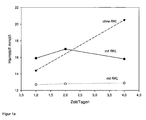
- FIG. 1 Urea kinetics (1a) and glutamine clearance (1 b) in normal CVVHD and in the inventive process with regeneration cycle, which is also known in FIG. 3 is shown
- FIG. 2 Ammonia course in plasma as a complex biological fluid compartment in dialysis without regeneration cycle and according to the structure according to the invention FIG. 3 .
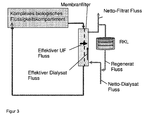
- FIG. 3 a circuit diagram for a dialysis with regeneration cycle
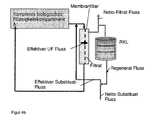
- FIG. 4 a circuit diagram for a filtration combined with substitution with regeneration cycle wherein the substitution can take place either as "postdilution" (4a) or as “predilution” (4b),
- FIG. 5 a circuit diagram for a combined dialysis and filtration (diafiltration) with substitution, wherein both parts of the dialysate and the substituate consist of regenerated by regeneration filtrate.
- Embodiment 1 Substance group X urea, substance group Y glutamine and / or ammonia
- the invention is based in one embodiment accordingly FIG. 3 that using a charcoal adsorbent with NO Urea Intakes for partial recycling of a sterile bicarbonate dialysate (flow 150 ml / min) CVVHD treatment mode with slow blood flow (150ml) and moderate net dialysate flow rate (50ml) and thus lower urea clearance ( 50 ml / min) despite short treatment time ( ⁇ 8h) in patients with acute renal failure in dialysis requiring a body weight of 60 kg, ie a Kt / V ratio (clearance times time divided by body volume) of only 0.48 (should normally be over 1) ) a stable and acceptable serum urea level was maintained over a treatment period of 3 days, whereas a comparable increase in urea was observed in comparable patients in an identical treatment period of 3 days with the same blood and dialysate flow and comparable treatment times with CVVHD without partial recycling ( FIG. 1 a) ,
- the good binding ability of glutamine can also be increased by targeted control of the microstructure of a charcoal fixed bed adsorber, if the perfusion channels are adjusted in a specific width range (10 nm to 100 micrometers). This achieves an effective, almost 100% single-pass depletion of the glutamine in the flow, maximizing the concentration gradient for glutamine across the membrane.
- the adsorber is organized as a "fluid bed” adsorber in the dialysate, which leads to a substantial increase in the diffusion distances between the individual adsorber particles. Therefore, the glutamine clearance is considerably limited here, the concentration gradient for glutamine across the membrane is much higher.
- a special adsorber for removing ammonia can be used, which additionally removes a nitrogen source and thus allows the control of the urea concentration in complex biological systems.
- Exemplary embodiment 2 substance group X ammonia, substance group Y glutamine
- ammonia can only be effectively removed by dialysis if at least a blood flow of more than 200 ml and a dialysate flow of more than 500 ml have been set, with a membrane surface area of 1.3 m2 (Cordoba et al., 1996).
- a model of a patient was simulated by one liter of plasma (experiments A, B and C) and one liter of 5% human albumin solution (experiment D) mixed with 53 mg of ammonia, thereby simulating the redistribution from the tissue was continuously added a solution with 1350 mg / l of ammonia in the patient model at a rate of 90ml / min.
- Experiment D was performed with albumin as a patient model to demonstrate that the absence of enzymes that are found in trace amounts in the plasma (e.g., gamma-glutamyltransferase) results in altered kinetics of ammonia in the patient on treatment.
- the patient model was dialyzed with a 1.7 square meter standard dialyzer (patient flow rate 250 ml / min, net dialysate flow rate 50 ml / min) and in experiment C under otherwise identical conditions a regeneration circuit with 250 ml / min installed, via an activated carbon filter was regenerated.
- Experiment A was performed without active detoxification to document the natural accumulation in the patient medium.
- the concentration profile for ammonia in the patient model was measured at the beginning and after 10, 20, 30, 45, 60, 90 and 120 minutes.
- the ammonia clearance according to the formula
- experiment C the ammonia concentration was measured at the same times before and after the activated carbon filter.
- nitric oxide at the site of action eg in the tissue or in the microcirculation
- nitric oxide at the site of action is not crucial, since it is a very short-lived radical nitric oxide, which unfolds its effect locally and then decays immediately.
- a regeneration cycle of 100 ml / min is established with a microstructured activated carbon filter (maximum perfusion channel width 100 ⁇ m), while a parallel CVVHD without Regeneration cycle is used.
- a reduction of the NO level (measured by nitrate / nitrite level) from 112 to 26 ⁇ mol / l within 24 h or from 108 to 24 ⁇ mol / l in 16 h could be achieved, while within 48 h normal CVVHD the NO mirror even increased again from 24 to 125 umol / l.
- the measurable removal of NO into the dialysate was not significantly different from one another.
- the arginine clearance was 72 ml / min ⁇ 25 ml / min, and in the case of the CVVHD mode, 36 ⁇ 3 ml / min (p ⁇ 0.05).
- Embodiment 4 Substance group X TNF alpha and substance group Y IL1
- a CVVHF compares the course of TNF and IL 1 beta between a part recycling system and a conventional CVVHF.
- the blood flow rate was 150 ml / min, the substituate / filtrate flow at the CVVHF 2.5 l / h.
- the filter used is a high-permeability filter (F50, Fresenius).
- F50 Fresenius
- an inner rice circulation with 150 ml / h in the dialysate mode is additionally established, otherwise the parameters are identical.
- IL1 beta and TNF alpha are measured in the blood at the beginning and end of treatment.
- the ultrafiltration of TNF alpha into the filtrate is measured.
- the TNF alpha ultrafiltration is not significantly different in both constructions.
- a decrease in TNF alpha in the blood from 150 ⁇ 90 to 100 ⁇ 40 pg / ml (p ⁇ 0.05 in the paired t-test) is to be measured, while in normal CVVHF no significant reduction is observed.
- a significant decrease in IL 1 beta from 9 ⁇ 7 to 6 ⁇ 6 pg / ml can be measured (p ⁇ 0.05 in the paired t-test), which is also not significant in the CVVHF mode.
- FIGS. 3 to 5 Various circuit diagrams are shown to implement the method. This is done in FIG. 3 a circuit diagram for a dialysis with regeneration circuit shown. Shown is a circuit pattern of dialysis which is familiar to the person skilled in the art.
- the complex biological fluid compartment A eg blood circulation
- a membrane filter which may be a filter of any pore size with no exclusion limits between 5000 Daltons up to 500,000 Daltons
- the dialysate (purge) solution flows along the dialysate side.
- the dialysate (purge) solution flows along the dialysate side.
- the dialysate (purge) solution flows along the dialysate side.
- the dialysate solution flows along the dialysate side.
- the dialysate solution flows along the dialysate side.
- the dialysate solution flows along the dialysate side.
- the dialysate solution flows along the dialysate side.
- the dialysate solution flows along the dialysate
- the decisive factor is the splitting of the diafiltrate into two streams, one of which is discarded and the other recycled via a regeneration cycle (RKL) (regenerate flow), whereby the substance group Y is retained, but not the substance group X, and the fresh dialysate (net). Dialysate) is added again. Through the net filtrate flow, the substance group X is transported away.
- RKL regeneration cycle
- FIG. 4 substitution being either "post-dilution” ( FIG. 4a ) or as “predilution” ( FIG. 4b ).
- Shown is a circuit pattern of a filtration customary for the person skilled in the art.
- the complex biological fluid compartment A is by means of hoses on one side of a Membrane filter (which may be a filter of any pore size without special restrictions with exclusion limits between 5000 daltons up to 500,000 daltons) along while ultrafiltered depending on the balancing, ie convective with liquid net current through the membrane in the Filtratkompartiment.
- a Membrane filter which may be a filter of any pore size without special restrictions with exclusion limits between 5000 daltons up to 500,000 daltons
- the loss of fluid is partly or wholly replaced by substitution with substitute solution either as postdilution (4a) or predilution (4b) into biological compartment A, depending on the desired balance.
- Decisive is the splitting of the filtrate into two streams, one of which is discarded and the other through a regeneration cycle (RKL) recycled (regenerate flow), wherein the substance group Y is retained, but not the substance group X, and the substituate (Netto Substituat ) is added. Through the net filtrate flow, the substance group X is transported away.
- FIG. 5 A circuit diagram for a combined dialysis and filtration (diafiltration) with substitution shows FIG. 5 wherein both portions of the dialysate and the substituate consist of regenerated by regeneration filtrate. Shown is a circuit diagram of a combined dialysis and filtration routine that is familiar to a person skilled in the art.
- Complex biological fluid compartment A is passed along tubing on one side of a membrane filter (which may be a filter of any pore size with no cut-off limitations between 5000 Daltons up to 500,000 Daltons) as the dialysate (purge) solution flows along the dialysate side ,
- a membrane filter which may be a filter of any pore size with no cut-off limitations between 5000 Daltons up to 500,000 Daltons
- the dialysate (purge) solution flows along the dialysate side
- the balancing device can also be ultrafiltered, ie also convective with liquid net current through the membrane in the Diafiltratkompartiment.
- the fluid loss is additionally replaced directly or partially by substitution with substituate solution in the biological compartment A, depending on the desired balance.
- Decisive is the splitting of the diafiltrate into two streams, one of which is discarded and the other recycled via a regeneration cycle (RKL) (regenerate flow), where the substance group Y is retained, but not the substance group X, and the dialysate and / or substituate (net dialysate and / or net substituate) is admixed. Through the net filtrate flow, the substance group X is transported away.
- RKL regeneration cycle
Landscapes
- Health & Medical Sciences (AREA)
- Heart & Thoracic Surgery (AREA)
- Biomedical Technology (AREA)
- Engineering & Computer Science (AREA)
- Life Sciences & Earth Sciences (AREA)
- Animal Behavior & Ethology (AREA)
- Hematology (AREA)
- Anesthesiology (AREA)
- Vascular Medicine (AREA)
- General Health & Medical Sciences (AREA)
- Public Health (AREA)
- Veterinary Medicine (AREA)
- Urology & Nephrology (AREA)
- Biodiversity & Conservation Biology (AREA)
- Cell Biology (AREA)
- Molecular Biology (AREA)
- Emergency Medicine (AREA)
- External Artificial Organs (AREA)
Priority Applications (1)
| Application Number | Priority Date | Filing Date | Title |
|---|---|---|---|
| PL08787309T PL2190498T3 (pl) | 2007-08-23 | 2008-08-19 | Urządzenie oczyszczające diafiltrat |
Applications Claiming Priority (2)
| Application Number | Priority Date | Filing Date | Title |
|---|---|---|---|
| DE102007039939A DE102007039939B4 (de) | 2007-08-23 | 2007-08-23 | Vorrichtung zur Einsparung von Diafiltrat |
| PCT/EP2008/060827 WO2009024566A1 (de) | 2007-08-23 | 2008-08-19 | Verfahren und vorrichtung zur einsparung von diafiltrat |
Publications (2)
| Publication Number | Publication Date |
|---|---|
| EP2190498A1 EP2190498A1 (de) | 2010-06-02 |
| EP2190498B1 true EP2190498B1 (de) | 2013-07-10 |
Family
ID=40016134
Family Applications (1)
| Application Number | Title | Priority Date | Filing Date |
|---|---|---|---|
| EP08787309.7A Active EP2190498B1 (de) | 2007-08-23 | 2008-08-19 | Vorrichtung zur einsparung von diafiltrat |
Country Status (6)
| Country | Link |
|---|---|
| US (1) | US9302038B2 (da) |
| EP (1) | EP2190498B1 (da) |
| DE (1) | DE102007039939B4 (da) |
| DK (1) | DK2190498T3 (da) |
| PL (1) | PL2190498T3 (da) |
| WO (1) | WO2009024566A1 (da) |
Cited By (5)
| Publication number | Priority date | Publication date | Assignee | Title |
|---|---|---|---|---|
| US8926542B2 (en) | 2011-04-29 | 2015-01-06 | Medtronic, Inc. | Monitoring fluid volume for patients with renal disease |
| US10010663B2 (en) | 2013-02-01 | 2018-07-03 | Medtronic, Inc. | Fluid circuit for delivery of renal replacement therapies |
| US10076283B2 (en) | 2013-11-04 | 2018-09-18 | Medtronic, Inc. | Method and device to manage fluid volumes in the body |
| US10098993B2 (en) | 2014-12-10 | 2018-10-16 | Medtronic, Inc. | Sensing and storage system for fluid balance |
| US11850344B2 (en) | 2021-08-11 | 2023-12-26 | Mozarc Medical Us Llc | Gas bubble sensor |
Families Citing this family (32)
| Publication number | Priority date | Publication date | Assignee | Title |
|---|---|---|---|---|
| US9399091B2 (en) | 2009-09-30 | 2016-07-26 | Medtronic, Inc. | System and method to regulate ultrafiltration |
| WO2013019994A2 (en) | 2011-08-02 | 2013-02-07 | Medtronic, Inc. | Hemodialysis system having a flow path with a controlled compliant volume |
| EP2744537B1 (en) | 2011-08-16 | 2018-01-24 | Medtronic, Inc. | Modular hemodialysis system |
| US10905816B2 (en) | 2012-12-10 | 2021-02-02 | Medtronic, Inc. | Sodium management system for hemodialysis |
| US10850016B2 (en) | 2013-02-01 | 2020-12-01 | Medtronic, Inc. | Modular fluid therapy system having jumpered flow paths and systems and methods for cleaning and disinfection |
| US9623164B2 (en) | 2013-02-01 | 2017-04-18 | Medtronic, Inc. | Systems and methods for multifunctional volumetric fluid control |
| US10543052B2 (en) | 2013-02-01 | 2020-01-28 | Medtronic, Inc. | Portable dialysis cabinet |
| US9827361B2 (en) | 2013-02-02 | 2017-11-28 | Medtronic, Inc. | pH buffer measurement system for hemodialysis systems |
| US20160022897A1 (en) | 2013-03-13 | 2016-01-28 | Nxstage Medical, Inc. | Single pass dialysis combined with multiple pass albumin dialysis |
| SG11201601647UA (en) | 2013-09-22 | 2016-04-28 | Spf Technologies Llc | Cycling ultra-thin channel filtration |
| US10518222B2 (en) | 2013-09-22 | 2019-12-31 | Spf Technologies, Llc | Cycling ultra-thin channel filtration |
| US10874787B2 (en) | 2014-12-10 | 2020-12-29 | Medtronic, Inc. | Degassing system for dialysis |
| US9713665B2 (en) | 2014-12-10 | 2017-07-25 | Medtronic, Inc. | Degassing system for dialysis |
| US9895479B2 (en) | 2014-12-10 | 2018-02-20 | Medtronic, Inc. | Water management system for use in dialysis |
| US10994064B2 (en) | 2016-08-10 | 2021-05-04 | Medtronic, Inc. | Peritoneal dialysate flow path sensing |
| US10874790B2 (en) | 2016-08-10 | 2020-12-29 | Medtronic, Inc. | Peritoneal dialysis intracycle osmotic agent adjustment |
| US12329892B2 (en) | 2016-04-04 | 2025-06-17 | Mozarc Medical Us Llc | Dextrose concentration sensor for a peritoneal dialysis system |
| IL291373B2 (en) | 2016-07-11 | 2023-10-01 | Yissum Res Dev Co Of Hebrew Univ Jerusalem Ltd | Methods and systems for growing cells in culture |
| US11013843B2 (en) | 2016-09-09 | 2021-05-25 | Medtronic, Inc. | Peritoneal dialysis fluid testing system |
| US11278654B2 (en) | 2017-12-07 | 2022-03-22 | Medtronic, Inc. | Pneumatic manifold for a dialysis system |
| US11033667B2 (en) | 2018-02-02 | 2021-06-15 | Medtronic, Inc. | Sorbent manifold for a dialysis system |
| US11110215B2 (en) | 2018-02-23 | 2021-09-07 | Medtronic, Inc. | Degasser and vent manifolds for dialysis |
| US11806457B2 (en) | 2018-11-16 | 2023-11-07 | Mozarc Medical Us Llc | Peritoneal dialysis adequacy meaurements |
| US11806456B2 (en) | 2018-12-10 | 2023-11-07 | Mozarc Medical Us Llc | Precision peritoneal dialysis therapy based on dialysis adequacy measurements |
| US12478571B2 (en) | 2018-12-17 | 2025-11-25 | Pontis Biologics, Inc. | Enzyme based compositions and methods for removing dental calculi |
| US12433976B2 (en) | 2019-01-08 | 2025-10-07 | Mozarc Medical Us Llc | Bicarbonate sensor for dialysis |
| US12128165B2 (en) | 2020-04-27 | 2024-10-29 | Mozarc Medical Us Llc | Dual stage degasser |
| US12154673B2 (en) | 2021-08-02 | 2024-11-26 | Mozarc Medical Us Llc | Artificial intelligence assisted home therapy settings for dialysis |
| US11965763B2 (en) | 2021-11-12 | 2024-04-23 | Mozarc Medical Us Llc | Determining fluid flow across rotary pump |
| US11944733B2 (en) | 2021-11-18 | 2024-04-02 | Mozarc Medical Us Llc | Sodium and bicarbonate control |
| JP2025128836A (ja) | 2024-02-22 | 2025-09-03 | フィジオロガス・テクノロジーズ株式会社 | 対象液浄化装置 |
| JP2025128837A (ja) | 2024-02-22 | 2025-09-03 | フィジオロガス・テクノロジーズ株式会社 | 対象液浄化装置 |
Family Cites Families (26)
| Publication number | Priority date | Publication date | Assignee | Title |
|---|---|---|---|---|
| US3579441A (en) * | 1968-04-19 | 1971-05-18 | Hydronautics | Blood purification by dual filtration |
| GB1558370A (en) * | 1975-09-26 | 1979-12-28 | Asahi Chemical Ind | Blood treating apparatus |
| US4350594A (en) * | 1980-04-16 | 1982-09-21 | Kuraray Co., Ltd. | Blood purification using plural ultrafiltration stages |
| JPS583705B2 (ja) * | 1980-07-18 | 1983-01-22 | 川澄化学工業株式会社 | 二重ロ過型血漿分離交換装置 |
| DE3101159C2 (de) * | 1981-01-16 | 1985-08-22 | Udipi Ramakrishna Dr. 5100 Aachen Shettigar | Verfahren zur Reinigung von Blut und künstliche Niere zur Durchführung des Verfahrens |
| DD206076A1 (de) * | 1981-09-28 | 1984-01-18 | Univ Leipzig | Verfahren zur blutreinigung |
| DE3243523A1 (de) * | 1982-11-25 | 1984-05-30 | Bellco Medizintechnik GmbH, 7800 Freiburg | Vorrichtung zum entfernen von giftstoffen aus dem blut |
| SE451946B (sv) * | 1982-12-10 | 1987-11-09 | Gambro Lundia Ab | Anordning for avlegsnande av en eller flera fraktioner ur helblod, plasma eller liknande kroppsvetskor |
| DE3927633C1 (da) * | 1989-08-22 | 1990-10-04 | Fresenius Ag, 6380 Bad Homburg, De | |
| DE4102693A1 (de) * | 1991-01-30 | 1992-08-06 | Schurek Hans Joachim Prof Dr M | Verfahren und einrichtung zur haemofiltratdialyse |
| US5919369A (en) * | 1992-02-06 | 1999-07-06 | Hemocleanse, Inc. | Hemofiltration and plasmafiltration devices and methods |
| DE4309410A1 (de) | 1993-03-19 | 1995-02-16 | Stange Jan | Material, Verfahren und Einrichtung zur selektiven Trennung frei gelöster und stoffgebundener Stoffe aus flüssigen Stoffgemischen sowie Verfahren zur Herstellung des Materials |
| EP0671958B1 (en) * | 1993-08-10 | 2001-07-18 | Slobodan Tepic | Apparatus for the treatment of tumors by selective protein depletion |
| DE4338858C1 (de) * | 1993-11-13 | 1995-04-13 | Alois Kastl | Vorrichtung zu Elimination von Stoffen aus dem Blut eines Patienten |
| US6627151B1 (en) * | 1997-06-13 | 2003-09-30 | Helmut Borberg | Method for treatment diseases associated with a deterioration of the macrocirculation, microcirculation and organ perfusion |
| US6620382B1 (en) * | 1998-05-22 | 2003-09-16 | Biopheresis Technologies, Llc. | Method and compositions for treatment of cancers |
| DE19854338B4 (de) * | 1998-11-25 | 2005-11-17 | Ulrich Dr.med. Saueressig | Verfahren und Einrichtung zur Nierenersatztherapie |
| WO2001058496A1 (en) * | 2000-02-11 | 2001-08-16 | Allied Therapeutics Limited | System for the extracorporeal treatment of blood |
| US7241272B2 (en) * | 2001-11-13 | 2007-07-10 | Baxter International Inc. | Method and composition for removing uremic toxins in dialysis processes |
| EP1362605A1 (de) * | 2002-05-14 | 2003-11-19 | Bernhard Dr. Kreymann | Dialysevorrichtung zur Entfernung proteingebundener Substanzen |
| EP1523350B1 (en) * | 2002-07-19 | 2011-04-13 | Baxter International Inc. | System for performing peritoneal dialysis |
| US7207964B2 (en) * | 2003-03-17 | 2007-04-24 | Hemavation, Llc | Apparatus and method for down-regulating immune system mediators in blood |
| US20040182783A1 (en) * | 2003-03-17 | 2004-09-23 | Walker Kimberly A. | Filter and concentrator device for treatment of blood |
| US8029454B2 (en) * | 2003-11-05 | 2011-10-04 | Baxter International Inc. | High convection home hemodialysis/hemofiltration and sorbent system |
| JP2008503273A (ja) * | 2004-06-21 | 2008-02-07 | ヘモライフ メディカル, インコーポレイテッド | 血漿無毒化および体積制御システムならびに使用方法 |
| JP5328152B2 (ja) * | 2004-12-28 | 2013-10-30 | レナル ソリューションズ,インク. | リン酸ジルコニウム粒子の合成法 |
-
2007
- 2007-08-23 DE DE102007039939A patent/DE102007039939B4/de not_active Expired - Fee Related
-
2008
- 2008-08-19 WO PCT/EP2008/060827 patent/WO2009024566A1/de not_active Ceased
- 2008-08-19 PL PL08787309T patent/PL2190498T3/pl unknown
- 2008-08-19 DK DK08787309.7T patent/DK2190498T3/da active
- 2008-08-19 US US12/674,825 patent/US9302038B2/en active Active
- 2008-08-19 EP EP08787309.7A patent/EP2190498B1/de active Active
Cited By (11)
| Publication number | Priority date | Publication date | Assignee | Title |
|---|---|---|---|---|
| US8926542B2 (en) | 2011-04-29 | 2015-01-06 | Medtronic, Inc. | Monitoring fluid volume for patients with renal disease |
| US8951219B2 (en) | 2011-04-29 | 2015-02-10 | Medtronic, Inc. | Fluid volume monitoring for patients with renal disease |
| US9597440B2 (en) | 2011-04-29 | 2017-03-21 | Medtronic, Inc. | Fluid volume monitoring for patients with renal disease |
| US9968721B2 (en) | 2011-04-29 | 2018-05-15 | Medtronic, Inc. | Monitoring fluid volume for patients with renal disease |
| US10064985B2 (en) | 2011-04-29 | 2018-09-04 | Medtronic, Inc. | Precision blood fluid removal therapy based on patient monitoring |
| US10179198B2 (en) | 2011-04-29 | 2019-01-15 | Medtronic, Inc. | Electrolyte and pH monitoring for fluid removal processes |
| US10293092B2 (en) | 2011-04-29 | 2019-05-21 | Medtronic, Inc. | Electrolyte and pH monitoring for fluid removal processes |
| US10010663B2 (en) | 2013-02-01 | 2018-07-03 | Medtronic, Inc. | Fluid circuit for delivery of renal replacement therapies |
| US10076283B2 (en) | 2013-11-04 | 2018-09-18 | Medtronic, Inc. | Method and device to manage fluid volumes in the body |
| US10098993B2 (en) | 2014-12-10 | 2018-10-16 | Medtronic, Inc. | Sensing and storage system for fluid balance |
| US11850344B2 (en) | 2021-08-11 | 2023-12-26 | Mozarc Medical Us Llc | Gas bubble sensor |
Also Published As
| Publication number | Publication date |
|---|---|
| DK2190498T3 (da) | 2013-10-14 |
| DE102007039939B4 (de) | 2013-03-14 |
| PL2190498T3 (pl) | 2014-01-31 |
| EP2190498A1 (de) | 2010-06-02 |
| DE102007039939A1 (de) | 2009-02-26 |
| US9302038B2 (en) | 2016-04-05 |
| DE102007039939A8 (de) | 2009-06-25 |
| US20110100909A1 (en) | 2011-05-05 |
| WO2009024566A1 (de) | 2009-02-26 |
Similar Documents
| Publication | Publication Date | Title |
|---|---|---|
| EP2190498B1 (de) | Vorrichtung zur einsparung von diafiltrat | |
| DE69230503T2 (de) | Pharmafiltersorbentsystem zur entfernung von bestandteilen aus blut, verbessertes massentransportsystem | |
| EP3554577B1 (de) | System zur extrakorporalen blutbehandlung und behandlungsvorrichtung | |
| DE3101159C2 (de) | Verfahren zur Reinigung von Blut und künstliche Niere zur Durchführung des Verfahrens | |
| DE69713667T2 (de) | Medizinische Vorrichtung zur extrakorporalen Blut-oder Blutplasmabehandlung und Herstellungsverfahren für diese Vorrichtung | |
| DE3837226C2 (de) | Perfusionsgerät zum Züchten und Erhalten von Hepatocyten | |
| EP1289630B1 (de) | Modul mit membranelementen in cross-flow und in dead-end anordnung | |
| EP0776223B1 (de) | Anordnung zur elimination von substanzen aus flüssigkeiten, insbesondere blut | |
| DE69929555T2 (de) | Verwendung einer Flüssigkeit zur Herstellung einer Dialyselösung für die kontinuierliche rezirkulierende Peritonealdialyse | |
| DE68926197T2 (de) | Vorrichtung zur Abtrennung von Plasma in vivo | |
| DE3110128A1 (de) | Verfahren und vorrichtung zur entgiftung und regeneration von blut, blutbestandteilen und bei der blutreinigung anfallenden loesungen sowie kit fuer die durchfuehrung des verfahrens | |
| EP2934619B1 (de) | Vorrichtung zur entfernung proteingebundener toxine aus blutplasma | |
| EP1867354B1 (de) | Vorrichtung zur Entfernung proteingebundener Substanzen | |
| DE60127657T2 (de) | Blutreinigungssystem | |
| AT12072U1 (de) | Dialysemembran zur behandlung von multiplem myelom | |
| DE3786138T2 (de) | Behandlungskreislauf zum Regenerieren von Körperflüssigkeit. | |
| EP2440265B1 (de) | Dialysevorrichtung | |
| DE102017131192A1 (de) | Pufferlösung zur Reduzierung des Kohlendioxidgehaltes in extrakorporalem Blut | |
| EP3952945A1 (de) | Verfahren und vorrichtung zur reinigung von blut | |
| DE1960504A1 (de) | Behandlung einer Dialysatloesung zwecks Entfernung von Harnstoff | |
| EP1827532B1 (de) | Vorrichtung zur abreicherung wenigstens einer komponente eines fluiden mediums | |
| DE19543371C2 (de) | Vorrichtung zur endotoxinfreien Blutreinigung durch Dialyse | |
| DE102019007144A1 (de) | Verfahren und Anordnung zur Verbesserung des Austausches von Gasen über semipermeable Membranen im wässrigen Milieu | |
| DE102012020497A1 (de) | Verfahren zur extrakorporalen Behandlung von Blut und Vorrichtung zur Durchführung des Verfahrens | |
| EP2729199B1 (de) | Dialyseverfahren zur entfernung proteingebundener toxine aus dem blut von akut oder chronisch-niereninsuffizienten patienten |
Legal Events
| Date | Code | Title | Description |
|---|---|---|---|
| PUAI | Public reference made under article 153(3) epc to a published international application that has entered the european phase |
Free format text: ORIGINAL CODE: 0009012 |
|
| 17P | Request for examination filed |
Effective date: 20100226 |
|
| AK | Designated contracting states |
Kind code of ref document: A1 Designated state(s): AT BE BG CH CY CZ DE DK EE ES FI FR GB GR HR HU IE IS IT LI LT LU LV MC MT NL NO PL PT RO SE SI SK TR |
|
| AX | Request for extension of the european patent |
Extension state: AL BA MK RS |
|
| 17Q | First examination report despatched |
Effective date: 20100716 |
|
| DAX | Request for extension of the european patent (deleted) | ||
| GRAP | Despatch of communication of intention to grant a patent |
Free format text: ORIGINAL CODE: EPIDOSNIGR1 |
|
| GRAS | Grant fee paid |
Free format text: ORIGINAL CODE: EPIDOSNIGR3 |
|
| GRAA | (expected) grant |
Free format text: ORIGINAL CODE: 0009210 |
|
| AK | Designated contracting states |
Kind code of ref document: B1 Designated state(s): AT BE BG CH CY CZ DE DK EE ES FI FR GB GR HR HU IE IS IT LI LT LU LV MC MT NL NO PL PT RO SE SI SK TR |
|
| REG | Reference to a national code |
Ref country code: GB Ref legal event code: FG4D Free format text: NOT ENGLISH |
|
| REG | Reference to a national code |
Ref country code: AT Ref legal event code: REF Ref document number: 620562 Country of ref document: AT Kind code of ref document: T Effective date: 20130715 Ref country code: CH Ref legal event code: EP |
|
| REG | Reference to a national code |
Ref country code: IE Ref legal event code: FG4D Free format text: LANGUAGE OF EP DOCUMENT: GERMAN |
|
| REG | Reference to a national code |
Ref country code: DE Ref legal event code: R096 Ref document number: 502008010283 Country of ref document: DE Effective date: 20130905 |
|
| REG | Reference to a national code |
Ref country code: DK Ref legal event code: T3 Effective date: 20131010 |
|
| REG | Reference to a national code |
Ref country code: SE Ref legal event code: TRGR |
|
| PG25 | Lapsed in a contracting state [announced via postgrant information from national office to epo] |
Ref country code: SI Free format text: LAPSE BECAUSE OF FAILURE TO SUBMIT A TRANSLATION OF THE DESCRIPTION OR TO PAY THE FEE WITHIN THE PRESCRIBED TIME-LIMIT Effective date: 20130710 |
|
| REG | Reference to a national code |
Ref country code: CH Ref legal event code: NV Representative=s name: E. BLUM AND CO. AG PATENT- UND MARKENANWAELTE , CH |
|
| REG | Reference to a national code |
Ref country code: NL Ref legal event code: T3 |
|
| REG | Reference to a national code |
Ref country code: NO Ref legal event code: T2 Effective date: 20130710 |
|
| REG | Reference to a national code |
Ref country code: LT Ref legal event code: MG4D |
|
| PG25 | Lapsed in a contracting state [announced via postgrant information from national office to epo] |
Ref country code: IS Free format text: LAPSE BECAUSE OF FAILURE TO SUBMIT A TRANSLATION OF THE DESCRIPTION OR TO PAY THE FEE WITHIN THE PRESCRIBED TIME-LIMIT Effective date: 20131110 Ref country code: PT Free format text: LAPSE BECAUSE OF FAILURE TO SUBMIT A TRANSLATION OF THE DESCRIPTION OR TO PAY THE FEE WITHIN THE PRESCRIBED TIME-LIMIT Effective date: 20131111 Ref country code: CY Free format text: LAPSE BECAUSE OF FAILURE TO SUBMIT A TRANSLATION OF THE DESCRIPTION OR TO PAY THE FEE WITHIN THE PRESCRIBED TIME-LIMIT Effective date: 20130828 Ref country code: LT Free format text: LAPSE BECAUSE OF FAILURE TO SUBMIT A TRANSLATION OF THE DESCRIPTION OR TO PAY THE FEE WITHIN THE PRESCRIBED TIME-LIMIT Effective date: 20130710 Ref country code: HR Free format text: LAPSE BECAUSE OF FAILURE TO SUBMIT A TRANSLATION OF THE DESCRIPTION OR TO PAY THE FEE WITHIN THE PRESCRIBED TIME-LIMIT Effective date: 20130710 |
|
| REG | Reference to a national code |
Ref country code: PL Ref legal event code: T3 |
|
| PG25 | Lapsed in a contracting state [announced via postgrant information from national office to epo] |
Ref country code: LV Free format text: LAPSE BECAUSE OF FAILURE TO SUBMIT A TRANSLATION OF THE DESCRIPTION OR TO PAY THE FEE WITHIN THE PRESCRIBED TIME-LIMIT Effective date: 20130710 Ref country code: GR Free format text: LAPSE BECAUSE OF FAILURE TO SUBMIT A TRANSLATION OF THE DESCRIPTION OR TO PAY THE FEE WITHIN THE PRESCRIBED TIME-LIMIT Effective date: 20131011 Ref country code: ES Free format text: LAPSE BECAUSE OF FAILURE TO SUBMIT A TRANSLATION OF THE DESCRIPTION OR TO PAY THE FEE WITHIN THE PRESCRIBED TIME-LIMIT Effective date: 20131021 |
|
| PG25 | Lapsed in a contracting state [announced via postgrant information from national office to epo] |
Ref country code: CY Free format text: LAPSE BECAUSE OF FAILURE TO SUBMIT A TRANSLATION OF THE DESCRIPTION OR TO PAY THE FEE WITHIN THE PRESCRIBED TIME-LIMIT Effective date: 20130710 |
|
| PG25 | Lapsed in a contracting state [announced via postgrant information from national office to epo] |
Ref country code: MC Free format text: LAPSE BECAUSE OF FAILURE TO SUBMIT A TRANSLATION OF THE DESCRIPTION OR TO PAY THE FEE WITHIN THE PRESCRIBED TIME-LIMIT Effective date: 20130710 Ref country code: CZ Free format text: LAPSE BECAUSE OF FAILURE TO SUBMIT A TRANSLATION OF THE DESCRIPTION OR TO PAY THE FEE WITHIN THE PRESCRIBED TIME-LIMIT Effective date: 20130710 Ref country code: SK Free format text: LAPSE BECAUSE OF FAILURE TO SUBMIT A TRANSLATION OF THE DESCRIPTION OR TO PAY THE FEE WITHIN THE PRESCRIBED TIME-LIMIT Effective date: 20130710 Ref country code: EE Free format text: LAPSE BECAUSE OF FAILURE TO SUBMIT A TRANSLATION OF THE DESCRIPTION OR TO PAY THE FEE WITHIN THE PRESCRIBED TIME-LIMIT Effective date: 20130710 Ref country code: RO Free format text: LAPSE BECAUSE OF FAILURE TO SUBMIT A TRANSLATION OF THE DESCRIPTION OR TO PAY THE FEE WITHIN THE PRESCRIBED TIME-LIMIT Effective date: 20130710 |
|
| PLBE | No opposition filed within time limit |
Free format text: ORIGINAL CODE: 0009261 |
|
| STAA | Information on the status of an ep patent application or granted ep patent |
Free format text: STATUS: NO OPPOSITION FILED WITHIN TIME LIMIT |
|
| REG | Reference to a national code |
Ref country code: IE Ref legal event code: MM4A |
|
| 26N | No opposition filed |
Effective date: 20140411 |
|
| REG | Reference to a national code |
Ref country code: DE Ref legal event code: R097 Ref document number: 502008010283 Country of ref document: DE Effective date: 20140411 |
|
| PG25 | Lapsed in a contracting state [announced via postgrant information from national office to epo] |
Ref country code: IE Free format text: LAPSE BECAUSE OF NON-PAYMENT OF DUE FEES Effective date: 20130819 |
|
| PG25 | Lapsed in a contracting state [announced via postgrant information from national office to epo] |
Ref country code: MT Free format text: LAPSE BECAUSE OF FAILURE TO SUBMIT A TRANSLATION OF THE DESCRIPTION OR TO PAY THE FEE WITHIN THE PRESCRIBED TIME-LIMIT Effective date: 20130710 Ref country code: TR Free format text: LAPSE BECAUSE OF FAILURE TO SUBMIT A TRANSLATION OF THE DESCRIPTION OR TO PAY THE FEE WITHIN THE PRESCRIBED TIME-LIMIT Effective date: 20130710 |
|
| PG25 | Lapsed in a contracting state [announced via postgrant information from national office to epo] |
Ref country code: BG Free format text: LAPSE BECAUSE OF FAILURE TO SUBMIT A TRANSLATION OF THE DESCRIPTION OR TO PAY THE FEE WITHIN THE PRESCRIBED TIME-LIMIT Effective date: 20130710 Ref country code: HU Free format text: LAPSE BECAUSE OF FAILURE TO SUBMIT A TRANSLATION OF THE DESCRIPTION OR TO PAY THE FEE WITHIN THE PRESCRIBED TIME-LIMIT; INVALID AB INITIO Effective date: 20080819 |
|
| REG | Reference to a national code |
Ref country code: FR Ref legal event code: PLFP Year of fee payment: 8 |
|
| REG | Reference to a national code |
Ref country code: FR Ref legal event code: PLFP Year of fee payment: 9 |
|
| REG | Reference to a national code |
Ref country code: FR Ref legal event code: PLFP Year of fee payment: 10 |
|
| REG | Reference to a national code |
Ref country code: FR Ref legal event code: PLFP Year of fee payment: 11 |
|
| PGFP | Annual fee paid to national office [announced via postgrant information from national office to epo] |
Ref country code: LU Payment date: 20210830 Year of fee payment: 14 |
|
| PGFP | Annual fee paid to national office [announced via postgrant information from national office to epo] |
Ref country code: PL Payment date: 20210701 Year of fee payment: 14 |
|
| PG25 | Lapsed in a contracting state [announced via postgrant information from national office to epo] |
Ref country code: LU Free format text: LAPSE BECAUSE OF NON-PAYMENT OF DUE FEES Effective date: 20220819 |
|
| PG25 | Lapsed in a contracting state [announced via postgrant information from national office to epo] |
Ref country code: PL Free format text: LAPSE BECAUSE OF NON-PAYMENT OF DUE FEES Effective date: 20220819 |
|
| PGFP | Annual fee paid to national office [announced via postgrant information from national office to epo] |
Ref country code: NL Payment date: 20240821 Year of fee payment: 17 |
|
| PGFP | Annual fee paid to national office [announced via postgrant information from national office to epo] |
Ref country code: FI Payment date: 20240820 Year of fee payment: 17 Ref country code: DE Payment date: 20240819 Year of fee payment: 17 |
|
| PGFP | Annual fee paid to national office [announced via postgrant information from national office to epo] |
Ref country code: DK Payment date: 20240822 Year of fee payment: 17 |
|
| PGFP | Annual fee paid to national office [announced via postgrant information from national office to epo] |
Ref country code: GB Payment date: 20240822 Year of fee payment: 17 |
|
| PGFP | Annual fee paid to national office [announced via postgrant information from national office to epo] |
Ref country code: BE Payment date: 20240820 Year of fee payment: 17 |
|
| PGFP | Annual fee paid to national office [announced via postgrant information from national office to epo] |
Ref country code: FR Payment date: 20240823 Year of fee payment: 17 |
|
| PGFP | Annual fee paid to national office [announced via postgrant information from national office to epo] |
Ref country code: CH Payment date: 20240901 Year of fee payment: 17 |
|
| PGFP | Annual fee paid to national office [announced via postgrant information from national office to epo] |
Ref country code: AT Payment date: 20240819 Year of fee payment: 17 |
|
| PGFP | Annual fee paid to national office [announced via postgrant information from national office to epo] |
Ref country code: NO Payment date: 20240820 Year of fee payment: 17 Ref country code: IT Payment date: 20240830 Year of fee payment: 17 Ref country code: SE Payment date: 20240821 Year of fee payment: 17 |
|
| REG | Reference to a national code |
Ref country code: DK Ref legal event code: EBP Effective date: 20250831 |
|
| REG | Reference to a national code |
Ref country code: CH Ref legal event code: H13 Free format text: ST27 STATUS EVENT CODE: U-0-0-H10-H13 (AS PROVIDED BY THE NATIONAL OFFICE) Effective date: 20260324 |