EP2183979A2 - Kaugummi und Herstellungsverfahren dafür - Google Patents
Kaugummi und Herstellungsverfahren dafür Download PDFInfo
- Publication number
- EP2183979A2 EP2183979A2 EP09013735A EP09013735A EP2183979A2 EP 2183979 A2 EP2183979 A2 EP 2183979A2 EP 09013735 A EP09013735 A EP 09013735A EP 09013735 A EP09013735 A EP 09013735A EP 2183979 A2 EP2183979 A2 EP 2183979A2
- Authority
- EP
- European Patent Office
- Prior art keywords
- chocolate
- oil
- covering
- chewing gum
- component
- Prior art date
- Legal status (The legal status is an assumption and is not a legal conclusion. Google has not performed a legal analysis and makes no representation as to the accuracy of the status listed.)
- Withdrawn
Links
- 235000015218 chewing gum Nutrition 0.000 title claims abstract description 84
- 229940112822 chewing gum Drugs 0.000 title claims abstract description 77
- 238000000034 method Methods 0.000 title claims abstract description 31
- 238000004519 manufacturing process Methods 0.000 title claims abstract description 22
- 235000019219 chocolate Nutrition 0.000 claims abstract description 110
- 239000007787 solid Substances 0.000 claims description 22
- 238000005496 tempering Methods 0.000 claims description 22
- 239000007788 liquid Substances 0.000 claims description 15
- 239000000463 material Substances 0.000 claims description 9
- 239000000796 flavoring agent Substances 0.000 abstract description 15
- 235000019634 flavors Nutrition 0.000 abstract description 13
- 244000299461 Theobroma cacao Species 0.000 description 107
- 239000003921 oil Substances 0.000 description 87
- 235000019198 oils Nutrition 0.000 description 87
- 235000019197 fats Nutrition 0.000 description 40
- 239000000203 mixture Substances 0.000 description 16
- 229940110456 cocoa butter Drugs 0.000 description 15
- 235000019868 cocoa butter Nutrition 0.000 description 15
- 230000035807 sensation Effects 0.000 description 14
- 235000019615 sensations Nutrition 0.000 description 14
- 230000018984 mastication Effects 0.000 description 12
- 238000010077 mastication Methods 0.000 description 12
- 239000000654 additive Substances 0.000 description 9
- 230000000996 additive effect Effects 0.000 description 9
- 230000000052 comparative effect Effects 0.000 description 9
- POULHZVOKOAJMA-UHFFFAOYSA-N dodecanoic acid Chemical compound CCCCCCCCCCCC(O)=O POULHZVOKOAJMA-UHFFFAOYSA-N 0.000 description 7
- 238000000926 separation method Methods 0.000 description 7
- 239000003995 emulsifying agent Substances 0.000 description 6
- 239000000845 maltitol Substances 0.000 description 6
- 235000010449 maltitol Nutrition 0.000 description 6
- VQHSOMBJVWLPSR-WUJBLJFYSA-N maltitol Chemical compound OC[C@H](O)[C@@H](O)[C@@H]([C@H](O)CO)O[C@H]1O[C@H](CO)[C@@H](O)[C@H](O)[C@H]1O VQHSOMBJVWLPSR-WUJBLJFYSA-N 0.000 description 6
- 229940035436 maltitol Drugs 0.000 description 6
- 210000000214 mouth Anatomy 0.000 description 6
- 239000008188 pellet Substances 0.000 description 6
- 235000009470 Theobroma cacao Nutrition 0.000 description 5
- 235000009508 confectionery Nutrition 0.000 description 5
- 239000004615 ingredient Substances 0.000 description 5
- 150000004667 medium chain fatty acids Chemical class 0.000 description 5
- 238000009495 sugar coating Methods 0.000 description 5
- PHYFQTYBJUILEZ-IUPFWZBJSA-N triolein Chemical compound CCCCCCCC\C=C/CCCCCCCC(=O)OCC(OC(=O)CCCCCCC\C=C/CCCCCCCC)COC(=O)CCCCCCC\C=C/CCCCCCCC PHYFQTYBJUILEZ-IUPFWZBJSA-N 0.000 description 5
- 235000014121 butter Nutrition 0.000 description 4
- 230000000694 effects Effects 0.000 description 4
- 239000000194 fatty acid Substances 0.000 description 4
- 230000005012 migration Effects 0.000 description 4
- 238000013508 migration Methods 0.000 description 4
- 239000002994 raw material Substances 0.000 description 4
- 238000004904 shortening Methods 0.000 description 4
- 239000005639 Lauric acid Substances 0.000 description 3
- 235000005764 Theobroma cacao ssp. cacao Nutrition 0.000 description 3
- 235000005767 Theobroma cacao ssp. sphaerocarpum Nutrition 0.000 description 3
- 235000001046 cacaotero Nutrition 0.000 description 3
- 239000003795 chemical substances by application Substances 0.000 description 3
- 235000014113 dietary fatty acids Nutrition 0.000 description 3
- 229930195729 fatty acid Natural products 0.000 description 3
- 239000004570 mortar (masonry) Substances 0.000 description 3
- 239000011148 porous material Substances 0.000 description 3
- -1 sucrose fatty acid ester Chemical class 0.000 description 3
- 235000019482 Palm oil Nutrition 0.000 description 2
- 229930006000 Sucrose Natural products 0.000 description 2
- GWEVSGVZZGPLCZ-UHFFFAOYSA-N Titan oxide Chemical compound O=[Ti]=O GWEVSGVZZGPLCZ-UHFFFAOYSA-N 0.000 description 2
- 239000002253 acid Substances 0.000 description 2
- 235000013334 alcoholic beverage Nutrition 0.000 description 2
- RYYVLZVUVIJVGH-UHFFFAOYSA-N caffeine Chemical compound CN1C(=O)N(C)C(=O)C2=C1N=CN2C RYYVLZVUVIJVGH-UHFFFAOYSA-N 0.000 description 2
- 239000008370 chocolate flavor Substances 0.000 description 2
- 239000000470 constituent Substances 0.000 description 2
- 239000006071 cream Substances 0.000 description 2
- 238000000151 deposition Methods 0.000 description 2
- 239000006185 dispersion Substances 0.000 description 2
- 229920001971 elastomer Polymers 0.000 description 2
- 239000000806 elastomer Substances 0.000 description 2
- 150000004665 fatty acids Chemical class 0.000 description 2
- 235000013355 food flavoring agent Nutrition 0.000 description 2
- 235000015203 fruit juice Nutrition 0.000 description 2
- 125000005456 glyceride group Chemical group 0.000 description 2
- 235000013615 non-nutritive sweetener Nutrition 0.000 description 2
- 239000003346 palm kernel oil Substances 0.000 description 2
- 235000019865 palm kernel oil Nutrition 0.000 description 2
- 239000002540 palm oil Substances 0.000 description 2
- 238000004513 sizing Methods 0.000 description 2
- 239000005720 sucrose Substances 0.000 description 2
- 150000003626 triacylglycerols Chemical class 0.000 description 2
- UFTFJSFQGQCHQW-UHFFFAOYSA-N triformin Chemical compound O=COCC(OC=O)COC=O UFTFJSFQGQCHQW-UHFFFAOYSA-N 0.000 description 2
- 235000019220 whole milk chocolate Nutrition 0.000 description 2
- SERLAGPUMNYUCK-DCUALPFSSA-N 1-O-alpha-D-glucopyranosyl-D-mannitol Chemical compound OC[C@@H](O)[C@@H](O)[C@H](O)[C@H](O)CO[C@H]1O[C@H](CO)[C@@H](O)[C@H](O)[C@H]1O SERLAGPUMNYUCK-DCUALPFSSA-N 0.000 description 1
- 244000215068 Acacia senegal Species 0.000 description 1
- 206010006326 Breath odour Diseases 0.000 description 1
- FBPFZTCFMRRESA-FSIIMWSLSA-N D-Glucitol Natural products OC[C@H](O)[C@H](O)[C@@H](O)[C@H](O)CO FBPFZTCFMRRESA-FSIIMWSLSA-N 0.000 description 1
- FBPFZTCFMRRESA-JGWLITMVSA-N D-glucitol Chemical compound OC[C@H](O)[C@@H](O)[C@H](O)[C@H](O)CO FBPFZTCFMRRESA-JGWLITMVSA-N 0.000 description 1
- 239000004386 Erythritol Substances 0.000 description 1
- UNXHWFMMPAWVPI-UHFFFAOYSA-N Erythritol Natural products OCC(O)C(O)CO UNXHWFMMPAWVPI-UHFFFAOYSA-N 0.000 description 1
- 229920000084 Gum arabic Polymers 0.000 description 1
- 208000032139 Halitosis Diseases 0.000 description 1
- LPHGQDQBBGAPDZ-UHFFFAOYSA-N Isocaffeine Natural products CN1C(=O)N(C)C(=O)C2=C1N(C)C=N2 LPHGQDQBBGAPDZ-UHFFFAOYSA-N 0.000 description 1
- 244000046052 Phaseolus vulgaris Species 0.000 description 1
- 235000010627 Phaseolus vulgaris Nutrition 0.000 description 1
- CZMRCDWAGMRECN-UGDNZRGBSA-N Sucrose Chemical compound O[C@H]1[C@H](O)[C@@H](CO)O[C@@]1(CO)O[C@@H]1[C@H](O)[C@@H](O)[C@H](O)[C@@H](CO)O1 CZMRCDWAGMRECN-UGDNZRGBSA-N 0.000 description 1
- 244000269722 Thea sinensis Species 0.000 description 1
- TVXBFESIOXBWNM-UHFFFAOYSA-N Xylitol Natural products OCCC(O)C(O)C(O)CCO TVXBFESIOXBWNM-UHFFFAOYSA-N 0.000 description 1
- 239000000205 acacia gum Substances 0.000 description 1
- 235000010489 acacia gum Nutrition 0.000 description 1
- 239000010480 babassu oil Substances 0.000 description 1
- 235000019636 bitter flavor Nutrition 0.000 description 1
- 239000004067 bulking agent Substances 0.000 description 1
- 229960001948 caffeine Drugs 0.000 description 1
- VJEONQKOZGKCAK-UHFFFAOYSA-N caffeine Natural products CN1C(=O)N(C)C(=O)C2=C1C=CN2C VJEONQKOZGKCAK-UHFFFAOYSA-N 0.000 description 1
- 239000004204 candelilla wax Substances 0.000 description 1
- 229940073532 candelilla wax Drugs 0.000 description 1
- 235000013868 candelilla wax Nutrition 0.000 description 1
- 235000016213 coffee Nutrition 0.000 description 1
- 235000013353 coffee beverage Nutrition 0.000 description 1
- 239000003086 colorant Substances 0.000 description 1
- 235000013365 dairy product Nutrition 0.000 description 1
- 239000002781 deodorant agent Substances 0.000 description 1
- 230000001687 destabilization Effects 0.000 description 1
- 230000006866 deterioration Effects 0.000 description 1
- 229940079593 drug Drugs 0.000 description 1
- 239000003814 drug Substances 0.000 description 1
- 238000001035 drying Methods 0.000 description 1
- 235000013399 edible fruits Nutrition 0.000 description 1
- 235000019414 erythritol Nutrition 0.000 description 1
- UNXHWFMMPAWVPI-ZXZARUISSA-N erythritol Chemical compound OC[C@H](O)[C@H](O)CO UNXHWFMMPAWVPI-ZXZARUISSA-N 0.000 description 1
- 229940009714 erythritol Drugs 0.000 description 1
- 239000003925 fat Substances 0.000 description 1
- 239000000945 filler Substances 0.000 description 1
- 239000012467 final product Substances 0.000 description 1
- 235000009569 green tea Nutrition 0.000 description 1
- IUJAMGNYPWYUPM-UHFFFAOYSA-N hentriacontane Chemical compound CCCCCCCCCCCCCCCCCCCCCCCCCCCCCCC IUJAMGNYPWYUPM-UHFFFAOYSA-N 0.000 description 1
- 229910052500 inorganic mineral Inorganic materials 0.000 description 1
- 239000000905 isomalt Substances 0.000 description 1
- 235000010439 isomalt Nutrition 0.000 description 1
- HPIGCVXMBGOWTF-UHFFFAOYSA-N isomaltol Natural products CC(=O)C=1OC=CC=1O HPIGCVXMBGOWTF-UHFFFAOYSA-N 0.000 description 1
- 238000002844 melting Methods 0.000 description 1
- 230000008018 melting Effects 0.000 description 1
- HEBKCHPVOIAQTA-UHFFFAOYSA-N meso ribitol Natural products OCC(O)C(O)C(O)CO HEBKCHPVOIAQTA-UHFFFAOYSA-N 0.000 description 1
- 239000011707 mineral Substances 0.000 description 1
- 239000010461 other edible oil Substances 0.000 description 1
- 239000004014 plasticizer Substances 0.000 description 1
- 229920005862 polyol Polymers 0.000 description 1
- 150000003077 polyols Chemical class 0.000 description 1
- 239000000843 powder Substances 0.000 description 1
- 239000002243 precursor Substances 0.000 description 1
- 239000000047 product Substances 0.000 description 1
- 230000002035 prolonged effect Effects 0.000 description 1
- 230000001953 sensory effect Effects 0.000 description 1
- 235000020183 skimmed milk Nutrition 0.000 description 1
- 239000002904 solvent Substances 0.000 description 1
- 239000000600 sorbitol Substances 0.000 description 1
- 229960002920 sorbitol Drugs 0.000 description 1
- 235000010356 sorbitol Nutrition 0.000 description 1
- 239000003549 soybean oil Substances 0.000 description 1
- 235000012424 soybean oil Nutrition 0.000 description 1
- 235000013599 spices Nutrition 0.000 description 1
- 238000005507 spraying Methods 0.000 description 1
- 239000004408 titanium dioxide Substances 0.000 description 1
- 235000013311 vegetables Nutrition 0.000 description 1
- 239000011782 vitamin Substances 0.000 description 1
- 229940088594 vitamin Drugs 0.000 description 1
- 229930003231 vitamin Natural products 0.000 description 1
- 235000013343 vitamin Nutrition 0.000 description 1
- 238000010792 warming Methods 0.000 description 1
- 239000001993 wax Substances 0.000 description 1
- 238000004260 weight control Methods 0.000 description 1
- 235000019222 white chocolate Nutrition 0.000 description 1
- 230000002087 whitening effect Effects 0.000 description 1
- 235000008939 whole milk Nutrition 0.000 description 1
- 239000000811 xylitol Substances 0.000 description 1
- 235000010447 xylitol Nutrition 0.000 description 1
- HEBKCHPVOIAQTA-SCDXWVJYSA-N xylitol Chemical compound OC[C@H](O)[C@@H](O)[C@H](O)CO HEBKCHPVOIAQTA-SCDXWVJYSA-N 0.000 description 1
- 229960002675 xylitol Drugs 0.000 description 1
Images
Classifications
-
- A—HUMAN NECESSITIES
- A23—FOODS OR FOODSTUFFS; TREATMENT THEREOF, NOT COVERED BY OTHER CLASSES
- A23G—COCOA; COCOA PRODUCTS, e.g. CHOCOLATE; SUBSTITUTES FOR COCOA OR COCOA PRODUCTS; CONFECTIONERY; CHEWING GUM; ICE-CREAM; PREPARATION THEREOF
- A23G4/00—Chewing gum
- A23G4/18—Chewing gum characterised by shape, structure or physical form, e.g. aerated products
- A23G4/20—Composite products, e.g. centre-filled, multi-layer, laminated
-
- A—HUMAN NECESSITIES
- A23—FOODS OR FOODSTUFFS; TREATMENT THEREOF, NOT COVERED BY OTHER CLASSES
- A23G—COCOA; COCOA PRODUCTS, e.g. CHOCOLATE; SUBSTITUTES FOR COCOA OR COCOA PRODUCTS; CONFECTIONERY; CHEWING GUM; ICE-CREAM; PREPARATION THEREOF
- A23G1/00—Cocoa; Cocoa products, e.g. chocolate; Substitutes therefor
- A23G1/30—Cocoa products, e.g. chocolate; Substitutes therefor
- A23G1/50—Cocoa products, e.g. chocolate; Substitutes therefor characterised by shape, structure or physical form, e.g. products with an inedible support
- A23G1/54—Composite products, e.g. layered, laminated, coated or filled
-
- A—HUMAN NECESSITIES
- A23—FOODS OR FOODSTUFFS; TREATMENT THEREOF, NOT COVERED BY OTHER CLASSES
- A23G—COCOA; COCOA PRODUCTS, e.g. CHOCOLATE; SUBSTITUTES FOR COCOA OR COCOA PRODUCTS; CONFECTIONERY; CHEWING GUM; ICE-CREAM; PREPARATION THEREOF
- A23G4/00—Chewing gum
- A23G4/06—Chewing gum characterised by the composition containing organic or inorganic compounds
- A23G4/066—Chewing gum characterised by the composition containing organic or inorganic compounds characterised by the fat used
-
- A—HUMAN NECESSITIES
- A23—FOODS OR FOODSTUFFS; TREATMENT THEREOF, NOT COVERED BY OTHER CLASSES
- A23G—COCOA; COCOA PRODUCTS, e.g. CHOCOLATE; SUBSTITUTES FOR COCOA OR COCOA PRODUCTS; CONFECTIONERY; CHEWING GUM; ICE-CREAM; PREPARATION THEREOF
- A23G4/00—Chewing gum
- A23G4/18—Chewing gum characterised by shape, structure or physical form, e.g. aerated products
- A23G4/182—Foamed, gas-expanded or cellular products
Definitions
- the present invention relates to a chewing gum and a method for manufacturing thereof, more specifically to a chewing gum using a chocolate component and a method for manufacturing the same.
- Patent Document 1 discloses a chewing gum manufactured using an emulsifier composed of sucrose fatty acid ester in chocolate and a gum base.
- emulsifier composed of sucrose fatty acid ester in chocolate and a gum base.
- a large amount of emulsifier is required in order to sufficiently increase an amount of chocolate that is usable, which may result in a harsh bitter flavor.
- Patent Document 2 discloses a chewing gum in which a gum base of a predetermined composition is covered with chocolate.
- a gum base of a predetermined composition is covered with chocolate.
- Patent Document 2 proposes sugarcoating of the chocolate in order to solve the problems, there is another problem of prolonged manufacturing process, since preparing the chocolate so as to be sugar-coatable requires a great amount of time.
- the present inventors focused on a mode where chocolate is covered with a gum base.
- a masticator may have an unpleasant sensation inside the mouth.
- the present invention is made in view of the abovementioned circumstances and aims at providing a chewing gum that has a superior balance in flavor and texture as a whole while maintaining characteristics of chewing gum and can be expected to lower a manufacturing cost, and a method for manufacturing the same.
- the present inventors found that a difference in texture can be suppressed by migrating oil contained in chocolate into a gum base, thus leading to the completion of the present invention. More specifically, the present invention provides the following.
- a chewing gum is manufactured by covering chocolate with a covering component containing a gum base so as to migrate oil contained in the chocolate into the covering component so that the chewing gum comprises a central part containing a chocolate-derived component and a covering part that covers the central part and contains the gum base and the oil.
- content of oil in a chocolate component as a raw material can be configured to be high, since the oil migrates to the covering part.
- viscosity of the chocolate is suppressed to some extent and a torque required in a manufacturing device can be reduced.
- a mode of disposing a sugarcoating in an outermost layer if chocolate is used to cover a gum base as in the conventional mode, it takes a great amount of time to form a chocolate layer before starting forming the outermost layer.
- the covering part is composed of a gum base
- forming of the outermost layer such as a sugarcoating can be started immediately after covering the central part. A manufacturing cost can thus be expected to be lowered.
- a chewing gum in a second aspect of the present invention, includes a central part containing a chocolate-derived component and a covering part that covers the central part and having a porous structure and containing gum base and oil.
- the covering part is provided with the porous structure, oil in a chocolate component contained in the central part sufficiently migrates to the covering part. This can achieve at least a similar effect to that of the invention described in the first aspect.
- the oil comprises non-tempering type fat as a main component.
- tempering of the chocolate is practically impossible in a case where the chocolate is covered with a covering component as in the present invention. Therefore, if oil including fat requiring tempering as a main component is used, there is a concern that a problem such as fat bloom occurs in the central part.
- oil including non-tempering type fat as a main component, a problem such as fat bloom can be suppressed even if tempering is not possible, and texture and flavor can be further improved.
- the oil in the chewing gum as described in any one of the first to the third aspects, contains liquid or semi-solid fat at room temperature as a main component.
- oil since oil generally migrates at room temperature, oil composed of fat that is solid at room temperature practically does not migrate from the central part into the covering part. In addition, in a case where fat that is solid at room temperature is a main component of the chocolate component, a solid portion thereof may give an unpleasant sensation during mastication. According to the invention described in the fourth aspect, oil including fat that is liquid or semi-solid at room temperature as a main component is used, and thus the oil sufficiently migrates from the central part into the covering part at room temperature. Furthermore, a liquid or semi-solid form gives far less unpleasant sensation during mastication than a solid form. This can sufficiently achieve the abovementioned effect.
- the oil content in the covering part is not greater than 10% by mass relative to the covering part as a whole.
- a method for manufacturing a chewing gum using chocolate includes a process of covering chocolate with a covering component containing a gum base, and migrating oil contained in the chocolate into the covering component.
- the process of covering is performed so as to provide the gum base with a porous structure.
- the oil in the method as described in the sixth or the seventh aspect, includes non-tempering type fat as a main component.
- the oil in the method as described in any one of the sixth to the eighth aspects, includes liquid or semi-solid fat at room temperature as a main component
- a material containing oil of greater than 30% by mass is used as the chocolate.
- viscosity of the chocolate can be lowered to some extent. This can reduce a torque required in a manufacturing device and a manufacturing cost thus can be expected to be lowered. As described above, even if chocolate containing a comparatively large amount of oil is used, the oil migrates to the covering part and is not likely to produce visible oil separation in the central part,
- the oil contained in the chocolate in the central part is migrated into the covering component, texture in the central part and the covering part become similar to each other, thereby improving balance in texture of the chewing gum as a whole.
- content of oil in chocolate component as a raw material can be configured to be relatively high, since the oil migrates to the covering part.
- viscosity of the chocolate is suppressed to some extent and a torque required in a manufacturing device can be reduced.
- a mode of disposing a sugarcoating in an outermost layer if chocolate is used to cover a gum base as in the conventional mode, it takes a great amount of time to form a chocolate layer before starting forming the outermost layer.
- the covering part is composed of a gum base
- forming of the outermost layer such as a sugarcoating can be started immediately after covering the central part. A manufacturing cost can thus be expected to be lowered.
- a method for manufacturing a chewing gum according to the present invention includes steps of: covering chocolate with a covering component containing a gum base; and migrating oil contained in the chocolate into the covering component. Texture in the central part and the covering part thus become similar to each other, thereby improving balance in texture of the chewing gum as a whole. Each of the steps is described in detail hereinafter.
- Chocolate can be covered with a covering component according to, for example, Publication of U.S. Patent No. 6,280,780 . More specifically, a rope having a layered structure in which a covering component is filled with chocolate is co-extruded and the rope is passed through a sizing mechanism provided with a pair of multiple (for example, seven-tiered) pulley-type roller members to form a thin rope of a desired thickness. Thereafter, the thin rope of gum material is controlled accordingly in traveling speed by a pair of roller members and cut into a desired size and shape in a pellet forming mechanism provided with a pair of rotating chain-die members rotating in a uniform velocity. A molded body (pellet), which is a predecessor of a chewing gum, is thus formed.
- a covering component according to, for example, Publication of U.S. Patent No. 6,280,780 . More specifically, a rope having a layered structure in which a covering component is filled with chocolate is co-extruded and the rope is passed through
- a covering method is not limited thereto and can also be performed by an arbitrary well-known process such as co-depositing and encrusting, preferably so as to provide a porous structure in a gum base constituting the molded body.
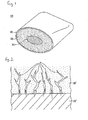
- oil contained in the chocolate in the central part of the molded body can easily migrate into the covering part through pores P in the porous structure (see FIG. 2 ), thereby further improving balance in texture of the chewing gum as a whole,
- the porous structure can be formed either by extruding a gum base under a mild condition so as not to break pores included therein, and co-depositing or encrusting, or by-extending a rope cooled down to 40 to 50C to-generate innumerable fine cracks by increasing traveling speed by the pair of roller members provided immediately before the pellet forming mechanism, in a system disclosed in Publication of U.S. Patent No. 6,280,780 .
- a specific porosity can be accordingly configured depending on a difference in oil content between chocolate and a gum base used, and is preferably no less than 5%, more preferably no less than 10%, and most preferably no less than 15%.
- the covering component can contain an optional ingredient such as elastomer, a bulking agent (maltitol and the like), wax, an elastomer solvent, an emulsifier, a plasticiser, a filler and a mixture thereof.
- the covering component must be configured so that the oil content thereof is lower than that of the chocolate component, in order to migrate the oil.
- the oil content of the covering component is preferably no greater than 5% by mass and more preferably no greater than 2.5% by mass with respect to the covering component as a whole, in order to reduce manufacturing time by ensuring migrating speed of the oil, and to ensure sufficient formability in a manufacturing process.
- the abovementioned covering component composed of the gum base and the optional ingredient can make up about 40 to 97% by mass and more preferably about 70 to 90% by mass of the chewing gum as a whole.
- “chocolate” indicates, according to class name definition in Chocolate Fair Competition Code (hereinafter referred to as Chocolate Code), a chocolate product or a chocolate-material containing no less than 60% chocolate material that is compliant with the standard for chocolate material, manufactured by a normal procedure using cacao mass, cocoa butter, cocoa cake or cocoa powder prepared from cacao beans as an ingredient, and adding sugar, dairy product, other edible oil and fat, flavor and the like thereto as necessary (Chocolate Code Article 2, Paragraph 3).
- Chocolate Code a chocolate product or a chocolate-material containing no less than 60% chocolate material that is compliant with the standard for chocolate material, manufactured by a normal procedure using cacao mass, cocoa butter, cocoa cake or cocoa powder prepared from cacao beans as an ingredient, and adding sugar, dairy product, other edible oil and fat, flavor and the like thereto as necessary
- the chocolate in the present specification is not limited to that defined in the abovementioned Code, and can include: quasi chocolate; chocolate sweet; quasi chocolate sweet; milk chocolate; quasi milk chocolate; pure chocolate; fresh cream chocolate; other oleaginous confectionery materials such as various oleaginous confectionery materials using, in place of or along with cocoa butter, tempering type fat or non-tempering type fat derived from animal, vegetable, and the both thereof or a mixture thereof; white chocolate obtained by not using cocoa butter or cacao mass but powdered whole milk, powdered skimmed milk and the like; colored chocolate of various flavors and colors using various flavorings such as fruits, coffee, green tea and the like; and an oleaginous confectionery such as ganache, cream and the like.
- the chocolate is covered with a covering component as in the present invention. Therefore, if oil including fat requiring tempering as a main component is used, there is a concern that a problem such as fat bloom occurs in the central part. Consequently, the oil preferably contains non-tempering type fat as a main component. A problem such as fat bloom can thus be suppressed even if tempering is not possible, and texture and flavor can be further improved.
- non-tempering type fat as a main component
- non-tempering fat makes up preferably no less than 50% by mass, more preferably no less than 75% by mass, and further preferably no less than 90% by mass of the oil as a whole, and does not exclude a case where tempering-type fat is contained therein.
- a representative example of the non-tempering type fat includes trans acid type fat and lauric acid type fat.
- Trans acid type fat is obtained by trans-isomerizing a soft fraction of palm oil and the like or liquid oil such as soybean oil, and composed of triglyceride containing a relatively large amount of trans-fatty acid in constituent fatty acid thereof.
- Lauric acid type fat is obtained from oil and fat composed of glyceride containing a large amount of lauric acid group such as palm oil, palm kernel oil, babassu oil and the like, and fractions thereof, and composed of triglyceride containing a large amount of lauric acid in constituent fatty acid thereof.
- asymmetrical glyceride such as SSU type glyceride (saturated triglyceride in 1,2-position and unsaturated triglyceride in 3-position) can be used solely or in combination with SUS type glyceride (saturated triglyceride in 1,3-position and unsaturated triglyceride in 2-position) as the non-tempering type fat
- oil since oil generally migrates at room temperature, oil composed of fat that is solid at room temperature practically does not migrate from the central part to the covering part.
- the oil preferably contains liquid or semi-solid fat at room temperature as a main-component.
- the oil sufficiently migrates from the central part into the covering part at room temperature.
- a liquid or semi-solid form gives far less unpleasant sensation during mastication than a solid form. This can sufficiently achieve the abovementioned effect.
- liquid or semi-solid fat at room temperature as a main component
- liquid or semi-solid fat at room temperature makes up preferably no less than 50% by mass, more preferably no less than 75% by mass, and further preferably no less than 90% by mass of the oil as a whole, and does not exclude a case where solid fat at room temperature (such as cocoa butter) is contained therein.
- liquid or semi-solid fat at room temperature though not limiting, palm kernel oil, butter oil, palm olein oil and the like can be exemplified.
- the chocolate can contain an optional ingredient such as sugar, shortening, lecitin, an emulsifier, an alcoholic beverage, fruit juice, a flavoring agent and the like, and a mixture thereof.
- an optional ingredient such as sugar, shortening, lecitin, an emulsifier, an alcoholic beverage, fruit juice, a flavoring agent and the like, and a mixture thereof.
- the alcoholic beverage, fruit juice and the flavoring agent flavor of the chewing gum as a whole can be improved since the abovementioned ingredients also migrate to the covering part along with the oil.
- the oil content of the chocolate should be no less than 18% by mass, preferably no less than 30% by mass, more preferably no less than 35% by mass, and further preferably no less than 40% by mass. This can reduce a torque required in a manufacturing device (for example, a preparing device of liquid chocolate, a transportation device and an extruding device) and a manufacturing cost thus can be expected to be lowered. As described above, even if chocolate containing a comparatively large amount of oil is used, the oil migrates to the covering part and is not likely to produce visible oil separation in the central part.
- the covering component can be further covered with an outermost layer.
- This can prevent deformation of the chewing gum during transportation and improve perceptibility thereof such as hand feeling and appearance.
- the outermost layer can be formed by a well-known method.
- a composition constituting the outermost layer can contain sorbitol, maltitol, xylitol, erythritol, isomalt, other crystallizable polyols, and sucrose.
- the molded body can contain an additive such as an algefacient, a throat soothing agent, a spice, a warming agent, a tooth whitening agent, a halitosis deodorant, vitamins, minerals, caffeine, a drug and the like in an arbitrary portion thereof.
- an additive such as an algefacient, a throat soothing agent, a spice, a warming agent, a tooth whitening agent, a halitosis deodorant, vitamins, minerals, caffeine, a drug and the like in an arbitrary portion thereof.
- a specific example thereof is not particularly limited and, for example, components disclosed in Japanese Translation of PCT International Publication, Publication No. 2008-510491 can be used.
- the abovementioned molded body is made into a chewing gum as a final product by migrating the oil from the chocolate into the covering component.
- the migration is generally performed at room temperature and time required therefor varies according to the amount of oil contained in the chocolate and the covering component; however, is generally 3 to 7 days.
- the migration is almost completed in the time period, and destabilization in quality due to difference in a degree of migration can be prevented.
- FIG 1 is a cross-sectional perspective view of a chewing gum 10 according to an embodiment of the present invention.
- the chewing gum 10 includes a central part 20 and a covering part 30 that covers the central part 20.
- the chewing gum 10 according to the present embodiment further includes an outermost later 40 that covers the covering part 30.
- the central part 20 contains a chocolate-derived component.
- the chocolate-derived component indicates a part of, or all of components generally contained in chocolate; more specifically components remained after migrating a part of, or all of components contained in chocolate used as a raw material into the covering part composed of a gum base and the like.
- the covering part 30 preferably has a porous structure.
- the covering part 30 having a porous structure indicates that, as shown in FIG 2 , a part of or all of components contained in chocolate 20' used as a raw material has been sufficiently migrated to a covering part precursor 30' composed of a covering component.
- the oil preferably contains non-tempering type fat or liquid or semi-solid fat at room temperature as a main component.
- the covering part 30 after the migration of oil preferably contains no greater than 10% by mass, more preferably no greater than 8% by mass of the oil with respect to the covering part as a whole. The characteristics of chewing gum can thus be sufficiently maintained, while suppressing an amount of an additive used.
- the chewing gum is preferably configured to be non-sugar, and more preferably configured to be sugarless.
- non-sugar means that sugar content per 100 g of chewing gum is less than 5 g
- sugarless means that sugar content per 100 g of chewing gum is less than 0.5 g.
- a chocolate of composition shown in Table 1 was prepared. As shown in Table 1, a proportion of oil in chocolate (cocoa butter (including cocoa butter contained in cocoa), palm olein oil, medium chain fatty acid oil, shortening, and butter oil) was 44.45% by mass.
- a covering component shown in Table 2 was prepared. As shown in Table 2, the covering component does substantially not contain oil.
- Table 3 Maltitol 95.02 Bleached gum arabic 3.32 titanium dioxide 0.36 Flavoring 1.07 algefacient 0.08 intense sweetener 0.08 Candelilla wax 0.08 (All figures are in percent by mass)
- the chocolate of the composition shown in Table 1 and the covering component of the composition shown in Table 2 were co-extruded, and then passed through a sizing mechanism provided with a pair of seven-tiered pulley-type roller members, thereby forming a thin rope having a desired thickness. Thereafter, traveling speed of the thin rope of a gum material was increased by a pair of roller members, and then the rope was introduced into a pellet forming mechanism provided with a pair of rotating chain-die members rotating in a uniform velocity and cut into a desired size and shape. Amount used of the chocolate and the covering component was as shown in Table 4.
- a molded body was formed by spraying the composition for forming an outermost layer of the composition shown in Table 3 onto an outer surface of the pellet and then drying.
- the molded body was stored for a week at room temperature, thereby forming a chewing gum in which oil in the chocolate had been migrated into the covering part.
- a chewing gum was prepared under the same conditions as in the Example 2, except for the covering component and the chocolate being kneaded in order to uniformly disperse the chocolate in the covering component.
- 0.7 g of the covering component shown in Table 2 was placed in a concave portion of a mortar, strongly compressed between the mortar and a convex shaped pestle, and formed into a bowl shape.
- Two bowl-shaped bodies were prepared by repeating the abovementioned step. One bowl-shaped body was placed inside a concave portion of a mortar having an approximate shape to a designed shape of a chewing gum, 0.2 g of chocolate in a melted state shown in Table 1 was placed in a center of the bowl-shaped body, and then other bowl-shaped body was placed thereon.
- a laminated body thus obtained was compressed by a concave portion of a pestle having an approximate shape to a designed shape of the chewing gum from above, edge portions of the bowl-shaped bodies were bonded with each other, thereby forming a molded body.
- the chewing gum was prepared by storing the molded body for a week at room temperature.
- Example 1 Example 2
- Example 3 Example 4 Covering componnt (g) 1.4 1.4 1.4 1.4
- Chocolate g) 0.1 0.2 0.3 0.2 Chocolate sensation Moderate Good Good Bad Softening of gum base Good Good Good Moderate Bad Total assessment Moderate Good Moderate Bad
- the covering part was densely-packed and had a non-porous structure that did not allow oil in the chocolate to migrate thereinto, and a central part was in a liquid form in which oil separation was observed.
- the covering part had a porous structure and the central part was in a semi-solid form in which oil separation was not observed.
- the covering part and the central part were very similar to each other in texture and gave no unpleasant sensation. The results described above proved that the covering part having a porous structure can suppress deterioration of appearance such as oil separation and improve balance in texture of the chewing gum as a whole.
- a chewing gum was prepared under the same conditions as in the Example 2, except for the chocolate of a composition shown in Table 5 being used.
- Example 4 Example 5 Cocoa 16.00 16.00 Maltitol 40.00 40.00 Cocoa butter 1.50 32.25 Palm olein oil 0.00 0.00 medium chain fatty acid oil 30.57 0.00 Shortening 9.33 9.33 Butter oil 1.33 1.33 Lecitin 0.61 0.61 Emulsifier 0.21 0.21 Flavoring 0.45 0.27 Total 100.00 100.00 (All figures are in percent by mass)
- cocoa butter lump was not observed in the chewing gum of Example 2, and observed in the chewing gums of Examples 4 and 5. It is considered that, since oil containing fat that is low in compatibility with cocoa butter as a main component, such as medium chain fatty acid oil, was used in the chewing gum of Example 4, cocoa butter formed a lump separately from medium chain fatty acid oil. In addition, it is considered that, since oil containing tempering-type fat as a main component, such as cocoa butter, was used without tempering in the chewing gum of Example 5, the cocoa butter lump was formed.
Landscapes
- Chemical & Material Sciences (AREA)
- Life Sciences & Earth Sciences (AREA)
- Engineering & Computer Science (AREA)
- Food Science & Technology (AREA)
- Polymers & Plastics (AREA)
- Inorganic Chemistry (AREA)
- Confectionery (AREA)
Applications Claiming Priority (1)
| Application Number | Priority Date | Filing Date | Title |
|---|---|---|---|
| JP2008287181A JP5225032B2 (ja) | 2008-11-07 | 2008-11-07 | チューインガム及びその製造方法 |
Publications (2)
| Publication Number | Publication Date |
|---|---|
| EP2183979A2 true EP2183979A2 (de) | 2010-05-12 |
| EP2183979A3 EP2183979A3 (de) | 2014-06-04 |
Family
ID=41651346
Family Applications (1)
| Application Number | Title | Priority Date | Filing Date |
|---|---|---|---|
| EP09013735.7A Withdrawn EP2183979A3 (de) | 2008-11-07 | 2009-11-02 | Kaugummi und Herstellungsverfahren dafür |
Country Status (3)
| Country | Link |
|---|---|
| US (1) | US20100119647A1 (de) |
| EP (1) | EP2183979A3 (de) |
| JP (1) | JP5225032B2 (de) |
Cited By (1)
| Publication number | Priority date | Publication date | Assignee | Title |
|---|---|---|---|---|
| EP3132691A4 (de) * | 2014-04-16 | 2017-11-29 | The Nisshin OilliO Group, Ltd. | Fetthaltiges lebensmittel |
Families Citing this family (1)
| Publication number | Priority date | Publication date | Assignee | Title |
|---|---|---|---|---|
| WO2014052494A1 (en) * | 2012-09-26 | 2014-04-03 | Dianaplantsciences, S.A.S. | Novel food compositions of whole plant cells |
Citations (4)
| Publication number | Priority date | Publication date | Assignee | Title |
|---|---|---|---|---|
| JPH0347828B2 (de) | 1983-10-08 | 1991-07-22 | Lotte Co Ltd | |
| US6280780B1 (en) | 2000-08-24 | 2001-08-28 | Warner-Lambert Company | Method and apparatus for continuously forming coated center-filled gum products |
| WO2008016940A1 (en) | 2006-07-31 | 2008-02-07 | Wm. Wrigley Jr. Company | Chewing gum products |
| JP2008510491A (ja) | 2004-08-25 | 2008-04-10 | キャドバリー・アダムズ・ユーエスエイ・エルエルシー | 液体充填チューインガム組成物 |
Family Cites Families (8)
| Publication number | Priority date | Publication date | Assignee | Title |
|---|---|---|---|---|
| JPS4416713Y1 (de) * | 1964-01-16 | 1969-07-18 | ||
| US4224345A (en) * | 1978-10-16 | 1980-09-23 | Lotte Co., Ltd | Chewing gum base and a combination of a chewing gum with fatty matter |
| JPS58301B2 (ja) * | 1979-04-17 | 1983-01-06 | 株式会社 ロツテ | 多孔質チユ−インガムの製造方法 |
| US4514423A (en) * | 1981-05-22 | 1985-04-30 | Lotte Co., Ltd. | Process of preparing an improved bubble chewing gum |
| JPS60114149A (ja) * | 1983-11-25 | 1985-06-20 | Lotte Co Ltd | 柔軟なチューインガム |
| JP3122841B2 (ja) * | 1997-09-19 | 2001-01-09 | 東京フード株式会社 | 油脂性菓子浸透パン及び菓子 |
| US20060280835A1 (en) * | 2004-08-25 | 2006-12-14 | Cadbury Adams Usa Llc. | Multi-modality flavored chewing gum compositions |
| JP2008515407A (ja) * | 2004-10-08 | 2008-05-15 | ガムリンク エー/エス | 菓子製品 |
-
2008
- 2008-11-07 JP JP2008287181A patent/JP5225032B2/ja not_active Expired - Fee Related
-
2009
- 2009-11-02 EP EP09013735.7A patent/EP2183979A3/de not_active Withdrawn
- 2009-11-06 US US12/613,599 patent/US20100119647A1/en not_active Abandoned
Patent Citations (4)
| Publication number | Priority date | Publication date | Assignee | Title |
|---|---|---|---|---|
| JPH0347828B2 (de) | 1983-10-08 | 1991-07-22 | Lotte Co Ltd | |
| US6280780B1 (en) | 2000-08-24 | 2001-08-28 | Warner-Lambert Company | Method and apparatus for continuously forming coated center-filled gum products |
| JP2008510491A (ja) | 2004-08-25 | 2008-04-10 | キャドバリー・アダムズ・ユーエスエイ・エルエルシー | 液体充填チューインガム組成物 |
| WO2008016940A1 (en) | 2006-07-31 | 2008-02-07 | Wm. Wrigley Jr. Company | Chewing gum products |
Cited By (2)
| Publication number | Priority date | Publication date | Assignee | Title |
|---|---|---|---|---|
| EP3132691A4 (de) * | 2014-04-16 | 2017-11-29 | The Nisshin OilliO Group, Ltd. | Fetthaltiges lebensmittel |
| AU2015247057B2 (en) * | 2014-04-16 | 2018-05-17 | The Nisshin Oillio Group, Ltd. | Oils and fats-containing food |
Also Published As
| Publication number | Publication date |
|---|---|
| EP2183979A3 (de) | 2014-06-04 |
| US20100119647A1 (en) | 2010-05-13 |
| JP2010110284A (ja) | 2010-05-20 |
| JP5225032B2 (ja) | 2013-07-03 |
Similar Documents
| Publication | Publication Date | Title |
|---|---|---|
| EP1699298B1 (de) | Überzogene süssware | |
| US8475865B2 (en) | Food emulsion | |
| EP1912515B1 (de) | Butterfettfüllung oder künstliche schokolade für getreidebackprodukte | |
| US11864563B2 (en) | Confectionery product and method of making | |
| HK1207537A1 (en) | Edible materials and their manufacture | |
| JP5592371B2 (ja) | 複数領域菓子及びその製造方法 | |
| CA2443976A1 (en) | Sugar wafer with confectionery filling | |
| KR101747706B1 (ko) | 내열성이 우수한 초콜렛류 이용식품의 제조방법 | |
| EP2183979A2 (de) | Kaugummi und Herstellungsverfahren dafür | |
| EP2124596B1 (de) | Konfektzusammensetzungen mit geringer dichte | |
| JP7170777B2 (ja) | 菓子およびその製造方法 | |
| EP1874126B1 (de) | Geformte kaugummiprodukte, die lösliches protein enthalten, sowie verfahren zu ihrer herstellung | |
| JP6232807B2 (ja) | グミキャンディ | |
| US20220217984A1 (en) | Composite bakery product | |
| JP2019000021A (ja) | 複合油脂性菓子 | |
| KR101739238B1 (ko) | 홍삼 트뤼플 초콜릿의 제조방법 및 그에 따른 홍삼 트뤼플 초콜릿 | |
| WO2007143367A1 (en) | Coated confectionery compositions and methods regarding same | |
| CN109953167B (zh) | 具有良好热稳定性的减糖健康型巧克力及其制备方法 | |
| KR100713139B1 (ko) | 반투명한 쉘 과자용 조성물 | |
| BE1026648B1 (nl) | Chocoladeproduct en werkwijze voor de productie van een chocoladeproduct | |
| JP7031773B1 (ja) | 中鎖脂肪酸結合トリグリセリドを含むチョコレート類 | |
| KR20140027375A (ko) | 기포화 구운 식품 제품 및 초콜릿 제품의 제조 및 제형화 방법 | |
| JP2021153584A (ja) | チョコレートおよびその製造方法 |
Legal Events
| Date | Code | Title | Description |
|---|---|---|---|
| PUAI | Public reference made under article 153(3) epc to a published international application that has entered the european phase |
Free format text: ORIGINAL CODE: 0009012 |
|
| AK | Designated contracting states |
Kind code of ref document: A2 Designated state(s): AT BE BG CH CY CZ DE DK EE ES FI FR GB GR HR HU IE IS IT LI LT LU LV MC MK MT NL NO PL PT RO SE SI SK SM TR |
|
| AX | Request for extension of the european patent |
Extension state: AL BA RS |
|
| PUAL | Search report despatched |
Free format text: ORIGINAL CODE: 0009013 |
|
| AK | Designated contracting states |
Kind code of ref document: A3 Designated state(s): AT BE BG CH CY CZ DE DK EE ES FI FR GB GR HR HU IE IS IT LI LT LU LV MC MK MT NL NO PL PT RO SE SI SK SM TR |
|
| AX | Request for extension of the european patent |
Extension state: AL BA RS |
|
| RIC1 | Information provided on ipc code assigned before grant |
Ipc: A23G 4/06 20060101ALI20140430BHEP Ipc: A23G 4/18 20060101ALI20140430BHEP Ipc: A23G 4/20 20060101AFI20140430BHEP Ipc: A23G 1/54 20060101ALI20140430BHEP |
|
| STAA | Information on the status of an ep patent application or granted ep patent |
Free format text: STATUS: THE APPLICATION IS DEEMED TO BE WITHDRAWN |
|
| 18D | Application deemed to be withdrawn |
Effective date: 20141205 |