EP2182011A1 - Verfahren zur Herstellung von wässrigen Polyacrylsäurelösungen mittels kontrollierter radikalischer Polymerisation - Google Patents
Verfahren zur Herstellung von wässrigen Polyacrylsäurelösungen mittels kontrollierter radikalischer Polymerisation Download PDFInfo
- Publication number
- EP2182011A1 EP2182011A1 EP08167837A EP08167837A EP2182011A1 EP 2182011 A1 EP2182011 A1 EP 2182011A1 EP 08167837 A EP08167837 A EP 08167837A EP 08167837 A EP08167837 A EP 08167837A EP 2182011 A1 EP2182011 A1 EP 2182011A1
- Authority
- EP
- European Patent Office
- Prior art keywords
- acrylic acid
- homo
- monomers
- polymerization
- auxiliary
- Prior art date
- Legal status (The legal status is an assumption and is not a legal conclusion. Google has not performed a legal analysis and makes no representation as to the accuracy of the status listed.)
- Withdrawn
Links
- 229920002125 Sokalan® Polymers 0.000 title description 30
- -1 poly(acrylic acid) Polymers 0.000 title description 27
- 238000004519 manufacturing process Methods 0.000 title description 2
- NIXOWILDQLNWCW-UHFFFAOYSA-N 2-Propenoic acid Natural products OC(=O)C=C NIXOWILDQLNWCW-UHFFFAOYSA-N 0.000 claims abstract description 65
- SMZOUWXMTYCWNB-UHFFFAOYSA-N 2-(2-methoxy-5-methylphenyl)ethanamine Chemical compound COC1=CC=C(C)C=C1CCN SMZOUWXMTYCWNB-UHFFFAOYSA-N 0.000 claims abstract description 58
- 238000000034 method Methods 0.000 claims abstract description 55
- 238000006116 polymerization reaction Methods 0.000 claims abstract description 44
- 238000006243 chemical reaction Methods 0.000 claims abstract description 39
- 229920001577 copolymer Polymers 0.000 claims abstract description 38
- 239000007864 aqueous solution Substances 0.000 claims abstract description 37
- 239000000178 monomer Substances 0.000 claims abstract description 34
- 239000003999 initiator Substances 0.000 claims abstract description 29
- 230000008569 process Effects 0.000 claims abstract description 29
- 229910052717 sulfur Inorganic materials 0.000 claims abstract description 27
- 239000012736 aqueous medium Substances 0.000 claims abstract description 22
- NINIDFKCEFEMDL-UHFFFAOYSA-N Sulfur Chemical compound [S] NINIDFKCEFEMDL-UHFFFAOYSA-N 0.000 claims abstract description 21
- 239000011593 sulfur Substances 0.000 claims abstract description 21
- XLYOFNOQVPJJNP-UHFFFAOYSA-N water Substances O XLYOFNOQVPJJNP-UHFFFAOYSA-N 0.000 claims abstract description 19
- 239000006185 dispersion Substances 0.000 claims abstract description 11
- 150000003839 salts Chemical class 0.000 claims abstract description 10
- 238000010526 radical polymerization reaction Methods 0.000 claims abstract description 9
- 238000010438 heat treatment Methods 0.000 claims abstract description 7
- 150000001768 cations Chemical class 0.000 claims abstract description 6
- 125000004108 n-butyl group Chemical group [H]C([H])([H])C([H])([H])C([H])([H])C([H])([H])* 0.000 claims abstract description 6
- 125000004123 n-propyl group Chemical group [H]C([H])([H])C([H])([H])C([H])([H])* 0.000 claims abstract description 6
- 239000000470 constituent Substances 0.000 claims abstract description 5
- 229910052760 oxygen Inorganic materials 0.000 claims abstract description 5
- 238000012719 thermal polymerization Methods 0.000 claims abstract description 5
- 125000000959 isobutyl group Chemical group [H]C([H])([H])C([H])(C([H])([H])[H])C([H])([H])* 0.000 claims abstract description 4
- 125000002496 methyl group Chemical group [H]C([H])([H])* 0.000 claims description 35
- 230000009849 deactivation Effects 0.000 claims description 17
- 238000002360 preparation method Methods 0.000 claims description 13
- 239000012752 auxiliary agent Substances 0.000 claims description 10
- 125000001495 ethyl group Chemical group [H]C([H])([H])C([H])([H])* 0.000 claims description 10
- 125000004432 carbon atom Chemical group C* 0.000 claims description 9
- 229920001519 homopolymer Polymers 0.000 claims description 5
- 230000007062 hydrolysis Effects 0.000 claims description 5
- 238000006460 hydrolysis reaction Methods 0.000 claims description 5
- QAOWNCQODCNURD-UHFFFAOYSA-L Sulfate Chemical compound [O-]S([O-])(=O)=O QAOWNCQODCNURD-UHFFFAOYSA-L 0.000 claims description 3
- 239000007800 oxidant agent Substances 0.000 claims description 3
- 230000003647 oxidation Effects 0.000 claims description 2
- 238000007254 oxidation reaction Methods 0.000 claims description 2
- 125000000751 azo group Chemical group [*]N=N[*] 0.000 abstract description 5
- 125000000217 alkyl group Chemical group 0.000 abstract 1
- 239000000243 solution Substances 0.000 description 32
- 150000003254 radicals Chemical class 0.000 description 31
- 239000003153 chemical reaction reagent Substances 0.000 description 28
- 239000004584 polyacrylic acid Substances 0.000 description 25
- 229920000642 polymer Polymers 0.000 description 22
- 239000000203 mixture Substances 0.000 description 19
- 125000003178 carboxy group Chemical group [H]OC(*)=O 0.000 description 18
- HEMHJVSKTPXQMS-UHFFFAOYSA-M Sodium hydroxide Chemical compound [OH-].[Na+] HEMHJVSKTPXQMS-UHFFFAOYSA-M 0.000 description 12
- IJGRMHOSHXDMSA-UHFFFAOYSA-N Atomic nitrogen Chemical compound N#N IJGRMHOSHXDMSA-UHFFFAOYSA-N 0.000 description 10
- 230000000052 comparative effect Effects 0.000 description 9
- 238000012712 reversible addition−fragmentation chain-transfer polymerization Methods 0.000 description 9
- VTYYLEPIZMXCLO-UHFFFAOYSA-L Calcium carbonate Chemical compound [Ca+2].[O-]C([O-])=O VTYYLEPIZMXCLO-UHFFFAOYSA-L 0.000 description 8
- 239000002904 solvent Substances 0.000 description 8
- LXEKPEMOWBOYRF-UHFFFAOYSA-N [2-[(1-azaniumyl-1-imino-2-methylpropan-2-yl)diazenyl]-2-methylpropanimidoyl]azanium;dichloride Chemical compound Cl.Cl.NC(=N)C(C)(C)N=NC(C)(C)C(N)=N LXEKPEMOWBOYRF-UHFFFAOYSA-N 0.000 description 7
- 239000002585 base Substances 0.000 description 7
- 238000009826 distribution Methods 0.000 description 6
- 239000000049 pigment Substances 0.000 description 6
- LFQSCWFLJHTTHZ-UHFFFAOYSA-N Ethanol Chemical compound CCO LFQSCWFLJHTTHZ-UHFFFAOYSA-N 0.000 description 5
- 230000002378 acidificating effect Effects 0.000 description 5
- 229910052757 nitrogen Inorganic materials 0.000 description 5
- 238000003756 stirring Methods 0.000 description 5
- 150000001298 alcohols Chemical class 0.000 description 4
- 229910000019 calcium carbonate Inorganic materials 0.000 description 4
- 239000012634 fragment Substances 0.000 description 4
- KWYUFKZDYYNOTN-UHFFFAOYSA-M potassium hydroxide Substances [OH-].[K+] KWYUFKZDYYNOTN-UHFFFAOYSA-M 0.000 description 4
- 238000012546 transfer Methods 0.000 description 4
- CERQOIWHTDAKMF-UHFFFAOYSA-N Methacrylic acid Chemical compound CC(=C)C(O)=O CERQOIWHTDAKMF-UHFFFAOYSA-N 0.000 description 3
- OKKJLVBELUTLKV-UHFFFAOYSA-N Methanol Chemical compound OC OKKJLVBELUTLKV-UHFFFAOYSA-N 0.000 description 3
- ZMXDDKWLCZADIW-UHFFFAOYSA-N N,N-Dimethylformamide Chemical compound CN(C)C=O ZMXDDKWLCZADIW-UHFFFAOYSA-N 0.000 description 3
- YXFVVABEGXRONW-UHFFFAOYSA-N Toluene Chemical compound CC1=CC=CC=C1 YXFVVABEGXRONW-UHFFFAOYSA-N 0.000 description 3
- 230000015556 catabolic process Effects 0.000 description 3
- 239000003795 chemical substances by application Substances 0.000 description 3
- 238000006731 degradation reaction Methods 0.000 description 3
- 238000005227 gel permeation chromatography Methods 0.000 description 3
- 238000000227 grinding Methods 0.000 description 3
- 239000001023 inorganic pigment Substances 0.000 description 3
- 239000002609 medium Substances 0.000 description 3
- JCBJVAJGLKENNC-UHFFFAOYSA-M potassium ethyl xanthate Chemical compound [K+].CCOC([S-])=S JCBJVAJGLKENNC-UHFFFAOYSA-M 0.000 description 3
- 239000002002 slurry Substances 0.000 description 3
- 238000003786 synthesis reaction Methods 0.000 description 3
- QGZKDVFQNNGYKY-UHFFFAOYSA-N Ammonia Chemical compound N QGZKDVFQNNGYKY-UHFFFAOYSA-N 0.000 description 2
- CIWBSHSKHKDKBQ-JLAZNSOCSA-N Ascorbic acid Chemical compound OC[C@H](O)[C@H]1OC(=O)C(O)=C1O CIWBSHSKHKDKBQ-JLAZNSOCSA-N 0.000 description 2
- CPELXLSAUQHCOX-UHFFFAOYSA-M Bromide Chemical compound [Br-] CPELXLSAUQHCOX-UHFFFAOYSA-M 0.000 description 2
- MHAJPDPJQMAIIY-UHFFFAOYSA-N Hydrogen peroxide Chemical compound OO MHAJPDPJQMAIIY-UHFFFAOYSA-N 0.000 description 2
- FAPWRFPIFSIZLT-UHFFFAOYSA-M Sodium chloride Chemical compound [Na+].[Cl-] FAPWRFPIFSIZLT-UHFFFAOYSA-M 0.000 description 2
- GWEVSGVZZGPLCZ-UHFFFAOYSA-N Titan oxide Chemical compound O=[Ti]=O GWEVSGVZZGPLCZ-UHFFFAOYSA-N 0.000 description 2
- XLOMVQKBTHCTTD-UHFFFAOYSA-N Zinc monoxide Chemical compound [Zn]=O XLOMVQKBTHCTTD-UHFFFAOYSA-N 0.000 description 2
- 239000000654 additive Substances 0.000 description 2
- 229910052783 alkali metal Inorganic materials 0.000 description 2
- 229910001413 alkali metal ion Inorganic materials 0.000 description 2
- 150000001340 alkali metals Chemical class 0.000 description 2
- 238000005904 alkaline hydrolysis reaction Methods 0.000 description 2
- 150000001412 amines Chemical class 0.000 description 2
- 239000013011 aqueous formulation Substances 0.000 description 2
- 230000008901 benefit Effects 0.000 description 2
- 230000015572 biosynthetic process Effects 0.000 description 2
- 229910052799 carbon Inorganic materials 0.000 description 2
- HIZCIEIDIFGZSS-UHFFFAOYSA-N carbonotrithioic acid Chemical class SC(S)=S HIZCIEIDIFGZSS-UHFFFAOYSA-N 0.000 description 2
- 239000003638 chemical reducing agent Substances 0.000 description 2
- 238000003776 cleavage reaction Methods 0.000 description 2
- 150000001875 compounds Chemical class 0.000 description 2
- 238000002474 experimental method Methods 0.000 description 2
- 239000007789 gas Substances 0.000 description 2
- 229910052739 hydrogen Inorganic materials 0.000 description 2
- 230000002209 hydrophobic effect Effects 0.000 description 2
- 238000011065 in-situ storage Methods 0.000 description 2
- 239000011976 maleic acid Substances 0.000 description 2
- 238000003801 milling Methods 0.000 description 2
- 150000001451 organic peroxides Chemical class 0.000 description 2
- 230000001590 oxidative effect Effects 0.000 description 2
- 239000002245 particle Substances 0.000 description 2
- 150000002978 peroxides Chemical class 0.000 description 2
- 239000003505 polymerization initiator Substances 0.000 description 2
- 230000007017 scission Effects 0.000 description 2
- 238000003860 storage Methods 0.000 description 2
- 125000001424 substituent group Chemical group 0.000 description 2
- 150000003464 sulfur compounds Chemical class 0.000 description 2
- HMUNWXXNJPVALC-UHFFFAOYSA-N 1-[4-[2-(2,3-dihydro-1H-inden-2-ylamino)pyrimidin-5-yl]piperazin-1-yl]-2-(2,4,6,7-tetrahydrotriazolo[4,5-c]pyridin-5-yl)ethanone Chemical compound C1C(CC2=CC=CC=C12)NC1=NC=C(C=N1)N1CCN(CC1)C(CN1CC2=C(CC1)NN=N2)=O HMUNWXXNJPVALC-UHFFFAOYSA-N 0.000 description 1
- LGJCFVYMIJLQJO-UHFFFAOYSA-N 1-dodecylperoxydodecane Chemical class CCCCCCCCCCCCOOCCCCCCCCCCCC LGJCFVYMIJLQJO-UHFFFAOYSA-N 0.000 description 1
- QEZSTBGQYFCJCW-UHFFFAOYSA-N 1-phenylethyl benzenecarbodithioate Chemical compound C=1C=CC=CC=1C(C)SC(=S)C1=CC=CC=C1 QEZSTBGQYFCJCW-UHFFFAOYSA-N 0.000 description 1
- 238000005160 1H NMR spectroscopy Methods 0.000 description 1
- VZSRBBMJRBPUNF-UHFFFAOYSA-N 2-(2,3-dihydro-1H-inden-2-ylamino)-N-[3-oxo-3-(2,4,6,7-tetrahydrotriazolo[4,5-c]pyridin-5-yl)propyl]pyrimidine-5-carboxamide Chemical compound C1C(CC2=CC=CC=C12)NC1=NC=C(C=N1)C(=O)NCCC(N1CC2=C(CC1)NN=N2)=O VZSRBBMJRBPUNF-UHFFFAOYSA-N 0.000 description 1
- JAHNSTQSQJOJLO-UHFFFAOYSA-N 2-(3-fluorophenyl)-1h-imidazole Chemical compound FC1=CC=CC(C=2NC=CN=2)=C1 JAHNSTQSQJOJLO-UHFFFAOYSA-N 0.000 description 1
- DPBJAVGHACCNRL-UHFFFAOYSA-N 2-(dimethylamino)ethyl prop-2-enoate Chemical compound CN(C)CCOC(=O)C=C DPBJAVGHACCNRL-UHFFFAOYSA-N 0.000 description 1
- 229920000536 2-Acrylamido-2-methylpropane sulfonic acid Polymers 0.000 description 1
- XNWFRZJHXBZDAG-UHFFFAOYSA-N 2-METHOXYETHANOL Chemical compound COCCO XNWFRZJHXBZDAG-UHFFFAOYSA-N 0.000 description 1
- XHZPRMZZQOIPDS-UHFFFAOYSA-N 2-Methyl-2-[(1-oxo-2-propenyl)amino]-1-propanesulfonic acid Chemical compound OS(=O)(=O)CC(C)(C)NC(=O)C=C XHZPRMZZQOIPDS-UHFFFAOYSA-N 0.000 description 1
- OFGGQKXKKPUVOV-UHFFFAOYSA-N 2-[(1-imino-2-methyl-1-pyrrolidin-1-ylbutan-2-yl)diazenyl]-2-methyl-1-pyrrolidin-1-ylbutan-1-imine;dihydrochloride Chemical compound Cl.Cl.C1CCCN1C(=N)C(C)(CC)N=NC(C)(CC)C(=N)N1CCCC1 OFGGQKXKKPUVOV-UHFFFAOYSA-N 0.000 description 1
- FLKBKUFGKQPPRY-UHFFFAOYSA-N 2-[2-[2-[2-[1-(2-hydroxyethyl)-4,5-dihydroimidazol-2-yl]propan-2-yldiazenyl]propan-2-yl]-4,5-dihydroimidazol-1-yl]ethanol;dihydrochloride Chemical compound Cl.Cl.N=1CCN(CCO)C=1C(C)(C)N=NC(C)(C)C1=NCCN1CCO FLKBKUFGKQPPRY-UHFFFAOYSA-N 0.000 description 1
- SXAMGRAIZSSWIH-UHFFFAOYSA-N 2-[3-[2-(2,3-dihydro-1H-inden-2-ylamino)pyrimidin-5-yl]-1,2,4-oxadiazol-5-yl]-1-(2,4,6,7-tetrahydrotriazolo[4,5-c]pyridin-5-yl)ethanone Chemical compound C1C(CC2=CC=CC=C12)NC1=NC=C(C=N1)C1=NOC(=N1)CC(=O)N1CC2=C(CC1)NN=N2 SXAMGRAIZSSWIH-UHFFFAOYSA-N 0.000 description 1
- WZFUQSJFWNHZHM-UHFFFAOYSA-N 2-[4-[2-(2,3-dihydro-1H-inden-2-ylamino)pyrimidin-5-yl]piperazin-1-yl]-1-(2,4,6,7-tetrahydrotriazolo[4,5-c]pyridin-5-yl)ethanone Chemical compound C1C(CC2=CC=CC=C12)NC1=NC=C(C=N1)N1CCN(CC1)CC(=O)N1CC2=C(CC1)NN=N2 WZFUQSJFWNHZHM-UHFFFAOYSA-N 0.000 description 1
- YJLUBHOZZTYQIP-UHFFFAOYSA-N 2-[5-[2-(2,3-dihydro-1H-inden-2-ylamino)pyrimidin-5-yl]-1,3,4-oxadiazol-2-yl]-1-(2,4,6,7-tetrahydrotriazolo[4,5-c]pyridin-5-yl)ethanone Chemical compound C1C(CC2=CC=CC=C12)NC1=NC=C(C=N1)C1=NN=C(O1)CC(=O)N1CC2=C(CC1)NN=N2 YJLUBHOZZTYQIP-UHFFFAOYSA-N 0.000 description 1
- OMIGHNLMNHATMP-UHFFFAOYSA-N 2-hydroxyethyl prop-2-enoate Chemical compound OCCOC(=O)C=C OMIGHNLMNHATMP-UHFFFAOYSA-N 0.000 description 1
- KFNGWPXYNSJXOP-UHFFFAOYSA-N 3-(2-methylprop-2-enoyloxy)propane-1-sulfonic acid Chemical compound CC(=C)C(=O)OCCCS(O)(=O)=O KFNGWPXYNSJXOP-UHFFFAOYSA-N 0.000 description 1
- BVYRHLPUAHNHKR-UHFFFAOYSA-N 3-[[1-amino-2-[[1-amino-1-(2-carboxyethylimino)-2-methylpropan-2-yl]diazenyl]-2-methylpropylidene]amino]propanoic acid;hydrate Chemical compound O.OC(=O)CCNC(=N)C(C)(C)N=NC(C)(C)C(=N)NCCC(O)=O BVYRHLPUAHNHKR-UHFFFAOYSA-N 0.000 description 1
- VFXXTYGQYWRHJP-UHFFFAOYSA-N 4,4'-azobis(4-cyanopentanoic acid) Chemical compound OC(=O)CCC(C)(C#N)N=NC(C)(CCC(O)=O)C#N VFXXTYGQYWRHJP-UHFFFAOYSA-N 0.000 description 1
- LPIJERWHZYVVLP-UHFFFAOYSA-N 4-(tert-butyldiazenyl)-4-cyanopentanoic acid Chemical compound CC(C)(C)N=NC(C)(C#N)CCC(O)=O LPIJERWHZYVVLP-UHFFFAOYSA-N 0.000 description 1
- NDWUBGAGUCISDV-UHFFFAOYSA-N 4-hydroxybutyl prop-2-enoate Chemical compound OCCCCOC(=O)C=C NDWUBGAGUCISDV-UHFFFAOYSA-N 0.000 description 1
- CONKBQPVFMXDOV-QHCPKHFHSA-N 6-[(5S)-5-[[4-[2-(2,3-dihydro-1H-inden-2-ylamino)pyrimidin-5-yl]piperazin-1-yl]methyl]-2-oxo-1,3-oxazolidin-3-yl]-3H-1,3-benzoxazol-2-one Chemical compound C1C(CC2=CC=CC=C12)NC1=NC=C(C=N1)N1CCN(CC1)C[C@H]1CN(C(O1)=O)C1=CC2=C(NC(O2)=O)C=C1 CONKBQPVFMXDOV-QHCPKHFHSA-N 0.000 description 1
- HRPVXLWXLXDGHG-UHFFFAOYSA-N Acrylamide Chemical compound NC(=O)C=C HRPVXLWXLXDGHG-UHFFFAOYSA-N 0.000 description 1
- NIXOWILDQLNWCW-UHFFFAOYSA-M Acrylate Chemical compound [O-]C(=O)C=C NIXOWILDQLNWCW-UHFFFAOYSA-M 0.000 description 1
- 239000005995 Aluminium silicate Substances 0.000 description 1
- 0 CC(*OC)NC(C)NC(C)C(CC1)[C@@]1C=C Chemical compound CC(*OC)NC(C)NC(C)C(CC1)[C@@]1C=C 0.000 description 1
- RWSOTUBLDIXVET-UHFFFAOYSA-N Dihydrogen sulfide Chemical compound S RWSOTUBLDIXVET-UHFFFAOYSA-N 0.000 description 1
- CBENFWSGALASAD-UHFFFAOYSA-N Ozone Chemical compound [O-][O+]=O CBENFWSGALASAD-UHFFFAOYSA-N 0.000 description 1
- 239000002202 Polyethylene glycol Substances 0.000 description 1
- OFOBLEOULBTSOW-UHFFFAOYSA-N Propanedioic acid Natural products OC(=O)CC(O)=O OFOBLEOULBTSOW-UHFFFAOYSA-N 0.000 description 1
- 239000005708 Sodium hypochlorite Substances 0.000 description 1
- 239000007983 Tris buffer Substances 0.000 description 1
- 239000002253 acid Substances 0.000 description 1
- 239000002671 adjuvant Substances 0.000 description 1
- 230000001476 alcoholic effect Effects 0.000 description 1
- 239000003513 alkali Substances 0.000 description 1
- 229910052784 alkaline earth metal Inorganic materials 0.000 description 1
- 229910001420 alkaline earth metal ion Inorganic materials 0.000 description 1
- 150000001342 alkaline earth metals Chemical class 0.000 description 1
- 125000005210 alkyl ammonium group Chemical group 0.000 description 1
- 235000012211 aluminium silicate Nutrition 0.000 description 1
- 229910021529 ammonia Inorganic materials 0.000 description 1
- 150000003863 ammonium salts Chemical class 0.000 description 1
- 238000004458 analytical method Methods 0.000 description 1
- 239000007900 aqueous suspension Substances 0.000 description 1
- 229960005070 ascorbic acid Drugs 0.000 description 1
- 235000010323 ascorbic acid Nutrition 0.000 description 1
- 239000011668 ascorbic acid Substances 0.000 description 1
- RQPZNWPYLFFXCP-UHFFFAOYSA-L barium dihydroxide Chemical compound [OH-].[OH-].[Ba+2] RQPZNWPYLFFXCP-UHFFFAOYSA-L 0.000 description 1
- 229910001863 barium hydroxide Inorganic materials 0.000 description 1
- LBSPZZSGTIBOFG-UHFFFAOYSA-N bis[2-(4,5-dihydro-1h-imidazol-2-yl)propan-2-yl]diazene;dihydrochloride Chemical compound Cl.Cl.N=1CCNC=1C(C)(C)N=NC(C)(C)C1=NCCN1 LBSPZZSGTIBOFG-UHFFFAOYSA-N 0.000 description 1
- JKRBKUNNPGKVLF-UHFFFAOYSA-N bis[2-(4,5-dihydro-1h-imidazol-2-yl)propan-2-yl]diazene;sulfo hydrogen sulfate;dihydrate Chemical compound O.O.OS(=O)(=O)OS(O)(=O)=O.N=1CCNC=1C(C)(C)N=NC(C)(C)C1=NCCN1 JKRBKUNNPGKVLF-UHFFFAOYSA-N 0.000 description 1
- SKOLWUPSYHWYAM-UHFFFAOYSA-N carbonodithioic O,S-acid Chemical compound SC(S)=O SKOLWUPSYHWYAM-UHFFFAOYSA-N 0.000 description 1
- 150000007942 carboxylates Chemical group 0.000 description 1
- 150000001732 carboxylic acid derivatives Chemical class 0.000 description 1
- 125000003262 carboxylic acid ester group Chemical group [H]C([H])([*:2])OC(=O)C([H])([H])[*:1] 0.000 description 1
- 239000003054 catalyst Substances 0.000 description 1
- 230000008859 change Effects 0.000 description 1
- 238000007796 conventional method Methods 0.000 description 1
- LDHQCZJRKDOVOX-NSCUHMNNSA-N crotonic acid Chemical compound C\C=C\C(O)=O LDHQCZJRKDOVOX-NSCUHMNNSA-N 0.000 description 1
- 238000000354 decomposition reaction Methods 0.000 description 1
- 230000003247 decreasing effect Effects 0.000 description 1
- OWMBTIRJFMGPAC-UHFFFAOYSA-N dimethylamino 2-methylprop-2-enoate Chemical compound CN(C)OC(=O)C(C)=C OWMBTIRJFMGPAC-UHFFFAOYSA-N 0.000 description 1
- 239000002270 dispersing agent Substances 0.000 description 1
- 239000012153 distilled water Substances 0.000 description 1
- 125000004119 disulfanediyl group Chemical group *SS* 0.000 description 1
- 150000002022 dithiocarboxylic acid derivatives Chemical class 0.000 description 1
- 239000003480 eluent Substances 0.000 description 1
- 238000005516 engineering process Methods 0.000 description 1
- 125000004185 ester group Chemical group 0.000 description 1
- 150000002148 esters Chemical class 0.000 description 1
- ZOOODBUHSVUZEM-UHFFFAOYSA-N ethoxymethanedithioic acid Chemical compound CCOC(S)=S ZOOODBUHSVUZEM-UHFFFAOYSA-N 0.000 description 1
- 238000009472 formulation Methods 0.000 description 1
- 238000013467 fragmentation Methods 0.000 description 1
- 238000006062 fragmentation reaction Methods 0.000 description 1
- 238000012812 general test Methods 0.000 description 1
- 125000001183 hydrocarbyl group Chemical group 0.000 description 1
- 125000004435 hydrogen atom Chemical group [H]* 0.000 description 1
- 229910000037 hydrogen sulfide Inorganic materials 0.000 description 1
- 125000004029 hydroxymethyl group Chemical group [H]OC([H])([H])* 0.000 description 1
- TVZISJTYELEYPI-UHFFFAOYSA-N hypodiphosphoric acid Chemical compound OP(O)(=O)P(O)(O)=O TVZISJTYELEYPI-UHFFFAOYSA-N 0.000 description 1
- PNDPGZBMCMUPRI-UHFFFAOYSA-N iodine Chemical compound II PNDPGZBMCMUPRI-UHFFFAOYSA-N 0.000 description 1
- 150000002500 ions Chemical class 0.000 description 1
- 238000002955 isolation Methods 0.000 description 1
- 125000001449 isopropyl group Chemical group [H]C([H])([H])C([H])(*)C([H])([H])[H] 0.000 description 1
- NLYAJNPCOHFWQQ-UHFFFAOYSA-N kaolin Chemical compound O.O.O=[Al]O[Si](=O)O[Si](=O)O[Al]=O NLYAJNPCOHFWQQ-UHFFFAOYSA-N 0.000 description 1
- 239000007788 liquid Substances 0.000 description 1
- 229920002521 macromolecule Polymers 0.000 description 1
- VZCYOOQTPOCHFL-UPHRSURJSA-N maleic acid Chemical compound OC(=O)\C=C/C(O)=O VZCYOOQTPOCHFL-UPHRSURJSA-N 0.000 description 1
- ACEONLNNWKIPTM-UHFFFAOYSA-N methyl 2-bromopropanoate Chemical compound COC(=O)C(C)Br ACEONLNNWKIPTM-UHFFFAOYSA-N 0.000 description 1
- LVHBHZANLOWSRM-UHFFFAOYSA-N methylenebutanedioic acid Natural products OC(=O)CC(=C)C(O)=O LVHBHZANLOWSRM-UHFFFAOYSA-N 0.000 description 1
- 238000002156 mixing Methods 0.000 description 1
- WVFLGSMUPMVNTQ-UHFFFAOYSA-N n-(2-hydroxyethyl)-2-[[1-(2-hydroxyethylamino)-2-methyl-1-oxopropan-2-yl]diazenyl]-2-methylpropanamide Chemical compound OCCNC(=O)C(C)(C)N=NC(C)(C)C(=O)NCCO WVFLGSMUPMVNTQ-UHFFFAOYSA-N 0.000 description 1
- QYZFTMMPKCOTAN-UHFFFAOYSA-N n-[2-(2-hydroxyethylamino)ethyl]-2-[[1-[2-(2-hydroxyethylamino)ethylamino]-2-methyl-1-oxopropan-2-yl]diazenyl]-2-methylpropanamide Chemical compound OCCNCCNC(=O)C(C)(C)N=NC(C)(C)C(=O)NCCNCCO QYZFTMMPKCOTAN-UHFFFAOYSA-N 0.000 description 1
- ZQXSMRAEXCEDJD-UHFFFAOYSA-N n-ethenylformamide Chemical compound C=CNC=O ZQXSMRAEXCEDJD-UHFFFAOYSA-N 0.000 description 1
- 230000007935 neutral effect Effects 0.000 description 1
- 230000009965 odorless effect Effects 0.000 description 1
- 150000002894 organic compounds Chemical class 0.000 description 1
- 238000007248 oxidative elimination reaction Methods 0.000 description 1
- TWNQGVIAIRXVLR-UHFFFAOYSA-N oxo(oxoalumanyloxy)alumane Chemical compound O=[Al]O[Al]=O TWNQGVIAIRXVLR-UHFFFAOYSA-N 0.000 description 1
- RVTZCBVAJQQJTK-UHFFFAOYSA-N oxygen(2-);zirconium(4+) Chemical compound [O-2].[O-2].[Zr+4] RVTZCBVAJQQJTK-UHFFFAOYSA-N 0.000 description 1
- 229920001223 polyethylene glycol Polymers 0.000 description 1
- BDERNNFJNOPAEC-UHFFFAOYSA-N propan-1-ol Chemical compound CCCO BDERNNFJNOPAEC-UHFFFAOYSA-N 0.000 description 1
- QLNJFJADRCOGBJ-UHFFFAOYSA-N propionamide Chemical compound CCC(N)=O QLNJFJADRCOGBJ-UHFFFAOYSA-N 0.000 description 1
- 229940080818 propionamide Drugs 0.000 description 1
- 238000000746 purification Methods 0.000 description 1
- 239000007870 radical polymerization initiator Substances 0.000 description 1
- 230000035484 reaction time Effects 0.000 description 1
- 230000009257 reactivity Effects 0.000 description 1
- 230000009467 reduction Effects 0.000 description 1
- 230000002441 reversible effect Effects 0.000 description 1
- 150000003333 secondary alcohols Chemical class 0.000 description 1
- 238000007086 side reaction Methods 0.000 description 1
- 239000011734 sodium Substances 0.000 description 1
- 239000011780 sodium chloride Substances 0.000 description 1
- SUKJFIGYRHOWBL-UHFFFAOYSA-N sodium hypochlorite Chemical compound [Na+].Cl[O-] SUKJFIGYRHOWBL-UHFFFAOYSA-N 0.000 description 1
- RPACBEVZENYWOL-XFULWGLBSA-M sodium;(2r)-2-[6-(4-chlorophenoxy)hexyl]oxirane-2-carboxylate Chemical compound [Na+].C=1C=C(Cl)C=CC=1OCCCCCC[C@]1(C(=O)[O-])CO1 RPACBEVZENYWOL-XFULWGLBSA-M 0.000 description 1
- 239000007787 solid Substances 0.000 description 1
- 125000004434 sulfur atom Chemical group 0.000 description 1
- 239000000725 suspension Substances 0.000 description 1
- 150000003509 tertiary alcohols Chemical class 0.000 description 1
- 125000003396 thiol group Chemical group [H]S* 0.000 description 1
- 150000003573 thiols Chemical class 0.000 description 1
- 239000004408 titanium dioxide Substances 0.000 description 1
- VZCYOOQTPOCHFL-UHFFFAOYSA-N trans-butenedioic acid Natural products OC(=O)C=CC(O)=O VZCYOOQTPOCHFL-UHFFFAOYSA-N 0.000 description 1
- LDHQCZJRKDOVOX-UHFFFAOYSA-N trans-crotonic acid Natural products CC=CC(O)=O LDHQCZJRKDOVOX-UHFFFAOYSA-N 0.000 description 1
- 230000007704 transition Effects 0.000 description 1
- FZGFBJMPSHGTRQ-UHFFFAOYSA-M trimethyl(2-prop-2-enoyloxyethyl)azanium;chloride Chemical compound [Cl-].C[N+](C)(C)CCOC(=O)C=C FZGFBJMPSHGTRQ-UHFFFAOYSA-M 0.000 description 1
- LENZDBCJOHFCAS-UHFFFAOYSA-N tris Chemical compound OCC(N)(CO)CO LENZDBCJOHFCAS-UHFFFAOYSA-N 0.000 description 1
- HIZCIEIDIFGZSS-UHFFFAOYSA-L trithiocarbonate Chemical compound [S-]C([S-])=S HIZCIEIDIFGZSS-UHFFFAOYSA-L 0.000 description 1
- 239000012989 trithiocarbonate Substances 0.000 description 1
- ZTWTYVWXUKTLCP-UHFFFAOYSA-N vinylphosphonic acid Chemical compound OP(O)(=O)C=C ZTWTYVWXUKTLCP-UHFFFAOYSA-N 0.000 description 1
- NLVXSWCKKBEXTG-UHFFFAOYSA-N vinylsulfonic acid Chemical compound OS(=O)(=O)C=C NLVXSWCKKBEXTG-UHFFFAOYSA-N 0.000 description 1
- 238000010626 work up procedure Methods 0.000 description 1
- 239000012991 xanthate Substances 0.000 description 1
- 239000011787 zinc oxide Substances 0.000 description 1
- 229910001928 zirconium oxide Inorganic materials 0.000 description 1
Classifications
-
- C—CHEMISTRY; METALLURGY
- C08—ORGANIC MACROMOLECULAR COMPOUNDS; THEIR PREPARATION OR CHEMICAL WORKING-UP; COMPOSITIONS BASED THEREON
- C08F—MACROMOLECULAR COMPOUNDS OBTAINED BY REACTIONS ONLY INVOLVING CARBON-TO-CARBON UNSATURATED BONDS
- C08F2/00—Processes of polymerisation
- C08F2/38—Polymerisation using regulators, e.g. chain terminating agents, e.g. telomerisation
-
- C—CHEMISTRY; METALLURGY
- C08—ORGANIC MACROMOLECULAR COMPOUNDS; THEIR PREPARATION OR CHEMICAL WORKING-UP; COMPOSITIONS BASED THEREON
- C08F—MACROMOLECULAR COMPOUNDS OBTAINED BY REACTIONS ONLY INVOLVING CARBON-TO-CARBON UNSATURATED BONDS
- C08F2438/00—Living radical polymerisation
- C08F2438/03—Use of a di- or tri-thiocarbonylthio compound, e.g. di- or tri-thioester, di- or tri-thiocarbamate, or a xanthate as chain transfer agent, e.g . Reversible Addition Fragmentation chain Transfer [RAFT] or Macromolecular Design via Interchange of Xanthates [MADIX]
Definitions
- the present invention relates to a process for the preparation of aqueous solutions of homo- or copolymers of acrylic acid having an average molar mass M n of 500 g / mol to 10000 g / mol by means of controlled radical polymerization in aqueous medium.
- the preparation of polyacrylic acid by means of controlled radical polymerization is known in principle.
- One known technique for controlled radical polymerization is the RAFT (Reversible Addition Fragmentation Transfer) technique.
- sulfur-containing compounds are used to control the reaction, in particular compounds of the general formula ZC (S) -SR, where Z may be, for example, a hydrocarbon group, an alcoholic group RO or a thiol group RS-.
- Z may be, for example, a hydrocarbon group, an alcoholic group RO or a thiol group RS-.
- the essential reaction steps of a RAFT polymerization are shown below.
- starting radicals are formed by the decomposition of a conventional radical polymerization initiator.
- these starting radicals I * react with one monomer to form a P n * radical.
- the P n * radical reacts with the RAFT reagent in the third step to form a more or less stable intermediate radical. This has two possibilities to react: On the one hand, it can react back and release the P n * radical. Second, it may also have the remainder R as an R * radical release.
- the released radical R * is capable of starting a new polymer chain by reacting with the monomer to form the species P m *.
- the species P m * and P n * have the same reactivity with respect to the reaction with other monomers, but also with the RAFT reagent. This creates a balance between the transition radical species and the two radicals P n * and P m *. The adjustment of this equilibrium is responsible for the control of the polymerization. Each released radicals P n * and P m * can react with other monomers with chain extension, but also react very quickly with the RAFT reagent.
- EP 910 587 B1 discloses the polymerization of a variety of ethylenically unsaturated monomers using certain sulfur compounds such as dithiocarboxylic acid derivatives or trithiocarbonic acid derivatives.
- sulfur compounds such as dithiocarboxylic acid derivatives or trithiocarbonic acid derivatives.
- polymerization of acrylic acid using 1-phenylethyl dithiobenzoate in dimethylformamide as a solvent is described.
- the result is polyacrylic acid having an average molar mass M n of 13792 g / mol and a nonuniformity M w / M n of 1.23.
- EP 1 255 731 B1 discloses symmetrical, carboxyl-substituted trithiocarbonic acid derivatives and their use for controlled radical polymerization. The document mentions the possibility of the polymerization of acrylic acid, but not the polymerization in water.
- US 2007/0179262 discloses a process for the preparation of polyacrylic acid or copolymers of acrylic acid with other water-soluble comonomers using symmetrical carboxy-substituted trithiocarbonic acid derivatives.
- Example 2.25 discloses in Example 2.25 the preparation of polyacrylic acid by controlled radical polymerization of acrylic acid in aqueous medium using (I-isopropylxanthyl) valeronitrile. The reaction is carried out by mixing all components together and heating to 70 ° C. The acrylic acid is neutralized to a pH of 6 to 7 before the reaction. Depending on the conditions, polyacrylic acid having an average molar mass M n of 8900 g / mol to 14800 g / mol and a nonuniformity M w / M n of 1.4 to 1.7.
- US 2004/0097674 discloses a process for the preparation of polyacrylic acid or copolymers of acrylic acid with other water-soluble comonomers using a transfer agent of the general formula RXC (S) -S-R ', where X is S or O and R and R' are a large number different radicals, in particular for aromatic radicals may be.
- the reaction is carried out simultaneously to give a "true" polymolecular index IP v of less than 2 at an average molar mass M n of more than 1000 g / mol receives and also in the course of the polymerization, no gel occurs.
- predominantly alcohols are used as solvents
- polymerisation is also carried out in aqueous solution using xanthogenates which are substituted by two carboxylic acid ethyl ester groups.
- the sulfur-containing transfer agents do not act as a catalyst but are incorporated into the polymer. This may be undesirable depending on the application of the polymer. Techniques have therefore also been proposed for cleaving the sulfur-containing groups from the polymers.
- US 2003/0166790 discloses a process for cleaving dithio groups by reacting with amines
- US 2004/0122193 discloses a process in which the polymer is reacted with a free radical source and at least one organic compound having a labile hydrogen atom
- US 2007/0027266 discloses a method for oxidative cleavage of groups using ozone.
- Polyacrylic acid or polyacrylic acid copolymers having a relatively low molar mass M n can be used as dispersing aids, for example for calcium carbonate particles. Such applications are for example in US 4,509,987 . US 5,317,053 . US 7,033,428 , It is also known to use polyacrylic acid obtained by RAFT polymerization as a dispersing aid, such as from J. Loiseau et al., Macromolecules 2003, 36, 3066-3077 or the already cited script US 2004/0097674 disclosed. Such polyacrylic acids have a better dispersing behavior than polyacrylic acid prepared by conventional methods.
- the polyacrylic acids are preferably used as dispersing aids in an aqueous formulation in a concentration of about 40 to 50% by weight.
- concentration of polyacrylic acid followed by the preparation of a suitable formulation is uneconomical, but an economical production process should provide an aqueous formulation which can be used for the dispersion process without further purification or work-up.
- the object of the invention was to provide an economical process for the preparation of aqueous polyacrylic acid solutions on an industrial scale, in which no degradation of the polymer takes place in the course of the cleavage of the RAFT reagents after the polymerization.
- an aqueous solution of homopolymers or copolymers of acrylic acid is prepared by polymerization in an aqueous medium.
- aqueous solution or "aqueous medium” in the sense of this invention is intended to mean that the solvents used are essentially water. This does not preclude the presence of small amounts of other water-miscible solvents.
- Other solvents may be, for example, alcohols such as methanol, ethanol or propanol.
- the amount of water should as a rule be at least 80% by weight, preferably at least 90% by weight and more preferably at least 95% by weight, based on the sum of all solvents together be. Particular preference is given to using exclusively water as the solvent. However, this procedure does not exclude that after the polymerization, however, small amounts of alcohols may be present due to side reactions in the aqueous medium.
- the concentration of the homo- or copolymer in the aqueous solution is usually from 20 to 60% by weight with respect to all constituents of the aqueous solution, preferably from 30 to 55% by weight and particularly preferably from 35 to 52% by weight.
- acrylic acid it is optionally possible to use further water-soluble, monoethylenically unsaturated comonomers (C) for the synthesis of the polymers, the amount of acrylic acid being at least 80% by weight, based on the sum of all monomers, preferably at least 90% by weight, particularly preferably 95% % By weight and very particularly preferably only acrylic acid is used as the monomer.
- C water-soluble, monoethylenically unsaturated comonomers
- suitable monoethylenically unsaturated comonomers (C) include other monomers having acidic groups, for example methacrylic acid, crotonic acid, maleic acid, itaconic acid, vinylphosphonic acid, vinylsulfonic acid, 2-acrylamido-2-methylpropanesulfonic acid, water-soluble (meth) acrylic acid derivatives, for example hydroxyethyl acrylate, hydroxypropylacylate, Hydroxybutyl acrylate, (meth) acrylamide, vinylformamide, alkali (3-methacryloyloxy) -propanesulfonate, dimethylaminoethyl acrylate, 2-acryloyloxyethyltrimethylammonium chloride, dimethylaminomethacrylate or polyethylene glycol methyl ether (meth) acrylate.
- monoethylenically unsaturated comonomers (C) include other monomers having acidic groups, for example methacrylic acid, crotonic acid
- Preferred comonomers (C) are-if any-maleic acid and methacrylic acid.
- the acrylic homo- or copolymers are prepared by controlled radical polymerization in the presence of a sulfur-containing auxiliary (H) to control the reaction.
- a sulfur-containing auxiliary (H) to control the reaction.
- Such aids are often referred to as RAFT reagent.
- the auxiliary (H) is an unsymmetrical molecule of the general formula R 1 -XC (S) -S-CR 2 n (COOR 3 ) m (I).
- X is O or S, so it is either derivatives of trithiocarbonic acid or dithiocarbonic acid.
- the latter are also called xanthogenates.
- X is O, so it is preferably Xanthogenate.
- the radical R 1 is a radical selected from the group of radicals R 1a , R 1b or R 1c .
- the radicals R 1a are alkyl radicals selected from the group of methyl, ethyl, 1-propyl, 1-butyl and 2-methyl-1-propyl radicals. The carbon atom directly bonded to X is thus connected to a maximum of one further carbon atom.
- R 1a is preferably linear alkyl radicals selected from the group of methyl, ethyl, 1-propyl, 1-butyl radicals and particularly preferably R 1a is methyl or ethyl radicals.
- the radicals R 1b are carboxyl groups or carboxylate groups having radicals of the general formula R 3 OOC- (CH 2 ) o -, wherein O is a natural number of 1 to 4, preferably 1 to 3.
- R 3 is independently H, a cation, methyl or ethyl. Cations have the general formula 1 / m M m + , where m is 1, 2 or 3, preferably 1 or 2 and particularly preferably 1. Suitable cations are, in particular, alkali metal ions, ammonium ions and alkaline earth metal ions. Preference is given to alkali metal ions, in particular Na + and ammonium ions, such as, for example, NH 4 + or alkylammonium or hydroxyalkylammonium ions. R 3 is preferably H or a methyl group.
- R 1c are alkoxy radicals of the general formula R 4 - [- O-CH 2 -CH 2 ] k -, where R 4 is H or a straight-chain or branched alkyl radical having 1 to 4 C atoms and k is a number from 1 to 10 stands. R 4 is preferably H or methyl, and k is preferably from 1 to 5, more preferably from 1 to 3. It is known to the skilled worker that such radicals can be prepared by alkoxylation, which leads to a statistical distribution of the chain lengths, and that the specified chain lengths are therefore to be regarded as mean values.
- the auxiliary (H) has either the structural fragment -C (S) -CR 2 (COOR 3 ) 2 or the structural fragment -C (S) -CR 2 2 (COOR 3 ).
- radicals R 2 are, independently of one another, H or a straight-chain or branched alkyl radical having 1 to 4 carbon atoms, for example methyl, ethyl, 1-propyl, 2-propyl, 1-butyl or 2-butyl radicals with the proviso that not more than one R 2 is H
- R 2 is H, methyl or ethyl and particularly preferably H or methyl.
- the radicals R 3 have the meaning as defined above.
- the auxiliary (H) has the general formula R 1 -OC (S) -S-CR 2 n (COOR 3 ) m (II), ie the auxiliary is a xanthogenate.
- the auxiliary (H) is a xanthate which has the general formula R 1 -OC (S) -S-CH (CH 3 ) (COOR 3 ) (III), wherein R 1 in formula (III) is preferably a radical R 1a or R 1c .
- auxiliaries are H 5 C 2 -OC (S) -S-CH (CH 3 ) (COOH) and H 5 C 2 -O-C (S) -S-CH (CH 3) (COOCH 3).
- the auxiliary (H) is a trithiocarbonate having the general formula R 1 -SC (S) -S-CH (CH 3 ) (COOR 3 ) (IV), and wherein R 1 in formula (IV) is preferably a radical R 1a or R 1b .
- the preparation of the auxiliaries described can be carried out by methods known in principle to the person skilled in the art.
- an alcohol or thiol R 1 -XH, CS 2 and a bromide Br-CR 2 n (COOR 3 ) m are reacted together.
- CS 2 can preferably be reacted with R 1 -XH and the resulting acid can be neutralized with KOH.
- Potassium ethylxanthogenate is commercially available.
- the described aids (H) are relatively hydrophilic dissolve at least partially in water or water-acrylic acid mixtures.
- the sulfur-containing auxiliary agent (H) is initially introduced as an aqueous solution or dispersion.
- aqueous and “aqueous medium” have been defined initially.
- additives may also be added to improve the solubility of the auxiliary (H), but preference is given to working without such additives.
- carboxylic acid ester groups can be hydrolyzed in acidic aqueous medium. This has the consequence that even with the use of the aid (H) in the form of their esters after some time at least one part of the auxiliary is present as a free carboxylic acid or, depending on the pH of the medium as the salt thereof. Furthermore, as a result of the hydrolysis, alcohols are released from the ester group, so that in this case the aqueous medium contains small amounts of alcohol, even if no alcohol was originally used as the solvent.
- the polymerization is carried out in a heatable reaction vessel.
- Appliances suitable for carrying out the polymerization are known in principle to the person skilled in the art. It may be, for example, stirred tanks, which have a corresponding number of addition devices for metering the individual components, in particular for continuously adding the monomers and optionally the initiator and possibilities for inerting and controlled temperature control.
- an aqueous solution or dispersion of the sulfur-containing auxiliary agent (H) in the temperature-controllable reaction vessel is initially introduced in a first process step.
- the total amount of aqueous medium used is such that, after carrying out the process, the concentration of the homopolymer or copolymer in the aqueous medium preferably has 20 to 60% by weight with respect to all constituents of the aqueous solution, preferably 30 to 55% by weight. % and especially preferably from 35 to 52% by weight. Obtained in this way immediately ready to use solutions.
- the sulfur-containing auxiliary agent (H) in aqueous medium at most the total amount of the required aqueous medium is used.
- the amount of water is dimensioned by a person skilled in the art, however, because it is generally sensible to dissolve at least the initiator before adding in an aqueous medium and to add it in dissolved form.
- at least 50%, preferably at least 60% and particularly preferably at least 75% of the total amount of aqueous medium should be initially charged. It has proven useful to use the adjuvant in a concentration of not more than 75 mmol / l, preferably not more than 60 mmol / l, without the invention being restricted to these values.
- the solution or dispersion if necessary, is heated to the desired polymerization temperature of 20 to 100 ° C.
- This temperature range ensures that the polymerization is carried out without pressure. It is of course possible to change the polymerization temperature in the course of the process, that is, for example, to increase stepwise.
- the polymerization temperature is preferably from 50 to 95.degree. C. and more preferably from 60 to 90.degree.
- the initiator, the acrylic acid and, if appropriate, further comonomers (C) are added to the solution or dispersion of the assistant in aqueous medium.
- the addition of the components takes place according to the invention continuously, i. it is not the total amount of the components added at once, but the addition is carried out gradually over the course of the reaction time. After complete addition, a certain post-reaction time may possibly follow.
- the acrylic acid is liquid and is preferably added in pure form. Of course, it can also be used in the form of an aqueous solution.
- the term "acrylic acid” is intended here to include both free acrylic acid and salts of acrylic acid, for example alkali metal, alkaline earth metal or ammonium salts. Salts can be used preferably as an aqueous solution.
- comonomers (C) are used, these can be mixed with the acrylic acid or, preferably, be added by means of a separate feed. Depending on the properties of other monomers, these can be used in pure form or as an aqueous solution.
- the initiator (In) is an azo group-containing, water-soluble thermal polymerization initiator. It is preferably used as a solution in an aqueous medium and added continuously in parallel or at least substantially parallel to the addition of the acrylic acid or further comonomers. "Substantially parallel" is intended to mean that the monomers or the initiator can have a certain lead time or lag time compared with the other components that at least 50 mol%, preferably 80 mol% and particularly preferably at least 90 mol% of the initiator and the monomers are metered into the reaction vessel at the same time. By the parallel, continuous addition of the components, the heat of reaction is generated continuously and the temperature in the reaction vessel can be easily kept constant.
- Water-soluble azo-containing initiators are known in principle to the person skilled in the art, and the person skilled in the art makes a suitable choice. He pays special attention to the fact that the initiator used has a matched to the desired polymerization temperature thermal stability.
- the thermal stability of initiators is usually given by the temperature of the 10 h half-life 10 ht 1 ⁇ 2 , that is, the temperature at which 50% of the original amount of initiator decompose into radicals within 10 h.
- initiators can preferably with a 10 1 ⁇ 2 ht of 40 to 90 ° C, preferably 50 to 70 ° C are used.
- Suitable initiators include 2,2'-azobis [2- (2-imidazolin-2-yl) propane] dihydrochloride (10 h 1 ⁇ 2 : 44 ° C), 2,2'-azobis [2- (2-imidazoline-2 -yl) propane] disulfate dihydrate (10 h 1 ⁇ 2 : 47 ° C), 2,2'-azobis (2-methylpropionamidine) dihydrochloride (10 h 1 ⁇ 2 : 56 ° C), 2,2'-azobis [N- (2 -carboxyethyl) -2-methylpropionamidine] hydrate (10 h 1 ⁇ 2 : 57 ° C), 2,2'-azobis ⁇ 2- [1- (2-hydroxyethyl) -2-imidazolin-2-yl] propane ⁇ dihydrochloride (10 ht 1 ⁇ 2 : 60 ° C), 4,4'-azobis (4-cyanopentanoic acid) (10 ht 1 ⁇ 2 : 60 ° C), 2,2'-azobis (1
- the molar ratio of the amount of initiator used to the amount of auxiliary used [In] / [H] is 1: 1 to 1: 100, preferably 1: 2 to 1:50 and particularly preferably 1: 3 to 1:20.
- the molar ratio of the amount of monomers used to the amount of assistant used [monomers] / [H] is 5: 1 to 150: 1, preferably 10: 1 to 100: 1, more preferably 20: 1 to 60: 1, and most preferably 30: 1 to 50: 1.
- the polymerization is carried out to a conversion of at least 99% with respect to the monomers used.
- the polymerization can preferably be carried out in a strongly acidic medium by using pure acrylic acid for the synthesis.
- the polymerization can also be carried out in less strongly acidic, slightly acidic, neutral or slightly alkaline medium. Too high a pH should be avoided, because otherwise the danger that the sulfur-containing auxiliaries could hydrolyze and thus become ineffective.
- the pH in the course of the reaction should not exceed pH 7, more preferably pH 5 and most preferably pH 2.
- the pH can be adjusted by the addition of a base such as NaOH.
- the base should not be initially charged with the sulfur-containing auxiliary (H) in order to avoid the abovementioned hydrolysis, but should be added continuously during the course of the reaction, preferably as an aqueous solution.
- the number-average molar mass M n of the obtained by the inventive process homo- or copolymer of acrylic acid is 500 g / mol to 10,000 g / mol, preferably 1000 g / mol to 8000 g / mol, particularly preferably from 2000 g / mol to 5000 g / mol and most preferably 3000 to 4000 g / mol.
- the non-uniformity of the homo- or copolymers of the acrylic acid M w / M n obtained by the process according to the invention is less than 2, preferably M w / M n ⁇ 1.8 and particularly preferably ⁇ 1.6.
- the radical polymerization aids (H) employed in the RAFT polymerization are incorporated into the polymer in stoichiometric amounts so that each polymer chain contains the auxiliary (H) or at least fragments thereof. Accordingly, the lower the average molecular weight of the polymer, the higher the proportion of the auxiliary (H) in the polymer. While at high molecular weights, the influence of the aid on the properties of the polymer can usually be neglected, the influence of the aid at low molecular weights can usually no longer be neglected.
- comparatively low molecular weight homo- or copolymer of acrylic acid are synthesized.
- the ratio of monomers to auxiliary [monomers] / [H] is according to the invention only 5: 1 to 150: 1.
- the polymers thus contain comparatively high amounts of the sulfur-containing auxiliary agent. Therefore, the relatively low molecular weight polymers obtained after the polymerization have a clearly perceptible, extremely undesirable odor. In addition, the polymers have a light, also undesirable color.
- auxiliaries (H) incorporated in the homo- or copolymers of acrylic acid are therefore deactivated in a further process step by means of suitable measures.
- auxiliary agents or fragments of the auxiliaries incorporated in the polymer are either completely or partially split off or, without being split off, are modified by means of suitable chemical reactions such that no disadvantageous product properties of them emanate more, in particular, that no unwanted odor and / or unwanted color more emanates from the acrylic acid polymers.
- deactivation is by hydrolysis using a base.
- the base may be an alkali metal base such as NaOH or KOH, or ammonia or amines may be used.
- the reaction can be carried out by adding the desired base after completion of the polymerization reaction of the aqueous solution and heating the solution.
- the temperature is preferably 50 to 100 ° C. and preferably base should be used in such an amount that the pH is at least 7.
- the deactivation of the auxiliary agent is carried out using an oxidizing agent.
- Suitable oxidizing agents are, in particular, iodine, sodium hypochlorite or peroxides such as, for example, hydrogen peroxide or organic peroxides.
- the deactivation can be carried out by adding an aqueous peroxide solution, in particular an aqueous H 2 O 2 solution after completion of the polymerization reaction of the aqueous solution and heating the solution.
- the sulfur present in the auxiliary is oxidized to sulfur in higher oxidation states, for example to sulfate. Formed sulfate may preferably be precipitated from the polymer solution using suitable auxiliaries, such as barium hydroxide.
- the deactivation of the auxiliary agent is carried out using a reducing agent.
- a reducing agent is in particular ascorbic acid into consideration.
- the deactivation of the auxiliary agent is carried out using a radical initiator with an H-donor.
- radical initiators are organic peroxides, for example lauryl peroxides.
- Suitable H-donors are secondary and tertiary alcohols, toluene and hypophosphoric acid.
- auxiliaries (H) for the polymerization of acrylic acid are revealed.
- the auxiliaries can deactivate, without causing this to degradation of the polymer or an increase in the polydispersity of the polymer M w / M n.
- the homopolymers or copolymers of acrylic acid obtained by the process according to the invention are particularly suitable for dispersing pigments, in particular for dispersing or milling inorganic pigments such as calcium carbonate, kaolin, titanium dioxide, zinc oxide, zirconium oxide, aluminum oxide, in particular for dispersing ground calcium carbonate (GCC).
- the aim is the preparation of aqueous suspensions of said pigments (pigment slurries).
- the polyacrylic acid solution is preferably used partially neutralized for this purpose, so that the pH of the solution used is about 5.
- the polymers produced according to the invention are particularly suitable for demanding calcium carbonate slurries which have a solids content of at least 70% by weight and a particle size of 95% less than 2 ⁇ m and 75% less than 1 ⁇ m.
- the dispersion or grinding takes place particularly energy-efficiently and it is possible to achieve a uniform size distribution of the pigments.
- the milling time can be reduced and the resulting suspension has a low viscosity.
- the pigment slurry remains stable for a long time, i. the increase in viscosity over time is relatively low.
- the person skilled in the art is familiar with suitable apparatuses for dispersing or grinding inorganic pigments.
- the polymerization was carried out in a 1 liter flask with cold trap and gas inlet.
- the flask further had an inlet for acrylic acid and an inlet for the initiator.
- 0.18 mol of the respective RAFT reagent (see Table 1) were dissolved or suspended in 450 ml of water.
- the mixture was heated to 70 ° C with continuous introduction of nitrogen and stirring.
- To the mixture was added 450 g (6.25 mol) of acrylic acid continuously over 4 hours and 4.9 g (18 mmol) of 2,2'-azobis (2-methylpropionamidine) -dihydrochloride (10 ht 1 ⁇ 2 : 56 ° C ) dissolved in 40 ml of water in 4.5 hours added dropwise.
- the mixture was cooled to room temperature after completion of the addition and analyzed as described above.
- the particular RAFT reagents used and the analytical results are summarized in Table 1
- RAFT reagent 0.15 mol of the RAFT reagent was dissolved or suspended in 380 ml of water in one. The mixture was heated to 70 ° C with continuous introduction of nitrogen and stirring. To the mixture was added 360 g (5 mol) of acrylic acid continuously over 2 hours and, in parallel, 4.1 g (15 mmol) of 2,2'-azobis (2-methylpropionamidine) dihydrochloride dissolved in 100 ml of water in 2.25 hours dropwise. At the end of the addition, 5 ml of sample was taken and analyzed as described above. The pH of the solution is 1.8. The smell of the solution is unpleasantly sulphurous.
- the polymerization was carried out as in Example 6.
- the deactivation of the RAFT reagent was carried out as follows:
- the same RAFT reagent as in Comparative Example 2 was used.
- the polymerization was carried out in a 4 liter flask with cold trap and gas inlet.
- the flask further had an inlet for acrylic acid and an inlet for the initiator.
- RAFT reagent 75 mmol of the RAFT reagent was suspended in 1000 ml of water. The mixture was heated to 70 ° C with continuous introduction of nitrogen and stirring. 216 g (3 mol) of acrylic acid were continuously added dropwise to the mixture, and 20.3 g (7.5 mmol) of 2,2'-azobis (2-methylpropionamidine) dihydrochloride dissolved in 100 ml of water were added dropwise in parallel over 2 hours. It was stirred for 1 h. At the end of the addition, 5 ml of sample was taken and analyzed as described above.
- RAFT reagent Molar ratio of initiator / auxiliaries
- Acrylic acid / auxiliaries Concentration of polyacrylic acid [wt. %] M n [g / mol] M w / M n sales Remarks example 1 1:10 35: 1 51 4200 1.3 99.5
- Example 2 1:10 35: 1 50 3600 1.3 99.5
- Example 3 1:10 35: 1 50 3900 1.6 99.9
- RAFT reagent was prepared in situ V1 1:10 35: 1 50 8500 2.3 99.5 No.
Landscapes
- Chemical & Material Sciences (AREA)
- Health & Medical Sciences (AREA)
- Chemical Kinetics & Catalysis (AREA)
- Medicinal Chemistry (AREA)
- Polymers & Plastics (AREA)
- Organic Chemistry (AREA)
- Addition Polymer Or Copolymer, Post-Treatments, Or Chemical Modifications (AREA)
Abstract
Description
- Die vorliegende Erfindung betrifft ein Verfahren zur Herstellung von wässrigen Lösungen von Homo- oder Copolymeren der Acrylsäure mit einer mittleren molaren Masse Mn von 500 g/mol bis 10000 g/mol mittels kontrollierter radikalischer Polymerisation in wässrigem Medium.
- Die Herstellung von Polyacrylsäure mittels kontrollierter radikalischer Polymerisation ist prinzipiell bekannt. Eine bekannte Technik zur kontrollierten radikalischen Polymerisation ist die RAFT (Reversible Addition Fragmentation Transfer) - Technik.
- Bei der RAFT-Polymerisation werden schwefelhaltige Verbindungen zur Kontrolle der Reaktion eingesetzt, insbesondere Verbindungen der der allgemeinen Formel Z-C(S)-SR, wobei Z beispielsweise für eine Kohlenwasserstoffgruppe, eine alkoholische Gruppe R-O-oder eine Thiolgruppe R-S- stehen kann. Die wesentlichen Reaktionsschritte einer RAFT-Polymerisation sind nachfolgend dargestellt. Hinsichtlich von Einzelheiten sei auf die einschlägige Literatur, wie beispielsweise auf "Handbook of RAFT-Polymerization", Hrsg. Barner-Kowollik, Christopher, Wiley-VCH, Weinheim 2008 verwiesen.

- Im ersten Schritt werden Startradikale durch den Zerfall eines üblichen Initiators für die radikalische Polymerisation gebildet. Im zweiten Schritt reagieren diese Startradikale I* mit einem Monomer zu einem Pn*-Radikal. Das Pn*-Radikal reagiert im dritten Schritt mit dem RAFT-Reagens unter Ausbildung eines mehr oder weniger stabilen Zwischenradikals. Dieses hat zwei Möglichkeiten weiterzureagieren: Einerseits kann es zurückreagieren und das Pn*-Radikal wieder freisetzen. Zum anderen kann es auch den Rest R als ein R*-Radikal freisetzen. Das freigesetzte Radikal R* ist seinerseits in der Lage, eine neue Polymerkette zu starten, indem es mit dem Monomer zu der Spezies Pm* reagiert. Die Spezies Pm* und Pn* weisen die gleiche Reaktivität im Hinblick auf die Umsetzung mit weiteren Monomeren, aber auch mit dem RAFT-Reagens auf. Dadurch entsteht ein Gleichgewicht zwischen der Übergangsradikalspezies und den beiden Radikalen Pn* und Pm*. Die Einstellung dieses Gleichgewichts ist für die Kontrolle der Polymerisation verantwortlich. Jeweils freigesetzte Radikale Pn* und Pm* können mit weiteren Monomeren unter Kettenverlängerung reagieren, reagieren aber auch sehr schnell wieder mit dem RAFT-Reagens.
- Die Anwendung der RAFT-Technologie zur Polymerisation von Acrylsäure ist prinzipiell bekannt.
-
EP 910 587 B1 -
EP 1 255 731 B1 offenbart symmetrische, mit Carboxylgruppen substituierte Trithiokohlensäurederivate und deren Verwendung zur kontrollierten radikalischen Polymerisation. Die Schrift erwähnt die Möglichkeit der Polymerisation von Acrylsäure, aber nicht die Polymerisation in Wasser. -
US 2007/0179262 offenbart ein Verfahren zur Herstellung von Polyacrylsäure oder Copolymeren von Acrylsäure mit anderen wasserlöslichen Comonomeren unter Verwendung von symmetrischen, mit Carboxygruppen substituierten Trithiokohlensäurederivaten. -
US 6,153,705 offenbart in Beispiel 2.25die Herstellung von Polyacrylsäure mittels kontrollierter radikalischer Polymerisation von Acrylsäure in wässrigem Medium unter Verwendung von (I-Isopropylxanthyl)valeronitril. Die Reaktion wird durchgeführt, indem man alle Komponenten miteinander mischt und auf 70°C erhitzt. Die Acrylsäure wird vor der Reaktion auf einen pH-Wert von 6 bis 7 neutralisiert. Je nach Bedingungen entsteht Polyacrylsäure mit einer mittleren molaren Masse Mn von 8900 g/mol bis 14800 g/mol und einer Uneinheitlichkeit Mw/Mn von 1,4 bis 1,7. -
US 2004/0097674 offenbart ein Verfahren zur Herstellung von Polyacrylsäure oder Copolymeren von Acrylsäure mit anderen wasserlöslichen Comonomeren unter Verwendung eines Transfer-Agens' der allgemeinen Formel R-X-C(S)-S-R', wobei X für S oder O und R und R' für eine große Anzahl verschiedener Reste, insbesondere für aromatische Reste stehen kann. Die Reaktion wird so durchgeführt, dass man gleichzeitig einen "wahren" Polymolekularitätsindex IPv von weniger als 2 bei einer mittleren molaren Masse Mn von mehr als 1000 g/mol erhält und außerdem im Zuge der Polymerisation kein Gel auftritt. In den Beispielen werden überwiegend Alkohole als Lösemittel verwendet, bei zwei Beispielen wird auch in wässriger Lösung unter Verwendung von Xanthogenaten polymerisiert, welche mit zwei Carbonsäureethylestergruppen substituiert sind. - Bei den genannten Verfahren fungieren die schwefelhaltigen Transfer-Agentien nicht als Katalysator, sondern werden in das Polymer eingebaut. Dies kann je nach Anwendung des Polymers unerwünscht sein. Es sind daher auch Techniken vorgeschlagen worden, die schwefelhaltigen Gruppen von den Polymeren abzuspalten.
-
US 2003/0166790 offenbart ein Verfahren zum Abspalten von Dithiogruppen durch Umsetzen mit Aminen,US 2004/0122193 offenbart ein Verfahren, bei dem man das Polymer mit einer Quelle für freie Radikale sowie mindestens einer organischen Verbindung mit einem labilen Wasserstoffatom umsetzt, undUS 2007/0027266 offenbart ein Verfahren zum oxidativen Abspalten der Gruppen mittels Ozon. - Polyacrylsäure oder Polyacrylsäurecopolymere mit einer relativ niedrigen molaren Masse Mn können als Dispergierhilfsmittel, beispielsweise für Calciumcarbonatpartikel eingesetzt werden. Derartige Anwendungen sind beispielsweise in
US 4,509,987 ,US 5,317,053 ,US 7,033,428 . Es ist auch bekannt, mittels RAFT-Polymerisation erhaltene Polyacrylsäure als Dispergierhilfsmittel einzusetzen, wie beispielsweise von J. Loiseau et al., Macromolecules 2003, 36, 3066 - 3077 oder der bereits zitierten SchriftUS 2004/0097674 offenbart. Derartige Polyacrylsäuren weisen ein besseres Dispergierverhalten auf als nach konventionellen Methoden hergestellte Polyacrylsäure. - Die Polyacrylsäuren werden als Dispergierhilfsmittel bevorzugt in wässriger Formulierung in einer Konzentration von ca. 40 bis 50 Gew. % eingesetzt. Aus wirtschaftlichen Gründen ist die Isolierung von Polyacrylsäure gefolgt von der Herstellung einer passenden Formulierung unwirtschaftlich, sondern ein wirtschaftlicher Herstellprozess sollte eine wässrige Formulierung liefern, die ohne weitere Reinigung oder Aufarbeitung für den Dispergierprozess eingesetzt werden kann.
- Die RAFT-Polymerisation von Acrylsäure in wässriger Lösung sowie die längere Lagerung der erhaltenen Polymerlösungen bereitet jedoch in der Praxis Probleme. Zum einen sind viele der vorgeschlagenen RAFT-Reagenzien nicht zum Arbeiten in wässriger Lösung geeignet. Weiterhin bereitet bei den beschriebenen Batch-Synthesen beim Arbeiten im technischen Maßstab die Abfuhr der Reaktionswärme Probleme, so dass die Reaktion nur schwer zu beherrschen ist. Schließlich können die während der RAFT-Polymerisation in die Polyacrylsäure eingebauten schwefelhaltigen Transfer-Agentien im Zuge der Lagerung hydrolysieren und dabei Schwefelwasserstoff oder andere leicht flüchtige Schwefelverbindungen freisetzen. Hierdurch bekommen die Polyacrylsäurelösungen einen unangenehmen, höchst unerwünschten Geruch.
- Wie oben dargestellt, sind Methoden vorgeschlagen worden, RAFT-Reagenzien nach der Polymerisation wieder abzuspalten. Es wurde gefunden, dass das Abspalten schwefelhaltiger Gruppen nach der RAFT-Polymerisation von Acrylsäure zur Folge haben kann, dass sich die molare Masse der erhaltenen Polyacrylsäure um 30 bis 40 % verringert und die Uneinheitlichkeit Mn/ Mw des Polymers zunimmt. Während schon alleine die Verbreiterung der Verteilung die Vorteile der RAFT-Polymerisation zunichte machen kann, macht die Abnahme der molaren Masse im Zuge der Desaktivierung den Prozess nur schwer steuerbar.
- Aufgabe der Erfindung war es, ein wirtschaftliches Verfahren zum Herstellen von wässrigen Polyacrylsäurelösungen in technischem Maßstabe bereitzustellen, bei dem im Zuge der Abspaltung der RAFT-Reagienzien nach der Polymerisation kein Abbau des Polymers erfolgt.
- Dem entsprechend wurde ein Verfahren zur Herstellung von wässrigen Lösungen von Homo- oder Copolymeren der Acrylsäure sowie optional wasserlöslichen, monoethylenisch ethylenisch ungesättigten Comonomeren (C) in wässrigem Medium gefunden, wobei man die Herstellung in Gegenwart eines schwefelhaltigen Hilfsmittels (H) zur Kontrolle der Reaktion vornimmt, und wobei
- die Menge Acrylsäure mindestens 80 Gew. % bzgl. der Summe aller Monomere zusammen beträgt,
- die zahlenmittlere molare Masse Mn des Homo- oder Copolymers 500 g/mol bis 10000 g/mol beträgt,
- die Uneinheitlichkeit des Homo- oder Copolymers Mw / Mn < 2 ist,
- die Konzentration des Homo- oder Copolymers 20 bis 60 Gew. % bzgl. aller Bestandteile der wässrigen Lösung beträgt, und
- die Polymerisationstemperatur 20 bis 100°C beträgt,
- n, m :
- unabhängig voneinander 1 oder 2, wobei n + m = 3,
- X :
- O oder S,
- R1:
- ein Rest ausgewählt aus der Gruppe von
R1a Alkylresten ausgewählt aus der Gruppe von Methyl-, Ethyl-, 1-Propyl-, 1-Butyl und 2-Methyl-1-propyl,
R1b Resten der allgemeinen Formel R3OOC-(CH2)o-, wobei O für eine natürliche Zahl von 1 bis 4 steht, oder
R1c Alkoxyresten der allgemeinen Formel R4-[-O-CH2-CH2]k-, wobei R4 für H oder einen geradkettigen oder verzweigten Alkylrest mit 1 bis 4 C-Atomen und k für eine Zahl von 1 bis 10 steht, - R2:
- unabhängig voneinander H oder ein Alkylrest mit 1 bis 4 C-Atomen, mit der Maßgabe, dass nicht mehr als ein Rest R2 für H steht,
- R3:
- unabhängig voneinander H, ein Kation, Methyl oder Ethyl,
- Vorlegen einer wässrigen Lösung oder Dispersion des schwefelhaltigen Hilfsmittels (H) in einem temperierbaren Reaktionsbehälter,
- Erwärmen auf die gewünschte Reaktionstemperatur,
- Kontinuierliches Zugeben eines Azogruppen aufweisenden, wasserlöslichen Initiators für die thermische Polymerisation (In), wobei das Molverhältnis der Gesamtmenge des Initiators (In) zum Hilfsmittels [In] / [H] 1:1 bis 1 : 100 beträgt,
- Kontinuierliches Zugeben von Acrylsäure oder Salzen davon sowie optional weiterer Comonomere oder einer wässrigen Lösung der genannten Monomere, wobei das Molverhältnis der Monomere zum Hilfsmittel [Monomere] / [H] 5 : 1 bis 150 : 1 beträgt, sowie
- Desaktivieren des an das gebildete Acrylsäure-Homo- oder Copolymer gebundenen Hilfsmittels (H),
- Zu der Erfindung ist im Einzelnen das Folgende auszuführen:
- Mittels des erfindungsgemäßen Verfahrens wird eine wässrige Lösung von Homo- oder Copolymeren der Acrylsäure durch Polymerisation in wässrigem Medium hergestellt.
- Der Begriff "wässrige Lösung" bzw. "wässriges Medium" im Sinne dieser Erfindung soll bedeuten, dass es sich bei den eingesetzten Lösemitteln im Wesentlichen um Wasser handelt. Dies schließt die Anwesenheit von geringen Mengen anderer, mit Wasser mischbarer Lösemittel nicht aus. Bei weiteren Lösemitteln kann es sich beispielsweise um Alkohole wie Methanol, Ethanol oder Propanol handeln. Die Menge von Wasser sollte aber im Regelfalle mindestens 80 Gew. %, bevorzugt mindestens 90 Gew. % und besonders bevorzugt mindestens 95 Gew. % bezüglich der Summe aller Lösemittel zusammen betragen. Besonders bevorzugt wird als Lösemittel ausschließlich Wasser eingesetzt. Diese Vorgehensweise schließt aber nicht aus, dass dennoch nach der Polymerisation geringe Menge von Alkoholen aufgrund von Nebenreaktionen im wässrigen Medium vorhanden sein können.
- Die Konzentration des Homo- oder Copolymers in der wässrigen Lösung beträgt üblicherweise 20 bis 60 Gew. % bzgl. aller Bestandteile der wässrigen Lösung, bevorzugt 30 bis 55 Gew. % und besonders bevorzugt 35 bis 52 Gew. %.
- Erfindungsgemäß können neben Acrylsäure optional weitere wasserlösliche, monoethylenisch ungesättigte Comonomere (C) zur Synthese der Polymere eingesetzt werden, wobei die Menge an Acrylsäure mindestens 80 Gew. % bzgl. der Summe aller Monomere zusammen beträgt, bevorzugt mindestens 90 Gew. %, besonders bevorzugt 95 Gew. % und ganz besonders bevorzugt wird ausschließlich Acrylsäure als Monomer eingesetzt.
- Durch die Verwendung von Comonomeren lassen sich die Eigenschaften der Acrylsäurepolymere verändern. Beispiele geeigneter monoethylenisch ungesättigte Comonomere (C) umfassen andere Monomere mit sauren Gruppen, wie beispielsweise Methacrylsäure, Crotonsäure, Maleinsäure, Itaconsäure, Vinylphosphonsäure, Vinylsulfonsäure, 2-Acrylamido-2-methyl-propansulfonsäure, wasserlösliche (Meth)acrylsäurederivate wie beispielsweise Hydroxyethylacrylat, Hydroxypropylacylat, Hydroxybutylacrylat, (Meth)acrylamid, Vinylformamid, Alkali (3- methacryloyloxy)-propansulfonat, Dimethylamino-ethylacrylat, 2-Acryloyloxyethyl-trimethylammoniumchlorid, Dimethylaminomethacrylat oder Polyethylenglykolmethylether(meth)acrylat.
- Bevorzugte Comomonere (C) sind -sofern überhaupt vorhanden- Maleinsäure und Methacrylsäure.
- Die Acrylsäurehomo- oder copolymere werden mittels kontrollierter radikalischer Polymerisation in Gegenwart eines schwefelhaltigen Hilfsmittels (H) zur Kontrolle der Reaktion hergestellt. Derartige Hilfsmittel werden häufig auch als RAFT-Reagenz bezeichnet.
- Erfindungsgemäß handelt es sich bei dem Hilfsmittel (H) um ein unsymmetrisches Molekül der allgemeinen Formel R1-X-C(S)-S-CR2 n(COOR3)m (I).
- In Formel (I) steht X hierbei für O oder für S, es handelt sich also entweder um Derivate der Trithiokohlensäure oder der Dithiokohlensäure. Letztere werden auch Xanthogenate genannt. Bevorzugt steht X für O, es handelt sich bevorzugt also um Xanthogenate.
- Bei dem Rest R1 handelt es sich um einen Rest ausgewählt aus der Gruppe von Resten R1a, R1b oder R1c.
- Bei den Resten R1a handelt es sich um Alkylreste ausgewählt aus der Gruppe von Methyl-, Ethyl-, 1-Propyl-, 1-Butyl und 2-Methyl-1-propylresten. Das an X direkt gebundene Kohlenstoffatom ist also mit maximal einem weiteren C-Atom verbunden. Bevorzugt handelt es sich bei R1a um lineare Alkylreste ausgewählt aus der Gruppe von Methyl-, Ethyl-, 1-Propyl-, 1-Butylresten und besonders bevorzugt handelt es sich bei R1a um Methyl- oder Ethylreste.
Bei den Resten R1b handelt es sich um Carboxylgruppen bzw. Carboxylatgruppen aufweisende Reste der allgemeinen Formel R3OOC-(CH2)o-, wobei O für eine natürliche Zahl von 1 bis 4, bevorzugt 1 bis 3 steht. Bei R3 handelt es sich unabhängig voneinander um H, ein Kation, Methyl oder Ethyl. Kationen weisen die allgemeine Formel 1/m Mm+ auf, wobei m für 1, 2 oder 3, bevorzugt 1 oder 2 und besonders bevorzugt für 1 steht. Als Kationen kommen insbesondere Alkalimetallionen, Ammoniumionen und Erdalkalimetallionen in Frage. Bevorzugt sind Alkalimetallionen, insbesonderes Na+ sowie Ammoniumionen, wie beispielsweise NH4 + oder Alkylammonium oder Hydroxyalkylammoniumionen. Bevorzugt handelt es sich bei R3 um H oder eine Methylgruppe. - Bei den Resten R1c handelt es sich um Alkoxyreste der allgemeinen Formel R4-[-O-CH2-CH2]k-, wobei R4 für H oder einen geradkettigen oder verzweigten Alkylrest mit 1 bis 4 C-Atomen und k für eine Zahl von 1 bis 10 steht. Bevorzugt steht R4 für H oder Methyl, und k steht bevorzugt für eine Zahl von 1 bis 5, besonders bevorzugt 1 bis 3. Dem Fachmann ist bekannt, dass sich derartige Reste durch Alkoxylierung herstellen lassen, welche zu einer statistischen Verteilung der Kettenlängen führt, und dass die angegebenen Kettenlängen daher als Mittelwerte zu betrachteten sind.
- Das mit einem Schwefelatom verbundene C-Atom weist n Substituenten R2 sowie m Substituenten -COOR3 auf, wobei n und m jeweils unabhängig voneinander für 1 oder 2, stehen und die Summe n + m = 3 ist. Das Hilfsmittel (H) weist also entweder das Strukturfragment -C(S)-CR2(COOR3)2 oder das Strukturfragment -C(S)-CR2 2(COOR3) auf.
- Bei den n Resten R2 handelt es sich unabhängig voneinander um H oder einen geradkettigen oder verzweigten Alkylrest mit 1 bis 4 Kohlenstoffatomen, beispielsweise um Methyl-, Ethyl-, 1-Propyl-, 2-Propyl, 1-Butyl-oder 2-Butylreste, mit der Maßgabe, dass nicht mehr als ein Rest R2 für H steht. Bevorzugt handelt es sich bei R2 um H, Methyl oder Ethyl und besonders bevorzugt um H oder Methyl. Die Reste R3 haben die Bedeutung wie oben definiert.
- In einer bevorzugten Ausführungsform des erfindungsgemäßen Verfahrens weist das Hilfsmittel (H) die allgemeine Formel R1-O-C(S)-S-CR2 n(COOR3)m (II) auf, d.h. es handelt sich bei dem Hilfsmittel um ein Xanthogenat.
- In einer besonders bevorzugten Ausführungsform handelt es sich bei dem Hilfsmittel (H) um ein Xanthogenat, welches die allgemeine Formel R1-O-C(S)-S-CH(CH3)(COOR3) (III) aufweist, wobei es sich bei R1 in Formel (III) bevorzugt um einen Rest R1a oder R1c handelt.
- Beispiele bevorzugter Hilfsmittel der Formel (III) umfassen
- H5C2-O-C(S)-S-CH(CH3)(COOH),
- H5C2-O-C(S)-S-CH(CH3)(COOCH3),
- H5C2-O-C(S)-S-CH(CH3)(COOC2H5),
- H3C-O-CH2-CH2-O-C(S)-S-CH(CH3)(COOH),
- H3C-O-CH2-CH2-O-C(S)-S-CH(CH3)(COOCH3),
- H3C-O-CH2-CH2-O-C(S)-S-CH(CH3)(COOC2H5),
- H5C2-O-C(S)-S-C(CH3)(COOC2H5)2,
- H5C2-O-C(S)-S-C(CH3)(COOCH3)2,
- H5C2-O-C(S)-S-C(CH3)(COOH)2,
- H3C-O-CH2-CH2-O-C(S)-S-C(CH3)(COOC2H5)2,
- H3C-O-CH2-CH2-O-C(S)-S-C(CH3)(COOCH3)2, und
- H3C-O-CH2-CH2-O-C(S)-S-C(CH3)(COOH)2.
- Ganz besonders bevorzugte Hilfsmittel sind H5C2-O-C(S)-S-CH(CH3)(COOH) und
H5C2-O-C(S)-S-CH(CH3)(COOCH3). - In einer weiteren besonders bevorzugten Ausführungsform handelt es sich bei dem Hilfsmittel (H) um ein Trithiocarbonat, welches die allgemeine Formel R1-S-C(S)-S-CH(CH3)(COOR3) (IV) aufweist, und wobei es sich bei R1 in Formel (IV) bevorzugt um einen Rest R1a oder R1b handelt.
- Beispiele bevorzugter Hilfsmittel der Formel (IV) umfassen
- H5C2-S-C(S)-S-CH(CH3)(COOC2H5),
- H5C2-S-C(S)-S-CH(CH3)(COOCH3),
- H5C2-S-C(S)-S-CH(CH3)(COOH),
- H3C-(CH2)3-S-C(S)-S-CH(CH3)(COOC2H5),
- H3C-(CH2)3-S-C(S)-S-CH(CH3)(COOCH3),
- H3C-(CH2)3-S-C(S)-S-CH(CH3)(COOH),
- HOOC-CH2-CH2-S-C(S)-S-CH(CH3)(COOH),
- H3COOC-CH2-CH2-S-C(S)-S-CH (CH3)(COOCH3) oder
- H3COOC-CH2-CH2-S-C(S)-S-CH(CH3)(COOC2H5).
- Ganz besonders bevorzugt sind H3C-(CH2)3-S-C(S)-S-CH(CH3)(COOCH3) und H3C-(CH2)3-S-C(S)-S-CH(CH3)(COOH).
- Die Herstellung der beschriebenen Hilfsmittel kann nach dem Fachmann prinzipiell bekannten Methoden erfolgen. Beispielsweise können ein Alkohol oder Thiol R1-XH, CS2 und ein Bromid Br- CR2 n(COOR3)m miteinander umgesetzt werden. Bevorzugt können in einer ersten Stufe CS2 mit R1-XH umgesetzt und die entstehende Säure mit KOH neutralisiert werden. Das erhaltene Salz R1-X-C(=S)-SK, beispielsweise Kaliumethylxanthogenat H5C2-O-C(=S)-SK kann dann in einer zweiten Stufe mit dem genannten Bromid, beispielsweise Br-CH(CH3)-COOH umgesetzt werden. Kaliumethylxanthogenat ist kommerziell erhältlich.
- Es ist selbstverständlich möglich, auch Mischungen zweier oder mehrerer Hilfsmittel [H] einzusetzen.
- Die beschriebenen Hilfsmittel (H) sind vergleichsweise hydrophil lösen sich zumindest teilweise in Wasser bzw. Wasser-Acrylsäure-Mischungen. Zur Durchführung des erfindungsgemäßen Verfahrens wird das schwefelhaltige Hilfsmittel (H) zunächst als wässrige Lösung oder Dispersion vorgelegt. Die Begriffe "wässrig" bzw. "wässriges Medium" wurden eingangs definiert. Optional können auch noch Additive zur Verbesserung der Löslichkeit des Hilfsmittels (H) zugegeben werden, bevorzugt wird aber ohne derartige Additive gearbeitet.
- Für den Fachmann ist klar, dass Carbonsäureestergruppen in saurem wässrigem Medium hydrolysiert werden können. Dies hat zur Folge, dass auch beim Einsatz der Hilfsmittel (H) in Form ihrer Ester nach einiger Zeit zumindest ein Teil des Hilfsmittels als freie Carbonsäure oder-je nach pH-Wert des Mediums- als Salz davon vorliegt. Weiterhin werden als Folge der Hydrolyse Alkohole aus der Esterguppe freigesetzt, so dass in diesem Falle das wässrige Medium geringe Mengen Alkohol enthält, selbst wenn ursprünglich gar kein Alkohol als Lösemittel eingesetzt wurde.
- Die Polymerisation wird in einem temperierbaren Reaktionsbehälter durchgeführt. Zur Durchführung der Polymerisation geeignete Apparaturen sind dem Fachmann prinzipiell bekannt. Es kann sich beispielsweise um Rührkessel handeln, welche über eine entsprechende Anzahl von Zugabevorrichtungen zur Dosierung der einzelnen Komponenten verfügen, insbesondere zum kontinuierlichen Zugeben der Monomere sowie ggf. des Initiators sowie Möglichkeiten zur Inertisierung und zur kontrollierten Temperaturführung.
- Zur Durchführung des erfindungsgemäßen Verfahrens wird in einem ersten Verfahrensschritt eine wässrige Lösung oder Dispersion des schwefelhaltigen Hilfsmittels (H) im temperierbaren Reaktionsbehälter vorgelegt.
- Beim erfindungsgemäßen Verfahren wird die Gesamtmenge des eingesetzten wässrigen Mediums so bemessen, dass nach Durchführung des Verfahrens die Konzentration des Homo- oder Copolymers im wässrigen Medium bevorzugt 20 bis 60 Gew. % bzgl. aller Bestandteile der wässrigen Lösung aufweist, bevorzugt 30 bis 55 Gew. % und besonders bevorzugt 35 bis 52 Gew. %. Man erhält auf diese Art und Weise unmittelbar gebrauchsfertige Lösungen.
- Dieser Maßgabe entsprechend wird bei der Vorlage des schwefelhaltigen Hilfsmittels (H) in wässrigem Medium maximal die Gesamtmenge des erforderlichen wässrigen Mediums eingesetzt. Im Regelfalle wird die Menge des Wassers vom Fachmann aber geringer bemessen, weil es im Regelfalle sinnvoll ist, zumindest den Initiator vor dem Zugeben in wässrigem Medium zu lösen und in gelöster Form zuzusetzen. Im Regelfalle sollte zumindest 50 %, bevorzugt mindestens 60 % und besonders bevorzugt mindestens 75 % der Gesamtmenge an wässrigem Medium vorgelegt werden. Bewährt hat es sich, das Hilfsmittel in einer Konzentration von nicht mehr 75 mmol / I, bevorzugt nicht mehr als 60 mmol / I einzusetzen, ohne dass die Erfindung damit auf diese Werte beschränkt sein soll. Im nächsten Verfahrensschritt wird die vorgelegte Lösung bzw. Dispersion -falls erforderlichauf die gewünschte Polymerisationstemperatur von 20 bis 100°C erwärmt. Dieser Temperaturbereich stellt sicher, dass die Polymerisation drucklos gefahren werden. Es ist selbstverständlich möglich, die Polymerisationstemperatur im Zuge des Verfahrens zu ändern, also beispielsweise stufenweise zu erhöhen. Bevorzugt beträgt die Polymerisationstemperatur 50 bis 95°C und besonders bevorzugt 60 bis 90°C.
- Zur Polymerisation werden der Initiator, die Acrylsäure sowie ggf. weitere Comonomere (C) zu der der vorgelegten Lösung bzw. Dispersion des Hilfsmittels in wässrigem Medium gegeben. Die Zugabe der Komponenten erfolgt erfindungsgemäß kontinuierlich, d.h. es wird nicht die Gesamtmenge der Komponenten auf einmal zugegeben, sondern die Zugabe erfolgt nach und nach im Verlaufe der Reaktionszeit. Nach vollständiger Zugabe kann sich ggf. noch eine gewisse Nachreaktionszeit anschließen.
- Die Acrylsäure ist flüssig und wird bevorzugt in reiner Form zudosiert. Sie kann aber selbstverständlich auch in Form einer wässrigen Lösung eingesetzt werden. Der Begriff "Acrylsäure" soll hierbei sowohl freie Acrylsäure als auch Salze der Acrylsäure, beispielsweise Alkalimetall-, Erdalkalimetall oder Ammoniumsalze umfassen. Salze können bevorzugt als wässrige Lösung eingesetzt werden.
- Falls Comonomere (C) eingesetzt werden, können diese mit der Acrylsäure gemischt werden oder bevorzugt mittels eines separaten Zulaufs zugegeben werden. Je nach Eigenschaften weiterer Monomere können diese in Reinform oder als wässrige Lösung eingesetzt werden.
- Bei dem Initiator (In) handelt es sich um einen Azogruppen aufweisenden, wasserlöslichen Initiator für die thermische Polymerisation. Er wird bevorzugt als Lösung in wässrigem Medium eingesetzt und parallel oder zumindest im Wesentlichen parallel zu der Zugabe der Acrylsäure bzw. weiterer Comonomere kontinuierlich zugegeben. "Im Wesentlichen parallel" soll hierbei heißen, dass die Monomere oder der Initiator eine gewisse Vorlauf- oder Nachlaufzeit gegenüber der jeweils anderen Komponenten haben können, dass mindestens 50 mol %, bevorzugt 80 mol % und besonders bevorzugt mindestens 90 mol % des Initiators und der Monomere gleichzeitig in den Reaktionsbehälter dosiert werden. Durch das parallele, kontinuierliche Zugeben der Komponenten wird auch die Reaktionswärme kontinuierlich erzeugt und die Temperatur im Reaktionsbehälter kann leicht konstant gehalten werden.
- Wasserlösliche Azogruppen aufweisende Initiatoren sind dem Fachmann prinzipiell bekannt, und der Fachmann trifft eine geeignete Auswahl. Er achtet dabei besonders darauf, dass der eingesetzte Initiator eine an die gewünschte Polymerisationstemperatur angepasste thermische Stabilität aufweist. Die thermische Stabilität von Initiatoren wird üblicherweise durch die Temperatur der 10 h -Halbwertszeit 10 h t ½ angegeben, das heißt diejenige Temperatur, bei der 50 % der ursprünglichen Initiatormenge innerhalb von 10 h in Radikale zerfallen. Zur Durchführung des erfindungsgemäßen Verfahrens können bevorzugt Initiatoren mit einer 10 h t ½ von 40 bis 90°C, bevorzugt 50 bis 70°C eingesetzt werden.
- Beispiele geeigneter Initiatoren umfassen 2,2'-Azobis[2-(2-imidazolin-2-yl)propan]dihydrochlorid (10 h t ½ : 44°C), 2,2'-Azobis[2-(2-imidazolin-2-yl)propan]disulfate dihydrat (10 h t ½: 47°C), 2,2'-Azobis(2-methylpropionamidin)dihydrochlorid (10 h t ½: 56°C), 2,2'-Azobis[N-(2-carboxyethyl)-2-methylpropionamidin]hydrat (10 h t ½ : 57°C), 2,2'-Azobis{2-[1-(2-hydroxyethyl)-2-imidazolin-2-yl]propan}dihydrochlorid (10 h t ½: 60°C), 4,4'-Azobis(4-cyanopentansäure) (10 h t ½: 60°C), 2,2'-Azobis(1-imino-1-pyrrolidino-2-ethylpropan)dihydrochlorid (10 h t ½ : 67°C), 4-(t-Butylazo)-4-cyanopentansäure (10 h t ½ : 73°C), 2,2'-Azobis{2-methyl-N-[1,1-bis(hydroxymethyl)-2-hydroxyethl]propionamid} (10 h t ½ : 80°C) oder 2,2'-Azobis[2-methyl-N-(2-hydroxyethyl)propionamid] (10 h t ½ : 87°C).
Besonders bevorzugt zur Ausführung der Erfindung ist 2,2'-Azobis(2-methylpropionamidin)-dihydrochlorid. - Erfindungsgemäß beträgt das Molverhältnis der Menge des eingesetzten Initiators zur Menge des eingesetzten Hilfsmittels [In] / [H] 1:1 bis 1 : 100, bevorzugt 1: 2 bis 1 : 50 und besonders bevorzugt 1 : 3 bis 1 : 20.
- Das Molverhältnis der Menge der eingesetzten Monomere zur Menge des eingesetzten Hilfsmittel [Monomere] / [H] beträgt 5 : 1 bis 150 : 1, bevorzugt 10 : 1 bis 100 : 1, besonders bevorzugt 20 : 1 bis 60 : 1 und ganz besonders bevorzugt 30 : 1 bis 50 : 1.
- Die Polymerisation wird bis zu einem Umsatz von mindestens 99 % bzgl. der eingesetzten Monomere geführt.
- Die Polymerisation kann bevorzugt in stark saurem Medium vorgenommen werden, indem man zur Synthese reine Acrylsäure einsetzt. Die Polymerisation kann auch in weniger stark saurem, leicht saurem, neutralem oder leicht alkalischem Medium vorgenommen werden. Ein zu hoher pH-Wert sollte hierbei aber vermieden werden, weil ansonsten die Gefahr besteht, dass die schwefelhaltigen Hilfsmittel hydrolysieren und dadurch unwirksam werden könnten. Bevorzugt sollte der pH-Wert im Zuge der Reaktion pH 7, besonders bevorzugt pH 5 und ganz besonders bevorzugt pH 2 nicht übersteigen. Die Einstellung des pH-Wertes kann durch die Zugabe einer Base wie beispielsweise von NaOH erfolgen. Die Base sollte im Regelfalle nicht mit dem schwefelhaltigen Hilfsmittel (H) vorgelegt werden, um die bereits genannte Hydrolyse zu vermeiden, sondern sollte kontinuierlich im Verlauf der Reaktion zugegeben werden, bevorzugt als wässrige Lösung. Alternativ kann man die zuzugebende Acrylsäure ganz oder teilweise in Form ihrer Salze einsetzen.
- Die zahlenmittlere molare Masse Mn des nach dem erfindungsgemäßen Verfahren erhaltenen Homo- oder Copolymers der Acrylsäure beträgt 500 g/mol bis 10000 g/mol, bevorzugt 1000 g/mol bis 8000 g/mol, besonders bevorzugt 2000 g/mol bis 5000 g/mol und ganz besonders bevorzugt 3000 bis 4000 g/mol.
Die Uneinheitlichkeit der mittels des Verfahrens erhaltenen Homo- oder Copolymere der Acrylsäure Mw / Mn ist erfindungsgemäß kleiner als 2, bevorzugt ist Mw / Mn < 1,8 und besonders bevorzugt < 1,6. - Die eingesetzten Hilfsmittel (H) zur Kontrolle der radikalischen Polymerisation werden bei der RAFT-Polymerisation in stöchiometrischen Mengen in das Polymer eingebaut, so dass jede Polymerkette das Hilfsmittel (H) oder zumindest Fragmente davon enthält. Dementsprechend ist der Anteil des Hilfsmittels (H) im Polymer umso höher, je niedriger das mittlere Molekulargewicht des Polymers ist. Während bei hohen Molekulargewichten der Einfluss des Hilfsmittels auf die Eigenschaften des Polymers meist vernachlässigt werden kann, kann der Einfluss des Hilfsmittels bei niedrigen Molekulargewichten meist nicht mehr vernachlässigt werden.
- Mittels des erfindungsgemäßen Verfahrens werden vergleichsweise niedermolekulare Homo- oder Copolymer der Acrylsäure synthetisiert. Das Verhältnis von Monomeren zum Hilfsmittel [Monomere] / [H] beträgt erfindungsgemäß nur 5 : 1 bis 150 : 1. Die Polymere enthalten also vergleichsweise hohe Mengen des schwefelhaltigen Hilfsmittels. Daher weisen die nach der Polymerisation erhaltenen, vergleichsweise niedermolekularen Polymere einen deutlich wahrnehmbaren, äußerst unerwünschten Geruch auf. Außerdem weisen die Polymere eine leichte, ebenfalls unerwünschte Farbe auf.
- Im Anschluss an die Polymerisation werden die in das Homo- oder Copolymere der Acrylsäure eingebauten Hilfsmittel (H) daher in einem weiteren Verfahrensschritt mittels geeigneter Maßnahmen desaktiviert.
- Der Begriff "Desaktivierung" im Sinne dieser Erfindung bedeutet, dass die in das Polymer eingebauten Hilfsmittel bzw. Fragmente der Hilfsmittel entweder ganz oder teilweise abgespalten werden oder -ohne abgespalten zu werden- mittels geeigneter chemischer Reaktionen so verändert werden, dass keine nachteiligen Produkteigenschaften von ihnen mehr ausgehen, insbesondere, dass kein unerwünschter Geruch und/oder keine ungewünschte Färbung mehr von den Acrylsäurepolymeren ausgeht.
- Methoden zur Desaktivierung wurden bereits eingangs erwähnt, beispielsweise die von
US 2003/166790 ,US 2004/122193 oderUS 2007/0027266 offenbarten Methoden. Nicht alle Methoden sind aber zur Anwendung in wässriger Lösung geeignet. - In einer bevorzugten Ausführungsform der Erfindung nimmt man die Desaktivierung durch Hydrolyse unter Verwendung einer Base vor. Bei der Base kann es sich um eine Alkalimetallbase wie beispielsweise NaOH oder KOH handeln, oder es können auch Ammoniak oder Amine eingesetzt werden. Die Reaktion kann vorgenommen werden, indem man nach Abschluss der Polymerisationsreaktion der wässrigen Lösung die gewünschte Base zusetzt und die Lösung erwärmt. Bevorzugt beträgt die Temperatur im Zuge der Hydrolyse 50 bis 100°C und bevorzugt sollte Base in einer solchen Menge eingesetzt werden, dass der der pH-Wert mindestens 7 beträgt.
- In einer bevorzugten Ausführungsform der Erfindung wird die Desaktivierung des Hilfsmittels unter Verwendung eines Oxidationsmittels vorgenommen. Als Oxidationsmittel kommen insbesondere, Jod, Natriumhypochlorit oder Peroxide in Betracht wie beispielsweise Wasserstoffperoxid oder organische Peroxide. Die Desaktivierung kann vorgenommen werden, indem man eine wässrige Peroxidlösung, insbesondere eine wässrige H2O2-Lösung nach Abschluss der Polymerisationsreaktion der wässrigen Lösung zugibt und die Lösung erwärmt. Hierbei wird der im Hilfsmittel vorhandene Schwefel zu Schwefel in höhere Oxidationsstufen oxidiert, beispielsweise zu Sulfat. Gebildetes Sulfat kann bevorzugt unter Verwendung geeigneter Hilfsmittel, wie beispielsweise Bariumhydroxid aus der Polymerlösung ausgefällt werden.
- In einer weiteren bevorzugten Ausführungsform der Erfindung wird die Desaktivierung des Hilfsmittels unter Verwendung eines Reduktionsmittels vorgenommen. Als Reduktionsmittel kommt insbesondere Ascorbinsäure in Betracht.
- In einer weiteren bevorzugten Ausführungsform der Erfindung wird die Desaktivierung des Hilfsmittels unter Verwendung eines Radikalstarters mit einem H-Donor vorgenommen. Als Radikalstarter kommen insbesondere organische Peroxide, wie beispielsweise Laurylperoxide in Betracht. Als H-Donor kommen sekundäre und tertiäre Alkohole, Toluol, und Hypophosphorsäure im Betracht.
- Bei der Desaktivierung kommen die besonderen Vorteile der speziellen Hilfsmittel (H) zur Polymerisation von Acrylsäure zum Vorschein. Die Hilfsmittel lassen sich desaktivieren, ohne dass es hierbei zu einem Abbau der Polymere oder zu einer Vergrößerung der Uneinheitlichkeit des Polymers MW / Mn kommt.
- Die gemäß dem erfindungsgemäßen Verfahren erhaltenen Homo- oder Copolymere der Acrylsäure eignen sich ganz besonders zum Dispergieren von Pigmenten, insbesondere zum Dispergieren bzw. Mahlen von anorganischen Pigmente wie beispielsweise Calciumcarbonat, Kaolin, Titandioxid, Zinkoxid, Zirkonoxid, Aluminiumoxid, insbesondere zum Dispergieren von gemahlenem Calciumcarbonat (GCC). Ziel ist die Herstellung von wässrigen Suspensionen der genannten Pigmente (Pigmentslurries).
Die Polyacrylsäurelösung wird zu diesem Zweck bevorzugt teilweise neutralisiert eingesetzt, so dass der pH-Wert der eingesetzten Lösung etwa 5 beträgt. - Zum Dispergieren bzw. Mahlen von Pigmenten - besonders anorganischen Pigmenten - werden anionische Dispergiermittel auf Basis Polyacrylsäure und deren Salze eingesetzt. Die erfindungsgemäß hergestellten Polymere sind besonders geeignet für anspruchsvolle Calciumcarbonat-Slurries, welche einen Feststoffgehalt von mindestens 70 Gew. % und eine Teilchengröße von 95 % kleiner 2 µm und 75 % kleiner 1 µm haben. Durch den Einsatz der erfindungsgemäß hergestellten Polyacrylsäure erfolgt die Dispergierung bzw. Mahlung besonders energieeffizient und es lässt sich eine gleichmäßige Größenverteilung der Pigmente erreichen. Desweiteren kann die Mahldauer reduziert werden und die resultierende Suspension hat eine niedrige Viskosität. Außerdem bleibt der Pigmentslurry langzeitstabil, d.h. der Anstieg der Viskosität mit der Zeit ist relativ gering. Dem Fachmann sind geeignete Apparaturen zum Dispergieren bzw. Mahlen anorganischer Pigmente bekannt.
- Die folgenden Beispiele sollen die Erfindung näher illustrieren:
- Von den erhaltenen Polyacrylsäurelösungen wurde jeweils der Umsatz, die mittlere molare Masse Mn sowie die Uneinheitlichkeit MW / Mn bestimmt.
- Die Bestimmung des Umsatzes erfolgte jeweils mit 1H-NMR in D2O.
- Die mittlere molare Masse Mn sowie die Uneinheitlichkeit MW / Mn wurden jeweils mittels Gelpermationschromatographie (GPC) bestimmt. Die GPC-Kalibrierung erfolgte mit Polyacrylsäure (Na-Salz) bekannter Verteilung als Standard. Elutionsmittel: Eine Mischung von 0,08 mol/I TRIS-Puffer pH = 7,0 in destilliertem Wasser, 0,15 mol/I NaCl und 0,01 mol/I NaN3.
- Polymerisation von Acrylsäure mit unsymmetrischen hydrophilen RAFT-Reagenzien
- Die Polymerisation wurde in einem 1-Liter-Kolben mit Kühlfalle und Gaszuleitung vorgenommen. Der Kolben wies weiterhin einen Zulauf für Acrylsäure und einen Zulauf für den Initiator aus.
0,18 mol des jeweiligen RAFT-Reagenz' (siehe Tabelle 1) wurden in 450 ml Wasser gelöst bzw. suspendiert. Die Mischung wurde unter kontinuierlicher Stickstoff-Einleitung und Rühren auf 70°C geheizt. Zu der Mischung wurden 450 g (6,25 mol) Acrylsäure kontinuierlich innerhalb von 4 Stunden und parallel dazu 4,9 g (18 mmol) 2,2'-Azobis(2-methylpropionamidin)-dihydrochlorid (10 h t ½ : 56°C) gelöst in 40 ml Wasser in 4,5 Stunden zugetropft. Die Mischung wurde nach beendeter Zugabe auf Raumtemperatur gekühlt und wie oben beschrieben analysiert. Die jeweils verwendeten RAFT-Reagenzien sowie die Analysenergebnisse sind in Tabelle 1 zusammengestellt - Polymerisation von Acrylsäure mit unsymmetrischen hydrophilen RAFT-Reagenzien bei in-situ-Herstellung des RAFT-Reagenz'

- Die Reaktion wurde in der Apparatur gemäß Beispiel 1 durchgeführt.
- 30 mmol Kaliumethylxanthogenat und 30 mmol Brompropionsäuremethylester wurden in 200 ml Wasser in einem 1-Liter-Kolben gerührt. Die Mischung wurde unter kontinuierlicher Stickstoff-Einleitung und Rühren auf 70°C geheizt. Nach 3 Stunden wurden 1 mol Acrylsäure zugetropft. Weiterhin wurden 0,81 g (3 mmol) 2,2'-Azobis(2-methylpropionamidin)-dihydrochlorid gelöst in 10 ml Wasser innerhalb von 2 Stunden zugetropft. Die Mischung wurde nach beendeter Zugabe auf Raumtemperatur gekühlt und wie oben beschrieben analysiert.
- Es wurde wie bei Beispielen 1 bis 4 beschrieben vorgegangen, nur wurde ein deutlich hydrophoberes RAFT-Ragenz eingesetzt.

- Die Analysenergebnisse sind in Tabelle 1 zusammengestellt.
- Erfindungsgemäße Polymerisation mit Desaktivierung des RAFT-Reagenz mittels alkalischer Hydrolyse
- Der Versuch wurde in der Apparatur gemäß Beispiel 1 durchgeführt. Es wurde das folgende RAFT-Reagenz eingesetzt:

- 0,15 mol des RAFT-Reagenz' wurden in 380 ml Wasser in einem gelöst bzw. suspendiert. Die Mischung wurde unter kontinuierlicher Stickstoff-Einleitung und Rühren auf 70°C geheizt. Zu der Mischung wurden 360 g (5 mol) Acrylsäure kontinuierlich innerhalb von 2 Stunden und parallel dazu 4,1 g (15 mmol) 2,2'-Azobis(2-methylpropionamidin)-dihydrochlorid gelöst in 100 ml Wasser in 2,25 Stunden zugetropft. Nach beendeter Zugabe wurden 5 ml Probe genommen und wie oben beschrieben analysiert. Der pH-Wert der Lösung ist 1,8. Der Geruch der Lösung ist unangenehm schwefelig.
- Der pH-Wert der verbliebenen Lösung wurde anschließend mit 430 g 50 %-iger NaOH-Lösung alkalisch eingestellt und 1 Stunde bei 70°C gerührt. Der pH-Werte der Lösung ist 14. Die Mischung wurde auf Raumtemperatur abgekühlt und wie oben beschrieben analysiert. Die Lösung ist geruchlos. Die Ergebnisse sind in Tabelle 2 zusammengestellt.
- Erfindungsgemäße Polymerisation mit oxidativer Desaktivierung des RAFT-Reagenz
- Die Polymerisation wurde wie in Beispiel 6 durchgeführt. Die Desaktivierung des RAFT-Reagenz wurde wie folgt vorgenommen:
- Zur der erhaltenen Polyacrylsäurelösung wurden 102 g 50 %-ige H2O2-Lösung in 5 Stunden bei 90°C zugetropft und noch 2 Stunden gerührt. Die Mischung wurde auf Raumtemperatur abgekühlt und wie oben beschrieben analysiert. Die Ergebnisse sind in Tabelle 2 zusammengestellt. Die pH-Werte der Lösung ist 0,5. Der schwefelige Geruch ist nicht mehr erkennbar.
- Polymerisation von Acrylsäure mit symmetrischen hydrophilen RAFT-Reagenzien mit Desaktivierung des RAFT-Reagenz mittels alkalischer Hydrolyse
- Der Versuch wurde in der Apparatur gemäß Beispiel 1 durchgeführt. Es wurde das folgende RAFT-Reagenz eingesetzt:

- 3 mmol des RAFT-Reagenz' wurden in 120 ml Wasser in einem gelöst bzw. suspendiert. Die Mischung wurde unter kontinuierlicher Stickstoff-Einleitung und Rühren auf 70°C geheizt. Zu der Mischung wurden 21,6 g (0,3 mol) Acrylsäure getropft und parallel dazu 0,81 g (0,3 mmol) 2,2'-Azobis(2-methylpropionamidin)-dihydrochlorid gelöst in 5 ml Wasser in 2 Stunden zugetropft. Es wurde 1 h nachgerührt. Nach beendeter Zugabe wurden 5 ml Probe genommen und wie oben beschrieben analysiert.
- Die verbliebene Lösung wurde anschließend mit 30 g 50%-iger NaOH-Lösung neutralisiert und 1 Stunde bei 70°C gerührt. Die Mischung wurde auf Raumtemperatur abgekühlt und wie oben beschrieben analysiert. Die Ergebnisse sind in Tabelle 2 zusammengestellt.
- Polymerisation von Acrylsäure mit symmetrischen hydrophilen RAFT-Reagenzien mit oxidativer Desaktivierung des RAFT-Reagenz
- Es wurde das gleiche RAFT-Reagenz wie in Vergleichsbeispiel 2 eingesetzt.
Die Polymerisation wurde in einem 4-Liter-Kolben mit Kühlfalle und Gaszuleitung vorgenommen. Der Kolben wies weiterhin einen Zulauf für Acrylsäure und einen Zulauf für den Initiator aus. - 75 mmol des RAFT-Reagenz' wurden in 1000 ml Wasser suspendiert. Die Mischung wurde unter kontinuierlicher Stickstoff-Einleitung und Rühren auf 70°C geheizt. Zu der Mischung wurden 216 g (3 mol) Acrylsäure kontinuierlich zugetropft und parallel dazu 20,3 g (7,5 mmol) 2,2'-Azobis(2-methylpropionamidin)-dihydrochlorid gelöst in 100 ml Wasser in 2 Stunden zugetropft. Es wurde 1 h nachgerührt. Nach beendeter Zugabe wurden 5 ml Probe genommen und wie oben beschrieben analysiert.
- Die verbliebene Lösung wurde auf 50 % eingeengt, anschließend 22 ml 50%-ige H2O2-Lösung in 2 Stunden bei 60°C zugetropft und noch 30 Min gerührt. Die Mischung wurde auf Raumtemperatur abgekühlt und wie oben beschrieben analysiert. Die Ergebnisse sind in Tabelle 2 zusammengestellt.
- Die Beispiele und Vergleichsbeispiele zeigen, dass bei der Verwendung symmetrischer Hilfsmittel (H) beim Abspalten des Hilfsmittels nach beendeter Reaktion gleichzeitig eine beträchtliche Verringerung des Molekulargewichtes der Polyacrylsäure um 30 bis 40 % erfolgt (siehe Vergleichsbeispiel 2 und Vergleichsbeispiel 3). Unsymmetrische, aber zu stark hydrophobe Hilfsmittel (H) führen zu einer breiten Molekulargewichtsverteilung (siehe Vergleichsbeispiel 1). Nur die erfindungsgemäß verwendeten, unsymmetrischen und hydrophilen Hilfsmittel (H) führen zu einer Molekulargewichtsverteilung MW / Mn < 2 ohne dass es beim Abspalten des Hilfsmittels nach der Reaktion zu einem teilweisen Abbau der Polyacrylsäure kommt.
Tabelle 1: Zusammenstellung der Beispiele und Vergleichsbeispiele Nr. Hilfsmittel (RAFT-Reagenz) Molverhältnis Initiator / Hilfsmittel Molverhältnis Acrylsäure / Hilfsmittel Konzentration Polyacrylsäure [Gew. %] Mn [g/mol] Mw / Mn Umsatz Anmerkungen Beispiel 1 
1 : 10 35 : 1 51 4200 1,3 99,5 Beispiel 2 
1 : 10 35 : 1 50 3600 1,3 99,5 Beispiel 3 
1 : 10 35 : 1 50 3900 1,6 99,9 Beispiel 4 
1 : 10 35 : 1 50 3700 1,5 99,9 Beispiel 5 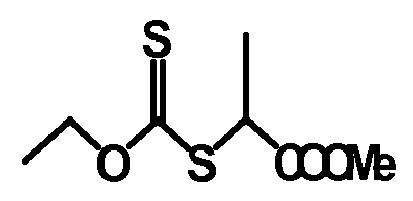
1:10 33 : 1 27 4200 1,6 99,9 RAFT-Reagens wurde in-situ hergestellt V1 
1:10 35 : 1 50 8500 2,3 99,5 Tabelle 2: Zusammenstellung der Beispiele und Vergleichsbeispiele Nr. Hilfsmittel (RAFT-Reagenz) Molverhältnis Initiator / Hilfsmittel Molverhältnis Acrylsäure / Hilfsmittel Umsatz [%] nach Polymerisation Nach der Desaktivierung Mn [g/mol] Mw / Mn Mn [g/mol] Mw / Mn Konzentration Polyacrylsäure [Gew. %] Beispiel 6 
1:10 33 : 1 99,9 3500 1,5 3600 1,5 40 Beispiel 7 
1:10 33 : 1 99,5 3400 1,5 3500 1,5 45 V2 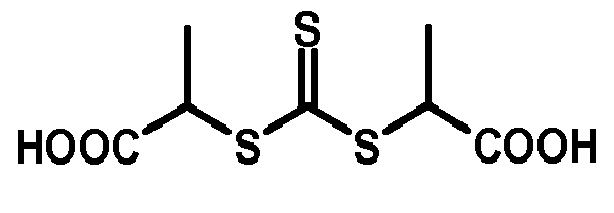
1 : 10 100 : 1 99,5 9700 1,2 6800 1,4 13 V3 
1 : 10 40 : 1 99,5 4200 1,1 2500 1,4 50
Claims (13)
- Verfahren zur Herstellung von wässrigen Lösungen von Homo- oder Copolymeren der Acrylsäure mittels kontrollierter radikalischer Polymerisation von Acrylsäure sowie optional wasserlöslichen, monoethylenisch ungesättigten Comonomeren (C) in wässrigem Medium in Gegenwart eines schwefelhaltigen Hilfsmittels (H) zur Kontrolle der Reaktion, wobei- die Menge Acrylsäure mindestens 80 Gew. % bzgl. der Summe aller Monomere zusammen beträgt,- die zahlenmittlere molare Masse Mn des Homo- oder Copolymers 500 g/mol bis 10000 g/mol beträgt,- die Uneinheitlichkeit des Homo- oder Copolymers Mw / Mn < 2 ist,- die Konzentration des Homo- oder Copolymers 20 bis 60 Gew. % bzgl. aller Bestandteile der wässrigen Lösung beträgt, und- die Polymerisationstemperatur 20 bis 100°C beträgt,dadurch gekennzeichnet, dass es sich bei dem Hilfsmittel H um ein unsymmetrisches Molekül der allgemeinen Formel (I) R1-X-C(S)-S-CR2 n(COOR3)m (I) handelt, und wobei die Reste und die Indices die folgende Bedeutung haben:n, m : unabhängig voneinander 1 oder 2, wobei n + m = 3,X : O oder S,R1: ein Rest ausgewählt aus der Gruppe vonR1a Alkylresten ausgewählt aus der Gruppe von Methyl-, Ethyl-, 1-Propyl-, 1-Butyl und 2-Methyl-1-propyl,R1b Resten der allgemeinen Formel R3OOC-(CH2)o-, wobei O für eine natürliche Zahl von 1 bis 4 steht, oderR1c Alkoxyresten der allgemeinen Formel R4-[-O-CH2-CH2]k-, wobei R4 für H oder einen geradkettigen oder verzweigten Alkylrest mit 1 bis 4 C-Atomen und k für eine Zahl von 1 bis 10 steht,R2: unabhängig voneinander H oder ein Alkylrest mit 1 bis 4 C-Atomen, mit der Maßgabe, dass nicht mehr als ein Rest R2 für H steht,R3: unabhängig voneinander H, ein Kation, Methyl oder Ethyl,und das Verfahren die folgenden Schritte umfasst:- Vorlegen einer wässrigen Lösung oder Dispersion des schwefelhaltigen Hilfsmittels (H) in einem temperierbaren Reaktionsbehälter,- Erwärmen auf die gewünschte Reaktionstemperatur,- Kontinuierliches Zugeben eines Azogruppen aufweisenden, wasserlöslichen Initiators für die thermische Polymerisation (In), wobei das Molverhältnis der Gesamtmenge des Initiators (In) zum Hilfsmittels [In] / [H] 1:1 bis 1 : 100 beträgt,- Kontinuierliches Zugeben von Acrylsäure oder Salzen davon sowie optional weiterer Comonomere (C) oder einer wässrigen Lösung der genannten Monomere, wobei das Molverhältnis der Monomere zum Hilfsmittel [Monomere] / [H] 5 : 1 bis 150 : 1 beträgt, sowie- Desaktivieren des an das gebildete Acrylsäure-Homo- oder Copolymer gebundenen Hilfsmittels (H),mit der Maßgabe, dass man die Polymerisation bis zu einem Umsatz von mindestens 99 % führt, und dass man die Gesamtmenge des eingesetzten wässrigen Mediums so bemisst, dass nach Durchführung des Verfahrens die Konzentration des Homo- oder Copolymers 20 bis 60 Gew. % bzgl. aller Bestandteile der wässrigen Lösung beträgt.
- Verfahren gemäß Anspruch 1, dadurch gekennzeichnet, dass das Hilfsmittel (H) die allgemeine Formel (II) R1-O-C(S)-S-CR2 n(COOR3)m aufweist.
- Verfahren gemäß Anspruch 2, dadurch gekennzeichnet, dass das Hilfsmittel (H) die allgemeine Formel (III) R1-O-C(S)-S-CH(CH3)(COOR3) aufweist, und es sich bei R1 um einen Rest R1a oder R1c handelt.
- Verfahren gemäß Anspruch 1, dadurch gekennzeichnet, dass das Hilfsmittel (H) die allgemeine Formel (IV) R1-S-C(S)-S-CH(CH3)(COOR3) aufweist, und es sich bei R1 um einen Rest R1a oder R1b handelt.
- Verfahren gemäß einem der Ansprüche 1 bis 4, dass als Monomer ausschließlich Acrylsäure eingesetzt wird.
- Verfahren gemäß einem der Ansprüche 1 bis 5, dadurch gekennzeichnet, dass die Polymerisationstemperatur 50 bis 95°C beträgt.
- Verfahren gemäß einem der Ansprüche 1 bis 5, dadurch gekennzeichnet, dass die Temperatur der 10 h - Halbwertszeit 10 h t ½ des eingesetzten Initiators 40 bis 90°C beträgt.
- Verfahren gemäß einem der Ansprüche 1 bis 5, dadurch gekennzeichnet, dass das Molverhältnis der Monomere zum Hilfsmittel [Monomere] / [H] 10 : 1 bis 100 : 1 beträgt.
- Verfahren gemäß einem der Ansprüche 1 bis 5, dadurch gekennzeichnet, dass das Molverhältnis des Initiators zum Hilfsmittel [In] / [H] 1 : 3 bis 1 : 20 beträgt.
- Verfahren gemäß einem der Ansprüche 1 bis 9, dadurch gekennzeichnet, dass die zahlenmittlere molare Masse Mn des Homo- oder Copolymers 2000 g/mol bis 5000 g/mol beträgt
- Verfahren gemäß einem der Ansprüche 1 bis 10, dass man die Desaktivierung des Hilfsmittels unter Verwendung eines Oxidationsmittels vornimmt.
- Verfahren gemäß Anspruch 11, dadurch gekennzeichnet, dass man bei der Oxidation gebildetes Sulfat unter Verwendung eines geeigneten Hilfsmittels aus der wässrigen Lösung entfernt.
- Verfahren gemäß einem der Ansprüche 1 bis 10, dass man die Desaktivierung des Hilfsmittels durch Hydrolyse unter Verwendung einer Base vornimmt.
Priority Applications (2)
| Application Number | Priority Date | Filing Date | Title |
|---|---|---|---|
| EP08167837A EP2182011A1 (de) | 2008-10-29 | 2008-10-29 | Verfahren zur Herstellung von wässrigen Polyacrylsäurelösungen mittels kontrollierter radikalischer Polymerisation |
| US12/607,181 US20100105832A1 (en) | 2008-10-29 | 2009-10-28 | Process for preparing aqueous polyacrylic acid solutions by means of controlled free-radical polymerization |
Applications Claiming Priority (1)
| Application Number | Priority Date | Filing Date | Title |
|---|---|---|---|
| EP08167837A EP2182011A1 (de) | 2008-10-29 | 2008-10-29 | Verfahren zur Herstellung von wässrigen Polyacrylsäurelösungen mittels kontrollierter radikalischer Polymerisation |
Publications (1)
| Publication Number | Publication Date |
|---|---|
| EP2182011A1 true EP2182011A1 (de) | 2010-05-05 |
Family
ID=40084165
Family Applications (1)
| Application Number | Title | Priority Date | Filing Date |
|---|---|---|---|
| EP08167837A Withdrawn EP2182011A1 (de) | 2008-10-29 | 2008-10-29 | Verfahren zur Herstellung von wässrigen Polyacrylsäurelösungen mittels kontrollierter radikalischer Polymerisation |
Country Status (2)
| Country | Link |
|---|---|
| US (1) | US20100105832A1 (de) |
| EP (1) | EP2182011A1 (de) |
Cited By (4)
| Publication number | Priority date | Publication date | Assignee | Title |
|---|---|---|---|---|
| WO2011054789A1 (de) | 2009-11-04 | 2011-05-12 | Basf Se | Verfahren zur herstellung von wässrigen polyacrylsäurelösungen |
| WO2012104325A1 (de) * | 2011-02-04 | 2012-08-09 | Basf Se | Niedermolekulare phosphorhaltige polyacrylsäuren und deren verwendung als belagsinhibitoren in wasserführenden systemen |
| US8889033B2 (en) | 2011-02-04 | 2014-11-18 | Basf Se | Low molecular weight phosphorus-containing polyacrylic acids and use thereof as scale inhibitors in water-carrying systems |
| US10889661B2 (en) | 2010-12-17 | 2021-01-12 | Basf Se | Stable polyacrylic acids, their manufacture and their use |
Families Citing this family (7)
| Publication number | Priority date | Publication date | Assignee | Title |
|---|---|---|---|---|
| JP6503296B2 (ja) * | 2013-10-09 | 2019-04-17 | 株式会社 資生堂 | 低曳糸性増粘剤、及び該増粘剤を配合した化粧料 |
| JP2018520994A (ja) * | 2015-05-08 | 2018-08-02 | ザ ルブリゾル コーポレイションThe Lubrizol Corporation | 水溶性連鎖移動剤 |
| CN108276833A (zh) * | 2017-12-22 | 2018-07-13 | 英德科迪颜料技术有限公司 | 一种raft合成的三元嵌段共聚物水性分散剂 |
| JP7053297B2 (ja) * | 2018-02-13 | 2022-04-12 | 株式会社日本触媒 | ポリカルボン酸系共重合体およびその製造方法、並びにこれを用いた無機粒子用添加剤およびセメント組成物 |
| CA3129103A1 (en) | 2019-02-11 | 2020-08-20 | Dow Global Technologies Llc | Reverse iodine transfer polymerization method and compositions therefrom |
| WO2020167599A1 (en) | 2019-02-11 | 2020-08-20 | Dow Global Technologies Llc | Iodine transfer polymerization method and compositions therefrom |
| CN116496454B (zh) * | 2023-06-30 | 2023-09-26 | 河北合众建材有限公司 | 一种低温法合成多支化保坍型聚醚减水剂及制备方法 |
Citations (9)
| Publication number | Priority date | Publication date | Assignee | Title |
|---|---|---|---|---|
| US4509987A (en) | 1982-11-10 | 1985-04-09 | Allied Colloids Limited | Calcium carbonate dispersions |
| US5317053A (en) | 1990-06-29 | 1994-05-31 | Ecc International Inc. | Method for production of high solid aqueous calcium carbonate suspensions |
| WO1998001478A1 (en) * | 1996-07-10 | 1998-01-15 | E.I. Du Pont De Nemours And Company | Polymerization with living characteristics |
| WO2003055919A1 (en) | 2001-12-21 | 2003-07-10 | University Of Sydney | Aqueous dispersions of polymer particles |
| US20030166790A1 (en) | 2002-02-19 | 2003-09-04 | Herve Adam | Process for removing a dithiocarbonyl group at the end of a polymer chain |
| US20040097674A1 (en) | 2001-03-02 | 2004-05-20 | Jean-Marc Suau | Method of controlled free radical polymerisation of acrylic acid and its salts thereof, resulting low-polydispersity polymers, and their uses |
| US20040122193A1 (en) | 2001-05-04 | 2004-06-24 | Wilczewska Zofia Agnieszka | Method for free radical reduction of dithiocarbonylated or dithiophosphorylated functions borne by a polymer |
| US7033428B2 (en) | 1996-12-30 | 2006-04-25 | Minerals Technologies Inc. | Acid stabilized calcium carbonate an method of making it |
| US20070027266A1 (en) | 2003-10-22 | 2007-02-01 | Samir Zard | Method for partial or total oxidation of one or several thiocarbonylthio ends of a polymer obtained by radical polymerisation controlled by reversible addition-cleavage |
Family Cites Families (3)
| Publication number | Priority date | Publication date | Assignee | Title |
|---|---|---|---|---|
| US4314044A (en) * | 1979-01-22 | 1982-02-02 | Rohm And Haas Company | Process for preparing low molecular weight water-soluble polymers |
| FR2764892B1 (fr) * | 1997-06-23 | 2000-03-03 | Rhodia Chimie Sa | Procede de synthese de polymeres a blocs |
| FR2868068B1 (fr) * | 2004-03-29 | 2006-07-14 | Coatex Soc Par Actions Simplif | Nouveaux composes soufres : utilisation comme agent de transfert pour la polymerisation radicalaire controlee de l'acide acrylique, polymeres obtenus et leurs applications |
-
2008
- 2008-10-29 EP EP08167837A patent/EP2182011A1/de not_active Withdrawn
-
2009
- 2009-10-28 US US12/607,181 patent/US20100105832A1/en not_active Abandoned
Patent Citations (9)
| Publication number | Priority date | Publication date | Assignee | Title |
|---|---|---|---|---|
| US4509987A (en) | 1982-11-10 | 1985-04-09 | Allied Colloids Limited | Calcium carbonate dispersions |
| US5317053A (en) | 1990-06-29 | 1994-05-31 | Ecc International Inc. | Method for production of high solid aqueous calcium carbonate suspensions |
| WO1998001478A1 (en) * | 1996-07-10 | 1998-01-15 | E.I. Du Pont De Nemours And Company | Polymerization with living characteristics |
| US7033428B2 (en) | 1996-12-30 | 2006-04-25 | Minerals Technologies Inc. | Acid stabilized calcium carbonate an method of making it |
| US20040097674A1 (en) | 2001-03-02 | 2004-05-20 | Jean-Marc Suau | Method of controlled free radical polymerisation of acrylic acid and its salts thereof, resulting low-polydispersity polymers, and their uses |
| US20040122193A1 (en) | 2001-05-04 | 2004-06-24 | Wilczewska Zofia Agnieszka | Method for free radical reduction of dithiocarbonylated or dithiophosphorylated functions borne by a polymer |
| WO2003055919A1 (en) | 2001-12-21 | 2003-07-10 | University Of Sydney | Aqueous dispersions of polymer particles |
| US20030166790A1 (en) | 2002-02-19 | 2003-09-04 | Herve Adam | Process for removing a dithiocarbonyl group at the end of a polymer chain |
| US20070027266A1 (en) | 2003-10-22 | 2007-02-01 | Samir Zard | Method for partial or total oxidation of one or several thiocarbonylthio ends of a polymer obtained by radical polymerisation controlled by reversible addition-cleavage |
Non-Patent Citations (4)
| Title |
|---|
| B. HOJJATI ET AL., POLYMER, vol. 48, 2007, pages 5850 - 5858 |
| HOJJATI ET AL: "Synthesis of TiO2/PAA nanocomposite by RAFT polymerization", POLYMER, ELSEVIER SCIENCE PUBLISHERS B.V, GB, vol. 48, no. 20, 14 September 2007 (2007-09-14), pages 5850 - 5858, XP022243752, ISSN: 0032-3861 * |
| J. LOISEAU, N. DOERR, J. M. SUAU, J. B. EGRAZ, M. F. LLAURO AND C. LADAVIERE: "Synthesis and characterization of poly(acrylic acid) produced by RAFT polymerization", MACROMOLECULES, vol. 36, 2003, pages 3066 - 3077, XP002520497 * |
| VON J. LOISEAU ET AL., MACROMOLECULES, vol. 36, 2003, pages 3066 - 3077 |
Cited By (6)
| Publication number | Priority date | Publication date | Assignee | Title |
|---|---|---|---|---|
| WO2011054789A1 (de) | 2009-11-04 | 2011-05-12 | Basf Se | Verfahren zur herstellung von wässrigen polyacrylsäurelösungen |
| US9056926B2 (en) | 2009-11-04 | 2015-06-16 | Basf Se | Process for preparing aqueous polyacrylic acid solutions |
| US10889661B2 (en) | 2010-12-17 | 2021-01-12 | Basf Se | Stable polyacrylic acids, their manufacture and their use |
| WO2012104325A1 (de) * | 2011-02-04 | 2012-08-09 | Basf Se | Niedermolekulare phosphorhaltige polyacrylsäuren und deren verwendung als belagsinhibitoren in wasserführenden systemen |
| US8889033B2 (en) | 2011-02-04 | 2014-11-18 | Basf Se | Low molecular weight phosphorus-containing polyacrylic acids and use thereof as scale inhibitors in water-carrying systems |
| RU2593591C2 (ru) * | 2011-02-04 | 2016-08-10 | Басф Се | Низкомолекулярные, содержащие фосфор полиакриловые кислоты и их применение в качестве ингибиторов отложений в водопроводящих системах |
Also Published As
| Publication number | Publication date |
|---|---|
| US20100105832A1 (en) | 2010-04-29 |
Similar Documents
| Publication | Publication Date | Title |
|---|---|---|
| DE69427489T2 (de) | Wässrige fluorcopolymerisatdispersion | |
| DE69402924T2 (de) | Hydrophobe Dispergiermitteln verwendet in der Herstellung von Polymer-Dispersionen | |
| EP0173033B1 (de) | Verfahren zur Herstellung von Copolymeren | |
| EP2147062B1 (de) | Anionische wasserlösliche additive | |
| EP2291413B1 (de) | Verfahren zur herstellung einer wässrigen polymerisatdispersion | |
| DE68912691T2 (de) | Verfahren zur Herstellung von Copolymeren von Diallyldimethylammoniumchlorid und Acrylamid mit hohem Molekulargewicht in Lösungsmitteln. | |
| DE3624813A1 (de) | Amphotere wasserloesliche polymere, verfahren zu ihrer herstellung und ihre verwendung als dispergierhilfsmittel | |
| EP0257413A2 (de) | Verwendung von speziellen Ethylen-Vinylacetat-Copolymeren zur Modifizierung von PVC | |
| EP0674678A1 (de) | Verfahren zur herstellung von wasserlöslichen polymerdispersionen mit hohem polymeranteil | |
| US20100105832A1 (en) | Process for preparing aqueous polyacrylic acid solutions by means of controlled free-radical polymerization | |
| EP0048320A1 (de) | Emulgiermittelfreie wässrige Kunststoffdispersion | |
| EP0250896B1 (de) | Herstellung eines geruchsarmen wasserlöslichen Polymerisats oder Copolymerisats | |
| WO2017162545A1 (de) | Verfahren zur herstellung von atbs und copolymeren daraus | |
| DE10340081A1 (de) | Copolymerisierbare Tenside | |
| DE3348109C2 (de) | ||
| EP1874833A1 (de) | Polymere für die dispersion von pigmenten und füllstoffen | |
| EP2410009B1 (de) | Reglermolekül | |
| DE69413753T2 (de) | Ein modifizierter Polyvinylalkohol und ein Verfahren zur Modifikation von Polyvinylalkohol durch radikalisches Pfropfen im festen Zustand | |
| EP1237968B1 (de) | Carbodiimide in emulsionspolymerisaten | |
| DE60023899T2 (de) | Verfahren zur herstellung einer wässrigen harzdispersion | |
| WO2010003753A1 (de) | Verfahren zur herstellung von copolymeren mit einem reduzierten acetaldehyd-gehalt | |
| DE4419568A1 (de) | Verfahren zur Herstellung niedermolekularer Polyacrylsäuren mit enger Molekulargewichtsverteilung im Rohrreaktor | |
| DE3638222A1 (de) | Verfahren zum herstellen waessriger loesungen von polyacrylsaeuren, ihren copolymeren und deren salzen | |
| DE102013226503B3 (de) | Verfahren zur Herstellung kurzkettiger Makromoleküle auf Basis von Acrylatmonomeren | |
| DE3545814C3 (de) | Dispersionsstabilisator für eine Wasser-in-Öl-Suspensionspolymerisation |
Legal Events
| Date | Code | Title | Description |
|---|---|---|---|
| PUAI | Public reference made under article 153(3) epc to a published international application that has entered the european phase |
Free format text: ORIGINAL CODE: 0009012 |
|
| 17P | Request for examination filed |
Effective date: 20090622 |
|
| AK | Designated contracting states |
Kind code of ref document: A1 Designated state(s): AT BE BG CH CY CZ DE DK EE ES FI FR GB GR HR HU IE IS IT LI LT LU LV MC MT NL NO PL PT RO SE SI SK TR |
|
| AX | Request for extension of the european patent |
Extension state: AL BA MK RS |
|
| GRAJ | Information related to disapproval of communication of intention to grant by the applicant or resumption of examination proceedings by the epo deleted |
Free format text: ORIGINAL CODE: EPIDOSDIGR1 |
|
| GRAP | Despatch of communication of intention to grant a patent |
Free format text: ORIGINAL CODE: EPIDOSNIGR1 |
|
| GRAP | Despatch of communication of intention to grant a patent |
Free format text: ORIGINAL CODE: EPIDOSNIGR1 |
|
| AKX | Designation fees paid |
Designated state(s): AT BE BG CH CY CZ DE DK EE ES FI FR GB GR HR HU IE IS IT LI LT LU LV MC MT NL NO PL PT RO SE SI SK TR |
|
| STAA | Information on the status of an ep patent application or granted ep patent |
Free format text: STATUS: THE APPLICATION IS DEEMED TO BE WITHDRAWN |
|
| 18D | Application deemed to be withdrawn |
Effective date: 20101201 |