EP2167896B1 - Adjustable heat exchange apparatus and method of use - Google Patents
Adjustable heat exchange apparatus and method of use Download PDFInfo
- Publication number
- EP2167896B1 EP2167896B1 EP08756385.4A EP08756385A EP2167896B1 EP 2167896 B1 EP2167896 B1 EP 2167896B1 EP 08756385 A EP08756385 A EP 08756385A EP 2167896 B1 EP2167896 B1 EP 2167896B1
- Authority
- EP
- European Patent Office
- Prior art keywords
- heat exchange
- exchange system
- pipe
- inner tube
- tube
- Prior art date
- Legal status (The legal status is an assumption and is not a legal conclusion. Google has not performed a legal analysis and makes no representation as to the accuracy of the status listed.)
- Active
Links
Images




Classifications
-
- F—MECHANICAL ENGINEERING; LIGHTING; HEATING; WEAPONS; BLASTING
- F28—HEAT EXCHANGE IN GENERAL
- F28D—HEAT-EXCHANGE APPARATUS, NOT PROVIDED FOR IN ANOTHER SUBCLASS, IN WHICH THE HEAT-EXCHANGE MEDIA DO NOT COME INTO DIRECT CONTACT
- F28D7/00—Heat-exchange apparatus having stationary tubular conduit assemblies for both heat-exchange media, the media being in contact with different sides of a conduit wall
- F28D7/0041—Heat-exchange apparatus having stationary tubular conduit assemblies for both heat-exchange media, the media being in contact with different sides of a conduit wall the conduits for only one medium being tubes having parts touching each other or tubes assembled in panel form
-
- F—MECHANICAL ENGINEERING; LIGHTING; HEATING; WEAPONS; BLASTING
- F22—STEAM GENERATION
- F22B—METHODS OF STEAM GENERATION; STEAM BOILERS
- F22B37/00—Component parts or details of steam boilers
- F22B37/02—Component parts or details of steam boilers applicable to more than one kind or type of steam boiler
- F22B37/10—Water tubes; Accessories therefor
-
- F—MECHANICAL ENGINEERING; LIGHTING; HEATING; WEAPONS; BLASTING
- F27—FURNACES; KILNS; OVENS; RETORTS
- F27B—FURNACES, KILNS, OVENS OR RETORTS IN GENERAL; OPEN SINTERING OR LIKE APPARATUS
- F27B3/00—Hearth-type furnaces, e.g. of reverberatory type; Electric arc furnaces ; Tank furnaces
- F27B3/06—Hearth-type furnaces, e.g. of reverberatory type; Electric arc furnaces ; Tank furnaces with movable working chambers or hearths, e.g. tiltable, oscillating or describing a composed movement
- F27B3/065—Hearth-type furnaces, e.g. of reverberatory type; Electric arc furnaces ; Tank furnaces with movable working chambers or hearths, e.g. tiltable, oscillating or describing a composed movement tiltable
-
- F—MECHANICAL ENGINEERING; LIGHTING; HEATING; WEAPONS; BLASTING
- F27—FURNACES; KILNS; OVENS; RETORTS
- F27B—FURNACES, KILNS, OVENS OR RETORTS IN GENERAL; OPEN SINTERING OR LIKE APPARATUS
- F27B3/00—Hearth-type furnaces, e.g. of reverberatory type; Electric arc furnaces ; Tank furnaces
- F27B3/08—Hearth-type furnaces, e.g. of reverberatory type; Electric arc furnaces ; Tank furnaces heated electrically, with or without any other source of heat
- F27B3/085—Arc furnaces
-
- F—MECHANICAL ENGINEERING; LIGHTING; HEATING; WEAPONS; BLASTING
- F27—FURNACES; KILNS; OVENS; RETORTS
- F27B—FURNACES, KILNS, OVENS OR RETORTS IN GENERAL; OPEN SINTERING OR LIKE APPARATUS
- F27B3/00—Hearth-type furnaces, e.g. of reverberatory type; Electric arc furnaces ; Tank furnaces
- F27B3/10—Details, accessories or equipment, e.g. dust-collectors, specially adapted for hearth-type furnaces
- F27B3/26—Arrangements of heat-exchange apparatus
-
- F—MECHANICAL ENGINEERING; LIGHTING; HEATING; WEAPONS; BLASTING
- F27—FURNACES; KILNS; OVENS; RETORTS
- F27D—DETAILS OR ACCESSORIES OF FURNACES, KILNS, OVENS OR RETORTS, IN SO FAR AS THEY ARE OF KINDS OCCURRING IN MORE THAN ONE KIND OF FURNACE
- F27D17/00—Arrangements for using waste heat; Arrangements for using, or disposing of, waste gases
- F27D17/20—Arrangements for treatment or cleaning of waste gases
- F27D17/28—Arrangements for treatment or cleaning of waste gases for cooling waste gases
-
- F—MECHANICAL ENGINEERING; LIGHTING; HEATING; WEAPONS; BLASTING
- F27—FURNACES; KILNS; OVENS; RETORTS
- F27D—DETAILS OR ACCESSORIES OF FURNACES, KILNS, OVENS OR RETORTS, IN SO FAR AS THEY ARE OF KINDS OCCURRING IN MORE THAN ONE KIND OF FURNACE
- F27D17/00—Arrangements for using waste heat; Arrangements for using, or disposing of, waste gases
- F27D17/30—Arrangements for extraction or collection of waste gases; Hoods therefor
- F27D17/302—Constructional details of ancillary components, e.g. waste gas conduits or seals
-
- F—MECHANICAL ENGINEERING; LIGHTING; HEATING; WEAPONS; BLASTING
- F28—HEAT EXCHANGE IN GENERAL
- F28D—HEAT-EXCHANGE APPARATUS, NOT PROVIDED FOR IN ANOTHER SUBCLASS, IN WHICH THE HEAT-EXCHANGE MEDIA DO NOT COME INTO DIRECT CONTACT
- F28D1/00—Heat-exchange apparatus having stationary conduit assemblies for one heat-exchange medium only, the media being in contact with different sides of the conduit wall, in which the other heat-exchange medium is a large body of fluid, e.g. domestic or motor car radiators
- F28D1/06—Heat-exchange apparatus having stationary conduit assemblies for one heat-exchange medium only, the media being in contact with different sides of the conduit wall, in which the other heat-exchange medium is a large body of fluid, e.g. domestic or motor car radiators with the heat-exchange conduits forming part of, or being attached to, the tank containing the body of fluid
-
- F—MECHANICAL ENGINEERING; LIGHTING; HEATING; WEAPONS; BLASTING
- F28—HEAT EXCHANGE IN GENERAL
- F28F—DETAILS OF HEAT-EXCHANGE AND HEAT-TRANSFER APPARATUS, OF GENERAL APPLICATION
- F28F1/00—Tubular elements; Assemblies of tubular elements
- F28F1/003—Multiple wall conduits, e.g. for leak detection
-
- F—MECHANICAL ENGINEERING; LIGHTING; HEATING; WEAPONS; BLASTING
- F28—HEAT EXCHANGE IN GENERAL
- F28F—DETAILS OF HEAT-EXCHANGE AND HEAT-TRANSFER APPARATUS, OF GENERAL APPLICATION
- F28F21/00—Constructions of heat-exchange apparatus characterised by the selection of particular materials
- F28F21/08—Constructions of heat-exchange apparatus characterised by the selection of particular materials of metal
-
- Y—GENERAL TAGGING OF NEW TECHNOLOGICAL DEVELOPMENTS; GENERAL TAGGING OF CROSS-SECTIONAL TECHNOLOGIES SPANNING OVER SEVERAL SECTIONS OF THE IPC; TECHNICAL SUBJECTS COVERED BY FORMER USPC CROSS-REFERENCE ART COLLECTIONS [XRACs] AND DIGESTS
- Y10—TECHNICAL SUBJECTS COVERED BY FORMER USPC
- Y10T—TECHNICAL SUBJECTS COVERED BY FORMER US CLASSIFICATION
- Y10T428/00—Stock material or miscellaneous articles
- Y10T428/12—All metal or with adjacent metals
- Y10T428/12292—Workpiece with longitudinal passageway or stopweld material [e.g., for tubular stock, etc.]
-
- Y—GENERAL TAGGING OF NEW TECHNOLOGICAL DEVELOPMENTS; GENERAL TAGGING OF CROSS-SECTIONAL TECHNOLOGIES SPANNING OVER SEVERAL SECTIONS OF THE IPC; TECHNICAL SUBJECTS COVERED BY FORMER USPC CROSS-REFERENCE ART COLLECTIONS [XRACs] AND DIGESTS
- Y10—TECHNICAL SUBJECTS COVERED BY FORMER USPC
- Y10T—TECHNICAL SUBJECTS COVERED BY FORMER US CLASSIFICATION
- Y10T428/00—Stock material or miscellaneous articles
- Y10T428/13—Hollow or container type article [e.g., tube, vase, etc.]
Definitions
- the present invention relates generally to heat exchange devices, and more specifically to heat exchange devices for use in the processing of metals.
- a heat exchange device for example, may be used in a metallurgical furnace and/or any of its support components as well as in other industries, such as for example the power and chemical industries.
- steel for example, steel illustratively is made by melting and refining iron and steel scrap in a metallurgical furnace.
- the furnace may be an electric arc furnace (EAF) or a basic oxygen furnace (BOF). It is desirable to keep such furnaces operational for as long as possible.
- EAF electric arc furnace
- BOF basic oxygen furnace
- One way to extend the operational life of a furnace is to guard against thermal, chemical and mechanical stresses through the use, for example, of heat exchange devices of various and varying designs.
- Structural damage caused during the charging process affects the operation of an EAF. Since scrap has a lower effective density than molten steel, the EAF must have sufficient volume to accommodate the scrap and still produce the desired amount of steel. As the scrap melts it forms a hot metal bath in the hearth or smelting area in the lower portion of the furnace. As the volume of steel in the furnace is reduced, however, the free volume in the EAF increases. The vessel wall, cover or roof, duct work, and off-gas chamber are at risk from thermal, chemical, and mechanical stresses caused by charging and melting the scrap and refining the resulting steel. Such stresses may limit the operational life of the furnace. It is desired to protect the portion of the furnace above the hearth or smelting area against the high internal temperatures of the furnace.
- the EAF was generally designed and fabricated as a welded steel structure which was protected against the high temperatures of the furnace by a refractory lining.
- the steel industry began to combat operational stresses by replacing expensive refractory brick with water cooled roof panels, and water cooled sidewall panels located in portions of the furnace vessel above the smelting area.
- Water cooled components have also been used to line furnace duct work in the off-gas systems.
- Existing water cooled components are made with various grades and types of plates and pipes.
- An example of a cooling system is disclosed in U.S. Pat. No. 4,207,060 , which uses a series of cooling coils.
- the coils are formed from adjacent pipe sections with a curved end cap, which forms a path for a liquid coolant flowing through the coils. This coolant is forced through the pipes under pressure to maximize heat transfer.
- Such pipes and plates have been formed using carbon steel and stainless steel, or more expensive metals such as copper.
- the terms tube, tubing, pipes, and piping are synonymous, and may be used interchangeably.
- the heat exchangers as recognized by those skilled in the art, to stabilize operating temperatures.
- a foreign substance such as for example slag, which is a by-product of the melting process
- slag which is a by-product of the melting process
- the collected or retained slag also protects against the accidental and potential catastrophic effects of inadvertent splashing of liquid metal against the operating or hot side of the equipment caused by excessive boiling or slopping of the molten metal during the process.
- a suitable example of cooling pipes designed to encourage slag retention is found in commonly owned U.S. Patent Number 6,330,269 .
- the steel, foundry and metal refining industry also has challenges with water cooled and non-water-cooled equipment collecting unwanted slag and/or other foreign materials on the hot face of the equipment during operation.
- This slag, siliceous, metallic and/or other foreign materials that enter the process can be detrimental to the operation should it become detached and fall into the liquid steel that is contained within the furnace or duct structure.
- the accidental intrusion of such material into the molten metal could contaminate or otherwise cause the molten metal in the vessel to become off-specification resulting in its being scrapped or requiring additional high cost processing to refine the molten metal back to its acceptable composition.
- PCT/US06/060461 discloses one illustrative embodiment comprising an extruded, drawn or cold rolled tube or pipe that has notches or indentions in its conduction surface to promote the adhesion of slag, siliceous or other foreign materials during normal operations in a metal processing device.
- a plurality of the illustrative tubes or pipes illustratively may be coupled, butted and/or welded together to form a notched surface that promotes adhesion of slag, siliceous or other foreign material.
- Another illustrative embodiment comprises an extruded, drawn or cold rolled tube or pipe that has a substantially flat surface configured to deter or resist the adhesion of slag, siliceous or other foreign material during normal operations of a metal processing device, system or equipment.
- a plurality of the illustrative pipes may be coupled, butted and/or welded together to form a generally smooth planar surface configured to deter or resist the adhesion of slag, siliceous or other foreign material.
- any combination and configuration of the notched and the generally smooth-surface pipes may be used as appropriate in the various areas of the metal processing device, system or equipment. Methods of use are also claimed.
- Today's modern EAF furnaces also incorporate pollution controls to capture the off-gasses that are created during the process of making steel. For example, fumes from the furnace are generally captured in two illustrative ways. Both of these processes are employed during the operation of the furnace.
- One illustrative form of capturing the off-gasses is through a furnace canopy.
- the canopy is similar to an oven hood. It is part of the building and catches gasses during charging and tapping.
- the canopy also catches fugitive emissions that may occur during the melting process.
- the canopy is connected to a bag house through a non-water cooled duct.
- the bag house is comprised of filter bags and several fans that push or pull air and off-gasses through the filter bags to cleanse the air and gas of any pollutants.
- the second illustrative form of capturing the off-gas emissions is through the primary furnace line.
- a damper illustratively closes the duct to the canopy and opens a duct in the primary line. This is a direct connection to the furnace and is the main method of capturing the emissions of the furnace.
- the primary line is also used to control the pressure of the furnace. This line is made up of water cooled duct work to guard against temperatures that can reach as high as about 2204 °C (4000° F) and then drop to ambient in a few seconds.
- the gas streams generally include various chemical elements, including hydrochloric and sulfuric acids. There are also many solids and sand type particles. The velocity of the gas stream can be upwards of 46 m/s (150 ft./sec). These gasses will be directed to the main bag house for cleansing, as hereinabove described.
- BOF systems Improvement in BOF refractories and steelmaking methods have extended operational life.
- the operational life is limited by, and related to, the durability of the off-gas system components, particularly the duct work of the off-gas system.
- the system when failure occurs, the system illustratively must be shut down for repair to prevent the release of gas and fumes into the atmosphere. Current failure rates cause an average furnace shut down of 14 days.
- water cooled components have historically been comprised of water cooled carbon steel, or stainless steel type panels.
- These gasses illustratively are directed to the off-gas chamber, or gas cleaning system, by a plurality of fume ducts containing water cooled pipes.
- the water cooled components and the fume ducts may give way to acid attack, metal fatigue, or erosion for example.
- Certain materials, for example, carbon steel and stainless steel, have been utilized in an attempt to resolve the issue of the acid attack. More water and higher water temperatures have been used with carbon steel in an attempt to reduce water concentration in the scrap, and to reduce the risk of acidic dust sticking to the side walls of a furnace. The use of such carbon steel in this manner has proven to be ineffective against acid attack.
- Breakdowns of one or more of the furnace components may occur in existing furnace systems due to one or more of the illustrative problems set forth above. When such a breakdown occurs, the furnace may need to be taken out of production for unscheduled maintenance to repair the damaged water cooled components. Since molten steel is not being produced by the steel mill during downtime, illustrative opportunity losses of as much as five thousand dollars per minute for the production of certain types of steel can occur. In addition to decreased production, unscheduled interruptions significantly increase operating and maintenance expenses.
- alloys illustratively aluminum-bronze systems
- the alloy provides better thermal conductivity, hardness, and modulous of elasticity for the purposes of steel making in a furnace, thereby increasing the operational life of the furnace.
- such an alloy, or the use of other desirable metals, for example and without limitation copper might cost more (in terms of the cost of the material itself and/or the cost of manufacture suitable for the particular material used) than would carbon or stainless steel.
- tubes or pipes illustratively and generally were steel or some other alloy and had variable cross-sectional areas and internal diameters to meet the specific application requirement(s) or parameter(s) for heat transfer, wear characteristics, coolant velocities and other parameters.
- some metals or alloys for example aluminum-bronze alloy
- the costs for tubes and pipes manufactured from such desired alloys, ceramics or other special materials, such as aluminum-bronze alloys for example, can be more expensive relative to using steel or cast iron for example.
- the present invention may comprise one or more of the features identified in the various claims appended to this application and combinations of such features, as well as one or more of the following features and combinations within the scope of the appended claims.
- the invention provides a heat exchange system according to claim 1.
- the invention also provides a method of protecting equipment according to claim 13.
- an inner tube may comprise a suitable, though relatively inexpensive material or metal such as for example and without limitation steel, suitable for transporting a liquid coolant.
- This inner tube may be overlaid or clad with a special/selected outer material, tube or pipe comprising a different, illustratively perhaps more expensive, material, such as for example and without limitation an aluminum-bronze alloy, with better operating characteristics or parameters relative to the inner tube material in the particular environment of operation.
- a special/selected outer material, tube or pipe comprising a different, illustratively perhaps more expensive, material, such as for example and without limitation an aluminum-bronze alloy, with better operating characteristics or parameters relative to the inner tube material in the particular environment of operation.
- Such tubes/ pipes are known for example from documents US 5,107,798 and US 4,124,068 .
- the outer layer or cladding may be produced by extruding a cladding tube/pipe onto the pipe/tube that forms the inside portion of the clad pipe. It will be appreciated that the outer material may be more expensive relative to the inner material or vice versa. So, too, the outer and inner material may be different grades or formulations of the same or similar material.
- the outer material may have performance characteristics optimized for the environment in which it operates. It is also the case that the inner tube material may have better operating characteristics in the regime in which it operates (for example fluid transport), and may be more or less expensive than the outer material. In any event, the inner tube may have one or more characteristics or parameters that differ from those of the outer tube. Each of the inner and outer tube may have a differing construction or structure, for example and without limitation by varying the shape, cross-section, and/or materials of the respective inner and outer tubes, in order to emphasize one or more characteristics or parameters. The emphasis may seek, but need not seek to optimize the particular characteristic or parameter.
- the special clad tube/pipe illustratively will result in having the same or similar physical, abrasiveness resistance, chemical attack resistance, heat transfer, thermal attributes or other characteristics/parameters of a tube/pipe manufactured from 100% of the selected material except that the clad tube illustratively may have a lower overall cost, which itself may be a selected characteristic or parameter, and/or have better operating characteristics/parameters in one or more regimes.
- the outer and inner materials may be combined based on their different operating characteristics being optimized relative to one another for the regimes in which they operate.
- a heat exchange or protective device incorporating pipes with an outer cladding of aluminum-bronze alloy, it will have a higher, relative to a steel pipe, thermal conductivity, resistance to etching by the stream of hot gasses (modulus of elasticity), and good resistance to oxidation, thereby increasing the life of the heat exchange system through reduced corrosion and erosion of the heat exchange system and related components.
- the combination of outer and inner materials may be necessary due to the need to have a pipe wall of a certain thickness, for example the heavy-walled pipes needed for use in portions of an EAF, without having to have the inner portions of that thickness comprised of a high-priced material.
- the combination of materials could be selected to obtain optimum operating characteristics in different regimes.
- the inner material could be selected to optimize the desired operating characteristics, for example fluid flow rate, in that regime, or to provide for the cost effectiveness, or some combination thereof; while the outer cladding is selected to better withstand the hot-side stresses relative to the material of the inner pipe or tube.
- the invention illustratively will allow a wider flexibility and application of materials of construction that will improve equipment longevity plus on-line reliability and up-time because the equipment will be better suited to resist the effects of the high heat flux, corrosive and abrasive atmosphere in the furnaces, combustion chambers, flue gas systems, etc. equipment that are comprised of an assembly of such elements and at a potential cost savings.
- the present invention can be used in combination with other heat transfer equipment, such as condensers, shell and tube-type exchangers, finned exchangers, plate-and-frame-heat exchangers, and forced-draft air-cooled exchangers.
- other heat transfer equipment could itself benefit from using a combination of materials in accordance with the current invention.
- the current invention and any heat exchange system incorporating the present invention has other applications, such as cooling exhaust gasses from converting plants, paper manufacturing plants, coal and gas fired electrical power generation plants, and other exhaust gas generators, where the gasses are cooled for the purpose of capturing one or more components of the gas, where capture is effected by condensation, by carbon bed absorption, or by filtration.
- the pipes can be cold rolled, hot rolled, drawn, extruded or cast.
- the pipes can be manufactured from ferrous metals, steel, copper, steel/ferrous alloy or copper alloys, nickel, titanium, bronze alloys including aluminum-bronze and nickel-bronze alloy alloys, and other suitable materials.
- the pipes can be seamless or welded in design as desired.
- the invention illustratively will create a means to select a wider range of materials, operating characteristics and costs for manufacture of customer shaped and designed water cooled elements for steel, chemical. power and perhaps other industry applications.
- the elements will have the ability to better withstand the hostile and ever changing requirements in the furnaces, flue gas systems, off gas hoods, skirts, combustion chambers, drop out boxes etc. due to the inherent and improved coolant velocity within the element and the resulting increased heat transfer capability.
- This invention allows the selection of cladding materials that can be extruded onto an internal tube/pipe of different material at a required or desired cross-sectional radius to potentially optimize the operating characteristics in one or more regimes, for example heat transfer and elasticity requirements of the application, as desired and without limitation to current requirements to select the tube/pipe from generally uniform materials that are available on the commercial market.
- the heat exchange system 10 comprises a pipe 50 having an inner material and an outer material.
- the inner material comprises an inner tube 150 and the outer material comprises an outer tube 250.
- the inner and outer tubes or portions 150, 250 have compositions or structures that differ in one or more respects from each other. For example, and without limitation, they may have different dimensions, they may be manufactured from differing processes, and the like. According to the invention, the inner tube and the outer tube are manufactured from differing materials.
- the inner tube 150 illustratively is defined by a first inner boundary 151 and a first outer boundary 152.
- the first inner boundary 151 and the first outer boundary 152 comprise or define the wall of the inner tube 150 and bound or define a hollow core 200 having a central axis 210 running generally through the center and along the longitudinal length of the inner tube 150.
- the pipe 50 further comprises the outer tube 250 defined by a second inner boundary 251 and a second outer boundary 252.
- the outer tube 250 overlays the inner tube 150.
- the central axis 210 runs generally through the center of and along the length of the outer tube 250.
- the pipe and the inner and outer tubes 150, 250 illustratively are concentric, illustratively sharing or having the same coincident centers and central axis 210.
- the inner and outer tubes may be of different composition or structure from one another
- the outer tube 250 is extruded onto the inner tube 150.
- the inner and outer tubes 150, 250 could be formed into a unitary pipe 50.
- the cladding 250 could be bonded to the inner material or tube 150 by for example and without limitation heat, pressure, extrusion, or casting.
- the inner tube 150 could be clad or overlaid with a metal coating 250 of a different composition.
- the cladding 250 for example and without limitation could be selected to exploit, for example by imparting, emphasizing, promoting, minimizing, or optimizing some desired property, characteristic or parameter such as for example conductivity, or the resistance of corrosion, erosion, pressure, thermal stress or the like.
- the inner tube 150 could be fashioned to exploit, for example by imparting, emphasizing, promoting, or optimizing the same or a different desired property compared to the cladding.
- the inner material 150 could be selected to optimize fluid flow, heat transfer, malleability, longevity, material cost, manufacturing process or the like.
- the clad 150 and cladding 250 material(s) may be selected to satisfy desired operating characteristics or parameters or other application requirements, including for example and without limitation economic requirements.
- the inner tube may but need not be made from a material having a lower cost compared to the cost of the cladding material.
- the cross-sectional area and outer cladding configuration may be adjusted to meet the resulting coolant velocity, pressure drop and residence time in the device required to optimize the operating device of the device.
- the entire length of the cladding material illustratively may have a generally consistent geometry throughout its length.
- the outer surface illustratively could be smooth or could incorporate geometries required for the application.
- the outer surface could include slag retention devices or indentations or webs or protrusions for mounting the pipe 50 to one or more other pipes 50, and/or to a mounting member or plate 93 or directly to a device such as an EAF or portion thereof.
- the outer configuration of the cladding tube can also be designed to have wings or other protrusions to allow a plurality of pipes to be connected together, as for example by welding if desired.
- the clad 150 and cladding 250 tubes could comprise half tubes or pipes of the kind disclosed, for example and without limitation, in U.S. Patent Application No. 11/741,769, filed April 30, 2007 .
- only one or the other of the tubes 150, 250 could have a half-pipe or semi-circular construction.
- a plurality of such illustrative half tube/pipe elements could illustratively be welded onto a mounting member or flat plate. The welding illustratively for example and without limitation will be along the length of the half tube/pipe elements. In the event a winged design half tube is used a single weld could attach two adjacent tube(s)/pipe(s) together.
- the clad tube(s)/pipe(s) will be connected to comprise a closed loop coolant circuit by either having 180 degree half elbows, or mitered elbows or supply and return headers.
- the entire element can be designed to be rolled in a typical plate roll to the desired radius in a specially modified plate roll. It will be appreciated that the total thickness of the element can be decreased when compared to typical tube/pipe design elements. This will effectively increase the working volume of the apparatus.
- This invention will offer a more cost competitive material of manufacture for complex heat exchanging devices for steel, chemical and power industry, as well as other industry applications.
- the pipes have an outer material or cladding that differs from an inner material.
- Such pipes may be used in numerous types of heat exchange systems for use in numerous types of heat exchanger applications in numerous industries.
- One such use in one such heat exchange system will now be described, it being understood that the pipe(s) described in the heat exchange system are constructed or formed having an outer tube/material that differs from an inner tube/material.
- the outer tube cladding material which may be selected based on the application requirement, will be extruded onto an inner tube, which may have one or more characteristics, for example a low cost compared to the cladding material, that differ(s) from those of the cladding material.
- the cross-sectional area and/or the outer cladding configuration illustratively may be adjusted to meet the resulting coolant velocity, pressure drop and/or residence time in the device required to optimize the operating life of the device.
- the entire length of the cladding material may have a consistent geometry throughout its length.
- the outer surface of the cladding could be smooth, or could incorporate other geometries required for a particular application such as for example and without limitation slag retention devices, such as for example and without limitation fin 96, anti-slag devices, or indentations or webs to facilitate welding a plurality of pipes together.
- the outer configuration of the cladding tube/pipe can also be designed to have extensions or wings to allow the plurality of tubes to be welded together.
- the plurality of half tube/pipe elements described herein above illustratively may be attached to the device, such as a furnace, or may be attached, for example and without limitation by welding, to a plate, which in turn may be mounted within the device.
- the welding illustratively may be along the length of the half tube/pipe elements.
- a single weld illustratively may be used to attach two adjacent tube(s)/pipe(s) together.
- the clad tube/pipes illustratively may be connected together in fluid communication to comprise a closed loop coolant circuit by using for example and without limitation 180 degree half elbows, or mitered elbows or supply and return headers.
- the entire element can be designed to be rolled in a typical plate roll to the desired radius in a specially modified plate roll.
- a secondary advantage to the design is that the total thickness of the element may be decreased when compared to typical tube/pipe design elements. This is advantageous in steelmaking process equipment because this will effectively increase the working volume of the apparatus.
- This invention will offer a more cost competitive material of manufacture for complex heat exchanging devices for steel, process and power industry applications. It will be appreciated that the illustrative embodiments described above and illustrated in Fig. 13 may be applied to numerous heat exchange configurations and elements, as well as used with other compositions as further described herein below.
- the heat exchange system or heat exchanger 10 comprises at least one panel of sinuously winding piping 50 having an inlet 56 and an outlet 58, an input manifold 84 in fluid communication with the inlet of the at least one panel, an output manifold 86 in fluid communication with the outlet of the at least one panel, and a cooling fluid flowing through the piping.
- the piping 50 described herein illustratively may comprise piping having an inner tube and an outer tube or cladding as described herein.
- the heat exchanger system 10 cools hot fume gasses 36 and dust that is being evacuated from a metallurgical furnace 80 and its supporting components.
- the piping is an assemblage of sectional lengths of connected tubes mounted side-by-side, wherein the connected tubes are secured to each other with a linkage 82, therein forming the at least one panel 50.
- one desirable composition for fabricating the piping 50 is an aluminum bronze alloy.
- Aluminum bronze alloys have been found to have a higher than expected thermal conductivity, resistance to etching by the stream of hot gasses (modulus of elasticity), and good resistance to oxidation. Thus, the operational life of the heat exchanger is extended. Corrosion and erosion of the heat exchanger and related components is reduced, when they are fabricated with aluminum bronze.
- Aluminum bronze has thermal conductivity that is 41% higher than P22 (Fe.about.96%, C.about.0.1%, Mn.about.0.45%, Cr.about.2.65%, Mo.about.0.93%) and 30.4% than carbon steel (A106B).
- the heat exchangers fabricated using aluminum bronze and alloys thereof are more efficient, and have a longer operational life than furnace constructed of refractive materials and or other metal alloys.
- the piping illustratively may be extruded, and that extruding may help the piping resist corrosion, erosion, pressure, and thermal stress.
- performance may be enhanced where the piping has an elongate ridge that serves as a fin or spline 96.
- the fin can serve to enhance cooling and collect slag.
- the piping is extruded, there are no weld lines associated with the fins that can fail, and the extruded seamless piping distributes heat more uniformly, which in turn improves the overall performance of the heat exchanger system.
- the piping can be curved or bent to match the curvature of a wall to which it is being attached, if so needed. More typically, the individual sections of piping are secured to each other with an angled linkage such that the resulting panel has a curvature that is comparable to the curvature of the wall.
- the heat exchanger system as illustrated in the drawings employs manifolds and multiple panels to further enhance the cooling efficiency.
- the combination assures that cool water is flowing through all the piping, therein optimizing heat transfer.
- the sinuously winding piping optimizes the surface area.
- the piping is typically secured using linkages and spacers, which enable fume gasses to flow essentially around nearly the entire perimeter of the piping.
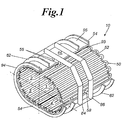
- an illustrative heat exchanger 10 is shown in a fumed exhaust gas duct 44 having a wall 94 with an interior side of the wall 93 and an exterior side of the wall 95.
- the wall 94 is partially cut away to view the interior of the duct 44.
- the illustrated duct 44 is elliptical, an engineering construction selected to increase the surface area versus a circular duct.
- the duct is divided into four quadrants, numbered 1-4, as indicated by the abscissas and the ordinate dashed lines.
- the heat exchanger utilizes four panels of sinuously winding piping, each with one inlet 56, and one outlet 58.
- Each panel is assembled with linkages 52 that serve as spaces and fasteners to secure the pipes 50, and therein establishing the relative position of one sectional length of piping with respect to the adjacent sectional lengths of piping.
- the panels, 1-4 are mounted on the inside wall 93 of the duct 44.
- Each panel is in fluid communication with an input manifold 84, and an output manifold 86.
- the manifolds 84 and 86 are mounted to the exterior side 95 of the wall 94, and substantially encircle the duct 44.
- the piping 50 is oriented so as to be substantially collinear with the wall of the duct 44. The orientation is selected because it is easier to fabricate and creates less pressure drop over the length of the duct.
- Each duct 44 is substantially a self-contained modular cooling unit.
- the modularization enables duct fabrication to be to a certain extent generic.
- Each duct has a cooling capacity, and the ducts are combined in sufficient numbers to achieve the desired cooling.
- the modularization is in part due to the fact that the heat exchanger system is comprised of individually cooled panels having a known cooling capacity, that when combined determine the cooling capacity of the duct.
- the cumulative cooling capacity is ultimately, therefore, a function of the type, number, and configuration of the panels, and the temperature and flow rate of the cooling fluid provided by the manifolds.
- the panels are largely substantially self-contained, modular components that are also relatively generic.
- the fume exhaust duct 44 typically has a pair of mounting supports numbered 62 for attaching the duct to a frame or support.
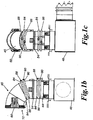
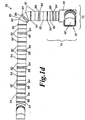
- the external elements of the duct and the heat exchanger system are illustrated in FIGS. 1a , 1b , 1c , and 1d .
- the duct 44 can be fitted with mounting member(s) or bracket(s) 60 for attaching the duct to the furnace roof, to an off-gas chamber (which is sometimes referred to as an air box 48), or to provide support to the flange 54.
- the elbow duct 45 is connected to a straight exhaust duct 44, which in turn is connected to an off-gas chamber 48.
- the elbow shaped duct 45 has roof brackets 60 for securing the elbow 45 to a furnace roof.
- a smoke ring 66 protrudes from the entrance of the elbow duct 45.
- the smoke ring 66 is the heat exchanger 10 having a circular configuration.
- the elbow duct has an input manifold 84 and an output manifold 86.
- the input manifold 84 is connected to a source of cooling water at 88 and the output manifold 86 is connected to a recycle outlet 90.
- the elbow duct 45 and the straight duct 44 are coupled via their respective flanges 54.
- the straight duct 44 and the off-gas chamber 48 are coupled via their respective flanges 54.
- the off-gas chamber 48 preferably has a pressure release mechanism on the off chance that an explosion develops in the furnace.
- the off-gas chamber 48 also serves as a junction box if additional capacity is required at a later date.
- the partially cooled fume gasses coming off the furnace are diverted 90 degrees to the remainder of the exhaust system 16.
- the length of the system is sufficient to cool the exhaust gasses exiting a metallurgical furnace, such as EAF or BOF from 4,000.degree.F.-5,000.degee.F (2204.4 °C to 2760 °C) to 200.degree. F.-350.degree, F (93 °C to 177°C).
- the complete cooling system outside the furnace is comprised of 8 pairs of manifolds after the off-gas chamber 48, plus 2 pairs prior to the off-gas chamber 48, and a smoke ring. Each pair of manifolds has 4 heat exchanger panels, bringing the total number to 40 panels, plus the smoke ring panel 66.
- the smoke ring can be mounted on the roof of the furnace, instead of to a duct, and a discussion of this configuration follows.
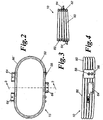
- FIGS.2-4 which further illustrate the heat exchanger system configured as a smoke ring
- the smoke ring 66 is comprised of sinuously winding piping that winds back and forth forming a curved panel that is an ellipsoidal ring.
- the ellipsoidal ring has one inlet and one outlet for the cooling water.
- the smoke ring can be configured to have more than one inlet and outlet.
- the heat exchanger 10 has three smoke ring brackets 64 for mounting the heat exchanger to a domed furnace roof.
- the piping 50 as shown in FIG.3 , is more compressed on the right than on the left, and the bracket 64 on the left is lower on the left than on the right.
- the compression and the different placement of the bracket compensates for the pitch of the roof, which result in a profile that is substantially vertical.
- the linkages 82 establish not only the curvature of the panel of sinuously winding piping 50, but also the profile.
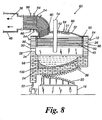
- an EAF 80 includes a furnace shell 12, a plurality of electrodes 14, an exhaust system 16, a working platform 18, a rocker tilting mechanism 20, a tilt cylinder 22, and an off gas chamber 48.
- the furnace shell 12 is movably disposed upon the rocker tilt 20 or other tiling mechanism. Further, the rocker tilt 20 is powered by tilt cylinder 22. The rocker tilt 20 is further secured upon the working platform 18.
- the furnace shell 12 is comprised of a dished hearth 24, a generally cylindrical side wall 26, a spout 28, a spout door 30, and a general cylindrical circular roof 32.
- the spout 28 and spout door 30 are located on one side of the cylindrical side wall 26. In the open position, the spout 28 allows intruding air 34 to enter the hearth 24 and partially burn gasses 36 produced from smelting.
- the hearth 24 is formed of suitable refractory material which is known in the art.
- At one end of the hearth 24 is a pouring box having a tap means 38 at its lower end. During a melting operation, the tap means 38 is closed by a refractory plug, or a slidable gate. Thereafter, the furnace shell 12 is tilted, the tap means 38 is unplugged, or open and molten metal is poured into a teeming ladle, tundish, or other device, as desired.
- the inside wall 26 of the furnace shell 12 is fitted with water cooled panels 40 of sinuously winding piping 50.
- the panels in effect serve as an interior wall in the furnace 80.
- the manifolds which supply cool water and a return, are in fluid communication with the panels 40.
- the manifolds are positioned peripherally in a fashion similar to the illustrated exhaust ducts 44.
- the cross-section of the manifolds are shown outside the furnace shell 12 in FIG.8 .
- the heat exchanger system 10 produces a more efficient operation and prolongs the operation life of the EAD furnace 80.
- the panels 40 are assembled such that the sinuously winding piping has a generally horizontal orientation, comparable to the smoke ring illustrated in FIGS.2-4 .
- the piping 50 can be linked with a linkage 82, as shown in FIG.7 , or can have a base 92 that is mounted to the wall 94.
- the piping has elongates ridges 96 for collecting slag and adding additional surface area to the piping.
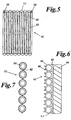
- the panels 40 are mounted such that the sinuously winding piping 50 has a generally vertical orientation as shown in FIG.5 .
- the upper ends of the panels 40 define a circular rim at the upper margin of the side wall 26 portion of the furnace 80.
- the heat exchanger system 10 can be fitted to the roof 32 of the furnace 80, wherein the water cooled panels 40 have a curvature that substantially follows the domed contour of the roof 32.
- the heat exchanger system 10 illustratively, is deployed on the inside of side wall 26 of the furnace 80, the roof 32 and the entrance of the exhaust system 16, as well as the throughout the exhaust system 16. Cumulatively, the heat exchanger system protects the furnace and cools the hot waste gasses 36 as they are ducted to a bag house or other filtering and air treatment facilities, where dust is collected and the gasses are vented to the atmosphere.
- vent 46 In operation, hot waste gasses 36, dust and fumes are removed from the heart 24 through vent 46 in the furnace shell 12.
- the vent 46 communicates with the exhaust system 16 comprised of the fume ducts 44, as shown in FIGS.1 and 1a-1d .
- the panel 40 has multiple axially arranged pipes 50.
- U-shaped elbows 53 connect adjacent sectional lengths of piping or pipes 50 together to form a continuous piping system.
- Linkages 82 that additionally serve as spacers are between adjacent pipes 50, and they provide structural integrity of the panel 40 and are determinative of curvature to the panel 40.
- FIG. 7 is a cross-sectional view of the panel embodiment of FIG. 5 .
- the pipes 50 have a tubular cross-section, a base 92, an elongate ridge 96, and a base plate 93.
- the base plate 93 is attached to the furnace wall 26, or to the furnace roof 32.
- the combination of the piping and, optionally, the base plate forms panel 40, which creates an interior wall of the furnace.
- the panels 40 illustratively cool the wall 26 of the furnace above the hearth in an EAF or the hood and fume ducts of a BOF.
- the panels are water cooled, and may be comprised of any suitable material or combination of materials as described herein above including for example and without limitation an aluminum bronze alloy that is custom melted and processed into a seamless pipe 50.
- the outer tube 250 comprises aluminum-bronze while the inner tube 150 may comprise a different grade or thickness of aluminum-bronze or a different material altogether.
- the cooling ducts 44 are incorporated into the exhaust system 16.
- the piping 50 is formed into the cooling panels 40 and placed throughout the roof 32 and ducts 44.
- the aluminum bronze alloy desirably has a nominal composition of: 6.5% Al, 2.5% Fe, 0.25% Sn, 0.5% max other, and Cu equaling the balance. However, it will be appreciated that the composition may vary, so that the Al content is at least 5% and no more than 11% with the respective remainder comprising the bronze compound.
- the use of the aluminum bronze alloy as the outer cladding material 250 provides enhanced mechanical and physical properties over prior art devices (i.e., carbon or stainless steel cooling systems) in that the alloy provides superior thermal conductivity, hardness, and modulus of elasticity for the purposes of steel making in a furnace. By employing these enhancements, the operational life of the furnace is directly increased.
- the elongation capabilities of the alloy is greater than that of steel or stainless steel, thereby allowing the piping and duct work 44 to expand and contract without cracking. Further, the surface hardness is superior over the prior art in that it reduces the effects of erosion from the sand blasting effect of off-gas debris.
- the elongate ridge 96 is a fin or spline that is especially suitable for collecting slag.
- the mass on each side of the centerline of the tubular section is illustratively and generally equivalent, so that the mass of the elongate ridge 96 is approximately equal to the mass of the base 92.
- composition of the illustrative heat exchanger system(s) differs from the prior art in that piping and plates in the prior art were composed of a single material such as carbon-steel or stainless steel or aluminum bronze alloy, as opposed to a combination of materials such as for example and without limitation carbon-steel, stainless steel, and/or aluminum bronze alloy.
- the use of aluminum-bronze for the outer tube 250 offers several advantages over other materials.
- the composition of the aluminum bronze alloy is not as prone to acid attack.
- aluminum bronze has a higher heat transfer rate than both carbon-steel or stainless steel, and that the alloy possesses the capability to expand and contract without cracking.
- the surface hardness of the alloy is greater than that of either steel, thereby reducing the effects of eroding the surface from the sand blasting effects of the exhaust gas moving through the duct/cooling system.
- FIG. 9 illustrates an embodiment of the heat exchanger system 10 using baffles.
- the heat exchanger system 10 is a duct 45, where the front plate 120 is on the interior of the duct 45.
- the base plate 93 also functions as the exterior wall of the duct 45.
- the duct has flanges 54 for coupling one duct to another duct, or coupling to an air box 48, or coupling to the roof 32 of the furnace 80.
- cooling fluid flows in and out of the plane of the paper.
- the manifolds are mounted to the exterior side of the base plate 93.
- FIG. 10 illustrates the heat exchanger system 10 configured as an interior furnace wall 47, which is cooling panel 41.
- the interior furnace wall 47 is fabricated to follow the contour of the wall 26 of the furnace shell 12.
- the panel 41 has baffles 124 mounted between the front plate 120 and the base plate 93.
- the system has an inlet 56 and an outlet 58 for the cooling fluid.
- the manifolds, which supply cool water and a return, are in fluid communication with the panel 41.
- the front plate 120 and the baffles 124 illustratively have an aluminum bronze alloy composition.
- the baffles illustratively are welded to the front plate along longitudinal edge 126.
- the base plate is attached to the opposing longitudinal edge, therein forming the channel 122.
- the channel 122 can be seen on the left hand side comer of FIG. 10 .
- the flow of the cooling fluid is sinuously winding in a serpentine fashion, very similar to the flow through the assemblage of pipes mounted side-by-side, as shown in FIG. 5 .
- the manifolds are not shown in embodiment 45 or 47, but are positioned peripherally, as previously illustrated in FIG. 2 .
- FIG. 11 which illustrates an interior furnace wall 49 cooled with a panel 43 having a plurality of spray nozzles 125.
- the heat exchanger has an aluminum bronze front plate 120, pipes 50 fitted with nozzles 125 and a base plate 93.
- the front plate 120 is directly exposed to the heat, exhaust gasses, and slag produced by the steel making process.
- the nozzles 125 spray the cooling fluid from the base plate toward the backside of the front plate 120.
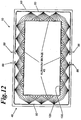
- FIG. 12 is a cross-sectional view of an air box 48 that is cooled using a heat exchanger system that utilizes spray nozzles 125.
- the illustrative four aluminum bronze front plates 120 define the interior of the air box 48.
- the plurality of nozzles 125 on pipe 50 direct a pattern spray of cooling fluid to the back side of the front plate 120.
- the base plate 93 serves as a mount for the illustrative pipes 50 as well as an exterior wall for the air box 48.
- the front plate 120 is displaced sufficiently from the plurality of nozzles that the cooling fluid is sprayed in an overlapping pattern. The overlap is sufficient to cover an area, which reduces the number of serpentine windings necessary to cool the front plate.
- FIG. 12 is a cross-sectional view of an air box 48 that is cooled using a heat exchanger system that utilizes spray nozzles 125.
- the illustrative four aluminum bronze front plates 120 define the interior of the air box 48.
- the outer tube section have an exterior surface or outer boundary 252 that is completely arcuate and generally uninterrupted or smooth, it may also have portions, for example and without limitation that may be generally planar, for example base 92, or may have protrusions.
- the protrusions may comprise the previously described fins or splines 96, they may also comprise horizontally extending planar portions or wings extending from the base.
- the planar portions may define notches or indentations or any other suitable surface depending on the need to optimize or discourage any type of operating characteristic for example and without limitation the need to promote or deter the retention of any foreign material including for example slag or siliceous.
- the notches or indentions can be for example and without limitation steeped, rectangular, serrated, oval, etc.
- the thickness of the exposed smooth/indented surface of the pipe(s) 50 may be designed to optimize the heat transfer and mechanical requirements of the process.
- the support portion of the pipe(s) 50 illustratively may have any suitable geometric configuration including for example and without limitation round, square or obround or otherwise.
- the tubes/pipe can have any fluid, including for example and without limitation, a liquid such as for example water, or a gas such as for example air directed or flowing through them to create a heat transfer and cooling of the equipment, if needed by the process.
- one or more pipe for example, arcuate, splined, planar, and/or notched, may be coupled together in any combination with one or more of any other type of pipe 50 for example arcuate, splined, planar, and/or notched.
- the illustrative pipes 50 may be coupled with or mounted within the operating portion or area of a metal processing apparatus, system, or equipment including attachment to the system's roof, sidewall, duct, burner gland or other equipment or areas required for metallic melting and refining in for example and without limitation an electric arc furnace (EAF), a foundry furnace, a metallurgical furnace, a ladle metallurgy device, and/or a degassing (VAD AOD, etc) device.
- EAF electric arc furnace
- VAD AOD degassing
- the pipe(s) illustratively may be positioned in the equipment between an interior and a wall of the system.
- the conduction portion of the pipe is exposed to the hot metal or gases emanating therefrom while the support portion is attached directly to the wall, roof or other interior structure of the system or to a plate that is attached to the system.
- the support portion may be attached or coupled to the system directly, or it may be attached to a mounting plate or other suitable component, which in turn mounts or couples with a wall, roof, or the like of the system such as for example and without limitation an EAF.
- the pipes 50 may be coupled using any suitable method including spot welding on either or both sides of the conduction portions, or other suitable methods known to those skilled in the art.
- the support sections can be attached or coupled to the system's support structure or to the plate using any suitable method, including for example and without limitation welding. Any suitable fluid, such as for example and without limitation any gas or liquid, may be directed through the core 200 in order to facilitate heat transfer.
- the pipes 50 may be manufactured using any suitable process including being cold rolled, hot rolled, drawn, extruded or cast.
- the pipes can be manufactured from ferrous metals, steel, copper, steel/ferrous alloy or copper alloys, nickel, titanium, bronze alloys including aluminum-bronze and nickel-bronze alloy alloys, and other suitable materials and combinations thereof.
- the pipes can be seamless or welded in design.
- the mass on either side of center line is substantially equal.
- a heat exchanger system that is adaptable for cooling exhaust gasses emanating from a steel making furnace, wherein the heat exchanger system can be fitted to the walls of the furnace, a furnace roof, a smoke ring exhaust port, a straight section of an exhaust duct, and a curved section of an exhaust duct.
- the heat exchanger system cools the exhaust gasses exiting a metallurgical furnace such as EAF or BOF from 4,000.degree. F.-5,0000.degree. F. (2204.4 °C to 2760°C) to 200.degree. F.-350.degree. F. (93°C to 177 °C).
- the invention provides a heat exchanger system that can be adapted for collecting and cooling slag, where the sinuously winding piping is extruded seamless piping having an elongate ridge, and the piping resists corrosion, erosion, pressure, and thermal stress.
- a heat exchanger that has other applications, such as cooling exhaust gasses from converting plants, paper manufacturing plants, coal and gas fired electrical power generation plants, and other exhaust gas generators, where the gasses are cooled for the purpose of capturing one or more components of the gas, where capture is effected by condensation, by carbon bed absorption, or by filtration.
Landscapes
- Engineering & Computer Science (AREA)
- Mechanical Engineering (AREA)
- General Engineering & Computer Science (AREA)
- Physics & Mathematics (AREA)
- Thermal Sciences (AREA)
- Environmental & Geological Engineering (AREA)
- Heat-Exchange Devices With Radiators And Conduit Assemblies (AREA)
Applications Claiming Priority (2)
| Application Number | Priority Date | Filing Date | Title |
|---|---|---|---|
| US94097007P | 2007-05-31 | 2007-05-31 | |
| PCT/US2008/064995 WO2008150806A1 (en) | 2007-05-31 | 2008-05-28 | Adjustable heat exchange apparatus and method of use |
Publications (3)
| Publication Number | Publication Date |
|---|---|
| EP2167896A1 EP2167896A1 (en) | 2010-03-31 |
| EP2167896A4 EP2167896A4 (en) | 2013-01-16 |
| EP2167896B1 true EP2167896B1 (en) | 2020-04-01 |
Family
ID=40086826
Family Applications (1)
| Application Number | Title | Priority Date | Filing Date |
|---|---|---|---|
| EP08756385.4A Active EP2167896B1 (en) | 2007-05-31 | 2008-05-28 | Adjustable heat exchange apparatus and method of use |
Country Status (11)
| Country | Link |
|---|---|
| US (2) | US20080296006A1 (enExample) |
| EP (1) | EP2167896B1 (enExample) |
| JP (2) | JP2010529399A (enExample) |
| CN (1) | CN101711337B (enExample) |
| BR (1) | BRPI0812007A2 (enExample) |
| CA (1) | CA2688835C (enExample) |
| DK (1) | DK2167896T3 (enExample) |
| ES (1) | ES2795399T3 (enExample) |
| MX (1) | MX338299B (enExample) |
| PT (1) | PT2167896T (enExample) |
| WO (1) | WO2008150806A1 (enExample) |
Cited By (1)
| Publication number | Priority date | Publication date | Assignee | Title |
|---|---|---|---|---|
| EP4047294B1 (en) * | 2017-06-13 | 2023-11-29 | Amerifab, Inc. | An enclosure of a steel-making furnace system |
Families Citing this family (19)
| Publication number | Priority date | Publication date | Assignee | Title |
|---|---|---|---|---|
| JP5532236B2 (ja) * | 2010-06-14 | 2014-06-25 | 株式会社神戸製鋼所 | 沸騰用伝熱管の製造方法 |
| US20130032978A1 (en) * | 2011-08-01 | 2013-02-07 | Nu-Core, Inc. | Burner Gland For An Electric Arc Furnace |
| US10024572B1 (en) | 2012-12-20 | 2018-07-17 | Htp, Inc. | Heat exchanger |
| DE102014112570A1 (de) * | 2014-09-01 | 2016-03-03 | Oschatz Gmbh | Isasmelt-Ofen mit Natur- und Zwangsumlauf |
| US10488114B1 (en) * | 2015-06-09 | 2019-11-26 | Materion Corporation | Fluid-cooled copper lid for arc furnace |
| US10378359B2 (en) * | 2016-05-17 | 2019-08-13 | United Technologies Corporation | Heat exchanger with precision manufactured flow passages |
| US10301208B2 (en) * | 2016-08-25 | 2019-05-28 | Johns Manville | Continuous flow submerged combustion melter cooling wall panels, submerged combustion melters, and methods of using same |
| DK3538830T3 (da) * | 2016-11-10 | 2022-01-03 | Amerifab Inc | Kølepanel, der er sammenkoblet med en indvendig væg af en stålfremstillingsovn, og tilhørende stålfremstillingsovn |
| IT201600116956A1 (it) | 2016-11-18 | 2018-05-18 | Steb S R L | Sistema e metodo di raffreddamento e recupero della scoria bianca usata nei processi siderurgici |
| US20190024980A1 (en) * | 2017-07-18 | 2019-01-24 | Amerifab, Inc. | Duct system with integrated working platforms |
| USD880679S1 (en) | 2017-12-06 | 2020-04-07 | Amerifab, Inc. | Cooling pipe return elbow in a steel making furnace |
| CN109593908A (zh) * | 2018-12-26 | 2019-04-09 | 苏州海陆重工股份有限公司 | 烟道连接结构 |
| CN110296610A (zh) * | 2019-07-26 | 2019-10-01 | 福建农林大学 | 虹膜式可变截面导流装置及其工作方法 |
| US11619450B2 (en) | 2019-09-04 | 2023-04-04 | Systems Spray-Cooled, Inc. | Stand alone copper burner panel for a metallurgical furnace |
| US11390551B2 (en) * | 2019-10-01 | 2022-07-19 | Owens-Brockway Glass Container Inc. | Cooling panel for a melter |
| CN112629270B (zh) * | 2020-08-28 | 2023-05-02 | 广西鱼峰水泥股份有限公司 | 一种低温余热发电aqc锅炉 |
| EP4237775A4 (en) | 2020-11-02 | 2024-10-30 | Amerifab, Inc. | MULTIPLE HALF-PIPE HEAT EXCHANGE SYSTEM FOR ELECTRIC ARC, METALLURGICAL OR REFINING FURNACES AND CORRESPONDING SYSTEM |
| CN118602830B (zh) * | 2024-08-08 | 2024-10-01 | 河北欧姆隆机械有限公司 | 一种换热面可调节的管式换热器 |
| KR102781280B1 (ko) * | 2024-08-23 | 2025-03-17 | 신일인텍 주식회사 | 인코넬 오버레이 용접방식의 전로용 배가스설비 |
Citations (3)
| Publication number | Priority date | Publication date | Assignee | Title |
|---|---|---|---|---|
| US4124068A (en) * | 1977-05-16 | 1978-11-07 | Uop Inc. | Heat exchange tube for fluidized bed reactor |
| US5107798A (en) * | 1991-04-08 | 1992-04-28 | Sage Of America Co. | Composite studs, pulp mill recovery boiler including composite studs and method for protecting boiler tubes |
| US6142216A (en) * | 1994-07-27 | 2000-11-07 | Bradford White Corporation | Indirect water heater |
Family Cites Families (64)
| Publication number | Priority date | Publication date | Assignee | Title |
|---|---|---|---|---|
| US60461A (en) * | 1866-12-18 | baetlett | ||
| US1844407A (en) * | 1924-05-23 | 1932-02-09 | Metropolitan Engineering Corp | Heat conducting tube |
| US1774150A (en) * | 1928-03-14 | 1930-08-26 | Metropolitan Eng Co | Boiler wall |
| US2239662A (en) * | 1935-06-23 | 1941-04-22 | Babcock & Wilcox Co | Furnace |
| US2829972A (en) * | 1956-10-05 | 1958-04-08 | Ampco Metal Inc | Aluminum bronze article for use in conducting steam or hot water |
| US3294162A (en) * | 1963-12-23 | 1966-12-27 | Reynolds Metals Co | Heat exchanger construction and method for making the same |
| FR1415799A (fr) | 1964-09-18 | 1965-10-29 | Perfectionnements aux tubes à ailettes, notamment pour parois tubulaires | |
| DE2127448C3 (de) * | 1970-06-04 | 1975-08-21 | Ishikawajima-Harima Jukogyo K.K., Tokio | Kühlelement, insbesondere Plattenkühler, für Hochöfen |
| US3725056A (en) * | 1971-02-25 | 1973-04-03 | Ampco Pitsburgh Corp | Aluminum bronze alloy having improved mechanical properties at elevated temperatures |
| CA1040109A (en) * | 1973-10-15 | 1978-10-10 | Wallis Separators Limited | Filter screen with acoustic pressure wave transducer |
| US4054174A (en) * | 1974-03-18 | 1977-10-18 | The Babcock & Wilcox Company | Method of inhibiting deposition of internal corrosion products in tubes |
| FR2323113A1 (fr) * | 1975-09-03 | 1977-04-01 | Sofresid | Plaque de refroidissement pour parois de fours a cuve, notamment pour hauts fourneaux |
| FR2336648A1 (fr) | 1975-12-24 | 1977-07-22 | Sofresid | Plaque de refroidissement pour fours a cuves, notamment pour hauts-fourneaux |
| JPS5285004A (en) * | 1976-01-09 | 1977-07-15 | Sanyo Special Steel Co Ltd | Furnace wall for superhighhpower arc furnace for steel making |
| US4122295A (en) * | 1976-01-17 | 1978-10-24 | Ishikawajima-Harima Jukogyo Kabushiki Kaisha | Furnace wall structure capable of tolerating high heat load for use in electric arc furnace |
| JPS52137505A (en) * | 1976-05-13 | 1977-11-17 | Balcke Duerr Ag | Tube wall comprising plurality of tubes extending horizontally or slantly in parallel with each other |
| FR2388884A1 (fr) * | 1977-04-27 | 1978-11-24 | Touze Francois | Perfectionnements aux boites de refroidissement pour hauts fourneaux |
| DE2759713C2 (de) * | 1977-10-11 | 1983-10-27 | Mannesmann AG, 4000 Düsseldorf | Gefäßdeckel für einen Metallschmelzofen, insbesondere elektrischen Lichtbogenofen |
| JPS5832313B2 (ja) * | 1977-12-06 | 1983-07-12 | 山陽特殊製鋼株式会社 | 電気ア−ク炉用水冷パネル |
| JPS5818298B2 (ja) | 1978-06-22 | 1983-04-12 | 株式会社東芝 | 移載装置 |
| DE2913092A1 (de) * | 1979-04-02 | 1980-10-16 | Benteler Werke Ag | Aus rohren gefertigtes, wassergekuehltes wandelement fuer lichtbogenschmelzofen |
| JPS5849607B2 (ja) * | 1979-04-09 | 1983-11-05 | 日本鋼管株式会社 | 非融着型二重冷却管を備えたク−リングステ−ブ |
| US4337824A (en) * | 1980-10-24 | 1982-07-06 | Amtrol | Double wall heat exchanger |
| US4458351A (en) * | 1981-04-06 | 1984-07-03 | Richards Raymond E | Membrane cooling system for metallurgical furnace |
| JPS57181774A (en) * | 1981-04-28 | 1982-11-09 | Mitsubishi Heavy Ind Ltd | Welding method for copper or copper alloy clad steel plate |
| US4453253A (en) * | 1981-06-10 | 1984-06-05 | Union Carbide Corporation | Electric arc furnace component |
| GB2129919B (en) * | 1982-05-27 | 1985-10-02 | Vni Pi Ochistke T Gazov | Cooler for shaft furnaces |
| US4455017A (en) * | 1982-11-01 | 1984-06-19 | Empco (Canada) Ltd. | Forced cooling panel for lining a metallurgical furnace |
| US4871014A (en) * | 1983-03-28 | 1989-10-03 | Tui Industries | Shell and tube heat exchanger |
| JPS6049840A (ja) | 1983-08-29 | 1985-03-19 | Sumitomo Metal Ind Ltd | ツインベルト連続鋳造設備 |
| GB2150158B (en) * | 1983-11-19 | 1986-11-26 | Alain James Duggan | Treatment of boiler tubes |
| FR2563900B1 (fr) * | 1984-05-04 | 1986-10-31 | Novatome | Tube a double paroi pour un echangeur de chaleur et procede de realisation de ce tube |
| US4589938A (en) * | 1984-07-16 | 1986-05-20 | Revere Copper And Brass Incorporated | Single phase copper-nickel-aluminum-alloys |
| US4741388A (en) * | 1984-12-20 | 1988-05-03 | Kazuo Kuroiwa | Underground heat exchanging apparatus |
| JPS61165349U (enExample) * | 1985-04-03 | 1986-10-14 | ||
| JPH0245644Y2 (enExample) * | 1985-10-18 | 1990-12-03 | ||
| JPH035758Y2 (enExample) * | 1985-12-27 | 1991-02-14 | ||
| DE3701614C2 (de) * | 1987-01-21 | 1998-07-16 | Dk Kaelteanlagen Gmbh | Rohrwärmetauscher |
| DE8807171U1 (de) * | 1987-06-06 | 1988-07-28 | Joh. Vaillant Gmbh U. Co, 5630 Remscheid | Rippenrohr |
| JPS6455320A (en) * | 1987-08-25 | 1989-03-02 | Nippon Steel Corp | Og hood tube for converter |
| IT1230983B (it) * | 1989-07-04 | 1991-11-08 | T M E Ind S P A | Tubo per scambiatore termico e scambiatore termico realizzato con detto tubo. |
| US4972903A (en) * | 1990-01-25 | 1990-11-27 | Phillips Petroleum Company | Heat exchanger |
| CA2036494C (en) * | 1990-05-11 | 1995-06-27 | Tai W. Kwok | Heat exchanger in an hf alkylation process |
| DE9103291U1 (de) * | 1991-03-18 | 1991-10-10 | Schiedel GmbH & Co, 8000 München | Radiator für Raumtemperierung sowie Vorrichtung zum Herstellen von Sektionen des Radiators |
| JPH0552558U (ja) * | 1991-11-25 | 1993-07-13 | 住友軽金属工業株式会社 | 二重管式熱交換器 |
| JPH05169283A (ja) * | 1991-12-16 | 1993-07-09 | Sumitomo Metal Ind Ltd | クラッド鋼板の製造方法 |
| US5241559A (en) * | 1992-03-30 | 1993-08-31 | Emc International, Inc. | Electric arc furnace roof |
| JPH0959784A (ja) * | 1995-08-23 | 1997-03-04 | Sumitomo Metal Ind Ltd | 耐海水性材料 |
| JPH10197193A (ja) * | 1997-01-14 | 1998-07-31 | Hitachi Ltd | 熱交換器の伝熱管用合金管及びその製造方法 |
| US6059028A (en) * | 1997-03-07 | 2000-05-09 | Amerifab, Inc. | Continuously operating liquid-cooled panel |
| DE19817659C1 (de) * | 1998-04-21 | 2000-05-11 | Centeon Pharma Gmbh | Mehrwege-Wärmeaustauscher |
| JP3447563B2 (ja) * | 1998-06-05 | 2003-09-16 | 滲透工業株式会社 | アーク式電気炉用水冷ジャケット |
| US6330259B1 (en) * | 1999-06-24 | 2001-12-11 | Jonathan S. Dahm | Monolithic radial diode-pumped laser with integral micro channel cooling |
| JP2001107109A (ja) * | 1999-09-29 | 2001-04-17 | Komatsu Ltd | 複層構造管の製造方法,その製造方法より得られる複層構造管およびその製造方法に用いられるダイス |
| US6330269B1 (en) | 2000-02-22 | 2001-12-11 | Amerifab, Inc. | Heat exchange pipe with extruded fins |
| JP2002257496A (ja) * | 2001-02-27 | 2002-09-11 | Toho Gas Co Ltd | 潜熱回収用熱交換器 |
| CN1400447A (zh) * | 2001-08-01 | 2003-03-05 | 吕钢岭 | 一种内外翅片管及翅片管簇 |
| US7582253B2 (en) * | 2001-09-19 | 2009-09-01 | Amerifab, Inc. | Heat exchanger system used in steel making |
| US6890479B2 (en) * | 2001-09-19 | 2005-05-10 | Amerifab, Inc. | System and method for steel making |
| US20090266529A1 (en) * | 2005-04-18 | 2009-10-29 | Giovanni Jahier | Protected Carbon Steel Pipe for Fire Tube Heat Exchange Devices, Particularly Boilers |
| CN2798016Y (zh) | 2005-07-01 | 2006-07-19 | 舒增鳌 | 同轴式套管换热器 |
| EP1977182B1 (en) * | 2005-11-01 | 2018-01-10 | Amerifab, Inc. | Metallurgical furnace with heat exchange apparatus and method of cooling the interior wall of a metallurgical furnace |
| JP4807076B2 (ja) * | 2005-12-28 | 2011-11-02 | Dowaテクノロジー株式会社 | 伝熱管,伝熱管の製造方法及び流動床炉 |
| US8997842B2 (en) * | 2006-05-01 | 2015-04-07 | Amerifab, Inc. | User selectable heat exchange apparatus and method of use |
-
2008
- 2008-05-28 WO PCT/US2008/064995 patent/WO2008150806A1/en not_active Ceased
- 2008-05-28 DK DK08756385.4T patent/DK2167896T3/da active
- 2008-05-28 BR BRPI0812007-2A2A patent/BRPI0812007A2/pt not_active Application Discontinuation
- 2008-05-28 JP JP2010510469A patent/JP2010529399A/ja active Pending
- 2008-05-28 CA CA2688835A patent/CA2688835C/en active Active
- 2008-05-28 ES ES08756385T patent/ES2795399T3/es active Active
- 2008-05-28 CN CN200880018188.5A patent/CN101711337B/zh not_active Expired - Fee Related
- 2008-05-28 PT PT87563854T patent/PT2167896T/pt unknown
- 2008-05-28 EP EP08756385.4A patent/EP2167896B1/en active Active
- 2008-05-28 US US12/128,493 patent/US20080296006A1/en not_active Abandoned
- 2008-05-28 MX MX2009012810A patent/MX338299B/es active IP Right Grant
-
2013
- 2013-09-12 JP JP2013189739A patent/JP5927163B2/ja not_active Expired - Fee Related
-
2017
- 2017-09-29 US US15/719,695 patent/US10760854B2/en active Active
Patent Citations (3)
| Publication number | Priority date | Publication date | Assignee | Title |
|---|---|---|---|---|
| US4124068A (en) * | 1977-05-16 | 1978-11-07 | Uop Inc. | Heat exchange tube for fluidized bed reactor |
| US5107798A (en) * | 1991-04-08 | 1992-04-28 | Sage Of America Co. | Composite studs, pulp mill recovery boiler including composite studs and method for protecting boiler tubes |
| US6142216A (en) * | 1994-07-27 | 2000-11-07 | Bradford White Corporation | Indirect water heater |
Cited By (1)
| Publication number | Priority date | Publication date | Assignee | Title |
|---|---|---|---|---|
| EP4047294B1 (en) * | 2017-06-13 | 2023-11-29 | Amerifab, Inc. | An enclosure of a steel-making furnace system |
Also Published As
| Publication number | Publication date |
|---|---|
| PT2167896T (pt) | 2020-07-06 |
| US10760854B2 (en) | 2020-09-01 |
| JP2010529399A (ja) | 2010-08-26 |
| CN101711337A (zh) | 2010-05-19 |
| US20180038655A1 (en) | 2018-02-08 |
| ES2795399T3 (es) | 2020-11-23 |
| US20080296006A1 (en) | 2008-12-04 |
| JP2014041001A (ja) | 2014-03-06 |
| MX338299B (es) | 2016-04-11 |
| CA2688835A1 (en) | 2008-12-11 |
| CA2688835C (en) | 2019-04-30 |
| EP2167896A1 (en) | 2010-03-31 |
| BRPI0812007A2 (pt) | 2014-11-18 |
| MX2009012810A (es) | 2010-01-14 |
| CN101711337B (zh) | 2015-07-22 |
| JP5927163B2 (ja) | 2016-05-25 |
| WO2008150806A1 (en) | 2008-12-11 |
| EP2167896A4 (en) | 2013-01-16 |
| DK2167896T3 (da) | 2020-06-22 |
Similar Documents
| Publication | Publication Date | Title |
|---|---|---|
| US10760854B2 (en) | Adjustable heat exchange apparatus and method of use | |
| US8202476B2 (en) | Heat exchanger system used in steel making | |
| US20260029197A1 (en) | Multi-half pipe heat exchange system for electric arc, metallurgical or refining furnaces and system thereof | |
| US6890479B2 (en) | System and method for steel making | |
| EP3538830B1 (en) | Cooling panel coupled to an inner wall of a steel making furnace and associated steel making furnace | |
| EP3638969B1 (en) | Drop out box of a steelmaking furnace and steelmaking furnace system comprising the drop out box | |
| US20250224179A1 (en) | Half pipe heat exchange system for electric arc, metallurgical or refining furnaces and system thereof |
Legal Events
| Date | Code | Title | Description |
|---|---|---|---|
| PUAI | Public reference made under article 153(3) epc to a published international application that has entered the european phase |
Free format text: ORIGINAL CODE: 0009012 |
|
| 17P | Request for examination filed |
Effective date: 20091210 |
|
| AK | Designated contracting states |
Kind code of ref document: A1 Designated state(s): AT BE BG CH CY CZ DE DK EE ES FI FR GB GR HR HU IE IS IT LI LT LU LV MC MT NL NO PL PT RO SE SI SK TR |
|
| AX | Request for extension of the european patent |
Extension state: AL BA MK RS |
|
| DAX | Request for extension of the european patent (deleted) | ||
| A4 | Supplementary search report drawn up and despatched |
Effective date: 20121219 |
|
| RIC1 | Information provided on ipc code assigned before grant |
Ipc: F27B 3/26 20060101ALI20121213BHEP Ipc: F28D 7/00 20060101AFI20121213BHEP Ipc: F28F 1/00 20060101ALI20121213BHEP Ipc: F27D 17/00 20060101ALI20121213BHEP Ipc: F28D 1/06 20060101ALI20121213BHEP Ipc: F28F 21/08 20060101ALI20121213BHEP |
|
| 17Q | First examination report despatched |
Effective date: 20160308 |
|
| STAA | Information on the status of an ep patent application or granted ep patent |
Free format text: STATUS: EXAMINATION IS IN PROGRESS |
|
| REG | Reference to a national code |
Ref country code: DE Ref legal event code: R079 Ref document number: 602008062433 Country of ref document: DE Free format text: PREVIOUS MAIN CLASS: F28D0007000000 Ipc: F16L0009180000 |
|
| GRAP | Despatch of communication of intention to grant a patent |
Free format text: ORIGINAL CODE: EPIDOSNIGR1 |
|
| STAA | Information on the status of an ep patent application or granted ep patent |
Free format text: STATUS: GRANT OF PATENT IS INTENDED |
|
| RIC1 | Information provided on ipc code assigned before grant |
Ipc: F16L 9/18 20060101AFI20191025BHEP Ipc: F22B 37/10 20060101ALI20191025BHEP Ipc: F28F 21/08 20060101ALI20191025BHEP Ipc: F27B 3/08 20060101ALI20191025BHEP Ipc: F28D 7/00 20060101ALI20191025BHEP Ipc: F28F 1/00 20060101ALI20191025BHEP Ipc: F27B 3/06 20060101ALI20191025BHEP Ipc: F27B 3/26 20060101ALI20191025BHEP Ipc: F27D 17/00 20060101ALI20191025BHEP Ipc: F28D 1/06 20060101ALI20191025BHEP |
|
| INTG | Intention to grant announced |
Effective date: 20191119 |
|
| GRAS | Grant fee paid |
Free format text: ORIGINAL CODE: EPIDOSNIGR3 |
|
| GRAA | (expected) grant |
Free format text: ORIGINAL CODE: 0009210 |
|
| STAA | Information on the status of an ep patent application or granted ep patent |
Free format text: STATUS: THE PATENT HAS BEEN GRANTED |
|
| AK | Designated contracting states |
Kind code of ref document: B1 Designated state(s): AT BE BG CH CY CZ DE DK EE ES FI FR GB GR HR HU IE IS IT LI LT LU LV MC MT NL NO PL PT RO SE SI SK TR |
|
| REG | Reference to a national code |
Ref country code: GB Ref legal event code: FG4D |
|
| REG | Reference to a national code |
Ref country code: AT Ref legal event code: REF Ref document number: 1251783 Country of ref document: AT Kind code of ref document: T Effective date: 20200415 Ref country code: CH Ref legal event code: EP |
|
| REG | Reference to a national code |
Ref country code: DE Ref legal event code: R096 Ref document number: 602008062433 Country of ref document: DE |
|
| REG | Reference to a national code |
Ref country code: IE Ref legal event code: FG4D |
|
| REG | Reference to a national code |
Ref country code: NL Ref legal event code: FP |
|
| REG | Reference to a national code |
Ref country code: DK Ref legal event code: T3 Effective date: 20200617 |
|
| RAP2 | Party data changed (patent owner data changed or rights of a patent transferred) |
Owner name: AMERIFAB, INC. |
|
| REG | Reference to a national code |
Ref country code: CH Ref legal event code: NV Representative=s name: VALIPAT S.A. C/O BOVARD SA NEUCHATEL, CH |
|
| REG | Reference to a national code |
Ref country code: PT Ref legal event code: SC4A Ref document number: 2167896 Country of ref document: PT Date of ref document: 20200706 Kind code of ref document: T Free format text: AVAILABILITY OF NATIONAL TRANSLATION Effective date: 20200629 |
|
| REG | Reference to a national code |
Ref country code: SE Ref legal event code: TRGR |
|
| PG25 | Lapsed in a contracting state [announced via postgrant information from national office to epo] |
Ref country code: BG Free format text: LAPSE BECAUSE OF FAILURE TO SUBMIT A TRANSLATION OF THE DESCRIPTION OR TO PAY THE FEE WITHIN THE PRESCRIBED TIME-LIMIT Effective date: 20200701 |
|
| REG | Reference to a national code |
Ref country code: GR Ref legal event code: EP Ref document number: 20200401777 Country of ref document: GR Effective date: 20200916 |
|
| REG | Reference to a national code |
Ref country code: LT Ref legal event code: MG4D |
|
| PG25 | Lapsed in a contracting state [announced via postgrant information from national office to epo] |
Ref country code: IS Free format text: LAPSE BECAUSE OF FAILURE TO SUBMIT A TRANSLATION OF THE DESCRIPTION OR TO PAY THE FEE WITHIN THE PRESCRIBED TIME-LIMIT Effective date: 20200801 Ref country code: CZ Free format text: LAPSE BECAUSE OF FAILURE TO SUBMIT A TRANSLATION OF THE DESCRIPTION OR TO PAY THE FEE WITHIN THE PRESCRIBED TIME-LIMIT Effective date: 20200401 Ref country code: FI Free format text: LAPSE BECAUSE OF FAILURE TO SUBMIT A TRANSLATION OF THE DESCRIPTION OR TO PAY THE FEE WITHIN THE PRESCRIBED TIME-LIMIT Effective date: 20200401 Ref country code: LT Free format text: LAPSE BECAUSE OF FAILURE TO SUBMIT A TRANSLATION OF THE DESCRIPTION OR TO PAY THE FEE WITHIN THE PRESCRIBED TIME-LIMIT Effective date: 20200401 Ref country code: NO Free format text: LAPSE BECAUSE OF FAILURE TO SUBMIT A TRANSLATION OF THE DESCRIPTION OR TO PAY THE FEE WITHIN THE PRESCRIBED TIME-LIMIT Effective date: 20200701 |
|
| REG | Reference to a national code |
Ref country code: ES Ref legal event code: FG2A Ref document number: 2795399 Country of ref document: ES Kind code of ref document: T3 Effective date: 20201123 |
|
| PG25 | Lapsed in a contracting state [announced via postgrant information from national office to epo] |
Ref country code: HR Free format text: LAPSE BECAUSE OF FAILURE TO SUBMIT A TRANSLATION OF THE DESCRIPTION OR TO PAY THE FEE WITHIN THE PRESCRIBED TIME-LIMIT Effective date: 20200401 Ref country code: LV Free format text: LAPSE BECAUSE OF FAILURE TO SUBMIT A TRANSLATION OF THE DESCRIPTION OR TO PAY THE FEE WITHIN THE PRESCRIBED TIME-LIMIT Effective date: 20200401 |
|
| REG | Reference to a national code |
Ref country code: DE Ref legal event code: R097 Ref document number: 602008062433 Country of ref document: DE |
|
| PG25 | Lapsed in a contracting state [announced via postgrant information from national office to epo] |
Ref country code: EE Free format text: LAPSE BECAUSE OF FAILURE TO SUBMIT A TRANSLATION OF THE DESCRIPTION OR TO PAY THE FEE WITHIN THE PRESCRIBED TIME-LIMIT Effective date: 20200401 Ref country code: RO Free format text: LAPSE BECAUSE OF FAILURE TO SUBMIT A TRANSLATION OF THE DESCRIPTION OR TO PAY THE FEE WITHIN THE PRESCRIBED TIME-LIMIT Effective date: 20200401 Ref country code: MC Free format text: LAPSE BECAUSE OF FAILURE TO SUBMIT A TRANSLATION OF THE DESCRIPTION OR TO PAY THE FEE WITHIN THE PRESCRIBED TIME-LIMIT Effective date: 20200401 |
|
| PLBE | No opposition filed within time limit |
Free format text: ORIGINAL CODE: 0009261 |
|
| STAA | Information on the status of an ep patent application or granted ep patent |
Free format text: STATUS: NO OPPOSITION FILED WITHIN TIME LIMIT |
|
| PG25 | Lapsed in a contracting state [announced via postgrant information from national office to epo] |
Ref country code: PL Free format text: LAPSE BECAUSE OF FAILURE TO SUBMIT A TRANSLATION OF THE DESCRIPTION OR TO PAY THE FEE WITHIN THE PRESCRIBED TIME-LIMIT Effective date: 20200401 Ref country code: SK Free format text: LAPSE BECAUSE OF FAILURE TO SUBMIT A TRANSLATION OF THE DESCRIPTION OR TO PAY THE FEE WITHIN THE PRESCRIBED TIME-LIMIT Effective date: 20200401 |
|
| 26N | No opposition filed |
Effective date: 20210112 |
|
| PG25 | Lapsed in a contracting state [announced via postgrant information from national office to epo] |
Ref country code: IE Free format text: LAPSE BECAUSE OF NON-PAYMENT OF DUE FEES Effective date: 20200528 |
|
| PG25 | Lapsed in a contracting state [announced via postgrant information from national office to epo] |
Ref country code: SI Free format text: LAPSE BECAUSE OF FAILURE TO SUBMIT A TRANSLATION OF THE DESCRIPTION OR TO PAY THE FEE WITHIN THE PRESCRIBED TIME-LIMIT Effective date: 20200401 |
|
| PG25 | Lapsed in a contracting state [announced via postgrant information from national office to epo] |
Ref country code: MT Free format text: LAPSE BECAUSE OF FAILURE TO SUBMIT A TRANSLATION OF THE DESCRIPTION OR TO PAY THE FEE WITHIN THE PRESCRIBED TIME-LIMIT Effective date: 20200401 Ref country code: CY Free format text: LAPSE BECAUSE OF FAILURE TO SUBMIT A TRANSLATION OF THE DESCRIPTION OR TO PAY THE FEE WITHIN THE PRESCRIBED TIME-LIMIT Effective date: 20200401 |
|
| REG | Reference to a national code |
Ref country code: AT Ref legal event code: UEP Ref document number: 1251783 Country of ref document: AT Kind code of ref document: T Effective date: 20200401 |
|
| PGFP | Annual fee paid to national office [announced via postgrant information from national office to epo] |
Ref country code: LU Payment date: 20240527 Year of fee payment: 17 |
|
| PGFP | Annual fee paid to national office [announced via postgrant information from national office to epo] |
Ref country code: NL Payment date: 20240527 Year of fee payment: 17 |
|
| PGFP | Annual fee paid to national office [announced via postgrant information from national office to epo] |
Ref country code: DK Payment date: 20240527 Year of fee payment: 17 |
|
| PGFP | Annual fee paid to national office [announced via postgrant information from national office to epo] |
Ref country code: GR Payment date: 20240520 Year of fee payment: 17 |
|
| PGFP | Annual fee paid to national office [announced via postgrant information from national office to epo] |
Ref country code: CH Payment date: 20240602 Year of fee payment: 17 |
|
| PGFP | Annual fee paid to national office [announced via postgrant information from national office to epo] |
Ref country code: PT Payment date: 20240507 Year of fee payment: 17 |
|
| PGFP | Annual fee paid to national office [announced via postgrant information from national office to epo] |
Ref country code: SE Payment date: 20240527 Year of fee payment: 17 Ref country code: BE Payment date: 20240527 Year of fee payment: 17 |
|
| PGFP | Annual fee paid to national office [announced via postgrant information from national office to epo] |
Ref country code: DE Payment date: 20250528 Year of fee payment: 18 |
|
| PGFP | Annual fee paid to national office [announced via postgrant information from national office to epo] |
Ref country code: ES Payment date: 20250611 Year of fee payment: 18 |
|
| PGFP | Annual fee paid to national office [announced via postgrant information from national office to epo] |
Ref country code: IT Payment date: 20250522 Year of fee payment: 18 |
|
| PGFP | Annual fee paid to national office [announced via postgrant information from national office to epo] |
Ref country code: FR Payment date: 20250526 Year of fee payment: 18 |
|
| PGFP | Annual fee paid to national office [announced via postgrant information from national office to epo] |
Ref country code: AT Payment date: 20250520 Year of fee payment: 18 |
|
| PGFP | Annual fee paid to national office [announced via postgrant information from national office to epo] |
Ref country code: TR Payment date: 20250508 Year of fee payment: 18 |
|
| PG25 | Lapsed in a contracting state [announced via postgrant information from national office to epo] |
Ref country code: PT Free format text: LAPSE BECAUSE OF NON-PAYMENT OF DUE FEES Effective date: 20251128 |
|
| REG | Reference to a national code |
Ref country code: DK Ref legal event code: EBP Effective date: 20250531 |
|
| REG | Reference to a national code |
Ref country code: CH Ref legal event code: H13 Free format text: ST27 STATUS EVENT CODE: U-0-0-H10-H13 (AS PROVIDED BY THE NATIONAL OFFICE) Effective date: 20251223 |
|
| REG | Reference to a national code |
Ref country code: NL Ref legal event code: MM Effective date: 20250601 |
|
| PG25 | Lapsed in a contracting state [announced via postgrant information from national office to epo] |
Ref country code: LU Free format text: LAPSE BECAUSE OF NON-PAYMENT OF DUE FEES Effective date: 20250528 |
|
| PG25 | Lapsed in a contracting state [announced via postgrant information from national office to epo] |
Ref country code: GR Free format text: LAPSE BECAUSE OF NON-PAYMENT OF DUE FEES Effective date: 20251205 |
|
| PG25 | Lapsed in a contracting state [announced via postgrant information from national office to epo] |
Ref country code: CH Free format text: LAPSE BECAUSE OF NON-PAYMENT OF DUE FEES Effective date: 20250531 |
|
| PG25 | Lapsed in a contracting state [announced via postgrant information from national office to epo] |
Ref country code: SE Free format text: LAPSE BECAUSE OF NON-PAYMENT OF DUE FEES Effective date: 20250529 |
|
| REG | Reference to a national code |
Ref country code: SE Ref legal event code: EUG |
|
| REG | Reference to a national code |
Ref country code: BE Ref legal event code: MM Effective date: 20250531 |
|
| PG25 | Lapsed in a contracting state [announced via postgrant information from national office to epo] |
Ref country code: NL Free format text: LAPSE BECAUSE OF NON-PAYMENT OF DUE FEES Effective date: 20250601 |
|
| PGFP | Annual fee paid to national office [announced via postgrant information from national office to epo] |
Ref country code: GB Payment date: 20260304 Year of fee payment: 19 |
|
| PG25 | Lapsed in a contracting state [announced via postgrant information from national office to epo] |
Ref country code: DK Free format text: LAPSE BECAUSE OF NON-PAYMENT OF DUE FEES Effective date: 20250531 |
|
| PG25 | Lapsed in a contracting state [announced via postgrant information from national office to epo] |
Ref country code: BE Free format text: LAPSE BECAUSE OF NON-PAYMENT OF DUE FEES Effective date: 20250531 |