EP2167499B1 - Substituierte oxazolidinone und ihre verwendung - Google Patents
Substituierte oxazolidinone und ihre verwendung Download PDFInfo
- Publication number
- EP2167499B1 EP2167499B1 EP08773422A EP08773422A EP2167499B1 EP 2167499 B1 EP2167499 B1 EP 2167499B1 EP 08773422 A EP08773422 A EP 08773422A EP 08773422 A EP08773422 A EP 08773422A EP 2167499 B1 EP2167499 B1 EP 2167499B1
- Authority
- EP
- European Patent Office
- Prior art keywords
- mmol
- methyl
- alkyl
- hydrogen
- alkoxy
- Prior art date
- Legal status (The legal status is an assumption and is not a legal conclusion. Google has not performed a legal analysis and makes no representation as to the accuracy of the status listed.)
- Not-in-force
Links
- IZXIZTKNFFYFOF-UHFFFAOYSA-N 2-Oxazolidone Chemical class O=C1NCCO1 IZXIZTKNFFYFOF-UHFFFAOYSA-N 0.000 title abstract description 4
- 238000000034 method Methods 0.000 claims abstract description 222
- 208000037265 diseases, disorders, signs and symptoms Diseases 0.000 claims abstract description 36
- 239000003814 drug Substances 0.000 claims abstract description 35
- 238000011282 treatment Methods 0.000 claims abstract description 30
- 201000010099 disease Diseases 0.000 claims abstract description 25
- 238000011321 prophylaxis Methods 0.000 claims abstract description 25
- 230000008569 process Effects 0.000 claims abstract description 20
- 230000009424 thromboembolic effect Effects 0.000 claims abstract description 16
- 150000001875 compounds Chemical class 0.000 claims description 237
- -1 trifluoromethoxy, difluoromethoxy Chemical group 0.000 claims description 142
- 239000001257 hydrogen Substances 0.000 claims description 68
- 229910052739 hydrogen Inorganic materials 0.000 claims description 67
- 239000000460 chlorine Substances 0.000 claims description 62
- 125000002496 methyl group Chemical group [H]C([H])([H])* 0.000 claims description 53
- 239000012453 solvate Substances 0.000 claims description 45
- 150000003839 salts Chemical class 0.000 claims description 43
- 125000002887 hydroxy group Chemical group [H]O* 0.000 claims description 37
- 125000002023 trifluoromethyl group Chemical group FC(F)(F)* 0.000 claims description 31
- 125000006273 (C1-C3) alkyl group Chemical group 0.000 claims description 27
- 125000003545 alkoxy group Chemical group 0.000 claims description 23
- 125000001997 phenyl group Chemical group [H]C1=C([H])C([H])=C(*)C([H])=C1[H] 0.000 claims description 21
- 125000001424 substituent group Chemical group 0.000 claims description 21
- 125000000229 (C1-C4)alkoxy group Chemical group 0.000 claims description 17
- 125000001559 cyclopropyl group Chemical group [H]C1([H])C([H])([H])C1([H])* 0.000 claims description 16
- 125000001449 isopropyl group Chemical group [H]C([H])([H])C([H])(*)C([H])([H])[H] 0.000 claims description 16
- 125000000217 alkyl group Chemical group 0.000 claims description 15
- 208000009190 disseminated intravascular coagulation Diseases 0.000 claims description 14
- 125000001495 ethyl group Chemical group [H]C([H])([H])C([H])([H])* 0.000 claims description 14
- 229910052736 halogen Inorganic materials 0.000 claims description 14
- 150000002367 halogens Chemical class 0.000 claims description 14
- 125000004123 n-propyl group Chemical group [H]C([H])([H])C([H])([H])C([H])([H])* 0.000 claims description 14
- 208000002815 pulmonary hypertension Diseases 0.000 claims description 14
- 125000006274 (C1-C3)alkoxy group Chemical group 0.000 claims description 13
- ZAMOUSCENKQFHK-UHFFFAOYSA-N Chlorine atom Chemical compound [Cl] ZAMOUSCENKQFHK-UHFFFAOYSA-N 0.000 claims description 12
- 125000005745 ethoxymethyl group Chemical group [H]C([H])([H])C([H])([H])OC([H])([H])* 0.000 claims description 12
- 229910052801 chlorine Inorganic materials 0.000 claims description 11
- 238000004519 manufacturing process Methods 0.000 claims description 11
- 125000006559 (C1-C3) alkylamino group Chemical group 0.000 claims description 10
- 206010040047 Sepsis Diseases 0.000 claims description 10
- 125000003917 carbamoyl group Chemical group [H]N([H])C(*)=O 0.000 claims description 10
- 208000035475 disorder Diseases 0.000 claims description 10
- 125000006518 morpholino carbonyl group Chemical group [H]C1([H])OC([H])([H])C([H])([H])N(C(*)=O)C1([H])[H] 0.000 claims description 10
- 238000000338 in vitro Methods 0.000 claims description 9
- 125000000876 trifluoromethoxy group Chemical group FC(F)(F)O* 0.000 claims description 9
- 206010069351 acute lung injury Diseases 0.000 claims description 8
- 239000004480 active ingredient Substances 0.000 claims description 6
- 230000009885 systemic effect Effects 0.000 claims description 6
- 206010053159 Organ failure Diseases 0.000 claims description 5
- YGYAWVDWMABLBF-UHFFFAOYSA-N Phosgene Chemical compound ClC(Cl)=O YGYAWVDWMABLBF-UHFFFAOYSA-N 0.000 claims description 5
- 230000023555 blood coagulation Effects 0.000 claims description 5
- 125000001301 ethoxy group Chemical group [H]C([H])([H])C([H])([H])O* 0.000 claims description 5
- 239000000546 pharmaceutical excipient Substances 0.000 claims description 5
- 206010001052 Acute respiratory distress syndrome Diseases 0.000 claims description 4
- 230000002429 anti-coagulating effect Effects 0.000 claims description 4
- 230000004768 organ dysfunction Effects 0.000 claims description 4
- WKBOTKDWSSQWDR-UHFFFAOYSA-N Bromine atom Chemical compound [Br] WKBOTKDWSSQWDR-UHFFFAOYSA-N 0.000 claims description 3
- 208000034486 Multi-organ failure Diseases 0.000 claims description 3
- 206010040070 Septic Shock Diseases 0.000 claims description 3
- 230000002757 inflammatory effect Effects 0.000 claims description 3
- 208000029744 multiple organ dysfunction syndrome Diseases 0.000 claims description 3
- 231100000252 nontoxic Toxicity 0.000 claims description 3
- 230000003000 nontoxic effect Effects 0.000 claims description 3
- 230000036303 septic shock Effects 0.000 claims description 3
- GDTBXPJZTBHREO-UHFFFAOYSA-N bromine Substances BrBr GDTBXPJZTBHREO-UHFFFAOYSA-N 0.000 claims description 2
- 229910052794 bromium Inorganic materials 0.000 claims description 2
- 208000011580 syndromic disease Diseases 0.000 claims description 2
- 125000004435 hydrogen atom Chemical group [H]* 0.000 claims 22
- 125000001309 chloro group Chemical group Cl* 0.000 claims 3
- 238000002360 preparation method Methods 0.000 abstract description 12
- XEKOWRVHYACXOJ-UHFFFAOYSA-N Ethyl acetate Chemical compound CCOC(C)=O XEKOWRVHYACXOJ-UHFFFAOYSA-N 0.000 description 384
- WEVYAHXRMPXWCK-UHFFFAOYSA-N Acetonitrile Chemical compound CC#N WEVYAHXRMPXWCK-UHFFFAOYSA-N 0.000 description 282
- YMWUJEATGCHHMB-UHFFFAOYSA-N Dichloromethane Chemical compound ClCCl YMWUJEATGCHHMB-UHFFFAOYSA-N 0.000 description 192
- LFQSCWFLJHTTHZ-UHFFFAOYSA-N Ethanol Chemical compound CCO LFQSCWFLJHTTHZ-UHFFFAOYSA-N 0.000 description 179
- XLYOFNOQVPJJNP-UHFFFAOYSA-N water Substances O XLYOFNOQVPJJNP-UHFFFAOYSA-N 0.000 description 168
- 239000000243 solution Substances 0.000 description 158
- 238000005160 1H NMR spectroscopy Methods 0.000 description 147
- 239000000047 product Substances 0.000 description 147
- 239000000203 mixture Substances 0.000 description 126
- 238000004128 high performance liquid chromatography Methods 0.000 description 104
- 239000002904 solvent Substances 0.000 description 103
- IAZDPXIOMUYVGZ-UHFFFAOYSA-N Dimethylsulphoxide Chemical compound CS(C)=O IAZDPXIOMUYVGZ-UHFFFAOYSA-N 0.000 description 93
- 238000004895 liquid chromatography mass spectrometry Methods 0.000 description 80
- ZMXDDKWLCZADIW-UHFFFAOYSA-N N,N-Dimethylformamide Chemical compound CN(C)C=O ZMXDDKWLCZADIW-UHFFFAOYSA-N 0.000 description 77
- WYURNTSHIVDZCO-UHFFFAOYSA-N Tetrahydrofuran Chemical compound C1CCOC1 WYURNTSHIVDZCO-UHFFFAOYSA-N 0.000 description 76
- VYPSYNLAJGMNEJ-UHFFFAOYSA-N Silicium dioxide Chemical compound O=[Si]=O VYPSYNLAJGMNEJ-UHFFFAOYSA-N 0.000 description 71
- FAPWRFPIFSIZLT-UHFFFAOYSA-M Sodium chloride Chemical class [Na+].[Cl-] FAPWRFPIFSIZLT-UHFFFAOYSA-M 0.000 description 70
- 239000012074 organic phase Substances 0.000 description 67
- 239000000741 silica gel Substances 0.000 description 64
- 229910002027 silica gel Inorganic materials 0.000 description 64
- 108090000190 Thrombin Proteins 0.000 description 63
- UFHFLCQGNIYNRP-UHFFFAOYSA-N Hydrogen Chemical compound [H][H] UFHFLCQGNIYNRP-UHFFFAOYSA-N 0.000 description 61
- PMZURENOXWZQFD-UHFFFAOYSA-L Sodium Sulfate Chemical compound [Na+].[Na+].[O-]S([O-])(=O)=O PMZURENOXWZQFD-UHFFFAOYSA-L 0.000 description 61
- 229910052938 sodium sulfate Inorganic materials 0.000 description 61
- 235000011152 sodium sulphate Nutrition 0.000 description 61
- 229960004072 thrombin Drugs 0.000 description 59
- KDLHZDBZIXYQEI-UHFFFAOYSA-N Palladium Chemical compound [Pd] KDLHZDBZIXYQEI-UHFFFAOYSA-N 0.000 description 57
- 239000000126 substance Substances 0.000 description 56
- PFKFTWBEEFSNDU-UHFFFAOYSA-N carbonyldiimidazole Chemical compound C1=CN=CN1C(=O)N1C=CN=C1 PFKFTWBEEFSNDU-UHFFFAOYSA-N 0.000 description 53
- 238000002953 preparative HPLC Methods 0.000 description 51
- 238000012360 testing method Methods 0.000 description 50
- OKKJLVBELUTLKV-UHFFFAOYSA-N Methanol Chemical compound OC OKKJLVBELUTLKV-UHFFFAOYSA-N 0.000 description 48
- VHYFNPMBLIVWCW-UHFFFAOYSA-N 4-Dimethylaminopyridine Chemical compound CN(C)C1=CC=NC=C1 VHYFNPMBLIVWCW-UHFFFAOYSA-N 0.000 description 41
- 238000006243 chemical reaction Methods 0.000 description 41
- 239000000706 filtrate Substances 0.000 description 39
- 238000004587 chromatography analysis Methods 0.000 description 38
- 210000004369 blood Anatomy 0.000 description 37
- 239000008280 blood Substances 0.000 description 37
- 238000001914 filtration Methods 0.000 description 37
- 239000012071 phase Substances 0.000 description 33
- XDTMQSROBMDMFD-UHFFFAOYSA-N Cyclohexane Chemical compound C1CCCCC1 XDTMQSROBMDMFD-UHFFFAOYSA-N 0.000 description 31
- DENPQNAWGQXKCU-UHFFFAOYSA-N thiophene-2-carboxamide Chemical compound NC(=O)C1=CC=CS1 DENPQNAWGQXKCU-UHFFFAOYSA-N 0.000 description 31
- MPCRDALPQLDDFX-UHFFFAOYSA-L Magnesium perchlorate Chemical compound [Mg+2].[O-]Cl(=O)(=O)=O.[O-]Cl(=O)(=O)=O MPCRDALPQLDDFX-UHFFFAOYSA-L 0.000 description 30
- 238000003756 stirring Methods 0.000 description 30
- HTTJABKRGRZYRN-UHFFFAOYSA-N Heparin Chemical compound OC1C(NC(=O)C)C(O)OC(COS(O)(=O)=O)C1OC1C(OS(O)(=O)=O)C(O)C(OC2C(C(OS(O)(=O)=O)C(OC3C(C(O)C(O)C(O3)C(O)=O)OS(O)(=O)=O)C(CO)O2)NS(O)(=O)=O)C(C(O)=O)O1 HTTJABKRGRZYRN-UHFFFAOYSA-N 0.000 description 29
- 239000003480 eluent Substances 0.000 description 29
- 238000000746 purification Methods 0.000 description 29
- 208000007536 Thrombosis Diseases 0.000 description 28
- 238000010992 reflux Methods 0.000 description 28
- HEMHJVSKTPXQMS-UHFFFAOYSA-M Sodium hydroxide Chemical compound [OH-].[Na+] HEMHJVSKTPXQMS-UHFFFAOYSA-M 0.000 description 27
- YXFVVABEGXRONW-UHFFFAOYSA-N Toluene Chemical compound CC1=CC=CC=C1 YXFVVABEGXRONW-UHFFFAOYSA-N 0.000 description 27
- VEXZGXHMUGYJMC-UHFFFAOYSA-N Hydrochloric acid Chemical class Cl VEXZGXHMUGYJMC-UHFFFAOYSA-N 0.000 description 26
- 230000000694 effects Effects 0.000 description 26
- 210000002381 plasma Anatomy 0.000 description 26
- 108010074860 Factor Xa Proteins 0.000 description 25
- 239000000725 suspension Substances 0.000 description 25
- BDAGIHXWWSANSR-UHFFFAOYSA-N methanoic acid Natural products OC=O BDAGIHXWWSANSR-UHFFFAOYSA-N 0.000 description 24
- LPNYRYFBWFDTMA-UHFFFAOYSA-N potassium tert-butoxide Chemical compound [K+].CC(C)(C)[O-] LPNYRYFBWFDTMA-UHFFFAOYSA-N 0.000 description 24
- 230000015271 coagulation Effects 0.000 description 23
- 238000005345 coagulation Methods 0.000 description 23
- CSNNHWWHGAXBCP-UHFFFAOYSA-L Magnesium sulfate Chemical compound [Mg+2].[O-][S+2]([O-])([O-])[O-] CSNNHWWHGAXBCP-UHFFFAOYSA-L 0.000 description 22
- 239000003112 inhibitor Substances 0.000 description 22
- 239000011780 sodium chloride Substances 0.000 description 22
- NXFFJDQHYLNEJK-UHFFFAOYSA-N 2-[4-[(4-chlorophenyl)methyl]-7-fluoro-5-methylsulfonyl-2,3-dihydro-1h-cyclopenta[b]indol-3-yl]acetic acid Chemical compound C1=2C(S(=O)(=O)C)=CC(F)=CC=2C=2CCC(CC(O)=O)C=2N1CC1=CC=C(Cl)C=C1 NXFFJDQHYLNEJK-UHFFFAOYSA-N 0.000 description 21
- 229920000669 heparin Polymers 0.000 description 21
- 238000002560 therapeutic procedure Methods 0.000 description 21
- 238000001816 cooling Methods 0.000 description 19
- 229940079593 drug Drugs 0.000 description 19
- DTQVDTLACAAQTR-UHFFFAOYSA-N Trifluoroacetic acid Chemical class OC(=O)C(F)(F)F DTQVDTLACAAQTR-UHFFFAOYSA-N 0.000 description 18
- 229960000549 4-dimethylaminophenol Drugs 0.000 description 17
- VZTDIZULWFCMLS-UHFFFAOYSA-N ammonium formate Chemical compound [NH4+].[O-]C=O VZTDIZULWFCMLS-UHFFFAOYSA-N 0.000 description 17
- 239000007795 chemical reaction product Substances 0.000 description 16
- BWHMMNNQKKPAPP-UHFFFAOYSA-L potassium carbonate Chemical compound [K+].[K+].[O-]C([O-])=O BWHMMNNQKKPAPP-UHFFFAOYSA-L 0.000 description 16
- 229920006395 saturated elastomer Polymers 0.000 description 16
- UXVMQQNJUSDDNG-UHFFFAOYSA-L Calcium chloride Chemical compound [Cl-].[Cl-].[Ca+2] UXVMQQNJUSDDNG-UHFFFAOYSA-L 0.000 description 15
- UIIMBOGNXHQVGW-UHFFFAOYSA-M Sodium bicarbonate Chemical compound [Na+].OC([O-])=O UIIMBOGNXHQVGW-UHFFFAOYSA-M 0.000 description 15
- 230000000740 bleeding effect Effects 0.000 description 15
- 150000002431 hydrogen Chemical class 0.000 description 15
- YLQBMQCUIZJEEH-UHFFFAOYSA-N tetrahydrofuran Natural products C=1C=COC=1 YLQBMQCUIZJEEH-UHFFFAOYSA-N 0.000 description 15
- 238000000825 ultraviolet detection Methods 0.000 description 15
- 208000032843 Hemorrhage Diseases 0.000 description 14
- 239000003146 anticoagulant agent Substances 0.000 description 14
- 239000008346 aqueous phase Substances 0.000 description 14
- 239000002585 base Substances 0.000 description 14
- 230000015572 biosynthetic process Effects 0.000 description 14
- 208000034158 bleeding Diseases 0.000 description 14
- 230000005764 inhibitory process Effects 0.000 description 14
- 239000000758 substrate Substances 0.000 description 14
- RYHBNJHYFVUHQT-UHFFFAOYSA-N 1,4-Dioxane Chemical compound C1COCCO1 RYHBNJHYFVUHQT-UHFFFAOYSA-N 0.000 description 12
- OSWFIVFLDKOXQC-UHFFFAOYSA-N 4-(3-methoxyphenyl)aniline Chemical compound COC1=CC=CC(C=2C=CC(N)=CC=2)=C1 OSWFIVFLDKOXQC-UHFFFAOYSA-N 0.000 description 12
- XKRFYHLGVUSROY-UHFFFAOYSA-N Argon Chemical compound [Ar] XKRFYHLGVUSROY-UHFFFAOYSA-N 0.000 description 12
- OKTJSMMVPCPJKN-UHFFFAOYSA-N Carbon Chemical compound [C] OKTJSMMVPCPJKN-UHFFFAOYSA-N 0.000 description 12
- ZMANZCXQSJIPKH-UHFFFAOYSA-N Triethylamine Chemical compound CCN(CC)CC ZMANZCXQSJIPKH-UHFFFAOYSA-N 0.000 description 12
- 229910052796 boron Inorganic materials 0.000 description 12
- KVNRLNFWIYMESJ-UHFFFAOYSA-N butyronitrile Chemical compound CCCC#N KVNRLNFWIYMESJ-UHFFFAOYSA-N 0.000 description 12
- 235000019253 formic acid Nutrition 0.000 description 12
- LWIHDJKSTIGBAC-UHFFFAOYSA-K tripotassium phosphate Chemical compound [K+].[K+].[K+].[O-]P([O-])([O-])=O LWIHDJKSTIGBAC-UHFFFAOYSA-K 0.000 description 12
- 239000012298 atmosphere Substances 0.000 description 11
- 239000003153 chemical reaction reagent Substances 0.000 description 11
- 230000023597 hemostasis Effects 0.000 description 11
- 0 *c1cc(N(C[C@](CNC(c([s]2)ccc2Cl)=O)O2)C2=O)c(*)c(*)c1* Chemical compound *c1cc(N(C[C@](CNC(c([s]2)ccc2Cl)=O)O2)C2=O)c(*)c(*)c1* 0.000 description 10
- AFABGHUZZDYHJO-UHFFFAOYSA-N 2-Methylpentane Chemical compound CCCC(C)C AFABGHUZZDYHJO-UHFFFAOYSA-N 0.000 description 10
- 229940123583 Factor Xa inhibitor Drugs 0.000 description 10
- 241000282414 Homo sapiens Species 0.000 description 10
- 239000001110 calcium chloride Substances 0.000 description 10
- 229910001628 calcium chloride Inorganic materials 0.000 description 10
- 239000012442 inert solvent Substances 0.000 description 10
- PSHKMPUSSFXUIA-UHFFFAOYSA-N n,n-dimethylpyridin-2-amine Chemical compound CN(C)C1=CC=CC=N1 PSHKMPUSSFXUIA-UHFFFAOYSA-N 0.000 description 10
- FPGGTKZVZWFYPV-UHFFFAOYSA-M tetrabutylammonium fluoride Chemical compound [F-].CCCC[N+](CCCC)(CCCC)CCCC FPGGTKZVZWFYPV-UHFFFAOYSA-M 0.000 description 10
- 230000001225 therapeutic effect Effects 0.000 description 10
- RTZKZFJDLAIYFH-UHFFFAOYSA-N Diethyl ether Chemical compound CCOCC RTZKZFJDLAIYFH-UHFFFAOYSA-N 0.000 description 9
- SJRJJKPEHAURKC-UHFFFAOYSA-N N-Methylmorpholine Chemical compound CN1CCOCC1 SJRJJKPEHAURKC-UHFFFAOYSA-N 0.000 description 9
- 229940127219 anticoagulant drug Drugs 0.000 description 9
- 239000000872 buffer Substances 0.000 description 9
- 229910052799 carbon Inorganic materials 0.000 description 9
- 239000000284 extract Substances 0.000 description 9
- 229960002897 heparin Drugs 0.000 description 9
- 230000014759 maintenance of location Effects 0.000 description 9
- BWGVNKXGVNDBDI-UHFFFAOYSA-N Fibrin monomer Chemical compound CNC(=O)CNC(=O)CN BWGVNKXGVNDBDI-UHFFFAOYSA-N 0.000 description 8
- BZLVMXJERCGZMT-UHFFFAOYSA-N Methyl tert-butyl ether Chemical compound COC(C)(C)C BZLVMXJERCGZMT-UHFFFAOYSA-N 0.000 description 8
- 241000700159 Rattus Species 0.000 description 8
- 229940122388 Thrombin inhibitor Drugs 0.000 description 8
- 208000001435 Thromboembolism Diseases 0.000 description 8
- 238000001994 activation Methods 0.000 description 8
- ILAHWRKJUDSMFH-UHFFFAOYSA-N boron tribromide Chemical compound BrB(Br)Br ILAHWRKJUDSMFH-UHFFFAOYSA-N 0.000 description 8
- 230000000052 comparative effect Effects 0.000 description 8
- 239000002158 endotoxin Substances 0.000 description 8
- 229910052943 magnesium sulfate Inorganic materials 0.000 description 8
- 235000019341 magnesium sulphate Nutrition 0.000 description 8
- 238000005259 measurement Methods 0.000 description 8
- NFHFRUOZVGFOOS-UHFFFAOYSA-N palladium;triphenylphosphane Chemical compound [Pd].C1=CC=CC=C1P(C=1C=CC=CC=1)C1=CC=CC=C1.C1=CC=CC=C1P(C=1C=CC=CC=1)C1=CC=CC=C1.C1=CC=CC=C1P(C=1C=CC=CC=1)C1=CC=CC=C1.C1=CC=CC=C1P(C=1C=CC=CC=1)C1=CC=CC=C1 NFHFRUOZVGFOOS-UHFFFAOYSA-N 0.000 description 8
- XUWHAWMETYGRKB-UHFFFAOYSA-N piperidin-2-one Chemical compound O=C1CCCCN1 XUWHAWMETYGRKB-UHFFFAOYSA-N 0.000 description 8
- 229910000027 potassium carbonate Inorganic materials 0.000 description 8
- 235000011181 potassium carbonates Nutrition 0.000 description 8
- 239000011541 reaction mixture Substances 0.000 description 8
- 102000015081 Blood Coagulation Factors Human genes 0.000 description 7
- 108010039209 Blood Coagulation Factors Proteins 0.000 description 7
- 102000009123 Fibrin Human genes 0.000 description 7
- 108010073385 Fibrin Proteins 0.000 description 7
- 108010049003 Fibrinogen Proteins 0.000 description 7
- 102000008946 Fibrinogen Human genes 0.000 description 7
- JGFZNNIVVJXRND-UHFFFAOYSA-N N,N-Diisopropylethylamine (DIPEA) Chemical compound CCN(C(C)C)C(C)C JGFZNNIVVJXRND-UHFFFAOYSA-N 0.000 description 7
- 108010094028 Prothrombin Proteins 0.000 description 7
- 102100027378 Prothrombin Human genes 0.000 description 7
- 206010064911 Pulmonary arterial hypertension Diseases 0.000 description 7
- 230000004913 activation Effects 0.000 description 7
- 239000003114 blood coagulation factor Substances 0.000 description 7
- VYFYYTLLBUKUHU-UHFFFAOYSA-N dopamine Chemical compound NCCC1=CC=C(O)C(O)=C1 VYFYYTLLBUKUHU-UHFFFAOYSA-N 0.000 description 7
- 230000009977 dual effect Effects 0.000 description 7
- 229950003499 fibrin Drugs 0.000 description 7
- 229940012952 fibrinogen Drugs 0.000 description 7
- 238000001727 in vivo Methods 0.000 description 7
- 210000000056 organ Anatomy 0.000 description 7
- 229940039716 prothrombin Drugs 0.000 description 7
- 239000003826 tablet Substances 0.000 description 7
- 239000003868 thrombin inhibitor Substances 0.000 description 7
- XUCYJGMIICONES-UHFFFAOYSA-N 1-fluoro-2-methyl-4-nitrobenzene Chemical compound CC1=CC([N+]([O-])=O)=CC=C1F XUCYJGMIICONES-UHFFFAOYSA-N 0.000 description 6
- OFJRNBWSFXEHSA-UHFFFAOYSA-N 2-(3-amino-1,2-benzoxazol-5-yl)-n-[4-[2-[(dimethylamino)methyl]imidazol-1-yl]-2-fluorophenyl]-5-(trifluoromethyl)pyrazole-3-carboxamide Chemical compound CN(C)CC1=NC=CN1C(C=C1F)=CC=C1NC(=O)C1=CC(C(F)(F)F)=NN1C1=CC=C(ON=C2N)C2=C1 OFJRNBWSFXEHSA-UHFFFAOYSA-N 0.000 description 6
- MAOALPSHCIBFJZ-RUZDIDTESA-N 2-[[(2r)-2-[2-[[4-[amino(azaniumylidene)methyl]anilino]methyl]-1-methylbenzimidazol-5-yl]-1-oxo-1-pyrrolidin-1-ylpropan-2-yl]amino]acetate Chemical compound N=1C2=CC([C@@](C)(NCC(O)=O)C(=O)N3CCCC3)=CC=C2N(C)C=1CNC1=CC=C(C(N)=N)C=C1 MAOALPSHCIBFJZ-RUZDIDTESA-N 0.000 description 6
- FEJUGLKDZJDVFY-UHFFFAOYSA-N 9-borabicyclo(3.3.1)nonane Chemical compound C1CCC2CCCC1B2 FEJUGLKDZJDVFY-UHFFFAOYSA-N 0.000 description 6
- NLXLAEXVIDQMFP-UHFFFAOYSA-N Ammonia chloride Chemical class [NH4+].[Cl-] NLXLAEXVIDQMFP-UHFFFAOYSA-N 0.000 description 6
- QNZCBYKSOIHPEH-UHFFFAOYSA-N Apixaban Chemical compound C1=CC(OC)=CC=C1N1C(C(=O)N(CC2)C=3C=CC(=CC=3)N3C(CCCC3)=O)=C2C(C(N)=O)=N1 QNZCBYKSOIHPEH-UHFFFAOYSA-N 0.000 description 6
- UHOVQNZJYSORNB-UHFFFAOYSA-N Benzene Chemical compound C1=CC=CC=C1 UHOVQNZJYSORNB-UHFFFAOYSA-N 0.000 description 6
- 102000004190 Enzymes Human genes 0.000 description 6
- 108090000790 Enzymes Proteins 0.000 description 6
- 238000005481 NMR spectroscopy Methods 0.000 description 6
- 108010000499 Thromboplastin Proteins 0.000 description 6
- 102000002262 Thromboplastin Human genes 0.000 description 6
- 229910052786 argon Inorganic materials 0.000 description 6
- 244000309464 bull Species 0.000 description 6
- 125000004432 carbon atom Chemical group C* 0.000 description 6
- 229940088598 enzyme Drugs 0.000 description 6
- 238000002290 gas chromatography-mass spectrometry Methods 0.000 description 6
- RAXXELZNTBOGNW-UHFFFAOYSA-N imidazole Natural products C1=CNC=N1 RAXXELZNTBOGNW-UHFFFAOYSA-N 0.000 description 6
- VLKZOEOYAKHREP-UHFFFAOYSA-N n-Hexane Chemical compound CCCCCC VLKZOEOYAKHREP-UHFFFAOYSA-N 0.000 description 6
- PFGVNLZDWRZPJW-OPAMFIHVSA-N otamixaban Chemical compound C([C@@H](C(=O)OC)[C@@H](C)NC(=O)C=1C=CC(=CC=1)C=1C=C[N+]([O-])=CC=1)C1=CC=CC(C(N)=N)=C1 PFGVNLZDWRZPJW-OPAMFIHVSA-N 0.000 description 6
- 229910000160 potassium phosphate Inorganic materials 0.000 description 6
- 235000011009 potassium phosphates Nutrition 0.000 description 6
- 239000002244 precipitate Substances 0.000 description 6
- 229910000030 sodium bicarbonate Inorganic materials 0.000 description 6
- 235000017557 sodium bicarbonate Nutrition 0.000 description 6
- 239000007787 solid Substances 0.000 description 6
- YJBKVPRVZAQTPY-UHFFFAOYSA-J tetrachlorostannane;dihydrate Chemical compound O.O.Cl[Sn](Cl)(Cl)Cl YJBKVPRVZAQTPY-UHFFFAOYSA-J 0.000 description 6
- 230000001732 thrombotic effect Effects 0.000 description 6
- LKIMDXQLHFCXQF-UHFFFAOYSA-N 3-methoxy-1h-pyridin-2-one Chemical compound COC1=CC=CN=C1O LKIMDXQLHFCXQF-UHFFFAOYSA-N 0.000 description 5
- QTBSBXVTEAMEQO-UHFFFAOYSA-N Acetic acid Chemical class CC(O)=O QTBSBXVTEAMEQO-UHFFFAOYSA-N 0.000 description 5
- 108010007267 Hirudins Proteins 0.000 description 5
- 102000007625 Hirudins Human genes 0.000 description 5
- 230000002785 anti-thrombosis Effects 0.000 description 5
- 238000001035 drying Methods 0.000 description 5
- 230000006870 function Effects 0.000 description 5
- WQPDUTSPKFMPDP-OUMQNGNKSA-N hirudin Chemical compound C([C@@H](C(=O)N[C@@H](CCC(O)=O)C(=O)N[C@@H](CCC(O)=O)C(=O)N[C@@H]([C@@H](C)CC)C(=O)N1[C@@H](CCC1)C(=O)N[C@@H](CCC(O)=O)C(=O)N[C@@H](CCC(O)=O)C(=O)N[C@@H](CC=1C=CC(OS(O)(=O)=O)=CC=1)C(=O)N[C@@H](CC(C)C)C(=O)N[C@@H](CCC(N)=O)C(O)=O)NC(=O)[C@H](CC(O)=O)NC(=O)CNC(=O)[C@H](CC(O)=O)NC(=O)[C@H](CC(N)=O)NC(=O)[C@H](CC=1NC=NC=1)NC(=O)[C@H](CO)NC(=O)[C@H](CCC(N)=O)NC(=O)[C@H]1N(CCC1)C(=O)[C@H](CCCCN)NC(=O)[C@H]1N(CCC1)C(=O)[C@@H](NC(=O)CNC(=O)[C@H](CCC(O)=O)NC(=O)CNC(=O)[C@@H](NC(=O)[C@@H](NC(=O)[C@H]1NC(=O)[C@H](CCC(N)=O)NC(=O)[C@H](CC(N)=O)NC(=O)[C@H](CCCCN)NC(=O)[C@H](CCC(O)=O)NC(=O)CNC(=O)[C@H](CC(O)=O)NC(=O)[C@H](CO)NC(=O)CNC(=O)[C@H](CC(C)C)NC(=O)[C@H]([C@@H](C)CC)NC(=O)[C@@H]2CSSC[C@@H](C(=O)N[C@@H](CCC(O)=O)C(=O)NCC(=O)N[C@@H](CO)C(=O)N[C@@H](CC(N)=O)C(=O)N[C@H](C(=O)N[C@H](C(NCC(=O)N[C@@H](CCC(N)=O)C(=O)NCC(=O)N[C@@H](CC(N)=O)C(=O)N[C@@H](CCCCN)C(=O)N2)=O)CSSC1)C(C)C)NC(=O)[C@H](CC(C)C)NC(=O)[C@H]1NC(=O)[C@H](CC(C)C)NC(=O)[C@H](CC(N)=O)NC(=O)[C@H](CCC(N)=O)NC(=O)CNC(=O)[C@H](CO)NC(=O)[C@H](CCC(O)=O)NC(=O)[C@H]([C@@H](C)O)NC(=O)[C@@H](NC(=O)[C@H](CC(O)=O)NC(=O)[C@@H](NC(=O)[C@H](CC=2C=CC(O)=CC=2)NC(=O)[C@@H](NC(=O)[C@@H](N)C(C)C)C(C)C)[C@@H](C)O)CSSC1)C(C)C)[C@@H](C)O)[C@@H](C)O)C1=CC=CC=C1 WQPDUTSPKFMPDP-OUMQNGNKSA-N 0.000 description 5
- 229940006607 hirudin Drugs 0.000 description 5
- 208000015181 infectious disease Diseases 0.000 description 5
- 230000002401 inhibitory effect Effects 0.000 description 5
- 238000002347 injection Methods 0.000 description 5
- 239000007924 injection Substances 0.000 description 5
- HVTICUPFWKNHNG-UHFFFAOYSA-N iodoethane Chemical compound CCI HVTICUPFWKNHNG-UHFFFAOYSA-N 0.000 description 5
- 239000007788 liquid Substances 0.000 description 5
- 229940127215 low-molecular weight heparin Drugs 0.000 description 5
- 229910052763 palladium Inorganic materials 0.000 description 5
- 125000002924 primary amino group Chemical group [H]N([H])* 0.000 description 5
- 229940002612 prodrug Drugs 0.000 description 5
- 239000000651 prodrug Substances 0.000 description 5
- BDERNNFJNOPAEC-UHFFFAOYSA-N propan-1-ol Chemical compound CCCO BDERNNFJNOPAEC-UHFFFAOYSA-N 0.000 description 5
- KGFYHTZWPPHNLQ-AWEZNQCLSA-N rivaroxaban Chemical compound S1C(Cl)=CC=C1C(=O)NC[C@@H]1OC(=O)N(C=2C=CC(=CC=2)N2C(COCC2)=O)C1 KGFYHTZWPPHNLQ-AWEZNQCLSA-N 0.000 description 5
- 239000007858 starting material Substances 0.000 description 5
- 238000000967 suction filtration Methods 0.000 description 5
- NWZSZGALRFJKBT-KNIFDHDWSA-N (2s)-2,6-diaminohexanoic acid;(2s)-2-hydroxybutanedioic acid Chemical compound OC(=O)[C@@H](O)CC(O)=O.NCCCC[C@H](N)C(O)=O NWZSZGALRFJKBT-KNIFDHDWSA-N 0.000 description 4
- ZGGHKIMDNBDHJB-NRFPMOEYSA-M (3R,5S)-fluvastatin sodium Chemical compound [Na+].C12=CC=CC=C2N(C(C)C)C(\C=C\[C@@H](O)C[C@@H](O)CC([O-])=O)=C1C1=CC=C(F)C=C1 ZGGHKIMDNBDHJB-NRFPMOEYSA-M 0.000 description 4
- PAMIQIKDUOTOBW-UHFFFAOYSA-N 1-methylpiperidine Chemical compound CN1CCCCC1 PAMIQIKDUOTOBW-UHFFFAOYSA-N 0.000 description 4
- BKWIJYNQPXKNMH-UHFFFAOYSA-N 4-(6-chloronaphthalen-2-yl)sulfonyl-1-[(1-pyridin-4-ylpiperidin-4-yl)methyl]piperazin-2-one Chemical compound C1=CC2=CC(Cl)=CC=C2C=C1S(=O)(=O)N(CC1=O)CCN1CC(CC1)CCN1C1=CC=NC=C1 BKWIJYNQPXKNMH-UHFFFAOYSA-N 0.000 description 4
- FTOAOBMCPZCFFF-UHFFFAOYSA-N 5,5-diethylbarbituric acid Chemical compound CCC1(CC)C(=O)NC(=O)NC1=O FTOAOBMCPZCFFF-UHFFFAOYSA-N 0.000 description 4
- RZVAJINKPMORJF-UHFFFAOYSA-N Acetaminophen Chemical compound CC(=O)NC1=CC=C(O)C=C1 RZVAJINKPMORJF-UHFFFAOYSA-N 0.000 description 4
- 206010053567 Coagulopathies Diseases 0.000 description 4
- HGVDHZBSSITLCT-JLJPHGGASA-N Edoxaban Chemical compound N([C@H]1CC[C@@H](C[C@H]1NC(=O)C=1SC=2CN(C)CCC=2N=1)C(=O)N(C)C)C(=O)C(=O)NC1=CC=C(Cl)C=N1 HGVDHZBSSITLCT-JLJPHGGASA-N 0.000 description 4
- 108010079356 FIIa Proteins 0.000 description 4
- 108010014173 Factor X Proteins 0.000 description 4
- KFZMGEQAYNKOFK-UHFFFAOYSA-N Isopropanol Chemical compound CC(C)O KFZMGEQAYNKOFK-UHFFFAOYSA-N 0.000 description 4
- 241001465754 Metazoa Species 0.000 description 4
- BAVYZALUXZFZLV-UHFFFAOYSA-N Methylamine Chemical compound NC BAVYZALUXZFZLV-UHFFFAOYSA-N 0.000 description 4
- PCZOHLXUXFIOCF-UHFFFAOYSA-N Monacolin X Natural products C12C(OC(=O)C(C)CC)CC(C)C=C2C=CC(C)C1CCC1CC(O)CC(=O)O1 PCZOHLXUXFIOCF-UHFFFAOYSA-N 0.000 description 4
- 241000699670 Mus sp. Species 0.000 description 4
- LRHPLDYGYMQRHN-UHFFFAOYSA-N N-Butanol Chemical compound CCCCO LRHPLDYGYMQRHN-UHFFFAOYSA-N 0.000 description 4
- 206010028980 Neoplasm Diseases 0.000 description 4
- 239000004698 Polyethylene Substances 0.000 description 4
- JUJWROOIHBZHMG-UHFFFAOYSA-N Pyridine Chemical compound C1=CC=NC=C1 JUJWROOIHBZHMG-UHFFFAOYSA-N 0.000 description 4
- 206010039897 Sedation Diseases 0.000 description 4
- KEAYESYHFKHZAL-UHFFFAOYSA-N Sodium Chemical compound [Na] KEAYESYHFKHZAL-UHFFFAOYSA-N 0.000 description 4
- 101000712605 Theromyzon tessulatum Theromin Proteins 0.000 description 4
- 239000007983 Tris buffer Substances 0.000 description 4
- PAOGOXGDGABPSC-SGNDLWITSA-N [(1r)-4-methoxy-1-[[(2s)-1-[(2r)-3-phenyl-2-(phenylmethoxycarbonylamino)propanoyl]pyrrolidine-2-carbonyl]amino]butyl]boronic acid Chemical compound COCCC[C@@H](B(O)O)NC(=O)[C@@H]1CCCN1C(=O)[C@H](NC(=O)OCC=1C=CC=CC=1)CC1=CC=CC=C1 PAOGOXGDGABPSC-SGNDLWITSA-N 0.000 description 4
- 125000004457 alkyl amino carbonyl group Chemical group 0.000 description 4
- 125000003282 alkyl amino group Chemical group 0.000 description 4
- 125000004448 alkyl carbonyl group Chemical group 0.000 description 4
- 239000004019 antithrombin Substances 0.000 description 4
- 229960003886 apixaban Drugs 0.000 description 4
- 229960003856 argatroban Drugs 0.000 description 4
- KXNPVXPOPUZYGB-XYVMCAHJSA-N argatroban Chemical compound OC(=O)[C@H]1C[C@H](C)CCN1C(=O)[C@H](CCCN=C(N)N)NS(=O)(=O)C1=CC=CC2=C1NC[C@H](C)C2 KXNPVXPOPUZYGB-XYVMCAHJSA-N 0.000 description 4
- 210000001772 blood platelet Anatomy 0.000 description 4
- 230000037396 body weight Effects 0.000 description 4
- 210000004027 cell Anatomy 0.000 description 4
- 239000013078 crystal Substances 0.000 description 4
- 238000001514 detection method Methods 0.000 description 4
- 125000004786 difluoromethoxy group Chemical group [H]C(F)(F)O* 0.000 description 4
- 229960003638 dopamine Drugs 0.000 description 4
- 230000002255 enzymatic effect Effects 0.000 description 4
- IKDUDTNKRLTJSI-UHFFFAOYSA-N hydrazine monohydrate Substances O.NN IKDUDTNKRLTJSI-UHFFFAOYSA-N 0.000 description 4
- NOESYZHRGYRDHS-UHFFFAOYSA-N insulin Chemical compound N1C(=O)C(NC(=O)C(CCC(N)=O)NC(=O)C(CCC(O)=O)NC(=O)C(C(C)C)NC(=O)C(NC(=O)CN)C(C)CC)CSSCC(C(NC(CO)C(=O)NC(CC(C)C)C(=O)NC(CC=2C=CC(O)=CC=2)C(=O)NC(CCC(N)=O)C(=O)NC(CC(C)C)C(=O)NC(CCC(O)=O)C(=O)NC(CC(N)=O)C(=O)NC(CC=2C=CC(O)=CC=2)C(=O)NC(CSSCC(NC(=O)C(C(C)C)NC(=O)C(CC(C)C)NC(=O)C(CC=2C=CC(O)=CC=2)NC(=O)C(CC(C)C)NC(=O)C(C)NC(=O)C(CCC(O)=O)NC(=O)C(C(C)C)NC(=O)C(CC(C)C)NC(=O)C(CC=2NC=NC=2)NC(=O)C(CO)NC(=O)CNC2=O)C(=O)NCC(=O)NC(CCC(O)=O)C(=O)NC(CCCNC(N)=N)C(=O)NCC(=O)NC(CC=3C=CC=CC=3)C(=O)NC(CC=3C=CC=CC=3)C(=O)NC(CC=3C=CC(O)=CC=3)C(=O)NC(C(C)O)C(=O)N3C(CCC3)C(=O)NC(CCCCN)C(=O)NC(C)C(O)=O)C(=O)NC(CC(N)=O)C(O)=O)=O)NC(=O)C(C(C)CC)NC(=O)C(CO)NC(=O)C(C(C)O)NC(=O)C1CSSCC2NC(=O)C(CC(C)C)NC(=O)C(NC(=O)C(CCC(N)=O)NC(=O)C(CC(N)=O)NC(=O)C(NC(=O)C(N)CC=1C=CC=CC=1)C(C)C)CC1=CN=CN1 NOESYZHRGYRDHS-UHFFFAOYSA-N 0.000 description 4
- PCZOHLXUXFIOCF-BXMDZJJMSA-N lovastatin Chemical compound C([C@H]1[C@@H](C)C=CC2=C[C@H](C)C[C@@H]([C@H]12)OC(=O)[C@@H](C)CC)C[C@@H]1C[C@@H](O)CC(=O)O1 PCZOHLXUXFIOCF-BXMDZJJMSA-N 0.000 description 4
- HQKMJHAJHXVSDF-UHFFFAOYSA-L magnesium stearate Chemical compound [Mg+2].CCCCCCCCCCCCCCCCCC([O-])=O.CCCCCCCCCCCCCCCCCC([O-])=O HQKMJHAJHXVSDF-UHFFFAOYSA-L 0.000 description 4
- BQJCRHHNABKAKU-KBQPJGBKSA-N morphine Chemical compound O([C@H]1[C@H](C=C[C@H]23)O)C4=C5[C@@]12CCN(C)[C@@H]3CC5=CC=C4O BQJCRHHNABKAKU-KBQPJGBKSA-N 0.000 description 4
- VYNKVNDKAOGAAQ-RUZDIDTESA-N n-[(1r)-2-[4-(1-methylpiperidin-4-yl)piperazin-1-yl]-2-oxo-1-phenylethyl]-1h-indole-6-carboxamide Chemical compound C1CN(C)CCC1N1CCN(C(=O)[C@H](NC(=O)C=2C=C3NC=CC3=CC=2)C=2C=CC=CC=2)CC1 VYNKVNDKAOGAAQ-RUZDIDTESA-N 0.000 description 4
- VLTRZXGMWDSKGL-UHFFFAOYSA-N perchloric acid Chemical compound OCl(=O)(=O)=O VLTRZXGMWDSKGL-UHFFFAOYSA-N 0.000 description 4
- 239000008194 pharmaceutical composition Substances 0.000 description 4
- 238000005191 phase separation Methods 0.000 description 4
- 229920000036 polyvinylpyrrolidone Polymers 0.000 description 4
- 235000013855 polyvinylpyrrolidone Nutrition 0.000 description 4
- 239000000843 powder Substances 0.000 description 4
- TUZYXOIXSAXUGO-PZAWKZKUSA-N pravastatin Chemical compound C1=C[C@H](C)[C@H](CC[C@@H](O)C[C@@H](O)CC(O)=O)[C@H]2[C@@H](OC(=O)[C@@H](C)CC)C[C@H](O)C=C21 TUZYXOIXSAXUGO-PZAWKZKUSA-N 0.000 description 4
- 230000002265 prevention Effects 0.000 description 4
- 235000018102 proteins Nutrition 0.000 description 4
- 102000004169 proteins and genes Human genes 0.000 description 4
- 108090000623 proteins and genes Proteins 0.000 description 4
- 229960001148 rivaroxaban Drugs 0.000 description 4
- 239000000523 sample Substances 0.000 description 4
- RYMZZMVNJRMUDD-HGQWONQESA-N simvastatin Chemical compound C([C@H]1[C@@H](C)C=CC2=C[C@H](C)C[C@@H]([C@H]12)OC(=O)C(C)(C)CC)C[C@@H]1C[C@@H](O)CC(=O)O1 RYMZZMVNJRMUDD-HGQWONQESA-N 0.000 description 4
- 239000001509 sodium citrate Substances 0.000 description 4
- NLJMYIDDQXHKNR-UHFFFAOYSA-K sodium citrate Chemical compound O.O.[Na+].[Na+].[Na+].[O-]C(=O)CC(O)(CC([O-])=O)C([O-])=O NLJMYIDDQXHKNR-UHFFFAOYSA-K 0.000 description 4
- 239000012312 sodium hydride Substances 0.000 description 4
- 229910000104 sodium hydride Inorganic materials 0.000 description 4
- 239000006228 supernatant Substances 0.000 description 4
- 230000001960 triggered effect Effects 0.000 description 4
- ZXIBCJHYVWYIKI-PZJWPPBQSA-N ximelagatran Chemical compound C1([C@@H](NCC(=O)OCC)C(=O)N2[C@@H](CC2)C(=O)NCC=2C=CC(=CC=2)C(\N)=N\O)CCCCC1 ZXIBCJHYVWYIKI-PZJWPPBQSA-N 0.000 description 4
- 229960001522 ximelagatran Drugs 0.000 description 4
- PGOHTUIFYSHAQG-LJSDBVFPSA-N (2S)-6-amino-2-[[(2S)-5-amino-2-[[(2S)-2-[[(2S)-2-[[(2S)-2-[[(2S)-4-amino-2-[[(2S)-2-[[(2S)-2-[[(2S)-2-[[(2S)-2-[[(2S)-5-amino-2-[[(2S)-5-amino-2-[[(2S)-2-[[(2S)-2-[[(2S)-2-[[(2S,3R)-2-[[(2S)-5-amino-2-[[(2S)-2-[[(2S)-2-[[(2S,3R)-2-[[(2S)-2-[[(2S)-2-[[(2S)-2-[[(2S)-2-[[(2S)-5-amino-2-[[(2S)-1-[(2S,3R)-2-[[(2S)-2-[[(2S)-2-[[(2R)-2-[[(2S)-2-[[(2S)-2-[[2-[[(2S)-2-[[(2S)-2-[[(2S)-2-[[(2S)-1-[(2S)-2-[[(2S)-2-[[(2S)-2-[[(2S)-2-amino-4-methylsulfanylbutanoyl]amino]-3-(1H-indol-3-yl)propanoyl]amino]-5-carbamimidamidopentanoyl]amino]propanoyl]pyrrolidine-2-carbonyl]amino]-3-methylbutanoyl]amino]-4-methylpentanoyl]amino]-4-methylpentanoyl]amino]acetyl]amino]-3-hydroxypropanoyl]amino]-4-methylpentanoyl]amino]-3-sulfanylpropanoyl]amino]-4-methylsulfanylbutanoyl]amino]-5-carbamimidamidopentanoyl]amino]-3-hydroxybutanoyl]pyrrolidine-2-carbonyl]amino]-5-oxopentanoyl]amino]-3-hydroxypropanoyl]amino]-3-hydroxypropanoyl]amino]-3-(1H-imidazol-5-yl)propanoyl]amino]-4-methylpentanoyl]amino]-3-hydroxybutanoyl]amino]-3-(1H-indol-3-yl)propanoyl]amino]-5-carbamimidamidopentanoyl]amino]-5-oxopentanoyl]amino]-3-hydroxybutanoyl]amino]-3-hydroxypropanoyl]amino]-3-carboxypropanoyl]amino]-3-hydroxypropanoyl]amino]-5-oxopentanoyl]amino]-5-oxopentanoyl]amino]-3-phenylpropanoyl]amino]-5-carbamimidamidopentanoyl]amino]-3-methylbutanoyl]amino]-4-methylpentanoyl]amino]-4-oxobutanoyl]amino]-5-carbamimidamidopentanoyl]amino]-3-(1H-indol-3-yl)propanoyl]amino]-4-carboxybutanoyl]amino]-5-oxopentanoyl]amino]hexanoic acid Chemical compound CSCC[C@H](N)C(=O)N[C@@H](Cc1c[nH]c2ccccc12)C(=O)N[C@@H](CCCNC(N)=N)C(=O)N[C@@H](C)C(=O)N1CCC[C@H]1C(=O)N[C@@H](C(C)C)C(=O)N[C@@H](CC(C)C)C(=O)N[C@@H](CC(C)C)C(=O)NCC(=O)N[C@@H](CO)C(=O)N[C@@H](CC(C)C)C(=O)N[C@@H](CS)C(=O)N[C@@H](CCSC)C(=O)N[C@@H](CCCNC(N)=N)C(=O)N[C@@H]([C@@H](C)O)C(=O)N1CCC[C@H]1C(=O)N[C@@H](CCC(N)=O)C(=O)N[C@@H](CO)C(=O)N[C@@H](CO)C(=O)N[C@@H](Cc1cnc[nH]1)C(=O)N[C@@H](CC(C)C)C(=O)N[C@@H]([C@@H](C)O)C(=O)N[C@@H](Cc1c[nH]c2ccccc12)C(=O)N[C@@H](CCCNC(N)=N)C(=O)N[C@@H](CCC(N)=O)C(=O)N[C@@H]([C@@H](C)O)C(=O)N[C@@H](CO)C(=O)N[C@@H](CC(O)=O)C(=O)N[C@@H](CO)C(=O)N[C@@H](CCC(N)=O)C(=O)N[C@@H](CCC(N)=O)C(=O)N[C@@H](Cc1ccccc1)C(=O)N[C@@H](CCCNC(N)=N)C(=O)N[C@@H](C(C)C)C(=O)N[C@@H](CC(C)C)C(=O)N[C@@H](CC(N)=O)C(=O)N[C@@H](CCCNC(N)=N)C(=O)N[C@@H](Cc1c[nH]c2ccccc12)C(=O)N[C@@H](CCC(O)=O)C(=O)N[C@@H](CCC(N)=O)C(=O)N[C@@H](CCCCN)C(O)=O PGOHTUIFYSHAQG-LJSDBVFPSA-N 0.000 description 3
- RFFLAFLAYFXFSW-UHFFFAOYSA-N 1,2-dichlorobenzene Chemical compound ClC1=CC=CC=C1Cl RFFLAFLAYFXFSW-UHFFFAOYSA-N 0.000 description 3
- AZNKKZHZGDZSIF-UHFFFAOYSA-N 1-fluoro-2-methoxy-4-nitrobenzene Chemical compound COC1=CC([N+]([O-])=O)=CC=C1F AZNKKZHZGDZSIF-UHFFFAOYSA-N 0.000 description 3
- GYHLCXMCGCVVCG-UHFFFAOYSA-N 2-(1h-indol-3-yl)acetohydrazide Chemical compound C1=CC=C2C(CC(=O)NN)=CNC2=C1 GYHLCXMCGCVVCG-UHFFFAOYSA-N 0.000 description 3
- JKMHFZQWWAIEOD-UHFFFAOYSA-N 2-[4-(2-hydroxyethyl)piperazin-1-yl]ethanesulfonic acid Chemical compound OCC[NH+]1CCN(CCS([O-])(=O)=O)CC1 JKMHFZQWWAIEOD-UHFFFAOYSA-N 0.000 description 3
- MVKDNXIKAWKCCS-UHFFFAOYSA-N 3-methyl-1h-pyridin-2-one Chemical compound CC1=CC=CN=C1O MVKDNXIKAWKCCS-UHFFFAOYSA-N 0.000 description 3
- OCKGFTQIICXDQW-ZEQRLZLVSA-N 5-[(1r)-1-hydroxy-2-[4-[(2r)-2-hydroxy-2-(4-methyl-1-oxo-3h-2-benzofuran-5-yl)ethyl]piperazin-1-yl]ethyl]-4-methyl-3h-2-benzofuran-1-one Chemical compound C1=C2C(=O)OCC2=C(C)C([C@@H](O)CN2CCN(CC2)C[C@H](O)C2=CC=C3C(=O)OCC3=C2C)=C1 OCKGFTQIICXDQW-ZEQRLZLVSA-N 0.000 description 3
- ZJKUSSXXGFPAIZ-CQSZACIVSA-N 5-chloro-n-[(2r)-3-methoxy-1-[3-methyl-4-(3-oxomorpholin-4-yl)anilino]-1-oxopropan-2-yl]thiophene-2-carboxamide Chemical compound N([C@H](COC)C(=O)NC=1C=C(C)C(N2C(COCC2)=O)=CC=1)C(=O)C1=CC=C(Cl)S1 ZJKUSSXXGFPAIZ-CQSZACIVSA-N 0.000 description 3
- PPZUICCLYBEWMP-WUJWULDRSA-N 5-chloro-n-[[(5s)-3-[3-chloro-4-[3-(2-hydroxyethyl)-2-oxopiperidin-1-yl]phenyl]-2-oxo-1,3-oxazolidin-5-yl]methyl]thiophene-2-carboxamide Chemical compound O=C1C(CCO)CCCN1C1=CC=C(N2C(O[C@@H](CNC(=O)C=3SC(Cl)=CC=3)C2)=O)C=C1Cl PPZUICCLYBEWMP-WUJWULDRSA-N 0.000 description 3
- PNBSZRZTFHFFBL-LWKPJOBUSA-N 5-chloro-n-[[(5s)-3-[4-[3-(2-hydroxyethyl)-2-oxopiperidin-1-yl]-3-methylphenyl]-2-oxo-1,3-oxazolidin-5-yl]methyl]thiophene-2-carboxamide Chemical compound CC1=CC(N2C(O[C@@H](CNC(=O)C=3SC(Cl)=CC=3)C2)=O)=CC=C1N1CCCC(CCO)C1=O PNBSZRZTFHFFBL-LWKPJOBUSA-N 0.000 description 3
- ZCDKBZYBHJQDCT-DAFXYXGESA-N 5-chloro-n-[[(5s)-3-[4-[3-(3-hydroxypropyl)-2-oxopiperidin-1-yl]-3-methylphenyl]-2-oxo-1,3-oxazolidin-5-yl]methyl]thiophene-2-carboxamide Chemical compound CC1=CC(N2C(O[C@@H](CNC(=O)C=3SC(Cl)=CC=3)C2)=O)=CC=C1N1CCCC(CCCO)C1=O ZCDKBZYBHJQDCT-DAFXYXGESA-N 0.000 description 3
- HBAQYPYDRFILMT-UHFFFAOYSA-N 8-[3-(1-cyclopropylpyrazol-4-yl)-1H-pyrazolo[4,3-d]pyrimidin-5-yl]-3-methyl-3,8-diazabicyclo[3.2.1]octan-2-one Chemical class C1(CC1)N1N=CC(=C1)C1=NNC2=C1N=C(N=C2)N1C2C(N(CC1CC2)C)=O HBAQYPYDRFILMT-UHFFFAOYSA-N 0.000 description 3
- 208000004476 Acute Coronary Syndrome Diseases 0.000 description 3
- 102000005862 Angiotensin II Human genes 0.000 description 3
- 101800000733 Angiotensin-2 Proteins 0.000 description 3
- BSYNRYMUTXBXSQ-UHFFFAOYSA-N Aspirin Chemical compound CC(=O)OC1=CC=CC=C1C(O)=O BSYNRYMUTXBXSQ-UHFFFAOYSA-N 0.000 description 3
- 108091003079 Bovine Serum Albumin Proteins 0.000 description 3
- 102000003847 Carboxypeptidase B2 Human genes 0.000 description 3
- 108090000201 Carboxypeptidase B2 Proteins 0.000 description 3
- HEDRZPFGACZZDS-UHFFFAOYSA-N Chloroform Chemical compound ClC(Cl)Cl HEDRZPFGACZZDS-UHFFFAOYSA-N 0.000 description 3
- 229910021595 Copper(I) iodide Inorganic materials 0.000 description 3
- XTHFKEDIFFGKHM-UHFFFAOYSA-N Dimethoxyethane Chemical compound COCCOC XTHFKEDIFFGKHM-UHFFFAOYSA-N 0.000 description 3
- 208000005189 Embolism Diseases 0.000 description 3
- 108010029144 Factor IIa Proteins 0.000 description 3
- 108010071241 Factor XIIa Proteins 0.000 description 3
- 108010080805 Factor XIa Proteins 0.000 description 3
- 108010088842 Fibrinolysin Proteins 0.000 description 3
- WQZGKKKJIJFFOK-GASJEMHNSA-N Glucose Natural products OC[C@H]1OC(O)[C@H](O)[C@@H](O)[C@@H]1O WQZGKKKJIJFFOK-GASJEMHNSA-N 0.000 description 3
- 206010021143 Hypoxia Diseases 0.000 description 3
- 241000242362 Kordia Species 0.000 description 3
- 239000004677 Nylon Substances 0.000 description 3
- 102000035195 Peptidases Human genes 0.000 description 3
- 108091005804 Peptidases Proteins 0.000 description 3
- 102000004270 Peptidyl-Dipeptidase A Human genes 0.000 description 3
- 108090000882 Peptidyl-Dipeptidase A Proteins 0.000 description 3
- 229920002565 Polyethylene Glycol 400 Polymers 0.000 description 3
- KWYUFKZDYYNOTN-UHFFFAOYSA-M Potassium hydroxide Chemical compound [OH-].[K+] KWYUFKZDYYNOTN-UHFFFAOYSA-M 0.000 description 3
- 239000007868 Raney catalyst Substances 0.000 description 3
- NPXOKRUENSOPAO-UHFFFAOYSA-N Raney nickel Chemical compound [Al].[Ni] NPXOKRUENSOPAO-UHFFFAOYSA-N 0.000 description 3
- 229910000564 Raney nickel Inorganic materials 0.000 description 3
- 102000012479 Serine Proteases Human genes 0.000 description 3
- 108010022999 Serine Proteases Proteins 0.000 description 3
- QAOWNCQODCNURD-UHFFFAOYSA-N Sulfuric acid Chemical class OS(O)(=O)=O QAOWNCQODCNURD-UHFFFAOYSA-N 0.000 description 3
- 229910021626 Tin(II) chloride Inorganic materials 0.000 description 3
- 108090000631 Trypsin Proteins 0.000 description 3
- 102000004142 Trypsin Human genes 0.000 description 3
- 208000027418 Wounds and injury Diseases 0.000 description 3
- GHVZOJONCUEWAV-UHFFFAOYSA-N [K].CCO Chemical compound [K].CCO GHVZOJONCUEWAV-UHFFFAOYSA-N 0.000 description 3
- 229950006323 angiotensin ii Drugs 0.000 description 3
- 239000005557 antagonist Substances 0.000 description 3
- 229940127218 antiplatelet drug Drugs 0.000 description 3
- 238000013459 approach Methods 0.000 description 3
- 125000003236 benzoyl group Chemical group [H]C1=C([H])C([H])=C(C([H])=C1[H])C(*)=O 0.000 description 3
- 229960001500 bivalirudin Drugs 0.000 description 3
- OIRCOABEOLEUMC-GEJPAHFPSA-N bivalirudin Chemical compound C([C@@H](C(=O)N[C@@H](CCC(O)=O)C(=O)N[C@@H](CCC(O)=O)C(=O)N[C@@H]([C@@H](C)CC)C(=O)N1[C@@H](CCC1)C(=O)N[C@@H](CCC(O)=O)C(=O)N[C@@H](CCC(O)=O)C(=O)N[C@@H](CC=1C=CC(O)=CC=1)C(=O)N[C@@H](CC(C)C)C(O)=O)NC(=O)[C@H](CC(O)=O)NC(=O)CNC(=O)[C@H](CC(N)=O)NC(=O)CNC(=O)CNC(=O)CNC(=O)CNC(=O)[C@H]1N(CCC1)C(=O)[C@H](CCCNC(N)=N)NC(=O)[C@H]1N(CCC1)C(=O)[C@H](N)CC=1C=CC=CC=1)C1=CC=CC=C1 OIRCOABEOLEUMC-GEJPAHFPSA-N 0.000 description 3
- 108010055460 bivalirudin Proteins 0.000 description 3
- 229940098773 bovine serum albumin Drugs 0.000 description 3
- 239000011575 calcium Substances 0.000 description 3
- 239000002775 capsule Substances 0.000 description 3
- 150000001721 carbon Chemical group 0.000 description 3
- 230000001684 chronic effect Effects 0.000 description 3
- KRKNYBCHXYNGOX-UHFFFAOYSA-N citric acid Chemical class OC(=O)CC(O)(C(O)=O)CC(O)=O KRKNYBCHXYNGOX-UHFFFAOYSA-N 0.000 description 3
- 230000035602 clotting Effects 0.000 description 3
- LSXDOTMGLUJQCM-UHFFFAOYSA-M copper(i) iodide Chemical compound I[Cu] LSXDOTMGLUJQCM-UHFFFAOYSA-M 0.000 description 3
- 239000012043 crude product Substances 0.000 description 3
- ZOOGRGPOEVQQDX-KHLHZJAASA-N cyclic guanosine monophosphate Chemical compound C([C@H]1O2)O[P@](O)(=O)O[C@@H]1[C@H](O)[C@H]2N1C(N=C(NC2=O)N)=C2N=C1 ZOOGRGPOEVQQDX-KHLHZJAASA-N 0.000 description 3
- 230000006378 damage Effects 0.000 description 3
- 238000010790 dilution Methods 0.000 description 3
- 239000012895 dilution Substances 0.000 description 3
- SPGAMGILENUIOF-UHFFFAOYSA-N dioxoplatinum;hydrate Chemical compound O.O=[Pt]=O SPGAMGILENUIOF-UHFFFAOYSA-N 0.000 description 3
- 230000002526 effect on cardiovascular system Effects 0.000 description 3
- 238000011156 evaluation Methods 0.000 description 3
- 238000002474 experimental method Methods 0.000 description 3
- 229940012426 factor x Drugs 0.000 description 3
- 239000010408 film Substances 0.000 description 3
- KANJSNBRCNMZMV-ABRZTLGGSA-N fondaparinux Chemical compound O[C@@H]1[C@@H](NS(O)(=O)=O)[C@@H](OC)O[C@H](COS(O)(=O)=O)[C@H]1O[C@H]1[C@H](OS(O)(=O)=O)[C@@H](O)[C@H](O[C@@H]2[C@@H]([C@@H](OS(O)(=O)=O)[C@H](O[C@H]3[C@@H]([C@@H](O)[C@H](O[C@@H]4[C@@H]([C@@H](O)[C@H](O)[C@@H](COS(O)(=O)=O)O4)NS(O)(=O)=O)[C@H](O3)C(O)=O)O)[C@@H](COS(O)(=O)=O)O2)NS(O)(=O)=O)[C@H](C(O)=O)O1 KANJSNBRCNMZMV-ABRZTLGGSA-N 0.000 description 3
- 229960001318 fondaparinux Drugs 0.000 description 3
- 239000008103 glucose Substances 0.000 description 3
- 230000012010 growth Effects 0.000 description 3
- 238000001631 haemodialysis Methods 0.000 description 3
- 208000019622 heart disease Diseases 0.000 description 3
- 210000003709 heart valve Anatomy 0.000 description 3
- 230000000322 hemodialysis Effects 0.000 description 3
- 230000007954 hypoxia Effects 0.000 description 3
- 238000011534 incubation Methods 0.000 description 3
- 238000001802 infusion Methods 0.000 description 3
- INQOMBQAUSQDDS-UHFFFAOYSA-N iodomethane Chemical compound IC INQOMBQAUSQDDS-UHFFFAOYSA-N 0.000 description 3
- 210000003734 kidney Anatomy 0.000 description 3
- 210000004185 liver Anatomy 0.000 description 3
- 125000004458 methylaminocarbonyl group Chemical group [H]N(C(*)=O)C([H])([H])[H] 0.000 description 3
- 238000002156 mixing Methods 0.000 description 3
- HYIMSNHJOBLJNT-UHFFFAOYSA-N nifedipine Chemical compound COC(=O)C1=C(C)NC(C)=C(C(=O)OC)C1C1=CC=CC=C1[N+]([O-])=O HYIMSNHJOBLJNT-UHFFFAOYSA-N 0.000 description 3
- PVHUJELLJLJGLN-UHFFFAOYSA-N nitrendipine Chemical compound CCOC(=O)C1=C(C)NC(C)=C(C(=O)OC)C1C1=CC=CC([N+]([O-])=O)=C1 PVHUJELLJLJGLN-UHFFFAOYSA-N 0.000 description 3
- 229920001778 nylon Polymers 0.000 description 3
- 238000007911 parenteral administration Methods 0.000 description 3
- 229940012957 plasmin Drugs 0.000 description 3
- 239000000106 platelet aggregation inhibitor Substances 0.000 description 3
- 229920000573 polyethylene Polymers 0.000 description 3
- 229920001223 polyethylene glycol Polymers 0.000 description 3
- AQHHHDLHHXJYJD-UHFFFAOYSA-N propranolol Chemical compound C1=CC=C2C(OCC(O)CNC(C)C)=CC=CC2=C1 AQHHHDLHHXJYJD-UHFFFAOYSA-N 0.000 description 3
- 238000011160 research Methods 0.000 description 3
- CDBYLPFSWZWCQE-UHFFFAOYSA-L sodium carbonate Substances [Na+].[Na+].[O-]C([O-])=O CDBYLPFSWZWCQE-UHFFFAOYSA-L 0.000 description 3
- 235000011150 stannous chloride Nutrition 0.000 description 3
- 238000003786 synthesis reaction Methods 0.000 description 3
- 229950007367 tanogitran Drugs 0.000 description 3
- 238000012032 thrombin generation assay Methods 0.000 description 3
- PHWBOXQYWZNQIN-UHFFFAOYSA-N ticlopidine Chemical compound ClC1=CC=CC=C1CN1CC(C=CS2)=C2CC1 PHWBOXQYWZNQIN-UHFFFAOYSA-N 0.000 description 3
- AXZWODMDQAVCJE-UHFFFAOYSA-L tin(II) chloride (anhydrous) Chemical compound [Cl-].[Cl-].[Sn+2] AXZWODMDQAVCJE-UHFFFAOYSA-L 0.000 description 3
- LENZDBCJOHFCAS-UHFFFAOYSA-N tris Chemical compound OCC(N)(CO)CO LENZDBCJOHFCAS-UHFFFAOYSA-N 0.000 description 3
- 239000012588 trypsin Substances 0.000 description 3
- 210000003462 vein Anatomy 0.000 description 3
- 239000003643 water by type Substances 0.000 description 3
- SFLSHLFXELFNJZ-QMMMGPOBSA-N (-)-norepinephrine Chemical compound NC[C@H](O)C1=CC=C(O)C(O)=C1 SFLSHLFXELFNJZ-QMMMGPOBSA-N 0.000 description 2
- 108010000230 (1-(((1-(1-oxo-2-N-((phenylmethoxy)carbonyl)-3-phenylpropyl)pyrrolidin-2-yl)carbonyl)amino)-4-methoxybutyl)-1-boronic acid Proteins 0.000 description 2
- FMIKYUVNGDAZNJ-XMMPIXPASA-N (2r)-4-(6-chloronaphthalen-2-yl)sulfonyl-6-oxo-1-[(1-pyridin-4-ylpiperidin-4-yl)methyl]piperazine-2-carboxylic acid Chemical compound C([C@@H]1C(=O)O)N(S(=O)(=O)C=2C=C3C=CC(Cl)=CC3=CC=2)CC(=O)N1CC(CC1)CCN1C1=CC=NC=C1 FMIKYUVNGDAZNJ-XMMPIXPASA-N 0.000 description 2
- DMYZJLOWGSRVKP-RTBURBONSA-N (2r,4r)-1-n-(4-chlorophenyl)-4-hydroxy-2-n-[4-(3-oxomorpholin-4-yl)phenyl]pyrrolidine-1,2-dicarboxamide Chemical compound N1([C@H](C[C@H](C1)O)C(=O)NC=1C=CC(=CC=1)N1C(COCC1)=O)C(=O)NC1=CC=C(Cl)C=C1 DMYZJLOWGSRVKP-RTBURBONSA-N 0.000 description 2
- XSNMGLZVFNDDPW-ZWKOTPCHSA-N (2s)-1-[(2r)-2-[3-chloro-5-(difluoromethoxy)phenyl]-2-hydroxyacetyl]-n-[[4-(n'-methoxycarbamimidoyl)phenyl]methyl]azetidine-2-carboxamide Chemical compound C1=CC(C(/N)=N/OC)=CC=C1CNC(=O)[C@H]1N(C(=O)[C@H](O)C=2C=C(OC(F)F)C=C(Cl)C=2)CC1 XSNMGLZVFNDDPW-ZWKOTPCHSA-N 0.000 description 2
- AGRCGQSFFMCBRE-ZEQRLZLVSA-N (2s)-3-(7-carbamimidoylnaphthalen-2-yl)-2-[4-[(3s)-1-ethanimidoylpyrrolidin-3-yl]oxyphenyl]propanoic acid Chemical compound C1N(C(=N)C)CC[C@@H]1OC1=CC=C([C@H](CC=2C=C3C=C(C=CC3=CC=2)C(N)=N)C(O)=O)C=C1 AGRCGQSFFMCBRE-ZEQRLZLVSA-N 0.000 description 2
- LJCBAPRMNYSDOP-LVCYMWGESA-N (2s)-3-(7-carbamimidoylnaphthalen-2-yl)-2-[4-[(3s)-1-ethanimidoylpyrrolidin-3-yl]oxyphenyl]propanoic acid;hydron;chloride;pentahydrate Chemical compound O.O.O.O.O.Cl.C1N(C(=N)C)CC[C@@H]1OC1=CC=C([C@H](CC=2C=C3C=C(C=CC3=CC=2)C(N)=N)C(O)=O)C=C1 LJCBAPRMNYSDOP-LVCYMWGESA-N 0.000 description 2
- BIDNLKIUORFRQP-XYGFDPSESA-N (2s,4s)-4-cyclohexyl-1-[2-[[(1s)-2-methyl-1-propanoyloxypropoxy]-(4-phenylbutyl)phosphoryl]acetyl]pyrrolidine-2-carboxylic acid Chemical compound C([P@@](=O)(O[C@H](OC(=O)CC)C(C)C)CC(=O)N1[C@@H](C[C@H](C1)C1CCCCC1)C(O)=O)CCCC1=CC=CC=C1 BIDNLKIUORFRQP-XYGFDPSESA-N 0.000 description 2
- DIWRORZWFLOCLC-HNNXBMFYSA-N (3s)-7-chloro-5-(2-chlorophenyl)-3-hydroxy-1,3-dihydro-1,4-benzodiazepin-2-one Chemical compound N([C@H](C(NC1=CC=C(Cl)C=C11)=O)O)=C1C1=CC=CC=C1Cl DIWRORZWFLOCLC-HNNXBMFYSA-N 0.000 description 2
- METKIMKYRPQLGS-GFCCVEGCSA-N (R)-atenolol Chemical compound CC(C)NC[C@@H](O)COC1=CC=C(CC(N)=O)C=C1 METKIMKYRPQLGS-GFCCVEGCSA-N 0.000 description 2
- TWBNMYSKRDRHAT-RCWTXCDDSA-N (S)-timolol hemihydrate Chemical compound O.CC(C)(C)NC[C@H](O)COC1=NSN=C1N1CCOCC1.CC(C)(C)NC[C@H](O)COC1=NSN=C1N1CCOCC1 TWBNMYSKRDRHAT-RCWTXCDDSA-N 0.000 description 2
- NQPJDJVGBDHCAD-UHFFFAOYSA-N 1,3-diazinan-2-one Chemical compound OC1=NCCCN1 NQPJDJVGBDHCAD-UHFFFAOYSA-N 0.000 description 2
- ASOKPJOREAFHNY-UHFFFAOYSA-N 1-Hydroxybenzotriazole Chemical compound C1=CC=C2N(O)N=NC2=C1 ASOKPJOREAFHNY-UHFFFAOYSA-N 0.000 description 2
- UUUHXMGGBIUAPW-UHFFFAOYSA-N 1-[1-[2-[[5-amino-2-[[1-[5-(diaminomethylideneamino)-2-[[1-[3-(1h-indol-3-yl)-2-[(5-oxopyrrolidine-2-carbonyl)amino]propanoyl]pyrrolidine-2-carbonyl]amino]pentanoyl]pyrrolidine-2-carbonyl]amino]-5-oxopentanoyl]amino]-3-methylpentanoyl]pyrrolidine-2-carbon Chemical compound C1CCC(C(=O)N2C(CCC2)C(O)=O)N1C(=O)C(C(C)CC)NC(=O)C(CCC(N)=O)NC(=O)C1CCCN1C(=O)C(CCCN=C(N)N)NC(=O)C1CCCN1C(=O)C(CC=1C2=CC=CC=C2NC=1)NC(=O)C1CCC(=O)N1 UUUHXMGGBIUAPW-UHFFFAOYSA-N 0.000 description 2
- ARJHCXYRCLMLQN-UHFFFAOYSA-N 1-iodo-2-methyl-4-nitrobenzene Chemical compound CC1=CC([N+]([O-])=O)=CC=C1I ARJHCXYRCLMLQN-UHFFFAOYSA-N 0.000 description 2
- COYPZADTXISTSJ-UHFFFAOYSA-N 1-methyl-1,3-diazinan-2-one Chemical compound CN1CCCNC1=O COYPZADTXISTSJ-UHFFFAOYSA-N 0.000 description 2
- GQHTUMJGOHRCHB-UHFFFAOYSA-N 2,3,4,6,7,8,9,10-octahydropyrimido[1,2-a]azepine Chemical compound C1CCCCN2CCCN=C21 GQHTUMJGOHRCHB-UHFFFAOYSA-N 0.000 description 2
- SGTNSNPWRIOYBX-UHFFFAOYSA-N 2-(3,4-dimethoxyphenyl)-5-{[2-(3,4-dimethoxyphenyl)ethyl](methyl)amino}-2-(propan-2-yl)pentanenitrile Chemical compound C1=C(OC)C(OC)=CC=C1CCN(C)CCCC(C#N)(C(C)C)C1=CC=C(OC)C(OC)=C1 SGTNSNPWRIOYBX-UHFFFAOYSA-N 0.000 description 2
- VXJGDFUAAMFCFC-UHFFFAOYSA-N 2-[[7-[(5-chloro-1h-indol-2-yl)sulfonyl]-5-oxo-1'-propanoylspiro[6,8-dihydro-3h-[1,3]oxazolo[3,2-a]pyrazine-2,4'-piperidine]-8a-yl]methyl-methylamino]acetic acid Chemical compound C1CN(C(=O)CC)CCC11OC2(CN(C)CC(O)=O)CN(S(=O)(=O)C=3NC4=CC=C(Cl)C=C4C=3)CC(=O)N2C1 VXJGDFUAAMFCFC-UHFFFAOYSA-N 0.000 description 2
- FAWMTDSAMOCUAR-UHFFFAOYSA-N 2-bromo-1-fluoro-4-nitrobenzene Chemical compound [O-][N+](=O)C1=CC=C(F)C(Br)=C1 FAWMTDSAMOCUAR-UHFFFAOYSA-N 0.000 description 2
- JBKINHFZTVLNEM-UHFFFAOYSA-N 2-bromoethoxy-tert-butyl-dimethylsilane Chemical compound CC(C)(C)[Si](C)(C)OCCBr JBKINHFZTVLNEM-UHFFFAOYSA-N 0.000 description 2
- DPHCXXYPSYMICK-UHFFFAOYSA-N 2-chloro-1-fluoro-4-nitrobenzene Chemical compound [O-][N+](=O)C1=CC=C(F)C(Cl)=C1 DPHCXXYPSYMICK-UHFFFAOYSA-N 0.000 description 2
- AUUIARVPJHGTSA-UHFFFAOYSA-N 3-(aminomethyl)chromen-2-one Chemical compound C1=CC=C2OC(=O)C(CN)=CC2=C1 AUUIARVPJHGTSA-UHFFFAOYSA-N 0.000 description 2
- ONZHMGRKWJMTDE-UHFFFAOYSA-N 3-chloro-4-iodoaniline Chemical compound NC1=CC=C(I)C(Cl)=C1 ONZHMGRKWJMTDE-UHFFFAOYSA-N 0.000 description 2
- YWSYLEUAJLDOJG-UHFFFAOYSA-N 5-[[2-[[5-(diaminomethylideneamino)-1-[(4-methyl-2-oxochromen-7-yl)amino]-1-oxopentan-2-yl]amino]-2-oxoethyl]amino]-4-[[3-methyl-2-[(2-methylpropan-2-yl)oxycarbonylamino]pentanoyl]amino]-5-oxopentanoic acid Chemical compound CC1=CC(=O)OC2=CC(NC(=O)C(CCCN=C(N)N)NC(=O)CNC(=O)C(CCC(O)=O)NC(=O)C(NC(=O)OC(C)(C)C)C(C)CC)=CC=C21 YWSYLEUAJLDOJG-UHFFFAOYSA-N 0.000 description 2
- LLRCNCXTSFGOGG-YFKPBYRVSA-N 5-chloro-n-[[(2s)-oxiran-2-yl]methyl]thiophene-2-carboxamide Chemical compound S1C(Cl)=CC=C1C(=O)NC[C@@H]1OC1 LLRCNCXTSFGOGG-YFKPBYRVSA-N 0.000 description 2
- KAFCUHPHPVINAG-WMCAAGNKSA-N 5-chloro-n-[[(5s)-3-[3-chloro-4-[3-(3-hydroxypropyl)-2-oxopiperidin-1-yl]phenyl]-2-oxo-1,3-oxazolidin-5-yl]methyl]thiophene-2-carboxamide Chemical compound O=C1C(CCCO)CCCN1C1=CC=C(N2C(O[C@@H](CNC(=O)C=3SC(Cl)=CC=3)C2)=O)C=C1Cl KAFCUHPHPVINAG-WMCAAGNKSA-N 0.000 description 2
- PLXWREYPPSGTND-PYMCNQPYSA-N 5-chloro-n-[[(5s)-3-[3-chloro-4-[3-(hydroxymethyl)-2-oxopiperidin-1-yl]phenyl]-2-oxo-1,3-oxazolidin-5-yl]methyl]thiophene-2-carboxamide Chemical compound O=C1C(CO)CCCN1C1=CC=C(N2C(O[C@@H](CNC(=O)C=3SC(Cl)=CC=3)C2)=O)C=C1Cl PLXWREYPPSGTND-PYMCNQPYSA-N 0.000 description 2
- HNUQKFCTNJZEOK-INIZCTEOSA-N 6-[4-[[(2s)-4-[(3-chloro-1h-indol-6-yl)sulfonyl]-2-methyl-6-oxopiperazin-1-yl]methyl]phenyl]-2-methylpyridazin-3-one Chemical compound C([C@@H]1C)N(S(=O)(=O)C=2C=C3NC=C(Cl)C3=CC=2)CC(=O)N1CC(C=C1)=CC=C1C=1C=CC(=O)N(C)N=1 HNUQKFCTNJZEOK-INIZCTEOSA-N 0.000 description 2
- OCCGRNQFQCNISA-UHFFFAOYSA-N 7-(6-chloronaphthalen-2-yl)sulfonyl-8a-(methoxymethyl)-1'-pyridin-4-ylspiro[6,8-dihydro-3h-[1,3]oxazolo[3,2-a]pyrazine-2,4'-piperidine]-5-one Chemical compound O1C2(COC)CN(S(=O)(=O)C=3C=C4C=CC(Cl)=CC4=CC=3)CC(=O)N2CC1(CC1)CCN1C1=CC=NC=C1 OCCGRNQFQCNISA-UHFFFAOYSA-N 0.000 description 2
- IKHGUXGNUITLKF-UHFFFAOYSA-N Acetaldehyde Chemical compound CC=O IKHGUXGNUITLKF-UHFFFAOYSA-N 0.000 description 2
- 102100036475 Alanine aminotransferase 1 Human genes 0.000 description 2
- 108010082126 Alanine transaminase Proteins 0.000 description 2
- 108010088751 Albumins Proteins 0.000 description 2
- 102000009027 Albumins Human genes 0.000 description 2
- 201000004384 Alopecia Diseases 0.000 description 2
- QGZKDVFQNNGYKY-UHFFFAOYSA-N Ammonia Chemical compound N QGZKDVFQNNGYKY-UHFFFAOYSA-N 0.000 description 2
- CIWBSHSKHKDKBQ-JLAZNSOCSA-N Ascorbic acid Chemical compound OC[C@H](O)[C@H]1OC(=O)C(O)=C1O CIWBSHSKHKDKBQ-JLAZNSOCSA-N 0.000 description 2
- 108010003415 Aspartate Aminotransferases Proteins 0.000 description 2
- 102000004625 Aspartate Aminotransferases Human genes 0.000 description 2
- XUKUURHRXDUEBC-KAYWLYCHSA-N Atorvastatin Chemical compound C=1C=CC=CC=1C1=C(C=2C=CC(F)=CC=2)N(CC[C@@H](O)C[C@@H](O)CC(O)=O)C(C(C)C)=C1C(=O)NC1=CC=CC=C1 XUKUURHRXDUEBC-KAYWLYCHSA-N 0.000 description 2
- XUKUURHRXDUEBC-UHFFFAOYSA-N Atorvastatin Natural products C=1C=CC=CC=1C1=C(C=2C=CC(F)=CC=2)N(CCC(O)CC(O)CC(O)=O)C(C(C)C)=C1C(=O)NC1=CC=CC=C1 XUKUURHRXDUEBC-UHFFFAOYSA-N 0.000 description 2
- 206010003658 Atrial Fibrillation Diseases 0.000 description 2
- 239000005465 B01AC22 - Prasugrel Substances 0.000 description 2
- XPCFTKFZXHTYIP-PMACEKPBSA-N Benazepril Chemical compound C([C@@H](C(=O)OCC)N[C@@H]1C(N(CC(O)=O)C2=CC=CC=C2CC1)=O)CC1=CC=CC=C1 XPCFTKFZXHTYIP-PMACEKPBSA-N 0.000 description 2
- BVKZGUZCCUSVTD-UHFFFAOYSA-M Bicarbonate Chemical compound OC([O-])=O BVKZGUZCCUSVTD-UHFFFAOYSA-M 0.000 description 2
- RHLJLALHBZGAFM-UHFFFAOYSA-N Bunazosinum Chemical compound C1CN(C(=O)CCC)CCCN1C1=NC(N)=C(C=C(OC)C(OC)=C2)C2=N1 RHLJLALHBZGAFM-UHFFFAOYSA-N 0.000 description 2
- 239000002083 C09CA01 - Losartan Substances 0.000 description 2
- 239000002080 C09CA02 - Eprosartan Substances 0.000 description 2
- 239000004072 C09CA03 - Valsartan Substances 0.000 description 2
- 239000002947 C09CA04 - Irbesartan Substances 0.000 description 2
- 239000002053 C09CA06 - Candesartan Substances 0.000 description 2
- 108010078791 Carrier Proteins Proteins 0.000 description 2
- 206010008111 Cerebral haemorrhage Diseases 0.000 description 2
- JZUFKLXOESDKRF-UHFFFAOYSA-N Chlorothiazide Chemical compound C1=C(Cl)C(S(=O)(=O)N)=CC2=C1NCNS2(=O)=O JZUFKLXOESDKRF-UHFFFAOYSA-N 0.000 description 2
- 208000026151 Chronic thromboembolic pulmonary hypertension Diseases 0.000 description 2
- QOSSAOTZNIDXMA-UHFFFAOYSA-N Dicylcohexylcarbodiimide Chemical compound C1CCCCC1N=C=NC1CCCCC1 QOSSAOTZNIDXMA-UHFFFAOYSA-N 0.000 description 2
- 238000002965 ELISA Methods 0.000 description 2
- 108010061435 Enalapril Proteins 0.000 description 2
- 108010056764 Eptifibatide Proteins 0.000 description 2
- 241000588724 Escherichia coli Species 0.000 description 2
- QUSNBJAOOMFDIB-UHFFFAOYSA-N Ethylamine Chemical compound CCN QUSNBJAOOMFDIB-UHFFFAOYSA-N 0.000 description 2
- PIICEJLVQHRZGT-UHFFFAOYSA-N Ethylenediamine Chemical compound NCCN PIICEJLVQHRZGT-UHFFFAOYSA-N 0.000 description 2
- 208000004248 Familial Primary Pulmonary Hypertension Diseases 0.000 description 2
- VZCYOOQTPOCHFL-OWOJBTEDSA-N Fumaric acid Chemical class OC(=O)\C=C\C(O)=O VZCYOOQTPOCHFL-OWOJBTEDSA-N 0.000 description 2
- 239000007821 HATU Substances 0.000 description 2
- 239000007995 HEPES buffer Substances 0.000 description 2
- 208000021124 Heritable pulmonary arterial hypertension Diseases 0.000 description 2
- MHAJPDPJQMAIIY-UHFFFAOYSA-N Hydrogen peroxide Chemical compound OO MHAJPDPJQMAIIY-UHFFFAOYSA-N 0.000 description 2
- 206010020591 Hypercapnia Diseases 0.000 description 2
- HEFNNWSXXWATRW-UHFFFAOYSA-N Ibuprofen Chemical compound CC(C)CC1=CC=C(C(C)C(O)=O)C=C1 HEFNNWSXXWATRW-UHFFFAOYSA-N 0.000 description 2
- 208000020875 Idiopathic pulmonary arterial hypertension Diseases 0.000 description 2
- CZGUSIXMZVURDU-JZXHSEFVSA-N Ile(5)-angiotensin II Chemical compound C([C@@H](C(=O)N[C@@H]([C@@H](C)CC)C(=O)N[C@@H](CC=1NC=NC=1)C(=O)N1[C@@H](CCC1)C(=O)N[C@@H](CC=1C=CC=CC=1)C([O-])=O)NC(=O)[C@@H](NC(=O)[C@H](CCCNC(N)=[NH2+])NC(=O)[C@@H]([NH3+])CC([O-])=O)C(C)C)C1=CC=C(O)C=C1 CZGUSIXMZVURDU-JZXHSEFVSA-N 0.000 description 2
- DGAQECJNVWCQMB-PUAWFVPOSA-M Ilexoside XXIX Chemical compound C[C@@H]1CC[C@@]2(CC[C@@]3(C(=CC[C@H]4[C@]3(CC[C@@H]5[C@@]4(CC[C@@H](C5(C)C)OS(=O)(=O)[O-])C)C)[C@@H]2[C@]1(C)O)C)C(=O)O[C@H]6[C@@H]([C@H]([C@@H]([C@H](O6)CO)O)O)O.[Na+] DGAQECJNVWCQMB-PUAWFVPOSA-M 0.000 description 2
- 102000004877 Insulin Human genes 0.000 description 2
- 108090001061 Insulin Proteins 0.000 description 2
- 102000003855 L-lactate dehydrogenase Human genes 0.000 description 2
- 108700023483 L-lactate dehydrogenases Proteins 0.000 description 2
- GUBGYTABKSRVRQ-QKKXKWKRSA-N Lactose Natural products OC[C@H]1O[C@@H](O[C@H]2[C@H](O)[C@@H](O)C(O)O[C@@H]2CO)[C@H](O)[C@@H](O)[C@H]1O GUBGYTABKSRVRQ-QKKXKWKRSA-N 0.000 description 2
- 239000002841 Lewis acid Substances 0.000 description 2
- 108010007859 Lisinopril Proteins 0.000 description 2
- WHXSMMKQMYFTQS-UHFFFAOYSA-N Lithium Chemical compound [Li] WHXSMMKQMYFTQS-UHFFFAOYSA-N 0.000 description 2
- 208000019693 Lung disease Diseases 0.000 description 2
- AFVFQIVMOAPDHO-UHFFFAOYSA-N Methanesulfonic acid Chemical class CS(O)(=O)=O AFVFQIVMOAPDHO-UHFFFAOYSA-N 0.000 description 2
- MZRVEZGGRBJDDB-UHFFFAOYSA-N N-Butyllithium Chemical compound [Li]CCCC MZRVEZGGRBJDDB-UHFFFAOYSA-N 0.000 description 2
- PCLIMKBDDGJMGD-UHFFFAOYSA-N N-bromosuccinimide Chemical compound BrN1C(=O)CCC1=O PCLIMKBDDGJMGD-UHFFFAOYSA-N 0.000 description 2
- 206010029315 Neuromuscular blockade Diseases 0.000 description 2
- 241000283973 Oryctolagus cuniculus Species 0.000 description 2
- NBIIXXVUZAFLBC-UHFFFAOYSA-N Phosphoric acid Chemical class OP(O)(O)=O NBIIXXVUZAFLBC-UHFFFAOYSA-N 0.000 description 2
- TUZYXOIXSAXUGO-UHFFFAOYSA-N Pravastatin Natural products C1=CC(C)C(CCC(O)CC(O)CC(O)=O)C2C(OC(=O)C(C)CC)CC(O)C=C21 TUZYXOIXSAXUGO-UHFFFAOYSA-N 0.000 description 2
- NBBJYMSMWIIQGU-UHFFFAOYSA-N Propionic aldehyde Chemical compound CCC=O NBBJYMSMWIIQGU-UHFFFAOYSA-N 0.000 description 2
- 208000010378 Pulmonary Embolism Diseases 0.000 description 2
- 208000014777 Pulmonary venoocclusive disease Diseases 0.000 description 2
- ZTVQQQVZCWLTDF-UHFFFAOYSA-N Remifentanil Chemical compound C1CN(CCC(=O)OC)CCC1(C(=O)OC)N(C(=O)CC)C1=CC=CC=C1 ZTVQQQVZCWLTDF-UHFFFAOYSA-N 0.000 description 2
- RYMZZMVNJRMUDD-UHFFFAOYSA-N SJ000286063 Natural products C12C(OC(=O)C(C)(C)CC)CC(C)C=C2C=CC(C)C1CCC1CC(O)CC(=O)O1 RYMZZMVNJRMUDD-UHFFFAOYSA-N 0.000 description 2
- 108010023197 Streptokinase Proteins 0.000 description 2
- DKGAVHZHDRPRBM-UHFFFAOYSA-N Tert-Butanol Chemical compound CC(C)(C)O DKGAVHZHDRPRBM-UHFFFAOYSA-N 0.000 description 2
- 102000012607 Thrombomodulin Human genes 0.000 description 2
- 108010079274 Thrombomodulin Proteins 0.000 description 2
- OKJPEAGHQZHRQV-UHFFFAOYSA-N Triiodomethane Natural products IC(I)I OKJPEAGHQZHRQV-UHFFFAOYSA-N 0.000 description 2
- 108060008682 Tumor Necrosis Factor Proteins 0.000 description 2
- 102000000852 Tumor Necrosis Factor-alpha Human genes 0.000 description 2
- XSQUKJJJFZCRTK-UHFFFAOYSA-N Urea Chemical compound NC(N)=O XSQUKJJJFZCRTK-UHFFFAOYSA-N 0.000 description 2
- 108090000435 Urokinase-type plasminogen activator Proteins 0.000 description 2
- 102000003990 Urokinase-type plasminogen activator Human genes 0.000 description 2
- GXBMIBRIOWHPDT-UHFFFAOYSA-N Vasopressin Natural products N1C(=O)C(CC=2C=C(O)C=CC=2)NC(=O)C(N)CSSCC(C(=O)N2C(CCC2)C(=O)NC(CCCN=C(N)N)C(=O)NCC(N)=O)NC(=O)C(CC(N)=O)NC(=O)C(CCC(N)=O)NC(=O)C1CC1=CC=CC=C1 GXBMIBRIOWHPDT-UHFFFAOYSA-N 0.000 description 2
- 108010004977 Vasopressins Proteins 0.000 description 2
- 102000002852 Vasopressins Human genes 0.000 description 2
- APMSEJWPNTZHKN-RBZQAINGSA-N [(1S)-1-[[(2R)-1-[(2S)-2-amino-3-phenylpropanoyl]pyrrolidine-2-carbonyl]-phenylmethoxycarbonylamino]-4-methoxybutyl]boronic acid Chemical compound COCCC[C@H](B(O)O)N(C(=O)OCc1ccccc1)C(=O)[C@H]1CCCN1C(=O)[C@@H](N)Cc1ccccc1 APMSEJWPNTZHKN-RBZQAINGSA-N 0.000 description 2
- 229960000446 abciximab Drugs 0.000 description 2
- GOEMGAFJFRBGGG-UHFFFAOYSA-N acebutolol Chemical compound CCCC(=O)NC1=CC=C(OCC(O)CNC(C)C)C(C(C)=O)=C1 GOEMGAFJFRBGGG-UHFFFAOYSA-N 0.000 description 2
- 229960002122 acebutolol Drugs 0.000 description 2
- 229960000583 acetic acid Drugs 0.000 description 2
- XGGRLKVDUXPILZ-UHFFFAOYSA-N acetic acid;1-[2-[(5-chloropyridin-2-yl)amino]-2-oxoethyl]-5-(2-methoxyethoxy)-n-(1-propan-2-ylpiperidin-4-yl)pyrrolo[2,3-c]pyridine-2-carboxamide Chemical compound CC(O)=O.C=1C=C(Cl)C=NC=1NC(=O)CN1C=2C=NC(OCCOC)=CC=2C=C1C(=O)NC1CCN(C(C)C)CC1 XGGRLKVDUXPILZ-UHFFFAOYSA-N 0.000 description 2
- 229960001138 acetylsalicylic acid Drugs 0.000 description 2
- 239000002253 acid Substances 0.000 description 2
- 206010000891 acute myocardial infarction Diseases 0.000 description 2
- 229960002213 alprenolol Drugs 0.000 description 2
- PAZJSJFMUHDSTF-UHFFFAOYSA-N alprenolol Chemical compound CC(C)NCC(O)COC1=CC=CC=C1CC=C PAZJSJFMUHDSTF-UHFFFAOYSA-N 0.000 description 2
- 235000019270 ammonium chloride Nutrition 0.000 description 2
- 230000010100 anticoagulation Effects 0.000 description 2
- 229940127217 antithrombotic drug Drugs 0.000 description 2
- 239000000010 aprotic solvent Substances 0.000 description 2
- 229940090880 ardeparin Drugs 0.000 description 2
- KBZOIRJILGZLEJ-LGYYRGKSSA-N argipressin Chemical compound C([C@H]1C(=O)N[C@@H](CCC(N)=O)C(=O)N[C@@H](CC(N)=O)C(=O)N[C@@H](CSSC[C@@H](C(N[C@@H](CC=2C=CC(O)=CC=2)C(=O)N1)=O)N)C(=O)N1[C@@H](CCC1)C(=O)N[C@@H](CCCN=C(N)N)C(=O)NCC(N)=O)C1=CC=CC=C1 KBZOIRJILGZLEJ-LGYYRGKSSA-N 0.000 description 2
- 238000003556 assay Methods 0.000 description 2
- 229960002274 atenolol Drugs 0.000 description 2
- 229960005370 atorvastatin Drugs 0.000 description 2
- SHZPNDRIDUBNMH-NIJVSVLQSA-L atorvastatin calcium trihydrate Chemical compound O.O.O.[Ca+2].C=1C=CC=CC=1C1=C(C=2C=CC(F)=CC=2)N(CC[C@@H](O)C[C@@H](O)CC([O-])=O)C(C(C)C)=C1C(=O)NC1=CC=CC=C1.C=1C=CC=CC=1C1=C(C=2C=CC(F)=CC=2)N(CC[C@@H](O)C[C@@H](O)CC([O-])=O)C(C(C)C)=C1C(=O)NC1=CC=CC=C1 SHZPNDRIDUBNMH-NIJVSVLQSA-L 0.000 description 2
- 229960002319 barbital Drugs 0.000 description 2
- 229960004530 benazepril Drugs 0.000 description 2
- WPYMKLBDIGXBTP-UHFFFAOYSA-N benzoic acid Chemical class OC(=O)C1=CC=CC=C1 WPYMKLBDIGXBTP-UHFFFAOYSA-N 0.000 description 2
- RROBIDXNTUAHFW-UHFFFAOYSA-N benzotriazol-1-yloxy-tris(dimethylamino)phosphanium Chemical compound C1=CC=C2N(O[P+](N(C)C)(N(C)C)N(C)C)N=NC2=C1 RROBIDXNTUAHFW-UHFFFAOYSA-N 0.000 description 2
- 125000001797 benzyl group Chemical group [H]C1=C([H])C([H])=C(C([H])=C1[H])C([H])([H])* 0.000 description 2
- WQZGKKKJIJFFOK-VFUOTHLCSA-N beta-D-glucose Chemical compound OC[C@H]1O[C@@H](O)[C@H](O)[C@@H](O)[C@@H]1O WQZGKKKJIJFFOK-VFUOTHLCSA-N 0.000 description 2
- 229960004324 betaxolol Drugs 0.000 description 2
- CHDPSNLJFOQTRK-UHFFFAOYSA-N betaxolol hydrochloride Chemical compound [Cl-].C1=CC(OCC(O)C[NH2+]C(C)C)=CC=C1CCOCC1CC1 CHDPSNLJFOQTRK-UHFFFAOYSA-N 0.000 description 2
- 238000010876 biochemical test Methods 0.000 description 2
- 230000003115 biocidal effect Effects 0.000 description 2
- 239000012472 biological sample Substances 0.000 description 2
- 229960002781 bisoprolol Drugs 0.000 description 2
- VHYCDWMUTMEGQY-UHFFFAOYSA-N bisoprolol Chemical compound CC(C)NCC(O)COC1=CC=C(COCCOC(C)C)C=C1 VHYCDWMUTMEGQY-UHFFFAOYSA-N 0.000 description 2
- 229960002467 bunazosin Drugs 0.000 description 2
- SGZAIDDFHDDFJU-UHFFFAOYSA-N candesartan Chemical compound CCOC1=NC2=CC=CC(C(O)=O)=C2N1CC(C=C1)=CC=C1C1=CC=CC=C1C1=NN=N[N]1 SGZAIDDFHDDFJU-UHFFFAOYSA-N 0.000 description 2
- 229960000932 candesartan Drugs 0.000 description 2
- 229960000830 captopril Drugs 0.000 description 2
- FAKRSMQSSFJEIM-RQJHMYQMSA-N captopril Chemical compound SC[C@@H](C)C(=O)N1CCC[C@H]1C(O)=O FAKRSMQSSFJEIM-RQJHMYQMSA-N 0.000 description 2
- 125000003739 carbamimidoyl group Chemical group C(N)(=N)* 0.000 description 2
- 229960001222 carteolol Drugs 0.000 description 2
- LWAFSWPYPHEXKX-UHFFFAOYSA-N carteolol Chemical compound N1C(=O)CCC2=C1C=CC=C2OCC(O)CNC(C)(C)C LWAFSWPYPHEXKX-UHFFFAOYSA-N 0.000 description 2
- 229960004195 carvedilol Drugs 0.000 description 2
- NPAKNKYSJIDKMW-UHFFFAOYSA-N carvedilol Chemical compound COC1=CC=CC=C1OCCNCC(O)COC1=CC=CC2=NC3=CC=C[CH]C3=C12 NPAKNKYSJIDKMW-UHFFFAOYSA-N 0.000 description 2
- 229940107792 certoparin Drugs 0.000 description 2
- 239000003638 chemical reducing agent Substances 0.000 description 2
- 239000003795 chemical substances by application Substances 0.000 description 2
- 229960001701 chloroform Drugs 0.000 description 2
- HHHKFGXWKKUNCY-FHWLQOOXSA-N cilazapril Chemical compound C([C@@H](C(=O)OCC)N[C@@H]1C(N2[C@@H](CCCN2CCC1)C(O)=O)=O)CC1=CC=CC=C1 HHHKFGXWKKUNCY-FHWLQOOXSA-N 0.000 description 2
- 229960005025 cilazapril Drugs 0.000 description 2
- FDEODCTUSIWGLK-RSAXXLAASA-N clopidogrel sulfate Chemical compound [H+].OS([O-])(=O)=O.C1([C@H](N2CC=3C=CSC=3CC2)C(=O)OC)=CC=CC=C1Cl FDEODCTUSIWGLK-RSAXXLAASA-N 0.000 description 2
- 238000000576 coating method Methods 0.000 description 2
- 239000012141 concentrate Substances 0.000 description 2
- 239000000470 constituent Substances 0.000 description 2
- DDRJAANPRJIHGJ-UHFFFAOYSA-N creatinine Chemical compound CN1CC(=O)NC1=N DDRJAANPRJIHGJ-UHFFFAOYSA-N 0.000 description 2
- 229960003850 dabigatran Drugs 0.000 description 2
- YBSJFWOBGCMAKL-UHFFFAOYSA-N dabigatran Chemical compound N=1C2=CC(C(=O)N(CCC(O)=O)C=3N=CC=CC=3)=CC=C2N(C)C=1CNC1=CC=C(C(N)=N)C=C1 YBSJFWOBGCMAKL-UHFFFAOYSA-N 0.000 description 2
- XETBXHPXHHOLOE-UHFFFAOYSA-N dabigatran etexilate methanesulfonate Chemical compound CS(O)(=O)=O.C1=CC(C(\N)=N/C(=O)OCCCCCC)=CC=C1NCC1=NC2=CC(C(=O)N(CCC(=O)OCC)C=3N=CC=CC=3)=CC=C2N1C XETBXHPXHHOLOE-UHFFFAOYSA-N 0.000 description 2
- 229960004969 dalteparin Drugs 0.000 description 2
- 229960003828 danaparoid Drugs 0.000 description 2
- IJNIQYINMSGIPS-UHFFFAOYSA-N darexaban Chemical compound C1=CC(OC)=CC=C1C(=O)NC1=CC=CC(O)=C1NC(=O)C1=CC=C(N2CCN(C)CCC2)C=C1 IJNIQYINMSGIPS-UHFFFAOYSA-N 0.000 description 2
- 238000013461 design Methods 0.000 description 2
- 238000011161 development Methods 0.000 description 2
- 238000003745 diagnosis Methods 0.000 description 2
- AAOVKJBEBIDNHE-UHFFFAOYSA-N diazepam Chemical compound N=1CC(=O)N(C)C2=CC=C(Cl)C=C2C=1C1=CC=CC=C1 AAOVKJBEBIDNHE-UHFFFAOYSA-N 0.000 description 2
- 229960003529 diazepam Drugs 0.000 description 2
- HPNMFZURTQLUMO-UHFFFAOYSA-N diethylamine Chemical compound CCNCC HPNMFZURTQLUMO-UHFFFAOYSA-N 0.000 description 2
- VQKLRVZQQYVIJW-UHFFFAOYSA-N dihydralazine Chemical compound C1=CC=C2C(NN)=NN=C(NN)C2=C1 VQKLRVZQQYVIJW-UHFFFAOYSA-N 0.000 description 2
- 229960002877 dihydralazine Drugs 0.000 description 2
- HSUGRBWQSSZJOP-RTWAWAEBSA-N diltiazem Chemical compound C1=CC(OC)=CC=C1[C@H]1[C@@H](OC(C)=O)C(=O)N(CCN(C)C)C2=CC=CC=C2S1 HSUGRBWQSSZJOP-RTWAWAEBSA-N 0.000 description 2
- 229960004166 diltiazem Drugs 0.000 description 2
- XBDQKXXYIPTUBI-UHFFFAOYSA-N dimethylselenoniopropionate Chemical class CCC(O)=O XBDQKXXYIPTUBI-UHFFFAOYSA-N 0.000 description 2
- 229940019332 direct factor xa inhibitors Drugs 0.000 description 2
- 238000004090 dissolution Methods 0.000 description 2
- 229960001389 doxazosin Drugs 0.000 description 2
- RUZYUOTYCVRMRZ-UHFFFAOYSA-N doxazosin Chemical compound C1OC2=CC=CC=C2OC1C(=O)N(CC1)CCN1C1=NC(N)=C(C=C(C(OC)=C2)OC)C2=N1 RUZYUOTYCVRMRZ-UHFFFAOYSA-N 0.000 description 2
- 239000006196 drop Substances 0.000 description 2
- 108010008250 drotrecogin alfa activated Proteins 0.000 description 2
- 108010085662 ecarin Proteins 0.000 description 2
- 229960000622 edoxaban Drugs 0.000 description 2
- 229950006127 embusartan Drugs 0.000 description 2
- 239000000839 emulsion Substances 0.000 description 2
- 229960000873 enalapril Drugs 0.000 description 2
- GBXSMTUPTTWBMN-XIRDDKMYSA-N enalapril Chemical compound C([C@@H](C(=O)OCC)N[C@@H](C)C(=O)N1[C@@H](CCC1)C(O)=O)CC1=CC=CC=C1 GBXSMTUPTTWBMN-XIRDDKMYSA-N 0.000 description 2
- 229960000610 enoxaparin Drugs 0.000 description 2
- 229960004563 eprosartan Drugs 0.000 description 2
- OROAFUQRIXKEMV-LDADJPATSA-N eprosartan Chemical compound C=1C=C(C(O)=O)C=CC=1CN1C(CCCC)=NC=C1\C=C(C(O)=O)/CC1=CC=CS1 OROAFUQRIXKEMV-LDADJPATSA-N 0.000 description 2
- GLGOPUHVAZCPRB-LROMGURASA-N eptifibatide Chemical compound N1C(=O)[C@H](CC(O)=O)NC(=O)CNC(=O)[C@H](CCCCNC(=N)N)NC(=O)CCSSC[C@@H](C(N)=O)NC(=O)[C@@H]2CCCN2C(=O)[C@@H]1CC1=CN=C2[C]1C=CC=C2 GLGOPUHVAZCPRB-LROMGURASA-N 0.000 description 2
- 229960004468 eptifibatide Drugs 0.000 description 2
- 210000003743 erythrocyte Anatomy 0.000 description 2
- 125000006260 ethylaminocarbonyl group Chemical group [H]N(C(*)=O)C([H])([H])C([H])([H])[H] 0.000 description 2
- PAVZHTXVORCEHP-UHFFFAOYSA-N ethylboronic acid Chemical compound CCB(O)O PAVZHTXVORCEHP-UHFFFAOYSA-N 0.000 description 2
- 125000004672 ethylcarbonyl group Chemical group [H]C([H])([H])C([H])([H])C(*)=O 0.000 description 2
- 230000005284 excitation Effects 0.000 description 2
- 229960002428 fentanyl Drugs 0.000 description 2
- IVLVTNPOHDFFCJ-UHFFFAOYSA-N fentanyl citrate Chemical compound OC(=O)CC(O)(C(O)=O)CC(O)=O.C=1C=CC=CC=1N(C(=O)CC)C(CC1)CCN1CCC1=CC=CC=C1 IVLVTNPOHDFFCJ-UHFFFAOYSA-N 0.000 description 2
- 229950002221 flovagatran Drugs 0.000 description 2
- 239000012530 fluid Substances 0.000 description 2
- 229960003765 fluvastatin Drugs 0.000 description 2
- 229960002490 fosinopril Drugs 0.000 description 2
- IKZACQMAVUIGPY-HOTGVXAUSA-N fradafiban Chemical compound C1=CC(C(=N)N)=CC=C1C(C=C1)=CC=C1OC[C@H]1NC(=O)[C@H](CC(O)=O)C1 IKZACQMAVUIGPY-HOTGVXAUSA-N 0.000 description 2
- 229950008851 fradafiban Drugs 0.000 description 2
- 239000004023 fresh frozen plasma Substances 0.000 description 2
- ZZUFCTLCJUWOSV-UHFFFAOYSA-N furosemide Chemical compound C1=C(Cl)C(S(=O)(=O)N)=CC(C(O)=O)=C1NCC1=CC=CO1 ZZUFCTLCJUWOSV-UHFFFAOYSA-N 0.000 description 2
- 229960003883 furosemide Drugs 0.000 description 2
- 239000007789 gas Substances 0.000 description 2
- 238000003304 gavage Methods 0.000 description 2
- 239000008187 granular material Substances 0.000 description 2
- 238000010438 heat treatment Methods 0.000 description 2
- 239000001307 helium Substances 0.000 description 2
- 229910052734 helium Inorganic materials 0.000 description 2
- SWQJXJOGLNCZEY-UHFFFAOYSA-N helium atom Chemical compound [He] SWQJXJOGLNCZEY-UHFFFAOYSA-N 0.000 description 2
- 208000007475 hemolytic anemia Diseases 0.000 description 2
- 150000004677 hydrates Chemical class 0.000 description 2
- 229930195733 hydrocarbon Natural products 0.000 description 2
- 150000002430 hydrocarbons Chemical class 0.000 description 2
- 229960002003 hydrochlorothiazide Drugs 0.000 description 2
- JYGXADMDTFJGBT-VWUMJDOOSA-N hydrocortisone Chemical compound O=C1CC[C@]2(C)[C@H]3[C@@H](O)C[C@](C)([C@@](CC4)(O)C(=O)CO)[C@@H]4[C@@H]3CCC2=C1 JYGXADMDTFJGBT-VWUMJDOOSA-N 0.000 description 2
- 229910000041 hydrogen chloride Inorganic materials 0.000 description 2
- 238000005984 hydrogenation reaction Methods 0.000 description 2
- WVLOADHCBXTIJK-YNHQPCIGSA-N hydromorphone Chemical compound O([C@H]1C(CC[C@H]23)=O)C4=C5[C@@]12CCN(C)[C@@H]3CC5=CC=C4O WVLOADHCBXTIJK-YNHQPCIGSA-N 0.000 description 2
- 229960001410 hydromorphone Drugs 0.000 description 2
- NPZTUJOABDZTLV-UHFFFAOYSA-N hydroxybenzotriazole Substances O=C1C=CC=C2NNN=C12 NPZTUJOABDZTLV-UHFFFAOYSA-N 0.000 description 2
- 229960001680 ibuprofen Drugs 0.000 description 2
- 239000005457 ice water Substances 0.000 description 2
- 239000007943 implant Substances 0.000 description 2
- 208000014674 injury Diseases 0.000 description 2
- 229940125396 insulin Drugs 0.000 description 2
- 229960002198 irbesartan Drugs 0.000 description 2
- YCPOHTHPUREGFM-UHFFFAOYSA-N irbesartan Chemical compound O=C1N(CC=2C=CC(=CC=2)C=2C(=CC=CC=2)C=2[N]N=NN=2)C(CCCC)=NC21CCCC2 YCPOHTHPUREGFM-UHFFFAOYSA-N 0.000 description 2
- 208000028867 ischemia Diseases 0.000 description 2
- 210000004731 jugular vein Anatomy 0.000 description 2
- OZWKMVRBQXNZKK-UHFFFAOYSA-N ketorolac Chemical compound OC(=O)C1CCN2C1=CC=C2C(=O)C1=CC=CC=C1 OZWKMVRBQXNZKK-UHFFFAOYSA-N 0.000 description 2
- 229960004752 ketorolac Drugs 0.000 description 2
- JVTAAEKCZFNVCJ-UHFFFAOYSA-N lactic acid Chemical class CC(O)C(O)=O JVTAAEKCZFNVCJ-UHFFFAOYSA-N 0.000 description 2
- 239000008101 lactose Substances 0.000 description 2
- FPKOGTAFKSLZLD-FQEVSTJZSA-N lamifiban Chemical compound C1=CC(C(=N)N)=CC=C1C(=O)N[C@H](C(=O)N1CCC(CC1)OCC(O)=O)CC1=CC=C(O)C=C1 FPKOGTAFKSLZLD-FQEVSTJZSA-N 0.000 description 2
- 229950003178 lamifiban Drugs 0.000 description 2
- PGCFXITVMNNKON-ROUUACIJSA-N lefradafiban Chemical compound N1C(=O)[C@H](CC(=O)OC)C[C@H]1COC1=CC=C(C=2C=CC(=CC=2)C(=N)NC(=O)OC)C=C1 PGCFXITVMNNKON-ROUUACIJSA-N 0.000 description 2
- 229950011635 lefradafiban Drugs 0.000 description 2
- 229940095570 lescol Drugs 0.000 description 2
- 150000007517 lewis acids Chemical class 0.000 description 2
- 229940002661 lipitor Drugs 0.000 description 2
- 229960002394 lisinopril Drugs 0.000 description 2
- CZRQXSDBMCMPNJ-ZUIPZQNBSA-N lisinopril dihydrate Chemical compound O.O.C([C@H](N[C@@H](CCCCN)C(=O)N1[C@@H](CCC1)C(O)=O)C(O)=O)CC1=CC=CC=C1 CZRQXSDBMCMPNJ-ZUIPZQNBSA-N 0.000 description 2
- 229910052744 lithium Inorganic materials 0.000 description 2
- AMXOYNBUYSYVKV-UHFFFAOYSA-M lithium bromide Chemical compound [Li+].[Br-] AMXOYNBUYSYVKV-UHFFFAOYSA-M 0.000 description 2
- 229960004391 lorazepam Drugs 0.000 description 2
- 229960004773 losartan Drugs 0.000 description 2
- KJJZZJSZUJXYEA-UHFFFAOYSA-N losartan Chemical compound CCCCC1=NC(Cl)=C(CO)N1CC1=CC=C(C=2C(=CC=CC=2)C=2[N]N=NN=2)C=C1 KJJZZJSZUJXYEA-UHFFFAOYSA-N 0.000 description 2
- 229960004844 lovastatin Drugs 0.000 description 2
- QLJODMDSTUBWDW-UHFFFAOYSA-N lovastatin hydroxy acid Natural products C1=CC(C)C(CCC(O)CC(O)CC(O)=O)C2C(OC(=O)C(C)CC)CC(C)C=C21 QLJODMDSTUBWDW-UHFFFAOYSA-N 0.000 description 2
- 235000019359 magnesium stearate Nutrition 0.000 description 2
- 238000004949 mass spectrometry Methods 0.000 description 2
- 230000010534 mechanism of action Effects 0.000 description 2
- 125000004184 methoxymethyl group Chemical group [H]C([H])([H])OC([H])([H])* 0.000 description 2
- LYVGOAYMIAQLHI-UHFFFAOYSA-N methyl 2-butyl-1-[[2-fluoro-4-[2-(2h-tetrazol-5-yl)phenyl]phenyl]methyl]-6-oxopyridine-4-carboxylate Chemical compound CCCCC1=CC(C(=O)OC)=CC(=O)N1CC1=CC=C(C=2C(=CC=CC=2)C2=NNN=N2)C=C1F LYVGOAYMIAQLHI-UHFFFAOYSA-N 0.000 description 2
- 125000004674 methylcarbonyl group Chemical group CC(=O)* 0.000 description 2
- 229960002237 metoprolol Drugs 0.000 description 2
- IUBSYMUCCVWXPE-UHFFFAOYSA-N metoprolol Chemical compound COCCC1=CC=C(OCC(O)CNC(C)C)C=C1 IUBSYMUCCVWXPE-UHFFFAOYSA-N 0.000 description 2
- 229940099246 mevacor Drugs 0.000 description 2
- DDLIGBOFAVUZHB-UHFFFAOYSA-N midazolam Chemical compound C12=CC(Cl)=CC=C2N2C(C)=NC=C2CN=C1C1=CC=CC=C1F DDLIGBOFAVUZHB-UHFFFAOYSA-N 0.000 description 2
- 229960003793 midazolam Drugs 0.000 description 2
- 229960005181 morphine Drugs 0.000 description 2
- MXSUKUHNZNKHBL-UHFFFAOYSA-N n-[4-bromo-2-[(5-chloropyridin-2-yl)carbamoyl]-6-hydroxyphenyl]-1-propan-2-ylpiperidine-4-carboxamide Chemical compound C1CN(C(C)C)CCC1C(=O)NC1=C(O)C=C(Br)C=C1C(=O)NC1=CC=C(Cl)C=N1 MXSUKUHNZNKHBL-UHFFFAOYSA-N 0.000 description 2
- 125000003506 n-propoxy group Chemical group [H]C([H])([H])C([H])([H])C([H])([H])O* 0.000 description 2
- 125000006252 n-propylcarbonyl group Chemical group [H]C([H])([H])C([H])([H])C([H])([H])C(*)=O 0.000 description 2
- VWPOSFSPZNDTMJ-UCWKZMIHSA-N nadolol Chemical compound C1[C@@H](O)[C@@H](O)CC2=C1C=CC=C2OCC(O)CNC(C)(C)C VWPOSFSPZNDTMJ-UCWKZMIHSA-N 0.000 description 2
- 229960004255 nadolol Drugs 0.000 description 2
- 229960000899 nadroparin Drugs 0.000 description 2
- 229960005425 nitrendipine Drugs 0.000 description 2
- 125000000449 nitro group Chemical group [O-][N+](*)=O 0.000 description 2
- 239000000041 non-steroidal anti-inflammatory agent Substances 0.000 description 2
- 229940021182 non-steroidal anti-inflammatory drug Drugs 0.000 description 2
- MVPQUSQUURLQKF-MCPDASDXSA-E nonasodium;(2s,3s,4s,5r,6r)-6-[(2r,3r,4s,5r,6r)-6-[(2r,3s,4s,5r,6r)-2-carboxylato-4,5-dimethoxy-6-[(2r,3r,4s,5r,6s)-6-methoxy-4,5-disulfonatooxy-2-(sulfonatooxymethyl)oxan-3-yl]oxyoxan-3-yl]oxy-4,5-disulfonatooxy-2-(sulfonatooxymethyl)oxan-3-yl]oxy-4,5-di Chemical compound [Na+].[Na+].[Na+].[Na+].[Na+].[Na+].[Na+].[Na+].[Na+].[O-]S(=O)(=O)O[C@@H]1[C@@H](OS([O-])(=O)=O)[C@@H](OC)O[C@H](COS([O-])(=O)=O)[C@H]1O[C@H]1[C@H](OC)[C@@H](OC)[C@H](O[C@@H]2[C@@H]([C@@H](OS([O-])(=O)=O)[C@H](O[C@H]3[C@@H]([C@@H](OC)[C@H](O[C@@H]4[C@@H]([C@@H](OC)[C@H](OC)[C@@H](COS([O-])(=O)=O)O4)OC)[C@H](O3)C([O-])=O)OC)[C@@H](COS([O-])(=O)=O)O2)OS([O-])(=O)=O)[C@H](C([O-])=O)O1 MVPQUSQUURLQKF-MCPDASDXSA-E 0.000 description 2
- SFLSHLFXELFNJZ-UHFFFAOYSA-N norepinephrine Natural products NCC(O)C1=CC=C(O)C(O)=C1 SFLSHLFXELFNJZ-UHFFFAOYSA-N 0.000 description 2
- 229960002748 norepinephrine Drugs 0.000 description 2
- 229950009478 otamixaban Drugs 0.000 description 2
- CTSLXHKWHWQRSH-UHFFFAOYSA-N oxalyl chloride Chemical compound ClC(=O)C(Cl)=O CTSLXHKWHWQRSH-UHFFFAOYSA-N 0.000 description 2
- GVEAYVLWDAFXET-XGHATYIMSA-N pancuronium Chemical compound C[N+]1([C@@H]2[C@@H](OC(C)=O)C[C@@H]3CC[C@H]4[C@@H]5C[C@@H]([C@@H]([C@]5(CC[C@@H]4[C@@]3(C)C2)C)OC(=O)C)[N+]2(C)CCCCC2)CCCCC1 GVEAYVLWDAFXET-XGHATYIMSA-N 0.000 description 2
- 229960005457 pancuronium Drugs 0.000 description 2
- 229960005489 paracetamol Drugs 0.000 description 2
- 229960004762 parnaparin Drugs 0.000 description 2
- 230000036961 partial effect Effects 0.000 description 2
- 230000037361 pathway Effects 0.000 description 2
- 229960002035 penbutolol Drugs 0.000 description 2
- KQXKVJAGOJTNJS-HNNXBMFYSA-N penbutolol Chemical compound CC(C)(C)NC[C@H](O)COC1=CC=CC=C1C1CCCC1 KQXKVJAGOJTNJS-HNNXBMFYSA-N 0.000 description 2
- 230000001175 peptic effect Effects 0.000 description 2
- 239000000137 peptide hydrolase inhibitor Substances 0.000 description 2
- 229960002582 perindopril Drugs 0.000 description 2
- IPVQLZZIHOAWMC-QXKUPLGCSA-N perindopril Chemical compound C1CCC[C@H]2C[C@@H](C(O)=O)N(C(=O)[C@H](C)N[C@@H](CCC)C(=O)OCC)[C@H]21 IPVQLZZIHOAWMC-QXKUPLGCSA-N 0.000 description 2
- 230000000144 pharmacologic effect Effects 0.000 description 2
- 229960002508 pindolol Drugs 0.000 description 2
- PHUTUTUABXHXLW-UHFFFAOYSA-N pindolol Chemical compound CC(C)NCC(O)COC1=CC=CC2=NC=C[C]12 PHUTUTUABXHXLW-UHFFFAOYSA-N 0.000 description 2
- 229920000136 polysorbate Polymers 0.000 description 2
- 229950008882 polysorbate Drugs 0.000 description 2
- 239000001267 polyvinylpyrrolidone Substances 0.000 description 2
- 230000003389 potentiating effect Effects 0.000 description 2
- DTGLZDAWLRGWQN-UHFFFAOYSA-N prasugrel Chemical compound C1CC=2SC(OC(=O)C)=CC=2CN1C(C=1C(=CC=CC=1)F)C(=O)C1CC1 DTGLZDAWLRGWQN-UHFFFAOYSA-N 0.000 description 2
- 229960004197 prasugrel Drugs 0.000 description 2
- 229940089484 pravachol Drugs 0.000 description 2
- 229960002965 pravastatin Drugs 0.000 description 2
- 229960001289 prazosin Drugs 0.000 description 2
- IENZQIKPVFGBNW-UHFFFAOYSA-N prazosin Chemical compound N=1C(N)=C2C=C(OC)C(OC)=CC2=NC=1N(CC1)CCN1C(=O)C1=CC=CO1 IENZQIKPVFGBNW-UHFFFAOYSA-N 0.000 description 2
- OLBCVFGFOZPWHH-UHFFFAOYSA-N propofol Chemical compound CC(C)C1=CC=CC(C(C)C)=C1O OLBCVFGFOZPWHH-UHFFFAOYSA-N 0.000 description 2
- 229960004134 propofol Drugs 0.000 description 2
- MNMZVSQUWOILCZ-GUMHCPJTSA-N propyl n-[(2s)-1-[(2s)-2-[(4-aminocyclohexyl)methylcarbamoyl]pyrrolidin-1-yl]-3-methyl-1-oxo-3-propan-2-ylsulfanylbutan-2-yl]carbamate Chemical compound CCCOC(=O)N[C@H](C(C)(C)SC(C)C)C(=O)N1CCC[C@H]1C(=O)NCC1CCC(N)CC1 MNMZVSQUWOILCZ-GUMHCPJTSA-N 0.000 description 2
- 235000019833 protease Nutrition 0.000 description 2
- 108010014806 prothrombinase complex Proteins 0.000 description 2
- 210000001147 pulmonary artery Anatomy 0.000 description 2
- 230000002685 pulmonary effect Effects 0.000 description 2
- UMJSCPRVCHMLSP-UHFFFAOYSA-N pyridine Natural products COC1=CC=CN=C1 UMJSCPRVCHMLSP-UHFFFAOYSA-N 0.000 description 2
- 229960001455 quinapril Drugs 0.000 description 2
- JSDRRTOADPPCHY-HSQYWUDLSA-N quinapril Chemical compound C([C@@H](C(=O)OCC)N[C@@H](C)C(=O)N1[C@@H](CC2=CC=CC=C2C1)C(O)=O)CC1=CC=CC=C1 JSDRRTOADPPCHY-HSQYWUDLSA-N 0.000 description 2
- 150000003254 radicals Chemical class 0.000 description 2
- 229960003401 ramipril Drugs 0.000 description 2
- HDACQVRGBOVJII-JBDAPHQKSA-N ramipril Chemical compound C([C@@H](C(=O)OCC)N[C@@H](C)C(=O)N1[C@@H](C[C@@H]2CCC[C@@H]21)C(O)=O)CC1=CC=CC=C1 HDACQVRGBOVJII-JBDAPHQKSA-N 0.000 description 2
- 229950010535 razaxaban Drugs 0.000 description 2
- 230000002829 reductive effect Effects 0.000 description 2
- 229960003394 remifentanil Drugs 0.000 description 2
- 108010051412 reteplase Proteins 0.000 description 2
- 229960002917 reteplase Drugs 0.000 description 2
- 229960005496 reviparin Drugs 0.000 description 2
- 230000036280 sedation Effects 0.000 description 2
- VFWRGKJLLYDFBY-UHFFFAOYSA-N silver;hydrate Chemical compound O.[Ag].[Ag] VFWRGKJLLYDFBY-UHFFFAOYSA-N 0.000 description 2
- 229960002855 simvastatin Drugs 0.000 description 2
- 239000011734 sodium Substances 0.000 description 2
- 229910000029 sodium carbonate Inorganic materials 0.000 description 2
- JQWHASGSAFIOCM-UHFFFAOYSA-M sodium periodate Chemical compound [Na+].[O-]I(=O)(=O)=O JQWHASGSAFIOCM-UHFFFAOYSA-M 0.000 description 2
- RPRGCEXAPSMSJT-UHFFFAOYSA-M sodium;1-[[5-(5-chlorothiophen-2-yl)-1,2-oxazol-3-yl]methyl]-2-[(1-cyclopropylpiperidin-4-yl)carbamoyl]benzimidazole-5-carboxylate Chemical compound [Na+].C1CN(C2CC2)CCC1NC(=O)C1=NC2=CC(C(=O)[O-])=CC=C2N1CC(=NO1)C=C1C1=CC=C(Cl)S1 RPRGCEXAPSMSJT-UHFFFAOYSA-M 0.000 description 2
- 229950000747 sofigatran Drugs 0.000 description 2
- 239000007921 spray Substances 0.000 description 2
- 229960005202 streptokinase Drugs 0.000 description 2
- 238000001356 surgical procedure Methods 0.000 description 2
- 230000002195 synergetic effect Effects 0.000 description 2
- 229960001693 terazosin Drugs 0.000 description 2
- VCKUSRYTPJJLNI-UHFFFAOYSA-N terazosin Chemical compound N=1C(N)=C2C=C(OC)C(OC)=CC2=NC=1N(CC1)CCN1C(=O)C1CCCO1 VCKUSRYTPJJLNI-UHFFFAOYSA-N 0.000 description 2
- 108010008704 tert-butoxycarbonyl-isoleucyl-glutamyl-glycyl-arginyl-amidomethylcoumarin Proteins 0.000 description 2
- MHYGQXWCZAYSLJ-UHFFFAOYSA-N tert-butyl-chloro-diphenylsilane Chemical compound C=1C=CC=CC=1[Si](Cl)(C(C)(C)C)C1=CC=CC=C1 MHYGQXWCZAYSLJ-UHFFFAOYSA-N 0.000 description 2
- VZGDMQKNWNREIO-UHFFFAOYSA-N tetrachloromethane Chemical compound ClC(Cl)(Cl)Cl VZGDMQKNWNREIO-UHFFFAOYSA-N 0.000 description 2
- 229960003766 thrombin (human) Drugs 0.000 description 2
- 230000002537 thrombolytic effect Effects 0.000 description 2
- 229940028869 ticlid Drugs 0.000 description 2
- 229960004605 timolol Drugs 0.000 description 2
- 229960005062 tinzaparin Drugs 0.000 description 2
- COKMIXFXJJXBQG-NRFANRHFSA-N tirofiban Chemical compound C1=CC(C[C@H](NS(=O)(=O)CCCC)C(O)=O)=CC=C1OCCCCC1CCNCC1 COKMIXFXJJXBQG-NRFANRHFSA-N 0.000 description 2
- 229960003425 tirofiban Drugs 0.000 description 2
- 210000001519 tissue Anatomy 0.000 description 2
- VZCYOOQTPOCHFL-UHFFFAOYSA-N trans-butenedioic acid Chemical class OC(=O)C=CC(O)=O VZCYOOQTPOCHFL-UHFFFAOYSA-N 0.000 description 2
- RIOQSEWOXXDEQQ-UHFFFAOYSA-N triphenylphosphine Chemical compound C1=CC=CC=C1P(C=1C=CC=CC=1)C1=CC=CC=C1 RIOQSEWOXXDEQQ-UHFFFAOYSA-N 0.000 description 2
- 229960005356 urokinase Drugs 0.000 description 2
- 229960004699 valsartan Drugs 0.000 description 2
- SJSNUMAYCRRIOM-QFIPXVFZSA-N valsartan Chemical compound C1=CC(CN(C(=O)CCCC)[C@@H](C(C)C)C(O)=O)=CC=C1C1=CC=CC=C1C1=NN=N[N]1 SJSNUMAYCRRIOM-QFIPXVFZSA-N 0.000 description 2
- 229960003726 vasopressin Drugs 0.000 description 2
- 230000002861 ventricular Effects 0.000 description 2
- 229960001722 verapamil Drugs 0.000 description 2
- 229940019333 vitamin k antagonists Drugs 0.000 description 2
- 235000012431 wafers Nutrition 0.000 description 2
- 229960005080 warfarin Drugs 0.000 description 2
- PJVWKTKQMONHTI-UHFFFAOYSA-N warfarin Chemical compound OC=1C2=CC=CC=C2OC(=O)C=1C(CC(=O)C)C1=CC=CC=C1 PJVWKTKQMONHTI-UHFFFAOYSA-N 0.000 description 2
- 239000011534 wash buffer Substances 0.000 description 2
- 238000005406 washing Methods 0.000 description 2
- 229940072168 zocor Drugs 0.000 description 2
- NRZHEBBKKSLKFP-UHFFFAOYSA-M (2-fluoro-5-nitrophenyl)methyl-triphenylphosphanium;bromide Chemical compound [Br-].[O-][N+](=O)C1=CC=C(F)C(C[P+](C=2C=CC=CC=2)(C=2C=CC=CC=2)C=2C=CC=CC=2)=C1 NRZHEBBKKSLKFP-UHFFFAOYSA-M 0.000 description 1
- YUHZIUAREWNXJT-UHFFFAOYSA-N (2-fluoropyridin-3-yl)boronic acid Chemical compound OB(O)C1=CC=CN=C1F YUHZIUAREWNXJT-UHFFFAOYSA-N 0.000 description 1
- SOHLZANWVLCPHK-LBPRGKRZSA-N (2s)-2-[(2-methylpropan-2-yl)oxycarbonylamino]-4-oxo-4-phenylmethoxybutanoic acid Chemical compound CC(C)(C)OC(=O)N[C@H](C(O)=O)CC(=O)OCC1=CC=CC=C1 SOHLZANWVLCPHK-LBPRGKRZSA-N 0.000 description 1
- CABVTRNMFUVUDM-VRHQGPGLSA-N (3S)-3-hydroxy-3-methylglutaryl-CoA Chemical compound O[C@@H]1[C@H](OP(O)(O)=O)[C@@H](COP(O)(=O)OP(O)(=O)OCC(C)(C)[C@@H](O)C(=O)NCCC(=O)NCCSC(=O)C[C@@](O)(CC(O)=O)C)O[C@H]1N1C2=NC=NC(N)=C2N=C1 CABVTRNMFUVUDM-VRHQGPGLSA-N 0.000 description 1
- BJEPYKJPYRNKOW-REOHCLBHSA-N (S)-malic acid Chemical class OC(=O)[C@@H](O)CC(O)=O BJEPYKJPYRNKOW-REOHCLBHSA-N 0.000 description 1
- PVHUJELLJLJGLN-INIZCTEOSA-N (S)-nitrendipine Chemical compound CCOC(=O)C1=C(C)NC(C)=C(C(=O)OC)[C@@H]1C1=CC=CC([N+]([O-])=O)=C1 PVHUJELLJLJGLN-INIZCTEOSA-N 0.000 description 1
- UHKAJLSKXBADFT-UHFFFAOYSA-N 1,3-indandione Chemical class C1=CC=C2C(=O)CC(=O)C2=C1 UHKAJLSKXBADFT-UHFFFAOYSA-N 0.000 description 1
- YNGDWRXWKFWCJY-UHFFFAOYSA-N 1,4-Dihydropyridine Chemical class C1C=CNC=C1 YNGDWRXWKFWCJY-UHFFFAOYSA-N 0.000 description 1
- OXDIYMHNQAWSCL-UHFFFAOYSA-N 1,4-oxazepan-5-one Chemical compound O=C1CCOCCN1 OXDIYMHNQAWSCL-UHFFFAOYSA-N 0.000 description 1
- MYLVJNBGHCEWRG-UHFFFAOYSA-N 1-(2,6-dimethyl-4-nitrophenyl)-3-(2-methoxyethoxymethoxy)pyridin-2-one Chemical compound O=C1C(OCOCCOC)=CC=CN1C1=C(C)C=C([N+]([O-])=O)C=C1C MYLVJNBGHCEWRG-UHFFFAOYSA-N 0.000 description 1
- RYZHXBLMYMUJMN-UHFFFAOYSA-N 1-(2,6-dimethyl-4-nitrophenyl)-3-hydroxypyridin-2-one Chemical compound CC1=CC([N+]([O-])=O)=CC(C)=C1N1C(=O)C(O)=CC=C1 RYZHXBLMYMUJMN-UHFFFAOYSA-N 0.000 description 1
- AZLQOGXAWVKAAK-UHFFFAOYSA-N 1-(2-chloro-4-nitrophenyl)-3-(2-hydroxyethoxy)pyridin-2-one Chemical compound O=C1C(OCCO)=CC=CN1C1=CC=C([N+]([O-])=O)C=C1Cl AZLQOGXAWVKAAK-UHFFFAOYSA-N 0.000 description 1
- RVRLQUZCFIHEMH-UHFFFAOYSA-N 1-(2-ethoxy-4-nitrophenyl)piperidin-2-one Chemical compound CCOC1=CC([N+]([O-])=O)=CC=C1N1C(=O)CCCC1 RVRLQUZCFIHEMH-UHFFFAOYSA-N 0.000 description 1
- OGZCIWSSUHWGIX-UHFFFAOYSA-N 1-(2-fluoropyridin-3-yl)propan-1-ol Chemical compound CCC(O)C1=CC=CN=C1F OGZCIWSSUHWGIX-UHFFFAOYSA-N 0.000 description 1
- QTGSADHCJQCFLU-UHFFFAOYSA-N 1-(2-fluoropyridin-3-yl)propyl acetate Chemical compound CC(=O)OC(CC)C1=CC=CN=C1F QTGSADHCJQCFLU-UHFFFAOYSA-N 0.000 description 1
- SNUUBCVNJIAAML-UHFFFAOYSA-N 1-(2-hydroxyethyl)-1,3-diazinan-2-one Chemical compound OCCN1CCCNC1=O SNUUBCVNJIAAML-UHFFFAOYSA-N 0.000 description 1
- AXODJOJDJKKRNS-UHFFFAOYSA-N 1-(2-methyl-4-nitrophenyl)-3-(trifluoromethyl)pyridin-2-one Chemical compound CC1=CC([N+]([O-])=O)=CC=C1N1C(=O)C(C(F)(F)F)=CC=C1 AXODJOJDJKKRNS-UHFFFAOYSA-N 0.000 description 1
- JMNGUMOXOJWQCH-UHFFFAOYSA-N 1-(4-amino-2,6-dimethylphenyl)-3-(2-methoxyethoxymethoxy)pyridin-2-one Chemical compound O=C1C(OCOCCOC)=CC=CN1C1=C(C)C=C(N)C=C1C JMNGUMOXOJWQCH-UHFFFAOYSA-N 0.000 description 1
- LIRFQBJMBWLLQT-UHFFFAOYSA-N 1-(4-amino-2-chlorophenyl)-3-[2-[tert-butyl(diphenyl)silyl]oxyethoxy]pyridin-2-one Chemical compound C=1C=CC=CC=1[Si](C=1C=CC=CC=1)(C(C)(C)C)OCCOC(C1=O)=CC=CN1C1=CC=C(N)C=C1Cl LIRFQBJMBWLLQT-UHFFFAOYSA-N 0.000 description 1
- LHMKMCNYDXAFQX-UHFFFAOYSA-N 1-(4-amino-2-chlorophenyl)-3-[[tert-butyl(diphenyl)silyl]oxymethyl]piperidin-2-one Chemical compound C=1C=CC=CC=1[Si](C=1C=CC=CC=1)(C(C)(C)C)OCC(C1=O)CCCN1C1=CC=C(N)C=C1Cl LHMKMCNYDXAFQX-UHFFFAOYSA-N 0.000 description 1
- MLCBGJUIBDYXPB-UHFFFAOYSA-N 1-(4-amino-2-chlorophenyl)-3-prop-2-enylpiperidin-2-one Chemical compound ClC1=CC(N)=CC=C1N1C(=O)C(CC=C)CCC1 MLCBGJUIBDYXPB-UHFFFAOYSA-N 0.000 description 1
- ULUJNIZINWLSSN-UHFFFAOYSA-N 1-(4-amino-2-ethoxyphenyl)piperidin-2-one Chemical compound CCOC1=CC(N)=CC=C1N1C(=O)CCCC1 ULUJNIZINWLSSN-UHFFFAOYSA-N 0.000 description 1
- OUEIQULZKFIACO-UHFFFAOYSA-N 1-(4-amino-2-methyl-5-propoxyphenyl)-3-methylpyridin-2-one Chemical compound C1=C(N)C(OCCC)=CC(N2C(C(C)=CC=C2)=O)=C1C OUEIQULZKFIACO-UHFFFAOYSA-N 0.000 description 1
- FIPXVVFQNMQQFR-UHFFFAOYSA-N 1-(4-amino-2-methylphenyl)-3-(2-methoxyethoxymethoxy)pyridin-2-one Chemical compound O=C1C(OCOCCOC)=CC=CN1C1=CC=C(N)C=C1C FIPXVVFQNMQQFR-UHFFFAOYSA-N 0.000 description 1
- YJPOEUUFAGEVFF-UHFFFAOYSA-N 1-(4-amino-2-methylphenyl)-3-(trifluoromethyl)pyridin-2-one Chemical compound CC1=CC(N)=CC=C1N1C(=O)C(C(F)(F)F)=CC=C1 YJPOEUUFAGEVFF-UHFFFAOYSA-N 0.000 description 1
- GBQQPUJUWUJPOM-UHFFFAOYSA-N 1-(4-amino-2-methylphenyl)-3-prop-2-enylpiperidin-2-one Chemical compound CC1=CC(N)=CC=C1N1C(=O)C(CC=C)CCC1 GBQQPUJUWUJPOM-UHFFFAOYSA-N 0.000 description 1
- VUXRPXFMTFUGOM-UHFFFAOYSA-N 1-(4-nitro-2-prop-1-enylphenyl)pyridin-2-one Chemical compound CC=CC1=CC([N+]([O-])=O)=CC=C1N1C(=O)C=CC=C1 VUXRPXFMTFUGOM-UHFFFAOYSA-N 0.000 description 1
- BIAAQBNMRITRDV-UHFFFAOYSA-N 1-(chloromethoxy)-2-methoxyethane Chemical compound COCCOCCl BIAAQBNMRITRDV-UHFFFAOYSA-N 0.000 description 1
- WXLGXWUGCDDNFN-UHFFFAOYSA-N 1-[2-(ethoxymethyl)-4-nitrophenyl]-3-methylpyridin-2-one Chemical compound CCOCC1=CC([N+]([O-])=O)=CC=C1N1C(=O)C(C)=CC=C1 WXLGXWUGCDDNFN-UHFFFAOYSA-N 0.000 description 1
- BGOVGGKRHVJWNS-UHFFFAOYSA-N 1-[2-(ethoxymethyl)-4-nitrophenyl]piperidin-2-one Chemical compound CCOCC1=CC([N+]([O-])=O)=CC=C1N1C(=O)CCCC1 BGOVGGKRHVJWNS-UHFFFAOYSA-N 0.000 description 1
- QTSIVIKGZFJWSA-UHFFFAOYSA-N 1-[2-(methoxymethyl)-4-nitrophenyl]-3-methylpyridin-2-one Chemical compound COCC1=CC([N+]([O-])=O)=CC=C1N1C(=O)C(C)=CC=C1 QTSIVIKGZFJWSA-UHFFFAOYSA-N 0.000 description 1
- PVCHYPIKDANZHN-UHFFFAOYSA-N 1-[2-(methoxymethyl)-4-nitrophenyl]piperidin-2-one Chemical compound COCC1=CC([N+]([O-])=O)=CC=C1N1C(=O)CCCC1 PVCHYPIKDANZHN-UHFFFAOYSA-N 0.000 description 1
- PPGCWDJBBRFFSB-UHFFFAOYSA-N 1-[2-[tert-butyl(diphenyl)silyl]oxyethyl]-3-(2-chloro-4-nitrophenyl)-1,3-diazinan-2-one Chemical compound C=1C=CC=CC=1[Si](C=1C=CC=CC=1)(C(C)(C)C)OCCN(C1=O)CCCN1C1=CC=C([N+]([O-])=O)C=C1Cl PPGCWDJBBRFFSB-UHFFFAOYSA-N 0.000 description 1
- HOLQKWDGTXRTJZ-UHFFFAOYSA-N 1-[2-[tert-butyl(diphenyl)silyl]oxyethyl]-3-(2-methyl-4-nitrophenyl)-1,3-diazinan-2-one Chemical compound CC1=CC([N+]([O-])=O)=CC=C1N1C(=O)N(CCO[Si](C=2C=CC=CC=2)(C=2C=CC=CC=2)C(C)(C)C)CCC1 HOLQKWDGTXRTJZ-UHFFFAOYSA-N 0.000 description 1
- ONWKVCHYSNFLMO-UHFFFAOYSA-N 1-[2-[tert-butyl(diphenyl)silyl]oxyethyl]-3-[4-nitro-2-(trifluoromethyl)phenyl]-1,3-diazinan-2-one Chemical compound C=1C=CC=CC=1[Si](C=1C=CC=CC=1)(C(C)(C)C)OCCN(C1=O)CCCN1C1=CC=C([N+]([O-])=O)C=C1C(F)(F)F ONWKVCHYSNFLMO-UHFFFAOYSA-N 0.000 description 1
- RFDRLKREZRTFAR-UHFFFAOYSA-N 1-[4-amino-2-(ethoxymethyl)phenyl]-3-methylpyridin-2-one Chemical compound CCOCC1=CC(N)=CC=C1N1C(=O)C(C)=CC=C1 RFDRLKREZRTFAR-UHFFFAOYSA-N 0.000 description 1
- MAIHOCRXZNWAKQ-UHFFFAOYSA-N 1-[4-amino-2-(ethoxymethyl)phenyl]piperidin-2-one Chemical compound CCOCC1=CC(N)=CC=C1N1C(=O)CCCC1 MAIHOCRXZNWAKQ-UHFFFAOYSA-N 0.000 description 1
- JLGYTUYOBRXGTB-UHFFFAOYSA-N 1-[4-amino-2-(methoxymethyl)phenyl]-3-methylpyridin-2-one Chemical compound COCC1=CC(N)=CC=C1N1C(=O)C(C)=CC=C1 JLGYTUYOBRXGTB-UHFFFAOYSA-N 0.000 description 1
- VSWJYJSLVNUCJM-UHFFFAOYSA-N 1-[4-amino-2-(methoxymethyl)phenyl]piperidin-2-one Chemical compound COCC1=CC(N)=CC=C1N1C(=O)CCCC1 VSWJYJSLVNUCJM-UHFFFAOYSA-N 0.000 description 1
- MVEPSIXBPJHHNP-UHFFFAOYSA-N 1-[4-amino-2-methyl-5-[methyl(propyl)amino]phenyl]-3-methylpyridin-2-one Chemical compound C1=C(N)C(N(C)CCC)=CC(N2C(C(C)=CC=C2)=O)=C1C MVEPSIXBPJHHNP-UHFFFAOYSA-N 0.000 description 1
- CQASLPNLDFSNRZ-UHFFFAOYSA-N 1-[4-amino-5-[2-(dimethylamino)ethyl-methylamino]-2-methylphenyl]-3-methylpyridin-2-one Chemical compound C1=C(N)C(N(C)CCN(C)C)=CC(N2C(C(C)=CC=C2)=O)=C1C CQASLPNLDFSNRZ-UHFFFAOYSA-N 0.000 description 1
- ABYATCDURYCWMR-UHFFFAOYSA-N 1-[5-[2-(dimethylamino)ethyl-methylamino]-2-methyl-4-nitrophenyl]-3-methylpyridin-2-one Chemical compound C1=C([N+]([O-])=O)C(N(C)CCN(C)C)=CC(N2C(C(C)=CC=C2)=O)=C1C ABYATCDURYCWMR-UHFFFAOYSA-N 0.000 description 1
- HOQQWVHNEUMOAJ-UHFFFAOYSA-N 1-benzyl-3,5-dichloropyrazin-2-one Chemical compound O=C1C(Cl)=NC(Cl)=CN1CC1=CC=CC=C1 HOQQWVHNEUMOAJ-UHFFFAOYSA-N 0.000 description 1
- JWPYFXBDOCJFGB-UHFFFAOYSA-N 1-benzyl-5-chloro-3-ethoxypyrazin-2-one Chemical compound O=C1C(OCC)=NC(Cl)=CN1CC1=CC=CC=C1 JWPYFXBDOCJFGB-UHFFFAOYSA-N 0.000 description 1
- SJDPAVRCQNFVDM-UHFFFAOYSA-N 1-chloro-5-fluoro-4-methyl-2-nitrobenzene Chemical compound CC1=CC([N+]([O-])=O)=C(Cl)C=C1F SJDPAVRCQNFVDM-UHFFFAOYSA-N 0.000 description 1
- VUOPPDPBZDVFHW-UHFFFAOYSA-N 1-fluoro-2,5-dimethyl-4-nitrobenzene Chemical compound CC1=CC([N+]([O-])=O)=C(C)C=C1F VUOPPDPBZDVFHW-UHFFFAOYSA-N 0.000 description 1
- XHTOCUBLUPKBTM-UHFFFAOYSA-N 1-fluoro-2-(methoxymethyl)-4-nitrobenzene Chemical compound COCC1=CC([N+]([O-])=O)=CC=C1F XHTOCUBLUPKBTM-UHFFFAOYSA-N 0.000 description 1
- DNTHMWUMRGOJRY-UHFFFAOYSA-N 1-fluoro-4-nitro-2-(trifluoromethyl)benzene Chemical compound [O-][N+](=O)C1=CC=C(F)C(C(F)(F)F)=C1 DNTHMWUMRGOJRY-UHFFFAOYSA-N 0.000 description 1
- ONFMETFVHVOBDS-NSCUHMNNSA-N 1-fluoro-4-nitro-2-[(e)-prop-1-enyl]benzene Chemical compound C\C=C\C1=CC([N+]([O-])=O)=CC=C1F ONFMETFVHVOBDS-NSCUHMNNSA-N 0.000 description 1
- YHAQYTBKDNROLS-UHFFFAOYSA-N 1-fluoro-4-nitro-2-propan-2-ylbenzene Chemical compound CC(C)C1=CC([N+]([O-])=O)=CC=C1F YHAQYTBKDNROLS-UHFFFAOYSA-N 0.000 description 1
- RBFWMPRFYROKPI-UHFFFAOYSA-N 1-iodo-2-methoxy-4-nitrobenzene Chemical compound COC1=CC([N+]([O-])=O)=CC=C1I RBFWMPRFYROKPI-UHFFFAOYSA-N 0.000 description 1
- UDTCHPHCWJIPMO-UHFFFAOYSA-N 1-methyl-3-(2-methyl-4-nitrophenyl)-1,3-diazinan-2-one Chemical compound O=C1N(C)CCCN1C1=CC=C([N+]([O-])=O)C=C1C UDTCHPHCWJIPMO-UHFFFAOYSA-N 0.000 description 1
- OZAIFHULBGXAKX-UHFFFAOYSA-N 2-(2-cyanopropan-2-yldiazenyl)-2-methylpropanenitrile Chemical compound N#CC(C)(C)N=NC(C)(C)C#N OZAIFHULBGXAKX-UHFFFAOYSA-N 0.000 description 1
- OJUIRUMDLUMSTN-UHFFFAOYSA-N 2-(benzylamino)acetonitrile;hydrochloride Chemical compound Cl.N#CCNCC1=CC=CC=C1 OJUIRUMDLUMSTN-UHFFFAOYSA-N 0.000 description 1
- KQAKOKGCKNKARC-UHFFFAOYSA-N 2-(bromomethyl)-1-fluoro-4-nitrobenzene Chemical compound [O-][N+](=O)C1=CC=C(F)C(CBr)=C1 KQAKOKGCKNKARC-UHFFFAOYSA-N 0.000 description 1
- UKSAGCUNNXEOBJ-UHFFFAOYSA-N 2-(difluoromethoxy)-1-fluoro-4-nitrobenzene Chemical compound [O-][N+](=O)C1=CC=C(F)C(OC(F)F)=C1 UKSAGCUNNXEOBJ-UHFFFAOYSA-N 0.000 description 1
- LKMDFUYISRBWNN-UHFFFAOYSA-N 2-(ethoxymethyl)-1-fluoro-4-nitrobenzene Chemical compound CCOCC1=CC([N+]([O-])=O)=CC=C1F LKMDFUYISRBWNN-UHFFFAOYSA-N 0.000 description 1
- HZAXFHJVJLSVMW-UHFFFAOYSA-N 2-Aminoethan-1-ol Chemical compound NCCO HZAXFHJVJLSVMW-UHFFFAOYSA-N 0.000 description 1
- LBLYYCQCTBFVLH-UHFFFAOYSA-N 2-Methylbenzenesulfonic acid Chemical class CC1=CC=CC=C1S(O)(=O)=O LBLYYCQCTBFVLH-UHFFFAOYSA-N 0.000 description 1
- CFWRDBDJAOHXSH-SECBINFHSA-N 2-azaniumylethyl [(2r)-2,3-diacetyloxypropyl] phosphate Chemical compound CC(=O)OC[C@@H](OC(C)=O)COP(O)(=O)OCCN CFWRDBDJAOHXSH-SECBINFHSA-N 0.000 description 1
- LDLCZOVUSADOIV-UHFFFAOYSA-N 2-bromoethanol Chemical compound OCCBr LDLCZOVUSADOIV-UHFFFAOYSA-N 0.000 description 1
- NGMAAUCSJUUCRU-UHFFFAOYSA-N 2-ethoxy-1-fluoro-4-nitrobenzene Chemical compound CCOC1=CC([N+]([O-])=O)=CC=C1F NGMAAUCSJUUCRU-UHFFFAOYSA-N 0.000 description 1
- JCJODSMQBXMELN-UHFFFAOYSA-N 2-ethyl-5-phenyl-1,2-oxazol-2-ium Chemical compound O1[N+](CC)=CC=C1C1=CC=CC=C1 JCJODSMQBXMELN-UHFFFAOYSA-N 0.000 description 1
- YHVQTNPDCHQEKT-UHFFFAOYSA-N 2-fluoro-3-(2-methoxy-4-nitrophenyl)pyridine Chemical compound COC1=CC([N+]([O-])=O)=CC=C1C1=CC=CN=C1F YHVQTNPDCHQEKT-UHFFFAOYSA-N 0.000 description 1
- YUUNOHVVMMOLCD-UHFFFAOYSA-N 2-fluoro-3-propylpyridine Chemical compound CCCC1=CC=CN=C1F YUUNOHVVMMOLCD-UHFFFAOYSA-N 0.000 description 1
- WFRLFZAMCVAQLN-UHFFFAOYSA-N 2-fluoro-5-nitrophenol Chemical compound OC1=CC([N+]([O-])=O)=CC=C1F WFRLFZAMCVAQLN-UHFFFAOYSA-N 0.000 description 1
- MTAODLNXWYIKSO-UHFFFAOYSA-N 2-fluoropyridine Chemical compound FC1=CC=CC=N1 MTAODLNXWYIKSO-UHFFFAOYSA-N 0.000 description 1
- 125000004200 2-methoxyethyl group Chemical group [H]C([H])([H])OC([H])([H])C([H])([H])* 0.000 description 1
- YOETUEMZNOLGDB-UHFFFAOYSA-N 2-methylpropyl carbonochloridate Chemical compound CC(C)COC(Cl)=O YOETUEMZNOLGDB-UHFFFAOYSA-N 0.000 description 1
- MPSXGPCFLAGJOM-UHFFFAOYSA-M 2-tert-butyl-5-methyl-1,2-oxazol-2-ium;perchlorate Chemical compound [O-]Cl(=O)(=O)=O.CC1=CC=[N+](C(C)(C)C)O1 MPSXGPCFLAGJOM-UHFFFAOYSA-M 0.000 description 1
- UPFUTIDZTTXLEO-UHFFFAOYSA-N 3-(2-ethoxyethyl)-1-(2-methyl-4-nitrophenyl)pyridin-2-one Chemical compound O=C1C(CCOCC)=CC=CN1C1=CC=C([N+]([O-])=O)C=C1C UPFUTIDZTTXLEO-UHFFFAOYSA-N 0.000 description 1
- PRALLGMPWGZLRJ-UHFFFAOYSA-N 3-(2-hydroxyethyl)-1-(2-methyl-4-nitrophenyl)pyridin-2-one Chemical compound CC1=CC([N+]([O-])=O)=CC=C1N1C(=O)C(CCO)=CC=C1 PRALLGMPWGZLRJ-UHFFFAOYSA-N 0.000 description 1
- QPQZSISCBZIXMQ-UHFFFAOYSA-N 3-(2-methoxy-4-nitrophenyl)-1h-pyridin-2-one Chemical compound COC1=CC([N+]([O-])=O)=CC=C1C1=CC=CNC1=O QPQZSISCBZIXMQ-UHFFFAOYSA-N 0.000 description 1
- OFQIXQLTBFWEGC-UHFFFAOYSA-N 3-(2-methoxyethoxymethoxy)-1-(2-methyl-4-nitrophenyl)pyridin-2-one Chemical compound O=C1C(OCOCCOC)=CC=CN1C1=CC=C([N+]([O-])=O)C=C1C OFQIXQLTBFWEGC-UHFFFAOYSA-N 0.000 description 1
- SMFLUROKSWKAGB-UHFFFAOYSA-N 3-(2-methoxyethyl)-1-(2-methyl-4-nitrophenyl)pyridin-2-one Chemical compound O=C1C(CCOC)=CC=CN1C1=CC=C([N+]([O-])=O)C=C1C SMFLUROKSWKAGB-UHFFFAOYSA-N 0.000 description 1
- ONLDWWBUUNZTLG-UHFFFAOYSA-N 3-(4-amino-2-methoxyphenyl)-1-ethylpyridin-2-one Chemical compound O=C1N(CC)C=CC=C1C1=CC=C(N)C=C1OC ONLDWWBUUNZTLG-UHFFFAOYSA-N 0.000 description 1
- MCMKNOXDUBESOF-UHFFFAOYSA-N 3-(hydroxymethyl)piperidin-2-one Chemical compound OCC1CCCNC1=O MCMKNOXDUBESOF-UHFFFAOYSA-N 0.000 description 1
- JHDCDEHVUADNKQ-UHFFFAOYSA-N 3-(trifluoromethyl)-1h-pyridin-2-one Chemical compound OC1=NC=CC=C1C(F)(F)F JHDCDEHVUADNKQ-UHFFFAOYSA-N 0.000 description 1
- RRCSCMPIOKCWAC-UHFFFAOYSA-N 3-[2-[tert-butyl(diphenyl)silyl]oxyethoxy]-1-(2-chloro-4-nitrophenyl)pyridin-2-one Chemical compound C=1C=CC=CC=1[Si](C=1C=CC=CC=1)(C(C)(C)C)OCCOC(C1=O)=CC=CN1C1=CC=C([N+]([O-])=O)C=C1Cl RRCSCMPIOKCWAC-UHFFFAOYSA-N 0.000 description 1
- XQQHGTLHXQGYFK-UHFFFAOYSA-N 3-[[tert-butyl(diphenyl)silyl]oxymethyl]piperidin-2-one Chemical compound C=1C=CC=CC=1[Si](C=1C=CC=CC=1)(C(C)(C)C)OCC1CCCNC1=O XQQHGTLHXQGYFK-UHFFFAOYSA-N 0.000 description 1
- KLDLRDSRCMJKGM-UHFFFAOYSA-N 3-[chloro-(2-oxo-1,3-oxazolidin-3-yl)phosphoryl]-1,3-oxazolidin-2-one Chemical compound C1COC(=O)N1P(=O)(Cl)N1CCOC1=O KLDLRDSRCMJKGM-UHFFFAOYSA-N 0.000 description 1
- BMYNFMYTOJXKLE-UHFFFAOYSA-N 3-azaniumyl-2-hydroxypropanoate Chemical class NCC(O)C(O)=O BMYNFMYTOJXKLE-UHFFFAOYSA-N 0.000 description 1
- YDUGVOUXNSWQSW-UHFFFAOYSA-N 3-bromo-1h-pyridin-2-one Chemical compound OC1=NC=CC=C1Br YDUGVOUXNSWQSW-UHFFFAOYSA-N 0.000 description 1
- VHGNEYPBHBIIAP-VWNXMTODSA-N 3-chloro-n-[(3s,4r)-1-methylsulfonyl-4-[[4-(2-oxopyridin-1-yl)benzoyl]amino]piperidin-3-yl]-1h-indole-6-carboxamide Chemical compound N([C@@H]1CCN(C[C@@H]1NC(=O)C=1C=C2NC=C(Cl)C2=CC=1)S(=O)(=O)C)C(=O)C(C=C1)=CC=C1N1C=CC=CC1=O VHGNEYPBHBIIAP-VWNXMTODSA-N 0.000 description 1
- BJNSGXVUMVZNBG-UHFFFAOYSA-N 3-ethoxy-1h-pyrazin-2-one Chemical compound CCOC1=NC=CNC1=O BJNSGXVUMVZNBG-UHFFFAOYSA-N 0.000 description 1
- ASWMZIKMYOMDDG-UHFFFAOYSA-N 3-methoxy-1-[2-(methoxymethyl)-4-nitrophenyl]pyridin-2-one Chemical compound COCC1=CC([N+]([O-])=O)=CC=C1N1C(=O)C(OC)=CC=C1 ASWMZIKMYOMDDG-UHFFFAOYSA-N 0.000 description 1
- BHLYABGQBZHBDC-UHFFFAOYSA-N 3-methyl-1-[2-methyl-5-[methyl(propyl)amino]-4-nitrophenyl]pyridin-2-one Chemical compound C1=C([N+]([O-])=O)C(N(C)CCC)=CC(N2C(C(C)=CC=C2)=O)=C1C BHLYABGQBZHBDC-UHFFFAOYSA-N 0.000 description 1
- POUVZFTXVMKOFT-UHFFFAOYSA-N 3-prop-2-enylpiperidin-2-one Chemical compound C=CCC1CCCNC1=O POUVZFTXVMKOFT-UHFFFAOYSA-N 0.000 description 1
- GIBYSLOXDAWWBA-UHFFFAOYSA-N 3-propyl-1h-pyridin-2-one Chemical compound CCCC1=CC=CNC1=O GIBYSLOXDAWWBA-UHFFFAOYSA-N 0.000 description 1
- JKAIJSHMSBQBME-UHFFFAOYSA-N 4-(2-bromo-4-nitrophenyl)-1,4-oxazepan-5-one Chemical compound BrC1=CC([N+](=O)[O-])=CC=C1N1C(=O)CCOCC1 JKAIJSHMSBQBME-UHFFFAOYSA-N 0.000 description 1
- WJVWURYNEDZGNN-UHFFFAOYSA-N 4-(2-cyclopropyl-4-nitrophenyl)-1,4-oxazepan-5-one Chemical compound C1CC1C1=CC([N+](=O)[O-])=CC=C1N1CCOCCC1=O WJVWURYNEDZGNN-UHFFFAOYSA-N 0.000 description 1
- QDGXFIAGGCYCMN-UHFFFAOYSA-N 4-(2-methyl-4-nitrophenyl)-1,4-oxazepan-5-one Chemical compound CC1=CC([N+]([O-])=O)=CC=C1N1C(=O)CCOCC1 QDGXFIAGGCYCMN-UHFFFAOYSA-N 0.000 description 1
- UUUFLRQIVZLMCE-UHFFFAOYSA-N 4-(4-amino-2-cyclopropylphenyl)-1,4-oxazepan-5-one Chemical compound C1CC1C1=CC(N)=CC=C1N1CCOCCC1=O UUUFLRQIVZLMCE-UHFFFAOYSA-N 0.000 description 1
- ZPVMGGVNINSDES-UHFFFAOYSA-N 4-(4-amino-2-methylphenyl)-1,4-oxazepan-5-one Chemical compound CC1=CC(N)=CC=C1N1C(=O)CCOCC1 ZPVMGGVNINSDES-UHFFFAOYSA-N 0.000 description 1
- UISBOJCPTKUBIC-UHFFFAOYSA-N 4-iodo-3-methylaniline Chemical compound CC1=CC(N)=CC=C1I UISBOJCPTKUBIC-UHFFFAOYSA-N 0.000 description 1
- CAMDKWNCYXPGLJ-INIZCTEOSA-N 5-chloro-n-[[(5s)-3-[3-(methoxymethyl)-4-(2-oxopiperidin-1-yl)phenyl]-2-oxo-1,3-oxazolidin-5-yl]methyl]thiophene-2-carboxamide Chemical compound COCC1=CC(N2C(O[C@@H](CNC(=O)C=3SC(Cl)=CC=3)C2)=O)=CC=C1N1CCCCC1=O CAMDKWNCYXPGLJ-INIZCTEOSA-N 0.000 description 1
- NXDITMJTEOGOJK-AWEZNQCLSA-N 5-chloro-n-[[(5s)-3-[3-chloro-4-[3-(2-hydroxyethyl)-2-oxo-1,3-diazinan-1-yl]phenyl]-2-oxo-1,3-oxazolidin-5-yl]methyl]thiophene-2-carboxamide Chemical compound O=C1N(CCO)CCCN1C1=CC=C(N2C(O[C@@H](CNC(=O)C=3SC(Cl)=CC=3)C2)=O)C=C1Cl NXDITMJTEOGOJK-AWEZNQCLSA-N 0.000 description 1
- NHFDKDHGJQETPD-INIZCTEOSA-N 5-chloro-n-[[(5s)-3-[3-cyclopropyl-4-(5-oxo-1,4-oxazepan-4-yl)phenyl]-2-oxo-1,3-oxazolidin-5-yl]methyl]thiophene-2-carboxamide Chemical compound S1C(Cl)=CC=C1C(=O)NC[C@@H]1OC(=O)N(C=2C=C(C(N3C(CCOCC3)=O)=CC=2)C2CC2)C1 NHFDKDHGJQETPD-INIZCTEOSA-N 0.000 description 1
- JFQSTHLSRUHBFG-HNNXBMFYSA-N 5-chloro-n-[[(5s)-3-[3-ethoxy-4-(2-oxopiperidin-1-yl)phenyl]-2-oxo-1,3-oxazolidin-5-yl]methyl]thiophene-2-carboxamide Chemical compound CCOC1=CC(N2C(O[C@@H](CNC(=O)C=3SC(Cl)=CC=3)C2)=O)=CC=C1N1CCCCC1=O JFQSTHLSRUHBFG-HNNXBMFYSA-N 0.000 description 1
- KHJWMIMSFMYKOD-HNNXBMFYSA-N 5-chloro-n-[[(5s)-3-[3-methyl-4-(5-oxo-1,4-oxazepan-4-yl)phenyl]-2-oxo-1,3-oxazolidin-5-yl]methyl]thiophene-2-carboxamide Chemical compound CC1=CC(N2C(O[C@@H](CNC(=O)C=3SC(Cl)=CC=3)C2)=O)=CC=C1N1CCOCCC1=O KHJWMIMSFMYKOD-HNNXBMFYSA-N 0.000 description 1
- FZSPDFGVHNNLNR-AWEZNQCLSA-N 5-chloro-n-[[(5s)-3-[4-[3-(2-hydroxyethyl)-2-oxo-1,3-diazinan-1-yl]-3-(trifluoromethyl)phenyl]-2-oxo-1,3-oxazolidin-5-yl]methyl]thiophene-2-carboxamide Chemical compound O=C1N(CCO)CCCN1C1=CC=C(N2C(O[C@@H](CNC(=O)C=3SC(Cl)=CC=3)C2)=O)C=C1C(F)(F)F FZSPDFGVHNNLNR-AWEZNQCLSA-N 0.000 description 1
- YQNPTYGRGWSSHW-INIZCTEOSA-N 5-chloro-n-[[(5s)-3-[4-[3-(2-hydroxyethyl)-2-oxo-1,3-diazinan-1-yl]-3-methylphenyl]-2-oxo-1,3-oxazolidin-5-yl]methyl]thiophene-2-carboxamide Chemical compound CC1=CC(N2C(O[C@@H](CNC(=O)C=3SC(Cl)=CC=3)C2)=O)=CC=C1N1CCCN(CCO)C1=O YQNPTYGRGWSSHW-INIZCTEOSA-N 0.000 description 1
- GUBGYTABKSRVRQ-XLOQQCSPSA-N Alpha-Lactose Chemical compound O[C@@H]1[C@@H](O)[C@@H](O)[C@@H](CO)O[C@H]1O[C@@H]1[C@@H](CO)O[C@H](O)[C@H](O)[C@H]1O GUBGYTABKSRVRQ-XLOQQCSPSA-N 0.000 description 1
- WSVLPVUVIUVCRA-KPKNDVKVSA-N Alpha-lactose monohydrate Chemical compound O.O[C@@H]1[C@@H](O)[C@@H](O)[C@@H](CO)O[C@H]1O[C@@H]1[C@@H](CO)O[C@H](O)[C@H](O)[C@H]1O WSVLPVUVIUVCRA-KPKNDVKVSA-N 0.000 description 1
- 239000005995 Aluminium silicate Substances 0.000 description 1
- 208000024827 Alzheimer disease Diseases 0.000 description 1
- 206010002091 Anaesthesia Diseases 0.000 description 1
- 206010002383 Angina Pectoris Diseases 0.000 description 1
- 102000004411 Antithrombin III Human genes 0.000 description 1
- 108090000935 Antithrombin III Proteins 0.000 description 1
- 239000004475 Arginine Substances 0.000 description 1
- 208000031104 Arterial Occlusive disease Diseases 0.000 description 1
- 201000001320 Atherosclerosis Diseases 0.000 description 1
- 239000005528 B01AC05 - Ticlopidine Substances 0.000 description 1
- 208000031729 Bacteremia Diseases 0.000 description 1
- 241000894006 Bacteria Species 0.000 description 1
- 239000005711 Benzoic acid Chemical class 0.000 description 1
- 102000004506 Blood Proteins Human genes 0.000 description 1
- 108010017384 Blood Proteins Proteins 0.000 description 1
- 201000006474 Brain Ischemia Diseases 0.000 description 1
- 101710155857 C-C motif chemokine 2 Proteins 0.000 description 1
- AEAFYBMKGGSDCJ-UHFFFAOYSA-N CC(C)(C)S(C(c1ccccc1)OCCOC1=CC=CN(c(ccc(N)c2)c2Cl)C1=O)c1ccccc1 Chemical compound CC(C)(C)S(C(c1ccccc1)OCCOC1=CC=CN(c(ccc(N)c2)c2Cl)C1=O)c1ccccc1 AEAFYBMKGGSDCJ-UHFFFAOYSA-N 0.000 description 1
- BWQMFHQWCYESQZ-UHFFFAOYSA-N CC(C)(C)[Si](c1ccccc1)(c1ccccc1)OCCN(CCCN1)C1=O Chemical compound CC(C)(C)[Si](c1ccccc1)(c1ccccc1)OCCN(CCCN1)C1=O BWQMFHQWCYESQZ-UHFFFAOYSA-N 0.000 description 1
- OFFCDIJQFNXYMJ-UHFFFAOYSA-N CC(C)(C)[Si](c1ccccc1)(c1ccccc1)OCCN(CCCN1c(cc2)c(C(F)(F)F)cc2N)C1=O Chemical compound CC(C)(C)[Si](c1ccccc1)(c1ccccc1)OCCN(CCCN1c(cc2)c(C(F)(F)F)cc2N)C1=O OFFCDIJQFNXYMJ-UHFFFAOYSA-N 0.000 description 1
- WQZLYUVUGJQHIK-NVHKAFQKSA-N CC(C)(COC(C1O)=CC=CN1c(c(C)c1)ccc1N(C[C@H](CNC(c([s]1)ccc1Cl)=O)O1)C1=O)O Chemical compound CC(C)(COC(C1O)=CC=CN1c(c(C)c1)ccc1N(C[C@H](CNC(c([s]1)ccc1Cl)=O)O1)C1=O)O WQZLYUVUGJQHIK-NVHKAFQKSA-N 0.000 description 1
- IUBCJMLEDUZNOA-KRWDZBQOSA-N CCOCc(cc(cc1)N(C[C@H](CNC(c([s]2)ccc2Cl)=O)O2)C2=O)c1N(CCCC1)C1=O Chemical compound CCOCc(cc(cc1)N(C[C@H](CNC(c([s]2)ccc2Cl)=O)O2)C2=O)c1N(CCCC1)C1=O IUBCJMLEDUZNOA-KRWDZBQOSA-N 0.000 description 1
- OYPRJOBELJOOCE-UHFFFAOYSA-N Calcium Chemical compound [Ca] OYPRJOBELJOOCE-UHFFFAOYSA-N 0.000 description 1
- 229940127291 Calcium channel antagonist Drugs 0.000 description 1
- 241000282472 Canis lupus familiaris Species 0.000 description 1
- 239000004215 Carbon black (E152) Substances 0.000 description 1
- 208000024172 Cardiovascular disease Diseases 0.000 description 1
- 102000014914 Carrier Proteins Human genes 0.000 description 1
- KENXLUVXJUSDAD-UHFFFAOYSA-N Cc(cc(c(Cl)c1)[N+]([O-])=O)c1N(C=CC=C1C)C1=O Chemical compound Cc(cc(c(Cl)c1)[N+]([O-])=O)c1N(C=CC=C1C)C1=O KENXLUVXJUSDAD-UHFFFAOYSA-N 0.000 description 1
- ZJNXRAVEUHUDTO-UHFFFAOYSA-N Cc(cc(cc1)[N+]([O-])=O)c1N(C=CC=C1C=C)C1=O Chemical compound Cc(cc(cc1)[N+]([O-])=O)c1N(C=CC=C1C=C)C1=O ZJNXRAVEUHUDTO-UHFFFAOYSA-N 0.000 description 1
- JJDRZRPSMGBNSO-HNNXBMFYSA-N Cc1cc(N(C[C@H](CNC(c([s]2)ccc2Cl)=O)O2)C2=O)ccc1N(C=CC=C1OC)C1=O Chemical compound Cc1cc(N(C[C@H](CNC(c([s]2)ccc2Cl)=O)O2)C2=O)ccc1N(C=CC=C1OC)C1=O JJDRZRPSMGBNSO-HNNXBMFYSA-N 0.000 description 1
- URCXSJRGCLWNLG-IBGZPJMESA-N Cc1cc(N(C[C@H](CNC(c([s]2)ccc2Cl)=O)O2)C2=O)ccc1N(C=CC=C1OCC(N2CCOCC2)=O)C1=O Chemical compound Cc1cc(N(C[C@H](CNC(c([s]2)ccc2Cl)=O)O2)C2=O)ccc1N(C=CC=C1OCC(N2CCOCC2)=O)C1=O URCXSJRGCLWNLG-IBGZPJMESA-N 0.000 description 1
- JFIAXHCVNNCBBG-YSJWXEPDSA-N Cc1cc(N(C[C@H](CNC(c([s]2)ccc2Cl)=O)O2)C2=O)ccc1N(CCCC1CCO)C1O Chemical compound Cc1cc(N(C[C@H](CNC(c([s]2)ccc2Cl)=O)O2)C2=O)ccc1N(CCCC1CCO)C1O JFIAXHCVNNCBBG-YSJWXEPDSA-N 0.000 description 1
- RWRJXBJGFJBXEB-UHFFFAOYSA-N Cc1cc([N+]([O-])=O)ccc1N(C=CC=C1OC)C1=O Chemical compound Cc1cc([N+]([O-])=O)ccc1N(C=CC=C1OC)C1=O RWRJXBJGFJBXEB-UHFFFAOYSA-N 0.000 description 1
- 241000282693 Cercopithecidae Species 0.000 description 1
- 102000000018 Chemokine CCL2 Human genes 0.000 description 1
- 208000006545 Chronic Obstructive Pulmonary Disease Diseases 0.000 description 1
- KRKNYBCHXYNGOX-UHFFFAOYSA-K Citrate Chemical compound [O-]C(=O)CC(O)(CC([O-])=O)C([O-])=O KRKNYBCHXYNGOX-UHFFFAOYSA-K 0.000 description 1
- 208000027932 Collagen disease Diseases 0.000 description 1
- 206010010356 Congenital anomaly Diseases 0.000 description 1
- 229920002261 Corn starch Polymers 0.000 description 1
- 241000271532 Crotalus Species 0.000 description 1
- 102000004127 Cytokines Human genes 0.000 description 1
- 108090000695 Cytokines Proteins 0.000 description 1
- FBPFZTCFMRRESA-KVTDHHQDSA-N D-Mannitol Chemical compound OC[C@@H](O)[C@@H](O)[C@H](O)[C@H](O)CO FBPFZTCFMRRESA-KVTDHHQDSA-N 0.000 description 1
- 206010051055 Deep vein thrombosis Diseases 0.000 description 1
- FEWJPZIEWOKRBE-JCYAYHJZSA-N Dextrotartaric acid Chemical class OC(=O)[C@H](O)[C@@H](O)C(O)=O FEWJPZIEWOKRBE-JCYAYHJZSA-N 0.000 description 1
- 208000007342 Diabetic Nephropathies Diseases 0.000 description 1
- 206010012689 Diabetic retinopathy Diseases 0.000 description 1
- BWLUMTFWVZZZND-UHFFFAOYSA-N Dibenzylamine Chemical compound C=1C=CC=CC=1CNCC1=CC=CC=C1 BWLUMTFWVZZZND-UHFFFAOYSA-N 0.000 description 1
- XBPCUCUWBYBCDP-UHFFFAOYSA-N Dicyclohexylamine Chemical compound C1CCCCC1NC1CCCCC1 XBPCUCUWBYBCDP-UHFFFAOYSA-N 0.000 description 1
- ZAFNJMIOTHYJRJ-UHFFFAOYSA-N Diisopropyl ether Chemical compound CC(C)OC(C)C ZAFNJMIOTHYJRJ-UHFFFAOYSA-N 0.000 description 1
- 229940123900 Direct thrombin inhibitor Drugs 0.000 description 1
- JRWZLRBJNMZMFE-UHFFFAOYSA-N Dobutamine Chemical compound C=1C=C(O)C(O)=CC=1CCNC(C)CCC1=CC=C(O)C=C1 JRWZLRBJNMZMFE-UHFFFAOYSA-N 0.000 description 1
- KCXVZYZYPLLWCC-UHFFFAOYSA-N EDTA Chemical compound OC(=O)CN(CC(O)=O)CCN(CC(O)=O)CC(O)=O KCXVZYZYPLLWCC-UHFFFAOYSA-N 0.000 description 1
- GKQLYSROISKDLL-UHFFFAOYSA-N EEDQ Chemical compound C1=CC=C2N(C(=O)OCC)C(OCC)C=CC2=C1 GKQLYSROISKDLL-UHFFFAOYSA-N 0.000 description 1
- 238000012286 ELISA Assay Methods 0.000 description 1
- 206010014498 Embolic stroke Diseases 0.000 description 1
- 206010014522 Embolism venous Diseases 0.000 description 1
- 241000196324 Embryophyta Species 0.000 description 1
- 206010048554 Endothelial dysfunction Diseases 0.000 description 1
- 208000037487 Endotoxemia Diseases 0.000 description 1
- 241000206602 Eukaryota Species 0.000 description 1
- 108010054265 Factor VIIa Proteins 0.000 description 1
- 108010071289 Factor XIII Proteins 0.000 description 1
- 108010000196 Factor XIIIa Proteins 0.000 description 1
- 206010016654 Fibrosis Diseases 0.000 description 1
- 241000233866 Fungi Species 0.000 description 1
- 208000018522 Gastrointestinal disease Diseases 0.000 description 1
- 208000015872 Gaucher disease Diseases 0.000 description 1
- 239000004471 Glycine Substances 0.000 description 1
- 102000003886 Glycoproteins Human genes 0.000 description 1
- 108090000288 Glycoproteins Proteins 0.000 description 1
- 208000031886 HIV Infections Diseases 0.000 description 1
- 208000037357 HIV infectious disease Diseases 0.000 description 1
- 102000001554 Hemoglobins Human genes 0.000 description 1
- 108010054147 Hemoglobins Proteins 0.000 description 1
- 206010062506 Heparin-induced thrombocytopenia Diseases 0.000 description 1
- 229920001499 Heparinoid Polymers 0.000 description 1
- 206010019663 Hepatic failure Diseases 0.000 description 1
- 241000282412 Homo Species 0.000 description 1
- 101000610640 Homo sapiens U4/U6 small nuclear ribonucleoprotein Prp3 Proteins 0.000 description 1
- 101150056637 Hrh2 gene Proteins 0.000 description 1
- 208000031226 Hyperlipidaemia Diseases 0.000 description 1
- 206010021133 Hypoventilation Diseases 0.000 description 1
- XQFRJNBWHJMXHO-RRKCRQDMSA-N IDUR Chemical compound C1[C@H](O)[C@@H](CO)O[C@H]1N1C(=O)NC(=O)C(I)=C1 XQFRJNBWHJMXHO-RRKCRQDMSA-N 0.000 description 1
- 206010061218 Inflammation Diseases 0.000 description 1
- 108090001005 Interleukin-6 Proteins 0.000 description 1
- 108010063738 Interleukins Proteins 0.000 description 1
- 102000015696 Interleukins Human genes 0.000 description 1
- 208000029523 Interstitial Lung disease Diseases 0.000 description 1
- 239000005909 Kieselgur Substances 0.000 description 1
- ODKSFYDXXFIFQN-BYPYZUCNSA-P L-argininium(2+) Chemical compound NC(=[NH2+])NCCC[C@H]([NH3+])C(O)=O ODKSFYDXXFIFQN-BYPYZUCNSA-P 0.000 description 1
- KDXKERNSBIXSRK-YFKPBYRVSA-N L-lysine Chemical compound NCCCC[C@H](N)C(O)=O KDXKERNSBIXSRK-YFKPBYRVSA-N 0.000 description 1
- JVTAAEKCZFNVCJ-UHFFFAOYSA-M Lactate Chemical compound CC(O)C([O-])=O JVTAAEKCZFNVCJ-UHFFFAOYSA-M 0.000 description 1
- 201000005099 Langerhans cell histiocytosis Diseases 0.000 description 1
- 206010025219 Lymphangioma Diseases 0.000 description 1
- 239000004472 Lysine Substances 0.000 description 1
- KDXKERNSBIXSRK-UHFFFAOYSA-N Lysine Natural products NCCCCC(N)C(O)=O KDXKERNSBIXSRK-UHFFFAOYSA-N 0.000 description 1
- 229930195725 Mannitol Natural products 0.000 description 1
- XADCESSVHJOZHK-UHFFFAOYSA-N Meperidine Chemical compound C=1C=CC=CC=1C1(C(=O)OCC)CCN(C)CC1 XADCESSVHJOZHK-UHFFFAOYSA-N 0.000 description 1
- 206010027476 Metastases Diseases 0.000 description 1
- 229920000168 Microcrystalline cellulose Polymers 0.000 description 1
- 208000010718 Multiple Organ Failure Diseases 0.000 description 1
- 208000014767 Myeloproliferative disease Diseases 0.000 description 1
- FXHOOIRPVKKKFG-UHFFFAOYSA-N N,N-Dimethylacetamide Chemical compound CN(C)C(C)=O FXHOOIRPVKKKFG-UHFFFAOYSA-N 0.000 description 1
- NQTADLQHYWFPDB-UHFFFAOYSA-N N-Hydroxysuccinimide Chemical compound ON1C(=O)CCC1=O NQTADLQHYWFPDB-UHFFFAOYSA-N 0.000 description 1
- UEEJHVSXFDXPFK-UHFFFAOYSA-N N-dimethylaminoethanol Chemical compound CN(C)CCO UEEJHVSXFDXPFK-UHFFFAOYSA-N 0.000 description 1
- SNIOPGDIGTZGOP-UHFFFAOYSA-N Nitroglycerin Chemical compound [O-][N+](=O)OCC(O[N+]([O-])=O)CO[N+]([O-])=O SNIOPGDIGTZGOP-UHFFFAOYSA-N 0.000 description 1
- CTQNGGLPUBDAKN-UHFFFAOYSA-N O-Xylene Chemical compound CC1=CC=CC=C1C CTQNGGLPUBDAKN-UHFFFAOYSA-N 0.000 description 1
- 208000001132 Osteoporosis Diseases 0.000 description 1
- 206010033645 Pancreatitis Diseases 0.000 description 1
- 208000030831 Peripheral arterial occlusive disease Diseases 0.000 description 1
- UJEWTUDSLQGTOA-UHFFFAOYSA-N Piretanide Chemical compound C=1C=CC=CC=1OC=1C(S(=O)(=O)N)=CC(C(O)=O)=CC=1N1CCCC1 UJEWTUDSLQGTOA-UHFFFAOYSA-N 0.000 description 1
- 108010001014 Plasminogen Activators Proteins 0.000 description 1
- 102000001938 Plasminogen Activators Human genes 0.000 description 1
- 108010077971 Plasminogen Inactivators Proteins 0.000 description 1
- 102000010752 Plasminogen Inactivators Human genes 0.000 description 1
- 206010035664 Pneumonia Diseases 0.000 description 1
- 239000002202 Polyethylene glycol Substances 0.000 description 1
- 239000004793 Polystyrene Substances 0.000 description 1
- OFOBLEOULBTSOW-UHFFFAOYSA-N Propanedioic acid Chemical class OC(=O)CC(O)=O OFOBLEOULBTSOW-UHFFFAOYSA-N 0.000 description 1
- 239000004365 Protease Substances 0.000 description 1
- 101800004937 Protein C Proteins 0.000 description 1
- 102000017975 Protein C Human genes 0.000 description 1
- 101710121440 Proteinase-activated receptor 1 Proteins 0.000 description 1
- 208000031467 Pulmonary capillary hemangiomatosis Diseases 0.000 description 1
- 241000700157 Rattus norvegicus Species 0.000 description 1
- 208000001647 Renal Insufficiency Diseases 0.000 description 1
- 206010038548 Renal vein thrombosis Diseases 0.000 description 1
- 206010038563 Reocclusion Diseases 0.000 description 1
- 208000004756 Respiratory Insufficiency Diseases 0.000 description 1
- 208000025747 Rheumatic disease Diseases 0.000 description 1
- 101001110823 Saccharomyces cerevisiae (strain ATCC 204508 / S288c) 60S ribosomal protein L6-A Proteins 0.000 description 1
- 101000712176 Saccharomyces cerevisiae (strain ATCC 204508 / S288c) 60S ribosomal protein L6-B Proteins 0.000 description 1
- 101800001700 Saposin-D Proteins 0.000 description 1
- 102100028904 Serine/threonine-protein kinase MARK2 Human genes 0.000 description 1
- 206010040893 Skin necrosis Diseases 0.000 description 1
- DBMJMQXJHONAFJ-UHFFFAOYSA-M Sodium laurylsulphate Chemical compound [Na+].CCCCCCCCCCCCOS([O-])(=O)=O DBMJMQXJHONAFJ-UHFFFAOYSA-M 0.000 description 1
- 102000007637 Soluble Guanylyl Cyclase Human genes 0.000 description 1
- 108010007205 Soluble Guanylyl Cyclase Proteins 0.000 description 1
- 208000007718 Stable Angina Diseases 0.000 description 1
- 229920002472 Starch Polymers 0.000 description 1
- 206010042220 Stress ulcer Diseases 0.000 description 1
- 208000006011 Stroke Diseases 0.000 description 1
- 206010051379 Systemic Inflammatory Response Syndrome Diseases 0.000 description 1
- FEWJPZIEWOKRBE-UHFFFAOYSA-N Tartaric acid Chemical class [H+].[H+].[O-]C(=O)C(O)C(O)C([O-])=O FEWJPZIEWOKRBE-UHFFFAOYSA-N 0.000 description 1
- 206010043189 Telangiectasia Diseases 0.000 description 1
- IUJDSEJGGMCXSG-UHFFFAOYSA-N Thiopental Chemical compound CCCC(C)C1(CC)C(=O)NC(=S)NC1=O IUJDSEJGGMCXSG-UHFFFAOYSA-N 0.000 description 1
- 206010043647 Thrombotic Stroke Diseases 0.000 description 1
- 208000024799 Thyroid disease Diseases 0.000 description 1
- 108090000373 Tissue Plasminogen Activator Proteins 0.000 description 1
- 102000003978 Tissue Plasminogen Activator Human genes 0.000 description 1
- NGBFQHCMQULJNZ-UHFFFAOYSA-N Torsemide Chemical compound CC(C)NC(=O)NS(=O)(=O)C1=CN=CC=C1NC1=CC=CC(C)=C1 NGBFQHCMQULJNZ-UHFFFAOYSA-N 0.000 description 1
- 238000008050 Total Bilirubin Reagent Methods 0.000 description 1
- 208000032109 Transient ischaemic attack Diseases 0.000 description 1
- GSEJCLTVZPLZKY-UHFFFAOYSA-N Triethanolamine Chemical compound OCCN(CCO)CCO GSEJCLTVZPLZKY-UHFFFAOYSA-N 0.000 description 1
- 102100040374 U4/U6 small nuclear ribonucleoprotein Prp3 Human genes 0.000 description 1
- 208000007814 Unstable Angina Diseases 0.000 description 1
- 208000024248 Vascular System injury Diseases 0.000 description 1
- 208000012339 Vascular injury Diseases 0.000 description 1
- 206010047249 Venous thrombosis Diseases 0.000 description 1
- 241000700605 Viruses Species 0.000 description 1
- 229930003448 Vitamin K Natural products 0.000 description 1
- RQFCJASXJCIDSX-GIMIYPNGSA-N [(2s,3r,4s,5s)-5-(2-amino-6-oxo-3h-purin-9-yl)-3,4-dihydroxyoxolan-2-yl]methyl dihydrogen phosphate Chemical compound C1=2NC(N)=NC(=O)C=2N=CN1[C@H]1O[C@@H](COP(O)(O)=O)[C@H](O)[C@@H]1O RQFCJASXJCIDSX-GIMIYPNGSA-N 0.000 description 1
- MOYKHGMNXAOIAT-OMMKOOBNSA-N [(3s,3as,6s,6ar)-3-nitrooxy-2,3,3a,5,6,6a-hexahydrofuro[3,2-b]furan-6-yl] nitrate Chemical compound [O-][N+](=O)O[C@H]1CO[C@H]2[C@@H](O[N+](=O)[O-])CO[C@@H]21 MOYKHGMNXAOIAT-OMMKOOBNSA-N 0.000 description 1
- WXIONIWNXBAHRU-UHFFFAOYSA-N [dimethylamino(triazolo[4,5-b]pyridin-3-yloxy)methylidene]-dimethylazanium Chemical compound C1=CN=C2N(OC(N(C)C)=[N+](C)C)N=NC2=C1 WXIONIWNXBAHRU-UHFFFAOYSA-N 0.000 description 1
- 210000001015 abdomen Anatomy 0.000 description 1
- 238000010521 absorption reaction Methods 0.000 description 1
- PBCJIPOGFJYBJE-UHFFFAOYSA-N acetonitrile;hydrate Chemical compound O.CC#N PBCJIPOGFJYBJE-UHFFFAOYSA-N 0.000 description 1
- 150000007513 acids Chemical class 0.000 description 1
- 230000009471 action Effects 0.000 description 1
- 230000003213 activating effect Effects 0.000 description 1
- 239000008186 active pharmaceutical agent Substances 0.000 description 1
- 230000001154 acute effect Effects 0.000 description 1
- 125000004442 acylamino group Chemical group 0.000 description 1
- 229940092980 adalat Drugs 0.000 description 1
- 239000000654 additive Substances 0.000 description 1
- 239000000443 aerosol Substances 0.000 description 1
- 206010064930 age-related macular degeneration Diseases 0.000 description 1
- 238000013019 agitation Methods 0.000 description 1
- 150000001298 alcohols Chemical class 0.000 description 1
- 229910052783 alkali metal Inorganic materials 0.000 description 1
- 229910000288 alkali metal carbonate Inorganic materials 0.000 description 1
- 150000008041 alkali metal carbonates Chemical class 0.000 description 1
- 150000001447 alkali salts Chemical class 0.000 description 1
- 150000001350 alkyl halides Chemical class 0.000 description 1
- BHELZAPQIKSEDF-UHFFFAOYSA-N allyl bromide Chemical compound BrCC=C BHELZAPQIKSEDF-UHFFFAOYSA-N 0.000 description 1
- 231100000360 alopecia Toxicity 0.000 description 1
- 108020004102 alpha-1 Adrenergic Receptor Proteins 0.000 description 1
- BJEPYKJPYRNKOW-UHFFFAOYSA-N alpha-hydroxysuccinic acid Chemical class OC(=O)C(O)CC(O)=O BJEPYKJPYRNKOW-UHFFFAOYSA-N 0.000 description 1
- 102000015009 alpha1-adrenergic receptor activity proteins Human genes 0.000 description 1
- 208000008445 altitude sickness Diseases 0.000 description 1
- 229910000147 aluminium phosphate Inorganic materials 0.000 description 1
- 235000012211 aluminium silicate Nutrition 0.000 description 1
- VSCWAEJMTAWNJL-UHFFFAOYSA-K aluminium trichloride Chemical compound Cl[Al](Cl)Cl VSCWAEJMTAWNJL-UHFFFAOYSA-K 0.000 description 1
- 230000003024 amidolytic effect Effects 0.000 description 1
- XSDQTOBWRPYKKA-UHFFFAOYSA-N amiloride Chemical compound NC(=N)NC(=O)C1=NC(Cl)=C(N)N=C1N XSDQTOBWRPYKKA-UHFFFAOYSA-N 0.000 description 1
- 229960002576 amiloride Drugs 0.000 description 1
- 150000001412 amines Chemical class 0.000 description 1
- 229940024606 amino acid Drugs 0.000 description 1
- 235000001014 amino acid Nutrition 0.000 description 1
- 150000001413 amino acids Chemical class 0.000 description 1
- 229910021529 ammonia Inorganic materials 0.000 description 1
- 150000003863 ammonium salts Chemical class 0.000 description 1
- 230000037005 anaesthesia Effects 0.000 description 1
- 230000036592 analgesia Effects 0.000 description 1
- 238000002399 angioplasty Methods 0.000 description 1
- 150000008064 anhydrides Chemical class 0.000 description 1
- 238000010171 animal model Methods 0.000 description 1
- 229940069428 antacid Drugs 0.000 description 1
- 239000003159 antacid agent Substances 0.000 description 1
- 230000003288 anthiarrhythmic effect Effects 0.000 description 1
- 239000003242 anti bacterial agent Substances 0.000 description 1
- 239000003416 antiarrhythmic agent Substances 0.000 description 1
- 229940088710 antibiotic agent Drugs 0.000 description 1
- 239000003429 antifungal agent Substances 0.000 description 1
- 239000003524 antilipemic agent Substances 0.000 description 1
- 239000003963 antioxidant agent Substances 0.000 description 1
- 235000006708 antioxidants Nutrition 0.000 description 1
- 229960005348 antithrombin iii Drugs 0.000 description 1
- 229960004676 antithrombotic agent Drugs 0.000 description 1
- 210000001765 aortic valve Anatomy 0.000 description 1
- 239000007864 aqueous solution Substances 0.000 description 1
- 239000007900 aqueous suspension Substances 0.000 description 1
- ODKSFYDXXFIFQN-UHFFFAOYSA-N arginine Natural products OC(=O)C(N)CCCNC(N)=N ODKSFYDXXFIFQN-UHFFFAOYSA-N 0.000 description 1
- 206010003119 arrhythmia Diseases 0.000 description 1
- 230000004872 arterial blood pressure Effects 0.000 description 1
- 208000021328 arterial occlusion Diseases 0.000 description 1
- 210000001367 artery Anatomy 0.000 description 1
- 235000010323 ascorbic acid Nutrition 0.000 description 1
- 229960005070 ascorbic acid Drugs 0.000 description 1
- 239000011668 ascorbic acid Substances 0.000 description 1
- 230000003143 atherosclerotic effect Effects 0.000 description 1
- 125000004429 atom Chemical group 0.000 description 1
- 230000001746 atrial effect Effects 0.000 description 1
- 230000006399 behavior Effects 0.000 description 1
- SRSXLGNVWSONIS-UHFFFAOYSA-N benzenesulfonic acid Chemical class OS(=O)(=O)C1=CC=CC=C1 SRSXLGNVWSONIS-UHFFFAOYSA-N 0.000 description 1
- 229940092714 benzenesulfonic acid Drugs 0.000 description 1
- 235000010233 benzoic acid Nutrition 0.000 description 1
- SXTGIAYWYXVNLT-NRFANRHFSA-N benzyl n-[2-[[2-[[(2s)-5-(diaminomethylideneamino)-1-[(4-methyl-2-oxochromen-7-yl)amino]-1-oxopentan-2-yl]amino]-2-oxoethyl]amino]-2-oxoethyl]carbamate Chemical compound N([C@@H](CCCNC(N)=N)C(=O)NC1=CC=2OC(=O)C=C(C=2C=C1)C)C(=O)CNC(=O)CNC(=O)OCC1=CC=CC=C1 SXTGIAYWYXVNLT-NRFANRHFSA-N 0.000 description 1
- 108010079115 benzyloxycarbonyl-glycyl-glycyl-arginine-4-methylcoumaryl-7-amide Proteins 0.000 description 1
- 102000015005 beta-adrenergic receptor activity proteins Human genes 0.000 description 1
- 108040006818 beta-adrenergic receptor activity proteins Proteins 0.000 description 1
- 239000011230 binding agent Substances 0.000 description 1
- 230000004071 biological effect Effects 0.000 description 1
- 239000004305 biphenyl Substances 0.000 description 1
- 235000010290 biphenyl Nutrition 0.000 description 1
- 125000006267 biphenyl group Chemical group 0.000 description 1
- 239000010836 blood and blood product Substances 0.000 description 1
- 230000017531 blood circulation Effects 0.000 description 1
- 208000015294 blood coagulation disease Diseases 0.000 description 1
- 229940019700 blood coagulation factors Drugs 0.000 description 1
- 238000004820 blood count Methods 0.000 description 1
- 229960000182 blood factors Drugs 0.000 description 1
- 230000036772 blood pressure Effects 0.000 description 1
- 229940125691 blood product Drugs 0.000 description 1
- 230000036760 body temperature Effects 0.000 description 1
- 239000006189 buccal tablet Substances 0.000 description 1
- MAEIEVLCKWDQJH-UHFFFAOYSA-N bumetanide Chemical compound CCCCNC1=CC(C(O)=O)=CC(S(N)(=O)=O)=C1OC1=CC=CC=C1 MAEIEVLCKWDQJH-UHFFFAOYSA-N 0.000 description 1
- 229960004064 bumetanide Drugs 0.000 description 1
- 229910052791 calcium Inorganic materials 0.000 description 1
- 239000000480 calcium channel blocker Substances 0.000 description 1
- 108090001015 cancer procoagulant Proteins 0.000 description 1
- 239000004202 carbamide Substances 0.000 description 1
- 150000001718 carbodiimides Chemical class 0.000 description 1
- BVKZGUZCCUSVTD-UHFFFAOYSA-N carbonic acid Chemical compound OC(O)=O BVKZGUZCCUSVTD-UHFFFAOYSA-N 0.000 description 1
- 150000001728 carbonyl compounds Chemical class 0.000 description 1
- 150000001735 carboxylic acids Chemical class 0.000 description 1
- 230000000747 cardiac effect Effects 0.000 description 1
- 238000012754 cardiac puncture Methods 0.000 description 1
- 238000007675 cardiac surgery Methods 0.000 description 1
- 230000001269 cardiogenic effect Effects 0.000 description 1
- 238000013194 cardioversion Methods 0.000 description 1
- 210000001715 carotid artery Anatomy 0.000 description 1
- 230000001413 cellular effect Effects 0.000 description 1
- 238000005119 centrifugation Methods 0.000 description 1
- 238000000451 chemical ionisation Methods 0.000 description 1
- 238000002512 chemotherapy Methods 0.000 description 1
- KOPOQZFJUQMUML-UHFFFAOYSA-N chlorosilane Chemical compound Cl[SiH3] KOPOQZFJUQMUML-UHFFFAOYSA-N 0.000 description 1
- 239000003593 chromogenic compound Substances 0.000 description 1
- 230000004087 circulation Effects 0.000 description 1
- 235000015165 citric acid Nutrition 0.000 description 1
- 238000004140 cleaning Methods 0.000 description 1
- 238000003776 cleavage reaction Methods 0.000 description 1
- KNHUKKLJHYUCFP-UHFFFAOYSA-N clofibrate Chemical compound CCOC(=O)C(C)(C)OC1=CC=C(Cl)C=C1 KNHUKKLJHYUCFP-UHFFFAOYSA-N 0.000 description 1
- 238000011260 co-administration Methods 0.000 description 1
- 230000009852 coagulant defect Effects 0.000 description 1
- 230000001112 coagulating effect Effects 0.000 description 1
- 239000011248 coating agent Substances 0.000 description 1
- 238000007906 compression Methods 0.000 description 1
- 230000006835 compression Effects 0.000 description 1
- 238000009833 condensation Methods 0.000 description 1
- 230000005494 condensation Effects 0.000 description 1
- 238000011973 continuous veno-venous hemofiltration Methods 0.000 description 1
- 239000008120 corn starch Substances 0.000 description 1
- 239000003218 coronary vasodilator agent Substances 0.000 description 1
- 239000003246 corticosteroid Substances 0.000 description 1
- 229960001334 corticosteroids Drugs 0.000 description 1
- 150000004775 coumarins Chemical class 0.000 description 1
- 239000006071 cream Substances 0.000 description 1
- 229940109239 creatinine Drugs 0.000 description 1
- 239000000179 crotalid venom Substances 0.000 description 1
- 230000001186 cumulative effect Effects 0.000 description 1
- NXQGGXCHGDYOHB-UHFFFAOYSA-L cyclopenta-1,4-dien-1-yl(diphenyl)phosphane;dichloropalladium;iron(2+) Chemical compound [Fe+2].Cl[Pd]Cl.[CH-]1C=CC(P(C=2C=CC=CC=2)C=2C=CC=CC=2)=C1.[CH-]1C=CC(P(C=2C=CC=CC=2)C=2C=CC=CC=2)=C1 NXQGGXCHGDYOHB-UHFFFAOYSA-L 0.000 description 1
- WLVKDFJTYKELLQ-UHFFFAOYSA-N cyclopropylboronic acid Chemical compound OB(O)C1CC1 WLVKDFJTYKELLQ-UHFFFAOYSA-N 0.000 description 1
- 229960002887 deanol Drugs 0.000 description 1
- 230000007547 defect Effects 0.000 description 1
- 230000002950 deficient Effects 0.000 description 1
- 230000006735 deficit Effects 0.000 description 1
- 230000003111 delayed effect Effects 0.000 description 1
- 230000001419 dependent effect Effects 0.000 description 1
- 206010012601 diabetes mellitus Diseases 0.000 description 1
- 208000033679 diabetic kidney disease Diseases 0.000 description 1
- 229960001912 dicoumarol Drugs 0.000 description 1
- DOBMPNYZJYQDGZ-UHFFFAOYSA-N dicoumarol Chemical compound C1=CC=CC2=C1OC(=O)C(CC=1C(OC3=CC=CC=C3C=1O)=O)=C2O DOBMPNYZJYQDGZ-UHFFFAOYSA-N 0.000 description 1
- HIZKPJUTKKJDGA-UHFFFAOYSA-N dicumarol Natural products O=C1OC2=CC=CC=C2C(=O)C1CC1C(=O)C2=CC=CC=C2OC1=O HIZKPJUTKKJDGA-UHFFFAOYSA-N 0.000 description 1
- ZBCBWPMODOFKDW-UHFFFAOYSA-N diethanolamine Chemical compound OCCNCCO ZBCBWPMODOFKDW-UHFFFAOYSA-N 0.000 description 1
- 238000001152 differential interference contrast microscopy Methods 0.000 description 1
- SBZXBUIDTXKZTM-UHFFFAOYSA-N diglyme Chemical compound COCCOCCOC SBZXBUIDTXKZTM-UHFFFAOYSA-N 0.000 description 1
- 229940085304 dihydropyridine derivative selective calcium channel blockers with mainly vascular effects Drugs 0.000 description 1
- UXGNZZKBCMGWAZ-UHFFFAOYSA-N dimethylformamide dmf Chemical compound CN(C)C=O.CN(C)C=O UXGNZZKBCMGWAZ-UHFFFAOYSA-N 0.000 description 1
- WJJMNDUMQPNECX-UHFFFAOYSA-N dipicolinic acid Chemical compound OC(=O)C1=CC=CC(C(O)=O)=N1 WJJMNDUMQPNECX-UHFFFAOYSA-N 0.000 description 1
- 239000002270 dispersing agent Substances 0.000 description 1
- 239000002934 diuretic Substances 0.000 description 1
- 229940030606 diuretics Drugs 0.000 description 1
- CETRZFQIITUQQL-UHFFFAOYSA-N dmso dimethylsulfoxide Chemical compound CS(C)=O.CS(C)=O CETRZFQIITUQQL-UHFFFAOYSA-N 0.000 description 1
- 229960001089 dobutamine Drugs 0.000 description 1
- 239000008298 dragée Substances 0.000 description 1
- 238000007876 drug discovery Methods 0.000 description 1
- 208000000718 duodenal ulcer Diseases 0.000 description 1
- 239000000975 dye Substances 0.000 description 1
- 238000000132 electrospray ionisation Methods 0.000 description 1
- 230000008030 elimination Effects 0.000 description 1
- 238000003379 elimination reaction Methods 0.000 description 1
- 239000003995 emulsifying agent Substances 0.000 description 1
- 210000002889 endothelial cell Anatomy 0.000 description 1
- 230000008694 endothelial dysfunction Effects 0.000 description 1
- 230000003511 endothelial effect Effects 0.000 description 1
- 231100000284 endotoxic Toxicity 0.000 description 1
- 230000002346 endotoxic effect Effects 0.000 description 1
- 238000005516 engineering process Methods 0.000 description 1
- 238000006911 enzymatic reaction Methods 0.000 description 1
- CCIVGXIOQKPBKL-UHFFFAOYSA-M ethanesulfonate Chemical class CCS([O-])(=O)=O CCIVGXIOQKPBKL-UHFFFAOYSA-M 0.000 description 1
- 150000002170 ethers Chemical class 0.000 description 1
- GVCAWQUJCHZRCB-UHFFFAOYSA-N ethyl 2-chloro-2,2-difluoroacetate Chemical compound CCOC(=O)C(F)(F)Cl GVCAWQUJCHZRCB-UHFFFAOYSA-N 0.000 description 1
- 230000006624 extrinsic pathway Effects 0.000 description 1
- 229940012414 factor viia Drugs 0.000 description 1
- 229940012444 factor xiii Drugs 0.000 description 1
- 230000002349 favourable effect Effects 0.000 description 1
- 239000002319 fibrinogen receptor antagonist Substances 0.000 description 1
- 230000020764 fibrinolysis Effects 0.000 description 1
- 229940049370 fibrinolysis inhibitor Drugs 0.000 description 1
- 230000003480 fibrinolytic effect Effects 0.000 description 1
- 238000003818 flash chromatography Methods 0.000 description 1
- 239000000796 flavoring agent Substances 0.000 description 1
- 235000019634 flavors Nutrition 0.000 description 1
- AAXVEMMRQDVLJB-BULBTXNYSA-N fludrocortisone Chemical compound O=C1CC[C@]2(C)[C@@]3(F)[C@@H](O)C[C@](C)([C@@](CC4)(O)C(=O)CO)[C@@H]4[C@@H]3CCC2=C1 AAXVEMMRQDVLJB-BULBTXNYSA-N 0.000 description 1
- 229960002011 fludrocortisone Drugs 0.000 description 1
- 238000000799 fluorescence microscopy Methods 0.000 description 1
- 230000004907 flux Effects 0.000 description 1
- 239000006260 foam Substances 0.000 description 1
- 235000013305 food Nutrition 0.000 description 1
- 238000009472 formulation Methods 0.000 description 1
- 239000012458 free base Substances 0.000 description 1
- 239000001530 fumaric acid Chemical class 0.000 description 1
- 235000011087 fumaric acid Nutrition 0.000 description 1
- 230000009760 functional impairment Effects 0.000 description 1
- 210000001035 gastrointestinal tract Anatomy 0.000 description 1
- 239000007903 gelatin capsule Substances 0.000 description 1
- 229940052308 general anesthetics halogenated hydrocarbons Drugs 0.000 description 1
- 239000012362 glacial acetic acid Substances 0.000 description 1
- 208000007345 glycogen storage disease Diseases 0.000 description 1
- PCHJSUWPFVWCPO-UHFFFAOYSA-N gold Chemical compound [Au] PCHJSUWPFVWCPO-UHFFFAOYSA-N 0.000 description 1
- 229910052737 gold Inorganic materials 0.000 description 1
- 239000010931 gold Substances 0.000 description 1
- 239000003119 guanylate cyclase activator Substances 0.000 description 1
- 208000024963 hair loss Diseases 0.000 description 1
- 230000003676 hair loss Effects 0.000 description 1
- 150000008282 halocarbons Chemical class 0.000 description 1
- 230000036541 health Effects 0.000 description 1
- 210000002216 heart Anatomy 0.000 description 1
- 208000018578 heart valve disease Diseases 0.000 description 1
- 208000034737 hemoglobinopathy Diseases 0.000 description 1
- 239000002874 hemostatic agent Substances 0.000 description 1
- 239000002554 heparinoid Substances 0.000 description 1
- 229940025770 heparinoids Drugs 0.000 description 1
- 230000002440 hepatic effect Effects 0.000 description 1
- 208000033519 human immunodeficiency virus infectious disease Diseases 0.000 description 1
- 229960000890 hydrocortisone Drugs 0.000 description 1
- IXCSERBJSXMMFS-UHFFFAOYSA-N hydrogen chloride Substances Cl.Cl IXCSERBJSXMMFS-UHFFFAOYSA-N 0.000 description 1
- 125000004029 hydroxymethyl group Chemical group [H]OC([H])([H])* 0.000 description 1
- 230000001771 impaired effect Effects 0.000 description 1
- 230000002458 infectious effect Effects 0.000 description 1
- 208000027866 inflammatory disease Diseases 0.000 description 1
- 230000004054 inflammatory process Effects 0.000 description 1
- 230000028709 inflammatory response Effects 0.000 description 1
- 208000018337 inherited hemoglobinopathy Diseases 0.000 description 1
- 229910052500 inorganic mineral Inorganic materials 0.000 description 1
- 239000001023 inorganic pigment Substances 0.000 description 1
- 230000000297 inotrophic effect Effects 0.000 description 1
- 230000003993 interaction Effects 0.000 description 1
- 229940047122 interleukins Drugs 0.000 description 1
- 238000001990 intravenous administration Methods 0.000 description 1
- 230000006623 intrinsic pathway Effects 0.000 description 1
- 238000011835 investigation Methods 0.000 description 1
- 150000002500 ions Chemical class 0.000 description 1
- UQSXHKLRYXJYBZ-UHFFFAOYSA-N iron oxide Inorganic materials [Fe]=O UQSXHKLRYXJYBZ-UHFFFAOYSA-N 0.000 description 1
- 235000013980 iron oxide Nutrition 0.000 description 1
- VBMVTYDPPZVILR-UHFFFAOYSA-N iron(2+);oxygen(2-) Chemical class [O-2].[Fe+2] VBMVTYDPPZVILR-UHFFFAOYSA-N 0.000 description 1
- 238000002955 isolation Methods 0.000 description 1
- MOYKHGMNXAOIAT-JGWLITMVSA-N isosorbide dinitrate Chemical compound [O-][N+](=O)O[C@H]1CO[C@@H]2[C@H](O[N+](=O)[O-])CO[C@@H]21 MOYKHGMNXAOIAT-JGWLITMVSA-N 0.000 description 1
- 229960000201 isosorbide dinitrate Drugs 0.000 description 1
- YWXYYJSYQOXTPL-SLPGGIOYSA-N isosorbide mononitrate Chemical compound [O-][N+](=O)O[C@@H]1CO[C@@H]2[C@@H](O)CO[C@@H]21 YWXYYJSYQOXTPL-SLPGGIOYSA-N 0.000 description 1
- 229960003827 isosorbide mononitrate Drugs 0.000 description 1
- CTAPFRYPJLPFDF-UHFFFAOYSA-N isoxazole Chemical class C=1C=NOC=1 CTAPFRYPJLPFDF-UHFFFAOYSA-N 0.000 description 1
- NLYAJNPCOHFWQQ-UHFFFAOYSA-N kaolin Chemical compound O.O.O=[Al]O[Si](=O)O[Si](=O)O[Al]=O NLYAJNPCOHFWQQ-UHFFFAOYSA-N 0.000 description 1
- VCMGMSHEPQENPE-UHFFFAOYSA-N ketamine hydrochloride Chemical compound [Cl-].C=1C=CC=C(Cl)C=1C1([NH2+]C)CCCCC1=O VCMGMSHEPQENPE-UHFFFAOYSA-N 0.000 description 1
- 201000006370 kidney failure Diseases 0.000 description 1
- 230000003907 kidney function Effects 0.000 description 1
- 230000002147 killing effect Effects 0.000 description 1
- 239000004310 lactic acid Chemical class 0.000 description 1
- 235000014655 lactic acid Nutrition 0.000 description 1
- 210000005240 left ventricle Anatomy 0.000 description 1
- FIBJDTSHOUXTKV-BRHMIFOHSA-N lepirudin Chemical compound CC[C@H](C)[C@H](NC(=O)[C@H](CCC(O)=O)NC(=O)[C@H](CCC(O)=O)NC(=O)[C@H](Cc1ccccc1)NC(=O)[C@H](CC(O)=O)NC(=O)CNC(=O)[C@H](CC(O)=O)NC(=O)[C@H](CC(N)=O)NC(=O)[C@H](Cc1c[nH]cn1)NC(=O)[C@H](CO)NC(=O)[C@H](CCC(N)=O)NC(=O)[C@@H]1CCCN1C(=O)[C@H](CCCCN)NC(=O)[C@@H]1CCCN1C(=O)[C@@H](NC(=O)CNC(=O)[C@H](CCC(O)=O)NC(=O)CNC(=O)[C@@H](NC(=O)[C@@H](NC(=O)[C@@H]1CSSC[C@@H]2NC(=O)[C@@H](NC(=O)[C@H](CC(N)=O)NC(=O)[C@H](CO)NC(=O)CNC(=O)[C@H](CCC(O)=O)NC(=O)[C@H](CSSC[C@H](NC(=O)[C@H](CCCCN)NC(=O)[C@H](CC(N)=O)NC(=O)CNC(=O)[C@H](CCC(N)=O)NC(=O)CNC2=O)C(=O)N[C@@H]([C@@H](C)CC)C(=O)N[C@@H](CC(C)C)C(=O)NCC(=O)N[C@@H](CO)C(=O)N[C@@H](CC(O)=O)C(=O)NCC(=O)N[C@@H](CCC(O)=O)C(=O)N[C@@H](CCCCN)C(=O)N[C@@H](CC(N)=O)C(=O)N[C@@H](CCC(N)=O)C(=O)N1)NC(=O)[C@H](CC(C)C)NC(=O)[C@@H]1CSSC[C@H](NC(=O)[C@H](CC(O)=O)NC(=O)[C@@H](NC(=O)[C@H](Cc2ccc(O)cc2)NC(=O)[C@@H](NC(=O)[C@@H](N)CC(C)C)[C@@H](C)O)[C@@H](C)O)C(=O)N[C@@H]([C@@H](C)O)C(=O)N[C@@H](CCC(O)=O)C(=O)N[C@@H](CO)C(=O)NCC(=O)N[C@@H](CCC(N)=O)C(=O)N[C@@H](CC(N)=O)C(=O)N[C@@H](CC(C)C)C(=O)N1)C(C)C)C(C)C)[C@@H](C)O)[C@@H](C)O)C(=O)N1CCC[C@H]1C(=O)N[C@@H](CCC(O)=O)C(=O)N[C@@H](CCC(O)=O)C(=O)N[C@@H](Cc1ccc(O)cc1)C(=O)N[C@@H](CC(C)C)C(=O)N[C@@H](CCC(N)=O)C(O)=O FIBJDTSHOUXTKV-BRHMIFOHSA-N 0.000 description 1
- 108010002230 lepirudin Proteins 0.000 description 1
- 210000000265 leukocyte Anatomy 0.000 description 1
- 150000002632 lipids Chemical class 0.000 description 1
- 238000004811 liquid chromatography Methods 0.000 description 1
- 239000006193 liquid solution Substances 0.000 description 1
- 208000007903 liver failure Diseases 0.000 description 1
- 231100000835 liver failure Toxicity 0.000 description 1
- 230000005923 long-lasting effect Effects 0.000 description 1
- 239000006210 lotion Substances 0.000 description 1
- 239000003055 low molecular weight heparin Substances 0.000 description 1
- 208000002780 macular degeneration Diseases 0.000 description 1
- 159000000003 magnesium salts Chemical class 0.000 description 1
- BZQRBEVTLZHKEA-UHFFFAOYSA-L magnesium;trifluoromethanesulfonate Chemical compound [Mg+2].[O-]S(=O)(=O)C(F)(F)F.[O-]S(=O)(=O)C(F)(F)F BZQRBEVTLZHKEA-UHFFFAOYSA-L 0.000 description 1
- VZCYOOQTPOCHFL-UPHRSURJSA-N maleic acid Chemical class OC(=O)\C=C/C(O)=O VZCYOOQTPOCHFL-UPHRSURJSA-N 0.000 description 1
- 239000011976 maleic acid Chemical class 0.000 description 1
- 230000036244 malformation Effects 0.000 description 1
- 239000001630 malic acid Chemical class 0.000 description 1
- 235000011090 malic acid Nutrition 0.000 description 1
- 239000000594 mannitol Substances 0.000 description 1
- 235000010355 mannitol Nutrition 0.000 description 1
- 239000000463 material Substances 0.000 description 1
- 239000011159 matrix material Substances 0.000 description 1
- 238000005399 mechanical ventilation Methods 0.000 description 1
- 230000001404 mediated effect Effects 0.000 description 1
- 238000002483 medication Methods 0.000 description 1
- 208000030159 metabolic disease Diseases 0.000 description 1
- 230000009401 metastasis Effects 0.000 description 1
- 229940098779 methanesulfonic acid Drugs 0.000 description 1
- 125000000956 methoxy group Chemical group [H]C([H])([H])O* 0.000 description 1
- 125000004170 methylsulfonyl group Chemical group [H]C([H])([H])S(*)(=O)=O 0.000 description 1
- 206010062198 microangiopathy Diseases 0.000 description 1
- 230000000813 microbial effect Effects 0.000 description 1
- 239000008108 microcrystalline cellulose Substances 0.000 description 1
- 235000019813 microcrystalline cellulose Nutrition 0.000 description 1
- 229940016286 microcrystalline cellulose Drugs 0.000 description 1
- 235000013336 milk Nutrition 0.000 description 1
- 239000008267 milk Substances 0.000 description 1
- 210000004080 milk Anatomy 0.000 description 1
- 235000010755 mineral Nutrition 0.000 description 1
- 239000011707 mineral Substances 0.000 description 1
- 210000004115 mitral valve Anatomy 0.000 description 1
- 210000000214 mouth Anatomy 0.000 description 1
- 210000002346 musculoskeletal system Anatomy 0.000 description 1
- 208000010125 myocardial infarction Diseases 0.000 description 1
- DILRJUIACXKSQE-UHFFFAOYSA-N n',n'-dimethylethane-1,2-diamine Chemical compound CN(C)CCN DILRJUIACXKSQE-UHFFFAOYSA-N 0.000 description 1
- HVOYZOQVDYHUPF-UHFFFAOYSA-N n,n',n'-trimethylethane-1,2-diamine Chemical compound CNCCN(C)C HVOYZOQVDYHUPF-UHFFFAOYSA-N 0.000 description 1
- KVKFRMCSXWQSNT-UHFFFAOYSA-N n,n'-dimethylethane-1,2-diamine Chemical compound CNCCNC KVKFRMCSXWQSNT-UHFFFAOYSA-N 0.000 description 1
- PEECTLLHENGOKU-UHFFFAOYSA-N n,n-dimethylpyridin-4-amine Chemical compound CN(C)C1=CC=NC=C1.CN(C)C1=CC=NC=C1 PEECTLLHENGOKU-UHFFFAOYSA-N 0.000 description 1
- WBHMJWBTAIEUDE-HHHXNRCGSA-N n-[(2r)-3-[4-[3-[2-[tert-butyl(diphenyl)silyl]oxyethoxy]-2-oxopyridin-1-yl]-3-chloroanilino]-2-hydroxypropyl]-5-chlorothiophene-2-carboxamide Chemical compound C([C@H](O)CNC1=CC=C(C(=C1)Cl)N1C=CC=C(C1=O)OCCO[Si](C(C)(C)C)(C=1C=CC=CC=1)C=1C=CC=CC=1)NC(=O)C1=CC=C(Cl)S1 WBHMJWBTAIEUDE-HHHXNRCGSA-N 0.000 description 1
- GTYFTOCFMZYUQE-ZCJYOONXSA-N n-[(2r)-3-[4-[3-[[tert-butyl(diphenyl)silyl]oxymethyl]-2-oxopiperidin-1-yl]-3-chloroanilino]-2-hydroxypropyl]-5-chlorothiophene-2-carboxamide Chemical compound C([C@H](O)CNC1=CC=C(C(=C1)Cl)N1CCCC(C1=O)CO[Si](C(C)(C)C)(C=1C=CC=CC=1)C=1C=CC=CC=1)NC(=O)C1=CC=C(Cl)S1 GTYFTOCFMZYUQE-ZCJYOONXSA-N 0.000 description 1
- CACRYIGTQWQKBD-HNNXBMFYSA-N n-[[(5s)-3-[4-[3-(2-amino-2-oxoethoxy)-2-oxopyridin-1-yl]-3-methylphenyl]-2-oxo-1,3-oxazolidin-5-yl]methyl]-5-chlorothiophene-2-carboxamide Chemical compound CC1=CC(N2C(O[C@@H](CNC(=O)C=3SC(Cl)=CC=3)C2)=O)=CC=C1N1C=CC=C(OCC(N)=O)C1=O CACRYIGTQWQKBD-HNNXBMFYSA-N 0.000 description 1
- QGFPQYZDVOUPLM-MHZLTWQESA-N n-[[(5s)-3-[4-[3-[2-[tert-butyl(diphenyl)silyl]oxyethoxy]-2-oxopyridin-1-yl]-3-chlorophenyl]-2-oxo-1,3-oxazolidin-5-yl]methyl]-5-chlorothiophene-2-carboxamide Chemical compound C([C@H]1CN(C(O1)=O)C1=CC=C(C(=C1)Cl)N1C=CC=C(C1=O)OCCO[Si](C(C)(C)C)(C=1C=CC=CC=1)C=1C=CC=CC=1)NC(=O)C1=CC=C(Cl)S1 QGFPQYZDVOUPLM-MHZLTWQESA-N 0.000 description 1
- AHIWYQJEZXXVPF-MHZLTWQESA-N n-[[(5s)-3-[4-[3-[2-[tert-butyl(diphenyl)silyl]oxyethyl]-2-oxo-1,3-diazinan-1-yl]-3-chlorophenyl]-2-oxo-1,3-oxazolidin-5-yl]methyl]-5-chlorothiophene-2-carboxamide Chemical compound C([C@H]1CN(C(O1)=O)C1=CC=C(C(=C1)Cl)N1CCCN(C1=O)CCO[Si](C(C)(C)C)(C=1C=CC=CC=1)C=1C=CC=CC=1)NC(=O)C1=CC=C(Cl)S1 AHIWYQJEZXXVPF-MHZLTWQESA-N 0.000 description 1
- DKPKYDOWACAYTQ-GPNIZQGCSA-N n-[[(5s)-3-[4-[3-[[tert-butyl(diphenyl)silyl]oxymethyl]-2-oxopiperidin-1-yl]-3-chlorophenyl]-2-oxo-1,3-oxazolidin-5-yl]methyl]-5-chlorothiophene-2-carboxamide Chemical compound C([C@H]1CN(C(O1)=O)C1=CC=C(C(=C1)Cl)N1CCCC(C1=O)CO[Si](C(C)(C)C)(C=1C=CC=CC=1)C=1C=CC=CC=1)NC(=O)C1=CC=C(Cl)S1 DKPKYDOWACAYTQ-GPNIZQGCSA-N 0.000 description 1
- UUIQMZJEGPQKFD-UHFFFAOYSA-N n-butyric acid methyl ester Natural products CCCC(=O)OC UUIQMZJEGPQKFD-UHFFFAOYSA-N 0.000 description 1
- YZMHQCWXYHARLS-UHFFFAOYSA-N naphthalene-1,2-disulfonic acid Chemical class C1=CC=CC2=C(S(O)(=O)=O)C(S(=O)(=O)O)=CC=C21 YZMHQCWXYHARLS-UHFFFAOYSA-N 0.000 description 1
- 239000007923 nasal drop Substances 0.000 description 1
- 229940100662 nasal drops Drugs 0.000 description 1
- 229920005615 natural polymer Polymers 0.000 description 1
- 230000014508 negative regulation of coagulation Effects 0.000 description 1
- 229960001597 nifedipine Drugs 0.000 description 1
- LYGJENNIWJXYER-UHFFFAOYSA-N nitromethane Chemical compound C[N+]([O-])=O LYGJENNIWJXYER-UHFFFAOYSA-N 0.000 description 1
- 238000013421 nuclear magnetic resonance imaging Methods 0.000 description 1
- 239000002674 ointment Substances 0.000 description 1
- 229940005483 opioid analgesics Drugs 0.000 description 1
- 229940127216 oral anticoagulant drug Drugs 0.000 description 1
- 229940100688 oral solution Drugs 0.000 description 1
- 229940100692 oral suspension Drugs 0.000 description 1
- 230000008816 organ damage Effects 0.000 description 1
- 210000004789 organ system Anatomy 0.000 description 1
- 150000007530 organic bases Chemical class 0.000 description 1
- 239000003960 organic solvent Substances 0.000 description 1
- 230000008520 organization Effects 0.000 description 1
- 125000001181 organosilyl group Chemical group [SiH3]* 0.000 description 1
- 239000012285 osmium tetroxide Substances 0.000 description 1
- 229910000489 osmium tetroxide Inorganic materials 0.000 description 1
- 244000045947 parasite Species 0.000 description 1
- 239000006072 paste Substances 0.000 description 1
- 244000052769 pathogen Species 0.000 description 1
- 230000001575 pathological effect Effects 0.000 description 1
- 239000008188 pellet Substances 0.000 description 1
- JLFNLZLINWHATN-UHFFFAOYSA-N pentaethylene glycol Chemical compound OCCOCCOCCOCCOCCO JLFNLZLINWHATN-UHFFFAOYSA-N 0.000 description 1
- 230000010412 perfusion Effects 0.000 description 1
- 206010034674 peritonitis Diseases 0.000 description 1
- 230000002085 persistent effect Effects 0.000 description 1
- 208000004594 persistent fetal circulation syndrome Diseases 0.000 description 1
- 229960000482 pethidine Drugs 0.000 description 1
- WCNLCIJMFAJCPX-UHFFFAOYSA-N pethidine hydrochloride Chemical compound Cl.C=1C=CC=CC=1C1(C(=O)OCC)CCN(C)CC1 WCNLCIJMFAJCPX-UHFFFAOYSA-N 0.000 description 1
- 239000003208 petroleum Substances 0.000 description 1
- 239000000825 pharmaceutical preparation Substances 0.000 description 1
- 229960004923 phenprocoumon Drugs 0.000 description 1
- DQDAYGNAKTZFIW-UHFFFAOYSA-N phenprocoumon Chemical compound OC=1C2=CC=CC=C2OC(=O)C=1C(CC)C1=CC=CC=C1 DQDAYGNAKTZFIW-UHFFFAOYSA-N 0.000 description 1
- ZUOUZKKEUPVFJK-UHFFFAOYSA-N phenylbenzene Natural products C1=CC=CC=C1C1=CC=CC=C1 ZUOUZKKEUPVFJK-UHFFFAOYSA-N 0.000 description 1
- 150000003904 phospholipids Chemical class 0.000 description 1
- 125000005543 phthalimide group Chemical group 0.000 description 1
- SHUZOJHMOBOZST-UHFFFAOYSA-N phylloquinone Natural products CC(C)CCCCC(C)CCC(C)CCCC(=CCC1=C(C)C(=O)c2ccccc2C1=O)C SHUZOJHMOBOZST-UHFFFAOYSA-N 0.000 description 1
- 230000008288 physiological mechanism Effects 0.000 description 1
- 229960001085 piretanide Drugs 0.000 description 1
- 230000036470 plasma concentration Effects 0.000 description 1
- 229940127126 plasminogen activator Drugs 0.000 description 1
- 239000002797 plasminogen activator inhibitor Substances 0.000 description 1
- 230000010118 platelet activation Effects 0.000 description 1
- 229940068918 polyethylene glycol 400 Drugs 0.000 description 1
- 229920002223 polystyrene Polymers 0.000 description 1
- 208000007232 portal hypertension Diseases 0.000 description 1
- 210000003240 portal vein Anatomy 0.000 description 1
- 235000015497 potassium bicarbonate Nutrition 0.000 description 1
- 159000000001 potassium salts Chemical class 0.000 description 1
- 238000001556 precipitation Methods 0.000 description 1
- 239000002243 precursor Substances 0.000 description 1
- 238000004321 preservation Methods 0.000 description 1
- 238000003825 pressing Methods 0.000 description 1
- 201000008312 primary pulmonary hypertension Diseases 0.000 description 1
- MFDFERRIHVXMIY-UHFFFAOYSA-N procaine Chemical compound CCN(CC)CCOC(=O)C1=CC=C(N)C=C1 MFDFERRIHVXMIY-UHFFFAOYSA-N 0.000 description 1
- 229960004919 procaine Drugs 0.000 description 1
- 239000003805 procoagulant Substances 0.000 description 1
- 238000004393 prognosis Methods 0.000 description 1
- 230000000750 progressive effect Effects 0.000 description 1
- 235000019260 propionic acid Nutrition 0.000 description 1
- 229960003712 propranolol Drugs 0.000 description 1
- 235000019419 proteases Nutrition 0.000 description 1
- 230000004224 protection Effects 0.000 description 1
- 230000009979 protective mechanism Effects 0.000 description 1
- 229960000856 protein c Drugs 0.000 description 1
- UBQKCCHYAOITMY-UHFFFAOYSA-N pyridin-2-ol Chemical compound OC1=CC=CC=N1 UBQKCCHYAOITMY-UHFFFAOYSA-N 0.000 description 1
- VTGOHKSTWXHQJK-UHFFFAOYSA-N pyrimidin-2-ol Chemical compound OC1=NC=CC=N1 VTGOHKSTWXHQJK-UHFFFAOYSA-N 0.000 description 1
- IUVKMZGDUIUOCP-BTNSXGMBSA-N quinbolone Chemical class O([C@H]1CC[C@H]2[C@H]3[C@@H]([C@]4(C=CC(=O)C=C4CC3)C)CC[C@@]21C)C1=CCCC1 IUVKMZGDUIUOCP-BTNSXGMBSA-N 0.000 description 1
- 238000001959 radiotherapy Methods 0.000 description 1
- 239000002464 receptor antagonist Substances 0.000 description 1
- 229940044551 receptor antagonist Drugs 0.000 description 1
- 230000009467 reduction Effects 0.000 description 1
- 229940030915 refludan Drugs 0.000 description 1
- 230000008844 regulatory mechanism Effects 0.000 description 1
- 238000012959 renal replacement therapy Methods 0.000 description 1
- QEVHRUUCFGRFIF-MDEJGZGSSA-N reserpine Chemical compound O([C@H]1[C@@H]([C@H]([C@H]2C[C@@H]3C4=C(C5=CC=C(OC)C=C5N4)CCN3C[C@H]2C1)C(=O)OC)OC)C(=O)C1=CC(OC)=C(OC)C(OC)=C1 QEVHRUUCFGRFIF-MDEJGZGSSA-N 0.000 description 1
- 201000004193 respiratory failure Diseases 0.000 description 1
- 230000029058 respiratory gaseous exchange Effects 0.000 description 1
- 230000000717 retained effect Effects 0.000 description 1
- 230000002441 reversible effect Effects 0.000 description 1
- 230000000630 rising effect Effects 0.000 description 1
- 229940069575 rompun Drugs 0.000 description 1
- 239000012723 sample buffer Substances 0.000 description 1
- 239000004576 sand Substances 0.000 description 1
- 201000000306 sarcoidosis Diseases 0.000 description 1
- 230000007017 scission Effects 0.000 description 1
- BHRZNVHARXXAHW-UHFFFAOYSA-N sec-butylamine Chemical compound CCC(C)N BHRZNVHARXXAHW-UHFFFAOYSA-N 0.000 description 1
- 238000000926 separation method Methods 0.000 description 1
- 208000013223 septicemia Diseases 0.000 description 1
- 150000003354 serine derivatives Chemical class 0.000 description 1
- 210000002966 serum Anatomy 0.000 description 1
- 230000035939 shock Effects 0.000 description 1
- 201000002859 sleep apnea Diseases 0.000 description 1
- 230000000391 smoking effect Effects 0.000 description 1
- 229910052708 sodium Inorganic materials 0.000 description 1
- 235000015424 sodium Nutrition 0.000 description 1
- WRIKHQLVHPKCJU-UHFFFAOYSA-N sodium bis(trimethylsilyl)amide Chemical compound C[Si](C)(C)N([Na])[Si](C)(C)C WRIKHQLVHPKCJU-UHFFFAOYSA-N 0.000 description 1
- 239000012279 sodium borohydride Substances 0.000 description 1
- 229910000033 sodium borohydride Inorganic materials 0.000 description 1
- HRZFUMHJMZEROT-UHFFFAOYSA-L sodium disulfite Chemical compound [Na+].[Na+].[O-]S(=O)S([O-])(=O)=O HRZFUMHJMZEROT-UHFFFAOYSA-L 0.000 description 1
- 235000010262 sodium metabisulphite Nutrition 0.000 description 1
- 238000001228 spectrum Methods 0.000 description 1
- 238000010911 splenectomy Methods 0.000 description 1
- 208000010110 spontaneous platelet aggregation Diseases 0.000 description 1
- 239000003381 stabilizer Substances 0.000 description 1
- 230000000087 stabilizing effect Effects 0.000 description 1
- 239000008107 starch Substances 0.000 description 1
- 235000019698 starch Nutrition 0.000 description 1
- 239000011550 stock solution Substances 0.000 description 1
- 239000012089 stop solution Substances 0.000 description 1
- 239000006190 sub-lingual tablet Substances 0.000 description 1
- 229940124530 sulfonamide Drugs 0.000 description 1
- 150000003456 sulfonamides Chemical class 0.000 description 1
- 150000003460 sulfonic acids Chemical class 0.000 description 1
- 125000000472 sulfonyl group Chemical group *S(*)(=O)=O 0.000 description 1
- 239000000829 suppository Substances 0.000 description 1
- 230000008961 swelling Effects 0.000 description 1
- 208000024891 symptom Diseases 0.000 description 1
- 229920001059 synthetic polymer Polymers 0.000 description 1
- 239000011975 tartaric acid Chemical class 0.000 description 1
- 235000002906 tartaric acid Nutrition 0.000 description 1
- 208000009056 telangiectasis Diseases 0.000 description 1
- 125000000999 tert-butyl group Chemical group [H]C([H])([H])C(*)(C([H])([H])[H])C([H])([H])[H] 0.000 description 1
- 150000003512 tertiary amines Chemical class 0.000 description 1
- WHRNULOCNSKMGB-UHFFFAOYSA-N tetrahydrofuran thf Chemical compound C1CCOC1.C1CCOC1 WHRNULOCNSKMGB-UHFFFAOYSA-N 0.000 description 1
- 231100001274 therapeutic index Toxicity 0.000 description 1
- 238000004809 thin layer chromatography Methods 0.000 description 1
- IDELNEDBPWKHGK-UHFFFAOYSA-N thiobutabarbital Chemical compound CCC(C)C1(CC)C(=O)NC(=S)NC1=O IDELNEDBPWKHGK-UHFFFAOYSA-N 0.000 description 1
- 239000003634 thrombocyte concentrate Substances 0.000 description 1
- 206010043554 thrombocytopenia Diseases 0.000 description 1
- 238000013169 thromboelastometry Methods 0.000 description 1
- 230000002885 thrombogenetic effect Effects 0.000 description 1
- 229960000103 thrombolytic agent Drugs 0.000 description 1
- 201000005665 thrombophilia Diseases 0.000 description 1
- 238000007395 thrombosis prophylaxis Methods 0.000 description 1
- 208000021510 thyroid gland disease Diseases 0.000 description 1
- 229960005001 ticlopidine Drugs 0.000 description 1
- 229960000187 tissue plasminogen activator Drugs 0.000 description 1
- YONPGGFAJWQGJC-UHFFFAOYSA-K titanium(iii) chloride Chemical compound Cl[Ti](Cl)Cl YONPGGFAJWQGJC-UHFFFAOYSA-K 0.000 description 1
- 229960005461 torasemide Drugs 0.000 description 1
- 201000010875 transient cerebral ischemia Diseases 0.000 description 1
- 125000005270 trialkylamine group Chemical group 0.000 description 1
- QIWRFOJWQSSRJZ-UHFFFAOYSA-N tributyl(ethenyl)stannane Chemical compound CCCC[Sn](CCCC)(CCCC)C=C QIWRFOJWQSSRJZ-UHFFFAOYSA-N 0.000 description 1
- AHZJKOKFZJYCLG-UHFFFAOYSA-K trifluoromethanesulfonate;ytterbium(3+) Chemical compound [Yb+3].[O-]S(=O)(=O)C(F)(F)F.[O-]S(=O)(=O)C(F)(F)F.[O-]S(=O)(=O)C(F)(F)F AHZJKOKFZJYCLG-UHFFFAOYSA-K 0.000 description 1
- 230000004614 tumor growth Effects 0.000 description 1
- 229940045136 urea Drugs 0.000 description 1
- 230000002485 urinary effect Effects 0.000 description 1
- 208000019206 urinary tract infection Diseases 0.000 description 1
- 210000002700 urine Anatomy 0.000 description 1
- 230000002792 vascular Effects 0.000 description 1
- 208000019553 vascular disease Diseases 0.000 description 1
- 230000008728 vascular permeability Effects 0.000 description 1
- 229940124549 vasodilator Drugs 0.000 description 1
- 239000003071 vasodilator agent Substances 0.000 description 1
- 210000001631 vena cava inferior Anatomy 0.000 description 1
- 239000002435 venom Substances 0.000 description 1
- 210000001048 venom Anatomy 0.000 description 1
- 231100000611 venom Toxicity 0.000 description 1
- 208000004043 venous thromboembolism Diseases 0.000 description 1
- 210000001835 viscera Anatomy 0.000 description 1
- 235000019168 vitamin K Nutrition 0.000 description 1
- 239000011712 vitamin K Substances 0.000 description 1
- 150000003721 vitamin K derivatives Chemical class 0.000 description 1
- 229940046010 vitamin k Drugs 0.000 description 1
- 238000005303 weighing Methods 0.000 description 1
- 239000000080 wetting agent Substances 0.000 description 1
- 239000000230 xanthan gum Substances 0.000 description 1
- 229920001285 xanthan gum Polymers 0.000 description 1
- 235000010493 xanthan gum Nutrition 0.000 description 1
- 229940082509 xanthan gum Drugs 0.000 description 1
- QYEFBJRXKKSABU-UHFFFAOYSA-N xylazine hydrochloride Chemical compound Cl.CC1=CC=CC(C)=C1NC1=NCCCS1 QYEFBJRXKKSABU-UHFFFAOYSA-N 0.000 description 1
- 239000008096 xylene Substances 0.000 description 1
Classifications
-
- C—CHEMISTRY; METALLURGY
- C07—ORGANIC CHEMISTRY
- C07D—HETEROCYCLIC COMPOUNDS
- C07D413/00—Heterocyclic compounds containing two or more hetero rings, at least one ring having nitrogen and oxygen atoms as the only ring hetero atoms
- C07D413/14—Heterocyclic compounds containing two or more hetero rings, at least one ring having nitrogen and oxygen atoms as the only ring hetero atoms containing three or more hetero rings
-
- A—HUMAN NECESSITIES
- A61—MEDICAL OR VETERINARY SCIENCE; HYGIENE
- A61P—SPECIFIC THERAPEUTIC ACTIVITY OF CHEMICAL COMPOUNDS OR MEDICINAL PREPARATIONS
- A61P1/00—Drugs for disorders of the alimentary tract or the digestive system
- A61P1/16—Drugs for disorders of the alimentary tract or the digestive system for liver or gallbladder disorders, e.g. hepatoprotective agents, cholagogues, litholytics
-
- A—HUMAN NECESSITIES
- A61—MEDICAL OR VETERINARY SCIENCE; HYGIENE
- A61P—SPECIFIC THERAPEUTIC ACTIVITY OF CHEMICAL COMPOUNDS OR MEDICINAL PREPARATIONS
- A61P11/00—Drugs for disorders of the respiratory system
-
- A—HUMAN NECESSITIES
- A61—MEDICAL OR VETERINARY SCIENCE; HYGIENE
- A61P—SPECIFIC THERAPEUTIC ACTIVITY OF CHEMICAL COMPOUNDS OR MEDICINAL PREPARATIONS
- A61P13/00—Drugs for disorders of the urinary system
- A61P13/12—Drugs for disorders of the urinary system of the kidneys
-
- A—HUMAN NECESSITIES
- A61—MEDICAL OR VETERINARY SCIENCE; HYGIENE
- A61P—SPECIFIC THERAPEUTIC ACTIVITY OF CHEMICAL COMPOUNDS OR MEDICINAL PREPARATIONS
- A61P25/00—Drugs for disorders of the nervous system
- A61P25/28—Drugs for disorders of the nervous system for treating neurodegenerative disorders of the central nervous system, e.g. nootropic agents, cognition enhancers, drugs for treating Alzheimer's disease or other forms of dementia
-
- A—HUMAN NECESSITIES
- A61—MEDICAL OR VETERINARY SCIENCE; HYGIENE
- A61P—SPECIFIC THERAPEUTIC ACTIVITY OF CHEMICAL COMPOUNDS OR MEDICINAL PREPARATIONS
- A61P27/00—Drugs for disorders of the senses
- A61P27/02—Ophthalmic agents
-
- A—HUMAN NECESSITIES
- A61—MEDICAL OR VETERINARY SCIENCE; HYGIENE
- A61P—SPECIFIC THERAPEUTIC ACTIVITY OF CHEMICAL COMPOUNDS OR MEDICINAL PREPARATIONS
- A61P29/00—Non-central analgesic, antipyretic or antiinflammatory agents, e.g. antirheumatic agents; Non-steroidal antiinflammatory drugs [NSAID]
-
- A—HUMAN NECESSITIES
- A61—MEDICAL OR VETERINARY SCIENCE; HYGIENE
- A61P—SPECIFIC THERAPEUTIC ACTIVITY OF CHEMICAL COMPOUNDS OR MEDICINAL PREPARATIONS
- A61P31/00—Antiinfectives, i.e. antibiotics, antiseptics, chemotherapeutics
- A61P31/04—Antibacterial agents
-
- A—HUMAN NECESSITIES
- A61—MEDICAL OR VETERINARY SCIENCE; HYGIENE
- A61P—SPECIFIC THERAPEUTIC ACTIVITY OF CHEMICAL COMPOUNDS OR MEDICINAL PREPARATIONS
- A61P35/00—Antineoplastic agents
-
- A—HUMAN NECESSITIES
- A61—MEDICAL OR VETERINARY SCIENCE; HYGIENE
- A61P—SPECIFIC THERAPEUTIC ACTIVITY OF CHEMICAL COMPOUNDS OR MEDICINAL PREPARATIONS
- A61P35/00—Antineoplastic agents
- A61P35/04—Antineoplastic agents specific for metastasis
-
- A—HUMAN NECESSITIES
- A61—MEDICAL OR VETERINARY SCIENCE; HYGIENE
- A61P—SPECIFIC THERAPEUTIC ACTIVITY OF CHEMICAL COMPOUNDS OR MEDICINAL PREPARATIONS
- A61P43/00—Drugs for specific purposes, not provided for in groups A61P1/00-A61P41/00
-
- A—HUMAN NECESSITIES
- A61—MEDICAL OR VETERINARY SCIENCE; HYGIENE
- A61P—SPECIFIC THERAPEUTIC ACTIVITY OF CHEMICAL COMPOUNDS OR MEDICINAL PREPARATIONS
- A61P7/00—Drugs for disorders of the blood or the extracellular fluid
-
- A—HUMAN NECESSITIES
- A61—MEDICAL OR VETERINARY SCIENCE; HYGIENE
- A61P—SPECIFIC THERAPEUTIC ACTIVITY OF CHEMICAL COMPOUNDS OR MEDICINAL PREPARATIONS
- A61P7/00—Drugs for disorders of the blood or the extracellular fluid
- A61P7/02—Antithrombotic agents; Anticoagulants; Platelet aggregation inhibitors
-
- A—HUMAN NECESSITIES
- A61—MEDICAL OR VETERINARY SCIENCE; HYGIENE
- A61P—SPECIFIC THERAPEUTIC ACTIVITY OF CHEMICAL COMPOUNDS OR MEDICINAL PREPARATIONS
- A61P9/00—Drugs for disorders of the cardiovascular system
-
- A—HUMAN NECESSITIES
- A61—MEDICAL OR VETERINARY SCIENCE; HYGIENE
- A61P—SPECIFIC THERAPEUTIC ACTIVITY OF CHEMICAL COMPOUNDS OR MEDICINAL PREPARATIONS
- A61P9/00—Drugs for disorders of the cardiovascular system
- A61P9/06—Antiarrhythmics
-
- A—HUMAN NECESSITIES
- A61—MEDICAL OR VETERINARY SCIENCE; HYGIENE
- A61P—SPECIFIC THERAPEUTIC ACTIVITY OF CHEMICAL COMPOUNDS OR MEDICINAL PREPARATIONS
- A61P9/00—Drugs for disorders of the cardiovascular system
- A61P9/10—Drugs for disorders of the cardiovascular system for treating ischaemic or atherosclerotic diseases, e.g. antianginal drugs, coronary vasodilators, drugs for myocardial infarction, retinopathy, cerebrovascula insufficiency, renal arteriosclerosis
-
- A—HUMAN NECESSITIES
- A61—MEDICAL OR VETERINARY SCIENCE; HYGIENE
- A61P—SPECIFIC THERAPEUTIC ACTIVITY OF CHEMICAL COMPOUNDS OR MEDICINAL PREPARATIONS
- A61P9/00—Drugs for disorders of the cardiovascular system
- A61P9/12—Antihypertensives
Definitions
- the invention relates to novel substituted oxazolidinones, processes for their preparation, their use for the treatment and / or prophylaxis of diseases and their use for the preparation of medicaments for the treatment and / or prophylaxis of diseases, in particular thromboembolic diseases.
- Blood clotting is a protective mechanism of the organism, with the help of which defects in the vessel wall can be "sealed” quickly and reliably. Thus, a blood loss can be avoided or minimized.
- Hemostasis following vascular injury is essentially through the coagulation system, which triggers an enzymatic cascade of complex plasma protein reactions.
- At the end of the cascade is the conversion of the soluble fibrinogen into the insoluble fibrin, resulting in a blood clot.
- blood clotting distinguishes between the intrinsic and extrinsic systems, which result in a final common pathway. Key factors here are the factors Xa and IIa (thrombin).
- Factor Xa bundles the signals of the two coagulation pathways, as it is produced by Factor VIIa / Tissue Factor (extrinsic pathway) as well as the Tenase complex (intrinsic pathway) by reaction of Factor X.
- the activated serine protease Xa cleaves prothrombin to thrombin.
- Thrombin transmits the signals from the cascade to the coagulation status of the blood via a bunch of reactions. Thrombin directly cleaves fibrinogen to fibrin. It activates factor XIII necessary for stabilizing the fibrin clot to form factor XIIIa.
- thrombin is a potent trigger of platelet aggregation (via PAR-1 activation), which also makes a significant contribution to hemostasis.
- TAFI thrombin-activatable fibrinolysis inhibitor
- Activation of factors V and VIII leads to the potentiation of thrombin production and thus to the enhancement of the coagulation reaction, the activated protein C produced in the complex with thrombomodulin counteracts this increased thrombin production and thus prevents the overshooting of hemostasis (thrombosis).
- Factor X and thrombin and bound forms are known.
- thrombin and prothrombinase factor Xa in the complex
- Clots thus have a general coagulative potential in this way.
- Hemostasis is subject to a complex regulatory mechanism.
- An uncontrolled activation of the coagulation system or a defective inhibition of the activation processes can cause the formation of local thromboses or embolisms in vessels (arteries, veins, lymphatics) or cardiac cavities. This can lead to serious thrombotic or thromboembolic disorders.
- systemic hypercoagulability can lead to consumption coagulopathy in the context of disseminated intravascular coagulation.
- Thromboembolic complications also occur in microangiopathic hemolytic anemias, extracorporeal blood circuits such as hemodialysis, and heart valve prostheses and stents.
- Thromboembolic disorders are the leading cause of morbidity and mortality in most industrialized countries [ Heart Disease: A Textbook of Cardiovascular Medicine, Eugene Braunwald, 5th Ed., 1997, WB Saunders Company, Philadelphia ].
- heparin In the therapy and prophylaxis of thromboembolic diseases, on the one hand heparin is used, which is administered parenterally or subcutaneously. Due to more favorable pharmacokinetic properties, although increasingly low molecular weight heparin is nowadays increasingly preferred; However, this also the known disadvantages described below can not be avoided, which consist in the therapy with heparin. Thus, heparin is orally ineffective and has only a comparatively low half-life.
- a second class of anticoagulants are the vitamin K antagonists. These include, for example, 1,3-indandiones, but especially compounds such as warfarin, phenprocoumon, dicumarol and other coumarin derivatives, which are unsuitable for the synthesis of various products of certain vitamin K-dependent coagulation factors in the liver. Due to the mechanism of action, the effect is only very slow (latency until the onset of action 36 to 48 hours). Although the compounds can be administered orally, due to the high risk of bleeding and the narrow therapeutic index, a complex individual adjustment and observation of the patient is necessary [ J. Hirsh, J.
- Hirudin is a protein that inhibits potent thrombin. In recombinant form, it is administered intravenously as a reserve anticoagulant. With bivalirudin a 20 amino acid piece of hirudin is available, which has a very short half-life and is not available orally. The same applies to the direct non-peptidic low-molecular thrombin inhibitor argatroban [ JHSohn, et al. Appl.Microbiol.Biotechnol.2001,57,606-613 ; T. Galdwell Clin. Ther. 2002, 24, 38-58 ; G. Escololar, Drugs of Today 2006, 42, 223 ].
- Tanogitran has been described as a low molecular weight substance which inhibits both thrombin and factor Xa but has a strong preference for thrombin inhibition. This developing substance is not orally bioavailable.
- the therapeutic range is of central importance: The distance between the therapeutically effective dose for anticoagulation and the dose at which bleeding can occur should be as large as possible so that maximum therapeutic efficacy is achieved with a minimal risk profile.
- thrombotic potential of an already existing clot is a critical point in the prevention of arterial occlusion. This is particularly effective by inhibiting both the thrombin activity present and the formation of new thrombin in the clot.
- a pure thrombin inhibitor can not prevent the avalanche-like thrombin production by the clot-bound factor Xa-containing prothrombinase complex and the inhibitory effect can be over-compensated for the strongly stimulated coagulation of the large amount of thrombin produced
- pure factor Xa inhibitors do not inhibit the already existing thrombin activity. Since this is no longer inhibitable by physiological mechanisms, this clot-bound thrombin is a particularly great risk.
- dual compounds i. H. Compounds that inhibit both thrombin and Factor Xa are able to inhibit both thrombin production and thrombin activity on clots and thus also prevent potential clot growth.
- An object of the present invention is therefore to provide dual compounds, i. H. Compounds which inhibit both thrombin and Factor Xa and inhibit their potential growth by inhibiting thrombin production and activity on clots, with a broad therapeutic window for the control of diseases, especially of human and animal thromboembolic disorders.
- Compounds according to the invention are the compounds of the formula (I) and their salts, solvates and solvates of the salts comprising the compounds of the formulas below and their salts, solvates and solvates of the salts and of the formula (I) encompassed by formula (I), hereinafter referred to as exemplary compounds and their salts, solvates and solvates of the salts, as far as the compounds of formula (I), the compounds mentioned below are not already salts, solvates and solvates of the salts.
- the compounds of the invention may exist in stereoisomeric forms (enantiomers, diastereomers).
- the invention therefore includes the enantiomers or diastereomers and their respective mixtures. From such mixtures of enantiomers and / or diastereomers, the stereoisomerically uniform components can be isolated in a known manner.
- the present invention encompasses all tautomeric forms.
- Salts used in the context of the present invention are physiologically acceptable salts of the compounds according to the invention. Also included are salts which are themselves unsuitable for pharmaceutical applications but can be used, for example, for the isolation or purification of the compounds of the invention.
- Physiologically acceptable salts of the compounds according to the invention include acid addition salts of mineral acids, carboxylic acids and sulfonic acids, for example salts of hydrochloric acid, hydrobromic acid, sulfuric acid, phosphoric acid, methanesulfonic acid, ethanesulfonic acid, Toluenesulfonic acid, benzenesulfonic acid, naphthalenedisulfonic acid, acetic acid, trifluoroacetic acid, propionic acid, lactic acid, tartaric acid, malic acid, citric acid, fumaric acid, maleic acid and benzoic acid.
- Physiologically acceptable salts of the compounds according to the invention also include salts of customary bases, such as, by way of example and by way of preference, alkali metal salts (for example sodium and potassium salts), alkaline earth salts (for example calcium and magnesium salts) and ammonium salts derived from ammonia or organic amines having 1 to 16 carbon atoms, such as, by way of example and by way of illustration, ethylamine, diethylamine, triethylamine, ethyldiisopropylamine, monoethanolamine, diethanolamine, triethanolamine, dicyclohexylamine, dimethylaminoethanol, procaine, dibenzylamine, N-methylmorpholine, arginine, lysine, ethylenediamine and N- methylpiperidine.
- customary bases such as, by way of example and by way of preference, alkali metal salts (for example sodium and potassium salts), alkaline earth salts (for example calcium and magnesium salt
- Solvates in the context of the invention are those forms of the compounds according to the invention which form a complex in the solid or liquid state by coordination with solvent molecules. Hydrates are a special form of solvates that coordinate with water. As solvates, hydrates are preferred in the context of the present invention.
- the present invention also includes prodrugs of the compounds of the invention.
- prodrugs includes compounds which may themselves be biologically active or inactive, but which are converted during their residence time in the body into compounds of the invention (for example metabolically or hydrolytically).
- a symbol * on a carbon atom means that the compound is in enantiomerically pure form with respect to the configuration at this carbon atom, which in the context of the present invention is understood to have an enantiomeric excess of more than 90% (> 90% ee).
- R 2 is chlorine, trifluoromethyl, methyl, ethyl, n-propyl, isopropyl, methoxy, ethoxy, methoxymethyl, ethoxymethyl or cyclopropyl.
- R 6 is hydrogen, trifluoromethyl, trifluoromethoxy, C 1 -C 3 alkyl or C 1 -C 4 alkoxy, wherein alkoxy may be substituted with a substituent wherein the substituent is selected from the group consisting of halogen, hydroxy, trifluoromethyl, aminocarbonyl, C 1 -C 3 alkoxy, C 1 -C 3 alkylcarbonyl, C 1 -C 4 alkylaminocarbonyl and morpholinocarbonyl.
- hydroxy groups protected during the process eg. B. by a silyl protecting group
- they are cleaved after completion of the method [A] or [B] by methods known in the art, eg. B. by reaction with tetrabutylammonium fluoride in a solvent such.
- tetrahydrofuran or by reaction with hydrogen chloride in methanol.
- the free base of the salts can be obtained, for example, by chromatography on a reversed-phase column with an acetonitrile-water gradient with the addition of a base, in particular by using a RP18 Phenomenex Luna C18 (2) column and diethylamine as the base, or by dissolving the Salts in an organic solvent and shaking with aqueous solutions of basic salts such as sodium bicarbonate.
- the invention further provides a process for the preparation of the compounds of the formula (I) or their solvates, in which salts of the compounds or solvates of the salts of the compounds are converted into the compounds by chromatography with addition of a base.
- the reaction of the first stage according to process [A] is generally carried out in inert solvents, in the presence of a Lewis acid, preferably in a temperature range from room temperature to reflux of the solvent at atmospheric pressure.
- Inert solvents are, for example, polar, aprotic solvents such as, for example, acetonitrile, butyronitrile, dichloromethane or chloroform, preference being given to acetonitrile.
- Lewis acids are, for example, magnesium perchlorate, ytterbium (III) trifluoromethanesulfonate, lithium bromide, magnesium triflate or aluminum trichloride; preference is given to magnesium perchlorate.
- reaction of the second stage according to process [A] is generally carried out in inert solvents, in the presence of a base, preferably in a temperature range from room temperature to reflux of the solvent at atmospheric pressure.
- Inert solvents are, for example, polar, aprotic solvents such as, for example, acetonitrile or butyronitrile.
- bases are strong, tertiary amine bases such as 4- N, N- dimethylarminopyridine.
- reaction is generally carried out in inert solvents, if appropriate in the presence of a base, preferably in a temperature range from -30 ° C to 50 ° C at atmospheric pressure.
- Inert solvents are, for example, tetrahydrofuran, methylene chloride, pyridine, dioxane or dimethylformamide, preference is given to tetrahydrofuran or methylene chloride.
- bases are triethylamine, diisopropylethylamine or N- methylmorpholine, preference is given to diisopropylethylamine.
- reaction is generally carried out in inert solvents, in the presence of a dehydrating reagent, optionally in the presence of a base, preferably in a temperature range from -30 ° C to 50 ° C at atmospheric pressure.
- Inert solvents are, for example, halogenated hydrocarbons such as dichloromethane or trichloromethane, hydrocarbon such as benzene, nitromethane, dioxane, dimethylformamide or Acetonitrile. It is likewise possible to use mixtures of the solvents. Particularly preferred is dichloromethane or dimethylformamide.
- dehydrating for example, carbodiimides such as N, N'-diethyl, N, N, N suitable '-ethylcarbodiimid hydrochloride (EDC), N -Cyclohexylcarbodiimid- N' -propyloxymethyl polystyrene (PS-carbodiimide) or carbonyl compounds such as carbonyldiimidazole, or 1,2-oxazolium compounds such as 2-ethyl-5-phenyl-1,2-oxazolium 3-sulfate or 2- tert- butyl-5- methylisoxazolium perchlorate, or acylamino compounds such as 2-ethoxy-1-ethoxycarbonyl-1,2-dihydr
- bases are alkali metal carbonates, such as, for example, sodium or potassium carbonate or bicarbonate, or organic bases such as trialkylamines, for example triethylamine, N- methylmorpholine, N- methylpiperidine, 4-dimethylaminopyridine or diisopropylethylamine.
- alkali metal carbonates such as, for example, sodium or potassium carbonate or bicarbonate
- organic bases such as trialkylamines, for example triethylamine, N- methylmorpholine, N- methylpiperidine, 4-dimethylaminopyridine or diisopropylethylamine.
- the condensation is carried out with HATU or with EDC in the presence of HOBt.
- the compounds of the formula (III) are known or can be prepared by reacting in compounds of the formula in which R 1 , R 2 , R 3 and R 4 have the abovementioned meaning, the nitro group is reduced.
- the reaction is generally carried out with a reducing agent in inert solvents, preferably in a temperature range from room temperature to reflux of the solvent at atmospheric pressure to 3 bar.
- Reducing agents are, for example, palladium on activated carbon and hydrogen, tin dichloride, titanium trichloride, hydrazine hydrate and Raney nickel, or ammonium formate and palladium on activated carbon in a mixture of ethanol and ethyl acetate, preferably palladium on activated carbon and hydrogen or tin dichloride.
- Inert solvents are, for example, ethers, such as diethyl ether, methyl tert -butyl ether, 1,2-dimethoxyethane, dioxane, tetrahydrofuran, glycol dimethyl ether or diethylene glycol dimethyl ether, alcohols, such as methanol, ethanol, n-propanol, isopropanol, n-butanol or tert .
- ethers such as diethyl ether, methyl tert -butyl ether, 1,2-dimethoxyethane, dioxane, tetrahydrofuran, glycol dimethyl ether or diethylene glycol dimethyl ether
- alcohols such as methanol, ethanol, n-propanol, isopropanol, n-butanol or tert .
- Butanol, hydrocarbons such as benzene, xylene, toluene, hexane, cyclohexane or petroleum fractions, or other solvents such as dimethylformamide, dimethylacetamide, acetonitrile or pyridine, as solvent are preferably methanol, ethanol, isopropanol or in the case of tin dichloride in dimethylformamide.
- the compounds of the formula (VII) are known, can be synthesized by known processes from the corresponding starting compounds or can be prepared analogously to the processes described in the Examples section.
- the compounds of the formula (V) are known or can be prepared by reacting in compounds of the formula in which R 1 , R 2 , R 3 and R 4 have the abovementioned meaning, the phthalimide protecting group is cleaved.
- the reaction is generally carried out with an aqueous methylamine solution or a hydrazine hydrate solution in ethanol, preferably with an aqueous methylamine solution under reflux of the solvent at atmospheric pressure.
- the compounds of the formula (VIII) are known, can be prepared as described under process [A] or can be synthesized by known processes from the corresponding starting compounds.
- the compounds of the invention show an unpredictable, valuable spectrum of pharmacological activity.
- the compounds according to the invention are dual inhibitors of the blood coagulation factors Xa and thrombin (factor IIa), which act in particular as anticoagulants.
- the compounds inhibit both thrombin and factor Xa, prevent their potential growth by inhibiting thrombin production and activity on clots, and have a broad therapeutic window.
- Another object of the present invention is the use of the compounds of the invention for the treatment and / or prophylaxis of diseases, preferably thromboembolic disorders and / or thromboembolic complications.
- thromboembolic disorders include, in particular, diseases such as myocardial infarction with ST segment elevation (STEMI) and without ST segment elevation (non-STEMI), stable angina pectoris, unstable angina pectoris, reocclusions and restenoses Coronary interventions such as angioplasty or aortocoronary bypass, peripheral arterial occlusive diseases, pulmonary embolism, deep venous thrombosis and renal vein thrombosis, transient ischemic attacks and thrombotic and thromboembolic stroke.
- diseases such as myocardial infarction with ST segment elevation (STEMI) and without ST segment elevation (non-STEMI)
- stable angina pectoris such as myocardial infarction with ST segment elevation (STEMI) and without ST segment elevation (non-STEMI)
- unstable angina pectoris unstable angina pectoris
- reocclusions and restenoses
- Coronary interventions such as angioplasty or aortocoronary bypass, peripheral
- the compounds according to the invention are therefore also suitable for the prevention and treatment of cardiogenic thromboembolisms, such as, for example, brain ischemia, stroke and systemic thromboembolisms and ischaemias, in patients with acute, intermittent or persistent cardiac arrhythmias, such as atrial fibrillation, and those undergoing cardioversion, as well as patients with valvular heart disease or with artificial heart valves.
- Thromboembolic complications also occur in microangiopathic hemolytic anemias, extracorporeal blood circuits such as hemodialysis, and heart valve prostheses.
- the compounds according to the invention are also suitable for the prophylaxis and / or treatment of atherosclerotic vascular diseases and inflammatory diseases such as rheumatic diseases of the musculoskeletal system, moreover also for the prophylaxis and / or treatment of Alzheimer's disease.
- the compounds of the present invention can inhibit tumor growth and metastasis, microangiopathies, age-related macular degeneration, diabetic retinopathy, diabetic nephropathy and other microvascular diseases and for the prevention and treatment of thromboembolic complications such as venous thromboembolism in tumor patients, especially those that undergo major surgery or chemo- or radiotherapy.
- the compounds according to the invention are also suitable for the prophylaxis and / or treatment of pulmonary hypertension.
- pulmonary hypertension covers certain forms of pulmonary hypertension, such as those established by the World Health Organization (WHO) ( Clinical Classification of Pulmonary Hypertension, Venice 2003 ). Examples include pulmonary arterial hypertension, pulmonary hypertension in left heart disease, pulmonary hypertension in pulmonary disease and / or hypoxia, and pulmonary hypertension due to chronic thromboembolism (CTEPH).
- WHO World Health Organization
- CTEPH chronic thromboembolism
- Pulmonary Arterial Hypertension includes Idiopathic Pulmonary Arterial Hypertension (IPAH, formerly referred to as Primary Pulmonary Hypertension), Familial Pulmonary Arterial Hypertension (FPAH), and Associated Pulmonary Arterial Hypertension (APAH), which is associated with collagenosis.
- Idiopathic Pulmonary Arterial Hypertension formerly referred to as Primary Pulmonary Hypertension
- FPAH Familial Pulmonary Arterial Hypertension
- APAH Associated Pulmonary Arterial Hypertension
- congenital systemic pulmonary shunt veins portal hypertension, HIV infection, the use of certain drugs and medications, with other diseases (thyroid disease, glycogen storage diseases, Gaucher disease, hereditary telangiectasia, hemoglobinopathies, myeloproliferative disorders, splenectomy), with diseases with a significant venous / capillary Involvement such as pulmonary veno-occlusive disease and pulmonary capillary hemangiomatosis, as well as persistent pulmonary hypertension of newborns.
- diseases thyroid disease, glycogen storage diseases, Gaucher disease, hereditary telangiectasia, hemoglobinopathies, myeloproliferative disorders, splenectomy
- diseases with a significant venous / capillary Involvement such as pulmonary veno-occlusive disease and pulmonary capillary hemangiomatosis, as well as persistent pulmonary hypertension of newborns.
- Pulmonary hypertension in left heart disease includes left atrial or ventricular disease and mitral or aortic valve failure.
- Pulmonary hypertension in lung disease and / or hypoxia includes chronic obstructive pulmonary disease, interstitial lung disease, sleep apnea syndrome, alveolar hypoventilation, chronic altitude sickness, and plant-related malformations.
- Pulmonary hypertension due to chronic thromboembolism includes thromboembolic occlusion of proximal pulmonary arteries, thromboembolic occlusion of distal pulmonary arteries, and non-thrombotic pulmonary embolisms (tumor, parasites, foreign bodies).
- Another object of the present invention is the use of the compounds of the invention for the preparation of medicaments for the treatment and / or prophylaxis of pulmonary hypertension in sarcoidosis, histiocytosis X and Lymphangiomatosis.
- the substances according to the invention are also suitable for the treatment of pulmonary and hepatic fibroses.
- the compounds according to the invention also come for the treatment and / or prophylaxis of sepsis (or septicemia), systemic inflammatory syndrome (SIRS), septic organ dysfunction, septic organ failure and multi-organ failure, Acute Respiratory Distress Syndrome (ARDS), Acute Lung Injury (ALI), Septic shock, DIC ("Disseminated Intravascular Coagulation", or “Consumption Coagulopathy”) and / or septic organ failure.
- SIRS systemic inflammatory response syndrome
- DIC Dispersed Intravascular Coagulation
- Consumption Coagulopathy hereinafter referred to as “Coagulation Disease”
- DIC Collection Coagulopathy
- endothelial damage can result in increased vascular permeability and leakage of fluid and proteins into the extravasal space.
- a failure of an organ eg kidney failure, liver failure, respiratory failure, central nervous deficits and cardiovascular failure
- Septic shock refers to the occurrence of a blood pressure depression requiring treatment, which favors further organ damage and is associated with a worsening of the prognosis.
- Pathogens can be bacteria (gram-negative and gram-positive), fungi, viruses and / or eukaryotes. Entry portal or primary infection can e.g. Pneumonia, urinary tract infection, peritonitis. The infection may or may not be associated with bacteremia.
- DIC and / or SIRS can occur as a result of sepsis, but also as a result of operations, tumors, burns or other injuries.
- DIC the surface of damaged endothelial cells, foreign body surfaces or extravasated extravascular tissue causes massive activation of the coagulation system.
- coagulation occurs in small vessels of various organs with hypoxia and subsequent organ dysfunction.
- coagulation factors e.g., Factor X, prothrombin, and fibrinogen
- platelets are consumed, which lowers the blood's ability to coagulate and cause severe bleeding.
- the therapy of sepsis consists on the one hand in the consequent elimination of the infectious cause, eg by operative herdsan ist and antibiosis. On the other hand, it consists in the temporary intensive medical support of the impaired organ systems. Therapies of the various stages of this disease are described, for example, in the following publication ( Dellinger et al., Crit Care Med 2004; 32: 858-873 ). There are no proven effective therapies for DICs.
- the compounds of the invention can also be used ex vivo to prevent coagulation, eg for the preservation of blood and plasma products, for cleaning / pretreatment of catheters and other medical aids and devices, for coating artificial surfaces of in vivo or ex vivo used medical Aids and equipment or biological samples containing factor Xa and / or factor IIa.
- Another object of the present invention is the use of the compounds of the invention for the treatment and / or prophylaxis of diseases, in particular the aforementioned diseases.
- Another object of the present invention is the use of the compounds of the invention for the manufacture of a medicament for the treatment and / or prophylaxis of diseases, in particular the aforementioned diseases.
- Another object of the present invention is a method for the treatment and / or prophylaxis of diseases, in particular the aforementioned diseases, using an anticoagulatory effective amount of the compound of the invention.
- Another object of the present invention is a method for preventing blood coagulation in vitro, especially in blood or biological samples containing factor Xa and / or factor IIa, which is characterized in that an anticoagulatory effective amount of the compound of the invention is added.
- compositions containing at least one compound of the invention usually together with one or more inert, non-toxic, pharmaceutically suitable excipients, and their use for the purposes mentioned above.
- the compounds according to the invention can act systemically and / or locally.
- they may be applied in a suitable manner, such as, for example, orally, parenterally, pulmonarily, nasally, sublingually, lingually, buccally, rectally, dermally, transdermally, conjunctivally, otically or as an implant or stent.
- the compounds according to the invention can be administered in suitable administration forms.
- the compounds of the invention rapidly and / or modified donating application forms containing the compounds of the invention in crystalline and / or amorphized and / or dissolved form, such.
- Tablets uncoated or coated tablets, for example with enteric or delayed-release or insoluble coatings which control the release of the compound of the invention
- tablets or films / wafers rapidly breaking down in the oral cavity, films / lyophilisates
- capsules e.g. Soft gelatin capsules
- dragees granules, pellets, powders, emulsions, suspensions, aerosols or solutions.
- Parenteral administration can be accomplished by bypassing a resorption step (e.g., intravenously, intraarterially, intracardially, intraspinal, or intralumbar) or by resorting to absorption (e.g., intramuscularly, subcutaneously, intracutaneously, percutaneously, or intraperitoneally).
- a resorption step e.g., intravenously, intraarterially, intracardially, intraspinal, or intralumbar
- absorption e.g., intramuscularly, subcutaneously, intracutaneously, percutaneously, or intraperitoneally.
- parenteral administration are suitable as application forms u.a. Injection and infusion preparations in the form of solutions, suspensions, emulsions, lyophilisates or sterile powders.
- Inhalation medicines including powder inhalers, nebulizers
- nasal drops solutions or sprays
- lingual, sublingual or buccal tablets films / wafers or capsules
- suppositories ear or ophthalmic preparations
- vaginal capsules aqueous suspensions (lotions, shake mixtures), lipophilic suspensions
- Ointments creams, transdermal therapeutic systems (eg patches), milk, pastes, foams, powdered powders, implants or stents.
- excipients include, but are not limited to, excipients (e.g., microcrystalline cellulose, lactose, mannitol), solvents (eg, liquid polyethylene glycols), emulsifiers and dispersing or wetting agents (e.g., sodium dodecyl sulfate, polyoxysorbitanoleate), binders (e.g., polyvinylpyrrolidone), synthetic and natural polymers (e.g., albumin). , Stabilizers (eg antioxidants such as ascorbic acid), dyes (eg inorganic pigments such as iron oxides) and flavor and / or odoriferous agents.
- excipients e.g., microcrystalline cellulose, lactose, mannitol
- solvents eg, liquid polyethylene glycols
- emulsifiers and dispersing or wetting agents e.g., sodium dodecyl sulfate, polyoxysorbitanole
- the dosage is about 0.01 to 100 mg / kg, preferably about 0.01 to 20 mg / kg and most preferably 0.1 to 10 mg / kg of body weight.
- Method 1 Instrument: HP 1100 with DAD detection; Column: Kromasil 100 RP-18, 60 mm x 2.1 mm, 3.5 ⁇ m; Eluent A: 5 ml perchloric acid (70%) / 1 water, eluent B: acetonitrile; Gradient: 0 min 2% B, 0.5 min 2% B, 4.5 min 90% B, 6.5 min 90% B, 6.7 min 2% B, 7.5 min 2% B; Flow: 0.75 ml / min; Column temperature: 30 ° C; Detection: UV 210 nm.
- Method 2 Instrument: HP 1100 with DAD detection; Column: Kromasil 100 RP-18, 60 mm x 2.1 mm, 3.5 ⁇ m; Eluent A: 5 ml perchloric acid (70%) / 1 water, eluent B: acetonitrile; Gradient: 0 min 2% B, 0.5 min 2% B, 4.5 min 90% B, 9 min 90% B, 9.2 min 2% B, 10 min 2% B; Flow: 0.75 ml / min; Column temperature: 30 ° C; Detection: UV 210 nm.
- Method 3 Device Type MS: Micromass ZQ; Device type HPLC: Waters Alliance 2795; Column: Phenomenex Synergi 2 ⁇ Hydro-RP Mercury 20 mm x 4 mm; Eluent A: 11% water + 0.5 ml 50% formic acid, eluent B: 1 liter acetonitrile + 0.5 ml 50% formic acid; Gradient: 0.0 min 90% A ⁇ 2.5 min 30% A ⁇ 3.0 min 5% A ⁇ 4.5 min 5% A; Flow: 0.0 min 1 ml / min, 2.5 min / 3.0 min / 4.5 min 2 ml / min; Oven: 50 ° C; UV detection: 210 nm.
- Method 4 Device Type MS: Micromass ZQ; Device type HPLC: HP 1100 Series; UV DAD; Column: Phenomenex Synergi 2 ⁇ Hydro-RP Mercury 20 mm x 4 mm; Eluent A: 1 l of water + 0.5 ml of 50% formic acid, eluent B: 1 l of acetonitrile + 0.5 ml of 50% formic acid; Gradient: 0.0 min 90% A ⁇ 2.5 min 30% A ⁇ 3.0 min 5% A ⁇ 4.5 min 5% A; Flow: 0.0 min 1 ml / min, 2.5 min / 3.0 min / 4.5 min. 2 ml / min; Oven: 50 ° C; UV detection: 210 nm.
- Method 5 Instrument: Micromass Quattro LCZ with HPLC Agilent Series 1100; Column: Phenomenex Synergi 2 ⁇ Hydro-RP Mercury 20 mm x 4 mm; Eluent A: 1 l of water + 0.5 ml of 50% formic acid, eluent B: 1 l of acetonitrile + 0.5 ml of 50% formic acid; Gradient: 0.0 min 90% A ⁇ 2.5 min 30% A ⁇ 3.0 min 5% A ⁇ 4.5 min 5% A; Flow: 0.0 min 1 ml / min, 2.5 min / 3.0 min / 4.5 min 2 ml / min; Oven: 50 ° C; UV detection: 208-400 nm.
- Method 6 Device Type MS: Micromass ZQ; Device type HPLC: HP 1100 Series; UV DAD; Column: Phenomenex Gemini 3 ⁇ 30 mm x 3.00 mm; Eluent A: 1 l of water + 0.5 ml of 50% formic acid, eluent B: 1 l of acetonitrile + 0.5 ml of 50% formic acid; Gradient: 0.0 min 90% A ⁇ 2.5 min 30% A ⁇ 3.0 min 5% A ⁇ 4.5 min 5% A; Flow: 0.0 min 1 ml / min, 2.5 min / 3.0 min / 4.5 min. 2 ml / min; Oven: 50 ° C; UV detection: 210 nm.
- Method 7 Instrument: Micromass Platform LCZ with HPLC Agilent Series 1100; Column: Thermo Hypersil GOLD 3 ⁇ 20mm x 4mm; Eluent A: 1 l of water + 0.5 ml of 50% formic acid, eluent B: 1 l of acetonitrile + 0.5 ml of 50% formic acid; Gradient: 0.0 min 100% A ⁇ 0.2 min 100% A ⁇ 2.9 min 30% A ⁇ 3.1 min 10% A ⁇ 5.5 min 10% A; Oven: 50 ° C; Flow: 0.8 ml / min; UV detection: 210 nm.
- Method 8 Device Type MS: Waters ZQ; Device type HPLC: Waters Alliance 2795; Column: Phenomenex Onyx Monolithic C18, 100 mm x 3 mm; Eluent A: 1 l of water + 0.5 ml of 50% formic acid, eluent B: 1 l of acetonitrile + 0.5 ml of 50% formic acid; Gradient: 0.0 min 90% A ⁇ 2 min 65% A ⁇ 4.5 min 5% A ⁇ 6 min 5% A; Flow: 2 ml / min; Oven: 40 ° C; UV detection: 210 nm.
- Method 9 Instrument: Micromass GCT, GC6890; Column: Restek RTX-35MS, 30 m ⁇ 250 ⁇ m ⁇ 0.25 ⁇ m; constant flow with helium: 0.88 ml / min; Oven: 60 ° C; Inlet: 250 ° C; Gradient: 60 ° C (hold for 0.30 min), 50 ° C / min ⁇ 120 ° C, 16 ° C / min ⁇ 250 ° C, 30 ° C / min ⁇ 300 ° C (hold for 1.7 min).
- Method 10 Instrument: Micromass GCT, GC6890; Column: Restek RTX-35, 15 m ⁇ 200 ⁇ m ⁇ 0.33 ⁇ m; constant flow with helium: 0.88 ml / min; Oven: 70 ° C; Inlet: 250 ° C; Gradient: 70 ° C, 30 ° C / min ⁇ 310 ° C (hold for 3 min).
- Example 1A is prepared as in WO04 / 1015 (Example 6A).
- Example 2A 22.8 g (81 mmol) of Example 2A are dissolved in 600 ml of anhydrous dichloromethane and cooled to 0 ° C. At this temperature, 203 ml (203 mmol) of a 1N boron tribromide solution in dichloromethane are added dropwise. It is stirred for a further 2 h at 0 ° C before being diluted with water. The cooling is removed, it is diluted with dichloromethane and the organic phase is separated. The aqueous phase is extracted with dichloromethane, the combined organic phases are washed with saturated sodium chloride solution, dried over sodium sulfate, filtered and evaporated to dryness in vacuo.
- Example 4A 17.8 g (66.7 mmol) of Example 4A are dissolved in 500 ml of anhydrous N, N-dimethylformamide and admixed with 18.5 g (134 mmol) of potassium carbonate. After 30 minutes, 13.1 g (100 mmol) of 2-bromoethanol are added and the mixture is heated to 60.degree. After 5 h, the mixture is cooled to RT and brought to pH 2 with 1N hydrochloric acid. The reaction solution is extracted several times with dichloromethane and the combined organic phases are washed with saturated sodium chloride solution, dried over sodium sulfate, filtered and evaporated to dryness in vacuo.
- Example 5A 13.4 g (43.1 mmol) of Example 5A are dissolved in 50 ml of anhydrous N, N-dimethylformamide and admixed with 3.5 g (52 mmol) of imidazole. At RT, slowly added dropwise 13.0 g (47 mmol) of tert-butyl (chloro) diphenylsilane. After completion of the addition, stirring is continued for 4 h at RT, then diluted with water and the reaction solution is extracted several times with ethyl acetate. The combined organic phases are washed twice with 1N hydrochloric acid and once with saturated sodium chloride solution, dried with sodium sulfate, filtered and evaporated to dryness in vacuo.
- Example 6A 25.4 g (41.6 mmol) of Example 6A are dissolved in 300 ml of tetrahydrofuran and admixed with 0.5 g of Raney nickel. 5.2 g (104 mmol) of hydrazine hydrate are added and the reaction mixture is heated to 80.degree. It occurs a violent evolution of gas which subsides after 1 h. The same amount of Raney nickel and hydrazine hydrate is again added and heated further. This is repeated twice until complete reduction. Then allowed to cool, filtered through silica gel and washed with tetrahydrofuran. The solution is evaporated to dryness in vacuo and the residue is dried in vacuo. 20.0 g (93% of theory) of the desired compound are obtained.
- Example 7A 690 mg (1.33 mmol) of Example 7A are dissolved in 10 ml of anhydrous acetonitrile and treated at 0 ° C with 318 mg (1.46 mmol) Example 1A. 445 mg (1.99 mmol) of magnesium perchlorate are added and the cooling is removed. After 6 h, 318 mg (1.46 mmol) of Example 1A are added again and the mixture is stirred at RT for a further 16 h. It is diluted with water and the reaction solution extracted several times with ethyl acetate. The combined organic phases are dried over sodium sulfate, filtered and evaporated to dryness in vacuo and the residue is dried in vacuo. This gives 1.4 g (99% of theory) of the desired compound.
- Example 8A 1.4 g (2 mmol) of Example 8A are dissolved in 25 ml of anhydrous butyronitrile and admixed with 5 mg (0.04 mmol) of 4-dimethylaminopyridine and 658 mg (4.1 mmol) of N, N-carbonyldiimidazole. It is heated to reflux for 5 h. It is allowed to cool and diluted with 150 ml of dichloromethane. The organic phase is separated, washed with water and saturated sodium chloride solution, dried over sodium sulfate, filtered and evaporated to dryness in vacuo. The residue is dissolved in dimethyl sulfoxide and separated by preparative HPLC with a water / acetonitrile gradient.
- Example 10A 23.3 g (90 mmol) of Example 10A are dissolved in 730 ml of anhydrous dichloromethane and cooled to 0 ° C. Within 10 minutes, 224 ml (224 mmol) of a 1N boron tribromide solution in dichloromethane are added dropwise before stirring for a further 1.5 h at this temperature. The mixture is mixed with 200 ml of water and the water phase is extracted three times with dichloromethane. The combined organic phases are washed with saturated sodium chloride solution, dried over sodium sulfate and filtered off. The solvent is removed in vacuo and the resulting solid is washed with tert-butyl methyl ether and filtered off.
- Example 11A 10.0 g (41 mmol) of Example 11A are dissolved in anhydrous dichloromethane and admixed with 13.6 g (89 mmol) of 1,8-diazabicyclo (5.4.0) undec-7-ene. 8.6 g (69 mmol) of 1- (chloromethoxy) -2-methoxyethane are slowly added in portions at 25.degree. C. to this solution. After a further hour, the solution is filtered through silica gel and evaporated to dryness in vacuo. 20.1 g (91% of theory) of the desired compound are obtained.
- Example 12A 12 g (36 mmol) of Example 12A are dissolved in 1.2 1 of a 1: 1 1 mixture of ethyl acetate and ethanol and treated with 0.1 equivalents of palladium on carbon and with 11.3 g (180 mmol) of ammonium formate. It is heated to 80 ° C for two hours. It is allowed to cool, filtered through silica gel and the solvent is removed in vacuo. This gives 10.6 g (88% of theory) of the desired compound.
- Example 13A 9.2 g (30 mmol) of Example 13A are dissolved in 580 ml of acetonitrile and cooled to 0 ° C. At this temperature, 7.3 g (34 mmol) of Example 1A are added and then stirred for a further 10 minutes. It is mixed with 10.2 g (46 mmol) of magnesium perchlorate, the cooling removed and further stirred for 17 h. Then 14.8 g (91 mmol) of carbonyldiimidazole and 0.37 g (3 mmol) of N, N-4-dimethylaminopyridine are added and the mixture is heated to 60 ° C. for 4 h.
- Example 14A 18 g (33 mmol) of Example 14A is dissolved in 50 ml of trifluoroacetic acid and stirred for 3 h, before being evaporated to dryness in vacuo.
- the residue (22.3 g) is dissolved in portions of 2 g each in 8.5 ml of dimethyl sulfoxide and purified by preparative HPLC with a water / acetonitrile gradient. The product fractions are combined, freed from acetonitrile and the resulting crystals are filtered off. The filtrate is extracted with ethyl acetate, the ethyl acetate phases are combined and washed with saturated sodium chloride solution, dried and evaporated in vacuo. The residue is combined with the crystals and dried in vacuo.
- Example 17A 1.95 g (7.11 mmol) of Example 17A in 30 ml of dichloromethane are added at 0 ° C with 17.7 ml (17.7 mmol) of a 1 molar solution of boron tribromide in dichloromethane. After 2.5 h, it is cooled and diluted with 150 ml of dichloromethane. It is then added carefully with 150 ml of water and it is stirred for 10 min. After phase separation, the aqueous phase is washed with dichloromethane. The combined organic phases are washed with saturated aqueous sodium chloride solution and then dried over sodium sulfate. After filtration, the Solvent removed in vacuo.
- Example 28A 2.00 g (6.89 mmol) of Example 28A are dissolved in 140 ml of a 1: 1 mixture of ethanol and ethyl acetate and admixed with 2.17 g (34.4 mmol) of ammonium formate and 200 mg of palladium on carbon. It is heated to 80 ° C. After 30 minutes, allowed to cool and filtered through silica gel. It is washed with a 1: 1 mixture of ethanol and ethyl acetate and the filtrate evaporated to dryness in vacuo. This gives 1.90 g (99% of theory) of the desired product.
- Example 30A 2.00 g (7.29 mmol) of Example 30A are dissolved in 150 ml of a 1: 1 mixture of ethanol and ethyl acetate and admixed with 2.60 g (36.5 mmol) of ammonium formate and 200 mg of palladium on carbon. It is heated to 80 ° C. After 30 minutes, allowed to cool and filtered through silica gel. It is washed with a 1: 1 mixture of ethanol and ethyl acetate and the filtrate evaporated to dryness in vacuo. This gives 1.81 g (99% of theory) of the desired product.
- Example 26A 15 g (64.1 mmol) of Example 26A are dissolved in 500 ml of anhydrous toluene and admixed with 22.3 g (96.1 mmol) of silver (I) oxide and 187 ml (3.20 mol) of anhydrous ethanol. After 96 h at 60 ° C is allowed to cool and filtered through silica gel. It is washed with toluene and the filtrate evaporated to dryness in vacuo. The residue is purified by preparative HPLC with a gradient of water and acetonitrile. The product fractions are combined and evaporated to dryness in vacuo. This gives 3.0 g (24% of theory) of the desired product.
- Example 33A 425 mg (1.47 mmol) of Example 33A are dissolved in 30 ml of a 1: 1 mixture of ethanol and ethyl acetate and admixed with 465 mg (7.37 mmol) of ammonium formate and 50 mg of palladium on carbon. It is heated to 80 ° C. After 30 minutes, allowed to cool and filtered through silica gel. It is washed with ethyl acetate and the filtrate evaporated to dryness in vacuo. 388 mg (99% of theory) of the desired product are obtained.
- Example 37A 103 mg (0.40 mmol) of Example 37A are dissolved in 10 ml of a 1: 1 mixture of ethanol and ethyl acetate and hydrogenated in the flow in an H-Cube (Thales-Nanotechnologies, Hungary) under atmospheric pressure over palladium on carbon. The resulting solution is evaporated to dryness in vacuo. This gives 90 mg (83% of theory) of the desired product.
- Example 39A 800 mg (2.68 mmol) of Example 39A are dissolved in 108 ml of a 1: 1 mixture of ethanol and ethyl acetate and admixed with 1.02 g (16.1 mmol) of ammonium formate and 50 mg of palladium on carbon. It is heated to 80 ° C. After 45 minutes, allowed to cool and filtered through silica gel. It is washed with ethyl acetate and the filtrate evaporated to dryness in vacuo. 780 mg (100% of theory) of the desired product are obtained.
- the combined organic phases are washed with a solution of 780 g (1.63 mol) of sodium disulfite, the organic phase is separated off and the aqueous phase is extracted again with ethyl acetate.
- the combined organic phases are washed with saturated sodium chloride solution, dried over magnesium sulfate and evaporated to dryness in vacuo.
- the residue is applied to silica gel and chromatographed with a gradient of cyclohexane and ethyl acetate.
- the product-containing fractions are combined and concentrated to dryness in vacuo. 38 mg (93% of theory) of the desired product are obtained.
- Example 43A 135 mg (0.49 mmol) of Example 43A are dissolved in 1 ml of anhydrous N, N-dimethylformamide and treated with 24 mg (0.59 mmol) of sodium hydride. The mixture is stirred for a further 30 min before 153 mg (1 mmol) of iodoethane are added. After 3 h, 48 mg (1.21 mmol) of sodium hydride and 307 mg (1.97 mmol) of iodoethane are added again before stirring for a further 30 min. It is mixed with water, filtered, and the filtrate is purified by preparative HPLC with a gradient of water and acetonitrile. The product fractions are combined and evaporated to dryness in vacuo.
- Example 44A 90 mg (0.30 mmol) of Example 44A are dissolved in 12 ml of a 1: 1 mixture of ethanol and ethyl acetate, and 113 mg (1.79 mmol) of ammonium formate and 50 mg of palladium on carbon are added. It is heated to 80 ° C. It is allowed to cool after 1 h and filtered through silica gel. It is washed with ethyl acetate and the filtrate evaporated to dryness in vacuo. 80 mg (99% of theory) of the desired product are obtained.
- Example 43A 135 mg (0.49 mmol) of Example 43A are dissolved in 1 ml of anhydrous N, N-dimethylformamide and treated with 24 mg (0.59 mmol) of sodium hydride. Stirring is continued for a further 30 minutes before adding 139 mg (1 mmol) of iodomethane. After 3 h, 48 mg (1.21 mmol) of sodium hydride and 278 mg (1.97 mmol) of iodomethane are again added and stirring is continued for a further 30 min. It is then mixed with water, filtered, and the filtrate is purified by preparative HPLC with a gradient of water and acetonitrile. The product fractions are combined and evaporated to dryness in vacuo.
- Example 46A 93 mg (0.32 mmol) of Example 46A are dissolved in 13 ml of a 1: 1 mixture of ethanol and ethyl acetate, and 122 mg (1.94 mmol) of ammonium formate and 50 mg of palladium on carbon are added. It is heated to 80 ° C. After 1 h, allowed to cool and filtered over Silica gel. It is washed with ethyl acetate and the filtrate evaporated to dryness in vacuo. 83 mg (93% of theory) of the desired product are obtained.
- Example 60A 60 mg (0.24 mmol) of Example 60A are dissolved in 10 ml of ethanol and treated with 100 mg of palladium on carbon. It is hydrogenated for 18 h at RT in a hydrogen atmosphere under normal pressure. The mixture is then filtered through kieselguhr, washed with ethanol and the filtrate freed from the solvent. The product (51 mg) is reacted further without further purification.
- Example 62A 430 mg (1.62 mmol) of Example 62A are dissolved in 50 ml of THF and admixed with 100 mg of palladium on carbon. It is hydrogenated for 18 h at RT in a hydrogen atmosphere under normal pressure. It is then filtered, washed with THF and the filtrate freed from the solvent. The reaction product (401 mg) is reacted further without further purification.
- Example 64A 750 mg (1.96 mmol) of Example 64A in 9 ml of DMF at 0 ° C with 330 mg (2.94 mmol) of potassium tert-butoxide are added and it is stirred for 30 min at room temperature. 335 mg (2.16 mmol) of 1-fluoro-2-methyl-4-nitrobenzene are added and the mixture is stirred at 60.degree. After 5 h, the mixture is cooled and the reaction solution is added to a solution of 100 ml of water with 10 ml of saturated aqueous ammonium chloride solution. Then it is extracted three times with 70 ml of ethyl acetate each time.
- a solution of 215 mg (0.42 mmol) of the product from Example 66A in 6 ml of acetonitrile is mixed with 105 mg (0.486 mmol) of the product from Example 1A.
- 148 mg (0.663 mmol) of magnesium perchlorate are added to the suspension, after which it is possible to stir at RT for 18 h.
- 179 mg (1.11 mmol) of 1,1'-carbonyldiimidazole and 5 mg (0.04 mmol) of DMAP are added, and it is stirred at 60 ° C. After 3 h is cooled and then added to 50 ml of water.
- Example 64A 500 mg (1.31 mmol) of Example 64A in 6 ml of DMF at 0 ° C with 220 mg (1.96 mmol) of potassium tert-butoxide are added and it is stirred for 30 min at room temperature. 252 mg (1.44 mmol) of 2-chloro-1-fluoro-4-nitrobenzene are added and the mixture is stirred at RT. After 22 h, the mixture is cooled and the reaction solution is added to a solution of 50 ml of water and 8 ml of saturated aqueous sodium chloride solution. Then it is extracted three times with 30 ml of ethyl acetate. The combined organic phases are washed with 30 ml of water and then dried over sodium sulfate.
- Example 68A 386 mg (0.72 mmol) of Example 68A are dissolved in 10 ml of THF and admixed with 50 mg of palladium on carbon. It is hydrogenated at RT for 2 h in a hydrogen atmosphere under normal pressure. It is then filtered, washed three times with THF and the filtrate is freed from the solvent. The reaction product (365 mg, purity 80%) is reacted further without further purification.
- Example 64A 71.8 g (187 mmol) of Example 64A in 1300 ml of DMF are added at 0 ° C with 31.6 g (281 mmol) of potassium tert-butoxide and it is stirred for 30 min at room temperature. 43.2 g (206 mmol) of 1-fluoro-4-nitro-2- (trifluoromethyl) benzene in 100 ml of DMF are added and the mixture is stirred at RT. After 18 hours, the reaction solution is mixed with 2000 ml of water and 50 ml of saturated aqueous sodium chloride solution. After phase separation, the aqueous phase is extracted three times with 500 ml of ethyl acetate.
- Example 71A 21.2 g (37.1 mmol) of Example 71A are dissolved in 700 ml of THF and mixed with 200 mg of palladium on carbon. It is hydrogenated at RT for 2 h in a hydrogen atmosphere under normal pressure. It is then filtered, washed three times with THF and the filtrate is freed from the solvent. The reaction product (20.5 g) is reacted further without further purification.
- a solution of 20.5 g (37.8 mmol) of the product from Example 72A in 300 ml of acetonitrile is mixed with 9.06 g (41.6 mmol) of the product from Example 1A.
- 12.7 g (56.7 mmol) of magnesium perchlorate are added to the suspension, after which it is possible to stir at RT for 15 h.
- 15.3 g (94.6 mmol) of 1,1'-carbonyldiimidazole and 462 mg (3.78 mmol) of DMAP are added, and it is stirred at RT. After 15 h, it is poured into 1500 ml of water, the phases are separated and the aqueous phase is extracted three times with ethyl acetate.
- Example 74A 160 mg (0.58 mmol) of Example 74A are dissolved in 10 ml of a 1: 1 mixture of ethanol and ethyl acetate, and 181 mg (2.17 mmol) of ammonium formate and 20 mg of palladium on carbon are added. It is heated to 80 ° C for 30 min, allowed to cool and filtered through silica gel. It is washed with ethyl acetate and ethanol and the filtrate is evaporated to dryness in vacuo. 147 mg (99% of theory) of the desired product are obtained.
- MS (ESIpos): m / z 249 (M + H) +
- Example 76A 430 mg (1.72 mmol) of Example 76A are dissolved in 40 ml of a 1: 1 mixture of ethanol and ethyl acetate and admixed with 650 mg (10.3 mmol) of ammonium formate and 50 mg of palladium on carbon. It is heated to 80 ° C and after 45 min is allowed to cool and filtered through silica gel. It is washed with ethyl acetate and the filtrate evaporated to dryness in vacuo. 373 mg (98% of theory) of the desired product are obtained.
- Example 78A Under argon, 300 mg (0.95 mmol) of Example 78A, 327 mg (3.81 mmol) of cyclopropylboronic acid, 33 mg (0.03 mmol) of tetrakis (triphenylphosphine) palladium (0) and 404 mg (1.90 mmol) of potassium phosphate are suspended in 12 ml of toluene. The mixture is stirred for 3.5 h at 120 ° C and then for 10 h at RT. Then 200 ml of water and 200 ml of ethyl acetate are added, the aqueous phase is extracted twice with ethyl acetate and the combined organic Once washed with water.
- Example 81A Under argon, 278 mg (0.92 mmol) of Example 81A, 410 mg (5.56 mmol) of ethyl boronic acid, 64 mg (0.06 mmol) of tetrakis (triphenylphosphine) palladium (0) and 393 mg (1.85 mmol) of potassium phosphate are suspended in 12 ml of toluene and 120 ° C stirred.
- Example 86A 44 mg (0.17 mmol) of Example 86A are dissolved in 8 ml of a 1: 1 mixture of ethanol and ethyl acetate, and 65 mg (1.02 mmol) of ammonium formate and 50 mg of palladium on carbon are added. It is heated to 80 ° C. After 45 minutes, allowed to cool and filtered through silica gel. Then it is washed with ethyl acetate and the filtrate is evaporated to dryness in vacuo. 42 mg (100% of theory) of the desired compound are obtained.
- 116 ml (116 mmol) boron tribromide (1 molar solution in dichloromethane) are added dropwise at -10 ° C over a period of 1 h to a solution of 5.00 g (29.2 mmol) of 1-fluoro-2-methoxy-4-nitrobenzene in that the temperature does not exceed -5 ° C. It is left for 5 h at 0 ° C, then poured slowly into 600 ml of ice-water and diluted with 100 ml of ethyl acetate. After phase separation, the aqueous phase is extracted twice with ethyl acetate. The combined organic phases are dried over sodium sulfate. After filtration, the solvents are removed in vacuo.
- Example 88A 1.00 g (6.37 mmol) of Example 88A are dissolved in 15 ml of DMF and admixed with 1.76 g (12.7 mmol) of potassium carbonate. Subsequently, 1.19 g (7.64 mmol) of iodoethane are added and it is stirred at RT. After 1.5 h, 100 ml of toluene and water are added, the phases are separated and the aqueous phase is extracted twice with 150 ml of toluene each time. The combined organic phases are washed with saturated aqueous sodium bicarbonate solution and then dried over sodium sulfate. It is freed from the solvent under reduced pressure and the solid obtained is dried under high vacuum.
- a solution of 5.00 g (38.7 mmol) of 3-hydroxymethylpiperidin-2-one in 40 ml of N, N- dimethylformamide is successively mixed with 3.16 g (46.5 mmol) of imidazole and 11 ml (42.6 mmol) of tert-butyl (diphenyl) drop by drop.
- silyl chloride added. After three hours of stirring at RT, it is mixed with about 400 ml of water and extracted three times with ethyl acetate. The combined organic extracts are washed successively with saturated ammonium chloride solution, water and saturated sodium chloride solution. After drying over anhydrous magnesium sulfate, it is filtered and the filtrate is freed from the solvent in vacuo.
- the crude product thus obtained is first purified by suction filtration through silica gel with cyclohexane / ethyl acetate 20: 1 ⁇ 1: 4 as the eluent. There are obtained 3.12 g of a still contaminated product, which is further purified by preparative HPLC with an acetonitrile / water mixture. There are obtained 0.71 g (13% of theory) of the title compound.
- Example 93A Analogously to the process described under Example 93A, from 6.00 g (23.7 mmol) of 3-chloro-4-iodoaniline and 4.11 g (29.6 mmol) of the compound from Example 96A, 1.57 g (25% of theory) of the title compound are obtained.
- the purification is carried out by suction filtration through silica gel with cyclohexane / ethyl acetate 2: 1 ⁇ 1: 2 as the eluent.
- Example 95A Analogously to the process described under Example 95A, 2.05 g (4.25 mmol) of the compound from Example 98A are converted to 1.44 g (67% of theory) of the title compound as diastereomeric mixture.
- the purification is carried out by suction filtration through silica gel with cyclohexane / ethyl acetate 5: 1 ⁇ 1: 3 as the eluent.
- the diastereomeric mixture can be separated into the pure diastereomers chromatographically on a preparative scale.
- 1.10 g of the compound from Example 101A are dissolved in 16 ml of the mobile phase and chromatographed in four portions. 386 mg (35% of theory) of the title compound (diastereomer 2) and 417 mg (38% of theory) of diastereomer 1 are obtained.
- Example 103A 400 mg (1.44 mmol) of Example 103A and 315 mg (4.31 mmol) of 1-methylpropylamine in 10 ml of DMF are stirred at 120.degree. After 4 h, 200 ml of water are added and then extracted three times with ethyl acetate. The combined organic phases are dried over sodium sulfate and after filtration, the solvents are removed in vacuo. The residue is purified by preparative HPLC with an acetonitrile / water mixture. 216 mg (48% of theory) of the desired compound are obtained.
- Example 104A 200 mg (0.63 mmol) of Example 104A are dissolved in a mixture of 5 ml of THF and 5 ml of ethanol. Then 7.7 mg (0.03 mmol) of platinum (IV) oxide hydrate are added and hydrogenation is carried out for 17 h at RT in a hydrogen atmosphere under normal pressure. It is then filtered and the filtrate is freed from the solvent. The reaction product is reacted further without further purification.
- Example 103A 400 mg (1.44 mmol) of Example 103A and 880 mg (8.61 mmol) of N, N, N'-trimethylethane-1,2-diamine in 10 ml of DMF are stirred at 120.degree. After 2 h, 200 ml of water are added and then extracted three times with dichloromethane. The combined organic phases are dried over sodium sulfate and after filtration, the solvents are removed in vacuo. The residue is purified by preparative HPLC with an acetonitrile / water mixture. 349 mg (71% of theory) of the desired compound are obtained.
- Example 106A 325 mg (0.94 mmol) of Example 106A are dissolved in a mixture of 10 ml of THF and 10 ml of ethanol. Then, 11 mg (0.05 mmol) of platinum (IV) oxide hydrate are added and hydrogenation is carried out for 17 h at RT in a hydrogen atmosphere under normal pressure. It is then filtered, washed with THF and the filtrate freed from the solvent. The reaction product is reacted further without further purification.
- Example 103A 300 mg (1.08 mmol) of Example 103A and 151 mg (2.69 mmol) of potassium hydroxide are stirred in 7.5 ml of 1-propanol for 30 h at 60 ° C. Then it is mixed with 200 ml of water and extracted three times with ethyl acetate. The combined organic phases are dried over sodium sulfate and after filtration, the solvents are removed in vacuo. The product thus obtained is reacted further without purification.
- Example 110A To a solution of 1.00 g (3.92 mmol) of Example 110A in 8 ml of anhydrous ethanol is added 660 mg (7.8 mmol) of potassium ethylate. After 2 h, 165 mg (196 mmol) of potassium ethylate are added and, after a further 30 min, 165 mg (196 mmol) of potassium ethylate are again added. After a further 30 min, the solvent is removed in vacuo and the residue is diluted with water. It is extracted several times with dichloromethane, the combined organic phases are washed with saturated sodium chloride solution, dried over magnesium sulfate, filtered and evaporated to dryness in vacuo. 1.0 g (96% of theory) of the desired compound is obtained.
- Example 111A 1.4 g (5.4 mmol) of Example 111A are dissolved in 200 ml of a mixture of ethanol and ethyl acetate 1: 1. 200 mg of palladium on carbon are added. It is refluxed for 1 h before, at this temperature, an additional 200 mg of palladium on carbon and 2.1 g (32.5 mmol) of ammonium formate are added. After a further 30 minutes, 200 mg of palladium on carbon and 2.1 g (32.5 mmol) of ammonium formate are again added. It is stirred for a further 30 min at this temperature, before allowing to cool and filtered through silica gel.
- Example 112A 300 mg (2.14 mmol) of Example 112A are dissolved in 7 ml of dimethyl sulfoxide and treated at room temperature with 288 mg (2.6 mmol) of potassium tert-butoxide. The suspension is stirred for 30 minutes at room temperature before 332 mg (2.14 mmol) of 1-fluoro-2-methyl-4-nitrobenzene are added and the reaction solution is heated to 80 ° C. for 20 h. It is carefully diluted with water. The solution is extracted several times with dichloromethane. The combined organic extracts are washed with water and saturated sodium chloride solution, dried over magnesium sulfate, filtered and evaporated in vacuo. The residue is crystallized from methanol and tert-butyl methyl ether.
- Example 113A 445 mg (1.62 mmol) of Example 113A are dissolved in 64 ml of a 1: 1 mixture of ethanol and ethyl acetate, and 611 mg (9.7 mmol) of ammonium formate and 50 mg of palladium on carbon are added. It is heated to 80 ° C. After 1 h, allowed to cool and filtered through silica gel. It is washed with ethyl acetate and the filtrate evaporated to dryness in vacuo. 400 mg (100% of theory) of the desired compound are obtained.
- Example 115A 630 mg (2.38 mmol) of Example 115A are dissolved in 50 ml of a 1: 1 mixture of ethanol and ethyl acetate and admixed with 752 mg (11.9 mmol) of ammonium formate and 65 mg of palladium on carbon. It is heated to 80 ° C for 30 min. It is allowed to cool and filtered through silica gel. It is washed with ethyl acetate and ethanol and the filtrate is evaporated to dryness in vacuo. 560 mg (99% of theory) of the desired compound are obtained.
- MS (ESIpos): m / z 235 (M + H) +
- a solution of 247 mg (0.98 mmol) of the product from Example 3A in 6 ml of acetonitrile is admixed with 236 mg (1.08 mmol) of the product from Example 1A.
- 330 mg (1.48 mmol) of magnesium perchlorate are added to the suspension, after which it is possible to stir at RT for 17 h.
- 400 mg (2.46 mmol) of 1,1'-carbonyldiimidazole and 12 mg (0.09 mmol) of DMAP are added, and it is heated to 60 ° C. After 4 h, it is diluted with water, saturated aqueous sodium chloride solution and ethyl acetate.
- the water phase is extracted twice with ethyl acetate and the combined organic phases are dried over sodium sulfate. After filtration, the solvent is removed and the residue is purified by chromatography on silica gel (dichloromethane / methanol 20: 1). Subsequent purification by preparative HPLC with an acetonitrile / water mixture yields 65 mg (13% of theory) of the desired product.
- a solution of 106 mg (0.460 mmol) of the product from Example 16A in 9 ml of acetonitrile is mixed with 110 mg (0.506 mmol) of the product from Example 1A.
- 154 mg (0.690 mmol) of magnesium perchlorate are added to the suspension, after which it is possible to stir at RT for 18 h.
- 186 mg (1.15 mmol) of 1,1'-carbonyldiimidazole and 5 mg (0.05 mmol) of DMAP are added, and it is heated to 60 ° C. After 4 h, it is cooled and diluted with water.
- the water phase is extracted three times with ethyl acetate, the combined organic phases are washed with saturated aqueous sodium chloride solution and dried over sodium sulfate. After filtration, the solvent is removed and the residue is purified by chromatography on silica gel (dichloromethane / ethanol 20: 1). After removal of the solvents, 150 mg (68% of theory) of the desired product are obtained.
- Example 15A 250 mg (0.544 mmol) of Example 15A are dissolved in 2.5 ml of anhydrous N, N-dimethylformamide, treated with 150 mg (1.1 mmol) of potassium carbonate and stirred for 30 min. There are added 128 mg (0.872 mmol) of iodoethane and it is heated to 60 ° C for 5 h. It is then diluted with 1 ml of dimethyl sulfoxide, filtered and purified by preparative HPLC with a water / acetonitrile gradient. The product fractions are evaporated to dryness in vacuo and the residue is dried in vacuo. After removal of the solvents, 104 mg (39% of theory) of the desired product are obtained.
- Example 15A 2.0 g (4.35 mmol) of Example 15A are dissolved in 9 ml of anhydrous N, N-dimethylformamide, treated with 3.6 g (26.1 mmol) of potassium carbonate and stirred for 30 min. It is diluted with a further 3 ml of anhydrous N, N-dimethylformamide, treated with 3.1 g (13.05 mmol) of (2-bromoethoxy) (tert-butyl) dimethylsilane and heated to 60 ° C for 7 h. It is allowed to cool, filtered and purified by preparative HPLC with a water / acetonitrile gradient. The product fractions are evaporated to dryness in vacuo and the residue is dried in vacuo.
- Example 15A 100 mg (0.172 mmol) of Example 15A are dissolved in 1.5 ml of anhydrous N, N-dimethylformamide, treated with 121 mg (0.87 mmol) of potassium carbonate and stirred for 30 min. 68.9 mg (0.435 mmol) of ethyl chloro (difluoro) acetate are added and it is heated to 60 ° C for 6 h. It is then filtered and purified by preparative HPLC with a water / acetonitrile gradient. The product fractions are evaporated to dryness in vacuo and the residue is dried in vacuo. This gives 21 mg (19% of theory) of the desired compound.
- Example 114A 400 mg (1.63 mmol) of Example 114A are dissolved in 16 ml of anhydrous acetonitrile and treated at 0 ° C with 443 mg (1.71 mmol) Example 1A. It is mixed with 546 mg (2.45 mmol) of magnesium perchlorate, the cooling removed and stirred for 5 h at RT. Then 528 mg (3.26 mmol) of 1,1-carbonyldiimidazole and 4 mg (0.03 mmol) of N, N-dimethylaminopyridine are added and the mixture is heated at reflux for 15 h. Allow to cool and the solvent is distilled off in vacuo.
- Example 38A 90 mg (0.0.39 mmol) of Example 38A are dissolved in 6 ml of anhydrous acetonitrile and treated at 0 ° C with 122 mg (0.47 mmol) Example 1A. 131 mg (0.59 mmol) of magnesium perchlorate are added, the cooling is removed and the mixture is stirred at RT for 15 h. The solvent is evaporated in vacuo and the residue is diluted with 9 ml of butyronitrile. Then 127 mg (0.79 mmol) of 1,1-carbonyldiimidazole and 1 mg (0.01 mmol) of N, N-dimethylaminopyridine are added and the mixture is heated at reflux for 15 h.
- Example 40A 750 mg (2.8 mmol) of Example 40A are dissolved in 28 ml of anhydrous acetonitrile and treated at 0 ° C with 730 mg (3.36 mmol) Example 1A.
- 936 mg (4.19 mmol) of magnesium perchlorate are added, the cooling is removed and the mixture is stirred at RT for 15 h.
- the solvent is evaporated in vacuo and the residue is diluted with 55 ml of butyronitrile.
- 906 mg (5.59 mmol) of 1,1-carbonyldiimidazole and 7 mg (0.06 mmol) of N, N-dimethylaminopyridine are added and the mixture is heated at reflux for 15 h.
- a solution of 180 mg (0.631 mmol) of the product from Example 105A in 5 ml of acetonitrile is mixed with 151 mg (0.694 mmol) of the product from Example 1A.
- 211 mg (0.95 mmol) of magnesium perchlorate are added to the suspension, after which it is possible to stir at RT for 17 h.
- 256 mg (1.58 mmol) of 1,1'-carbonyldiimidazole and 7.7 mg (0.06 mmol) of DMAP are added and it is stirred at 60 ° C for 17 h.
- the crude mixture is purified by preparative HPLC with an acetonitrile / water mixture. 106 mg (30% of theory) of the desired product are obtained.
- Example 116A 560 mg (2.39 mmol) of Example 116A are dissolved in 24 ml of anhydrous acetonitrile and treated at 0 ° C with 624 mg (2.87 mmol) Example 1A. 800 mg (3.89 mmol) of magnesium perchlorate are added, the cooling is removed and the mixture is stirred at RT for 15 h. The solvent is removed in vacuo, the residue is dissolved with 50 ml of anhydrous butyronitrile and then treated with 775 mg (4.78 mmol) of 1,1-carbonyldiimidazole and 6 mg (0.05 mmol) of N, N-dimethylaminopyridine.
- Example 75A 147 mg (0.58 mmol) of Example 75A are dissolved in 6 ml of anhydrous acetonitrile and treated at 0 ° C with 184 mg (0.71 mmol) Example 1A. 198 mg (0.89 mmol) of magnesium perchlorate are added, the cooling is removed and the mixture is stirred at RT for 15 h. The solvent is removed in vacuo, the residue is diluted with 10 ml of anhydrous butyronitrile and admixed with 192 mg (1.18 mmol) of 1,1-carbonyldiimidazole and 2 mg (0.01 mmol) of N, N-dimethylaminopyridine.
- Example 77A 373 mg (1.69 mmol) of Example 77A are dissolved in 20 ml of anhydrous acetonitrile and treated at 0 ° C with 526 mg (2.03 mmol) Example 1A. 567 mg (2.54 mmol) of magnesium perchlorate are added, the cooling is removed and the mixture is stirred at RT for 15 h. It is then evaporated to dryness in vacuo and taken up in 30 ml of butyronitrile. It is mixed with 549 mg (3.39 mmol) of 1,1-carbonyldiimidazole and 4 mg (0.03 mmol) of N, N-dimethylaminopyridine and heated for 5 h at reflux.
- a solution of 236 mg (0.95 mmol) of the product from Example 80A in 12 ml of acetonitrile is mixed with 229 mg (1.05 mmol) of the product from Example 1A.
- 320 mg (1.44 mmol) of magnesium perchlorate are added to the suspension, after which it is possible to stir at RT for 5 h.
- 388 mg (2.40 mmol) of 1,1'-carbonyldiimidazole and 12 mg (0.09 mmol) of DMAP are added and it is stirred for 12 h at RT. It is then diluted with water, the water phase extracted three times with ethyl acetate and the combined organic phases dried over sodium sulfate.
- a solution of 75 mg (0.32 mmol) of the product from Example 85A in 4 ml of acetonitrile is mixed with 77 mg (0.35 mmol) of the product from Example 1A.
- 107 mg (0.482 mmol) of magnesium perchlorate are added to the suspension, followed by stirring at RT for 5 h.
- 130 mg (0.804 mmol) of 1,1'-carbonyldiimidazole and 4 mg (0.03 mmol) of DMAP are added and it is stirred at RT for 18 h. It is then diluted with water and extracted three times with ethyl acetate. The combined organic phases are dried over sodium sulfate.
- Example 87A 42 mg (0.18 mmol) of Example 87A are dissolved in 3 ml of anhydrous acetonitrile and treated at 0 ° C with 56 mg (0.22 mmol) Example 1A. 60 mg (0.27 mmol) of magnesium perchlorate are added, the cooling is removed and it is stirred for 15 h at RT. The solvent is evaporated in vacuo, the residue is diluted with 5 ml of butyronitrile and admixed with 58 mg (0.36 mmol) of 1,1-carbonyldiimidazole and 0.4 mg (0.004 mmol) of N, N-dimethylaminopyridine. After 15 h at reflux, allowed to cool and the solvent is distilled off in vacuo.
- a solution of 350 mg (1.49 mmol) of the product from Example 63A in 10 ml of acetonitrile is mixed with 356 mg (1.64 mmol) of the product from Example 1A. 498 mg (2.23 mmol) of magnesium perchlorate are added to the suspension, after which it is possible to stir at RT for 2 h. Then, 603 mg (3.72 mmol) of 1,1'-carbonyldiimidazole and 18 mg (0.15 mmol) of DMAP are added, and it is stirred at RT. After 48 h, 200 ml of water are added and the aqueous phase is extracted three times with ethyl acetate. The precipitate formed is filtered off and dried in vacuo.
- a solution of 355 mg (0.47 mmol) of the product from Example 70A in 9 ml of THF is admixed with 290 mg (1.10 mmol) of a 1 molar solution of tetrabutylammonium fluoride in THF. It is stirred for 2 h at RT. Then 80 ml of water, 50 ml of ethyl acetate and 6 ml of sodium chloride solution are added and the phases are separated. The organic phase is extracted twice with ethyl acetate and the combined organic phases are dried over sodium sulfate. After filtration, the solvent is removed and the residue is purified by chromatography on silica gel (dichloromethane / methanol 20: 1).
- a solution of 100 mg (0.197 mmol) of the compound from Example 101A in a mixture of 1 ml of tetrahydrofuran and water is mixed with 49 .mu.l (0.004 mmol) of a 2.5 percent solution of osmium tetroxide in tert -butanol and 126 mg (0.59 mmol ) Sodium periodate.
- the reaction mixture is stirred for 16 hours at RT. It is then diluted with about 5 ml of water and extracted with dichloromethane. The organic extract is dried over anhydrous magnesium sulfate, filtered and the filtrate is freed from the solvent on a rotary evaporator.
- the residue obtained is again dissolved in a mixture of 1 ml of tetrahydrofuran and water, and treated with 8 mg (0.2 mmol) of sodium borohydride. After one hour of stirring at RT is again diluted with about 5 ml of water and extracted with dichloromethane. The organic extract is dried over anhydrous magnesium sulfate, filtered and the filtrate is freed from the solvent on a rotary evaporator. The residue obtained is purified by preparative HPLC with an acetonitrile / water mixture. 52 mg (50% of theory) of the title compound are obtained.
- the diastereomer mixture from Example 39 can be separated by chromatography on a preparative scale into the pure diastereomers.
- 50 mg of the compound from Example 39 are dissolved in 3.5 ml of the mobile phase and chromatographed in one portion. 13 mg (26% of theory) of the title compound (diastereomer 1) and 16 mg (32% of theory) of the diastereomer 2 are obtained.
- the diastereomer mixture from Example 39 can be separated by chromatography on a preparative scale into the pure diastereomers.
- 50 mg of the compound from Example 39 are dissolved in 3.5 ml of the mobile phase and chromatographed in one portion. 16 mg (32% of theory) of the title compound (diastereomer 2) and 13 mg (26% of theory) of diastereomer 1 are obtained.
- the diastereomer mixture from Example 42 can be separated by chromatography on a preparative scale into the pure diastereomers.
- 320 mg of the compound from Example 46 are dissolved in 12 ml of the mobile phase and chromatographed in three portions. 167 mg (52% of theory) of the title compound (diastereomer 1) and 128 mg (40% of theory) of diastereomer 2 are obtained.
- the diastereomer mixture from Example 44 can be separated by chromatography on a preparative scale into the pure diastereomers. For this purpose, 53 mg of the compound from Example 44 dissolved in 10 ml of ethanol and chromatographed in 20 portions. 20 mg (38% of theory) of the title compound (diastereomer 1) and 24 mg (45% of theory) of diastereomer 2 are obtained.
- the diastereomer mixture from Example 44 can be separated by chromatography on a preparative scale into the pure diastereomers. For this purpose, 53 mg of the compound from Example 44 are dissolved in 10 ml of ethanol and chromatographed in 20 portions. 24 mg (45% of theory) of the title compound (diastereomer 2) and 20 mg (38% of theory) of diastereomer 1 are obtained.
- the cooling bath is removed, and when the reaction mixture has reached RT, allowed to stir for about 30 minutes. Then it is mixed with 20 ml of water and extracted with ethyl acetate. The organic extract is dried over anhydrous magnesium sulfate. After filtration, the solvent is removed on a rotary evaporator and the crude product is isolated by preparative HPLC of an acetonitrile / water mixture. 97 mg of the educt Example 102A and 60 mg (56% of theory, based on conversion) of the title compound are obtained.
- the diastereomer mixture from Example 48 can be separated by chromatography on a preparative scale into the pure diastereomers.
- 32 mg of the compound from Example 48 are dissolved in 2.5 ml of ethanol and chromatographed in one portion. 14 mg (44% of theory) of the title compound (diastereomer 1) and 14 mg (44% of theory) of diastereomer 2 are obtained.
- the diastereomer mixture from Example 48 can be separated by chromatography on a preparative scale into the pure diastereomers. For this purpose, 32 mg of the compound from Example 48 are dissolved in 2.5 ml of ethanol and chromatographed in one portion. 14 mg (44% of theory) of the title compound (diastereomer 2) and 14 mg (44% of theory) of diastereomer 1 are obtained.
- Example 34A 500 mg (2.05 mmol) of Example 34A are dissolved in 20 ml of anhydrous acetonitrile and treated at 0 ° C with 686 mg (3.07 mmol) Example 1A. 685 mg (3.07 mmol) of magnesium perchlorate are added, the cooling is removed and the mixture is stirred at RT for 16 h. The solvent is removed in vacuo, the residue is taken up in butyronitrile, treated with 664 mg (4.01 mmol) of 1,1-carbonyldiimidazole and 5 mg (0.03 mmol) of N, N dimethylaminopyridine and heated to reflux.
- Example 34A 388 mg (1.5 mmol) of Example 34A are dissolved in 15 ml of anhydrous acetonitrile and treated at 0 ° C with 467 mg (1.80 mmol) Example 1A. 503 mg (2.25 mmol) of magnesium perchlorate are added, the cooling is removed and the mixture is stirred at RT for 16 h. The solvent is removed in vacuo, the residue taken up in butyronitrile, with 487 mg (3.00 mmol) of 1,1-carbonyldiimidazole and 3.6 mg (0.03 mmol) of N, N-dimethylaminopyridine and heated for 15 h at reflux.
- a biochemical test system is constructed in which the reaction of a factor Xa substrate is used to determine the enzymatic activity of human factor Xa.
- Factor Xa breaks down from the peptic substrate aminomethylcoumarin, which is measured fluorescently. The determinations are carried out in microtiter plates.
- Substances to be tested are dissolved in various concentrations in dimethylsulfoxide and incubated for 30 min with human factor Xa (1.3 nmol / l dissolved in 50 mmol / l Tris buffer [C, C, C-tris (hydroxymethyl) aminomethane], 100 mmol / l Sodium chloride, 5 mmol / l calcium chloride, 0.1% BSA [bovine serum albumin], pH 7.4) at 22 ° C. Subsequently, the substrate (5 .mu.mol / l Boc-Ile-Glu-Gly-Arg-AMC from Bachem) is added.
- the sample After incubation for 30 min, the sample is excited at a wavelength of 360 nm and the emission is measured at 460 nm.
- the measured emissions of the test mixtures with test substance are compared with the test batches without test substance (excluding dimethyl sulfoxide instead of test substance in dimethylsulfoxide) and IC 50 values are calculated from the concentration-activity relationships.
- thrombin inhibition of the substances listed above a biochemical test system is constructed in which the reaction of a thrombin substrate is used to determine the enzymatic activity of human thrombin. Thrombin separates from the peptic substrate aminomethylcoumarin, which is measured fluorescently. The determinations are carried out in microtiter plates.
- the test substances are tested for their inhibition of other human serine proteases, such as factor XIIa, factor XIa, trypsin and plasmin.
- factor XIIa 10 nmol / l of Kordia
- factor XIa 0.4 nmol / l of Kordia
- trypsin 83 mU / ml of Sigma
- plasmin 0.1 ug / ml of Kordia
- these enzymes become dissolved (50 mmol / l Tris buffer [C, C, C-tris (hydroxymethyl) -aminomethane], 100 mmol / l sodium chloride, 0.1% BSA [bovine serum albumin], 5 mmol / l calcium chloride, pH 7.4) and for 15 min with test substance in various concentrations in dimethyl sulfoxide and with dimethyl sulfoxide
- the enzymatic reaction is then started by addition of the appropriate substrates (5 ⁇ mol / l Bachem's H-Pro-Phe-Arg-AMC for factor XIIa, 5 ⁇ mol / l Boc-Ile-Glu-Gly-Arg-AMC from Bachem for trypsin , 5 ⁇ mol / l Boc-Glu (OBzl) -Ala-Arg-AMC from Bachem for factor XIa, 50 ⁇ mol / l MeOSuc-Ala-Phe-Lys-AMC from Bachem for plasmin). After an incubation period of 30 min at 22 ° C, the fluorescence is measured (excitation: 360 nm, emission: 460 nm). The measured emissions of the test mixtures with test substance are compared with the test batches without test substance (excluding dimethyl sulfoxide instead of test substance in dimethylsulfoxide) and IC 50 values are calculated from the concentration-activity relationships.
- factor Xa present in the plasma is activated by a protease from the venom of the rattlesnake. Subsequently, the factor Xa activity or its inhibition is measured by potential inhibitors by adding a chromogenic substrate.
- the substances to be tested are dissolved in different concentrations in dimethyl sulfoxide and diluted with an aqueous Refludan solution (10 ug / ml).
- an aqueous Refludan solution (10 ug / ml).
- 30 .mu.l of citrate plasma (Octapharma) are mixed with 10 .mu.l of the substance dilution.
- RVV rattlesnake venom
- RVV reagent Pentapharm 121-06, final concentration 0.6 mU
- RVV rattlesnake venom
- the SpectraFluor Reader is used to measure every minute over a period of 20 minutes using a 405 nm measuring filter. The IC 50 value is determined when approx. 70% of the maximum signal is reached (approx. 12 min).
- the substances to be tested are dissolved in different concentrations in dimethyl sulfoxide and diluted with water.
- white 96-well flat bottom plates are 20 ul of substance dilution with 20 ul Ecarin solution (Ecarin reagent, Sigma E-0504, final concentration 20 mU per batch) in Ca buffer (200 mM Herpes + 560 mM sodium chloride + 10 mM calcium chloride + 0.4% PEG) or with 20 ⁇ l Ca buffer (as unstimulated control) mixed.
- 20 ⁇ l of fluorogenic thrombin substrate (Bachem I-1120, final concentration 50 ⁇ mol / l) and 20 ⁇ l of citrated plasma (Octapharma) are added and homogenized well.
- the plate is measured in the SpectraFluorplus Reader with an excitation filter 360 nm and emission filter 465 nm for 20 minutes every minute.
- the IC 50 value is determined when approx. 70% of the maximum signal is reached (approx. 12 min
- thrombin generation assay is determined in vitro in human plasma (Octaplas® from Octapharma).
- Thrombin Generation Assay the activity of thrombin in clotting plasma is determined by measuring the fluorescent cleavage products of substrate I-1140 (Z-Gly-Gly-Arg-AMC, Bachem).
- PPP reagent 30 pM recombinant tissue factor, 24 ⁇ M phospholipids in HEPES.
- the reaction is carried out in the presence of varying concentrations of test substance or the corresponding solvent.
- a thrombin calibrator is the Thrombinoscope, whose amidolytic activity is needed to calculate thrombin activity in a plasma sample.
- the test is carried out according to the manufacturer (Thrombionsocpe BV): 4 .mu.l of the test substance or the solvent, 76 .mu.l of plasma and 20 .mu.l of PPP reagent or thrombin calibrator are incubated for 5 min at 37.degree. After addition of 20 .mu.l 2.5 mM thrombin substrate in 20 mM Hepes, 60 mg / ml BSA, 102 mM calcium chloride, the thrombin generation over 120 min every 20 s measured. The measurement is carried out with a fluorometer (Fluoroskan Ascent) from Thermo Electron, which is equipped with a 390/460 nM filter pair and a dispenser. By using the "thrombinoscope software", the thrombogram is calculated and graphically displayed. The following parameters are calculated: lag time, time to peak, peak, ETP (endogenous thrombin potential) and start tail.
- the anticoagulant activity of the test substances is determined in vitro in human, rabbit and rat plasma.
- blood is removed using a 0.11 molar sodium citrate solution as a template in a mixing ratio of sodium citrate / blood 1/9.
- the blood is mixed well immediately after collection and centrifuged for 15 minutes at approximately 4000 g. The supernatant is pipetted off.
- the prothrombin time (PT, synonyms: thromboplastin time, quick test) is determined in the presence of varying concentrations of test substance or the corresponding solvent with a commercially available test kit (Neoplastin® from Boehringer Mannheim or Hemoliance® RecombiPlastin from Instrumentation Laboratory). The test compounds are incubated for 3 minutes at 37 ° C with the plasma. Subsequently, coagulation is triggered by the addition of thromboplastin and the time of coagulation is determined. The concentration of test substance is determined which causes a doubling of the prothrombin time.
- the thrombin time is determined in the presence of varying concentrations of test substance or the corresponding solvent with a commercially available test kit (Thrombin Reagent from Roche).
- the test compounds are incubated for 3 minutes at 37 ° C with the plasma. Subsequently, coagulation is triggered by the addition of the thrombin reagent and the time of coagulation is determined.
- the concentration of test substance is determined which causes a doubling of the thrombin time.
- the activated partial thromboplastin time is determined in the presence of varying concentrations of test substance or the corresponding solvent with a commercially available test kit (PTT Reagent from Roche).
- the test compounds are incubated for 3 minutes at 37 ° C with the plasma and the PTT reagent (cephalin, kaolin). Subsequently, coagulation is triggered by the addition of 25 mM calcium chloride and the time of coagulation is determined.
- the concentration of test substance is determined which causes a doubling of the APTT.
- the thromboelastography is performed with the help of the thromboelastograph ROTEM from the company Pentapharm and the associated accessories cup and pin.
- the measurement is in whole blood, which is previously taken in sodium citrate monovettes Sarstedt.
- the blood is kept in the monovettes using a shaker in motion and at 37 ° C for 30 min. pre-incubated.
- a 2 molar stock solution of calcium chloride in water is prepared. This is diluted 1:10 with an aqueous 0.9% sodium chloride solution.
- 20 ⁇ l of this 200 mM calcium chloride solution are introduced into the cups (final concentration of calcium chloride 12.5 mM).
- Add 3.2 ⁇ l of substance or solvent are started by adding 300 ⁇ l of whole blood.
- Thrombi are formed in vitro from human plasma and assayed for activity of the bound coagulation factors thrombin and FXa.
- 300 ⁇ l of plasma are mixed with 30 ⁇ l of lipid vesicles and 30 ⁇ l of an aqueous calcium chloride solution in a 48 MTP plate and incubated for 30 min. This and the following steps are performed at 37 ° C and under constant agitation (300 rpm).
- the thrombi formed are transferred to a new 48 MTP plate and washed in 0.9% sodium chloride solution twice for 10 min, blotting the thrombus between the washes on filter paper.
- the thrombus is transferred to Buffer B (Owens veronal buffer, 1% BSA) and incubated for 15 minutes, blotted on filter paper and incubated in test compound at different concentrations in Buffer B for 30 minutes. Subsequently, the clots are washed twice as described above. The thrombi are blotted and transferred into buffer D: (240 ⁇ l of Owren's veronal buffer, 1% BSA and 15.6 mM calcium chloride) and incubated with or without 0.6 ⁇ M prothrombin for 45 min. The reaction is stopped by 75 ⁇ l of 1% EDTA solution.
- Buffer B Oles veronal buffer, 1% BSA
- Thrombin activity is measured separately in the thrombus in buffer A (7.5 mM Na 2 EDTAx 2 H 2 O, 175 mM sodium chloride, 1% BSA, pH 8.4) or in the supernatant from the last step.
- buffer A 7.5 mM Na 2 EDTAx 2 H 2 O, 175 mM sodium chloride, 1% BSA, pH 8.4
- the substrate I-1120 is used in the final concentration of 50 ⁇ M, and the resulting fluorescence measured in the fluorescence plate reader (360/465 nm).
- this thrombus-bound thrombin can not be suppressed by a selective FXa inhibitor at therapeutically relevant concentrations. On the other hand, it can be inhibited with dual FIIa / FXa inhibitors or a FIIa reference inhibitor.
- new thrombin Upon addition of prothrombin, new thrombin is formed in the presence of thrombus-bound FXa (prothrombinase complex), which is detected by the fluorescent substrate.
- thrombus-bound FXa prothrombinase complex
- This reformation of thrombin can not be prevented by a pure thrombin inhibitor, but by dual FIIa / FXa inhibitors or the selective FXa inhibitor reference inhibitor.
- the biological activity of the thrombus-bound thrombin activity is checked by adding fluorescently labeled fibrinogen which is converted to fibrin by active thrombin and bound to the thrombus.
- the thrombus is formed as described above and incubated in 250 ul of Alexa488-labeled fibrinogen solution (100 ug / ml) and 30 ul of an aqueous 100 mM calcium chloride solution (with or without test substances in various concentrations).
- the fluorescence of the supernatant is measured in a fluorescence plate reader at a suitable wavelength.
- the thrombi are washed four times, each for 15 min, and evaluated by fluorescence microscopy. Of the Loss of fluorescence from the supernatant and increase in fluorescence of the thrombi may be inhibited by dual FIIa / FXa inhibitors, but not by the FXa reference inhibitor.
- the investigations are repeated on thrombi taken from patients in the context of cardiac surgery from the left ventricle.
- the thrombi are thawed and divided into pieces (10 - 100mg wet weight).
- the thrombi are washed several times or used unwashed and the thrombin activity is measured with the substrate I-1120 (final concentration 100 ⁇ M) analogously to the method described above.
- TAT Thrombin-antithrombin complexes
Landscapes
- Health & Medical Sciences (AREA)
- Chemical & Material Sciences (AREA)
- Organic Chemistry (AREA)
- Medicinal Chemistry (AREA)
- Chemical Kinetics & Catalysis (AREA)
- General Chemical & Material Sciences (AREA)
- Nuclear Medicine, Radiotherapy & Molecular Imaging (AREA)
- Pharmacology & Pharmacy (AREA)
- Life Sciences & Earth Sciences (AREA)
- Animal Behavior & Ethology (AREA)
- General Health & Medical Sciences (AREA)
- Public Health (AREA)
- Veterinary Medicine (AREA)
- Engineering & Computer Science (AREA)
- Bioinformatics & Cheminformatics (AREA)
- Cardiology (AREA)
- Heart & Thoracic Surgery (AREA)
- Oncology (AREA)
- Neurosurgery (AREA)
- Urology & Nephrology (AREA)
- Neurology (AREA)
- Diabetes (AREA)
- Hematology (AREA)
- Biomedical Technology (AREA)
- Hospice & Palliative Care (AREA)
- Vascular Medicine (AREA)
- Communicable Diseases (AREA)
- Psychiatry (AREA)
- Pain & Pain Management (AREA)
- Rheumatology (AREA)
- Ophthalmology & Optometry (AREA)
- Pulmonology (AREA)
- Gastroenterology & Hepatology (AREA)
- Pharmaceuticals Containing Other Organic And Inorganic Compounds (AREA)
- Plural Heterocyclic Compounds (AREA)
Description
- Die Erfindung betrifft neue substituierte Oxazolidinone, Verfahren zu ihrer Herstellung, ihre Verwendung zur Behandlung und/oder Prophylaxe von Krankheiten sowie ihre Verwendung zur Herstellung von Arzneimitteln zur Behandlung und/oder Prophylaxe von Krankheiten, insbesondere von thromboembolischen Erkrankungen.
- Die Blutgerinnung ist ein Schutzmechanismus des Organismus, mit dessen Hilfe Defekte in der Gefäßwand rasch und zuverlässig "abgedichtet" werden können. So kann ein Blutverlust vermieden bzw. minimiert werden. Die Blutstillung nach Gefäßverletzung erfolgt im wesentlichen durch das Gerinnungssystem, bei dem eine enzymatische Kaskade komplexer Reaktionen von Plasmaproteinen ausgelöst wird. Hierbei sind zahlreiche Blutgerinnungsfaktoren beteiligt, von denen jeder, sobald aktiviert, die jeweils nächste inaktive Vorstufe in ihre aktive Form überführt. Am Ende der Kaskade steht die Umwandlung des löslichen Fibrinogens in das unlösliche Fibrin, so dass es zu einem Blutgerinnsel kommt. Traditionell unterscheidet man bei der Blutgerinnung zwischen dem intrinsischen und dem extrinsischen System, die in einem abschließenden gemeinsamen Reaktionsweg münden. Hierbei kommen den Faktoren Xa und IIa (Thrombin) Schlüsselrollen zu.
- Faktor Xa bündelt die Signale der beiden Gerinnungswege, da er sowohl über Faktor VIIa/Tissue Factor (extrinsischer Weg) wie auch den Tenase Komplex (intrisischer Weg) durch Umsetzung von Faktor X entsteht. Die aktivierte Serinprotease Xa spaltet Prothrombin zu Thrombin.
- Thrombin überträgt über einen Strauss von Umsetzungen die Signale aus der Kaskade auf den Gerinnungsstatus des Blutes. Thrombin spaltet direkt Fibrinogen zu Fibrin. Es aktiviert den zur Stabilisierung des Fibringerinnsels notwendigen Faktor XIII zu Faktor XIIIa. Darüber hinaus ist Thrombin ein potenter Auslöser der Thrombozytenaggregation (über PAR-1 Aktivierung), die ebenfalls einen erheblichen Beitrag bei der Hämostase leistet. Mittels Aktivierung von TAFI (Thrombin-aktivierbarer Fibrinolyse Inhibitor) zu TAFIa hemmt Thrombin im Komplex mit Thrombomodulin die Auflösung des Gerinnsels. Aktivierung der Faktoren V und VIII führt zur Potenzierung der Thrombinproduktion und damit wiederum zur Verstärkung der Gerinnungsreaktion, das im Komplex mit Thrombomodulin hergestellte aktivierte Protein C wirkt dieser verstärkten Thrombinproduktion entgegen und verhindert so das Überschießen der Hämostase (Thrombose).
- Neben frei im Blut befindlichem Faktor X und Thrombin sind auch gebundene Formen bekannt. Während der Entstehung eines Fibringerinnsels werden Thrombin und Prothrombinase (Faktor Xa im Komplex) an das Fibringerüst gebunden. Diese Enzymmoleküle besitzen weiterhin Aktivität und können durch das körpereigene Anti-Thrombin III nicht inhibiert werden. Gerinnsel besitzen also auf diese Weise ein generelles koagulatives Potenzial.
- Im Verlauf vieler Herzkreislauf- und Stoffwechselerkrankungen kommt es infolge systemischer Faktoren, wie z.B. Hyperlipidämie, Diabetes oder Rauchen, infolge von Blutflußveränderungen mit Stase, wie z.B. beim Vorhofflimmern, oder infolge pathologischer Gefäßwandveränderungen, z.B. endothelialer Dysfunktionen oder Atherosklerose, zu einer erhöhten Neigung von Gerinnung- und Thrombozytenaktivierung. Diese unerwünschte und überschießende Hämostase kann durch Bildung fibrin- und plättchenreicher Thromben zu thromboembolischen Erkrankungen und thrombotischen Komplikationen mit lebensbedrohlichen Zuständen führen.
- Die Hämostase unterliegt einem komplexen Regulationsmechanismus. Eine unkontrollierte Aktivierung des Gerinnungssystems oder eine defekte Hemmung der Aktivierungsprozesse kann die Bildung von lokalen Thrombosen oder Embolien in Gefäßen (Arterien, Venen, Lymphgefäßen) oder Herzhöhlen bewirken. Dies kann zu schwerwiegenden thrombotischen oder thromboembolischen Erkrankungen führen. Darüber hinaus kann eine systemische Hyperkoagulabilität zu einer Verbrauchskoagulopathie im Rahmen einer disseminierten intravasalen Gerinnung führen. Thromboembolische Komplikationen treten ferner auf bei mikroangiopathischen hämolytischen Anämien, extrakorporalen Blutkreisläufen, wie Hämodialyse, sowie Herzklappenprothesen und Stents.
- Thromboembolische Erkrankungen sind die häufigste Ursache von Morbidität und Mortalität in den meisten industrialisierten Ländern [Heart Disease: A Textbook of Cardiovascular Medicine, Eugene Braunwald, 5. Auflage, 1997, W.B. Saunders Company, Philadelphia].
- Die aus dem Stand der Technik bekannten Antikoagulantien, d.h. Stoffe zur Hemmung oder Verhinderung der Blutgerinnung, weisen verschiedene, oftmals gravierende Nachteile auf. Eine effiziente Behandlungsmethode bzw. Prophylaxe von thrombotischen/thromboembolischen Erkrankungen erweist sich in der Praxis deshalb als sehr schwierig und unbefriedigend.
- In der Therapie und Prophylaxe von thromboembolischen Erkrankungen findet zum einen Heparin Verwendung, das parenteral oder subkutan appliziert wird. Aufgrund günstigerer pharmakokinetischer Eigenschaften wird zwar heutzutage zunehmend niedermolekulares Heparin bevorzugt; allerdings können auch hierdurch die im folgenden geschilderten bekannten Nachteile nicht vermieden werden, die bei der Therapierung mit Heparin bestehen. So ist Heparin oral unwirksam und besitzt nur eine vergleichsweise geringe Halbwertszeit. Darüber hinaus besteht ein hohes Blutungsrisiko, insbesondere können Hirnblutungen und Blutungen im Gastrointestinaltrakt auftreten, und es kann zu Thrombopenie, Alopecia medicomentosa oder Osteoporose kommen [Pschyrembel, Klinisches Wörterbuch, 257. Auflage, 1994, Walter de Gruyter Verlag, Seite 610, Stichwort "Heparin"; Römpp Lexikon Chemie, Version 1.5, 1998, Georg Thieme Verlag Stuttgart, Stichwort "Heparin"]. Niedermolekulare Heparine besitzen zwar eine geringere Wahrscheinlichkeit zur Ausbildung einer Heparin-induzierten Thrombocytopenie, sind aber auch nur subkutan applizierbar. Dies gilt auch für Fondaparinux, einem synthetisch hergestellten, selektiven Faktor Xa Inhibitor mit einer langen Halbwertszeit.
- Eine zweite Klasse von Antikoagulantien stellen die Vitamin K-Antagonisten dar. Hierzu gehören beispielsweise 1,3-Indandione, vor allem aber Verbindungen wie Warfarin, Phenprocoumon, Dicumarol und andere Cumarin-Derivate, die unselektiv die Synthese verschiedener Produkte bestimmter Vitamin K-abhängiger Gerinnungsfaktoren in der Leber hemmen. Durch den Wirkmechanismus bedingt, setzt die Wirkung nur sehr langsam ein (Latenzzeit bis zum Wirkeintritt 36 bis 48 Stunden). Die Verbindungen können zwar oral appliziert werden, aufgrund des hohen Blutungsrisikos und des engen therapeutischen Indexes ist aber eine aufwendige individuelle Einstellung und Beobachtung des Patienten notwendig [J. Hirsh, J. Dalen, D.R. Anderson et al., "Oral anticoagulants: Mechanism of action, clinical effectiveness, and optimal therapeutic range" Chest 2001, 119, 8S-21S; J. Ansell, J. Hirsh, J. Dalen et al., "Managing oral anticoagulant therapy" Chest 2001, 119, 22S-38S; P.S. Wells, A.M. Holbrook, N.R. Crowther et al., "Interactions of warfarin with drugs and food" Ann. Intern. Med. 1994, 121, 676-683]. Darüber hinaus sind weitere Nebenwirkungen wie gastrointestinale Störungen, Haarausfall und Hautnekrosen beschrieben.
- Daneben werden in geringerem Umfang Thrombininhibitoren eingesetzt. Hirudin ist ein Protein, das sehr potent Thrombin hemmt. In recombinanter Form wird es intravenös als Reserve-Antikoagulanz appliziert. Mit Bivalirudin steht ein 20 Aminosäure-Stück aus Hirudin zur Verfügung, das eine sehr kurze Halbwertszeit hat und auch nicht oral verfügbar ist. Das gleiche gilt für den direkten nicht-peptidischen niedermolekularen Thrombininhibitor Argatroban [J.H.Sohn, et al. Appl.Microbiol.Biotechnol.2001,57,606-613; T.Galdwell Clin. Ther. 2002, 24, 38-58; G.Escolar, Drugs of Today 2006, 42, 223 ].
- Ein weiterer Therapieansatz sieht die alleinige Inhibition von Faktor Xa vor. [J. Hauptmann, J. Stürzebecher, Thrombosis Research 1999, 93, 203; S.A.V. Raghavan, M. Dikshit, "Recent advances in the status and targets of antithrombotic agents" Drugs Fut. 2002, 27, 669-683; H.A. Wieland, V. Laux, D. Kozian, M. Lorenz, "Approaches in anticoagulation: Rationales for target positioning" Curr. Opin. Investig. Drugs 2003, 4, 264-271; U.J. Ries, W. Wienen, "Serine proteases as targets for antithrombotic therapy" Drugs Fut. 2003, 28, 355-370; L.-A. Linkins, J.I. Weitz, "New anticoagulant therapy" Annu. Rev. Med. 2005, 56, 63-77; A. Casimiro-Garcia et al., "Progress in the discovery of Factor Xa inhibitors" Expert Opin. Ther. Patents 2006, 15, 119-145].
- Dabei ist gezeigt worden, dass verschiedene, sowohl peptidische wie nicht-peptidische Verbindungen in Tiermodellen als Faktor Xa-Inhibitoren wirksam sind. Eine große Anzahl von direkten Faktor Xa-Inhibitoren ist bislang bekannt [J.M. Walenga, W.P. Jeske, D. Hoppensteadt, J. Fareed, "Factor Xa Inhibitors: Today and beyond" Curr. Opin. Investig. Drugs 2003, 4, 272-281; J. Ruef, H.A. Katus, "New antithrombotic drugs on the horizon" Expert Opin. Investig. Drugs 2003, 12, 781-797; M.L. Quan, J.M. Smallheer, "The race to an orally active Factor Xa inhibitor: Recent advances" Curr. Opin. Drug Discovery & Development 2004, 7, 460-469]. Oxazolidinone als nicht-peptidische, niedermolekulare Faktor Xa-Inhibitoren sind beschrieben in
WO 01/47919 US2003153610 ) undWO 2007/039134 ). - In jüngster Zeit sind Ansätze beschrieben worden, in denen niedermolekulare Thrombin- und Faktor Xa Inhibitoren in verschiedenen Mischungsverhältnissen in-vitro und in-vivo getestet wurden. Dabei zeigte sich ein starkes synergistisches Potential. Mit Tanogitran ist eine niedermolekulare Substanz beschrieben worden, die sowohl Thrombin als auch Faktor Xa hemmt, aber eine starke Präferenz auf Thrombinhemmung besitzt. Diese in der Entwicklung befindliche Substanz ist nicht oral bioverfügbar.
- Bei antithrombotischen Arzneimitteln ist die therapeutische Breite von zentraler Bedeutung: Der Abstand zwischen der therapeutisch wirksamen Dosis zur Gerinnungshemmung und der Dosis, bei der Blutungen auftreten können, sollte möglichst groß sein, so dass eine maximale therapeutische Wirksamkeit bei minimalem Risikoprofil erreicht wird.
- Wie die Experimente mit Mischungen von niedermolekularen Thrombin- und Faktor Xa Inhibitoren zeigen, würden Verbindungen, die sowohl Thrombin als auch Faktor Xa hemmen, durch ihren dualen Charakter einen besonders starken Synergismus besitzen und dadurch besonders effektiv die Entstehung von Thromben bekämpfen können. Damit hemmen die Verbindungen die beiden entscheidenden Enzyme der Koagulationskaskade, ohne die einzelnen Enzyme vollständig blocken zu müssen. Der übriggebliebene Rest an Faktor Xa und Thrombin führt zu einer intakten Blutstillung und somit zu einer besonders vorteilhaften therapeutischen Breite. In einem Arteriovenösem-Shunt Modell im Kaninchen konnte gezeigt werden, dass Co-Administration von nur schwach antithrombotisch wirksamen Dosierungen des selektiven FXa Inhibitors PD0313052 und des selektiven Thrombin Inhibitors Argatroban zu einem starken, überadditiven antithrombotischen Effekt führen. Zudem wurde bei der Kombination der Einzeldosen mit dem maximalen synergistischen Effekt keine Verstärkung von Blutungen beobachtet. Diese Beobachtungen lassen den Schluss zu, dass die simultane Inhibition von Thrombin und FXa die therapeutische Breite in Bezug auf Abstand der antithrombotischen Wirkung zum Blutungsrisiko vergrößert (Journal of Thrombosis and Haemostasis, 4: 834-841).
- Dieser Synergismus zeigt sich besonders deutlich bei Betrachtung der Entwicklung der Prothrombinzeit in Abhängigkeit von der Substanzkonzentration im direkten Vergleich zu reinen Faktor Xa- und Thrombin-Inhibitoren. Diese starke Wirkung auf die beiden entscheidenden Enzyme der Gerinnungskaskade wird als besonders vorteilhaft angesehen, wenn ein hohes Risiko für Thrombenbildungen besteht bzw. die Bildung von Thromben zu einer fatalen Erkrankung führen kann. Beides trifft beispielsweise auf die atherothrombotischen Erkrankungen aus dem Bereich des Akuten Koronarsyndroms bzw. die Situation nach einem akuten Myokardinfarkt zu.
- Desweiteren würden Verbindungen, die sowohl Thrombin als auch Faktor Xa hemmen, im Gegensatz zu Heparinen, Hirudin und Vitamin K-Antagonisten auch gegen Fibringerinnsel-gebundene Koagulationsfaktoren aktiv. Die Begrenzung des thrombotischen Potentials eines schon vorhandenen Gerinnsels ist ein kritischer Punkt in der Prävention eines arteriellen Verschlusses. Dieses geschieht besonders effektiv durch Hemmung sowohl der vorhandenen Thrombin-Aktivität als auch der Bildung von neuem Thrombin im Gerinnsel. Während ein reiner Thrombin-Inhibitor die lawinenartige Thrombinproduktion durch den Gerinnsel-gebundenen Faktor Xa-enthaltenen Prothrombinase-Komplex nicht verhindern kann und der inhibitorische Effekt damit bei einer stark stimulierten Koagulation von der großen Menge produziertem Thrombin überkompensiert werden kann, können reine Faktor Xa-Inhibitoren die schon vorhandene Thrombin-Aktivität nicht hemmen. Da diese auch durch physiologische Mechanismen nicht mehr hemmbar ist, stellt dies Gerinnselgebundene Thrombin ein besonders großes Risiko dar. Im Gegensatz dazu sind duale Verbindungen, d. h. Verbindungen, die sowohl Thrombin als auch Faktor Xa hemmen, in der Lage, sowohl die Thrombinproduktion als auch die Thrombinaktivität auf Gerinnseln zu hemmen und damit auch potentielles Gerinnselwachstum zu verhindern.
-
US 2006069260 beschreibt die Synthese von N-Aryl-pyridonen. - Eine Aufgabe der vorliegenden Erfindung ist daher die Bereitstellung von dualen Verbindungen, d. h. Verbindungen, die sowohl Thrombin als auch Faktor Xa hemmen und durch Hemmung der Thrombinproduktion und -aktivität auf Gerinnseln deren potentielles Wachstum verhindern, mit einem breiten therapeutischen Fenster, zur Bekämpfung von Erkrankungen, insbesondere von thromboembolischen Erkrankungen, bei Menschen und Tieren.
- Gegenstand der Erfindung sind Verbindungen der Formel

- R1
- für eine Gruppe der Formel

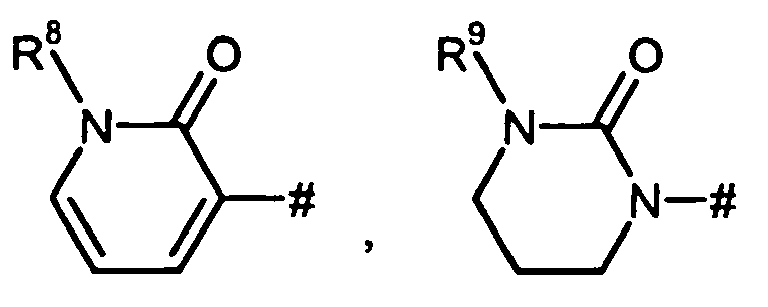
wobei
# die Anknüpfstelle an den Phenylring ist,
R5 für Wasserstoff oder C1-C3-Alkyl steht,
worin Alkyl substituiert sein kann mit einem Substituenten Hydroxy,
R6 für Wasserstoff, Trifluormethyl, Trifluormethoxy, Difluormethoxy, C1-C3-Alkyl oder C1-C4-Alkoxy steht,
worin Alkoxy substituiert sein kann mit einem Substituenten, wobei der Substituent ausgewählt wird aus der Gruppe bestehend aus Halogen, Hydroxy, Trifluormethyl, Aminocarbonyl, C1-C3-Alkoxy, C1-C3-Alkylcarbonyl, C1-C4-Alkylaminocarbonyl und Morpholinocarbonyl,
R7 für Wasserstoff, C1-C3-Alkyl oder C1-C4-Alkoxy steht,
worin C2-C3-Alkyl und C2-C4-Alkoxy substituiert sein können mit einem Substituenten Hydroxy,
R8 für Wasserstoff oder C1-C3-Alkyl steht,
worin C2-C3-Alkyl substituiert sein kann mit einem Substituenten Hydroxy,
R9 für Wasserstoff oder C1-C3-Alkyl steht,
worin C2-C3-Alkyl substituiert sein kann mit einem Substituenten Hydroxy, - R2
- für Chlor, Trifluormethyl, Trifluormethoxy, Difluormethoxy, Methyl, Ethyl, n-Propyl, iso-Propyl, Methoxy, Ethoxy, Methoxymethyl, Ethoxymethyl oder Cyclopropyl steht,
- R3
- für Wasserstoff, C1-C3-Alkoxy oder C1-C3-Alkylamino steht,
- R4
- für Wasserstoff oder Methyl steht,
- Erfindungsgemäße Verbindungen sind die Verbindungen der Formel (I) und deren Salze, Solvate und Solvate der Salze, die von Formel (I) umfassten Verbindungen der nachfolgend genannten Formeln und deren Salze, Solvate und Solvate der Salze sowie die von Formel (I) umfassten, nachfolgend als Ausführungsbeispiele genannten Verbindungen und deren Salze, Solvate und Solvate der Salze, soweit es sich bei den von Formel (I) umfassten, nachfolgend genannten Verbindungen nicht bereits um Salze, Solvate und Solvate der Salze handelt.
- Die erfindungsgemäßen Verbindungen können in Abhängigkeit von ihrer Struktur in stereoisomeren Formen (Enantiomere, Diastereomere) existieren. Die Erfindung umfasst deshalb die Enantiomeren oder Diastereomeren und ihre jeweiligen Mischungen. Aus solchen Mischungen von Enantiomeren und/oder Diastereomeren lassen sich die stereoisomer einheitlichen Bestandteile in bekannter Weise isolieren.
- Sofern die erfindungsgemäßen Verbindungen in tautomeren Formen vorkommen können, umfasst die vorliegende Erfindung sämtliche tautomere Formen.
- Als Salze sind im Rahmen der vorliegenden Erfindung physiologisch unbedenkliche Salze der erfindungsgemäßen Verbindungen bevorzugt. Umfasst sind auch Salze, die für pharmazeutische Anwendungen selbst nicht geeignet sind, jedoch beispielsweise für die Isolierung oder Reinigung der erfindungsgemäßen Verbindungen verwendet werden können.
- Physiologisch unbedenkliche Salze der erfindungsgemäßen Verbindungen umfassen Säureadditionssalze von Mineralsäuren, Carbonsäuren und Sulfonsäuren, z.B. Salze der Chlorwasserstoffsäwe, Bromwasserstoffsäure, Schwefelsäure, Phosphorsäure, Methansulfonsäure, Ethansulfonsäure, Toluolsulfonsäure, Benzolsulfonsäure, Naphthalindisulfonsäure, Essigsäure, Trifluoressigsäure, Propionsäure, Milchsäure, Weinsäure, Äpfelsäure, Zitronensäure, Fumarsäure, Maleinsäure und Benzoesäure.
- Physiologisch unbedenkliche Salze der erfindungsgemäßen Verbindungen umfassen auch Salze üblicher Basen, wie beispielhaft und vorzugsweise Alkalimetallsalze (z.B. Natrium- und Kaliumsalze), Erdalkalisalze (z.B. Calcium- und Magnesiumsalze) und Ammoniumsalze, abgeleitet von Ammoniak oder organischen Aminen mit 1 bis 16 C-Atomen, wie beispielhaft und vorzugsweise Ethylamin, Diethylamin, Triethylamin, Ethyldiisopropylamin, Monoethanolamin, Diethanolamin, Triethanolamin, Dicyclohexylamin, Dimethylaminoethanol, Prokain, Dibenzylamin, N-Methylmorpholin, Arginin, Lysin, Ethylendiamin und N-Methylpiperidin.
- Als Solvate werden im Rahmen der Erfindung solche Formen der erfindungsgemäßen Verbindungen bezeichnet, welche in festem oder flüssigem Zustand durch Koordination mit Lösungsmittelmolekülen einen Komplex bilden. Hydrate sind eine spezielle Form der Solvate, bei denen die Koordination mit Wasser erfolgt. Als Solvate sind im Rahmen der vorliegenden Erfindung Hydrate bevorzugt.
- Außerdem umfasst die vorliegende Erfindung auch Prodrugs der erfindungsgemäßen Verbindungen. Der Begriff "Prodrugs" umfasst Verbindungen, welche selbst biologisch aktiv oder inaktiv sein können, jedoch während ihrer Verweilzeit im Körper zu erfindungsgemäßen Verbindungen umgesetzt werden (beispielsweise metabolisch oder hydrolytisch).
- Im Rahmen der vorliegenden Erfindung haben die Substituenten, soweit nicht anders spezifiziert, die folgende Bedeutung:
- Alkyl per se und "Alk" und "Alkyl" in Alkoxy, Alkylamino, Alkylcarbonyl und Alkylaminocarbonyl steht für einen linearen Alkylrest mit in der Regel 1 bis 3, bevorzugt 1 oder 2 Kohlenstoffatomen, beispielhaft und vorzugsweise für Methyl, Ethyl und n-Propyl.
- Alkoxy steht beispielhaft und vorzugsweise für Methoxy, Ethoxy und n-Propoxy.
- Alkylamino steht für einen Alkylaminorest mit einem oder zwei (unabhängig voneinander gewählten) Alkylsubstituenten, beispielhaft und vorzugsweise für Methylamino, Ethylamino, n-Propylamino, iso-Propylamino, N,N-Dimethylamino, N,N-Diethylamino, N-Ethyl-N-methylamino, N-Methyl-N-n-propylamino und N-iso-Propyl-N-n-propylamino. C1-C3-Akylamino steht beispielsweise für einen Monoalkylaminorest mit 1 bis 3 Kohlenstoffatomen oder für einen Dialkylaminorest mit jeweils 1 bis 3 Kohlenstoffatomen pro Alkylsubstituent.
- Alkylcarbonyl steht beispielhaft und vorzugsweise für Methylcarbonyl, Ethylcarbonyl, n-Propylcarbonyl und iso-Propylcarbonyl.
- Alkylaminocarbonyl steht für einen Alkylaminocarbonylrest mit einem oder zwei (unabhängig voneinander gewählten) Alkylsubstituenten, beispielhaft und vorzugsweise für Methylaminocarbonyl, Ethylaminocarbonyl, n-Propylaminocarbonyl, iso-Propylaminocarbonyl, tert-Butylaminocarbonyl, N,N-Dimethylaminocarbonyl, N,N-Diethylaminocarbonyl, N-Ethyl-N-methylaminocarbonyl, N-Methyl-N-n-propylaminocarbonyl, N-iso-Propyl-N-n-propylaminocarbonyl und N-tert-Butyl-N methylaminocarbonyl. C1-C4-Alkylaminocarbonyl steht beispielsweise für einen Monoalkylaminocarbonylrest mit 1 bis 4 Kohlenstoffatomen oder für einen Dialkylaminocarbonylrest mit jeweils 1 bis 4 Kohlenstoffatomen pro Alkylsubstituent.
- In den Formeln der Gruppe, die für R1 stehen kann, steht der Endpunkt der Linie, neben der jeweils ein # steht, nicht für ein Kohlenstoffatom beziehungsweise eine CH2-Gruppe sondern ist Bestandteil der Bindung zu dem Atom, an das R1 gebunden ist.
- Ein Symbol * an einem Kohlenstoffatom bedeutet, dass die Verbindung hinsichtlich der Konfiguration an diesem Kohlenstoffatom in enantiomerenreiner Form vorliegt, worunter im Rahmen der vorliegenden Erfindung ein Enantiomerenüberschuss (enantiomeric excess) von mehr als 90% verstanden wird (> 90% ee).
- Bevorzugt sind Verbindungen der Formel (I), in welcher
- R1
- für eine Gruppe der Formel


wobei
# die Anknüpfstelle an den Phenylring ist,
R5 für Wasserstoff oder C1-C3-Alkyl steht,
worin Alkyl substituiert sein kann mit einem Substituenten Hydroxy,
R6 für Wasserstoff, Trifluormethyl, Trifluormethoxy, C1-C3-Alkyl oder C1-C4-Alkoxy steht,
worin Alkoxy substituiert sein kann mit einem Substituenten, wobei der Substituent ausgewählt wird aus der Gruppe bestehend aus Halogen, Hydroxy, Trifluormethyl, Aminocarbonyl, C1-C3-Alkoxy, C1-C3-Akylcarbonyl, C1-C4-Alkylaminocarbonyl und Morpholinocarbonyl,
R7 für C1-C4-Alkoxy steht,
R8 für C1-C3-Alkyl steht,
R9 für Wasserstoff oder C1-C3-Alkyl steht,
worin C2-C3-Alkyl substituiert sein kann mit einem Substituenten Hydroxy, - R2
- für Chlor, Trifluormethyl, Methyl, Ethyl, n-Propyl, iso-Propyl, Methoxy, Ethoxy, Methoxymethyl, Ethoxymethyl oder Cyclopropyl steht,
- R3
- für Wasserstoff, C1-C3-Alkoxy oder C1-C3-Alkylamino steht,
- R4
- für Wasserstoff oder Methyl steht,
- Bevorzugt sind auch Verbindungen der Formel (I), in welcher
- R1
- für eine Gruppe der Formel
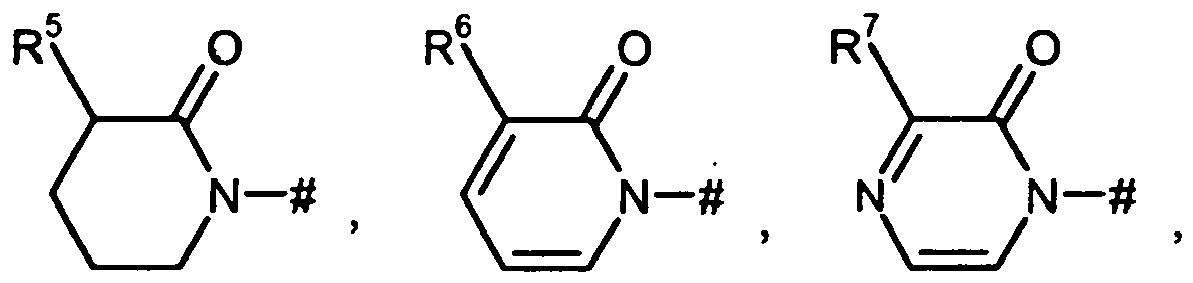

wobei
# die Anknüpfstelle an den Phenylring ist,
R5 für Wasserstoff oder C1-C3-Alkyl steht,
worin Alkyl substituiert sein kann mit einem Substituenten Hydroxy,
R6 für Wasserstoff, Trifluormethyl, Trifluormethoxy, C1-C3-Alkyl oder C1-C4-Alkoxy steht,
worin Alkoxy substituiert sein kann mit einem Substituenten, wobei der Substituent ausgewählt wird aus der Gruppe bestehend aus Halogen, Hydroxy, Trifluormethyl, Aminocarbonyl, C1-C3-Alkoxy, C1-C3-Alkylcarbonyl, C1-C4-Alkylaminocarbonyl und Morpholinocarbonyl,
k7 für C1-C4-Alkoxy steht,
R9 für Wasserstoff oder C1-C3-Alkyl steht,
worin C2-C3-Alkyl substituiert sein kann mit einem Substituenten Hydroxy, - R2
- für Chlor, Trifluormethyl, Methyl, Ethyl, n-Propyl, iso-Propyl, Methoxy, Ethoxy, Methoxymethyl, Ethoxymethyl oder Cyclopropyl steht,
- R3
- für Wasserstoff, C1-C3-Alkoxy oder C1-C3-Alkylamino steht,
- R4
- für Wasserstoff oder Methyl steht,
- Bevorzugt sind auch Verbindungen der Formel (I), in welcher
- R1
- für eine Gruppe der Formel


wobei
# die Anknüpfstelle an den Phenylring ist,
R5 für Wasserstoff oder C1-C3-Alkyl steht,
worin Alkyl substituiert sein kann mit einem Substituenten Hydroxy,
R6 für Wasserstoff, C1-C3-Alkyl oder C1-C4-Alkoxy steht,
worin Alkoxy substituiert sein kann mit einem Substituenten, wobei der Substituent ausgewählt wird aus der Gruppe bestehend aus Hydroxy, Aminocarbonyl, C1-C3-Alkoxy, C1-C3-Alkylcarbonyl und C1-C4-Alkylaminocarbonyl,
R7 für C1-C4-Alkoxy steht,
R9 für Wasserstoff oder C1-C3-Alkyl steht,
worin C2-C3-Alkyl substituiert sein kann mit einem Substituenten Hydroxy, - R2
- für Chlor, Methyl, Ethyl, n-Propyl, iso-Propyl, Methoxy, Ethoxy, Methoxymethyl, Ethoxymethyl oder Cyclopropyl steht,
- R3
- für Wasserstoff steht,
- R4
- für Wasserstoff oder Methyl steht,
- Bevorzugt sind auch Verbindungen der Formel (I), in welcher
- R1
- für eine Gruppe der Formel


wobei
# die Anknüpfstelle an den Phenylring ist,
R5 für Wasserstoff steht,
R6 für Wasserstoff oder C1-C4-Alkoxy steht,
worin Alkoxy substituiert sein kann mit einem Substituenten Hydroxy,
R7 für Ethoxy steht,
R9 für Wasserstoff, Methyl oder 2-Hydroxyeth-1-yl steht, - R2
- für Methyl, iso-Propyl, Methoxy, Ethoxy, Methoxymethyl oder Cyclopropyl steht,
- R3
- für Wasserstoff steht,
- R4
- für Wasserstoff oder Methyl steht,
- Bevorzugt sind auch Verbindungen der Formel (I), in welcher
- R1
- für eine Gruppe der Formel


wobei
# die Anknüpfstelle an den Phenylring ist,
R6 für Wasserstoff oder C1-C4-Alkoxy steht,
worin Alkoxy substituiert sein kann mit einem Substituenten Hydroxy,
R7 für Ethoxy steht,
R9 für Wasserstoff, Methyl oder 2-Hydroxyeth-1-yl steht. - Bevorzugt sind auch Verbindungen der Formel (I), in welcher
- R1
- für eine Gruppe der Formel

wobei
# die Anknüpfstelle an den Phenylring ist,
R6 für Wasserstoff oder C1-C4-Alkoxy steht,
worin Alkoxy substituiert sein kann mit einem Substituenten Hydroxy. - Bevorzugt sind auch Verbindungen der Formel (I), in welcher R2 für Chlor, Trifluormethyl, Methyl, Ethyl, n-Propyl, iso-Propyl, Methoxy, Ethoxy, Methoxymethyl, Ethoxymethyl oder Cyclopropyl steht.
- Bevorzugt sind auch Verbindungen der Formel (I), in welcher R2 für Methyl, iso-Propyl, Methoxy, Ethoxy, Methoxymethyl oder Cyclopropyl steht.
- Bevorzugt sind auch Verbindungen der Formel (I), in welcher R2 für Chlor, Methyl oder Methoxy steht.
- Bevorzugt sind auch Verbindungen der Formel (I), in welcher R2 für Methyl steht.
- Bevorzugt sind auch Verbindungen der Formel (I), in welcher R3 für Wasserstoff steht.
- Bevorzugt sind auch Verbindungen der Formel (I), in welcher R4 für Wasserstoff steht.
- Bevorzugt sind auch Verbindungen der Formel (I), in welcher R6 für Wasserstoff, Trifluormethyl, Trifluormethoxy, C1-C3-Alkyl oder C1-C4-Alkoxy steht, worin Alkoxy substituiert sein kann mit einem Substituenten, wobei der Substituent ausgewählt wird aus der Gruppe bestehend aus Halogen, Hydroxy, Trifluormethyl, Aminocarbonyl, C1-C3-Alkoxy, C1-C3-Alkylcarbonyl, C1-C4-Alkylaminocarbonyl und Morpholinocarbonyl.
- Die in den jeweiligen Kombinationen bzw. bevorzugten Kombinationen von Resten im einzelnen angegebenen Reste-Definitionen werden unabhängig von den jeweiligen angegebenen Kombinationen der Reste beliebig auch durch Reste-Definitionen anderer Kombinationen ersetzt.
- Ganz besonders bevorzugt sind Kombinationen von zwei oder mehreren der oben genannten Vorzugsbereiche.
- Gegenstand der Erfindung ist weiterhin ein Verfahren zur Herstellung der Verbindungen der Formel (I), oder ihrer Salze, ihrer Solvate oder der Solvate ihrer Salze, wobei
- [A] die Verbindung der Formel


zu Verbindungen der Formel
umgesetzt werden,
und in der zweiten Stufe in Anwesenheit von Phosgen oder Phosgenäquivalenten wie z.B. Carbonyldiimidazol (CDI) zu den Verbindungen der Formel (I) cyclisiert werden
oder - [B] die Verbindungen der Formel

mit Verbindungen der Formel
- X
- für Halogen, bevorzugt Brom oder Chlor, oder Hydroxy steht,
- Sind Hydroxygruppen während des Verfahrens geschützt, z. B. durch eine Silylschutzgruppe, so werden diese nach Beendigung des Verfahrens [A] oder [B] nach dem Fachmann bekannten Methoden abgespalten, z. B. durch Umsetzung mit Tetrabutylammoniumfluorid in einem Lösungsmittel, wie z. B. Tetrahydrofuran, oder durch Umsetzung mit Chlorwasserstoff in Methanol.
- Die freie Base der Salze kann zum Beispiel durch Chromatographie an einer Reversed Phase Säule mit einem Acetonitril-Wasser-Gradienten unter Zusatz einer Base erhalten werden, insbesondere durch Verwendung einer RP18 Phenomenex Luna C18(2) Säule und Diethylamin als Base, oder durch Lösen der Salze in einem organischen Lösungsmittel und Ausschütteln mit wässrigen Lösungen von basischen Salzen wie Natriumhydrogencarbonat.
- Weiterer Gegenstand der Erfindung ist ein Verfahren zur Herstellung der Verbindungen der Formel (I) oder ihrer Solvate, bei dem Salze der Verbindungen oder Solvate der Salze der Verbindungen durch Chromatographie unter Zusatz einer Base in die Verbindungen überführt werden.
- Die Umsetzung der ersten Stufe nach Verfahren [A] erfolgt im Allgemeinen in inerten Lösungsmitteln, in Gegenwart einer Lewissäure, bevorzugt in einem Temperaturbereich von Raumtemperatur bis zum Rückfluss des Lösungsmittels bei Normaldruck.
- Inerte Lösungsmittel sind beispielsweise polare, aprotische Lösungsmittel wie beispielsweise Acetonitril, Butyronitril, Dichlormethan oder Chloroform, bevorzugt ist Acetonitril.
- Lewis-Säuren sind beispielsweise Magnesiumperchlorat, Ytterbium(III)trifluormethansulfonat, Lithiumbromid, Magnesiumtriflat oder Aluminiumtrichlorid, bevorzugt ist Magnesiumperchlorat.
- Die Umsetzung der zweiten Stufe nach Verfahren [A] erfolgt im Allgemeinen in inerten Lösungsmitteln, in Gegenwart einer Base, bevorzugt in einem Temperaturbereich von Raumtemperatur bis zum Rückfluss des Lösungsmittels bei Normaldruck.
- Inerte Lösungsmittel sind beispielsweise polare, aprotische Lösungsmittel wie beispielsweise Acetonitril oder Butyronitril.
- Basen sind beispielsweise starke, tertiäre Aminbasen wie beispielsweise 4-N,N-Dimethylarminopyridin.
- Bevorzugt ist die Reaktion mit N,N'-Carbonyldiimidazol als Kohlensäure-Äquivalent unter Zusatz von 4-N,N-Dimethylaminopyridin als Base.
- Wenn bei Verfahren [B] X für Halogen steht, erfolgt die Umsetzung im Allgemeinen in inerten Lösungsmitteln, gegebenenfalls in Gegenwart einer Base, bevorzugt in einem Temperaturbereich von -30°C bis 50°C bei Normaldruck.
- Inerte Lösungsmittel sind beispielsweise Tetrahydrofuran, Methylenchlorid, Pyridin, Dioxan oder Dimethylformamid, bevorzugt ist Tetrahydrofuran oder Methylenchlorid.
- Basen sind beispielsweise Triethylamin, Diisopropylethylamin oder N-Methylmorpholin, bevorzugt ist Diisopropylethylamin.
- Wenn bei Verfahren [B] X für Hydroxy steht, erfolgt die Umsetzung im Allgemeinen in inerten Lösungsmitteln, in Gegenwart eines Dehydratisierungsreagenzes, gegebenenfalls in Gegenwart einer Base, bevorzugt in einem Temperaturbereich von -30°C bis 50°C bei Normaldruck.
- Inerte Lösungsmittel sind beispielsweise Halogenkohlenwasserstoffe wie Dichlormethan oder Trichlormethan, Kohlenwasserstoff wie Benzol, Nitromethan, Dioxan, Dimethylformamid oder Acetonitril. Ebenso ist es möglich, Gemische der Lösemittel einzusetzen. Besonders bevorzugt ist Dichlormethan oder Dimethylformamid.
- Als Dehydratisierungsreagenzien eignen sich hierbei beispielsweise Carbodiimide wie z.B. N,N'-Diethyl-, N,N,'-Dipropyl-, N,N'-Diisopropyl-, N,N'-Dicyclohexylcarbodiimid, N-(3-Dimethylaminoisopropyl)-N'-ethylcarbodiimid-hydrochlorid (EDC), N-Cyclohexylcarbodiimid-N'-propyloxymethyl-Polystyrol (PS-Carbodiimid) oder Carbonylverbindungen wie Carbonyldiimidazol, oder 1,2-Oxazoliumverbindungen wie 2-Ethyl-5-phenyl-1,2-oxazolium-3-sulfat oder 2-tert-Butyl-5-methyl-isoxazolium-perchlorat, oder Acylaminoverbindungen wie 2-Ethoxy-1-ethoxycarbonyl-1,2-dihydrochinolin, oder Propanphosphonsäureanhydrid, oder Isobutylchloroformat, oder Bis-(2-oxo-3-oxazolidinyl)-phosphorylchlorid oder Benzotriazolyloxy-tri(dimethylamino)-phosphoniumhexafluorophosphat, oder O-(Benzotriazol-1-yl)-N,N,N',N'-tetra-methyluroniumhexafluorophosphat (HBTU), 2-(2-Oxo-1-(2H)-pyridyl)-1,1,3,3-tetramethyluroniumtetrafluoroborat (TPTU) oder O-(7-Azabenzotriazol-1-yl)-N,N,N',N'-tetramethyl-uroniumhexafluorophosphat (HATU), oder 1-Hydroxybenzotriazol (HOBt), oder Benzotriazol-1-yloxytris(dimethylamino)-phosphoniumhexafluorophosphat (BOP), oder N-Hydroxysuccinimid, oder Mischungen aus diesen, mit Basen.
- Basen sind beispielsweise Alkalicarbonate, wie z.B. Natrium- oder Kaliumcarbonat, oder -hydrogencarbonat, oder organische Basen wie Trialkylamine z.B. Triethylamin, N-Methylmorpholin, N-Methylpiperidin, 4-Dimethylaminopyridin oder Diisopropylethylamin.
- Vorzugsweise wird die Kondensation mit HATU oder mit EDC in Gegenwart von HOBt durchgeführt.
- Die Verbindungen der Formeln (II) und (VI) sind bekannt oder lassen sich nach bekannten Verfahren aus den entsprechenden Ausgangsverbindungen synthetisieren.
- Die Verbindungen der Formel (III) sind bekannt oder können hergestellt werden, indem in Verbindungen der Formel

die Nitrogruppe reduziert wird. - Die Umsetzung erfolgt im Allgemeinen mit einem Reduktionsmittel in inerten Lösungsmitteln, bevorzugt in einem Temperaturbereich von Raumtemperatur bis zum Rückfluss der Lösungsmittel bei Normaldruck bis 3 bar.
- Reduktionsmittel sind beispielsweise Palladium auf Aktivkohle und Wasserstoff, Zinndichlorid, Titantrichlorid, Hydrazinhydrat und Raney-Nickel, oder Ammoniumformiat und Palladium auf Aktivkohle in einem Gemisch aus Ethanol und Essigsäureethylester, bevorzugt ist Palladium auf Aktivkohle und Wasserstoff oder Zinndichlorid.
- Inerte Lösungsmittel sind beispielsweise Ether wie Diethylether, Methyl-tert.-butylether, 1,2-Dimethoxyethan, Dioxan, Tetrahydrofuran, Glykoldimethylether oder Diethylenglykoldimethylether, Alkohole wie Methanol, Ethanol, n-Propanol, iso-Propanol, n-Butanol oder tert.-Butanol, Kohlenwasserstoffe wie Benzol, Xylol, Toluol, Hexan, Cyclohexan oder Erdölfraktionen, oder andere Lösungsmittel wie Dimethylformamid, Dimethylacetamid, Acetonitril oder Pyridin, als Lösungsmittel sind bevorzugt Methanol, Ethanol, iso-Propanol oder im Falle von Zinndichlorid in Dimethylformamid.
- Die Verbindungen der Formel (VII) sind bekannt, lassen sich nach bekannten Verfahren aus den entsprechenden Ausgangsverbindungen synthetisieren oder können analog den im Beispielteil beschriebenen Verfahren hergestellt werden.
- Die Verbindungen der Formel (V) sind bekannt oder können hergestellt werden, indem in Verbindungen der Formel

die Phthalimid-Schutzgruppe gespalten wird. - Die Umsetzung erfolgt im Allgemeinen mit einer wässrigen Methylamin-Lösung oder einer Hydrazinhydrat-Lösung in Ethanol, bevorzugt mit einer wässrigen Methylamin-Lösung unter Rückfluss der Lösungsmittel bei Normaldruck.
- Die Verbindungen der Formel (VIII) sind bekannt, lassen sich wie unter Verfahren [A] beschrieben herstellen oder lassen sich nach bekannten Verfahren aus den entsprechenden Ausgangsverbindungen synthetisieren.
- Die Herstellung der erfindungsgemäßen Verbindungen kann durch das folgende Syntheseschema veranschaulicht werden:

- Die erfindungsgemäßen Verbindungen zeigen ein nicht vorhersehbares, wertvolles pharmakologisches Wirkspektrum.
- Sie eignen sich daher zur Verwendung als Arzneimittel zur Behandlung und/oder Prophylaxe von Krankheiten bei Menschen und Tieren.
- Bei den erfindungsgemäßen Verbindungen handelt es sich um duale Inhibitoren der Blutgerinnungsfaktoren Xa und Thrombin (Faktor IIa), die insbesondere als Antikoagulantien wirken. Die Verbindungen hemmen sowohl Thrombin als auch Faktor Xa, verhindern durch Hemmung der Thrombinproduktion und -aktivität auf Gerinnseln deren potentielles Wachstum und weisen ein breites therapeutisches Fenster auf.
- Weiterer Gegenstand der vorliegenden Erfindung ist der Einsatz der erfindungsgemäßen Verbindungen zur Behandlung und/oder Prophylaxe von Erkrankungen, vorzugsweise von thromboembolischen Erkrankungen und/oder thromboembolischen Komplikationen.
- Zu den "thromboembolischen Erkrankungen" im Sinne der vorliegenden Erfindung zählen insbesondere Erkrankungen wie Herzinfarkt mit ST-Segment-Erhöhung (STEMI) und ohne ST-Segment-Erhöhung (non-STEMI), stabile Angina Pectoris, instabile Angina Pectoris, Reokklusionen und Restenosen nach Koronarinterventionen wie Angioplastie oder aortokoronarem Bypass, periphere arterielle Verschlusskrankheiten, Lungenembolien, tiefe venöse Thrombosen und Nierenvenenthrombosen, transitorische ischämische Attacken sowie thrombotischer und thromboembolischer Hirnschlag.
- Die die erfindungsgemäßen Verbindungen eignen sich daher auch zur Prävention und Behandlung von kardiogenen Thromboembolien, wie beispielsweise Hirn-Ischämien, Schlaganfall und systemischen Thromboembolien und Ischämien, bei Patienten mit akuten, intermittierenden oder persistierenden Herzarrhythmien, wie beispielsweise Vorhofflimmern, und solchen, die sich einer Kardioversion unterziehen, ferner bei Patienten mit Herzklappen-Erkrankungen oder mit künstlichen Herzklappen.
- Thromboembolische Komplikationen treten ferner auf bei mikroangiopathischen hämolytischen Anämien, extrakorporalen Blutkreisläufen, wie Hämodialyse, sowie Herzklappenprothesen.
- Außerdem kommen die erfindungsgemäßen Verbindungen auch für die Prophylaxe und/oder Behandlung von atherosklerotischen Gefäßerkrankungen und entzündlichen Erkrankungen wie rheumatische Erkrankungen des Bewegungsapparats in Betracht, darüber hinaus ebenso für die Prophylaxe und/oder Behandlung der Alzheimer'schen Erkrankung. Außerdem können die erfindungsgemäßen Verbindungen zur Inhibition des Tumorwachstums und der Metastasenbildung, bei Mikroangiopathien, altersbedingter Makula-Degeneration, diabetischer Retinopathie, diabetischer Nephropathie und anderen mikrovaskulären Erkrankungen sowie zur Prävention und Behandlung thromboembolischer Komplikationen, wie beispielsweise venöser Thromboembolien, bei Tumorpatienten, insbesondere solchen, die sich größeren chirurgischen Eingriffen oder einer Chemo- oder Radiotherapie unterziehen, eingesetzt werden.
- Außerdem kommen die erfindungsgemäßen Verbindungen auch für die Prophylaxe und/oder Behandlung von pulmonaler Hypertonie in Betracht.
- Der Begriff "pulmonale Hypertonie" umfasst bestimmte Formen der pulmonalen Hypertonie, wie sie z.B. von der Weltgesundheitsorganisation (WHO) festgelegt worden sind (Clinical Classification of Pulmonary Hypertension, Venedig 2003). Als Beispiele seien genannt, die pulmonale arterielle Hypertonie, die pulmonale Hypertonie bei Erkrankungen des linken Herzens, die pulmonale Hypertonie bei Lungenerkrankung und/oder Hypoxie und die Pulmonale Hypertonie aufgrund chronischer Thrombembolien (CTEPH).
- Die "pulmonale arterielle Hypertonie" beinhaltet die Idiopathische Pulmonale Arterielle Hypertonie (IPAH, früher auch als primäre pulmonale Hypertonie bezeichnet), die Familiär bedingte Pulmonale Arterielle Hypertonie (FPAH) und die Assoziierte Pulmonal-Arterielle Hypertonie (APAH), die assoziiert ist mit Kollagenosen, kongenitalen systemisch-pulmonalen Shuntvitien, portaler Hypertension, HIV-Infektionen, der Einnahme bestimmter Drogen und Medikamente, mit anderen Erkrankungen (Schilddrüsenerkrankungen, Glykogenspeicherkrankheiten, Morbus Gaucher, hereditäre Teleangiektasie, Hämoglobinopathien, myeloproliferative Erkrankungen, Splenektomie), mit Erkrankungen mit einer signifikanten venösen/kapillären Beteiligung wie der pulmonal-venookklusiven Erkrankung und der pulmonal-kapillären Hämangiomatose, sowie die persistierende pulmonale Hypertonie der Neugeborenen.
- Die pulmonale Hypertonie bei Erkrankungen des linken Herzens beinhaltet die Erkrankung des linken Vorhofes oder Ventrikels und Mitral- oder Aortenklappenfehler.
- Die pulmonale Hypertonie bei Lungenerkrankung und/oder Hypoxie beinhaltet chronisch obstruktive Lungenerkrankungen, interstitielle Lungenerkrankung, Schlafapnoe-Syndrom, alveolärer Hypoventilation, chronische Höhenkrankheit und anlagebedingte Fehlbildungen.
- Die Pulmonale Hypertonie aufgrund chronischer Thrombembolien (CTEPH) beinhaltet den thrombembolischen Verschluss proximaler Lungenarterien, den thrombembolischen Verschluss distaler Lungenarterien und nicht-thrombotische Lungenembolien (Tumor, Parasiten, Fremdkörper).
- Weiterer Gegenstand der vorliegenden Erfindung ist die Verwendung der erfindungsgemäßen Verbindungen zur Herstellung von Arzneimitteln zur Behandlung und/oder Prophylaxe von pulmonaler Hypertonie bei Sarkoidose, Histiozytose X und Lymphangiomatosis.
- Außerdem kommen die erfindungsgemäßen Substanzen auch zur Behandlung von pulmonalen und hepatischen Fibrosen in Betracht.
- Außerdem kommen die erfindungsgemäßen Verbindungen auch für die Behandlung und/oder Prophylaxe von Sepsis (oder Septikämie), Systemic Inflammatory Syndrome (SIRS), septische Organdysfunktion, septisches Organversagen und Muliorganversagen, Acute Respiratory Distress Syndrome (ARDS), Acute Lung Injury (ALI), Septischer Schock, DIC ("Disseminated Intravascular coagulation", oder "Verbrauchskoagulopathie") und/oder des septischen Organversagens in Betracht.
- "Sepsis" wird definiert als das Vorliegen einer Infektion und eines "systemic inflammatory response syndrome" (nachfolgend mit "SIRS" bezeichnet). SIRS tritt im Rahmen von Infekten, aber auch von anderen Zuständen wie Verletzungen, Verbrennungen, Schock, Operationen, Ischämie, Pankreatitis, Reanimation oder Tumoren auf. Nach der Definition des ACCP/SCCM Consensus Conference Committee von 1992 (Crit Care Med 1992;20:864-874) werden die zur Diagnose "SIRS" erforderlichen Symptome zur Diagnose und Meßparameter beschrieben (u.a. veränderte Körpertemperatur, erhöhte Herzfrequenz, Atemschwierigkeiten und verändertes Blutbild). In der späteren (2001) SCCM/ESICM/ACCP/ATS/SIS International Sepsis Definitions Conference wurden die Kriterien im Wesentlichen beibehalten, in Details jedoch verfeinert (Levy et al., Crit Care Med 2003;31:1250-1256).
- Im Verlauf einer Sepsis kann es zur generalisierten Aktivierung des Gerinnungssystems kommen ("Disseminated Intravascular coagulation", oder "Verbrauchskoagulopathie", nachfolgend als "DIC" bezeichnet) mit Mikrothrombosierung in verschiedenen Organen und sekundärer Blutungskomplikationen. Außerdem kann es es zur endothelialen Schädigung mit Erhöhung der Gefäßpermeabilität und Austritt von Flüssigkeit und Proteinen in den Extravasalraum kommen. Im weiteren Verlauf kann ein Versagen eines Organs (z.B. Nierenversagen, Leberversagen, Atemversagen, zentralnervöse Defizite und Herz-/Kreislaufversagen) oder zum Multiorganversagen kommen. "Septischer Schock" bezeichnet das Auftreten einer behandlungspflichtigen Blutdruckernedrigung, die eine weitere Organschädigung begünstigt und mit einer Verschlechterung der Prognose einhergeht.
- Krankheitserreger können Bakterien (gram-negativ und gram-positiv), Pilze, Viren und/oder Eukaryonten sein. Eintrittspforte bzw. Primärinfektion können z.B. Pneumonie, Harnwegsinfekt, Peritonitis sein. Die Infektion kann, muß aber nicht zwingend, mit einer Bakteriämie einhergehen.
- DIC und/oder SIRS können im Rahmen einer Sepsis, aber auch infolge von Operationen, Tumorerkrankungen, Verbrennungen oder anderen Verletzungen auftreten. Bei der DIC kommt es an der Oberfäche von geschädigten Endothelzellen, Fremdkörperoberflächen oder veretztem extravaskulärem Gewebe zur massiven Aktivierung des Gerinnungssystems. Als Folge kommt es zur Gerinnung in kleinen Gefäßen verschiedener Organe mit Hypoxie und anschließender Organdysfunktion. Sekundär kommt es zum Verbrauch von Gerinnungsfaktoren (z.B. Faktor X, Prothrombin und Fibrinogen) und Plättchen, wodurch die Gerinnungsfähigkeit des Blutes herabgesetzt wird und schwere Blutungen auftreten können.
- Die Therapie der Sepsis besteht einerseits in der konsequenten Beseitigung der infektiösen Ursache, z.B. durch operative Herdsanierung und Antibiose. Andererseits besteht sie in der temporären intensivmedizinischen Unterstützung der beeinträchtigten Organsysteme. Therapien der verschiedenen Stadien dieser Erkrankung sind z.B. in folgender Publikation beschrieben (Dellinger et al., Crit Care Med 2004;32:858-873). Für die DIC existieren keine erwiesenermaßen effektive Therapien.
- Weiterer Gegenstand der vorliegenden Erfindung sind Arzneimittel, enthaltend eine erfindungsgemäße Verbindung und einen oder mehrere weitere Wirkstoffe, insbesondere zur Behandlung und/oder Prophylaxe der zuvor genannten Erkrankungen. Als geeignete Kombinationswirkstoffe seien beispielhaft und vorzugsweise genannt:
- Antibiotische Therapie
Verschiedene Antibiotika oder antifungale Medikamenten-Kombinationen kommen in Frage, entweder als kalkulierte Therapie (vor Vorliegen des mikrobiellen Befundes) oder als spezifische Therapie. - Flüssigkeitstherapie
z.B. Kristalloide oder kolloidale Flüssigkeiten. - Vasopressoren
z.B. Norepinephrine, Dopamine oder Vasopressin - Inotrope Therapie
z.B. Dobutamin - Kortikosteroide
z.B. Hydrokortison, oder Fludrokortison - rekombinantes humanes aktivierte Protein C
Xigris - Blutprodukte
z.B. Erythrozytenkonzentrate, Thrombozytenkonzentrate, Erythropietin oder Fresh Frozen Plasma - Maschinelle Beatmung bei sepsis-induziertem Acute Lung Injury (ALI) bzw. Acute Respiratory Distress Syndrome (ARDS)
z.B. Permissive Hyperkapnie, niedrigere Tidalvolumina - Sedierung, Analgesierung und neuromuskuläre Blockade
Sedierung: z.B. Diazepam, Lorazepam, Midazolam oder Propofol. Opioide: z.B. Fentanyl, Hydromorphon, Morphin, Meperidin oder Remifentanil. NSAIDs: z.B. Ketorolac, Ibuprofen oder Acetaminophen. Neuromuskuläre Blockade: z.B. Pancuronium - Glukose-Kontrolle
z.B. Insulin, Glukose - Nierenersatzverfahren
z.B. kontinuierliche veno-venöse-Hämofiltration oder intermittierende Hämodialyse. Dopamin niedrig-dosiert zur renalen Protektion. - Antikoagulantien
z.B. zur Thromboseprophylaxe oder bei Nierenersatzverfahren, z.B. unfraktionierte Heparine, low molecular weight Heparine, Heparinoide, Hirudin, Bivalirudin oder Argatroban. - Bikarbonat-Therapie
- Streßulkusprophylaxe
z.B. H2-Rezeptorinhibitoren, Antazida - Die erfindungsgemäßen Verbindungen können darüber hinaus auch zur Verhinderung von Koagulation ex vivo eingesetzt werden, z.B. zur Konservierung von Blut- und Plasmaprodukten, zur Reinigung/Vorbehandlung von Kathetern und anderen medizinischen Hilfsmitteln und Geräten, zur Beschichtung künstlicher Oberflächen von in vivo oder ex vivo eingesetzten medizinischen Hilfsmitteln und Geräten oder bei biologischen Proben, die Faktor Xa und/oder Faktor IIa enthalten.
- Weiterer Gegenstand der vorliegenden Erfindung ist die Verwendung der erfindungsgemäßen Verbindungen zur Behandlung und/oder Prophylaxe von Erkrankungen, insbesondere der zuvor genannten Erkrankungen.
- Weiterer Gegenstand der vorliegenden Erfindung ist die Verwendung der erfindungsgemäßen Verbindungen zur Herstellung eines Arzneimittels zur Behandlung und/oder Prophylaxe von Erkrankungen, insbesondere der zuvor genannten Erkrankungen.
- Weiterer Gegenstand der vorliegenden Erfindung ist ein Verfahren zur Behandlung und/oder Prophylaxe von Erkrankungen, insbesondere der zuvor genannten Erkrankungen, unter Verwendung einer antikoagulatorisch wirksamen Menge der erfindungsgemäßen Verbindung.
- Weiterer Gegenstand der vorliegenden Erfindung ist ein Verfahren zur Verhinderung der Blutkoagulation in vitro, insbesondere bei Blutkonserven oder biologischen Proben, die Faktor Xa und/oder Faktor IIa enthalten, das dadurch gekennzeichnet ist, dass eine antikoagulatorisch wirksame Menge der erfindungsgemäßen Verbindung zugegeben wird.
- Weiterer Gegenstand der vorliegenden Erfindung sind Arzneimittel, enthaltend eine erfindungsgemäße Verbindung und einen oder mehrere weitere Wirkstoffe, insbesondere zur Behandlung und/oder Prophylaxe der zuvor genannten Erkrankungen. Als geeignete Kombinationswirkstoffe seien beispielhaft und vorzugsweise genannt:
- Lipidsenker, insbesondere HMG-CoA-(3-Hydroxy-3-methylglutaryl-Coenzym A)-Reduktase-Inhibitoren wie beispielsweise Lovastatin (Mevacor;
US 4,231,938 ), Simvastatin (Zocor;US 4,444,784 ), Pravastatin (Pravachol;US 4,346,227 ), Fluvastatin (Lescol;US 5,354,772 ) und Atorvastatin (Lipitor;US 5,273,995 ); - Koronartherapeutika/Vasodilatatoren, insbesondere ACE-(Angiotensin-Converting-Enzyme)-Inhibitoren wie beispielsweise Captopril, Lisinopril, Enalapril, Ramipril, Cilazapril, Benazepril, Fosinopril, Quinapril und Perindopril, oder AII-(Angiotensin II)-Rezeptor-Antagonisten wie beispielsweise Embusartan (
US 5,863,930 ), Losartan, Valsartan, Irbesartan, Candesartan, Eprosartan und Temisarta, oder β-Adrenozeptor-Antagonisten wie beispielsweise Carvedilol, Alprenolol, Bisoprolol, Acebutolol, Atenolol, Betaxolol, Carteolol, Metoprolol, Nadolol, Penbutolol, Pindolol, Propanolol und Timolol, oder alpha-1-Adrenozeptor-Antagonisten wie beispielsweise Prazosin, Bunazosin, Doxazosin und Terazosin, oder Diuretika wie beispielsweise Hydrochlorothiazid, Furosemid, Bumetanid, Piretanid, Torasemid, Amilorid und Dihydralazin, oder Calciumkanal-Blocker wie beispielsweise Verapamil und Diltiazem, oder Dihydropyridin-Derivate wie beispielsweise Nifedipin (Adalat) und Nitrendipin (Bayotensin), oder Nitropräparate wie beispielsweise Isosorbid-5-mononitrat, Isosorbid-dinitrat und Glyceroltrinitrat, oder Substanzen, die eine Erhöhung von cyclischem Guanosinmonophosphat (cGMP) bewirken, wie beispielsweise Stimulatoren der löslichen Guanylatcyclase (WO 98/16223 WO 98/16507 WO 98/23619 WO 00/06567 WO 00/06568 WO 00/06569 WO 00/21954 WO 00/66582 WO 01/17998 WO 01/19776 WO 01/19355 WO 01/19780 WO 01/19778 WO 07/045366 WO 07/045367 WO 07/045369 WO 07/045370 WO 07/045433 - Plasminogen-Aktivatoren (Thrombolytika/Fibrinolytika) und die Thrombolyse/Fibrinolyse steigernde Verbindungen wie Inhibitoren des Plasminogen-Aktivator-Inhibitors (PAI-Inhibitoren) oder Inhibitoren des Thrombin-aktivierten Fibrinolyse-Inhibitors (TAFI-Inhibitoren) wie beispielsweise Gewebsplasminogen-Aktivator (t-PA), Streptokinase, Reteplase und Urokinase;
- antikoagulatorisch wirksame Substanzen (Antikoagulantien) wie beispielsweise Heparin (UFH), niedermolekulare Heparine (NMH) wie beispielsweise Tinzaparin, Certoparin, Parnaparin, Nadroparin, Ardeparin, Enoxaparin, Reviparin, Dalteparin, Danaparoid,
- AVE 5026 (Sanofi-Aventis, Company Presentation 2008, February 12 ),
- M118 (Momenta Pharmaceuticals Inc, Press Release 2008, February 14),
- ORG42675 (Organon International Inc, Company World Wide Website 2007, April),
und direkte Thrombin Inhibitoren (DTI) wie beispielsweise - Exanta (Ximelagatran)

- Rendix (Dabigatran)
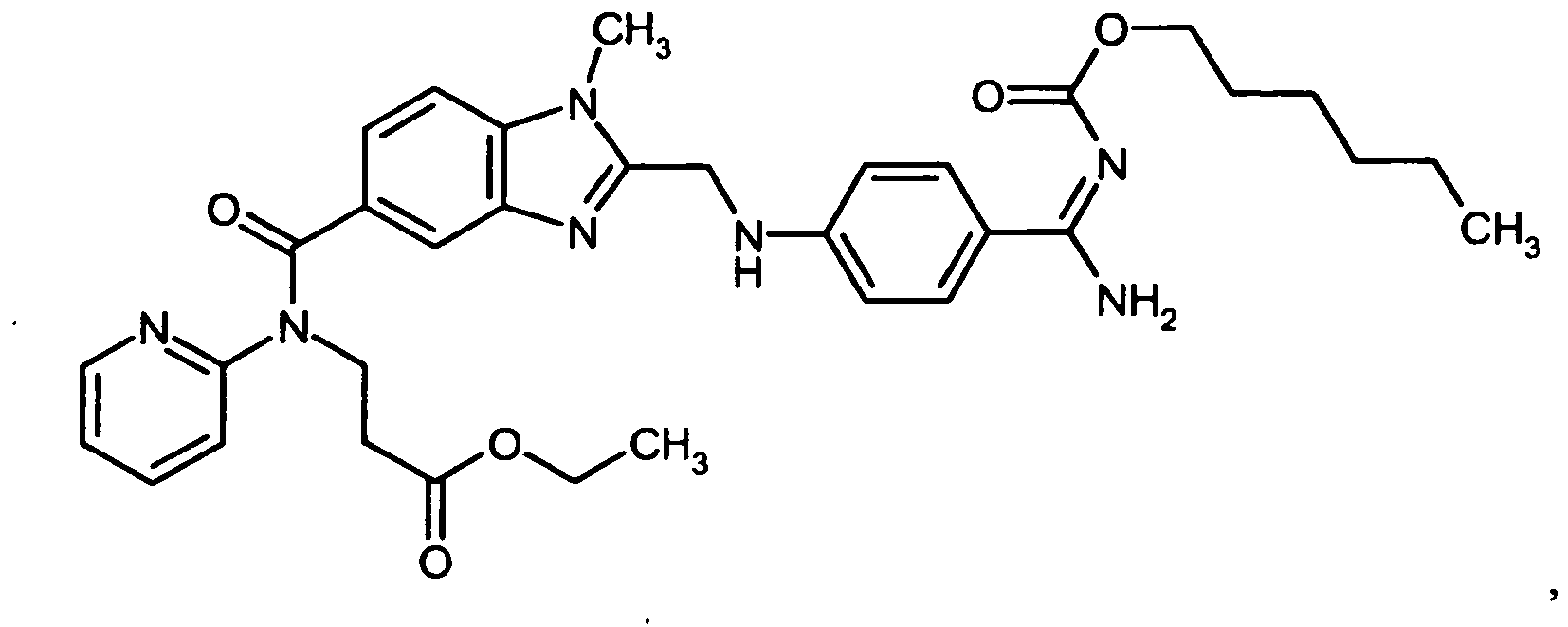
- AZD-0837 [AstraZeneca Annual Report 2006, 19. März 2007]

- SSR-182289A [J. Lorrain et al. Journal of Pharmacology and Experimental Therapeutics 2003, 304, 567-574; J-M Altenburger et al. Bioorg.Med.Chem. 2004, 12, 1713-1730]

- TGN-167 [S. Combe et al. Blood 2005, 106, abstract 1863 (ASH 2005)],
- N-[(Benzyloxy)carbonyl]-L-phenylalanyl-N-[(1S)-1-(dihydroxyboryl)-4-methoxybutyl]-D-prolinamid [
WO 2005/084685 ]
- Sofigatran [WHO Drug Information 2007, 21, 77]

- MCC-977 [Mitsubishi Pharma website pipeline 2006, 25. Juli 2006],
- MPC-0920 [Press Release: "Myriad Genetics Begins Phase 1 Trial of Anti-Thrombin Drug MPC-0920", Myriad Genetics Inc, 02. Mai 2006] und
- TGN-255 (Flovagatran)
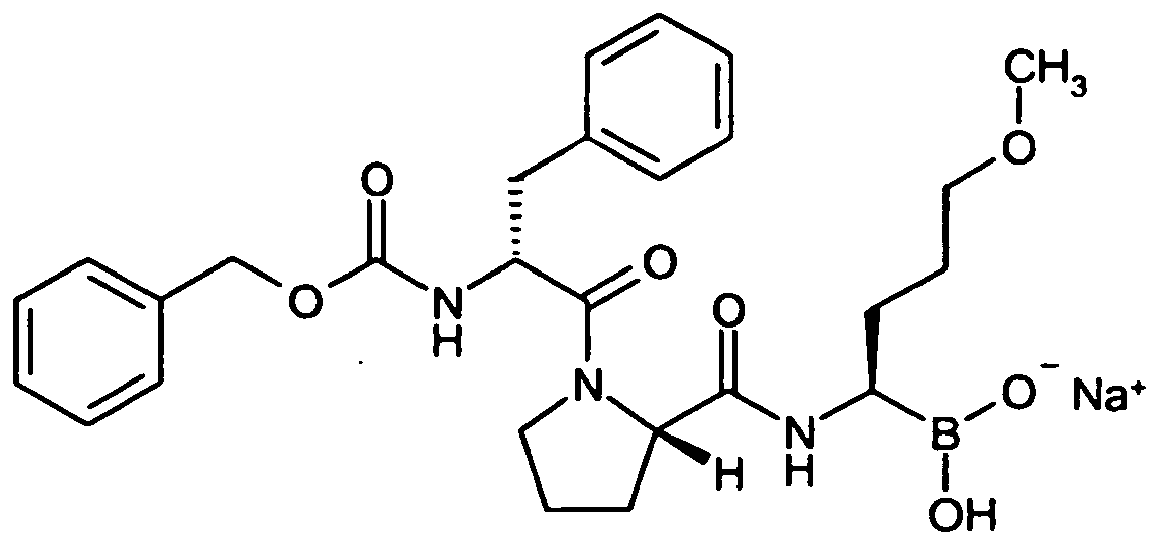
- Rivaroxaban (BAY 59-7939): 5-Chlor-N-({(5S)-2-oxo-3-[4-(3-oxomorpholin-4-yl)phenyl]-1,3-oxazolidin-5-yl}methyl)thiophen-2-carboxamid [
WO 2001/47919 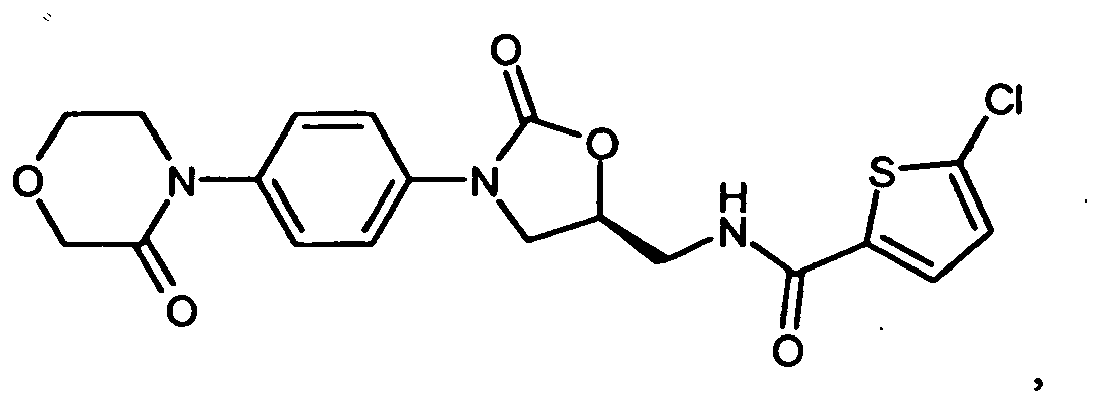
- AX-1826 [S. Takehana et al. Japanese Journal of Pharmacology 2000, 82 (Suppl. 1), 213P; T. Kayahara et al. Japanese Journal of Pharmacology 2000, 82 (Suppl. 1), 213P],
- Tanogitran (BIBT-986, prodrug: BIBT-1011): N-[(1R)-1-(2-[({4-[Amino(imino)methyl]-phenyl} amino)methyl]-1-methyl-1H-benzimidazol-5-yl}-1-methyl-2-oxo-2-pyrrolidin-1-ylethyl]glycin [American Chemical Society - 226th National Meeting, New York City, NY, USA, 2003]

WO 2004/056784 offengelegt wurden., - YM-150 [Y. Iwatsuki et al. Blood 2006, 108 , abstract 911 (ASH 2006)],
N-{4-Brom-2-[(5-chlorpyridin-2-yl)carbamoyl]-6-hydroxyphenyl}-1-isopropylpiperidin-4-carboxamid [JP 2005/179272 
WO 2000/242270 offengelegt wurden., - AZ12300547: 6-[4-({(2S)-4-[(3-Chlor-1H-indol-6-yl)sulfonyl]-2-methyl-6-oxopiperazin-1-yl}methyl)-phenyl]-2-methylpyridazin-3(2H)-on [K.L Granberg et al. American Chemical Society - 232th National Meeting, San Francisco, USA, 2006, MEDI 391]

WO 2007/008142 offengelegt wurden., - Razaxaban (DPC-906): 1-(3-Amino-1,2-benzisoxazol-5-yl)-N-(4-{2-[(dimethylamino)-methyl]-1H-imidazol-1-yl}-2-fluorphenyl)-3-(trifluormethyl)-1H-pyrazol-5-carboxamid [J.Med.Chem. 2005, 48, 1729-1744]

- Apixaban (BMS-562247): 1-(4-Methoxyphenyl)-7-oxo-6-[4-(2-oxopiperidin-1-yl)phenyl]-4,5,6,7-tetrahydro-1H-pyrazolo[3,4-c]pyridin-3-carboxamid [
WO 2003/026652 ,WO 2003/049681 ]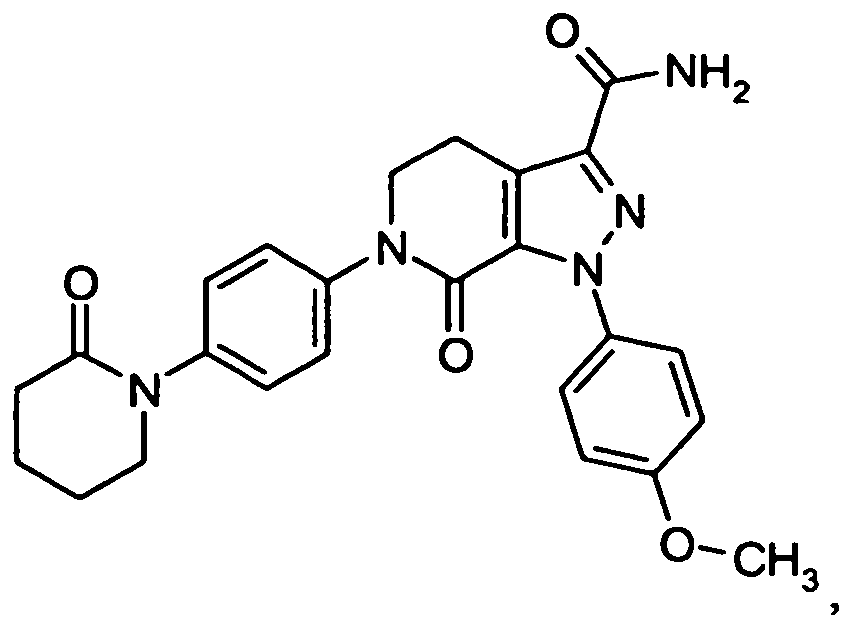
- BMS-691648: 3-Chlor-N-[(3S,4R)-1-(methylsulfonyl)-4-{[4-(2-oxopyridin-1(2H)-yl)benzoyl]-amino}piperidin-3-yl]-1H-indol-6-carboxamid [T. Güngör et al. Drugs Fut. 2006, 31(Suppl A): abstract P118;
WO 2004/082687 ]
- DX-9065a: (2S)-3-{7-[Amino(imino)methyl]-2-naphthyl}-2-(4-{[(3S)-1-ethanimidoylpyrrolidin-3-yl]oxy}phenyl)propansäure [T. Nagahara et al. J.Med.Chem. 1994, 37, 1200-1207]

- DU-176b [Y. Morishima et al. Blood 2004, 104 , abstract 1862 (ASH 2004); T. Fukuda et al. Blood 2004, 104, abstract 1852 (ASH 2004); T. Furugohri et al. Blood 2004, 104, abstract 1851 (ASH 2004)],
N-(5-Chlorpyridin-2-yl)-N'-[(1S,2R,4S)-4-(dimethylcarbamoyl)-2-{[(5-methyl-4,5,6,7-tetrahydro[1,3]thiazolo[5,4-c]pyridin-2-yl)carbonyl]amino}cyclohexyl]ethandiamid [US 2005/0020645 ,WO 2005/47296 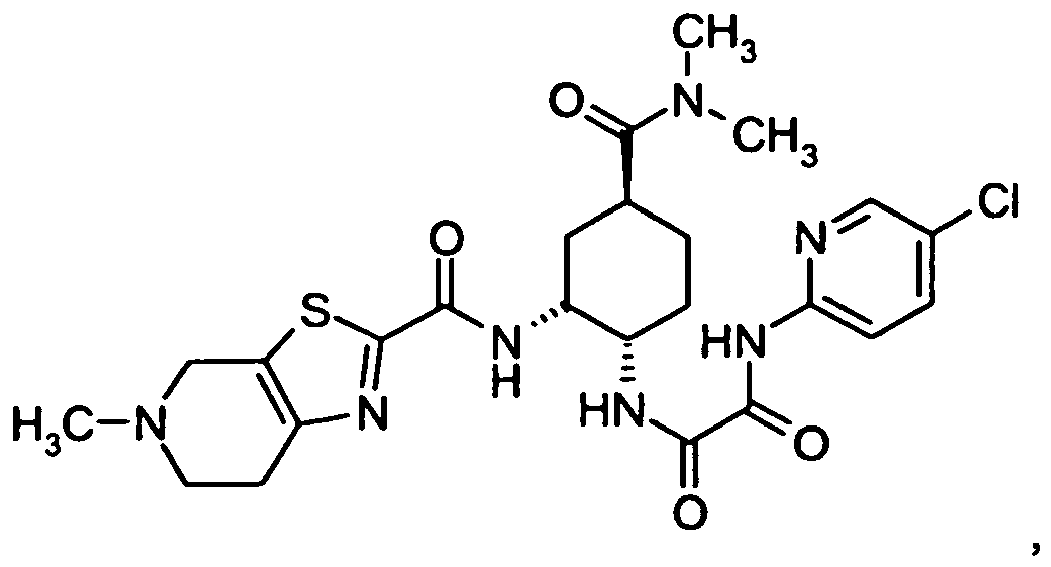
US 2005/0020645 offengelegt wurden., - LY517717: N-{(1R)-2-[4-(1-Methylpiperidin-4-yl)piperazin-1-yl]-2-oxo-1-phenylethyl}-1H indol-6-carboxamid [
WO 2000/76971 WO 2002/100847 ]
- 813893 [Proteinase Inhibitor Design - Fourth SCI-RSC Symposium, Proteinase 2004: Strategies for New Medicines (Part I), London],
6-Chlor-N-{(3S)-1-[(1S)-1-methyl-2-morpholin-4-yl-2-oxoethyl]-2-oxopyrrolidin-3-yl}naphtha-len-2-sulfonamid [N.S. Watson et al. Bioorg.Med.Chem.Lett. 2006, 16, 3784;WO 2002/100830 ;WO 2002/100886 ]
- KFA-1982 (prodrug of KFA-1829) [T. Koizumi et al. Journal of Thrombosis and Hemostasis 2003, 1 Suppl 1, P2022],
- EMD-503982 [Merck KGaA Annual Report 2006, 48-49],
- EMD-495235: 5-Chlor-N-[(1R)-1-(methoxymethyl)-2-{[3-methyl-4-(3-oxomorpholin-4-yl)-phenyl]amino}-2-oxoethyl]thiophen-2-carboxamid [Bioorg.Med.Chem.Lett. 2004, 14, 5817-5822]

- M-55113: 4-[(6-Chlor-2-naphthyl)sulfonyl]-1-[(1-pyridin-4-ylpiperidin-4-yl)methyl]piperazin-2-on [H. Nishida et al. Chem.Pharm.Bull. 2001, 49, 1237-1244]
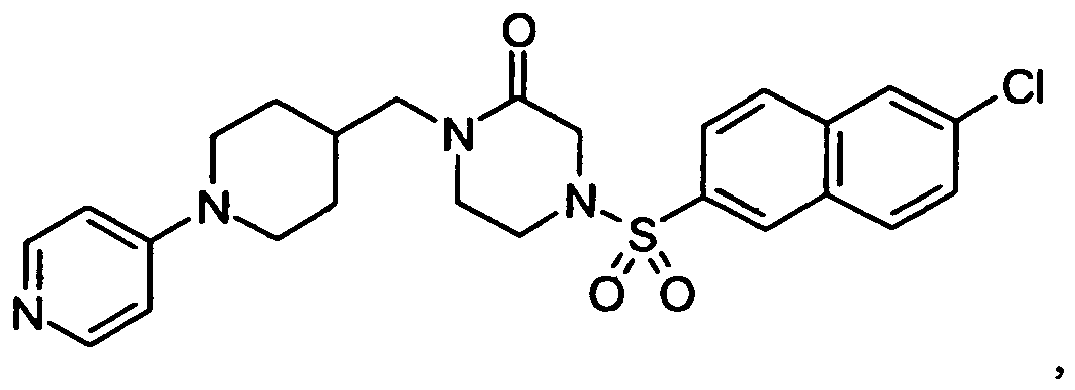
- M-55551/M-55555: (2R)-4-[(6-Chlor-2-naphthyl)sulfonyl]-6-oxo-1-[(1-pyridin-4-ylpiperidin-4-yl)methyl]piperazin-2-carbonsäure [H. Nishida et al. Chem.Pharm.Bull. 2002, 50, 1187-1194]

- M-55190: (2R)-4-[(6-Chlor-2-naphthyl)sulfonyl]-6-oxo-1-[(1-pyridin-4-ylpiperidin-4-yl)-methyl]piperazin-2-carbonsäureethylester [H. Nishida et al. 16th Int Symp Med Chem, Bologna, 18-22 Sept 2000, Abst PA-125]

- M-55532: 7-[(6-Chlor-2-naphthyl)sulfonyl]-8a-(methoxymethyl)-1'-pyridin-4-yltetrahydro-5H-spiro[1,3-oxazolo[3,2-a]pyrazin-2,4'-piperidin]-5-on [H. Nishida et al. 228th ACS National Meeting, Philadelphia, August 22-26, 2004, MEDI-251; H. Nishida et al. Chem.Pharm.Bull. 2004, 52, 406-412; dito 459-462]

WO 2006/106804 ]
- PRT54021 [U. Sinha et al. Blood 2006, 108 , abstract 907 (ASH 2006); K. Abe et al. Blood 2006, 108 , abstract 901 (ASH 2006)],
Verbindungen, die mitWO 2006/002099 offengelegt wurden., - Otamixaban (FXV-673, RPR-130673): (2R,3R)-2-{3-[Amino(imino)methyl]benzyl}-3-{[4-(1-oxidopyridin-4-yl)benzoyl]amino}butansäuremethylester [V. Chu et al. Thrombosis Research 2001, 103, 309-324; K.R. Guertin et al. Bioorg Med.Chem.Lett. 2002, 12, 1671-1674]

- AVE3247 [Sanofi Aventis Company Presentation, Paris 2007, February 13],
- SAR377142 (SSR-7142) [Sanofi Aventis Company Presentation, Paris 2007, February 13],
- HMR-2906 [XVIIth Congress of the International Society for Thrombosis and Haemostasis, Washington D.C., USA, 14-21 Aug 1999 ; Generating greater value from our products and pipeline. Aventis SA Company Presentation, 05 Feb 2004],
- Idraparinux [Harry R. Büller et al. Blood, 2006, 108, abstract 571 (ASH 2006)] und
- Fondaparinux;
- plättchenaggregationshemmende Substanzen (Plättchenaggregationshemmer, Thrombozytenaggregationshemmer) wie beispielsweise Acetylsalicylsäure (wie beispielsweise Aspirin), Ticlopidin (Ticlid), Clopidogrel (Plavix) und Prasugrel;
- Fibrinogen-Rezeptor-Antagonisten (Glycoprotein-IIb/IIIa-Antagonisten) wie beispielsweise Abciximab, Eptifibatide, Tirofiban, Lamifiban, Lefradafiban und Fradafiban;
- sowie Antiarrhythmika.
- Weiterer Gegenstand der vorliegenden Erfindung sind Arzneimittel, die mindestens eine erfindungsgemäße Verbindung, üblicherweise zusammen mit einem oder mehreren inerten, nichttoxischen, pharmazeutisch geeigneten Hilfsstoffen enthalten, sowie deren Verwendung zu den zuvor genannten Zwecken.
- Die erfindungsgemäßen Verbindungen können systemisch und/oder lokal wirken. Zu diesem Zweck können sie auf geeignete Weise appliziert werden, wie z.B. oral, parenteral, pulmonal, nasal, sublingual, lingual, buccal, rectal, dermal, transdermal, conjunctival, otisch oder als Implantat bzw. Stent.
- Für diese Applikationswege können die erfindungsgemäßen Verbindungen in geeigneten Applikationsformen verabreicht werden.
- Für die orale Applikation eignen sich nach dem Stand der Technik funktionierende, die erfindungsgemäßen Verbindungen schnell und/oder modifiziert abgebende Applikationsformen, die die erfindungsgemäßen Verbindungen in kristalliner und/oder amorphisierter und/oder gelöster Form enthalten, wie z.B. Tabletten (nicht-überzogene oder überzogene Tabletten, beispielsweise mit magensaftresistenten oder sich verzögert auflösenden oder unlöslichen Überzügen, die die Freisetzung der erfindungsgemäßen Verbindung kontrollieren), in der Mundhöhle schnell zerfallende Tabletten oder Filme/Oblaten, Filme/Lyophylisate, Kapseln (beispielsweise Hart- oder Weichgelatinekapseln), Dragees, Granulate, Pellets, Pulver, Emulsionen, Suspensionen, Aerosole oder Lösungen.
- Die parenterale Applikation kann unter Umgehung eines Resorptionsschrittes geschehen (z.B. intravenös, intraarteriell, intrakardial, intraspinal oder intralumbal) oder unter Einschaltung einer Resorption (z.B. intramuskulär, subcutan, intracutan, percutan oder intraperitoneal). Für die parenterale Applikation eignen sich als Applikationsformen u.a. Injektions- und Infusionszubereitungen in Form von Lösungen, Suspensionen, Emulsionen, Lyophilisaten oder sterilen Pulvern.
- Für die sonstigen Applikationswege eignen sich z.B. Inhalationsarzneiformen (u.a. Pulverinhalatoren, Nebulizer), Nasentropfen, -lösungen oder -sprays, lingual, sublingual oder buccal zu applizierende Tabletten, Filme/Oblaten oder Kapseln, Suppositorien, Ohren- oder Augenpräparationen, Vaginalkapseln, wässrige Suspensionen (Lotionen, Schüttelmixturen), lipophile Suspensionen, Salben, Cremes, transdermale therapeutische Systeme (z.B. Pflaster), Milch, Pasten, Schäume, Streupuder, Implantate oder Stents.
- Bevorzugt sind die orale oder parenterale Applikation, insbesondere die orale Applikation.
- Die erfindungsgemäßen Verbindungen können in die angeführten Applikationsformen überführt werden. Dies kann in an sich bekannter Weise durch Mischen mit inerten, nichttoxischen, pharmazeutisch geeigneten Hilfsstoffen geschehen. Zu diesen Hilfsstoffen zählen u.a. Trägerstoffe (beispielsweise mikrokristalline Cellulose, Lactose, Mannitol), Lösungsmittel (z.B. flüssige Polyethylenglycole), Emulgatoren und Dispergier- oder Netzmittel (beispielsweise Natriumdodecylsulfat, Polyoxysorbitanoleat), Bindemittel (beispielsweise Polyvinylpyrrolidon), synthetische und natürliche Polymere (beispielsweise Albumin), Stabilisatoren (z.B. Antioxidantien wie beispielsweise Ascorbinsäure), Farbstoffe (z.B. anorganische Pigmente wie beispielsweise Eisenoxide) und Geschmacks- und/oder Geruchskorrigentien.
- Im Allgemeinen hat es sich als vorteilhaft erwiesen, bei parenteraler Applikation Mengen von etwa 0.001 bis 5 mg/kg, vorzugsweise etwa 0.01 bis 1 mg/kg Körpergewicht zur Erzielung wirksamer Ergebnisse zu verabreichen. Bei oraler Applikation beträgt die Dosierung etwa 0.01 bis 100 mg/kg, vorzugsweise etwa 0.01 bis 20 mg/kg und ganz besonders bevorzugt 0.1 bis 10 mg/kg Körpergewicht.
- Trotzdem kann es gegebenenfalls erforderlich sein, von den genannten Mengen abzuweichen, und zwar in Abhängigkeit von Körpergewicht, Applikationsweg, individuellem Verhalten gegenüber dem Wirkstoff, Art der Zubereitung und Zeitpunkt bzw. Intervall, zu welchem die Applikation erfolgt. So kann es in einigen Fällen ausreichend sein, mit weniger als der vorgenannten Mindestmenge auszukommen, während in anderen Fällen die genannte obere Grenze überschritten werden muss. Im Falle der Applikation größerer Mengen kann es empfehlenswert sein, diese in mehreren Einzelgaben über den Tag zu verteilen.
- Die nachfolgenden Ausführungsbeispiele erläutern die Erfindung. Die Erfindung ist nicht auf die Beispiele beschränkt.
- Die Prozentangaben in den folgenden Tests und Beispielen sind, sofern nicht anders angegeben, Gewichtsprozente; Teile sind Gewichtsteile. Lösungsmittelverhältnisse, Verdünnungsverhältnisse und Konzentrationsangaben von flüssig/flüssig-Lösungen beziehen sich jeweils auf das Volumen.
-
- ca.
- circa
- CDI
- Carbonyldiimidazol
- d
- Tag(e), Dublett (bei NMR)
- DC
- Dünnschicht-Chromatographie
- DCI
- direkte chemische Ionisation (bei MS)
- dd
- Doppeltes Dublett (bei NMR)
- DMAP
- 4-Dimethylaminopyridin
- DMF
- N,N-Dimethylformamid
- DMSO
- Dimethylsulfoxid
- d. Th.
- der Theorie (bei Ausbeute)
- eq.
- Äquivalent(e)
- ESI
- Elektrospray-Ionisation (bei MS)
- h
- Stunde(n)
- HPLC
- Hochdruck-, Hochleistungsflüssigchromatographie
- LC-MS
- Flüssigchromatographie-gekoppelte Massenspektroskopie
- LDA
- Lithiumdiisopropylamid
- m
- Multiplett (bei NMR)
- min
- Minute(n)
- MS
- Massenspektroskopie
- NMR
- Kernresonanzspektroskopie
- RP
- reverse phase (bei HPLC)
- RT
- Raumtemperatur
- Rt
- Retentionszeit (bei HPLC)
- s
- Singulett (bei NMR)
- THF
- Tetrahydrofuran
- Methode 1 (HPLC): Instrument: HP 1100 mit DAD-Detektion; Säule: Kromasil 100 RP-18, 60 mm x 2.1 mm, 3.5 µm; Eluent A: 5 ml Perchlorsäure (70%ig) / 1 Wasser, Eluent B: Acetonitril; Gradient: 0 min 2%B, 0.5 min 2%B, 4.5 min 90%B, 6.5 min 90%B, 6.7 min 2%B, 7.5 min 2%B; Fluß: 0.75 ml/min; Säulentemperatur: 30°C; Detektion: UV 210 nm.
- Methode 2 (HPLC): Instrument: HP 1100 mit DAD-Detektion; Säule: Kromasil 100 RP-18, 60 mm x 2.1 mm, 3.5 µm; Eluent A: 5 ml Perchlorsäure (70%ig) / 1 Wasser, Eluent B: Acetonitril; Gradient: 0 min 2%B, 0.5 min 2%B, 4.5 min 90%B, 9 min 90%B, 9.2 min 2%B, 10 min 2%B; Fluß: 0.75 ml/min; Säulentemperatur: 30°C; Detektion: UV 210 nm.
- Methode 3 (LC-MS): Gerätetyp MS: Micromass ZQ; Gerätetyp HPLC: Waters Alliance 2795; Säule: Phenomenex Synergi 2µ Hydro-RP Mercury 20 mm x 4 mm; Eluent A: 11 Wasser + 0.5 ml 50%ige Ameisensäure, Eluent B: 1 1 Acetonitril + 0.5 ml 50%ige Ameisensäure; Gradient: 0.0 min 90%A → 2.5 min 30%A → 3.0 min 5%A → 4.5 min 5%A; Fluss: 0.0 min 1 ml/min, 2.5 min/3.0 min/4.5 min 2 ml/min; Ofen: 50°C; UV-Detektion: 210 nm.
- Methode 4 (LC-MS): Gerätetyp MS: Micromass ZQ; Gerätetyp HPLC: HP 1100 Series; UV DAD; Säule: Phenomenex Synergi 2µ Hydro-RP Mercury 20 mm x 4 mm; Eluent A: 1 1 Wasser + 0.5 ml 50%ige Ameisensäure, Eluent B: 1 1 Acetonitril + 0.5 ml 50%ige Ameisensäure; Gradient: 0.0 min 90%A → 2.5 min 30%A → 3.0 min 5%A → 4.5 min 5%A; Fluss: 0.0 min 1 ml/min, 2.5 min/3.0 min/4.5 min. 2 ml/min; Ofen: 50°C; UV-Detektion: 210 nm.
- Methode 5 (LC-MS): Instrument: Micromass Quattro LCZ mit HPLC Agilent Serie 1100; Säule: Phenomenex Synergi 2µ Hydro-RP Mercury 20 mm x 4 mm; Eluent A: 1 1 Wasser + 0.5 ml 50%ige Ameisensäure, Eluent B: 1 1 Acetonitril + 0.5 ml 50%ige Ameisensäure; Gradient: 0.0 min 90%A → 2.5 min 30%A → 3.0 min 5%A → 4.5 min 5%A; Fluss: 0.0 min 1 ml/min, 2.5 min/3.0 min/4.5 min 2 ml/min; Ofen: 50°C; UV-Detektion: 208- 400 nm.
- Methode 6 (LC-MS): Gerätetyp MS: Micromass ZQ; Gerätetyp HPLC: HP 1100 Series; UV DAD; Säule: Phenomenex Gemini 3µ 30 mm x 3.00 mm; Eluent A: 1 1 Wasser + 0.5 ml 50%ige Ameisensäure, Eluent B: 1 1 Acetonitril + 0.5 ml 50%ige Ameisensäure; Gradient: 0.0 min 90%A → 2.5 min 30%A → 3.0 min 5%A → 4.5 min 5%A; Fluss: 0.0 min 1 ml/min, 2.5 min/3.0 min/4.5 min. 2 ml/min; Ofen: 50°C; UV-Detektion: 210 nm.
- Methode 7 (LC-MS): Instrument: Micromass Platform LCZ mit HPLC Agilent Serie 1100; Säule: Thermo Hypersil GOLD 3µ 20 mm x 4 mm; Eluent A: 1 1 Wasser + 0.5 ml 50%ige Ameisensäure, Eluent B: 1 1 Acetonitril + 0.5 ml 50%ige Ameisensäure; Gradient: 0.0 min 100%A → 0.2 min 100%A → 2.9 min 30%A → 3.1 min 10%A → 5.5 min 10%A; Ofen: 50°C; Fluss: 0.8 ml/min; UV-Detektion: 210 nm.
- Methode 8 (LC-MS): Gerätetyp MS: Waters ZQ; Gerätetyp HPLC: Waters Alliance 2795; Säule: Phenomenex Onyx Monolithic C18, 100 mm x 3 mm; Eluent A: 1 1 Wasser + 0.5 ml 50%ige Ameisensäure, Eluent B: 1 1 Acetonitril + 0.5 ml 50%ige Ameisensäure; Gradient: 0.0 min 90%A → 2 min 65%A → 4.5 min 5%A → 6 min 5%A; Fluss: 2 ml/min; Ofen: 40°C; UV-Detektion: 210 nm.
- Methode 9 (GC-MS): Instrument: Micromass GCT, GC6890; Säule: Restek RTX-35MS, 30 m x 250 µm x 0.25 µm; konstanter Fluss mit Helium: 0.88 ml/min; Ofen: 60°C; Inlet: 250°C; Gradient: 60°C (0.30 min halten), 50°C/min → 120°C, 16°C/min → 250°C, 30°C/min → 300°C (1.7 min halten).
- Methode 10 (GC-MS): Instrument: Micromass GCT, GC6890; Säule: Restek RTX-35, 15 m x 200 µm x 0.33 µm; konstanter Fluss mit Helium: 0.88 ml/min; Ofen: 70°C; Inlet: 250°C; Gradient: 70°C, 30°C/min → 310°C (3 min halten).
- Methode 11 (HPLC, Enantiomerentrennung): Säule: Daicel Chiralpak AD-H, 5 µm, 250 mm x 4.6 mm; Laufmittel: Ethanol/Isohexan 70:30; Fluss: 1 ml/min; Temperatur: 40°C; UV-Detektion: 220 nm.
-

- Beispiel 1A wird hergestellt, wie in
WO04/1015 -

- 15 g (120 mmol) 3-Methoxy-pyridon werden in 120 ml wasserfreiem Dimethylsulfoxid gelöst und unter Rühren mit 16.1 g (144 mmol) Kalium-tert.-butylat versetzt. Nach 30 min werden 21.0 g (120 mmol) 3-Chlor-4-fluor-nitrobenzol zugegeben und es wird auf 80°C erhitzt. Nach 16 h lässt man erkalten, versetzt mit 1N Salzsäure und extrahiert mehrmals mit Dichlormethan. Die vereinigten Dichlormethan-Phasen werden mit Wasser und gesättigter Natriumchloridlösung gewaschen, über Natriumsulfat getrocknet, filtriert und im Vakuum zur Trockene eingedampft. Der erhaltene Rückstand wird mit tert.-Butylmethylether verrührt und abfiltriert. Der Feststoff wird im Vakuum getrocknet. Es werden 22.8 g (60% d. Th.) der gewünschten Verbindung erhalten.
1H-NMR (400 MHz, DMSO-d 6, δlppm): 8.55 (d, 1H), 8.3 (dd, 1H), 7.85 (d, 1H), 7.15 (d, 1H), 6.9 (d, 1H), 6.3 (t, 1H), 3.65 (s, 3H).
HPLC (Methode 4): Rt = 1.80 min.
MS (ESIpos, m/z): 281 (M+H)+. -

1H-NMR (400 MHz, DMSO-d 6, δ/ppm): 7.05-6.94 (m, 2H), 6.84 (dd, 1H), 6.72 (d, 1H), 6.56 (dd, 1H), 6.17 (dd, 1H), 5.63 (br.s, 2H), 3.12 (s, 3H).
HPLC (Methode 1): Rt = 3.38 min.
MS (DCI, m/z): 251 (M+H)+. -

- 22.8 g (81 mmol) Beispiel 2A werden in 600 ml wasserfreiem Dichlormethan gelöst und auf 0°C gekühlt. Bei dieser Temperatur werden 203 ml (203 mmol) einer 1N Bortribromid-Lösung in Dichlormethan zugetropft. Es wird weitere 2 h bei 0°C gerührt bevor mit Wasser verdünnt wird. Die Kühlung wird entfernt, es wird mit Dichlormethan verdünnt und die organische Phase wird abgetrennt. Die Wasserphase wird mit Dichlormethan extrahiert, die vereinigten organischen Phasen werden mit gesättigter Natriumchloridlösung gewaschen, über Natriumsulfat getrocknet, filtriert und im Vakuum zur Trockene eingedampft. Der Rückstand wird mit Diisopropylether verrührt, abfiltriert und im Vakuum getrocknet. Man erhält 17.8 g (82% d. Th.) der gewünschten Verbindung.
1H-NMR (400 MHz, DMSO-d 6, δ/ppm): δ = 9.55 (s, 1H), 8.6 (s, 1H), 8.35 (dd, 1H), 7.85 (d, 1H), 7.05 (d, 1H), 6.8 (d, 1H), 6.3 (t, 1H).
LC-MS (Methode 4): Rt = 1.48 min
MS (ESIpos): m/z = 267 (M+H)+ -

- 17.8 g (66.7 mmol) Beispiel 4A werden in 500 ml wasserfreiem N,N-Dimethylformamid gelöst und mit 18.5 g (134 mmol) Kaliumcarbonat versetzt. Nach 30 min werden 13.1 g (100 mmol) 2-Bromethanol zugegeben und auf 60°C erhitzt. Nach 5 h wird auf RT abgekült und mit 1N Salzsäure auf pH 2 gebracht. Die Reaktionslösung wird mehrmals mit Dichlormethan extrahiert und die vereinigten organischen Phasen werden mit gesättigter Natriumchloridlösung gewaschen, über Natriumsulfat getrocknet, filtriert und im Vakuum zur Trockene eingedampft. Der Rückstand wird aus Essigsäureethylester umkristallisiert, die Kristalle abfiltriert und im Vakuum getrocknet. Man erhält 13.4 g (65% d. Th.) der gewünschten Verbindung.
1H-NMR (400 MHz, DMSO-d 6, δlppm): δ = 8.5 (s, 1H), 8.35 (dd, 1H), 7.85 (d, 1H), 7.15 (d, 1H), 6.95 (d, 1H), 6.3 (t, 1H), 4.95 (t, 1H), 3.9 (m, 2H), 3.7 (m, 2H).
LC-MS (Methode 4): Rt = 1.83 min
MS (ESIpos): m/z = 311 (M+H)+ -

- 13.4 g (43.1 mmol) Beispiel 5A werden in 50 ml wasserfreiem N,N-Dimethylformamid gelöst und mit 3.5 g (52 mmol) Imidazol versetzt. Bei RT wird langsam 13.0 g (47 mmol) tert-Butyl(chlor)diphenylsilan zugetropft. Nach beendeter Zugabe wir weitere 4 h bei RT nachgerührt, dann mit Wasser verdünnt und die Reaktionslösung wird mehrmals mit Essigsäureethylester extrahiert. Die vereinigten organischen Phasen werden zweimal mit 1N Salzsäure und einmal mit gesättigter Natriumchloridlösung gewaschen, mit Natriumsulfat getrocknet, filtriert und im Vakuum zur Trockene eingedampft. Der Rückstand wird im Vakuum getrocknet. Man erhält 25.4 g (91% d. Th.) der gewünschten Verbindung.
1H-NMR (400 MHz, DMSO-d 6, δ/ppm): δ = 8.55 (d, 1H), 8.35 (dd, 1H), 7.85 (d, 1H), 7.7 (m, 5H), 7.4 (m, 5H), 7.2 (d, 1H), 6.95 (d, 1H), 6.3 (t, 1H), 4.1 (m, 2H), 3.9 (m, 2H), 1.0 (s, 9H).
LC-MS (Methode 4): Rt = 3.12 min
MS (ESIpos): m/z = 549 (M+H)+ -

- 25.4 g (41.6 mmol) Beispiel 6A werden in 300 ml Tetrahydrofuran gelöst und mit 0.5 g Raney Nickel versetzt. Es werden 5.2 g (104 mmol) Hydrazinhydrat zugesetzt und die Reaktionsmischung auf 80°C erhitzt. Es tritt eine heftige Gasentwicklung ein die nach 1 h abklingt. Es wird erneut dieselbe Menge Raney Nickel und Hydrazinhydrat zugegeben und weiter erhitzt. Dies wird zweimal bis zur vollständigen Reduktion wiederholt. Dann lässt man erkalten, filtriert über Kieselgel und wäscht mit Tetrahydrofuran nach. Die Lösung wird im Vakuum zur Trockene eingedampft und der Rückstand wird im Vakuum getrocknet. Man erhält 20.0 g (93% d. Th.) der gewünschten Verbindung.
1H-NMR (400 MHz, DMSO-d 6, δlppm): δ = 7.7 (d, 4H), 7.45 (m, 6H), 7.2 (m, 2H), 6.9 (dd, 1H), 6.65 (d, 1H), 6.6 (dd, 1H), 6.15 (t, 1H), 5.65 (m, 2H), 4.1 (m, 2H), 3.95 (m, 2H), 1.0 (s, 9H).
LC-MS (Methode 5): Rt = 3.14 min
MS (ESIpos): m/z = 519 (M+H)+ -

- 690 mg (1.33 mmol) Beispiel 7A werden in 10 ml wasserfreiem Acetonitril gelöst und bei 0°C mit 318 mg (1.46 mmol) Beispiel 1A versetzt. Es werden 445 mg (1.99 mmol) Magnesiumperchlorat zugesetzt und die Kühlung entfernt. Nach 6 h werden erneut 318 mg (1.46 mmol) Beispiel 1A zugegeben und weitere 16 h bei RT gerührt. Es wird mit Wasser verdünnt und die Reaktionslösung mehrmals mit Essigsäureethylester extrahiert. Die vereinigten organischen Phasen werden über Natriumsulfat getrocknet, filtriert und im Vakuum zur Trockene eingedampft und der Rückstand wird im Vakuum getrocknet. Man erhält 1.4 g (99% d. Th.) der gewünschten Verbindung.
LC-MS (Methode 5): Rt = 3.25 min
MS (ESIpos): m/z= 736 (M+H)+ -

- 1.4 g (2 mmol) Beispiel 8A werden in 25 ml wasserfreiem Butyronitril gelöst und mit 5 mg (0.04 mmol) 4-Dimethylaminopyridin und 658 mg (4.1 mmol) N,N-Carbonyldiimidazol versetzt. Es wird 5 h zum Rückfluss erhitzt. Man lässt erkalten und verdünnt mit 150 ml Dichlormethan. Die organische Phase wird abgetrennt, mit Wasser und gesättigter Natriumchloridlösung gewaschen, über Natriumsulfat getrocknet, filtriert und im Vakuum zur Trockene eingedampft. Der Rückstand wird in Dimethylsulfoxid gelöst und mit präparativer HPLC mit einem Wasser/Acetonitril Gradienten getrennt. Man erhält 0.74 g (48% d. Th.) der gewünschten Verbindung.
1H-NMR (400 MHz, DMSO-d 6, δ/ppm): δ = 9.0 (t, 1H), 7.9 (d, 1H), 7.7 (m, 5H), 7.6 (m, 2H), 7.35-7.55 (m, 6H), 7.2 (d, 1H), 7.1 (dd, 1H), 6.9 (d, 1H), 6.2 (t, 1H), 4.9 (m, 1H), 4.3 (t, 1H), 4.1 (m, 2H), 3.95 (m, 2H), 3.9 (m, 1H), 3.6 (m, 2H), 1.0 (s, 9H).
LC-MS (Methode 5): Rt = 3.13 min
MS (ESIpos): m/z = 762 (M+H)+ -

- 28.5 g (228 mol) 3-Methoxypyridin-2(1H)-on werden in 850 ml Dimethylsulfoxid gelöst und bei RT mit 31 g (273 mmol) Kalium-tert.-butylat versetzt. Die Suspension wird 30 min bei RT gerührt, bevor 35 g (228 mmol) 1-Fluor-2-methyl-4-nitrobenzol zugesetzt werden und die Reaktionslösung für 20 h auf 80°C erhitzt wird. Dann wird vorsichtig mit 1 1 Wasser verdünnt und mit 1N Salzsäure auf pH 1-2 gebracht. Die Lösung wird mehrmals mit Dichlormethan extrahiert. Die vereinigten organischen Extrakte werden mit Wasser und gesättigter Natriumchloridlösung gewaschen, über Natriumsulfat getrocknet, filtriert und im Vakuum eingedampft. Der erhaltene Feststoff wird mit wenig tert-Butylmethylether gewaschen, abfiltriert und im Vakuum getrocknet. Man erhält 42.8 g (72% d. Th.) der gewünschten Verbindung.
1H-NMR (400 MHz, DMSO-d6, δ/ppm): δ = 8.35 (d, 1H), 8.18 (dd, 1H), 7.57 (d, 1H), 7.13 (d, 1H), 6.95 (dd, 1H), 6.32 (t, 1H), 3.75 (s, 3H), 2.25 (s, 3H).
LC-MS (Methode 3): Rt = 1.45 min
MS (ESIpos): m/z = 261 (M+H)+ -

- 23.3 g (90 mmol) Beispiel 10A werden in 730 ml wasserfreiem Dichlormethan gelöst und auf 0°C gekühlt. Innerhalb von 10 Minuten werden 224 ml (224 mmol) einer 1N Bortribromid Lösung in Dichlormethan zugetropft, bevor weitere 1.5 h bei dieser Temperatur gerührt wird. Der Ansatz wird mit 200 ml Wasser versetzt und die Wasserphase wird dreimal mit Dichlormethan extrahiert. Die vereinigten organischen Phasen werden mit gesättigter Natriumchloridlösung gewaschen, über Natriumsulfat getrocknet und abfiltriert. Das Lösemittel wird im Vakuum entfernt und der erhaltene Feststoff wird mit tert.-Butylmethylether gewaschen und abfiltriert. Man erhält 20.1 g (91% d. Th.) der gewünschten Verbindung.
1H-NMR (400 MHz, DMSO-d 6, δ/ppm): δ = 9.50 (s, 1H), 8.42 (d, 1H), 8.20 (dd, 1H), 7.6 (d, 1H), 7.05 (d, 1H), 6.85 (dd, 1H), 6.25 (t, 1H), 2.25 (s, 3H).
LC-MS (Methode 3): Rt = 1.45 min
MS (ESIpos): m/z = 246 (M+H)+ -

- 10.0 g (41 mmol) Beispiel 11A werden in wasserfreiem Dichlormethan gelöst und mit 13.6 g (89 mmol) 1,8-Diazabicyclo(5.4.0)undec-7-en versetzt. Zu dieser Lösung wird bei 25°C langsam portionsweise 8.6 g (69 mmol) 1-(Chlormethoxy)-2-methoxyethan zugegeben. Nach einer weiteren Stunde wird die Lösung über Kieselgel filtriert und im Vakuum zur Trockene eingedampft. Man erhält 20.1 g (91% d. Th.) der gewünschten Verbindung.
1H-NMR (400 MHz, DMSO-d 6, δ/ppm): δ = 8.32 (d, 1H), 8.19 (dd, 1H), 7.6 (d, 1H), 7.22 (dd, 1H), 7.15 (dd, 1H), 6.3 (t, 1H), 5.25 (s, 2H), 3.78-3.72 (m, 2H), 3.51-3.45 (m, 2H), 3.23 (s, 3H), 2.15 (s, 3H).
LC-MS (Methode 3): Rt = 1.79 min
MS (ESIpos): m/z = 335 (M+H)+ -

- 12 g (36 mmol) Beispiel 12A werden in 1.2 1 eines 1:1 1 Gemisches aus Essigsäureethylester und Ethanol gelöst und mit 0.1 Equivalenten Palladium auf Kohle und mit 11.3 g (180 mmol) Ammoniumformiat versetzt. Es wird zwei Stunden auf 80°C erhitzt. Man läßt erkalten, filtriert über Kieselgel und entfernt das Lösemittel im Vakuum. Man erhält 10.6 g (88% d. Th.) der gewünschten Verbindung.
1H-NMR (400 MHz, DMSO-d 6, δ/ppm): δ = 7.12-7.05 (m, 1H), 6.80 (d, 1H), 6.51-6.42 (m, 2H), 6.17 (t, 1H), 5.21 (s, 2H), 3.76-3.71 (m, 2H), 3.49-3.45 (m, 2H), 3.23 (s, 3H), 1.85 (s, 3H).
LC-MS (Methode 3): Rt = 1.10 min
MS (ESIpos): m/z = 305 (M+H)+ -

- 9.2 g (30 mmol) Beispiel 13A werden in 580 ml Acetonitril gelöst und auf 0°C gekühlt. Bei dieser Temperatur werden 7.3 g (34 mmol) Beispiel 1A zugegeben und dann weitere 10 Minuten gerührt. Es wird mit 10.2 g (46 mmol) Magnesiumperchlorat versetzt, die Kühlung entfernt und weiter 17 h nachgerührt. Dann werden 14.8 g (91 mmol) Carbonyldiimidaziol und 0.37 g (3 mmol) N,N-4-Dimethylaminopyridin zugegeben und man erhitzt für 4 h auf 60°C. Nach Erkalten wird weitere 1.6 h bei RT gerührt und dann im Vakuum zur Trockene eingedampft. Der Rückstand wird mit 1N Salzsäure und Essigsäureethylester versetzt und heftig gerührt. Nach 15 min werden die Phasen getrennt, die wässrige Phase dreimal mit Essigsäureethylester extrahiert und die organischen Phasen vereinigt. Nach Waschen mit gesättigter Natriumchloridlösung wird getrocknet und im Vakuum zur Trockene eingedampft. Man erhält 17.2 g (95% d. Th.) der gewünschten Verbindung.
1H-NMR (400 MHz, DMSO-d 6, δ/ppm): δ = 9.0 (t, 1H), 7.70 (d, 1H), 7.56-7.49 (m, 2H), 7.26 (d, 1H), 7.20 (d, 1H), 6.95 (dd, 1H), 6.80 (dd, 1H), 6.20 (t, 1H), 4.90-4.81 (m, 1H), 4.24 (t, 1H), 3.92-3.85 (m, 1H), 3.70-3.55 (m, 3H), 3.52-3.25 (m, 2H), 2.55 (s, 3H), 2.08-2.02 (m, 3H), 1.9 (s, 3H).
LC-MS (Methode 4): Rt = 2.13 min
MS (ESIpos): m/z = 548 (M+H)+ -

- 18 g (33 mmol) Beispiel 14A wird in 50 ml Trifluoressigsäure gelöst und 3 h nachgerührt, bevor im Vakuum zur Trockene eingedampft wird. Der Rückstand (22.3 g) wird in Portionen zu je 2 g in je 8.5 ml Dimethylsulfoxid gelöst und mit präparativer HPLC mit einem Wasser/Acetonitril Gradienten gereinigt. Die Produktfraktionen werden vereinigt, vom Acetonitril befreit und die enstandenen Kristalle abfiltriert. Das Filtrat wird mit Essigsäureethylester extrahiert, die Essigsäureethylesterphasen werden vereinigt und mit gesättigter Natriumchloridlösung gewaschen getrocknet und im Vakuum eingedampft. Der Rückstand wird mit den Kristallen vereinigt und im Vakuum getrocknet. Man erhält 9.95 g (65% d. Th.) der gewünschten Verbindung.
1H-NMR (400 MHz, DMSO-d 6, δlppm): δ = 9.2 (br. s, 1H), 9.00 (t, 1H), 7.70 (d, 1H), 7.56-7.48 (m, 2H), 7.26 (d, 1H), 7.20 (d, 1H), 6.95 (dd, 1H), 6.86 (dd, 1H), 6.2 (t, 1H), 4.92-4.80 (m, 1H), 4.22 (t, 1H), 3.92-3.82 (m, 1H), 3.62 (t, 2H), 2.04 (s, 3H).
LC-MS (Methode 4) Rt = 2.09 min
MS (ESIpos): m/z = 460 (M+H)+ -

- 188 mg (0.724 mmol) Beispiel 10A werden in 10 ml Ethanol gelöst und mit 654 g (2.89 mmol) Zinnchlorid-dihydrat versetzt. Es wird 1 h zum Rückfluß erhitzt, dann abgekühlt und mit 50 ml Wasser verdünnt. Mit Natronlauge wird auf pH = 10 gestellt und anschließend dreimal mit Essigsäureethylester extrahiert. Die vereinigten organischen Phasen werden über Natriumsulfat getrocknet. Nach Filtration wird das Filtrat vom Lösungsmittel befreit. Das Reaktionsprodukt wird ohne weitere Aufreinigung umgesetzt.
1H-NMR (400 MHz, DMSO-d 6, δ/ppm): 6.96 (dd, 1H), 6.85 (dd, 1H), 6.77 (d, 1H), 6.49-6.41 (m, 2H), 6.16 (dd, 1H), 5.21 (br.s, 2H), 3.72 (s, 3H), 1.84 (s, 3H).
LC-MS (Methode 2): Rt = 2.70 min.
MS (ESIpos, m/z): 231 (M+H)+. -

- 336 mg (2.69 mmol) 3-Methoxypyridinon in 10 ml DMF werden bei 0°C mit 452 mg (4.03 mmol) Kalium-tert.-butylat versetzt und es wird 30 min bei Raumtemperatur gerührt. 500 mg (2.96 mmol) 1-Fluor-2,5-dimethyl-4-nitrobenzol werden zugefügt und es wird bei 80°C gerührt. Nach 22 h wird auf 120°C erhitzt und weitere 20 h gerührt. Dann wird abgekühlt und in 100 ml Wasser und 15 ml gesättigte wässrige Natriumchlorid-Lösung gegeben. Es wird dreimal mit je 300 ml Essigsäureethylester extrahiert und die vereinigten organischen Phasen werden über Natriumsulfat getrocknet. Nach Filtration werden die Lösungsmittel im Vakuum entfernt und der Rückstand durch Chromatographie an Kieselgel (Cyclohexan/Essigsäureethylester 1:1) gereinigt. Man erhält 383 mg (52% d. Th.) der gewünschten Verbindung.
1H-NMR (300 MHz, DMSO-d 6, δ/ppm): 8.16 (s, 2H), 7.04 (dd, 1H), 6.97 (dd, 1H), 6.38 (dd, 1H), 3.77 (s, 3H), 2.08 (s, 6H).
HPLC (Methode 1): Rt = 2.84 min.
MS (DCI, m/z): 275 (M+H)+. -

- 300 mg (1.09 mmol) Beispiel 17A werden in 20 ml Ethanol gelöst und mit 987 g (4.38 mmol) Zinnchlorid-dihydrat versetzt. Es wird 1 h zum Rückfluß erhitzt, dann abgekühlt und mit 150 ml Wasser verdünnt. Mit Natronlauge wird auf pH = 10 gestellt und anschließend dreimal mit Essigsäureethylester extrahiert. Die vereinigten organischen Phasen werden über Natriumsulfat getrocknet. Nach Filtration wird das Filtrat vom Lösungsmittel befreit. Das Reaktionsprodukt (204 mg) wird ohne weitere Aufreinigung umgesetzt.
1H-NMR (300 MHz, DMSO-d 6, δ/ppm): 6.93-6.83 (m, 2H), 6.33 (s, 2H), 6.19 (dd, 1H), 5.12 (br.s, 2H), 3.72 (s, 3H), 1.78 (s, 6H).
LC-MS (Methode 1): Rt = 2.90 min.
MS (DCI, m/z): 245 (M+H)+. -
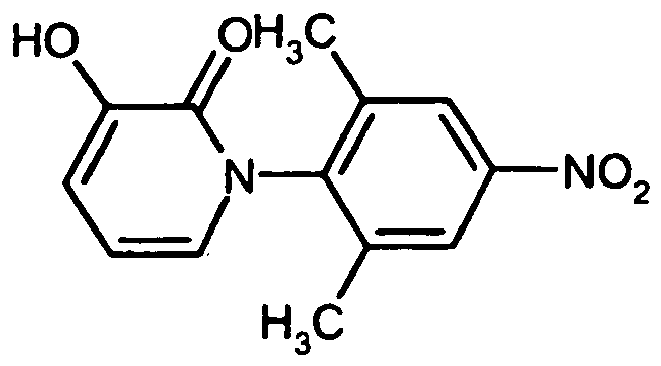
- 1.95 g (7.11 mmol) Beispiel 17A in 30 ml Dichlormethan werden bei 0°C mit 17.7 ml (17.7 mmol) einer 1-molaren Lösung von Bortribromid in Dichlormethan versetzt. Nach 2.5 h wird abgekühlt und mit 150 ml Dichlormethan verdünnt. Anschließend wird vorsichtig mit 150 ml Wasser versetzt und es wird 10 min gerührt. Nach Phasentrennung wird die wässrige Phase mit Dichlormethan gewaschen. Die vereinigten organischen Phasen werden mit gesättigter wässriger Natriumchlorid-Lösung gewaschen und dann über Natriumsulfat getrocknet. Nach Filtration werden die Lösungsmittel im Vakuum entfernt. Das so erhaltene Reaktionsprodukt (1.85 g) wird ohne weitere Aufreinigung umgesetzt.
1H-NMR (400 MHz, DMSO-d 6, δ/ppm): 9.45 (s, 1H), 8.16 (s, 2H), 6.94 (dd, 1H), 6.86 (dd, 1H), 6.31 (dd, 1H), 2.10 (s, 6H).
LC-MS (Methode 3): Rt = 1.58 min.
MS (ESIpos, m/z): 261 (M+H)+. -

- 1.37 g (5.28 mmol) Beispiel 19A in 60 ml Dichlormethan und 1.73 ml (11.6 mmol) 1,8-Diazabicyclo(5.4.0)undec-7-en werden bei 0°C mit einer Lösung von 1.12 g (8.97 mmol) Methoxyethoxymethlychlorid in 15 ml Dichlormethan versetzt. Es wird 1 h bei RT gerührt. Die Lösungsmittel werden im Vakuum entfernt und das erhaltene Reaktionsprodukt durch Chromatographie an Kieselgel (Cyclohexan/Essigsäureethylester 2:1) gereinigt. Man erhält 1.02 g (55% d. Th.) der gewünschten Verbindung.
1H-NMR (400 MHz, DMSO-d 6, δ/ppm): 8.16 (s, 2H), 7.22-7.13 (m, 2H), 6.37 (dd, 1H), 5.26 (s, 2H), 3.79-3.73 (m, 2H), 3.50-3.45 (m, 2H), 3.31 (s, 3H), 2.10 (s, 6H).
HPLC (Methode 1): Rt = 3.85 min.
MS (ESIpos, m/z): 349 (M+H)+. -

- 1.00 g (2.81 mmol) Beispiel 20A in 14 ml Ethanol werden mit 905 mg (14.4 mmol) Ammoniumformiat und 50 mg Palladium auf Kohle versetzt. Es wird 2 h bei 90°C gerührt. Nach Abkühlen wird über Kieselgur abgesaugt und zweimal mit Ethanol gespült. Die Lösungsmittel der gesammelten Filtrate werden im Vakuum entfernt. Das erhaltene Reaktionsprodukt (895 mg) wird ohne weitere Aufreinigung umgesetzt.
LC-MS (Methode 6): Rt = 1.42 min.
MS (ESIpos, mlz): 319 (M+H)+. -

- Eine Lösung von 875 mg (2.75 mmol) des Produktes aus Beispiel 21A in 50 ml Acetonitril wird mit 658 mg (3.03 mmol) des Produktes aus Beispiel 1A versetzt. Der Suspension werden 921 mg (4.13 mmol) Magnesiumperchlorat zugefügt, wonach man 6.5 h bei RT rühren lässt. Dann werden 1.15 g (6.88 mmol) 1,1'-Carbonyldiimidazol und 33 mg (0.28 mmol) DMAP hinzugesetzt und es wird bei RT gerührt. Nach 17 h wird mit 140 ml Wasser und 100 ml Essigsäureethylester verdünnt. Die Wasserphase wird zweimal mit Essigsäureethylester extrahiert und die vereinigten organischen Phasen werden über Natriumsulfat getrocknet. Nach Filtration wird vom Lösungsmittel befreit und der Rückstand durch Chromatographie an Kieselgel (Dichlormethan/Ethanol 40:1 -> 20:1) gereinigt. Nach Entfernen der Lösungsmittel erhält man 853 mg (50% d. Th.) des gewünschten Produktes.
HPLC (Methode 1): Rt = 4.11 min.
MS (ESIpos, m/z): 562 (M+H)+. -

- Zu einer Lösung von 750 mg (1.33 mmol) des Produktes aus Beispiel 22A in 3 ml Dichlormethan werden bei 0°C langsam 13.3 ml (173 mmol) Trifluoressigsäure getropft. Nach 5 h bei 0°C wird mit 200 ml Wasser und 80 ml Essigsäureethylester verdünnt. Mit Natriumhydrogencarbonat wird dann pH = 6 eingestellt und die Phasen werden getrennt. Die Wasserphase wird zweimal mit Essigsäureethylester extrahiert und die vereinigten organischen Phasen werden über Natriumsulfat getrocknet. Nach Filtration wird vom Lösungsmittel befreit. Man erhält 652 mg (100% d. Th.) des gewünschten Produktes.
1H-NMR (400 MHz, DMSO-d 6, δ/ppm): 9.25 (s, 1H), 8.98 (t, 1H), 7.70 (d, 1H), 7.39 (dd, 2H), 7.20 (d, 1H), 6.84 (dd, 1H), 6.24 (dd, 1H), 4.91-4.80 (m, 1H), 4.21 (dd, 1H), 3.90-3.83 (m, 1H), 3.70-3.57 (m, 2H), 1.97 (s, 6H).
HPLC (Methode 1): Rt = 4.09 min.
MS (DCI, m/z): 474 (M+H)+. -

- 302 mg (2.41 mmol) 3-Methoxy-Pyridon werden in 8.2 ml wasserfreiem Dimethylsulfoxid gelöst und mit 325 mg (2.89 mmol) Kalium-tert.-butylat versetzt. Nach 30 min werden 500 mg (2.41 mmol) 2-(Difluormethoxy)-1-fluor-4-nitrobenzol zugegeben und 20 h auf 80°C erhitzt. Die Reaktionslösung wird mit Dichlormethan verdünnt und mit Wasser und 1N Salzsäure gewaschen. Nach Trocknen der organischen Phase über Natriumsulfat wird filtriert und im Vakuum zur Trockene eingedampft. Der Rückstand wird in Dimethylsulfoxid gelöst und mit präparativer HPLC mit einem Wasser/Acetonitril Gradienten aufgereinigt. Die Produktfraktionen werden vereinigt und im Vakuum zur Trockene eingedampft. Man erhält 207 mg (28% d. Th.) des gewünschten Produktes.
1H-NMR (400 MHz, DMSO-d 6, δ/ppm): δ = 8.3 (dd, 1H), 8.2 (d, 1H), 7.8 (d, 1H), 7.4 (t, 1H), 7.2 (d, 1H), 6.9 (d, 1H), 6.3 (t, 1H), 3.75 (s, 3H).
LC-MS (Methode 4): Rt = 1.83 min
MS (ESIpos): m/z = 313 (M+H)+ -

- 200 mg (0.641 mmol) Beispiel werden in 20 ml einer 1:1 Mischung aus Ethanol und Essigsäureethylester gelöst und mit 202 mg (3.20 mmol) Ammoniumformiat und 50 mg Palladium auf Kohle versetzt. Es wird auf 80°C erhitzt. Nach 1 h lässt man erkalten und filtriert über Kieselgel. Dann wird mit einem 1:1 Gemisch aus Ethanol und Essigsäureethylester nachgewaschen und das Filtrat im Vakuum zur Trockene eingedampft. Man erhält 190 mg (100% d. Th.) des gewünschten Produktes.
1H-NMR (400 MHz, DMSO-d 6, δ/ppm): δ = 6.75-7.15 (m, 4H), 6.5 (s, 2H), 6.2 (t, 1H), 5.65 (m, 2H), 3.7 (s, 3H).
LC-MS (Methode 3): Rt = 1.30 min
MS (ESIpos): m/z = 283 (M+H)+ -

- 186 g (1.2 mol) 2-Fluor-5-nitro-toluol werden in 1.2 1 Tetrachlormethan gelöst und mit 214 g (1.20 mol) N-Brom-succinimid versetzt. 19.7 g (120 mmol) Azo-diisobutyronitril werden zugegeben und es wird unter Rückfluß erhitzt. Nach 16 h lässt man erkalten, filtriert und dampft im Vakuum zur Trockene ein. Der Rückstand wird in 300 ml Dichlormethan gelöst und mit 300 g Seesand versetzt. Dann wird erneut im Vakuum zur Trockene eingeengt und der Rückstand auf eine 1 kg Kieselgelsäule gegeben. Es wird mit einer 20:1 Mischung aus Cyclohexan und Essigsäureethylester chromatographiert und die Produktfraktionen werden im Vakuum zur Trockene eingedampft. Der Rückstand wird mit Cyclohexan kristallisiert und im Vakuum getrocknet. Man erhält 92 g (32% d. Th.) des gewünschten Produktes.
1H-NMR (400 MHz, DMSO-d 6, δ/ppm): δ = 8.57-8.52 (m, 1H), 8.33-8.27 (m, 1H), 7.56 (t, 1H), 4.62 (s, 2H).
GC-MS (Methode 9): Rt = 7.79 min
MS (ESIpos): m/z = 154 (M-Br)+ -

- 30 g (128 mmol) der Verbindung aus Beispiel 26A werden in 1.3 1 wasserfreiem Toluol gelöst und mit 45 g (192 mmol) Silber(I)oxid und 24.6 g (769 mmol) wasserfreiem Methanol versetzt. Es wird 16 h auf 60°C erhitzt. Dann lässt man erkalten und filtriert über Kieselgel. Das Produkt wird mit einem Gradienten von Cyclohexan und Cyclohexan/Essigsäureethylester 25:1 fraktioniert eluiert. Die Produktfraktionen werden im Vakuum zur Trockene eingedampft und im Vakuum getrocknet. Man erhält 17 g (72% d. Th.) des gewünschten Produktes.
1H-NMR (400 MHz, DMSO-d 6, δ/ppm): δ = 8.41-8.36 (m, 1H), 8.22-8.16 (m, 1H), 7.26 (t, 1H), 4.58 (s, 2H), 3.49 (s, 3H).
GC-MS (Methode 9): Rt = 6.52 min
MS (ESIpos): m/z = 154 (M-OCH3)+ -
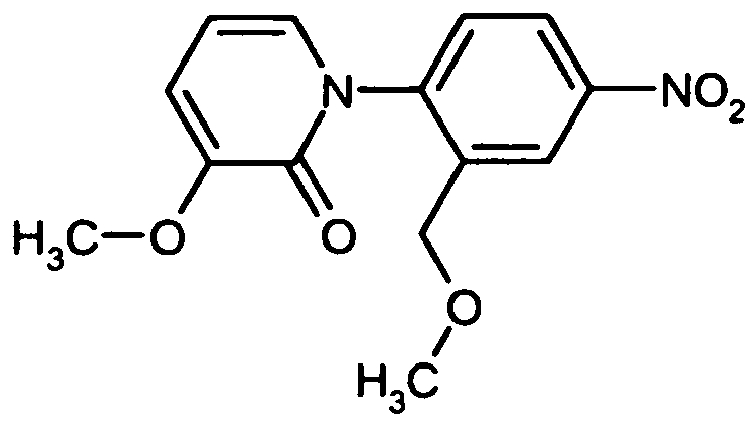
- 1.69 g (13.5 mmol) 3-Methoxy-Pyridon werden in 50 ml wasserfreiem Dimethylsulfoxid gelöst und mit 1.82 g (16.2 mmol) Kalium-tert.-butylat versetzt. Nach 1 h werden 2.5 g (13.5 mmol) Beispiel 27A gelöst in 10 ml wasserfreiem Dimethylsulfoxid zugegeben und es wird 3 h auf 80°C erhitzt. Man lässt erkalten und lässt weitere 48 h stehen, bevor die Reaktionslösung mit Essigsäureethylester verdünnt und mit Wasser und 1N Salzsäure gewaschen wird. Die organische Phase wird über Magnesiumsulfat getrocknet, filtriert und im Vakuum zur Trockene eingedampft. Der Rückstand wird mit tert.-Butylmethylether versetzt und die sich abscheidenden Kristalle werden abfiltriert und im Vakuum getrocknet. Man erhält 2.05 g (52% d. Th.) des gewünschten Produktes.
1H-NMR (400 MHz, DMSO-d 6, δ/ppm): δ = 8.45 (d, 1H), 8.25 (dd, 1H), 7.6 (d, 1H), 7.15 (d, 1H), 6.9 (d, 1H), 6.3 (t, 1H), 4.25 (q, 2H), 3.75 (s, 3H) 3.2 (s, 3H).
LC-MS (Methode 4): Rt = 1.82 min
MS (ESIpos): m/z = 291 (M+H)+ -
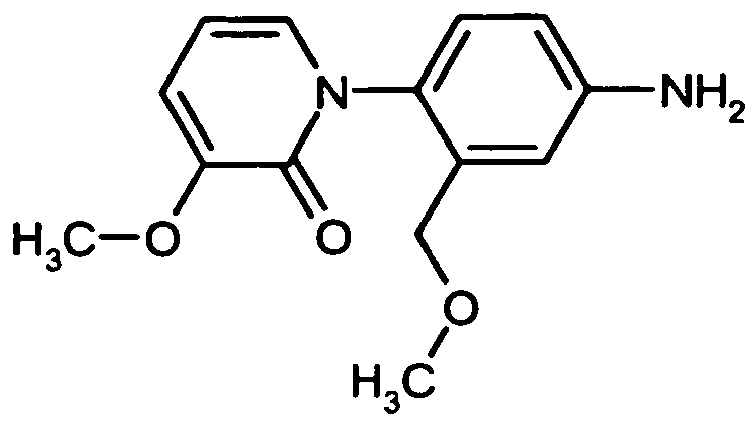
- 2.00 g (6.89 mmol) Beispiel 28A werden in 140 ml einer 1:1 Mischung aus Ethanol und Essigsäureethylester gelöst und mit 2.17 g (34.4 mmol) Ammoniumformiat und 200 mg Palladium auf Kohle versetzt. Es wird auf 80°C erhitzt. Nach 30 min lässt man erkalten und filtriert über Kieselgel. Es wird mit einem 1:1 Gemisch aus Ethanol und Essigsäureethylester nachgewaschen und das Filtrat im Vakuum zur Trockene eingedampft. Man erhält 1.90 g (99% d. Th.) des gewünschten Produktes.
LC-MS (Methode 4): Rt = 1.34 min
MS (ESIpos): m/z = 261 (M+H)+ -
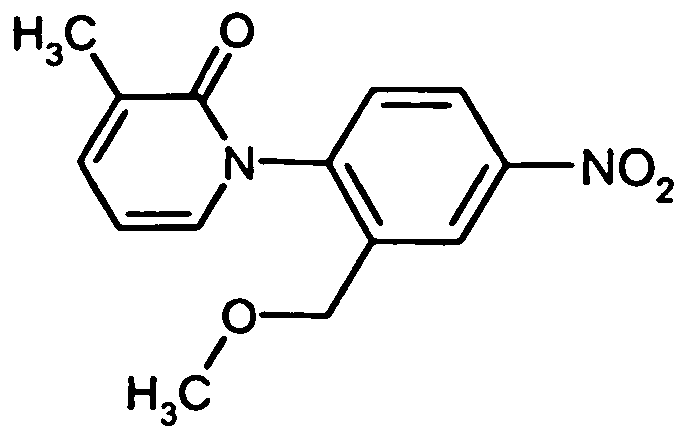
- 1.47 g (13.5 mmol) 3-Methyl-2-Pyridon werden in 50 ml wasserfreiem Dimethylsulfoxid gelöst und mit 1.82 g (16.2 mmol) Kalium-tert.-butylat versetzt. Nach 1 h werden 2.5 g (13.5 mmol) Beispiel 27A, gelöst in 10 ml wasserfreiem Dimethylsulfoxid zugegeben und es wird 3 h auf 80°C erhitzt. Man lässt erkalten und weitere 48 h stehen, bevor die Reaktionslösung mit Essigsäureethylester verdünnt und mit Wasser und 1N Salzsäure gewaschen wird. Die organische Phase wird über Magnesiumsulfat getrocknet, filtriert und im Vakuum zur Trockene eingedampft. Der Rückstand wird auf Kieselgel aufgezogen und an Kieselgel mit einer Mischung aus Cyclohexan und Essigsäureethylester 1:1 getrennt. Die Produktfraktionen werden vereinigt und im Vakuum zur Trockene eingedampft. Man erhält 2.05 g (55% d. Th.) des gewünschten Produktes.
1H-NMR (400 MHz, DMSO-d 6, δ/ppm): δ = 8.45 (d, 1H), 8.25 (dd, 1H), 7.6 (d, 1H), 7.4 (m, 2H), 6.3 (t, 1H), 4.4-4.1 (q, 2H), 3.25 (s, 3H) 2.05 (s, 3H). -

- 2.00 g (7.29 mmol) Beispiel 30A werden in 150 ml einer 1:1 Mischung aus Ethanol und Essigsäureethylester gelöst und mit 2.60 g (36.5 mmol) Ammoniumformiat und 200 mg Palladium auf Kohle versetzt. Es wird auf 80°C erhitzt. Nach 30 min lässt man erkalten und filtriert über Kieselgel. Es wird mit einem 1:1 Gemisch aus Ethanol und Essigsäureethylester nachgewaschen und das Filtrat im Vakuum zur Trockene eingedampft. Man erhält 1.81 g (99% d. Th.) des gewünschten Produktes.
LC-MS (Methode 4): Rt= 1.47 min
MS (ESIpos): m/z = 245 (M+H)+ -

- 15 g (64.1 mmol) Beispiel 26A werden in 500 ml wasserfreiem Toluol gelöst und mit 22.3 g (96.1 mmol) Silber(I)oxid und 187 ml (3.20 mol) wasserfreiem Ethanol versetzt. Nach 96 h bei 60°C läßt man erkalten und filtriert über Kieselgel. Es wird mit Toluol nachgewaschen und das Filtrat im Vakuum zur Trockene eingedampft. Der Rückstand wird mit präparativer HPLC mit einem Gradienten aus Wasser und Acetonitril aufgereinigt. Die Produktfraktionen werden vereinigt und im Vakuum zur Trockene eingedampft. Man erhält 3.0 g (24% d. Th.) des gewünschten Produktes.
1H-NMR (400 MHz, DMSO-d 6, δ/ppm): δ = 8.45 (m, 1H), 8.25 (m, 1H), 7.5 (t, 1H), 4.6 (s, 2H), 3.55 (q, 2H), 1.2 (t, 3H).
GC-MS (Methode 9): Rt = 6.91 min
MS (ESIpos): m/z = 154 (M-OC2H5)+ -

- 273 mg (2.51 mmol) 3-Methyl-2-pyridon werden in 10 ml wasserfreiem Dimethylsulfoxid gelöst und mit 338 g (3.01 mmol) Kalium-tert.-butylat versetzt. Nach 1 h werden 500 mg (2.51 mmol) Beispiel 32A zugegeben und es wird 16 h auf 80°C erhitzt. Man lässt erkalten und versetzt mit gesättigter Natriumchloridlösung. Die Mischung wird mehrmals mit Dichlormethan extrahiert, die organische Phase zweimal mit Wasser und zweimal mit gesättigter Natriumchloridlösung gewaschen, über Natriumsulfat getrocknet, filtriert und im Vakuum zur Trockene eingedampft. Der Rückstand wird in 5 ml Dimethylsulfoxid gelöst und mit präparativer HPLC mit einem Gradienten aus Wasser und Acetonitril aufgereinigt. Die Produktfraktionen werden vereinigt und im Vakuum zur Trockene eingedampft. Man erhält 430 mg (59% d. Th.) des gewünschten Produktes.
1H-NMR (400 MHz, DMSO-d6 , δ/ppm): δ= 8.4 (d, 1H), 8.3 (dd, 1H), 7.6 (d, 1H), 7.45 (m, 2H), 6.3 (t, 1H), 4.4-4.1 (q, 2H), 3.4 (m, 2H) 2.05 (s, 3H), 1.1 (t, 3H).
LC-MS (Methode 4) Rt = 2.04 min
MS (ESIpos): m/z = 289 (M+H)+ -

- 425 mg (1.47 mmol) Beispiel 33A werden in 30 ml einer 1:1 Mischung aus Ethanol und Essigsäureethylester gelöst und mit 465 mg (7.37 mmol) Ammoniumformiat und 50 mg Palladium auf Kohle versetzt. Es wird auf 80°C erhitzt. Nach 30 min lässt man erkalten und filtriert über Kieselgel. Es wird mit Essigsäureethylester nachgewaschen und das Filtrat im Vakuum zur Trockene eingedampft. Man erhält 388 mg (99% d. Th.) des gewünschten Produktes.
LC-MS (Methode 4): Rt = 1.28 min
MS (ESIpos): m/z = 259 (M+H)+ -

- 20 g (85.5 mmol) der Verbindung aus Beispiel 26A werden in 250 ml wasserfreiem Toluol gelöst und mit 22.4 g (85.5 mmol) Triphenylphosphin versetzt. Die Lösung wird 16 h unter Rückfluss erhitzt, wobei sich ein Niederschlag abscheidet. Man lässt erkalten und filtriert den Niederschlag ab. Nach Waschen mit Diethylether wird im Vakuum getrocknet. Man erhält 39 g (92% d. Th.) des gewünschten Produktes.
1H-NMR (400 MHz, DMSO-d6 , δ/ppm): δ = 8.30-8.23 (m, 1H), 7.98-7.88 (m, 4H), 7.81-7.70 (m, 12H), 7.45 (t, 1H), 5.32 (d, 2H). -

- Bei 10°C werden zu einer Lösung von 13.5 g (27.3 mmol) der Verbindung aus Beispiel 35A in 145 ml Dioxan 5.99 g (32.7 mmol) Natriumbis(trimethylsiliy)amid getropft. Es wird 1 h bei dieser Temperatur gerührt. Dann wird eine Lösung von 2.40 g (54.5 mmol) Acetaldehyd in 5 ml Dioxan zugegeben und die Reaktion 1 h bei RT gerührt, anschließend mit 400 ml Wasser versetzt, dreimal mit Dichlormethan extrahiert und die vereinigten organischen Phasen zweimal mit gesättigter wässriger Natriumchlorid-Lösung gewaschen. Nach Trocknen über Natriumsulfat und anschließender Filtration wird das Lösungsmittel im Vakuum entfernt. Man reinigt mittels Chromatographie an Kieselgel (Eluens: Cyclohexan/Essigsäureethylester = 40:1). Es werden 5.2 g (100% d. Th.) des gewünschten Produktes als E/Z-Isomeren-Gemisch erhalten.
1H-NMR (400 MHz, DMSO-d6, δ/ppm): δ = 8.47-8.05 (m, 2H), 7.58-7.42 (m, 1H), 6.70-6.05 (m, 2H), 1.90-1.78 (m, 3H).
GC-MS (Methode 10): Rt = 2.64 und 2.70 min
MS (ESIpos): m/z = 181 (M+H+)+ -

- 223 mg (2.35 mmol) Pyridin-2(1H)-on werden in 10 ml wasserfreiem Dimethylsulfoxid gelöst und mit 315 mg (2.82 mmol) Kalium-tert.-butylat versetzt. Nach 1 h werden 500 mg (2.76 mmol) Beispiel 36A zugegeben und es wird 15 h auf 80°C erhitzt. Man lässt erkalten und verdünnt mit Wasser und gesättigter Natriumchloridlösung. Die Lösung wird mehrmals mit Dichlormethan extrahiert. Die vereinigten organischen Phasen werden mit Wasser und mit gesättigter Natriumchloridlösung gewaschen, über Natriumsulfat getrocknet, filtriert und im Vakuum zur Trockene eingedampft. Der Rückstand wird mit präparativer HPLC mit einem Gradienten aus Wasser und Acetonitril aufgereinigt. Die Produktfraktionen werden vereinigt und im Vakuum zur Trockene eingedampft. Man erhält 103 mg (17% d. Th.) des gewünschten Produktes.
1H-NMR (400 MHz, DMSO-d6, δ/ppm): δ = 8.5 (d, 1H), 8.2 (dd, 1H), 7.65-7.50 (m, 3H), 6.65-6.50 (m, 2H), 6.4 (t, 1 H), 6.0 (d, 1H), 1.8 (dd, 3H).
LC-MS (Methode 5): Rt = 1.88 min
MS (ESIpos): m/z = 257 (M+H)+ -

- 103 mg (0.40 mmol) Beispiel 37A werden in 10 ml einer 1:1 Mischung aus Ethanol und Essigsäureethylester gelöst und im Durchfluss in einem H-Cube (Fa. Thales-Nanotechnologies, Ungarn) bei Normaldruck an Palladium auf Kohle hydriert. Die erhaltene Lösung wird im Vakuum zur Trockene eingedampft. Man erhält 90 mg (83% d. Th.) des gewünschten Produktes.
LC-MS (Methode 7): Rt = 2.77 min
MS (ESIpos): m/z = 229 (M+H)+ -

- 2.5 g (15.3 mmol) 3-(Trifluormethyl)pyridin-2(1H)-on werden in 40 ml Dimethylsulfoxid gelöst und bei Raumtemperatur mit 2.58 g (22.9 mmol) Kalium-tert.-butylat versetzt. Die Suspension wird 30 min bei Raumtemperatur gerührt, bevor 2.6 g (16.9 mmol) 1-Fluor-2-methyl-4-nitrobenzol zugesetzt werden und die Reaktionslösung für 20 h auf 80°C erhitzt wird. Es wird vorsichtig mit Wasser verdünnt. Die Lösung wird mehrmals mit Dichlormethan extrahiert. Die vereinigten organischen Extrakte werden mit Wasser und gesättigter Natriumchloridlösung gewaschen, über Magnesiumsulfat getrocknet, filtriert und im Vakuum eingedampft. Man löst den Rückstand in Acetonitril an reinigt mit präparativer HPLC mit einem Gradienten aus Wasser und Acetonitril auf. Die Produktfraktionen werden vereinigt und im Vakuum zur Trockene eingedampft. Man erhält 1.87 g (41% d. Th.) des gewünschten Produktes.
1H-NMR (400 MHz, DMSO-d6 , δ/ppm): 8.4 (d, 1H), 8.2 (dd, 1H), 8.15 (d, 1H), 8.0 (dd, 1H), 7.7 (d, 1H), 6.55 (t, 1H), 2.2 (s, 3H).
LC-MS (Methode 6): Rt = 2.26 min
MS (ESIpos): m/z = 488 (M+H)+ -

- 800 mg (2.68 mmol) Beispiel 39A werden in 108 ml einer 1:1 Mischung aus Ethanol und Essigsäureethylester gelöst und mit 1.02 g (16.1 mmol) Ammoniumformiat und 50 mg Palladium auf Kohle versetzt. Es wird auf 80°C erhitzt. Nach 45 min lässt man erkalten und filtriert über Kieselgel. Es wird mit Essigsäureethylester nachgewaschen und das Filtrat im Vakuum zur Trockene eingedampft. Man erhält 780 mg (100% d. Th.) des gewünschten Produktes.
1H-NMR (400 MHz, DMSO-d6 , δ/ppm): δ = 8.05 (d, 1H), 7.8 (d, 1H), 6.9 (d, 1H), 6.5-6.3 (m, 3H), 5.3 (s, 2H), 1.8 (s, 3H).
LC-MS (Methode 3): Rt= 1.42 min
MS (ESIpos): m/z = 269 (M+H)+ -

- 44.5 g (280 mmol) 3-Brompyridin-2(1H)-on werden in 750 ml wasserfreiem Dimethylsulfoxid gelöst und bei Raumtemperatur portionsweise mit 33.4 g (298 mmol) Kalium-tert-butylat versetzt. Die Suspension wird 1 h bei dieser Temperatur gerührt, bevor 38.5 g (280 mmol) 1-Fluor-2-methyl-4-nitrobenzol zugesetzt werden und die Reaktionslösung für 20 h auf 80°C erhitzt wird. Man läßt erkalten und es wird vorsichtig mit Wasser verdünnt. Der ausgefallene kristalline Niederschlag wird abfiltriert, mit etwas Wasser gewaschen und im Vakuum getrocknet. Es werden 62 g (80% d. Th.) des gewünschten Produktes erhalten.
1H-NMR (400 MHz, DMSO-d6, δ/ppm): δ = 8.34 (d, 1H), 8.21 (dd, 1H), 8.10 (dd, 1H), 7.71-7.63 (m, 2H), 6.36 (t, 1H), 2.17 (s, 3H).
LC-MS (Methode 3): Rt = 1.72 min
MS (ESIpos): m/z = 309 (M+H)+ -

- 50 g (162 mmol) der Verbindung aus Beispiel 41A werden in 700 ml wasserfreiem Dioxan gelöst und mit 62 g (194 mmol) Tributylvinyl-zinn und 4.7 g (4.0 mmol) Tetrakis(triphenylphosphin)-palladium versetzt und es wird 15 h am Rückfluss erhitzt. Man lässt erkalten und filtriert über Kieselgur. Es wird mit Essigsäureethylester nachgewaschen und die vereinigten Filtrate werden im Vakuum zur Trockene eingeengt. Der Rückstand wird auf Kieslegel aufgezogen und an 800 g Kieselgel mit einem Gradienten aus Cyclohexan und Essigsäureethylester chromatographiert. Es werden 27 g (62% d. Th.) des gewünschten Produktes erhalten.
1H-NMR (400 MHz, DMSO-d6, δ/ppm): δ = 8.35 (d, 1H), 8.2 (dd, 1H), 7.75 (dd, 1H), 7.60 (d, 1H), 7.55 (dd, 1H), 6.75 (dd, 1H), 6.45 (t, 1H), 6.15 (dd, 1H), 5.30 (dd, 1H), 2.17 (s, 3H).
LC-MS (Methode 4): Rt = 1.86 min
MS (ESIpos): m/z = 257 (M+H)+ -

- 38 g (148 mmol) der Verbindung aus Beispiel 42A werden unter Eiskühlung innerhalb von 45 min mit einer Lösung von 40 g (326 mmol) 9-Borabicyclo[3.3.1]nonan in 650 ml Tetrahydrofuran versetzt. Bei dieser Temperatur wird eine weitere Stunde nachgerührt, bevor mit einer Lösung von 30 g (747 mmol) Natriumhydroxid in 740 ml Wasser innerhalb von 15 min versetzt wird. Es werden 151 ml einer 30%igen Wasserstoffperoxidlösung so zugegeben, dass die Temperatur 30°C nicht übersteigt. Nach beendeter Zugabe wird die Kühlung entfernt und es werden weitere 30 min nachgerührt. Es wird mehrmals mit Essigsäureethylester extrahiert. Die vereinigten organischen Phasen werden mit einer Lösung aus 780 g (1.63 mol) Natriumdisulfit gewaschen, die organische Phase abgetrennt und die wässrige Phase erneut mit Essigsäureethylester extrahiert. Die vereinigten organischen Phasen werden mit gesättigter Natriumchloridlösung gewaschen, über Magnesiumsulfat getrocknet und im Vakuum zur Trockene eingedampft. Der Rückstand wird auf Kieselgel aufgezogen und mit einem Gradienten aus Cyclohexan und Essigsäureethylester chromatographiert. Die produkthaltigen Fraktionen werden vereinigt und im Vakuum zur Trockene eingeengt. Es werden 38 mg (93% d. Th.) des gewünschten Produktes erhalten.
1H-NMR (400 MHz, DMSO-d6, δ/ppm): δ = 8.33 (d, 1H), 8.18 (d, 1H), 7.57 (d, 1H), 7.48-7.40 (m, 2H), 6.33 (t, 1H), 4.58 (t, 1H), 3.62-3.50 (m, 2H), 2.62 (t, 2H), 2.15 (s, 3H).
LC-MS (Methode 6): Rt = 1.57 min
MS (ESIpos): m/z = 275 (M+H)+ -

- 135 mg (0.49 mmol) Beispiel 43A werden in 1 ml wasserfreiem N,N-Dimethylformamid gelöst und mit 24 mg (0.59 mmol) Natriumhydrid versetzt. Man läßt weitere 30 min rühren bevor 153 mg (1 mmol) Jodethan zugegeben werden. Nach 3 h werden erneut 48 mg (1.21 mmol) Natriumhydrid und 307 mg (1.97 mmol) Iodethan zugegeben bevor weitere 30 min nachgerührt wird. Es wird mit Wasser versetzt, filtriert, und das Filtrat wird mit präparativer HPLC mit einem Gradienten aus Wasser und Acetonitril aufgereinigt. Die Produktfraktionen werden vereinigt und im Vakuum zur Trockene eingedampft. Man erhält 92 mg (62% d. Th.) des gewünschten Produktes.
1H-NMR (400 MHz, DMSO-d6 δ/ppm): δ = 8.35 (d, 1H), 8.2 (dd, 1H), 7.6 (d, 1H), 7.45 (m, 2H), 6.35 (t, 1H), 3.6 (t, 2H), 3.4 (q, 2H), 2.7 (t, 2H), 2.15 (s, 3H), 1.1 (t, 3H).
LC-MS (Methode 5): Rt = 2.00 min
MS (ESIpos): m/z = 303 (M+H)+ -

- 90 mg (0.30 mmol) Beispiel 44A werden in 12 ml einer 1:1 Mischung aus Ethanol und Essigsäureethylester gelöst und mit 113 mg (1.79 mmol) Ammoniumformiat und 50 mg Palladium auf Kohle versetzt. Es wird auf 80°C erhitzt. Man lässt nach 1 h erkalten und filtriert über Kieselgel. Es wird mit Essigsäureethylester nachgewaschen und das Filtrat im Vakuum zur Trockene eingedampft. Man erhält 80 mg (99% d. Th.) des gewünschten Produktes.
1H-NMR (400 MHz, DMSO-d6 δlppm): δ = 7.4 (d, 1H), 7.3 (dd, 1H), 6.8 (d, 1H), 6.5-6.4 (m, 2H), 6.2 (t, 1H), 5.2 (s,2H), 3.55 (t, 2H), 3.45 (q, 2H), 2.65 (t, 2H), 1.8 (s, 3H); 1.1 (t, 3H).
LC-MS (Methode 3): Rt = 1.30 min
MS (ESIpos): m/z=273 (M+H)+ -

- 135 mg (0.49 mmol) Beispiel 43A werden in 1 ml wasserfreiem N,N-Dimethylformamid gelöst und mit 24 mg (0.59 mmol) Natriumhydrid versetzt. Man läßt weitere 30 min rühren bevor 139 mg (1 mmol) Jodmethan zugegeben werden. Nach 3 h werden erneut 48 mg (1.21 mmol) Natriumhydrid und 278 mg (1.97 mmol) Iodmethan zugegeben und es wird weitere 30 min nachgerührt. Dann wird mit Wasser versetzt, filtriert, und das Filtrat wird mit präparativer HPLC mit einem Gradienten aus Wasser und Acetonitril aufgereinigt. Die Produktfraktionen werden vereinigt und im Vakuum zur Trockene eingedampft. Man erhält 94 mg (66% d. Th.) des gewünschten Produktes.
1H-NMR (400 MHz, DMSO-d6 , δ/ppm): δ = 8.3 (d, 1H), 8.15 (dd, 1H), 7.6 (d, 1H), 7.45 (d, 2H), 6.35 (t, 1H), 3.55 (t, 2H), 3.3 (s, 3H), 2.7 (t, 2H), 2.15 (s, 3H).
LC-MS (Methode 5): Rt = 1.82 min
MS (ESIpos): m/z = 289 (M+H)+ -

- 93 mg (0.32 mmol) Beispiel 46A werden in 13 ml einer 1:1 Mischung aus Ethanol und Essigsäureethylester gelöst und mit 122 mg (1.94 mmol) Ammoniumformiat und 50 mg Palladium auf Kohle versetzt. Es wird auf 80°C erhitzt. Nach 1 h lässt man erkalten und filtriert über Kieselgel. Es wird mit Essigsäureethylester nachgewaschen und das Filtrat im Vakuum zur Trockene eingedampft. Man erhält 83 mg (93% d. Th.) des gewünschten Produktes.
1H-NMR (400 MHz, DMSO-d6 , δ/ppm): δ = 7.35 (d, 1H), 7.3 (dd, 1H), 6.8 (d, 1H), 6.5-6.4 (m, 2H), 6.2 (t, 1H), 5.2 (s, 2H), 3.55 (t, 2H), 3.35 (s, 3H), 2.65 (t, 2H), 1.8 (s, 3H).
LC-MS (Methode 3): Rt = 1.12 min
MS (ESIpos): m/z = 259 (M+H)+ -

- Man kühlt eine frisch bereitete LDA-Lösung (68.0 mmol) in 500 ml THF auf-75°C und setzt 6.00 g (61.8 mmol) 2-Fluorpyridin hinzu. Man läßt 2 h bei dieser Temperatur rühren, wobei sich eine Suspension bildet. Man gibt im Anschluß 4.31 g (74.2 mmol) Propanal hinzu, wobei die Innentemperatur auf -45°C ansteigt. Nach 2 h läßt man auf RT kommen, gießt auf gesättigte Ammoniumchlorid-Lösung und extrahiert dreimal mit tert-Butylmethylether. Die vereinten organischen Phasen werden mit Natriumchlorid-Lösung gewaschen, über Natriumsulfat getrocknet und eingeengt. Man reinigt durch Chromatographie an Kieselgel (Eluens Dichlormethan, dann Dichlormethan/Methanol = 25:1). Man erhält 8.00 g (76% d. Th.) der Titelverbindung.
1H-NMR (400 MHz, DMSO-d6 , δ/ppm): 8.13-8.09 (m, 1H), 7.99 (ddd, 1H), 7.36 (ddd, 1H), 5.42 (d, 1H), 4.68 (dq, 1H), 1.72-1.56 (m, 2H), 0.85 (t, 3H).
HPLC (Methode 4): Rt = 1.50 min.
MS (ESIpos, m/z): 156 (M+H)+. -

- 2.75 g (17.7 mmol) des Produktes aus Beispiel 48A werden in 12 ml Eisessig gelöst und mit 4 ml konzentrierter Schwefelsäure versetzt. Man erhitzt 30 min lang auf 130°C und rührt nach dem Abkühlen in Eiswasser ein. Man stellt mit Natronlauge einen pH-Wert von 8 ein und extrahiert dann mit Dichlormethan. Die vereinten organischen Phasen werden über Natriumsulfat getrocknet und vorsichtig eingeengt. Man erhält 3.30 g (94% d. Th.) der Titelverbindung, die ohne Aufreinigung weiter umgesetzt wird.
1H-NMR (400 MHz, DMSO-d6, δ/ppm): 8.21-8.18 (m, 1H), 7.97 (ddd, 1H), 7.39 (ddd, 1H), 5.71 (t, 1H), 2.07 (s, 3H), 1.90-1.77 (m, 2H), 0.85 (t, 3H).
HPLC (Methode 4): Rt = 2.16 min.
MS (ESIpos, m/z): 198 (M+H)+. -

- 3.50 g (17.7 mmol) des Produktes aus Beispiel 49A werden in 30 ml Ethanol gelöst und mit 2.00 g 10%igem Palladium auf Aktivkohle versetzt. Man hydriert über Nacht in einer Wasserstoffatmosphäre unter normalem Druck. Man saugt ab, wäscht mit Ethanol nach und engt vorsichtig im Vakuum ein. Man erhält 1.9 g ca. 89%iges Produkt (69% d. Th.), das ohne Aufreinigung weiter umgesetzt wird.
1H-NMR (400 MHz, DMSO-d6 , δ/ppm): 8.08-8.05 (m, 1H), 7.84 (ddd, 1H), 7.28 (ddd, 1H), 2.58 (t, 2H), 1.63-1.54 (m, 2H), 0.90 (t, 3H).
HPLC (Methode 6): Rt = 3.54 min.
MS (ESIpos, m/z): 140 (M+H)+. -

- Die Titelverbindung wird analog zu Beispiel 55A aus 1.90 g (13.7 mmol) des Produktes aus Beispiel 50A synthetisiert. Man erhält 1.50 g (80% d. Th.) der gewünschten Verbindung.
1H-NMR (400 MHz, DMSO-d 6, δ/ppm): 11.42 (s, breit, 1H), 7.23 (dd, 1H), 7.19 (dd, 1H), 6.09 (t, 1H), 2.33 (t, 2H), 1.55-1.44 (m, 2H), 0.87 (t, 3H).
HPLC (Methode 6): Rt = 2.72 min.
MS (ESIpos, m/z): 138 (M+H)+. -

- 500 mg (3.65 mmol) des Produktes aus Beispiel 51A werden in 7.3 ml DMF gelöst und auf 0°C gekühlt. Man gibt 613 mg (5.47 mmol) Kalium-tert-butylat hinzu und lässt 30 min bei RT nachrühren. Dann werden 624 mg (3.65 mmol) 1-Fluor-2-methoxy-4-nitrobenzol hinzugefügt. Man rührt 6 h bei RT, setzt Wasser hinzu und extrahiert viermal mit Essigsäureethylester. Die vereinten organischen Phasen werden über Natriumsulfat getrocknet und eingeengt. Man reinigt durch präparative HPLC. Die erhaltene Produktfraktion wird durch Chromatographie an Kieselgel (Eluens: Dichlormethan, dann Dichlormethan/Methanol 10:1) weiter aufgereinigt. Man erhält 158 mg (15% d. Th.) der gewünschten Verbindung als Feststoff.
1H-NMR (400 MHz, DMSO-d6 , δ/ppm): 7.97 (d, 1H), 7.93 (dd, 1H), 7.61 (d, 1H), 7.40-7.33 (m, 2H), 6.26 (t, 1H), 3.89 (s, 3H), 2.43-2.36 (m, 2H), 1.60-1.48 (m, 2H), 0.91 (t, 3H).
HPLC (Methode 5): Rt = 2.19 min.
MS (ESIpos, m/z): 289 (M+H)+. -
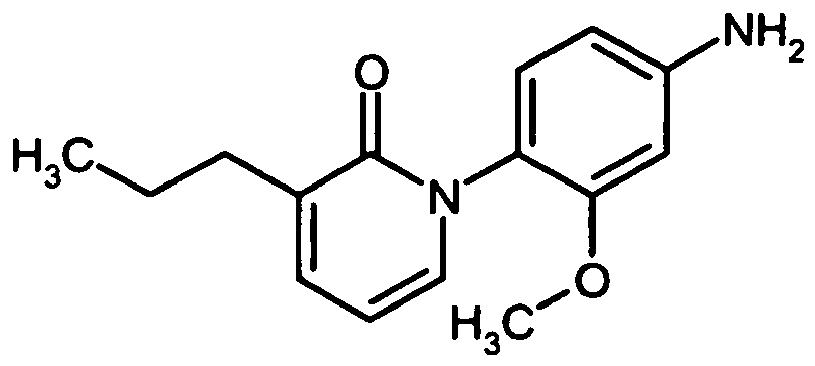
- 130 mg (0.45 mmol) des Produktes aus Beispiel 52A werden in 4 ml THF vorgelegt. Man gibt 50 mg 10%iges Palladium auf Aktivkohle hinzu und hydriert 1 h bei normalem Druck in einer Wasserstoff-Atmosphäre. Die Reaktionslösung wird dann durch Celite filtriert, das mit Essigsäureethylester nachgespült wird. Man engt im Vakuum ein und erhält 115 mg (99% d. Th.) der kristallinen Titelverbindung.
1H-NMR (400 MHz, DMSO-d6 , δ/ppm): 7.25-7.19 (m, 2H), 6.80 (d, 1H), 6.32 (d, 1H), 6.17 (dd, 1H), 6.11 (t, 1H), 5.75 (s, breit, 2H), 3.62 (s, 3H), 2.40-2.32 (m, 2H), 1.56-1.46 (m, 2H), 0.90 (t, 3H).
HPLC (Methode 3): Rt = 1.56 min.
MS (ESIpos, m/z): 259 (M+H)+. -

- 2.00 g (7.17 mmol) 2-Iod-5-nitroanisol, 2.02 g (14.3 mmol) (2-Fluorpyridin-3-yl)boronsäure (A. Bouillon, J.-C. Lancelot, V. Collot, P. R. Bovy, S. Rault, Tetrahedron 2002, 58, 3323-3328.), 1.81 g (21.5 mmol) Natriumhydrogencarbonat und 117 mg (0.14 mmol) [1,1'-Bis(diphenylphosphino)-ferrocen]-palladiumdichlorid werden in einer entgasten Mischung aus 40 ml Dioxan und 10 ml Wasser 1 h auf 100°C erhitzt. Man verdünnt nach dem Abkühlen mit Wasser und extrahiert dreimal mit Essigsäureethylester. Die vereinten organischen Phasen werden über Natriumsulfat getrocknet, über Aktivkohle geklärt und eingeengt. Man reinigt durch Chromatographie an Kieselgel (Eluens: Dichlormethan) und erhält 1.55 g (87% d. Th.) des gewünschten Produktes.
1H-NMR (400 MHz, DMSO-d6, δ/ppm): 3.32 (d, 1H), 8.02 (ddd, 1H), 7.95 (dd, 1H), 7.92 (d, 1H), 7.64 (d, 1H), 7.49 (ddd, 1H), 4.10 (s, 3H).
HPLC (Methode 6): Rt = 3.61 min.
MS (ESIpos, m/z): 249 (M+H)+. -

- Man erhitzt 1.50 g (6.04 mmol) des Produkts aus Beispiel 54A über Nacht in einer Mischung aus 75 ml Dioxan und 75 ml 4-molarer Salzsäure. Dann stellt man mit Natriumcarbonatlösung alkalisch. Der Niederschlag wird abgesaugt, mit Wasser nachgewaschen und getrocknet. Man erhält 1.43 g (96% d. Th.) der gewünschten Verbindung.
1H-NMR (400 MHz, DMSO-d6, δ/ppm): 11.82 (s, breit, 1H), 7.85 (dd, 1H), 7.82 (d, 1H), 7.57 (d, 1H), 7.52 (dd, 1H), 7.44 (dd, 1H), 6.28 (t, 1H), 3.86 (s, 3H).
HPLC (Methode 3): Rt = 1.40 min.
MS (ESIpos, m/z): 247 (M+H)+. -

- 350 mg (1.42 mmol) des Produktes aus Beispiel 55A werden in 3.5 ml DMF suspendiert. Man setzt 393 mg (2.84 mmol) Kaliumcarbonat und 266 mg (1.71 mmol) Iodethan hinzu und läßt 3 h bei RT rühren. Dann wird mit Wasser versetzt und mit Dichlormethan extrahiert. Man trocknet die organische Lösung über Natriumsulfat, engt ein und reingt durch präparative HPLC. Man erhält 224 mg (57% d. Th.) der Titelverbindung.
1H-NMR (400 MHz, DMSO-d6 , δ/ppm): 7.87-7.81 (m, 2H), 7.78 (d, 1H), 7.56 (d, 1H), 7.48 (dd, 1H), 6.33 (t, 1H), 3.96 (q, 2H), 3.86 (s, 3H), 1.25 (t, 3H).
HPLC (Methode 5): Rt = 1.88 min.
MS (ESIpos, mlz): 275 (M+H)+. -

- 196 mg (0.72 mmol) des Produktes aus Beispiel 56A werden analog Beispiel 53A hydriert. Man erhält 184 mg (98% d. Th.) der Titelverbindung.
1H-NMR (400 MHz, DMSO-d6 , δ/ppm): 7.57 (dd, 1H), 7.24 (dd, 1H), 6.91 (d, 1H), 6.25 (d, 1H), 6.19 (t, 1H), 6.14 (dd, 1H), 5.14 (s, 2H), 3.91 (q, 2H), 3.61 (s, 3H), 1.21 (t, 3H).
HPLC (Methode 3): Rt = 0.92 min.
MS (ESIpos, m/z): 244 (M+H)+. -

- 350 mg (1.42 mmol) des Produktes aus Beispiel 55A werden analog Beispiel 56A mit 242 mg (1.71 mmol) Methyliodid alkyliert. Man erhält 347 mg (88% d. Th.) der Titelverbindung.
1H-NMR (400 MHz, DMSO-d6, δ/ppm): 7.85 (d, 1H), 7.82 (d, 1H), 7.78 (dd, 1H), 7.54 (d, 1H), 7.48 (dd, 1H), 6.31 (t, 1H), 3.85 (s, 3H), 3.48 (s, 3H).
HPLC (Methode 4): Rt = 1.77 min.
MS (ESIpos, m/z): 261 (M+H)+. -

- 320 mg (1.23 mmol) des Produktes aus Beispiel 58A werden analog Beispiel 53A hydriert. Man erhält 320 mg (85% Reinheit, 96% d. Th.) der Titelverbindung.
1H-NMR (400 MHz, DMSO-d6, δlppm): 7.57 (dd, 1H), 7.25 (dd, 1H), 6.89 (d, 1H), 6.25 (d, 1H), 6.18 (t, 1H), 6.14 (dd, 1H), 5.14 (s, 2H), 3.61 (s, 3H), 3.43 (s, 3H).
HPLC (Methode 3): Rt = 0.62 min.
MS (ESIpos, m/z): 231 (M+H)+. -

- 16.1 g (76.1 mmol) Kaliumphosphat und 0.362 g (1.90 mmol) Kupfer(I)iodid werden vorgelegt, die Apparatur ausgeheizt und anschließend mit Argon gespült. 10.0 g (38.1 mmol) 1-Iod-2-methyl-4-nitrobenzol, 6.51 g (57.0 mmol) 1-Methyltetrahydropyrimidin-2(1H)-on und 0.394 g (3.80 mmol) N,N'-Dimethylendiamin in 200 ml Dioxan werden zugegeben und es wird bei 110°C gerührt. Nach 19 h wird nach Abkühlen über Kieselgur abgesaugt und dann dreimal mit 100 ml Essigsäureethylester gewaschen. Die Lösungsmittel wird im Vakuum entfernt und der Rückstand durch Chromatographie an Kieselgel (Cyclohexan/Essigsäureethylester 2:1 -> 1:1) gereinigt. Man erhält 5.94 g (63% d. Th.) der gewünschten Verbindung.
1H-NMR (400 MHz, DMSO-d6 , δ/ppm): 8.12 (d, 1H), 8.04 (dd, 1H), 7.43 (d, 1H), 3.78-3.61 (m, 1H), 3.46-3.34 (m, 3H), 2.86 (s, 3H), 2.25 (s, 3H), 2.10-2.01 (m, 2H).
HPLC (Methode 1): Rt = 3.73 min.
MS (DCI, m/z): 250 (M+H)+. -
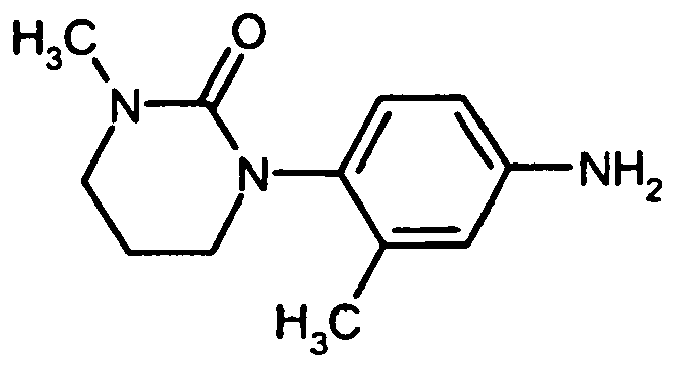
- 60 mg (0.24 mmol) Beispiel 60A werden in 10 ml Ethanol gelöst und mit 100 mg Palladium auf Kohle versetzt. Es wird 18 h bei RT in einer Wasserstoffatmosphäre unter normalem Druck hydriert. Anschließende wird über Kieselgur filtriert, mit Ethanol nachgewaschen und das Filtrat vom Lösungsmittel befreit. Das Produkt (51 mg) wird ohne weitere Aufreinigung weiter umgesetzt.
1H-NMR (400 MHz, DMSO-d6 , δ/ppm): 6.71 (d, 1H), 6.39-6.27 (m, 2H), 4.88 (br.s, 2H), 3.48-3.37 (m, 1H), 3.35-3.19 (m, 3H), 2.80 (s, 3H), 2.03-1.92 (m, 5H).
HPLC (Methode 1): Rt = 3.29 min.
MS (ESIpos, m/z): 220 (M+H)+. -
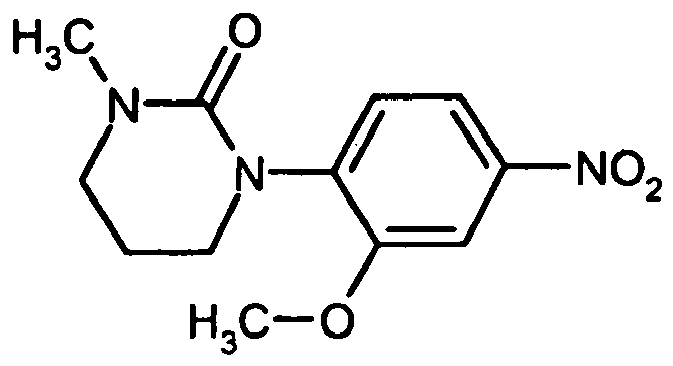
- 450 mg (3.94 mmol) 1-Methyltetrahydropyrimidin-2(1H)-on in 15 ml DMF werden bei 0°C mit 663 mg (5.91 mmol) Kalium-terl.-butylat versetzt und es wird 30 min bei Raumtemperatur gerührt. 742 mg (4.33 mmol) 1-Fluor-2-methoxy-4-nitrobenzol werden zugefügt und es wird bei RT gerührt. Nach 2 h wird mit 150 ml Wasser und 8 ml gesättigter wässriger Natriumchlorid-Lösung versetzt und dreimal mit je 30 ml Essigsäureethylester extrahiert. Die vereinigten organischen Phasen werden mit 30 ml Wasser gewaschen und anschließend über Natriumsulfat getrocknet. Nach Filtration werden die Lösungsmittel im Vakuum entfernt. Der Rückstand wird durch Chromatographie an Kieselgel (Cyclohexan/Essigsäureethylester 1:5 -> 1:10) gereinigt. Man erhält 457 mg (43% d. Th.) der gewünschten Verbindung.
1H-NMR (400 MHz, DMSO-d6 , δ/ppm): 7.85 (m, 2H), 7.44-7.39 (m, 1H), 3.90 (s, 3H), 3.48 (t, 2H), 3.38-3.31 (m, 2H), 2.84 (s, 3H), 2.05-1.93 (m, 2H).
HPLC (Methode 1): Rt = 3.57 min.
MS (DCI, m/z): 266 (M+H)+. -

- 430 mg (1.62 mmol) Beispiel 62A werden in 50 ml THF gelöst und mit 100 mg Palladium auf Kohle versetzt. Es wird 18 h bei RT in einer Wasserstoffatmosphäre unter normalem Druck hydriert. Anschließend wird filtriert, mit THF nachgewaschen und das Filtrat vom Lösungsmittel befreit. Das Reaktionsprodukt (401 mg) wird ohne weitere Aufreinigung weiter umgesetzt.
1H-NMR (400 MHz, DMSO-d6 , δ/ppm): 6.69 (d, 1H), 6.22 (d, 1H), 6.06 (dd, 1H), 5.00 (br.s, 2H), 3.65 (s, 3H), 3.37-3.25 (m, 4H), 2.79 (s, 3H), 2.00-1.91 s (m, 2 H).
HPLC (Methode 1): Rt = 2.88 min.
MS (ESIpos, m/z): 236 (M+H)+. -

- 34.3 g (237 mmol) 1-(2-Hydroxyethyl)tetrahydropyrimidin-2(1H)-on (Patent; Chem. Werke Huels;
DE 1121617; 1962 ; Chem.Abstr.; EN; 56; 11601g; 1962) werden in 612 ml DMF gelöst und mit 36.1 g (356 mmol) Triethylamin, 1.45 g (11.9 mmol) DMAP und 85.0 g (309 mmol) tert-Butyl(chlor)diphenylsilan versetzt und 18 h bei RT gerührt. Dann wird in 2000 ml Wasser gegeben und dreimal mit Dichlormethan extrahiert. Die vereinigten organischen Phasen werden zweimal mit Wasser gewaschen und dann über Natriumsulfat getrocknet. Nach Filtration werden die Lösungsmittel im Vakuum entfernt. Der Rückstand wird aus Acetonitril umkristallisiert. Man erhält 71.9 g (78% d. Th.) der gewünschten Verbindung.
1H-NMR (400 MHz, DMSO-d6 , δ/ppm): 7.67-7.58 (m, 4H), 7.48-7.39 (m, 6H), 6.17 (br.s, 1H), 3.70 (t, 2H), 3.40-3.26 (m, 4H), 3.17-3.05 (m, 2H), 1.80-1.72 (m, 2H), 0.99 (s, 9H).
HPLC (Methode 1): Rt = 4.86min.
MS (ESIpos, m/z): 383 (M+H)+. -

- 750 mg (1.96 mmol) Beispiel 64A in 9 ml DMF werden bei 0°C mit 330 mg (2.94 mmol) Kalium-tert.-butylat versetzt und es wird 30 min bei Raumtemperatur gerührt. 335 mg (2.16 mmol) 1-Fluor-2-methyl-4-nitrobenzol werden zugefügt und es wird bei 60°C gerührt. Nach 5 h wird abgekühlt und die Reaktionslösung in eine Lösung von 100 ml Wasser mit 10 ml gesättigter wässriger Ammoniumchlorid-Lösung gegeben. Dann wird dreimal mit je 70 ml Essigsäureethylester extrahiert. Die vereinigten organischen Phasen werden mit 100 ml Wasser gewaschen und dann über Natriumsulfat getrocknet. Nach Filtration werden die Lösungsmittel im Vakuum entfernt. Der Rückstand wird durch Chromatographie an Kieselgel (Cyclohexan/Essigsäureethylester 3:1) gereinigt. Man erhält 135 mg (13% d. Th.) der gewünschten Verbindung.
HPLC (Methode 1): Rt = 5.17 min.
MS (DCI, m/z): 518 (M+H)+. -

- 229 mg (0.44 mmol) Beispiel 65A werden in 10 ml THF gelöst und mit 50 mg Palladium auf Kohle versetzt. Es wird 4 h bei RT in einer Wasserstoffatmosphäre unter normalem Druck hydriert. Anschließend wird filtriert, mit THF nachgewaschen und das Filtrat vom Lösungsmittel befreit. Das Reaktionsprodukt (230 mg, Reinheit 67%) wird ohne weitere Aufreinigung weiter umgesetzt.
HPLC (Methode 2): Rt = 4.61 min.
MS (DCI, m/z): 488 (M+H)+. -

- Eine Lösung von 215 mg (0.42 mmol) des Produktes aus Beispiel 66A in 6 ml Acetonitril wird mit 105 mg (0.486 mmol) des Produktes aus Beispiel 1A versetzt. Der Suspension werden 148 mg (0.663 mmol) Magnesiumperchlorat zugefügt, wonach man 18 h bei RT rühren lässt. Dann werden 179 mg (1.11 mmol) 1,1'-Carbonyldiimidazol und 5 mg (0.04 mmol) DMAP hinzugesetzt, und es wird bei 60°C gerührt. Nach 3 h wird abgekühlt und anschließend in 50 ml Wasser gegeben. Nach Zugabe von 50 ml Essigsäureethylester werden die Phasen getrennt und die wässrige Phase dreimal mit Essigsäureethylester extrahiert. Die vereinigten organischen Phasen werden über Natriumsulfat getrocknet. Die Lösungsmittel werden im Vakuum entfernt und der Rückstand durch Chromatographie an Kieselgel (Dichlormethan/Methanol 20:1) gereinigt. Man erhält 241 mg (74% d. Th.) der gewünschten Verbindung.
HPLC (Methode 2): Rt = 5.16 min.
MS (ESIpos, m/z): 731 (M+H)+. -

- 500 mg (1.31 mmol) Beispiel 64A in 6 ml DMF werden bei 0°C mit 220 mg (1.96 mmol) Kalium-tert.-butylat versetzt und es wird 30 min bei Raumtemperatur gerührt. 252 mg (1.44 mmol) 2-Chlor-1-fluor-4-nitrobenzol werden zugefügt und es wird bei RT gerührt. Nach 22 h wird abgekühlt und die Reaktionslösung in eine Lösung von 50 ml Wasser und 8 ml gesättigter wässriger Natriumchlorid-Lösung gegeben. Dann wird dreimal mit je 30 ml Essigsäureethylester extrahiert. Die vereinigten organischen Phasen werden mit 30 ml Wasser gewaschen und dann über Natriumsulfat getrocknet. Nach Filtration werden die Lösungsmittel im Vakuum entfernt. Der Rückstand wird durch Chromatographie an Kieselgel (Cyclohexan/Essigsäureethylester 2:1) gereinigt. Man erhält 200 mg (28% d. Th.) der gewünschten Verbindung.
1H-NMR (400 MHz, DMSO-d6, δ/ppm): 8.34 (d, 1H), 8.21 (dd, 1H), 7.68-7.62 (m, 5H), 7.51-7.42 (m, 6H), 3.76 (t, 2H), 3.58-3.41 (m, 6H), 2.07 (tt, 2H), 1.01 (s, 9H).
HPLC (Methode 2): Rt = 5.78 min.
MS (DCI, m/z): 538 (M+H)+. -

- 386 mg (0.72 mmol) Beispiel 68A werden in 10 ml THF gelöst und mit 50 mg Palladium auf Kohle versetzt. Es wird 2 h bei RT in einer Wasserstoffatmosphäre unter normalem Druck hydriert. Anschließend wird filtriert, dreimal mit THF nachgewaschen und das Filtrat vom Lösungsmittel befreit. Das Reaktionsprodukt (365 mg, Reinheit 80%) wird ohne weitere Aufreinigung weiter umgesetzt.
1H-NMR (400 MHz, DMSO-d6 , δ/ppm): 7.66-7.60 (m, 4H), 7.51-7.40 (m, 6H), 6.88 (d, 1H), 6.62 (d, 1H), 6.45 (dd, 1H), 5.33 (br.s., 2H), 3.77-3.68 (m, 2H), 3.50-3.30 (m, 6H), 2.05-1.94 (m, 2H), 1.01 (s, 9H).
HPLC (Methode 2): Rt = 4.71 min.
MS (ESIpos, m/z): 508 (M+H)+. -

- Eine Lösung von 364 mg (0.718 mmol) des Produktes aus Beispiel 69A in 8 ml Acetonitril wird mit 172 mg (0.789 mmol) des Produktes aus Beispiel 1A versetzt. Der Suspension werden 240 mg (1.07 mmol) Magnesiumperchlorat zugefügt, wonach man 15 h bei RT rühren lässt. Dann werden 291 mg (1.79 mmol) 1,1'-Carbonyldiimidazol und 9 mg (0.08 mmol) DMAP hinzugesetzt, und es wird bei 60°C gerührt. Nach 3 h wird abgekühlt und anschließend mit 70 ml Wasser und 50 ml Essigsäureethylester verdünnt. Die Phasen werden getrennt und die wässrige Phase zweimal mit Essigsäureethylester extrahiert. Die vereinigten organischen Phasen werden über Natriumsulfat getrocknet. Die Lösungsmittel werden im Vakuum entfernt und der Rückstand durch Chromatographie an Kieselgel (Dichlormethan/Methanol 20:1) gereinigt. Man erhält 366 mg (59% d. Th.) der gewünschten Verbindung.
1H-NMR (400 MHz, DMSO-d6 , δ/ppm): 8.96 (dd, 1H), 7.70 (d, 1H), 7.66-7.58 (m, 5H), 7.48-7.36 (m, 7H), 7.31 (d, 1H), 7.21-7.16 (m, 1H), 4.89-4.78 (m., 1H), 4.19 (dd, 1H), 3.89-3.82 (m, 1H), 3.80-3.68 (m, 2H), 3.60 (t, 2H), 3.52-3.38 (m, 6H), 2.10-1.95 (m, 2H), 1.01 (s, 9H).
HPLC (Methode 2): Rt = 5.26 min.
MS (ESIpos, m/z): 751 (M+H)+. -
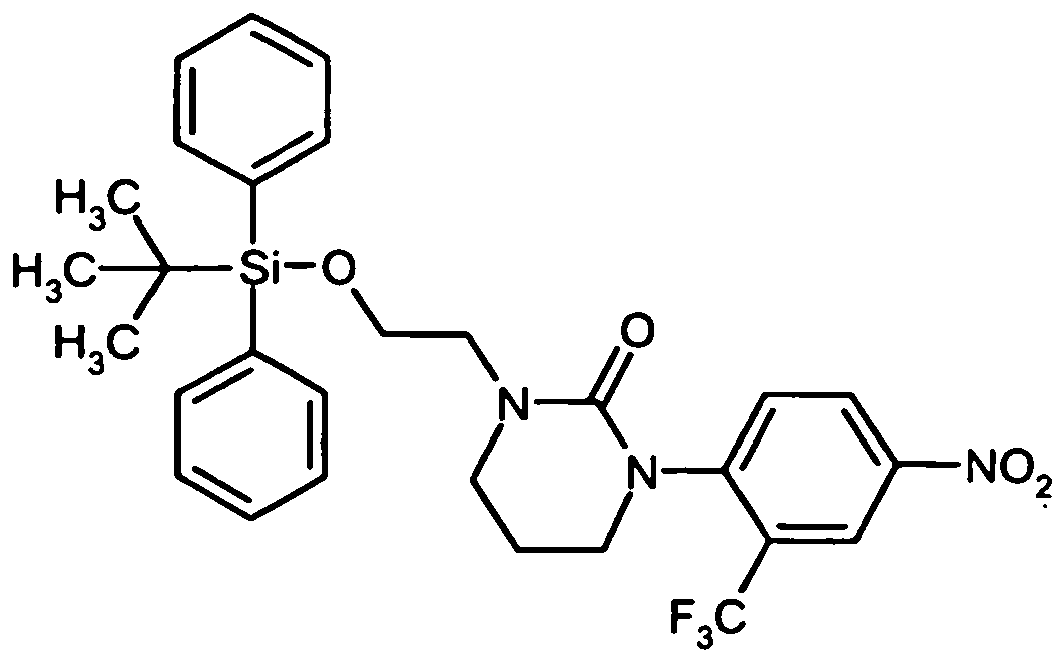
- 71.8 g (187 mmol) Beispiel 64A in 1300 ml DMF werden bei 0°C mit 31.6 g (281 mmol) Kalium-tert.-butylat versetzt und es wird 30 min bei Raumtemperatur gerührt. 43.2 g (206 mmol) 1-Fluor-4-nitro-2-(trifluormethyl)benzol in 100 ml DMF werden zugefügt und es wird bei RT gerührt. Nach 18 h wird die Reaktionslösung mit 2000 ml Wasser und 50 ml gesättigter wässriger Natriumchlorid-Lösung versetzt. Nach Phasentrennung wird die wässrige Phase dreimal mit je 500 ml Essigsäureethylester extrahiert. Die vereinigten organischen Phasen werden zweimal mit 500 ml Wasser gewaschen und dann über Natriumsulfat getrocknet. Nach Filtration werden die Lösungsmittel im Vakuum entfernt. Der Rückstand wird durch Chromatographie an Kieselgel (Cyclohexan/Essigsäureethylester 5:1 -> 2:1) gereinigt. Man erhält 31.3 g (28% d. Th.) der gewünschten Verbindung.
1H-NMR (400 MHz, DMSO-d6 , δ/ppm): 8.56 (dd, 1H), 8.45 (d, 1H), 7.74 (d, 1H), 7.68-7.60 (m, 4H), 7.51-7.39 (m, 6H), 3.80-3.62 (m, 3H), 3.58-3.44 (m, 3H), 3.42-3.31 (m, 2H), 2.05 (tt, 2H), 1.01 (s, 9H).
HPLC (Methode 2): Rt = 5.50 min.
MS (ESIpos, m/z): 572 (M+H)+. -

- 21.2 g (37.1 mmol) Beispiel 71A werden in 700 ml THF gelöst und mit 200 mg Palladium auf Kohle versetzt. Es wird 2 h bei RT in einer Wasserstoffatmosphäre unter normalem Druck hydriert. Anschließend wird filtriert, dreimal mit THF nachgewaschen und das Filtrat vom Lösungsmittel befreit. Das Reaktionsprodukt (20.5 g) wird ohne weitere Aufreinigung weiter umgesetzt.
1H-NMR (400 MHz, DMSO-d6 , δ/ppm): 7.68-7.61 (m, 4H), 7.51-7.40 (m, 6H), 6.94 (d, 1H), 6.84 (d, 1H), 6.75 (dd, 1H), 5.53 (br.s., 2H), 3.77-3.65 (m, 2H), 3.50-3.23 (m, 6H), 2.05-1.92 (m, 2H), 1.01 (s, 9H).
HPLC (Methode 2): Rt = 5.41 min.
MS (ESIpos, m/z): 542 (M+H)+. -

- Eine Lösung von 20.5 g (37.8 mmol) des Produktes aus Beispiel 72A in 300 ml Acetonitril wird mit 9.06 g (41.6 mmol) des Produktes aus Beispiel 1A versetzt. Der Suspension werden 12.7 g (56.7 mmol) Magnesiumperchlorat zugefügt, wonach man 15 h bei RT rühren lässt. Dann werden 15.3 g (94.6 mmol) 1,1'-Carbonyldiimidazol und 462 mg (3.78 mmol) DMAP hinzugesetzt, und es wird bei RT gerührt. Nach 15 h wird in 1500 ml Wasser gegeben, die Phasen werden getrennt und die wässrige Phase dreimal mit Essigsäureethylester extrahiert. Die vereinigten organischen Phasen werden über Natriumsulfat getrocknet. Die Lösungsmittel werden im Vakuum entfernt und der Rückstand durch Chromatographie an Kieselgel (Cyclohexan/Essigsäureethylester 1:5) gereinigt. Man erhält 19.7 g (60% d. Th.) der gewünschten Verbindung.
1H-NMR (400 MHz, DMSO-d6 , δ/ppm): 8.96 (dd, 1H), 7.96 (dd, 1H), 7.69 (d, 1H), 7.66-7.61 (m, 5H), 7.48-7.38 (m, 7H), 7.19 (d, 1H), 4.89-4.80 (m, 1H), 4.28-4.19 (m, 1H), 3.92-3.84 (m, 1H), 3.80-3.68 (m, 2H), 3.65-3.25 (m, 8H), 2.08-1.98 (m, 2H), 1.01 (s, 9H).
HPLC (Methode 2): Rt = 6.27 min.
MS (ESIpos, m/z): 785 (M+H)+. -
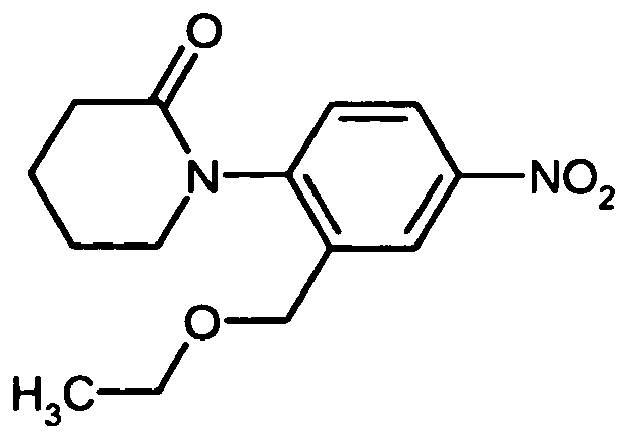
- 248 mg (2.51 mmol) Piperidin-2-on werden in 10 ml wasserfreiem Dimethylsulfoxid gelöst und mit 338 g (3.01 mmol) Kalium-tert.-butylat versetzt. Nach 1 h werden 500 mg Beispiel 32A zugegeben und es wird 16 h auf 80°C erhitzt. Man lässt erkalten und versetzt mit gesättigter Natriumchloridlösung. Die Mischung wird mehrmals mit Dichlormethan extrahiert, die organische Phase wird zweimal mit Wasser und zweimal mit gesättigter Natriumchloridlösung gewaschen, über Natriumsulfat getrocknet, filtriert und im Vakuum zur Trockene eingedampft. Der Rückstand wird in 5 ml Dimethylsulfoxid gelöst und mit präparativer HPLC mit einem Gradienten aus Wasser und Acetonitril aufgereinigt. Die Produktfraktionen werden vereinigt und im Vakuum zur Trockene eingedampft. Man erhält 162 mg (23% d. Th.) des gewünschten Produktes.
1H-NMR (400 MHz, DMSO-d6 , δ/ppm): δ = 8.3 (d, 1H), 8.2 (dd, 1H), 7.55 (d, 1H), 4.45 (m, 2H), 3.7 (b, 1H), 3.5 (q, 2H), 3.4 (b, 1H), 2.4 (b, 2H), 1.9 (b, 4H), 1.15 (t, 3H).
LC-MS (Methode 6): Rt = 1.99 min
MS (ESIpos): m/z = 279 (M+H)+ -

- 160 mg (0.58 mmol) Beispiel 74A werden in 10 ml einer 1:1 Mischung aus Ethanol und Essigsäureethylester gelöst und mit 181 mg (2.17 mmol) Ammoniumformiat und 20 mg Palladium auf Kohle versetzt. Es wird 30 min auf 80°C erhitzt, man lässt erkalten und filtriert über Kieselgel. Es wird mit Essigsäureethylester und Ethanol nachgewaschen und das Filtrat im Vakuum zur Trockene eingedampft. Man erhält 147 mg (99% d. Th.) des gewünschten Produktes.
LC-MS (Methode 6): Rt= 1.04 min
MS (ESIpos): m/z = 249 (M+H)+ -

- 3.32 g (15.6 mmol) Kaliumphosphat werden mit 0.5 g (2.6 mmol) Kupfer(I)iodid in einem Rundkolben vermischt und mehrmals abwechselnd ausgeheizt und mit Argon belüftet. Es werden nacheinander 10 ml wasserfreies Dioxan, 1.5 g (13.0 mmol) 1,4-Oxazepan-5-on, 3.43 g (13.0 mmol) 1-Iod-2-methyl-4-nitrobenzol und 0.46 g (5.21 mmol) N,N-Dimethylethylendiamin zugegeben und 15 h auf 110°C erhitzt. Man läßt erkalten, filtriert über Kieselgel und wäscht das Kieselgel mit Dioxan nach. Die vereinigten Filtrate werden im Vakuum zur Trockene eingedampft. Man löst den Rückstand in Acetonitril an und reinigt mit präparativer HPLC mit einem Gradienten aus Wasser und Acetonitril auf. Die Produktfraktionen werden vereinigt und im Vakuum zur Trockene eingedampft. Man erhält 430 mg (13% d. Th.) des gewünschten Produktes.
1H-NMR (400 MHz, DMSO-d6 , δ/ppm): δ = 8.2 (s, 1H), 8.1 (d, 1H), 7.5 (d, 1H), 3.9 (m, 5H), 3.8 (m, 1H), 2.9 (m, 1H), 2.8 (m, 1H), 2.3 (s, 3H).
LC-MS (Methode 6): Rt = 1.58 min
MS (ESIpos): m/z = 251 (M+H)+ -

- 430 mg (1.72 mmol) Beispiel 76A werden in 40 ml einer 1:1 Mischung aus Ethanol und Essigsäureethylester gelöst und mit 650 mg (10.3 mmol) Ammoniumformiat und 50 mg Palladium auf Kohle versetzt. Es wird auf 80°C erhitzt und nach 45 min lässt man erkalten und filtriert über Kieselgel. Es wird mit Essigsäureethylester nachgewaschen und das Filtrat im Vakuum zur Trockene eingedampft. Man erhält 373 mg (98% d. Th.) des gewünschten Produktes.
LC-MS (Methode 7): Rt = 1.84 min
MS (ESIpos): m/z = 221 (M+H)+ -

- 1.57 g (13.6 mmol) 1,4-Oxapan-5-on in 60 ml DMSO werden bei RT mit 2.30 g (20.5 mmol) Kalium-tert.-butylat versetzt und es wird 30 min bei Raumtemperatur gerührt. 3.00 g (13.6 mmol) 2-Brom-1-fluor-4-nitrobenzol werden zugefügt und es wird bei 60°C gerührt. Nach 2 h wird das Heizbad entfernt und anschließend 18 h bei RT gerührt. Dann wird in 600 ml Wasser und 200 ml gesättigter wässriger Natriumchlorid-Lösung gegeben und dreimal mit je 300 ml Essigsäureethylester extrahiert. Die vereinigten organischen Phasen werden über Natriumsulfat getrocknet. Nach Filtration werden die Lösungsmittel im Vakuum entfernt. Der Rückstand wird durch Chromatographie an Kieselgel (Cyclohexan/Essigsäureethylester 1:1; dann Essigsäureethylester) vorgereinigt. Nach erneuter Chromatographie an Kieselgel (Dichlormethan/Methanol 60:1) erhält man 839 mg (20% d. Th.) der gewünschten Verbindung.
1H-NMR (400 MHz, DMSO-d6 , δ/ppm): 8.50 (d, 1H), 8.28 (dd, 1H), 7.66 (d, 1H), 3.92-3.83 (m, 4H), 3.82-3.75 (m, 2H), 2.90-2.81 (m, 2H).
HPLC (Methode 1): Rt = 3.59 min.
MS (DCI, m/z): 316 (M+H)+. -

- Unter Argon werden 300 mg (0.95 mmol) Beispiel 78A, 327 mg (3.81 mmol) Cyclopropylboronsäure, 33 mg (0.03 mmol) Tetrakis(triphenlyphosphin)palladium (0) und 404 mg (1.90 mmol) Kaliumphosphat in 12 ml Toluol suspendiert. Man rührt 3.5 h bei 120°C und anschließend 10 h bei RT. Dann wird mit 200 ml Wasser und 200 ml Essigsäureethylester versetzt, die wässrige Phase zweimal mit Essigsäureethylester extrahiert und die vereinigten organischen Phasen einmal mit Wasser gewaschen. Nach Trocknen über Natriumsulfat und Filtration werden die Lösungsmittel im Vakuum entfernt. Das Reaktionsprodukt (98% d. Th.) wird ohne weitere Aufreinigung weiter umgesetzt.
HPLC (Methode 1): Rt = 3.73 min.
MS (DCI, m/z): 277 (M+H)+. -

- 394 mg (1.42 mmol) Beispiel 79A werden in 23 ml Ethanol gelöst und mit 1.29 g (5.70 mmol) Zinnchlorid-dihydrat versetzt. Es wird 20 min zum Rückfluß erhitzt und dann die Reaktion durch Zugabe von 100 ml Wasser beendet. Mit Natronlauge wird auf pH = 10 gestellt und dreimal mit Essigsäureethylester extrahiert. Die vereinigten organischen Phasen werden über Natriumsulfat getrocknet. Anschließend wird filtriert und das Filtrat vom Lösungsmittel befreit. Das Reaktionsprodukt wird ohne weitere Aufreinigung weiter umgesetzt.
LC-MS (Methode 3): Rt = 2.13 min.
MS (ESIpos, m/z): 247 (M+H)+. -

- 910 mg (9.09 mmol) Tetrahydropyrimidinon in 39 ml DMSO werden bei RT mit 1.53 g (13.6 mmol) Kalium-tert.-butylat versetzt und es wird 30 min bei Raumtemperatur gerührt. 2.00 g (9.09 mmol) 2-Brom-1-fluor-4-nitrobenzol werden zugefügt und es wird bei 60°C gerührt. Nach 18 h wird abgekühlt und in 600 ml Wasser und 160 ml gesättigter wässriger Natriumchlorid-Lösung gegeben. Es wird dreimal mit je 300 ml Essigsäureethylester extrahiert und die vereinigten organischen Phasen werden über Natriumsulfat getrocknet. Nach Filtration werden die Lösungsmittel im Vakuum entfernt und der Rückstand durch Chromatographie an Kieselgel (Dichlormethan/Ethanol 60:1) gereinigt. Man erhält 481 mg (17% d. Th.) der gewünschten Verbindung.
1H-NMR (400 MHz, DMSO-d6 , δ/ppm): 8.46 (d, 1H), 8.24 (dd, 1H), 7.65 (d, 1H), 6.83 (br. s, 1H), 3.58-3.44 (m, 2H), 3.31-3.23 (m, 2H), 2.03-1.90 (m, 2H).
HPLC (Methode 5): Rt = 2.84 min.
MS (ESIpos, m/z): 300 (M+H)+. -

- Unter Argon werden 278 mg (0.92 mmol) Beispiel 81A, 410 mg (5.56 mmol) Ethylboronsäure, 64 mg (0.06 mmol) Tetrakis(triphenylphosphin)palladium(0) und 393 mg (1.85 mmol) Kaliumphosphat in 12 ml Toluol suspendiert und bei 120°C gerührt. Nach 20 h wird abermals mit 410 mg (5.56 mmol) Ethylboronsäure, 64 mg (0.06 mmol) Tetrakis(triphenylphosphin)palladium (0) und 393 mg (1.85 mmol) Kaliumphosphat versetzt und anschließend 22 h bei 120°C gerührt. Dann wird mit 100 ml Wasser und 80 ml Essigsäureethylester versetzt und die wässrige Phase zweimal mit Essigsäureethylester extrahiert und die vereinigten organischen Phasen werden über Natriumsulfat getrocknet. Nach Filtration werden die Lösungsmittel im Vakuum entfernt und der Rückstand mit präparativer HPLC mit einem Gradienten aus Wasser und Acetonitril aufgereinigt. Man erhält 22 mg (7% d. Th.) des gewünschten Produktes.
HPLC (Methode 1): Rt = 3.70 min.
MS (DCI, m/z): 250 (M+H)+. -

- 16.8 mg (0.067 mmol) Beispiel 82A werden in 1 ml Ethanol gelöst und mit 60.8 g (0.270 mmol) Zinnchlorid-dihydrat versetzt. Es wird 20 min zum Rückfluß erhitzt, ehe man die Reaktion durch Zugabe von 15 ml Wasser beendet. Mit Natronlauge wird auf pH = 10 gestellt und anschließend dreimal mit Essigsäureethylester extrahiert. Die vereinigten organischen Phasen werden über Natriumsulfat getrocknet. Nach Filtration wird das Filtrat vom Lösungsmittel befreit. Das Reaktionsprodukt wird ohne weitere Aufreinigung umgesetzt.
LC-MS (Methode 7): Rt = 2.06 min.
MS (ESIpos, m/z): 220 (M+H)+. -

- 347 mg (3.47 mmol) Tetrahydropyrimidinon in 21 ml DMSO werden bei RT mit 584 mg (5.21 mmol) Kalium-tert.-butylat versetzt und es wird 45 min bei Raumtemperatur gerührt. 700 mg (3.82 mmol) 1-Fluor-2-isopropyl-4-nitrobenzol werden zugefügt und es wird bei 60°C gerührt. Nach 18 h wird abgekühlt und mit 250 ml Wasser verdünnt. Es wird dreimal mit Essigsäureethylester extrahiert und die vereinigten organischen Phasen über Natriumsulfat getrocknet. Nach Filtration werden die Lösungsmittel im Vakuum entfernt und der Rückstand durch Chromatographie an Kieselgel (Cyclohexan/Essigsäureethylester 1:5 -> 1:10) gereinigt. Man erhält 140 mg (14% d. Th.) der gewünschten Verbindung.
1H-NMR (400 MHz, DMSO-d6, δ/ppm): 8.13 (d, 1H), 8.05 (dd, 1H), 7.46 (d, 1H), 6.68 (br. s, 1H), 3.69-3.60 (m, 1H), 3.37-3.21 (m, 2H), 3.14-3.04 (m, 2H), 2.03-1.93 (m, 2H), 1.20 (dd, 6H).
HPLC (Methode 1): Rt = 3.87 min.
MS (DCI, m/z): 264 (M+H)+. -

- 130 mg.(0.493 mmol) Beispiel 84A werden in 8 ml Ethanol gelöst und mit 445 g (1.97 mmol) Zinnchlorid-dihydrat versetzt. Es wird 20 min zum Rückfluß erhitzt, ehe man die Reaktion durch Zugabe von 100 ml Wasser beendet. Mit Natronlauge wird auf pH = 10 gestellt und anschließend dreimal mit Essigsäureethylester extrahiert. Die vereinigten organischen Phasen werden über Natriumsulfat getrocknet. Nach Filtration wird das Filtrat vom Lösungsmittel befreit. Das Reaktionsprodukt (82 mg) wird ohne weitere Aufreinigung umgesetzt.
HPLC (Methode 1): Rt = 2.95 min.
MS (ESIpos, m/z): 234 (M+H)+. -

- 295 mg (2.76 mmol) Pyrimidin-2-on werden in 10 ml wasserfreiem N,N-Dimethylformamid gelöst und mit 371 mg (3.3 mmol) Kalium-tert.-butylat versetzt. Nach 1 h werden 500 mg (2.76 mmol) Beispiel 36A zugegeben und es wird 16 h auf 50°C erhitzt. Man lässt erkalten und filtriert die unlöslichen Bestandteile ab. Die Lösung wird mit präparativer HPLC mit einem Gradienten aus Wasser und Acetonitril aufgereinigt. Die Produktfraktionen werden vereinigt und im Vakuum zur Trockene eingedampft. Man erhält 45 mg (6% d. Th.) der gewünschten Verbindung.
1H-NMR (400 MHz, DMSO-d6 , δ/ppm): δ = 8.75 (m, 1H), 8.25-8.5 (m, 2H), 8.1 (m, 1H), 7.8 (d, 1H), 6.6 (m, 1H), 6.1 (m, 1H), 5.9 (m, 1H), 1.6-1.8 (dd, 3H). -

- 44 mg (0.17 mmol) Beispiel 86A werden in 8 ml einer 1:1 Mischung aus Ethanol und Essigsäureethylester gelöst und mit 65 mg (1.02 mmol) Ammoniumformiat und 50 mg Palladium auf Kohle versetzt. Es wird auf 80°C erhitzt. Nach 45 min lässt man erkalten und filtriert über Kieselgel. Dann wird mit Essigsäureethylester nachgewaschen und das Filtrat im Vakuum zur Trockene eingedampft. Man erhält 42 mg (100% d. Th.) der gewünschten Verbindung.
LC-MS (Methode 7): Rt = 2.30 min
MS (ESIpos): m/z = 234 (M+H)+ -

- 116 ml (116 mmol) Bortribromid (1-molare Lösung in Dichlormethan) werden bei -10°C über einen Zeitraum von 1 h so zu einer Lösung von 5.00 g (29.2 mmol) 1-Fluor-2-methoxy-4-nitrobenzol getropft, dass die Temperatur -5°C nicht übersteigt. Es wird 5 h bei 0°C belassen, dann langsam in 600 ml Eiswasser gegeben und mit 100 ml Essigsäureethylester verdünnt. Nach Phasentrennung wird die wässrige Phase zweimal mit Essigsäureethylester extrahiert. Die vereinigten organischen Phasen werden über Natriumsulfat getrocknet. Nach Filtration werden die Lösungsmittel im Vakuum entfernt. Der Rückstand wird durch Chromatographie an Kieselgel (Cyclohexan/Essigsäureethylester 10: 1) gereinigt. Man erhält 1.45 g (30% d. Th.) der gewünschten Verbindung.
1H-NMR (400 MHz, DMSO-d6 , δ/ppm): 10.99 (s, 1H), 7.78 (dd, 1H), 7.73 (ddd, 1H), 7.44 (dd, 1H).
HPLC (Methode 1): Rt = 3.60 min.
MS (DCI, m/z): 174 (M+NH4)+. -

- 1.00 g (6.37 mmol) Beispiel 88A werden in 15 ml DMF gelöst und mit 1.76 g (12.7 mmol) Kaliumcarbonat versetzt. Anschließend wird 1.19 g (7.64 mmol) Iodethan zugegeben und es wird bei RT gerührt. Nach 1.5 h wird mit je 100 ml Toluol und Wasser versetzt, die Phasen getrennt und die wässrige Phase zweimal mit je 150 ml Toluol extrahiert. Die vereinigten organischen Phasen werden mit gesättigter wässriger Natriumhydrogencarbonat-Lösung gewaschen und dann über Natriumsulfat getrocknet. Es wird im Vakuum vom Lösungsmittel befreit und der erhaltene Feststoff im Hochvakuum getrocknet. Man erhält 1.06 g (89% d. Th.) des gewünschten Produktes.
1H-NMR (400MHz, DMSO-d6 , δ/ppm): δ = 7.95 (dd, 1H), 7.89 (ddd, 1H), 7.52 (dd, 1H), 4.25 (q, 2H), 1.38 (t, 3H).
GC/MS (Methode 9): Rt = 6.42 min.
MS (EI-pos): m/z = 185 (M+H)+. -

- Unter Argon werden 243 mg (2.45 mmol) Piperidin-2-on in 12 ml DMF bei 0°C mit 330 mg (2.95 mmol) Kalium-tert.-butylat versetzt und es wird 30 min bei Raumtemperatur gerührt. 500 mg (2.70 mmol) Beispiel 89A in 30 ml DMF werden zugefügt und es wird bei RT gerührt. Nach 18 h wird in 150 ml gesättigte wässrige Ammoniumchlorid-Lösung gegeben und dann dreimal mit je 100 ml Essigsäureethylester extrahiert. Die vereinigten organischen Phasen werden mit 200 ml Wasser gewaschen und dann über Natriumsulfat getrocknet. Nach Filtration werden die Lösungsmittel im Vakuum entfernt. Der Rückstand wird durch Chromatographie an Kieselgel (Cyclohexan/Essigsäureethylester 1:5) gereinigt. Man erhält 256 mg (39% d. Th.) der gewünschten Verbindung.
1H-NMR (400 MHz, DMSO-d6 , δ/ppm): 7.89-7.81 (m, 2H), 7.50-7.42 (m, 1H), 4.18 (q, 2H), 3.47 (t, 2H), 2.38 (t, 2H), 1.92-1.78 (m, 4H), 1.33 (t, 3H).
HPLC (Methode 1): Rt = 3.93 min.
MS (DCI, m/z): 265 (M+H)+. -

- 235 mg (0.889 mmol) des Produktes aus Beispiel 90A werden in 40 ml THF gelöst und mit 50 mg 10%-igem Palladium auf Aktivkohle versetzt. Man hydriert über Nacht in einer Wasserstoffatmosphäre unter normalem Druck, saugt dann über Kieselgur ab, wäscht dreimal mit THF nach und engt vorsichtig im Vakuum ein. Man erhält 262 mg Roh-Produkt, das ohne Aufreinigung weiter umgesetzt wird.
1H-NMR (400 MHz, DMSO-d6, δ/ppm): 6.68 (d, 1H), 6.22 (d, 1H), 6.08 (dd, 1H), 5.06 (s. 2H), 3.88 (q, 2H), 3.38-3.28 (m, 2H), 2.33-2.24 (m, 2H), 1.85-1.70 (m, 4H), 1.26 (t, 3H).
LC-MS (Methode 6): Rt = 1.37 min.
MS (ESIpos, m/z): 235 (M+H)+. -

- Eine Lösung von 5.00 g (38.7 mmol) 3-Hydroxymethylpiperidin-2-on in 40 ml N,N-Dimethylformamid wird nacheinander mit 3.16 g (46.5 mmol) Imidazol und tropfenweise mit 11 ml (42.6 mmol) tert.-Butyl(diphenyl)silylchlorid versetzt. Nach drei Stunden Rühren bei RT wird mit ca. 400 ml Wasser versetzt und dreimal mit Essigsäureethylester extrahiert. Die vereinigten organischen Extrakte werden nacheinander mit gesättigter Ammoniumchlorid-Lösung, Wasser und gesättigter Natriumchlorid-Lösung gewaschen. Nach Trocknen über wasserfreiem Magnesiumsulfat wird filtriert und das Filtrat im Vakuum vom Lösemittel befreit. Der erhaltene Rückstand wird durch Saugfiltration über Kieselgel mit Cyclohexan/Essigsäureethylester 20:1 → 1:1 als Laufmittel gereinigt. Es werden 9.43 g (66% d. Th.) der Titelverbindung erhalten.
1H-NMR (400 MHz, CDCl3, δ/ppm): 7.69-7.65 (m, 4H), 7.42-7.34 (m, 6H), 5.82 (s, breit, 1H), 4.03 (dd, 1H), 3.93 (dd, 1H), 3.32-3.28 (m, 2H), 2.53-2.48 (m, 1H), 2.07-1.99 (m, 1H), 1.96-1.87 (m, 2H), 1.78-1.68 (m, 1H), 1.04 (s, 9H).
HPLC (Methode 3): Rt = 2.79 min.
MS (ESIpos, m/z): 368 (M+H)+. -

- 2.75 g (10.8 mmol) 3-Chlor-4-jodanilin werden in 20 ml wasserfreiem Dioxan gelöst und nacheinander mit 4.98 g (13.5 mmol) der Verbindung aus Beispiel 92A, 103 mg (0542 mmol) Kupfer(I)-jodid, 4.61 g (21.7 mmol) Kaliumphosphat und 116 µl (1.085 mmol) N,N'-Dimethylethylendiamin versetzt. Die Rückflußapparatur wird durch wiederholtes Anlegen eines leichten Vakuums und Begasen mit Argon inertisiert. Das Reaktionsgemisch wird 15 Stunden zum Rückfluß erhitzt. Nach dieser Zeit läßt man auf RT abkühlen. Es wird mit Wasser versetzt und mit Essigsäureethylester extrahiert. Der organische Extrakt wird nacheinander mit Wasser und gesättigter Natriumchlorid-Lösung gewaschen. Dann wird über wasserfreiem Magnesiumsulfat getrocknet, filtriert und das Filtrat im Vakuum vom Lösemittel befreit. Das so erhaltene Rohprodukt wird zunächst durch Saugfiltration über Kieselgel mit Cyclohexan/Essigsäureethylester 20:1 → 1:4 als Laufmittel gereinigt. Es werden 3.12 g eines immer noch verunreinigten Produktes erhalten, das mittels präparativer HPLC mit einem Acetonitril/WasserGemisch weiter aufgereinigt wird. Es werden 0.71 g (13% d. Th.) der Titelverbindung erhalten.
1H-NMR (400 MHz, DMSO-d6, δ/ppm): 7.67-7.62 (m, 4H), 7.48-7.40 (m, 6H), 6.91 und 6.81 (2 d, zusammen 1H), 6.67 und 6.62 (2 d, zusammen 1H), 6.50 und 6.47 (2 dd, zusammen, 1H), 5.41 (s, breit, 2H), 4.08-4.00 (m, 1H), 3.78-3.73 (m, 1H), 3.50-3.41 (m, 1H), 3.40-3.32 (m, 1H, teilweise überdeckt vom Wassersignal), 2.07-1.96 (m, 3H), 1.92-1.81 (m, 2H), 1.01 und 1.00 (2 s, zusammen 9H).
HPLC (Methode 5): Rt = 3.26 min.
MS (ESIpos, m/z): 493/495 (35Cl/37Cl) (M+H)+. -

- Eine Lösung von 665 mg (1.35 mmol) der Verbindung aus Beispiel 93A und 323 mg (1.48 mmol) der Verbindung aus Beispiel 1A in 3 ml Acetonitril wird mit 452 mg (2.02 mmol) Magnesiumperchlorat versetzt und 15 Stunden bei RT gerührt. Der Ansatz wird ohne Vorbehandlung über eine präparative HPLC mit einem Acetonitril/Wasser-Gemisch aufgereinigt. Es werden 871 mg (91% d. Th.) der Titelverbindung erhalten.
1H-NMR (400 MHz, DMSO-d6, δ/ppm): 8.60 (t, 1H), 7.68-7.62 (m, 5H), 7.48-7.40 (m, 6H), 7.18 (d, 1H), 6.97 und 6.86 (2 d, zusammen 1H), 6.70 und 6.64 (2 d, zusammen 1H), 6.56 und 6.53 (2 dd, zusammen, 1H), 5.98 (t, breit, 1H), 5.11 (d, 1H), 4.09-4.01 (m, 1H), 3.80-3.73 (m, 2H), 3.51-3.42 (m, 1H), 3.38-3.22 (m, 2H, teilweise überdeckt vom Wassersignal), 3.71-3.08 (m, 1H), 3.00-2.93 (m, 1H), 2.58-2.52 (m, 1H), 2.08-1.96 (m, 3H), 1.91-1.82 (m, 2H), 1.01 und 1.00 (2 s, zusammen 9H).
HPLC (Methode 4): Rt = 3.40 min.
MS (ESIpos, m/z): 710/712/714 (Cl2, 3sCl/37Cl) (M+H)+. -

- Eine Lösung von 850 mg (1.196 mmol) der Verbindung aus Beispiel 94A und 387 mg (2.39 mmol) Carbonyldiimidazol in 30 ml Butyronitril wird mit 3 mg (0.024 mmol) 4-Dimethylaminopyridin versetzt und zum Rückfluß erhitzt. Nach 15 Stunden wird der grösste. Teil des Lösemittels am Rotationsverdampfer entfernt. Das Produkt wird mittels präparativer HPLC mit einem Acetonitril/Wasser-Gemisch weiter isoliert. Es werden 605 mg (69% d. Th.) der Titelverbindung erhalten.
1H-NMR (400 MHz, DMSO-d6, δ/ppm): 8.97 (t, 1H), 7.80 und 7.72 (2 d, zusammen 1H), 7.68 (d, 1H), 7.66-7.63 (m, 4H), 7.52-7.41 (m, 7H), 7.37 und 7.23 (2 d, zusammen 1H), 7.19 (d, 1H), 4.88-4.82 (m, 1H), 4.22-4.17 (m, 1H), 4.09-4.03 (m, 1H), 3.89-3.83 (m, 1H), 3.81-3.74 (m, 1H), 3.61-3.37 (m, 3H), 2.64-2.57 (m, 1H), 2.11-2.00 (m, 3H), 1.97-1.86 (m, 2H), 1.02 und 1.00 (2 s, zusammen 9H).
HPLC (Methode 4): Rt = 3.44 min.
MS (ESIpos, m/z): 736/738/740 (Cl2, 35Cl/37Cl) (M+H)+. -

- Eine Lösung von 5.00 g (50.4 mmol) Piperidin-2-on in 75 ml wasserfreiem Tetrahydrofuran wird bei einer Temperatur von 0°C tropfenweise mit 69 ml (110 mmol) einer 1.6-molaren Lösung von n-Butyllithium in Hexan versetzt. Nach einer weiteren Stunde bei 0°C wird das Reaktionsgemisch auf -78°C abgekühlt und dann mit einer Lösung von 5.3 ml (60.5 mmol) Allylbromid in 25 ml wasserfreiem Tetrahydrofuran tropfenweise versetzt. Nach beendeter Zugabe läßt man das Reaktionsgemisch innerhalb von 45 Minuten auf RT erwärmen. Dann werden 500 ml Wasser zugesetzt, und es wird dreimal mit je ca. 200 ml Essigsäureethylester extrahiert. Die vereinigten organischen Extrakte werden nacheinander mit Wasser und gesättigter Natriumchloridlösung gewaschen und über wasserfreiem Magnesiumsulfat getrocknet. Nach Filtration wird das Lösemittel am Rotationsverdampfer entfernt. Es werden 4.89 g (70% d. Th.) der Titelverbindung erhalten.
1H-NMR (400 MHz, CDCl3, δ/ppm): 5.99 (s, breit, 1H), 5.83-5.72 (m, 1H), 5.10-5.03 (m, 2H), 3.31-3.27 (m, 2H), 2.70-2.64 (m, 1H), 2.38-2.24 (m, 2H), 1.96-1.88 (m, 2H), 1.77-1.67 (m, 1H), 1.59-1.51 (m, 1H).
HPLC (Methode 1): Rt = 3.57 min.
MS (DCI, NH3, m/z): 140 (M+H)+, 157 (M+NH4)+, 174 (M+N2H7)+. -

- Analog zu dem unter Beispiel 93A beschriebenen Verfahren werden aus 6.00 g (23.7 mmol) 3-Chlor-4-iodanilin und 4.11 g (29.6 mmol) der Verbindung aus Beispiel 96A 1.57 g (25% d. Th.) der Titelverbindung erhalten. Die Aufreinigung erfolgt durch Saugfiltration über Kieselgel mit Cyclohexan/Essigsäureethylester 2:1 → 1:2 als Laufmittel.
1H-NMR (400 MHz, CDCl3, δ/ppm): 6.98 und 6.95 (zwei d, zusammen 1H), 6.75 und 6.73 (zwei d, zusammen 1H), 6.57 und 6.54 (zwei dd, zusammen 1H), 5.90-5.78 (m, 1H), 5.12-5.03 (m, 2H), 3.73 (s, breit, 2H), 3.51-3.38 (m, 2H), 2.78-2.68 (m, 1H), 2.53-2.31 (m, 2H), 2.07-1.85 (m, 4H).
HPLC (Methode 1): Rt = 3.88 min.
MS (DCI, NH3, m/z): 265/267 (35Cl/37Cl) (M+H)+. -

- In Analogie zu dem unter Beispiel 94A beschriebenen Verfahren werden aus 1.40 g (5.29 mmol) der Verbindung aus Beispiel 97A 2.09 g (82% d. Th.) der Titelverbindung erhalten. Die Aufreinigung erfolgt durch Saugfiltration über Kieselgel mit Cyclohexan/Essigsäureethylester 5:1 → 1:4 als Laufmittel.
1H-NMR (400 MHz, CDCl3, δ/ppm): 7.32-7.31 (m, 1H), 7.22-7.19 (m, 1H), 6.93-6.84 (m, 2H), 6.56 (s, 1H), 6.43-6.39 (m, 1H), 5.87-5.73 (m, 1H), 5.12-5.07 (m, 2H), 4.58-4.52 (m, 1H), 4.15-4.09 (m, 1H), 3.71-3.64 (m, 1H), 3.60-3.40 (m, 2H), 3.33-3.30 (m, 2H), 3.01-2.96 (m, 2H), 2.73-2.63 (m, 1H), 2.59-2.48 (m, 1H), 2.46-2.32 (m, 1H), 2.07-1.86 (m, 3H), 1.80-1.67 (m, 1H).
HPLC (Methode 2): Rt = 4.38 min.
MS (ESIpos, m/z): 482/484/486 (Cl2, 35Cl/37Cl) (M+H)+. -

- Analog zu dem unter Beispiel 93A beschriebenen Verfahren werden aus 2.68 g (11.5 mmol) 4-Iod-3-methylanilin und 2.0 g (14.3 mmol) der Verbindung aus Beispiel 96A nach präparativer HPLC 1.31 g (47% d. Th.) der Titelverbindung erhalten.
HPLC (Methode 1): Rt = 3.76 und 3.98 min.
MS (DCI, NH3, m/z): 245 (M+H)+, 262 (M+NH4)+. -

- In Analogie zu dem unter Beispiel 94A beschriebenen Verfahren werden aus 1.3 g (5.32 mmol) der Verbindung aus Beispiel 99A nach präparativer HPLC 990 mg (83% d. Th.) der Titelverbindung erhalten.
1H-NMR (400 MHz, DMSO-d6, δ/ppm): 8.60 (t, 1H), 7.69 (d, 1H), 7.18 (d, 1H), 6.79 und 7.75 (2 d, zusammen, 1H), 6.44-6.39 (m, 2H), 5.83-73 (m, 1H), 5.48 und 5.03 (2 s, breit, zusammen 1H), 5.10-5.05 (m, 2H), 3.81-3.76 (m, 1H), 3.48-3.40 (m, 1H), 3.37-3.22 (m, 4H, teilweise überdeckt vom Wassersignal), 3.11-3.05 (m, 1H), 2.98-2.92 (m, 1H), 2.57-2.47 (m, 1H, teilweise überdeckt vom DMSO-Signal), 2.43-2.35 (m, 1H), 2.33-2.18 (m, 1H), 1.93 und 1.92 (2 s, zusammen 3H) 1.92-1.87 (m, 2H), 1.86-1.77 (m, 1H), 1.61-1.53 (m, 1H).
HPLC (Methode 2): Rt = 4.16 min.
MS (DCI, NH3, m/z): 462/464 (35Cl/37Cl) (M+H)+, 479/481 (M+NH4)+. -

- Analog zu dem unter Beispiel 95A beschriebenen Verfahren werden 2.05 g (4.25 mmol) der Verbindung aus Beispiel 98A zu 1.44 g (67% d. Th.) der Titelverbindung als DiastereomerenGemisch umgesetzt. Die Aufreinigung erfolgt durch Saugfiltration über Kieselgel mit Cyclohexan/Essigsäureethylester 5:1 → 1:3 als Laufmittel.
1H-NMR (400 MHz, CDCl3, δ/ppm): 7.72-7.67 (m, 1H), 7.44-7.37 (m, 1H), 7.33-7.31 (m, 1H), 7.23-7.18 (m, 1H), 6.92-6.87 (m, 2H), 5.88-5.77 (m, 1H), 5.12-5.06 (m, 2H), 4.82-4.77 (m, 1H), 4.06-3.98 (m, 1H), 3.82-3.74 (m, 2H), 3.71-3.63 (m, 1H), 3.61-3.42 (m, 2H), 2.77-2.66 (m, 1H), 2.60-2.50 (m, 1H), 2.47-2.32 (m, 1H), 2.09-1.88 (m, 3H), 1.81-1.63 (m, 1H).
HPLC (Methode 2): Rt = 4.50 min.
MS (ESIpos, m/z): 508/510/512 (Cl2, 35Cl/37Cl) (M+H)+. - Das Diastereomerengemisch kann in präparativern Maßstab chromatographisch in die reinen Diastereomere aufgetrennt werden. Dazu werden 1.10 g der Verbindung aus Beispiel 101A in 16 ml des Laufmittels gelöst und in vier Portionen chromatographiert. Es werden 386 mg (35% d. Th.) der Titelverbindung (Diastereomer 2) und 417 mg (38% d. Th.) des Diastereomers 1 erhalten.
Methode: Säule: Daicel Chiralpak AD-H, 5 µm, 250 mm x 20 mm; Laufmittel: Ethanol + 1% Wasser + 0.2% Trifluoressigsäure; Fluß: 15 ml/min; Temperatur: 40°C; UV-Detektion: 220 nm.
Retentionszeit: 10.5 min (Diastereomer 1), 18.8 min (Diastereomer 2)
1H-NMR (400 MHz, CDCl3, δ/ppm): 7.72 und 7.67 (2 d, zusammen 1H), 7.43 und 7.39 (2 dd, zusammen 1H), 7.33 und 7.32 (2 d, zusammen 1H), 7.22 und 7.19 (2 d, zusammen 1H), 6.89 (d, 1H), 6.81 (t, 1H), 5.88-5.77 (m, 1H), 5.12-5.06 (m, 2H), 4.83-4.78 (m, 1H), 4.07-4.00 (m, 1H), 3.80 (dd, 2H), 3.71-3.63 (m, 1H), 3.62-3.41 (m, 2H), 2.77-2.66 (m, 1H), 2.62-2.51 (m, 1H), 2.47-2.32 (m, 1H), 2.09-1.90 (m, 3H), 1.82-1.68 (m, 1H).
HPLC (Methode 4): Rt = 2.60 min.
MS (ESIpos, m/z): 508/510/512 (Cl2, 35Cl/37Cl) (M+H)+. -

- Analog zu dem unter Beispiel 95A beschriebenen Verfahren werden 980 mg (2.12 mmol) der Verbindung aus Beispiel 100A zu 790 mg (76% d. Th.) der Titelverbindung umgesetzt.
1H-NMR (400 MHz, CDCl3, δ/ppm): 7.41-7.37 (m, 2H), 7.33 und 7.32 (2 d, zusammen 1H), 7.12-7.06 (m, 1H), 6.88 (d, 1H), 6.85-6.77 (m, 1H), 5.87-5.77 (m, 1H), 5.12-5.08 (m, 2H), 4.79-4.70 (m, 1H), 4.03-3.98 (m, 1H), 3.82-3.73 (m, 2H), 3.64-3.50 (m, 2H), 3.44-3.22 (m, 1H), 2.77-2.66 (m, 1H), 2.59-2.51 (m, 1H), 2.47-2.31 (m, 1H), 2.19 und 2.18 (2 s, zusammen 3H), 2.09-1.98 (m, 2H), 1.96-1.87 (m, 1H), 1.79-1.68 (m, 1H).
HPLC (Methode 2): Rt = 4.56 min.
MS (ESIpos, m/z): 488/490 (35Cl/37Cl) (M+H)+. -

- 1.50 g (13.8 mmol) 2-Hydroxy-3-methylpyridin in 70 ml DMF werden bei 0°C mit 2.31 g (20.6 mmol) Kalium-tert.-butylat versetzt und es wird 30 min bei Raumtemperatur gerührt. 2.87 g (15.1 mmol) 2-Chlor-4-fluor-5-methylnitrobenzol werden zugefügt und es weiter bei RT gerührt. Nach 17 h wird mit 1000 ml Wasser versetzt und dann dreimal mit Essigsäureethylester extrahiert. Die vereinigten organischen Phasen werden über Natriumsulfat getrocknet und nach Filtration werden die Lösungsmittel im Vakuum entfernt. Der Rückstand wird durch Chromatographie an Kieselgel (Cyclohexan/Essigsäureethylester 2:1) aufgereinigt. Man erhält 2.15 g (56% d. Th.) der gewünschten Verbindung.
1H-NMR (400 MHz, DMSO-d6 , δ/ppm): 8.18 (s, 1H), 7.85 (s, 1H), 7.48-7.44 (m, 2H), 6.31 (dd, 1H), 2.08 (s, 3H), 2.05 (s, 3H).
HPLC (Methode 1): Rt = 4.05 min.
MS (DCI, m/z): 279 (M+H)+. -

- 400 mg (1.44 mmol) Beispiel 103A und 315 mg (4.31 mmol) 1-Methylpropylamin in 10 ml DMF werden bei 120°C gerührt. Nach 4 h wird mit 200 ml Wasser versetzt und dann dreimal mit Essigsäureethylester extrahiert. Die vereinigten organischen Phasen werden über Natriumsulfat getrocknet und nach Filtration werden die Lösungsmittel im Vakuum entfernt. Der Rückstand wird durch präparative HPLC mit einem Acetonitril/Wasser-Gemisch aufgereinigt. Man erhält 216 mg (48% d. Th.) der gewünschten Verbindung.
1H-NMR (400 MHz, DMSO-d6, δ/ppm): 7.77 (s, 1H), 7.70-7.45 (m, 2H), 7.14 (s, 1H), 6.26 (dd, 1H), 3.05 (t, 2 H), 2.72 (s, 3H), 2.07 (s, 3H), 2.05 (s, 3H), 1.51 (dt, 2H), 0.81 (t, 3H).
HPLC (Methode 2): Rt = 4.36 min.
MS (DCI, m/z): 316 (M+H)+. -

- 200 mg (0.63 mmol) Beispiel 104A werden in einem Gemisch von 5 ml THF und 5 ml Ethanol gelöst. Dann werden 7.7 mg (0.03 mmol) Platin(IV)oxidhydrat hinzugefügt und es wird 17 h bei RT in einer Wasserstoffatmosphäre unter normalem Druck hydriert. Anschließend wird filtriert und das Filtrat vom Lösungsmittel befreit. Das Reaktionsprodukt wird ohne weitere Aufreinigung weiter umgesetzt.
1H-NMR (400 MHz, DMSO-d6 , δ/ppm): 7.37-7.33 (m, 1H), 7.29-7.26 (m, 1H), 6.67 (s, 1H), 6.58 (s, 1H), 6.15 (dd, 1H), 4.86 (s, 2H), 2.71 (t, 2H), 2.01 (s, 3H), 1.82 (s, 3H), 1.45 (dt, 2H), 1.36 (s, 3H), 0.85 (t, 3H).
HPLC (Methode 4): Rt = 1.75 min.
MS (ESIpos, m/z): 286 (M+H)+. -

- 400 mg (1.44 mmol) Beispiel 103A und 880 mg (8.61 mmol) N,N,N'-Trimethylethan-1,2-diamin in 10 ml DMF werden bei 120°C gerührt. Nach 2 h wird mit 200 ml Wasser versetzt und dann dreimal mit Dichlormethan extrahiert. Die vereinigten organischen Phasen werden über Natriumsulfat getrocknet und nach Filtration werden die Lösungsmittel im Vakuum entfernt. Der Rückstand wird durch präparative HPLC mit einem Acetonitril/Wasser-Gemisch aufgereinigt. Man erhält 349 mg (71% d. Th.) der gewünschten Verbindung.
1H-NMR (400 MHz, DMSO-d6 , δ/ppm): 7.76 (s, 1H), 7.47-7.40 (m, 2H), 7.15 (s, 1H), 6.27 (dd, 1H), 3.18 (t, 2 H), 2.76 (s, 3H), 2.43 (t, 2H), 2.14 (s, 6H), 2.05 (s, 3H), 1.95 (s, 3H).
HPLC (Methode 2): Rt = 3.66 min.
MS (DCI, m/z): 345 (M+H)+. -

- 325 mg (0.94 mmol) Beispiel 106A werden in einem Gemisch von 10 ml THF und 10 ml Ethanol gelöst. Dann werden 11 mg (0.05 mmol) Platin(IV)oxidhydrat hinzugefügt und es wird 17 h bei RT in einer Wasserstoffatmosphäre unter normalem Druck hydriert. Anschließend wird filtriert, mit THF nachgewaschen und das Filtrat vom Lösungsmittel befreit. Das Reaktionsprodukt wird ohne weitere Aufreinigung weiter umgesetzt.
1H-NMR (400 MHz, DMSO-d6 , δ/ppm): 7.29-7.25 (m, 1H), 7.38-7.33 (m, 1H), 6.68 (s, 1H), 6.55 (s, 1H), 6.15 (dd, 1H), 5.75 (s, 2H), 2.79 (t, 2H), 2.55 (s, 3H), 2.39 (t, 2H), 2.21 (s, 6H), 2.02 (s, 3H), 1.83 (s, 3H).
HPLC (Methode 1): Rt = 3.26 min.
MS (DCI, m/z): 315 (M+H)+. -

- 300 mg (1.08 mmol) Beispiel 103A und 151 mg (2.69 mmol) Kaliumhydroxid werden in 7.5 ml 1-Propanol 30 h bei 60°C gerührt. Dann wird mit 200 ml Wasser versetzt und dreimal mit Essigsäureethylester extrahiert. Die vereinigten organischen Phasen werden über Natriumsulfat getrocknet und nach Filtration werden die Lösungsmittel im Vakuum entfernt. Das so erhaltene Produkt wird ohne Aufreinigung weiter umgesetzt.
1H-NMR (400 MHz, DMSO-d6 , δ/ppm): 7.92 (s, 1H), 7.47-7.41 (m, 2H), 7.33 (s, 1H), 6.29 (dd, 1H), 4.09 (t, 2 H), 2.08 (s, 3H), 1.98 (s, 3H), 1.75-1.66 (m, 2H), 0.95 (t, 3H).
HPLC (Methode 1): Rt = 4.33 min.
MS (DCI, m/z): 320 (M+H)+. -

- 400 mg (1.32 mmol) Beispiel 108A werden in einem Gemisch von 10 ml THF und 10 ml Ethanol gelöst. Dann werden 16 mg (0.07 mmol) Platin(IV)oxidhydrat hinzugefügt und es wird 3 Tage bei RT in einer Wasserstoffatmosphäre unter normalem Druck hydriert. Anschließend wird filtriert, mit THF nachgewaschen und das Filtrat vom Lösungsmittel befreit. Das Reaktionsprodukt wird ohne weitere Aufreinigung weiter umgesetzt.
HPLC (Methode 3): Rt = 1.68 min.
MS (ESIpos, m/z): 273 (M+H)+. -

- Zu einer Lösung aus 92 g (725 mmol) Oxalylchlorid in 188 ml 1,2-Dichlorbenzol werden 26.5 g (145 mmol) N-Benzylamino-acetonitril gegeben. Die Lösung wird 20 min auf 60°C und 6 h auf 90°C erhitzt. Man lässt erkalten und belässt bei dieser Temperatur für 15 h. Das Lösemittel wird im Vakuum entfernt und der Rückstand mit Kieselgel und mit einem Gradienten von Cyclohexan bis Cyclohexan/Essigsäureethylester 5:1 eluiert. Die Produktfraktionen werden vereinigt und im Vakuum zur Trockene eingedampft. Der Rückstand wird aus Diethylether kristallisiert. Man erhält 22 g (60% d. Th.) der gewünschten Verbindung.
1H-NMR (400 MHz, CDCl3, δ/ppm): δ = 7.4 (m, 3H), 7.35 (m, 2H), 7.15 (s, 1H), 5.1 (s, 2H).
LC-MS (Methode 3): Rt = 2.04 min
MS (ESIpos): m/z = 255 (M+H)+ -

- Zu einer Lösung von 1.00 g (3.92 mmol) Beispiel 110A in 8 ml wasserfreiem Ethanol werden 660 mg (7.8 mmol) Kaliumethylat gegeben. Nach 2 h werden 165 mg (196 mmol) Kaliumethylat zugegeben und nach weiteren 30 min abermals 165 mg (196 mmol) Kaliumethylat. Nach weiteren 30 min wird im Vakuum das Lösemittel entfernt und der Rückstand mit Wasser verdünnt. Es wird mehrmals mit Dichlormethan extrahiert, die vereinigten organischen Phasen werden mit gesättigter Natriumchloridlösung gewaschen, über Magnesiumsulfat getrocknet, filtriert und im Vakuum zur Trockene eingedampft. Man erhält 1.0 g (96% d. Th.) der gewünschten Verbindung.
1H-NMR (400 MHz, CDCl3, δ/ppm): δ = 7.4-7.3 (m, 5H), 6.8 (s, 1H), 5.05 (s, 2H), 4.4 (q, 2H), 1.45 (t, 3H).
LC-MS (Methode 5): Rt = 2.27 min
MS (ESIpos): m/z = 265 (M+H)+ -

- 1.4 g (5.4 mmol) Beispiel 111A werden in 200 ml einer Mischung aus Ethanol und Essigsäureethylester 1:1 gelöst. Es werden 200 mg Palladium auf Kohle zugegeben. Es wird 1 h am Rückfluss erhitzt bevor, bei dieser Temperatur, weitere 200 mg Palladium auf Kohle und 2.1 g (32.5 mmol) Ammoniumformiat zugegeben werden. Nach weiteren 30 min werden erneut 200 mg Palladium auf Kohle und 2.1 g (32.5 mmol) Ammoniumformiat zugegeben. Es wird weitere 30 min bei dieser Temperatur gerührt, bevor man erkalten läßt und über Kieselgel filtriert. Das Filtrat wird im Vakuum zur Trockene eingedampft, der Rückstand in Methanol gelöst und mit präparativer HPLC mit einem Gradienten aus Wasser und Acetonitril aufgereinigt. Die Produktfraktionen werden vereinigt und im Vakuum zur Trockene eingedampft. Man erhält 579 mg (79% d. Th.) der gewünschten Verbindung.
1H-NMR (400 MHz, DMSO-d6 , δ/ppm): δ = 6.95 (d, 1H), 6.75 (d, 1H), 4.25 (q, 2H), 1.3 (t, 3H).
LC-MS (Methode 6): Rt, = 2.17 min
MS (ESIpos): m/z = 141 (M+H)+ -

- 300 mg (2.14 mmol) Beispiel 112A werden in 7 ml Dimethylsulfoxid gelöst und bei Raumtemperatur mit 288 mg (2.6 mmol) Kalium-tert.-butylat versetzt. Die Suspension wird 30 min bei Raumtemperatur gerührt, bevor 332 mg (2.14 mmol) 1-Fluor-2-methyl-4-nitrobenzol zugesetzt werden und die Reaktionslösung für 20 h auf 80°C erhitzt wird. Es wird vorsichtig mit Wasser verdünnt. Die Lösung wird mehrmals mit Dichlormethan extrahiert. Die vereinigten organischen Extrakte werden mit Wasser und gesättigter Natriumchloridlösung gewaschen, über Magnesiumsulfat getrocknet, filtriert und im Vakuum eingedampft. Der Rückstand wird aus Methanol und tert.-Butylmethylether kristallisiert. Man erhält 429 mg (72% d. Th.) der gewünschten Verbindung.
1H-NMR (400 MHz, CDCl3, δ/ppm): δ = 8.25 (d, 1H), 8.2 (dd, 1H), 7.4 (d, 1H), 6.95 (d, 1H), 6.65 (d, 1H), 4.5 (m, 2H), 2.25 (s, 3H), 1.5 (t, 3H).
LC-MS (Methode 5): Rt = 1.90 min
MS (ESIpos): m/z = 276 (M+H)+ -

- 445 mg (1.62 mmol) Beispiel 113A werden in 64 ml einer 1:1 Mischung aus Ethanol und Essigsäureethylester gelöst und mit 611 mg (9.7 mmol) Ammoniumformiat und 50 mg Palladium auf Kohle versetzt. Es wird auf 80°C erhitzt. Nach 1 h lässt man erkalten und filtriert über Kieselgel. Es wird mit Essigsäureethylester nachgewaschen und das Filtrat im Vakuum zur Trockene eingedampft. Man erhält 400 mg (100% d. Th.) der gewünschten Verbindung.
1H-NMR (400 MHz, DMSO-d6 δ/ppm): δ = 7.0 (d, 1H), 6.85 (d, 1H), 6.8 (d, 1H), 6.5-6.4 (m, 2H), 5.3 (s, 2H), 4.3 (q, 2H), 1.8 (s, 3H) 1.3 (t, 3H).
LC-MS (Methode 3): Rt= 1.37 min
MS (ESIpos): m/z = 246 (M+H)+ -

- 1.34 g (13.5 mmol) Piperidin-2-on werden in 40 ml wasserfreiem Dimethylsulfoxid gelöst und mit 1.82 g (16.2 mmol) Kalium-tert.-butylat versetzt. Nach 1 h werden 2.5 g (13.5 mmol) Beispiel 27A gelöst in 10 ml wasserfreiem Dimethylsulfoxid zugegeben und 3 h auf 80°C erhitzt. Man lässt erkalten und weitere 48 h stehen, bevor die Reaktionslösung mit Essigsäureethylester verdünnt und mit Wasser und 1N Salzsäure gewaschen wird. Die organische Phase wird über Magnesiumsulfat getrocknet, filtriert und im Vakuum zur Trockene eingedampft. Der Rückstand wird auf Kieselgel aufgezogen und an Kieselgel mit einer Mischung aus Cyclohexan und Essigsäureethylester 1:1 getrennt. Die Produktfraktionen werden vereinigt und im Vakuum zur Trockene eingedampft. Man erhält 620 mg (17% d. Th.) der gewünschten Verbindung.
1H-NMR (400 MHz, DMSO-d6 , δ/ppm): δ = 8.25 (m, 2H), 7.6 (d, 1H), 4.35 (m, 2H), 4.0 (q, 2H), 4.0 (b, 2H), 3.55 (m, 2H), 3.3 (s, 3H) 2.4 (b, 2H). -

- 630 mg (2.38 mmol) Beispiel 115A werden in 50 ml einer 1:1 Mischung aus Ethanol und Essigsäureethylester gelöst und mit 752 mg (11.9 mmol) Ammoniumformiat und 65 mg Palladium auf Kohle versetzt. Es wird 30 min auf 80°C erhitzt. Man lässt erkalten und filtriert über Kieselgel. Es wird mit Essigsäureethylester und Ethanol nachgewaschen und das Filtrat im Vakuum zur Trockene eingedampft. Man erhält 560 mg (99% d. Th.) der gewünschten Verbindung.
LC-MS (Methode 6): Rt = 1.19 min
MS (ESIpos): m/z = 235 (M+H)+ -

- Eine Lösung von 247 mg (0.98 mmol) des Produktes aus Beispiel 3A in 6 ml Acetonitril wird mit 236 mg (1.08 mmol) des Produktes aus Beispiel 1A versetzt. Der Suspension werden 330 mg (1.48 mmol) Magnesiumperchlorat zugefügt, wonach man 17 h bei RT rühren lässt. Dann werden 400 mg (2.46 mmol) 1,1'-Carbonyldiimidazol und 12 mg (0.09 mmol) DMAP hinzugesetzt und es wird auf 60°C erhitzt. Nach 4 h wird mit Wasser, gesättigter wässriger Natriumchlorid-Lösung und Essigsäureethylester verdünnt. Die Wasserphase wird zweimal mit Essigsäureethylester extrahiert und die vereinigten organischen Phasen über Natriumsulfat getrocknet. Nach Filtration wird vom Lösungsmittel befreit und der Rückstand durch Chromatographie an Kieselgel (Dichlormethan/Methanol 20:1) vorgereinigt. Anschließende Reinigung mittels präparativer HPLC mit einem Acetonitril/Wasser-Gemisch liefert 65 mg (13% d. Th.) des gewünschten Produktes.
1H-NMR (400 MHz, DMSO-d6 , δ/ppm): 8.97 (t, 1H), 7.86 (dd, 1H), 7.60 (d, 1H), 7.63-7.54 (m, 1H), 7.49 (d, 1H), 7.19 (d, 1H), 7.07 (dd, 1H), 6.90 (dd, 1H), 6.25 (dd, 1H), 4.93-4.82 (m, 1H), 4.24 (dd, 1H), 3.99 (dd, 1H), 3.74 (s, 3H), 3.65-3.56 (m, 2H).
HPLC (Methode 2): Rt = 4.03 min.
MS (ESIpos, m/z): 494 (M+H)+. -

- Eine Lösung von 106 mg (0.460 mmol) des Produktes aus Beispiel 16A in 9 ml Acetonitril wird mit 110 mg (0.506 mmol) des Produktes aus Beispiel 1A versetzt. Der Suspension werden 154 mg (0.690 mmol) Magnesiumperchlorat zugefügt, wonach man 18 h bei RT rühren lässt. Dann werden 186 mg (1.15 mmol) 1,1'-Carbonyldiimidazol und 5 mg (0.05 mmol) DMAP hinzugesetzt und es wird auf 60°C erhitzt. Nach 4 h wird abgekühlt und mit Wasser verdünnt. Die Wasserphase wird dreimal mit Essigsäureethylester extrahiert, die vereinigten organischen Phasen mit gesättigter wässriger Natriumchloridlösung gewaschen und über Natriumsulfat getrocknet. Nach Filtration wird vom Lösungsmittel befreit und der Rückstand durch Chromatographie an Kieselgel (Dichlormethan/Ethanol 20:1) gereinigt. Nach Entfernen der Lösungsmittel erhält man 150 mg (68% d. Th.) des gewünschten Produktes.
1H-NMR (400 MHz, DMSO-d6, δ/ppm): 8.97 (t, 1H), 7.69 (d, 1H), 7.57-7.45 (m, 2H), 7.28-7.13 (m, 2H), 7.03 (d, 1H), 6.90 (d, 1H), 6.24 (dd, 1H), 4.93-4.80 (m, 1H), 4.22 (dd, 1H), 3.92-3.85 (m, 1H), 3.74 (s, 3H), 3.62 (dd, 2H), 2.00 (s, 3H).
HPLC (Methode 2): Rt = 4.04 min. -

- Eine Lösung von 195 mg (0.799 mmol) des Produktes aus Beispiel 18A in 10 ml Acetonitril wird mit 191 mg (0.878 mmol) des Produktes aus Beispiel 1A versetzt. Der Suspension werden 267 mg (1.197 mmol) Magnesiumperchlorat zugefügt, wonach man 5 h bei RT rühren lässt. Dann werden 259 mg (1.59 mmol) 1,1'-Carbonyldiimidazol und 9 mg (0.08 mmol) DMAP hinzugesetzt und es wird auf 60°C erhitzt. Nach 24 h wird abgekühlt und mit 50 ml Wasser verdünnt. Die Wasserphase wird dreimal mit Essigsäureethylester extrahiert und die vereinigten organischen Phasen über Natriumsulfat getrocknet. Nach Filtration wird vom Lösungsmittel befreit und der Rückstand durch Chromatographie an Kieselgel (Dichlormethan/Ethanol 20:1) gereinigt. Nach Entfernen der Lösungsmittel erhält man 258 mg (65% d. Th.) des gewünschten Produktes.
1H-NMR 300 MHz, DMSO-d6 , δ/ppm): 8.98 (t, 1H), 7.69 (d, 1H), 7.42-7.32 (m, 2H), 7.20 (dd, 1H), 7.00-6.8 (m, 2H), 6.28 (dd, 1H), 4.91-4.80 (m, 1H), 4.20 (dd, 1H), 3.90-3.82 (m, 1H), 3.75 (s, 3H), 3.60 (dd, 2H), 1.95 (s, 6H).
HPLC (Methode 2): Rt = 4.05 min.
MS (ESIpos, m/z): 494 (M+H)+. -

- 250 mg (0.544 mmol) Beispiel 15A werden in 2.5 ml wasserfreiem N,N-Dimethylformamid gelöst, mit 150 mg (1.1 mmol) Kaliumcarbonat versetzt und 30 min nachgerührt. Es werden 128 mg (0.872 mmol) Iodethan zugegeben und es wird 5 h auf 60°C erhitzt. Dann wird mit 1 ml Dimethylsulfoxid verdünnt, filtriert und mit präparativer HPLC mit einem Wasser/Acetonitril Gradient gereinigt. Die Produktfraktionen werden im Vakuum zur Trockene eingedampft und der Rückstand im Vakuum getrocknet. Nach Entfernen der Lösungsmittel erhält man 104 mg (39% d. Th.) des gewünschten Produktes.
1H-NMR (400 MHz, DMSO- d6, δ/ppm): δ = 8.95 (t, 1H), 7.70 (d, 1H), 7.55-7.46 (m, 2H), 7.25-7.17 (m, 2H), 7.03 (d, 1H), 6.88 (d, 1H), 6.22 (t, 1H), 4.90-4.82 (m, 1H), 4.22 (t, 1H), 4.02-3.92 (m, 2H), 3.91-3.84 (m, 1H), 3.61 (t, 2H), 2.01 (s, 3H), 1.35 (t, 3H).
LC-MS (Methode 4): Rt = 2.20 min
MS (ESIpos): m/z = 488 (M+H)+
Analog zur Darstellung von Beispiel 4 werden aus dem entsprechenden Alkylhalogenid und Beispiel 15A folgende Derivate hergestellt. -
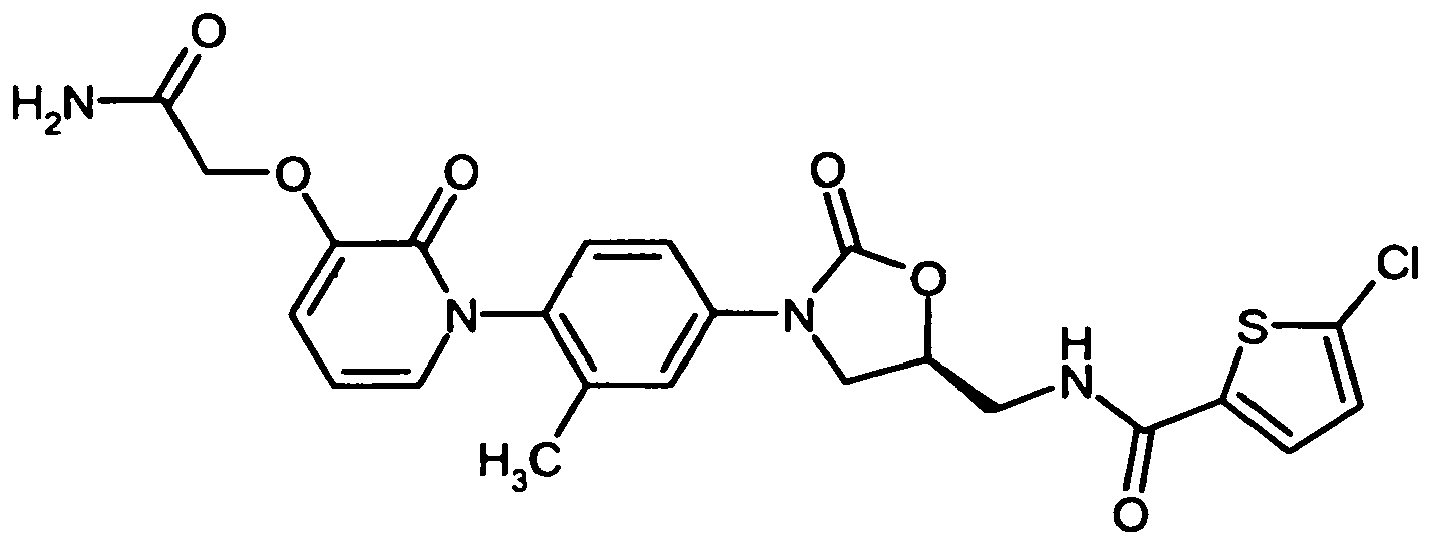
1H-NMR (400 MHz, DMSO-d6, δ/ppm): δ = 8.99 (t, 1H), 7.70 (d, 1H), 7.56-7.49 (m, 2H), 7.48-7.39 (m, 2H), 7.24 (d, 1H), 7.20 (d, 1H), 7.14 (d, 1H), 6.97 (d, 1H), 6.26 (t, 1H), 4.90-4.82 (m, 1H), 4.45 (s, 2H), 4.22 (t, 1H), 3.91-3.85 (m, 1H), 3.61 (t, 2H), 2.03 (s, 3H).
LC-MS (Methode 4): Rt = 1.88 min
MS (ESIpos): m/z = 517 (M+H)+ -

1H-NMR (400 MHz, DMSO-d6 , δ/ppm): δ = 8.99 (t, 1H), 7.70 (d, 1H), 7.55-7.47 (m, 2H), 7.26-7.18 (m, 2H), 7.05 (d, 1H), 6.93 (d, 1H), 6.22 (t, 1H), 4.90-4.82 (m, 1H), 4.22 (t, 1H), 4.10-3.99 (m, 2H), 3.91-3.81 (m, 1H), 3.66 (t, 2H), 3.61 (t, 2H), 2.54 (s, 3H), 2.02 (s, 3H).
LC-MS (Methode 4): Rt = 2.09 min
MS (ESIpos): m/z = 518 (M+H)+ -
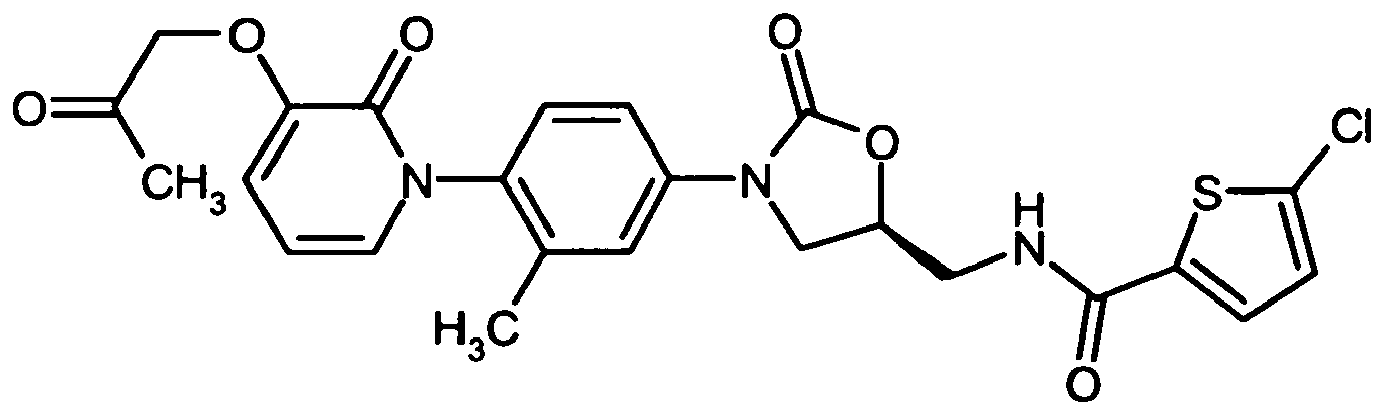
1H-NMR (400 MHz, DMSO-d6 , δ/ppm): δ = 8.98 (t, 1H), 7.70 (d, 1H), 7.55-7.49 (m, 2H), 7.25 (d, 1H), 7.20(d, 1H), 7.11-7.07 (m, 1H), 6.85 (dd, 1H), 6.20 (t, 1H), 4.90-4.82 (m, 1H), 4.77 (s, 2H), 4.22 (t, 1H), 3.91-3.85 (m, 1H), 3.62 (t, 2H), 2.15 (s, 3H), 2.02 (d, 3H).
LC-MS (Methode 4): Rt = 2.04 min
MS (ESIpos): m/z = 516 (M+H)+ -

1H-NMR (400 MHz, DMSO-d6 , δ/ppm): δ = 9.0 (t, 1H), 7.7 (d, 1H), 7.50 (m, 2H), 7.2 (m, 2H), 7.1 (m, 1H), 7.0 (m, 1H), 6.2 (t, 1H), 4.85 (m, 1H), 4.8 (m, 1H), 4.7 (m, 1H), 4.2 (m, 3H), 3.9 (m, 1H), 3.6 (t, 2H), 2.0 (s, 3H).
LC-MS (Methode 4): Rt = 2.23 min
MS (ESIpos): m/z= 506 (M+H)+ -

1H-NMR (400 MHz, DMSO-d6, δ/ppm): δ = 8.98 (t, 1H), 7.70 (d, 1H), 7.56-7.47 (m, 2H), 7.26-7.17 (m, 2H), 7.05 (d, 1H), 6.93 (d, 1H), 6.21 (t, 1H), 4.91-4.82 (m, 1H), 4.64 (s, 1H), 4.22 (t, 1H), 3.92-3.84 (m, 1H), 3.77-3.55 (m, 3H), 2.02 (s, 3H), 1.22-1.16 (m, 6H).
LC-MS (Methode 5): Rt = 2.05 min
MS (ESIpos): m/z = 532 (M+H)+ -

1H-NMR. (400 MHz, DMSO-d6 , δ/ppm): δ = 8.98 (t, 1H), 7.70 (d, 1H), 7.55-7.49 (m, 2H), 7.26-7.18 (m, 2H), 7.13-7.07 (m, 1H), 6.88 (dd, 1H), 6.22 (t, 1H), 4.90-4.80 (m, 3H), 4.22 (t, 1H), 3.9-3.84 (m, 1H), 3.64-3.38 (m, 10H), 2.02 (s, 3H).
LC-MS (Methode 5): Rt = 1.90 min
MS (ESIpos): m/z = 586 (M+H)+ -

1H-NMR (400 MHz, DMSO-d 6, δ/ppm): δ = 8.98 (t, 1H), 8.02-7.95 (m, 1H), 7.69 (d, 1H), 7.56-4.49 (b, 2H), 7.25 (d, 1H), 7.20 (d, 1H), 7.14 (d, 1H), 6.93 (d, 1H), 6.25 (t, 1H), 4.90-4.82 (m, 1H), 4.47 (s, 2H), 4.22 (t, 1H), 3.92-3.85 (m, 1H), 3.62 (t, 2H), 2.65 (s, 3H), 2.02 (s, 3H).
LC-MS (Methode 5): Rt = 1.87 min
MS (ESIpos): m/z = 531 (M+H)+ -

1H-NMR (400 MHz, DMSO-d6 , δ/ppm): δ = 8.98 (t, 1H), 8.00 (d, 1H), 7.70 (d, 1H), 7.61-7.50 (m, 2H), 7.25 (d, 1H), 7.20 (d, 1H), 7.15 (dd, 1H), 7.02 (dd, 1H), 6.26 (t, 1H), 4.90-4.82 (m, 1H), 4.41 (s, 2H), 4.22 (t, 1H), 3.91-3.85 (m, 1H), 3.61 (t, 2H), 2.02 (s, 3H), 1.27 (s, 9H).
LC-MS (Methode 5): Rt = 2.17 min
MS (ESIpos): m/z = 573 (M+H)+ -

1H-NMR (400 MHz, CDCl3, δ/ppm): δ = 7.51-7.45 (m, 2H), 7.33 (d, 1H), 7.21-7.18 (m, 1H), 7.12 (dd, 1H), 7.00 (dd, 1H), 6.90 (d, 1H), 6.70-6.62 (d, 1H), 6.22 (t, 1H), 4.88-4.78 (m, 1H), 4.66-4.50 (m, 2H), 4.16-4.04 (m, 1H), 3.90-3.82 (m, 2H), 3.76-3.66 (m, 1H), 2.13 (s, 3H).
LC-MS (Methode 3): Rt = 2.13 min
MS (ESIpos): m/z = 542 (M+H)+ -

1H-NMR (400 MHz, DMSO-d6 , δ/ppm): δ = 8.98 (t, 1H), 7.70 (d, 1H), 7.56-7.47 (m, 2H), 7.25 (d, 1H), 7.20 (d, 1H), 7.09 (d, 1H), 6.83 (d, 1H), 6.21 (t, 1H), 4.90-4.82 (m, 1H), 4.78 (s, 2H), 4.22 (t, 1H), 3.92-3.84 (m, 1H), 3.62 (t, 2H), 3.00 (s, 3H), 2.85 (s, 3H), 2.02 (s, 3H).
LC-MS (Methode 3): Rt = 1.71 min
MS (ESIpos): m/z = 545 (M+H)+ -

- 2.0 g (4.35 mmol) Beispiel 15A werden in 9 ml wasserfreiem N,N-Dimethylformamid gelöst, mit 3.6 g (26.1 mmol) Kaliumcarbonat versetzt und 30 min nachgerührt. Es wird mit weiteren 3 ml wasserfreiem N,N-Dimethylformamid verdünnt, mit 3.1 g (13.05 mmol) (2-Bromethoxy)(tert.-butyl)dimethylsilan versetzt und 7 h auf 60°C erhitzt. Man lässt erkalten, filtriert und reinigt mit präparativer HPLC mit einem Wasser/Acetonitril Gradient. Die Produktfraktionen werden im Vakuum zur Trockene eingedampft und der Rückstand im Vakuum getrocknet. Man erhält 1.17 g (53% d. Th.) der gewünschten Verbindung.
1H-NMR (400 MHz, DMSO-d6, δ/ppm): δ = 8.98 (t, 1H), 7.70 (d, 1H), 7.56-7.47 (m, 2H), 7.25-7.17 (m, 2H), 7.05 (dd, 1H), 6.93 (dd, 1H), 6.22 (t, 1H), 4.91 (t, 1H), 4.87-4.82 (m, 1H), 4.22 (t, 1H), 4.00-3.84 (m, 3H), 3.75-3.68 (m, 2H), 3.61 (t, 2H), 2.02 (s, 3H).
LC-MS (Methode 5): Rt = 1.93 min
MS (ESIpos): m/z = 504 (M+H)+ -

- Eine Lösung von 108 mg (0.228 mmol) des Produktes aus Beispiel 23A in 2 ml DMF wird mit 189 mg (1.37 mmol) Kaliumcarbonat versetzt. Nach 1 h bei RT werden 0.15 ml (0.684 mmol) (2-Bromethoxy)-tert.-butyldimethylsilan zugetropft und es wird bei 60°C gerührt. Nach 2 h wird abgekühlt und in 50 ml Wasser gegeben. Nach Phasentrennung wird dreimal mit 80 ml Essigsäureethylester extrahiert. Die vereinigten organischen Phasen werden mit gesättigter wässriger Natriumchlorid-Lösung gewaschen und dann über Natriumsulfat getrocknet. Nach Filtration wird vom Lösungsmittel befreit, der Rückstand in 6 ml Dichlormethan aufgenommen und bei RT mit 2 ml Trifluoressigsäure versetzt. Nach 2 h bei RT wird mit 50 ml Dichlormethan verdünnt, zweimal mit Wasser, dann mit gesättigter wässriger Natriumhydrogencarbonat-Lösung und dann wieder mit Wasser gewaschen. Es wird über Natriumsulfat getrocknet und anschließend vom Lösungsmittel befreit. Da noch Edukt enthalten ist, wird der Rückstand abermals in 4 ml Dichlormethan gelöst und mit 1 ml Trifluoressigsäure versetzt. Nach 3.5 h bei RT wird mit 50 ml Dichlormethan verdünnt und mit gesättigter wässriger Natriumhydrogencarbonat-Lösung sowie mit Wasser gewaschen. Dann wird über Natriumsulfat getrocknet und anschließend vom Lösungsmittel befreit. Der Rückstand wird durch Chromatographie an Kieselgel (Dichlormethan/Essigsäureethylester 20:1) gereinigt. Man erhält 83 mg (70% d. Th.) des gewünschten Produktes.
1H-NMR (400 MHz, DMSO-d6 , δ/ppm): 8.98 (t, 1H), 7.70 (d, 1H), 7.38 (dd, 2H), 7.20 (d, 1H), 6.99-6.90 (m, 2H), 6.26 (dd, 1H), 4.97-4.80 (m, 2H), 4.22 (dd, 1H), 3.95 (dd, 2H); 3.86 (dd, 1H), 3.76-3.70 (m, 2H), 3.60 (dd, 2H), 1.96 (s, 6H).
HPLC (Methode 1): Rt = 3.93 min.
MS (DCI, m/z): 518 (M+H)+. -

- 100 mg (0.172 mmol) Beispiel 15A werden in 1.5 ml wasserfreiem N,N-Dimethylformamid gelöst, mit 121 mg (0.87 mmol) Kaliumcarbonat versetzt und 30 min nachgerührt. 68.9 mg (0.435 mmol) Ethyl-chlor(difluor)acetat werden zugegeben und es wird 6 h auf 60°C erhitzt. Dann wird filtriert und mit präparativer HPLC mit einem Wasser/Acetonitril Gradient gereinigt. Die Produktfraktionen werden im Vakuum zur Trockene eingedampft und der Rückstand im Vakuum getrocknet. Man erhält 21 mg (19% d. Th.) der gewünschten Verbindung.
1H-NMR (400 MHz, DMSO-d6 , δ/ppm): δ = 9.0 (t, 1H), 7.6 (d, 1H), 7.05 (b, 2H), 7.5 (d, 2H), 7.3 (d, 1H), 7.2 (d, 1H), 7.05 (t, 1H), 6.3 (t, 1H), 4.85 (m, 1H), 4.2 (t, 1H), 3.9 (m, 1H), 3.6 (t, 2H), 2.0 (s, 3H).
LC-MS (Methode 4): Rt = 2.04 min
MS (ESIpos): m/z = 510 (M+H)+ -

- 400 mg (1.63 mmol) Beispiel 114A werden in 16 ml wasserfreiem Acetonitril gelöst und bei 0°C mit 443 mg (1.71 mmol) Beispiel 1A versetzt. Es wird mit 546 mg (2.45 mmol) Magnesiumperchlorat versetzt, die Kühlung entfernt und 5 h bei RT gerührt. Dann werden 528 mg (3.26 mmol) 1,1-Carbonyldiimidazol und 4 mg (0.03 mmol) N,N-Dimethylaminopyridin zugefügt und es wird 15 h am Rückfluß erhitzt. Man lässt erkalten und destilliert das Lösemittel im Vakuum ab. Der Rückstand wird in Essigsäureethylester aufgenommen und zweimal mit Wasser, mit gesättigter Natriumhydrogencarbonatlösung sowie mit gesättigter Natriumchloridlösung gewaschen, über Magnesiumsulfat getrocknet. Nach Filtration wird im Vakuum zur Trockene eingedampft. Man löst den Rückstand in Acetonitril an und es wird mit präparativer HPLC mit einem Gradienten aus Wasser und Acetonitril aufgereinigt. Die Produktfraktionen werden vereinigt und im Vakuum zur Trockene eingedampft. Man erhält 273 mg (34% d. Th.) der gewünschten Verbindung.
1H-NMR (400 MHz, DMSO-d6 , δ/ppm): δ = 8.98 (t, 1H), 7.70 (d, 1H), 7.56-7.50 (m, 2H), 7.30 (d, 1H), 7.20 (d, 1H), 7.07 (d, 1H), 6.88 (d, 1H), 4.90-4.82 (m, 1H), 4.30 (q, 2H), 4.21 (t, 1H), 3.90-3.84 (m, 1H), 3.61 (t, 2H), 2.05 (s, 3H), 1.34 (t, 3H).
LC-MS (Methode 6): Rt = 2.22 min
MS (ESIpos): m/z = 489 (M+H)+ -

- 90 mg (0.0.39 mmol) Beispiel 38A werden in 6 ml wasserfreiem Acetonitril gelöst und bei 0°C mit 122 mg (0.47 mmol) Beispiel 1A versetzt. Es werden 131 mg (0.59 mmol) Magnesiumperchlorat zugegeben, die Kühlung entfernt und es wird 15 h bei RT gerührt. Das Lösemittel wird im Vakuum eingedampft und der Rückstand mit 9 ml Butyronitril verdünnt. Dann wird mit 127 mg (0.79 mmol) 1,1-Carbonyldiimidazol und 1 mg (0.01 mmol) N,N-Dimethylaminopyridin versetzt und 15 h am Rückfluß erhitzt. Man lässt erkalten und destilliert das Lösemittel im Vakuum ab, löst den Rückstand in Acetonitril an und reinigt mit präparativer HPLC mit einem Gradienten aus Wasser und Acetonitril auf. Die Produktfraktionen werden vereinigt und im Vakuum zur Trockene eingedampft. Man erhält 33 mg (18% d. Th.) der gewünschten Verbindung.
1H-NMR (400 MHz, DMSO-d6 , δ/ppm): δ = 8.98 (t, 1H), 7.70 (d, 1H), 7.56-7.46 (m, 4H), 7.24-7.17 (m, 2H), 6.47 (d, 1H), 6.30 (dt, 1H), 4.90-4.82 (m, 1H), 4.26-4.19 (m, 1H), 3.92-3.85 (m, 1H), 3.62 (t, 2H), 2.30 (t, 2H), 1.49-1.36 (m, 2H), 0.71 (t, 3H).
LC-MS (Methode 6): Rt = 2.20 min
MS (ESIpos): m/z = 472 (M+H)+ -

- 750 mg (2.8 mmol) Beispiel 40A werden in 28 ml wasserfreiem Acetonitril gelöst und bei 0°C mit 730 mg (3.36 mmol) Beispiel 1A versetzt. Es werden 936 mg (4.19 mmol) Magnesiumperchlorat zugegeben, die Kühlung entfernt und es wird 15 h bei RT gerührt. Das Lösemittel wird im Vakuum eingedampft und der Rückstand mit 55 ml Butyronitril verdünnt. Dann wird mit 906 mg (5.59 mmol) 1,1-Carbonyldiimidazol und 7 mg (0.06 mmol) N,N-Dimethylaminopyridin versetzt und 15 h am Rückfluß erhitzt. Man lässt erkalten, destilliert das Lösemittel im Vakuum ab, löst den Rückstand in Acetonitril an und reinigt mit präparativer HPLC mit einem Gradienten aus Wasser und Acetonitril auf. Die Produktfraktionen werden vereinigt und im Vakuum zur Trockene eingedampft. Man erhält 828 mg (58% d. Th.) der gewünschten Verbindung.
1H-NMR (400 MHz, DMSO-d 6 δ/ppm): δ = 8.98 (t, 1H), 8.07 (d, 1H), 7.89 (d, 1H), 7.70 (d, 1H), 7.58-7.52 (m, 2H), 7.33 (d, 1H), 7.20 (d, 1H), 6.47 (t, 1H), 4.91-4.82 (m, 1H), 4.23 (t, 1H), 3.92-3.85 (m, 1H), 3.62 (t, 2H), 2.04 (s, 3H).
LC-MS (Methode 6): Rt = 2.14 mm
MS (ESIpos): m/z = 512 (M+H)+ -
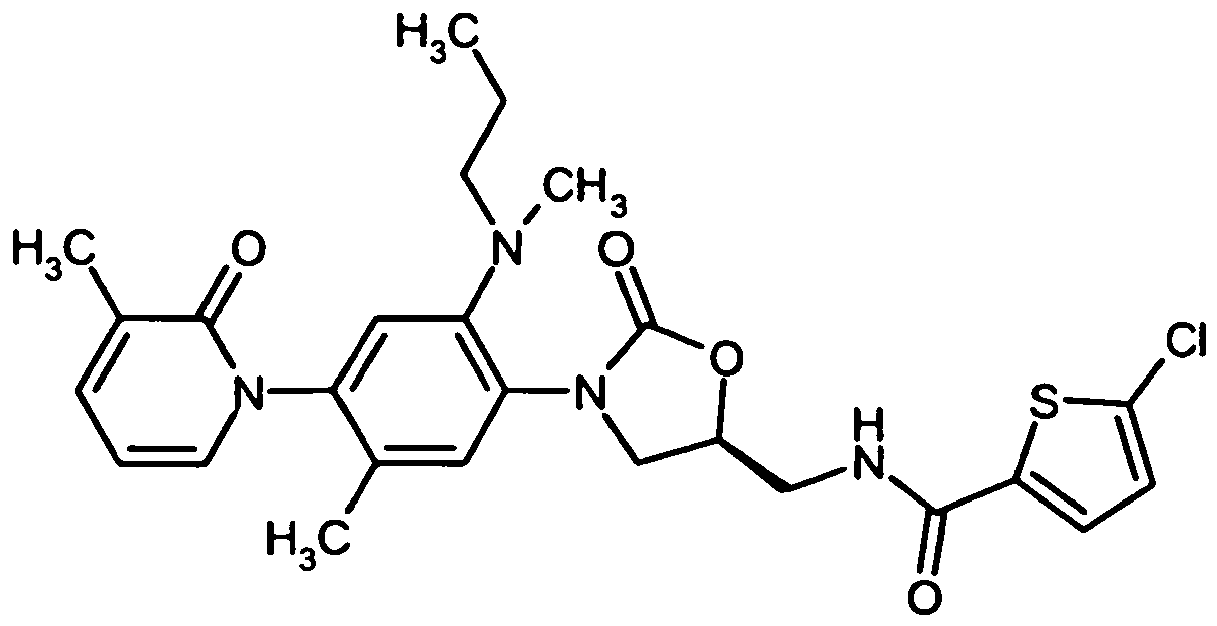
- Eine Lösung von 180 mg (0.631 mmol) des Produktes aus Beispiel 105A in 5 ml Acetonitril wird mit 151 mg (0.694 mmol) des Produktes aus Beispiel 1A versetzt. Der Suspension werden 211 mg (0.95 mmol) Magnesiumperchlorat zugefügt, wonach man 17 h bei RT rühren läßt. Dann werden 256 mg (1.58 mmol) 1,1'-Carbonyldiimidazol und 7.7 mg (0.06 mmol) DMAP hinzugesetzt und es wird 17 h bei 60°C gerührt. Das Rohgemisch wird mittels präparativer HPLC mit einem Acetonitril/Wasser-Gemisch gereinigt. Es werden 106 mg (30% d. Th.) des gewünschten Produktes erhalten.
1H-NMR (400 MHz, DMSO-d6 , δ/ppm): 9.04 (t, 1H), 7.77 (d, 1H), 7.44-7.34 (m, 2 H), 7.22 (d, 1H), 7.14 (d, 1H), 6.88 (s, 1H), 6.22 (dd, 1H), 4.95-4.82 (m, 1H), 4.00 (ddd, 1H), 3.72-3.50 (m, 3H), 2.90-2.69 (m, 2H), 2.58 (s, 3H), 2.04 (s, 3H), 1.86 (d, 3H), 1.46-1.31 (m, 2H), 0.80 (s, 3H).
HPLC (Methode 2): Rt = 4.07 min.
MS (DCI, mlz): 529 (M+H)+. -

- Eine Lösung von 415 mg (1.52 mmol) des Produktes aus Beispiel 109A in 10 ml Acetonitril wird mit 365 mg (1.68 mmol) des Produktes aus Beispiel 1A versetzt. Der Suspension werden 510 mg (2.29 mmol) Magnesiumperchlorat zugefügt, wonach man 17 h bei RT rühren läßt. Dann werden 617 mg (3.81 mmol) 1,1'-Carbonyldiimidazol und 18 mg (0.15 mmol) DMAP hinzugesetzt und es wird auf 60°C erhitzt. Nach 48 h wird vom Lösungsmittel befreit und das eingeengte Filtrat mittels präparativer HPLC mit einem Acetonitril/Wasser-Gemisch gereinigt. Es werden 58 mg (7% d. Th.) des gewünschten Produktes erhalten.
1H-NMR (400 MHz, DMSO-d6 , δ/ppm): 8.99 (t, 1H), 7.74 (d, 1H), 7.44-7.33 (m, 2H), 7.22 (br.s, 2H), 6.99 (s, 1H), 6.24 (dd, 1H), 4.88-4.80 (m, 1H), 4.07-3.88 (m, 3H), 3.76-3.53 (m, 3H), 2.04 (s, 3H), 1.89 (s, 3H), 1.70-1.61 (m, 2H), 0.92 (t, 3H).
HPLC (Methode 2): Rt = 4.43 min. -

- 160 mg (0.67 mmol) der Verbindung aus Beispiel 57A werden in 6 ml Acetonitril gelöst. Man kühlt auf 0°C, versetzt mit 157 mg (0.72 mmol) der Verbindung aus Beispiel 1A und 219 mg (0.98 mmol) Magnesiumperchlorat, wonach 20 h bei RT gerührt wird. Dann fügt man 159 mg (0.98 mmol) 1,1'-Carbonyldiimidazol und 8 mg (0.065 mmol) DMAP hinzu und erhitzt 20 h lang auf 60°C. Man reinigt direkt mittels präparativer HPLC. Es werden 190 mg (59% d. Th.) des gewünschten Produktes erhalten.
1H-NMR (400 MHz, DMSO-d6 , δ/ppm): 8.99 (t, 1H), 7.70 (d, 1H), 7.68 (dd, 1H), 7.36-7.32 (m, 2H), 7.25 (d, 1H), 7.20 (d, 1H), 7.01 (dd, 1H), 6.26 (t, 1H), 4.89-4.81 (m, 1H), 4.22 (t, 1H), 3.94 (q, 2H), 3.88 (dd, 1H), 3.70 (s, 3H), 3.62 (t, 2H), 1.23 (t, 3H).
HPLC (Methode 3): Rt = 1.89 min.
MS (ESIpos, m/z): 488/490 (35Cl/37Cl) (M+H)+. -

- 260 mg (1.13 mmol) des Produktes aus Beispiel 59A werden analog Beispiel 23 mit dem Produkt aus Beispiel 1A umgesetzt. Man reinigt mittels präparativer HPLC. Es werden 310 mg (58% d. Th.) des gewünschten Produktes erhalten.
1H-NMR (400 MHz, DMSO-d6 , δ/ppm): 8.98 (t, 1H), 7.70 (d, 1H), 7.67 (dd, 1H), 7.36-7.33 (m, 2H), 7.23 (d, 1H), 7.20 (d, 1H), 7.01 (dd, 1H), 6.24 (t, 1H), 4.89-4.81 (m, 1H), 4.23 (t, 1H), 3.88 (dd, 1H), 3.70 (s, 3H), 3.62 (t, 2H), 3.46 (s, 3H).
HPLC (Methode 2): Rt = 3.99 min.
MS (ESIpos, m/z): 474/476 (35Cl37Cl) (M+H)+. -

- 110 mg (0.43 mmol) des Produktes aus Beispiel 53A werden analog Beispiel 23 mit dem Produkt aus Beispiel 1A umgesetzt. Man reinigt mittels präparativer HPLC. Es werden 113 mg (51% d. Th.) des gewünschten Produktes erhalten.
1H-NMR (400 MHz, DMSO-d6 , δ/ppm): 9.00 (t, 1H), 7.70 (d, 1H), 7.44 (d, 1H), 7.32-7.28 (m, 2H), 7.26 (d, 1HP, 7.20 (d, 1H), 7.11 (d, 1H), 6.19 (t, 1H), 4.91-4.83 (m, 1H), 4.25 (t, 1H), 3.90 (dd, 1H), 3.73 (s, 3H), 3.63 (t, 2H), 2.52-2.49 (m, 2H), 1.50-1.48 (m, 2H), 0.91 (t, 3H).
HPLC (Methode 4): Rt = 2.43 min.
MS (ESIpos, m/z): 502/504 (35Cl/37Cl) (M+H)+. -

- Eine Lösung von 220 mg (0.939 mmol) des Produktes aus Beispiel 91A in 10 ml Acetonitril wird mit 224 mg (1.03 mmol) des Produktes aus Beispiel 1A versetzt. Der Suspension werden 314 mg (1.41 mmol) Magnesiumperchlorat zugefügt, wonach man 5 h bei RT rühren lässt. Dann werden 380 mg (2.35 mmol) 1,1'-Carbonyldiimidazol und 11 mg (0.09 mmol) DMAP hinzugesetzt und es wird bei RT gerührt. Nach 18 h wird mit 100 ml Wasser verdünnt. Die Wasserphase wird dreimal mit Essigsäureethylester extrahiert und die vereinigten organischen Phasen über Natriumsulfat getrocknet. Anschließende Reinigung mittels präparativer HPLC mit einem Gradienten aus Wasser und Acetonitril liefert 137 mg (30% d. Th.) des gewünschten Produktes.
1H-NMR (400 MHz, DMSO-d6 , δ/ppm): 8.97 (t, 1H); 7.69 (d, 1H), 7.32 (d, 1H), 7.20 (d, 1H), 7.11 (d, 1H), 6.98 (dd, 1H), 4.90-4.78 (m, 1H), 4.19 (dd, 1H), 3.99 (q, 2H), 3.85 (dd, 1H), 3.60 (dd, 2H), 3.44-3.35 (m, 2H), 2.37-2.28 (m, 2H), 1.88-1.77 (m, 4H), 1.30 (t, 3H).
LC-MS (Methode 5): Rt = 4.03 min.
MS (ESIpos, m/z): 478 (M+H)+. -

- 560 mg (2.39 mmol) Beispiel 116A werden in 24 ml wasserfreiem Acetonitril gelöst und bei 0°C mit 624 mg (2.87 mmol) Beispiel 1A versetzt. Es werden 800 mg (3.89 mmol) Magnesiumperchlorat zugegeben, die Kühlung entfernt und 15 h bei RT gerührt. Das Lösemittel wird im Vakuum entfernt, der Rückstand mit 50 ml wasserfreiem Butyronitril gelöst und dann mit 775 mg (4.78 mmol) 1,1-Carbonyldiimidazol und 6 mg (0.05 mmol) N,N-Dimethylaminopyridin versetzt. Nach Erhitzen für 16 h am Rückfluss, wird mit Essigsäureethylester versetzt, die organische Phase abgetrennt, zweimal mit Wasser, einmal mit gesättigter Natriumhydrogencarbonatlösung und einmal mit gesättigter Natriumchloridlösung gewaschen, getrocknet, filtriert und im Vakuum zur Trockene eingedampft. Der Rückstand wird in Dimethylsulfoxid angelöst und mit präparativer HPLC mit einem Gradienten aus Wasser und Acetonitril aufgereinigt. Die Produktfraktionen werden vereinigt und im Vakuum zur Trockene eingedampft. Man erhält 560 mg (49% d. Th.) der gewünschten Verbindung.
1H-NMR (400 MHz, DMSO-d6 , δ/ppm): δ = 8.97 (t, 1H), 7.70 (d, 1H), 7.59-7.54 (m, 1H), 7.52-7.45 (m, 1H), 7.24-7.17 (m, 2H), 4.87-4.78 (m, 1H), 4.30 (d, 1H), 4.22-4.14 (m, 2H), 3.90-3.83 (m, 1H), 3.63-3.52 (m, 3H), 3.37-3.27 (m, 4H), 2.40-2.32 (m, 2H), 1.90-1.80 (m, 4H).
LC-MS (Methode 5): Rt = 1.93 min
MS (ESIpos): m/z = 478 (M+H)+ -

- 147 mg (0.58 mmol) Beispiel 75A werden in 6 ml wasserfreiem Acetonitril gelöst und bei 0°C mit 184 mg (0.71 mmol) Beispiel 1A versetzt. Es werden 198 mg (0.89 mmol) Magnesiumperchlorat zugegeben, die Kühlung entfernt und 15 h bei RT gerührt. Das Lösemittel wird im Vakuum entfernt, der Rückstand mit 10 ml wasserfreiem Butyronitril verdünnt und mit 192 mg (1.18 mmol) 1,1-Carbonyldiimidazol und 2 mg (0.01 mmol) N,N-Dimethylaminopyridin versetzt. Nach 16 h am Rückfluss wird mit Essigsäureethylester versetzt, die organische Phase abgetrennt, zweimal mit Wasser, einmal mit gesättigter Natriumhydrogencarbonat-Lösung und einmal mit gesättigter Natriumchloridlösung gewaschen, getrocknet, filtriert und im Vakuum zur Trockene eingedampft. Der Rückstand wird in Dimethylsulfoxid angelöst und es wird mit präparativer HPLC mit einem Gradienten aus Wasser und Acetonitril auf gereinigt, die Produktfraktionen werden vereinigt und im Vakuum zur Trockene eingedampft. Man erhält 190 mg (65% d. Th.) der gewünschten Verbindung.
1H-NMR (400 MHz, DMSO-d6 , δ/ppm): δ = 8.97 (t, 1H), 7.70 (d, 1H), 7.57 (d, 1H), 7.52-7.44 (m, 1H), 7.24-7.17 (m, 2H), 4.87-4.78 (m, 1H), 4.33 (d, 1H), 4.23-4.15 (m, 2H), 3.89-3.82 (m, 1H), 3.64-3.51 (m, 3H), 3.45 (q, 2H), 3.39-3.33 (m, 1H), 2.39-2.30 (m, 2H), 1.88-1.78 (m, 4H) 1.20-1.11 (m, 3H).
LC-MS (Methode 5): Rt = 2.06 min
MS (ESIpos): m/z = 492 (M+H)+ -

- 373 mg (1.69 mmol) Beispiel 77A werden in 20 ml wasserfreiem Acetonitril gelöst und bei 0°C mit 526 mg (2.03 mmol) Beispiel 1A versetzt. 567 mg (2.54 mmol) Magnesiumperchlorat werden zugegeben, die Kühlung entfernt und es wird 15 h bei RT gerührt. Dann wird im Vakuum zur Trockene eingedampft und in 30 ml Butyronitril aufgenommen. Es wird mit 549 mg (3.39 mmol) 1,1-Carbonyldiimidazol und 4 mg (0.03 mmol) N,N-Dimethylaminopyridin versetzt und 5 h am Rückfluß erhitzt. Man lässt erkalten und destilliert das Lösemittel im Vakuum ab. Der Rückstand wird in Acetonitril gelöst und mit präparativer HPLC mit einem Gradienten aus Wasser und Acetonitril aufgereinigt. Die Produktfraktionen werden vereinigt und im Vakuum zur Trockene eingedampft. Man erhält 462 mg (59% d. Th.) der gewünschten Verbindung.
1H-NMR (400 MHz, DMSO-d 6, δ/ppm): δ = 8.97 (t, 1H), 7.70 (d, 1H), 7.42-7.35 (m, 2H), 7.20 (d, 1H), 7.13 (d, 1H), 4.87-4.79 (m, 1H), 4.17 (t, 1H), 3.85-3.78 (m, 6H), 3.65-3.56 (m, 3H), 2.92-2.84 (m, 1H), 2.75-2.67 (m, 1H), 2.15 (s, 3H).
LC-MS (Methode 6): Rt = 1.88 min
MS (ESIpos): m/z = 464 (M+H)+ -

- Eine Lösung von 236 mg (0.95 mmol) des Produktes aus Beispiel 80A in 12 ml Acetonitril wird mit 229 mg (1.05 mmol) des Produktes aus Beispiel 1A versetzt. Der Suspension werden 320 mg (1.44 mmol) Magnesiumperchlorat zugefügt, wonach man 5 h bei RT rühren lässt. Dann werden 388 mg (2.40 mmol) 1,1'-Carbonyldiimidazol und 12 mg (0.09 mmol) DMAP hinzugesetzt und es wird 12 h bei RT gerührt. Anschließend wird mit Wasser verdünnt, die Wasserphase dreimal mit Essigsäureethylester extrahiert und die vereinigten organischen Phasen über Natriumsulfat getrocknet. Nach Filtration wird vom Lösungsmittel befreit und der Rückstand mittels präparativer HPLC mit einem Wasser/Acetonitril Gemisch gereinigt. Man erhält 138 mg (29% d. Th.) des gewünschten Produktes.
1H-NMR (400 MHz, DMSO-d 6, δ/ppm): 8.94 (t, 1H), 7.67 (d, 1H), 7.32 (ddd, 1H), 7.18 (d, 1H), 7.12 (d, 1H), 7.06 (dd, 1H), 4.86-4.75 (m, 1H), 4.16 (ddd, 1H), 3.91-3.72 (m, 6H), 3.67-3.52 (m, 3H), 2.92 (ddd, 1H), 2.69 (ddd, 1H), 1.92-1.84 (m, 1H), 1.01-0.82 (m, 2H), 0.77-0.68 (m, 1H), 0.50-0.41 (m, 1H).
HPLC (Methode 1): Rt = 3.99 min
MS (DCI, m/z): 507 (M+NH4)+. -

- Eine Lösung von 12.8 mg (0.058 mmol) des Produktes aus Beispiel 83A in 1 ml Acetonitril wird mit 14 mg (0.06 mmol) des Produktes aus Beispiel 1A versetzt. Der Suspension werden 19 mg (0.09 mmol) Magnesiumperchlorat zugefügt, wonach man 4.5 h bei RT rühren lässt. Dann werden 23.6 mg (0.146 mmol) 1,1'-Carbonyldiimidazol und 1 mg (0.01 mmol) DMAP hinzugesetzt und es wird 18 h bei RT gerührt. Anschließend wird mit DMSO versetzt und mittels präparativer HPLC mit einem Wasser/Acetonitril Gemisch gereinigt. Man erhält 10 mg (36% d. Th.) des gewünschten Produktes.
1H-NMR (400 MHz, DMSO-d 6, δ/ppm): 8.95 (t, 1H), 7.68 (d, 1H), 7.42-7.29 (m, 2H), 7.21-7.12 (m, 2H), 6.42 (br. s, 1H), 4.89-4.78 (m, 1H), 4.18 (ddd, 1H), 3.88-3.82 (m, 1H), 3.65-3.48 (m, 4H), 3.40-3.18 (m, 4H), 1.98-1.87 (m, 2H), 1.13 (t, 3H).
HPLC (Methode 1): Rt = 3.98 min
MS (ESIpos, m/z): 463 (M+H)+. -

- Eine Lösung von 75 mg (0.32 mmol) des Produktes aus Beispiel 85A in 4 ml Acetonitril wird mit 77 mg (0.35 mmol) des Produktes aus Beispiel 1A versetzt. Der Suspension werden 107 mg (0.482 mmol) Magnesiumperchlorat zugefügt, wonach man 5 h bei RT rühren lässt. Dann werden 130 mg (0.804 mmol) 1,1'-Carbonyldiimidazol und 4 mg (0.03 mmol) DMAP hinzugesetzt und es wird 18 h bei RT gerührt. Anschließend wird mit Wasser verdünnt und dreimal mit Essigsäureethylester extrahiert. Die vereinigten organischen Phasen werden über Natriumsulfat getrocknet. Nach Filtration wird im Vakuum vom Lösungsmittel befreit und der Rückstand mittels präparativer HPLC mit einem Wasser/Acetonitril Gemisch gereinigt. Man erhält 51 mg (33% d. Th.) des gewünschten Produktes.
1H-NMR (400 MHz, DMSO-d6, δ/ppm): 8.96 (t, 1H), 7.68 (d, 1H), 7.44 (m, 1H), 7.29 (ddd, 1H), 7.18 (d, 1H), 7.12 (d, 1H), 6.41 (br. s, 1H), 4.88-4.78 (m, 1H), 4.19 (dd, 1H), 3.86 (dd, 1H), 3.60 (dd, 2H), 3.57-3.48 (m, 1H), 3.31-3.17 (m, 3H), 3.03-2.93 (m, 1H), 2.00-1.89 (m, 2H), 1.18-1.08 (m, 6H).
HPLC (Methode 1): Rt = 4.07 min
MS (ESIpos, m/z): 477 (M+H)+. -

- 42 mg (0.18 mmol) Beispiel 87A werden in 3 ml wasserfreiem Acetonitril gelöst und bei 0°C mit 56 mg (0.22 mmol) Beispiel 1A versetzt. 60 mg (0.27 mmol) Magnesiumperchlorat werden zugegeben, die Kühlung entfernt und es wird 15 h bei RT gerührt. Das Lösemittel wird im Vakuum eingedampft, der Rückstand mit 5 ml Butyronitril verdünnt und mit 58 mg (0.36 mmol) 1,1-Carbonyldiimidazol und 0.4 mg (0.004 mmol) N,N-Dimethylaminopyridin versetzt. Nach 15 h am Rückfluß lässt man erkalten und destilliert das Lösemittel im Vakuum ab. Man löst den Rückstand in Acetonitril und reinigt mit präparativer HPLC mit einem Gradienten aus Wasser und Acetonitril. Die Produktfraktionen werden vereinigt und im Vakuum zur Trockene eingedampft. Man erhält 44 mg (51% d. Th.) der gewünschten Verbindung.
1H-NMR (400 MHz, DMSO-d 6, δ/ppm): δ = 8.98 (t, 1H), 7.70 (d, 1H), 7.39-7.29 (m, 2H), 7.20 (d, 1H), 7.14 (d, 1H), 6.45 (br. s, 1H), 4.85-4.79 (m, 1H), 4.17 (t, 1H), 3.86-3.81 (m, 1H), 3.55-3.35 (m, 5H), 2.52-2.48 (m, 2H), 2.49-2.38 (m, 1H), 1.97-1.90 (m, 2H), 1.59-1.45 (m, 2H), 0.90 (t, 3H).
LC-MS (Methode 6): Rt = 2.10 min
MS (ESIpos): m/z = 477 (M+H)+ -

- Eine Lösung von 45 mg (0.205 mmol) des Produktes aus Beispiel 61A in 2 ml Acetonitril wird mit 49.1 mg (0.226 mmol) des Produktes aus Beispiel 1A versetzt. Der Suspension werden 68.7 mg (0.308 mmol) Magnesiumperchlorat zugefügt, wonach man 3 h bei RT rühren lässt. Dann werden 83.2 mg (0.513 mmol) 1,1'-Carbonyldiimidazol und 2.5 mg (0.02 mmol) DMAP hinzugesetzt, und es wird bei RT gerührt. Nach 24 h wird mit 50 ml Wasser verdünnt und die wässrige Phase dreimal mit Essigsäureethylester extrahiert. Die vereinigten organischen Phasen werden über Natriumsulfat getrocknet. Nach Filtration wird vom Lösungsmittel befreit und der Rückstand mittels präparativer HPLC mit einem Acetonitril/Wasser-Gemisch gereinigt. Es werden 68 mg (71% d. Th.) des gewünschten Produktes erhalten.
1H-NMR (400 MHz, DMSO-d 6, δ/ppm): 8.96 (dd, 1H), 7.68 (dd, 1H), 7.38-7.31 (m, 2H), 7.19 (d, 1H), 7.13 (d, 1H), 4.85-4.76 (m, 1H), 4.16 (dd, 1H), 3.83 (dd, 1H), 3.62-3.52 (m, 3H), 3.43-3.25 (m, 3H), 2.84 (s, 3H), 2.13 (s, 3H), 2.07-1.99 (m, 2H).
HPLC (Methode 2): Rt = 4.09 min.
MS (DCIpos, m/z): 463 (M+H)+. -

- Eine Lösung von 350 mg (1.49 mmol) des Produktes aus Beispiel 63A in 10 ml Acetonitril wird mit 356 mg (1.64 mmol) des Produktes aus Beispiel 1A versetzt. Der Suspension werden 498 mg (2.23 mmol) Magnesiumperchlorat zugefügt, wonach man 2 h bei RT rühren lässt. Dann werden 603 mg (3.72 mmol) 1,1'-Carbonyldiimidazol und 18 mg (0.15 mmol) DMAP hinzugesetzt, und es wird bei RT gerührt. Nach 48 h wird in 200 ml Wasser gegeben und die wässrige Phase dreimal mit Essigsäureethylester extrahiert. Der gebildete Niederschlag wird abfiltriert und im Vakuum getrocknet. Es werden 232 mg (32% d. Th.) des gewünschten Produktes erhalten.
1H-NMR (400 MHz, DMSO-d 6, δ/ppm): 8.97 (t, 1H), 7.69 (d, 1H), 7.29 (d, 1H), 7.19 (d, 1H), 7.10 (d, 1H), 6.94 (dd, 1H), 4.87-4.77 (m, 1H), 4.19 (dd, 1H), 3.85 (dd, 1H), 3.74 (s, 3H), 3.60 (t, 2H), 3.48-3.21 (m, 4H), 2.81 (s, 3H), 1.99 (tt, 2H).
HPLC (Methode 2): Rt = 4.04 min.
MS (ESIpos, m/z): 479 (M+H)+. -

- Eine Lösung von 232 mg (0.32 mmol) des Produktes aus Beispiel 67A in 6 ml THF wird mit 195 mg (0.74 mmol) einer 1 molaren Lösung von Tetrabutylammoniumfluorid in THF versetzt. Es wird 2 h bei RT gerührt. Dann wird mit 60 ml Wasser, 30 ml Essigsäureethylester und 6 ml Natriumchlorid-Lösung versetzt und die Phasen werden getrennt. Die organische Phase wird dreimal mit Essigsäureethylester extrahiert und die vereinigten organischen Phasen über Natriumsulfat getrocknet. Nach Filtration wird vom Lösungsmittel befreit und der Rückstand durch Chromatographie an Kieselgel (Dichlormethan/Methanol 20:1) vorgereinigt. Anschließende Aufreinigung mittels präparativer HPLC mit einem Acetonitril/Wasser-Gemisch liefert 29 mg (18% d. Th.) des gewünschten Produktes.
1H-NMR (400 MHz, DMSO-d 6, δ/ppm): 8.96 (t, 1H), 7.69 (d, 1H), 7.40-7.31 (m, 2H), 7.19 (d, 1H), 7.13 (d, 1H), 4.86-4.77 (m, 1H), 4.64 (t, 1H), 4.16 (dd, 1H), 3.83 (dd, 1H), 3.59 (t, 2H), 3.58-3.40 (m, 5H), 3.38-3.22 (m, 3H), 2.12 (s, 3H), 2.06-1.95 (m, 2H).
HPLC (Methode 1): Rt = 3.91 min.
MS (ESIpos, m/z): 493 (M+H)+. -

- Eine Lösung von 355 mg (0.47 mmol) des Produktes aus Beispiel 70A in 9 ml THF wird mit 290 mg (1.10 mmol) einer 1 molaren Lösung von Tetrabutylammoniumfluorid in THF versetzt. Es wird 2 h bei RT gerührt. Dann wird mit 80 ml Wasser, 50 ml Essigsäureethylester und 6 ml Natriumchlorid-Lösung versetzt und die Phasen werden getrennt. Die organische Phase wird zweimal mit Essigsäureethylester extrahiert und die vereinigten organischen Phasen werden über Natriumsulfat getrocknet. Nach Filtration wird vom Lösungsmittel befreit und der Rückstand durch Chromatographie an Kieselgel (Dichlormethan/Methanol 20:1) vorgereinigt. Anschließende Aufreinigung mittels präparativer HPLC mit einem Actonitril/Wasser-Gemisch liefert 39 mg (16% d. Th.) des gewünschten Produktes.
1H-NMR (400 MHz, DMSO-d 6, δ/ppm): 8.96 (t, 1H), 7.73-7.67 (m, 2H), 7.46-7.36 (m, 1H), 7.34 (d, 1H), 7.19 (d, 1H), 4.84 (dddd, 1H), 4.64 (t, 1H), 4.19 (dd, 1H), 3.85 (dd, 1H), 3.60 (t, 2H), 3.52-3.33 (m, 6H), 3.33-3.24 (m, 1H), 2.06-1.97 (m, 2H).
HPLC (Methode 1): Rt = 3.95 min.
MS (ESIpos, m/z): 513 (M+H)+. -

- Eine Lösung von 8.88 g (11.3 mmol) des Produktes aus Beispiel 73A in 225 ml THF wird mit 6.95 g (26.6 mmol) einer 1 molaren Lösung von Tetrabutylammoniumfluorid in THF versetzt. Es wird 45 min bei RT gerührt. Dann wird vom Lösungsmittel befreit und der Rückstand durch Chromatographie an Kieselgel (Dichlormethan/Methanol 40:1 -> 10:1) gereinigt. Man erhält 5.24 g (80% d. Th.) des gewünschten Produktes.
1H-NMR (400 MHz, DMSO-d 6, δ/ppm): 8.96 (dd, 1H), 7.95 (dd, 1H), 7.75-7.66 (m, 2H), 7.46 (d, 1H), 7.19 (d, 1H), 4.91-4.82 (m, 1H), 4.63 (t, 1H), 4.24 (dd, 1H), 3.91 (dd, 1H), 3.63-3.22 (m, 10H), 2.06-1.97 (m, 2H).
HPLC (Methode 2): Rt = 4.03 min.
MS (ESIpos, m/z): 547 (M+H)+. -

- Eine Lösung von 100 mg (0.197 mmol) der Verbindung aus Beispiel 101A in einem Gemisch aus jeweils 1 ml Tetrahydrofuran und Wasser wird mit 49 µl (0.004 mmol) einer 2.5-prozentigen Lösung von Osmiumtetroxid in tert.-Butanol und 126 mg (0.59 mmol) Natriumperjodat versetzt. Das Reaktionsgemisch wird 16 Stunden bei RT gerührt. Anschliessend wird mit ca. 5 ml Wasser verdünnt und mit Dichlormethan extrahiert. Der organische Extrakt wird über wasserfreiem Magnesiumsulfat getrocknet, filtriert und das Filtrat am Rotationsverdampfer vom Lösemittel befreit. Der erhaltene Rückstand wird wieder in einem Gemisch aus jeweils 1 ml Tetrahydrofuran und Wasser gelöst und mit 8 mg (0.2 mmol) Natriumborhydrid versetzt. Nach einer Stunde Rühren bei RT wird wiederum mit ca. 5 ml Wasser verdünnt und mit Dichlormethan extrahiert. Der organische Extrakt wird über wasserfreiem Magnesiumsulfat getrocknet, filtriert und das Filtrat am Rotationsverdampfer vom Lösemittel befreit. Der erhaltene Rückstand wird mittels präparativer HPLC mit einem Acetonitril/Wasser-Gemisch gereinigt. Es werden 52 mg (50% d. Th.) der Titelverbindung erhalten.
1H-NMR (400 MHz, CDCl3, δ/ppm): 7.73 und 7.68 (2 dd, zusammen 1H), 7.43 und 7.41 (2 d, zusammen 1H), 7.31 (d, 1H), 7.21 und 7.20 (2 d, zusammen 1H), 6.89 (d, 1H), 6.80 (t, 1H), 4.89-4.82 (m, 1H), 4.07-4.02 (m, 2H), 3.83-3.69 (m, 5H), 3.62-3.47 (m, 2H), 2.71-2.62 (m, 1H), 2.16-1.94 (m, 4H), 1.83-1.74 (m, 2H).
HPLC (Methode 5): Rt = 1.96 min.
MS (ESIpos, m/z): 512/514/516 (Cl2, 35Cl/37Cl) (M+H)+. -

- Das Diastereomerengemisch aus Beispiel 39 kann in präparativem Maßstab chromatographisch in die reinen Diastereomere aufgetrennt werden. Dazu werden 50 mg der Verbindung aus Beispiel 39 in 3.5 ml des Laufmittels gelöst und in einer Portion chromatographiert. Es werden 13 mg (26% d. Th.) der Titelverbindung (Diastereomer 1) und 16 mg (32% d. Th.) des Diastereomers 2 erhalten.
Methode: Säule: Daicel Chiralpak AD-H, 5 µm, 250 mm x 20 mm; Laufmittel: Ethanol + 1% Wasser + 0.2% Trifluoressigsäure; Fluß: 15 ml/min; Temperatur: 40°C; UV-Detektion: 220 nm.
Retentionszeit: 15.9 min (Diastereomer 1), 19.3 min (Diastereomer 2)
1H-NMR (400 MHz, CDCl3, δ/ppm): 7.71 (d, 1H), 7.46 und 7.43 (2 dd, zusammen 1H), 7.30 (d, 1H), 7.22 und 7.21 (2 d, zusammen 1H), 6.91 (d, 1H), 6.61 und 6.59 (2 t, zusammen 1H), 4.89-4.82 (m, 1H), 4.09-4.03 (m, 1H), 3.88-3.71 (m, 5H), 3.63-3.45 (m, 2H), 2.72-2.62 (m, 1H), 2.14-1.93 (m, 4H), 1.83-1.74 (m, 1H), 1.71 (breit, 1H).
HPLC (Methode 4): Rt = 2.07 min.
MS (ESIpos, m/z): 512/514/516 (Cl2, 35Cl/37Cl) (M+H)+. -

- Das Diastereomerengemisch aus Beispiel 39 kann in präparativem Maßstab chromatographisch in die reinen Diastereomere aufgetrennt werden. Dazu werden 50 mg der Verbindung aus Beispiel 39 in 3.5 ml des Laufmittels gelöst und in einer Portion chromatographiert. Es werden 16 mg (32% d. Th.) der Titelverbindung (Diastereomer 2) und 13 mg (26% d. Th.) des Diastereomers 1 erhalten.
Methode: Säule: Daicel Chiralpak AD-H, 5 µm, 250 mm x 20 mm; Laufmittel: Ethanol + 1% Wasser + 0.2% Trifluoressigsäure; Fluß: 15 ml/min; Temperatur: 40°C; UV-Detektion: 220 nm.
Retentionszeit: 15.9 min (Diastereomer 1), 19.3 min (Diastereomer 2)
1H-NMR (400 MHz, CDCl3, δ/ppm): 7.73-7.68 (m, 1H), 7.48-4.41 (m, 1H), 7.30 (d, 1H), 7.25-7.20 (m, 1H, teilweise überdeckt vom CHCl3-Signal), 6.90 (d, 1H), 6.67-6.61 (m, 1H), 4.89-4.82 (m, 1H), 4.10-4.01 (m, 1H), 3.88-3.69 (m, 5H), 3.63-3.44 (m, 2H), 2.72-2.62 (m, 1H), 2.28 (breit, 1H), 2.16-1.92 (m, 4H), 1.85-1.73 (m, 1H).
HPLC (Methode 4): Rt = 2.07 min.
MS (ESIpos, m/z): 512/514/516 (Cl2, 35Cl/37Cl) (M+H)+. -

- Eine Lösung von 600 mg (0.814 mmol) der Verbindung aus Beispiel 95A in 10 ml Tetrahydrofuran wird bei 0°C mit 855 µl (0.855 mmol) einer 1-molaren Lösung von Tetrabutylammoniumfluorid in Tetrahydrofuran versetzt. Nach fünf Stunden bei RT wird das Reaktionsgemisch am Rotationsverdampfer zur Trockene eingedampft. Der erhaltene Rückstand wird mittels Flash-Chromatographie über Kieselgel mit Cyclohexan/Essigsäureethylester 2:1 → 1:2 als Laufmittel gereinigt. Es werden 342 mg (84% d. Th.) der Titelverbindung erhalten.
1H-NMR (400 MHz, DMSO-d6, δ/ppm): 7.72 und 7.71 (2 t, zusammen 1H), 7.48-7.41 (m, 1H), 7.31 (d, 1H), 7.23 (d, 1H), 6.91 (d, 1H), 6.64 und 6.60 (m, 1H), 4.90-4.83 (m, 1H), 4.07 und 4.05 (2 t, zusammen 1H), 3.87-3.73 (m, 5H), 3.60-3.45 (m, 2H), 2.72-2.61 (m, 1H), 2.10-1.96 (m, 3H), 1.76-1.63 (m, 1H).
HPLC (Methode 2): Rt = 4.09 min.
MS (ESIpos, m/z): 498/500/502 (Cl2, 35Cl/37Cl) (M+H)+. -

- Das Diastereomerengemisch aus Beispiel 42 kann in präparativem Maßstab chromatographisch in die reinen Diastereomere aufgetrennt werden. Dazu werden 320 mg der Verbindung aus Beispiel 46 in 12 ml des Laufmittels gelöst und in drei Portionen chromatographiert. Es werden 167 mg (52% d. Th.) der Titelverbindung (Diastereomer 1) und 128 mg (40% d. Th.) des Diastereomers 2 erhalten.
Methode: Säule: Daicel Chiralpak AD-H, 5 µm, 250 mm x 20 mm; Laufmittel: Ethanol + 1 % Wasser + 0.2% Trifluoressigsäure; Fluß: 15 ml/min; Temperatur: 40°C; UV-Detektion: 220 nm.
Retentionszeit: 12.4 min (Diastereomer 1), 22.3 min (Diastereomer 2)
1H-NMR (400 MHz, CDCl3, δ/ppm): 7.71 (d, 1H), 7.47 und.7.43 (2 d, zusammen 1H), 7.30 und 7.28 (2 d, zusammen 1H), 7.23 und 7.22 (2 d, zusammen 1H, teilweise überdeckt vom CHCl3-Signal), 6.91 und 6.90 (2 d, zusammen 1H), 6.61 und 6.57 (2 t, zusammen 1H), 4.89-4.83 (m, 1H), 4.10 und 4.03 (m, 1H), 3.87-3.72 (m, 5H), 3.64-3.44 (m, 2H), 2.72-2.61 (m, 1H), 2.13-1.83 (m, 4H), 1.76-1.64 (m, 1H).
HPLC (Methode 4): Rt = 2.11 min.
MS (ESIpos, m/z): 498/500/502 (Cl2, 35Cl/37Cl) (M+H)+. -

- In Analogie zu dem in Beispiel 39 beschriebenen Verfahren werden aus 100 mg (0.205 mmol) der Verbindung aus Beispiel 102A nach präparativer HPLC 60 mg (60% d. Th.) der Titelverbindung erhalten.
1H-NMR (400 MHz, CDCl3, δ/ppm): 7.42-7.36 (m, 2H), 7.30 (d, 1H), 7.09 (dd, 1H), 6.90 (d, 1H), 6.67-6.62 (m, 1H), 4.87-4.80 (m, 1H), 4.09-4.03 (m, 1H), 3.88-3.67 (m, 5H), 3.63-3.53 (m, 1H), 3.48-3.35 (m, 1H), 2.70-2.61 (m, 1H), 2.18 (s, 3H), 2.15-1.73 (m, 7H).
HPLC (Methode 2): Rt = 3.94 min.
MS (ESIpos, mlz): 492/494 (35Cl/37Cl) (M+H)+. -

- Das Diastereomerengemisch aus Beispiel 44 kann in präparativem Maßstab chromatographisch in die reinen Diastereomere aufgetrennt werden. Dazu werden 53 mg der Verbindung aus Beispiel 44 in 10 ml Ethanol gelöst und in 20 Portionen chromatographiert. Es werden 20 mg (38% d. Th.) der Titelverbindung (Diastereomer 1) und 24 mg (45% d. Th.) des Diastereomers 2 erhalten.
Methode: Säule: Daicel Chiralpak AD-H, 5 µm, 250 mm x 20 mm; Laufmittel: Ethanol/Isohexan 70:30; Fluß:15 ml/min; Temperatur: 30°C; UV-Detektion: 220 nm.
Retentionszeit (Methode 11): 18.52 min (Diastereomer 1); 22.57 min (Diastereomer 2).
1H-NMR (400 MHz, CDCl3, δ/ppm): 7.43-7.37 (m, 2H), 7.29 (d, 1H), 7.10 (dd, 1H), 6.90 (d, 1H), 6.53-6.50 (m, 1H), 4.86-4.81 (m, 1H), 4.33-4.25 (m, 1H), 4.10-4.04 (m, 1H), 3.90-3.65 (m, 5H), 3.61-3.53 (m, 1H), 3.48-3.35 (m, 1H), 2.70-2.61 (m, 1H), 2.19 (s, 3H), 2.15-1.93 (m, 4H), 1.84-1.73 (m, 2H).
HPLC (Methode 1): Rt = 3.93 min. -

- Das Diastereomerengemisch aus Beispiel 44 kann in präparativem Maßstab chromatographisch in die reinen Diastereomere aufgetrennt werden. Dazu werden 53 mg der Verbindung aus Beispiel 44 in 10 ml Ethanol gelöst und in 20 Portionen chromatographiert. Es werden 24 mg (45% d. Th.) der Titelverbindung (Diastereomer 2) und 20 mg (38% d. Th.) des Diastereomers 1 erhalten.
Methode: Säule: Daicel Chiralpak AD-H, 5 µm, 250 mm x 20 mm; Laufmittel: Ethanol/Isohexan 70:30; Fluß:15 ml/min; Temperatur: 30°C; UV-Detektion: 220 nm.
Retentionszeit (Methode 11): 18.52 min (Diastereomer 1); 22.57 min (Diastereomer 2).
1H-NMR (400 MHz, CDCl3, δ/ppm): 7.43-7.37 (m, 2H), 7.30 (d, 1H), 7.10 (dd, 1H), 6.90 (d, 1H), 6.58-6.53 (m, 1H), 4.87-4.81 (m, 1H), 4.35-4.26 (m, 1H), 4.10-4.04 (m, 1H), 3.88-3.68 (m, 5H), 3.63-3.53 (m, 1H), 3.48-3.35 (m, 1H), 2.70-2.60 (m, 1H), 2.19 (s, 3H), 2.14-1.91 (m, 4H), 1.84-1.73 (m, 2H).
HPLC (Methode 1): Rt = 3.93 min. -

- Eine Lösung von 200 mg (0.393 mmol) des Produktes aus Diastereomer 2 des Beispiels 101A in 4 ml wasserfreiem Tetrahydrofuran wird bei 0°C mit 1.2 ml (0.590 mmol) einer 0.5-molaren Lösung von 9-Borabicyclo[3.3.1]nonan in Tetrahydrofuran versetzt. Nach beendetem Zutropfen wird das Reaktionsgemisch zwei Stunden zum Rückfluß erhitzt. Anschließend wird wiederum auf 0°C abgekühlt und bei dieser Temperatur mit 160 µl (0.393 mmol) 10%-iger Natronlauge und 121 µl (1.18 mmol) 30%-iger Wasserstoffperoxid-Lösung versetzt. Das Kühlbad wird entfernt, und wenn das Reaktionsgemisch RT erreicht hat, läßt man noch etwa 30 Minuten rühren. Dann wird mit 20 ml Wasser versetzt und mit Essigsäureethylester extrahiert. Der organische Extrakt wird über wasserfreiem Magnesiumsulfat getrocknet. Nach Filtration wird das Lösemittel am Rotationsverdampfer entfernt und das Rohprodukt mittels präparativer HPLC eines Acetonitril/Wasser-Gemisches isoliert. Es werden 97 mg des Eduktes Beispiel 102A und 60 mg (56% d. Th., bezogen auf Umsatz) der Titelverbindung erhalten.
1H-NMR (400 MHz, CDCl3, δ/ppm): 7.76 und 7.62 (2 d, zusammen 1H), 7.45 und 7.33 (2 dd, zusammen 1H), 7.31 (d, 1H), 7.20 und 7.17 (2 d, zusammen 1H), 6.96 (s, breit, 1H), 6.88 (d, 1H), 4.86-4.78 (m, 1H), 4.01 (quart, 1H), 3.80 (dd, 1H), 3.73 (dd, 1H), 3.70-3.57 (m, 3H), 3.54-3.43 (m, 1H), 2.58-2.51 (m, 1H), 2.13-1.91 (m, 4H), 1.83-1.50 (m, 6H).
HPLC (Methode 4): Rt = 2.22 min.
MS (ESIpos, m/z): 526/528/530 (Cl2, 35Cl/37Cl) (M+H)+. -

- Analog zu dem unter Beispiel 47 beschriebenen Verfahren werden 200 mg (0.410 mmol) der Verbindung aus Beispiel 102A mit 9-Borabicyclo[3.3.1]nonan umgesetzt. Es werden 77 mg des Eduktes und 84 mg (66% d. Th., bezogen auf Umsatz) der Titelverbindung erhalten.
1H-NMR (400 MHz, CDCl3, δ/ppm): 7.43-7.31 (m, 2H), 7.31 (d, 1H), 7.10-7.03 (m, 1H), 6.89 (d, 1H), 6.81-6.72 (m, 1H), 5.86-5.72 (m, 1H), 4.83-4.75 (m, 1H), 4.05-3.99 (m, 1H), 3.87-3.72 (m, 3H), 3.69-3.61 (m, 2H), 3.58-3.51 (m, 1H), 3.47-3.33 (m, 1H), 2.57-2.50 (m, 1H), 2.18 und 2.17 (2 s, zusammen 3H), 2.10-1.87 (m, 4H), 1.79-1.51 (m, 4H).
HPLC (Methode 2): Rt = 4.01 min.
MS (ESIpos, m/z): 506/508 (35Cl/37Cl) (M+H)+. -

- Das Diastereomerengemisch aus Beispiel 48 kann in präparativem Maßstab chromatographisch in die reinen Diastereomere aufgetrennt werden. Dazu werden 32 mg der Verbindung aus Beispiel 48 in 2.5 ml Ethanol gelöst und in einer Portion chromatographiert. Es werden 14 mg (44% d. Th.) der Titelverbindung (Diastereomer 1) und 14 mg (44% d. Th.) des Diastereomers 2 erhalten.
Methode: Säule: Daicel Chiralpak AD-H, 5 µm, 250 mm x 20 mm; Laufmittel: Ethanol/Isohexan 70:30; Fluß: 15 ml/min; Temperatur: 40°C; UV-Detektion: 220 nm.
Retentionszeit (Methode 11): 11.62 min (Diastereomer 1); 17.08 min (Diastereomer 2).
1H-NMR (400 MHz, CDCl3, δ/ppm): 7.40-7.35 (m, 2H), 7.31 (d, 1H), 7.10-7.05 (m, 1H), 6.89 (d, 1H), 6.77-6.73 (m, 1H), 4.82-4.74 (m, 1H), 4.05-4.00 (m, 1H), 3.83-3.76 (m, 2H), 3.69-3.52 (m, 4H), 3.46-3.33 (m, 1H), 2.57-2.50 (m, 1H), 2.36 (s, breit, 1H), 2.18 (s, 3H), 2.13-1.89 (m, 4H), 1.80-1.63 (m, 4H).
HPLC (Methode 1): Rt = 4.03 min. -

- Das Diastereomerengemisch aus Beispiel 48 kann in präparativem Maßstab chromatographisch in die reinen Diastereomere aufgetrennt werden. Dazu werden 32 mg der Verbindung aus Beispiel 48 in 2.5 ml Ethanol gelöst und in einer Portion chromatographiert. Es werden 14 mg (44% d. Th.) der Titelverbindung (Diastereomer 2) und 14 mg (44% d. Th.) des Diastereomers 1 erhalten.
Methode: Säule: Daicel Chiralpak AD-H, 5 µm, 250 mm x 20 mm; Laufmittel: Ethanol/Isohexan 70:30; Fluß: 15 ml/min; Temperatur: 40°C; UV-Detektion: 220 nm.
Retentionszeit (Methode 11): 11.62 min (Diastereomer 1); 17.08min (Diastereomer 2).
1H-NMR (400 MHz, CDCl3, δ/ppm): 7.41-7.32 (m, 2H), 7.30 (d, 1H), 7.10-7.05 (m, 1H), 6.90 (d, 1H), 6.69-6.63 (m, 1H), 4.83-4.78 (m, 1H), 4.07-4.01 (m, 1H), 3.87-3.77 (m, 2H), 3.71-3.60 (m, 3H), 3.59-3.51 (m, 1H), 3.46-3.34 (m, 1H), 2.57-2.50 (m, 1H), 2.36 (s, breit, 1H), 2.18 und 2.17 (2 s, zusammen 3H), 2.13-1.90 (m, 4H), 1.79-1.63 (m, 4H).
HPLC (Methode 1): Rt = 4.02 min. -

- 500 mg (2.05 mmol) Beispiel 34A werden in 20 ml wasserfreiem Acetonitril gelöst und bei 0°C mit 686 mg (3.07 mmol) Beispiel 1A versetzt. 685 mg (3.07 mmol) Magnesiumperchlorat werden zugegeben, die Kühlung entfernt und 16 h bei RT gerührt. Das Lösemittel wird im Vakuum entfernt, der Rückstand in Butyronitril aufgenommen, mit 664 mg (4.01 mmol) 1,1-Carbonyldiimidazol und 5 mg (0.03 mmol) N,N Dimethylaminopyridin versetzt und am Rückfluß erhitzt. Nach 16 h wird erneut dieselbe Menge N,N-Dimethylaminopyridin zugegeben und nochmals 16 h am Rückfluß erhitzt. Man lässt erkalten, destilliert das Lösemittel im Vakuum ab und verdünnt mit 300 ml Dichlormethan. Die Dichlormethan-Phase wird mit 1N Salzsäure und gesättigter Natriumchloridlösung gewaschen, filtriert, über Natriumsulfat getrocknet und im Vakuum zur Trockene eingedampft. Man löst den Rückstand in DMSO und reinigt mit präparativer HPLC mit einem Gradienten aus Wasser und Acetonitril. Die Produktfraktionen werden vereinigt und im Vakuum zur Trockene eingedampft. Man erhält 576 mg (58% d. Th.) der gewünschten Verbindung.
1H-NMR (400 MHz, DMSO-d 6, δ/ppm): δ = 8.98 (t, 1H), 7.73-7.65 (m, 2H), 7.62-7.55 (m, 1H), 7.42 (d, 1H), 7.35 (d, 1H), 7.27 (d, 1H), 7.18 (d, 1H), 6.23 (t, 1H), 4.91-4.82 (m, 1H), 4.28-4.08 (m, 3H), 3.95-3.87 (m, 1H), 3.68-3.58 (m, 2H), 3.35 (s, 3H), 2.04 (s, 3H).
LC-MS (Methode 3): Rt= 1.88 min
MS (ESIpos): m/z = 488 (M+H)+ -

- 388 mg (1.5 mmol) Beispiel 34A werden in 15 ml wasserfreiem Acetonitril gelöst und bei 0°C mit 467 mg (1.80 mmol) Beispiel 1A versetzt. 503 mg (2.25 mmol) Magnesiumperchlorat werden zugegeben, die Kühlung entfernt und 16 h bei RT gerührt. Das Lösemittel wird im Vakuum entfernt, der Rückstand in Butyronitril aufgenommen, mit 487 mg (3.00 mmol) 1,1-Carbonyldiimidazol und 3.6 mg (0.03 mmol) N,N-Dimethylaminopyridin versetzt und 15 h am Rückfluß erhitzt. Man lässt erkalten, destilliert das Lösemittel im Vakuum ab, löst den Rückstand in Dimethylsulfoxid und reinigt mit präparativer HPLC mit einem Gradienten aus Wasser und Acetonitril. Die Produktfraktionen werden vereinigt und im Vakuum zur Trockene eingedampft. Man erhält 395 mg (52% d. Th.) der gewünschten Verbindung.
1H-NMR (400 MHz, DMSO-d 6, δ/ppm): δ = 8.99 (t, 1H), 7.72-7.67 (m, 2H), 7.62-7.53 (m, 1H), 7.41 (d, 1H), 7.34 (d, 1H), 7.26 (d, 1H), 7.20 (d, 1H), 6.22 (t, 1H), 4.91-4.82 (m, 1H), 4.28-4.14 (m, 3H), 3.93-3.87 (m, 1H), 3.68-3.59 (m, 2H), 3.38-3.25 (m, 2H), 2.04 (s, 3H), 1.03 (t, 3H).
LC-MS (Methode 5): Rt = 2.15 min
MS (ESIpos): m/z = 502 (M+H)+ - Die Eignung der erfindungsgemäßen Verbindungen zur Behandlung von thromboembolischen Erkrankungen kann in folgenden Assaysystemen gezeigt werden:
- Zur Bestimmung der Faktor Xa-Hemmung der oben aufgeführten Substanzen wird ein biochemisches Testsystem aufgebaut, in dem die Umsetzung eines Faktor Xa-Substrates zur Ermittlung der enzymatischen Aktivität von humanem Faktor Xa benutzt wird. Dabei spaltet Faktor Xa aus dem peptischen Substrat Aminomethylcoumarin ab, das fluoreszent gemessen wird. Die Bestimmungen werden in Mikrotiterplatten durchgeführt.
- Zu testende Substanzen werden in unterschiedlichen Konzentrationen in Dimethylsulfoxid gelöst und 30 min mit humanem Faktor Xa (1.3 nmol/l gelöst in 50 mmol/l Tris-Puffer [C,C,C-Tris(hydroxymethyl)-aminomethan], 100 mmol/l Natriumchlorid, 5 mmol/l Calciumchlorid, 0.1% BSA [bovines Serumalbumin], ph 7.4) bei 22°C inkubiert. Anschließend wird das Substrat (5 µmol/l Boc-Ile-Glu-Gly-Arg-AMC von der Firma Bachem) hinzugefügt. Nach einer Inkubation von 30 min wird die Probe bei einer Wellenlänge von 360 nm angeregt und die Emission bei 460 nm gemessen. Die gemessenen Emissionen der Testansätze mit Prüfsubstanz werden mit den Kontrollansätzen ohne Prüfsubstanz (ausschließlich Dimethylsulfoxid anstatt Prüfsubstanz in Dimethylsulfoxid) verglichen und aus den Konzentrations-Wirkungs-Beziehungen IC50-Werte berechnet.
- Zur Bestimmung der Thrombin-Hemmung der oben aufgeführten Substanzen wird ein biochemisches Testsystem aufgebaut, in dem die Umsetzung eines Thrombin-Substrates zur Ermittlung der enzymatischen Aktivität von humanem Thrombin benutzt wird. Dabei spaltet Thrombin aus dem peptischen Substrat Aminomethylcoumarin ab, das fluoreszent gemessen wird. Die Bestimmungen werden in Mikrötiterplatten durchgeführt.
- Zu testende Substanzen werden in unterschiedlichen Konzentrationen in Dimethylsulfoxid gelöst und 15 min mit humanem Thrombin (0.06 nmol/l gelöst in 50 mmol/l Tris-Puffer [C,C,C-Tris(hydroxymethyl)-aminomethan], 100 mmol/l Natriumchlorid, 0.1% BSA [bovines Serumalbumin], ph 7.4) bei 22°C inkubiert. Anschließend wird das Substrat (5 µmol/l Boc-Asp(OBzl)-Pro-Arg-AMC von der Firma Bachem) hinzugefügt. Nach einer Inkubation von 30 min wird die Probe bei einer Wellenlänge von 360 nm angeregt und die Emission bei 460 nm gemessen. Die gemessenen Emissionen der Testansätze mit Prüfsubstanz werden mit den Kontrollansätzen ohne Prüfsubstanz (ausschließlich Dimethylsulfoxid anstatt Prüfsubstanz in Dimethylsulfoxid) verglichen und aus den Konzentrations-Wirkungs-Beziehungen IC50-Werte berechnet.
- Zum Nachweis der Selektivität der Substanzen bezüglich Thrombin- und Faktor Xa-Hemmung werden die Prüfsubstanzen auf ihre Hemmung anderer humaner Serinproteasen wie Faktor XIIa, Faktor XIa, Trypsin und Plasmin hin untersucht. Zur Bestimmung der enzymatischen Aktivität von Faktor XIIa (10 nmol/l von Kordia), Faktor XIa (0.4 nmol/l von Kordia), Trypsin (83 mU/ml von Sigma) und Plasmin (0.1 µg/ml von Kordia) werden diese Enzyme gelöst (50 mmol/l Tris-Puffer [C,C,C-Tris(hydroxymethyl)-aminomethan], 100 mmol/l Natriumchlorid, 0.1% BSA [bovines Serumalbumin], 5 mmol/l Calciumchlorid, pH 7.4) und für 15 min mit Prüfsubstanz in verschiedenen Konzentrationen in Dimethylsulfoxid sowie mit Dimethylsulfoxid ohne Prüfsubstanz inkubiert. Anschließend wird die enzymatische Reaktion durch Zugabe der entsprechenden Substrate gestartet (5 µmol/l H-Pro-Phe-Arg-AMC von Bachem für Faktor XIIa, 5 µmol/l Boc-Ile-Glu-Gly-Arg-AMC von Bachem für Trypsin, 5 µmol/l Boc-Glu(OBzl)-Ala-Arg-AMC von Bachem für Faktor XIa, 50 µmol/l MeOSuc-Ala-Phe-Lys-AMC von Bachem für Plasmin). Nach einer Inkubationszeit von 30 min bei 22°C wird die Fluoreszenz gemessen (Anregung: 360 nm, Emission: 460 nm). Die gemessenen Emissionen der Testansätze mit Prüfsubstanz werden mit den Kontrollansätzen ohne Prüfsubstanz (ausschließlich Dimethylsulfoxid anstatt Prüfsubstanz in Dimethylsulfoxid) verglichen und aus den Konzentrations-Wirkungs-Beziehungen IC50-Werte berechnet.
- Zur Bestimmung der Hemmung von Faktor Xa in Plasmaproben wird der im Plasma vorhandene Faktor X durch eine Protease aus dem Gift der Klapperschlange aktiviert. Anschließend wird die Faktor Xa-Aktivität bzw. deren Hemmung durch potentielle Inhibitoren mittels Zugabe eines chromogenen Substrats gemessen.
- Die zu testenden Substanzen werden in unterschiedlichen Konzentrationen in Dimethylsulfoxid gelöst und mit einer wässrigen Refludan-Lösung (10 µg/ml) verdünnt. In klaren 96-Loch-Flachbodenplatten werden 30 µl Citratplasma (Octapharma) mit 10 µl der Substanzverdünnung gemischt. Dann werden entweder 20 µl einer Lösung eines Klapperschlangengifts (Russel viper venom (RVV); RVV Reagenz: Pentapharm 121-06, Endkonzentration 0.6 mU) in einem wässrigen Calciumchlorid-Lösung-Puffer (Endkonzentration Calciumchlorid 0.05 M) oder 20 µl der wässrigen Calciumchlorid-Lösung (Endkonzentration Calciumchlorid 0.05 M) ohne RVV Reagenz (als Referenz für eine unstimmulierte Probe) hinzugegeben. Nach Zugabe von 20 µl ChromozymXSubstrat (Endkonzentration 1.6 mmol/l, Bachem L-1565, verdünnt in Wasser) wird im SpectraFluor Reader mit einem Messfilter von 405 nm über 20 Minuten jede Minute gemessen. Die Ermittlung des IC50-Wertes erfolgt, wenn ca. 70% des Maximalsignals erreicht ist (ca. 12 min).
- Repräsentative Wirkdaten aus diesem Test sind in der folgenden Tabelle 1 aufgerührt:
Tabelle 1 Beispiel Nr. IC50 [nM] 4 201 7 206 9 149 16 213 18 319 19 361 27 39 30* 25 32 70 35 552 38 252 * Vergleichsbeispiel - Die zu testenden Substanzen werden in unterschiedlichen Konzentrationen in Dimethylsulfoxid gelöst und mit Wasser verdünnt. In weissen 96-Loch-Flachbodenplatten werden 20 µl Substanzverdünnung mit 20 µl Ecarin-Lösung (Ecarin Reagenz, Firma Sigma E-0504, Endkonzentration 20 mU pro Ansatz) in Ca-Puffer (200 mM Herpes + 560 mM Natriumchlorid + 10 mM Calciumchlorid + 0.4% PEG) bzw. mit 20 µl Ca-Puffer (als unstimulierte Kontrolle) gemischt. Desweiteren werden 20 µl fluorogenes Thrombinsubstrat (Firma Bachem I-1120, Endkonzentration 50 µmol/l) und 20 µl Citratplasma (Firma Octapharma) zugegeben und gut homogenisiert. Die Platte wird im SpectraFluorplus Reader mit einem Excitationsfilter 360 nm und Emissionsfilter 465 nm über 20 Minuten jede Minute gemessen. Die Ermittlung des IC50-Wertes erfolgt, wenn ca. 70% des Maximalsignals erreicht ist (ca. 12 min).
- Repräsentative Wirkdaten aus diesem Test sind in der folgenden Tabelle 2 aufgeführt:
Tabelle 2 Beispiel Nr. Ic50 [nM] 4 286 7 277 9 247 16 14 18 502 19 8 27 54 30* 34 32 151 35 390 38 632 * Vergleichsbeispiel - Die Wirkung der Prüfsubstanzen auf das Thrombogramm (Thrombin Generation Assay nach Hemker) wird in vitro in Humanplasma (Octaplas® von der Firma Octapharma) bestimmt. Im Thrombin Generation Assay nach Hemker wird die Aktivität von Thrombin in gerinnendem Plasma durch die Messung der fluoreszenten Spaltprodukte des Substrats I-1140 (Z-Gly-Gly-Arg-AMC, Bachem) bestimmt. Um die Gerinnungsreaktion zu starten werden Reagenzien der Firma Thrombinoscope verwendet (PPP Reagenz: 30 pM recombinant tissue factor, 24 µM phospholipids in HEPES). Die Reaktion wird in Gegenwart variierender Konzentrationen an Prüfsubstanz oder dem entsprechenden Lösungsmittel durchgeführt. Außerdem wird ein Thrombin-Kalibrator der Firma Thrombinoscope verwendet, dessen amidolytische Aktivität zur Berechnung der Thrombinaktivität in einer Plasmaprobe benötigt wird.
- Die Testdurchführung erfolgt nach Herstellerangaben (Thrombionsocpe BV): 4 µl der Prüfsubstanz oder des Lösungsmittels, 76 µl Plasma und 20 µl PPP-Reagenz oder Thrombin Calibrator werden 5 min bei 37°C inkubiert. Nach Zugabe von 20 µl 2.5 mM Thrombinsubstrat in 20 mM Hepes, 60 mg/ml BSA, 102 mM Calciumchlorid wird die Thrombin-Generierung über 120 min alle 20 s gemessen. Die Messung wird mit einem Fluorometer (Fluoroskan Ascent) der Firma Thermo Electron durchgeführt, der mit einem 390/460 nM Filterpaar und einem Dispenser ausgestattet ist. Durch die Verwendung der "thrombinoscope software" wird das Thrombogramm berechnet und graphisch dargestellt. Die folgenden Parameter werden berechnet: lag time, time to Peak, Peak, ETP (endogenous thrombin potential) und start tail.
- Die antikoagulatorische Wirkung der Prüfsubstanzen wird in vitro in Human-, Kaninchen- und Rattenplasma bestimmt. Dazu wird Blut unter Verwendung einer 0.11 molaren Natriumcitrat-Lösung als Vorlage in einem Mischungsverhältnis Natriumcitrat/Blut 1/9 abgenommen. Das Blut wird unmittelbar nach der Abnahme gut gemischt und 15 Minuten bei ca. 4000 g zentrifugiert. Der Überstand wird abpipettiert.
- Die Prothrombinzeit (PT, Synonyme: Thromboplastinzeit, Quick-Test) wird in Gegenwart variierender Konzentrationen an Prüfsubstanz oder dem entsprechenden Lösungsmittel mit einem handelsüblichen Testkit (Neoplastin® von der Firma Boehringer Mannheim oder Hemoliance® RecombiPlastin von der Firma Instrumentation Laboratory) bestimmt. Die Testverbindungen werden 3 Minuten bei 37°C mit dem Plasma inkubiert. Anschließend wird durch Zugabe von Thromboplastin die Gerinnung ausgelöst und der Zeitpunkt des Gerinnungseintritts bestimmt. Es wird die Konzentration an Prüfsubstanz ermittelt, die eine Verdoppelung der Prothrombinzeit bewirkt.
- Die Thrombinzeit (TT) wird in Gegenwart variierender Konzentrationen an Prüfsubstanz oder dem entsprechenden Lösungsmittel mit einem handelsüblichen Testkit (Thrombin Reagent von der Firma Roche) bestimmt. Die Testverbindungen werden 3 Minuten bei 37°C mit dem Plasma inkubiert. Anschließend wird durch Zugabe des Thrombin Reagenz die Gerinnung ausgelöst und der Zeitpunkt des Gerinnungseintritts bestimmt. Es wird die Konzentration an Prüfsubstanz ermittelt, die eine Verdoppelung der Thrombinzeit bewirkt.
- Die aktivierte partielle Thromboplastinzeit (APTT) wird in Gegenwart variierender Konzentrationen an Prüfsubstanz oder dem entsprechenden Lösungsmittel mit einem handelsüblichen Testkit (PTT Reagent von der Firma Roche) bestimmt. Die Testverbindungen werden 3 Minuten bei 37°C mit dem Plasma und dem PTT Reagenz (Cephalin, Kaolin) inkubiert. Anschließend wird durch Zugabe von 25 mM Calciumchlorid die Gerinnung ausgelöst und der Zeitpunkt des Gerinnungseintritts bestimmt. Es wird die Konzentration an Prüfsubstanz ermittelt, die eine Verdoppelung der APTT bewirkt.
- Die Thromboelastographie wird mit Hilfe des Thromboelastographen ROTEM der Firma Pentapharm und dem dazu gehörenden Zubehör Cup and pin durchgeführt. Die Messung erfolgt in Vollblut, welches zuvor in Natrium-Citrat Monovetten der Firma Sarstedt entnommen wird. Das Blut wird in den Monovetten mit Hilfe eines Schüttlers in Bewegung gehalten und bei 37°C für 30 min. vorinkubiert. Es wird eine 2 molare Stammlösung von Calciumchlorid in Wasser erstellt. Diese wird 1:10 mit einer wässrigen 0.9%igen Natriumchlorid-Lösung verdünnt. Zur Messung werden 20 µl dieser 200 mM Calciumchlorid-Lösung in die Cups vorgelegt (Endkonzentration Calciumchlorid 12.5 mM). Es werden 3.2 µl Substanz oder Lösemittel zugegeben. Die Messung wird durch Zugabe von 300 µl Vollblut gestartet. Nach der Zugabe wird kurz mit der Pipettenspitze auf und ab pipettiert ohne Luftblasen zu erzeugen. Die Messung erfolgt über 2.5 Stunden oder wird bei Beginn der Fibrinolyse gestoppt. Zur Auswertung werden folgende Parameter bestimmt: CT(clotting time/ [sec.]), CFT (clotting formation time/ [sec.]), MCF (maximum clot firmness / [mm]) und der alpha-Winkel [°]. Die Messpunkte werden alle 3 Sekunden erhoben und graphisch über die y-Achse als MCF [mm] und auf der x-Achse als Zeit [sec.] dargestellt.
- Blutgerinnsel, die sich entweder vor Therapiebeginn mit Antikoagulantien, während Therapiepausen oder trotz Therapie bilden, enthalten große Mengen Gerinnungsfaktoren, die eine fortschreitende Thrombusbildung begünstigen können. Diese Gerinnungsfaktoren sind fest an den Thromus gebunden und können nicht ausgewaschen werden. In bestimmten klinischen Situationen kann hieraus ein Risiko für den Patienten entstehen. In den unten aufgeführten Versuchen lassen sich in humanen Thromben sowohl Thrombin als auch FXa mit biologischer (prokoagulatorischer) Aktivität nachweisen.
- Thromben werden in vitro aus humanem Plasma gebildet und auf Aktivität der gebundenen Gerinnungsfaktoren Thrombin und FXa untersucht. Hierzu werden 300µl Plasma mit 30 µl Lipidvesikeln und 30 µl einer wässrigen Calciumchlorid-Lösung in einer 48 MTP Platte gemischt, und 30 min inkubiert. Dieser und die folgenden Schritte werden bei 37°C und unter konstanter Bewegung durchgeführt (300 U/min). Die gebildeten Thromben werden in eine neue 48 MTP Platte transferiert und in 0.9%iger Natriumchlorid-Lösung zweimal 10 min gewaschen, wobei der Thrombus zwischen den Waschgängen auf Filterpapier abgetupft wird. Der Thrombus wird in Puffer B transferiert (Owens Veronal Puffer, 1% BSA) und 15 min inkubiert, auf Filterpapier abgetupft und 30 min in Testsubstanz in verschiedenen Konzentrationen in Puffer B inkubiert. Anschließend werden die Clots wie oben beschrieben zweimalig gewaschen. Die Thromben werden abgetupft und in Puffer D transferiert: (240 µl Owren's veronal Puffer, 1% BSA und 15.6 mM Calciumchlorid) und mit oder ohne 0.6 µM Prothrombin 45 min inkubiert. Die Reaktion wird durch 75 µl 1% EDTA-Lösung gestoppt. Thrombinaktivität wird separat im Thrombus in Puffer A (7.5 mM Na2EDTAx2H2O, 175 mM Natriumchlorid, 1 % BSA, pH 8.4) oder im Überstand aus dem letzten Schritt gemessen. Hierzu wird das Substrat I-1120 in der Endkonzentration 50 µM eingesetzt, und die resultierende Fluoreszenz im Fluoreszenz-Plattenausleser ausgemessen (360/465nm).
- Die Aktivität dieses thrombusgebundenen Thrombins kann durch einen selektiven FXa-Inhibitor in therapeutisch relevanten Konzentrationen nicht unterdrückt werden. Hingegen kann diese mit dualen FIIa/FXa Inhibitoren oder einem FIIa-Referenz-Inhibitor gehemmt werden.
- Nach Zugabe von Prothrombin wird bei Vorhandensein von thrombusgebundenem FXa (Prothrombinase-Komplex) neues Thrombin gebildet, das durch das fluoreszierende Substrat nachgewiesen wird. Diese Neubildung von Thrombin kann durch einen reinen Thrombininhibitor nicht verhindert werden, jedoch durch duale FIIa/FXa Inhibitoren oder den selektiven FXa-Inhibitor Referenzinhibitor.
- Die biologische Wirksamkeit der Thrombus-gebundenen Thrombinaktivität wird durch Zugabe von fluoreszierend markiertem Fibrinogen überprüft, das durch aktives Thrombin in Fibrin umgewandelt und an den Thrombus gebunden wird. Hierzu wird der Thrombus wie oben beschrieben gebildet und in 250 µl einer Alexa488-markiertem Fibrinogen-Lösung (100 µg/ml) und 30 µl einer wässrigen 100 mM Calciumchlorid-Lösung inkubiert (mit oder ohne Testsubstanzen in verschiedenen Konzentrationen). Die Fluoreszenz des Überstandes wird in einem Fluoreszenz-Plattenausleser bei geeigneter Wellenlänge gemessen. Außerdem werden die Thromben viermal jeweils 15 min gewaschen, und fluoreszenz-mikroskopisch evaluiert. Der Abfall der Fluoreszenz aus dem Überstand und die Zunahme der Fluoreszenz der Thromben kann durch duale FIIa/FXa Inhibitoren, nicht jedoch durch den FXa-Referenzinhibitor gehemmt werden.
- Die Untersuchungen werden wiederholt an Thromben, die Patienten im Rahmen von Herzoperationen aus dem linken Ventrikel entnommen worden waren. Hierzu werden die Thromben aufgetaut und in Stücke unterteilt (10 - 100mg Feuchtgewicht). Die Thromben werden, je nach Protokoll, mehrmalig gewaschen oder ungewaschen eingesetzt und die Thrombinaktivität mit dem Substrat I-1120 (Endkonzentration 100 µM) analog dem oben beschrieben Verfahren gemessen.
- Thrombin-Antithrombin-Komplexe (nachfolgend als "TAT" bezeichnet) sind ein Maß für das durch Gerinnungsaktivierung endogen gebildete Thrombin. TAT werden mittels eines ELISA-Assays bestimmt (Enzygnost TAT micro, Dade-Behring). Aus Zitratblut wird durch Zentrifugation Plasma gewonnen. Zu 50 µl Plasma wird 50 µl TAT-Probenpuffer gegeben, kurz geschüttelt und 15 min bei Raumtemperatur inkubiert. Die Proben werden abgesaugt, und das Well 3-malig mit Waschpuffer gewaschen (300 µl/Well). Die Platte wird zwischen den Waschgängen abgeklopft. Es wird Konjugatlösung (100 µl) hinzugegeben und 15 min bei Raumtemperatur inkubiert. Die Proben werden abgesaugt, und das Well 3-malig mit Waschpuffer gewaschen (300 µl/Well). Anschließend wird chromogenes Susbtrat hinzugegeben (100 µl/Well), 30 min im Dunkeln bei Raumtemperatur inkubiert, Stopplösung hinzugegeben (100 µl/ Well), und die Farbbildung bei 492 nm gemessen (Saphire Plate reader).
- Es werden verschiedene Parameter bestimmt, aufgrund derer Rückschlüsse auf die Funktionseinschränkung verschiedener innerer Organe durch die LPS-Gabe gezogen werden können, und der therapeutische Effekt von Prüfsubstanzen abgeschätzt werden kann. Zitratblut oder ggf. Lithium-Heparin-Blut wird zentrifugiert, und die Parameter aus dem Plasma bestimmt. Folgende Parameter werden typischerweise erhoben: Kreatinin, Harnstoff, Aspartat-Aminotransferase (AST), Alanin-Aminotransferase (ALT), Gesamt-Bilirubin, Laktatdehydrogenase (LDH), Gesamt-Protein, Gesamt-Albumin und Fibrinogen. Die Werte geben Aufschluss auf die Funktion der Niere, der Leber, des Kreislaufes und der Gefäße.
- Das Ausmaß der durch Endotoxin ausgelösten Entzündungsreaktion lässt sich aus dem Anstieg von Entzündungsmediatoren im Plasma nachweisen, z.B. Interleukine (1, 6, 8 und 10), Tumornekrosefaktor alpha oder Monocyte Chemoattractant Protein-1. Hierzu können ELISAs oder das Luminex-System verwendet werden.
- Nüchterne männliche Ratten (Stamm: HSD CPB:WU) mit einem Gewicht von 300-350 g werden mit Inactin (150 - 180 mg/kg) narkotisiert. Die Thrombusbildung wird in einem arteriovenösen Shunt in Anlehnung an die von Christopher N. Berry et al., Br. J. Pharmacol. (1994), 113, 1209-1214 beschriebene Methode ausgelöst. Dazu werden die linke Vena jugularis und die rechte Arteria carotis freipräpariert. Ein extracorporaler Shunt wird mittels eines 10 cm langen Polyethylenschlauchs (PE 60) zwischen den beiden Gefäßen gelegt. Dieser Polyethylenschlauch ist in der Mitte in einen weiteren 3 cm langen Polyethylenschlauch (PE 160), der zur Erzeugung einer thrombogenen Oberfläche einen aufgerauhten und zu einer Schlinge gelegten Nylonfaden enthält, eingebunden. Der extrakorporale Kreislauf wird 15 Minuten lang aufrechterhalten. Dann wird der Shunt entfernt und der Nylonfaden mit dem Thrombus sofort gewogen. Das Leergewicht des Nylonfadens ist vor Versuchsbeginn ermittelt worden.
- Zur Bestimmung der Blutungszeit wird unmittelbar nach Öffnung des Shunt-Kreislaufs die Schwanzspitze der Ratten mit einer Rasierklinge um 3 mm kupiert. Der Schwanz wird in 37°C temperierte physiologische Kochsalzlösung gelegt und die Blutung aus der Schnittwunde über 15 Minuten beobachtet. Es werden die Zeit bis zum Sistieren der Blutung für mind. 30 Sekunden (initiale Blutungszeit), die Gesamtblutungszeit innerhalb von 15 Minuten (kumulative Blutungszeit) sowie die Menge des Blutverlusts über die photometrische Bestimmung des aufgefangenen Hämoglobins ermittelt.
- Die Prüfsubstanzen werden vor Anlegung des extrakorporalen Kreislaufs und des Schwanzspitzenschnitts entweder intravenös über die kontralaterale Jugularvene als Einzelbolus bzw. als Bolus mit anschließender Dauerinfusion oder oral mittels Schlundsonde wachen Tieren verabreicht.
- Zur Bestimmung der in vivo Pharmakokinetik werden die Testsubstanzen in verschiedenen Formulierungsmitteln (z.B. Plasma, Ethanol, DMSO, PEG400 etc.) oder Gemischen dieser Lösungsvennittler gelöst Mäusen, Ratten, Hunden oder Affen intravenös oder peroral appliziert. Die intravenöse Applikation erfolgt wahlweise als Bolus oder als Infusion. Die applizierten Dosen liegen im Bereich von 0.1 bis 5 mg/kg. Blutproben werden mittels eines Katheters oder als Tötungsplasma zu verschiedenen Zeitenpunkten über ein Intervall von bis zu 26 h entnommen. Des weiteren werden teilweise auch Organ-, Gewebs- und Urinproben gewonnen. Die quantitative Bestimmung der Substanzen in den Versuchsproben erfolgt mittels Eichproben die in der jeweiligen Matrix eingestellt werden. In den Proben enthaltene Proteine werden durch Fällung mit Acetonitril oder Methanol entfernt. Anschließend werden die Proben mittels HPLC auf einer 2300 HTLC Anlage (Cohesive Technologies, Franklin, MA, USA) unter Verwendung von Reversed Phase Säulen aufgetrennt. Das HPLC System ist über ein Turbo Ion Spray Interface an ein Triple Quadropole Massenspektrometer API 3000 (Applied Biosystems, Darmstadt, Deutschland) gekoppelt. Die Auswertung des Plasmakonzentrations-Zeitverlaufs erfolgt unter Verwendung eines validierten Kinetikauswerteprogramms.
- Die Affinität einer Substanz für ein Transportprotein wird mittels in vitro Testung in einem Flux Assay unter Verwendung von Caco-2 Zellen oder Zellen die ein spezifischen Transporter überexpremieren untersucht (Troutman MD, Thakker DR, Pharm. Res. 20 (8) 1210-1224 (2003); Schwab D, Fischer H, Tabatabaei A, Poli S, Huwyler J, J. Med. Chem. 46, 1716-1725 (2003); Merino G, Jonker JW, Wagenaar E, Pulido MM, Molina AJ, Alvarez AI, Schinkel AH, Drug Metab. Dispos. 33 (5) 614- 618 (2005)). Hierzu werden die Zellen auf 24- oder 96-Loch-Filter-Platten für 4 bis 15 Tage kultiviert. Zur Bestimmung der Permeation werden die Substanzen in einem HEPES-Puffer entweder apikal (A) oder basal (B) auf die Zellen gegeben und für 2 h inkubiert. Nach 0 h und 2 h werden Proben aus den Cis- und Transkompartimenten gezogen und mittels LC-MS/MS analysiert. Der Papp-Wert wird mittels der von Schwab et al. publizierten Formel berechnet. Eine Substanz wird als aktiv transportiert klassifiziert, wenn das Ratio von Papp (B-A)/Papp (A-B) > 2 oder < 0.5 ist.
- Die Untersuchung wird an Ratten oder Mäusen durchgeführt. Im Modell an Mäusen (NMRI, männlich) wird LPS (Escherichia coli Serotyp 055:B5, Sigma-Aldrich) 50 mg/kg intraperitoneal injiziert. Die Prüfsubstanzen werden bis zu einer Stunde vor LPS-Injektion entweder intravenös über die Schwanzvene, subkutan, intraperitoneal oder oral mittels Schlundsonde verabreicht. Vier Stunden nach LPS-Applikation wird das Tier narkotisiert (Ketavet/Rompun) und das Abdomen operativ eröffnet. Natrium-Zitratlösung (3.2% w/v) (Formel: Körpergewicht in g / 13 mal 100 µl) wird in die untere Hohlvene injiziert, und nach 30 Sek. Blut entnommen (ca. 1 ml). Aus dem Blut werden verschiedene Parameter bestimmt, z.B. die zellulären Blutbestandteile (insbesondere Erythrozyten, Leukozyten und Thrombozyten), der Laktatspiegel, die Gerinnungsaktivierung (TAT) oder Parameter der Organdysfunktion oder des Organversagens und Sterblichkeit.
- Bei männlichen Wistar-Ratten wird LPS (E. coli O55 B5, Hersteller Sigma, gelöst in PBS) in einer Dosierung von 250 µg/ kg intravenös in die Schwanzvene injiziert (Applikationsvolumen 2 ml/kg). Die Prüfsubstanz wird in PEG 400/H2O 60%/40% gelöst und oral (Applikationsvolumen 5 ml/kg) 30 Minuten vor LPS-Injektion appliziert. 1, 5 oder 4 Stunden nach LPS-Injektion werden die Tiere in Terminalnarkose (Trapanal® 100 mg/kg i.p.) durch Herzpunktion entblutet und Citratplasma für die Bestimmung von Fibrinogen, PT, TAT und Plättchenzahl gewonnen. Optional wird Serum zur Bestimmung von Leberenzymen, Nierenfunktionsparamertern und Cytokinen gewonnen. TNFα und IL-6 werden mit kommerziell erhältlichen ELISAs (R&D Systems) bestimmt.
- Es können auch direkte Parameter der Organfunktion gemessen werden, z.B. links- und rechtsventrikuläre Drucke, arterielle Drucke, Urinausscheidung, Nierendurchblutung und Blutgase und Säure-Basenstatus.
- Die erfindungsgemäßen Verbindungen können folgendermaßen in pharmazeutische Zubereitungen überführt werden:
- 100 mg der erfindungsgemäßen Verbindung, 50 mg Lactose (Monohydrat), 50 mg Maisstärke (nativ), 10 mg Polyvinylpyrrolidon (PVP 25) (Fa. BASF, Ludwigshafen, Deutschland) und 2 mg Magnesiumstearat.
- Tablettengewicht 212 mg. Durchmesser 8 mm, Wölbungsradius 12 mm.
- Die Mischung aus erfindungsgemäßer Verbindung, Lactose und Stärke wird mit einer 5%-igen Lösung (m/m) des PVPs in Wasser granuliert. Das Granulat wird nach dem Trocknen mit dem Magnesiumstearat 5 Minuten gemischt. Diese Mischung wird mit einer üblichen Tablettenpresse verpresst (Format der Tablette siehe oben). Als Richtwert für die Verpressung wird eine Presskraft von 15 kN verwendet.
- 1000 mg der erfindungsgemäßen Verbindung, 1000 mg Ethanol (96%), 400 mg Rhodigel® (Xanthan gum der Firma FMC, Pennsylvania, USA) und 99 g Wasser.
- Einer Einzeldosis von 100 mg der erfindungsgemäßen Verbindung entsprechen 10 ml orale Suspension.
- Das Rhodigel wird in Ethanol suspendiert, die erfindungsgemäße Verbindung wird der Suspension zugefügt. Unter Rühren erfolgt die Zugabe des Wassers. Bis zum Abschluß der Quellung des Rhodigels wird ca. 6 h gerührt.
- 500 mg der erfindungsgemäßen Verbindung, 2.5 g Polysorbat und 97 g Polyethylenglycol 400. Einer Einzeldosis von 100 mg der erfindungsgemäßen Verbindung entsprechen 20 g orale Lösung.
- Die erfindungsgemäße Verbindung wird in der Mischung aus Polyethylenglycol und Polysorbat unter Rühren suspendiert. Der Rührvorgang wird bis zur vollständigen Auflösung der erfindungsgemäßen Verbindung fortgesetzt.
- Die erfindungsgemäße Verbindung wird in einer Konzentration unterhalb der Sättigungslöslichkeit in einem physiologisch verträglichen Lösungsmittel (z.B. isotonische Natriumchloridlösung, Glucoselösung 5% und/oder PEG 400-Lösung 30%) gelöst. Die Lösung wird steril filtriert und in sterile und pyrogenfreie Injektionsbehältnisse abgefüllt.
Claims (15)
- Verbindung der Formel
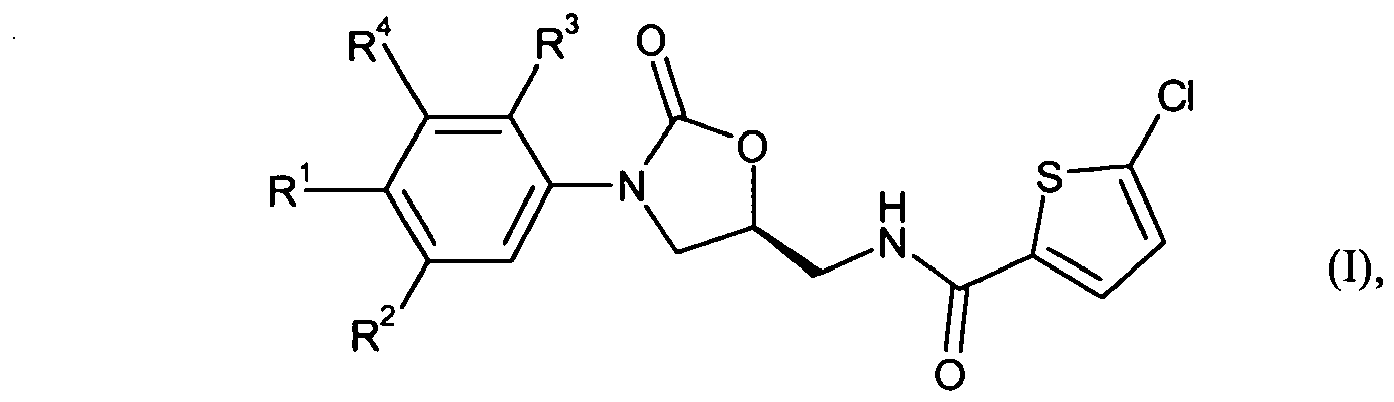 R1 für eine Gruppe der Formel


wobei# die Anknüpfstelle an den Phenylring ist,R5 für Wasserstoff oder C1-C3-Alkyl steht, worin Alkyl substituiert sein kann mit einem Substituenten Hydroxy,R6 für Wasserstoff, Trifluormethyl, Trifluormethoxy, Difluormethoxy, C1-C3-Alkyl oder C1-C4-Alkoxy steht,
worin Alkoxy substituiert sein kann mit einem Substituenten; wobei der Substituent ausgewählt wird aus der Gruppe bestehend aus Halogen, Hydroxy, Trifluormethyl, Aminocarbonyl, C1-C3-Alkoxy, C1-C3-Alkylcarbonyl, C1-C4-Alkylaminocarbonyl und Morpholinocarbonyl,R7 für Wasserstoff, C1-C3-Alkyl oder C1-C4-Alkoxy steht,
worin C2-C3-Akl und C2-C4-Alkoxy substituiert sein können mit einem Substituenten Hydroxy,R8 für Wasserstoff oder C1-C3-Alkyl steht,
worin C2-C3-Alkyl substituiert sein kann mit einem Substituenten Hydroxy,R9 für Wasserstoff oder C1-C3-Alkyl steht,
worin C2-C3-Alkyl substituiert sein kann mit einem Substituenten Hydroxy,R2 für Chlor, Trifluormethyl, Trifluormethoxy, Difluormethoxy, Methyl, Ethyl, n-Propyl, iso-Propyl, Methoxy, Ethoxy, Methoxymethyl, Ethoxymethyl oder Cyclopropyl steht,R3 für Wasserstoff, C1-C3-Alkoxy oder C1-C3-Alkylamino steht,R4 für Wasserstoff oder Methyl steht,oder eines ihrer Salze, ihrer Solvate oder der Solvate ihrer Salze. - Verbindung nach Anspruch 1, dadurch gekennzeichnet, dassR1 für eine Gruppe der Formel
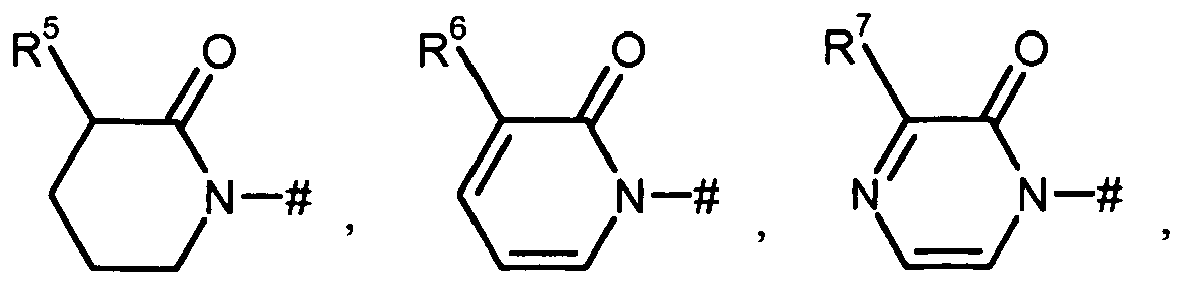

 # die Anknüpfstelle an den Phenylring ist,R5 für Wasserstoff oder C1-C3-Alkyl steht,
worin Alkyl substituiert sein kann mit einem Substituenten Hydroxy,R6 für Wasserstoff, Trifluormethyl, Trifluormethoxy, C1-C3-Alkyl oder C1-C4-Alkoxy steht,
worin Alkoxy substituiert sein kann mit einem Substituenten, wobei der Substituent ausgewählt wird aus der Gruppe bestehend aus Halogen, Hydroxy, Trifluormethyl, Aminocarbonyl, C1-C3-Alkoxy, C1-C3-Alkylcarbonyl, C1-C4-Alkylaminocarbonyl und Morpholinocarbonyl,R7 für C1-C4-Alkoxy steht,R8 für C1-C3-Alkyl steht,R9 für Wasserstoff oder C1-C3-Alkyl steht, worin C2-C3-Alkyl substituiert sein kann mit einem Substituenten Hydroxy,R2 für Chlor, Trifluormethyl, Methyl, Ethyl, n-Propyl, iso-Propyl, Methoxy, Ethoxy, Methoxymethyl, Ethoxymethyl oder Cyclopropyl steht,R3 für Wasserstoff, C1-C3-Alkoxy oder C1-C3-Alkylamino steht,R4 für Wasserstoff oder Methyl steht,oder eines ihrer Salze, ihrer Solvate oder der Solvate ihrer Salze. - Verbindung nach einem der Ansprüche 1 oder 2, dadurch gekennzeichnet, dassR1 für eine Gruppe der Formel


wobei# die Anknüpfstelle an den Phenylring ist,R5 für Wasserstoff oder C1-C3-Alkyl steht,
worin Alkyl substituiert sein kann mit einem Substituenten Hydroxy,R6 für Wasserstoff, Trifluormethyl, Trifluormethoxy, C1-C3-Alkyl oder C1-C4-Alkoxy steht,
worin Alkoxy substituiert sein kann mit einem Substituenten, wobei der Substituent ausgewählt wird aus der Gruppe bestehend aus Halogen, Hydroxy, Trifluormethyl, Aminocarbonyl, C1-C3-Alkoxy, C1-C3-Alkylcarbonyl, C1-C4-Alkylaminocarbonyl und Morpholinocarbonyl,R7 für C1-C4-Alkoxy steht,R9 für Wasserstoff oder C1-C3-Alkyl steht,
worin C2-C3-Alkyl substituiert sein kann mit einem Substituenten Hydroxy,R2 für Chlor, Trifluormethyl, Methyl, Ethyl, n-Propyl, iso-Propyl, Methoxy, Ethoxy, Methoxymethyl, Ethoxymethyl oder Cyclopropyl steht,R3 für Wasserstoff, C1-C3-Alkoxy oder C1-C3-Alkylamino steht,R4 für Wasserstoff oder Methyl steht,oder eines ihrer Salze, ihrer Solvate oder der Solvate ihrer Salze. - Verbindung nach einem der Ansprüche 1 bis 3, dadurch gekennzeichnet, dassR1 für eine Gruppe der Formel


wobei# die Anknüpfstelle an den Phenylring ist,R5 für Wasserstoff steht,R6 für Wasserstoff oder C1-C4-Alkoxy steht,
worin Alkoxy substituiert sein kann mit einem Substituenten Hydroxy,R7 für Ethoxy steht,R9 für Wasserstoff, Methyl oder 2-Hydroxyeth-1-yl steht,R2 für Methyl, iso-Propyl, Methoxy, Ethoxy, Methoxymethyl oder Cyclopropyl steht,R3 für Wasserstoff steht,R4 für Wasserstoff oder Methyl steht,oder eines ihrer Salze, ihrer Solvate oder der Solvate ihrer Salze. - Verfahren zur Herstellung einer Verbindung der Formel (I) oder eines ihrer Salze, ihrer Solvate oder der Solvate ihrer Salze nach Anspruch 1, dadurch gekennzeichnet, dass[A] die Verbindung der Formel


in welcher R1, R2, R3 und R4 die in Anspruch 1 angegebene Bedeutung haben,
zu einer Verbindung der Formel
umgesetzt wird,
und in der zweiten Stufe in Anwesenheit von Phosgen oder Phosgenäquivalenten zu einer Verbindung der Formel (I) cyclisiert wird
oder[B] eine Verbindung der Formel
mit eienr Verbindung der Formel X für Halogen, bevorzugt Brom oder Chlor, oder Hydroxy steht,umgesetzt wird.
 - Verbindung nach einem der Ansprüche 1 bis 4 zur Verwendung in der Behandlung und/oder Prophylaxe von Krankheiten.
- Verwendung einer Verbindung nach einem der Ansprüche 1 bis 4 zur Herstellung eines Arzneimittels zur Behandlung und/oder Prophylaxe von Krankheiten.
- Verwendung einer Verbindung nach einem der Ansprüche 1 bis 4 zur Herstellung eines Arzneimittels zur Behandlung und/oder Prophylaxe von thromboembolischen Erkrankungen.
- Arzneimittel enthaltend eine Verbindung nach einem der Ansprüche 1 bis 4 in Kombination mit einem inerten, nichttoxischen, pharmazeutisch geeigneten Hilfsstoff.
- Arzneimittel enthaltend eine Verbindung nach einem der Ansprüche 1 bis 4 in Kombination mit einem weiteren Wirkstoff.
- Arzneimittel nach Anspruch 10 oder 11 zur Verwendung in der Behandlung und/oder Prophylaxe von thromboembolischen Erkrankungen.
- Verfahren zur Verhinderung der Blutkoagulation in vitro, dadurch gekennzeichnet, dass eine antikoagulatorisch wirksame Menge einer Verbindung nach einem der Ansprüche 1 bis 4 zugegeben wird.
- Verwendung einer Verbindung nach einem der Ansprüche 1 bis 4 zur Herstellung eines Arzneimittels zur Behandlung und/oder Prophylaxe von pulmonaler Hypertonie.
- Verwendung einer Verbindung nach einem der Ansprüche 1 bis 4 zur Herstellung eines Arzneimittels zur Behandlung und/oder Prophylaxe von Sepsis, Systemic Inflammatory Syndrome (SIRS), septische Organdysfunktion, septisches Organversagen und Muliorganversagen, Acute Respiratory Distress Syndrome (ARDS), Acute Lung Injury (ALI), Septischer Schock, DIC ("Disseminated Intravascular coagulation") und/oder des septischen Organversagens.
- Verbindung, wie in einem der Ansprüche 1 bis 4 definiert, zur Verwendung in einem Verfahren zur Behandlung und/oder Prophylaxe von thromboembolischen Erkrankungen.
Applications Claiming Priority (2)
| Application Number | Priority Date | Filing Date | Title |
|---|---|---|---|
| DE102007028406A DE102007028406A1 (de) | 2007-06-20 | 2007-06-20 | Substituierte Oxazolidinone und ihre Verwendung |
| PCT/EP2008/004746 WO2008155069A2 (de) | 2007-06-20 | 2008-06-13 | Substituierte oxazolidinone und ihre verwendung |
Publications (2)
| Publication Number | Publication Date |
|---|---|
| EP2167499A2 EP2167499A2 (de) | 2010-03-31 |
| EP2167499B1 true EP2167499B1 (de) | 2011-12-14 |
Family
ID=39645522
Family Applications (1)
| Application Number | Title | Priority Date | Filing Date |
|---|---|---|---|
| EP08773422A Not-in-force EP2167499B1 (de) | 2007-06-20 | 2008-06-13 | Substituierte oxazolidinone und ihre verwendung |
Country Status (9)
| Country | Link |
|---|---|
| US (1) | US8198267B2 (de) |
| EP (1) | EP2167499B1 (de) |
| JP (1) | JP2010530391A (de) |
| AT (1) | ATE537168T1 (de) |
| CA (1) | CA2692178A1 (de) |
| DE (1) | DE102007028406A1 (de) |
| ES (1) | ES2377422T3 (de) |
| PA (1) | PA8784001A1 (de) |
| WO (1) | WO2008155069A2 (de) |
Families Citing this family (24)
| Publication number | Priority date | Publication date | Assignee | Title |
|---|---|---|---|---|
| DE102006039589A1 (de) * | 2006-08-24 | 2008-03-06 | Bayer Healthcare Ag | Aminoacyl-Prodrugs II |
| DE102007028407A1 (de) * | 2007-06-20 | 2008-12-24 | Bayer Healthcare Ag | Substituierte Oxazolidinone und ihre Verwendung |
| DE102007028319A1 (de) * | 2007-06-20 | 2008-12-24 | Bayer Healthcare Ag | Substituierte Oxazolidinone und ihre Verwendung |
| DE102007028320A1 (de) * | 2007-06-20 | 2008-12-24 | Bayer Healthcare Ag | Substituierte Oxazolidinone und ihre Verwendung |
| JP5627574B2 (ja) | 2008-06-03 | 2014-11-19 | インターミューン, インコーポレイテッド | 炎症性および線維性疾患を治療するための化合物および方法 |
| CN101519374B (zh) * | 2008-12-30 | 2013-05-15 | 凯莱英医药集团(天津)股份有限公司 | 一种手性吡啶类芳环氨基醇的衍生物的合成方法及其部分中间产物与最终产物 |
| DE102010028362A1 (de) | 2010-04-29 | 2011-11-03 | Bayer Schering Pharma Aktiengesellschaft | Herstellverfahren |
| CN102464658B (zh) * | 2010-11-03 | 2014-04-16 | 天津药物研究院 | 噁唑烷酮衍生物及其制备方法和用途 |
| WO2012156983A1 (en) * | 2011-05-16 | 2012-11-22 | Symed Labs Limited | Processes for the preparation of 5-chloro-n-({(5s)-2-oxo-3-[4-(3-oxo-4-morpholinyl) phenyl]-1,3-oxazolidin-5-yl}methyl)-2-thiophenecarboxamide |
| US20130267699A1 (en) | 2011-06-24 | 2013-10-10 | California Institute Of Technology | Quaternary heteroatom containing compounds |
| US8822679B2 (en) * | 2011-06-24 | 2014-09-02 | California Institute Of Technology | Quaternary heteroatom containing compounds |
| WO2013151719A2 (en) * | 2012-04-05 | 2013-10-10 | Scifluor Life Sciences, Llc | Fluorinated oxazolidinone derivatives |
| US9376427B2 (en) | 2012-05-02 | 2016-06-28 | Symed Labs Limited | Process for preparing rivaroxaban using intermediates |
| AR092742A1 (es) | 2012-10-02 | 2015-04-29 | Intermune Inc | Piridinonas antifibroticas |
| CN103242307B (zh) * | 2013-05-17 | 2015-08-12 | 天津药物研究院有限公司 | 一种噁唑烷酮类衍生物晶型ⅰ及其制备方法和用途 |
| CN103232446B (zh) * | 2013-05-17 | 2015-09-23 | 天津药物研究院 | 一种噁唑烷酮衍生物晶型ⅱ及其制备方法和用途 |
| CN104163819A (zh) * | 2013-05-17 | 2014-11-26 | 天津药物研究院 | 一种噁唑烷酮衍生物的乙酸溶剂化物及其制备方法和用途 |
| US9518034B2 (en) | 2013-10-14 | 2016-12-13 | California Institute Of Technology | Synthesis of chiral enaminones, their derivatives, and bioactivity studies thereof |
| US10233195B2 (en) | 2014-04-02 | 2019-03-19 | Intermune, Inc. | Anti-fibrotic pyridinones |
| US10421696B2 (en) | 2014-12-18 | 2019-09-24 | California Institute Of Technology | Enantioselective synthesis of α-quaternary mannich adducts by palladium-catalyzed allylic alkylation |
| CN107922373A (zh) | 2015-03-27 | 2018-04-17 | 加利福尼亚技术学院 | 使用低催化剂浓度和稳定的预催化剂的不对称催化脱羧烷基烷基化 |
| WO2017156239A1 (en) | 2016-03-11 | 2017-09-14 | California Institute Of Technology | Compositions and methods for acylating lactams |
| US10358422B2 (en) | 2017-11-01 | 2019-07-23 | California Institute Of Technology | Methods for enantioselective allylic alkylation of esters, lactones, and lactams with unactivated allylic alcohols |
| US11214568B2 (en) | 2018-10-18 | 2022-01-04 | California Institute Of Technology | Gem-disubstituted pyrrolidines, piperazines, and diazepanes, and compositions and methods of making the same |
Family Cites Families (46)
| Publication number | Priority date | Publication date | Assignee | Title |
|---|---|---|---|---|
| DE1121617B (de) | 1959-05-26 | 1962-01-11 | Huels Chemische Werke Ag | Verfahren zur Herstellung von Tetrahydropyrimidin-2-onderivaten |
| US4231938A (en) | 1979-06-15 | 1980-11-04 | Merck & Co., Inc. | Hypocholesteremic fermentation products and process of preparation |
| US4444784A (en) | 1980-08-05 | 1984-04-24 | Merck & Co., Inc. | Antihypercholesterolemic compounds |
| MX7065E (es) | 1980-06-06 | 1987-04-10 | Sankyo Co | Un procedimiento microbiologico para preparar derivados de ml-236b |
| US5354772A (en) | 1982-11-22 | 1994-10-11 | Sandoz Pharm. Corp. | Indole analogs of mevalonolactone and derivatives thereof |
| FI94339C (fi) | 1989-07-21 | 1995-08-25 | Warner Lambert Co | Menetelmä farmaseuttisesti käyttökelpoisen /R-(R*,R*)/-2-(4-fluorifenyyli)- , -dihydroksi-5-(1-metyylietyyli)-3-fenyyli-4-/(fenyyliamino)karbonyyli/-1H-pyrroli-1-heptaanihapon ja sen farmaseuttisesti hyväksyttävien suolojen valmistamiseksi |
| DE4319041A1 (de) | 1992-10-23 | 1994-04-28 | Bayer Ag | Trisubstituierte Biphenyle |
| DE59713007D1 (de) | 1996-10-14 | 2009-06-25 | Bayer Healthcare Ag | Neue heterocyclylmethyl-substituierte pyrazolderivate und ihre verwendung in der behandlung von herz-kreislauf-erkrankungen |
| DE19642255A1 (de) | 1996-10-14 | 1998-04-16 | Bayer Ag | Verwendung von 1-Benzyl-3-(substituierten-hetaryl) -kondensierten Pyrazol-Derivaten |
| DE19649460A1 (de) | 1996-11-26 | 1998-05-28 | Bayer Ag | Neue substituierte Pyrazolderivate |
| DE19834045A1 (de) | 1998-07-29 | 2000-02-03 | Bayer Ag | (4-Amino-5-ethylpyrimidin-2-yl)-1-(2-fluorbenzyl)-1H-pyrazolo[3,4-b]pyridin |
| DE19834047A1 (de) | 1998-07-29 | 2000-02-03 | Bayer Ag | Substituierte Pyrazolderivate |
| DE19834044A1 (de) | 1998-07-29 | 2000-02-03 | Bayer Ag | Neue substituierte Pyrazolderivate |
| DE19846514A1 (de) | 1998-10-09 | 2000-04-20 | Bayer Ag | Neue Heterocyclyl-methyl-substituierte Pyrazole |
| US6259067B1 (en) | 1998-10-16 | 2001-07-10 | Medical Solutions, Inc. | Temperature control system and method for heating and maintaining medical items at desired temperatures |
| DE19920352A1 (de) | 1999-05-04 | 2000-11-09 | Bayer Ag | Substituiertes Pyrazolderivat |
| US6855715B1 (en) | 1999-06-14 | 2005-02-15 | Eli Lilly And Company | Serine protease inhibitors |
| DE19942809A1 (de) | 1999-09-08 | 2001-03-15 | Bayer Ag | Verfahren zur Herstellung substituierter Pyrimidinderivate |
| DE19943639A1 (de) | 1999-09-13 | 2001-03-15 | Bayer Ag | Dicarbonsäurederivate mit neuartigen pharmazeutischen Eigenschaften |
| DE19943635A1 (de) | 1999-09-13 | 2001-03-15 | Bayer Ag | Neuartige Aminodicarbonsäurederivate mit pharmazeutischen Eigenschaften |
| DE19943634A1 (de) | 1999-09-13 | 2001-04-12 | Bayer Ag | Neuartige Dicarbonsäurederivate mit pharmazeutischen Eigenschaften |
| DE19943636A1 (de) | 1999-09-13 | 2001-03-15 | Bayer Ag | Neuartige Dicarbonsäurederivate mit pharmazeutischen Eigenschaften |
| DE19962924A1 (de) | 1999-12-24 | 2001-07-05 | Bayer Ag | Substituierte Oxazolidinone und ihre Verwendung |
| GB0114005D0 (en) | 2001-06-08 | 2001-08-01 | Glaxo Group Ltd | Chemical compounds |
| GB0114004D0 (en) | 2001-06-08 | 2001-08-01 | Glaxo Group Ltd | Chemical compounds |
| TWI257389B (en) | 2001-06-12 | 2006-07-01 | Lilly Co Eli | Pharmaceutical compound |
| DE10129725A1 (de) * | 2001-06-20 | 2003-01-02 | Bayer Ag | Kombinationstherapie substituierter Oxazolidinone |
| WO2003000657A1 (en) | 2001-06-20 | 2003-01-03 | Daiichi Pharmaceutical Co., Ltd. | Diamine derivatives |
| EP1427415B1 (de) | 2001-09-21 | 2009-08-12 | Brystol-Myers Squibb Company | Lactamhaltige verbindungen und ihre derivate als faktor-xa-hemmer |
| TW200303201A (en) | 2001-12-10 | 2003-09-01 | Bristol Myers Squibb Co | Synthesis of 4,5-dihydro-pyrazolo [3,4-c] pyrid-2-ones |
| PE20040804A1 (es) | 2002-12-19 | 2004-12-31 | Boehringer Ingelheim Pharma | DERIVADOS DE CARBOXAMIDAS COMO INHIBIDORES DEL FACTOR Xa |
| US7205318B2 (en) | 2003-03-18 | 2007-04-17 | Bristol-Myers Squibb Company | Lactam-containing cyclic diamines and derivatives as a factor Xa inhibitors |
| DE10322469A1 (de) | 2003-05-19 | 2004-12-16 | Bayer Healthcare Ag | Heterocyclische Verbindungen |
| CA2773066A1 (en) | 2003-11-12 | 2005-05-26 | Daiichi Sankyo Company, Limited | Process for producing thiazole derivative |
| JP2005179272A (ja) | 2003-12-19 | 2005-07-07 | Yamanouchi Pharmaceut Co Ltd | カルボキサミド誘導体のマロン酸塩結晶 |
| GB0405272D0 (en) | 2004-03-09 | 2004-04-21 | Trigen Ltd | Compounds |
| JP5020073B2 (ja) | 2004-06-18 | 2012-09-05 | ミレニアム ファーマシューティカルズ インク. | 第Xa因子阻害剤 |
| US20060069260A1 (en) * | 2004-09-28 | 2006-03-30 | Huiping Zhang | Preparation of N-aryl pyridones |
| WO2006106804A1 (ja) | 2005-03-31 | 2006-10-12 | Mochida Pharmaceutical Co., Ltd. | 環内窒素原子にアシル基が結合した三環系スピロ化合物 |
| US20080221063A1 (en) | 2005-07-08 | 2008-09-11 | Astrazeneca Ab | Heterocyclic Sulfonamide Derivatives As Inhibitors Of Factor Xa |
| DE102005047558A1 (de) | 2005-10-04 | 2008-02-07 | Bayer Healthcare Ag | Kombinationstherapie substituierter Oxazolidinone zur Prophylaxe und Behandlung von cerebralen Durchblutungsstörungen |
| DE102005050497A1 (de) | 2005-10-21 | 2007-04-26 | Bayer Healthcare Ag | Difluorphenol-Derivate und ihre Verwendung |
| DE102005050377A1 (de) | 2005-10-21 | 2007-04-26 | Bayer Healthcare Ag | Heterocyclische Verbindungen und ihre Verwendung |
| DE102005050375A1 (de) | 2005-10-21 | 2007-04-26 | Bayer Healthcare Ag | Tetrazol-Derivate und ihre Verwendung |
| DE102005050376A1 (de) | 2005-10-21 | 2007-05-31 | Bayer Healthcare Ag | Dicarbonsäure-Derivate und ihre Verwendung |
| DE102005050498A1 (de) | 2005-10-21 | 2007-06-06 | Bayer Healthcare Aktiengesellschaft | Cyclopropylessigsäure-Derivate und ihre Verwendung |
-
2007
- 2007-06-20 DE DE102007028406A patent/DE102007028406A1/de not_active Withdrawn
-
2008
- 2008-06-10 PA PA20088784001A patent/PA8784001A1/es unknown
- 2008-06-13 EP EP08773422A patent/EP2167499B1/de not_active Not-in-force
- 2008-06-13 ES ES08773422T patent/ES2377422T3/es active Active
- 2008-06-13 JP JP2010512578A patent/JP2010530391A/ja not_active Withdrawn
- 2008-06-13 CA CA002692178A patent/CA2692178A1/en not_active Abandoned
- 2008-06-13 WO PCT/EP2008/004746 patent/WO2008155069A2/de not_active Ceased
- 2008-06-13 AT AT08773422T patent/ATE537168T1/de active
- 2008-06-13 US US12/665,728 patent/US8198267B2/en not_active Expired - Fee Related
Also Published As
| Publication number | Publication date |
|---|---|
| US8198267B2 (en) | 2012-06-12 |
| PA8784001A1 (es) | 2009-02-09 |
| WO2008155069A3 (de) | 2009-03-19 |
| ATE537168T1 (de) | 2011-12-15 |
| US20100298293A1 (en) | 2010-11-25 |
| ES2377422T3 (es) | 2012-03-27 |
| CA2692178A1 (en) | 2008-12-24 |
| EP2167499A2 (de) | 2010-03-31 |
| WO2008155069A2 (de) | 2008-12-24 |
| JP2010530391A (ja) | 2010-09-09 |
| DE102007028406A1 (de) | 2008-12-24 |
Similar Documents
| Publication | Publication Date | Title |
|---|---|---|
| DE102007028406A1 (de) | Substituierte Oxazolidinone und ihre Verwendung | |
| EP2170877B1 (de) | Substituierte (oxazolidinon-5-yl-methyl) -2-thiophen-carboxamide und ihre verwendung im gebiet der blutgerinnung | |
| DE102007028320A1 (de) | Substituierte Oxazolidinone und ihre Verwendung | |
| KR20120044289A (ko) | 치환된 피페리딘 | |
| EP2029546B1 (de) | Aryl-substituierte heterozyklen und ihre verwendung | |
| EP2173744B1 (de) | Substituierte (oxazolidinon-5-yl-methyl) -2-thiophen-carboxamide und ihre verwendung im gebiet der blutgerinnung | |
| EP2029586B1 (de) | Isoindolin-1-on-, isoindolin-3-on- und isoindolin-1,3-dion-derivate und ihre verwendung | |
| WO2007137792A1 (de) | Substituierte heterozyklen und ihre verwendung | |
| DE102006025316A1 (de) | Isoindolin-1-on-, Isoindolin-3-on- und Isoindolin-1,3-dion-Derivate und ihre Verwendung | |
| HK1144574B (en) | Substituted (oxazolidinon-5-yl-methyl)-2-thiophene-carboxamides and use thereof in the field of blood coagulation |
Legal Events
| Date | Code | Title | Description |
|---|---|---|---|
| PUAI | Public reference made under article 153(3) epc to a published international application that has entered the european phase |
Free format text: ORIGINAL CODE: 0009012 |
|
| 17P | Request for examination filed |
Effective date: 20100120 |
|
| AK | Designated contracting states |
Kind code of ref document: A2 Designated state(s): AT BE BG CH CY CZ DE DK EE ES FI FR GB GR HR HU IE IS IT LI LT LU LV MC MT NL NO PL PT RO SE SI SK TR |
|
| AX | Request for extension of the european patent |
Extension state: AL BA MK RS |
|
| 17Q | First examination report despatched |
Effective date: 20100531 |
|
| GRAP | Despatch of communication of intention to grant a patent |
Free format text: ORIGINAL CODE: EPIDOSNIGR1 |
|
| DAX | Request for extension of the european patent (deleted) | ||
| RAP1 | Party data changed (applicant data changed or rights of an application transferred) |
Owner name: BAYER PHARMA AKTIENGESELLSCHAFT |
|
| GRAS | Grant fee paid |
Free format text: ORIGINAL CODE: EPIDOSNIGR3 |
|
| GRAA | (expected) grant |
Free format text: ORIGINAL CODE: 0009210 |
|
| AK | Designated contracting states |
Kind code of ref document: B1 Designated state(s): AT BE BG CH CY CZ DE DK EE ES FI FR GB GR HR HU IE IS IT LI LT LU LV MC MT NL NO PL PT RO SE SI SK TR |
|
| REG | Reference to a national code |
Ref country code: GB Ref legal event code: FG4D Free format text: NOT ENGLISH |
|
| REG | Reference to a national code |
Ref country code: CH Ref legal event code: EP |
|
| REG | Reference to a national code |
Ref country code: IE Ref legal event code: FG4D |
|
| REG | Reference to a national code |
Ref country code: DE Ref legal event code: R096 Ref document number: 502008005858 Country of ref document: DE Effective date: 20120216 |
|
| REG | Reference to a national code |
Ref country code: ES Ref legal event code: FG2A Ref document number: 2377422 Country of ref document: ES Kind code of ref document: T3 Effective date: 20120327 |
|
| REG | Reference to a national code |
Ref country code: NL Ref legal event code: VDEP Effective date: 20111214 |
|
| PG25 | Lapsed in a contracting state [announced via postgrant information from national office to epo] |
Ref country code: LT Free format text: LAPSE BECAUSE OF FAILURE TO SUBMIT A TRANSLATION OF THE DESCRIPTION OR TO PAY THE FEE WITHIN THE PRESCRIBED TIME-LIMIT Effective date: 20111214 Ref country code: NO Free format text: LAPSE BECAUSE OF FAILURE TO SUBMIT A TRANSLATION OF THE DESCRIPTION OR TO PAY THE FEE WITHIN THE PRESCRIBED TIME-LIMIT Effective date: 20120314 |
|
| LTIE | Lt: invalidation of european patent or patent extension |
Effective date: 20111214 |
|
| PG25 | Lapsed in a contracting state [announced via postgrant information from national office to epo] |
Ref country code: GR Free format text: LAPSE BECAUSE OF FAILURE TO SUBMIT A TRANSLATION OF THE DESCRIPTION OR TO PAY THE FEE WITHIN THE PRESCRIBED TIME-LIMIT Effective date: 20120315 Ref country code: SE Free format text: LAPSE BECAUSE OF FAILURE TO SUBMIT A TRANSLATION OF THE DESCRIPTION OR TO PAY THE FEE WITHIN THE PRESCRIBED TIME-LIMIT Effective date: 20111214 Ref country code: LV Free format text: LAPSE BECAUSE OF FAILURE TO SUBMIT A TRANSLATION OF THE DESCRIPTION OR TO PAY THE FEE WITHIN THE PRESCRIBED TIME-LIMIT Effective date: 20111214 Ref country code: NL Free format text: LAPSE BECAUSE OF FAILURE TO SUBMIT A TRANSLATION OF THE DESCRIPTION OR TO PAY THE FEE WITHIN THE PRESCRIBED TIME-LIMIT Effective date: 20111214 Ref country code: SI Free format text: LAPSE BECAUSE OF FAILURE TO SUBMIT A TRANSLATION OF THE DESCRIPTION OR TO PAY THE FEE WITHIN THE PRESCRIBED TIME-LIMIT Effective date: 20111214 Ref country code: HR Free format text: LAPSE BECAUSE OF FAILURE TO SUBMIT A TRANSLATION OF THE DESCRIPTION OR TO PAY THE FEE WITHIN THE PRESCRIBED TIME-LIMIT Effective date: 20111214 |
|
| PG25 | Lapsed in a contracting state [announced via postgrant information from national office to epo] |
Ref country code: CY Free format text: LAPSE BECAUSE OF FAILURE TO SUBMIT A TRANSLATION OF THE DESCRIPTION OR TO PAY THE FEE WITHIN THE PRESCRIBED TIME-LIMIT Effective date: 20111214 |
|
| REG | Reference to a national code |
Ref country code: IE Ref legal event code: FD4D |
|
| PG25 | Lapsed in a contracting state [announced via postgrant information from national office to epo] |
Ref country code: CZ Free format text: LAPSE BECAUSE OF FAILURE TO SUBMIT A TRANSLATION OF THE DESCRIPTION OR TO PAY THE FEE WITHIN THE PRESCRIBED TIME-LIMIT Effective date: 20111214 Ref country code: BG Free format text: LAPSE BECAUSE OF FAILURE TO SUBMIT A TRANSLATION OF THE DESCRIPTION OR TO PAY THE FEE WITHIN THE PRESCRIBED TIME-LIMIT Effective date: 20120314 Ref country code: EE Free format text: LAPSE BECAUSE OF FAILURE TO SUBMIT A TRANSLATION OF THE DESCRIPTION OR TO PAY THE FEE WITHIN THE PRESCRIBED TIME-LIMIT Effective date: 20111214 Ref country code: IE Free format text: LAPSE BECAUSE OF FAILURE TO SUBMIT A TRANSLATION OF THE DESCRIPTION OR TO PAY THE FEE WITHIN THE PRESCRIBED TIME-LIMIT Effective date: 20111214 Ref country code: IS Free format text: LAPSE BECAUSE OF FAILURE TO SUBMIT A TRANSLATION OF THE DESCRIPTION OR TO PAY THE FEE WITHIN THE PRESCRIBED TIME-LIMIT Effective date: 20120414 Ref country code: SK Free format text: LAPSE BECAUSE OF FAILURE TO SUBMIT A TRANSLATION OF THE DESCRIPTION OR TO PAY THE FEE WITHIN THE PRESCRIBED TIME-LIMIT Effective date: 20111214 |
|
| PGFP | Annual fee paid to national office [announced via postgrant information from national office to epo] |
Ref country code: DE Payment date: 20120607 Year of fee payment: 5 |
|
| PG25 | Lapsed in a contracting state [announced via postgrant information from national office to epo] |
Ref country code: PT Free format text: LAPSE BECAUSE OF FAILURE TO SUBMIT A TRANSLATION OF THE DESCRIPTION OR TO PAY THE FEE WITHIN THE PRESCRIBED TIME-LIMIT Effective date: 20120416 Ref country code: PL Free format text: LAPSE BECAUSE OF FAILURE TO SUBMIT A TRANSLATION OF THE DESCRIPTION OR TO PAY THE FEE WITHIN THE PRESCRIBED TIME-LIMIT Effective date: 20111214 Ref country code: RO Free format text: LAPSE BECAUSE OF FAILURE TO SUBMIT A TRANSLATION OF THE DESCRIPTION OR TO PAY THE FEE WITHIN THE PRESCRIBED TIME-LIMIT Effective date: 20111214 |
|
| PGFP | Annual fee paid to national office [announced via postgrant information from national office to epo] |
Ref country code: FR Payment date: 20120619 Year of fee payment: 5 Ref country code: GB Payment date: 20120613 Year of fee payment: 5 |
|
| RAP2 | Party data changed (patent owner data changed or rights of a patent transferred) |
Owner name: BAYER INTELLECTUAL PROPERTY GMBH |
|
| PGFP | Annual fee paid to national office [announced via postgrant information from national office to epo] |
Ref country code: IT Payment date: 20120616 Year of fee payment: 5 |
|
| PLBE | No opposition filed within time limit |
Free format text: ORIGINAL CODE: 0009261 |
|
| STAA | Information on the status of an ep patent application or granted ep patent |
Free format text: STATUS: NO OPPOSITION FILED WITHIN TIME LIMIT |
|
| PG25 | Lapsed in a contracting state [announced via postgrant information from national office to epo] |
Ref country code: DK Free format text: LAPSE BECAUSE OF FAILURE TO SUBMIT A TRANSLATION OF THE DESCRIPTION OR TO PAY THE FEE WITHIN THE PRESCRIBED TIME-LIMIT Effective date: 20111214 |
|
| 26N | No opposition filed |
Effective date: 20120917 |
|
| BERE | Be: lapsed |
Owner name: BAYER PHARMA A.G. Effective date: 20120630 |
|
| PGFP | Annual fee paid to national office [announced via postgrant information from national office to epo] |
Ref country code: ES Payment date: 20120726 Year of fee payment: 5 |
|
| REG | Reference to a national code |
Ref country code: DE Ref legal event code: R097 Ref document number: 502008005858 Country of ref document: DE Effective date: 20120917 |
|
| PG25 | Lapsed in a contracting state [announced via postgrant information from national office to epo] |
Ref country code: MC Free format text: LAPSE BECAUSE OF NON-PAYMENT OF DUE FEES Effective date: 20120630 |
|
| REG | Reference to a national code |
Ref country code: CH Ref legal event code: PL |
|
| REG | Reference to a national code |
Ref country code: CH Ref legal event code: PL |
|
| PG25 | Lapsed in a contracting state [announced via postgrant information from national office to epo] |
Ref country code: BE Free format text: LAPSE BECAUSE OF NON-PAYMENT OF DUE FEES Effective date: 20120630 Ref country code: CH Free format text: LAPSE BECAUSE OF NON-PAYMENT OF DUE FEES Effective date: 20120630 Ref country code: LI Free format text: LAPSE BECAUSE OF NON-PAYMENT OF DUE FEES Effective date: 20120630 |
|
| REG | Reference to a national code |
Ref country code: DE Ref legal event code: R081 Ref document number: 502008005858 Country of ref document: DE Owner name: BAYER INTELLECTUAL PROPERTY GMBH, DE Free format text: FORMER OWNER: BAYER PHARMA AKTIENGESELLSCHAFT, 13353 BERLIN, DE Effective date: 20130410 |
|
| PG25 | Lapsed in a contracting state [announced via postgrant information from national office to epo] |
Ref country code: FI Free format text: LAPSE BECAUSE OF FAILURE TO SUBMIT A TRANSLATION OF THE DESCRIPTION OR TO PAY THE FEE WITHIN THE PRESCRIBED TIME-LIMIT Effective date: 20111214 |
|
| PG25 | Lapsed in a contracting state [announced via postgrant information from national office to epo] |
Ref country code: MT Free format text: LAPSE BECAUSE OF FAILURE TO SUBMIT A TRANSLATION OF THE DESCRIPTION OR TO PAY THE FEE WITHIN THE PRESCRIBED TIME-LIMIT Effective date: 20111214 |
|
| GBPC | Gb: european patent ceased through non-payment of renewal fee |
Effective date: 20130613 |
|
| REG | Reference to a national code |
Ref country code: DE Ref legal event code: R119 Ref document number: 502008005858 Country of ref document: DE Effective date: 20140101 |
|
| REG | Reference to a national code |
Ref country code: FR Ref legal event code: ST Effective date: 20140228 |
|
| PG25 | Lapsed in a contracting state [announced via postgrant information from national office to epo] |
Ref country code: GB Free format text: LAPSE BECAUSE OF NON-PAYMENT OF DUE FEES Effective date: 20130613 Ref country code: DE Free format text: LAPSE BECAUSE OF NON-PAYMENT OF DUE FEES Effective date: 20140101 Ref country code: TR Free format text: LAPSE BECAUSE OF FAILURE TO SUBMIT A TRANSLATION OF THE DESCRIPTION OR TO PAY THE FEE WITHIN THE PRESCRIBED TIME-LIMIT Effective date: 20111214 |
|
| PG25 | Lapsed in a contracting state [announced via postgrant information from national office to epo] |
Ref country code: IT Free format text: LAPSE BECAUSE OF NON-PAYMENT OF DUE FEES Effective date: 20130613 Ref country code: LU Free format text: LAPSE BECAUSE OF NON-PAYMENT OF DUE FEES Effective date: 20120613 Ref country code: FR Free format text: LAPSE BECAUSE OF NON-PAYMENT OF DUE FEES Effective date: 20130701 |
|
| REG | Reference to a national code |
Ref country code: ES Ref legal event code: FD2A Effective date: 20140708 |
|
| PG25 | Lapsed in a contracting state [announced via postgrant information from national office to epo] |
Ref country code: HU Free format text: LAPSE BECAUSE OF FAILURE TO SUBMIT A TRANSLATION OF THE DESCRIPTION OR TO PAY THE FEE WITHIN THE PRESCRIBED TIME-LIMIT Effective date: 20080613 |
|
| REG | Reference to a national code |
Ref country code: AT Ref legal event code: MM01 Ref document number: 537168 Country of ref document: AT Kind code of ref document: T Effective date: 20130613 |
|
| PG25 | Lapsed in a contracting state [announced via postgrant information from national office to epo] |
Ref country code: AT Free format text: LAPSE BECAUSE OF NON-PAYMENT OF DUE FEES Effective date: 20130613 Ref country code: ES Free format text: LAPSE BECAUSE OF NON-PAYMENT OF DUE FEES Effective date: 20130614 |
|
| REG | Reference to a national code |
Ref country code: GB Ref legal event code: 732E Free format text: REGISTERED BETWEEN 20160901 AND 20160907 |