EP2137356B1 - Modulares zugangskontrollsystem - Google Patents
Modulares zugangskontrollsystem Download PDFInfo
- Publication number
- EP2137356B1 EP2137356B1 EP08731885.3A EP08731885A EP2137356B1 EP 2137356 B1 EP2137356 B1 EP 2137356B1 EP 08731885 A EP08731885 A EP 08731885A EP 2137356 B1 EP2137356 B1 EP 2137356B1
- Authority
- EP
- European Patent Office
- Prior art keywords
- portable container
- area
- room
- passing
- container
- Prior art date
- Legal status (The legal status is an assumption and is not a legal conclusion. Google has not performed a legal analysis and makes no representation as to the accuracy of the status listed.)
- Not-in-force
Links
Images






Classifications
-
- E—FIXED CONSTRUCTIONS
- E04—BUILDING
- E04H—BUILDINGS OR LIKE STRUCTURES FOR PARTICULAR PURPOSES; SWIMMING OR SPLASH BATHS OR POOLS; MASTS; FENCING; TENTS OR CANOPIES, IN GENERAL
- E04H1/00—Buildings or groups of buildings for dwelling or office purposes; General layout, e.g. modular co-ordination or staggered storeys
- E04H1/12—Small buildings or other erections for limited occupation, erected in the open air or arranged in buildings, e.g. kiosks, waiting shelters for bus stops or for filling stations, roofs for railway platforms, watchmen's huts or dressing cubicles
- E04H1/1205—Small buildings erected in the open air
-
- G—PHYSICS
- G01—MEASURING; TESTING
- G01V—GEOPHYSICS; GRAVITATIONAL MEASUREMENTS; DETECTING MASSES OR OBJECTS; TAGS
- G01V5/00—Prospecting or detecting by the use of ionising radiation, e.g. of natural or induced radioactivity
- G01V5/20—Detecting prohibited goods, e.g. weapons, explosives, hazardous substances, contraband or smuggled objects
-
- B—PERFORMING OPERATIONS; TRANSPORTING
- B65—CONVEYING; PACKING; STORING; HANDLING THIN OR FILAMENTARY MATERIAL
- B65D—CONTAINERS FOR STORAGE OR TRANSPORT OF ARTICLES OR MATERIALS, e.g. BAGS, BARRELS, BOTTLES, BOXES, CANS, CARTONS, CRATES, DRUMS, JARS, TANKS, HOPPERS, FORWARDING CONTAINERS; ACCESSORIES, CLOSURES, OR FITTINGS THEREFOR; PACKAGING ELEMENTS; PACKAGES
- B65D90/00—Component parts, details or accessories for large containers
- B65D90/0006—Coupling devices between containers, e.g. ISO-containers
- B65D90/0013—Twist lock
-
- B—PERFORMING OPERATIONS; TRANSPORTING
- B65—CONVEYING; PACKING; STORING; HANDLING THIN OR FILAMENTARY MATERIAL
- B65D—CONTAINERS FOR STORAGE OR TRANSPORT OF ARTICLES OR MATERIALS, e.g. BAGS, BARRELS, BOTTLES, BOXES, CANS, CARTONS, CRATES, DRUMS, JARS, TANKS, HOPPERS, FORWARDING CONTAINERS; ACCESSORIES, CLOSURES, OR FITTINGS THEREFOR; PACKAGING ELEMENTS; PACKAGES
- B65D90/00—Component parts, details or accessories for large containers
- B65D90/008—Doors for containers, e.g. ISO-containers
-
- E—FIXED CONSTRUCTIONS
- E04—BUILDING
- E04B—GENERAL BUILDING CONSTRUCTIONS; WALLS, e.g. PARTITIONS; ROOFS; FLOORS; CEILINGS; INSULATION OR OTHER PROTECTION OF BUILDINGS
- E04B1/00—Constructions in general; Structures which are not restricted either to walls, e.g. partitions, or floors or ceilings or roofs
- E04B1/348—Structures composed of units comprising at least considerable parts of two sides of a room, e.g. box-like or cell-like units closed or in skeleton form
- E04B1/34815—Elements not integrated in a skeleton
- E04B1/3483—Elements not integrated in a skeleton the supporting structure consisting of metal
-
- E—FIXED CONSTRUCTIONS
- E04—BUILDING
- E04G—SCAFFOLDING; FORMS; SHUTTERING; BUILDING IMPLEMENTS OR AIDS, OR THEIR USE; HANDLING BUILDING MATERIALS ON THE SITE; REPAIRING, BREAKING-UP OR OTHER WORK ON EXISTING BUILDINGS
- E04G27/00—Temporary arrangements for giving access from one level to another for men or vehicles, e.g. steps, ramps
-
- E—FIXED CONSTRUCTIONS
- E04—BUILDING
- E04H—BUILDINGS OR LIKE STRUCTURES FOR PARTICULAR PURPOSES; SWIMMING OR SPLASH BATHS OR POOLS; MASTS; FENCING; TENTS OR CANOPIES, IN GENERAL
- E04H1/00—Buildings or groups of buildings for dwelling or office purposes; General layout, e.g. modular co-ordination or staggered storeys
- E04H1/12—Small buildings or other erections for limited occupation, erected in the open air or arranged in buildings, e.g. kiosks, waiting shelters for bus stops or for filling stations, roofs for railway platforms, watchmen's huts or dressing cubicles
- E04H2001/1283—Small buildings of the ISO containers type
-
- E—FIXED CONSTRUCTIONS
- E04—BUILDING
- E04H—BUILDINGS OR LIKE STRUCTURES FOR PARTICULAR PURPOSES; SWIMMING OR SPLASH BATHS OR POOLS; MASTS; FENCING; TENTS OR CANOPIES, IN GENERAL
- E04H3/00—Buildings or groups of buildings for public or similar purposes; Institutions, e.g. infirmaries or prisons
- E04H3/10—Buildings or groups of buildings for public or similar purposes; Institutions, e.g. infirmaries or prisons for meetings, entertainments, or sports
-
- E—FIXED CONSTRUCTIONS
- E06—DOORS, WINDOWS, SHUTTERS, OR ROLLER BLINDS IN GENERAL; LADDERS
- E06B—FIXED OR MOVABLE CLOSURES FOR OPENINGS IN BUILDINGS, VEHICLES, FENCES OR LIKE ENCLOSURES IN GENERAL, e.g. DOORS, WINDOWS, BLINDS, GATES
- E06B11/00—Means for allowing passage through fences, barriers or the like, e.g. stiles
- E06B11/08—Turnstiles; Gates for control of entry or exit of persons, e.g. in supermarkets
-
- E—FIXED CONSTRUCTIONS
- E06—DOORS, WINDOWS, SHUTTERS, OR ROLLER BLINDS IN GENERAL; LADDERS
- E06B—FIXED OR MOVABLE CLOSURES FOR OPENINGS IN BUILDINGS, VEHICLES, FENCES OR LIKE ENCLOSURES IN GENERAL, e.g. DOORS, WINDOWS, BLINDS, GATES
- E06B3/00—Window sashes, door leaves, or like elements for closing wall or like openings; Layout of fixed or moving closures, e.g. windows in wall or like openings; Features of rigidly-mounted outer frames relating to the mounting of wing frames
- E06B3/90—Revolving doors; Cages or housings therefor
Definitions
- the present invention is directed generally to access control systems and specifically to portable access control systems.
- WO2006055078 (A2 ) describes a portable container which includes a passing room allowing entry into a second area into a first area, the passing room having at least two openings with a walkway in-between.
- a barrier device can be located in the walkway to control passage through the passing room.
- US2004232054 (A1 ) describes a vehicle security inspection system which may include multiple automated detection devices for detecting explosives, weapons, contraband, etc. which may be contained on or within a motor vehicle.
- the system includes a tunnel or enclosure with a moving conveyor therein.
- a motor vehicle is driven into the entrance to the enclosure, and conveyed past the series of sensors by the conveyor belt.
- the various sensors incorporated therein check the vehicle for illegal articles, and the vehicle is released from the enclosure via a control gate.
- US2003085348 (A1 ) describes apparatus for screening an object for the presence of an explosive, chemical warfare agent, biological warfare agent, drug, metal, weapon, and/or radioactive material.
- the apparatus includes a portal through which the object is arranged to pass, the portal including a housing equipped with an ion mobility spectrometer and a surface acoustic wave device for detecting explosives, drugs and chemical warfare agents. Other detectors may be provided.
- an access control system comprising:
- the access control system comprises at least one security device providing authorization for an individual to enter into the second area.
- the at least one security device is located in the first space, the second space or both.
- the at least one security device is located outside the passing room.
- the access control system comprises a fence at least partly forming the enclosure of the second area, wherein the fence is attached or adjacent to an outside surface of the first portable container and/or to an outside surface of the second portable container.
- the second portable container comprises a control room adjacent to the passing room.
- control room comprises a control panel to control the barrier device in order for a guard and/or a supervisor to monitor the passing room while staying in the control room.
- control room comprises a detecting system for scanning belongings of individuals passing through the passing room.
- the one or more panels further comprises a locking mechanism configured to fasten the one or more panels onto the one or more sidewall openings.
- the access control system comprises one or more anchoring device configured to attach the first portable container to the second portable container.
- the anchoring device comprises a plurality of links and a ratcheting device linked to the plurality of links.
- the disposing comprises disposing the first portable container such that the first opening and the second opening are located on opposite sides of a fence at least partially surrounding the enclosed second area.
- the method further comprises controlling ingress and egress from and to the second area via a control room in the second portable container, the control room being adjacent to the at least one passing room.
- controlling comprises controlling the at least one barrier device so as to authorize or deny entry into the enclosed second area.
- the method comprises connecting the first portable container and the second portable container together.
- FIGURE 1 shows a perspective view of a portable container 10, according to an embodiment of the invention.
- the portable container 10 has a housing 12, which, in one embodiment, is rectangular shaped. However, any other shape is also possible.
- the housing 12 can be made of a durable material (e.g ., iron, aluminum, stainless steel, wood, reinforced plastics) or a combination of various materials.
- the portable container 10 can be made, for example, from corrugated steel and may include marine grade plywood flooring.
- the portable container 10 can also be made to withstand repeated lifting and placing.
- the portable container 10 can be configured to hold a cargo as large as 30 tons.
- the portable container 10 can be equipped to be securely towed by a vehicle.
- one or both ends of the portable container 10 can be equipped with hooks, links or the like to be towed by a vehicle.
- the portable container 10 can also be provided with forklift pockets, corner connectors or other types of attachments as may be useful for the transport or the anchorage of the portable container 10.
- a security system to ensure that only authorized vehicles move the portable container 10 can also be included.
- the portable container 10 can be delivered to a user in a ready-made or turn-key state. In this case, if electricity is not required, the portable container 10 is ready to be used. If electricity is required, all that needs to be done to render the portable container 10 usable is the provision of electricity. In another embodiment, the portable container 10 can be customized by the user to meet specific needs of the user.
- the portable container 10 can be a standard shipping container.
- the standard shipping container can be a shipping container which complies with international standards as determined by the International Organization for Standardization (ISO).
- the dimensions of a standard shipping container as defined by the ISO body can be, for example, approx. 12 m (40 feet), approx. 6 m (20 feet) or approx. 3.3 m (10 feet long) by approx. 2.4 m (8 feet) wide by approx. 2.6 m (8.5 feet) high.
- the portable container 10 may also be provided with one or more openings 14 to allow entry and exit of persons, as will be explained in detail the following paragraphs.
- one or more lockable accessible panels or doors 16 may also be provided on one or more openings 17 in one or both sidewalls 18 of the portable container 10.
- the opening 17 is a approx. 2.7 m (9 feet) wide by approx. 2.1 m (7 feet) high opening.
- the opening 17 can have any dimension, as desired.
- the opening 17 can be framed or reinforced with a framing material 19.
- the framing material 19 can be any suitable material for framing structures including wood, metal, plastic or a composite material.
- the framing can be made for example of rectangular tubing or other suitable structure.
- the framing material 19 is used for structural reinforcement around the opening 17 as well as a joining material for joining two portable containers together. Specifically, when two containers 10 each having an opening 17 are brought together such that the openings 17 are communicating, the framing material 19 on one container 10 would abut against a wall of another container 10 to form a container-to-container interface seal.
- the framing 19 may be provided with a flexible material (e.g., a sponge material) such that when the container 10 presses against the other adjacent container 10, the flexible material would be compressed and act as a gasket to create an atmosphere tight seal including a water tight seal.
- the lockable accessible panel 16 comprises three panel-sections 16A, 16B and 16C (see FIGURE 2A ).
- the three panels section 16,A, 16B and 16C are joined together using strips of material 16D by fastening each strip 16D onto two adjacent panel sections.
- the foot-print of the lockable accessible panel 16 is rendered smaller so as to occupy a small space for storage while expandable when needed to close the opening 17.
- the lockable accessible panel 16 can be mounted on the sidewall 18 using one or more locking mechanisms 20.
- the locking mechanism 20 can be any type of locking mechanism.
- the locking mechanism 20 can be a plurality of locks provided on a periphery of the accessible panel 16 so as to attach the panel 16 to the sidewall 18.
- the locking mechanism 20 comprises a bar-like locking mechanism 21 and a movable center-lock 22 provided in the center of the bar-like locking mechanism 21 as depicted in FIGURES 2A and 2B .
- the movable center-lock 22 latches the bar-like locking mechanism 21 to the accessible panel 16.
- the bar-like locking mechanism 21 is rotatable by the movable center-lock 22 so as to allow the extremities 24A and 24B of the bar-like locking mechanism 21 to slide behind the sidewall 18 and latch onto the sidewall 18.
- the bar-like locking mechanism 21 is fastened to the accessible panel 16 using the center-lock 22 (e.g., a bolt and a nut) so as to bring the extremities 24A and 24B of the bar-like locking mechanism against a lip or an edge of the sidewall 18 (shown in FIGURE 1 ).
- the portable container 10 can be used as a stand-alone access control unit to control ingress or egress from and to a first area (e.g., secured area) 26 delimited by a fencing material 30, through openings 14.
- a first area e.g., secured area
- the fencing 30 or other material may be attached to the portable container 10.
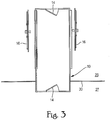
- the fencing 30 can be attached to the sidewalls 18 of the portable container 10 so as to surround the secured area 26, as depicted in FIGURE 1 and FIGURE 3 . Therefore, the fencing 30 separates a second area (e.g., a non-secured area) 27 from the first area (secured area) 26.
- first area 26 is described herein as being the secured area and the second area 27 is described as being the non-secured area, it must be appreciated that the fencing 30 can also be arranged such that the first area 26 is the non-secured area and the second area 27 is the secured area.
- other features such as natural barriers (e.g., bodies of water, ridges, etc.) or other barriers (e.g., walls, etc.) may be employed to separate the first area 26 from the second area 27.
- two or more portable containers 10 may be connected to each other to form the access control system.
- the one or more openings 17 in the one or more portable containers 10 may be opened by removing the accessible panels 16 and the portable containers 10 are placed adjacent to each other so as to allow communication between the portable containers 10 through the one or more openings 17.
- opening 17A in portable container 10A is opened by removing an accessible panel (not shown) provided in a sidewall of the portable container 10A
- openings 17B and 17C in portable container 10B are opened by removing accessible panels (not shown) provided in each of the sidewalls of the portable container 10B
- opening 17D is opened by removing an accessible panel (not shown) provided in a sidewall of the portable container 10C.
- the portable containers 10A, 10B and 10C are arranged such that opening 17A communicates with opening 17B and opening 17C communicates with opening 17D.
- one or more anchoring device 31, shown in FIGURE 6 can be used to attach the portable container 10A to adjacent portable container 10B and can be used to attach portable container 10B to adjacent portable container 10C.
- the anchoring device 31 is used to anchor the portable containers 10A, 10B and 10C to each other.
- the anchoring device 31 comprises two links 32A and 32B and a ratcheting device 33 linked to the two links 32A and 32B.
- the link 32A is fastened to a sidewall of one of the portable containers 10A, 10B, 10C (e.g., portable container 10A) and the link 32B is fastened to a sidewall of another portable container (e.g., portable container 10B).
- the links 32A and 32B include one or more holes 34 through which the ratcheting device 33 can be connected to the links 32A and 32B.
- the ratcheting device 33 has one or more levers 35 which when pivoted back and forth allow the ratcheting device to bring the two links 32A and 32B closer to each other and hence bring the two portable containers 10A and 10B closer to each other.
- the space in each of the portable containers 10A, 10B and 10C can be tailored for a specific need.
- the spaces in the portable containers 10A and 10C can be used as passing rooms for individual to access a first area (e.g., a secured area) 26 delimited by the fencing material 30 from a second area (e.g., non-secured area) 27.
- the space in portable container 10B can be used as a control room in which one or more guards or supervisors may be located to control the movement of people through the passing rooms in the portable containers 10A and 10C.
- FIGURES 4 and 5 show a configuration in which a container configured as a control room (container 10B) being disposed between two containers configured as passing rooms (containers 10A and 10C), other configurations are also possible.
- two or more containers configured as passing rooms can be disposed next to each other (e.g., the container 10A can be disposed adjacent to container 10C).
- a container configured as a control room e.g., container 10B
- the arrangement need not include the control room.
- the architecture of the access control system being modulable and flexible, any arrangement of any one or more containers configured as passing rooms and any one or more containers configured as control rooms is within the scope of the present invention.
- the juxtaposed portable containers 10A, 10B and 10C can be used as an access control system to control ingress or egress from and to the first area (secured area) 26 delimited by the fencing material 30.
- the fencing 30 or other material may be attached to sidewall 18A of the portable container 10A and to sidewall 18B of the portable container 10C, to surround the secured area 26, as depicted in FIGURE 4 .
- openings 14B can also be provided in the portable container 10B to allow separate entry into or exit from the control room of the access control device for the one or more guards or supervisors.
- the guards or supervisors can also enter into the control room in the portable container 10B through any one of openings 14A and openings 14C by passing through the opening (17A, 17B) or by passing through the opening (17C, 17D).
- one or more portable containers can be used as passing rooms to allow controlled movement of individuals into and out of the first area (the secured area) 26.
- the containers 10A and 10C comprise passing rooms 40A and 40C, respectively.
- the passing rooms 40A and 40C control the movement of people between the first area (the secured area) 26 and the second area (the non-secured area) 27.
- the passing room 40A communicates with the first area (the secured area) 26 and the second area (the non-secured area) 27 through doors 14A. Specifically, the passing room 40A communicates with the second area (non-secured area) 27 via a first opening 14A1 and communicates with the first area (the secured area) 26 via a second opening 14A2.
- the passing room 40C communicates with the first area (the secured area) 26 and the second area (the non-secured area) 27 through doors 14C. Specifically, the passing room 40C communicates with the second area (the non-secured area) 27 via a first opening 14C1 and communicates with the first area (the secured area) 26 via a second opening 14C2.
- the first opening 14A1 is spaced apart from the second opening 14A2, in the passing room 40A, so as to define a walkway 42A in-between.
- the first opening 14C1 is spaced apart from the second opening 14C2, in the passing room 40C, so as to define a walkway 42C in-between.
- a closing device 44 e.g., a door, shutters or the like
- a security sensing device for safeguarding the closing device 44 can be employed.
- the portable container 10A can comprise at least one barrier device 46A and the portable container 10C can comprise at least one barrier device 46C.
- the barrier device 46A can be arranged inside of the passing room 40A so as to restrict a person's movement through the passing room 40A.
- the barrier device 46C can be arranged inside of the passing room 40C so as to restrict a person's movement through the passing room 40C.
- a turnstile e.g., a full-body turnstile, a partial-body turnstile, a bi-directional turnstile, or a uni-directional turnstile
- a turnstile is employed as a barrier device 46A, 46C of the portable containers 10A, 10B, respectively.
- barrier devices may be used to restrict a person's movement through the passing room 42A, 42C.
- a sliding door, a revolving door, moving bars, and gates, or the like may be used as a barrier device 46A, 46C.
- the barrier device 46A is located inside the walkway 42A, defining a first space 50A1 between the barrier device 46A and the first opening 14A1, and defining a second space 50A2 between the barrier device 46A and the second opening 14A2.
- the barrier device 46C is located inside the walkway 42C, defining a first space 50C1 between the barrier device 46C and the first opening 14C1, and defining a second space 50C2 between the barrier device 46A and the second opening 14C2.
- the passing room 40A, 40C can include one or more security devices 52A, 52C issuing permission for a person to pass through the passing room 42A, 42B, respectively.
- the security device 52A, 52C can comprise, but is not limited to, one or more card readers, one or more metal detectors (such as a magnetometer or the like), one or more weapon detectors, one or more x-ray scanners, one or more radiofrequency scanners (e.g., shortwave scanners), one or more biometric readers, one or more iris scanners, one or more fingerprint or palm readers, one or more explosive detectors, one or more physical or facial recognition terminology, one or more electronic key locks, or one or more mechanical key locks, or any combination of two or more thereof.
- the security device 52A, 52C can comprise, but is not limited to, one or more card readers, one or more metal detectors (such as a magnetometer or the like), one or more weapon detectors, one or more x-ray scanners, one or more radiofrequency scanners (e.g., short
- the security device 52A, 52C can also include a security measure, such as, but not limited to, posting an individual or guard 56 proximate to the barrier device 46A, 46C to check identification cards (e.g., photo identification cards, licenses, etc.).
- the security device 52A may be located in the first space 50A1 and also in the second space 50A2 of the passing room 42A.
- the security device 52C may be located in the first space 50C1 and also in the second space 50C2 of the passing room 42C.
- Security devices 52A, 52C can also be included inside or outside of the respective passing rooms 40A and 40C.
- each of the passing rooms 40A and 40C can comprise lighting.
- lighting 54A can be provided in the first space 50A1 and/or the second space 50A2 of passing room 40A and lighting 54C can be provided in the first space 50C1 and/or in the second space 50C2 of the passing room 40C.
- Heat curtains can also be provided in the vicinity, for example above, anyone of openings 14A1, 14A2, 14C1 and 14C1.
- a cover material (e.g., an awning) 23 may also be provide in the vicinity, for example above, of any one of openings 14A1, 14A2, 14C1 and 14C1.
- a floor lining 25 may also be provided in the vicinity, for example at a foot, of any one of openings 14A1, 14A2, 14C1 and 14C2.
- the awning 23 can be a retractable sheet of flexible material or a removable panel or the like, or can be permanent.
- the floor lining 25 can be, for example, a non-skid rubber liner or grating, or the like.
- the portable container 10B is used as a control room.
- a control room 40B is provided in the portable container 10B for housing one or more guards 56 or supervisors 57.
- the control room 40B can include a detection system 58.
- the detection system can be used to check items carried by individuals when passing through the passing rooms 40A and 40C.
- the detection system comprises a detection device 59 for scanning objects carried by the individuals.
- the detection system 58 can also comprise a conveyor 60 for transporting the objects into the detection device 58.
- the detection devices can be an electromagnetic device (e.g., an x-ray machine) or a chemical device for detecting belongings of an individual (e.g., the inside contents of a bag carried by the individual) passing through the passing rooms 40A and 40C.
- an electromagnetic device e.g., an x-ray machine
- a chemical device for detecting belongings of an individual (e.g., the inside contents of a bag carried by the individual) passing through the passing rooms 40A and 40C.
- any other sort of detection device can be employed.
- the detection system 58 can be placed near one of the openings 14B1 or 14B2 so as to allow an individual passing through one of the passing rooms 40A or 40C to place in or retrieve from the detection system 58 his/her belongings.
- control room 40B can also include a control panel 45 to control the barrier device(s) 46A and/or 46C and the security device(s) 52A and/or 52C in order for the guard 56 or supervisor 57 to monitor the passing room 40A and/or 40C while staying in the control room 40B.
- the control panel 42 can comprise an alarm device 47 which gives an alarm in case a problem occurs in the passing room 40A and/or the passing room 40C.
- the control room 40B is located between the passing rooms 40A and 40C. In this way the guard 56 and/or the supervisor 57 in control room 40C can observe the inside of the passing rooms 40A and 40C. The guard 56 and/or the supervisor 57 can take the appropriate action to address any situation that may occur in any of the passing room 40A, the passing room 40C and/or the control room 40B.
- control room 40B can also comprise lighting 54B.
- lighting 54B can be provided in three areas of the control room.
- heat curtains can also be provided in the vicinity, for example above, of opening 14B1 and/or 14B2.
- an awning 23 and or a floor lining may also be provided in the vicinity, for example above or at the foot of the opening 14B1 and/or 14B2.
- One or more air conditioning units can be provided in the control device, for example, provided in any one of the passing rooms 40A and 40C and/or the control room 40B.
- the one or more air conditioning units can be installed, for example, on a roof of any one of the portable containers 10A, 10B and 10C.
- the control room can also be provided with various amenities and utilities such as the provision of one or more telephone jacks, one or more computer outlets, one or more cable outlets, one or more electrical outlets, or any combination of two or more thereof.
- one or more openings 15A, 15B can be provided in both containers 10A and 10B for communicating between the passing room 40A and control room 40B and in both containers 10B and 10C for communicating between the passing room 40C and the control room 40B.
- the openings 15A, 15B can be used as a handicap access to redirect handicapped or disabled individuals to pass through the control room 40B instead of one of the passing rooms 40A or 40C as a handicapped or disabled individual may have a difficulty passing through the barrier device 46A or the barrier device 46C or difficulty using (e.g., reaching, seeing, etc.) security device 52A or security device 52C.
- the portable containers 10A, 10B or 10C can be put on a vehicle or trailer and transported or towed to reach a specific destination. By arranging the portable container in the manner described above, the portable containers 10A, 10B and 10C can be used to control access to an area.
- the portable containers 10A, 10B and 10C may be used in a setting where control of access to a specific area may be needed.
- the specific area can be a work site where access of personnel to the work site can be controlled. A worker may carry an access device which when read by the security device may allow or deny access to the work site.
- the portable containers 10A, 10B and 10C may also be used by people that do not have an access device, but who must pass through security to enter a venue (e.g., an outside concert or the like).
- the portable containers 10A, 10B and 10C are being used in conjunction with an access device, when a person approaches the passing room 40A in portable container 10A from, for example, the second area 27 and enters through the opening 14A1, the person can stay in the first space 50A1 in the walkway 42A and present an access device (e.g., identification or electronically read card) to the security device 52A.
- an access device e.g., identification or electronically read card
- the security device 52A is located inside the passing room 40A, the chance that the person will lose or break an identification card or device is decreased because the person does not need to expose the identification card or device outside of the portable container 10A.
- the barrier device 46A remains locked or closed until the access device is successfully read by the security device 52A. Once a person is approved by the security device 52A, the barrier device 46A is unlocked and the person can go through the barrier device 46A. If a person is not approved by the security device 54, the barrier device 46A continues to be kept locked, and the control panel 45 can give an alarm to the guard 56 and/or the supervisor 57 via the alarm device 47.
- the individual in the case where an individual is coming from the second area 27 (e.g., a non-secure area) and intending to enter into the first area 26 (e.g., a secure area), the individual must pass through the passing room 40A or the passing room 40C by entering through opening 14A1 or opening 14C1. Before entering through, for example, the opening 14A1 of the passing room 40A in the portable container 10A, the individual may deposit his/her belongings at one end of conveyor 60 through the opening 14B1, to be scanned by the detection system 58.
- the opening 14B1 can be, for example, a window or trap door, or the like.
- the individual in the case where an individual is coming from the first area 26 (e.g., a non-secure area) and intending to enter into the second area 27 (e.g., a secure area), the individual must pass through the passing room 40A or the passing room 40C by entering through opening 14A2 or opening 14C2.
- the individual being in area 50A2 may deposit his/her belongings at a table 61 to be screened by the one or more guards 56 or the one or more supervisors 57. If deemed necessary by the guards 56 or the supervisor 57, the belongings of the individual may be sent for scanning using detection system 58.
- the belongings can be placed at one end of conveyor 60 to be guided into the detection device 59 for scanning. While the belongings of the individual are being scanned, the individual may present an access device to the security device 52A to pass the barrier device 46A. Once the individual has passed through the barrier device 46A and the individual is in area 50A1, the individual may exit through the opening 14A1 to enter into the secured area 27. The individual may then pickup his/her belongings at an other end of the conveyor 60 through opening 14B1.
- the portable container 10A when an individual approaches the passing room 40A from an area 26 (e.g., a non-secure area) and enters through opening 14A2, the individual can go through the security device 52A (e.g., a magnetometer). The individual enters area 50A2 in which the individual may be subject to additional screening.
- the barrier device 46A can be the same device as the security device 52A (e.g., the metal detector).
- a separate barrier device 46A can be used to stop persons from accessing the second area (e.g., a secure area) 27. The barrier device 46A remains locked or closed until the guard 56 or the supervisor 57 authorizes the individual to enter the secured area 27.
- the barrier device 46A is unlocked and the individual can go through the barrier device 46A. If the individual is not approved, the barrier device 46A continues to be kept locked, and the control panel 45 in the control room 40B can give an alarm to the guard 56 and/or the supervisor 57 via the alarm device 47 and the guard 56 can instruct the individual to go back to non-secured area 26 or show additional credentials. Alternatively, the barrier device 46A can remain open until locked by the guard 56 or the supervisor 57.
- FIGURE 7 is floor plan of the access control system, according to yet another embodiment of the present invention. Similarly to the embodiment depicted in FIGURE 5 , three portable containers 70A, 70B and 70C are juxtaposed next to each other. The portable containers 70A, 70B and 70C are arranged such that opening 72A in portable container 70A communicates with opening 72B in portable container 70B and opening 72C in portable container 70B communicates with opening 72D in portable container 70C.
- the space in each of the portable containers 70A, 70B and 70C can be tailored for a specific need.
- the spaces in the portable containers 70A and 70C can be used as passing rooms for individuals to access a second area (e.g., a secured area) 27 delimited by the fencing material 30 from a first area (e.g., non-secured area) 26.
- the space in portable container 70B can be used as a control room.
- the space in portable container 70B can be configured to house a detection system 73 for scanning belonging of individuals passing through the passing rooms of portable container 70A and 70C.
- the containers 70A and 70C comprise passing rooms 74A and 74C, respectively.
- the passing rooms 74A and 74C control the movement of people between the first area (the non secured area) 26 and the second area (the secured area) 27.
- the passing rooms 74A and 74C can be similar in many aspects to the passing rooms 40A and 40B in portable containers 10A and 10B described in the previous paragraphs.
- the portable container 70A comprises entrance doorway 80A1 and exit doorway 80A2 and the portable container 70C comprises entrance doorway 80C1 and exit doorway 80C2 through which an individual enter from area (e.g., non secured area) 26 and exit into area (e.g., secured area) 27.
- the portable container 70A can comprise at least one barrier device 76A and the portable container 10C can comprise at least one barrier device 76C.
- the barrier device 76A can be arranged inside of the passing room 74A so as to restrict a person's movement through the passing room 7A.
- the barrier device 76C can be arranged inside of the passing room 74C so as to restrict a person's movement through the passing room 74C.
- a turnstile e.g., a full-body turnstile, a partial-body turnstile, a bi-directional turnstile, or a uni-directional turnstile
- a turnstile is employed as a barrier device 76A, 76C of the portable containers 70A, 70B, respectively.
- barrier devices may be used to restrict a person's movement through the passing room 74A, 74C.
- a sliding door, a revolving door, moving bars, and gates, or the like may be used as a barrier device 76A, 76C.
- the passing room 74A, 74C can include one or more security devices 78A1, 78A2, 78C1, 78C2 issuing permission for a person to pass through doorway 80A2, 80C2, respectively.
- the security device 78A1, 78A2, 78C1, 78C2 can comprise, but is not limited to, one or more card readers, one or more metal detectors (such as a magnetometer or the like), one or more weapon detectors, one or more x-ray scanners, one or more radiofrequency scanners (e.g., shortwave scanners), one or more biometric readers, one or more iris scanners, one or more fingerprint or palm readers, one or more physical or facial recognition terminology, one or more electronic key locks, or one or more mechanical key locks, or any combination of two or more thereof.
- the security device 78A1, 78A2, 78C1, 78C2 can also include a security measure, such as, but not limited to, posting an individual or guard proximate to the doorway 80A1 and/or 80A2, 80C 1 and/or 80C2 to check identification cards (e.g., photo identification cards, licenses, etc.).
- the security device 78A2 may be located in the space between the barrier 76A and the exit doorway 80A2 and the security device 78A1 located in the space between the entrance doorway 80A1 and the barrier device 76A.
- the security device 78C2 may be located in the space between the barrier 76C and the exit doorway 80C2 and the security device 78C1 can be located in the space between the entrance doorway 80C1 and the barrier device 76C.
- the passing room 74A, 74C can also include one or more explosive and/or weapon detection device 79A, 79C, respectively. Alternatively, any sorts of detection devices may be employed.
- the one or more explosive and/or weapon detection device may be located, for example, in the space between the entrance doorway 80A1 and the barrier device 76A in the passing room 74A and in the space between the entrance doorway 80C1 and the barrier device 76C in the passing room 74C.
- the one or more explosive and/or weapon detection device 79A, 79C may also be located in the space between the barrier device 76A and the exit doorway 80A2 and may also be located in the space between the barrier device 76C and the exit doorway 80C2 in the passing room 74C.
- the one or more (for example two) explosive and/or weapon detection devices 79A in passing room 74A can be separated by a wall 71A and/or the one or more (for example two) explosive and/or weapon detection devices 79C in passing room 74C can be separated by a wall 71C.
- the walls 71A and 71C can be provided to separate the one or more explosion detection zones 79A, 79C so as to increase the number of individuals processed through the respective passing rooms 74A and 74C.
- the portable container 70B can be used as a control room.
- a control room 74B is provided in the portable container 70B for housing one or more detection systems 73.
- the detection system 73 can be used to check items carried by individuals when passing through the passing rooms 74A and 74C.
- the detection system 73 comprises one or more detection devices 75 for scanning objects carried by the individuals.
- the detection system 73 can also comprise one or more conveyors 77 for transporting the objects into and out of the detection device 75.
- the detection device 75 can be an electromagnetic device (e.g., an x-ray machine) for detecting belongings of an individual (e.g., the inside contents of a bag carried by the individual) passing through the passing rooms 74A and 74C, a chemical detection device or any other kind of detector.
- the conveyor 77 can be configured as an L-shape.
- a first end 77A of the L-shaped conveyor 77 can be positioned in the passing room 74A so as to allow individuals to place their belongings for scanning.
- a second end 77B of the L-shaped conveyor 77 can be positioned outside the control room 74B in the area 27.
- the L-shaped conveyor can thus guide the belongings placed at the first end 77A through the detection device 75 and through an opening 80B in the portable container 70B before reaching the second end 77B where the individual can pick up the scanned belongings.
- the control room 74B is located between the passing rooms 74A and 74C.
- One or more guards can be posted in the control room 74B to monitor the detection system 73, observe the inside of the passing rooms 74A and 74C and/or manually scan the belongings of the individuals passing through the passing rooms 74A and 74B.
- the one or more guards can take appropriate action to address any situation that may occur in any of the passing room 74A, the passing room 74C and/or the control room 74B.
- one or more openings 81A, 81B can be provided in both containers 70A and 70B for communicating between the passing room 74A and control room 74B and provided in both containers 70B and 70C for communicating between the passing room 74C and the control room 74B.
- the openings 81A, 81B can be used as a handicap access to redirect handicapped or disabled individuals to pass through the control room 74B instead of one of the passing rooms 74A or 74C as a handicapped or disabled individual may have a difficulty passing through the barrier device 76A or the barrier device 76C or difficulty using (e.g., reaching, seeing, etc.) security device 78A2 or security device 78C2.
- the portable containers 70A, 70B or 70C can be put on a vehicle or trailer and transported or towed to reach a specific destination.
- the portable containers 70A, 70B and 70C can be used to control access to an area.
- the portable containers 70A, 70B and 70C may be used in a setting where control of access to a specific area may be needed.
- the specific area can be a work site where access of personnel to the work site can be controlled. A worker may carry an access device which when read by a security device may allow or deny access to the work site.
- the portable containers 70A, 70B and 70C may also be used by individuals that do not have an access device, but who must pass through security to enter a venue (e.g., an outside concert or the like).
- the individual in the case where an individual is coming from the first area 26 (in this case the non-secured area) and intending to enter into the second area 27 (in this case the secured area), the individual must pass through the passing room 74A or the passing room 74C by entering through doorway 80A1 or 80C1. After entering through, for example, the opening 80A1 of the passing room 74A in the portable container 70A, the individual may deposit his/her belongings at the first end 77A of the conveyor 77 to be guided to the detection device 75 for scanning. While the belongings of the individual are being scanned by the detection device 75, the individual may be scanned for presence of explosives or weapons with the explosive/weapons detection device 79A.
- the individual may submit to a scan by the security device 78A1 (for example an iris scan device or a finger scan device or the like) to pass the barrier device 76A.
- the security device 78A1 for example an iris scan device or a finger scan device or the like
- the individual may be required to present an access device to the security device 78A2 (e.g., a card swipe device or the like) to exit through the doorway 80A2 to enter into the secured area 27.
- the individual may then pickup his/her belongings at the second end 77B of the conveyor 77.
- FIGURE 8 is floor plan view of a comparative example of an access control device using a portable container.
- the portable container 90 has a housing 92, which, in one example, is rectangular shaped.
- the portable container 90 can have same general characteristics as container 10 described in the above paragraphs.
- the portable container can be a standard shipping container which complies with international standards as determined by the International Organization for Standardization (ISO).
- the portable container 90 comprises passing room 94.
- the passing room 94 control the movement of people between a first area (for example the secured area) 26 and a second area (for example the non-secured area) 27.
- the first area 26 and the second area 27 are separated by a fence or barrier 30.
- the barrier 30 can be, for example, attached to sidewalls of the portable container 90.
- the passing room 94 communicates with the second area (non-secured area) 27 via a first opening 96A and communicates with the first area (the secured area) 26 via a second opening 96B.
- the first opening 96A is spaced apart from the second opening 96B, in the passing room 94, so as to define a walkway 98 in-between.
- a closing device 99 (e.g., a door, shutters or the like) may be employed to close the openings 96A and 96B.
- a security sensing device for safeguarding the closing device 99 can be employed.
- the first and second openings 96A and 96B are provided inside the portable container 90.
- the first and second openings 96A and 96B can be provided in respective walls 97A and 97B which are constructed inside the portable container 90.
- the walls 97A and 97B can be recessed relative to opening 93 of the portable container 90.
- the opening 93 of the portable container 90 can be closed, for example, with an already existing door in the portable container 90. Indeed, the portable container 90 may originally be provided with one or more doors on each opposite side of the container.
- the recessed closing device 99 provided on recessed walls 97A and 97B and any associated security sensing device can be, for example, isolated from outside environmental elements when the portable container 90 is not in use.
- the portable container is not provided with any external openings other than opening 93 which can be closed with doors. By closing the doors in the opening 93, the portable container 90 being closed on all sides, can be viewed from the outside as a regular shipping container as the internal structure of the portable container 90 is hidden from outside view. This feature provides additional security for the structure as well as other components inside the container when the portable container is not in use.
- the access control device can be handled as a regular portable container, for example, during shipping.
- the portable container 90 can comprise at least one barrier device.
- the portable container 90 comprises two barrier devices 100A and 100B.
- the barrier devices 100A, 100B can be arranged inside of the passing room 94 so as to restrict a person's movement through the passing room 94.
- a turnstile e.g., a full-body turnstile, a partial-body turnstile, a bi-directional turnstile, or a uni-directional turnstile
- barrier devices 100A and 100B is employed as barrier devices 100A and 100B.
- other types of barrier devices may be used to restrict a person's movement through the passing room 94.
- a sliding door, a revolving door, moving bars, and gates, or the like may be used as the barrier devices 100A and 100B.
- the barrier devices 100A and 100B are located inside the walkway 98 and partition the walkway 98 into a first, a second and third spaces 102A, 102B and 102C.
- the first space 102A is defined as a space between the barrier device 100A and the first opening 96A.
- the second space 102B is defined as a space between the barrier device 100A and the barrier device 100B.
- the third space is defined as a space between the barrier device 100B and the second opening 96B.
- the first space 102A is used as a screening area
- the second space 102B is used a detection zone for explosives, weapons, metal, drugs and/or other materials
- the third space 102C is used as an intermediary area before accessing the second area (e.g., the secured area) 26.
- the passing room 94 can include one or more security devices 104A, 104B issuing permission for a person to pass through the passing room 94.
- the security devices 104A, 104B can comprise, but is not limited to, one or more card readers, one or more metal detectors (such as a magnetometer or the like), one or more weapon detectors, one or more x-ray scanners, one or more radiofrequency scanners (e.g., shortwave scanners), one or more biometric readers, one or more iris scanners, one or more fingerprint or palm readers, one or more explosive detectors, one or more physical or facial recognition terminology, one or more electronic key locks, or one or more mechanical key locks, or any combination of two or more thereof.
- the security devices 104A, 104B can comprise, but is not limited to, one or more card readers, one or more metal detectors (such as a magnetometer or the like), one or more weapon detectors, one or more x-ray scanners, one or more radiofrequency scanners (e.g., shortwave scanner
- the security device 104A, 104B can also include a security measure, such as, but not limited to, posting an individual or guard 56 proximate to the barrier devices 100A, 100B to check identification cards (e.g., photo identification cards, licenses, etc.).
- the security device 104A may be located in the first space 102A and the security device 104B may be located in the third space 102C of the passing room 94.
- security devices 104A, 104B can also be provided in the space between the opening 93 of the portable container and the respective opening 96A and 96B provided inside the portable container.
- the passing room 94 can comprise various amenities such as lighting, water, air conditioning, etc.
- interior lighting 110 can be provided in the first space 102A, the second space 102B and/or the third space 102C.
- flood lighting 111 can also be provided outside the passing room 94 to illuminate the exterior of the passing room 98.
- heat curtains 112 can also be provided in the vicinity, for example above, any one of openings 96A and 96B.
- One or more air conditioning units 113 can also be provided to control the temperature inside the passing room 94.
- Electrical power can be provided via power connection 114 so as to operate various electrical amenities and other electrical powered systems in the passing room 94.
- the first space 102A is used as a screening area
- the second space 102B is used a detection zone
- the third space is used as an intermediary area before accessing the second area (e.g., the secured area) 26.
- the screening area can, for example, include detection system 105 for scanning items carried by individuals when passing through passing room 94.
- the detection system 105 can comprise a detection device 106 for scanning objects carried by the individuals and a conveyor 107 for transporting the objects into the detection device 106.
- the detection device 106 can be an electromagnetic device (e.g., an x-ray machine) for detecting belongings of an individual (e.g., the inside contents of a bag carried by the individual) passing through the passing room 94, a chemical detector and/or any other kind of detector.
- an electromagnetic device e.g., an x-ray machine
- belongings of an individual e.g., the inside contents of a bag carried by the individual
- a chemical detector e.g., the inside contents of a bag carried by the individual
- the first space (screening area) 102A can also include a control panel 108 to control the barrier device(s) 100A and/or 100B and the security device(s) 104A and/or 104B in order for a guard 109 to monitor the passing room 94 while staying in the first space (screening area) 102A.
- the control panel 108 can comprise an alarm device which gives an alarm in case a problem occurs in the passing room 94.
- the portable container 90 can be used to control access of personnel to the a work site.
- a worker may carry an access device which when read by the security device may allow or deny access to the work site.
- other uses are possible.
- the individual can stay in the first space 102A in the walkway 98 and present an access device (e.g., identification or electronically read card) to the security device 104A.
- an access device e.g., identification or electronically read card
- the individual Prior to presenting the access device to the security device 104A, the individual places his/her belongings on the conveyor 107 to be scanned by the detection device 106. After scanning of the belongings of the individual, the individual can pick up his/her belongings and can proceed and present the access device to the security device 104A.
- the barrier device 100A remains locked or closed until the access device is successfully read by the security device 104A. Once the individual is approved by the security device 104A, the barrier device 100A is unlocked and the individual can go through the barrier device 100A to enter into second space (detection area) 102B. If a person is not approved by the security device 104A, the barrier device 100A remains locked, and the control panel 108 can give an alarm to the guard 109.
- the individual is scanned for explosives, weapons, metal, drugs or the like, using a detection device such as, but not limited to, a magnetometer or the like. If a trace of contraband is detected on the individual, the control panel 108 can give an alarm to the guard 109 and shuts both barrier devices 100A and 100B. In this way the second space between the barrier devices 100A and 100B can function as a "trap" that traps the individual on which a trace of contraband is detected in the second space between the two shut barrier devices 100A and 100B.
- a detection device such as, but not limited to, a magnetometer or the like.
- the individual may be released through one or more doorways or emergency exits 101A or 101B for a more detailed screening and evaluation by additional guards upon summoned by guard 109. In this way, a flow of individuals through the first space 102A and the second space 102B may not be interrupted. If the individual does not carry any contraband, the barrier device 100B can be opened and the individual can proceed to exit from the second space (detection area) 102B via barrier device 100B to enter into the third space 102C. In one example, the barrier devices 100A and 100B are uni-directional turnstiles.
- the individual when the individual is in the detection area 102B, the individual can only exit through the barrier device 100B and the individual cannot exit through the barrier device 100A as this barrier device is only activated in one direction (entry direction).
- the individual When the individual is in the third space 102C, the individual can present the access device to the security device 104B.
- the security device 104B controls the opening or closing of the closing device 99 (e.g., a door, shutters or the like) that is employed to close the openings 96B.
- the closing device 99 of opening 96B remains closed until the access device is successfully read by the security device 104B. Once the identity of the individual is confirmed by the security device 104B, the closing device 99 is unlocked and the individual can go through the opening 96B to enter into the first area (secured area) 26.
- Two or more standard shipping containers may be filled with material to be shipped at a first location. Then, the two or more containers are shipped to a second location. The two or more containers are next unloaded at the second location. Next, the two or more containers are configured as an access control system after the two or more containers are unloaded.
- a first container in the two or more containers may be outfitted to function as a passing room while a second container in the two or more containers is placed adjacent the first container and is outfitted to function as a control room.
- the second location may be overseas from the first location.
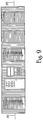
- FIGURES 9 and 10 illustrate a front view and a perspective view of a portable container 210.
- the portable container 210 has housing 220, which, in one example, is rectangular shaped. However, any other shape is also possible.
- the housing 220 can be made of a durable material (e.g., iron, stainless steel), enabling the portable container 210 to be securely towed by a vehicle.
- One or both ends of the portable container 210 can be equipped to be towed by a vehicle.
- a security system to ensure that only authorized vehicles move the portable container 210 can also be included.
- fencing 263 or other material may be attached to the portable container 210 to surround a secured area 262 (e.g., see FIGURE 13 ).
- FIGURE 11 illustrates a top cross-sectional view of a comparative example of the portable container 210.
- the portable container 210 comprises at least one passing room 230, which is provided for controlling and directing the movement of people between two areas.
- the portable container 210 can also comprise at least one control room 240, for housing a guard or supervisor.
- the portable container 210 can be a standard shipping container.
- the standard shipping container can be a shipping container which complies with international standards as determined by the International Organization for Standardization (ISO).
- the shipping container can include the following features: made from corrugated steel; heavy steel framed to withstand repeated lifting and placing; able to hold a cargo as large as 30 tons; marine grade plywood flooring; lockable accessible doors on one or both sides of the shipping container; forklift pockets; corner connectors; or a venting system; or any combination thereof.
- the portable container 210 can be delivered to a user in a ready-made or turn-key state. In this case, if electricity is not required, the portable container 210 is ready to be used. If electricity is required, all that needs to be done to render the portable container 210 usable is the provision of electricity. In another example, the portable container can be customized by the user to meet specific needs of the user.
- FIGURE 12 is a detailed top cross-sectional view of a passing room 230 and a control room 240, according to one example of the invention.
- the passing room 230 controls the movement of people between area 260 and another area 262.
- a fence 263 can also be used to separate areas 260 and 262 in locations where the portable containers 210 are not used.
- the passing room 230 has at least a first opening 232, and at least a second opening 234, which in one example is on a side opposite the first opening 232.
- the first opening 232, second opening 234, and additional openings can be located on any side of the passing room 230, including being located on the same side of the passing room 230.
- the second opening 234 is spaced apart from the first opening 232 so as to define a walkway 236 in-between.
- a closing device 233 e.g., a door, shutters
- a security sensing device for safeguarding the closing device 233 can be employed.
- the portable container 210 can comprise at least one barrier device 238 in the inside of the passing room 230, which restricts a person's movement through the passing room 230.
- a turnstile e.g ., a full-body turnstile, a partial-body turnstile, a bi-directional turnstile, or a uni-directional turnstile
- other barrier device may be used to restrict a person's movement through the passing room 230.
- a sliding door, a revolving door, moving bars, and gates may be used as a barrier device.
- the barrier device 238 is located inside the walkway 236, defining a first space 250 between the barrier device 238 and the first opening 232, and defining a second space 252 between the barrier device 238 and the second opening 234.
- the passing room 230 can alternatively include at least one security device 254 issuing permission for a person to pass through the passing room 230.
- the security device 254 can comprise, but is not limited to, one or more card readers, metal detectors, biometric readers, iris scanners, fingerprint or palm readers, explosive and/or weapon detectors, physical or facial recognition terminology, electronic key locks, or mechanical key locks, or any combination thereof.
- the security device 254 can also include a security measure, such as, but not limited to, posting an individual proximate to the barrier device 238 to check identification cards (e.g., photo identification cards, licenses).
- a security device 254 is located in the first space 250 and also in the second space 252. Security devices 254 can be included inside or outside of the passing room.
- the passing room 230 can also comprise lighting.
- a control room 240 is provided for housing a guard or supervisor.
- the control room 240 can include a control panel 242 to control the barrier device(s) 238 and the security device(s) 254 in order for a guard or supervisor to monitor the passing room while staying in the control room 240.
- the control panel 242 can comprise an alarm device 243 which gives an alarm in case a problem occurs in the passing room 230.
- the control room 240 and the passing room 230 are separated by at least one wall 212.
- the wall 212 can comprise at least one window 214, so that a guard in the control room 240 can observe the inside of the passing room 230 or the outside of the portable container 210.
- the control room 240 has at least one opening 244 with at least one closing device 245.
- the closing device(s) 245 of the control room 240 can be the same as, or different from, the closing device(s) 233 of the passing room 230.
- the control room 240 can also comprise: heat and/or air-conditioning; lighting; at least one computer/cable outlet; at least one phone jack; at least one electrical outlet; at least one vent; or insulation; or any combination thereof.
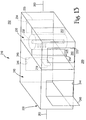
- FIGURE 13 illustrates a perspective view of a passing room 230 and a control room 240, according to one example of the invention.
- the portable container 210 has a housing 220 which comprises both the at least one passing room 230 and the at least one control room 240, it is easy for users to move and use almost anywhere.
- the portable container has everything that a user needs to control access to an area.
- the portable container 210 can be put on a vehicle or trailer and transported or towed to reach multiple destinations, and can be used to control access to an area.
- the portable container may be used by people who have an access device (e.g ., people working on a construction site).
- the access device is read by the security device.
- the portable container 210 may also be used by people that do not have an access device, but who must pass through security to enter a venue ( e.g ., an outside concert).
- the portable container 210 is being used in conjunction with an access device, when a person approaches the passing room 230 from an area 260 and enters the first opening 232, the person can stay in the first space 250 in the walkway 236 and present an access device (e.g ., identification or electronically read card) to the security device 254.
- an access device e.g ., identification or electronically read card
- the security device 254 is located inside the passing room, the chance that the person will lose or break an identification card or device is decreased because the person does not need to expose the identification card or device outside of the portable container 210.
- the portable container 210 also protects the security device 254, because the security device 254 is located inside of the passing room 230.
- the barrier device remains locked or closed until the access device is successfully read by the security device 254. Once a person is approved by the security device 254, the barrier device 238 is unlocked and the person can go through the barrier device 238. If a person is not approved by the security device 254, the barrier device 238 continues to be kept locked, and, the control panel 242 can give an alarm to a guard via the alarm device 243.
- the portable container 210 when a person approaches the passing room 230 from an area 260 and enters the first opening 232, the person can stay in the first space 250 in the walkway 236 and go through the security device 254 (e.g., a metal detector).
- the barrier device 238 can be the same device as the security device 254 (e.g., the metal detector).
- a separate barrier device can be used to stop persons from accessing the secured area 262. The barrier device 238 remains locked or closed until the security device 254 or security personnel authorizes a person to enter the secured area 262. Once a person is approved, the barrier device 238 is unlocked and the person can go through the barrier device 238. If a person is not approved, the barrier device 238 continues to be kept locked, and, the control panel 242 can give an alarm to a guard via the alarm device 243. Alternatively, the barrier device can remain open until locked by security personnel, for example.
- a standard shipping container may be filled with material to be shipped at a first location. Then, the container is shipped to a second location. The container is next unloaded at the second location. Next, the container is outfitted as an access control unit after the container is unloaded. The second location may be overseas from the first location.
Landscapes
- Engineering & Computer Science (AREA)
- Architecture (AREA)
- Civil Engineering (AREA)
- Structural Engineering (AREA)
- Physics & Mathematics (AREA)
- High Energy & Nuclear Physics (AREA)
- Life Sciences & Earth Sciences (AREA)
- General Life Sciences & Earth Sciences (AREA)
- General Physics & Mathematics (AREA)
- Geophysics (AREA)
- Lock And Its Accessories (AREA)
- Burglar Alarm Systems (AREA)
Claims (16)
- Zugangskontrollsystem, das Folgendes umfasst:einen ersten fahrbaren Container (10A), der einen in dem ersten fahrbaren Container angeordneten Durchgangsraum (40A) umfasst, wobei der Durchgangsraum eine erste Durchgangsraumöffnung (14A1) und eine zweite Durchgangsraumöffnung (14A2) und einen dazwischenliegenden Laufweg (42A) aufweist, wobei der Durchgangsraum eine Schrankenvorrichtung (46A) umfasst, die in dem Laufweg angeordnet ist und einen ersten Raum (50A1) zwischen der ersten Durchgangsraumöffnung (14A1) und der Schrankenvorrichtung und einen zweiten Raum (50A2) zwischen der Schrankenvorrichtung und der zweiten Durchgangsraumöffnung (14A2) definiert,wobei das Zugangskontrollsystem derart konstruiert ist, dass, wenn das Zugangskontrollsystem zwischen einem ersten Bereich (22), außerhalb des Zugangskontrollsystems und mit Zugang zu der ersten Durchgangsraumöffnung, und einem eingeschlossenen zweiten Bereich (26), außerhalb des Zugangskontrollsystems und mit Zugang zu der zweiten Durchgangsraumöffnung, angeordnet ist, der Eintritt in und Austritt aus dem zweiten Bereich von dem Zugangskontrollsystem kontrolliert wird,dadurch gekennzeichnet, dass das Zugangskontrollsystem mindestens einen zweiten fahrbaren Container (10B) umfasst,und dadurch, dass der erste fahrbare Container (10A) mindestens eine Seitenwandöffnung (17A, 15A) umfasst und der zweite fahrbare Container mindestens eine Seitenwandöffnung (17B, 15A) umfasst, wobei die fahrbaren Container so angeordnet sind, dass mindestens eine Seitenwandöffnung in dem ersten fahrbaren Container mit mindestens einer Seitenwandöffnung in dem zweiten fahrbaren Container kommuniziert, wobei der erste Container oder der zweite Container oder beide eine oder mehrere Platten (16) umfassen, die zum Schließen einer oder mehrerer Seitenwandöffnungen (17A, 17B, 15A), die im ersten Container oder im zweiten Container vorgesehen sind, konfiguriert sind.
- Zugangskontrollsystem nach Anspruch 1, das ferner mindestens eine Sicherheitsvorrichtung (52A) umfasst, die Autorisierung für ein Individuum zum Betreten des zweiten Bereichs bereitstellt.
- Zugangskontrollsystem nach Anspruch 2, wobei die mindestens eine Sicherheitsvorrichtung (52A) in dem ersten Raum, dem zweiten Raum oder in beiden Räumen angeordnet ist.
- Zugangskontrollsystem nach Anspruch 2, wobei die mindestens eine Sicherheitsvorrichtung (52A) außerhalb des Durchgangsraums angeordnet ist.
- Zugangskontrollsystem nach Anspruch 1, das ferner einen Zaun (30) umfasst, der zumindest teilweise die Umschließung des zweiten Bereichs bildet, wobei der Zaun an einer Außenfläche des ersten fahrbaren Containers und/oder an einer Außenfläche des zweiten fahrbaren Containers angebracht oder daran angrenzend ist.
- Zugangskontrollsystem nach Anspruch 1, wobei der zweite fahrbare Container einen Kontrollraum (40B) neben dem Durchgangsraum (40A) umfasst.
- Zugangskontrollsystem nach Anspruch 6, wobei der Kontrollraum eine Bedientafel (42) zum Kontrollieren der Schrankenvorrichtung (46A) umfasst, damit ein Wachmann und/oder ein Aufseher den Durchgangsraum (40A) überwachen kann während er im Kontrollraum (40B) bleibt.
- Zugangskontrollsystem nach Anspruch 6, wobei der Kontrollraum ein Detektiersystem (75) zum Scannen von Eigentum von Individuen, die durch den Durchgangsraum gehen, umfasst.
- Zugangskontrollsystem nach Anspruch 1, wobei die eine oder die mehreren Platten ferner einen Verriegelungsmechanismus umfassen, der zum Befestigen der einen oder der mehreren Platten an der einen oder den mehreren Seitenwandöffnungen konfiguriert ist.
- Zugangskontrollsystem nach Anspruch 1, das ferner eine oder mehrere Verankerungsvorrichtungen (31) umfasst, die dazu konfiguriert sind, den ersten fahrbaren Container am zweiten fahrbaren Container zu befestigen.
- Zugangskontrollsystem nach Anspruch 10, wobei die Verankerungsvorrichtung (31) mehrere Bindeglieder und eine mit den mehreren Bindegliedern verbundene Sperrklinke umfasst.
- Verfahren zum Kontrollieren von Durchgang zwischen einem ersten Bereich und einem umschlossenen zweiten Bereich mittels eines Zugangskontrollsystems nach einem der Ansprüche 1 bis 11, das Folgendes umfasst:Anordnen des Zugangskontrollsystems zwischen dem ersten Bereich und dem zweiten Bereich, wobei der erste fahrbare Container und der zweite fahrbare Container aneinander angrenzen, so dass der Durchgang zwischen dem ersten und dem zweiten Bereich mindestens durch den ersten fahrbaren Container erfolgen muss und so dass mindestens eine Seitenwandöffnung des ersten fahrbaren Containers mit mindestens einer Seitenwandöffnung im zweiten fahrbaren Container kommuniziert; undSchließen einer oder mehrerer Seitenwandöffnungen, die in dem ersten Container oder dem zweiten Container vorgesehen sind, mittels einer oder mehrerer Platten.
- Verfahren nach Anspruch 12, wobei das Anordnen das Anordnen des ersten fahrbaren Containers derart umfasst, dass die erste Öffnung und die zweite Öffnung auf gegenüberliegenden Seiten eines Zauns angeordnet sind, der den umschlossenen zweiten Bereich zumindest teilweise umgibt.
- Verfahren nach Anspruch 12, das ferner das Kontrollieren des Eintretens in und Austretens aus dem zweiten Bereich über einen Kontrollraum im zweiten fahrbaren Container umfasst, wobei der Kontrollraum an den mindestens einen Durchgangsraum angrenzt.
- Verfahren nach Anspruch 14, wobei das Kontrollieren das Kontrollieren der mindestens einen Schrankenvorrichtung umfasst, um den Zugang zu dem umschlossenen zweiten Bereich zu autorisieren oder zu verweigern.
- Verfahren nach Anspruch 12, das ferner das Verbinden des ersten fahrbaren Containers und des zweiten fahrbaren Containers miteinander umfasst.
Applications Claiming Priority (2)
| Application Number | Priority Date | Filing Date | Title |
|---|---|---|---|
| US11/733,464 US7823338B2 (en) | 2007-04-10 | 2007-04-10 | Modular access control system |
| PCT/US2008/056503 WO2008124236A1 (en) | 2007-04-10 | 2008-03-11 | Modular access control system |
Publications (3)
| Publication Number | Publication Date |
|---|---|
| EP2137356A1 EP2137356A1 (de) | 2009-12-30 |
| EP2137356A4 EP2137356A4 (de) | 2016-06-08 |
| EP2137356B1 true EP2137356B1 (de) | 2017-06-07 |
Family
ID=39831308
Family Applications (1)
| Application Number | Title | Priority Date | Filing Date |
|---|---|---|---|
| EP08731885.3A Not-in-force EP2137356B1 (de) | 2007-04-10 | 2008-03-11 | Modulares zugangskontrollsystem |
Country Status (4)
| Country | Link |
|---|---|
| US (2) | US7823338B2 (de) |
| EP (1) | EP2137356B1 (de) |
| CA (1) | CA2682764C (de) |
| WO (1) | WO2008124236A1 (de) |
Families Citing this family (55)
| Publication number | Priority date | Publication date | Assignee | Title |
|---|---|---|---|---|
| US7762025B2 (en) * | 2004-11-19 | 2010-07-27 | Modular Security Systems, Inc. | Containerized access control system |
| DE202005018751U1 (de) * | 2005-11-28 | 2006-05-11 | Zschornack, Norbert, Dipl.-Ing. | Flughafenpassagierterminal aus mobilen Raumeinheiten |
| US7823338B2 (en) * | 2007-04-10 | 2010-11-02 | Modular Security Systems, Inc. | Modular access control system |
| US20080266165A1 (en) * | 2007-04-27 | 2008-10-30 | Robert Patrick Daly | System for deployment of a millimeter wave concealed object detection system |
| US8806914B2 (en) * | 2007-09-24 | 2014-08-19 | Freddie R. Brasfield | Target odor detection and security apparatus |
| JP5186176B2 (ja) * | 2007-10-19 | 2013-04-17 | 株式会社ジェーシービー | 認証システム及び認証用可搬媒体 |
| US20110100405A1 (en) * | 2008-01-16 | 2011-05-05 | Gilbert Fournier | Installation for defense or protection allowing the control of the entry of people |
| US20090229194A1 (en) * | 2008-03-11 | 2009-09-17 | Advanced Shielding Technologies Europe S.I. | Portable modular data center |
| US20100302001A1 (en) * | 2009-05-27 | 2010-12-02 | Gym Door Repairs, Inc. | Electrically operated folding partition system with biometric authentication |
| KR101033988B1 (ko) | 2009-07-15 | 2011-05-11 | 주식회사씨큐어테크 | 보안 회전문 제어장치 |
| KR101033979B1 (ko) | 2009-07-15 | 2011-05-11 | 주식회사씨큐어테크 | 보안 회전문의 구동장치 |
| US8642900B2 (en) | 2009-10-16 | 2014-02-04 | Emprimus, Llc | Modular electromagnetically shielded enclosure |
| US8547710B2 (en) | 2009-10-16 | 2013-10-01 | Emprimus, Llc | Electromagnetically shielded power module |
| US8760859B2 (en) | 2010-05-03 | 2014-06-24 | Emprimus, Llc | Electromagnetically-shielded portable storage device |
| US8599576B2 (en) | 2010-10-29 | 2013-12-03 | Emprimus, Llc | Electromagnetically-protected electronic equipment |
| WO2012061746A2 (en) | 2010-11-05 | 2012-05-10 | Emprimus, Inc. | Electromagnetically shielded camera and shielded enclosure for image capture devices |
| US8643772B2 (en) | 2010-11-05 | 2014-02-04 | Emprimus, Llc | Electromagnetically shielded video camera and shielded enclosure for image capture devices |
| US9420219B2 (en) | 2010-12-20 | 2016-08-16 | Emprimus, Llc | Integrated security video and electromagnetic pulse detector |
| US9093755B2 (en) | 2010-12-20 | 2015-07-28 | Emprimus, Llc | Lower power localized distributed radio frequency transmitter |
| US8933393B2 (en) | 2011-04-06 | 2015-01-13 | Emprimus, Llc | Electromagnetically-shielded optical system having a waveguide beyond cutoff extending through a shielding surface of an electromagnetically shielding enclosure |
| CN102759963A (zh) * | 2011-04-28 | 2012-10-31 | 鸿富锦精密工业(深圳)有限公司 | 服务器外壳 |
| US9123224B2 (en) * | 2011-06-01 | 2015-09-01 | Jobsite Resources, Llc | Mobile perimeter access security system |
| EP3581928B1 (de) * | 2011-06-14 | 2022-11-02 | Brasfield, Freddie R. | Zielgeruchserkennungs- und sicherheitsvorrichtung |
| DE102011053306A1 (de) * | 2011-09-06 | 2013-03-07 | Drehtainer Gmbh Spezial Container- Und Fahrzeugbau | Fahrzeug mit Auflieger in modularer Bauweise |
| WO2014151978A2 (en) | 2013-03-14 | 2014-09-25 | Emprimus, Llc | Electromagnetically protected electronic enclosure |
| GB201308530D0 (en) * | 2013-05-13 | 2013-06-19 | Linhope Internat S A | Container assembly and method |
| WO2015039761A1 (de) * | 2013-09-20 | 2015-03-26 | Novomatic Ag | Zugangskontrollvorrichtung |
| RU2623420C1 (ru) * | 2013-11-19 | 2017-06-26 | Апстек Системс Юэсэй Ллс | Интеллектуальный досмотровый барьер |
| WO2015077167A1 (en) * | 2013-11-19 | 2015-05-28 | Apstec Systems Usa Llc | Smart screening barrier |
| JP6178511B2 (ja) * | 2013-11-19 | 2017-08-09 | アプステック システムズ ユーエスエー エルエルシー | 能動マイクロ波装置及び検出方法 |
| US9507980B2 (en) * | 2014-04-02 | 2016-11-29 | Trimble Navigation Limited | Intelligent container |
| CN106460459A (zh) * | 2014-07-14 | 2017-02-22 | 哈里伯顿能源服务公司 | 移动油田工具服务中心 |
| NO341445B1 (en) * | 2015-03-24 | 2017-11-13 | Fmc Kongsberg Subsea As | Stand Alone Control Unit |
| US10280608B2 (en) | 2015-04-07 | 2019-05-07 | Storage Ip Llc | Self-storage facility, fabrication, and methodology |
| JP2017049946A (ja) * | 2015-09-04 | 2017-03-09 | 株式会社熊平製作所 | 通行管理ゲート、通行管理ゲートセットおよび制御装置 |
| EP3144428A1 (de) * | 2015-09-18 | 2017-03-22 | Security Holding ApS | Mobilzugangskontrollsystem |
| US9922515B2 (en) | 2015-10-02 | 2018-03-20 | Marian Alice Hoy | Security, monitoring and safety system with containment and method of use |
| NL2017582B1 (en) * | 2016-10-05 | 2018-04-13 | Electromach B V | A pre-fab wall-unit and an assembly comprising the pre-fab wall-unit and a standard size shipping container |
| EP3535204B1 (de) * | 2016-11-01 | 2026-04-01 | GS LicenseCo LLC | Selbstlageranlage |
| GB2557250A (en) * | 2016-12-02 | 2018-06-20 | Proventia Emission Control Oy | Mobile container system comprising standard-sized container |
| DE202018107098U1 (de) * | 2018-12-12 | 2020-03-13 | Agtatec Ag | Einweg-Durchgangssystem mit einer Rücklaufsperre zum Einsatz in Gebäuden und ein entsprechendes Gebäude mit einem solchen Einweg-Durchgangssystem |
| US20200307902A1 (en) | 2019-04-01 | 2020-10-01 | Irish Dawg Industries, LLC | Cargo securement system |
| US12188220B2 (en) * | 2019-09-18 | 2025-01-07 | Gs Licenseco Llc | Self-storage facility, fabrication, and methodology |
| FR3105799B1 (fr) * | 2019-12-31 | 2022-01-07 | Behm | Module transportable destiné au contrôle des personnes |
| EP4121623A1 (de) * | 2020-03-19 | 2023-01-25 | ASSA ABLOY Entrance Systems AB | Drehtür |
| US11741770B2 (en) * | 2020-05-14 | 2023-08-29 | MARAYA-Holding GmbH | Passage device as well as method for operating such a passage device |
| WO2022117906A1 (en) * | 2020-12-04 | 2022-06-09 | Kone Corporation | A movable user entry device and an access system for physical access control |
| US11167915B1 (en) | 2021-03-26 | 2021-11-09 | Irish Dawg Industries, LLC | Multipurpose relocatable structure and lifting systems and methods |
| USD1039174S1 (en) | 2021-09-29 | 2024-08-13 | Ginter Electrical Contractors, Llc | Venue entry unit |
| US12221278B2 (en) | 2022-07-27 | 2025-02-11 | Irish Dawg Industries, LLC | Interoperable prefabricated mobile structure |
| ES1299955Y (es) * | 2023-04-03 | 2023-08-16 | Lastmille Integracion Y Desarrollo S L | Puesto de control movil para fuerzas y cuerpos de seguridad |
| US20240394820A1 (en) * | 2023-05-25 | 2024-11-28 | The Government of the United States of America, as represented by the Secretary of Homeland Security | Modular screening apparatus and method |
| USD1066746S1 (en) | 2023-08-16 | 2025-03-11 | Sanico USA | Turnstile emergency exit release |
| US20250171997A1 (en) * | 2023-11-27 | 2025-05-29 | Kurtis Kolisnek | Portable protective enclosure |
| US20250327321A1 (en) * | 2024-04-18 | 2025-10-23 | Tesseract Ventures, Llc | Access Control Structure |
Family Cites Families (71)
| Publication number | Priority date | Publication date | Assignee | Title |
|---|---|---|---|---|
| US2309437A (en) * | 1941-07-12 | 1943-01-26 | Overhead Door Corp | Adjustable bearing for door locking bolts |
| US3482037A (en) | 1966-08-01 | 1969-12-02 | Marie Van Brittan Brown | Home security system utilizing television surveillance |
| US3492767A (en) | 1968-02-19 | 1970-02-03 | Core Properties Dev Corp | Prefabricated building construction |
| NL7308642A (en) | 1973-06-21 | 1974-12-24 | Bank or post office robbery prevention equipment - comprises tunnel with successive doors lockable only from the outside | |
| GB1589510A (en) | 1977-11-16 | 1981-05-13 | Wardell Transport Ltd | Container workshop |
| GB1600858A (en) | 1978-05-24 | 1981-10-21 | Mastiff Security Syst Ltd | Security installation |
| DE2830737C2 (de) | 1978-07-13 | 1981-10-15 | Kernforschungszentrum Karlsruhe Gmbh, 7500 Karlsruhe | Personenschleuse zum Betreten von kerntechnischen Anlagen |
| FR2442928A1 (fr) | 1978-08-04 | 1980-06-27 | Morel Jacques | Batiment prefabrique |
| GB2041053B (en) | 1979-01-31 | 1983-01-12 | Pretini Gisberto | Protective door systems |
| ES494510A0 (es) | 1980-08-26 | 1981-04-01 | Gutierrez Amador Antonio | Mejoras introducidas en la construccion de esclusas de segu-ridad para acceso a locales |
| DE3135401C2 (de) * | 1981-09-07 | 1985-03-07 | Hörmann KG Brockhagen, 4803 Steinhagen | Verriegelungseinrichtung für ein Tor mit einem ein- oder mehrteiligen Torblatt |
| US4586441A (en) | 1982-06-08 | 1986-05-06 | Related Energy & Security Systems, Inc. | Security system for selectively allowing passage from a non-secure region to a secure region |
| US4481887A (en) | 1982-08-31 | 1984-11-13 | Enrique Urbano | Security doors |
| US4513545A (en) | 1982-09-20 | 1985-04-30 | Hopkins Jr George D | Apparatus for and method of constructing, transporting and erecting a structure of two or more stories comprised of a plurality of prefabricated core modules and panelized room elements |
| GB2146053A (en) | 1983-09-07 | 1985-04-11 | Leach R E | Portable building |
| NL8304062A (nl) | 1983-11-25 | 1985-06-17 | Verburg G Ontwerp & Advies | Geprefabriceerd gebouw, zoals een ziekenhuis. |
| DE3409768A1 (de) | 1984-03-16 | 1985-09-19 | Allen Stefan Dipl.-Ing. 4000 Düsseldorf Wojcinski | Raumcontainer-schiessstaette |
| IT1176583B (it) | 1984-08-08 | 1987-08-18 | Tonali Spa | Ingresso di sicurezza autogestito per banche e simili |
| FR2646456B3 (fr) | 1989-04-28 | 1991-09-06 | Cormier Bernard | Installation d'abri pour pietons |
| GB2249574B (en) | 1990-11-01 | 1994-05-18 | Mayor Limited | Turnstile assembly |
| ES2068052B1 (es) | 1991-07-01 | 1995-11-01 | Nueva Electronica S A Nutronic | Sistema de seguridad contra atraco basado en arco detector de metales y sistema de vigilancia y grabacion por circuito cerrado de television. |
| ES2049596B1 (es) | 1991-10-04 | 1996-08-01 | Nueva Electronica S A Nutronic | Sistema de esclusa con arco detector de metales de una y dos vias. |
| GB2264470A (en) | 1992-02-28 | 1993-09-01 | Morfax Ltd | Transportable service unit. |
| SE9202459L (sv) | 1992-08-27 | 1994-02-28 | Istvan Nemet | Transportabel, värmeisolerad och färdiginredd bostadsmodul |
| IT1255955B (it) * | 1992-11-26 | 1995-11-17 | Bussola di sicurezza per banche e simili | |
| US5353558A (en) | 1992-12-23 | 1994-10-11 | Fairmont Homes, Inc. | Manufactured house unit |
| GB9307510D0 (en) * | 1993-04-13 | 1993-06-02 | Reynard Kenneth | Improved means fo attaching aixilliary equipment to marine shipping @containers and the like |
| DE59403737D1 (de) * | 1993-05-03 | 1997-09-18 | Skidata Gmbh | Drehkreuz |
| NL9301809A (nl) | 1993-10-19 | 1995-05-16 | Frederik Hamaker | Verplaatsbare container. |
| US5579613A (en) | 1994-09-07 | 1996-12-03 | Carr; Albert E. | Modular closure unit |
| US5727352A (en) | 1994-12-19 | 1998-03-17 | Rewjb Dairy Plant Associates | Prefabricated, transportable, drive-thru convenience store |
| TW363646U (en) | 1995-03-24 | 1999-07-01 | Global Concept Housing Pty Ltd | Transportable building apparatus incorporating cargo shipping container |
| BE1009435A6 (nl) | 1995-06-21 | 1997-03-04 | William Yves | Container restaurant. |
| AT405338B (de) * | 1995-11-16 | 1999-07-26 | Skidata Gmbh | Drehsperre |
| US5617674A (en) * | 1996-05-06 | 1997-04-08 | Terrill; Timothy T. | Adjustable passageway gate |
| NO963263D0 (no) * | 1996-08-05 | 1996-08-05 | Shelter Container System As | Anordning for sammenföyning av isocontainere |
| US5706614A (en) | 1996-10-16 | 1998-01-13 | Wiley, Jr.; James G. | Modular building having a steel shipping container core |
| US6205200B1 (en) | 1996-10-28 | 2001-03-20 | The United States Of America As Represented By The Secretary Of The Navy | Mobile X-ray unit |
| US5735639A (en) * | 1996-12-13 | 1998-04-07 | The United States Of America As Represented By The Secretary Of The Navy | Modular mobile safety structure for containment and handling of hazardous materials |
| US5983578A (en) | 1997-11-19 | 1999-11-16 | Arizona Public Service Company | Penetration-resistant security passway and door therefor |
| US6179358B1 (en) * | 1998-03-03 | 2001-01-30 | Hirayama Setsubi Kabushiki Kaisha | Mobile hospital system |
| DE19809235C2 (de) | 1998-03-05 | 2002-11-07 | Dorma Gmbh & Co Kg | Durchgangsschleuse und Verfahren zum Betrieb einer solchen Durchgangsschleuse |
| US6724304B2 (en) | 1998-10-20 | 2004-04-20 | Georal International Ltd. | Security entrance system |
| US6155747A (en) * | 1999-01-07 | 2000-12-05 | The United States Of America As Represented By The Secretary Of The Navy | Mobile modular warehouse structure for containment and handling of hazardous materials |
| CA2303611A1 (en) | 1999-04-01 | 2000-10-01 | Steve Mann | Public safety and security system |
| WO2000078129A1 (en) | 1999-06-17 | 2000-12-28 | Mark Pestell | Animal shelter fabricated from freight container |
| US6299008B1 (en) * | 1999-09-28 | 2001-10-09 | Boh Environmental, Llc | Transport and storage system |
| FR2808048B1 (fr) | 2000-04-21 | 2003-07-04 | Fabienne Calemard | Porte de securite a ouverture inaccessible aux enfants |
| US6505200B1 (en) * | 2000-07-06 | 2003-01-07 | International Business Machines Corporation | Application-independent data synchronization technique |
| US6742301B1 (en) | 2000-09-05 | 2004-06-01 | Tomsed Corporation | Revolving door with metal detection security |
| DE10046335A1 (de) * | 2000-09-19 | 2002-04-18 | Skidata Ag | Zugangskontrolleinrichtung |
| US20020116878A1 (en) | 2000-09-29 | 2002-08-29 | Ciotti Theodore T. | Containerized habitable structures |
| US6513670B2 (en) * | 2001-02-02 | 2003-02-04 | Erkki O. Minkkinen | Dual use cargo container |
| US6973758B2 (en) * | 2001-05-14 | 2005-12-13 | Rad Technology, Llc | Shielded structure for radiation treatment equipment and method of assembly |
| US6610977B2 (en) | 2001-10-01 | 2003-08-26 | Lockheed Martin Corporation | Security system for NBC-safe building |
| US6745520B2 (en) | 2002-05-10 | 2004-06-08 | John L. Puskaric | Integrated rapid access entry/egress system |
| RU2247821C2 (ru) | 2002-05-28 | 2005-03-10 | Государственное унитарное предприятие "Дедал" Дочернее предприятие ГУП "Специальное научно-производственное объединение "Элерон" | Устройство преграждающее, управляемое, электромеханическое, двухсекционное, полнопрофильное, нормально закрытое, с частичным перекрытием зон прохода, роторного типа, с функцией шлюза, блокирующее |
| US7264273B2 (en) * | 2003-04-17 | 2007-09-04 | Ryan Iii James Joseph | Ballast system for use in a cargo bed of a vehicle |
| US6972693B2 (en) | 2003-05-19 | 2005-12-06 | Brown Betty J | Vehicle security inspection system |
| US20060150872A1 (en) | 2003-09-12 | 2006-07-13 | Joshua Mesinger | Security checking cabin and method |
| US7102512B2 (en) * | 2003-10-07 | 2006-09-05 | Accenture Global Services Gmbh | Mobile security unit |
| DE20316067U1 (de) | 2003-10-15 | 2004-02-26 | Elkosta Security Systems Gmbh & Co. Kg | Personenschleuse mit Durchgangssperrvorrichtung |
| US7343762B1 (en) * | 2003-10-16 | 2008-03-18 | Amarr Company | Garage door locking system |
| GB2408127B (en) | 2003-11-12 | 2005-10-12 | Laing O Rourke Plc | Turnstile security system |
| IL159973A (en) | 2004-01-20 | 2010-05-31 | Rafael Advanced Defense Sys | Crowd screening and protection (csp) facility and method such as a rotary door |
| US7023339B2 (en) | 2004-04-13 | 2006-04-04 | Stomski Gerald D | Transportable security portal for screening potential terrorists |
| DE102004048403A1 (de) | 2004-10-01 | 2006-04-06 | Kaba Gallenschütz GmbH | Zugangskontrollvorrichtung |
| US7762025B2 (en) * | 2004-11-19 | 2010-07-27 | Modular Security Systems, Inc. | Containerized access control system |
| GB2440937A (en) | 2006-08-18 | 2008-02-20 | Paul Kelly | Arms and explosives detection and containment chamber with revolving door |
| US7823338B2 (en) * | 2007-04-10 | 2010-11-02 | Modular Security Systems, Inc. | Modular access control system |
| DE202008002754U1 (de) | 2008-02-27 | 2008-07-03 | Hintersteininger, Sigrid, Dr.-Ing. | Recycelte ISO-Stahlcontainer für das Wohnen und Arbeiten von Studierenden und anderen Personen |
-
2007
- 2007-04-10 US US11/733,464 patent/US7823338B2/en active Active
-
2008
- 2008-03-11 EP EP08731885.3A patent/EP2137356B1/de not_active Not-in-force
- 2008-03-11 CA CA2682764A patent/CA2682764C/en active Active
- 2008-03-11 WO PCT/US2008/056503 patent/WO2008124236A1/en not_active Ceased
-
2010
- 2010-09-24 US US12/889,861 patent/US20110011314A1/en not_active Abandoned
Also Published As
| Publication number | Publication date |
|---|---|
| WO2008124236A1 (en) | 2008-10-16 |
| US7823338B2 (en) | 2010-11-02 |
| US20080250726A1 (en) | 2008-10-16 |
| EP2137356A1 (de) | 2009-12-30 |
| CA2682764A1 (en) | 2008-10-16 |
| EP2137356A4 (de) | 2016-06-08 |
| CA2682764C (en) | 2012-11-27 |
| US20110011314A1 (en) | 2011-01-20 |
Similar Documents
| Publication | Publication Date | Title |
|---|---|---|
| CA2682764C (en) | Modular access control system | |
| US11149453B2 (en) | Portable access control system | |
| CA2579175C (en) | Transportable inspection station for checking individuals and luggage | |
| US6745520B2 (en) | Integrated rapid access entry/egress system | |
| US20080106368A1 (en) | Secure storage facility | |
| US20170098357A1 (en) | Security, monitoring and safety system with containment and method of use | |
| US20080266165A1 (en) | System for deployment of a millimeter wave concealed object detection system | |
| US7858938B2 (en) | System for deployment of a millimeter wave concealed object detection system using an outdoor passively illuminated structure |
Legal Events
| Date | Code | Title | Description |
|---|---|---|---|
| PUAI | Public reference made under article 153(3) epc to a published international application that has entered the european phase |
Free format text: ORIGINAL CODE: 0009012 |
|
| 17P | Request for examination filed |
Effective date: 20091012 |
|
| AK | Designated contracting states |
Kind code of ref document: A1 Designated state(s): AT BE BG CH CY CZ DE DK EE ES FI FR GB GR HR HU IE IS IT LI LT LU LV MC MT NL NO PL PT RO SE SI SK TR |
|
| DAX | Request for extension of the european patent (deleted) | ||
| RA4 | Supplementary search report drawn up and despatched (corrected) |
Effective date: 20160509 |
|
| RIC1 | Information provided on ipc code assigned before grant |
Ipc: E04H 1/12 20060101AFI20160502BHEP Ipc: B65D 88/00 20060101ALI20160502BHEP Ipc: E04B 1/348 20060101ALI20160502BHEP Ipc: E04G 27/00 20060101ALN20160502BHEP Ipc: E06B 11/08 20060101ALN20160502BHEP Ipc: E04B 1/00 20060101ALI20160502BHEP Ipc: E04H 3/10 20060101ALN20160502BHEP |
|
| REG | Reference to a national code |
Ref country code: DE Ref legal event code: R079 Ref document number: 602008050572 Country of ref document: DE Free format text: PREVIOUS MAIN CLASS: E04B0001000000 Ipc: E04H0001120000 |
|
| GRAP | Despatch of communication of intention to grant a patent |
Free format text: ORIGINAL CODE: EPIDOSNIGR1 |
|
| STAA | Information on the status of an ep patent application or granted ep patent |
Free format text: STATUS: GRANT OF PATENT IS INTENDED |
|
| INTG | Intention to grant announced |
Effective date: 20170105 |
|
| RIC1 | Information provided on ipc code assigned before grant |
Ipc: E04H 3/10 20060101ALN20161220BHEP Ipc: B65D 88/00 20060101ALI20161220BHEP Ipc: E04B 1/00 20060101ALI20161220BHEP Ipc: B65D 90/00 20060101ALI20161220BHEP Ipc: E06B 11/08 20060101ALN20161220BHEP Ipc: E04G 27/00 20060101ALN20161220BHEP Ipc: E04B 1/348 20060101ALI20161220BHEP Ipc: E06B 3/90 20060101ALI20161220BHEP Ipc: E04H 1/12 20060101AFI20161220BHEP |
|
| GRAS | Grant fee paid |
Free format text: ORIGINAL CODE: EPIDOSNIGR3 |
|
| GRAA | (expected) grant |
Free format text: ORIGINAL CODE: 0009210 |
|
| STAA | Information on the status of an ep patent application or granted ep patent |
Free format text: STATUS: THE PATENT HAS BEEN GRANTED |
|
| AK | Designated contracting states |
Kind code of ref document: B1 Designated state(s): AT BE BG CH CY CZ DE DK EE ES FI FR GB GR HR HU IE IS IT LI LT LU LV MC MT NL NO PL PT RO SE SI SK TR |
|
| REG | Reference to a national code |
Ref country code: GB Ref legal event code: FG4D |
|
| GRAA | (expected) grant |
Free format text: ORIGINAL CODE: 0009210 |
|
| REG | Reference to a national code |
Ref country code: CH Ref legal event code: EP Ref country code: AT Ref legal event code: REF Ref document number: 899340 Country of ref document: AT Kind code of ref document: T Effective date: 20170615 |
|
| REG | Reference to a national code |
Ref country code: IE Ref legal event code: FG4D |
|
| REG | Reference to a national code |
Ref country code: DE Ref legal event code: R096 Ref document number: 602008050572 Country of ref document: DE |
|
| REG | Reference to a national code |
Ref country code: NL Ref legal event code: MP Effective date: 20170607 |
|
| REG | Reference to a national code |
Ref country code: LT Ref legal event code: MG4D |
|
| PG25 | Lapsed in a contracting state [announced via postgrant information from national office to epo] |
Ref country code: GR Free format text: LAPSE BECAUSE OF FAILURE TO SUBMIT A TRANSLATION OF THE DESCRIPTION OR TO PAY THE FEE WITHIN THE PRESCRIBED TIME-LIMIT Effective date: 20170908 Ref country code: FI Free format text: LAPSE BECAUSE OF FAILURE TO SUBMIT A TRANSLATION OF THE DESCRIPTION OR TO PAY THE FEE WITHIN THE PRESCRIBED TIME-LIMIT Effective date: 20170607 Ref country code: ES Free format text: LAPSE BECAUSE OF FAILURE TO SUBMIT A TRANSLATION OF THE DESCRIPTION OR TO PAY THE FEE WITHIN THE PRESCRIBED TIME-LIMIT Effective date: 20170607 Ref country code: HR Free format text: LAPSE BECAUSE OF FAILURE TO SUBMIT A TRANSLATION OF THE DESCRIPTION OR TO PAY THE FEE WITHIN THE PRESCRIBED TIME-LIMIT Effective date: 20170607 Ref country code: NO Free format text: LAPSE BECAUSE OF FAILURE TO SUBMIT A TRANSLATION OF THE DESCRIPTION OR TO PAY THE FEE WITHIN THE PRESCRIBED TIME-LIMIT Effective date: 20170907 Ref country code: LT Free format text: LAPSE BECAUSE OF FAILURE TO SUBMIT A TRANSLATION OF THE DESCRIPTION OR TO PAY THE FEE WITHIN THE PRESCRIBED TIME-LIMIT Effective date: 20170607 |
|
| REG | Reference to a national code |
Ref country code: AT Ref legal event code: MK05 Ref document number: 899340 Country of ref document: AT Kind code of ref document: T Effective date: 20170607 |
|
| PG25 | Lapsed in a contracting state [announced via postgrant information from national office to epo] |
Ref country code: LV Free format text: LAPSE BECAUSE OF FAILURE TO SUBMIT A TRANSLATION OF THE DESCRIPTION OR TO PAY THE FEE WITHIN THE PRESCRIBED TIME-LIMIT Effective date: 20170607 Ref country code: SE Free format text: LAPSE BECAUSE OF FAILURE TO SUBMIT A TRANSLATION OF THE DESCRIPTION OR TO PAY THE FEE WITHIN THE PRESCRIBED TIME-LIMIT Effective date: 20170607 Ref country code: BG Free format text: LAPSE BECAUSE OF FAILURE TO SUBMIT A TRANSLATION OF THE DESCRIPTION OR TO PAY THE FEE WITHIN THE PRESCRIBED TIME-LIMIT Effective date: 20170907 Ref country code: NL Free format text: LAPSE BECAUSE OF FAILURE TO SUBMIT A TRANSLATION OF THE DESCRIPTION OR TO PAY THE FEE WITHIN THE PRESCRIBED TIME-LIMIT Effective date: 20170607 |
|
| PG25 | Lapsed in a contracting state [announced via postgrant information from national office to epo] |
Ref country code: RO Free format text: LAPSE BECAUSE OF FAILURE TO SUBMIT A TRANSLATION OF THE DESCRIPTION OR TO PAY THE FEE WITHIN THE PRESCRIBED TIME-LIMIT Effective date: 20170607 Ref country code: EE Free format text: LAPSE BECAUSE OF FAILURE TO SUBMIT A TRANSLATION OF THE DESCRIPTION OR TO PAY THE FEE WITHIN THE PRESCRIBED TIME-LIMIT Effective date: 20170607 Ref country code: CZ Free format text: LAPSE BECAUSE OF FAILURE TO SUBMIT A TRANSLATION OF THE DESCRIPTION OR TO PAY THE FEE WITHIN THE PRESCRIBED TIME-LIMIT Effective date: 20170607 Ref country code: AT Free format text: LAPSE BECAUSE OF FAILURE TO SUBMIT A TRANSLATION OF THE DESCRIPTION OR TO PAY THE FEE WITHIN THE PRESCRIBED TIME-LIMIT Effective date: 20170607 Ref country code: SK Free format text: LAPSE BECAUSE OF FAILURE TO SUBMIT A TRANSLATION OF THE DESCRIPTION OR TO PAY THE FEE WITHIN THE PRESCRIBED TIME-LIMIT Effective date: 20170607 |
|
| PG25 | Lapsed in a contracting state [announced via postgrant information from national office to epo] |
Ref country code: IT Free format text: LAPSE BECAUSE OF FAILURE TO SUBMIT A TRANSLATION OF THE DESCRIPTION OR TO PAY THE FEE WITHIN THE PRESCRIBED TIME-LIMIT Effective date: 20170607 Ref country code: IS Free format text: LAPSE BECAUSE OF FAILURE TO SUBMIT A TRANSLATION OF THE DESCRIPTION OR TO PAY THE FEE WITHIN THE PRESCRIBED TIME-LIMIT Effective date: 20171007 Ref country code: PL Free format text: LAPSE BECAUSE OF FAILURE TO SUBMIT A TRANSLATION OF THE DESCRIPTION OR TO PAY THE FEE WITHIN THE PRESCRIBED TIME-LIMIT Effective date: 20170607 |
|
| REG | Reference to a national code |
Ref country code: DE Ref legal event code: R097 Ref document number: 602008050572 Country of ref document: DE |
|
| REG | Reference to a national code |
Ref country code: FR Ref legal event code: PLFP Year of fee payment: 11 |
|
| PLBE | No opposition filed within time limit |
Free format text: ORIGINAL CODE: 0009261 |
|
| STAA | Information on the status of an ep patent application or granted ep patent |
Free format text: STATUS: NO OPPOSITION FILED WITHIN TIME LIMIT |
|
| PG25 | Lapsed in a contracting state [announced via postgrant information from national office to epo] |
Ref country code: DK Free format text: LAPSE BECAUSE OF FAILURE TO SUBMIT A TRANSLATION OF THE DESCRIPTION OR TO PAY THE FEE WITHIN THE PRESCRIBED TIME-LIMIT Effective date: 20170607 |
|
| 26N | No opposition filed |
Effective date: 20180308 |
|
| PG25 | Lapsed in a contracting state [announced via postgrant information from national office to epo] |
Ref country code: SI Free format text: LAPSE BECAUSE OF FAILURE TO SUBMIT A TRANSLATION OF THE DESCRIPTION OR TO PAY THE FEE WITHIN THE PRESCRIBED TIME-LIMIT Effective date: 20170607 |
|
| REG | Reference to a national code |
Ref country code: CH Ref legal event code: PL |
|
| PG25 | Lapsed in a contracting state [announced via postgrant information from national office to epo] |
Ref country code: MC Free format text: LAPSE BECAUSE OF FAILURE TO SUBMIT A TRANSLATION OF THE DESCRIPTION OR TO PAY THE FEE WITHIN THE PRESCRIBED TIME-LIMIT Effective date: 20170607 |
|
| REG | Reference to a national code |
Ref country code: BE Ref legal event code: MM Effective date: 20180331 |
|
| REG | Reference to a national code |
Ref country code: IE Ref legal event code: MM4A |
|
| PG25 | Lapsed in a contracting state [announced via postgrant information from national office to epo] |
Ref country code: LU Free format text: LAPSE BECAUSE OF NON-PAYMENT OF DUE FEES Effective date: 20180311 |
|
| PG25 | Lapsed in a contracting state [announced via postgrant information from national office to epo] |
Ref country code: IE Free format text: LAPSE BECAUSE OF NON-PAYMENT OF DUE FEES Effective date: 20180311 |
|
| PG25 | Lapsed in a contracting state [announced via postgrant information from national office to epo] |
Ref country code: CH Free format text: LAPSE BECAUSE OF NON-PAYMENT OF DUE FEES Effective date: 20180331 Ref country code: LI Free format text: LAPSE BECAUSE OF NON-PAYMENT OF DUE FEES Effective date: 20180331 Ref country code: BE Free format text: LAPSE BECAUSE OF NON-PAYMENT OF DUE FEES Effective date: 20180331 |
|
| PG25 | Lapsed in a contracting state [announced via postgrant information from national office to epo] |
Ref country code: MT Free format text: LAPSE BECAUSE OF NON-PAYMENT OF DUE FEES Effective date: 20180311 |
|
| PG25 | Lapsed in a contracting state [announced via postgrant information from national office to epo] |
Ref country code: TR Free format text: LAPSE BECAUSE OF FAILURE TO SUBMIT A TRANSLATION OF THE DESCRIPTION OR TO PAY THE FEE WITHIN THE PRESCRIBED TIME-LIMIT Effective date: 20170607 |
|
| PG25 | Lapsed in a contracting state [announced via postgrant information from national office to epo] |
Ref country code: PT Free format text: LAPSE BECAUSE OF FAILURE TO SUBMIT A TRANSLATION OF THE DESCRIPTION OR TO PAY THE FEE WITHIN THE PRESCRIBED TIME-LIMIT Effective date: 20170607 Ref country code: HU Free format text: LAPSE BECAUSE OF FAILURE TO SUBMIT A TRANSLATION OF THE DESCRIPTION OR TO PAY THE FEE WITHIN THE PRESCRIBED TIME-LIMIT; INVALID AB INITIO Effective date: 20080311 |
|
| PG25 | Lapsed in a contracting state [announced via postgrant information from national office to epo] |
Ref country code: CY Free format text: LAPSE BECAUSE OF FAILURE TO SUBMIT A TRANSLATION OF THE DESCRIPTION OR TO PAY THE FEE WITHIN THE PRESCRIBED TIME-LIMIT Effective date: 20170607 |
|
| P01 | Opt-out of the competence of the unified patent court (upc) registered |
Effective date: 20230523 |
|
| PGFP | Annual fee paid to national office [announced via postgrant information from national office to epo] |
Ref country code: DE Payment date: 20240318 Year of fee payment: 17 Ref country code: GB Payment date: 20240315 Year of fee payment: 17 |
|
| PGFP | Annual fee paid to national office [announced via postgrant information from national office to epo] |
Ref country code: FR Payment date: 20240313 Year of fee payment: 17 |
|
| REG | Reference to a national code |
Ref country code: GB Ref legal event code: 732E Free format text: REGISTERED BETWEEN 20250501 AND 20250507 |
|
| REG | Reference to a national code |
Ref country code: DE Ref legal event code: R081 Ref document number: 602008050572 Country of ref document: DE Owner name: PORTABLE SOLUTIONS GROUP LLC (N.D.GES.D.STAATE, US Free format text: FORMER OWNER: MODULAR SECURITY SYSTEMS, INC., IRONTON, OHIO, US |
|
| REG | Reference to a national code |
Ref country code: DE Ref legal event code: R119 Ref document number: 602008050572 Country of ref document: DE |
|
| GBPC | Gb: european patent ceased through non-payment of renewal fee |
Effective date: 20250311 |
|
| PG25 | Lapsed in a contracting state [announced via postgrant information from national office to epo] |
Ref country code: DE Free format text: LAPSE BECAUSE OF NON-PAYMENT OF DUE FEES Effective date: 20251001 |
|
| PG25 | Lapsed in a contracting state [announced via postgrant information from national office to epo] |
Ref country code: GB Free format text: LAPSE BECAUSE OF NON-PAYMENT OF DUE FEES Effective date: 20250311 |
|
| PG25 | Lapsed in a contracting state [announced via postgrant information from national office to epo] |
Ref country code: FR Free format text: LAPSE BECAUSE OF NON-PAYMENT OF DUE FEES Effective date: 20250331 |