EP2123741A1 - Flüssige Leitfähigkeitsadditive für nichtwässrige Hydrauliköle - Google Patents
Flüssige Leitfähigkeitsadditive für nichtwässrige Hydrauliköle Download PDFInfo
- Publication number
- EP2123741A1 EP2123741A1 EP09155815A EP09155815A EP2123741A1 EP 2123741 A1 EP2123741 A1 EP 2123741A1 EP 09155815 A EP09155815 A EP 09155815A EP 09155815 A EP09155815 A EP 09155815A EP 2123741 A1 EP2123741 A1 EP 2123741A1
- Authority
- EP
- European Patent Office
- Prior art keywords
- methyl
- butyl
- pentyl
- dimethyl
- carbon atoms
- Prior art date
- Legal status (The legal status is an assumption and is not a legal conclusion. Google has not performed a legal analysis and makes no representation as to the accuracy of the status listed.)
- Withdrawn
Links
- 239000010720 hydraulic oil Substances 0.000 title claims abstract description 26
- 239000007788 liquid Substances 0.000 title claims description 12
- 239000002482 conductive additive Substances 0.000 title 1
- 239000000654 additive Substances 0.000 claims abstract description 71
- 239000000203 mixture Substances 0.000 claims abstract description 44
- 239000000314 lubricant Substances 0.000 claims abstract description 24
- -1 oxonium cation Chemical class 0.000 claims description 813
- 125000004432 carbon atom Chemical group C* 0.000 claims description 80
- 239000001257 hydrogen Substances 0.000 claims description 63
- 229910052739 hydrogen Inorganic materials 0.000 claims description 63
- 150000003254 radicals Chemical class 0.000 claims description 63
- 150000001768 cations Chemical class 0.000 claims description 56
- 229910052757 nitrogen Inorganic materials 0.000 claims description 48
- 150000001450 anions Chemical class 0.000 claims description 28
- 125000000217 alkyl group Chemical group 0.000 claims description 19
- 230000000996 additive effect Effects 0.000 claims description 18
- 239000004215 Carbon black (E152) Substances 0.000 claims description 17
- 229930195733 hydrocarbon Natural products 0.000 claims description 17
- 150000001875 compounds Chemical class 0.000 claims description 16
- 229910019142 PO4 Inorganic materials 0.000 claims description 15
- 239000002184 metal Substances 0.000 claims description 12
- 229910052751 metal Inorganic materials 0.000 claims description 12
- 229920006395 saturated elastomer Polymers 0.000 claims description 12
- 150000002500 ions Chemical class 0.000 claims description 11
- 229910052760 oxygen Inorganic materials 0.000 claims description 11
- 235000021317 phosphate Nutrition 0.000 claims description 11
- 125000004433 nitrogen atom Chemical group N* 0.000 claims description 9
- 150000003839 salts Chemical class 0.000 claims description 9
- 239000001301 oxygen Substances 0.000 claims description 8
- 229920000570 polyether Polymers 0.000 claims description 8
- 239000004721 Polyphenylene oxide Substances 0.000 claims description 7
- 125000001997 phenyl group Chemical group [H]C1=C([H])C([H])=C(*)C([H])=C1[H] 0.000 claims description 7
- 150000003013 phosphoric acid derivatives Chemical class 0.000 claims description 7
- 229910052717 sulfur Chemical group 0.000 claims description 7
- QTJISTOHDJAKOQ-UHFFFAOYSA-N 2-hydroxyethylazanium;methyl sulfate Chemical compound [NH3+]CCO.COS([O-])(=O)=O QTJISTOHDJAKOQ-UHFFFAOYSA-N 0.000 claims description 6
- QVGXLLKOCUKJST-UHFFFAOYSA-N atomic oxygen Chemical group [O] QVGXLLKOCUKJST-UHFFFAOYSA-N 0.000 claims description 6
- 125000005842 heteroatom Chemical group 0.000 claims description 6
- 125000004435 hydrogen atom Chemical class [H]* 0.000 claims description 6
- JZMJDSHXVKJFKW-UHFFFAOYSA-M methyl sulfate(1-) Chemical compound COS([O-])(=O)=O JZMJDSHXVKJFKW-UHFFFAOYSA-M 0.000 claims description 6
- VEXZGXHMUGYJMC-UHFFFAOYSA-M Chloride anion Chemical compound [Cl-] VEXZGXHMUGYJMC-UHFFFAOYSA-M 0.000 claims description 5
- 150000004820 halides Chemical class 0.000 claims description 5
- 150000003871 sulfonates Chemical class 0.000 claims description 5
- 150000003467 sulfuric acid derivatives Chemical class 0.000 claims description 5
- 150000001491 aromatic compounds Chemical class 0.000 claims description 4
- 150000007942 carboxylates Chemical class 0.000 claims description 4
- 150000001923 cyclic compounds Chemical class 0.000 claims description 4
- 125000000113 cyclohexyl group Chemical group [H]C1([H])C([H])([H])C([H])([H])C([H])(*)C([H])([H])C1([H])[H] 0.000 claims description 4
- 150000002540 isothiocyanates Chemical class 0.000 claims description 4
- IJGRMHOSHXDMSA-UHFFFAOYSA-N nitrogen Substances N#N IJGRMHOSHXDMSA-UHFFFAOYSA-N 0.000 claims description 4
- QJGQUHMNIGDVPM-UHFFFAOYSA-N nitrogen group Chemical group [N] QJGQUHMNIGDVPM-UHFFFAOYSA-N 0.000 claims description 4
- 239000003760 tallow Substances 0.000 claims description 4
- 125000006569 (C5-C6) heterocyclic group Chemical group 0.000 claims description 3
- ZXMGHDIOOHOAAE-UHFFFAOYSA-N 1,1,1-trifluoro-n-(trifluoromethylsulfonyl)methanesulfonamide Chemical compound FC(F)(F)S(=O)(=O)NS(=O)(=O)C(F)(F)F ZXMGHDIOOHOAAE-UHFFFAOYSA-N 0.000 claims description 3
- XDOFQFKRPWOURC-UHFFFAOYSA-N 16-methylheptadecanoic acid Chemical class CC(C)CCCCCCCCCCCCCCC(O)=O XDOFQFKRPWOURC-UHFFFAOYSA-N 0.000 claims description 3
- 125000001931 aliphatic group Chemical group 0.000 claims description 3
- 150000008051 alkyl sulfates Chemical class 0.000 claims description 3
- 229940045714 alkyl sulfonate alkylating agent Drugs 0.000 claims description 3
- 150000008052 alkyl sulfonates Chemical class 0.000 claims description 3
- 125000000623 heterocyclic group Chemical group 0.000 claims description 3
- SNMVRZFUUCLYTO-UHFFFAOYSA-N n-propyl chloride Chemical compound CCCCl SNMVRZFUUCLYTO-UHFFFAOYSA-N 0.000 claims description 3
- 229910017464 nitrogen compound Inorganic materials 0.000 claims description 3
- XYFCBTPGUUZFHI-UHFFFAOYSA-O phosphonium Chemical compound [PH4+] XYFCBTPGUUZFHI-UHFFFAOYSA-O 0.000 claims description 3
- JUJWROOIHBZHMG-UHFFFAOYSA-O pyridinium Chemical class C1=CC=[NH+]C=C1 JUJWROOIHBZHMG-UHFFFAOYSA-O 0.000 claims description 3
- 125000004434 sulfur atom Chemical group 0.000 claims description 3
- NINIDFKCEFEMDL-UHFFFAOYSA-N Sulfur Chemical group [S] NINIDFKCEFEMDL-UHFFFAOYSA-N 0.000 claims description 2
- 125000002015 acyclic group Chemical group 0.000 claims description 2
- 150000003863 ammonium salts Chemical class 0.000 claims description 2
- 125000005534 decanoate group Chemical class 0.000 claims description 2
- VKKVMDHHSINGTJ-UHFFFAOYSA-M di(docosyl)-dimethylazanium;chloride Chemical compound [Cl-].CCCCCCCCCCCCCCCCCCCCCC[N+](C)(C)CCCCCCCCCCCCCCCCCCCCCC VKKVMDHHSINGTJ-UHFFFAOYSA-M 0.000 claims description 2
- IQDGSYLLQPDQDV-UHFFFAOYSA-N dimethylazanium;chloride Chemical compound Cl.CNC IQDGSYLLQPDQDV-UHFFFAOYSA-N 0.000 claims description 2
- REZZEXDLIUJMMS-UHFFFAOYSA-M dimethyldioctadecylammonium chloride Chemical compound [Cl-].CCCCCCCCCCCCCCCCCC[N+](C)(C)CCCCCCCCCCCCCCCCCC REZZEXDLIUJMMS-UHFFFAOYSA-M 0.000 claims description 2
- 239000004664 distearyldimethylammonium chloride (DHTDMAC) Substances 0.000 claims description 2
- 239000012634 fragment Substances 0.000 claims description 2
- 238000002844 melting Methods 0.000 claims description 2
- 230000008018 melting Effects 0.000 claims description 2
- 125000004430 oxygen atom Chemical group O* 0.000 claims description 2
- 230000000737 periodic effect Effects 0.000 claims description 2
- 229910052698 phosphorus Inorganic materials 0.000 claims description 2
- 239000011574 phosphorus Substances 0.000 claims description 2
- 125000001453 quaternary ammonium group Chemical group 0.000 claims description 2
- 238000006467 substitution reaction Methods 0.000 claims description 2
- 239000011593 sulfur Chemical group 0.000 claims description 2
- 150000003464 sulfur compounds Chemical class 0.000 claims description 2
- 150000003567 thiocyanates Chemical class 0.000 claims description 2
- 125000004070 6 membered heterocyclic group Chemical group 0.000 claims 1
- 125000002496 methyl group Chemical group [H]C([H])([H])* 0.000 description 97
- UFHFLCQGNIYNRP-UHFFFAOYSA-N Hydrogen Chemical compound [H][H] UFHFLCQGNIYNRP-UHFFFAOYSA-N 0.000 description 87
- 125000001797 benzyl group Chemical group [H]C1=C([H])C([H])=C(C([H])=C1[H])C([H])([H])* 0.000 description 69
- 125000000959 isobutyl group Chemical group [H]C([H])([H])C([H])(C([H])([H])[H])C([H])([H])* 0.000 description 67
- 125000001495 ethyl group Chemical group [H]C([H])([H])C([H])([H])* 0.000 description 66
- 125000004108 n-butyl group Chemical group [H]C([H])([H])C([H])([H])C([H])([H])C([H])([H])* 0.000 description 40
- 125000001280 n-hexyl group Chemical group C(CCCCC)* 0.000 description 35
- 125000004398 2-methyl-2-butyl group Chemical group CC(C)(CC)* 0.000 description 34
- 125000004918 2-methyl-2-pentyl group Chemical group CC(C)(CCC)* 0.000 description 34
- 125000004922 2-methyl-3-pentyl group Chemical group CC(C)C(CC)* 0.000 description 34
- 125000004493 2-methylbut-1-yl group Chemical group CC(C*)CC 0.000 description 34
- 125000000094 2-phenylethyl group Chemical group [H]C1=C([H])C([H])=C(C([H])=C1[H])C([H])([H])C([H])([H])* 0.000 description 34
- 125000004917 3-methyl-2-butyl group Chemical group CC(C(C)*)C 0.000 description 34
- 125000004919 3-methyl-2-pentyl group Chemical group CC(C(C)*)CC 0.000 description 34
- 125000004921 3-methyl-3-pentyl group Chemical group CC(CC)(CC)* 0.000 description 34
- 125000006201 3-phenylpropyl group Chemical group [H]C1=C([H])C([H])=C(C([H])=C1[H])C([H])([H])C([H])([H])C([H])([H])* 0.000 description 34
- 125000004920 4-methyl-2-pentyl group Chemical group CC(CC(C)*)C 0.000 description 34
- SNRUBQQJIBEYMU-UHFFFAOYSA-N Dodecane Natural products CCCCCCCCCCCC SNRUBQQJIBEYMU-UHFFFAOYSA-N 0.000 description 34
- 125000001204 arachidyl group Chemical group [H]C([*])([H])C([H])([H])C([H])([H])C([H])([H])C([H])([H])C([H])([H])C([H])([H])C([H])([H])C([H])([H])C([H])([H])C([H])([H])C([H])([H])C([H])([H])C([H])([H])C([H])([H])C([H])([H])C([H])([H])C([H])([H])C([H])([H])C([H])([H])[H] 0.000 description 34
- 125000002511 behenyl group Chemical group [H]C([*])([H])C([H])([H])C([H])([H])C([H])([H])C([H])([H])C([H])([H])C([H])([H])C([H])([H])C([H])([H])C([H])([H])C([H])([H])C([H])([H])C([H])([H])C([H])([H])C([H])([H])C([H])([H])C([H])([H])C([H])([H])C([H])([H])C([H])([H])C([H])([H])C([H])([H])[H] 0.000 description 34
- 125000003901 ceryl group Chemical group [H]C([*])([H])C([H])([H])C([H])([H])C([H])([H])C([H])([H])C([H])([H])C([H])([H])C([H])([H])C([H])([H])C([H])([H])C([H])([H])C([H])([H])C([H])([H])C([H])([H])C([H])([H])C([H])([H])C([H])([H])C([H])([H])C([H])([H])C([H])([H])C([H])([H])C([H])([H])C([H])([H])C([H])([H])C([H])([H])C([H])([H])[H] 0.000 description 34
- 125000004210 cyclohexylmethyl group Chemical group [H]C([H])(*)C1([H])C([H])([H])C([H])([H])C([H])([H])C([H])([H])C1([H])[H] 0.000 description 34
- 125000004851 cyclopentylmethyl group Chemical group C1(CCCC1)C* 0.000 description 34
- 125000002704 decyl group Chemical group [H]C([H])([H])C([H])([H])C([H])([H])C([H])([H])C([H])([H])C([H])([H])C([H])([H])C([H])([H])C([H])([H])C([H])([H])* 0.000 description 34
- 125000005982 diphenylmethyl group Chemical group [H]C1=C([H])C([H])=C(C([H])=C1[H])C([H])(*)C1=C([H])C([H])=C([H])C([H])=C1[H] 0.000 description 34
- 125000003438 dodecyl group Chemical group [H]C([H])([H])C([H])([H])C([H])([H])C([H])([H])C([H])([H])C([H])([H])C([H])([H])C([H])([H])C([H])([H])C([H])([H])C([H])([H])C([H])([H])* 0.000 description 34
- 125000000755 henicosyl group Chemical group [H]C([*])([H])C([H])([H])C([H])([H])C([H])([H])C([H])([H])C([H])([H])C([H])([H])C([H])([H])C([H])([H])C([H])([H])C([H])([H])C([H])([H])C([H])([H])C([H])([H])C([H])([H])C([H])([H])C([H])([H])C([H])([H])C([H])([H])C([H])([H])C([H])([H])[H] 0.000 description 34
- 125000002818 heptacosyl group Chemical group [H]C([*])([H])C([H])([H])C([H])([H])C([H])([H])C([H])([H])C([H])([H])C([H])([H])C([H])([H])C([H])([H])C([H])([H])C([H])([H])C([H])([H])C([H])([H])C([H])([H])C([H])([H])C([H])([H])C([H])([H])C([H])([H])C([H])([H])C([H])([H])C([H])([H])C([H])([H])C([H])([H])C([H])([H])C([H])([H])C([H])([H])C([H])([H])[H] 0.000 description 34
- 125000003187 heptyl group Chemical group [H]C([*])([H])C([H])([H])C([H])([H])C([H])([H])C([H])([H])C([H])([H])C([H])([H])[H] 0.000 description 34
- 125000001972 isopentyl group Chemical group [H]C([H])([H])C([H])(C([H])([H])[H])C([H])([H])C([H])([H])* 0.000 description 34
- 125000002463 lignoceryl group Chemical group [H]C([*])([H])C([H])([H])C([H])([H])C([H])([H])C([H])([H])C([H])([H])C([H])([H])C([H])([H])C([H])([H])C([H])([H])C([H])([H])C([H])([H])C([H])([H])C([H])([H])C([H])([H])C([H])([H])C([H])([H])C([H])([H])C([H])([H])C([H])([H])C([H])([H])C([H])([H])C([H])([H])C([H])([H])[H] 0.000 description 34
- 125000002960 margaryl group Chemical group [H]C([*])([H])C([H])([H])C([H])([H])C([H])([H])C([H])([H])C([H])([H])C([H])([H])C([H])([H])C([H])([H])C([H])([H])C([H])([H])C([H])([H])C([H])([H])C([H])([H])C([H])([H])C([H])([H])C([H])([H])[H] 0.000 description 34
- 125000002819 montanyl group Chemical group [H]C([*])([H])C([H])([H])C([H])([H])C([H])([H])C([H])([H])C([H])([H])C([H])([H])C([H])([H])C([H])([H])C([H])([H])C([H])([H])C([H])([H])C([H])([H])C([H])([H])C([H])([H])C([H])([H])C([H])([H])C([H])([H])C([H])([H])C([H])([H])C([H])([H])C([H])([H])C([H])([H])C([H])([H])C([H])([H])C([H])([H])C([H])([H])C([H])([H])[H] 0.000 description 34
- 125000001802 myricyl group Chemical group [H]C([*])([H])C([H])([H])C([H])([H])C([H])([H])C([H])([H])C([H])([H])C([H])([H])C([H])([H])C([H])([H])C([H])([H])C([H])([H])C([H])([H])C([H])([H])C([H])([H])C([H])([H])C([H])([H])C([H])([H])C([H])([H])C([H])([H])C([H])([H])C([H])([H])C([H])([H])C([H])([H])C([H])([H])C([H])([H])C([H])([H])C([H])([H])C([H])([H])C([H])([H])C([H])([H])[H] 0.000 description 34
- 125000001421 myristyl group Chemical group [H]C([*])([H])C([H])([H])C([H])([H])C([H])([H])C([H])([H])C([H])([H])C([H])([H])C([H])([H])C([H])([H])C([H])([H])C([H])([H])C([H])([H])C([H])([H])C([H])([H])[H] 0.000 description 34
- 125000000740 n-pentyl group Chemical group [H]C([H])([H])C([H])([H])C([H])([H])C([H])([H])C([H])([H])* 0.000 description 34
- 125000002465 nonacosyl group Chemical group [H]C([*])([H])C([H])([H])C([H])([H])C([H])([H])C([H])([H])C([H])([H])C([H])([H])C([H])([H])C([H])([H])C([H])([H])C([H])([H])C([H])([H])C([H])([H])C([H])([H])C([H])([H])C([H])([H])C([H])([H])C([H])([H])C([H])([H])C([H])([H])C([H])([H])C([H])([H])C([H])([H])C([H])([H])C([H])([H])C([H])([H])C([H])([H])C([H])([H])C([H])([H])[H] 0.000 description 34
- 125000001196 nonadecyl group Chemical group [H]C([*])([H])C([H])([H])C([H])([H])C([H])([H])C([H])([H])C([H])([H])C([H])([H])C([H])([H])C([H])([H])C([H])([H])C([H])([H])C([H])([H])C([H])([H])C([H])([H])C([H])([H])C([H])([H])C([H])([H])C([H])([H])C([H])([H])[H] 0.000 description 34
- 125000001400 nonyl group Chemical group [H]C([*])([H])C([H])([H])C([H])([H])C([H])([H])C([H])([H])C([H])([H])C([H])([H])C([H])([H])C([H])([H])[H] 0.000 description 34
- 125000002347 octyl group Chemical group [H]C([*])([H])C([H])([H])C([H])([H])C([H])([H])C([H])([H])C([H])([H])C([H])([H])C([H])([H])[H] 0.000 description 34
- 125000000913 palmityl group Chemical group [H]C([*])([H])C([H])([H])C([H])([H])C([H])([H])C([H])([H])C([H])([H])C([H])([H])C([H])([H])C([H])([H])C([H])([H])C([H])([H])C([H])([H])C([H])([H])C([H])([H])C([H])([H])C([H])([H])[H] 0.000 description 34
- 125000002460 pentacosyl group Chemical group [H]C([*])([H])C([H])([H])C([H])([H])C([H])([H])C([H])([H])C([H])([H])C([H])([H])C([H])([H])C([H])([H])C([H])([H])C([H])([H])C([H])([H])C([H])([H])C([H])([H])C([H])([H])C([H])([H])C([H])([H])C([H])([H])C([H])([H])C([H])([H])C([H])([H])C([H])([H])C([H])([H])C([H])([H])C([H])([H])[H] 0.000 description 34
- 125000003538 pentan-3-yl group Chemical group [H]C([H])([H])C([H])([H])C([H])(*)C([H])([H])C([H])([H])[H] 0.000 description 34
- 125000002914 sec-butyl group Chemical group [H]C([H])([H])C([H])([H])C([H])(*)C([H])([H])[H] 0.000 description 34
- 125000004079 stearyl group Chemical group [H]C([*])([H])C([H])([H])C([H])([H])C([H])([H])C([H])([H])C([H])([H])C([H])([H])C([H])([H])C([H])([H])C([H])([H])C([H])([H])C([H])([H])C([H])([H])C([H])([H])C([H])([H])C([H])([H])C([H])([H])C([H])([H])[H] 0.000 description 34
- 125000002469 tricosyl group Chemical group [H]C([*])([H])C([H])([H])C([H])([H])C([H])([H])C([H])([H])C([H])([H])C([H])([H])C([H])([H])C([H])([H])C([H])([H])C([H])([H])C([H])([H])C([H])([H])C([H])([H])C([H])([H])C([H])([H])C([H])([H])C([H])([H])C([H])([H])C([H])([H])C([H])([H])C([H])([H])C([H])([H])[H] 0.000 description 34
- 125000002889 tridecyl group Chemical group [H]C([*])([H])C([H])([H])C([H])([H])C([H])([H])C([H])([H])C([H])([H])C([H])([H])C([H])([H])C([H])([H])C([H])([H])C([H])([H])C([H])([H])C([H])([H])[H] 0.000 description 34
- 125000002221 trityl group Chemical group [H]C1=C([H])C([H])=C([H])C([H])=C1C([*])(C1=C(C(=C(C(=C1[H])[H])[H])[H])[H])C1=C([H])C([H])=C([H])C([H])=C1[H] 0.000 description 34
- 125000002948 undecyl group Chemical group [H]C([*])([H])C([H])([H])C([H])([H])C([H])([H])C([H])([H])C([H])([H])C([H])([H])C([H])([H])C([H])([H])C([H])([H])C([H])([H])[H] 0.000 description 34
- 125000002958 pentadecyl group Chemical group [H]C([*])([H])C([H])([H])C([H])([H])C([H])([H])C([H])([H])C([H])([H])C([H])([H])C([H])([H])C([H])([H])C([H])([H])C([H])([H])C([H])([H])C([H])([H])C([H])([H])C([H])([H])[H] 0.000 description 33
- 150000002431 hydrogen Chemical class 0.000 description 30
- 125000000999 tert-butyl group Chemical group [H]C([H])([H])C(*)(C([H])([H])[H])C([H])([H])[H] 0.000 description 18
- 125000003118 aryl group Chemical group 0.000 description 15
- 239000012530 fluid Substances 0.000 description 14
- 125000002777 acetyl group Chemical group [H]C([H])([H])C(*)=O 0.000 description 12
- 125000001072 heteroaryl group Chemical group 0.000 description 12
- 125000000753 cycloalkyl group Chemical group 0.000 description 11
- 235000014113 dietary fatty acids Nutrition 0.000 description 11
- 239000000194 fatty acid Substances 0.000 description 11
- 229930195729 fatty acid Natural products 0.000 description 11
- 229910004283 SiO 4 Inorganic materials 0.000 description 9
- 229910052909 inorganic silicate Inorganic materials 0.000 description 9
- 239000000460 chlorine Substances 0.000 description 7
- 238000011109 contamination Methods 0.000 description 7
- 229910052736 halogen Inorganic materials 0.000 description 7
- 150000002367 halogens Chemical class 0.000 description 7
- 150000003949 imides Chemical class 0.000 description 7
- 239000002245 particle Substances 0.000 description 7
- 239000007787 solid Substances 0.000 description 7
- 230000003068 static effect Effects 0.000 description 7
- 125000000954 2-hydroxyethyl group Chemical group [H]C([*])([H])C([H])([H])O[H] 0.000 description 6
- 125000005843 halogen group Chemical group 0.000 description 6
- RAXXELZNTBOGNW-UHFFFAOYSA-N imidazole Natural products C1=CNC=N1 RAXXELZNTBOGNW-UHFFFAOYSA-N 0.000 description 6
- 238000005259 measurement Methods 0.000 description 6
- UZZYXUGECOQHPU-UHFFFAOYSA-N octyl hydrogen sulfate Chemical compound CCCCCCCCOS(O)(=O)=O UZZYXUGECOQHPU-UHFFFAOYSA-N 0.000 description 6
- 239000003921 oil Substances 0.000 description 6
- 235000019198 oils Nutrition 0.000 description 6
- 239000000126 substance Substances 0.000 description 6
- 238000001914 filtration Methods 0.000 description 5
- 238000005461 lubrication Methods 0.000 description 5
- ZMZDMBWJUHKJPS-UHFFFAOYSA-N thiocyanic acid Chemical compound SC#N ZMZDMBWJUHKJPS-UHFFFAOYSA-N 0.000 description 5
- RGICCULPCWNRAB-UHFFFAOYSA-N 2-[2-(2-hexoxyethoxy)ethoxy]ethanol Chemical compound CCCCCCOCCOCCOCCO RGICCULPCWNRAB-UHFFFAOYSA-N 0.000 description 4
- BTBUEUYNUDRHOZ-UHFFFAOYSA-N Borate Chemical compound [O-]B([O-])[O-] BTBUEUYNUDRHOZ-UHFFFAOYSA-N 0.000 description 4
- KIWBPDUYBMNFTB-UHFFFAOYSA-N Ethyl hydrogen sulfate Chemical compound CCOS(O)(=O)=O KIWBPDUYBMNFTB-UHFFFAOYSA-N 0.000 description 4
- ZMZDMBWJUHKJPS-UHFFFAOYSA-M Thiocyanate anion Chemical compound [S-]C#N ZMZDMBWJUHKJPS-UHFFFAOYSA-M 0.000 description 4
- 230000032683 aging Effects 0.000 description 4
- 230000005540 biological transmission Effects 0.000 description 4
- 238000005260 corrosion Methods 0.000 description 4
- 230000007797 corrosion Effects 0.000 description 4
- 150000002148 esters Chemical class 0.000 description 4
- 238000009472 formulation Methods 0.000 description 4
- 235000015112 vegetable and seed oil Nutrition 0.000 description 4
- 239000008158 vegetable oil Substances 0.000 description 4
- UBVJCUOIVMEVCX-UHFFFAOYSA-N 2-(2-methoxyethoxy)ethyl hydrogen sulfate Chemical compound COCCOCCOS(O)(=O)=O UBVJCUOIVMEVCX-UHFFFAOYSA-N 0.000 description 3
- QTBSBXVTEAMEQO-UHFFFAOYSA-M Acetate Chemical compound CC([O-])=O QTBSBXVTEAMEQO-UHFFFAOYSA-M 0.000 description 3
- 240000002791 Brassica napus Species 0.000 description 3
- 235000004977 Brassica sinapistrum Nutrition 0.000 description 3
- ZTHQBROSBNNGPU-UHFFFAOYSA-N Butyl hydrogen sulfate Chemical compound CCCCOS(O)(=O)=O ZTHQBROSBNNGPU-UHFFFAOYSA-N 0.000 description 3
- AEMRFAOFKBGASW-UHFFFAOYSA-M Glycolate Chemical compound OCC([O-])=O AEMRFAOFKBGASW-UHFFFAOYSA-M 0.000 description 3
- JVTAAEKCZFNVCJ-UHFFFAOYSA-M Lactate Chemical compound CC(O)C([O-])=O JVTAAEKCZFNVCJ-UHFFFAOYSA-M 0.000 description 3
- 229910002651 NO3 Inorganic materials 0.000 description 3
- NHNBFGGVMKEFGY-UHFFFAOYSA-N Nitrate Chemical compound [O-][N+]([O-])=O NHNBFGGVMKEFGY-UHFFFAOYSA-N 0.000 description 3
- RWRDLPDLKQPQOW-UHFFFAOYSA-N Pyrrolidine Chemical compound C1CCNC1 RWRDLPDLKQPQOW-UHFFFAOYSA-N 0.000 description 3
- 239000004480 active ingredient Substances 0.000 description 3
- ZKQLVOZSJHOZBL-UHFFFAOYSA-M bis(2,4,4-trimethylpentyl)phosphinate;trihexyl(tetradecyl)phosphanium Chemical compound CC(C)(C)CC(C)CP([O-])(=O)CC(C)CC(C)(C)C.CCCCCCCCCCCCCC[P+](CCCCCC)(CCCCCC)CCCCCC ZKQLVOZSJHOZBL-UHFFFAOYSA-M 0.000 description 3
- 125000000484 butyl group Chemical group [H]C([*])([H])C([H])([H])C([H])([H])C([H])([H])[H] 0.000 description 3
- 150000004665 fatty acids Chemical class 0.000 description 3
- 239000007789 gas Substances 0.000 description 3
- QAOWNCQODCNURD-UHFFFAOYSA-M hydrogensulfate Chemical compound OS([O-])(=O)=O QAOWNCQODCNURD-UHFFFAOYSA-M 0.000 description 3
- VZCYOOQTPOCHFL-UPHRSURJSA-N maleic acid Chemical compound OC(=O)\C=C/C(O)=O VZCYOOQTPOCHFL-UPHRSURJSA-N 0.000 description 3
- 239000003960 organic solvent Substances 0.000 description 3
- NBIIXXVUZAFLBC-UHFFFAOYSA-K phosphate Chemical compound [O-]P([O-])([O-])=O NBIIXXVUZAFLBC-UHFFFAOYSA-K 0.000 description 3
- 239000010452 phosphate Substances 0.000 description 3
- ACVYVLVWPXVTIT-UHFFFAOYSA-M phosphinate Chemical compound [O-][PH2]=O ACVYVLVWPXVTIT-UHFFFAOYSA-M 0.000 description 3
- 239000005077 polysulfide Substances 0.000 description 3
- 229920001021 polysulfide Polymers 0.000 description 3
- 150000008117 polysulfides Polymers 0.000 description 3
- JOXIMZWYDAKGHI-UHFFFAOYSA-N toluene-4-sulfonic acid Chemical compound CC1=CC=C(S(O)(=O)=O)C=C1 JOXIMZWYDAKGHI-UHFFFAOYSA-N 0.000 description 3
- VZCYOOQTPOCHFL-UHFFFAOYSA-N trans-butenedioic acid Natural products OC(=O)C=CC(O)=O VZCYOOQTPOCHFL-UHFFFAOYSA-N 0.000 description 3
- 150000003626 triacylglycerols Chemical class 0.000 description 3
- GBXQPDCOMJJCMJ-UHFFFAOYSA-M trimethyl-[6-(trimethylazaniumyl)hexyl]azanium;bromide Chemical compound [Br-].C[N+](C)(C)CCCCCC[N+](C)(C)C GBXQPDCOMJJCMJ-UHFFFAOYSA-M 0.000 description 3
- LWNGJAHMBMVCJR-UHFFFAOYSA-N (2,3,4,5,6-pentafluorophenoxy)boronic acid Chemical compound OB(O)OC1=C(F)C(F)=C(F)C(F)=C1F LWNGJAHMBMVCJR-UHFFFAOYSA-N 0.000 description 2
- 125000006702 (C1-C18) alkyl group Chemical group 0.000 description 2
- AMKUSFIBHAUBIJ-UHFFFAOYSA-N 1-hexylpyridin-1-ium Chemical compound CCCCCC[N+]1=CC=CC=C1 AMKUSFIBHAUBIJ-UHFFFAOYSA-N 0.000 description 2
- 125000001637 1-naphthyl group Chemical group [H]C1=C([H])C([H])=C2C(*)=C([H])C([H])=C([H])C2=C1[H] 0.000 description 2
- XDEQOBPALZZTCA-UHFFFAOYSA-N 1-octylpyridin-1-ium Chemical compound CCCCCCCC[N+]1=CC=CC=C1 XDEQOBPALZZTCA-UHFFFAOYSA-N 0.000 description 2
- 125000001462 1-pyrrolyl group Chemical group [*]N1C([H])=C([H])C([H])=C1[H] 0.000 description 2
- RNFJDJUURJAICM-UHFFFAOYSA-N 2,2,4,4,6,6-hexaphenoxy-1,3,5-triaza-2$l^{5},4$l^{5},6$l^{5}-triphosphacyclohexa-1,3,5-triene Chemical compound N=1P(OC=2C=CC=CC=2)(OC=2C=CC=CC=2)=NP(OC=2C=CC=CC=2)(OC=2C=CC=CC=2)=NP=1(OC=1C=CC=CC=1)OC1=CC=CC=C1 RNFJDJUURJAICM-UHFFFAOYSA-N 0.000 description 2
- HZAXFHJVJLSVMW-UHFFFAOYSA-N 2-Aminoethan-1-ol Chemical compound NCCO HZAXFHJVJLSVMW-UHFFFAOYSA-N 0.000 description 2
- 125000001731 2-cyanoethyl group Chemical group [H]C([H])(*)C([H])([H])C#N 0.000 description 2
- 125000001622 2-naphthyl group Chemical group [H]C1=C([H])C([H])=C2C([H])=C(*)C([H])=C([H])C2=C1[H] 0.000 description 2
- 125000003903 2-propenyl group Chemical group [H]C([*])([H])C([H])=C([H])[H] 0.000 description 2
- 125000000389 2-pyrrolyl group Chemical group [H]N1C([*])=C([H])C([H])=C1[H] 0.000 description 2
- 125000004975 3-butenyl group Chemical group C(CC=C)* 0.000 description 2
- 125000001397 3-pyrrolyl group Chemical group [H]N1C([H])=C([*])C([H])=C1[H] 0.000 description 2
- 125000004860 4-ethylphenyl group Chemical group [H]C1=C([H])C(=C([H])C([H])=C1*)C([H])([H])C([H])([H])[H] 0.000 description 2
- 125000000590 4-methylphenyl group Chemical group [H]C1=C([H])C(=C([H])C([H])=C1*)C([H])([H])[H] 0.000 description 2
- UJOBWOGCFQCDNV-UHFFFAOYSA-N 9H-carbazole Chemical compound C1=CC=C2C3=CC=CC=C3NC2=C1 UJOBWOGCFQCDNV-UHFFFAOYSA-N 0.000 description 2
- 102000012758 APOBEC-1 Deaminase Human genes 0.000 description 2
- 108010079649 APOBEC-1 Deaminase Proteins 0.000 description 2
- CPELXLSAUQHCOX-UHFFFAOYSA-M Bromide Chemical compound [Br-] CPELXLSAUQHCOX-UHFFFAOYSA-M 0.000 description 2
- 125000000739 C2-C30 alkenyl group Chemical group 0.000 description 2
- 239000004667 Diesterquat Substances 0.000 description 2
- RWSOTUBLDIXVET-UHFFFAOYSA-N Dihydrogen sulfide Chemical compound S RWSOTUBLDIXVET-UHFFFAOYSA-N 0.000 description 2
- MYMOFIZGZYHOMD-UHFFFAOYSA-N Dioxygen Chemical compound O=O MYMOFIZGZYHOMD-UHFFFAOYSA-N 0.000 description 2
- PXGOKWXKJXAPGV-UHFFFAOYSA-N Fluorine Chemical compound FF PXGOKWXKJXAPGV-UHFFFAOYSA-N 0.000 description 2
- BDAGIHXWWSANSR-UHFFFAOYSA-M Formate Chemical compound [O-]C=O BDAGIHXWWSANSR-UHFFFAOYSA-M 0.000 description 2
- SIKJAQJRHWYJAI-UHFFFAOYSA-N Indole Chemical compound C1=CC=C2NC=CC2=C1 SIKJAQJRHWYJAI-UHFFFAOYSA-N 0.000 description 2
- AFVFQIVMOAPDHO-UHFFFAOYSA-N Methanesulfonic acid Chemical compound CS(O)(=O)=O AFVFQIVMOAPDHO-UHFFFAOYSA-N 0.000 description 2
- PCNDJXKNXGMECE-UHFFFAOYSA-N Phenazine Natural products C1=CC=CC2=NC3=CC=CC=C3N=C21 PCNDJXKNXGMECE-UHFFFAOYSA-N 0.000 description 2
- ABLZXFCXXLZCGV-UHFFFAOYSA-N Phosphorous acid Chemical compound OP(O)=O ABLZXFCXXLZCGV-UHFFFAOYSA-N 0.000 description 2
- GLUUGHFHXGJENI-UHFFFAOYSA-N Piperazine Chemical compound C1CNCCN1 GLUUGHFHXGJENI-UHFFFAOYSA-N 0.000 description 2
- NQRYJNQNLNOLGT-UHFFFAOYSA-N Piperidine Chemical compound C1CCNCC1 NQRYJNQNLNOLGT-UHFFFAOYSA-N 0.000 description 2
- KYQCOXFCLRTKLS-UHFFFAOYSA-N Pyrazine Chemical compound C1=CN=CC=N1 KYQCOXFCLRTKLS-UHFFFAOYSA-N 0.000 description 2
- JUJWROOIHBZHMG-UHFFFAOYSA-N Pyridine Chemical compound C1=CC=NC=C1 JUJWROOIHBZHMG-UHFFFAOYSA-N 0.000 description 2
- KAESVJOAVNADME-UHFFFAOYSA-N Pyrrole Chemical compound C=1C=CNC=1 KAESVJOAVNADME-UHFFFAOYSA-N 0.000 description 2
- SMWDFEZZVXVKRB-UHFFFAOYSA-N Quinoline Chemical compound N1=CC=CC2=CC=CC=C21 SMWDFEZZVXVKRB-UHFFFAOYSA-N 0.000 description 2
- QAOWNCQODCNURD-UHFFFAOYSA-L Sulfate Chemical compound [O-]S([O-])(=O)=O QAOWNCQODCNURD-UHFFFAOYSA-L 0.000 description 2
- 239000007983 Tris buffer Substances 0.000 description 2
- KPCZJLGGXRGYIE-UHFFFAOYSA-N [C]1=CC=CN=C1 Chemical group [C]1=CC=CN=C1 KPCZJLGGXRGYIE-UHFFFAOYSA-N 0.000 description 2
- 150000004703 alkoxides Chemical class 0.000 description 2
- 125000003545 alkoxy group Chemical group 0.000 description 2
- 125000005228 aryl sulfonate group Chemical group 0.000 description 2
- 125000004104 aryloxy group Chemical group 0.000 description 2
- 150000001642 boronic acid derivatives Chemical class 0.000 description 2
- 125000003178 carboxy group Chemical group [H]OC(*)=O 0.000 description 2
- 229910052681 coesite Inorganic materials 0.000 description 2
- 229910052906 cristobalite Inorganic materials 0.000 description 2
- LPIQUOYDBNQMRZ-UHFFFAOYSA-N cyclopentenylidene Natural products C1CC=CC1 LPIQUOYDBNQMRZ-UHFFFAOYSA-N 0.000 description 2
- 125000001511 cyclopentyl group Chemical group [H]C1([H])C([H])([H])C([H])([H])C([H])(*)C1([H])[H] 0.000 description 2
- 230000007423 decrease Effects 0.000 description 2
- UCQFCFPECQILOL-UHFFFAOYSA-N diethyl hydrogen phosphate Chemical compound CCOP(O)(=O)OCC UCQFCFPECQILOL-UHFFFAOYSA-N 0.000 description 2
- 125000002147 dimethylamino group Chemical group [H]C([H])([H])N(*)C([H])([H])[H] 0.000 description 2
- 230000000694 effects Effects 0.000 description 2
- 230000007613 environmental effect Effects 0.000 description 2
- 125000001924 fatty-acyl group Chemical group 0.000 description 2
- 239000003063 flame retardant Substances 0.000 description 2
- 238000007710 freezing Methods 0.000 description 2
- 230000008014 freezing Effects 0.000 description 2
- 125000004051 hexyl group Chemical group [H]C([H])([H])C([H])([H])C([H])([H])C([H])([H])C([H])([H])C([H])([H])* 0.000 description 2
- 125000001449 isopropyl group Chemical group [H]C([H])([H])C([H])(*)C([H])([H])[H] 0.000 description 2
- AWJUIBRHMBBTKR-UHFFFAOYSA-N isoquinoline Chemical compound C1=NC=CC2=CC=CC=C21 AWJUIBRHMBBTKR-UHFFFAOYSA-N 0.000 description 2
- 230000001050 lubricating effect Effects 0.000 description 2
- 239000000463 material Substances 0.000 description 2
- VNWKTOKETHGBQD-UHFFFAOYSA-N methane Chemical compound C VNWKTOKETHGBQD-UHFFFAOYSA-N 0.000 description 2
- LGRLWUINFJPLSH-UHFFFAOYSA-N methanide Chemical compound [CH3-] LGRLWUINFJPLSH-UHFFFAOYSA-N 0.000 description 2
- JZMJDSHXVKJFKW-UHFFFAOYSA-N methyl sulfate Chemical compound COS(O)(=O)=O JZMJDSHXVKJFKW-UHFFFAOYSA-N 0.000 description 2
- CAWHJQAVHZEVTJ-UHFFFAOYSA-N methylpyrazine Chemical compound CC1=CN=CC=N1 CAWHJQAVHZEVTJ-UHFFFAOYSA-N 0.000 description 2
- 239000002480 mineral oil Substances 0.000 description 2
- 235000010446 mineral oil Nutrition 0.000 description 2
- UZZYXUGECOQHPU-UHFFFAOYSA-M n-octyl sulfate Chemical compound CCCCCCCCOS([O-])(=O)=O UZZYXUGECOQHPU-UHFFFAOYSA-M 0.000 description 2
- 125000004123 n-propyl group Chemical group [H]C([H])([H])C([H])([H])C([H])([H])* 0.000 description 2
- 229940067739 octyl sulfate Drugs 0.000 description 2
- NFHFRUOZVGFOOS-UHFFFAOYSA-N palladium;triphenylphosphane Chemical compound [Pd].C1=CC=CC=C1P(C=1C=CC=CC=1)C1=CC=CC=C1.C1=CC=CC=C1P(C=1C=CC=CC=1)C1=CC=CC=C1.C1=CC=CC=C1P(C=1C=CC=CC=1)C1=CC=CC=C1.C1=CC=CC=C1P(C=1C=CC=CC=1)C1=CC=CC=C1 NFHFRUOZVGFOOS-UHFFFAOYSA-N 0.000 description 2
- VLTRZXGMWDSKGL-UHFFFAOYSA-M perchlorate Inorganic materials [O-]Cl(=O)(=O)=O VLTRZXGMWDSKGL-UHFFFAOYSA-M 0.000 description 2
- VLTRZXGMWDSKGL-UHFFFAOYSA-N perchloric acid Chemical compound OCl(=O)(=O)=O VLTRZXGMWDSKGL-UHFFFAOYSA-N 0.000 description 2
- 125000005538 phosphinite group Chemical group 0.000 description 2
- XRBCRPZXSCBRTK-UHFFFAOYSA-N phosphonous acid Chemical compound OPO XRBCRPZXSCBRTK-UHFFFAOYSA-N 0.000 description 2
- CZPWVGJYEJSRLH-UHFFFAOYSA-P pyrimidine-1,3-diium Chemical compound C1=C[NH+]=C[NH+]=C1 CZPWVGJYEJSRLH-UHFFFAOYSA-P 0.000 description 2
- 150000003856 quaternary ammonium compounds Chemical class 0.000 description 2
- 150000003242 quaternary ammonium salts Chemical class 0.000 description 2
- 230000002829 reductive effect Effects 0.000 description 2
- 238000000926 separation method Methods 0.000 description 2
- VYPSYNLAJGMNEJ-UHFFFAOYSA-N silicon dioxide Inorganic materials O=[Si]=O VYPSYNLAJGMNEJ-UHFFFAOYSA-N 0.000 description 2
- 239000000243 solution Substances 0.000 description 2
- 229910052682 stishovite Inorganic materials 0.000 description 2
- LSNNMFCWUKXFEE-UHFFFAOYSA-L sulfite Chemical compound [O-]S([O-])=O LSNNMFCWUKXFEE-UHFFFAOYSA-L 0.000 description 2
- BDHFUVZGWQCTTF-UHFFFAOYSA-M sulfonate Chemical compound [O-]S(=O)=O BDHFUVZGWQCTTF-UHFFFAOYSA-M 0.000 description 2
- 125000005463 sulfonylimide group Chemical group 0.000 description 2
- 150000007944 thiolates Chemical class 0.000 description 2
- 229910052905 tridymite Inorganic materials 0.000 description 2
- JFZKOODUSFUFIZ-UHFFFAOYSA-N trifluoro phosphate Chemical compound FOP(=O)(OF)OF JFZKOODUSFUFIZ-UHFFFAOYSA-N 0.000 description 2
- LENZDBCJOHFCAS-UHFFFAOYSA-N tris Chemical compound OCC(N)(CO)CO LENZDBCJOHFCAS-UHFFFAOYSA-N 0.000 description 2
- 125000000923 (C1-C30) alkyl group Chemical group 0.000 description 1
- 0 *C1N(*)C(*)N(*)C1*=C Chemical compound *C1N(*)C(*)N(*)C1*=C 0.000 description 1
- DOYSIZKQWJYULQ-UHFFFAOYSA-N 1,1,2,2,2-pentafluoro-n-(1,1,2,2,2-pentafluoroethylsulfonyl)ethanesulfonamide Chemical compound FC(F)(F)C(F)(F)S(=O)(=O)NS(=O)(=O)C(F)(F)C(F)(F)F DOYSIZKQWJYULQ-UHFFFAOYSA-N 0.000 description 1
- CVHZOJJKTDOEJC-UHFFFAOYSA-M 1,1-dioxo-1,2-benzothiazol-3-olate Chemical compound C1=CC=C2C([O-])=NS(=O)(=O)C2=C1 CVHZOJJKTDOEJC-UHFFFAOYSA-M 0.000 description 1
- JXKFTCYRLIOPQE-UHFFFAOYSA-N 1,2-dimethyl-3-octylimidazol-1-ium Chemical compound CCCCCCCC[N+]=1C=CN(C)C=1C JXKFTCYRLIOPQE-UHFFFAOYSA-N 0.000 description 1
- YAUDCIYPLNVQLB-UHFFFAOYSA-N 1,4,5-trimethyl-3-octylimidazol-1-ium Chemical compound CCCCCCCCN1C=[N+](C)C(C)=C1C YAUDCIYPLNVQLB-UHFFFAOYSA-N 0.000 description 1
- CASWLBSPGZUOFP-UHFFFAOYSA-N 1,4-dimethyl-3-octylimidazol-1-ium Chemical compound CCCCCCCCN1C=[N+](C)C=C1C CASWLBSPGZUOFP-UHFFFAOYSA-N 0.000 description 1
- XUAXVBUVQVRIIQ-UHFFFAOYSA-N 1-butyl-2,3-dimethylimidazol-3-ium Chemical compound CCCCN1C=C[N+](C)=C1C XUAXVBUVQVRIIQ-UHFFFAOYSA-N 0.000 description 1
- RIDWYWYHKGNNOF-UHFFFAOYSA-N 1-butyl-3,4,5-trimethylimidazol-3-ium Chemical compound CCCCN1C=[N+](C)C(C)=C1C RIDWYWYHKGNNOF-UHFFFAOYSA-N 0.000 description 1
- YQVWRENWRRGCAE-UHFFFAOYSA-N 1-butyl-3-dodecylimidazol-3-ium Chemical compound CCCCCCCCCCCC[N+]=1C=CN(CCCC)C=1 YQVWRENWRRGCAE-UHFFFAOYSA-N 0.000 description 1
- JYARJXBHOOZQQD-UHFFFAOYSA-N 1-butyl-3-ethylimidazol-1-ium Chemical compound CCCC[N+]=1C=CN(CC)C=1 JYARJXBHOOZQQD-UHFFFAOYSA-N 0.000 description 1
- SEXHGTIIWVRNCW-UHFFFAOYSA-N 1-butyl-3-hexadecylimidazol-3-ium Chemical compound CCCCCCCCCCCCCCCC[N+]=1C=CN(CCCC)C=1 SEXHGTIIWVRNCW-UHFFFAOYSA-N 0.000 description 1
- FBYLUDUZJBTVKE-UHFFFAOYSA-N 1-butyl-3-hexylimidazol-3-ium Chemical compound CCCCCC[N+]=1C=CN(CCCC)C=1 FBYLUDUZJBTVKE-UHFFFAOYSA-N 0.000 description 1
- IQQRAVYLUAZUGX-UHFFFAOYSA-N 1-butyl-3-methylimidazolium Chemical compound CCCCN1C=C[N+](C)=C1 IQQRAVYLUAZUGX-UHFFFAOYSA-N 0.000 description 1
- SFDHXQFDRRXIQD-UHFFFAOYSA-N 1-butyl-3-octylimidazol-3-ium Chemical compound CCCCCCCC[N+]=1C=CN(CCCC)C=1 SFDHXQFDRRXIQD-UHFFFAOYSA-N 0.000 description 1
- UDUANKMWNRSRHS-UHFFFAOYSA-N 1-butyl-3-tetradecylimidazol-3-ium Chemical compound CCCCCCCCCCCCCC[N+]=1C=CN(CCCC)C=1 UDUANKMWNRSRHS-UHFFFAOYSA-N 0.000 description 1
- MCMFEZDRQOJKMN-UHFFFAOYSA-N 1-butylimidazole Chemical compound CCCCN1C=CN=C1 MCMFEZDRQOJKMN-UHFFFAOYSA-N 0.000 description 1
- UAGDLNCPPXLUJE-UHFFFAOYSA-N 1-dodecyl-2-ethylpyridin-1-ium Chemical compound CCCCCCCCCCCC[N+]1=CC=CC=C1CC UAGDLNCPPXLUJE-UHFFFAOYSA-N 0.000 description 1
- OMPLFUALYIEKNF-UHFFFAOYSA-N 1-dodecyl-2-methylpyridin-1-ium Chemical compound CCCCCCCCCCCC[N+]1=CC=CC=C1C OMPLFUALYIEKNF-UHFFFAOYSA-N 0.000 description 1
- MKMZBNMOMCOCOA-UHFFFAOYSA-N 1-dodecyl-3-ethyl-2-methylpyridin-1-ium Chemical compound CCCCCCCCCCCC[N+]1=CC=CC(CC)=C1C MKMZBNMOMCOCOA-UHFFFAOYSA-N 0.000 description 1
- SXZFAXBXUMMDRX-UHFFFAOYSA-N 1-dodecyl-3-ethylimidazol-1-ium Chemical compound CCCCCCCCCCCC[N+]=1C=CN(CC)C=1 SXZFAXBXUMMDRX-UHFFFAOYSA-N 0.000 description 1
- ILQHIGIKULUQFQ-UHFFFAOYSA-N 1-dodecyl-3-methylimidazolium Chemical compound CCCCCCCCCCCCN1C=C[N+](C)=C1 ILQHIGIKULUQFQ-UHFFFAOYSA-N 0.000 description 1
- LMOWRYYEJQFKGZ-UHFFFAOYSA-N 1-dodecyl-3-octylimidazol-1-ium Chemical compound CCCCCCCCCCCC[N+]=1C=CN(CCCCCCCC)C=1 LMOWRYYEJQFKGZ-UHFFFAOYSA-N 0.000 description 1
- FFYRIXSGFSWFAQ-UHFFFAOYSA-N 1-dodecylpyridin-1-ium Chemical compound CCCCCCCCCCCC[N+]1=CC=CC=C1 FFYRIXSGFSWFAQ-UHFFFAOYSA-N 0.000 description 1
- UNVFUDQXHWCYDC-UHFFFAOYSA-N 1-ethyl-3-hexadecylimidazol-3-ium Chemical compound CCCCCCCCCCCCCCCC[N+]=1C=CN(CC)C=1 UNVFUDQXHWCYDC-UHFFFAOYSA-N 0.000 description 1
- KRJBDLCQPFFVAX-UHFFFAOYSA-N 1-ethyl-3-hexylimidazol-3-ium Chemical compound CCCCCC[N+]=1C=CN(CC)C=1 KRJBDLCQPFFVAX-UHFFFAOYSA-N 0.000 description 1
- JKPTVNKULSLTHA-UHFFFAOYSA-N 1-ethyl-3-octylimidazol-3-ium Chemical compound CCCCCCCC[N+]=1C=CN(CC)C=1 JKPTVNKULSLTHA-UHFFFAOYSA-N 0.000 description 1
- YXRBLBNHFRVPSY-UHFFFAOYSA-N 1-ethyl-3-tetradecylimidazol-3-ium Chemical compound CCCCCCCCCCCCCC[N+]=1C=CN(CC)C=1 YXRBLBNHFRVPSY-UHFFFAOYSA-N 0.000 description 1
- OPVAFCQZNIZLRH-UHFFFAOYSA-N 1-hexadecyl-2-methylpyridin-1-ium Chemical compound CCCCCCCCCCCCCCCC[N+]1=CC=CC=C1C OPVAFCQZNIZLRH-UHFFFAOYSA-N 0.000 description 1
- DCLKMMFVIGOXQN-UHFFFAOYSA-N 1-hexadecyl-3-methylimidazol-3-ium Chemical compound CCCCCCCCCCCCCCCCN1C=C[N+](C)=C1 DCLKMMFVIGOXQN-UHFFFAOYSA-N 0.000 description 1
- WIAFMINWRRVYEP-UHFFFAOYSA-N 1-hexadecyl-3-octylimidazol-1-ium Chemical compound CCCCCCCCCCCCCCCC[N+]=1C=CN(CCCCCCCC)C=1 WIAFMINWRRVYEP-UHFFFAOYSA-N 0.000 description 1
- SWWLEHMBKPSRSI-UHFFFAOYSA-N 1-hexyl-2,3-dimethylimidazol-3-ium Chemical compound CCCCCCN1C=C[N+](C)=C1C SWWLEHMBKPSRSI-UHFFFAOYSA-N 0.000 description 1
- OLRSYSUCJIKFOL-UHFFFAOYSA-N 1-hexyl-2-methylpyridin-1-ium Chemical compound CCCCCC[N+]1=CC=CC=C1C OLRSYSUCJIKFOL-UHFFFAOYSA-N 0.000 description 1
- RVEJOWGVUQQIIZ-UHFFFAOYSA-N 1-hexyl-3-methylimidazolium Chemical compound CCCCCCN1C=C[N+](C)=C1 RVEJOWGVUQQIIZ-UHFFFAOYSA-N 0.000 description 1
- MCTWTZJPVLRJOU-UHFFFAOYSA-N 1-methyl-1H-imidazole Chemical compound CN1C=CN=C1 MCTWTZJPVLRJOU-UHFFFAOYSA-N 0.000 description 1
- BMKLRPQTYXVGNK-UHFFFAOYSA-N 1-methyl-3-tetradecylimidazol-1-ium Chemical compound CCCCCCCCCCCCCCN1C=C[N+](C)=C1 BMKLRPQTYXVGNK-UHFFFAOYSA-N 0.000 description 1
- LCXKRHUGCUOJJN-UHFFFAOYSA-N 1-octyl-3-tetradecylimidazol-3-ium Chemical compound CCCCCCCCCCCCCC[N+]=1C=CN(CCCCCCCC)C=1 LCXKRHUGCUOJJN-UHFFFAOYSA-N 0.000 description 1
- SIHFYNZIBKOFFK-UHFFFAOYSA-N 1-tetradecylpyridin-1-ium Chemical compound CCCCCCCCCCCCCC[N+]1=CC=CC=C1 SIHFYNZIBKOFFK-UHFFFAOYSA-N 0.000 description 1
- HYZJCKYKOHLVJF-UHFFFAOYSA-N 1H-benzimidazole Chemical compound C1=CC=C2NC=NC2=C1 HYZJCKYKOHLVJF-UHFFFAOYSA-N 0.000 description 1
- OGRQRAJRWVHBTK-UHFFFAOYSA-N 1h-imidazol-1-ium;methyl sulfate Chemical compound C1=C[NH+]=CN1.COS([O-])(=O)=O OGRQRAJRWVHBTK-UHFFFAOYSA-N 0.000 description 1
- KEQTWHPMSVAFDA-UHFFFAOYSA-N 2,3-dihydro-1h-pyrazole Chemical compound C1NNC=C1 KEQTWHPMSVAFDA-UHFFFAOYSA-N 0.000 description 1
- VEPOHXYIFQMVHW-XOZOLZJESA-N 2,3-dihydroxybutanedioic acid (2S,3S)-3,4-dimethyl-2-phenylmorpholine Chemical compound OC(C(O)C(O)=O)C(O)=O.C[C@H]1[C@@H](OCCN1C)c1ccccc1 VEPOHXYIFQMVHW-XOZOLZJESA-N 0.000 description 1
- LCZUOKDVTBMCMX-UHFFFAOYSA-N 2,5-Dimethylpyrazine Chemical compound CC1=CN=C(C)C=N1 LCZUOKDVTBMCMX-UHFFFAOYSA-N 0.000 description 1
- OISVCGZHLKNMSJ-UHFFFAOYSA-N 2,6-dimethylpyridine Chemical class CC1=CC=CC(C)=N1 OISVCGZHLKNMSJ-UHFFFAOYSA-N 0.000 description 1
- KRKNYBCHXYNGOX-UHFFFAOYSA-L 2-(carboxymethyl)-2-hydroxysuccinate Chemical compound [O-]C(=O)CC(O)(C(=O)O)CC([O-])=O KRKNYBCHXYNGOX-UHFFFAOYSA-L 0.000 description 1
- IMSODMZESSGVBE-UHFFFAOYSA-N 2-Oxazoline Chemical compound C1CN=CO1 IMSODMZESSGVBE-UHFFFAOYSA-N 0.000 description 1
- YKZAWSIPYMCKTA-UHFFFAOYSA-N 2-ethyl-1-hexadecylpyridin-1-ium Chemical compound CCCCCCCCCCCCCCCC[N+]1=CC=CC=C1CC YKZAWSIPYMCKTA-UHFFFAOYSA-N 0.000 description 1
- LAZBQCSALWFNRK-UHFFFAOYSA-N 2-ethyl-1-hexylpyridin-1-ium Chemical compound CCCCCC[N+]1=CC=CC=C1CC LAZBQCSALWFNRK-UHFFFAOYSA-N 0.000 description 1
- NJTLATCJDPHVMV-UHFFFAOYSA-N 2-ethyl-1-octylpyridin-1-ium Chemical compound CCCCCCCC[N+]1=CC=CC=C1CC NJTLATCJDPHVMV-UHFFFAOYSA-N 0.000 description 1
- HRDVJODPWYQQCG-UHFFFAOYSA-N 2-ethyl-1-tetradecylpyridin-1-ium Chemical compound CCCCCCCCCCCCCC[N+]1=CC=CC=C1CC HRDVJODPWYQQCG-UHFFFAOYSA-N 0.000 description 1
- UAAXLYUGYHRBLE-UHFFFAOYSA-N 2-methyl-1-octylpyridin-1-ium Chemical compound CCCCCCCC[N+]1=CC=CC=C1C UAAXLYUGYHRBLE-UHFFFAOYSA-N 0.000 description 1
- FCPJQWAQQWCBII-UHFFFAOYSA-N 2-methyl-1-tetradecylpyridin-1-ium Chemical compound CCCCCCCCCCCCCC[N+]1=CC=CC=C1C FCPJQWAQQWCBII-UHFFFAOYSA-N 0.000 description 1
- BSKHPKMHTQYZBB-UHFFFAOYSA-N 2-methylpyridine Chemical class CC1=CC=CC=N1 BSKHPKMHTQYZBB-UHFFFAOYSA-N 0.000 description 1
- RSEBUVRVKCANEP-UHFFFAOYSA-N 2-pyrroline Chemical compound C1CC=CN1 RSEBUVRVKCANEP-UHFFFAOYSA-N 0.000 description 1
- SDXAWLJRERMRKF-UHFFFAOYSA-N 3,5-dimethyl-1h-pyrazole Chemical compound CC=1C=C(C)NN=1 SDXAWLJRERMRKF-UHFFFAOYSA-N 0.000 description 1
- JMTFLSQHQSFNTE-UHFFFAOYSA-O 3-dodecyl-1h-imidazol-3-ium Chemical compound CCCCCCCCCCCCN1C=C[NH+]=C1 JMTFLSQHQSFNTE-UHFFFAOYSA-O 0.000 description 1
- GVHIIOWNAUSAPT-UHFFFAOYSA-N 3-ethyl-1-hexadecyl-2-methylpyridin-1-ium Chemical compound CCCCCCCCCCCCCCCC[N+]1=CC=CC(CC)=C1C GVHIIOWNAUSAPT-UHFFFAOYSA-N 0.000 description 1
- DLCGJBUWOXTQBD-UHFFFAOYSA-N 3-ethyl-1-hexyl-2-methylpyridin-1-ium Chemical compound CCCCCC[N+]1=CC=CC(CC)=C1C DLCGJBUWOXTQBD-UHFFFAOYSA-N 0.000 description 1
- SBMAVGCFVCQWMA-UHFFFAOYSA-N 3-ethyl-2-methyl-1-octylpyridin-1-ium Chemical compound CCCCCCCC[N+]1=CC=CC(CC)=C1C SBMAVGCFVCQWMA-UHFFFAOYSA-N 0.000 description 1
- YBQNFGJPJGULSW-UHFFFAOYSA-N 3-ethyl-2-methyl-1-tetradecylpyridin-1-ium Chemical compound CCCCCCCCCCCCCC[N+]1=CC=CC(CC)=C1C YBQNFGJPJGULSW-UHFFFAOYSA-N 0.000 description 1
- ORIZJEOWAFVTGA-UHFFFAOYSA-O 3-hexadecyl-1h-imidazol-3-ium Chemical compound CCCCCCCCCCCCCCCCN1C=C[NH+]=C1 ORIZJEOWAFVTGA-UHFFFAOYSA-O 0.000 description 1
- WXMVWUBWIHZLMQ-UHFFFAOYSA-N 3-methyl-1-octylimidazolium Chemical compound CCCCCCCCN1C=C[N+](C)=C1 WXMVWUBWIHZLMQ-UHFFFAOYSA-N 0.000 description 1
- KLMZKZJCMDOKFE-UHFFFAOYSA-O 3-octyl-1h-imidazol-3-ium Chemical compound CCCCCCCCN1C=C[NH+]=C1 KLMZKZJCMDOKFE-UHFFFAOYSA-O 0.000 description 1
- TZMGRMKTZVQDMX-UHFFFAOYSA-O 3-tetradecyl-1h-imidazol-3-ium Chemical compound CCCCCCCCCCCCCCN1C=C[NH+]=C1 TZMGRMKTZVQDMX-UHFFFAOYSA-O 0.000 description 1
- ZCYVEMRRCGMTRW-UHFFFAOYSA-N 7553-56-2 Chemical compound [I] ZCYVEMRRCGMTRW-UHFFFAOYSA-N 0.000 description 1
- NIXOWILDQLNWCW-UHFFFAOYSA-M Acrylate Chemical compound [O-]C(=O)C=C NIXOWILDQLNWCW-UHFFFAOYSA-M 0.000 description 1
- 229910016467 AlCl 4 Inorganic materials 0.000 description 1
- 241001136792 Alle Species 0.000 description 1
- QGZKDVFQNNGYKY-UHFFFAOYSA-O Ammonium Chemical compound [NH4+] QGZKDVFQNNGYKY-UHFFFAOYSA-O 0.000 description 1
- 229910017008 AsF 6 Inorganic materials 0.000 description 1
- 229910017048 AsF6 Inorganic materials 0.000 description 1
- BVKZGUZCCUSVTD-UHFFFAOYSA-M Bicarbonate Chemical compound OC([O-])=O BVKZGUZCCUSVTD-UHFFFAOYSA-M 0.000 description 1
- LSNNMFCWUKXFEE-UHFFFAOYSA-M Bisulfite Chemical compound OS([O-])=O LSNNMFCWUKXFEE-UHFFFAOYSA-M 0.000 description 1
- WKBOTKDWSSQWDR-UHFFFAOYSA-N Bromine atom Chemical compound [Br] WKBOTKDWSSQWDR-UHFFFAOYSA-N 0.000 description 1
- OKTJSMMVPCPJKN-UHFFFAOYSA-N Carbon Chemical group [C] OKTJSMMVPCPJKN-UHFFFAOYSA-N 0.000 description 1
- BVKZGUZCCUSVTD-UHFFFAOYSA-L Carbonate Chemical compound [O-]C([O-])=O BVKZGUZCCUSVTD-UHFFFAOYSA-L 0.000 description 1
- ZAMOUSCENKQFHK-UHFFFAOYSA-N Chlorine atom Chemical compound [Cl] ZAMOUSCENKQFHK-UHFFFAOYSA-N 0.000 description 1
- KRKNYBCHXYNGOX-UHFFFAOYSA-K Citrate Chemical compound [O-]C(=O)CC(O)(CC([O-])=O)C([O-])=O KRKNYBCHXYNGOX-UHFFFAOYSA-K 0.000 description 1
- 244000060011 Cocos nucifera Species 0.000 description 1
- 235000013162 Cocos nucifera Nutrition 0.000 description 1
- 229910021591 Copper(I) chloride Inorganic materials 0.000 description 1
- 229910021592 Copper(II) chloride Inorganic materials 0.000 description 1
- KKUKTXOBAWVSHC-UHFFFAOYSA-N Dimethylphosphate Chemical compound COP(O)(=O)OC KKUKTXOBAWVSHC-UHFFFAOYSA-N 0.000 description 1
- 241000196324 Embryophyta Species 0.000 description 1
- 239000005069 Extreme pressure additive Substances 0.000 description 1
- FEWJPZIEWOKRBE-JCYAYHJZSA-L L-tartrate(2-) Chemical compound [O-]C(=O)[C@H](O)[C@@H](O)C([O-])=O FEWJPZIEWOKRBE-JCYAYHJZSA-L 0.000 description 1
- CERQOIWHTDAKMF-UHFFFAOYSA-M Methacrylate Chemical compound CC(=C)C([O-])=O CERQOIWHTDAKMF-UHFFFAOYSA-M 0.000 description 1
- AFVFQIVMOAPDHO-UHFFFAOYSA-M Methanesulfonate Chemical compound CS([O-])(=O)=O AFVFQIVMOAPDHO-UHFFFAOYSA-M 0.000 description 1
- IOVCWXUNBOPUCH-UHFFFAOYSA-M Nitrite anion Chemical compound [O-]N=O IOVCWXUNBOPUCH-UHFFFAOYSA-M 0.000 description 1
- 240000007594 Oryza sativa Species 0.000 description 1
- 235000007164 Oryza sativa Nutrition 0.000 description 1
- MUBZPKHOEPUJKR-UHFFFAOYSA-N Oxalic acid Chemical compound OC(=O)C(O)=O MUBZPKHOEPUJKR-UHFFFAOYSA-N 0.000 description 1
- ZCQWOFVYLHDMMC-UHFFFAOYSA-N Oxazole Chemical compound C1=COC=N1 ZCQWOFVYLHDMMC-UHFFFAOYSA-N 0.000 description 1
- 235000019482 Palm oil Nutrition 0.000 description 1
- NBIIXXVUZAFLBC-UHFFFAOYSA-L Phosphate ion(2-) Chemical compound OP([O-])([O-])=O NBIIXXVUZAFLBC-UHFFFAOYSA-L 0.000 description 1
- XYFCBTPGUUZFHI-UHFFFAOYSA-N Phosphine Chemical class P XYFCBTPGUUZFHI-UHFFFAOYSA-N 0.000 description 1
- 239000004952 Polyamide Substances 0.000 description 1
- XBDQKXXYIPTUBI-UHFFFAOYSA-M Propionate Chemical compound CCC([O-])=O XBDQKXXYIPTUBI-UHFFFAOYSA-M 0.000 description 1
- WTKZEGDFNFYCGP-UHFFFAOYSA-N Pyrazole Chemical compound C=1C=NNC=1 WTKZEGDFNFYCGP-UHFFFAOYSA-N 0.000 description 1
- CZPWVGJYEJSRLH-UHFFFAOYSA-N Pyrimidine Chemical compound C1=CN=CN=C1 CZPWVGJYEJSRLH-UHFFFAOYSA-N 0.000 description 1
- RWRDLPDLKQPQOW-UHFFFAOYSA-O Pyrrolidinium ion Chemical compound C1CC[NH2+]C1 RWRDLPDLKQPQOW-UHFFFAOYSA-O 0.000 description 1
- 229910018286 SbF 6 Inorganic materials 0.000 description 1
- 229910004298 SiO 2 Inorganic materials 0.000 description 1
- 229910020489 SiO3 Inorganic materials 0.000 description 1
- LSNNMFCWUKXFEE-UHFFFAOYSA-N Sulfurous acid Chemical compound OS(O)=O LSNNMFCWUKXFEE-UHFFFAOYSA-N 0.000 description 1
- UCKMPCXJQFINFW-UHFFFAOYSA-N Sulphide Chemical compound [S-2] UCKMPCXJQFINFW-UHFFFAOYSA-N 0.000 description 1
- FZWLAAWBMGSTSO-UHFFFAOYSA-N Thiazole Chemical compound C1=CSC=N1 FZWLAAWBMGSTSO-UHFFFAOYSA-N 0.000 description 1
- GSEJCLTVZPLZKY-UHFFFAOYSA-N Triethanolamine Chemical compound OCCN(CCO)CCO GSEJCLTVZPLZKY-UHFFFAOYSA-N 0.000 description 1
- DTQVDTLACAAQTR-UHFFFAOYSA-M Trifluoroacetate Chemical compound [O-]C(=O)C(F)(F)F DTQVDTLACAAQTR-UHFFFAOYSA-M 0.000 description 1
- STSSBAPKNFQORT-UHFFFAOYSA-N [PH2](OC(C(F)(F)F)(F)F)=O Chemical compound [PH2](OC(C(F)(F)F)(F)F)=O STSSBAPKNFQORT-UHFFFAOYSA-N 0.000 description 1
- 238000005299 abrasion Methods 0.000 description 1
- 238000009825 accumulation Methods 0.000 description 1
- 125000002252 acyl group Chemical group 0.000 description 1
- 230000002411 adverse Effects 0.000 description 1
- 125000003342 alkenyl group Chemical group 0.000 description 1
- 150000001343 alkyl silanes Chemical class 0.000 description 1
- 125000003368 amide group Chemical group 0.000 description 1
- 150000001408 amides Chemical class 0.000 description 1
- 239000007866 anti-wear additive Substances 0.000 description 1
- 239000003963 antioxidant agent Substances 0.000 description 1
- IPTLKMXBROVJJF-UHFFFAOYSA-N azanium;methyl sulfate Chemical compound N.COS(O)(=O)=O IPTLKMXBROVJJF-UHFFFAOYSA-N 0.000 description 1
- XSCHRSMBECNVNS-UHFFFAOYSA-N benzopyrazine Natural products N1=CC=NC2=CC=CC=C21 XSCHRSMBECNVNS-UHFFFAOYSA-N 0.000 description 1
- QUXFOKCUIZCKGS-UHFFFAOYSA-M bis(2,4,4-trimethylpentyl)phosphinate Chemical compound CC(C)(C)CC(C)CP([O-])(=O)CC(C)CC(C)(C)C QUXFOKCUIZCKGS-UHFFFAOYSA-M 0.000 description 1
- UQWLFOMXECTXNQ-UHFFFAOYSA-N bis(trifluoromethylsulfonyl)methylsulfonyl-trifluoromethane Chemical compound FC(F)(F)S(=O)(=O)[C-](S(=O)(=O)C(F)(F)F)S(=O)(=O)C(F)(F)F UQWLFOMXECTXNQ-UHFFFAOYSA-N 0.000 description 1
- KGBXLFKZBHKPEV-UHFFFAOYSA-N boric acid Chemical compound OB(O)O KGBXLFKZBHKPEV-UHFFFAOYSA-N 0.000 description 1
- 125000005621 boronate group Chemical class 0.000 description 1
- ZADPBFCGQRWHPN-UHFFFAOYSA-N boronic acid Chemical compound OBO ZADPBFCGQRWHPN-UHFFFAOYSA-N 0.000 description 1
- GDTBXPJZTBHREO-UHFFFAOYSA-N bromine Substances BrBr GDTBXPJZTBHREO-UHFFFAOYSA-N 0.000 description 1
- CODNYICXDISAEA-UHFFFAOYSA-N bromine monochloride Chemical compound BrCl CODNYICXDISAEA-UHFFFAOYSA-N 0.000 description 1
- 229910052794 bromium Inorganic materials 0.000 description 1
- 150000004649 carbonic acid derivatives Chemical class 0.000 description 1
- 150000003857 carboxamides Chemical class 0.000 description 1
- NEUSVAOJNUQRTM-UHFFFAOYSA-N cetylpyridinium Chemical compound CCCCCCCCCCCCCCCC[N+]1=CC=CC=C1 NEUSVAOJNUQRTM-UHFFFAOYSA-N 0.000 description 1
- 150000008280 chlorinated hydrocarbons Chemical class 0.000 description 1
- 229910052801 chlorine Inorganic materials 0.000 description 1
- WCZVZNOTHYJIEI-UHFFFAOYSA-N cinnoline Chemical compound N1=NC=CC2=CC=CC=C21 WCZVZNOTHYJIEI-UHFFFAOYSA-N 0.000 description 1
- 239000003245 coal Substances 0.000 description 1
- 239000011362 coarse particle Substances 0.000 description 1
- 238000009833 condensation Methods 0.000 description 1
- 230000005494 condensation Effects 0.000 description 1
- 230000001143 conditioned effect Effects 0.000 description 1
- 238000010276 construction Methods 0.000 description 1
- 238000001816 cooling Methods 0.000 description 1
- OXBLHERUFWYNTN-UHFFFAOYSA-M copper(I) chloride Chemical compound [Cu]Cl OXBLHERUFWYNTN-UHFFFAOYSA-M 0.000 description 1
- ORTQZVOHEJQUHG-UHFFFAOYSA-L copper(II) chloride Chemical compound Cl[Cu]Cl ORTQZVOHEJQUHG-UHFFFAOYSA-L 0.000 description 1
- 235000005687 corn oil Nutrition 0.000 description 1
- 125000000392 cycloalkenyl group Chemical group 0.000 description 1
- GHVNFZFCNZKVNT-UHFFFAOYSA-N decanoic acid Chemical compound CCCCCCCCCC(O)=O GHVNFZFCNZKVNT-UHFFFAOYSA-N 0.000 description 1
- 239000003599 detergent Substances 0.000 description 1
- ZBCBWPMODOFKDW-UHFFFAOYSA-N diethanolamine Chemical compound OCCNCCO ZBCBWPMODOFKDW-UHFFFAOYSA-N 0.000 description 1
- NBIIXXVUZAFLBC-UHFFFAOYSA-M dihydrogenphosphate Chemical compound OP(O)([O-])=O NBIIXXVUZAFLBC-UHFFFAOYSA-M 0.000 description 1
- 238000006471 dimerization reaction Methods 0.000 description 1
- GJPICBWGIJYLCB-UHFFFAOYSA-N dodecyl phenylmethanesulfonate Chemical compound CCCCCCCCCCCCOS(=O)(=O)CC1=CC=CC=C1 GJPICBWGIJYLCB-UHFFFAOYSA-N 0.000 description 1
- 239000003344 environmental pollutant Substances 0.000 description 1
- ZTWTYVWXUKTLCP-UHFFFAOYSA-L ethenyl-dioxido-oxo-$l^{5}-phosphane Chemical compound [O-]P([O-])(=O)C=C ZTWTYVWXUKTLCP-UHFFFAOYSA-L 0.000 description 1
- 238000001704 evaporation Methods 0.000 description 1
- 230000008020 evaporation Effects 0.000 description 1
- 238000002474 experimental method Methods 0.000 description 1
- 239000012467 final product Substances 0.000 description 1
- 239000010419 fine particle Substances 0.000 description 1
- 239000011737 fluorine Substances 0.000 description 1
- 229910052731 fluorine Inorganic materials 0.000 description 1
- 125000000524 functional group Chemical group 0.000 description 1
- ISNICOKBNZOJQG-UHFFFAOYSA-O guanidinium ion Chemical compound C[NH+]=C(N(C)C)N(C)C ISNICOKBNZOJQG-UHFFFAOYSA-O 0.000 description 1
- 125000006343 heptafluoro propyl group Chemical group 0.000 description 1
- IDUWTCGPAPTSFB-UHFFFAOYSA-N hexyl hydrogen sulfate Chemical compound CCCCCCOS(O)(=O)=O IDUWTCGPAPTSFB-UHFFFAOYSA-N 0.000 description 1
- XMBWDFGMSWQBCA-UHFFFAOYSA-N hydrogen iodide Chemical compound I XMBWDFGMSWQBCA-UHFFFAOYSA-N 0.000 description 1
- 229910000037 hydrogen sulfide Inorganic materials 0.000 description 1
- 239000008172 hydrogenated vegetable oil Substances 0.000 description 1
- 238000005984 hydrogenation reaction Methods 0.000 description 1
- PEYVWSJAZONVQK-UHFFFAOYSA-N hydroperoxy(oxo)borane Chemical compound OOB=O PEYVWSJAZONVQK-UHFFFAOYSA-N 0.000 description 1
- 125000002768 hydroxyalkyl group Chemical group 0.000 description 1
- 229920000587 hyperbranched polymer Polymers 0.000 description 1
- MTNDZQHUAFNZQY-UHFFFAOYSA-N imidazoline Chemical compound C1CN=CN1 MTNDZQHUAFNZQY-UHFFFAOYSA-N 0.000 description 1
- 125000001841 imino group Chemical group [H]N=* 0.000 description 1
- PZOUSPYUWWUPPK-UHFFFAOYSA-N indole Natural products CC1=CC=CC2=C1C=CN2 PZOUSPYUWWUPPK-UHFFFAOYSA-N 0.000 description 1
- RKJUIXBNRJVNHR-UHFFFAOYSA-N indolenine Natural products C1=CC=C2CC=NC2=C1 RKJUIXBNRJVNHR-UHFFFAOYSA-N 0.000 description 1
- 239000003112 inhibitor Substances 0.000 description 1
- PNDPGZBMCMUPRI-UHFFFAOYSA-N iodine Chemical compound II PNDPGZBMCMUPRI-UHFFFAOYSA-N 0.000 description 1
- 229910052740 iodine Inorganic materials 0.000 description 1
- 239000011630 iodine Substances 0.000 description 1
- DBLMXLQJTBGLMP-UHFFFAOYSA-N iron tetracarbonyl hydride Chemical compound [Fe].[O+]#[C-].[O+]#[C-].[O+]#[C-].[O+]#[C-] DBLMXLQJTBGLMP-UHFFFAOYSA-N 0.000 description 1
- ZLTPDFXIESTBQG-UHFFFAOYSA-N isothiazole Chemical compound C=1C=NSC=1 ZLTPDFXIESTBQG-UHFFFAOYSA-N 0.000 description 1
- CTAPFRYPJLPFDF-UHFFFAOYSA-N isoxazole Chemical compound C=1C=NOC=1 CTAPFRYPJLPFDF-UHFFFAOYSA-N 0.000 description 1
- 239000010687 lubricating oil Substances 0.000 description 1
- 238000012423 maintenance Methods 0.000 description 1
- IWYDHOAUDWTVEP-UHFFFAOYSA-M mandelate Chemical compound [O-]C(=O)C(O)C1=CC=CC=C1 IWYDHOAUDWTVEP-UHFFFAOYSA-M 0.000 description 1
- 229910021645 metal ion Inorganic materials 0.000 description 1
- 125000005525 methide group Chemical group 0.000 description 1
- 125000004170 methylsulfonyl group Chemical group [H]C([H])([H])S(*)(=O)=O 0.000 description 1
- 238000002156 mixing Methods 0.000 description 1
- 239000003607 modifier Substances 0.000 description 1
- QIQXTHQIDYTFRH-UHFFFAOYSA-N octadecanoic acid Chemical compound CCCCCCCCCCCCCCCCCC(O)=O QIQXTHQIDYTFRH-UHFFFAOYSA-N 0.000 description 1
- ZQPPMHVWECSIRJ-KTKRTIGZSA-M oleate Chemical compound CCCCCCCC\C=C/CCCCCCCC([O-])=O ZQPPMHVWECSIRJ-KTKRTIGZSA-M 0.000 description 1
- 229940049964 oleate Drugs 0.000 description 1
- 150000002892 organic cations Chemical class 0.000 description 1
- 230000003647 oxidation Effects 0.000 description 1
- 238000007254 oxidation reaction Methods 0.000 description 1
- 239000002540 palm oil Substances 0.000 description 1
- 230000036961 partial effect Effects 0.000 description 1
- 125000006340 pentafluoro ethyl group Chemical group FC(F)(F)C(F)(F)* 0.000 description 1
- AQSJGOWTSHOLKH-UHFFFAOYSA-N phosphite(3-) Chemical class [O-]P([O-])[O-] AQSJGOWTSHOLKH-UHFFFAOYSA-N 0.000 description 1
- UEZVMMHDMIWARA-UHFFFAOYSA-M phosphonate Chemical compound [O-]P(=O)=O UEZVMMHDMIWARA-UHFFFAOYSA-M 0.000 description 1
- 150000003014 phosphoric acid esters Chemical class 0.000 description 1
- LFSXCDWNBUNEEM-UHFFFAOYSA-N phthalazine Chemical compound C1=NN=CC2=CC=CC=C21 LFSXCDWNBUNEEM-UHFFFAOYSA-N 0.000 description 1
- 231100000719 pollutant Toxicity 0.000 description 1
- 229920000058 polyacrylate Polymers 0.000 description 1
- 229920013639 polyalphaolefin Polymers 0.000 description 1
- 229920002647 polyamide Polymers 0.000 description 1
- 229920000728 polyester Polymers 0.000 description 1
- 229920000151 polyglycol Polymers 0.000 description 1
- 239000010695 polyglycol Substances 0.000 description 1
- 238000006116 polymerization reaction Methods 0.000 description 1
- 238000001556 precipitation Methods 0.000 description 1
- 230000002028 premature Effects 0.000 description 1
- 239000000047 product Substances 0.000 description 1
- 125000001436 propyl group Chemical group [H]C([*])([H])C([H])([H])C([H])([H])[H] 0.000 description 1
- TYRGSDXYMNTMML-UHFFFAOYSA-N propyl hydrogen sulfate Chemical compound CCCOS(O)(=O)=O TYRGSDXYMNTMML-UHFFFAOYSA-N 0.000 description 1
- 230000001681 protective effect Effects 0.000 description 1
- 230000010349 pulsation Effects 0.000 description 1
- 238000005086 pumping Methods 0.000 description 1
- USPWKWBDZOARPV-UHFFFAOYSA-N pyrazolidine Chemical compound C1CNNC1 USPWKWBDZOARPV-UHFFFAOYSA-N 0.000 description 1
- PBMFSQRYOILNGV-UHFFFAOYSA-N pyridazine Chemical compound C1=CC=NN=C1 PBMFSQRYOILNGV-UHFFFAOYSA-N 0.000 description 1
- UMJSCPRVCHMLSP-UHFFFAOYSA-N pyridine Natural products COC1=CC=CN=C1 UMJSCPRVCHMLSP-UHFFFAOYSA-N 0.000 description 1
- JWVCLYRUEFBMGU-UHFFFAOYSA-N quinazoline Chemical compound N1=CN=CC2=CC=CC=C21 JWVCLYRUEFBMGU-UHFFFAOYSA-N 0.000 description 1
- 235000009566 rice Nutrition 0.000 description 1
- 238000005185 salting out Methods 0.000 description 1
- 150000004671 saturated fatty acids Chemical class 0.000 description 1
- 210000002374 sebum Anatomy 0.000 description 1
- 239000013049 sediment Substances 0.000 description 1
- 150000004760 silicates Chemical class 0.000 description 1
- RMAQACBXLXPBSY-UHFFFAOYSA-N silicic acid Chemical class O[Si](O)(O)O RMAQACBXLXPBSY-UHFFFAOYSA-N 0.000 description 1
- 239000000377 silicon dioxide Substances 0.000 description 1
- 239000002904 solvent Substances 0.000 description 1
- 235000012424 soybean oil Nutrition 0.000 description 1
- 239000003549 soybean oil Substances 0.000 description 1
- 125000000472 sulfonyl group Chemical group *S(*)(=O)=O 0.000 description 1
- 239000000725 suspension Substances 0.000 description 1
- 239000003784 tall oil Substances 0.000 description 1
- 229940095064 tartrate Drugs 0.000 description 1
- 238000012360 testing method Methods 0.000 description 1
- WFIYFFUAOQKJJS-UHFFFAOYSA-N tetraoctylphosphanium Chemical compound CCCCCCCC[P+](CCCCCCCC)(CCCCCCCC)CCCCCCCC WFIYFFUAOQKJJS-UHFFFAOYSA-N 0.000 description 1
- CBDKQYKMCICBOF-UHFFFAOYSA-N thiazoline Chemical compound C1CN=CS1 CBDKQYKMCICBOF-UHFFFAOYSA-N 0.000 description 1
- 150000003568 thioethers Chemical class 0.000 description 1
- 239000010496 thistle oil Substances 0.000 description 1
- 125000002088 tosyl group Chemical group [H]C1=C([H])C(=C([H])C([H])=C1C([H])([H])[H])S(*)(=O)=O 0.000 description 1
- YCBRTSYWJMECAH-UHFFFAOYSA-N tributyl(tetradecyl)phosphanium Chemical compound CCCCCCCCCCCCCC[P+](CCCC)(CCCC)CCCC YCBRTSYWJMECAH-UHFFFAOYSA-N 0.000 description 1
- ITMCEJHCFYSIIV-UHFFFAOYSA-M triflate Chemical compound [O-]S(=O)(=O)C(F)(F)F ITMCEJHCFYSIIV-UHFFFAOYSA-M 0.000 description 1
- 125000001889 triflyl group Chemical group FC(F)(F)S(*)(=O)=O 0.000 description 1
- UFTFJSFQGQCHQW-UHFFFAOYSA-N triformin Chemical compound O=COCC(OC=O)COC=O UFTFJSFQGQCHQW-UHFFFAOYSA-N 0.000 description 1
- PYVOHVLEZJMINC-UHFFFAOYSA-N trihexyl(tetradecyl)phosphanium Chemical compound CCCCCCCCCCCCCC[P+](CCCCCC)(CCCCCC)CCCCCC PYVOHVLEZJMINC-UHFFFAOYSA-N 0.000 description 1
- 238000005829 trimerization reaction Methods 0.000 description 1
- 150000004670 unsaturated fatty acids Chemical class 0.000 description 1
- 235000021122 unsaturated fatty acids Nutrition 0.000 description 1
- XLYOFNOQVPJJNP-UHFFFAOYSA-N water Substances O XLYOFNOQVPJJNP-UHFFFAOYSA-N 0.000 description 1
Classifications
-
- C—CHEMISTRY; METALLURGY
- C10—PETROLEUM, GAS OR COKE INDUSTRIES; TECHNICAL GASES CONTAINING CARBON MONOXIDE; FUELS; LUBRICANTS; PEAT
- C10M—LUBRICATING COMPOSITIONS; USE OF CHEMICAL SUBSTANCES EITHER ALONE OR AS LUBRICATING INGREDIENTS IN A LUBRICATING COMPOSITION
- C10M171/00—Lubricating compositions characterised by purely physical criteria, e.g. containing as base-material, thickener or additive, ingredients which are characterised exclusively by their numerically specified physical properties, i.e. containing ingredients which are physically well-defined but for which the chemical nature is either unspecified or only very vaguely indicated
-
- C—CHEMISTRY; METALLURGY
- C10—PETROLEUM, GAS OR COKE INDUSTRIES; TECHNICAL GASES CONTAINING CARBON MONOXIDE; FUELS; LUBRICANTS; PEAT
- C10M—LUBRICATING COMPOSITIONS; USE OF CHEMICAL SUBSTANCES EITHER ALONE OR AS LUBRICATING INGREDIENTS IN A LUBRICATING COMPOSITION
- C10M133/00—Lubricating compositions characterised by the additive being an organic non-macromolecular compound containing nitrogen
- C10M133/02—Lubricating compositions characterised by the additive being an organic non-macromolecular compound containing nitrogen having a carbon chain of less than 30 atoms
- C10M133/38—Heterocyclic nitrogen compounds
- C10M133/44—Five-membered ring containing nitrogen and carbon only
-
- C—CHEMISTRY; METALLURGY
- C10—PETROLEUM, GAS OR COKE INDUSTRIES; TECHNICAL GASES CONTAINING CARBON MONOXIDE; FUELS; LUBRICANTS; PEAT
- C10M—LUBRICATING COMPOSITIONS; USE OF CHEMICAL SUBSTANCES EITHER ALONE OR AS LUBRICATING INGREDIENTS IN A LUBRICATING COMPOSITION
- C10M137/00—Lubricating compositions characterised by the additive being an organic non-macromolecular compound containing phosphorus
- C10M137/12—Lubricating compositions characterised by the additive being an organic non-macromolecular compound containing phosphorus having a phosphorus-to-carbon bond
-
- C—CHEMISTRY; METALLURGY
- C10—PETROLEUM, GAS OR COKE INDUSTRIES; TECHNICAL GASES CONTAINING CARBON MONOXIDE; FUELS; LUBRICANTS; PEAT
- C10M—LUBRICATING COMPOSITIONS; USE OF CHEMICAL SUBSTANCES EITHER ALONE OR AS LUBRICATING INGREDIENTS IN A LUBRICATING COMPOSITION
- C10M2207/00—Organic non-macromolecular hydrocarbon compounds containing hydrogen, carbon and oxygen as ingredients in lubricant compositions
-
- C—CHEMISTRY; METALLURGY
- C10—PETROLEUM, GAS OR COKE INDUSTRIES; TECHNICAL GASES CONTAINING CARBON MONOXIDE; FUELS; LUBRICANTS; PEAT
- C10M—LUBRICATING COMPOSITIONS; USE OF CHEMICAL SUBSTANCES EITHER ALONE OR AS LUBRICATING INGREDIENTS IN A LUBRICATING COMPOSITION
- C10M2207/00—Organic non-macromolecular hydrocarbon compounds containing hydrogen, carbon and oxygen as ingredients in lubricant compositions
- C10M2207/10—Carboxylix acids; Neutral salts thereof
-
- C—CHEMISTRY; METALLURGY
- C10—PETROLEUM, GAS OR COKE INDUSTRIES; TECHNICAL GASES CONTAINING CARBON MONOXIDE; FUELS; LUBRICANTS; PEAT
- C10M—LUBRICATING COMPOSITIONS; USE OF CHEMICAL SUBSTANCES EITHER ALONE OR AS LUBRICATING INGREDIENTS IN A LUBRICATING COMPOSITION
- C10M2207/00—Organic non-macromolecular hydrocarbon compounds containing hydrogen, carbon and oxygen as ingredients in lubricant compositions
- C10M2207/10—Carboxylix acids; Neutral salts thereof
- C10M2207/12—Carboxylix acids; Neutral salts thereof having carboxyl groups bound to acyclic or cycloaliphatic carbon atoms
- C10M2207/125—Carboxylix acids; Neutral salts thereof having carboxyl groups bound to acyclic or cycloaliphatic carbon atoms having hydrocarbon chains of eight up to twenty-nine carbon atoms, i.e. fatty acids
- C10M2207/126—Carboxylix acids; Neutral salts thereof having carboxyl groups bound to acyclic or cycloaliphatic carbon atoms having hydrocarbon chains of eight up to twenty-nine carbon atoms, i.e. fatty acids monocarboxylic
-
- C—CHEMISTRY; METALLURGY
- C10—PETROLEUM, GAS OR COKE INDUSTRIES; TECHNICAL GASES CONTAINING CARBON MONOXIDE; FUELS; LUBRICANTS; PEAT
- C10M—LUBRICATING COMPOSITIONS; USE OF CHEMICAL SUBSTANCES EITHER ALONE OR AS LUBRICATING INGREDIENTS IN A LUBRICATING COMPOSITION
- C10M2211/00—Organic non-macromolecular compounds containing halogen as ingredients in lubricant compositions
-
- C—CHEMISTRY; METALLURGY
- C10—PETROLEUM, GAS OR COKE INDUSTRIES; TECHNICAL GASES CONTAINING CARBON MONOXIDE; FUELS; LUBRICANTS; PEAT
- C10M—LUBRICATING COMPOSITIONS; USE OF CHEMICAL SUBSTANCES EITHER ALONE OR AS LUBRICATING INGREDIENTS IN A LUBRICATING COMPOSITION
- C10M2211/00—Organic non-macromolecular compounds containing halogen as ingredients in lubricant compositions
- C10M2211/06—Perfluorinated compounds
-
- C—CHEMISTRY; METALLURGY
- C10—PETROLEUM, GAS OR COKE INDUSTRIES; TECHNICAL GASES CONTAINING CARBON MONOXIDE; FUELS; LUBRICANTS; PEAT
- C10M—LUBRICATING COMPOSITIONS; USE OF CHEMICAL SUBSTANCES EITHER ALONE OR AS LUBRICATING INGREDIENTS IN A LUBRICATING COMPOSITION
- C10M2215/00—Organic non-macromolecular compounds containing nitrogen as ingredients in lubricant Compositions
- C10M2215/02—Amines, e.g. polyalkylene polyamines; Quaternary amines
-
- C—CHEMISTRY; METALLURGY
- C10—PETROLEUM, GAS OR COKE INDUSTRIES; TECHNICAL GASES CONTAINING CARBON MONOXIDE; FUELS; LUBRICANTS; PEAT
- C10M—LUBRICATING COMPOSITIONS; USE OF CHEMICAL SUBSTANCES EITHER ALONE OR AS LUBRICATING INGREDIENTS IN A LUBRICATING COMPOSITION
- C10M2215/00—Organic non-macromolecular compounds containing nitrogen as ingredients in lubricant Compositions
- C10M2215/02—Amines, e.g. polyalkylene polyamines; Quaternary amines
- C10M2215/04—Amines, e.g. polyalkylene polyamines; Quaternary amines having amino groups bound to acyclic or cycloaliphatic carbon atoms
-
- C—CHEMISTRY; METALLURGY
- C10—PETROLEUM, GAS OR COKE INDUSTRIES; TECHNICAL GASES CONTAINING CARBON MONOXIDE; FUELS; LUBRICANTS; PEAT
- C10M—LUBRICATING COMPOSITIONS; USE OF CHEMICAL SUBSTANCES EITHER ALONE OR AS LUBRICATING INGREDIENTS IN A LUBRICATING COMPOSITION
- C10M2215/00—Organic non-macromolecular compounds containing nitrogen as ingredients in lubricant Compositions
- C10M2215/02—Amines, e.g. polyalkylene polyamines; Quaternary amines
- C10M2215/04—Amines, e.g. polyalkylene polyamines; Quaternary amines having amino groups bound to acyclic or cycloaliphatic carbon atoms
- C10M2215/042—Amines, e.g. polyalkylene polyamines; Quaternary amines having amino groups bound to acyclic or cycloaliphatic carbon atoms containing hydroxy groups; Alkoxylated derivatives thereof
-
- C—CHEMISTRY; METALLURGY
- C10—PETROLEUM, GAS OR COKE INDUSTRIES; TECHNICAL GASES CONTAINING CARBON MONOXIDE; FUELS; LUBRICANTS; PEAT
- C10M—LUBRICATING COMPOSITIONS; USE OF CHEMICAL SUBSTANCES EITHER ALONE OR AS LUBRICATING INGREDIENTS IN A LUBRICATING COMPOSITION
- C10M2215/00—Organic non-macromolecular compounds containing nitrogen as ingredients in lubricant Compositions
- C10M2215/02—Amines, e.g. polyalkylene polyamines; Quaternary amines
- C10M2215/04—Amines, e.g. polyalkylene polyamines; Quaternary amines having amino groups bound to acyclic or cycloaliphatic carbon atoms
- C10M2215/044—Amines, e.g. polyalkylene polyamines; Quaternary amines having amino groups bound to acyclic or cycloaliphatic carbon atoms having cycloaliphatic groups
-
- C—CHEMISTRY; METALLURGY
- C10—PETROLEUM, GAS OR COKE INDUSTRIES; TECHNICAL GASES CONTAINING CARBON MONOXIDE; FUELS; LUBRICANTS; PEAT
- C10M—LUBRICATING COMPOSITIONS; USE OF CHEMICAL SUBSTANCES EITHER ALONE OR AS LUBRICATING INGREDIENTS IN A LUBRICATING COMPOSITION
- C10M2215/00—Organic non-macromolecular compounds containing nitrogen as ingredients in lubricant Compositions
- C10M2215/086—Imides [having hydrocarbon substituents containing less than thirty carbon atoms]
-
- C—CHEMISTRY; METALLURGY
- C10—PETROLEUM, GAS OR COKE INDUSTRIES; TECHNICAL GASES CONTAINING CARBON MONOXIDE; FUELS; LUBRICANTS; PEAT
- C10M—LUBRICATING COMPOSITIONS; USE OF CHEMICAL SUBSTANCES EITHER ALONE OR AS LUBRICATING INGREDIENTS IN A LUBRICATING COMPOSITION
- C10M2215/00—Organic non-macromolecular compounds containing nitrogen as ingredients in lubricant Compositions
- C10M2215/14—Containing carbon-to-nitrogen double bounds, e.g. guanidines, hydrazones, semicarbazones
-
- C—CHEMISTRY; METALLURGY
- C10—PETROLEUM, GAS OR COKE INDUSTRIES; TECHNICAL GASES CONTAINING CARBON MONOXIDE; FUELS; LUBRICANTS; PEAT
- C10M—LUBRICATING COMPOSITIONS; USE OF CHEMICAL SUBSTANCES EITHER ALONE OR AS LUBRICATING INGREDIENTS IN A LUBRICATING COMPOSITION
- C10M2215/00—Organic non-macromolecular compounds containing nitrogen as ingredients in lubricant Compositions
- C10M2215/16—Nitriles
-
- C—CHEMISTRY; METALLURGY
- C10—PETROLEUM, GAS OR COKE INDUSTRIES; TECHNICAL GASES CONTAINING CARBON MONOXIDE; FUELS; LUBRICANTS; PEAT
- C10M—LUBRICATING COMPOSITIONS; USE OF CHEMICAL SUBSTANCES EITHER ALONE OR AS LUBRICATING INGREDIENTS IN A LUBRICATING COMPOSITION
- C10M2215/00—Organic non-macromolecular compounds containing nitrogen as ingredients in lubricant Compositions
- C10M2215/22—Heterocyclic nitrogen compounds
-
- C—CHEMISTRY; METALLURGY
- C10—PETROLEUM, GAS OR COKE INDUSTRIES; TECHNICAL GASES CONTAINING CARBON MONOXIDE; FUELS; LUBRICANTS; PEAT
- C10M—LUBRICATING COMPOSITIONS; USE OF CHEMICAL SUBSTANCES EITHER ALONE OR AS LUBRICATING INGREDIENTS IN A LUBRICATING COMPOSITION
- C10M2215/00—Organic non-macromolecular compounds containing nitrogen as ingredients in lubricant Compositions
- C10M2215/22—Heterocyclic nitrogen compounds
- C10M2215/221—Six-membered rings containing nitrogen and carbon only
-
- C—CHEMISTRY; METALLURGY
- C10—PETROLEUM, GAS OR COKE INDUSTRIES; TECHNICAL GASES CONTAINING CARBON MONOXIDE; FUELS; LUBRICANTS; PEAT
- C10M—LUBRICATING COMPOSITIONS; USE OF CHEMICAL SUBSTANCES EITHER ALONE OR AS LUBRICATING INGREDIENTS IN A LUBRICATING COMPOSITION
- C10M2215/00—Organic non-macromolecular compounds containing nitrogen as ingredients in lubricant Compositions
- C10M2215/22—Heterocyclic nitrogen compounds
- C10M2215/223—Five-membered rings containing nitrogen and carbon only
-
- C—CHEMISTRY; METALLURGY
- C10—PETROLEUM, GAS OR COKE INDUSTRIES; TECHNICAL GASES CONTAINING CARBON MONOXIDE; FUELS; LUBRICANTS; PEAT
- C10M—LUBRICATING COMPOSITIONS; USE OF CHEMICAL SUBSTANCES EITHER ALONE OR AS LUBRICATING INGREDIENTS IN A LUBRICATING COMPOSITION
- C10M2215/00—Organic non-macromolecular compounds containing nitrogen as ingredients in lubricant Compositions
- C10M2215/22—Heterocyclic nitrogen compounds
- C10M2215/223—Five-membered rings containing nitrogen and carbon only
- C10M2215/224—Imidazoles
-
- C—CHEMISTRY; METALLURGY
- C10—PETROLEUM, GAS OR COKE INDUSTRIES; TECHNICAL GASES CONTAINING CARBON MONOXIDE; FUELS; LUBRICANTS; PEAT
- C10M—LUBRICATING COMPOSITIONS; USE OF CHEMICAL SUBSTANCES EITHER ALONE OR AS LUBRICATING INGREDIENTS IN A LUBRICATING COMPOSITION
- C10M2215/00—Organic non-macromolecular compounds containing nitrogen as ingredients in lubricant Compositions
- C10M2215/22—Heterocyclic nitrogen compounds
- C10M2215/225—Heterocyclic nitrogen compounds the rings containing both nitrogen and oxygen
-
- C—CHEMISTRY; METALLURGY
- C10—PETROLEUM, GAS OR COKE INDUSTRIES; TECHNICAL GASES CONTAINING CARBON MONOXIDE; FUELS; LUBRICANTS; PEAT
- C10M—LUBRICATING COMPOSITIONS; USE OF CHEMICAL SUBSTANCES EITHER ALONE OR AS LUBRICATING INGREDIENTS IN A LUBRICATING COMPOSITION
- C10M2217/00—Organic macromolecular compounds containing nitrogen as ingredients in lubricant compositions
- C10M2217/04—Macromolecular compounds from nitrogen-containing monomers obtained otherwise than by reactions only involving carbon-to-carbon unsaturated bonds
- C10M2217/041—Macromolecular compounds from nitrogen-containing monomers obtained otherwise than by reactions only involving carbon-to-carbon unsaturated bonds involving a condensation reaction
-
- C—CHEMISTRY; METALLURGY
- C10—PETROLEUM, GAS OR COKE INDUSTRIES; TECHNICAL GASES CONTAINING CARBON MONOXIDE; FUELS; LUBRICANTS; PEAT
- C10M—LUBRICATING COMPOSITIONS; USE OF CHEMICAL SUBSTANCES EITHER ALONE OR AS LUBRICATING INGREDIENTS IN A LUBRICATING COMPOSITION
- C10M2219/00—Organic non-macromolecular compounds containing sulfur, selenium or tellurium as ingredients in lubricant compositions
-
- C—CHEMISTRY; METALLURGY
- C10—PETROLEUM, GAS OR COKE INDUSTRIES; TECHNICAL GASES CONTAINING CARBON MONOXIDE; FUELS; LUBRICANTS; PEAT
- C10M—LUBRICATING COMPOSITIONS; USE OF CHEMICAL SUBSTANCES EITHER ALONE OR AS LUBRICATING INGREDIENTS IN A LUBRICATING COMPOSITION
- C10M2219/00—Organic non-macromolecular compounds containing sulfur, selenium or tellurium as ingredients in lubricant compositions
- C10M2219/04—Organic non-macromolecular compounds containing sulfur, selenium or tellurium as ingredients in lubricant compositions containing sulfur-to-oxygen bonds, i.e. sulfones, sulfoxides
-
- C—CHEMISTRY; METALLURGY
- C10—PETROLEUM, GAS OR COKE INDUSTRIES; TECHNICAL GASES CONTAINING CARBON MONOXIDE; FUELS; LUBRICANTS; PEAT
- C10M—LUBRICATING COMPOSITIONS; USE OF CHEMICAL SUBSTANCES EITHER ALONE OR AS LUBRICATING INGREDIENTS IN A LUBRICATING COMPOSITION
- C10M2219/00—Organic non-macromolecular compounds containing sulfur, selenium or tellurium as ingredients in lubricant compositions
- C10M2219/04—Organic non-macromolecular compounds containing sulfur, selenium or tellurium as ingredients in lubricant compositions containing sulfur-to-oxygen bonds, i.e. sulfones, sulfoxides
- C10M2219/042—Sulfate esters
-
- C—CHEMISTRY; METALLURGY
- C10—PETROLEUM, GAS OR COKE INDUSTRIES; TECHNICAL GASES CONTAINING CARBON MONOXIDE; FUELS; LUBRICANTS; PEAT
- C10M—LUBRICATING COMPOSITIONS; USE OF CHEMICAL SUBSTANCES EITHER ALONE OR AS LUBRICATING INGREDIENTS IN A LUBRICATING COMPOSITION
- C10M2219/00—Organic non-macromolecular compounds containing sulfur, selenium or tellurium as ingredients in lubricant compositions
- C10M2219/04—Organic non-macromolecular compounds containing sulfur, selenium or tellurium as ingredients in lubricant compositions containing sulfur-to-oxygen bonds, i.e. sulfones, sulfoxides
- C10M2219/044—Sulfonic acids, Derivatives thereof, e.g. neutral salts
-
- C—CHEMISTRY; METALLURGY
- C10—PETROLEUM, GAS OR COKE INDUSTRIES; TECHNICAL GASES CONTAINING CARBON MONOXIDE; FUELS; LUBRICANTS; PEAT
- C10M—LUBRICATING COMPOSITIONS; USE OF CHEMICAL SUBSTANCES EITHER ALONE OR AS LUBRICATING INGREDIENTS IN A LUBRICATING COMPOSITION
- C10M2219/00—Organic non-macromolecular compounds containing sulfur, selenium or tellurium as ingredients in lubricant compositions
- C10M2219/06—Thio-acids; Thiocyanates; Derivatives thereof
-
- C—CHEMISTRY; METALLURGY
- C10—PETROLEUM, GAS OR COKE INDUSTRIES; TECHNICAL GASES CONTAINING CARBON MONOXIDE; FUELS; LUBRICANTS; PEAT
- C10M—LUBRICATING COMPOSITIONS; USE OF CHEMICAL SUBSTANCES EITHER ALONE OR AS LUBRICATING INGREDIENTS IN A LUBRICATING COMPOSITION
- C10M2219/00—Organic non-macromolecular compounds containing sulfur, selenium or tellurium as ingredients in lubricant compositions
- C10M2219/10—Heterocyclic compounds containing sulfur, selenium or tellurium compounds in the ring
- C10M2219/104—Heterocyclic compounds containing sulfur, selenium or tellurium compounds in the ring containing sulfur and carbon with nitrogen or oxygen in the ring
-
- C—CHEMISTRY; METALLURGY
- C10—PETROLEUM, GAS OR COKE INDUSTRIES; TECHNICAL GASES CONTAINING CARBON MONOXIDE; FUELS; LUBRICANTS; PEAT
- C10M—LUBRICATING COMPOSITIONS; USE OF CHEMICAL SUBSTANCES EITHER ALONE OR AS LUBRICATING INGREDIENTS IN A LUBRICATING COMPOSITION
- C10M2223/00—Organic non-macromolecular compounds containing phosphorus as ingredients in lubricant compositions
-
- C—CHEMISTRY; METALLURGY
- C10—PETROLEUM, GAS OR COKE INDUSTRIES; TECHNICAL GASES CONTAINING CARBON MONOXIDE; FUELS; LUBRICANTS; PEAT
- C10M—LUBRICATING COMPOSITIONS; USE OF CHEMICAL SUBSTANCES EITHER ALONE OR AS LUBRICATING INGREDIENTS IN A LUBRICATING COMPOSITION
- C10M2223/00—Organic non-macromolecular compounds containing phosphorus as ingredients in lubricant compositions
- C10M2223/02—Organic non-macromolecular compounds containing phosphorus as ingredients in lubricant compositions having no phosphorus-to-carbon bonds
-
- C—CHEMISTRY; METALLURGY
- C10—PETROLEUM, GAS OR COKE INDUSTRIES; TECHNICAL GASES CONTAINING CARBON MONOXIDE; FUELS; LUBRICANTS; PEAT
- C10M—LUBRICATING COMPOSITIONS; USE OF CHEMICAL SUBSTANCES EITHER ALONE OR AS LUBRICATING INGREDIENTS IN A LUBRICATING COMPOSITION
- C10M2223/00—Organic non-macromolecular compounds containing phosphorus as ingredients in lubricant compositions
- C10M2223/02—Organic non-macromolecular compounds containing phosphorus as ingredients in lubricant compositions having no phosphorus-to-carbon bonds
- C10M2223/04—Phosphate esters
-
- C—CHEMISTRY; METALLURGY
- C10—PETROLEUM, GAS OR COKE INDUSTRIES; TECHNICAL GASES CONTAINING CARBON MONOXIDE; FUELS; LUBRICANTS; PEAT
- C10M—LUBRICATING COMPOSITIONS; USE OF CHEMICAL SUBSTANCES EITHER ALONE OR AS LUBRICATING INGREDIENTS IN A LUBRICATING COMPOSITION
- C10M2223/00—Organic non-macromolecular compounds containing phosphorus as ingredients in lubricant compositions
- C10M2223/02—Organic non-macromolecular compounds containing phosphorus as ingredients in lubricant compositions having no phosphorus-to-carbon bonds
- C10M2223/049—Phosphite
-
- C—CHEMISTRY; METALLURGY
- C10—PETROLEUM, GAS OR COKE INDUSTRIES; TECHNICAL GASES CONTAINING CARBON MONOXIDE; FUELS; LUBRICANTS; PEAT
- C10M—LUBRICATING COMPOSITIONS; USE OF CHEMICAL SUBSTANCES EITHER ALONE OR AS LUBRICATING INGREDIENTS IN A LUBRICATING COMPOSITION
- C10M2223/00—Organic non-macromolecular compounds containing phosphorus as ingredients in lubricant compositions
- C10M2223/06—Organic non-macromolecular compounds containing phosphorus as ingredients in lubricant compositions having phosphorus-to-carbon bonds
-
- C—CHEMISTRY; METALLURGY
- C10—PETROLEUM, GAS OR COKE INDUSTRIES; TECHNICAL GASES CONTAINING CARBON MONOXIDE; FUELS; LUBRICANTS; PEAT
- C10M—LUBRICATING COMPOSITIONS; USE OF CHEMICAL SUBSTANCES EITHER ALONE OR AS LUBRICATING INGREDIENTS IN A LUBRICATING COMPOSITION
- C10M2223/00—Organic non-macromolecular compounds containing phosphorus as ingredients in lubricant compositions
- C10M2223/10—Phosphatides, e.g. lecithin, cephalin
-
- C—CHEMISTRY; METALLURGY
- C10—PETROLEUM, GAS OR COKE INDUSTRIES; TECHNICAL GASES CONTAINING CARBON MONOXIDE; FUELS; LUBRICANTS; PEAT
- C10N—INDEXING SCHEME ASSOCIATED WITH SUBCLASS C10M RELATING TO LUBRICATING COMPOSITIONS
- C10N2030/00—Specified physical or chemical properties which is improved by the additive characterising the lubricating composition, e.g. multifunctional additives
- C10N2030/28—Anti-static
-
- C—CHEMISTRY; METALLURGY
- C10—PETROLEUM, GAS OR COKE INDUSTRIES; TECHNICAL GASES CONTAINING CARBON MONOXIDE; FUELS; LUBRICANTS; PEAT
- C10N—INDEXING SCHEME ASSOCIATED WITH SUBCLASS C10M RELATING TO LUBRICATING COMPOSITIONS
- C10N2040/00—Specified use or application for which the lubricating composition is intended
- C10N2040/08—Hydraulic fluids, e.g. brake-fluids
Definitions
- Hydraulic oils are used in machines of power transmission.
- oil is conveyed through a line by a pump, at the end of which a piston is moved by the hydraulic oil. Due to the lever set, large forces can be transmitted with comparatively low pumping power.
- hydraulic fluids are structured differently.
- the fluids are classified according to ISO 6743 in mineral oil-based, flame-retardant and environmentally friendly fluids.
- hydraulic oils The most commonly used hydraulic fluids, but also lubricants are based on mineral oil with appropriate additives. They are also referred to as hydraulic oils. The requirements for these hydraulic oils are defined in ISO 6743/4 with the designation HL, HM, HV. In Germany, the designations HL, HLP, HVLP according to DIN 51524 are common.
- HL with active ingredients to increase corrosion protection and aging resistance (also HL according to DIN 51524, part 1); HM: with active ingredients to increase the corrosion protection, the aging resistance as well as to reduce the scuffing wear in the mixed friction area (also HLP according to DIN 51524, part 2); HV: with active ingredients to increase the corrosion protection, the aging resistance, to reduce scuffing in the mixed friction area and to improve the viscosity-temperature behavior (also HVLP DIN 51524, Part 3)].
- Hydraulic equipment manufacturers mostly require products in accordance with DIN 51524 Part 2 "HLP” or Part 3 "HVLP”. Oils of this quality must possess a certain water-separating capacity, filterability, seal compatibility, air-separating ability, oxidation stability, wear protection, etc. (Some parts of DIN 51524 have been revised in 2005. The revised version of DIN 51524 was published in April 2005. The main change is the new introduced purity class 21/19/16).
- Damage analysis of hydraulic and lubrication systems usually diagnoses damage to the components used, caused by hard and high-concentration solid particles in the operating medium.
- the filters used in lubrication and hydraulic systems have the task of complying with the specified solids contamination. To achieve this goal, these filters must be mounted as close as possible to the dirt entry point, have the necessary filter fineness, be installed in the largest volume flow, so that a high tank circulation is achieved. If possible, system filtration should be assisted by efficient tank recirculation (bypass filtration). In order to avoid damage to the filter element, and an economical, cost-optimized element replacement is possible, the filter should be provided with an active clogging indicator, which stops the system if it is ignored.
- the problem of the static charge is the higher, the lower the temperature, especially at reduced humidity, or residual moisture in closed systems.
- conductivity improvers are also referred to as conductivity additives, with both terms being considered synonymous with one another.
- Object of the present invention is therefore to overcome the identified shortcomings of the prior art and to provide new conductivity improvers which are capable of providing a permanent antistatic finish of hydraulic oils and / or lubricants.
- liquid conductivity additives which are soluble in the non-aqueous hydraulic fluid and / or the lubricant or at least clearly miscible with the hydraulic fluid and / or the lubricant and can advantageously be used in hydraulic oils and / or lubricants.
- liquid conductivity additives contain ions with organic radicals and have very low vapor pressures and thus also low volatilities.
- the invention therefore relates to compositions comprising non-aqueous hydraulic oils or lubricants and one or more liquid conductivity additives which contain organic ions and may optionally contain further customary additives.
- compositions containing liquid ionic conductivity additives in which at least either the cation and / or the anion have organic radicals.
- compositions containing ionic conductivity additives having at least one cation and / or anion with organic radicals are particularly preferred.
- the ionic conductivity additive in the cation and / or anion preferably contains at least one organic radical having at least eight carbon atoms, wherein the sum of the C atoms of all radicals is at least 14.
- ionic conductivity additives having at least one radical in the cation and / or anion which contains at least 12 C atoms, the sum of the C atoms of all radicals being at least 22.
- conductivity additives having two or more organic radicals in the cation and / or anion which contain at least 12 carbon atoms and in which the sum of all radicals is at least 26.
- Another object of the invention is the use of liquid organic conductivity additives in hydraulic or lubricant systems, especially in those in which the lubricant is filtered continuously or semicontinuously, especially at temperatures between +20 ° C and -75 ° C, preferably between +10 ° C and -50 ° C, more preferably between 5 ° C and -25 ° C.
- Suitable lubricant systems are lubricant systems in 2-stroke engines, gasoline engines and diesel engines, automatic transmissions, manual transmissions, brake circuits, hydraulic systems, air and gas compressors, transmissions, ball bearings, gas turbines, steam turbines, cooling circuits, which are e.g. used in automobiles, trucks, tractors, aircraft, ships and industrial equipment.
- Preferred lubricant systems are hydraulic systems, particularly preferred are hydraulic systems which are continuously filtered.
- the conductivity of the hydraulic oils can be increased and so as to avoid the risk of electric charging;
- the required properties of the hydraulic oils with respect to vapor pressure / volatility, flammability, filtration ability, turbidity and stability of the formulation are improved, but at least not adversely affected.
- the conductivity additive is liquid and does not separate from the formulation in crystalline form, which can lead to the described problems of conventional additives when used in hydraulic or lubrication systems.
- the conductivity additives used according to the invention are preferably composed of at least one cation [A + ], corresponding to a quaternary nitrogen and / or phosphorus compound and / or sulfur compound and at least one anion, and their melting point is below approximately + 250 ° C., preferably below approximately + 150 ° C, especially below about + 100 ° C.
- the conductivity additives or mixtures thereof used according to the invention are liquid at room temperature, preferably at the temperatures of use.
- the formulations according to the invention also have the advantage that, owing to the increased solubility of the conductivity additives according to the invention, they can also be used at temperatures below room temperature, even well below freezing point.
- the conductivity can be increased and the static charge, especially in the filtration, counteracted.
- the metal cations [M 1 ] + , [M 2 ] + , [M 3 ] + , [M 4 ] 2+ and [M 5 ] 3+ mentioned in formulas (IIIa) to (IIIj) are generally Metal cations of the 1st, 2nd, 6th, 7th, 8th, 9th, 10th, 11th, 12th and 13th group of the periodic table in the IUPAC nomenclature.
- Suitable metal cations are, for example, Li + , Na + , K + , Cs + , Mg 2+ , Ca 2+ , Ba 2+ , Cr 3+ , Fe 2+ , Fe 3+ , CO 2+ , Ni 2+ , Cu 2 + , Ag + , Zn 2+ and Al 3+ .
- the conductivity additives of the invention consist of anions such as halides, carboxylates, phosphates, thiocyanates, isothiocyanates, dicyanamides, sulfates, alkyl sulfates, sulfonates, alkyl sulfonates, tetrafluoroborate, hexafluoro-phosphate or bis (trifluoromethylsulfonyl) imide combined with, for example, substituted ammonium, phosphonium -, pyridinium or imidazolium cations, wherein the aforementioned anions and cations represent a small selection of the large number of possible anions and cations and thus no claim completeness or even a restriction should be specified.
- anions such as halides, carboxylates, phosphates, thiocyanates, isothiocyanates, dicyanamides, sulfates, alkyl sulfates, sulfonates, alky
- R 1 is an alkyl radical having 1 to 20 carbon atoms
- R 2 is an alkyl radical with 1 to 4 carbon atoms
- R 3 is a radical (CH 2 CHRO) n -H with n from 1 to 200 and R is H or CH 3
- R 4 is an alkyl radical having 1 to 4 carbon atoms or a radical (CH 2 CHRO) n -H with n from 1 to 200 and R is H or CH 3
- a - is a monovalent anion.
- the fragment -C (O) R 7 is a fatty acyl group.
- Useful fatty acyl groups are derived from the natural sources of triglycerides, preferably tallow, vegetable oils, partially hydrogenated tallow, and partially hydrogenated vegetable oils.
- Usable sources of triglycerides are soybean oil, Sebum, partially hydrogenated tallow, palm oil, palm kernels, rapeseed, lard, coconut, rapeseed, thistle oil, corn, rice and tall oil and mixtures of these components.
- composition of the fatty acid-containing compounds is subject to certain natural variations, depending on crop to crop or of the variety of vegetable oil sources.
- the R 7 groups are usually mixtures of the linear and branched carbon chains of the saturated and unsaturated aliphatic fatty acids.
- the proportion of the unsaturated groups R 7 in such mixtures is preferably at least 10%, particularly preferably at least 25% and very particularly preferably 40% to 70%.
- the proportion of the polyunsaturated groups R 7 in such mixtures is less than 10%, preferably less than 5% and particularly preferably less than 3%. If necessary, partial hydrogenation can be carried out to increase the saturated character and thus improve the stability (eg, odor, color, etc.) of the final product.
- the content of unsaturated matter expressed by the iodine number should be in a range of 5 to 150, and preferably in a range of preferably 5 to 50.
- the ratio of cis and trans isomers of the double bonds in the unsaturated groups R 7 is preferably greater than 1: 1 and more preferably in the range of 4 to 1 to 50 to 1.
- quaternary ammonium salts are ditallowdimethylammonium chloride, ditallowdimethylammonium methylsulfate, dimethylammonium chloride, di (hydrogenated estallow) distearyldimethylammonium chloride and dibehenyldimethylammonium chloride.
- cyclic nitrogen compounds of the aforementioned type are pyrrolidine, dihydropyrrole, pyrrole, imidazoline, oxazoline, oxazole, thiazoline, thiazole, isoxazole, isothiazole, indole, carbazole, piperidine, pyridine, the isomeric picolines and lutidines, quinoline and iso-quinoline.
- ions which are derived from saturated acyclic, saturated or unsaturated cyclic compounds and from aromatic compounds each having more than one trivalent nitrogen atom in a 4- to 10-, preferably 5- to 6-membered heterocyclic ring. These compounds may be substituted on both the carbon atoms and the nitrogen atoms. They may also be annelated by, optionally substituted, benzene rings and / or cyclohexane rings to form polynuclear structures.
- Examples of such compounds are pyrazole, 3,5-dimethylpyrazole, imidazole, benzimidazole, N-methylimidazole, dihydropyrazole, pyrazolidine, pyridazine, pyrimidine, pyrazine, 2,3-, 2,5- and 2,6-dimethylpyrazine, cinnoline, phthalazine , Quinazoline, phenazine and piperazine.
- cations derived from imidazole and its alkyl and phenyl derivatives can be used.
- Very particularly preferred imidazolium ions which may be mentioned are 1- (1-octyl) -imidazolium, 1- (1-dodecyl) -imidazolium, 1- (1-tetradecyl) -imidazolium, 1- (1-hexadecyl) -imidazolium, 1- (1-butyl) -3-methylimidazolium, 1- (1-butyl) -3-ethylimidazolium, 1- (1-hexyl) -3-methylimidazolium, 1- (1-hexyl) -3-ethyl imidazolium, 1- (1-hexyl) -3-butylimidazolium, 1- (1-octyl) -3-methylimidazolium, 1- (1-octyl) -3-ethylimidazolium, 1- (1-octyl) -3-butyl imidazolium, 1- (1-doctyl
- ions which in particular are composed of the abovementioned cations which form dications, trications or polycations due to dimerization, trimerization or polymerization.
- dications, trications and polycations which have a polymeric backbone, for example based on siloxanes, polyethers, polyesters, polyamides or polyacrylates, in particular branched and hyperbranched polymers.
- pyridinium ions may be mentioned 1- (1-hexyl) pyridinium, 1- (1-octyl) -pyridinium, 1- (1-hexyl) -pyridinium, 1- (1-octyl) -pyridinium, 1 - (1-dodecyl) -pyridinium, 1- (1-tetradecyl) -pyridinium, 1- (1-hexadecyl) -pyridinium, 1- (1-hexyl) -2-methyl-pyridinium, 1- (1-octyl) 2-methylpyridinium, 1- (1-dodecyl) -2-methylpyridinium, 1- (1-tetradecyl) -2-methylpyridinium, 1- (1-hexadecyl) -2-methylpyridinium, 1- (1-hexyl) -2 -ethylpyridinium, 1- (1-octyl
- R, R 1 and R 2 are alkyl groups having 1 to 4 carbon atoms, more preferably a methyl group, and R 3 and / or R 4 are saturated or unsaturated fatty acid or acyl radicals having 8 to 22 carbon atoms 12 to 18 carbon atoms. There may also be mixtures of the acyl or fatty acid residues (especially, for example, in naturally occurring proportions).
- R, R 1 , R 2 is an alkyl radical having 1 to 4 carbon atoms, in particular methyl groups and R 3 is a fatty acid radical and R 4 and R 5 is a fatty acid radical or hydrogen.
- Conductivity additives in which the cation [A] + is a phosphonium ion (VI) in which R 1 to R 3 independently of one another are C 1 -C 18 -alkyl, in particular butyl, isobutyl, 1-hexyl or 1-octyl, are suitable ,
- tributyloctylphosphonium triisobutyloctylphosphonium, trioctylethylphosphonium, trioctylbutylphosphonium, tributylhexylphosphonium, tetraoctylphosphonium, tributyltetradecylphosphonium, trihexyloctylphosphonium, trihexyltetradecylphosphonium and the tetra-tetradecylphosphonium cation.
- the conductivity additives according to the invention are composed of at least one of the abovementioned cations combined with at least one anion each.
- anions are in principle all anions into consideration, which lead in conjunction with the cation to a non-aqueous hydraulic oil clearly soluble liquid.
- Suitable anions are, for example, chloride; Bromide; iodide; thiocyanate; hexafluorophosphate; trifluoromethanesulfonate; methane; formate; Acetate; glycolate; lactate; oxalate; citrate; maleate; maleate; tartrate; mandelate; Nitrate; Nitrite; trifluoroacetate; Sulfate; Bisulfate; Methyl sulfate; ethyl sulfate; 1-propyl sulfate; 1-butyl sulfate; 1-hexyl sulfate; 1-octyl sulfate; Phosphate; dihydrogen phosphate; Hydrogen phosphate; C 1 -C 4 dialkyl phosphates; propionate; tetrachloroaluminate; Al 2 Cl 7 - ; chlorozincate; Chloroferrat; imide, bis (trifluoro
- Preferred anions are selected from the group - without being exhaustive - the halides, bis (perfluoroalkylsulfonyl) amides or imides such as bis (trifluoromethylylsulfonyl) imide, alkyl and aryl tosylates, perfluoroalkyl tosylates, nitrate, sulfate, hydrogen sulfate, Alkyl and aryl sulfates, polyether sulfates and sulfonates, perfluoroalkyl sulfates, sulfonate, alkyl and aryl sulfonates, perfluorinated alkyl and aryl sulfonates, alkyl and aryl carboxylates, perfluoroalkyl carboxylates, perchlorate, tetrarchloroaluminate, saccharinate.
- Very particularly preferred anions are: chloride, bromide, hydrogensulfate, tetrachloroaluminate, thiocyanate, methylsulfate, ethylsulfate, methanesulfonate, formate, acetate, glycolate, lactate, dimethyl phosphate, diethyl phosphate, p-toluenesulfonate, tetrafluoroborate, hexafluorophosphate, diethyl phosphate, isostearate, dodecylbenzyl sulfonate, bis (2, 4, 4-trimethylpentyl) -phosphinate, phosphatide, decanoate, and tosylate.
- such conductivity additives or mixtures thereof are used, which is a combination of a 1,3-dialkylimidazolium, 1,2,3-Trialkylimidazolium-, 1,3-Dialkylimidazolinium- and 1,2,3-Trialkylimidazoliniumkations with an anion selected from the group of halides, bis (trifluoromethylsulfonyl) imide, perfluoroalkyl tosylates, alkyl sulfates and sulfonates, perfluorinated alkyl sulfonates and sulfates, perfluoroalkyl carboxylates, perchlorate, dicyanamide, thiocyanate, isothiocyanate, tetraphenylborate, tetrakis (pentafluorophenyl) borate, Tetrafluoroborate, hexafluorophosphate, acetate, glycolate,
- the mixing ratios of hydraulic oil and conductivity additive are between 100,000: 1 and 10: 1, preferably between 10,000: 1 and 20: 1, more preferably 5,000: 1 and 25: 1, very particularly preferably between 1,000: 1 and 50: 1.
- composition of hydraulic oil and conductivity additive may contain other conventional additives. These include, for example, viscosity index improvers, defoamers, pour point depressants, extreme pressure additives, anti-wear additives, corrosion inhibitors, friction modifier additives, demulsifying additives, antioxidants or detergents.
- the required minimum conductivity is, for example, at least 1,000 pS / m for applications in cold store hydraulic fluids.
- the desired conductivity is much higher, but can not be permanently achieved by the previously known conductivity improvers, as it comes to evaporation of the volatile solvent and associated with precipitations or salting out.
- a limitation of the conductivity upwards is certainly not necessary, since the desired effect, the tendency to static charge, with increasing conductivity continues to decrease.
- the ionic conductivity additives according to the invention with organic radicals in the ions no longer have these disadvantages.
- the minimum conductivities and desired conductivities may differ and also maximum conductivities may be relevant.
- inventive conductivity additives and their use are described below by way of example, without the invention being considered to be limited to these exemplary embodiments.
- ranges, general formulas, or classes of compounds are intended to encompass not only the corresponding regions or groups of compounds explicitly mentioned, but also all sub-regions and sub-groups of compounds obtained by removing individual values (ranges) or compounds can be.
- the static conductivity was determined according to DIN 51412 Part 1 (2005-06).
- the turbidity value quantifies the qualitative phenomenon of turbidity.
- the aim of the turbidity measurement is to obtain information about the content of scattering particles.
- FNU also FTU: formazin turbidity unit
- FNU is a unit of measurement of turbidity, which was measured with stray light, used according to the standard ISO 7027. To make scattered light measurements comparable, be these measuring instruments are calibrated with a suspension, eg formazine, in order to be able to reduce the measurements to a common standard.
- the cuvette was filled with the respective sample to the black ring and conditioned to the appropriate temperature (in each case 0 ° C and room temperature). Thereafter, the cuvette was inserted into the apparatus. At least 3 measurements were carried out in different cuvette positions and the mean was calculated. In order to avoid condensation of atmospheric moisture, working was carried out at 0 ° C. in a protective gas atmosphere.
- Table 1 Turbidity and static conductivity at room temperature of additized hydraulic oil (Kühlhaus Hydrauliköl 50468783 (Jungheinrich) rest conductivity haze value pS / m FNU Blank value pure hydraulic oil 50 0.24 1% addition Trihexyltetradecylphosphonium bis (2,4,4-trimethylpentyl) phosphinate 38520 2.7 5% addition trihexyltetradecylphosphonium bis (2,4,4-trimethylpentyl) phosphinate 210000 1% additive TEGO ® IL ZTO 50,000 0.24 5% additive TEGO ® IL ZTO 281700 0.24
- TEGO ® IL ZTO a Fettchureaminpolyglykolether-diesterquat, CAS-No. 217813-30-4, but also with TEGO ® IL ZTI, a Talloylaminpolyglykolether-diester quat, and with TEGO ® IL IM36, a 2- (C 17 and C 17 -unsaturatedalkyl) -1- [2- (C 18 and C 18 -unsatd.amido) -ethyl] -4,5-dihydro-1-methyl, imidazolium methylsulfate and Trihexyltetradecylphosphonium bis (2,4,4-trimethylpentyl) phosphinate comparatively high conductivities associated with very low turbidity levels are achieved (TEGO ® is a trademark Evonik Goldschmidt GmbH Even at temperatures around the freezing point (0 ° C), the organic conductivity improver remains in solution and so that the high relative conductivity is
Landscapes
- Chemical & Material Sciences (AREA)
- Chemical Kinetics & Catalysis (AREA)
- General Chemical & Material Sciences (AREA)
- Oil, Petroleum & Natural Gas (AREA)
- Organic Chemistry (AREA)
- Lubricants (AREA)
Abstract
Description
- Hydrauliköle dienen in Maschinen der Kraftübertragung. Dabei wird durch eine Pumpe Öl durch eine Leitung befördert, an deren Ende ein Kolben durch das Hydrauliköl bewegt wird. Aufgrund des Hebelgesetztes lassen sich so mit vergleichsweise geringer Pumpleistung große Kräfte übertragen.
- Je nach Verwendungszweck und geforderter Eigenschaft sind Hydraulikflüssigkeiten unterschiedlich aufgebaut. Die Flüssigkeiten werden nach ISO 6743 in mineralölbasierte, schwer entflammbare und umweltfreundliche Flüssigkeiten eingeteilt.
- Die am häufigsten eingesetzten Hydraulikflüssigkeiten, aber auch Schmierstoffe sind auf Mineralölbasis mit entsprechenden Additiven aufgebaut. Sie werden auch als Hydrauliköle bezeichnet. Die Anforderungen an diese Hydrauliköle sind in der ISO 6743/4 mit den Bezeichnungen HL, HM, HV festgelegt. In Deutschland sind die Bezeichnungen HL, HLP, HVLP nach DIN 51524 üblich.
- [HL: mit Wirkstoffen zum Erhöhen des Korrosionsschutzes und der Alterungsbeständigkeit (auch HL nach DIN 51524, Teil 1); HM: mit Wirkstoffen zum Erhöhen des Korrosionsschutzes, der Alterungsbeständigkeit sowie zur Verminderung des Fressverschleißes im Mischreibungsgebiet (auch HLP nach DIN 51524, Teil 2); HV: mit Wirkstoffen zum Erhöhen des Korrosionsschutzes, der Alterungsbeständigkeit, zur Verminderung des Fressverschleißes im Mischreibungsgebiet sowie zur Verbesserung des Viskositäts-Temperatur-Verhaltens (auch HVLP DIN 51524, Teil 3)].
- Weiterhin sind von Bedeutung wasserfreie, synthetisch hergestellte schwerentflammbare Flüssigkeiten. Sie stützen sich auf folgende Verbindungen:
- Phosphorsäureester (HFD R), die heute am häufigsten eingesetzte HFD-Flüssigkeit; hat jedoch die geringste Schwerentflammbarkeit,
- Chlorierte Kohlenwasserstoffe (HFD S); kommen aus Gründen des Umweltschutzes nur noch in geschlossenen Systemen des Steinkohlenbergbaus zur Anwendung,
- Mischungen aus HFD R und HFD S,
- Andere Zusammensetzungen (HFD U).
- Darüber hinaus werden biologisch abbaubare Hydraulikflüssigkeiten auf Basis pflanzlicher Öle (z.B. Rapsbasis) hergestellt und in biologisch kritischer Umgebung (Baumaschinen in Wasserschutzgebieten, Pistengeräte im Gebirge etc.) eingesetzt. Diese Fluide sind Schadstoffe der Schadstoffklasse I und werden mit der Kennzeichnung: HE = Hydraulic Environmental abgekürzt. Die einzelnen Stoffklassen sind wie folgt unterteilt:
- HETG (Basis Triglyceride = pflanzliche Öle),
- HEES (Basis synthetische Ester),
- HEPG (Basis Polyglycole)
- HEPR (andere Basisflüssigkeiten, in erster Linie Poly-alpha-olefine).
- Die Hydraulikanlagenhersteller verlangen überwiegend Produkte nach DIN 51524 Teil 2 "HLP" oder Teil 3 "HVLP". Öle dieser Qualität müssen ein bestimmtes Wasserabscheidevermögen, Filtrierbarkeit, Dichtungsverträglichkeit, Luftabscheidevermögen, Oxidationsstabilität, Verschleißschutz etc. besitzen. (Die DIN 51524 ist in 2005 in einigen Teilen überarbeitet worden. Im April 2005 ist die Neufassung der DIN 51524 erschienen. Die wesentliche Änderung ist die neue eingeführte Reinheitsklasse 21/19/16).
- Die allgemeine Beurteilung einer hydraulischen Gesamtanlage in Bezug auf Wirtschaftlichkeit, Zuverlässigkeit, geringe Wartungskosten und hohe Maschinenverfügbarkeit wird durch den Einsatz hochwertiger Komponenten, wie z. B. Ventile, Regelpumpen, Schmier- und Hydraulikmedien, beeinflusst.
- Feinstpartikel beeinflussen die Lebensdauer einer hydraulischen Anlage durch Abrieb und andere unerwünschte Nebenwirkungen erheblich. Aus diesem Grund schreiben die Hersteller von Hydraulikanlagen vor, dass das Öl über Spezialfilter in die Anlage gefüllt wird.
- Bei der Schadensanalyse an Hydraulik- und Schmieranlagen wird meistens eine Beschädigung der eingesetzten Komponenten, verursacht durch harte und in hoher Konzentration auftretende Feststoffpartikel im Betriebsmedium, als Ursache diagnostiziert.
- Die Intensität der Komponentenbeschädigung durch die Feststoffverschmutzung im Schmier- und Hydrauliköl ist abhängig von
- Material der Verschmutzung (je härter die Partikel sind, desto größer ist die Komponentenbeschädigung)
- Betriebsüberdruck (je höher der Betriebsüberdruck, desto stärker werden die Feststoffpartikel in den Schmierspalt gedrückt).
- Der Ausfall von Hydraulik- und Schmierkomponenten ist meistens auf folgende Ursachen zurück zu führen:
- Grobe Partikel (> 15 µm): Plötzlicher Komponentenausfall,
- Feinverschmutzung (5-15 µm): Komponentenverschleiß, Leckagen, Ventilverblockungen,
- Feinstverschmutzung (< 2-5 µm): Schlammansammlung im Öl, Schnellere Ölalterung.
- Die in Schmier- und Hydrauliksystemen eingesetzten Filter haben die Aufgabe, die vorgegebene Feststoffverschmutzung einzuhalten. Damit dieses Ziel erreicht werden kann, müssen diese Filter möglichst nahe an der Schmutzeintragstelle angebracht werden, die notwendige Filterfeinheit aufweisen, im größten Volumenstrom eingebaut werden, damit eine hohe Tankumwälzung erreicht wird. Wenn möglich sollte die Systemfiltration durch eine wirksame Tankumwälzung (Nebenstromfiltration) unterstützt werden. Damit Beschädigungen am Filterelement vermieden werden, und ein wirtschaftlicher, kostenoptimierter Elementwechsel möglich ist, sollte der Filter mit einer aktiven Verschmutzungsanzeige, die bei Nichtbeachten die Anlage still setzt, versehen werden.
- Diese Empfehlungen sollen dazu führen, dass die vom Betreiber geforderte Komponentenlebensdauer und somit die Einsatzdauer der gesamten Anlage erfüllt werden kann. Die Aufgabe der im System eingesetzten Hydraulikfilter und deren richtige Platzierung im System ist es, diese Reinheitsklassenforderungen über den gesamten Betriebszeitraum der Anlage umzusetzen und einzuhalten. Vor allem bei Neuölen, die in Fässern, Tankwagen oder Minicontainern angeliefert werden, ist mit einer unzulässig hohen Feststoffverschmutzung zu rechnen.
- Durch den Einsatz von hochwertigen Filtern mit Elementen, die im Multipass-Test nach ISO 16889 Partikelabscheidung über einen breiten Partikelgrößenbereich ausweisen, eine hohe Schmutzaufnahme haben, eine geringe Druckdifferenz am Filterelement und Gehäuse, eine hohe Kollaps-Berstdruck-Festigkeit, eine hohe dynamische Druck- und Volumenstrom-Pulsationsfestigkeit garantieren, wird die Konzentration der Feststoffverschmutzung in Schmier- und Hydraulikmedien merklich reduziert, mit dem Ziel einen vorzeitigen Komponentenausfall zu verhindern. Eine geringe Feststoffkonzentration in den einzelnen Partikelgrößen bei den Schmier- und Hydraulikmedien ist die Voraussetzung, dass die Gesamtanlage wirtschaftlich und zuverlässig betrieben werden kann.
- Bei den Filtrierprozessen treten insbesondere bei niedrigen Umgebungstemperaturen, wie sie zum Beispiel in Kühlhäusern herrschen, Ladungstrennungen auf, die zu einer statischen Aufladung führen.
- Das Problem der statischen Aufladung ist umso höher, je niedriger die Temperatur ist, insbesondere auch bei verminderter Luftfeuchtigkeit, bzw. Restfeuchte in geschlossenen Systemen.
- Die durch die statische Aufladung mögliche Funkenbildung stellt ein hohes Sicherheitsrisiko dar. Zur Verhinderung dieser Problematik sind Leitfähigkeitsadditive notwendig, die eine Mindestleitfähigkeit der Hydraulikflüssigkeit sicherstellen und somit für einen Ladungsabfluss sorgen sollen. Üblicherweise werden feste Salze in Verbindung mit organischen Lösungsmitteln einsetzt. Diese sind notwendig, um zumindest eine minimale Löslichkeit zu erreichen. Diese Konstellation hat verschiedene Nachteile. Zum einen erhöhen die organischen Lösungsmittel die Entflammbarkeit und die Brennbarkeit der Hydraulikflüssigkeit, zum anderen sind sie leicht flüchtig und stellen ein Gesundheitsrisiko dar. Darüber hinaus führt die Flüchtigkeit dazu, dass die Löslichkeit der Leitsalze abnimmt und diese mit der Zeit herausfiltriert werden und sogar zu einer Schädigung der Hydraulikanlage durch Reibung führen können. Zudem verliert die Hydraulikflüssigkeit damit ihre antistatische Ausrüstung. In Verbindung mit den noch in geringen Mengen vorhandenen organischen Lösungsmitteln erhöht sich als Folge die Entflammbarkeit und somit das Sicherheitsrisiko.
- Die maximale Konzentration an Leitfähigkeitsverbesserer ist somit begrenzt und damit auch die maximal erreichbare Leitfähigkeit der Hydrauliköle bzw. Schmierstoffe.
- Leitfähigkeitsverbesserer werden im Rahmen dieser Anmeldung auch als Leitfähigkeitsadditive bezeichnet, wobei beide Begriffe als synonym zueinander gelten sollen.
- Aufgabe der vorliegenden Erfindung ist es daher, die aufgezeigten Mängel des Standes der Technik zu überwinden und neue Leitfähigkeitsverbesserer zur Verfügung zu stellen die eine dauerhafte antistatische Ausrüstung von Hydraulikölen und/oder Schmierstoffen zu gewährleisten vermögen.
- Überraschenderweise wurden nun flüssige Leitfähigkeitsadditive gefunden, die in der nicht-wässrigen Hydraulikflüssigkeit und/oder dem Schmierstoff löslich oder zumindest mit der Hydraulikflüssigkeit und/oder dem Schmierstoff klar mischbar sind und sich vorteilhaft in Hydraulikölen und/oder Schmierstoffen einsetzen lassen.
- Diese flüssigen Leitfähigkeitsadditive enthalten Ionen mit organischen Resten und weisen sehr niedrige Dampfdrücke und somit auch niedrige Flüchtigkeiten auf.
- Gegenstand der Erfindung sind daher Zusammensetzungen enthaltend nicht-wässrige Hydrauliköle oder Schmierstoffe sowie ein oder mehrere flüssige Leitfähigkeitsadditive die organische Ionen enthalten und gegebenenfalls weitere übliche Additive enthalten können.
- Bevorzugt werden Zusammensetzungen, die flüssige ionische Leitfähigkeitsadditive enthalten, in denen zumindest entweder das Kation und/oder das Anion organische Reste aufweisen.
- Besonders bevorzugt sind Zusammensetzungen, die ionische Leitfähigkeitsadditive enthalten, die zumindest ein Kation und/oder Anion mit organischen Resten aufweisen.
- Bevorzugt enthält das ionische Leitfähigkeitsadditiv im Kation und/oder Anion mindestens einen organischen Rest mit mindestens acht C-Atomen, wobei die Summe der C-Atome aller Reste mindestens 14 ist.
- Besonders bevorzugt sind ionische Leitfähigkeitsadditive mit mindestens einem Rest im Kation und/oder Anion, der mindestens 12 C-Atome enthält, wobei die Summe der C-Atome aller Reste mindestens 22 beträgt.
- Ganz besonders bevorzugt sind Leitfähigkeitsadditive mit zwei oder mehr organischen Resten im Kation und/oder Anion, die mindestens 12 C-Atome enthalten und bei denen die Summe aller Reste mindestens 26 ist.
- Ein weiterer Gegenstand der Erfindung ist die Verwendung von flüssigen organischen Leitfähigkeitsadditiven in Hydraulik- oder Schmierstoffsystemen, insbesondere in solchen, in denen der Schmierstoff kontinuierlich oder semikontinuierlich filtriert wird, insbesondere bei Temperaturen zwischen +20 °C und -75 °C, bevorzugt zwischen +10 °C und -50 °C, besonders bevorzugt zwischen 5 °C und -25 °C. Als Schmierstoffsysteme kommen Schmierstoffsysteme in 2-Takt-Motoren, Ottomotoren und Dieselmotoren, Automatikgetrieben, Schaltgetrieben, Bremskreisläufen, Hydrauliksystemen, Luft- und Gaskompressoren, Getrieben, Kugellager, Gasturbinen, Dampfturbinen, Kühlkreisläufen in Betracht, die z.B. in Automobilen, Lastkraftwagen, Traktoren, Flugzeugen, Schiffen und industriellen Anlagen eingesetzt werden. Bevorzugte Schmierstoffsysteme sind hydraulische Systeme, besonders bevorzugt sind hydraulische Systeme, die kontinuierlich filtriert werden.
- Durch den Einsatz der erfindungsgemäßen Zusammensetzungen lässt sich die Leitfähigkeit der Hydrauliköle erhöhen und damit das Gefahrenpotential der elektrischen Aufladung vermeiden; zusätzlich werden die geforderten Eigenschaften der Hydrauliköle in Hinblick auf Dampfdruck/Flüchtigkeit, Entflammbarkeit, Filtrationsfähigkeit, Trübung und Stabilität der Formulierung verbessert, zumindest aber nicht nachteilig verändert.
- Insbesondere vorteilhaft ist, dass das Leitfähigkeitsadditiv flüssig ist und sich nicht aus der Formulierung kristallin abtrennt, was zu den beschriebenen Problemen klassischer Additive bei der Verwendung in Hydraulik-oder Schmieranlagen führen kann.
- Die erfindungsgemäß verwendeten Leitfähigkeitsadditive setzen sich bevorzugt aus mindestens einem Kation [A+], entsprechend einer quartären Stickstoff- und/oder Phosphorverbindung und/oder Schwefelverbindung und mindestens einem Anion zusammen und ihr Schmelzpunkt liegt unterhalb etwa + 250 °C, vorzugsweise unterhalb ca. + 150 °C, insbesondere unterhalb ca. + 100 °C. Besonders bevorzugt sind die erfindungsgemäß verwendeten Leitfähigkeitsadditive oder ihre Mischungen bei Raumtemperatur, bevorzugt bei den Verwendungstemperaturen flüssig.
- Den erfindungsgemäßen Formulierungen kommt weiterhin der Vorteil zu, dass sie, bedingt durch die erhöhte Löslichkeit der erfindungsgemäßen Leitfähigkeitsadditive, auch bei Temperaturen unterhalb der Raumtemperatur, sogar deutlich unterhalb des Gefrierpunktes, eingesetzt werden können.
- Damit kann auch bei niedrigen Temperaturen die Leitfähigkeit erhöht werden und der statischen Aufladung, insbesondere bei der Filtration, entgegengewirkt werden.
- Leitfähigkeitsadditive im Sinne der vorliegenden Erfindung sind Salze der nachfolgend aufgeführten allgemeinen Formeln (I), (II), oder (III):
[A]n + [Y]n- (I)
in der - n für 1, 2, 3 oder 4 steht,
- [A]+für ein quartäres Ammonium-Kation, ein Oxonium-Kation, ein Sulfonium-Kation oder ein Phosphonium-Kation und
- [Y]n- für ein n-wertiges Anion steht und/oder gemischte Salze der allgemeinen Formeln (II)
- [A1]+, [A2]+ [A3]+ und [A4]+ unabhängig voneinander aus den für [A]+ genannten Gruppen ausgewählt sind und [Y]n- die für Formel (I) genannte Bedeutung besitzt und/oder gemischte Salze der allgemeinen Formeln (III)
- [A1]+, [A2]+ und [A3]+ unabhängig voneinander aus den für [A]+ genannten Gruppen ausgewählt sind,
- [Y]n- die für Formel (I) genannte Bedeutung besitzt und [M1]+, [M2]+, [M3]+ einwertige Metallkationen,
- [M4]2+ zweiwertige Metallkationen und
- [M5]3+ dreiwertige Metallkationen bedeuten, oder Gemische aus allen Formeln (I) bis (III).
- Bei den in den Formeln (IIIa) bis (IIIj) genannten Metallkationen [M1]+, [M2]+, [M3]+, [M4]2+ und [M5]3+ handelt es sich im Allgemeinen um Metallkationen der 1., 2., 6., 7., 8., 9., 10., 11., 12. und 13. Gruppe des Periodensystems in der IUPAC Nomenklatur. Geeignete Metallkationen sind beispielsweise Li+, Na+, K+, Cs+, Mg2+, Ca2+, Ba2+, Cr3+, Fe2+, Fe3+, CO2+, Ni2+, Cu2+, Ag+, Zn2+ und Al3+.
- Die erfindungsgemäßen Leitfähigkeitsadditive bestehen aus Anionen wie zum Beispiel Halogeniden, Carboxylaten, Phosphaten, Thiocyanaten, Isothiocyanaten, Dicyanamiden, Sulfaten, Alkylsulfaten, Sulfonaten, Alkylsulfonaten, Tetrafluoroborat, Hexafluoro-phosphat oder auch Bis(trifluormethylsulfonyl)imid kombiniert mit zum Beispiel substituierten Ammonium-, Phosphonium-, Pyridinium-oder Imidazolium-Kationen, wobei die vorgenannten Anionen und Kationen eine kleine Auswahl aus der großen Zahl möglicher Anionen und Kationen darstellen und damit kein Anspruch auf Vollständigkeit erhoben oder gar eine Einschränkung vorgegeben werden soll.
- Die im Sinne der Erfindung bevorzugt verwendeten Leitfähigkeitsadditive können beispielsweise aus mindestens einem organischen Kation [A+] der allgemeinen Formeln
R1R2R3R4N+ (IV)
R1R2N+=CR3R4 (V)
R1R2R3R4P+ (VI)
R1R2P+=CR3R4 (VII)
R1R2R3S+ (VIII)
bestehen, in denen - R1,R2,R3,R4 gleich oder unterschiedlich sind und Wasserstoff, einen linearen oder verzweigten gegebenenfalls Doppelbindungen enthaltenden aliphatischen Kohlenwasserstoffrest mit 1 bis 30 Kohlenstoffatomen, mit der Vorgabe, dass mindestens einer der Reste ungleich Wasserstoff ist, einen gegebenenfalls Doppelbindungen enthaltenden cycloaliphatischen Kohlenwasserstoffrest mit 5 bis 40 Kohlenstoffatomen, einen aromatischen Kohlenwasserstoffrest mit 6 bis 40 Kohlenstoffatomen, einen Alkylarylrest mit 7 bis 40 Kohlenstoffatomen, einen durch ein oder mehrere Heteroatome (Sauerstoff, NH, NR' mit R' gleich einem gegebenenfalls Doppelbindungen enthaltenden C1-C30-Alkylrest, insbesondere -CH3) unterbrochenen linearen oder verzweigten gegebenenfalls Doppelbindungen enthaltenden aliphatischen Kohlenwasserstoffrest mit 2 bis 30 Kohlenstoffatomen, einen durch eine oder mehrere Funktionalitäten, ausgewählt aus der Gruppe -O-C(O)-, -(O)C-O-, -NH-C(O)-, -(O)C-NH, -(CH3)N-C(O)-, -(O)C-N(CH3)-, -S(O2)-O-, -O-S(O2)-, -S(O2)-NH-, -NH-S(O2)-, -S(O2)-N(CH3)-, -N(CH3)-S(O2)-, unterbrochenen linearen oder verzweigten gegebenenfalls Doppelbindungen enthaltenden aliphatischen Kohlenwasserstoffrest mit 2 bis 30 Kohlenstoffatomen, einen endständig mit OH, OR', NH2, N(H)R', N(R')2, bei denen R' gleich einem gegebenenfalls Doppelbindungen enthaltenden C1-C30-Alkylrest ist, funktionalisierten linearen oder verzweigten gegebenenfalls Doppelbindungen enthaltenden aliphatischen oder cycloaliphatischen Kohlenwasserstoffrest mit 1 bis 30 Kohlenstoffatomen oder einen blockweise oder statistisch aufgebauten Polyether gemäß -(R5-O)n-R6 bedeuten,
- R5
- ein 2 bis 4 Kohlenstoffatome enthaltender linearer oder verzweigter Kohlenwasserstoffrest,
- n
- 1 bis 100, vorzugsweise 2 bis 60, ist und
- R6
- Wasserstoff, einen linearen oder verzweigten gege- benenfalls Doppelbindungen enthaltenden aliphatischen Kohlenwasserstoffrest mit 1 bis 30 Kohlenstoffatomen, einen gegebenenfalls Doppelbindungen enthaltenden cycloaliphatischen Kohlenwasserstoffrest mit 5 bis 40 Kohlenstoffatomen, einen aromatischen Kohlenwasser- stoffrest mit 6 bis 40 Kohlenstoffatomen, einen Al- kylarylrest mit 7 bis 40 Kohlenstoffatomen bedeutet oder ein Rest -C(O)-R7 mit
- R7
- gleich einem linearen oder verzweigten gegebenenfalls Doppelbindungen enthaltenden aliphatischen Kohlenwas- serstoffrest mit 1 bis 30 Kohlenstoffatomen, einem gegebenenfalls Doppelbindungen enthaltenden cycloali- phatischen Kohlenwasserstoffrest mit 5 bis 40 Kohlen- stoffatomen, einem aromatischen Kohlenwasserstoffrest mit 6 bis 40 Kohlenstoffatomen, einem Alkylarylrest mit 7 bis 40 Kohlenstoffatomen ist.
- Bevorzugt werden quarternäre Ammoniumsalze alkoxylierter Fettsäuren - auch als Alkanolaminesterquats bezeichnet - gekennzeichnet durch die generische Formel des Typs R1R2R3R4N+ A- (IV) in denen R1 ein Alkylrest mit 1 bis 20 Kohlenstoffatomen, R2 ein Alkylrest mit 1 bis 4 Kohlenstoffatomen, R3 ein Rest (CH2CHRO)n-H mit n von 1 bis 200 und R gleich H oder CH3, R4 ein Alkylrest mit 1 bis 4 Kohlenstoffatomen oder ein Rest (CH2CHRO)n-H mit n von 1 bis 200 und R gleich H oder CH3 und A- ein einwertiges Anion ist.
- Bei diesen Verbindungen sind Substanzen der Formel
- (i) R6 4-mN+[(CH2)n-Q-R7]m X-
- R7
- ist unabhängig voneinander Wasserstoff, eine lineare oder verzweigte Alkylgruppe mit 11 bis 22 Kohlenstoffatomen, eine lineare oder verzweigte Alkenylgruppe mit 11 bis 22 Kohlenstoffatomen, mit der Bedingung dass mindestens ein Rest R7 nicht Wasserstoff ist,
- Q
- ist unabhängig ausgewählt aus den Gruppen der Formeln -O-C O)-, -C(O)O, -NR8-C(O)-, -C(O)-NR8-, -O-C(O)-O, -CHR9-O-C(O)- oder -CH(OCOR7)-CH2-O-C(O)-, wobei R8 Wasserstoff, Methyl, Ethyl, Propyl- oder Butylrest ist und R9 Wasserstoff oder Methyl ist und vorzugsweise Q ist -O-C(O)- oder -NH-C(O)-;
- M
- ist gleich 1 bis 4 und vorzugsweise 2 oder 3;
- N
- ist gleich 1 bis 4 und vorzugsweise 2; und
- X
- ein mit Hydraulikölen kompatibles Anion, z.B. Methylsulfat, Ethylsulfat, Methylsulfonat, Butyl- sulfat, Octylsulfat, Phosphinat oder 2-(2-me- thoxyethoxy)ethylsulfat vorzugsweise Methylsulfat, 2- (2-methoxyethoxy)ethylsulfat, Octylsulfat und Phos- phinat. Die quaternäre Ammonium-Verbindung kann Gemische der Verbindungen mit unterschiedlichen Gruppen R7 enthalten die nicht gleich Wasserstoff sind, deren Wert von 1 bis zu m reicht. Vorzugsweise umfassen solche Gemische auf Durchschnitt von 1,2 bis 2,5 Gruppen R7, die nicht Wasserstoff sind. Vorzugsweise liegt der Anteil der Nicht- Wasserstoffgruppen R7 bei 1,4 bis 2,0 und bevorzugt bei 1,6 bis 1,9.
- Die bevorzugten quarternären Ammoniumverbindungen sind die Verbindungen des Typs:
- (ii) R6N+[CH2CHR9OH-][CH2CHR9OC(O)R7]2 X-
- (iii) R6N+[CH2CHR9OC(O)R7]2 X-
- (iv) R6N+[CH2CHR9OH-][CH2CH2NHC(O)R7]2 X-,
- Vorzugsweise ist das Fragment -C(O)R7 eine fetthaltige Acylgruppe. Verwendbare fetthaltige Acylgruppen werden von den natürlichen Quellen der Triglyzeride, vorzugsweise Talg, pflanzliche Öle, teilweise hydrierter Talg und teilweise hydrierte pflanzliche Öle abgeleitet. Verwendbare Quellen der Triglyzeride sind Sojabohnenöl, Talg, partiell hydrierter Talg, Palmöl, Palmkerne, Rapssamen, Schweinefett, Kokosnuss, Raps, Distelöl, Mais, Reis und Tallöl und Mischungen dieser Komponenten.
- Dem Fachmann ist bekannt, dass die Zusammensetzung der fettsäurehaltigen Verbindungen gewissen natürlichen Schwankungen unterworfen ist, abhängig von Erntegut zu Erntegut oder von der Vielzahl der pflanzlichen Ölquellen. Die R7-Gruppen sind gewöhnlich Gemische der linearen und verzweigten Kohlenstoffketten der gesättigten und ungesättigten aliphatischen Fettsäuren.
- Der Anteil der ungesättigten Gruppen R7 in solchen Gemischen beträgt vorzugsweise mindestens 10 %, besonders bevorzugt mindestens 25 % und ganz besonders bevorzugt 40 % bis 70 %. Der Anteil der mehrfach ungesättigten Gruppen R7 in solchen Gemischen beträgt weniger als 10 %, vorzugsweise weniger als 5 % und besonders bevorzugt weniger als 3 %. Wenn erforderlich kann Teilhydrierung durchgeführt werden, um die den gesättigten Charakter anzuheben und damit die Stabilität (z.B., Geruch, Farbe, etc.) des Endprodukts zu verbessern. Der Gehalt ungesättigter Anteile, ausgedrückt durch die Jodzahl, sollte in einem Bereich von 5 bis 150 und vorzugsweise in einem Bereich von bevorzugt 5 bis 50 liegen. Das Verhältnis von cis- und trans-Isomeren der Doppelbindungen in den ungesättigten Gruppen R7 ist vorzugsweise größer als 1 : 1 und besonders bevorzugt im Bereich von 4 zu 1 bis 50 zu 1.
- Bevorzugte Beispiele der Verbindungen von Formel (i) sind:
- N,N-Di(tallowyloxyethyl)-N,N-dimethylammonium-chlorid;
- N,N-Di(canolyloxyethyl)-N,N-dimethylammonium-chlorid;
- N,N-Di(tallowyloxyethyl)-N-methyl,N-(2-hydroxyethyl)-ammonium-methylsulfat;
- N,N-Di(canolyloxyethyl)-N-methyl,N-(2-hydroxyethyl)-ammonium-methylsulfat;
- N,N-Di(tallowylamidoethyl)-N-methyl,N-(2-hydroxyethyl) ammonium-methylsulfat;
- N,N-Di(2-tallowyloxy-2-oxo-ethyl)-N,N-dimethylammonium-chlorid;
- N,N-Di(2-canolyloxy-2-oxo-ethyl)-N,N-dimethylammonium-chlorid;
- N,N-Di(2-tallowyloxyethylcarbonyloxyethyl)-N,N-dimethylammonium-chlorid;
- N,N-Di(2-canolyloxyethylcarbonyloxyethyl)-N,N-dimethylammonium-chlorid;
- N(2-tallowoyloxy-2-ethyl)-N-(2-tallowyloxy-2-oxo-ethyl)-N,N-dimethylammonium-chlorid;
- N(2-canolyloxy-2-ethyl)-N(2-canolyloxy-2-oxo-ethyl)-N,N-dimethylammonium-chlorid;
- N,N,N-Tri(tallowyloxyäthyl)-N-methylammonium-chlorid; N,N,N-Tri(canolyloxyäthyl)-N-methylammonium-chlorid;
- 1,2-Ditallowyloxy-3-N,N,N-trimethylammoniumpropyl-chlorid; und
- 1,2-Dicanolyloxy-3-N,N,N-trimethylammoniumpropyl-chlorid.
- Weiterhin bevorzugte quarternäre Ammoniumsalze sind Ditallowdimethylammonium-chlorid, Ditallowdimethylammonium-methylsulfat, Dimethylammonium-chlorid der Di(hydriertestallow)distearyldimethylammonium-chlorid und Dibehenyldimethylammonium-chlorid.
- Als Kationen kommen ferner Ionen in Betracht, die sich von gesättigten oder ungesättigten cyclischen Verbindungen sowie von aromatischen Verbindungen mit jeweils mindestens einem dreibindigen Stickstoffatom in einem 4- bis 10-, vorzugsweise 5- bis 6-gliedrigen heterocyclischen Ring ableiten, der gegebenenfalls substituiert sein kann. Solche Kationen lassen sich vereinfacht (d. h. ohne Angabe von genauer Lage und Zahl der Doppelbindungen im Molekül) durch die nachstehenden allgemeinen Formeln (IX), (X) und (XI) beschreiben, wobei die heterocyclischen Ringe gegebenenfalls auch mehrere Hetereoatome wie Stickstoff, Sauerstoff oder Schwefel enthalten können

- R1 und R2
- besitzen dabei die vorgenannte Bedeutung,
- R
- ist ein Wasserstoff, ein linearer oder verzweigter gegebenenfalls Doppelbindungen enthaltender aliphati- scher Kohlenwasserstoffrest mit 1 bis 30 Kohlenstoff- atomen, ein cycloaliphatischer gegebenenfalls Doppel- bindungen enthaltender Kohlenwasserstoffrest mit 5 bis 40 Kohlenstoffatomen, ein aromatischer Kohlen- wasserstoffrest mit 6 bis 40 Kohlenstoffatomen oder ein Alkylarylrest mit 7 bis 40 Kohlenstoffatomen,
- X
- ist ein Sauerstoffatom, ein Schwefelatom oder ein substituiertes Stickstoffatom (X = O, S, NR1).
- Beispiele für cyclische Stickstoffverbindungen der vorgenannten Art sind Pyrrolidin, Dihydropyrrol, Pyrrol, Imidazolin, Oxazolin, Oxazol, Thiazolin, Thiazol, Isoxazol, Isothiazol, Indol, Carbazol, Piperidin, Pyridin, die isomeren Picoline und Lutidine, Chinolin und iso-Chinolin. Die cyclischen Stickstoffverbindungen der allgemeinen Formeln (IX), (X) und (XI) können unsubstituiert (R = H), einfach oder auch mehrfach durch den Rest R substituiert sein, wobei bei einer Mehrfachsubstitution durch R die einzelnen Reste R gleich oder unterschiedlich sein können.
- Als Kationen kommen weiterhin Ionen in Betracht, die sich von gesättigten acyclischen, gesättigten oder ungesättigten cyclischen Verbindungen sowie von aromatischen Verbindungen mit jeweils mehr als einem dreibindigen Stickstoffatom in einem 4- bis 10-, vorzugsweise 5- bis 6-gliedrigen heterocyclischen Ring ableiten. Diese Verbindungen können sowohl an den Kohlenstoffatomen als auch an den Stickstoffatomen substituiert sein. Sie können ferner durch, gegebenenfalls substituierte, Benzolringe und/oder Cyclohexanringe unter Ausbildung mehrkerniger Strukturen anneliert sein. Beispiele für solche Verbindungen sind Pyrazol, 3,5-Dimethylpyrazol, Imidazol, Benzimidazol, N-Methylimidazol, Dihydropyrazol, Pyrazolidin, Pyridazin, Pyrimidin, Pyrazin, 2,3-, 2,5- und 2,6-Dimethylpyrazin, Cinnolin, Phthalazin, Chinazolin, Phenazin und Piperazin. Insbesondere vom Imidazol und seinen Alkyl- und Phenylderivaten abgeleitete Kationen können zum Einsatz kommen.
- Als Kationen kommen ferner Ionen in Betracht, welche zwei Stickstoffatome enthalten und durch die allgemeine Formel (XII) wiedergegeben sind

- R8,R9,R10,R11,R12
- gleich oder unterschiedlich sind und Wasserstoff, einen linearen oder verzweigten gegebenenfalls Doppelbindungen enthaltenden aliphatischen Kohlenwasserstoffrest mit 1 bis 30 Kohlenstoffatomen, einen cycloaliphatischen gegeben- enfalls Doppelbindungen enthaltenden Kohlenwasser- stoffrest mit 5 bis 40 Kohlenstoffatomen, einen aro- matischen Kohlenwasserstoffrest mit 6 bis 40 Kohlen- stoffatomen, einen Alkylarylrest mit 7 bis 40 Kohlen- stoffatomen, einen durch ein oder mehrere Heteroatome (Sauerstoff, NH, NR' mit R' gleich einem gegebenenfalls Doppelbindungen enthaltenden C1-C30- Alkylrest), unterbrochenen linearen oder verzweigten gegebenenfalls Doppelbindungen enthaltenden aliphatischen Kohlenwasserstoffrest mit 1 bis 30 Kohlenstoffatomen, einen durch ein oder mehrere Funk- tionalitäten, ausgewählt aus der Gruppe -O-C(O)-, -(O)C-O-, -NH-C(O)-, -(O)C-NH, -(CH3)N-C(O)-, -(O)C-N(CH3)-, -S(O2)-O-, -O-S(O2)-, -S(O2)-NH-, -NH-S(O2)-, -S(O2)-N(CH3)-, -N(CH3)-S(O2)-, unterbrochenen linearen oder verzweigten gegebenenfalls Doppelbindungen enthaltenden aliphati- schen Kohlenwasserstoffrest mit 1 bis 30 Kohlen- stoffatomen, einen endständig OH, OR', NH2, N(H)R', N(R')2 mit R' gleich einem gegebenenfalls Doppelbindungen enthaltenden C1-C30-Alkylrest, funktionalisierten linearen oder verzweigten gegebenenfalls Doppelbindungen enthaltenden aliphatischen oder cycloaliphatischen Kohlen- wasserstoffrest mit 1 bis 30 Kohlenstoffatomen oder einen blockweise oder statistisch aufgebauten Polyether aufgebaut aus -(R5-O)n-R6 bedeuten,
- R5
- ein 2 bis 4 Kohlenstoffatome enthaltender Kohlenwas- serstoffrest,
- n
- 1 bis 100 ist und
- R6
- Wasserstoff, einen linearen oder verzweigten gege- benenfalls Doppelbindungen enthaltenden aliphatischen Kohlenwasserstoffrest mit 1 bis 30 Kohlenstoffatomen einen cycloaliphatischen gegebenenfalls Doppelbindun- gen enthaltenden Kohlenwasserstoffrest mit 5 bis 40 Kohlenstoffatomen, einen aromatischen Kohlenwasser- stoffrest mit 6 bis 40 Kohlenstoffatomen, einen Al- kylarylrest mit 7 bis 40 Kohlenstoffatomen bedeutet oder ein Rest -C(O)-R7 mit
- R7
- gleich einem linearen oder verzweigten gegebenenfalls Doppelbindungen enthaltenden aliphatischen Kohlen- wasserstoffrest mit 1 bis 30 Kohlenstoffatomen, einem gegebenenfalls Doppelbindungen enthaltenden cycloali- phatischen Kohlenwasserstoffrest mit 5 bis 40 Kohlen- stoffatomen, einem aromatischen Kohlenwasserstoffrest mit 6 bis 40 Kohlenstoffatomen, einem Alkylarylrest mit 7 bis 40 Kohlenstoffatomen ist.
- Als ganz besonders bevorzugte Imidazoliumionen (XII) seien genannt 1-(1-Octyl)-imidazolium, 1-(1-Dodecyl)-imidazolium, 1-(1-Tetradecyl)-imidazolium, 1-(1-Hexadecyl)-imidazolium, 1-(1-Butyl)-3-methylimidazolium, 1-(1-Butyl)-3-ethylimidazolium, 1-(1-Hexyl)-3-methyl-imidazolium, 1-(1-Hexyl)-3-ethyl-imidazolium, 1-(1-Hexyl)-3-butyl-imidazolium, 1-(1-Octyl)-3-methylimidazolium, 1-(1-Octyl)-3-ethylimidazolium, 1-(1-Octyl)-3-butylimidazolium, 1-(1-Dodecyl)-3-methyl-imidazolium, 1-(1-Dodecyl)-3-ethylimidazolium, 1-(1-Dodecyl)-3-butylimidazolium, 1-(1-Dodecyl)-3-octylimidazolium, 1-(1-Tetradecyl)-3-methylimidazolium, 1-(1-Tetradecyl)-3-ethylimidazolium, 1-(1-Tetradecyl)-3-butylimidazolium, 1-(1-Tetradecyl)-3-octylimidazolium, 1-(1-Hexadecyl)-3-methylimidazolium, 1-(1-Hexadecyl)-3-ethylimidazolium, 1-(1-Hexadecyl)-3-butylimidazolium, 1-(1-Hexadecyl)-3-octylimidazolium, 1-(1-Butyl)-2,3-dimethylimidazolium, 1-(1-Hexyl)-2,3-dimethylimidazolium, 1-(1-Octyl)-2,3-di-methylimidazolium, 3-Butylimidazolium, 1,4-Dimethyl-3-octylimidazolium, 1,4,5-Trimethyl-3-butylimidazolium und 1,4,5-Trimethyl-3-octylimidazolium.
- Als Kationen kommen zudem Ionen in Betracht, die insbesondere zusammengesetzt aus den vorgenannten Kationen, die aufgrund von Dimerisierung, Trimerisierung oder Polymerisierung Dikationen, Trikationen oder Polykationen bilden. Hierunter werden auch solche Dikationen, Trikationen und Polykationen zusammengefasst, die ein polymeres Rückgrat beispielsweise auf Basis von Siloxanen, Polyethern, Polyestern, Polyamiden, oder Polyacrylaten besitzen, insbesondere verzweigte und hyperverzweigte Polymere.
- Es kommen ferner Leitfähigkeitsadditive in Betracht, bei denen das Kation [A]+ ein Pyridiniumion (XIIIa) ist, bei dem

- R1 bis R5
- unabhängig voneinander 1-Butyl, 2-Butyl, 2- Methyl-1-propyl (Isobutyl), 2-Methyl-2-propyl (tert.- Butyl), 1-Pentyl, 2-Pentyl, 3-Pentyl, 2-Methyl-1- butyl, 3-Methyl-1-butyl, 2-Methyl-2-butyl, 3-Methyl- 2-butyl, 2,2-Dimethyl-1-propyl, 1-Hexyl, 2-Hexyl, 3- Hexyl, 2-Methyl-1-pentyl, 3-Methyl-1-pentyl, 4- Methyl-1-pentyl, 2-Methyl-2-pentyl, 3-Methyl-2- pentyl, 4-Methyl-2- pentyl, 2-Methyl-3-pentyl, 3- Methyl-3-pentyl, 2,2-Dimethyl-1-butyl, 2,3-Dimethyl- 1-butyl, 3,3-Dimethyl-1-butyl, 2-Ethyl-1-butyl, 2,3- Dimethyl-2-butyl, 3,3-Dimethyl-2-butyl, Heptyl, Octyl, Nonyl, Decyl, Undecyl, Dodecyl, Tridecyl, Tetradecyl, Pentadecyl, Hexadecyl, Heptadecyl, Octadecyl, Nonadecyl, Icosyl, Henicosyl, Docosyl, Tricosyl, Tetracosyl, Pentacosyl, Hexacosyl, Heptacosyl, Octacosyl, Nonacosyl, Triacontyl, Phenylmethyl (Benzyl), Diphenylmethyl, Triphenylmethyl, 2-Phenylethyl, 3-Phenylpropyl, Cyclopentylmethyl, 2-Cyclopentylethyl, 3- Cyclopentylpropyl, Cyclohexylmethyl, 2- Cyclohexylethyl, 3-Cyclohexylpropyl ist und die verbleibenden Reste R1 bis R5 Wasserstoff oder Methyl oder Ethyl sind, R3 Dimethylamino ist und die verbleibenden Reste R1, R2, R4 und R5 Wasserstoff sind, alle Reste R1 bis R5 Wasserstoff sind, R2 Carboxy oder Carboxamid ist und die verbleibenden Reste R1, R2, R4 und R5 Wasserstoff sind, oder R1 und R2 oder R2 und R3 1,4-Buta-1,3-dienylen ist und die verbleibenden Reste R1, R2, R4 und R5 Wasserstoff sind,
- R1 bis R5
- Wasserstoff sind, oder einer der Reste R1 bis R5 Methyl oder Ethyl ist und die verbleibenden Reste R1 bis R5 Wasserstoff sind.
- Als ganz besonders bevorzugte Pyridiniumionen (XIIIa) seien genannt 1-(1-Hexyl)pyridinium, 1-(1-Octyl)-pyridinium, 1-(1-Hexyl)-pyridinium, 1-(1-Octyl)-pyridinium, 1-(1-Dodecyl)-pyridinium, 1-(1-Tetradecyl)-pyridinium, 1-(1-Hexadecyl)-pyridinium, 1-(1-Hexyl)-2-methyl-pyridinium, 1-(1-Octyl)-2-methylpyridinium, 1-(1-Dodecyl)-2-methylpyridinium, 1-(1-Tetradecyl)-2-methylpyridinium, 1-(1-Hexadecyl)-2-methylpyridinium, 1-(1-Hexyl)-2-ethylpyridinium, 1-(1-Octyl)-2-ethylpyridinium, 1-(1-Dodecyl)-2-ethylpyridinium, 1-(1-Tetradecyl)-2-ethylpyridinium, 1-(1-Hexadecyl)-2-ethylpyridinium, 1-(1-Hexyl)-2-methyl-3-ethyl-pyridinium und 1-(1-Octyl)-2-methyl-3-ethyl-pyridinium, 1-(1-Dodecyl)-2-methyl-3-ethyl-pyridinium, 1-(1-Tetradecyl)-2-methyl-3-ethyl-pyridinium und 1-(1-Hexadecyl)-2-methyl-3-ethyl-pyridinium.
- Darüber hinaus kommen Leitfähigkeitsadditive in Betracht, bei denen das Kation [A]+ ein Pyridaziniumion (XIIIb) ist,

- R1 bis R4
- Wasserstoff sind, oder einer oder mehrere der Reste R1 bis R4 unabhängig voneinander 1-Butyl, 2- Butyl, 2-Methyl-1-propyl (Isobutyl), 2-Methyl-2- propyl (tert.-Butyl), 1-Pentyl, 2-Pentyl, 3-Pentyl, 2-Methyl-1-butyl, 3-Methyl-1-butyl, 2-Methyl-2-butyl, 3-Methyl-2-butyl, 2,2- Dimethyl-1-propyl, 1-Hexyl, 2- Hexyl, 3-Hexyl, 2-Methyl-1-pentyl, 3-Methyl-1-pentyl, 4-Methyl-1-pentyl, 2-Methyl-2-pentyl, 3-Methyl-2- pentyl, 4-Methyl-2- pentyl, 2-Methyl-3-pentyl, 3- Methyl-3-pentyl, 2,2-Dimethyl-1-butyl, 2,3-Dimethyl- 1-butyl, 3,3-Dimethyl-1-butyl, 2-Ethyl-1-butyl, 2,3- Dimethyl-2-butyl, 3,3-Dimethyl-2-butyl, Heptyl, Octyl, Nonyl, Decyl, Undecyl, Dodecyl, Tridecyl, Tetradecyl, Pentadecyl, Hexadecyl, Heptadecyl, Octadecyl, Nonadecyl, Icosyl, Henicosyl, Docosyl, Tricosyl, Tetracosyl, Pentacosyl, Hexacosyl, Heptacosyl, Octacosyl, Nonacosyl, Triacontyl, Phenylmethyl (Benzyl), Diphenylmethyl, Triphenylmethyl, 2-Phenylethyl, 3-Phenylpropyl, Cyclopentylmethyl, 2-Cyclopentylethyl, 3- Cyclopentylpropyl, Cyclohexylmethyl, 2- Cyclohexylethyl, 3-Cyclohexylpropyl ist und die verbleibenden Reste R1 bis R4 Wasserstoff oder Methyl oder Ethyl sind.
- Ganz besonders bevorzugt sind zudem Leitfähigkeitsadditive, bei denen das Kation [A]+ ein Pyrimidiniumionen (XIIIc) ist,

- R1
- Wasserstoff, Methyl oder Ethyl ist und R2 bis R4 unabhängig voneinander Wasserstoff oder Methyl sind, oder einer oder mehrere der Reste R1 bis R4 unabhängig voneinander 1-Butyl, 2-Butyl, 2-Methyl-1- propyl (Isobutyl), 2-Methyl-2-propyl (tert.-Butyl), 1-Pentyl, 2-Pentyl, 3-Pentyl, 2-Methyl-1-butyl, 3- Methyl-1-butyl, 2-Methyl-2-butyl, 3-Methyl-2-butyl, 2,2-Dimethyl-1-propyl, 1-Hexyl, 2-Hexyl, 3-Hexyl, 2- Methyl-1-pentyl, 3-Methyl-1-pentyl, 4-Methyl-1- pentyl, 2-Methyl-2-pentyl, 3-Methyl-2-pentyl, 4- Methyl-2- pentyl, 2-Methyl-3-pentyl, 3-Methyl-3- pentyl, 2,2-Dimethyl-1-butyl, 2,3-Dimethyl- 1-butyl, 3,3-Dimethyl-1-butyl, 2-Ethyl-1-butyl, 2,3-Dimethyl- 2-butyl, 3,3-Dimethyl-2-butyl, Heptyl, Octyl, Nonyl, Decyl, Undecyl, Dodecyl, Tridecyl, Tetradecyl, Pentadecyl, Hexadecyl, Heptadecyl, Octadecyl, Nonadecyl, Icosyl, Henicosyl, Docosyl, Tricosyl, Tetracosyl, Pentacosyl, Hexacosyl, Heptacosyl, Octacosyl, Nonacosyl, Triacontyl, Phenylmethyl (Benzyl), Diphenylmethyl, Triphenylmethyl, 2- Phenylethyl , 3-Phenylpropyl, Cyclopentylmethyl, 2- Cyclopentylethyl, 3-Cyclopentylpropyl, Cyclohexyl- methyl, 2-Cyclohexylethyl, 3-Cyclohexylpropyl ist und die verbleibenden Reste R1 bis R4 Wasserstoff oder Methyl oder Ethyl sind.
- In Betracht kommen außerdem Leitfähigkeitsadditive, bei denen das Kation [A]+ ein Pyraziniumionen (XIIId) ist,

einer oder mehrere der Reste - R1 bis R4
- unabhängig voneinander 1-Butyl, 2-Butyl, 2- Methyl-1-propyl (Isobutyl), 2-Methyl-2-propyl (tert.- Butyl), 1-Pentyl, 2-Pentyl, 3-Pentyl, 2-Methyl-1- butyl, 3-Methyl-1-butyl, 2-Methyl-2-butyl, 3-Methyl- 2-butyl, 2,2-Dimethyl-1-propyl, 1-Hexyl, 2-Hexyl, 3- Hexyl, 2-Methyl-1-pentyl, 3-Methyl-1-pentyl, 4- Methyl-1-pentyl, 2-Methyl-2-pentyl, 3-Methyl-2- pentyl, 4-Methyl-2- pentyl, 2-Methyl-3-pentyl, 3- Methyl-3-pentyl, 2,2-Dimethyl-1-butyl, 2,3-Dimethyl- 1-butyl, 3,3-Dimethyl-1-butyl, 2-Ethyl-1-butyl, 2,3- Dimethyl-2-butyl, 3,3-Dimethyl-2-butyl, Heptyl, Octyl, Nonyl, Decyl, Undecyl, Dodecyl, Tridecyl, Tetradecyl, P e ntadecyl, Hexadecyl, Heptadecyl, Octadecyl, Nonadecyl, Icosyl, Henicosyl, Docosyl, Tricosyl, Tetracosyl, Pentacosyl, Hexacosyl, Heptacosyl, Octacosyl, Nonacosyl, Triacontyl, Phenylmethyl (Benzyl), Diphenylmethyl, Triphenylmethyl, 2-Phenylethyl, 3-Phenylpropyl, Cyclopentylmethyl, 2-Cyclopentylethyl, 3-Cyclopentyl- propyl, Cyclohexylmethyl, 2-Cyclohexylethyl, 3-Cyclo- hexylpropyl ist und die verbleibenden Reste R1 bis R4 Wasserstoff oder Methyl oder Ethyl sind, R1 Wasserstoff, Methyl oder Ethyl ist, R2 und R4 Methyl sind und R3 Wasserstoff ist, R1 bis R4 Methyl sind, oder R1 bis R4 Methyl oder Wasserstoff sind.
- In Betracht kommen weiterhin Leitfähigkeitsadditive, bei denen das Kation [A]+ ein Pyrazoliumion (XIIIf), (XIIIg) beziehungsweise (XIIIg') ist, bei dem

- R1
- Wasserstoff, Methyl oder Ethyl ist und
- R2 bis R4
- unabhängig voneinander Wasserstoff oder Methyl sind, einer oder mehrere der Reste R1 bis R4 unabhängig voneinander 1-Butyl, 2-Butyl, 2-Methyl-1- propyl (Isobutyl), 2-Methyl-2-propyl (tert.-Butyl), 1-Pentyl, 2-Pentyl, 3-Pentyl, 2-Methyl-1-butyl, 3- Methyl-1-butyl, 2-Methyl-2-butyl, 3-Methyl-2-butyl, 2,2- Dimethyl-1-propyl, 1-Hexyl, 2-Hexyl, 3-Hexyl, 2- Methyl-1-pentyl, 3-Methyl-1-pentyl, 4-Methyl-1- pentyl, 2-Methyl-2-pentyl, 3-Methyl-2-pentyl, 4- Methyl-2- pentyl, 2-Methyl-3-pentyl, 3-Methyl-3- pentyl, 2,2-Dimethyl-1-butyl, 2,3-Dimethyl- 1-butyl, 3,3-Dimethyl-1-butyl, 2-Ethyl-1-butyl, 2,3-Dimethyl- 2-butyl, 3,3-Dimethyl-2-butyl, Heptyl, Octyl, Nonyl, Decyl, Undecyl, Dodecyl, Tridecyl, Tetradecyl, Pentadecyl, Hexadecyl, Heptadecyl, Octadecyl, Nonadecyl, Icosyl, Henicosyl, Docosyl, Tricosyl, Tetracosyl, Pentacosyl, Hexacosyl, Heptacosyl, Octacosyl, Nonacosyl, Triacontyl, Phenylmethyl (Benzyl), Diphenylmethyl, Triphenylmethyl, 2- Phenylethyl, 3-Phenylpropyl, Cyclopentylmethyl, 2- Cyclopentylethyl, 3-Cyclopentylpropyl, Cyclohexyl- methyl, 2-Cyclohexylethyl, 3-Cyclohexylpropyl ist und die verbleibenden Reste R1 bis R4 Wasserstoff oder Methyl oder Ethyl sind.
- In Betracht kommen darüber hinaus Leitfähigkeitsadditive, bei denen das Kation [A]+ ein Pyrazoliumion (XIIIh) ist,

einer oder mehrere der Reste - R1 bis R4
- unabhängig voneinander 1-Butyl, 2-Butyl, 2- Methyl-1-propyl (Isobutyl), 2-Methyl-2-propyl (tert.- Butyl), 1-Pentyl, 2-Pentyl, 3-Pentyl, 2-Methyl-1- butyl, 3-Methyl-1-butyl, 2-Methyl-2-butyl, 3-Methyl- 2-butyl, 2,2-Dimethyl-1-propyl, 1-Hexyl, 2-Hexyl, 3- Hexyl, 2-Methyl-1-pentyl, 3-Methyl-1-pentyl, 4- Methyl-1-pentyl, 2-Methyl-2-pentyl, 3-Methyl-2- pentyl, 4-Methyl-2- pentyl, 2-Methyl-3-pentyl, 3- Methyl-3-pentyl, 2,2-Dimethyl-1-butyl, 2,3-Dimethyl- 1-butyl, 3,3-Dimethyl-1-butyl, 2-Ethyl-1-butyl, 2,3- Dimethyl-2-butyl, 3,3-Dimethyl- 2-butyl, Heptyl, Octyl, Nonyl, Decyl, Undecyl, Dodecyl, Tridecyl, Tetradecyl, Pentadecyl, Hexadecyl, Heptadecyl, Octadecyl, Nonadecyl, Icosyl, Henicosyl, Docosyl, Tricosyl, Tetracosyl, Pentacosyl, Hexacosyl, Heptacosyl, Octacosyl, Nonacosyl, Triacontyl, Phenylmethyl (Benzyl), Diphenylmethyl, Triphenyl- methyl, 2-Phenylethyl, 3-Phenylpropyl, Cyclopentyl- methyl, 2-Cyclopentylethyl, 3-Cyclopentylpropyl, Cyclohexylmethyl, 2-Cyclohexylethyl, 3-Cyclohexyl- propyl ist und die verbleibenden Reste R1 bis R4 Wasserstoff oder Methyl oder Ethyl sind.
- In Betracht kommen zudem Leitfähigkeitsadditive, bei denen das Kation [A]+ ein 1-Pyrazoliniumion (XIIII) ist,

einer oder mehrere der Reste - R1 bis R4
- unabhängig voneinander 1-Butyl, 2-Butyl, 2- Methyl-1-propyl (Isobutyl), 2-Methyl-2-propyl (tert.- Butyl), 1-Pentyl, 2-Pentyl, 3-Pentyl, 2-Methyl-1- butyl, 3-Methyl-1-butyl, 2-Methyl-2-butyl, 3-Methyl- 2-butyl, 2,2-Dimethyl-1-propyl, 1-Hexyl, 2-Hexyl, 3- Hexyl, 2-Methyl-1-pentyl, 3-Methyl-1-pentyl, 4- Methyl-1-pentyl, 2-Methyl-2-pentyl, 3-Methyl-2- pentyl, 4-Methyl-2- pentyl, 2-Methyl-3-pentyl, 3- Methyl-3-pentyl, 2,2-Dimethyl-1-butyl, 2,3-Dimethyl- 1-butyl, 3,3-Dimethyl-1-butyl, 2-Ethyl-1-butyl, 2,3- Dimethyl-2-butyl, 3,3-Dimethyl-2-butyl, Heptyl, Octyl, Nonyl, Decyl, Undecyl, Dodecyl, Tridecyl, Tetradecyl, Pentadecyl, Hexadecyl, Heptadecyl, Octadecyl, Nonadecyl, Icosyl, Henicosyl, Docosyl, Tricosyl, Tetracosyl, Pentacosyl, Hexacosyl, Heptacosyl, Octacosyl, Nona- cosyl, Triacontyl, Phenylmethyl (Benzyl), Diphenylmethyl, Triphenyl- methyl, 2-Phenylethyl, 3-Phenylpropyl, Cyclopentyl- methyl, 2-Cyclopentylethyl, 3-Cyclopentylpropyl, Cyclohexylmethyl, 2-Cyclohexylethyl, 3-Cyclo- hexylpropyl ist und die verbleibenden Reste R1 bis R4 Wasserstoff oder Methyl oder Ethyl sind.
- In Betracht kommen weiterhin Leitfähigkeitsadditive, bei denen das Kation [A]+ ein 2-Pyrazoliniumion (XIIIj) ist,
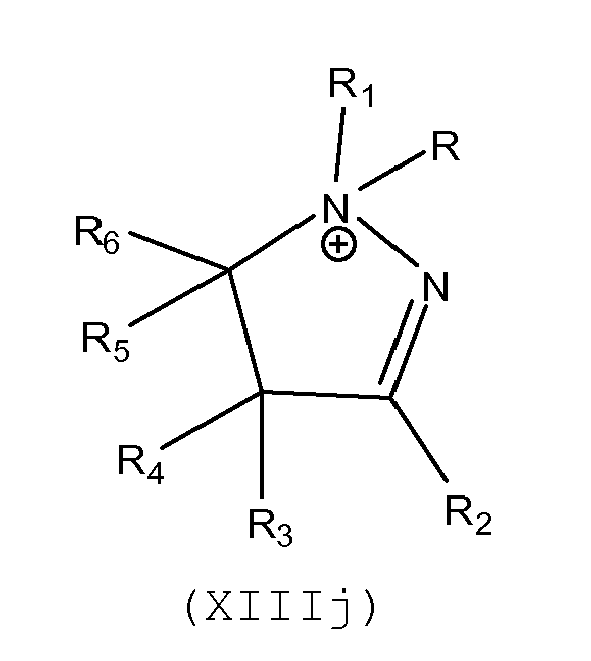
einer oder mehrere der Reste - R1 bis R4
- unabhängig voneinander 1-Butyl, 2-Butyl, 2- Methyl-1-propyl (Isobutyl), 2-Methyl-2-propyl (tert.- Butyl), 1-Pentyl, 2-Pentyl, 3-Pentyl, 2-Methyl-1- butyl, 3-Methyl-1-butyl, 2-Methyl-2-butyl, 3-Methyl- 2-butyl, 2,2- Dimethyl-1-propyl, 1-Hexyl, 2-Hexyl, 3- Hexyl, 2-Methyl-1-pentyl, 3-Methyl-1-pentyl, 4- Methyl-1-pentyl, 2-Methyl-2-pentyl, 3-Methyl-2- pentyl, 4-Methyl-2- pentyl, 2-Methyl-3-pentyl, 3- Methyl-3-pentyl, 2,2-Dimethyl-1-butyl, 2,3-Dimethyl- 1-butyl, 3,3-Dimethyl-1-butyl, 2-Ethyl-1-butyl, 2,3- Dimethyl-2-butyl, 3,3-Dimethyl-2-butyl, Heptyl, Octyl, Nonyl, Decyl, Undecyl, Dodecyl, Tridecyl, Tetradecyl, Pentadecyl, Hexadecyl, Heptadecyl, Octadecyl, Nonadecyl, Icosyl, Henicosyl, Docosyl, Tricosyl, Tetracosyl, Pentacosyl, Hexacosyl, Heptacosyl, Octacosyl, Nonacosyl, Triacontyl, Phenylmethyl (Benzyl), Diphenylmethyl, Triphenylmethyl, 2-Phenylethyl, 3-Phenylpropyl, Cyclopentylmethyl, 2-Cyclopentylethyl, 3- Cyclopentylpropyl, Cyclohexylmethyl, 2- Cyclohexylethyl, 3-Cyclohexylpropyl ist und die verbleibenden Reste R1 bis R4 Wasserstoff oder Methyl oder Ethyl sind.
- In Betracht kommen auch Leitfähigkeitsadditive, bei denen das Kation [A]+ ein 3-Pyrazoliniumion (XIIIk) beziehungsweise (XIIIk') ist,

einer oder mehrere der Reste - R1 bis R4
- unabhängig voneinander 1-Butyl, 2-Butyl, 2- Methyl-1-propyl (Isobutyl), 2-Methyl-2-propyl (tert.- Butyl), 1-Pentyl, 2-Pentyl, 3-Pentyl, 2-Methyl-1- butyl, 3-Methyl-1-butyl, 2-Methyl-2-butyl, 3-Methyl- 2-butyl, 2,2-Dimethyl-1-propyl, 1-Hexyl, 2-Hexyl, 3- Hexyl, 2-Methyl-1-pentyl, 3-Methyl-1-pentyl, 4- Methyl-1-pentyl, 2-Methyl-2-pentyl, 3-Methyl-2- pentyl, 4-Methyl-2- pentyl, 2-Methyl-3-pentyl, 3- Methyl-3-pentyl, 2,2-Dimethyl-1-butyl, 2,3-Dimethyl- 1-butyl, 3,3-Dimethyl-1-butyl, 2-Ethyl-1-butyl, 2,3- Dimethyl-2-butyl, 3,3-Dimethyl- 2-butyl, Heptyl, Octyl, Nonyl, Decyl, Undecyl, Dodecyl, Tridecyl, Tetradecyl, Pentadecyl, Hexadecyl, Heptadecyl, Octadecyl, Nonadecyl, Icosyl, Henicosyl, Docosyl, Tricosyl, Tetracosyl, Pentacosyl, Hexacosyl, Heptacosyl, Octacosyl, Nonacosyl, Triacontyl, Phenylmethyl (Benzyl), Diphenylmethyl, Triphenyl- methyl, 2-Phenylethyl, 3-Phenylpropyl, Cyclopentyl- methyl, 2-Cyclopentylethyl, 3-Cyclopentylpropyl, Cyclohexylmethyl, 2-Cyclohexylethyl, 3-Cyclohexyl- propyl ist und die verbleibenden Reste R1 bis R4 Wasserstoff oder Methyl oder Ethyl sind.
- In Betracht kommen daneben Leitfähigkeitsadditive, bei denen das Kation [A]+ ein Imidazoliniumion (XIIIl) ist,

- R für H
- oder Methyl steht,
- R1 und R2
- unabhängig voneinander Wasserstoff, Methyl oder Ethyl, oder ein linearer gesättigter oder ungesättigter Acylrest mit 14 bis 22, vorzugsweise 16 bis 18 Kohlenstoffatomen sind und R3 bis R6 unabhängig voneinander für Wasserstoff, einen linearen gesättigten, gegebenenfalls OH-Gruppen enthaltenden Alkylrest mit 1 bis 4 Kohlenstoffatomen stehen, bevorzugt Methyl oder ein Fettsäurerest ist, insbesondere bevorzugt sind R1 und R2 Fettsäureacylreste, sowie R oder R2 und R3 Fettsäureacylreste. Von besonderer Bedeutung sind die Substanzen entsprechend Formel (XIIIm). Teilweise sind in der Literatur hierfür auch irreführende Formeln (analog Formel XIIIm' oder XIIIl) eingeführt.
- In Betracht kommen außerdem Leitfähigkeitsadditive, bei denen das Kation [A]+ ein Imidazoliniumion (XIIIm) beziehungsweise (XIIIm') ist,

- R für H
- oder Methyl steht,
- R1 und R2
- unabhängig voneinander Wasserstoff, Methyl oder Ethyl, oder ein linearer gesättigter oder ungesättigter Acylrest mit 14 bis 22, vorzugsweise 16 bis 18 Kohlenstoffatomen sind und R3 bis R6 unabhängig voneinander für Wasserstoff, einen linearen gesättigten, gegebenenfalls OH-Gruppen enthaltenden Alkylrest mit 1 bis 4 Kohlenstoffatomen stehen, bevorzugt Methyl oder ein Fettsäurerest ist, insbesondere bevorzugt sind R1 und R2 Fettsäureacylreste, sowie R oder R2 und R3 Fettsäureacylreste. Von besonderer Bedeutung sind die Substanzen entsprechend Formel (XIIIm). Teilweise sind in der Literatur hierfür auch irreführende Formeln (analog Formel XIIIm' oder XIIIl) eingeführt.
- In Betracht kommen daneben Leitfähigkeitsadditive, bei denen das Kation [A]+ ein Thiazoliumion (XIIIo) beziehungsweise (XIIIo') sowie ein Oxazoliumion (XIIIp) ist,

einer oder mehrere der Reste - R1 bis R3 unabhängig voneinander 1-Butyl, 2-Butyl, 2-Methyl-1-propyl (Isobutyl), 2-Methyl-2-propyl (tert.-Butyl), 1-Pentyl, 2-Pentyl, 3-Pentyl, 2-Methyl-1-butyl, 3-Methyl-1-butyl, 2-Methyl-2-butyl, 3-Methyl-2-butyl, 2,2-Dimethyl-1-propyl, 1-Hexyl, 2-Hexyl, 3-Hexyl, 2-Methyl-1-pentyl, 3-Methyl-1-pentyl, 4-Methyl-1-pentyl, 2-Methyl-2-pentyl, 3-Methyl-2-pentyl, 4-Methyl-2- pentyl, 2-Methyl-3-pentyl, 3-Methyl-3-pentyl, 2,2-Dimethyl-1-butyl, 2,3-Dimethyl-1-butyl, 3,3-Dimethyl-1-butyl, 2-Ethyl-1-butyl, 2,3-Dimethyl-2-butyl, 3,3-Dimethyl- 2-butyl, Heptyl, Octyl, Nonyl, Decyl, Undecyl, Dodecyl, Tridecyl, Tetradecyl, Pentadecyl, Hexadecyl, Heptadecyl, Octadecyl, Nonadecyl, Icosyl, Henicosyl, Docosyl, Tricosyl, Tetracosyl, Pentacosyl, Hexacosyl, Heptacosyl, Octacosyl, Nonacosyl, Triacontyl, Phenylmethyl (Benzyl), Diphenylmethyl, Triphenylmethyl, 2-Phenylethyl, 3-Phenylpropyl, Cyclopentylmethyl, 2-Cyclopentylethyl, 3-Cyclopentylpropyl, Cyclohexylmethyl, 2-Cyclohexylethyl, 3-Cyclohexylpropyl ist und die verbleibenden Reste R1 bis R4 Wasserstoff oder Methyl oder Ethyl sind. In Betracht kommen auch Leitfähigkeitsadditive, bei denen das Kation [A]+ ein 1,2,4-Triazoliumion (XIIIq), (XIIIq') beziehungsweise (XIIIq") ist,
- R1 bis R3 unabhängig voneinander 1-Butyl, 2-Butyl, 2-Methyl-1-propyl (Isobutyl), 2-Methyl-2-propyl (tert.-Butyl), 1-Pentyl, 2-Pentyl, 3-Pentyl, 2-Methyl-1-butyl, 3-Methyl-1-butyl, 2-Methyl-2-butyl, 3-Methyl-2-butyl, 2,2-Dimethyl-1-propyl, 1-Hexyl, 2-Hexyl, 3-Hexyl, 2-Methyl-1-pentyl, 3-Methyl-1-pentyl, 4-Methyl-1-pentyl, 2-Methyl-2-pentyl, 3-Methyl-2-pentyl, 4-Methyl-2- pentyl, 2-Methyl-3-pentyl, 3-Methyl-3-pentyl, 2,2-Dimethyl-1-butyl, 2,3-Dimethyl-1-butyl, 3,3-Dimethyl-1-butyl, 2-Ethyl-1-butyl, 2, 3-Dimethyl-2-butyl, 3,3-Dimethyl- 2-butyl, Heptyl, Octyl, Nonyl, Decyl, Undecyl, Dodecyl, Tridecyl, Tetradecyl, Pentadecyl, Hexadecyl, Heptadecyl, Octadecyl, Nonadecyl, Icosyl, Henicosyl, Docosyl, Tricosyl, Tetracosyl, Pentacosyl, Hexacosyl, Heptacosyl, Octacosyl, Nonacosyl, Triacontyl, Phenylmethyl (Benzyl), Diphenylmethyl, Triphenylmethyl, 2-Phenylethyl, 3-Phenylpropyl, Cyclopentylmethyl, 2-Cyclopentylethyl, 3-Cyclopentylpropyl, Cyclohexylmethyl, 2-Cyclohexylethyl, 3-Cyclohexylpropyl ist und die verbleibenden Reste R1 bis R4 Wasserstoff oder Methyl oder Ethyl sind. In Betracht kommen weiterhin Leitfähigkeitsadditive, bei denen das Kation [A]+ ein 1,2,3-Triazoliumion (XIIIr), (XIIIr') beziehungsweise (XIIIr") ist,
- R1
- Wasserstoff, Methyl oder Ethyl ist und
- R2 und R3
- unabhängig voneinander Wasserstoff oder Methyl sind, oder R2 und R3 zusammen 1,4-Buta-1,3-dienylen ist, einer oder mehrere der Reste R1 bis R3 unabhängig voneinander 1-Butyl, 2-Butyl, 2-Methyl-1- propyl (Isobutyl), 2-Methyl-2-propyl (tert.-Butyl), 1-Pentyl, 2-Pentyl, 3-Pentyl, 2-Methyl-1-butyl, 3- Methyl-1-butyl, 2-Methyl-2-butyl, 3-Methyl-2-butyl, 2,2-Dimethyl-1-propyl, 1-Hexyl, 2-Hexyl, 3-Hexyl, 2- Methyl-1-pentyl, 3-Methyl-1-pentyl, 4-Methyl-1- pentyl, 2-Methyl-2-pentyl, 3-Methyl-2-pentyl, 4- Methyl-2- pentyl, 2-Methyl-3-pentyl, 3-Methyl-3- pentyl, 2,2-Dimethyl-1-butyl, 2,3-Dimethyl-1-butyl, 3,3-Dimethyl-1-butyl, 2-Ethyl-1-butyl, 2,3-Dimethyl- 2-butyl, 3,3-Dimethyl-2-butyl, Heptyl, Octyl, Nonyl, Decyl, Undecyl, Dodecyl, Tridecyl, Tetradecyl, Pentadecyl, Hexadecyl, Heptadecyl, Octadecyl, Nonadecyl, Icosyl, Henicosyl, Docosyl, Tricosyl, Tetracosyl, Pentacosyl, Hexacosyl, Heptacosyl, Octacosyl, Nonacosyl, Triacontyl, Phenylmethyl (Benzyl), Diphenylmethyl, Triphenylmethyl, 2- Phenylethyl, 3-Phenylpropyl, Cyclopentylmethyl, 2- Cyclopentylethyl, 3-Cyclopentylpropyl, Cyclohexyl- methyl, 2-Cyclohexylethyl, 3-Cyclohexylpropyl ist und die verbleibenden Reste R1 bis R3 Wasserstoff oder Methyl oder Ethyl sind.
- In Betracht kommen zudem Leitfähigkeitsadditive, bei denen das Kation [A]+ ein Pyrrolidiniumion (XIIIs) ist,

- R1
- Wasserstoff, Methyl, Ethyl oder Phenyl ist und
- R2 bis R9
- unabhängig voneinander Wasserstoff oder Methyl sind einer oder mehrere der Reste R1 bis R3 unabhängig voneinander 1-Butyl, 2-Butyl, 2-Methyl-1- propyl (Isobutyl), 2-Methyl-2-propyl (tert.-Butyl), 1-Pentyl, 2-Pentyl, 3-Pentyl, 2-Methyl-1-butyl, 3- Methyl-1-butyl, 2-Methyl-2-butyl, 3-Methyl-2-butyl, 2,2-Dimethyl-1-propyl, 1-Hexyl, 2-Hexyl, 3-Hexyl, 2- Methyl-1-pentyl, 3-Methyl-1-pentyl, 4-Methyl-1- pentyl, 2-Methyl-2-pentyl, 3-Methyl-2-pentyl, 4- Methyl-2- pentyl, 2-Methyl-3-pentyl, 3-Methyl-3- pentyl, 2,2-Dimethyl-1-butyl, 2,3-Dimethyl-1-butyl, 3,3-Dimethyl-1-butyl, 2-Ethyl-1-butyl, 2,3-Dimethyl- 2-butyl, 3,3-Dimethyl- 2-butyl, Heptyl, Octyl, Nonyl, Decyl, Undecyl, Dodecyl, Tridecyl, Tetradecyl, Pentadecyl, Hexadecyl, Heptadecyl, Octadecyl, Nonadecyl, Icosyl, Henicosyl, Docosyl, Tricosyl, Tetracosyl, Pentacosyl, Hexacosyl, Heptacosyl, Octacosyl, Nonacosyl, Triacontyl, Phenylmethyl (Benzyl), Diphenylmethyl, Triphenylmethyl, 2- Phenylethyl, 3-Phenylpropyl, Cyclopentylmethyl, 2- Cyclopentylethyl, 3-Cyclopentylpropyl, Cyclohexyl- methyl, 2-Cyclohexylethyl, 3-Cyclohexylpropyl ist und die verbleibenden Reste R1 bis R3 Wasserstoff oder Methyl oder Ethyl sind.
- In Betracht kommen daneben Leitfähigkeitsadditive, bei denen das Kation [A]+ ein Imidazolidiniumion (XIIIt) ist,

einer oder mehrere der Reste - R1 bis R8
- unabhängig voneinander 1-Butyl, 2-Butyl, 2- Methyl-1-propyl (Isobutyl), 2-Methyl-2-propyl (tert.- Butyl), 1-Pentyl, 2-Pentyl, 3-Pentyl, 2-Methyl-1- butyl, 3-Methyl-1-butyl, 2-Methyl-2-butyl, 3-Methyl- 2-butyl, 2,2-Dimethyl-1-propyl, 1-Hexyl, 2-Hexyl, 3- Hexyl, 2-Methyl-1-pentyl, 3-Methyl-1-pentyl, 4- Methyl-1-pentyl, 2-Methyl-2-pentyl, 3-Methyl-2- pentyl, 4-Methyl-2- pentyl, 2-Methyl-3-pentyl, 3- Methyl-3-pentyl, 2,2-Dimethyl-1-butyl, 2,3-Dimethyl- 1-butyl, 3,3-Dimethyl-1-butyl, 2-Ethyl-1-butyl, 2,3- Dimethyl-2-butyl, 3,3-Dimethyl-2-butyl, Heptyl, Octyl, Nonyl, Decyl, Undecyl, Dodecyl, Tridecyl, Tetradecyl, Pentadecyl, Hexadecyl, Heptadecyl, Octadecyl, Nonadecyl, Icosyl, Henicosyl, Docosyl, Tricosyl, Tetracosyl, Pentacosyl, Hexacosyl, Heptacosyl, Octacosyl, Nonacosyl, Triacontyl, Phenylmethyl (Benzyl), Diphenylmethyl, Tri- phenylmethyl, 2-Phenylethyl, 3-Phenylpropyl, Cyclopentylmethyl, 2-Cyclopentylethyl, 3-Cyclo- pentylpropyl, Cyclohexylmethyl, 2-Cyclohexylethyl, 3- Cyclohexylpropyl ist und die verbleibenden Reste R1 bis R8 Wasserstoff oder Methyl oder Ethyl sind.
- In Betracht kommen auch Leitfähigkeitsadditive, bei denen das Kation [A]+ ein Ammoniumion (IV) ist,

einer oder mehrere der Reste - R1 bis R3
- unabhängig voneinander 1-Butyl, 2-Butyl, 2- Methyl-1-propyl (Isobutyl), 2-Methyl-2-propyl (tert.- Butyl), 1-Pentyl, 2-Pentyl, 3-Pentyl, 2-Methyl-1- butyl, 3-Methyl-1-butyl, 2-Methyl-2-butyl, 3-Methyl- 2-butyl, 2,2-Dimethyl-1-propyl, 1-Hexyl, 2-Hexyl, 3- Hexyl, 2-Methyl-1-pentyl, 3-Methyl-1-pentyl, 4- Methyl-1-pentyl, 2-Methyl-2-pentyl, 3-Methyl-2- pentyl, 4-Methyl-2-pentyl, 2-Methyl-3-pentyl, 3- Methyl-3-pentyl, 2,2-Dimethyl-1-butyl, 2,3-Dimethyl- 1-butyl, 3,3-Dimethyl-1-butyl, 2-Ethyl-1-butyl, 2,3- Dimethyl-2-butyl, 3,3-Dimethyl-2-butyl, Heptyl, Octyl, Nonyl, Decyl, Undecyl, Dodecyl, Tridecyl, Tetradecyl, Pentadecyl, Hexadecyl, Heptadecyl, Octadecyl, Nonadecyl, Icosyl, Henicosyl, Docosyl, Tricosyl, Tetracosyl, Pentacosyl, Hexacosyl, Heptacosyl, Octacosyl, Nonacosyl, Triacontyl, Phenylmethyl (Benzyl), Diphenylmethyl, Triphenylmethyl, 2-Phenylethyl, 3-Phenylpropyl, Cyclopentylmethyl, 2-Cyclopentylethyl, 3-Cyclopentyl- propyl, Cyclohexylmethyl, 2-Cyclohexylethyl, 3-Cyclo- hexylpropyl ist und die verbleibenden Reste R1 bis R4 Wasserstoff oder Methyl oder Ethyl sind; oder R1 bis R3 unabhängig voneinander Wasserstoff oder C C1-C18- Alkyl sind und R4 2-Hydroxyethyl ist; oder R1 und R2 zusammen 1,5-Pentylen oder 3-Oxa-1,5-pentylen sind und R3 C1-C18-Alkyl, 2-Hydroxyethyl oder 2-Cyanoethyl ist.
- Zudem kommen Leitfähigkeitsadditive in Betracht, bei denen das Kation [A]+ ein Guanidiniumion (IVv) ist,

einer oder mehrere der Reste - R1 bis R5
- unabhängig voneinander 1-Butyl, 2-Butyl, 2- Methyl-1-propyl (Isobutyl), 2-Methyl-2-propyl (tert.- Butyl), 1-Pentyl, 2-Pentyl, 3-Pentyl, 2-Methyl-1- butyl, 3-Methyl-1-butyl, 2-Methyl-2-butyl, 3-Methyl- 2-butyl, 2,2-Dimethyl-1-propyl, 1-Hexyl, 2-Hexyl, 3- Hexyl, 2-Methyl-l-pentyl, 3-Methyl-1-pentyl, 4- Methyl-1-pentyl, 2-Methyl-2-pentyl, 3-Methyl-2- pentyl, 4-Methyl-2- pentyl, 2-Methyl-3-pentyl, 3- Methyl-3-pentyl, 2,2-Dimethyl-1-butyl, 2,3-Dimethyl- 1-butyl, 3,3-Dimethyl-1-butyl, 2-Ethyl-1-butyl, 2,3- Dimethyl-2-butyl, 3,3-Dimethyl- 2-butyl, Heptyl, Octyl, Nonyl, Decyl, Undecyl, Dodecyl, Tridecyl, Tetradecyl, Pentadecyl, Hexadecyl, Heptadecyl, Octadecyl, Nonadecyl, Icosyl, Henicosyl, Docosyl, Tricosyl, Tetracosyl, Pentacosyl, Hexacosyl, Heptacosyl, Octacosyl, Nonacosyl, Triacontyl, Phenylmethyl (Benzyl), Diphenylmethyl, Triphenyl- methyl, 2-Phenylethyl, 3-Phenylpropyl, Cyclo- pentylmethyl, 2-Cyclopentylethyl, 3-Cyclopentyl- propyl, Cyclohexylmethyl, 2-Cyclohexylethyl, 3- Cyclohexylpropyl ist und die verbleibenden Reste R1 bis R4 Wasserstoff oder Methyl oder Ethyl sind; R1 bis R5 unabhängig voneinander C1-C18-Alkyl sind; oder R1 bis R5 unabhängig voneinander Wasserstoff oder C1- C18-Alkyl oder 2-Hydroxyethyl sind.
- In Betracht kommen auch Leitfähigkeitsadditive, bei denen das Kation [A]+ ein Derivat eines Ethanolamins, z.B. ein Choliniumion (XIIIw), oder eines Diethanolamins (XIIIw'), oder eines Triethanolamins (XIIIw") ist,

- R1 und R2
- unabhängig voneinander Methyl, Ethyl, 1-Butyl oder 1-Octyl sind und R3 Wasserstoff, Methyl, Ethyl, Acetyl, -SO2OH oder -PO(OH)2 ist; R1 Methyl, Ethyl, 1- Butyl oder 1-Octyl ist, R2 eine -CH2-CH2-OR4-Gruppe ist und R3 und R4 unabhängig voneinander Wasserstoff, Methyl, Ethyl, Acetyl, -SO2OH oder -PO(OH)2 sind; oder R1 eine -CH2-CH2-OR4-Gruppe ist, R2 eine -CH2-CH2- OR5-Gruppe ist und R3 bis R5 unabhängig voneinander Wasserstoff, Methyl, Ethyl, Acetyl, -SO2OH oder -PO(OH)2 sind; R1 Methyl, Ethyl, 1-Butyl, 1-Octyl, Acetyl, -SO2OH, oder -PO(OH)2 ist und R3 bis R5 unabhängig voneinander Wasserstoff, Methyl, Ethyl, Acetyl, -SO2OH, -PO(OH)2, oder -(CnH2nO)mR1 mit n = 1 bis 5 und m = 1 bis 100 sind.
- Bevorzugt sind außerdem Verbindungen in denen R, R1 und R2 Alkylgruppen mit 1 bis 4 Kohlenstoffatomen, besonders bevorzugt gleich einer Methylgruppe sind, und R3 und/oder R4 gesättigte oder ungesättigte Fettsäure- bzw. Acylreste mit 8 bis 22 Kohlenstoffatomen, bevorzugt 12 bis 18 Kohlenstoffatomen sind. Es können auch Mischungen der Acyl- oder Fettsäurereste (insbesondere beispielsweise in natürlich vorkommenden Verhältnissen) vorliegen.
- Ganz besonders bevorzugt ist die Formel (XIIIw") mit R, R1, R2 gleich einem Alkylrest mit 1 bis 4 Kohlenstofatomen, insbesondere Methylgruppen und R3 gleich einem Fettsäurerest und R4 und R5 gleich einem Fettsäurerest oder gleich Wasserstoff.
- In Betracht kommen Leitfähigkeitsadditive, bei denen das Kation [A]+ ein Phosphoniumion (VI) ist, bei dem R1 bis R3 unabhängig voneinander C1-C18-Alkyl, insbesondere Butyl, Isobutyl, 1-Hexyl oder 1-Octyl sind.
- Besonders bevorzugt sind das Tributyloctylphosphonium, Triisobutyloctylphosphonium, Trioctylethylphosphonium, Trioctylbutylphosphonium, Tributylhexylphosphonium, Tetraoctylphosphonium, Tributyltetradecylphosphonium, Trihexyloctylphosphonium, Trihexyltetradecylphosphonium, und das Tetratetradecylphosphonium Kation.
- Die erfindungsgemäß Verwendung findenden Leitfähigkeitsadditive bestehen aus mindestens einem der vorgenannten Kationen kombiniert mit jeweils mindestens einem Anion. Als Anionen kommen prinzipiell alle Anionen in Betracht, welche in Verbindung mit dem Kation zu einer im nichtwässrigen Hydrauliköl klar löslichen Flüssigkeit führen.
- Das Anion [Y]n- der Leitfähigkeitsadditive ist beispielsweise ausgewählt aus:
- der Gruppe der Halogenide und halogenhaltigen Verbindungen der Formeln: F- Cl-, Br-, I-, BF4 -, PF6 -, AlCl4 -, Al2Cl7 -, Al3Cl10 -, AlBr4 -, FeCI4 -, BCl4 - SbF6 -, AsF6 -, ZnCl3 -, SnCl3 -, CuCl2 -, CF3SO3 -, (CF3SO3)2N-, CF3CO2 -, CCl3CO2 -, CN-, SCN-, OCN-, NO2 -, NO3 -, N(CN)-; der Gruppe der Sulfate, Sulfite und Sulfonate der allgemeinen Formeln: SO4 2-, HSO4 -, SO3 2", HSO3 -, RaOSO3 -, RaSO3 -;
- der Gruppe der Phosphate der allgemeinen Formeln: PO4 3-, HPO4 2-, H2PO4-, RaPO4 2-, HRaPO4 -, RaRbPO4 -;
- der Gruppe der Phosphonate und Phosphinate der allgemeinen Formel: RaHPO3 -, RaRbPO2 -, RaRbPO3 -;
- der Gruppe der Phosphite der allgemeinen Formeln: PO3 3-, HPO3 2-, H2PO3 -, RaPO3 2-, RaHPO3 -, RaRbPO3 -;
- der Gruppe der Phosphonite und Phosphinite der allgemeinen Formel: RaRbPO2 -, RaHPO2 -, RaRbPO-, RaHPO-; der Gruppe der Carboxylate der allgemeinen Formeln: RaCOO-;
- der Gruppe der Borate der allgemeinen Formeln: BO3 3-, HBO3 2-, H2BO3 -, RaRbBO3 -, RaHBO3 -, RaBO3 2-, B(ORa)(ORb)(ORc)(ORd)-, B(HSO4)-, B(RaSO4)- ;
- der Gruppe der Boronate der allgemeinen Formeln: RaBO2 2-, RaRbBO-;
- der Gruppe der Carbonate und Kohlensäureester der allgemeinen Formeln: HCO3 -, CO3 2-, RaCO3-;
- der Gruppe der Silikate und Kieselsäuresäureester der allgemeinen Formeln: SiO4 4-, HSiO4 3-, H2SiO4 2-, H3SiO4 -, RaSiO4 3-, RaRbSiO4 2-, RaRbRcSiO4 -, HRaSiO4 2-, H2RaSiO4 -, HRaRbSiO4 -;
- der Gruppe der Alkyl- bzw. Arylsilan-Salze der allgemeinen Formeln: RaSiO3 3-, RaRbSiO2 2-, RaRbRcSiO-, RaRbRcSi03 -, RaRbRcSi02 -, RaRbSi03 2-;
- der Gruppe der Carbonsäureimide, Bis(sulfonyl)imide und Sulfonylimide der allgemeinen Formeln:

- der Gruppe der Methide der allgemeinen Formel:

- der Gruppe der Alkoxide und Aryloxide der allgemeinen Formeln: RaO-;
- der Gruppe der Halometallate der allgemeinen Formel [MrHalt]s-, wobei M für ein Metall und Hal für Fluor, Chlor, Brom oder lod steht, r und t ganze positive Zahlen sind und die Stöchiometrie des Komplexes angeben und s eine ganze positive Zahl ist und die Ladung des Komplexes angibt;
- der Gruppe der Sulfide, Hydrogensulfide, Polysulfide, Hydrogenpolysulfide und Thiolate der allgemeinen Formeln:
- S2-, HS-, [Sv]2-, [HSv]-, [RaS]-, wobei v eine ganze positive Zahl von 2 bis 10 ist;
- der Gruppe der komplexen Metallionen wie Fe(CN)6 3-, Fe(CN)6 4-, MnO4 -, Fe(CO)4 -.
- Darin bedeuten Ra, Rb, Rc und Rd unabhängig voneinander jeweils Wasserstoff;
- C1-C30-Alkyl und deren aryl-, heteroaryl-, cycloalkyl, halogen-, hydroxy-, amino-, carboxy-, formyl-, -O-, - CO-, -CO-O- oder -CO-N< substituierte Komponenten, wie beispielsweise Methyl, Ethyl, 1-Propyl, 2-Propyl, 1-Butyl, 2-Butyl, 2-Methyl-1-propyl (Isobutyl), 2-Methyl-2-propyl (tert.-Butyl), 1-Pentyl, 2-Pentyl, 3-Pentyl, 2-Methyl-1-butyl, 3-Methyl-1-butyl, 2-Methyl-2-butyl, 3-Methyl-2-butyl, 2,2-Dimethyl-1-propyl, 1-Hexyl, 2-Hexyl, 3-Hexyl, 2-Methyl-1-pentyl, 3-Methyl-1-pentyl, 4-Methyl-1-pentyl, 2-Methyl-2-pentyl, 3-Methyl-2-pentyl, 4-Methyl-2-pentyl, 2-Methyl-3-pentyl, 3-Methyl-3-pentyl, 2,2-Dimethyl-1-butyl, 2,3-Dimethyl-1-butyl, 3,3-Dimethyl-1-butyl, 2-Ethyl-1-butyl, 2,3-Dimethyl-2-butyl, 3,3-Dimethyl-2-butyl, Heptyl, Octyl, Nonyl, Decyl, Undecyl, Dodecyl, Tridecyl, Tetradecyl, Pentadecyl, Hexadecyl, Heptadecyl, Octadecyl, Nonadecyl, Icosyl, Henicosyl, Doco- syl, Tricosyl, Tetracosyl, Pentacosyl, Hexacosyl, Heptacosyl, Octacosyl, Nonacosyl, Triacontyl, Phenylmethyl (Benzyl), Diphenylmethyl, Triphenylmethyl, 2-Phenylethyl, 3-Phenylpropyl, Cyclopentylmethyl, 2-Cyclopentylethyl, 3-Cyclopentylpropyl, Cyclohexylmethyl, 2-Cyclohexylethyl, 3-Cyclohexylpropyl, Methoxy, Ethoxy, Formyl, Acetyl oder CqF2(q-a)+(1-b)H2a+b mit q < 30, 0 ≤ a ≤ q und b = 0 oder 1 (beispielsweise CF3, C2F5, CH2CH2-C(q-2)F2(q-2)+1, C6F13, C8F17, C10F21, C12F25);
- C3-C12-Cycloalkyl und deren aryl-, heteroaryl-, cycloalkyl-, halogen-, hydroxy-, amino-, carboxy-, formyl-, -O-, -CO- oder -CO-O-substituierte Komponenten, wie beispielsweise Cyclopentyl, 2-Methyl-1-cyclopentyl, 3-Methyl-1-cyclopentyl, Cyclohexyl, 2-Methyl-1-cyclohexyl, 3-Methyl-1-cyclohexyl, 4-Methyl-1-cyclohexyl oder CqF2(q-a)-(1-b)H2a-b mit q ≤ 30, 0 ≤ a ≤ q und b = 0 oder 1 ; C2-C30-Alkenyl und deren aryl-, heteroaryl-, cycloalkyl-, halogen-, hydroxy-, amino-, carboxy-, formyl-, -O-, -CO- oder -CO-O-substituierte Komponenten, wie beispielsweise 2-Propenyl, 3-Butenyl, cis-2-Butenyl, trans-2-Butenyl oder CqF2(q-a)-(1-b)H2a-b mit q ≤ 30, 0 ≤ a ≤ q und b = 0 oder 1;
- C3-C12-Cycloalkenyl und deren aryl-, heteroaryl-, cycloalkyl-, halogen-, hydroxy-, amino-, carboxy-, formyl-, -O-, -CO- oder -CO-O-substituierte Komponenten, wie beispielsweise 3-Cyclopentenyl, 2-Cyclohexenyl, 3-Cyclohexenyl, 2,5- Cyclohexadienyl oder CqF2(q-a)-3(1-b)H2a-3b mit q ≤ 30, 0 ≤ a ≤ q und b = 0 oder 1;
- Aryl oder Heteroaryl mit 2 bis 30 Kohlenstoffatomen und deren alkyl-, aryl-, heteroaryl-, cycloalkyl-, halogen-, hydroxy-, amino-, carboxy-, formyl-, -O-, - CO- oder -CO-O-substituierte Komponenten, wie beispielsweise Phenyl, 2-Methyl-phenyl (2-Tolyl), 3-Methyl-phenyl (3-Tolyl), 4-Methyl-phenyl, 2-Ethyl-phenyl, 3-Ethyl-phenyl, 4-Ethyl-phenyl, 2,3-Dimethyl-phenyl, 2, 4-Dimethyl-phenyl, 2,5-Dimethyl-phenyl, 2,6-Dimethyl-phenyl, 3,4-Dimethyl-phenyl, 3,5-Dimethyl-phenyl, 4-Phenyl-phenyl, 1-Naphthyl, 2-Naphthyl, 1-Pyrrolyl, 2-Pyrrolyl, 3-Pyrrolyl, 2-Pyridinyl, 3-Pyridinyl, 4-Pyridinyl oder C6F(5-a)Ha mit 0 ≤ a ≤ 5; oder
- zwei Reste einen ungesättigten, gesättigten oder aromatischen, gegebenenfalls durch funktionelle Gruppen, Aryl, Alkyl, Aryloxy, Alkyloxy, Halogen, Heteroatome und/oder Heterocyclen substituierten und gegebenenfalls durch ein oder mehrere Sauerstoff-und/oder Schwefelatome und/oder ein oder mehrere substituierte oder unsubstituierte Iminogruppen unterbrochenen Ring.
- In Betracht kommende Anionen sind zum Beispiel Chlorid; Bromid; Iodid; Thiocyanat; Hexafluorophosphat; Trifluormethansulfonat; Methansulfonat; Formiat; Acetat; Glycolat; Lactat; Oxalat; Citrat; Maleinat; Maleat; Tartrat; Mandelat; Nitrat; Nitrit; Trifluoracetat; Sulfat; Hydrogensulfat; Methylsulfat; Ethylsulfat; 1-Propylsulfat; 1-Butylsulfat; 1-Hexylsulfat; 1-Octylsulfat; Phosphat; Dihydrogenphosphat; Hydrogenphosphat; C1-C4-Dialkylphosphate; Propionat; Tetrachloroaluminat; Al2Cl7 -; Chlorozinkat; Chloroferrat; Bis(trifluoromethylsulfonyl)imid; Bis(pentafluoroethylsulfonyl) imid; Bis (methylsulfonyl) imid; Bis (p-Tolylsulfonyl)imid; Tris(trifluoromethylsulfonyl)methid; Bis(pentafluoroethylsulfonyl)methid; p-Tolylsulfonat; Tetracarbonylcobaltat; Dimethylenglykolmonomethylethersulfat; Oleat; Stearat; Acrylat; Methacrylat; Maleinat; Hydrogencitrat; Vinylphosphonat; Bis(pentafluoroethyl)phosphinat; Borate wie Bis[salicylato(2-)]borat, Bis[oxalato(2-)]borat, Bis[1,2-benzoldiolato(2-)-0,0']borat, Tetracyanoborat, Tetrafluoroborat; Dicyanamid; Tris(pentafluoroethyl)trifluorophosphat; Tris(heptafluoropropyl)trifluorophosphat, cyclische Arylphosphate wie Brenzcatecholphosphat (C6H4O2)P(O)O- und Chlorocobaltat.
- Bevorzugte Anionen werden ausgewählt aus der Gruppe - ohne Anspruch auf Vollständigkeit - der Halogenide, Bis(perfluoralkylsulfonyl)amide bzw. -imide wie z.B. Bis(trifluormethylylsulfonyl)imid, Alkyl- und Aryltosylate, Perfluoralkyltosylate, Nitrat, Sulfat, Hydrogensulfat, Alkyl- und Arylsulfate, Polyethersulfate und - sulfonate, Perfluoralkylsulfate, Sulfonat, Alkyl- und Arylsulfonate, perfluorierte Alkyl- und Arylsulfonate, Alkyl- und Arylcarboxylate, Perfluoralkylcarboxylate, Perchlorat, Tetrarchloroaluminat, Saccharinat. Weiterhin sind Dicyanamid, Thiocyanat, Isothiocyanat, Tetraphenylborat, Tetrakis (pentafluorphenyl) borat, Tetrafluoroborat, Hexafluorophosphat, Polyetherphosphate Dialkylphosphate, Isostearate, Alkylbenzylsulfonate, bis(Alkyl)phosphinate, Phosphatide, Decanoate und Phosphat bevorzugt.
- Ganz besonders bevorzugte Anionen sind: Chlorid, Bromid, Hydrogensulfat, Tetrachloroaluminat, Thiocyanat, Methylsulfat, Ethylsulfat, Methansulfonat, Formiat, Acetat, Glycolat, Lactat, Dimethylphosphat, Diethylphosphat, p-Tolylsulfonat, Tetrafluoroborat, Hexafluorophosphat, Diethylphosphat, Isostearat, Dodecylbenzyl sulfonat, bis ( 2 , 4 , 4-Trimethylpentyl)-phosphinat, Phosphatid, Decanoat, und Tosylat.
- Erfindungsgemäß in einer weiteren bevorzugten Ausführungsform werden solche Leitfähigkeitsadditive bzw. deren Mischungen verwendet, die eine Kombination eines 1,3-Dialkylimidazolium-, 1,2,3-Trialkylimidazolium-, 1,3-Dialkylimidazolinium- und 1,2,3-Trialkylimidazoliniumkations mit einem Anion ausgesucht aus der Gruppe der Halogenide, Bis(trifluormethylylsulfonyl)imid, Perfluoralkyltosylate, Alkylsulfate und -sulfonate, perfluorierte Alkylsulfonate und -sulfate, Perfluoralkylcarboxylate, Perchlorat, Dicyanamid, Thiocyanat, Isothiocyanat, Tetraphenylborat, Tetrakis(pentafluorphenyl)borat, Tetrafluoroborat, Hexafluorophosphat, Acetat, Glycolat, Lactat enthalten.
- Die Mischungsverhältnisse aus Hydrauliköl und Leitfähigkeitsadditiv betragen zwischen 100.000 : 1 und 10 : 1, bevorzugt zwischen 10.000 : 1 und 20 : 1, besonders bevorzugt 5.000 : 1 und 25 : 1, ganz besonders bevorzugt zwischen 1.000 : 1 und 50 : 1.
- Die Zusammensetzung aus Hydrauliköl und Leitfähigkeitsadditiv kann weitere übliche Additive enthalten. Dazu gehören beispielsweise Viskositätsindexverbesserer, Entschäumer, Pourpoint-Depressants, Extreme Pressure Additive, Anti-wear Additive, Korrosionsinhibitoren, Friction Modifier Additive, Demulgieradditive, Antioxidantien oder Detergentien.
- Die erforderliche Minimalleitfähigkeit beträgt beispielsweise für Anwendungen in Kühlhaushydraulikflüssigkeiten mindestens 1.000 pS/m. Die gewünschte Leitfähigkeit liegt wesentlich höher, kann allerdings durch die bislang bekannten Leitfähigkeitsverbesserer nicht dauerhaft erreicht werden, da es zum Verdampfen des flüchtigen Lösungsmittels und damit verbunden zu Ausfällungen oder Aussalzungen kommt. Eine Begrenzung der Leitfähigkeit nach oben ist jedenfalls nicht notwendig, da die gewünschte Wirkung, die Neigung zur statischen Aufladung, mit steigender Leitfähigkeit immer weiter abnimmt. Die erfindungsgemäßen ionischen Leitfähigkeitsadditive mit organischen Resten in den Ionen weisen diese Nachteile nicht mehr auf.
- In anderen Anwendungsgebieten können die Minimalleitfähigkeiten und Wunschleitfähigkeiten abweichen und auch Maximalleitfähigkeiten relevant sein.
- Die erfindungsgemäßen Leitfähigkeitsadditive und deren Verwendung werden nachfolgend beispielhaft beschrieben, ohne dass die Erfindung als auf diese beispielhaften Ausführungsformen beschränkt angesehen werden kann. Sind nachfolgend Bereiche, allgemeine Formeln oder Verbindungsklassen angegeben, so sollen diese nicht nur die entsprechenden Bereiche oder Gruppen von Verbindungen umfassen, die explizit erwähnt sind, sondern auch alle Teilbereiche und Teilgruppen von Verbindungen, die durch Herausnahme von einzelnen Werten (Bereichen) oder Verbindungen erhalten werden können.
- In den nachfolgend aufgeführten Beispielen wird die vorliegende Erfindung beispielhaft beschrieben, ohne dass die Erfindung, deren Anwendungsbreite sich aus der gesamten Beschreibung und den Ansprüchen ergibt, als auf die in den Beispielen genannten Ausführungsformen beschränkt gelesen werden kann.
- 100 g Kühlhaus Hydrauliköl 50468783 (Firma Jungheinrich) wurde vorgelegt und jeweils 1 g bzw. 5 g des Leitfähigkeitsadditivs hinzugewogen. Die Probe wurde gerührt bis sie homogen war und anschließend wurde die elektrische Ruheleitfähigkeit und der Trübungswert FNU (Formazine Nephelometric Units) bestimmt.
- Die Ruheleitfähigkeit wurde nach DIN 51412 Teil 1 (2005-06) bestimmt.
- Zur Bestimmung der Trübung wurde ein Labor-Trübungsphotometer NEPHLA vom Typ LPG239 (Hersteller Dr. Bruno Lange GmbH, Düsseldorf) eingesetzt. Der Abgleich erfolgte gegen DIN Standard Formazin.
- Mit dem Trübungswert wird das qualitative Phänomen der Trübung quantitativ erfaßt. Das Ziel der Trübungsmessung ist es, Aussagen über den Gehalt an streuenden Partikeln zu erhalten. FNU (auch FTU: Formazin-Turbidity-Unit) ist eine gemäß der NORM ISO 7027 verwendete Einheit der Messung einer Trübung, welche mit Streulicht gemessen wurde. Um Streulichtmessungen vergleichbar zu machen, werden diese Messgeräte mit einer Suspension, z.B. Formazin, kalibriert, um die Messungen auf einen gemeinsamen Standard zurückführen zu können.
- Die Meßküvette wurde mit der jeweiligen Probe bis zum schwarzen Ring gefüllt und auf die entsprechende Temperatur (jeweils 0 °C und Raumtemperatur) konditioniert. Danach wurde die Küvette in die Apparatur eingesetzt. Es wurden mindestens 3 Messungen in unterschiedlicher Küvettenstellung durchgeführt und der Mittelwert errechnet. Zur Vermeidung von Kondensation von Luftfeuchtigkeit wurde bei 0 °C in Schutzgasatmosphäre gearbeitet.
Tabelle 1: Trübung und Ruheleitfähigkeit bei Raumtemperatur von additiviertem Hydrauliköl (Kühlhaus Hydrauliköl 50468783 (Firma Jungheinrich) Ruheleitfähigkeit Trübungswert pS/m FNU Blindwert reines Hydrauliköl 50 0,24 1 % Zusatz Trihexyltetradecylphosphonium bis(2,4,4-trimethylpentyl) phosphinat 38.520 2,7 5 % Zusatz Trihexyltetradecylphosphonium bis(2,4,4-trimethylpentyl) phosphinat 210.000 1 % Zusatz TEGO® IL ZTO 50.000 0,24 5 % Zusatz TEGO® IL ZTO 281.700 0,24 - Nicht nur mit TEGO® IL ZTO, einem Fettsäureaminpolyglykolether-Diesterquat, CAS-Nr. 217813-30-4, sondern auch mit TEGO® IL ZTI, einem Talloylaminpolyglykolether-Diesterquat, sowie mit TEGO® IL IM36, einem 2-(C17 and C17-unsaturatedalkyl) -1- [2- (C18 and C18-unsatd.amido)-ethyl]-4,5-dihydro-1-methyl, Imidazolium methylsulfat und Trihexyltetradecylphosphonium bis(2,4,4-trimethylpentyl) phosphinat werden vergleichsweise hohe Leitfähigkeiten verbunden mit sehr niedrigen Trübungswerten erreicht (TEGO® ist ein Warenzeichen der Evonik Goldschmidt GmbH. Auch bei Temperaturen um den Gefrierpunkt (0° C) bleibt der organische Leitfähigkeitsverbesserer in Lösung und damit die hohe relative Leitfähigkeit erhalten. Diese Leitfähigkeiten sind wesentlich höher im Vergleich zu einem anorganischen Leitsalz in maximaler Konzentration (das heißt mit Bodensatz).
- Die Ergebnisse zeigen deutlich, dass die erfindungsgemäßen Formulierungen mit einem ungleich höheren Anteil an Leitfähigkeitsadditiv ausgestattet werden können gegenüber bisher verwendeten technischen Lösungen. Somit sind auch gegenüber dem Stand der Technik absolut höhere Werte bei der Leitfähigkeit erreichbar und einstellbar.
[A1]+[A2]+ [Y]2- (IIa)
[A1]+[A2]+[A3]+ [Y]3- (IIb)
oder
[A1]+[A2]+[A3]+[A4]+ [Y]4- (IIc)
wobei
[A1]+[A2]+[A3]+[M1]+ [Y]4- (IIIa)
[A1]+[A2]+[M1]+[M2]+ [Y]4- (IIIb)
[A1]+[M1]+[M2]+[M3]+ [Y]4- (IIIc)
[A1]+[A2]+[M1]+ [Y]3- (IIId)
[A1]+[M1]+[M2]+ [Y]3- (IIIe)
[A1]+[M1]+ [Y]2- (IIIf)
[A1]+[A2]+[M4]2+ [Y]4- (IIIg)
[A1]+[M1]+[M4]2+ [Y]4- (IIIh)
[A1] + [M5]3+ [Y]4- (IIIi)
oder
[A1]+[M4]2+ [Y]3- (IIIj)
wobei
jeder Rest R6 unabhängig voneinander eine Alkylgruppe oder Hydroxyalkylgruppe mit 1 bis 6 Kohlenstoffatomen, oder eine Benzylgruppe und vorzugsweise eine Methylgruppe ist,

einer oder mehrere der Reste

Claims (17)
- Zusammensetzung enthaltend nicht-wässrige Hydrauliköle oder Schmierstoffe sowie ein oder mehrere mit dem Hydrauliköl klar mischbare oder lösliche Leitfähigkeitsadditive und gegebenenfalls weitere übliche Additive.
- Zusammensetzung gemäß Anspruch 1, dadurch gekennzeichnet, dass das Leitfähigkeitsadditiv flüssig und von ionischer Struktur ist und Ionen mit organischen Resten enthält.
- Zusammensetzung nach zumindest einem der Ansprüche 1 oder 2, dadurch gekennzeichnet, dass das ionische Leitfähigkeitsadditiv zumindest ein Kation und/oder ein Anion mit organischen Resten umfasst.
- Zusammensetzung nach zumindest einem der Ansprüche 1 bis 3, dadurch gekennzeichnet, dass das ionische Leitfähigkeitsadditiv im Kation und/oder Anion mindestens einen organischen Rest mit mindestens 8 C-Atomen, wobei die Summe der C-Atome aller Reste mindestens 14 ist, enthält.
- Zusammensetzung gemäß einem der Ansprüche 1 bis 4, enthaltend als Leitfähigkeitsadditiv eine Verbindung der Formeln (I), (II) oder (III)
[A]n + [Y]n- (I)
in dern für 1, 2, 3 oder 4 steht,[A]+ für ein quartäres Ammonium-Kation, ein Oxonium-Kation, ein Sulfonium-Kation oder ein Phosphonium-Kation und[Y]n- für ein n-wertiges Anion steht und/oder
gemischte Salze der allgemeinen Formeln (II)
[A1]+[A2]+ [Y]2- (IIa),
[A1]+[A2]+[A3]+ [Y]3- (IIb),
oder
[A1]+[A2]+[A3]+[A4]+ [Y]4- (IIc),
wobei[A1]+, [A2]+ [A3]+ und [A4]+ unabhängig voneinander aus den für [A]+ genannten Gruppen ausgewählt sind,[Y]n- die für Formel (I) genannte Bedeutung besitzt und/oder
gemischte Salze der allgemeinen Formeln (III)
[A1]+[A2]+[A3]+[M1]+ [Y]4- (IIIa),
[A1]+[A2]+[M1]+[M2]+ [Y]4- (IIIb),
A1]+[M1]+[M2]+[M3]+ [Y]4- (IIIc),
[A1]+[A2]+[M1]+ [Y]3- (IIId),
[A1]+[M1]+[M2]+ [Y]3- (IIIe),
[A1]+[M1]+ [Y]2- (IIIf),
[A1]+[A2]+[M4]2+ [Y]4- (IIIg),
[A1]+[M1]+[M4]2+ [Y]4- (IIIh),
[A1]+[M5]3+ [Y]4- (IIIi),
oder
[A1]+[M4]2+ [Y]3- (IIIj),
wobei[A1]+, [A2]+ oder [A3]+ unabhängig voneinander aus den für [A]+ genannten Gruppen ausgewählt sind,[Y]n- die für Formel (I) genannte Bedeutung besitzt und[M1]+, [M2]+, [M3]+ einwertige Metallkationen,[M4]2+ zweiwertige Metallkationen und[M5]3+ dreiwertige Metallkationen bedeutenoder Gemische aus allen Formeln (I) bis (III). - Zusammensetzung gemäß Anspruch 5 enthaltend als Kation [A+] Strukturelemente der allgemeinen Formeln (IV) bis (VIII)
R1R2R3R4N+ (IV)
R1R2N+=CR3R4 (V)
R1R2R3R4P+ (VI)
R1R2P+=CR3R4 (VII)
R1R2R3S+ (VIII)
in denenR1,R2,R3,R4 gleich oder unterschiedlich sind und Wasserstoff, einen linearen oder verzweigten gegebenenfalls Doppelbindungen enthaltenden aliphatischen Kohlenwasserstoffrest mit 1 bis 30 Kohlenstoffatomen, mit der Vorgabe, dass mindestens ein Rest ungleich Wasserstoff ist, einen gegebenenfalls Doppelbindungen enthaltenden cycloaliphatischen Kohlenwasserstoffrest mit 5 bis 40 Kohlenstoffatomen, einen aromatischen Kohlenwasserstoffrest mit 6 bis 40 Kohlenstoffatomen, einen Alkylarylrest mit 7 bis 40 Kohlenstoffatomen, einen durch ein oder mehrere Heteroatome wie Sauerstoff, NH, NR' mit R' gleich einem gegebenenfalls Doppelbindungen enthaltenden C1-C30-Alkylrest, unterbrochenen linearen oder verzweigten gegebenenfalls Doppelbindungen enthaltenden aliphatischen Kohlenwasserstoffrest mit 2 bis 30 Kohlenstoffatomen, einen durch eine oder mehrere Funktionalitäten, ausgewählt aus der Gruppe -O-C(O)-, -(O)C-O-, -NH-C(O)-, -(O)C-NH, -(CH3)N-C(O)-, -(O)C-N(CH3)-, -S(O2)-O-, -O-S(O2)-, -S(O2)-NH-, -NH-S(O2)-, -S(O2)-N(CH3)-, -N(CH3)-S(O2)-, unterbrochenen linearen oder ver- zweigten gegebenenfalls Doppelbindungen enthaltenden aliphatischen Kohlenwasserstoffrest mit 2 bis 30 Kohlenstoffatomen, einen endständig mit OH, OR', NH2, N(H)R', N(R')2, bei denen R' gleich einem gegebenenfalls Doppelbindungen enthaltenden C1-C30-Alkylrest ist, oder funktionalisierten linearer oder verzweigter ge- gebenenfalls Doppelbindungen enthaltenden aliphatischen oder cycloaliphatischen Kohlenwasserstoffrest mit 1 bis 30 Kohlenstoff- atomen oder einen blockweise oder statistisch aufgebauten Polyether gemäß -(R5-O)n-R6 bedeutet,wobeiR5 ein 2 bis 4 Kohlenstoffatome enthaltender linearer oder verzweigter Kohlenwasserstoffrest,n 1 bis 100 ist undR6 Wasserstoff, einen linearen oder verzweigten gegebenenfalls Doppelbindungen enthaltenden aliphatischen Kohlenwasserstoffrest mit 1 bis 30 Kohlenstoffatomen, einen gegebenenfalls Doppelbindungen enthaltenden cycloaliphatischen Kohlenwasserstoffrest mit 5 bis 40 Koh- lenstoffatomen, einen aromatischen Kohlenwasser- stoffrest mit 6 bis 40 Kohlenstoffatomen, einen Alkylarylrest mit 7 bis 40 Kohlenstoffatomen bedeutet oder ein Rest -C(O)-R7 mitR7 gleich einem linearen oder verzweigten gegebenen- falls Doppelbindungen enthaltenden aliphatischen Kohlenwasserstoffrest mit 1 bis 30 Kohlenstoff- atomen, einem gegebenenfalls Doppelbindungen ent- haltenden cycloaliphatischen Kohlenwasserstoff- rest mit 5 bis 40 Kohlenstoffatomen, einem aroma- tischen Kohlenwasserstoffrest mit 6 bis 40 Kohlenstoffatomen, einem Alkylarylrest mit 7 bis 40 Kohlenstoffatomen ist. - Zusammensetzung gemäß zumindest einem der Ansprüche 5 oder 6, dadurch gekennzeichnet, dass die Metallkationen [M1]+, [M2]+, [M3]+, [M4]2+ und [M5]3+ ausgewählt sind aus den Metallkationen der 1., 2., 6., 7., 8., 9., 10., 11., 12. und 13. Gruppe des Periodensystems in der IUPAC Nomenklatur.
- Zusammensetzung gemäß zumindest einem der Ansprüche 5 bis 7, dadurch gekennzeichnet, dass die Anionen [Y]n- ausgewählt sind aus der Gruppe der Halogenide, Carboxylate, Phosphate, Thiocyanate, Isothiocyanate, Dicyanamide, Sulfate, Alkylsulfate, Sulfonate, Alkylsulfonate, Tetrafluoroborat, Hexafluorophosphat , Bis(trifluormethylsulfonyl)imid, Dialkylphosphate, Isostearate, Alkylbenzylsulfonate, bis (Alkyl)-phosphinate, Phosphatide, Decanoate.
- Zusammensetzung gemäß Anspruch 5, dadurch gekennzeichnet dass, die Anionen [Y]n- mit Kationen [A1]+, [A2]+ [A3]+ und [A4]+ in Form von substituierten Ammonium-, Phosphonium-, Pyridinium- oder Imidazolium-Kationen kombiniert sind.
- Zusammensetzung gemäß zumindest einem der Ansprüche 5 bis 9, dadurch gekennzeichnet, dass sich das Leitfähigkeitsadditiv oder die Mischung der Leitfähigkeitsadditive aus mindestens einer quartären Stickstoff- und/oder Phosphorverbindung und/oder Schwefelverbindung und mindestens einem Anion [Y]n- zusammensetzt und der Schmelzpunkt der Zusammensetzung unterhalb von etwa + 250° C liegt.
- Zusammensetzung gemäß Anspruch 10, dadurch gekennzeichnet, dass das Leitfähigkeitsadditiv oder seine Mischungen bei Raumtemperatur flüssig sind.
- Verwendung von Zusammensetzungen gemäß zumindest einem der Ansprüche 1 bis 11 in Hydraulik- und/oder Schmierstoffsystemen.
- Verwendung von Zusammensetzungen nach einem der Ansprüche 1 bis 11, enthaltend ein oder mehrere Hydrauliköle oder Schmierstoffe und ein oder mehrere Verbindungen ausgewählt aus N,N-Di(tallowyloxyethyl)-N,N-dimethylammonium-chlorid; N,N-Di(canolyloxyethyl)-N,N-dimethylammonium-chlorid; N,N-Di(tallowyloxyethyl)-N-methyl,N-(2-hydroxyethyl)ammonium-methylsulfat; N,N-Di(canolyloxyethyl)-N-methyl,N-(2-hydroxyethyl)ammonium-methylsulfat; N,N-Di(tallowylamidoethyl)-N-methyl,N-(2-hydroxyethyl)ammonium-methylsulfat; N,N-Di(2-tallowyloxy-2-oxo-ethyl)-N,N-dimethylammonium-chlorid; N,N-Di(2-canolyloxy-2-oxo-ethyl)-N,N-dimethylammonium-chlorid; N,N-Di(2-tallowyloxyethylcarbonyloxyethyl)-N,N-dimethylammonium-chlorid; N,N-Di(2-canolyloxyethylcarbonyloxyethyl)-N,N-dimethylammonium-chlorid; N(2-tallowoyloxy-2-ethyl)-N-(2-tallowyloxy-2-oxo-ethyl)-N,N-dimethylammonium-chlorid; N(2-canolyloxy-2-ethyl)-N(2-canolyloxy-2-oxo-ethyl)-N,N-dimethylammonium-chlorid; N,N,N-Tri(tallowyloxyäthyl)-N-methylammonium-chlorid; N,N,-N-Tri(canolyloxyäthyl)-N-methylammonium-chlorid; 1,2-Ditallowyloxy-3-N,N,N-trimethylammoniumpropyl-chlorid, 1,2-Dicanolyloxy-3-N,N,N-trimethylammonium-propyl-chlorid, Ditallowdimethylammonium-chlorid, Ditallowdimethylammonium-methylsulfat, Dimethylammonium-chlorid der Di(hydriertes-tallow)distearyl-dimethylammonium-chlorid und/oder Dibehenyldimethylammonium-chlorid als Leitfähigkeitsadditiv, in Hydrauliksystemen oder Schmierstoffssystemen.
- Verwendung von Zusammensetzungen gemäß einem der Ansprüche 1 bis 11, enthaltend als Leitfähigkeitsadditiv Verbindungen die als Kationen Strukturfragmente enthalten, die sich von gesättigten oder ungesättigten cyclischen Verbindungen sowie von aromatischen Verbindungen mit jeweils mindestens einem dreibindigen Stickstoffatom in einem 4- bis 10-, vorzugsweise 5- bis 6-gliedrigen heterocyclischen Ring ableiten, der gegebenenfalls substituiert sein kann, in Hydrauliksystemen oder Schmierstoffsystemen.
- Verwendung von Zusammensetzungen gemäß Anspruch 14, wobei das Kation des Leitfähigkeitsadditivs die Struktur der Formeln (IX), (X) und (XI) aufweist, wobei die heterocyclischen Ringe gegebenenfalls auch mehrere Hetereoatome wie Stickstoff, Sauerstoff oder Schwefel enthalten können und
 R1 und R2 sind entsprechend Anspruch 2 definiert,R ist ein Wasserstoff, ein linearer oder verzweig- ter gegebenenfalls Doppelbindungen enthaltender aliphatischer Kohlenwasserstoffrest mit 1 bis 30 Kohlenstoffatomen, ein cycloaliphatischer gege- benenfalls Doppelbindungen enthaltender Kohlen- wasserstoffrest mit 5 bis 40 Kohlenstoffatomen, ein aromatischer Kohlenwasserstoffrest mit 6 bis 40 Kohlenstoffatomen oder ein Alkylarylrest mit 7 bis 40 Kohlenstoffatomen undX ist ein Sauerstoffatom, ein Schwefelatom oder ein substituiertes Stickstoffatom (X = O, S, NR1) und die cyclischen Stickstoffverbindungen unsubstitu- iert (R = H), einfach oder auch mehrfach durch den Rest R substituiert sein können, wobei bei einer Mehrfachsubstitution durch R die einzelnen Reste R gleich oder unterschiedlich sein können, in Hydrauliksystemen oder Schmierstoffssystemen.
 - Verwendung von Zusammensetzungen gemäß Anspruch 14, wobei sich die Kationen des Leitfähigkeitsadditivs von gesättigten acyclischen, gesättigten oder ungesättigten cyclischen Verbindungen sowie von aromatischen Verbindungen mit jeweils mehr als einem dreibindigen Stickstoffatom in einem 4- bis 10-, vorzugsweise 5- bis 6-gliedrigen heterocyclischen Ring ableiten lassen und sowohl an den Kohlenstoffatomen als auch an den Stickstoffatomen substituiert sein können und gegebenenfalls durch substituierte Benzolringe und/oder Cyclohexanringe unter Ausbildung mehrkerniger Strukturen anneliert sein können, in Hydrauliksystemen oder Schmierstoffssystemen.
- Verwendung von Zusammensetzungen gemäß einem der Ansprüche 1 bis 11, dadurch gekennzeichnet, dass sich die elektrische Leitfähigkeit von Hydraulikölen oder Schmierstoffen durch den Zusatz von mischbaren oder löslichen Leitfähigkeitsadditiven erhöhen lässt.
Applications Claiming Priority (1)
| Application Number | Priority Date | Filing Date | Title |
|---|---|---|---|
| DE102008001674A DE102008001674A1 (de) | 2008-05-09 | 2008-05-09 | Flüssige Leitfähigkeitsadditive für nichtwässrige Hydrauliköle |
Publications (1)
| Publication Number | Publication Date |
|---|---|
| EP2123741A1 true EP2123741A1 (de) | 2009-11-25 |
Family
ID=40637094
Family Applications (1)
| Application Number | Title | Priority Date | Filing Date |
|---|---|---|---|
| EP09155815A Withdrawn EP2123741A1 (de) | 2008-05-09 | 2009-03-23 | Flüssige Leitfähigkeitsadditive für nichtwässrige Hydrauliköle |
Country Status (5)
| Country | Link |
|---|---|
| US (1) | US20100120640A1 (de) |
| EP (1) | EP2123741A1 (de) |
| CN (1) | CN101575549A (de) |
| CA (1) | CA2664861A1 (de) |
| DE (1) | DE102008001674A1 (de) |
Families Citing this family (10)
| Publication number | Priority date | Publication date | Assignee | Title |
|---|---|---|---|---|
| EP2093278A1 (de) * | 2008-02-05 | 2009-08-26 | Evonik Goldschmidt GmbH | Performance-Additive zur Verbesserung der Benetzungseigenschaften von ionischen Flüssigkeiten auf festen Oberflächen |
| DE102008040486A1 (de) * | 2008-07-17 | 2010-01-21 | Evonik Goldschmidt Gmbh | Verwendung von ionischen Flüssigkeiten als Zusatzstoff für Reinigungsverfahren in verflüssigtem und/oder überkritischem Gas |
| DE102009000641A1 (de) * | 2009-02-05 | 2010-08-12 | Evonik Goldschmidt Gmbh | Verfahren zur Herstellung von antistatisch angerüsteten Kunststeinen für Flächengebilde |
| SE535675C2 (sv) * | 2011-03-22 | 2012-11-06 | Högprestandasmörjmedel och tillsatser till smörjmedel för järnhaltiga och icke järnhaltiga material | |
| US9957460B2 (en) * | 2014-02-20 | 2018-05-01 | Ut-Battelle, Llc | Ionic liquids containing symmetric quaternary phosphonium cations and phosphorus-containing anions, and their use as lubricant additives |
| US20160024421A1 (en) * | 2014-07-28 | 2016-01-28 | Ut-Battelle, Llc | Ionic liquids containing quaternary phosphonium cations and carboxylate anions, and their use as lubricant additives |
| US10190067B2 (en) * | 2016-02-24 | 2019-01-29 | Washington State University | High performance environmentally acceptable hydraulic fluid |
| JP2019172729A (ja) * | 2018-03-27 | 2019-10-10 | Emgルブリカンツ合同会社 | 潤滑油組成物 |
| CN108441295A (zh) * | 2018-04-09 | 2018-08-24 | 烟台广和润滑油有限公司 | 一种低凝、抗静电抗磨液压油 |
| DE102020102462A1 (de) * | 2020-01-31 | 2021-08-05 | IoLiTec Ionic Liquids Technologies GmbH | Ionische Flüssigkeiten enthaltende Schmierstoffzusammensetzung |
Citations (6)
| Publication number | Priority date | Publication date | Assignee | Title |
|---|---|---|---|---|
| US6458343B1 (en) * | 1999-05-07 | 2002-10-01 | Goldschmidt Chemical Corporation | Quaternary compounds, compositions containing them, and uses thereof |
| US20040179758A1 (en) * | 2002-12-06 | 2004-09-16 | Matsushita Electric Industrial Co., Ltd. | Fluid dynamic bearing and magnetic disk apparatus |
| DE102004033021A1 (de) * | 2004-07-08 | 2006-02-02 | Iolitec Ionic Liquid Technologies Gmbh & Co. Kg | Ionische Flüssigkeiten als Hydraulikflüssigkeiten |
| EP1672051A1 (de) * | 2003-10-10 | 2006-06-21 | Idemitsu Kosan Co., Ltd. | Schmieröl |
| JP2006321856A (ja) * | 2005-05-17 | 2006-11-30 | Nippon Shokubai Co Ltd | 潤滑剤組成物 |
| WO2007010845A1 (ja) * | 2005-07-15 | 2007-01-25 | Idemitsu Kosan Co., Ltd. | 含油軸受用潤滑剤 |
Family Cites Families (16)
| Publication number | Priority date | Publication date | Assignee | Title |
|---|---|---|---|---|
| US7601771B2 (en) * | 2002-07-05 | 2009-10-13 | Goldschmidt Gmbh | Polymer compositions containing polymers and ionic liquids |
| EP1462512B1 (de) * | 2003-03-24 | 2007-08-01 | The Procter & Gamble Company | Zusammensetzungen enthaltend Cyclodextrinkomplexe und mindestens ein Waschmitteladditiv |
| ATE323745T1 (de) * | 2004-02-20 | 2006-05-15 | Goldschmidt Gmbh | Verfahren zur herstellung von homogenen, lagerstabilen pasten, farben, lacken unter mitverwendung ionischer flüssigkeiten als dispergierhilfsmittel |
| DK1705172T3 (da) * | 2005-03-24 | 2007-03-19 | Goldschmidt Gmbh | Tensider, indeholdende hydroxylgrupper, med lav overfladespænding og deres anvendelse |
| DE102005028451B4 (de) * | 2005-06-17 | 2017-02-16 | Evonik Degussa Gmbh | Verfahren zum Transport von Wärme |
| DE102006015539A1 (de) * | 2006-03-31 | 2007-10-04 | Goldschmidt Gmbh | Kühlmittel zum Behandeln und Herstellen von Wafern |
| DE102006015775A1 (de) * | 2006-04-04 | 2007-10-11 | Construction Research & Technology Gmbh | Bodendickbeschichtung mit antistatischen Eigenschaften |
| DE102006020967A1 (de) * | 2006-05-05 | 2007-11-08 | Goldschmidt Gmbh | Reaktives, flüssiges Keramikbindemittel |
| DE102006031952A1 (de) * | 2006-07-11 | 2008-01-17 | Goldschmidt Gmbh | Verwendung von ionischen Flüssigkeiten oder Lösungen aus Metallsalzen in ionischen Flüssigkeiten als Antistatika für Kunststoffe |
| DE102007034353A1 (de) * | 2007-07-24 | 2009-01-29 | Evonik Goldschmidt Gmbh | Verwendung von ionischen Flüssigkeiten für die spanlose Umformung von metallischen Werkstücken |
| EP2022840A3 (de) * | 2007-08-03 | 2009-11-25 | Evonik Goldschmidt GmbH | Verwendung von ionischen Flüssigkeiten für die Schmierung von Bauteilen in Windkraftanlagen |
| DE102007044148A1 (de) * | 2007-09-15 | 2009-03-26 | Evonik Goldschmidt Gmbh | Neuartige siloxanhaltige Blockcopolymere, Verfahren zu deren Herstellung und deren Verwendung für Schmiermittel |
| DE102007063149A1 (de) * | 2007-12-29 | 2009-07-02 | Evonik Goldschmidt Gmbh | Neuartige Imidazolinium-Salze mit niedrigem Schmelzpunkt, Verfahren zu deren Herstellung und deren Verwendung als Schmiermittel |
| EP2093278A1 (de) * | 2008-02-05 | 2009-08-26 | Evonik Goldschmidt GmbH | Performance-Additive zur Verbesserung der Benetzungseigenschaften von ionischen Flüssigkeiten auf festen Oberflächen |
| EP2087931A3 (de) * | 2008-02-05 | 2011-08-31 | Evonik Goldschmidt GmbH | Entschäumung von ionischen Flüssigkeiten |
| DE102008040486A1 (de) * | 2008-07-17 | 2010-01-21 | Evonik Goldschmidt Gmbh | Verwendung von ionischen Flüssigkeiten als Zusatzstoff für Reinigungsverfahren in verflüssigtem und/oder überkritischem Gas |
-
2008
- 2008-05-09 DE DE102008001674A patent/DE102008001674A1/de not_active Withdrawn
-
2009
- 2009-03-23 EP EP09155815A patent/EP2123741A1/de not_active Withdrawn
- 2009-04-29 CA CA002664861A patent/CA2664861A1/en not_active Abandoned
- 2009-05-08 US US12/437,640 patent/US20100120640A1/en not_active Abandoned
- 2009-05-08 CN CNA2009101380632A patent/CN101575549A/zh active Pending
Patent Citations (7)
| Publication number | Priority date | Publication date | Assignee | Title |
|---|---|---|---|---|
| US6458343B1 (en) * | 1999-05-07 | 2002-10-01 | Goldschmidt Chemical Corporation | Quaternary compounds, compositions containing them, and uses thereof |
| US20040179758A1 (en) * | 2002-12-06 | 2004-09-16 | Matsushita Electric Industrial Co., Ltd. | Fluid dynamic bearing and magnetic disk apparatus |
| EP1672051A1 (de) * | 2003-10-10 | 2006-06-21 | Idemitsu Kosan Co., Ltd. | Schmieröl |
| DE102004033021A1 (de) * | 2004-07-08 | 2006-02-02 | Iolitec Ionic Liquid Technologies Gmbh & Co. Kg | Ionische Flüssigkeiten als Hydraulikflüssigkeiten |
| JP2006321856A (ja) * | 2005-05-17 | 2006-11-30 | Nippon Shokubai Co Ltd | 潤滑剤組成物 |
| WO2007010845A1 (ja) * | 2005-07-15 | 2007-01-25 | Idemitsu Kosan Co., Ltd. | 含油軸受用潤滑剤 |
| US20090069204A1 (en) * | 2005-07-15 | 2009-03-12 | Idemitsu Kosan Co., Ltd. | Lubricant for oil retaining bearing |
Non-Patent Citations (1)
| Title |
|---|
| DATABASE WPI Week 200706, Derwent World Patents Index; AN 2007-049889, XP002529616 * |
Also Published As
| Publication number | Publication date |
|---|---|
| CA2664861A1 (en) | 2009-11-09 |
| US20100120640A1 (en) | 2010-05-13 |
| CN101575549A (zh) | 2009-11-11 |
| DE102008001674A1 (de) | 2009-11-12 |
Similar Documents
| Publication | Publication Date | Title |
|---|---|---|
| EP2123741A1 (de) | Flüssige Leitfähigkeitsadditive für nichtwässrige Hydrauliköle | |
| EP2087931A2 (de) | Entschäumung von ionischen Flüssigkeiten | |
| DE102007063149A1 (de) | Neuartige Imidazolinium-Salze mit niedrigem Schmelzpunkt, Verfahren zu deren Herstellung und deren Verwendung als Schmiermittel | |
| DE102008040486A1 (de) | Verwendung von ionischen Flüssigkeiten als Zusatzstoff für Reinigungsverfahren in verflüssigtem und/oder überkritischem Gas | |
| EP2260091B1 (de) | Verwendung einer schmierfettzusammensetzung auf basis von ionischen flüssigkeiten | |
| EP2022574A1 (de) | Verwendung von ionischen Flüssigkeiten für die spanlose Umformung von metallischen Werkstücken | |
| DE102009000641A1 (de) | Verfahren zur Herstellung von antistatisch angerüsteten Kunststeinen für Flächengebilde | |
| EP3872154B1 (de) | Ionische flüssigkeiten enthaltende schmierstoffzusammensetzung | |
| WO2008034820A1 (de) | Magnetorheologische formulierung | |
| WO2006120145A1 (de) | Flüssigkeit zur verdichtung eines gasförmigen mediums und verwendung derselben | |
| DE102011005441A1 (de) | Korrosionsinhibitoren für ionische Flüssigkeiten | |
| EP2598593B1 (de) | Verwendung von ionischen flüssigkeiten mit einem gehalt an ionischen polymeren | |
| DE69913615T2 (de) | Neutrale Rostinhibitore enthaltende Turbin- und R&O-Öle | |
| DE102005003115A1 (de) | Verfahren zur Abdichtung rotierender Wellen | |
| EP2796447B1 (de) | Neue schwefelbrückenhaltige Verbindungen, Verfahren zu deren Herstellung und deren Verwendung | |
| DE3600401A1 (de) | Verwendung von alkylbenzoylacrylsaeuren als korrosionsinhibitoren | |
| DE19611466A1 (de) | Schmiermittel | |
| DE2340454A1 (de) | Mineraloel und azelainsaeurediester enthaltendes schmiermittel | |
| EP2363452B1 (de) | Thixotrope Korrosionsschutzadditive für Konservierungsflüssigkeiten und Schmierfette | |
| DE102024136799A1 (de) | Niedirgviskose schmierölzusammensetzung mit verbesserter haltbarkeit und nvh-leistung | |
| DE102011116471A1 (de) | Schmiermittelzusammensetzung zur Verwendung in einem fluiddynamischen Lagersystem | |
| DE102011110887A1 (de) | Verwendung von Pyrrolidinium-Triflaten in Schmiermitteln oder Sperrflüssigkeiten | |
| Knorr | Kraftstoff-und Ölwechselwirkungen | |
| DE1049521B (de) | Schmiermittel | |
| EP3353271A1 (de) | Schmierstoffzusammensetzungen |
Legal Events
| Date | Code | Title | Description |
|---|---|---|---|
| PUAI | Public reference made under article 153(3) epc to a published international application that has entered the european phase |
Free format text: ORIGINAL CODE: 0009012 |
|
| 17P | Request for examination filed |
Effective date: 20090323 |
|
| AK | Designated contracting states |
Kind code of ref document: A1 Designated state(s): AT BE BG CH CY CZ DE DK EE ES FI FR GB GR HR HU IE IS IT LI LT LU LV MC MK MT NL NO PL PT RO SE SI SK TR |
|
| AX | Request for extension of the european patent |
Extension state: AL BA RS |
|
| 17Q | First examination report despatched |
Effective date: 20100324 |
|
| AKX | Designation fees paid |
Designated state(s): AT BE BG CH CY CZ DE DK EE ES FI FR GB GR HR HU IE IS IT LI LT LU LV MC MK MT NL NO PL PT RO SE SI SK TR |
|
| STAA | Information on the status of an ep patent application or granted ep patent |
Free format text: STATUS: THE APPLICATION IS DEEMED TO BE WITHDRAWN |
|
| 18D | Application deemed to be withdrawn |
Effective date: 20120710 |