EP2120860B1 - Pharmaceutical compositions and method for treating inflammation in cattle and other animals - Google Patents
Pharmaceutical compositions and method for treating inflammation in cattle and other animals Download PDFInfo
- Publication number
- EP2120860B1 EP2120860B1 EP07867799.4A EP07867799A EP2120860B1 EP 2120860 B1 EP2120860 B1 EP 2120860B1 EP 07867799 A EP07867799 A EP 07867799A EP 2120860 B1 EP2120860 B1 EP 2120860B1
- Authority
- EP
- European Patent Office
- Prior art keywords
- liquid preparation
- transdermal liquid
- flunixin
- transdermal
- penetration enhancer
- Prior art date
- Legal status (The legal status is an assumption and is not a legal conclusion. Google has not performed a legal analysis and makes no representation as to the accuracy of the status listed.)
- Active
Links
Images


Classifications
-
- A—HUMAN NECESSITIES
- A61—MEDICAL OR VETERINARY SCIENCE; HYGIENE
- A61K—PREPARATIONS FOR MEDICAL, DENTAL OR TOILETRY PURPOSES
- A61K31/00—Medicinal preparations containing organic active ingredients
- A61K31/33—Heterocyclic compounds
- A61K31/395—Heterocyclic compounds having nitrogen as a ring hetero atom, e.g. guanethidine or rifamycins
- A61K31/435—Heterocyclic compounds having nitrogen as a ring hetero atom, e.g. guanethidine or rifamycins having six-membered rings with one nitrogen as the only ring hetero atom
- A61K31/44—Non condensed pyridines; Hydrogenated derivatives thereof
-
- A—HUMAN NECESSITIES
- A61—MEDICAL OR VETERINARY SCIENCE; HYGIENE
- A61K—PREPARATIONS FOR MEDICAL, DENTAL OR TOILETRY PURPOSES
- A61K9/00—Medicinal preparations characterised by special physical form
- A61K9/08—Solutions
-
- A—HUMAN NECESSITIES
- A61—MEDICAL OR VETERINARY SCIENCE; HYGIENE
- A61K—PREPARATIONS FOR MEDICAL, DENTAL OR TOILETRY PURPOSES
- A61K31/00—Medicinal preparations containing organic active ingredients
- A61K31/33—Heterocyclic compounds
- A61K31/395—Heterocyclic compounds having nitrogen as a ring hetero atom, e.g. guanethidine or rifamycins
- A61K31/435—Heterocyclic compounds having nitrogen as a ring hetero atom, e.g. guanethidine or rifamycins having six-membered rings with one nitrogen as the only ring hetero atom
- A61K31/44—Non condensed pyridines; Hydrogenated derivatives thereof
- A61K31/4422—1,4-Dihydropyridines, e.g. nifedipine, nicardipine
-
- A—HUMAN NECESSITIES
- A61—MEDICAL OR VETERINARY SCIENCE; HYGIENE
- A61K—PREPARATIONS FOR MEDICAL, DENTAL OR TOILETRY PURPOSES
- A61K9/00—Medicinal preparations characterised by special physical form
- A61K9/0012—Galenical forms characterised by the site of application
- A61K9/0014—Skin, i.e. galenical aspects of topical compositions
- A61K9/0017—Non-human animal skin, e.g. pour-on, spot-on
-
- A—HUMAN NECESSITIES
- A61—MEDICAL OR VETERINARY SCIENCE; HYGIENE
- A61P—SPECIFIC THERAPEUTIC ACTIVITY OF CHEMICAL COMPOUNDS OR MEDICINAL PREPARATIONS
- A61P1/00—Drugs for disorders of the alimentary tract or the digestive system
- A61P1/04—Drugs for disorders of the alimentary tract or the digestive system for ulcers, gastritis or reflux esophagitis, e.g. antacids, inhibitors of acid secretion, mucosal protectants
-
- A—HUMAN NECESSITIES
- A61—MEDICAL OR VETERINARY SCIENCE; HYGIENE
- A61P—SPECIFIC THERAPEUTIC ACTIVITY OF CHEMICAL COMPOUNDS OR MEDICINAL PREPARATIONS
- A61P11/00—Drugs for disorders of the respiratory system
-
- A—HUMAN NECESSITIES
- A61—MEDICAL OR VETERINARY SCIENCE; HYGIENE
- A61P—SPECIFIC THERAPEUTIC ACTIVITY OF CHEMICAL COMPOUNDS OR MEDICINAL PREPARATIONS
- A61P15/00—Drugs for genital or sexual disorders; Contraceptives
-
- A—HUMAN NECESSITIES
- A61—MEDICAL OR VETERINARY SCIENCE; HYGIENE
- A61P—SPECIFIC THERAPEUTIC ACTIVITY OF CHEMICAL COMPOUNDS OR MEDICINAL PREPARATIONS
- A61P15/00—Drugs for genital or sexual disorders; Contraceptives
- A61P15/14—Drugs for genital or sexual disorders; Contraceptives for lactation disorders, e.g. galactorrhoea
-
- A—HUMAN NECESSITIES
- A61—MEDICAL OR VETERINARY SCIENCE; HYGIENE
- A61P—SPECIFIC THERAPEUTIC ACTIVITY OF CHEMICAL COMPOUNDS OR MEDICINAL PREPARATIONS
- A61P25/00—Drugs for disorders of the nervous system
- A61P25/04—Centrally acting analgesics, e.g. opioids
-
- A—HUMAN NECESSITIES
- A61—MEDICAL OR VETERINARY SCIENCE; HYGIENE
- A61P—SPECIFIC THERAPEUTIC ACTIVITY OF CHEMICAL COMPOUNDS OR MEDICINAL PREPARATIONS
- A61P27/00—Drugs for disorders of the senses
- A61P27/02—Ophthalmic agents
-
- A—HUMAN NECESSITIES
- A61—MEDICAL OR VETERINARY SCIENCE; HYGIENE
- A61P—SPECIFIC THERAPEUTIC ACTIVITY OF CHEMICAL COMPOUNDS OR MEDICINAL PREPARATIONS
- A61P29/00—Non-central analgesic, antipyretic or antiinflammatory agents, e.g. antirheumatic agents; Non-steroidal antiinflammatory drugs [NSAID]
-
- A—HUMAN NECESSITIES
- A61—MEDICAL OR VETERINARY SCIENCE; HYGIENE
- A61K—PREPARATIONS FOR MEDICAL, DENTAL OR TOILETRY PURPOSES
- A61K47/00—Medicinal preparations characterised by the non-active ingredients used, e.g. carriers or inert additives; Targeting or modifying agents chemically bound to the active ingredient
- A61K47/06—Organic compounds, e.g. natural or synthetic hydrocarbons, polyolefins, mineral oil, petrolatum or ozokerite
-
- A—HUMAN NECESSITIES
- A61—MEDICAL OR VETERINARY SCIENCE; HYGIENE
- A61K—PREPARATIONS FOR MEDICAL, DENTAL OR TOILETRY PURPOSES
- A61K47/00—Medicinal preparations characterised by the non-active ingredients used, e.g. carriers or inert additives; Targeting or modifying agents chemically bound to the active ingredient
- A61K47/06—Organic compounds, e.g. natural or synthetic hydrocarbons, polyolefins, mineral oil, petrolatum or ozokerite
- A61K47/08—Organic compounds, e.g. natural or synthetic hydrocarbons, polyolefins, mineral oil, petrolatum or ozokerite containing oxygen, e.g. ethers, acetals, ketones, quinones, aldehydes, peroxides
- A61K47/10—Alcohols; Phenols; Salts thereof, e.g. glycerol; Polyethylene glycols [PEG]; Poloxamers; PEG/POE alkyl ethers
-
- A—HUMAN NECESSITIES
- A61—MEDICAL OR VETERINARY SCIENCE; HYGIENE
- A61K—PREPARATIONS FOR MEDICAL, DENTAL OR TOILETRY PURPOSES
- A61K47/00—Medicinal preparations characterised by the non-active ingredients used, e.g. carriers or inert additives; Targeting or modifying agents chemically bound to the active ingredient
- A61K47/06—Organic compounds, e.g. natural or synthetic hydrocarbons, polyolefins, mineral oil, petrolatum or ozokerite
- A61K47/08—Organic compounds, e.g. natural or synthetic hydrocarbons, polyolefins, mineral oil, petrolatum or ozokerite containing oxygen, e.g. ethers, acetals, ketones, quinones, aldehydes, peroxides
- A61K47/14—Esters of carboxylic acids, e.g. fatty acid monoglycerides, medium-chain triglycerides, parabens or PEG fatty acid esters
-
- A—HUMAN NECESSITIES
- A61—MEDICAL OR VETERINARY SCIENCE; HYGIENE
- A61K—PREPARATIONS FOR MEDICAL, DENTAL OR TOILETRY PURPOSES
- A61K47/00—Medicinal preparations characterised by the non-active ingredients used, e.g. carriers or inert additives; Targeting or modifying agents chemically bound to the active ingredient
- A61K47/06—Organic compounds, e.g. natural or synthetic hydrocarbons, polyolefins, mineral oil, petrolatum or ozokerite
- A61K47/16—Organic compounds, e.g. natural or synthetic hydrocarbons, polyolefins, mineral oil, petrolatum or ozokerite containing nitrogen, e.g. nitro-, nitroso-, azo-compounds, nitriles, cyanates
-
- A—HUMAN NECESSITIES
- A61—MEDICAL OR VETERINARY SCIENCE; HYGIENE
- A61K—PREPARATIONS FOR MEDICAL, DENTAL OR TOILETRY PURPOSES
- A61K47/00—Medicinal preparations characterised by the non-active ingredients used, e.g. carriers or inert additives; Targeting or modifying agents chemically bound to the active ingredient
- A61K47/06—Organic compounds, e.g. natural or synthetic hydrocarbons, polyolefins, mineral oil, petrolatum or ozokerite
- A61K47/20—Organic compounds, e.g. natural or synthetic hydrocarbons, polyolefins, mineral oil, petrolatum or ozokerite containing sulfur, e.g. dimethyl sulfoxide [DMSO], docusate, sodium lauryl sulfate or aminosulfonic acids
Definitions
- the present invention relates to compositions and methods for the treatment of inflammation in animals. More particularly, the invention relates to transdermal administration of a non-steroidal anti-inflammatory drug (NSAID) in animals.
- NSAID non-steroidal anti-inflammatory drug
- Inflammation is a process that occurs in response to injury or other abnormal stimulation by physical, chemical, or biological agents, with the purpose of helping to overcome the abnormal stimulus. Inflammation involves local tissue reactions and morphologic changes, destruction or removal of injurious material, and the initiation of repair and/or healing. Cardinal signs of active inflammation include redness, heat, swelling, pain, and reduction or loss of function; these signs can present locally and/or systemically.
- inflammatory episodes can have deleterious effects.
- febrile or painful animals may have reduced feed and water intake, which can create the risk of developing problems related to a negative energy balance or dehydration.
- some inflammatory episodes can leave long-lasting residual damage, scarring, and reduced functionality.
- bovine respiratory disease occurs in both dairy and beef cattle and is one of the leading causes of economic loss to the cattle industry throughout the world. Economic losses are attributable to excessive mortality, treatment and prevention costs, and decreased productivity - dairy cattle with clinical or sub-clinical BRD do not gain weight or produce milk as well as healthy animals, and beef cattle with BRD gain less weight, have reduced feed efficiency and often produce a lower grade carcass at slaughter.
- a direct correlation between pulmonary lesions observed at slaughter and reduced weight gains has been established in cattle with sub-clinical BRD infections.
- the etiologic agents of BRD are bacterial organisms such as Mannheimia haemolytica, Pasteurella multocida and Histophilus somni.
- Bovine mastitis is considered to be the most costly production disease faced by the dairy industry, costing hundreds of millions of dollars per year. Bovine mastitis is typically caused by infectious agents such as Staphylococcus aureus, Streptococcus species, and Escherichia coli. In response to infection, the mammary gland undergoes an inflammatory process, characterized by warmth, pain, redness, swelling, and impaired function. The affected animal often develops a fever and eats and drinks less. There is a transient decrease in milk production during the acute inflammatory stage, and subsequent milk yield for the remainder of the lactation is reduced as a result of residual inflammatory damage.
- NSAIDs Non-steroidal anti-inflammatory drugs
- NSAIDs are a cornerstone of management of inflammatory processes in human and veterinary medicine. Regardless of the species or organ system affected or the cause, pharmacologic modulation of inflammation offers important quality of life benefits to painful or febrile animals, allowing the affected animal to eat and drink and thus increase the potential for recovery. Furthermore, use of NSAIDs helps to reduce excessive damage that results in long-term reduction of functionality, thus bringing economic benefits to livestock producers.
- Flunixin meglumine is the active ingredient in FINADYNE® and BANAMINE® (both available from Schering-Plough Animal Health Corporation). It has emerged as one of the leading NSAIDs in large animal veterinary medicine and is a first choice NSAID for adjunctive therapy of BRD and mastitis in cattle. Flunixin meglumine has been studied extensively in regard to its use in conjunction with antibiotics for the treatment of BRD and mastitis.
- flunixin meglumine and flunixin base both have very poor lipid solubility.
- a compound needs to have a moderate degree of lipid solubility in order to be delivered across the lipid layers of the skin. Because of the undesirable solubility characteristics of flunixin meglumine, it presents challenges regarding formulating it into an effective transdermal liquid preparation.
- Flunixin meglumine is currently formulated for intravenous injection in cattle using a syringe and needle, which introduces some challenges. Needles present challenges with respect to accumulation and disposal of sharp biowaste material, needle stick hazards for human handlers, and an additional discomfort for animals being treated. Also, the requirement for intravenous injection requires some technical expertise for proper administration. As a result of these requirements for proper administration of flunixin meglumine to cattle, some animals in need may go untreated in the interest of reducing needle waste, protecting human handlers, or because of technical limitations.
- transdermal drug delivery there is a need for an improved formulation and method of administration, such as a formulation for transdermal drug delivery, which addresses these problems.
- One difficulty faced, however, when attempting to arrive at a transdermal formulation is the fact that the skin has been described as a "black box" with regard to drug delivery. This is due to the lack of knowledge in the mechanisms of drug penetration through the epidermis and partitioning into the underlying layers. Thus far, the boundaries for such properties have not been defined; making it very difficult to predict what compounds can be delivered transdermally.
- Transdermal systems effective for delivering one compound are almost always ineffective with other compounds and systems and devices that work in one species are almost universally ineffective in other species.
- WO 0135883 discloses an analgesic and anti-inflammatory transdermal composition
- the present invention fulfills this need by providing improved preparations and methods for the delivery of flunixin and other NSAIDs in cattle and other animals.
- the invention includes a transdermal liquid pour-on preparation comprising:
- the pharmaceutically acceptable salt is flunixin meglumine.
- the first dermal penetration enhancer comprises from 2 to 20% w/v of the transdermal liquid preparation.
- the second dermal penetration enhancer comprises from 2 to 50% w/v of the transdermal liquid preparation.
- the ratio of the first dermal penetration enhancer to the second dermal penetration enhancer is from 4:1 to 1:4.
- the first dermal penetration enhancer is menthol and the second dermal penetration enhancer is propylene glycol dicaprylate/dicaprate.
- the second dermal penetration enhancer is selected from the group consisting of terpenoids, saturated or unsaturated fatty acid esters or diesters of propylene glycol and glycerol, saturated or unsaturated fatty acids, saturated or unsaturated fatty alcohols, and mixtures thereof.
- the second dermal penetration enhancer is xylene, D-limonene, isopropyl myristate, propylene glycol dicaprylate/dicaprate, decanoic acid, decyl alcohol, oleic acid, or mixtures thereof.
- the transdermal liquid preparation comprises from 1 to 20 % by wt of flunixin active.
- the aprotic primary solvent is selected from the group consisting of a pyrrolidone solvent, N, N- dimethylacetamide, N,N-dimethylformamide, DMSO, acetone, glycerol formal ethyl lactate, glycol ethers, and/or mixtures thereof.
- the glycol ether is selected from the group consisting of ethylene glycol monoethyl ether, diethylene glycol monoethyl ether, and/or dipropylene glycol monoethyl ether.
- the aprotic primary solvent is a 2-pyrrolidone, N-methyl-2-pyrrolidone, and/or mixtures thereof.
- the aprotic primary solvent comprises from 5 to 90% by wt of the transdermal liquid preparation.
- the transdermal liquid preparation further comprises a second vehicle or solvent comprising up to 80% by wt of the transdermal liquid preparation wherein the second vehicle or solvent is water, ethanol, isopropanol, 1 ,2-propanediol, glycerin, benzyl alcohol, dimethylisosorbide, triacetin, propylene glycol, glycol ethers, ethyl lactate and/or mixtures thereof.
- the second vehicle or solvent is water, ethanol, isopropanol, 1 ,2-propanediol, glycerin, benzyl alcohol, dimethylisosorbide, triacetin, propylene glycol, glycol ethers, ethyl lactate and/or mixtures thereof.
- the glycol ether is selected from the group consisting of ethylene glycol monoethyl ether, diethylene glycol monoethyl ether, and/or dipropylene glycol monoethyl ether.
- the transdermal liquid preparation further comprises a second pharmaceutically active compound.
- the transdermal liquid preparation comprises:
- the amount of flunixin administered is from 1 to 5 mg/kg active content.
- the present invention relates to an NSAID product for providing systemic anti-inflammatory (including anti-pyrexia and analgesia) activity for bovid animals, especially cows.
- the present invention demonstrates that, through improved compositions and methods of delivery, flunixin can effectively diffuse through the skin and further partition into the underlying layers for rapid absorption. It was discovered that the pharmacokinetic parameters of the present invention are comparable to those obtained by the counterpart intramuscular injectable formulations.
- the high Cmax and the short Tmax values obtained suggest sufficient drug cargo was carried through the skin barrier with high flux.
- the high area under the time-plasma concentration curve (AUC) indicates complete absorption of the active into the systemic circulation.
- the pharmacokinetic data shows high efficiency of skin barrier penetration, as well as tissue partitioning from the current formulations.
- compositions of the present invention can be used to prevent or reduce inflammation associated with an infectious disease, surgery, injury, or other cause.
- the transdermal liquid preparation contains a therapeutically effective amount of flunixin or a pharmaceutically acceptable salt thereof, a first and a second dermal penetration enhancer, and an aprotic primary solvent.
- the concentration of flunixin can be from about 1 to about 20% by weight of the transdermal liquid preparation (based on the free acid content of flunixin), or particularly from about 5% to about 15% by weight, or particularly with amounts being from about 7.5% to about 12.5%, or particularly with amounts being from about 9 to about 11% by weight.
- the flunixin can be introduced into the formulation as a pharmaceutically acceptable salt, in which case the concentration of the salt would be adjusted in order to maintain the preferred flunixin concentration.
- the pharmaceutically acceptable salt of flunixin is preferably flunixin meglumine.
- Flunixin meglumine is currently approved globally for use in the treatment of BRD and mastitis. It has become a mainstay of veterinary practice for the treatment of inflammatory conditions.
- Flunixin meglumine is commercially available from, e . g ., ISP (Wayne, NJ), or may be made according to methods known in the art, e.g., the methods described in U.S. Patent Nos. 3,337,570 , 3,478,040 and 3,839,344 .
- the transdermal liquid preparation of the invention also includes a first dermal preparation enhancer.
- the first dermal penetration enhancer is present in amounts from about 2 to about 20% w/v of the transdermal liquid preparation, particularly from about 5 to about 15% w/v or particularly from about 7.5 to about 12.5% w/v.
- Non-limiting examples of a suitable first dermal preparation enhancer include, but are not limited to, terpenoids such as menthol, camphor, d-limonene, nerolidol, 1-8 Cineole and mixtures thereof.
- the first dermal penetration enhancer is menthol and is employed in an amount of 10% w/v.
- a second dermal preparation enhancer is also present in the transdermal liquid preparation of the invention.
- the second dermal penetration enhancer is particularly present in an amount from about 2 to about 50% w/v of the transdermal liquid preparation, particularly from about 5 to about 30% w/v, or particularly from about 7.5 to about 12.5% w/v.
- Non-limiting examples of a suitable second dermal preparation enhancer include, but are not limited to, a second terpenoid, saturated or unsaturated fatty acid esters or diesters of propylene glycol or glycerol, saturated or unsaturated fatty acids, saturated or unsaturated fatty alcohols and mixtures thereof.
- the second dermal penetration enhancer is employed in an amount of 10% w/v and is xylene, D-limonene, isopropyl myristate, propylene glycol dicaprylate/dicaprate, decanoic acid, decyl alcohol, oleic acid or mixtures thereof.
- the second dermal penetration enhancer is propylene glycol dicaprylate/dicaprate and/or xylene and/or D-limonene and/or isopropyl myristate.
- the first dermal penetration enhancer is menthol
- the second dermal penetration enhancer is propylene glycol dicaprylate/dicaprate and/or xylene and/or D-limonene and/or isopropyl myristate.
- the ratio of the first dermal penetration enhancer to the second dermal penetration enhancer is from about 4:1 to about 1:4.
- first and second dermal penetration enhancers provide a synergistic increase in the systemic availability of flunixin or its pharmaceutically acceptable salt compared to the use of a single penetration enhancer alone.
- first dermal penetration enhancer menthol in Example 6
- second dermal penetration enhancer xylene in Example 6
- the transdermal liquid preparation of the invention also includes an aprotic primary solvent.
- the aprotic primary solvent is present in an amount from about 5 to about 90% by weight of the transdermal liquid preparation, particularly, from about 10 to about 60% by weight, or particularly from about 20 to about 50% by weight.
- Non-limiting examples of a suitable aprotic primary solvent include, but are not limited to, aprotic solvents such as a pyrrolidone solvent, such as 2-pyrrolidone, N-methyl-2-pyrrolidone, and/or mixtures thereof, N,N-dimethylacetamide, N,N-dimethylformamide, DMSO, acetone, glycerol formal, ethyl lactate, and glycol ethers such as ethylene glycol monoethyl ether, diethylene glycol monoethyl ether, or dipropylene glycol monoethyl ether, or mixtures thereof.
- the aprotic primary solvent is 2-pyrrolidone, N-methyl pyrrolidone, mixtures thereof and the like.
- suitable secondary vehicles or solvents include, but are not limited to, water, ethanol, isopropanol, 1,2-propanediol, glycerin, benzyl alcohol, dimethylisosorbide, triacetin, propylene glycol, ethyl lactate, glycol ethers such as ethylene glycol monoethyl ether, diethylene glycol monoethyl ether, or dipropylene glycol monoethyl ether, and polyethylene glycols (PEG) having an average molecular weight between about 200 and 400.
- suitable secondary vehicles or solvents include, but are not limited to, water, ethanol, isopropanol, 1,2-propanediol, glycerin, benzyl alcohol, dimethylisosorbide, triacetin, propylene glycol, ethyl lactate, glycol ethers such as ethylene glycol monoethyl ether, diethylene glycol monoethyl ether, or dipropy
- secondary vehicles or solvents include isopropyl alcohol, benzyl alcohol, and PEG having an average molecular weight between about 200 and about 400, triacetin, dimethylisosorbide, ethanol, and water, and combinations thereof. These secondary vehicles or solvents may comprise up to about 80% by weight of the formulation. The secondary vehicles or solvents may comprise from about 10% to about 75% by weight. Particularly, the secondary vehicles or solvents comprise from about 20% to about 40% by weight of the formulation.
- the transdermal liquid preparation of the invention can also optionally include a second pharmaceutically active compound, or other therapeutic classes of drugs such as anti-microbials, anti-inflammatory agents, oxytocin, hormones for reproduction, growth enhancement compounds, physiologic intervention compounds, anxiolytic compounds, antihistamines, immune stimulants, and vaccines and the like, for example.
- a second pharmaceutically active compound or other therapeutic classes of drugs such as anti-microbials, anti-inflammatory agents, oxytocin, hormones for reproduction, growth enhancement compounds, physiologic intervention compounds, anxiolytic compounds, antihistamines, immune stimulants, and vaccines and the like, for example.
- a wide variety of pharmaceutically active compounds/agents can be included with the flunixin-based transdermal formulations described herein.
- the only limitation on the type of pharmaceutical agent which can be included is that the second agent must not significantly interact with or significantly diminish the activity of the flunixin or pharmaceutically acceptable salt being transdermally administered.
- transdermal formulations will include an antibiotic such as a fluorine-containing analog of the antibiotics chloramphenicol and thiamphenicol, which have been shown to have antibiotic activity both against organisms sensitive to and resistant to chloramphenicol and thiamphenicol. See Schafer, T. W.
- Suitable NSAIDs include, without limitation, acemetacin, acetylsalicylic acid (aspirin), alminoprofen, benoxaprofen, bucloxic acid, carprofen, celecoxib, clidanac, deracoxib, diclofenac, diflunisal, dipyrone, etodolac, fenoprofen, fentiazac, firocoxib, flobufen, flufenamic acid, flufenisal, flunixin, fluprofen, flurbiprofen, ibuprofen, indomethacin, indoprofen, isoxicam, ketoprofen, ketorolac, meclofenamic acid, mefenamic acid, meloxicam, miroprofen, nabumetone, naproxen, niflumic acid, oxaprozin, oxepinac, phenylbutazone,
- Suitable animicrobials include, but are not limited to, compounds from classes such as aminoglycosides, beta-lactams, cephalosporins, floroquinolones, lincosamides, macrolides, sulfonamides and potentiated sulfonamides, tetracyclines, and fluorine-containing analogs of chloramphenicol.
- Suitable growth enhancing agents include, without limitation, somatotropin and zeranol.
- Suitable anxiolytic compounds include, without limitation, NOP-1 receptor agonists, NK-1 receptor antagonists, benzodiazepines, and phenothiazines.
- Suitable antihistamines include, without limitation, diphenhydramine and tripelennamine.
- ingredients can be added to the present composition, as desired.
- Such ingredients include preservatives, chelating agents, antioxidants, and viscosity modifying agents.
- exemplary preservatives include without limitation methyl p- hydroxybenzoate (methylparaben) and propyl p -hydroxybenzoate (propylparaben), added in an appropriate quantity known to one skilled in the art.
- exemplary chelating agents include without limitation edetate disodium and EDTA.
- Exemplary antioxidants include without limitation butylated hydroxyanisole, ascorbic acid, and sodium monothioglycerol, added in an appropriate quantity known to one skilled in the art.
- Suitable viscosity modifying agents include, without limitation, water, ethanol, isopropanol, propylene glycol, dimethylisosorbide, triacetin, or glycerol, added in an appropriate quantity known to one skilled in the art.
- Citric acid and maleic acid are examples of stabilizers useful in the present invention.
- the amount of the active agent(s) or any other excipients may be varied to alter the dose volume delivered or the physical properties of the formulation.
- the amount of the second pharmaceutically or therapeutically active agent will depend on transdermal bioavailability and pharmacologic synergy with other actives in the formulation and will be titrated to effect.
- the transdermal formulations in accordance with the invention have a similar plasma profile to that observed with injectable Banamine® (flunixin meglumine) (a short onset of activity and clearance from plasma within 24 hours). Because the formulations of the invention have a short onset of activity, animals will benefit from rapid relief of clinical signs. Also, because the formulations of the invention clear from plasma within 24 hours, shorter withhold times will be required prior to selling milk or meat from treated animals.
- Banamine® renalin meglumine
- the present invention encompasses, in one aspect, methods of treating inflammation by administering, for example, a pharmaceutically acceptable composition comprising, for example, flunixin or a pharmaceutically acceptable salt thereof, to an animal by transdermal administration.
- a pharmaceutically acceptable composition comprising, for example, flunixin or a pharmaceutically acceptable salt thereof.
- the composition can be applied in a variety of ways, such as a pouring, spraying, or wiping on to any area of the animal's skin, including the back, ears, or udder, preferably the back.
- the amount of administered flunixin or its pharmaceutically acceptable salt is from about 1 to about 5 mg/kg flunixin active.
- Formulation efforts on the product of the invention were directed at creating a pharmacokinetic profile for flunixin or its pharmaceutically acceptable salts following transdermal applications to be as similar as possible to that observed for Banamine® injectable.
- a formulation containing 100 mg/mL of flunixin was developed and transdermally administered at a dose of 5 mg/kg of flunixin.
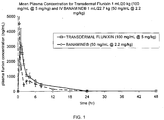
- the data presented in Figure 1 demonstrated that the flunixin plasma profile is similar to that of a known effective profile. For example, plasma concentrations of flunixin, following a single transdermal administration of about 5 mg/kg of flunixin achieved a Cmax of greater than 3000 ng/ml at a Tmax of about 60 minutes.
- the data presented in Figure 5 show the plasma profile following transdermal administration at a dose of 2.5 mg/kg of flunixin. Following a single transdermal dose of 2.5 mg/kg, a Cmax of about 1500 ng/mL was achieved at a Tmax of about 90 minutes. In this example ( Figure 5 ), the bioavailability of the flunixin transdermal solution was greater than 50%.
- the present invention also includes a transdermal composition for the treatment of inflammatory conditions in an animal.
- the transdermal composition comprises from about 5% to about 15% by wt of a first dermal penetration enhancer, from about 2% to about 50% by wt of a second dermal penetration enhancer, from about 5% to about 15% of flunixin or a pharmaceutically acceptable salt thereof based on the free acid content of flunixin, from about 5% to about 90% of an aprotic primary solvent; and up to about 80% of a second vehicle or solvent, wherein the transdermal composition exhibits with respect to flunixin a Cmax of from about 1600 to about 4800 ng/mL, and a Tmax of from about 30 minutes to about 2 hours when administered transdermally to bovids at a flunixin dose of about 5 mg/kg.
- the transdermal composition exhibits with respect to flunixin a Cmax of from about 1000 to about 2500 ng/mL, and a Tmax of from about 60 minutes to about 2 hours, and a bioavailability of greater than 50% when administered transdermally to bovids at a flunixin dose of about 2.5 mg/kg.
- transdermal product in accordance with the present invention will promote humane animal care by reducing the number of injections needed to treat animals and providing rapid relief of disease symptoms. By reducing the number of injections, manpower costs also may be significantly reduced.
- the vehicle(s) or a portion of the vehicle(s) are added to the compounding vessel, followed by the remaining excipients and the actives.
- the mixture is mixed until all solids are dissolved.
- An additional solvent to bring the composition to final volume may be added if needed.
- Additives, such as those listed above, may also be included in the vessel and mixed into the formulation. The order of addition of the above vehicles, excipients, solvents and additives is not critical.
- compositions according to the present invention will generally be administered to cattle at from about 1 mg to about 5 mg of flunixin per kilogram of body weight per day. Particularly, the compositions of the present invention will be administered to cattle at about 2.5 mg of flunixin per kilogram of body weight.
- compositions may be administered once daily or divided into multiple doses. In some circumstances, daily doses will be required to treat the animal. The precise dose will depend on the stage and severity of the condition being treated, and the individual characteristics of the animal species being treated, as will be appreciated by one of ordinary skill in the art.
- compositions of the present invention may be administered in a press in bottle insert application device (PIBA) to an animal in need thereof.
- PIBA press in bottle insert application device
- Such a device allows a health care professional to easily dispense liquids from stock bottles into (oral) syringes.
- the professional opens the bottle and presses the plastic adapter into the opening of the bottle and then attaches the oral syringe to the port of the adapter.
- the professional may withdraw the dose of medication from the bottle and administer the dose.
- the cap can be replaced on the bottle to be used later.
- animal pour-on products generally require administering larger volumes of a composition, thus, the above-described method of administration is not appropriate.
- present pour-on products are either administered in a dosing gun or a dosing cup.
- Such methods of administration prove difficult to accurately deliver small volumes of medication.
- the method of administration of the present invention using the PISA application system allows for more accurate and convenient administration of the presently claimed pour-on liquid preparation.
- compositions according to the present invention are particularly useful for cattle, bovids.
- the compositions of this invention are also suitable for the treatment of other conditions associated with inflammation such as footrot, acute mastitis, pinkeye (infectious keratoconjunctivitis), acute pneumonia, metritis and enteritis in cattle.
- other inflammatory conditions in other species could be treated with the compositions.
- the dosage regimen for treatment of such diseases should be appropriate for the species and condition being treated.
- Mastitis is a complex disease that occurs in lactating females, and is of particular economic importance in dairy cows and goats.
- pathogenic agents including Staphylococcus aureus, Escherichia coli, and Streptococcus species.
- the acute form of mastitis has a sudden onset, the udder is enlarged, hot to the touch and tender; and usually the affected animal will have a fever. If not treated promptly, the udder may be permanently damaged and milk production may be decreased or lost.
- the use of the formulations of the present invention would be an improvement by offering a way for animal handlers to safely and conveniently administer flunixin to animals in need thereof to ameliorate inflammation, while minimizing pain and stress to the animal associated with the treatment and the potential for injection site tissue damage. Additionally, the present invention provides an improved method of administrating the formulation because it overcomes the challenges of needle stick hazards and disposal of sharp biowaste material. Moreover, based on the pharmacokinetic data, transdermal flunixin allows for rapid onset of action.
- Pinkeye is an acute infectious disease of cattle, sheep and other animals that is characterized by inflammation of the tissues of the eye, accompanied by nasal discharge, lacrimation and copious ocular discharge. Affected animals may display extreme discomfort, resulting in decreased feed intake and subsequent reduction in body weight gain and/or a drop in milk production. In extreme cases, permanent blindness occurs.
- the disease, which is caused by Moraxella bovis in cattle, is widespread, especially among range and feedlot cattle, the cure of which is of great economic importance to the cattle industry.
- Footrot is an acute infection of the interdigital space that occurs throughout the world in both beef and dairy cattle. Fusobacterium necrophorum is the major cause of footrot, although other organisms, including Bacteroides melaninogenicus, can be involved. The major symptoms include pain, severe lameness, fever, anorexia, and reduced milk production. Currently, footrot is treated by antibiotic therapy. Recommended therapy can involve treatment for up to five days. The use of the formulations of the present invention would be a useful adjunct therapy because the NSAID would reduce the inflammation caused by footrot and make the animal feel better.
- transdermal formulations in accordance with the present invention are set forth below.
- the vehicle(s) or a portion of the vehicle(s) are added to the compounding vessel, followed by the remaining excipients and the actives. The combination is mixed until all solids are dissolved.
- additives such as those mentioned in the detailed description, are also included in the vessel and mixed into the formulation. The order of addition was not critical.
- Example 1 The Formulation of Example 1 was assessed in a pharmacokinetic study involving 6 cattle which received a single transdermal application of 1 mL/20 kg (5 mg/kg flunixin). Blood samples for determination of flunixin concentration were collected at 0, 0.5, 1, 1.5, 2, 3, 4, 6, 8, 24 and 48 hours after dosing. The results are shown in Figure 1 , in comparison to IV dosing of Banamine® at 2.2 mg/kg. This study provided evidence that the pharmacokinetic profile of the formulation from Example 1, when dosed at 5 mg/kg flunixin, is similar to that of the IV dosing of Banamine® at 2.2 mg/kg.
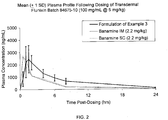
- Example 3 The Formulation of Example 3 was assessed in a pharmacokinetic study involving 4 cattle which received a single transdermal application of 1 mL/20 kg (5 mg/kg flunixin). Blood samples for determination of flunixin concentration were collected at 0, 0.5, 1, 1.5, 2, 4, 6, 8, and 24 hours after dosing. The results are shown in Figure 2 , in comparison to intramuscular (IM) or subcutaneous (SC) dosing of Banamine® at 2.2 mg/kg. This study demonstrated that the pharmacokinetic profile of the formulation from Example 3, when dosed at 5 mg/kg flunixin, is similar to that of the IM or SC dosing of Banamine® at 2.2 mg/kg.
- IM intramuscular
- SC subcutaneous
- Example 5 The Formulations of Example 5 were assessed in a pharmacokinetic study involving 6 cattle, each of which received a single transdermal application of 1 mL/20 kg (5 mg/kg flunixin). Blood samples for determination of flunixin concentration were collected at 0, 0.5, 1, 1.5, 2, 4, 6, 8, and 24 hours after dosing. The results are shown in Figure 3.
- Figure 3 demonstrates that the plasma uptake of flunixin was enhanced when menthol is used in combination with another penetration enhancer.
- Example 6 thus demonstrates the discovery that the combination of the first and second dermal penetration enhancers of the invention provides a synergistic increase in the systemic availability of flunixin meglumine compared to the use of a single penetration enhancer alone.
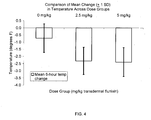
- Example 3 The Formulation of Example 3 was evaluated in a study to determine the antipyretic efficacy of different doses in naturally-occurring bovine respiratory disease (BRD).
- BRD bovine respiratory disease
- Example 7 thus demonstrates the discovery that a transdermal flunixin dose using the Formulation described in Example 3 at a transdermal dose of 2.5 mg/kg or 5 mg/kg leads to a greater decrease in rectal temperature at 6 hours following dosing than that observed with placebo treatment.
- Example 8 The Formulation of Example 8 was assessed in a pharmacokinetic study involving 6 cattle which received a single transdermal application of 1 mL/40 kg (2.5 mg/kg flunixin). Following dosing, animals were maintained in headgates to prevent any licking of their own or their penmates' application sites. Blood samples for determination of flunixin concentration were collected at 0, 0.25, 0.5, 0.75, 1, 1.5, 2, 4, 6, 8, and 24 hours after dosing. The results are shown in Figure 5 . These plasma data were used to estimate bioavailability based on data generated for IV dosing (2.2 mg/kg) of Banamine® (SPRI SN 06482). This study demonstrates that the flunixin detected in the plasma of study subjects is attributable to transdermal absorption. It also generates a bioavailability estimate of greater than 50% for the transdermal formulation presented in Example 8.
Landscapes
- Health & Medical Sciences (AREA)
- Life Sciences & Earth Sciences (AREA)
- Chemical & Material Sciences (AREA)
- General Health & Medical Sciences (AREA)
- Medicinal Chemistry (AREA)
- Veterinary Medicine (AREA)
- Public Health (AREA)
- Pharmacology & Pharmacy (AREA)
- Animal Behavior & Ethology (AREA)
- Chemical Kinetics & Catalysis (AREA)
- General Chemical & Material Sciences (AREA)
- Epidemiology (AREA)
- Engineering & Computer Science (AREA)
- Organic Chemistry (AREA)
- Nuclear Medicine, Radiotherapy & Molecular Imaging (AREA)
- Bioinformatics & Cheminformatics (AREA)
- Dermatology (AREA)
- Zoology (AREA)
- Reproductive Health (AREA)
- Endocrinology (AREA)
- Pain & Pain Management (AREA)
- Pregnancy & Childbirth (AREA)
- Pulmonology (AREA)
- Biomedical Technology (AREA)
- Gynecology & Obstetrics (AREA)
- Neurology (AREA)
- Neurosurgery (AREA)
- Rheumatology (AREA)
- Ophthalmology & Optometry (AREA)
- Oil, Petroleum & Natural Gas (AREA)
- Medicinal Preparation (AREA)
- Pharmaceuticals Containing Other Organic And Inorganic Compounds (AREA)
- Acyclic And Carbocyclic Compounds In Medicinal Compositions (AREA)
- Medicines That Contain Protein Lipid Enzymes And Other Medicines (AREA)
Applications Claiming Priority (2)
| Application Number | Priority Date | Filing Date | Title |
|---|---|---|---|
| US87090706P | 2006-12-20 | 2006-12-20 | |
| PCT/US2007/025808 WO2008082507A2 (en) | 2006-12-20 | 2007-12-18 | Pharmaceutical compositions and method for treating inflammation in cattle and other animals |
Publications (2)
| Publication Number | Publication Date |
|---|---|
| EP2120860A2 EP2120860A2 (en) | 2009-11-25 |
| EP2120860B1 true EP2120860B1 (en) | 2019-01-23 |
Family
ID=39262615
Family Applications (1)
| Application Number | Title | Priority Date | Filing Date |
|---|---|---|---|
| EP07867799.4A Active EP2120860B1 (en) | 2006-12-20 | 2007-12-18 | Pharmaceutical compositions and method for treating inflammation in cattle and other animals |
Country Status (19)
| Country | Link |
|---|---|
| US (1) | US9006272B2 (enExample) |
| EP (1) | EP2120860B1 (enExample) |
| JP (1) | JP5377326B2 (enExample) |
| KR (1) | KR20090091328A (enExample) |
| CN (2) | CN101588789B (enExample) |
| AR (1) | AR064425A1 (enExample) |
| AU (1) | AU2007339312B2 (enExample) |
| BR (1) | BRPI0720500B1 (enExample) |
| CA (1) | CA2672964C (enExample) |
| CL (1) | CL2007003711A1 (enExample) |
| CO (1) | CO6190598A2 (enExample) |
| ES (1) | ES2714550T3 (enExample) |
| MX (1) | MX2009006893A (enExample) |
| NZ (1) | NZ598554A (enExample) |
| PE (1) | PE20081406A1 (enExample) |
| RU (1) | RU2466715C2 (enExample) |
| TW (1) | TWI350182B (enExample) |
| WO (1) | WO2008082507A2 (enExample) |
| ZA (1) | ZA200904329B (enExample) |
Families Citing this family (12)
| Publication number | Priority date | Publication date | Assignee | Title |
|---|---|---|---|---|
| CA2738970A1 (en) * | 2008-10-31 | 2010-05-06 | Moberg Derma Ab | Topical composition comprising a combination of at least two penetration enhancing agents |
| CA2828086C (en) | 2010-03-10 | 2018-07-31 | Nuvo Research Inc. | Foamable formulation |
| WO2012022837A1 (en) * | 2010-08-16 | 2012-02-23 | Helsingin Yliopisto | Transdermal compositions |
| WO2012043701A1 (ja) * | 2010-09-30 | 2012-04-05 | 富山化学工業株式会社 | 経皮吸収製剤 |
| CN114903848A (zh) * | 2013-02-27 | 2022-08-16 | 阿根塔创新有限公司 | 透皮制剂 |
| CN105769827B (zh) * | 2016-03-09 | 2018-07-17 | 金陵科技学院 | 用于动物清热镇痛氟尼辛葡甲胺涂膜剂及其制备方法 |
| KR20200065711A (ko) | 2018-11-30 | 2020-06-09 | 한원경 | 동물 피부질환 개선용 조성물 |
| WO2021010843A1 (en) | 2019-07-16 | 2021-01-21 | Donaghys Limited | Transdermal solvent system and methods of use |
| WO2021045870A1 (en) * | 2019-09-06 | 2021-03-11 | Iowa State University Research Foundation, Inc. | Mirtazapine as a pre-shipping inhibitor of bovine respiratory disease |
| JP7846689B2 (ja) * | 2020-11-25 | 2026-04-15 | インターベット インターナショナル ベー. フェー. | フルニキシンを口腔投与することによる疼痛の治療方法 |
| WO2022238965A1 (en) * | 2021-05-12 | 2022-11-17 | Argenta Innovation Limited | Veterinary transdermal formulation |
| CN114404360B (zh) * | 2021-12-16 | 2023-03-28 | 江西益昕葆生物科技有限公司 | 一种氟尼辛葡甲胺注射液的制备方法 |
Citations (1)
| Publication number | Priority date | Publication date | Assignee | Title |
|---|---|---|---|---|
| US20050287219A1 (en) * | 2004-06-24 | 2005-12-29 | Murthy Yerramilli V S | Pharmaceutical compositions for drug delivery and methods of treating or preventing conditions using same |
Family Cites Families (11)
| Publication number | Priority date | Publication date | Assignee | Title |
|---|---|---|---|---|
| JPS63225316A (ja) * | 1986-10-21 | 1988-09-20 | Nitto Electric Ind Co Ltd | 外皮投与用組成物 |
| JPH11222443A (ja) * | 1997-11-11 | 1999-08-17 | Saitama Daiichi Seiyaku Kk | 経皮吸収促進組成物および経皮吸収製剤 |
| AU1780101A (en) | 1999-11-19 | 2001-05-30 | Xel Herbaceuticals | Transdermal delivery system for alkaloids of aconitum species |
| JP4865958B2 (ja) * | 2001-05-23 | 2012-02-01 | 株式会社トクホン | 鎮痛抗炎症局所作用型の貼付剤 |
| US6790867B2 (en) * | 2002-05-20 | 2004-09-14 | Schering-Plough Animal Health Corporation | Compositions and method for treating infection in cattle and swine |
| CA2530407A1 (en) * | 2003-07-23 | 2005-02-03 | The Regents Of The University Of California | Penetration enhancer combinations for transdermal delivery |
| JP2007500691A (ja) | 2003-07-31 | 2007-01-18 | ファルマシア・アンド・アップジョン・カンパニー・エルエルシー | 抗炎症剤の分散性製剤 |
| DE10358525A1 (de) * | 2003-12-13 | 2005-07-07 | Bayer Healthcare Ag | Endoparasitizide Mittel zur topischen Applikation |
| CA2573412A1 (en) * | 2004-07-19 | 2006-02-02 | Warner-Lambert Company Llc | Formulation for stimulating hair growth |
| AU2005284422A1 (en) * | 2004-09-16 | 2006-03-23 | Bayer Healthcare Ag | Dermally applicable formulations for treating skin diseases in animals |
| WO2007061739A2 (en) * | 2005-11-21 | 2007-05-31 | Schering-Plough Ltd. | Pharmaceutical compositions comprising buprenorphine |
-
2007
- 2007-12-14 PE PE2007001807A patent/PE20081406A1/es not_active Application Discontinuation
- 2007-12-18 RU RU2009127500/15A patent/RU2466715C2/ru active
- 2007-12-18 KR KR1020097014552A patent/KR20090091328A/ko not_active Ceased
- 2007-12-18 MX MX2009006893A patent/MX2009006893A/es active IP Right Grant
- 2007-12-18 NZ NZ59855407A patent/NZ598554A/xx unknown
- 2007-12-18 EP EP07867799.4A patent/EP2120860B1/en active Active
- 2007-12-18 AR ARP070105702 patent/AR064425A1/es not_active Application Discontinuation
- 2007-12-18 WO PCT/US2007/025808 patent/WO2008082507A2/en not_active Ceased
- 2007-12-18 CN CN2007800470359A patent/CN101588789B/zh active Active
- 2007-12-18 JP JP2009542867A patent/JP5377326B2/ja active Active
- 2007-12-18 AU AU2007339312A patent/AU2007339312B2/en active Active
- 2007-12-18 US US11/959,185 patent/US9006272B2/en active Active
- 2007-12-18 ES ES07867799T patent/ES2714550T3/es active Active
- 2007-12-18 CN CN201310549264.8A patent/CN103690471B/zh active Active
- 2007-12-18 BR BRPI0720500A patent/BRPI0720500B1/pt active IP Right Grant
- 2007-12-18 CA CA2672964A patent/CA2672964C/en active Active
- 2007-12-19 TW TW096148778A patent/TWI350182B/zh not_active IP Right Cessation
- 2007-12-19 CL CL2007003711A patent/CL2007003711A1/es unknown
-
2009
- 2009-06-17 CO CO09062884A patent/CO6190598A2/es not_active Application Discontinuation
- 2009-06-19 ZA ZA200904329A patent/ZA200904329B/xx unknown
Patent Citations (1)
| Publication number | Priority date | Publication date | Assignee | Title |
|---|---|---|---|---|
| US20050287219A1 (en) * | 2004-06-24 | 2005-12-29 | Murthy Yerramilli V S | Pharmaceutical compositions for drug delivery and methods of treating or preventing conditions using same |
Also Published As
| Publication number | Publication date |
|---|---|
| TW200833367A (en) | 2008-08-16 |
| AU2007339312A1 (en) | 2008-07-10 |
| CA2672964A1 (en) | 2008-07-10 |
| RU2009127500A (ru) | 2011-01-27 |
| CA2672964C (en) | 2018-04-03 |
| KR20090091328A (ko) | 2009-08-27 |
| CL2007003711A1 (es) | 2008-07-25 |
| CO6190598A2 (es) | 2010-08-19 |
| RU2466715C2 (ru) | 2012-11-20 |
| CN103690471B (zh) | 2015-11-18 |
| NZ598554A (en) | 2013-08-30 |
| EP2120860A2 (en) | 2009-11-25 |
| WO2008082507A3 (en) | 2009-03-19 |
| US20080153885A1 (en) | 2008-06-26 |
| TWI350182B (en) | 2011-10-11 |
| JP2010513500A (ja) | 2010-04-30 |
| BRPI0720500A8 (pt) | 2015-12-29 |
| MX2009006893A (es) | 2009-07-03 |
| ZA200904329B (en) | 2010-05-26 |
| ES2714550T3 (es) | 2019-05-29 |
| BRPI0720500B1 (pt) | 2019-01-02 |
| CN103690471A (zh) | 2014-04-02 |
| US9006272B2 (en) | 2015-04-14 |
| AU2007339312B2 (en) | 2013-06-06 |
| WO2008082507A2 (en) | 2008-07-10 |
| JP5377326B2 (ja) | 2013-12-25 |
| CN101588789A (zh) | 2009-11-25 |
| AR064425A1 (es) | 2009-04-01 |
| BRPI0720500A2 (pt) | 2014-02-04 |
| CN101588789B (zh) | 2013-12-11 |
| PE20081406A1 (es) | 2008-10-17 |
Similar Documents
| Publication | Publication Date | Title |
|---|---|---|
| CA2672964C (en) | Pharmaceutical compositions and method for treating inflammation in cattle and other animals | |
| CA2728727C (en) | Pharmaceutical transdermal compositions and method for treating inflammation in cattle | |
| EP1462101B1 (en) | Drinkable preparation comprising ketoprofen and use thereof in the simultaneous treatment of a group of animals of respiratory diseases | |
| AU2008208151B2 (en) | Topical formulation | |
| MX2013008407A (es) | Metodo para el tratamiento de una infeccion. | |
| PL218606B1 (pl) | Stabilny w temperaturze pokojowej wodny roztwór do wstrzyknięć i sposób jego wytwarzania | |
| AU2015268626C1 (en) | Injectable compositions for mastitis comprising an NSAID and an antibiotic in a non-aqueous solvent | |
| US20240058365A1 (en) | External Preparation for Treating Epilepsy or Autism Spectrum Disorder | |
| HK40027580B (en) | Therapeutic formulations comprising cox-2 inhibitor and uses thereof | |
| EA040476B1 (ru) | Препарат парацетамола для инъекций |
Legal Events
| Date | Code | Title | Description |
|---|---|---|---|
| PUAI | Public reference made under article 153(3) epc to a published international application that has entered the european phase |
Free format text: ORIGINAL CODE: 0009012 |
|
| 17P | Request for examination filed |
Effective date: 20080331 |
|
| AK | Designated contracting states |
Kind code of ref document: A2 Designated state(s): AT BE BG CH CY CZ DE DK EE ES FI FR GB GR HU IE IS IT LI LT LU LV MC MT NL PL PT RO SE SI SK TR |
|
| AX | Request for extension of the european patent |
Extension state: AL BA HR MK RS |
|
| REG | Reference to a national code |
Ref country code: HK Ref legal event code: DE Ref document number: 1136222 Country of ref document: HK |
|
| RAP1 | Party data changed (applicant data changed or rights of an application transferred) |
Owner name: INTERVET INTERNATIONAL BV |
|
| 17Q | First examination report despatched |
Effective date: 20150902 |
|
| REG | Reference to a national code |
Ref country code: HK Ref legal event code: WD Ref document number: 1136222 Country of ref document: HK |
|
| STAA | Information on the status of an ep patent application or granted ep patent |
Free format text: STATUS: EXAMINATION IS IN PROGRESS |
|
| GRAP | Despatch of communication of intention to grant a patent |
Free format text: ORIGINAL CODE: EPIDOSNIGR1 |
|
| STAA | Information on the status of an ep patent application or granted ep patent |
Free format text: STATUS: GRANT OF PATENT IS INTENDED |
|
| INTG | Intention to grant announced |
Effective date: 20181011 |
|
| GRAS | Grant fee paid |
Free format text: ORIGINAL CODE: EPIDOSNIGR3 |
|
| GRAA | (expected) grant |
Free format text: ORIGINAL CODE: 0009210 |
|
| STAA | Information on the status of an ep patent application or granted ep patent |
Free format text: STATUS: THE PATENT HAS BEEN GRANTED |
|
| AK | Designated contracting states |
Kind code of ref document: B1 Designated state(s): AT BE BG CH CY CZ DE DK EE ES FI FR GB GR HU IE IS IT LI LT LU LV MC MT NL PL PT RO SE SI SK TR |
|
| AX | Request for extension of the european patent |
Extension state: AL BA HR MK RS |
|
| REG | Reference to a national code |
Ref country code: GB Ref legal event code: FG4D |
|
| REG | Reference to a national code |
Ref country code: CH Ref legal event code: EP |
|
| REG | Reference to a national code |
Ref country code: AT Ref legal event code: REF Ref document number: 1090897 Country of ref document: AT Kind code of ref document: T Effective date: 20190215 |
|
| REG | Reference to a national code |
Ref country code: IE Ref legal event code: FG4D |
|
| REG | Reference to a national code |
Ref country code: DE Ref legal event code: R096 Ref document number: 602007057519 Country of ref document: DE |
|
| REG | Reference to a national code |
Ref country code: ES Ref legal event code: FG2A Ref document number: 2714550 Country of ref document: ES Kind code of ref document: T3 Effective date: 20190529 Ref country code: NL Ref legal event code: MP Effective date: 20190123 |
|
| PG25 | Lapsed in a contracting state [announced via postgrant information from national office to epo] |
Ref country code: NL Free format text: LAPSE BECAUSE OF FAILURE TO SUBMIT A TRANSLATION OF THE DESCRIPTION OR TO PAY THE FEE WITHIN THE PRESCRIBED TIME-LIMIT Effective date: 20190123 |
|
| PG25 | Lapsed in a contracting state [announced via postgrant information from national office to epo] |
Ref country code: LT Free format text: LAPSE BECAUSE OF FAILURE TO SUBMIT A TRANSLATION OF THE DESCRIPTION OR TO PAY THE FEE WITHIN THE PRESCRIBED TIME-LIMIT Effective date: 20190123 Ref country code: SE Free format text: LAPSE BECAUSE OF FAILURE TO SUBMIT A TRANSLATION OF THE DESCRIPTION OR TO PAY THE FEE WITHIN THE PRESCRIBED TIME-LIMIT Effective date: 20190123 Ref country code: PL Free format text: LAPSE BECAUSE OF FAILURE TO SUBMIT A TRANSLATION OF THE DESCRIPTION OR TO PAY THE FEE WITHIN THE PRESCRIBED TIME-LIMIT Effective date: 20190123 Ref country code: FI Free format text: LAPSE BECAUSE OF FAILURE TO SUBMIT A TRANSLATION OF THE DESCRIPTION OR TO PAY THE FEE WITHIN THE PRESCRIBED TIME-LIMIT Effective date: 20190123 Ref country code: PT Free format text: LAPSE BECAUSE OF FAILURE TO SUBMIT A TRANSLATION OF THE DESCRIPTION OR TO PAY THE FEE WITHIN THE PRESCRIBED TIME-LIMIT Effective date: 20190523 |
|
| REG | Reference to a national code |
Ref country code: AT Ref legal event code: MK05 Ref document number: 1090897 Country of ref document: AT Kind code of ref document: T Effective date: 20190123 |
|
| PG25 | Lapsed in a contracting state [announced via postgrant information from national office to epo] |
Ref country code: LV Free format text: LAPSE BECAUSE OF FAILURE TO SUBMIT A TRANSLATION OF THE DESCRIPTION OR TO PAY THE FEE WITHIN THE PRESCRIBED TIME-LIMIT Effective date: 20190123 Ref country code: GR Free format text: LAPSE BECAUSE OF FAILURE TO SUBMIT A TRANSLATION OF THE DESCRIPTION OR TO PAY THE FEE WITHIN THE PRESCRIBED TIME-LIMIT Effective date: 20190424 Ref country code: BG Free format text: LAPSE BECAUSE OF FAILURE TO SUBMIT A TRANSLATION OF THE DESCRIPTION OR TO PAY THE FEE WITHIN THE PRESCRIBED TIME-LIMIT Effective date: 20190423 Ref country code: IS Free format text: LAPSE BECAUSE OF FAILURE TO SUBMIT A TRANSLATION OF THE DESCRIPTION OR TO PAY THE FEE WITHIN THE PRESCRIBED TIME-LIMIT Effective date: 20190523 |
|
| REG | Reference to a national code |
Ref country code: DE Ref legal event code: R097 Ref document number: 602007057519 Country of ref document: DE |
|
| PG25 | Lapsed in a contracting state [announced via postgrant information from national office to epo] |
Ref country code: EE Free format text: LAPSE BECAUSE OF FAILURE TO SUBMIT A TRANSLATION OF THE DESCRIPTION OR TO PAY THE FEE WITHIN THE PRESCRIBED TIME-LIMIT Effective date: 20190123 Ref country code: SK Free format text: LAPSE BECAUSE OF FAILURE TO SUBMIT A TRANSLATION OF THE DESCRIPTION OR TO PAY THE FEE WITHIN THE PRESCRIBED TIME-LIMIT Effective date: 20190123 Ref country code: RO Free format text: LAPSE BECAUSE OF FAILURE TO SUBMIT A TRANSLATION OF THE DESCRIPTION OR TO PAY THE FEE WITHIN THE PRESCRIBED TIME-LIMIT Effective date: 20190123 Ref country code: CZ Free format text: LAPSE BECAUSE OF FAILURE TO SUBMIT A TRANSLATION OF THE DESCRIPTION OR TO PAY THE FEE WITHIN THE PRESCRIBED TIME-LIMIT Effective date: 20190123 Ref country code: DK Free format text: LAPSE BECAUSE OF FAILURE TO SUBMIT A TRANSLATION OF THE DESCRIPTION OR TO PAY THE FEE WITHIN THE PRESCRIBED TIME-LIMIT Effective date: 20190123 |
|
| PLBE | No opposition filed within time limit |
Free format text: ORIGINAL CODE: 0009261 |
|
| STAA | Information on the status of an ep patent application or granted ep patent |
Free format text: STATUS: NO OPPOSITION FILED WITHIN TIME LIMIT |
|
| PG25 | Lapsed in a contracting state [announced via postgrant information from national office to epo] |
Ref country code: AT Free format text: LAPSE BECAUSE OF FAILURE TO SUBMIT A TRANSLATION OF THE DESCRIPTION OR TO PAY THE FEE WITHIN THE PRESCRIBED TIME-LIMIT Effective date: 20190123 |
|
| 26N | No opposition filed |
Effective date: 20191024 |
|
| PG25 | Lapsed in a contracting state [announced via postgrant information from national office to epo] |
Ref country code: SI Free format text: LAPSE BECAUSE OF FAILURE TO SUBMIT A TRANSLATION OF THE DESCRIPTION OR TO PAY THE FEE WITHIN THE PRESCRIBED TIME-LIMIT Effective date: 20190123 |
|
| PG25 | Lapsed in a contracting state [announced via postgrant information from national office to epo] |
Ref country code: TR Free format text: LAPSE BECAUSE OF FAILURE TO SUBMIT A TRANSLATION OF THE DESCRIPTION OR TO PAY THE FEE WITHIN THE PRESCRIBED TIME-LIMIT Effective date: 20190123 |
|
| REG | Reference to a national code |
Ref country code: CH Ref legal event code: PL |
|
| REG | Reference to a national code |
Ref country code: BE Ref legal event code: MM Effective date: 20191231 |
|
| PG25 | Lapsed in a contracting state [announced via postgrant information from national office to epo] |
Ref country code: MC Free format text: LAPSE BECAUSE OF FAILURE TO SUBMIT A TRANSLATION OF THE DESCRIPTION OR TO PAY THE FEE WITHIN THE PRESCRIBED TIME-LIMIT Effective date: 20190123 |
|
| PG25 | Lapsed in a contracting state [announced via postgrant information from national office to epo] |
Ref country code: IE Free format text: LAPSE BECAUSE OF NON-PAYMENT OF DUE FEES Effective date: 20191218 Ref country code: LU Free format text: LAPSE BECAUSE OF NON-PAYMENT OF DUE FEES Effective date: 20191218 |
|
| PG25 | Lapsed in a contracting state [announced via postgrant information from national office to epo] |
Ref country code: LI Free format text: LAPSE BECAUSE OF NON-PAYMENT OF DUE FEES Effective date: 20191231 Ref country code: BE Free format text: LAPSE BECAUSE OF NON-PAYMENT OF DUE FEES Effective date: 20191231 Ref country code: CH Free format text: LAPSE BECAUSE OF NON-PAYMENT OF DUE FEES Effective date: 20191231 |
|
| PG25 | Lapsed in a contracting state [announced via postgrant information from national office to epo] |
Ref country code: CY Free format text: LAPSE BECAUSE OF FAILURE TO SUBMIT A TRANSLATION OF THE DESCRIPTION OR TO PAY THE FEE WITHIN THE PRESCRIBED TIME-LIMIT Effective date: 20190123 |
|
| PG25 | Lapsed in a contracting state [announced via postgrant information from national office to epo] |
Ref country code: MT Free format text: LAPSE BECAUSE OF FAILURE TO SUBMIT A TRANSLATION OF THE DESCRIPTION OR TO PAY THE FEE WITHIN THE PRESCRIBED TIME-LIMIT Effective date: 20190123 Ref country code: HU Free format text: LAPSE BECAUSE OF FAILURE TO SUBMIT A TRANSLATION OF THE DESCRIPTION OR TO PAY THE FEE WITHIN THE PRESCRIBED TIME-LIMIT; INVALID AB INITIO Effective date: 20071218 |
|
| P01 | Opt-out of the competence of the unified patent court (upc) registered |
Effective date: 20230525 |
|
| PGFP | Annual fee paid to national office [announced via postgrant information from national office to epo] |
Ref country code: DE Payment date: 20251118 Year of fee payment: 19 |
|
| PGFP | Annual fee paid to national office [announced via postgrant information from national office to epo] |
Ref country code: GB Payment date: 20251113 Year of fee payment: 19 |
|
| PGFP | Annual fee paid to national office [announced via postgrant information from national office to epo] |
Ref country code: IT Payment date: 20251212 Year of fee payment: 19 |
|
| PGFP | Annual fee paid to national office [announced via postgrant information from national office to epo] |
Ref country code: FR Payment date: 20251111 Year of fee payment: 19 |
|
| PGFP | Annual fee paid to national office [announced via postgrant information from national office to epo] |
Ref country code: ES Payment date: 20260120 Year of fee payment: 19 |