EP2115131B1 - Stabilisierte zusammensetzungen aus temperaturstabiler dna-polymerase und einem anionischen detergens - Google Patents
Stabilisierte zusammensetzungen aus temperaturstabiler dna-polymerase und einem anionischen detergens Download PDFInfo
- Publication number
- EP2115131B1 EP2115131B1 EP07865796.2A EP07865796A EP2115131B1 EP 2115131 B1 EP2115131 B1 EP 2115131B1 EP 07865796 A EP07865796 A EP 07865796A EP 2115131 B1 EP2115131 B1 EP 2115131B1
- Authority
- EP
- European Patent Office
- Prior art keywords
- sodium
- composition
- dna polymerase
- poly
- ethylene glycol
- Prior art date
- Legal status (The legal status is an assumption and is not a legal conclusion. Google has not performed a legal analysis and makes no representation as to the accuracy of the status listed.)
- Active
Links
Images

Classifications
-
- C—CHEMISTRY; METALLURGY
- C12—BIOCHEMISTRY; BEER; SPIRITS; WINE; VINEGAR; MICROBIOLOGY; ENZYMOLOGY; MUTATION OR GENETIC ENGINEERING
- C12N—MICROORGANISMS OR ENZYMES; COMPOSITIONS THEREOF; PROPAGATING, PRESERVING, OR MAINTAINING MICROORGANISMS; MUTATION OR GENETIC ENGINEERING; CULTURE MEDIA
- C12N9/00—Enzymes; Proenzymes; Compositions thereof; Processes for preparing, activating, inhibiting, separating or purifying enzymes
- C12N9/96—Stabilising an enzyme by forming an adduct or a composition; Forming enzyme conjugates
-
- C—CHEMISTRY; METALLURGY
- C12—BIOCHEMISTRY; BEER; SPIRITS; WINE; VINEGAR; MICROBIOLOGY; ENZYMOLOGY; MUTATION OR GENETIC ENGINEERING
- C12Q—MEASURING OR TESTING PROCESSES INVOLVING ENZYMES, NUCLEIC ACIDS OR MICROORGANISMS; COMPOSITIONS OR TEST PAPERS THEREFOR; PROCESSES OF PREPARING SUCH COMPOSITIONS; CONDITION-RESPONSIVE CONTROL IN MICROBIOLOGICAL OR ENZYMOLOGICAL PROCESSES
- C12Q1/00—Measuring or testing processes involving enzymes, nucleic acids or microorganisms; Compositions therefor; Processes of preparing such compositions
- C12Q1/68—Measuring or testing processes involving enzymes, nucleic acids or microorganisms; Compositions therefor; Processes of preparing such compositions involving nucleic acids
- C12Q1/6844—Nucleic acid amplification reactions
- C12Q1/6848—Nucleic acid amplification reactions characterised by the means for preventing contamination or increasing the specificity or sensitivity of an amplification reaction
-
- C—CHEMISTRY; METALLURGY
- C12—BIOCHEMISTRY; BEER; SPIRITS; WINE; VINEGAR; MICROBIOLOGY; ENZYMOLOGY; MUTATION OR GENETIC ENGINEERING
- C12N—MICROORGANISMS OR ENZYMES; COMPOSITIONS THEREOF; PROPAGATING, PRESERVING, OR MAINTAINING MICROORGANISMS; MUTATION OR GENETIC ENGINEERING; CULTURE MEDIA
- C12N9/00—Enzymes; Proenzymes; Compositions thereof; Processes for preparing, activating, inhibiting, separating or purifying enzymes
- C12N9/10—Transferases (2.)
Definitions
- compositions, methods, and kits comprising compositions of thermostable DNA polymerase and an anionic detergent or a zwitterionic detergent.
- PCR polymerase chain reaction
- a thermostable DNA polymerase cycles repeatedly between low and high temperatures (e.g., 55°C and 95°C). The total period of time spent at the high temperature depends upon the total number of cycles, the duration of the high temperature step of each cycle, and the ramp speed (i.e., the speed at which the thermocycler switches between the steps of each cycle).
- these DNA polymerases are highly thermostable, they tend to become inactive at high temperatures over time.
- these enzymes may also be inactivated by dilution into aqueous environments with sub-optimal concentration of cofactors or sub-optimal pH levels, and the presence of chemical or biological inhibitors in the reaction mixtures.
- One way of stabilizing an enzyme is to add a stabilizing agent, such as a surfactant.
- a stabilizing agent such as a surfactant.
- surfactants or detergents, are surface-active compounds that stabilize the interface between the active form of an enzyme and the liquid environment in which they are contained.
- the activity of Taq DNA polymerase has been stabilized by the addition of nonionic detergents, such as Tween 20.
- Tween 20-stabilizd DNA polymerases have low efficiencies of amplification or lead to the amplification of non-specific products.
- detergents that improve the stability of thermostable DNA polymerases in solution, and particularly detergents that improve enzyme stability without imparting any of the disadvantages of currently used detergents.
- WO 89/06691 describes storage of a thermostable DNA polymerase from Thermus aquaticus in a buffer containing non-ionic detergents that lend stability to the enzyme.
- US 5,871,975 describes methods and uses of a non-ionic detergent to suppress enzyme inhibition in a reaction solution due to the presence of inhibiting ionic detergent.
- the reaction includes the use of a DNA polymerase.
- composition comprising:
- Yet another aspect of the invention provides a method for inhibiting inactivation of a thermostable DNA polymerase in a thermal cycling process, the method comprising contacting the DNA polymerase with an anionic detergent during the thermal cycling process, the anionic detergent being selected from the group consisting of poly(ethylene glycol) 4-nonylphenyl 3-sulfopropyl ether potassium salt; poly(ethylene glycol) monolaurate; polyoxyethylene(150)dinonylphenyl ether; and nonyl nonoxynol-15 phosphate.
- kits for amplifying DNA in a thermal cycling process comprising a thermostable DNA polymerase and an anionic detergent anionic detergent selected from the group consisting of poly(ethylene glycol) 4-nonylphenyl 3-sulfopropyl ether potassium salt; poly(ethylene glycol) monolaurate; polyoxyethylene(150)dinonylphenyl ether; and nonyl nonoxynol-15 phosphate.
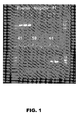
- Figure 1 is a photographic image of fluorescently-stained PCR fragments resolved on an agarose gel.
- the leftmost and rightmost lanes each contain a DNA ladder.
- Each of the lanes labeled "positive” contain a 500 bp fragment that was amplified in the presence of 0.0005% Tween 20.
- the lanes labeled "negative” represent reactions performed in the absence of a stabilizing detergent.
- the lanes labeled "41” represent reactions performed in the presence of 0.05%, 0.05%, 0.005%, and 0.0005%, from left to right, of poly(ethylene glycol) monolaurate, carrageenan lambda.
- the lanes labeled "59” represent reactions performed in the presence of 0.05%, 0.05%, 0.005%, and 0.0005%, from left to right, of Mackanate TM DOS-70.
- the lanes labeled “61” represent reactions performed in the presence of 0.05%, 0.05%, 0.005%, and 0.0005%, from left to right, of Rhodafac RM710.
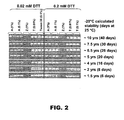
- Figure 2 is a photographic image of fluorescently-stained PCR fragments resolved on an agarose gel.
- the bright bands correspond to a 500 bp fragment amplified with Taq DNA polymerase formulated with different concentration of the anionic (A) detergent, poly(ethylene glycol) 4-nonphenyl 3-sulfopropyl ether potassium salt, the zwitterionic (Z) detergent, CHAPS, or Tween 20 (T).
- A anionic
- Z zwitterionic
- CHAPS zwitterionic detergent
- Tween 20 Tween 20
- Figure 3 is a photographic image of fluorescently-stained PCR fragments resolved on an agarose gel.
- the lane labeled "L” contains a DNA ladder, with the size of the fragments denoted to the left of the image.
- the three lanes on the left represent reactions in which a 352 bp fragment was targeted for amplification, and the three lanes on the right represent reactions in which a 360 bp fragment was targeted for amplification.
- the lanes labeled "T' contain fragments amplified with Taq DNA polymerase formulated with Tween 20.
- Each of the lanes labeled “A” contains a fragment amplified by Taq DNA polymerase formulated with the anionic surfactant, poly(ethylene glycol) 4-nonphenyl 3-sulfopropyl ether potassium salt.
- the lanes labeled “R” contain fragments amplified with another commercially available Tween 20 formulated Taq DNA polymerase.
- thermostable DNA polymerases While substantially thermostable, DNA polymerases, such as Taq, do become inactive over time at the high temperatures utilized in thermal cycling reactions. It has been discovered, as demonstrated in the examples, that thermostable DNA polymerases may be protected from such heat inactivation by contacting the polymerase with either an anionic detergent or a zwitterionic detergent during a thermal cycling process. Accordingly, the present invention provides compositions, methods and kits for inhibiting inactivation of a thermostable DNA polymerase during thermal cycling processes.
- compositions of the invention will be utilized to protect thermostable DNA polymerases during thermocycling processes (e.g., PCR) used to amplify a target nucleic acids.
- target nucleic acid will typically be DNA
- the target nucleic acid may be RNA or a mixture of DNA and RNA.
- enzymes, and/or conditions optimal for reverse transcribing the template to DNA known to those in the art would be utilized.
- the target nucleic acid is DNA.
- PCR amplification involves an enzymatic chain reaction in which exponential quantities of the target nucleic acid are produced relative to the number of reaction steps performed.
- PCR amplification is generally conducted at a temperature ranging from about 50° C to about 95° C for approximately one to about fifty cycles and more typically from about ten to about forty cycles.
- PCR amplification techniques and many variations of the PCR are known and well documented.
- the compositions of the invention may be utilized to protect thermostable DNA polymerase in PCR and in variations of PCR. See e.g., Saiki et al., Science 239: 487-491 (1988 ); U.S. Pat. Nos. 4,682,195 , 4,683,202 and 4,800,159 .
- the composition of the invention comprises an anionic detergent and a thermostable DNA polymerase.
- the composition may comprise a zwitterionic detergent and a thermostable DNA polymerase.
- the composition may further comprise a buffering agent, a monovalent salt, a divalent salt, a reducing agent, a chelating agent, and a mixture of dNTPs.
- Reaction mixtures comprising a composition of the invention may further comprise reactants for DNA amplification reactions.
- composition of the invention comprises an anionic detergent as defined in claim 1.
- anionic detergents include compounds that inhibit inactivation of thermostable DNA polymerase when it is subjected to repeated amplification reactions conducted at high temperatures (e.g., 50°C to 95°C). Methods for determining whether particular anionic detergent compound functions in this manner are detailed in the Examples. Anionic detergents are detailed below or are otherwise known in the art.
- Anionic detergents include alkyl sulfates, alkyl sulfonates, alkyl benzene sulfonates, alpha sulfonyl fatty acids, alkyl phosphates, dioctyl sulfosuccinate, isethionates, alkyl ether sulfates, methyl sarcosines and the like.
- suitable anionic detergents include amine dodecylbenzene sulfonate; ammonium capryleth sulfate; ammonium cumenesulfonate; ammonium dihydroxy stearate; ammonium dodecylbenzene sulfonate; ammonium laureth sulfate; ammonium laureth-12 sulfate; ammonium laureth-30 sulfate; ammonium lauroyl sarcosinate; ammonium lauryl sulfate; ammonium lauryl sulfosuccinate; ammonium lignosulfonate; ammonium myreth sulfate; ammonium naphthalene sulfonate; ammonium nonoxynol-20 sulfate; ammonium nonoxynol-30 sulfate; ammonium nonoxynol-4 sulfate; ammonium nonoxynol-6 sulf
- the anionic detergent may be glycolic acid ethoxylate octyl ether; glycolic acid ethoxylate oleyl ether; glycolic acid ethoxylate lauryl ether; poly(ethylene glycol) 4-nonylphenyl 3-sulfopropyl ether potassium salt; glycolic acid ethoxylate 4-tert-butylphenyl ether; glycolic acid ethoxylate oleyl ether; glycolic acid ethoxylate oleyl ether; poly(ethylene glycol) n-alkyl 3-sulfopropyl ether potassium salt; glycolic acid ethoxylate 4-nonylphenyl ether; poly(ethylene glycol) n-alkyl 3-sulfopropyl ether potassium salt; sodium cholate hydrate; sodium deoxycholate; sodium taurodeoxycholate hydrate; sodium taurocholate; sodium cholate hydrate; sodium deoxycholate; sodium taurodeoxycholate hydate; sodium
- the anionic detergent is selected from the group consisting of poly(ethylene glycol)4-nonphenyl 3-sulfopropyl ether potassium salt; poly(ethylene glycol) monolaurate; polyoxyethylene(150)dinonylphenyl ether (Igepal ® DM-970); and nonyl nonoxynol-15 phosphate (Rhodafac RM710).
- the composition may comprise a zwitterionic detergent.
- Suitable zwitterionic detergents include compounds that inhibit inactivation of thermostable DNA polymerase when it is subjected to repeated amplification reactions conducted at high temperatures (e.g., 50°C to 95°C). Methods for determining whether particular zwitterionic detergent compound functions in this manner are detailed in the Examples. Suitable zwitterionic detergents are detailed below or are otherwise known in the art.
- the zwitterionic detergent may be a compound comprising formula (Ia): wherein:
- each of R 1 , R 2 , and R 3 will consist of a chain of no more than about 1 to 10 atoms, more preferably a chain of about 1 to 7 atoms, still more preferably, a chain of no more than 1 to 5 atoms and even more preferably, a chain of no more than 1 to 3 atoms.
- R 4 will consist of a chain of no more than about 5 to 30 atoms, more preferably, a chain of about 8 to about 25 atoms, and still more preferably, will be a chain of about 10 to about 20 atoms.
- Exemplary compounds having formula (Ia) will have a chain of about 1 to 5 atoms for each of R 1 , R 2 , and R 3 and a chain of about 8 to 20 atoms for R 4 . Even more exemplary compounds having formula (Ia) will have a methyl group for each of R 1 and R 2 , a chain from about 1 to 3 atoms for R 3 and a chain from about 10 to 16 atoms for R 4 .
- a further case encompasses zwitterionic detergents comprising a compound of formula (Ib): wherein:
- m is an integer from 0 to 5
- n is an integer from 1 to 8
- R 4 has a chain length of from about 8 to 25 atoms.
- m is an integer from 0 to 3
- n is an integer from 1 to 5
- R 4 has a chain length of from about 10 to 20 atoms.
- m is 0, n is 3 and R 4 has a chain length from about 10 to 16 atoms.
- n is an integer from 1 to 8 and R 4 has a chain length of from about 8 to 25 atoms.
- n is an integer from 1 to 5 and R 4 has a chain length of from about 10 to 20 atoms.
- n is 3 and R 4 has a chain length from about 10 to 16 atoms.
- the zwitterionic detergent may be a compound comprising formula (Id): wherein:
- i is an integer from 10 to 20 and n is an integer from 1 to 5. In an exemplary embodiment, i is an integer from 10 to 16 and n is 3.
- Representative exemplary zwitterionic detergent compounds having formula (Ia), (Ib), (Ic), or (Id) include:
- the zwitterionic detergent is CHAPS or CHAPSO.
- CHAPS has the following chemical structure: wherein n is an integer between 18 and 22. In an exemplary embodiment n is 20.
- CHAPSO has the following chemical structure:
- zwitterionic detergents include: acetylated lecithin; apricotamidopropyl betaine; babassuamidopropyl betaine; behenyl betaine; bis 2-hydroxyethyl tallow glycinate; C12-14 alkyl dimethyl betaine; canolamidopropyl betaine; capric/caprylic amidopropyl betaine; capryloamidopropyl betaine; cetyl betaine; cocamidopropyl betaine; cocamidopropyl dimethylaminohydroxypropyl hydrolyzed collagen; N-[3-cocamido)-propyl]-N,N-dimethyl betaine, potassium salt; cocamidopropyl hydroxysultaine; cocamidopropyl sulfobetaine; cocaminobutyric acid; cocaminopropionic acid; cocoamphodipropionic acid; coco-betaine; cocod
- the stabilized composition of the invention may comprise a variety of enzymes that catalyze reactions involving nucleic acids at elevated temperatures-particularly thermal cycling processes (e.g., PCR). Enzymes that modify, cut, or synthesize nucleic acids may be stabilized in the compositions of the invention. Examples include ligase, phosphodiesterase, DNase, exonuclease, RNase, phosphatase, kinase, terminal transferase, reverse transcriptase, restriction endonuclease, RNA polymerase, and DNA polymerase.
- the enzyme is a thermostable polymerase that catalyzes the amplification of a target polynucleotide sequence. A thermostable DNA polymerase is particularly preferred.
- thermostable DNA polymerases are substantially stable at elevated temperatures and efficiently catalyze amplification of a target polynucleotide in a thermal cycling process.
- the thermostable DNA polymerase is substantially resistant to inactivation when subjected to the elevated temperatures for the time necessary to effect denaturation of double-stranded nucleic acids. Inactivation, as utilized herein, refers to permanent and complete loss of enzymatic activity. While it is envisioned that the temperature necessary for nucleic acid denaturation will depend on a variety of factors (e.g., on the buffer salt concentration and the length and nucleotide composition of the nucleic acids being denatured), the temperature will typically range from about 90° C to about 105° C.
- thermostable DNA polymerases typically do not become inactivated at a temperature of about 90°C to temperatures greater than about 100° C. Additionally, the thermostable DNA polymerase also typically has an optimum temperature at which it functions that is higher than about 40° C, which is the temperature below which hybridization of primers to the DNA template is promoted. Exemplary thermostable DNA polymerases, as such, typically function throughout the entire temperature spectrum utilized in thermal cycling reactions, such as PCR. For example, suitable thermostable DNA polymerases generally have an optimum temperature range from about 40°C to 110 °C, and more typically, from about 50°C to about 95°C.
- thermostable DNA polymerase may be obtained from any source and may be a native or recombinant protein.
- Representative heat-stable polymerases are the DNA polymerases isolated from the thermophilic bacteria Thermus flavus, Thermus ruber, Thermus thermophilus, Bacillus stearothermophilus, Thermus aquaticus, Thermus lacteus, Thermus rubens, and Methanothermus fervidus.
- thermophilic archaebacteria examples include, for example, Sulfolobus solfataricus, Sulfolobus acidocaldarius, Thermoplasma acidophilum, Methanobacterium thermoautotrophicum and Desulfurococcus mobilis.
- An exemplary thermostable DNA polymerase is isolated from Thermus aquaticus (Taq).
- Taq DNA polymerase Various strains of Taq DNA polymerase are known in the art including from the American Type Culture Collection, Rockville, Md., and is described by T. D. Brock, J. Bact. (1969) 98:289-297 , and by T. Oshima, Arch. Microbiol. (1978): 189-196 .
- Taq DNA polymerase is also commercially available from a variety of sources.
- thermostable polymerases such as, for example, a combination of Taq and Pfu, may also be used in the processes of the present invention.
- composition of the invention includes any combination of anionic detergent described in paragraph [0018] and any of the thermostable DNA polymerases described in I(c) or otherwise known in the art.
- a composition may include any combination of zwitterionic detergent described in I(b) or otherwise known in the art and any of the thermostable DNA polymerases described in I(c) or otherwise known in the art.
- Exemplary combinations of anionic detergents or zwitterionic detergent and thermostable DNA polymerase are depicted in Table A.
- thermostable DNA polymerase utilized to catalyze a given DNA amplification reaction can and will vary depending upon the reaction parameters.
- Taq DNA polymerase formulations are provided at about 0.1 unit/ ⁇ L to about 5 units/ ⁇ L.
- concentration of Taq DNA polymerase in a amplification reaction mixture may range from about 0.01 unit/ ⁇ L to about 0.1 unit/ ⁇ L.
- the amount of anionic detergent present in a composition of the invention can and will vary. Generally speaking, the amount utilized will typically be an amount effective to produce the desired result (e.g., inhibit inactivation of DNA polymerase).
- the detergent for example, may be present in the composition at a concentration from about 0.0005% to about 2% by weight, preferably from about 0.001 % to about 1% by weight, and more preferably from about 0.005% to about 0.1 % by weight.
- the composition of the invention may further comprise a buffering agent, a monovalent salt, a divalent salt, a reducing agent, a chelating agent, and a mixture of dNTPs.
- Reaction mixtures comprising a composition of the invention may further comprise reactants for DNA amplification reactions.
- Suitable buffering agents include those known in the art that are utilized in thermal cycling processes.
- the buffering agent may be a storage buffer or a reaction buffer.
- the buffering agent will maintain the pH of the composition from about 4.0 to about 9.5, more typically from about 6.0 to about 9.0 and still more typically from about 7.0 to about 8.0.
- suitable buffering agents include MOPS, HEPES, TAPS, Bicine, Tricine, TES, PIPES, MES, or a Tris buffer.
- a storage buffer may further comprise a storage solution such as glycerol, polyethylene glycol and/or BSA.
- the composition may also include a salt.
- the salt may be a monovalent salt. Suitable monovalent salts include sodium chloride, potassium chloride, or lithium chloride. Alternatively, the salt may be a divalent salt. Representative examples of suitable divalent salts include calcium chloride or magnesium chloride.
- the composition may further comprise a reducing agent.
- Suitable reducing agents include dithiothreitol, ⁇ -mercaptoethanot, sodium borohydride, oxalic acid, or lithium aluminium hydride.
- the concentration of the reducing may be higher than that typically added to enzyme compositions.
- the composition may include a chelating agent. Examples of suitable chelating agents include EDTA or EGTA.
- the composition may further comprise a mixture of dNTPs selected from dATP, dCTP, dGTP, and dTTP.
- Reaction mixtures comprising the composition may also comprise reactants for DNA amplification reactions.
- reactants for DNA amplification reactions will include, in addition to a thermostable DNA polymerase, a target polynucleotide, a mixture of dNTPs, and a pair of oligonucleotide primers.
- Reactions mixtures may comprise an additional buffering agent, monovalent salt, and divalent salt for optimal enzyme activity.
- the mixture may also include a reagent to increase efficiency of PCR. Suitable examples of such agents include dimethyl sulfoxide, formamide, and betatine.
- kits for inhibiting inactivation, and in particular, heat inactivation, of a thermostable DNA polymerase in the thermal cycling process include, a thermostable DNA polymerase and an anionic detergent as detailed in claim 13.
- the kit may further comprise a reducing agent, a buffering agent, a mixture of dNTPs, and instructions for using the composition and other components necessary for thermal cycling reactions to amplify nucleic acids.
- the kit may be in the form of a test kit of controls, that is, in a packaged collection or combination as appropriate for the needs of the user and any analytical instrumentation involved.
- the kit can, of course, also include appropriate packaging, containers, labeling, buffers, and controls for thermal cycling reactions to amplify nucleic acids.
- alkyl groups described herein are preferably lower alkyl containing from one to eight carbon atoms in the principal chain and up to 20 carbon atoms. They may be straight or branched chain or cyclic and include methyl, ethyl, propyl, isopropyl, butyl, hexyl and the like.
- alkenyl groups described herein are preferably lower alkenyl containing from two to eight carbon atoms in the principal chain and up to 20 carbon atoms. They may be straight or branched chain or cyclic and include ethenyl, propenyl, isopropenyl, butenyl, isobutenyl, hexenyl, and the like.
- alkynyl groups described herein are preferably lower alkynyl containing from two to eight carbon atoms in the principal chain and up to 20 carbon atoms. They may be straight or branched chain and include ethynyl, propynyl, butynyl, isobutynyl, hexynyl, and the like.
- aryl or “ar” as used herein alone or as part of another group denote optionally substituted homocyclic aromatic groups, preferably monocyclic or bicyclic groups containing from 6 to 12 carbons in the ring portion, such as phenyl, biphenyl, naphthyl, substituted phenyl, substituted biphenyl or substituted naphthyl. Phenyl and substituted phenyl are the more preferred aryl.
- the "amplification" of nucleic acids refers to the replication of one to many additional copies of a nucleic acid sequence by a method catalyzed by an enzyme. Preferably, it is carried out using polymerase chain reaction (PCR) technologies.
- PCR polymerase chain reaction
- a variety of amplification methods are known in the art and are described, inter alia, in U.S. Pat. Nos. 4,683,195 and 4,683,202 and in PCR Protocols: A Guide to Methods and Applications, ed. Innis et al., Academic Press, San Diego, 1990 .
- a primer refers to a short oligonucleotide of defined sequence that is annealed to a nucleic acid template to provide an initiation site for a polymerase as in the polymerase chain reaction.
- “Complimentary” refers to the natural association of nucleic acid sequences by base-pairing (5'-A G T-3' pairs with the complimentary sequence 3'-T C A-5'). Complementarity between two single-stranded molecules may be partial, if only some of the nucleic acids pair are complimentary, or complete, if all bases pair are complimentary.
- the term "dNTP” refers to deoxynucleoside triphosphates.
- the purine bases (Pu) include adenine (A), guanine (G) and derivatives and analogs thereof.
- the pyrimidine bases (Py) include cytosine (C), thymine (T), uracil (U) and derivatives and analogs thereof. Examples of such derivatives or analogs, by way of illustration and not limitation, are those which are modified with a reporter group, biotinylated, amine modified, radiolabeled, alkylated, and the like and also include phosphorothioate, phosphite, ring atom modified derivatives, and the like.
- the reporter group can be a fluorescent group such as fluorescein, a chemiluminescent group such as luminol, a terbium chelator such as N-(hydroxyethyl) ethylenediaminetriacetic acid that is capable of detection by delayed fluorescence, and the like.
- heterocyclo or “heterocyclic” as used herein alone or as part of another group denote optionally substituted, fully saturated or unsaturated, monocyclic or bicyclic, aromatic or nonaromatic groups having at least one heteroatom in at least one ring, and preferably 5 or 6 atoms in each ring.
- the heterocyclo group preferably has 1 or 2 oxygen atoms, 1 or 2 sulfur atoms, and/or 1 to 4 nitrogen atoms in the ring, and may be bonded to the remainder of the molecule through a carbon or heteroatom.
- exemplary heterocyclo include heteroaromatics such as furyl, thienyl, pyridyl, oxazolyl, pyrrolyl, indolyl, quinolinyl, or isoquinolinyl and the like.
- substituents include one or more of the following groups: hydrocarbyl, substituted hydrocarbyl, keto, hydroxy, protected hydroxy, acyl, acyloxy, alkoxy, alkenoxy, alkynoxy, aryloxy, halogen, amido, amino, nitro, cyano, thiol, ketals, acetals, esters and ethers.
- heteroaromatic as used herein alone or as part of another group denote optionally substituted aromatic groups having at least one heteroatom in at least one ring, and preferably 5 or 6 atoms in each ring.
- the heteroaromatic group preferably has 1 or 2 oxygen atoms, 1 or 2 sulfur atoms, and/or 1 to 4 nitrogen atoms in the ring, and may be bonded to the remainder of the molecule through a carbon or heteroatom.
- Exemplary heteroaromatics include furyl, thienyl, pyridyl, oxazolyl, pyrrolyl, indolyl, quinolinyl, or isoquinolinyl and the like.
- substituents include one or more of the following groups: hydrocarbyl, substituted hydrocarbyl, keto, hydroxy, protected hydroxy, acyl, acyloxy, alkoxy, alkenoxy, alkynoxy, aryloxy, halogen, amido, amino, nitro, cyano, thiol, ketals, acetals, esters and ethers.
- hydrocarbon and “hydrocarbyl” as used herein describe organic compounds or radicals consisting exclusively of the elements carbon and hydrogen. These moieties include alkyl, alkenyl, alkynyl, and aryl moieties. These moieties also include alkyl, alkenyl, alkynyl, and aryl moieties substituted with other aliphatic or cyclic hydrocarbon groups, such as alkaryl, alkenaryl and alkynaryl. Unless otherwise indicated, these moieties preferably comprise 1 to 20 carbon atoms.
- a “polymerase” is a catalyst, usually a protein enzyme, for forming an extension of an oligonucleotide along a DNA template where the extension is complimentary to the template.
- a “polymerase” is an enzyme that is capable of incorporating nucleoside triphosphates to extend a 3' hydroxyl group of a nucleic acid molecule, if that molecule has hybridized to a suitable template nucleic acid molecule. Polymerase enzymes are discussed in Watson, J. D., In: Molecular Biology of the Gene, 3rd Ed., W. A. Benjamin, Inc., Menlo Park, Calif. (1977 ), and similar texts.
- substituted hydrocarbyl moieties described herein are hydrocarbyl moieties which are substituted with at least one atom other than carbon, including moieties in which a carbon chain atom is substituted with a hetero atom such as nitrogen, oxygen, silicon, phosphorous, boron, sulfur, or a halogen atom.
- substituents include halogen, carbocycle, aryl, heterocyclo, alkoxy, alkenoxy, alkynoxy, aryloxy, hydroxy, protected hydroxy, keto, acyl, acyloxy, nitro, amino, amido, nitro, cyano, thiol, ketals, acetals, esters and ethers.
- a PCR assay was used to screen 47 of the potential candidate detergents for their ability to stabilize Taq DNA polymerase. The final concentration of each detergent tested was 5%, 0.5%, 0.05%, 0.005%, or 0.0005%.
- a forward primer (5'-TGGATACCCGTCGTGGCTCTAATT-3'; SEQ ID No:1) and a reverse primer (5'-CTTCTTTCGTCCCCGTCAGGCTGA-3'; SEQ ID No:2) were designed to amplify a 500 bp fragment of lambda DNA.
- Each 10 ⁇ l reaction contained:
- the cycling parameters were 94°C for 15 min and 30 cycles of 94°C for 30 sec and 70°C for 30 sec, and a 4°C hold.
- positive control reactions comprising 0.0005% Tween 20 were included, as well as negative control reactions without any detergent.
- An aliquot of each reaction was resolved by agarose gel electrophoresis. A representative gel is shown in Figure 1 . Amplified products were present in the positive control reactions, as well as in reactions with a low concentration of the detergent nonyl nonoxynol-15 phosphate (Rhodafac RM710).
- Taq The long-term stability of Taq formulated with either Tween 20, an anionic detergent, or a zwitterionic detergent was compared in the presence of two concentrations of DTT.
- Taq was formulated with 0.01 % or 0.1 % Tween 20, 0.1 % or 1 % poly(ethylene glycol)4-nonphenyl 3-sulfopropyl ether potassium salt, or 1% CHAPS.
- Each formulation was stored in the presence of 0.02 mM DTT or 0.2 mM DTT at 25°C for periods of time ranging from 6 days to 40 days.
- the calculated corresponding periods for storage at -20°C ranged from about 1.5 years to about 10 years (see Figure 2 ).
- the ability of various formulations of Taq to support PCR was assessed using a PCR assay similar to that described in Example 1. The same primers and reactions conditions were used as in Example 1.
- Table 2 presents the Ct values (which is the cycle that the fluorescence exceeds a defined threshold value) for each amplified product using the different templates.
- the 'no template' control reactions (for every primer pair) produced no amplicons.
- the addition of the anionic detergent (poly (ethylene glycol) 4-nonphenyl 3-sulfopropyl ether potassium salt) yielded lower Ct values at higher dilutions than the Tween 20-containing amplification mixes.
- the efficiency of amplification was derived from the slopes of the serially diluted template amplification plots (dilutional efficiency), and the percent efficiency is also presented in Table 2.
- the anionic surfactant formulation had a higher efficiency than the corresponding Tween 20 formulation.
- the anionic surfactant samples had an average of 67.3% and 84.7 % efficiency for the digested and intact templates, respectively, whereas the Tween 20 samples had an average of 43.7% and 31 % efficiency for the digested and intact templates, respectively.
- Example 4 Anionic Detergent Improves Specificity of Amplification.
- formulations comprising Tween 20 were compared to an anionic detergent formulation.
- Primers (see Table 4) were designed to amplify a 352 bp fragment (BsrGlO) and a 360 bp fragment (SaclO) in human genomic DNA.
- the reactions (50 ⁇ l) contained 0.5 ⁇ g HEK293 genomic DNA, 50 pmol primers, 1x PCR Buffer, 0.2 mM dNTPs, 0.05 U/ ⁇ L Taq, and 4% DMSO.
- Thermocycling parameters were 94°C for 2 min, 30 cycles of 94°C for 20 sec, 58°C for 30 sec, and 72°C for 80 sec, a final extension at 72°C for 10 min, and a 4°C hold.
- Table 4 PCR Primers Forward Primer Reverse Primer Sequence (5'-3') SEQ ID NO: Sequence (5'-3') SEQ ID NO: BsrGlO 11 12 SaclO 13 14
Landscapes
- Chemical & Material Sciences (AREA)
- Life Sciences & Earth Sciences (AREA)
- Organic Chemistry (AREA)
- Health & Medical Sciences (AREA)
- Zoology (AREA)
- Wood Science & Technology (AREA)
- Engineering & Computer Science (AREA)
- Genetics & Genomics (AREA)
- Bioinformatics & Cheminformatics (AREA)
- Molecular Biology (AREA)
- Biochemistry (AREA)
- Microbiology (AREA)
- Biotechnology (AREA)
- Proteomics, Peptides & Aminoacids (AREA)
- Chemical Kinetics & Catalysis (AREA)
- General Health & Medical Sciences (AREA)
- General Engineering & Computer Science (AREA)
- Physics & Mathematics (AREA)
- Immunology (AREA)
- Analytical Chemistry (AREA)
- Biophysics (AREA)
- Medicinal Chemistry (AREA)
- Biomedical Technology (AREA)
- Enzymes And Modification Thereof (AREA)
- Detergent Compositions (AREA)
Claims (15)
- Zusammensetzung, wobei die Zusammensetzung Folgendes umfasst:(a) eine thermostabile DNA-Polymerase; und(b) ein anionisches Detergens, das aus der aus Poly(ethylenglykol)-4-nonylphenyl-3-sulfopropyletherkaliumsalz; Poly(ethylenglykol)monolaurat; Polyoxyethylen-(150)dinonylphenylether; und Nonylnonoxynol-15-phosphat bestehenden Gruppe ausgewählt ist.
- Zusammensetzung nach Anspruch 1, worin die DNA-Polymerase von einem thermophilen Bakterium stammt, das aus der aus Thermus flavus, Thermus ruber, Thermus thermophilus, Bacillus stearothermophilus, Thermus aquaticus, Thermus lacteus, Thermus rubens und Methanothermus fervidus bestehenden Gruppe ausgewählt ist.
- Zusammensetzung nach Anspruch 1, worin die thermostabile DNA-Polymerase Taq ist und das anionische Detergens Poly(ethylenglykol)-4-nonylphenyl-3-sulfopropyletherkaliumsalz ist.
- Zusammensetzung nach Anspruch 3, worin das Taq in der Zusammensetzung in einer Konzentration von 0,1 Einheiten/µl bis 5 Einheiten µl enthalten ist und das Detergens in der Zusammensetzung in einer Konzentration von 0,001 bis 1 Gew.-% vorhanden ist.
- Zusammensetzung nach Anspruch 1, die weiters Folgendes umfasst:(a) ein Reduktionsmittel; und/oder(b) einen Puffer, der die Zusammensetzung bei einem pH von 6 bis 9 hält, wobei der Puffer aus der aus MOPS, HEPES, TAPS, Bicin, Tricin, TES, PIPES, MES oder einem Tris bestehenden Gruppe ausgewählt ist; und/oder(c) ein Gemisch aus dNTPs, die aus der aus dATP, dCTP, dGTP und dTTP bestehenden Gruppe ausgewählt sind.
- Zusammensetzung nach Anspruch 1, die weiters einen Puffer, der die Zusammensetzung bei einem pH von 7 bis 8 hält, ein Target-Polynucleotid, ein Paar Oligonucleotidprimer und ein Gemisch aus dNTPs, die aus der aus dATP, dCTP, dGTP und dTTP bestehenden Gruppe ausgewählt sind, umfasst.
- Zusammensetzung nach Anspruch 6, worin das anionische Detergens Poly-(ethylenglykol)-4-nonylphenyl-3-sulfopropyletherkaliumsalz ist und die thermostabile DNA-Polymerase Taq ist.
- Zusammensetzung nach Anspruch 7, die weiters Folgendes umfasst:(a) ein Salz, das aus der aus Kaliumchlorid, Natriumchlorid, Magnesiumchlorid, Calciumchlorid und Lithiumchlorid bestehenden Gruppe ausgewählt ist; und/oder(b) ein Mittel, das die Wirksamkeit der PCR erhöht, ausgewählt aus der aus Dimethylsulfoxid, Formamid und Betain bestehenden Gruppe.
- Verfahren zur Hemmung der Inaktivierung einer thermostabilen DNA-Polymerase in einem Wärmewechselzyklus, wobei das Verfahren das Kontaktieren der DNA-Polymerase mit einem anionischen Detergens während des Wärmewechselzyklus umfasst, wobei das anionische Detergens aus der aus Poly(ethylenglykol)-4-nonylphenyl-3-sulfopropyletherkaliumsalz; Poly(ethylenglykol)monolaurat; Polyoxyethylen-(150)dinonylphenylether; und Nonylnonoxynol-15-phosphat bestehenden Gruppe ausgewählt ist.
- Verfahren nach Anspruch 9, wobei die DNA-Polymerase von einem thermophilen Bakterium stammt, das aus der aus Thermus flavus, Thermus ruber, Thermus thermophilus, Bacillus stearothermophilus, Thermus aquaticus, Thermus lacteus, Thermus rubens und Methanothermus fervidus bestehenden Gruppe ausgewählt ist.
- Verfahren nach Anspruch 10, das weiters einen Puffer, der die Zusammensetzung bei einem pH von 7 bis 8 hält, ein Target-Polynucleotid, ein Paar Oligonucleotidprimer und ein Gemisch aus dNTPs, die aus der aus dATP, dCTP, dGTP und dTTP bestehenden Gruppe ausgewählt sind, umfasst.
- Verfahren nach Anspruch 8, wobei das anionische Detergens Poly(ethylenglykol)-4-nonylphenyl-3-sulfopropyletherkaliumsalz ist und die thermostabile DNA-Polymerase Taq ist.
- Set zur Amplifikation von DNA in einem Wärmewechselzyklus, wobei das Set eine thermostabile DNA-Polymerase und ein anionisches Detergens umfasst, wobei das anionische Detergens aus der aus Poly(ethylenglykol)-4-nonylphenyl-3-sulfopropyletherkaliumsalz; Poly(ethylenglykol)monolaurat; Polyoxyethylen(150)dinonylphenylether; und Nonylnonoxynol-15-phosphat bestehenden Gruppe ausgewählt ist.
- Set nach Anspruch 13, das weiters ein Reduktionsmittel, einen Puffer und ein Gemisch aus dNTPs, die aus der aus dATP, dCTP, dGTP und dTTP bestehenden Gruppe ausgewählt sind, umfasst.
- Set nach Anspruch 13, wobei das anionische Detergens Poly(ethylenglykol)-4-nonylphenyl-3-sulfopropyletherkaliumsalz ist und die thermostabile DNA-Polymerase Taq ist.
Applications Claiming Priority (2)
| Application Number | Priority Date | Filing Date | Title |
|---|---|---|---|
| US11/612,776 US7972828B2 (en) | 2006-12-19 | 2006-12-19 | Stabilized compositions of thermostable DNA polymerase and anionic or zwitterionic detergent |
| PCT/US2007/087887 WO2008077017A2 (en) | 2006-12-19 | 2007-12-18 | Stabilized compositions of thermostable dna polymerase and anionic or zwitterionic detergent |
Publications (3)
| Publication Number | Publication Date |
|---|---|
| EP2115131A2 EP2115131A2 (de) | 2009-11-11 |
| EP2115131A4 EP2115131A4 (de) | 2011-04-27 |
| EP2115131B1 true EP2115131B1 (de) | 2013-07-31 |
Family
ID=39527797
Family Applications (1)
| Application Number | Title | Priority Date | Filing Date |
|---|---|---|---|
| EP07865796.2A Active EP2115131B1 (de) | 2006-12-19 | 2007-12-18 | Stabilisierte zusammensetzungen aus temperaturstabiler dna-polymerase und einem anionischen detergens |
Country Status (5)
| Country | Link |
|---|---|
| US (2) | US7972828B2 (de) |
| EP (1) | EP2115131B1 (de) |
| JP (1) | JP5231447B2 (de) |
| KR (1) | KR20090111316A (de) |
| WO (1) | WO2008077017A2 (de) |
Cited By (3)
| Publication number | Priority date | Publication date | Assignee | Title |
|---|---|---|---|---|
| US8980333B2 (en) | 2011-06-08 | 2015-03-17 | Life Technologies Corporation | Development of novel detergents for use in PCR systems |
| US10378050B2 (en) | 2011-06-08 | 2019-08-13 | Life Technologies Corporation | Polymerization of nucleic acids using proteins having low isoelectric points |
| US10683539B2 (en) | 2013-10-25 | 2020-06-16 | Life Technologies Corporation | Compounds for use in PCR systems and applications thereof |
Families Citing this family (61)
| Publication number | Priority date | Publication date | Assignee | Title |
|---|---|---|---|---|
| US7692219B1 (en) | 2004-06-25 | 2010-04-06 | University Of Hawaii | Ultrasensitive biosensors |
| US7846703B2 (en) * | 2006-10-02 | 2010-12-07 | Takara Bio Inc. | Method for enhancing polymerase activity |
| US11339430B2 (en) | 2007-07-10 | 2022-05-24 | Life Technologies Corporation | Methods and apparatus for measuring analytes using large scale FET arrays |
| US8349167B2 (en) | 2006-12-14 | 2013-01-08 | Life Technologies Corporation | Methods and apparatus for detecting molecular interactions using FET arrays |
| US8262900B2 (en) | 2006-12-14 | 2012-09-11 | Life Technologies Corporation | Methods and apparatus for measuring analytes using large scale FET arrays |
| GB2457851B (en) | 2006-12-14 | 2011-01-05 | Ion Torrent Systems Inc | Methods and apparatus for measuring analytes using large scale fet arrays |
| EP2152864A1 (de) * | 2007-06-13 | 2010-02-17 | Amersham Biosciences Corp. | Polymerasestabilisierung |
| US11041215B2 (en) * | 2007-08-24 | 2021-06-22 | Longhorn Vaccines And Diagnostics, Llc | PCR ready compositions and methods for detecting and identifying nucleic acid sequences |
| EP2307577B1 (de) | 2008-06-25 | 2015-06-03 | Life Technologies Corporation | Verfahren zur analytmessung mithilfe grosser fet-arrays |
| US20100137143A1 (en) * | 2008-10-22 | 2010-06-03 | Ion Torrent Systems Incorporated | Methods and apparatus for measuring analytes |
| US20100301398A1 (en) | 2009-05-29 | 2010-12-02 | Ion Torrent Systems Incorporated | Methods and apparatus for measuring analytes |
| US8574835B2 (en) * | 2009-05-29 | 2013-11-05 | Life Technologies Corporation | Scaffolded nucleic acid polymer particles and methods of making and using |
| US8673627B2 (en) | 2009-05-29 | 2014-03-18 | Life Technologies Corporation | Apparatus and methods for performing electrochemical reactions |
| US8776573B2 (en) | 2009-05-29 | 2014-07-15 | Life Technologies Corporation | Methods and apparatus for measuring analytes |
| GB0915796D0 (en) * | 2009-09-09 | 2009-10-07 | Fermentas Uab | Polymerase compositions and uses |
| US20120202276A1 (en) | 2010-02-26 | 2012-08-09 | Life Technologies Corporation | Modified Proteins and Methods of Making and Using Same |
| EP2539471B1 (de) * | 2010-02-26 | 2014-08-06 | Life Technologies Corporation | Verfahren zur sequenzierung bei verwendung einer modifizierte polymerase |
| US20110250598A1 (en) | 2010-04-12 | 2011-10-13 | Ulrike Fischer | Detergent free polymerases |
| TWI465716B (zh) | 2010-06-30 | 2014-12-21 | 生命技術公司 | 用於檢測及測量化學反應及化合物之電晶體電路 |
| EP2588851B1 (de) | 2010-06-30 | 2016-12-21 | Life Technologies Corporation | Ion-sensing charge-accumulation circuit and method |
| EP2588850B1 (de) | 2010-06-30 | 2016-12-28 | Life Technologies Corporation | Trockentestverfahren für isfet-arrays |
| US8653567B2 (en) | 2010-07-03 | 2014-02-18 | Life Technologies Corporation | Chemically sensitive sensor with lightly doped drains |
| WO2012018639A2 (en) | 2010-07-26 | 2012-02-09 | Biomatrica, Inc. | Compositions for stabilizing dna, rna and proteins in saliva and other biological samples during shipping and storage at ambient temperatures |
| EP2598660B1 (de) | 2010-07-26 | 2017-03-15 | Biomatrica, INC. | Zusammensetzungen zur stabilisierung von dna, rna und proteinen in blut- und anderen biologischen proben während des transports und der lagerung bei umgebungstemperaturen |
| WO2012036679A1 (en) | 2010-09-15 | 2012-03-22 | Life Technologies Corporation | Methods and apparatus for measuring analytes |
| US8685324B2 (en) | 2010-09-24 | 2014-04-01 | Life Technologies Corporation | Matched pair transistor circuits |
| US8715987B2 (en) | 2011-05-02 | 2014-05-06 | New England Biolabs, Inc. | Solubilized phospholipids for stabilizing nucleic acid polymerases |
| CN113355321A (zh) | 2011-09-26 | 2021-09-07 | 凯杰有限公司 | 用于分离细胞外核酸的快速方法 |
| US9970984B2 (en) | 2011-12-01 | 2018-05-15 | Life Technologies Corporation | Method and apparatus for identifying defects in a chemical sensor array |
| US8821798B2 (en) | 2012-01-19 | 2014-09-02 | Life Technologies Corporation | Titanium nitride as sensing layer for microwell structure |
| US8747748B2 (en) | 2012-01-19 | 2014-06-10 | Life Technologies Corporation | Chemical sensor with conductive cup-shaped sensor surface |
| JP6300452B2 (ja) * | 2012-05-17 | 2018-03-28 | タカラバイオ株式会社 | インターカレーティング色素及び界面活性剤を含むdna合成用組成物 |
| US8786331B2 (en) | 2012-05-29 | 2014-07-22 | Life Technologies Corporation | System for reducing noise in a chemical sensor array |
| US8956816B2 (en) | 2012-06-05 | 2015-02-17 | Pacific Biosciences Of California, Inc. | Methods and compositions for performing analytical operations |
| US9085761B1 (en) | 2012-06-14 | 2015-07-21 | Affymetrix, Inc. | Methods and compositions for amplification of nucleic acids |
| WO2014072367A1 (en) | 2012-11-07 | 2014-05-15 | Qiagen Gmbh | Control for diagnostic assay |
| US9725703B2 (en) | 2012-12-20 | 2017-08-08 | Biomatrica, Inc. | Formulations and methods for stabilizing PCR reagents |
| US9080968B2 (en) | 2013-01-04 | 2015-07-14 | Life Technologies Corporation | Methods and systems for point of use removal of sacrificial material |
| US9841398B2 (en) | 2013-01-08 | 2017-12-12 | Life Technologies Corporation | Methods for manufacturing well structures for low-noise chemical sensors |
| US8962366B2 (en) | 2013-01-28 | 2015-02-24 | Life Technologies Corporation | Self-aligned well structures for low-noise chemical sensors |
| US8841217B1 (en) | 2013-03-13 | 2014-09-23 | Life Technologies Corporation | Chemical sensor with protruded sensor surface |
| US8963216B2 (en) | 2013-03-13 | 2015-02-24 | Life Technologies Corporation | Chemical sensor with sidewall spacer sensor surface |
| CN105264366B (zh) | 2013-03-15 | 2019-04-16 | 生命科技公司 | 具有一致传感器表面区域的化学传感器 |
| WO2014149779A1 (en) | 2013-03-15 | 2014-09-25 | Life Technologies Corporation | Chemical device with thin conductive element |
| US9116117B2 (en) | 2013-03-15 | 2015-08-25 | Life Technologies Corporation | Chemical sensor with sidewall sensor surface |
| EP2971121A4 (de) | 2013-03-15 | 2016-11-30 | Fluidigm Corp | Gleichzeitige erkennung von zielproteinen und zielnukleinsäuren in einer einzelzelle |
| EP2972279B1 (de) | 2013-03-15 | 2021-10-06 | Life Technologies Corporation | Chemischer sensor mit stetigen sensoroberflächen |
| US10458942B2 (en) | 2013-06-10 | 2019-10-29 | Life Technologies Corporation | Chemical sensor array having multiple sensors per well |
| EP3041957A4 (de) * | 2013-09-04 | 2017-03-29 | Fluidigm Corporation | Näheassays zum nachweis von nukleinsäuren und proteinen in einzelnen zellen |
| ES2786373T3 (es) | 2014-06-10 | 2020-10-09 | Biomatrica Inc | Estabilización de trombocitos a temperaturas ambiente |
| US10131898B2 (en) | 2014-07-22 | 2018-11-20 | Bio-Rad Laboratories, Inc. | Buffers for use with polymerases |
| US10077472B2 (en) | 2014-12-18 | 2018-09-18 | Life Technologies Corporation | High data rate integrated circuit with power management |
| KR102593647B1 (ko) | 2014-12-18 | 2023-10-26 | 라이프 테크놀로지스 코포레이션 | 트랜스미터 구성을 갖춘 높은 데이터율 집적 회로 |
| JP2018516569A (ja) | 2015-05-22 | 2018-06-28 | シグマ−アルドリッチ・カンパニー・リミテッド・ライアビリティ・カンパニーSigma−Aldrich Co., LLC | 次世代ゲノムウォーキングのための方法ならびに関連する組成物およびキット |
| JP6787916B2 (ja) | 2015-06-10 | 2020-11-18 | キアゲン ゲーエムベーハー | アニオン交換粒子を使用する細胞外核酸を単離する方法 |
| KR20250047404A (ko) | 2015-12-08 | 2025-04-03 | 바이오매트리카 인코포레이티드 | 적혈구 침강 속도의 감소 |
| WO2017121836A1 (en) | 2016-01-15 | 2017-07-20 | Thermo Fisher Scientific Baltics Uab | Thermophilic dna polymerase mutants |
| WO2018025899A1 (ja) * | 2016-08-03 | 2018-02-08 | 和光純薬工業株式会社 | プラスチック製マイクロ流体デバイス充填用溶液 |
| EP3645710A1 (de) | 2017-06-26 | 2020-05-06 | Thermo Fisher Scientific Baltics Uab | Thermophile dna-polymerase-mutanten |
| JP7238766B2 (ja) * | 2017-12-27 | 2023-03-14 | 東レ株式会社 | 核酸の回収方法 |
| WO2025007089A1 (en) * | 2023-06-30 | 2025-01-02 | Life Technologies Corporation | Compositions, methods and kits for nucleic acids synthesis and amplification |
Family Cites Families (16)
| Publication number | Priority date | Publication date | Assignee | Title |
|---|---|---|---|---|
| US4683202A (en) * | 1985-03-28 | 1987-07-28 | Cetus Corporation | Process for amplifying nucleic acid sequences |
| US4682195A (en) * | 1985-09-30 | 1987-07-21 | General Electric Company | Insulated gate device with configured emitter contact pad |
| US4800159A (en) * | 1986-02-07 | 1989-01-24 | Cetus Corporation | Process for amplifying, detecting, and/or cloning nucleic acid sequences |
| US6127155A (en) * | 1986-08-22 | 2000-10-03 | Roche Molecular Systems, Inc. | Stabilized thermostable nucleic acid polymerase compositions containing non-ionic polymeric detergents |
| IL88923A (en) * | 1988-01-12 | 1995-07-31 | Hoffmann La Roche | Gene encoding a thermostable dna polymerase from thermus aquaticus said dna polymerase and its purification |
| WO1992009689A1 (en) | 1990-12-03 | 1992-06-11 | Stratagene | PURIFIED THERMOSTABLE $i(PYROCOCCUS FURIOSUS) |
| US5489523A (en) * | 1990-12-03 | 1996-02-06 | Stratagene | Exonuclease-deficient thermostable Pyrococcus furiosus DNA polymerase I |
| US5556772A (en) * | 1993-12-08 | 1996-09-17 | Stratagene | Polymerase compositions and uses thereof |
| WO1995024499A1 (en) * | 1994-03-10 | 1995-09-14 | Gen-Probe Incorporated | Method for suppressing inhibition of enzyme-mediated reactions by ionic detergents |
| US5612473A (en) * | 1996-01-16 | 1997-03-18 | Gull Laboratories | Methods, kits and solutions for preparing sample material for nucleic acid amplification |
| US6242235B1 (en) * | 1998-06-24 | 2001-06-05 | Promega Corp. | Polymerase stabilization by polyethoxylated amine surfactants |
| US6277666B1 (en) | 1999-06-24 | 2001-08-21 | Honeywell Inc. | Precisely defined microelectromechanical structures and associated fabrication methods |
| US6617136B2 (en) * | 2001-04-24 | 2003-09-09 | 3M Innovative Properties Company | Biological sample processing methods and compositions that include surfactants |
| US7186522B2 (en) * | 2003-03-31 | 2007-03-06 | Cytyc Corporation | Papanicolau staining process |
| JP5479895B2 (ja) | 2006-07-25 | 2014-04-23 | アジレント・テクノロジーズ・インク | Dnaポリメラーゼの保存及び使用のための両性イオン洗剤 |
| US7846703B2 (en) * | 2006-10-02 | 2010-12-07 | Takara Bio Inc. | Method for enhancing polymerase activity |
-
2006
- 2006-12-19 US US11/612,776 patent/US7972828B2/en active Active
-
2007
- 2007-12-18 KR KR1020097015161A patent/KR20090111316A/ko not_active Withdrawn
- 2007-12-18 WO PCT/US2007/087887 patent/WO2008077017A2/en not_active Ceased
- 2007-12-18 EP EP07865796.2A patent/EP2115131B1/de active Active
- 2007-12-18 JP JP2009543132A patent/JP5231447B2/ja active Active
-
2011
- 2011-04-22 US US13/092,541 patent/US8404464B2/en active Active
Cited By (10)
| Publication number | Priority date | Publication date | Assignee | Title |
|---|---|---|---|---|
| US8980333B2 (en) | 2011-06-08 | 2015-03-17 | Life Technologies Corporation | Development of novel detergents for use in PCR systems |
| US9493414B2 (en) | 2011-06-08 | 2016-11-15 | Life Technologies Corporation | Development of novel detergents for use in PCR systems |
| US10202639B2 (en) | 2011-06-08 | 2019-02-12 | Life Technologies Corporation | Development of novel detergents for use in PCR systems |
| US10378050B2 (en) | 2011-06-08 | 2019-08-13 | Life Technologies Corporation | Polymerization of nucleic acids using proteins having low isoelectric points |
| US10676785B2 (en) | 2011-06-08 | 2020-06-09 | Life Technologies Corporation | Development of novel detergents for use in PCR systems |
| US11365443B2 (en) | 2011-06-08 | 2022-06-21 | Life Technologies Corporation | Polymerization of nucleic acids using proteins having low isoelectric points |
| US11697841B2 (en) | 2011-06-08 | 2023-07-11 | Life Technologies Corporation | Development of novel detergents for use in PCR systems |
| US12241119B2 (en) | 2011-06-08 | 2025-03-04 | Life Technologies Corporation | Polymerization of nucleic acids using proteins having low isoelectric points |
| US10683539B2 (en) | 2013-10-25 | 2020-06-16 | Life Technologies Corporation | Compounds for use in PCR systems and applications thereof |
| US11479814B2 (en) | 2013-10-25 | 2022-10-25 | Life Technologies Corporation | Compounds for use in PCR systems and applications thereof |
Also Published As
| Publication number | Publication date |
|---|---|
| KR20090111316A (ko) | 2009-10-26 |
| WO2008077017A2 (en) | 2008-06-26 |
| US20110312035A1 (en) | 2011-12-22 |
| EP2115131A2 (de) | 2009-11-11 |
| US8404464B2 (en) | 2013-03-26 |
| US7972828B2 (en) | 2011-07-05 |
| EP2115131A4 (de) | 2011-04-27 |
| JP2010512797A (ja) | 2010-04-30 |
| JP5231447B2 (ja) | 2013-07-10 |
| US20080145910A1 (en) | 2008-06-19 |
| WO2008077017A3 (en) | 2008-11-20 |
Similar Documents
| Publication | Publication Date | Title |
|---|---|---|
| EP2115131B1 (de) | Stabilisierte zusammensetzungen aus temperaturstabiler dna-polymerase und einem anionischen detergens | |
| EP2025761B1 (de) | Verfahren zur Amplifikation von Nukleinsäure | |
| JP5637853B2 (ja) | 縮重オリゴヌクレオチドおよびその使用 | |
| US5985619A (en) | Use of exonuclease and/or glycosylase as supplements to anti-polymerase antibody to increase specificity in polymerase chain reaction | |
| EP2060638B1 (de) | Verfahren zur Amplifikation von Nukleinsäuren | |
| US20200048693A1 (en) | Method for nucleic acid amplification | |
| EP3058065B1 (de) | Reverse-transkriptase mit verbesserten eigenschaften | |
| US10093966B2 (en) | Cooperative primers, probes, and applications thereof | |
| AU2013292706B2 (en) | Cooperative primers, probes, and applications thereof | |
| CA2930926A1 (en) | An improved oligonucleotide inhibitor of dna polymerases | |
| US20090155856A1 (en) | Nucleic acid amplification method | |
| JP2013515458A (ja) | 細胞培養試料中のマイコプラズマ汚染の迅速な検出 | |
| EP2025763B1 (de) | Verfahren zur Amplifikation von Nukleinsäure | |
| EP0977891B1 (de) | Verfahren für die reverse transkription | |
| EP2058406A2 (de) | RNA-Detektionsverfahren | |
| Laksanalamai et al. | Stabilization of Taq DNA polymerase at high temperature by protein folding pathways from a hyperthermophilic archaeon, Pyrococcus furiosus | |
| JP2023038069A (ja) | 長時間の核酸増幅反応の改善 | |
| KR20140127819A (ko) | 핵산합성반응의 향상방법 | |
| JP2021052598A (ja) | 非特異的な核酸増幅を抑制する方法 |
Legal Events
| Date | Code | Title | Description |
|---|---|---|---|
| PUAI | Public reference made under article 153(3) epc to a published international application that has entered the european phase |
Free format text: ORIGINAL CODE: 0009012 |
|
| 17P | Request for examination filed |
Effective date: 20090713 |
|
| AK | Designated contracting states |
Kind code of ref document: A2 Designated state(s): AT BE BG CH CY CZ DE DK EE ES FI FR GB GR HU IE IS IT LI LT LU LV MC MT NL PL PT RO SE SI SK TR |
|
| DAX | Request for extension of the european patent (deleted) | ||
| REG | Reference to a national code |
Ref country code: HK Ref legal event code: DE Ref document number: 1135433 Country of ref document: HK |
|
| A4 | Supplementary search report drawn up and despatched |
Effective date: 20110324 |
|
| RAP1 | Party data changed (applicant data changed or rights of an application transferred) |
Owner name: SIGMA-ALDRICH CO. LLC |
|
| 17Q | First examination report despatched |
Effective date: 20120321 |
|
| REG | Reference to a national code |
Ref country code: DE Ref legal event code: R079 Ref document number: 602007032051 Country of ref document: DE Free format text: PREVIOUS MAIN CLASS: C12N0009100000 Ipc: C12Q0001680000 |
|
| RIC1 | Information provided on ipc code assigned before grant |
Ipc: C12Q 1/68 20060101AFI20130102BHEP |
|
| GRAP | Despatch of communication of intention to grant a patent |
Free format text: ORIGINAL CODE: EPIDOSNIGR1 |
|
| GRAS | Grant fee paid |
Free format text: ORIGINAL CODE: EPIDOSNIGR3 |
|
| GRAA | (expected) grant |
Free format text: ORIGINAL CODE: 0009210 |
|
| AK | Designated contracting states |
Kind code of ref document: B1 Designated state(s): AT BE BG CH CY CZ DE DK EE ES FI FR GB GR HU IE IS IT LI LT LU LV MC MT NL PL PT RO SE SI SK TR |
|
| REG | Reference to a national code |
Ref country code: GB Ref legal event code: FG4D Ref country code: CH Ref legal event code: EP |
|
| REG | Reference to a national code |
Ref country code: AT Ref legal event code: REF Ref document number: 624708 Country of ref document: AT Kind code of ref document: T Effective date: 20130815 |
|
| REG | Reference to a national code |
Ref country code: IE Ref legal event code: FG4D |
|
| REG | Reference to a national code |
Ref country code: DE Ref legal event code: R096 Ref document number: 602007032051 Country of ref document: DE Effective date: 20130926 |
|
| REG | Reference to a national code |
Ref country code: AT Ref legal event code: MK05 Ref document number: 624708 Country of ref document: AT Kind code of ref document: T Effective date: 20130731 |
|
| REG | Reference to a national code |
Ref country code: NL Ref legal event code: VDEP Effective date: 20130731 |
|
| REG | Reference to a national code |
Ref country code: LT Ref legal event code: MG4D |
|
| PG25 | Lapsed in a contracting state [announced via postgrant information from national office to epo] |
Ref country code: BE Free format text: LAPSE BECAUSE OF FAILURE TO SUBMIT A TRANSLATION OF THE DESCRIPTION OR TO PAY THE FEE WITHIN THE PRESCRIBED TIME-LIMIT Effective date: 20130731 Ref country code: LT Free format text: LAPSE BECAUSE OF FAILURE TO SUBMIT A TRANSLATION OF THE DESCRIPTION OR TO PAY THE FEE WITHIN THE PRESCRIBED TIME-LIMIT Effective date: 20130731 Ref country code: SE Free format text: LAPSE BECAUSE OF FAILURE TO SUBMIT A TRANSLATION OF THE DESCRIPTION OR TO PAY THE FEE WITHIN THE PRESCRIBED TIME-LIMIT Effective date: 20130731 Ref country code: PT Free format text: LAPSE BECAUSE OF FAILURE TO SUBMIT A TRANSLATION OF THE DESCRIPTION OR TO PAY THE FEE WITHIN THE PRESCRIBED TIME-LIMIT Effective date: 20131202 Ref country code: CY Free format text: LAPSE BECAUSE OF FAILURE TO SUBMIT A TRANSLATION OF THE DESCRIPTION OR TO PAY THE FEE WITHIN THE PRESCRIBED TIME-LIMIT Effective date: 20130814 Ref country code: AT Free format text: LAPSE BECAUSE OF FAILURE TO SUBMIT A TRANSLATION OF THE DESCRIPTION OR TO PAY THE FEE WITHIN THE PRESCRIBED TIME-LIMIT Effective date: 20130731 Ref country code: IS Free format text: LAPSE BECAUSE OF FAILURE TO SUBMIT A TRANSLATION OF THE DESCRIPTION OR TO PAY THE FEE WITHIN THE PRESCRIBED TIME-LIMIT Effective date: 20131130 |
|
| PG25 | Lapsed in a contracting state [announced via postgrant information from national office to epo] |
Ref country code: PL Free format text: LAPSE BECAUSE OF FAILURE TO SUBMIT A TRANSLATION OF THE DESCRIPTION OR TO PAY THE FEE WITHIN THE PRESCRIBED TIME-LIMIT Effective date: 20130731 Ref country code: LV Free format text: LAPSE BECAUSE OF FAILURE TO SUBMIT A TRANSLATION OF THE DESCRIPTION OR TO PAY THE FEE WITHIN THE PRESCRIBED TIME-LIMIT Effective date: 20130731 Ref country code: FI Free format text: LAPSE BECAUSE OF FAILURE TO SUBMIT A TRANSLATION OF THE DESCRIPTION OR TO PAY THE FEE WITHIN THE PRESCRIBED TIME-LIMIT Effective date: 20130731 Ref country code: GR Free format text: LAPSE BECAUSE OF FAILURE TO SUBMIT A TRANSLATION OF THE DESCRIPTION OR TO PAY THE FEE WITHIN THE PRESCRIBED TIME-LIMIT Effective date: 20131101 Ref country code: SI Free format text: LAPSE BECAUSE OF FAILURE TO SUBMIT A TRANSLATION OF THE DESCRIPTION OR TO PAY THE FEE WITHIN THE PRESCRIBED TIME-LIMIT Effective date: 20130731 Ref country code: NL Free format text: LAPSE BECAUSE OF FAILURE TO SUBMIT A TRANSLATION OF THE DESCRIPTION OR TO PAY THE FEE WITHIN THE PRESCRIBED TIME-LIMIT Effective date: 20130731 |
|
| PG25 | Lapsed in a contracting state [announced via postgrant information from national office to epo] |
Ref country code: CY Free format text: LAPSE BECAUSE OF FAILURE TO SUBMIT A TRANSLATION OF THE DESCRIPTION OR TO PAY THE FEE WITHIN THE PRESCRIBED TIME-LIMIT Effective date: 20130731 |
|
| PG25 | Lapsed in a contracting state [announced via postgrant information from national office to epo] |
Ref country code: DK Free format text: LAPSE BECAUSE OF FAILURE TO SUBMIT A TRANSLATION OF THE DESCRIPTION OR TO PAY THE FEE WITHIN THE PRESCRIBED TIME-LIMIT Effective date: 20130731 Ref country code: EE Free format text: LAPSE BECAUSE OF FAILURE TO SUBMIT A TRANSLATION OF THE DESCRIPTION OR TO PAY THE FEE WITHIN THE PRESCRIBED TIME-LIMIT Effective date: 20130731 Ref country code: CZ Free format text: LAPSE BECAUSE OF FAILURE TO SUBMIT A TRANSLATION OF THE DESCRIPTION OR TO PAY THE FEE WITHIN THE PRESCRIBED TIME-LIMIT Effective date: 20130731 Ref country code: SK Free format text: LAPSE BECAUSE OF FAILURE TO SUBMIT A TRANSLATION OF THE DESCRIPTION OR TO PAY THE FEE WITHIN THE PRESCRIBED TIME-LIMIT Effective date: 20130731 Ref country code: RO Free format text: LAPSE BECAUSE OF FAILURE TO SUBMIT A TRANSLATION OF THE DESCRIPTION OR TO PAY THE FEE WITHIN THE PRESCRIBED TIME-LIMIT Effective date: 20130731 |
|
| PG25 | Lapsed in a contracting state [announced via postgrant information from national office to epo] |
Ref country code: IT Free format text: LAPSE BECAUSE OF FAILURE TO SUBMIT A TRANSLATION OF THE DESCRIPTION OR TO PAY THE FEE WITHIN THE PRESCRIBED TIME-LIMIT Effective date: 20130731 Ref country code: ES Free format text: LAPSE BECAUSE OF FAILURE TO SUBMIT A TRANSLATION OF THE DESCRIPTION OR TO PAY THE FEE WITHIN THE PRESCRIBED TIME-LIMIT Effective date: 20130731 |
|
| PLBE | No opposition filed within time limit |
Free format text: ORIGINAL CODE: 0009261 |
|
| STAA | Information on the status of an ep patent application or granted ep patent |
Free format text: STATUS: NO OPPOSITION FILED WITHIN TIME LIMIT |
|
| 26N | No opposition filed |
Effective date: 20140502 |
|
| REG | Reference to a national code |
Ref country code: DE Ref legal event code: R097 Ref document number: 602007032051 Country of ref document: DE Effective date: 20140502 |
|
| PG25 | Lapsed in a contracting state [announced via postgrant information from national office to epo] |
Ref country code: MC Free format text: LAPSE BECAUSE OF FAILURE TO SUBMIT A TRANSLATION OF THE DESCRIPTION OR TO PAY THE FEE WITHIN THE PRESCRIBED TIME-LIMIT Effective date: 20130731 Ref country code: LU Free format text: LAPSE BECAUSE OF FAILURE TO SUBMIT A TRANSLATION OF THE DESCRIPTION OR TO PAY THE FEE WITHIN THE PRESCRIBED TIME-LIMIT Effective date: 20131218 |
|
| REG | Reference to a national code |
Ref country code: IE Ref legal event code: MM4A |
|
| PG25 | Lapsed in a contracting state [announced via postgrant information from national office to epo] |
Ref country code: IE Free format text: LAPSE BECAUSE OF NON-PAYMENT OF DUE FEES Effective date: 20131218 |
|
| PG25 | Lapsed in a contracting state [announced via postgrant information from national office to epo] |
Ref country code: TR Free format text: LAPSE BECAUSE OF FAILURE TO SUBMIT A TRANSLATION OF THE DESCRIPTION OR TO PAY THE FEE WITHIN THE PRESCRIBED TIME-LIMIT Effective date: 20130731 |
|
| PG25 | Lapsed in a contracting state [announced via postgrant information from national office to epo] |
Ref country code: HU Free format text: LAPSE BECAUSE OF FAILURE TO SUBMIT A TRANSLATION OF THE DESCRIPTION OR TO PAY THE FEE WITHIN THE PRESCRIBED TIME-LIMIT; INVALID AB INITIO Effective date: 20071218 Ref country code: BG Free format text: LAPSE BECAUSE OF FAILURE TO SUBMIT A TRANSLATION OF THE DESCRIPTION OR TO PAY THE FEE WITHIN THE PRESCRIBED TIME-LIMIT Effective date: 20130731 |
|
| PG25 | Lapsed in a contracting state [announced via postgrant information from national office to epo] |
Ref country code: MT Free format text: LAPSE BECAUSE OF FAILURE TO SUBMIT A TRANSLATION OF THE DESCRIPTION OR TO PAY THE FEE WITHIN THE PRESCRIBED TIME-LIMIT Effective date: 20130731 |
|
| REG | Reference to a national code |
Ref country code: FR Ref legal event code: PLFP Year of fee payment: 9 |
|
| REG | Reference to a national code |
Ref country code: HK Ref legal event code: WD Ref document number: 1135433 Country of ref document: HK |
|
| REG | Reference to a national code |
Ref country code: FR Ref legal event code: PLFP Year of fee payment: 10 |
|
| REG | Reference to a national code |
Ref country code: FR Ref legal event code: PLFP Year of fee payment: 11 |
|
| P01 | Opt-out of the competence of the unified patent court (upc) registered |
Effective date: 20230602 |
|
| REG | Reference to a national code |
Ref country code: CH Ref legal event code: U11 Free format text: ST27 STATUS EVENT CODE: U-0-0-U10-U11 (AS PROVIDED BY THE NATIONAL OFFICE) Effective date: 20260101 |
|
| PGFP | Annual fee paid to national office [announced via postgrant information from national office to epo] |
Ref country code: DE Payment date: 20251126 Year of fee payment: 19 |
|
| PGFP | Annual fee paid to national office [announced via postgrant information from national office to epo] |
Ref country code: GB Payment date: 20251120 Year of fee payment: 19 |
|
| PGFP | Annual fee paid to national office [announced via postgrant information from national office to epo] |
Ref country code: FR Payment date: 20251119 Year of fee payment: 19 |
|
| PGFP | Annual fee paid to national office [announced via postgrant information from national office to epo] |
Ref country code: CH Payment date: 20260101 Year of fee payment: 19 |