EP2109629B2 - Methods of controlling polymer properties - Google Patents
Methods of controlling polymer properties Download PDFInfo
- Publication number
- EP2109629B2 EP2109629B2 EP08724657.5A EP08724657A EP2109629B2 EP 2109629 B2 EP2109629 B2 EP 2109629B2 EP 08724657 A EP08724657 A EP 08724657A EP 2109629 B2 EP2109629 B2 EP 2109629B2
- Authority
- EP
- European Patent Office
- Prior art keywords
- reactor
- hafnium
- ethylene
- composition distribution
- bis
- Prior art date
- Legal status (The legal status is an assumption and is not a legal conclusion. Google has not performed a legal analysis and makes no representation as to the accuracy of the status listed.)
- Active
Links
- 238000000034 method Methods 0.000 title claims description 35
- 229920000642 polymer Polymers 0.000 title description 41
- 239000000203 mixture Substances 0.000 claims description 94
- 238000009826 distribution Methods 0.000 claims description 70
- VGGSQFUCUMXWEO-UHFFFAOYSA-N Ethene Chemical compound C=C VGGSQFUCUMXWEO-UHFFFAOYSA-N 0.000 claims description 64
- 239000005977 Ethylene Substances 0.000 claims description 64
- 239000007789 gas Substances 0.000 claims description 58
- 239000003054 catalyst Substances 0.000 claims description 51
- -1 halogen ions Chemical class 0.000 claims description 35
- 230000008859 change Effects 0.000 claims description 22
- 238000006116 polymerization reaction Methods 0.000 claims description 21
- 239000001257 hydrogen Substances 0.000 claims description 17
- 229910052739 hydrogen Inorganic materials 0.000 claims description 17
- 239000012190 activator Substances 0.000 claims description 14
- 229920001577 copolymer Polymers 0.000 claims description 13
- 239000004711 α-olefin Substances 0.000 claims description 13
- 229910052735 hafnium Inorganic materials 0.000 claims description 11
- VBJZVLUMGGDVMO-UHFFFAOYSA-N hafnium atom Chemical compound [Hf] VBJZVLUMGGDVMO-UHFFFAOYSA-N 0.000 claims description 11
- 239000000463 material Substances 0.000 claims description 11
- 238000002474 experimental method Methods 0.000 claims description 7
- 150000004678 hydrides Chemical class 0.000 claims description 7
- 230000002902 bimodal effect Effects 0.000 claims description 5
- 229920006213 ethylene-alphaolefin copolymer Polymers 0.000 claims description 4
- 239000011541 reaction mixture Substances 0.000 claims description 4
- 229910052782 aluminium Inorganic materials 0.000 claims description 3
- XAGFODPZIPBFFR-UHFFFAOYSA-N aluminium Chemical compound [Al] XAGFODPZIPBFFR-UHFFFAOYSA-N 0.000 claims description 3
- 125000003342 alkenyl group Chemical group 0.000 claims description 2
- 125000003118 aryl group Chemical group 0.000 claims description 2
- 229910052736 halogen Inorganic materials 0.000 claims description 2
- 125000004435 hydrogen atom Chemical class [H]* 0.000 claims description 2
- 125000004642 (C1-C12) alkoxy group Chemical group 0.000 claims 1
- 125000004400 (C1-C12) alkyl group Chemical group 0.000 claims 1
- XHCVOYVNRMNVBQ-UHFFFAOYSA-N C(CC)C1(C=CC=C1)[Hf]C1(C=C(C=C1)CCCC)CCC Chemical compound C(CC)C1(C=CC=C1)[Hf]C1(C=C(C=C1)CCCC)CCC XHCVOYVNRMNVBQ-UHFFFAOYSA-N 0.000 claims 1
- SVBLJDGZIHTZBY-UHFFFAOYSA-N C(CC)C1(C=CC=C1)[Hf]C1(C=CC=C1)CCC Chemical compound C(CC)C1(C=CC=C1)[Hf]C1(C=CC=C1)CCC SVBLJDGZIHTZBY-UHFFFAOYSA-N 0.000 claims 1
- RQVLPQDLABCJOE-UHFFFAOYSA-N C(CC)C1(C=CC=C1)[Hf]C1(C=CC=C1)CCCC Chemical compound C(CC)C1(C=CC=C1)[Hf]C1(C=CC=C1)CCCC RQVLPQDLABCJOE-UHFFFAOYSA-N 0.000 claims 1
- QLAKHLDSFWPUJU-UHFFFAOYSA-N C(CCCC)C1(C=CC=C1)[Hf]C1(C=CC=C1)CCCCC Chemical compound C(CCCC)C1(C=CC=C1)[Hf]C1(C=CC=C1)CCCCC QLAKHLDSFWPUJU-UHFFFAOYSA-N 0.000 claims 1
- MIJWKCIKTGLDEF-UHFFFAOYSA-N CCCC1([Hf]C2(CCC)C=CC=C2C)C=CC=C1C Chemical compound CCCC1([Hf]C2(CCC)C=CC=C2C)C=CC=C1C MIJWKCIKTGLDEF-UHFFFAOYSA-N 0.000 claims 1
- RKLCUOCYNFGCBT-UHFFFAOYSA-N CCCCC1([Hf]C2(CCCC)C=CC=C2)C=CC=C1 Chemical compound CCCCC1([Hf]C2(CCCC)C=CC=C2)C=CC=C1 RKLCUOCYNFGCBT-UHFFFAOYSA-N 0.000 claims 1
- NLNGSBVZCDKHDH-UHFFFAOYSA-N C[SiH](C)[Hf](C1(C=CC=C1)CCCC)C1(C=CC=C1)CCCC Chemical compound C[SiH](C)[Hf](C1(C=CC=C1)CCCC)C1(C=CC=C1)CCCC NLNGSBVZCDKHDH-UHFFFAOYSA-N 0.000 claims 1
- HEDBCIJCSMXCQD-UHFFFAOYSA-N C[Si](C)(C)C1(C=CC=C1)[Hf]C1(C=CC=C1)[Si](C)(C)C Chemical compound C[Si](C)(C)C1(C=CC=C1)[Hf]C1(C=CC=C1)[Si](C)(C)C HEDBCIJCSMXCQD-UHFFFAOYSA-N 0.000 claims 1
- JEMOTBOESUJOAE-UHFFFAOYSA-N C[Si](CCC1(C=CC=C1)[Hf]C1(C=CC=C1)CC[Si](C)(C)C)(C)C Chemical compound C[Si](CCC1(C=CC=C1)[Hf]C1(C=CC=C1)CC[Si](C)(C)C)(C)C JEMOTBOESUJOAE-UHFFFAOYSA-N 0.000 claims 1
- 125000002877 alkyl aryl group Chemical group 0.000 claims 1
- 125000005248 alkyl aryloxy group Chemical group 0.000 claims 1
- 125000004104 aryloxy group Chemical group 0.000 claims 1
- 125000003709 fluoroalkyl group Chemical group 0.000 claims 1
- 125000005842 heteroatom Chemical group 0.000 claims 1
- 229930195733 hydrocarbon Natural products 0.000 claims 1
- 150000002430 hydrocarbons Chemical class 0.000 claims 1
- 239000004698 Polyethylene Substances 0.000 description 25
- 229920000573 polyethylene Polymers 0.000 description 25
- LIKMAJRDDDTEIG-UHFFFAOYSA-N 1-hexene Chemical compound CCCCC=C LIKMAJRDDDTEIG-UHFFFAOYSA-N 0.000 description 18
- 229920000098 polyolefin Polymers 0.000 description 16
- UFHFLCQGNIYNRP-UHFFFAOYSA-N Hydrogen Chemical compound [H][H] UFHFLCQGNIYNRP-UHFFFAOYSA-N 0.000 description 15
- RFFLAFLAYFXFSW-UHFFFAOYSA-N 1,2-dichlorobenzene Chemical compound ClC1=CC=CC=C1Cl RFFLAFLAYFXFSW-UHFFFAOYSA-N 0.000 description 13
- 238000006243 chemical reaction Methods 0.000 description 13
- 239000002245 particle Substances 0.000 description 12
- 239000012530 fluid Substances 0.000 description 11
- 230000008569 process Effects 0.000 description 11
- 239000011347 resin Substances 0.000 description 10
- 229920005989 resin Polymers 0.000 description 10
- VYPSYNLAJGMNEJ-UHFFFAOYSA-N Silicium dioxide Chemical compound O=[Si]=O VYPSYNLAJGMNEJ-UHFFFAOYSA-N 0.000 description 8
- 238000002425 crystallisation Methods 0.000 description 8
- 230000008025 crystallization Effects 0.000 description 8
- 238000004519 manufacturing process Methods 0.000 description 8
- 229920000089 Cyclic olefin copolymer Polymers 0.000 description 7
- 239000003446 ligand Substances 0.000 description 7
- IJGRMHOSHXDMSA-UHFFFAOYSA-N Atomic nitrogen Chemical compound N#N IJGRMHOSHXDMSA-UHFFFAOYSA-N 0.000 description 6
- 239000003795 chemical substances by application Substances 0.000 description 6
- 125000000058 cyclopentadienyl group Chemical group C1(=CC=CC1)* 0.000 description 6
- ZSWFCLXCOIISFI-UHFFFAOYSA-N endo-cyclopentadiene Natural products C1C=CC=C1 ZSWFCLXCOIISFI-UHFFFAOYSA-N 0.000 description 6
- 238000002347 injection Methods 0.000 description 6
- 239000007924 injection Substances 0.000 description 6
- 239000000178 monomer Substances 0.000 description 6
- 230000009467 reduction Effects 0.000 description 6
- 239000000243 solution Substances 0.000 description 6
- GNNOWEKPHTXEKC-UHFFFAOYSA-L [Cl-].[Cl-].C(CC)C1(C=CC=C1)[Hf+2]C1(C=CC=C1)CCC Chemical compound [Cl-].[Cl-].C(CC)C1(C=CC=C1)[Hf+2]C1(C=CC=C1)CCC GNNOWEKPHTXEKC-UHFFFAOYSA-L 0.000 description 5
- 230000001186 cumulative effect Effects 0.000 description 5
- 230000000694 effects Effects 0.000 description 5
- 238000012685 gas phase polymerization Methods 0.000 description 5
- 239000007788 liquid Substances 0.000 description 5
- 239000000155 melt Substances 0.000 description 5
- 125000000008 (C1-C10) alkyl group Chemical group 0.000 description 4
- VXNZUUAINFGPBY-UHFFFAOYSA-N 1-Butene Chemical compound CCC=C VXNZUUAINFGPBY-UHFFFAOYSA-N 0.000 description 4
- NLZUEZXRPGMBCV-UHFFFAOYSA-N Butylhydroxytoluene Chemical compound CC1=CC(C(C)(C)C)=C(O)C(C(C)(C)C)=C1 NLZUEZXRPGMBCV-UHFFFAOYSA-N 0.000 description 4
- 125000000217 alkyl group Chemical group 0.000 description 4
- 125000002947 alkylene group Chemical group 0.000 description 4
- 238000004458 analytical method Methods 0.000 description 4
- 235000010354 butylated hydroxytoluene Nutrition 0.000 description 4
- 239000012968 metallocene catalyst Substances 0.000 description 4
- 239000000377 silicon dioxide Substances 0.000 description 4
- VYZAMTAEIAYCRO-UHFFFAOYSA-N Chromium Chemical compound [Cr] VYZAMTAEIAYCRO-UHFFFAOYSA-N 0.000 description 3
- 230000015572 biosynthetic process Effects 0.000 description 3
- 125000004432 carbon atom Chemical group C* 0.000 description 3
- 229910052804 chromium Inorganic materials 0.000 description 3
- 239000011651 chromium Substances 0.000 description 3
- 238000001816 cooling Methods 0.000 description 3
- 238000010828 elution Methods 0.000 description 3
- 238000001125 extrusion Methods 0.000 description 3
- 150000004820 halides Chemical group 0.000 description 3
- VLKZOEOYAKHREP-UHFFFAOYSA-N n-Hexane Chemical compound CCCCCC VLKZOEOYAKHREP-UHFFFAOYSA-N 0.000 description 3
- 229910052757 nitrogen Inorganic materials 0.000 description 3
- 238000010926 purge Methods 0.000 description 3
- 239000002002 slurry Substances 0.000 description 3
- XKRFYHLGVUSROY-UHFFFAOYSA-N Argon Chemical compound [Ar] XKRFYHLGVUSROY-UHFFFAOYSA-N 0.000 description 2
- TWRXJAOTZQYOKJ-UHFFFAOYSA-L Magnesium chloride Chemical compound [Mg+2].[Cl-].[Cl-] TWRXJAOTZQYOKJ-UHFFFAOYSA-L 0.000 description 2
- GWEVSGVZZGPLCZ-UHFFFAOYSA-N Titan oxide Chemical compound O=[Ti]=O GWEVSGVZZGPLCZ-UHFFFAOYSA-N 0.000 description 2
- MCMNRKCIXSYSNV-UHFFFAOYSA-N Zirconium dioxide Chemical compound O=[Zr]=O MCMNRKCIXSYSNV-UHFFFAOYSA-N 0.000 description 2
- 238000010521 absorption reaction Methods 0.000 description 2
- PNEYBMLMFCGWSK-UHFFFAOYSA-N aluminium oxide Inorganic materials [O-2].[O-2].[O-2].[Al+3].[Al+3] PNEYBMLMFCGWSK-UHFFFAOYSA-N 0.000 description 2
- IAQRGUVFOMOMEM-UHFFFAOYSA-N butene Natural products CC=CC IAQRGUVFOMOMEM-UHFFFAOYSA-N 0.000 description 2
- 238000004891 communication Methods 0.000 description 2
- 230000007423 decrease Effects 0.000 description 2
- 239000012632 extractable Substances 0.000 description 2
- 238000005194 fractionation Methods 0.000 description 2
- 230000020169 heat generation Effects 0.000 description 2
- 150000002431 hydrogen Chemical class 0.000 description 2
- 238000002354 inductively-coupled plasma atomic emission spectroscopy Methods 0.000 description 2
- 238000001746 injection moulding Methods 0.000 description 2
- 229910052751 metal Inorganic materials 0.000 description 2
- 239000002184 metal Substances 0.000 description 2
- 150000002739 metals Chemical class 0.000 description 2
- 125000002496 methyl group Chemical group [H]C([H])([H])* 0.000 description 2
- 238000002156 mixing Methods 0.000 description 2
- 229920013716 polyethylene resin Polymers 0.000 description 2
- 238000001175 rotational moulding Methods 0.000 description 2
- KWKAKUADMBZCLK-UHFFFAOYSA-N 1-octene Chemical compound CCCCCCC=C KWKAKUADMBZCLK-UHFFFAOYSA-N 0.000 description 1
- YBYIRNPNPLQARY-UHFFFAOYSA-N 1H-indene Natural products C1=CC=C2CC=CC2=C1 YBYIRNPNPLQARY-UHFFFAOYSA-N 0.000 description 1
- CORHDXNAYKUXRI-UHFFFAOYSA-N 1h-cyclopenta[12]annulene Chemical compound C1=CC=CC=CC=CC=CC2=C1CC=C2 CORHDXNAYKUXRI-UHFFFAOYSA-N 0.000 description 1
- AQZWEFBJYQSQEH-UHFFFAOYSA-N 2-methyloxaluminane Chemical compound C[Al]1CCCCO1 AQZWEFBJYQSQEH-UHFFFAOYSA-N 0.000 description 1
- OKTJSMMVPCPJKN-UHFFFAOYSA-N Carbon Chemical compound [C] OKTJSMMVPCPJKN-UHFFFAOYSA-N 0.000 description 1
- 239000004215 Carbon black (E152) Substances 0.000 description 1
- KRHYYFGTRYWZRS-UHFFFAOYSA-M Fluoride anion Chemical group [F-] KRHYYFGTRYWZRS-UHFFFAOYSA-M 0.000 description 1
- 239000002841 Lewis acid Substances 0.000 description 1
- 229910000831 Steel Inorganic materials 0.000 description 1
- RTAQQCXQSZGOHL-UHFFFAOYSA-N Titanium Chemical compound [Ti] RTAQQCXQSZGOHL-UHFFFAOYSA-N 0.000 description 1
- 239000011954 Ziegler–Natta catalyst Substances 0.000 description 1
- QCWXUUIWCKQGHC-UHFFFAOYSA-N Zirconium Chemical compound [Zr] QCWXUUIWCKQGHC-UHFFFAOYSA-N 0.000 description 1
- 238000009825 accumulation Methods 0.000 description 1
- 125000004054 acenaphthylenyl group Chemical group C1(=CC2=CC=CC3=CC=CC1=C23)* 0.000 description 1
- 239000000654 additive Substances 0.000 description 1
- 150000001336 alkenes Chemical class 0.000 description 1
- 125000003545 alkoxy group Chemical group 0.000 description 1
- 150000003973 alkyl amines Chemical class 0.000 description 1
- 125000003282 alkyl amino group Chemical group 0.000 description 1
- 125000005115 alkyl carbamoyl group Chemical group 0.000 description 1
- 125000003277 amino group Chemical group 0.000 description 1
- 229910052786 argon Inorganic materials 0.000 description 1
- 125000004429 atom Chemical group 0.000 description 1
- QVGXLLKOCUKJST-UHFFFAOYSA-N atomic oxygen Chemical compound [O] QVGXLLKOCUKJST-UHFFFAOYSA-N 0.000 description 1
- 239000011324 bead Substances 0.000 description 1
- 229910052794 bromium Inorganic materials 0.000 description 1
- 125000000484 butyl group Chemical group [H]C([*])([H])C([H])([H])C([H])([H])C([H])([H])[H] 0.000 description 1
- 238000001354 calcination Methods 0.000 description 1
- 125000002915 carbonyl group Chemical group [*:2]C([*:1])=O 0.000 description 1
- 125000003178 carboxy group Chemical group [H]OC(*)=O 0.000 description 1
- 229910052801 chlorine Inorganic materials 0.000 description 1
- 150000001805 chlorine compounds Chemical group 0.000 description 1
- 150000001875 compounds Chemical class 0.000 description 1
- 150000004696 coordination complex Chemical class 0.000 description 1
- 125000004122 cyclic group Chemical group 0.000 description 1
- 230000001419 dependent effect Effects 0.000 description 1
- GUJOJGAPFQRJSV-UHFFFAOYSA-N dialuminum;dioxosilane;oxygen(2-);hydrate Chemical compound O.[O-2].[O-2].[O-2].[Al+3].[Al+3].O=[Si]=O.O=[Si]=O.O=[Si]=O.O=[Si]=O GUJOJGAPFQRJSV-UHFFFAOYSA-N 0.000 description 1
- 230000009977 dual effect Effects 0.000 description 1
- 230000006353 environmental stress Effects 0.000 description 1
- 238000011067 equilibration Methods 0.000 description 1
- 125000001495 ethyl group Chemical group [H]C([H])([H])C([H])([H])* 0.000 description 1
- 238000005243 fluidization Methods 0.000 description 1
- 125000003983 fluorenyl group Chemical group C1(=CC=CC=2C3=CC=CC=C3CC12)* 0.000 description 1
- 229910052731 fluorine Inorganic materials 0.000 description 1
- 239000010439 graphite Substances 0.000 description 1
- 229910002804 graphite Inorganic materials 0.000 description 1
- 238000010438 heat treatment Methods 0.000 description 1
- 125000004051 hexyl group Chemical group [H]C([H])([H])C([H])([H])C([H])([H])C([H])([H])C([H])([H])C([H])([H])* 0.000 description 1
- 125000002887 hydroxy group Chemical group [H]O* 0.000 description 1
- 238000010348 incorporation Methods 0.000 description 1
- 125000003454 indenyl group Chemical group C1(C=CC2=CC=CC=C12)* 0.000 description 1
- 229910052809 inorganic oxide Inorganic materials 0.000 description 1
- 150000007517 lewis acids Chemical class 0.000 description 1
- ZLNQQNXFFQJAID-UHFFFAOYSA-L magnesium carbonate Chemical compound [Mg+2].[O-]C([O-])=O ZLNQQNXFFQJAID-UHFFFAOYSA-L 0.000 description 1
- 239000001095 magnesium carbonate Substances 0.000 description 1
- 229910000021 magnesium carbonate Inorganic materials 0.000 description 1
- 235000014380 magnesium carbonate Nutrition 0.000 description 1
- 229910001629 magnesium chloride Inorganic materials 0.000 description 1
- 238000012423 maintenance Methods 0.000 description 1
- 238000005259 measurement Methods 0.000 description 1
- MGJXBDMLVWIYOQ-UHFFFAOYSA-N methylazanide Chemical compound [NH-]C MGJXBDMLVWIYOQ-UHFFFAOYSA-N 0.000 description 1
- 238000012986 modification Methods 0.000 description 1
- 230000004048 modification Effects 0.000 description 1
- 229910052901 montmorillonite Inorganic materials 0.000 description 1
- 125000001624 naphthyl group Chemical group 0.000 description 1
- JRZJOMJEPLMPRA-UHFFFAOYSA-N olefin Natural products CCCCCCCC=C JRZJOMJEPLMPRA-UHFFFAOYSA-N 0.000 description 1
- 239000001301 oxygen Substances 0.000 description 1
- 229910052760 oxygen Inorganic materials 0.000 description 1
- 238000005325 percolation Methods 0.000 description 1
- 125000001997 phenyl group Chemical group [H]C1=C([H])C([H])=C(*)C([H])=C1[H] 0.000 description 1
- XYFCBTPGUUZFHI-UHFFFAOYSA-N phosphine group Chemical group P XYFCBTPGUUZFHI-UHFFFAOYSA-N 0.000 description 1
- 229920002959 polymer blend Polymers 0.000 description 1
- 125000001436 propyl group Chemical group [H]C([*])([H])C([H])([H])C([H])([H])[H] 0.000 description 1
- 230000003134 recirculating effect Effects 0.000 description 1
- 238000005070 sampling Methods 0.000 description 1
- 238000007789 sealing Methods 0.000 description 1
- 238000000926 separation method Methods 0.000 description 1
- 239000007787 solid Substances 0.000 description 1
- 229910001220 stainless steel Inorganic materials 0.000 description 1
- 239000010935 stainless steel Substances 0.000 description 1
- 239000010959 steel Substances 0.000 description 1
- 125000000547 substituted alkyl group Chemical group 0.000 description 1
- 229910052719 titanium Inorganic materials 0.000 description 1
- 239000010936 titanium Substances 0.000 description 1
- 238000012546 transfer Methods 0.000 description 1
- 230000007704 transition Effects 0.000 description 1
- 238000011144 upstream manufacturing Methods 0.000 description 1
- 229910052720 vanadium Inorganic materials 0.000 description 1
- GPPXJZIENCGNKB-UHFFFAOYSA-N vanadium Chemical compound [V]#[V] GPPXJZIENCGNKB-UHFFFAOYSA-N 0.000 description 1
- XLYOFNOQVPJJNP-UHFFFAOYSA-N water Substances O XLYOFNOQVPJJNP-UHFFFAOYSA-N 0.000 description 1
- 238000004876 x-ray fluorescence Methods 0.000 description 1
- 229910052726 zirconium Inorganic materials 0.000 description 1
Images


Classifications
-
- C—CHEMISTRY; METALLURGY
- C08—ORGANIC MACROMOLECULAR COMPOUNDS; THEIR PREPARATION OR CHEMICAL WORKING-UP; COMPOSITIONS BASED THEREON
- C08F—MACROMOLECULAR COMPOUNDS OBTAINED BY REACTIONS ONLY INVOLVING CARBON-TO-CARBON UNSATURATED BONDS
- C08F10/00—Homopolymers and copolymers of unsaturated aliphatic hydrocarbons having only one carbon-to-carbon double bond
- C08F10/02—Ethene
-
- C—CHEMISTRY; METALLURGY
- C08—ORGANIC MACROMOLECULAR COMPOUNDS; THEIR PREPARATION OR CHEMICAL WORKING-UP; COMPOSITIONS BASED THEREON
- C08F—MACROMOLECULAR COMPOUNDS OBTAINED BY REACTIONS ONLY INVOLVING CARBON-TO-CARBON UNSATURATED BONDS
- C08F2/00—Processes of polymerisation
- C08F2/01—Processes of polymerisation characterised by special features of the polymerisation apparatus used
-
- C—CHEMISTRY; METALLURGY
- C08—ORGANIC MACROMOLECULAR COMPOUNDS; THEIR PREPARATION OR CHEMICAL WORKING-UP; COMPOSITIONS BASED THEREON
- C08F—MACROMOLECULAR COMPOUNDS OBTAINED BY REACTIONS ONLY INVOLVING CARBON-TO-CARBON UNSATURATED BONDS
- C08F4/00—Polymerisation catalysts
- C08F4/42—Metals; Metal hydrides; Metallo-organic compounds; Use thereof as catalyst precursors
- C08F4/44—Metals; Metal hydrides; Metallo-organic compounds; Use thereof as catalyst precursors selected from light metals, zinc, cadmium, mercury, copper, silver, gold, boron, gallium, indium, thallium, rare earths or actinides
-
- C—CHEMISTRY; METALLURGY
- C08—ORGANIC MACROMOLECULAR COMPOUNDS; THEIR PREPARATION OR CHEMICAL WORKING-UP; COMPOSITIONS BASED THEREON
- C08F—MACROMOLECULAR COMPOUNDS OBTAINED BY REACTIONS ONLY INVOLVING CARBON-TO-CARBON UNSATURATED BONDS
- C08F4/00—Polymerisation catalysts
- C08F4/42—Metals; Metal hydrides; Metallo-organic compounds; Use thereof as catalyst precursors
- C08F4/44—Metals; Metal hydrides; Metallo-organic compounds; Use thereof as catalyst precursors selected from light metals, zinc, cadmium, mercury, copper, silver, gold, boron, gallium, indium, thallium, rare earths or actinides
- C08F4/60—Metals; Metal hydrides; Metallo-organic compounds; Use thereof as catalyst precursors selected from light metals, zinc, cadmium, mercury, copper, silver, gold, boron, gallium, indium, thallium, rare earths or actinides together with refractory metals, iron group metals, platinum group metals, manganese, rhenium technetium or compounds thereof
-
- C—CHEMISTRY; METALLURGY
- C08—ORGANIC MACROMOLECULAR COMPOUNDS; THEIR PREPARATION OR CHEMICAL WORKING-UP; COMPOSITIONS BASED THEREON
- C08F—MACROMOLECULAR COMPOUNDS OBTAINED BY REACTIONS ONLY INVOLVING CARBON-TO-CARBON UNSATURATED BONDS
- C08F210/00—Copolymers of unsaturated aliphatic hydrocarbons having only one carbon-to-carbon double bond
- C08F210/16—Copolymers of ethene with alpha-alkenes, e.g. EP rubbers
-
- C—CHEMISTRY; METALLURGY
- C08—ORGANIC MACROMOLECULAR COMPOUNDS; THEIR PREPARATION OR CHEMICAL WORKING-UP; COMPOSITIONS BASED THEREON
- C08F—MACROMOLECULAR COMPOUNDS OBTAINED BY REACTIONS ONLY INVOLVING CARBON-TO-CARBON UNSATURATED BONDS
- C08F2400/00—Characteristics for processes of polymerization
- C08F2400/02—Control or adjustment of polymerization parameters
-
- Y—GENERAL TAGGING OF NEW TECHNOLOGICAL DEVELOPMENTS; GENERAL TAGGING OF CROSS-SECTIONAL TECHNOLOGIES SPANNING OVER SEVERAL SECTIONS OF THE IPC; TECHNICAL SUBJECTS COVERED BY FORMER USPC CROSS-REFERENCE ART COLLECTIONS [XRACs] AND DIGESTS
- Y10—TECHNICAL SUBJECTS COVERED BY FORMER USPC
- Y10S—TECHNICAL SUBJECTS COVERED BY FORMER USPC CROSS-REFERENCE ART COLLECTIONS [XRACs] AND DIGESTS
- Y10S526/00—Synthetic resins or natural rubbers -- part of the class 520 series
- Y10S526/943—Polymerization with metallocene catalysts
Definitions
- the invention generally relates to methods for controlling polymer properties.
- the invention relates to methods for controlling the comonomer composition distribution of polyolefins such as ethylene alpha-olefin copolymers.
- composition distribution of a polyolefin such as an ethylene alpha-olefin copolymer refers to the distribution of comonomer (short chain branches) among the molecules that comprise the polyethylene polymer.
- short chain branches comonomer (short chain branches) among the molecules that comprise the polyethylene polymer.
- the resin is said to have a "broad" composition distribution.
- the amount of comonomer per 1000 carbons is similar among the polyethylene molecules of different chain lengths, the composition distribution is said to be "narrow.”
- composition distribution is known to influence the properties of copolymers, for example, extractables content, environmental stress crack resistance, heat sealing, and tear strength.
- composition distribution of a polyolefin may be readily measured by methods known in the art, for example, temperature raising elution fractionation (TREF) or crystallization analysis fractionation (CRYSTAF).
- Polyolefins such as ethylene alpha-olefin copolymers are typically produced in a low pressure reactor, utilizing, for example, solution, slurry, or gas phase polymerization processes. Polymerization takes place in the presence of catalyst systems such as those employing, for example, a Ziegler-Natta catalyst, a chromium based catalyst, a metallocene catalyst, or combinations thereof.
- catalyst systems such as those employing, for example, a Ziegler-Natta catalyst, a chromium based catalyst, a metallocene catalyst, or combinations thereof.
- composition distribution is primarily dictated by the catalyst system used, attempts have been made to change the composition distribution of a polyolefin.
- a desired composition distribution may be achieved with polymer blends.
- U. S. Patent No. 5,382,630 discloses, inter alia , linear ethylene interpolymer blends made from components that can have the same molecular weight but different comonomer contents, or the same comonomer contents but different molecular weights, or comonomer contents that increase with molecular weight.
- composition distribution utilizes multiple catalysts that respond differently to the comonomer concentration present in the reactor as is disclosed in, for example, U. S. Patent Application Publication Nos. 2004/0225088 and 2004/0122054 .
- WO2006/007046 discloses, inter alia , a method of broadening the composition distribution breadth index (CDBI) of a single reactor/single catalyst system by increasing the amount of condensable agent in the reactor.
- CDBI composition distribution breadth index
- EP 1 669 373 A discloses the use of a dual catalyst to control the properties of a polymer produced in a gas or slurry phase.
- the invention discloses a method for altering the composition distribution of an ethylene alpha olefin copolymer, the method comprising contacting a reaction mixture and a catalyst system consisting of a hafnocene and, optionally, at least one support material and, optionally, at least one activator, in a polymerization reactor, wherein the reaction mixture comprises ethylene, hydrogen, and one or more alpha olefins, and wherein the composition distribution of the copolymer is altered by altering at least one or both of the following:
- polyethylene refers to at least one ethylene alpha-olefin copolymer, the alpha-olefin being, for example, hexene and/or butene.
- composition distribution is the distribution of comonomer among the molecules that comprise the polyethylene resin.
- the composition distribution may be determined by a TREF or CRYSTAF experiment as described herein.
- a monomodal composition distribution may be identified by having only one distinct peak in a TREF or CRYSTAF experiment as described herein.
- a multimodal composition distribution is identified by the appearance of at least two distinct peaks (e.g., two or more), a high temperature peak and a low temperature peak, in a TREF or a CRYSTAF experiment as described herein.
- a “peak” is present when the general slope of the graph changes from positive to negative with increasing temperature.
- Two “peaks” are present when there is a local minimum present between the peaks in which the general slope of the graph changes from negative to positive with increasing temperature.
- the relative ratio of the two peaks may be determined from a TREF or CRYSTAF curve using a Gaussian fit to each of the peaks in the TREF or CRYSTAF curve and integrating the area under each peak wherein the integral under the entire curve is normalized to 100%.
- the T 90 , T 75 , T 25 , values represent the temperatures at which 90%, 75% and 25%, respectively, of the polymer elutes in a TREF experiment as described herein.
- the high density fraction (%high density) is calculated from the integral under the peak that elutes at the higher temperature in the TREF or CRYSTAF wherein the integral under the entire curve is normalized to 100%.
- non-crystallizing (%non-crystallizing) fraction is indicated by a stepwise increase in the trace below 30°C in a CRYSTAF experiment.
- the non-crystallizing fraction is calculated by integrating the area of the low temperature side under the CRYSTAF curve wherein the integral under the entire curve is normalized to 100%.
- density is measured by the gradient technique according to ASTM D 1505.
- melt index is measured according to ASTM-D-1238-E (190°C, 2.16 kg weight).
- substantially in the phrase “without substantially changing the copolymer's density” means that the density change (+/-) is less than 0.015 g/cm 3 in some embodiments, less than 0.008 g/cm 3 in other embodiments and less than 0.004 g/cm 3 in yet other embodiments.
- substantially in the phrase “without substantially changing the copolymer's density or melt index” means that the density change (+/-) is less than 0.015 g/cm 3 in some embodiments, less than 0.008 g/cm 3 in other embodiments and less than 0.004 g/cm 3 in yet other embodiments, and that the melt index change (+/-) is less than 2 g/10 min in some embodiments, less than 1 g/10 min in other embodiments and less than 0.5 g/10 min in yet other embodiments.
- TREF is measured using an analytical size TREF instrument (available from Polymerchar, Spain), with a column of the following dimensions: inner diameter (ID) 7.8 mm, outer diameter (OD) 9.52 mm, and a column length of 15 cm.
- the column is filled with steel beads.
- 0.5 mL of a 6.4% (w/v) polymer solution in orthodichlorobenzene (ODCB) ODCB, Aldrich 99+% stabilized with 0.5g BHT/4L) containing 6 g BHT/4L (2,6-Di-tert-butyl-4-methylphenol
- ODCB orthodichlorobenzene
- the ODCB is pumped through the column at a flow rate of 1.0 ml/min, and the column temperature is increased at a constant heating rate of 2°C/min to elute the polymer.
- the polymer concentration in the eluted liquid is detected by means of measuring the absorption at a wave number of 2857 cm -1 using an infrared detector.
- the concentration of the polymer in the solution is then calculated from the absorption and plotted as a function of temperature.
- CRYSTAF is measured using a commercial instrument by PolymerChar S.A., Model No. 200. Approximately 20-30 mg of polymer are placed in a reactor and dissolved in 30 mL 1,2 dichlorobenzene (ODCB, Aldrich 99+% stabilized with 0.5g BHT/4L) at 160°C for 60 minutes followed by 45 minutes equilibration time at 100°C. The polymer solutions are cooled to 0°C using a crystallization rate of 0.2°C/min. A two wavelength infrared detector is used to measure the polymer concentration during crystallization (3.5 ⁇ m, 2853 cm -1 sym. stretch) and to compensate for base line drifts (3.6 ⁇ m) during the analysis time.
- ODCB 1,2 dichlorobenzene
- the solution concentration is monitored at certain temperature intervals, yielding a cumulative concentration curve.
- the derivative of this curve with respect to temperature (dw/dT) represents the weight fraction of crystallized polymer at each temperature. This derivative of the cumulative concentration curve then plotted as a function of the crystallization temperature.
- the catalyst system consists of a hafnocene and, optionally, at least one support material and, optionally, at least one activator.
- the metallocene of the catalyst composition is a hafnocene, i.e., one metal complex of hafnium and at least one ligand.
- the "hafnocene” may be a catalyst component comprising mono-, bis- or tris-cyclopentadienyl-type complexes of hafnium.
- the cyclopentadienyl-type ligand comprises cyclopentadienyl or ligands isolobal to cyclopentadienyl and substituted versions thereof.
- ligands isolobal to cyclopentadienyl include cyclopentaphenanthreneyl, indenyl, benzindenyl, fluorenyl, octahydrofluorenyl, cyclooctatetraenyl, cyclopentacyclododecene, phenanthrindenyl, 3,4-benzofluorenyl, 9-phenylfluorenyl, 8-H-cyclopent[a]acenaphthylenyl, 7H-dibenzofluorenyl, indeno[1,2-9]anthrene, thiophenoindenyl, thiophenofluorenyl, hydrogenated versions thereof (e.g., 4,5,6,7-tetrahydroindenyl, or "H 4 Ind”) and substituted versions thereof.
- the hafnocene is an unbridged bis-cyclopentadienyl hafnocene and substituted versions thereof. In another embodiment, the hafnocene excludes unsubstituted bridged and unbridged bis-cyclopentadienyl hafnocenes, and unsubstituted bridged and unbridged bis-indenyl hafnocenes, "unsubstituted" meaning that there are only hydride groups bound to the rings and no other group.
- the hafnocene useful in the present invention can be represented by the formula (where "Hf' is hafnium): Cp n HfX q (1) wherein n is 1 or 2, q is 1, 2 or 3, each Cp is independently a cyclopentadienyl ligand or a ligand isolobal to cyclopentadienyl or a substituted version thereof bound to the hafnium; and X is selected from the group consisting of hydride, halides, C 1 to C 10 alkyls and C 2 to C 12 alkenyls; and wherein when n is 2, each Cp may be bound to one another through a bridging group A selected from the group consisting of C 1 to C 5 alkylenes, oxygen, alkylamine, silylhydrocarbons, and siloxyl-hydrocarbons.
- a bridging group A selected from the group consisting of C 1 to C 5 alkylenes, oxygen, alkylamine, silylhydr
- C 1 to C 5 alkylenes include ethylene (-CH 2 CH 2 -) bridge groups; an example of an alkylamine bridging group includes methylamide (-(CH 3 )N-); an example of a silylhydrocarbon bridging group includes dimethylsilyl (-(CH 3 ) 2 Si-); and an example of a siloxyl-hydrocarbon bridging group includes (-O- (CH 3 ) 2 Si-O-).
- n 2 and q is 1 or 2.
- substituted means that the referenced group possesses at least one moiety in place of one or more hydrogens in any position, the moieties selected from such groups as halogen radicals (esp., F, Cl, Br), hydroxyl groups, carbonyl groups, carboxyl groups, amine groups, phosphine groups, alkoxy groups, phenyl groups, naphthyl groups, C 1 to C 10 alkyl groups, C 2 to C 10 alkenyl groups, and combinations thereof.
- halogen radicals esp., F, Cl, Br
- hydroxyl groups esp., carbonyl groups, carboxyl groups, amine groups, phosphine groups, alkoxy groups, phenyl groups, naphthyl groups, C 1 to C 10 alkyl groups, C 2 to C 10 alkenyl groups, and combinations thereof.
- substituted alkyls and aryls includes, but are not limited to, acyl radicals, alkylamino radicals, alkoxy radicals, aryloxy radicals, alkylthio radicals, dialkylamino radicals, alkoxycarbonyl radicals, aryloxycarbonyl radicals, carbamoyl radicals, alkyl- and dialkyl- carbamoyl radicals, acyloxy radicals, acylamino radicals, arylamino radicals, and combinations thereof.
- the hafnocene useful in the present invention can be represented by the formula: (CpR 5 ) 2 HfX 2 (2) wherein each Cp is a cyclopentadienyl ligand and each is bound to the hafnium; each R is independently selected from hydrides and C 1 to C 10 alkyls, most preferably hydrides and C 1 to C 5 alkyls; and X is selected from the group consisting of hydride, halide, C 1 to C 10 alkyls and C 2 to C 12 alkenyls, and more preferably X is selected from the group consisting of halides, C 2 to C 6 alkylenes and C 1 to C 6 alkyls, and most preferably X is selected from the group consisting of chloride, fluoride, C 1 to C 5 alkyls and C 2 to C 6 alkylenes.
- the hafnocene is represented by formula (2) above, wherein at least one R group is an alkyl as defined above, preferably a C 1 to C 5 alkyl, and the others are hydrides.
- each Cp is independently substituted with from one two three groups selected from the group consisting of methyl, ethyl, propyl, butyl, and isomers thereof.
- the polymerization process may be carried out such that the catalyst composition is heterogeneous and the catalyst composition comprises at least one support material.
- the support material may be any material known in the art for supporting catalyst compositions, such as an inorganic oxide, preferably silica, alumina, silica-alumina, magnesium chloride, graphite, magnesite, titania, zirconia, and montmorillonite, any of which can be chemically/physically modified such as by fluoriding processes, calcining, or other processes known in the art.
- the support material may be a silica material having an average particle size as determined by Malvern analysis of from 0.1 to 100 ⁇ m, most preferably 10 to 50 ⁇ m.
- the catalyst composition may comprises at least one activator.
- activators are well known in the art and include but are not limited to Lewis acids such as cyclic or oligomeric poly(hydrocarbylaluminum oxides and so called non-coordinating activators ("NCA").
- the at least one activator may also comprise an alumoxane (e.g., methylalumoxane "MAO") and modified alumoxane (e.g., "MMAO” or "TIBAO”).
- alumoxane e.g., methylalumoxane "MAO”
- MMAO modified alumoxane
- TIBAO modified alumoxane
- the activator is an alumoxane, and most preferably methalumoxane such as described by J.B.P. Soares and A.E. Hamielec in 3(2) POLYMER REACTION ENGINEERING 131-200 (1995 ).
- the alumoxane may be co-supported on the support material, optionally, in a molar ratio of aluminum to hafnium (Al:Hf) ranging from 50:1 to 200:1, or 80:1 to 120:1.
- the "polymerization reactor” may be any type of reactor known in the art that is useful in producing polyolefins.
- An example of such reactor is a continuous gas phase reactor, more particularly, a continuous fluidized bed gas phase reactor.
- Such reactors are generally capable of being operated at an overall pressure of less than 10,000 kPa, preferably less than 8,000 kPa, and even more preferably less than 6,000 kPa, and even more preferably less than 4,000 kPa, and most preferably less than 3,000 kPa.
- the reactor is a "continuous" reactor, meaning that monomers and catalyst composition are continually or regularly fed to the reactor while the polymer product, for example, polyethylene is continually or regularly extracted from the reactor.
- polymerization reactors include so called “slurry” reactors, “solution” reactors, and “fluidized bed gas phase” reactors.
- Such reactors are outlined by A.E. Hamielec and J.B.P. Soares in Polymerization Reaction Engineering-Metallocene Catalysts, 21 PROG. POLYM. SCI. 651-706 (1996 ).
- the polymerization reactor useful in the invention is a continuous fluidized bed gas phase reactor comprising a feed stream or "cycle gas" comprising the ethylene and a comonomer, for example, hexene, butene, octene, and/or mixtures thereof, both of which are flowed continuously through the polymerization reactor by any suitable means.
- a feed stream or "cycle gas” comprising the ethylene and a comonomer, for example, hexene, butene, octene, and/or mixtures thereof, both of which are flowed continuously through the polymerization reactor by any suitable means.
- Such reactors are well known in the art and described in more detail in U.S. Patent Nos. 5,352,749 , 5,462,999 , and WO 03/044061 .
- the amount of comonomer can be expressed as a molar ratio relative to the amount of ethylene in the reactor.
- the feed stream or "cycle gas" is provided to assist the reactor in
- a monomer stream is passed to a polymerization section.
- a reactor in fluid communication with one or more discharge tanks, surge tanks, purge tanks, and recycle compressors.
- the reactor includes a reaction zone in fluid communication with a velocity reduction zone.
- the reaction zone includes a bed of growing polymer particles, formed polymer particles and catalyst composition particles fluidized by the continuous flow of polymerizable and modifying gaseous components in the form of make-up feed and recycle fluid through the reaction zone.
- the make-up feed includes polymerizable monomer, most preferably ethylene and at least one other ⁇ -olefin, and may also include "condensing agents" as is known in the art and disclosed in, for example, U. S. Patent Nos. 4,543,399 , 5,405,922 , and 5,462,999 .
- the fluidized bed has the general appearance of a dense mass of individually moving particles, preferably polyethylene particles, as created by the percolation of gas through the bed.
- the pressure drop through the bed may be equal to or slightly greater than the weight of the bed divided by the cross-sectional area. It is thus dependent on the geometry of the reactor.
- the superficial gas velocity through the bed must exceed the minimum flow required for fluidization.
- the superficial gas velocity may be at least two times the minimum flow velocity.
- the height to diameter ratio of the reaction zone may vary in the range of 2:1 to 5:1.
- the range can vary to larger or smaller ratios and depends upon the desired production capacity.
- the cross-sectional area of the velocity reduction zone is typically within the range of 2 to 3 multiplied by the cross-sectional area of the reaction zone.
- the velocity reduction zone has a larger inner diameter than the reaction zone, and can be conically tapered in shape. As the name suggests, the velocity reduction zone slows the velocity of the gas due to the increased cross sectional area. This reduction in gas velocity drops the entrained particles into the bed, reducing the quantity of entrained particles that flow from the reactor. That gas exiting the overhead of the reactor is the recycle gas stream.
- the recycle stream is compressed in a compressor and then passed through a heat exchange zone where heat is removed before it is returned to the bed.
- the heat exchange zone is typically a heat exchanger which can be of the horizontal or vertical type. If desired, several heat exchangers can be employed to lower the temperature of the cycle gas stream in stages. It is also possible to locate the compressor downstream from the heat exchanger or at an intermediate point between several heat exchangers.
- the recycle stream is returned to the reactor through a recycle inlet line. The cooled recycle stream absorbs the heat of reaction generated by the polymerization reaction.
- the recycle stream is returned to the reactor and to the fluidized bed through a gas distributor plate.
- a gas deflector is preferably installed at the inlet to the reactor to prevent contained polymer particles from settling out and agglomerating into a solid mass and to prevent liquid accumulation at the bottom of the reactor as well to facilitate easy transitions between processes which contain liquid in the cycle gas stream and those which do not and vice versa.
- An illustrative deflector suitable for this purpose is described in, for example, U. S. Patent Nos. 4,933,149 and 6,627,713 .
- the catalyst composition or system used in the fluidized bed is preferably stored for service in a reservoir under a blanket of a gas which is inert (or does not react during the polymerization process) to the stored material, such as nitrogen or argon.
- the catalyst composition may be added to the reaction system, or reactor, at any point and by any suitable means, and is preferably added to the reaction system either directly into the fluidized bed or downstream of the last heat exchanger (the exchanger farthest downstream relative to the flow) in the recycle line, in which case the activator is fed into the bed or recycle line from a dispenser.
- the catalyst composition is injected into the bed at a point above distributor plate.
- the catalyst composition is injected at a point in the bed where good mixing with polymer particles occurs. Injecting the catalyst composition at a point above the distribution plate provides satisfactory operation of a fluidized bed polymerization reactor.
- the monomers can be introduced into the polymerization zone in various ways including direct injection through a nozzle into the bed or cycle gas line.
- the monomers can also be sprayed onto the top of the bed through a nozzle positioned above the bed, which may aid in eliminating some carryover of fines by the cycle gas stream.
- Make-up fluid may be fed to the bed through a separate line to the reactor.
- the composition of the make-up stream is determined by a gas analyzer.
- the gas analyzer determines the composition of the recycle stream and the composition of the make-up stream is adjusted accordingly to maintain an essentially steady state gaseous composition within the reaction zone.
- the gas analyzer can be a conventional gas analyzer that determines the recycle stream composition to maintain the ratios of feed stream components. Such equipment is commercially available from a wide variety of sources.
- the gas analyzer is typically positioned to receive gas from a sampling point located between the velocity reduction zone and heat exchanger.
- the production rate of polyolefin may be conveniently controlled by adjusting the rate of catalyst composition injection, activator injection, or both. Since any change in the rate of catalyst composition injection will change the reaction rate and thus the rate at which heat is generated in the bed, the temperature of the recycle stream entering the reactor is adjusted to accommodate any change in the rate of heat generation. This ensures the maintenance of an essentially constant temperature in the bed. Complete instrumentation of both the fluidized bed and the recycle stream cooling system is, of course, useful to detect any temperature change in the bed so as to enable either the operator or a conventional automatic control system to make a suitable adjustment in the temperature of the recycle stream.
- the fluidized bed is maintained at essentially a constant height by withdrawing a portion of the bed as product at the rate of formation of the particulate polymer product. Since the rate of heat generation is directly related to the rate of product formation, a measurement of the temperature rise of the fluid across the reactor (the difference between inlet fluid temperature and exit fluid temperature) is indicative of the rate of particulate polymer formation at a constant fluid velocity if no or negligible vaporizable liquid is present in the inlet fluid.
- the reactor temperature of the fluidized bed in the fluidized bed gas-phase reactor embodiment herein ranges from 70°C or 75°C or 80°C to 90°C or 95°C or 100°C or 110°C, wherein a desirable temperature range comprises any upper temperature limit combined with any lower temperature limit described herein.
- the present invention provides for a method to use the reactor temperature, among other variables, to alter the composition distribution of the polyolefin.
- the ethylene in order to maintain an adequate catalyst productivity in the present invention, it is preferable that the ethylene is present in the reactor at a partial pressure at or greater than 100 psia (690 kPa), or 120 psia (830 kPa), or 190 psia (1300 kPa), or 200 psia (1380 kPa), or 210 psia (1450 kPa), or 220 psia (1515 kPa); and less than 10,000 kPa in a preferred embodiment.
- the present invention provides for a method to use the partial pressure of ethylene, among other variables, to alter the composition distribution of the polyolefin.
- the process of the invention is characterized in that when the ethylene partial pressure is changed by at least 50 kPa or the reactor temperature is changed by at least 1°C or both, the composition distribution of the produced polyethylene changes.
- This change in composition distribution may be characterized by: the composition distribution changes such that the T 75 -T 25 value changes by at least 5°C or the T 90 value changes by at least 5°C.
- the molar ratio of copolymer to ethylene may be used to control the density of the resultant ethylene alpha-olefin copolymer, where higher molar ratios of copolymer to ethylene produce lower density polyethylenes.
- the final polyethylene product may comprise from 0 to 15 or 20 wt% comonomer derived units.
- ethylene is copolymerized with ⁇ -olefins containing from 3 to 12 carbon atoms in one embodiment, and from 4 to 10 carbon atoms in yet another embodiment, and from 4 to 8 carbon atoms in a preferable embodiment.
- ethylene is copolymerized with 1-butene or 1-hexene.
- the comonomer is present at any level that will achieve the desired weight percent incorporation of the comonomer into the finished polyethylene, and thus a desired density.
- the molar ratio of comonomer to ethylene as described herein, is the ratio of the gas concentration of comonomer moles in the cycle gas to the gas concentration of ethylene moles in the cycle gas.
- the comonomer is present with ethylene in the cycle gas in a mole ratio range of from 0.0001 (comonomer:ethylene) to 0.20 or 0.10, and from 0.001 to 0.1 in another embodiment, and from 0.001 to 0.050 in yet another embodiment, and from 0.002 to 0.030 in yet another embodiment, wherein a desirable range may comprise any combination of any upper limit with any lower limit as described herein.
- the present invention provides for a method to use the comonomer to ethylene ratio, among other variables, to alter the composition distribution of the polyolefin.
- Hydrogen gas may also be added to the polymerization reactor to achieve a desired melt index, such as I 2 or I 21 .
- the ratio of hydrogen to total ethylene monomer (ppm H 2 : mol % C 2 ) in the circulating gas stream is in a range of from 0 to 60:1 in one embodiment, and from 0.10:1 (0.10) to 50:1 (50) in another embodiment, and from 0.12 to 40 in yet another embodiment, and from 0.15 to 35 in yet another embodiment, wherein a desirable range may comprise any combination of any upper mole ratio limit with any lower mole ratio limit described herein.
- the present invention provides for a method to use the hydrogen to ethylene ratio, among other variables, to alter the composition distribution of the polyolefin.
- the present invention is suitable for forming a broad range of polyethylene copolymers.
- the polyethylene produced from the process of the invention has a melt index (I 2 as measured according to ASTM-D-1238-E 190°C /2.16 kg) of from 0.01 to 200 dg/min.
- the polyethylene may have an I 21 /I 2 (I 21 as measured by ASTM-D-1238-F, 190°C/21.6 kg) value of from 10 to 100 in one embodiment, and from 10 to 50 in yet another embodiment, and from 12 to 40 in yet another embodiment, and from 15 to 35 in yet another embodiment.
- the density of the polyethylenes described herein may range from 0.910 to 0.975 g/cm 3 preferably form 0.910 to 0.965 g/cm 3 more preferably form 0.910 to 0.960 g/cm 3 as measured by ASTM D 792.
- the polyethylene preferably may have a molecular weight distribution of from 2 to 15 in one embodiment, and from 2 to 10 in another embodiment, and from 2.5 to 8 in yet another embodiment, and from 2.5 to 5 in yet another embodiment, wherein a desirable range may comprise any combination of any upper limit with any lower limit described herein.
- the polyethylene may have a hexane extractables value (as measured by 21 CFR 177.1520(d)(3)(i)) of less than 2 % in one embodiment, and less than 1 % in another embodiments.
- the polyethylene has substantially no chromium, zirconium, vanadium or titanium content, that is only amounts that would be considered by those skilled in the art trace amounts of these metals, such as, for example, less than 0.01 ppm.
- the polyethylene comprises from 0.001 to 4 ppm of hafnium, and more preferably between 0.001 and 3 ppm of hafnium.
- the metals content may be determined by X-ray fluorescence analysis (XRF) or Inductively Coupled Plasma-Atomic Emission Spectrometry (ICP-AES), as is known in the art.
- the polyethylene can be formed into any useful article of manufacture by any suitable means.
- the polyethylenes of the invention are well suited for films made by the cast or blown film extrusion processes.
- the polyethylenes of the invention are particularly well suited for being formed into an article by a rotational molding or injection molding process. Such processes are well known in the art.
- Typical rotational molded articles include large containers for conveying liquids, drums, agricultural tanks, and large parts such as canoes or large playground toys.
- Typical injection molded articles include, housewares, thin wall containers, and lids for containers.
- the polyethylene of the present invention may be blended with other polymers and/or additives to form compositions that can be used in articles of manufacture.
- the blends may be formed into such articles of manufacture by cast film extrusion, blown film extrusion, rotational molding or injection molding processes.
- the composition distribution may be altered by changing one or both of the following: the partial pressure of ethylene and the reactor temperature.
- the polymerization reactor is a single continuous gas phase reactor operating at less than 10,000 kPa pressure and the catalyst system comprises a single metallocene catalyst such as described herein.
- the single metallocene system is a hafnocene.
- Ethylene/1-hexene copolymers were produced according to the following procedure.
- the catalyst composition comprised a silica supported bis(n-propylcyclopentadienyl)hafnium dichloride with methalumoxane, the Al:Hf ratio being from 80:1 to 130:1.
- Methods of preparing the catalyst composition are disclosed in, for example U. S. Patent No. 6,242,545 .
- the catalyst composition was injected dry into a fluidized bed gas phase polymerization reactor. More particularly, polymerization was conducted in a 152.4 mm diameter gas-phase fluidized bed reactor operating at approximately 2068 kPa total pressure. The reactor bed weight was approximately 2 kg.
- Fluidizing gas was passed through the bed at a velocity of approximately 0.6 m per second.
- the fluidizing gas exiting the bed entered a resin disengaging zone located at the upper portion of the reactor.
- the fluidizing gas then entered a recycle loop and passed through a cycle gas compressor and water-cooled heat exchanger.
- the shell side water temperature was adjusted to maintain the reactor temperature as specified in Tables 1 and 2.
- Ethylene, hydrogen, 1-hexene and nitrogen were fed to the cycle gas loop just upstream of the compressor at quantities sufficient to maintain the desired gas concentrations as specified in Tables 1 and 2. Gas concentrations were measured by an on-line vapor fraction analyzer.
- Product polyethylene particles
- C 6 /C 2 flow ratio (“FR") is the ratio of the lbs of 1-hexene comonomer feed to the pounds of ethylene feed to the reactor, whereas the C 6 /C 2 ratio is the ratio of the gas concentration of 1-hexene moles in the cycle gas to the gas concentration of ethylene moles in the cycle gas.
- the C 6 /C 2 ratio is obtained from a cycle gas vapor fraction analyzer, whereas the C 6 /C 2 Flow Ratio comes from some measure of the mass flow.
- the cycle gas is the gas in the reactor, and is measured from a tap off the recirculating loop around the reactor.
- the ratios reported in the following tables are from the gas concentrations in the reactor. Samples are taken every 9 min, and thus reported C 6 /C 2 ratios are running averages.
- Tables 1 and 2 summarize the respective gas concentrations and reactor variables as well as densities and melt indices of the produced polymers.
- the ethylene/1-hexene copolymers were produced in a continuous gas phase fluidized bed reactor similar to the one used in Examples 1-8, except the diameter is 14 inches (355.6 mm), with varying reactor temperature and partial pressure of ethylene.
- the catalyst composition comprised silica supported bis(n-propylcyclopentadienyl)hafnium dichloride with methalumoxane, the Al:Hf ratio being from 180:1 to 130:1.
- Table 3 summarizes the respective gas concentrations and reactor variables as well as density and melt index of the produced polymers.
- Table 1 is directed to gas phase polymerizations of ethylene and 1-hexene with the bis-(n-propylcyclopentadienyl) hafnium dichloride catalyst where the amounts of comonomer and hydrogen are varied in the reactor while maintaining a density range from 0.922 g/cm 3 to 0.926 g/cm 3 .
- the melt index was measured according to ASTM-D-1238-E (190°C, 2.16 kg weight).
- the density was measured according to ASTM D 792.
- T 90 , T 75 and T 25 were measured as described herein.
- Example -001 -002 -003 -004 Process data Molar H2/C2 ratio 8.7 E-4 4.6 E-4 4.6 E-4 0.14 E-4 Molar C6/C2ratio 0.013 0.011 0.009 0.005 C2 partial pressure (psi) 130 130 130 130 RX pressure (psig) 300 300 300 H2 conc. mol ppm 296 162 162 49 H2 flow / sccm 8.3 4.66 5.8 0 C6 conc. (mol%) 0.44 0.37 0.31 0.17 C2 conc.
- the polymers described in Examples 1-4 have similar densities of between 0.922 g/cm 3 and 0.926 g/cm 3 but different composition distributions.
- the composition distributions changed as a result of the varying comonomer/ethylene and hydrogen /ethylene ratios at constant reactor pressure and temperature.
- Table 1 summarizes the respective gas concentrations and reactor variables as well as density and melt index of the produced polymers of examples 1-4.
- the T 75 - T 25 value indicates the change in composition distribution.
- Examples 2 and 3 demonstrate how changes in the comonomer/ethylene ratio affect the breadth of the composition distribution as well as the modality of the composition distribution in the resulting polymers.
- An increase in the comonomer/ethylene ratio at constant hydrogen concentration can be used to broaden the composition distribution.
- the TREF curves are shown in Figure 1 .
- Examples 2 and 3 further demonstrate that an increase in the comonomer/ethylene ratio at constant hydrogen concentration can be used to change a monomodal composition distribution to a bimodal composition distribution.
- the composition distributions (TREF curves) are shown in Figure 1 .
- Table 2 is directed to gas phase polymerizations of ethylene and 1-hexene with the bis-(n-propylcyclopentadienyl) hafnium dichloride catalyst where the amounts of comonomer and hydrogen in the reactor are varied while maintaining a density from 0.914 g/cm 3 to 0.917 g/cm 3 .
- the melt index was measured according to ASTM-D-1238-E (190°C, 2.16 kg weight).
- the density was measured according to ASTM D 792.
- T 90 , T 75 and T 25 were measured as described herein.
- the polymers described in Examples 5-8 have similar densities of between 0.914 g/cm 3 and 0.917 g/cm 3 but different composition distributions.
- the composition distributions changed as a result of the varying comonomer/ethylene and hydrogen /ethylene ratios at constant reactor pressure.
- Tables 2 summarize the respective gas concentrations and reactor variables as well as density and melt index of the produced polymers of examples 5-8.
- Table 3 is directed to gas phase polymerizations of ethylene and 1-hexene with the bis-(n-propylcyclopentadienyl) hafnium dichloride catalyst where the ethylene partial pressure and reactor temperature are varied while maintaining a constant C 6 /C 2 ratio and a constant hydrogen concentration in the reactor.
- the melt index was measured according to ASTM-D-1238-E (190°C, 2.16 kg weight).
- the density was measured according to ASTM D 792.
- the polymers described in Examples 9-13 were produced with varying ethylene partial pressures and reactor temperatures while maintaining constant C 6 /C 2 ratios and constant hydrogen concentrations.
- Figure 3 shows the CRYSTAF curves of examples 12 and 13 to demonstrate the effect of ethylene partial pressure on the composition distribution:
- Example 12 was produced with higher ethylene partial pressure (240 psi). It exhibits a relatively strong high temperature peak compared to the low temperature peak.
- Example 13 was produced at lower ethylene partial pressure of 180 psi while keeping all other variables substantially constant. Compared to Example 12, Example 13 shows a weaker high temperature peak and a stronger low temperature peak.
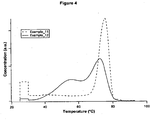
- Figure 4 shows the CRYSTAF curves of Examples 11 and 12 and demonstrates the effect of reactor temperature on the composition distribution of the produced polymer.
- Examples 11 and 12 were produced under similar conditions, except Examples 11 was produced at a lower reactor temperature.
- the polymer produced at higher reactor temperature shows a bimodal composition distribution.
- a lower reactor temperature significantly increases the fraction of high density polymer (%high density) and the composition distribution of the lower reactor temperature polymer is further altered in that the peak at lower crystallization temperature decreases and thus a monomodal composition distribution results.
- a lower reactor temperature increases the fraction of non-crystallizing polymer chains as evidenced by a stepwise increase in the CRYSTAF trace below 30°C.
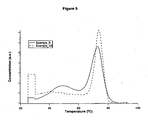
- Figure 5 shows the CRYSTAF curves of Examples 9 and 10.
- two resins having similar densities and melt indices but different composition distributions can be produced by adjusting reactor temperature and ethylene partial pressure.
- the resin produced at lower reactor temperature and lower ethylene partial pressure shows a lower high density fraction (%high density) but a greater non crystallizing fraction.
Landscapes
- Chemical & Material Sciences (AREA)
- Health & Medical Sciences (AREA)
- Chemical Kinetics & Catalysis (AREA)
- Medicinal Chemistry (AREA)
- Polymers & Plastics (AREA)
- Organic Chemistry (AREA)
- Engineering & Computer Science (AREA)
- Materials Engineering (AREA)
- Addition Polymer Or Copolymer, Post-Treatments, Or Chemical Modifications (AREA)
- Transition And Organic Metals Composition Catalysts For Addition Polymerization (AREA)
- Polymerisation Methods In General (AREA)
Applications Claiming Priority (2)
| Application Number | Priority Date | Filing Date | Title |
|---|---|---|---|
| US89952607P | 2007-02-05 | 2007-02-05 | |
| PCT/US2008/000731 WO2008097422A2 (en) | 2007-02-05 | 2008-01-18 | Methods of controlling polymer properties |
Publications (4)
| Publication Number | Publication Date |
|---|---|
| EP2109629A2 EP2109629A2 (en) | 2009-10-21 |
| EP2109629A4 EP2109629A4 (en) | 2009-11-25 |
| EP2109629B1 EP2109629B1 (en) | 2015-02-25 |
| EP2109629B2 true EP2109629B2 (en) | 2019-11-13 |
Family
ID=38180642
Family Applications (1)
| Application Number | Title | Priority Date | Filing Date |
|---|---|---|---|
| EP08724657.5A Active EP2109629B2 (en) | 2007-02-05 | 2008-01-18 | Methods of controlling polymer properties |
Country Status (15)
| Country | Link |
|---|---|
| US (2) | US8497329B2 (enExample) |
| EP (1) | EP2109629B2 (enExample) |
| JP (1) | JP5441717B2 (enExample) |
| KR (1) | KR101553413B1 (enExample) |
| CN (1) | CN101605822B (enExample) |
| AR (1) | AR065030A1 (enExample) |
| AU (1) | AU2008214434B2 (enExample) |
| BR (1) | BRPI0807837B1 (enExample) |
| CA (1) | CA2675112C (enExample) |
| CL (1) | CL2008000345A1 (enExample) |
| MX (1) | MX2009008330A (enExample) |
| MY (1) | MY153215A (enExample) |
| RU (1) | RU2447089C2 (enExample) |
| TW (1) | TWI404730B (enExample) |
| WO (1) | WO2008097422A2 (enExample) |
Families Citing this family (42)
| Publication number | Priority date | Publication date | Assignee | Title |
|---|---|---|---|---|
| TWI404730B (zh) | 2007-02-05 | 2013-08-11 | Univation Tech Llc | 控制聚合物性質之方法 |
| US11337714B2 (en) | 2007-10-17 | 2022-05-24 | Covidien Lp | Restoring blood flow and clot removal during acute ischemic stroke |
| EP2055720A1 (en) * | 2007-11-05 | 2009-05-06 | Total Petrochemicals Research Feluy | Predictive model for density and melt index of polymer leaving loop reactor |
| US8507103B2 (en) | 2007-12-18 | 2013-08-13 | Exxonmobil Chemical Patents Inc. | Polyethylene and process for production thereof |
| US8431661B2 (en) | 2010-10-21 | 2013-04-30 | Exxonmobil Chemical Patents Inc. | Polyethylene and process for production thereof |
| US8436114B2 (en) | 2010-10-21 | 2013-05-07 | Exxonmobil Chemical Patents Inc. | Polyethylene and process for production thereof |
| US20110152472A1 (en) * | 2009-12-17 | 2011-06-23 | Gessner Mark A | Operation of multi-reactor polyolefin manufacturing process |
| EP2558531B1 (en) * | 2010-04-13 | 2017-02-15 | Univation Technologies, LLC | Polymer blends and films made therefrom |
| US20130274427A1 (en) * | 2010-12-22 | 2013-10-17 | BASELL POLOYOLEFINE GmbH | Process for controlling the relative activity of active centers of catalyst systems comprising at least one late transition metal catalyst component and at least one ziegler catalyst component |
| JP5624948B2 (ja) * | 2011-06-14 | 2014-11-12 | 日本ポリプロ株式会社 | 双峰性の組成分布を有するエチレン−α−オレフィン共重合体の製造方法 |
| KR101331556B1 (ko) | 2012-03-30 | 2013-11-20 | 대림산업 주식회사 | 멀티모달 폴리올레핀 수지 및 이로부터 제조되는 성형체 |
| BR112016010838B1 (pt) | 2013-11-21 | 2022-05-03 | Univation Technologies, Llc | Método para produzir poliolefinas |
| ES2918979T3 (es) * | 2014-02-11 | 2022-07-21 | Univation Tech Llc | Métodos para preparar copolímeros de etileno |
| US9765164B2 (en) | 2014-06-27 | 2017-09-19 | Dow Global Technologies Llc | Polyolefin compositions and uses thereof |
| EP3223938A1 (en) | 2014-11-25 | 2017-10-04 | Univation Technologies, LLC | Methods of monitoring and controlling the melt index of a polyolefin product during production |
| CA2891693C (en) | 2015-05-21 | 2022-01-11 | Nova Chemicals Corporation | Controlling the placement of comonomer in an ethylene copolymer |
| EP3365379B1 (en) * | 2015-10-23 | 2024-12-18 | ExxonMobil Chemical Patents Inc. | Production of polyolefins with internal unsaturation structures using a metallocene catalyst system |
| WO2018063767A1 (en) * | 2016-09-27 | 2018-04-05 | Exxonmobil Chemical Patents Inc. | Polymerization process |
| US11274170B2 (en) | 2016-09-27 | 2022-03-15 | Exxonmobil Chemical Patents Inc. | Polymerization process |
| BR112019005988B1 (pt) | 2016-09-27 | 2022-08-23 | Exxonmobil Chemical Patents Inc | Processo de polimerização |
| RU2720995C1 (ru) | 2016-09-27 | 2020-05-15 | Эксонмобил Кемикэл Пейтентс Инк. | Способ полимеризации |
| EP3559051B1 (en) | 2016-12-20 | 2021-03-24 | ExxonMobil Chemical Patents Inc. | Polymerization process |
| WO2018118258A1 (en) * | 2016-12-20 | 2018-06-28 | Exxonmobil Chemical Patents Inc. | Methods for controlling start up conditions in polymerization processes |
| US10696758B2 (en) * | 2017-02-20 | 2020-06-30 | Exxonmobil Chemical Patents, Inc. | Group 4 catalyst compounds and process for use thereof |
| US11161923B2 (en) | 2017-10-27 | 2021-11-02 | Univation Technologies, Llc | Selectively transitioning polymerization processes |
| US11161924B2 (en) | 2017-10-27 | 2021-11-02 | Univation Technologies, Llc | Polyethylene copolymer resins and films |
| CN111448226B (zh) | 2017-11-15 | 2023-08-25 | 埃克森美孚化学专利公司 | 聚合方法 |
| CN111356705A (zh) | 2017-11-15 | 2020-06-30 | 埃克森美孚化学专利公司 | 聚合方法 |
| CN111356706B (zh) | 2017-11-15 | 2022-04-15 | 埃克森美孚化学专利公司 | 聚合方法 |
| CN111819204A (zh) * | 2018-03-28 | 2020-10-23 | 尤尼威蒂恩技术有限责任公司 | 用于调节聚合物特性的方法 |
| CA3101451A1 (en) | 2018-03-28 | 2019-10-03 | Univation Technologies, Llc | Controlling a polymerization reaction |
| WO2019226344A1 (en) | 2018-05-24 | 2019-11-28 | Univation Technologies, Llc | Unimodal polyethylene copolymer and film thereof |
| EP3807331A1 (en) | 2018-06-13 | 2021-04-21 | Univation Technologies, LLC | Bimodal polyethylene copolymer and film thereof |
| CN112739731A (zh) | 2018-07-31 | 2021-04-30 | 尤尼威蒂恩技术有限责任公司 | 单峰聚乙烯共聚物和其膜 |
| SG11202100284XA (en) | 2018-07-31 | 2021-03-30 | Univation Tech Llc | Unimodal polyethylene copolymer and film thereof |
| SG11202101334XA (en) | 2018-08-29 | 2021-03-30 | Univation Tech Llc | Bimodal polyethylene copolymer and film thereof |
| CA3113622A1 (en) | 2018-09-28 | 2020-04-02 | Univation Technologies, Llc | Bimodal polyethylene copolymer composition and pipe made thereof |
| US11014997B2 (en) | 2019-05-16 | 2021-05-25 | Chevron Phillips Chemical Company Lp | Dual catalyst system for producing high density polyethylenes with long chain branching |
| BR112022004186A2 (pt) | 2019-09-26 | 2022-05-31 | Univation Tech Llc | Composição de homopolímero de polietileno bimodal, métodos para fazer a composição de homopolímero de polietileno bimodal, para fabricar um artigo fabricado, para fazer um filme extrudado e para proteger um material sensível à umidade e/ou sensível ao oxigênio, formulação, artigo fabricado, filme extrudado, e, embalagem vedada |
| WO2022005533A1 (en) * | 2020-06-30 | 2022-01-06 | Dow Global Technologies Llc | Polyethylene compositions and films including polyethylene compositions |
| WO2025135619A1 (ko) * | 2023-12-22 | 2025-06-26 | 주식회사 엘지화학 | 폴리올레핀 조성물 |
| KR20250098940A (ko) * | 2023-12-22 | 2025-07-01 | 주식회사 엘지화학 | 봉지재 필름용 조성물 및 이를 포함하는 봉지재 필름 |
Citations (4)
| Publication number | Priority date | Publication date | Assignee | Title |
|---|---|---|---|---|
| US6242545B1 (en) † | 1997-12-08 | 2001-06-05 | Univation Technologies | Polymerization catalyst systems comprising substituted hafinocenes |
| WO2006007046A2 (en) † | 2004-06-21 | 2006-01-19 | Univation Technologies, Llc | Methods for producing polymers with control over composition distribution |
| EP1669373A1 (en) † | 2004-12-07 | 2006-06-14 | Nova Chemicals (International) S.A. | Adjusting polymer characteristics through process control |
| WO2006138007A1 (en) † | 2005-06-14 | 2006-12-28 | Univation Technologies, Llc | Single catalyst low, medium and high density polyethylenes |
Family Cites Families (23)
| Publication number | Priority date | Publication date | Assignee | Title |
|---|---|---|---|---|
| US3819592A (en) * | 1973-08-27 | 1974-06-25 | Uniroyal Inc | Molecular weight regulation of ethylene-alpha-olefin copolymers |
| NL7505002A (nl) | 1974-05-01 | 1975-11-04 | Monsanto Co | Werkwijze voor de bereiding van ethyleenpoly- meren. |
| JPS55164205A (en) | 1979-06-07 | 1980-12-20 | Sumitomo Chem Co Ltd | Multistage polymerization of ethylene |
| US4621952A (en) | 1981-07-28 | 1986-11-11 | Union Carbide Corporation | Fluidized bed discharge process |
| US5382630A (en) * | 1988-09-30 | 1995-01-17 | Exxon Chemical Patents Inc. | Linear ethylene interpolymer blends of interpolymers having narrow molecular weight and composition distribution |
| EP1004603B1 (en) * | 1997-08-15 | 2003-01-15 | Chisso Corporation | Polydisperse propylene polymer and process for producing the same |
| IT1305321B1 (it) | 1998-04-21 | 2001-05-04 | Atochem Elf Italia | Composizioni perossidiche con migliorata resistenza allo scorch per lareticolazione di elastomeri e poliolefine |
| JP2000044612A (ja) * | 1998-07-31 | 2000-02-15 | Ube Ind Ltd | オレフィンの気相重合方法 |
| RU2228937C2 (ru) * | 1998-10-23 | 2004-05-20 | Эксонмобил Кемикэл Пейтентс Инк. | Способ сополимеризации олефинов с мостиковыми гафноценами |
| BR9906022A (pt) | 1999-12-30 | 2001-09-25 | Opp Petroquimica S A | Processo para a produção controlada de polietileno e seus copolìmeros |
| JP4823461B2 (ja) | 2000-03-31 | 2011-11-24 | 三井化学株式会社 | ポリオレフィン組成物の製造方法 |
| JP2004501243A (ja) * | 2000-06-22 | 2004-01-15 | エクソンモービル・ケミカル・パテンツ・インク | メタロセンを用いて生成された極低密度ポリエチレン類 |
| US6884747B2 (en) | 2000-10-06 | 2005-04-26 | Univation Technologies, Llc | Linear low density polyethylenes with high melt strength and high melt index ratio |
| DE10202690A1 (de) * | 2001-01-31 | 2002-11-28 | Ykk Corp | Riemenförmige Einrichtung und Einrichtung zum Unterbringen von Gegenständen unter Verwendung der riemenförmigen Einrichtung |
| US7022766B2 (en) * | 2001-05-31 | 2006-04-04 | Mitsui Chemicals, Inc. | Olefin block copolymer, viscosity index improver for lubricating oils and lubricating oil composition |
| DE60239615D1 (de) * | 2001-07-19 | 2011-05-12 | Univation Tech Llc | Polyethylenfilme mit verbesserten physikalischen eigenschaften |
| CN100398570C (zh) * | 2001-07-19 | 2008-07-02 | 尤尼威蒂恩技术有限责任公司 | 含有弱共聚单体引入剂和良共聚单体引入剂的混合金属茂催化剂体系 |
| US6936675B2 (en) * | 2001-07-19 | 2005-08-30 | Univation Technologies, Llc | High tear films from hafnocene catalyzed polyethylenes |
| US20040122054A1 (en) | 2002-12-23 | 2004-06-24 | Harvey Rosner | Alpha glucosidase inhibitor use |
| US20050148742A1 (en) * | 2004-01-02 | 2005-07-07 | Hagerty Robert O. | Method for controlling sheeting in gas phase reactors |
| WO2005113615A2 (en) | 2004-05-20 | 2005-12-01 | Univation Technologies, Llc | Gas olefin polymerization process |
| US7151145B1 (en) * | 2005-07-13 | 2006-12-19 | Equistar Chemicals, Lp | Process for narrowing short-chain branching distribution in two-step ethylene polymerizations and products |
| TWI404730B (zh) * | 2007-02-05 | 2013-08-11 | Univation Tech Llc | 控制聚合物性質之方法 |
-
2008
- 2008-01-14 TW TW097101373A patent/TWI404730B/zh not_active IP Right Cessation
- 2008-01-18 AU AU2008214434A patent/AU2008214434B2/en not_active Ceased
- 2008-01-18 CN CN200880004155.5A patent/CN101605822B/zh active Active
- 2008-01-18 CA CA2675112A patent/CA2675112C/en active Active
- 2008-01-18 MY MYPI20093203A patent/MY153215A/en unknown
- 2008-01-18 KR KR1020097018496A patent/KR101553413B1/ko active Active
- 2008-01-18 JP JP2009549072A patent/JP5441717B2/ja not_active Expired - Fee Related
- 2008-01-18 MX MX2009008330A patent/MX2009008330A/es active IP Right Grant
- 2008-01-18 BR BRPI0807837A patent/BRPI0807837B1/pt active IP Right Grant
- 2008-01-18 RU RU2009133212/04A patent/RU2447089C2/ru active
- 2008-01-18 US US12/523,400 patent/US8497329B2/en active Active
- 2008-01-18 EP EP08724657.5A patent/EP2109629B2/en active Active
- 2008-01-18 WO PCT/US2008/000731 patent/WO2008097422A2/en not_active Ceased
- 2008-01-25 AR ARP080100307A patent/AR065030A1/es unknown
- 2008-02-04 CL CL200800345A patent/CL2008000345A1/es unknown
-
2011
- 2011-10-19 US US13/276,693 patent/US8227552B2/en active Active
Patent Citations (4)
| Publication number | Priority date | Publication date | Assignee | Title |
|---|---|---|---|---|
| US6242545B1 (en) † | 1997-12-08 | 2001-06-05 | Univation Technologies | Polymerization catalyst systems comprising substituted hafinocenes |
| WO2006007046A2 (en) † | 2004-06-21 | 2006-01-19 | Univation Technologies, Llc | Methods for producing polymers with control over composition distribution |
| EP1669373A1 (en) † | 2004-12-07 | 2006-06-14 | Nova Chemicals (International) S.A. | Adjusting polymer characteristics through process control |
| WO2006138007A1 (en) † | 2005-06-14 | 2006-12-28 | Univation Technologies, Llc | Single catalyst low, medium and high density polyethylenes |
Non-Patent Citations (6)
| Title |
|---|
| Declaration of Jofn Francis Szul † |
| HEILAND ET AL: "Comparison of zirconocene and hafnocene catalysts for the polymerization of ethylene and 1-butene", MAKROMOL. CHEM., vol. 193, 1992, pages 601 - 610 † |
| KIM ET AL: "Copolymerization of ethylene and a-olefins with combined metallocene catalysts", J. POLYM. SCI., vol. 38, 2000, pages 1417 - 1426 † |
| Manufacturing efficiences from metallocene catalysis in gas-phase polyethylene production, Univation Technologies † |
| OLABISI OLAGOKE: "The handbook of Thermoplastics", 1997, pages: 20 † |
| VISWANATHAN; PILLAL, RECENT DEVELOPMENTS IN CATALYSIS, 1991, pages 728 † |
Also Published As
| Publication number | Publication date |
|---|---|
| RU2009133212A (ru) | 2011-03-20 |
| KR101553413B1 (ko) | 2015-09-15 |
| WO2008097422A2 (en) | 2008-08-14 |
| MX2009008330A (es) | 2009-10-07 |
| US20120041164A1 (en) | 2012-02-16 |
| CA2675112C (en) | 2016-02-16 |
| CL2008000345A1 (es) | 2008-09-05 |
| US20100144989A1 (en) | 2010-06-10 |
| US8227552B2 (en) | 2012-07-24 |
| RU2447089C2 (ru) | 2012-04-10 |
| EP2109629B1 (en) | 2015-02-25 |
| CN101605822A (zh) | 2009-12-16 |
| JP5441717B2 (ja) | 2014-03-12 |
| BRPI0807837A2 (pt) | 2014-08-05 |
| AR065030A1 (es) | 2009-05-13 |
| JP2010518225A (ja) | 2010-05-27 |
| EP2109629A4 (en) | 2009-11-25 |
| EP2109629A2 (en) | 2009-10-21 |
| TWI404730B (zh) | 2013-08-11 |
| US8497329B2 (en) | 2013-07-30 |
| AU2008214434A1 (en) | 2008-08-14 |
| TW200846377A (en) | 2008-12-01 |
| KR20090117784A (ko) | 2009-11-12 |
| AU2008214434B2 (en) | 2013-01-24 |
| CN101605822B (zh) | 2014-10-29 |
| BRPI0807837B1 (pt) | 2019-09-03 |
| WO2008097422A3 (en) | 2008-09-25 |
| CA2675112A1 (en) | 2008-08-14 |
| MY153215A (en) | 2015-01-29 |
Similar Documents
| Publication | Publication Date | Title |
|---|---|---|
| EP2109629B2 (en) | Methods of controlling polymer properties | |
| EP2032617B1 (en) | Ethylene-alpha olefin copolymer's and polymerization processes for making the same | |
| KR101357895B1 (ko) | 로토몰딩 및 사출 성형 생성물에 사용하기 위한, 메탈로센 촉매를 이용하여 제조된 중합체 | |
| CA2951113C (en) | Polyethylene resins | |
| JP2007508435A (ja) | 重合方法及びポリマー組成物特性の調節 | |
| US10995161B2 (en) | Method of maintaining a melt flow index of a polyethylene polymer product |
Legal Events
| Date | Code | Title | Description |
|---|---|---|---|
| PUAI | Public reference made under article 153(3) epc to a published international application that has entered the european phase |
Free format text: ORIGINAL CODE: 0009012 |
|
| 17P | Request for examination filed |
Effective date: 20090623 |
|
| AK | Designated contracting states |
Kind code of ref document: A2 Designated state(s): AT BE BG CH CY CZ DE DK EE ES FI FR GB GR HR HU IE IS IT LI LT LU LV MC MT NL NO PL PT RO SE SI SK TR |
|
| A4 | Supplementary search report drawn up and despatched |
Effective date: 20091028 |
|
| RIC1 | Information provided on ipc code assigned before grant |
Ipc: C08F 2/00 20060101ALI20091022BHEP Ipc: C08F 10/02 20060101AFI20091022BHEP |
|
| DAX | Request for extension of the european patent (deleted) | ||
| 17Q | First examination report despatched |
Effective date: 20101109 |
|
| GRAP | Despatch of communication of intention to grant a patent |
Free format text: ORIGINAL CODE: EPIDOSNIGR1 |
|
| INTG | Intention to grant announced |
Effective date: 20140320 |
|
| GRAP | Despatch of communication of intention to grant a patent |
Free format text: ORIGINAL CODE: EPIDOSNIGR1 |
|
| INTG | Intention to grant announced |
Effective date: 20140812 |
|
| GRAS | Grant fee paid |
Free format text: ORIGINAL CODE: EPIDOSNIGR3 |
|
| GRAA | (expected) grant |
Free format text: ORIGINAL CODE: 0009210 |
|
| AK | Designated contracting states |
Kind code of ref document: B1 Designated state(s): AT BE BG CH CY CZ DE DK EE ES FI FR GB GR HR HU IE IS IT LI LT LU LV MC MT NL NO PL PT RO SE SI SK TR |
|
| REG | Reference to a national code |
Ref country code: GB Ref legal event code: FG4D |
|
| REG | Reference to a national code |
Ref country code: CH Ref legal event code: EP |
|
| REG | Reference to a national code |
Ref country code: IE Ref legal event code: FG4D |
|
| REG | Reference to a national code |
Ref country code: DE Ref legal event code: R096 Ref document number: 602008036788 Country of ref document: DE Effective date: 20150409 |
|
| REG | Reference to a national code |
Ref country code: AT Ref legal event code: REF Ref document number: 711943 Country of ref document: AT Kind code of ref document: T Effective date: 20150415 |
|
| REG | Reference to a national code |
Ref country code: NL Ref legal event code: VDEP Effective date: 20150225 |
|
| REG | Reference to a national code |
Ref country code: LT Ref legal event code: MG4D |
|
| PG25 | Lapsed in a contracting state [announced via postgrant information from national office to epo] |
Ref country code: NO Free format text: LAPSE BECAUSE OF FAILURE TO SUBMIT A TRANSLATION OF THE DESCRIPTION OR TO PAY THE FEE WITHIN THE PRESCRIBED TIME-LIMIT Effective date: 20150525 Ref country code: FI Free format text: LAPSE BECAUSE OF FAILURE TO SUBMIT A TRANSLATION OF THE DESCRIPTION OR TO PAY THE FEE WITHIN THE PRESCRIBED TIME-LIMIT Effective date: 20150225 Ref country code: SE Free format text: LAPSE BECAUSE OF FAILURE TO SUBMIT A TRANSLATION OF THE DESCRIPTION OR TO PAY THE FEE WITHIN THE PRESCRIBED TIME-LIMIT Effective date: 20150225 Ref country code: HR Free format text: LAPSE BECAUSE OF FAILURE TO SUBMIT A TRANSLATION OF THE DESCRIPTION OR TO PAY THE FEE WITHIN THE PRESCRIBED TIME-LIMIT Effective date: 20150225 Ref country code: ES Free format text: LAPSE BECAUSE OF FAILURE TO SUBMIT A TRANSLATION OF THE DESCRIPTION OR TO PAY THE FEE WITHIN THE PRESCRIBED TIME-LIMIT Effective date: 20150225 Ref country code: LT Free format text: LAPSE BECAUSE OF FAILURE TO SUBMIT A TRANSLATION OF THE DESCRIPTION OR TO PAY THE FEE WITHIN THE PRESCRIBED TIME-LIMIT Effective date: 20150225 |
|
| PG25 | Lapsed in a contracting state [announced via postgrant information from national office to epo] |
Ref country code: LV Free format text: LAPSE BECAUSE OF FAILURE TO SUBMIT A TRANSLATION OF THE DESCRIPTION OR TO PAY THE FEE WITHIN THE PRESCRIBED TIME-LIMIT Effective date: 20150225 Ref country code: IS Free format text: LAPSE BECAUSE OF FAILURE TO SUBMIT A TRANSLATION OF THE DESCRIPTION OR TO PAY THE FEE WITHIN THE PRESCRIBED TIME-LIMIT Effective date: 20150625 Ref country code: GR Free format text: LAPSE BECAUSE OF FAILURE TO SUBMIT A TRANSLATION OF THE DESCRIPTION OR TO PAY THE FEE WITHIN THE PRESCRIBED TIME-LIMIT Effective date: 20150526 |
|
| PG25 | Lapsed in a contracting state [announced via postgrant information from national office to epo] |
Ref country code: NL Free format text: LAPSE BECAUSE OF FAILURE TO SUBMIT A TRANSLATION OF THE DESCRIPTION OR TO PAY THE FEE WITHIN THE PRESCRIBED TIME-LIMIT Effective date: 20150225 |
|
| PG25 | Lapsed in a contracting state [announced via postgrant information from national office to epo] |
Ref country code: RO Free format text: LAPSE BECAUSE OF FAILURE TO SUBMIT A TRANSLATION OF THE DESCRIPTION OR TO PAY THE FEE WITHIN THE PRESCRIBED TIME-LIMIT Effective date: 20150225 Ref country code: EE Free format text: LAPSE BECAUSE OF FAILURE TO SUBMIT A TRANSLATION OF THE DESCRIPTION OR TO PAY THE FEE WITHIN THE PRESCRIBED TIME-LIMIT Effective date: 20150225 Ref country code: SK Free format text: LAPSE BECAUSE OF FAILURE TO SUBMIT A TRANSLATION OF THE DESCRIPTION OR TO PAY THE FEE WITHIN THE PRESCRIBED TIME-LIMIT Effective date: 20150225 Ref country code: DK Free format text: LAPSE BECAUSE OF FAILURE TO SUBMIT A TRANSLATION OF THE DESCRIPTION OR TO PAY THE FEE WITHIN THE PRESCRIBED TIME-LIMIT Effective date: 20150225 Ref country code: CZ Free format text: LAPSE BECAUSE OF FAILURE TO SUBMIT A TRANSLATION OF THE DESCRIPTION OR TO PAY THE FEE WITHIN THE PRESCRIBED TIME-LIMIT Effective date: 20150225 |
|
| REG | Reference to a national code |
Ref country code: DE Ref legal event code: R026 Ref document number: 602008036788 Country of ref document: DE |
|
| PLBI | Opposition filed |
Free format text: ORIGINAL CODE: 0009260 |
|
| PG25 | Lapsed in a contracting state [announced via postgrant information from national office to epo] |
Ref country code: PL Free format text: LAPSE BECAUSE OF FAILURE TO SUBMIT A TRANSLATION OF THE DESCRIPTION OR TO PAY THE FEE WITHIN THE PRESCRIBED TIME-LIMIT Effective date: 20150225 |
|
| REG | Reference to a national code |
Ref country code: FR Ref legal event code: PLFP Year of fee payment: 9 |
|
| 26 | Opposition filed |
Opponent name: SABIC GLOBAL TECHNOLOGIES B.V. Effective date: 20151125 |
|
| PLAX | Notice of opposition and request to file observation + time limit sent |
Free format text: ORIGINAL CODE: EPIDOSNOBS2 |
|
| PG25 | Lapsed in a contracting state [announced via postgrant information from national office to epo] |
Ref country code: SI Free format text: LAPSE BECAUSE OF FAILURE TO SUBMIT A TRANSLATION OF THE DESCRIPTION OR TO PAY THE FEE WITHIN THE PRESCRIBED TIME-LIMIT Effective date: 20150225 |
|
| PLAF | Information modified related to communication of a notice of opposition and request to file observations + time limit |
Free format text: ORIGINAL CODE: EPIDOSCOBS2 |
|
| PG25 | Lapsed in a contracting state [announced via postgrant information from national office to epo] |
Ref country code: BE Free format text: LAPSE BECAUSE OF FAILURE TO SUBMIT A TRANSLATION OF THE DESCRIPTION OR TO PAY THE FEE WITHIN THE PRESCRIBED TIME-LIMIT Effective date: 20150225 |
|
| PLAS | Information related to reply of patent proprietor to notice(s) of opposition deleted |
Free format text: ORIGINAL CODE: EPIDOSDOBS3 |
|
| PLBB | Reply of patent proprietor to notice(s) of opposition received |
Free format text: ORIGINAL CODE: EPIDOSNOBS3 |
|
| PLBB | Reply of patent proprietor to notice(s) of opposition received |
Free format text: ORIGINAL CODE: EPIDOSNOBS3 |
|
| PG25 | Lapsed in a contracting state [announced via postgrant information from national office to epo] |
Ref country code: LU Free format text: LAPSE BECAUSE OF FAILURE TO SUBMIT A TRANSLATION OF THE DESCRIPTION OR TO PAY THE FEE WITHIN THE PRESCRIBED TIME-LIMIT Effective date: 20160118 |
|
| REG | Reference to a national code |
Ref country code: CH Ref legal event code: PL |
|
| REG | Reference to a national code |
Ref country code: AT Ref legal event code: UEP Ref document number: 711943 Country of ref document: AT Kind code of ref document: T Effective date: 20150225 |
|
| PG25 | Lapsed in a contracting state [announced via postgrant information from national office to epo] |
Ref country code: MC Free format text: LAPSE BECAUSE OF FAILURE TO SUBMIT A TRANSLATION OF THE DESCRIPTION OR TO PAY THE FEE WITHIN THE PRESCRIBED TIME-LIMIT Effective date: 20150225 |
|
| PG25 | Lapsed in a contracting state [announced via postgrant information from national office to epo] |
Ref country code: LI Free format text: LAPSE BECAUSE OF NON-PAYMENT OF DUE FEES Effective date: 20160131 Ref country code: CH Free format text: LAPSE BECAUSE OF NON-PAYMENT OF DUE FEES Effective date: 20160131 |
|
| REG | Reference to a national code |
Ref country code: IE Ref legal event code: MM4A |
|
| REG | Reference to a national code |
Ref country code: FR Ref legal event code: PLFP Year of fee payment: 10 |
|
| PG25 | Lapsed in a contracting state [announced via postgrant information from national office to epo] |
Ref country code: IE Free format text: LAPSE BECAUSE OF NON-PAYMENT OF DUE FEES Effective date: 20160118 |
|
| PGFP | Annual fee paid to national office [announced via postgrant information from national office to epo] |
Ref country code: AT Payment date: 20161223 Year of fee payment: 10 |
|
| PGFP | Annual fee paid to national office [announced via postgrant information from national office to epo] |
Ref country code: IT Payment date: 20170123 Year of fee payment: 10 |
|
| PG25 | Lapsed in a contracting state [announced via postgrant information from national office to epo] |
Ref country code: MT Free format text: LAPSE BECAUSE OF FAILURE TO SUBMIT A TRANSLATION OF THE DESCRIPTION OR TO PAY THE FEE WITHIN THE PRESCRIBED TIME-LIMIT Effective date: 20150225 |
|
| REG | Reference to a national code |
Ref country code: FR Ref legal event code: PLFP Year of fee payment: 11 |
|
| PLAY | Examination report in opposition despatched + time limit |
Free format text: ORIGINAL CODE: EPIDOSNORE2 |
|
| PLAB | Opposition data, opponent's data or that of the opponent's representative modified |
Free format text: ORIGINAL CODE: 0009299OPPO |
|
| R26 | Opposition filed (corrected) |
Opponent name: SABIC GLOBAL TECHNOLOGIES B.V. Effective date: 20151125 |
|
| PLBC | Reply to examination report in opposition received |
Free format text: ORIGINAL CODE: EPIDOSNORE3 |
|
| PLAY | Examination report in opposition despatched + time limit |
Free format text: ORIGINAL CODE: EPIDOSNORE2 |
|
| PG25 | Lapsed in a contracting state [announced via postgrant information from national office to epo] |
Ref country code: CY Free format text: LAPSE BECAUSE OF FAILURE TO SUBMIT A TRANSLATION OF THE DESCRIPTION OR TO PAY THE FEE WITHIN THE PRESCRIBED TIME-LIMIT Effective date: 20150225 Ref country code: HU Free format text: LAPSE BECAUSE OF FAILURE TO SUBMIT A TRANSLATION OF THE DESCRIPTION OR TO PAY THE FEE WITHIN THE PRESCRIBED TIME-LIMIT; INVALID AB INITIO Effective date: 20080118 |
|
| PLBC | Reply to examination report in opposition received |
Free format text: ORIGINAL CODE: EPIDOSNORE3 |
|
| PLAP | Information related to despatch of examination report in opposition + time limit deleted |
Free format text: ORIGINAL CODE: EPIDOSDORE2 |
|
| PLAT | Information related to reply to examination report in opposition deleted |
Free format text: ORIGINAL CODE: EPIDOSDORE3 |
|
| PLBC | Reply to examination report in opposition received |
Free format text: ORIGINAL CODE: EPIDOSNORE3 |
|
| PLAY | Examination report in opposition despatched + time limit |
Free format text: ORIGINAL CODE: EPIDOSNORE2 |
|
| PG25 | Lapsed in a contracting state [announced via postgrant information from national office to epo] |
Ref country code: PT Free format text: LAPSE BECAUSE OF FAILURE TO SUBMIT A TRANSLATION OF THE DESCRIPTION OR TO PAY THE FEE WITHIN THE PRESCRIBED TIME-LIMIT Effective date: 20150225 Ref country code: MT Free format text: LAPSE BECAUSE OF FAILURE TO SUBMIT A TRANSLATION OF THE DESCRIPTION OR TO PAY THE FEE WITHIN THE PRESCRIBED TIME-LIMIT Effective date: 20160131 Ref country code: TR Free format text: LAPSE BECAUSE OF FAILURE TO SUBMIT A TRANSLATION OF THE DESCRIPTION OR TO PAY THE FEE WITHIN THE PRESCRIBED TIME-LIMIT Effective date: 20150225 |
|
| PLAH | Information related to despatch of examination report in opposition + time limit modified |
Free format text: ORIGINAL CODE: EPIDOSCORE2 |
|
| PLAP | Information related to despatch of examination report in opposition + time limit deleted |
Free format text: ORIGINAL CODE: EPIDOSDORE2 |
|
| PLAT | Information related to reply to examination report in opposition deleted |
Free format text: ORIGINAL CODE: EPIDOSDORE3 |
|
| PLAY | Examination report in opposition despatched + time limit |
Free format text: ORIGINAL CODE: EPIDOSNORE2 |
|
| PLBC | Reply to examination report in opposition received |
Free format text: ORIGINAL CODE: EPIDOSNORE3 |
|
| PLAH | Information related to despatch of examination report in opposition + time limit modified |
Free format text: ORIGINAL CODE: EPIDOSCORE2 |
|
| PLAP | Information related to despatch of examination report in opposition + time limit deleted |
Free format text: ORIGINAL CODE: EPIDOSDORE2 |
|
| PLAT | Information related to reply to examination report in opposition deleted |
Free format text: ORIGINAL CODE: EPIDOSDORE3 |
|
| PLAY | Examination report in opposition despatched + time limit |
Free format text: ORIGINAL CODE: EPIDOSNORE2 |
|
| PLBC | Reply to examination report in opposition received |
Free format text: ORIGINAL CODE: EPIDOSNORE3 |
|
| PG25 | Lapsed in a contracting state [announced via postgrant information from national office to epo] |
Ref country code: BG Free format text: LAPSE BECAUSE OF FAILURE TO SUBMIT A TRANSLATION OF THE DESCRIPTION OR TO PAY THE FEE WITHIN THE PRESCRIBED TIME-LIMIT Effective date: 20150225 |
|
| REG | Reference to a national code |
Ref country code: AT Ref legal event code: MM01 Ref document number: 711943 Country of ref document: AT Kind code of ref document: T Effective date: 20180118 |
|
| PG25 | Lapsed in a contracting state [announced via postgrant information from national office to epo] |
Ref country code: AT Free format text: LAPSE BECAUSE OF NON-PAYMENT OF DUE FEES Effective date: 20180118 |
|
| PG25 | Lapsed in a contracting state [announced via postgrant information from national office to epo] |
Ref country code: IT Free format text: LAPSE BECAUSE OF NON-PAYMENT OF DUE FEES Effective date: 20180118 |
|
| PUAH | Patent maintained in amended form |
Free format text: ORIGINAL CODE: 0009272 |
|
| STAA | Information on the status of an ep patent application or granted ep patent |
Free format text: STATUS: PATENT MAINTAINED AS AMENDED |
|
| 27A | Patent maintained in amended form |
Effective date: 20191113 |
|
| AK | Designated contracting states |
Kind code of ref document: B2 Designated state(s): AT BE BG CH CY CZ DE DK EE ES FI FR GB GR HR HU IE IS IT LI LT LU LV MC MT NL NO PL PT RO SE SI SK TR |
|
| REG | Reference to a national code |
Ref country code: DE Ref legal event code: R102 Ref document number: 602008036788 Country of ref document: DE |
|
| REG | Reference to a national code |
Ref country code: DE Ref legal event code: R082 Ref document number: 602008036788 Country of ref document: DE Representative=s name: KILBURN & STRODE LLP, NL |
|
| P01 | Opt-out of the competence of the unified patent court (upc) registered |
Effective date: 20230526 |
|
| PGFP | Annual fee paid to national office [announced via postgrant information from national office to epo] |
Ref country code: GB Payment date: 20241205 Year of fee payment: 18 |
|
| PGFP | Annual fee paid to national office [announced via postgrant information from national office to epo] |
Ref country code: FR Payment date: 20241209 Year of fee payment: 18 |
|
| PGFP | Annual fee paid to national office [announced via postgrant information from national office to epo] |
Ref country code: DE Payment date: 20241203 Year of fee payment: 18 |