EP2104566B1 - Olefinmetathese-initiatoren mit thiazol-2-yliden-liganden - Google Patents
Olefinmetathese-initiatoren mit thiazol-2-yliden-liganden Download PDFInfo
- Publication number
- EP2104566B1 EP2104566B1 EP07854716.3A EP07854716A EP2104566B1 EP 2104566 B1 EP2104566 B1 EP 2104566B1 EP 07854716 A EP07854716 A EP 07854716A EP 2104566 B1 EP2104566 B1 EP 2104566B1
- Authority
- EP
- European Patent Office
- Prior art keywords
- substituted
- unsubstituted
- group
- olefin
- alkyl
- Prior art date
- Legal status (The legal status is an assumption and is not a legal conclusion. Google has not performed a legal analysis and makes no representation as to the accuracy of the status listed.)
- Ceased
Links
- -1 thiazol-2-ylidene Chemical group 0.000 title claims description 68
- 239000003446 ligand Substances 0.000 title claims description 34
- 238000005865 alkene metathesis reaction Methods 0.000 title description 15
- 239000003999 initiator Substances 0.000 title 1
- RTZKZFJDLAIYFH-UHFFFAOYSA-N Diethyl ether Chemical compound CCOCC RTZKZFJDLAIYFH-UHFFFAOYSA-N 0.000 claims description 53
- 125000001183 hydrocarbyl group Chemical group 0.000 claims description 42
- 150000001336 alkenes Chemical class 0.000 claims description 37
- JRZJOMJEPLMPRA-UHFFFAOYSA-N olefin Natural products CCCCCCCC=C JRZJOMJEPLMPRA-UHFFFAOYSA-N 0.000 claims description 37
- 238000006243 chemical reaction Methods 0.000 claims description 34
- 238000006798 ring closing metathesis reaction Methods 0.000 claims description 33
- 238000000034 method Methods 0.000 claims description 32
- 229910052799 carbon Inorganic materials 0.000 claims description 28
- 125000001997 phenyl group Chemical group [H]C1=C([H])C([H])=C(*)C([H])=C1[H] 0.000 claims description 26
- 125000005842 heteroatom Chemical group 0.000 claims description 25
- 125000003118 aryl group Chemical group 0.000 claims description 23
- 238000005686 cross metathesis reaction Methods 0.000 claims description 20
- 150000001875 compounds Chemical class 0.000 claims description 19
- 125000000743 hydrocarbylene group Chemical group 0.000 claims description 17
- 229910052739 hydrogen Inorganic materials 0.000 claims description 17
- 239000001257 hydrogen Substances 0.000 claims description 17
- 150000004820 halides Chemical class 0.000 claims description 14
- 238000005649 metathesis reaction Methods 0.000 claims description 14
- 238000007152 ring opening metathesis polymerisation reaction Methods 0.000 claims description 13
- XYFCBTPGUUZFHI-UHFFFAOYSA-N Phosphine Chemical compound P XYFCBTPGUUZFHI-UHFFFAOYSA-N 0.000 claims description 12
- 125000000449 nitro group Chemical group [O-][N+](*)=O 0.000 claims description 12
- 125000002887 hydroxy group Chemical group [H]O* 0.000 claims description 11
- 125000003396 thiol group Chemical group [H]S* 0.000 claims description 11
- JUJWROOIHBZHMG-UHFFFAOYSA-N Pyridine Chemical compound C1=CC=NC=C1 JUJWROOIHBZHMG-UHFFFAOYSA-N 0.000 claims description 10
- HZVOZRGWRWCICA-UHFFFAOYSA-N methanediyl Chemical compound [CH2] HZVOZRGWRWCICA-UHFFFAOYSA-N 0.000 claims description 10
- 125000004469 siloxy group Chemical group [SiH3]O* 0.000 claims description 10
- 125000006527 (C1-C5) alkyl group Chemical group 0.000 claims description 9
- OKTJSMMVPCPJKN-UHFFFAOYSA-N Carbon Chemical compound [C] OKTJSMMVPCPJKN-UHFFFAOYSA-N 0.000 claims description 9
- UFHFLCQGNIYNRP-UHFFFAOYSA-N Hydrogen Chemical compound [H][H] UFHFLCQGNIYNRP-UHFFFAOYSA-N 0.000 claims description 9
- 125000000746 allylic group Chemical group 0.000 claims description 8
- 125000000524 functional group Chemical group 0.000 claims description 7
- 125000002496 methyl group Chemical group [H]C([H])([H])* 0.000 claims description 7
- 238000006467 substitution reaction Methods 0.000 claims description 7
- 125000000999 tert-butyl group Chemical group [H]C([H])([H])C(*)(C([H])([H])[H])C([H])([H])[H] 0.000 claims description 7
- 125000003837 (C1-C20) alkyl group Chemical group 0.000 claims description 6
- 125000004209 (C1-C8) alkyl group Chemical group 0.000 claims description 6
- 125000003545 alkoxy group Chemical group 0.000 claims description 6
- 125000004122 cyclic group Chemical group 0.000 claims description 6
- 150000002431 hydrogen Chemical group 0.000 claims description 6
- 125000004435 hydrogen atom Chemical group [H]* 0.000 claims description 6
- 125000000959 isobutyl group Chemical group [H]C([H])([H])C([H])(C([H])([H])[H])C([H])([H])* 0.000 claims description 6
- 125000005244 neohexyl group Chemical group [H]C([H])([H])C(C([H])([H])[H])(C([H])([H])[H])C([H])([H])C([H])([H])* 0.000 claims description 6
- 125000001971 neopentyl group Chemical group [H]C([*])([H])C(C([H])([H])[H])(C([H])([H])[H])C([H])([H])[H] 0.000 claims description 6
- 229910000073 phosphorus hydride Inorganic materials 0.000 claims description 6
- UMJSCPRVCHMLSP-UHFFFAOYSA-N pyridine Natural products COC1=CC=CN=C1 UMJSCPRVCHMLSP-UHFFFAOYSA-N 0.000 claims description 6
- 229910052707 ruthenium Inorganic materials 0.000 claims description 6
- 125000006850 spacer group Chemical group 0.000 claims description 6
- 125000004178 (C1-C4) alkyl group Chemical group 0.000 claims description 5
- 125000000325 methylidene group Chemical group [H]C([H])=* 0.000 claims description 5
- 230000007935 neutral effect Effects 0.000 claims description 5
- 125000000008 (C1-C10) alkyl group Chemical group 0.000 claims description 4
- 125000003358 C2-C20 alkenyl group Chemical group 0.000 claims description 4
- VEXZGXHMUGYJMC-UHFFFAOYSA-M Chloride anion Chemical compound [Cl-] VEXZGXHMUGYJMC-UHFFFAOYSA-M 0.000 claims description 4
- 125000000217 alkyl group Chemical group 0.000 claims description 4
- 125000002178 anthracenyl group Chemical group C1(=CC=CC2=CC3=CC=CC=C3C=C12)* 0.000 claims description 4
- 125000001624 naphthyl group Chemical group 0.000 claims description 4
- 150000001408 amides Chemical class 0.000 claims description 3
- 150000001412 amines Chemical class 0.000 claims description 3
- 125000000129 anionic group Chemical group 0.000 claims description 3
- 125000001495 ethyl group Chemical group [H]C([H])([H])C([H])([H])* 0.000 claims description 3
- 150000002466 imines Chemical class 0.000 claims description 3
- 229910052762 osmium Inorganic materials 0.000 claims description 3
- 150000003568 thioethers Chemical class 0.000 claims description 3
- 125000000391 vinyl group Chemical group [H]C([*])=C([H])[H] 0.000 claims description 3
- 229920002554 vinyl polymer Chemical group 0.000 claims description 3
- 125000005913 (C3-C6) cycloalkyl group Chemical group 0.000 claims description 2
- CSCPPACGZOOCGX-UHFFFAOYSA-N Acetone Chemical compound CC(C)=O CSCPPACGZOOCGX-UHFFFAOYSA-N 0.000 claims description 2
- CPELXLSAUQHCOX-UHFFFAOYSA-M Bromide Chemical compound [Br-] CPELXLSAUQHCOX-UHFFFAOYSA-M 0.000 claims description 2
- 125000003860 C1-C20 alkoxy group Chemical group 0.000 claims description 2
- KRHYYFGTRYWZRS-UHFFFAOYSA-M Fluoride anion Chemical compound [F-] KRHYYFGTRYWZRS-UHFFFAOYSA-M 0.000 claims description 2
- AFVFQIVMOAPDHO-UHFFFAOYSA-N Methanesulfonic acid Chemical compound CS(O)(=O)=O AFVFQIVMOAPDHO-UHFFFAOYSA-N 0.000 claims description 2
- MWUXSHHQAYIFBG-UHFFFAOYSA-N Nitric oxide Chemical group O=[N] MWUXSHHQAYIFBG-UHFFFAOYSA-N 0.000 claims description 2
- 125000004414 alkyl thio group Chemical group 0.000 claims description 2
- 229910000074 antimony hydride Inorganic materials 0.000 claims description 2
- RBFQJDQYXXHULB-UHFFFAOYSA-N arsane Chemical compound [AsH3] RBFQJDQYXXHULB-UHFFFAOYSA-N 0.000 claims description 2
- 125000005228 aryl sulfonate group Chemical group 0.000 claims description 2
- 125000004104 aryloxy group Chemical group 0.000 claims description 2
- WPYMKLBDIGXBTP-UHFFFAOYSA-N benzoic acid Chemical compound OC(=O)C1=CC=CC=C1 WPYMKLBDIGXBTP-UHFFFAOYSA-N 0.000 claims description 2
- 125000003178 carboxy group Chemical group [H]OC(*)=O 0.000 claims description 2
- 150000007942 carboxylates Chemical class 0.000 claims description 2
- 125000000753 cycloalkyl group Chemical group 0.000 claims description 2
- 125000000113 cyclohexyl group Chemical group [H]C1([H])C([H])([H])C([H])([H])C([H])(*)C([H])([H])C1([H])[H] 0.000 claims description 2
- 125000002147 dimethylamino group Chemical group [H]C([H])([H])N(*)C([H])([H])[H] 0.000 claims description 2
- XMBWDFGMSWQBCA-UHFFFAOYSA-N hydrogen iodide Chemical compound I XMBWDFGMSWQBCA-UHFFFAOYSA-N 0.000 claims description 2
- 125000001449 isopropyl group Chemical group [H]C([H])([H])C([H])(*)C([H])([H])[H] 0.000 claims description 2
- 125000000951 phenoxy group Chemical group [H]C1=C([H])C([H])=C(O*)C([H])=C1[H] 0.000 claims description 2
- 150000003003 phosphines Chemical class 0.000 claims description 2
- 125000005538 phosphinite group Chemical group 0.000 claims description 2
- XRBCRPZXSCBRTK-UHFFFAOYSA-N phosphonous acid Chemical compound OPO XRBCRPZXSCBRTK-UHFFFAOYSA-N 0.000 claims description 2
- OJMIONKXNSYLSR-UHFFFAOYSA-N phosphorous acid Chemical compound OP(O)O OJMIONKXNSYLSR-UHFFFAOYSA-N 0.000 claims description 2
- 229910052698 phosphorus Inorganic materials 0.000 claims description 2
- 150000003222 pyridines Chemical class 0.000 claims description 2
- OUULRIDHGPHMNQ-UHFFFAOYSA-N stibane Chemical compound [SbH3] OUULRIDHGPHMNQ-UHFFFAOYSA-N 0.000 claims description 2
- 150000003462 sulfoxides Chemical class 0.000 claims description 2
- JOXIMZWYDAKGHI-UHFFFAOYSA-N toluene-4-sulfonic acid Chemical compound CC1=CC=C(S(O)(=O)=O)C=C1 JOXIMZWYDAKGHI-UHFFFAOYSA-N 0.000 claims description 2
- ITMCEJHCFYSIIV-UHFFFAOYSA-M triflate Chemical compound [O-]S(=O)(=O)C(F)(F)F ITMCEJHCFYSIIV-UHFFFAOYSA-M 0.000 claims description 2
- 230000002194 synthesizing effect Effects 0.000 claims 2
- 150000008052 alkyl sulfonates Chemical class 0.000 claims 1
- 125000001475 halogen functional group Chemical group 0.000 claims 1
- 229920000642 polymer Polymers 0.000 claims 1
- 239000003054 catalyst Substances 0.000 description 137
- YMWUJEATGCHHMB-UHFFFAOYSA-N Dichloromethane Chemical compound ClCCl YMWUJEATGCHHMB-UHFFFAOYSA-N 0.000 description 62
- UHOVQNZJYSORNB-UHFFFAOYSA-N Benzene Chemical compound C1=CC=CC=C1 UHOVQNZJYSORNB-UHFFFAOYSA-N 0.000 description 54
- 239000007787 solid Substances 0.000 description 53
- YMWUJEATGCHHMB-DICFDUPASA-N dichloromethane-d2 Chemical compound [2H]C([2H])(Cl)Cl YMWUJEATGCHHMB-DICFDUPASA-N 0.000 description 50
- HEDRZPFGACZZDS-MICDWDOJSA-N Trichloro(2H)methane Chemical compound [2H]C(Cl)(Cl)Cl HEDRZPFGACZZDS-MICDWDOJSA-N 0.000 description 28
- 239000013078 crystal Substances 0.000 description 26
- 239000000243 solution Substances 0.000 description 26
- 239000002904 solvent Substances 0.000 description 25
- YXFVVABEGXRONW-UHFFFAOYSA-N Toluene Chemical compound CC1=CC=CC=C1 YXFVVABEGXRONW-UHFFFAOYSA-N 0.000 description 24
- 239000000203 mixture Substances 0.000 description 23
- HEDRZPFGACZZDS-UHFFFAOYSA-N Chloroform Chemical compound ClC(Cl)Cl HEDRZPFGACZZDS-UHFFFAOYSA-N 0.000 description 22
- 239000011541 reaction mixture Substances 0.000 description 20
- 238000005160 1H NMR spectroscopy Methods 0.000 description 16
- LYUUVYQGUMRKOV-UHFFFAOYSA-N Diethyl diallylmalonate Chemical compound CCOC(=O)C(CC=C)(CC=C)C(=O)OCC LYUUVYQGUMRKOV-UHFFFAOYSA-N 0.000 description 16
- UHOVQNZJYSORNB-MZWXYZOWSA-N benzene-d6 Chemical compound [2H]C1=C([2H])C([2H])=C([2H])C([2H])=C1[2H] UHOVQNZJYSORNB-MZWXYZOWSA-N 0.000 description 16
- 238000013480 data collection Methods 0.000 description 16
- VLKZOEOYAKHREP-UHFFFAOYSA-N n-Hexane Chemical class CCCCCC VLKZOEOYAKHREP-UHFFFAOYSA-N 0.000 description 16
- 238000002360 preparation method Methods 0.000 description 15
- 238000004009 13C{1H}-NMR spectroscopy Methods 0.000 description 14
- WYURNTSHIVDZCO-UHFFFAOYSA-N Tetrahydrofuran Chemical compound C1CCOC1 WYURNTSHIVDZCO-UHFFFAOYSA-N 0.000 description 14
- 238000011068 loading method Methods 0.000 description 14
- 239000000047 product Substances 0.000 description 13
- WFDIJRYMOXRFFG-UHFFFAOYSA-N Acetic anhydride Chemical compound CC(=O)OC(C)=O WFDIJRYMOXRFFG-UHFFFAOYSA-N 0.000 description 12
- HJWLCRVIBGQPNF-UHFFFAOYSA-N prop-2-enylbenzene Chemical compound C=CCC1=CC=CC=C1 HJWLCRVIBGQPNF-UHFFFAOYSA-N 0.000 description 12
- OFOBLEOULBTSOW-UHFFFAOYSA-L Malonate Chemical compound [O-]C(=O)CC([O-])=O OFOBLEOULBTSOW-UHFFFAOYSA-L 0.000 description 11
- VYPSYNLAJGMNEJ-UHFFFAOYSA-N Silicium dioxide Chemical compound O=[Si]=O VYPSYNLAJGMNEJ-UHFFFAOYSA-N 0.000 description 11
- VZUAUHWZIKOMFC-ARJAWSKDSA-N [(z)-4-acetyloxybut-2-enyl] acetate Chemical compound CC(=O)OC\C=C/COC(C)=O VZUAUHWZIKOMFC-ARJAWSKDSA-N 0.000 description 11
- 239000000741 silica gel Substances 0.000 description 11
- 229910002027 silica gel Inorganic materials 0.000 description 11
- VYXHVRARDIDEHS-UHFFFAOYSA-N 1,5-cyclooctadiene Chemical compound C1CC=CCCC=C1 VYXHVRARDIDEHS-UHFFFAOYSA-N 0.000 description 10
- CDBYLPFSWZWCQE-UHFFFAOYSA-L Sodium Carbonate Chemical compound [Na+].[Na+].[O-]C([O-])=O CDBYLPFSWZWCQE-UHFFFAOYSA-L 0.000 description 10
- 125000001424 substituent group Chemical group 0.000 description 10
- IIYFAKIEWZDVMP-UHFFFAOYSA-N tridecane Chemical compound CCCCCCCCCCCCC IIYFAKIEWZDVMP-UHFFFAOYSA-N 0.000 description 10
- 229910001868 water Inorganic materials 0.000 description 10
- ADLVDYMTBOSDFE-UHFFFAOYSA-N 5-chloro-6-nitroisoindole-1,3-dione Chemical compound C1=C(Cl)C([N+](=O)[O-])=CC2=C1C(=O)NC2=O ADLVDYMTBOSDFE-UHFFFAOYSA-N 0.000 description 9
- 239000012300 argon atmosphere Substances 0.000 description 9
- 125000004432 carbon atom Chemical group C* 0.000 description 9
- 150000002596 lactones Chemical class 0.000 description 9
- 229930015698 phenylpropene Natural products 0.000 description 9
- 239000011550 stock solution Substances 0.000 description 9
- LFQSCWFLJHTTHZ-UHFFFAOYSA-N Ethanol Chemical compound CCO LFQSCWFLJHTTHZ-UHFFFAOYSA-N 0.000 description 8
- UIIMBOGNXHQVGW-UHFFFAOYSA-M Sodium bicarbonate Chemical compound [Na+].OC([O-])=O UIIMBOGNXHQVGW-UHFFFAOYSA-M 0.000 description 8
- 238000010521 absorption reaction Methods 0.000 description 8
- BDAGIHXWWSANSR-UHFFFAOYSA-N methanoic acid Natural products OC=O BDAGIHXWWSANSR-UHFFFAOYSA-N 0.000 description 8
- 239000000523 sample Substances 0.000 description 8
- RUVWYQWRZJTNRE-UHFFFAOYSA-M 4,5-dimethyl-3-(2,4,6-trimethylphenyl)-1,3-thiazol-3-ium;chloride Chemical compound [Cl-].CC1=C(C)SC=[N+]1C1=C(C)C=C(C)C=C1C RUVWYQWRZJTNRE-UHFFFAOYSA-M 0.000 description 7
- 150000001925 cycloalkenes Chemical class 0.000 description 7
- DHCWLIOIJZJFJE-UHFFFAOYSA-L dichlororuthenium Chemical compound Cl[Ru]Cl DHCWLIOIJZJFJE-UHFFFAOYSA-L 0.000 description 7
- 239000012299 nitrogen atmosphere Substances 0.000 description 7
- 238000002424 x-ray crystallography Methods 0.000 description 7
- CHFVKTMFZMRQMO-UHFFFAOYSA-M 3-(2,6-diethylphenyl)-4,5-dimethyl-1,3-thiazol-3-ium;chloride Chemical compound [Cl-].CCC1=CC=CC(CC)=C1[N+]1=CSC(C)=C1C CHFVKTMFZMRQMO-UHFFFAOYSA-M 0.000 description 6
- XKRFYHLGVUSROY-UHFFFAOYSA-N Argon Chemical compound [Ar] XKRFYHLGVUSROY-UHFFFAOYSA-N 0.000 description 6
- 238000005481 NMR spectroscopy Methods 0.000 description 6
- OFBQJSOFQDEBGM-UHFFFAOYSA-N Pentane Chemical class CCCCC OFBQJSOFQDEBGM-UHFFFAOYSA-N 0.000 description 6
- 239000002808 molecular sieve Substances 0.000 description 6
- 229920006395 saturated elastomer Polymers 0.000 description 6
- URGAHOPLAPQHLN-UHFFFAOYSA-N sodium aluminosilicate Chemical compound [Na+].[Al+3].[O-][Si]([O-])=O.[O-][Si]([O-])=O URGAHOPLAPQHLN-UHFFFAOYSA-N 0.000 description 6
- 238000003756 stirring Methods 0.000 description 6
- RYHBNJHYFVUHQT-UHFFFAOYSA-N 1,4-Dioxane Chemical compound C1COCCO1 RYHBNJHYFVUHQT-UHFFFAOYSA-N 0.000 description 5
- 239000004912 1,5-cyclooctadiene Substances 0.000 description 5
- MCSXGCZMEPXKIW-UHFFFAOYSA-N 3-hydroxy-4-[(4-methyl-2-nitrophenyl)diazenyl]-N-(3-nitrophenyl)naphthalene-2-carboxamide Chemical compound Cc1ccc(N=Nc2c(O)c(cc3ccccc23)C(=O)Nc2cccc(c2)[N+]([O-])=O)c(c1)[N+]([O-])=O MCSXGCZMEPXKIW-UHFFFAOYSA-N 0.000 description 5
- UJJZSQZVAPNQHT-UHFFFAOYSA-M 4,5-dimethyl-3-(2-methylphenyl)-1,3-thiazol-3-ium;chloride Chemical compound [Cl-].CC1=C(C)SC=[N+]1C1=CC=CC=C1C UJJZSQZVAPNQHT-UHFFFAOYSA-M 0.000 description 5
- MLJPFCQPHJAMNZ-UHFFFAOYSA-M 4,5-dimethyl-3-phenyl-1,3-thiazol-3-ium;chloride Chemical compound [Cl-].CC1=C(C)SC=[N+]1C1=CC=CC=C1 MLJPFCQPHJAMNZ-UHFFFAOYSA-M 0.000 description 5
- MAGOYBJJLVSJIC-UHFFFAOYSA-N 4-chlorobutan-2-one Chemical compound CC(=O)CCCl MAGOYBJJLVSJIC-UHFFFAOYSA-N 0.000 description 5
- 238000001816 cooling Methods 0.000 description 5
- CYQAYERJWZKYML-UHFFFAOYSA-N phosphorus pentasulfide Chemical compound S1P(S2)(=S)SP3(=S)SP1(=S)SP2(=S)S3 CYQAYERJWZKYML-UHFFFAOYSA-N 0.000 description 5
- VFWRGKJLLYDFBY-UHFFFAOYSA-N silver;hydrate Chemical compound O.[Ag].[Ag] VFWRGKJLLYDFBY-UHFFFAOYSA-N 0.000 description 5
- 239000002002 slurry Substances 0.000 description 5
- 229910000029 sodium carbonate Inorganic materials 0.000 description 5
- BEOQPFNGPVYINI-UHFFFAOYSA-M 3-[2,6-di(propan-2-yl)phenyl]-4,5-dimethyl-1,3-thiazol-3-ium;chloride Chemical compound [Cl-].CC(C)C1=CC=CC(C(C)C)=C1[N+]1=CSC(C)=C1C BEOQPFNGPVYINI-UHFFFAOYSA-M 0.000 description 4
- OSWFIVFLDKOXQC-UHFFFAOYSA-N 4-(3-methoxyphenyl)aniline Chemical compound COC1=CC=CC(C=2C=CC(N)=CC=2)=C1 OSWFIVFLDKOXQC-UHFFFAOYSA-N 0.000 description 4
- 239000007832 Na2SO4 Substances 0.000 description 4
- PMZURENOXWZQFD-UHFFFAOYSA-L Sodium Sulfate Chemical compound [Na+].[Na+].[O-]S([O-])(=O)=O PMZURENOXWZQFD-UHFFFAOYSA-L 0.000 description 4
- 238000010535 acyclic diene metathesis reaction Methods 0.000 description 4
- 230000005540 biological transmission Effects 0.000 description 4
- 230000015572 biosynthetic process Effects 0.000 description 4
- 238000004440 column chromatography Methods 0.000 description 4
- 238000012937 correction Methods 0.000 description 4
- 238000002425 crystallisation Methods 0.000 description 4
- 230000008025 crystallization Effects 0.000 description 4
- 150000001993 dienes Chemical class 0.000 description 4
- FJKIXWOMBXYWOQ-UHFFFAOYSA-N ethenoxyethane Chemical compound CCOC=C FJKIXWOMBXYWOQ-UHFFFAOYSA-N 0.000 description 4
- 235000019253 formic acid Nutrition 0.000 description 4
- 125000002485 formyl group Chemical group [H]C(*)=O 0.000 description 4
- 239000011159 matrix material Substances 0.000 description 4
- 239000012044 organic layer Substances 0.000 description 4
- 229910000030 sodium bicarbonate Inorganic materials 0.000 description 4
- 229910052938 sodium sulfate Inorganic materials 0.000 description 4
- 239000007858 starting material Substances 0.000 description 4
- 239000000126 substance Substances 0.000 description 4
- XLYOFNOQVPJJNP-UHFFFAOYSA-N water Substances O XLYOFNOQVPJJNP-UHFFFAOYSA-N 0.000 description 4
- KJTLSVCANCCWHF-UHFFFAOYSA-N Ruthenium Chemical compound [Ru] KJTLSVCANCCWHF-UHFFFAOYSA-N 0.000 description 3
- 229910052786 argon Inorganic materials 0.000 description 3
- 238000009792 diffusion process Methods 0.000 description 3
- 230000000694 effects Effects 0.000 description 3
- 229910052736 halogen Inorganic materials 0.000 description 3
- 150000002367 halogens Chemical class 0.000 description 3
- ZVEPYIWOJSDVMX-UHFFFAOYSA-N n-(2,6-diethylphenyl)formamide Chemical compound CCC1=CC=CC(CC)=C1NC=O ZVEPYIWOJSDVMX-UHFFFAOYSA-N 0.000 description 3
- ZXTLGJAARBNQGK-UHFFFAOYSA-N n-(2-methylphenyl)formamide Chemical compound CC1=CC=CC=C1NC=O ZXTLGJAARBNQGK-UHFFFAOYSA-N 0.000 description 3
- 238000003786 synthesis reaction Methods 0.000 description 3
- 125000000027 (C1-C10) alkoxy group Chemical group 0.000 description 2
- 235000019502 Orange oil Nutrition 0.000 description 2
- 239000012298 atmosphere Substances 0.000 description 2
- 125000000649 benzylidene group Chemical group [H]C(=[*])C1=C([H])C([H])=C([H])C([H])=C1[H] 0.000 description 2
- 150000001721 carbon Chemical group 0.000 description 2
- 230000003197 catalytic effect Effects 0.000 description 2
- 238000011161 development Methods 0.000 description 2
- 239000012634 fragment Substances 0.000 description 2
- 238000004817 gas chromatography Methods 0.000 description 2
- 150000002576 ketones Chemical class 0.000 description 2
- QNEZBLSIMQMUHQ-UHFFFAOYSA-N n-(2,4,6-trimethylphenyl)formamide Chemical compound CC1=CC(C)=C(NC=O)C(C)=C1 QNEZBLSIMQMUHQ-UHFFFAOYSA-N 0.000 description 2
- RNVCVTLRINQCPJ-UHFFFAOYSA-N o-toluidine Chemical compound CC1=CC=CC=C1N RNVCVTLRINQCPJ-UHFFFAOYSA-N 0.000 description 2
- 239000003921 oil Substances 0.000 description 2
- 235000019198 oils Nutrition 0.000 description 2
- 239000010502 orange oil Substances 0.000 description 2
- 230000009257 reactivity Effects 0.000 description 2
- 238000005872 self-metathesis reaction Methods 0.000 description 2
- WSLDOOZREJYCGB-UHFFFAOYSA-N 1,2-Dichloroethane Chemical compound ClCCCl WSLDOOZREJYCGB-UHFFFAOYSA-N 0.000 description 1
- KWVPRPSXBZNOHS-UHFFFAOYSA-N 2,4,6-Trimethylaniline Chemical compound CC1=CC(C)=C(N)C(C)=C1 KWVPRPSXBZNOHS-UHFFFAOYSA-N 0.000 description 1
- WKBALTUBRZPIPZ-UHFFFAOYSA-N 2,6-di(propan-2-yl)aniline Chemical compound CC(C)C1=CC=CC(C(C)C)=C1N WKBALTUBRZPIPZ-UHFFFAOYSA-N 0.000 description 1
- FOYHNROGBXVLLX-UHFFFAOYSA-N 2,6-diethylaniline Chemical compound CCC1=CC=CC(CC)=C1N FOYHNROGBXVLLX-UHFFFAOYSA-N 0.000 description 1
- KXDHJXZQYSOELW-UHFFFAOYSA-M Carbamate Chemical compound NC([O-])=O KXDHJXZQYSOELW-UHFFFAOYSA-M 0.000 description 1
- BVKZGUZCCUSVTD-UHFFFAOYSA-L Carbonate Chemical compound [O-]C([O-])=O BVKZGUZCCUSVTD-UHFFFAOYSA-L 0.000 description 1
- BWGNESOTFCXPMA-UHFFFAOYSA-N Dihydrogen disulfide Chemical compound SS BWGNESOTFCXPMA-UHFFFAOYSA-N 0.000 description 1
- 150000001299 aldehydes Chemical class 0.000 description 1
- 229930013930 alkaloid Natural products 0.000 description 1
- 125000003342 alkenyl group Chemical group 0.000 description 1
- 125000004390 alkyl sulfonyl group Chemical group 0.000 description 1
- 125000001118 alkylidene group Chemical group 0.000 description 1
- 238000004458 analytical method Methods 0.000 description 1
- 230000002547 anomalous effect Effects 0.000 description 1
- 239000003242 anti bacterial agent Substances 0.000 description 1
- 229940088710 antibiotic agent Drugs 0.000 description 1
- 239000008346 aqueous phase Substances 0.000 description 1
- 125000004429 atom Chemical group 0.000 description 1
- PNPBGYBHLCEVMK-UHFFFAOYSA-N benzylidene(dichloro)ruthenium;tricyclohexylphosphanium Chemical compound Cl[Ru](Cl)=CC1=CC=CC=C1.C1CCCCC1[PH+](C1CCCCC1)C1CCCCC1.C1CCCCC1[PH+](C1CCCCC1)C1CCCCC1 PNPBGYBHLCEVMK-UHFFFAOYSA-N 0.000 description 1
- FCDPQMAOJARMTG-UHFFFAOYSA-M benzylidene-[1,3-bis(2,4,6-trimethylphenyl)imidazolidin-2-ylidene]-dichlororuthenium;tricyclohexylphosphanium Chemical compound C1CCCCC1[PH+](C1CCCCC1)C1CCCCC1.CC1=CC(C)=CC(C)=C1N(CCN1C=2C(=CC(C)=CC=2C)C)C1=[Ru](Cl)(Cl)=CC1=CC=CC=C1 FCDPQMAOJARMTG-UHFFFAOYSA-M 0.000 description 1
- 150000001718 carbodiimides Chemical class 0.000 description 1
- 239000011203 carbon fibre reinforced carbon Substances 0.000 description 1
- 238000000354 decomposition reaction Methods 0.000 description 1
- 150000002148 esters Chemical class 0.000 description 1
- PSLIMVZEAPALCD-UHFFFAOYSA-N ethanol;ethoxyethane Chemical compound CCO.CCOCC PSLIMVZEAPALCD-UHFFFAOYSA-N 0.000 description 1
- 150000002170 ethers Chemical class 0.000 description 1
- 239000000706 filtrate Substances 0.000 description 1
- DYDNPESBYVVLBO-UHFFFAOYSA-N formanilide Chemical compound O=CNC1=CC=CC=C1 DYDNPESBYVVLBO-UHFFFAOYSA-N 0.000 description 1
- 239000011984 grubbs catalyst Substances 0.000 description 1
- 125000005843 halogen group Chemical group 0.000 description 1
- 238000011065 in-situ storage Methods 0.000 description 1
- 239000004615 ingredient Substances 0.000 description 1
- 239000012948 isocyanate Substances 0.000 description 1
- 150000002513 isocyanates Chemical class 0.000 description 1
- 125000000654 isopropylidene group Chemical group C(C)(C)=* 0.000 description 1
- 150000003951 lactams Chemical class 0.000 description 1
- 238000004519 manufacturing process Methods 0.000 description 1
- 125000000956 methoxy group Chemical group [H]C([H])([H])O* 0.000 description 1
- HGCULERWAGEILG-UHFFFAOYSA-N n-[2,6-di(propan-2-yl)phenyl]formamide Chemical compound CC(C)C1=CC=CC(C(C)C)=C1NC=O HGCULERWAGEILG-UHFFFAOYSA-N 0.000 description 1
- LJDZFAPLPVPTBD-UHFFFAOYSA-N nitroformic acid Chemical compound OC(=O)[N+]([O-])=O LJDZFAPLPVPTBD-UHFFFAOYSA-N 0.000 description 1
- 229910052757 nitrogen Inorganic materials 0.000 description 1
- 125000004433 nitrogen atom Chemical group N* 0.000 description 1
- 239000002304 perfume Substances 0.000 description 1
- 230000000379 polymerizing effect Effects 0.000 description 1
- IUBQJLUDMLPAGT-UHFFFAOYSA-N potassium bis(trimethylsilyl)amide Chemical compound C[Si](C)(C)N([K])[Si](C)(C)C IUBQJLUDMLPAGT-UHFFFAOYSA-N 0.000 description 1
- 150000003303 ruthenium Chemical class 0.000 description 1
- 150000003839 salts Chemical class 0.000 description 1
- 229910052709 silver Inorganic materials 0.000 description 1
- 239000004332 silver Substances 0.000 description 1
- 238000012360 testing method Methods 0.000 description 1
Images







Classifications
-
- C—CHEMISTRY; METALLURGY
- C07—ORGANIC CHEMISTRY
- C07F—ACYCLIC, CARBOCYCLIC OR HETEROCYCLIC COMPOUNDS CONTAINING ELEMENTS OTHER THAN CARBON, HYDROGEN, HALOGEN, OXYGEN, NITROGEN, SULFUR, SELENIUM OR TELLURIUM
- C07F15/00—Compounds containing elements of Groups 8, 9, 10 or 18 of the Periodic Table
- C07F15/0006—Compounds containing elements of Groups 8, 9, 10 or 18 of the Periodic Table compounds of the platinum group
- C07F15/002—Osmium compounds
-
- B—PERFORMING OPERATIONS; TRANSPORTING
- B01—PHYSICAL OR CHEMICAL PROCESSES OR APPARATUS IN GENERAL
- B01J—CHEMICAL OR PHYSICAL PROCESSES, e.g. CATALYSIS OR COLLOID CHEMISTRY; THEIR RELEVANT APPARATUS
- B01J31/00—Catalysts comprising hydrides, coordination complexes or organic compounds
- B01J31/16—Catalysts comprising hydrides, coordination complexes or organic compounds containing coordination complexes
- B01J31/22—Organic complexes
- B01J31/2204—Organic complexes the ligands containing oxygen or sulfur as complexing atoms
- B01J31/2208—Oxygen, e.g. acetylacetonates
-
- B—PERFORMING OPERATIONS; TRANSPORTING
- B01—PHYSICAL OR CHEMICAL PROCESSES OR APPARATUS IN GENERAL
- B01J—CHEMICAL OR PHYSICAL PROCESSES, e.g. CATALYSIS OR COLLOID CHEMISTRY; THEIR RELEVANT APPARATUS
- B01J31/00—Catalysts comprising hydrides, coordination complexes or organic compounds
- B01J31/16—Catalysts comprising hydrides, coordination complexes or organic compounds containing coordination complexes
- B01J31/22—Organic complexes
- B01J31/2265—Carbenes or carbynes, i.e.(image)
- B01J31/2269—Heterocyclic carbenes
-
- B—PERFORMING OPERATIONS; TRANSPORTING
- B01—PHYSICAL OR CHEMICAL PROCESSES OR APPARATUS IN GENERAL
- B01J—CHEMICAL OR PHYSICAL PROCESSES, e.g. CATALYSIS OR COLLOID CHEMISTRY; THEIR RELEVANT APPARATUS
- B01J31/00—Catalysts comprising hydrides, coordination complexes or organic compounds
- B01J31/16—Catalysts comprising hydrides, coordination complexes or organic compounds containing coordination complexes
- B01J31/22—Organic complexes
- B01J31/2265—Carbenes or carbynes, i.e.(image)
- B01J31/2278—Complexes comprising two carbene ligands differing from each other, e.g. Grubbs second generation catalysts
-
- B—PERFORMING OPERATIONS; TRANSPORTING
- B01—PHYSICAL OR CHEMICAL PROCESSES OR APPARATUS IN GENERAL
- B01J—CHEMICAL OR PHYSICAL PROCESSES, e.g. CATALYSIS OR COLLOID CHEMISTRY; THEIR RELEVANT APPARATUS
- B01J31/00—Catalysts comprising hydrides, coordination complexes or organic compounds
- B01J31/16—Catalysts comprising hydrides, coordination complexes or organic compounds containing coordination complexes
- B01J31/24—Phosphines, i.e. phosphorus bonded to only carbon atoms, or to both carbon and hydrogen atoms, including e.g. sp2-hybridised phosphorus compounds such as phosphabenzene, phosphole or anionic phospholide ligands
- B01J31/2404—Cyclic ligands, including e.g. non-condensed polycyclic ligands, the phosphine-P atom being a ring member or a substituent on the ring
-
- C—CHEMISTRY; METALLURGY
- C07—ORGANIC CHEMISTRY
- C07C—ACYCLIC OR CARBOCYCLIC COMPOUNDS
- C07C67/00—Preparation of carboxylic acid esters
- C07C67/30—Preparation of carboxylic acid esters by modifying the acid moiety of the ester, such modification not being an introduction of an ester group
- C07C67/333—Preparation of carboxylic acid esters by modifying the acid moiety of the ester, such modification not being an introduction of an ester group by isomerisation; by change of size of the carbon skeleton
-
- C—CHEMISTRY; METALLURGY
- C07—ORGANIC CHEMISTRY
- C07C—ACYCLIC OR CARBOCYCLIC COMPOUNDS
- C07C67/00—Preparation of carboxylic acid esters
- C07C67/475—Preparation of carboxylic acid esters by splitting of carbon-to-carbon bonds and redistribution, e.g. disproportionation or migration of groups between different molecules
-
- C—CHEMISTRY; METALLURGY
- C07—ORGANIC CHEMISTRY
- C07D—HETEROCYCLIC COMPOUNDS
- C07D277/00—Heterocyclic compounds containing 1,3-thiazole or hydrogenated 1,3-thiazole rings
- C07D277/02—Heterocyclic compounds containing 1,3-thiazole or hydrogenated 1,3-thiazole rings not condensed with other rings
- C07D277/08—Heterocyclic compounds containing 1,3-thiazole or hydrogenated 1,3-thiazole rings not condensed with other rings having one double bond between ring members or between a ring member and a non-ring member
- C07D277/10—Heterocyclic compounds containing 1,3-thiazole or hydrogenated 1,3-thiazole rings not condensed with other rings having one double bond between ring members or between a ring member and a non-ring member with only hydrogen atoms, hydrocarbon or substituted hydrocarbon radicals, directly attached to ring carbon atoms
-
- C—CHEMISTRY; METALLURGY
- C07—ORGANIC CHEMISTRY
- C07F—ACYCLIC, CARBOCYCLIC OR HETEROCYCLIC COMPOUNDS CONTAINING ELEMENTS OTHER THAN CARBON, HYDROGEN, HALOGEN, OXYGEN, NITROGEN, SULFUR, SELENIUM OR TELLURIUM
- C07F15/00—Compounds containing elements of Groups 8, 9, 10 or 18 of the Periodic Table
- C07F15/0006—Compounds containing elements of Groups 8, 9, 10 or 18 of the Periodic Table compounds of the platinum group
- C07F15/0046—Ruthenium compounds
-
- C—CHEMISTRY; METALLURGY
- C08—ORGANIC MACROMOLECULAR COMPOUNDS; THEIR PREPARATION OR CHEMICAL WORKING-UP; COMPOSITIONS BASED THEREON
- C08G—MACROMOLECULAR COMPOUNDS OBTAINED OTHERWISE THAN BY REACTIONS ONLY INVOLVING UNSATURATED CARBON-TO-CARBON BONDS
- C08G61/00—Macromolecular compounds obtained by reactions forming a carbon-to-carbon link in the main chain of the macromolecule
- C08G61/02—Macromolecular compounds containing only carbon atoms in the main chain of the macromolecule, e.g. polyxylylenes
- C08G61/04—Macromolecular compounds containing only carbon atoms in the main chain of the macromolecule, e.g. polyxylylenes only aliphatic carbon atoms
- C08G61/06—Macromolecular compounds containing only carbon atoms in the main chain of the macromolecule, e.g. polyxylylenes only aliphatic carbon atoms prepared by ring-opening of carbocyclic compounds
-
- B—PERFORMING OPERATIONS; TRANSPORTING
- B01—PHYSICAL OR CHEMICAL PROCESSES OR APPARATUS IN GENERAL
- B01J—CHEMICAL OR PHYSICAL PROCESSES, e.g. CATALYSIS OR COLLOID CHEMISTRY; THEIR RELEVANT APPARATUS
- B01J2231/00—Catalytic reactions performed with catalysts classified in B01J31/00
- B01J2231/50—Redistribution or isomerisation reactions of C-C, C=C or C-C triple bonds
- B01J2231/54—Metathesis reactions, e.g. olefin metathesis
- B01J2231/543—Metathesis reactions, e.g. olefin metathesis alkene metathesis
-
- B—PERFORMING OPERATIONS; TRANSPORTING
- B01—PHYSICAL OR CHEMICAL PROCESSES OR APPARATUS IN GENERAL
- B01J—CHEMICAL OR PHYSICAL PROCESSES, e.g. CATALYSIS OR COLLOID CHEMISTRY; THEIR RELEVANT APPARATUS
- B01J2531/00—Additional information regarding catalytic systems classified in B01J31/00
- B01J2531/80—Complexes comprising metals of Group VIII as the central metal
- B01J2531/82—Metals of the platinum group
- B01J2531/821—Ruthenium
-
- B—PERFORMING OPERATIONS; TRANSPORTING
- B01—PHYSICAL OR CHEMICAL PROCESSES OR APPARATUS IN GENERAL
- B01J—CHEMICAL OR PHYSICAL PROCESSES, e.g. CATALYSIS OR COLLOID CHEMISTRY; THEIR RELEVANT APPARATUS
- B01J2531/00—Additional information regarding catalytic systems classified in B01J31/00
- B01J2531/80—Complexes comprising metals of Group VIII as the central metal
- B01J2531/82—Metals of the platinum group
- B01J2531/825—Osmium
-
- C—CHEMISTRY; METALLURGY
- C07—ORGANIC CHEMISTRY
- C07C—ACYCLIC OR CARBOCYCLIC COMPOUNDS
- C07C2601/00—Systems containing only non-condensed rings
- C07C2601/06—Systems containing only non-condensed rings with a five-membered ring
- C07C2601/10—Systems containing only non-condensed rings with a five-membered ring the ring being unsaturated
Definitions
- This invention relates to a compound having general formula (I): wherein M is Ru or Os; n is 0, 1 or 2; X 1 and X 2 are independently anionic ligands; L is any neutral 2-electron donor ligand; m is 1 or 2; and L 1 is a thiazol-2-ylidene ligand of formula (II): where R 1 -R 7 are defined below.
- the catalysts may be used in ring-closing metathesis reactions, cross-metathesis reactions, self-metathesis reactions, ring-opening metathesis polymerization reactions, and acyclic diene metathesis polymerization reactions.
- the invention also relates to a method of preparing a tetra-substituted cyclic olefin through a ring-closing metathesis reaction.
- an olefinic compound that has at least two terminal olefins that are substituted at the beta-carbon of each terminal olefin is contacted with the above-described catalyst under metathesis conditions to form a cyclic tetra-substituted olefin.
- the invention also relates to a method of preparing a tri-substituted olefin or a di-substituted olefin that is further substituted at the allylic carbon via a cross-metathesis reaction.
- two olefins are contacted with the above-described catalyst under metathesis conditions to form a tri-substituted olefin.
- the first olefin is monosubstituted at the ⁇ -carbon and either unsubstituted or monosubstituted at the ⁇ -carbon.
- the second olefin is either disubstituted at the ⁇ -carbon or monosubstituted at the ⁇ -carbon with a further substitution at the allylic carbon, and either monosubstituted or unsubstituted at the ⁇ -carbon.
- the invention also relates to a process for polymerizing cyclic olefins by contacting an cyclic olefin with the above-described catalyst.
- the invention relates to the synthesis and the utility of N -heterocyclic carbene (NHC) olefin metathesis catalysts of general formula (I):
- N N -heterocyclic carbene
- M is Ru or Os, and is preferably Ru.
- L 1 is a thiazol-2-ylidene ligand of formula (II):
- R 1 , R 2 , and R 3 which define the substitution pattern on the phenyl ring bound to the nitrogen atom adjacent to the carbene carbon in the thiazol-2-ylidene ligands of formula (II).
- the combinations of R 1 , R 2 , and R 3 are:
- R 1 is preferably methyl, ethyl, or iso-propyl.
- Each R 3 is preferably H, iso-butyl, tert-butyl, neopentyl, neohexyl, or phenyl and is most preferably H.
- R 2 is preferably a secondary or tertiary C 3 -C 10 alkyl or aryl; more preferably, iso-butyl, tert-butyl, neopentyl, neohexyl, or phenyl and most preferably tert-butyl.
- R 3 is preferably H, iso-butyl, tert-butyl, neopentyl, neohexyl, or phenyl and is most preferably H.
- R 4 and R 5 are each independently H, a substituted or unsubstituted C 1 -C 8 alkyl group, substituted or unsubstituted aryl, or, together with the carbons carrying them, form a substituted or unsubstituted, fused 4-8 membered carbocylic ring or a substituted or unsubstituted, fused aromatic ring.
- R 4 and R 5 are H, C 1 -C 4 alkyl, or fused cyclohexyl or phenyl.
- X 1 and X 2 are independently anionic ligands.
- X 1 and X 2 are halide, or one of the following groups: C 1 -C 20 alkyl, aryl, C 1 -C 20 alkoxide, aryloxide, C 3 -C 20 alkyldiketonate, aryldiketonate, C 1 -C 20 carboxylate, arylsulfonate, C 1 -C 20 alkylsulfonate, C 1 -C 20 alkylthio, C 1 -C 20 alkylsulfonyl, or C 1 -C 20 alkylsulfinyl.
- X 1 and X 2 may be substituted with one or more moieties selected from the group consisting of C 1 -C 10 alkyl, C 1 -C 10 alkoxy, and aryl which in turn may each be further substituted with one or more groups selected from halogen, C 1 -C 5 alkyl, C 1 -C 5 alkoxy, and phenyl.
- X 1 and X 2 are halide, benzoate, C 1 -C 5 carboxylate, C 1 -C 5 alkyl, phenoxy, C 1 -C 5 alkoxy, C 1 -C 5 alkylthio, aryl, and C 1 -C 5 alkyl sulfonate.
- X 1 and X 2 are each halide, CF 3 CO 2 , CH 3 CO 2 , CFH 2 CO 2 , (CH 3 ) 3 CO, (CF 3 ) 2 (CH 3 )CO, (CF 3 )(CH 3 ) 2 CO, PhO, MeO, EtO, tosylate, mesylate, or trifluoromethanesulfonate.
- X 1 and X 2 are each chloride.
- variable "n” defines the number of successive double bounds in the alkylidene substituted by R 6 and R 7 .
- the variable "n” is 0, 1 or 2.
- "n" is 0.
- R 6 and R 7 are each independently hydrogen or a substituted or unsubstituted group selected from the group consisting of C 1 -C 20 alkyl, C 2 -C 20 alkenyl, C 2 -C 20 alkynyl, aryl, C 1 -C 20 carboxylate, C 1 -C 20 alkoxy, C 2 -C 20 alkenyloxy, C 2 -C 20 alkynyloxy, aryloxy, C 2 -C 20 alkoxycarbonyl, C 1 -C 20 alkylthio, C 1 -C 20 20 alkylsulfonyl and C 1 -C 20 alkylsulfinyl.
- each of the R 6 or R 7 substituent group may be substituted with one or more moieties selected from the group consisting of C 1 -C 10 alkyl, C 1 -C 10 alkoxy, and aryl which in turn may each be further substituted with one or more groups selected from a halogen, a C 1 -C 5 alkyl, C 1 -C 15 alkoxy, and phenyl.
- R 6 and R 7 as well as any other of the catalyst ligands, may further include one or more functional groups as long as they do not defeat the activity of the catalyst.
- R 6 and R 7 may optionally be linked together to form a cyclic structure via one of the substituents mentioned above.
- the R 6 substituent is hydrogen, C 1 -C 5 alkyl or aryl and the R 7 substituent is selected from the group consisting of C 1 -C 20 alkyl, C 2 -C 20 alkenyl, and aryl.
- the R 7 substituent is phenyl or vinyl, optionally substituted with one or more moieties selected from the group consisting of C 1 -C 5 alkyl, C 1 -C 5 alkoxy, phenyl, and a functional group.
- R 7 is phenyl or vinyl substituted with one or more moieties selected from the group consisting of chloride, bromide, iodide, fluoride, -NO 2 , -NMe 2 , methyl, methoxy and phenyl.
- L may be any neutral 2-electron donor ligand known in the art.
- the variable “m” defines the number of neutral donor ligands, L.
- the variable “m” is 1 or 2 and preferably 1.
- L is any neutral 2-electron donor ligand.
- L may be linked to R 7 forming a chelating carbene ligand when "n" is zero.
- L is pyridine or substituted pyridine.
- L is selected from the group consisting of phosphine, sulfonated phosphine, phosphite, phosphinite, phosphonite, arsine, stibine, ether, amine, amide, imine, sulfoxide, carboxyl, nitrosyl, pyridine, and thioether. L may also represent the same ligand as L 1 .
- L is a phosphine of the formula PR'R"R"', where R', R", and R'" are each independently aryl; C 1 -C 10 alkyl (in particular, a primary or secondary alkyl); or C 3 -C 6 cycloalkyl.
- L is selected from the group consisting of P(cyclohexyl) 3 , P(cyclopentyl) 3 , P(isopropyl) 3 , and P(phenyl) 3 .
- L may be linked to R 7 forming a chelating carbene ligand.
- Chelating carbenes of this type are well-known in the art. When forming a chelating carbene ligand, n is zero. The L portion of the chelating carbene ligand is still a 2-electron donor ligand when linked to R 7 .
- L may or may not be linked to R 7 through a spacer moiety. The spacer moiety may be substituted or unsubstituted.
- R 7 is linked to L via spacer group being 2-5 atoms in length between L and R 7 , for example via an alkyl group, a cycloalkyl group, or an aryl group.
- a preferred spacer group is a substituted or unsubstituted phenyl group.
- Preferred catalysts of the invention where L and R 7 are linked include the following:
- Preferred catalysts of formula (I) include catalyst A-C, shown in Chart 1 below.
- the dashed lines in the structures indicate that the coordinating ligand L may or may not be connected to the phenyl ring of the benzylidene.
- Catalysts where L is connected to the phenyl ring of the benzylidene represent preferred embodiments of the invention
- Catalysts 1-7 in Chart 2 are preferred catalysts within classes A-C.
- PCy 3 analogs of 1 and 2 were also formed but are not stable and decompose in the reaction mixture. These PCy 3 analogs were only observed in situ.
- the olefin metathesis catalysts of the invention are particularly efficient olefin metathesis catalysts.
- the catalysts efficiently control E / Z selectivity in cross-metathesis reactions, or afford tetrasubstituted double bond products in ring-closing metathesis reactions.
- one embodiment of the invention is an olefin metathesis reaction which contacts an olefin with an N -heterocyclic carbene (NHC) ruthenium olefin metathesis catalyst of the invention under metathesis conditions.
- N-heterocyclic carbene (NHC) ruthenium olefin metathesis catalyst of the invention under metathesis conditions.
- the catalysts of the invention may be used in, for example, ring-closing metathesis (RCM), cross metathesis (CM), self metathesis (which is a type of cross metathesis), ring-opening metathesis polymerization (ROMP), and acyclic diene metathesis polymerization (ADMET). Additionally, the catalysts may be used to synthesize a variety of macrocyclic (seven-membered or higher) lactones, lactams, ketones, and ethers, some of which are alkaloids, perfume ingredients, and antibiotics, via macrocyclic RCM reactions of the corresponding ⁇ , ⁇ -dienes.
- RCM ring-closing metathesis
- CM cross metathesis
- self metathesis which is a type of cross metathesis
- ROMP ring-opening metathesis polymerization
- ADMET acyclic diene metathesis polymerization
- the catalysts may be used to synthesize a variety of macrocyclic (seven-membered or higher) lactones,
- the metathesis conditions for the catalysts of the invention are the same as those used in other olefin metathesis reactions and with other known olefin metathesis catalysts. Generally speaking, the olefin metathesis reactions are run at a temperature ranging from about 10 °C to about 70 °C and for a time period ranging from about 5 minutes to about 24 hours.
- the catalysts of the invention may be used in the same amounts as know for other olefin metathesis catalysts. Typically, about 1 to about 10 mol % of the catalyst is used and more often about 5 mol %.
- the olefin metathesis catalysts of the invention are particularly useful in metathesis reactions for the production of tetra-substituted cyclic olefins.
- the catalysts of the invention have significantly increased efficiency/activity for the preparation of tetra-substituted cyclic olefins via olefin metathesis.
- another embodiment of the invention is a ring-closing metathesis method to prepare a tetra-substituted cyclic olefin.
- the method contacts an olefinic compound having at least two terminal olefins which are substituted at the beta-carbon of each terminal olefin with an N -heterocyclic carbene (NHC) olefin metathesis catalyst of the invention under metathesis conditions to form a cyclic tetra-substituted olefin.
- NOC N -heterocyclic carbene
- a preferred group of olefinic compounds are those which have a structure according to general formula (III):
- Q is selected from hydrocarbylene, substituted hydrocarbylene, heteroatom-containing hydrocarbylene, and substituted heteroatom-containing hydrocarbylene.
- Q 1 and Q 2 are independently selected from hydrogen, hydrocarbyl, substituted hydrocarbyl, heteroatom-containing hydrocarbyl, substituted heteroatom-containing hydrocarbyl, and other groups such as halide, hydroxyl, sulfhydryl, cyano, cyanato, thiocyanato, amino, nitro, nitroso, sulfo, sulfonato, boryl, borono, phosphono, phosphonato, phosphinato, phospho, phosphino, and silyloxy.
- both Q 1 and Q 2 cannot both be hydrogen and, more preferably, are both not hydrogen.
- an embodiment of the invention relates to a cross-metathesis reaction in which an N- heterocyclic carbene (NHC) ruthenium olefin metathesis catalyst of the invention contacts two olefins under metathesis conditions.
- the first olefin is monosubstituted at the ⁇ -carbon and either unsubstituted or monosubstituted at the ⁇ -carbon.
- the second olefin is either disubstituted at the ⁇ -carbon or monosubstituted at the ⁇ -carbon but also has further substitution at the allylic carbon. Both olefins are either monosubstituted or unsubstituted at the ⁇ -carbon.
- Q 1 , Q 2 , and Q 3 are independently selected from hydrocarbyl, substituted hydrocarbyl, heteroatom-containing hydrocarbyl, substituted heteroatom-containing hydrocarbyl, and other groups such as halide, hydroxyl, sulfhydryl, cyano, cyanato, thiocyanato, amino, nitro, nitroso, sulfo, sulfonato, boryl, borono, phosphono, phosphonato, phosphinato, phospho, phosphino, and silyloxy. Any number of Q 1 , Q 2 , and Q 3 may also be linked as part of a cyclic olefin.
- Q 1 and Q 2 are independently selected from hydrocarbyl, substituted hydrocarbyl, heteroatom-containing hydrocarbyl, substituted heteroatom-containing hydrocarbyl, and other groups such as halide, hydroxyl, sulfhydryl, cyano, cyanato, thiocyanato, amino, nitro, nitroso, sulfo, sulfonato, boryl, borono, phosphono, phosphonato, phosphinato, phospho, phosphino, and silyloxy.
- Q 1 and Q 2 may also be linked in the case of cyclic olefins.
- Q 1 , Q 2 , Q 3 , and Q 4 are independently selected from hydrogen, hydrocarbyl, substituted hydrocarbyl, heteroatom-containing hydrocarbyl, substituted heteroatom-containing hydrocarbyl, and other groups such as halide, hydroxyl, sulfhydryl, cyano, cyanato, thiocyanato, amino, nitro, nitroso, sulfo, sulfonato, boryl, borono, phosphono, phosphonato, phosphinato, phospho, phosphino, and silyloxy, provided that at least two of Q 2 , Q 3 and Q 4 are different from hydrogen.
- Q 1 , Q 2 , Q 3 , and Q 4 can be linked when the olefin is a cyclic
- hydrocarbyl refers to univalent hydrocarbyl radicals containing 1 to about 30 carbon atoms, preferably 1 to about 24 carbon atoms, most preferably 1 to about 12 carbon atoms, including linear, branched, cyclic, saturated and unsaturated species, such as alkyl groups, alkenyl groups, aryl groups, and the like.
- lower hydrocarbyl intends a hydrocarbyl group of 1 to 6 carbon atoms, preferably 1 to 4 carbon atoms.
- hydrocarbylene intends a divalent hydrocarbyl moiety containing 1 to about 30 carbon atoms, preferably 1 to about 24 carbon atoms, most preferably 1 to about 12 carbon atoms, including linear, branched, cyclic, saturated and unsaturated species.
- lower hydrocarbylene intends a hydrocarbylene group of 1 to 6 carbon atoms.
- Substituted hydrocarbyl refers to hydrocarbyl substituted with one or more substituent groups such as discussed above, and the terms "heteroatom-containing hydrocarbyl” and “heterohydrocarbyl” refer to hydrocarbyl in which at least one carbon atom is replaced with a heteroatom.
- substituted hydrocarbylene refers to hydrocarbylene substituted with one or more substituent groups discussed above
- heteroatom-containing hydrocarbylene and heterohydrocarbylene refer to hydrocarbylene in which at least one carbon atom is replaced with a heteroatom.
- hydrocarbyl and hydrocarbylene are to be interpreted as including substituted and/or heteroatom-containing hydrocarbyl and hydrocarbylene moieties, respectively.
- 3-phenyl-4,5-dimethylthiazolium chloride (9a) (113.0 mg, 0.50 mmol, 1 equiv.), silver(I) oxide (58.0 mg, 0.025 mmol, 0.5 equiv.), and 4 ⁇ molecular sieves (113 mg) were suspended in CH 2 Cl 2 (7 mL) in the dark.
- the reaction mixture was stirred at room temperature for 1 h.
- Catalyst 10 (270 mg, 0.45 mmol, 0.9 equiv.) was added as a solid in one portion, the reaction flask was taken out of the glove box and stirred under a nitrogen atmosphere at room temperature for 1.5 h in the dark.
- the solvent was removed in vacuo, the remaining solid was dissolved in a minimum amount of C 6 H 6 , and poured onto a column packed with TSI Scientific silica gel.
- the complex was eluted with pentanes/diethyl ether (1/1) as a brown-green band. This was concentrated in vacuo, transferred in a glove box, dissolved in the minimum amount of benzene and lyophilized to afford the desired complex as a brown-yellow solid (75 mg, 0.147 mmol, 32% yield).
- the solid is stable in air in the solid state and soluble in CH 2 Cl 2 , CHCl 3 , benzene, toluene and THF.
- the solvent was removed in vacuo, the remaining solid was dissolved in a minimum amount of C 6 H 6 , and poured onto a column packed with TSI Scientific silica gel.
- the complex was eluted with pentanes/diethyl ether (1/1) as a brown band. This was concentrated in vacuo, transferred in a glove box, dissolved in the minimum amount of benzene and lyophilized to afford the desired complex as a brown solid (125 mg, 0.239 mmol, 53% yield).
- the solid is stable in air in the solid state and soluble in CH 2 Cl 2 , CHCl 3 , benzene, toluene and THF.
- the solvent was removed in vacuo, the remaining solid was dissolved in a minimum amount of C 6 H 6 , and poured onto a column packed with TSI Scientific silica gel.
- the complex was eluted with pentanes/diethyl ether (1/1) as a brown band. This was concentrated in vacuo, transferred in a glove box, dissolved in the minimum amount of benzene and lyophilized to afford the desired complex as a brown solid (93 mg, 0.168 mmol, 54% yield).
- the solid is stable in air in the solid state and soluble in CH 2 Cl 2 , CHCl 3 , benzene, toluene and THF.
- the solvent was removed in vacuo, the remaining solid was dissolved in a minimum amount of C 6 H 6 , and poured onto a column packed with TSI Scientific silica gel.
- the complex was eluted with pentanes/diethyl ether (1/1) as a brown band. This was concentrated in vacuo, transferred in a glove box, dissolved in the minimum amount of benzene and lyophilized to afford the desired complex as a brown solid (74 mg, 0.131 mmol, 58% yield).
- the solid is stable in air in the solid state and soluble in CH 2 Cl 2 , CHCl 3 , benzene, toluene and THF.
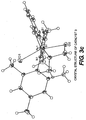
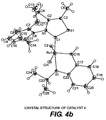
- FIGS. 4(a) and 4(b) The crystal structure of catalyst 4 is shown in FIGS. 4(a) and 4(b) , which is confirmed by the X-ray crystallography results, set forth in Table 4, below:
- the solution was concentrated to 2 mL in vacuo and poured onto a column packed with TSI Scientific silica gel.
- the complex was eluted with hexanes/diethyl ether (1/1) as a brown band. This was concentrated in vacuo, transferred in a glove box, dissolved in the minimum amount of benzene and lyophilized to afford the desired complex as a brown solid (66 mg, 0.11 mmol, 40% yield).
- the solid is stable in air in the solid state and soluble in CH 2 Cl 2 , CHCl 3 , benzene, toluene and THF. Crystals suitable for X-ray crystallography were grown at room temperature by slow diffusion of hexanes into a solution of 5 in toluene.
- the solvent was removed in vacuo, the remaining solid was dissolved in a minimum amount of C 6 H 6 , and poured onto a column packed with TSI Scientific silica gel.
- the complex was eluted with diethyl ether/pentanes (15/85) as a green band. This was concentrated in vacuo, transferred in a glove box, dissolved in the minimum amount of benzene and lyophilized to afford the desired complex as a brown solid (105 mg, 0.136 mmol, 30% yield).
- the solid is stable in air in the solid state and soluble in CH 2 Cl 2 , CHCl 3 , benzene, toluene and THF.
- the solvent was removed in vacuo, the remaining solid was dissolved in a minimum amount of C 6 H 6 , and poured onto a column packed with TSI Scientific silica gel.
- the complex was eluted with diethyl ether/pentanes (15/85) as a brown band. This was concentrated in vacuo, transferred in a glove box, dissolved in the minimum amount of benzene and lyophilized to afford the desired complex as a brown solid (72 mg, 0.091 mmol, 41% yield).
- the solid is stable in air in the solid state and soluble in CH 2 Cl 2 , CHCl 3 , benzene, toluene and THF.
- the catalysts of the invention are compared with conventional catalysts.
- the conventional catalysts are shown below: catalyst A (also referred to as a first-generation Grubbs catalyst); catalyst B (also referred to as a first-generation Hoveyda catalyst); catalyst C (also referred to as a second-generation Grubbs catalyst); and catalyst D (also referred to as a second-generation Hoveyda catalyst). 4 All reactions were performed at least in duplicate to conform reproducibility.
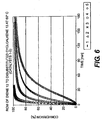
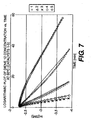
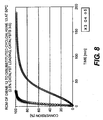
- FIGS. 5-8 show the results RCM of diethyldiallyl malonate (12) using catalysts 1-5
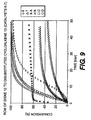
- FIG. 9 shows the results RCM of diethyldiallyl malonate (12) using catalysts 6-7.
- the conversion to 15 was determined by comparing the ratio of the integrals of the methylene protons in the starting material, ⁇ 2.91 (s), 2.88 (dt), with those in the product, ⁇ 3.15 (s), 3.05 (m) (These are the chemical shifts in C 6 D 6 . In CD 2 Cl 2 , the corresponding chemical shifts are: ⁇ 2.67 (s), 2.64 (dt) for the starting material, and ⁇ 2.93 (s), 2.88 (m) for the product).
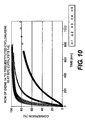
- FIG. 10 shows the results RCM of diethylallylmethallyl malonate (14) using catalysts 1-5
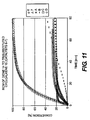
- FIG. 11 shows the results RCM of diethylallylmethallyl malonate (14) using catalysts 6-7.
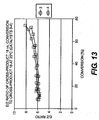
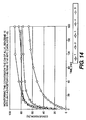
- FIGS. 12-15 show the results of catalyzing the CM of allyl benzene (16) with cis -1,4-diacetoxy-2-butene (17) using catalysts 3-5.
- catalysts 2 and 4 demonstrated about the same reactivity, while catalyst 3 was shown to be slightly more efficient, affording a higher yield of the desired cross-product.
- the catalysts also produce more Z-olefin upon increasing the bulkiness of the N -aryl substituents of the thiazole-2-ylidene ligand, as illustrated in FIG. 15 .
- the catalysts become more Z-selective with complex 5 being the most selective of all, affording an E / Z ratio that is smaller than 4 for up to 50% product yield.
- FIG. 16 shows the ROMP of 1,5-cyclooctadiene (19) using catalysts 1-5 at 30 °C.
- FIG. 17 shows the ROMP of 1,5-cyclooctadiene (19) using catalysts 6-7 at 60 °C.
- 14-membered lactone 21 (410 ⁇ L, 1.5 mmol) and tridecane (internal standard, 500 ⁇ L, 2.05 mmol) were combined in a flame-dried, 4 mL vial under an atmosphere of argon. The mixture was stirred before taking a to time point.
- the catalyst (1.5 ⁇ mol) and dry, degassed ClCH 2 CH 2 Cl (6mL) were added in a 20-mL vial in a glovebox. The vial was taken out of the glovebox and equilibrated at 50 °C for 5 minutes under argon, and the 14-membered lactone/tridecane mixture (18 ⁇ L) was then added via syringe. The reaction was allowed to stir at 50 °C.
- Samples for GC analysis were obtained by adding a 400- ⁇ L reaction aliquot to 100 ⁇ L of a 3M solution of ethyl vinyl ether in dichloromethane. The sample was shaken, allowed to stand for at least 5 minutes, and then analyzed via GC.
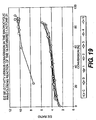
- catalysts 1-5 The catalytic activity of catalysts 1-5 in the macrocyclic ring-closing of the 14-membered lactone 21 was analyzed in FIGS. 18 and 19 .
- catalysts 2-4 were the most reactive catalysts in this family, showing reactivity comparable to that of conventional catalysts C and D.
- catalysts 1-5 display almost identical stereoselectivity in this reaction, producing macrocyclic product 22 with an E / Z ratio that begins at ⁇ 3 and finally reaches the value of ⁇ 6 at 85% conversion.
- the E / Z profile of catalysts 1-5 is different than that of catalysts C and D and more similar to the stereoselectivity displayed by catalyst A in the same reaction.
- An analysis of catalyst A may be found in Lee et al., Org. Lett., 2, 2145-2147 .
- the catalysts of this invention have been shown to efficiently catalyze a variety of metathesis reactions.
- the examples show the RCM reactions of diethyldiallyl malonate ( 12, FIGS. 5-9 ) and diethylallylmethallyl malonate ( 14, FIGS. 10-11 ); the CM reactions of allyl benzene (16) with cis -1,4-diacetoxy-2-butene (17) ( FIGS. 12-15 ); the ROMP of 1,5-cyclooctadiene (19) ( FIGS. 16-17 ); and the macrocyclic RCM of diene 21 ( FIGS. 18-19 ). More significantly, as illustrated by the linear logarithmic plot of diene concentration vs. time in the RCM reactions of 12 catalyzed by catalysts 3-5, at 1% catalyst loading, at 60 °C ( Figure 7 ), these RCM reactions follow pseudo-first order kinetics, namely catalysts 3-5 are unexpectedly stable.
Landscapes
- Chemical & Material Sciences (AREA)
- Organic Chemistry (AREA)
- Chemical Kinetics & Catalysis (AREA)
- Inorganic Chemistry (AREA)
- Engineering & Computer Science (AREA)
- Materials Engineering (AREA)
- Health & Medical Sciences (AREA)
- Medicinal Chemistry (AREA)
- Polymers & Plastics (AREA)
- Organic Low-Molecular-Weight Compounds And Preparation Thereof (AREA)
Claims (14)
- Eine Verbindung, welche die allgemeine Formel (I) aufweist.
 M gleich Ru oder Os ist,n gleich 0, 1 oder 2 ist;X1 und X2 unabhängig voneinander anionische Liganden sind,L irgendein neutraler 2-Elektronen-Donorligand ist,m gleich 1 oder 2 ist,R6 und R7 jeweils unabhängig voneinander Wasserstoff oder ein substituierter oder unsubstituierter Rest, ausgewählt aus der Gruppe bestehend aus C1-C20-Alkyl, C2-C20-Alkenyl, C2-C20-Alkinyl, Aryl, C1-C20-Carboxylat, C1-C20-Alkoxy, C2-C20-Alkenyloxy, C2-C20-Alkinyloxy, Aryloxy, C2-C20-Alkoxycarbonyl, C1-C20-Alkylthio, C1-C20-Alkylsulfonyl und C1-C20-Alkylsulfinyl, ist, undL1 ein Thiazol-2-yliden-Ligand nach Formel (II) ist:wobei
 R4 und R5 jeweils unabhängig voneinander H, ein substituierter oder unsubstituierter C1-C8-Alkylrest, ein substituiertes oder unsubstituiertes Aryl ist oder zusammen mit den Kohlenstoffen, die sie Tragen, einen substituierten oder unsubstituierten kondensierten 4- bis 8-gliedrigen carbocyclischen Ring oder einen substituierten oder unsubstituierten kondensierten aromatischen Ring bilden; undR1, R2 und R3 gemeinsam als Kombination (a) oder Kombination (b) definiert sind:(a) jedes R1 unabhängig ein primärer oder sekundärer C1-C4-Alkylrest ist, jedes R2 unabhängig H ist; und R3 unabhängig H, ein substituierter oder unsubstituierter C1-C8-Alkylrest, substituiertes oder unsubstituiertes Phenyl, substituiertes oder unsubstituiertes Naphthyl oder substituiertes oder unsubstituiertes Anthracenyl oder eine funktionelle Gruppe, ausgewählt aus der Gruppe bestehend aus Halo, Hydroxyl, Sulfhydryl, Cyano, Cyanato, Thiocyanato, Amino, Nitro, Nitroso, Sulfo, Sulfonato, Boryl, Borono, Phosphono, Phosphonato, Phosphinato, Phospho, Phosphino und Silyloxy ist; oder(b) jedes R1 gleich H ist, jedes R2 unabhängig H, ein substituierter oder unsubstituierter C1-C8-Alkylrest, ein substituiertes oder unsubstituiertes Phenyl, substituiertes oder unsubstituiertes Naphthyl oder substituiertes oder unsubstituiertes Anthracenyl ist; und R3 gleich H ist.
 - Die Verbindung gemäß Anspruch 1, wobei:i) R1, R2 und R3 in L1 durch die Kombination (a) definiert sind, wobei jedes R1 Methyl, Ethyl oder Isopropyl ist; und R3 gleich H, Isobutyl, tert-Butyl, Neopentyl, Neohexyl oder Phenyl ist, und
gegebenenfalls jedes R1 Methyl ist, und R3 gleich H ist;ii) R1, R2 und R3 in L1 durch die Kombination (b) definiert sind, wobei R2 ein sekundäres oder tertiäres C3-C10-Alkyl oder Aryl ist; und R3 gleich H, Isobutyl, tert-Butyl, Neopentyl, Neohexyl oder Phenyl ist; und
gegebenenfalls jedes R2 Isobutyl, tert-Butyl, Neopentyl, Neohexyl oder Phenyl ist; und R3 gleich H ist;iii) R4 und R5 unabhängig voneinander H oder C1-C4-Alkyl oder kondensiertes Cyclohexyl oder Phenyl sind,iv) X1 und X2 unabhängig voneinander ausgewählt sind aus der Gruppe bestehend aus Halogenid, C1-C20-Alkyl, Aryl, C1-C20-Alkoxid, Aryloxid, C3-C20-Alkyldiketonat, Aryldiketonat, C1-C20-Carboxylat, Arylsulfonat, C1-C20-Alkylsulfonat, C1-C20-Alkylthio, C1-C20-Alkylsulfonyl und C1-C20-Alkylsufinyl; und
X1 und X2 gegebenenfalls unabhängig voneinander ausgewählt sind aus der Gruppe bestehend aus Halogenid, Benzoat, C1-C5-Carboxylat, C1-C5-Alkyl, Phenoxy, C1-C5-Alkoxy, C1-C5-Alkylthio, Aryl und C1-C5-Alkylsulfonat; wobei X1 und X2 gegebenenfalls unabhängig voneinander ausgewählt sind aus der Gruppe bestehend aus Halogenid, CF3CO2, CH3CO2, CFH2CO2, (CH3)3CO, (CF3)2(CH3)CO, (CF3)(CH3)2CO, PhO, MeO, EtO, Tosylat, Mesylat und Trifluormethansulfonat; und wobei X1 und X2 gegebenenfalls beide Chlorid sind,v) R2 Wasserstoff, substituiertes oder unsubstituiertes C1-C5-Alkyl oder substituiertes oder unsubstituiertes Aryl ist; und R7 substituiertes oder unsubstituiertes C1-C20-Alkyl, substituiertes oder unsubstituiertes C2-C20-Alkenyl oder substituiertes oder unsubstituiertes Aryl ist; und
gegebenenfalls R6 Wasserstoff ist und R7 Phenyl oder Vinyl, gegebenenfalls substituiert mit einem oder mehreren Gruppen, ausgewählt aus der Gruppe bestehen aus C1-C5-Alkyl, C1-C5-Alkoxy, Phenyl, Chlorid, Bromid, Iodid, Fluorid, -NO2 und-NMe2 ist, ist und wobei R7 gegebenenfalls Phenyl oder-CH=C(CH3)2 ist;vi) m gleich 1 ist, n gleich 0 ist und L an R7 gebunden ist, um einen chelatbildenden Carbenliganden zu bilden; und
gegebenenfalls L an R7 über einen Spacer-Gruppe gebunden ist, wobei der Spacer-Gruppe ein substituierter oder unsubstituierter Alkylrest, ein substituierter oder unsubstituierter Cycoloalkylrest oder ein substituierter oder unsubstituierter Arylrest ist; oder
M gleich Ru ist und L und R7 verbunden sind, um einen Komplex zu bilden, der ausgewählt ist aus der Gruppe bestehend aus:

 vii) m gleich 2 ist und jeder Ligand L unabhängig ein Pyridin oder substituiertes Pyridin ist.
 - Die Verbindung gemäß Anspruch 1, wobei L ausgewählt ist aus der Gruppe bestehend aus Phosphin, sulfoniertem Phosphin, Phosphit, Phosphinit, Phosphonit, Arsin, Stibin, Ether, Amin, Amid, Imin, Sulfoxid, Carboxyl, Nitrosyl, Pyridin, Thioether und L1.
- Die Verbindung gemäß Anspruch 3, wobei L ein Phosphin der Formel PR'R"R"' ist, wobei R', R" und R"' jeweils unabhängig voneinander Aryl; C1-C10-Alkyl oder C3-C6-Cycloalkyl sind.
- Die Verbindung gemäß Anspruch 4, wobei L ausgewählt ist aus der Gruppe bestehend aus P(cyclohexyl)3, P(cyclopentyl)3, P(isopropyl)3 und P(phenyl)3.
- Die Verbindung gemäß Anspruch 1, welche die Formel aufweist:


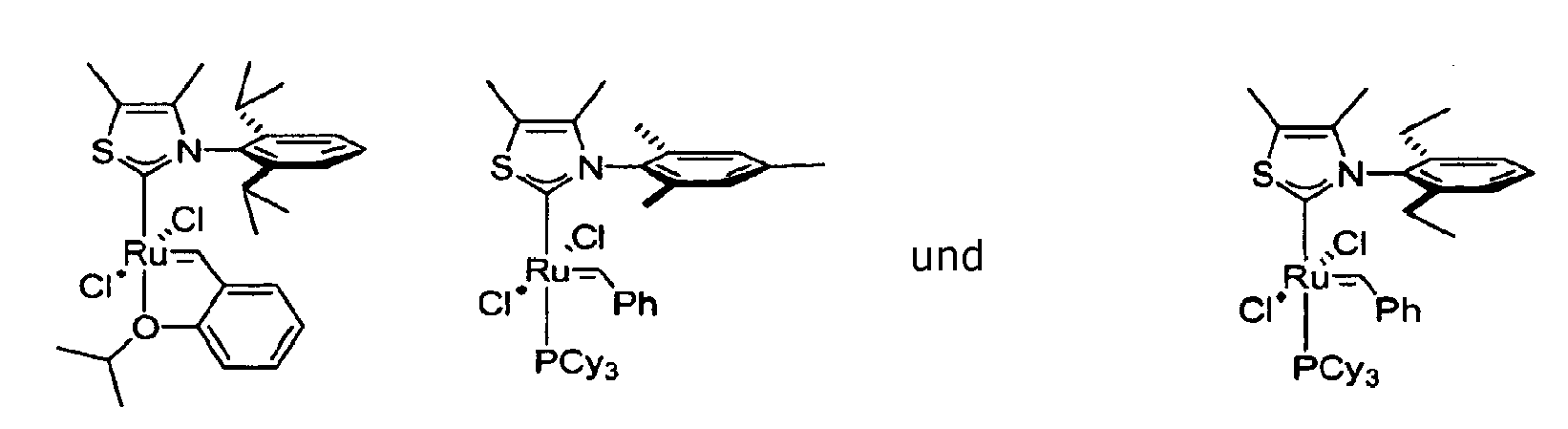
- Die Verbindung gemäß Anspruch 1, wobei die Verbindung ausgewählt ist aus der Gruppe bestehend aus:

- Ein Verfahren zur Herstellung eines vierfach substituierten cyclischen Olefins durch eine Ringschlussmetathese-Reaktion, umfassend in Kontakt bringen einer olefinischen Verbindung unter Metathese-Bedingungen mit einer Verbindung nach Anspruch 1, um ein cyclisches vierfach substituiertes Olefin zu bilden, wobei die olefinische Verbindung mindestens zwei End-Olefine aufweist, die an dem beta-Kohlenstoff des jeweiligen End-Olefins substituiert sind.
- Das Verfahren gemäß Anspruch 8, wobei die olefinische Verbindung eine Struktur gemäß der allgemeinen Formel (III) aufweist:
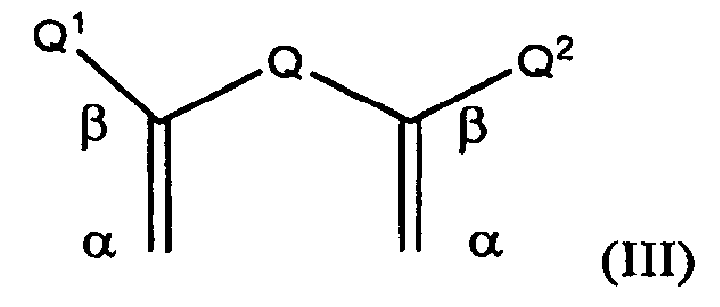 Q ausgewählt ist aus der Gruppe bestehend aus Hydrocarbylen, substituiertem Hydrocarbylen, Heteroatom enthaltendem Hydrocarbylen und substituiertem Heteroatom enthaltenden Hydrocarbylen;Q1 und Q2 jeweils unabhängig ausgewählt sind aus der Gruppe bestehend aus Wasserstoff, Hydrocarbyl, substituiertem Hydrocarbyl, Heteroatom enthaltendem Hydrocarbyl, substituiertem Heteroatom enthaltenden Hydrocarbyl, Halogenid, Hydroxyl, Sulfhydryl, Cyano Cyanato, Thiocyanato, Amino, Nitro, Nitroso, Sulfo, Sulfonato, Boryl, Borono, Phosphono, Phosphonato, Phosphinato, Phospho, Phosphino und Silyloxy;mit der Maßgabe, dass Q1 und Q2 nicht beide Wasserstoff sein können,
wobei gegebenenfalls weder Q1 noch Q2 Wasserstoff sind. - Ein Verfahren zur Herstellung eines dreifach substituierten Olefins oder eines zweifach substituierten Olefins, welches ferner am allylischen Kohlenstoff durch eine Kreuzmetathese-Reaktion substituiert ist, umfassend in Kontakt bringen von zwei Olefinen unter Metathese-Bedingungen mit einer Verbindung nach Anspruch 1, um ein dreifach substituiertes Olefin zu bilden, wobei das erste Olefin einfachsubstituiert am β-Kohlenstoff ist und entweder unsubstituiert oder einfachsubstituiert an dem ∝-Kohlenstoff ist und das zweite Olefin entweder zweifachsubstituiert am β-Kohlenstoff oder einfachsubstituiert an dem β-Kohlenstoff mit einer weiteren Substitution an dem allylischen Kohlenstoff und entweder einfachsubstituiert oder unsubstituiert am ∝-Kohlenstoff ist.
- Das Verfahren von Anspruch 10, wobei;i) das dreifach substituierte Olefin die Formel Q1Q2C=CHQ3 aufweist, wobei Q1, Q2 und Q3 unabhängig voneinander ausgewählt sind aus der Gruppe bestehende aus Hydrocarbyl, substituiertem Hydrocarbyl, Heteroatom enthaltendem Hydrocarbyl, substituiertem Heteroatom enthaltenden Hydrocarbyl, Halogenid, Hydroxyl, Sulfhydryl, Cyano, Cyanato, Thiocyanato, Amino, Nitro, Nitroso, Sulfo, Sulfonato, Boryl, Borono, Phosphono, Phosphonato, Phosphinato, Phospho, Phosphino und Silyloxy, wobei Q1, Q2 und/oder Q3 als ein Teil eines cyclischen Olefins verbunden sein können;ii) das zweifach substituierte Olefin die Formel Q1Q2C=CH2 oder Q1HC=CHQ2 aufweist, wobei Q1 und Q2 unabhängig voneinander ausgewählt sind aus der Gruppe bestehend aus Hydrocarbyl, substituiertem Hydrocarbyl, Heteroatom enthaltendem Hydrocarbyl, substituiertem Heteroatom enthaltenden Hydrocarbyl, Halogenid, Hydroxyl, Sulfhydryl, Cyano, Cyanato, Thiocyanato, Amino, Nitro, Nitroso, Sulfo, Sulfonato, Boryl, Borono, Phosphono, Phosphonato, Phosphinato, Phospho, Phosphino und Silyloxy, wobei Q1 und Q2 als Teil eines cyclischen Olefins verbunden sein können; oderiii) das zweifach substituierte Olefin, das eine weitere Substitution an dem allycyclischen Kohlenstoff aufweist, die Formel Q1HC=CHCQ2Q3Q4 aufweist, wobei Q1, Q2, Q3 und Q4 unabhängig voneinander ausgewählt sind aus der Gruppe bestehend aus Hydrocarbyl, substituiertem Hydrocarbyl, Heteroatom enthaltendem Hydrocarbyl, substituiertem Heteroatom enthaltenden Hydrocarbyl, Halogenid, Hydroxyl, Sulfhydryl, Cyano, Cyanato, Thiocyanato, Amino, Nitro, Nitroso, Sulfo, Sulfonato, Boryl, Borono, Phosphono, Phosphonato, Phosphinato, Phospho, Phosphino und Silyloxy, wobei Q1, Q2, Q3 und/oder Q4 als Teil eines cyclischen Olefins verbunden sein können.
- Ein Verfahren zum Synthetisieren eines Polymers unter Verwenden einer Ringöffnungsmetathese-Polymerisationsreaktion, umfassend in Kontakt bringen eines cyclischen Olefins mit einer Verbindung nach Anspruch 1.
- Ein Verfahren zum Synthetisieren eines cyclischen Olefins durch Ringschlussmetathese, umfassend in Kontakt bringen eines acyclischen Diens in Gegenwart einer Verbindung nach Anspruch 1, um ein cyclisches Olefin zu ergeben.
- Das Verfahren gemäß Anspruch 13, wobei das cyclische Olefin ein makrocyclisches Olefin ist.
Applications Claiming Priority (4)
| Application Number | Priority Date | Filing Date | Title |
|---|---|---|---|
| US86044306P | 2006-11-21 | 2006-11-21 | |
| US90162107P | 2007-02-13 | 2007-02-13 | |
| US89672607P | 2007-03-23 | 2007-03-23 | |
| PCT/US2007/085239 WO2008064223A1 (en) | 2006-11-21 | 2007-11-20 | Olefin metathesis initiators bearing thiazol-2-ylidene ligands |
Publications (3)
| Publication Number | Publication Date |
|---|---|
| EP2104566A1 EP2104566A1 (de) | 2009-09-30 |
| EP2104566A4 EP2104566A4 (de) | 2011-04-20 |
| EP2104566B1 true EP2104566B1 (de) | 2016-01-27 |
Family
ID=39430062
Family Applications (1)
| Application Number | Title | Priority Date | Filing Date |
|---|---|---|---|
| EP07854716.3A Ceased EP2104566B1 (de) | 2006-11-21 | 2007-11-20 | Olefinmetathese-initiatoren mit thiazol-2-yliden-liganden |
Country Status (4)
| Country | Link |
|---|---|
| US (1) | US8039566B2 (de) |
| EP (1) | EP2104566B1 (de) |
| CN (1) | CN101594937B (de) |
| WO (1) | WO2008064223A1 (de) |
Families Citing this family (8)
| Publication number | Priority date | Publication date | Assignee | Title |
|---|---|---|---|---|
| EP2533899A4 (de) * | 2010-02-12 | 2013-08-07 | Exxonmobil Chem Patents Inc | Metathesekatalysator und verfahren zu siner verwendung |
| EP2838359A4 (de) | 2012-03-05 | 2015-12-09 | California Inst Of Techn | Synthese von z-olefin-haltigen pheromonen von lepidoptera-insekten |
| BR112015013580A2 (pt) * | 2012-12-12 | 2017-07-11 | California Inst Of Techn | catalisador de metátese z-seletiva |
| WO2014133115A1 (ja) * | 2013-02-28 | 2014-09-04 | 住友化学株式会社 | チアゾリウム塩およびその製造方法 |
| CN104437642B (zh) * | 2013-09-16 | 2017-11-07 | 中国石油化工股份有限公司 | 一种用于烯烃复分解反应的催化剂及其制备方法 |
| PL3353187T3 (pl) * | 2015-09-24 | 2021-11-22 | Umicore Ag & Co. Kg | Katalizatory metatezy olefin na bazie karbenu metalu |
| PL3865495T3 (pl) * | 2016-11-09 | 2025-01-27 | Verbio Vereinigte Bioenergie Ag | Kompleksy rutenu przydatne do katalizowania reakcji metatezy |
| US10995049B2 (en) | 2019-07-19 | 2021-05-04 | California Institute Of Technology | Total synthesis of prostaglandin J natural products and their intermediates |
Family Cites Families (6)
| Publication number | Priority date | Publication date | Assignee | Title |
|---|---|---|---|---|
| WO1999060030A1 (en) * | 1998-05-19 | 1999-11-25 | Materia, Inc. | Polyolefin compositions having variable toughness and/or hardness |
| JP2002536467A (ja) * | 1999-02-05 | 2002-10-29 | マテリア インコーポレイテッド | 様々な密度を有するポリオレフィン組成物ならびに該組成物の製造方法および使用方法 |
| DE60327378D1 (de) * | 2002-01-22 | 2009-06-04 | Telene S A S | Metallkomplexe für die Metathese, Atomtransferradikalreaktionen. Additionspolymerisation und Vinylationreaktionen, Verfahren und Zwischenprodukte für deren Herstellung. |
| JP2005517774A (ja) * | 2002-02-19 | 2005-06-16 | カリフォルニア インスティテュート オブ テクノロジー | 非環式ジエンを用いるオレフィンメタセシス反応による、環式オレフィンの環拡大 |
| CN1659172B (zh) * | 2002-04-05 | 2012-08-01 | 加州理工学院 | 直接被吸电子基团取代的烯烃使用过渡金属卡宾催化剂的交叉-易位 |
| MXPA06011302A (es) * | 2004-03-29 | 2007-01-16 | Materia Inc | Catalizadores de metatesis de olefinas de alta actividad, latentes que contienen un ligando de carbeno n-heterociclico. |
-
2007
- 2007-11-20 EP EP07854716.3A patent/EP2104566B1/de not_active Ceased
- 2007-11-20 WO PCT/US2007/085239 patent/WO2008064223A1/en not_active Ceased
- 2007-11-20 CN CN200780050108.XA patent/CN101594937B/zh not_active Expired - Fee Related
- 2007-11-20 US US12/515,702 patent/US8039566B2/en active Active
Also Published As
| Publication number | Publication date |
|---|---|
| US8039566B2 (en) | 2011-10-18 |
| EP2104566A4 (de) | 2011-04-20 |
| EP2104566A1 (de) | 2009-09-30 |
| WO2008064223A1 (en) | 2008-05-29 |
| CN101594937A (zh) | 2009-12-02 |
| US20100144987A1 (en) | 2010-06-10 |
| CN101594937B (zh) | 2014-04-30 |
Similar Documents
| Publication | Publication Date | Title |
|---|---|---|
| EP2104566B1 (de) | Olefinmetathese-initiatoren mit thiazol-2-yliden-liganden | |
| US8877936B2 (en) | Ruthenium olefin metathesis catalysts bearing N-heterocyclic carbene ligands with substituted backbone | |
| US6153778A (en) | Synthesis of ruthenium or osmium metathesis catalysts | |
| EP2116302B1 (de) | Katalysatorkomplex mit einem heterozyklischen Carbenliganden | |
| RU2674471C2 (ru) | Катализаторы на основе переходного металла 8 группы, способ их получения и способ их применения в реакции метатезиса | |
| RU2644556C2 (ru) | Каталитические комплексы с карбеновым лигандом, способ их получения и применение в реакции метатезиса | |
| Denmark et al. | Solution and Solid‐State Studies of a Chiral Zinc–Sulfonamide Complex Relevant to Enantioselective Cyclopropanations | |
| JP5931046B2 (ja) | オレフィンメタセシスで使用するためのルテニウム錯体 | |
| Boeda et al. | Ruthenium–indenylidene complexes: powerful tools for metathesis transformations | |
| CN104220418B (zh) | 钌基复分解催化剂以及用于其制备的前体 | |
| JP5522941B2 (ja) | 有機金属ルテニウム錯体および関連する四置換および別の嵩高いオレフィンの製造方法 | |
| WO2014093687A1 (en) | Z-selective metathesis catalysts | |
| US20180065914A1 (en) | Ruthenium polymerisation catalysts | |
| Endo et al. | Cationic ruthenium alkylidene catalysts bearing phosphine ligands | |
| RU2835693C1 (ru) | Способ получения рутениевого катализатора метатезисной полимеризации | |
| KR20010080598A (ko) | 루테늄 착물의 제조 방법 | |
| Axtell | Synthesis and reactivity of high oxidation state tungsten and molybdenum olefin metathesis catalysts bearing new imido ligands |
Legal Events
| Date | Code | Title | Description |
|---|---|---|---|
| PUAI | Public reference made under article 153(3) epc to a published international application that has entered the european phase |
Free format text: ORIGINAL CODE: 0009012 |
|
| 17P | Request for examination filed |
Effective date: 20090619 |
|
| AK | Designated contracting states |
Kind code of ref document: A1 Designated state(s): AT BE BG CH CY CZ DE DK EE ES FI FR GB GR HU IE IS IT LI LT LU LV MC MT NL PL PT RO SE SI SK TR |
|
| DAX | Request for extension of the european patent (deleted) | ||
| RIN1 | Information on inventor provided before grant (corrected) |
Inventor name: VOUGIOUKALAKIS, GEORGIOS C. Inventor name: GRUBBS, ROBERT H. |
|
| A4 | Supplementary search report drawn up and despatched |
Effective date: 20110323 |
|
| GRAP | Despatch of communication of intention to grant a patent |
Free format text: ORIGINAL CODE: EPIDOSNIGR1 |
|
| INTG | Intention to grant announced |
Effective date: 20130405 |
|
| GRAP | Despatch of communication of intention to grant a patent |
Free format text: ORIGINAL CODE: EPIDOSNIGR1 |
|
| GRAJ | Information related to disapproval of communication of intention to grant by the applicant or resumption of examination proceedings by the epo deleted |
Free format text: ORIGINAL CODE: EPIDOSDIGR1 |
|
| GRAP | Despatch of communication of intention to grant a patent |
Free format text: ORIGINAL CODE: EPIDOSNIGR1 |
|
| INTG | Intention to grant announced |
Effective date: 20140613 |
|
| INTG | Intention to grant announced |
Effective date: 20140625 |
|
| 17Q | First examination report despatched |
Effective date: 20150128 |
|
| GRAP | Despatch of communication of intention to grant a patent |
Free format text: ORIGINAL CODE: EPIDOSNIGR1 |
|
| INTG | Intention to grant announced |
Effective date: 20150702 |
|
| GRAS | Grant fee paid |
Free format text: ORIGINAL CODE: EPIDOSNIGR3 |
|
| GRAA | (expected) grant |
Free format text: ORIGINAL CODE: 0009210 |
|
| AK | Designated contracting states |
Kind code of ref document: B1 Designated state(s): AT BE BG CH CY CZ DE DK EE ES FI FR GB GR HU IE IS IT LI LT LU LV MC MT NL PL PT RO SE SI SK TR |
|
| REG | Reference to a national code |
Ref country code: GB Ref legal event code: FG4D |
|
| REG | Reference to a national code |
Ref country code: CH Ref legal event code: EP |
|
| REG | Reference to a national code |
Ref country code: AT Ref legal event code: REF Ref document number: 772433 Country of ref document: AT Kind code of ref document: T Effective date: 20160215 |
|
| REG | Reference to a national code |
Ref country code: IE Ref legal event code: FG4D |
|
| REG | Reference to a national code |
Ref country code: DE Ref legal event code: R096 Ref document number: 602007044728 Country of ref document: DE |
|
| REG | Reference to a national code |
Ref country code: NL Ref legal event code: FP |
|
| REG | Reference to a national code |
Ref country code: LT Ref legal event code: MG4D |
|
| REG | Reference to a national code |
Ref country code: AT Ref legal event code: MK05 Ref document number: 772433 Country of ref document: AT Kind code of ref document: T Effective date: 20160127 |
|
| PG25 | Lapsed in a contracting state [announced via postgrant information from national office to epo] |
Ref country code: GR Free format text: LAPSE BECAUSE OF FAILURE TO SUBMIT A TRANSLATION OF THE DESCRIPTION OR TO PAY THE FEE WITHIN THE PRESCRIBED TIME-LIMIT Effective date: 20160428 Ref country code: IT Free format text: LAPSE BECAUSE OF FAILURE TO SUBMIT A TRANSLATION OF THE DESCRIPTION OR TO PAY THE FEE WITHIN THE PRESCRIBED TIME-LIMIT Effective date: 20160127 Ref country code: ES Free format text: LAPSE BECAUSE OF FAILURE TO SUBMIT A TRANSLATION OF THE DESCRIPTION OR TO PAY THE FEE WITHIN THE PRESCRIBED TIME-LIMIT Effective date: 20160127 Ref country code: FI Free format text: LAPSE BECAUSE OF FAILURE TO SUBMIT A TRANSLATION OF THE DESCRIPTION OR TO PAY THE FEE WITHIN THE PRESCRIBED TIME-LIMIT Effective date: 20160127 |
|
| PG25 | Lapsed in a contracting state [announced via postgrant information from national office to epo] |
Ref country code: PT Free format text: LAPSE BECAUSE OF FAILURE TO SUBMIT A TRANSLATION OF THE DESCRIPTION OR TO PAY THE FEE WITHIN THE PRESCRIBED TIME-LIMIT Effective date: 20160527 Ref country code: SE Free format text: LAPSE BECAUSE OF FAILURE TO SUBMIT A TRANSLATION OF THE DESCRIPTION OR TO PAY THE FEE WITHIN THE PRESCRIBED TIME-LIMIT Effective date: 20160127 Ref country code: LV Free format text: LAPSE BECAUSE OF FAILURE TO SUBMIT A TRANSLATION OF THE DESCRIPTION OR TO PAY THE FEE WITHIN THE PRESCRIBED TIME-LIMIT Effective date: 20160127 Ref country code: PL Free format text: LAPSE BECAUSE OF FAILURE TO SUBMIT A TRANSLATION OF THE DESCRIPTION OR TO PAY THE FEE WITHIN THE PRESCRIBED TIME-LIMIT Effective date: 20160127 Ref country code: AT Free format text: LAPSE BECAUSE OF FAILURE TO SUBMIT A TRANSLATION OF THE DESCRIPTION OR TO PAY THE FEE WITHIN THE PRESCRIBED TIME-LIMIT Effective date: 20160127 Ref country code: LT Free format text: LAPSE BECAUSE OF FAILURE TO SUBMIT A TRANSLATION OF THE DESCRIPTION OR TO PAY THE FEE WITHIN THE PRESCRIBED TIME-LIMIT Effective date: 20160127 Ref country code: IS Free format text: LAPSE BECAUSE OF FAILURE TO SUBMIT A TRANSLATION OF THE DESCRIPTION OR TO PAY THE FEE WITHIN THE PRESCRIBED TIME-LIMIT Effective date: 20160527 |
|
| REG | Reference to a national code |
Ref country code: DE Ref legal event code: R097 Ref document number: 602007044728 Country of ref document: DE |
|
| PG25 | Lapsed in a contracting state [announced via postgrant information from national office to epo] |
Ref country code: EE Free format text: LAPSE BECAUSE OF FAILURE TO SUBMIT A TRANSLATION OF THE DESCRIPTION OR TO PAY THE FEE WITHIN THE PRESCRIBED TIME-LIMIT Effective date: 20160127 Ref country code: DK Free format text: LAPSE BECAUSE OF FAILURE TO SUBMIT A TRANSLATION OF THE DESCRIPTION OR TO PAY THE FEE WITHIN THE PRESCRIBED TIME-LIMIT Effective date: 20160127 |
|
| REG | Reference to a national code |
Ref country code: FR Ref legal event code: PLFP Year of fee payment: 10 |
|
| PG25 | Lapsed in a contracting state [announced via postgrant information from national office to epo] |
Ref country code: SK Free format text: LAPSE BECAUSE OF FAILURE TO SUBMIT A TRANSLATION OF THE DESCRIPTION OR TO PAY THE FEE WITHIN THE PRESCRIBED TIME-LIMIT Effective date: 20160127 Ref country code: CZ Free format text: LAPSE BECAUSE OF FAILURE TO SUBMIT A TRANSLATION OF THE DESCRIPTION OR TO PAY THE FEE WITHIN THE PRESCRIBED TIME-LIMIT Effective date: 20160127 Ref country code: RO Free format text: LAPSE BECAUSE OF FAILURE TO SUBMIT A TRANSLATION OF THE DESCRIPTION OR TO PAY THE FEE WITHIN THE PRESCRIBED TIME-LIMIT Effective date: 20160127 |
|
| PLBE | No opposition filed within time limit |
Free format text: ORIGINAL CODE: 0009261 |
|
| STAA | Information on the status of an ep patent application or granted ep patent |
Free format text: STATUS: NO OPPOSITION FILED WITHIN TIME LIMIT |
|
| PG25 | Lapsed in a contracting state [announced via postgrant information from national office to epo] |
Ref country code: BE Free format text: LAPSE BECAUSE OF FAILURE TO SUBMIT A TRANSLATION OF THE DESCRIPTION OR TO PAY THE FEE WITHIN THE PRESCRIBED TIME-LIMIT Effective date: 20160127 |
|
| 26N | No opposition filed |
Effective date: 20161028 |
|
| PG25 | Lapsed in a contracting state [announced via postgrant information from national office to epo] |
Ref country code: SI Free format text: LAPSE BECAUSE OF FAILURE TO SUBMIT A TRANSLATION OF THE DESCRIPTION OR TO PAY THE FEE WITHIN THE PRESCRIBED TIME-LIMIT Effective date: 20160127 Ref country code: BG Free format text: LAPSE BECAUSE OF FAILURE TO SUBMIT A TRANSLATION OF THE DESCRIPTION OR TO PAY THE FEE WITHIN THE PRESCRIBED TIME-LIMIT Effective date: 20160427 |
|
| PG25 | Lapsed in a contracting state [announced via postgrant information from national office to epo] |
Ref country code: LU Free format text: LAPSE BECAUSE OF NON-PAYMENT OF DUE FEES Effective date: 20161130 |
|
| REG | Reference to a national code |
Ref country code: FR Ref legal event code: PLFP Year of fee payment: 11 |
|
| PG25 | Lapsed in a contracting state [announced via postgrant information from national office to epo] |
Ref country code: CY Free format text: LAPSE BECAUSE OF FAILURE TO SUBMIT A TRANSLATION OF THE DESCRIPTION OR TO PAY THE FEE WITHIN THE PRESCRIBED TIME-LIMIT Effective date: 20160127 Ref country code: HU Free format text: LAPSE BECAUSE OF FAILURE TO SUBMIT A TRANSLATION OF THE DESCRIPTION OR TO PAY THE FEE WITHIN THE PRESCRIBED TIME-LIMIT; INVALID AB INITIO Effective date: 20071120 |
|
| PG25 | Lapsed in a contracting state [announced via postgrant information from national office to epo] |
Ref country code: TR Free format text: LAPSE BECAUSE OF FAILURE TO SUBMIT A TRANSLATION OF THE DESCRIPTION OR TO PAY THE FEE WITHIN THE PRESCRIBED TIME-LIMIT Effective date: 20160127 Ref country code: MC Free format text: LAPSE BECAUSE OF FAILURE TO SUBMIT A TRANSLATION OF THE DESCRIPTION OR TO PAY THE FEE WITHIN THE PRESCRIBED TIME-LIMIT Effective date: 20160127 |
|
| PG25 | Lapsed in a contracting state [announced via postgrant information from national office to epo] |
Ref country code: MT Free format text: LAPSE BECAUSE OF NON-PAYMENT OF DUE FEES Effective date: 20161120 |
|
| REG | Reference to a national code |
Ref country code: DE Ref legal event code: R082 Ref document number: 602007044728 Country of ref document: DE |
|
| PGFP | Annual fee paid to national office [announced via postgrant information from national office to epo] |
Ref country code: NL Payment date: 20210928 Year of fee payment: 15 |
|
| PGFP | Annual fee paid to national office [announced via postgrant information from national office to epo] |
Ref country code: GB Payment date: 20210930 Year of fee payment: 15 |
|
| PGFP | Annual fee paid to national office [announced via postgrant information from national office to epo] |
Ref country code: IE Payment date: 20211012 Year of fee payment: 15 Ref country code: FR Payment date: 20211109 Year of fee payment: 15 Ref country code: DE Payment date: 20210929 Year of fee payment: 15 |
|
| PGFP | Annual fee paid to national office [announced via postgrant information from national office to epo] |
Ref country code: CH Payment date: 20211014 Year of fee payment: 15 |
|
| REG | Reference to a national code |
Ref country code: DE Ref legal event code: R119 Ref document number: 602007044728 Country of ref document: DE |
|
| REG | Reference to a national code |
Ref country code: CH Ref legal event code: PL |
|
| REG | Reference to a national code |
Ref country code: NL Ref legal event code: MM Effective date: 20221201 |
|
| GBPC | Gb: european patent ceased through non-payment of renewal fee |
Effective date: 20221120 |
|
| PG25 | Lapsed in a contracting state [announced via postgrant information from national office to epo] |
Ref country code: LI Free format text: LAPSE BECAUSE OF NON-PAYMENT OF DUE FEES Effective date: 20221130 Ref country code: CH Free format text: LAPSE BECAUSE OF NON-PAYMENT OF DUE FEES Effective date: 20221130 |
|
| PG25 | Lapsed in a contracting state [announced via postgrant information from national office to epo] |
Ref country code: NL Free format text: LAPSE BECAUSE OF NON-PAYMENT OF DUE FEES Effective date: 20221201 |
|
| PG25 | Lapsed in a contracting state [announced via postgrant information from national office to epo] |
Ref country code: IE Free format text: LAPSE BECAUSE OF NON-PAYMENT OF DUE FEES Effective date: 20221120 Ref country code: GB Free format text: LAPSE BECAUSE OF NON-PAYMENT OF DUE FEES Effective date: 20221120 Ref country code: DE Free format text: LAPSE BECAUSE OF NON-PAYMENT OF DUE FEES Effective date: 20230601 |
|
| PG25 | Lapsed in a contracting state [announced via postgrant information from national office to epo] |
Ref country code: FR Free format text: LAPSE BECAUSE OF NON-PAYMENT OF DUE FEES Effective date: 20221130 |