EP2097367B1 - Verfahren zur herstellung von fettsäurealkylestern und acrolein aus triglyceriden - Google Patents
Verfahren zur herstellung von fettsäurealkylestern und acrolein aus triglyceriden Download PDFInfo
- Publication number
- EP2097367B1 EP2097367B1 EP07822023A EP07822023A EP2097367B1 EP 2097367 B1 EP2097367 B1 EP 2097367B1 EP 07822023 A EP07822023 A EP 07822023A EP 07822023 A EP07822023 A EP 07822023A EP 2097367 B1 EP2097367 B1 EP 2097367B1
- Authority
- EP
- European Patent Office
- Prior art keywords
- reaction
- acrolein
- catalyst
- process according
- glycerol
- Prior art date
- Legal status (The legal status is an assumption and is not a legal conclusion. Google has not performed a legal analysis and makes no representation as to the accuracy of the status listed.)
- Not-in-force
Links
- HGINCPLSRVDWNT-UHFFFAOYSA-N Acrolein Chemical compound C=CC=O HGINCPLSRVDWNT-UHFFFAOYSA-N 0.000 title claims abstract description 164
- 235000014113 dietary fatty acids Nutrition 0.000 title claims abstract description 49
- 239000000194 fatty acid Substances 0.000 title claims abstract description 49
- 229930195729 fatty acid Natural products 0.000 title claims abstract description 49
- 150000003626 triacylglycerols Chemical class 0.000 title claims description 29
- 238000004519 manufacturing process Methods 0.000 title claims description 21
- 150000004665 fatty acids Chemical class 0.000 title description 2
- 125000005907 alkyl ester group Chemical group 0.000 title 1
- PEDCQBHIVMGVHV-UHFFFAOYSA-N Glycerine Chemical compound OCC(O)CO PEDCQBHIVMGVHV-UHFFFAOYSA-N 0.000 claims abstract description 216
- 239000003054 catalyst Substances 0.000 claims abstract description 71
- LFQSCWFLJHTTHZ-UHFFFAOYSA-N Ethanol Chemical compound CCO LFQSCWFLJHTTHZ-UHFFFAOYSA-N 0.000 claims abstract description 19
- UFTFJSFQGQCHQW-UHFFFAOYSA-N triformin Chemical compound O=COCC(OC=O)COC=O UFTFJSFQGQCHQW-UHFFFAOYSA-N 0.000 claims abstract description 10
- 238000006243 chemical reaction Methods 0.000 claims description 82
- 238000000034 method Methods 0.000 claims description 55
- 230000008569 process Effects 0.000 claims description 46
- 239000012071 phase Substances 0.000 claims description 45
- 238000006297 dehydration reaction Methods 0.000 claims description 34
- 238000005809 transesterification reaction Methods 0.000 claims description 27
- 230000002378 acidificating effect Effects 0.000 claims description 25
- 239000000203 mixture Substances 0.000 claims description 22
- 239000011541 reaction mixture Substances 0.000 claims description 22
- XLYOFNOQVPJJNP-UHFFFAOYSA-N water Substances O XLYOFNOQVPJJNP-UHFFFAOYSA-N 0.000 claims description 21
- PNEYBMLMFCGWSK-UHFFFAOYSA-N Alumina Chemical compound [O-2].[O-2].[O-2].[Al+3].[Al+3] PNEYBMLMFCGWSK-UHFFFAOYSA-N 0.000 claims description 20
- NBIIXXVUZAFLBC-UHFFFAOYSA-N Phosphoric acid Chemical compound OP(O)(O)=O NBIIXXVUZAFLBC-UHFFFAOYSA-N 0.000 claims description 18
- QAOWNCQODCNURD-UHFFFAOYSA-N Sulfuric acid Chemical compound OS(O)(=O)=O QAOWNCQODCNURD-UHFFFAOYSA-N 0.000 claims description 18
- 238000005191 phase separation Methods 0.000 claims description 18
- 239000002904 solvent Substances 0.000 claims description 18
- 239000012528 membrane Substances 0.000 claims description 16
- 238000004821 distillation Methods 0.000 claims description 15
- 239000002253 acid Substances 0.000 claims description 14
- 239000010457 zeolite Substances 0.000 claims description 13
- VYPSYNLAJGMNEJ-UHFFFAOYSA-N Silicium dioxide Chemical compound O=[Si]=O VYPSYNLAJGMNEJ-UHFFFAOYSA-N 0.000 claims description 12
- YXFVVABEGXRONW-UHFFFAOYSA-N Toluene Chemical compound CC1=CC=CC=C1 YXFVVABEGXRONW-UHFFFAOYSA-N 0.000 claims description 12
- 108090000790 Enzymes Proteins 0.000 claims description 10
- 102000004190 Enzymes Human genes 0.000 claims description 10
- GWEVSGVZZGPLCZ-UHFFFAOYSA-N Titan oxide Chemical compound O=[Ti]=O GWEVSGVZZGPLCZ-UHFFFAOYSA-N 0.000 claims description 10
- 239000011942 biocatalyst Substances 0.000 claims description 10
- 239000002638 heterogeneous catalyst Substances 0.000 claims description 10
- 229920005989 resin Polymers 0.000 claims description 10
- 239000011347 resin Substances 0.000 claims description 10
- 238000000926 separation method Methods 0.000 claims description 10
- 239000000126 substance Substances 0.000 claims description 9
- BZLVMXJERCGZMT-UHFFFAOYSA-N Methyl tert-butyl ether Chemical compound COC(C)(C)C BZLVMXJERCGZMT-UHFFFAOYSA-N 0.000 claims description 8
- WYURNTSHIVDZCO-UHFFFAOYSA-N Tetrahydrofuran Chemical compound C1CCOC1 WYURNTSHIVDZCO-UHFFFAOYSA-N 0.000 claims description 8
- 229910000147 aluminium phosphate Inorganic materials 0.000 claims description 8
- 150000007522 mineralic acids Chemical class 0.000 claims description 8
- NUMQCACRALPSHD-UHFFFAOYSA-N tert-butyl ethyl ether Chemical compound CCOC(C)(C)C NUMQCACRALPSHD-UHFFFAOYSA-N 0.000 claims description 8
- 150000007513 acids Chemical class 0.000 claims description 7
- -1 alkali metal alkoxides Chemical class 0.000 claims description 7
- 150000003839 salts Chemical class 0.000 claims description 7
- 108090000604 Hydrolases Proteins 0.000 claims description 6
- 102000004157 Hydrolases Human genes 0.000 claims description 6
- AFVFQIVMOAPDHO-UHFFFAOYSA-N Methanesulfonic acid Chemical compound CS(O)(=O)=O AFVFQIVMOAPDHO-UHFFFAOYSA-N 0.000 claims description 6
- 229920000557 Nafion® Polymers 0.000 claims description 6
- 150000001298 alcohols Chemical class 0.000 claims description 6
- FLJPGEWQYJVDPF-UHFFFAOYSA-L caesium sulfate Chemical compound [Cs+].[Cs+].[O-]S([O-])(=O)=O FLJPGEWQYJVDPF-UHFFFAOYSA-L 0.000 claims description 6
- HNPSIPDUKPIQMN-UHFFFAOYSA-N dioxosilane;oxo(oxoalumanyloxy)alumane Chemical compound O=[Si]=O.O=[Al]O[Al]=O HNPSIPDUKPIQMN-UHFFFAOYSA-N 0.000 claims description 6
- 239000002815 homogeneous catalyst Substances 0.000 claims description 6
- 239000011973 solid acid Substances 0.000 claims description 6
- 239000001117 sulphuric acid Substances 0.000 claims description 6
- MCMNRKCIXSYSNV-UHFFFAOYSA-N ZrO2 Inorganic materials O=[Zr]=O MCMNRKCIXSYSNV-UHFFFAOYSA-N 0.000 claims description 5
- 229910052783 alkali metal Inorganic materials 0.000 claims description 5
- 238000000605 extraction Methods 0.000 claims description 5
- RVTZCBVAJQQJTK-UHFFFAOYSA-N oxygen(2-);zirconium(4+) Chemical compound [O-2].[O-2].[Zr+4] RVTZCBVAJQQJTK-UHFFFAOYSA-N 0.000 claims description 5
- 229910052939 potassium sulfate Inorganic materials 0.000 claims description 5
- 238000000066 reactive distillation Methods 0.000 claims description 5
- 239000000377 silicon dioxide Substances 0.000 claims description 5
- 235000012239 silicon dioxide Nutrition 0.000 claims description 5
- RYHBNJHYFVUHQT-UHFFFAOYSA-N 1,4-Dioxane Chemical compound C1COCCO1 RYHBNJHYFVUHQT-UHFFFAOYSA-N 0.000 claims description 4
- LBLYYCQCTBFVLH-UHFFFAOYSA-N 2-Methylbenzenesulfonic acid Chemical compound CC1=CC=CC=C1S(O)(=O)=O LBLYYCQCTBFVLH-UHFFFAOYSA-N 0.000 claims description 4
- 108090000371 Esterases Proteins 0.000 claims description 4
- 108090001060 Lipase Proteins 0.000 claims description 4
- 102000004882 Lipase Human genes 0.000 claims description 4
- 239000004367 Lipase Substances 0.000 claims description 4
- NTIZESTWPVYFNL-UHFFFAOYSA-N Methyl isobutyl ketone Chemical compound CC(C)CC(C)=O NTIZESTWPVYFNL-UHFFFAOYSA-N 0.000 claims description 4
- UIHCLUNTQKBZGK-UHFFFAOYSA-N Methyl isobutyl ketone Natural products CCC(C)C(C)=O UIHCLUNTQKBZGK-UHFFFAOYSA-N 0.000 claims description 4
- WQDUMFSSJAZKTM-UHFFFAOYSA-N Sodium methoxide Chemical compound [Na+].[O-]C WQDUMFSSJAZKTM-UHFFFAOYSA-N 0.000 claims description 4
- 229910021536 Zeolite Inorganic materials 0.000 claims description 4
- 229920001429 chelating resin Polymers 0.000 claims description 4
- 239000003795 chemical substances by application Substances 0.000 claims description 4
- GUJOJGAPFQRJSV-UHFFFAOYSA-N dialuminum;dioxosilane;oxygen(2-);hydrate Chemical compound O.[O-2].[O-2].[O-2].[Al+3].[Al+3].O=[Si]=O.O=[Si]=O.O=[Si]=O.O=[Si]=O GUJOJGAPFQRJSV-UHFFFAOYSA-N 0.000 claims description 4
- SBZXBUIDTXKZTM-UHFFFAOYSA-N diglyme Chemical compound COCCOCCOC SBZXBUIDTXKZTM-UHFFFAOYSA-N 0.000 claims description 4
- 229910052500 inorganic mineral Inorganic materials 0.000 claims description 4
- 239000003456 ion exchange resin Substances 0.000 claims description 4
- 229920003303 ion-exchange polymer Polymers 0.000 claims description 4
- 229910000398 iron phosphate Inorganic materials 0.000 claims description 4
- WBJZTOZJJYAKHQ-UHFFFAOYSA-K iron(3+) phosphate Chemical compound [Fe+3].[O-]P([O-])([O-])=O WBJZTOZJJYAKHQ-UHFFFAOYSA-K 0.000 claims description 4
- 235000019421 lipase Nutrition 0.000 claims description 4
- 239000007791 liquid phase Substances 0.000 claims description 4
- 229910001386 lithium phosphate Inorganic materials 0.000 claims description 4
- 239000000463 material Substances 0.000 claims description 4
- 239000011707 mineral Substances 0.000 claims description 4
- 229910052901 montmorillonite Inorganic materials 0.000 claims description 4
- 229910052680 mordenite Inorganic materials 0.000 claims description 4
- 229910052938 sodium sulfate Inorganic materials 0.000 claims description 4
- 150000003467 sulfuric acid derivatives Chemical class 0.000 claims description 4
- YLQBMQCUIZJEEH-UHFFFAOYSA-N tetrahydrofuran Natural products C=1C=COC=1 YLQBMQCUIZJEEH-UHFFFAOYSA-N 0.000 claims description 4
- 239000004408 titanium dioxide Substances 0.000 claims description 4
- TWQULNDIKKJZPH-UHFFFAOYSA-K trilithium;phosphate Chemical compound [Li+].[Li+].[Li+].[O-]P([O-])([O-])=O TWQULNDIKKJZPH-UHFFFAOYSA-K 0.000 claims description 4
- NWONKYPBYAMBJT-UHFFFAOYSA-L zinc sulfate Chemical compound [Zn+2].[O-]S([O-])(=O)=O NWONKYPBYAMBJT-UHFFFAOYSA-L 0.000 claims description 4
- JODIJOMWCAXJJX-UHFFFAOYSA-N [O-2].[Al+3].[O-2].[Zn+2] Chemical compound [O-2].[Al+3].[O-2].[Zn+2] JODIJOMWCAXJJX-UHFFFAOYSA-N 0.000 claims description 3
- 150000008043 acidic salts Chemical class 0.000 claims description 3
- 229910010293 ceramic material Inorganic materials 0.000 claims description 3
- CHKVPAROMQMJNQ-UHFFFAOYSA-M potassium bisulfate Chemical compound [K+].OS([O-])(=O)=O CHKVPAROMQMJNQ-UHFFFAOYSA-M 0.000 claims description 3
- OTYBMLCTZGSZBG-UHFFFAOYSA-L potassium sulfate Chemical compound [K+].[K+].[O-]S([O-])(=O)=O OTYBMLCTZGSZBG-UHFFFAOYSA-L 0.000 claims description 3
- 235000011151 potassium sulphates Nutrition 0.000 claims description 3
- 102000004867 Hydro-Lyases Human genes 0.000 claims description 2
- 108090001042 Hydro-Lyases Proteins 0.000 claims description 2
- 125000001495 ethyl group Chemical group [H]C([H])([H])C([H])([H])* 0.000 claims description 2
- 125000002496 methyl group Chemical group [H]C([H])([H])* 0.000 claims description 2
- 239000003960 organic solvent Substances 0.000 claims description 2
- PMZURENOXWZQFD-UHFFFAOYSA-L Sodium Sulfate Chemical compound [Na+].[Na+].[O-]S([O-])(=O)=O PMZURENOXWZQFD-UHFFFAOYSA-L 0.000 claims 6
- 239000001120 potassium sulphate Substances 0.000 claims 4
- 235000011149 sulphuric acid Nutrition 0.000 claims 4
- 239000010953 base metal Substances 0.000 claims 2
- 229910052792 caesium Inorganic materials 0.000 claims 2
- TVFDJXOCXUVLDH-UHFFFAOYSA-N caesium atom Chemical compound [Cs] TVFDJXOCXUVLDH-UHFFFAOYSA-N 0.000 claims 2
- QAOWNCQODCNURD-UHFFFAOYSA-M hydrogensulfate Chemical compound OS([O-])(=O)=O QAOWNCQODCNURD-UHFFFAOYSA-M 0.000 claims 2
- 229910044991 metal oxide Inorganic materials 0.000 claims 2
- 150000004706 metal oxides Chemical class 0.000 claims 2
- 235000010755 mineral Nutrition 0.000 claims 2
- WBHQBSYUUJJSRZ-UHFFFAOYSA-M sodium bisulfate Chemical compound [Na+].OS([O-])(=O)=O WBHQBSYUUJJSRZ-UHFFFAOYSA-M 0.000 claims 2
- 235000011152 sodium sulphate Nutrition 0.000 claims 2
- BDHFUVZGWQCTTF-UHFFFAOYSA-N sulfonic acid Chemical compound OS(=O)=O BDHFUVZGWQCTTF-UHFFFAOYSA-N 0.000 claims 2
- 239000011686 zinc sulphate Substances 0.000 claims 2
- 235000009529 zinc sulphate Nutrition 0.000 claims 2
- 235000011187 glycerol Nutrition 0.000 description 60
- 239000003225 biodiesel Substances 0.000 description 28
- 208000005156 Dehydration Diseases 0.000 description 24
- 230000018044 dehydration Effects 0.000 description 24
- 230000015572 biosynthetic process Effects 0.000 description 14
- OKKJLVBELUTLKV-UHFFFAOYSA-N Methanol Chemical compound OC OKKJLVBELUTLKV-UHFFFAOYSA-N 0.000 description 12
- QQONPFPTGQHPMA-UHFFFAOYSA-N Propene Chemical compound CC=C QQONPFPTGQHPMA-UHFFFAOYSA-N 0.000 description 12
- 238000003786 synthesis reaction Methods 0.000 description 8
- 239000006227 byproduct Substances 0.000 description 7
- 238000010626 work up procedure Methods 0.000 description 7
- QTBSBXVTEAMEQO-UHFFFAOYSA-N Acetic acid Chemical compound CC(O)=O QTBSBXVTEAMEQO-UHFFFAOYSA-N 0.000 description 6
- 238000006555 catalytic reaction Methods 0.000 description 6
- 238000002360 preparation method Methods 0.000 description 6
- 239000000047 product Substances 0.000 description 6
- SMZOUWXMTYCWNB-UHFFFAOYSA-N 2-(2-methoxy-5-methylphenyl)ethanamine Chemical compound COC1=CC=C(C)C=C1CCN SMZOUWXMTYCWNB-UHFFFAOYSA-N 0.000 description 5
- NIXOWILDQLNWCW-UHFFFAOYSA-N 2-Propenoic acid Natural products OC(=O)C=C NIXOWILDQLNWCW-UHFFFAOYSA-N 0.000 description 5
- DGAQECJNVWCQMB-PUAWFVPOSA-M Ilexoside XXIX Chemical compound C[C@@H]1CC[C@@]2(CC[C@@]3(C(=CC[C@H]4[C@]3(CC[C@@H]5[C@@]4(CC[C@@H](C5(C)C)OS(=O)(=O)[O-])C)C)[C@@H]2[C@]1(C)O)C)C(=O)O[C@H]6[C@@H]([C@H]([C@@H]([C@H](O6)CO)O)O)O.[Na+] DGAQECJNVWCQMB-PUAWFVPOSA-M 0.000 description 5
- ZLMJMSJWJFRBEC-UHFFFAOYSA-N Potassium Chemical compound [K] ZLMJMSJWJFRBEC-UHFFFAOYSA-N 0.000 description 5
- 230000008901 benefit Effects 0.000 description 5
- 229930182817 methionine Natural products 0.000 description 5
- 229960004452 methionine Drugs 0.000 description 5
- 239000011591 potassium Substances 0.000 description 5
- 239000011734 sodium Substances 0.000 description 5
- 239000000243 solution Substances 0.000 description 5
- FFEARJCKVFRZRR-BYPYZUCNSA-N L-methionine Chemical compound CSCC[C@H](N)C(O)=O FFEARJCKVFRZRR-BYPYZUCNSA-N 0.000 description 4
- 239000000543 intermediate Substances 0.000 description 4
- 239000012048 reactive intermediate Substances 0.000 description 4
- 239000007858 starting material Substances 0.000 description 4
- WSFSSNUMVMOOMR-UHFFFAOYSA-N Formaldehyde Chemical compound O=C WSFSSNUMVMOOMR-UHFFFAOYSA-N 0.000 description 3
- 239000008346 aqueous phase Substances 0.000 description 3
- 238000009835 boiling Methods 0.000 description 3
- 239000000470 constituent Substances 0.000 description 3
- 235000021588 free fatty acids Nutrition 0.000 description 3
- 239000007789 gas Substances 0.000 description 3
- 239000003921 oil Substances 0.000 description 3
- 235000019198 oils Nutrition 0.000 description 3
- 230000003647 oxidation Effects 0.000 description 3
- 238000007254 oxidation reaction Methods 0.000 description 3
- TWNQGVIAIRXVLR-UHFFFAOYSA-N oxo(oxoalumanyloxy)alumane Chemical compound O=[Al]O[Al]=O TWNQGVIAIRXVLR-UHFFFAOYSA-N 0.000 description 3
- 229910052700 potassium Inorganic materials 0.000 description 3
- 238000000746 purification Methods 0.000 description 3
- 238000007086 side reaction Methods 0.000 description 3
- 229910052708 sodium Inorganic materials 0.000 description 3
- 235000015112 vegetable and seed oil Nutrition 0.000 description 3
- 239000008158 vegetable oil Substances 0.000 description 3
- ONFOSYPQQXJWGS-UHFFFAOYSA-N 2-hydroxy-4-(methylthio)butanoic acid Chemical compound CSCCC(O)C(O)=O ONFOSYPQQXJWGS-UHFFFAOYSA-N 0.000 description 2
- 239000002028 Biomass Substances 0.000 description 2
- QIGBRXMKCJKVMJ-UHFFFAOYSA-N Hydroquinone Chemical compound OC1=CC=C(O)C=C1 QIGBRXMKCJKVMJ-UHFFFAOYSA-N 0.000 description 2
- 239000003377 acid catalyst Substances 0.000 description 2
- 230000004913 activation Effects 0.000 description 2
- 229960005363 aluminium oxide Drugs 0.000 description 2
- 239000003674 animal food additive Substances 0.000 description 2
- 239000002585 base Substances 0.000 description 2
- 230000003197 catalytic effect Effects 0.000 description 2
- MEAHOQPOZNHISZ-UHFFFAOYSA-M cesium;hydrogen sulfate Chemical compound [Cs+].OS([O-])(=O)=O MEAHOQPOZNHISZ-UHFFFAOYSA-M 0.000 description 2
- 239000003797 essential amino acid Substances 0.000 description 2
- 235000020776 essential amino acid Nutrition 0.000 description 2
- 239000003925 fat Substances 0.000 description 2
- 235000019387 fatty acid methyl ester Nutrition 0.000 description 2
- 239000000446 fuel Substances 0.000 description 2
- 238000004817 gas chromatography Methods 0.000 description 2
- 239000008240 homogeneous mixture Substances 0.000 description 2
- BSABBBMNWQWLLU-UHFFFAOYSA-N hydroxypropionaldehyde Natural products CC(O)C=O BSABBBMNWQWLLU-UHFFFAOYSA-N 0.000 description 2
- 238000002955 isolation Methods 0.000 description 2
- 229940098779 methanesulfonic acid Drugs 0.000 description 2
- 239000012466 permeate Substances 0.000 description 2
- 229920000172 poly(styrenesulfonic acid) Polymers 0.000 description 2
- 229920002239 polyacrylonitrile Polymers 0.000 description 2
- 229920006393 polyether sulfone Polymers 0.000 description 2
- 229920000642 polymer Polymers 0.000 description 2
- 229940005642 polystyrene sulfonic acid Drugs 0.000 description 2
- 238000000197 pyrolysis Methods 0.000 description 2
- 238000010791 quenching Methods 0.000 description 2
- 230000000171 quenching effect Effects 0.000 description 2
- 238000005292 vacuum distillation Methods 0.000 description 2
- 229960001763 zinc sulfate Drugs 0.000 description 2
- 229910000368 zinc sulfate Inorganic materials 0.000 description 2
- DNIAPMSPPWPWGF-VKHMYHEASA-N (+)-propylene glycol Chemical compound C[C@H](O)CO DNIAPMSPPWPWGF-VKHMYHEASA-N 0.000 description 1
- 125000000008 (C1-C10) alkyl group Chemical group 0.000 description 1
- YPFDHNVEDLHUCE-UHFFFAOYSA-N 1,3-propanediol Substances OCCCO YPFDHNVEDLHUCE-UHFFFAOYSA-N 0.000 description 1
- PICCHNWCTUUCAQ-UHFFFAOYSA-N 2-hydroxypentanethioic s-acid Chemical compound CCCC(O)C(O)=S PICCHNWCTUUCAQ-UHFFFAOYSA-N 0.000 description 1
- 240000001889 Brahea edulis Species 0.000 description 1
- 235000019482 Palm oil Nutrition 0.000 description 1
- 239000004642 Polyimide Substances 0.000 description 1
- 235000019484 Rapeseed oil Nutrition 0.000 description 1
- 229920002125 Sokalan® Polymers 0.000 description 1
- 235000019486 Sunflower oil Nutrition 0.000 description 1
- HCHKCACWOHOZIP-UHFFFAOYSA-N Zinc Chemical compound [Zn] HCHKCACWOHOZIP-UHFFFAOYSA-N 0.000 description 1
- 239000002250 absorbent Substances 0.000 description 1
- 230000002745 absorbent Effects 0.000 description 1
- 239000006096 absorbing agent Substances 0.000 description 1
- IKHGUXGNUITLKF-XPULMUKRSA-N acetaldehyde Chemical compound [14CH]([14CH3])=O IKHGUXGNUITLKF-XPULMUKRSA-N 0.000 description 1
- 150000001252 acrylic acid derivatives Chemical class 0.000 description 1
- 239000000654 additive Substances 0.000 description 1
- 125000000217 alkyl group Chemical group 0.000 description 1
- 150000001412 amines Chemical class 0.000 description 1
- 150000001413 amino acids Chemical class 0.000 description 1
- 235000019728 animal nutrition Nutrition 0.000 description 1
- 239000007864 aqueous solution Substances 0.000 description 1
- 238000005815 base catalysis Methods 0.000 description 1
- 230000002051 biphasic effect Effects 0.000 description 1
- 239000012876 carrier material Substances 0.000 description 1
- 229920002678 cellulose Polymers 0.000 description 1
- 239000007795 chemical reaction product Substances 0.000 description 1
- 239000011248 coating agent Substances 0.000 description 1
- 238000000576 coating method Methods 0.000 description 1
- 239000002131 composite material Substances 0.000 description 1
- 150000001875 compounds Chemical class 0.000 description 1
- 230000009849 deactivation Effects 0.000 description 1
- 238000007257 deesterification reaction Methods 0.000 description 1
- 238000003795 desorption Methods 0.000 description 1
- 238000009792 diffusion process Methods 0.000 description 1
- 239000003085 diluting agent Substances 0.000 description 1
- 239000012897 dilution medium Substances 0.000 description 1
- 150000002148 esters Chemical class 0.000 description 1
- 150000002170 ethers Chemical class 0.000 description 1
- 150000002194 fatty esters Chemical class 0.000 description 1
- 235000013305 food Nutrition 0.000 description 1
- 125000000524 functional group Chemical group 0.000 description 1
- 239000012456 homogeneous solution Substances 0.000 description 1
- 229930195733 hydrocarbon Natural products 0.000 description 1
- 150000002430 hydrocarbons Chemical class 0.000 description 1
- 239000012535 impurity Substances 0.000 description 1
- 238000009776 industrial production Methods 0.000 description 1
- 238000011835 investigation Methods 0.000 description 1
- 239000007788 liquid Substances 0.000 description 1
- 238000005374 membrane filtration Methods 0.000 description 1
- FFEARJCKVFRZRR-UHFFFAOYSA-N methionine Chemical compound CSCCC(N)C(O)=O FFEARJCKVFRZRR-UHFFFAOYSA-N 0.000 description 1
- 150000002742 methionines Chemical class 0.000 description 1
- 150000004702 methyl esters Chemical class 0.000 description 1
- 238000001471 micro-filtration Methods 0.000 description 1
- 230000004048 modification Effects 0.000 description 1
- 238000012986 modification Methods 0.000 description 1
- 239000011368 organic material Substances 0.000 description 1
- 239000002540 palm oil Substances 0.000 description 1
- 229920001601 polyetherimide Polymers 0.000 description 1
- 229920001721 polyimide Polymers 0.000 description 1
- 238000006116 polymerization reaction Methods 0.000 description 1
- 229920000166 polytrimethylene carbonate Polymers 0.000 description 1
- 239000011148 porous material Substances 0.000 description 1
- 229910000343 potassium bisulfate Inorganic materials 0.000 description 1
- 244000144977 poultry Species 0.000 description 1
- 230000001737 promoting effect Effects 0.000 description 1
- 239000000376 reactant Substances 0.000 description 1
- 230000035484 reaction time Effects 0.000 description 1
- 230000000384 rearing effect Effects 0.000 description 1
- 230000009467 reduction Effects 0.000 description 1
- 230000000717 retained effect Effects 0.000 description 1
- 239000012465 retentate Substances 0.000 description 1
- 150000004760 silicates Chemical class 0.000 description 1
- 239000000344 soap Substances 0.000 description 1
- 239000007787 solid Substances 0.000 description 1
- 238000001179 sorption measurement Methods 0.000 description 1
- 235000012424 soybean oil Nutrition 0.000 description 1
- 239000003549 soybean oil Substances 0.000 description 1
- 239000002600 sunflower oil Substances 0.000 description 1
- 239000013589 supplement Substances 0.000 description 1
- OGIDPMRJRNCKJF-UHFFFAOYSA-N titanium oxide Inorganic materials [Ti]=O OGIDPMRJRNCKJF-UHFFFAOYSA-N 0.000 description 1
- 238000004448 titration Methods 0.000 description 1
- 230000007704 transition Effects 0.000 description 1
- 230000014616 translation Effects 0.000 description 1
- 239000013638 trimer Substances 0.000 description 1
- 238000000108 ultra-filtration Methods 0.000 description 1
- 239000011701 zinc Substances 0.000 description 1
- 229910052725 zinc Inorganic materials 0.000 description 1
Images
Classifications
-
- C—CHEMISTRY; METALLURGY
- C07—ORGANIC CHEMISTRY
- C07C—ACYCLIC OR CARBOCYCLIC COMPOUNDS
- C07C45/00—Preparation of compounds having >C = O groups bound only to carbon or hydrogen atoms; Preparation of chelates of such compounds
- C07C45/51—Preparation of compounds having >C = O groups bound only to carbon or hydrogen atoms; Preparation of chelates of such compounds by pyrolysis, rearrangement or decomposition
- C07C45/54—Preparation of compounds having >C = O groups bound only to carbon or hydrogen atoms; Preparation of chelates of such compounds by pyrolysis, rearrangement or decomposition of compounds containing doubly bound oxygen atoms, e.g. esters
-
- C—CHEMISTRY; METALLURGY
- C07—ORGANIC CHEMISTRY
- C07C—ACYCLIC OR CARBOCYCLIC COMPOUNDS
- C07C45/00—Preparation of compounds having >C = O groups bound only to carbon or hydrogen atoms; Preparation of chelates of such compounds
- C07C45/51—Preparation of compounds having >C = O groups bound only to carbon or hydrogen atoms; Preparation of chelates of such compounds by pyrolysis, rearrangement or decomposition
- C07C45/52—Preparation of compounds having >C = O groups bound only to carbon or hydrogen atoms; Preparation of chelates of such compounds by pyrolysis, rearrangement or decomposition by dehydration and rearrangement involving two hydroxy groups in the same molecule
-
- C—CHEMISTRY; METALLURGY
- C07—ORGANIC CHEMISTRY
- C07C—ACYCLIC OR CARBOCYCLIC COMPOUNDS
- C07C67/00—Preparation of carboxylic acid esters
- C07C67/03—Preparation of carboxylic acid esters by reacting an ester group with a hydroxy group
-
- C—CHEMISTRY; METALLURGY
- C11—ANIMAL OR VEGETABLE OILS, FATS, FATTY SUBSTANCES OR WAXES; FATTY ACIDS THEREFROM; DETERGENTS; CANDLES
- C11C—FATTY ACIDS FROM FATS, OILS OR WAXES; CANDLES; FATS, OILS OR FATTY ACIDS BY CHEMICAL MODIFICATION OF FATS, OILS, OR FATTY ACIDS OBTAINED THEREFROM
- C11C1/00—Preparation of fatty acids from fats, fatty oils, or waxes; Refining the fatty acids
- C11C1/08—Refining
-
- C—CHEMISTRY; METALLURGY
- C11—ANIMAL OR VEGETABLE OILS, FATS, FATTY SUBSTANCES OR WAXES; FATTY ACIDS THEREFROM; DETERGENTS; CANDLES
- C11C—FATTY ACIDS FROM FATS, OILS OR WAXES; CANDLES; FATS, OILS OR FATTY ACIDS BY CHEMICAL MODIFICATION OF FATS, OILS, OR FATTY ACIDS OBTAINED THEREFROM
- C11C1/00—Preparation of fatty acids from fats, fatty oils, or waxes; Refining the fatty acids
- C11C1/08—Refining
- C11C1/10—Refining by distillation
-
- C—CHEMISTRY; METALLURGY
- C11—ANIMAL OR VEGETABLE OILS, FATS, FATTY SUBSTANCES OR WAXES; FATTY ACIDS THEREFROM; DETERGENTS; CANDLES
- C11C—FATTY ACIDS FROM FATS, OILS OR WAXES; CANDLES; FATS, OILS OR FATTY ACIDS BY CHEMICAL MODIFICATION OF FATS, OILS, OR FATTY ACIDS OBTAINED THEREFROM
- C11C3/00—Fats, oils, or fatty acids by chemical modification of fats, oils, or fatty acids obtained therefrom
- C11C3/003—Fats, oils, or fatty acids by chemical modification of fats, oils, or fatty acids obtained therefrom by esterification of fatty acids with alcohols
-
- C—CHEMISTRY; METALLURGY
- C12—BIOCHEMISTRY; BEER; SPIRITS; WINE; VINEGAR; MICROBIOLOGY; ENZYMOLOGY; MUTATION OR GENETIC ENGINEERING
- C12P—FERMENTATION OR ENZYME-USING PROCESSES TO SYNTHESISE A DESIRED CHEMICAL COMPOUND OR COMPOSITION OR TO SEPARATE OPTICAL ISOMERS FROM A RACEMIC MIXTURE
- C12P7/00—Preparation of oxygen-containing organic compounds
- C12P7/62—Carboxylic acid esters
-
- C—CHEMISTRY; METALLURGY
- C12—BIOCHEMISTRY; BEER; SPIRITS; WINE; VINEGAR; MICROBIOLOGY; ENZYMOLOGY; MUTATION OR GENETIC ENGINEERING
- C12P—FERMENTATION OR ENZYME-USING PROCESSES TO SYNTHESISE A DESIRED CHEMICAL COMPOUND OR COMPOSITION OR TO SEPARATE OPTICAL ISOMERS FROM A RACEMIC MIXTURE
- C12P7/00—Preparation of oxygen-containing organic compounds
- C12P7/64—Fats; Fatty oils; Ester-type waxes; Higher fatty acids, i.e. having at least seven carbon atoms in an unbroken chain bound to a carboxyl group; Oxidised oils or fats
- C12P7/6436—Fatty acid esters
- C12P7/6445—Glycerides
- C12P7/6458—Glycerides by transesterification, e.g. interesterification, ester interchange, alcoholysis or acidolysis
-
- C—CHEMISTRY; METALLURGY
- C12—BIOCHEMISTRY; BEER; SPIRITS; WINE; VINEGAR; MICROBIOLOGY; ENZYMOLOGY; MUTATION OR GENETIC ENGINEERING
- C12P—FERMENTATION OR ENZYME-USING PROCESSES TO SYNTHESISE A DESIRED CHEMICAL COMPOUND OR COMPOSITION OR TO SEPARATE OPTICAL ISOMERS FROM A RACEMIC MIXTURE
- C12P7/00—Preparation of oxygen-containing organic compounds
- C12P7/64—Fats; Fatty oils; Ester-type waxes; Higher fatty acids, i.e. having at least seven carbon atoms in an unbroken chain bound to a carboxyl group; Oxidised oils or fats
- C12P7/6436—Fatty acid esters
- C12P7/649—Biodiesel, i.e. fatty acid alkyl esters
-
- Y—GENERAL TAGGING OF NEW TECHNOLOGICAL DEVELOPMENTS; GENERAL TAGGING OF CROSS-SECTIONAL TECHNOLOGIES SPANNING OVER SEVERAL SECTIONS OF THE IPC; TECHNICAL SUBJECTS COVERED BY FORMER USPC CROSS-REFERENCE ART COLLECTIONS [XRACs] AND DIGESTS
- Y02—TECHNOLOGIES OR APPLICATIONS FOR MITIGATION OR ADAPTATION AGAINST CLIMATE CHANGE
- Y02E—REDUCTION OF GREENHOUSE GAS [GHG] EMISSIONS, RELATED TO ENERGY GENERATION, TRANSMISSION OR DISTRIBUTION
- Y02E50/00—Technologies for the production of fuel of non-fossil origin
- Y02E50/10—Biofuels, e.g. bio-diesel
-
- Y—GENERAL TAGGING OF NEW TECHNOLOGICAL DEVELOPMENTS; GENERAL TAGGING OF CROSS-SECTIONAL TECHNOLOGIES SPANNING OVER SEVERAL SECTIONS OF THE IPC; TECHNICAL SUBJECTS COVERED BY FORMER USPC CROSS-REFERENCE ART COLLECTIONS [XRACs] AND DIGESTS
- Y02—TECHNOLOGIES OR APPLICATIONS FOR MITIGATION OR ADAPTATION AGAINST CLIMATE CHANGE
- Y02P—CLIMATE CHANGE MITIGATION TECHNOLOGIES IN THE PRODUCTION OR PROCESSING OF GOODS
- Y02P20/00—Technologies relating to chemical industry
- Y02P20/10—Process efficiency
Definitions
- the invention relates to a process for the preparation of fatty acid alkyl esters and acrolein from triglycerides using suitable catalysts.
- triglycerides are, for example, an important constituent of artificial and natural fats or vegetable oils, e.g. Palm oil, sunflower oil, soybean oil or rapeseed oil used in biodiesel production.
- the triglycerides used according to the invention can be present in contaminated form or in the form of mixtures.
- R ' represents a CH 3 or C 2 H 5 group, but usually a CH 3 group, since in the biodiesel production mostly methylates are used in methanolic solution.
- the transesterification of the triglycerides can also be carried out with other alcohols to corresponding fatty acid esters.
- transesterification of triglycerides to fatty acid alkyl esters can be accelerated by acidic or basic catalysis.
- acidic or basic catalysis predominantly the faster homogeneous base catalysis is used.
- base catalysis preference is given to using sodium or potassium methylates.
- the concentration of the catalyst, the temperature, the residence time, the humidity, the presence of free fatty acids and the excess of alcohol represent important process parameters for optimizing the yield ( Freedman, EH Pryde, TL Mounts, Variables affecting the yield of fatty esters from transesterified vegetable oils, J. Am. Oil Chem. Soc., 61, 1638, 1984 ).
- the triglycerides used contain about 10 wt .-% glycerol, which is isolated as a contaminated fraction after transesterification, preferably by a phase separation or extraction of the biodiesel fraction. Both fractions are then freed in multistage workup steps of water, acids, catalysts, alcohol, salts and by-products as far as possible.
- Methionine is an essential amino acid that is used as a supplement in animal feeds.
- Nutrit foundedsverêtnde feed additives are today an indispensable part of animal nutrition. They serve the better utilization of the food supply, stimulate the growth and promote the protein formation.
- One of the most important of these additives is the essential amino acid methionine, which occupies a prominent position as a feed additive, especially in poultry rearing. In this area, but also so-called methionine substitutes such as the methionine-hydroxy analog have not insignificant importance, since they have similar growth-stimulating properties as the known amino acid.
- WO 2006/092272 discloses a process for the preparation of acrylic acid or acrylic acid polymers by dehydration of glycerol to an acrolein-containing dehydration product, gas phase oxidation and subsequent isolation of acrylic acid, and subsequent polymerization. However, a method for targeted acrolein production is not described.
- the DE 42 38 493 describes the acid-catalyzed conversion of glycerol to acrolein in the gas phase and in the liquid phase.
- the DE 42 38 492 further relates to the synthesis of 1,2- and 1,3-propanediol by dehydration of glycerol in high yields.
- the glycerol used in this case is usually pure or in the form of an aqueous solution.
- WO 2005 / 021697A describes a process for the preparation of fatty acid alkyl esters and glycerol by reacting a triglyceride, in the presence of a suitable catalyst with, for example, methanol to the corresponding methyl ester and glycerol.
- a suitable catalyst for example, methanol
- the workup of the reaction mixture by distillation process steps and phase separation finally allows the isolation of the fatty acid methyl ester and glycerol.
- the glycerol produced in biodiesel production after phase separation is typically of little value since it is highly contaminated, e.g. by excess methanol, catalyst and soaps.
- the object was to find a method in which the primary transesterification of triglycerides can be achieved in a simple and efficient manner with inexpensive and inexpensive catalysts and the glycerol primarily obtained can be separated from the fatty acid alkyl ester in an efficient manner.
- the separated glycerin should be catalytically dehydrated to acrolein as directly as possible, and again in a simple and efficient manner, thus avoiding the disadvantages of the prior art.
- Another task in this context was to make the most efficient and manageable catalysts possible Find which are suitable for both the primary transesterification (biodiesel or glycerol formation) and for the secondary dehydration of the glycerol to acrolein as possible.
- An additional object is to provide a process in which an aqueous acrolein solution is obtained, which can be supplied directly to their use, in particular as starting material for the preparation of methionine compounds or of acrylic acid derivatives.
- Triglycerides are particularly preferred in the reaction step. a) used in which R 1 , R 2 and R 3 are each a C 12 -C 18 alkyl radical.
- the simultaneous production of both target products can be achieved by various variants of the method according to the invention. Two main variants can be distinguished.
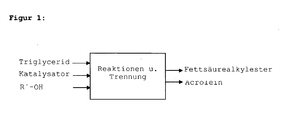
- the first variant comprises a process in which the reactions a) and b) are carried out simultaneously in one step, ie in one stage, and is in FIG. 1 shown.
- both reactions proceed in parallel.
- a triglyceride-catalyst mixture optionally reacted in the presence of a solvent in the liquid phase on an acidic catalyst with the alcohol R 'OH.
- a homogeneous or heterogeneous acidic catalyst and / or salts of mineral acids or optionally a suitable biocatalyst can be used.
- Suitable catalysts are, for example, strong Brönstedt acids such as sulfuric acid, phosphoric acid, toluenesulfonic acid or methanesulfonic acid.
- Suitable as salt-like catalysts are, for example, potassium, sodium or cesium sulfate, potassium, sodium or cesium hydrogen sulfate or mixtures of said hydrogen sulfates or sulfates, lithium phosphate, iron phosphate, zinc sulfate, optionally in a homogeneous phase and optionally in the presence of a solvent.
- heterogeneous acid catalyst When using a heterogeneous acid catalyst, those are preferably having an H 0 value of ⁇ +2, preferably ⁇ -3.
- the H 0 value corresponds to the acid function according to Hammet and can be determined by the so-called amine titration using indicators or by adsorption of a gaseous base (see Studies in surface science and catalysis, Vol. 51, 1989: “New solid acids and bases, their catalytic properties", K. Tanabe et al., Chapter 2, in particular pages 5-9 ).
- Preferred heterogeneous catalysts are zeolites, solid acids, common mixed oxide catalysts or acidic ion exchange resins.
- Suitable biocatalysts are lipases, esterases, hydratases and / or hydrolases.
- solvents and diluents known to the person skilled in the art are used, for example methyl tert-butyl ether, ethyl tert-butyl ether, tetrahydrofuran, 1,4-dioxane, diglyme, toluene, methyl isobutyl ketone and / or the alcohol R'-OH used for the transesterification ,
- the triglycerides used can also act as solvents, as well as the intermediately formed glycerol and the resulting fatty acid alkyl esters and water formed during the dehydration.
- the solvent is preferably added in excess and is preferably identical to the alcohol R'-OH used for the transesterification. Methanol and / or ethanol are very particularly preferably used.
- reaction temperature between 30 and 500 ° C, preferably between 50 and 350 ° C, particularly preferably worked between 70 and 300 ° C.
- the pressure is adjusted in such a way that the liquid state of the reaction mixture is maintained.
- the pressure is usually between 1 and 300 bar, preferably between 1 and 150 bar, more preferably between 1 and 50 bar.
- the feedthrough can be carried out in the reaction vessels known to the person skilled in the art, such as, for example, fixed-bed reactors, R.kesseln, flow tubes or combinations are performed.
- Formed acrolein can be separated in a conventional manner alone or together with a part of the solvent or dilution medium and / or water preferably by stripping or distillation from the resulting reaction mixture. Unreacted intermediates or glycerol remain in the reaction stage and continue to be reacted. By suspending the separated acrolein with water (quenching), an aqueous acrolein solution is obtained, which can be fed directly to use or further purification.
- impurities or by-products in the acrolein can be tolerated or removed by work-up steps.
- water, acetaldehyde, formaldehyde or acetic acid and other unreactive by-products are not isolated from the acrolein.
- the present process variant is therefore characterized in that the acrolein formed in the reaction b) is separated from the reaction mixture alone or optionally together with at least part of the solvent and / or the water.
- the acrolein can be separated from the reaction mixture by stripping, distillation, extraction, phase separation or use of membranes.
- the acrolein is very particularly preferably separated off during the reaction by distillation from the reaction mixture.
- water should also preferably be obtained from the reaction mixture or equilibrium in addition to glycerol, which is essentially consumed by the subsequent reaction to the acrolein be removed. This can be done directly in the first reaction step or in a downstream stage.
- acrolein is not formed immediately at the beginning of the transesterification reaction, but first separated glycerol is separated off after most of the triglycerides have been converted to fatty acid alkyl esters. The resulting after transesterification glycerol is then reacted by means of a dehydration catalyst to acrolein.
- the catalysts may consist of the acidic or basic components described or components of dehydration catalysts known to those skilled in the art.
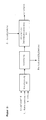
- This further process variant comprises a process in which the reactions a) and b) are carried out in separate steps be performed and is in FIG. 2 shown.
- the reaction a) (transesterification) of triglyceride with alcohol R'OH to glycerol and fatty acid alkyl esters (biodiesel) is carried out in the presence of a suitable first catalyst. This is followed by separation into a glycerol-containing and a fatty acid alkyl ester-containing phase.
- the reactions a) and b) are carried out in this process variant simultaneously in spatially separated steps and the glycerol primarily formed from the reaction mixture of the reaction a) completely or partially separated by membrane separation, by phase separation after a fatty acid alkyl ester containing lipophilic phase A and a glycerol containing hydrophilic phase B or dehydrated by reactive distillation and in reaction b) catalytically to acrolein.
- the glycerol in the separated glycerol-containing phase is dehydrated in the presence of a suitable second catalyst to acrolein (reaction b).
- the fatty acid alkyl ester can be used directly or after suitable post-treatment, such as extensive dehydration as a fuel or biodiesel.
- the use of the dehydration catalyst in a separate reaction step avoids the formation of reactive intermediates which, under the conditions given above, can form at least from portions of the triglycerides or glycerol. Otherwise, the reactive intermediates increasingly form undesirable by-products which lead to deactivation of the catalyst or reduction of the yield. When these intermediates are minimized, the yield to acrolein and fatty acid alkyl esters can be improved.
- the dehydration catalyst can be fed only at a location remote from the reactor inlet in the flow direction or in another reactor section, after a phase separation has taken place. Until the glycerol solution and the catalyst reach this location, some of the glycerol may already be converted to reactive intermediates.
- This driving style can be technically realized for example in a stirred tank cascade or a flow tube.
- the phase separation can be accelerated in this embodiment of the invention by subsequent addition of water or by distillative removal of excess alcohol, which facilitates the subsequent dehydration in the glycerol phase.
- a further advantage of the dehydration in a second step is that the yields of acrolein and fatty acid alkyl esters can be increased because a temperature profile or temperature program optimized on the basis of the reaction behavior of the reactants can be set separately for each step.
- the transesterification of the triglycerides requires a significantly lower activation energy or reaction temperature than the activation of glycerol and its first dehydration step for the rapid production of intermediates such as e.g. Hydroxypropionaldehyde.
- the resulting fatty acid alkyl esters tend at higher temperatures of about 150 to 250 ° C to unselective further reactions.
- carrying out the co-production of fatty acid alkyl esters and acrolein by passing through two reaction stages under different reaction conditions is a preferred embodiment.
- a preferred embodiment of the process is characterized in that the transesterification reaction a) is carried out with the aid of an alkaline catalyst, preferably with an alkaline catalyst in which the pKa value of the corresponding acid is> 13.
- alkali metal alkoxides of the alcohol R'OH used for the transesterification should be mentioned here.
- reaction a) it is also possible here for reaction a) to be carried out with the aid of a homogeneous or heterogeneous acidic catalyst.
- This catalyst may also be different from the acidic catalyst to be used in the dehydration, which further increases the breadth of variation and flexibility of the process.
- Both the alkaline and the acid-catalyzed transesterification a) is carried out at temperatures of 20 to 150 °, preferably 25 to 100 ° C, preferably from 25 to 80 ° C.
- reaction a) is carried out with the aid of a biocatalyst.
- biocatalysts preferably lipases, esterases, hydratases or hydrolases are used.
- the glycerol formed primarily from the reaction mixture of the reaction a) is completely or partially separated and dehydrated catalytically in the separately proceeding reaction b) to acrolein.
- a homogeneous or heterogeneous acidic catalyst can be used according to the invention.
- sulfuric acid phosphoric acid, toluenesulfonic acid or methanesulfonic acid can be used as the catalyst here.
- salts of mineral acids are preferably used as homogeneous catalysts for the dehydration reaction b).
- heterogeneous catalysts preference is given to those having an H 0 value ⁇ +2, preferably ⁇ -3.
- reaction conditions to be preferably set correspond to those used in the first-stage process variant described above. Only the reaction temperature of the second reaction, the dehydration b), compared to the first reaction, the transesterification a), at higher temperatures of 50 to 400 ° C, preferably 100 to 350 ° C.
- the dehydration reaction b) is carried out with the aid of a biocatalyst.
- dehydratases for example, dehydratases, hydratases or hydrolases are used as the biocatalyst.
- the reaction step b) is preferably carried out in the presence of a solvent.
- Preferred solvents are methyl tert-butyl ether, ethyl tert-butyl ether, tetrahydrofuran, 1,4-dioxane, diglyme, toluene, methyl isobutyl ketone and / or the Transesterification in reaction step a) already used alcohol R'-OH used.
- glycerol is separated from the reaction mixture a) by distillation.
- the glycerol can be separated in a distillation column attached to the first reactor.
- a particularly advantageous embodiment of the process consists in separating glycerol from the reaction mixture a) by reactive distillation and thereby dehydrating it to acrolein on the simultaneously present acidic catalyst (reaction step b).
- a heterogeneous dehydration catalyst preferably the o.g. specified type (i) to (iv), which simultaneously accelerates the reaction of the glycerol to be separated to acrolein.
- the temperature in the downstream column is between 50 and 300 ° C, preferably between 80 and 250 ° C, more preferably between 100 and 200 ° C.
- the pressure there is between 0.1 and 1500 mbar, preferably between 0.5 and 1000 mbar, more preferably between 2 and 100 mbar.
- the solid, generally insoluble acidic dehydration catalyst is incorporated within the distillation column as a bed or as a coating.
- a further preferred embodiment of the method according to the invention is characterized in that glycerol is separated from the reaction solution by simple phase separation, after a fatty acid alkyl ester-containing lipophilic phase A and a glycerol-containing hydrophilic phase B have formed.
- phase separation can be facilitated or promoted by adding a phase release agent.
- phase-separating agents are water and / or an organic solvent and / or fatty acid alkyl ester.
- the joint production of acrolein and fatty acid alkyl esters can also be achieved by deliberately promoting the phase separation into a lipophilic phase A containing triglyceride and fatty acid alkyl esters and into a hydrophilic phase B containing water and glycerol already at the beginning of the transesterification and the reactions a ) and b) proceed in parallel in the two different liquid phases (two-phase catalysis). This can be done on the one hand by the addition of water or other solvents.
- the excess alcohol used for the transesterification can be removed by distillation in order to accelerate the phase separation.
- This has the advantage that in each case optimized catalysts can be used for the transesterification reaction a) and for the dehydration reaction b). Both reactions also run separately in the respective phases, without influencing each other.
- reaction a) in the lipophilic phase A, the triglyceride and Fatty acid alkyl ester is carried out, and the reaction b) in the hydrophilic phase B, which contains glycerol, water and acrolein.
- Example 1 The slight transition of the acrolein from the fatty acid alkyl ester-containing lipophilic phase A into the aqueous hydrophilic phase B becomes clear in Example 1, in which acrolein was predominantly recovered in the aqueous phase.
- the overall yield of both target products can be increased by running off less unselective side reactions. It is also desirable residual moisture or added water to bind exclusively in the glycerol phase, otherwise it leads to increased unwanted formation of free fatty acids.
- the catalyst systems for transesterification and for dehydration are tuned in the case of two-phase catalysis that solve when using homogeneous catalysts of the transesterification catalyst in the triglyceride phase and the dehydration in the glycerol-containing phase and not vice versa, so that in the lipophilic phase A, preferably soluble catalyst there, the reaction accelerates a) and a preferably soluble in the hydrophilic phase catalyst there reaction b).
- a homogeneous solution for a good mass transfer is advantageous, but not essential here. This is even exploited here specifically by the principle of two-phase catalysis, wherein the product acrolein is readily soluble in the aqueous glycerol phase. Thus, acrolein can be separated without elaborate workup simply by phase separation or additional extraction of the fatty acid alkyl ester, thus simplifying the overall process. This is also clear from Example 1.
- the ester cleavage is an equilibrium reaction which can be directed in one direction or the other depending on the reaction conditions. This is specifically exploited in the described embodiment of the two-phase catalysis by glycerol as the reaction product aus.der triglyceride / and fatty acid alkyl ester-containing phase and thus removed from the equilibrium ..
- the reaction a) accelerated toward fatty acid alkyl ester or biodiesel resp minimizes back reaction to triglycerides.
- reaction conditions can be set which otherwise would not be optimal for the production of biodiesel or the range of suitable reaction conditions can be extended. For example, the excess of alcohol can be reduced.
- Fatty acid alkyl esters of the formula I are preferably obtained from the lipophilic phase A and can be used directly or optionally after further purification as a fuel.
- Acrolein is obtained from the hydrophilic phase B and can be used directly or optionally after further purification as starting material for methionine products or acrylic acid.
- An embodiment of the invention is characterized in that the triglycerides used are catalytically converted into fatty acid alkyl esters and acrolein in the presence of alcohols R'OH, wherein the transesterification reaction a) and the dehydration reaction b) are simultaneously carried out spatially separated using membranes (membrane separation) , Through the membrane, the triglycerides and fatty acid alkyl esters are selectively retained (retentate), while resulting glycerol enters the permeate. As a result, the separation takes place without a separate work-up step, which lowers the production costs.
- glycerol can be separated from the reaction mixture of the reaction a) according to the invention by membrane filtration.
- Suitable membrane materials are in particular organic or ceramic materials.
- the dehydration reaction can also be carried out by suitable immobilized on or in the membrane catalysts or by a separate catalyst addition to the permeate.
- the catalytically active components for dehydration may also be insoluble constituents of the membrane.
- Suitable membranes are, for example, solubility membranes or diffusion membranes from micro- or ultrafiltration, which due to their functional groups, polarity or pore structure retain the triglycerides but are permeable to glycerol.
- Suitable membranes are in particular composed of organic materials such as polyether sulfones (PES), cellulose esters, polyimides or polyetherimides, poly fatty acid amides or polyacrylonitrile (PAN) or of ceramic materials such as aluminum oxide, titanium dioxide, silicon dioxide, zirconium dioxide (Baddeleyit) and combinations thereof.
- higher-boiling by-products which are produced during acrolein synthesis can be added to the biodiesel as additional calorific value or, if necessary, left in the biodiesel.
- These may be, for example, di- or trimers of acrolein or ethers of glycerol.
- the invention also provides a mixture containing acrolein, prepared by the process according to the invention shown here, and a mixture containing a fatty acid alkyl ester of the formula I, prepared by the process according to the invention shown here.
Landscapes
- Chemical & Material Sciences (AREA)
- Organic Chemistry (AREA)
- Life Sciences & Earth Sciences (AREA)
- Engineering & Computer Science (AREA)
- Wood Science & Technology (AREA)
- Zoology (AREA)
- General Chemical & Material Sciences (AREA)
- Chemical Kinetics & Catalysis (AREA)
- Microbiology (AREA)
- Oil, Petroleum & Natural Gas (AREA)
- Biochemistry (AREA)
- Health & Medical Sciences (AREA)
- Biotechnology (AREA)
- Bioinformatics & Cheminformatics (AREA)
- General Engineering & Computer Science (AREA)
- General Health & Medical Sciences (AREA)
- Genetics & Genomics (AREA)
- Organic Low-Molecular-Weight Compounds And Preparation Thereof (AREA)
- Low-Molecular Organic Synthesis Reactions Using Catalysts (AREA)
Description
- Die Erfindung betrifft ein Verfahren zur Herstellung von Fettsäurealkylestern und Acrolein aus Triglyceriden unter Verwendung von geeigneten Katalysatoren.
- Triglyeride können beispielsweise durch folgende Formel beschrieben werden:

R1 bis R3= C10 bis C30-Alkyl bedeuten. - Diese Triglyceride sind beispielsweise wichtiger Bestandteil von künstlichen und natürlichen Fetten oder Pflanzenölen, wie z.B. Palmöl, Sonnenblumenöl, Sojaöl oder Rapsöl, das in der Biodiesel-Produktion eingesetzt wird. Die erfindungsgemäß eingesetzten Triglyceride können in verunreinigter Form oder in Form von Mischungen vorliegen.
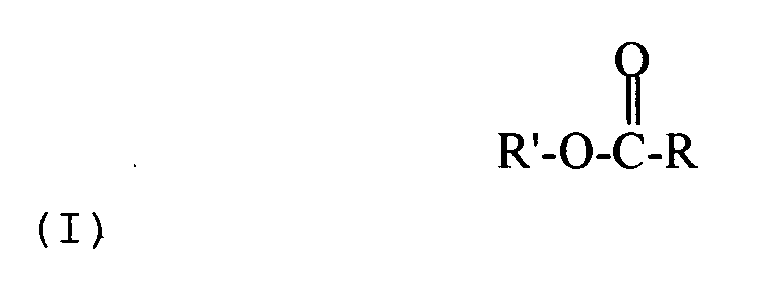
- Fettsäurealkylester oder Biodiesel werden im vorliegenden Zusammenhang durch folgende Formel beschrieben:

- Gemische diese Fettsäurealkylester sind Hauptbestandteil des Biodiesel. Bevorzugt stellt R' eine CH3- oder C2H5-Gruppe dar, meistens jedoch eine CH3- Gruppe, da bei der Biodiesel-Produktion meist Methylate in methanolischer Lösung eingesetzt werden. Die Umesterung der Triglyceride kann auch mit anderen Alkoholen zu entsprechenden Fettsäurestern durchgeführt werden.
- Einen Überblick über den Stand der Verwendung von Pflanzenölen und weiteren Fetten zur Herstellung von Biodiesel wird beschrieben in G. Knothe, J. Van Gerpen, J. Krahl, The Biodiesel Handbook, OACS Verlag, 2005.
- Im allgemeinen kann die Umesterung von Triglyceriden zu Fettsäurealkylestern durch saure oder basische Katalyse beschleunigt werden. Technisch wird vorwiegend die schnellere homogene Basenkatalyse verwendet. Dabei werden bevorzugt Natrium- oder Kaliummethylate eingesetzt.
- Bei der technischen Herstellung von Biodiesel stellen unter anderem die Konzentration des Katalysators, die Temperatur, die Verweilzeit, die Feuchtigkeit, die Gegenwart von freien Fettsäuren und der Alkoholüberschuss wichtige Prozessparameter für die Optimierung der Ausbeute dar (B. Freedman, E.H. Pryde, T.L. Mounts, Variables affecting the yield of fatty esters from transesterified vegetable oils, J. Am. Oil Chem. Soc., 61, 1638, 1984).
- Die eingesetzten Triglyceride enthalten etwa 10 Gew.-% Glycerin, das als verunreinigte Fraktion nach der Umesterung bevorzugt durch eine Phasentrennung oder Extraktion von der Biodiesel-Fraktion isoliert wird. Beide Fraktionen werden dann in mehrstufigen Aufarbeitungsschritten von Wasser, Säuren, Katalysatoren, Alkohol, Salzen und Nebenprodukten weitestgehend befreit.
- Acrolein ist ein wichtiges Zwischenprodukt und somit von großer wirtschaftlicher Bedeutung für die Darstellung von Acrylsäure, D,L-Methionin und dem Methionin-Hydroxy-Analogen (MHA,=2-Hydroxy-4-methylthiobuttersäure). Methionin ist eine essentielle Aminosäure, die u.a. als Ergänzung in Futtermitteln eingesetzt wird. Nutritivitätsverbessernde Futtermittelzusatzstoffe sind heute ein unverzichtbarer Bestandteil der Tierernährung. Sie dienen der besseren Verwertung des Nahrungsangebotes, stimulieren das Wachstum und fördern die Eiweißbildung. Einer der wichtigsten dieser Zusatzstoffe ist die essentielle Aminosäure Methionin, die vor allem in der Geflügelaufzucht als Futtermitteladditiv eine herausragende Stellung einnimmt. Auf diesem Gebiet haben, aber auch sogenannte Methionin-Ersatzstoffe wie das Methionin-Hydroxy-Analog nicht unerhebliche Bedeutung, da sie ähnliche wachstumsstimulierende Eigenschaften aufweisen wie die dafür bekannte Aminosäure.
- Nach dem Stand der Technik erfolgt die Synthese von Acrolein durch heterogen katalysierte selektive Oxidation von Propen an Mischoxidkatalysatoren.
EP 417723 - Wissenschaftliche Untersuchungen zur Synthese des Acroleins aus isoliertem Glycerin sind bekannt. Es ist z.B. auch bekannt, dass sich Glycerin in Gegenwart sauerer Stoffe zu verschiedenen Produkten dehydratisieren lässt.
- Gemäß Organic Synthesis I, 15-18 (1964) wird durch Behandeln eines Gemisches aus pulverförmigem Kaliumhydrogensulfat, Kaliumsulfat und Glycerin bei 190 bis 200 °C Acrolein in einer Ausbeute zwischen 33 und 48 % gewonnen. Aufgrund der niedrigen Ausbeuten und der hohen Salzfrachten eignet sich dieses Verfahren jedoch nicht für den technischen Maßstab.
- Im Rahmen der Untersuchungen von Modellsubstanzen von Biomasse-Pyrolyseölen wurde auch die katalytische Behandlung von Glycerin an H-ZSM5-Zeolithen bei 350 bis 500 °C untersucht - siehe Dao, Le H. et al. ACS Symp. Ser.: 376 (Pyrolysis Oils Biomass) 328-341 (1988). Kohlenwasserstoffe werden nur in geringen Ausbeuten gebildet, aber es wird auf die Bildung von Acrolein hingewiesen.
-
WO 2006/092272 offenbart ein Verfahren zur Herstellung von Acrylsäure bzw. von Acrylsäure-Polymeren durch Dehydratisierung von Glycerin zu einem Acrolein aufweisenden Dehydratisierungsprodukt, Gasphasenoxidation und anschließende Isolierung von Acrylsäure sowie nachfolgende Polymerisation. Ein Verfahren zur gezielten Acroleinherstellung wird jedoch nicht beschrieben. - In der
DE 42 38 493 ist die sauer katalysierte Umsetzung von Glycerin zu Acrolein in der Gas- und in der Flüssigphase beschrieben. DieDE 42 38 492 betrifft ferner die Synthese von 1,2- und 1,3-Propandiol durch Dehydratisierung von Glycerin mit hohen Ausbeuten. Das dabei eingesetzte Glycerin liegt meist rein oder in Form einer wässrigen Lösung vor. -
WO 2005/021697A beschreibt ein Verfahren zur Herstellung von Fettsäure-alkylestern und Glycerin durch Umsetzung eines Triglycerids, in Gegenwart eines geeigneten Katalysator mit z.B. Methanol zum entsprechenden Methylester und Glycerin. Die Aufarbeitung des Reaktionsgemisches durch destillative Verfahrensschritte und Phasentrennung ermöglicht schließlich die Isolierung des Fettsäuremethylesters und des Glycerins. - Das in der Biodiesel-Produktion nach der Phasentrennung anfallende Glycerin ist jedoch in der Regel von geringem Wert, da stark verunreinigt, z.B. durch überschüssiges Methanol, Katalysator und Seifen.
- Bisher wurden die oben beschriebenen Schritte noch niemals kombiniert, .um Triglyceride direkt zur simultanen Herstellung von Fettsäurealkylestern insbesondere von Biodiesel und Acrolein einzusetzen.
- Einerseits entstehen durch die separate Herstellung von Biodiesel aus Triglyceriden und Acrolein aus Propen oder Glycerin ein vergleichsweise hoher apparativer Aufwand und damit entsprechende Investitionskosten, da Synergien bei der gemeinsamen Herstellung im Verbund nicht genutzt werden. Weiterhin entstehen ein entsprechender logistischer Aufwand und damit entsprechend hohe variable Kosten wie beispielsweise Transport- und Energiekosten, um Glycerin zu befördern.
- Andererseits ist der Nachteil der bisherigen klassischen Acroleinproduktion durch selektive Oxidation aus Propen insbesondere im aufwändigen Verfahren zu sehen, bei dem Propen in der Gasphase hergestellt und in der mehrstufigen Aufarbeitung isoliert werden muss sowie darin, dass Propen ein vergleichsweise teurer Ausgangsstoff ist, dessen Kosten zudem aktuell überproportional steigen.
- Es war daher Aufgabe dieser Erfindung, ein Verfahren zur gleichzeitigen Herstellung von Acrolein und Fettsäurealkylestern, insbesondere von Biodiesel, aus Triglyceriden bereitzustellen und so die Nachteile des Standes der Technik zu vermeiden.
- Insbesondere war es die Aufgabe, ein Verfahren aufzufinden, bei dem die primäre Umesterung von Triglyceriden auf einfache und effiziente Weise mit preiswerten und wohlfeilen Katalysatoren gelingt sowie das primär erhaltene Glycerin in effizienter Weise vom Fettsäurealkylester abgetrennt werden kann. Das abgetrennte Glycerin sollte zudem möglichst direkt und auf wiederum einfache und effiziente Weise katalytisch zu Acrolein dehydratisiert werden können und damit die Nachteile des Standes der Technik vermieden werden.
- Eine weitere Aufgabe in diesem Zusammenhang war es, möglichst effiziente, gut handhabbare Katalysatoren aufzufinden, welche möglichst sowohl für die primäre Umesterung (Biodiesel- bzw. Glycerin-Bildung) als auch für die sekundär ablaufende Dehydratisierung des Glycerins zum Acrolein geeignet sind.
- Eine zusätzlich Aufgabe richtet sich darauf, ein Verfahren bereitzustellen, bei dem eine wässrige Acroleinlösung erhalten wird, die unmittelbar ihrer Verwendung, insbesondere als Ausgangsstoff zur Herstellung von Methioninverbindungen oder von Acrylsäurederivaten zugeführt werden kann.
- Gelöst werden diese sowie weitere nicht explizit genannten Aufgaben, die jedoch aus den hierin diskutierten Zusammenhängen ohne weiteres ableitbar oder erschließbar sind durch ein Verfahren gemäß Anspruch 1. Zweckmäßige Ausformungen und Abwandlungen des erfindungsgemäßen Verfahrens werden in den auf Anspruch 1 direkt oder indirekt rückbezogenen Unteransprüchen unter Schutz gestellt.
- Dadurch, dass man ein Verfahren zur Herstellung von Fettsäurealkylestern der allgemeinen Formel I:

- a) die Triglyceride mittels Alkoholen R'-OH in Gegenwart eines geeigneten Katalysators zum Fettsäürealkylester und Glycerin umgesetzt werden und
- b) das entstandene Glycerin katalytisch zu Acrolein dehydratisiert wird,
- Besonders bevorzugt werden Triglyceride im Reaktionsschritt. a) eingesetzt, bei denen R1, R2 und R3 jeweils ein C12-C18-Alkyl-Rest ist.
- Vorzugsweise eingesetzt werden darüber hinaus im Reaktionsschritt a) Alkohole R'-OH bei denen R'= Methyl oder Ethyl ist. Ganz besonders bevorzugt wird Methanol eingesetzt, da die so entstehenden Fettsäüremethylester am häufigsten als Biodiesel verwendet werden.
- Die simultane Herstellung beider Zielprodukte kann durch verschiedene Varianten des erfindungsgemäßen Verfahrens erreicht werden. Dabei können zwei Hauptvarianten unterschieden werden.
- Die erste Variante umfasst ein Verfahren bei denen die Reaktionen a) und b) gleichzeitig in einem Schritt, also einstufig durchgeführt werden und ist in
Figur 1 dargestellt. - Durch Verwendung eines geeigneten Katalysators oder eines Gemisches aus Katalysatoren laufen beide Reaktionen parallel ab. Dabei wird zum Beispiel ein Triglycerid-Katalysator-Gemisch, gegebenenfalls in Gegenwart eines Lösungsmittels in der Flüssigphase an einem sauren Katalysator mit dem Alkohol R' OH umgesetzt.
- Für die Reaktionen a) und b) können ein homogener oder heterogener saurer Katalysator und/oder Salze von Mineralsäuren oder ggf. ein geeigneter Biokatalysator verwendet werden.
- Bevorzugt sind dabei Verfahren unter Verwendung eines homogenen sauren Katalysators, insbesondere eines homogenen Katalysators mit einem pKs-Wert < 7.
- Als Katalysatoren geeignet sind beispielsweise starke Brönstedt-Säuren wie Schwefelsäure, Phosphorsäure, Toluolsulfonsäure oder Methansulfonsäure.
- Als salzartige Katalysatoren geeignet sind beispielsweise Kalium-, Natrium- oder Cäsiumsulfat, Kalium-, Natrium- oder Cäsiumhydrogensulfat oder Mischungen der genannten Hydrogensulfate oder Sulfate, Lithiumphosphat, Eisenphosphat, Zinksulfat ggf. in homogener Phase und ggf.in Anwesenheit eines Lösungsmittels.
- Bei Verwendung eines heterogenen sauren Katalysators sind solche bevorzugt mit einem H0-Wert von < +2, vorzugsweise < -3.
- Der H0-Wert entspricht der Säurefunktion nach Hammet und lässt sich, durch die sogenannte Amintitration unter Verwendung von Indikatoren oder durch Adsorption einer gasförmigen Base ermitteln (siehe Studies in surface science and catalysis, Vol. 51, 1989: "New solid acids and bases, their catalytic properties", K. Tanabe et al., Kapitel 2, insbesondere Seiten 5-9).
- Kapitel 1, Seiten 1-3 des vorgenannten Dokuments nennt zahlreiche feste Säuren, aus welchen der Fachmann, gegebenenfalls nach Bestimmung des H0-Werts, den geeigneten Katalysator auswählen kann.
- Es eignen sich als heterogener Katalysator vorzugsweise Zeolithe, Festkörpersäuren, unedle Mischoxidkatalysatoren oder saure Ionenaustauscherharze.
- Als heterogener Katalysator bevorzugt werden dabei:
- (i) natürliche oder synthetische silikatische Stoffe wie insbesondere Mordenit, Montmorillonit und saure Zeolithe, wie beispielsweise HZSM-5, MCM-22, Zeolith Beta;
- (ii) mit ein-, zwei- oder mehrbasigen anorganischen Säuren insbesondere Phosphorsäure, Schwefelsäure oder sauren Salzen anorganischer Säuren belegte Trägermaterialien, wie oxidische oder silikalitische Stoffe, vorzugsweise Aluminiumoxid, Titanoxid, Siliziumdioxid, Zirkondioxid oder deren Mischungen;
- (iii) Oxide und Mischoxide, wie beispielsweise Aluminiumoxide, Zinkoxid-Aluminiumoxid-Mischungen oder Heteropolysäuren, oder
- (iv) Polystyrolsulfonsäureharze, insbesondere Lewatit- oder Amberlite-Harze oder perfluorierte Polymersulfonsäureharze, insbesondere Nafion.
- Als Biokatalysatoren eignen sich Lipasen, Esterasen, Hydratasen und/oder Hydrolasen.
- Die Verwendung eines Lösungsmittels ist bevorzugt, denn dadurch werden die Konzentrationen an reaktiven Zwischenverbindungen gesenkt und Nebenreaktionen zu Oligomeren, Polymeren und anderen Hochsiedern minimiert. Weiterhin ist für die Esterbildung der Zusatz eines Alkohols erforderlich. Eingesetzt werden dem Fachmann bekannte Lösungs- und Verdünnungsmittel wie beispielsweise Methyl-tert.-butylether, Ethyl-tert.-butylether, Tetrahydrofuran, 1,4-Dioxan, Diglyme, Toluol, Methylisobutylketon und/oder der zur Umesterung benutzte Alkohol R'-OH. Auch die eingesetzten Triglyceride können als Lösungsmittel wirken, ebenso das intermediär entstehende Glycerin sowie die entstehenden Fettsäurealkylester und bei der Dehydratisierung entstehendes Wasser.
- Das Lösungsmittel wird vorzugsweise im Überschuss zugegeben und ist bevorzugt mit dem für die Umesterung eingesetzten Alkohol R'-OH identisch. Methanol und/oder Ethanol werden dabei ganz besonders bevorzugt verwendet.
- Es wird eine Reaktionstemperatur zwischen 30 und 500 °C, bevorzugt zwischen 50 und 350 °C, besonders bevorzugt zwischen 70 und 300 °C gearbeitet. Der Druck wird dabei derart eingestellt, dass der flüssige Zustand des Reaktionsgemisches erhalten bleibt. Üblicherweise beträgt der Druck zwischen 1 und 300 bar, bevorzugt zwischen 1 und 150 bar, besonders bevorzugt zwischen 1 und 50 bar.
- Die Durchführung kann in dem vom Fachmann bekannten Reaktionsgefäßen wie beispielsweise Festbettreaktoren, Rührkesseln, Strömungsrohren oder Kombinationen durchgeführt werden.
- Gebildetes Acrolein kann in an sich bekannter Weise allein oder zusammen mit einem Teil des Lösungs- oder Verdünnungsmediums und/oder Wasser bevorzugt durch Strippen oder Destillation aus dem erhaltenen Reaktionsgemisch abgetrennt werden. Nicht umgesetzte Intermediate oder Glycerin verbleiben in der Reaktionsstufe und werden fortlaufend weiterumgesetzt. Durch Aufangen des abgetrennten Acroleins mit Wasser (Quenchen) wird eine wässrige Acroleinlösung erhalten, die unmittelbar der Verwendung oder einer weiteren Aufreinigung zugeführt werden kann.
- Je nach Verwendungszweck können dementsprechend Verunreinigungen oder Nebenprodukte im Acrolein toleriert werden oder sind durch Aufarbeitungsschritte zu entfernen. Bevorzugt werden Wasser, Acetaldehyd, Formaldehyd oder Essigsäure sowie weitere unreaktive Nebenprodukte nicht vom Acrolein isoliert.
- Die vorliegende Verfahrensvariante ist folglich dadurch gekennzeichnet, dass das in der Reaktion b) gebildete Acrolein aus dem Reaktionsgemisch allein oder ggf. zusammen mit wenigstens einem Teil des Lösungsmittels und/oder des Wassers abgetrennt wird.
- Dabei kann das Acrolein durch Strippen, Destillation, Extraktion, Phasentrennung oder Einsatz von Membranen aus dem Reaktionsgemisch abgetrennt werden.
- Ganz besonders bevorzugt wird dabei das Acrolein während der Reaktion durch Destillation aus dem Reaktionsgemisch abgetrennt.
- Für die simultane Synthese von Acrolein und Biodiesel aus Triglyceriden ist neben der Beteiligung von Dehydratisierungsschritten die selektive Umesterung erforderlich. Da bei der Dehydratisierung zu Acrolein Wasser gebildet wird, das bei der Fettsäurealkylester-Synthese ebenfalls zur unerwünschten Entstehung der freien Fettsäure führen kann, sollte neben Glycerin, das im wesentlichen durch die Folgereaktion zum Acrolein verbraucht wird, auch bevorzugt Wasser aus dem Reaktionsgemisch bzw. Gleichgewicht entfernt werden. Dies kann direkt im ersten Reaktionsschritt oder in einer nachgeschalteten Stufe erfolgen.
- Die gleichzeitige Entfernung des Acroleins während der chemischen Umsetzungen aus dem Reaktionsgemisch ist mittels Destillation relativ einfach möglich und daher bevorzugt. Dies ist durch die großen Unterschiede der Siedepunkte von Acrolein einerseits und Triglyceriden, Fettsäurealkylestern und Glycerin andererseits bedingt. Durch die sofortige Abtrennung des entstandenen Acroleins aus dem Reaktionsgemisch kann zudem die Ausbeute erhöht werden, da Acrolein im Reaktionsgemisch eine sehr reaktive Verbindung darstellt, die zu unerwünschten Nebenreaktionen führen kann. Die gute destillative Abtrennbarkeit des Acroleins von der Fettsäurealkylester enthaltenden Reaktionsmischung wird am Beispiel 2 deutlich, bei dem Acrolein quantitativ durch Vakuumdestillation vom Biodiesel abgetrennt wurde.
- In einer weiteren Ausführungsform der Erfindung wird Acrolein nicht sofort zu Reaktionsbeginn der Umesterung gebildet, sondern erst gebildetes Glycerin abgetrennt, nachdem der Großteil der Triglyceride zu Fettsäurealkylestern umgesetzt wurde. Das nach der Umesterung entstandene Glycerin wird dann mit Hilfe eines Dehydratisierungskatalysators zu Acrolein umgesetzt. Die Katalysatoren können aus den beschriebenen sauren oder basischen Komponenten oder aus dem Fachmann bekannten Komponenten von Dehydratisierungskatalysatoren bestehen.
- Diese weitere Verfahrensvariante umfasst ein Verfahren, bei dem die Reaktionen a) und b) in getrennten Schritten durchgeführt werden und ist in
Figur 2 dargestellt. Dabei wird zunächst die Reaktion a) (Umesterung) von Triglycerid mit Alkohol R'OH zu Glycerin und Fettsäurealkylester (Biodiesel) in Gegenwart eines geeigneten ersten Katalysators durchgeführt. Anschließend erfolgt eine Trennung in eine Glycerin-haltige und eine Fettsäurealkylester-haltige Phase. Die Reaktionen a) und b) werden bei dieser Verfahrensvariante gleichzeitig in räumlich getrennten Schritten durchgeführt und das primär gebildete Glycerin aus dem Reaktionsgemisch der Reaktion a) ganz oder teilweise abgetrennt durch Membrantrennung, durch Phasentrennung nachdem sich eine Fettsäurealkylester enthaltende lipophile Phase A und eine Glycerin-haltige hydrophile Phase B gebildet haben oder durch Reaktivdestillation und in Reaktion b) katalytisch zu Acrolein dehydratisiert. Das Glycerin in der abgetrennten Glycerin-haltigen Phase wird in Gegenwart eines geeigneten zweiten Katalysators zu Acrolein dehydratisiert (Reaktion b). Der Fettsäurealkylester kann direkt oder nach geeigneter Nachbehandlung wie z.B. einer weitgehenden Entwässerung als Brennstoff bzw. Biodiesel verwendet werden. - Durch die Verwendung des Dehydratisierungskatalysators in einem getrennten Reaktionsschritt wird die Bildung reaktiver Intermediate vermieden, die sich bei den oben angegebenen Bedingungen zumindest aus Teilmengen der Triglyceride oder des Glycerins bilden können. Die reaktiven Intermediate bilden sonst verstärkt unerwünschte Nebenprodukte, die zu einer Desaktivierung des Katalysators oder zur Verminderung der Ausbeute führen. Werden diese Intermediate minimiert, kann die Ausbeute zu Acrolein und Fettsäurealkylestern verbessert werden.
- Dies kann einerseits in einer diskontinuierlichen Fahrweise erfolgen, wobei der Dehydratisierungskatalysator nach einer gewissen Reaktionszeit dem dann zweiphasigen Reaktionsgemisch zugesetzt wird. Geeignet ist dafür beispielsweise die Durchführung im Rührkessel.
- Andererseits kann der Dehydratisierungskatalysator erst an einem vom Reaktoreingang in Strömungsrichtung entfernten Ort oder in einem weiteren Reaktorabschnitt eingespeist werden, nachdem eine Phasentrennung erfolgt ist. Bis die Glycerinlösung und der Katalysator diesen Ort erreichen, kann bereits ein Teil des Glycerins zu reaktiven Intermediaten umgesetzt sein. Diese Fahrweise kann technisch beispielsweise in einer Rührkesselkaskade oder einem Strömungsrohr realisiert werden. Die Phasentrennung kann bei dieser Ausführungsform der Erfindung durch nachträgliche Zugabe von Wasser oder durch destillative Entfernung von überschüssigem Alkohol beschleunigt werden, was die anschließende Dehydratisierung in der Glycerinphase erleichtert.
- Ein weiterer Vorteil der Dehydratisierung in einem zweiten Schritt besteht darin, dass die Ausbeuten an Acrolein und Fettsäurealkylestern gesteigert werden können, weil ein anhand des Reaktionsverhaltens der Reaktanden optimiertes Temperaturprofil bzw. Temperaturprogramm für jeden Schritt separat eingestellt werden kann. So erfordert die Umesterung der Triglyceride eine deutlich niedrigere Aktivierungsenergie oder Reaktionstemperatur als die Aktivierung von Glycerin und dessen erster Dehydratisierungsschritt zur schnellen Herstellung von Zwischenprodukten wie z.B. Hydroxypropionaldehyd. Die entstandenen Fettsäurealkylester tendieren hingegen bei höheren Temperaturen von ca. 150 bis 250 °C zu unselektiven Weiterreaktionen. Somit stellt die Durchführung der gemeinsamen Herstellung von Fettsäurealkylestern und Acrolein mittels Durchlaufen von zwei Reaktionsstufen bei unterschiedlichen Reaktionsbedingungen eine bevorzugte Ausführungsform dar.
- Eine bevorzugte Ausführungsform des Verfahrens ist dadurch gekennzeichnet, dass die Umesterungsreaktion a) mit Hilfe eines alkalischen Katalysators durchgeführt wird, vorzugsweise mit einem alkalischen Katalysator, bei dem der pKs-Wert der korrespondierenden Säure > 13 ist.
- Hier sind insbesondere Alkalialkoholate des für die Umesterung eingesetzten Alkohols R'OH zu nennen. Bevorzugt werden dabei die Alkalialkoholate der C1-C4-Alkohole, insbesondere Alkalimethylate oder -ethylate und ganz besonders bevorzugt Natriummethylat.
- Die Möglichkeit, alkalische Katalysatoren für die Umesterung in Reaktion a) einzusetzen, stellt bei der zweiten Verfahrensvariante einen zusätzlichen Vorteil dar, weil hier durch die nachfolgende Abtrennung der GlycerinPhase praktische keine Reaktion mit den in der Dehydratisierung zu verwendenden sauren Katalysatoren stattfinden kann.
- Ebenso wie bei der Reaktionsführung in einem Schritt ist es aber auch hier möglich, dass Reaktion a) mit Hilfe eines homogenen oder heterogenen sauren Katalysators durchgeführt wird. Dieser Katalysator kann zudem verschieden sein von dem in der Dehydratisierung zu verwendenden sauren Katalysator, was die Variationsbreite und Flexibilität des Verfahrens weiter erhöht.
- Bei Verwendung eines homogenen sauren Katalysators in Reaktion a), werden bevorzugt Katalysatoren mit einem pKs-Wert < 7 verwendet.
- Bei Verwendung eines heterogenen sauren Katalysators in Reaktion a), werden bevorzugt Katalysatoren mit einem H0-Wert < +2, vorzugsweise < -3 verwendet.
- Sowohl die alkalisch als auch die sauer katalysierte Umesterung a) wird bei Temperaturen von 20 bis 150°, vorzugsweise 25 bis 100°C, bevorzugt von 25 bis 80°C durchgeführt.
- Auf diese Weise ist es möglich durch Wahl von optimalen Reaktionsbedingungen, das Glycerin neben Biodiesel in einer ersten Reaktionsstufe zu bilden und anschließend in einer zweiten Stufe selektiv zu Acrolein umzusetzen.
- Erfindungsgemäß ist auch möglich, dass Reaktion a) mit Hilfe eines Biokatalysators durchgeführt wird.
- Als Biokatalysatoren werden dabei vorzugsweise Lipasen, Esterasen, Hydratasen oder Hydrolasen verwendet.
- Bei der Verfahrensvariante mit getrennten Reaktionsschritten a) und b) wird das primär gebildete Glycerin aus dem Reaktionsgemisch der Reaktion a) ganz oder teilweise abgetrennt und bei der getrennt ablaufenden Reaktion b) katalytisch zu Acrolein dehydratisiert.
- Für die Dehydratisierungsreaktion b) kann erfindungsgemäß ein homogener oder heterogener saurer Katalysator verwendet werden.
- Im Falle von homogenen Katalysatoren sind solche mit einem pKs-Wert < 7 bevorzugt.
- Insbesondere können hier Schwefelsäure, Phosphorsäure, Toluolsulfonsäure oder Methansulfonsäure als Katalysator verwendet werden.
- Desweiteren werden bevorzugt als homogene Katalysatoren für die Dehydratisierungsreaktion b) Salze von Mineralsäuren ggf. in Anwesenheit eines Lösungsmittels verwendet.
- Ganz besonders bevorzugt werden dabei Kalium-, Natrium- oder Cäsiumsulfat, Kalium-, Natrium- oder Cäsiumhydrogensulfat oder Mischungen der vorstehend genannten Hydrogensulfate und Sulfate, Lithiumphosphat, Eisenphosphat, Zinksulfat, ggf. in Anwesenheit eines Lösungsmittels, als Katalysator verwendet.
- Im Falle von heterogenen Katalysatoren sind solche mit einem H0-Wert < +2 , vorzugsweise < -3 bevorzugt.
- Bevorzugt werden Zeolithe, Festkörpersäuren, unedle Mischoxidkatalysatoren oder saure Ionenaustauscherharze als heterogener Katalysator verwendet.
- Als heterogener Katalysator eignen sich insbesondere:
- (i) natürliche oder synthetische silikatische Stoffe, wie insbesondere Mordenit, Montmorillonit und saure Zeolithe, insbesondere HZSM-5, MCM-22, Zeolith Beta;
- (ii) mit ein-, zwei- oder mehrbasigen anorganischen Säuren insbesondere Phosphorsäure, Schwefelsäure oder sauren Salzen der anorganischen Säuren, belegte Trägermaterialien, wie beispielsweise oxidische oder silikatische Stoffe, insbesondere Aluminiumoxid, Titandioxid, Siliziumdioxid, Zirkondioxid oder deren Mischungen;
- (iii) Oxide und Mischoxide, insbesondere Aluminiumoxide, Zinkoxid-Aluminiumoxid-Mischungen oder Heteropolysäuren oder
- (iv) Polystyrolsulfonsäureharze, insbesondere Lewatit- oder Amberlite-Harze, oder perfluorierte Polymersulfonsäureharze, insbesondere Nafion.
- Die vorzugsweise einzustellenden Reaktionsbedingungen entsprechen denen, die bei der oben beschriebenen ersten einstufigen Verfahrensvariante angewendet werden. Lediglich die Reaktionstemperatur der zweiten Reaktion, der Dehydratisierung b), liegt im Vergleich zur ersten Reaktion, der Umesterung a), bei höheren Temperaturen von 50 bis 400 °C, bevorzugt 100 bis 350 °C.
- Ebenso bevorzugt wird die Dehydratisierungsreaktion b) mit Hilfe eines Biokatalysators durchgeführt.
- Als Biokatalysator verwendet werden dabei beispielsweise Dehydratasen, Hydratasen oder Hydrolasen.
- Der Reaktionsschritt b) wird dabei vorzugsweise in Gegenwart eines Lösungsmittels durchgeführt.
- Als Lösungsmittel bevorzugt werden Methyl-tert.-butylether, Ethyl-tert.-butylether, Tetrahydrofuran, 1,4-Dioxan, Diglyme, Toluol, Methylisobutylketon und/oder der zur Umesterung in Reaktionsschritt a) bereits benutzte Alkohol R'-OH eingesetzt.
- Eine Möglichkeit dabei ist, dass das Glycerin aus dem Reaktionsgemisch a) durch Destillation abgetrennt wird.
- Durch eine Vakuumdestillation des Reaktionsgemisches a) kann das Glycerin in einer dem ersten Reaktionsapparat aufgesetzten Destillationskolonne abgetrennt werden.
- Eine besonders vorteilhafte Ausführungsform des Verfahrens besteht darin, dass Glycerin aus dem Reaktionsgemisch a) durch Reaktivdestillation abgetrennt wird und dabei am gleichzeitig vorhandenen sauren Katalysator zu Acrolein dehydratisiert wird (Reaktionsschritt b).
- In diesem Fall befindet sich in der Destillationskolonne ein heterogener Dehydratisierungskatalysator vorzugsweise der o.g. näher bezeichneten Art (i) bis (iv), der gleichzeitig die Umsetzung des abzutrennenden Glycerins zu Acrolein beschleunigt. Die Temperatur in der nachgeschalteten Kolonne beträgt zwischen 50 und 300 °C, bevorzugt zwischen 80 und 250 °C, besonders bevorzugt zwischen 100 und 200 °C. Der Druck beträgt dort zwischen 0,1 und 1500 mbar, bevorzugt zwischen 0,5 und 1000 mbar, besonders bevorzugt zwischen 2 und 100 mbar.
- Der feste, in der Regel unlösliche saure Dehydratisierungskatalysator ist innerhalb der Destillationskolonne als Schüttung oder als Beschichtung eingebracht.
- Der Vorteil der Durchführung der Reaktionen a) und b) in zwei getrennten Schritten besteht auch darin, dass die Stabilität des Prozesses aufgrund abgegrenzter Verfahrensschritte bei kontinuierlicher Betriebsweise verbessert ist.
- Neben der Destillation bzw. Reaktivdestillation können noch weitere Möglichkeiten zur Abtrennung des Glycerins verwendet werden.
- Eine weitere bevorzugte Ausführungsform des erfindungsgemäßen Verfahrens ist dadurch gekennzeichnet, dass Glycerin aus der Reaktionslösung durch einfache Phasentrennung abgetrennt wird, nachdem sich eine Fettsäurealkylester enthaltende lipophile Phase A und eine Glycerin-haltige hydrophile Phase B gebildet haben.
- Diese Phasentrennung kann darüberhinaus durch Zugabe eines Phasentrennmittels ermöglicht oder gefördert werden.
- Bevorzugte Phasentrennmittel sind dabei Wasser und/oder ein organisches Lösungsmittel und/oder Fettsäurealkylester.
- Die gemeinsame Herstellung von Acrolein und Fettsäurealkylestern kann erfindungsgemäß auch dadurch erreicht werden, dass die Phasentrennung in eine Triglycerid und Fettsäurealkylester enthaltende lipophile Phase A und in eine Wasser- und Glycerin-haltige hydrophile Phase B bereits zu Beginn der Umesterung bewusst gefördert wird und die Reaktionen a) und b) parallel in den beiden verschiedenen Flüssigphasen ablaufen (Zweiphasen-Katalyse). Dies kann einerseits durch die Zugabe von Wasser oder anderen Lösungsmitteln erfolgen.
- Andererseits kann der für die Umesterung eingesetzte überschüssige Alkohol destillativ entfernt werden, um die Phasentrennung zu beschleunigen. Dies hat den Vorteil, dass für die Umesterungsreaktion a) und für die Dehydratisierungsreaktion b) jeweils optimierte Katalysatoren eingesetzt werden können. Beide Reaktionen laufen zudem getrennt in den jeweiligen Phasen ab, ohne sich gegenseitig zu beeinflussen.
- Bevorzugt ist daher ein Verfahren, bei dem die Reaktion a) in der lipophilen Phase A, die Triglycerid und Fettsäurealkylester enthält, durchgeführt wird und die Reaktion b) in der hydrophilen Phase B, die Glycerin, Wasser und Acrolein enthält.
- Der leichte Übergang des Acroleins aus der Fettsäurealkylester enthaltenden lipophilen Phase A in die wässrige hydrophile Phase B wird am Beispiel 1 deutlich, bei dem Acrolein überwiegend in der wässrigen Phase wiedergefunden wurde.
- Somit kann die Ausbeute beider Zielprodukte insgesamt gesteigert werden, indem weniger unselektive Nebenreaktionen ablaufen. Es wird auch angestrebt Restfeuchte oder zugegebenes Wasser ausschließlich in der Glycerinphase zu binden, da es sonst verstärkt zur unerwünschten Bildung von freien Fettsäuren führt.
- Die Katalysatorsysteme für die Umesterung und für die Dehydratisierung sind im Fall der Zweiphasen-Katalyse so abgestimmt, dass sich bei Verwendung von homogenen Katalysatoren der Umesterungskatalysator in der Triglyceridphase und der Dehydratisierungskatalysator in der Glycerin- haltigen Phase lösen und nicht umgekehrt, so dass ein in der lipophilen Phase A bevorzugt löslicher Katalysator dort die Reaktion a) beschleunigt und ein in der hydrophilen Phase bevorzugt löslicher Katalysator dort die Reaktion b).
- Im allgemeinen ist eine homogene Lösung für einen guten Stoffaustausch vorteilhaft, aber hier nicht zwingend erforderlich. Dies wird hier sogar durch das Prinzip der Zweiphasen-Katalyse gezielt ausgenutzt, wobei das Produkt Acrolein in der wäßrigen Glycerinphase gut löslich ist. Somit kann Acrolein ohne aufwendige Aufarbeitung einfach durch Phasentrennung oder zusätzliche Extraktion vom Fettsäurealkylester separiert und somit das Gesamtverfahren vereinfacht werden. Dies wird auch am Beispiel 1 deutlich.
- Bei der Esterspaltung handelt es sich um eine Gleichgewichtsreaktion, die je nach Reaktionsbedingungen in die eine oder andere Richtung gelenkt werden kann. Dies wird bei der beschriebenen Ausführungsform der Zweiphasen-Katalyse gezielt ausgenutzt, indem Glycerin als Reaktionsprodukt aus.der Triglycerid/und Fettsäurealkylester enthaltenden Phase und somit aus dem Gleichgewicht entfernt wird.. Damit wird die Reaktion a) verstärkt in Richtung Fettsäurealkylester bzw. Biodiesel beschleunigt bzw. eine Rückreaktion zu Triglyceriden minimiert. Dadurch können Reaktionsbedingungen eingestellt werden, die sonst eigentlich nicht optimal für die Herstellung von Biodiesel wären bzw. kann der Bereich der geeigneter Reaktionsbedingungen erweitert werden. So kann beilspielsweise der Überschuss an Alkohol gesenkt werden.
- Fettsäurealkylester der Formel I werden vorzugsweise aus der lipophilen Phase A gewonnen und können direkt oder ggf. nach weiterer Aufreinigung als Brennstoff verwendet werden.
- Acrolein wird aus der hydrophilen Phase B gewonnen und kann direkt oder ggf. nach weiterer Aufreinigung als Ausgangsstoff für Methionin-Produkte oder Acrylsäure verwendet werden.
- Eine Ausführungsform der Erfindung ist dadurch gekennzeichnet, dass die eingesetzten Triglyceride in Gegenwart von Alkoholen R'OH katalytisch in Fettsäurealkylester und Acrolein umgewandelt werden, wobei die Umesterungsreaktion a)und die Dehydratisierungsreaktion b) unter Verwendung von Membranen gleichzeitig aber räumlich getrennt durchgeführt werden (Membrantrennung). Durch die Membran werden die Triglyceride und Fettsäurealkylester selektiv zurückgehalten (Retentat), während entstehendes Glycerin in das Permeat gelangt. Dadurch erfolgt die Trennung ohne separaten Aufarbeitungsschritt, was die Herstellkosten senkt.
- So kann Glycerin aus dem Reaktionsgemisch der Reaktion a) erfindungsgemäß auch durch Membranfiltration abgetrennt werden. Als Membranmaterialien eignen sich insbesondere organische oder keramische Materialien.
- Die Dehydratisierungsreaktion kann auch durch geeignete auf oder in der Membran immobilisierte Katalysatoren oder durch eine separate Katalysatorzugabe in das Permeat erfolgen. Die katalytisch aktiven Komponenten für die Dehydratisierung können auch unlösliche Bestandteil der Membran sein.
- Als Membranen eignen sich beispielsweise Löslichkeitsmembranen oder Diffusionsmembranen aus der Mikro- oder Ultrafiltration, die aufgrund ihrer funktionellen Gruppen, Polarität oder Porenstruktur die Triglyceride zurückhalten, aber für Glycerin durchgängig sind. Geeignete Membranen sind insbesondere aufgebaut aus organischen Materialien wie Polyethersulfonen (PES), Celluloseestern, Polyimiden oder Polyetherimiden, Polyfettsäureamiden oder Polyacrylnitril (PAN) oder aus keramischen Materialien wie Aluminiumoxid, Titandioxid, Siliciumdioxid, Zirkoniumdioxid (Baddeleyit) sowie deren Kombinationen.
- Die Vorteile der beschriebenen simultanen Herstellung von Biodiesel und Acrolein bestehen in einer erhöhten Produktivität, Wertschöpfung und Zeitersparnis. Gleichzeitig werden die Transport- und Energiekosten reduziert. Insgesamt wird die Produktion von Biodiesel und Acrolein wirtschaftlicher.
- Gleichzeitig können höhersiedende Nebenprodukte, die bei der Acroleinsynthese anfallen als zusätzlicher Brennwert dem Biodiesel beigemischt oder ggf. im Biodiesel belassen werden. Dies können beispielsweise Di- oder Trimere des Acroleins oder Ether aus Glycerin sein.
- Gegenstand der Erfindung ist auch eine Acrolein enthaltende Mischung, hergestellt nach dem hier dargestellten erfindungsgemäßen Verfahren, sowie eine Fettsäurealkylester der Formel I enthaltende Mischung, hergestellt nach dem hier dargestellten erfindungsgemäßen Verfahren.
- Die nachfolgenden Beispiele sollen die dargestellte Erfindung näher erläutern jedoch keines falls beschränkend wirken.
- 50 g Biodiesel und 50 g Acrolein wurden gemischt und bildeten ein homogenes Gemisch. Im Scheidetrichter wurde dieses homogene Gemisch mit 250 g Wasser versetzt, geschüttelt und stehen gelassen, wobei sich zwei Phasen bildeten. Nach der Ausbildung der Phasengrenze wurde die untere, wässrige Phase im Scheidetrichter abgetrennt und zur Bestimmung des Acroleingehalts mittels Gaschromatographie analysiert. Insgesamt wurden in der wässrigen Phase dadurch 33,4 g Acrolein erhalten. Bereits bei einfacher, einstufiger Extraktion mit Wasser konnte somit ein großer Teil des Acroleins vom Biodiesel abgetrennt werden.
- Im Kolben eines Rotationsverdampfers wurde ein Gemisch aus 50 g Biodiesel und 50 g Acrolein vorgelegt und in einem Wasserbad auf 35°C beheizt. Mittels einer Wasserstrahlpumpe wurde das Gemisch langsam unter Vakuum gesetzt. In der gekühlten Destillationsvorlage wurden 50 mg Hydrochinon zur Stabilisierung des destillerten Acroleins vorgelegt. Innerhalb von einer Stunde wurde ein Destillat von 49,1 g Acrolein erhalten. Die Reinheit des Destillats wurde mittels Gaschromatographie zu mindestens 99,5 % bestätigt. Im Kolben des Rotationsverdampfers blieben 50,6 g zurück.
Claims (22)
- Verfahren zur Herstellung von Fettsäurealkylestern der allgemeinen Formel I:

 a) die Triglyceride mittels Alkoholen R'-OH in Gegenwart eines geeigneten Katalysators zum Fettsäurealkylester und Glycerin umgesetzt werden undb) das entstandene Glycerin katalytisch zu Acrolein dehydratisiert wird,
wobei R für R1, R2 und R3 steht und R1, R2 und R3 allesamt gleich oder teilweise gleich oder
allesamt verschieden sind und jeweils einen geradkettigen oder verzweigten und ggf. ein- oder mehrfach ungesättigten C10-C30-Alkyl-Rest, bevorzugt C12-C20-Alkyl-Rest bedeuten und R' einen C1-C10-AlkylRest, bevorzugt C1-C6-Alkyl-Rest, einen C3-C6-Cycloalkyl-Rest, bevorzugt C6-Cycloalkyl-Rest bedeutet, und wobei die Reaktionen a) und b) gleichzeitig in einem Schritt durchgeführt werden - Verfahren gemäß Anspruch 1, dadurch gekennzeichnet, dass
R1, R2 und R3 = C12-C18-Alkyl-Rest ist, und/oder
R'= Methyl oder Ethyl ist. - Verfahren gemäß einem der Ansprüche 1 bis 2, dadurch gekennzeichnet, dass für die Reaktionen a) und b) ein homogener oder heterogener saurer Katalysator und/oder Salze von Mineralsäuren oder ein Biokatalysator verwendet wird.
- Verfahren gemäß Anspruch 3, dadurch gekennzeichnet, dass ein homogener Katalysator mit einem pKs-Wert < 7 verwendet wird, vorzugsweise
Schwefelsäure, Phosphorsäure, Toluolsulfonsäure oder Methansulfonsäure. - Verfahren gemäß Anspruch 3, dadurch gekennzeichnet, dass Kalium-, Natrium- oder Cäsiumsulfat, Kalium-, Natrium- oder Cäsiumhydrogensulfat oder Mischungen der genannten Hydrogensulfate und Sulfate, Lithiumphosphat, Eisenphosphat, Zinksulfat, ggf. in Anwesenheit eines Lösungsmittels als Katalysator verwendet werden.
- Verfahren gemäß Anspruch 3, dadurch gekennzeichnet, dass ein heterogener Katalysator mit einem H0-Wert < +2 verwendet wird, vorzugsweise mit einem Ho-Wert < -3,
besonders bevorzugt Zeolithe, Festkörpersäuren, unedle Mischoxidkatalysatoren oder saure Ionenaustauscherharze als heterogener Katalysator. - Verfahren gemäß Anspruch 6, dadurch gekennzeichnet, dass(i) natürliche oder synthetische silikatische Stoffe, insbesondere Mordenit, Montmorillonit und saure Zeolithe, insbesondere HZSM-5, MCM-22 und Zeolith Beta,(ii) mit ein-, zwei- oder mehrbasigen anorganischen Säuren, insbesondere Phosphorsäure, Schwefelsäure oder sauren Salzen anorganischer Säuren belegte Trägermaterialien, wie insbesondere oxidische oder silikatische Stoffe, vorzugsweise Aluminiumoxid, Titandioxid, Siliziumdioxid, Zirkondioxid oder deren Mischungen,(iii) Oxide und Mischoxide, insbesondere Aluminiumoxide, Zinkoxid-Aluminiumoxid-Mischungen oder Heteropolysäuren, oder(iv) Polystyrolsulfonsäureharze, insbesondere Lewatit- oder Amberlite-Harze oder perfluorierte Polymersulfonsäureharze, insbesondere Nafion, verwendet werden.
- Verfahren gemäß Anspruch 3, dadurch gekennzeichnet, dass Lipasen, Esterasen, Hydratasen und/oder Hydrolasen als Biokatalysator verwendet werden.
- Verfahren gemäß einem der Ansprüche 1 bis 8, dadurch gekennzeichnet, dass die Reaktion in Gegenwart eines Lösungsmittels durchgeführt wird, vorzugsweise
Methyl-tert.-butylether, Ethyl-tert.-butylether, Tetrahydrofuran, 1,4-Dioxan, Diglyme, Toluol, Methylisobutylketon und/oder der zur Umesterung gemäß Anspruch 1 benutzte Alkohol R'-OH. - Verfahren gemäß einem der Ansprüche 1 bis 9, dadurch gekennzeichnet, dass das in Reaktion b) gebildete Acrolein aus dem Reaktionsgemisch allein oder ggf. zusammen mit wenigstens einem Teil des Lösungsmittels abgetrennt wird, bevorzugt
durch Strippen, Destillation, Extraktion, Phasentrennung oder Einsatz von Membranen, ganz besonders bevorzugt das Acrolein bereits während der Reaktion durch Destillation aus dem Reaktionsgemisch abgetrennt wird. - Verfahren zur Herstellung von Fettsäurealkylestern der allgemeinen Formel I:

 a) die Triglyceride mittels Alkoholen R'-OH in Gegenwart eines geeigneten Katalysators zum Fettsäurealkylester und Glycerin umgesetzt werden undb) das entstandene Glycerin katalytisch zu Acrolein dehydratisiert wird,
wobei R für R1, R2 und R3 steht und R1, R2 und R3 allesamt gleich oder teilweise gleich oder
allesamt verschieden sind und jeweils einen geradkettigen oder verzweigten und ggf. ein- oder mehrfach ungesättigten C10-C30-Alkyl-Rest, bevorzugt C12-C20-Alkyl-Rest bedeuten und R' einen C1-C10-AlkylRest, bevorzugt C1-C6-Alkyl-Rest, einen C3-C6-Cycloalkyl-Rest, bevorzugt C6-Cycloalkyl-Rest bedeutet, und wobei die Reaktionen a) und b) gleichzeitig in räumlich getrennten Schritten durchgeführt werden und das primär gebildete Glycerin aus dem Reaktionsgemisch der Reaktion a) ganz oder teilweise abgetrennt wird durch Membrantrennung, durch Phasentrennung nachdem sich eine Fettsäurealkylester enthaltende lipophile Phase A und eine Glycerin-haltige hydrophile Phase B gebildet haben oder durch Reaktivdestillation und in Reaktion b) katalytisch zu Acrolein dehydratisiert wird. - Verfahren gemäß Anspruch 11, dadurch gekennzeichnet, dass Reaktion a) mit Hilfe eines alkalischen Katalysators durchgeführt wird, bei dem der pKs-Wert der korrespondierenden Säure > 13 ist,
dass vorzugsweise als alkalischer Katalysator Alkalialkoholate des für die Umesterung eingesetzten Alkohols R'OH oder Alkalimethylate oder -ethylate, besonders bevorzugt Natriummethylat verwendet werden. - Verfahren gemäß Anspruch 11, dadurch gekennzeichnet, dass Reaktion a) mit Hilfe eines homogenen oder heterogenen sauren Katalysators durchgeführt wird,
vorzugsweise ein homogener saurer Katalysator mit einem pKs-Wert < 7 verwendet wird, oder
dadurch gekennzeichnet, dass ein heterogener Katalysator mit einem H0-Wert < +2, vorzugsweise < -3 verwendet wird. - Verfahren gemäß Anspruch 11, dadurch gekennzeichnet, dass Reaktion a) mit Hilfe eines Biokatalysators durchgeführt wird, vorzugsweise
einer Lipase, Esterase, Hydratase
oder Hydrolase. - Verfahren gemäß Anspruch 11-14, dadurch gekennzeichnet, dass für die Dehydratisierungsreaktion b) ein homogener oder heterogener saurer Katalysator verwendet wird,
bevorzugt ein homogener Katalysator mit einem pKs-Wert < 7, ganz besonders bevorzugt
Schwefelsäure, Phosphorsäure, Toluolsulfonsäure oder Methansulfonsäure. - Verfahren gemäß Anspruch 11-14, dadurch gekennzeichnet, dass für die Dehydratisierungsreaktion b) Salze von Mineralsäuren als Katalysatoren verwendet werden, vorzugsweise
Kalium-, Natrium- oder Cäsiumsulfat, Kalium-, Natrium- oder Cäsiumhydrogensulfat oder Mischungen der vorstehend genannten Hydrogensulfate und Sulfate, Lithiumphosphat, Eisenphosphat, Zinksulfat, ggf. in Anwesenheit eines Lösungsmittels , oder
dass für die Dehydratisierungsreaktion b) ein heterogener Katalysator mit einem H0-Wert < +2, vorzugsweise < -3 verwendet wird. - Verfahren gemäß Anspruch 16, dadurch gekennzeichnet, dass Zeolithe, Festkörpersäuren, unedle Mischoxidkatalysatoren oder saure Ionenaustauscherharze als heterogener Katalysator verwendet werden, vorzugsweise(i) natürliche oder synthetische silikatische Stoffe, insbesondere Mordenit, Montmorillonit und saure Zeolithe, insbesondere HZSM-5, MCM-22 und Zeolith Beta,(ii) mit ein-, zwei- oder mehrbasigen anorganischen Säuren, insbesondere Phosphorsäure, Schwefelsäure oder sauren Salzen der anorganischen Säuren belegte Trägermaterialien, wie insbesondere oxidische oder silikatische Stoffe, insbesondere Aluminiumoxid, Titandioxid, Siliziumdioxid, Zirkondioxid oder deren Mischungen,(iii) Oxide und Mischoxide, insbesondere Aluminiumoxide, Zinkoxid-Aluminiumoxid-Mischungen oder Heteropolysäuren, oder(iv) (Polystyrolsulfonsäureharze, insbesondere Lewatit- oder Amberlite-Harze, oder perfluorierte Polymersulfonsäureharze, insbesondere Nafion.
- Verfahren gemäß Anspruch 11-14, dadurch gekennzeichnet, dass die Dehydratisierungsreaktion b) mit Hilfe eines Biokatalysator durchgeführt wird, vorzugsweise einer Dehydratase, Hydratase oder Hydrolase.
- Verfahren gemäß einem der Ansprüche 11 bis 18, dadurch gekennzeichnet, dass die Reaktion b) in Gegenwart eines Lösungsmittels durchgeführt wird, vorzugsweise
Methyl-tert.-butylether, Ethyl-tert.-butylether, Tetrahydrofuran, 1,4-Dioxan, Diglyme, Toluol, Methylisobutylketon und/oder der zur Umesterung gemäß Anspruch 1 benutzte Alkohol R'-OH . - Verfahren gemäß einem der Ansprüche 11 bis 19, dadurch gekennzeichnet, dass Glycerin aus dem Reaktionsgemisch a) durch Reaktivdestillation abgetrennt wird,
und dabei am gleichzeitig vorhandenen sauren Katalysator zu Acrolein dehydratisiert wird, oder
dadurch gekennzeichnet, dass Glycerin aus der Reaktionslösung durch Membrantrennung abgetrennt wird und
als Membran organische oder keramische Materialien verwendet werden, oder
dadurch gekennzeichnet, dass Glycerin aus der Reaktionslösung durch Phasentrennung abgetrennt wird, nachdem sich eine Fettsäurealkylester enthaltende lipophile Phase A und eine Glycerin-haltige hydrophile Phase B gebildet haben, und
die Phasentrennung durch Zugabe eines Phasentrennmittels ermöglicht oder befördert wird und bevorzugt
als Phasentrennmittel Wasser und/oder ein organisches Lösungsmittel und/oder Fettsäurealkylester verwendet werden. - Verfahren gemäß einem der Ansprüche 11 oder 13 bis 19, dadurch gekennzeichnet, dass die Reaktionen a) und b) parallel in zwei verschiedenen Flüssigphasen ablaufen, bevorzugt dabei
Reaktion a) in einer lipophilen Phase A, die Triglycerid und Fettsäurealkylester enthält, durchgeführt wird und ganz besonders bevorzugt
in der lipophilen Phase A ein dort bevorzugt löslicher Katalysator die Reaktion a) beschleunigt, oder bevorzugt dabei
Reaktion b) in einer hydrophilen Phase B, die Glycerin, Wasser und Acrolein enthält, durchgeführt wird und ganz besonders bevorzugt
in der hydrophilen Phase B ein dort bevorzugt löslicher Katalysator die Reaktion b) beschleunigt. - Verfahren gemäß Anspruch 21, dadurch gekennzeichnet, dass die Fettsäurealkylester der Formel I aus der Phase A gewonnen werden, oder
Acrolein aus der Phase B gewonnen wird.
Applications Claiming Priority (2)
| Application Number | Priority Date | Filing Date | Title |
|---|---|---|---|
| DE102006054519A DE102006054519A1 (de) | 2006-11-20 | 2006-11-20 | Verfahren zur Herstellung von Fettsäurealkylestern und Acrolein aus Triglyceriden |
| PCT/EP2007/061669 WO2008061860A1 (de) | 2006-11-20 | 2007-10-30 | Verfahren zur herstellung von fettsäurealkylestern und acrolein aus triglyceriden |
Publications (2)
| Publication Number | Publication Date |
|---|---|
| EP2097367A1 EP2097367A1 (de) | 2009-09-09 |
| EP2097367B1 true EP2097367B1 (de) | 2011-11-30 |
Family
ID=38988343
Family Applications (1)
| Application Number | Title | Priority Date | Filing Date |
|---|---|---|---|
| EP07822023A Not-in-force EP2097367B1 (de) | 2006-11-20 | 2007-10-30 | Verfahren zur herstellung von fettsäurealkylestern und acrolein aus triglyceriden |
Country Status (12)
| Country | Link |
|---|---|
| US (1) | US7498454B2 (de) |
| EP (1) | EP2097367B1 (de) |
| JP (1) | JP5361731B2 (de) |
| CN (1) | CN101535233A (de) |
| AT (1) | ATE535509T1 (de) |
| BR (1) | BRPI0718997B1 (de) |
| DE (1) | DE102006054519A1 (de) |
| ES (1) | ES2377218T3 (de) |
| MX (1) | MX2009005106A (de) |
| MY (1) | MY147480A (de) |
| RU (1) | RU2009123233A (de) |
| WO (1) | WO2008061860A1 (de) |
Families Citing this family (34)
| Publication number | Priority date | Publication date | Assignee | Title |
|---|---|---|---|---|
| US7897798B2 (en) * | 2006-08-04 | 2011-03-01 | Mcneff Research Consultants, Inc. | Methods and apparatus for producing alkyl esters from lipid feed stocks and systems including same |
| US8445709B2 (en) * | 2006-08-04 | 2013-05-21 | Mcneff Research Consultants, Inc. | Systems and methods for refining alkyl ester compositions |
| US8017796B2 (en) * | 2007-02-13 | 2011-09-13 | Mcneff Research Consultants, Inc. | Systems for selective removal of contaminants from a composition and methods of regenerating the same |
| US8585976B2 (en) * | 2007-02-13 | 2013-11-19 | Mcneff Research Consultants, Inc. | Devices for selective removal of contaminants from a composition |
| US20110237828A1 (en) * | 2007-08-29 | 2011-09-29 | Showa Denko K.K. | Acrolein production method and acrylic acid production method |
| US7943791B2 (en) * | 2007-09-28 | 2011-05-17 | Mcneff Research Consultants, Inc. | Methods and compositions for refining lipid feed stocks |
| JP5134443B2 (ja) * | 2008-06-05 | 2013-01-30 | 昭和電工株式会社 | アクロレイン及びアクリル酸の製造方法 |
| US20110224451A1 (en) * | 2008-06-11 | 2011-09-15 | Rajiv Kumar Chaturvedi | Process for production of biodiesel |
| EP2145872A1 (de) * | 2008-07-19 | 2010-01-20 | Cognis IP Management GmbH | Verfahren zur Dehydratisierung von Alkoholen |
| FR2935148B1 (fr) * | 2008-08-25 | 2010-08-27 | Arkema France | Procede de fabrication de fibres de carbone. |
| US8361174B2 (en) * | 2008-10-07 | 2013-01-29 | Sartec Corporation | Catalysts, systems, and methods for producing fuels and fuel additives from polyols |
| US9102877B2 (en) * | 2008-11-12 | 2015-08-11 | Sartec Corporation | Systems and methods for producing fuels from biomass |
| FR2938535B1 (fr) * | 2008-11-20 | 2012-08-17 | Arkema France | Procede de fabrication de methylmercaptopropionaldehyde et de methionine a partir de matieres renouvelables |
| DE102008060888A1 (de) * | 2008-12-09 | 2010-06-10 | Evonik Stockhausen Gmbh | Verfahren zur Herstellung von Acrolein umfassend die Aufarbeitung einer Rohglycerin-Phase |
| JP5478132B2 (ja) * | 2009-07-01 | 2014-04-23 | 株式会社日立製作所 | アクロレインの合成方法及び装置 |
| FR2953829B1 (fr) * | 2009-12-14 | 2011-12-09 | Arkema France | Procede de fabrication d'acroleine et/ou d'acide acrylique a partir de glycerol |
| CN105566083A (zh) * | 2009-12-18 | 2016-05-11 | 巴特勒纪念研究院 | 多羟基化合物脱水系统、催化剂组合物、和方法 |
| FR2954311B1 (fr) * | 2009-12-22 | 2012-02-03 | Arkema France | Procede de synthese perfectionne d'acroleine a partir de glycerol |
| ES2373595B1 (es) * | 2010-01-15 | 2012-12-21 | Universidad De Extremadura | Procedimiento de transesterificación mediante catálisis ácida heterogénea. |
| US20110218104A1 (en) * | 2010-03-03 | 2011-09-08 | Auburn University | Biodiesel Solvents in Pesticide Compositions |
| DE102010002809A1 (de) * | 2010-03-12 | 2011-11-17 | Evonik Degussa Gmbh | Verfahren zur Herstellung von linearen alpha,omega-Dicarbonsäurediestern |
| SG11201509776VA (en) | 2013-06-03 | 2015-12-30 | Evonik Degussa Gmbh | Method for producing acrolein |
| US9328054B1 (en) | 2013-09-27 | 2016-05-03 | Travis Danner | Method of alcoholisis of fatty acids and fatty acid gyicerides |
| KR101629003B1 (ko) * | 2013-11-18 | 2016-06-09 | 주식회사 엘지화학 | 글리세린 탈수반응용 촉매, 이의 제조 방법 및 아크롤레인의 제조 방법 |
| US9796648B2 (en) | 2014-05-02 | 2017-10-24 | University Of Tennessee Research Foundation | Glycerol dehydration methods and products thereof |
| CN105693519A (zh) * | 2014-11-27 | 2016-06-22 | 上海华谊能源化工有限公司 | 一种对苯二甲酸二酯的低熔点混合物的制备方法 |
| GB201505178D0 (en) | 2015-03-26 | 2015-05-13 | Stichting Dienst Landbouwkundi | Production of fatty acid estolides |
| FR3059327B1 (fr) * | 2016-11-25 | 2021-10-15 | Arkema France | Composition acide pour le traitement d'acides gras |
| US10239812B2 (en) | 2017-04-27 | 2019-03-26 | Sartec Corporation | Systems and methods for synthesis of phenolics and ketones |
| CN109772439B (zh) * | 2017-11-14 | 2022-02-08 | 中国石油化工股份有限公司 | 一种叔丁醇精制催化剂及其制备方法和应用 |
| CN107915614B (zh) * | 2017-12-06 | 2020-12-01 | 中国科学院山西煤炭化学研究所 | 一种制备丙烯醛的方法 |
| US10696923B2 (en) | 2018-02-07 | 2020-06-30 | Sartec Corporation | Methods and apparatus for producing alkyl esters from lipid feed stocks, alcohol feedstocks, and acids |
| US10544381B2 (en) | 2018-02-07 | 2020-01-28 | Sartec Corporation | Methods and apparatus for producing alkyl esters from a reaction mixture containing acidified soap stock, alcohol feedstock, and acid |
| CN115350727B (zh) * | 2022-10-21 | 2023-01-24 | 河北工业大学 | 一种改性磺酸树脂催化剂及其制备方法和应用 |
Family Cites Families (7)
| Publication number | Priority date | Publication date | Assignee | Title |
|---|---|---|---|---|
| DE4238493C1 (de) | 1992-11-14 | 1994-04-21 | Degussa | Verfahren zur Herstellung von Acrolein und dessen Verwendung |
| DE4238492C2 (de) | 1992-11-14 | 1995-06-14 | Degussa | Verfahren zur Herstellung von 1,2- und 1,3-Propandiol |
| BRPI0414031A (pt) | 2003-08-29 | 2006-10-24 | Nippon Catalytic Chem Ind | método de produção de ésteres alquìlicos de ácidos graxos e/ou glicerina e composição contendo éster alquìlico de ácido graxo |
| JP2005102533A (ja) * | 2003-09-29 | 2005-04-21 | Nippon Shokubai Co Ltd | 1,3−プロパンジオールの製造方法 |
| FR2882052B1 (fr) * | 2005-02-15 | 2007-03-23 | Arkema Sa | Procede de deshydratation du glycerol en acroleine |
| TWI438187B (zh) * | 2005-02-28 | 2014-05-21 | Evonik Degussa Gmbh | 丙烯酸和基於可再生原料之吸水聚合物結構及二者之製備方法 |
| JP4909526B2 (ja) * | 2005-04-12 | 2012-04-04 | 花王株式会社 | アクロレインの製造方法 |
-
2006
- 2006-11-20 DE DE102006054519A patent/DE102006054519A1/de not_active Withdrawn
-
2007
- 2007-10-30 WO PCT/EP2007/061669 patent/WO2008061860A1/de not_active Ceased
- 2007-10-30 MY MYPI20092046A patent/MY147480A/en unknown
- 2007-10-30 ES ES07822023T patent/ES2377218T3/es active Active
- 2007-10-30 CN CNA2007800428262A patent/CN101535233A/zh active Pending
- 2007-10-30 AT AT07822023T patent/ATE535509T1/de active
- 2007-10-30 MX MX2009005106A patent/MX2009005106A/es active IP Right Grant
- 2007-10-30 RU RU2009123233/04A patent/RU2009123233A/ru not_active Application Discontinuation
- 2007-10-30 BR BRPI0718997A patent/BRPI0718997B1/pt not_active IP Right Cessation
- 2007-10-30 EP EP07822023A patent/EP2097367B1/de not_active Not-in-force
- 2007-10-30 JP JP2009537584A patent/JP5361731B2/ja not_active Expired - Fee Related
- 2007-11-20 US US11/942,974 patent/US7498454B2/en not_active Expired - Fee Related
Also Published As
| Publication number | Publication date |
|---|---|
| CN101535233A (zh) | 2009-09-16 |
| WO2008061860A1 (de) | 2008-05-29 |
| MX2009005106A (es) | 2009-05-27 |
| RU2009123233A (ru) | 2010-12-27 |
| JP2010510277A (ja) | 2010-04-02 |
| EP2097367A1 (de) | 2009-09-09 |
| ATE535509T1 (de) | 2011-12-15 |
| US7498454B2 (en) | 2009-03-03 |
| ES2377218T3 (es) | 2012-03-23 |
| BRPI0718997A2 (pt) | 2014-02-18 |
| DE102006054519A1 (de) | 2008-05-21 |
| JP5361731B2 (ja) | 2013-12-04 |
| BRPI0718997B1 (pt) | 2016-12-20 |
| US20080119663A1 (en) | 2008-05-22 |
| MY147480A (en) | 2012-12-14 |
Similar Documents
| Publication | Publication Date | Title |
|---|---|---|
| EP2097367B1 (de) | Verfahren zur herstellung von fettsäurealkylestern und acrolein aus triglyceriden | |
| EP2004590B1 (de) | Verfahren zur herstellung eines carbonsäurealkylesters | |
| EP2432773B1 (de) | Verfahren zur Herstellung von 2-substituierten Tetrahydropyranolen | |
| EP2244996B2 (de) | Verfahren zur herstellung von 6-hydroxycapronsäureestern | |
| DE3444893A1 (de) | Verfahren zur herstellung von fettsaeuremethylestern | |
| WO2017046001A1 (de) | Synthese von methacrylsäure aus auf methacrolein basierenden alkylmethacrylat | |
| EP3242870B1 (de) | Verfahren zur herstellung von tetrahydrofuran, 1,4-butandiol oder gamma-butyrolacton | |
| WO2009027501A2 (de) | Verfahren zur herstellung von 1,2-propandiol durch hydrierung von glycerin in wenigstens drei hintereinandergeschalteten reaktoren | |
| WO2012085275A1 (de) | Verfahren zur herstellung organischer verbindungen via fermentation von biomasse und zeolith-katalyse | |
| EP2205709A1 (de) | Verfahren zur heterogen katalysierten veresterung von fettsäuren | |
| EP3798202A1 (de) | Verfahren zur aufreinigung von methylmethacrylat von leichtsiedenden komponenten | |
| EP2183238B1 (de) | Verfahren zur herstellung von zyklischen glyzerinacetalen oder zyklischen glyzerinketalen oder gemische derselben | |
| EP1841732B1 (de) | Herstellung von 3-(alkylthio)propanal | |
| WO2019077140A1 (de) | Verfahren zur herstellung von polyoxymethylendimethylether | |
| WO2003031386A1 (de) | Verfahren zum herstellen von estern einer hydroxysäure | |
| EP2205708A1 (de) | Kontinuierliches verfahren zur heterogen katalysierten veresterung von fettsäuren | |
| EP2346972B1 (de) | Verfahren zur herstellung von fettsäureestern ein- oder mehrwertiger alkohole unter verwendung spezieller hydroxyfunktioneller quartärer ammoniumverbindungen als katalysatoren | |
| WO2004046072A1 (de) | Verfahren zur herstellung von 1,6-hexandiol in einer reinheit von über 99,5% | |
| WO2025125187A1 (de) | Verfahren zur kontinuierlichen herstellung von methacrylsäure durch hydrolyse von alkylmethacrylaten | |
| WO2010037807A1 (de) | Verfahren zur herstellung von polycarbonsäurealkylestern | |
| WO2009095190A2 (de) | Verbessertes verfahren zur heterogen katalysierten veresterung von fettsäuren | |
| DE102007052064A1 (de) | Verfahren zur heterogen katalysierten Veresterung von Fettsäuren | |
| DE2314454A1 (de) | Verfahren zur kontinuierlichen herstellung von carbonsaeuren | |
| DE3149021C1 (de) | Verfahren zur Reinigung von Terephthalaldehydsäureester | |
| WO2008119489A1 (de) | Verfahren zur trennung von produktgemischen aus umesterungsreaktionen |
Legal Events
| Date | Code | Title | Description |
|---|---|---|---|
| PUAI | Public reference made under article 153(3) epc to a published international application that has entered the european phase |
Free format text: ORIGINAL CODE: 0009012 |
|
| 17P | Request for examination filed |
Effective date: 20090528 |
|
| AK | Designated contracting states |
Kind code of ref document: A1 Designated state(s): AT BE BG CH CY CZ DE DK EE ES FI FR GB GR HU IE IS IT LI LT LU LV MC MT NL PL PT RO SE SI SK TR |
|
| 17Q | First examination report despatched |
Effective date: 20091207 |
|
| DAX | Request for extension of the european patent (deleted) | ||
| GRAP | Despatch of communication of intention to grant a patent |
Free format text: ORIGINAL CODE: EPIDOSNIGR1 |
|
| GRAS | Grant fee paid |
Free format text: ORIGINAL CODE: EPIDOSNIGR3 |
|
| GRAA | (expected) grant |
Free format text: ORIGINAL CODE: 0009210 |
|
| AK | Designated contracting states |
Kind code of ref document: B1 Designated state(s): AT BE BG CH CY CZ DE DK EE ES FI FR GB GR HU IE IS IT LI LT LU LV MC MT NL PL PT RO SE SI SK TR |
|
| REG | Reference to a national code |
Ref country code: CH Ref legal event code: EP Ref country code: GB Ref legal event code: FG4D Free format text: NOT ENGLISH |
|
| REG | Reference to a national code |
Ref country code: IE Ref legal event code: FG4D Free format text: LANGUAGE OF EP DOCUMENT: GERMAN |
|
| REG | Reference to a national code |
Ref country code: DE Ref legal event code: R096 Ref document number: 502007008786 Country of ref document: DE Effective date: 20120209 |
|
| REG | Reference to a national code |
Ref country code: NL Ref legal event code: T3 |
|
| REG | Reference to a national code |
Ref country code: ES Ref legal event code: FG2A Ref document number: 2377218 Country of ref document: ES Kind code of ref document: T3 Effective date: 20120323 |
|
| LTIE | Lt: invalidation of european patent or patent extension |
Effective date: 20111130 |
|
| PG25 | Lapsed in a contracting state [announced via postgrant information from national office to epo] |
Ref country code: LT Free format text: LAPSE BECAUSE OF FAILURE TO SUBMIT A TRANSLATION OF THE DESCRIPTION OR TO PAY THE FEE WITHIN THE PRESCRIBED TIME-LIMIT Effective date: 20111130 Ref country code: IS Free format text: LAPSE BECAUSE OF FAILURE TO SUBMIT A TRANSLATION OF THE DESCRIPTION OR TO PAY THE FEE WITHIN THE PRESCRIBED TIME-LIMIT Effective date: 20120330 |
|
| PG25 | Lapsed in a contracting state [announced via postgrant information from national office to epo] |
Ref country code: GR Free format text: LAPSE BECAUSE OF FAILURE TO SUBMIT A TRANSLATION OF THE DESCRIPTION OR TO PAY THE FEE WITHIN THE PRESCRIBED TIME-LIMIT Effective date: 20120301 Ref country code: SE Free format text: LAPSE BECAUSE OF FAILURE TO SUBMIT A TRANSLATION OF THE DESCRIPTION OR TO PAY THE FEE WITHIN THE PRESCRIBED TIME-LIMIT Effective date: 20111130 Ref country code: SI Free format text: LAPSE BECAUSE OF FAILURE TO SUBMIT A TRANSLATION OF THE DESCRIPTION OR TO PAY THE FEE WITHIN THE PRESCRIBED TIME-LIMIT Effective date: 20111130 Ref country code: PT Free format text: LAPSE BECAUSE OF FAILURE TO SUBMIT A TRANSLATION OF THE DESCRIPTION OR TO PAY THE FEE WITHIN THE PRESCRIBED TIME-LIMIT Effective date: 20120330 Ref country code: LV Free format text: LAPSE BECAUSE OF FAILURE TO SUBMIT A TRANSLATION OF THE DESCRIPTION OR TO PAY THE FEE WITHIN THE PRESCRIBED TIME-LIMIT Effective date: 20111130 |
|
| REG | Reference to a national code |
Ref country code: IE Ref legal event code: FD4D |
|
| PG25 | Lapsed in a contracting state [announced via postgrant information from national office to epo] |
Ref country code: CY Free format text: LAPSE BECAUSE OF FAILURE TO SUBMIT A TRANSLATION OF THE DESCRIPTION OR TO PAY THE FEE WITHIN THE PRESCRIBED TIME-LIMIT Effective date: 20111130 |
|
| PG25 | Lapsed in a contracting state [announced via postgrant information from national office to epo] |
Ref country code: SK Free format text: LAPSE BECAUSE OF FAILURE TO SUBMIT A TRANSLATION OF THE DESCRIPTION OR TO PAY THE FEE WITHIN THE PRESCRIBED TIME-LIMIT Effective date: 20111130 Ref country code: EE Free format text: LAPSE BECAUSE OF FAILURE TO SUBMIT A TRANSLATION OF THE DESCRIPTION OR TO PAY THE FEE WITHIN THE PRESCRIBED TIME-LIMIT Effective date: 20111130 Ref country code: CZ Free format text: LAPSE BECAUSE OF FAILURE TO SUBMIT A TRANSLATION OF THE DESCRIPTION OR TO PAY THE FEE WITHIN THE PRESCRIBED TIME-LIMIT Effective date: 20111130 Ref country code: BG Free format text: LAPSE BECAUSE OF FAILURE TO SUBMIT A TRANSLATION OF THE DESCRIPTION OR TO PAY THE FEE WITHIN THE PRESCRIBED TIME-LIMIT Effective date: 20120229 Ref country code: DK Free format text: LAPSE BECAUSE OF FAILURE TO SUBMIT A TRANSLATION OF THE DESCRIPTION OR TO PAY THE FEE WITHIN THE PRESCRIBED TIME-LIMIT Effective date: 20111130 Ref country code: IE Free format text: LAPSE BECAUSE OF FAILURE TO SUBMIT A TRANSLATION OF THE DESCRIPTION OR TO PAY THE FEE WITHIN THE PRESCRIBED TIME-LIMIT Effective date: 20111130 |
|
| PG25 | Lapsed in a contracting state [announced via postgrant information from national office to epo] |
Ref country code: PL Free format text: LAPSE BECAUSE OF FAILURE TO SUBMIT A TRANSLATION OF THE DESCRIPTION OR TO PAY THE FEE WITHIN THE PRESCRIBED TIME-LIMIT Effective date: 20111130 Ref country code: RO Free format text: LAPSE BECAUSE OF FAILURE TO SUBMIT A TRANSLATION OF THE DESCRIPTION OR TO PAY THE FEE WITHIN THE PRESCRIBED TIME-LIMIT Effective date: 20111130 Ref country code: IT Free format text: LAPSE BECAUSE OF FAILURE TO SUBMIT A TRANSLATION OF THE DESCRIPTION OR TO PAY THE FEE WITHIN THE PRESCRIBED TIME-LIMIT Effective date: 20111130 |
|
| PLBE | No opposition filed within time limit |
Free format text: ORIGINAL CODE: 0009261 |
|
| STAA | Information on the status of an ep patent application or granted ep patent |
Free format text: STATUS: NO OPPOSITION FILED WITHIN TIME LIMIT |
|
| 26N | No opposition filed |
Effective date: 20120831 |
|
| REG | Reference to a national code |
Ref country code: DE Ref legal event code: R097 Ref document number: 502007008786 Country of ref document: DE Effective date: 20120831 |
|
| REG | Reference to a national code |
Ref country code: NL Ref legal event code: V1 Effective date: 20130501 |
|
| PG25 | Lapsed in a contracting state [announced via postgrant information from national office to epo] |
Ref country code: MC Free format text: LAPSE BECAUSE OF NON-PAYMENT OF DUE FEES Effective date: 20121031 |
|
| REG | Reference to a national code |
Ref country code: CH Ref legal event code: PL |
|
| GBPC | Gb: european patent ceased through non-payment of renewal fee |
Effective date: 20121030 |
|
| PG25 | Lapsed in a contracting state [announced via postgrant information from national office to epo] |
Ref country code: FI Free format text: LAPSE BECAUSE OF FAILURE TO SUBMIT A TRANSLATION OF THE DESCRIPTION OR TO PAY THE FEE WITHIN THE PRESCRIBED TIME-LIMIT Effective date: 20111130 |
|
| PG25 | Lapsed in a contracting state [announced via postgrant information from national office to epo] |
Ref country code: GB Free format text: LAPSE BECAUSE OF NON-PAYMENT OF DUE FEES Effective date: 20121030 Ref country code: LI Free format text: LAPSE BECAUSE OF NON-PAYMENT OF DUE FEES Effective date: 20121031 Ref country code: CH Free format text: LAPSE BECAUSE OF NON-PAYMENT OF DUE FEES Effective date: 20121031 |
|
| PG25 | Lapsed in a contracting state [announced via postgrant information from national office to epo] |
Ref country code: NL Free format text: LAPSE BECAUSE OF NON-PAYMENT OF DUE FEES Effective date: 20130501 |
|
| PG25 | Lapsed in a contracting state [announced via postgrant information from national office to epo] |
Ref country code: MT Free format text: LAPSE BECAUSE OF FAILURE TO SUBMIT A TRANSLATION OF THE DESCRIPTION OR TO PAY THE FEE WITHIN THE PRESCRIBED TIME-LIMIT Effective date: 20111130 |
|
| REG | Reference to a national code |
Ref country code: AT Ref legal event code: MM01 Ref document number: 535509 Country of ref document: AT Kind code of ref document: T Effective date: 20121031 |
|
| PG25 | Lapsed in a contracting state [announced via postgrant information from national office to epo] |
Ref country code: AT Free format text: LAPSE BECAUSE OF NON-PAYMENT OF DUE FEES Effective date: 20121031 |
|
| PG25 | Lapsed in a contracting state [announced via postgrant information from national office to epo] |
Ref country code: TR Free format text: LAPSE BECAUSE OF FAILURE TO SUBMIT A TRANSLATION OF THE DESCRIPTION OR TO PAY THE FEE WITHIN THE PRESCRIBED TIME-LIMIT Effective date: 20111130 |
|
| PG25 | Lapsed in a contracting state [announced via postgrant information from national office to epo] |
Ref country code: LU Free format text: LAPSE BECAUSE OF NON-PAYMENT OF DUE FEES Effective date: 20121030 |
|
| PG25 | Lapsed in a contracting state [announced via postgrant information from national office to epo] |
Ref country code: HU Free format text: LAPSE BECAUSE OF FAILURE TO SUBMIT A TRANSLATION OF THE DESCRIPTION OR TO PAY THE FEE WITHIN THE PRESCRIBED TIME-LIMIT Effective date: 20071030 |
|
| REG | Reference to a national code |
Ref country code: FR Ref legal event code: PLFP Year of fee payment: 9 |
|
| REG | Reference to a national code |
Ref country code: FR Ref legal event code: PLFP Year of fee payment: 10 |
|
| PGFP | Annual fee paid to national office [announced via postgrant information from national office to epo] |
Ref country code: DE Payment date: 20161020 Year of fee payment: 10 |
|
| PGFP | Annual fee paid to national office [announced via postgrant information from national office to epo] |
Ref country code: BE Payment date: 20161019 Year of fee payment: 10 |
|
| REG | Reference to a national code |
Ref country code: FR Ref legal event code: PLFP Year of fee payment: 11 |
|
| REG | Reference to a national code |
Ref country code: DE Ref legal event code: R119 Ref document number: 502007008786 Country of ref document: DE |
|
| PG25 | Lapsed in a contracting state [announced via postgrant information from national office to epo] |
Ref country code: DE Free format text: LAPSE BECAUSE OF NON-PAYMENT OF DUE FEES Effective date: 20180501 |
|
| REG | Reference to a national code |
Ref country code: BE Ref legal event code: MM Effective date: 20171031 |
|
| PG25 | Lapsed in a contracting state [announced via postgrant information from national office to epo] |
Ref country code: BE Free format text: LAPSE BECAUSE OF NON-PAYMENT OF DUE FEES Effective date: 20171031 |
|
| REG | Reference to a national code |
Ref country code: FR Ref legal event code: PLFP Year of fee payment: 12 |
|
| PGFP | Annual fee paid to national office [announced via postgrant information from national office to epo] |
Ref country code: ES Payment date: 20181123 Year of fee payment: 12 Ref country code: FR Payment date: 20181023 Year of fee payment: 12 |
|
| PG25 | Lapsed in a contracting state [announced via postgrant information from national office to epo] |
Ref country code: FR Free format text: LAPSE BECAUSE OF NON-PAYMENT OF DUE FEES Effective date: 20191031 |
|
| REG | Reference to a national code |
Ref country code: ES Ref legal event code: FD2A Effective date: 20210414 |
|
| PG25 | Lapsed in a contracting state [announced via postgrant information from national office to epo] |
Ref country code: ES Free format text: LAPSE BECAUSE OF NON-PAYMENT OF DUE FEES Effective date: 20191031 |