EP2093255A2 - Transparente Polyamidformmasse - Google Patents
Transparente Polyamidformmasse Download PDFInfo
- Publication number
- EP2093255A2 EP2093255A2 EP08021557A EP08021557A EP2093255A2 EP 2093255 A2 EP2093255 A2 EP 2093255A2 EP 08021557 A EP08021557 A EP 08021557A EP 08021557 A EP08021557 A EP 08021557A EP 2093255 A2 EP2093255 A2 EP 2093255A2
- Authority
- EP
- European Patent Office
- Prior art keywords
- mol
- polyamide molding
- transparent
- transparent polyamide
- molding composition
- Prior art date
- Legal status (The legal status is an assumption and is not a legal conclusion. Google has not performed a legal analysis and makes no representation as to the accuracy of the status listed.)
- Granted
Links
Classifications
-
- C—CHEMISTRY; METALLURGY
- C08—ORGANIC MACROMOLECULAR COMPOUNDS; THEIR PREPARATION OR CHEMICAL WORKING-UP; COMPOSITIONS BASED THEREON
- C08L—COMPOSITIONS OF MACROMOLECULAR COMPOUNDS
- C08L77/00—Compositions of polyamides obtained by reactions forming a carboxylic amide link in the main chain; Compositions of derivatives of such polymers
-
- C—CHEMISTRY; METALLURGY
- C08—ORGANIC MACROMOLECULAR COMPOUNDS; THEIR PREPARATION OR CHEMICAL WORKING-UP; COMPOSITIONS BASED THEREON
- C08K—Use of inorganic or non-macromolecular organic substances as compounding ingredients
- C08K5/00—Use of organic ingredients
- C08K5/04—Oxygen-containing compounds
- C08K5/10—Esters; Ether-esters
- C08K5/101—Esters; Ether-esters of monocarboxylic acids
-
- C—CHEMISTRY; METALLURGY
- C08—ORGANIC MACROMOLECULAR COMPOUNDS; THEIR PREPARATION OR CHEMICAL WORKING-UP; COMPOSITIONS BASED THEREON
- C08G—MACROMOLECULAR COMPOUNDS OBTAINED OTHERWISE THAN BY REACTIONS ONLY INVOLVING UNSATURATED CARBON-TO-CARBON BONDS
- C08G69/00—Macromolecular compounds obtained by reactions forming a carboxylic amide link in the main chain of the macromolecule
- C08G69/02—Polyamides derived from amino-carboxylic acids or from polyamines and polycarboxylic acids
- C08G69/36—Polyamides derived from amino-carboxylic acids or from polyamines and polycarboxylic acids derived from amino acids, polyamines and polycarboxylic acids
-
- C—CHEMISTRY; METALLURGY
- C08—ORGANIC MACROMOLECULAR COMPOUNDS; THEIR PREPARATION OR CHEMICAL WORKING-UP; COMPOSITIONS BASED THEREON
- C08K—Use of inorganic or non-macromolecular organic substances as compounding ingredients
- C08K5/00—Use of organic ingredients
- C08K5/04—Oxygen-containing compounds
- C08K5/09—Carboxylic acids; Metal salts thereof; Anhydrides thereof
-
- C—CHEMISTRY; METALLURGY
- C08—ORGANIC MACROMOLECULAR COMPOUNDS; THEIR PREPARATION OR CHEMICAL WORKING-UP; COMPOSITIONS BASED THEREON
- C08L—COMPOSITIONS OF MACROMOLECULAR COMPOUNDS
- C08L77/00—Compositions of polyamides obtained by reactions forming a carboxylic amide link in the main chain; Compositions of derivatives of such polymers
- C08L77/02—Polyamides derived from omega-amino carboxylic acids or from lactams thereof
-
- C—CHEMISTRY; METALLURGY
- C08—ORGANIC MACROMOLECULAR COMPOUNDS; THEIR PREPARATION OR CHEMICAL WORKING-UP; COMPOSITIONS BASED THEREON
- C08L—COMPOSITIONS OF MACROMOLECULAR COMPOUNDS
- C08L77/00—Compositions of polyamides obtained by reactions forming a carboxylic amide link in the main chain; Compositions of derivatives of such polymers
- C08L77/06—Polyamides derived from polyamines and polycarboxylic acids
-
- C—CHEMISTRY; METALLURGY
- C08—ORGANIC MACROMOLECULAR COMPOUNDS; THEIR PREPARATION OR CHEMICAL WORKING-UP; COMPOSITIONS BASED THEREON
- C08L—COMPOSITIONS OF MACROMOLECULAR COMPOUNDS
- C08L77/00—Compositions of polyamides obtained by reactions forming a carboxylic amide link in the main chain; Compositions of derivatives of such polymers
- C08L77/10—Polyamides derived from aromatically bound amino and carboxyl groups of amino-carboxylic acids or of polyamines and polycarboxylic acids
-
- G—PHYSICS
- G02—OPTICS
- G02B—OPTICAL ELEMENTS, SYSTEMS OR APPARATUS
- G02B1/00—Optical elements characterised by the material of which they are made; Optical coatings for optical elements
- G02B1/04—Optical elements characterised by the material of which they are made; Optical coatings for optical elements made of organic materials, e.g. plastics
-
- G—PHYSICS
- G02—OPTICS
- G02B—OPTICAL ELEMENTS, SYSTEMS OR APPARATUS
- G02B1/00—Optical elements characterised by the material of which they are made; Optical coatings for optical elements
- G02B1/10—Optical coatings produced by application to, or surface treatment of, optical elements
- G02B1/14—Protective coatings, e.g. hard coatings
-
- C—CHEMISTRY; METALLURGY
- C08—ORGANIC MACROMOLECULAR COMPOUNDS; THEIR PREPARATION OR CHEMICAL WORKING-UP; COMPOSITIONS BASED THEREON
- C08G—MACROMOLECULAR COMPOUNDS OBTAINED OTHERWISE THAN BY REACTIONS ONLY INVOLVING UNSATURATED CARBON-TO-CARBON BONDS
- C08G69/00—Macromolecular compounds obtained by reactions forming a carboxylic amide link in the main chain of the macromolecule
- C08G69/02—Polyamides derived from amino-carboxylic acids or from polyamines and polycarboxylic acids
- C08G69/26—Polyamides derived from amino-carboxylic acids or from polyamines and polycarboxylic acids derived from polyamines and polycarboxylic acids
- C08G69/265—Polyamides derived from amino-carboxylic acids or from polyamines and polycarboxylic acids derived from polyamines and polycarboxylic acids from at least two different diamines or at least two different dicarboxylic acids
-
- C—CHEMISTRY; METALLURGY
- C08—ORGANIC MACROMOLECULAR COMPOUNDS; THEIR PREPARATION OR CHEMICAL WORKING-UP; COMPOSITIONS BASED THEREON
- C08K—Use of inorganic or non-macromolecular organic substances as compounding ingredients
- C08K5/00—Use of organic ingredients
- C08K5/04—Oxygen-containing compounds
- C08K5/09—Carboxylic acids; Metal salts thereof; Anhydrides thereof
- C08K5/098—Metal salts of carboxylic acids
-
- C—CHEMISTRY; METALLURGY
- C08—ORGANIC MACROMOLECULAR COMPOUNDS; THEIR PREPARATION OR CHEMICAL WORKING-UP; COMPOSITIONS BASED THEREON
- C08L—COMPOSITIONS OF MACROMOLECULAR COMPOUNDS
- C08L2205/00—Polymer mixtures characterised by other features
- C08L2205/02—Polymer mixtures characterised by other features containing two or more polymers of the same C08L -group
-
- C—CHEMISTRY; METALLURGY
- C08—ORGANIC MACROMOLECULAR COMPOUNDS; THEIR PREPARATION OR CHEMICAL WORKING-UP; COMPOSITIONS BASED THEREON
- C08L—COMPOSITIONS OF MACROMOLECULAR COMPOUNDS
- C08L2205/00—Polymer mixtures characterised by other features
- C08L2205/03—Polymer mixtures characterised by other features containing three or more polymers in a blend
Definitions
- the invention relates to the formulation, production and finishing of transparent, amorphous or microcrystalline polyamides, copolyamides or polyamide blends having improved scratch resistance.
- Scratch resistance is the resistance of a surface to one-off mechanical external influences, e.g. the scratching motion of a sharp edge. A distinction is made in: Plowing scratching load, stick-slip scratching load and cutting scratching load.
- Abrasion resistance is the resistance to the progressive undesirable loss of material of the surface of plastics caused by the cutting or scratching release action of a friction partner.
- Transparent polyamides have excellent transparency and a low haze. Most additives change these optical properties very negatively. The usability of transparent products depends essentially on the haze, which is enhanced by damaging the surface.
- One particular type of scratch resistance is e.g. the resistance of an unpainted plastic surface to a PE pen. This feature is required, for example, in display applications that are operated with a PE pen.
- the US 2007/0066726 A1 describes the improvement of scratch resistance in ABS, PBT, PVC, PET, nylon 6, nylon 66, ABS / PBT, PC / ABS with additives.
- Additives are carboxylic acid functionalized olefin polymers or copolymers such as polybond or epolene and fatty acid amides. Suitable fatty acid amides are oleic acid, palmitinamide and stearylerucamide.
- the finished polymers show excellent scratch resistance, weathering stability, good processing behavior and good mechanical properties while maintaining a high gloss value. However, the document does not give any information on the behavior of the optical properties in transparent polymers.
- the scratch resistance was tested with an Erichson scratch tester according to ISO 1518. The document is just as little an indication of the behavior of the transparency in transparent polyamides.
- the DE 101 22 188 mentions high-index (optical refractive index) transparent copolyamides, which, inter alia, also have a high scratch resistance, the diamines preferably being selected from those having aromatic nuclei.
- Lubricants are only mentioned generally among the possible additives.
- the according to the JP 2003-118055 produced polyamides are generally classified as relatively scratch resistant, but always uses normal aliphatic polyamides.
- the transparent and scratch-resistant surface layer consists of polyamide-imide, not a polyamide, but a polymer that is only a "half" polyamide.
- this cycloaliphatic diamines are contained according to the teaching of this document.
- the US 4,740,450 does not describe PA molding compounds but improves the scratch resistance of the surface of reproduced images or photographs.
- Polyamide is mentioned only as a possible binder or hot melt adhesive material among other polymers.
- the photosensitive resin layer or a layer applied thereto is provided with a scratch resistance improver, enumerating many suitable compounds.
- polyamides can be influenced by the inventive choice of monomers in the scratch resistance.
- Compositions have been found which have comparable scratch resistance, such as polycarbonate molded parts coated with hardcoat.
- polyamides according to the invention are in the range of average stiffness with excellent toughness. At the same time, excellent transparency close to that of PMMA with haze values below 1.0% is obtained.
- lubricants have been found which do not adversely affect the transparency, do not increase the haze and improve the scratch resistance of the transparent polyamides. These lubricants can be added directly to the polymer by mixing with the polymer or preferably as a highly concentrated masterbatch.
- Particularly suitable for the use according to the invention are salts of stearic acid, isotridecyl stearate and / or salts of montanic acids, montanic acid esters and their Ca salts (Licomont and Licomont CAV types), since they show little turbidity.
- the scratch resistance to stresses in everyday life or compared to PE-Pens is improved. Improved scratch resistance prevents loss of gloss or tarnishing of the surface. As a result, optical functions, cosmetic appearance or the sliding properties remain in use longer, which significantly increases the safety and life of such components.
- the resistance of the surface of the polyamide composition according to the invention to scratching is significantly improved by the action of hard or soft materials.
- Such materials may be items in a purse, wipes or washing brushes.
- the at least one lubricant (B) is present in a proportion of 0.1 to 3 wt.%, More preferably 0.2 to 2 wt.%, Particularly preferably 0.5 to 1.5 wt. and most preferably 0.8 to 1.2 wt .-% is included.
- a particularly preferred lubricant is a Ca salt of montan acids and / or Isotridecylstearat, stearyl and / or a metal stearate, isotridecyl stearate (trade name Loxiol G 40) is particularly preferred.
- the further additives (C) are preferably selected from the group of UV stabilizers, heat stabilizers, catalysts, transparent dyes, photochromic additives, antistatic agents, processing aids and laser marking additives.
- the relative viscosity (RV) of the polyamide molding composition measured in 0.5% strength m-cresol solution is preferably> 1.45, particularly preferably 1.53 to 1.56.
- the polyamide molding composition is characterized by a preferred Tg value of> 175 ° C.
- the haze measured by the Byk Gardner test according to ASTM 1003 is preferably at most 200% greater than that of a 2 mm thick plate of an otherwise identical polyamide molding compound but without lubricant (B).
- the polyamide molding composition when tested in the form of a plate with a thickness of 2 mm, has a haze measured by the Byk Gardner test according to ASTM 1003 after a treatment time of 2 hours in the tumbler which is smaller than that of one 2 mm thick plate from an otherwise same polyamide molding compound but without lubricant (B), which was also subjected to the same treatment in the tumbler.
- the molding compounds have excellent transparency.
- a further advantageous embodiment provides that a test body produced from the polyamide molding composition has an E-modulus of at least 1800 MPa.
- molded parts made from the transparent polyamide molding composition according to the invention are also provided.
- the moldings can with or without additional surface coating, such. a hardcoat paint, be configured.
- thermoplastic forming processes e.g. Injection molding, injection compression molding, injection blow molding, injection stretch blow molding, extrusion, pipe extrusion, profile extrusion, film extrusion, extrusion blow molding.
- injection molding injection compression molding
- injection blow molding injection stretch blow molding
- extrusion pipe extrusion
- profile extrusion film extrusion
- extrusion blow molding injection stretch blow molding
- the moldings according to the invention in particular those for highly transparent and scratch-resistant applications, preferably have no additional surface coating (ie manage without protective varnish or hardcoat on the surface).
- a surface coating e.g., as a protective coating
- a surface coating e.g., as a protective coating
- a double security i.
- the molded part can fulfill its function without turbidity even further and longer, even if the lacquer layer would be worn or worn after some time.
- Such requirements for double protection already exist in practice for complex technical devices or systems in which the replacement of a transparent functional part would not be possible or would be too costly, such as, for example, Displays or camera lenses.
- the coating of the already scratch-resistant moldings additional security and extend the life of a whole system. Measured by the price of a complex overall system, the costs for subsequent painting of a small transparent molded part would not be significant here.
- moldings such as lenses, loupes, spectacles, optical filters, prisms, Fresnel lenses, infrared windows, windows, protective screens, protective films, sight glasses, light covers, linings or Housings, displays, touchscreens, sensor housings, mobile phones, telephones, gauges, music devices, television sets, navigation devices, cameras, wristwatches, game computers, game consoles, personal computers, control buttons, screens or manipulation panels, handles, containers, bottles, boxes, pipes or profiles.
- moldings such as lenses, loupes, spectacles, optical filters, prisms, Fresnel lenses, infrared windows, windows, protective screens, protective films, sight glasses, light covers, linings or Housings, displays, touchscreens, sensor housings, mobile phones, telephones, gauges, music devices, television sets, navigation devices, cameras, wristwatches, game computers, game consoles, personal computers, control buttons, screens or manipulation panels, handles, containers, bottles, boxes, pipes or profiles.
- the particularly high scratch resistance of the polyamide compositions according to the invention was determined using the handbag test or the tumbler test.
- the handbag test two back-glued lens plates are added to the handbag contents and stirred for one hour in a granular mixer, while the Tumbler test a 10 kg drum is filled with 5 kg PE granules and the specimen, a lens plate with the dimensions 100x80x2 mm, in the Granules are plugged. The cask is then rotated asymmetrically over the desired time (in this case 2 hours).
- tumbler stands for a roll-on barrel with external motor drive, in order to rotate it in wind-shale position in interaction with the gravitation and the resulting mixing effect, in which usually granules are rolled up with pulverulent additives for small experiments.
- this barrel is not used for rolling but alone in its function as a tumbler, in addition to the 2mm thick test plates also a certain amount of polyethylene granules is filled into the barrel.
- the PE granulate which has certain curves and slight edges, rubs and scrapes on the surfaces of the test plates as the tumbler rotates, much like a PE pen or similar to objects in a handbag being shaken.
- the handbag test is a nonspecific test against all kinds of scratching.
- the general scratch resistance which is composed of frequently occurring types of stress.
- polycarbonate and PMMA show significantly higher haze values.
- PC and PMMA with commercial hardcoats used in the eyewear industry are used, both polymers show significantly better Haze values after handbag test. But they are still worse than for Grilamid TR 60 without paint.
- the handbag test corresponds to a frequently occurring load of transparent surfaces. Compared to this type of load Grilamid TR 60 shows the highest load capacity and is also better than painted PC or PMMA.
- the coating (hardcoat) brings benefits only at the beginning and later significant disadvantages.
- PA TR 60 has a very balanced property profile against various types of action. The addition of lubricants enhances the resistance to blunt loads such as PE granules. From the handbag test clearly shows the improved general scratch resistance even without protective coating.
- the scratch resistance depends very much on the way scratches are produced. Needle-like hard metal tips create a different type of damage than soft PE-pen tips on display surfaces. Pencils or, for example, cleaning cloths with and without washing liquids show other scratch resistance. Information such as pencil hardness or scratch hardness is often used as a measure of the expected scratch resistance. Lubricants can improve or degrade the scratch resistance of polymers. In the case of transparent materials, especially the lubricants which improve the scratch resistance cause an unpleasant turbidity and prevent its application.
- Grilamid TR 60 (XE 3942) cause Versapol ® (available from Polichem, paraffin oil), Loxiol ® G40 (available from Cognis, isotridecyl), stearyl stearate, Licomont ® CAV 102 P (available from Clariant, Ca salts of montanic acids), Laventin ® LNB (available from BASF, Alkanolpo-lygylkolether) and Acrawax ® C (available from IMS Company, N, N'-ethylene bis-stearamide-), Licomont ® ET 132 P (available from Clariant, Montanklader), Licowax e ® (available from Clariant, Montanklareester), Licowax OP ® (available from Clariant (partially saponified Montanchureester) low haze haze).
- Versapol ® available from Polichem, paraffin oil
- Loxiol ® G40 available from Cognis,
- the lubricants Loxiol, Ca-stearate and Licomont CAV 102 P show the slightest increase in haze and the least loss of gloss.
- the lubricants in Examples 2 to 11 were drummed onto the polymer granules Grilamid TR 60 (XE 3942) and incorporated with a ZSK25 twin-screw extruder from WP. 100x80x2 mm plates with film casting were produced on an Arburg machine. The results of the examples are summarized in Table 2.
- Additives are typically added in the form of masterbatches (MB) during molding on the injection molding machine.
- MB masterbatches
- the low-viscosity additives can not be sufficiently or only poorly distributed in the polymer melt.
- Lubricants that migrate slightly to the surface are usually highly incompatible with the polymer melt and tend to phase separation, which then causes haze (haze) in the transparent molding.
- MBs with 10% content could be produced with the selected effective lubricants.
- the lubricant is added to some extruder zones away from the melt into the melt.
- MB granules (used in Examples 13-23) could be prepared in excellent homogeneity, with an excellent cut, cf. Table 3.
- the Haze values for Grilamid TR 60 with 1% by weight lubricant in Table 2 show advantages for Loxiol G40 and Licomont CAV 102P before the Tumbler test. In contrast, the Haze values after the Tumbler test show advantages for Loxiol G40, stearyl stearate and Licomont CAV 102P. Loxiol G40 shows less yellowing than Licomont, making it the best solution for high levels of addition.
Landscapes
- Chemical & Material Sciences (AREA)
- Health & Medical Sciences (AREA)
- Chemical Kinetics & Catalysis (AREA)
- Medicinal Chemistry (AREA)
- Polymers & Plastics (AREA)
- Organic Chemistry (AREA)
- Physics & Mathematics (AREA)
- General Physics & Mathematics (AREA)
- Optics & Photonics (AREA)
- Life Sciences & Earth Sciences (AREA)
- Proteomics, Peptides & Aminoacids (AREA)
- Compositions Of Macromolecular Compounds (AREA)
- Polyamides (AREA)
- Manufacture Of Macromolecular Shaped Articles (AREA)
Abstract
Description
- Die Erfindung betrifft die Rezeptur, Herstellung und Ausrüstung von transparenten, amorphen oder mikrokristallinen Polyamiden, Copolyamiden oder Polyamidblends mit verbesserter Kratzfestigkeit.
- Die Kratzfestigkeit ist der Widerstand einer Oberfläche gegen einmalig auftretende mechanische äussere Einflüsse, z.B. die Kratzbewegung einer scharfen Kante. Unterschieden wird in: Pflügende Kratzbelastung, Stick-Slip Kratzbelastung und schneidende Kratzbelastung.
- Die Abriebsfestigkeit ist die Festigkeit gegen den fortschreitenden unerwünschten Materialverlust der Nutzoberfläche von Kunststoffen, der durch die schneidende oder kratzende lostrennende Wirkung eines Reibepartners hervorgerufen wird.
- Transparente Polyamide besitzen eine hervorragende Transparenz und einen niedrigen Haze (Trübung). Die meisten Additive verändern diese optischen Eigenschaften sehr negativ. Die Gebrauchsfähigkeit transparenter Produkte hängt wesentlich von der Trübung (Haze) ab, die durch das Beschädigen der Oberfläche verstärkt wird. Eine besondere Art der Kratzfestigkeit ist z.B. die Resistenz einer unlackierten Kunststoffoberfläche gegenüber einem PE-Pen. Diese Eigenschaft wird zum Beispiel in Displayanwendungen, die mit einem PE-Pen bedient werden, gefordert.
- Die
US 2007/0066726 A1 beschreibt die Verbesserung der Kratzfestigkeit in ABS, PBT, PVC, PET, Nylon 6, Nylon 66, ABS/PBT, PC/ABS mit Additiven. Additive sind mit Carbonsäuren funktionalisierte Olefinpolymere oder Copolymere wie Polybond oder Epolene und Fettsäureamide. Geeignete Fettsäureamide sind Ölsäure, Palmitinamid und Stearylerucamid. Die ausgerüsteten Polymere zeigen ausgezeichnete Kratzfestigkeit, Witterungsstabilität, gutes Verarbeitungsverhalten und gute mechanische Eigenschaften unter Beibehaltung eines hohen Glanzwertes. Der Druckschrift sind jedoch keine Angaben zum Verhalten der optischen Eigenschaften in transparenten Polymeren zu entnehmen. - Die
EP 0 943 651 beschreibt Copolyester-Elastomere mit Shore D = 25 - 82 und 0.1-1.0% Fluoralkylethylenen zur Verbesserung der Kratzfestigkeit. Die Kratzfestigkeit wurde mit einem Erichson-Scratch-Tester nach ISO 1518 getestet. Der Druckschrift ist genauso wenig ein Hinweis auf das Verhalten der Transparenz in transparenten Polyamiden zu entnehmen. - Aus der
EP 0 682 679 ist die Erhöhung der Kratzfestigkeit von PP mit Talg bekannt. Die Kratzfestigkeit kann durch Zusatz von Polysiloxanen weiter verbessert werden, wie dies z.B. in derUS 5.731.376 beschrieben ist. Der Scratch-Test wurde mit einem Tester von "Sheen Instruments Ltd." ausgeführt und visuell bewertet. Die vermessenen Teile sind stets aus PP und somit nicht transparent. Ein Rückschluss auf den Einfluss der verwendeten Materialien auf die Kratzfestigkeit von Polyamiden lässt die Patentschrift jedoch nicht zu. - Die
WO 2007/087896 beschreibt eine PA-Rezeptur zusammen mit Gleitmitteln, die jedoch nur allgemein erwähnt werden, es werden hierzu keine weiteren Angaben gemacht. - In der
EP 1 570 983 sind transparente Polyamide und verschiedene Gleitmittel beschrieben. Der Begriff "Kratzfestigkeit" wird im Zusammenhang mit der Haftungsprüfung eines Hardcoats (Hartlackbeschichtung) auf einer Linse erwähnt. Die Kratzfestigkeit resultiert gemäß dieser Patentschrift stets aus der Hartlackbeschichtung. - Die
DE 101 22 188 erwähnt hochbrechende (optischer Brechungsindex) transparente Copolyamide, die unter anderem auch eine hohe Kratzfestigkeit aufweisen, wobei die Diamine vorzugsweise aus solchen mit aromatischen Kernen ausgewählt sind. Gleitmittel sind nur allgemein unter den möglichen Additiven erwähnt. - Die gemäß der
JP 2003-118055 - Bei der
JP 08-083515 - Die
US 4.740.450 beschreibt keine PA-Formmassen, sondern die Verbesserung der Kratzbeständigkeit der Oberfläche von reproduzierten Bildern bzw. Fotografien. Polyamid wird neben anderen Polymeren nur als mögliches Binder- bzw. Schmelzklebermaterial genannt. Gemäß diesem US-Patent wird die photosensitive Harzschicht oder eine darauf aufgetragene Schicht mit einem Kratzbeständigkeitsverbesserer (scratch resistance improver) ausgerüstet, wobei viele geeignete Verbindungen aufgezählt werden. - Von diesem technologischen Hintergrund ausgehend war es Aufgabe der vorliegenden Erfindung, eine transparente Polyamidzusammensetzung anzugeben, die eine erhöhte Kratzfestigkeit aufweist. Insbesondere sollen dabei die hervorragenden optischen Eigenschaften transparenter Polyamide nicht negativ beeinflusst werden. Ebenso ist es Aufgabe der vorliegenden Erfindung, aus der entsprechenden Polyamidzusammensetzung gebildete Formteile und entsprechende Verwendungsmöglichkeiten anzugeben.
- Diese Aufgabe wird bezüglich der Polyamidformmasse mit den Merkmalen des Patentanspruchs 1 gelöst. Mit Patentanspruch 14 werden aus der PA-Zusammensetzung hergestellte Formteile angegeben. Die jeweiligen abhängigen Ansprüche betreffen vorteilhafte Ausgestaltungen.
- Erfindungsgemäß wird eine transparente Polyamidformmasse, enthaltend mindestens ein Copolyamid und ein Gleitmittel, bereitgestellt, wobei die Polyamidformmasse
- (A1) 50 bis 99,99 Gew.-Teile eines Copolyamides, aufgebaut aus:
- a) 15 bis 45 Mol-% Bis-(4-amino-3-methylcyclohexyl)methan (MACM), das bis zu 50 Mol-% durch Bis-(4-amino-cyclohexyl)methan (PACM) und/oder Hexamethylendiamin (HMDA) ersetzt sein kann,
- b) 15 bis 45 Mol-% Isophthalsäure (IPS), die bis zu 50 Mol-% durch Terephthalsäure (TPS) und/oder aliphatische Dicarbonsäuren ersetzt sein kann, und
- c) 10 bis 70 Mol-% Laurinlactam (LC 12), und
- (A2) 0 bis 49,99 Gew.-Teile eines transparenten Polyamids basierend auf MACM und/oder PACM und Dicarbonsäuren mit mindestens 9 C-Atomen, und
- (A3) 0 bis 29,99 Gew.-Teile eines aliphatischen Polyamids basierend auf Monomeren ausgewählt aus Diaminen mit mindestens 8 C-Atomen, Dicarbonsäuren mit mindestens 10 C-Atomen, Lactamen mit mindestens 10 C-Atomen und Aminocarbonsäuren mit mindestens 10 C-Atomen, wobei die Summe von (A2) und (A3) maximal 49,99 Gew.-Teile beträgt, und
- (B) 0,01 bis 5 Gew.-Teile mindestens eines Gleitmittels ausgewählt aus Salzen der Stearinsäure, Isotridecylstearat und/oder Salzen der Montansäuren, und
- (C) 0 bis 3 Gew.-Teile weitere Additive enthält, mit der Maßgabe, dass die Summe von (A1) und (A2) und (A3) und (B) 100 Gewichtsteile ergibt.
- Überraschenderweise wurde nun gefunden, dass Polyamide durch die erfindungsgemäße Wahl der Monomeren in der Kratzfestigkeit beeinflusst werden können. Es wurden Zusammensetzungen gefunden, die vergleichbare Kratzfestigkeiten besitzen, wie beispielsweise Formteile aus Polycarbonat, die mit Hartlack beschichtet sind.
- Dabei liegen diese erfindungsgemäßen Polyamide im Bereich mittlerer Steifigkeit bei ausgezeichneter Zähigkeit. Gleichzeitig wird eine ausgezeichnete Transparenz nahe der von PMMA mit Haze-Werten unter 1.0 % erhalten.
- Ferner wurde gefunden, dass die Kratzfestigkeit durch die Auswahl sowie den erfindungsgemäßen Gehalt an Gleitmitteln noch weiter gesteigert werden kann und dabei gleichzeitig die hervorragende Transparenz beibehalten wird. Aus dem Stand der Technik ist die Problematik bekannt, dass Gleitmittel den Haze erhöhen und die Transmission reduzieren.
- Überraschenderweise wurden Gleitmittel gefunden, die die Transparenz nicht negativ beeinflussen, den Haze nicht erhöhen und die Kratzfestigkeit der transparenten Polyamide verbessern. Diese Gleitmittel können direkt durch Mischen mit dem Polymer oder bevorzugt als hochkonzentrierter Masterbatch dem Polymer zugegeben werden.
- Hervorragend für den erfindungsgemäßen Einsatz geeignet sind Salze der Stearinsäure, Isotridecylstearat und/oder Salze der Montansäuren, Montansäureester und deren Ca-Salze (Licomont und Licomont CAV Typen), da sie eine geringe Trübung zeigen.
- Hierdurch wird die Kratzfestigkeit gegenüber Belastungen im Alltag oder gegenüber von PE-Pens verbessert. Verbesserte Kratzfestigkeit verhindert Glanzverluste oder das Eintrüben der Oberfläche. Dadurch bleiben optische Funktionen, kosmetisches Aussehen oder die Gleiteigenschaften im Gebrauch länger erhalten, wodurch die Sicherheit und die Lebensdauer solcher Bauteile wesentlich erhöht wird.
- Insbesondere wird die Resistenz der Oberfläche der erfindungsgemäßen Polyamidzusammensetzung gegen Verkratzen durch die Einwirkung von harten oder weichen Materialien deutlich verbessert. Solche Materialien können Gegenstände in einer Handtasche, Reinigungstücher oder Waschbürsten sein.
- Bevorzugt ist, wenn das mindestens eine Gleitmittel (B) mit einem Anteil von 0,1 bis 3 Gew.-%, weiter bevorzugt 0,2 bis 2 Gew.-%, besonders bevorzugt 0,5 bis 1,5 Gew.-% und äußerst bevorzugt 0,8 bis 1,2 Gew.-% enthalten ist.
- Ein besonders bevorzugtes Gleitmittel ist ein Ca-Salz der Montansäuren und/oder Isotridecylstearat, Stearylstearat und/oder ein Metallstearat, wobei Isotridecylstearat (Handelsname Loxiol G 40) besonders bevorzugt ist.
- Eine bevorzugte Auswahl an Monomeren sieht vor, dass das Copolyamid (A1) aus den Edukten
- a) 30 bis 42 Mol-% MACM, das bis zu 50 Mol-% durch PACM ersetzt sein kann,
- b) 30 bis 42 Mol-% IPS, die bis zu 50 Mol-% durch TPS und/oder aliphatische Dicarbonsäuren ersetzt sein kann, und
- c) 16 bis 40 Mol-% LC 12 aufgebaut ist.
- Insbesondere kommt hierbei die folgende Auswahl an Edukten in Frage:
- a) 35 bis 40 Mol-% MACM
- b) 18 bis 22 Mol-% IPS sowie
16 bis 20 Mol-% TPS und - c) 22 bis 27 Mol-% LC 12.
- Die weiteren Additive (C) sind dabei bevorzugt ausgewählt aus der Gruppe der UV-Stabilisatoren, Hitzestabilisatoren, Katalysatoren, transparente Farbstoffe, phototrope Additive, Antistatikmittel, Verarbeitungshilfsmittel und Lasermarkieradditive.
- Die relative Viskosität (RV) der Polyamidformmasse gemessen in 0,5 %-iger m-Kresollösung beträgt dabei bevorzugt > 1,45, besonders bevorzugt 1,53 bis 1,56.
- Die Polyamidformmasse ist gekennzeichnet durch einen bevorzugten Tg-Wert von > 175 °C.
- Bei Prüfung der Polyamidformmasse in Form einer Platte mit einer Dicke von 2 mm ist die Trübung (Haze) gemessen nach dem Byk Gardner Test gemäß ASTM 1003 um bevorzugt maximal 200 % größer als die einer 2 mm dicken Platte aus einer sonst gleichen Polyamidformmasse aber ohne Gleitmittel (B).
- Ebenso ist es vorteilhaft, wenn die Polyamdiformmasse bei Prüfung in Form einer Platte mit einer Dicke von 2 mm eine Trübung (Haze) gemessen nach dem Byk Gardner Test gemäß ASTM 1003 nach einer Behandlungsdauer von 2 Stunden im Tumbler aufweist, die kleiner ist als die einer 2 mm dicken Platte aus einer sonst gleichen Polyamidformmasse aber ohne Gleitmittel (B), welche auch derselben Behandlung im Tumbler unterworfen wurde.
- Die Formmassen weisen exzellente Transparenz auf. Hierbei ist es vorteilhaft, wenn die Transmission bei Prüfung in Form einer Platte mit einer Dicke von 2 mm > 90 %, bevorzugt > 91 % beträgt.
- Eine weitere vorteilhafte Ausgestaltungsform sieht vor, dass ein aus der Polyamidformmasse hergestellter Prüfkörper einen E-Modul von mindestens 1800 MPa aufweist.
- Erfindungsgemäß werden ebenso Formteile, hergestellt aus der erfindungsgemäßen transparenten Polyamidformmasse, bereitgestellt. Die Formteile können dabei mit oder ohne zusätzliche Oberflächenbeschichtung, wie z.B. einer Hardcoat-Lackierung, ausgestaltet sein.
- Als Verarbeitungs- bzw. Herstellungsverfahren für die Formteile aus den erfindungsgemässen Formmassen kommen im Prinzip alle thermoplastischen Umformungsverfahren in Frage kommen, z.B. Spritzgiessen, Spritzprägen, Spritzblasen, Spritzstreckblasen, Extrusion, Rohrextrusion, Profilextrusion, Folienextrusion, Extrusionsblasformen. Selbstverständlich können die Formteile nachträglich auch weiter bearbeitet werden.
- Besonders vorteilhaft ist dabei, dass die erfindungsgemäßen Formteile, insbesondere diejenigen für hochtransparente und kratzfeste Anwendungen, bevorzugt keine zusätzliche Oberflächenbeschichtung aufweisen (d.h. ohne Schutzlack oder Hartlackierung an der Oberfläche auskommen).
- Ebenso ist jedoch die Möglichkeit gegeben, die Formteile mit einer Oberflächenbeschichtung (z.B. als Schutzbeschichtung) zu versehen. In diesem Fall, d.h. bei Beschichtung der erfindungsgemäßen Formteile mit einem Hardcoat, ergibt sich eine doppelte Sicherheit, d.h. das Formteil kann seine Funktion ohne Trübung noch weiter und länger erfüllen, auch wenn die Lackschicht nach einiger Zeit abgenutzt oder verschlissen wäre. Solche Anforderungen nach einer doppelten Absicherung gibt es schon in der Praxis für komplexe technische Geräte oder Systeme, bei denen das Auswechseln eines transparenten Funktionsteils nicht möglich oder zu aufwändig wäre, wie z.B. Displays oder Kameralinsen. Für solche speziellen Einsatzzwecke könnte man mit der Lackierung der an und für sich schon kratzfesten Formteile zusätzliche Sicherheit gewinnen und die Lebensdauer eines ganzen Systems verlängern. Gemessen am Preis eines komplexen Gesamtsystems würden hier die Kosten für eine nachträgliche Lackierung eines kleinen transparenten Formteils nicht stark ins Gewicht fallen.
- Verwendungsmöglichkeiten der Formmasse bzw. der daraus hergestellten Formteile sind hochtransparente und kratzfeste Anwendungen, insbesondere für Formkörper wie Linsen, Lupen, Brillen, optischer Filter, Prismen, Fresnel-Linsen, Infrarotfenster, Scheiben, Schutzscheiben, Schutzfolien, Schaugläser, Leuchten-Abdeckungen, Verkleidungen oder Gehäuse, Displays, Touchscreens, Sensorgehäuse, Mobiltelefone, Telefone, Messgeräte, Musik-Geräte, TV-Geräte, Navigationsgeräte, Fotoapparate, Armbanduhren, Spielcomputer, Spielkonsolen, PCs, Bedienungstasten, Blenden oder Manipulationsfelder, Griffe, Behälter, Flaschen, Boxen, Rohre oder Profile.
- Vorliegende Erfindung wird anhand der nachfolgenden Versuche und Beispiele näher verdeutlicht. Dabei sind die Beispiele keineswegs so zu verstehen, die Erfindung auf die in den Beispielen speziell verwendeten Parameter zu beschränken.
- Die besonders hohe Kratzfestigkeit der erfindungsgemäßen Polyamidzusammensetzungen wurde mit dem Handtaschentest bzw. dem Tumbler-Test ermittelt. Beim Handtaschentest werden zwei rückseitig verklebte Linsenplatten dem Handtascheninhalt zugefügt und eine Stunde lang im Granulatmixer gerührt, während beim Tumbler-Test ein 10 kg Fass mit 5 kg PE Granulat gefüllt wird und der Prüfling, eine Linsen-Platte mit den Abmessungen 100x80x2 mm, in das Granulat gesteckt wird. Das Fass wird dann über die gewünschte Zeit (im vorliegenden Fall 2 Stunden) asymmetrisch gedreht. Die Bezeichnung Tumbler steht dabei für ein Anrollfass mit äußerem Motorantrieb, um es in windschiefer Lage im Zusammenspiel mit der Gravitation und daraus resultierender Mischwirkung rotieren zu lassen, in dem normalerweise Granulate mit pulverförmigen Additiven für Kleinversuche angerollt werden. Im vorliegenden Fall wird dieses Fass aber nicht zum Anrollen, sondern allein in seiner Funktion als Tumbler benutzt, wobei neben den 2mm dicken Prüfplatten auch noch eine gewisse Menge Polyethylengranulat in das Fass eingefüllt wird. Das PE-Granulat, das ja gewisse Rundungen und leichte Kanten aufweist, reibt und kratzt beim Rotieren des Tumblers an den Oberflächen der Prüfplatten, ähnlich wie ein PE-Stift (Pen) oder vergleichbar mit Gegenständen in einer Handtasche, die geschüttelt wird.
- Der Handtaschentest ist ein unspezifischer Test gegen alle möglichen Kratzarten. Hier wird die allgemeine Kratzfestigkeit erfasst, die aus häufig vorkommenden Beanspruchungsarten zusammengesetzt ist.
- Die Ergebnisse des Handtaschentests sind in Tabelle 1 zusammengefasst.
Tabelle 1: Handtaschentest von TR 60 im Vergleich zu handelsüblichen Kunststoffen (PC: Polycarbonat, PMMA: Polymethylmethacrylat, HC: Hardcoat) Beispiel Vergleichsbeispiele Polyamid B1 VB1 VB2 VB3 VB4 Typ TR 60 PC PMMA PC+HC PMMA+HC Lexan LS2 8N Lexan LS2 8N MACM mol-% 37,7 IPS mol-% 19,3 TPS mol-% 18,4 LC12 mol-% 24,6 Summe mol-% 100 Eigenschaften Tg °C 192 MVR/275°C/5 kg ccm/10min 4 E-Modul MPa 2200 KSZ/RT kJ/m2 8 Haze/2mm % Original 0,4 0,4 0,1 0,3 0,1 Transp./2mm % Original 93,4 91,8 94 Kratzetest Handtasche Haze/2mm Differenz % 0,73 3,2 3,18 1,14 1,63 - Grilamid TR 60 mit einem Tg = 190°C zeigt den geringsten Anstieg im Haze nach dem Handtaschentest. Im Vergleich dazu zeigen Polycarbonat und PMMA deutlich höhere Haze Werte. Nach der Lackierung von PC und PMMA mit handelsüblichen Hartlacken, die in der Brillenindustrie eingesetzt werden, zeigen beide Polymere deutlich bessere Haze-Werte nach dem Handtaschentest. Sie liegen aber immer noch schlechter als für Grilamid TR 60 ohne Lackierung. Der Handtaschentest entspricht einer häufig vorkommenden Beanspruchung von transparenten Oberflächen. Gegenüber dieser Belastungsart zeigt Grilamid TR 60 die höchste Belastbarkeit und ist auch besser als lackiertes PC oder PMMA. Die Lackierung (Hardcoat) bringt nur am Anfang Vorteile und später deutliche Nachteile. PA TR 60 weist im Handtaschentest ein sehr ausgewogenes Eigenschaftsprofil gegen verschiedene Einwirkungsarten auf. Der Zusatz von Gleitmitteln verstärkt die Resistenz gegen stumpfe Belastungen wie PE-Granulat. Aus dem Handtaschentest geht deutlich die verbesserte allgemeine Kratzfestigkeit selbst ohne Schutzlackierung hervor.
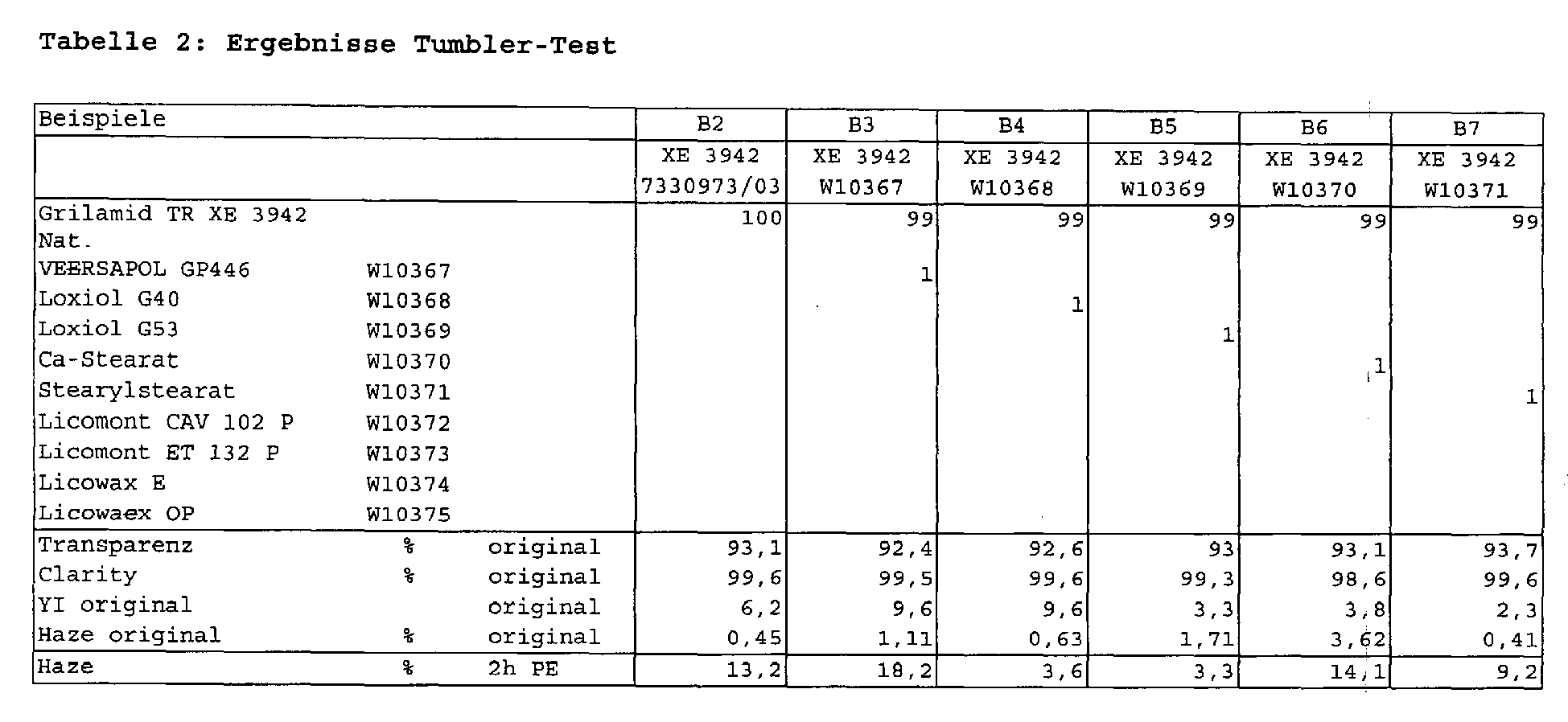
- Die Kratzfestigkeit hängt sehr stark von der Art ab, wie Kratzer erzeugt werden. So erzeugen nadelartige harte Metallspitzen eine andere Art von Beschädigung als weiche PE-Pen Spitzen auf Displayoberflächen. Bleistifte oder beispielsweise Putztücher mit und ohne Waschflüssigkeiten zeigen andere Kratzfestigkeiten. Häufig werden Angaben wie Bleistifthärte oder Ritzhärte als Maß für die zu erwartende Kratzfestigkeit verwendet. Gleitmittel können die Kratzfestigkeit von Polymeren verbessern oder verschlechtern. Bei transparenten Werkstoffen verursachen gerade die Gleitmittel, die die Kratzfestigkeit verbessern, eine unangenehme Trübung und verhindern eine Anwendung. In Platten 100x80x2 mm aus transparenten Polyamiden wie beispielsweise Grilamid TR 60 (XE 3942) verursachen Versapol® (erhältlich von Polichem, Paraffinöl), Loxiol® G40 (erhältlich von Cognis, Isotridecylstearat), Stearylstearat, Licomont® CAV 102 P (erhältlich von Clariant, Ca-Salze von Montansäuren), Laventin® LNB (erhältlich von BASF, Alkanolpo-lygylkolether) und Acrawax® C (erhältlich von IMS Company, N,N'-Ethylen-bisstearamid), Licomont® ET 132 P (erhältlich von Clariant, Montansäureester), Licowax® E (erhältlich von Clariant, Montansäureester), Licowax® OP (erhältlich von Clariant, teilweise verseifte Montansäureester) eine geringe Trübung (Haze). Nach zwei Stunden der Beanspruchung dieser Platten in einem Tumbler gefüllt mit PE Granulat zeigen die Gleitmittel Loxiol, Ca-Stearat und Licomont CAV 102 P den geringsten Anstieg im Haze und den geringsten Glanzverlust. Die Gleitmittel in den Beispielen 2 bis 11 wurden auf das Polymergranulat Grilamid TR 60 (XE 3942) aufgetrommelt und mit einem ZSK25 Doppelwellen Extruder von WP eingearbeitet. 100x80x2 mm Platten mit Filmanguss wurden auf einer Arburg-Maschine hergestellt. Die Ergebnisse der Beispiele sind in Tabelle 2 zusammengefasst.

- Additive werden in der Regel in der Form von Masterbatches (MB) während der Formgebung auf der Spritzgießmaschine zugegeben. Dazu ist die Herstellung von MB mit hohen Füllgraden, also hohe Zugaben der wirksamen Additive, notwendig, damit Zusätze von weniger als 5 % MB zum Polymergranulat die notwendige Additivmenge eintragen. Häufig können die niederviskosen Additive nicht oder nur schlecht in der Polymerschmelze ausreichend verteilt werden.
- Die Wirkungsweise gleicher Additivmengen compoundiert oder als MB zugemischt, weicht häufig voneinander ab, insbesondere bei Gleitmitteln, die hauptsächlich an der Oberfläche im Kontakt zu den Maschinenteilen ihre Wirksamkeit entfalten müssen.
- Gleitmittel, die leicht an die Oberfläche wandern, sind meist stark unverträglich zur Polymerschmelze und neigen zur Phasentrennung, die dann Haze (Trübung) im transparenten Formteil verursacht.
- Die üblichen Prozesse zur Herstellung von MB's als Compounds, die Gleitmittel in den Einzug des Extruders dosieren, versagen ebenso wie die Prozesse, die flüssig in die Schmelze dosieren und scheitern an der geringen Neigung der Polymerschmelze das Gleitmittel aufzunehmen.
- Entgegen den Erwartungen konnten mit den ausgewählten, wirksamen Gleitmitteln MB's mit 10 % Anteil hergestellt werden. Das Gleitmittel wird dazu einige Extruderzonen entfernt vom Einzug in die Schmelze gegeben. Dadurch konnten MB-Granulate (eingesetzt in Beispiel 13 - 23) in ausgezeichneter Homogenität, mit ausgezeichnetem Schnitt hergestellt werden, vgl. Tabelle 3.
- Einen sehr niedrigen Haze im Formteil original, d.h. vor dem Tumbler Test, zeigen Ca-Stearat, Loxiol G40, Stearylstearat und Licomont CAV 102 P in den Beispielen 17 - 21. Nach dem Tumbler Test zeigt das Loxiol G40 (Beispiele 18 u. 19) deutlich geringere Haze Werte und geringeren Glanzverlust als die übrigen. Die Resultate sind gut reproduzierbar (Beispiel 13/14, 18/19, 20/21).
- Damit konnten Formteile in der Kratzfestigkeit deutlich verbessert werden ohne die Transparenz negativ zu beeinflussen.


- Die in der Tabelle 4 aufgelisteten Messergebnisse zeigen, dass sich die besten Haze-Werte nach dem Tumler-Test für Grilamid TR 60 mit 0,5 Gew.-% Ca-Stearat, Stearylstearat und Licowax ergeben, die überlegene Messergebnisse gegenüber der Versapol-Variante ergeben.
- Die Haze-Werte für Grilamid TR 60 mit 1 Gew.-% Gleitmittel in Tabelle 2 zeigen vor dem Tumbler Test Vorteile für Loxiol G40 und Licomont CAV 102P. Die Haze-Werte nach dem Tumbler Test zeigen dagegen Vorteile für Loxiol G40, Stearylstearat und Licomont CAV 102P. Loxiol G40 zeigt gegenüber dem Licomont den geringeren Gelbstich und stellt damit für hohe Zugabemengen die beste Lösung dar.
- Gegenüber Formteilen ohne Gleitmittel wird dadurch eine deutliche Verbesserung der Kratzfestigkeit nach dem Tumbler Test erzielt, dadurch gekennzeichnet, dass dabei der Haze geringer ist.
Claims (16)
- Transparente Polyamidformmasse, enthaltend mindestens ein Copolyamid und ein Gleitmittel, dadurch gekennzeichnet, dass die Polyamidformmasse(A1) 50 bis 99,99 Gew.-Teile eines Copolyamides, aufgebaut aus:a) 15 bis 45 Mol-% Bis-(4-amino-3-methylcyclohexyl)methan (MACM), das bis zu 50 Mol-% durch Bis-(4-amino-cyclohexyl)methan (PACM) und/oder Hexamethylendiamin (HMDA) ersetzt sein kann,b) 15 bis 45 Mol-% Isophthalsäure (IPS), die bis zu 50 Mol-% durch Terephthalsäure (TPS) und/oder aliphatische Dicarbonsäuren ersetzt sein kann, undc) 10 bis 70 Mol-% Laurinlactam (LC 12), und(A2) 0 bis 49,99 Gew.-Teile eines transparenten Polyamids basierend auf MACM und/oder PACM und Dicarbonsäuren mit mindestens 9 C-Atomen, und(A3) 0 bis 29,99 Gew.-Teile eines aliphatischen Polyamids basierend auf Monomeren ausgewählt aus Diaminen mit mindestens 8 C-Atomen, Dicarbonsäuren mit mindestens 10 C-Atomen, Lactamen mit mindestens 10 C-Atomen und Aminocarbonsäuren mit mindestens 10 C-Atomen, wobei die Summe von (A2) und (A3) maximal 49,99 Gew.-Teile beträgt, und(B) 0,01 bis 5 Gew.-Teile mindestens eines Gleitmittels ausgewählt aus Salzen der Stearinsäure, Isotridecylstearat und/oder Salzen der Montansäuren, und(C) 0 bis 3 Gew.-Teile weitere Additive enthält,
mit der Maßgabe dass die Summe von (A1) und (A2) und (A3) und (B) 100 Gewichtsteile ergibt. - Transparente Polyamidformmasse nach Anspruch 1, dadurch gekennzeichnet, dass das mindestens eine Gleitmittel (B) mit einem Anteil von 0,1 bis 3 Gew.-%, bevorzugt 0,2 bis 2 Gew.-%, besonders bevorzugt mit 0,5 bis 1,5 Gew.-% und äußerst bevorzugt mit 0,8 bis 1,2 Gew.-% enthalten ist.
- Transparente Polyamidformmasse nach einem der vorhergehenden Ansprüche, dadurch gekennzeichnet, dass das Gleitmittel ein Ca-Salz der Montansäuren ist.
- Transparente Polyamidformmasse nach einem der Ansprüche 1 bis 2, dadurch gekennzeichnet, dass das aus Salzen der Stearinsäure ausgewählte Gleitmittel ein Metallstearat ist.
- Transparente Polyamidformmasse nach einem der vorhergehenden Ansprüche, dadurch gekennzeichnet, dass das Copolyamid (A1) aus den Eduktena) 30 bis 42 Mol-% MACM, das bis zu 50 Mol-% durch PACM ersetzt sein kann,b) 30 bis 42 Mol-% IPS, die bis zu 50 Mol-% durch TPS und/oder aliphatische Dicarbonsäuren ersetzt sein kann, undc) 16 bis 40 Mol-% LC 12aufgebaut ist.
- Transparente Polyamidformmasse nach Anspruch 5, dadurch gekennzeichnet, dass das Copolyamid (A1) aus den Eduktena) 35 bis 40 Mol-% MACMb) 18 bis 22 Mol-% IPS sowie
16 bis 20 Mol-% TPS undc) 22 bis 27 Mol-% LC 12aufgebaut ist. - Transparente Polyamidformmasse nach einem der vorhergehenden Ansprüche, dadurch gekennzeichnet, dass die weiteren Additive (C) ausgewählt sind aus der Gruppe UV-Stabilisatoren, Hitzestabilisatoren, Katalysatoren, transparente Farbstoffe, phototrope Additive, Antistatikmittel, Verarbeitungshilfsmittel und Lasermarkieradditive.
- Transparente nach einem der vorhergehenden Ansprüche, dadurch gekennzeichnet, dass die relative Viskosität (RV) der Polyamidformmasse gemessen in 0,5 %-iger m-Kresollösung > 1,45, bevorzugt 1,53 bis 1,56 ist.
- Transparente Polyamidformmasse nach einem der vorhergehenden Ansprüche, dadurch gekennzeichnet, dass der Tg-Wert > 175 °C ist.
- Transparente Polyamidformmasse nach einem der vorhergehenden Ansprüche, dadurch gekennzeichnet, dass sie bei Prüfung in Form einer Platte mit einer Dicke von 2 mm eine Trübung (Haze) gemessen nach dem Byk Gardner Test gemäß ASTM 1003 aufweist, die um maximal 200 % größer ist verglichen mit einer 2 mm dicken Platte aus einer sonst gleichen Polyamidformmasse aber ohne Gleitmittel (B).
- Transparente Polyamidformmasse nach einem der vorhergehenden Ansprüche, dadurch gekennzeichnet, dass sie bei Prüfung in Form einer Platte mit einer Dicke von 2 mm eine Trübung (Haze) gemessen nach dem Byk Gardner Test gemäß ASTM 1003 nach einer Behandlungsdauer von 2 Stunden im Tumbler aufweist, die kleiner ist verglichen mit einer 2 mm dicken Platte aus einer sonst gleichen Polyamidformmasse aber ohne Gleitmittel (B), welche auch derselben Behandlung im Tumbler unterworfen wurde.
- Transparente Polyamidformmasse nach einem der vorhergehenden Ansprüche, dadurch gekennzeichnet, dass sie bei Prüfung in Form einer Platte mit einer Dicke von 2 mm eine Transmission > 90 %, bevorzugt > 91 % aufweist.
- Transparente Polyamidformmasse nach einem der vorhergehenden Ansprüche, dadurch gekennzeichnet, dass sie gemessen an einem daraus hergestellten Prüfkörper einen E-Modul von mindestens 1800 MPa aufweist.
- Formteil, hergestellt aus einer transparenten Polyamidformmasse nach mindestens einem der Ansprüche 1 bis 13.
- Formteil gemäß Anspruch 14 für hochtransparente und kratzfeste Anwendungen ohne zusätzliche Oberflächenbeschichtung.
- Formteil nach Anspruch 14 für hochtransparente und kratzfeste Anwendungen, wobei die Oberfläche zumindest teilweise beschichtet ist.
Applications Claiming Priority (1)
| Application Number | Priority Date | Filing Date | Title |
|---|---|---|---|
| DE102007062063A DE102007062063A1 (de) | 2007-12-21 | 2007-12-21 | Transparente Polyamidformmasse |
Publications (3)
| Publication Number | Publication Date |
|---|---|
| EP2093255A2 true EP2093255A2 (de) | 2009-08-26 |
| EP2093255A3 EP2093255A3 (de) | 2010-03-31 |
| EP2093255B1 EP2093255B1 (de) | 2012-06-06 |
Family
ID=40689741
Family Applications (1)
| Application Number | Title | Priority Date | Filing Date |
|---|---|---|---|
| EP08021557A Not-in-force EP2093255B1 (de) | 2007-12-21 | 2008-12-11 | Transparente Polyamidformmasse |
Country Status (5)
| Country | Link |
|---|---|
| US (1) | US8507598B2 (de) |
| EP (1) | EP2093255B1 (de) |
| JP (1) | JP5714208B2 (de) |
| KR (1) | KR101528202B1 (de) |
| DE (1) | DE102007062063A1 (de) |
Cited By (1)
| Publication number | Priority date | Publication date | Assignee | Title |
|---|---|---|---|---|
| EP2666803A1 (de) | 2012-05-23 | 2013-11-27 | Ems-Patent Ag | Kratzfeste, transparente und zähe Copolyamidformmassen, hieraus hergestellte Formkörper und deren Verwendung |
Families Citing this family (27)
| Publication number | Priority date | Publication date | Assignee | Title |
|---|---|---|---|---|
| DE102007062063A1 (de) | 2007-12-21 | 2009-06-25 | Ems-Patent Ag | Transparente Polyamidformmasse |
| US9339696B2 (en) | 2009-03-13 | 2016-05-17 | Acushnet Company | Three-cover-layer golf ball comprising intermediate layer including a plasticized polyester composition |
| US9669265B2 (en) | 2009-03-13 | 2017-06-06 | Acushnet Company | Three-cover-layer golf ball having transparent or plasticized polyamide intermediate layer |
| US10166441B2 (en) | 2009-03-13 | 2019-01-01 | Acushnet Company | Three-cover-layer golf ball having transparent or plasticized polyamide intermediate layer |
| FR2957603B1 (fr) * | 2010-03-22 | 2013-05-03 | Rhodia Poliamida E Especialidades Ltda | Utilisation de polyamide pour la preparation d'articles moules par injection et articles moules ainsi obtenus |
| KR20120105720A (ko) | 2011-03-16 | 2012-09-26 | 삼성전자주식회사 | 폴리아미드 혼합물, 이를 사용하여 제조한 필름 및 상기 필름을 포함하는 디스플레이 장치 |
| KR101796174B1 (ko) | 2011-05-19 | 2017-11-10 | 삼성전자주식회사 | 폴리아미드 블록 코폴리머, 이의 제조 방법, 이를 포함하는 성형품 및 상기 성형품을 포함하는 디스플레이 장치 |
| US20140323243A1 (en) | 2012-04-20 | 2014-10-30 | Acushnet Company | Polyamide compositions containing plasticizers for use in making golf balls |
| US9339695B2 (en) | 2012-04-20 | 2016-05-17 | Acushnet Company | Compositions containing transparent polyamides for use in making golf balls |
| US9409057B2 (en) | 2012-04-20 | 2016-08-09 | Acushnet Company | Blends of polyamide and acid anhydride-modified polyolefins for use in golf balls |
| US9415268B2 (en) | 2014-11-04 | 2016-08-16 | Acushnet Company | Polyester-based thermoplastic elastomers containing plasticizers for making golf balls |
| US9592425B2 (en) | 2012-04-20 | 2017-03-14 | Acushnet Company | Multi-layer core golf ball |
| US9649539B2 (en) | 2012-04-20 | 2017-05-16 | Acushnet Company | Multi-layer core golf ball |
| TWM442264U (en) * | 2012-08-20 | 2012-12-01 | Yu Star Internat Ltd | Screen protector device for hand-held electronic apparatus |
| EP2716716B1 (de) | 2012-10-02 | 2018-04-18 | Ems-Patent Ag | Polyamid-Formmassen und deren Verwendung bei der Herstellung von Formkörpern |
| PL2746339T3 (pl) | 2012-12-18 | 2015-05-29 | Ems Patent Ag | Tłoczywo poliamidowe i wytłaczane z niego kształtki |
| EP2949704B1 (de) * | 2012-12-21 | 2019-04-24 | Ems-Patent Ag | Anfärberesistente artikel und ihre verwendung |
| DE102013201388A1 (de) | 2013-01-29 | 2014-07-31 | Evonik Industries Ag | Verfahren zur Herstellung eines Metall-Kunststoff-Hybridbauteils |
| EP2778190B1 (de) | 2013-03-15 | 2015-07-15 | Ems-Patent Ag | Polyamidformmasse sowie hieraus hergestellter Formkörper |
| DE102013213579A1 (de) | 2013-07-11 | 2014-09-04 | Evonik Industries Ag | Sehhilfe |
| DE102013213582A1 (de) | 2013-07-11 | 2015-01-29 | Evonik Industries Ag | Sportschuh umfassend stollen oder stollenaufnahmen |
| DE102014206022A1 (de) | 2014-03-31 | 2015-10-01 | Evonik Degussa Gmbh | Metall-Kunststoff-Hybridbauteil |
| CN104974342A (zh) * | 2014-12-02 | 2015-10-14 | 淮安市欣佳尼龙有限公司 | 一种透明尼龙610的制备方法及其牙刷丝 |
| EP3309199B1 (de) * | 2016-10-12 | 2020-04-01 | Ems-Patent Ag | Glasfüller-verstärkte polyamid-formmassen auf basis amorpher copolyamide |
| EP3697831B1 (de) * | 2017-10-20 | 2024-05-22 | DSM IP Assets B.V. | Polyamid-copolymer, verfahren zur herstellung und daraus hergestellte formteile |
| WO2021148685A1 (es) * | 2020-01-20 | 2021-07-29 | Sociedad Anónima Minera Catalano Aragonesa | Envase reciclable con capacidad de sellado |
| US20230415395A1 (en) | 2021-03-12 | 2023-12-28 | Asahi Kasei Kabushiki Kaisha | Molded article, production method for laser-marked molded article, and laser marking method |
Citations (10)
| Publication number | Priority date | Publication date | Assignee | Title |
|---|---|---|---|---|
| US4740450A (en) | 1983-09-13 | 1988-04-26 | Toyo Boseki Kabushiki Kaisha | Method of making image reproducing material having scratch improvment |
| EP0682679A1 (de) | 1993-02-03 | 1995-11-22 | BASF Aktiengesellschaft | Kratzfeste polymerzusammensetzungen |
| JPH0883515A (ja) | 1994-09-13 | 1996-03-26 | Fujimori Kogyo Kk | 透明導電性シート |
| US5731376A (en) | 1991-07-29 | 1998-03-24 | Imperial Chemical Industries Plc | Scratch resistant polymer compositions and articles |
| EP0943651A2 (de) | 1998-03-20 | 1999-09-22 | E. I. du Pont de Nemours and Company | Polymer mit verbesserter Kratz- und Verschleissfestigkeit |
| DE10122188A1 (de) | 2001-05-08 | 2002-11-28 | Ems Chemie Ag | Polyamidformmassen zur Herstellung optischer Linsen |
| JP2003118055A (ja) | 2001-10-18 | 2003-04-23 | Dainippon Printing Co Ltd | 化粧シート |
| EP1570983A1 (de) | 2004-02-03 | 2005-09-07 | EMS-Chemie AG | Werkstoffverbunde aus einem Formteil aus transparenten oder transluzenten, einfärbbaren Kunststoffformmassen |
| US20070066726A1 (en) | 2005-09-22 | 2007-03-22 | Ashutosh Sharma | Scratch resistant polymer compositions |
| WO2007087896A1 (de) | 2006-01-31 | 2007-08-09 | Ems-Chemie Ag | Polyamidformmasse und deren verwendung zur herstellung von transparenten,heissdampfsterilisierbaren formteilen und extrudaten |
Family Cites Families (30)
| Publication number | Priority date | Publication date | Assignee | Title |
|---|---|---|---|---|
| CH624970A5 (en) | 1975-09-22 | 1981-08-31 | Inventa Ag | Process for the preparation of glass-transparent polyamide |
| US4232145A (en) * | 1978-12-18 | 1980-11-04 | Inventa Ag Fur Forschung Und Patentverwertung, Zurich | Injection moldable glass clear transparent polyamide |
| US4511684A (en) * | 1982-12-15 | 1985-04-16 | Ems-Inventa Ag | Flame retardant polyamides and agent for inducing flame retardancy |
| US4826955A (en) * | 1988-01-21 | 1989-05-02 | Allied-Signal Inc. | Amorphous copolyamide article of manufacture with moisture-insensitive oxygen barrier properties |
| DE58908791D1 (de) * | 1988-07-13 | 1995-02-02 | Basf Ag | Flammgeschützte thermoplastische Formmassen auf der Basis teilaromatischer Copolyamide. |
| DE68927469T2 (de) * | 1988-09-22 | 1997-03-27 | Mitsui Petrochemical Ind | Polyamidharz-Zusammensetzungen |
| DE69312701T2 (de) * | 1992-04-14 | 1997-12-04 | Allied Signal Inc | Thermoplastische zusammensetzungen enthaltend mischungen aus polyamiden und amorphen copolyamiden |
| DE4312752A1 (de) * | 1993-04-20 | 1994-10-27 | Basf Ag | Flammgeschützte thermoplastische Formmassen auf der Basis von Polyamiden |
| DE4337030A1 (de) * | 1993-10-29 | 1995-05-04 | Henkel Kgaa | Verfahren zur Herstellung von Wachsdispersionen |
| DE4444378A1 (de) * | 1994-12-14 | 1996-06-20 | Basf Ag | Thermoplastische Formmassen auf der Basis von teilaromatischen Polyamiden und Polymethacrylimiden |
| CA2162429A1 (en) * | 1995-02-01 | 1996-08-02 | Hans Dalla Torre | Colorless, transparent copolyamides, their preparation, and molded articles made from these copolyamides, their blends or alloys |
| CH689422A5 (de) * | 1995-02-01 | 1999-04-15 | Inventa Ag | Transparente Copolyamide, ihre Herstellung sowie Formkoerper aus den transparenten Copolyamiden. |
| CH688624A5 (de) * | 1995-02-01 | 1997-12-15 | Inventa Ag | Amorphe Polyamid-Formmassen und -Formteile. |
| DE19725617A1 (de) | 1997-06-17 | 1998-12-24 | Inventa Ag | Schlagzähe transparente Polyamidlegierungen |
| US6831137B2 (en) * | 1997-06-17 | 2004-12-14 | Ems Inventa Ag | Impact resistant transparent polyamide alloys |
| US6297345B1 (en) * | 1999-05-27 | 2001-10-02 | Ube Industries, Ltd. | Polyamide having excellent stretching properties |
| US6022613A (en) * | 1999-06-11 | 2000-02-08 | Alliedsignal Inc. | Transparent polyamide compositions |
| US6515058B1 (en) * | 2000-08-09 | 2003-02-04 | Asahi Kasei Kogyo Kabushiki Kaisha | Polyamide resin composition |
| JP4918954B2 (ja) * | 2001-05-01 | 2012-04-18 | 株式会社ジェイテクト | 電動パワーステアリング装置 |
| EP1454960B1 (de) * | 2001-08-07 | 2012-10-24 | Pacific Engineering Corporation | Polyamidharzzusammensetzung für sicherungselement und sicherungselement |
| DE10224947B4 (de) * | 2002-06-05 | 2006-07-06 | Ems Chemie Ag | Transparente Polyamid-Formmassen mit verbesserter Transparenz, Chemikalienbeständigkeit und dynamischer Belastbarkeit |
| US7491763B2 (en) * | 2002-07-10 | 2009-02-17 | Asahi Kasei Chemicals Corporation | Polyamide composition |
| JP4245327B2 (ja) * | 2002-10-25 | 2009-03-25 | 旭化成ケミカルズ株式会社 | ポリアミド樹脂組成物 |
| WO2004039856A1 (ja) * | 2002-10-31 | 2004-05-13 | Kyoeisha Chemical Co.,Ltd. | 樹脂組成物、転写材及び成型品の製造方法 |
| DE102004051241A1 (de) * | 2004-10-20 | 2006-05-04 | Basf Ag | Fließfähige Polyamide mit hyperverzweigten Polyestern/Polycarbonaten |
| DE102005007034A1 (de) * | 2005-02-15 | 2006-08-17 | Degussa Ag | Verfahren zur Herstellung von Formteilen unter Erhöhung der Schmelzesteifigkeit |
| DE102006045269A1 (de) * | 2005-11-09 | 2007-05-31 | Ems-Chemie Ag | Metallisch beschichtete Lichtreflektierbauteile auf der Basis von thermoplastischen Formmassen |
| EP1882719B1 (de) * | 2006-07-11 | 2017-04-19 | Ems-Chemie Ag | Polyamidformmasse und deren Verwendung |
| DE502007002951D1 (de) * | 2006-07-26 | 2010-04-08 | Basf Se | Thermoplastische formmassen mit hoher steifigkeit |
| DE102007062063A1 (de) | 2007-12-21 | 2009-06-25 | Ems-Patent Ag | Transparente Polyamidformmasse |
-
2007
- 2007-12-21 DE DE102007062063A patent/DE102007062063A1/de not_active Ceased
-
2008
- 2008-12-11 EP EP08021557A patent/EP2093255B1/de not_active Not-in-force
- 2008-12-19 US US12/339,573 patent/US8507598B2/en not_active Expired - Fee Related
- 2008-12-22 JP JP2008325246A patent/JP5714208B2/ja not_active Expired - Fee Related
- 2008-12-22 KR KR1020080130796A patent/KR101528202B1/ko not_active Expired - Fee Related
Patent Citations (10)
| Publication number | Priority date | Publication date | Assignee | Title |
|---|---|---|---|---|
| US4740450A (en) | 1983-09-13 | 1988-04-26 | Toyo Boseki Kabushiki Kaisha | Method of making image reproducing material having scratch improvment |
| US5731376A (en) | 1991-07-29 | 1998-03-24 | Imperial Chemical Industries Plc | Scratch resistant polymer compositions and articles |
| EP0682679A1 (de) | 1993-02-03 | 1995-11-22 | BASF Aktiengesellschaft | Kratzfeste polymerzusammensetzungen |
| JPH0883515A (ja) | 1994-09-13 | 1996-03-26 | Fujimori Kogyo Kk | 透明導電性シート |
| EP0943651A2 (de) | 1998-03-20 | 1999-09-22 | E. I. du Pont de Nemours and Company | Polymer mit verbesserter Kratz- und Verschleissfestigkeit |
| DE10122188A1 (de) | 2001-05-08 | 2002-11-28 | Ems Chemie Ag | Polyamidformmassen zur Herstellung optischer Linsen |
| JP2003118055A (ja) | 2001-10-18 | 2003-04-23 | Dainippon Printing Co Ltd | 化粧シート |
| EP1570983A1 (de) | 2004-02-03 | 2005-09-07 | EMS-Chemie AG | Werkstoffverbunde aus einem Formteil aus transparenten oder transluzenten, einfärbbaren Kunststoffformmassen |
| US20070066726A1 (en) | 2005-09-22 | 2007-03-22 | Ashutosh Sharma | Scratch resistant polymer compositions |
| WO2007087896A1 (de) | 2006-01-31 | 2007-08-09 | Ems-Chemie Ag | Polyamidformmasse und deren verwendung zur herstellung von transparenten,heissdampfsterilisierbaren formteilen und extrudaten |
Cited By (1)
| Publication number | Priority date | Publication date | Assignee | Title |
|---|---|---|---|---|
| EP2666803A1 (de) | 2012-05-23 | 2013-11-27 | Ems-Patent Ag | Kratzfeste, transparente und zähe Copolyamidformmassen, hieraus hergestellte Formkörper und deren Verwendung |
Also Published As
| Publication number | Publication date |
|---|---|
| US20090163634A1 (en) | 2009-06-25 |
| EP2093255B1 (de) | 2012-06-06 |
| US8507598B2 (en) | 2013-08-13 |
| KR20090068186A (ko) | 2009-06-25 |
| DE102007062063A1 (de) | 2009-06-25 |
| EP2093255A3 (de) | 2010-03-31 |
| JP5714208B2 (ja) | 2015-05-07 |
| JP2009149896A (ja) | 2009-07-09 |
| KR101528202B1 (ko) | 2015-06-11 |
Similar Documents
| Publication | Publication Date | Title |
|---|---|---|
| EP2093255B1 (de) | Transparente Polyamidformmasse | |
| EP2107083B1 (de) | Polyamidformmasse für lackfreie, zähe Gehäuse mit Hochglanz-Oberfläche | |
| EP1847569B1 (de) | Transparente Polyamid-Formmassen | |
| EP2203521B1 (de) | Polyamidformmassen, enthaltend copolyamide zur herstellung von transparenten formteilen mit geringem verzug im klimatest | |
| EP1397414B2 (de) | Polyamidformmassen zur herstellung optischer linsen | |
| EP2022820B1 (de) | Photochrome formmassen und daraus hergestellte gegenstände | |
| EP1680276B1 (de) | Mehrschichtfolie aus (meth)acrylatcopolymer und polycarbonat | |
| EP2291457B1 (de) | Polyamidformmassen, enthaltend teilkristalline, transparente copolyamide, zur herstellung von transparenten formteilen mit hoher flexibilität, hoher kerbschlagzähigkeit, niedriger wasseraufnahme und ausgezeichneter chemikalienbeständigkeit | |
| DE10224947B4 (de) | Transparente Polyamid-Formmassen mit verbesserter Transparenz, Chemikalienbeständigkeit und dynamischer Belastbarkeit | |
| DE19642885C2 (de) | Verwendung von Polyamid-Formmassen zur Herstellung von optischen oder elektrooptischen Formteilen | |
| JP2888656B2 (ja) | 着色熱可塑性樹脂組成物 | |
| EP2616512B1 (de) | Witterungsbeständige, eingefärbte formkörper mit verbessertem glanz und wischbeständigkeit | |
| DE69225643T2 (de) | Film mit aufgerauhter Oberfläche und Verfahren zu seiner Herstellung | |
| DE2616147A1 (de) | Optisch klares, verstaerktes silikonelastomeres und daraus gefertigte kontaktlinsen und augenimplantate | |
| DE102013227126A1 (de) | Zusammensetzungen aus Polypropylen mit einer verbesserten Taktilität und einer verbesserten Beständigkeit gegen Kratzer und Verfahren zur Verwendung derselben | |
| EP3502191A1 (de) | Polyamid-formmasse | |
| DE102016212419B4 (de) | Harzzusammensetzung zum beschichten einer kunststoffverglasung und deren verwendung | |
| DE69231838T2 (de) | Kratzfestige Polymermischungen und Artikeln herstellt davon | |
| DE102006057957B4 (de) | Transparenter Formkörper aus einer Polyamidformmasse sowie dessen Verwendung | |
| EP4010423B1 (de) | Durchsichtige zusammensetzung | |
| EP3873989B1 (de) | Fleckenbeständige polyamidzusammensetzung | |
| EP2639269B1 (de) | Verwendung einer Polymer-Zusammensetzung zur Herstellung eines Geräteeinbaukanals sowie aus einer derartigen Polymer-Zusammensetzung erhaltener Geräteeinbaukanal | |
| WO1996035746A1 (de) | Biologisch abbaubare thermoplastische formmassen mit verbesserten verarbeitungs- und gebrauchseigenschaften |
Legal Events
| Date | Code | Title | Description |
|---|---|---|---|
| PUAI | Public reference made under article 153(3) epc to a published international application that has entered the european phase |
Free format text: ORIGINAL CODE: 0009012 |
|
| AK | Designated contracting states |
Kind code of ref document: A2 Designated state(s): AT BE BG CH CY CZ DE DK EE ES FI FR GB GR HR HU IE IS IT LI LT LU LV MC MT NL NO PL PT RO SE SI SK TR |
|
| AX | Request for extension of the european patent |
Extension state: AL BA MK RS |
|
| PUAL | Search report despatched |
Free format text: ORIGINAL CODE: 0009013 |
|
| AK | Designated contracting states |
Kind code of ref document: A3 Designated state(s): AT BE BG CH CY CZ DE DK EE ES FI FR GB GR HR HU IE IS IT LI LT LU LV MC MT NL NO PL PT RO SE SI SK TR |
|
| AX | Request for extension of the european patent |
Extension state: AL BA MK RS |
|
| RIC1 | Information provided on ipc code assigned before grant |
Ipc: C08L 77/06 20060101AFI20090716BHEP Ipc: C08K 5/101 20060101ALI20100223BHEP Ipc: C08K 5/098 20060101ALI20100223BHEP Ipc: C08G 69/36 20060101ALI20100223BHEP |
|
| 17P | Request for examination filed |
Effective date: 20100813 |
|
| AKX | Designation fees paid |
Designated state(s): AT BE BG CH CY CZ DE DK EE ES FI FR GB GR HR HU IE IS IT LI LT LU LV MC MT NL NO PL PT RO SE SI SK TR |
|
| RIC1 | Information provided on ipc code assigned before grant |
Ipc: C08L 77/06 20060101AFI20110429BHEP Ipc: C08K 5/101 20060101ALI20110429BHEP Ipc: C08K 5/098 20060101ALI20110429BHEP Ipc: C08G 69/36 20060101ALI20110429BHEP |
|
| 17Q | First examination report despatched |
Effective date: 20110704 |
|
| GRAP | Despatch of communication of intention to grant a patent |
Free format text: ORIGINAL CODE: EPIDOSNIGR1 |
|
| RIC1 | Information provided on ipc code assigned before grant |
Ipc: C08K 5/098 20060101ALI20111028BHEP Ipc: C08L 77/06 20060101AFI20111028BHEP Ipc: C08K 5/101 20060101ALI20111028BHEP Ipc: C08G 69/36 20060101ALI20111028BHEP Ipc: G02B 1/04 20060101ALI20111028BHEP |
|
| GRAS | Grant fee paid |
Free format text: ORIGINAL CODE: EPIDOSNIGR3 |
|
| RAP1 | Party data changed (applicant data changed or rights of an application transferred) |
Owner name: EMS-PATENT AG |
|
| GRAA | (expected) grant |
Free format text: ORIGINAL CODE: 0009210 |
|
| AK | Designated contracting states |
Kind code of ref document: B1 Designated state(s): AT BE BG CH CY CZ DE DK EE ES FI FR GB GR HR HU IE IS IT LI LT LU LV MC MT NL NO PL PT RO SE SI SK TR |
|
| REG | Reference to a national code |
Ref country code: GB Ref legal event code: FG4D Free format text: NOT ENGLISH |
|
| REG | Reference to a national code |
Ref country code: AT Ref legal event code: REF Ref document number: 561027 Country of ref document: AT Kind code of ref document: T Effective date: 20120615 Ref country code: CH Ref legal event code: EP |
|
| REG | Reference to a national code |
Ref country code: IE Ref legal event code: FG4D Free format text: LANGUAGE OF EP DOCUMENT: GERMAN |
|
| REG | Reference to a national code |
Ref country code: DE Ref legal event code: R096 Ref document number: 502008007366 Country of ref document: DE Effective date: 20120802 |
|
| REG | Reference to a national code |
Ref country code: NL Ref legal event code: VDEP Effective date: 20120606 |
|
| PG25 | Lapsed in a contracting state [announced via postgrant information from national office to epo] |
Ref country code: FI Free format text: LAPSE BECAUSE OF FAILURE TO SUBMIT A TRANSLATION OF THE DESCRIPTION OR TO PAY THE FEE WITHIN THE PRESCRIBED TIME-LIMIT Effective date: 20120606 Ref country code: CY Free format text: LAPSE BECAUSE OF FAILURE TO SUBMIT A TRANSLATION OF THE DESCRIPTION OR TO PAY THE FEE WITHIN THE PRESCRIBED TIME-LIMIT Effective date: 20120606 Ref country code: SE Free format text: LAPSE BECAUSE OF FAILURE TO SUBMIT A TRANSLATION OF THE DESCRIPTION OR TO PAY THE FEE WITHIN THE PRESCRIBED TIME-LIMIT Effective date: 20120606 Ref country code: LT Free format text: LAPSE BECAUSE OF FAILURE TO SUBMIT A TRANSLATION OF THE DESCRIPTION OR TO PAY THE FEE WITHIN THE PRESCRIBED TIME-LIMIT Effective date: 20120606 Ref country code: NO Free format text: LAPSE BECAUSE OF FAILURE TO SUBMIT A TRANSLATION OF THE DESCRIPTION OR TO PAY THE FEE WITHIN THE PRESCRIBED TIME-LIMIT Effective date: 20120906 |
|
| REG | Reference to a national code |
Ref country code: LT Ref legal event code: MG4D Effective date: 20120606 |
|
| PG25 | Lapsed in a contracting state [announced via postgrant information from national office to epo] |
Ref country code: LV Free format text: LAPSE BECAUSE OF FAILURE TO SUBMIT A TRANSLATION OF THE DESCRIPTION OR TO PAY THE FEE WITHIN THE PRESCRIBED TIME-LIMIT Effective date: 20120606 Ref country code: HR Free format text: LAPSE BECAUSE OF FAILURE TO SUBMIT A TRANSLATION OF THE DESCRIPTION OR TO PAY THE FEE WITHIN THE PRESCRIBED TIME-LIMIT Effective date: 20120606 Ref country code: SI Free format text: LAPSE BECAUSE OF FAILURE TO SUBMIT A TRANSLATION OF THE DESCRIPTION OR TO PAY THE FEE WITHIN THE PRESCRIBED TIME-LIMIT Effective date: 20120606 Ref country code: GR Free format text: LAPSE BECAUSE OF FAILURE TO SUBMIT A TRANSLATION OF THE DESCRIPTION OR TO PAY THE FEE WITHIN THE PRESCRIBED TIME-LIMIT Effective date: 20120907 |
|
| PG25 | Lapsed in a contracting state [announced via postgrant information from national office to epo] |
Ref country code: RO Free format text: LAPSE BECAUSE OF FAILURE TO SUBMIT A TRANSLATION OF THE DESCRIPTION OR TO PAY THE FEE WITHIN THE PRESCRIBED TIME-LIMIT Effective date: 20120606 Ref country code: NL Free format text: LAPSE BECAUSE OF FAILURE TO SUBMIT A TRANSLATION OF THE DESCRIPTION OR TO PAY THE FEE WITHIN THE PRESCRIBED TIME-LIMIT Effective date: 20120606 Ref country code: EE Free format text: LAPSE BECAUSE OF FAILURE TO SUBMIT A TRANSLATION OF THE DESCRIPTION OR TO PAY THE FEE WITHIN THE PRESCRIBED TIME-LIMIT Effective date: 20120606 Ref country code: SK Free format text: LAPSE BECAUSE OF FAILURE TO SUBMIT A TRANSLATION OF THE DESCRIPTION OR TO PAY THE FEE WITHIN THE PRESCRIBED TIME-LIMIT Effective date: 20120606 Ref country code: IS Free format text: LAPSE BECAUSE OF FAILURE TO SUBMIT A TRANSLATION OF THE DESCRIPTION OR TO PAY THE FEE WITHIN THE PRESCRIBED TIME-LIMIT Effective date: 20121006 |
|
| PG25 | Lapsed in a contracting state [announced via postgrant information from national office to epo] |
Ref country code: PL Free format text: LAPSE BECAUSE OF FAILURE TO SUBMIT A TRANSLATION OF THE DESCRIPTION OR TO PAY THE FEE WITHIN THE PRESCRIBED TIME-LIMIT Effective date: 20120606 Ref country code: PT Free format text: LAPSE BECAUSE OF FAILURE TO SUBMIT A TRANSLATION OF THE DESCRIPTION OR TO PAY THE FEE WITHIN THE PRESCRIBED TIME-LIMIT Effective date: 20121008 |
|
| PLBE | No opposition filed within time limit |
Free format text: ORIGINAL CODE: 0009261 |
|
| STAA | Information on the status of an ep patent application or granted ep patent |
Free format text: STATUS: NO OPPOSITION FILED WITHIN TIME LIMIT |
|
| PG25 | Lapsed in a contracting state [announced via postgrant information from national office to epo] |
Ref country code: ES Free format text: LAPSE BECAUSE OF FAILURE TO SUBMIT A TRANSLATION OF THE DESCRIPTION OR TO PAY THE FEE WITHIN THE PRESCRIBED TIME-LIMIT Effective date: 20120917 Ref country code: DK Free format text: LAPSE BECAUSE OF FAILURE TO SUBMIT A TRANSLATION OF THE DESCRIPTION OR TO PAY THE FEE WITHIN THE PRESCRIBED TIME-LIMIT Effective date: 20120606 |
|
| 26N | No opposition filed |
Effective date: 20130307 |
|
| BERE | Be: lapsed |
Owner name: EMS-PATENT A.G. Effective date: 20121231 |
|
| REG | Reference to a national code |
Ref country code: DE Ref legal event code: R097 Ref document number: 502008007366 Country of ref document: DE Effective date: 20130307 |
|
| PG25 | Lapsed in a contracting state [announced via postgrant information from national office to epo] |
Ref country code: BG Free format text: LAPSE BECAUSE OF FAILURE TO SUBMIT A TRANSLATION OF THE DESCRIPTION OR TO PAY THE FEE WITHIN THE PRESCRIBED TIME-LIMIT Effective date: 20120906 Ref country code: MC Free format text: LAPSE BECAUSE OF NON-PAYMENT OF DUE FEES Effective date: 20121231 |
|
| REG | Reference to a national code |
Ref country code: CH Ref legal event code: PL |
|
| GBPC | Gb: european patent ceased through non-payment of renewal fee |
Effective date: 20121211 |
|
| REG | Reference to a national code |
Ref country code: IE Ref legal event code: MM4A |
|
| PG25 | Lapsed in a contracting state [announced via postgrant information from national office to epo] |
Ref country code: BE Free format text: LAPSE BECAUSE OF NON-PAYMENT OF DUE FEES Effective date: 20121231 |
|
| PG25 | Lapsed in a contracting state [announced via postgrant information from national office to epo] |
Ref country code: LI Free format text: LAPSE BECAUSE OF NON-PAYMENT OF DUE FEES Effective date: 20121231 Ref country code: IE Free format text: LAPSE BECAUSE OF NON-PAYMENT OF DUE FEES Effective date: 20121211 Ref country code: CH Free format text: LAPSE BECAUSE OF NON-PAYMENT OF DUE FEES Effective date: 20121231 |
|
| PG25 | Lapsed in a contracting state [announced via postgrant information from national office to epo] |
Ref country code: MT Free format text: LAPSE BECAUSE OF FAILURE TO SUBMIT A TRANSLATION OF THE DESCRIPTION OR TO PAY THE FEE WITHIN THE PRESCRIBED TIME-LIMIT Effective date: 20120606 Ref country code: GB Free format text: LAPSE BECAUSE OF NON-PAYMENT OF DUE FEES Effective date: 20121211 |
|
| PG25 | Lapsed in a contracting state [announced via postgrant information from national office to epo] |
Ref country code: TR Free format text: LAPSE BECAUSE OF FAILURE TO SUBMIT A TRANSLATION OF THE DESCRIPTION OR TO PAY THE FEE WITHIN THE PRESCRIBED TIME-LIMIT Effective date: 20120606 |
|
| PG25 | Lapsed in a contracting state [announced via postgrant information from national office to epo] |
Ref country code: LU Free format text: LAPSE BECAUSE OF NON-PAYMENT OF DUE FEES Effective date: 20121211 |
|
| PG25 | Lapsed in a contracting state [announced via postgrant information from national office to epo] |
Ref country code: HU Free format text: LAPSE BECAUSE OF FAILURE TO SUBMIT A TRANSLATION OF THE DESCRIPTION OR TO PAY THE FEE WITHIN THE PRESCRIBED TIME-LIMIT Effective date: 20081211 |
|
| REG | Reference to a national code |
Ref country code: FR Ref legal event code: PLFP Year of fee payment: 8 |
|
| REG | Reference to a national code |
Ref country code: FR Ref legal event code: PLFP Year of fee payment: 9 |
|
| REG | Reference to a national code |
Ref country code: FR Ref legal event code: PLFP Year of fee payment: 10 |
|
| REG | Reference to a national code |
Ref country code: DE Ref legal event code: R082 Ref document number: 502008007366 Country of ref document: DE Representative=s name: PFENNING, MEINIG & PARTNER MBB PATENTANWAELTE, DE Ref country code: DE Ref legal event code: R081 Ref document number: 502008007366 Country of ref document: DE Owner name: EMS-CHEMIE AG, CH Free format text: FORMER OWNER: EMS-PATENT AG, DOMAT, CH |
|
| PGFP | Annual fee paid to national office [announced via postgrant information from national office to epo] |
Ref country code: AT Payment date: 20211222 Year of fee payment: 14 Ref country code: CZ Payment date: 20211213 Year of fee payment: 14 |
|
| P01 | Opt-out of the competence of the unified patent court (upc) registered |
Effective date: 20230412 |
|
| PG25 | Lapsed in a contracting state [announced via postgrant information from national office to epo] |
Ref country code: CZ Free format text: LAPSE BECAUSE OF NON-PAYMENT OF DUE FEES Effective date: 20221211 |
|
| REG | Reference to a national code |
Ref country code: AT Ref legal event code: MM01 Ref document number: 561027 Country of ref document: AT Kind code of ref document: T Effective date: 20221211 |
|
| PG25 | Lapsed in a contracting state [announced via postgrant information from national office to epo] |
Ref country code: AT Free format text: LAPSE BECAUSE OF NON-PAYMENT OF DUE FEES Effective date: 20221211 |
|
| PGFP | Annual fee paid to national office [announced via postgrant information from national office to epo] |
Ref country code: IT Payment date: 20231228 Year of fee payment: 16 Ref country code: FR Payment date: 20231221 Year of fee payment: 16 Ref country code: DE Payment date: 20231214 Year of fee payment: 16 |
|
| REG | Reference to a national code |
Ref country code: DE Ref legal event code: R119 Ref document number: 502008007366 Country of ref document: DE |
|
| PG25 | Lapsed in a contracting state [announced via postgrant information from national office to epo] |
Ref country code: DE Free format text: LAPSE BECAUSE OF NON-PAYMENT OF DUE FEES Effective date: 20250701 |
|
| PG25 | Lapsed in a contracting state [announced via postgrant information from national office to epo] |
Ref country code: IT Free format text: LAPSE BECAUSE OF NON-PAYMENT OF DUE FEES Effective date: 20241211 |
|
| PG25 | Lapsed in a contracting state [announced via postgrant information from national office to epo] |
Ref country code: FR Free format text: LAPSE BECAUSE OF NON-PAYMENT OF DUE FEES Effective date: 20241231 |