EP0943651A2 - Improved scratch and scuff resistant polymer - Google Patents
Improved scratch and scuff resistant polymer Download PDFInfo
- Publication number
- EP0943651A2 EP0943651A2 EP99102494A EP99102494A EP0943651A2 EP 0943651 A2 EP0943651 A2 EP 0943651A2 EP 99102494 A EP99102494 A EP 99102494A EP 99102494 A EP99102494 A EP 99102494A EP 0943651 A2 EP0943651 A2 EP 0943651A2
- Authority
- EP
- European Patent Office
- Prior art keywords
- weight percent
- fluorosurfactant
- polymer composition
- formula
- copolyetherester elastomer
- Prior art date
- Legal status (The legal status is an assumption and is not a legal conclusion. Google has not performed a legal analysis and makes no representation as to the accuracy of the status listed.)
- Granted
Links
Classifications
-
- C—CHEMISTRY; METALLURGY
- C08—ORGANIC MACROMOLECULAR COMPOUNDS; THEIR PREPARATION OR CHEMICAL WORKING-UP; COMPOSITIONS BASED THEREON
- C08K—Use of inorganic or non-macromolecular organic substances as compounding ingredients
- C08K5/00—Use of organic ingredients
- C08K5/04—Oxygen-containing compounds
- C08K5/06—Ethers; Acetals; Ketals; Ortho-esters
-
- C—CHEMISTRY; METALLURGY
- C08—ORGANIC MACROMOLECULAR COMPOUNDS; THEIR PREPARATION OR CHEMICAL WORKING-UP; COMPOSITIONS BASED THEREON
- C08L—COMPOSITIONS OF MACROMOLECULAR COMPOUNDS
- C08L67/00—Compositions of polyesters obtained by reactions forming a carboxylic ester link in the main chain; Compositions of derivatives of such polymers
- C08L67/02—Polyesters derived from dicarboxylic acids and dihydroxy compounds
- C08L67/025—Polyesters derived from dicarboxylic acids and dihydroxy compounds containing polyether sequences
-
- C—CHEMISTRY; METALLURGY
- C08—ORGANIC MACROMOLECULAR COMPOUNDS; THEIR PREPARATION OR CHEMICAL WORKING-UP; COMPOSITIONS BASED THEREON
- C08L—COMPOSITIONS OF MACROMOLECULAR COMPOUNDS
- C08L101/00—Compositions of unspecified macromolecular compounds
Definitions
- This invention relates to the field of polymers, and specifically polymers that include at least one copolyetherester elastomer.
- Copolyetherester elastomers and methods for their preparation are known in the art. Copolyetherester elastomers combine many of the most desirable characteristics of high-performance elastomers and flexible plastics.
- Copolyetherester elastomers are block polymers that include a hard, or crystalline, segment and a soft, or amorphous, segment based on long-chain polyether glycols. Properties are determined by the ratio of soft segments and by the makeup of these segments.
- These elastomers also feature exceptional toughness and resilience; high resistance to creep, impact and flex fatigue; flexibility at low temperatures; and good retention of properties at elevated temperatures.
- Copolyetherester elastomers may be readily formed into high-performance products by a variety of thermoplastic processing techniques, including injection molding, extrusion, blow molding, rotational molding and melt casting.
- a problem with molded parts made from copolyetherester elastomers sometimes arises when those molded parts are subjected to a scratching or scuffing force in that those forces leave visible scratches or scuff marks on the surface of the molded part. These scratches and scuff marks are undesirable when the molded part is visible in normal use, such as when the molded part is an air bag deployment door or dashboard of an automobile.
- the present invention relates to a scratch resistant polymer composition having a polymer that includes a copolyetherester elastomer, said polymer having a hardness of from 25D to 82D, and a fluorosurfactant having a nonionic organic head and a tail of the formula CF 3 -(CF 2 ) x -CH 2 CH 2 , where x is an integer from 3 to 15.
- the present invention relates to a scratch resistant polymer composition having (a) from 99 to 99.9 weight percent of a polymer that includes a copolyetherester elastomer, said polymer having a hardness of from 25D to 82D, and (b) from 0.1 to 1 weight percent of a fluorosurfactant having a nonionic organic head and a tail of the formula CF 3 -(CF 2 ) x -CH 2 CH 2 , where x is an integer from 3 to 15, based on the total weight of (a) and (b) only.
- the polymer of the present invention includes a copolyetherester elastomer or a mixture of two or more copolyetherester elastomers.
- the polymer may also include polystyrene, polyethylene terephthalate, polybutylene terephthalate, acrylonitrile butadiene styrene, styrene acrylonitryle, polycarbonate, polypropylene modified with ethylene-propylene-diene terpolymer (EPDM), or mixtures thereof.
- the copolyetherester elastomer should be present in the polymer in an amount of at least 30 weight percent.
- copolyetherester elastomer or "a mixture of two or more copolyetherester elastomers” is meant a copolyetherester elastomer such as is disclosed in US 3,766,146, US 4,014,624 and US 4,725,481. These patents disclose a segmented thermoplastic copolyetherester elastomer containing recurring polymeric long chain ester units derived from carboxylic acids and long chain glycols and short chain ester units derived from dicarboxylic acids and low molecular weight diols. The long chain ester units form the soft segment of the copolyetherester elastomer, and the short chain ester units form the hard segment.
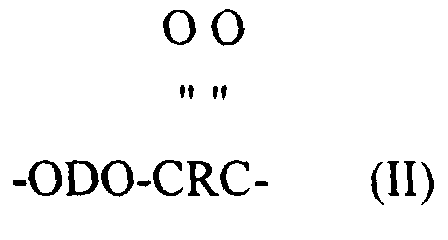
- such copolyetherester elastomers may comprise a multiplicity of recurring intralinear long chain and short chain ester units connected head-to-tail through ester linkages, said long chain ester units being represented by the formula: and said short-chain ester units being represented by the formula: wherein:
- the short chain ester units constitute about 15-95% by weight of the copolyester and at least about 50% of the short chain ester units be identical.
- long chain ester units refers to the reaction product of long chain glycol with a dicarboxylic acid.
- Such "long chain ester units" which are a repeating unit in the copolyesters, correspond to the formula (I) above.
- the long chain glycols are polymeric glycols having terminal (or as nearly terminal as possible) hydroxyl groups and a molecular weight above about 400 and preferably from about 400-4000.
- the long chain glycols used to prepare the copolyesters are poly(alkylene oxide) glycols having a carbon to oxygen ratio of about 2.0-4.3.
- Representative long chain glycols are poly (1,2- and 1,3-propylene oxide) glycol, poly(tetramethylene oxide) glycol, random or block copolymers of ethylene oxide and 1,2-propylene oxide.
- short chain ester units as applied to units in a polymer chain refers to low molecular weight compounds or polymer chain units having molecular weights less than about 550. They are made by reacting a low molecular weight diol (below about 250) with a dicarboxylic acid to form ester units represented by formula (II) above.
- Dicarboxylic acids which are reacted with the foregoing long chain glycols and low molecular weight diols to produce the copolyesters of this invention are aliphatic, cycloaliphatic or aromatic dicarboxylic acids of low molecular weight, that is, having a molecular weight of less than about 300, an example of which is terephthalic acid.
- the polymer of the invention has a hardness of from 25D to 82D.
- hardness means the hardness of a polymer as determined by International Standard ISO 868-1978(E). The hardness measured by this Standard is also known as "Shore hardness”. Hardness measurements according to this standard are followed by either the letter A or D to indicate whether a type A or type D Shore durometer was used to make the hardness measurement.
- the scratch resistant polymer composition also includes from 0.1 to 1 weight percent of a fluorosurfactant.
- Fluorosurfactants are anionic, nonionic or cationic fluoro alkyl compounds that have extremely low surface tension and are used as wetting, emulsifying and dispersing agents.
- the fluorosurfactant according to the present invention has a nonionic organic head and a tail of the formula CF 3 -(CF 2 ) x -CH 2 CH 2 , where x is an integer from 3 to 15.
- the nonionic organic head may be an alkenyl or a compound of the formula (O-CH 2 -CH 2 ) y -OH, where y in an integer from 1 to 10.
- the fluorosurfactant may be present in a solvent system, such as an ethylene glycol/water solvent system.
- the fluorosurfactant is normally present in the form of a viscous liquid, and may be added to the polymer using any conventional method, such as directly injecting the fluorosurfactant into a compounding machine that includes the polymer.
- the polymer may be compounded with antioxidant stabilizers, ultra-violet stabilizers, hydrolysis stabilizers, dyes or pigments, fillers such as mineral fillers, anti-microbial reagents, and the like.
- the polymer composition included a copolyetherester elastomer, carbon black and a fluorosurfactant. Carbon black was added to make the molded polymer black, and which made it easier to detect scratches and scuffs in the molded polymer.
- the polymer composition was prepared by preblending pellets of the copolyetherester elastomer with a fluorosurfactant.
- the preblended pellets were combined with additional copolyetherester elastomer pellets in a compounder and were compounded into a molten resin.
- the molten resin was cooled in a water bath and cut into pellets.
- the pellets were then dried to reduce the moisture content to below 0.1 weight percent.
- the dried pellets were injection molded to form a plate that had both a glossy surface and a mat surface.
- the mat surface had a texture roughness that corresponded to Charmilles 12 with a roughness number Ra of 0.4 microns.
- the fluorosurfactants used in the examples according to the invention were Zonyl® FSO 100 and Zonyl® 8857A, available from DuPont.
- Zonyl® FSO 100 is a non ionic fluorosurfactant having a tail of the formula CF 3 -(CF 2 ) x -CH 2 CH 2 , where x is an integer from 3 to 15 and a head of the formula (O-CH 2 -CH 2 ) y -OH, where y in an integer from 1 to 10.
- the Zonyl® FSO 100 is present in a concentration of 50 percent in an ethylene glycol/water solvent system.
- Zonyl® 8857A is a non ionic fluorosurfactant having a tail of the formula CF 3 -(CF 2 ) a- CH 2 CH 2 , where a is an integer from 3 to 15 and an alkenyl head. There was no solvent present in Zonyl® 8857A.
- Scratch resistance of both the glossy and mat surfaces of the molded plate was measured by a modified ISO 1518 test using an Erichsen scratch tester.
- the ISO 1518 standard is a test for scratching paint where a pin is subjected to a load and then placed in contact with a painted surface where the pin is dragged on the surface at a constant speed of 30 millimeters per second. The same test procedure was used for these examples except that a molded plate was used in place of a painted surface. The pin was subjected to higher and higher loads until the surface of the molded plate was scratched, at which point the load was recorded.
- Scuffing resistance of both the glossy and mat surfaces of the molded plate was measured by the following method.
- a measuring device was used that included a horizontal table supporting the molded plate; a vertical cylinder supporting an horizontal arm able to have a rotational motion around the cylinder; a vertical pin having a total weight of about 295 grams fixed a the free end of the horizontal arm, the pin having a cylindrical shape with a diameter of 1.2mm with rounded edge, and an angular displacement limited at both ends by a block; and a cylindrical spring made of steel having a stiffness of about 0.2N/mm. This spring was fixed between the free end of the horizontal arm and one end of the block, and was used to move the vertically-loaded pin with a constant force.
- the angular motion speed of the pin depended of the friction coefficient of the material of the molded plate.
- the scuffing resistance of the molded plate was measured as follows.
- the molded plate of the material to be tested was fixed onto the horizontal table, and the loaded pin was attached to the horizontal arm so that there was no contact between the plate and the tip of the pin.
- the horizontal arm was rotated to the maximum angle possible, to give the maximum force from the spring according the limited angular displacement of this arm.
- the loaded pin was placed in contact with the test plate and then the arm holding the pin was released and the force exerted by the spring allowed the pin to follow an angular displacement on the surface of the molded plate to scuff the surface of the molded plate.
- the angular motion of the loaded pin produced a visible scoffing line on the surface of the test plate, depending on the weight of the pin.
- the load on the pin was adjusted to give invisible scoffing line on a reference material defined as the target material.
- the constant value of load should give a visible scuffing line on the material to be improved as far as scratch resistance is concerned.
- the scale of scoffing resistance in Table 1 is rated in a range of from 0 to 5, where 0 represents no or an invisible scoffing line, and 5 represents a significant amount of scoffing.
- Comparative Example 1 a polymer composition was made using 0.4 weight percent carbon black and 99.6 weight percent of copolyetherester elastomer having a hard segment of 4-glycol terephthalate (4GT) and a soft segment of polypropylene glycol (PPG) and a hardness of 35D.
- the elastomer is sold by DuPont under the trademark Hytrel® G3548L.
- Examples 2 and 3 a polymer composition was made as in Comparative Example 1 using 0.4 weight percent carbon black, except that the composition also included Zonyl® FSO 100 fluorosurfactant.
- Examples 4 and 5 a polymer composition was made as in Examples 2 and 3 except that the composition included Zonyl® 8857A fluorosurfactant.
- compositions were made as in the previous Comparative Example 1 and examples 4-5 except that the polymer had a hardness of 55D.
- the elastomer is sold by DuPont under the trademark Hytrel® G5544.
- compositions were made as in the previous Comparative Example 1 and Examples 4-5 except that the polymer used was a copolyetherester elastomer having a hard segment of 4GT and a soft segment of polytetra methylene ether glycol (PTMEG) and a hardness of 55D.
- the elastomer is sold by DuPont under the trademark Hytrel® 5556.
- compositions were made as in the previous Comparative Example 1 and Examples 4 and 5 except that the polymer used was a copolyetherester elastomer having a hard segment of 4GT and a soft segment of PTMEG and a hardness of 72D.
- the elastomer is sold by DuPont under the trademark Hytrel® 7246.
- compositions were made as in the previous Comparative Example 1 and Examples 2 and 4 except that the polymer had a hardness of 40D.
- the elastomer is sold by DuPont under the trademark Hytrel® G4044.
- Comparative Example 18 the physical properties of the composition of Comparative Example 15 was measured, and in Examples 19 and 20 the physical properties of the composition of Examples 16 and 17 were measured.
- Tables 2-5 below showed that the addition of the fluorosurfactant does not adversely affect the physical properties of the polymer composition.
- the data for stress, strength and strain were all measured according to ISO 527, and the data for tear strength were measured according to ISO 34A.
- the data for shrinkage in Table 5 were measured as follows: a molded plate was made under standard molding conditions and was kept at room temperature for 24 hours. Then the length of the plate was measured in both the in-flow and cross-flow directions, and this length was compared to the length of the mold cavity in the in-flow and cross-flow directions. "In- flow” direction means along the direction of flow of resin into the mold, and "cross-flow” direction means perpendicular to the direction of flow of resin into the mold.
Landscapes
- Chemical & Material Sciences (AREA)
- Health & Medical Sciences (AREA)
- Chemical Kinetics & Catalysis (AREA)
- Medicinal Chemistry (AREA)
- Polymers & Plastics (AREA)
- Organic Chemistry (AREA)
- Compositions Of Macromolecular Compounds (AREA)
Abstract
Description

| Scratch Resistance (N) | Scuffing Resistance | |||||||
| Ex. No. | Fluorosurfactant | wt. % | AT GATE | AT END | ||||
| GLOSSY | MAT | GLOSSY | MAT | GLOSSY | MAT | |||
| C1 | None | 8 | 9 | 5 | 5 | 5 | 5 | |
| 2 | Zonyl® FSO100 | 0.3 | 12 | 12 | 5 | 2 | 5 | 2 |
| 3 | Zonyl® FSO100 | 0.6 | 13 | 13 | 0.5 | 0.5 | 0.5 | 0.5 |
| 4 | Zonyl® 8857A | 0.1 | 13 | 11 | 4 | 1 | 4 | 0.5 |
| 5 | Zonyl® 8857A | 0.3 | 14 | 14 | 0.5 | 0.5 | 0.5 | 0.5 |
| C6 | None | 9 | 3 | 2 | 3 | 2 | ||
| 7 | Zonyl® 8857A | 0.1 | 20- | 19 | 0 | 0.5 | 0 | 0 |
| 8 | Zonyl® 8857A | 0.3 | 20+ | 20 | 0.5 | 0 | 0.5 | 0 |
| C9 | None | 12 | 12 | 0 | 3 | 0.5 | 3 | |
| 10 | Zonyl® 8857A | 0.1 | 19 | 20 | 0 | 0.5 | 0.5 | 0.5 |
| 11 | Zonyl® 8857A | 0.3 | 19 | 20 | 0.5 | 0.5 | 0.5 | 0.5 |
| C12 | None | 10 | 18 | 0.5 | 0.5 | 0.5 | 1 | |
| 13 | Zonyl® 8857A | 0.1 | 17 | 18 | 0.5 | 1 | 0.5 | 0.5 |
| 14 | Zonyl® 8857A | 0.3 | 17 | 18 | 0.5 | 1 | 0.5 | 0.5 |
| C15 | None | 5 | 8 | 5 | 5 | 5 | 5 | |
| 16 | Zonyl® FSO100 | 0.3 | 15 | 14 | 0 | 1 | 0 | 1 |
| 17 | Zonyl® 8857A | 0.1 | 16 | 14 | 0 | 1 | 0.5 | 1 |
| Ex. No. | Tensile Properties at +23 C | |||
| Stress @ 10% strain (MPa) | Strength @ break (MPa) | Strain at break (%) | Tear Strength (N/mm) | |
| C18 | 4 | 21 | >500 | 47 |
| 19 | 4.3 | 19.2 | >500 | 50 |
| 20 | 4.3 | 20.3 | >500 | 47 |
| Ex. No. | Tensile Properties at -40 C | |||
| Stress @ 10% strain (MPa) | Strength @ break (MPa) | Strain at break (%) | Tear Strength (N/mm) | |
| C18 | 20.1 | 29 | 210 | 145 |
| 19 | 16.6 | 26.4 | 180 | 140 |
| 20 | 14.5 | 26.5 | 180 | 150 |
| Ex. No. | Tensile Properties at +85 C | ||
| Stress @ 10% strain (MPa) | Strength @ break (MPa) | Strain at break (%) | |
| C18 | 2.5 | 12 | >500 |
| 19 | 2.6 | 11.9 | >500 |
| 20 | 2.9 | 12 | >500 |
| Example No. | shrinkage |
| in flow (%)/ cross flow (%) | |
| C18 | 0.8/1.0 |
| 19 | 0.7/0.9 |
Claims (10)
- A scratch resistant polymer composition comprisingsaid weight percent is based on the total weight of (a) and (b) only.(a) from 99 to 99.9 weight percent of a copolyetherester elastomer having a hardness of from 25D to 82D,(b) from 0.1 to 1 weight percent of a fluorosurfactant having a nonionic organic head and a tail of the formula CF3-(CF2)x-CH2CH2, where x is an integer from 3 to 15,
- The polymer composition of claim 1, wherein the head of the fluorosurfactant is a compound of the formula (O-CH2-CH2)y-OH, where y in an integer from 1 to 10.
- The polymer composition of claim 1, wherein the head of the fluorosurfactant is an alkenyl compound.
- The polymer composition of claim 1, wherein the polymer composition further comprises polystyrene, polyethylene terephthalate, polybutylene terephthalate, acrylonltrile butadiene styrene, styrene acrylonitryle, polycarbenate, polypropylene modified with ethylene-propylene-diene terpolymer, or mixtures thereof.
- A molded article formed from a scratch resistant polymer composition comprising:said weight percent is based on the total weight of (a) and (b) only.(a) from 99 to 99.9 weight percent of a copolyetherester elastomer having a hardness of from 25D to 82D,(b) from 0.1 to 1 weight percent of a fluorosurfactant having a nonionic organic head and a tall of the formula CF3-(CF2)x-CH2CH2, where x is an integer from 3 to 15,
- A molded article made from the composition of claim 2.
- A molded article made from the composition of claim 3.
- A molded article made from the composition of claim 4.
- A method for making a scratch resistant polymer composition, which comprises the steps:a) preparing a copolyetherester elastomer component having a hardness of from 25D to 82D, said copolyetherester elastomer component contains recurring polymeric long chain ester units derived from carboxylic acids and long chain glycols and short chain ester units derived from dicarboxylic acids and low molecular weight diols;b) melt blending about 99 to 99.9 weight percent of said copolyetherester elastomer component with about 0.1 to 1 weight percent of a fluorosurfactant having a nonionic organic head and a tail of the formula CF3-(CF2)x-CH2CH2, where x is an integer from 3 to 15.
- The product of the method as recited in claim 9.
Applications Claiming Priority (2)
| Application Number | Priority Date | Filing Date | Title |
|---|---|---|---|
| US45618 | 1998-03-20 | ||
| US09/045,618 US5861452A (en) | 1998-03-20 | 1998-03-20 | Scratch and scuff resistant polymer |
Publications (3)
| Publication Number | Publication Date |
|---|---|
| EP0943651A2 true EP0943651A2 (en) | 1999-09-22 |
| EP0943651A3 EP0943651A3 (en) | 1999-12-29 |
| EP0943651B1 EP0943651B1 (en) | 2003-06-25 |
Family
ID=21938957
Family Applications (1)
| Application Number | Title | Priority Date | Filing Date |
|---|---|---|---|
| EP99102494A Expired - Lifetime EP0943651B1 (en) | 1998-03-20 | 1999-02-10 | Improved scratch and scuff resistant polymer |
Country Status (5)
| Country | Link |
|---|---|
| US (1) | US5861452A (en) |
| EP (1) | EP0943651B1 (en) |
| JP (1) | JP3086214B2 (en) |
| CA (1) | CA2266545C (en) |
| DE (1) | DE69908997T2 (en) |
Cited By (1)
| Publication number | Priority date | Publication date | Assignee | Title |
|---|---|---|---|---|
| DE102007062063A1 (en) | 2007-12-21 | 2009-06-25 | Ems-Patent Ag | Transparent polyamide molding compound |
Families Citing this family (4)
| Publication number | Priority date | Publication date | Assignee | Title |
|---|---|---|---|---|
| AUPP366398A0 (en) | 1998-05-22 | 1998-06-18 | Resmed Limited | Ventilatory assistance for treatment of cardiac failure and cheyne-stokes breathing |
| EP1235523B1 (en) * | 1999-12-06 | 2004-09-01 | SYNTHES AG Chur | Resorbable bone plate |
| EP1321270A1 (en) * | 2001-12-18 | 2003-06-25 | Dsm N.V. | Process for making a slush-moulded article |
| EP1321490A1 (en) * | 2001-12-18 | 2003-06-25 | Dsm N.V. | Copolyether ester composition and air bag cover made therefrom |
Family Cites Families (5)
| Publication number | Priority date | Publication date | Assignee | Title |
|---|---|---|---|---|
| US3766146A (en) * | 1971-03-18 | 1973-10-16 | Du Pont | Segmented thermoplastic copolyester elastomers |
| US4725481A (en) * | 1986-10-31 | 1988-02-16 | E. I. Du Pont De Nemours And Company | Vapor-permeable, waterproof bicomponent structure |
| JP2971923B2 (en) * | 1990-07-26 | 1999-11-08 | エヌティエヌ株式会社 | Lubricating rubber composition |
| US5198406A (en) * | 1991-07-03 | 1993-03-30 | Polaroid Corporation | Transparent thermographic recording films |
| JPH10219004A (en) * | 1997-02-12 | 1998-08-18 | Asahi Denka Kogyo Kk | Agricultural thermoplastic resin film |
-
1998
- 1998-03-20 US US09/045,618 patent/US5861452A/en not_active Expired - Lifetime
-
1999
- 1999-02-10 DE DE69908997T patent/DE69908997T2/en not_active Expired - Lifetime
- 1999-02-10 EP EP99102494A patent/EP0943651B1/en not_active Expired - Lifetime
- 1999-03-22 CA CA002266545A patent/CA2266545C/en not_active Expired - Fee Related
- 1999-03-23 JP JP11078655A patent/JP3086214B2/en not_active Expired - Fee Related
Cited By (2)
| Publication number | Priority date | Publication date | Assignee | Title |
|---|---|---|---|---|
| DE102007062063A1 (en) | 2007-12-21 | 2009-06-25 | Ems-Patent Ag | Transparent polyamide molding compound |
| EP2093255A2 (en) | 2007-12-21 | 2009-08-26 | Ems-Patent Ag | Transparent polyamide moulding composition |
Also Published As
| Publication number | Publication date |
|---|---|
| CA2266545C (en) | 2003-01-28 |
| JPH11323112A (en) | 1999-11-26 |
| US5861452A (en) | 1999-01-19 |
| EP0943651A3 (en) | 1999-12-29 |
| EP0943651B1 (en) | 2003-06-25 |
| JP3086214B2 (en) | 2000-09-11 |
| CA2266545A1 (en) | 1999-09-20 |
| DE69908997T2 (en) | 2004-05-19 |
| DE69908997D1 (en) | 2003-07-31 |
Similar Documents
| Publication | Publication Date | Title |
|---|---|---|
| CA1187649A (en) | Thermoplastic elastomeric polyetheresterimides | |
| US3925504A (en) | Poly(hydroxy ether) polymers blended with cyclic ester polymers | |
| KR102165345B1 (en) | Polyester elastomer resin composition with improved mold contamination | |
| US4287324A (en) | Compositions of epichlorohydrin rubber and polyester | |
| EP0943651B1 (en) | Improved scratch and scuff resistant polymer | |
| EP0040060A2 (en) | Compositions of cured epichlorohydrin rubber and nylon | |
| CA1126430A (en) | Copolyether-esters as additives for fiber-reinforced polyethylene terephthalate | |
| US5321099A (en) | Blends of semi-crystalline polyamides and polyesteramides | |
| CA1283233C (en) | Polymer blends containing a polymer having pendant oxazoline groups | |
| CA1242291A (en) | Blends of polyesteramides and polyamides | |
| EP0374313B1 (en) | Polyester resin filled with low-adhesive glass fibre | |
| US20110288264A1 (en) | Polyether ester block copolymer | |
| KR101161890B1 (en) | Block copolyetherester elastomer and preparation thereof | |
| KR970005965B1 (en) | Polyacetal resin composition | |
| JPH058941B2 (en) | ||
| KR102076210B1 (en) | Thermoplastic elastomer copolymer, thermoplastic resin composition comprising the same and molded article comprising the same | |
| JPH02199159A (en) | Polyester elastomer composition | |
| JPH0641415A (en) | Glass-fiber-reinforced polycarbonate resin composition having improved flowability | |
| JP3649304B2 (en) | Heat resistant polyester elastomer composition | |
| CA1131837A (en) | Composition of a polycarbonate resin and a selectively hydrogenated block copolymer of a vinyl aromatic compound and an olefinic elastomer | |
| JPS629618B2 (en) | ||
| KR20010002077A (en) | Composition of poly(oxymethylene) | |
| WO1998003589A1 (en) | Rigid copolyester blends mixed with a low molecular weight copolymer salt compatibilizer | |
| Goldberg | Elastomeric Polycarbonate Block Copolymers | |
| Chiu et al. | Miscibility study of polycarbonate and SBS triblock copolymer blends |
Legal Events
| Date | Code | Title | Description |
|---|---|---|---|
| PUAI | Public reference made under article 153(3) epc to a published international application that has entered the european phase |
Free format text: ORIGINAL CODE: 0009012 |
|
| AK | Designated contracting states |
Kind code of ref document: A2 Designated state(s): DE FR GB IT NL |
|
| AX | Request for extension of the european patent |
Free format text: AL;LT;LV;MK;RO;SI |
|
| PUAL | Search report despatched |
Free format text: ORIGINAL CODE: 0009013 |
|
| AK | Designated contracting states |
Kind code of ref document: A3 Designated state(s): AT BE CH CY DE DK ES FI FR GB GR IE IT LI LU MC NL PT SE |
|
| AX | Request for extension of the european patent |
Free format text: AL;LT;LV;MK;RO;SI |
|
| 17P | Request for examination filed |
Effective date: 20000606 |
|
| AKX | Designation fees paid |
Free format text: DE FR GB IT NL |
|
| GRAH | Despatch of communication of intention to grant a patent |
Free format text: ORIGINAL CODE: EPIDOS IGRA |
|
| GRAH | Despatch of communication of intention to grant a patent |
Free format text: ORIGINAL CODE: EPIDOS IGRA |
|
| GRAA | (expected) grant |
Free format text: ORIGINAL CODE: 0009210 |
|
| AK | Designated contracting states |
Designated state(s): DE FR GB IT NL |
|
| REG | Reference to a national code |
Ref country code: GB Ref legal event code: FG4D |
|
| REF | Corresponds to: |
Ref document number: 69908997 Country of ref document: DE Date of ref document: 20030731 Kind code of ref document: P |
|
| ET | Fr: translation filed | ||
| PLBE | No opposition filed within time limit |
Free format text: ORIGINAL CODE: 0009261 |
|
| STAA | Information on the status of an ep patent application or granted ep patent |
Free format text: STATUS: NO OPPOSITION FILED WITHIN TIME LIMIT |
|
| 26N | No opposition filed |
Effective date: 20040326 |
|
| PGFP | Annual fee paid to national office [announced via postgrant information from national office to epo] |
Ref country code: NL Payment date: 20060205 Year of fee payment: 8 |
|
| NLV4 | Nl: lapsed or anulled due to non-payment of the annual fee |
Effective date: 20070901 |
|
| PG25 | Lapsed in a contracting state [announced via postgrant information from national office to epo] |
Ref country code: NL Free format text: LAPSE BECAUSE OF NON-PAYMENT OF DUE FEES Effective date: 20070901 |
|
| PGFP | Annual fee paid to national office [announced via postgrant information from national office to epo] |
Ref country code: GB Payment date: 20090204 Year of fee payment: 11 |
|
| PGFP | Annual fee paid to national office [announced via postgrant information from national office to epo] |
Ref country code: IT Payment date: 20090216 Year of fee payment: 11 |
|
| PGFP | Annual fee paid to national office [announced via postgrant information from national office to epo] |
Ref country code: FR Payment date: 20090213 Year of fee payment: 11 |
|
| GBPC | Gb: european patent ceased through non-payment of renewal fee |
Effective date: 20100210 |
|
| REG | Reference to a national code |
Ref country code: FR Ref legal event code: ST Effective date: 20101029 |
|
| PG25 | Lapsed in a contracting state [announced via postgrant information from national office to epo] |
Ref country code: FR Free format text: LAPSE BECAUSE OF NON-PAYMENT OF DUE FEES Effective date: 20100301 |
|
| PG25 | Lapsed in a contracting state [announced via postgrant information from national office to epo] |
Ref country code: GB Free format text: LAPSE BECAUSE OF NON-PAYMENT OF DUE FEES Effective date: 20100210 Ref country code: IT Free format text: LAPSE BECAUSE OF NON-PAYMENT OF DUE FEES Effective date: 20100210 |
|
| PGFP | Annual fee paid to national office [announced via postgrant information from national office to epo] |
Ref country code: DE Payment date: 20110208 Year of fee payment: 13 |
|
| REG | Reference to a national code |
Ref country code: DE Ref legal event code: R119 Ref document number: 69908997 Country of ref document: DE Effective date: 20120901 |
|
| PG25 | Lapsed in a contracting state [announced via postgrant information from national office to epo] |
Ref country code: DE Free format text: LAPSE BECAUSE OF NON-PAYMENT OF DUE FEES Effective date: 20120901 |