EP2086606B1 - Drug-delivery endovascular stent and method of use - Google Patents
Drug-delivery endovascular stent and method of use Download PDFInfo
- Publication number
- EP2086606B1 EP2086606B1 EP07839691.8A EP07839691A EP2086606B1 EP 2086606 B1 EP2086606 B1 EP 2086606B1 EP 07839691 A EP07839691 A EP 07839691A EP 2086606 B1 EP2086606 B1 EP 2086606B1
- Authority
- EP
- European Patent Office
- Prior art keywords
- stent
- coating
- filaments
- drug
- surface roughness
- Prior art date
- Legal status (The legal status is an assumption and is not a legal conclusion. Google has not performed a legal analysis and makes no representation as to the accuracy of the status listed.)
- Active
Links
- PGQCMNXDZOLRQA-UHFFFAOYSA-N IC1=CCC=C1 Chemical compound IC1=CCC=C1 PGQCMNXDZOLRQA-UHFFFAOYSA-N 0.000 description 1
Images







Classifications
-
- A—HUMAN NECESSITIES
- A61—MEDICAL OR VETERINARY SCIENCE; HYGIENE
- A61L—METHODS OR APPARATUS FOR STERILISING MATERIALS OR OBJECTS IN GENERAL; DISINFECTION, STERILISATION OR DEODORISATION OF AIR; CHEMICAL ASPECTS OF BANDAGES, DRESSINGS, ABSORBENT PADS OR SURGICAL ARTICLES; MATERIALS FOR BANDAGES, DRESSINGS, ABSORBENT PADS OR SURGICAL ARTICLES
- A61L31/00—Materials for other surgical articles, e.g. stents, stent-grafts, shunts, surgical drapes, guide wires, materials for adhesion prevention, occluding devices, surgical gloves, tissue fixation devices
- A61L31/14—Materials characterised by their function or physical properties, e.g. injectable or lubricating compositions, shape-memory materials, surface modified materials
- A61L31/16—Biologically active materials, e.g. therapeutic substances
-
- A—HUMAN NECESSITIES
- A61—MEDICAL OR VETERINARY SCIENCE; HYGIENE
- A61L—METHODS OR APPARATUS FOR STERILISING MATERIALS OR OBJECTS IN GENERAL; DISINFECTION, STERILISATION OR DEODORISATION OF AIR; CHEMICAL ASPECTS OF BANDAGES, DRESSINGS, ABSORBENT PADS OR SURGICAL ARTICLES; MATERIALS FOR BANDAGES, DRESSINGS, ABSORBENT PADS OR SURGICAL ARTICLES
- A61L27/00—Materials for grafts or prostheses or for coating grafts or prostheses
- A61L27/28—Materials for coating prostheses
- A61L27/34—Macromolecular materials
-
- A—HUMAN NECESSITIES
- A61—MEDICAL OR VETERINARY SCIENCE; HYGIENE
- A61F—FILTERS IMPLANTABLE INTO BLOOD VESSELS; PROSTHESES; DEVICES PROVIDING PATENCY TO, OR PREVENTING COLLAPSING OF, TUBULAR STRUCTURES OF THE BODY, e.g. STENTS; ORTHOPAEDIC, NURSING OR CONTRACEPTIVE DEVICES; FOMENTATION; TREATMENT OR PROTECTION OF EYES OR EARS; BANDAGES, DRESSINGS OR ABSORBENT PADS; FIRST-AID KITS
- A61F2/00—Filters implantable into blood vessels; Prostheses, i.e. artificial substitutes or replacements for parts of the body; Appliances for connecting them with the body; Devices providing patency to, or preventing collapsing of, tubular structures of the body, e.g. stents
- A61F2/02—Prostheses implantable into the body
- A61F2/04—Hollow or tubular parts of organs, e.g. bladders, tracheae, bronchi or bile ducts
- A61F2/06—Blood vessels
- A61F2/07—Stent-grafts
-
- A—HUMAN NECESSITIES
- A61—MEDICAL OR VETERINARY SCIENCE; HYGIENE
- A61F—FILTERS IMPLANTABLE INTO BLOOD VESSELS; PROSTHESES; DEVICES PROVIDING PATENCY TO, OR PREVENTING COLLAPSING OF, TUBULAR STRUCTURES OF THE BODY, e.g. STENTS; ORTHOPAEDIC, NURSING OR CONTRACEPTIVE DEVICES; FOMENTATION; TREATMENT OR PROTECTION OF EYES OR EARS; BANDAGES, DRESSINGS OR ABSORBENT PADS; FIRST-AID KITS
- A61F2/00—Filters implantable into blood vessels; Prostheses, i.e. artificial substitutes or replacements for parts of the body; Appliances for connecting them with the body; Devices providing patency to, or preventing collapsing of, tubular structures of the body, e.g. stents
- A61F2/82—Devices providing patency to, or preventing collapsing of, tubular structures of the body, e.g. stents
- A61F2/86—Stents in a form characterised by the wire-like elements; Stents in the form characterised by a net-like or mesh-like structure
- A61F2/90—Stents in a form characterised by the wire-like elements; Stents in the form characterised by a net-like or mesh-like structure characterised by a net-like or mesh-like structure
- A61F2/91—Stents in a form characterised by the wire-like elements; Stents in the form characterised by a net-like or mesh-like structure characterised by a net-like or mesh-like structure made from perforated sheets or tubes, e.g. perforated by laser cuts or etched holes
-
- A—HUMAN NECESSITIES
- A61—MEDICAL OR VETERINARY SCIENCE; HYGIENE
- A61F—FILTERS IMPLANTABLE INTO BLOOD VESSELS; PROSTHESES; DEVICES PROVIDING PATENCY TO, OR PREVENTING COLLAPSING OF, TUBULAR STRUCTURES OF THE BODY, e.g. STENTS; ORTHOPAEDIC, NURSING OR CONTRACEPTIVE DEVICES; FOMENTATION; TREATMENT OR PROTECTION OF EYES OR EARS; BANDAGES, DRESSINGS OR ABSORBENT PADS; FIRST-AID KITS
- A61F2/00—Filters implantable into blood vessels; Prostheses, i.e. artificial substitutes or replacements for parts of the body; Appliances for connecting them with the body; Devices providing patency to, or preventing collapsing of, tubular structures of the body, e.g. stents
- A61F2/82—Devices providing patency to, or preventing collapsing of, tubular structures of the body, e.g. stents
- A61F2/86—Stents in a form characterised by the wire-like elements; Stents in the form characterised by a net-like or mesh-like structure
- A61F2/90—Stents in a form characterised by the wire-like elements; Stents in the form characterised by a net-like or mesh-like structure characterised by a net-like or mesh-like structure
- A61F2/91—Stents in a form characterised by the wire-like elements; Stents in the form characterised by a net-like or mesh-like structure characterised by a net-like or mesh-like structure made from perforated sheets or tubes, e.g. perforated by laser cuts or etched holes
- A61F2/915—Stents in a form characterised by the wire-like elements; Stents in the form characterised by a net-like or mesh-like structure characterised by a net-like or mesh-like structure made from perforated sheets or tubes, e.g. perforated by laser cuts or etched holes with bands having a meander structure, adjacent bands being connected to each other
-
- A—HUMAN NECESSITIES
- A61—MEDICAL OR VETERINARY SCIENCE; HYGIENE
- A61L—METHODS OR APPARATUS FOR STERILISING MATERIALS OR OBJECTS IN GENERAL; DISINFECTION, STERILISATION OR DEODORISATION OF AIR; CHEMICAL ASPECTS OF BANDAGES, DRESSINGS, ABSORBENT PADS OR SURGICAL ARTICLES; MATERIALS FOR BANDAGES, DRESSINGS, ABSORBENT PADS OR SURGICAL ARTICLES
- A61L27/00—Materials for grafts or prostheses or for coating grafts or prostheses
- A61L27/50—Materials characterised by their function or physical properties, e.g. injectable or lubricating compositions, shape-memory materials, surface modified materials
- A61L27/54—Biologically active materials, e.g. therapeutic substances
-
- A—HUMAN NECESSITIES
- A61—MEDICAL OR VETERINARY SCIENCE; HYGIENE
- A61L—METHODS OR APPARATUS FOR STERILISING MATERIALS OR OBJECTS IN GENERAL; DISINFECTION, STERILISATION OR DEODORISATION OF AIR; CHEMICAL ASPECTS OF BANDAGES, DRESSINGS, ABSORBENT PADS OR SURGICAL ARTICLES; MATERIALS FOR BANDAGES, DRESSINGS, ABSORBENT PADS OR SURGICAL ARTICLES
- A61L31/00—Materials for other surgical articles, e.g. stents, stent-grafts, shunts, surgical drapes, guide wires, materials for adhesion prevention, occluding devices, surgical gloves, tissue fixation devices
- A61L31/02—Inorganic materials
- A61L31/022—Metals or alloys
-
- A—HUMAN NECESSITIES
- A61—MEDICAL OR VETERINARY SCIENCE; HYGIENE
- A61L—METHODS OR APPARATUS FOR STERILISING MATERIALS OR OBJECTS IN GENERAL; DISINFECTION, STERILISATION OR DEODORISATION OF AIR; CHEMICAL ASPECTS OF BANDAGES, DRESSINGS, ABSORBENT PADS OR SURGICAL ARTICLES; MATERIALS FOR BANDAGES, DRESSINGS, ABSORBENT PADS OR SURGICAL ARTICLES
- A61L31/00—Materials for other surgical articles, e.g. stents, stent-grafts, shunts, surgical drapes, guide wires, materials for adhesion prevention, occluding devices, surgical gloves, tissue fixation devices
- A61L31/08—Materials for coatings
- A61L31/10—Macromolecular materials
-
- A—HUMAN NECESSITIES
- A61—MEDICAL OR VETERINARY SCIENCE; HYGIENE
- A61F—FILTERS IMPLANTABLE INTO BLOOD VESSELS; PROSTHESES; DEVICES PROVIDING PATENCY TO, OR PREVENTING COLLAPSING OF, TUBULAR STRUCTURES OF THE BODY, e.g. STENTS; ORTHOPAEDIC, NURSING OR CONTRACEPTIVE DEVICES; FOMENTATION; TREATMENT OR PROTECTION OF EYES OR EARS; BANDAGES, DRESSINGS OR ABSORBENT PADS; FIRST-AID KITS
- A61F2/00—Filters implantable into blood vessels; Prostheses, i.e. artificial substitutes or replacements for parts of the body; Appliances for connecting them with the body; Devices providing patency to, or preventing collapsing of, tubular structures of the body, e.g. stents
- A61F2/82—Devices providing patency to, or preventing collapsing of, tubular structures of the body, e.g. stents
-
- A—HUMAN NECESSITIES
- A61—MEDICAL OR VETERINARY SCIENCE; HYGIENE
- A61F—FILTERS IMPLANTABLE INTO BLOOD VESSELS; PROSTHESES; DEVICES PROVIDING PATENCY TO, OR PREVENTING COLLAPSING OF, TUBULAR STRUCTURES OF THE BODY, e.g. STENTS; ORTHOPAEDIC, NURSING OR CONTRACEPTIVE DEVICES; FOMENTATION; TREATMENT OR PROTECTION OF EYES OR EARS; BANDAGES, DRESSINGS OR ABSORBENT PADS; FIRST-AID KITS
- A61F2/00—Filters implantable into blood vessels; Prostheses, i.e. artificial substitutes or replacements for parts of the body; Appliances for connecting them with the body; Devices providing patency to, or preventing collapsing of, tubular structures of the body, e.g. stents
- A61F2/82—Devices providing patency to, or preventing collapsing of, tubular structures of the body, e.g. stents
- A61F2/848—Devices providing patency to, or preventing collapsing of, tubular structures of the body, e.g. stents having means for fixation to the vessel wall, e.g. barbs
-
- A—HUMAN NECESSITIES
- A61—MEDICAL OR VETERINARY SCIENCE; HYGIENE
- A61F—FILTERS IMPLANTABLE INTO BLOOD VESSELS; PROSTHESES; DEVICES PROVIDING PATENCY TO, OR PREVENTING COLLAPSING OF, TUBULAR STRUCTURES OF THE BODY, e.g. STENTS; ORTHOPAEDIC, NURSING OR CONTRACEPTIVE DEVICES; FOMENTATION; TREATMENT OR PROTECTION OF EYES OR EARS; BANDAGES, DRESSINGS OR ABSORBENT PADS; FIRST-AID KITS
- A61F2/00—Filters implantable into blood vessels; Prostheses, i.e. artificial substitutes or replacements for parts of the body; Appliances for connecting them with the body; Devices providing patency to, or preventing collapsing of, tubular structures of the body, e.g. stents
- A61F2/82—Devices providing patency to, or preventing collapsing of, tubular structures of the body, e.g. stents
- A61F2/86—Stents in a form characterised by the wire-like elements; Stents in the form characterised by a net-like or mesh-like structure
- A61F2/89—Stents in a form characterised by the wire-like elements; Stents in the form characterised by a net-like or mesh-like structure the wire-like elements comprising two or more adjacent rings flexibly connected by separate members
-
- A—HUMAN NECESSITIES
- A61—MEDICAL OR VETERINARY SCIENCE; HYGIENE
- A61F—FILTERS IMPLANTABLE INTO BLOOD VESSELS; PROSTHESES; DEVICES PROVIDING PATENCY TO, OR PREVENTING COLLAPSING OF, TUBULAR STRUCTURES OF THE BODY, e.g. STENTS; ORTHOPAEDIC, NURSING OR CONTRACEPTIVE DEVICES; FOMENTATION; TREATMENT OR PROTECTION OF EYES OR EARS; BANDAGES, DRESSINGS OR ABSORBENT PADS; FIRST-AID KITS
- A61F2/00—Filters implantable into blood vessels; Prostheses, i.e. artificial substitutes or replacements for parts of the body; Appliances for connecting them with the body; Devices providing patency to, or preventing collapsing of, tubular structures of the body, e.g. stents
- A61F2/82—Devices providing patency to, or preventing collapsing of, tubular structures of the body, e.g. stents
- A61F2002/825—Devices providing patency to, or preventing collapsing of, tubular structures of the body, e.g. stents having longitudinal struts
-
- A—HUMAN NECESSITIES
- A61—MEDICAL OR VETERINARY SCIENCE; HYGIENE
- A61F—FILTERS IMPLANTABLE INTO BLOOD VESSELS; PROSTHESES; DEVICES PROVIDING PATENCY TO, OR PREVENTING COLLAPSING OF, TUBULAR STRUCTURES OF THE BODY, e.g. STENTS; ORTHOPAEDIC, NURSING OR CONTRACEPTIVE DEVICES; FOMENTATION; TREATMENT OR PROTECTION OF EYES OR EARS; BANDAGES, DRESSINGS OR ABSORBENT PADS; FIRST-AID KITS
- A61F2/00—Filters implantable into blood vessels; Prostheses, i.e. artificial substitutes or replacements for parts of the body; Appliances for connecting them with the body; Devices providing patency to, or preventing collapsing of, tubular structures of the body, e.g. stents
- A61F2/82—Devices providing patency to, or preventing collapsing of, tubular structures of the body, e.g. stents
- A61F2/86—Stents in a form characterised by the wire-like elements; Stents in the form characterised by a net-like or mesh-like structure
- A61F2/90—Stents in a form characterised by the wire-like elements; Stents in the form characterised by a net-like or mesh-like structure characterised by a net-like or mesh-like structure
- A61F2/91—Stents in a form characterised by the wire-like elements; Stents in the form characterised by a net-like or mesh-like structure characterised by a net-like or mesh-like structure made from perforated sheets or tubes, e.g. perforated by laser cuts or etched holes
- A61F2/915—Stents in a form characterised by the wire-like elements; Stents in the form characterised by a net-like or mesh-like structure characterised by a net-like or mesh-like structure made from perforated sheets or tubes, e.g. perforated by laser cuts or etched holes with bands having a meander structure, adjacent bands being connected to each other
- A61F2002/91533—Stents in a form characterised by the wire-like elements; Stents in the form characterised by a net-like or mesh-like structure characterised by a net-like or mesh-like structure made from perforated sheets or tubes, e.g. perforated by laser cuts or etched holes with bands having a meander structure, adjacent bands being connected to each other characterised by the phase between adjacent bands
- A61F2002/91541—Adjacent bands are arranged out of phase
-
- A—HUMAN NECESSITIES
- A61—MEDICAL OR VETERINARY SCIENCE; HYGIENE
- A61F—FILTERS IMPLANTABLE INTO BLOOD VESSELS; PROSTHESES; DEVICES PROVIDING PATENCY TO, OR PREVENTING COLLAPSING OF, TUBULAR STRUCTURES OF THE BODY, e.g. STENTS; ORTHOPAEDIC, NURSING OR CONTRACEPTIVE DEVICES; FOMENTATION; TREATMENT OR PROTECTION OF EYES OR EARS; BANDAGES, DRESSINGS OR ABSORBENT PADS; FIRST-AID KITS
- A61F2/00—Filters implantable into blood vessels; Prostheses, i.e. artificial substitutes or replacements for parts of the body; Appliances for connecting them with the body; Devices providing patency to, or preventing collapsing of, tubular structures of the body, e.g. stents
- A61F2/82—Devices providing patency to, or preventing collapsing of, tubular structures of the body, e.g. stents
- A61F2/86—Stents in a form characterised by the wire-like elements; Stents in the form characterised by a net-like or mesh-like structure
- A61F2/90—Stents in a form characterised by the wire-like elements; Stents in the form characterised by a net-like or mesh-like structure characterised by a net-like or mesh-like structure
- A61F2/91—Stents in a form characterised by the wire-like elements; Stents in the form characterised by a net-like or mesh-like structure characterised by a net-like or mesh-like structure made from perforated sheets or tubes, e.g. perforated by laser cuts or etched holes
- A61F2/915—Stents in a form characterised by the wire-like elements; Stents in the form characterised by a net-like or mesh-like structure characterised by a net-like or mesh-like structure made from perforated sheets or tubes, e.g. perforated by laser cuts or etched holes with bands having a meander structure, adjacent bands being connected to each other
- A61F2002/9155—Adjacent bands being connected to each other
- A61F2002/91566—Adjacent bands being connected to each other connected trough to trough
-
- A—HUMAN NECESSITIES
- A61—MEDICAL OR VETERINARY SCIENCE; HYGIENE
- A61F—FILTERS IMPLANTABLE INTO BLOOD VESSELS; PROSTHESES; DEVICES PROVIDING PATENCY TO, OR PREVENTING COLLAPSING OF, TUBULAR STRUCTURES OF THE BODY, e.g. STENTS; ORTHOPAEDIC, NURSING OR CONTRACEPTIVE DEVICES; FOMENTATION; TREATMENT OR PROTECTION OF EYES OR EARS; BANDAGES, DRESSINGS OR ABSORBENT PADS; FIRST-AID KITS
- A61F2210/00—Particular material properties of prostheses classified in groups A61F2/00 - A61F2/26 or A61F2/82 or A61F9/00 or A61F11/00 or subgroups thereof
- A61F2210/0004—Particular material properties of prostheses classified in groups A61F2/00 - A61F2/26 or A61F2/82 or A61F9/00 or A61F11/00 or subgroups thereof bioabsorbable
-
- A—HUMAN NECESSITIES
- A61—MEDICAL OR VETERINARY SCIENCE; HYGIENE
- A61F—FILTERS IMPLANTABLE INTO BLOOD VESSELS; PROSTHESES; DEVICES PROVIDING PATENCY TO, OR PREVENTING COLLAPSING OF, TUBULAR STRUCTURES OF THE BODY, e.g. STENTS; ORTHOPAEDIC, NURSING OR CONTRACEPTIVE DEVICES; FOMENTATION; TREATMENT OR PROTECTION OF EYES OR EARS; BANDAGES, DRESSINGS OR ABSORBENT PADS; FIRST-AID KITS
- A61F2210/00—Particular material properties of prostheses classified in groups A61F2/00 - A61F2/26 or A61F2/82 or A61F9/00 or A61F11/00 or subgroups thereof
- A61F2210/0014—Particular material properties of prostheses classified in groups A61F2/00 - A61F2/26 or A61F2/82 or A61F9/00 or A61F11/00 or subgroups thereof using shape memory or superelastic materials, e.g. nitinol
-
- A—HUMAN NECESSITIES
- A61—MEDICAL OR VETERINARY SCIENCE; HYGIENE
- A61F—FILTERS IMPLANTABLE INTO BLOOD VESSELS; PROSTHESES; DEVICES PROVIDING PATENCY TO, OR PREVENTING COLLAPSING OF, TUBULAR STRUCTURES OF THE BODY, e.g. STENTS; ORTHOPAEDIC, NURSING OR CONTRACEPTIVE DEVICES; FOMENTATION; TREATMENT OR PROTECTION OF EYES OR EARS; BANDAGES, DRESSINGS OR ABSORBENT PADS; FIRST-AID KITS
- A61F2220/00—Fixations or connections for prostheses classified in groups A61F2/00 - A61F2/26 or A61F2/82 or A61F9/00 or A61F11/00 or subgroups thereof
- A61F2220/0025—Connections or couplings between prosthetic parts, e.g. between modular parts; Connecting elements
-
- A—HUMAN NECESSITIES
- A61—MEDICAL OR VETERINARY SCIENCE; HYGIENE
- A61F—FILTERS IMPLANTABLE INTO BLOOD VESSELS; PROSTHESES; DEVICES PROVIDING PATENCY TO, OR PREVENTING COLLAPSING OF, TUBULAR STRUCTURES OF THE BODY, e.g. STENTS; ORTHOPAEDIC, NURSING OR CONTRACEPTIVE DEVICES; FOMENTATION; TREATMENT OR PROTECTION OF EYES OR EARS; BANDAGES, DRESSINGS OR ABSORBENT PADS; FIRST-AID KITS
- A61F2230/00—Geometry of prostheses classified in groups A61F2/00 - A61F2/26 or A61F2/82 or A61F9/00 or A61F11/00 or subgroups thereof
- A61F2230/0002—Two-dimensional shapes, e.g. cross-sections
- A61F2230/0004—Rounded shapes, e.g. with rounded corners
- A61F2230/0013—Horseshoe-shaped, e.g. crescent-shaped, C-shaped, U-shaped
-
- A—HUMAN NECESSITIES
- A61—MEDICAL OR VETERINARY SCIENCE; HYGIENE
- A61F—FILTERS IMPLANTABLE INTO BLOOD VESSELS; PROSTHESES; DEVICES PROVIDING PATENCY TO, OR PREVENTING COLLAPSING OF, TUBULAR STRUCTURES OF THE BODY, e.g. STENTS; ORTHOPAEDIC, NURSING OR CONTRACEPTIVE DEVICES; FOMENTATION; TREATMENT OR PROTECTION OF EYES OR EARS; BANDAGES, DRESSINGS OR ABSORBENT PADS; FIRST-AID KITS
- A61F2240/00—Manufacturing or designing of prostheses classified in groups A61F2/00 - A61F2/26 or A61F2/82 or A61F9/00 or A61F11/00 or subgroups thereof
- A61F2240/001—Designing or manufacturing processes
-
- A—HUMAN NECESSITIES
- A61—MEDICAL OR VETERINARY SCIENCE; HYGIENE
- A61F—FILTERS IMPLANTABLE INTO BLOOD VESSELS; PROSTHESES; DEVICES PROVIDING PATENCY TO, OR PREVENTING COLLAPSING OF, TUBULAR STRUCTURES OF THE BODY, e.g. STENTS; ORTHOPAEDIC, NURSING OR CONTRACEPTIVE DEVICES; FOMENTATION; TREATMENT OR PROTECTION OF EYES OR EARS; BANDAGES, DRESSINGS OR ABSORBENT PADS; FIRST-AID KITS
- A61F2250/00—Special features of prostheses classified in groups A61F2/00 - A61F2/26 or A61F2/82 or A61F9/00 or A61F11/00 or subgroups thereof
- A61F2250/0014—Special features of prostheses classified in groups A61F2/00 - A61F2/26 or A61F2/82 or A61F9/00 or A61F11/00 or subgroups thereof having different values of a given property or geometrical feature, e.g. mechanical property or material property, at different locations within the same prosthesis
- A61F2250/0023—Special features of prostheses classified in groups A61F2/00 - A61F2/26 or A61F2/82 or A61F9/00 or A61F11/00 or subgroups thereof having different values of a given property or geometrical feature, e.g. mechanical property or material property, at different locations within the same prosthesis differing in porosity
-
- A—HUMAN NECESSITIES
- A61—MEDICAL OR VETERINARY SCIENCE; HYGIENE
- A61F—FILTERS IMPLANTABLE INTO BLOOD VESSELS; PROSTHESES; DEVICES PROVIDING PATENCY TO, OR PREVENTING COLLAPSING OF, TUBULAR STRUCTURES OF THE BODY, e.g. STENTS; ORTHOPAEDIC, NURSING OR CONTRACEPTIVE DEVICES; FOMENTATION; TREATMENT OR PROTECTION OF EYES OR EARS; BANDAGES, DRESSINGS OR ABSORBENT PADS; FIRST-AID KITS
- A61F2250/00—Special features of prostheses classified in groups A61F2/00 - A61F2/26 or A61F2/82 or A61F9/00 or A61F11/00 or subgroups thereof
- A61F2250/0014—Special features of prostheses classified in groups A61F2/00 - A61F2/26 or A61F2/82 or A61F9/00 or A61F11/00 or subgroups thereof having different values of a given property or geometrical feature, e.g. mechanical property or material property, at different locations within the same prosthesis
- A61F2250/0025—Special features of prostheses classified in groups A61F2/00 - A61F2/26 or A61F2/82 or A61F9/00 or A61F11/00 or subgroups thereof having different values of a given property or geometrical feature, e.g. mechanical property or material property, at different locations within the same prosthesis differing in roughness
-
- A—HUMAN NECESSITIES
- A61—MEDICAL OR VETERINARY SCIENCE; HYGIENE
- A61F—FILTERS IMPLANTABLE INTO BLOOD VESSELS; PROSTHESES; DEVICES PROVIDING PATENCY TO, OR PREVENTING COLLAPSING OF, TUBULAR STRUCTURES OF THE BODY, e.g. STENTS; ORTHOPAEDIC, NURSING OR CONTRACEPTIVE DEVICES; FOMENTATION; TREATMENT OR PROTECTION OF EYES OR EARS; BANDAGES, DRESSINGS OR ABSORBENT PADS; FIRST-AID KITS
- A61F2250/00—Special features of prostheses classified in groups A61F2/00 - A61F2/26 or A61F2/82 or A61F9/00 or A61F11/00 or subgroups thereof
- A61F2250/0014—Special features of prostheses classified in groups A61F2/00 - A61F2/26 or A61F2/82 or A61F9/00 or A61F11/00 or subgroups thereof having different values of a given property or geometrical feature, e.g. mechanical property or material property, at different locations within the same prosthesis
- A61F2250/0026—Special features of prostheses classified in groups A61F2/00 - A61F2/26 or A61F2/82 or A61F9/00 or A61F11/00 or subgroups thereof having different values of a given property or geometrical feature, e.g. mechanical property or material property, at different locations within the same prosthesis differing in surface structures
-
- A—HUMAN NECESSITIES
- A61—MEDICAL OR VETERINARY SCIENCE; HYGIENE
- A61F—FILTERS IMPLANTABLE INTO BLOOD VESSELS; PROSTHESES; DEVICES PROVIDING PATENCY TO, OR PREVENTING COLLAPSING OF, TUBULAR STRUCTURES OF THE BODY, e.g. STENTS; ORTHOPAEDIC, NURSING OR CONTRACEPTIVE DEVICES; FOMENTATION; TREATMENT OR PROTECTION OF EYES OR EARS; BANDAGES, DRESSINGS OR ABSORBENT PADS; FIRST-AID KITS
- A61F2250/00—Special features of prostheses classified in groups A61F2/00 - A61F2/26 or A61F2/82 or A61F9/00 or A61F11/00 or subgroups thereof
- A61F2250/0014—Special features of prostheses classified in groups A61F2/00 - A61F2/26 or A61F2/82 or A61F9/00 or A61F11/00 or subgroups thereof having different values of a given property or geometrical feature, e.g. mechanical property or material property, at different locations within the same prosthesis
- A61F2250/0036—Special features of prostheses classified in groups A61F2/00 - A61F2/26 or A61F2/82 or A61F9/00 or A61F11/00 or subgroups thereof having different values of a given property or geometrical feature, e.g. mechanical property or material property, at different locations within the same prosthesis differing in thickness
-
- A—HUMAN NECESSITIES
- A61—MEDICAL OR VETERINARY SCIENCE; HYGIENE
- A61F—FILTERS IMPLANTABLE INTO BLOOD VESSELS; PROSTHESES; DEVICES PROVIDING PATENCY TO, OR PREVENTING COLLAPSING OF, TUBULAR STRUCTURES OF THE BODY, e.g. STENTS; ORTHOPAEDIC, NURSING OR CONTRACEPTIVE DEVICES; FOMENTATION; TREATMENT OR PROTECTION OF EYES OR EARS; BANDAGES, DRESSINGS OR ABSORBENT PADS; FIRST-AID KITS
- A61F2250/00—Special features of prostheses classified in groups A61F2/00 - A61F2/26 or A61F2/82 or A61F9/00 or A61F11/00 or subgroups thereof
- A61F2250/0014—Special features of prostheses classified in groups A61F2/00 - A61F2/26 or A61F2/82 or A61F9/00 or A61F11/00 or subgroups thereof having different values of a given property or geometrical feature, e.g. mechanical property or material property, at different locations within the same prosthesis
- A61F2250/0037—Special features of prostheses classified in groups A61F2/00 - A61F2/26 or A61F2/82 or A61F9/00 or A61F11/00 or subgroups thereof having different values of a given property or geometrical feature, e.g. mechanical property or material property, at different locations within the same prosthesis differing in height or in length
-
- A—HUMAN NECESSITIES
- A61—MEDICAL OR VETERINARY SCIENCE; HYGIENE
- A61F—FILTERS IMPLANTABLE INTO BLOOD VESSELS; PROSTHESES; DEVICES PROVIDING PATENCY TO, OR PREVENTING COLLAPSING OF, TUBULAR STRUCTURES OF THE BODY, e.g. STENTS; ORTHOPAEDIC, NURSING OR CONTRACEPTIVE DEVICES; FOMENTATION; TREATMENT OR PROTECTION OF EYES OR EARS; BANDAGES, DRESSINGS OR ABSORBENT PADS; FIRST-AID KITS
- A61F2250/00—Special features of prostheses classified in groups A61F2/00 - A61F2/26 or A61F2/82 or A61F9/00 or A61F11/00 or subgroups thereof
- A61F2250/0014—Special features of prostheses classified in groups A61F2/00 - A61F2/26 or A61F2/82 or A61F9/00 or A61F11/00 or subgroups thereof having different values of a given property or geometrical feature, e.g. mechanical property or material property, at different locations within the same prosthesis
- A61F2250/0051—Special features of prostheses classified in groups A61F2/00 - A61F2/26 or A61F2/82 or A61F9/00 or A61F11/00 or subgroups thereof having different values of a given property or geometrical feature, e.g. mechanical property or material property, at different locations within the same prosthesis differing in tissue ingrowth capacity, e.g. made from both ingrowth-promoting and ingrowth-preventing parts
-
- A—HUMAN NECESSITIES
- A61—MEDICAL OR VETERINARY SCIENCE; HYGIENE
- A61F—FILTERS IMPLANTABLE INTO BLOOD VESSELS; PROSTHESES; DEVICES PROVIDING PATENCY TO, OR PREVENTING COLLAPSING OF, TUBULAR STRUCTURES OF THE BODY, e.g. STENTS; ORTHOPAEDIC, NURSING OR CONTRACEPTIVE DEVICES; FOMENTATION; TREATMENT OR PROTECTION OF EYES OR EARS; BANDAGES, DRESSINGS OR ABSORBENT PADS; FIRST-AID KITS
- A61F2250/00—Special features of prostheses classified in groups A61F2/00 - A61F2/26 or A61F2/82 or A61F9/00 or A61F11/00 or subgroups thereof
- A61F2250/0058—Additional features; Implant or prostheses properties not otherwise provided for
- A61F2250/0067—Means for introducing or releasing pharmaceutical products into the body
-
- A—HUMAN NECESSITIES
- A61—MEDICAL OR VETERINARY SCIENCE; HYGIENE
- A61F—FILTERS IMPLANTABLE INTO BLOOD VESSELS; PROSTHESES; DEVICES PROVIDING PATENCY TO, OR PREVENTING COLLAPSING OF, TUBULAR STRUCTURES OF THE BODY, e.g. STENTS; ORTHOPAEDIC, NURSING OR CONTRACEPTIVE DEVICES; FOMENTATION; TREATMENT OR PROTECTION OF EYES OR EARS; BANDAGES, DRESSINGS OR ABSORBENT PADS; FIRST-AID KITS
- A61F2250/00—Special features of prostheses classified in groups A61F2/00 - A61F2/26 or A61F2/82 or A61F9/00 or A61F11/00 or subgroups thereof
- A61F2250/0058—Additional features; Implant or prostheses properties not otherwise provided for
- A61F2250/0067—Means for introducing or releasing pharmaceutical products into the body
- A61F2250/0068—Means for introducing or releasing pharmaceutical products into the body the pharmaceutical product being in a reservoir
-
- A—HUMAN NECESSITIES
- A61—MEDICAL OR VETERINARY SCIENCE; HYGIENE
- A61F—FILTERS IMPLANTABLE INTO BLOOD VESSELS; PROSTHESES; DEVICES PROVIDING PATENCY TO, OR PREVENTING COLLAPSING OF, TUBULAR STRUCTURES OF THE BODY, e.g. STENTS; ORTHOPAEDIC, NURSING OR CONTRACEPTIVE DEVICES; FOMENTATION; TREATMENT OR PROTECTION OF EYES OR EARS; BANDAGES, DRESSINGS OR ABSORBENT PADS; FIRST-AID KITS
- A61F2250/00—Special features of prostheses classified in groups A61F2/00 - A61F2/26 or A61F2/82 or A61F9/00 or A61F11/00 or subgroups thereof
- A61F2250/0058—Additional features; Implant or prostheses properties not otherwise provided for
- A61F2250/0096—Markers and sensors for detecting a position or changes of a position of an implant, e.g. RF sensors, ultrasound markers
-
- A—HUMAN NECESSITIES
- A61—MEDICAL OR VETERINARY SCIENCE; HYGIENE
- A61L—METHODS OR APPARATUS FOR STERILISING MATERIALS OR OBJECTS IN GENERAL; DISINFECTION, STERILISATION OR DEODORISATION OF AIR; CHEMICAL ASPECTS OF BANDAGES, DRESSINGS, ABSORBENT PADS OR SURGICAL ARTICLES; MATERIALS FOR BANDAGES, DRESSINGS, ABSORBENT PADS OR SURGICAL ARTICLES
- A61L2300/00—Biologically active materials used in bandages, wound dressings, absorbent pads or medical devices
- A61L2300/40—Biologically active materials used in bandages, wound dressings, absorbent pads or medical devices characterised by a specific therapeutic activity or mode of action
- A61L2300/416—Anti-neoplastic or anti-proliferative or anti-restenosis or anti-angiogenic agents, e.g. paclitaxel, sirolimus
-
- A—HUMAN NECESSITIES
- A61—MEDICAL OR VETERINARY SCIENCE; HYGIENE
- A61L—METHODS OR APPARATUS FOR STERILISING MATERIALS OR OBJECTS IN GENERAL; DISINFECTION, STERILISATION OR DEODORISATION OF AIR; CHEMICAL ASPECTS OF BANDAGES, DRESSINGS, ABSORBENT PADS OR SURGICAL ARTICLES; MATERIALS FOR BANDAGES, DRESSINGS, ABSORBENT PADS OR SURGICAL ARTICLES
- A61L2300/00—Biologically active materials used in bandages, wound dressings, absorbent pads or medical devices
- A61L2300/60—Biologically active materials used in bandages, wound dressings, absorbent pads or medical devices characterised by a special physical form
- A61L2300/606—Coatings
-
- A—HUMAN NECESSITIES
- A61—MEDICAL OR VETERINARY SCIENCE; HYGIENE
- A61L—METHODS OR APPARATUS FOR STERILISING MATERIALS OR OBJECTS IN GENERAL; DISINFECTION, STERILISATION OR DEODORISATION OF AIR; CHEMICAL ASPECTS OF BANDAGES, DRESSINGS, ABSORBENT PADS OR SURGICAL ARTICLES; MATERIALS FOR BANDAGES, DRESSINGS, ABSORBENT PADS OR SURGICAL ARTICLES
- A61L2420/00—Materials or methods for coatings medical devices
- A61L2420/02—Methods for coating medical devices
Definitions
- the present application relates to an endovascular stent at least partly including a textured or abraded surface, and a method of making the stent.
- restenosis is a recurring problem in patients who have received artherosclerosis therapy in the form of medical procedures such as percutaneous translumenal coronary angioplasty (PTCA). Restenosis is commonly treated by a procedure known as stenting, where a medical device is surgically implanted in the affected artery to prevent it from occluding post procedure.
- PTCA percutaneous translumenal coronary angioplasty
- a stent is typically cylindrical in shape and is usually made from a biocompatible metal, such as cobalt chromium or surgical steel. Most stents are collapsible and are delivered to the occluded artery via a translumenal catheter. The stent is affixed to the catheter and can be either self expanding or expanded by inflation of a balloon inside the stent that is then removed with the catheter once the stent is in place.
- stents may contain a layer or coating of an anti-restenosis drug that is released in a controlled fashion at the stent-implantation site.
- the drug is contained in a permanent or bioerodable polymer carrier, as disclosed, for example, in US Patent No. 5,716,981 issued to Hunter entitled "Anti-angiogenic Compositions and Methods of Use.”
- Examples of typical therapies that are proposed to be delivered in this manner are antiproliferatives, anticoagulants, anti-inflammatory agents and immunosuppressive agents, although there are many other chemical and biological agents also mentioned in the patent literature.
- the polymer carrier with drug may be covered by a porous biodegradable layer that serves to regulate controlled release of the drug into the body, as disclosed for example, in US Patent Nos. 6,774,278 and 6,730,064 .
- a stent having at least one roughened or textured surface for increased surface area, which can be manufactured in such a way as to maximize structural integrity, drug loading capacity, and ability to deliver drug to the vessel wall in a therapeutically enhanced way, as evidenced by a reduced risk of rate of occurrence or extent of restenosis following stent placement at the site of vascular injury.
- the invention includes, in one embodiment, an improvement in a method for reducing the rate of occurrence and/or extent of restenosis or thrombosis resulting from vascular injury in a subject, relative to that observed by placing at the site of injury, a smooth-surfaced expandable stent formed of interconnected metal filaments, by coating the outer surface of the stent filaments with a polymer carrier containing a limus drug.
- the improvement which is intended to maintain or further reduce the rate of occurrence and/or extent of restenosis or thrombosis, relative to that achieved with a polymer-coated, limus-eluting stent, but without the presence of a polymer carrier, includes the steps of:
- the stent filaments may be roughened to have a surface roughness of between 20-40 ⁇ in (0.5 to 1 ⁇ m), and/or a surface roughness range of between 300-500 ⁇ in (7.5-12.5 ⁇ m).
- the surface roughening may be carried out by abrading the outer surface regions of the stent filaments with a pressurized stream of abrasive particles, by forming a hydrocarbon-film mask over outer surface regions of the stent filaments, selectively removing stent material exposed by the mask, and removing the mask, by laser etching the outer surface regions of the stent filaments, or by peening the outer surface regions of the filaments to imprint a pattern thereon.
- the drug coating may be applied as a viscous solution of the drug onto the outer surfaces of the stent filament, with drying to form a solid drug coating on the stent filaments.
- the coating may be applied to a final amount of limus drug on the stent between 25 to 240 ug/cm stent length, and to a final coating thickness 5 and 15 ⁇ m.
- One preferred class of limus drugs are the 42-0-alkoxyalkyl limus compounds, as exemplified by the 42-O-ethoxyethyl compound referred to herein as Biolimus A9.
- “Surface roughness” or “roughness average” or “Ra” is the arithmetic average of absolute values of the measured profile height deviations taken within the sampling length or area measured from the graphical centerline or centerplane (the mean line or plane). It is measured typically by a non-contact surface optical profilometer, as discussed below, but may also be measured by a contact profilometer or by estimating peak and valley heights from a surface micrograph.
- “Surface roughness range” or “Rt” is the maximum peak-to-valley distance, calculated as the sum of the maximum peak and maximum valley measurements of roughness with respect to a centerline or centerplane. It is typically measured by non-contact surface optical profilometer, but can also be measured by the other methods noted above.
- “Limus drug” refers to a macrocyclic triene immunosuppressive compound having the general structure shown, for example, in U.S. Patents Nos. 4,650,803 , 5,288,711 , 5,516,781 , 5,665,772 and 6,153,252 , in PCT Publication No. WO 97/35575 , in U.S. Patent No. 6,273,913B1 , and in U.S. Patent Application Nos. 60/176086 , 2000/021217A1 , and 2001/002935A1 .
- 42-O-alkoxyalkyl limus drug refers to the 42-O alkoxyalkyl derivative of rapamycin described in U.S. patent application 20050101624, published May 12, 2005 , which is incorporated herein in its entirety.
- 42-O-alkoxyalkyl limus drug is "42-O-ethoxyethyl rapamycin, also referred to herein as Biolimus A9.
- Polymer-free coating means a coating whose structure and cohesiveness are provided by the drug itself, with or without the presence of one or more binding agents, rather than by a polymer matrix in which the drug is embedded, i.e. , a polymer carrier.
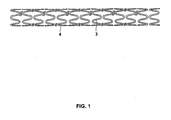
- Fig. 1 shows a stent constructed in accordance with the invention, in the stent's contracted state.
- the stent includes a structural member or body with at least one surface being at least partly roughened or abraded at least for holding and releasing an anti-restenosis compound, as will be described further below.
- the stent body is formed of a series of tubular members called struts 3 connected to each other by filaments called linkers 4.
- Each strut 3 has an expandable zig-zag, sawtooth, helical ribbon coil or sinusoidal wave structure, and the connections to each linker 4 serve to increase overall stent flexibility.
- the contracted-state diameter of the stent is between approximately 0.5 mm-2.0 mm, preferably 0.71 to 1.65 mm, and a length of between 5-100 mm.
- the expanded stent diameter is at least twice and up to 8-9 times that of the stent in its contracted state, for example, a stent with a contracted diameter of between 0.7 to 1.5 mm may expand radially to a selected expanded state of between 2.0-8.0 mm or more.
- Stents having this general stent-body architecture of linked, expandable tubular members are known, for example, as described in PCT Publication No. WO 99/07308 , which is commonly owned with the present application and expressly incorporated by reference herein.
- the stent structure is made of a biocompatible material, such as stainless steel.
- biocompatible materials that are typically used for the stent structure are, cobalt chromium, nickel, magnesium, tantalum, titanium, nitinol, gold, platinum, inconel, iridium, silver, tungsten, or another biocompatible metal, or alloys of any of these; carbon or carbon fiber; cellulose acetate, cellulose nitrate, silicone, polyethylene teraphthalate, polyurethane, polyamide, polyester, polyorthoester, polyanhydride, polyether sulfone, polycarbonate, polypropylene, high molecular weight polyethylene, polytetrafluoroethylene, or another biocompatible polymeric material, or mixtures or copolymers of these; poly-L-lactic acid, poly-DL-lactic acid, polyglycolic acid or copolymers thereof, a polyanhydride, polycaprolactone, polyhydroxybutyrate valerate or another biode
- a typical stent is described in US Patent No. 6,730,064 .
- the dimensions of each stent will vary depending on the body lumen in which they are to be delivered.
- a stent may have a diameter ranging from approximately 0.5 mm to approximately 25.0 mm and a length that ranges from approximately 4 mm to approximately 100 mm or longer.
- An example of stent measurements is described in co-owned US Patent No. 6,939,376 , which is commonly owned and expressly incorporated by reference herein.
- At least a portion of at least one of the surfaces of the stent has a roughened or abraded microstructure or textured surface.
- This microstructure can include at least one therapeutic agent that elutes from the microstructure.
- the roughened or textured surface provides interstices or vertically projecting surface features and/or regions of undercuts or recesses. It will be appreciated that a solution containing a therapeutic agent can be drawn, e.g. , by capillary forces into such recesses and coat the projecting surfaces. In this manner, the surface area for coating the stent may be increased.
- the thickness of such layer refers to the average thickness of the layer, e.g.
- At least a portion of the ablumenal surface of the stent i.e. , the surface in contact with the treated vessel after stent placement, includes the microstructure surfacing.
- the method includes use of a mask to prevent at least a portion of the stent from being abraded.
- the mask is a hydrocarbon film, such as PARAFILM ® , however, it will be appreciated that any suitable barrier to abrasion is suitable for use in these methods.
- at least the lumenal surface of the stent is not abraded.
- a sheet of the mask approximately 5 mm by 60 mm is rolled around the diameter of a mandrel such as a 1.4 mm glass capillary tube. The stent is positioned onto the mandrel and hand-crimped into the hydrocarbon mask.
- a stereo microscope set between 10X and 40X may be used to ensure that the portion of the stent that is not to be abraded is covered by the mask.
- at least 80% of the stent wall thickness on all surfaces is masked by the hydrocarbon film layer.
- the stent surface 5 is then treated by utilizing microblasting systems, such as the MICRO BLASTER ® and PROCENTER ® by Comco, Inc. or an equivalent.
- microblasting systems such as the MICRO BLASTER ® and PROCENTER ® by Comco, Inc. or an equivalent.
- 25 ⁇ m of an abrasive, such as aluminum oxide, is used to roughen the stent surface 5 .
- the pressure is adjusted to 40 psi ⁇ 5 psi, and a spray nozzle is positioned approximately 2.5 cm to 5.0 cm from the stent surface 5 , making multiple passes over the stent.
- the mask is removed by any appropriate means such as via ultrasonic cleaning.
- the ultrasonic cleaner is filled with deionized water which is heated to 45 °C:
- a sample vial of HPLC grade chloroform is heated to between 50-60 °C on a hotplate.
- a glass capillary tube mandrel with a treated stent is incubated in a vial of 40 °C and 50 °C HPLC grade chloroform for 5-10 minutes.
- the vial containing the chloroform and mandrel is then sonicated in 45° C deionized water for two minutes.
- the treated stent is generally passivated according to ASTM standards and cleaned in a series of solvents such as Chloroform, Acetone and/or Isopropyl Alcohol.
- solvents such as Chloroform, Acetone and/or Isopropyl Alcohol.
- the mask is removed and the treated stent is sonicated, it is removed from the vial of chloroform.
- a sample vial is rinsed with Acetone and then refilled with Acetone.
- the treated stent is placed in the vial and sonicated in the ultrasonic cleaner for two minutes.
- the vial is rinsed with isopropyl alcohol and then refilled with isopropyl alcohol.
- the stent is sonicated in the ultrasonic cleaner for two more minutes.
- the treated stent is then passivated in a 60 °C ⁇ 3 °C 20% by volume Nitric Acid bath for 30 minutes.
- the stent is then rinsed 10 times with copious amounts of deionized water.
- the stent is then placed in 600 mL of a solvent such as isopropyl alcohol and sonicated in the ultrasonic cleaner for 5 minutes and allowed to air dry.
- the surface of the stent is uniformly abraded in a controlled manner via shot peening.
- Roughening of a stent surface 5 is accomplished using metal particles called shot that range in size from approximately 1 to 5 microns and is made from an atomic element having at least a weight of 43 g/mol.
- the shot may be in the form of particulate tantalum, particulate tungsten, particulate platinum, particulate iridium, particulate gold, particulate bismuth, particulate barium, particulate zirconium and alloys thereof.
- suitable alloys include a platinum/nickel alloy and a platinum/iridium alloy.
- a stent surface 5 can be treated to create mechanical injectors that range in size from about 3 to about 10 microns.
- a stent surface 5 can be laser etched to create regular or irregular patterns of asperities/ mechanical injectors of about 5 to about 25 microns.
- the stent surface can be treated to have a different roughness factor on the ablumenal surface than the lumen surface.
- the whole surface may be treated via any of the above disclosed methods.
- a subsequent masking of the lumen surface is performed so that a second surface treatment can be directed to the ablumenal surface.
- the subsequent treatment would typically utilize the more aggressive texturing process.
- the differing surfaces thus obtained can be used to impart differing useful properties to the inside (i.e. lumenal) vs. outside (ablumenal) surfaces of the stent.
- the lumenal surface roughness is optimized to improve cell ingrowth and adhesion for example as described in ( US Patent Application No. 2005/0211680 ), and the ablumenal surface roughness may be optimized to provide drug transfer from the ablumenal surface of the stent to the surrounding tissues as described herein.
- the stent surface 5 may be treated by placing desired amount of shot over a predetermined portion of the stent surface 5 and in the desired pattern. Pressure is applied to the particles using plates or rollers to make indentations in the stent surface 5 . Roughness can also be achieved by jet blasting the particles at the stent surface 5 at a velocity sufficient to make indentations.
- An example of shot peening a metal surface is described in US Patent No. 6,911,100 .
- this uniform, controlled surface roughness can also be achieved similar to above by employing a laser rather than the use of shot.
- a series of electric discharges are applied to the desired portion of the outer or inner stent surface 5 .
- the electric discharges contact the surface with sufficient energy to vaporize the material on the surface of the stent, creating pits, sometimes called voids, the combined effect of which is a rough surface having increased surface area.
- An example of this process is described in US Patent No 6,913,617 .
- the surface of the stent is uniformly treated by compression.
- the stent is affixed to a mandrel, which is inserted into a die that is equipped with preformed raised portions that form indentations in the desired amount, shape, size and pattern on the stent surface 5 .
- the indentations may be made in a number of ways such as welding them onto the stent surface 5 or sandblasting.
- the die is then closed around the stent forming indentations of the desired depth and covering the desired surface area.
- the stent is treated over its entire surface, or a portion of the surface, depending on the manufacture of the die. An example of this process is described in US Patent No. 7,055,237 .
- a stent surface 5 is treated with a pneumatic press or hydraulic press.
- Pneumatic presses are well known in the art as described in US Patent No. 4,079,617 .
- Hydraulic presses are also well-known in the art as described in US Patent No. 7,033,155 .
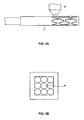
- the stent is positioned on a mandrel 1 that is either stationary or rotating.
- a computer controlled pneumatic or hydraulic press 8 is configured to treat the surface of the stent in one of several predetermined ways, for example, randomly or in a desired pattern.
- the punch assembly 9 of the press may be configured to contain one or more peeners 10, 11 here defined as indentation creating mechanisms.
- the punch assembly contains a plurality of peeners. It will be appreciated that the peeners may be of uniform or varied length in order to form the surface microstructure. Each peener 10, 11 remains in a retracted position until the computer is programmed to treat the stent surface 5 . According to the selected program, the peeners 10, 11 will be depressed onto the stent surface 5 with enough force to result in an indentation.
- the punch assembly 9 is configured to be no more than width of the desired stent, for example if the stent strut 3 is 15 micron, the plurality of peeners 10, 11, will total no more than 15 micron on width as well.
- the number of peeners 10, 11 on a given punch assembly 9 will vary depending on the width of the stent.
- the punch assembly 9 may be configured to be a preformed head affixed to the press the heads are interchangeable depending on which pattern is desired.
- the head can be stationary and the stent is turned or in the alternative, the head can be moveable, this is embodied in a single peener 10, 11 affixed to the press that will randomly make impressions on the stent surface 5 .
- the entire length of the tubing used to create stents is treated prior to laser cutting it into a plurality of desired stent lengths.
- the stent is horizontally or vertically attached to one or more mandrels 1 and abraded using one of the methods disclosed in this application.
- the stent is treated randomly, uniformly or in a desired pattern.
- the length and sides of the stent is treated lengthwise, vertically or spirally.
- the stent surface 5 is treated either by moving it over a stationary roughening mechanism, or in the alternative, the entire stent tube length is stationary and the roughening mechanism may be moved over the length of the tube in one of the manners disclosed, for example horizontally, vertically, spirally.
- Potentiodynamic corrosion testing was performed on the treated stent to confirm the desirability of the passivation step and its effectiveness.
- the data shows that the treated, passivated stent breakdown potential is well within ASTM specified voltage levels standards. Therefore, after the roughening process and passivation, the treated stent does not exhibit a greater likelihood of corrosion when compared to the untreated control stent, and the roughening process does not increase the potential for restenosis and thrombosis. After passivation, the biocompatibility of the microstructured metal surface was observe d to be equivalent to that observed with stents having smooth electropolished surfaces.
- the approximate thickness of an untreated stent wall is generally around 0.05 mm.
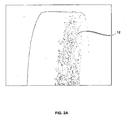
- the treatment of the stent surface 5 in the manner disclosed results in a treated stent surface with an average peak 6 height of approximately 1.30 ⁇ m and an average valley 7 depth of 2.08 ⁇ m.
- axial fatigue testing and auger analysis was performed on a treated stent. Axial fatigue testing was focused at the portion of the stent that is the most susceptible to breakage, which is the link 4 between stent struts 3 .
- the untreated stent control and the roughed stent both remained intact. Since a portion of the treated stent is removed in the roughening process, and it has been discovered that the treated stent is able to withstand the same fatigue conditions as an untreated intact stent with more surface area is able to withstand, it is understood that the roughening process actually increases the fatigue resistance of the stent due to the disrupted microcrystalline structures of the stent body. Finally, auger analysis was performed on the treated stent to characterize the surface chemistry, which revealed similar ratios of identical elements in the passivated unroughened stent and the passivated roughened stent. This demonstrates that the process of passivating the untreated control stent in the manner disclosed has no deleterious effects on the surface chemistry of the stent.
- Example 2 provides surface roughness Ra and roughness factor Rt measurements for 4 stents prepared as above by surface abrasion with a pressurized particle blast.
- the surface roughness values were all at least 20 ⁇ in (0.5 ⁇ m) and are typically between about 20-40 ⁇ in. (0.5 ⁇ m-1.0 ⁇ m), and a roughness range between 300-700 ⁇ inch (7.5 to 17.5 ⁇ m), and typically between 300 and 500 0.5 ⁇ inch (7.5 and 12.5 ⁇ mm).
- these roughness values, and particularly the roughness range values have been found optimal for achieving optimal anti-restenosis results in subjects.
- the surface asperities or projections in the 300-700 ⁇ inch peak to valley range are optimal for "injecting" drug in the drug coating into the surrounding vessel.
- the projections may facilitate entry of the drug into the vessel.
- the defined roughness range of the stent surface combined with the polymer-free drug coating, maintains or further reduces the rate of occurrence and/or extent of restenosis or thrombosis seen with a polymer-coated, limus-eluting stent, but without the presence of a polymer carrier, and further reduces the rate of occurrence and/or extent of restenosis or thrombosis seen with a polymer-free coating on a less-roughened surface, i.e. having a lower surface roughness range.
- studies conducted in support of the present invention indicate that a stent having surface-roughness features with peak-to-height values in the range 800-1,000 ⁇ inch (20-25 ⁇ m or more) may be less effective in reducing restenosis.
- the invention is directed to improving the effectiveness, in terms of reduced incidence and/or extent of restenosis in treating a vascular injury with a drug-eluting stent, e.g. , a limus-eluting stent.
- a drug-eluting stent e.g. , a limus-eluting stent.
- the improvement includes the steps of roughening at least the ablumenal surface portions of the stent to a surface roughness of at least about 20 ⁇ in (0.5 ⁇ m), and a surface roughness range of between about 300-700 ⁇ in (7.5-17.5 ⁇ m), and coating the roughened regions of the stent filaments with a polymer-free coating of the limus drug, to a coating thickness greater than the range of surface roughness of the roughened stent surface, that is, to a coating thickness that forms a substantially unbroken drug coating.
- an API i.e. active pharmaceutical ingredient
- the antiproliferative Biolimus A9 ® is applied at least to the ablumenal portion of the stent.
- the API may be applied to the stent surface by any appropriate means including by spraying the treated surface of the stent with a solution of the API.
- the API solution may also be applied by dipping the entire stent into the desired API or by applying it directly to the stent surface 5 manually.
- Biolimus A9 ® has an amorphous to semi-crystalline structure that does not crack or fracture like some other crystalline limus compounds. Therefore, the properties of Biolimus A9 ® permit adhesion to the stent's roughened treated surface in the unexpanded state and the expanded state.
- the API material is applied to the ablumenal portion of the stent via autopipetting as described in co-owned U.S. Patent No. 6,939,376 .
- a solution ranging in a concentration of approximately 100 mg/ml to approximately 200 mg/ml is made by dissolving the desired API in an appropriate solvent, such as ethyl acetate or acetonitrile.
- the solution is placed in a reservoir with a pump designed to deliver the solution at a predetermined rate.
- the pump is controlled by a microcontroller, such as the 4-Axis Dispensing Robot Model available from I&J Fisnar Inc.
- a solution delivery tube for delivery of the solvent mixture to the stent surface 5 is attached to the bottom of the reservoir.
- the reservoir and delivery tube are mounted to a moveable support that moves the solvent delivery tube continuously or in small steps, for example, 0.2 mm per step along the longitudinal axis.
- An uncoated stent is gripped by a rotating chuck contacting the inner surface of the stent at least at one end.
- Axial rotation of the stent is accomplished by rotating the stent continuously, or in small degree steps, such as 0.5 degree per step.
- the delivery tube is held at a fixed position and, in addition to the rotation movement, the stent is moved along its longitudinal direction to accomplish the coating process.
- the solution delivery tubes Prior to use, the solution delivery tubes are drawn and shaped under a Bunsen burner to form a small tapered opening at the tip of the tube to facilitate precise application of the drug/solvent mixture, which can then be applied over the length and sides of the stent as needed with the formed tip of the tube. It is within the scope of the invention to use more than one of the fluid dispensing tube types working in concert to form the coating, or alternately to use more than one moveable solution reservoir equipped with different tips, or containing different viscosity solutions or different chemical makeup of the multiple solutions in the same process to form the coating.
- a non-porous layer of parylene, parylene derivative, or another biocompatible polymer is applied to the treated stent surface, and the desired API is applied or layered onto that.
- an additional layer of slightly non-porous polymer is applied directly over the API, which aids in controlled release over time.
- the stent comprises at least one layer of an API posited on its surface, and the other surfaces will either contain no API or one or more different APIs. In this manner, one or more APIs may be delivered to the blood stream from the lumenal surface of the stent, while different treatments for different conditions are delivered on the vascular injury site outside surface of the stent.
- the stent is capable of being coated with an API molecule without the need of a polymer.
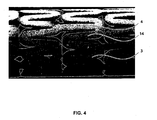
- the process of roughening all or a portion of the stent in one of the methods disclosed above allows for the API to adhere directly to the surface of the treated stent 14.
- the API is a limus drug, such as described in U.S. Patents Nos. 4,650,803 , 5,288,711 , 5,516,781 , 5,665,772 and 6,153,252 , in PCT Publication No. WO 97/35575 , in U.S. Patent No. 6,273,913B1 , and in U.S. Patent Application Nos.
- Exemplary limus drugs are the 42-O-alkoxyalkyl drugs, such as Biolimus A9.
- Additional API drugs that may be employed, either alone, or in combination with a limus drug, include antiplatelet or antithrombotic agents, or anti-inflammatory agents such as dexamethasone, dexamethasone acetate, dexamethasone sodium phosphate, or another dexamethasone derivative or an anti-inflammatory steroid.
- Either the inside and/or outside surfaces of the stent can also be used to deliver other types of API molecules such as thrombolytics, vasodilators, antihypertensive agents, antimicrobials or antibiotics, antimitotics, antiproliferatives, antisecretory agents, non-steroidal anti-inflammatory drugs, immunosuppressive agents, growth factors and growth factor antagonists, antitumor and/or chemotherapeutic agents, antipolymerases, antiviral agents, photodynamic therapy agents, antibody targeted therapy agents, prodrugs, sex hormones, free radical scavengers, antioxidants, biologic agents, radiotherapeutic agents, radiopaque agents and radiolabelled agents.
- API molecules such as thrombolytics, vasodilators, antihypertensive agents, antimicrobials or antibiotics, antimitotics, antiproliferatives, antisecretory agents, non-steroidal anti-inflammatory drugs, immunosuppressive agents, growth factors and growth factor antagonists, antitumor and
- the stent may be included in an assembly consisting of a stent body surrounding a deflated balloon affixed to the distal portion of a catheter which is used to implant the stent at the vascular injury site.
- the stent is introduced into the cardiovascular system of a patient via the brachial or femoral artery using the catheter.
- the catheter assembly is advanced through the coronary vasculature until the deflated balloon and stent combination is positioned across the vascular injury site or site of vascular disease or site of vascular narrowing.
- the balloon is then inflated to a predetermined size to expand the stent to a diameter large enough to be in continuous contact with the lumen.
- the balloon is then deflated to a smaller profile to allow the catheter to be withdrawn from the patient's vasculature, leaving the stent in place.
- An example of a typical stent implantation procedure is described in US Patent No 6,913,617 .
- This section describes vascular treatment methods in accordance with the invention, and the performance characteristics of stents constructed in accordance with the invention.
- the methods of the invention are designed to minimize the risk and/or extent of restenosis in a patient who has received localized vascular injury, or who is at risk of vascular occlusion due to the presence of advanced atherosclerotic disease.
- the vascular injury is produced during an angiographic procedure to open a partially occluded vessel, such as a coronary or peripheral vascular artery.
- the stent may be introduced into a site of vascular narrowing, and expanded using the balloon to directly open up the narrowed portion of the vessel ( i.e. the vascular injury disease site).
- a balloon catheter is first placed at the occlusion site, and a distal-end balloon is inflated and deflated one or more times to force the occluded vessel open.
- This vessel expansion particularly involving surface trauma at the vessel wall where plaque may be dislodged, often produces enough localized injury that the vessel responds over time by cell proliferation and reocclusion in the vicinity of the implanted stent.
- the occurrence or severity of restenosis is often related to the extent of vessel stretching involved in the angioplasty procedure. Particularly where overstretching is 10% or more, restenosis occurs with high frequency and often with substantial severity, i.e. , vascular occlusion.
- the present invention is intended to be used without limitations to any particular method of treating and injuring the vascular site, and can be used with either of the techniques described above, or with alternative techniques for vascular disease and injury as is known.
- the stent is placed in its contracted state typically at the distal end of a catheter, either within the catheter lumen, or in a contracted state on a distal end balloon.
- the distal catheter end is then guided to the injury site, or to the site of potential occlusion, and released from the catheter, e.g.
- the drug coated stent begins to release active compound (API) into the cells lining the vascular site, to inhibit cellular proliferation and/or for other therapeutic benefits such as reduction of inflammation, limitation of thrombosis formation, reduction in cell apoptosis, etc.
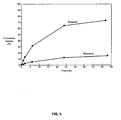
- Fig. 5 shows Biolimus A9 ® release kinetics from two stents, one with the drug coated onto a textured surface and the other a Biomatrix ® II stent with a polymer coating containing Biolimus A9 ® .
- Fig. 6 shows the percentage of drug release of Biolimus A9 ® from a polymer coated and textured stent. As seen in the graph, after only two months, 100% of the Biolimus A9 ® was released from the textured stent. In contrast, after three months approximately 30% of the drug remained on the polymer coated stent.
- Fig. 7 shows the peak blood concentration of Biolimus A9 ® as measured by mass spectroscopy for each of the polymer coated Biomatrix ® II and textured non-polymeric stent.
- the Biolimus A9 ® blood concentration peaks at about four hours with the textured stent.
- the peak blood concentration of Biolimus A9 ® with the polymer coated Biomatrix ® II is at about two months.
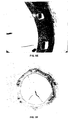
- Figs. 9A-9F shows in cross-section, a vascular region having an implanted bare metal stent ( FIGs. 9A-9B ), a metal Biomatrix ® II stent having a polymer coating of 225 ⁇ g PLA and 225 ⁇ g Biolimus A9 ® ( Figs. 9C-9D ), and a textured stent with 225 ⁇ g Biolimus A9 ® ( Figs. 9E-9F ), where the coated filaments are seen in cross section.
- the figure illustrates the release of anti-restenosis compound from each filament region into the surrounding vascular wall region.
- the smooth muscle cells forming the vascular wall begin to grow into and through the lattice or helical openings in the stent, ultimately forming a continuous inner cell layer that engulfs the stent on both sides. If the stent implantation has been successful, the extent of late vascular occlusion at the site will be less than 50%, that is, the cross-sectional diameter of flow channel remaining inside the vessel will be at least 50% of expanded stent diameter at time of implant.
- the studies compare the extent of restenosis at 28 days in an animal model following stent implantation, in bare metal stents, polymer-coated stents, and textured stents.
- Figs. 9A-9F show that both the polymer coated and textured stent greatly reduced levels of restenosis.
- the vessels with polymer drug-coated and textured stent treatment appeared to be well-healed with a well established endothelial layer. There is evidence of complete healing and vessel homeostasis at 28 days post implant.
- Example 4 Further trials demonstrate the ability of the stents described herein to limit the extent of restenosis over an extended period of at least three months. The studies are summarized in Example 4.
- Bioflex II 6 crown stent The outer surface of a Bioflex II 6 crown stent was treated with an abrasive to create a selectively micro-structured outer surface of the stent for drug loading capacity, called Bio-Freedom Stent (FS).
- FS Bio-Freedom Stent
- the therapeutic agent can be coated directly on the selectively microstructured surface of the stent.
- the roughness factor of the FS was characterized using a commercially available Veeco Metrology Group (Tucson, Ariz.) WYKO NT-2000 system, which is a non-contact optical profiler.
- VSI vertical scanning interferometer
- Vision 32 software removing cylinder and tilt terms so that the stent surface appears flat.
- a low pass filter is used which removes the effects of high spatial frequency roughness, smoothing over features that are smaller than a nine pixel window.
- Textured stents from Example 2 with and without Biolimus A9 ® were implanted in out-bred juvenile swine.
- a balloon catheter was used to place the stent according to the standard porcine overstretch model with 10-20% overstretch.
- the juvenile swine target vessels were predilated by known angioplasty techniques prior to stent placement.
- the animals were euthanized according to approved protocols, the heart and surrounding tissue was removed from the animals.
- the stent and artery were dissected, and micro-tomed by a histologist.
- the samples were stained for various growth signals, cell proliferation, and other cellular debris. Histomorphometric measurements were made of:
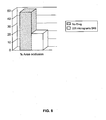
- Fig. 8 shows the graph of the % area occlusion for each of the stent with textured surface and the stent with textured surface and 225 ⁇ g Biolimus A9 ® .
- CV Path Institute, Inc. received hearts from 5 pigs. Non-overlapping stenting was performed in 5 pigs, and stents were explanted for light microscopic analysis at three months. Animal 1 died before scheduled follow up at three months for reasons not associated with stent implant procedure at 2 months. The left circumflex coronary artery (LCX) of animal #3 was not stented in this animal because the LCX, which was of an unsuitable size.
- LCX left circumflex coronary artery
- the stented vessel segments were embedded in methylmethacrylate plastic and sections from the proximal, middle, and distal stent were cut, mounted on charged slides, and stained with hematoxylin & eosin and Elastic Van Gieson (EVG).
- EVG Elastic Van Gieson
- the non-stented proximal and distal sections of the artery were embedded in paraffin, sectioned at four to five microns, and stained with hematoxylin and eosin and EVG. All sections were examined by light microscopy for the presence of inflammation, thrombus, neointimal formation and vessel wall injury.
- Morphometric Analysis Morphometric software (IP Lab for Macintosh, Scanalytics, Rockville, MD) was calibrated using NIST traceable microscope stage micrometers of 2.0 mm linear and 2.0 mm diameter circle with all objectives. Klarmann Rulings, Inc., (Manchester, New Hampshire) certified all micrometer graduations. Areas of measurement included the EEL (external elastic lamina), IEL (internal elastic lamina) and lumen. The neointimal thickness was measured at and between stent struts and averaged for each animal. By subtracting IEL from EEL, the medial area was determined. Percent stenosis was derived from the formula [1-(lumen area/stent area)] xIOO.
- the morphometric continuous data were expressed as mean ⁇ SD.
- Statistical analysis of the normally distributed parameters was performed using a Student's t-test.
- the Wilcoxon test was used in the analysis for non-normally distributed parameters or discrete values. Normality of distribution was tested with the Wilk-Shapiro test. A p value of ⁇ 0.05 was considered statistically significant.
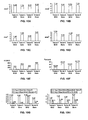
- Neointimal formation was mild with a mean neointimal thickness of 0.16 mm and composed by loosely packed smooth muscle cells and proteoglycan-rich matrix.
- Vessel injury was mild. Mild fibrin deposition localized around the struts was observed.
- granulomatous response was seen in the LCX of animal #5, inflammation was minimal overall in the other vessels. Giant cells were occasionally observed and documented. Endothelialization was complete without lumenal inflammatory cells and/or platelets adhesion. Notably, a dense calcification was seen in neointima at the proximal section in LCX of animal #2 which contained a bare metal stent.
- Neointimal formation was mild with a mean neointimal thickness of 0.21 mm and composed of tightly packed smooth muscle cell. Medial rupture was observed in the Left Anterior Descending coronary artery (LAD) of animal #2. This vessel showed severe inflammation mainly around the struts probably due to the injury created by the implant procedure. However, except for this animal, vessel injury and inflammation was mild overall. Fibrin deposition and malapposition were not seen in any stents. Endothelialization was completed without presence of lumenal inflammatory cells and/or platelets adhesion.
- LAD Left Anterior Descending coronary artery
Landscapes
- Health & Medical Sciences (AREA)
- Life Sciences & Earth Sciences (AREA)
- Engineering & Computer Science (AREA)
- Biomedical Technology (AREA)
- Veterinary Medicine (AREA)
- Public Health (AREA)
- General Health & Medical Sciences (AREA)
- Animal Behavior & Ethology (AREA)
- Heart & Thoracic Surgery (AREA)
- Vascular Medicine (AREA)
- Oral & Maxillofacial Surgery (AREA)
- Transplantation (AREA)
- Epidemiology (AREA)
- Chemical & Material Sciences (AREA)
- Cardiology (AREA)
- Surgery (AREA)
- Medicinal Chemistry (AREA)
- Physics & Mathematics (AREA)
- Optics & Photonics (AREA)
- Molecular Biology (AREA)
- Inorganic Chemistry (AREA)
- Dermatology (AREA)
- Gastroenterology & Hepatology (AREA)
- Pulmonology (AREA)
- Materials For Medical Uses (AREA)
- Media Introduction/Drainage Providing Device (AREA)
Priority Applications (1)
| Application Number | Priority Date | Filing Date | Title |
|---|---|---|---|
| PL07839691T PL2086606T3 (pl) | 2006-10-20 | 2007-10-19 | Wewnątrznaczyniowy stent do podawania leków i sposób stosowania |
Applications Claiming Priority (4)
| Application Number | Priority Date | Filing Date | Title |
|---|---|---|---|
| US85307706P | 2006-10-20 | 2006-10-20 | |
| US11/690,768 US8067055B2 (en) | 2006-10-20 | 2007-03-23 | Drug-delivery endovascular stent and method of use |
| US11/751,268 US20080097591A1 (en) | 2006-10-20 | 2007-05-21 | Drug-delivery endovascular stent and method of use |
| PCT/US2007/022284 WO2008051453A2 (en) | 2006-10-20 | 2007-10-19 | Drug-delivery endovascular stent and method of use |
Publications (2)
| Publication Number | Publication Date |
|---|---|
| EP2086606A2 EP2086606A2 (en) | 2009-08-12 |
| EP2086606B1 true EP2086606B1 (en) | 2014-03-12 |
Family
ID=39204880
Family Applications (1)
| Application Number | Title | Priority Date | Filing Date |
|---|---|---|---|
| EP07839691.8A Active EP2086606B1 (en) | 2006-10-20 | 2007-10-19 | Drug-delivery endovascular stent and method of use |
Country Status (13)
| Country | Link |
|---|---|
| US (3) | US20080097591A1 (enExample) |
| EP (1) | EP2086606B1 (enExample) |
| JP (1) | JP5139438B2 (enExample) |
| KR (1) | KR101392770B1 (enExample) |
| AU (1) | AU2007309522B2 (enExample) |
| BR (1) | BRPI0717442B8 (enExample) |
| CA (1) | CA2667061C (enExample) |
| DK (1) | DK2086606T3 (enExample) |
| ES (1) | ES2476594T3 (enExample) |
| IL (1) | IL198207A (enExample) |
| PL (1) | PL2086606T3 (enExample) |
| PT (1) | PT2086606E (enExample) |
| WO (1) | WO2008051453A2 (enExample) |
Families Citing this family (55)
| Publication number | Priority date | Publication date | Assignee | Title |
|---|---|---|---|---|
| US20090093875A1 (en) * | 2007-05-01 | 2009-04-09 | Abbott Laboratories | Drug eluting stents with prolonged local elution profiles with high local concentrations and low systemic concentrations |
| EP3103422A1 (en) | 2003-03-14 | 2016-12-14 | Intersect ENT, Inc. | Sinus delivery of sustained release therapeutics |
| KR100675379B1 (ko) * | 2005-01-25 | 2007-01-29 | 삼성전자주식회사 | 프린팅 시스템 및 프린팅 방법 |
| WO2006107957A2 (en) * | 2005-04-04 | 2006-10-12 | Sinexus, Inc. | Device and methods for treating paranasal sinus conditions |
| WO2007011708A2 (en) | 2005-07-15 | 2007-01-25 | Micell Technologies, Inc. | Stent with polymer coating containing amorphous rapamycin |
| JP5756588B2 (ja) | 2005-07-15 | 2015-07-29 | ミセル テクノロジーズ、インコーポレイテッド | 制御されたモルホロジーの薬剤粉末を含むポリマーコーティング |
| CA2996768C (en) | 2006-04-26 | 2020-12-08 | Micell Technologies, Inc. | Coatings containing multiple drugs |
| US8535707B2 (en) * | 2006-07-10 | 2013-09-17 | Intersect Ent, Inc. | Devices and methods for delivering active agents to the osteomeatal complex |
| US20080097591A1 (en) | 2006-10-20 | 2008-04-24 | Biosensors International Group | Drug-delivery endovascular stent and method of use |
| EP2081694B1 (en) | 2006-10-23 | 2020-05-13 | Micell Technologies, Inc. | Holder for electrically charging a substrate during coating |
| JP5603598B2 (ja) * | 2007-01-08 | 2014-10-08 | ミセル テクノロジーズ、インコーポレイテッド | 生物分解層を有するステント |
| US11426494B2 (en) | 2007-01-08 | 2022-08-30 | MT Acquisition Holdings LLC | Stents having biodegradable layers |
| US9433516B2 (en) | 2007-04-17 | 2016-09-06 | Micell Technologies, Inc. | Stents having controlled elution |
| AU2008256684B2 (en) * | 2007-05-25 | 2012-06-14 | Micell Technologies, Inc. | Polymer films for medical device coating |
| US8205317B2 (en) * | 2007-07-16 | 2012-06-26 | Medtronic Vascular, Inc. | Method of manufacturing a controlled porosity stent |
| US20090198179A1 (en) | 2007-12-18 | 2009-08-06 | Abbate Anthony J | Delivery devices and methods |
| BRPI0910969B8 (pt) | 2008-04-17 | 2021-06-22 | Micell Technologies Inc | dispositivo |
| EP2313122B1 (en) | 2008-07-17 | 2019-03-06 | Micell Technologies, Inc. | Drug delivery medical device |
| WO2011009096A1 (en) | 2009-07-16 | 2011-01-20 | Micell Technologies, Inc. | Drug delivery medical device |
| EP2320832A4 (en) | 2008-08-01 | 2015-07-29 | Intersect Ent Inc | METHODS AND DEVICES FOR CRIMPING SELF-DILATABLE DEVICES |
| US8834913B2 (en) | 2008-12-26 | 2014-09-16 | Battelle Memorial Institute | Medical implants and methods of making medical implants |
| WO2010086863A2 (en) * | 2009-02-02 | 2010-08-05 | Yissum Research Development Company Of The Hebrew University Of Jerusalem Ltd. | Crystalline drug-containing coatings |
| EP2413847A4 (en) | 2009-04-01 | 2013-11-27 | Micell Technologies Inc | COATED STENTS |
| CN102573981B (zh) | 2009-05-15 | 2016-06-22 | 因特尔赛克特耳鼻喉公司 | 可展开装置及其使用方法 |
| ES2921527T3 (es) | 2009-06-03 | 2022-08-29 | Forsight Vision5 Inc | Administración de fármaco en segmento anterior |
| EP2531140B1 (en) * | 2010-02-02 | 2017-11-01 | Micell Technologies, Inc. | Stent and stent delivery system with improved deliverability |
| KR101140002B1 (ko) * | 2010-02-11 | 2012-05-02 | 이화여자대학교 산학협력단 | 약물 코팅 스텐트 제조방법 및 스텐트 |
| US8795762B2 (en) | 2010-03-26 | 2014-08-05 | Battelle Memorial Institute | System and method for enhanced electrostatic deposition and surface coatings |
| WO2011133655A1 (en) | 2010-04-22 | 2011-10-27 | Micell Technologies, Inc. | Stents and other devices having extracellular matrix coating |
| EP2593039B1 (en) | 2010-07-16 | 2022-11-30 | Micell Technologies, Inc. | Drug delivery medical device |
| JP5636857B2 (ja) * | 2010-10-12 | 2014-12-10 | 国立大学法人茨城大学 | 生体組織接着用柔軟性金属箔テープ及びその接着方法 |
| KR101760506B1 (ko) | 2011-01-20 | 2017-07-21 | 주식회사 라파스 | 생분해성 마이크로구조체가 결합된 약물 용출형 스텐트 |
| WO2012166819A1 (en) | 2011-05-31 | 2012-12-06 | Micell Technologies, Inc. | System and process for formation of a time-released, drug-eluting transferable coating |
| WO2013012689A1 (en) | 2011-07-15 | 2013-01-24 | Micell Technologies, Inc. | Drug delivery medical device |
| US20140257465A1 (en) * | 2011-08-12 | 2014-09-11 | Micell Technologies, Inc. | Stents having controlled elution |
| CN106073986B (zh) | 2011-09-14 | 2019-01-11 | 弗赛特影像5股份有限公司 | 治疗患者的眼睛的装置 |
| US10188772B2 (en) | 2011-10-18 | 2019-01-29 | Micell Technologies, Inc. | Drug delivery medical device |
| KR101401585B1 (ko) * | 2012-02-10 | 2014-06-02 | 주식회사 엠아이텍 | 스텐트 코팅 장치 |
| PT2911623T (pt) | 2012-10-26 | 2019-11-21 | Forsight Vision5 Inc | Sistema oftálmico para libertação prolongada de fármaco no olho |
| JP6330024B2 (ja) | 2013-03-12 | 2018-05-23 | マイセル・テクノロジーズ,インコーポレイテッド | 生体吸収性バイオメディカルインプラント |
| US10406332B2 (en) | 2013-03-14 | 2019-09-10 | Intersect Ent, Inc. | Systems, devices, and method for treating a sinus condition |
| JP2016519965A (ja) | 2013-05-15 | 2016-07-11 | マイセル・テクノロジーズ,インコーポレイテッド | 生体吸収性バイオメディカルインプラント |
| KR101501933B1 (ko) * | 2013-07-26 | 2015-03-16 | 인하대학교 산학협력단 | 스텐트 |
| KR101501935B1 (ko) * | 2013-07-26 | 2015-03-16 | 인하대학교 산학협력단 | 높은 내구성을 가지는 스텐트 |
| WO2015181826A1 (en) | 2014-05-27 | 2015-12-03 | Yissum Research Development Company Of The Hebrew University Of Jerusalem Ltd. | Crystalline coating and release of bioactive agents |
| KR102097542B1 (ko) * | 2014-12-19 | 2020-04-06 | 보스톤 싸이엔티픽 싸이메드 인코포레이티드 | 이동 방지 특성을 갖는 스텐트 |
| CA2974376A1 (en) | 2015-01-22 | 2016-07-28 | Intersect Ent, Inc. | Drug-coated balloon |
| US20160296532A1 (en) | 2015-04-13 | 2016-10-13 | Forsight Vision5, Inc. | Ocular Insert Composition of a Semi-Crystalline or Crystalline Pharmaceutically Active Agent |
| KR101868972B1 (ko) * | 2016-07-11 | 2018-06-19 | 한국과학기술연구원 | 생체분해성 재료 및 그 제조 방법 |
| KR101878853B1 (ko) * | 2017-02-16 | 2018-07-16 | 한국과학기술연구원 | 선택적 세포 제어형 생체적합성 임플란트 |
| US11744732B2 (en) * | 2017-10-19 | 2023-09-05 | Amo Development, Llc | Medication-coated patient interface device for ophthalmic laser surgery |
| US12403291B2 (en) | 2019-08-30 | 2025-09-02 | Intersect Ent, Inc. | Submucosal bioresorbable drug eluting platform |
| EP3854349A1 (en) * | 2020-01-23 | 2021-07-28 | Kardiozis SAS | Endoprosthesis and method of manufacturing an endoprosthesis |
| WO2021236413A1 (en) | 2020-05-18 | 2021-11-25 | Wangs Alliance Corporation | Germicidal lighting |
| WO2021258063A1 (en) * | 2020-06-19 | 2021-12-23 | Massachusetts Institute Of Technology | Kirigami-inspired stents for sustained local delivery of therapeutics |
Family Cites Families (123)
| Publication number | Priority date | Publication date | Assignee | Title |
|---|---|---|---|---|
| ZA737247B (en) * | 1972-09-29 | 1975-04-30 | Ayerst Mckenna & Harrison | Rapamycin and process of preparation |
| US4885171A (en) * | 1978-11-03 | 1989-12-05 | American Home Products Corporation | Use of rapamycin in treatment of certain tumors |
| US4316885A (en) * | 1980-08-25 | 1982-02-23 | Ayerst, Mckenna And Harrison, Inc. | Acyl derivatives of rapamycin |
| US4650803A (en) | 1985-12-06 | 1987-03-17 | University Of Kansas | Prodrugs of rapamycin |
| US5059211A (en) * | 1987-06-25 | 1991-10-22 | Duke University | Absorbable vascular stent |
| US5527337A (en) * | 1987-06-25 | 1996-06-18 | Duke University | Bioabsorbable stent and method of making the same |
| US4990155A (en) * | 1989-05-19 | 1991-02-05 | Wilkoff Howard M | Surgical stent method and apparatus |
| US5100899A (en) * | 1989-06-06 | 1992-03-31 | Roy Calne | Methods of inhibiting transplant rejection in mammals using rapamycin and derivatives and prodrugs thereof |
| US6248129B1 (en) * | 1990-09-14 | 2001-06-19 | Quanam Medical Corporation | Expandable polymeric stent with memory and delivery apparatus and method |
| US5163952A (en) * | 1990-09-14 | 1992-11-17 | Michael Froix | Expandable polymeric stent with memory and delivery apparatus and method |
| US5258020A (en) * | 1990-09-14 | 1993-11-02 | Michael Froix | Method of using expandable polymeric stent with memory |
| ES2134205T3 (es) * | 1991-03-08 | 1999-10-01 | Keiji Igaki | Stent para vasos, estructura de sujecion de dicho stent, y dispositivo para montar dicho stent. |
| US5120842A (en) * | 1991-04-01 | 1992-06-09 | American Home Products Corporation | Silyl ethers of rapamycin |
| US5151413A (en) * | 1991-11-06 | 1992-09-29 | American Home Products Corporation | Rapamycin acetals as immunosuppressant and antifungal agents |
| US5516781A (en) | 1992-01-09 | 1996-05-14 | American Home Products Corporation | Method of treating restenosis with rapamycin |
| US6013853A (en) * | 1992-02-14 | 2000-01-11 | The University Of Texas System | Continuous release polymeric implant carrier |
| US5288711A (en) | 1992-04-28 | 1994-02-22 | American Home Products Corporation | Method of treating hyperproliferative vascular disease |
| US5540712A (en) * | 1992-05-01 | 1996-07-30 | Nitinol Medical Technologies, Inc. | Stent and method and apparatus for forming and delivering the same |
| GB9221220D0 (en) | 1992-10-09 | 1992-11-25 | Sandoz Ag | Organic componds |
| US5258389A (en) * | 1992-11-09 | 1993-11-02 | Merck & Co., Inc. | O-aryl, O-alkyl, O-alkenyl and O-alkynylrapamycin derivatives |
| US5342348A (en) * | 1992-12-04 | 1994-08-30 | Kaplan Aaron V | Method and device for treating and enlarging body lumens |
| US6663881B2 (en) * | 1993-01-28 | 2003-12-16 | Neorx Corporation | Therapeutic inhibitor of vascular smooth muscle cells |
| DE4303181A1 (de) * | 1993-02-04 | 1994-08-11 | Angiomed Ag | Implantierbarer Katheter |
| US5441515A (en) | 1993-04-23 | 1995-08-15 | Advanced Cardiovascular Systems, Inc. | Ratcheting stent |
| US5464650A (en) * | 1993-04-26 | 1995-11-07 | Medtronic, Inc. | Intravascular stent and method |
| US5824048A (en) * | 1993-04-26 | 1998-10-20 | Medtronic, Inc. | Method for delivering a therapeutic substance to a body lumen |
| US5886026A (en) | 1993-07-19 | 1999-03-23 | Angiotech Pharmaceuticals Inc. | Anti-angiogenic compositions and methods of use |
| ES2146741T3 (es) * | 1993-12-17 | 2000-08-16 | Novartis Ag | Derivados de rapamicina utiles como inmunosupresores. |
| US5362718A (en) * | 1994-04-18 | 1994-11-08 | American Home Products Corporation | Rapamycin hydroxyesters |
| US5649977A (en) * | 1994-09-22 | 1997-07-22 | Advanced Cardiovascular Systems, Inc. | Metal reinforced polymer stent |
| EP1181904B1 (en) * | 1994-10-17 | 2009-06-24 | Kabushikikaisha Igaki Iryo Sekkei | Stent for liberating drug |
| US5707385A (en) * | 1994-11-16 | 1998-01-13 | Advanced Cardiovascular Systems, Inc. | Drug loaded elastic membrane and method for delivery |
| US6231600B1 (en) * | 1995-02-22 | 2001-05-15 | Scimed Life Systems, Inc. | Stents with hybrid coating for medical devices |
| US6099562A (en) * | 1996-06-13 | 2000-08-08 | Schneider (Usa) Inc. | Drug coating with topcoat |
| US5609629A (en) * | 1995-06-07 | 1997-03-11 | Med Institute, Inc. | Coated implantable medical device |
| US6774278B1 (en) | 1995-06-07 | 2004-08-10 | Cook Incorporated | Coated implantable medical device |
| CA2178541C (en) * | 1995-06-07 | 2009-11-24 | Neal E. Fearnot | Implantable medical device |
| US5735872A (en) | 1995-11-13 | 1998-04-07 | Navius Corporation | Stent |
| CA2197375C (en) | 1996-02-15 | 2003-05-06 | Yasuhiro Okuda | Artificial blood vessel |
| GB9606452D0 (en) * | 1996-03-27 | 1996-06-05 | Sandoz Ltd | Organic compounds |
| US6019784A (en) * | 1996-04-04 | 2000-02-01 | Electroformed Stents, Inc. | Process for making electroformed stents |
| US5713949A (en) * | 1996-08-06 | 1998-02-03 | Jayaraman; Swaminathan | Microporous covered stents and method of coating |
| US5769884A (en) * | 1996-06-27 | 1998-06-23 | Cordis Corporation | Controlled porosity endovascular implant |
| US6174329B1 (en) * | 1996-08-22 | 2001-01-16 | Advanced Cardiovascular Systems, Inc. | Protective coating for a stent with intermediate radiopaque coating |
| US5868781A (en) | 1996-10-22 | 1999-02-09 | Scimed Life Systems, Inc. | Locking stent |
| US6197013B1 (en) * | 1996-11-06 | 2001-03-06 | Setagon, Inc. | Method and apparatus for drug and gene delivery |
| US5980972A (en) | 1996-12-20 | 1999-11-09 | Schneider (Usa) Inc | Method of applying drug-release coatings |
| IT1289815B1 (it) * | 1996-12-30 | 1998-10-16 | Sorin Biomedica Cardio Spa | Stent per angioplastica e relativo procedimento di produzione |
| JP4422215B2 (ja) | 1997-02-20 | 2010-02-24 | クック インコーポレイテッド | 被覆された移植可能な医療器具 |
| US5843172A (en) | 1997-04-15 | 1998-12-01 | Advanced Cardiovascular Systems, Inc. | Porous medicated stent |
| US6273913B1 (en) | 1997-04-18 | 2001-08-14 | Cordis Corporation | Modified stent useful for delivery of drugs along stent strut |
| US6670398B2 (en) * | 1997-05-14 | 2003-12-30 | Atherogenics, Inc. | Compounds and methods for treating transplant rejection |
| US6669970B2 (en) * | 1997-06-09 | 2003-12-30 | The University Of British Columbia | Method of feeding fish |
| WO1999007308A1 (en) | 1997-08-08 | 1999-02-18 | Sunscope International, Inc. | Microporous stent and implantation device |
| US6042606A (en) * | 1997-09-29 | 2000-03-28 | Cook Incorporated | Radially expandable non-axially contracting surgical stent |
| US5972027A (en) * | 1997-09-30 | 1999-10-26 | Scimed Life Systems, Inc | Porous stent drug delivery system |
| US6156062A (en) | 1997-12-03 | 2000-12-05 | Ave Connaught | Helically wrapped interlocking stent |
| US6129755A (en) * | 1998-01-09 | 2000-10-10 | Nitinol Development Corporation | Intravascular stent having an improved strut configuration |
| US6190406B1 (en) * | 1998-01-09 | 2001-02-20 | Nitinal Development Corporation | Intravascular stent having tapered struts |
| US6623521B2 (en) | 1998-02-17 | 2003-09-23 | Md3, Inc. | Expandable stent with sliding and locking radial elements |
| US7208011B2 (en) * | 2001-08-20 | 2007-04-24 | Conor Medsystems, Inc. | Implantable medical device with drug filled holes |
| US20010029351A1 (en) * | 1998-04-16 | 2001-10-11 | Robert Falotico | Drug combinations and delivery devices for the prevention and treatment of vascular disease |
| US6153252A (en) | 1998-06-30 | 2000-11-28 | Ethicon, Inc. | Process for coating stents |
| US6096175A (en) * | 1998-07-17 | 2000-08-01 | Micro Therapeutics, Inc. | Thin film stent |
| US20020038146A1 (en) * | 1998-07-29 | 2002-03-28 | Ulf Harry | Expandable stent with relief cuts for carrying medicines and other materials |
| US6299604B1 (en) * | 1998-08-20 | 2001-10-09 | Cook Incorporated | Coated implantable medical device |
| CA2359943C (en) * | 1999-01-25 | 2006-04-11 | Michelson, Gary K. | Instrument and method for creating an intervertebral space for receiving an implant |
| US6368658B1 (en) * | 1999-04-19 | 2002-04-09 | Scimed Life Systems, Inc. | Coating medical devices using air suspension |
| US6607598B2 (en) * | 1999-04-19 | 2003-08-19 | Scimed Life Systems, Inc. | Device for protecting medical devices during a coating process |
| US6368346B1 (en) | 1999-06-03 | 2002-04-09 | American Medical Systems, Inc. | Bioresorbable stent |
| AU783158B2 (en) | 1999-08-24 | 2005-09-29 | Ariad Pharmaceuticals, Inc. | 28-epirapalogs |
| US6713119B2 (en) | 1999-09-03 | 2004-03-30 | Advanced Cardiovascular Systems, Inc. | Biocompatible coating for a prosthesis and a method of forming the same |
| US6790228B2 (en) * | 1999-12-23 | 2004-09-14 | Advanced Cardiovascular Systems, Inc. | Coating for implantable devices and a method of forming the same |
| ATE475418T1 (de) | 2000-01-14 | 2010-08-15 | Univ Pennsylvania | O-methylierte rapamycinderivate zur milderung oder vermeidung lymphoproliferativer erkrankungen |
| US6312463B1 (en) * | 2000-02-01 | 2001-11-06 | Endotex Interventional Systems, Inc. | Micro-porous mesh stent with hybrid structure |
| US20050271701A1 (en) | 2000-03-15 | 2005-12-08 | Orbus Medical Technologies, Inc. | Progenitor endothelial cell capturing with a drug eluting implantable medical device |
| WO2001087575A2 (en) * | 2000-05-12 | 2001-11-22 | The Regents Of The University Of Michigan | Reverse fabrication of porous materials |
| US6585151B1 (en) * | 2000-05-23 | 2003-07-01 | The Regents Of The University Of Michigan | Method for producing microporous objects with fiber, wire or foil core and microporous cellular objects |
| AU2001288809A1 (en) | 2000-09-26 | 2002-04-08 | Advanced Cardiovascular Systems Inc. | A method of loading a substance onto an implantable device |
| US6805898B1 (en) * | 2000-09-28 | 2004-10-19 | Advanced Cardiovascular Systems, Inc. | Surface features of an implantable medical device |
| WO2002026281A1 (en) | 2000-09-29 | 2002-04-04 | Cordis Corporation | Coated medical devices |
| US6746773B2 (en) * | 2000-09-29 | 2004-06-08 | Ethicon, Inc. | Coatings for medical devices |
| US20020051730A1 (en) * | 2000-09-29 | 2002-05-02 | Stanko Bodnar | Coated medical devices and sterilization thereof |
| US20020111590A1 (en) * | 2000-09-29 | 2002-08-15 | Davila Luis A. | Medical devices, drug coatings and methods for maintaining the drug coatings thereon |
| JP2004511297A (ja) | 2000-10-16 | 2004-04-15 | コナー メドシステムズ, インコーポレイテッド | 有益な薬剤を搬送するための拡張可能な医療装置 |
| JP4583756B2 (ja) * | 2000-10-31 | 2010-11-17 | クック インコーポレイテッド | 医療器具 |
| WO2002056790A2 (en) | 2000-12-22 | 2002-07-25 | Avantec Vascular Corporation | Delivery of therapeutic capable agents |
| US20030033007A1 (en) * | 2000-12-22 | 2003-02-13 | Avantec Vascular Corporation | Methods and devices for delivery of therapeutic capable agents with variable release profile |
| US20030050692A1 (en) * | 2000-12-22 | 2003-03-13 | Avantec Vascular Corporation | Delivery of therapeutic capable agents |
| US7077859B2 (en) * | 2000-12-22 | 2006-07-18 | Avantec Vascular Corporation | Apparatus and methods for variably controlled substance delivery from implanted prostheses |
| US7083642B2 (en) * | 2000-12-22 | 2006-08-01 | Avantec Vascular Corporation | Delivery of therapeutic capable agents |
| US20020082679A1 (en) * | 2000-12-22 | 2002-06-27 | Avantec Vascular Corporation | Delivery or therapeutic capable agents |
| US6913617B1 (en) | 2000-12-27 | 2005-07-05 | Advanced Cardiovascular Systems, Inc. | Method for creating a textured surface on an implantable medical device |
| US6682553B1 (en) | 2000-12-28 | 2004-01-27 | Advanced Cardiovascular Systems, Inc. | System and method for stent retention |
| US6540777B2 (en) * | 2001-02-15 | 2003-04-01 | Scimed Life Systems, Inc. | Locking stent |
| US7128755B2 (en) * | 2001-06-01 | 2006-10-31 | Texas Stent Technologies, Inc. | Expandable biodegradable polymeric stents for combined mechanical support and pharmacological or radiation therapy |
| TW514350U (en) * | 2001-06-22 | 2002-12-11 | Coretronic Corp | Projecting device with heat-dissipating fan |
| US20030050687A1 (en) * | 2001-07-03 | 2003-03-13 | Schwade Nathan D. | Biocompatible stents and method of deployment |
| EP1277449B2 (en) * | 2001-07-20 | 2012-07-11 | Sorin Biomedica Cardio S.R.L. | Stent |
| US6641611B2 (en) * | 2001-11-26 | 2003-11-04 | Swaminathan Jayaraman | Therapeutic coating for an intravascular implant |
| EP1429819B1 (en) * | 2001-09-24 | 2010-11-24 | Boston Scientific Limited | Optimized dosing for paclitaxel coated stents |
| US20030077310A1 (en) * | 2001-10-22 | 2003-04-24 | Chandrashekhar Pathak | Stent coatings containing HMG-CoA reductase inhibitors |
| US6939376B2 (en) * | 2001-11-05 | 2005-09-06 | Sun Biomedical, Ltd. | Drug-delivery endovascular stent and method for treating restenosis |
| US7682387B2 (en) * | 2002-04-24 | 2010-03-23 | Biosensors International Group, Ltd. | Drug-delivery endovascular stent and method for treating restenosis |
| US6743463B2 (en) * | 2002-03-28 | 2004-06-01 | Scimed Life Systems, Inc. | Method for spray-coating a medical device having a tubular wall such as a stent |
| US20040024450A1 (en) * | 2002-04-24 | 2004-02-05 | Sun Biomedical, Ltd. | Drug-delivery endovascular stent and method for treating restenosis |
| ATE495769T1 (de) * | 2002-07-12 | 2011-02-15 | Cook Inc | Beschichtete medizinische vorrichtung |
| US6911100B1 (en) | 2002-08-30 | 2005-06-28 | Biomet, Inc. | Method for controlling residual stress in prosthetics |
| DE60226236T3 (de) * | 2002-09-20 | 2011-12-15 | Abbott Laboratories Vascular Enterprises Ltd. | Mit einer rauhen Oberfläche versehener Stent und sein Herstellungsverfahren |
| US20040249442A1 (en) | 2003-02-26 | 2004-12-09 | Fleming James A. | Locking stent having multiple locking points |
| US6904658B2 (en) * | 2003-06-02 | 2005-06-14 | Electroformed Stents, Inc. | Process for forming a porous drug delivery layer |
| US7055237B2 (en) * | 2003-09-29 | 2006-06-06 | Medtronic Vascular, Inc. | Method of forming a drug eluting stent |
| US7220755B2 (en) * | 2003-11-12 | 2007-05-22 | Biosensors International Group, Ltd. | 42-O-alkoxyalkyl rapamycin derivatives and compositions comprising same |
| JP4768736B2 (ja) * | 2004-08-13 | 2011-09-07 | レヴァ メディカル、 インコーポレイテッド | 多重使用のための本質的に放射線不透過性の生体吸収性ポリマー |
| EP1786363B1 (en) * | 2004-08-13 | 2010-04-14 | Setagon, Inc. | Methods for making medical devices having nanoporous layers |
| US7901451B2 (en) * | 2004-09-24 | 2011-03-08 | Biosensors International Group, Ltd. | Drug-delivery endovascular stent and method for treating restenosis |
| JP5312018B2 (ja) * | 2005-04-05 | 2013-10-09 | エリクシアー メディカル コーポレイション | 分解性の移植可能な医療装置 |
| US8460364B2 (en) * | 2006-07-20 | 2013-06-11 | Orbusneich Medical, Inc. | Bioabsorbable polymeric medical device |
| CN103494661B (zh) * | 2006-07-20 | 2016-03-30 | 奥巴斯尼茨医学公司 | 可生物吸收的聚合物医疗器械 |
| US8067055B2 (en) | 2006-10-20 | 2011-11-29 | Biosensors International Group, Ltd. | Drug-delivery endovascular stent and method of use |
| CN101600463B (zh) | 2006-10-20 | 2015-01-07 | 生物传感器国际集团有限公司 | 药物释放型血管内支架及其使用方法 |
| US7959942B2 (en) * | 2006-10-20 | 2011-06-14 | Orbusneich Medical, Inc. | Bioabsorbable medical device with coating |
| US20080097591A1 (en) | 2006-10-20 | 2008-04-24 | Biosensors International Group | Drug-delivery endovascular stent and method of use |
-
2007
- 2007-05-21 US US11/751,268 patent/US20080097591A1/en not_active Abandoned
- 2007-10-19 JP JP2009533384A patent/JP5139438B2/ja active Active
- 2007-10-19 WO PCT/US2007/022284 patent/WO2008051453A2/en not_active Ceased
- 2007-10-19 PT PT78396918T patent/PT2086606E/pt unknown
- 2007-10-19 PL PL07839691T patent/PL2086606T3/pl unknown
- 2007-10-19 KR KR1020097010312A patent/KR101392770B1/ko active Active
- 2007-10-19 AU AU2007309522A patent/AU2007309522B2/en active Active
- 2007-10-19 CA CA2667061A patent/CA2667061C/en active Active
- 2007-10-19 BR BRPI0717442A patent/BRPI0717442B8/pt active IP Right Grant
- 2007-10-19 EP EP07839691.8A patent/EP2086606B1/en active Active
- 2007-10-19 ES ES07839691.8T patent/ES2476594T3/es active Active
- 2007-10-19 DK DK07839691.8T patent/DK2086606T3/da active
-
2009
- 2009-04-19 IL IL198207A patent/IL198207A/en active IP Right Grant
-
2012
- 2012-07-20 US US13/554,296 patent/US9579424B2/en active Active
-
2017
- 2017-01-13 US US15/406,475 patent/US10456508B2/en active Active
Also Published As
| Publication number | Publication date |
|---|---|
| KR101392770B1 (ko) | 2014-05-14 |
| PL2086606T3 (pl) | 2014-09-30 |
| CA2667061C (en) | 2014-12-09 |
| CA2667061A1 (en) | 2008-05-02 |
| IL198207A0 (en) | 2009-12-24 |
| DK2086606T3 (da) | 2014-06-23 |
| EP2086606A2 (en) | 2009-08-12 |
| IL198207A (en) | 2015-08-31 |
| US20170128635A1 (en) | 2017-05-11 |
| AU2007309522B2 (en) | 2013-04-11 |
| BRPI0717442B1 (pt) | 2018-05-22 |
| US10456508B2 (en) | 2019-10-29 |
| PT2086606E (pt) | 2014-06-25 |
| US9579424B2 (en) | 2017-02-28 |
| BRPI0717442A2 (pt) | 2014-04-15 |
| US20120330406A1 (en) | 2012-12-27 |
| US20080097591A1 (en) | 2008-04-24 |
| AU2007309522A1 (en) | 2008-05-02 |
| WO2008051453A3 (en) | 2008-06-19 |
| JP5139438B2 (ja) | 2013-02-06 |
| BRPI0717442B8 (pt) | 2021-06-22 |
| WO2008051453A2 (en) | 2008-05-02 |
| ES2476594T3 (es) | 2014-07-15 |
| KR20090090314A (ko) | 2009-08-25 |
| HK1133604A1 (en) | 2010-04-01 |
| JP2010506666A (ja) | 2010-03-04 |
Similar Documents
| Publication | Publication Date | Title |
|---|---|---|
| US10456508B2 (en) | Drug delivery endovascular stent and method of use | |
| US8067055B2 (en) | Drug-delivery endovascular stent and method of use | |
| US7861570B2 (en) | Stent with improved drug loading capacity | |
| US7575593B2 (en) | Implantable device with reservoirs for increased drug loading | |
| CN101600463B (zh) | 药物释放型血管内支架及其使用方法 | |
| US20050055078A1 (en) | Stent with outer slough coating | |
| HK1133604B (en) | Drug-delivery endovascular stent and method of use | |
| HK1134792B (en) | Drug-delivery endovascular stent and method of use |
Legal Events
| Date | Code | Title | Description |
|---|---|---|---|
| PUAI | Public reference made under article 153(3) epc to a published international application that has entered the european phase |
Free format text: ORIGINAL CODE: 0009012 |
|
| 17P | Request for examination filed |
Effective date: 20090513 |
|
| AK | Designated contracting states |
Kind code of ref document: A2 Designated state(s): AT BE BG CH CY CZ DE DK EE ES FI FR GB GR HU IE IS IT LI LT LU LV MC MT NL PL PT RO SE SI SK TR |
|
| DAX | Request for extension of the european patent (deleted) | ||
| REG | Reference to a national code |
Ref country code: HK Ref legal event code: DE Ref document number: 1133604 Country of ref document: HK |
|
| RAP1 | Party data changed (applicant data changed or rights of an application transferred) |
Owner name: BIOSENSORS INTERNATIONAL GROUP, LTD. |
|
| 17Q | First examination report despatched |
Effective date: 20101126 |
|
| GRAP | Despatch of communication of intention to grant a patent |
Free format text: ORIGINAL CODE: EPIDOSNIGR1 |
|
| INTG | Intention to grant announced |
Effective date: 20130924 |
|
| GRAS | Grant fee paid |
Free format text: ORIGINAL CODE: EPIDOSNIGR3 |
|
| GRAA | (expected) grant |
Free format text: ORIGINAL CODE: 0009210 |
|
| AK | Designated contracting states |
Kind code of ref document: B1 Designated state(s): AT BE BG CH CY CZ DE DK EE ES FI FR GB GR HU IE IS IT LI LT LU LV MC MT NL PL PT RO SE SI SK TR |
|
| REG | Reference to a national code |
Ref country code: GB Ref legal event code: FG4D |
|
| REG | Reference to a national code |
Ref country code: CH Ref legal event code: EP |
|
| REG | Reference to a national code |
Ref country code: AT Ref legal event code: REF Ref document number: 655805 Country of ref document: AT Kind code of ref document: T Effective date: 20140315 |
|
| REG | Reference to a national code |
Ref country code: IE Ref legal event code: FG4D |
|
| REG | Reference to a national code |
Ref country code: DE Ref legal event code: R096 Ref document number: 602007035584 Country of ref document: DE Effective date: 20140424 |
|
| REG | Reference to a national code |
Ref country code: NL Ref legal event code: T3 |
|
| REG | Reference to a national code |
Ref country code: HK Ref legal event code: GR Ref document number: 1133604 Country of ref document: HK |
|
| REG | Reference to a national code |
Ref country code: DK Ref legal event code: T3 Effective date: 20140616 |
|
| REG | Reference to a national code |
Ref country code: PT Ref legal event code: SC4A Free format text: AVAILABILITY OF NATIONAL TRANSLATION Effective date: 20140612 |
|
| REG | Reference to a national code |
Ref country code: SE Ref legal event code: TRGR |
|
| REG | Reference to a national code |
Ref country code: ES Ref legal event code: FG2A Ref document number: 2476594 Country of ref document: ES Kind code of ref document: T3 Effective date: 20140715 Ref country code: CH Ref legal event code: NV Representative=s name: DR. LUSUARDI AG, CH |
|
| PG25 | Lapsed in a contracting state [announced via postgrant information from national office to epo] |
Ref country code: LT Free format text: LAPSE BECAUSE OF FAILURE TO SUBMIT A TRANSLATION OF THE DESCRIPTION OR TO PAY THE FEE WITHIN THE PRESCRIBED TIME-LIMIT Effective date: 20140312 |
|
| REG | Reference to a national code |
Ref country code: LT Ref legal event code: MG4D |
|
| PG25 | Lapsed in a contracting state [announced via postgrant information from national office to epo] |
Ref country code: CY Free format text: LAPSE BECAUSE OF FAILURE TO SUBMIT A TRANSLATION OF THE DESCRIPTION OR TO PAY THE FEE WITHIN THE PRESCRIBED TIME-LIMIT Effective date: 20140312 |
|
| REG | Reference to a national code |
Ref country code: GR Ref legal event code: EP Ref document number: 20140401150 Country of ref document: GR Effective date: 20140718 |
|
| PG25 | Lapsed in a contracting state [announced via postgrant information from national office to epo] |
Ref country code: LV Free format text: LAPSE BECAUSE OF FAILURE TO SUBMIT A TRANSLATION OF THE DESCRIPTION OR TO PAY THE FEE WITHIN THE PRESCRIBED TIME-LIMIT Effective date: 20140312 |
|
| REG | Reference to a national code |
Ref country code: PL Ref legal event code: T3 |
|
| PG25 | Lapsed in a contracting state [announced via postgrant information from national office to epo] |
Ref country code: BG Free format text: LAPSE BECAUSE OF FAILURE TO SUBMIT A TRANSLATION OF THE DESCRIPTION OR TO PAY THE FEE WITHIN THE PRESCRIBED TIME-LIMIT Effective date: 20140612 Ref country code: EE Free format text: LAPSE BECAUSE OF FAILURE TO SUBMIT A TRANSLATION OF THE DESCRIPTION OR TO PAY THE FEE WITHIN THE PRESCRIBED TIME-LIMIT Effective date: 20140312 Ref country code: RO Free format text: LAPSE BECAUSE OF FAILURE TO SUBMIT A TRANSLATION OF THE DESCRIPTION OR TO PAY THE FEE WITHIN THE PRESCRIBED TIME-LIMIT Effective date: 20140312 Ref country code: IS Free format text: LAPSE BECAUSE OF FAILURE TO SUBMIT A TRANSLATION OF THE DESCRIPTION OR TO PAY THE FEE WITHIN THE PRESCRIBED TIME-LIMIT Effective date: 20140712 |
|
| PG25 | Lapsed in a contracting state [announced via postgrant information from national office to epo] |
Ref country code: SK Free format text: LAPSE BECAUSE OF FAILURE TO SUBMIT A TRANSLATION OF THE DESCRIPTION OR TO PAY THE FEE WITHIN THE PRESCRIBED TIME-LIMIT Effective date: 20140312 |
|
| REG | Reference to a national code |
Ref country code: DE Ref legal event code: R097 Ref document number: 602007035584 Country of ref document: DE |
|
| PLBE | No opposition filed within time limit |
Free format text: ORIGINAL CODE: 0009261 |
|
| STAA | Information on the status of an ep patent application or granted ep patent |
Free format text: STATUS: NO OPPOSITION FILED WITHIN TIME LIMIT |
|
| 26N | No opposition filed |
Effective date: 20141215 |
|
| REG | Reference to a national code |
Ref country code: DE Ref legal event code: R097 Ref document number: 602007035584 Country of ref document: DE Effective date: 20141215 |
|
| PG25 | Lapsed in a contracting state [announced via postgrant information from national office to epo] |
Ref country code: LU Free format text: LAPSE BECAUSE OF FAILURE TO SUBMIT A TRANSLATION OF THE DESCRIPTION OR TO PAY THE FEE WITHIN THE PRESCRIBED TIME-LIMIT Effective date: 20141019 Ref country code: MC Free format text: LAPSE BECAUSE OF FAILURE TO SUBMIT A TRANSLATION OF THE DESCRIPTION OR TO PAY THE FEE WITHIN THE PRESCRIBED TIME-LIMIT Effective date: 20140312 |
|
| REG | Reference to a national code |
Ref country code: HU Ref legal event code: AG4A Ref document number: E022748 Country of ref document: HU |
|
| PG25 | Lapsed in a contracting state [announced via postgrant information from national office to epo] |
Ref country code: SI Free format text: LAPSE BECAUSE OF FAILURE TO SUBMIT A TRANSLATION OF THE DESCRIPTION OR TO PAY THE FEE WITHIN THE PRESCRIBED TIME-LIMIT Effective date: 20140312 |
|
| PG25 | Lapsed in a contracting state [announced via postgrant information from national office to epo] |
Ref country code: MT Free format text: LAPSE BECAUSE OF FAILURE TO SUBMIT A TRANSLATION OF THE DESCRIPTION OR TO PAY THE FEE WITHIN THE PRESCRIBED TIME-LIMIT Effective date: 20140312 |
|
| REG | Reference to a national code |
Ref country code: FR Ref legal event code: PLFP Year of fee payment: 10 |
|
| REG | Reference to a national code |
Ref country code: FR Ref legal event code: PLFP Year of fee payment: 11 |
|
| REG | Reference to a national code |
Ref country code: FR Ref legal event code: PLFP Year of fee payment: 12 |
|
| P01 | Opt-out of the competence of the unified patent court (upc) registered |
Effective date: 20230522 |
|
| PGFP | Annual fee paid to national office [announced via postgrant information from national office to epo] |
Ref country code: DE Payment date: 20241021 Year of fee payment: 18 |
|
| PGFP | Annual fee paid to national office [announced via postgrant information from national office to epo] |
Ref country code: DK Payment date: 20241025 Year of fee payment: 18 |
|
| PGFP | Annual fee paid to national office [announced via postgrant information from national office to epo] |
Ref country code: BE Payment date: 20241021 Year of fee payment: 18 Ref country code: FI Payment date: 20241025 Year of fee payment: 18 Ref country code: GR Payment date: 20241021 Year of fee payment: 18 |
|
| PGFP | Annual fee paid to national office [announced via postgrant information from national office to epo] |
Ref country code: GB Payment date: 20241022 Year of fee payment: 18 |
|
| PGFP | Annual fee paid to national office [announced via postgrant information from national office to epo] |
Ref country code: FR Payment date: 20241021 Year of fee payment: 18 Ref country code: AT Payment date: 20241022 Year of fee payment: 18 |
|
| PGFP | Annual fee paid to national office [announced via postgrant information from national office to epo] |
Ref country code: IE Payment date: 20241028 Year of fee payment: 18 Ref country code: CZ Payment date: 20241014 Year of fee payment: 18 |
|
| PGFP | Annual fee paid to national office [announced via postgrant information from national office to epo] |
Ref country code: IT Payment date: 20241025 Year of fee payment: 18 Ref country code: ES Payment date: 20241127 Year of fee payment: 18 |
|
| PGFP | Annual fee paid to national office [announced via postgrant information from national office to epo] |
Ref country code: SE Payment date: 20241021 Year of fee payment: 18 |
|
| PGFP | Annual fee paid to national office [announced via postgrant information from national office to epo] |
Ref country code: CH Payment date: 20241101 Year of fee payment: 18 |
|
| PGFP | Annual fee paid to national office [announced via postgrant information from national office to epo] |
Ref country code: TR Payment date: 20241011 Year of fee payment: 18 |
|
| PGFP | Annual fee paid to national office [announced via postgrant information from national office to epo] |
Ref country code: PL Payment date: 20250929 Year of fee payment: 19 |
|
| REG | Reference to a national code |
Ref country code: CH Ref legal event code: U11 Free format text: ST27 STATUS EVENT CODE: U-0-0-U10-U11 (AS PROVIDED BY THE NATIONAL OFFICE) Effective date: 20251101 |
|
| PGFP | Annual fee paid to national office [announced via postgrant information from national office to epo] |
Ref country code: HU Payment date: 20251027 Year of fee payment: 19 |
|
| PGFP | Annual fee paid to national office [announced via postgrant information from national office to epo] |
Ref country code: NL Payment date: 20251021 Year of fee payment: 19 |
|
| PGFP | Annual fee paid to national office [announced via postgrant information from national office to epo] |
Ref country code: PT Payment date: 20251009 Year of fee payment: 19 |