EP2077913B1 - Verfahren zur regenerierung eines filterhilfsmittels - Google Patents
Verfahren zur regenerierung eines filterhilfsmittels Download PDFInfo
- Publication number
- EP2077913B1 EP2077913B1 EP07820667A EP07820667A EP2077913B1 EP 2077913 B1 EP2077913 B1 EP 2077913B1 EP 07820667 A EP07820667 A EP 07820667A EP 07820667 A EP07820667 A EP 07820667A EP 2077913 B1 EP2077913 B1 EP 2077913B1
- Authority
- EP
- European Patent Office
- Prior art keywords
- treatment
- filter
- process according
- aqueous
- aqueous alkali
- Prior art date
- Legal status (The legal status is an assumption and is not a legal conclusion. Google has not performed a legal analysis and makes no representation as to the accuracy of the status listed.)
- Not-in-force
Links
- 238000000034 method Methods 0.000 title claims description 35
- 230000001172 regenerating effect Effects 0.000 title claims 2
- 238000001914 filtration Methods 0.000 title description 27
- HEMHJVSKTPXQMS-UHFFFAOYSA-M Sodium hydroxide Chemical compound [OH-].[Na+] HEMHJVSKTPXQMS-UHFFFAOYSA-M 0.000 claims description 50
- 108090000790 Enzymes Proteins 0.000 claims description 34
- 102000004190 Enzymes Human genes 0.000 claims description 34
- 239000012065 filter cake Substances 0.000 claims description 27
- 239000004793 Polystyrene Substances 0.000 claims description 21
- 229920002223 polystyrene Polymers 0.000 claims description 18
- 239000004094 surface-active agent Substances 0.000 claims description 17
- 239000003513 alkali Substances 0.000 claims description 15
- 229920001169 thermoplastic Polymers 0.000 claims description 13
- 229920000036 polyvinylpyrrolidone Polymers 0.000 claims description 11
- 235000013855 polyvinylpyrrolidone Nutrition 0.000 claims description 11
- 239000001267 polyvinylpyrrolidone Substances 0.000 claims description 11
- 210000005253 yeast cell Anatomy 0.000 claims description 9
- 239000002002 slurry Substances 0.000 claims description 6
- 239000004416 thermosoftening plastic Substances 0.000 claims description 6
- DBMJMQXJHONAFJ-UHFFFAOYSA-M Sodium laurylsulphate Chemical compound [Na+].CCCCCCCCCCCCOS([O-])(=O)=O DBMJMQXJHONAFJ-UHFFFAOYSA-M 0.000 claims description 4
- 239000002736 nonionic surfactant Substances 0.000 claims description 4
- 239000007900 aqueous suspension Substances 0.000 claims description 3
- 150000002191 fatty alcohols Chemical class 0.000 claims description 3
- 239000000725 suspension Substances 0.000 claims description 3
- 125000000129 anionic group Chemical group 0.000 claims description 2
- 239000003945 anionic surfactant Substances 0.000 claims description 2
- 230000002934 lysing effect Effects 0.000 claims description 2
- 230000008929 regeneration Effects 0.000 description 43
- 238000011069 regeneration method Methods 0.000 description 43
- 229940088598 enzyme Drugs 0.000 description 28
- 235000011121 sodium hydroxide Nutrition 0.000 description 17
- -1 polyethylenes Polymers 0.000 description 15
- XLYOFNOQVPJJNP-UHFFFAOYSA-N water Substances O XLYOFNOQVPJJNP-UHFFFAOYSA-N 0.000 description 14
- 235000013405 beer Nutrition 0.000 description 12
- 239000000243 solution Substances 0.000 description 12
- 230000002255 enzymatic effect Effects 0.000 description 10
- 238000002474 experimental method Methods 0.000 description 8
- 229920000642 polymer Polymers 0.000 description 8
- 239000000047 product Substances 0.000 description 8
- 238000005406 washing Methods 0.000 description 8
- 239000000203 mixture Substances 0.000 description 7
- VYPSYNLAJGMNEJ-UHFFFAOYSA-N Silicium dioxide Chemical compound O=[Si]=O VYPSYNLAJGMNEJ-UHFFFAOYSA-N 0.000 description 6
- 239000002253 acid Substances 0.000 description 6
- 239000007864 aqueous solution Substances 0.000 description 6
- KRKNYBCHXYNGOX-UHFFFAOYSA-N citric acid Chemical compound OC(=O)CC(O)(C(O)=O)CC(O)=O KRKNYBCHXYNGOX-UHFFFAOYSA-N 0.000 description 6
- 239000003651 drinking water Substances 0.000 description 6
- 235000020188 drinking water Nutrition 0.000 description 6
- 235000014113 dietary fatty acids Nutrition 0.000 description 5
- 230000000694 effects Effects 0.000 description 5
- 239000000194 fatty acid Substances 0.000 description 5
- 229930195729 fatty acid Natural products 0.000 description 5
- 239000002245 particle Substances 0.000 description 5
- 235000013809 polyvinylpolypyrrolidone Nutrition 0.000 description 5
- 229920000523 polyvinylpolypyrrolidone Polymers 0.000 description 5
- VEXZGXHMUGYJMC-UHFFFAOYSA-N Hydrochloric acid Chemical compound Cl VEXZGXHMUGYJMC-UHFFFAOYSA-N 0.000 description 4
- 239000005909 Kieselgur Substances 0.000 description 4
- WHNWPMSKXPGLAX-UHFFFAOYSA-N N-Vinyl-2-pyrrolidone Chemical compound C=CN1CCCC1=O WHNWPMSKXPGLAX-UHFFFAOYSA-N 0.000 description 4
- NBIIXXVUZAFLBC-UHFFFAOYSA-N Phosphoric acid Chemical compound OP(O)(O)=O NBIIXXVUZAFLBC-UHFFFAOYSA-N 0.000 description 4
- 239000004952 Polyamide Substances 0.000 description 4
- 150000007513 acids Chemical class 0.000 description 4
- JVTAAEKCZFNVCJ-UHFFFAOYSA-N lactic acid Chemical compound CC(O)C(O)=O JVTAAEKCZFNVCJ-UHFFFAOYSA-N 0.000 description 4
- 239000007788 liquid Substances 0.000 description 4
- 229920002647 polyamide Polymers 0.000 description 4
- 101100229963 Drosophila melanogaster grau gene Proteins 0.000 description 3
- 239000004698 Polyethylene Substances 0.000 description 3
- 229960000913 crospovidone Drugs 0.000 description 3
- 239000000706 filtrate Substances 0.000 description 3
- 238000011068 loading method Methods 0.000 description 3
- 229920000573 polyethylene Polymers 0.000 description 3
- 239000007787 solid Substances 0.000 description 3
- KAKZBPTYRLMSJV-UHFFFAOYSA-N Butadiene Chemical compound C=CC=C KAKZBPTYRLMSJV-UHFFFAOYSA-N 0.000 description 2
- 101000763602 Manilkara zapota Thaumatin-like protein 1 Proteins 0.000 description 2
- 101000763586 Manilkara zapota Thaumatin-like protein 1a Proteins 0.000 description 2
- 101000966653 Musa acuminata Glucan endo-1,3-beta-glucosidase Proteins 0.000 description 2
- GRYLNZFGIOXLOG-UHFFFAOYSA-N Nitric acid Chemical compound O[N+]([O-])=O GRYLNZFGIOXLOG-UHFFFAOYSA-N 0.000 description 2
- 239000004743 Polypropylene Substances 0.000 description 2
- 240000004808 Saccharomyces cerevisiae Species 0.000 description 2
- PPBRXRYQALVLMV-UHFFFAOYSA-N Styrene Chemical compound C=CC1=CC=CC=C1 PPBRXRYQALVLMV-UHFFFAOYSA-N 0.000 description 2
- QAOWNCQODCNURD-UHFFFAOYSA-N Sulfuric acid Chemical compound OS(O)(=O)=O QAOWNCQODCNURD-UHFFFAOYSA-N 0.000 description 2
- 229910000147 aluminium phosphate Inorganic materials 0.000 description 2
- 239000002585 base Substances 0.000 description 2
- MOTZDAYCYVMXPC-UHFFFAOYSA-N dodecyl hydrogen sulfate Chemical compound CCCCCCCCCCCCOS(O)(=O)=O MOTZDAYCYVMXPC-UHFFFAOYSA-N 0.000 description 2
- 229940043264 dodecyl sulfate Drugs 0.000 description 2
- 150000002148 esters Chemical class 0.000 description 2
- RTZKZFJDLAIYFH-UHFFFAOYSA-N ether Substances CCOCC RTZKZFJDLAIYFH-UHFFFAOYSA-N 0.000 description 2
- 150000004665 fatty acids Chemical class 0.000 description 2
- 239000012530 fluid Substances 0.000 description 2
- 239000012535 impurity Substances 0.000 description 2
- 238000011065 in-situ storage Methods 0.000 description 2
- 229910052500 inorganic mineral Inorganic materials 0.000 description 2
- 239000004310 lactic acid Substances 0.000 description 2
- 235000014655 lactic acid Nutrition 0.000 description 2
- 235000010755 mineral Nutrition 0.000 description 2
- 239000011707 mineral Substances 0.000 description 2
- 229910017604 nitric acid Inorganic materials 0.000 description 2
- 229920001155 polypropylene Polymers 0.000 description 2
- 238000000926 separation method Methods 0.000 description 2
- 239000011734 sodium Substances 0.000 description 2
- 229920001059 synthetic polymer Polymers 0.000 description 2
- 230000009897 systematic effect Effects 0.000 description 2
- WBIQQQGBSDOWNP-UHFFFAOYSA-N 2-dodecylbenzenesulfonic acid Chemical compound CCCCCCCCCCCCC1=CC=CC=C1S(O)(=O)=O WBIQQQGBSDOWNP-UHFFFAOYSA-N 0.000 description 1
- CDOUZKKFHVEKRI-UHFFFAOYSA-N 3-bromo-n-[(prop-2-enoylamino)methyl]propanamide Chemical compound BrCCC(=O)NCNC(=O)C=C CDOUZKKFHVEKRI-UHFFFAOYSA-N 0.000 description 1
- PNEYBMLMFCGWSK-UHFFFAOYSA-N Alumina Chemical class [O-2].[O-2].[O-2].[Al+3].[Al+3] PNEYBMLMFCGWSK-UHFFFAOYSA-N 0.000 description 1
- 108010065511 Amylases Proteins 0.000 description 1
- 102000013142 Amylases Human genes 0.000 description 1
- 101710130006 Beta-glucanase Proteins 0.000 description 1
- 239000002028 Biomass Substances 0.000 description 1
- 241000196324 Embryophyta Species 0.000 description 1
- 108010022769 Glucan 1,3-beta-Glucosidase Proteins 0.000 description 1
- 108010056771 Glucosidases Proteins 0.000 description 1
- 102000004366 Glucosidases Human genes 0.000 description 1
- 229910019142 PO4 Inorganic materials 0.000 description 1
- 108091005804 Peptidases Proteins 0.000 description 1
- 102000035195 Peptidases Human genes 0.000 description 1
- 229920003171 Poly (ethylene oxide) Polymers 0.000 description 1
- 108010059820 Polygalacturonase Proteins 0.000 description 1
- 229920001214 Polysorbate 60 Polymers 0.000 description 1
- KWYUFKZDYYNOTN-UHFFFAOYSA-M Potassium hydroxide Chemical compound [OH-].[K+] KWYUFKZDYYNOTN-UHFFFAOYSA-M 0.000 description 1
- 239000004365 Protease Substances 0.000 description 1
- ULUAUXLGCMPNKK-UHFFFAOYSA-N Sulfobutanedioic acid Chemical compound OC(=O)CC(C(O)=O)S(O)(=O)=O ULUAUXLGCMPNKK-UHFFFAOYSA-N 0.000 description 1
- HRKAMJBPFPHCSD-UHFFFAOYSA-N Tri-isobutylphosphate Chemical compound CC(C)COP(=O)(OCC(C)C)OCC(C)C HRKAMJBPFPHCSD-UHFFFAOYSA-N 0.000 description 1
- 235000002017 Zea mays subsp mays Nutrition 0.000 description 1
- 241000482268 Zea mays subsp. mays Species 0.000 description 1
- 238000009825 accumulation Methods 0.000 description 1
- 239000000654 additive Substances 0.000 description 1
- 150000004996 alkyl benzenes Chemical class 0.000 description 1
- 229940045714 alkyl sulfonate alkylating agent Drugs 0.000 description 1
- 150000008052 alkyl sulfonates Chemical class 0.000 description 1
- BTBJBAZGXNKLQC-UHFFFAOYSA-N ammonium lauryl sulfate Chemical compound [NH4+].CCCCCCCCCCCCOS([O-])(=O)=O BTBJBAZGXNKLQC-UHFFFAOYSA-N 0.000 description 1
- 235000019418 amylase Nutrition 0.000 description 1
- 229940025131 amylases Drugs 0.000 description 1
- 238000003556 assay Methods 0.000 description 1
- 230000008033 biological extinction Effects 0.000 description 1
- BVKZGUZCCUSVTD-UHFFFAOYSA-N carbonic acid Chemical compound OC(O)=O BVKZGUZCCUSVTD-UHFFFAOYSA-N 0.000 description 1
- 230000015556 catabolic process Effects 0.000 description 1
- 210000004027 cell Anatomy 0.000 description 1
- 230000000052 comparative effect Effects 0.000 description 1
- 239000002131 composite material Substances 0.000 description 1
- 150000001875 compounds Chemical class 0.000 description 1
- 239000000470 constituent Substances 0.000 description 1
- 238000001816 cooling Methods 0.000 description 1
- 229920001577 copolymer Polymers 0.000 description 1
- 238000006731 degradation reaction Methods 0.000 description 1
- 230000008021 deposition Effects 0.000 description 1
- 235000019329 dioctyl sodium sulphosuccinate Nutrition 0.000 description 1
- 239000006185 dispersion Substances 0.000 description 1
- 238000004090 dissolution Methods 0.000 description 1
- 238000009826 distribution Methods 0.000 description 1
- 229940060296 dodecylbenzenesulfonic acid Drugs 0.000 description 1
- 238000001035 drying Methods 0.000 description 1
- 238000001952 enzyme assay Methods 0.000 description 1
- 108010093305 exopolygalacturonase Proteins 0.000 description 1
- 239000011521 glass Substances 0.000 description 1
- 238000000227 grinding Methods 0.000 description 1
- 229920005669 high impact polystyrene Polymers 0.000 description 1
- 239000004797 high-impact polystyrene Substances 0.000 description 1
- 229920001519 homopolymer Polymers 0.000 description 1
- 230000010354 integration Effects 0.000 description 1
- 239000002563 ionic surfactant Substances 0.000 description 1
- 239000000463 material Substances 0.000 description 1
- 238000003801 milling Methods 0.000 description 1
- 238000006386 neutralization reaction Methods 0.000 description 1
- 150000007524 organic acids Chemical class 0.000 description 1
- 235000005985 organic acids Nutrition 0.000 description 1
- 239000007800 oxidant agent Substances 0.000 description 1
- 235000021317 phosphate Nutrition 0.000 description 1
- 238000000053 physical method Methods 0.000 description 1
- 229920000191 poly(N-vinyl pyrrolidone) Polymers 0.000 description 1
- 229920002857 polybutadiene Polymers 0.000 description 1
- 229920000098 polyolefin Polymers 0.000 description 1
- 229920001451 polypropylene glycol Polymers 0.000 description 1
- 238000002360 preparation method Methods 0.000 description 1
- 230000000717 retained effect Effects 0.000 description 1
- 238000002791 soaking Methods 0.000 description 1
- 229910052708 sodium Inorganic materials 0.000 description 1
- 238000003756 stirring Methods 0.000 description 1
- 229920003048 styrene butadiene rubber Polymers 0.000 description 1
- 239000000126 substance Substances 0.000 description 1
- 239000000758 substrate Substances 0.000 description 1
- 230000008961 swelling Effects 0.000 description 1
Images


Classifications
-
- C—CHEMISTRY; METALLURGY
- C12—BIOCHEMISTRY; BEER; SPIRITS; WINE; VINEGAR; MICROBIOLOGY; ENZYMOLOGY; MUTATION OR GENETIC ENGINEERING
- C12H—PASTEURISATION, STERILISATION, PRESERVATION, PURIFICATION, CLARIFICATION OR AGEING OF ALCOHOLIC BEVERAGES; METHODS FOR ALTERING THE ALCOHOL CONTENT OF FERMENTED SOLUTIONS OR ALCOHOLIC BEVERAGES
- C12H1/00—Pasteurisation, sterilisation, preservation, purification, clarification, or ageing of alcoholic beverages
- C12H1/02—Pasteurisation, sterilisation, preservation, purification, clarification, or ageing of alcoholic beverages combined with removal of precipitate or added materials, e.g. adsorption material
- C12H1/04—Pasteurisation, sterilisation, preservation, purification, clarification, or ageing of alcoholic beverages combined with removal of precipitate or added materials, e.g. adsorption material with the aid of ion-exchange material or inert clarification material, e.g. adsorption material
- C12H1/0416—Pasteurisation, sterilisation, preservation, purification, clarification, or ageing of alcoholic beverages combined with removal of precipitate or added materials, e.g. adsorption material with the aid of ion-exchange material or inert clarification material, e.g. adsorption material with the aid of organic added material
- C12H1/0424—Pasteurisation, sterilisation, preservation, purification, clarification, or ageing of alcoholic beverages combined with removal of precipitate or added materials, e.g. adsorption material with the aid of ion-exchange material or inert clarification material, e.g. adsorption material with the aid of organic added material with the aid of a polymer
-
- B—PERFORMING OPERATIONS; TRANSPORTING
- B01—PHYSICAL OR CHEMICAL PROCESSES OR APPARATUS IN GENERAL
- B01D—SEPARATION
- B01D39/00—Filtering material for liquid or gaseous fluids
- B01D39/02—Loose filtering material, e.g. loose fibres
- B01D39/04—Organic material, e.g. cellulose, cotton
-
- B—PERFORMING OPERATIONS; TRANSPORTING
- B01—PHYSICAL OR CHEMICAL PROCESSES OR APPARATUS IN GENERAL
- B01D—SEPARATION
- B01D41/00—Regeneration of the filtering material or filter elements outside the filter for liquid or gaseous fluids
- B01D41/02—Regeneration of the filtering material or filter elements outside the filter for liquid or gaseous fluids of loose filtering material
-
- B—PERFORMING OPERATIONS; TRANSPORTING
- B01—PHYSICAL OR CHEMICAL PROCESSES OR APPARATUS IN GENERAL
- B01J—CHEMICAL OR PHYSICAL PROCESSES, e.g. CATALYSIS OR COLLOID CHEMISTRY; THEIR RELEVANT APPARATUS
- B01J20/00—Solid sorbent compositions or filter aid compositions; Sorbents for chromatography; Processes for preparing, regenerating or reactivating thereof
- B01J20/22—Solid sorbent compositions or filter aid compositions; Sorbents for chromatography; Processes for preparing, regenerating or reactivating thereof comprising organic material
- B01J20/26—Synthetic macromolecular compounds
- B01J20/264—Synthetic macromolecular compounds derived from different types of monomers, e.g. linear or branched copolymers, block copolymers, graft copolymers
-
- B—PERFORMING OPERATIONS; TRANSPORTING
- B01—PHYSICAL OR CHEMICAL PROCESSES OR APPARATUS IN GENERAL
- B01J—CHEMICAL OR PHYSICAL PROCESSES, e.g. CATALYSIS OR COLLOID CHEMISTRY; THEIR RELEVANT APPARATUS
- B01J20/00—Solid sorbent compositions or filter aid compositions; Sorbents for chromatography; Processes for preparing, regenerating or reactivating thereof
- B01J20/30—Processes for preparing, regenerating, or reactivating
- B01J20/34—Regenerating or reactivating
- B01J20/3425—Regenerating or reactivating of sorbents or filter aids comprising organic materials
-
- B—PERFORMING OPERATIONS; TRANSPORTING
- B01—PHYSICAL OR CHEMICAL PROCESSES OR APPARATUS IN GENERAL
- B01J—CHEMICAL OR PHYSICAL PROCESSES, e.g. CATALYSIS OR COLLOID CHEMISTRY; THEIR RELEVANT APPARATUS
- B01J20/00—Solid sorbent compositions or filter aid compositions; Sorbents for chromatography; Processes for preparing, regenerating or reactivating thereof
- B01J20/30—Processes for preparing, regenerating, or reactivating
- B01J20/34—Regenerating or reactivating
- B01J20/345—Regenerating or reactivating using a particular desorbing compound or mixture
- B01J20/3475—Regenerating or reactivating using a particular desorbing compound or mixture in the liquid phase
Definitions
- the present invention relates to a process for the regeneration of a filter aid, which is a co-extrudate of a water-insoluble polyvinylpyrrolidone and a thermoplastic polymer, by treatment with aqueous alkali and using enzymes. Furthermore, regenerates are disclosed which are obtained by means of the method according to the invention, as well as their use in the filtration of beer.
- filter aid additives are understood that are used in solid-liquid separation processes to ensure by deposition of a porous Voranschwemm für on the actual filter medium and / or by integration into the filter cake skeleton separation of solids while sufficient flowability of the resulting filter cake.
- filter aids both inorganic substances such as kieselguhr or aluminum oxides, as well as synthetic polymers are used. Which filter aids are used in detail also depends on the field of application. Diatomaceous earth is one of the main filter aids used in the filtration of beer.
- the filter aid is regenerable. Regeneration over several cycles is particularly advantageous.
- thermoplastic polymers other than polystyrene and water-insoluble polyvinylpyrrolidone and their use as regenerable filter aids are described, but regenerability is only mentioned in general terms.
- Filter aids are described based on agglomerates of crosslinked polyvinylpyrrolidone and fibrous thermoplastic polymers such as polyethylenes or polyamides and their use as filter aids. It is generally stated that the filter aids are regenerable.
- the filter aids are first treated with enzyme solutions and then treated first with weak alkalis, then with weak acids and finally with an oxidizing agent.
- filter resistors and wash resistors which exceed a certain value, depending on the technical field of application and filter aid, in practice considered unacceptable, otherwise too high pressure rise rates occur during beer filtration, which uneconomically short filtration times result.
- the filter and wash resistances for the filter aid to be treated according to the invention should preferably not exceed a value of 10 ⁇ 10 12 mPas / m 2 .
- a filter resistance is called the product of fluid viscosity and flow resistance during the filter cake structure, as a wash resistance, the product of fluid viscosity and flow resistance in the flow through the already formed filter cake.
- the determination of the corresponding measured values is known to the person skilled in the art and is described in detail in VDI Guideline 2762.
- the object of the invention was to find a process for the regeneration of the filter aid mentioned above, which allows the repeated use of the filter aid at economic values of filtrate throughput and filter life and sufficient clarifying effect and the provision of a corresponding Regenerats.
- the problem was to find a method in which it does not come to the degradation of the polymeric constituents.
- a process for the regeneration of a filter aid which is a co-extrudate of a water-insoluble polyvinylpyrrolidone and a thermoplastic polymer, found by treatment with aqueous liquor and with enzymes, which is characterized in that the filter aid is first subjected to a treatment with aqueous liquor , followed by a treatment with an enzyme solution, then subsequently carrying out a further treatment with aqueous alkali and a treatment with a surfactant.
- the method is preferably carried out so that the enzyme treatment is not carried out in situ on the intact filter cake, but that the filter cake is removed destroying the particle composite and treated outside the filter unit.
- the pressure-resistant container and the filter element therein is referred to, in which the filtration takes place.
- filter elements all known devices such as filter cartridges or disc filters can be present.
- the regeneration process according to the invention is suitable as described for filter aids which are obtained as co-extrudates of water-insoluble polyvinylpyrrolidone and a thermoplastic polymer.
- Co-extrudates are mixtures of chemically different polymers, which are obtained by co-processing of the individual components in the extruder, whereby the co-extrudates can not be decomposed by physical methods into the individual components.
- the co-extrudates preferably consist of a thermoplastic polystyrene component and a non-thermoplastic water-insoluble crosslinked polyvinyl pyrrolidone. In coextrusion, the polyvinylpyrrolidone component is dispersed in the molten thermoplastic.
- polystyrene are suitable as thermoplastics, for example polyethylene, polypropylene or polyamides.
- Suitable polystyrene components are all common polystyrene types, such as standard polystyrene, impact-modified polystyrene (SB types) such as copolymers of styrene and butadiene or high impact-modified polystyrene (HIPS types), for example with polybutadiene rubber or styrene-butadiene rubber. Rubber-modified polystyrene.
- SB types impact-modified polystyrene
- HIPS types high impact-modified polystyrene
- Rubber-modified polystyrene Such polystyrenes are commercially available, for example as PS 158 k, PS 486 M or Styrolux® (BASF) or Empera 153F (Nova innovene) or Edistir® N2987, Edistir® N1782 (Polimeri Europa).
- anionically polymerized polystyrene can be used.
- the coextrudates contain in addition to the polystyrene component as the second polymer component insoluble in water, not gelling in water, crosslinked polyvinylpyrrolidone polymers, which are referred to in the literature as so-called popcorn polymers (Cf. JW Schunbach, Chimia, Vol. 21, pp. 449-488, 1976 ). In the pharmacopeias such as USP or Ph. Eur. Such polymers are referred to as crospovidones. Such polymers have a porous structure and are rich in voids. As already mentioned, the polymers do not gel when absorbed by water.
- the swelling volume of such polymers in water at 20 ° C is usually in the range of 2 to 10 l / kg, preferably 4 to 8 l / kg.
- Such crospovidones are commercially available, for example as Divergan® types from BASF or as Polyplasdone® grades, from ISP.
- the co-extrudates may contain from 95 to 20, preferably from 75 to 60, weight percent of polystyrene and from 5 to 80, preferably from 25 to 40, weight percent of crospovidone, based on the total weight of the co-extrudate.
- the co-extrudates are usually adjusted for use as filter aids by grinding processes to average particle sizes of 20 to 100 microns. It is also possible to use mixtures of ground coextrudates with different grain size distributions.
- a water-insoluble polyvinylpyrrolidone is especially a crosslinked homopolymer of N-vinylpyrrolidone into consideration, which is also referred to as crospovidone.
- Such products are commercially available.
- thermoplastic polymers are, for example, polystyrene types, polyamides, polyolefins such as polyethylene or polypropylene.
- polystyrene is used as the thermoplastic polymer.
- the inventive method is carried out so that the loaded with impurities filter aid is first subjected to a treatment with an aqueous liquor.
- Suitable aqueous solutions are, in particular, sodium hydroxide solution or potassium hydroxide solution, particularly preferably sodium hydroxide solution.
- the concentration is usually 0.5 to 5 wt .-% solids base / l, in particular 1 to 5 wt .-%, particularly preferably 2 to 3.5 wt .-%.
- the treatment time depends on the amount of the filter aid to be treated. Usually, the treatment time is 15 to 180 minutes, preferably 45 to 120 minutes.
- an enzymatic treatment of the filter aid takes place. It may also be advisable to carry out a washing step with cold or hot water or a suitable acid between the first treatment step with a lye and the enzymatic treatment.
- Suitable acids are mineral acids such as hydrochloric acid, nitric acid or phosphoric acid or organic acids such as citric acid, lactic acid and carbonic acid. According to a preferred embodiment of the invention, a washing step is mandatory.
- the pH is usually adjusted to values ⁇ pH 7, preferably to pH 3.5 to 5.5.
- the adjustment of the pH can be carried out, for example, with mineral acids such as phosphoric acid, nitric acid, sulfuric acid or, in the case of glass appliances, also with hydrochloric acid. Also suitable are citric acid or lactic acid.
- suitable enzymes are proteases, glucosidases, amylases or pectinases and all other enzymes which are capable of lysing yeast cells, or mixtures of enzymes. Such enzymes or enzyme mixtures are commercially available.
- Suitable enzymes are preferably glucanases, more preferably ⁇ -1,3-glucanases. In addition to a ⁇ -glucanase activity, further enzyme activities may also be present in the enzyme solution used according to the invention.
- the enzymes are usually used in the form of aqueous solutions.
- the appropriate amount of enzyme depends on the activity of the respective enzyme and the loading of the unfiltrate and the filter cake with impurities. The determination of the activity can be made by those skilled in the art by some simple experiments, by examining what amount of enzyme it takes to lyse a defined number of yeast cells. Then the dosage depending on the Turbidity or loading with yeast cells and the volume of the unfiltrate to be filtered take place.
- the enzyme treatment can be carried out at 25 ° -80 ° C., preferably 35 ° -60 ° C., particularly preferably 40 ° -50 ° C.
- the duration depends on the amount of filter aid and loading with yeast cells. Usually, the duration is 30 to 300 minutes, preferably 100 to 180 minutes.
- An active unit U (units) is defined according to the invention as the decrease of the extinction at 800 nm by 0.04 / min in an enzyme assay at pH 4.0 and 45 ° C within the first 10 min.
- an enzyme assay at pH 4.0 and 45 ° C within the first 10 min.
- brewery yeast with 1-3x10 7 cells / ml can be used, which was previously treated with sodium hydroxide solution.
- a dosage of 3 to 170 U / 10 10 yeast cells, preferably 5 to 85 U / 10 10 yeast cells, in particular 5 to 20 U / 10 10 yeast cells is recommended.
- a second treatment step is carried out with an aqueous liquor under the conditions described for the first treatment step with an alkali. If desired, a washing step with cold or hot water can again take place between enzymatic treatment and the lye treatment.
- the filter aid will also be treated with an aqueous surfactant solution or surfactant dispersion.
- concentration of surfactant based on the total weight of the solution; may be 0.01 to 4 wt .-%, preferably 0.01 to 1.5 wt .-%, particularly preferably 0.1 to 0.75 wt .-%, amount.
- Suitable surfactants are both anionic and nonionic surfactants. It is also possible to use mixtures of surfactants.
- Suitable ionic surfactants may be: fatty alcohol sulfates such as sodium dodecyl sulfate or ammonium dodecyl sulfate, fatty alcohol ether sulfates, alkyl sulfoacetates, fatty alcohol phosphoric acid esters, fatty alcohol ether phosphates, alcohol phosphoric acid esters such as triisobutyl phosphate, monoalkyl or dialkyl esters of sulfosuccinic acid such as dioctyl sodium sulfosuccinate, Alkyl sulfonates, alkyl benzene sulfonates such as dodecyl benzene sulfonic acid.
- fatty alcohol sulfates such as sodium dodecyl sulfate or ammonium dodecyl sulfate
- fatty alcohol ether sulfates alkyl sulfoacetates
- the treatment with the surfactant can be carried out simultaneously with the second treatment step with aqueous alkali or in a subsequent treatment step.
- the surfactant treatment may also be carried out before the second treatment step with aqueous liquor.
- the treatment with aqueous surfactant is a preferred process variant.
- This washing step may be followed by another washing step with cold or hot water.
- the method according to the invention is carried out such that the step of the enzymatic treatment does not take place on an intact filter cake or a precoat layer, but in a separate device.
- This separate device may for example be a kettle or any other suitable container, and is preferably equipped with a stirring device.
- the treatment can also be done on the filter.
- the first treatment step with aqueous alkali can be carried out according to a process variant on the intact filter cake.
- the filter aid is then removed with dissolution of the particle dressing in the filter cake from the filter element, discharged from the filtration plant and treated in a separate device.
- the enzymatic treatment is carried out on an aqueous suspension or slurry of the filter aid, which usually has a solids content of 5 to 25 wt .-%.
- the first treatment with aqueous liquor can also be carried out on a filter cake removed from the filter system, whose particle dressing is disintegrated and which is present as an aqueous slurry or suspension.
- the second treatment step with aqueous alkali can also be carried out on the aqueous slurry or suspension of the filter aid.
- the filter aid is previously stranded in a suitable filter and the newly formed filter cake subjected to further treatment steps.
- the regeneration steps which are carried out by flowing through the intact filter cake, can be carried out at all pressure differences between inlet and filtrate side of the filter, on the one hand enable a filter cake flow and on the other hand, do not exceed the pressure resistance of the filter housing.
- this pressure difference is between 1 kPa and 800 kPa.
- the enzymatic treatment, and optionally the first and / or the second treatment step with a lye and the surfactant treatment in the separate device are usually carried out at atmospheric pressure. It is also conceivable that at least one of the steps is carried out at overpressure.
- the temperature of the aqueous bases used for the regeneration as well as the aqueous surfactants may be 5 to 95 ° C, preferably 45 to 95 ° C.
- the fully regenerated filter aid can remain in the filter unit and be used immediately for filtration. However, the regenerated filter aid can also be removed from the system and stored after drying.
- the method according to the invention is suitable for the regeneration of filter aids for any type of precoat filters with a precoat layer deposited on filter elements.
- the regeneration process according to the invention is particularly suitable for use in beer filtration.
- the main assessment feature of the regeneration is the pressure increase over time (pressure difference between inlet and filtrate side of the filter) during the beer filtration following the regeneration. Too much pressure increase or an increase in the pressure rise rate from experiment to experiment indicate incomplete regeneration of the filter aid. An approximately constant pressure rise rate of trial an experiment that is in the range of that of the fresh product indicates a complete regeneration.
- the turbidity load in the unfiltrate usually fluctuates and has a considerable influence on the pressure rise rate. This influence can be approximately eliminated by normalizing the pressure difference using the respective (also normalized to a standard value) unfiltered turbidity (25 ° -EBC).
- the turbidity-normalized pressure is calculated by dividing the measured pressure by the quotient of the actual unfiltered turbidity and a standard turbidity of 30 EBC (25 ° -EBC).
- Another assessment criterion for the regeneration success is the filter or the washing resistance of the regenerate. If these values are significantly increased compared to the fresh product and show an increase from cycle to cycle, incomplete regeneration is also to be expected.
- aqueous solution of a 1,3- ⁇ -glucanase (Trenolin Filtro DF, Erbslöh) was used. Beer filtration was carried out with turbid beer as precoat filtration using a pilot candle filter (gap width 70 ⁇ m, filter area 0.032 m 2 , throughput 15 l / h).
- the filter resistances were determined in accordance with VDI Guideline 2762.
- Example 1 (Comparative Example): Serial experiment with 4 filtration regeneration cycles; Example of incomplete regeneration
- the residual beer volume was removed in the system with cold drinking water. Regeneration was carried out by rinsing with hot water (85 ° C.) for 15 minutes, followed by rinsing with 3% by weight aqueous NaOH (85 ° C.) for 15 minutes, and renewed hot water rinsing (15 minutes, 85 ° C.). All rinses were carried out on the still intact filter cake.
- the filter resistance of the regenerate increases after each regeneration, which indicates the accumulation of biomass in the regenerate.
- Example 2 Serial experiment with 10 filtration regeneration cycles, example of a successful regeneration
- the residual beer volume in the system was rinsed with cold drinking water.
- a hot water rinse was carried out by rinsing the filter cake still intact on the filter with drinking water (85 ° C.) over a period of 15 min., At a throughput of 30 l / h.
- the filter cake was rinsed with aqueous 2% strength by weight NaOH (85 ° C.) over a period of 10 minutes. with discarding the rinsing liquid, then 50 min. long also with aqueous NaOH in circulation mode, in both cases at a throughput of 15 l / h.
- Regeneration was carried out analogously to Example 2, but the enzyme concentration was 1.1-2.5 U / EBC ⁇ hL depending on the cycle.
- the amount of enzyme used was 1.4 U / (EBC ⁇ hL).
- the treatment (duration: 25 min.) With an aqueous solution containing 1 wt.% NaOH and 0.5 wt.% Na dodecyl sulfate was carried out directly after the enzyme treatment outside the filter system in the stirred kettle. After this treatment, the material was washed on the filter and the filter cake 15 min. with hot- ⁇ em water (85 ° C) and then 15 min. with cold water (5-10 ° C) flows through at a rate of 30 l / h.
Landscapes
- Chemical & Material Sciences (AREA)
- Organic Chemistry (AREA)
- Chemical Kinetics & Catalysis (AREA)
- Analytical Chemistry (AREA)
- Engineering & Computer Science (AREA)
- Biochemistry (AREA)
- Genetics & Genomics (AREA)
- Life Sciences & Earth Sciences (AREA)
- Food Science & Technology (AREA)
- Bioinformatics & Cheminformatics (AREA)
- General Engineering & Computer Science (AREA)
- General Health & Medical Sciences (AREA)
- Health & Medical Sciences (AREA)
- Wood Science & Technology (AREA)
- Zoology (AREA)
- Distillation Of Fermentation Liquor, Processing Of Alcohols, Vinegar And Beer (AREA)
- Filtering Materials (AREA)
- Purification Treatments By Anaerobic Or Anaerobic And Aerobic Bacteria Or Animals (AREA)
- Separation Of Suspended Particles By Flocculating Agents (AREA)
Description
- Die vorliegende Erfindung betrifft ein Verfahren zur Regenerierung eines Filterhilfsmittels, welches ein Co-Extrudat aus einem wasserunlöslichen Polyvinylpyrrolidon und einem thermoplastischen Polymer darstellt, durch Behandlung mit wässager Lauge und unter Einsatz von Enzymen. Weiterhin sind Regenerate offenbart, die mit Hilfe des erfindungsgemäßen Verfahrens erhalten werden, sowie deren Verwendung bei der Filtration von Bier.
- Als Filterhilfsmittel werden Zusatzstoffe verstanden, die bei Fest-Flüssig-Trennprozessen eingesetzt werden, um durch Bildung einer porösen Voranschwemmschicht auf dem eigentlichen Filtermedium und/oder durch Einbindung in das Filterkuchengerüst eine Abscheidung der Feststoffe bei gleichzeitig ausreichender Durchströmbarkeit des entstehenden Filterkuchens zu gewährleisten.
- Als Filterhilfsmittel werden sowohl anorganische Substanzen wie beispielsweise Kieselgur oder Aluminiumoxide, als auch synthetische Polymere eingesetzt. Welche Filterhilfsmittel im Einzelnen verwandt werden, richtet sich auch nach dem Anwendungsgebiet. Bei der Filtration von Bier ist Kieselgur eines der hauptsächlich verwendeten Filterhilfsmittel.
- Aus wirtschaftlichen Gründen ist es vorteilhafter, wenn das Filterhilfsmittel regenerierbar ist. Besonders vorteilhaft ist eine Regenerierung über mehrere Zyklen.
- In der
WO 02/32544 - In der
WO 03/084639 - In der
WO 92/11085 - Aus der
EP-A 611249 - In der
EP-A 253 233 - In der
DE 19625481 ist,die Regenerierung von Kieselgur in Gegenwart einer Mischung von nichtionischen Tensiden beschrieben. - In der
DE 196 52 499 ist die Regenerierung von Filterhilfsmitteln aus Kieselgur beschrieben, wobei die Filterhilfsmittel zunächst mit Enzymlösungen behandelt werden und danach erst mit schwachen Alkalien, dann mit schwachen Säuren und zuletzt mit einem Oxidationsmittel behandelt werden. - In der
WO 03/008067 WO 96/3549 US 6117459 ist die Regenerierung von Filterhilfsmitteln aus synthetischen Polymeren durch Waschen mit Natronlauge und Waschen mit einer enzymatischen Verbindung bekannt, wobei die Behandlung in situ in der Filteranlage am intakten Filterkuchen erfolgt. Beschrieben ist dabei vor allem die Regenerierung eins Polyamid-Filterhilfsmittels. - Es hat sich jedoch gezeigt, dass die bisher bekannten Verfahren für die erfindungsgemäß zu behandelnden Filterhilfsmittel keine befriedigenden Ergebnisse liefern. Mit Hilfe dieser Verfahren ist keine erfolgreiche Regenerierung des Co-Extrudats über mehrere Zyklen möglich, und die guten Filtrationseigenschaften des frischen Filterhilfsmittels hinsichtlich Druckanstieg während der Filtration sowie der Filter- und Waschwiderstände im Regenerat bleiben nicht erhalten.
- Üblicherweise werden Filterwiderstände und Waschwiderstände, die je nach technischem Anwendungsgebiet und Filterhilfsmittel einen bestimmten Wert übersteigen, in der Praxis als nicht akzeptabel angesehen, da ansonsten zu hohe Druckanstiegsraten während der Bierfiltration auftreten, was unwirtschaftlich kurze Filtrationszeiten zur Folge hat. Bei der Bierfiltration sollten beispielsweise die Filter- und Waschwiderstände für das erfindungsgemäß zu behandelnde Filterhilfsmittel einen Wert von 10 x 1012 mPas/m2 möglichst nicht übersteigen.
- Als Filterwiderstand bezeichnet man das Produkt aus Fluidviskosität und Durchströmungswiderstand während des Filterkuchenaufbaus, als Waschwiderstand das Produkt aus Fluidviskosität und Durchströmungswiderstand bei der Durchströmung des bereits gebildeten Filterkuchens. Die Bestimmung der entsprechenden Messwerte ist dem Fachmann bekannt und ist in der VDI-Richtlinie 2762 ausführlich beschrieben.
- Aufgabe der Erfindung war es, ein Verfahren zur Regenerierung des oben genannten Filterhilfsmittels zu finden, welches den mehrmaligen Einsatz des Filterhilfsmittels bei wirtschaftlichen Werten von Filtratdurchsatz und Filterstandzeit sowie ausreichender Klärwirkung ermöglicht sowie die Bereitstellung eines entsprechenden Regenerats. Zudem bestand das Problem, ein Verfahren zu finden, bei dem es nicht zum Abbau der polymeren Bestandteile kommt.
- Demgemäß wurde ein Verfahren zur Regenerierung eines Filterhilfsmittels, welches ein Co-Extrudat aus einem wasserunlöslichen Polyvinylpyrrolidon und eines thermoplastischen Polymeren darstellt, durch Behandlung mit wässeriger Lauge und mit Enzymen gefunden, welches dadurch gekennzeichnet ist, dass man das Filterhilfsmittel zunächst einer Behandlung mit wässriger Lauge unterwirft, anschliessend eine Behandlung mit einer Enzymlösung vornimmt, daran anschliessend eine weitere Behandlung mit wässriger Lauge und eine Behandlung mit einem Tensid durchführt.
- Das Verfahren wird vorzugsweise so durchgeführt, dass die Enzymbehandlung nicht in situ am intakten Filterkuchen durchgeführt wird, sondern dass der Filterkuchen unter Zerstörung des Partikelverbundes entfernt und ausserhalb der Filteranlage behandelt wird.
- Als Filteranlage wird erfindungsgemäß der druckfeste Behälter und das darin befindliche Filterelement bezeichnet, in der die Filtration stattfindet. Als Filterelemente können alle dafür bekannten Vorrichtungen wie beispielsweise Filterkerzen oder Scheibenfilter vorhanden sein.
- Das erfindungsgemäße Regenerierungsverfahren eignet sich wie beschrieben für Filterhilfsmittel, die als Co-Extrudate von wasserunlöslichem Polyvinylpyrrolidon und einem thermoplastischen Polymeren erhalten werden.
- Als Co-Extrudate werden Mischungen von chemisch verschiedenen Polymeren bezeichnet, die durch gemeinsame Verarbeitung der Einzelkomponenten im Extruder erhalten werden, wobei die Co-Extrudate mit physikalischen Methoden nicht in die Einzelkomponenten zerlegt werden können. Im Falle der vorliegenden Erfindung bestehen die Co-Extrudate vorzugsweise aus einer thermoplastischen Polystyrol-Komponente und einem nicht-thermoplastischen wasserunlöslichen vernetzten Polyvinylpyrrolido. Bei der Co-Extrusion wird die Polyvinylpyrrolidon-Komponente in dem aufgeschmolzenen Thermoplasten dispergiert. Neben Polystyrol eignen sich als Thermoplasten beispielsweise Polyethylen, Polypropylen oder Polyamide.
- Als Polystyrol-Komponente kommen alle gängigen Polystyrol-Typen in Betracht, wie Standard-Polystyrol, schlagzähmodifiziertes Polystyrol (SB-Typen) wie Copolymere aus Styrol und Butadien oder hochschlagzähmodifiziertes Polystyrol (HIPS-Typen), beispielsweise mit Polybutadien-Kautschuk oder Styrol-Butadien-Kautschuk modifziertes Polystyrol. Solche Polystyrole sind kommerziell erhältlich, beispielsweise als PS 158 k, PS 486 M oder Styrolux® (Fa. BASF) oder Empera 153F (Fa. Nova innovene) oder Edistir® N2987, Edistir ®N1782 (Fa. Polimeri Europa). Weiterhin kann anionisch polymerisiertes Polystyrol eingesetzt werden.
- Erfindungsgemäß enthalten die Co-Extrudate neben der Polystyrol-Komponente als zweite Polymer-Komponente in Wasser unlösliche, bei Wasseraufnahme nicht gelbildende, vernetzte Polyvinylpyrrolidon-Polymerisate, die in der Literatur auch als sogenannte Popcorn-Polymere bezeichnet werden (Vgl. J.W. Breitenbach, Chimia, Vol. 21, S. 449-488, 1976). In den Pharmakopöen wie USP oder Ph.Eur. werden solche Polymerisate als Crospovidone bezeichnet. Solche Polymere weisen eine poröse Struktur auf und sind reich an Hohlräumen. Die Polymere sind wie gesagt auch bei Wasseraufnahme nicht gelbildend. Das Quellvolumen solcher Polymerisate in Wasser bei 20 °C liegt üblicherweise im Bereich von 2 bis 10 l/kg, vorzugsweise bei 4 bis 8 l/kg.
Solche crospovidone sind kommerziell erhältlich, beispielsweise als Divergan®-Typen der Fa. BASF oder als Polyplasdone®-Typen, Fa. ISP. - Die Co-Extrudate können 95 bis 20, vorzugsweise 75 bis 60 Gew.-% an Polystyrol und 5 bis 80, vorzugsweise 25 bis 40 Gew.-% Crospovidon, bezogen auf das Gesamtgewicht des Co-Extrudats, enthalten.
- Die Herstellung der erfindungsgemäß zu behandelnden Co-Extrudate ist an sich bekannt und beispielweise in der
WO 02/32544 WO 03/084639 - Die Co-Extrudate werden für die Anwendung als Filterhilfsmittel üblicherweise durch Mahlprozesse auf mittlere Korngrössen von 20 bis 100 µm eingestellt. Es können auch Mischungen aus gemahlenen Co-Extrudaten mit unterschiedlichen Korngrössenverteilungen eingesetzt werden.
- Als wasserunlösliches Polyvinylpyrrolidon kommt insbesondere ein vernetztes Homopolymer des N-Vinylpyrrolidons in Betracht, das auch als Crospovidon bezeichnet wird. Solche Produkte sind kommerziell erhältlich.
- Als thermoplastische Polymere eignen sich beispielsweise Polystyrol-Typen, Polyamide, Polyolefine wie Polyethylen oder Polypropylen. Vorzugsweise wird als thermoplastisches Polymer Polystyrol eingesetzt.
- Das erfindungsgemäße Verfahren wird so ausgeführt, dass das mit Verunreinigungen beladene Filterhilfsmittel zunächst einer Behandlung mit einer wässrigen Lauge unterworfen wird. Als wässrige Laugen eignen sich vor allem Natronlauge oder Kalilauge, besonders bevorzugt Natronlauge. Die Konzentration beträgt üblicherweise 0.5 bis 5 Gew.-% Feststoff Base/ l , insbesondere 1 bis 5 Gew.-%, besonders bevorzugt 2 bis 3.5 Gew.-%. Die Behandlungszeit richtet sich nach der Menge des zu behandelnden Filterhilfsmittels. Üblicherweise liegt die Behandlungszeit bei 15 bis 180 Minuten, bevorzugt 45 bis120 Minuten.
- Im Anschluss an die Behandlung mit einer wässrigen Lauge erfolgt eine enzymatische Behandlung des Filterhilfsmittels. Es kann sich auch empfehlen, zwischen dem ersten Behandlungsschritt mit einer Lauge und der enzymatischen Behandlung einen Waschschritt mit kaltem oder heissem Wasser oder einer geeigneten Säure vorzunehmen. Geeignete Säuren sind mineralische Säuren wie beispielsweise Salzsäure, Salpetersäure oder Phosphorsäure oder auch organische Säuren wie Zitronensäure, Milchsäure und Kohlensäure. Gemäß einer bevorzugten Ausführungsform der Erfindung ist ein Waschschritt obligatorisch.
- Vor der Behandlung mit einem Enzym wird der pH-Wert üblicherweise auf Werte < pH 7 eingestellt, vorzugsweise auf pH 3,5 bis 5,5.
Die Einstellung des pH-Werts kann beispielsweise mit Mineralsäuren wie Phosphorsäure, Salpetersäure, Schwefelsäure oder, im Falle von gläsernen Apparaturen, auch mit Salzsäure erfolgen. Weiterhin eignen sich Zitronensäure oder Milchsäure. - Grundsätzlich eignen sich als Enzyme Proteasen, Glucosidasen, Amylasen oder Pektinasen und alle weiteren Enzyme, die in der Lage sind, Hefezellen zu lysieren, oder auch Mischungen von Enzymen. Solche Enzyme bzw. Enzymmischungen sind kommerziell erhältlich.
- Als Enzyme eignen sich bevorzugt Glucanasen, besonders bevorzugt β-1,3-Glucanasen. Neben einer β-Glucanase-Aktivität können auch weitere Enzymaktivitäten in der erfindungsgemäß verwendeten Enzymlösung vorhanden sein.
- Die Enzyme kommen üblicherweise in Form wässriger Lösungen zur Anwendung.
- Die geeignete Menge Enzym richtet sich nach der Aktivität des jeweiligen Enzyms und der Beladung des Unfiltrats und des Filterkuchens mit Verunreinigungen.
Die Ermittlung der Aktivität kann der Fachmann durch einige einfache Versuche vornehmen, indem er untersucht, welche Menge an Enzym er benötigt, um eine definierte Zahl von Hefezellen zu lysieren. Sodann kann die Dosierung in Abhängigkeit von der Trübung oder Beladung mit Hefezellen und des zu filtrierenden Volumens des Unfiltrats erfolgen. - Die Enzymbehandlung kann bei 25 - 80 °C, bevorzugt 35 - 60 °C, besonders bevorzugt 40 - 50 °C erfolgen. Die Dauer richtet sich nach der Menge an Filterhilfsmittel und Beladung mit Hefezellen. Üblicherweise beträgt die Dauer 30 bis 300 Minuten, bevorzugt 100 bis 180 Minuten.
- Die Bestimmung von aktiven Einheiten kann wie im folgenden geschildert erfolgen: Eine aktive Einheit U (Units) ist erfindungsgemäß definiert als die Abnahme der Extinktion bei 800 nm um 0.04/min in einem Enzym-Assay bei pH 4,0 und 45 °C innerhalb der ersten 10 min. Als Substrat kann bei diesem Assay Brauereihefe mit 1-3x10⁷ Zellen/ml verwendet werden, die vorher mit Natronlauge behandelt wurde.
- Bezogen auf den EBC-Wert des Unfiltrats bei 25 °C sowie das filtrierte Volumen und unter Bezug auf die wie oben beschriebenen aktiven Units empfiehlt sich eine Dosierung von 0.2 U/(EBC x hL) bis 12 U/(EBC x hL), vorzugsweise 1 bis 5 U/(EBC x hL).
- In Bezug auf die Hefezellzahl im zu regenerierenden Filterkuchen empfiehlt sich eine Dosierung von 3 bis 170 U/ 1010 Hefezellen, vorzugsweise 5 bis 85 U/ 1010 Hefezellen, insbesondere 5 bis 20 U/1010 Hefezellen.
Im Anschluss an die enzymatische Behandlung erfolgt ein zweiter Behandlungsschritt mit einer wässrigen Lauge unter den für den ersten Behandlungsschritt mit einer Lauge geschilderten Bedingungen. Zwischen enzymatischer Behandlung und der Laugenbe-handlung kann gewünschtenfalls wiederum ein Waschschritt mit kaltem oder heissem Wasser erfolgen. - Das Filterhilfsmittel wird auch mit einer wässrigen Tensidlösung oder Tensiddispersion behandelt werden. Die Konzentration an Tensid, bezogen auf das Gesamtgewicht der Lösung; kann 0.01 bis 4 Gew.-%, vorzugsweise 0.01 bis 1.5 Gew.-%, besonders bevorzugt 0.1 bis 0.75 Gew.-%, betragen. Als Tenside eignen sich sowohl anionische wie nichtionische Tenside. Es können auch Mischungen von Tensiden eingesetzt werden.
- Geeignete ionische Tenside können sein: Fettalkoholsulfate wie Natriumdodecylsulfat oder Ammoniumdodecylsulfat, Fettalkoholethersulfate, Alkylsulfoacetate, Fettalkoholphosphorsäureester, Fettalkoholetherphosphate, Alkoholphosphorsäureester wie Triisobutylphosphat, Monoalkyl- oder Dialkylester der Sulfobernsteinsäure wie Dioctylnatriumsulfosuccinat, Alkylsulfonate, Alkylbenzolsulfonate wie Dodecylbenzolsulfonsäure.
- Als nichtionische Tenside kommen in Betracht:
- Fettalkoholethoxylate wie beispielsweise ein C13-Fettalkohol mit 6 EO-Einheiten , Alkylphenolethoxylate, Polyoxyethylenfettsäureester, Polypropylenglykolethoxylate, Fettsäure- mono- und -diglyceride sowie die entsprechenden ethoxylate, Fettsäureglykolpartialester, Sorbitanfettsäureester oder Polyoxyethylensorbitanfettsäureester.
- Die Behandlung mit dem Tensid kann gleichzeitig mit dem zweiten Behandlungsschritt mit wässriger Lauge erfolgen oder in einem nachgeschalteten Behandlungsschritt. Die Tensidbehandlung kann auch vor dem zweiten Behandlungsschritt mit wässriger Lauge erfolgen.
- Die Behandlung mit wässrigem Tensid stellt eine bevorzugte Verfahrensvariante dar.
- An diesen Behandlungsschritt kann sich ein weiterer Waschschritt mit kaltem oder heissen Wasser anschliessen.
- Das erfindungsgemäße Verfahren wird gemäß einer Ausführungsform so durchgeführt, dass der Schritt der enzymatischen Behandlung nicht an einem intakten Filterkuchen bzw. einer Anschwemmschicht erfolgt, sondern in einer separaten Vorrichtung. Diese separate Vorrichtung kann beispielsweise ein Kessel oder jeder andere geeignete Behälter sein, und ist vorzugsweise mit einer Rührvorrichtung ausgestattet. Gegebenenfalls kann die Behandlung aber auch auf dem Filter erfolgen.
- Der erste Behandlungsschritt mit wässriger Lauge kann gemäß einer Verfahrensvariante am intakten Filterkuchen erfolgen. Vor der enzymatischen Behandlung wird das Filterhilfsmittel dann unter Auflösung des Partikelverbands im Filterkuchen vom Filterelement entfernt, aus der Filtrationsanlage ausgebracht und in einer separaten Vorrichtung behandelt. Die enzymatische Behandlung erfolgt an einer wässrigen Suspension oder Aufschlämmung des Filterhilfsmittels, die üblicherweise einen Feststoffgehalt von 5 bis 25 Gew.-% aufweist.
- Gemäß einer anderen Verfahrensvariante kann die erste Behandlung mit wässriger Lauge auch an einem aus der Filteranlage entfernten Filterkuchen, dessen Partikelverband disintegriert ist, und der als wässrige Aufschlämmung oder Suspension vorliegt, vorgenommen werden.
- Nach der enzymatischen Behandlung kann der zweite Behandlungsschritt mit wässriger Lauge, gegebenenfalls in Anwesenheit von Tensiden, ebenfalls an der wässrigen Aufschlämmung oder Suspension des Filterhilfsmittels erfolgen. Gemäß einer Verfahrensvariante wird das Filterhilfsmittel jedoch vorher in einem geeigneten Filter angeschwemmt und der neu gebildete Filterkuchen den weiteren Behandlungsschritten unterzogen.
- Die Regenerierungsschritte, die durch Durchströmung am intakten Filterkuchen vorgenommen werden, können bei sämtlichen Druckdifferenzen zwischen Zulauf- und Filtratseite des Filters durchgeführt werden, die einerseits eine Filterkuchendurchströmung ermöglichen und andererseits die Druckfestigkeit des Filtergehäuses nicht überschreiten. Üblicherweise liegt diese Druckdifferenz zwischen 1 kPA und 800 kPa.
- Die enzymatische Behandlung, sowie gegebenenfalls der erste und/oder der zweite Behandlungsschritt mit einer Lauge sowie die Tensidbehandlung in der separaten Vorrichtung erfolgen üblicherweise bei Atmosphärendruck. Es ist auch denkbar, dass mindestens einer der Schritte bei Überdruck durchgeführt wird.
- Die Temperatur der für die Regenerierung eingesetzten wässrigen Laugen ebenso wie der wässrigen Tenside kann 5 bis 95 °C, bevorzugt 45 bis 95 °C, betragen.
- Das vollständig regenerierte Filterhilfsmittel kann in der Filteranlage verbleiben und sofort für die Filtration eingesetzt werden. Man kann das regenerierte Filterhilfsmittel jedoch auch aus der Anlage entfernen und nach Trocknung lagern.
- Mit Hilfe des erfindungsgemäßen Verfahrens ist eine erfolgreiche Regenerierung des Co-Extrudats über mehrere Zyklen möglich, wobei die guten Filtrationseigenschaften des frischen Filterhilfsmittels hinsichtlich Druckanstieg während der Filtration sowie der Filter- und Waschwiderstände im Regenerat weitestgehend erhalten bleiben.
- Der Fachmann kann je nach Biersorte und Hefefracht frisches Filterhilfsmittel zur Voranschwemmung oder Dosage zugeben.
- Das erfindungsgemäße Verfahren eignet sich zur Regenerierung von Filterhilfsmitteln für jegliche Art von Anschwemmfiltern mit einer auf Filterelementen abgelagerten Anschwemmschicht.
- Das erfindungsgemäße Regenerierungsverfahren eignet sich insbesondere für den Einsatz in der Bierfiltration.
- Hauptbeurteilungsmerkmal der Regenerierung ist der zeitliche Druckanstieg (Druckdifferenz zwischen Zulauf- und Filtratseite des Filters) bei der auf die Regeneration folgenden Bierfiltration. Ein zu hoher Druckanstieg oder ein Anwachsen der Druckanstiegsrate von Versuch zu Versuch deuten auf eine unvollständige Regeneration des Filterhilfsmittels hin. Eine näherungsweise konstante Druckanstiegsrate von Versuch zu Versuch, die im Bereich derjenigen des Frischprodukts liegt, deutet auf eine vollständige Regeneration hin. Die Trübungsfracht im Unfiltrat schwankt üblicherweise und hat einen beträchtlichen Einfluss auf die Druckanstiegsrate. Dieser Einfluss kann näherungsweise durch Normierung der Druckdifferenz mit Hilfe der jeweiligen (ebenfalls auf einen Standardwert normierten) Unfiltrattrübung (25°-EBC) eliminiert werden. Die Berechnung des trübungsnormierten Drucks erfolgt dabei durch Division des gemessenen Drucks mit dem Quotienten aus der tatsächlichen Unfiltrattrübung und einer Standardtrübung von 30 EBC (25°-EBC).
- Ein weiteres Beurteilungskriterium für den Regenerationserfolg ist der Filter- bzw. der Waschwiderstand des Regenerats. Sind diese Werte im Vergleich zum Frischprodukt signifikant erhöht und zeigen von Zyklus zu Zyklus einen Anstieg, ist ebenfalls von einer unvollständigen Regeneration auszugehen.
- In den nachfolgenden Beispielen wurde als Filterhilfsmittel ein Co-Extrudat aus 70 Gew.-% Polystyrol PS 158K und 30 Gew.-% Crospovidon, bezogen auf die Gesamtmenge an Co-Extrudat, verwendet. Es wurde eine Mischung aus zwei Mahlfraktionen mit mittleren Teilchengrößen D [0,5] 54 µm (45 Gew.-%) und D [0,5] 28 µm (55 Gew.-%) verwendet.
- Für die Enzymbehandlung wurde eine wässrige Lösung einer 1,3-β-Glucanase (Trenolin Filtro DF, Fa. Erbslöh) verwendet.
Die Bierfiltration erfolgte mit Trübbier als Anschwemmfiltration mittels eines Pilotkerzenfilters (Spaltweite 70 µm, Filterfläche 0,032 m2, Durchsatz 15 l/h). - Die Bestimmung der Filterwiderstände erfolgte gemäß der VDI-Richtlinie 2762.
- Zunächst wurde das Restbiervolumen in der Anlage mit kaltem Trinkwasser entfernt. Die Regeneration erfolgte durch 15 min Spülung mit Heißwasser (85°C), gefolgt von 15 min Spülung mit 3 Gew.-%iger wässriger NaOH (85°C), und einer erneuten Heißwasserspülung (15 min, 85°C). Sämtliche Spülungen wurden auf dem noch intakten Filterkuchen durchgeführt.
- Druckanstiegskurven: (siehe
Figur 1 ) - Fig. 1:
- Trübungsnormierte Druckdifferenz als Funktion der Filtrationszeit (Normierung auf 30 EBC (25°)); Zyklusnummern: ◆-1, ■-2, x-3, ▲-4
- Es ist zu erkennen, dass der Gradient der Druckkurven von Zyklus zu Zyklus steigt und deutlich höhere Druckdifferenzen als im Falle des Frischprodukts gemessen werden.
Filterwiderstände der Regenerate: (sieheFigur 2 ) - Fig. 2:
- Filterwiderstände als Funktion der Anzahl der Regenerationen
- Der Filterwiderstand des Regenerats nimmt nach jeder Regenerierung zu, was auf die Akkumulation von Biomasse im Regenerat hindeutet.
- Nach Beendigung der Bierfiltration erfolgte ein Ausspülen des Restbiervolumens in der Anlage mit kaltem Trinkwasser. Anschliessend erfolgte eine Heißwasserspülung durch Spülung des noch auf dem Filter befindlichen intakten Filterkuchens mit Trinkwasser (85°C) während eines Zeitraums von 15 min., bei einem Durchsatz von 30 l/h. Anschliessend erfolgte eine Spülung des Filterkuchens mit wässriger 2 gew.-%iger NaOH ( 85°C) während eines Zeitraums von 10 min. unter Verwerfen der Spülflüssigkeit, anschliessend 50 min. lang ebenfalls mit wässriger NaOH in Kreislauffahrweise, in beiden Fällen bei einem Durchsatz von 15 l/h. Danach erfolgte eine Kaltwasserspülung zur Entfernung des Restvolumens der NaOH-Lösung in der Anlage und Abkühlung durch Spülung mit kaltem Trinkwasser (5-10°C), für 15 min, bei 30 /h Im Anschluss daran erfolgte eine Enzymbehandlung, wobei vor der Behandlung der Filterkuchen ausgebaut und in einen ausserhalb der Filteranlage befindlichen Rührkessel überführt wurde. Dort erfolgte eine Behandlung mit der wässrigen Lösung der β-1,3-Glucanase bei pH 5 und 47°C für 120 min. Die Enzymmenge betrug 10,9 U/EBC x hL.
Nach Beendigung der Enzymbehandlung wurde das Filterhilfsmittel über eine Dosiervorrichtung bei einem Durchsatz von 30 l/h erneut auf der Filterkerze angeschwemmt. Danach erfolgte eine Spülung des so erhaltenen Filterkuchens mit einer wässrigen Lösung, enthaltend NaOH und Na-Dodecylsulfat (SDS) (1 gew.-%ig NaOH, 2 gew.-%ig SDS), bei einer Temperatur der Spüllösung von 85°C, 15 min unter Verwerfen der Spülflüssigkeit, 10 min in Kreislauffahrweise, bei einem Durchsatz von 15 l/h. Daran schloss sich eine Heißwasserspülung des Filterkuchens mit Trinkwasser von 85°C, für 15 min an, bei einem Durchsatz von 30 l/h und danach eine Spülung mit kaltem Trinkwasser (5-10°C), für 15 min, bei 30 l/h. - Die Druckanstiegskurven sind der
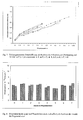
Figur 3 zu entnehmen. - Fig. 3:
- Trübungsnormierte Druckdifferenz als Funktion der Filtrationszeit (Normierung auf 30 EBC (25°)); Zyklusnummern: ◆-1, ■-2, x-3, ▲-4, Δ-5, □-6, ◇-7, +-8, ○-9, ●-10
- Die einzelnen Druckanstiegskurven liegen in einem Band um diejenige der Ausgangsfiltration mit Frischprodukt und zeigen keinen systematischen Anstieg des Gradienten. Filter- und Waschwiderstände der Regenerate:
Die Filter- und Waschwiderstände (sieheFigur 4 ) weisen zwar versuchsbedingte Schwankungen, jedoch keinen kontinuierlichen Anstieg auf. - Fig. 4:
- Filterwiderstände (grau) und Waschwiderstände (schraffiert) als Funktion der Anzahl der Regenerationen
- Die Regeneration erfolgte analog Beispiel 2, wobei aber die Enzymkonzentration je nach Zyklus 1,1 - 2,5 U/EBC x hL betrug.
- Die Druckanstiegskurven sind
Figur 5 zu entnehmen. - Fig. 5:
- Trübungsnormierte Druckdifferenz als Funktion der Filtrationszeit (Normierung auf 30 EBC (25°)); Zyklusnummern: ◆-1, ■-2, x-3, ▲-4, Δ-5, □-6, ◇-7, +-8, ○-9, ●-10,--11
- Wiederum ist zu erkennen, dass kein systematischer Anstieg bzgl. des Gradienten der Druckanstiegskurven vorliegt. Die Streuung der Versuchsdaten ist einerseits durch die unterschiedlichen Trübungen des Unfiltrats (die Normierung dämpft dies lediglich teilweise ab) und andererseits durch die unterschiedlichen eingesetzten Enzymmengen bedingt.
Filter- und Waschwiderstände der Regenerate
Die Filter- und Waschwiderstände (sieheFigur 6 ) zeigen z.T. Erhöhungen im Vergleich zum Frischprodukt, jedoch keinen kontinuierlichen Anstieg wie in Beispiel 1. - Fig. 6:
- Filterwiderstände (grau) und Waschwiderstände (schraffiert) als Funktion der Anzahl der Regenerationen
- Die Versuchsführung erfolgte weitgehend analog zu Beispiel 2, jedoch mit folgenden Unterschieden:
- Zu Beginn der Regeneration erfolgte eine Spülung mit wässriger Natronlauge während eines Zeitraums von 60 min, zunächst 15 min lang unter Verwerfen der Spülflüssigkeit, 45 min in Kreislauffahrweise.
- Die verwendete Enzymmenge betrug 1,4 U/(EBC x hL).
- Die Behandlung (Dauer: 25 min.) mit einer wässrigen Lösung, enthaltend 1 Gew.-% NaOH und 0.5 Gew.-% Na-Dodecylsulfat, wurde direkt nach der Enzymbehandlung außerhalb der Filteranlage im Rührkessel durchgeführt. Nach dieser Behandlung wurde das Material auf dem Filter angeschwemmt und der Filterkuchen 15 min. mit hei-βem Wasser (85 °C) und anschließend 15 min. mit Kaltwasser (5-10 °C) bei einem Durchsatz von 30 l/h durchströmt.
- Der Druckverlauf der Filtration ist in
Figur 7 , die Filter- und Waschwiderstände sind inFigur 8 dargestellt. - Fig. 7:
- Trübungsnormierte Druckdifferenz als Funktion der Filtrationszeit (Normierung auf 30 EBC (25°)); Zyklusnummern: ◆-1, ■-2, x-3, ▲-4, Δ-5, □-6, ◇-7, +-8
- Fig. 8:
- Filterwiderstände (grau) und Waschwiderstände (schraffiert) als Funktion der Anzahl der Regenerationen
- Es liegt keine monotone Zunahme der Filter- und Waschwiderstände als Funktion der Zyklenzahl vor, was bedeutet, dass die Regeneration erfolgreich war.
Claims (14)
- Verfahren zur Regenerierung eines Filterhilfsmittels, welches ein Co-Extrudat aus einem wasserunlöslichen Polyvinylpyrrolidon und einem Thermoplasten darstellt, durch Behandlung mit wässriger Lauge und mit Enzymen, dadurch gekennzeichnet ist, dass man das Filterhilfsmittel zunächst einer ersten Behandlung mit wässriger Lauge unterwirft, anschliessend eine Behandlung mit Enzymen vornimmt und daran anschliessend eine zweite Behandlung mit wässriger Lauge durchführt und man das Filterhilfsmittel mit einem Tensid behandelt.
- Verfahren nach Anspruch 1, dadurch gekennzeichnet, dass als wässrige Lauge Natronlauge eingesetzt wird.
- Verfahren nach einem der Ansprüche 1 bis 2, dadurch gekennzeichnet, dass als Enzyme Hefezellen lysierende Enzyme eingesetzt werden.
- Verfahren nach einem der Ansprüche 1 bis 3, dadurch gekennzeichnet, dass als Enzyme Glucanasen eingesetzt werden.
- Verfahren nach einem der Ansprüche 1 bis 4, dadurch gekennzeichnet, dass als Tenside anionische oder nicht-ionische Tenside eingesetzt werden.
- Verfahren nach einem der Ansprüche 1 bis 5, dadurch gekennzeichnet, dass als Tensid Natriumdodecylsulfat verwendet wird.
- Verfahren nach einem der Ansprüche 1 bis 6, dadurch gekennzeichnet, dass als Tenside Fettalkoholethoxylate verwendet werden.
- Verfahren nach einem der Ansprüche 1 bis 7, dadurch gekennzeichnet, dass das Co-Extrudat als Thermoplast Polystyrol enthält.
- Verfahren nach einem der Ansprüche 1 bis 8, dadurch gekennzeichnet, dass die Enzymbehandlung an einer wässrigen Aufschlämmung oder Suspension des Filterhilfsmittels erfolgt.
- Verfahren nach einem der Ansprüche 1 bis 9, dadurch gekennzeichnet, dass die erste Behandlung mit wässriger Lauge an einem Filterkuchen erfolgt.
- Verfahren nach einem der Ansprüche 1 bis 9, dadurch gekennzeichnet, dass die erste Behandlung mit wässriger Lauge an einer wässrigen Suspension oder Aufschlämmung des Filterhilfsmittels erfolgt.
- Verfahren nach einem der Ansprüche 1 bis 11, dadurch gekennzeichnet, dass die zweite Behandlung mit wässriger Lauge an einer wässrigen Suspension oder Aufschlämmung des Filterhilfsmittels erfolgt.
- Verfahren nach einem der Ansprüche 1 bis 11, dadurch gekennzeichnet, dass die zweite Behandlung mit wässriger Lauge an einem Filterkuchen erfolgt.
- Verfahren nach einem der Ansprüche 1 bis 13, dadurch gekennzeichnet, dass die Behandlung mit dem Tensid gleichzeitig mit dem zweiten Behandlungsschritt mit wässriger Lauge erfolgt.
Priority Applications (2)
| Application Number | Priority Date | Filing Date | Title |
|---|---|---|---|
| PL07820667T PL2077913T3 (pl) | 2006-09-29 | 2007-09-27 | Sposób regeneracji środka pomocniczego do filtracji |
| EP07820667A EP2077913B1 (de) | 2006-09-29 | 2007-09-27 | Verfahren zur regenerierung eines filterhilfsmittels |
Applications Claiming Priority (4)
| Application Number | Priority Date | Filing Date | Title |
|---|---|---|---|
| EP06121563 | 2006-09-29 | ||
| EP07108932 | 2007-05-25 | ||
| EP07820667A EP2077913B1 (de) | 2006-09-29 | 2007-09-27 | Verfahren zur regenerierung eines filterhilfsmittels |
| PCT/EP2007/060279 WO2008037777A1 (de) | 2006-09-29 | 2007-09-27 | Verfahren zur regenerierung eines filterhilfsmittels |
Publications (2)
| Publication Number | Publication Date |
|---|---|
| EP2077913A1 EP2077913A1 (de) | 2009-07-15 |
| EP2077913B1 true EP2077913B1 (de) | 2013-01-02 |
Family
ID=38880990
Family Applications (1)
| Application Number | Title | Priority Date | Filing Date |
|---|---|---|---|
| EP07820667A Not-in-force EP2077913B1 (de) | 2006-09-29 | 2007-09-27 | Verfahren zur regenerierung eines filterhilfsmittels |
Country Status (10)
| Country | Link |
|---|---|
| US (1) | US7993533B2 (de) |
| EP (1) | EP2077913B1 (de) |
| CN (1) | CN101516498B (de) |
| AU (1) | AU2007301951A1 (de) |
| BR (1) | BRPI0717112B1 (de) |
| DK (1) | DK2077913T3 (de) |
| ES (1) | ES2400378T3 (de) |
| MX (1) | MX2009002964A (de) |
| PL (1) | PL2077913T3 (de) |
| WO (1) | WO2008037777A1 (de) |
Families Citing this family (9)
| Publication number | Priority date | Publication date | Assignee | Title |
|---|---|---|---|---|
| WO2008031779A1 (de) * | 2006-09-12 | 2008-03-20 | Basf Se | Verfahren zur herstellung von co-extrudaten aus polystyrol und einem vernetzten polyvinylpyrrolidon mit verringertem styrol-restmonomergehalt |
| BRPI0717112B1 (pt) * | 2006-09-29 | 2017-04-18 | Basf Se | processo para a regeneração de um auxiliar de filtração |
| BRPI0808829A8 (pt) * | 2007-03-15 | 2018-02-14 | Basf Se | Processo para regeneração de auxiliares de filtração inorgânicos, naturais e semi-sintéticos |
| ES2529374T3 (es) * | 2010-07-22 | 2015-02-19 | Heineken Supply Chain B.V. | Un método de estabilización de bebidas fermentadas con levadura |
| MX344830B (es) | 2010-07-22 | 2017-01-09 | Heineken Supply Chain Bv | Un metodo y aparato para la recuperacion de pvpp despues del contacto con una bebida fermentada con levadura mediante separacion por sedimentacion. |
| EP2595723B1 (de) * | 2010-07-22 | 2016-03-02 | Heineken Supply Chain B.V. | Verfahren zur regeneration von pvpp aus einem membranfilterretentat nach der aufklärung und stabilisierung von hefefermentierten getränken |
| EP2548944A1 (de) | 2011-07-21 | 2013-01-23 | AB Enzymes GmbH | Verfahren zum Lysieren von Hefezellwänden |
| CN106732486B (zh) * | 2016-12-09 | 2019-08-02 | 广西珠江啤酒有限公司 | 一种基于啤酒过滤机的再生型助滤剂再生转移方法 |
| CN113477230A (zh) * | 2021-08-26 | 2021-10-08 | 临江市明盛硅藻新型材料有限公司 | 一种含有改性硅藻土的助滤剂及其制备方法 |
Family Cites Families (18)
| Publication number | Priority date | Publication date | Assignee | Title |
|---|---|---|---|---|
| DE3623484A1 (de) | 1986-07-11 | 1988-01-21 | Henninger Brau Ag | Regenerierung von kieselgur |
| US5484620A (en) * | 1990-12-22 | 1996-01-16 | Schenk-Filterbau Gesellschaft Mit Beschrankter Haftung | Method of manufacturing stabilizing and/or filtering aids for use in the processing of liquids, especially beverages |
| DE4125594A1 (de) | 1990-12-22 | 1992-06-25 | Schenk Filterbau Gmbh | Verfahren zur herstellung von stabilisier- und/oder filterhilfsmitteln zur behandlung von fluessigkeiten, insbesondere getraenken |
| WO1992013807A1 (en) | 1991-02-12 | 1992-08-20 | Buckman Laboratories International, Inc. | Composition and methods for removing or preventing biofilm |
| DE59408670D1 (de) | 1993-02-12 | 1999-10-07 | Filtrox Ag | Verfahren zur Reinigung eines Filterhilfsmittels durch Zusatz von Enzymen |
| US5801051A (en) * | 1994-02-10 | 1998-09-01 | Filtrox-Werk Ag | Method and apparatus for cleaning a filter aid |
| GB2288608A (en) * | 1994-04-14 | 1995-10-25 | Isp Investments Inc | Beverage stabilisation |
| FR2733920B1 (fr) | 1995-05-12 | 2001-06-08 | Interbrew Sa | Procede de regeneration d'adjuvants de filtration |
| FR2733922B1 (fr) * | 1995-05-12 | 1997-07-25 | Interbrew Sa | Nouveaux adjuvants de filtration, nouveaux supports de filtration, procede de filtration les utilisant et procede de regeneration desdits adjuvants |
| DE19625481A1 (de) * | 1996-06-26 | 1998-01-02 | Gock Eberhard Prof Dr Ing Habi | Verfahren zum produktionsintegrierten Recycling von Kieselgur-Filterschlämmen in der Getränkeindustrie |
| DE19652499C2 (de) | 1996-12-17 | 2002-10-31 | Seitz Schenk Filtersystems Gmb | Verfahren zur Regenerierung von Anschwemmfiltern |
| BE1011099A3 (fr) | 1997-04-10 | 1999-04-06 | Meura S A | Aide de filtration regenerable, procede de production d'une telle aide et son utilisation. |
| DE10051266A1 (de) * | 2000-10-16 | 2002-04-25 | Basf Ag | Verfahren zur Filtration einer Flüssigkeit, mit einem Filterhilfsmittel und Verfahren zu deren Herstellung |
| US20030059869A1 (en) * | 2001-06-22 | 2003-03-27 | Xia Tai-He | Novel G protein-coupled receptor, GAVE3 |
| DE10134861A1 (de) | 2001-07-18 | 2003-02-20 | Seitz Schenk Filtersystems Gmb | Verfahren zur Filtration von Flüssigkeiten |
| EP1338321A1 (de) | 2002-02-22 | 2003-08-27 | Anton Steinecker Maschinenfabrik GmbH | Einsatz von modifizierter Stärke als Getränkefilterhilfsmittel. |
| DE10215147A1 (de) | 2002-04-05 | 2003-10-16 | Basf Ag | Verwendung von Polymerisation, enthaltend thermoplastische Polymere als Filterhilfs- und/oder Stabilisierungsmittel |
| BRPI0717112B1 (pt) * | 2006-09-29 | 2017-04-18 | Basf Se | processo para a regeneração de um auxiliar de filtração |
-
2007
- 2007-09-27 BR BRPI0717112A patent/BRPI0717112B1/pt not_active IP Right Cessation
- 2007-09-27 PL PL07820667T patent/PL2077913T3/pl unknown
- 2007-09-27 DK DK07820667.9T patent/DK2077913T3/da active
- 2007-09-27 EP EP07820667A patent/EP2077913B1/de not_active Not-in-force
- 2007-09-27 US US12/443,586 patent/US7993533B2/en active Active
- 2007-09-27 CN CN2007800353571A patent/CN101516498B/zh not_active Expired - Fee Related
- 2007-09-27 WO PCT/EP2007/060279 patent/WO2008037777A1/de not_active Ceased
- 2007-09-27 MX MX2009002964A patent/MX2009002964A/es active IP Right Grant
- 2007-09-27 ES ES07820667T patent/ES2400378T3/es active Active
- 2007-09-27 AU AU2007301951A patent/AU2007301951A1/en not_active Abandoned
Also Published As
| Publication number | Publication date |
|---|---|
| PL2077913T3 (pl) | 2013-06-28 |
| US7993533B2 (en) | 2011-08-09 |
| WO2008037777A1 (de) | 2008-04-03 |
| EP2077913A1 (de) | 2009-07-15 |
| BRPI0717112A2 (pt) | 2013-10-15 |
| CN101516498B (zh) | 2012-06-20 |
| US20090291164A1 (en) | 2009-11-26 |
| CN101516498A (zh) | 2009-08-26 |
| MX2009002964A (es) | 2009-04-01 |
| DK2077913T3 (da) | 2013-04-08 |
| BRPI0717112B1 (pt) | 2017-04-18 |
| AU2007301951A1 (en) | 2008-04-03 |
| ES2400378T3 (es) | 2013-04-09 |
Similar Documents
| Publication | Publication Date | Title |
|---|---|---|
| EP2136913B1 (de) | Verfahren zur regenerierung eines filterhilfsmittels | |
| EP2077913A1 (de) | Verfahren zur regenerierung eines filterhilfsmittels | |
| DE4110252C1 (de) | ||
| DE69419376T2 (de) | Membran für Mikrofiltration und/oder Ultrafiltration, Verfahren zur Herstellung dieser Membran und Verfahren zur Filtration einer Flüssigkeit mittels dieser Membran | |
| DE69614534T2 (de) | Verfahren zur regenerierung von filterhilfsmittel und filtrationsverfahren unter verwendung desselben | |
| DE69805417T2 (de) | Reinigungsverfahren für membranen | |
| DE4006293A1 (de) | Trennmittel, trennvorrichtung und verfahren zum abtrennen von zellen oder viren | |
| DE3014408A1 (de) | Verfahren zur entsaeuerung eines kaffeeextraktes und dadurch erhaltenes entsaeuertes extrakt | |
| EP1333906B1 (de) | Verwendung von polymerisaten als filterhilfs- und/oder stabilisierungsmittel | |
| DE102013218412A1 (de) | Filterhilfsmittel und Filterschicht | |
| DE69502157T2 (de) | Stabilisation von getränke | |
| EP1495104B1 (de) | Verwendung von polymerisaten, enthaltend thermoplastische polymere als filterhilfs- und/oder stabilisierungsmittel | |
| EP0611249B1 (de) | Verfahren zur Reinigung eines Filterhilfsmittels durch Zusatz von Enzymen | |
| EP2686413B1 (de) | Vorrichtung und verfahren zur stabilisierung einer flüssigkeit, insbesondere bier | |
| CH686495A5 (de) | Verfahren zur Behandlung eines verstopften poroesen Materials. | |
| DE60314916T2 (de) | Verfahren zur vorfilterung einer proteinlösung | |
| EP0641521B1 (de) | Verfahren zur Entfernung von Aluminiumionen aus Getränken | |
| DE3820393C2 (de) | ||
| EP1219349A2 (de) | Verwendung teilchenförmiger Polymerisate als Filterhilfsmittel für wässrige Flüssigkeiten | |
| DE19652697A1 (de) | Herstellung und Verwendung von Formulierungen bestehend aus Cellulose, Kaliumcaseinat und vernetzten Vinylpyrrolidon-Homopolymeren und/oder Vinylimidazol/Vinylpyrrolidon-Copolymeren | |
| DE19652499A1 (de) | Verfahren zur Regenerierung von Anschwemmfiltern | |
| DE2925076C2 (de) | ||
| DE2028322C3 (de) | Verfahren zur Reinigung von verunreinigtem Wasser | |
| WO1994008693A1 (de) | Verfahren und vorrichtung zum trennen von ablagerungen von filterhilfsstoffen | |
| DE2028322B2 (de) | Verfahren zur reinigung von verunreinigtem wasser |
Legal Events
| Date | Code | Title | Description |
|---|---|---|---|
| PUAI | Public reference made under article 153(3) epc to a published international application that has entered the european phase |
Free format text: ORIGINAL CODE: 0009012 |
|
| 17P | Request for examination filed |
Effective date: 20090429 |
|
| AK | Designated contracting states |
Kind code of ref document: A1 Designated state(s): AT BE BG CH CY CZ DE DK EE ES FI FR GB GR HU IE IS IT LI LT LU LV MC MT NL PL PT RO SE SI SK TR |
|
| 17Q | First examination report despatched |
Effective date: 20100910 |
|
| GRAP | Despatch of communication of intention to grant a patent |
Free format text: ORIGINAL CODE: EPIDOSNIGR1 |
|
| DAX | Request for extension of the european patent (deleted) | ||
| GRAS | Grant fee paid |
Free format text: ORIGINAL CODE: EPIDOSNIGR3 |
|
| GRAA | (expected) grant |
Free format text: ORIGINAL CODE: 0009210 |
|
| AK | Designated contracting states |
Kind code of ref document: B1 Designated state(s): AT BE BG CH CY CZ DE DK EE ES FI FR GB GR HU IE IS IT LI LT LU LV MC MT NL PL PT RO SE SI SK TR |
|
| REG | Reference to a national code |
Ref country code: GB Ref legal event code: FG4D Free format text: NOT ENGLISH |
|
| REG | Reference to a national code |
Ref country code: CH Ref legal event code: EP Ref country code: AT Ref legal event code: REF Ref document number: 591268 Country of ref document: AT Kind code of ref document: T Effective date: 20130115 |
|
| REG | Reference to a national code |
Ref country code: IE Ref legal event code: FG4D Free format text: LANGUAGE OF EP DOCUMENT: GERMAN |
|
| REG | Reference to a national code |
Ref country code: DE Ref legal event code: R096 Ref document number: 502007011161 Country of ref document: DE Effective date: 20130228 |
|
| REG | Reference to a national code |
Ref country code: DK Ref legal event code: T3 |
|
| REG | Reference to a national code |
Ref country code: ES Ref legal event code: FG2A Ref document number: 2400378 Country of ref document: ES Kind code of ref document: T3 Effective date: 20130409 |
|
| REG | Reference to a national code |
Ref country code: NL Ref legal event code: T3 |
|
| PG25 | Lapsed in a contracting state [announced via postgrant information from national office to epo] |
Ref country code: SI Free format text: LAPSE BECAUSE OF FAILURE TO SUBMIT A TRANSLATION OF THE DESCRIPTION OR TO PAY THE FEE WITHIN THE PRESCRIBED TIME-LIMIT Effective date: 20130102 |
|
| REG | Reference to a national code |
Ref country code: LT Ref legal event code: MG4D |
|
| REG | Reference to a national code |
Ref country code: PL Ref legal event code: T3 |
|
| PG25 | Lapsed in a contracting state [announced via postgrant information from national office to epo] |
Ref country code: SE Free format text: LAPSE BECAUSE OF FAILURE TO SUBMIT A TRANSLATION OF THE DESCRIPTION OR TO PAY THE FEE WITHIN THE PRESCRIBED TIME-LIMIT Effective date: 20130102 Ref country code: BG Free format text: LAPSE BECAUSE OF FAILURE TO SUBMIT A TRANSLATION OF THE DESCRIPTION OR TO PAY THE FEE WITHIN THE PRESCRIBED TIME-LIMIT Effective date: 20130402 Ref country code: IS Free format text: LAPSE BECAUSE OF FAILURE TO SUBMIT A TRANSLATION OF THE DESCRIPTION OR TO PAY THE FEE WITHIN THE PRESCRIBED TIME-LIMIT Effective date: 20130502 Ref country code: LT Free format text: LAPSE BECAUSE OF FAILURE TO SUBMIT A TRANSLATION OF THE DESCRIPTION OR TO PAY THE FEE WITHIN THE PRESCRIBED TIME-LIMIT Effective date: 20130102 |
|
| PG25 | Lapsed in a contracting state [announced via postgrant information from national office to epo] |
Ref country code: PT Free format text: LAPSE BECAUSE OF FAILURE TO SUBMIT A TRANSLATION OF THE DESCRIPTION OR TO PAY THE FEE WITHIN THE PRESCRIBED TIME-LIMIT Effective date: 20130502 Ref country code: FI Free format text: LAPSE BECAUSE OF FAILURE TO SUBMIT A TRANSLATION OF THE DESCRIPTION OR TO PAY THE FEE WITHIN THE PRESCRIBED TIME-LIMIT Effective date: 20130102 Ref country code: GR Free format text: LAPSE BECAUSE OF FAILURE TO SUBMIT A TRANSLATION OF THE DESCRIPTION OR TO PAY THE FEE WITHIN THE PRESCRIBED TIME-LIMIT Effective date: 20130403 Ref country code: LV Free format text: LAPSE BECAUSE OF FAILURE TO SUBMIT A TRANSLATION OF THE DESCRIPTION OR TO PAY THE FEE WITHIN THE PRESCRIBED TIME-LIMIT Effective date: 20130102 |
|
| PG25 | Lapsed in a contracting state [announced via postgrant information from national office to epo] |
Ref country code: EE Free format text: LAPSE BECAUSE OF FAILURE TO SUBMIT A TRANSLATION OF THE DESCRIPTION OR TO PAY THE FEE WITHIN THE PRESCRIBED TIME-LIMIT Effective date: 20130102 Ref country code: RO Free format text: LAPSE BECAUSE OF FAILURE TO SUBMIT A TRANSLATION OF THE DESCRIPTION OR TO PAY THE FEE WITHIN THE PRESCRIBED TIME-LIMIT Effective date: 20130102 Ref country code: SK Free format text: LAPSE BECAUSE OF FAILURE TO SUBMIT A TRANSLATION OF THE DESCRIPTION OR TO PAY THE FEE WITHIN THE PRESCRIBED TIME-LIMIT Effective date: 20130102 |
|
| PLBE | No opposition filed within time limit |
Free format text: ORIGINAL CODE: 0009261 |
|
| STAA | Information on the status of an ep patent application or granted ep patent |
Free format text: STATUS: NO OPPOSITION FILED WITHIN TIME LIMIT |
|
| PG25 | Lapsed in a contracting state [announced via postgrant information from national office to epo] |
Ref country code: CY Free format text: LAPSE BECAUSE OF FAILURE TO SUBMIT A TRANSLATION OF THE DESCRIPTION OR TO PAY THE FEE WITHIN THE PRESCRIBED TIME-LIMIT Effective date: 20130102 |
|
| 26N | No opposition filed |
Effective date: 20131003 |
|
| PG25 | Lapsed in a contracting state [announced via postgrant information from national office to epo] |
Ref country code: IT Free format text: LAPSE BECAUSE OF FAILURE TO SUBMIT A TRANSLATION OF THE DESCRIPTION OR TO PAY THE FEE WITHIN THE PRESCRIBED TIME-LIMIT Effective date: 20130102 |
|
| REG | Reference to a national code |
Ref country code: DE Ref legal event code: R097 Ref document number: 502007011161 Country of ref document: DE Effective date: 20131003 |
|
| PG25 | Lapsed in a contracting state [announced via postgrant information from national office to epo] |
Ref country code: MC Free format text: LAPSE BECAUSE OF FAILURE TO SUBMIT A TRANSLATION OF THE DESCRIPTION OR TO PAY THE FEE WITHIN THE PRESCRIBED TIME-LIMIT Effective date: 20130102 |
|
| REG | Reference to a national code |
Ref country code: CH Ref legal event code: PL |
|
| REG | Reference to a national code |
Ref country code: IE Ref legal event code: MM4A |
|
| PG25 | Lapsed in a contracting state [announced via postgrant information from national office to epo] |
Ref country code: IE Free format text: LAPSE BECAUSE OF NON-PAYMENT OF DUE FEES Effective date: 20130927 Ref country code: LI Free format text: LAPSE BECAUSE OF NON-PAYMENT OF DUE FEES Effective date: 20130930 Ref country code: CH Free format text: LAPSE BECAUSE OF NON-PAYMENT OF DUE FEES Effective date: 20130930 |
|
| REG | Reference to a national code |
Ref country code: AT Ref legal event code: MM01 Ref document number: 591268 Country of ref document: AT Kind code of ref document: T Effective date: 20130927 |
|
| PG25 | Lapsed in a contracting state [announced via postgrant information from national office to epo] |
Ref country code: AT Free format text: LAPSE BECAUSE OF NON-PAYMENT OF DUE FEES Effective date: 20130927 |
|
| PG25 | Lapsed in a contracting state [announced via postgrant information from national office to epo] |
Ref country code: MT Free format text: LAPSE BECAUSE OF FAILURE TO SUBMIT A TRANSLATION OF THE DESCRIPTION OR TO PAY THE FEE WITHIN THE PRESCRIBED TIME-LIMIT Effective date: 20130102 Ref country code: TR Free format text: LAPSE BECAUSE OF FAILURE TO SUBMIT A TRANSLATION OF THE DESCRIPTION OR TO PAY THE FEE WITHIN THE PRESCRIBED TIME-LIMIT Effective date: 20130102 |
|
| PG25 | Lapsed in a contracting state [announced via postgrant information from national office to epo] |
Ref country code: LU Free format text: LAPSE BECAUSE OF NON-PAYMENT OF DUE FEES Effective date: 20130927 Ref country code: HU Free format text: LAPSE BECAUSE OF FAILURE TO SUBMIT A TRANSLATION OF THE DESCRIPTION OR TO PAY THE FEE WITHIN THE PRESCRIBED TIME-LIMIT; INVALID AB INITIO Effective date: 20070927 |
|
| REG | Reference to a national code |
Ref country code: FR Ref legal event code: PLFP Year of fee payment: 10 |
|
| REG | Reference to a national code |
Ref country code: FR Ref legal event code: PLFP Year of fee payment: 11 |
|
| REG | Reference to a national code |
Ref country code: FR Ref legal event code: PLFP Year of fee payment: 12 |
|
| PGFP | Annual fee paid to national office [announced via postgrant information from national office to epo] |
Ref country code: NL Payment date: 20220926 Year of fee payment: 16 Ref country code: GB Payment date: 20220920 Year of fee payment: 16 Ref country code: DK Payment date: 20220923 Year of fee payment: 16 Ref country code: DE Payment date: 20220527 Year of fee payment: 16 Ref country code: CZ Payment date: 20220923 Year of fee payment: 16 |
|
| PGFP | Annual fee paid to national office [announced via postgrant information from national office to epo] |
Ref country code: PL Payment date: 20220906 Year of fee payment: 16 Ref country code: FR Payment date: 20220926 Year of fee payment: 16 Ref country code: BE Payment date: 20220926 Year of fee payment: 16 |
|
| PGFP | Annual fee paid to national office [announced via postgrant information from national office to epo] |
Ref country code: ES Payment date: 20221003 Year of fee payment: 16 |
|
| REG | Reference to a national code |
Ref country code: DE Ref legal event code: R119 Ref document number: 502007011161 Country of ref document: DE |
|
| REG | Reference to a national code |
Ref country code: DK Ref legal event code: EBP Effective date: 20230930 |
|
| PG25 | Lapsed in a contracting state [announced via postgrant information from national office to epo] |
Ref country code: CZ Free format text: LAPSE BECAUSE OF NON-PAYMENT OF DUE FEES Effective date: 20230927 |
|
| REG | Reference to a national code |
Ref country code: NL Ref legal event code: MM Effective date: 20231001 |
|
| REG | Reference to a national code |
Ref country code: BE Ref legal event code: MM Effective date: 20230930 |
|
| GBPC | Gb: european patent ceased through non-payment of renewal fee |
Effective date: 20230927 |
|
| PG25 | Lapsed in a contracting state [announced via postgrant information from national office to epo] |
Ref country code: NL Free format text: LAPSE BECAUSE OF NON-PAYMENT OF DUE FEES Effective date: 20231001 |
|
| PG25 | Lapsed in a contracting state [announced via postgrant information from national office to epo] |
Ref country code: NL Free format text: LAPSE BECAUSE OF NON-PAYMENT OF DUE FEES Effective date: 20231001 |
|
| PG25 | Lapsed in a contracting state [announced via postgrant information from national office to epo] |
Ref country code: GB Free format text: LAPSE BECAUSE OF NON-PAYMENT OF DUE FEES Effective date: 20230927 |
|
| PG25 | Lapsed in a contracting state [announced via postgrant information from national office to epo] |
Ref country code: GB Free format text: LAPSE BECAUSE OF NON-PAYMENT OF DUE FEES Effective date: 20230927 Ref country code: FR Free format text: LAPSE BECAUSE OF NON-PAYMENT OF DUE FEES Effective date: 20230930 Ref country code: DE Free format text: LAPSE BECAUSE OF NON-PAYMENT OF DUE FEES Effective date: 20240403 |
|
| PG25 | Lapsed in a contracting state [announced via postgrant information from national office to epo] |
Ref country code: BE Free format text: LAPSE BECAUSE OF NON-PAYMENT OF DUE FEES Effective date: 20230930 |
|
| PG25 | Lapsed in a contracting state [announced via postgrant information from national office to epo] |
Ref country code: DK Free format text: LAPSE BECAUSE OF NON-PAYMENT OF DUE FEES Effective date: 20230930 |
|
| PG25 | Lapsed in a contracting state [announced via postgrant information from national office to epo] |
Ref country code: PL Free format text: LAPSE BECAUSE OF NON-PAYMENT OF DUE FEES Effective date: 20230927 |
|
| PG25 | Lapsed in a contracting state [announced via postgrant information from national office to epo] |
Ref country code: PL Free format text: LAPSE BECAUSE OF NON-PAYMENT OF DUE FEES Effective date: 20230927 Ref country code: DK Free format text: LAPSE BECAUSE OF NON-PAYMENT OF DUE FEES Effective date: 20230930 |
|
| REG | Reference to a national code |
Ref country code: ES Ref legal event code: FD2A Effective date: 20241104 |
|
| PG25 | Lapsed in a contracting state [announced via postgrant information from national office to epo] |
Ref country code: ES Free format text: LAPSE BECAUSE OF NON-PAYMENT OF DUE FEES Effective date: 20230928 |
|
| PG25 | Lapsed in a contracting state [announced via postgrant information from national office to epo] |
Ref country code: ES Free format text: LAPSE BECAUSE OF NON-PAYMENT OF DUE FEES Effective date: 20230928 |