EP2077282B1 - Antigen binding molecules with increased Fc receptor binding affinity and effector function - Google Patents
Antigen binding molecules with increased Fc receptor binding affinity and effector function Download PDFInfo
- Publication number
- EP2077282B1 EP2077282B1 EP09004064.3A EP09004064A EP2077282B1 EP 2077282 B1 EP2077282 B1 EP 2077282B1 EP 09004064 A EP09004064 A EP 09004064A EP 2077282 B1 EP2077282 B1 EP 2077282B1
- Authority
- EP
- European Patent Office
- Prior art keywords
- antibody
- seq
- item
- polypeptide
- sequence
- Prior art date
- Legal status (The legal status is an assumption and is not a legal conclusion. Google has not performed a legal analysis and makes no representation as to the accuracy of the status listed.)
- Expired - Lifetime
Links
Images








Classifications
-
- C—CHEMISTRY; METALLURGY
- C07—ORGANIC CHEMISTRY
- C07K—PEPTIDES
- C07K16/00—Immunoglobulins [IG], e.g. monoclonal or polyclonal antibodies
- C07K16/18—Immunoglobulins [IG], e.g. monoclonal or polyclonal antibodies against material from animals or humans
- C07K16/28—Immunoglobulins [IG], e.g. monoclonal or polyclonal antibodies against material from animals or humans against receptors, cell surface antigens or cell surface determinants
-
- A—HUMAN NECESSITIES
- A61—MEDICAL OR VETERINARY SCIENCE; HYGIENE
- A61K—PREPARATIONS FOR MEDICAL, DENTAL OR TOILETRY PURPOSES
- A61K39/00—Medicinal preparations containing antigens or antibodies
- A61K39/395—Antibodies; Immunoglobulins; Immune serum, e.g. antilymphocytic serum
-
- A—HUMAN NECESSITIES
- A61—MEDICAL OR VETERINARY SCIENCE; HYGIENE
- A61P—SPECIFIC THERAPEUTIC ACTIVITY OF CHEMICAL COMPOUNDS OR MEDICINAL PREPARATIONS
- A61P1/00—Drugs for disorders of the alimentary tract or the digestive system
- A61P1/04—Drugs for disorders of the alimentary tract or the digestive system for ulcers, gastritis or reflux esophagitis, e.g. antacids, inhibitors of acid secretion, mucosal protectants
-
- A—HUMAN NECESSITIES
- A61—MEDICAL OR VETERINARY SCIENCE; HYGIENE
- A61P—SPECIFIC THERAPEUTIC ACTIVITY OF CHEMICAL COMPOUNDS OR MEDICINAL PREPARATIONS
- A61P1/00—Drugs for disorders of the alimentary tract or the digestive system
- A61P1/16—Drugs for disorders of the alimentary tract or the digestive system for liver or gallbladder disorders, e.g. hepatoprotective agents, cholagogues, litholytics
-
- A—HUMAN NECESSITIES
- A61—MEDICAL OR VETERINARY SCIENCE; HYGIENE
- A61P—SPECIFIC THERAPEUTIC ACTIVITY OF CHEMICAL COMPOUNDS OR MEDICINAL PREPARATIONS
- A61P11/00—Drugs for disorders of the respiratory system
-
- A—HUMAN NECESSITIES
- A61—MEDICAL OR VETERINARY SCIENCE; HYGIENE
- A61P—SPECIFIC THERAPEUTIC ACTIVITY OF CHEMICAL COMPOUNDS OR MEDICINAL PREPARATIONS
- A61P11/00—Drugs for disorders of the respiratory system
- A61P11/06—Antiasthmatics
-
- A—HUMAN NECESSITIES
- A61—MEDICAL OR VETERINARY SCIENCE; HYGIENE
- A61P—SPECIFIC THERAPEUTIC ACTIVITY OF CHEMICAL COMPOUNDS OR MEDICINAL PREPARATIONS
- A61P13/00—Drugs for disorders of the urinary system
- A61P13/12—Drugs for disorders of the urinary system of the kidneys
-
- A—HUMAN NECESSITIES
- A61—MEDICAL OR VETERINARY SCIENCE; HYGIENE
- A61P—SPECIFIC THERAPEUTIC ACTIVITY OF CHEMICAL COMPOUNDS OR MEDICINAL PREPARATIONS
- A61P17/00—Drugs for dermatological disorders
-
- A—HUMAN NECESSITIES
- A61—MEDICAL OR VETERINARY SCIENCE; HYGIENE
- A61P—SPECIFIC THERAPEUTIC ACTIVITY OF CHEMICAL COMPOUNDS OR MEDICINAL PREPARATIONS
- A61P17/00—Drugs for dermatological disorders
- A61P17/02—Drugs for dermatological disorders for treating wounds, ulcers, burns, scars, keloids, or the like
-
- A—HUMAN NECESSITIES
- A61—MEDICAL OR VETERINARY SCIENCE; HYGIENE
- A61P—SPECIFIC THERAPEUTIC ACTIVITY OF CHEMICAL COMPOUNDS OR MEDICINAL PREPARATIONS
- A61P17/00—Drugs for dermatological disorders
- A61P17/06—Antipsoriatics
-
- A—HUMAN NECESSITIES
- A61—MEDICAL OR VETERINARY SCIENCE; HYGIENE
- A61P—SPECIFIC THERAPEUTIC ACTIVITY OF CHEMICAL COMPOUNDS OR MEDICINAL PREPARATIONS
- A61P19/00—Drugs for skeletal disorders
- A61P19/02—Drugs for skeletal disorders for joint disorders, e.g. arthritis, arthrosis
-
- A—HUMAN NECESSITIES
- A61—MEDICAL OR VETERINARY SCIENCE; HYGIENE
- A61P—SPECIFIC THERAPEUTIC ACTIVITY OF CHEMICAL COMPOUNDS OR MEDICINAL PREPARATIONS
- A61P21/00—Drugs for disorders of the muscular or neuromuscular system
-
- A—HUMAN NECESSITIES
- A61—MEDICAL OR VETERINARY SCIENCE; HYGIENE
- A61P—SPECIFIC THERAPEUTIC ACTIVITY OF CHEMICAL COMPOUNDS OR MEDICINAL PREPARATIONS
- A61P21/00—Drugs for disorders of the muscular or neuromuscular system
- A61P21/04—Drugs for disorders of the muscular or neuromuscular system for myasthenia gravis
-
- A—HUMAN NECESSITIES
- A61—MEDICAL OR VETERINARY SCIENCE; HYGIENE
- A61P—SPECIFIC THERAPEUTIC ACTIVITY OF CHEMICAL COMPOUNDS OR MEDICINAL PREPARATIONS
- A61P25/00—Drugs for disorders of the nervous system
-
- A—HUMAN NECESSITIES
- A61—MEDICAL OR VETERINARY SCIENCE; HYGIENE
- A61P—SPECIFIC THERAPEUTIC ACTIVITY OF CHEMICAL COMPOUNDS OR MEDICINAL PREPARATIONS
- A61P25/00—Drugs for disorders of the nervous system
- A61P25/14—Drugs for disorders of the nervous system for treating abnormal movements, e.g. chorea, dyskinesia
-
- A—HUMAN NECESSITIES
- A61—MEDICAL OR VETERINARY SCIENCE; HYGIENE
- A61P—SPECIFIC THERAPEUTIC ACTIVITY OF CHEMICAL COMPOUNDS OR MEDICINAL PREPARATIONS
- A61P25/00—Drugs for disorders of the nervous system
- A61P25/18—Antipsychotics, i.e. neuroleptics; Drugs for mania or schizophrenia
-
- A—HUMAN NECESSITIES
- A61—MEDICAL OR VETERINARY SCIENCE; HYGIENE
- A61P—SPECIFIC THERAPEUTIC ACTIVITY OF CHEMICAL COMPOUNDS OR MEDICINAL PREPARATIONS
- A61P27/00—Drugs for disorders of the senses
- A61P27/02—Ophthalmic agents
-
- A—HUMAN NECESSITIES
- A61—MEDICAL OR VETERINARY SCIENCE; HYGIENE
- A61P—SPECIFIC THERAPEUTIC ACTIVITY OF CHEMICAL COMPOUNDS OR MEDICINAL PREPARATIONS
- A61P29/00—Non-central analgesic, antipyretic or antiinflammatory agents, e.g. antirheumatic agents; Non-steroidal antiinflammatory drugs [NSAID]
-
- A—HUMAN NECESSITIES
- A61—MEDICAL OR VETERINARY SCIENCE; HYGIENE
- A61P—SPECIFIC THERAPEUTIC ACTIVITY OF CHEMICAL COMPOUNDS OR MEDICINAL PREPARATIONS
- A61P3/00—Drugs for disorders of the metabolism
- A61P3/08—Drugs for disorders of the metabolism for glucose homeostasis
- A61P3/10—Drugs for disorders of the metabolism for glucose homeostasis for hyperglycaemia, e.g. antidiabetics
-
- A—HUMAN NECESSITIES
- A61—MEDICAL OR VETERINARY SCIENCE; HYGIENE
- A61P—SPECIFIC THERAPEUTIC ACTIVITY OF CHEMICAL COMPOUNDS OR MEDICINAL PREPARATIONS
- A61P31/00—Antiinfectives, i.e. antibiotics, antiseptics, chemotherapeutics
- A61P31/04—Antibacterial agents
- A61P31/06—Antibacterial agents for tuberculosis
-
- A—HUMAN NECESSITIES
- A61—MEDICAL OR VETERINARY SCIENCE; HYGIENE
- A61P—SPECIFIC THERAPEUTIC ACTIVITY OF CHEMICAL COMPOUNDS OR MEDICINAL PREPARATIONS
- A61P35/00—Antineoplastic agents
-
- A—HUMAN NECESSITIES
- A61—MEDICAL OR VETERINARY SCIENCE; HYGIENE
- A61P—SPECIFIC THERAPEUTIC ACTIVITY OF CHEMICAL COMPOUNDS OR MEDICINAL PREPARATIONS
- A61P35/00—Antineoplastic agents
- A61P35/02—Antineoplastic agents specific for leukemia
-
- A—HUMAN NECESSITIES
- A61—MEDICAL OR VETERINARY SCIENCE; HYGIENE
- A61P—SPECIFIC THERAPEUTIC ACTIVITY OF CHEMICAL COMPOUNDS OR MEDICINAL PREPARATIONS
- A61P37/00—Drugs for immunological or allergic disorders
-
- A—HUMAN NECESSITIES
- A61—MEDICAL OR VETERINARY SCIENCE; HYGIENE
- A61P—SPECIFIC THERAPEUTIC ACTIVITY OF CHEMICAL COMPOUNDS OR MEDICINAL PREPARATIONS
- A61P37/00—Drugs for immunological or allergic disorders
- A61P37/02—Immunomodulators
-
- A—HUMAN NECESSITIES
- A61—MEDICAL OR VETERINARY SCIENCE; HYGIENE
- A61P—SPECIFIC THERAPEUTIC ACTIVITY OF CHEMICAL COMPOUNDS OR MEDICINAL PREPARATIONS
- A61P37/00—Drugs for immunological or allergic disorders
- A61P37/02—Immunomodulators
- A61P37/06—Immunosuppressants, e.g. drugs for graft rejection
-
- A—HUMAN NECESSITIES
- A61—MEDICAL OR VETERINARY SCIENCE; HYGIENE
- A61P—SPECIFIC THERAPEUTIC ACTIVITY OF CHEMICAL COMPOUNDS OR MEDICINAL PREPARATIONS
- A61P37/00—Drugs for immunological or allergic disorders
- A61P37/08—Antiallergic agents
-
- A—HUMAN NECESSITIES
- A61—MEDICAL OR VETERINARY SCIENCE; HYGIENE
- A61P—SPECIFIC THERAPEUTIC ACTIVITY OF CHEMICAL COMPOUNDS OR MEDICINAL PREPARATIONS
- A61P43/00—Drugs for specific purposes, not provided for in groups A61P1/00-A61P41/00
-
- A—HUMAN NECESSITIES
- A61—MEDICAL OR VETERINARY SCIENCE; HYGIENE
- A61P—SPECIFIC THERAPEUTIC ACTIVITY OF CHEMICAL COMPOUNDS OR MEDICINAL PREPARATIONS
- A61P5/00—Drugs for disorders of the endocrine system
-
- A—HUMAN NECESSITIES
- A61—MEDICAL OR VETERINARY SCIENCE; HYGIENE
- A61P—SPECIFIC THERAPEUTIC ACTIVITY OF CHEMICAL COMPOUNDS OR MEDICINAL PREPARATIONS
- A61P5/00—Drugs for disorders of the endocrine system
- A61P5/14—Drugs for disorders of the endocrine system of the thyroid hormones, e.g. T3, T4
-
- A—HUMAN NECESSITIES
- A61—MEDICAL OR VETERINARY SCIENCE; HYGIENE
- A61P—SPECIFIC THERAPEUTIC ACTIVITY OF CHEMICAL COMPOUNDS OR MEDICINAL PREPARATIONS
- A61P5/00—Drugs for disorders of the endocrine system
- A61P5/38—Drugs for disorders of the endocrine system of the suprarenal hormones
- A61P5/40—Mineralocorticosteroids, e.g. aldosterone; Drugs increasing or potentiating the activity of mineralocorticosteroids
-
- A—HUMAN NECESSITIES
- A61—MEDICAL OR VETERINARY SCIENCE; HYGIENE
- A61P—SPECIFIC THERAPEUTIC ACTIVITY OF CHEMICAL COMPOUNDS OR MEDICINAL PREPARATIONS
- A61P7/00—Drugs for disorders of the blood or the extracellular fluid
- A61P7/02—Antithrombotic agents; Anticoagulants; Platelet aggregation inhibitors
-
- A—HUMAN NECESSITIES
- A61—MEDICAL OR VETERINARY SCIENCE; HYGIENE
- A61P—SPECIFIC THERAPEUTIC ACTIVITY OF CHEMICAL COMPOUNDS OR MEDICINAL PREPARATIONS
- A61P7/00—Drugs for disorders of the blood or the extracellular fluid
- A61P7/04—Antihaemorrhagics; Procoagulants; Haemostatic agents; Antifibrinolytic agents
-
- A—HUMAN NECESSITIES
- A61—MEDICAL OR VETERINARY SCIENCE; HYGIENE
- A61P—SPECIFIC THERAPEUTIC ACTIVITY OF CHEMICAL COMPOUNDS OR MEDICINAL PREPARATIONS
- A61P7/00—Drugs for disorders of the blood or the extracellular fluid
- A61P7/06—Antianaemics
-
- A—HUMAN NECESSITIES
- A61—MEDICAL OR VETERINARY SCIENCE; HYGIENE
- A61P—SPECIFIC THERAPEUTIC ACTIVITY OF CHEMICAL COMPOUNDS OR MEDICINAL PREPARATIONS
- A61P9/00—Drugs for disorders of the cardiovascular system
-
- A—HUMAN NECESSITIES
- A61—MEDICAL OR VETERINARY SCIENCE; HYGIENE
- A61P—SPECIFIC THERAPEUTIC ACTIVITY OF CHEMICAL COMPOUNDS OR MEDICINAL PREPARATIONS
- A61P9/00—Drugs for disorders of the cardiovascular system
- A61P9/10—Drugs for disorders of the cardiovascular system for treating ischaemic or atherosclerotic diseases, e.g. antianginal drugs, coronary vasodilators, drugs for myocardial infarction, retinopathy, cerebrovascula insufficiency, renal arteriosclerosis
-
- C—CHEMISTRY; METALLURGY
- C07—ORGANIC CHEMISTRY
- C07K—PEPTIDES
- C07K16/00—Immunoglobulins [IG], e.g. monoclonal or polyclonal antibodies
- C07K16/18—Immunoglobulins [IG], e.g. monoclonal or polyclonal antibodies against material from animals or humans
-
- C—CHEMISTRY; METALLURGY
- C07—ORGANIC CHEMISTRY
- C07K—PEPTIDES
- C07K16/00—Immunoglobulins [IG], e.g. monoclonal or polyclonal antibodies
- C07K16/18—Immunoglobulins [IG], e.g. monoclonal or polyclonal antibodies against material from animals or humans
- C07K16/28—Immunoglobulins [IG], e.g. monoclonal or polyclonal antibodies against material from animals or humans against receptors, cell surface antigens or cell surface determinants
- C07K16/2887—Immunoglobulins [IG], e.g. monoclonal or polyclonal antibodies against material from animals or humans against receptors, cell surface antigens or cell surface determinants against CD20
-
- C—CHEMISTRY; METALLURGY
- C12—BIOCHEMISTRY; BEER; SPIRITS; WINE; VINEGAR; MICROBIOLOGY; ENZYMOLOGY; MUTATION OR GENETIC ENGINEERING
- C12N—MICROORGANISMS OR ENZYMES; COMPOSITIONS THEREOF; PROPAGATING, PRESERVING, OR MAINTAINING MICROORGANISMS; MUTATION OR GENETIC ENGINEERING; CULTURE MEDIA
- C12N15/00—Mutation or genetic engineering; DNA or RNA concerning genetic engineering, vectors, e.g. plasmids, or their isolation, preparation or purification; Use of hosts therefor
- C12N15/09—Recombinant DNA-technology
- C12N15/11—DNA or RNA fragments; Modified forms thereof; Non-coding nucleic acids having a biological activity
-
- C—CHEMISTRY; METALLURGY
- C12—BIOCHEMISTRY; BEER; SPIRITS; WINE; VINEGAR; MICROBIOLOGY; ENZYMOLOGY; MUTATION OR GENETIC ENGINEERING
- C12N—MICROORGANISMS OR ENZYMES; COMPOSITIONS THEREOF; PROPAGATING, PRESERVING, OR MAINTAINING MICROORGANISMS; MUTATION OR GENETIC ENGINEERING; CULTURE MEDIA
- C12N5/00—Undifferentiated human, animal or plant cells, e.g. cell lines; Tissues; Cultivation or maintenance thereof; Culture media therefor
- C12N5/10—Cells modified by introduction of foreign genetic material
-
- C—CHEMISTRY; METALLURGY
- C12—BIOCHEMISTRY; BEER; SPIRITS; WINE; VINEGAR; MICROBIOLOGY; ENZYMOLOGY; MUTATION OR GENETIC ENGINEERING
- C12N—MICROORGANISMS OR ENZYMES; COMPOSITIONS THEREOF; PROPAGATING, PRESERVING, OR MAINTAINING MICROORGANISMS; MUTATION OR GENETIC ENGINEERING; CULTURE MEDIA
- C12N9/00—Enzymes; Proenzymes; Compositions thereof; Processes for preparing, activating, inhibiting, separating or purifying enzymes
- C12N9/10—Transferases (2.)
- C12N9/1048—Glycosyltransferases (2.4)
- C12N9/1051—Hexosyltransferases (2.4.1)
-
- A—HUMAN NECESSITIES
- A61—MEDICAL OR VETERINARY SCIENCE; HYGIENE
- A61K—PREPARATIONS FOR MEDICAL, DENTAL OR TOILETRY PURPOSES
- A61K39/00—Medicinal preparations containing antigens or antibodies
- A61K2039/505—Medicinal preparations containing antigens or antibodies comprising antibodies
-
- C—CHEMISTRY; METALLURGY
- C07—ORGANIC CHEMISTRY
- C07K—PEPTIDES
- C07K2317/00—Immunoglobulins specific features
- C07K2317/10—Immunoglobulins specific features characterized by their source of isolation or production
- C07K2317/14—Specific host cells or culture conditions, e.g. components, pH or temperature
-
- C—CHEMISTRY; METALLURGY
- C07—ORGANIC CHEMISTRY
- C07K—PEPTIDES
- C07K2317/00—Immunoglobulins specific features
- C07K2317/20—Immunoglobulins specific features characterized by taxonomic origin
- C07K2317/21—Immunoglobulins specific features characterized by taxonomic origin from primates, e.g. man
-
- C—CHEMISTRY; METALLURGY
- C07—ORGANIC CHEMISTRY
- C07K—PEPTIDES
- C07K2317/00—Immunoglobulins specific features
- C07K2317/20—Immunoglobulins specific features characterized by taxonomic origin
- C07K2317/24—Immunoglobulins specific features characterized by taxonomic origin containing regions, domains or residues from different species, e.g. chimeric, humanized or veneered
-
- C—CHEMISTRY; METALLURGY
- C07—ORGANIC CHEMISTRY
- C07K—PEPTIDES
- C07K2317/00—Immunoglobulins specific features
- C07K2317/40—Immunoglobulins specific features characterized by post-translational modification
- C07K2317/41—Glycosylation, sialylation, or fucosylation
-
- C—CHEMISTRY; METALLURGY
- C07—ORGANIC CHEMISTRY
- C07K—PEPTIDES
- C07K2317/00—Immunoglobulins specific features
- C07K2317/50—Immunoglobulins specific features characterized by immunoglobulin fragments
- C07K2317/52—Constant or Fc region; Isotype
-
- C—CHEMISTRY; METALLURGY
- C07—ORGANIC CHEMISTRY
- C07K—PEPTIDES
- C07K2317/00—Immunoglobulins specific features
- C07K2317/50—Immunoglobulins specific features characterized by immunoglobulin fragments
- C07K2317/52—Constant or Fc region; Isotype
- C07K2317/53—Hinge
-
- C—CHEMISTRY; METALLURGY
- C07—ORGANIC CHEMISTRY
- C07K—PEPTIDES
- C07K2317/00—Immunoglobulins specific features
- C07K2317/50—Immunoglobulins specific features characterized by immunoglobulin fragments
- C07K2317/56—Immunoglobulins specific features characterized by immunoglobulin fragments variable (Fv) region, i.e. VH and/or VL
-
- C—CHEMISTRY; METALLURGY
- C07—ORGANIC CHEMISTRY
- C07K—PEPTIDES
- C07K2317/00—Immunoglobulins specific features
- C07K2317/50—Immunoglobulins specific features characterized by immunoglobulin fragments
- C07K2317/56—Immunoglobulins specific features characterized by immunoglobulin fragments variable (Fv) region, i.e. VH and/or VL
- C07K2317/565—Complementarity determining region [CDR]
-
- C—CHEMISTRY; METALLURGY
- C07—ORGANIC CHEMISTRY
- C07K—PEPTIDES
- C07K2317/00—Immunoglobulins specific features
- C07K2317/50—Immunoglobulins specific features characterized by immunoglobulin fragments
- C07K2317/56—Immunoglobulins specific features characterized by immunoglobulin fragments variable (Fv) region, i.e. VH and/or VL
- C07K2317/567—Framework region [FR]
-
- C—CHEMISTRY; METALLURGY
- C07—ORGANIC CHEMISTRY
- C07K—PEPTIDES
- C07K2317/00—Immunoglobulins specific features
- C07K2317/70—Immunoglobulins specific features characterized by effect upon binding to a cell or to an antigen
- C07K2317/72—Increased effector function due to an Fc-modification
-
- C—CHEMISTRY; METALLURGY
- C07—ORGANIC CHEMISTRY
- C07K—PEPTIDES
- C07K2317/00—Immunoglobulins specific features
- C07K2317/70—Immunoglobulins specific features characterized by effect upon binding to a cell or to an antigen
- C07K2317/73—Inducing cell death, e.g. apoptosis, necrosis or inhibition of cell proliferation
-
- C—CHEMISTRY; METALLURGY
- C07—ORGANIC CHEMISTRY
- C07K—PEPTIDES
- C07K2317/00—Immunoglobulins specific features
- C07K2317/70—Immunoglobulins specific features characterized by effect upon binding to a cell or to an antigen
- C07K2317/73—Inducing cell death, e.g. apoptosis, necrosis or inhibition of cell proliferation
- C07K2317/732—Antibody-dependent cellular cytotoxicity [ADCC]
-
- C—CHEMISTRY; METALLURGY
- C07—ORGANIC CHEMISTRY
- C07K—PEPTIDES
- C07K2317/00—Immunoglobulins specific features
- C07K2317/70—Immunoglobulins specific features characterized by effect upon binding to a cell or to an antigen
- C07K2317/73—Inducing cell death, e.g. apoptosis, necrosis or inhibition of cell proliferation
- C07K2317/734—Complement-dependent cytotoxicity [CDC]
-
- C—CHEMISTRY; METALLURGY
- C07—ORGANIC CHEMISTRY
- C07K—PEPTIDES
- C07K2317/00—Immunoglobulins specific features
- C07K2317/90—Immunoglobulins specific features characterized by (pharmaco)kinetic aspects or by stability of the immunoglobulin
- C07K2317/92—Affinity (KD), association rate (Ka), dissociation rate (Kd) or EC50 value
-
- C—CHEMISTRY; METALLURGY
- C07—ORGANIC CHEMISTRY
- C07K—PEPTIDES
- C07K2319/00—Fusion polypeptide
- C07K2319/01—Fusion polypeptide containing a localisation/targetting motif
-
- C—CHEMISTRY; METALLURGY
- C12—BIOCHEMISTRY; BEER; SPIRITS; WINE; VINEGAR; MICROBIOLOGY; ENZYMOLOGY; MUTATION OR GENETIC ENGINEERING
- C12N—MICROORGANISMS OR ENZYMES; COMPOSITIONS THEREOF; PROPAGATING, PRESERVING, OR MAINTAINING MICROORGANISMS; MUTATION OR GENETIC ENGINEERING; CULTURE MEDIA
- C12N15/00—Mutation or genetic engineering; DNA or RNA concerning genetic engineering, vectors, e.g. plasmids, or their isolation, preparation or purification; Use of hosts therefor
- C12N15/09—Recombinant DNA-technology
- C12N15/63—Introduction of foreign genetic material using vectors; Vectors; Use of hosts therefor; Regulation of expression
-
- C—CHEMISTRY; METALLURGY
- C12—BIOCHEMISTRY; BEER; SPIRITS; WINE; VINEGAR; MICROBIOLOGY; ENZYMOLOGY; MUTATION OR GENETIC ENGINEERING
- C12Y—ENZYMES
- C12Y204/00—Glycosyltransferases (2.4)
- C12Y204/01—Hexosyltransferases (2.4.1)
- C12Y204/01144—Beta-1,4-mannosyl-glycoprotein 4-beta-N-acetylglucosaminyltransferase (2.4.1.144)
-
- Y—GENERAL TAGGING OF NEW TECHNOLOGICAL DEVELOPMENTS; GENERAL TAGGING OF CROSS-SECTIONAL TECHNOLOGIES SPANNING OVER SEVERAL SECTIONS OF THE IPC; TECHNICAL SUBJECTS COVERED BY FORMER USPC CROSS-REFERENCE ART COLLECTIONS [XRACs] AND DIGESTS
- Y10—TECHNICAL SUBJECTS COVERED BY FORMER USPC
- Y10S—TECHNICAL SUBJECTS COVERED BY FORMER USPC CROSS-REFERENCE ART COLLECTIONS [XRACs] AND DIGESTS
- Y10S530/00—Chemistry: natural resins or derivatives; peptides or proteins; lignins or reaction products thereof
- Y10S530/808—Materials and products related to genetic engineering or hybrid or fused cell technology, e.g. hybridoma, monoclonal products
-
- Y—GENERAL TAGGING OF NEW TECHNOLOGICAL DEVELOPMENTS; GENERAL TAGGING OF CROSS-SECTIONAL TECHNOLOGIES SPANNING OVER SEVERAL SECTIONS OF THE IPC; TECHNICAL SUBJECTS COVERED BY FORMER USPC CROSS-REFERENCE ART COLLECTIONS [XRACs] AND DIGESTS
- Y10—TECHNICAL SUBJECTS COVERED BY FORMER USPC
- Y10S—TECHNICAL SUBJECTS COVERED BY FORMER USPC CROSS-REFERENCE ART COLLECTIONS [XRACs] AND DIGESTS
- Y10S530/00—Chemistry: natural resins or derivatives; peptides or proteins; lignins or reaction products thereof
- Y10S530/866—Chemistry: natural resins or derivatives; peptides or proteins; lignins or reaction products thereof involving immunoglobulin or antibody fragment, e.g. fab', fab, fv, fc, heavy chain or light chain
-
- Y—GENERAL TAGGING OF NEW TECHNOLOGICAL DEVELOPMENTS; GENERAL TAGGING OF CROSS-SECTIONAL TECHNOLOGIES SPANNING OVER SEVERAL SECTIONS OF THE IPC; TECHNICAL SUBJECTS COVERED BY FORMER USPC CROSS-REFERENCE ART COLLECTIONS [XRACs] AND DIGESTS
- Y10—TECHNICAL SUBJECTS COVERED BY FORMER USPC
- Y10S—TECHNICAL SUBJECTS COVERED BY FORMER USPC CROSS-REFERENCE ART COLLECTIONS [XRACs] AND DIGESTS
- Y10S530/00—Chemistry: natural resins or derivatives; peptides or proteins; lignins or reaction products thereof
- Y10S530/867—Chemistry: natural resins or derivatives; peptides or proteins; lignins or reaction products thereof involving immunoglobulin or antibody produced via recombinant dna technology
Definitions
- the disclosure generally relates to antigen binding molecules (ABMs).
- the present disclosure relates to recombinant monoclonal antibodies, including chimeric, primatized or humanized antibodies specific for human CD20.
- the present disclosure relates to nucleic acid molecules encoding such ABMs, and vectors and host cells comprising such nucleic acid molecules.
- the disclosure further relates to methods for producing the ABMs of the disclosure and to methods of using these ABMs in treatment of disease.
- the present disclosure relates to ABMs with modified glycosylation having improved therapeutic properties, including antibodies with increased Fc receptor binding and increased effector function.
- the invention is defined in the claims.
- the invention relates to a humanized Type II anti-CD20 antibody comprising
- lymphocytes are critical for the proper function of the immune system. These cells are produced in the thymus, spleen and bone marrow (adult) and represent about 30% of the total white blood cells present in the circulatory system of adult humans. There are two major sub-populations of lymphocytes: T cells and B cells. T cells are responsible for cell mediated immunity, while B cells are responsible for antibody production (humoral immunity).
- T cells and B cells function interdependently: T cells are activated when the T cell receptor binds to fragments of an antigen that are bound to major histocompatability complex ("MHC") glycoproteins on the surface of an antigen presenting cell; such activation causes release of biological mediators (“interleukins”), which stimulate B cells to differentiate and produce antibodies (“immunoglobulins”) against the antigen.
- MHC major histocompatability complex
- B cell proliferation and antibody production spike as a reaction to a foreign antigen, and both typically cease (or substantially decrease) once the foreign antigen has been neutralized. Occasionally, however, proliferation of a particular B cell will continue unabated; such proliferation can result in a cancer referred to as "B cell lymphoma.”
- T cells and B cells both comprise cell surface proteins which can be utilized as “markers” for differentiation and identification.
- One such human B cell marker is the human B lymphocyte-restricted differentiation antigen Bp35, referred to as "CD20".
- CD20 is expressed during early pre-B cell development and remains until plasma cell differentiation. Specifically, the CD20 molecule may regulate a step in the activation process that is required for cell cycle initiation and differentiation and is usually expressed at very high levels on neoplastic (“tumor”) B cells.
- CD20 is present at high levels on "malignant" B cells, i.e., those B cells whose unabated proliferation can lead to B cell lymphoma, the CD20 surface antigen has the potential of serving as a candidate for "targeting" of B cell lymphomas.
- such targeting can be generalized as follows: antibodies specific to the CD20 surface antigen of B cells are introduced into a patient, by injection, for example. These anti-CD20 antibodies specifically bind to the CD20 cell surface antigen of (ostensibly) both normal and malignant B cells; the anti-CD20 antibody bound to the CD20 surface antigen may lead to the destruction and depletion of neoplastic B cells. Additionally, chemical agents or radioactive labels having the potential to destroy the tumor can be conjugated to the anti-CD20 antibody such that the agent is specifically "delivered" to e.g., the neoplastic B cells. Irrespective of the approach, a primary goal is to destroy the tumor the specific approach can be determined by the particular anti-CD20 antibody which is utilized and, thus, the available approaches to targeting the CD20 antigen can vary considerably.
- Unconjugated monoclonal antibodies can be useful medicines for the treatment of cancer, as demonstrated by the U.S. Food and Drug Administration's approval ofRituximab (RituxanTM; IDEC Pharmaceuticals, San Diego, CA, and Genentech Inc., San Francisco, CA), for the treatment of CD20 positive B-cell, low-grade or follicular Non-Hodgkin's lymphoma, Trastuzumab (HerceptinTM; Genentech Inc,) for the treatment of advanced breast cancer ( Grillo-Lopez, A.-J., et al., Semin. Oncol. 26:66-73 (1999 ); Goldenberg, M. M., Clin. Ther.
- Gemtuzumab (MylotargTM, Celltech/Wyeth-Ayerst) for the treatment of relapsed acute myeloid leukemia
- Alemtuzumab (CAMPATHTM, Millenium Pharmaceuticals/Schering AG) for the treatment of B cell chronic lymphocytic leukemia.
- the success of these products relies not only on their efficacy but also on their outstanding safety profiles ( Grillo-Lopez, A.-J., et al., Semin. Oncol. 26:66-73 (1999 ); Goldenberg, M. M., Clin. Ther. 21:309-18 (1999 )).
- the murine monoclonal antibody, B-Lyl is another antibody known to be specific to human CD20 ( Poppema, S. and Visser, L., Biotest Bulletin 3: 131-139 (1987 )). Polyak, MJ. and Deans J.P., Blood 99:3256-3262 (2002 ) describes the murine B-Ly1 antibody as one of 16 anti-CD20 antibodies.
- none of the individually disclosed antibodies has been completely structurally characterized and none of them has been deposited.
- Murine (mouse) monoclonal antibody 1F5 (an anti-CD20 antibody) was reportedly administered by continuous intravenous infusion to B cell lymphoma patients. Extremely high levels (>2 grams) of 1F5 were reportedly required to deplete circulating tumor cells, and the results were described as being "transient.” Press et al., "Monoclonal Antibody 1F5 (Anti-CD20) Serotherapy of Human B-Cell Lymphomas.” Blood 69/2:584-591 (1987 ).
- non-human monoclonal antibodies typically lack human effector functionality, i.e., they are unable to, inter alia, mediate complement dependent lysis or lyse human target cells through antibody dependent cellular toxicity or Fc-receptor mediated phagocytosis.
- non-human monoclonal antibodies can be recognized by the human host as a foreign protein; therefore, repeated injections of such foreign antibodies can lead to the induction of immune responses leading to harmful hypersensitivity reactions.
- HAMA Human Anti-Mouse Antibody response
- these "foreign" antibodies can be attacked by the immune system of the host such that they are, in effect, neutralized before they reach their target site.
- Chimeric antibodies comprising portions of antibodies from two or more different species (e.g., mouse and human) have been developed as an alternative to “conjugated” antibodies.
- a mouse/human chimeric antibody directed against the CD20 antigen.
- PCT Publication No. WO 88/04936 describes a mouse/human chimeric antibody directed against the CD20 antigen.
- rituximab RITUXAN®
- a chimeric anti-CD20, antibody has been approved for the treatment of non-Hodgkins lymphoma.
- this antigen can serve as a candidate for "targeting" of such lymphomas.
- targeting can be generalized as follows: antibodies specific for CD20 surface antigen on B cells are administered to a patient. These anti-CD20 antibodies specifically bind to the CD20 antigen of (ostensibly) both normal and malignant B cells, and the antibody bound to the CD20 on the cell surface results in the destruction and depletion of tumorigenic B cells. Additionally, chemical agents, cytotoxins or radioactive agents may be directly or indirectly attached to the anti-CD20 antibody such that the agent is selectively "delivered" to the CD20 antigen expressing B cells. With both of these approaches, the primary goal is to destroy the tumor. The specific approach will depend upon the particular anti-CD20 antibody that is utilized. Thus, it is apparent that the various approaches for targeting the CD20 antigen can vary considerably.
- the rituximab (RITUXAN®) antibody is a genetically engineered chimeric human gamma 1 murine constant domain containing monoclonal antibody directed against the human CD20 antigen.
- This chimeric antibody contains human gamma 1 constant domains and is identified by the name "C2B8" in U.S. Pat. No. 5,736,137 (Andersen et. al.) issued on April 17, 1998 , assigned to IDEC Pharmaceuticals Corporation.
- RITUXAN® is approved for the treatment of patients with relapsed or refracting low-grade or follicular, CD20 positive, B cell non-Hodgkin's lymphoma.
- RITUXAN® exhibits human complement--dependent cytotoxicity (CDC) ( Reff et. al, Blood 83(2): 435-445 (1994 )). Additionally, it exhibits significant activity in assays that measure antibody--dependent cellular cytotoxicity (ADCC). RITUXAN® has been shown to possess anti-proliferative activity in thymidine incorporation assays and a limited ability to induce apoptosis directly, whereas CD20 antibodies do not ( Maloney et al, Blood 88 (10): 637a (1996 )).
- the oligosaccharide component can significantly affect properties relevant to the efficacy of a therapeutic glycoprotein, including physical stability, resistance to protease attack, interactions with the immune system, pharmacokinetics, and specific biological activity. Such properties may depend not only on the presence or absence, but also on the specific structures, of oligosaccharides. Some generalizations between oligosaccharide structure and glycoprotein function can be made. For example, certain oligosaccharide structures mediate rapid clearance of the glycoprotein from the bloodstream through interactions with specific carbohydrate binding proteins, while others can be bound by antibodies and trigger undesired immune reactions. ( Jenkins et al., Nature Biotechnol. 14:975-81 (1996 )).
- Mammalian cells are the preferred hosts for production of therapeutic glycoproteins, due to their capability to glycosylate proteins in the most compatible form for human application. ( Cumming et al., Glycobiology 1:115-30 (1991 ); Jenkins et al., Nature Biotechnol. 14:975-81 (1996 )). Bacteria very rarely glycosylate proteins, and like other types of common hosts, such as yeasts, filamentous fungi, insect and plant cells, yield glycosylation patterns associated with rapid clearance from the blood stream, undesirable immune interactions, and in some specific cases, reduced biological activity. Among mammalian cells, Chinese hamster ovary (CHO) cells have been most commonly used during the last two decades.
- these cells allow consistent generation of genetically stable, highly productive clonal cell lines. They can be cultured to high densities in simple bioreactors using serum-free media, and permit the development of safe and reproducible bioprocesses.
- Other commonly used animal cells include baby hamster kidney (BHK) cells, NS0- and SP2/0-mouse myeloma cells. More recently, production from transgenic animals has also been tested. ( Jenkins et al., Nature Biotechnol. 14:975-81 (1996 )).
- All antibodies contain carbohydrate structures at conserved positions in the heavy chain constant regions, with each isotype possessing a distinct array of N-linked carbohydrate structures, which variably affect protein assembly, secretion or functional activity.
- the structure of the attached N-linked carbohydrate varies considerably, depending on the degree of processing, and can include high-mannose, multiply-branched as well as biantennary complex oligosaccharides. ( Wright, A., and Morrison, S. L., Trends Biotech. 15:26-32 (1997 )).
- IgG1 type antibodies the most commonly used antibodies in cancer immunotherapy, are glycoproteins that have a conserved N-linked glycosylation site at Asn297 in each CH2 domain.
- the two complex biantennary oligosaccharides attached to Asn297 are buried between the CH2 domains, form ing extensive contacts with the polypeptide backbone, and their presence is essential for the antibody to mediate effector functions such as antibody dependent cellular cytotoxicity (ADCC) ( Lifely, M. R., et al., Glycobiology 5:813-822 (1995 ); Jefferis, R., et al., Immunol Rev.163:59-76 (1998 ); Wright, A. and Morrison, S. L., Trends Biotechnol. 15:26-32 (1997 )).
- ADCC antibody dependent cellular cytotoxicity
- the antibody chCE7 belongs to a large class of unconjugated mAbs which have high tumor affinity and specificity, but have too little potency to be clinically useful when produced in standard industrial cell lines lacking the GnTIII enzyme ( Umana, P., et al., Nature Biotechnol. 17:176-180 (1999 )). That study was the first to show that large increases of ADCC activity could be obtained by engineering the antibody-producing cells to express GnTIII, which also led to an increase in the proportion of constant region (Fc)-associated, bisected oligosaccharides, including bisected, nonfucosylated oligosaccharides, above the levels found in naturally-occurring antibodies.
- Fc constant region
- ABSMs antigen binding molecules
- the disclosure is directed to an isolated polynucleotide comprising: (a) a sequence selected from a group consisting of: SEQ ID NO.:5, SEQ ID NO.: 6 and SEQ ID NO.:7. (CDRs V H-1 ); (b) a sequence selected from a group consisting of: SEQ ID NO.:21, SEQ ID NO.:22 and SEQ ID NO.:23. (CDRs V H-2 ); and SEQ ID NO:24.
- the disclosure is directed to an isolated polynucleotide comprising SEQ ID NO.:8, SEQ ID NO.: 9 and SEQ ID NO.:10. (CDRs V L ).
- any of these polynucleotides encodes a fusion polypeptide.
- the disclosure is directed to an isolated polynucleotide comprising SEQ ID No.:3
- the disclosure is directed to an isolated polynucleotide comprising SEQ ID No.:4.
- the disclosure is directed to an isolated polynucleotide comprising a sequence selected from the group consisting of SEQ ID No:29; SEQ ID No:31; SEQ ID No:33; SEQ ID No:35; SEQ ID No:37; SEQ ID No:39; SEQ ID No:41; SEQ ID No:43; SEQ ID No:45; SEQ ID No:47; SEQ ID No:49; SEQ ID No:51; SEQ ID No:53; SEQ ID No:55; SEQ ID No:57; SEQ ID No:59; SEQ ID No:61; SEQ ID No:63; SEQ ID No:65; SEQ ID No:67; SEQ ID No:69; and (SEQ ID No:71.
- the invention is directed to an isolated polynucleotide comprising SEQ ID No
- the disclosure is further directed to an isolated polynucleotide comprising a sequence having at least 80% identity to SEQ ID NO:3, wherein said isolated polynucleotide encodes a fusion polypeptide.
- the disclosure is directed to an isolated polynucleotide comprising a sequence having at least 80% identity to SEQ ID NO:4, wherein said isolated polynucleotide encodes a fusion polypeptide.
- the disclosure is further directed to an isolated polynucleotide comprising a sequence having at least 80% identity to a sequence selected from the group consisting of SEQ ID No:29; SEQ ID No:31; SEQ ID No:33; SEQ ID No:35; SEQ ID No:37; SEQ ID No:39; SEQ ID No:41; SEQ ID No:43; SEQ ID No:45; SEQ ID No:47; SEQ ID No:49; SEQ ID No:51; SEQ ID No:53; SEQ ID No:55; SEQ ID No:57; SEQ ID No:59; SEQ ID No:61; SEQ ID No:63; SEQ ID No:65; SEQ ID No:67; SEQ ID No:69; and SEQ ID No:71, wherein said isolated polynucleotide encodes a fusion polypeptide.
- the disclosure is directed to an isolated polynucleotide comprising a sequence having at least 80% identity to SEQ ID NO:75, wherein said isolated
- the disclosure is further directed to a polynucleotide comprising SEQ ID NO:11 (whole heavy chain), or to polynucleotides having 80%, 85%, 90%, 95% or 99% identity to SEQ ID NO:11.
- the disclosure is also directed to a polynucleotide comprising SEQ ID NO:12 (whole light chain), or to polynucleotides having 80%, 85%, 90%, 95% or 99% identity to SEQ ID NO:12.
- the disclosure is also directed to an isolated polynucleotide encoding a chimeric polypeptide having the sequence of SEQ ID No.:1.
- the polynucleotide comprises a sequence encoding a polypeptide having the sequence of SEQ ID No.: 1; and a sequence encoding a polypeptide having the sequence of an antibody Fc region, or a fragment thereof, from a species other than mouse.
- the disclosure is also directed to an isolated polynucleotide encoding a chimeric polypeptide having a sequence selected from the group consisting of SEQ ID No:30; SEQ ID No:32; SEQ ID No:34; SEQ ID No:36; SEQ ID No:38; SEQ ID No:40; SEQ ID No:42; SEQ ID No:44; SEQ ID No:46; SEQ ID No:48; SEQ ID No:50; SEQ ID No:52; SEQ ID No:54; SEQ ID No:56; SEQ ID No:58; SEQ ID No:60; SEQ ID No:62; SEQ ID No:64; SEQ ID No:66; SEQ ID No:68; SEQ ID No:70; and SEQ ID No:72.
- the polynucleotide comprises a sequence encoding a polypeptide having a sequence selected from the group consisting of SEQ ID No:30; SEQ ID No:32; SEQ ID No:34; SEQ ID No:36; SEQ ID No:38; SEQ ID No:40; SEQ ID No:42; SEQ ID No:44; SEQ ID No:46; SEQ ID No:48; SEQ ID No:50; SEQ ID No:52; SEQ ID No:54; SEQ ID No:56; SEQ ID No:58; SEQ ID No:60; SEQ ID No:62; SEQ ID No:64; SEQ ID No:66; SEQ ID No:68; SEQ ID No:70; and SEQ ID No:72; and a sequence encoding a polypeptide having the sequence of an antibody Fc region, or a fragment thereof, from a species other than mouse.
- the disclosure is directed to an isolated polynucleotide encoding a chimeric polypeptide having the sequence of SEQ ID No.:2.
- the polynucleotide comprises a sequence encoding a polypeptide having the sequence of SEQ ID No.:2; and a sequence encoding a polypeptide having the sequence of an antibody Fc region, or a fragment thereof, from a species other than mouse.
- the disclosure is directed to an isolated polynucleotide encoding a chimeric polypeptide having the sequence of SEQ ID No.:76.
- the polynucleotide comprises a sequence encoding a polypeptide having the sequence of SEQ ID No.:76; and a sequence encoding a polypeptide having the sequence of an antibody Fc region, or a fragment thereof, from a species other than mouse.
- the disclosure is also directed to an isolated polynucleotide comprising a sequence encoding a polypeptide having the V H region of the murine B-Ly1 antibody, or functional variants thereof, and a sequence encoding a polypeptide having the sequence of an antibody Fc region, or a fragment thereof, from a species other than mouse.
- the disclosure is directed to an isolated polynucleotide comprising a sequence encoding polypeptide having the V L region of the murine B-Ly1 antibody, or functional variants thereof, and a sequence encoding a polypeptide having the sequence of an antibody Fc region, or a fragment thereof, from a species other than mouse.
- the disclosure is further directed to an expression vector comprising any of the isolated polynucleotides described above, and to a host cell that comprises such an expression vector. In a further aspect, the disclosure is directed to a host cell comprising any of the isolated polynucleotides described above.
- the disclosure is directed to an isolated polypeptide comprising: (a) a sequence selected from a group consisting of: SEQ ID NO.:15, SEQ ID NO.: 16 and SEQ ID NO.:17. (CDRs V H-1 ); (b) a sequence selected from a group consisting of: SEQ ID NO.:25, SEQ ID NO.:26 and SEQ ID NO.:27 (CDRs V H-2 ); and SEQ ID NO:28, wherein said polypeptide is a fusion polypeptide.
- the disclosure is directed to an isolated polypeptide comprising SEQ ID NO.:18, SEQ ID NO.: 19 and SEQ ID NO.:20. (CDRs V L ), wherein said polypeptide is a fusion polypeptide.
- the disclosure is also directed to a chimeric polypeptide comprising the sequence of SEQ ID NO.:1 or a variant thereof.
- the disclosure is further directed to a chimeric polypeptide comprising the sequence of SEQ ID NO.:2 or a variant thereof.
- any one of these polypeptides further comprises a human Fc region.
- the disclosure is also directed to a chimeric polypeptide comprising a sequence selected from the group consisting of SEQ ID No:30; SEQ ID No:32; SEQ ID No:34; SEQ ID No:36; SEQ ID No:38; SEQ ID No:40; SEQ ID No:42; SEQ ID No:44; SEQ ID No:46; SEQ ID No:48; SEQ ID No:50; SEQ ID No:52; SEQ ID No:54; SEQ ID No:56; SEQ ID No:58; SEQ ID No:60; SEQ ID No:62; SEQ ID No:64; SEQ ID No:66; SEQ ID No:68; SEQ ID No:70; and SEQ ID No:72, or a variant thereof.
- the disclosure is further directed to a chimeric polypeptide comprising the sequence of SEQ ID NO.:76 or a variant thereof. In one embodiment, any one of these polypeptides further comprises a human Fc region.
- the disclosure is directed to a polypeptide comprising a sequence derived from the murine B-Ly1 antibody and a sequence derived from a heterologous polypeptide and to an antigen-binding molecule comprising such a polypeptide.
- the antigen-binding molecule is an antibody.
- the antibody is chimeric.
- the antibody is humanized or primatized.
- the disclosure is directed to an isolated polypeptide comprising SEQ ID NO: 13 or a variant thereof. In another aspect, the disclosure is directed to an isolated polypeptide comprising SEQ ID NO: 14.
- the disclosure is directed to an ABM, which is capable of competing with the murine B-Ly1 antibody forbindingto CD20 and which is chimeric.
- the ABM is an antibody or a fragment thereof.
- the ABM is a recombinant antibody comprising a V H region having an amino acid sequence selected from the group consisting of SEQ ID NO.: 1; SEQ ID No:30; SEQ ID No:32; SEQ ID No:34; SEQ IDNo:36; SEQ ID No:38; SEQ ID No:40; SEQ ID No:42; SEQ ID No:44; SEQ IDNo:46; SEQ ID No:48; SEQ ID No:50; SEQ ID No:52; SEQ ID No:54; SEQ ID No:56; SEQ ID No:58; SEQ ID No:60; SEQ ID No:62; SEQ ID No:64; SEQ ID No:66; SEQ ID No:68; SEQ ID No:70; and SEQ ID No:
- the ABM is a recombinant antibody comprising a V L region having an amino acid sequence selected from the group consisting of SEQ ID NO.: 2 and SEQ ID NO:76.
- the ABM is a recombinant antibody that is primatized.
- the ABM is a recombinant antibody that is humanized.
- the ABM is a recombinant antibody comprising a human Fc region.
- any of the ABMs discussed above may be conjugated to a moiety such as a toxin or a radiolabel.
- the disclosure is further related to an ABM as described herein, said ABM having modified oligosaccharides.
- the modified oligosaccharides have reduced fucosylation as compared to non-modified oligosaccharides.
- the modified oligosaccharides are hybrid or complex.
- the ABM has an increased proportion of nonfucosylated oligosaccharides or bisected, nonfucosylated oligosaccharides in the Fc region of said molecule.
- the bisected, nonfucosylated oligosaccharides are hybrid.
- the bisected, nonfucosylated oligosaccharides are complex.
- At least 20% of the oligosacchardies in the Fc region of said polypeptide are nonfucosylated or bisected, nonfucosylated. In more preferred embodiments, at least 30%, 35%, 40%, 45%, 50%, 55%, 60%, 65%, 70% or 75% or more of the oligosaccharides are nonfucosylated or bisected, nonfucosylated.
- the disclosure is further related to a polynucleotide encoding any of the ABMs discussed above, and to expression vectors and cells comprising such a polynucleotide.
- the disclosure is further related to a method of producing an ABM, which is capable of competing with the murine B-Ly1 antibody for binding to CD20 and wherein said ABM is chimeric; said method comprising: (a) culturing a host cell comprising a polynucleotide that encodes an ABM of the present invention in a medium under conditions allowing the expression of said polynucleotide encoding said ABM; and (b) recovering said ABM from the resultant culture.
- the disclosure is related to a pharmaceutical composition
- a pharmaceutical composition comprising theABM described herein. It is contemplated that the pharmaceutical composition may further comprise a pharmaceutically acceptable carrier, an adjuvant or a combination thereof.
- the disclosure is related to a method of treating a disease treatable by B-cell depletion.
- the method comprises administering a therapeutically effective amount of the ABM described herein to a human subject in need thereof.
- the disease is treated by administering an ABM that is a chimeric antibody, or a chimeric fragment of an antibody.
- the disclosure is related to a host cell engineered to express at least one nucleic acid encoding a polypeptide having GnTIII activity in an amount sufficient to modify the oligosaccharides in the Fc region of produced by the host cell, wherein the ABM is capable of competing with the murine B-Lyl antibody for binding to CD20 and wherein the ABM is chimeric.
- the polypeptide having GnTIII activity is a fusion polypeptide.
- the ABM produced by the host cell is an antibody or an antibody fragment.
- the ABM comprises a region equivalent to the Fc region of a human IgG.
- the disclosure is also directed to an isolated polynucleotide comprising at least one complementarity determining region of the murine B-Ly1 antibody, or a variant or truncated form thereof containing at least the specificity-determining residues for said complementarity determining region, wherein said isolated polynucleotide encodes a fusion polypeptide.
- such isolated polynucleotides encode a fusion polypeptide that is an antigen binding molecule.
- the polynucleotide comprises three complementarity determining regions of the murine B-Ly1 antibody, or variants or truncated forms thereof containing at least the specificity-determining residues for each of said three complementarity determining regions.
- the polynucleotide encodes the entire variable region of the light or heavy chain of a chimeric (e.g., humanized) antibody.
- the disclosure is further directed to the polypeptides encoded by such polynucleotides.
- the disclosure isdirected to an antigen combining molecule comprising at least one complementarity determining region of the murine B-Ly1 antibody, or a variant or truncated form thereof containing at lest the specificity-determining residues for said complementarity determining region, and comprising a sequence derived from a heterologous polypeptide.
- the antigen binding molecule comprises three complementarity determining regions of the murine B-Ly1 antibody, or variants or truncated forms thereof containing at least the specificity-determining residues for each of said three complementarity determining regions.
- the antigen binding molecule comprises the variable region of an antibody light or heavy chain.
- the antigen binding molecule is a chimeric, e.g., humanized, antibody.
- the disclosure is also directed to methods of making such antigen binding molecules, and the use of same in the treatment of disease; including B cell lymphomas.
- the present disclosure is the first known instance in which a Type II anti-CD20 antibody has been engineered to have increases effector functions such as ADCC, while still retaining potent apoptosis ability. Accordingly, the present disclosure is directed to an engineered Type II anti-CD20 antibody having increased ADCC as a result of said engineering and without loss of substantial ability to induces apoptosis.
- the Type II anti-CD20 antibodies have been engineered to have an altered pattern of glycosylation in the Fc region.
- the altered glycosylation comprises an increased level of bisected complex residues in the Fc region.
- the altered glycosylation comprises and reduced level of fucose residues in the Fc region.
- the Type II anti-CD20 antibodies have undergone polypeptide engineering. The disclosure is further directed to methods of making such engineered Type II antibodies and to methods of using such antibodies in the treatment of various B cell disorders, including B cell lymphomas.
- the host cell of the present invention may be selected from the group that includes, but is not limited to, a CHO cell, a BHK cell, a NSO cell, a SP2/0 cell, a YO myeloma cell, a P3X63 mouse myeloma cell, a PER cell, a PER.C6 cell or a hybridoma cell.
- the host cell of the disclosure further comprises a transfected polynucleotide comprising a polynucleotide encoding the V L region of the murine B-Ly1 antibody or variants thereof and a sequence encoding a region equivalent to the Fc region of a human immunoglobulin.
- the host cell of the disclosure further comprises a transfected polynucleotide comprising a polynucleotide encoding the V H region of the murine B-Ly1 antibody or variants thereof and a sequence encoding a region equivalent to the Fc region of a human immunoglobulin.
- the disclosure is directed to a host cell that produces an ABM that exhibits increased Fc receptor binding affinity and/or increased effector function as a result of the modification of its oligosaccharides.
- the increased binding affinity is to an Fc receptor, particularly, the Fc ⁇ RIIIA receptor.
- the effector function contemplated herein may be selected from the group that includes, but is not limited to, increased Fc-mediated cellular cytotoxicity; increased binding to NK cells; increased binding to macrophages; increased binding to polymorphonuclear cells; increased binding to monocytes; increased direct signaling inducing apoptosis; increased dendritic cell maturation; and increased T cell priming.
- the host cell as described herein comprises at least one nucleic acid encoding a polypeptide having GnTIII activity that is operably linked to a constitutive promoter element.
- the disclosure is directed to a method for producing an ABM in a host cell, comprising: (a) culturing a host cell engineered to express at least one polynucleotide encoding a fusion polypeptide having GnTIII activity under conditions which permit the production of said ABM and which perm it the modification of the oligosaccharides present on the Fc region of said ABM; and (b) isolating said ABM; wherein said ABM is capable of competing with the murine B-Ly1 antibody for binding to CD20 and wherein said ABM is chimeric.
- the polypeptide having GnTIII activity is a fusion polypeptide, preferably comprising the catalytic domain of GnTIII and the Golgi localization domain of a heterologous Golgi resident polypeptide selected from the group consisting of the localization domain of mannosidase II, the localization domain of ⁇ (1,2)-N-acetylglucosaminyltransferase 1 ("GnTI"), the localization domain of mannosidase I, the localization domain of ⁇ (1,2)-N-acetylglucosaminyltransferase II (“GnTII”), and the localization domain of ⁇ 1-6 core fucosyltransferase.
- the Golgi localization domain is from mannosidase II or GnTI.
- the disclosure is directed to a method for modifying the glycosylation profile of an anti-CD20 ABM produced by a host cell comprising introducing into the host cell at least one nucleic acid or expression vector of the invention.
- the ABM is an antibody or a fragment thereof; preferably comprising the Fc region of an IgG.
- the polypeptide is a fusion protein that includes a region equivalent to the Fc region of a human IgG.
- the disclosure is related to a recombinant, chimeric antibody, or a fragment thereof, capable of competing with the murine B-Ly1 antibody for binding to CD20 and having reduced fucosylation.
- the present disclosure is directed to a method of modifying the glycosylation of the recombinant antibody or a fragment thereof of the invention by using a fusion polypeptide having GnTIII activity and comprising the Golgi localization domain of a heterologous Golgi resident polypeptide.
- the fusion polypeptides described herein comprise the catalytic domain of GnTIII.
- the Golgi localization domain is selected from the group consisting of: the localization domain of mannosidase II, the localization domain of GnTI, the localization domain of mannosidase 1, the localization domain of GnTII and the localization domain of ⁇ 1-6 core fucosyltransferase.
- the Golgi localization domain is from mannosidase II or GnTI.
- the method described herein is directed towards producing a recombinant, chimeric antibody or a fragment thereof, with modified oligosaccharides wherein said modified oligosaccharides have reduced fucosylation as compared to non-modified oligosaccharides.
- these modified oligosaccharides may be hybrid or complex.
- the method described herein is directed towards producing a recombinant, chimeric antibody or a fragment thereof having an increased proportion of bisected, nonfucosylated oligosaccharides in the Fc region of said polypeptide.
- the bisected, nonfucosylated oligosaccharides are hybrid.
- the bisected, nonfucosylated oligosaccharides are complex.
- the method of the invention is directed towards producing a recombinant, chimeric antibody or a fragment thereof having at least 20% of the oligosaccharides in the Fc region of said polypeptide that are bisected, nonfucosylated.
- at least 30% of the oligosaccharides in the Fc region of said polypeptide are bisected, nonfucosylated.
- at least 35% of the oligosaccharides in the Fc region of said polypeptide are bisected, nonfucosylated.
- the disclosure is directed to a recombinant, chimeric antibody or a fragment thereof, that exhibits increased Fc receptor binding affinity and/or increased effector function as a result of the modification of its oligosaccharides.
- the increased binding affinity is to an Fc activating receptor.
- the Fc receptor is Fc ⁇ activating receptor, particularly, the Fc ⁇ RIIIA receptor.
- the effector function contemplated herein may be selected from the group that includes, but is not limited to, increased Fc-mediated cellular cytotoxicity; increased binding to NK cells; increased binding to macrophages; increased binding to polymorphonuclear cells; increased binding to monocytes; increased direct signaling inducing apoptosis; increased dendritic cell maturation; and increased T cell priming.
- the disclosure is directed to a recombinant, chimeric antibody fragment, having the binding specificity of the murine B-Ly1 antibody and containing the Fc region, that is engineered to have increased effector function produced by any of the methods of the present invention.
- the present disclosure is directed to a fusion protein that includes a polypeptide having the sequence of SEQ ID NO:1 and a region equivalent to the Fc region of an immunoglobulin and engineered to have increased effector function produced by any of the methods described herein.
- the present disclosure is directed to a fusion protein that includes a polypeptide having the sequence of SEQ ID NO:2 and a region equivalent to the Fc region of an immunoglobulin and engineered to have increased effector function produced by any of the methods described herein.
- the present disclosure is directed to a pharmaceutical composition comprising a recombinant, chimeric antibody, produced by any of the methods of the present invention, and a pharmaceutically acceptable carrier.
- the present disclosure is directed to a pharmaceutical composition comprising a recombinant, chimeric antibody fragment produced by any of the methods of the present invention, and a pharmaceutically acceptable carrier.
- the present disclosure is directed to a pharmaceutical composition comprising a fusion protein produced by any of the methods described herein , and a pharmaceutically acceptable carrier.
- the disclosure is further directed to a method of treating a disease treatable by B-cell depletion comprising administering a therapeutically effective amount of the recombinant, chimeric, antibody or fragment thereof, produced by any of the methods described herein, to a human subject in need thereof.
- antibody is intended to include whole antibody molecules, including monoclonal, polyclonal and multispecific (e.g., bispecific) antibodies, as well as antibody fragments having the Fc region and retaining binding specificity, and fusion proteins that include a region equivalent to the Fc region of an immunoglobulin and that retain binding specificity. Also encompassed are humanized, primatized and chimeric antibodies.
- Fc region is intended to refer to a C-terminal region of an IgG heavy chain. Although the boundaries of the Fc region of an IgG heavy chain might vary slightly, the human IgG heavy chain Fc region is usually defined to stretch from the amino acid residue at position Cys226 to the carbokyl-terminus.
- region equivalent to the Fc region of an immunoglobulin is intended to include naturally occurring allelic variants of the Fc region of an immunoglobulin as well as variants having alterations which produce substitutions, additions, or deletions but which do not decrease substantially the ability of the immunoglobulin to mediate effector functions (such as antibody dependent cellular cytotoxicity).
- one or more amino acids can be deleted from the N-terminus or C-terminus of the Fc region of an immunoglobulin without substantial loss of biological function.
- variants can be selected according to general rules known in the art so as to have minimal effect on activity. ( See, e.g., Bowie, J. U. et al., Science 247:1306-10 (1990 ).
- an antigen binding molecule refers in its broadest sense to a molecule that specifically binds an antigenic determinant. More specifically, an antigen binding molecule that binds CD20 is a molecule which specifically binds to a cell surface non-glycosylated phosphoprotein of 35,000 Daltons, typically designated as the human B lymphocyte restricted differentiation antigen Bp35, commonly referred to as CD20. By “specifically binds” is meant that the binding is selective for the antigen and can be discriminated from unwanted or nonspecific interactions.
- fusion and chimeric when used in reference to polypeptides such as ABMs refer to polypeptides comprising amino acid sequences derived from two or more heterologous polypeptides, such as portions of antibodies from different species.
- the non-antigen binding components may be derived from a wide variety of species, including primates such as chimpanzees and humans.
- the constant region of the chimeric ABM is most preferably substantially identical to the constant region of a natural human antibody; the variable region of the chimeric antibody is most preferably substantially identical to that of a recombinant antiCD-20 antibody having the amino acid sequence of the murine B-Ly1 variable region.
- Humanized antibodies are a particularly preferred form of fusion or chimeric antibody.
- a polypeptide having "GnTIII activity” refers to polypeptides that are able to catalyze the addition of a N-acetylglucosamine (GlcNAc) residue in ⁇ -1-4 linkage to the ⁇ -linked mannoside of the trimannosyl core ofN-linked oligosaccharides.
- GlcNAc N-acetylglucosamine
- ⁇ (1,4)-N-acetylglucosaminyltransferase III also known as ⁇ -1,4-mannosyl-glycoprotein 4-beta-N-acetylglucosaminyl-transferase (EC 2.4.1.144)
- NC-IUBMB Nomenclature Committee of the International Union of Biochemistry and Molecular Biology
- the candidate polypeptide will exhibit greater activity or not more than about 25-fold less and, preferably, not more than about tenfold less activity, and most preferably, not more than about three-fold less activity relative to the GnTIII.
- variant refers to a polypeptide differing from a specifically recited polypeptide of the invention by amino acid insertions, deletions, and substitutions, created using, e g ., recombinant DNA techniques.
- variants of the ABMs of the present invention include chimeric, primatized or humanized antigen binding molecules wherein one or several of the amino acid residues are modified by substitution, addition and/or deletion in such manner that does not substantially affect antigen (e.g., CD20) binding affinity.
- Guidance in determining which amino acid residues may be replaced, added or deleted without abolishing activities of interest may be found by comparing the sequence of the particular polypeptide with that of homologous peptides and minimizing the number of amino acid sequence changes made in regions of high homology (conserved regions) or by replacing amino acids with consensus sequence.
- recombinant variants encoding these same or similar polypeptides may be synthesized or selected by making use of the "redundancy" in the genetic code.
- Various codon substitutions such as the silent changes which produce various restriction sites, may be introduced to optimize cloning into a plasmid or viral vector or expression in a particular prokaryotic or eukaryotic system.
- Mutations in the polynucleotide sequence may be reflected in the polypeptide or domains of other peptides added to the polypeptide to modify the properties of any part of the polypeptide, to change characteristics such as ligand-binding affinities, interchain affinities, or degradation/tumover rate.
- amino acid substitutions are the result of replacing one amino acid with another amino acid having similar structural and/or chemical properties, i.e., conservative amino acid replacements.
- conservative amino acid replacements may be made on the basis of similarity in polarity, charge, solubility, hydrophobicity, hydrophilicity, and/or the amphipathic nature of the residues involved.
- nonpolar (hydrophobic) amino acids include alanine, leucine, isoleucine, valine, proline, phenylalanine, tryptophan, and methionine; polar neutral amino acids include glycine, serine, threonine, cysteine, tyrosine, asparagine, and glutamine; positively charged (basic) amino acids include arginine, lysine, and histidine; and negatively charged (acidic) amino acids include aspartic acid and glutamic acid.
- “Insertions” or “deletions” are preferably in the range of about 1 to 20 amino acids, more preferably 1 to 10 amino acids. The variation allowed may be experimentally determined by systematically making insertions, deletions, or substitutions of amino acids in a polypeptide molecule using recombinant DNA techniques and assaying the resulting recombinant variants for activity.
- humanized is used to referto an antigen -binding molecule derived from a non-human antigen-binding molecule, for example, a murine antibody, that retains or substantially retains the antigen-binding properties of the parent molecule but which is less immunogenic in humans.
- critical framework residues e.g., those that are important for retaining good antigen binding affinity or antibody functions
- CDRs complementarity determining regions, or CDR3 in each of the heavy and light chain variable domains of an antibody, which are flanked by four framework subregions (i.e., FR1, FR2, FR3, and FR4) in each of the heavy and light chain variable domains ofan antibody: FR1-CDR1-FR2-CDR2-FR3-CDR3-FR4.
- FR1, FR2, FR3, and FR4 framework subregions
- primatized is used to refer to an antigen-binding molecule derived from a non-primate antigen-binding molecule, for example, a murine antibody, that retains or substantially retains the antigen-binding properties of the parent molecule but which is less immunogenic in primates.
- CDR complementarity determining region
- CDR Definitions 1 Kabat Chothia AbM V H CDR1 31-35 26-32 26-35 V H CDR2 50-65 52-58 50-58 V H CDR3 95-102 95-102 95-102 V L CDR1 24-34 26-32 V L CDR2 50-56 50-52 V L CDR3 89-97 91-96 1 Numbering of all CDR definitions in Table 1 is according to the numbering conventions set forth by Kabat et al. (see below).
- Kabat et al. also defined a numbering system for variable domain sequences that is applicable to any antibody.
- Kabat numbering refers to the numbering system set forth by Kabat et al., U.S. Dept. of Health and Human Services, "Sequence of Proteins of Immunological Interest” (1983 ). Unless otherwise specified, references to the numbering of specific amino acid residue positions in an ABM are according to the Kabat numbering system.
- sequences of the sequence listing i.e., SEQ ID NO:1 to SEQ ID NO:78
- nucleic acid or polynucleotide having a nucleotide sequence at least, for example, 95% "identical" to a reference nucleotide sequence of the present disclosure it is intended that the nucleotide sequence of the polynucleotide is identical to the reference sequence except that the polynucleotide sequence may include up to five point mutations per each 100 nucleotides of the reference nucleotide sequence.
- a polynucleotide having a nucleotide sequence at least 95% identical to a reference nucleotide sequence up to 5% of the nucleotides in the reference sequence may be deleted or substituted with another nucleotide, or a number of nucleotides up to 5% of the total nucleotides in the reference sequence may be inserted into the reference sequence.
- the query sequence may be the entire sequence shown in either FIG. 24 or FIG. 25.
- nucleic acid molecule or polypeptide is at least 80%, 85%, 90%, 95%, 96%, 97%, 98% or 99% identical to a nucleotide sequence or polypeptide sequence of the present disclosure can be determined conventionally using known computer programs.
- a preferred method for determining the best overall match between a query sequence (a sequence of the present invention) and a subject sequence, also referred to as a global sequence alignment, can be determined using the FASTDB computer program based on the algorithm of Brutlag et al., Comp. App. Biosci. 6:237-245 (1990 ). In a sequence alignment the query and subject sequences are both DNA sequences.
- RNA sequence can be compared by converting U's to T's.
- the result of said global sequence alignment is in percent identity.
- the percent identity is corrected by calculating the number of bases of the query sequence that are 5' and 3' of the subject sequence, which are not matched/aligned, as a percent of the total bases of the query sequence. Whether a nucleotide is matched/aligned is determined by results of the FASTDB sequence alignment.
- This percentage is then subtracted from the percent identity, calculated by the above FASTDB program using the specified parameters, to arrive at a final percent identity score.
- This corrected score is what is used for the purposes of the present invention. Only bases outside the 5' and 3' bases of the subject sequence, as displayed by the FASTDB alignment, which are not matched/aligned with the query sequence, are calculated for the purposes of manually adjusting the percent identity score.
- a 90 base subject sequence is aligned to a 100 base query sequence to determine percent identity.
- the deletions occur at the 5' end of the subject sequence and therefore, the FASTDB alignment does not show a matched/alignment of the first 10 bases at 5' end.
- the 10 unpaired bases represent 10% of the sequence (number of bases at the 5' and 3' ends not matched/total number of bases in the query sequence) so 10% is subtracted from the percent identity score calculated by the FASTDB program. If the remaining 90 bases were perfectly matched the final percent identity would be 90%.
- a 90 base subject sequence is compared with a 100 base query sequence.
- deletions are internal deletions so that there are no bases on the 5' or 3' of the subject sequence which are not matched/aligned with the query.
- percent identity calculated by FASTDB is not manually corrected.
- bases 5' and 3' of the subject sequence which are not matched/aligned with the query sequence are manually corrected for. No other manual corrections are to made for the purposes of the present disclosure.
- polypeptide having an amino acid sequence at least, for example, 95% "identical" to a query amino acid sequence described herein it is intended that the amino acid sequence of the subject polypeptide is identical to the query sequence except that the subject polypeptide sequence may include up to five amino acid alterations per each 100 amino acids of the query amino acid sequence.
- the amino acid sequence of the subject polypeptide may include up to five amino acid alterations per each 100 amino acids of the query amino acid sequence.
- up to 5% of the amino acid residues in the subject sequence may be inserted, deleted, or substituted with another amino acid.
- These alterations of the reference sequence may occur at the amino or carboxy terminal positions of the reference amino acid sequence or anywhere between those terminal positions, interspersed either individually among residues in the reference sequence or in one or more contiguous groups within the reference sequence.
- any particular polypeptide is at least 80%, 85%, 90%, 95%, 96%, 97%, 98% or 99% identical to a reference polypeptide can be determined conventionally using known computer programs.
- a preferred method for determining the best overall match between a query sequence (a sequence of the present invention) and a subject sequence, also referred to as a global sequence alignment, can be determined using the FASTDB computer program based on the algorithm of Brutlag et al., Comp. App. Biosci. 6:237-245 (1990 ).
- the query and subject sequences are either both nucleotide sequences or both amino acid sequences.
- the result of said global sequence alignment is in percent identity.
- the percent identity is corrected by calculating the number of residues of the query sequence that are N- and C-terminal of the subject sequence, which are not matched/aligned with a corresponding subject residue, as a percent of the total bases of the query sequence. Whether a residue is matched/aligned is determined by results of the FASTDB sequence alignment.
- This percentage is then subtracted from the percent identity, calculated by the above FASTDB program using the specified parameters, to arrive at a final percent identity score.
- This final percent identity score is what is used for the purposes of the present invention. Only residues to the N- and C-termini of the subject sequence, which are not matched/aligned with the query sequence, are considered for the purposes of manually adjusting the percent identity score. That is, only query residue positions outside the farthest N- and C-terminal residues of the subject sequence.
- a 90 amino acid residue subject sequence is aligned with a 100 residue query sequence to determine percent identity.
- the deletion occurs at the N-terminus of the subject sequence and therefore, the FASTDB alignment does not show a matching/alignment of the first 10 residues at the N-terminus.
- the 10 unpaired residues represent 10% of the sequence (number of residues at the N- and C- termini not matched/total number of residues in the query sequence) so 10% is subtracted from the percent identity score calculated by the FASTDB program. If the remaining 90 residues were perfectly matched the final percent identity would be 90%.
- a 90 residue subject sequence is compared with a 100 residue query sequence.
- deletions are internal deletions so there are no residues at the N-or C-termini of the subject sequence which are not matched/aligned with the query.
- percent identity calculated by FASTDB is not manually corrected.
- residue positions outside the N- and C-terminal ends of the subject sequence, as displaced in the FASTDB alignment, which are not matched/aligned with the query sequence are manually corrected for. No other manual corrections are to be made for the purposes of the present invention.
- a nucleic acid that " hybridizes under stringent conditions " to a nucleic acid sequence of the invention refers to a polynucleotide that hybridizes in an overnight incubation at 42° C in a solution comprising 50% formamide, 5x SSC (750 mM NaCl, 75 mM sodium citrate), 50 mM sodium phosphate (pH 7.6), 5x Denhardt's solution, 10% dextran sulfate, and 20 ⁇ g/ml denatured, sheared salmon sperm DNA, followed by washing the filters in 0.1x SSC at about 65°C.
- 5x SSC 750 mM NaCl, 75 mM sodium citrate
- 50 mM sodium phosphate pH 7.6
- 5x Denhardt's solution 10% dextran sulfate
- 20 ⁇ g/ml denatured, sheared salmon sperm DNA followed by washing the filters in 0.1x SSC at about 65°C.
- Golgi localization domain refers to the amino acid sequence of a Golgi resident polypeptide which is responsible for anchoring the polypeptide in location within the Golgi complex.
- localization domains comprise amino terminal "tails" of an enzyme.
- effector function refers to those biological activities attributable to the Fc region (a native sequence Fc region or amino acid sequence variant Fc region) of an antibody.
- antibody effector functions include, but are not limited to, Fc receptor binding affinity, antibody-dependent cellular cytotoxicity (ADCC), antibody-dependent cellular phagocytosis (ADCP), cytokine secretion, immune-complex-mediated antigen uptake by antigen-presenting cells, down-regulation of cell surface receptors, etc.
- glycosylation engineering includes metabolic engineering of the glycosylation machinery of a cell, including genetic manipulations of the oligosaccharide synthesis pathways to achieve altered glycosylation of glycoproteins expressed in cells. Furthermore, glycosylation engineering includes the effects of mutations and cell environment on glycosylation.
- the term host cell covers any kind of cellular system which can be engineered to generate the polypeptides and antigen-binding molecules of the present invention.
- the host cell is engineered to allow the production of an antigen binding molecule with modified glycoforms.
- the antigen binding molecule is an antibody, antibody fragment, or fusion protein.
- the host cells have been further manipulated to express increased levels of one or more polypeptides having GnTIII activity.
- Host cells include cultured cells, e.g ., mammalian cultured cells, such as CHO cells, BHK cells, NS0 cells, SP2/0 cells, YO myeloma cells, P3X63 mouse myeloma cells, PER cells, PER.C6 cells or hybridoma cells, yeast cells, insect cells, and plant.cells, to name only a few, but also cells comprised within a transgenic animal, transgenic plant or cultured plant or animal tissue.
- mammalian cultured cells such as CHO cells, BHK cells, NS0 cells, SP2/0 cells, YO myeloma cells, P3X63 mouse myeloma cells, PER cells, PER.C6 cells or hybridoma cells, yeast cells, insect cells, and plant.cells, to name only a few, but also cells comprised within a transgenic animal, transgenic plant or cultured plant or animal tissue.
- Fc-mediated cellular cytotoxicity includes antibody-dependent cellular cytotoxicity and cellular cytotoxicity mediated by a soluble Fc-fusion protein containing a human Fc-region. It is an immune mechanism leading to the lysis of "antibody-targeted cells” by "human immune effector cells”, wherein:
- the human immune effector cells are a population of leukocytes that display Fc receptors on their surface through which they bind to the Fc-region of antibodies or of Fc-fusion proteins and perform effector functions.
- Such a population may include, but is not limited to, peripheral blood mononuclear cells (PBMC) and/or natural killer (NK) cells.
- PBMC peripheral blood mononuclear cells
- NK natural killer
- the antibody-targeted cells are cells bound by the antibodies or Fc-fusion proteins.
- the antibodies or Fc fusion-proteins bind to target cells via the protein part N-terminal to the Fc region.
- the term increased Fc-mediated cellular cytotoxicity is defined as either an increase in the number of "antibody-targeted cells” that are lysed in a given time, at a given concentration of antibody, or of Fc-fusion protein, in the medium surrounding the target cells, by the mechanism of Fc-mediated cellular cytotoxicity defined above, and/or a reduction in the concentration of antibody, or of Fc-fusion protein, in the medium surrounding the target cells, required to achieve the lysis of a given number of "antibody-targeted cells", in a given time, by the mechanism of Fc -mediated cellular cytotoxicity.
- Fc-mediated cellular cytotoxicity is relative to the cellular cytotoxicity mediated by the same antibody, or Fc-fusion protein, produced by the same type of host cells, using the same standard production, purification, formulation and storage methods, which are known to those skilled in the art, but that has not been produced by host cells engineered to express the glycosyltransferase GnTIII by the methods described herein.
- ADCC antibody dependent cellular cytotoxicity
- the present disclosure is related to antigen binding molecules having the binding specificity of the murine B-Ly1 antibody, and to the discovery that their effector functions can be enhanced by altered glycosylation.
- the antigen binding molecule is a chimeric antibody.
- the disclosure is directed to a chimeric antibody, or a fragment thereof, comprising the CDRs shown in Figure 7 .
- the disclosure is directed to an isolated polynucleotide comprising: (a) a sequence selected from a group consisting of: SEQ ID NO.:5, SEQ ID NO.: 6 and SEQ ID NO.:7.
- CDRs V H-1 a sequence selected from a group consisting of: SEQ ID NO.:21, SEQ ID NO.:22 and SEQ ID NO.:23.
- CDRs V H-2 a sequence selected from a group consisting of: SEQ ID NO.:21, SEQ ID NO.:22 and SEQ ID NO.:23.
- CDRs V H-2 a sequence selected from a group consisting of: SEQ ID NO.:21, SEQ ID NO.:22 and SEQ ID NO.:23.
- CDRs V H-2 SEQ ID NO.
- the disclosure is directed to an isolated polynucleotide comprising SEQ ID NO.:8, SEQ ID NO.: 9 and SEQ ID NO.: 10.
- any of these polynucleotides encodes a fusion polypeptide.
- the antigen binding molecule comprises the V H domain of the murine B-Ly1 antibody shown in Figure 1 , or a variant thereof; and a non-murine polypeptide.
- the invention is directed to an antigen binding molecule comprising the V L domain of the murine B-Ly1 antibody shown in Figure 2 , or a variant thereof; and a non-murine polypeptide.
- the disclosure is directed to antigen binding molecules comprising one or more truncated CDRs of BLy-1.
- Such truncated CDRs will contain, at a minimum, the specificity-determining amino acid residues for the given CDR.
- specificity-determ ining residue is meant those residues that are directly involved in the interaction with the antigen. In general, only about one-fifth to one-third of the residues in a given CDR participate in binding to antigen.
- the specificity-determining residues in a particular CDR can be identified by, for example, computation of interatomic contacts from three-dimensional modeling and determination of the sequence variability at a given residue position in accordance with the methods described in Padlan et al., FASEB J. 9(1):133-139 (1995 ).
- the disclosure is also directed to an isolated polynucleotide comprising at least one complementarity determining region of the murine B-Ly1 antibody, or a variant or truncated form thereof containing at least the specificity-determining residues for said complementarity determining region, wherein said isolated polynucleotide encodes a fusion polypeptide.
- such isolated polynucleotides encode a fusion polypeptide that is an antigen binding molecule.
- the polynucleotide comprises three complementarity determining regions of the murine B-Ly1 antibody, or variants or truncated forms thereof containing at least the specificity-determining residues for each of said three complementarity determining regions.
- the polynucleotide encodes the entire variable region of the light or heavy chain of a chimeric (e.g., humanized) antibody.
- the disclosure is further directed to the polypeptides encoded by such polynucleotides.
- the disclosure is directed to an antigen combining molecule comprising at least one complementarity determining region of the murine B-Ly1 antibody, or a variant or truncated form thereof containing at lest the specificity-determining residues for said complementarity determining region, and comprising a sequence derived from a heterologous polypeptide.
- the antigen binding molecule comprises three complementarity determining regions of the murine B-Ly1 antibody, or variants or truncated forms thereof containing at least the specificity-determining residues for each of said three complementarity determining regions.
- the antigen binding molecule comprises the variable region of an antibody light or heavy chain.
- the antigen binding molecule is a chimeric, e.g., humanized, antibody.
- the disclosure is also directed to methods of making such antigen binding molecules, and the use of same in the treatment of disease, including B cell lymphomas.
- ADCC antibody dependent cellular cytotoxicity
- CDC complement-dependent cytotoxicity
- rituximab operates through conventional effector mechanisms measured by CDC and ADCC assays.
- B1 the mode of action in vivo of another antibody that has been approved for therapeutic use, B1 requires neither complement nor natural killer (NK) cell activity. Rather, the efficacy of B1 in vivo is due to its ability to induce potent apoptosis.
- anti-CD20 monoclonal antibodies fall into two distinct categories based on their mechanism of action in eradicating lymphoma cells.
- Type I anti-CD20 antibodies primarily utilize complement to kill target cells, while Type II antibodies operate by different mechanisms, primarily apoptosis.
- Rituximab and 1F5 are examples of Type I anti-CD20 antibodies, whereas B1 is an example of a Type II antibody. See, e.g., Cragg, M.S. and Glennie, M.J., Blood 103(7):2738-2743 (April 2004 ); Teeling, J.L. et al., Blood 104(6):1793-1800 (September 2004 ).
- the present disclosure is the first known instance in which a Type II anti-CD20 antibody has been engineered to have increases effector functions such as ADCC, while still retaining potent apoptosis ability. Accordingly, the present disclosure is directed to an engineered Type II anti-CD20 antibody having increased ADCC as a result of said engineering and without loss of substantial ability to induces apoptosis.
- the Type II anti-CD20 antibodies have been engineered to have an altered pattern of glycosylation in the Fc region.
- the altered glycosylation comprises an increased level of bisected complex residues in the Fc region.
- the altered glycosylation comprises and reduced level of fucose residues in the Fc region. See U.S. Pat. Appl.
- Type II anti-CD20 antibodies have undergone polypeptide engineering as taught in U.S. Pat. No. 6,737,056 to Presta or U.S. Pat. Appl. Pub. No. 2004 0185045 (Macrogenics) or U.S. Pat. Appl. Pub. No. 20040 132101 (Xencor).
- the disclosure is further directed to methods of making such engineered Type II antibodies and to methods of using such antibodies in the treatment of various B cell disorders, including B cell lymphomas.
- the light and heavy chains can be expressed separately, using, for example, immunoglobulin light chain and immunoglobulin heavy chains in separate plasmids, or on a single (e.g., polycistronic) vector. These can then be purified and assembled in vitro into complete antibodies; methodologies for accomplishing such assembly have been described. See, for example, Scharff, M., Harvey Lectures 69:125 (1974 ). In vitro reaction parameters for the formation of IgG antibodies from reduced isolated light and heavy chains have also been described. See, for example, Sears et al., Biochem. 16(9):2016-25 (1977 ).
- the chimeric ABM described herein is a humanized antibody.
- Methods for humanizing non-human antibodies are known in the art.
- humanized ABMs described herein can be prepared according to the methods of U.S. Pat. No. 5,225,539 to Winter , U.S. Pat. No. 6,180,370 to Queen et al. , or U.S. Pat. No. 6,632,927 to Adair et al. .
- a humanized antibody has one or more amino acid residues introduced into it from a source which is non-human. These non-human amino acid residues are often referred to as "import" residues, which are typically taken from an "import” variable domain. Humanization can be essentially performed following the method of Winter and co-workers ( Jones et al., Nature, 321:522-525 (1986 ); Riechmann et al., Nature, 332:323-327 (1988 ); Verhoeyen et al., Science, 239:1534-1536 (1988 )), by substituting hypervariable region sequences for the corresponding sequences of a human antibody. Accordingly, such "humanized” antibodies arc chimeric antibodies ( U.S.
- humanized antibodies are typically human antibodies in which some hypervariable region residues and possibly some FR residues are substituted by residues from analogous sites in rodent antibodies.
- the subject humanized anti-CD20 antibodies will comprise constant regions of human immunoglobulin.
- variable domains both light and heavy
- sequenceof the variable domain of a rodent antibody is screened against the entire library of known human variable-domain sequences.
- the human sequence which is closest to that of the rodent is then accepted as the human framework region (FR) for the humanized antibody ( Sims et al., J. Immunol., 151:2296 (1993 ); Chothia et al., J. Mol. Biol., 196:901 (1987 )).
- Another method of selecting the human framework sequence is to compare the sequence of each individual subregion of the full rodent framework (i.e., FR1, FR2, FR3, and FR4) or some combination of the individual subregions (e.g., FR1 and FR2) against a library of known human variable region sequences that correspond to that framework subregion (e.g., as determined by Kabat numbering), and choose the human sequence for each subregion or combination that is the closest to that of the rodent ( Leung U.S. Patent Application Publication No. 2003/0040606A1, published Feb. 27, 2003 ).
- Another method uses a particular framework region derived from the consensus sequence of all human antibodies of a particular subgroup of light or heavy chains.
- the same framework may be used for several different humanized antibodies ( Carter et al., Proc. Natl. Acad Sci. USA, 89:4285 (1992 ); Presta et al., J. Immunol., 151:2623 (1993 )).
- humanized antibodies are prepared by a process of analysis of the parental sequences and various conceptual humanized products using three-dimensional models of the parental and humanized sequences.
- Three-dimensional immunoglobulin models are commonly available and are familiar to those skilled in the art.
- Computer programs are available which illustrate and display probable three-dimensional conformational structures of selected candidate immunoglobulin sequences. Inspection of these displays permits analysis of the likely role of the residues in the functioning of the candidate immunoglobulin sequence, i.e., the analysis of residues that influence the ability of the candidate immunoglobulin to bind its antigen.
- FR residues can be selected and combined from the recipient and import sequences so that the desired antibody characteristic, such as increased affinity for the target antigen(s), is achieved.
- the hypervariable region residues are directly and most substantially involved in influencing antigen binding.
- the antigen binding molecules described herein are engineered to have enhanced binding affinity according to, for example, the methods disclosed in U.S. Pat. Appl. Pub. No. 2004/0132066 to Balint et al. .
- the antigen binding molecule described herein is conjugated to an additional moiety, such as a radiolabel or a toxin.
- an additional moiety such as a radiolabel or a toxin.
- conjugated ABMs can be produced by numerous methods that are well known in the art.
- 131 iodine is a well known radionuclide used for targeted immunotherapy.
- the clinical usefulness of 131 iodine can be limited by several factors including: eight-day physical half-life; dehalogenation of iodinated antibody both in the blood and at tumor sites; and emission characteristics (eg, large gamma component) which can be suboptimal for localized dose deposition in tumor.
- 90 Yttrium provides several benefits for utilization in radioimmunotherapeutic applications: the 64 hour half-life of 90 yttrium is long enough to allow antibody accumulation by tumor and, unlike eg, 131 iodine, 90 yttrium is a pure beta emitter of high energy with no accompanying gamma irradiation in its decay, with a range in tissue of 100 to 1000 cell diameters. Furthermore, the minimal amount of penetrating radiation allows for outpatient administration of 90 yttrium-labeled antibodies. Additionally, internalization of labeled antibody is not required for cell killing, and the local emission of ionizing radiation should be lethal for adjacent tumor cells lacking the target antigen.
- Effective single treatment dosages i.e., therapeutically effective amounts
- Effective single treatment non-marrow ablative dosages of 131 iodine labeled anti-CD20 antibodies range from between about 5 and about 70 mCi, more preferably between about 5 and about 40 mCi.
- Effective single treatment ablative dosages (ie, may require autologous bone marrow transplantation) of 131 iodine labeled anti-CD20 antibodies range from between about 30 and about 600 mCi, more preferably between about 50 and less than about 500 mCi.
- an effective single treatment non-marrow ablative dosages of 131 iodine labeled chimeric anti-CD20 antibodies range from between about 5 and about 40 mCi, more preferably less than about 30 mCi Imaging criteria for, e.g., the 111 indium label, are typically less than about 5 mCi.
- radiolabeled anti-CD20 antibodies therapy therewith can also occur using a single therapy treatment or using multiple treatments. Because of the radionuclide component, it is preferred that prior to treatment, peripheral stem cells (“PSC”) or bone marrow (“BM”) be “harvested” for patients experiencing potentially fatal bone marrow toxicity resulting from radiation. BM and/or PSC are harvested using standard techniques, and then purged and frozen for possible reinfusion.
- PSC peripheral stem cells
- BM bone marrow
- a diagnostic dosimetry study using a diagnostic labeled antibody be conducted on the patient, a purpose of which is to ensure that the therapeutically labeled antibody (eg, using 90 yttrium) will not become unnecessarily "concentrated” in any normal organ or tissue.
- the present disclosure is directed to an isolated polynucleotide comprising a sequence that encodes a polypeptide having an amino acid sequence as shown in Table 3 below.
- the disclosure is further directed to an isolated nucleic acid comprising a sequence at least 80%, 85%, 90%, 95%, 96%, 97%, 98% or 99% identical to a nucleotide sequence shown in Table 2 below.
- the disclosure is directed to an isolated nucleic acid comprising a sequence that encodes a polypeptide having an amino acid sequence at least 80%, 85%, 90%, 95%, 96%, 97%, 98% or 99% identical to an amino acid sequence in Table 3.
- the disclosure also encompasses an isolated nucleic acid comprising a sequence that encodes a polypeptide having the amino acid sequence of any of the constructs in Table 3 with conservative amino acid substitutions.
- CONSTRUCT NUCLEOTIDE SEQUENCE SEQ ID NO B-HH1 29 B-HH2 31 B-HH3 33 B-HH4 35 B-HH5 37 B-HH6 39 B-HH7 41 B-HH8 43 B-HH9 45 B-HL1 47 B-HL2 49 B-HL3 51 B-HL4 53 B-HL8 55 B-HL10 57 B-HL11 59 B-HL12 61 B-HL13 63 B-HL14 65 B-HL15 67 B-HL16 69 B-HL17 71 VH Signal Sequence 73 B-KV1 75 VL Signal Sequence 77 TABLE 3 CONSTRUCT AMINO ACID SEQUENCE SEQ ID NO B-HH1 30 B-HH2 32 B-HH3 34 B-HH4 36 B-HH5 38 B-HH6 40 B-HH7 42
- the present disclosure is directed to an isolated polynucleotide comprising a sequence that encodes a polypeptide having the amino acid sequence shown in FIG. 1 or FIG. 2 .
- the disclosure is further directed to an isolated nucleic acid comprising a sequence at least 80%, 85%, 90%, 95%, 96%, 97%, 98% or 99% identical to the nucleotide sequence shown in FIG. 5 or FIG. 6 .
- the disclosure is directed to an isolated nucleic acid comprising a sequence that encodes a polypeptide having an amino acid sequence at least 80%, 85%, 90%, 95%, 96%, 97%, 98% or 99% identical to the amino acid sequence FIG. 5 or FIG. 6 .
- the disclosure also encompasses an isolated nucleic acid comprising a sequence that encodes a polypeptide having the amino acid sequence of any of FIG. 1 , FIG. 2 , FIG. 5 or FIG. 6 with conservative amino acid substitutions.
- the present disclosure is directed to an expression vector and/or a host cell which comprise one or more isolated polynucleotides described herein.
- any type of cultured cell line can be used to express the ABM of the present invention.
- CHO cells, BHK cells, NS0 cells, SP2/0 cells, YO myeloma cells, P3X63 mouse myeloma cells, PER cells, PER.C6 cells or hybridoma cells, other mammalian cells, yeast cells, insect cells, or plant cells are used as the background cell line to generate the engineered host cells described herein.
- the therapeutic efficacy of the ABMs described herein can be enhanced by producing them in a host cell that further expresses a polynucleotide encoding a polypeptide having GnTIII activity.
- the polypeptide having GnTIII activity is a fusion polypeptide comprising the Golgi localization domain of a Golgi resident polypeptide.
- the expression of the ABMs of the present invention in a host cell that expresses a polynucleotide encoding a polypeptide having GnTIII activity results in ABMs with increased Fc receptor binding affinity and increased effector function.
- the present disclosure is directed to a host cell comprising (a) an isolated nucleic acid comprising a sequence encoding a polypeptide having GnTIII activity; and (b) an isolated polynucleotide encoding an ABM described herein, such as a chimeric, primatized or humanized antibody that binds human CD20.
- the polypeptide having GnTIII activity is a fusion polypeptide comprising the catalytic domain of GnTIII and the Golgi localization domain is the localization domain of mannosidase II.
- the chimeric ABM is a chimeric antibody or a fragment thereof, having the binding specificity of the murine B-LY1 antibody.
- the chimeric antibody comprises a human Fc.
- the antibody is primatized or humanized.
- one or several polynucleotides encoding an ABM of the present disclosure may be expressed under the control of a constitutive promoter or, alternately, a regulated expression system.
- Suitable regulated expression systems include, but are not limited to, a tetracycline-regulated expression system, an ecdysone-inducible expression system, a lac-switch expression system, a glucocorticoid-inducible expression system, a temperature-inducible promoter system, and a metallothionein metal-inducible expression system.
- nucleic acids encoding an ABM described herein are comprised within the host cell system, some of them may be expressed under the control of a constitutive promoter, while others are expressed under the control of a regulated promoter.
- the maximal expression level is considered to be the highest possible level of stable polypeptide expression that does not have a significant adverse effect on cell growth rate, and will be determined using routine experimentation. Expression levels are determined by methods generally known in the art, including Western blot analysis using an antibody specific for the ABM or an antibody specific for a peptide tag fused to the ABM; and Northern blot analysis.
- the polynucleotide may be operatively linked to a reporter gene; the expression levels of a chimeric ABM having substantially the same binding specificity of the murine B-Ly1 antibody are determined by measuring a signal correlated with the expression level of the reporter gene.
- the reporter gene may be transcribed together with the nucleic acid(s) encoding said fusion polypeptide as a single mRNA molecule; their respective coding sequences may be linked either by an internal ribosome entry site (IRES) or by a cap-independent translation enhancer (CITE).
- the reporter gene may be translated together with at least one nucleic acid encoding a chimeric ABM having substantially the same binding specificity of the murine B-Lyl antibody such that a single polypeptide chain is formed.
- the nucleic acids encoding the AMBs described herein may be operatively linked to the reporter gene under the control of a single promoter, such that the nucleic acid encoding the fusion polypeptide and the reporter gene are transcribed into an RNA molecule which is alternatively spliced into two separate messenger RNA (mRNA) molecules; one of the resulting mRNAs is translated into said reporter protein, and the other is translated into said fusion polypeptide.
- mRNA messenger RNA
- Methods which are well known to those skilled in the art can be used to construct expression vectors containing the coding sequence of an ABM having substantially the same binding specificity of the murine B-Ly1 antibody along with appropriate transcriptional/translational control signals.
- These methods include in vitro recombinant DNA techniques, synthetic techniques and in vivo recombination/genetic recombination. See, for example, the techniques described in Maniatis et al., MOLECULAR CLONING A LABORATORY MANUAL, Cold Spring Harbor Laboratory, N.Y. (1989 ) and Ausubel et al., CURRENT PROTOCOLS IN MOLECULAR BIOLOGY, Greene Publishing Associates and Wiley Interscience, N.Y (1989 ).
- a variety of host-expression vector systems may be utilized to express the coding sequence of the ABMs of the present invention.
- mammalian cells are used as host cell systems transfected with recombinant plasmid DNA or cosmid DNA expression vectors containing the coding sequence of the protein of interest and the coding sequence of the fusion polypeptide.
- CHO cells, BHK cells, NS0 cells, SP2/0 cells, YO myeloma cells, P3X63 mouse myeloma cells, PER cells, PER.C6 cells or hybridoma cells, other mammalian cells, yeast cells, insect cells, or plant cells are used as host cell system.
- yeast cells transformed with recombinant yeast expression vectors containing the coding sequence of an ABM of the present invention insect cell systems infected with recombinant virus expression vectors (e.g., baculovirus) containing the coding sequence of a chimeric ABM having substantially the same binding specificity of the murine B-Ly1 antibody
- plant cell systems infected with recombinant virus expression vectors e.g ., cauliflower mosaic virus, CaMV; tobacco mosaic virus, TMV
- recombinant plasmid expression vectors e.g., Ti plasmid
- animal cell systems infected with recombinant virus expression vectors e.g., adenovirus, vaccinia virus
- the vector comprising the polynucleotide(s) encoding the ABM of the disclosure is polycistronic.
- the ABM discussed above is an antibody or a fragment thereof.
- the ABM is a humanized antibody.
- stable expression is generally preferred to transient expression because it typically achieves more reproducible results and also is more amenable to large-scale production.
- host cells can be transformed with the respective coding nucleic acids controlled by appropriate expression control elements (e.g., promoter, enhancer, sequences, transcription terminators, polyadenylation sites, etc.), and a selectable marker.
- appropriate expression control elements e.g., promoter, enhancer, sequences, transcription terminators, polyadenylation sites, etc.
- engineered cells may be allowed to grow for 1-2 days in an enriched media, and then are switched to a selective media.
- the selectable marker in the recombinant plasmid confers resistance to the selection and allows selection of cells which have stably integrated the plasmid into their chromosomes and grow to form foci which in turn can be cloned and expanded into cell lines.
- a number of selection systems may be used, including, butnot limited to, the herpes simplex virus thymidine kinase ( Wigler et al., Cell 11:223 (1977 )), hypoxanthine-guanine phosphoribosyltransferase ( Szybalska & Szybalski, Proc. Natl. Acad Sci. USA 48:2026 (1962 )), and adenine phosphoribosyltransferase ( Lowy et al., Cell 22:817 (1980 )) genes, which can be employed in tk - , hgprt - or aprt - cells, respectively.
- antimetabolite resistance can be used as the basis of selection for dhfr, which confers resistance to methotrexate ( Wigler et al., Natl. Acad Sci. USA 77:3567 (1989 ); O'Hare et al., Proc. Natl. Acad. Sci. USA 78:1527 (1981 )); gpt, which confers resistance to mycophenolic acid ( Mulligan & Berg, Proc. Natl. Acad. Sci. USA 78:2072 (1981 )); neo, which confers resistance to the aminoglycoside G-418 ( Colberre-Garapin et al., J. Mol. Biol.
- hygro which confers resistance to hygromycin
- trpB which allows cells to utilize indole in place of tryptophan
- hisD which allows cells to utilize histinol in place ofhistidine
- the present disclosure is further directed to a method for modifying the glycosylation profile of the ABMs described herein that are produced by a host cell, comprising expressing in said host cell a nucleic acid encoding an ABM of the disclosure and a nucleic acid encoding a polypeptide with GnTIII activity, or a vector comprising such nucleic acids.
- the modified polypeptide is IgG or a fragment thereof comprising the Fc region.
- the ABM is a humanized antibody or a fragment thereof.
- the modified ABMs produced by the host cells of the invention exhibit increased Fc receptor binding affinity and/or increased effector function as a result of the modification.
- the ABM is a humanized antibody or a fragment thereof containing the Fc region.
- the increased Fc receptor binding affinity is increased binding to a Fc ⁇ activating receptor, such as the Fc ⁇ RIIIa receptor.
- the increased effector function is preferably an increase in one or more of the following: increased antibody-dependent cellular cytotoxicity, increased antibody-dependent cellular phagocytosis (ADCP), increased cytokine secretion, increased immune-complex-mediated antigen uptake by antigen-presenting cells, increased Fc-mediated cellular cytotoxicity, increased binding to NK cells, increased binding to macrophages, increased binding to polymorphonuclear cells (PMNs), increased binding to monocytes, increased crosslinking of target-bound antibodies, increased direct signaling inducing apoptosis, increased dendritic cell maturation, and increased T cell priming.
- ADCP antibody-dependent cellular cytotoxicity
- ADCP antibody-dependent cellular phagocytosis
- cytokine secretion increased immune-complex-mediated antigen uptake by antigen-presenting cells
- Fc-mediated cellular cytotoxicity increased binding to NK cells
- macrophages increased binding to macrophages
- PMNs polymorphonuclear cells
- the present disclosure is also directed to a method for producing an ABM described herein , having modified oligosaccharides in a host cell comprising (a) culturing a host cell engineered to express at least one nucleic acid encoding a polypeptide having GnTIII activity under conditions which permit the production of an ABM according to the present disclosure, wherein said polypeptide having GnTIII activity is expressed in an amount sufficient to modify the oligosaccharides in the Fc region of said ABM produced by said host cell; and (b) isolating said ABM.
- the polypeptide having GnTIII activity is a fusion polypeptide comprising the catalytic domain of GnTIII.
- the fusion polypeptide further comprises the Golgi localization domain of a Golgi resident polypeptide.
- the Golgi localization domain is the localization domain of mannosidase II or GnTI.
- the Golgi localization domain is selected from the group consisting of: the localization domain of mannosidase I, the localization domain of GnTII, and the localization domain of ⁇ 1-6 core fucosyltransferase.
- the ABMs produced by the methods described herein have increased Fc receptor binding affinity and/or increased effector function.
- the increased effector function is one or more of the following: increased Fc-mediated cellular cytotoxicity (including increased antibody-dependent cellular cytotoxicity), increased antibody-dependent cellular phagocytosis (ADCP), increased cytokine secretion, increased immune-complex-mediated antigen uptake by antigen-presenting cells, increased binding to NK cells, increased binding to macrophages, increased binding to monocytes, increased binding to polymorphonuclear cells, increased direct signaling inducing apoptosis, increased crosslinking of target-bound antibodies, increased dendritic cell maturation, or increased T cell priming.
- the increased Fc receptor binding affinity is preferably increased binding to Fc activating receptors such as Fc ⁇ RIIIa.
- the ABM is a humanized antibody or a fragment thereof.
- the present disclosure is directed to a chimeric ABM having substantially the same binding specificity of the murine B-Ly1 antibody produced by the methods described herein which has an increased proportion of bisected oligosaccharides in the Fc region of said polypeptide. It is contemplated that such an ABM encompasses antibodies and fragments thereof comprising the Fc region. In a preferred embodiment, the ABM is a humanized antibody. In one embodiment, the percentage of bisected oligosaccharides in the Fc region of the ABM is at least 50%, more preferably, at least 60%, at least 70%, at least 80%, or at least 90%, and most preferably at least 90-95% of the total oligosaccharides.
- the ABM produced by the methods described herein has an increased proportion of nonfucosylated oligosaccharides in the Fc region as a result of the modification of its oligosaccharides by the methods described herein.
- the percentage of nonfucosylated oligosaccharides is at least 50%, preferably, at least 60% to 70%, most preferably at least 75%.
- the nonfucosylated oligosaccharides may be of the hybrid or complex type.
- the ABM produced by the host cells and.methods described herein has an increased proportion of bisected, nonfucosylated oligosaccharides in the Fc region.
- the bisected, nonfucosylated oligosaccharides may be either hybrid or complex.
- the methods described herein may be used to produce ABMs in which at least 15%, more preferably at least 20%, more preferably at least 25%, more preferably at least 30%, more preferably at least 35% of the oligosaccharides in the Fc region of the ABM are bisected, nonfucosylated.
- the methods described herein may also be used to produce polypeptides in which at least 15%, more preferably at least 20%, more preferably at least 25%, more preferably at least 30%, more preferably at least 35% of the oligosaccharides in the Fc region of the polypeptide are bisected hybrid nonfucosylated.
- the present disclosure is directed to a chimeric ABM having substantially the same binding specificity of the murine B-Ly1 antibody engineered to have increased effector function and/or increased Fc receptor binding affinity, produced by the methods described herein.
- the increased effector function is one or more of the following: increased Fc-mediated cellular cytotoxicity (including increased antibody-dependent cellular cytotoxicity), increased antibody-dependent cellular phagocytosis (ADCP), increased cytokine secretion, increased immune-complex-mediated antigen uptake by antigen-presenting cells, increased binding to NK cells, increased binding to macrophages, increased binding to monocytes, increased binding to polymorphonuclear cells, increased direct signaling inducing apoptosis, increased crosslinking of target-bound antibodies, increased dendritic cell maturation, or increased T cell priming.
- the increased Fc receptor binding affinity is increased binding to a Fc activating receptor, most preferably Fc ⁇ RIIIa.
- the ABM is an antibody, an antibody fragment containing the Fc region, or a fusion protein that includes a region equivalent to the Fc region of an immunoglobulin.
- the ABM is a humanized antibody.
- compositions comprising the ABMs described herein and a pharmaceutically acceptable carrier.
- the present disclosure is further directed to the use of such pharmaceutical compositions in the method of treatment of cancer.
- the present disclosure is directed to a method for the treatment of cancer comprising administering a therapeutically effective amount of the pharmaceutical composition described herein.
- the present disclosure further provides methods for the generation and use of host cell systems for the production of glycoforms of the ABMs described herein, having increased Fc receptor binding affinity, preferably increased binding to Fc activating receptors, and/or having increased effector functions, including antibody-dependent cellular cytotoxicity.
- the glycoengineering methodology that can be used with the ABMs described herein has been described in greater detail in U.S. Pat. No. 6,602,684 and Provisional U.S. Patent Application No. 60/441,307 and WO 2004/065540 .
- the ABMs of the present disclosure can alternatively be glycoengineered to have reduced fucose residues in the Fc region according to the techniques disclosed in EP 1 176 195 A1 .
- the present disclosure describes host cell expression systems for the generation of the ABMs described herein having modified glycosylation patterns.
- the present disclosure describes host cell systems for the generation of glycoforms of the ABMs described herein having an improved therapeutic value. Therefore, the disclosure describes host cell expression systems selected or engineered to express a polypeptide having GnTIII activity.
- the polypeptide having GnTIII activity is a fusion polypeptide comprising the Golgi localization domain of a heterologous Golgi resident polypeptide.
- such host cell expression systems may be engineered to comprise a recombinant nucleic acid molecule encoding a polypeptide having GnTIII, operatively linked to a constitutive or regulated promoter system.
- the present disclosure relates to host cell that has been engineered to express at least one nucleic acid encoding a fusion polypeptide having GnTIII activity and comprising the Golgi localization domain of a heterologous Golgi resident polypeptide.
- the host cell is engineered with a nucleic acid molecule comprising at least one gene encoding a fusion polypeptide having GnTIII activity and comprising the Golgi localization domain of a heterologous Golgi resident polypeptide.
- any type of cultured cell line including the cell lines discussed above, can be used as a background to engineer the host cell lines described herein.
- CHO cells, BHK cells, NS0 cells, SP2/0 cells, YO myeloma cells, P3X63 mouse myeloma cells, PER cells, PER.C6 cells or hybridoma cells, other mammalian cells, yeast cells, insect cells, or plant cells are used as the background cell line to generate the engineered host cells described herein.
- the disclosure is contemplated to encompass any engineered host cells expressing a polypeptide having GnTIII activity, including a fusion polypeptide that comprises the Golgi localization domain of a heterologous Golgi resident polypeptide as defined herein.
- nucleic acids encoding a polypeptide having GnTIII activity may be expressed under the control of a constitutive promoter or, alternately, a regulated expression system. Such systems are well known in the art, and include the systems discussed above. If several different nucleic acids encoding fusion polypeptides having GnTIII activity and comprising the Golgi localization domain of a heterologous Golgi resident polypeptide are comprised within the host cell system, some of them may be expressed under the control of a constitutive promoter, while others are expressed under the control of a regulated promoter.
- Expression levels of the fusion polypeptides having GnTIII activity are determined by methods generally known in the art, including Western blot analysis, Northern blot analysis, reporter gene expression analysis or measurement of GnTIII activity.
- a lectin may be employed which binds to biosynthetic products of the GnTIII, for example, E 4 -PHA lectin.
- a functional assay which measures the increased Fc receptor binding or increased effector function mediated by antibodies produced by the cells engineered with the nucleic acid encoding a polypeptide with GnTIII activity may be used.
- the host cells which contain the coding sequence of a chimeric ABM having substantially the same binding specificity of the murine B-Ly1 antibody and which express the biologically active gene products may be identified by at least four general approaches; (a) DNA-DNA or DNA-RNA hybridization; (b) the presence or absence of "marker" gene functions; (c) assessing the level of transcription as measured by the expression of the respective mRNA transcripts in the host cell; and (d) detection of the gene product as measured by immunoassay or by its biological activity.
- the presence of the coding sequence of a chimeric ABM having substantially the same binding specificity of the murine B-Ly1 antibody and the coding sequence of the polypeptide having GnTIII activity can be detected by DNA-DNA or DNA-RNA hybridization using probes comprising nucleotide sequences that are homologous to the respective coding sequences, respectively, or portions or derivatives thereof.
- the recombinant expression vector/host system can be identified and selected based upon the presence or absence of certain "marker” gene functions (e.g., thymidine kinase activity, resistance to antibiotics, resistance to methotrexate, transformation phenotype, occlusion body formation in baculovirus, etc.).
- certain "marker" gene functions e.g., thymidine kinase activity, resistance to antibiotics, resistance to methotrexate, transformation phenotype, occlusion body formation in baculovirus, etc.
- telomere sequence of the ABM described herein, or a fragment thereof, and the coding sequence of the polypeptide having GnTIII activity are inserted within a marker gene sequence of the vector, recombinants containing th e respective coding sequences can be identified by the absence of the marker gene function
- a marker gene can be placed in tandem with the coding sequences under the control of the same or different promoter used to control the expression of the coding sequences. Expression of the marker in response to induction or selection indicates expression of the coding sequence of the ABM described herein and the coding sequence of the polypeptide having GnTIII activity.
- transcriptional activity for the coding region of the ABM of the invention, or a fragment thereof, and the coding sequence of the polypeptide having GnTIII activity can be assessed by hybridization assays.
- RNA can be isolated and analyzed by Northern blot using a probe homologous to the coding sequences of the ABM described herein, or a fragment thereof, and the coding sequence of the polypeptide having GnTIII activity or particular portions thereof.
- total nucleic acids of the host cell may be extracted and assayed for hybridization to such probes.
- the expression of the protein products can be assessed immunologically, for example by Western blots, immunoassays such as radioimmuno-precipitation and enzyme-linked immunoassays.
- immunoassays such as radioimmuno-precipitation and enzyme-linked immunoassays.
- the ultimate test of the success of the expression system involves the detection of the biologically active gene products.
- the present disclosure describes glycoforms of chimeric ABMs having substantially the same binding specificity of the murine B-Ly1 antibody and having increased effector function including antibody-dependent cellular cytotoxicity.
- Glycosylation engineering of antibodies has been previously described. See, e.g ., U.S. Patent No. 6,602,684 .
- ADCC a lytic attack on antibody-targeted cells, is triggered upon binding of leukocyte receptors to the constant region (Fc) of antibodies. Deo et al., Immunology Today 18:127 (1997 ).
- An IgG molecule carries two N-linked oligosaccharides in its Fc region, one on each heavy chain.
- an antibody is produced as a population of glycoforms which share the same polypeptide backbone but have different oligosaccharides attached to the glycosylation sites.
- the oligosaccharides normally found in the Fc region of serum IgG are of complex bi-antennary type ( Wormald et al., Biochemistry 36:130-38 (1997 ), with a low level of terminal sialic acid and bisecting N-acetylgiucosamine (GlcNAc), and a variable degree of terminal galactosylation and core fucosylation.
- the mouse- or hamster-derived cell lines used in industry and academia for production of unconjugated therapeutic mAbs normally attach the required oligosaccharide determinants to Fc sites.
- IgGs expressed in these cell lines lack, however, the bisecting GlcNAc found in low amounts in serum IgGs. Lifely et al., Glycobiology 318:813-22 (1995 ).
- CAMPATH-1H humanized IgG1
- the rat cell-derived antibody reached a similar maximal in vitro ADCC activity as CAMPATH-1H antibodies produced in standard cell lines, but at significantly lower antibody concentrations.
- the CAMPATH antigen is normally present at high levels on lymphoma cells, and this chimeric mAb has high ADCC activity in the absence of a bisecting GlcNAc. Lifely et al., Glycobiology 318:813-22 (1995 ). In the N-linked glycosylation pathway, a bisecting GlcNAc is added by GnTIII. Schachter, Biochem. Cell Biol. 64:163-81 (1986 ).
- the increased GnTIII activity results in an increase in the percentage of bisected oligosaccharides, as well as a decrease in the percentageof fucose residues, in the Fc region of the ABM.
- This antibody, or fragment thereof has increased Fc receptor binding affinity and increased effector function.
- the disclosure is directed to antibody fragment and fusion proteins comprising a region that is equivalent to the Fc region of immunoglobulins.
- the ABMs described herein can be used alone to target and kill tumor cells in vivo.
- the ABMs can also be used in conjunction with an appropriate therapeutic agent to treat human carcinoma.
- the ABMs can be used in combination with standard or conventional treatment methods such as chemotherapy, radiation therapy or can be conjugated or linked to a therapeutic drug, or toxin, as well as to a lymphokine or a tumor-inhibitory growth factor, for delivery of the therapeutic agent to the site of the carcinoma.
- the conjugates of the ABMs described herein that are of prime importance are (1) immunotoxins (conjugates of the ABM and a cytotoxic moiety) and (2) labeled (e.g.
- radiolabeled, enzyme-labeled, orfluorochrome-labeled ABMs in which the label provides a means for identifying immune complexes that include the labeled ABM.
- the ABMs can also be used to induce lysis through the natural complement process, and to interact with antibody dependent cytotoxic cells normally present.
- the cytotoxic moiety of the immunotoxin may be a cytotoxic drug or an enzymatically active toxin of bacterial or plant origin, or an enzymatically active fragment ("A chain") of such a toxin.
- Enzymatically active toxins and fragments thereof used are diphtheria A chain, nonbinding active fragments of diphtheria toxin, exotoxin A chain (from Pseudomonas aeruginosa), ricin A chain, abrin A chain, modeccin A chain, alpha-sarcin, Aleurites fordii proteins, dianthin proteins, Phytolacca americana proteins (PAPI, PAPII, and PAP-S), momordica charantia inhibitor, curcin, crotin, sapaonaria officinalis inhibitor, gelonin, mitogellin, restrictocin, phenomycin, and enomycin.
- the ABMs are conjugated to small molecule anticancer drugs.
- Conjugates of the ABM and such cytotoxic moieties are made using a variety of bifunctional protein coupling agents.
- examples of such reagents are SPDP, IT, bifunctional derivatives of imidoesters such a dimethyl adipimidate HCl, active esters such as disuccinimidyl suberate, aldehydes such as glutaraldehyde, bis-azido compounds such as bis (p-azidobenzoyl) hexanediamine, bis-diazonium derivatives such as bis-(p-diazoniumbenzoyl)-ethylenediamine, diisocyanates such as tolylene 2,6-diisocyanate, and bis-active fluorine compounds such as 1,5-difluoro-2,4-dinitrobenzene.
- the lysing portion of a toxin may be joined to the Fab fragment of the ABMs
- a chimeric, glycoengineered ABM having substantially the same binding specificity of the murine B-Ly1 antibody is conjugated to ricin A chain.
- the ricin A chain is deglycosylated and produced through recombinant means.
- the conjugates When used to kill human cancer cells in vitro for diagnostic purposes, the conjugates will typically be added to the cell culture medium at a concentration of at least about 10 nM.
- the formulation and mode of administration for in vitro use are not critical. Aqueous formulations that are compatible with the culture or perfusion medium will normally be used. Cytotoxicity may be read by conventional techniques to determine the presence or degree of cancer.
- a cytotoxic radiopharmaceutical for treating cancer may be made by conjugating a radioactive isotope (e.g., I, Y, Pr) to a chimeric, glycoengineered ABM having substantially the same binding specificity of the murine B-Ly1 antibody.
- a radioactive isotope e.g., I, Y, Pr
- cytotoxic moiety as used herein is intended to include such isotopes.
- liposomes are filled with a cytotoxic drug and the liposomes are coated with the ABMs described herein. Because there are many CD20 molecules on the surface of the malignant B-cell, this method permits delivery of large amounts of drug to the correct cell type.
- Still other therapeutic applications for the ABM described herein include conjugation or linkage, e.g., by recombinant DNA techniques, to an enzyme capable of converting a prodrug into a cytotoxic drug and the use of that antibody-enzyme conjugate in combination with the prodrug to convert the prodrug to a cytotoxic agent at the tumor site (see, e.g., Senter et al., "Anti-Tumor Effects of Antibody-alkaline Phosphatase", Proc. Natl. Acad Sci.
- Still another therapeutic use for the ABMs described herein involves use, either unconjugated, in the presence of complement, or as part of an antibody-drug or antibody-toxin conjugate, to remove tumor cells from the bone marrow of cancer patients.
- autologous bone marrow may be purged ex vivo by treatment with the antibody and the marrow infused back into the patient [see, e.g., Ramsay et al., "Bone Marrow Purging Using Monoclonal Antibodies", J. Clin. Immunol., 8(2):81-88 (1988 )].
- the disclosure comprises a single-chain immunotoxin comprising antigen binding domains that allow substantially the same specificity of binding as the murine B-Ly1 antibody (e.g., polypeptides comprising the CDRs of the murine B-Ly1 antibody) and further comprising a toxin polypeptide.
- the single-chain immunotoxins of the invention may be used to treat human carcinoma in vivo.
- fusion protein comprising at least the antigen-binding region of an ABM of the invention joined to at least a functionally active portion of a second protein having anti-tumor acitivty, e.g., a lymphokine or oncostatin, can be used to treat human carcinoma in vivo.
- a fusion protein comprising at least the antigen-binding region of an ABM of the invention joined to at least a functionally active portion of a second protein having anti-tumor acitivty, e.g., a lymphokine or oncostatin, can be used to treat human carcinoma in vivo.
- the present disclosure describes a method for selectively killing tumor cells expressing CD20.
- This method comprises reacting the immunoconjugate (e.g., the immunotoxin) described herein with said tumor cells.
- the immunoconjugate e.g., the immunotoxin
- These tumor cells may be from a human carcinoma.
- this disclosure describes a method of treating carcinomas (for example, human carcinomas) in vivo.
- This method comprises administering to a subject a pharmaceutically effective amount of a composition containing at least one of the immunoconjugates (e.g., the immunotoxin) described herein.
- the disclosure is directed to an improved method for treating B-cell proliferative disorders including B-cell Lymphoma, as well as an autoimmune disease produced in whole or in part by pathogenic autoantibodies, based on B-cell depletion comprising administering a therapeutically effective amount of an ABM described herein to a human subject in need thereof.
- the ABM is a glycoengineered anti-CD20 antibody with a binding specificity substantially the same as that of the murine B-Ly1 antibody.
- the antibody is humanized.
- autoimmune diseases or disorders include, but are not limited to, immune-mediated thrombocytopenias, such as acute idiopathic thrombocytopenic purpurea and chronic idiopathic thrombocytopenic purpurea, dermatomyositis, Sydenham's chorea, lupus nephritis, rheumatic fever, polyglandular syndromes, Henoch-Schonlein purpura, post-streptococcal nephritis, erythema nodosum, Takayasu's arteritis, Addison's disease, erythema multiforme, polyarteritis nodosa, ankylosing spondylitis, Goodpasture's syndrome, thromboangitis ubiterans, primary biliary cirrhosis, Hashimoto's thyroiditis, thyrotoxicosis, chronic active hepatitis, polymyositis/
- atopic dermatitis atopic dermatitis
- systemic scleroderma and sclerosis responses associated with inflammatory bowel disease (such as Crohn's disease and ulcerative colitis); respiratory distress syndrome (including adult respiratory distress syndrome; ARDS); dermatitis; meningitis; encephalitis; uveitis; colitis; glomerulonephritis; allergic conditions such as eczema and asthma and other conditions involving infiltration of T cells and chronic inflammatory responses; atherosclerosis; leukocyte adhesion deficiency; rheumatoid arthritis; systemic lupus erythematosus (SLE); diabetes mellitus ( e . g .
- Type 1 diabetes mellitus or insulin dependent diabetes mellitus multiple sclerosis; Reynaud's syndrome; autoimmune thyroiditis; allergic encephalomyelitis; Sjorgen's syndrome; juvenile onset diabetes; and immune responses associated with acute and delayed hypersensitivity mediated by cytokines and T-lymphocytes typically found in tuberculosis, sarcoidosis, polymyositis, granulomatosis and vasculitis; pernicious amenia (Addison's disease); diseases involving leukocyte diapedesis; central nervous system (CNS) inflammatory disorder; multiple organ injury syndrome; hemolytic anemia (including, but not limited to cryoglobinernia or Coombs positive anemia); myasthenia gravis; antigen-antibody complex mediated diseases; anti-glomerular basement membrane disease; antiphospholipid syndrome; allergic neuritis; Graves' disease; Lambert-Eaton myasthenic syndrome; pemphigoid bullous; pemphigus;
- the subject may be a human, equine, porcine, bovine, murine, canine, feline, and avian subjects. Other warm blooded animals are also included wherein.
- the disclosure further describes methods for inhibiting the growth of human tumor cells, treating a tumor in a subject, and treating a proliferative type disease in a subject. These methods comprise administering to the subject an effective amount of the composition described herein.
- the present disclosure encompasses pharmaceutical compositions, combinations and methods for treating human carcinomas, such as a B cell lymphoma.
- the disclosure includes pharmaceutical compositions for use in the treatment of human carcinomas comprising a pharmaceutically effective amount of an antibody described herein and a pharmaceutically acceptable carrier.
- compositions described herein can be administered using conventional modes of administration including, but not limited to, intravenous, intraperitoneal, oral, intralymphatic or administration directly into the tumor. Intravenous administration is preferred.
- therapeutic formulations containing the ABMs described herein are prepared for storage by mixing an antibody having the desired degree of purity with optional pharmaceutically acceptable carriers, excipients or stabilizers ( Remington's Pharmaceutical Sciences 16th edition, Osol, A. Ed. (1980 )), in the form of lyophilized formulations or aqueous solutions.
- Acceptable carriers, excipients, or stabilizers arenontoxicto recipients at the dosages and concentrations employed, and include buffers such as phosphate, citrate, and other organic acids; antioxidants including ascorbic acid and methionine; preservatives (such as octadecyfdimethylbenzyl ammonium chloride; hexamethonium chloride; benzalkonium chloride, benzethonium chloride; phenol, butyl or benzyl alcohol; alkyl parabens such as methyl or propyl paraben; catechol; resorcinol; cyclohexanol; 3-pentanol; and m-cresol); low molecular weight (less than about 10 residues) polypeptides; proteins, such as serum albumin, gelatin, or immunoglobulins; hydrophilic polymers such as polyvinylpyrrolidone; amino acids such as glycine, glutamine, asparagine, histidine,
- Exemplary anti-CD20 ABM formulations are described in WO98/56418 .
- This publication describes a liquid multidose formulation comprising 40 mg/mL rituximab, 25 mM acetate,150 mM trehalose, 0.9% benzyl alcohol, 0.02% polysorbate 20 at pH 5.0 that has a minimum shelf life of two years storage at2-8°C.
- Another anti-CD20 formulation of interest comprises 10 mg/mL rituximab in 9.0 mg/mL sodium chloride, 7.35 mg/mL sodium citrate dihydrate, 0.7 mg/mL polysorbate 80, and Sterile Water for Injection, pH6.5.
- RITUXAN® will be substituted by an ABM described herein.
- Lyophilized formulations adapted for subcutaneous administration are described in WO97/04801 .
- Such lyophihized formulations may be reconstituted with a suitable diluent to a high protein concentration and the reconstituted formulation may be administered subcutaneously to the mammal to be treated herein.
- the formulation herein may also contain more than one active compound as necessary for the particular indication being treated, preferably those with complementary activities that do not adversely affect each other.
- a cytotoxic agent, chemotherapeutic agent, cytokine or immunosuppressive agent e.g. one which acts on T cells, such as cyclosporin or an antibody that binds T cells, e.g., one which binds LFA-1).
- the effective amount of such other agents depends on the amount of antagonist present in the formulation, the type of disease or disorder or treatment, and other factors discussed above. These are generally used in the same dosages and with administration routes as used hereinbefore or about from 1 to 99% of the heretofore employed dosages.
- the active ingredients may also be entrapped in microcapsules prepared, for example, by coacervation techniques or by interfacial polymerization, for example, hydroxymethylcellulose or gelatin-microcapsules and poly-(methylmethacylate) microcapsules, respectively, in colloidal drug delivery systems (for example, liposomes, albumin microspheres, microemulsions, nano-particles and nanocapsules) or in macroemulsions.
- colloidal drug delivery systems for example, liposomes, albumin microspheres, microemulsions, nano-particles and nanocapsules
- Sustained-release preparations may be prepared. Suitable examples of sustained-release preparations include semipermeable matrices of solid hydrophobic polymers containing the antagonist, which matrices are in the form of shaped articles, e.g., films, or microcapsules. Examples of sustained-release matrices include polyesters, hydrogels (for example, poly(2-hydroxyethyl-methacrylate), or poly(vinylalcohol)), polylactides ( U.S. Pat. No.
- copolymers of L-glutamic acid and ⁇ ethyl-L-glutamate copolymers of L-glutamic acid and ⁇ ethyl-L-glutamate, non-degradable ethylene-vinyl acetate, degradable lactic acid-glycolic acid copolymers such as the LUPRON DEPOTTM (injectable microspheres composed of lactic acid-glycolic acid copolymer and leuprolide acetate), and poly-D-(-)-3-hydroxybutyric acid.
- LUPRON DEPOTTM injectable microspheres composed of lactic acid-glycolic acid copolymer and leuprolide acetate
- poly-D-(-)-3-hydroxybutyric acid poly-D-(-)-3-hydroxybutyric acid.
- the formulations to be used for in vivo administration must be sterile. This is readily accomplished by filtration through sterile filtration membranes.
- compositions described herein may be in a variety of dosage forms which include, but are not limited to, liquid solutions or suspension, tablets, pills, powders, suppositories, polymeric microcapsules or microvesicles, liposomes, and injectable or infusible solutions.
- dosage forms include, but are not limited to, liquid solutions or suspension, tablets, pills, powders, suppositories, polymeric microcapsules or microvesicles, liposomes, and injectable or infusible solutions.
- the preferred form depends upon the mode of administration and the therapeutic application.
- compositions described herein also preferably include conventional pharmaceutically acceptable carriers and adjuvants known in the art such as human serum albumin, ion exchangers, alumina, lecithin, buffer substances such as phosphates, glycine, sorbic acid, potassium sorbate, and salts or electrolytes such as protamine sulfate.
- conventional pharmaceutically acceptable carriers and adjuvants known in the art such as human serum albumin, ion exchangers, alumina, lecithin, buffer substances such as phosphates, glycine, sorbic acid, potassium sorbate, and salts or electrolytes such as protamine sulfate.
- compositions of this invention The most effective mode of administration and dosage regimen for the pharmaceutical compositions of this invention depends upon the severity and course of the disease, the patient's health and response to treatment and the judgment of the treating physician. Accordingly, the dosages of the compositions should be titrated to the individual patient. Nevertheless, an effective dose of the compositions of this invention will generally be in the range of from about 0.01 to about 2000 mg/kg.
- the molecules described herein may be in a variety of dosage forms which include, but are not limited to, liquid solutions or suspensions, tablets, pills, powders, suppositories, polymeric microcapsules or microvesicles, liposomes, and injectable or infusible solutions.
- dosage forms include, but are not limited to, liquid solutions or suspensions, tablets, pills, powders, suppositories, polymeric microcapsules or microvesicles, liposomes, and injectable or infusible solutions.
- the preferred form depends upon the mode of administration and the therapeutic application.
- composition comprising an ABM of the present invention will be formulated, dosed, and administered in a fashion consistent with good medical practice.
- Factors for consideration in this context include the particular disease or disorder being treated, the particular mammal being treated, the clinic condition of the individual patient, the cause of the disease or disorder, the site of delivery of the agent, the method of administration, the scheduling of administration, and other factors known to medical practitioners.
- the therapeutically effective amount of the antagonist to be administered will be governed by such considerations.
- the therapeutically effective amount of the antibody administered parenterally per dose will be in the range of about 0.1 to 20 mg/kg of patient body weight per day, with the typical initial range of antagonist used being in the range of about 2 to 10 mg/kg.
- the ABM is an antibody, preferably a humanized antibody
- Suitable dosages for such an unconjugated antibody are, for example, in the range from about 20 mg/m 2 to about 1000 mg/m 2 .
- the dosage of the antibody differs from that presently recommended for RITUXAN®.
- one may administer one or more initial dose(s) of the antibody followed by one or more subsequent dose(s), wherein the mg/m 2 dose of the antibody in the subsequent dose(s) exceeds the mg/m 2 dose of the antibody in the initial dose(s).
- the initial dose may be in the range from about 20 mg/m 2 to about 250 mg/m 2 (e.g., from about 50 mg/m 2 to about 200mg/m 2 ) and the subsequent dose may be in the range from about 250 mg/m 2 to about 1000 mg/m 2 .
- the antagonist is administered as close to the first sign, diagnosis, appearance, or occurrence of the disease or disorder as possible or during remissions of the disease or disorder.
- the ABM described herein is administered by any suitable means, including parenteral, subcutaneous, intraperitoneal, intrapulinonary, and intranasal, and, if desired for local immunosuppressive treatment, intralesional administration.
- Parenteral infusions include intramuscular, intravenous, intraarterial, intraperitoneal, or subcutaneous administration.
- the antagonist may suitably be administered by pulse infusion, e.g., with declining doses of the antagonist.
- the dosing is given by injections, most preferably intravenous or subcutaneous injections, depending in part on whether the administration is brief or chronic.
- the combined administration includes coadministration, using separate formulations or a single pharmaceutical formulation, and consecutive administration in either order, wherein preferably there is a time period while both (or all) active agents simultaneously exert their biological activities.
- the pharmaceutical carrier may be a lipid carrier.
- the lipid carrier may be a phospholipid.
- the lipid carrier may be a fatty acid.
- the lipid carrier may be a detergent.
- a detergent is any substance that alters the surface tension of a liquid, generally lowering it.
- the detergent may be a nonionic detergent.
- nonionic detergents include, but are not limited to, polysorbate 80 (also known as Tween 80 or (polyoxyethylenesorbitan monooleate), Brij, and Triton (for example Triton WR-1339 and Triton A-20).
- the detergent may be an ionic detergent.
- An example of an ionic detergent includes, but is not limited to, alkyltrimethylammonium bromide.
- the lipid carrier may be a liposome.
- a liposome is any membrane bound vesicle which contains any molecules of the invention or combinations thereof,
- B-Ly1 expressing hybridoma cells were grown in RPMI containing 10% FBS and 4 mM L-glutamine. 6 x 10 6 cells with a viability> 90% were harvested and total RNA was isolated using a Qiagen RNAeasy midi kit. cDNAs encoding the variable light and heavy chains of B-Ly1 were amplified by RT-PCR. The RT-PCR reaction was performed using the following conditions: 30 min 50°C for the first strand cDNA synthesis; 15 min 95 °C initial denaturation; 30 cycles of 1 min 94 °C, 1 min 45°C, 1.5 min 72 °C; and a final elongation step for 10 min at 72 °C. The expected size of the PCR products was confirmed by gel electrophoresis. The PCR products were cloned into suitable E. coli vectors and DNA sequencing confirmed that the variable light and heavy chain encoding genes were isolated.
- variable chains For construction of chimeric B-Ly1 expression vectors, synthetic signal sequences and appropriate restriction sites were fused to the variable chains by additional PCR reactions. After a final confirmation of the correct DNA sequence of the variable chains, they were combined with the corresponding human IgG1 constant regions. Once the genes were constructed, they were cloned under control of the MPSV promoter and upstream of a synthetic polyA site, using two separate vectors, one for each chain, resulting in the plasmids pETR1808 (heavy chain expression vector) and pETR1813 (light chain expression vector). Each vector carried an EBV OriP sequence.
- Chimeric B-Ly1 was produced by co-transfecting HEK293-EBNA cells with vectors pETR1808 and pETR1813 using a calcium phosphate-transfection approach. Exponentially growing HEK293-EBNA cells were transfected by the calcium phosphate method. Cells were grown as adherent monolayer cultures in T flasks using DMEM culture medium supplemented with 10% FCS, and were transfected when they were between 50 and 80% confluent.
- a solution of DNA, CaCl2 and water was prepared by mixing47 ⁇ g total plasmid vector DNA divided equally between the light and heavy chain expression vectors, 235 ⁇ l of a 1M CaCl 2 solution, and adding water to a final volume of 469 ⁇ l.
- the cells were co-transfected with four plasmids, two for antibody expression (pETR1808 and pETR1813), one for a fusion GnTIII polypeptide expression (pETR1519), and one for mannosidase II expression (pCLF9) at a ratio of 4:4:1:1, respectively.
- pETR1808 and pETR1813 two for antibody expression
- pETR1519 one for a fusion GnTIII polypeptide expression
- pCLF9 mannosidase II expression
- chB-Ly1 and chB-Ly1-ge were purified from culture supernatant using three sequential chromatographic steps, Protein A chromatography, cation exchange chromatography, and a size exclusion chromatography step on a Superdex 200 column (Amersham Pharmacia) exchanging the buffer to phosphate buffer saline and collecting the monomeric antibody peak from this last step.
- Antibody concentration was estimated using a spectrophotometer from the absorbance at 280 nm.
- Oligosaccharides were enzymatically released from the antibodies by PNGaseF digestion, with the antibodies being either immobilized on a PVDF membrane or in solution.
- the resulting digest solution containing the released oligosaccharides either prepared directly for MALDI/TOF-MS analysis or was further digested with EndoH glycosidase prior to sample preparation for MALDI/TOF-MS analysis.
- the wells of a 96-well plate made with a PVDF (Immobilon P, Millipore, Bedford, Massachusetts) membrane were wetted with 100 ⁇ l methanol and the liquid was drawn through the PVDF membrane using vacuum applied to the Multiscreen vacuum manifold (Millipore, Bedford, Massachusetts).
- the PVDF membranes were washed three times with 300 ⁇ l of water.
- the wells were then washed with 50 ⁇ l RCM buffer (8M Urea, 360mM Tris, 3.2mM EDTA, pH 8.6). Between 30-40 ⁇ g antibody was loaded in a well containing 10 ⁇ l RCM buffer.
- the liquid in the well was drawn through the membrane by applying vacuum, and the membrane was subsequently washed twice with 50 ⁇ l RCM buffer.
- the reduction of disulfide bridges was performed by addition of 50 ⁇ l of 0.1M dithiothreitol in RCM and incubation at 37°C for 1 h.
- the wells were drawn with vacuum and subsequently washed three times with 300 ⁇ l water.
- the PVDF membrane was then blocked, to prevent adsorption of the endoglycosidase, by incubating 100 ⁇ l of a 1 % aqueous solution of polyvinylpyrrolidone 360 at room temperature for 1 hour.
- the blocking reagent was then removed by gentle vacuum followed by three washes with 300 ⁇ l water.
- N-linked oligosaccharides were released by addition of 2.5 mU peptide-N-glycbsydase F (recombinat N-Glycanase, GLYKO, Novato, CA) and 0.1 mU Sialidase (GLYKO, Novato, CA), to remove any potential charged monosaccharide residues, in a final volume of 25 ⁇ l in 20mM NaHCO 3 , pH7.0). Digestion was performed for 3 hours at 37°C.
- the PNGaseF released oligosaccharides were subsequently digested with Endoglycosidase H (EC 3.2.1.96).
- Endoglycosidase H EC 3.2.1.96
- 15 mU of EndoH (Roche, Switzerland) were added to the PNGaseF digest (antibody in solution method above) to give a final volume of 30 microliters, and the mix was incubated for 3 hours at 37°C.
- EndoH cleaves between the N-acetylglucosamine residues of the chitobiose core of N-linked oligosaccharides.
- the enzyme can only digest oligomannose and most hybrid type glycans, whereas complex type oligosaccharides are not hydrolyzed.
- the enzymatic digests containing the released oligosaccharides were incubated for a further 3 h at room after the addition of acetic acid to a final concentration of 150 mM, and were subsequently passed through 0.6 ml of cation exchange resin (AG50W-X8 resin, hydrogen form, 100-200 mesh, BioRad, Switzerland) packed into a micro-bio-spin chromatography column (BioRad, Switzerland) to remove cations and proteins.
- cation exchange resin AG50W-X8 resin, hydrogen form, 100-200 mesh, BioRad, Switzerland
- micro-bio-spin chromatography column BioRad, Switzerland
- sDHB matrix was prepared by dissolving 2 mg of 2,5-dihydroxybenzoic acid plus 0.1 mg of 5-methoxysalicylic acid in 1 ml of ethanol/10 mM aqueous sodium chloride 1:1 (v/v). The samples were air dried, 0.2 ⁇ l ethanol was applied, and the samples were finally allowed to re-crystallize under air.
- the MALDI-TOF mass spectrometer used to acquire the mass spectra was a Voyager Elite (Perspective Biosystems). The instrument was operated in the linear configuration, with an acceleration of 20kV and 80 ns delay. External calibration using oligosaccharide standards was used for mass assignment of the ions. The spectra from 200 laser shots were summed to obtain the final spectrum.
- the CD3-FITC and CD 19-PE fluorescence of the blood samples were flowcytometrically analyzed by setting a threshold on CD45-CyChrome. B cell-depletion was determined by plotting the ratio of CD19 + B cells to CD3 + T cells.
- FACS buffer PBS containing 2% FCS and 5mM EDTA
- 20 ul 10 fold concentrated anti-CD20 antibody samples (1-5000 ng/ml final concentration) or PBS only were added and the tubes were incubated at 4°C for 30min.
- samples were washed twice with FACS buffer and pelleted at 300 x g for 3min.
- Supernatant was aspirated off and cells were taken up in 100 ⁇ 1 FACS buffer and 1 ⁇ l anti-Fc-specific F(ab')2-FITC fragments (Jackson Immuno Research Laboratories, USA) was added and the tubes were incubated at 4°C for 30min.
- the high homology antibody acceptor framework search was performed by aligning the mouse B-lyl protein sequence to a collection of human germ-line sequences and picking that human sequence that showed the highest sequence identity.
- the sequence VH1_10 from the VBase database was chosen as the heavy chain framework acceptor sequence
- the VK_2_40 sequence was chosen to be the framework acceptor for the light chain.
- the three complementary determining regions (CDRs) of the mouse heavy and light variable domains were grafted. Since the framework 4 region is not part of the variable region of the germ line V gene, the alignment for that position was done individually.
- the JH4 region was chosen for the heavy chain, and the JK4 region was chosen for the light chain.
- Those critical residues comprise residues 24, 71, and 94 (Kabat numbering), and also those residues at position 27, 28, and 30 (Kabat numbering), which lie outside of the CDR1 definition by Kabat, but often are involved in antigen binding.
- the IMGT sequence VH_3_15 was chosen as a suitable one. After having designed the protein sequences, DNA sequences encoding these proteins were synthesized as detailed below. Using this approach no back mutations were required either for the light or heavy chain, in order to retain good levels of antigen binding.
- the DNA sequence After having designed the amino acid sequence of the humanized antibody V region, the DNA sequence had to be generated.
- the DNA sequence data of the individual framework regions was found in the databases for human germ line sequences.
- the DNA sequence of the CDR regions was taken from the corresponding murine cDNA data. With these sequences, the whole DNA sequence was virtually assembled. Having this DNA sequence data, diagnostic restriction sites were introduced in the virtual sequence, by introducing silent mutations, creating recognition sites for restriction endonucleases. To obtain the physical DNA chain, gene synthesis was performed (e.g., Wheeler et al. 1995).
- oligonucleotides are designed from the genes of interest, such, that a series of oligonucleotides is derived from the coding strand, and one other series is from the non-coding strand.
- the 3' and 5' ends of each oligonucleotide always show complementary sequences to two primers derived from the opposite strand.
- the newly formed 3' end of one primer then anneals with the next primer of the opposite strand, and extending its sequence further under conditions suitable for template dependant DNA chain elongation.
- the final product was cloned into a conventional vector for propagation in E. coli.
- Human heavy and light chain leader sequences (for secretion) were added upstream of the above variable region sequences and these were then joined upstream of human IgG1 kappa constant heavy and light chain sequences, respectively, using standard molecular biology techniques.
- the resulting full antibody heavy and light chain DNA sequences were subcloned into mammalian expression vectors (one for the light chain and one for the heavy chain) under the control of the MPSV promoter and upstream of a synthetic polyA site, each vector carrying an EBV OriP sequence, as described in Example 1 above.
- Antibodies were produced as described in Example 1 above, namely by co-transfecting HEK293-EBNA with the mammalian antibody heavy and light chain expression vectors, harvesting the conditioned culture medium 5 to 7 days post-transfection, and purifying the secreted antibodies by Protein A affinity chromatography, followed by cation exchange chromatography and a final size exclusion chromatographic step to isolate pure monomeric IgG1 antibodies.
- the antibodies were formulated in a 25 mM potassium phosphate, 125 mM sodium chloride, 100 mM glycine solution of pH 6.7.
- Glycoengineered variants of the humanized antibody variants were produced by co-transfection of the antibody expression vectors together with a GnT-III glycosyltransferase expression vectors, or together with a GnT-III expression vector plus a Golgi mannosidase II expression vector, as described for the chimeric antibody in Example 1 above.
- Glycoengineered antibodies were purified and formulated as described above for the non-glycoengineered antibodies.
- the oligosaccharides attached to the Fc region of the antibodies was analysed by MALDI/TOF-MS as described below.
- Oligosaccharide release method for antibodies in solution Between 40 and 50 ⁇ g of antibody were mixed with 2.5 mU of PNGaseF (Glyko, U.S.A.) in 2 mM Tris, pH7.0 in a final volume of 25 microliters, and the mix was incubated for 3 hours at 37°C.
- PNGaseF Glyko, U.S.A.
- the enzymatic digests containing the released oligosaccharides were incubated for a further 3 h at room temperature after the addition of acetic acid to a final concentration of 150 mM, and were subsequently passed through 0.6 ml of cation exchange resin (AG50W-X8 resin, hydrogen form, 100-200 mesh, BioRad, Switzerland) packed into a micro-bio-spin chromatography column (BioRad, Switzerland) to remove cations and proteins.
- cation exchange resin AG50W-X8 resin, hydrogen form, 100-200 mesh, BioRad, Switzerland
- micro-bio-spin chromatography column BioRad, Switzerland
- sDHB matrix was prepared by dissolving 2 mg of 2,5-dihydroxybenzoic acid plus 0.1 mg of 5-methoxysalicylic acid in 1 ml of ethanol/10 mM aqueous sodium chloride 1:1 (v/v). The samples were air dried, 0.2 ⁇ l ethanol was applied, and the samples were finally allowed to re-crystallize under air.
- the MALDI-TOF mass spectrometer used to acquire the mass spectra was a Voyager Elite (Perspective Biosystems). The instrument was operated in the linear configuration, with an acceleration of 20kV and 80 ns delay. External calibration using oligosaccharide standards was used for mass assignment of the ions. The spectra from 200 laser shots were summed to obtain the final spectrum.
- the purified, monomeric humanized antibody variants were tested for binding to human CD20 on Raji B-cell lymphoma target cells using a flow cytometry-based assay, as described for the chimeric B-lyl antibody in Example 1 above.
- Human NK cells were isolated from freshly isolated peripheral blood mononuclear cells (PBMC) applying a negative selection enriching for CD16-and CD56-positive cells (MACS system, Miltenyl Biotec GmbH, Bergisch Gladbach/Germany). The purity determined by CD56 expression was between 88-95 %.
- Freshly isolated NK cells were incubated in PBS without calcium and magnesium ions (3 x 10⁵ cells/ml) for 20 minutes at 37°C to remove NK cell-associated IgG. Cells were incubated at 106 cells/ml at different concentrations of anti-CD20 antibody (0, 0.1, 0.3, 1, 3, 10 ⁇ g/ml) in PBS, 0.1% BSA.
- the fluorescence intensity referring to the bound antibody variants was determined for CD56-positive cells on a FACSCalibur (BD Biosciences, Allschwil /Switzerland).
- CHO cells were transfected by electroporation (280 V, 950 ⁇ F, 0.4 cm) with an expression vector coding for the FcgammaRIIIA-Val158 ⁇ -chain and the ⁇ -chain.
- Transfectants were selected by addition of 6 ⁇ g/ml puromycin and stable clones were analyzed by FACS using 10 ⁇ l FITC-conjugated-anti-FcgammaRIII 3G8 monoclonal antibody (BD Biosciences, Allschwil/Switzerland) for 10 6 cells. Binding of IgG 1 to FcgammaRIIIA-Val158-expressing CHO cells was performed analogously to the NK cell binding described above.
- PBMC Human peripheral blood mononuclear cells
- Histopaque-1077 Human peripheral blood mononuclear cells
- venous blood was taken with heparinized syringes from volunteers.
- the blood was diluted 1:0.75-1.3 with PBS (not containing Ca++ or Mg++) and layered on Histopaque-1077.
- the gradient was centrifuged at 400 x g for 30 min at room temperature (RT) without breaks.
- the interphase containing the PBMC was collected and washed with PBS (50 ml per cells from two gradients) and harvested by centrifugation at 300 x g for 10 minutes at RT.
- the PBMC were counted and washed a second time by centrifugation at 200 x g for 10 minutes at RT. The cells were then resuspended in the appropriate medium for the subsequent procedures.
- the effector to target ratio used for the ADCC assays was 25:1 and 10:1 for PBMC and NK cells, respectively.
- the effector cells were prepared in AIM-V medium at the appropriate concentration in order to add 50 ⁇ l per well of round bottom 96 well plates.
- Target cells were human B lymphoma cells (e.g., Raji cells) grown in DMEM containing 10% FCS.
- Target cells were washed in PBS, counted and resuspended in AIM-V at 0.3 million per ml in order to add 30'000 cells in 100 ⁇ l per microwell.
- Antibodies were diluted in AIM-V, added in 50 ⁇ l to the pre-plated target cells and allowed to bind to the targets for 10 minutes at RT.
- Vmax values of the color reaction were determined in an ELISA reader at 490 nm for at least 10 min using SOFTmax PRO software (Molecular Devices, Sunnyvale, CA94089, USA).
- Spontaneous LDH release was measured from wells containing only target and effector cells but no antibodies.
- Maximal release was determined from wells containing only target cells and 1% Triton X-100. Percentage of specific antibody-mediated killing was calculated as follows: ((x - SR)/(MR - SR)* 100, where x is the mean of Vmax at a specific antibody concentration, SR is the mean of Vmax of the spontaneous release and MR is the mean of Vmax of the maximal release.
- Target cells were counted, washed with PBS, resuspended in AIM-V (Invitrogen) at 1 million cells per ml. 50 ⁇ l cells were plated per well in a flat bottom 96 well plate. Antibody dilutions were prepared in AIM-V and added in 50 ⁇ l to the cells. Antibodies were allowed to bind to the cells for 10 minutes at room temperature. Human serum complement (Quidel) was freshly thawed, diluted 3-fold with AIM-V and added in 50 ⁇ l to the wells. Rabbit complement (Cedarlane Laboratories) was prepared as described by the manufacturer, diluted 3-fold with A IM-V and added in 50 ⁇ l to the wells.
- AIM-V Invitrogen
- complement sources were heated for 30 min at 56°C before addition to the assay.
- the assay plates were incubated for 2h at 37°C. Killing of cells was determined by measuring LDH release. Briefly, the plates were centrifuged at 300 x g for 3 min. 50 ⁇ l supernatant per well were transferred to a new 96 well plate and 50 ⁇ l of the assay reagent from the Cytotoxicity Kit (Roche) were added. A kinetic measurement with the ELISA reader determined the Vmax corresponding with LDH concentration in the supernatant. Maximal release was determined by incubating the cells in presence of 1% Trition X-100.
- the apoptotic potency of the antibodies was assayed by incubating the antibody at 10 ⁇ g/ml (saturating conditions in respect to antigen binding) with the target cells (at a target cell concentration of 5 x 10⁵ cells/ml) overnight (16-24 h). Samples were stained with AnnV-FITC and analyzed by FACS. Assay was done in triplicates.
- Detection is performed by flow cytometry by following the appearance of apoptotic markers like annexin V and phosphatidy serine. Negative control (no apoptosis induced) does not contain any antibody, but only phosphate buffered saline. Positive control (maximal apoptosis) contains 5 micromolar of the strong apoptosis inducer Camptothecin (CPT).
- CPT Camptothecin
- B-HH1 can be distinguished from B-HH2 and B-HH3 by its partially human CDR1 and CDR2 regions (Kabat definition), as well as the Ala/Thr polymorphism at position 28 (Kabat numbering). This indicates that either position 28, the complete CDR1, and/or the complete CDR2 are important for antibody/antigen interaction.
- the comparison of the B-HL1, B-HH1, and the chimeric chB-ly1 parental antibody showed absence of any binding activity in the B-HL1 construct, and about half of the binding intensity /stoichiometry of the B-HH1 compared to B-ly1 ( Figure 12 ).
- Both the B-HL1 as well as the B-HH1 are designed based on acceptor frameworks derived from the human VH1 class.
- position 71 Kabat position 71 corresponds to position 72 of SEQ ID NO:48
- the BHH2-KV 1, BHL8-KV 1, and BHL11-KV1 variants show the best binding affinity, among the different humanized antibody variants tested, to human CD20 on the surface of human cells.
- the differences between B-HH2, on one hand, and B-HL8 and B-HL11 on the other hand are located in the FR1 and FR2 regions only, with all three CDRs being identical (compare, e.g., SEQ ID NOs: 32, 56, and 60, which are not numbered according to Kabat, but whose Kabat numbering can be readily determined by one of ordinary skill).
- B-HL8 and B-HL11 have their FR1 and FR2 sequences derived from the human VH3 class, whereas the complete B-HH2 framework is human VH1 derived.
- B-HL11 is a derivative of B-HL8 with the single mutation Glu1Gln (position 1 is the same in both Kabat numbering and the conventional numbering system used in the sequence listing), with Gln being the amino acid residue in the B-HH2 construct. This means that GlulGln exchange does not alter binding affinity nor intensity.
- the other differences between B-HH2 and B-HL8 are 14 framework residues, of which one or more will influence the antigen binding behavior of this antibody.
- the B-HL4 construct is derived from the B-HH2 antibody by replacing the FR1 of the B-HH2 with that of the human germ line sequence VH1_45.
- This construct shows greatly diminished antigen binding capacity, despite having different amino acids at only three positions within FR1. These residues are located at positions 2, 14, and 30 (Kabat numbering). Of these, position 30 could be an influential position, since it is part of the Chothia definition of CDR1.
- BHH2-KV1 humanized B-ly1 variant BHH2-KV1 (even more potent than the original chB-ly1 and a lot more potent than an antibody with a sequence identical to rituximab, C2B8).
- Other humanized variants (derivatives of BHL8) that can recover the increased apoptosis are: B-HL12 to B-HL17 (see Table) and BHH8 (mixed frameworks) and BHH9 ("mixed frameworks" with one back mutation, S30T). Positions 9 and 48 (Kabat numbering) can contact the antigen.
- Variants BHH4 to BHH7 are other humanized B-ly1 variants that do not introduce additional non-human sequences.
- the humanized B-ly1 antibody is a type II anti-CD20 antibody as defined in Cragg, M.S. and Glennie, M.J., Blood 103(7):2738-2743 (April 2001 ). It therefore did not induce, upon binding to CD20, any significant resistance to non-ionic detergent extraction of CD20 from the surface of CD20+ human cells, using the assay described for this purposes in Polyak, MJ. and Deans, J.P., Blood 99(9):3256-3262 (2002 ). It certainly induced significantly less resistance to non-ionic detergent extraction of CD20 than the C2B8 antibody does (another anti-CD20 antibody with identical sequence to rituximab,(See U.S. Pat. Pub. No.
- the humanized B-ly1 did not have any significant complement mediated lysis activity and certainly a lot complement mediated lysis activity than the anti-CD20 antibody C2B8 (chimeric IgG1 with identical sequence to rituximab). Another important property of the humanized B-ly1 antibody was that it was very potent in the homotypic aggregation assay.
- CD20-positive human cells Daudi cells
- Daudi cells were incubated in cell culture medium for up to 24 hours at 37°C in a 5%CO2 atmosphere in a mammalian cell incubator as described in detail in (Deans reference), with the antibody at a concentration of 1 microgram per ml and in parallel at a concentration of 5 micrograms per ml.
- control, parallel incubation of the cells were done under identical conditions but using the anti-CD20 antibody C2B8.
- the cells were inspected visually using a microscope.
- the humanized B-ly1 antibody led to strong homotypic aggregation, with aggregates being significantly larger that those induced by addition of the C2B8 control antibody.
- the antibody being anti-CD20 type II, it induced higher levels of apoptosis when CD20-positive human cells were incubated with the humanized B-ly1 antibody, relative to a control under identical conditions using the C2B8 chimeric IgG1 antibody with identical sequence to rituximab.
- Glycoenginecred variants of the humanized antibodies were produced by co-expression of GnTIII glycosyltransferase, together with the antibody genes, in mammalian cells. This led to an increase in the fraction of non-fucosylated oligosaccharides attached to the Fc region of the antibodies, including bisected non-fucosylated oligosaccharides, as has been described in WO 2004/065540 ( Figures 17-19 ).
- the glycoengineered antibodies had significantly higher levels of binding to human FcgammaRIII receptors ( Figure 20 ) and ADCC activity as well ( Figure 16 ), relative to the non-glycoengineered antibody and relative to the C2B8 antibody.
- the humanized B-ly1 antibody was also more potent at inducing human B-cell depletion in a whole blood assay ( Figure 16 ) than the control C2B8 antibody. This was true both for the non-glycoengineered B-ly1 antibody and for the glycoengineered version of it.
- the glycoengineered antibody was approximately 1000-fold more potent than the C2B8 control anti-CD20 antibody in depleting B-cells in the whole blood assay.
- both the glycoengineered and non-glycoengineered forms of this type II anti-CD20 antibody were potent, with the Fc-engineered variants with increased binding affinity to Fcgamma receptors being even more potent in apoptosis induction than the non-Fc-engineered variant, and with all variants being significantly more potent than the control antibody C2B8.
- the exact mechanism for enhanced homotypic aggregation and induction of apoptopsis mediated by type II anti-CD20 antibodies is not known and concomitant binding to other molecules on the surface of CD20-positive cells, such as Fc gamma receptors, can influence this important property.
- anti-CD20 antibodies of type II that have been engineered in their Fc region for increased binding affinity to Fc gamma receptors, including FcgammaRIII and with an associated increase in ADCC activity, were still able to induce strong apoptosis, even higher than the non-Fc-engineered, and homotypic aggregation.
- Apoptopsis induction is important as in vivo, as there are locations in the body where the target CD20-positive cells can be found, but were access to FcgammaRIII-positive cells is more difficult than in blood, such locations are, for example, lymph nodes.
- the induction of apoptosis by the anti-CD20 antibody itself can be crucial for good efficacy of the anti-CD20 antibody therapy in humans, both for the treatment of haematological malignancies such as non-Hodgkins lymphomas and B-cell chronic lymphocytic leukaemia, and for the treatment of autoimmune diseases such as rheumatoid arthritis and lupus via a B-cell depletion approach.
- haematological malignancies such as non-Hodgkins lymphomas and B-cell chronic lymphocytic leukaemia
- autoimmune diseases such as rheumatoid arthritis and lupus via a B-cell depletion approach.
- the increased binding affinity to FcgammaRIII and higher ADCC of the humanized, Fc-engineered type II anti-CD20 antibody can also be a very important attribute for such therapies.
Landscapes
- Health & Medical Sciences (AREA)
- Chemical & Material Sciences (AREA)
- Life Sciences & Earth Sciences (AREA)
- Organic Chemistry (AREA)
- Engineering & Computer Science (AREA)
- General Health & Medical Sciences (AREA)
- Bioinformatics & Cheminformatics (AREA)
- Medicinal Chemistry (AREA)
- Veterinary Medicine (AREA)
- Public Health (AREA)
- Animal Behavior & Ethology (AREA)
- Pharmacology & Pharmacy (AREA)
- Chemical Kinetics & Catalysis (AREA)
- General Chemical & Material Sciences (AREA)
- Nuclear Medicine, Radiotherapy & Molecular Imaging (AREA)
- Immunology (AREA)
- Genetics & Genomics (AREA)
- Zoology (AREA)
- Wood Science & Technology (AREA)
- Biomedical Technology (AREA)
- Biochemistry (AREA)
- Molecular Biology (AREA)
- Biotechnology (AREA)
- General Engineering & Computer Science (AREA)
- Diabetes (AREA)
- Biophysics (AREA)
- Microbiology (AREA)
- Hematology (AREA)
- Proteomics, Peptides & Aminoacids (AREA)
- Pulmonology (AREA)
- Neurology (AREA)
- Physical Education & Sports Medicine (AREA)
- Rheumatology (AREA)
- Endocrinology (AREA)
- Dermatology (AREA)
- Orthopedic Medicine & Surgery (AREA)
- Cardiology (AREA)
- Heart & Thoracic Surgery (AREA)
- Neurosurgery (AREA)
- Plant Pathology (AREA)
Abstract
Description
- The disclosure generally relates to antigen binding molecules (ABMs). In particular embodiments, the present disclosure relates to recombinant monoclonal antibodies, including chimeric, primatized or humanized antibodies specific for human CD20. In addition, the present disclosure relates to nucleic acid molecules encoding such ABMs, and vectors and host cells comprising such nucleic acid molecules. The disclosure further relates to methods for producing the ABMs of the disclosure and to methods of using these ABMs in treatment of disease. In addition, the present disclosure relates to ABMs with modified glycosylation having improved therapeutic properties, including antibodies with increased Fc receptor binding and increased effector function.
- The invention is defined in the claims. The invention relates to a humanized Type II anti-CD20 antibody comprising
- (a) a heavy chain variable region comprising SEQ ID NO:32 or a heavy chain variable region comprising SEQ ID NO:32 which comprises the substitution M34I, and
- (b) a light chain variable region comprising SEQ ID NO:76.
- The immune system of vertebrates, including humans, consists of a number of organs and cell types, which have evolved to accurately and specifically recognize, bind and destroy invading foreign microorganisms ("antigens"). Lymphocytes are critical for the proper function of the immune system. These cells are produced in the thymus, spleen and bone marrow (adult) and represent about 30% of the total white blood cells present in the circulatory system of adult humans. There are two major sub-populations of lymphocytes: T cells and B cells. T cells are responsible for cell mediated immunity, while B cells are responsible for antibody production (humoral immunity). However, in a typical immune response, T cells and B cells function interdependently: T cells are activated when the T cell receptor binds to fragments of an antigen that are bound to major histocompatability complex ("MHC") glycoproteins on the surface of an antigen presenting cell; such activation causes release of biological mediators ("interleukins"), which stimulate B cells to differentiate and produce antibodies ("immunoglobulins") against the antigen.
- Each B cell within the host expresses an antibody of one particular type and specificity, and different B cells express antibodies specific for different antigens. B cell proliferation and antibody production spike as a reaction to a foreign antigen, and both typically cease (or substantially decrease) once the foreign antigen has been neutralized. Occasionally, however, proliferation of a particular B cell will continue unabated; such proliferation can result in a cancer referred to as "B cell lymphoma."
- T cells and B cells both comprise cell surface proteins which can be utilized as "markers" for differentiation and identification. One such human B cell marker is the human B lymphocyte-restricted differentiation antigen Bp35, referred to as "CD20". CD20 is expressed during early pre-B cell development and remains until plasma cell differentiation. Specifically, the CD20 molecule may regulate a step in the activation process that is required for cell cycle initiation and differentiation and is usually expressed at very high levels on neoplastic ("tumor") B cells. Because CD20 is present at high levels on "malignant" B cells, i.e., those B cells whose unabated proliferation can lead to B cell lymphoma, the CD20 surface antigen has the potential of serving as a candidate for "targeting" of B cell lymphomas.
- In essence, such targeting can be generalized as follows: antibodies specific to the CD20 surface antigen of B cells are introduced into a patient, by injection, for example. These anti-CD20 antibodies specifically bind to the CD20 cell surface antigen of (ostensibly) both normal and malignant B cells; the anti-CD20 antibody bound to the CD20 surface antigen may lead to the destruction and depletion of neoplastic B cells. Additionally, chemical agents or radioactive labels having the potential to destroy the tumor can be conjugated to the anti-CD20 antibody such that the agent is specifically "delivered" to e.g., the neoplastic B cells. Irrespective of the approach, a primary goal is to destroy the tumor the specific approach can be determined by the particular anti-CD20 antibody which is utilized and, thus, the available approaches to targeting the CD20 antigen can vary considerably.
- Unconjugated monoclonal antibodies (mAbs) can be useful medicines for the treatment of cancer, as demonstrated by the U.S. Food and Drug Administration's approval ofRituximab (Rituxan™; IDEC Pharmaceuticals, San Diego, CA, and Genentech Inc., San Francisco, CA), for the treatment of CD20 positive B-cell, low-grade or follicular Non-Hodgkin's lymphoma, Trastuzumab (Herceptin™; Genentech Inc,) for the treatment of advanced breast cancer (Grillo-Lopez, A.-J., et al., Semin. Oncol. 26:66-73 (1999); Goldenberg, M. M., Clin. Ther. 21:309-18 (1999)), Gemtuzumab (Mylotarg™, Celltech/Wyeth-Ayerst) for the treatment of relapsed acute myeloid leukemia, and Alemtuzumab (CAMPATH™, Millenium Pharmaceuticals/Schering AG) for the treatment of B cell chronic lymphocytic leukemia. The success of these products relies not only on their efficacy but also on their outstanding safety profiles (Grillo-Lopez, A.-J., et al., Semin. Oncol. 26:66-73 (1999); Goldenberg, M. M., Clin. Ther. 21:309-18 (1999)). In spite of the achievements of these drugs, there is currently a large interest in obtaining higher specific antibody activity than what is typically afforded by unconjugated mAb therapy. The murine monoclonal antibody, B-Lyl, is another antibody known to be specific to human CD20 (Poppema, S. and Visser, L., Biotest Bulletin 3: 131-139 (1987)). Polyak, MJ. and Deans J.P., Blood 99:3256-3262 (2002) describes the murine B-Ly1 antibody as one of 16 anti-CD20 antibodies. However, none of the individually disclosed antibodies has been completely structurally characterized and none of them has been deposited.
- The results of a number of studies suggest that Fc-receptor-dependent mechanisms contribute substantially to the action of cytotoxic antibodies against tumors and indicate that an optimal antibody against tumors would bind preferentially to activation Fc receptors and minimally to the inhibitory partner FcγRIIB. (Clynes, R. A., et al., Nature Medicine 6(4):443-446 (2000); Kalergis, A.M., and Ravetch, J. V., J. Exp. Med. 195(12):1653-1659 (June 2002). For example, the results of at least one study suggest that the FcγRIIIa receptor in particular is strongly associated with the efficacy of antibody therapy. (Cartron, G., et al., Blood 99(3):754-757 (February 2002)). That study showed that patients homozygous for FcγRIIIa have a better response to Rituximab than heterozygous patients. The authors concluded that the superior response was due to better in vivo binding of the antibody to FcγRIIIa, which resulted in better ADCC activity against lymphoma cells. (Cartron, G., et al., Blood 99(3):754-757 (February 2002)).
- Various attempts to target the CD20 surface antigen have been reported. Murine (mouse) monoclonal antibody 1F5 (an anti-CD20 antibody) was reportedly administered by continuous intravenous infusion to B cell lymphoma patients. Extremely high levels (>2 grams) of 1F5 were reportedly required to deplete circulating tumor cells, and the results were described as being "transient." Press et al., "Monoclonal Antibody 1F5 (Anti-CD20) Serotherapy of Human B-Cell Lymphomas." Blood 69/2:584-591 (1987). A potential problem with this approach is that non-human monoclonal antibodies (e.g., murine monoclonal antibodies) typically lack human effector functionality, i.e., they are unable to, inter alia, mediate complement dependent lysis or lyse human target cells through antibody dependent cellular toxicity or Fc-receptor mediated phagocytosis. Furthermore, non-human monoclonal antibodies can be recognized by the human host as a foreign protein; therefore, repeated injections of such foreign antibodies can lead to the induction of immune responses leading to harmful hypersensitivity reactions. For murine-based monoclonal antibodies, this is often referred to as a Human Anti-Mouse Antibody response, or "HAMA" response. Additionally, these "foreign" antibodies can be attacked by the immune system of the host such that they are, in effect, neutralized before they reach their target site.
- Another reported approach at improving the ability of murine monoclonal antibodies to be effective in the treatment of B-cell disorders has been to conjugate a radioactive label or toxin to the antibody such that the label or toxin is localized at the tumor site. For example, the above-referenced 1F5 antibody has been "labeled" with iodine-131 ("131I") and was reportedly evaluated for biodistribution in two patients. See Eary, J. F. et al., "Imaging and Treatment of B-Cell Lymphoma" J. Nuc. Med. 31/8:1257-1268 (1990); see also, Press, O. W. et al., "Treatment of Refractory Non-Hodgkin's Lymphoma with Radiolabeled MB-1 (Anti-CD37) Antibody" J. Clin. Onc. 7/8:1027-1038 (1989) (indication that one patient treated with 131I-labeled IF-5 achieved a "partial response"); Goldenberg, D. M. et al., "Targeting, Dosimetry and Radioimmunotherapy of B-Cell Lymphomas with Iodine-131-Labeled LL2 Monoclonal Antibody" J. Clin. Onc. 9/4:548-564 (1991) (three of eight patients receiving multiple injections reported to have developed a HAMA response); Appelbaum, F. R. "Radiolabeled Monoclonal Antibodies in the Treatment of Non-Hodgkin's Lymphoma" Hem./Onc. Clinics of N. A. 5/5:1013-1025 (1991) (review article); Press, O. W. et al "Radiolabeled-Antibody Therapy of B-Cell Lymphoma with Autologous Bone Marrow Support." New England J. Med. 329/17: 1219-12223 (1993) (iodine-131 labeled anti-CD20 antibody IF5 and B1); and Kaminski, M. G. et al "Radioimmunotherapy of B-Cell Lymphoma with 131I Anti-B1 (Anti-CD20) Antibody". New England J. Med. 329/7(1993) (iodine-131 labeled anti-CD20 antibody B1; hereinafter "Kaminski"). Toxins (i.e., chemotherapeutic agents such as doxorubicin or mitomycin C) have also been conjugated to antibodies. See, for example,
PCT published application WO 92/07466 (published May 14, 1992 - Chimeric antibodies comprising portions of antibodies from two or more different species (e.g., mouse and human) have been developed as an alternative to "conjugated" antibodies. For example, Liu, A. Y. et al, "Production of a Mouse-Human Chimeric Monoclonal Antibody to CD20 with Potent Fc-Dependent Biologic Activity" J. Immun. 139/10:3521-3526 (1987), describes a mouse/human chimeric antibody directed against the CD20 antigen. See also,
PCT Publication No. WO 88/04936 - Given the expression of CD20 by B cell lymphomas, this antigen can serve as a candidate for "targeting" of such lymphomas. In essence, such targeting can be generalized as follows: antibodies specific for CD20 surface antigen on B cells are administered to a patient. These anti-CD20 antibodies specifically bind to the CD20 antigen of (ostensibly) both normal and malignant B cells, and the antibody bound to the CD20 on the cell surface results in the destruction and depletion of tumorigenic B cells. Additionally, chemical agents, cytotoxins or radioactive agents may be directly or indirectly attached to the anti-CD20 antibody such that the agent is selectively "delivered" to the CD20 antigen expressing B cells. With both of these approaches, the primary goal is to destroy the tumor. The specific approach will depend upon the particular anti-CD20 antibody that is utilized. Thus, it is apparent that the various approaches for targeting the CD20 antigen can vary considerably.
- The rituximab (RITUXAN®) antibody is a genetically engineered chimeric
human gamma 1 murine constant domain containing monoclonal antibody directed against the human CD20 antigen. This chimeric antibody containshuman gamma 1 constant domains and is identified by the name "C2B8" inU.S. Pat. No. 5,736,137 (Andersen et. al.) issued on April 17, 1998 , assigned to IDEC Pharmaceuticals Corporation. RITUXAN® is approved for the treatment of patients with relapsed or refracting low-grade or follicular, CD20 positive, B cell non-Hodgkin's lymphoma. In vitro mechanism of action studies have shown that RITUXAN® exhibits human complement--dependent cytotoxicity (CDC) (Reff et. al, Blood 83(2): 435-445 (1994)). Additionally, it exhibits significant activity in assays that measure antibody--dependent cellular cytotoxicity (ADCC). RITUXAN® has been shown to possess anti-proliferative activity in thymidine incorporation assays and a limited ability to induce apoptosis directly, whereas CD20 antibodies do not (Maloney et al, Blood 88 (10): 637a (1996)). - The oligosaccharide component can significantly affect properties relevant to the efficacy of a therapeutic glycoprotein, including physical stability, resistance to protease attack, interactions with the immune system, pharmacokinetics, and specific biological activity. Such properties may depend not only on the presence or absence, but also on the specific structures, of oligosaccharides. Some generalizations between oligosaccharide structure and glycoprotein function can be made. For example, certain oligosaccharide structures mediate rapid clearance of the glycoprotein from the bloodstream through interactions with specific carbohydrate binding proteins, while others can be bound by antibodies and trigger undesired immune reactions. (Jenkins et al., Nature Biotechnol. 14:975-81 (1996)).
- Mammalian cells are the preferred hosts for production of therapeutic glycoproteins, due to their capability to glycosylate proteins in the most compatible form for human application. (Cumming et al., Glycobiology 1:115-30 (1991); Jenkins et al., Nature Biotechnol. 14:975-81 (1996)). Bacteria very rarely glycosylate proteins, and like other types of common hosts, such as yeasts, filamentous fungi, insect and plant cells, yield glycosylation patterns associated with rapid clearance from the blood stream, undesirable immune interactions, and in some specific cases, reduced biological activity. Among mammalian cells, Chinese hamster ovary (CHO) cells have been most commonly used during the last two decades. In addition to giving suitable glycosylation patterns, these cells allow consistent generation of genetically stable, highly productive clonal cell lines. They can be cultured to high densities in simple bioreactors using serum-free media, and permit the development of safe and reproducible bioprocesses. Other commonly used animal cells include baby hamster kidney (BHK) cells, NS0- and SP2/0-mouse myeloma cells. More recently, production from transgenic animals has also been tested. (Jenkins et al., Nature Biotechnol. 14:975-81 (1996)).
- All antibodies contain carbohydrate structures at conserved positions in the heavy chain constant regions, with each isotype possessing a distinct array of N-linked carbohydrate structures, which variably affect protein assembly, secretion or functional activity. (Wright, A., and Morrison, S. L., Trends Biotech. 15:26-32 (1997)). The structure of the attached N-linked carbohydrate varies considerably, depending on the degree of processing, and can include high-mannose, multiply-branched as well as biantennary complex oligosaccharides. (Wright, A., and Morrison, S. L., Trends Biotech. 15:26-32 (1997)). Typically, there is heterogeneous processing of the core oligosaccharide structures attached at a particular glycosylation site such that even monoclonal antibodies exist as multiple glycoforms. Likewise, it has been shown that major differences in antibody glycosylation occur between cell lines, and even minor differences are seen for a given cell line grown under different culture conditions. (Lifely, M. R. et al., Glycobiology 5(8):813-22 (1995)).
- One way to obtain large increases in potency, while maintaining a simple production process and potentially avoiding significant, undesirable side effects, is to enhance the natural, cell-mediated effector functions of monoclonal antibodies by engineering their oligosaccharide component as described in Umaña, P. et al., Nature Biotechnol. 17:176-180 (1999) and
U.S. Pat. No. 6,602,684 . - IgG1 type antibodies, the most commonly used antibodies in cancer immunotherapy, are glycoproteins that have a conserved N-linked glycosylation site at Asn297 in each CH2 domain. The two complex biantennary oligosaccharides attached to Asn297 are buried between the CH2 domains, form ing extensive contacts with the polypeptide backbone, and their presence is essential for the antibody to mediate effector functions such as antibody dependent cellular cytotoxicity (ADCC) (Lifely, M. R., et al., Glycobiology 5:813-822 (1995); Jefferis, R., et al., Immunol Rev.163:59-76 (1998); Wright, A. and Morrison, S. L., Trends Biotechnol. 15:26-32 (1997)).
- It was shown previously that overexpression in Chinese hamster ovary (CHO) cells of β(1,4)-N-acetylglucosaminyltransferase III ("GnTIII"), a glycosyltransferase catalyzing the formation of bisected oligosaccharides, significantly increases the in vitro ADCC activity of an anti-neuroblastoma chimeric monoclonal antibody (chCE7) produced by the engineered CHO cells. (See Umaña, P. et al., Nature Biotechnol. 17:176-180 (1999);and International Publication No.
WO 99/54342 - The antibody chCE7 belongs to a large class of unconjugated mAbs which have high tumor affinity and specificity, but have too little potency to be clinically useful when produced in standard industrial cell lines lacking the GnTIII enzyme (Umana, P., et al., Nature Biotechnol. 17:176-180 (1999)). That study was the first to show that large increases of ADCC activity could be obtained by engineering the antibody-producing cells to express GnTIII, which also led to an increase in the proportion of constant region (Fc)-associated, bisected oligosaccharides, including bisected, nonfucosylated oligosaccharides, above the levels found in naturally-occurring antibodies.
- There remains a need for enhanced therapeutic approaches targeting the CD20 antigen for the treatment of B cell lymphomas in primates, including, but not limited to, humans.
- Recognizing the tremendous therapeutic potential of antigen binding molecules (ABMs) that have the binding specificity of the murine B-Ly1 antibody and that have been glycoengineered to enhance Fc receptor binding affinity and effector function, it was developed a method for producing such ABMs. Inter alia, this method involves producing recombinant, chimeric antibodies or chimeric fragments thereof. The efficacy of these ABMs is further enhanced by engineering the glycosylation profile of the antibody Fc region.
- Accordingly, in one aspect, the disclosure is directed to an isolated polynucleotide comprising: (a) a sequence selected from a group consisting of: SEQ ID NO.:5, SEQ ID NO.: 6 and SEQ ID NO.:7. (CDRs VH-1); (b) a sequence selected from a group consisting of: SEQ ID NO.:21, SEQ ID NO.:22 and SEQ ID NO.:23. (CDRs VH-2); and SEQ ID NO:24. In another aspect, the disclosure is directed to an isolated polynucleotide comprising SEQ ID NO.:8, SEQ ID NO.: 9 and SEQ ID NO.:10. (CDRs VL). In one embodiment, any of these polynucleotides encodes a fusion polypeptide.
- In a further aspect, the disclosure is directed to an isolated polynucleotide comprising SEQ ID No.:3 In another aspect, the disclosure is directed to an isolated polynucleotide comprising SEQ ID No.:4. In a further aspect, the disclosure is directed to an isolated polynucleotide comprising a sequence selected from the group consisting of SEQ ID No:29; SEQ ID No:31; SEQ ID No:33; SEQ ID No:35; SEQ ID No:37; SEQ ID No:39; SEQ ID No:41; SEQ ID No:43; SEQ ID No:45; SEQ ID No:47; SEQ ID No:49; SEQ ID No:51; SEQ ID No:53; SEQ ID No:55; SEQ ID No:57; SEQ ID No:59; SEQ ID No:61; SEQ ID No:63; SEQ ID No:65; SEQ ID No:67; SEQ ID No:69; and (SEQ ID No:71. In another aspect, the invention is directed to an isolated polynucleotide comprising SEQ ID No.:75. In one embodiment, such polynucleotides encode fusion polypeptides.
- The disclosure is further directed to an isolated polynucleotide comprising a sequence having at least 80% identity to SEQ ID NO:3, wherein said isolated polynucleotide encodes a fusion polypeptide. In an additional aspect, the disclosure is directed to an isolated polynucleotide comprising a sequence having at least 80% identity to SEQ ID NO:4, wherein said isolated polynucleotide encodes a fusion polypeptide. The disclosure is further directed to an isolated polynucleotide comprising a sequence having at least 80% identity to a sequence selected from the group consisting of SEQ ID No:29; SEQ ID No:31; SEQ ID No:33; SEQ ID No:35; SEQ ID No:37; SEQ ID No:39; SEQ ID No:41; SEQ ID No:43; SEQ ID No:45; SEQ ID No:47; SEQ ID No:49; SEQ ID No:51; SEQ ID No:53; SEQ ID No:55; SEQ ID No:57; SEQ ID No:59; SEQ ID No:61; SEQ ID No:63; SEQ ID No:65; SEQ ID No:67; SEQ ID No:69; and SEQ ID No:71, wherein said isolated polynucleotide encodes a fusion polypeptide. In an additional aspect, the disclosure is directed to an isolated polynucleotide comprising a sequence having at least 80% identity to SEQ ID NO:75, wherein said isolated polynucleotide encodes a fusion polypeptide.
- The disclosure is further directed to a polynucleotide comprising SEQ ID NO:11 (whole heavy chain), or to polynucleotides having 80%, 85%, 90%, 95% or 99% identity to SEQ ID NO:11. The disclosure is also directed to a polynucleotide comprising SEQ ID NO:12 (whole light chain), or to polynucleotides having 80%, 85%, 90%, 95% or 99% identity to SEQ ID NO:12.
- The disclosure is also directed to an isolated polynucleotide encoding a chimeric polypeptide having the sequence of SEQ ID No.:1. In one embodiment, the polynucleotide comprises a sequence encoding a polypeptide having the sequence of SEQ ID No.: 1; and a sequence encoding a polypeptide having the sequence of an antibody Fc region, or a fragment thereof, from a species other than mouse. The disclosure is also directed to an isolated polynucleotide encoding a chimeric polypeptide having a sequence selected from the group consisting of SEQ ID No:30; SEQ ID No:32; SEQ ID No:34; SEQ ID No:36; SEQ ID No:38; SEQ ID No:40; SEQ ID No:42; SEQ ID No:44; SEQ ID No:46; SEQ ID No:48; SEQ ID No:50; SEQ ID No:52; SEQ ID No:54; SEQ ID No:56; SEQ ID No:58; SEQ ID No:60; SEQ ID No:62; SEQ ID No:64; SEQ ID No:66; SEQ ID No:68; SEQ ID No:70; and SEQ ID No:72. In one embodiment, the polynucleotide comprises a sequence encoding a polypeptide having a sequence selected from the group consisting of SEQ ID No:30; SEQ ID No:32; SEQ ID No:34; SEQ ID No:36; SEQ ID No:38; SEQ ID No:40; SEQ ID No:42; SEQ ID No:44; SEQ ID No:46; SEQ ID No:48; SEQ ID No:50; SEQ ID No:52; SEQ ID No:54; SEQ ID No:56; SEQ ID No:58; SEQ ID No:60; SEQ ID No:62; SEQ ID No:64; SEQ ID No:66; SEQ ID No:68; SEQ ID No:70; and SEQ ID No:72; and a sequence encoding a polypeptide having the sequence of an antibody Fc region, or a fragment thereof, from a species other than mouse.
- In yet another aspect, the disclosure is directed to an isolated polynucleotide encoding a chimeric polypeptide having the sequence of SEQ ID No.:2. In one embodiment, the polynucleotide comprises a sequence encoding a polypeptide having the sequence of SEQ ID No.:2; and a sequence encoding a polypeptide having the sequence of an antibody Fc region, or a fragment thereof, from a species other than mouse. In yet another aspect, the disclosure is directed to an isolated polynucleotide encoding a chimeric polypeptide having the sequence of SEQ ID No.:76. In one embodiment, the polynucleotide comprises a sequence encoding a polypeptide having the sequence of SEQ ID No.:76; and a sequence encoding a polypeptide having the sequence of an antibody Fc region, or a fragment thereof, from a species other than mouse.
- The disclosure is also directed to an isolated polynucleotide comprising a sequence encoding a polypeptide having the VH region of the murine B-Ly1 antibody, or functional variants thereof, and a sequence encoding a polypeptide having the sequence of an antibody Fc region, or a fragment thereof, from a species other than mouse. In another aspect, the disclosure is directed to an isolated polynucleotide comprising a sequence encoding polypeptide having the VL region of the murine B-Ly1 antibody, or functional variants thereof, and a sequence encoding a polypeptide having the sequence of an antibody Fc region, or a fragment thereof, from a species other than mouse.
- The disclosure is further directed to an expression vector comprising any of the isolated polynucleotides described above, and to a host cell that comprises such an expression vector. In a further aspect, the disclosure is directed to a host cell comprising any of the isolated polynucleotides described above.
- In one aspect, the disclosure is directed to an isolated polypeptide comprising: (a) a sequence selected from a group consisting of: SEQ ID NO.:15, SEQ ID NO.: 16 and SEQ ID NO.:17. (CDRs VH-1); (b) a sequence selected from a group consisting of: SEQ ID NO.:25, SEQ ID NO.:26 and SEQ ID NO.:27 (CDRs VH-2); and SEQ ID NO:28, wherein said polypeptide is a fusion polypeptide. In another aspect, the disclosure is directed to an isolated polypeptide comprising SEQ ID NO.:18, SEQ ID NO.: 19 and SEQ ID NO.:20. (CDRs VL), wherein said polypeptide is a fusion polypeptide.
- The disclosure is also directed to a chimeric polypeptide comprising the sequence of SEQ ID NO.:1 or a variant thereof. The disclosure is further directed to a chimeric polypeptide comprising the sequence of SEQ ID NO.:2 or a variant thereof. In one embodiment, any one of these polypeptides further comprises a human Fc region. The disclosure is also directed to a chimeric polypeptide comprising a sequence selected from the group consisting of SEQ ID No:30; SEQ ID No:32; SEQ ID No:34; SEQ ID No:36; SEQ ID No:38; SEQ ID No:40; SEQ ID No:42; SEQ ID No:44; SEQ ID No:46; SEQ ID No:48; SEQ ID No:50; SEQ ID No:52; SEQ ID No:54; SEQ ID No:56; SEQ ID No:58; SEQ ID No:60; SEQ ID No:62; SEQ ID No:64; SEQ ID No:66; SEQ ID No:68; SEQ ID No:70; and SEQ ID No:72, or a variant thereof. The disclosure is further directed to a chimeric polypeptide comprising the sequence of SEQ ID NO.:76 or a variant thereof. In one embodiment, any one of these polypeptides further comprises a human Fc region.
- In another aspect the disclosure is directed to a polypeptide comprising a sequence derived from the murine B-Ly1 antibody and a sequence derived from a heterologous polypeptide and to an antigen-binding molecule comprising such a polypeptide. In one embodiment the antigen-binding molecule is an antibody. In a preferred embodiment, the antibody is chimeric. In another preferred embodiment, the antibody is humanized or primatized.
- In an additional aspect, the disclosure is directed to an isolated polypeptide comprising SEQ ID NO: 13 or a variant thereof. In another aspect, the disclosure is directed to an isolated polypeptide comprising SEQ ID NO: 14.
- In another aspect, the disclosure is directed to an ABM, which is capable of competing with the murine B-Ly1 antibody forbindingto CD20 and which is chimeric. In one embodiment, the ABM is an antibody or a fragment thereof. In a further embodiment, the ABM is a recombinant antibody comprising a VH region having an amino acid sequence selected from the group consisting of SEQ ID NO.: 1; SEQ ID No:30; SEQ ID No:32; SEQ ID No:34; SEQ IDNo:36; SEQ ID No:38; SEQ ID No:40; SEQ ID No:42; SEQ ID No:44; SEQ IDNo:46; SEQ ID No:48; SEQ ID No:50; SEQ ID No:52; SEQ ID No:54; SEQ ID No:56; SEQ ID No:58; SEQ ID No:60; SEQ ID No:62; SEQ ID No:64; SEQ ID No:66; SEQ ID No:68; SEQ ID No:70; and SEQ ID No:72. In another embodiment, the ABM is a recombinant antibody comprising a VL region having an amino acid sequence selected from the group consisting of SEQ ID NO.: 2 and SEQ ID NO:76. In a further embodiment the ABM is a recombinant antibody that is primatized. In yet a further embodiment the ABM is a recombinant antibody that is humanized. In another embodiment, the ABM is a recombinant antibody comprising a human Fc region. In a further embodiment, any of the ABMs discussed above may be conjugated to a moiety such as a toxin or a radiolabel.
- The disclosure is further related to an ABM as described herein, said ABM having modified oligosaccharides. In one embodiment the modified oligosaccharides have reduced fucosylation as compared to non-modified oligosaccharides. In other embodiments, the modified oligosaccharides are hybrid or complex. In a further embodiment, the ABM has an increased proportion of nonfucosylated oligosaccharides or bisected, nonfucosylated oligosaccharides in the Fc region of said molecule. In one embodiment, the bisected, nonfucosylated oligosaccharides are hybrid. In a further embodiment, the bisected, nonfucosylated oligosaccharides are complex. In one embodiment, at least 20% of the oligosacchardies in the Fc region of said polypeptide are nonfucosylated or bisected, nonfucosylated. In more preferred embodiments, at least 30%, 35%, 40%, 45%, 50%, 55%, 60%, 65%, 70% or 75% or more of the oligosaccharides are nonfucosylated or bisected, nonfucosylated.
- The disclosure is further related to a polynucleotide encoding any of the ABMs discussed above, and to expression vectors and cells comprising such a polynucleotide.
- The disclosure is further related to a method of producing an ABM, which is capable of competing with the murine B-Ly1 antibody for binding to CD20 and wherein said ABM is chimeric; said method comprising: (a) culturing a host cell comprising a polynucleotide that encodes an ABM of the present invention in a medium under conditions allowing the expression of said polynucleotide encoding said ABM; and (b) recovering said ABM from the resultant culture.
- In another aspect, the disclosure is related to a pharmaceutical composition comprising theABM described herein. It is contemplated that the pharmaceutical composition may further comprise a pharmaceutically acceptable carrier, an adjuvant or a combination thereof.
- In a further aspect, the disclosure is related to a method of treating a disease treatable by B-cell depletion. The method comprises administering a therapeutically effective amount of the ABM described herein to a human subject in need thereof. In a preferred embodiment, the disease is treated by administering an ABM that is a chimeric antibody, or a chimeric fragment of an antibody.
- In yet another aspect, the disclosure is related to a host cell engineered to express at least one nucleic acid encoding a polypeptide having GnTIII activity in an amount sufficient to modify the oligosaccharides in the Fc region of produced by the host cell, wherein the ABM is capable of competing with the murine B-Lyl antibody for binding to CD20 and wherein the ABM is chimeric. In one embodiment, the polypeptide having GnTIII activity is a fusion polypeptide. In another embodiment, the ABM produced by the host cell is an antibody or an antibody fragment. In a further embodiment, the ABM comprises a region equivalent to the Fc region of a human IgG.
- The disclosure is also directed to an isolated polynucleotide comprising at least one complementarity determining region of the murine B-Ly1 antibody, or a variant or truncated form thereof containing at least the specificity-determining residues for said complementarity determining region, wherein said isolated polynucleotide encodes a fusion polypeptide. Preferably, such isolated polynucleotides encode a fusion polypeptide that is an antigen binding molecule. In one embodiment, the polynucleotide comprises three complementarity determining regions of the murine B-Ly1 antibody, or variants or truncated forms thereof containing at least the specificity-determining residues for each of said three complementarity determining regions. In another embodiment, the polynucleotide encodes the entire variable region of the light or heavy chain of a chimeric (e.g., humanized) antibody. The disclosure is further directed to the polypeptides encoded by such polynucleotides.
- In another embodiment, the disclosure isdirected to an antigen combining molecule comprising at least one complementarity determining region of the murine B-Ly1 antibody, or a variant or truncated form thereof containing at lest the specificity-determining residues for said complementarity determining region, and comprising a sequence derived from a heterologous polypeptide. In one embodiment, the antigen binding molecule comprises three complementarity determining regions of the murine B-Ly1 antibody, or variants or truncated forms thereof containing at least the specificity-determining residues for each of said three complementarity determining regions. In another aspect, the antigen binding molecule comprises the variable region of an antibody light or heavy chain. In one particularly useful embodiment, the antigen binding molecule is a chimeric, e.g., humanized, antibody. The disclosure is also directed to methods of making such antigen binding molecules, and the use of same in the treatment of disease; including B cell lymphomas.
- The present disclosure is the first known instance in which a Type II anti-CD20 antibody has been engineered to have increases effector functions such as ADCC, while still retaining potent apoptosis ability. Accordingly, the present disclosure is directed to an engineered Type II anti-CD20 antibody having increased ADCC as a result of said engineering and without loss of substantial ability to induces apoptosis. In one embodiment, the Type II anti-CD20 antibodies have been engineered to have an altered pattern of glycosylation in the Fc region. In a particular embodiment, the altered glycosylation comprises an increased level of bisected complex residues in the Fc region. In another particular embodiment, the altered glycosylation comprises and reduced level of fucose residues in the Fc region. In another embodiment, the Type II anti-CD20 antibodies have undergone polypeptide engineering. The disclosure is further directed to methods of making such engineered Type II antibodies and to methods of using such antibodies in the treatment of various B cell disorders, including B cell lymphomas.
- The host cell of the present invention may be selected from the group that includes, but is not limited to, a CHO cell, a BHK cell, a NSO cell, a SP2/0 cell, a YO myeloma cell, a P3X63 mouse myeloma cell, a PER cell, a PER.C6 cell or a hybridoma cell. In one embodiment, the host cell of the disclosure further comprises a transfected polynucleotide comprising a polynucleotide encoding the VL region of the murine B-Ly1 antibody or variants thereof and a sequence encoding a region equivalent to the Fc region of a human immunoglobulin. In another embodiment, the host cell of the disclosure further comprises a transfected polynucleotide comprising a polynucleotide encoding the VH region of the murine B-Ly1 antibody or variants thereof and a sequence encoding a region equivalent to the Fc region of a human immunoglobulin.
- In a further aspect, the disclosure is directed to a host cell that produces an ABM that exhibits increased Fc receptor binding affinity and/or increased effector function as a result of the modification of its oligosaccharides. In one embodiment, the increased binding affinity is to an Fc receptor, particularly, the FcγRIIIA receptor. The effector function contemplated herein may be selected from the group that includes, but is not limited to, increased Fc-mediated cellular cytotoxicity; increased binding to NK cells; increased binding to macrophages; increased binding to polymorphonuclear cells; increased binding to monocytes; increased direct signaling inducing apoptosis; increased dendritic cell maturation; and increased T cell priming.
- In a further embodiment, the host cell as described herein comprises at least one nucleic acid encoding a polypeptide having GnTIII activity that is operably linked to a constitutive promoter element.
- In another aspect,the disclosure is directed to a method for producing an ABM in a host cell, comprising: (a) culturing a host cell engineered to express at least one polynucleotide encoding a fusion polypeptide having GnTIII activity under conditions which permit the production of said ABM and which perm it the modification of the oligosaccharides present on the Fc region of said ABM; and (b) isolating said ABM; wherein said ABM is capable of competing with the murine B-Ly1 antibody for binding to CD20 and wherein said ABM is chimeric. In one embodiment, the polypeptide having GnTIII activity is a fusion polypeptide, preferably comprising the catalytic domain of GnTIII and the Golgi localization domain of a heterologous Golgi resident polypeptide selected from the group consisting of the localization domain of mannosidase II, the localization domain of β(1,2)-N-acetylglucosaminyltransferase 1 ("GnTI"), the localization domain of mannosidase I, the localization domain of β(1,2)-N-acetylglucosaminyltransferase II ("GnTII"), and the localization domain of α1-6 core fucosyltransferase. Preferably, the Golgi localization domain is from mannosidase II or GnTI.
- In a further aspect, the disclosure is directed to a method for modifying the glycosylation profile of an anti-CD20 ABM produced by a host cell comprising introducing into the host cell at least one nucleic acid or expression vector of the invention. In one embodiment, the ABM is an antibody or a fragment thereof; preferably comprising the Fc region of an IgG. Alternatively, the polypeptide is a fusion protein that includes a region equivalent to the Fc region of a human IgG.
- In one aspect, the disclosure is related to a recombinant, chimeric antibody, or a fragment thereof, capable of competing with the murine B-Ly1 antibody for binding to CD20 and having reduced fucosylation.
- In another aspect, the present disclosure is directed to a method of modifying the glycosylation of the recombinant antibody or a fragment thereof of the invention by using a fusion polypeptide having GnTIII activity and comprising the Golgi localization domain of a heterologous Golgi resident polypeptide. In one embodiment, the fusion polypeptides described herein comprise the catalytic domain of GnTIII. In another embodiment, the Golgi localization domain is selected from the group consisting of: the localization domain of mannosidase II, the localization domain of GnTI, the localization domain of
mannosidase 1, the localization domain of GnTII and the localization domain of α1-6 core fucosyltransferase. Preferably, the Golgi localization domain is from mannosidase II or GnTI. - In one embodiment, the method described herein is directed towards producing a recombinant, chimeric antibody or a fragment thereof, with modified oligosaccharides wherein said modified oligosaccharides have reduced fucosylation as compared to non-modified oligosaccharides. According to the present disclosure, these modified oligosaccharides may be hybrid or complex. In another embodiment, the method described herein is directed towards producing a recombinant, chimeric antibody or a fragment thereof having an increased proportion of bisected, nonfucosylated oligosaccharides in the Fc region of said polypeptide. In one embodiment, the bisected, nonfucosylated oligosaccharides are hybrid. In another embodiment, the bisected, nonfucosylated oligosaccharides are complex. In a further embodiment, the method of the invention is directed towards producing a recombinant, chimeric antibody or a fragment thereof having at least 20% of the oligosaccharides in the Fc region of said polypeptide that are bisected, nonfucosylated. In a preferred embodiment, at least 30% of the oligosaccharides in the Fc region of said polypeptide are bisected, nonfucosylated. In another preferred embodiment, wherein at least 35% of the oligosaccharides in the Fc region of said polypeptide are bisected, nonfucosylated.
- In a further aspect, the disclosure is directed to a recombinant, chimeric antibody or a fragment thereof, that exhibits increased Fc receptor binding affinity and/or increased effector function as a result of the modification of its oligosaccharides. In one embodiment, the increased binding affinity is to an Fc activating receptor. In a further embodiment, the Fc receptor is Fcγ activating receptor, particularly, the FcγRIIIA receptor. The effector function contemplated herein may be selected from the group that includes, but is not limited to, increased Fc-mediated cellular cytotoxicity; increased binding to NK cells; increased binding to macrophages; increased binding to polymorphonuclear cells; increased binding to monocytes; increased direct signaling inducing apoptosis; increased dendritic cell maturation; and increased T cell priming.
- In another aspect, the disclosure is directed to a recombinant, chimeric antibody fragment, having the binding specificity of the murine B-Ly1 antibody and containing the Fc region, that is engineered to have increased effector function produced by any of the methods of the present invention.
- In another aspect, the present disclosure is directed to a fusion protein that includes a polypeptide having the sequence of SEQ ID NO:1 and a region equivalent to the Fc region of an immunoglobulin and engineered to have increased effector function produced by any of the methods described herein.
- In another aspect, the present disclosure is directed to a fusion protein that includes a polypeptide having the sequence of SEQ ID NO:2 and a region equivalent to the Fc region of an immunoglobulin and engineered to have increased effector function produced by any of the methods described herein.
- In one aspect, the present disclosure is directed to a pharmaceutical composition comprising a recombinant, chimeric antibody, produced by any of the methods of the present invention, and a pharmaceutically acceptable carrier. In another aspect, the present disclosure is directed to a pharmaceutical composition comprising a recombinant, chimeric antibody fragment produced by any of the methods of the present invention, and a pharmaceutically acceptable carrier. In another aspect, the present disclosure is directed to a pharmaceutical composition comprising a fusion protein produced by any of the methods described herein , and a pharmaceutically acceptable carrier.
- The disclosure is further directed to a method of treating a disease treatable by B-cell depletion comprising administering a therapeutically effective amount of the recombinant, chimeric, antibody or fragment thereof, produced by any of the methods described herein, to a human subject in need thereof.
-
-
FIG 1 . Nucleotide (SEQ ID NO:3) and amino acid sequence (SEQ ID NO:1) of the VH region of the murine B-Ly1. -
FIG 2 . Nucleotide (SEQ ID NO:4) and amino acid sequence (SEQ ID NO:2) of the VL region of the murine B-Ly1. -
FIG 3 . Binding of Rituximab® (O) and ch-B_Ly1 (Δ) to CD20 on Raji B-lymphoma cells. -
FIG 4 . B-Cell depletion by Rituximab® (O) and ch-B_Ly1 (Δ) in whole blood of the three different classes of FcγRIIIa-158V/F genotype: (A) whole blood from a F/F donor, homozygous for the lower affinity receptor; (B) whole blood from a F/V donor, heterozygous for the affinity receptor; and (C) whole blood from a V/V donor, homozygous for the higher affinity receptor. -
FIG 5 . Nucleotide (SEQ ID NO:11) and amino acid sequence (SEQ ID NO:13) of the heavy chain of a chimeric, anti-CD20 antibody. -
FIG 6 . Nucleotide (SEQ ID NO: 12) and amino acid sequence (SEQ ID NO: 14) of the light chain of a chimeric, anti-CD20 antibody. -
FIG 7 . Nucleotide and amino acid sequences of the murine B-Ly1 antibody CDRs. (A) Predicted CDRs for the VH region. (B) Predicted CDRs for the VL region. -
FIG 8 . MALDI-TOF profile of a glycoengineered, chimeric B-Ly1 antibody. (A) Table detailing the percentages of specific peaks; (B) Spectrum for glycoengineered chimeric B-Ly1; (C) Spectrum forglycoengineered chimeric B-Lyl treated with Endo-H. -
FIG 9 . Binding of different humanized anti-CD20 antibodies to Raji B-cells. The differences between the B-HH2 construct and the B-HL8 and B-HL11 constructs are located in theframework Glu 1 Gin exchange does not alter binding affinity or intensity. The other differences between B-HH2 and B-HL8 are 14 FR residues, from which one or more will influence the antigen binding behavior of this antibody. -
FIG 10 . Binding of the humanized anti-CD20 antibody BHL4-KV1 on Raji target cells. The B-HL4 construct is derived from the B-HH2 antibody by replacing the FR1 of the B-HH2 with that of the human germ line sequence VH1_45. This construct shows greatly diminished antigen binding capacity, despite of having different amino acids at only three positions within FR1. These residues are located atpositions position 30 seems to be the most influential position, since it is part of the Chothia definition of CDR1. -
FIG 11 . Comparison of the binding behavior between B-HH1, B-HH2, B-HH3, and the parental antibody B-ly1. The data show that all Abs show a similar EC50 value, but the B-HH1 construct binds with a lower intensity/stoichiometry than the the variants B-HH2 and B-HH3. B-HH1 can be distinguished from B-HH2 and B-HH3 by its partially human CDR1 and CDR2 regions (Kabat definition), as well as the Ala/Thr polymorphism at position 28 (Kabat numbering). This indicates that eitherposition 28, the complete CDR1, and/or the complete CDR2 is important for antibody/antigen interaction. -
FIG 12 . The comparison of B-HL1, B-HH1, and the B-ly1 parental antibody. The datashowed absence of any binding activity in the B-HL1 construct, and about half of the binding intensity /stoichiometry of B-HH1 compared to B-ly1. Both B-HL1, as well as B-HH1, are designed based on acceptor frameworks derived from the human VH1 class. Among other differences, position 71 (Kabat numbering) of the B-HL1 construct is a striking difference, indicating its putative importance for antigen binding. -
FIG 13 . Fluorocytometric analysis of the capaicty of the anti-CD20 antibody to its antigen. The data showed that the B-HL2 and B-HL3 constructs do not display CD-20 binding activity. -
FIG 14 . Apoptosis of anti-CD20 antibodies on Z-138 MCL cells. -
FIG 15 . Apoptosis by anti-CD20 antibodies. Assay details: 5 x 10⁵ cells/well were seeded in 24-well plates (5 x 10⁵ cells/ml) in culture medium. 10 mg of the respective Ab, PBS for the negative control or 5mM Camptothecin (CPT) positive control were added to the wells. Samples were incubated o/n (16 h), stained with AnnV-FITC and analysed by FACS. Assay was done in triplicates.(*): Signal for PBS alone subtracted (PBS alone gave 8% and 2% AnnV+ for PR-1 and Z-138 cells respectively). Antibodies used were: C2B8 (chimeric, non-glycoengineered); BHH2-KV1 (humanized, non-glycoengineered). Note: this assay does not involve any additional effector cells, just targets plus antibody or controls. -
FIG 16 . Target-cell killing by anti-CD20 antibodies with immune effector cells. Assay details: B-cell depletion in normal whole blood overnight incubation and analysis for CD19+/CD3+ by FACS. ADCC using PBMCs as effectors, 4 h incubation, 25:1 effector:target ratio, target-killing measured by Calcein-retention relative to detergent-lysis (100%) and to lysis without Ab (0%). Antibodies used: C2B8 (chimeric, non-glycoengineered form); BHH2-KV1-wt (humanized, non-glycoengineered form of BHH2-KV1); BHH2-KV1-GE (humanized, glycoengineered form of BHH2-KV1). -
FIG 17 . MALDI/TOF-MS profile of PNGaseF-released Fc-oligosaccharides of unmodified, non-glycoengineered BHH2-KV1 humanized IgG1 B-ly1 anti-human CD20 antibody. -
FIG 18 . MALDI/TOF-MS profile of PNGaseF-released Fc-oligosaccharides of glycoengineered BHH2-KV1g1 humanized IgG1 B-ly1 anti-human CD20 antibody. Glycoengineering done by co-expression in host cells of antibody genes and gene encoding enzyme with β-1,4-N-acetylglucosaminyltransferase III (GnT-III) catalytic activity. -
FIG 19 . MALDI/TOF-MS profile of PNGaseF-released Fc-oligosaccharides of glycoengineered BHH2-KV1g2 humanized IgG1 B-ly1 anti-human CD20 antibody. Glycoengineering done by co-expression in host cells of antibody genes and genes encoding enzyme with β-1,4-N-acetylglucosaminyltransferase III (GnT-III) catalytic activity and encoding enzyme with Golgi α-mannosidase II catalytic activity. -
FIG 20 . Binding of non-glycoengineered and glycoengineered antibodies to human FcgammaRIIIa receptor displayed on the surface of recombinant CHO-CD16 cells. -
FIG 21 . Apoptosis of non-Fc engineered and Fc-engineered anti-CD20 antibodies on Z-138 MCL cells. Assay details: 5 x 10⁵ cells/well were seeded in 24-well plates (5 x 10⁵ cells/ml) in culture medium. 10 mg of the respective Ab, PBS for the negative control were added to the wells. Samples were incubated o/n (16 h), stained with AnnV-FITC and analysed by FACS. Assay was done in triplicates. Abs used: C2B8 = rituximab (chimeric, non-glycoengineered form, same as commercial form); BHH2-KV1 (humanized, non-glycoengineered-seeFigure 6 for glycosylation profile); BHH2-KV1g1 (humanized, glycoengineered - seeFig.7 for glycosylation profile); BHH2-KV1g2 (humanized, glycoengineered - seeFig 8 for glycosylation profile). Note: this assay does not involve any additional effector cells, just targets plus antibody or controls. (*): Signal for PBS alone subtracted. - Terms are used herein as generally used in the art, unless otherwise defined as follows.
- As used herein, the term antibody is intended to include whole antibody molecules, including monoclonal, polyclonal and multispecific (e.g., bispecific) antibodies, as well as antibody fragments having the Fc region and retaining binding specificity, and fusion proteins that include a region equivalent to the Fc region of an immunoglobulin and that retain binding specificity. Also encompassed are humanized, primatized and chimeric antibodies.
- As used herein, the term Fc region is intended to refer to a C-terminal region of an IgG heavy chain. Although the boundaries of the Fc region of an IgG heavy chain might vary slightly, the human IgG heavy chain Fc region is usually defined to stretch from the amino acid residue at position Cys226 to the carbokyl-terminus.
- As used herein, the term region equivalent to the Fc region of an immunoglobulin is intended to include naturally occurring allelic variants of the Fc region of an immunoglobulin as well as variants having alterations which produce substitutions, additions, or deletions but which do not decrease substantially the ability of the immunoglobulin to mediate effector functions (such as antibody dependent cellular cytotoxicity). For example, one or more amino acids can be deleted from the N-terminus or C-terminus of the Fc region of an immunoglobulin without substantial loss of biological function. Such variants can be selected according to general rules known in the art so as to have minimal effect on activity. (See, e.g., Bowie, J. U. et al., Science 247:1306-10 (1990).
- As used herein, the term antigen binding molecule refers in its broadest sense to a molecule that specifically binds an antigenic determinant. More specifically, an antigen binding molecule that binds CD20 is a molecule which specifically binds to a cell surface non-glycosylated phosphoprotein of 35,000 Daltons, typically designated as the human B lymphocyte restricted differentiation antigen Bp35, commonly referred to as CD20. By "specifically binds" is meant that the binding is selective for the antigen and can be discriminated from unwanted or nonspecific interactions.
- As used herein, the terms fusion and chimeric, when used in reference to polypeptides such as ABMs refer to polypeptides comprising amino acid sequences derived from two or more heterologous polypeptides, such as portions of antibodies from different species. For chimeric ABMs, for example, the non-antigen binding components may be derived from a wide variety of species, including primates such as chimpanzees and humans. The constant region of the chimeric ABM is most preferably substantially identical to the constant region of a natural human antibody; the variable region of the chimeric antibody is most preferably substantially identical to that of a recombinant antiCD-20 antibody having the amino acid sequence of the murine B-Ly1 variable region. Humanized antibodies are a particularly preferred form of fusion or chimeric antibody.
- As used herein, a polypeptide having "GnTIII activity" refers to polypeptides that are able to catalyze the addition of a N-acetylglucosamine (GlcNAc) residue in β-1-4 linkage to the β-linked mannoside of the trimannosyl core ofN-linked oligosaccharides. This includes fusion polypeptides exhibiting enzymatic activity similar to, but not necessarily identical to, an activity of β(1,4)-N-acetylglucosaminyltransferase III, also known as β-1,4-mannosyl-glycoprotein 4-beta-N-acetylglucosaminyl-transferase (EC 2.4.1.144), according to the Nomenclature Committee of the International Union of Biochemistry and Molecular Biology (NC-IUBMB), as measured in a particular biological assay, with or without dose dependency. In the case where dose dependency does exist, it need not be identical to that of GnTIII, but rather substantially similar to the dose-dependence in a given activity as compared to the GnTIII (i.e., the candidate polypeptide will exhibit greater activity or not more than about 25-fold less and, preferably, not more than about tenfold less activity, and most preferably, not more than about three-fold less activity relative to the GnTIII.)
- As used herein, the term variant (or analog) refers to a polypeptide differing from a specifically recited polypeptide of the invention by amino acid insertions, deletions, and substitutions, created using, e g., recombinant DNA techniques. Variants of the ABMs of the present invention include chimeric, primatized or humanized antigen binding molecules wherein one or several of the amino acid residues are modified by substitution, addition and/or deletion in such manner that does not substantially affect antigen (e.g., CD20) binding affinity. Guidance in determining which amino acid residues may be replaced, added or deleted without abolishing activities of interest, may be found by comparing the sequence of the particular polypeptide with that of homologous peptides and minimizing the number of amino acid sequence changes made in regions of high homology (conserved regions) or by replacing amino acids with consensus sequence.
- Alternatively, recombinant variants encoding these same or similar polypeptides may be synthesized or selected by making use of the "redundancy" in the genetic code. Various codon substitutions, such as the silent changes which produce various restriction sites, may be introduced to optimize cloning into a plasmid or viral vector or expression in a particular prokaryotic or eukaryotic system. Mutations in the polynucleotide sequence may be reflected in the polypeptide or domains of other peptides added to the polypeptide to modify the properties of any part of the polypeptide, to change characteristics such as ligand-binding affinities, interchain affinities, or degradation/tumover rate.
- Preferably, amino acid "substitutions" are the result of replacing one amino acid with another amino acid having similar structural and/or chemical properties, i.e., conservative amino acid replacements. "Conservative" amino acid substitutions may be made on the basis of similarity in polarity, charge, solubility, hydrophobicity, hydrophilicity, and/or the amphipathic nature of the residues involved. For example, nonpolar (hydrophobic) amino acids include alanine, leucine, isoleucine, valine, proline, phenylalanine, tryptophan, and methionine; polar neutral amino acids include glycine, serine, threonine, cysteine, tyrosine, asparagine, and glutamine; positively charged (basic) amino acids include arginine, lysine, and histidine; and negatively charged (acidic) amino acids include aspartic acid and glutamic acid. "Insertions" or "deletions" are preferably in the range of about 1 to 20 amino acids, more preferably 1 to 10 amino acids. The variation allowed may be experimentally determined by systematically making insertions, deletions, or substitutions of amino acids in a polypeptide molecule using recombinant DNA techniques and assaying the resulting recombinant variants for activity.
- As used herein, the term humanized is used to referto an antigen -binding molecule derived from a non-human antigen-binding molecule, for example, a murine antibody, that retains or substantially retains the antigen-binding properties of the parent molecule but which is less immunogenic in humans. This may be achieved by various methods including (a) grafting the entire non-human variable domains onto human constant regions to generate chimeric antibodies, (b) grafting only the non-human CDRs onto human framework and constant regions with or without retention of critical framework residues (e.g., those that are important for retaining good antigen binding affinity or antibody functions), or (c) transplanting the entire non-human variable domains, but "cloaking" them with a human-like section by replacement of surface residues. Such methods are disclosed in Jones et al., Morrison et al., Proc. Natl. Acad. Sci., 81:6851-6855 (1984); Morrison and Oi, Adv. Immunol., 44:65-92 (1988); Verhoeyen et al., Science, 239:1534-1536 (1988); Padlan, Molec. Immun., 28:489-498 (1991); Padlan, Molec. Immun., 31(3):169-217 (1994).
- There are generally 3 complementarity determining regions, or CDRs, (CDR1, CDR2 and CDR3) in each of the heavy and light chain variable domains of an antibody, which are flanked by four framework subregions (i.e., FR1, FR2, FR3, and FR4) in each of the heavy and light chain variable domains ofan antibody: FR1-CDR1-FR2-CDR2-FR3-CDR3-FR4. A discussion of humanized antibodies can be found, inter alia, in
U.S. Patent No. 6,632,927 , and in publishedU.S. Application No. 2003/0175269 . - Similarly, as used herein, the term primatized is used to refer to an antigen-binding molecule derived from a non-primate antigen-binding molecule, for example, a murine antibody, that retains or substantially retains the antigen-binding properties of the parent molecule but which is less immunogenic in primates.
- In the case where there are two or more definitions of a term which is used and/or accepted within the art, the definition of the term as used herein is intended to include all such meanings unless explicitly stated to the contrary. A specific example is the use of the term "complementarity determining region" ("CDR") to describe the non-contiguous antigen combining sites found within the variable region of both heavy and light chain polypeptides. This particular region has been described by Kabat et al., U.S. Dept. of Health and Human Services, "Sequences of Proteins of Immunological Interest" (1983) and by Chothia et al., J. Mol. Biol. 196:901-917 (1987),
where the definitions include overlapping or subsets of amino acid residues when compared against each other. Nevertheless, application of either definition to refer to a CDR of an antibody or variants thereof is intended to be within the scope of the term as defined and used herein. The appropriate amino acid residues which encompass the CDRs as defined by each of the above cited references are set forth below in Table 1 as a comparison. The exact residue numbers which encompass a particular CDR will vary depending on the sequence and size of the CDR. Those skilled in the art can routinely determine which residues comprise a particular CDR given the variable region amino acid sequence of the antibody.TABLE 1. CDR Definitions1 Kabat Chothia AbM VH CDR1 31-35 26-32 26-35 VH CDR2 50-65 52-58 50-58 VH CDR3 95-102 95-102 95-102 VL CDR1 24-34 26-32 VL CDR2 50-56 50-52 VL CDR3 89-97 91-96 1Numbering of all CDR definitions in Table 1 is according to the numbering conventions set forth by Kabat et al. (see below). - Kabat et al. also defined a numbering system for variable domain sequences that is applicable to any antibody. One of ordinary skill in the art can unambigously assign this system of "Kabat numbering" to any variable domain sequence, without reliance on any experimental data beyond the sequence itself. As used herein, "Kabat numbering" refers to the numbering system set forth by Kabat et al., U.S. Dept. of Health and Human Services, "Sequence of Proteins of Immunological Interest" (1983). Unless otherwise specified, references to the numbering of specific amino acid residue positions in an ABM are according to the Kabat numbering system. The sequences of the sequence listing (i.e., SEQ ID NO:1 to SEQ ID NO:78) are not numbered according to the Kabat numbering system.
- By a nucleic acid or polynucleotide having a nucleotide sequence at least, for example, 95% "identical" to a reference nucleotide sequence of the present disclosure, it is intended that the nucleotide sequence of the polynucleotide is identical to the reference sequence except that the polynucleotide sequence may include up to five point mutations per each 100 nucleotides of the reference nucleotide sequence. In other words, to obtain a polynucleotide having a nucleotide sequence at least 95% identical to a reference nucleotide sequence, up to 5% of the nucleotides in the reference sequence may be deleted or substituted with another nucleotide, or a number of nucleotides up to 5% of the total nucleotides in the reference sequence may be inserted into the reference sequence. The query sequence may be the entire sequence shown in either FIG. 24 or FIG. 25.
- As a practical matter, whether any particular nucleic acid molecule or polypeptide is at least 80%, 85%, 90%, 95%, 96%, 97%, 98% or 99% identical to a nucleotide sequence or polypeptide sequence of the present disclosure can be determined conventionally using known computer programs. A preferred method for determining the best overall match between a query sequence (a sequence of the present invention) and a subject sequence, also referred to as a global sequence alignment, can be determined using the FASTDB computer program based on the algorithm of Brutlag et al., Comp. App. Biosci. 6:237-245 (1990). In a sequence alignment the query and subject sequences are both DNA sequences. An RNA sequence can be compared by converting U's to T's. The result of said global sequence alignment is in percent identity. Preferred parameters used in a FASTDB alignment of DNA sequences to calculate percent identity are: Matrix=Unitary, k-tuple=4, Mismatch Penalty=1, Joining Penalty=30, Randomization Group Length=0, Cutoff Score=1, Gap Penalty=5, Gap Size Penalty 0.05, Window Size=500 or the length of the subject nucleotide sequence, whichever is shorter.
- If the subject sequence is shorter than the query sequence because of 5' or 3' deletions, not because of internal deletions, a manual correction must be made to the results. This is because the FASTDB program does not account for 5' and 3' truncations of the subject sequence when calculating percent identity. For subject sequences truncated at the 5' or 3' ends, relative to the query sequence, the percent identity is corrected by calculating the number of bases of the query sequence that are 5' and 3' of the subject sequence, which are not matched/aligned, as a percent of the total bases of the query sequence. Whether a nucleotide is matched/aligned is determined by results of the FASTDB sequence alignment. This percentage is then subtracted from the percent identity, calculated by the above FASTDB program using the specified parameters, to arrive at a final percent identity score. This corrected score is what is used for the purposes of the present invention. Only bases outside the 5' and 3' bases of the subject sequence, as displayed by the FASTDB alignment, which are not matched/aligned with the query sequence, are calculated for the purposes of manually adjusting the percent identity score.
- For example, a 90 base subject sequence is aligned to a 100 base query sequence to determine percent identity. The deletions occur at the 5' end of the subject sequence and therefore, the FASTDB alignment does not show a matched/alignment of the first 10 bases at 5' end. The 10 unpaired bases represent 10% of the sequence (number of bases at the 5' and 3' ends not matched/total number of bases in the query sequence) so 10% is subtracted from the percent identity score calculated by the FASTDB program. If the remaining 90 bases were perfectly matched the final percent identity would be 90%. In another example, a 90 base subject sequence is compared with a 100 base query sequence. This time the deletions are internal deletions so that there are no bases on the 5' or 3' of the subject sequence which are not matched/aligned with the query. In this case the percent identity calculated by FASTDB is not manually corrected. Once again, only bases 5' and 3' of the subject sequence which are not matched/aligned with the query sequence are manually corrected for. No other manual corrections are to made for the purposes of the present disclosure.
- By a polypeptide having an amino acid sequence at least, for example, 95% "identical" to a query amino acid sequence described herein, it is intended that the amino acid sequence of the subject polypeptide is identical to the query sequence except that the subject polypeptide sequence may include up to five amino acid alterations per each 100 amino acids of the query amino acid sequence. In other words, to obtain a polypeptide having an amino acid sequence at least 95% identical to a query amino acid sequence, up to 5% of the amino acid residues in the subject sequence may be inserted, deleted, or substituted with another amino acid. These alterations of the reference sequence may occur at the amino or carboxy terminal positions of the reference amino acid sequence or anywhere between those terminal positions, interspersed either individually among residues in the reference sequence or in one or more contiguous groups within the reference sequence.
- As a practical matter, whether any particular polypeptide is at least 80%, 85%, 90%, 95%, 96%, 97%, 98% or 99% identical to a reference polypeptide can be determined conventionally using known computer programs. A preferred method for determining the best overall match between a query sequence (a sequence of the present invention) and a subject sequence, also referred to as a global sequence alignment, can be determined using the FASTDB computer program based on the algorithm of Brutlag et al., Comp. App. Biosci. 6:237-245 (1990). In a sequence alignment the query and subject sequences are either both nucleotide sequences or both amino acid sequences. The result of said global sequence alignment is in percent identity. Preferred parameters used in a FASTDB amino acid alignment are: Matrix=
PAM 0, k-tuple=2, Mismatch Penalty=1, Joining Penalty=20, Randomization Group Length=0, Cutoff Score=1, Window Size=sequence length, Gap Penalty=5, Gap Size Penalty=0.05, Window Size=500 or the length of the subject amino acid sequence, whichever is shorter. - If the subject sequence is shorter than the query sequence due to N- or C-terminal deletions, not because of internal deletions, a manual correction must be made to the results. This is because the FASTDB program does not account for N- and C-terminal truncations of the subject sequence when calculating global percent identity. For subject sequences truncated at the N- and C-termini, relative to the query sequence, the percent identity is corrected by calculating the number of residues of the query sequence that are N- and C-terminal of the subject sequence, which are not matched/aligned with a corresponding subject residue, as a percent of the total bases of the query sequence. Whether a residue is matched/aligned is determined by results of the FASTDB sequence alignment. This percentage is then subtracted from the percent identity, calculated by the above FASTDB program using the specified parameters, to arrive at a final percent identity score. This final percent identity score is what is used for the purposes of the present invention. Only residues to the N- and C-termini of the subject sequence, which are not matched/aligned with the query sequence, are considered for the purposes of manually adjusting the percent identity score. That is, only query residue positions outside the farthest N- and C-terminal residues of the subject sequence.
- For example, a 90 amino acid residue subject sequence is aligned with a 100 residue query sequence to determine percent identity. The deletion occurs at the N-terminus of the subject sequence and therefore, the FASTDB alignment does not show a matching/alignment of the first 10 residues at the N-terminus. The 10 unpaired residues represent 10% of the sequence (number of residues at the N- and C- termini not matched/total number of residues in the query sequence) so 10% is subtracted from the percent identity score calculated by the FASTDB program. If the remaining 90 residues were perfectly matched the final percent identity would be 90%. In another example, a 90 residue subject sequence is compared with a 100 residue query sequence. This time the deletions are internal deletions so there are no residues at the N-or C-termini of the subject sequence which are not matched/aligned with the query. In this case the percent identity calculated by FASTDB is not manually corrected. Once again, only residue positions outside the N- and C-terminal ends of the subject sequence, as displaced in the FASTDB alignment, which are not matched/aligned with the query sequence are manually corrected for. No other manual corrections are to be made for the purposes of the present invention.
- As used herein, a nucleic acid that "hybridizes under stringent conditions" to a nucleic acid sequence of the invention, refers to a polynucleotide that hybridizes in an overnight incubation at 42° C in a solution comprising 50% formamide, 5x SSC (750 mM NaCl, 75 mM sodium citrate), 50 mM sodium phosphate (pH 7.6), 5x Denhardt's solution, 10% dextran sulfate, and 20 µg/ml denatured, sheared salmon sperm DNA, followed by washing the filters in 0.1x SSC at about 65°C.
- As used herein, the term Golgi localization domain refers to the amino acid sequence of a Golgi resident polypeptide which is responsible for anchoring the polypeptide in location within the Golgi complex. Generally, localization domains comprise amino terminal "tails" of an enzyme.
- As used herein, the term effector function refers to those biological activities attributable to the Fc region (a native sequence Fc region or amino acid sequence variant Fc region) of an antibody. Examples of antibody effector functions include, but are not limited to, Fc receptor binding affinity, antibody-dependent cellular cytotoxicity (ADCC), antibody-dependent cellular phagocytosis (ADCP), cytokine secretion, immune-complex-mediated antigen uptake by antigen-presenting cells, down-regulation of cell surface receptors, etc.
- As used herein, the terms engineer, engineered, engineering and glycosylation engineering are considered to include any manipulation of the glycosylation pattern of a naturally occurring or recombinant polypeptide or fragment thereof. Glycosylation engineering includes metabolic engineering of the glycosylation machinery of a cell, including genetic manipulations of the oligosaccharide synthesis pathways to achieve altered glycosylation of glycoproteins expressed in cells. Furthermore, glycosylation engineering includes the effects of mutations and cell environment on glycosylation.
- As used herein, the term host cell covers any kind of cellular system which can be engineered to generate the polypeptides and antigen-binding molecules of the present invention. In one embodiment, the host cell is engineered to allow the production of an antigen binding molecule with modified glycoforms. In a preferred embodiment, the antigen binding molecule is an antibody, antibody fragment, or fusion protein. In certain embodiments, the host cells have been further manipulated to express increased levels of one or more polypeptides having GnTIII activity. Host cells include cultured cells, e.g., mammalian cultured cells, such as CHO cells, BHK cells, NS0 cells, SP2/0 cells, YO myeloma cells, P3X63 mouse myeloma cells, PER cells, PER.C6 cells or hybridoma cells, yeast cells, insect cells, and plant.cells, to name only a few, but also cells comprised within a transgenic animal, transgenic plant or cultured plant or animal tissue.
- As used herein, the term, Fc-mediated cellular cytotoxicity includes antibody-dependent cellular cytotoxicity and cellular cytotoxicity mediated by a soluble Fc-fusion protein containing a human Fc-region. It is an immune mechanism leading to the lysis of "antibody-targeted cells" by "human immune effector cells", wherein:
- The human immune effector cells are a population of leukocytes that display Fc receptors on their surface through which they bind to the Fc-region of antibodies or of Fc-fusion proteins and perform effector functions. Such a population may include, but is not limited to, peripheral blood mononuclear cells (PBMC) and/or natural killer (NK) cells.
- The antibody-targeted cells are cells bound by the antibodies or Fc-fusion proteins. The antibodies or Fc fusion-proteins bind to target cells via the protein part N-terminal to the Fc region.
- As used herein, the term increased Fc-mediated cellular cytotoxicity is defined as either an increase in the number of "antibody-targeted cells" that are lysed in a given time, at a given concentration of antibody, or of Fc-fusion protein, in the medium surrounding the target cells, by the mechanism of Fc-mediated cellular cytotoxicity defined above, and/or a reduction in the concentration of antibody, or of Fc-fusion protein, in the medium surrounding the target cells, required to achieve the lysis of a given number of "antibody-targeted cells", in a given time, by the mechanism of Fc -mediated cellular cytotoxicity. The increase in Fc-mediated cellular cytotoxicity is relative to the cellular cytotoxicity mediated by the same antibody, or Fc-fusion protein, produced by the same type of host cells, using the same standard production, purification, formulation and storage methods, which are known to those skilled in the art, but that has not been produced by host cells engineered to express the glycosyltransferase GnTIII by the methods described herein.
- By antibody having increased antibody dependent cellular cytotoxicity (ADCC) is meant an antibody, as that term is defined herein, having increased ADCC as determined by any suitable method known to those of ordinary skill in the art. One accepted in vitro ADCC assay is as follows:
- 1) the assay uses target cells that are known to express the target antigen recognized by the antigen-binding region of the antibody;
- 2) the assay uses human peripheral blood mononuclear cells (PBMCs), isolated from blood of a randomly chosen healthy donor, as effector cells;
- 3) the assay is carried out according to following protocol:
- i) the PBMCs are isolated using standard density centrifugation procedures and are suspended at 5 x 10⁶ cells/ml in RPM1 cell culture medium;
- ii) the target cells are grown by standard tissue culture methods, harvested from the exponential growth phase with a viability higher than 90%, washed in RPM1 cell culture medium, labeled with 100 micro-Curies of 51Cr, washed twice with cell culture medium, and resuspended in cell culture medium at a density of 105 cells/ml;
- iii) 100 microliters of the final target cell suspension above are transferred to each well of a 96-well microtiter plate;
- iv) the antibody is serially-diluted from 4000 ng/ml to 0.04 ng/ml in cell culture medium and 50 microliters of the resulting antibody solutions are added to the target cells in the 96-well microtiter plate, testing in triplicate various antibody concentrations covering the whole concentration range above;
- v) for the maximum release (MR) controls, 3 additional wells in the plate containing the labeled target cells, receive 50 microliters of a 2% (V/V) aqueous solution of non-ionic detergent (Nonidet, Sigma, St. Louis), instead of the antibody solution (point iv above);
- vi) for the spontaneous release (SR) controls, 3 additional wells in the plate containing the labeled target cells, receive 50 microliters of RPM1 cell culture medium instead of the antibody solution (point iv above);
- vii) the 96-well microtiter plate is then centrifuged at 50 x g for 1 minute and incubated for 1 hour at 4°C;
- viii) 50 microliters of the PBMC suspension (point i above) are added to each well to yield an effector:target cell ratio of 25:1 and the plates are placed in an incubator under 5% CO2 atmosphere at 37°C for 4 hours;
- ix) the cell-free supernatant from each well is harvested and the experimentally released radioactivity (ER) is quantified using a gamma counter;
- x) the percentage of specific lysis is calculated for each antibody concentration according to the formula (ER-MR)/(MR-SR) x 100, where ER is the average radioactivity quantified (see point ix above) for that antibody concentration, MR is the average radioactivity quantified (see point ix above) for the MR controls (see point v above), and SR is the average radioactivity quantified (see point ix above) for the SR controls (see point vi above);
- 4) "increased ADCC" is defined as either an increase in the maximum percentage of specific lysis observed within the antibody concentration range tested above, and/or a reduction in the concentration of antibody required to achieve one half of the maximum percentage of specific lysis observed within the antibody concentration range tested above. The increase in ADCC is relative to the ADCC, measured with the above assay, mediated by the same antibody, produced by the same type of host cells, using the same standard production, purification, formulation and storage methods, which are known to those skilled in the art, but that has not been produced by host cells engineered to overexpress GnTIII.
- In one aspect, the present disclosure is related to antigen binding molecules having the binding specificity of the murine B-Ly1 antibody, and to the discovery that their effector functions can be enhanced by altered glycosylation. In one embodiment, the antigen binding molecule is a chimeric antibody. In a preferred embodiment, the disclosure is directed to a chimeric antibody, or a fragment thereof, comprising the CDRs shown in
Figure 7 . Specifically, in a preferred embodiment, the disclosure is directed to an isolated polynucleotide comprising: (a) a sequence selected from a group consisting of: SEQ ID NO.:5, SEQ ID NO.: 6 and SEQ ID NO.:7. (CDRs VH-1); and (b) a sequence selected from a group consisting of: SEQ ID NO.:21, SEQ ID NO.:22 and SEQ ID NO.:23. (CDRs VH-2); and SEQ ID NO:24. In another preferred embodiment, the disclosure is directed to an isolated polynucleotide comprising SEQ ID NO.:8, SEQ ID NO.: 9 and SEQ ID NO.: 10. (CDRs VL). In one embodiment, any of these polynucleotides encodes a fusion polypeptide. - In another embodiment, the antigen binding molecule comprises the VH domain of the murine B-Ly1 antibody shown in
Figure 1 , or a variant thereof; and a non-murine polypeptide. In another preferred embodiment, the invention is directed to an antigen binding molecule comprising the VL domain of the murine B-Ly1 antibody shown inFigure 2 , or a variant thereof; and a non-murine polypeptide. - In another aspect, the disclosure is directed to antigen binding molecules comprising one or more truncated CDRs of BLy-1. Such truncated CDRs will contain, at a minimum, the specificity-determining amino acid residues for the given CDR. By "specificity-determ ining residue" is meant those residues that are directly involved in the interaction with the antigen. In general, only about one-fifth to one-third of the residues in a given CDR participate in binding to antigen. The specificity-determining residues in a particular CDR can be identified by, for example, computation of interatomic contacts from three-dimensional modeling and determination of the sequence variability at a given residue position in accordance with the methods described in Padlan et al., FASEB J. 9(1):133-139 (1995).
- Accordingly, the disclosure is also directed to an isolated polynucleotide comprising at least one complementarity determining region of the murine B-Ly1 antibody, or a variant or truncated form thereof containing at least the specificity-determining residues for said complementarity determining region, wherein said isolated polynucleotide encodes a fusion polypeptide. Preferably, such isolated polynucleotides encode a fusion polypeptide that is an antigen binding molecule. In one embodiment, the polynucleotide comprises three complementarity determining regions of the murine B-Ly1 antibody, or variants or truncated forms thereof containing at least the specificity-determining residues for each of said three complementarity determining regions. In another embodiment, the polynucleotide encodes the entire variable region of the light or heavy chain of a chimeric (e.g., humanized) antibody. The disclosure is further directed to the polypeptides encoded by such polynucleotides.
- In another embodiment, the disclosure is directed to an antigen combining molecule comprising at least one complementarity determining region of the murine B-Ly1 antibody, or a variant or truncated form thereof containing at lest the specificity-determining residues for said complementarity determining region, and comprising a sequence derived from a heterologous polypeptide. In one embodiment, the antigen binding molecule comprises three complementarity determining regions of the murine B-Ly1 antibody, or variants or truncated forms thereof containing at least the specificity-determining residues for each of said three complementarity determining regions. In another aspect, the antigen binding molecule comprises the variable region of an antibody light or heavy chain. In one particularly useful embodiment, the antigen binding molecule is a chimeric, e.g., humanized, antibody. The disclosure is also directed to methods of making such antigen binding molecules, and the use of same in the treatment of disease, including B cell lymphomas.
- It is known that several mechanism are involved in the therapeutic efficacy of anti-CD20 antibodies, including antibody dependent cellular cytotoxicity (ADCC), complement-dependent cytotoxicity (CDC), and the induction of growth arrest or apoptosis. For example, the majority of experimental evidence indicates that rituximab operates through conventional effector mechanisms measured by CDC and ADCC assays. Similarly, it has been shown that the resistance of different lymphoma cells to rituximab in vivo is a function of their sensitivity to CDC in vitro. In contrast, the mode of action in vivo of another antibody that has been approved for therapeutic use, B1, requires neither complement nor natural killer (NK) cell activity. Rather, the efficacy of B1 in vivo is due to its ability to induce potent apoptosis.
- In general, anti-CD20 monoclonal antibodies fall into two distinct categories based on their mechanism of action in eradicating lymphoma cells. Type I anti-CD20 antibodies primarily utilize complement to kill target cells, while Type II antibodies operate by different mechanisms, primarily apoptosis. Rituximab and 1F5 are examples of Type I anti-CD20 antibodies, whereas B1 is an example of a Type II antibody. See, e.g., Cragg, M.S. and Glennie, M.J., Blood 103(7):2738-2743 (April 2004); Teeling, J.L. et al., Blood 104(6):1793-1800 (September 2004).
- The present disclosure is the first known instance in which a Type II anti-CD20 antibody has been engineered to have increases effector functions such as ADCC, while still retaining potent apoptosis ability. Accordingly, the present disclosure is directed to an engineered Type II anti-CD20 antibody having increased ADCC as a result of said engineering and without loss of substantial ability to induces apoptosis. In one embodiment, the Type II anti-CD20 antibodies have been engineered to have an altered pattern of glycosylation in the Fc region. In a particular embodiment, the altered glycosylation comprises an increased level of bisected complex residues in the Fc region. In another particular embodiment, the altered glycosylation comprises and reduced level of fucose residues in the Fc region. See
U.S. Pat. Appl. Pub. No. 2004 0093621 to Shitara et al. . In another embodiment, the Type II anti-CD20 antibodies have undergone polypeptide engineering as taught inU.S. Pat. No. 6,737,056 to Presta orU.S. Pat. Appl. Pub. No. 2004 0185045 (Macrogenics) orU.S. Pat. Appl. Pub. No. 20040 132101 (Xencor). - The disclosure is further directed to methods of making such engineered Type II antibodies and to methods of using such antibodies in the treatment of various B cell disorders, including B cell lymphomas.
- Chimeric mouse/human antibodies have been described. See, for example, Morrison, S. L. et al., PNAS 11:6851-6854 (November 1984); European Patent Publication No.
173494 ; Boulianna, G. L, at al., Nature 312:642 (December 1984); Neubeiger, M. S. et al., Nature 314:268 (March 1985); European Patent Publication No.125023 Robinson et al., in PCT Publication Number WO/88104936 - Methodologies for generating chimeric antibodies are available to those in the art. For example, the light and heavy chains can be expressed separately, using, for example, immunoglobulin light chain and immunoglobulin heavy chains in separate plasmids, or on a single (e.g., polycistronic) vector. These can then be purified and assembled in vitro into complete antibodies; methodologies for accomplishing such assembly have been described. See, for example, Scharff, M., Harvey Lectures 69:125 (1974). In vitro reaction parameters for the formation of IgG antibodies from reduced isolated light and heavy chains have also been described. See, for example, Sears et al., Biochem. 16(9):2016-25 (1977).
- In a particularly preferred embodiment, the chimeric ABM described herein is a humanized antibody. Methods for humanizing non-human antibodies are known in the art. For example, humanized ABMs described herein can be prepared according to the methods of
U.S. Pat. No. 5,225,539 to Winter ,U.S. Pat. No. 6,180,370 to Queen et al. , orU.S. Pat. No. 6,632,927 to Adair et al. . - Preferably, a humanized antibody has one or more amino acid residues introduced into it from a source which is non-human. These non-human amino acid residues are often referred to as "import" residues, which are typically taken from an "import" variable domain. Humanization can be essentially performed following the method of Winter and co-workers (Jones et al., Nature, 321:522-525 (1986); Riechmann et al., Nature, 332:323-327 (1988); Verhoeyen et al., Science, 239:1534-1536 (1988)), by substituting hypervariable region sequences for the corresponding sequences of a human antibody. Accordingly, such "humanized" antibodies arc chimeric antibodies (
U.S. Pat. No. 4,816,567 ) wherein substantially less than an intact human variable domain has been substituted by the corresponding sequence from a non-human species. In practice, humanized antibodies are typically human antibodies in which some hypervariable region residues and possibly some FR residues are substituted by residues from analogous sites in rodent antibodies. The subject humanized anti-CD20 antibodies will comprise constant regions of human immunoglobulin. - The choice of human variable domains, both light and heavy, to be used in making the humanized antibodies is very important to reduce antigenicity. Accordingto the so-called "best-fit" method, the sequenceof the variable domain of a rodent antibody is screened against the entire library of known human variable-domain sequences. The human sequence which is closest to that of the rodent is then accepted as the human framework region (FR) for the humanized antibody (Sims et al., J. Immunol., 151:2296 (1993); Chothia et al., J. Mol. Biol., 196:901 (1987)). Another method of selecting the human framework sequence is to compare the sequence of each individual subregion of the full rodent framework (i.e., FR1, FR2, FR3, and FR4) or some combination of the individual subregions (e.g., FR1 and FR2) against a library of known human variable region sequences that correspond to that framework subregion (e.g., as determined by Kabat numbering), and choose the human sequence for each subregion or combination that is the closest to that of the rodent (
Leung U.S. Patent Application Publication No. 2003/0040606A1, published Feb. 27, 2003 ). Another method uses a particular framework region derived from the consensus sequence of all human antibodies of a particular subgroup of light or heavy chains. The same framework may be used for several different humanized antibodies (Carter et al., Proc. Natl. Acad Sci. USA, 89:4285 (1992); Presta et al., J. Immunol., 151:2623 (1993)). - It is further important that antibodies be humanized with retention ofhigh affinity for the antigen and other favorable biological properties. To achieve this goal, according to a preferred method, humanized antibodies are prepared by a process of analysis of the parental sequences and various conceptual humanized products using three-dimensional models of the parental and humanized sequences. Three-dimensional immunoglobulin models are commonly available and are familiar to those skilled in the art. Computer programs are available which illustrate and display probable three-dimensional conformational structures of selected candidate immunoglobulin sequences. Inspection of these displays permits analysis of the likely role of the residues in the functioning of the candidate immunoglobulin sequence, i.e., the analysis of residues that influence the ability of the candidate immunoglobulin to bind its antigen. In this way, FR residues can be selected and combined from the recipient and import sequences so that the desired antibody characteristic, such as increased affinity for the target antigen(s), is achieved. In general, the hypervariable region residues are directly and most substantially involved in influencing antigen binding.
- In another embodiment, the antigen binding molecules described herein are engineered to have enhanced binding affinity according to, for example, the methods disclosed in
U.S. Pat. Appl. Pub. No. 2004/0132066 to Balint et al. . - In one embodiment, the antigen binding molecule described herein is conjugated to an additional moiety, such as a radiolabel or a toxin. Such conjugated ABMs can be produced by numerous methods that are well known in the art.
- A variety of radionuclides are applicable to the present disclosure and those skilled in the art are credited with the ability to readily determine which radionuclide is most appropriate under a variety of circumstances. For example, 131iodine is a well known radionuclide used for targeted immunotherapy. However, the clinical usefulness of 131iodine can be limited by several factors including: eight-day physical half-life; dehalogenation of iodinated antibody both in the blood and at tumor sites; and emission characteristics (eg, large gamma component) which can be suboptimal for localized dose deposition in tumor. With the advent of superior chelating agents, the opportunity for attaching metal chelating groups to proteins has increased the opportunities to utilize other radionuclides such as 111indium and 90yttrium. 90Yttrium provides several benefits for utilization in radioimmunotherapeutic applications: the 64 hour half-life of 90yttrium is long enough to allow antibody accumulation by tumor and, unlike eg, 131iodine, 90yttrium is a pure beta emitter of high energy with no accompanying gamma irradiation in its decay, with a range in tissue of 100 to 1000 cell diameters. Furthermore, the minimal amount of penetrating radiation allows for outpatient administration of 90yttrium-labeled antibodies. Additionally, internalization of labeled antibody is not required for cell killing, and the local emission of ionizing radiation should be lethal for adjacent tumor cells lacking the target antigen.
- Effective single treatment dosages (i.e., therapeutically effective amounts) of 90yttrium labeled anti-CD20 antibodies range from between about 5 and about 75 mCi, more preferably between about 10 and about 40 mCi. Effective single treatment non-marrow ablative dosages of 131iodine labeled anti-CD20 antibodies range from between about 5 and about 70 mCi, more preferably between about 5 and about 40 mCi. Effective single treatment ablative dosages (ie, may require autologous bone marrow transplantation) of 131iodine labeled anti-CD20 antibodies range from between about 30 and about 600 mCi, more preferably between about 50 and less than about 500 mCi. In conjunction with a chimeric anti-CD20 antibody, owing to the longer circulating half life vis-a-vis murine antibodies, an effective single treatment non-marrow ablative dosages of 131iodine labeled chimeric anti-CD20 antibodies range from between about 5 and about 40 mCi, more preferably less than about 30 mCi Imaging criteria for, e.g., the 111indium label, are typically less than about 5 mCi.
- With respect to radiolabeled anti-CD20 antibodies, therapy therewith can also occur using a single therapy treatment or using multiple treatments. Because of the radionuclide component, it is preferred that prior to treatment, peripheral stem cells ("PSC") or bone marrow ("BM") be "harvested" for patients experiencing potentially fatal bone marrow toxicity resulting from radiation. BM and/or PSC are harvested using standard techniques, and then purged and frozen for possible reinfusion. Additionally, it is most preferred that prior to treatment a diagnostic dosimetry study using a diagnostic labeled antibody (eg, using 111indium) be conducted on the patient, a purpose of which is to ensure that the therapeutically labeled antibody (eg, using 90yttrium) will not become unnecessarily "concentrated" in any normal organ or tissue.
- In a preferred embodiment, the present disclosure is directed to an isolated polynucleotide comprising a sequence that encodes a polypeptide having an amino acid sequence as shown in Table 3 below. The disclosure is further directed to an isolated nucleic acid comprising a sequence at least 80%, 85%, 90%, 95%, 96%, 97%, 98% or 99% identical to a nucleotide sequence shown in Table 2 below. In another embodiment, the disclosure is directed to an isolated nucleic acid comprising a sequence that encodes a polypeptide having an amino acid sequence at least 80%, 85%, 90%, 95%, 96%, 97%, 98% or 99% identical to an amino acid sequence in Table 3. The disclosure also encompasses an isolated nucleic acid comprising a sequence that encodes a polypeptide having the amino acid sequence of any of the constructs in Table 3 with conservative amino acid substitutions.
TABLE 2 CONSTRUCT NUCLEOTIDE SEQUENCE SEQ ID NO B-HH1 
29 B-HH2 
31 B-HH3 
33 B-HH4 
35 B-HH5 
37 B-HH6 
39 B-HH7 
41 B-HH8 
43 B-HH9 
45 B-HL1 
47 B-HL2 
49 B-HL3 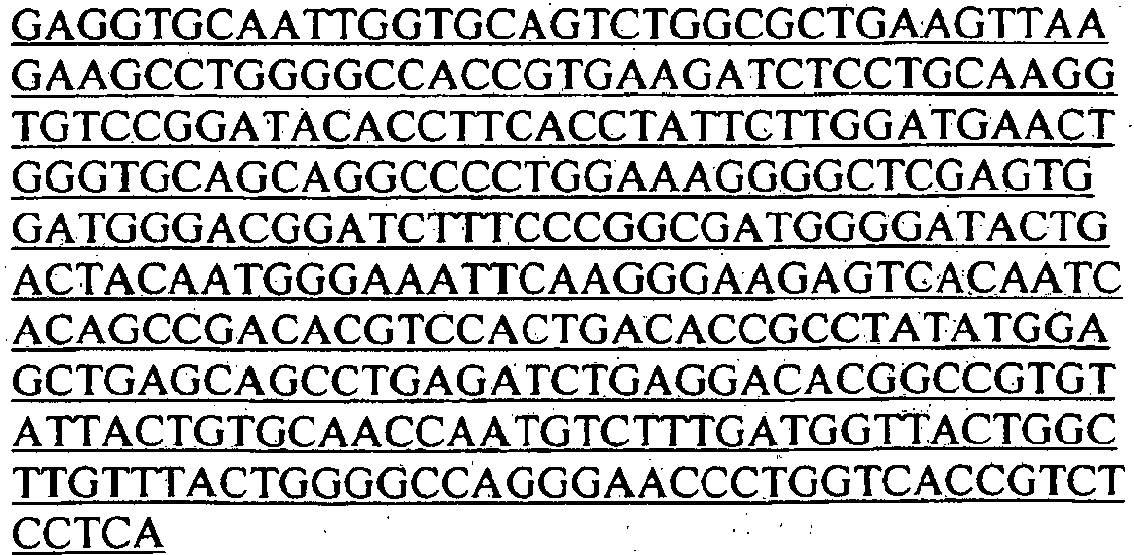
51 B-HL4 
53 B-HL8 
55 B-HL10 
57 B-HL11 
59 B-HL12 
61 B-HL13 
63 B-HL14 
65 B-HL15 
67 B-HL16 
69 B-HL17 
71 VH Signal Sequence 
73 B-KV1 
75 VL Signal Sequence 
77 TABLE 3 CONSTRUCT AMINO ACID SEQUENCE SEQ ID NO B-HH1 
30 B-HH2 
32 B-HH3 
34 B-HH4 
36 B-HH5 
38 B-HH6 
40 B-HH7 
42 B-HH8 
44 B-HH9 
46 B-HL1 
48 B-HL2 
50 B-HL3 
52 B-HL4 
54 B-HL8 
56 B-HL10 
58 B-HL11 
60 B-HL12 
62 B-HL13 
64 B-HL14 
66 B-HL15 
68 B-HL16 
70 B-HL17 
72 VH Signal Sequence MDWTWRILFLVAAATGAHS 74 B-KV1 
76 VL Signal Sequence MDMRVPAQLLGLLLLWFPGARC 78 - In another preferred embodiment, the present disclosure is directed to an isolated polynucleotide comprising a sequence that encodes a polypeptide having the amino acid sequence shown in
FIG. 1 orFIG. 2 . The disclosure is further directed to an isolated nucleic acid comprising a sequence at least 80%, 85%, 90%, 95%, 96%, 97%, 98% or 99% identical to the nucleotide sequence shown inFIG. 5 orFIG. 6 . In another embodiment, the disclosure is directed to an isolated nucleic acid comprising a sequence that encodes a polypeptide having an amino acid sequence at least 80%, 85%, 90%, 95%, 96%, 97%, 98% or 99% identical to the amino acid sequenceFIG. 5 orFIG. 6 . The disclosure also encompasses an isolated nucleic acid comprising a sequence that encodes a polypeptide having the amino acid sequence of any ofFIG. 1 ,FIG. 2 ,FIG. 5 orFIG. 6 with conservative amino acid substitutions. - In another embodiment, the present disclosure is directed to an expression vector and/or a host cell which comprise one or more isolated polynucleotides described herein.
- Generally, any type of cultured cell line can be used to express the ABM of the present invention. In a preferred embodiment, CHO cells, BHK cells, NS0 cells, SP2/0 cells, YO myeloma cells, P3X63 mouse myeloma cells, PER cells, PER.C6 cells or hybridoma cells, other mammalian cells, yeast cells, insect cells, or plant cells are used as the background cell line to generate the engineered host cells described herein.
- The therapeutic efficacy of the ABMs described herein can be enhanced by producing them in a host cell that further expresses a polynucleotide encoding a polypeptide having GnTIII activity. In a preferred embodiment, the polypeptide having GnTIII activity is a fusion polypeptide comprising the Golgi localization domain of a Golgi resident polypeptide. In another preferred embodiment, the expression of the ABMs of the present invention in a host cell that expresses a polynucleotide encoding a polypeptide having GnTIII activity results in ABMs with increased Fc receptor binding affinity and increased effector function. Accordingly, in one embodiment, the present disclosure is directed to a host cell comprising (a) an isolated nucleic acid comprising a sequence encoding a polypeptide having GnTIII activity; and (b) an isolated polynucleotide encoding an ABM described herein, such as a chimeric, primatized or humanized antibody that binds human CD20. In a preferred embodiment, the polypeptide having GnTIII activity is a fusion polypeptide comprising the catalytic domain of GnTIII and the Golgi localization domain is the localization domain of mannosidase II. Methods for generating such fusion polypeptides and using them to produce antibodies with increased effector functions are disclosed in
U.S. Provisional Pat. Appl. No. 60/495,142 . - In another preferred embodiment, the chimeric ABM is a chimeric antibody or a fragment thereof, having the binding specificity of the murine B-LY1 antibody. In a particularly preferred embodiment, the chimeric antibody comprises a human Fc. In another preferred embodiment, the antibody is primatized or humanized.
- In one embodiment, one or several polynucleotides encoding an ABM of the present disclosure may be expressed under the control of a constitutive promoter or, alternately, a regulated expression system. Suitable regulated expression systems include, but are not limited to, a tetracycline-regulated expression system, an ecdysone-inducible expression system, a lac-switch expression system, a glucocorticoid-inducible expression system, a temperature-inducible promoter system, and a metallothionein metal-inducible expression system. If several different nucleic acids encoding an ABM described herein are comprised within the host cell system, some of them may be expressed under the control of a constitutive promoter, while others are expressed under the control of a regulated promoter. The maximal expression level is considered to be the highest possible level of stable polypeptide expression that does not have a significant adverse effect on cell growth rate, and will be determined using routine experimentation. Expression levels are determined by methods generally known in the art, including Western blot analysis using an antibody specific for the ABM or an antibody specific for a peptide tag fused to the ABM; and Northern blot analysis. In a further alternative, the polynucleotide may be operatively linked to a reporter gene; the expression levels of a chimeric ABM having substantially the same binding specificity of the murine B-Ly1 antibody are determined by measuring a signal correlated with the expression level of the reporter gene. The reporter gene may be transcribed together with the nucleic acid(s) encoding said fusion polypeptide as a single mRNA molecule; their respective coding sequences may be linked either by an internal ribosome entry site (IRES) or by a cap-independent translation enhancer (CITE). The reporter gene may be translated together with at least one nucleic acid encoding a chimeric ABM having substantially the same binding specificity of the murine B-Lyl antibody such that a single polypeptide chain is formed. The nucleic acids encoding the AMBs described herein may be operatively linked to the reporter gene under the control of a single promoter, such that the nucleic acid encoding the fusion polypeptide and the reporter gene are transcribed into an RNA molecule which is alternatively spliced into two separate messenger RNA (mRNA) molecules; one of the resulting mRNAs is translated into said reporter protein, and the other is translated into said fusion polypeptide.
- Methods which are well known to those skilled in the art can be used to construct expression vectors containing the coding sequence of an ABM having substantially the same binding specificity of the murine B-Ly1 antibody along with appropriate transcriptional/translational control signals. These methods include in vitro recombinant DNA techniques, synthetic techniques and in vivo recombination/genetic recombination. See, for example, the techniques described in Maniatis et al., MOLECULAR CLONING A LABORATORY MANUAL, Cold Spring Harbor Laboratory, N.Y. (1989) and Ausubel et al., CURRENT PROTOCOLS IN MOLECULAR BIOLOGY, Greene Publishing Associates and Wiley Interscience, N.Y (1989).
- A variety of host-expression vector systems may be utilized to express the coding sequence of the ABMs of the present invention. Preferably, mammalian cells are used as host cell systems transfected with recombinant plasmid DNA or cosmid DNA expression vectors containing the coding sequence of the protein of interest and the coding sequence of the fusion polypeptide. Most preferably, CHO cells, BHK cells, NS0 cells, SP2/0 cells, YO myeloma cells, P3X63 mouse myeloma cells, PER cells, PER.C6 cells or hybridoma cells, other mammalian cells, yeast cells, insect cells, or plant cells are used as host cell system. Some examples of expression systems and selection methods are described in the following references, and references therein: Borth et al., Biotechnol. Bioen. 71(4):266-73 (2000-2001), in Werner et al., Arzneimittelforschung/Drug Res. 48(8):870-80 (1998), in Andersen and Krummen, Curr. Op. Biotechnol. 13:117-123 (2002), in Chadd and Chamow, Curr. Op. Biotechnol. 12:188-194 (2001), and in Giddings, Curr. Op. Biotechnol. 12: 450-454 (2001). In alternate embodiments, other eukaryotic host cell systems may be contemplated, including yeast cells transformed with recombinant yeast expression vectors containing the coding sequence of an ABM of the present invention; insect cell systems infected with recombinant virus expression vectors (e.g., baculovirus) containing the coding sequence of a chimeric ABM having substantially the same binding specificity of the murine B-Ly1 antibody; plant cell systems infected with recombinant virus expression vectors (e.g., cauliflower mosaic virus, CaMV; tobacco mosaic virus, TMV) or transformed with recombinant plasmid expression vectors (e.g., Ti plasmid) containing the coding sequence of the ABM of the invention; or animal cell systems infected with recombinant virus expression vectors (e.g., adenovirus, vaccinia virus) including cell lines engineered to contain multiple copies of the DNA encoding a chimeric ABM having substantially the same binding specificity of the murine B-Ly1 antibody either stably amplified (CHO/dhfr) or unstably amplified in double-minute chromosomes (e.g., murine cell lines). In one embodiment, the vector comprising the polynucleotide(s) encoding the ABM of the disclosure is polycistronic. Also, in one embodiment the ABM discussed above is an antibody or a fragment thereof. In a preferred embodiment, the ABM is a humanized antibody.
- For the methods of this disclosure, stable expression is generally preferred to transient expression because it typically achieves more reproducible results and also is more amenable to large-scale production. Rather than using expression vectors which contain viral origins of replication, host cells can be transformed with the respective coding nucleic acids controlled by appropriate expression control elements (e.g., promoter, enhancer, sequences, transcription terminators, polyadenylation sites, etc.), and a selectable marker. Following the introduction of foreign DNA, engineered cells may be allowed to grow for 1-2 days in an enriched media, and then are switched to a selective media. The selectable marker in the recombinant plasmid confers resistance to the selection and allows selection of cells which have stably integrated the plasmid into their chromosomes and grow to form foci which in turn can be cloned and expanded into cell lines.
- A number of selection systems may be used, including, butnot limited to, the herpes simplex virus thymidine kinase (Wigler et al., Cell 11:223 (1977)), hypoxanthine-guanine phosphoribosyltransferase (Szybalska & Szybalski, Proc. Natl. Acad Sci. USA 48:2026 (1962)), and adenine phosphoribosyltransferase (Lowy et al., Cell 22:817 (1980)) genes, which can be employed in tk-, hgprt- or aprt- cells, respectively. Also, antimetabolite resistance can be used as the basis of selection for dhfr, which confers resistance to methotrexate (Wigler et al., Natl. Acad Sci. USA 77:3567 (1989); O'Hare et al., Proc. Natl. Acad. Sci. USA 78:1527 (1981)); gpt, which confers resistance to mycophenolic acid (Mulligan & Berg, Proc. Natl. Acad. Sci. USA 78:2072 (1981)); neo, which confers resistance to the aminoglycoside G-418 (Colberre-Garapin et al., J. Mol. Biol. 150:1 (1981)); and hygro, which confers resistance to hygromycin (Santerre et al., Gene 30:147 (1984) genes. Recently, additional selectable genes have been described, namely trpB, which allows cells to utilize indole in place of tryptophan; hisD, which allows cells to utilize histinol in place ofhistidine (Hartman & Mulligan, Proc. Natl. Acad. Sci. USA 85:8047 (1988)); the glutamine synthase system; and ODC (ornithine decarboxylase) which confers resistance to the ornithine decarboxylase inhibitor, 2-(difluoromethyl)-DL-ornithine, DFMO (McConlogue, in: Current Communications in Molecular Biology, Cold Spring Harbor Laboratory ed. (1987)).
- The present disclosure is further directed to a method for modifying the glycosylation profile of the ABMs described herein that are produced by a host cell, comprising expressing in said host cell a nucleic acid encoding an ABM of the disclosure and a nucleic acid encoding a polypeptide with GnTIII activity, or a vector comprising such nucleic acids. Preferably, the modified polypeptide is IgG or a fragment thereof comprising the Fc region. In a particularly preferred embodiment the ABM is a humanized antibody or a fragment thereof.
- The modified ABMs produced by the host cells of the invention exhibit increased Fc receptor binding affinity and/or increased effector function as a result of the modification. In a particularly preferred embodiment the ABM is a humanized antibody or a fragment thereof containing the Fc region. Preferably, the increased Fc receptor binding affinity is increased binding to a Fcγ activating receptor, such as the FcγRIIIa receptor. The increased effector function is preferably an increase in one or more of the following: increased antibody-dependent cellular cytotoxicity, increased antibody-dependent cellular phagocytosis (ADCP), increased cytokine secretion, increased immune-complex-mediated antigen uptake by antigen-presenting cells, increased Fc-mediated cellular cytotoxicity, increased binding to NK cells, increased binding to macrophages, increased binding to polymorphonuclear cells (PMNs), increased binding to monocytes, increased crosslinking of target-bound antibodies, increased direct signaling inducing apoptosis, increased dendritic cell maturation, and increased T cell priming.
- The present disclosure is also directed to a method for producing an ABM described herein , having modified oligosaccharides in a host cell comprising (a) culturing a host cell engineered to express at least one nucleic acid encoding a polypeptide having GnTIII activity under conditions which permit the production of an ABM according to the present disclosure, wherein said polypeptide having GnTIII activity is expressed in an amount sufficient to modify the oligosaccharides in the Fc region of said ABM produced by said host cell; and (b) isolating said ABM. In a preferred embodiment, the polypeptide having GnTIII activity is a fusion polypeptide comprising the catalytic domain of GnTIII. In a particularly preferred embodiment, the fusion polypeptide further comprises the Golgi localization domain of a Golgi resident polypeptide.
- Preferably, the Golgi localization domain is the localization domain of mannosidase II or GnTI. Alternatively, the Golgi localization domain is selected from the group consisting of: the localization domain of mannosidase I, the localization domain of GnTII, and the localization domain of α 1-6 core fucosyltransferase. The ABMs produced by the methods described herein have increased Fc receptor binding affinity and/or increased effector function. Preferably, the increased effector function is one or more of the following: increased Fc-mediated cellular cytotoxicity (including increased antibody-dependent cellular cytotoxicity), increased antibody-dependent cellular phagocytosis (ADCP), increased cytokine secretion, increased immune-complex-mediated antigen uptake by antigen-presenting cells, increased binding to NK cells, increased binding to macrophages, increased binding to monocytes, increased binding to polymorphonuclear cells, increased direct signaling inducing apoptosis, increased crosslinking of target-bound antibodies, increased dendritic cell maturation, or increased T cell priming. The increased Fc receptor binding affinity is preferably increased binding to Fc activating receptors such as FcγRIIIa. In a particularly preferred embodiment the ABM is a humanized antibody or a fragment thereof.
- In another embodiment, the present disclosure is directed to a chimeric ABM having substantially the same binding specificity of the murine B-Ly1 antibody produced by the methods described herein which has an increased proportion of bisected oligosaccharides in the Fc region of said polypeptide. It is contemplated that such an ABM encompasses antibodies and fragments thereof comprising the Fc region. In a preferred embodiment, the ABM is a humanized antibody. In one embodiment, the percentage of bisected oligosaccharides in the Fc region of the ABM is at least 50%, more preferably, at least 60%, at least 70%, at least 80%, or at least 90%, and most preferably at least 90-95% of the total oligosaccharides. In yet another embodiment, the ABM produced by the methods described herein has an increased proportion of nonfucosylated oligosaccharides in the Fc region as a result of the modification of its oligosaccharides by the methods described herein. In one embodiment, the percentage of nonfucosylated oligosaccharides is at least 50%, preferably, at least 60% to 70%, most preferably at least 75%. The nonfucosylated oligosaccharides may be of the hybrid or complex type. In a particularly preferred embodiment, the ABM produced by the host cells and.methods described herein has an increased proportion of bisected, nonfucosylated oligosaccharides in the Fc region. The bisected, nonfucosylated oligosaccharides may be either hybrid or complex. Specifically, the methods described herein may be used to produce ABMs in which at least 15%, more preferably at least 20%, more preferably at least 25%, more preferably at least 30%, more preferably at least 35% of the oligosaccharides in the Fc region of the ABM are bisected, nonfucosylated. The methods described herein may also be used to produce polypeptides in which at least 15%, more preferably at least 20%, more preferably at least 25%, more preferably at least 30%, more preferably at least 35% of the oligosaccharides in the Fc region of the polypeptide are bisected hybrid nonfucosylated.
- In another embodiment, the present disclosure is directed to a chimeric ABM having substantially the same binding specificity of the murine B-Ly1 antibody engineered to have increased effector function and/or increased Fc receptor binding affinity, produced by the methods described herein. Preferably, the increased effector function is one or more of the following: increased Fc-mediated cellular cytotoxicity (including increased antibody-dependent cellular cytotoxicity), increased antibody-dependent cellular phagocytosis (ADCP), increased cytokine secretion, increased immune-complex-mediated antigen uptake by antigen-presenting cells, increased binding to NK cells, increased binding to macrophages, increased binding to monocytes, increased binding to polymorphonuclear cells, increased direct signaling inducing apoptosis, increased crosslinking of target-bound antibodies, increased dendritic cell maturation, or increased T cell priming. In a preferred embodiment, the increased Fc receptor binding affinity is increased binding to a Fc activating receptor, most preferably FcγRIIIa. In one embodiment, the ABM is an antibody, an antibody fragment containing the Fc region, or a fusion protein that includes a region equivalent to the Fc region of an immunoglobulin. In a particularly preferred embodiment, the ABM is a humanized antibody.
- The present disclosure is further directed to pharmaceutical compositions comprising the ABMs described herein and a pharmaceutically acceptable carrier.
- The present disclosure is further directed to the use of such pharmaceutical compositions in the method of treatment of cancer. Specifically, the present disclosure is directed to a method for the treatment of cancer comprising administering a therapeutically effective amount of the pharmaceutical composition described herein.
- The present disclosure further provides methods for the generation and use of host cell systems for the production of glycoforms of the ABMs described herein, having increased Fc receptor binding affinity, preferably increased binding to Fc activating receptors, and/or having increased effector functions, including antibody-dependent cellular cytotoxicity. The glycoengineering methodology that can be used with the ABMs described herein has been described in greater detail in
U.S. Pat. No. 6,602,684 and ProvisionalU.S. Patent Application No. 60/441,307 andWO 2004/065540 .
The ABMs of the present disclosure can alternatively be glycoengineered to have reduced fucose residues in the Fc region according to the techniques disclosed inEP 1 176 195 A1 - The present disclosure describes host cell expression systems for the generation of the ABMs described herein having modified glycosylation patterns. In particular, the present disclosure describes host cell systems for the generation of glycoforms of the ABMs described herein having an improved therapeutic value. Therefore, the disclosure describes host cell expression systems selected or engineered to express a polypeptide having GnTIII activity. In one embodiment, the polypeptide having GnTIII activity is a fusion polypeptide comprising the Golgi localization domain of a heterologous Golgi resident polypeptide. Specifically, such host cell expression systems may be engineered to comprise a recombinant nucleic acid molecule encoding a polypeptide having GnTIII, operatively linked to a constitutive or regulated promoter system.
- In one specific embodiment, the present disclosure relates to host cell that has been engineered to express at least one nucleic acid encoding a fusion polypeptide having GnTIII activity and comprising the Golgi localization domain of a heterologous Golgi resident polypeptide. In one aspect, the host cell is engineered with a nucleic acid molecule comprising at least one gene encoding a fusion polypeptide having GnTIII activity and comprising the Golgi localization domain of a heterologous Golgi resident polypeptide.
- Generally, any type of cultured cell line, including the cell lines discussed above, can be used as a background to engineer the host cell lines described herein. In a preferred embodiment, CHO cells, BHK cells, NS0 cells, SP2/0 cells, YO myeloma cells, P3X63 mouse myeloma cells, PER cells, PER.C6 cells or hybridoma cells, other mammalian cells, yeast cells, insect cells, or plant cells are used as the background cell line to generate the engineered host cells described herein.
- The disclosure is contemplated to encompass any engineered host cells expressing a polypeptide having GnTIII activity, including a fusion polypeptide that comprises the Golgi localization domain of a heterologous Golgi resident polypeptide as defined herein.
- One or several nucleic acids encoding a polypeptide having GnTIII activity may be expressed under the control of a constitutive promoter or, alternately, a regulated expression system. Such systems are well known in the art, and include the systems discussed above. If several different nucleic acids encoding fusion polypeptides having GnTIII activity and comprising the Golgi localization domain of a heterologous Golgi resident polypeptide are comprised within the host cell system, some of them may be expressed under the control of a constitutive promoter, while others are expressed under the control of a regulated promoter. Expression levels of the fusion polypeptides having GnTIII activity are determined by methods generally known in the art, including Western blot analysis, Northern blot analysis, reporter gene expression analysis or measurement of GnTIII activity. Alternatively, a lectin may be employed which binds to biosynthetic products of the GnTIII, for example, E4-PHA lectin. Alternatively, a functional assay which measures the increased Fc receptor binding or increased effector function mediated by antibodies produced by the cells engineered with the nucleic acid encoding a polypeptide with GnTIII activity may be used.
- The host cells which contain the coding sequence of a chimeric ABM having substantially the same binding specificity of the murine B-Ly1 antibody and which express the biologically active gene products may be identified by at least four general approaches; (a) DNA-DNA or DNA-RNA hybridization; (b) the presence or absence of "marker" gene functions; (c) assessing the level of transcription as measured by the expression of the respective mRNA transcripts in the host cell; and (d) detection of the gene product as measured by immunoassay or by its biological activity.
- In the first approach, the presence of the coding sequence of a chimeric ABM having substantially the same binding specificity of the murine B-Ly1 antibody and the coding sequence of the polypeptide having GnTIII activity can be detected by DNA-DNA or DNA-RNA hybridization using probes comprising nucleotide sequences that are homologous to the respective coding sequences, respectively, or portions or derivatives thereof.
- In the second approach, the recombinant expression vector/host system can be identified and selected based upon the presence or absence of certain "marker" gene functions (e.g., thymidine kinase activity, resistance to antibiotics, resistance to methotrexate, transformation phenotype, occlusion body formation in baculovirus, etc.). For example, if the coding sequence of the ABM described herein, or a fragment thereof, and the coding sequence of the polypeptide having GnTIII activity are inserted within a marker gene sequence of the vector, recombinants containing th e respective coding sequences can be identified by the absence of the marker gene function Alternatively, a marker gene can be placed in tandem with the coding sequences under the control of the same or different promoter used to control the expression of the coding sequences. Expression of the marker in response to induction or selection indicates expression of the coding sequence of the ABM described herein and the coding sequence of the polypeptide having GnTIII activity.
- In the third approach, transcriptional activity for the coding region of the ABM of the invention, or a fragment thereof, and the coding sequence of the polypeptide having GnTIII activity can be assessed by hybridization assays. For example, RNA can be isolated and analyzed by Northern blot using a probe homologous to the coding sequences of the ABM described herein, or a fragment thereof, and the coding sequence of the polypeptide having GnTIII activity or particular portions thereof. Alternatively, total nucleic acids of the host cell may be extracted and assayed for hybridization to such probes.
- In the fourth approach, the expression of the protein products can be assessed immunologically, for example by Western blots, immunoassays such as radioimmuno-precipitation and enzyme-linked immunoassays. The ultimate test of the success of the expression system, however, involves the detection of the biologically active gene products.
- In preferred embodiments, the present disclosure describes glycoforms of chimeric ABMs having substantially the same binding specificity of the murine B-Ly1 antibody and having increased effector function including antibody-dependent cellular cytotoxicity. Glycosylation engineering of antibodies has been previously described. See, e.g.,
U.S. Patent No. 6,602,684 . - Clinical trials of unconjugated monoclonal antibodies (mAbs) for the treatment of some types of cancer have recently yielded encouraging results. Dillman, Cancer Biother. & Radiopharm. 12:223-25 (1997); Deo et al., Immunology Today 18:127 (1997). A chimeric, unconjugated IgG1 has been approved for low-grade or follicular B-cell non-Hodgkin's lymphoma. Dillman, Cancer Biother. & Radiopharm. 12:223-25 (1997), while another unconjugated mAb, a humanized IgG1 targeting solid breast tumors, has also been showing promising results in phase III clinical trials. Deo et al., Immunology Today 18:127 (1997). The antigens of these two mAbs are highly expressed in their respective tumor cells and the antibodies mediate potent tumor destruction by effector cells in vitro and in vivo. In contrast, many other unconjugated mAbs with fine tumor specificities cannot trigger effector functions of sufficient potency to be clinically useful. Frost et al., Cancer 80:317-33 (1997); Surfus et al., J. Immunother. 19:184-91 (1996). For some of these weaker mAbs, adjunct cytokine therapy is currently being tested. Addition of cytokines can stimulate antibody-dependent cellular cytotoxicity (ADCC) by increasing the activity and number of circulating lymphocytes. Frost et al., Cancer 80:317-33 (1997); Surfus et al., J. Immunother. 19:184-91 (1996). ADCC, a lytic attack on antibody-targeted cells, is triggered upon binding of leukocyte receptors to the constant region (Fc) of antibodies. Deo et al., Immunology Today 18:127 (1997).
- A different, but complementary, approach to increase ADCC activity of unconjugated IgG1s is to engineer the Fc region of the antibody. Protein engineering studies have shown that FcγRs interact with the lower hinge region of the IgG CH2 domain. Lund et al., J. Immunol. 157:4963-69 (1996). However, FcγR binding also requires the presence of oligosaccharides covalently attached at the conserved Asn 297 in the CH2 region. Lund et al., J. Immunol. 157:4963-69 (1996); Wright and Morrison, Trends Biotech. 15:26-31 (1997), suggesting that either oligosaccharide and polypeptide both directly contribute to the interaction site or that the oligosaccharide is required to maintain an active CH2 polypeptide conformation. Modification of the oligosaccharide structure can therefore be explored as a means to increase the affinity of the interaction.
- An IgG molecule carries two N-linked oligosaccharides in its Fc region, one on each heavy chain. As any glycoprotein, an antibody is produced as a population of glycoforms which share the same polypeptide backbone but have different oligosaccharides attached to the glycosylation sites. The oligosaccharides normally found in the Fc region of serum IgG are of complex bi-antennary type (Wormald et al., Biochemistry 36:130-38 (1997), with a low level of terminal sialic acid and bisecting N-acetylgiucosamine (GlcNAc), and a variable degree of terminal galactosylation and core fucosylation. Some studies suggest that the minimal carbohydrate structure required for FcγR binding lies within the oligosaccharide core. Lund et al., J Immunol. 157:4963-69 (1996)
- The mouse- or hamster-derived cell lines used in industry and academia for production of unconjugated therapeutic mAbs normally attach the required oligosaccharide determinants to Fc sites. IgGs expressed in these cell lines lack, however, the bisecting GlcNAc found in low amounts in serum IgGs. Lifely et al., Glycobiology 318:813-22 (1995). In contrast, it was recently observed that a rat myeloma-produced, humanized IgG1 (CAMPATH-1H) carried a bisecting GlcNAc in some of its glycoforms. Lifely et al., Glycobiology 318:813-22 (1995). The rat cell-derived antibody reached a similar maximal in vitro ADCC activity as CAMPATH-1H antibodies produced in standard cell lines, but at significantly lower antibody concentrations.
- The CAMPATH antigen is normally present at high levels on lymphoma cells, and this chimeric mAb has high ADCC activity in the absence of a bisecting GlcNAc. Lifely et al., Glycobiology 318:813-22 (1995). In the N-linked glycosylation pathway, a bisecting GlcNAc is added by GnTIII. Schachter, Biochem. Cell Biol. 64:163-81 (1986).
- Previous studies used a single antibody-producing CHO cell line, that was previously engineered to express, in an externally-regulated fashion, different levels of a cloned GnT III gene enzyme (Umana, P., et al., Nature Biotechnol. 17:176-180 (1999)). This approach established for the first time a rigorous correlation between expression of GnTIII and the ADCC activity of the modified antibody. Thus, the disclosure contemplates a recombinant, chimeric antibody or a fragment thereof with the binding specificity of the murine B-Ly1 antibody, having altered glycosylation resulting from increased GnTIII activity. The increased GnTIII activity results in an increase in the percentage of bisected oligosaccharides, as well as a decrease in the percentageof fucose residues, in the Fc region of the ABM. This antibody, or fragment thereof, has increased Fc receptor binding affinity and increased effector function. In addition, the disclosure is directed to antibody fragment and fusion proteins comprising a region that is equivalent to the Fc region of immunoglobulins.
- The ABMs described herein can be used alone to target and kill tumor cells in vivo. The ABMs can also be used in conjunction with an appropriate therapeutic agent to treat human carcinoma. For example, the ABMs can be used in combination with standard or conventional treatment methods such as chemotherapy, radiation therapy or can be conjugated or linked to a therapeutic drug, or toxin, as well as to a lymphokine or a tumor-inhibitory growth factor, for delivery of the therapeutic agent to the site of the carcinoma. The conjugates of the ABMs described herein that are of prime importance are (1) immunotoxins (conjugates of the ABM and a cytotoxic moiety) and (2) labeled (e.g. radiolabeled, enzyme-labeled, orfluorochrome-labeled) ABMs in which the label provides a means for identifying immune complexes that include the labeled ABM. The ABMs can also be used to induce lysis through the natural complement process, and to interact with antibody dependent cytotoxic cells normally present.
- The cytotoxic moiety of the immunotoxin may be a cytotoxic drug or an enzymatically active toxin of bacterial or plant origin, or an enzymatically active fragment ("A chain") of such a toxin. Enzymatically active toxins and fragments thereof used are diphtheria A chain, nonbinding active fragments of diphtheria toxin, exotoxin A chain (from Pseudomonas aeruginosa), ricin A chain, abrin A chain, modeccin A chain, alpha-sarcin, Aleurites fordii proteins, dianthin proteins, Phytolacca americana proteins (PAPI, PAPII, and PAP-S), momordica charantia inhibitor, curcin, crotin, sapaonaria officinalis inhibitor, gelonin, mitogellin, restrictocin, phenomycin, and enomycin. In another embodiment, the ABMs are conjugated to small molecule anticancer drugs. Conjugates of the ABM and such cytotoxic moieties are made using a variety of bifunctional protein coupling agents. Examples of such reagents are SPDP, IT, bifunctional derivatives of imidoesters such a dimethyl adipimidate HCl, active esters such as disuccinimidyl suberate, aldehydes such as glutaraldehyde, bis-azido compounds such as bis (p-azidobenzoyl) hexanediamine, bis-diazonium derivatives such as bis-(p-diazoniumbenzoyl)-ethylenediamine, diisocyanates such as
tolylene 2,6-diisocyanate, and bis-active fluorine compounds such as 1,5-difluoro-2,4-dinitrobenzene. The lysing portion of a toxin may be joined to the Fab fragment of the ABMs. Additional appropriate toxins are known in the art, as evidenced in e.g., publishedU.S. Patent Application No. 2002/0128448 . - In one embodiment, a chimeric, glycoengineered ABM having substantially the same binding specificity of the murine B-Ly1 antibody, is conjugated to ricin A chain. Most advantageously, the ricin A chain is deglycosylated and produced through recombinant means. An advantageous method of making the ricin immunotoxin is described in Vitetta et al., Science 238, 1098 (1987),
- When used to kill human cancer cells in vitro for diagnostic purposes, the conjugates will typically be added to the cell culture medium at a concentration of at least about 10 nM. The formulation and mode of administration for in vitro use are not critical. Aqueous formulations that are compatible with the culture or perfusion medium will normally be used. Cytotoxicity may be read by conventional techniques to determine the presence or degree of cancer.
- As discussed above, a cytotoxic radiopharmaceutical for treating cancer may be made by conjugating a radioactive isotope (e.g., I, Y, Pr) to a chimeric, glycoengineered ABM having substantially the same binding specificity of the murine B-Ly1 antibody. The term "cytotoxic moiety" as used herein is intended to include such isotopes.
- In another embodiment, liposomes are filled with a cytotoxic drug and the liposomes are coated with the ABMs described herein. Because there are many CD20 molecules on the surface of the malignant B-cell, this method permits delivery of large amounts of drug to the correct cell type.
- Techniques for conjugating such therapeutic agents to antibodies are well known (see, e.g., Amon et al., "Monoclonal Antibodies for Immunotargeting of Drugs in Cancer Therapy", in Monoclonal Antibodies and Cancer Therapy, Reisfeld et al. (eds.), pp. 243-56 (Alan R. Liss, Inc. 1985); Helistrom et al., "Antibodies For Drug Delivery", in Controlled Drug Delivery (2nd Ed.), Robinson et al. (eds.), pp. 623-53 (Marcel Dekker, Inc. 1987); Thorpe, "Antibody Carriers Of Cytotoxic Agents In Cancer Therapy: A Review", in Monoclonal Antibodies '84: Biological And Clinical Applications, Pinchera et al. (eds.), pp. 475-506 (1985); and Thorpe et al., "The Preparation And Cytotoxic Properties Of Antibody-Toxin Conjugates", Immunol. Rev., 62:119-58 (1982)).
- Still other therapeutic applications for the ABM described herein include conjugation or linkage, e.g., by recombinant DNA techniques, to an enzyme capable of converting a prodrug into a cytotoxic drug and the use of that antibody-enzyme conjugate in combination with the prodrug to convert the prodrug to a cytotoxic agent at the tumor site (see, e.g., Senter et al., "Anti-Tumor Effects of Antibody-alkaline Phosphatase", Proc. Natl. Acad Sci. USA 85:4842-46 (1988); "Enhancement of the in vitro and in vivo Antitumor Activites of Phosphorylated Mitocycin C and Etoposide Derivatives by Monoclonal Antibody-Alkaline Phosphatase Conjugates", Cancer Research 49:5789-5792 (1989); and Senter, "Activation of Prodrugs by Antibody-Enzyme Conjugates: A New Approach to Cancer Therapy," FASEB J. 4:188-193 (1990)).
- Still another therapeutic use for the ABMs described herein involves use, either unconjugated, in the presence of complement, or as part of an antibody-drug or antibody-toxin conjugate, to remove tumor cells from the bone marrow of cancer patients. According to this approach, autologous bone marrow may be purged ex vivo by treatment with the antibody and the marrow infused back into the patient [see, e.g., Ramsay et al., "Bone Marrow Purging Using Monoclonal Antibodies", J. Clin. Immunol., 8(2):81-88 (1988)].
- Furthermore, it is contemplated that the disclosure comprises a single-chain immunotoxin comprising antigen binding domains that allow substantially the same specificity of binding as the murine B-Ly1 antibody (e.g., polypeptides comprising the CDRs of the murine B-Ly1 antibody) and further comprising a toxin polypeptide. The single-chain immunotoxins of the invention may be used to treat human carcinoma in vivo.
- Similarly, a fusion protein comprising at least the antigen-binding region of an ABM of the invention joined to at least a functionally active portion of a second protein having anti-tumor acitivty, e.g., a lymphokine or oncostatin, can be used to treat human carcinoma in vivo.
- The present disclosure describes a method for selectively killing tumor cells expressing CD20. This method comprises reacting the immunoconjugate (e.g., the immunotoxin) described herein with said tumor cells. These tumor cells may be from a human carcinoma.
- Additionally, this disclosure describes a method of treating carcinomas (for example, human carcinomas) in vivo. This method comprises administering to a subject a pharmaceutically effective amount of a composition containing at least one of the immunoconjugates (e.g., the immunotoxin) described herein.
- In a further aspect, the disclosure is directed to an improved method for treating B-cell proliferative disorders including B-cell Lymphoma, as well as an autoimmune disease produced in whole or in part by pathogenic autoantibodies, based on B-cell depletion comprising administering a therapeutically effective amount of an ABM described herein to a human subject in need thereof.
In a preferred embodiment, the ABM is a glycoengineered anti-CD20 antibody with a binding specificity substantially the same as that of the murine B-Ly1 antibody. In another preferred embodiment the antibody is humanized. Examples of autoimmune diseases or disorders include, but are not limited to, immune-mediated thrombocytopenias, such as acute idiopathic thrombocytopenic purpurea and chronic idiopathic thrombocytopenic purpurea, dermatomyositis, Sydenham's chorea, lupus nephritis, rheumatic fever, polyglandular syndromes, Henoch-Schonlein purpura, post-streptococcal nephritis, erythema nodosum, Takayasu's arteritis, Addison's disease, erythema multiforme, polyarteritis nodosa, ankylosing spondylitis, Goodpasture's syndrome, thromboangitis ubiterans, primary biliary cirrhosis, Hashimoto's thyroiditis, thyrotoxicosis, chronic active hepatitis, polymyositis/dermatomyositis, polychondritis, pamphigus vulgaris, Wegener's granulomatosis, membranous nephropathy, amyotrophic lateral sclerosis, tabes dorsalis, polymyaglia, pernicious anemia, rapidly progressive glomerulonephritis and fibrosing alveolitis, inflammatory responses such as inflammatory skin diseases including psoriasis and dermatitis (e.g. atopic dermatitis); systemic scleroderma and sclerosis; responses associated with inflammatory bowel disease (such as Crohn's disease and ulcerative colitis); respiratory distress syndrome (including adult respiratory distress syndrome; ARDS); dermatitis; meningitis; encephalitis; uveitis; colitis; glomerulonephritis; allergic conditions such as eczema and asthma and other conditions involving infiltration of T cells and chronic inflammatory responses; atherosclerosis; leukocyte adhesion deficiency; rheumatoid arthritis; systemic lupus erythematosus (SLE); diabetes mellitus (e.g.Type 1 diabetes mellitus or insulin dependent diabetes mellitus); multiple sclerosis; Reynaud's syndrome; autoimmune thyroiditis; allergic encephalomyelitis; Sjorgen's syndrome; juvenile onset diabetes; and immune responses associated with acute and delayed hypersensitivity mediated by cytokines and T-lymphocytes typically found in tuberculosis, sarcoidosis, polymyositis, granulomatosis and vasculitis; pernicious amenia (Addison's disease); diseases involving leukocyte diapedesis; central nervous system (CNS) inflammatory disorder; multiple organ injury syndrome; hemolytic anemia (including, but not limited to cryoglobinernia or Coombs positive anemia); myasthenia gravis; antigen-antibody complex mediated diseases; anti-glomerular basement membrane disease; antiphospholipid syndrome; allergic neuritis; Graves' disease; Lambert-Eaton myasthenic syndrome; pemphigoid bullous; pemphigus; autoimmune polyendocrinopathies; Reiter's disease; stiff-man syndrome; Behcet disease; giant cell arteritis; immune complex nephritis; IgA nephropathy; IgM polyneuropathies; immune thrombocytopenic purpura (ITP) or autoimmune thrombocytopenia etc. In this aspect of the disclosure, the ABMs described herein are used to deplete the blood of normal B-cells for an extended period. - In accordance with the practice of this disclosure, the subject may be a human, equine, porcine, bovine, murine, canine, feline, and avian subjects. Other warm blooded animals are also included wherein.
- The disclosure further describes methods for inhibiting the growth of human tumor cells, treating a tumor in a subject, and treating a proliferative type disease in a subject. These methods comprise administering to the subject an effective amount of the composition described herein.
- It is apparent, therefore, that the present disclosure encompasses pharmaceutical compositions, combinations and methods for treating human carcinomas, such as a B cell lymphoma. For example, the disclosure includes pharmaceutical compositions for use in the treatment of human carcinomas comprising a pharmaceutically effective amount of an antibody described herein and a pharmaceutically acceptable carrier.
- The ABM compositions described herein can be administered using conventional modes of administration including, but not limited to, intravenous, intraperitoneal, oral, intralymphatic or administration directly into the tumor. Intravenous administration is preferred.
- In one aspect of the disclosure, therapeutic formulations containing the ABMs described herein are prepared for storage by mixing an antibody having the desired degree of purity with optional pharmaceutically acceptable carriers, excipients or stabilizers (Remington's Pharmaceutical Sciences 16th edition, Osol, A. Ed. (1980)), in the form of lyophilized formulations or aqueous solutions. Acceptable carriers, excipients, or stabilizers arenontoxicto recipients at the dosages and concentrations employed, and include buffers such as phosphate, citrate, and other organic acids; antioxidants including ascorbic acid and methionine; preservatives (such as octadecyfdimethylbenzyl ammonium chloride; hexamethonium chloride; benzalkonium chloride, benzethonium chloride; phenol, butyl or benzyl alcohol; alkyl parabens such as methyl or propyl paraben; catechol; resorcinol; cyclohexanol; 3-pentanol; and m-cresol); low molecular weight (less than about 10 residues) polypeptides; proteins, such as serum albumin, gelatin, or immunoglobulins; hydrophilic polymers such as polyvinylpyrrolidone; amino acids such as glycine, glutamine, asparagine, histidine, arginine, or lysine; monosaccharides, disaccharides, and other carbohydrates including glucose, mannose, or dextrins; chelating agents such as EDTA; sugars such as sucrose, mannitol, trehalose or sorbitol; salt-forming counter-ions such as sodium; metal complexes (e.g., Zn-protein complexes); and/or non-ionic surfactants such as TWEEN™, PLURONICS™ or polyethylene glycol (PEG).
- Exemplary anti-CD20 ABM formulations are described in
WO98/56418 % polysorbate 20 at pH 5.0 that has a minimum shelf life of two years storage at2-8°C. Another anti-CD20 formulation of interest comprises 10 mg/mL rituximab in 9.0 mg/mL sodium chloride, 7.35 mg/mL sodium citrate dihydrate, 0.7 mg/mL polysorbate 80, and Sterile Water for Injection, pH6.5. In the present invention, RITUXAN® will be substituted by an ABM described herein. - Lyophilized formulations adapted for subcutaneous administration are described in
WO97/04801 - The formulation herein may also contain more than one active compound as necessary for the particular indication being treated, preferably those with complementary activities that do not adversely affect each other. For example, it maybe desirable to further provide a cytotoxic agent, chemotherapeutic agent, cytokine or immunosuppressive agent (e.g. one which acts on T cells, such as cyclosporin or an antibody that binds T cells, e.g., one which binds LFA-1). The effective amount of such other agents depends on the amount of antagonist present in the formulation, the type of disease or disorder or treatment, and other factors discussed above. These are generally used in the same dosages and with administration routes as used hereinbefore or about from 1 to 99% of the heretofore employed dosages.
- The active ingredients may also be entrapped in microcapsules prepared, for example, by coacervation techniques or by interfacial polymerization, for example, hydroxymethylcellulose or gelatin-microcapsules and poly-(methylmethacylate) microcapsules, respectively, in colloidal drug delivery systems (for example, liposomes, albumin microspheres, microemulsions, nano-particles and nanocapsules) or in macroemulsions. Such techniques are disclosed in Remington's Pharmaceutical Sciences 16th edition, Osol, A. Ed. (1980).
- Sustained-release preparations may be prepared. Suitable examples of sustained-release preparations include semipermeable matrices of solid hydrophobic polymers containing the antagonist, which matrices are in the form of shaped articles, e.g., films, or microcapsules. Examples of sustained-release matrices include polyesters, hydrogels (for example, poly(2-hydroxyethyl-methacrylate), or poly(vinylalcohol)), polylactides (
U.S. Pat. No. 3,773,919 ), copolymers of L-glutamic acid and γethyl-L-glutamate, non-degradable ethylene-vinyl acetate, degradable lactic acid-glycolic acid copolymers such as the LUPRON DEPOT™ (injectable microspheres composed of lactic acid-glycolic acid copolymer and leuprolide acetate), and poly-D-(-)-3-hydroxybutyric acid. - The formulations to be used for in vivo administration must be sterile. This is readily accomplished by filtration through sterile filtration membranes.
- The compositions described herein may be in a variety of dosage forms which include, but are not limited to, liquid solutions or suspension, tablets, pills, powders, suppositories, polymeric microcapsules or microvesicles, liposomes, and injectable or infusible solutions. The preferred form depends upon the mode of administration and the therapeutic application.
- The compositions described herein also preferably include conventional pharmaceutically acceptable carriers and adjuvants known in the art such as human serum albumin, ion exchangers, alumina, lecithin, buffer substances such as phosphates, glycine, sorbic acid, potassium sorbate, and salts or electrolytes such as protamine sulfate.
- The most effective mode of administration and dosage regimen for the pharmaceutical compositions of this invention depends upon the severity and course of the disease, the patient's health and response to treatment and the judgment of the treating physician. Accordingly, the dosages of the compositions should be titrated to the individual patient. Nevertheless, an effective dose of the compositions of this invention will generally be in the range of from about 0.01 to about 2000 mg/kg.
- The molecules described herein may be in a variety of dosage forms which include, but are not limited to, liquid solutions or suspensions, tablets, pills, powders, suppositories, polymeric microcapsules or microvesicles, liposomes, and injectable or infusible solutions. The preferred form depends upon the mode of administration and the therapeutic application.
- The composition comprising an ABM of the present invention will be formulated, dosed, and administered in a fashion consistent with good medical practice. Factors for consideration in this context include the particular disease or disorder being treated, the particular mammal being treated, the clinic condition of the individual patient, the cause of the disease or disorder, the site of delivery of the agent, the method of administration, the scheduling of administration, and other factors known to medical practitioners. The therapeutically effective amount of the antagonist to be administered will be governed by such considerations.
- As a general proposition, the therapeutically effective amount of the antibody administered parenterally per dose will be in the range of about 0.1 to 20 mg/kg of patient body weight per day, with the typical initial range of antagonist used being in the range of about 2 to 10 mg/kg.
- In a preferred embodiment, the ABM is an antibody, preferably a humanized antibody Suitable dosages for such an unconjugated antibody are, for example, in the range from about 20 mg/m2 to about 1000 mg/m2. In one embodiment, the dosage of the antibody differs from that presently recommended for RITUXAN®. For example, one may administer to the patient one or more doses of substantially less than 375 mg/m2 of the antibody, e.g., where the dose is in the range from about 20 mg/m2 to about 250 mg/m2, for example from about 50 mg/m2 to about 200 mg/m2.
- Moreover, one may administer one or more initial dose(s) of the antibody followed by one or more subsequent dose(s), wherein the mg/m2 dose of the antibody in the subsequent dose(s) exceeds the mg/m2 dose of the antibody in the initial dose(s). For example, the initial dose may be in the range from about 20 mg/m2 to about 250 mg/m2 (e.g., from about 50 mg/m2 to about 200mg/m2) and the subsequent dose may be in the range from about 250 mg/m2 to about 1000 mg/m2.
- As noted above, however, these suggested amounts of ABM are subject to a great deal of therapeutic discretion. The key factor in selecting an appropriate dose and scheduling is the result obtained, as indicated above. For example, relatively higher doses may be needed initially for the treatment of ongoing and acute diseases. To obtain the most efficacious results, depending on the disease or disorder, the antagonist is administered as close to the first sign, diagnosis, appearance, or occurrence of the disease or disorder as possible or during remissions of the disease or disorder.
- The ABM described herein is administered by any suitable means, including parenteral, subcutaneous, intraperitoneal, intrapulinonary, and intranasal, and, if desired for local immunosuppressive treatment, intralesional administration. Parenteral infusions include intramuscular, intravenous, intraarterial, intraperitoneal, or subcutaneous administration. In addition, the antagonist may suitably be administered by pulse infusion, e.g., with declining doses of the antagonist. Preferably the dosing is given by injections, most preferably intravenous or subcutaneous injections, depending in part on whether the administration is brief or chronic.
- One may administer other compounds, such as cytotoxic agents, chemotherapeutic agents, immunosuppressive agents and/or cytokines with the antagonists herein. The combined administration includes coadministration, using separate formulations or a single pharmaceutical formulation, and consecutive administration in either order, wherein preferably there is a time period while both (or all) active agents simultaneously exert their biological activities.
- It would be clear that the dose of the composition described herein required to achieve cures may be further reduced with schedule optimization.
- In accordance with the practice of the disclosure, the pharmaceutical carrier may be a lipid carrier. The lipid carrier may be a phospholipid. Further, the lipid carrier may be a fatty acid. Also, the lipid carrier may be a detergent. As used herein, a detergent is any substance that alters the surface tension of a liquid, generally lowering it.
- In one example of the disclosure the detergent may be a nonionic detergent. Examples of nonionic detergents include, but are not limited to, polysorbate 80 (also known as
Tween 80 or (polyoxyethylenesorbitan monooleate), Brij, and Triton (for example Triton WR-1339 and Triton A-20). - Alternatively, the detergent may be an ionic detergent. An example of an ionic detergent includes, but is not limited to, alkyltrimethylammonium bromide.
- Additionally, in accordance with the disclosure, the lipid carrier may be a liposome. As used in this application, a "liposome" is any membrane bound vesicle which contains any molecules of the invention or combinations thereof,
- In the following embodiments of the present disclosure are mentioned which are preferred:
- Item 1: An isolated polynucleotide comprising
- a. a sequence selected from the group consisting of: SEQ ID NO.:5, SEQ ID NO.: 6 and SEQ ID NO:7; and
- b. a sequence selected from the group consisting of:SEQ ID NO: 21, SEQ ID NO: 22 and SEQ ID NO:23; and
- c. sequence ID NO:24.
- Item 2: An isolated polynucleotide comprising SEQ ID NO.:8, SEQ ID NO.: 9 and SEQ ID NO.:10.
- Item 3: An isolated polynucleotide according to
item 1 oritem 2, which encodes a fusion polypeptide. - Item 4: An isolated polynucleotide comprising SEQ ID No.:3.
- Item 5: An isolated polynucleotide comprising SEQ ID No.:4.
- Item 6: An isolated polynucleotide according to
item - Item 7: An isolated polynucleotide comprising a sequence having at least 80% identity to SEQ ID NO:3, wherein said isolated polynucleotide encodes a fusion polypeptide.
- Item 8: An isolated polynucleotide comprising a sequence having at least 80% identity to SEQ ID NO:4, wherein said isolated polynucleotide encodes a fusion polypeptide.
- Item 9: An isolated polynucleotide comprising
- a. a sequence encoding a polypeptide having the sequence of SEQ ID No.:1; and
- b. a sequence encoding a polypeptide having the sequence of an antibody Fc region, or a fragment thereof, from a species other than mouse.
- Item 10: An isolated polynucleotide comprising
- a. a sequence encoding a polypeptide having the sequence of SEQ ID No.:2; and
- b. a sequence encoding a polypeptide having the sequence of an antibody Fc region, or a fragment thereof, from a species other than mouse.
- Item 11: An isolated polynucleotide encoding a polypeptide having the sequence of SEQ ID No.:1.
- Item 12: An isolated polynucleotide encoding a polypeptide having the sequence of SEQ ID No.:2.
- Item 13: An isolated polynucleotide comprising SEQ ID NO.: 11.
- Item 14: An isolated polynucleotide comprising SEQ ID NO.: 12.
- Item 15: An isolated polynucleotide comprising a sequence having at least 80% identity to SEQ ID NO.:11 or to SEQ ID NO.:12.
- Item 16: An isolated polynucleotide comprising a sequence having at least 85% identity to SEQ ID NO.:11 or to SEQ ID NO.:12.
- Item 17: An isolated polynucleotide comprising a sequence having at least 90% identity to SEQ ID NO.:11 or to SEQ ID NO.:12.
- Item 18: An isolated polynucleotide comprising a sequence having at least 95% identity to SEQ ID NO.:11 or to SEQ ID NO.:12.
- Item 19: An isolated polynucleotide comprising a sequence having at least 99% identity to SEQ ID NO.:11 or to SEQ ID NO.:12.
- Item 20: An isolated polynucleotide comprising a sequence that encodes a polypeptide having SEQ ID NO:13 (heavy chain aa).
- Item 21: An isolated polynucleotide comprising a sequence that encodes a polypeptide having SEQ ID NO:14 (light chain aa).
- Item 22: An isolated polynucleotide comprising
- a. a sequence encoding a polypeptide having the VH region of the murine B-Ly1 antibody, or variants thereof; and
- b. a sequence encoding a polypeptide having the sequence of an antibody Fc region, or a fragment thereof, from a species other than mouse.
- Item 23: An isolated polynucleotide comprising
- a. a sequence encoding a polypeptide having the VL region of the murine B-Ly1 antibody, or variants thereof; and
- b. a sequence encoding a polypeptide having the sequence of an antibody Fc region, or a fragment thereof, from a species other than mouse.
- Item 24: An expression vector comprising an isolated polynucleotide according to any one of items 1-23.
- Item 25: The vector of
item 24, wherein said vector is polycistronic. - Item 26: A host cell comprising the expression vector of
item 24. - Item 27: A host cell comprising an isolated polynucleotide according to any one of items 1-23.
- Item 28: A polypeptide comprising a sequence derived from the murine B-Ly1 antibody and a sequence derived from a heterologous polypeptide.
- Item 29: An antigen-binding molecule comprising the polypeptide of
item 28. - Item 30: An antigen-binding molecule according to item 29, which binds human CD20.
- Item 31: An antigen-binding molecule according to item 29, which is an antibody.
- Item 32: An antigen-binding molecule according to
item 31, which is a chimeric antibody. - Item 33: An antigen-binding molecule according to
item 31, which is a humanized antibody. - Item 34: An antigen-binding molecule according to
item 31, which is a primatized antibody. - Item 35: A chimeric polypeptide comprising the sequence of SEQ ID NO:1 or a variant thereof.
- Item 36: A chimeric polypeptide comprising the sequence of SEQ ID NO:2 or a variant thereof.
- Item 37: A chimeric polypeptide comprising:
- d. a polypeptide having a sequence selected from the group consisting of: SEQ ID NO: 15, SEQ ID NO: 16 and SEQ ID NO: 17; and
- e. a polypeptide having a sequence selected from the group consisting of: SEQ ID NO:25, SEQ ID NO:26 and SEQ ID NO: 27; and
- f. SEQ ID NO:28.
- Item 38: A chimeric polypeptide according to item 37, further comprising a heavy chain variable region framework, wherein said framework comprises an alanine residue at position 71, according to Kabat numbering.
- Item 39: A chimeric polypeptide according to item 37, further comprising a heavy chain variable region framework, wherein said framework comprises an arginine residue at position 94, according to Kabat numbering.
- Item 40: A chimeric polypeptide comprising SEQ ID NO: 18, SEQ ID NO: 19 and SEQ ID NO: 20.
- Item 41: An isolated polypeptide comprising SEQ ID NO: 13 or a variant thereof.
- Item 42: An isolated polypeptide comprising SEQ ID NO: 14 or a variant therof.
- Item 43: The isolated polypeptide according to any of items 35-40, wherein said polypeptide is a fusion polypeptide.
- Item 44: An antigen binding molecule comprising the isolated polypeptide of item 43.
- Item 45: The antigen binding molecule of item 44, wherein said antigen binding molecule is an antibody.
- Item 46: The antibody of
item 45, wherein said antibody is a primatized antibody. - Item 47: The antibody of
item 45, wherein said antibody is a humanized antibody. - Item 48: The antigen binding molecule of item 44, wherein said antigen binding molecule is an antibody fragment.
- Item 49: The antibody fragment of item 48, wherein said antibody fragment is primatized.
- Item 50: The antigen binding molecule of item 48, wherein said antibody fragment is humanized.
- Item 51: An antigen binding molecule, which is capable of competing with the murine B-Ly1 antibody for binding to CD20, wherein said antigen binding molecule is chimeric.
- Item 52: The antigen binding molecule of item 51, wherein said antigen binding molecule is an antibody.
- Item 53: The antigen binding molecule of item 52, wherein said antibody is primatized.
- Item 54: The antigen binding molecule of item 51, wherein said recombinant antibody is humanized.
- Item 55: The antigen binding molecule of item 51, wherein said recombinant antibody comprises a human Fc region.
- Item 56: The antigen binding molecule of item 55, wherein said human Fc region is a human IgG Fc region.
- Item 57: An antigen binding molecule of any of items 29-34 or 44-56, said antigen binding molecule having an Fc region with modified oligosaccharides.
- Item 58: An antigen binding molecule according to item 57, wherein said Fc region has been modified to have reduced fucose residues as compared to non-modified antigen binding molecule.
- Item 59: An antigen binding molecule according to item 57, wherein said Fc region has an increased proportion of bisected oligosaccharides.
- Item 60: An antigen binding molecule according to item 59, wherein said modified oligosaccharides are bisected complex.
- Item 61: An antigen binding molecule according to item 57, wherein said modified oligosaccharides have an increased proportion of bisected, nonfucosylated oligosaccharides in the Fc region of said antigen binding molecule.
- Item 62: An antigen binding molecule according to item 61, wherein said bisected, nonfucosylated oligosaccharides are hybrid.
- Item 63: An antigen binding molecule according to item 61, wherein said bisected, nonfucosylated oligosaccharides are complex.
- Item 64: An antigen binding molecule according to item 57, wherein at least 20% of the oligosacchardies in the Fc region of said polypeptide are bisected, nonfucosylated.
- Item 65: An antigen binding molecule according to item 57, wherein at least 30% of the oligosacchardies in the Fc region of said polypeptide are bisected, nonfucosylated.
- Item 66: An antigen binding molecule according to item 57, wherein at least 35% of the oligosacchardies in the Fc region of said polypeptide are bisected, nonfucosylated.
- Item 67: An antigen binding molecule according to item 57, wherein at least 70% of the oligosacchardies in the Fc region of said polypeptide are bisected, nonfucosylated.
- Item 68: A method of producing an antigen binding molecule, which is capable of competing with the murine B-Ly1 antibody for binding to human CD20, and wherein said antigen binding molecule is chimeric; said method comprising
- a. culturing the host cell of
item 26 oritem 27 in a medium under conditions allowing the expression of said polynucleotide encoding said antigen binding molecule; and - b. recovering said antigen binding molecule from the resultant culture.
- a. culturing the host cell of
- Item 69: The method of item 68, wherein said antigen binding molecule is an antibody.
- Item 70: A pharmaceutical composition comprising the antigen binding molecule according to any of items 29-34 or 46-67 and a pharmaceutically acceptable carrier.
- Item 71: The pharmaceutical composition of
item 70, wherein said composition further comprises a pharmaceutically acceptable carrier. - Item 72: The pharmaceutical composition of
item 70, wherein said composition further comprises an adjuvant. - Item 73: A method of treating a disorder treatable by B-cell depletion comprising administering a therapeutically effective amount of pharmaceutical composition of any of items 70-72 to a human subject in need thereof.
- Item 74: A host cell engineered to express at least one nucleic acid encoding a polypeptide having β(1,4)-N-acetylglucosaminyltransferase III activity in an amount sufficient to modify the oligosaccharides in the Fc region of a polypeptide produced by said host cell, wherein said polypeptide is an antigen binding molecule according to any of items 44-67.
- Item 75: The host cell of item 74, wherein said polypeptide having β(1,4)-N-acetylglucosaminyltransferase III activity is a fusion polypeptide.
- Item 76: The host cell of item 74, wherein said antigen binding molecule is an antibody.
- Item 77: The host cell of item 74, wherein said antigen binding molecule is an antibody fragment.
- Item 78: The host cell of item 74, wherein said antigen binding molecule comprises a region equivalent to the Fc region of a human IgG.
- Item 79: The host cell of item 74, wherein said antigen binding molecule produced by said host cell exhibits increased Fc receptor binding affinity as a result of said modification.
- Item 80: The host cell of item 74, wherein said antigen binding molecule produced by said host cell exhibits increased effector function as a result of said modification.
- Item 81: A host cell according to item 75, wherein said fusion polypeptide comprises the catalytic domain of β(1,4)-N-acetylglucosaminyltransferase III.
- Item 82: A host cell according to item 75, wherein said fusion polypeptide further comprises the Golgi localization domain of a heterologous Golgi resident polypeptide.
- Item 83: A host cell according to item 82, wherein said Golgi localization domain is the localization domain of mannosidase II.
- Item 84: A host cell according to item 82, wherein said Golgi localization domain is the localization domain of β(1,2)-N-acetylglucosaminyltransferase I.
- Item 85: A host cell according to item 82, wherein said Golgi localization domain is the localization domain of β(1,2)-N-acetylglucosaminyltransferase II.
- Item 86: A host cell according to item 82, wherein said Golgi localization domain is the localization domain of mannosidase I.
- Item 87: A host cell according to item 82, wherein said Golgi localization domain is the localization domain of α1-6 core fucosyltransferase.
- Item 88: A host cell according to
item 80, wherein said increased effector function is increased Fc-mediated cellular cytotoxicity. - Item 89: A host cell according to
item 80, wherein said increased effector function is increased binding to NK cells. - Item 90: A host cell according to
item 80, wherein said increased effector function is increased binding to macrophages. - Item 91: A host cell according to
item 80, wherein said increased effector function is increased binding to polymorphonuclear cells. - Item 92: A host cell according to
item 80, wherein said increased effector function is increased binding to monocytes. - Item 93: A host cell according to
item 80, wherein said increased effector function is increased direct signaling inducing apoptosis. - Item 94: A host cell according to
item 80, wherein said increased effector function is increased dendritic cell maturation. - Item 95: A host cell according to
item 80, wherein said increased effector function is increased T cell priming. - Item 96: A host cell according to item 79, wherein said Fc receptor is Fcγ activating receptor.
- Item 97: A host cell according to item 79, wherein said Fc receptor is FcγRIIIA receptor.
- Item 98: A host cell according to item 74, wherein said host cell is a CHO cell, a BHK cell, a NSO cell, a SP2/0 cell, a YO myeloma cell, a P3X63 mouse myeloma cell, a PER cell, a PER.C6 cell or a hybridoma cell.
- Item 99: The host cell of item 74, further comprising at least one transfected polynucleotide encoding a polypeptide according to any of
items 28 and 355-41, and wherein said nucleic acid comprises a sequence encoding a region equivalent to the Fc region of a human immunoglobulin. - Item 100: The host cell of item 74, wherein said at least one nucleic acid encoding a polypeptide having β(1,4)-N-acetylglucosaminyltransferase III activity is operably linked to a constitutive promoter element.
- Item 101: The host cell of
item 100, wherein said polypeptide having β(1,4)-N-acetylglucosaminyltransferase III activity is a fusion polypeptide. - Item 102: A method for producing an antigen binding molecule having modified oligosaccharides in a host cell, said method comprising:
- a. culturing a host cell engineered to express at least one nucleic acid encoding a polypeptide having β(1,4)-N-acetylglucosaminyltransferase III activity under conditions which permit the production of said antigen binding molecule, and which permit the modification of the oligosaccharides present on the Fc region of said antigen binding molecule; and
- b. isolating said antigen binding molecule wherein said antigen binding molecule is capable of competing with the murine B-Ly1 antibody for binding to CD20 and wherein said antigen binding molecule or fragment thereof is chimeric.
- Item 103: A method according to item 102, wherein said modified oligosaccharides have reduced fucosylation as compared to non-modifed oligosaccharides.
- Item 104: A method according to item 102, wherein said modified oligosaccharides are hybrid.
- Item 105: A method according to item 102, wherein said modified oligosaccharides are complex.
- Item 106: A method according to item 102, wherein said recombinant antibody or fragment thereof produced by said host cell has an increased proportion of bisected, nonfucosylated oligosaccharides in the Fc region of said polypeptide.
- Item 107: A method according to item 106, wherein said bisected, nonfucosylated oligosaccharides are hybrid.
- Item 108: A method according to item 106, wherein said bisected, nonfucosylated oligosaccharides are complex.
- Item 109: A method according to item 102, wherein at least 20% of the oligosaccharides in the Fc region of said polypeptide are bisected, nonfucosylated.
- Item 110: A method according to item 102, wherein at least 30% of the oligosaccharides in the Fc region of said polypeptide are bisected, nonfucosylated.
- Item 111: A method according to item 102, wherein at least 35% of the oligosaccharides in the Fc region of said polypeptide are bisected, nonfucosylated.
- Item 112: An antigen binding molecule engineered to have increased effector function produced by the method according to any one of items 102-111.
- Item 113: The antigen binding molecule of item 112, wherein said antigen binding molecule is an antibody
- Item 114: An antibody engineered to have increased Fc receptor binding affinity produced by the method of any one of items 102-111.
- Item 115: The antigen binding molecule of item 114, wherein said antigen binding molecule is an antibody.
- Item 116: An antigen binding molecule according to item 112, wherein said increased effector function is increased Fc-mediated cellular cytotoxicity.
- Item 117: An antigen binding molecule according to item 112, wherein said increased effector function is increased binding to NK cells.
- Item 118: An antigen binding molecule according to item 112, wherein said increased effector function is increased binding to macrophages.
- Item 119: An antigen binding molecule according to item 112, wherein said increased effector function is increased binding to monocytes.
- Item 120: An antigen binding molecule according to item 112, wherein said increased effector function is increased binding to polymorphonuclear cells.
- Item 121: An antigen binding molecule according to item 112, wherein said increased effector function is direct signaling inducing apoptosis.
- Item 122: An antigen binding molecule according to item 112, wherein said increased effector function is increased dendritic cell maturation.
- Item 123: An antigen binding molecule according to item 112, wherein said increased effector function is increased T cell priming.
- Item 124: An antigen binding molecule according to item 114, wherein said Fc receptor is Fc activating receptor.
- Item 125: An antigen binding molecule according to item 114, wherein said Fc receptor is FcγRIIIa receptor.
- Item 126: An antigen binding molecule produced by the method of any of items 102 to 111, wherein said antigen binding molecule is an antibody fragment containing the Fc region and engineered to have increased effector function.
- Item 127: An antigen binding molecule produced by the method of any of items 102 to 111, wherein said antigen binding molecule is a fusion protein that includes a polypeptide having the sequence of SEQ ID NO:1 and a region equivalent to the Fc region of an immunoglobulin and engineered to have increased effector function.
- Item 128: An antigen binding molecule produced by the method of any of items 102 to 111, wherein said antigen binding molecule is a fusion protein that includes a polypeptide having a sequence selected from the group consisting of SEQ ID No:30; SEQ ID No:32; SEQ ID No:34; SEQ ID No:36; SEQ ID No:38; SEQ ID No:40; SEQ ID No:42; SEQ ID No:44; SEQ ID No:46; SEQ ID No:48; SEQ ID No:50; SEQ ID No:52; SEQ ID No:54; SEQ ID No:56; SEQ ID No:58; SEQ ID No:60; SEQ ID No:62; SEQ ID No:64; SEQ ID No:66; SEQ ID No:68; SEQ ID No:70; and SEQ ID No:72, and a region equivalent to the Fc region of an immunoglobulin and engineered to have increased effector function.
- Item 129: An antigen binding molecule produced by the method of any of items 102 to 111, wherein said antigen binding molecule is a fusion protein that includes a polypeptide having the sequence of SEQ ID NO:3 and a region equivalent to the Fc region of an immunoglobulin and engineered to have increased effector function.
- Item 130: An antigen binding molecule produced by the method of any of items 102 to 111, wherein said antigen binding molecule is a fusion protein that includes a polypeptide having the sequence of SEQ ID NO:76 and a region equivalent to the Fc region of an immunoglobulin and engineered to have increased effector function.
- Item 131: A pharmaceutical composition comprising the antigen binding molecule of any of items 112 to 130 and a pharmaceutically acceptable carrier.
- Item 132: A pharmaceutical composition comprising the antibody fragment of item 126 and a pharmaceutically acceptable carrier.
- Item 133: A pharmaceutical composition comprising the fusion protein of any of items 127 to 130 and a pharmaceutically acceptable carrier.
- Item 134: A method of treating a disease treatable by B-cell depletion comprising administering a therapeutically effective amount of the antigen binding according to any of items 112 to 130 to a human subject in need thereof.
- Item 135: An isolated polynucleotide according to
item - Item 136: An isolated polynucleotide comprising a sequence with at least 80% identity to SEQ ID NO:24, wherein said isolated polynucleotide encodes a fusion polypeptide.
- Item 137: A host cell coexpressing an isolated polynucleotide according to item 136 and a polynucleotide comprising a sequence encoding the variable region of an antibody light chain.
- Item 138: An antigen binding molecule according to item 57, wherein at least 50% of the oligosaccharides in the Fc region are bisected.
- Item 139: An antigen binding molecule according to item 57, wherein at least 60% of the oligosaccharides in the Fc region are bisected.
- Item 140: An antigen binding molecule according to item 57, wherein at least 70% of the oligosaccharides in the Fc region are bisected.
- Item 141: An antigen binding molecule according to item 57, wherein at least 80% of the oligosaccharides in the Fc region are bisected.
- Item 142: An antigen binding molecule according to item 57, wherein at least 90% of the oligosaccharides in the Fc region are bisected.
- Item 143: An antigen binding molecule according to item 57, wherein at least 50% of the oligosaccharides in the Fc region are nonfucosylated.
- Item 144: An antigen binding molecule according to item 57, wherein at least 60% of the oligosaccharides in the Fc region are nonfucosylated.
- Item 145: An antigen binding molecule according to item 57, wherein at least 70% of the oligosaccharides in the Fc region are nonfucosylated.
- Item 146: An antigen binding molecule according to item 57, wherein at least 75% of the oligosaccharides in the Fc region are nonfucosylated.
- Item 147: A method according to item 73, wherein said disorder is a B cell lymphoma.
- Item 148: An isolated polynucleotide comprising a sequence selected from the group consisting of SEQ ID No:29; SEQ ID No:31; SEQ ID No:33; SEQ ID No:35; SEQ ID No:37; SEQ ID No:39; SEQ ID No:41; SEQ ID No:43; SEQ ID No:45; SEQ ID No:47; SEQ ID No:49; SEQ ID No:51; SEQ ID No:53; SEQ ID No:55; SEQ ID No:57; SEQ ID No:59; SEQ ID No:61; SEQ ID No:63; SEQ ID No:65; SEQ ID No:67; SEQ ID No:69; and SEQ ID No:71.
- Item 149: An isolated polynucleotide according to item 148, wherein said isolated polynucleotide comprises SEQ ID NO:31.
- Item 150: An isolated polynucleotide according to item 148, wherein said isolated polynucleotide comprises SEQ ID NO:55.
- Item 151: An isolated polynucleotide according to item 148, wherein said isolated polynucleotide comprises SEQ ID NO:59.
- Item 152: An isolated polynucleotide comprising SEQ ID No:75.
- Item 153: An isolated polynucleotide according to item 148 or 149, wherein said isolated polynucleotide encodes a fusion polypeptide.
- Item 154: An isolated polynucleotide comprising
- a) a sequence encoding a polypeptide having a sequence selected from the group consisting of SEQ ID NO:32; SEQ ID NO:56; and SEQ ID NO:60; and
- b) a sequence encoding a polypeptide having the sequence of SEQ ID NO:76
- Item 155: An isolated polynucleotide comprising a sequence having at least 80% identity to a sequence selected from the group consisting of SEQ ID No:29; SEQ ID No:31; SEQ ID No:33; SEQ ID No:35; SEQ ID No:37; SEQ ID No:39; SEQ ID No:41; SEQ ID No:43; SEQ ID No:45; SEQ ID No:47; SEQ ID No:49; SEQ ID No:51; SEQ ID No:53; SEQ ID No:55; SEQ ID No:57; SEQ ID No:59; SEQ ID No:61; SEQ ID No:63; SEQ ID No:65; SEQ ID No:67; SEQ ID No:69; and SEQ ID No:71, wherein said isolated polynucleotide encodes a fusion polypeptide.
- Item 156: An isolated polynucleotide comprising a sequence having at least 80% identity to SEQ ID NO:75, wherein said isolated polynucleotide encodes a fusion polypeptide.
- Item 157: An isolated polynucleotide comprising a sequence having at least 85% identity to a sequence selected from the group consisting of SEQ ID No:29; SEQ ID No:31; SEQ ID No:33; SEQ ID No:35; SEQ ID No:37; SEQ ID No:39; SEQ ID No:41; SEQ ID No:43; SEQ ID No:45; SEQ ID No:47; SEQ ID No:49; SEQ ID No:51; SEQ ID No:53; SEQ ID No:55; SEQ ID No:57; SEQ ID No:59; SEQ ID No:61; SEQ ID No:63; SEQ ID No:65; SEQ ID No:67; SEQ ID No:69; and SEQ ID No:71.
- Item 158: An isolated polynucleotide comprising a sequence having at least 85% identity to SEQ ID No: 75.
- Item 159: An isolated polynucleotide comprising a sequence having at least 90% identity to a sequence selected from the group consisting of SEQ ID No:29; SEQ ID No:31; SEQ ID No:33; SEQ ID No:35; SEQ ID No:37; SEQ ID No:39; SEQ ID No:41; SEQ ID No:43; SEQ ID No:45; SEQ ID No:47; SEQ ID No:49; SEQ ID No:51; SEQ ID No:53; SEQ ID No:55; SEQ ID No:57; SEQ ID No:59; SEQ ID No:61; SEQ ID No:63; SEQ ID No:65; SEQ ID No:67; SEQ ID No:69; and SEQ ID No:71.
- Item 160: An isolated polynucleotide comprising a sequence having at least 90% identity to SEQ ID No: 75.
- Item 161: An isolated polynucleotide comprising a sequence having at least 95% identity to a sequence selected from the group consisting of SEQ ID No:29; SEQ ID No:31; SEQ ID No:33; SEQ ID No:35; SEQ ID No:37; SEQ ID No:39; SEQ ID No:41; SEQ ID No:43; SEQ ID No:45; SEQ ID No:47; SEQ ID No:49; SEQ ID No:51; SEQ ID No:53; SEQ ID No:55; SEQ ID No:57; SEQ ID No:59; SEQ ID No:61; SEQ ID No:63; SEQ ID No:65; SEQ ID No:67; SEQ ID No:69; and SEQ ID No:71.
- Item 162: An isolated polynucleotide comprising a sequence having at least 95% identity to SEQ ID No: 75.
- Item 163: An isolated polynucleotide comprising a sequence having at least 99% identity to a sequence selected from the group consisting of SEQ ID No:29; SEQ ID No:31; SEQ ID No:33; SEQ ID No:35; SEQ ID No:37; SEQ ID No:39; SEQ ID No:41; SEQ ID No:43; SEQ ID No:45; SEQ ID No:47; SEQ ID No:49; SEQ ID No:51; SEQ ID No:53; SEQ ID No:55; SEQ ID No:57; SEQ ID No:59; SEQ ID No:61; SEQ ID No:63; SEQ ID No:65; SEQ ID No:67; SEQ ID No:69; and SEQ ID No:71.
- Item 164: An isolated polynucleotide comprising a sequence having at least 99% identity to SEQ ID No: 75.
- Item 165: An isolated polynucleotide comprising
- a) a sequence encoding a polypeptide having a sequence selected from the group consisting of SEQ ID No:30; SEQ ID No:32; SEQ ID No:34; SEQ ID No:36; SEQ ID No:38; SEQ ID No:40; SEQ ID No:42; SEQ ID No:44; SEQ ID No:46; SEQ ID No:48; SEQ ID No:50; SEQ ID No:52; SEQ ID No:54; SEQ ID No:56; SEQ ID No:58; SEQ ID No:60; SEQ ID No:62; SEQ ID No:64; SEQ ID No:66; SEQ ID No:68; SEQ ID No:70; and SEQ ID No:72; and
- b) a sequence encoding a polypeptide having the sequence of an antibody Fc region, or a fragment thereof, from a species other than mouse.
- Item 166: An isolated polynucleotide comprising
- a) a sequence encoding a polypeptide having the sequence of SEQ ID No:76; and
- b) a sequence encoding a polypeptide having the sequence of an antibody Fc region, or a fragment thereof, from a species other than mouse.
- Item 167: An isolated polynucleotide encoding a polypeptide having a sequence selected from the group consisting of SEQ ID No:30; SEQ ID No:32; SEQ ID No:34; SEQ ID No:36; SEQ ID No:38; SEQ ID No:40; SEQ ID No:42; SEQ ID No:44; SEQ ID No:46; SEQ ID No:48; SEQ ID No:50; SEQ ID No:52; SEQ ID No:54; SEQ ID No:56; SEQ ID No:58; SEQ ID No:60; SEQ ID No:62; SEQ ID No:64; SEQ ID No:66; SEQ ID No:68; SEQ ID No:70; and SEQ ID No:72. Item 168: An isolated polynucleotide encoding a polypeptide having the sequence of SEQ ID No:76.
- Item 169: An isolated polynucleotide comprising a sequence that encodes a polypeptide having a sequence selected from the group consisting of SEQ ID No:30; SEQ ID No:32; SEQ ID No:34; SEQ ID No:36; SEQ ID No:38; SEQ ID No:40; SEQ ID No:42; SEQ ID No:44; SEQ ID No:46; SEQ ID No:48; SEQ ID No:50; SEQ ID No:52; SEQ ID No:54; SEQ ID No:56; SEQ ID No:58; SEQ ID No:60; SEQ ID No:62; SEQ ID No:64; SEQ ID No:66; SEQ ID No:68; SEQ ID No:70; and SEQ ID No:72.
- Item 170: An isolated polynucleotide comprising a sequence that encodes a polypeptide having SEQ ID NO:76.
- Item 171: An expression vector comprising an isolated polynucleotide according to any one of items 148-170.
- Item 172: The vector of item 171, wherein said vector is polycistronic.
- Item 173: A host cell comprising the expression vector of item 171.
- Item 174: A host cell comprising an isolated polynucleotide according to any one of items 148-170.
- Item 175: A humanized polypeptide comprising a sequence selected from the group consisting of SEQ ID No:30; SEQ ID No:32; SEQ ID No:34; SEQ ID No:36; SEQ ID No:38; SEQ ID No:40; SEQ ID No:42; SEQ ID No:44; SEQ ID No:46; SEQ ID No:48; SEQ ID No:50; SEQ ID No:52; SEQ ID No:54; SEQ ID No:56; SEQ ID No:58; SEQ ID No:60; SEQ ID No:62; SEQ ID No:64; SEQ ID No:66; SEQ ID No:68; SEQ ID No:70; and SEQ ID No:72, or a variant thereof. Item 176: A humanized polypeptide comprising the sequence of SEQ ID NO:76, or a variant thereof.
- Item 177: An isolated polypeptide comprising a sequence selected from the group consisting of SEQ ID No:30; SEQ ID No:32; SEQ ID No:34; SEQ ID No:36; SEQ ID No:38; SEQ ID No:40; SEQ ID No:42; SEQ ID No:44; SEQ ID No:46; SEQ ID No:48; SEQ ID No:50; SEQ ID No:52; SEQ ID No:54; SEQ ID No:56; SEQ ID No:58; SEQ ID No:60; SEQ ID No:62; SEQ ID No:64; SEQ ID No:66; SEQ ID No:68; SEQ ID No:70; and SEQ ID No:72, or a variant thereof.
- Item 178: An isolated polypeptide comprising SEQ ID NO:76, or a variant thereof.
- Item 179: The isolated polypeptide according to any of items 177-178, wherein said polypeptide is a fusion polypeptide.
- Item 180: An antigen binding molecule comprising the isolated polypeptide of item 179.
- Item 181: The antigen binding molecule of item 180, wherein said antigen binding molecule is an antibody.
- Item 182: The antibody of item 181, wherein said antibody is a humanized antibody.
- Item 183: The antigen binding molecule of item 180, wherein said antigen binding molecule is an antibody fragment.
- Item 184: The antigen binding molecule of item 183, wherein said antibody fragment is humanized.
- Item 185: The antigen binding molecule of item 180, wherein said antigen binding molecule is a recombinant antibody.
- Item 186: The antigen binding molecule of item 185, wherein said recombinant antibody is humanized.
- Item 187: The antigen binding molecule of item 180, wherein said recombinant antibody comprises a human Fc region.
- Item 188: The antigen binding molecule of item 187, wherein said human Fc region is a human IgG Fc region.
- Item 189: An antigen binding molecule of any of items 180-188, said antigen binding molecule having an Fc region with modified oligosaccharides.
- Item 190: An antigen binding molecule according to item 189, wherein said Fc region has been modified to have reduced fucose residues as compared to non-modified antigen binding molecule.
- Item 191: An antigen binding molecule according to item 189, wherein said Fc region has an increased proportion of bisected oligosaccharides.
- Item 192: An antigen binding molecule according to item 189, wherein said modified oligosaccharides are bisected complex.
- Item 193: An antigen binding molecule according to item 189, wherein said modified oligosaccharides have an increased proportion of bisected, nonfucosylated oligosaccharides in the Fc region of said antigen binding molecule.
- Item 194: An antigen binding molecule according to item 193, wherein said bisected, nonfucosylated oligosaccharides are hybrid.
- Item 195: An antigen binding molecule according to item 193, wherein said bisected, nonfucosylated oligosaccharides are complex.
- Item 196: An antigen binding molecule according to item 189, wherein at least 20% of the oligosacchardies in the Fc region of said polypeptide are bisected, nonfucosylated.
- Item 197: An antigen binding molecule according to item 189, wherein at least 30% of the oligosacchardies in the Fc region of said polypeptide are bisected, nonfucosylated.
- Item 198: An antigen binding molecule according to item 189, wherein at least 35% of the oligosacchardies in the Fc region of said polypeptide are bisected, nonfucosylated.
- Item 199: An antigen binding molecule according to item 189, wherein at least 70% of the oligosaccharides in the Fc region of said polypeptide are bisected, nonfucosylated.
- Item 200: A method of producing an antigen binding molecule, which is capable of competing with the murine B-Ly1 antibody for binding to human CD20, and wherein said antigen binding molecule is chimeric; said method comprising
- a) culturing the host cell of item 173 or item 174 in a medium under conditions allowing the expression of said polynucleotide encoding said antigen binding molecule; and
- b) recovering said antigen binding molecule.
- Item 201: The method of
item 200, wherein said antigen binding molecule is an antibody. - Item 202: The method of
item 200, wherein said chimeric antigen binding molecule is humanized. - Item 203: A pharmaceutical composition comprising the antigen binding molecule according to any of items 189-199 and a pharmaceutically acceptable carrier.
- Item 204: The pharmaceutical composition of item 203, wherein said composition further comprises a pharmaceutically acceptable carrier.
- Item 205: The pharmaceutical composition of item 203, wherein said composition further comprises an adjuvant.
- Item 206: A method of treating a disorder treatable by 13-cell depletion comprising administering a therapeutically effective amount of pharmaceutical composition of any of items 203-205 to a human subject in need thereof.
- Item 207: A host cell engineered to express at least one nucleic acid encoding a polypeptide having β(1,4)-N-acetylglucosaminyltransferase III activity in an amount sufficient to modify the oligosaccharides in the Fc region of a polypeptide produced by said host cell, wherein said polypeptide is an antigen binding molecule according to any of items 180-197.
- Item 208: The host cell of item 207, wherein said polypeptide having β(1,4)-N-acetylglucosaminyltransferase III activity is a fusion polypeptide.
- Item 209: The host cell of item 207, wherein said antigen binding molecule is an antibody.
- Item 210: The host cell of item 207, wherein said antigen binding molecule is an antibody fragment.
- Item 211: The host cell of item 207, wherein said antigen binding molecule comprises a region equivalent to the Fc region of a human IgG.
- Item 212: The host cell of item 207, wherein said antigen binding molecule produced by said host cell exhibits increased Fc receptor binding affinity as a result,of said modification.
- Item 213: The host cell of item 207, wherein said antigen binding molecule produced by said host cell exhibits increased effector function as a result of said modification.
- Item 214: A host cell according to item 208, wherein said fusion polypeptide comprises the catalytic domain of β(1,4)-N-acetylglucosaminyltransferase III.
- Item 215: A host cell according to item 208, wherein said fusion polypeptide further comprises the Golgi localization domain of a heterologous Golgi resident polypeptide.
- Item 216: A host cell according to item 215, wherein said Golgi localization domain is the localization domain of mannosidase II.
- Item 217: A host cell according to item 215, wherein said Golgi localization domain is the localization domain of β(1,2)-N-acetylglucosaminyltransferase I.
- Item 218: A host cell according to item 215, wherein said Golgi localization domain is the localization domain of β(1,2)-N-acetylglucosaminyltransferase II.
- Item 219: A host cell according to item 215, wherein said Golgi localization domain is the localization domain of mannosidase I.
- Item 220: A host cell according to item 215, wherein said Golgi localization domain is the localization domain of α1-6 core fucosyltransferase.
- Item 221: A host cell according to item 213, wherein said increased effector function is increased Fc-mediated cellular cytotoxicity.
- Item 222: A host cell according to item 213, wherein said increased effector function is increased binding to NK cells.
- Item 223: A host cell according to item 213, wherein said increased effector function is increased binding to macrophages.
- Item 224: A host cell according to item 213, wherein said increased effector function is increased binding to polymorphonuclear cells.
- Item 225: A host cell according to item 213, wherein said increased effector function is increased binding to monocytes.
- Item 226: A host cell according to item 213, wherein said increased effector function is increased direct signaling inducing apoptosis.
- Item 227: A host cell according to item 213, wherein said increased effector function is increased dendritic cell maturation.
- Item 228: A host cell according to item 213, wherein said increased effector function is increased T cell priming.
- Item 229: A host cell according to item 212, wherein said Fc receptor is Fcγ activating receptor.
- Item 230: A host cell according to item 212, wherein said Fc receptor is FcγRIIIA receptor.
- Item 231: A host cell according to item 207, wherein said host cell is a CHO cell, a BHK cell, a NSO cell, a SP2/0 cell, a YO myeloma cell, a P3X63 mouse myeloma cell, a PER cell, a PER.C6 cell or a hybridoma cell.
- Item 232: The host cell of item 207, further comprising at least one transfected polynucleotide encoding a polypeptide according to any of
items 28 and 35-41, and wherein said nucleic acid comprises a sequence encoding a region equivalent to the Fc region of a human immunoglobulin. - Item 233: The host cell of item 207, wherein said at least one nucleic acid encoding a polypeptide having β(1,4)-N-acetylglucosaminyltransferase III activity is operably linked to a constitutive promoter element.
- Item 234: The host cell of item 233, wherein said polypeptide having β(1,4)-N-acetylglucosaminyltransferase III activity is a fusion polypeptide.
- Item 235: An antigen binding molecule according to item 189, wherein at least 50% of the oligosaccharides in the Fc region are bisected.
- Item 236: An antigen binding molecule according to item 189, wherein at least 60% of the oligosaccharides in the Fc region are bisected.
- Item 237: An antigen binding molecule according to item 189, wherein at least 70% of the oligosaccharides in the Fc region are bisected.
- Item 238: An antigen binding molecule according to item 189, wherein at least 80% of the oligosaccharides in the Fc region are bisected.
- Item 239: An antigen binding molecule according to item 189, wherein at least 90% of the oligosaccharides in the Fc region are bisected.
- Item 240: An antigen binding molecule according to item 189, wherein at least 50% of the oligosaccharides in the Fc region are nonfucosylated.
- Item 241: An antigen binding molecule according to item 189, wherein at least 60% of the oligosaccharides in the Fc region are nonfucosylated.
- Item 242: An antigen binding molecule according to item 189, wherein at least 70% of the oligosaccharides in the Fc region are nonfucosylated.
- Item 243: An antigen binding molecule according to item 189, wherein at least 75% of the oligosaccharides in the Fc region are nonfucosylated.
- Item 244: A method according to item 206, wherein said disorder is a B cell lymphoma.
- Item 245: An isolated polynucleotide comprising at least one complementarity determining region of the murine B-Ly1 antibody, or a variant or truncated form thereof containing at least the specificity-determining residues for said complementarity determining region, wherein said isolated polynucleotide encodes a fusion polypeptide.
- Item 246: An isolated polynucleotide according to item 245, wherein said complementarity determining region is selected from the group consisting of: [LIST ALL B-Ly1 CDR SEQUENCES].
- Item 247: An isolated polynucleotide according to item 245, wherein said isolated polynucleotide encodes an antigen binding molecule.
- Item 248: An isolated polynucleotide comprising at least three complementarity determining regions of the murine B-Ly1 antibody, or variants or truncated forms thereof containing at least the specificity-determining residues for each of said three complementarity determining regions, wherein said isolated polynucleotide encodes a fusion polypeptide.
- Item 249: An isolated polynucleotide according to item 248, wherein said complementarity determining regions comprise at least one sequence selected from the group consisting of: SEQ ID NO:5, SEQ ID NO:6 and SEQ ID NO:7; and at least one sequence selected from the group consisting of: SEQ ID NO:21, SEQ ID NO:22, and SEQ ID NO:23; and SEQ ID NO:24, or variants or truncated forms of said sequences that contain at least the specificity-determining residues for each of said complementarity determining regions.
- Item 250: An isolated polypeptide encoded by the isolated polynucleotides of any of items 245-249.
- Item 251: An antigen binding molecule comprising at least one complementarity determining region of the murine B-Ly1 antibody, or a variant or truncated form thereof containing at lest the specificity-determining residues for said complementarity determining region, and further comprising a sequence derived from a heterologous polypeptide.
- Item 252: An antigen binding molecule according to item 251, wherein said antigen binding molecule comprises at least three complementarity determining regions of the murine B-Ly1 antibody, or variants or truncated forms thereof containing at least the specificity-determining residues for each of said complementarity determining regions.
- Item 253: An antigen binding molecule according to item 252, wherein said antigen binding molecule comprises the variable region of an antibody light or heavy chain.
- Item 254: An antigen binding molecule according to item 252, wherein said antigen binding molecule is a chimeric or humanized, antibody.
- Item 255: An engineered Type II anti-CD20 antibody having increased ADCC as a result of said engineering without substantial loss of ability to induce apoptosis of target cells.
- Item 256: An engineered Type II anti-CD20 antibody according to item 255, wherein said antibody has been engineered to have an altered pattern of glycosylation in the Fc region.
- Item 257: An engineered Type II anti-CD20 antibody according to item 256, wherein said altered glycosylation is an increase in the amount of bisected complex oligosaccharides.
- Item 258: An engineered Type II anti-CD20 antibody according to item 256, wherein said altered glycosylation is a decrease in the amount of fucose residues.
- Item 259: An engineered Type II anti-CD20 antibody according to item 255, wherein said antibody has been engineered to have an altered amino acid sequence in the Fc region.
- The examples below explain the invention in more detail. The following preparations and examples are given to enable those skilled in the art to more clearly understand and to practice the invention.
- [NOTE: Unless otherwise specified, references to the numbering of specific amino acid residue positions in the following Examples are according to the Kabat numbering system.]
- B-Ly1 expressing hybridoma cells were grown in RPMI containing 10% FBS and 4 mM L-glutamine. 6 x 10⁶ cells with a viability> 90% were harvested and total RNA was isolated using a Qiagen RNAeasy midi kit. cDNAs encoding the variable light and heavy chains of B-Ly1 were amplified by RT-PCR. The RT-PCR reaction was performed using the following conditions: 30
min 50°C for the first strand cDNA synthesis; 15 min 95 °C initial denaturation; 30 cycles of 1 min 94 °C, 1min 45°C, 1.5 min 72 °C; and a final elongation step for 10 min at 72 °C. The expected size of the PCR products was confirmed by gel electrophoresis. The PCR products were cloned into suitable E. coli vectors and DNA sequencing confirmed that the variable light and heavy chain encoding genes were isolated. - For construction of chimeric B-Ly1 expression vectors, synthetic signal sequences and appropriate restriction sites were fused to the variable chains by additional PCR reactions. After a final confirmation of the correct DNA sequence of the variable chains, they were combined with the corresponding human IgG1 constant regions. Once the genes were constructed, they were cloned under control of the MPSV promoter and upstream of a synthetic polyA site, using two separate vectors, one for each chain, resulting in the plasmids pETR1808 (heavy chain expression vector) and pETR1813 (light chain expression vector). Each vector carried an EBV OriP sequence.
- Chimeric B-Ly1 was produced by co-transfecting HEK293-EBNA cells with vectors pETR1808 and pETR1813 using a calcium phosphate-transfection approach. Exponentially growing HEK293-EBNA cells were transfected by the calcium phosphate method. Cells were grown as adherent monolayer cultures in T flasks using DMEM culture medium supplemented with 10% FCS, and were transfected when they were between 50 and 80% confluent. For the transfection of a T75 flask, 8 million cells were seeded 24 hours before transfection in 14 ml DMEM culture medium supplemented with FCS (at 10% V/V final), 250 µg/ml neomycin, and cells were placed at 37°C in an incubator with a 5% CO2 atmosphere overnight. For each T75 flask to be transfected, a solution of DNA, CaCl2 and water was prepared by mixing47 µg total plasmid vector DNA divided equally between the light and heavy chain expression vectors, 235 µl of a 1M CaCl2 solution, and adding water to a final volume of 469 µl. To this solution, 469 µl of a 50mM HEPES, 280 mM NaCl, 1.5 mM Na2HPO4 solution at pH 7.05 were added, mixed immediately for 10 sec and left to stand at room temperature for 20 sec. The suspension was diluted with 12 ml of DMEM supplemented with 2% FCS, and added to the T75 in place of the existing medium. The cells were incubated at 37°C, 5% CO2 for about 17 to 20 hours, then medium was replaced with 12 ml DMEM, 10% FCS. For the production of unmodified antibody "chB-Ly1", the cells were transfected only with antibody expression vectors pETR1808 and pETR1813 in a 1:1 ratio. For the production of the glycoengineered antibody "chB-Ly1-ge", the cells were co-transfected with four plasmids, two for antibody expression (pETR1808 and pETR1813), one for a fusion GnTIII polypeptide expression (pETR1519), and one for mannosidase II expression (pCLF9) at a ratio of 4:4:1:1, respectively. At
day 5 post-transfection, supernatant was harvested, centrifuged for 5 min at 1200 rpm, followed by a second centrifugation for 10 min at 4000 rpm and kept at 4°C. - chB-Ly1 and chB-Ly1-ge were purified from culture supernatant using three sequential chromatographic steps, Protein A chromatography, cation exchange chromatography, and a size exclusion chromatography step on a
Superdex 200 column (Amersham Pharmacia) exchanging the buffer to phosphate buffer saline and collecting the monomeric antibody peak from this last step. Antibody concentration was estimated using a spectrophotometer from the absorbance at 280 nm. - Oligosaccharides were enzymatically released from the antibodies by PNGaseF digestion, with the antibodies being either immobilized on a PVDF membrane or in solution.
- The resulting digest solution containing the released oligosaccharides either prepared directly for MALDI/TOF-MS analysis or was further digested with EndoH glycosidase prior to sample preparation for MALDI/TOF-MS analysis.
- The wells of a 96-well plate made with a PVDF (Immobilon P, Millipore, Bedford, Massachusetts) membrane were wetted with 100 µl methanol and the liquid was drawn through the PVDF membrane using vacuum applied to the Multiscreen vacuum manifold (Millipore, Bedford, Massachusetts). The PVDF membranes were washed three times with 300 µl of water. The wells were then washed with 50 µl RCM buffer (8M Urea, 360mM Tris, 3.2mM EDTA, pH 8.6). Between 30-40 µg antibody was loaded in a well containing 10 µl RCM buffer. The liquid in the well was drawn through the membrane by applying vacuum, and the membrane was subsequently washed twice with 50 µl RCM buffer. The reduction of disulfide bridges was performed by addition of 50 µl of 0.1M dithiothreitol in RCM and incubation at 37°C for 1 h.
- following reduction, a vacuum was applied to remove the dithiothreitol solution from the well. The wells were washed three times with 300 µl water before performing the carboxymethylation of the cysteine residues by addition of 50 µl 0.1 M iodoacetic acid in RCM buffer and incubation at room temperature in the dark for 30 min.
- After carboxymethylation, the wells were drawn with vacuum and subsequently washed three times with 300 µl water. The PVDF membrane was then blocked, to prevent adsorption of the endoglycosidase, by incubating 100 µl of a 1 % aqueous solution of polyvinylpyrrolidone 360 at room temperature for 1 hour. The blocking reagent was then removed by gentle vacuum followed by three washes with 300 µl water.
- N-linked oligosaccharides were released by addition of 2.5 mU peptide-N-glycbsydase F (recombinat N-Glycanase, GLYKO, Novato, CA) and 0.1 mU Sialidase (GLYKO, Novato, CA), to remove any potential charged monosaccharide residues, in a final volume of 25 µl in 20mM NaHCO3, pH7.0). Digestion was performed for 3 hours at 37°C.
- Between 40 and 50 µg of antibody were mixed with 2.5 mU of PNGaseF (Glyko, U.S.A.) in 2 mM Tris, pH7.0 in a final volume of 25 microliters, and the mix was incubated for 3 hours at 37°C.
- The PNGaseF released oligosaccharides were subsequently digested with Endoglycosidase H (EC 3.2.1.96). For the EndoH digestion, 15 mU of EndoH (Roche, Switzerland) were added to the PNGaseF digest (antibody in solution method above) to give a final volume of 30 microliters, and the mix was incubated for 3 hours at 37°C. EndoH cleaves between the N-acetylglucosamine residues of the chitobiose core of N-linked oligosaccharides. The enzyme can only digest oligomannose and most hybrid type glycans, whereas complex type oligosaccharides are not hydrolyzed.
- The enzymatic digests containing the released oligosaccharides were incubated for a further 3 h at room after the addition of acetic acid to a final concentration of 150 mM, and were subsequently passed through 0.6 ml of cation exchange resin (AG50W-X8 resin, hydrogen form, 100-200 mesh, BioRad, Switzerland) packed into a micro-bio-spin chromatography column (BioRad, Switzerland) to remove cations and proteins. One microliter of the resulting sample was applied to a stainless steel target plate, and mixed on the plate with 1 µl of sDHB matrix. sDHB matrix was prepared by dissolving 2 mg of 2,5-dihydroxybenzoic acid plus 0.1 mg of 5-methoxysalicylic acid in 1 ml of ethanol/10 mM aqueous sodium chloride 1:1 (v/v). The samples were air dried, 0.2 µl ethanol was applied, and the samples were finally allowed to re-crystallize under air.
- The MALDI-TOF mass spectrometer used to acquire the mass spectra was a Voyager Elite (Perspective Biosystems). The instrument was operated in the linear configuration, with an acceleration of 20kV and 80 ns delay. External calibration using oligosaccharide standards was used for mass assignment of the ions. The spectra from 200 laser shots were summed to obtain the final spectrum.
- 495 µl heparinized blood from a healthy donor was aliquoted into 5 ml polystyrene tubes, 5 µl 100-fold concentrated antibody samples (1-1000 ng/ml final concentration) or PBS only were added and the tubes were incubated at 37°. After 24h 50 µl blood was transferred to a fresh tube and stained with anti-CD3-FITC, anti-CD19-PE and anti-CD45-CyChrome (Becton-Dickinson) for 15 min at room temperature in the dark. Before analysis, 500 µl FACS buffer (PBS containing 2% FCS and 5mM EDTA) was added to the tubes. The CD3-FITC and CD 19-PE fluorescence of the blood samples were flowcytometrically analyzed by setting a threshold on CD45-CyChrome. B cell-depletion was determined by plotting the ratio of CD19+ B cells to CD3+ T cells.
- 500.000 in 180 µl FACS buffer (PBS containing 2% FCS and 5mM EDTA) were transferred to 5 ml polystyrene tubes and 20
ul 10 fold concentrated anti-CD20 antibody samples (1-5000 ng/ml final concentration) or PBS only were added and the tubes were incubated at 4°C for 30min. Subsequently, samples were washed twice with FACS buffer and pelleted at 300 x g for 3min. Supernatant was aspirated off and cells were taken up in 100 Φ1 FACS buffer and 1 µl anti-Fc-specific F(ab')2-FITC fragments (Jackson Immuno Research Laboratories, USA) was added and the tubes were incubated at 4°C for 30min. Samples were washed twice with FACS buffer and taken up in 500 µl of FACS buffer containing 0.5 µg/ml PI for analysis by Flow Cytometry. Binding was determined by plotting the geometric mean fluorescence against the antibody concentrations. - The high homology antibody acceptor framework search was performed by aligning the mouse B-lyl protein sequence to a collection of human germ-line sequences and picking that human sequence that showed the highest sequence identity. Here, the sequence VH1_10 from the VBase database was chosen as the heavy chain framework acceptor sequence, and the VK_2_40 sequence was chosen to be the framework acceptor for the light chain. Onto these two acceptor frameworks, the three complementary determining regions (CDRs) of the mouse heavy and light variable domains were grafted. Since the
framework 4 region is not part of the variable region of the germ line V gene, the alignment for that position was done individually. The JH4 region was chosen for the heavy chain, and the JK4 region was chosen for the light chain. Molecular modelling of the designed immunoglobulin domain revealed one spot potentially requiring the murine amino acid residues instead of the human ones outside of the CDR. Reintroducing murine amino acid residues into the human framework would generate the so-called back mutations. For example, the human acceptor amino acid residue atKabat position 27 was back mutated to a tyrosine residue. Humanized antibody variants were designed that either included or omitted the back mutations. The humanized antibody light chain did not require any back mutations. After having designed the protein sequences, DNA sequences encoding these proteins were synthesized as detailed below. - In order to avoid introducing back mutations at critical amino acid residue positions (critical to retain good antigen binding affinity or antibody functions) of the human acceptor framework, it was investigated whether either the whole framework region 1 (FR1), or framework regions 1 (FR1) and 2 (FR2) together, could be replaced by human antibody sequences already having donor residues, or functionally equivalent ones, at those important positions in the natural human germline sequence. For this purpose, the
VH frameworks mouse Bly 1 sequence were aligned individually to human germ-line sequences. Here, highest sequence identity was not important, and was not used, for choosing acceptor frameworks, but instead matching of several critical residues was assumed to be more important. Those critical residues compriseresidues 24, 71, and 94 (Kabat numbering), and also those residues atposition - After having designed the amino acid sequence of the humanized antibody V region, the DNA sequence had to be generated. The DNA sequence data of the individual framework regions was found in the databases for human germ line sequences. The DNA sequence of the CDR regions was taken from the corresponding murine cDNA data. With these sequences, the whole DNA sequence was virtually assembled. Having this DNA sequence data, diagnostic restriction sites were introduced in the virtual sequence, by introducing silent mutations, creating recognition sites for restriction endonucleases. To obtain the physical DNA chain, gene synthesis was performed (e.g., Wheeler et al. 1995). In this method, oligonucleotides are designed from the genes of interest, such, that a series of oligonucleotides is derived from the coding strand, and one other series is from the non-coding strand. The 3' and 5' ends of each oligonucleotide (except the very first and last in the row) always show complementary sequences to two primers derived from the opposite strand. When putting these oligonucleotides into a reaction buffer suitable for any heat stable polymerase, and adding Mg2+, dNTPs and a DNA polymerase, each oligonucleotide is extended from its 3' end. The newly formed 3' end of one primer then anneals with the next primer of the opposite strand, and extending its sequence further under conditions suitable for template dependant DNA chain elongation. The final product was cloned into a conventional vector for propagation in E. coli.
- Human heavy and light chain leader sequences (for secretion) were added upstream of the above variable region sequences and these were then joined upstream of human IgG1 kappa constant heavy and light chain sequences, respectively, using standard molecular biology techniques. The resulting full antibody heavy and light chain DNA sequences were subcloned into mammalian expression vectors (one for the light chain and one for the heavy chain) under the control of the MPSV promoter and upstream of a synthetic polyA site, each vector carrying an EBV OriP sequence, as described in Example 1 above. Antibodies were produced as described in Example 1 above, namely by co-transfecting HEK293-EBNA with the mammalian antibody heavy and light chain expression vectors, harvesting the
conditioned culture medium 5 to 7 days post-transfection, and purifying the secreted antibodies by Protein A affinity chromatography, followed by cation exchange chromatography and a final size exclusion chromatographic step to isolate pure monomeric IgG1 antibodies. The antibodies were formulated in a 25 mM potassium phosphate, 125 mM sodium chloride, 100 mM glycine solution of pH 6.7. Glycoengineered variants of the humanized antibody variants were produced by co-transfection of the antibody expression vectors together with a GnT-III glycosyltransferase expression vectors, or together with a GnT-III expression vector plus a Golgi mannosidase II expression vector, as described for the chimeric antibody in Example 1 above. Glycoengineered antibodies were purified and formulated as described above for the non-glycoengineered antibodies. The oligosaccharides attached to the Fc region of the antibodies was analysed by MALDI/TOF-MS as described below. - Oligosaccharide release method for antibodies in solution Between 40 and 50 µg of antibody were mixed with 2.5 mU of PNGaseF (Glyko, U.S.A.) in 2 mM Tris, pH7.0 in a final volume of 25 microliters, and the mix was incubated for 3 hours at 37°C.
- The enzymatic digests containing the released oligosaccharides were incubated for a further 3 h at room temperature after the addition of acetic acid to a final concentration of 150 mM, and were subsequently passed through 0.6 ml of cation exchange resin (AG50W-X8 resin, hydrogen form, 100-200 mesh, BioRad, Switzerland) packed into a micro-bio-spin chromatography column (BioRad, Switzerland) to remove cations and proteins. One microliter of the resulting sample was applied to a stainless steel target plate, and mixed on the plate with 1 µl of sDHB matrix. sDHB matrix was prepared by dissolving 2 mg of 2,5-dihydroxybenzoic acid plus 0.1 mg of 5-methoxysalicylic acid in 1 ml of ethanol/10 mM aqueous sodium chloride 1:1 (v/v). The samples were air dried, 0.2 µl ethanol was applied, and the samples were finally allowed to re-crystallize under air.
- The MALDI-TOF mass spectrometer used to acquire the mass spectra was a Voyager Elite (Perspective Biosystems). The instrument was operated in the linear configuration, with an acceleration of 20kV and 80 ns delay. External calibration using oligosaccharide standards was used for mass assignment of the ions. The spectra from 200 laser shots were summed to obtain the final spectrum.
- The purified, monomeric humanized antibody variants were tested for binding to human CD20 on Raji B-cell lymphoma target cells using a flow cytometry-based assay, as described for the chimeric B-lyl antibody in Example 1 above.
- Human NK cells were isolated from freshly isolated peripheral blood mononuclear cells (PBMC) applying a negative selection enriching for CD16-and CD56-positive cells (MACS system, Miltenyl Biotec GmbH, Bergisch Gladbach/Germany). The purity determined by CD56 expression was between 88-95 %. Freshly isolated NK cells were incubated in PBS without calcium and magnesium ions (3 x 10⁵ cells/ml) for 20 minutes at 37°C to remove NK cell-associated IgG. Cells were incubated at 106 cells/ml at different concentrations of anti-CD20 antibody (0, 0.1, 0.3, 1, 3, 10 µg/ml) in PBS, 0.1% BSA. After several washes antibody binding was detected by incubating with 1:200 FITC-conjugated F(ab')2 goat anti-human, F(ab')2 specific IgG (Jackson ImmunoReasearch, West Grove, PA/USA) and anti-human CD56-PE (BD Biosciences, Allschwil/Switzerland). The anti-FcgammaRIIIA 3G8 F(ab')2 fragments (Ancell, Bayport, MN/USA) were added at a concentration of 10 µg/ml to compete binding of antibody glycovariants (3 µg/ml). The fluorescence intensity referring to the bound antibody variants was determined for CD56-positive cells on a FACSCalibur (BD Biosciences, Allschwil /Switzerland). CHO cells were transfected by electroporation (280 V, 950 µF, 0.4 cm) with an expression vector coding for the FcgammaRIIIA-Val158 α-chain and the γ-chain. Transfectants were selected by addition of 6 µg/ml puromycin and stable clones were analyzed by FACS using 10 µl FITC-conjugated-anti-FcgammaRIII 3G8 monoclonal antibody (BD Biosciences, Allschwil/Switzerland) for 106 cells. Binding of
IgG 1 to FcgammaRIIIA-Val158-expressing CHO cells was performed analogously to the NK cell binding described above. - Human peripheral blood mononuclear cells (PBMC) were used as effector cells and were prepared using Histopaque-1077 (Sigma Diagnostics Inc., St. Louis, MO63178 USA) and following essentially the manufacturer's instructions. In brief, venous blood was taken with heparinized syringes from volunteers. The blood was diluted 1:0.75-1.3 with PBS (not containing Ca++ or Mg++) and layered on Histopaque-1077. The gradient was centrifuged at 400 x g for 30 min at room temperature (RT) without breaks. The interphase containing the PBMC was collected and washed with PBS (50 ml per cells from two gradients) and harvested by centrifugation at 300 x g for 10 minutes at RT. After resuspension of the pellet with PBS, the PBMC were counted and washed a second time by centrifugation at 200 x g for 10 minutes at RT. The cells were then resuspended in the appropriate medium for the subsequent procedures.
- The effector to target ratio used for the ADCC assays was 25:1 and 10:1 for PBMC and NK cells, respectively. The effector cells were prepared in AIM-V medium at the appropriate concentration in order to add 50 µl per well of round bottom 96 well plates. Target cells were human B lymphoma cells (e.g., Raji cells) grown in DMEM containing 10% FCS. Target cells were washed in PBS, counted and resuspended in AIM-V at 0.3 million per ml in order to add 30'000 cells in 100 µl per microwell. Antibodies were diluted in AIM-V, added in 50 µl to the pre-plated target cells and allowed to bind to the targets for 10 minutes at RT. Then the effector cells were added and the plate was incubated for 4 hours at 37°C in a humified atmoshpere containing 5% CO2. Killing of target cells was assessed by measurement of lactate dehydrogenase (LDH) release from damaged cells using the Cytotoxicity Detection kit (Roche Diagnostics, Rotkreuz, Switzerland). After the 4-hour incubation the plates were centrifuged at 800 x g. 100 µl supernatant from each well was transferred to a new transparent flat bottom 96 well plate. 100 µl color substrate buffer from the kit were added per well. The Vmax values of the color reaction were determined in an ELISA reader at 490 nm for at least 10 min using SOFTmax PRO software (Molecular Devices, Sunnyvale, CA94089, USA). Spontaneous LDH release was measured from wells containing only target and effector cells but no antibodies. Maximal release was determined from wells containing only target cells and 1% Triton X-100. Percentage of specific antibody-mediated killing was calculated as follows: ((x - SR)/(MR - SR)* 100, where x is the mean of Vmax at a specific antibody concentration, SR is the mean of Vmax of the spontaneous release and MR is the mean of Vmax of the maximal release.
- Target cells were counted, washed with PBS, resuspended in AIM-V (Invitrogen) at 1 million cells per ml. 50 µl cells were plated per well in a flat bottom 96 well plate. Antibody dilutions were prepared in AIM-V and added in 50 µl to the cells. Antibodies were allowed to bind to the cells for 10 minutes at room temperature. Human serum complement (Quidel) was freshly thawed, diluted 3-fold with AIM-V and added in 50 µl to the wells. Rabbit complement (Cedarlane Laboratories) was prepared as described by the manufacturer, diluted 3-fold with A IM-V and added in 50 µl to the wells. As a control, complement sources were heated for 30 min at 56°C before addition to the assay. The assay plates were incubated for 2h at 37°C. Killing of cells was determined by measuring LDH release. Briefly, the plates were centrifuged at 300 x g for 3 min. 50 µl supernatant per well were transferred to a new 96 well plate and 50 µl of the assay reagent from the Cytotoxicity Kit (Roche) were added. A kinetic measurement with the ELISA reader determined the Vmax corresponding with LDH concentration in the supernatant. Maximal release was determined by incubating the cells in presence of 1% Trition X-100.
- Normal B-cell depletion in whole blood by the anti-CD20 antibodies was carried out as described in Example 1 above.
- The apoptotic potency of the antibodies was assayed by incubating the antibody at 10µg/ml (saturating conditions in respect to antigen binding) with the target cells (at a target cell concentration of 5 x 10⁵ cells/ml) overnight (16-24 h). Samples were stained with AnnV-FITC and analyzed by FACS. Assay was done in triplicates.
- Detection is performed by flow cytometry by following the appearance of apoptotic markers like annexin V and phosphatidy serine. Negative control (no apoptosis induced) does not contain any antibody, but only phosphate buffered saline. Positive control (maximal apoptosis) contains 5 micromolar of the strong apoptosis inducer Camptothecin (CPT).
- Comparison of the binding to human CD20 antigen of antibody variants B-HH1, B-HH2, B-HH3, either complexed with the chimeric B-ly1 light chain (mVL, as described in Example 1 above) or with the humanized B-ly1 light chain (KV1), and the parental, chimeric antibody chB-ly1 (described in Example 1 above) shows that all antibodies have a similar EC50 value, but the B-HH1 construct binds with a lower intensity/stoichiometry than the variants B-HH2 and B-HH3 (
Figure 11 ). B-HH1 can be distinguished from B-HH2 and B-HH3 by its partially human CDR1 and CDR2 regions (Kabat definition), as well as the Ala/Thr polymorphism at position 28 (Kabat numbering). This indicates that eitherposition 28, the complete CDR1, and/or the complete CDR2 are important for antibody/antigen interaction. - The comparison of the B-HL1, B-HH1, and the chimeric chB-ly1 parental antibody showed absence of any binding activity in the B-HL1 construct, and about half of the binding intensity /stoichiometry of the B-HH1 compared to B-ly1 (
Figure 12 ). Both the B-HL1 as well as the B-HH1 are designed based on acceptor frameworks derived from the human VH1 class. Among other differences, position 71 (Kabat numbering; Kabat position 71 corresponds to position 72 of SEQ ID NO:48) of the B-HL1 construct is a striking difference, indicating its putative importance for antigen binding. - When comparing the antigen binding data of
Figures 9 to 13 , the BHH2-KV 1, BHL8-KV 1, and BHL11-KV1 variants show the best binding affinity, among the different humanized antibody variants tested, to human CD20 on the surface of human cells.. The differences between B-HH2, on one hand, and B-HL8 and B-HL11 on the other hand are located in the FR1 and FR2 regions only, with all three CDRs being identical (compare, e.g., SEQ ID NOs: 32, 56, and 60, which are not numbered according to Kabat, but whose Kabat numbering can be readily determined by one of ordinary skill). B-HL8 and B-HL11 have their FR1 and FR2 sequences derived from the human VH3 class, whereas the complete B-HH2 framework is human VH1 derived. B-HL11 is a derivative of B-HL8 with the single mutation Glu1Gln (position 1 is the same in both Kabat numbering and the conventional numbering system used in the sequence listing), with Gln being the amino acid residue in the B-HH2 construct. This means that GlulGln exchange does not alter binding affinity nor intensity. The other differences between B-HH2 and B-HL8 are 14 framework residues, of which one or more will influence the antigen binding behavior of this antibody. - The B-HL4 construct is derived from the B-HH2 antibody by replacing the FR1 of the B-HH2 with that of the human germ line sequence VH1_45. This construct shows greatly diminished antigen binding capacity, despite having different amino acids at only three positions within FR1. These residues are located at
positions position 30 could be an influential position, since it is part of the Chothia definition of CDR1. Overall analysis of all the binding curves fromFigures 9 to 13 indicates that the following humanized B-ly1 heavy chain residues (Kabat numbering) are important for binding to CD20: N35 (end of Kabat CDR1), full Kabat CDR1, full Kabat CDR2 and full Kabat CDR3, residues A71 and R94 (in this case R94 cannot be replaced by a threonine) and Y27. A28 and S30 also contribute to a lesser extent. In addition, Kabat CDR3 and all canonical residues are important for antigen binding. No back mutations were introduced in the humanized light chain, which had the full Kabat CDR1, CDR2 and CDR3 grafted. In induction of apoptosis (Figures 14 ,15 and21 ), the most potent variant was humanized B-ly1 variant BHH2-KV1 (even more potent than the original chB-ly1 and a lot more potent than an antibody with a sequence identical to rituximab, C2B8). Other humanized variants (derivatives of BHL8) that can recover the increased apoptosis are: B-HL12 to B-HL17 (see Table) and BHH8 (mixed frameworks) and BHH9 ("mixed frameworks" with one back mutation, S30T).Positions 9 and 48 (Kabat numbering) can contact the antigen. Variants BHH4 to BHH7 are other humanized B-ly1 variants that do not introduce additional non-human sequences. - Important properties of the humanized B-ly1 antibody are that it is a type II anti-CD20 antibody as defined in Cragg, M.S. and Glennie, M.J., Blood 103(7):2738-2743 (April 2001). It therefore did not induce, upon binding to CD20, any significant resistance to non-ionic detergent extraction of CD20 from the surface of CD20+ human cells, using the assay described for this purposes in Polyak, MJ. and Deans, J.P., Blood 99(9):3256-3262 (2002). It certainly induced significantly less resistance to non-ionic detergent extraction of CD20 than the C2B8 antibody does (another anti-CD20 antibody with identical sequence to rituximab,(See
U.S. Pat. Pub. No. 2003 0003097 to Reff ). As expected of a type II anti-CD20 antibody, the humanized B-ly1 did not have any significant complement mediated lysis activity and certainly a lot complement mediated lysis activity than the anti-CD20 antibody C2B8 (chimeric IgG1 with identical sequence to rituximab). Another important property of the humanized B-ly1 antibody was that it was very potent in the homotypic aggregation assay. In this assay CD20-positive human cells, Daudi cells, were incubated in cell culture medium for up to 24 hours at 37°C in a 5%CO2 atmosphere in a mammalian cell incubator as described in detail in (Deans reference), with the antibody at a concentration of 1 microgram per ml and in parallel at a concentration of 5 micrograms per ml. As a comparison, control, parallel incubation of the cells were done under identical conditions but using the anti-CD20 antibody C2B8. At different time points, including 8 hours and 24 hours of incubation, the cells were inspected visually using a microscope. It was found that the humanized B-ly1 antibody led to strong homotypic aggregation, with aggregates being significantly larger that those induced by addition of the C2B8 control antibody. In addition, and consistent with the antibody being anti-CD20 type II, it induced higher levels of apoptosis when CD20-positive human cells were incubated with the humanized B-ly1 antibody, relative to a control under identical conditions using the C2B8 chimeric IgG1 antibody with identical sequence to rituximab. - Glycoenginecred variants of the humanized antibodies were produced by co-expression of GnTIII glycosyltransferase, together with the antibody genes, in mammalian cells. This led to an increase in the fraction of non-fucosylated oligosaccharides attached to the Fc region of the antibodies, including bisected non-fucosylated oligosaccharides, as has been described in
WO 2004/065540 (Figures 17-19 ). The glycoengineered antibodies had significantly higher levels of binding to human FcgammaRIII receptors (Figure 20 ) and ADCC activity as well (Figure 16 ), relative to the non-glycoengineered antibody and relative to the C2B8 antibody. The humanized B-ly1 antibody was also more potent at inducing human B-cell depletion in a whole blood assay (Figure 16 ) than the control C2B8 antibody. This was true both for the non-glycoengineered B-ly1 antibody and for the glycoengineered version of it. The glycoengineered antibody was approximately 1000-fold more potent than the C2B8 control anti-CD20 antibody in depleting B-cells in the whole blood assay. This comparison is important both for the non-glycoengineered and for the glycoengineered humanized forms of B-ly1 antibody, because it showed that in assays that combined Fc receptor-dependent activities, such as ADCC, plus complement mediated lysis, plus induction of apoptosis, that both forms of B-ly1 were significantly more potent that C2B8, although both forms of B-ly1 have dramatically lower complement mediated lysis activity. The ADCC, Fc receptor-dependent cell killing activities and apoptosis induction were present in this superior activity of the humanized B-lyl antibody variants. Furthermore, in the apoptosis assay, both the glycoengineered and non-glycoengineered forms of this type II anti-CD20 antibody were potent, with the Fc-engineered variants with increased binding affinity to Fcgamma receptors being even more potent in apoptosis induction than the non-Fc-engineered variant, and with all variants being significantly more potent than the control antibody C2B8. The exact mechanism for enhanced homotypic aggregation and induction of apoptopsis mediated by type II anti-CD20 antibodies is not known and concomitant binding to other molecules on the surface of CD20-positive cells, such as Fc gamma receptors, can influence this important property. It was therefore important to demonstrate that anti-CD20 antibodies of type II that have been engineered in their Fc region for increased binding affinity to Fc gamma receptors, including FcgammaRIII and with an associated increase in ADCC activity, were still able to induce strong apoptosis, even higher than the non-Fc-engineered, and homotypic aggregation. Apoptopsis induction is important as in vivo, as there are locations in the body where the target CD20-positive cells can be found, but were access to FcgammaRIII-positive cells is more difficult than in blood, such locations are, for example, lymph nodes. In those locations, the induction of apoptosis by the anti-CD20 antibody itself can be crucial for good efficacy of the anti-CD20 antibody therapy in humans, both for the treatment of haematological malignancies such as non-Hodgkins lymphomas and B-cell chronic lymphocytic leukaemia, and for the treatment of autoimmune diseases such as rheumatoid arthritis and lupus via a B-cell depletion approach. The increased binding affinity to FcgammaRIII and higher ADCC of the humanized, Fc-engineered type II anti-CD20 antibody can also be a very important attribute for such therapies. Finally, the reduced or negligible complement mediated lysis activity of this type II anti-CD20 antibodies, including humanized and Fc-engineered variants, can also be important higher complement activation by anti-CD20 antibodies has been correlated with increased, undesirable side-effects. -
- <110> GlycArt Biotechnology AG
Umana, Pablo
Bruenker, Peter
Suter, Tobias
Puentener, Ursula
Moessner, Ekkehard
Ferrara, Claudia - <120> Antigen Binding Molecules with Increased Fc Receptor Binding Affinity and Effector Function
- <130> 1975.029PC01
- <160> 78
- <170> PatentIn version 3.3
- <210> 1
<211> 112
<212> PRT
<213> Mus sp. - <400> 1

- <210> 2
<211> 336
<212> DNA
<213> Mus sp. - <400> 2
ggacctgaac tggtgaagcc tggggcctca gtgaagattt cctgcaaagc ttctggctac 60
- <210> 3
<211> 103
<212> PRT
<213> Mus sp. - <400> 3

- <210> 4
<211> 309
<212> DNA
<213> Mus sp. - <400> 4


- <210> 5
<211> 15
<212> DNA
<213> Mus sp. - <400> 5
tactcttgga tgaac 15 - <210> 6
<211> 18
<212> DNA
<213> Mus sp. - <400> 6
ggctacgcat tcagttac 18 - <210> 7
<211> 30
<212> DNA
<213> Mus sp. - <400> 7
ggctacgcat tcagttactc ttggatgaac 30 - <210> 8
<211> 48
<212> DNA
<213> Mus sp. - <400> 8
aggtctagta agagtctcct acatagtaat ggcatcactt atttgtat 48 - <210> 9
<211> 21
<212> DNA
<213> Mus sp. - <400> 9
cagatgtcca accttgtctc a 21 - <210> 10
<211> 27
<212> DNA
<213> Mus sp. - <400> 10
gctcaaaatc tagaacttcc gtacacg 27 - <210> 11
<211> 1407
<212> DNA
<213> Artificial Sequence - <220>
<223> Mouse-human chimeric cDNA - <400> 11

- <210> 12
<211> 720
<212> DNA
<213> Artificial Sequence - <220>
<223> Mouse-human chimeric cDNA - <400> 12

- <210> 13
<211> 468
<212> PRT
<213> Artificial Sequence - <220>
<223> Mouse-human chimeric polypeptide - <400> 13


- <210> 14
<211> 239
<212> PRT
<213> Artificial Sequence - <220>
<223> Mouse-human chimeric polypeptide - <400> 14


- <210> 15
<211> 5
<212> PRT
<213> Mus sp. - <400> 15

- <210> 16
<211> 6
<212> PRT
<213> Mus sp. - <400> 16

- <210> 17
<211> 10
<212> PRT
<213> Mus sp. - <400> 17

- <210> 18
<211> 16
<212> PRT
<213> Mus sp. - <400> 18

- <210> 19
<211> 7
<212> PRT
<213> Mus sp. - <400> 19

- <210> 20
<211> 9
<212> PRT
<213> Mus sp. - <400> 20

- <210> 21
<211> 51
<212> DNA
<213> Mus sp. - <400> 21
cggatttttc ctggagatgg ggatactgac tacaatggga aattcaaggg c 51 - <210> 22
<211> 24
<212> DNA
<213> Mus sp. - <400> 22
tttcctggag atggggatac tgac 24 - <210> 23
<211> 30
<212> DNA
<213> Mus sp. - <400> 23
cggatttttc ctggagatgg ggatactgac 30 - <210> 24
<211> 30
<212> DNA
<213> Mus sp. - <400> 24
aatgtctttg atggttactg gttagtttac 30 - <210> 25
<211> 17
<212> PRT
<213> Mus sp. - <400> 25

- <210> 26
<211> 8
<212> PRT
<213> Mus sp. - <400> 26

- <210> 27
<211> 10
<212> PRT
<213> Mus sp. - <400> 27

- <210> 28
<211> 10
<212> PRT
<213> Mus sp. - <400> 28

- <210> 29
<211> 357
<212> DNA
<213> Artificial - <220>
<223> Mouse-human chimeric DNA - <400> 29

- <210> 30
<211> 119
<212> PRT
<213> Artificial - <220>
<223> Mouse-human chimeric polypeptide - <400> 30


- <210> 31
<211> 357
<212> DNA
<213> Artificial - <220>
<223> Mouse-human chimeric DNA - <400> 31

- <210> 32
<211> 119
<212> PRT
<213> Artificial - <220>
<223> Mouse-human chimeric polypeptide - <400> 32


- <210> 33
<211> 366
<212> DNA
<213> Artificial - <220>
<223> Mouse-human chimeric DNA - <400> 33

- <210> 34
<211> 119
<212> PRT
<213> Artificial - <220>
<223> Mouse-human chimeric polypeptide - <400> 34


- <210> 35
<211> 357
<212> DNA
<213> Artificial - <220>
<223> Mouse-human chimeric DNA - <400> 35

- <210> 36
<211> 119
<212> PRT
<213> Artificial - <220>
<223> Mouse-human chimeric polypeptide - <400> 36


- <210> 37
<211> 357
<212> DNA
<213> Artificial - <220>
<223> Mouse-human chimeric DNA - <400> 37

- <210> 38
<211> 119
<212> PRT
<213> Artificial - <220>
<223> Mouse-human chimeric polypeptide - <400> 38


- <210> 39
<211> 357
<212> DNA
<213> Artificial - <220>
<223> Mouse-human chimeric DNA - <400> 39

- <210> 40
<211> 119
<212> PRT
<213> Artificial - <220>
<223> Mouse-human chimeric polypeptide - <400> 40

- <210> 41
<211> 357
<212> DNA
<213> Artificial - <220>
<223> Mouse-human chimeric DNA - <400> 41

- <210> 42
<211> 119
<212> PRT
<213> Artificial - <220>
<223> Mouse-human chimeric polypeptide - <400> 42

- <210> 43
<211> 357
<212> DNA
<213> Artificial - <220>
<223> Mouse-human chimeric DNA - <400> 43

- <210> 44
<211> 119
<212> PRT
<213> Artificial - <220>
<223> Mouse-human chimeric polypeptide - <400> 44

- <210> 45
<211> 357
<212> DNA
<213> Artificial - <220>
<223> Mouse-human chimeric DNA - <400> 45

- <210> 46
<211> 119
<212> PRT
<213> Artificial - <220>
<223> Mouse-human chimeric polypeptide - <400> 46

- <210> 47
<211> 357
<212> DNA
<213> Artificial - <220>
<223> Mouse-human chimeric DNA - <400> 47


- <210> 48
<211> 119
<212> PRT
<213> Artificial - <220>
<223> Mouse-human chimeric polypeptide - <400> 48

- <210> 49
<211> 357
<212> DNA
<213> Artificial - <220>
<223> Mouse-human chimeric DNA - <400> 49


- <210> 50
<211> 119
<212> PRT
<213> Artificial - <220>
<223> Mouse-human chimeric polypeptide - <400> 50
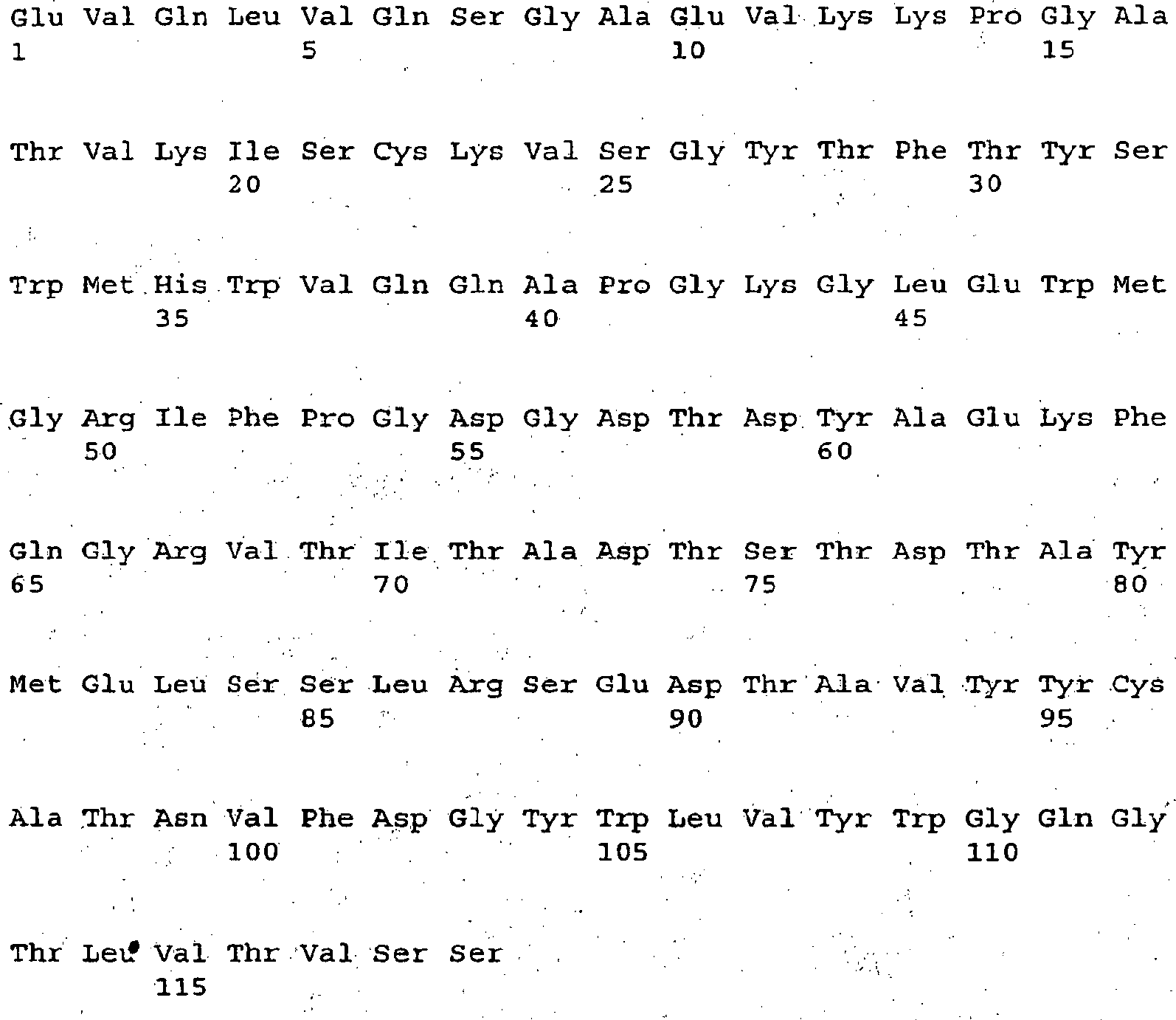
- <210> 51
<211> 357
<212> DNA
<213> Artificial - <220>
<223> Mouse-human chimeric DNA - <400> 51


- <210> 52
<211> 119
<212> PRT
<213> Artificial - <220>
<223> Mouse-human chimeric polypeptide - <400> 52

- <210> 53
<211> 366
<212> DNA
<213> Artificial - <220>
<223> Mouse-human chimeric DNA - <400> 53


- <210> 54
<211> 119
<212> PRT
<213> Artificial - <220>
<223> Mouse-human chimeric polypeptide - <400> 54

- <210> 55
<211> 357
<212> DNA
<213> Artificial - <220>
<223> Mouse-human chimeric DNA - <400> 55

- <210> 56
<211> 119
<212> PRT
<213> Artificial - <220>
<223> Mouse-human chimeric polypeptide - <400> 56

- <210> 57
<211> 456
<212> DNA
<213> Artificial - <220>
<223> Mouse-human chimeric DNA - <400> 57

- <210> 58
<211> 119
<212> PRT
<213> Artificial - <220>
<223> Mouse-human chimeric polypeptide - <400> 58


- <210> 59
<211> 357
<212> DNA
<213> Artificial - <220>
<223> Mouse-human chimeric DNA - <400> 59

- <210> 60
<211> 119
<212> PRT
<213> Artificial - <220>
<223> Mouse-human chimeric polypeptide - <400> 60


- <210> 61
<211> 456
<212> DNA
<213> Artificial - <220>
<223> Mouse-human chimeric DNA - <400> 61

- <210> 62
<211> 119
<212> PRT
<213> Artificial - <220>
<223> Mouse-human chimeric polypeptide - <400> 62


- <210> 63
<211> 456
<212> DNA
<213> Artificial - <220>
<223> Mouse-human chimeric DNA - <400> 63

- <210> 64
<211> 119
<212> PRT
<213> Artificial. - <220>
<223> Mouse-human chimeric polypeptide - <400> 64


- <210> 65
<211> 456
<212> DNA
<213> Artificial - <220>
<223> Mouse-human chimeric DNA - <400> 65

- <210> 66
<211> 119
<212> PRT
<213> Artificial - <220>
<223> Mouse-human chimeric polypeptide - <400> 66


- <210> 67
<211> 456
<212> DNA
<213> Artificial - <220>
<223> Mouse-human chimeric DNA - <400> 67
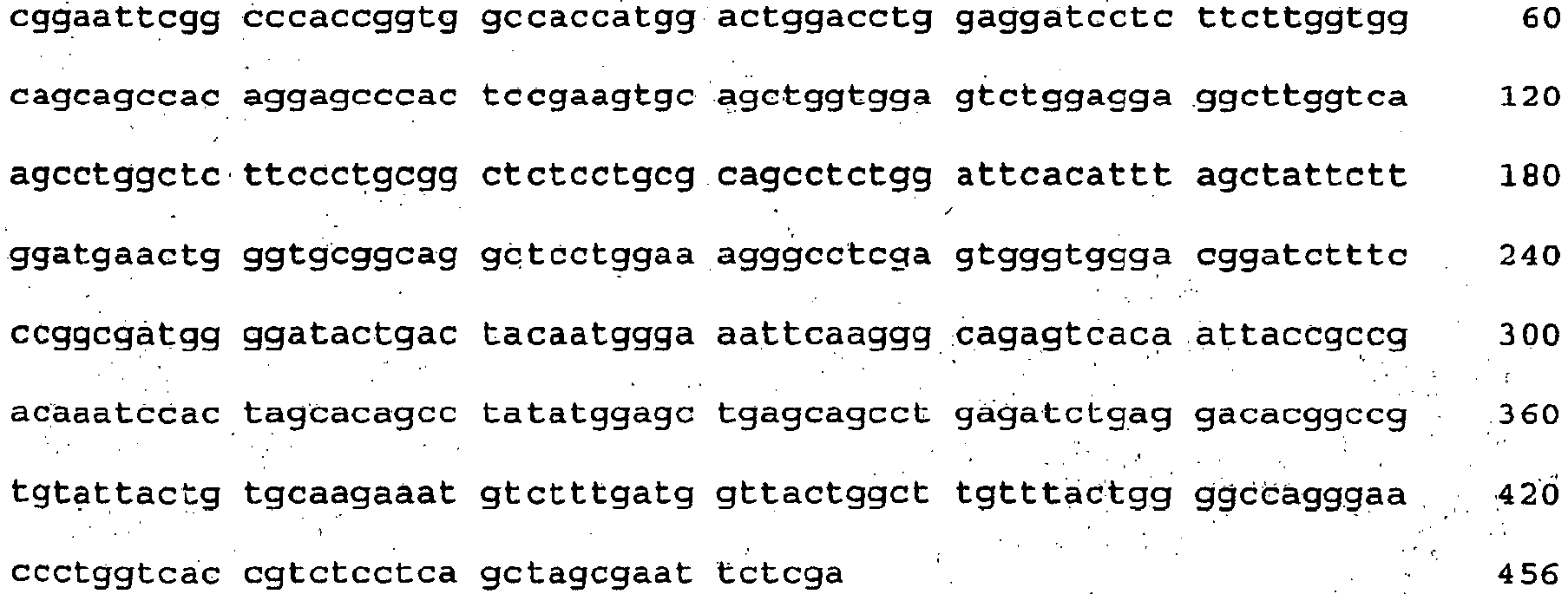
- <210> 68
<211> 119
<212> PRT
<213> Artificial - <220>
<223> Mouse-human chimeric polypeptide - <400> 68

- <210> 69
<211> 456
<212> DNA
<213> Artificial - <220>
<223> Mouse-human chimeric DNA - <400> 69

- <210> 70
<211> 119
<212> PRT
<213> Artificial - <220>
<223> Mouse-human chimeric polypeptide - <400> 70

- <210> 71
<211> 456
<212> DNA
<213> Artificial - <220>
<223> Mouse-human chimeric DNA - <400> 71


- <210> 72
<211> 119
<212> PRT
<213> . Artificial - <220>
<223> Mouse-human chimeric polypeptide - <400> 72

- <210> 73
<211> 57
<212> DNA
<213> Homo sapiens - <400> 73
atggactgga cctggaggat cctcttcttg gtggcagcag ccacaggagc ccactcc 57 - <210> 74
<211> 19
<212> PRT
<213> Homo sapiens - <400> 74
Ala His Ser

- <210> 75
<211> 345
<212> DNA
<213> Artificial - <220>
<223> Mouse-human chimeric DNA - <400> 75

- <210> 76
<211> 115
<212> PRT
<213> Artificial - <220>
<223> Mouse-human chimeric polypeptide - <400> 76


- <210> 77
<211> 66
<212> DNA
<213> Homo sapiens - <400> 77

- <210> 78
<211> 22
<212> PRT
<213> Homo sapiens - <400> 78

Claims (23)
- A humanized Type II anti-CD20 antibody comprising(a) a heavy chain variable region comprising SEQ ID NO:32 or a heavy chain variable region comprising SEQ ID NO:32 which comprises the substitution M34I, and(b) a light chain variable region comprising SEQ ID NO:76.
- The antibody of claim 1, wherein said antibody comprises the heavy chain variable region of SEQ ID NO:40.
- An expression vector comprising a polynucleotide encoding a heavy chain variable region of claim 1 or claim 2 and a polynucleotide encoding a light chain variable region of claim 1.
- The vector of claim 3, which is polycistronic.
- A host cell comprising the expression vector of claim 3 or claim 4 or a polynucleotide encoding a heavy chain variable region of claim 1 or claim 2 and a polynucleotide encoding a light chain variable region of claim 1.
- The host cell of claim 5, wherein said host cell is engineered to express at least one nucleic acid encoding a polypeptide having β(1,4)-N-acetylglucosylaminyltransferase III activity.
- The host cell of claim 6, wherein said polypeptide having β(1,4)-N-acetylglucosylaminyltransferase III activity is a fusion polypeptide further comprising the Golgi localization domain of a heterologous Golgi resident polypeptide.
- The host cell of claim 7, wherein said Golgi localization domain is selected from the localization domain of mannosidase II, the localization domain of β(1,2)-N-acetylglucosaminyltransferase I, β(1,2)-N-acetylglucosaminyltransfcrase II, mannosidase I or α1-6 core fucosyltransferase.
- A method for the production of a humanized Type II anti-CD20 antibody of claim 1 or claim 2 comprising culturing the host cell of any one of claims 5 to 8 under conditions that allow the production of said antibody and recovering said antibody from said culture.
- A humanized Type II anti-CD20 antibody, wherein the antibody is obtained by the method of claim 9.
- The antibody of any one of claims 1, 2 or 10, or obtained by the method of claim 9, wherein said antibody comprises a glycoengineered Fc region.
- The antibody of claim 11, wherein said antibody has an increase in the fraction of non-fucosylated oligosaccharides attached to said glycoengineered Fc region.
- The antibody of claim 11, wherein said antibody has an increase in the fraction of bisected, non-fucosylated oligosaccharides attached to said glycoengineered Fc region.
- The antibody of claim 11, wherein said antibody has significantly higher levels of binding to human FcgammaRIII receptors relative to the non-glycoengineered antibody.
- The antibody of claim 11, wherein said antibody has significantly higher levels of ADCC activity relative to the non-glycoengineered antibody.
- A pharmaceutical composition comprising the antibody of any one of claims 1, 2 or 10 to 15, or obtained by the method of claim 9 and a pharmaceutically acceptable carrier.
- An antibody of any one of claims 1, 2 or 10 to 15, or obtained by the method of claim 9 for use as a medicament to treat a B-cell disorder.
- The antibody of claim 17, wherein said B-cell disorder is a B-cell lymphoma.
- Use of the antibody of any one of claims 1, 2 or 10 to 15, or obtained by the method of claim 9 for the manufacture of a medicament to treat a disorder treatable by B-cell depletion.
- An antibody of any one of claims 1, 2 or 10 to 15, or obtained by the method of claim 9 for use as a medicament to treat a disorder treatable by B-cell depletion.
- The antibody for the use of claim 20 or the use of the antibody according to claim 19, wherein said disorder is a haematological malignancy or an autoimmune disease.
- The antibody for use or the use of the antibody according to claim 21, wherein said haematological malignancy is B-cell lymphoma, non-Hodgkin's lymphoma, or B-cell chronic lymphocytic leukaemia.
- The antibody for use or the use of the antibody according to claim 21, wherein said autoimmune disease is rheumatoid arthritis or lupus.
Priority Applications (20)
| Application Number | Priority Date | Filing Date | Title |
|---|---|---|---|
| EP10185340.6A EP2348051B1 (en) | 2003-11-05 | 2004-11-05 | CD20 antibodies with increased fc receptor binding affinity and effector function |
| DK10185340.6T DK2348051T3 (en) | 2003-11-05 | 2004-11-05 | CD20 antibodies with increased fc receptor binding affinity and effector function |
| SI200432374A SI2077282T1 (en) | 2003-11-05 | 2004-11-05 | Antigen binding molecules with increased Fc receptor binding affinity and effector function |
| RS20170173A RS55723B1 (en) | 2003-11-05 | 2004-11-05 | ANTIGEN-BINDING MOLECULES WITH INCREASED BINDING AFFINITY FOR FC RECEPTOR AND EFFECTOR FUNCTION |
| PL10185313T PL2380911T3 (en) | 2003-11-05 | 2004-11-05 | Antigen binding molecules with increased Fc receptor binding affinity and effector function |
| PL10185277T PL2380910T3 (en) | 2003-11-05 | 2004-11-05 | Antigen binding molecules with increased Fc receptor binding affinity and effector function |
| EP10185277.0A EP2380910B1 (en) | 2003-11-05 | 2004-11-05 | Antigen binding molecules with increased Fc receptor binding affinity and effector function |
| DK10185313.3T DK2380911T3 (en) | 2003-11-05 | 2004-11-05 | Antigen-binding molecules with increased Fc receptor binding affinity and effector function |
| PL10185340T PL2348051T3 (en) | 2003-11-05 | 2004-11-05 | CD20 antibodies with increased fc receptor binding affinity and effector function |
| EP10185313.3A EP2380911B1 (en) | 2003-11-05 | 2004-11-05 | Antigen binding molecules with increased Fc receptor binding affinity and effector function |
| DK10185277.0T DK2380910T3 (en) | 2003-11-05 | 2004-11-05 | Antigen binding molecules with increased Fc receptor binding affinity and effector function |
| FR15C0076C FR15C0076I2 (en) | 2003-11-05 | 2015-11-23 | ANTIGEN BINDING MOLECULES WITH ENHANCED FC RECEPTOR BINDING AFFINITY AND EFFECTOR FUNCTION |
| CY2016004C CY2016004I1 (en) | 2003-11-05 | 2016-02-18 | ANTIGEN BINDING MOLECULES WITH INCREASED BINDING AFFINITY TO THE Fc RECEPTOR AND EFFECTOR FUNCTION |
| BE2016C008C BE2016C008I2 (en) | 2003-11-05 | 2016-03-03 | |
| LTPA2016006C LTC2380910I2 (en) | 2003-11-05 | 2016-03-10 | Antigen-binding molecules with increased Fc receptor attachment and effector function |
| LU93001C LU93001I2 (en) | 2003-11-05 | 2016-03-14 | OBINUTUZUMAB AND ALL ITS VARIANTS AS PROTECTED IN THE BASIC PATENT |
| NL300801C NL300801I2 (en) | 2003-11-05 | 2016-03-16 | Obinutuzumab |
| HRP20170398TT HRP20170398T2 (en) | 2003-11-05 | 2017-03-09 | Antigen binding molecules with increased fc receptor binding affinity and effector function |
| CY20181100537T CY1120252T1 (en) | 2003-11-05 | 2018-05-22 | Antigen Binding Molecules with Increased Affinity Affinity to the FC Receiver and Operator Function |
| CY20191100144T CY1121206T1 (en) | 2003-11-05 | 2019-01-31 | ANTIBODIES AGAINST CD20 WITH INCREASED RELATION ASSOCIATION TO FC RECEPTOR AND OPERATOR OPERATION |
Applications Claiming Priority (2)
| Application Number | Priority Date | Filing Date | Title |
|---|---|---|---|
| US51709603P | 2003-11-05 | 2003-11-05 | |
| EP04798998A EP1692182B1 (en) | 2003-11-05 | 2004-11-05 | Cd20 antibodies with increased fc receptor binding affinity and effector function |
Related Parent Applications (1)
| Application Number | Title | Priority Date | Filing Date |
|---|---|---|---|
| EP04798998A Division EP1692182B1 (en) | 2003-11-05 | 2004-11-05 | Cd20 antibodies with increased fc receptor binding affinity and effector function |
Related Child Applications (6)
| Application Number | Title | Priority Date | Filing Date |
|---|---|---|---|
| EP10185340.6A Division EP2348051B1 (en) | 2003-11-05 | 2004-11-05 | CD20 antibodies with increased fc receptor binding affinity and effector function |
| EP10185340.6A Division-Into EP2348051B1 (en) | 2003-11-05 | 2004-11-05 | CD20 antibodies with increased fc receptor binding affinity and effector function |
| EP10185313.3A Division-Into EP2380911B1 (en) | 2003-11-05 | 2004-11-05 | Antigen binding molecules with increased Fc receptor binding affinity and effector function |
| EP10185313.3A Division EP2380911B1 (en) | 2003-11-05 | 2004-11-05 | Antigen binding molecules with increased Fc receptor binding affinity and effector function |
| EP10185277.0A Division EP2380910B1 (en) | 2003-11-05 | 2004-11-05 | Antigen binding molecules with increased Fc receptor binding affinity and effector function |
| EP10185277.0A Division-Into EP2380910B1 (en) | 2003-11-05 | 2004-11-05 | Antigen binding molecules with increased Fc receptor binding affinity and effector function |
Publications (3)
| Publication Number | Publication Date |
|---|---|
| EP2077282A2 EP2077282A2 (en) | 2009-07-08 |
| EP2077282A3 EP2077282A3 (en) | 2009-08-05 |
| EP2077282B1 true EP2077282B1 (en) | 2016-12-28 |
Family
ID=34572912
Family Applications (5)
| Application Number | Title | Priority Date | Filing Date |
|---|---|---|---|
| EP09004064.3A Expired - Lifetime EP2077282B1 (en) | 2003-11-05 | 2004-11-05 | Antigen binding molecules with increased Fc receptor binding affinity and effector function |
| EP10185313.3A Expired - Lifetime EP2380911B1 (en) | 2003-11-05 | 2004-11-05 | Antigen binding molecules with increased Fc receptor binding affinity and effector function |
| EP10185340.6A Expired - Lifetime EP2348051B1 (en) | 2003-11-05 | 2004-11-05 | CD20 antibodies with increased fc receptor binding affinity and effector function |
| EP10185277.0A Expired - Lifetime EP2380910B1 (en) | 2003-11-05 | 2004-11-05 | Antigen binding molecules with increased Fc receptor binding affinity and effector function |
| EP04798998A Expired - Lifetime EP1692182B1 (en) | 2003-11-05 | 2004-11-05 | Cd20 antibodies with increased fc receptor binding affinity and effector function |
Family Applications After (4)
| Application Number | Title | Priority Date | Filing Date |
|---|---|---|---|
| EP10185313.3A Expired - Lifetime EP2380911B1 (en) | 2003-11-05 | 2004-11-05 | Antigen binding molecules with increased Fc receptor binding affinity and effector function |
| EP10185340.6A Expired - Lifetime EP2348051B1 (en) | 2003-11-05 | 2004-11-05 | CD20 antibodies with increased fc receptor binding affinity and effector function |
| EP10185277.0A Expired - Lifetime EP2380910B1 (en) | 2003-11-05 | 2004-11-05 | Antigen binding molecules with increased Fc receptor binding affinity and effector function |
| EP04798998A Expired - Lifetime EP1692182B1 (en) | 2003-11-05 | 2004-11-05 | Cd20 antibodies with increased fc receptor binding affinity and effector function |
Country Status (40)
| Country | Link |
|---|---|
| US (8) | US9296820B2 (en) |
| EP (5) | EP2077282B1 (en) |
| JP (5) | JP4653109B2 (en) |
| KR (3) | KR101220691B1 (en) |
| CN (4) | CN1902231B (en) |
| AT (1) | ATE463513T1 (en) |
| AU (1) | AU2004287643C1 (en) |
| BE (1) | BE2016C008I2 (en) |
| BR (2) | BRPI0416262B1 (en) |
| CA (1) | CA2544865C (en) |
| CR (1) | CR11848A (en) |
| CY (6) | CY1110301T1 (en) |
| DE (1) | DE602004026470D1 (en) |
| DK (5) | DK2380911T3 (en) |
| EA (4) | EA015009B1 (en) |
| EC (2) | ECSP066603A (en) |
| ES (5) | ES2672640T3 (en) |
| FR (1) | FR15C0076I2 (en) |
| HK (1) | HK1213574A1 (en) |
| HR (5) | HRP20100303T1 (en) |
| HU (5) | HUE038955T2 (en) |
| IL (4) | IL175367A (en) |
| LT (4) | LT2380911T (en) |
| LU (2) | LU92632I2 (en) |
| MA (1) | MA31040B1 (en) |
| ME (3) | ME02332B (en) |
| MX (2) | MXPA06004836A (en) |
| NL (1) | NL300801I2 (en) |
| NO (6) | NO347530B1 (en) |
| NZ (2) | NZ547589A (en) |
| PL (5) | PL2380911T3 (en) |
| PT (5) | PT1692182E (en) |
| RS (5) | RS55723B1 (en) |
| SG (3) | SG10201504094SA (en) |
| SI (5) | SI2348051T1 (en) |
| TN (1) | TNSN06126A1 (en) |
| TR (2) | TR201903329T4 (en) |
| UA (1) | UA91823C2 (en) |
| WO (1) | WO2005044859A2 (en) |
| ZA (1) | ZA200604547B (en) |
Families Citing this family (909)
| Publication number | Priority date | Publication date | Assignee | Title |
|---|---|---|---|---|
| AU3657899A (en) | 1998-04-20 | 1999-11-08 | James E. Bailey | Glycosylation engineering of antibodies for improving antibody-dependent cellular cytotoxicity |
| NZ581474A (en) | 2001-08-03 | 2011-04-29 | Glycart Biotechnology Ag | Antibody glycosylation variants having increased antibody-dependent cellular cytotoxicity |
| TWI353991B (en) | 2003-05-06 | 2011-12-11 | Syntonix Pharmaceuticals Inc | Immunoglobulin chimeric monomer-dimer hybrids |
| KR101351122B1 (en) | 2003-05-09 | 2014-01-14 | 듀크 유니버시티 | CD20-Specific Antibodies and Methods of Employing Same |
| PT1692182E (en) * | 2003-11-05 | 2010-05-13 | Roche Glycart Ag | Cd20 antibodies with increased fc receptor binding affinity and effector function |
| JP2008507555A (en) * | 2004-07-22 | 2008-03-13 | ジェネンテック・インコーポレーテッド | Treatment for Sjogren's syndrome |
| EA012464B1 (en) | 2004-08-04 | 2009-10-30 | Эпплайд Молекьюлар Эволюшн, Инк. | Antibody against cd20 and use thereof |
| RU2411956C2 (en) | 2004-10-05 | 2011-02-20 | Дженентек, Инк. | Method of treating vasculitis |
| ES2755976T3 (en) | 2005-02-07 | 2020-04-24 | Roche Glycart Ag | Antigen-binding molecules that bind to EGFR, vectors that encode them, and uses thereof |
| JP2008539753A (en) * | 2005-05-09 | 2008-11-20 | グリクアート バイオテクノロジー アクチェンゲゼルシャフト | Antigen binding molecule having modified FC region and altered binding to FC receptor |
| ZA200709956B (en) * | 2005-05-20 | 2009-02-25 | Genentech Inc | Pretreatment of a biological sample from an autoimmune disease subject |
| WO2006133148A2 (en) * | 2005-06-03 | 2006-12-14 | Genentech, Inc. | Method of producing antibodies with modified fucosylation level |
| WO2007009469A2 (en) | 2005-07-21 | 2007-01-25 | Genmab A/S | Potency assays for antibody drug substance binding to an fc receptor |
| AU2012216702B2 (en) * | 2005-08-26 | 2014-12-04 | Roche Glycart Ag | Modified antigen binding molecules with altered cell signaling activity |
| RU2482132C2 (en) | 2005-08-26 | 2013-05-20 | Роше Гликарт Аг | Modified antigen-binding molecules with changed cell signal activity |
| EP2455100A3 (en) * | 2005-11-07 | 2012-11-07 | The Rockefeller University | Reagents, methods and systems for selecting a cytotoxic antibody or variant thereof |
| US20080206246A1 (en) * | 2006-04-05 | 2008-08-28 | Ravetch Jeffrey V | Polypeptides with enhanced anti-inflammatory and decreased cytotoxic properties and relating methods |
| US8470318B2 (en) * | 2005-11-07 | 2013-06-25 | The Rockefeller University | Polypeptides with enhanced anti-inflammatory and decreased cytotoxic properties and relating methods |
| MY149159A (en) | 2005-11-15 | 2013-07-31 | Hoffmann La Roche | Method for treating joint damage |
| AU2006342792A1 (en) | 2005-12-02 | 2007-11-08 | Genentech, Inc. | Compositions and methods for the treatment of diseases and disorders associated with cytokine signaling involving antibodies that bind to IL-22 and IL-22R |
| EP1973950B1 (en) | 2006-01-05 | 2014-09-17 | Genentech, Inc. | Anti-ephb4 antibodies and methods using the same |
| WO2008029281A2 (en) * | 2006-02-10 | 2008-03-13 | Invitrogen Corporation | Labeling and detection of post translationally modified proteins |
| AR059851A1 (en) | 2006-03-16 | 2008-04-30 | Genentech Inc | ANTIBODIES OF EGFL7 AND METHODS OF USE |
| EP2815768A3 (en) * | 2006-04-05 | 2015-01-14 | The Rockefeller University | Polypeptides with enhanced anti-inflammatory and decreased cytotoxic properties and relating methods |
| WO2007140371A2 (en) | 2006-05-30 | 2007-12-06 | Genentech, Inc. | Antibodies and immunoconjugates and uses therefor |
| WO2007143689A2 (en) * | 2006-06-06 | 2007-12-13 | Genentech, Inc. | Compositions and methods for modulating vascular development |
| AR062223A1 (en) * | 2006-08-09 | 2008-10-22 | Glycart Biotechnology Ag | MOLECULES OF ADHESION TO THE ANTIGEN THAT ADHER TO EGFR, VECTORS THAT CODE THEM, AND THEIR USES OF THESE |
| NZ576032A (en) * | 2006-10-12 | 2012-03-30 | Genentech Inc | Antibodies to lymphotoxin-alpha |
| AU2007308792B2 (en) | 2006-10-27 | 2013-01-24 | Genentech, Inc. | Antibodies and immunoconjugates and uses therefor |
| AU2013202392B2 (en) * | 2006-12-20 | 2016-02-25 | Mmrglobal, Inc. | Antibodies and methods for making and using them |
| CA2673725C (en) * | 2006-12-20 | 2016-01-12 | Mmr Information Systems, Inc. | Antibodies and methods for making and using them |
| JP5361738B2 (en) | 2007-01-22 | 2013-12-04 | ジェネンテック, インコーポレイテッド | Purification of polyelectrolyte precipitates and proteins |
| JP2010517944A (en) * | 2007-01-26 | 2010-05-27 | バイオインヴェント インターナショナル アーベー | DLL4 signaling inhibitor and use thereof |
| BRPI0806403A2 (en) | 2007-02-09 | 2011-09-06 | Genentech Inc | anti-robo4 antibody, use an antibody and imaging method |
| US7960139B2 (en) | 2007-03-23 | 2011-06-14 | Academia Sinica | Alkynyl sugar analogs for the labeling and visualization of glycoconjugates in cells |
| FR2915398B1 (en) * | 2007-04-25 | 2012-12-28 | Lab Francais Du Fractionnement | "SET OF MEANS FOR THE TREATMENT OF MALIGNANT PATHOLOGY, AUTOIMMUNE DISEASE OR INFECTIOUS DISEASE" |
| DK3072525T3 (en) | 2007-05-14 | 2018-04-30 | Astrazeneca Ab | PROCEDURES FOR REDUCING BASOFILE CELL LEVELS |
| DK2158315T3 (en) | 2007-06-25 | 2016-06-06 | Esbatech Alcon Biomed Res Unit | Methods of modifying antibodies and modified antibodies with improved functional properties |
| ATE543835T1 (en) | 2007-07-16 | 2012-02-15 | Genentech Inc | ANTI-CD79B ANTIBODIES AND IMMUNE CONJUGATES AND METHODS OF APPLICATION |
| ES2528922T3 (en) | 2007-07-16 | 2015-02-13 | Genentech, Inc. | Humanized and immunoconjugate anti-CD79b antibodies and methods of use |
| US20110243931A1 (en) * | 2007-09-02 | 2011-10-06 | Thomas Friess | Combination therapy with type i and type ii anti-cd20 antibodies |
| EP3415529B1 (en) | 2007-09-26 | 2020-11-04 | Chugai Seiyaku Kabushiki Kaisha | Modified antibody constant region |
| US20090098118A1 (en) * | 2007-10-15 | 2009-04-16 | Thomas Friess | Combination therapy of a type ii anti-cd20 antibody with an anti-bcl-2 active agent |
| US20090110688A1 (en) * | 2007-10-24 | 2009-04-30 | Georg Fertig | Combination therapy of type ii anti-cd20 antibody with a proteasome inhibitor |
| RU2503460C2 (en) | 2007-11-07 | 2014-01-10 | Дженентек Инк. | Using antimicrobial polypeptide for treating microbial disorders |
| TWI580694B (en) | 2007-11-30 | 2017-05-01 | 建南德克公司 | Anti-vegf antibodies |
| ES2511844T3 (en) * | 2007-12-21 | 2014-10-23 | F. Hoffmann-La Roche Ag | Antibody formulation |
| US9266967B2 (en) | 2007-12-21 | 2016-02-23 | Hoffmann-La Roche, Inc. | Bivalent, bispecific antibodies |
| US20090162359A1 (en) | 2007-12-21 | 2009-06-25 | Christian Klein | Bivalent, bispecific antibodies |
| CN101945667A (en) * | 2007-12-21 | 2011-01-12 | 健泰科生物技术公司 | Therapy of rituximab-refractory rheumatoid arthritis patients |
| PT2247620T (en) | 2008-01-31 | 2016-08-23 | Genentech Inc | ANTIBODIES AND IMMUNOCONJUGATES ANTI-CD79B AND METHODS OF USE |
| KR101280716B1 (en) * | 2008-03-25 | 2013-07-01 | 로슈 글리카트 아게 | Use of a type ⅱ anti-cd20 antibody with increased antibody dependent cellular cytotoxicity (adcc) in combination with cyclophosphamide, vincristine and doxorubicine for treating non-hodgkin's lymphomas |
| JP6161233B2 (en) * | 2008-03-31 | 2017-07-12 | ジェネンテック, インコーポレイテッド | Compositions and methods for the treatment and diagnosis of asthma |
| EP2279410B1 (en) * | 2008-04-22 | 2015-11-11 | The Rockefeller University | Methods of identifying anti-inflammatory compounds |
| WO2009134738A1 (en) * | 2008-04-29 | 2009-11-05 | Genentech, Inc. | Responses to immunizations in rheumatoid arthritis patients treated with a cd20 antibody |
| KR101054362B1 (en) * | 2008-07-03 | 2011-08-05 | 재단법인 목암생명공학연구소 | How to reduce the fucose content of recombinant protein |
| JP5986745B2 (en) | 2008-07-15 | 2016-09-06 | アカデミア シニカAcademia Sinica | Glycan arrays on PTFE-like aluminum-coated glass slides and related methods |
| TW201438738A (en) | 2008-09-16 | 2014-10-16 | 建南德克公司 | Method for treating progressive multiple sclerosis |
| KR101834999B1 (en) | 2008-10-14 | 2018-03-06 | 제넨테크, 인크. | Immunoglobulin variants and uses thereof |
| WO2010075249A2 (en) | 2008-12-22 | 2010-07-01 | Genentech, Inc. | A method for treating rheumatoid arthritis with b-cell antagonists |
| EP2382234A2 (en) | 2008-12-23 | 2011-11-02 | Genentech, Inc. | Immunoglobulin variants with altered binding to protein a |
| SG10201402742YA (en) | 2009-03-20 | 2014-08-28 | Genentech Inc | Bispecific anti-her antibodies |
| HRP20150965T1 (en) * | 2009-03-25 | 2015-11-06 | Genentech, Inc. | ANTI-FGR3 ANTIBODIES AND METHODS USED |
| JP6051048B2 (en) | 2009-03-25 | 2016-12-21 | ジェネンテック, インコーポレイテッド | Novel anti-α5β1 antibody and use thereof |
| US20100247484A1 (en) * | 2009-03-31 | 2010-09-30 | Heinrich Barchet | Combination therapy of an afucosylated antibody and one or more of the cytokines gm csf, m csf and/or il3 |
| BRPI1014089A2 (en) | 2009-04-02 | 2016-04-19 | Roche Glycart Ag | multispecific antibodies comprising full length antibodies and single chain fab fragments |
| PT2417156E (en) | 2009-04-07 | 2015-04-29 | Roche Glycart Ag | Trivalent, bispecific antibodies |
| AU2010233993A1 (en) | 2009-04-07 | 2011-09-08 | Roche Glycart Ag | Bispecific anti-ErbB-1/anti-c-Met antibodies |
| JP5587975B2 (en) | 2009-04-07 | 2014-09-10 | ロシュ グリクアート アクチェンゲゼルシャフト | Bispecific anti-ErbB-3 / anti-c-Met antibody |
| WO2010146059A2 (en) | 2009-06-16 | 2010-12-23 | F. Hoffmann-La Roche Ag | Biomarkers for igf-1r inhibitor therapy |
| US9676845B2 (en) | 2009-06-16 | 2017-06-13 | Hoffmann-La Roche, Inc. | Bispecific antigen binding proteins |
| DE202010018640U1 (en) | 2009-07-24 | 2019-11-14 | F. Hoffmann-La Roche Ag | stirrer system |
| TW201106972A (en) | 2009-07-27 | 2011-03-01 | Genentech Inc | Combination treatments |
| KR20120089253A (en) | 2009-07-31 | 2012-08-09 | 제넨테크, 인크. | Inhibition of tumor metastasis using bv8- or g-csf-antagonists |
| TWI409079B (en) * | 2009-08-14 | 2013-09-21 | Roche Glycart Ag | Combination therapy of atypical fucosylated CD20 antibody and bendamustine |
| RU2012109451A (en) | 2009-08-14 | 2013-09-27 | Роше Гликарт Аг | COMBINED THERAPY BASED ON AFUCHOSILY ANTIBODY TO CD20 IN COMBINATION WITH FLUDARABIN AND / OR MITOXANTRON |
| GB0914691D0 (en) | 2009-08-21 | 2009-09-30 | Lonza Biologics Plc | Immunoglobulin variants |
| TW201113037A (en) | 2009-08-28 | 2011-04-16 | Hoffmann La Roche | Antibodies against CDCP1 for the treatment of cancer |
| TWI412375B (en) | 2009-08-28 | 2013-10-21 | Roche Glycart Ag | Humanized anti-cdcp1 antibodies |
| DK2473522T3 (en) | 2009-09-02 | 2016-11-28 | Genentech Inc | Smoothened MUTANT AND METHODS OF USING THE SAME |
| AR078161A1 (en) | 2009-09-11 | 2011-10-19 | Hoffmann La Roche | VERY CONCENTRATED PHARMACEUTICAL FORMULATIONS OF AN ANTIBODY ANTI CD20. USE OF THE FORMULATION. TREATMENT METHOD |
| MX2012003396A (en) | 2009-09-16 | 2012-04-10 | Genentech Inc | Coiled coil and/or tether containing protein complexes and uses thereof. |
| AU2010303415B2 (en) * | 2009-10-07 | 2015-02-19 | Macrogenics, Inc. | Fc region-containing polypeptides that exhibit improved effector function due to alterations of the extent of fucosylation, and methods for their use |
| BR112012009412A2 (en) | 2009-10-22 | 2016-11-29 | Genentech Inc | 'isolated anti-hepsin antibody, nucleic acid molecule, host cell, method of making an antibody, immunoconjugate, pharmaceutical formulation, use of the antibody and method of making an anti-serine protease antibody' |
| WO2011056494A1 (en) | 2009-10-26 | 2011-05-12 | Genentech, Inc. | Activin receptor-like kinase-1 antagonist and vegfr3 antagonist combinations |
| WO2011056502A1 (en) | 2009-10-26 | 2011-05-12 | Genentech, Inc. | Bone morphogenetic protein receptor type ii compositions and methods of use |
| WO2011056497A1 (en) | 2009-10-26 | 2011-05-12 | Genentech, Inc. | Activin receptor type iib compositions and methods of use |
| DK3202898T3 (en) | 2009-11-02 | 2019-01-14 | Univ Washington | THERAPEUTIC NUCLEASE COMPOSITIONS AND PROCEDURES |
| EP2496600A1 (en) | 2009-11-04 | 2012-09-12 | Fabrus LLC | Methods for affinity maturation-based antibody optimization |
| SI2496601T1 (en) | 2009-11-05 | 2017-09-29 | F. Hoffmann-La Roche Ag | Methods and composition for secretion of heterologous polypeptides |
| US11377485B2 (en) | 2009-12-02 | 2022-07-05 | Academia Sinica | Methods for modifying human antibodies by glycan engineering |
| US10087236B2 (en) | 2009-12-02 | 2018-10-02 | Academia Sinica | Methods for modifying human antibodies by glycan engineering |
| TWI505836B (en) | 2009-12-11 | 2015-11-01 | Genentech Inc | Anti-vegf-c antibodies and methods using same |
| PH12012501157A1 (en) | 2009-12-22 | 2012-10-29 | Roche Glycart Ag | Anti-her3 antibodies and uses thereof |
| NZ600826A (en) | 2009-12-23 | 2014-09-26 | Genentech Inc | Anti-bv8 antibodies and uses thereof |
| US9173961B2 (en) | 2010-02-10 | 2015-11-03 | Immunogen, Inc. | CD20 antibodies and uses thereof |
| RU2577702C2 (en) | 2010-02-11 | 2016-03-20 | Ф.Хоффманн-Ля Рош Аг | Nk-cell 3d-facs-analysis-adcc |
| KR20130000384A (en) | 2010-02-18 | 2013-01-02 | 더 보드 어브 트러스티스 어브 더 리랜드 스탠포드 주니어 유니버시티 | Neuregulin antagonists and use thereof in treating cancer |
| BR112012022044A2 (en) | 2010-03-24 | 2020-08-25 | Genentech Inc | ''antibody, immunoconjugate, pharmaceutical formulation, antibody use, treatment method, isolated bispecific antibody and host cell''. |
| TW201138821A (en) | 2010-03-26 | 2011-11-16 | Roche Glycart Ag | Bispecific antibodies |
| EP2374816B1 (en) | 2010-04-07 | 2016-09-28 | Agency For Science, Technology And Research | Binding molecules against Chikungunya virus and uses thereof |
| WO2011124635A1 (en) | 2010-04-07 | 2011-10-13 | Humalys | Binding molecules against chikungunya virus and uses thereof |
| WO2011130332A1 (en) | 2010-04-12 | 2011-10-20 | Academia Sinica | Glycan arrays for high throughput screening of viruses |
| MX342590B (en) * | 2010-04-27 | 2016-10-05 | Roche Glycart Ag | Combination therapy of an afucosylated cd20 antibody with a mtor inhibitor. |
| EP2568976B1 (en) | 2010-05-10 | 2015-09-30 | Academia Sinica | Zanamivir phosphonate congeners with anti-influenza activity and determining oseltamivir susceptibility of influenza viruses |
| WO2011147834A1 (en) | 2010-05-26 | 2011-12-01 | Roche Glycart Ag | Antibodies against cd19 and uses thereof |
| BR112012029866A2 (en) | 2010-06-03 | 2017-03-07 | Genentech Inc | method for determining the presence of a steap-1 protein |
| CA2794731C (en) | 2010-06-18 | 2019-03-19 | Genentech, Inc. | Anti-axl antibodies and methods of use |
| WO2011161119A1 (en) | 2010-06-22 | 2011-12-29 | F. Hoffmann-La Roche Ag | Antibodies against insulin-like growth factor i receptor and uses thereof |
| WO2011161189A1 (en) | 2010-06-24 | 2011-12-29 | F. Hoffmann-La Roche Ag | Anti-hepsin antibodies and methods of use |
| WO2012006503A1 (en) | 2010-07-09 | 2012-01-12 | Genentech, Inc. | Anti-neuropilin antibodies and methods of use |
| HRP20191305T1 (en) | 2010-07-09 | 2019-10-18 | Bioverativ Therapeutics Inc. | Processable single chain molecules and polypeptides made using same |
| EP2409712A1 (en) | 2010-07-19 | 2012-01-25 | International-Drug-Development-Biotech | Anti-CD19 antibody having ADCC and CDC functions and improved glycosylation profile |
| EP2409993A1 (en) | 2010-07-19 | 2012-01-25 | International-Drug-Development-Biotech | Anti-CD19 antibody having ADCC function with improved glycosylation profile |
| EP2409989A1 (en) | 2010-07-19 | 2012-01-25 | International-Drug-Development-Biotech | Method to improve glycosylation profile for antibody |
| FR2962908A1 (en) | 2010-07-20 | 2012-01-27 | Lfb Biotechnologies | ANTI-CD20 ANTIBODY FORMULATION |
| WO2012010582A1 (en) | 2010-07-21 | 2012-01-26 | Roche Glycart Ag | Anti-cxcr5 antibodies and methods of use |
| BR112013002535A2 (en) | 2010-08-03 | 2019-09-24 | F. Hoffmann - La Roche Ag | biomarkers of chronic lymphocytic leukemia (cll) |
| MX2013001305A (en) | 2010-08-05 | 2013-03-20 | Hoffmann La Roche | Anti-mhc antibody anti-viral cytokine fusion protein. |
| CA2807552A1 (en) | 2010-08-06 | 2012-02-09 | Moderna Therapeutics, Inc. | Engineered nucleic acids and methods of use thereof |
| SG187746A1 (en) | 2010-08-13 | 2013-03-28 | Roche Glycart Ag | Anti-fap antibodies and methods of use |
| KR101653030B1 (en) | 2010-08-13 | 2016-08-31 | 로슈 글리카트 아게 | Anti-tenascin-c a2 antibodies and methods of use |
| WO2012022734A2 (en) | 2010-08-16 | 2012-02-23 | Medimmune Limited | Anti-icam-1 antibodies and methods of use |
| AR082693A1 (en) | 2010-08-17 | 2012-12-26 | Roche Glycart Ag | COMBINATION THERAPY OF AN ANTI-CD20 AFUCOSILATED ANTIBODY WITH AN ANTI-VEGF ANTIBODY |
| NZ604510A (en) | 2010-08-17 | 2013-10-25 | Csl Ltd | Dilutable biocidal compositions and methods of use |
| RU2013110875A (en) | 2010-08-24 | 2014-09-27 | Ф.Хоффманн-Ля Рош Аг | SPECIFIC ANTIBODIES CONTAINING DISSULPHIDE-STABILIZED Fv Fragment |
| AR082518A1 (en) | 2010-08-25 | 2012-12-12 | Hoffmann La Roche | ANTIBODIES AGAINST IL-18R1 AND USES OF THE SAME |
| SG10201408229WA (en) | 2010-08-31 | 2015-02-27 | Genentech Inc | Biomarkers and methods of treatment |
| ES3005233T3 (en) | 2010-10-01 | 2025-03-14 | Modernatx Inc | Modified nucleosides, nucleotides, and nucleic acids, and uses thereof |
| AU2011312205B2 (en) | 2010-10-05 | 2015-08-13 | Curis, Inc. | Mutant smoothened and methods of using the same |
| EP2787007A3 (en) | 2010-11-08 | 2015-03-11 | F. Hoffmann-La Roche AG | Subcutaneously administered ANTI-IL-6 receptor antibody |
| TW201300417A (en) | 2010-11-10 | 2013-01-01 | Genentech Inc | Method and composition for neurological immunotherapy |
| WO2012075037A1 (en) | 2010-11-30 | 2012-06-07 | Genentech, Inc. | Low affinity blood brain barrier receptor antibodies and uses therefor |
| TWI638833B (en) | 2010-11-30 | 2018-10-21 | 中外製藥股份有限公司 | Cell damage induction treatment |
| EP2652498B1 (en) | 2010-12-16 | 2018-04-18 | F.Hoffmann-La Roche Ag | Diagnosis and treatments relating to th2 inhibition |
| JP2014507384A (en) | 2010-12-16 | 2014-03-27 | ロシュ グリクアート アーゲー | Combination therapy of afucosylated CD20 antibody with MDM2 inhibitor |
| PE20170917A1 (en) | 2010-12-20 | 2017-07-12 | Genentech Inc | ANTI-MESOTHELIN ANTIBODIES AND IMMUNOCONJUGATES |
| BR112013015687A2 (en) | 2010-12-22 | 2016-10-11 | Genentech Inc | anti-pcsk9 antibody or an antibody fragment that binds to pcsk9, isolated nucleic acid, vector, host cell, method for making an anti-pcsk9 antibody, pharmaceutical composition, method of lowering ldl cholesterol level in a subject and method of treatment of hypercholesterolemia in a subject |
| JP5766296B2 (en) | 2010-12-23 | 2015-08-19 | エフ.ホフマン−ラ ロシュ アーゲーF. Hoffmann−La Roche Aktiengesellschaft | Polypeptide-polynucleotide complexes and their use in targeted delivery of effector components |
| RU2013139267A (en) * | 2011-02-10 | 2015-03-20 | Рош Гликарт Аг | IMPROVED IMMUNOTHERAPY |
| EP2681239B8 (en) | 2011-02-28 | 2015-09-09 | F. Hoffmann-La Roche AG | Antigen binding proteins |
| AR085403A1 (en) | 2011-02-28 | 2013-09-25 | Hoffmann La Roche | MONOVALENT PROTEINS THAT JOIN ANTIGENS |
| ES2692268T5 (en) | 2011-03-29 | 2025-02-26 | Roche Glycart Ag | Antibody fc variants |
| JP2014511687A (en) | 2011-03-31 | 2014-05-19 | モデルナ セラピューティクス インコーポレイテッド | Engineered nucleic acid delivery and formulation |
| BR112013024717A2 (en) | 2011-04-07 | 2017-08-08 | Genentech Inc | isolated antibody, isolated nucleic acid, host cell, immunoconjugate, pharmaceutical formulation, method of treating an individual who has cancer and method of inhibiting cell proliferation in an individual |
| WO2012146630A1 (en) | 2011-04-29 | 2012-11-01 | F. Hoffmann-La Roche Ag | N-terminal acylated polypeptides, methods for their production and uses thereof |
| PH12013502441B1 (en) | 2011-04-29 | 2019-02-08 | Univ Washington | Therapeutic nuclease compositions and methods |
| US8679767B2 (en) | 2011-05-12 | 2014-03-25 | Genentech, Inc. | Multiple reaction monitoring LC-MS/MS method to detect therapeutic antibodies in animal samples using framework signature peptides |
| KR101623246B1 (en) | 2011-05-16 | 2016-05-20 | 제넨테크, 인크. | Fgfr1 agonists and methods of use |
| MY166974A (en) | 2011-06-15 | 2018-07-27 | Hoffmann La Roche | Anti-human epo receptor antibodies and method of use |
| PE20141212A1 (en) | 2011-06-22 | 2014-09-19 | Hoffmann La Roche | ELIMINATION OF TARGET CELLS BY VIRUS SPECIFIC CYTOTOXIC T CELLS USING COMPLEXES INCLUDING CLASS 1 MHC |
| FR2976811A1 (en) | 2011-06-22 | 2012-12-28 | Lfb Biotechnologies | USE OF A HIGH ADCC ANTI-CD20 ANTIBODY FOR THE TREATMENT OF WALDENSTROM'S DISEASE |
| WO2013003680A1 (en) | 2011-06-30 | 2013-01-03 | Genentech, Inc. | Anti-c-met antibody formulations |
| US20140363438A1 (en) | 2011-08-17 | 2014-12-11 | Genentech, Inc. | Neuregulin antibodies and uses thereof |
| MX2014001736A (en) | 2011-08-17 | 2014-03-31 | Genentech Inc | Inhibition of angiogenesis in refractory tumors. |
| BR112014003999A2 (en) | 2011-08-23 | 2017-06-13 | Roche Glycart Ag | isolated antibody that binds to a near epitope near the human mcsp membrane, isolated nucleic acid, host cell, method of producing an antibody, immunoconjugate, pharmaceutical formulation, use of the antibody, method of treating cancer patients, unduction method of cell lysis in individuals and mcsp immunohistochemical test |
| EP2747781B1 (en) | 2011-08-23 | 2017-11-15 | Roche Glycart AG | Bispecific antibodies specific for t-cell activating antigens and a tumor antigen and methods of use |
| US9464124B2 (en) | 2011-09-12 | 2016-10-11 | Moderna Therapeutics, Inc. | Engineered nucleic acids and methods of use thereof |
| WO2013040433A1 (en) | 2011-09-15 | 2013-03-21 | Genentech, Inc. | Methods of promoting differentiation |
| WO2013043715A1 (en) | 2011-09-19 | 2013-03-28 | Genentech, Inc. | Combination treatments comprising c-met antagonists and b-raf antagonists |
| EP2758435A1 (en) | 2011-09-23 | 2014-07-30 | Roche Glycart AG | Bispecific anti-egfr/anti igf-1r antibodies |
| SG11201401102VA (en) * | 2011-09-30 | 2014-09-26 | Chugai Pharmaceutical Co Ltd | Ion concentration-dependent binding molecule library |
| MX2014003689A (en) | 2011-09-30 | 2014-12-05 | Teva Pharmaceuticals Australia Pty Ltd | Antibodies against tl1a and uses thereof. |
| EP2763701B1 (en) | 2011-10-03 | 2018-12-19 | Moderna Therapeutics, Inc. | Modified nucleosides, nucleotides, and nucleic acids, and uses thereof |
| CA2849011A1 (en) | 2011-10-05 | 2013-04-11 | Genentech, Inc. | Methods of treating liver conditions using notch2 antagonists |
| MX390891B (en) | 2011-10-14 | 2025-03-19 | Genentech Inc | ANTI-HtrA1 ANTIBODIES AND METHODS OF USE. |
| MX2014004426A (en) | 2011-10-15 | 2014-07-09 | Genentech Inc | Scd1 antagonists for treating cancer. |
| WO2013059531A1 (en) | 2011-10-20 | 2013-04-25 | Genentech, Inc. | Anti-gcgr antibodies and uses thereof |
| WO2013059740A1 (en) | 2011-10-21 | 2013-04-25 | Foundation Medicine, Inc. | Novel alk and ntrk1 fusion molecules and uses thereof |
| PH12014500925A1 (en) | 2011-10-28 | 2014-06-09 | Genentech Inc | Therapeutic combinations and methods of treating melanoma |
| AU2012327878A1 (en) | 2011-10-28 | 2014-05-29 | Patrys Limited | PAT-LM1 epitopes and methods for using same |
| ES2749349T3 (en) | 2011-11-07 | 2020-03-19 | Medimmune Llc | Multispecific and multivalent binding proteins and uses thereof |
| MX2014005885A (en) | 2011-11-21 | 2014-09-04 | Genentech Inc | Purification of anti-c-met antibodies. |
| US20130302274A1 (en) | 2011-11-25 | 2013-11-14 | Roche Glycart Ag | Combination therapy |
| WO2013083497A1 (en) | 2011-12-06 | 2013-06-13 | F. Hoffmann-La Roche Ag | Antibody formulation |
| JP2015501844A (en) | 2011-12-16 | 2015-01-19 | モデルナ セラピューティクス インコーポレイテッドModerna Therapeutics,Inc. | Modified nucleosides, nucleotides and nucleic acid compositions |
| PT2794905T (en) | 2011-12-20 | 2020-06-30 | Medimmune Llc | Modified polypeptides for bispecific antibody scaffolds |
| HRP20200744T1 (en) | 2011-12-22 | 2020-07-24 | F. Hoffmann - La Roche Ag | ORGANIZATION OF EXPRESSION VECTOR, NEW PROCEDURES FOR GENERATION OF CELL PRODUCTION AND THEIR USE FOR RECOMBINANT POLYPEPTIDE PRODUCTION |
| RU2756910C2 (en) | 2011-12-22 | 2021-10-06 | Ф. Хоффманн-Ля Рош Аг | Combinations of expression vector elements, new methods for producing producer cells and their application for recombinant production of polypeptides |
| CN104011080B (en) | 2011-12-22 | 2017-10-20 | 弗·哈夫曼-拉罗切有限公司 | Full-length antibody display system for eukaryotic cells and use thereof |
| WO2013096791A1 (en) | 2011-12-23 | 2013-06-27 | Genentech, Inc. | Process for making high concentration protein formulations |
| CA2862424A1 (en) | 2012-01-18 | 2013-07-25 | Genentech, Inc. | Methods of using fgf19 modulators |
| US9200072B2 (en) | 2012-01-18 | 2015-12-01 | Genentech Inc. | Anti-LRP5 antibodies and methods of use |
| CN104105711B (en) | 2012-02-10 | 2018-11-30 | 弗·哈夫曼-拉罗切有限公司 | Single-chain antibody and other heteromultimerics |
| HK1211037A1 (en) | 2012-02-11 | 2016-05-13 | 霍夫曼-拉罗奇有限公司 | R-spondin translocations and methods using the same |
| PL2814587T3 (en) | 2012-02-15 | 2018-10-31 | F.Hoffmann-La Roche Ag | Fc-receptor based affinity chromatography |
| RU2014136886A (en) | 2012-03-27 | 2016-05-20 | Дженентек, Инк. | DIAGNOSTIC AND TREATMENT TYPES RELATED TO HER3 INHIBITORS |
| AR090549A1 (en) | 2012-03-30 | 2014-11-19 | Genentech Inc | ANTI-LGR5 AND IMMUNOCATE PLAYERS |
| US9254311B2 (en) | 2012-04-02 | 2016-02-09 | Moderna Therapeutics, Inc. | Modified polynucleotides for the production of proteins |
| WO2013151663A1 (en) | 2012-04-02 | 2013-10-10 | modeRNA Therapeutics | Modified polynucleotides for the production of membrane proteins |
| US9572897B2 (en) | 2012-04-02 | 2017-02-21 | Modernatx, Inc. | Modified polynucleotides for the production of cytoplasmic and cytoskeletal proteins |
| US9283287B2 (en) | 2012-04-02 | 2016-03-15 | Moderna Therapeutics, Inc. | Modified polynucleotides for the production of nuclear proteins |
| US10130714B2 (en) | 2012-04-14 | 2018-11-20 | Academia Sinica | Enhanced anti-influenza agents conjugated with anti-inflammatory activity |
| BR112014027166A2 (en) | 2012-05-01 | 2017-06-27 | Genentech Inc | antibody, nucleic acid, host cell, method for producing an antibody, immunoconjugate, pharmaceutical formulation, treatment method, proliferation inhibiting method and detection methods. |
| WO2013170191A1 (en) | 2012-05-11 | 2013-11-14 | Genentech, Inc. | Methods of using antagonists of nad biosynthesis from nicotinamide |
| PL2849723T3 (en) | 2012-05-18 | 2018-10-31 | Genentech, Inc. | High-concentration monoclonal antibody formulations |
| MX374424B (en) | 2012-05-21 | 2025-03-06 | Genentech Inc | METHODS TO IMPROVE THE SAFETY OF BLOOD-BRAIN BARRIER TRANSPORT. |
| MX2014014086A (en) | 2012-05-23 | 2015-01-26 | Genentech Inc | Selection method for therapeutic agents. |
| RU2015101113A (en) | 2012-06-15 | 2016-08-10 | Дженентек, Инк. | ANTIBODIES AGAINST PCSK9, COMPOSITIONS, DOSES AND METHODS OF APPLICATION |
| HK1209034A1 (en) | 2012-06-21 | 2016-03-24 | Indiana University Research And Technology Corporation | Incretin receptor ligand polypeptide fc-region fusion polypeptides and conjugates with altered fc-effector function |
| WO2014004549A2 (en) | 2012-06-27 | 2014-01-03 | Amgen Inc. | Anti-mesothelin binding proteins |
| MX2014014804A (en) | 2012-06-27 | 2015-02-12 | Hoffmann La Roche | Method for making antibody fc-region conjugates comprising at least one binding entity that specifically binds to a target and uses thereof. |
| EP2867253B1 (en) | 2012-06-27 | 2016-09-14 | F. Hoffmann-La Roche AG | Method for selection and production of tailor-made highly selective and multi-specific targeting entities containing at least two different binding entities and uses thereof |
| BR112014030844A2 (en) | 2012-07-04 | 2019-10-15 | Hoffmann La Roche | humanized anti-biotin antibody, pharmaceutical formulation and antibody use |
| BR112014029403A2 (en) | 2012-07-04 | 2018-10-09 | F. Hoffmann-La Roche Ag | conjugates, antibody and pharmaceutical formulation |
| JP6324376B2 (en) | 2012-07-04 | 2018-05-16 | エフ.ホフマン−ラ ロシュ アーゲーF. Hoffmann−La Roche Aktiengesellschaft | Anti-theophylline antibodies and methods of use |
| PL2870247T3 (en) | 2012-07-05 | 2019-10-31 | Hoffmann La Roche | Expression and secretion system |
| CN104540524A (en) | 2012-07-09 | 2015-04-22 | 基因泰克公司 | Immunoconjugates comprising anti-CD22 antibodies |
| CN104428007B (en) | 2012-07-09 | 2018-03-16 | 基因泰克公司 | Immunoconjugates comprising anti-CD22 antibody |
| EP2869847B1 (en) | 2012-07-09 | 2017-12-06 | Genentech, Inc. | Immunoconjugates comprising anti-cd79b antibodies |
| AR091700A1 (en) | 2012-07-09 | 2015-02-25 | Genentech Inc | ANTI-CD79B ANTIBODIES AND IMMUNOCATION |
| LT3495387T (en) | 2012-07-13 | 2021-11-25 | Roche Glycart Ag | Bispecific anti-vegf/anti-ang-2 antibodies and their use in the treatment of ocular vascular diseases |
| AR092044A1 (en) * | 2012-08-07 | 2015-03-18 | Roche Glycart Ag | IMPROVED IMMUNOTHERAPY |
| WO2014031498A1 (en) | 2012-08-18 | 2014-02-27 | Academia Sinica | Cell-permeable probes for identification and imaging of sialidases |
| AU2013305827A1 (en) | 2012-08-21 | 2015-03-05 | Academia Sinica | Benzocyclooctyne compounds and uses thereof |
| RU2711552C2 (en) | 2012-08-29 | 2020-01-17 | Ф. Хоффманн-Ля Рош Аг | Shuttle for blood-brain barrier |
| MX2015002947A (en) * | 2012-09-07 | 2015-09-23 | Genentech Inc | Combination therapy of a type ii anti-cd20 antibody with a selective bcl-2 inhibitor. |
| EP2905290B1 (en) | 2012-10-05 | 2019-12-04 | Kyowa Kirin Co., Ltd. | Heterodimeric protein composition |
| WO2014056783A1 (en) | 2012-10-08 | 2014-04-17 | Roche Glycart Ag | Fc-free antibodies comprising two fab-fragments and methods of use |
| EP2727942A1 (en) | 2012-11-05 | 2014-05-07 | MAB Discovery GmbH | Bispecific antibodies against human EGFR, HER2, and HER3 |
| AU2013337277B2 (en) | 2012-11-05 | 2018-03-08 | Foundation Medicine, Inc. | Novel NTRK1 fusion molecules and uses thereof |
| EP2914629A1 (en) | 2012-11-05 | 2015-09-09 | MAB Discovery GmbH | Method for the production of multispecific antibodies |
| EP2727943A1 (en) | 2012-11-05 | 2014-05-07 | MAB Discovery GmbH | Trispecific antibodies against human EGFR, HER2 and HER3 |
| EP2727941A1 (en) | 2012-11-05 | 2014-05-07 | MAB Discovery GmbH | Method for the production of multispecific antibodies |
| WO2014071419A2 (en) | 2012-11-05 | 2014-05-08 | Foundation Medicine, Inc. | Novel fusion molecules and uses thereof |
| WO2014072306A1 (en) | 2012-11-08 | 2014-05-15 | F. Hoffmann-La Roche Ag | Her3 antigen binding proteins binding to the beta-hairpin of her3 |
| JP6386465B2 (en) | 2012-11-13 | 2018-09-05 | ジェネンテック, インコーポレイテッド | Anti-hemagglutinin antibodies and methods of use |
| ES2921623T3 (en) | 2012-11-26 | 2022-08-30 | Modernatx Inc | terminally modified RNA |
| WO2014096672A1 (en) | 2012-12-17 | 2014-06-26 | Laboratoire Francais Du Fractionnement Et Des Biotechnologies | Use of monoclonal antibodies for the treatment of inflammation and bacterial infections |
| WO2014096015A1 (en) | 2012-12-21 | 2014-06-26 | F. Hoffmann-La Roche Ag | Disulfide-linked multivalent mhc class i comprising multi-function proteins |
| US20140194368A1 (en) * | 2013-01-04 | 2014-07-10 | Beech Tree Labs, Inc. | Method of Treating Cancer by Administration of Low Levels of Heat Shock Protein 70 (HSP70) |
| AR094403A1 (en) | 2013-01-11 | 2015-07-29 | Hoffmann La Roche | ANTI-HER3 ANTIBODY COMBINATION THERAPY |
| RU2519546C1 (en) | 2013-01-16 | 2014-06-10 | Общество С Ограниченной Ответственностью "Биоинтегратор" (Ооо "Биоинтегратор") | CONJUGATES AND SMALL MOLECULES, INTERACTING WITH CD16a RECEPTOR |
| WO2014113729A2 (en) | 2013-01-18 | 2014-07-24 | Foundation Mecicine, Inc. | Methods of treating cholangiocarcinoma |
| WO2014116749A1 (en) | 2013-01-23 | 2014-07-31 | Genentech, Inc. | Anti-hcv antibodies and methods of using thereof |
| PT2951208T (en) | 2013-02-01 | 2019-12-30 | Univ California | Anti-cd83 antibodies and use thereof |
| KR102489953B1 (en) | 2013-02-07 | 2023-01-20 | 씨에스엘 리미티드 | Il-11r binding proteins and uses thereof |
| AU2014217561B2 (en) | 2013-02-13 | 2018-11-15 | Laboratoire Francais Du Fractionnement Et Des Biotechnologies | Highly galactosylated anti-TNF-alpha antibodies and uses thereof |
| KR20150118159A (en) | 2013-02-22 | 2015-10-21 | 에프. 호프만-라 로슈 아게 | Methods of treating cancer and preventing drug resistance |
| WO2014131712A1 (en) | 2013-02-26 | 2014-09-04 | Roche Glycart Ag | Bispecific t cell activating antigen binding molecules |
| JP2016512489A (en) | 2013-02-26 | 2016-04-28 | ロシュ グリクアート アーゲー | Anti-MCSP antibody |
| JP6499087B2 (en) | 2013-02-26 | 2019-04-10 | ロシュ グリクアート アーゲー | Bispecific T cell activation antigen binding molecule |
| KR20150123250A (en) | 2013-03-06 | 2015-11-03 | 제넨테크, 인크. | Methods of treating and preventing cancer drug resistance |
| AU2014248886B2 (en) * | 2013-03-12 | 2019-06-27 | University Of Utah Research Foundation | Compositions and methods for inducing apoptosis |
| CN105209069B (en) * | 2013-03-13 | 2019-08-23 | 豪夫迈·罗氏有限公司 | Antibody formulation |
| AU2014239903A1 (en) | 2013-03-14 | 2015-09-17 | Genentech, Inc. | Combinations of a MEK inhibitor compound with an HER3/EGFR inhibitor compound and methods of use |
| EP3299391B1 (en) | 2013-03-14 | 2019-12-04 | Genentech, Inc. | Anti-b7-h4 antibodies and immunoconjugates |
| KR20150127216A (en) | 2013-03-14 | 2015-11-16 | 제넨테크, 인크. | Methods of treating cancer and preventing cancer drug resistance |
| US9562099B2 (en) | 2013-03-14 | 2017-02-07 | Genentech, Inc. | Anti-B7-H4 antibodies and immunoconjugates |
| RU2015143437A (en) | 2013-03-15 | 2017-04-27 | Дженентек, Инк. | METHODS FOR TREATING CANCER AND PREVENTING RESISTANCE TO MEDICINES FOR TREATING CANCER |
| PE20151673A1 (en) | 2013-03-15 | 2015-11-27 | Genentech Inc | IL-22 POLYPEPTIDES AND IL-22 Fc FUSION PROTEINS AND METHODS OF USE |
| US8980864B2 (en) | 2013-03-15 | 2015-03-17 | Moderna Therapeutics, Inc. | Compositions and methods of altering cholesterol levels |
| US9587235B2 (en) | 2013-03-15 | 2017-03-07 | Atyr Pharma, Inc. | Histidyl-tRNA synthetase-Fc conjugates |
| WO2014151006A2 (en) | 2013-03-15 | 2014-09-25 | Genentech, Inc. | Biomarkers and methods of treating pd-1 and pd-l1 related conditions |
| WO2014144865A2 (en) | 2013-03-15 | 2014-09-18 | Genentech, Inc. | Anti-crth2 antibodies and methods of use |
| AU2014236815B2 (en) | 2013-03-15 | 2019-04-04 | Genentech, Inc. | Compositions and methods for diagnosis and treatment of hepatic cancers |
| BR112015023262B8 (en) | 2013-03-15 | 2024-02-06 | Ac Immune Sa | Isolated antibody, immunoconjugate, pharmaceutical formulation and uses of antibody |
| UA118028C2 (en) | 2013-04-03 | 2018-11-12 | Рош Глікарт Аг | Bispecific antibodies specific for fap and dr5, antibodies specific for dr5 and methods of use |
| EP2992010B1 (en) | 2013-04-29 | 2021-03-24 | F.Hoffmann-La Roche Ag | Fc-receptor binding modified asymmetric antibodies and methods of use |
| SG10201810481UA (en) | 2013-04-29 | 2018-12-28 | Hoffmann La Roche | Fcrn-binding abolished anti-igf-1r antibodies and their use in the treatment of vascular eye diseases |
| SG10201800492PA (en) | 2013-04-29 | 2018-03-28 | Hoffmann La Roche | Human fcrn-binding modified antibodies and methods of use |
| MX359964B (en) * | 2013-05-02 | 2018-10-17 | Hoffmann La Roche | ANTIBODY COMBINATION THERAPY FOR CD20 AFUCOSILATED WITH AN ANTIBODY CONJUGATE FOR CD79B-FARMACO. |
| JP6207721B2 (en) * | 2013-05-02 | 2017-10-04 | エフ・ホフマン−ラ・ロシュ・アクチェンゲゼルシャフト | Combination therapy of afucosylated CD20 antibody with CD22 antibody-drug conjugate |
| EA038367B1 (en) | 2013-05-20 | 2021-08-16 | Дженентек, Инк. | ANTI-TRANSFERRIN RECEPTOR (TfR) ANTIBODIES AND METHODS OF USE THEREOF |
| US10086054B2 (en) | 2013-06-26 | 2018-10-02 | Academia Sinica | RM2 antigens and use thereof |
| WO2014210564A1 (en) | 2013-06-27 | 2014-12-31 | Academia Sinica | Glycan conjugates and use thereof |
| CN105452296B (en) | 2013-08-01 | 2020-09-25 | 戊瑞治疗有限公司 | Afucosylated anti-FGFR 2IIIB antibodies |
| EP3038657A2 (en) | 2013-08-28 | 2016-07-06 | Bioasis Technologies Inc. | Cns-targeted conjugates having modified fc regions and methods of use thereof |
| JP6486368B2 (en) | 2013-09-06 | 2019-03-20 | アカデミア シニカAcademia Sinica | Activation of human iNKT cells using glycolipids containing modified glycosyl groups |
| MX2016003248A (en) | 2013-09-17 | 2016-06-07 | Genentech Inc | Methods of using anti-lgr5 antibodies. |
| WO2015048744A2 (en) | 2013-09-30 | 2015-04-02 | Moderna Therapeutics, Inc. | Polynucleotides encoding immune modulating polypeptides |
| WO2015050959A1 (en) | 2013-10-01 | 2015-04-09 | Yale University | Anti-kit antibodies and methods of use thereof |
| PT3052192T (en) | 2013-10-02 | 2020-09-24 | Medimmune Llc | Neutralizing anti-influenza a antibodies and uses thereof |
| KR20160067219A (en) | 2013-10-03 | 2016-06-13 | 모더나 세라퓨틱스, 인코포레이티드 | Polynucleotides encoding low density lipoprotein receptor |
| RU2016115866A (en) | 2013-10-11 | 2017-11-16 | Ф. Хоффманн-Ля Рош Аг | MULTI-SPECIFIC ANTIBODIES WITH EXCHANGED DOMAINS AND SAME VARIABLE DOMAINS OF EASY CHAIN |
| EP3055328A1 (en) | 2013-10-11 | 2016-08-17 | F. Hoffmann-La Roche AG | Nsp4 inhibitors and methods of use |
| ES2764833T3 (en) | 2013-10-11 | 2020-06-04 | The United States Of America Represented By The Sec Dep Of Health And Human Services | TEM8 antibodies and their use |
| TW201940514A (en) | 2013-10-18 | 2019-10-16 | 美商建南德克公司 | Anti-RSPO antibodies and methods of use |
| BR112016008694A2 (en) | 2013-10-23 | 2017-10-03 | Genentech Inc | METHODS FOR PREDICTING THE REACTION OF PATIENTS WITH ASTHMA, FOR PREDICTING THE ABILITY TO REACT IN PATIENTS WITH ASTHMA, FOR IDENTIFYING PATIENTS WITH ASTHMA, FOR TREATMENT OF PATIENTS WITH ASTHMA AND FOR TREATMENT OF ASTHMA, USE OF A KIT AND KIT |
| SI3063275T1 (en) | 2013-10-31 | 2020-02-28 | Resolve Therapeutics, Llc | Therapeutic nuclease-albumin fusions and methods |
| CA2924268C (en) | 2013-11-21 | 2021-05-18 | F. Hoffmann-La Roche Ag | Anti-alpha-synuclein antibodies and methods of use |
| WO2015082446A1 (en) | 2013-12-02 | 2015-06-11 | F. Hoffmann-La Roche Ag | Treatment of cancer using an anti-cdcp1 antibody and a taxane |
| EP3611191A1 (en) | 2013-12-09 | 2020-02-19 | Allakos Inc. | Anti-siglec-8 antibodies and methods of use thereof |
| CA2931340A1 (en) | 2013-12-13 | 2015-06-18 | Genentech, Inc. | Anti-cd33 antibodies and immunoconjugates |
| MX379030B (en) | 2013-12-17 | 2025-03-10 | Genentech Inc | Anti-cd3 antibodies and methods of use |
| BR112016013741A2 (en) | 2013-12-17 | 2017-10-03 | Genentech Inc | USES OF PD-1 AXIS LEADING ANTAGONISTS AND AN ANTI-CD20 ANTIBODY, AND KITS COMPRISING THEM |
| WO2015095423A2 (en) | 2013-12-17 | 2015-06-25 | Genentech, Inc. | Combination therapy comprising ox40 binding agonists and pd-1 axis binding antagonists |
| SG10202002334PA (en) | 2013-12-17 | 2020-05-28 | Genentech Inc | Methods of treating cancers using pd-1 axis binding antagonists and taxanes |
| TWI670283B (en) | 2013-12-23 | 2019-09-01 | 美商建南德克公司 | Antibodies and methods of use |
| EP3089758B1 (en) | 2014-01-03 | 2021-01-27 | F.Hoffmann-La Roche Ag | Covalently linked helicar-anti-helicar antibody conjugates and uses thereof |
| WO2015103549A1 (en) | 2014-01-03 | 2015-07-09 | The United States Of America, As Represented By The Secretary Department Of Health And Human Services | Neutralizing antibodies to hiv-1 env and their use |
| ES2895752T3 (en) | 2014-01-03 | 2022-02-22 | Hoffmann La Roche | Bispecific anti-hapten/anti-blood brain barrier receptor antibodies, complexes thereof and their use as shuttles across the blood brain barrier |
| EP3089759B1 (en) | 2014-01-03 | 2018-12-05 | F. Hoffmann-La Roche AG | Covalently linked polypeptide toxin-antibody conjugates |
| JP6557664B2 (en) | 2014-01-06 | 2019-08-07 | エフ.ホフマン−ラ ロシュ アーゲーF. Hoffmann−La Roche Aktiengesellschaft | Monovalent blood-brain barrier shuttle module |
| EP3835318B1 (en) | 2014-01-15 | 2025-10-29 | F. Hoffmann-La Roche AG | Fc-region variants with modified fcrn- and maintained protein a-binding properties |
| TW201620939A (en) | 2014-01-16 | 2016-06-16 | 中央研究院 | Composition and method for treating and detecting cancer |
| US10150818B2 (en) | 2014-01-16 | 2018-12-11 | Academia Sinica | Compositions and methods for treatment and detection of cancers |
| CN106413756A (en) | 2014-01-24 | 2017-02-15 | 豪夫迈·罗氏有限公司 | Methods of using anti-STEAP1 antibodies and immunoconjugates |
| ES2694857T3 (en) | 2014-02-04 | 2018-12-27 | Genentech, Inc. | Smoothened mutant and methods of using it |
| SG10201901076WA (en) | 2014-02-08 | 2019-03-28 | Genentech Inc | Methods of treating alzheimer's disease |
| RU2724190C2 (en) | 2014-02-08 | 2020-06-23 | Дженентек, Инк. | Methods of treating alzheimer's disease |
| EP3105253B1 (en) | 2014-02-12 | 2018-06-27 | F. Hoffmann-La Roche AG | Anti-jagged1 antibodies and methods of use |
| UA117608C2 (en) | 2014-02-21 | 2018-08-27 | Дженентек, Інк. | Anti-il-13/il-17 bispecific antibodies and uses thereof |
| JP6825909B2 (en) | 2014-02-28 | 2021-02-03 | アラコス インコーポレイテッド | Methods and Compositions for Treating SIGLEC-8 Related Diseases |
| PL3116999T3 (en) | 2014-03-14 | 2021-12-27 | F.Hoffmann-La Roche Ag | Methods and compositions for secretion of heterologous polypeptides |
| US20170107294A1 (en) | 2014-03-21 | 2017-04-20 | Nordlandssykehuset Hf | Anti-cd14 antibodies and uses thereof |
| EP3119490B1 (en) | 2014-03-21 | 2021-09-08 | F. Hoffmann-La Roche AG | In vitro prediction of in vivo half-life of antibodies |
| MX2016012285A (en) | 2014-03-24 | 2017-01-23 | Genentech Inc | Cancer treatment with c-met antagonists and correlation of the latter with hgf expression. |
| EP3129767B1 (en) | 2014-03-27 | 2021-09-01 | Academia Sinica | Reactive labelling compounds and uses thereof |
| MA40682B1 (en) | 2014-03-31 | 2020-01-31 | Hoffmann La Roche | Anti-ox40 antibodies and methods of use thereof |
| WO2015153514A1 (en) | 2014-03-31 | 2015-10-08 | Genentech, Inc. | Combination therapy comprising anti-angiogenesis agents and ox40 binding agonists |
| SG11201608192SA (en) | 2014-04-11 | 2016-10-28 | Medimmune Llc | Bispecific her2 antibodies |
| WO2015164615A1 (en) | 2014-04-24 | 2015-10-29 | University Of Oslo | Anti-gluten antibodies and uses thereof |
| EP3145952A2 (en) | 2014-05-22 | 2017-03-29 | Genentech, Inc. | Anti-gpc3 antibodies and immunoconjugates |
| MX2016015163A (en) | 2014-05-23 | 2017-03-03 | Genentech Inc | Mit biomarkers and methods using the same. |
| KR20170003720A (en) | 2014-05-27 | 2017-01-09 | 아카데미아 시니카 | Anti-cd20 glycoantibodies and uses thereof |
| US10118969B2 (en) | 2014-05-27 | 2018-11-06 | Academia Sinica | Compositions and methods relating to universal glycoforms for enhanced antibody efficacy |
| DK3149045T3 (en) | 2014-05-27 | 2023-03-06 | Academia Sinica | COMPOSITIONS AND METHODS OF UNIVERSAL GLYCOFORMS FOR ENHANCED ANTIBODIST EFFECT |
| AU2015267045B2 (en) | 2014-05-27 | 2021-02-25 | Academia Sinica | Anti-HER2 glycoantibodies and uses thereof |
| JP7063538B2 (en) | 2014-05-28 | 2022-05-09 | アカデミア シニカ | Anti-TNFα sugar-manipulated antibody group and its use |
| TWI689520B (en) | 2014-05-30 | 2020-04-01 | 漢霖生技股份有限公司 | Anti-epidermal growth factor receptor (EGFR) antibody |
| KR20170010785A (en) | 2014-06-11 | 2017-02-01 | 제넨테크, 인크. | Anti-lgr5 antibodies and uses thereof |
| EP3154589A1 (en) | 2014-06-13 | 2017-04-19 | Genentech, Inc. | Methods of treating and preventing cancer drug resistance |
| CN106687476B (en) | 2014-06-26 | 2020-11-13 | 豪夫迈·罗氏有限公司 | Anti-BRDU antibody and method of use |
| BR112017000130A2 (en) | 2014-07-11 | 2018-01-09 | Genentech Inc | method for mitigating toxicity associated with notch pathway inhibition and cancer treatment method |
| BR112017000497B1 (en) | 2014-07-11 | 2023-12-26 | Ventana Medical Systems, Inc | ISOLATED ANTIBODY, PROKARYOTIC HOST CELL, IMMUNOCONJUGATE AND METHOD FOR DETECTING THE PRESENCE OR LEVEL OF PD-L1 EXPRESSION |
| CA2954780A1 (en) | 2014-07-15 | 2016-01-21 | Medimmune, Llc | Neutralizing anti-influenza b antibodies and uses thereof |
| RS65573B1 (en) | 2014-08-04 | 2024-06-28 | Hoffmann La Roche | Bispecific t cell activating antigen binding molecules |
| TWI805109B (en) | 2014-08-28 | 2023-06-11 | 美商奇諾治療有限公司 | Antibodies and chimeric antigen receptors specific for cd19 |
| ES3034398T3 (en) | 2014-08-28 | 2025-08-18 | Bioatla Inc | Conditionally active chimeric antigen receptors for modified t-cells |
| EP3191500A4 (en) | 2014-09-08 | 2018-04-11 | Academia Sinica | HUMAN iNKT CELL ACTIVATION USING GLYCOLIPIDS |
| EP3191527B1 (en) * | 2014-09-10 | 2020-01-15 | F.Hoffmann-La Roche Ag | Galactoengineered immunoglobulin 1 antibodies |
| MA40579A (en) | 2014-09-12 | 2016-03-17 | Genentech Inc | ANTI-CLL-1 ANTIBODIES AND IMMUNOCONJUGATES |
| MY186334A (en) | 2014-09-12 | 2021-07-12 | Genentech Inc | Anti-her2 antibodies and immunoconjugates |
| CN113698488A (en) | 2014-09-12 | 2021-11-26 | 基因泰克公司 | Anti-B7-H4 antibodies and immunoconjugates |
| SG11201701821QA (en) | 2014-09-15 | 2017-04-27 | Genentech Inc | Antibody formulations |
| CN107124870A (en) | 2014-09-17 | 2017-09-01 | 基因泰克公司 | Immunoconjugates comprising an anti-HER2 antibody and a pyrrolobenzodiazepine* |
| DK3262071T3 (en) | 2014-09-23 | 2020-06-15 | Hoffmann La Roche | Method of using anti-CD79b immune conjugates |
| US9732148B2 (en) | 2014-10-16 | 2017-08-15 | Genentech, Inc. | Anti-α-synuclein antibodies and methods of use |
| US10870704B2 (en) | 2014-10-23 | 2020-12-22 | Kira Biotech Pty Limited | CD83 binding proteins and uses thereof |
| WO2016070001A1 (en) | 2014-10-31 | 2016-05-06 | Jounce Therapeutics, Inc. | Methods of treating conditions with antibodies that bind b7-h4 |
| EP3215637B1 (en) | 2014-11-03 | 2019-07-03 | F. Hoffmann-La Roche AG | Methods and biomarkers for predicting efficacy and valuation of an ox40 agonist treatment |
| KR20170086540A (en) | 2014-11-03 | 2017-07-26 | 제넨테크, 인크. | Assays for detecting t cell immune subsets and methods of use thereof |
| CN107108740B (en) | 2014-11-05 | 2021-09-17 | 豪夫迈·罗氏有限公司 | anti-FGFR 2/3 antibodies and methods of use thereof |
| KR20170072343A (en) | 2014-11-06 | 2017-06-26 | 제넨테크, 인크. | Combination therapy comprising ox40 binding agonists and tigit inhibitors |
| EP3215528B1 (en) | 2014-11-06 | 2019-08-07 | F.Hoffmann-La Roche Ag | Fc-region variants with modified fcrn-binding and methods of use |
| WO2016071377A1 (en) | 2014-11-06 | 2016-05-12 | F. Hoffmann-La Roche Ag | Fc-region variants with modified fcrn- and protein a-binding properties |
| EP3552488A1 (en) | 2014-11-10 | 2019-10-16 | F. Hoffmann-La Roche AG | Animal model for nephropathy and agents for treating the same |
| AU2015346460A1 (en) | 2014-11-10 | 2017-03-23 | Genentech, Inc. | Anti-interleukin-33 antibodies and uses thereof |
| MX391388B (en) | 2014-11-14 | 2025-03-21 | Hoffmann La Roche | ANTIGEN-BINDING MOLECULES THAT COMPRISE A LIGAND TRIMER FROM THE TNF FAMILY. |
| WO2016077789A1 (en) | 2014-11-14 | 2016-05-19 | The Usa, As Represented By The Secretary, Department Of Health And Human Services | Neutralizing antibodies to ebola virus glycoprotein and their use |
| EP3221360A1 (en) | 2014-11-17 | 2017-09-27 | F. Hoffmann-La Roche AG | Combination therapy comprising ox40 binding agonists and pd-1 axis binding antagonists |
| WO2016081640A1 (en) | 2014-11-19 | 2016-05-26 | Genentech, Inc. | Anti-transferrin receptor / anti-bace1 multispecific antibodies and methods of use |
| JP6779876B2 (en) | 2014-11-19 | 2020-11-04 | ジェネンテック, インコーポレイテッド | Anti-transferrin receptor antibody and how to use it |
| CN107108745B (en) | 2014-11-19 | 2021-01-12 | 基因泰克公司 | Antibodies against BACE1 and their use for immunotherapy of neurological diseases |
| FI4141032T3 (en) | 2014-11-20 | 2024-07-31 | Hoffmann La Roche | Combination therapy of t cell activating bispecific antigen binding molecules and pd-1 axis binding antagonists |
| EP3221356B1 (en) | 2014-11-20 | 2020-09-02 | F.Hoffmann-La Roche Ag | T cell activating bispecific antigen binding molecules against folr1 and cd3 |
| BR112017010513A2 (en) | 2014-11-20 | 2018-04-03 | F. Hoffmann-La Roche Ag | Common light chains and methods of use |
| CN107001482B (en) | 2014-12-03 | 2021-06-15 | 豪夫迈·罗氏有限公司 | multispecific antibody |
| AR102918A1 (en) | 2014-12-05 | 2017-04-05 | Genentech Inc | ANTI-CD79B ANTIBODIES AND METHODS OF USE |
| CA2966365A1 (en) | 2014-12-10 | 2016-06-16 | Genentech, Inc. | Blood brain barrier receptor antibodies and methods of use |
| NZ730607A (en) | 2014-12-19 | 2022-07-01 | Chugai Pharmaceutical Co Ltd | Anti-myostatin antibodies, polypeptides containing variant fc regions, and methods of use |
| SG10201710322VA (en) | 2014-12-19 | 2018-02-27 | Chugai Pharmaceutical Co Ltd | Anti-c5 antibodies and methods of use |
| US20160200815A1 (en) | 2015-01-05 | 2016-07-14 | Jounce Therapeutics, Inc. | Antibodies that inhibit tim-3:lilrb2 interactions and uses thereof |
| WO2016110576A1 (en) | 2015-01-08 | 2016-07-14 | Genmab A/S | Bispecific antibodies against cd3 and cd20 |
| US9975965B2 (en) | 2015-01-16 | 2018-05-22 | Academia Sinica | Compositions and methods for treatment and detection of cancers |
| US10495645B2 (en) | 2015-01-16 | 2019-12-03 | Academia Sinica | Cancer markers and methods of use thereof |
| AR103442A1 (en) | 2015-01-16 | 2017-05-10 | Juno Therapeutics Inc | ANTIBODIES AND RECEIVERS OF SPECIFIC CHEMICAL ANTIGENS OF ROR1 |
| CN107428823B (en) | 2015-01-22 | 2021-10-26 | 中外制药株式会社 | Combinations and methods of use of two or more anti-C5 antibodies |
| US10342858B2 (en) | 2015-01-24 | 2019-07-09 | Academia Sinica | Glycan conjugates and methods of use thereof |
| WO2016126972A1 (en) | 2015-02-04 | 2016-08-11 | Genentech, Inc. | Mutant smoothened and methods of using the same |
| WO2016125495A1 (en) | 2015-02-05 | 2016-08-11 | Chugai Seiyaku Kabushiki Kaisha | Antibodies comprising an ion concentration dependent antigen-binding domain, fc region variants, il-8-binding antibodies, and uses therof |
| US10301377B2 (en) | 2015-02-24 | 2019-05-28 | The United States Of America, As Represented By The Secretary, Department Of Health And Human Services | Middle east respiratory syndrome coronavirus immunogens, antibodies, and their use |
| AU2016233398A1 (en) | 2015-03-16 | 2017-09-07 | F. Hoffmann-La Roche Ag | Methods of detecting and quantifying IL-13 and uses in diagnosing and treating Th2-associated diseases |
| WO2016146833A1 (en) | 2015-03-19 | 2016-09-22 | F. Hoffmann-La Roche Ag | Biomarkers for nad(+)-diphthamide adp ribosyltransferase resistance |
| SMT202000255T1 (en) | 2015-03-20 | 2020-07-08 | The United States Of America As Represented By The Secretary Department Of Health And Human Services | Neutralizing antibodies to gp120 and their use |
| RS60614B1 (en) | 2015-03-23 | 2020-08-31 | Jounce Therapeutics Inc | Antibodies to icos |
| HUE048111T2 (en) | 2015-03-23 | 2020-05-28 | Bayer Pharma AG | Anti-CEACAM6 antibodies and their application |
| WO2016161390A1 (en) | 2015-04-03 | 2016-10-06 | Eureka Therapeutics, Inc. | Constructs targeting afp peptide/mhc complexes and uses thereof |
| CN115932273A (en) | 2015-04-24 | 2023-04-07 | 豪夫迈·罗氏有限公司 | Method for identifying bacteria comprising a binding polypeptide |
| WO2016174917A1 (en) * | 2015-04-30 | 2016-11-03 | 富士フイルム株式会社 | Decorative sheet |
| HK1250997A1 (en) | 2015-05-01 | 2019-01-18 | 基因泰克公司 | Masked anti-cd3 antibodies and methods of use |
| WO2016179194A1 (en) | 2015-05-04 | 2016-11-10 | Jounce Therapeutics, Inc. | Lilra3 and method of using the same |
| CN107592812A (en) | 2015-05-11 | 2018-01-16 | 豪夫迈·罗氏有限公司 | Compositions and methods for treating lupus nephritis |
| IL255312B (en) | 2015-05-12 | 2022-08-01 | Genentech Inc | Therapeutic and diagnostic methods for cancer comprising a pd-l1 binding antagonist |
| HK1248773A1 (en) | 2015-05-29 | 2018-10-19 | 豪夫迈‧罗氏有限公司 | Therapeutic and diagnostic methods for cancer |
| WO2016196343A1 (en) | 2015-05-29 | 2016-12-08 | Genentech, Inc. | Humanized anti-ebola virus glycoprotein antibodies and methods of use |
| JP2018516933A (en) | 2015-06-02 | 2018-06-28 | ジェネンテック, インコーポレイテッド | Compositions and methods for treating neurological disorders using anti-IL-34 antibodies |
| WO2016196975A1 (en) | 2015-06-03 | 2016-12-08 | The United States Of America, As Represented By The Secretary Department Of Health & Human Services | Neutralizing antibodies to hiv-1 env and their use |
| ES2834823T3 (en) | 2015-06-04 | 2021-06-18 | Ospedale San Raffaele Srl | IGFBP3 and its uses |
| AU2016272045B2 (en) | 2015-06-04 | 2018-04-19 | Ospedale San Raffaele Srl | Inhibitor of IGFBP3/TMEM219 axis and diabetes |
| UA126272C2 (en) | 2015-06-05 | 2022-09-14 | Дженентек, Інк. | Anti-tau antibodies and methods of use |
| KR20180011839A (en) | 2015-06-08 | 2018-02-02 | 제넨테크, 인크. | Treatment of Cancer Using Anti-OX40 Antibody |
| HK1251474A1 (en) | 2015-06-08 | 2019-02-01 | 豪夫迈‧罗氏有限公司 | Methods of treating cancer using anti-ox40 antibodies and pd-1 axis binding antagonists |
| US10017577B2 (en) | 2015-06-15 | 2018-07-10 | Genentech, Inc. | Antibodies and immunoconjugates |
| WO2016204966A1 (en) | 2015-06-16 | 2016-12-22 | Genentech, Inc. | Anti-cd3 antibodies and methods of use |
| CN107847568B (en) | 2015-06-16 | 2022-12-20 | 豪夫迈·罗氏有限公司 | anti-CLL-1 antibodies and methods of use |
| HRP20231134T1 (en) | 2015-06-16 | 2024-01-05 | F. Hoffmann - La Roche Ag | HUMANIZED AND AFFINITY MATURED ANTIBODIES TO FCRH5 AND METHODS OF USE |
| US10774145B2 (en) | 2015-06-17 | 2020-09-15 | Allakos Inc. | Methods and compositions for treating fibrotic diseases |
| HUE073235T2 (en) | 2015-06-17 | 2026-01-28 | Hoffmann La Roche | Anti-her2 antibodies and methods of use |
| CA2986263A1 (en) | 2015-06-17 | 2016-12-22 | Genentech, Inc. | Methods of treating locally advanced or metastatic breast cancers using pd-1 axis binding antagonists and taxanes |
| JP7021955B2 (en) | 2015-06-24 | 2022-03-03 | エフ・ホフマン-ラ・ロシュ・アクチェンゲゼルシャフト | Trispecific antibodies specific for HER2 and blood-brain barrier receptors and how to use them |
| RU2018102575A (en) * | 2015-06-24 | 2019-07-25 | Ф. Хоффманн-Ля Рош Аг | ANTIBODIES AGAINST HUMAN CSF-1R, INTENDED FOR USE FOR THE INDUCTION OF LYMPHOCYTOSIS IN LYMPHOMAS OR LEUKOSIS |
| EP3108897A1 (en) | 2015-06-24 | 2016-12-28 | F. Hoffmann-La Roche AG | Antibodies against human csf-1r for use in inducing lymphocytosis in lymphomas or leukemias |
| CR20210429A (en) | 2015-06-24 | 2021-09-24 | Hoffmann La Roche | TRANSFERRIN ANTI-RECEPTOR ANTIBODIES WITH DESIGNED AFFINITY (Divisional 2017-0562) |
| CN108026172B (en) | 2015-06-26 | 2022-04-29 | 赛诺菲生物技术公司 | Monoclonal anti-IL-1RCP antibody |
| EP3313885A1 (en) | 2015-06-29 | 2018-05-02 | H. Hoffnabb-La Roche Ag | Type ii anti-cd20 antibody for use in organ transplantation |
| EP3514174B1 (en) | 2015-06-29 | 2021-03-31 | Ventana Medical Systems, Inc. | Materials and methods for performing histochemical assays for human pro-epiregulin and amphiregulin |
| FR3038517B1 (en) | 2015-07-06 | 2020-02-28 | Laboratoire Francais Du Fractionnement Et Des Biotechnologies | USE OF MODIFIED FC FRAGMENTS IN IMMUNOTHERAPY |
| CN105384825B (en) | 2015-08-11 | 2018-06-01 | 南京传奇生物科技有限公司 | A kind of bispecific chimeric antigen receptor and its application based on single domain antibody |
| WO2017040342A1 (en) | 2015-08-28 | 2017-03-09 | Genentech, Inc. | Anti-hypusine antibodies and uses thereof |
| AU2016328357B2 (en) | 2015-09-22 | 2023-03-02 | Ventana Medical Systems, Inc. | Anti-OX40 antibodies and diagnostic uses thereof |
| JP6959912B2 (en) | 2015-09-23 | 2021-11-05 | ジェネンテック, インコーポレイテッド | Optimized variant of anti-VEGF antibody |
| PH12018500645B1 (en) | 2015-09-24 | 2022-10-21 | Abvitro Llc | Hiv antibody compositions and methods of use |
| PH12022553648A1 (en) | 2015-09-25 | 2024-03-11 | Genentech Inc | Anti-tigit antibodies and methods of use |
| JP7628764B2 (en) | 2015-09-29 | 2025-02-12 | アムジエン・インコーポレーテツド | mod folkpon edge cargogo search carrier Signalsure procedure always Subaturch curl carrieresert match experiencesch suffer with Japan missed crgoc car |
| AR106188A1 (en) | 2015-10-01 | 2017-12-20 | Hoffmann La Roche | ANTI-CD19 HUMANIZED HUMAN ANTIBODIES AND METHODS OF USE |
| KR20180073561A (en) | 2015-10-02 | 2018-07-02 | 에프. 호프만-라 로슈 아게 | Double specific anti-CEAXCD3 T cell activating antigen binding molecules |
| BR112018002570A2 (en) | 2015-10-02 | 2018-10-16 | Hoffmann La Roche | bispecific antigen binding molecule, bispecific antibody, polynucleotides, ox40-specific binding antibody, pharmaceutical composition and method for inhibiting tumor cell growth in an individual |
| TWI819458B (en) | 2015-10-02 | 2023-10-21 | 瑞士商赫孚孟拉羅股份公司 | Bispecific anti-human cd20/human transferrin receptor antibodies and methods of use |
| AR106189A1 (en) | 2015-10-02 | 2017-12-20 | Hoffmann La Roche | BIESPECTIFIC ANTIBODIES AGAINST HUMAN A-b AND THE HUMAN TRANSFERRINE RECEIVER AND METHODS OF USE |
| DK3356411T3 (en) | 2015-10-02 | 2021-09-06 | Hoffmann La Roche | Bispecific antibodies specific for PD1 and TIM3 |
| EP3150636A1 (en) | 2015-10-02 | 2017-04-05 | F. Hoffmann-La Roche AG | Tetravalent multispecific antibodies |
| KR102111338B1 (en) | 2015-10-02 | 2020-05-15 | 제넨테크, 인크. | Pyrrolobenzodiazepine antibody drug conjugates and methods of use thereof |
| KR20180054877A (en) | 2015-10-07 | 2018-05-24 | 에프. 호프만-라 로슈 아게 | Bispecific antibodies with tetravalent to the co-stimulated TNF receptor |
| CA2997809A1 (en) | 2015-10-07 | 2017-04-13 | The United States Of America, As Represented By The Secretary, Department Of Health And Human Services | Il-7r-alpha specific antibodies for treating acute lymphoblastic leukemia |
| US10604577B2 (en) | 2015-10-22 | 2020-03-31 | Allakos Inc. | Methods and compositions for treating systemic mastocytosis |
| CA2998208A1 (en) | 2015-10-22 | 2017-04-27 | Jounce Therapeutics, Inc. | Gene signatures for determining icos expression |
| CN114891102A (en) | 2015-10-29 | 2022-08-12 | 豪夫迈·罗氏有限公司 | Anti-variant Fc region antibodies and methods of use |
| EP3184547A1 (en) | 2015-10-29 | 2017-06-28 | F. Hoffmann-La Roche AG | Anti-tpbg antibodies and methods of use |
| EP3368074A2 (en) | 2015-10-30 | 2018-09-05 | Hoffmann-La Roche AG | Anti-factor d antibodies and conjugates |
| SG11201803356SA (en) | 2015-10-30 | 2018-05-30 | Genentech Inc | Anti-htra1 antibodies and methods of use thereof |
| CA3003878A1 (en) | 2015-11-03 | 2017-05-11 | The United States Of America, As Represented By The Secretary, Department Of Health And Human Services | Neutralizing antibodies to hiv-1 gp41 and their use |
| CN108602884B (en) | 2015-11-08 | 2024-06-25 | 豪夫迈·罗氏有限公司 | Methods for screening multispecific antibodies |
| RU2745707C2 (en) | 2015-11-23 | 2021-03-30 | Файв Прайм Терапьютикс, Инк. | Fgfr2 inhibitors separately or in combination with immunostimulating agents in cancer treatment |
| EP3178848A1 (en) | 2015-12-09 | 2017-06-14 | F. Hoffmann-La Roche AG | Type ii anti-cd20 antibody for reducing formation of anti-drug antibodies |
| AU2016368469B2 (en) * | 2015-12-09 | 2023-11-02 | F. Hoffmann-La Roche Ag | Type II anti-CD20 antibody for reducing formation of anti-drug antibodies |
| PL3390442T3 (en) | 2015-12-18 | 2024-03-18 | Chugai Seiyaku Kabushiki Kaisha | Anti-c5 antibodies and methods of use |
| EP3390443A4 (en) | 2015-12-18 | 2019-11-13 | Chugai Seiyaku Kabushiki Kaisha | ANTI-MYOSTATIN ANTIBODIES, POLYPEPTIDES CONTAINING VARIANTS OF FC REGIONS, AND METHODS OF USE |
| AR107303A1 (en) | 2016-01-08 | 2018-04-18 | Hoffmann La Roche | METHODS OF TREATMENT OF POSITIVE CANCER FOR ACE USING ANTAGONISTS OF AXISION TO AXIS PD-1 AND ANTI-ACE / ANTI-CD3, USE, COMPOSITION, KIT |
| CN114019170A (en) | 2016-01-20 | 2022-02-08 | 基因泰克公司 | High dose treatment for alzheimer's disease |
| AU2017213826A1 (en) | 2016-02-04 | 2018-08-23 | Curis, Inc. | Mutant smoothened and methods of using the same |
| CN109196121B (en) | 2016-02-29 | 2022-01-04 | 基因泰克公司 | Methods for treatment and diagnosis of cancer |
| JP2019515874A (en) | 2016-03-01 | 2019-06-13 | エフ・ホフマン−ラ・ロシュ・アクチェンゲゼルシャフト | Obintuzumab variants with altered cell death induction |
| AU2017231749A1 (en) | 2016-03-08 | 2018-09-20 | Academia Sinica | Methods for modular synthesis of N-glycans and arrays thereof |
| US11767362B1 (en) | 2016-03-15 | 2023-09-26 | Chugai Seiyaku Kabushiki Kaisha | Methods of treating cancers using PD-1 axis binding antagonists and anti-GPC3 antibodies |
| LT3433280T (en) | 2016-03-22 | 2023-07-10 | F. Hoffmann-La Roche Ag | Protease-activated t cell bispecific molecules |
| US20170315132A1 (en) | 2016-03-25 | 2017-11-02 | Genentech, Inc. | Multiplexed total antibody and antibody-conjugated drug quantification assay |
| WO2017172260A1 (en) | 2016-03-31 | 2017-10-05 | Ngm Bioparmaceuticals, Inc. | Binding proteins and methods of use thereof |
| EP3443004A1 (en) | 2016-04-14 | 2019-02-20 | H. Hoffnabb-La Roche Ag | Anti-rspo3 antibodies and methods of use |
| JP2019515670A (en) | 2016-04-15 | 2019-06-13 | ジェネンテック, インコーポレイテッド | Methods for monitoring and treating cancer |
| AU2017248644B2 (en) | 2016-04-15 | 2019-10-31 | Bioatla, Llc | Anti-Axl antibodies, antibody fragments and their immunoconjugates and uses thereof |
| MX384141B (en) | 2016-04-15 | 2025-03-14 | Genentech Inc | METHODS FOR MONITORING AND THERAPIES FOR USE IN TREATING CANCER. |
| SG11201809620UA (en) | 2016-05-02 | 2018-11-29 | Hoffmann La Roche | The contorsbody - a single chain target binder |
| WO2017192589A1 (en) | 2016-05-02 | 2017-11-09 | The United States Of America, As Represented By The Secretary, Department Of Health And Human Services | Neutralizing antibodies to influenza ha and their use and identification |
| EP3241845A1 (en) | 2016-05-06 | 2017-11-08 | MAB Discovery GmbH | Humanized anti-il-1r3 antibodies |
| EP3243836A1 (en) | 2016-05-11 | 2017-11-15 | F. Hoffmann-La Roche AG | C-terminally fused tnf family ligand trimer-containing antigen binding molecules |
| WO2017194442A1 (en) | 2016-05-11 | 2017-11-16 | F. Hoffmann-La Roche Ag | Antigen binding molecules comprising a tnf family ligand trimer and a tenascin binding moiety |
| CN109071640B (en) | 2016-05-11 | 2022-10-18 | 豪夫迈·罗氏有限公司 | Modified anti-tenascin antibodies and methods of use |
| EP3243832A1 (en) | 2016-05-13 | 2017-11-15 | F. Hoffmann-La Roche AG | Antigen binding molecules comprising a tnf family ligand trimer and pd1 binding moiety |
| TWI851939B (en) | 2016-05-13 | 2024-08-11 | 美商拜奧亞特拉公司 | Anti-ror2 antibodies, antibody fragments, their immunoconjugates and uses thereof |
| CN118436801A (en) | 2016-05-20 | 2024-08-06 | 豪夫迈·罗氏有限公司 | PROTAC antibody conjugates and methods of use thereof |
| JP7022080B2 (en) | 2016-05-27 | 2022-02-17 | ジェネンテック, インコーポレイテッド | Biochemical analytical methods for the characterization of site-specific antibody-drug conjugates |
| EP3252078A1 (en) | 2016-06-02 | 2017-12-06 | F. Hoffmann-La Roche AG | Type ii anti-cd20 antibody and anti-cd20/cd3 bispecific antibody for treatment of cancer |
| CN110603266A (en) | 2016-06-02 | 2019-12-20 | 豪夫迈·罗氏有限公司 | Type II anti-CD 20 and anti-CD 20/CD3 bispecific antibodies for the treatment of cancer |
| MX2018014375A (en) | 2016-06-17 | 2019-04-22 | Chugai Pharmaceutical Co Ltd | Anti-myostatin antibodies and methods of use. |
| EP3257866A1 (en) | 2016-06-17 | 2017-12-20 | Academisch Medisch Centrum | Modified anti-tnf antibody and use thereof in the treatment of ibd |
| EP3475298A1 (en) | 2016-06-24 | 2019-05-01 | H. Hoffnabb-La Roche Ag | Anti-polyubiquitin multispecific antibodies |
| AU2017291262A1 (en) * | 2016-06-30 | 2019-01-03 | F. Hoffmann-La Roche Ag | Improved adoptive T-cell therapy |
| AU2017290389B2 (en) | 2016-07-01 | 2024-09-26 | Resolve Therapeutics, Llc | Optimized binuclease fusions and methods |
| CN109415435B (en) | 2016-07-04 | 2024-01-16 | 豪夫迈·罗氏有限公司 | New antibody form |
| WO2018014260A1 (en) | 2016-07-20 | 2018-01-25 | Nanjing Legend Biotech Co., Ltd. | Multispecific antigen binding proteins and methods of use thereof |
| WO2018023100A2 (en) | 2016-07-29 | 2018-02-01 | Juno Therapeutics, Inc. | Anti-idiotypic antibodies and related methods |
| CN109415444B (en) | 2016-07-29 | 2024-03-01 | 中外制药株式会社 | Bispecific antibodies showing increased functional activity of alternative FVIII cofactors |
| BR112019001902A2 (en) | 2016-08-05 | 2019-07-09 | Chugai Seiyaku Kabushiki Kaisha | prophylaxis or treatment composition for il-8-related diseases |
| JP7250674B2 (en) | 2016-08-08 | 2023-04-03 | エフ・ホフマン-ラ・ロシュ・アクチェンゲゼルシャフト | CANCER TREATMENT AND DIAGNOSTIC METHOD |
| KR102512934B1 (en) | 2016-08-10 | 2023-03-23 | 레전드 바이오테크 아일랜드 리미티드 | Chimeric antigen receptors targeting BCMA and methods for their use |
| AU2017316663B2 (en) | 2016-08-22 | 2024-02-22 | CHO Pharma Inc. | Antibodies, binding fragments, and methods of use |
| CN107384932B (en) | 2016-08-31 | 2020-10-20 | 北京天广实生物技术股份有限公司 | Anti-human CD20 humanized monoclonal antibody MIL62, preparation method and application thereof |
| WO2018045379A1 (en) | 2016-09-02 | 2018-03-08 | Dana-Farber Cancer Institute, Inc. | Composition and methods of treating b cell disorders |
| WO2018049083A1 (en) | 2016-09-07 | 2018-03-15 | The Regents Of The University Of California | Antibodies to oxidation-specific epitopes |
| SG10201607778XA (en) | 2016-09-16 | 2018-04-27 | Chugai Pharmaceutical Co Ltd | Anti-Dengue Virus Antibodies, Polypeptides Containing Variant Fc Regions, And Methods Of Use |
| CN109689682B (en) | 2016-09-19 | 2022-11-29 | 豪夫迈·罗氏有限公司 | Complement factor-based affinity chromatography |
| HUE063135T2 (en) | 2016-09-23 | 2023-12-28 | Hoffmann La Roche | Uses of il-13 antagonists for treating atopic dermatitis |
| US10882918B2 (en) | 2016-09-30 | 2021-01-05 | Hoffmann-La Roche Inc. | Bispecific T cell activating antigen binding molecules |
| EP3519433A1 (en) | 2016-10-03 | 2019-08-07 | Juno Therapeutics, Inc. | Hpv-specific binding molecules |
| EP3522933B1 (en) | 2016-10-05 | 2021-12-15 | F. Hoffmann-La Roche AG | Methods for preparing antibody drug conjugates |
| EP3523451A1 (en) | 2016-10-06 | 2019-08-14 | Genentech, Inc. | Therapeutic and diagnostic methods for cancer |
| WO2018068201A1 (en) | 2016-10-11 | 2018-04-19 | Nanjing Legend Biotech Co., Ltd. | Single-domain antibodies and variants thereof against ctla-4 |
| US11555076B2 (en) | 2016-10-29 | 2023-01-17 | Genentech, Inc. | Anti-MIC antibodies and methods of use |
| RS62589B1 (en) | 2016-11-02 | 2021-12-31 | Jounce Therapeutics Inc | Antibodies to pd-1 and uses thereof |
| KR20190074300A (en) | 2016-11-15 | 2019-06-27 | 제넨테크, 인크. | Dosage for treatment with anti-CD20 / anti-CD3 bispecific antibodies |
| JOP20190100A1 (en) | 2016-11-19 | 2019-05-01 | Potenza Therapeutics Inc | Anti-gitr antigen-binding proteins and methods of use thereof |
| CA3036983A1 (en) | 2016-11-21 | 2018-05-24 | Cureab Gmbh | Anti-gp73 antibodies and immunoconjugates |
| KR20240035636A (en) | 2016-12-07 | 2024-03-15 | 제넨테크, 인크. | Anti-tau antibodies and methods of their use |
| AR110321A1 (en) | 2016-12-07 | 2019-03-20 | Genentech Inc | ANTITAU ANTIBODIES AND METHODS OF USE |
| TW201827076A (en) | 2016-12-12 | 2018-08-01 | 美商建南德克公司 | Methods of treating cancer using anti-pd-l1 antibodies and antiandrogens |
| CN117752798A (en) | 2016-12-19 | 2024-03-26 | 豪夫迈·罗氏有限公司 | Combination therapy with targeted 4-1BB (CD137) agonists |
| MX2019006954A (en) | 2016-12-20 | 2019-08-01 | Hoffmann La Roche | COMBINATION THERAPY OF ANTI-CD20 / ANTI-CD3 BISPECIFIC ANTIBODIES AND 4-1BB (CD137) AGONISTS. |
| JOP20190134A1 (en) | 2016-12-23 | 2019-06-02 | Potenza Therapeutics Inc | Anti-neuropilin antigen-binding proteins and methods of use thereof |
| KR20190099527A (en) | 2017-01-03 | 2019-08-27 | 에프. 호프만-라 로슈 아게 | Bispecific antigen binding molecule comprising anti-4-1BB clone 20H4.9 |
| US20180230218A1 (en) | 2017-01-04 | 2018-08-16 | Immunogen, Inc. | Met antibodies and immunoconjugates and uses thereof |
| TW201831517A (en) | 2017-01-12 | 2018-09-01 | 美商優瑞科生物技術公司 | Construct for targeting tissue protein H3 peptide/MHC complex and use thereof |
| BR112019016595A2 (en) | 2017-02-10 | 2020-03-31 | Genentech, Inc. | ISOLATED ANTIBODIES, METHODS OF ANTIBODY PRODUCTION AND TREATMENT OF A DISORDER, ISOLATED NUCLEIC ACID, VECTOR OR SET OF VECTORS, HOST CELL, PHARMACEUTICAL COMPOSITIONS AND USE |
| US11021535B2 (en) | 2017-02-10 | 2021-06-01 | The United States Of America As Represented By The Secretary, Department Of Health And Human Services | Neutralizing antibodies to plasmodium falciparum circumsporozoite protein and their use |
| CA3052670A1 (en) | 2017-03-01 | 2018-09-07 | Genentech, Inc. | Diagnostic and therapeutic methods for cancer |
| EP3600442A1 (en) | 2017-03-22 | 2020-02-05 | Genentech, Inc. | Optimized antibody compositions for treatment of ocular disorders |
| MX2019011423A (en) | 2017-03-28 | 2019-11-01 | Genentech Inc | Methods of treating neurodegenerative diseases. |
| JP7196094B2 (en) | 2017-03-29 | 2022-12-26 | エフ・ホフマン-ラ・ロシュ・アクチェンゲゼルシャフト | Bispecific Antigen Binding Molecules for Costimulatory TNF Receptors |
| EP3601346A1 (en) | 2017-03-29 | 2020-02-05 | H. Hoffnabb-La Roche Ag | Bispecific antigen binding molecule for a costimulatory tnf receptor |
| JOP20190203A1 (en) | 2017-03-30 | 2019-09-03 | Potenza Therapeutics Inc | Anti-tigit antigen-binding proteins and methods of use thereof |
| TWI704158B (en) | 2017-04-04 | 2020-09-11 | 瑞士商赫孚孟拉羅股份公司 | Novel bispecific antigen binding molecules capable of specific binding to cd40 and to fap |
| SG11201909154SA (en) | 2017-04-05 | 2019-10-30 | Hoffmann La Roche | Bispecific antibodies specifically binding to pd1 and lag3 |
| WO2018191438A1 (en) | 2017-04-11 | 2018-10-18 | Inhibrx, Inc. | Multispecific polypeptide constructs having constrained cd3 binding and methods of using the same |
| EP3610042A1 (en) | 2017-04-14 | 2020-02-19 | H. Hoffnabb-La Roche Ag | Diagnostic and therapeutic methods for cancer |
| CN110536694A (en) | 2017-04-20 | 2019-12-03 | Atyr 医药公司 | Compositions and methods for treating pulmonary inflammation |
| CA3059615A1 (en) | 2017-04-21 | 2018-10-25 | Genentech, Inc. | Use of klk5 antagonists for treatment of a disease |
| IL270138B2 (en) | 2017-04-26 | 2025-08-01 | Eureka Therapeutics Inc | Constructs specifically recognizing glypican 3 and uses thereof |
| SG11201909395TA (en) | 2017-04-27 | 2019-11-28 | Tesaro Inc | Antibody agents directed against lymphocyte activation gene-3 (lag-3) and uses thereof |
| BR112019022912A2 (en) | 2017-05-05 | 2020-05-26 | Allakos Inc. | METHODS AND COMPOSITIONS TO TREAT ALLERGIC EYE DISEASES |
| EP3401332A1 (en) | 2017-05-08 | 2018-11-14 | MAB Discovery GmbH | Anti-il-1r3 antibodies for use in inflammatory conditions |
| LT3624837T (en) | 2017-05-16 | 2025-10-10 | Anti-fgfr2 antibodies in combination with chemotherapy agents in cancer treatment | |
| EP3652206A1 (en) | 2017-07-10 | 2020-05-20 | International-Drug-Development-Biotech | Treatment of b cell malignancies using afucosylated pro-apoptotic anti-cd19 antibodies in combination with anti cd20 antibodies or chemotherapeutics |
| EP3655034A1 (en) | 2017-07-21 | 2020-05-27 | Genentech, Inc. | Therapeutic and diagnostic methods for cancer |
| EP3658172A4 (en) | 2017-07-25 | 2021-05-05 | TrueBinding, Inc. | CANCER TREATMENT BY BLOCKING THE INTERACTION OF TIM-3 AND ITS LIGAND |
| PL3658589T3 (en) | 2017-07-26 | 2024-03-18 | Forty Seven, Inc. | Anti-sirp-alpha antibodies and related methods |
| JP2020528061A (en) | 2017-07-26 | 2020-09-17 | エフ・ホフマン−ラ・ロシュ・アクチェンゲゼルシャフト | Combination therapy with BET inhibitor, Bcl-2 inhibitor and anti-CD20 antibody |
| CN119798437A (en) | 2017-08-08 | 2025-04-11 | 豪夫迈·罗氏有限公司 | Treatment with obinutuzumab in a subgroup of DLBCL patients |
| CN107881160A (en) | 2017-08-11 | 2018-04-06 | 百奥泰生物科技(广州)有限公司 | There are recombinant antibodies of unique sugar spectrum and preparation method thereof caused by a kind of CHO host cells edited as genome |
| CN111511762B (en) | 2017-08-21 | 2025-05-06 | 天演药业公司 | Anti-CD 137 molecules and uses thereof |
| US10947295B2 (en) | 2017-08-22 | 2021-03-16 | Sanabio, Llc | Heterodimers of soluble interferon receptors and uses thereof |
| EP4424707A3 (en) * | 2017-09-19 | 2024-11-13 | Tillotts Pharma AG | Antibody variants |
| JP7382922B2 (en) | 2017-09-20 | 2023-11-17 | 中外製薬株式会社 | Dosing regimen for combination therapy using PD-1 system binding antagonists and GPC3 targeting agents |
| EP3692063A1 (en) | 2017-10-03 | 2020-08-12 | Juno Therapeutics, Inc. | Hpv-specific binding molecules |
| EP3694890A4 (en) | 2017-10-12 | 2021-11-03 | Immunowake Inc. | VEGFR ANTIBODY LIGHT CHAIN FUSION PROTEIN |
| IL321935A (en) | 2017-10-19 | 2025-09-01 | Hoffmann La Roche | Treatment of cd20-positive b-cell lymphoma with obituzumab |
| EP3703746A1 (en) | 2017-11-01 | 2020-09-09 | F. Hoffmann-La Roche AG | Novel tnf family ligand trimer-containing antigen binding molecules |
| CA3080904A1 (en) | 2017-11-01 | 2019-05-09 | Juno Therapeutics, Inc. | Antibodies and chimeric antigen receptors specific for b-cell maturation antigen |
| IL272747B2 (en) | 2017-11-01 | 2025-04-01 | Hoffmann La Roche | Bispecific 2 + 1 contorsbodies |
| CA3079036A1 (en) | 2017-11-01 | 2019-05-09 | F. Hoffmann-La Roche Ag | Combination therapy with targeted ox40 agonists |
| CN111213059B (en) | 2017-11-06 | 2024-01-09 | 豪夫迈·罗氏有限公司 | Diagnostic and therapeutic methods for cancer |
| EP3710589A4 (en) | 2017-11-14 | 2021-11-10 | Chugai Seiyaku Kabushiki Kaisha | ANTI-C1S ANTIBODIES AND METHODS OF USE |
| BR112020010753A2 (en) | 2017-12-01 | 2020-11-24 | The Regents Of The University Of California | anti-cxcr5 antibodies and compositions and uses thereof |
| MX2020006125A (en) | 2017-12-14 | 2020-08-24 | Hoffmann La Roche | Use of a cea cd3 bispecific antibody and a pd-1 axis binding antagonist in a dosage regime to treat cancer. |
| WO2019118937A1 (en) | 2017-12-15 | 2019-06-20 | Juno Therapeutics, Inc. | Anti-cct5 binding molecules and methods of use thereof |
| EP3502140A1 (en) | 2017-12-21 | 2019-06-26 | F. Hoffmann-La Roche AG | Combination therapy of tumor targeted icos agonists with t-cell bispecific molecules |
| WO2019126472A1 (en) | 2017-12-22 | 2019-06-27 | Genentech, Inc. | Use of pilra binding agents for treatment of a disease |
| CA3087166A1 (en) | 2017-12-22 | 2019-06-27 | Jounce Therapeutics, Inc. | Antibodies to lilrb2 |
| TW201930358A (en) | 2017-12-28 | 2019-08-01 | 大陸商南京傳奇生物科技有限公司 | Single-domain antibodies and variants thereof against TIGIT |
| JP7383617B2 (en) | 2017-12-28 | 2023-11-20 | ナンジン レジェンド バイオテック カンパニー,リミテッド | Antibodies against PD-L1 and variants thereof |
| EP3724223A1 (en) | 2018-01-02 | 2020-10-21 | The United States of America, as represented by The Secretary, Department of Health and Human Services | Neutralizing antibodies to ebola virus glycoprotein and their use |
| JP7653013B2 (en) | 2018-01-04 | 2025-03-28 | アイコニック セラピューティクス リミテッド ライアビリティ カンパニー | Anti-Tissue Factor Antibodies, Antibody Drug Conjugates, and Related Methods |
| CA3086879A1 (en) | 2018-01-05 | 2019-07-11 | Ac Immune Sa | Misfolded tdp-43 binding molecules |
| EP3508499A1 (en) | 2018-01-08 | 2019-07-10 | iOmx Therapeutics AG | Antibodies targeting, and other modulators of, an immunoglobulin gene associated with resistance against anti-tumour immune responses, and uses thereof |
| WO2019139987A1 (en) | 2018-01-09 | 2019-07-18 | Elstar Therapeutics, Inc. | Calreticulin binding constructs and engineered t cells for the treatment of diseases |
| KR102839330B1 (en) | 2018-01-15 | 2025-07-30 | 난징 레전드 바이오테크 씨오., 엘티디. | Single-domain antibodies to PD-1 and variants thereof |
| WO2019143636A1 (en) | 2018-01-16 | 2019-07-25 | Lakepharma, Inc. | Bispecific antibody that binds cd3 and another target |
| SG11202006259SA (en) | 2018-01-26 | 2020-08-28 | Genentech Inc | Il-22 fc fusion proteins and methods of use |
| LT3743088T (en) | 2018-01-26 | 2022-12-27 | F. Hoffmann-La Roche Ag | Il-22 fc compositions and methods of use |
| TWI860665B (en) | 2018-02-01 | 2024-11-01 | 大陸商信達生物製藥(蘇州)有限公司 | Full-human anti-b cell mature antigen (bcma) single chain antibody and use thereof |
| WO2019148445A1 (en) | 2018-02-02 | 2019-08-08 | Adagene Inc. | Precision/context-dependent activatable antibodies, and methods of making and using the same |
| WO2019154776A1 (en) | 2018-02-06 | 2019-08-15 | F. Hoffmann-La Roche Ag | Treatment of ophthalmologic diseases |
| AR115360A1 (en) | 2018-02-08 | 2021-01-13 | Genentech Inc | ANTIGEN BINDING MOLECULES AND METHODS OF USE |
| KR20230142806A (en) | 2018-02-09 | 2023-10-11 | 제넨테크, 인크. | Therapeutic and diagnostic methods for mast cell-mediated inflammatory diseases |
| AU2019220395B2 (en) | 2018-02-14 | 2025-12-04 | Abba Therapeutics Ag | Anti-human PD-L2 antibodies |
| CA3091437A1 (en) | 2018-02-21 | 2019-08-29 | The United States Of America, As Represented By The Secretary, Department Of Health And Human Services | Neutralizing antibodies to hiv-1 env and their use |
| JP2021514354A (en) | 2018-02-21 | 2021-06-10 | ジェネンテック, インコーポレイテッド | Administration for treatment with IL-22Fc fusion protein |
| MX2020008882A (en) | 2018-02-26 | 2021-01-08 | Genentech Inc | Dosing for treatment with anti-tigit and anti-pd-l1 antagonist antibodies. |
| TWI841551B (en) | 2018-03-13 | 2024-05-11 | 瑞士商赫孚孟拉羅股份公司 | Combination therapy with targeted 4-1bb (cd137) agonists |
| CA3092002A1 (en) | 2018-03-13 | 2019-09-19 | F. Hoffmann-La Roche Ag | Therapeutic combination of 4-1 bb agonists with anti-cd20 antibodies |
| BR112020014591A2 (en) | 2018-03-14 | 2020-12-01 | Beijing Xuanyi Pharmasciences Co., Ltd. | anticlaudin antibodies 18.2 |
| US12152073B2 (en) | 2018-03-14 | 2024-11-26 | Marengo Therapeutics, Inc. | Multifunctional molecules that bind to calreticulin and uses thereof |
| US20200040103A1 (en) | 2018-03-14 | 2020-02-06 | Genentech, Inc. | Anti-klk5 antibodies and methods of use |
| CA3093729A1 (en) | 2018-03-15 | 2019-09-19 | Chugai Seiyaku Kabushiki Kaisha | Anti-dengue virus antibodies having cross-reactivity to zika virus and methods of use |
| MX2020009786A (en) | 2018-03-21 | 2020-10-12 | Five Prime Therapeutics Inc | ANTIBODIES BINDING TO SUPPRESSOR OF T CELL ACTIVATION CONTAINING THE IMMUNOGLOBULIN VARIABLE DOMAIN (VISTA) AT ACID PH. |
| JP7346790B2 (en) | 2018-03-30 | 2023-09-20 | ナンジン レジェンド バイオテック カンパニー,リミテッド | Single domain antibodies against LAG-3 and their uses |
| TW202011029A (en) | 2018-04-04 | 2020-03-16 | 美商建南德克公司 | Methods for detecting and quantifying FGF21 |
| CN112566698A (en) | 2018-04-05 | 2021-03-26 | 朱诺治疗学股份有限公司 | T cell receptor and engineered cells expressing the same |
| US11505610B2 (en) | 2018-04-06 | 2022-11-22 | Atyr Pharma, Inc. | Compositions and methods comprising anti-NRP2 antibodies |
| IL277863B2 (en) | 2018-04-11 | 2026-02-01 | Inhibrx Inc | Multispecific polypeptide constructs having constrained cd3 binding and related methods and uses |
| CA3094235A1 (en) | 2018-04-13 | 2019-10-17 | F. Hoffmann-La Roche Ag | Her2-targeting antigen binding molecules comprising 4-1bbl |
| EP3560945A1 (en) | 2018-04-27 | 2019-10-30 | F. Hoffmann-La Roche AG | Methods for purification of polypeptides using polysorbates |
| WO2019228514A1 (en) | 2018-06-01 | 2019-12-05 | Tayu Huaxia Biotech Medical Group Co., Ltd. | Compositions and uses thereof for treating disease or condition |
| WO2019227490A1 (en) | 2018-06-01 | 2019-12-05 | Tayu Huaxia Biotech Medical Group Co., Ltd. | Compositions and methods for imaging |
| EP3805400A4 (en) | 2018-06-04 | 2022-06-29 | Chugai Seiyaku Kabushiki Kaisha | Antigen-binding molecule showing changed half-life in cytoplasm |
| TWI851577B (en) | 2018-06-07 | 2024-08-11 | 美商思進公司 | Camptothecin conjugates |
| CA3103936A1 (en) | 2018-06-18 | 2019-12-26 | Eureka Therapeutics, Inc. | Constructs targeting prostate-specific membrane antigen (psma) and uses thereof |
| US12275797B2 (en) | 2018-06-22 | 2025-04-15 | Genmab Holding B.V. | Anti-CD37 antibodies and anti-CD20 antibodies, compositions and methods of use thereof |
| US20200030443A1 (en) | 2018-06-23 | 2020-01-30 | Genentech, Inc. | Methods of treating lung cancer with a pd-1 axis binding antagonist, a platinum agent, and a topoisomerase ii inhibitor |
| WO2020010250A2 (en) | 2018-07-03 | 2020-01-09 | Elstar Therapeutics, Inc. | Anti-tcr antibody molecules and uses thereof |
| TW202035447A (en) | 2018-07-04 | 2020-10-01 | 瑞士商赫孚孟拉羅股份公司 | Novel bispecific agonistic 4-1bb antigen binding molecules |
| US12097199B2 (en) | 2018-07-09 | 2024-09-24 | Takeda Pharmaceutical Company Limited | Administration of SUMO-activating enzyme inhibitor and anti-CD20 antibodies |
| TWI819024B (en) | 2018-07-09 | 2023-10-21 | 美商戊瑞治療有限公司 | Antibodies binding to ilt4 |
| WO2020014306A1 (en) | 2018-07-10 | 2020-01-16 | Immunogen, Inc. | Met antibodies and immunoconjugates and uses thereof |
| WO2020014327A2 (en) | 2018-07-11 | 2020-01-16 | Five Prime Therapeutics, Inc. | Antibodies binding to vista at acidic ph |
| US20200171146A1 (en) | 2018-07-18 | 2020-06-04 | Genentech, Inc. | Methods of treating lung cancer with a pd-1 axis binding antagonist, an antimetabolite, and a platinum agent |
| KR20210032488A (en) | 2018-07-20 | 2021-03-24 | 서피스 온콜로지, 인크. | Anti-CD112R compositions and methods |
| CA3105891A1 (en) | 2018-07-24 | 2020-01-30 | Inhibrx, Inc. | Multispecific polypeptide constructs containing a constrained cd3 binding domain and a receptor binding region and methods of using the same |
| JP7490925B2 (en) | 2018-07-26 | 2024-05-28 | エータイアー ファーマ, インコーポレイテッド | Compositions and methods for treating NRP2-associated diseases |
| AU2019315226B2 (en) | 2018-08-03 | 2025-09-18 | Chugai Seiyaku Kabushiki Kaisha | Antigen-binding molecule containing two antigen-binding domains that are linked to each other |
| US12172106B2 (en) | 2018-08-09 | 2024-12-24 | Regeneron Pharmaceuticals, Inc. | Methods for assessing binding affinity of an antibody variant to the neonatal Fc receptor |
| IL317002A (en) | 2018-08-10 | 2025-01-01 | Chugai Pharmaceutical Co Ltd | Anti-cd137 antigen-binding molecule and utilization thereof |
| CN112584863B (en) | 2018-08-17 | 2025-10-28 | Ab工作室有限公司 | Catalytic antibodies and methods of use thereof |
| GB201814281D0 (en) | 2018-09-03 | 2018-10-17 | Femtogenix Ltd | Cytotoxic agents |
| WO2020052542A1 (en) | 2018-09-10 | 2020-03-19 | Nanjing Legend Biotech Co., Ltd. | Single-domain antibodies against cll1 and constructs thereof |
| KR20210063330A (en) | 2018-09-19 | 2021-06-01 | 제넨테크, 인크. | Methods of treatment and diagnosis for bladder cancer |
| EP3857230B1 (en) | 2018-09-21 | 2023-06-07 | F. Hoffmann-La Roche AG | Diagnostic methods for triple-negative breast cancer |
| MX2021003543A (en) | 2018-09-27 | 2021-06-23 | Xilio Dev Inc | Masked cytokine polypeptides. |
| EP3861025A1 (en) | 2018-10-01 | 2021-08-11 | F. Hoffmann-La Roche AG | Bispecific antigen binding molecules with trivalent binding to cd40 |
| SG11202102477QA (en) | 2018-10-01 | 2021-04-29 | Hoffmann La Roche | Bispecific antigen binding molecules comprising anti-fap clone 212 |
| EP3632929A1 (en) | 2018-10-02 | 2020-04-08 | Ospedale San Raffaele S.r.l. | Antibodies and uses thereof |
| UA130250C2 (en) | 2018-10-05 | 2025-12-31 | Файв Прайм Терапьютикс, Інк. | LIQUID PHARMACEUTICAL COMPOSITION AND COMPOSITION BASED ON ANTIBODY TO FGFR2 |
| US12331320B2 (en) | 2018-10-10 | 2025-06-17 | The Research Foundation For The State University Of New York | Genome edited cancer cell vaccines |
| WO2020077257A1 (en) | 2018-10-11 | 2020-04-16 | Inhibrx, Inc. | Pd-1 single domain antibodies and therapeutic compositions thereof |
| WO2020081493A1 (en) | 2018-10-16 | 2020-04-23 | Molecular Templates, Inc. | Pd-l1 binding proteins |
| AU2019361983A1 (en) | 2018-10-18 | 2021-05-20 | Genentech, Inc. | Diagnostic and therapeutic methods for sarcomatoid kidney cancer |
| CN113260632A (en) * | 2018-10-29 | 2021-08-13 | 蒂嘉特克斯公司 | Compositions and methods comprising IgA antibody constructs |
| SG11202103064YA (en) | 2018-10-29 | 2021-05-28 | Hoffmann La Roche | Antibody formulation |
| WO2020089380A1 (en) | 2018-10-31 | 2020-05-07 | Bayer Aktiengesellschaft | REVERSAL AGENTS FOR NEUTRALIZING THE THERAPEUTIC ACTIVITY OF ANTI-FXIa ANTIBODIES |
| JP7627216B2 (en) | 2018-11-16 | 2025-02-05 | メモリアル スローン ケタリング キャンサー センター | Antibodies to mucin-16 and methods of using same - Patents.com |
| JP7290725B2 (en) | 2018-11-27 | 2023-06-13 | 舒泰神(北京)生物製薬股フン有限公司 | Antibody that specifically recognizes granulocyte-macrophage colony-stimulating factor receptor α and use thereof |
| AU2019394940A1 (en) | 2018-12-05 | 2021-06-24 | Genentech, Inc. | Diagnostic methods and compositions for cancer immunotherapy |
| KR20210100668A (en) | 2018-12-06 | 2021-08-17 | 제넨테크, 인크. | Combination therapy of diffuse large B-cell lymphoma comprising an anti-CD79b immunoconjugate, an alkylating agent and an anti-CD20 antibody |
| EP3894427A1 (en) | 2018-12-10 | 2021-10-20 | Genentech, Inc. | Photocrosslinking peptides for site specific conjugation to fc-containing proteins |
| US11793834B2 (en) | 2018-12-12 | 2023-10-24 | Kite Pharma, Inc. | Chimeric antigen and T cell receptors and methods of use |
| EP3883609A2 (en) | 2018-12-20 | 2021-09-29 | The United States of America, as represented by the Secretary, Department of Health and Human Services | Ebola virus glycoprotein-specific monoclonal antibodies and uses thereof |
| CN113227131B (en) | 2018-12-20 | 2025-03-04 | 豪夫迈·罗氏有限公司 | Modified antibody Fc and methods of using the same |
| MX2021007320A (en) | 2018-12-21 | 2021-07-07 | Hoffmann La Roche | Tumor-targeted agonistic cd28 antigen binding molecules. |
| US20200223925A1 (en) | 2018-12-21 | 2020-07-16 | Hoffmann-La Roche Inc. | Tumor-targeted superagonistic cd28 antigen binding molecules |
| EP3902833A2 (en) | 2018-12-26 | 2021-11-03 | City of Hope | Activatable masked anti-ctla4 binding proteins |
| JP7650802B2 (en) | 2018-12-30 | 2025-03-25 | エフ. ホフマン-ラ ロシュ アーゲー | Anti-rabbit CD19 antibodies and methods of use |
| EP3911678A1 (en) | 2019-01-14 | 2021-11-24 | Genentech, Inc. | Methods of treating cancer with a pd-1 axis binding antagonist and an rna vaccine |
| US20220128561A1 (en) | 2019-01-17 | 2022-04-28 | Bayer Aktiengesellschaft | Methods to determine whether a subject is suitable of being treated with an agonist of soluble gyanylyl cyclase (sgc) |
| WO2020151572A1 (en) | 2019-01-23 | 2020-07-30 | Tayu Huaxia Biotech Medical Group Co., Ltd. | Anti-pd-l1 diabodies and the use thereof |
| EP3915581A4 (en) | 2019-01-24 | 2023-03-22 | Chugai Seiyaku Kabushiki Kaisha | NOVEL CANCER ANTIGENS AND ANTIBODIES TO SUCH ANTIGENS |
| GB201901197D0 (en) | 2019-01-29 | 2019-03-20 | Femtogenix Ltd | G-A Crosslinking cytotoxic agents |
| CA3123303A1 (en) | 2019-01-29 | 2020-08-06 | Juno Therapeutics, Inc. | Antibodies and chimeric antigen receptors specific for receptor tyrosine kinase like orphan receptor 1 (ror1) |
| CN113711036B (en) | 2019-01-30 | 2025-03-18 | 真和制药有限公司 | Anti-GAL3 antibodies and uses thereof |
| AU2020226893B2 (en) | 2019-02-21 | 2025-02-27 | Marengo Therapeutics, Inc. | Multifunctional molecules that bind to T cell related cancer cells and uses thereof |
| GB2597851B (en) | 2019-02-21 | 2024-05-29 | Marengo Therapeutics Inc | Antibody molecules that bind to NKP30 and uses thereof |
| BR112021016923A2 (en) | 2019-02-27 | 2021-11-03 | Genentech Inc | Methods for treating a patient with hematologic cancer, methods for treating a patient with relapsed or refractory mm, methods for treating a patient having a relapsed or refractory lnh, and kits |
| KR102866290B1 (en) | 2019-03-08 | 2025-10-01 | 제넨테크, 인크. | Method for detecting and quantifying membrane-associated proteins on extracellular vesicles |
| MA55296A (en) | 2019-03-14 | 2022-03-23 | Hoffmann La Roche | CANCER TREATMENT WITH BISPECIFIC ANTIBODIES TO HER2XCD3 IN COMBINATION WITH AN ANTI-HER2 MAB |
| WO2020208049A1 (en) | 2019-04-12 | 2020-10-15 | F. Hoffmann-La Roche Ag | Bispecific antigen binding molecules comprising lipocalin muteins |
| MX2021012692A (en) | 2019-04-19 | 2021-11-12 | Genentech Inc | Anti-mertk antibodies and their methods of use. |
| JPWO2020213724A1 (en) | 2019-04-19 | 2020-10-22 | ||
| WO2020227228A2 (en) | 2019-05-03 | 2020-11-12 | The United States Of America, As Represented By The Secretary, Department Of Health And Human Services | Neutralizing antibodies to plasmodium falciparum circumsporozoite protein and their use |
| KR20220004744A (en) | 2019-05-03 | 2022-01-11 | 제넨테크, 인크. | Methods of Treating Cancer Using Anti-PD-L1 Antibodies |
| CN114206340A (en) | 2019-05-14 | 2022-03-18 | 豪夫迈·罗氏有限公司 | Methods of treating follicular lymphoma using anti-CD 79B immunoconjugates |
| CN114096562B (en) | 2019-05-15 | 2025-02-21 | 中外制药株式会社 | Antigen binding molecules, pharmaceutical compositions and methods |
| US12559544B2 (en) | 2019-05-21 | 2026-02-24 | University Of Georgia Research Foundation, Inc. | Antibodies that bind human metapneumovirus fusion protein and their use |
| US12600766B2 (en) | 2019-05-23 | 2026-04-14 | Ac Immune Sa | Anti-TDP-43 binding molecules and uses thereof |
| JPWO2020246563A1 (en) * | 2019-06-05 | 2020-12-10 | ||
| CA3141378A1 (en) | 2019-06-26 | 2020-12-30 | F. Hoffmann-La Roche Ag | Fusion of an antibody binding cea and 4-1bbl |
| EP3990492A1 (en) | 2019-06-27 | 2022-05-04 | F. Hoffmann-La Roche AG | Novel icos antibodies and tumor-targeted antigen binding molecules comprising them |
| AU2020299382A1 (en) | 2019-07-02 | 2022-01-20 | The United States Of America, As Represented By The Secretary, Department Of Health And Human Services | Monoclonal antibodies that bind EGFRvIII and their use |
| KR20220051164A (en) | 2019-07-05 | 2022-04-26 | 아이오엠엑스 테라퓨틱스 아게 | Antibody binding IGC2 of IGSF11 (VSIG3) and uses thereof |
| EP3997121A4 (en) | 2019-07-09 | 2024-03-27 | Beijing SoloBio Genetechnology Company Ltd. | ANTIBODIES SPECIFICALLY RECOGNIZING PSEUDOMONAS PCRV AND THEIR USES |
| US20220267452A1 (en) | 2019-07-12 | 2022-08-25 | Chugai Seiyaku Kabushiki Kaisha | Anti-mutation type fgfr3 antibody and use therefor |
| JP7181438B2 (en) | 2019-08-06 | 2022-11-30 | アプリノイア セラピューティクス リミテッド | Antibodies that bind to pathological tau species and uses thereof |
| EP4438057A3 (en) | 2019-09-12 | 2025-01-01 | F. Hoffmann-La Roche AG | Compositions and methods of treating lupus nephritis |
| MX2022003204A (en) | 2019-09-19 | 2022-04-18 | Bristol Myers Squibb Co | ANTIBODIES BINDING TO THE SUPPRESSOR OF ACTIVATION OF T LYMPHOCYTES CONTAINING IMMUNOGLOBULIN WITH DOMAIN V (VIEW) AT ACID PH. |
| CR20220149A (en) | 2019-09-20 | 2022-05-23 | Genentech Inc | Dosing for anti-tryptase antibodies |
| JP2022548978A (en) | 2019-09-27 | 2022-11-22 | ジェネンテック, インコーポレイテッド | Dosing for Treatment with Drugs Anti-TIGIT and Anti-PD-L1 Antagonist Antibodies |
| TW202122114A (en) | 2019-10-18 | 2021-06-16 | 美商建南德克公司 | Methods of using anti-cd79b immunoconjugates to treat diffuse large b-cell lymphoma |
| WO2021092171A1 (en) | 2019-11-06 | 2021-05-14 | Genentech, Inc. | Diagnostic and therapeutic methods for treatment of hematologic cancers |
| US20220396839A1 (en) | 2019-11-12 | 2022-12-15 | Foundation Medicine, Inc. | Methods of detecting a fusion gene encoding a neoantigen |
| CN114651006A (en) | 2019-11-15 | 2022-06-21 | 恩瑟拉有限责任公司 | TMEM219 antibody and its therapeutic use |
| EP3822288A1 (en) | 2019-11-18 | 2021-05-19 | Deutsches Krebsforschungszentrum, Stiftung des öffentlichen Rechts | Antibodies targeting, and other modulators of, the cd276 antigen, and uses thereof |
| EP4061839A1 (en) | 2019-11-21 | 2022-09-28 | Enthera S.R.L. | Igfbp3 antibodies and therapeutic uses thereof |
| KR20220122653A (en) | 2019-12-06 | 2022-09-02 | 주노 쎄러퓨티크스 인코퍼레이티드 | Anti-idiotypic Antibodies and Related Compositions and Methods Against BPCMA-Target Binding Domains |
| CN115335399A (en) | 2019-12-06 | 2022-11-11 | 朱诺治疗学股份有限公司 | Anti-idiotype antibodies directed against GPRC5D target binding domains and related compositions and methods |
| BR112022011357A2 (en) | 2019-12-13 | 2022-08-23 | Genentech Inc | ISOLATED ANTIBODIES, ONE OR MORE ISOLATED NUCLEIC ACIDS, ONE OR MORE VECTORS, ONE OR MORE HOST CELLS, COMPOSITION, KIT, ANTIBODY USE, METHODS TO PRODUCE THE ANTIBODY AND METHOD TO TREAT OR DELAY PROGRESSION OF A LY6G6D POSITIVE CANCER |
| KR102645629B1 (en) | 2019-12-27 | 2024-03-07 | 추가이 세이야쿠 가부시키가이샤 | Anti-CTLA-4 antibodies and their uses |
| CN113045655A (en) | 2019-12-27 | 2021-06-29 | 高诚生物医药(香港)有限公司 | anti-OX 40 antibodies and uses thereof |
| AU2020416273A1 (en) | 2020-01-03 | 2022-07-28 | Marengo Therapeutics, Inc. | Anti-TCR antibody molecules and uses thereof |
| CN114929734A (en) | 2020-01-09 | 2022-08-19 | 豪夫迈·罗氏有限公司 | Novel antigen binding molecules comprising 4-1BBL trimers |
| CN110818795B (en) | 2020-01-10 | 2020-04-24 | 上海复宏汉霖生物技术股份有限公司 | anti-TIGIT antibodies and methods of use |
| WO2021194481A1 (en) | 2020-03-24 | 2021-09-30 | Genentech, Inc. | Dosing for treatment with anti-tigit and anti-pd-l1 antagonist antibodies |
| WO2022050954A1 (en) | 2020-09-04 | 2022-03-10 | Genentech, Inc. | Dosing for treatment with anti-tigit and anti-pd-l1 antagonist antibodies |
| IL294879A (en) | 2020-01-29 | 2022-09-01 | Inhibrx Inc | Cd28 single domain antibodies and multivalent and multispecific constructs thereof |
| WO2021155295A1 (en) | 2020-01-31 | 2021-08-05 | The Cleveland Clinic Foundation | Anti-müllerian hormone receptor 2 antibodies and methods of use |
| KR20220136378A (en) | 2020-01-31 | 2022-10-07 | 제넨테크, 인크. | Method of Inducing Neoepitope-Specific T Cells Using PD-1 Axis Binding Antagonists and RNA Vaccines |
| TWI895351B (en) | 2020-02-12 | 2025-09-01 | 日商中外製藥股份有限公司 | Anti-CD137 antigen binding molecules for the treatment of cancer |
| CN117964757A (en) | 2020-02-14 | 2024-05-03 | 吉利德科学公司 | Antibodies and fusion proteins binding to CCR8 and uses thereof |
| EP3868396A1 (en) | 2020-02-20 | 2021-08-25 | Enthera S.R.L. | Inhibitors and uses thereof |
| US20230348568A1 (en) | 2020-02-20 | 2023-11-02 | The U.S.A., As Represented By The Secretary, Department Of Health And Human Services | Epstein-barr virus monoclonal antibodies and uses thereof |
| CN115151573A (en) | 2020-02-28 | 2022-10-04 | 上海复宏汉霖生物技术股份有限公司 | anti-CD 137 constructs, multispecific antibodies, and uses thereof |
| KR20220148209A (en) | 2020-02-28 | 2022-11-04 | 상하이 헨리우스 바이오테크, 인크. | Anti-CD137 constructs and uses thereof |
| JP7767298B2 (en) | 2020-03-13 | 2025-11-11 | ジェネンテック, インコーポレイテッド | Anti-interleukin-33 antibodies and uses thereof |
| CR20220524A (en) | 2020-03-19 | 2022-12-02 | Genentech Inc | Isoform-selective anti-tgf-beta antibodies and methods of use |
| US20240025991A1 (en) | 2020-03-23 | 2024-01-25 | Genentech, Inc. | Method for treating pneumonia, including covid-19 pneumonia, with an il6 antagonist |
| JP2023518812A (en) | 2020-03-23 | 2023-05-08 | ジェネンテック, インコーポレイテッド | Combination of tocilizumab and remdesivir to treat COVID19 pneumonia |
| JP2023518814A (en) | 2020-03-23 | 2023-05-08 | ジェネンテック, インコーポレイテッド | Biomarkers for predicting response to IL-6 antagonists in COVID-19 pneumonia |
| PE20230414A1 (en) | 2020-03-24 | 2023-03-07 | Genentech Inc | TIE2 FIXING AGENTS AND METHODS OF USE |
| AR121706A1 (en) | 2020-04-01 | 2022-06-29 | Hoffmann La Roche | OX40 AND FAP-TARGETED BSPECIFIC ANTIGEN-BINDING MOLECULES |
| CN115698717A (en) | 2020-04-03 | 2023-02-03 | 基因泰克公司 | Cancer treatment and diagnosis methods |
| WO2021207662A1 (en) | 2020-04-10 | 2021-10-14 | Genentech, Inc. | Use of il-22fc for the treatment or prevention of pneumonia, acute respiratory distress syndrome, or cytokine release syndrome |
| JP7785016B2 (en) | 2020-04-24 | 2025-12-12 | ジェネンテック, インコーポレイテッド | Methods of Use of Anti-CD79b Immunoconjugates |
| KR20230004520A (en) | 2020-04-27 | 2023-01-06 | 더 리젠츠 오브 더 유니버시티 오브 캘리포니아 | Isotype-independent antibodies to lipoproteins (a) |
| CN115885050A (en) | 2020-04-28 | 2023-03-31 | 基因泰克公司 | Methods and compositions for non-small cell lung cancer immunotherapy |
| TW202200212A (en) | 2020-05-03 | 2022-01-01 | 中國大陸商聯寧(蘇州)生物製藥有限公司 | Antibody-drug conjugates comprising an anti-trop-2 antibody |
| WO2021228178A1 (en) | 2020-05-13 | 2021-11-18 | Adagene Ag | Compositions and methods for treating cancer |
| CN116157151A (en) | 2020-05-26 | 2023-05-23 | 真和制药有限公司 | Methods of treating inflammatory diseases by blocking galectin-3 |
| US20230220057A1 (en) | 2020-05-27 | 2023-07-13 | Staidson (Beijing) Biopharmaceuticals Co., Ltd. | Antibodies specifically recognizing nerve growth factor and uses thereof |
| CN116529260A (en) | 2020-06-02 | 2023-08-01 | 当康生物技术有限责任公司 | anti-CD 93 constructs and uses thereof |
| AU2021283345A1 (en) | 2020-06-02 | 2023-02-02 | Dynamicure Biotechnology Llc | Anti-CD93 constructs and uses thereof |
| WO2021252977A1 (en) | 2020-06-12 | 2021-12-16 | Genentech, Inc. | Methods and compositions for cancer immunotherapy |
| MX2022015877A (en) | 2020-06-16 | 2023-01-24 | Genentech Inc | Methods and compositions for treating triple-negative breast cancer. |
| CN115916348A (en) | 2020-06-18 | 2023-04-04 | 基因泰克公司 | Treatment with Anti-TIGIT Antibodies and PD-1 Axis Binding Antagonists |
| TWI852680B (en) | 2020-06-19 | 2024-08-11 | 瑞士商赫孚孟拉羅股份公司 | Antibodies binding to cd3 and cd19 |
| MX2022015795A (en) | 2020-06-23 | 2023-01-24 | Hoffmann La Roche | Agonistic cd28 antigen binding molecules targeting her2. |
| EP4172203A1 (en) | 2020-06-25 | 2023-05-03 | F. Hoffmann-La Roche AG | Anti-cd3/anti-cd28 bispecific antigen binding molecules |
| WO2022008027A1 (en) | 2020-07-06 | 2022-01-13 | Iomx Therapeutics Ag | Antibodies binding igv of igsf11 (vsig3) and uses thereof |
| JP2023532764A (en) | 2020-07-07 | 2023-07-31 | エフ. ホフマン-ラ ロシュ アーゲー | Alternative surfactants as stabilizers for therapeutic protein formulations |
| WO2022012680A1 (en) | 2020-07-16 | 2022-01-20 | Nanjing Legend Biotech Co., Ltd. | Cd20 binding molecules and uses thereof |
| GB2597532A (en) | 2020-07-28 | 2022-02-02 | Femtogenix Ltd | Cytotoxic compounds |
| US20230322935A1 (en) | 2020-07-29 | 2023-10-12 | Dynamicure Biotechnology Llc | Anti-cd93 constructs and uses thereof |
| WO2022031749A1 (en) | 2020-08-03 | 2022-02-10 | Genentech, Inc. | Diagnostic and therapeutic methods for lymphoma |
| JP2023536326A (en) | 2020-08-05 | 2023-08-24 | ジュノー セラピューティクス インコーポレイテッド | Anti-idiotypic antibodies against ROR1 target binding domains and related compositions and methods |
| PE20230983A1 (en) | 2020-08-07 | 2023-06-21 | Genentech Inc | LIGAND FUSION PROTEINS FOR FLT3 AND METHODS OF USE |
| US20230322908A1 (en) | 2020-08-14 | 2023-10-12 | Ac Immune Sa | Humanized Anti-TDP-43 Binding Molecules and Uses Thereof |
| EP4204448A2 (en) | 2020-08-27 | 2023-07-05 | cureab GmbH | Anti-golph2 antibodies for macrophage and dendritic cell differentiation |
| MX2023002984A (en) | 2020-09-15 | 2023-04-10 | Bayer Ag | NEW ANTI-A2AP ANTIBODIES AND USES THEREOF. |
| EP4213877A1 (en) | 2020-09-17 | 2023-07-26 | Genentech, Inc. | Results of empacta: a randomized, double-blind, placebo-controlled, multicenter study to evaluate the efficacy and safety of tocilizumab in hospitalized patients with covid-19 pneumonia |
| CN118146383A (en) | 2020-09-28 | 2024-06-07 | 安济盛生物医药有限公司 | Anti-sclerostin constructs and uses thereof |
| CA3193952A1 (en) | 2020-10-05 | 2022-04-14 | Bernard Martin Fine | Dosing for treatment with anti-fcrh5/anti-cd3 bispecific antibodies |
| EP4232040A1 (en) | 2020-10-20 | 2023-08-30 | F. Hoffmann-La Roche AG | Combination therapy of pd-1 axis binding antagonists and lrrk2 inhitibors |
| AU2021366287A1 (en) | 2020-10-20 | 2023-04-13 | Kantonsspital St. Gallen | Antibodies or antigen-binding fragments specifically binding to Gremlin-1 and uses thereof |
| WO2022093981A1 (en) | 2020-10-28 | 2022-05-05 | Genentech, Inc. | Combination therapy comprising ptpn22 inhibitors and pd-l1 binding antagonists |
| CA3173151A1 (en) | 2020-11-03 | 2022-05-12 | Deutsches Krebsforschungszentrum Stiftung Des Offentlichen Rechts | Target-cell restricted, costimulatory, bispecific and bivalent anti-cd28 antibodies |
| KR20230095113A (en) | 2020-11-04 | 2023-06-28 | 제넨테크, 인크. | Dosing for Treatment with Anti-CD20/Anti-CD3 Bispecific Antibodies and Anti-CD79B Antibody Drug Conjugates |
| AU2021374590A1 (en) | 2020-11-04 | 2023-06-01 | Genentech, Inc. | Subcutaneous dosing of anti-cd20/anti-cd3 bispecific antibodies |
| TWI874719B (en) | 2020-11-04 | 2025-03-01 | 美商建南德克公司 | Dosing for treatment with anti-cd20/anti-cd3 bispecific antibodies |
| EP4244254A1 (en) | 2020-11-16 | 2023-09-20 | F. Hoffmann-La Roche AG | Combination therapy with fap-targeted cd40 agonists |
| JP2023553323A (en) | 2020-11-25 | 2023-12-21 | エクシリオ デベロップメント, インコーポレイテッド | Tumor-specific cleavable linker |
| WO2022116877A1 (en) | 2020-12-02 | 2022-06-09 | Shanghai Henlius Biotech, Inc. | ANTI-GARP/TGFβ ANTIBODIES AND METHODS OF USE |
| TW202237638A (en) | 2020-12-09 | 2022-10-01 | 日商武田藥品工業股份有限公司 | Compositions of guanylyl cyclase c (gcc) antigen binding agents and methods of use thereof |
| TW202237639A (en) | 2020-12-09 | 2022-10-01 | 日商武田藥品工業股份有限公司 | Compositions of guanylyl cyclase c (gcc) antigen binding agents and methods of use thereof |
| WO2022132904A1 (en) | 2020-12-17 | 2022-06-23 | The United States Of America, As Represented By The Secretary, Department Of Health And Human Services | Human monoclonal antibodies targeting sars-cov-2 |
| MX2023007846A (en) | 2021-01-06 | 2023-07-07 | Hoffmann La Roche | CO-TREATMENT USING A BISPECIFIC ANTIBODY AGAINST PD1-LAG3 AND A BISPECIFIC ANTIBODY TO CD20 T LYMPHOCYTES. |
| WO2022162587A1 (en) | 2021-01-27 | 2022-08-04 | Centre Hospitalier Universitaire Vaudois (C.H.U.V.) | Anti-sars-cov-2 antibodies and use thereof in the treatment of sars-cov-2 infection |
| AU2022212599A1 (en) | 2021-01-28 | 2023-08-17 | Universität Ulm | Method and means for modulating b-cell mediated immune responses |
| CN117120084A (en) | 2021-01-28 | 2023-11-24 | 维肯芬特有限责任公司 | Methods and means for modulating B cell-mediated immune responses |
| WO2022162203A1 (en) | 2021-01-28 | 2022-08-04 | Vaccinvent Gmbh | Method and means for modulating b-cell mediated immune responses |
| JP2024506315A (en) | 2021-02-09 | 2024-02-13 | ザ ユナイテッド ステイツ オブ アメリカ アズ リプリゼンテッド バイ ザ セクレタリー、デパートメント オブ ヘルス アンド ヒューマン サービシーズ | Antibodies that target the coronavirus spike protein |
| US20240117019A1 (en) | 2021-02-09 | 2024-04-11 | University Of Georgia Research Foundation, Inc. | Human monoclonal antibodies against pneumococcal antigens |
| JP2024506200A (en) | 2021-02-15 | 2024-02-09 | 武田薬品工業株式会社 | Compositions for cell therapy and methods of modulating TGF-B signaling |
| CA3211686A1 (en) | 2021-02-26 | 2022-09-01 | Bayer Aktiengesellschaft | Inhibitors of il-11 or il-11ra for use in the treatment of abnormal uterine bleeding |
| WO2022187270A1 (en) | 2021-03-01 | 2022-09-09 | Xilio Development, Inc. | Combination of ctla4 and pd1/pdl1 antibodies for treating cancer |
| EP4301781A1 (en) | 2021-03-01 | 2024-01-10 | Xilio Development, Inc. | Combination of masked ctla4 and pd1/pdl1 antibodies for treating cancer |
| WO2022184082A1 (en) | 2021-03-03 | 2022-09-09 | Sorrento Therapeutics, Inc. | Antibody-drug conjugates comprising an anti-bcma antibody |
| JP2024509191A (en) | 2021-03-05 | 2024-02-29 | ダイナミキュア バイオテクノロジー エルエルシー | Anti-VISTA constructs and their uses |
| BR112023018621A2 (en) | 2021-03-15 | 2023-10-24 | Hoffmann La Roche | METHODS TO TREAT LUPUS NEPHRITIS, DEPLETION OF PERIPHERAL B CELLS, KITS TO TREAT LUPUS NEPHRITIS AND ANTI-CD20 TYPE II ANTIBODIES |
| WO2022197877A1 (en) | 2021-03-19 | 2022-09-22 | Genentech, Inc. | Methods and compositions for time delayed bio-orthogonal release of cytotoxic agents |
| WO2022204724A1 (en) | 2021-03-25 | 2022-09-29 | Dynamicure Biotechnology Llc | Anti-igfbp7 constructs and uses thereof |
| US12384843B2 (en) | 2021-03-30 | 2025-08-12 | Bayer Aktiengesellschaft | Anti-semaphorin 3A antibodies |
| AR125344A1 (en) | 2021-04-15 | 2023-07-05 | Chugai Pharmaceutical Co Ltd | ANTI-C1S ANTIBODY |
| WO2022228705A1 (en) | 2021-04-30 | 2022-11-03 | F. Hoffmann-La Roche Ag | Dosing for combination treatment with anti-cd20/anti-cd3 bispecific antibody and anti-cd79b antibody drug conjugate |
| AU2021443863A1 (en) | 2021-04-30 | 2023-10-26 | F. Hoffmann-La Roche Ag | Dosing for treatment with anti-cd20/anti-cd3 bispecific antibody |
| MX2023013264A (en) | 2021-05-12 | 2023-11-30 | Genentech Inc | Methods of using anti-cd79b immunoconjugates to treat diffuse large b-cell lymphoma. |
| TW202306993A (en) | 2021-05-14 | 2023-02-16 | 美商建南德克公司 | Agonists of trem2 |
| KR20240007171A (en) | 2021-05-14 | 2024-01-16 | 제넨테크, 인크. | Methods for treating CD20 positive proliferative disorders using mosunetuzumab and polatuzumab vedotin |
| WO2022243261A1 (en) | 2021-05-19 | 2022-11-24 | F. Hoffmann-La Roche Ag | Agonistic cd40 antigen binding molecules targeting cea |
| AR126009A1 (en) | 2021-06-02 | 2023-08-30 | Hoffmann La Roche | CD28 ANTIGEN-BINDING AGONIST MOLECULES THAT TARGET EPCAM |
| WO2022255440A1 (en) | 2021-06-04 | 2022-12-08 | Chugai Seiyaku Kabushiki Kaisha | Anti-ddr2 antibodies and uses thereof |
| EP4351582B1 (en) | 2021-06-09 | 2025-10-08 | F. Hoffmann-La Roche AG | Combination of a particular braf inhibitor (paradox breaker) and a pd-1 axis binding antagonist for use in the treatment of cancer |
| CN117980333A (en) | 2021-06-11 | 2024-05-03 | 基因泰克公司 | Methods for treating chronic obstructive pulmonary disease using ST2 antagonists |
| WO2022263638A1 (en) | 2021-06-17 | 2022-12-22 | Centre Hospitalier Universitaire Vaudois (C.H.U.V.) | Anti-sars-cov-2 antibodies and use thereof in the treatment of sars-cov-2 infection |
| US12227574B2 (en) | 2021-06-17 | 2025-02-18 | Amberstone Biosciences, Inc. | Anti-CD3 constructs and uses thereof |
| TW202527987A (en) | 2021-06-25 | 2025-07-16 | 日商中外製藥股份有限公司 | Use of anti-ctla-4 antibodies |
| AR126220A1 (en) | 2021-06-25 | 2023-09-27 | Chugai Pharmaceutical Co Ltd | ANTI-CTLA-4 ANTIBODY |
| EP4367139A1 (en) | 2021-07-08 | 2024-05-15 | Staidson Biopharma Inc. | Antibodies specifically recognizing tnfr2 and uses thereof |
| KR20240058075A (en) | 2021-07-14 | 2024-05-03 | 스테이드슨 (베이징) 바이오팔마슈티칼스 캄퍼니 리미티드 | Antibodies specifically identifying CD40 and their applications |
| EP4373576A1 (en) | 2021-07-22 | 2024-05-29 | Genentech, Inc. | Brain targeting compositions and methods of use thereof |
| US20240336697A1 (en) | 2021-08-07 | 2024-10-10 | Genentech, Inc. | Methods of using anti-cd79b immunoconjugates to treat diffuse large b-cell lymphoma |
| JP2024534004A (en) | 2021-08-13 | 2024-09-18 | ジェネンテック, インコーポレイテッド | Dosage for Antitryptase Antibodies |
| JP2024534067A (en) | 2021-08-19 | 2024-09-18 | エフ. ホフマン-ラ ロシュ アーゲー | Multivalent anti-variant fc region antibodies and methods of use |
| MX2024002295A (en) | 2021-08-27 | 2024-03-07 | Genentech Inc | Methods of treating tau pathologies. |
| EP4396223A1 (en) | 2021-08-30 | 2024-07-10 | Genentech, Inc. | Anti-polyubiquitin multispecific antibodies |
| WO2023034809A1 (en) | 2021-08-30 | 2023-03-09 | Lassen Therapeutics 1, Inc. | Anti-il-11rα antibodies |
| JP2024535249A (en) | 2021-09-17 | 2024-09-30 | ザ ユナイテッド ステイツ オブ アメリカ, アズ リプレゼンテッド バイ ザ セクレタリー, デパートメント オブ ヘルス アンド ヒューマン サービシーズ | Synthetic humanized llama nanobody library and its use to identify SARS-COV-2 neutralizing antibodies |
| WO2023049732A1 (en) | 2021-09-21 | 2023-03-30 | Qilu Puget Sound Biotherapeutics Corporation | HETERODIMERIC Fc FOR MAKING FUSION PROTEINS AND BISPECIFIC ANTIBODIES |
| WO2023056403A1 (en) | 2021-09-30 | 2023-04-06 | Genentech, Inc. | Methods for treatment of hematologic cancers using anti-tigit antibodies, anti-cd38 antibodies, and pd-1 axis binding antagonists |
| MX2024004117A (en) | 2021-10-08 | 2024-04-19 | Chugai Pharmaceutical Co Ltd | Method for preparing prefilled syringe formulation. |
| CA3236417A1 (en) | 2021-11-05 | 2023-05-11 | American Diagnostics & Therapy, Llc (Adxrx) | Monoclonal antibodies against carcinoembryonic antigens, and their uses |
| JP2024544885A (en) | 2021-11-10 | 2024-12-05 | ジェネンテック, インコーポレイテッド | Anti-interleukin-33 antibodies and uses thereof |
| EP4433506A1 (en) | 2021-11-16 | 2024-09-25 | Genentech, Inc. | Methods and compositions for treating systemic lupus erythematosus (sle) with mosunetuzumab |
| TW202334202A (en) | 2021-11-16 | 2023-09-01 | 瑞士商Ac免疫有限公司 | Novel molecules for therapy and diagnosis |
| US20250066458A1 (en) | 2021-12-06 | 2025-02-27 | Beijing Solobio Genetechnology Co., Ltd. | Bispecific Antibodies Specifically Binding to Klebsiella Pneumoniae O2 Antigen and O1 Antigen and Compositions Thereof |
| AU2022408865A1 (en) | 2021-12-17 | 2024-07-04 | Shanghai Henlius Biologics Co., Ltd. | Anti-ox40 antibodies, multispecific antibodies and methods of use |
| JP2025501522A (en) | 2021-12-17 | 2025-01-22 | シャンハイ・ヘンリウス・バイオテック・インコーポレイテッド | Anti-OX40 Antibodies and Methods of Use |
| CR20240246A (en) | 2021-12-20 | 2024-07-19 | Hoffmann La Roche | AGONIST ANTI-LTBR ANTIBODIES AND BISPECIFIC ANTIBODIES THAT INCLUDE THEM |
| UY40097A (en) | 2022-01-07 | 2023-07-14 | Johnson & Johnson Entpr Innovation Inc | MATERIALS AND METHODS FOR IL-1B BINDING PROTEINS |
| EP4476251A1 (en) | 2022-02-10 | 2024-12-18 | The United States of America, as represented by the Secretary, Department of Health and Human Services | Human monoclonal antibodies that broadly target coronaviruses |
| MX2024009948A (en) | 2022-02-16 | 2024-08-22 | Ac Immune Sa | HUMANIZED ANTI-TDP-43 BINDING MOLECULES AND THEIR USES. |
| WO2023159182A1 (en) | 2022-02-18 | 2023-08-24 | Rakuten Medical, Inc. | Anti-programmed death-ligand 1 (pd-l1) antibody molecules, encoding polynucleotides, and methods of use |
| EP4489790A1 (en) | 2022-03-10 | 2025-01-15 | Vivasor, Inc. | Antibody-drug conjugates and uses thereof |
| WO2023180353A1 (en) | 2022-03-23 | 2023-09-28 | F. Hoffmann-La Roche Ag | Combination treatment of an anti-cd20/anti-cd3 bispecific antibody and chemotherapy |
| CN118974096A (en) | 2022-03-25 | 2024-11-15 | 上海复宏汉霖生物技术股份有限公司 | Anti-MSLN antibodies and methods of use |
| AU2023241824A1 (en) | 2022-03-26 | 2024-10-03 | The United States Of America, As Represented By The Secretary, Department Of Health And Human Services | Bispecific antibodies to hiv-1 env and their use |
| WO2023192881A1 (en) | 2022-03-28 | 2023-10-05 | The United States Of America, As Represented By The Secretary, Department Of Health And Human Services | Neutralizing antibodies to hiv-1 env and their use |
| WO2023186756A1 (en) | 2022-03-28 | 2023-10-05 | F. Hoffmann-La Roche Ag | Interferon gamma variants and antigen binding molecules comprising these |
| WO2023191816A1 (en) | 2022-04-01 | 2023-10-05 | Genentech, Inc. | Dosing for treatment with anti-fcrh5/anti-cd3 bispecific antibodies |
| KR20250004705A (en) | 2022-04-08 | 2025-01-08 | 에이씨 이뮨 에스에이 | Anti-TDP-43 binding molecule |
| CN119384432A (en) | 2022-04-13 | 2025-01-28 | 基因泰克公司 | Pharmaceutical compositions and methods of use of therapeutic proteins |
| CA3255366A1 (en) | 2022-04-13 | 2023-10-19 | F. Hoffmann-La Roche Ag | Pharmaceutical compositions of anti-cd20/anti-cd3 bispecific antibodies and methods of use |
| US20250257123A1 (en) | 2022-04-20 | 2025-08-14 | Kantonsspital St. Gallen | Antibodies or antigen-binding fragments pan-specifically binding to gremlin-1 and gremlin-2 and uses thereof |
| PE20242350A1 (en) | 2022-05-03 | 2024-12-16 | Genentech Inc | ANTI-LY6E ANTIBODIES, IMMUNOCONJUGATES AND THEIR USES |
| CN119487065A (en) | 2022-05-09 | 2025-02-18 | 舒泰神(北京)生物制药股份有限公司 | Antibodies specifically recognizing GDF15 and their applications |
| CN119317641A (en) | 2022-05-11 | 2025-01-14 | 基因泰克公司 | Administration for treatment with anti-FCRH5/anti-CD3 bispecific antibodies |
| WO2023235699A1 (en) | 2022-05-31 | 2023-12-07 | Jounce Therapeutics, Inc. | Antibodies to lilrb4 and uses thereof |
| US11807689B1 (en) * | 2022-06-01 | 2023-11-07 | Tg Therapeutics, Inc. | Anti-CD20 antibody compositions |
| US11965032B1 (en) | 2022-06-01 | 2024-04-23 | Tg Therapeutics, Inc. | Anti-CD20 antibody compositions |
| IL317449A (en) | 2022-06-07 | 2025-02-01 | Genentech Inc | Method for determining the efficacy of a lung cancer treatment comprising an anti-pd-l1 antagonist and an anti-tigit antagonist antibody |
| EP4536701A2 (en) | 2022-06-08 | 2025-04-16 | Institute for Research in Biomedicine (IRB) | Cross-specific antibodies, uses and methods for discovery thereof |
| KR20250039386A (en) | 2022-07-13 | 2025-03-20 | 제넨테크, 인크. | Dosage regimen for treatment with anti-FCRH5/anti-CD3 bispecific antibodies |
| TW202413433A (en) | 2022-07-19 | 2024-04-01 | 美商建南德克公司 | Dosing for treatment with anti-fcrh5/anti-cd3 bispecific antibodies |
| US20260035464A1 (en) | 2022-07-19 | 2026-02-05 | Staidson Biopharma Inc. | Antibodies specifically recognizing b- and t-lymphocyte attenuator (btla) and uses thereof |
| KR20250041021A (en) | 2022-07-22 | 2025-03-25 | 제넨테크, 인크. | Anti-STEAP1 antigen binding molecules and uses thereof |
| AU2023312054A1 (en) | 2022-07-22 | 2025-01-23 | Bristol-Myers Squibb Company | Antibodies binding to human pad4 and uses thereof |
| WO2024030829A1 (en) | 2022-08-01 | 2024-02-08 | The United States Of America, As Represented By The Secretary, Department Of Health And Human Services | Monoclonal antibodies that bind to the underside of influenza viral neuraminidase |
| CA3263784A1 (en) | 2022-08-05 | 2024-02-08 | Janssen Biotech, Inc. | Transferrin receptor binding proteins for treating brain tumors |
| JP2025525969A (en) | 2022-08-05 | 2025-08-07 | ヤンセン バイオテツク,インコーポレーテツド | CD98-binding constructs for treating brain tumors |
| CN121293357A (en) | 2022-08-22 | 2026-01-09 | 雅博得乐医疗公司 | DLL3-binding molecules and their applications |
| JP2025529903A (en) | 2022-08-26 | 2025-09-09 | ジュノー セラピューティクス インコーポレイテッド | Antibodies and chimeric antigen receptors specific for delta-like ligand 3 (DLL3) |
| CN120153254A (en) | 2022-09-01 | 2025-06-13 | 基因泰克公司 | Bladder cancer treatment and diagnosis |
| WO2024054822A1 (en) | 2022-09-07 | 2024-03-14 | The United States Of America, As Represented By The Secretary, Department Of Health And Human Services | Engineered sars-cov-2 antibodies with increased neutralization breadth |
| US20260078185A1 (en) | 2022-09-07 | 2026-03-19 | Dynamicure Biotechnology Llc | Anti-vista constructs and uses thereof |
| EP4590704A1 (en) | 2022-09-21 | 2025-07-30 | Sanofi Biotechnology | Humanized anti-il-1r3 antibody and methods of use |
| WO2024064826A1 (en) | 2022-09-22 | 2024-03-28 | The United States Of America, As Represented By The Secretary, Department Of Health And Human Services | Neutralizing antibodies to plasmodium falciparum circumsporozoite protein and their use |
| WO2024067344A1 (en) | 2022-09-27 | 2024-04-04 | 舒泰神(北京)生物制药股份有限公司 | Antibody for specifically recognizing light and use thereof |
| WO2024068996A1 (en) | 2022-09-30 | 2024-04-04 | Centre Hospitalier Universitaire Vaudois (C.H.U.V.) | Anti-sars-cov-2 antibodies and use thereof in the treatment of sars-cov-2 infection |
| KR20250093362A (en) | 2022-10-20 | 2025-06-24 | 베이징 솔로바이오 진테크놀로지 컴퍼니 리미티드 | Combinations of antibodies and bispecific antibodies that specifically bind to TRAIL or FasL |
| TW202426505A (en) | 2022-10-25 | 2024-07-01 | 美商建南德克公司 | Therapeutic and diagnostic methods for cancer |
| WO2024094741A1 (en) | 2022-11-03 | 2024-05-10 | F. Hoffmann-La Roche Ag | Combination therapy with anti-cd19/anti-cd28 bispecific antibody |
| WO2024097741A1 (en) | 2022-11-04 | 2024-05-10 | Gilead Sciences, Inc. | Anticancer therapies using anti-ccr8 antibody, chemo and immunotherapy combinations |
| IL320029A (en) | 2022-11-08 | 2025-06-01 | Genentech Inc | Compositions and methods of treating childhood onset idiopathic nephrotic syndrome |
| AU2023376983A1 (en) | 2022-11-09 | 2025-04-17 | Cis Biopharma Ag | Anti-l1-cam antibodies and their uses for diagnostic and therapeutic applications |
| US20240226313A1 (en) | 2022-11-17 | 2024-07-11 | Sanofi | Ceacam5 antibody-drug conjugates and methods of use thereof |
| TW202436348A (en) | 2022-11-25 | 2024-09-16 | 日商中外製藥股份有限公司 | How Protein is Made |
| EP4638491A1 (en) | 2022-12-19 | 2025-10-29 | The United States of America, as represented by The Secretary, Department of Health and Human Services | Monoclonal antibodies for treating sars-cov-2 infection |
| EP4491230A1 (en) | 2023-07-14 | 2025-01-15 | iOmx Therapeutics AG | Cross-specific antigen binding proteins (abp) targeting leukocyte immunoglobulin-like receptor subfamily b1 (lilrb1) and lilrb2, combinations and uses thereof |
| AU2023410277A1 (en) | 2022-12-23 | 2025-06-12 | Iomx Therapeutics Ag | Cross-specific antigen binding proteins (abp) targeting leukocyte immunoglobulin-like receptor subfamily b1 (lilrb1) and lilrb2, combinations and uses thereof |
| JP2026503273A (en) | 2023-01-06 | 2026-01-28 | ラッセン・セラピューティクス・インコーポレイテッド | Anti-IL-18BP antibody |
| CN120787238A (en) | 2023-01-06 | 2025-10-14 | 拉森医疗公司 | Anti-IL-11 Rα antibodies for treating thyroid eye disease |
| TW202430560A (en) | 2023-01-06 | 2024-08-01 | 美商拉森醫療公司 | Anti-il-18bp antibodies |
| JP2026509262A (en) | 2023-03-08 | 2026-03-17 | エイシー イミューン ソシエテ アノニム | Anti-TDP-43 binding molecule and its use |
| EP4428159A1 (en) | 2023-03-10 | 2024-09-11 | Istituto Romagnolo per lo Studio dei Tumori "Dino Amadori" - IRST S.r.l. | Melanoma targeting human antibodies and therapeutic uses thereof |
| EP4428158A1 (en) | 2023-03-10 | 2024-09-11 | Istituto Romagnolo per lo Studio dei Tumori "Dino Amadori" - IRST S.r.l. | Lung cancer targeting human antibodies and therapeutic uses thereof |
| JP2026510584A (en) | 2023-03-13 | 2026-04-08 | エフ・ホフマン-ラ・ロシュ・アクチェンゲゼルシャフト | Combination therapy using PD1-LAG3 bispecific antibody and HLA-GT T cell bispecific antibody |
| CN121969397A (en) | 2023-04-05 | 2026-05-01 | 维硕公司 | Antibody-conjugated drugs and uses thereof |
| WO2024211235A1 (en) | 2023-04-05 | 2024-10-10 | Sorrento Therapeutics, Inc. | Antibody-drug conjugates and uses thereof |
| WO2024211234A1 (en) | 2023-04-05 | 2024-10-10 | Sorrento Therapeutics, Inc. | Antibody-drug conjugates and uses thereof |
| AU2024251934A1 (en) | 2023-04-12 | 2025-10-30 | Shanghai Kangabio Co., Limited | Multifunctional molecules comprising masked interleukin 12 and methods of use |
| AU2024257248A1 (en) | 2023-04-17 | 2025-11-06 | Peak Bio, Inc. | Antibodies and antibody-drug conjugates and methods of use and synthetic processes and intermediates |
| AU2024270495A1 (en) | 2023-05-05 | 2025-10-09 | Genentech, Inc. | Dosing for treatment with anti-fcrh5/anti-cd3 bispecific antibodies |
| EP4709484A1 (en) | 2023-05-10 | 2026-03-18 | Genentech, Inc. | Methods and compositions for treating cancer |
| WO2024243355A1 (en) | 2023-05-24 | 2024-11-28 | The United States Of America, As Represented By The Secretary, Department Of Health And Human Services | Human monoclonal antibodies that target the rh5 complex of blood-stage plasmodium falciparum |
| WO2024246086A1 (en) | 2023-06-01 | 2024-12-05 | F. Hoffmann-La Roche Ag | Immunostimulatory antigen binding molecules that specifically bind to bcma |
| WO2024246083A1 (en) | 2023-06-01 | 2024-12-05 | F. Hoffmann-La Roche Ag | Bispecific antibodies targeting bcma and cd28 |
| TW202504641A (en) | 2023-06-08 | 2025-02-01 | 美商建南德克公司 | Macrophage signatures for diagnostic and therapeutic methods for lymphoma |
| CN121311247A (en) | 2023-06-09 | 2026-01-09 | 舒泰神(北京)生物制药股份有限公司 | Antibodies that specifically bind to MASP3 and multispecific antibodies that specifically bind to both MASP3 and MASP2 |
| WO2024255794A1 (en) | 2023-06-16 | 2024-12-19 | 舒泰神(北京)生物制药股份有限公司 | Antibody specifically recognizing factor xiia and use thereof |
| AU2024311339A1 (en) | 2023-06-21 | 2026-01-08 | F. Hoffmann-La Roche Ag | Combination therapy with fap-targeted lymphotoxin beta receptor agonists |
| WO2024263845A1 (en) | 2023-06-22 | 2024-12-26 | Genentech, Inc. | Treatment of multiple myeloma |
| CN121986113A (en) | 2023-07-07 | 2026-05-05 | 美国政府(由卫生和人类服务部的部长所代表) | Humanized 40H3 antibody |
| WO2025024233A1 (en) | 2023-07-21 | 2025-01-30 | The United States Of America, As Represented By The Secretary, Department Of Health And Human Services | Bispecific antibodies that broadly target coronaviruses |
| KR20260041867A (en) | 2023-07-21 | 2026-03-27 | 브리스톨-마이어스 스큅 컴퍼니 | Method for evaluating the citrullination and activity of PAD4 modifiers |
| CN121548587A (en) | 2023-07-24 | 2026-02-17 | 豪夫迈·罗氏有限公司 | Multispecific antibodies |
| WO2025034806A1 (en) | 2023-08-08 | 2025-02-13 | Wisconsin Alumni Research Foundation | Single-domain antibodies and variants thereof against fibroblast activation protein |
| CN121666400A (en) | 2023-08-09 | 2026-03-13 | 豪夫迈·罗氏有限公司 | Monospecific and multispecific anti-TREM 2 antibodies, methods and uses thereof |
| CN121693516A (en) | 2023-08-09 | 2026-03-17 | 豪夫迈·罗氏有限公司 | Monospecific and multispecific anti-TREM 2 antibodies, methods and uses thereof |
| KR20260051039A (en) | 2023-08-09 | 2026-04-15 | 에프. 호프만-라 로슈 아게 | Anti-A-beta protein antibody, method of preparation thereof, and uses |
| AU2024324215A1 (en) | 2023-08-11 | 2026-02-26 | Abalytics Oncology, Inc. | Anti-ctla-4 antibodies and related binding molecules and methods and uses thereof |
| CN122003435A (en) | 2023-09-03 | 2026-05-08 | 科越医药(美国)有限责任公司 | Multispecific constructs comprising anti-factor D moieties |
| WO2025064539A1 (en) | 2023-09-19 | 2025-03-27 | The United States Of America, As Represented By The Secretary, Dept. Of Health And Human Services | Herv-e antibodies and methods of their use |
| EP4537907A1 (en) | 2023-10-10 | 2025-04-16 | Enthera S.r.l. | Cd248 inhibitors and uses thereof |
| WO2025085489A1 (en) | 2023-10-17 | 2025-04-24 | Bristol-Myers Squibb Company | Gspt1-degrading compounds, anti-cd33 antibodies and antibody-drug conjugates and uses thereof |
| TW202517674A (en) | 2023-10-19 | 2025-05-01 | 德商拜耳廠股份有限公司 | Anti-gpc3 antibodies and radioconjugates thereof |
| WO2025106427A1 (en) | 2023-11-14 | 2025-05-22 | The United States Of America, As Represented By The Secretary, Department Of Health And Human Services | Neutralizing and protective monoclonal antibodies against respiratory syncytial virus (rsv) |
| WO2025106474A1 (en) | 2023-11-14 | 2025-05-22 | Genentech, Inc. | Therapeutic and diagnostic methods for treating cancer with anti-fcrh5/anti-cd3 bispecific antibodies |
| WO2025111402A1 (en) | 2023-11-21 | 2025-05-30 | Board Of Regents Of The University Of Nebraska | Anti-amyloid beta antibodies and related compositions and methods thereof |
| WO2025117384A1 (en) | 2023-12-01 | 2025-06-05 | The United States Of America, As Represented By The Secretary, Department Of Health And Human Services | Broadly neutralizing influenza hemagglutinin stem-directed antibodies |
| US20250230251A1 (en) | 2023-12-20 | 2025-07-17 | Bristol-Myers Squibb Company | Antibodies targeting il-18 receptor beta (il-18rb) and related methods |
| AU2024408954A1 (en) | 2023-12-21 | 2026-05-14 | The United States Of America, As Represented By The Secretary, Department Of Health And Human Services | Broadly neutralizing antibodies against sars-cov-2 and sars-cov variants |
| WO2025174974A1 (en) | 2024-02-14 | 2025-08-21 | Bristol-Myers Squibb Company | Anti-cd33 antibodies and uses thereof |
| WO2025179281A1 (en) | 2024-02-23 | 2025-08-28 | The United States Of America, As Represented By The Secretary, Department Of Health And Human Services | Treatment of cardiovascular disease with antxr1 antibodies |
| WO2025184416A1 (en) | 2024-02-27 | 2025-09-04 | The United States Of America, As Represented By The Secretary, Department Of Health And Human Services | Single-domain antibodies and bispecific antibodies against hiv-1 and their use |
| WO2025184421A1 (en) | 2024-02-28 | 2025-09-04 | Juno Therapeutics, Inc. | Chimeric antigen receptors and antibodies specific for delta-like ligand 3 (dll3) and related methods |
| WO2025199352A2 (en) | 2024-03-20 | 2025-09-25 | Juno Therapeutics, Inc. | Antibodies specific for solute carrier family 34 member 2 (slc34a2) |
| TW202602929A (en) | 2024-03-21 | 2026-01-16 | 美商思進公司 | Cd25 antibodies, antibody-drug conjugates, and uses thereof |
| WO2025215124A2 (en) | 2024-04-12 | 2025-10-16 | F. Hoffmann-La Roche Ag | Combination treatment of glofitamab and chemotherapy |
| WO2025218725A1 (en) * | 2024-04-18 | 2025-10-23 | 徕特康(苏州)生物制药有限公司 | Myeloid cell engager antibody targeting cd20 and cd89 and use thereof |
| TW202604943A (en) | 2024-04-24 | 2026-02-01 | 美商建南德克公司 | Compositions and methods of treating lupus nephritis |
| WO2025240670A2 (en) | 2024-05-15 | 2025-11-20 | Abalytics Oncology, Inc. | Anti-pd-1 antibodies and related binding molecules and methods and uses thereof |
| WO2025238187A1 (en) | 2024-05-15 | 2025-11-20 | Cis Biopharma Ag | Immunoconjugates targeting l1-cam |
| WO2025242909A1 (en) | 2024-05-24 | 2025-11-27 | Paul Scherrer Institut | CD30-targeting antibody-radioligand conjugates and their therapeutic use |
| TW202606758A (en) | 2024-05-31 | 2026-02-16 | 美商維泰克斯製藥公司 | Anti-cd74 antibody compositions and methods |
| WO2025262564A1 (en) | 2024-06-17 | 2025-12-26 | Pfizer Inc. | Use of anti-cxcr5 antibodies |
| WO2026003224A2 (en) | 2024-06-26 | 2026-01-02 | Iomx Therapeutics Ag | Bispecific antigen binding proteins (abp) targeting immune checkpoint molecules and both leukocyte immunoglobulin-like receptor subfamily b1 (lilrb1) and lilrb2; combinations and uses thereof |
| WO2026013218A1 (en) | 2024-07-10 | 2026-01-15 | Ac Immune Sa | Anti-tdp-43 vectors, binding molecules and uses thereof |
| EP4684803A1 (en) | 2024-07-25 | 2026-01-28 | CeMM - Forschungszentrum für Molekulare Medizin GmbH | Antibody conjugated chemical inducers of degradation of rbm39 and therapeutic uses thereof |
| WO2026030464A1 (en) | 2024-07-30 | 2026-02-05 | Genentech, Inc. | Dosage regimen for reducing cytokine release syndrome (crs) with anti-fcrh5/anti-cd3 bispecific antibodies in multiple myeloma therapy |
| WO2026030473A1 (en) | 2024-07-31 | 2026-02-05 | The United States Of America, As Represented By The Secretary, Department Of Health And Human Services | West nile virus neutralizing monoclonal antibodies |
| WO2026050244A1 (en) | 2024-08-26 | 2026-03-05 | Angitia Incorporated Limited | Methods of treating or preventing osteoporosis and low bone mass |
| WO2026072685A1 (en) | 2024-09-25 | 2026-04-02 | Genentech, Inc. | Compositions and methods of treating lupus nephritis |
| EP4729541A1 (en) | 2024-10-16 | 2026-04-22 | Paolo Fiorina | Anti- igfbp7 antibodies and uses thereof |
| US20260124300A1 (en) | 2024-11-01 | 2026-05-07 | Hoffmann-La Roche Inc. | Combination treatment of an anti-cd20/anti-cd3 bispecific antibody and chemotherapy |
Family Cites Families (174)
| Publication number | Priority date | Publication date | Assignee | Title |
|---|---|---|---|---|
| US7097A (en) | 1850-02-19 | Elevating- and lowering carriage-tops | ||
| US3773919A (en) | 1969-10-23 | 1973-11-20 | Du Pont | Polylactide-drug mixtures |
| US4816567A (en) | 1983-04-08 | 1989-03-28 | Genentech, Inc. | Recombinant immunoglobin preparations |
| EP0173494A3 (en) | 1984-08-27 | 1987-11-25 | The Board Of Trustees Of The Leland Stanford Junior University | Chimeric receptors by dna splicing and expression |
| US5225539A (en) | 1986-03-27 | 1993-07-06 | Medical Research Council | Recombinant altered antibodies and methods of making altered antibodies |
| US6893625B1 (en) * | 1986-10-27 | 2005-05-17 | Royalty Pharma Finance Trust | Chimeric antibody with specificity to human B cell surface antigen |
| IL85035A0 (en) | 1987-01-08 | 1988-06-30 | Int Genetic Eng | Polynucleotide molecule,a chimeric antibody with specificity for human b cell surface antigen,a process for the preparation and methods utilizing the same |
| EP0365685B1 (en) | 1988-03-30 | 1995-01-18 | Toray Industries, Inc. | Freeze-dried composition comprising a horseradish peroxidase-labelled Fab' fragment of an anti-human interferon-beta monclonal antibody and trehalose; EIA kit containing the composition |
| US5047335A (en) | 1988-12-21 | 1991-09-10 | The Regents Of The University Of Calif. | Process for controlling intracellular glycosylation of proteins |
| US5530101A (en) | 1988-12-28 | 1996-06-25 | Protein Design Labs, Inc. | Humanized immunoglobulins |
| US5859205A (en) | 1989-12-21 | 1999-01-12 | Celltech Limited | Humanised antibodies |
| CA2095141A1 (en) | 1990-11-05 | 1992-05-06 | Ingegerd Hellstrom | Synergistic therapy with combinations of anti-tumor antibodies and biologically active agents |
| US5736137A (en) | 1992-11-13 | 1998-04-07 | Idec Pharmaceuticals Corporation | Therapeutic application of chimeric and radiolabeled antibodies to human B lymphocyte restricted differentiation antigen for treatment of B cell lymphoma |
| US7744877B2 (en) * | 1992-11-13 | 2010-06-29 | Biogen Idec Inc. | Expression and use of anti-CD20 Antibodies |
| DE69303494T2 (en) * | 1992-11-13 | 1997-01-16 | Idec Pharma Corp | THERAPEUTIC USE OF CHIMERIC AND LABELED ANTIBODIES AGAINST HUMAN B LYMPHOCYTIC LIMITED DIFFERENTIATION ANTIQUES FOR THE TREATMENT OF B CELL LYMPHOMA |
| US5595721A (en) | 1993-09-16 | 1997-01-21 | Coulter Pharmaceutical, Inc. | Radioimmunotherapy of lymphoma using anti-CD20 |
| US20030180290A1 (en) * | 1995-06-07 | 2003-09-25 | Idec Pharmaceuticals Corporation | Anti-CD80 antibody having ADCC activity for ADCC mediated killing of B cell lymphoma cells alone or in combination with other therapies |
| CA2226575C (en) | 1995-07-27 | 2011-10-18 | Genentech, Inc. | Stabile isotonic lyophilized protein formulation |
| US6001358A (en) | 1995-11-07 | 1999-12-14 | Idec Pharmaceuticals Corporation | Humanized antibodies to human gp39, compositions containing thereof |
| EP0938334A4 (en) | 1996-07-26 | 2004-12-15 | Smithkline Beecham Corp | Improved method of treating immune cell mediated systemic diseases |
| UA76934C2 (en) * | 1996-10-04 | 2006-10-16 | Chugai Pharmaceutical Co Ltd | Reconstructed human anti-hm 1.24 antibody, coding dna, vector, host cell, method for production of reconstructed human antibody, pharmaceutical composition and drug for treating myeloma containing reconstructed human anti-hm 1.24 antibody |
| ES2337091T3 (en) | 1996-11-27 | 2010-04-20 | Genentech, Inc. | PURIFICATION FOR POLYPEPTIDE AFFINITY IN A PROTEIN MATRIX. |
| US6306393B1 (en) | 1997-03-24 | 2001-10-23 | Immunomedics, Inc. | Immunotherapy of B-cell malignancies using anti-CD22 antibodies |
| US6991790B1 (en) | 1997-06-13 | 2006-01-31 | Genentech, Inc. | Antibody formulation |
| EP0999853B1 (en) | 1997-06-13 | 2003-01-02 | Genentech, Inc. | Stabilized antibody formulation |
| US6171586B1 (en) | 1997-06-13 | 2001-01-09 | Genentech, Inc. | Antibody formulation |
| CA2293829C (en) | 1997-06-24 | 2011-06-14 | Genentech, Inc. | Methods and compositions for galactosylated glycoproteins |
| US20040191256A1 (en) * | 1997-06-24 | 2004-09-30 | Genentech, Inc. | Methods and compositions for galactosylated glycoproteins |
| DE69840412D1 (en) | 1997-10-31 | 2009-02-12 | Genentech Inc | METHODS AND COMPOSITIONS CONTAINING GLYCOPROTEIN GLYCOR FORMS |
| US6528624B1 (en) | 1998-04-02 | 2003-03-04 | Genentech, Inc. | Polypeptide variants |
| TR200002885T2 (en) * | 1998-04-03 | 2000-12-21 | Chugai Seiyaku Kabushiki Kaisha | Humanized antibody against human tissue factor (TF) |
| AU3657899A (en) * | 1998-04-20 | 1999-11-08 | James E. Bailey | Glycosylation engineering of antibodies for improving antibody-dependent cellular cytotoxicity |
| BRPI9910332B8 (en) | 1998-05-06 | 2021-05-25 | Genentech Inc | method for purifying a polypeptide from a composition |
| PL195870B1 (en) * | 1998-08-11 | 2007-11-30 | Biogen Idec Inc | Combination therapies for b-cell lymphomas comprising administration of anti-cd20 antibody |
| AU5565299A (en) | 1998-08-17 | 2000-03-06 | California Institute Of Technology | Devices and methods for analysis of non-ionic solutes |
| US6224866B1 (en) | 1998-10-07 | 2001-05-01 | Biocrystal Ltd. | Immunotherapy of B cell involvement in progression of solid, nonlymphoid tumors |
| HK1041811A1 (en) | 1998-11-09 | 2002-07-26 | Idec药物公司 | Chimeric anti-cd20 antibody treatment of patients receiving bmt or pbsc transplants |
| DK1616572T3 (en) * | 1998-11-09 | 2010-12-06 | Biogen Idec Inc | Chimeric anti-CD20 antibody, rituxane, for use in the treatment of chronic lymphocytic leukemia |
| US6737056B1 (en) | 1999-01-15 | 2004-05-18 | Genentech, Inc. | Polypeptide variants with altered effector function |
| KR100940380B1 (en) * | 1999-01-15 | 2010-02-02 | 제넨테크, 인크. | Polypeptide Variants with Altered Effector Function |
| PT1176195E (en) | 1999-04-09 | 2013-07-18 | Kyowa Hakko Kirin Co Ltd | Method for controlling the activity of immunologically functional molecule |
| ATE311199T1 (en) * | 1999-05-07 | 2005-12-15 | Genentech Inc | TREATMENT OF AUTOIMMUNE DISEASES WITH ANTAGONISTS THAT BIND SURFACE MARKERS OF B CELLS |
| EP1194167B1 (en) | 1999-06-09 | 2009-08-19 | Immunomedics, Inc. | Immunotherapy of autoimmune disorders using antibodies which target b-cells |
| AU778863B2 (en) | 1999-07-12 | 2004-12-23 | Genentech Inc. | Blocking immune response to a foreign antigen using an antagonist which binds to CD20 |
| US8557244B1 (en) | 1999-08-11 | 2013-10-15 | Biogen Idec Inc. | Treatment of aggressive non-Hodgkins lymphoma with anti-CD20 antibody |
| CA2378646A1 (en) | 1999-08-11 | 2001-02-15 | Idec Pharmaceuticals Corporation | Treatment of patients having non-hodgkins lymphoma with bone marrow involvement with anti-cd20 antibodies |
| US6451284B1 (en) | 1999-08-11 | 2002-09-17 | Idec Pharmaceuticals Corporation | Clinical parameters for determining hematologic toxicity prior to radioimmunotheraphy |
| CN1169952C (en) | 1999-10-10 | 2004-10-06 | 中国医学科学院中国协和医科大学血液学研究所血液病医院 | Heavy chain and light chain variable region gene of anti-C D 20 monoclonal antibody and its application |
| US20020006404A1 (en) * | 1999-11-08 | 2002-01-17 | Idec Pharmaceuticals Corporation | Treatment of cell malignancies using combination of B cell depleting antibody and immune modulating antibody related applications |
| CA2390412A1 (en) * | 1999-11-08 | 2001-05-17 | Idec Pharmaceuticals Corporation | Treatment of b cell malignancies using anti-cd40l antibodies in combination with anti-cd20 antibodies and/or chemotherapeutics and radiotherapy |
| US20020028178A1 (en) * | 2000-07-12 | 2002-03-07 | Nabil Hanna | Treatment of B cell malignancies using combination of B cell depleting antibody and immune modulating antibody related applications |
| WO2001071005A2 (en) | 2000-03-24 | 2001-09-27 | Micromet Ag | Multifunctional polypeptides comprising a binding site to an epitope of the nkg2d receptor complex |
| CN1981868A (en) * | 2000-03-31 | 2007-06-20 | 拜奥根Idec公司 | Combined use of anti-cytokine antibodies or antagonists and anti-CD20 for treatment of B cell lymphoma |
| EP1286692A4 (en) | 2000-04-25 | 2004-11-17 | Idec Pharma Corp | Intrathecal administration of rituximab for treatment of central nervous system lymphomas |
| AU6836301A (en) * | 2000-06-20 | 2002-01-02 | Idec Pharma Corp | Treatment of b-cell associated diseases such as malignancies and autoimmune diseases using a cold anti-cd20 antibody/radiolabeled anti-cd22 antibody combination |
| KR20030031957A (en) | 2000-07-12 | 2003-04-23 | 아이덱 파마슈티칼즈 코포레이션 | Treatment of b cell malignancies using combination of b cell depleting antibody and immune modulating antibody related applications |
| NZ523912A (en) * | 2000-07-31 | 2005-03-24 | Biolex Inc | Expression of biologically active polypeptides in duckweed |
| DE10043452A1 (en) | 2000-09-04 | 2002-03-14 | Basf Ag | Molded body with a clay mineral coating |
| US20020058029A1 (en) * | 2000-09-18 | 2002-05-16 | Nabil Hanna | Combination therapy for treatment of autoimmune diseases using B cell depleting/immunoregulatory antibody combination |
| US20020128448A1 (en) * | 2000-10-20 | 2002-09-12 | Idec Pharmaceuticals Corporation | Variant IgG3 Rituxan and therapeutic use thereof |
| US7754208B2 (en) * | 2001-01-17 | 2010-07-13 | Trubion Pharmaceuticals, Inc. | Binding domain-immunoglobulin fusion proteins |
| US20030103971A1 (en) * | 2001-11-09 | 2003-06-05 | Kandasamy Hariharan | Immunoregulatory antibodies and uses thereof |
| CN100574803C (en) * | 2001-01-31 | 2009-12-30 | 拜奥根Idec公司 | Use of immunomodulatory antibodies in the treatment of neoplastic diseases |
| US20030211107A1 (en) * | 2002-01-31 | 2003-11-13 | Kandasamy Hariharan | Use of CD23 antagonists for the treatment of neoplastic disorders |
| US20020159996A1 (en) * | 2001-01-31 | 2002-10-31 | Kandasamy Hariharan | Use of CD23 antagonists for the treatment of neoplastic disorders |
| AU2002251913A1 (en) | 2001-02-02 | 2002-08-19 | Millennium Pharmaceuticals, Inc. | Hybrid antibodies and uses thereof |
| US20030077826A1 (en) | 2001-02-02 | 2003-04-24 | Lena Edelman | Chimeric molecules containing a module able to target specific cells and a module regulating the apoptogenic function of the permeability transition pore complex (PTPC) |
| ES2364816T3 (en) | 2001-04-02 | 2011-09-14 | Genentech, Inc. | COMBINATION THERAPY. |
| AU2002307037B2 (en) * | 2001-04-02 | 2008-08-07 | Biogen Idec Inc. | Recombinant antibodies coexpressed with GnTIII |
| WO2003061694A1 (en) | 2001-05-10 | 2003-07-31 | Seattle Genetics, Inc. | Immunosuppression of the humoral immune response by anti-cd20 antibodies |
| US7321026B2 (en) | 2001-06-27 | 2008-01-22 | Skytech Technology Limited | Framework-patched immunoglobulins |
| MXPA05000511A (en) * | 2001-07-12 | 2005-09-30 | Jefferson Foote | Super humanized antibodies. |
| NZ581474A (en) | 2001-08-03 | 2011-04-29 | Glycart Biotechnology Ag | Antibody glycosylation variants having increased antibody-dependent cellular cytotoxicity |
| IL159422A0 (en) * | 2001-09-20 | 2004-06-01 | Cornell Res Foundation Inc | Methods and compositions for treating or preventing skin disorders using binding agents specific for prostate-specific membrane antigen |
| KR100988949B1 (en) * | 2001-10-25 | 2010-10-20 | 제넨테크, 인크. | Glycoprotein Composition |
| US20040093621A1 (en) * | 2001-12-25 | 2004-05-13 | Kyowa Hakko Kogyo Co., Ltd | Antibody composition which specifically binds to CD20 |
| EP2359685B1 (en) | 2001-12-27 | 2013-12-04 | GlycoFi, Inc. | Methods to engineer mammalian-type carbohydrate structures |
| RU2004127458A (en) | 2002-02-14 | 2005-10-27 | Иммуномедикс, Инк. (Us) | ANTI-CD20 ANTIBODIES, THEIR HYBRID PROTEINS AND WAYS OF THEIR USE |
| US7432063B2 (en) | 2002-02-14 | 2008-10-07 | Kalobios Pharmaceuticals, Inc. | Methods for affinity maturation |
| US20040132101A1 (en) | 2002-09-27 | 2004-07-08 | Xencor | Optimized Fc variants and methods for their generation |
| US20030180292A1 (en) * | 2002-03-14 | 2003-09-25 | Idec Pharmaceuticals | Treatment of B cell malignancies using anti-CD40L antibodies in combination with anti-CD20 antibodies and/or chemotherapeutics and radiotherapy |
| EP2319935B1 (en) | 2002-03-19 | 2016-04-27 | Stichting Dienst Landbouwkundig Onderzoek | GnTIII (UDP-N-acetylglucosamine:Beta -D mannoside Beta (1,4)-N-acetylglucosaminyltransferase III) expression in plants. |
| US7262277B2 (en) * | 2002-03-21 | 2007-08-28 | Eli Lilly And Company | Antagonistic anti-hFAS ligand human antibodies and fragments thereof |
| AU2003210060B2 (en) | 2002-03-22 | 2010-02-25 | Aprogen, Inc. | Humanized antibody and process for preparing same |
| US20030190689A1 (en) * | 2002-04-05 | 2003-10-09 | Cell Signaling Technology,Inc. | Molecular profiling of disease and therapeutic response using phospho-specific antibodies |
| EP1502603A4 (en) * | 2002-04-09 | 2006-12-13 | Kyowa Hakko Kogyo Kk | MEDICAMENT CONTAINING ANTIBODY COMPOSITION APPROPRIATE TO PATIENT SUFFERING FROM POLYMORPHISM FC gammma RIIIA |
| AU2003236017B2 (en) * | 2002-04-09 | 2009-03-26 | Kyowa Kirin Co., Ltd. | Drug containing antibody composition |
| WO2004000102A2 (en) * | 2002-06-19 | 2003-12-31 | Abgenix, Inc. | Method for predicting response to epidermal growth factor receptor-directed therapy |
| WO2004016750A2 (en) | 2002-08-14 | 2004-02-26 | Macrogenics, Inc. | FcϜRIIB-SPECIFIC ANTIBODIES AND METHODS OF USE THEREOF |
| EP1539966B1 (en) | 2002-09-12 | 2010-06-30 | Greenovation Biotech GmbH | Protein production method |
| KR20110017020A (en) | 2002-10-17 | 2011-02-18 | 젠맵 에이/에스 | Human monoclonal antibodies against CD20 |
| EP1578947A4 (en) * | 2002-12-02 | 2006-12-06 | Abgenix Inc | ANTIBODIES AGAINST A2 PHOSPHOLIPASE AND USES |
| JP2006517096A (en) | 2002-12-16 | 2006-07-20 | ジェネンテック・インコーポレーテッド | Transgenic mouse expressing human CD20 |
| EP1944320A1 (en) * | 2002-12-16 | 2008-07-16 | Genentech, Inc. | Immunoglobulin variants and uses thereof |
| WO2004057002A2 (en) | 2002-12-20 | 2004-07-08 | Greenovation Biotech Gmbh | Production of heterologous glycosylated proteins in bryophyte cells |
| EP2368578A1 (en) | 2003-01-09 | 2011-09-28 | Macrogenics, Inc. | Identification and engineering of antibodies with variant Fc regions and methods of using same |
| US7960512B2 (en) * | 2003-01-09 | 2011-06-14 | Macrogenics, Inc. | Identification and engineering of antibodies with variant Fc regions and methods of using same |
| CZ308720B6 (en) | 2003-01-22 | 2021-03-24 | Roche Glycart Ag | Fusion constructs and their use in preparing antibodies with increased binding affinity to Fc receptors and effector function |
| CA2513113A1 (en) * | 2003-01-23 | 2004-08-05 | Genentech, Inc. | Methods for producing humanized antibodies and improving yield of antibodies or antigen binding fragments in cell culture |
| MXPA05009837A (en) * | 2003-03-14 | 2005-12-05 | Pharmacia Corp | Antibodies to igf-i receptor for the treatment of cancers. |
| SI1613350T1 (en) * | 2003-04-09 | 2009-08-31 | Genentech Inc | Therapy of autoimmune disease in a patient with an inadequate response to a tnf-alpha inhibitor |
| AR044388A1 (en) | 2003-05-20 | 2005-09-07 | Applied Molecular Evolution | CD20 UNION MOLECULES |
| US20050163775A1 (en) * | 2003-06-05 | 2005-07-28 | Genentech, Inc. | Combination therapy for B cell disorders |
| PT2272868E (en) | 2003-06-05 | 2015-07-07 | Genentech Inc | Combination therapy for b cell disorders |
| CA2532556A1 (en) * | 2003-07-29 | 2005-02-24 | Genentech, Inc. | Assay for human anti cd20 antibodies and uses therefor |
| JP2007528723A (en) * | 2003-08-22 | 2007-10-18 | メディミューン,インコーポレーテッド | Antibody humanization |
| BRPI0412629A (en) * | 2003-08-29 | 2006-09-26 | Genentech Inc | Method of treating eye dysfunction in mammals |
| PT1692182E (en) * | 2003-11-05 | 2010-05-13 | Roche Glycart Ag | Cd20 antibodies with increased fc receptor binding affinity and effector function |
| US20050186206A1 (en) * | 2003-12-19 | 2005-08-25 | Genentech, Inc. | Detection of CD20 in therapy of autoimmune diseases |
| KR20060107555A (en) | 2003-12-19 | 2006-10-13 | 제넨테크, 인크. | Detection of CD20 in Transplant Rejection |
| AU2004308482A1 (en) | 2003-12-23 | 2005-07-14 | Rinat Neuroscience Corp. | Agonist anti-trkC antibodies and methods using same |
| AU2005214988A1 (en) | 2004-02-17 | 2005-09-01 | Absalus, Inc. | Super-humanized antibodies against respiratory syncytial virus |
| EP1735000A2 (en) | 2004-04-16 | 2006-12-27 | Genentech, Inc. | Method for augmenting b cell depletion |
| RU2006145450A (en) * | 2004-04-16 | 2008-06-27 | Дженентек, Инк. (Us) | ANTIBODY ANALYSIS |
| WO2005115453A2 (en) * | 2004-04-16 | 2005-12-08 | Genentech, Inc. | Treatment of polychondritis and mononeuritis multiplex with anti-cd20 antibodies |
| EP1773393A2 (en) | 2004-05-05 | 2007-04-18 | Genentech, Inc. | Preventing autoimmune disease by using an anti-cd20 antibody |
| JP2007538258A (en) | 2004-05-15 | 2007-12-27 | ジェネンテック・インコーポレーテッド | Cross-screening system and method for detecting molecules having binding affinity for a target molecule |
| CA2568336A1 (en) * | 2004-06-04 | 2005-12-22 | Genentech, Inc. | Method for treating lupus |
| EP1753455A2 (en) | 2004-06-04 | 2007-02-21 | Genentech, Inc. | Method for treating multiple sclerosis |
| US7501121B2 (en) * | 2004-06-17 | 2009-03-10 | Wyeth | IL-13 binding agents |
| JP2008507555A (en) | 2004-07-22 | 2008-03-13 | ジェネンテック・インコーポレーテッド | Treatment for Sjogren's syndrome |
| WO2006031370A2 (en) | 2004-08-19 | 2006-03-23 | Genentech, Inc. | Polypeptide variants with altered effector function |
| US20090175854A1 (en) * | 2004-09-08 | 2009-07-09 | Genentech, Inc. | Methods of using death receptor ligands and CD20 antibodies |
| JP2008513367A (en) | 2004-09-08 | 2008-05-01 | ジェネンテック・インコーポレーテッド | Method of using death receptor ligand and CD20 antibody |
| CA2579142A1 (en) * | 2004-09-13 | 2006-03-23 | Macrogenics, Inc. | Humanized antibodies against west nile virus and therapeutic and prophylactic uses thereof |
| RU2411956C2 (en) | 2004-10-05 | 2011-02-20 | Дженентек, Инк. | Method of treating vasculitis |
| PE20061329A1 (en) | 2004-12-15 | 2006-12-08 | Neuralab Ltd | HUMANIZED AB ANTIBODIES TO IMPROVE COGNITION |
| SV2006002342A (en) | 2004-12-17 | 2006-06-01 | Genentech Inc | ANTIOGENESIS THERAPY FOR AUTOIMMUNE DISEASES IN PATIENTS WHO HAD THE INTERRUPTED PREVIOUS THERAPY |
| KR20070100307A (en) | 2004-12-22 | 2007-10-10 | 제넨테크, 인크. | Production method of soluble multi-membrane protein |
| GT200600020A (en) | 2005-01-13 | 2006-11-08 | TREATMENT PROCEDURE | |
| DOP2006000029A (en) | 2005-02-07 | 2006-08-15 | Genentech Inc | ANTIBODY VARIANTS AND USES THEREOF. (VARIATIONS OF AN ANTIBODY AND USES OF THE SAME) |
| TW200714289A (en) | 2005-02-28 | 2007-04-16 | Genentech Inc | Treatment of bone disorders |
| AR053579A1 (en) | 2005-04-15 | 2007-05-09 | Genentech Inc | TREATMENT OF INTESTINAL INFLAMMATORY DISEASE (IBD) |
| WO2006116369A2 (en) | 2005-04-22 | 2006-11-02 | Genentech, Inc. | Method for treating dementia or alzheimer's disease with a cd20 antibody |
| AU2006247064A1 (en) | 2005-05-18 | 2006-11-23 | Biogen Idec Inc. | Methods for treating fibrotic conditions |
| ZA200709956B (en) | 2005-05-20 | 2009-02-25 | Genentech Inc | Pretreatment of a biological sample from an autoimmune disease subject |
| WO2006133148A2 (en) | 2005-06-03 | 2006-12-14 | Genentech, Inc. | Method of producing antibodies with modified fucosylation level |
| RU2482132C2 (en) | 2005-08-26 | 2013-05-20 | Роше Гликарт Аг | Modified antigen-binding molecules with changed cell signal activity |
| MY149159A (en) | 2005-11-15 | 2013-07-31 | Hoffmann La Roche | Method for treating joint damage |
| US9726673B2 (en) | 2005-11-23 | 2017-08-08 | Genentech, Inc. | Methods and compositions related to B cell assays |
| WO2007064911A1 (en) | 2005-12-02 | 2007-06-07 | Biogen Idec Inc. | Anti-mouse cd20 antibodies and uses thereof |
| US7708944B1 (en) | 2006-06-13 | 2010-05-04 | Research Foundation Of State University Of New York | Ultra-sensitive, portable capillary sensor |
| AR065910A1 (en) | 2007-04-02 | 2009-07-08 | Genentech Inc | FORECAST BIOLOGICAL MARKERS OF THE RESPONSE OF THE Rheumatoid ARTHRITIS TO THE ANTAGONISTS OF THE LYMPHOCYTES B |
| WO2008157282A1 (en) | 2007-06-18 | 2008-12-24 | Genentech, Inc. | Biological markers predictive of rheumatoid arthritis response to b-cell antagonists |
| HUE037162T2 (en) | 2007-07-09 | 2018-08-28 | Genentech Inc | Prevention of reduction of disulfide bond during recombinant production of polypeptides |
| KR100898362B1 (en) | 2007-07-10 | 2009-05-18 | 주식회사 그리폰 | Multipurpose shoes |
| US20110243931A1 (en) | 2007-09-02 | 2011-10-06 | Thomas Friess | Combination therapy with type i and type ii anti-cd20 antibodies |
| GB0718684D0 (en) | 2007-09-24 | 2007-10-31 | Roche Products Ltd | Treatment method |
| US20090214561A1 (en) | 2007-09-24 | 2009-08-27 | David Robert Close | Treatment method |
| US20090098118A1 (en) | 2007-10-15 | 2009-04-16 | Thomas Friess | Combination therapy of a type ii anti-cd20 antibody with an anti-bcl-2 active agent |
| US20090110688A1 (en) | 2007-10-24 | 2009-04-30 | Georg Fertig | Combination therapy of type ii anti-cd20 antibody with a proteasome inhibitor |
| CN105315323A (en) | 2007-10-30 | 2016-02-10 | 健泰科生物技术公司 | Antibody purification by cation exchange chromatography |
| AU2008343347A1 (en) | 2007-12-21 | 2009-07-09 | Genentech, Inc. | Crystallization of anti-CD20 antibodies |
| ES2511844T3 (en) | 2007-12-21 | 2014-10-23 | F. Hoffmann-La Roche Ag | Antibody formulation |
| US20090162351A1 (en) | 2007-12-21 | 2009-06-25 | Depuy Spine, Inc. | Transdiscal administration of inhibitors of p38 MAP kinase |
| CN101945667A (en) | 2007-12-21 | 2011-01-12 | 健泰科生物技术公司 | Therapy of rituximab-refractory rheumatoid arthritis patients |
| KR101280716B1 (en) | 2008-03-25 | 2013-07-01 | 로슈 글리카트 아게 | Use of a type ⅱ anti-cd20 antibody with increased antibody dependent cellular cytotoxicity (adcc) in combination with cyclophosphamide, vincristine and doxorubicine for treating non-hodgkin's lymphomas |
| WO2009134738A1 (en) | 2008-04-29 | 2009-11-05 | Genentech, Inc. | Responses to immunizations in rheumatoid arthritis patients treated with a cd20 antibody |
| US8021850B2 (en) | 2008-07-14 | 2011-09-20 | Ribo Guo | Universal tandem solid-phases based immunoassay |
| TW201438738A (en) | 2008-09-16 | 2014-10-16 | 建南德克公司 | Method for treating progressive multiple sclerosis |
| TW201032826A (en) | 2008-11-17 | 2010-09-16 | Genentech Inc | Method and formulation for reducing aggregation of a macromolecule under physiological conditions |
| RU2011124527A (en) | 2008-11-17 | 2012-12-27 | Дженентек, Инк. | METHOD AND COMPOSITION FOR REDUCING MACROMOLECULE AGGREGATION IN PHYSIOLOGICAL CONDITIONS |
| US20100247484A1 (en) | 2009-03-31 | 2010-09-30 | Heinrich Barchet | Combination therapy of an afucosylated antibody and one or more of the cytokines gm csf, m csf and/or il3 |
| TWI409079B (en) | 2009-08-14 | 2013-09-21 | Roche Glycart Ag | Combination therapy of atypical fucosylated CD20 antibody and bendamustine |
| RU2012109451A (en) | 2009-08-14 | 2013-09-27 | Роше Гликарт Аг | COMBINED THERAPY BASED ON AFUCHOSILY ANTIBODY TO CD20 IN COMBINATION WITH FLUDARABIN AND / OR MITOXANTRON |
| BR112012004777A2 (en) | 2009-09-03 | 2019-09-24 | Genentech Inc | Methods to Treat Diagnose and Monitor Rheumatoid Arthritis |
| AR078161A1 (en) | 2009-09-11 | 2011-10-19 | Hoffmann La Roche | VERY CONCENTRATED PHARMACEUTICAL FORMULATIONS OF AN ANTIBODY ANTI CD20. USE OF THE FORMULATION. TREATMENT METHOD |
| WO2011131749A1 (en) | 2010-04-23 | 2011-10-27 | Glaxo Group Limited | New 14 and 15 membered macrolides for the treatment of neutrophil dominated inflammatory diseases |
| BR112013002535A2 (en) | 2010-08-03 | 2019-09-24 | F. Hoffmann - La Roche Ag | biomarkers of chronic lymphocytic leukemia (cll) |
| AR082693A1 (en) | 2010-08-17 | 2012-12-26 | Roche Glycart Ag | COMBINATION THERAPY OF AN ANTI-CD20 AFUCOSILATED ANTIBODY WITH AN ANTI-VEGF ANTIBODY |
| WO2012118750A2 (en) | 2011-02-28 | 2012-09-07 | Genentech, Inc. | Biological markers and methods for predicting response to b-cell antagonists |
| US8592156B2 (en) | 2011-08-08 | 2013-11-26 | Roche Molecular Systems, Inc. | Predicting response to anti-CD20 therapy in DLBCL patients |
| EP2892470A4 (en) | 2012-09-06 | 2016-07-06 | Freedom Innovations Llc | METHOD AND SYSTEM FOR PROSTHETIC DEVICE WITH MULTIPLE LEVELS OF FUNCTIONALITY ACTIVATED BY MULTIPLE CONTROL SYSTEMS |
| MX2015002947A (en) | 2012-09-07 | 2015-09-23 | Genentech Inc | Combination therapy of a type ii anti-cd20 antibody with a selective bcl-2 inhibitor. |
-
2004
- 2004-11-05 PT PT04798998T patent/PT1692182E/en unknown
- 2004-11-05 HU HUE10185313A patent/HUE038955T2/en unknown
- 2004-11-05 ME MEP-2016-202A patent/ME02332B/en unknown
- 2004-11-05 PL PL10185313T patent/PL2380911T3/en unknown
- 2004-11-05 DK DK10185313.3T patent/DK2380911T3/en active
- 2004-11-05 RS RS20170173A patent/RS55723B1/en unknown
- 2004-11-05 PT PT10185340T patent/PT2348051T/en unknown
- 2004-11-05 SI SI200432461T patent/SI2348051T1/en unknown
- 2004-11-05 RS RS20180868A patent/RS57466B1/en unknown
- 2004-11-05 KR KR1020067011070A patent/KR101220691B1/en not_active Expired - Lifetime
- 2004-11-05 HU HUE09004064A patent/HUE031632T2/en unknown
- 2004-11-05 DK DK10185340.6T patent/DK2348051T3/en active
- 2004-11-05 SI SI200432374A patent/SI2077282T1/en unknown
- 2004-11-05 EP EP09004064.3A patent/EP2077282B1/en not_active Expired - Lifetime
- 2004-11-05 SI SI200432272T patent/SI2380910T1/en unknown
- 2004-11-05 DK DK10185277.0T patent/DK2380910T3/en active
- 2004-11-05 SI SI200432440T patent/SI2380911T1/en unknown
- 2004-11-05 PT PT101853133T patent/PT2380911T/en unknown
- 2004-11-05 KR KR1020117027731A patent/KR101364902B1/en not_active Expired - Lifetime
- 2004-11-05 ME MEP-2010-225A patent/ME01775B/en unknown
- 2004-11-05 TR TR2019/03329T patent/TR201903329T4/en unknown
- 2004-11-05 RS RSP-2010/0225A patent/RS51334B/en unknown
- 2004-11-05 LT LTEP10185313.3T patent/LT2380911T/en unknown
- 2004-11-05 EA EA200600905A patent/EA015009B1/en active Protection Beyond IP Right Term
- 2004-11-05 DK DK09004064.3T patent/DK2077282T3/en active
- 2004-11-05 NO NO20220263A patent/NO347530B1/en unknown
- 2004-11-05 JP JP2006538995A patent/JP4653109B2/en not_active Expired - Lifetime
- 2004-11-05 ES ES10185313.3T patent/ES2672640T3/en not_active Expired - Lifetime
- 2004-11-05 LT LTEP10185340.6T patent/LT2348051T/en unknown
- 2004-11-05 SG SG10201504094SA patent/SG10201504094SA/en unknown
- 2004-11-05 PL PL09004064T patent/PL2077282T3/en unknown
- 2004-11-05 EP EP10185313.3A patent/EP2380911B1/en not_active Expired - Lifetime
- 2004-11-05 LT LTEP09004064.3T patent/LT2077282T/en unknown
- 2004-11-05 ES ES04798998T patent/ES2341009T3/en not_active Expired - Lifetime
- 2004-11-05 ME MEP-2019-49A patent/ME03330B/en unknown
- 2004-11-05 CN CN200480039946.3A patent/CN1902231B/en not_active Expired - Lifetime
- 2004-11-05 UA UAA200606108A patent/UA91823C2/en unknown
- 2004-11-05 EP EP10185340.6A patent/EP2348051B1/en not_active Expired - Lifetime
- 2004-11-05 ES ES10185277.0T patent/ES2550311T3/en not_active Expired - Lifetime
- 2004-11-05 US US10/981,738 patent/US9296820B2/en active Active
- 2004-11-05 NO NO20210499A patent/NO346533B1/en unknown
- 2004-11-05 DK DK04798998.3T patent/DK1692182T3/en active
- 2004-11-05 AU AU2004287643A patent/AU2004287643C1/en active Active
- 2004-11-05 TR TR2018/09892T patent/TR201809892T4/en unknown
- 2004-11-05 EP EP10185277.0A patent/EP2380910B1/en not_active Expired - Lifetime
- 2004-11-05 SG SG10202008722QA patent/SG10202008722QA/en unknown
- 2004-11-05 CN CN201110285833.3A patent/CN102373214B/en not_active Expired - Lifetime
- 2004-11-05 CA CA2544865A patent/CA2544865C/en not_active Expired - Lifetime
- 2004-11-05 EA EA201100128A patent/EA025962B1/en active Protection Beyond IP Right Term
- 2004-11-05 RS RS20150731A patent/RS54450B1/en unknown
- 2004-11-05 EP EP04798998A patent/EP1692182B1/en not_active Expired - Lifetime
- 2004-11-05 ES ES10185340T patent/ES2708095T3/en not_active Expired - Lifetime
- 2004-11-05 HU HUE10185277A patent/HUE026669T2/en unknown
- 2004-11-05 PT PT90040643T patent/PT2077282T/en unknown
- 2004-11-05 BR BRPI0416262-5A patent/BRPI0416262B1/en not_active IP Right Cessation
- 2004-11-05 CN CN201510181109.4A patent/CN104829719A/en active Pending
- 2004-11-05 PT PT101852770T patent/PT2380910E/en unknown
- 2004-11-05 PL PL10185340T patent/PL2348051T3/en unknown
- 2004-11-05 SG SG201001348-0A patent/SG160348A1/en unknown
- 2004-11-05 CN CN201110285834.8A patent/CN102373215B/en not_active Expired - Lifetime
- 2004-11-05 EA EA202091901A patent/EA202091901A1/en unknown
- 2004-11-05 NZ NZ547589A patent/NZ547589A/en not_active IP Right Cessation
- 2004-11-05 MX MXPA06004836A patent/MXPA06004836A/en active IP Right Grant
- 2004-11-05 PL PL10185277T patent/PL2380910T3/en unknown
- 2004-11-05 RS RS20190202A patent/RS58420B1/en unknown
- 2004-11-05 SI SI200431421T patent/SI1692182T1/en unknown
- 2004-11-05 BR BR122020013239-6A patent/BR122020013239B1/en active IP Right Grant
- 2004-11-05 KR KR1020127020631A patent/KR101364858B1/en not_active Expired - Lifetime
- 2004-11-05 NZ NZ588860A patent/NZ588860A/en not_active IP Right Cessation
- 2004-11-05 AT AT04798998T patent/ATE463513T1/en active
- 2004-11-05 HR HR20100303T patent/HRP20100303T1/en unknown
- 2004-11-05 MX MX2013012567A patent/MX337587B/en unknown
- 2004-11-05 HU HUE10185340A patent/HUE042914T2/en unknown
- 2004-11-05 DE DE602004026470T patent/DE602004026470D1/en not_active Expired - Lifetime
- 2004-11-05 EA EA201300481A patent/EA036531B1/en unknown
- 2004-11-05 PL PL04798998T patent/PL1692182T3/en unknown
- 2004-11-05 WO PCT/IB2004/003896 patent/WO2005044859A2/en not_active Ceased
- 2004-11-05 ES ES09004064.3T patent/ES2615507T3/en not_active Expired - Lifetime
-
2006
- 2006-05-01 IL IL175367A patent/IL175367A/en active Protection Beyond IP Right Term
- 2006-05-04 TN TNP2006000126A patent/TNSN06126A1/en unknown
- 2006-05-19 NO NO20062289A patent/NO341893B1/en active Protection Beyond IP Right Term
- 2006-05-24 MA MA29059A patent/MA31040B1/en unknown
- 2006-06-02 EC EC2006006603A patent/ECSP066603A/en unknown
- 2006-06-02 ZA ZA200604547A patent/ZA200604547B/en unknown
-
2007
- 2007-08-17 US US11/889,975 patent/US8883980B2/en active Active
-
2009
- 2009-11-26 JP JP2009268995A patent/JP2010081940A/en not_active Withdrawn
-
2010
- 2010-07-02 CY CY20101100610T patent/CY1110301T1/en unknown
- 2010-08-02 IL IL207347A patent/IL207347A/en active IP Right Grant
- 2010-12-15 CR CR11848A patent/CR11848A/en unknown
-
2012
- 2012-07-23 JP JP2012162906A patent/JP6125770B2/en not_active Expired - Lifetime
-
2014
- 2014-06-02 IL IL232954A patent/IL232954A/en active IP Right Grant
- 2014-10-19 IL IL235172A patent/IL235172A0/en unknown
-
2015
- 2015-01-09 LU LU92632C patent/LU92632I2/en unknown
- 2015-01-15 CY CY2015001C patent/CY2015001I1/en unknown
- 2015-04-01 JP JP2015075370A patent/JP6235521B2/en not_active Expired - Lifetime
- 2015-07-31 US US14/815,562 patent/US20160075793A1/en not_active Abandoned
- 2015-07-31 US US14/815,583 patent/US20160076009A1/en not_active Abandoned
- 2015-07-31 US US14/815,604 patent/US20160075794A1/en not_active Abandoned
- 2015-11-23 FR FR15C0076C patent/FR15C0076I2/en active Active
- 2015-12-23 HR HRP20151418TT patent/HRP20151418T1/en unknown
-
2016
- 2016-02-03 HK HK16101265.8A patent/HK1213574A1/en unknown
- 2016-02-18 CY CY2016004C patent/CY2016004I1/en unknown
- 2016-03-03 BE BE2016C008C patent/BE2016C008I2/fr unknown
- 2016-03-10 LT LTPA2016006C patent/LTC2380910I2/en unknown
- 2016-03-14 LU LU93001C patent/LU93001I2/en unknown
- 2016-03-16 NL NL300801C patent/NL300801I2/en unknown
- 2016-03-23 HU HUS1600013C patent/HUS1600013I1/en unknown
-
2017
- 2017-03-09 HR HRP20170398TT patent/HRP20170398T2/en unknown
- 2017-03-14 CY CY20171100324T patent/CY1118719T1/en unknown
- 2017-09-07 JP JP2017172375A patent/JP2018027088A/en active Pending
- 2017-12-13 NO NO20171989A patent/NO346167B1/en unknown
-
2018
- 2018-05-22 CY CY20181100537T patent/CY1120252T1/en unknown
- 2018-06-27 NO NO2018020C patent/NO2018020I1/en unknown
- 2018-07-25 HR HRP20181204TT patent/HRP20181204T1/en unknown
-
2019
- 2019-01-31 CY CY20191100144T patent/CY1121206T1/en unknown
- 2019-02-19 HR HRP20190333TT patent/HRP20190333T1/en unknown
-
2020
- 2020-02-11 US US16/787,936 patent/US20210002382A1/en not_active Abandoned
-
2021
- 2021-04-14 EC ECSENADI202123271A patent/ECSP21023271A/en unknown
-
2022
- 2022-08-24 NO NO20220904A patent/NO347800B1/en unknown
- 2022-08-24 US US17/822,105 patent/US20230212303A1/en not_active Abandoned
-
2023
- 2023-12-14 US US18/540,730 patent/US20240301079A1/en active Pending
Non-Patent Citations (1)
| Title |
|---|
| None * |
Also Published As
Similar Documents
| Publication | Publication Date | Title |
|---|---|---|
| US20240301079A1 (en) | Antigen binding molecules with increased fc receptor binding affinity and effector function | |
| HK1167681B (en) | Antigen binding molecules with increased fc receptor binding affinity and effector function | |
| HK1167682B (en) | Antigen binding molecules with increased fc receptor binding affinity and effector function |
Legal Events
| Date | Code | Title | Description |
|---|---|---|---|
| PUAI | Public reference made under article 153(3) epc to a published international application that has entered the european phase |
Free format text: ORIGINAL CODE: 0009012 |
|
| PUAL | Search report despatched |
Free format text: ORIGINAL CODE: 0009013 |
|
| 17P | Request for examination filed |
Effective date: 20090320 |
|
| AC | Divisional application: reference to earlier application |
Ref document number: 1692182 Country of ref document: EP Kind code of ref document: P |
|
| AK | Designated contracting states |
Kind code of ref document: A2 Designated state(s): AT BE BG CH CY CZ DE DK EE ES FI FR GB GR HU IE IS IT LI LU MC NL PL PT RO SE SI SK TR |
|
| AX | Request for extension of the european patent |
Extension state: AL HR LT LV MK YU |
|
| AK | Designated contracting states |
Kind code of ref document: A3 Designated state(s): AT BE BG CH CY CZ DE DK EE ES FI FR GB GR HU IE IS IT LI LU MC NL PL PT RO SE SI SK TR |
|
| AX | Request for extension of the european patent |
Extension state: AL HR LT LV MK YU |
|
| RIC1 | Information provided on ipc code assigned before grant |
Ipc: A61K 39/395 20060101ALI20090629BHEP Ipc: C07K 16/28 20060101AFI20090603BHEP |
|
| 17Q | First examination report despatched |
Effective date: 20100205 |
|
| AKX | Designation fees paid |
Designated state(s): AT BE BG CH CY CZ DE DK EE ES FI FR GB GR HU IE IS IT LI LU MC NL PL PT RO SE SI SK TR |
|
| AXX | Extension fees paid |
Extension state: AL Payment date: 20090320 Extension state: MK Payment date: 20090320 Extension state: LT Payment date: 20090320 Extension state: HR Payment date: 20090320 Extension state: LV Payment date: 20090320 Extension state: YU Payment date: 20090320 |
|
| RAP1 | Party data changed (applicant data changed or rights of an application transferred) |
Owner name: ROCHE GLYCART AG |
|
| RIC1 | Information provided on ipc code assigned before grant |
Ipc: A61K 39/395 20060101ALI20151016BHEP Ipc: A61K 39/00 20060101ALI20151016BHEP Ipc: C07K 16/28 20060101AFI20151016BHEP |
|
| GRAP | Despatch of communication of intention to grant a patent |
Free format text: ORIGINAL CODE: EPIDOSNIGR1 |
|
| INTG | Intention to grant announced |
Effective date: 20160127 |
|
| GRAP | Despatch of communication of intention to grant a patent |
Free format text: ORIGINAL CODE: EPIDOSNIGR1 |
|
| INTG | Intention to grant announced |
Effective date: 20160704 |
|
| GRAS | Grant fee paid |
Free format text: ORIGINAL CODE: EPIDOSNIGR3 |
|
| GRAA | (expected) grant |
Free format text: ORIGINAL CODE: 0009210 |
|
| AC | Divisional application: reference to earlier application |
Ref document number: 1692182 Country of ref document: EP Kind code of ref document: P |
|
| AK | Designated contracting states |
Kind code of ref document: B1 Designated state(s): AT BE BG CH CY CZ DE DK EE ES FI FR GB GR HU IE IS IT LI LU MC NL PL PT RO SE SI SK TR |
|
| AX | Request for extension of the european patent |
Extension state: AL HR LT LV MK YU |
|
| REG | Reference to a national code |
Ref country code: GB Ref legal event code: FG4D |
|
| REG | Reference to a national code |
Ref country code: CH Ref legal event code: EP |
|
| REG | Reference to a national code |
Ref country code: AT Ref legal event code: REF Ref document number: 857197 Country of ref document: AT Kind code of ref document: T Effective date: 20170115 |
|
| REG | Reference to a national code |
Ref country code: IE Ref legal event code: FG4D |
|
| REG | Reference to a national code |
Ref country code: DK Ref legal event code: T3 Effective date: 20170127 |
|
| REG | Reference to a national code |
Ref country code: PT Ref legal event code: SC4A Ref document number: 2077282 Country of ref document: PT Date of ref document: 20170214 Kind code of ref document: T Free format text: AVAILABILITY OF NATIONAL TRANSLATION Effective date: 20170208 |
|
| REG | Reference to a national code |
Ref country code: DE Ref legal event code: R096 Ref document number: 602004050589 Country of ref document: DE |
|
| REG | Reference to a national code |
Ref country code: NL Ref legal event code: FP |
|
| REG | Reference to a national code |
Ref country code: HR Ref legal event code: TUEP Ref document number: P20170398 Country of ref document: HR |
|
| REG | Reference to a national code |
Ref country code: RO Ref legal event code: EPE |
|
| REG | Reference to a national code |
Ref country code: SE Ref legal event code: TRGR |
|
| REG | Reference to a national code |
Ref country code: CH Ref legal event code: NV Representative=s name: VOSSIUS AND PARTNER PATENTANWAELTE RECHTSANWAE, CH |
|
| REG | Reference to a national code |
Ref country code: EE Ref legal event code: FG4A Ref document number: E013376 Country of ref document: EE Effective date: 20170307 |
|
| REG | Reference to a national code |
Ref country code: HR Ref legal event code: T1PR Ref document number: P20170398 Country of ref document: HR |
|
| REG | Reference to a national code |
Ref country code: ES Ref legal event code: FG2A Ref document number: 2615507 Country of ref document: ES Kind code of ref document: T3 Effective date: 20170607 |
|
| REG | Reference to a national code |
Ref country code: HU Ref legal event code: AG4A Ref document number: E031632 Country of ref document: HU |
|
| REG | Reference to a national code |
Ref country code: GR Ref legal event code: EP Ref document number: 20170400790 Country of ref document: GR Effective date: 20170804 |
|
| REG | Reference to a national code |
Ref country code: DE Ref legal event code: R097 Ref document number: 602004050589 Country of ref document: DE |
|
| REG | Reference to a national code |
Ref country code: SK Ref legal event code: T3 Ref document number: E 23878 Country of ref document: SK |
|
| REG | Reference to a national code |
Ref country code: FR Ref legal event code: PLFP Year of fee payment: 14 |
|
| PLBE | No opposition filed within time limit |
Free format text: ORIGINAL CODE: 0009261 |
|
| STAA | Information on the status of an ep patent application or granted ep patent |
Free format text: STATUS: NO OPPOSITION FILED WITHIN TIME LIMIT |
|
| 26N | No opposition filed |
Effective date: 20170929 |
|
| REG | Reference to a national code |
Ref country code: FR Ref legal event code: PLFP Year of fee payment: 15 |
|
| REG | Reference to a national code |
Ref country code: HR Ref legal event code: ODRP Ref document number: P20170398 Country of ref document: HR Payment date: 20181030 Year of fee payment: 15 |
|
| REG | Reference to a national code |
Ref country code: HR Ref legal event code: T2IS Ref document number: P20170398 Country of ref document: HR |
|
| REG | Reference to a national code |
Ref country code: AT Ref legal event code: UEP Ref document number: 857197 Country of ref document: AT Kind code of ref document: T Effective date: 20161228 |
|
| REG | Reference to a national code |
Ref country code: HR Ref legal event code: ODRP Ref document number: P20170398 Country of ref document: HR Payment date: 20191029 Year of fee payment: 16 |
|
| REG | Reference to a national code |
Ref country code: HR Ref legal event code: ODRP Ref document number: P20170398 Country of ref document: HR Payment date: 20201102 Year of fee payment: 17 |
|
| REG | Reference to a national code |
Ref country code: HR Ref legal event code: ODRP Ref document number: P20170398 Country of ref document: HR Payment date: 20211105 Year of fee payment: 18 |
|
| REG | Reference to a national code |
Ref country code: HR Ref legal event code: ODRP Ref document number: P20170398 Country of ref document: HR Payment date: 20221103 Year of fee payment: 19 |
|
| P01 | Opt-out of the competence of the unified patent court (upc) registered |
Effective date: 20230526 |
|
| REG | Reference to a national code |
Ref country code: HR Ref legal event code: ODRP Ref document number: P20170398 Country of ref document: HR Payment date: 20231024 Year of fee payment: 20 |
|
| PGFP | Annual fee paid to national office [announced via postgrant information from national office to epo] |
Ref country code: NL Payment date: 20231020 Year of fee payment: 20 |
|
| PGFP | Annual fee paid to national office [announced via postgrant information from national office to epo] |
Ref country code: LU Payment date: 20231019 Year of fee payment: 20 |
|
| PGFP | Annual fee paid to national office [announced via postgrant information from national office to epo] |
Ref country code: SK Payment date: 20231025 Year of fee payment: 20 |
|
| PGFP | Annual fee paid to national office [announced via postgrant information from national office to epo] |
Ref country code: GB Payment date: 20231019 Year of fee payment: 20 Ref country code: GR Payment date: 20231023 Year of fee payment: 20 |
|
| PGFP | Annual fee paid to national office [announced via postgrant information from national office to epo] |
Ref country code: MC Payment date: 20231025 Year of fee payment: 20 |
|
| PGFP | Annual fee paid to national office [announced via postgrant information from national office to epo] |
Ref country code: ES Payment date: 20231201 Year of fee payment: 20 |
|
| PGFP | Annual fee paid to national office [announced via postgrant information from national office to epo] |
Ref country code: IS Payment date: 20231026 Year of fee payment: 20 |
|
| PGFP | Annual fee paid to national office [announced via postgrant information from national office to epo] |
Ref country code: TR Payment date: 20231023 Year of fee payment: 20 Ref country code: SI Payment date: 20231026 Year of fee payment: 20 Ref country code: SE Payment date: 20231020 Year of fee payment: 20 Ref country code: RO Payment date: 20231101 Year of fee payment: 20 Ref country code: PT Payment date: 20231019 Year of fee payment: 20 Ref country code: IT Payment date: 20231019 Year of fee payment: 20 Ref country code: IE Payment date: 20231023 Year of fee payment: 20 Ref country code: HU Payment date: 20231030 Year of fee payment: 20 Ref country code: FR Payment date: 20231019 Year of fee payment: 20 Ref country code: FI Payment date: 20231019 Year of fee payment: 20 Ref country code: EE Payment date: 20231020 Year of fee payment: 20 Ref country code: DK Payment date: 20231019 Year of fee payment: 20 Ref country code: DE Payment date: 20231019 Year of fee payment: 20 Ref country code: CZ Payment date: 20231023 Year of fee payment: 20 Ref country code: CY Payment date: 20231020 Year of fee payment: 20 Ref country code: CH Payment date: 20231201 Year of fee payment: 20 Ref country code: BG Payment date: 20231027 Year of fee payment: 20 Ref country code: AT Payment date: 20231023 Year of fee payment: 20 |
|
| PGFP | Annual fee paid to national office [announced via postgrant information from national office to epo] |
Ref country code: PL Payment date: 20231025 Year of fee payment: 20 Ref country code: BE Payment date: 20231019 Year of fee payment: 20 |
|
| REG | Reference to a national code |
Ref country code: DE Ref legal event code: R071 Ref document number: 602004050589 Country of ref document: DE |
|
| REG | Reference to a national code |
Ref country code: NL Ref legal event code: MK Effective date: 20241104 |
|
| REG | Reference to a national code |
Ref country code: DK Ref legal event code: EUP Expiry date: 20241105 |
|
| REG | Reference to a national code |
Ref country code: CH Ref legal event code: PL |
|
| REG | Reference to a national code |
Ref country code: SK Ref legal event code: MK4A Ref document number: E 23878 Country of ref document: SK Expiry date: 20241105 |
|
| REG | Reference to a national code |
Ref country code: LT Ref legal event code: MM9A Effective date: 20241105 |
|
| REG | Reference to a national code |
Ref country code: GB Ref legal event code: PE20 Expiry date: 20241104 |
|
| REG | Reference to a national code |
Ref country code: ES Ref legal event code: FD2A Effective date: 20241204 |
|
| PG25 | Lapsed in a contracting state [announced via postgrant information from national office to epo] |
Ref country code: PT Free format text: LAPSE BECAUSE OF EXPIRATION OF PROTECTION Effective date: 20241114 |
|
| REG | Reference to a national code |
Ref country code: AT Ref legal event code: MK07 Ref document number: 857197 Country of ref document: AT Kind code of ref document: T Effective date: 20241105 |
|
| REG | Reference to a national code |
Ref country code: BE Ref legal event code: MK Effective date: 20241105 |
|
| PG25 | Lapsed in a contracting state [announced via postgrant information from national office to epo] |
Ref country code: PT Free format text: LAPSE BECAUSE OF EXPIRATION OF PROTECTION Effective date: 20241114 |
|
| REG | Reference to a national code |
Ref country code: IE Ref legal event code: MK9A |
|
| REG | Reference to a national code |
Ref country code: SE Ref legal event code: EUG |
|
| PG25 | Lapsed in a contracting state [announced via postgrant information from national office to epo] |
Ref country code: GB Free format text: LAPSE BECAUSE OF EXPIRATION OF PROTECTION Effective date: 20241104 |
|
| PG25 | Lapsed in a contracting state [announced via postgrant information from national office to epo] |
Ref country code: CZ Free format text: LAPSE BECAUSE OF EXPIRATION OF PROTECTION Effective date: 20241105 Ref country code: IE Free format text: LAPSE BECAUSE OF EXPIRATION OF PROTECTION Effective date: 20241105 |
|
| PG25 | Lapsed in a contracting state [announced via postgrant information from national office to epo] |
Ref country code: SK Free format text: LAPSE BECAUSE OF EXPIRATION OF PROTECTION Effective date: 20241105 |
|
| PG25 | Lapsed in a contracting state [announced via postgrant information from national office to epo] |
Ref country code: ES Free format text: LAPSE BECAUSE OF EXPIRATION OF PROTECTION Effective date: 20241106 |
|
| PG25 | Lapsed in a contracting state [announced via postgrant information from national office to epo] |
Ref country code: SK Free format text: LAPSE BECAUSE OF EXPIRATION OF PROTECTION Effective date: 20241105 Ref country code: IE Free format text: LAPSE BECAUSE OF EXPIRATION OF PROTECTION Effective date: 20241105 Ref country code: GB Free format text: LAPSE BECAUSE OF EXPIRATION OF PROTECTION Effective date: 20241104 Ref country code: ES Free format text: LAPSE BECAUSE OF EXPIRATION OF PROTECTION Effective date: 20241106 Ref country code: CZ Free format text: LAPSE BECAUSE OF EXPIRATION OF PROTECTION Effective date: 20241105 |
|
| REG | Reference to a national code |
Ref country code: HR Ref legal event code: PB20 Ref document number: P20170398 Country of ref document: HR Effective date: 20241105 |