EP2071295B1 - Verfahren und Vorrichtung zur Verwendung eines mobilen Codes bei der verteilten Datenfusion in Netzwerkfühlsystemen - Google Patents
Verfahren und Vorrichtung zur Verwendung eines mobilen Codes bei der verteilten Datenfusion in Netzwerkfühlsystemen Download PDFInfo
- Publication number
- EP2071295B1 EP2071295B1 EP08171337.2A EP08171337A EP2071295B1 EP 2071295 B1 EP2071295 B1 EP 2071295B1 EP 08171337 A EP08171337 A EP 08171337A EP 2071295 B1 EP2071295 B1 EP 2071295B1
- Authority
- EP
- European Patent Office
- Prior art keywords
- sensors
- sensor
- state
- measurement
- likelihood
- Prior art date
- Legal status (The legal status is an assumption and is not a legal conclusion. Google has not performed a legal analysis and makes no representation as to the accuracy of the status listed.)
- Active
Links
Images

Classifications
-
- G—PHYSICS
- G01—MEASURING; TESTING
- G01D—MEASURING NOT SPECIALLY ADAPTED FOR A SPECIFIC VARIABLE; ARRANGEMENTS FOR MEASURING TWO OR MORE VARIABLES NOT COVERED IN A SINGLE OTHER SUBCLASS; TARIFF METERING APPARATUS; MEASURING OR TESTING NOT OTHERWISE PROVIDED FOR
- G01D18/00—Testing or calibrating apparatus or arrangements provided for in groups G01D1/00 - G01D15/00
-
- G—PHYSICS
- G01—MEASURING; TESTING
- G01D—MEASURING NOT SPECIALLY ADAPTED FOR A SPECIFIC VARIABLE; ARRANGEMENTS FOR MEASURING TWO OR MORE VARIABLES NOT COVERED IN A SINGLE OTHER SUBCLASS; TARIFF METERING APPARATUS; MEASURING OR TESTING NOT OTHERWISE PROVIDED FOR
- G01D1/00—Measuring arrangements giving results other than momentary value of variable, of general application
- G01D1/16—Measuring arrangements giving results other than momentary value of variable, of general application giving a value which is a function of two or more values, e.g. product or ratio
-
- G—PHYSICS
- G01—MEASURING; TESTING
- G01D—MEASURING NOT SPECIALLY ADAPTED FOR A SPECIFIC VARIABLE; ARRANGEMENTS FOR MEASURING TWO OR MORE VARIABLES NOT COVERED IN A SINGLE OTHER SUBCLASS; TARIFF METERING APPARATUS; MEASURING OR TESTING NOT OTHERWISE PROVIDED FOR
- G01D21/00—Measuring or testing not otherwise provided for
Definitions
- Embodiments of the present invention relate to sensing systems. More specifically, embodiments of the present invention relate to a technique for using mobile code for distributed data fusion in networked sensing systems.
- Networked sensing systems where each node is equipped with sensors, a processor, and a communication device, have the capability to extract data from the sensors and process the data to monitor the environment in which they are embedded, see for example US 6 502 042 , in which different algorithms are provided to approximate a state probability function of a phenomenon under investigation. These systems, once deployed, typically have the potential to serve the current and future sensing needs within a predefined environment.
- One embodiment of the present invention provides a system that uses mobile code for distributed data fusion in networked sensing systems.
- One embodiment is implemented as a sensing system, including a set of sensors and a data-fusing mechanism coupled to at least one of these sensors.
- the set of sensors at least one sensor is configured to store one or more measurement models for one or more phenomenon states.
- at least one sensor in the set of sensors is configured to sample a measurement value and generate a likelihood function based on the sampled measurement and the measurement models.
- the data-fusing mechanism coupled to a respective sensor in the set of sensors is configured to collect one or more likelihood functions generated by the one or more sensors and use the collected likelihood functions to compute an aggregate probability of a phenomenon state.
- X x ), wherein Z is a random variable corresponding to the sampled measurement value and X is a random variable corresponding to the phenomenon state under investigation.
- X x ) .
- X x .
- the aggregate likelihood function can then be used to compute maximum a posteriori (MAP) estimates, maximum likelihood (ML), or other estimates.
- the senor is configured to communicate the likelihood function to the data-fusing mechanism in the form of mobile code.
- the sensing system further comprises a teaching mechanism configured to load and/or reload a new measurement model onto one or more sensors in the set of sensors.
- the phenomenon includes one or more of: a sound, motion, vibration, altitude, luminous intensity, proximity, pressure, temperature, radiation, timing, humidity, electromagnetic field intensity, altitude, weight, airborne particulates, chemical composition, velocity, direction, and distance.
- One embodiment of the present invention provides a system for using mobile code for distributed feature extraction in networked sensing systems.
- the present invention is implemented as a sensing system, comprising a set of sensors that sample values for corresponding parameters, a feature-extraction mechanism included in these sensors, and a feature-aggregation mechanism.
- the feature-extraction mechanism uses the sampled values of the corresponding parameters to generate relevant features.
- the feature-aggregation mechanism uses the relevant features from these sensors to compute an estimate of a phenomenon state.
- the senor is configured to communicate the relevant features to the feature-aggregation mechanism in the form of a mobile code.
- the teaching mechanism is configured to load and/or reload a corresponding feature-extraction function onto the feature-extraction mechanism in a respective sensor.
- the phenomenon includes one or more of: a sound, motion, vibration, altitude, luminous intensity, magnetic field intensity, proximity, pressure, temperature, radiation, timing, humidity, altitude, weight, airborne particulates, chemical composition, velocity, direction, eccentricity, distance, and location.
- a computer-readable storage medium which may be any device or medium that can store code and/or data for use by a computer system.
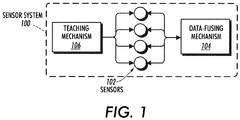
- FIG. 1 illustrates a sensor system 100 in accordance with one embodiment of the present invention.
- Sensor system 100 includes sensors 102, a data-fusing mechanism 104, and a teaching mechanism 106.
- Sensors 102 can include cameras, microphones, motion detectors, ultra-wideband (UWB) sensors, infrared sensors, magnetometers, thermometers, barometers, weight scales, and other types of sensors that detect sound, motion, vibration, luminous intensity, magnetic field intensity, proximity, pressure, temperature, radiation, timing, humidity, altitude, weight, airborne particulates, chemical composition, velocity, direction, and other properties and/or combinations of properties.
- a sensor can include a memory (e.g., a predetermined amount of RAM) for storing information and a mechanism for generating expressions for likelihood functions, which are defined below.
- Sensor system 100 senses (e.g., detects, estimates, tracks, and/or monitors) phenomena using the signals observed by sensors 102 in the system.
- sensor system 100 can sense the locations and activities of a person or object (e.g., tracking an elderly person and determining his/her location and movements) or detect the occurrence of an event (e.g., a fire in the kitchen).
- Embodiments of the present invention use a probabilistic approach to sensing phenomena.
- the state of the sensed phenomenon can be represented by a random variable X
- the raw signal observed by a given sensor can be represented by a random variable Z.
- the Z signal for a camera can be an image
- the Z signal for a microphone can be a sampled acoustic signal
- the Z signal for a thermometer can be a temperature measurement.
- a phenomenon state indicates the state of an observable fact or event at a given time instance.
- the X variable represents the actual state, or value, of the sensed phenomenon. In general, there is typically uncertainty between the measurement or observation z and the actual state x.
- X x which returns the probability that the sensor measurement is z given that the phenomenon state is x.
- a respective sensor uses this model to identify the likelihood that the phenomenon state is x given that the sensor measurement is observed to be z.
- This function returns the probability that the phenomenon state is x given that the n sensor measurement are z 1 , z 2 , ..., z n .
- X x .
- X x ) of a possible phenomenon state x.
- a measurement model is typically specific to a particular sensor or sensing task and a particular phenomenon state, and because new sensors or new software may be installed in the sensor network, pre-loading all possible measurement models might not be feasible.
- Embodiments of the present invention provide a mechanism 106 to "teach" a sensor how to generate one or more likelihood functions that correspond to the sensor's task.
- embodiments of the present invention can load and/or reload measurement models to the sensors in the system (e.g., by loading the measurement models formatted as code into the memory of a sensor). Consequently, the system can reconfigure the sensing capabilities of the sensor system as sensors are added and/or removed, or as the sensing requirements change.
- Teaching mechanism 106 loads and/or reloads measurement models in sensors 102.
- a sensor's manufacturer may serve as the initial teaching mechanism.
- the sensor manufacturer loads measurement models for a particular or several state space(s) X on to the sensor while manufacturing the sensor.
- teaching mechanism 106 can be a device temporarily or permanently coupled to sensors 102 using a wired or wireless network connection or another electrical connection. In these embodiments, teaching mechanism 106 can load and/or reload new measurement models into the sensors 102 before or after the sensors have been deployed.
- Data-fusing mechanism 104 is a computational device, such as an application-specific integrated circuit (ASIC), a microprocessor, an embedded processor, a controller, a computer, or another type of computational engine. Data-fusing mechanism 104 collects the likelihood functions from sensors 102 and computes the product of the individual likelihoods. From the computed product, data-fusing mechanism 104 can extract information about the sensed phenomenon. In one embodiment, data-fusing mechanism 104 is the same computational device as teaching mechanism 106.
- ASIC application-specific integrated circuit
- microprocessor such as a microprocessor, an embedded processor, a controller, a computer, or another type of computational engine.
- Data-fusing mechanism 104 collects the likelihood functions from sensors 102 and computes the product of the individual likelihoods. From the computed product, data-fusing mechanism 104 can extract information about the sensed phenomenon. In one embodiment, data-fusing mechanism 104 is the same computational device as teaching mechanism 106.
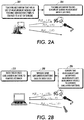
- FIG. 2A presents a block diagram illustrating the first set of interactions, which occur between a teaching mechanism 106 and a set of sensors 102. This set of interactions can be divided into two operations:
- a measurement model is represented as a function expression compiled into a mobile code, such as JavaTM bytecode.
- Mobile code is a program that can be transferred from a remote system over a network and downloaded onto a local system, such that the mobile code can be executed on the local system without requiring that the program had been previously installed on the local system.
- the generated likelihood function corresponds to a fragment of the mobile code or a suitably modified version of the mobile code.
- a measurement model is represented in a data table and contained in the mobile code. The generated likelihood function corresponds to a row or column of the data table.
- FIG. 2B presents a block diagram illustrating the second set of interactions between the data-fusing mechanism 104 and the sensors 102.
- this set of interactions can be divided into three operations:
- FIG. 3 presents a diagram illustrating a server coupled to a number of sensors in accordance with one embodiment of the present invention.
- server 300 is configured to use sensors installed throughout a house to compute the probability that a person is in a room of the house.
- the sensors include cameras 301, 302, and 303 respectively in the living room, dining room, and kitchen, and microphones 304 and 305 respectively in the bathroom and living room.
- the cameras can compute the number of pixels which change significantly between frames in order to determine motion and the microphones can detect sounds above a certain loudness threshold.
- the manufacturer of the sensors serves as teaching mechanism 106.
- the measurement model code used to determine the likelihood of the presence of a person in the house can be pre-loaded on the cameras and microphones.
- server 300 could include hardware and/or software-based teaching mechanism 106 that is configured to download the measurement models from a website on the Internet for different sensor types and state spaces.
- teaching mechanism 106 could include a database of measurement models or could download the measurement models from a proprietary database.
- teaching mechanism 106 can be temporarily or permanently coupled to the sensors and can load and/or reload measurement model code onto the sensors.
- the server While computing the probability that a person is in a room of the house, the server performs the operations described in operations 206-210, and optionally operations 202-204 outlined in the preceding sections as follows. Note that although the operations are described as happening in a particular order for the purposes of illustration, one or more of the operations may happen in a different order or may be skipped.
- the system is described as loading measurement models onto the sensors as part of the process, but in some embodiments, the measurement models can be pre-loaded by a manufacturer or can be loaded when the system is initially installed (e.g., the measurement models may be loaded once and not reloaded every time that the sensing system operates).
- Server 300 optionally functioning first as teaching mechanism 106, detects that there are five sensors in the house and selects the appropriate measurement model code to send to these sensors. The server then sends the measurement model code for camera sensors to sensors 301, 302, and 303, and code for microphone sensors to sensors 304 and 305.
- the cameras and microphones include a predetermined amount of memory that is used to store the measurement model code.
- the cameras and microphones include a mechanism for incorporating a measured value into the measurement model code (e.g., forming a likelihood function).
- Server 300 now functioning as data-fusing mechanism 104, requests the likelihood function relating to the presence of a person in the house from the set of the sensors.
- Each sensor i then takes a measurement z i , incorporates the measured value into the corresponding measurement model, and forms a likelihood function.
- each sensor sends the likelihood function back to server 300 as mobile code (e.g., code that can be used by both the sensor and server 300).
- the server receives all the likelihood functions and computes the product operation using the likelihood functions to obtain the aggregate likelihood and the posterior distribution of the probability of the presence of a person in the house.
- server 300 does not include measurement models for each sensor/state space pair, but instead includes a feature-extraction function for each sensor/state space pair.
- Server 300 first functioning as teaching mechanism 106, teaches a respective sensor its feature-extraction function for various corresponding state spaces.
- the respective sensor is taught how to identify particular features in a measurement for estimating a state, instead of being asked to extract a complete measurement of the state.
- server 300 can teach the camera sensors a feature-extraction function using images for estimating whether a person is present and can teach the microphones a feature-extraction function using the acoustic signals from one's voice for estimating whether a person is present.
- Server 300 now functioning as data-fusing mechanism 104, requests features from the sensors which are useful for estimating the state.
- the data-fusing mechanism 104 uses the specific voice and image features that were identified by the sensors to detect the presence of a person.
- a respective sensor takes a measurement z and uses the measured value to compute the features according to the feature-extraction code that corresponds to this sensor/state space pair.
- the sensor then sends the computed features to server 300.
- server 300 receives all of the features and fuses them together using the feature aggregator code to compute the estimate.
Landscapes
- Physics & Mathematics (AREA)
- General Physics & Mathematics (AREA)
- Testing Or Calibration Of Command Recording Devices (AREA)
- Arrangements For Transmission Of Measured Signals (AREA)
Claims (9)
- Sensorsystem (100), das Folgendes umfasst:einen Satz von n Sensoren (102), die jeweils ein oder mehrere Messmodelle zum Erkennen eines Zustands eines untersuchten Phänomens speichern, wobei ein jeweiliger Sensor i = 1, ... n einen Messwert zi abtastet;einen Datenfusionsmechanismus (104), der mit dem Sensor gekoppelt ist und ein erstes Messmodell als P(Z = z | X = x) speichert, wobei Z dem Messwert entspricht und X dem Zustand des untersuchten Phänomens entspricht, unddadurch gekennzeichnet, dassder Datenfusionsmechanismus (104) Wahrscheinlichkeitsfunktionen sammelt, die von dem Satz von n Sensoren (102) erzeugt werden, und eine Summenwahrscheinlichkeit eines möglichen Zustands des untersuchten Phänomens berechnet, auf der Basis von
 entsprechend einem Produkt aus einer Anzahl von n Wahrscheinlichkeitsfunktionen, die von den n Sensoren (102) gesammelt wurden.
 - Sensorsystem nach Anspruch 1, wobei der Sensor zum Kommunizieren der Wahrscheinlichkeitsfunktion zu dem Datenfusionsmechanismus (104) in Form eines mobilen Code konfiguriert ist.
- Sensorsystem nach Anspruch 1, wobei das zu lehrende Messmodell in Form von mobilem Code vorliegt.
- Sensorsystem nach Anspruch 1, wobei der erste Phänomenzustand einen Zustand von einem oder mehreren der Folgenden beinhaltet: Ton, Bewegung, Vibration, Höhe, Lichtintensität, Nähe, Druck, Temperatur, Strahlung, Timing, Feuchtigkeit, elektromagnetische Feldintensität, Höhe, Gewicht, Schwebeteilchen, chemische Zusammensetzung, Geschwindigkeit, Richtung und Entfernung.
- Verfahren, das Folgendes beinhaltet:Abtasten, an einem jeweiligen Sensor i = 1, ... n, in einem Satz von n Sensoren (102), eines Messwertes zi, wobei der Sensor ein erstes Messmodell als P(Z = z | X = x) speichert, zum Erzeugen einer Wahrscheinlichkeitsfunktion für einen Zustand eines untersuchten Phänomens, wobei Z dem Messwert entspricht und X dem Zustand des untersuchten Phänomens entspricht;Erzeugen von Wahrscheinlichkeitsfunktionen an den n Sensoren (102) durch Einsetzen des abgetasteten Messwertes in das erste Messmodell;Sammeln der Wahrscheinlichkeitsfunktionen von dem Satz von n Sensoren (102); undgekennzeichnet durchBerechnen einer Summenwahrscheinlichkeit eines möglichen Zustands des untersuchten Phänomens über
 entsprechend einem Produkt aus einer Anzahl von n Wahrscheinlichkeitsfunktionen, die von den n Sensoren (102) gesammelt wurden.
 - Verfahren nach Anspruch 5, wobei das Sammeln der Wahrscheinlichkeitsfunktionen Folgendes beinhaltet Kommunizieren der Wahrscheinlichkeitsfunktionen in Form von mobilem Code.
- Verfahren nach Anspruch 5, wobei das zu ladende und/oder neu zu ladende Messmodell in Form von mobilem Code vorliegt.
- Verfahren nach Anspruch 5, wobei der erste Phänomenzustand einen Zustand von einem oder mehreren der Folgenden beinhaltet: Ton, Bewegung, Vibration, Höhe, Lichtintensität, Nähe, Druck, Temperatur, Strahlung, Timing, Feuchtigkeit, elektromagnetische Feldintensität, Höhe, Gewicht, Schwebeteilchen, chemische Zusammensetzung, Geschwindigkeit, Richtung und Entfernung.
- Nichtflüchtiges computerlesbares Speichermedium mit Befehlen, die bei Ausführung durch ein Computersystem bewirken, dass der Computer ein Verfahren ausführt, wobei das Verfahren Folgendes beinhaltet:Abtasten, an einem jeweiligen Sensor i = 1, ... n, in einem Satz von n Sensoren (102), eines Messwertes zi, wobei der Sensor ein erstes Messmodell als P(Z = z | X = x) speichert, zum Erzeugen einer Wahrscheinlichkeitsfunktion für einen Zustand eines untersuchten Phänomens, wobei Z dem Messwert entspricht und X dem Zustand des untersuchten Phänomens entspricht;Erzeugen von Wahrscheinlichkeitsfunktionen an den Sensoren durch Einsetzen des abgetasteten Messwertes in das erste Messmodell;Sammeln der Wahrscheinlichkeitsfunktionen von dem Satz von n Sensoren (102); undgekennzeichnet durchBerechnen einer Summenwahrscheinlichkeit eines möglichen Zustands des untersuchten Phänomens über
 entsprechend einem Produkt aus einer Anzahl von n Wahrscheinlichkeitsfunktionen, die von den n Sensoren (102) gesammelt wurden.
Applications Claiming Priority (1)
| Application Number | Priority Date | Filing Date | Title |
|---|---|---|---|
| US11/956,943 US7962313B2 (en) | 2007-12-14 | 2007-12-14 | Method and apparatus for using mobile code for distributed data fusion in networked sensing systems |
Publications (3)
| Publication Number | Publication Date |
|---|---|
| EP2071295A2 EP2071295A2 (de) | 2009-06-17 |
| EP2071295A3 EP2071295A3 (de) | 2015-10-14 |
| EP2071295B1 true EP2071295B1 (de) | 2017-06-21 |
Family
ID=40566176
Family Applications (1)
| Application Number | Title | Priority Date | Filing Date |
|---|---|---|---|
| EP08171337.2A Active EP2071295B1 (de) | 2007-12-14 | 2008-12-11 | Verfahren und Vorrichtung zur Verwendung eines mobilen Codes bei der verteilten Datenfusion in Netzwerkfühlsystemen |
Country Status (3)
| Country | Link |
|---|---|
| US (1) | US7962313B2 (de) |
| EP (1) | EP2071295B1 (de) |
| JP (1) | JP5437625B2 (de) |
Families Citing this family (5)
| Publication number | Priority date | Publication date | Assignee | Title |
|---|---|---|---|---|
| US10555775B2 (en) | 2005-05-16 | 2020-02-11 | Intuitive Surgical Operations, Inc. | Methods and system for performing 3-D tool tracking by fusion of sensor and/or camera derived data during minimally invasive robotic surgery |
| US8073528B2 (en) * | 2007-09-30 | 2011-12-06 | Intuitive Surgical Operations, Inc. | Tool tracking systems, methods and computer products for image guided surgery |
| US20090195401A1 (en) * | 2008-01-31 | 2009-08-06 | Andrew Maroney | Apparatus and method for surveillance system using sensor arrays |
| EP2449511A1 (de) | 2009-06-29 | 2012-05-09 | BAE Systems PLC | Schätzung eines zustandes von mindestens einem ziel mit mehreren sensoren |
| US20140260642A1 (en) * | 2013-03-15 | 2014-09-18 | Samsung Electronics Co., Ltd. | Electronic system with surface detection mechanism and method of operation thereof |
Family Cites Families (9)
| Publication number | Priority date | Publication date | Assignee | Title |
|---|---|---|---|---|
| JP3349196B2 (ja) * | 1992-06-20 | 2002-11-20 | テキサス インスツルメンツ インコーポレイテツド | 対象識別システムおよび方法 |
| US6502042B1 (en) * | 2000-10-26 | 2002-12-31 | Bfgoodrich Aerospace Fuel And Utility Systems | Fault tolerant liquid measurement system using multiple-model state estimators |
| US6594524B2 (en) * | 2000-12-12 | 2003-07-15 | The Trustees Of The University Of Pennsylvania | Adaptive method and apparatus for forecasting and controlling neurological disturbances under a multi-level control |
| JP4318465B2 (ja) * | 2002-11-08 | 2009-08-26 | コニカミノルタホールディングス株式会社 | 人物検出装置および人物検出方法 |
| EP1564721A1 (de) * | 2002-11-21 | 2005-08-17 | Matsushita Electric Industrial Co., Ltd. | Standardmodellerzeugungseinrichtung und standardmodellerzeugungsverfahren |
| JP4419543B2 (ja) * | 2003-12-05 | 2010-02-24 | コニカミノルタホールディングス株式会社 | 検出装置および検出方法 |
| US7969462B2 (en) * | 2005-03-30 | 2011-06-28 | L-3 Communications Corporation | Digitally enhanced night vision device |
| US8941816B2 (en) * | 2006-05-02 | 2015-01-27 | National Science Foundation | Rotary laser positioning for geophysical sensing |
| US7616115B2 (en) * | 2007-02-13 | 2009-11-10 | Honeywell International Inc. | Sensor for detecting human intruders, and security system |
-
2007
- 2007-12-14 US US11/956,943 patent/US7962313B2/en active Active
-
2008
- 2008-12-11 EP EP08171337.2A patent/EP2071295B1/de active Active
- 2008-12-12 JP JP2008316916A patent/JP5437625B2/ja not_active Expired - Fee Related
Also Published As
| Publication number | Publication date |
|---|---|
| JP2009145346A (ja) | 2009-07-02 |
| US7962313B2 (en) | 2011-06-14 |
| US20090157352A1 (en) | 2009-06-18 |
| JP5437625B2 (ja) | 2014-03-12 |
| EP2071295A2 (de) | 2009-06-17 |
| EP2071295A3 (de) | 2015-10-14 |
Similar Documents
| Publication | Publication Date | Title |
|---|---|---|
| JP6107409B2 (ja) | 位置特定処理装置及び位置特定処理プログラム | |
| EP2071295B1 (de) | Verfahren und Vorrichtung zur Verwendung eines mobilen Codes bei der verteilten Datenfusion in Netzwerkfühlsystemen | |
| JP6263281B2 (ja) | 占有数推定のためのシステムおよび方法 | |
| EP3511871A1 (de) | Zeitreihendaten-merkmalsmengen-extraktionsvorrichtung, zeitreihendaten-merkmalsmengen-extraktionsverfahren und zeitreihen-datenmerkmalsmengen-extraktionsprogramm | |
| US20180326814A1 (en) | Enhanced climate control | |
| WO2013083823A1 (en) | Method and system for sensor calibration support | |
| JP5437328B2 (ja) | 観測値信頼度評価装置、観測値信頼度評価方法及び観測値信頼度評価プログラム | |
| US10785617B2 (en) | Context awareness system, method and computer-readable recording medium for providing smart service in Internet of Things environment | |
| JP2017510916A5 (de) | ||
| EP3940306A1 (de) | Klimaanlagensteuerungssystem und klimaanlagensteuerungsverfahren | |
| KR102905891B1 (ko) | 반려동물의 건강 상태를 모니터링하는 방법 및 그 시스템 | |
| JP2009145346A5 (de) | ||
| JP7236842B2 (ja) | データ収集装置、データ収集システムおよびデータ収集方法 | |
| FR3003666A1 (fr) | Dispositif d'estimation de probabilite de presence dans une piece, procede et programme correspondants | |
| CN110289090A (zh) | 事件发现方法及装置、存储介质、终端 | |
| JP5791555B2 (ja) | 状態追跡装置、方法、及びプログラム | |
| JP2008294593A (ja) | 位置推定システム、位置推定装置及びそれらに用いる位置推定方法並びにそのプログラム | |
| CN109642827B (zh) | 温度推算系统、温度推算方法及记录有温度推算程序的记录媒体 | |
| CN111708561B (zh) | 算法模型更新系统、方法、装置及电子设备 | |
| US11769330B2 (en) | System and method for video analytics for thermography procedure compliance | |
| JP7666624B2 (ja) | 予測装置、予測方法、及びプログラム | |
| US20260126523A1 (en) | Computing device and method for monitoring a person based on radar sensor data | |
| US10921167B1 (en) | Methods and apparatus for validating event scenarios using reference readings from sensors associated with predefined event scenarios | |
| WO2012089959A1 (fr) | Procede et systeme de construction d'un graphe representant le plan d'un batiment batiment | |
| WO2024073838A1 (en) | Computing device and method for monitoring a person based on radar sensor data |
Legal Events
| Date | Code | Title | Description |
|---|---|---|---|
| PUAI | Public reference made under article 153(3) epc to a published international application that has entered the european phase |
Free format text: ORIGINAL CODE: 0009012 |
|
| AK | Designated contracting states |
Kind code of ref document: A2 Designated state(s): AT BE BG CH CY CZ DE DK EE ES FI FR GB GR HR HU IE IS IT LI LT LU LV MC MT NL NO PL PT RO SE SI SK TR |
|
| AX | Request for extension of the european patent |
Extension state: AL BA MK RS |
|
| PUAL | Search report despatched |
Free format text: ORIGINAL CODE: 0009013 |
|
| AK | Designated contracting states |
Kind code of ref document: A3 Designated state(s): AT BE BG CH CY CZ DE DK EE ES FI FR GB GR HR HU IE IS IT LI LT LU LV MC MT NL NO PL PT RO SE SI SK TR |
|
| AX | Request for extension of the european patent |
Extension state: AL BA MK RS |
|
| RIC1 | Information provided on ipc code assigned before grant |
Ipc: G01D 21/00 20060101ALI20150909BHEP Ipc: G01D 1/16 20060101ALI20150909BHEP Ipc: G01D 18/00 20060101AFI20150909BHEP |
|
| 17P | Request for examination filed |
Effective date: 20160414 |
|
| RBV | Designated contracting states (corrected) |
Designated state(s): AT BE BG CH CY CZ DE DK EE ES FI FR GB GR HR HU IE IS IT LI LT LU LV MC MT NL NO PL PT RO SE SI SK TR |
|
| AKX | Designation fees paid |
Designated state(s): DE FR GB |
|
| AXX | Extension fees paid |
Extension state: RS Extension state: MK Extension state: BA Extension state: AL |
|
| 17Q | First examination report despatched |
Effective date: 20160721 |
|
| STAA | Information on the status of an ep patent application or granted ep patent |
Free format text: STATUS: EXAMINATION IS IN PROGRESS |
|
| GRAP | Despatch of communication of intention to grant a patent |
Free format text: ORIGINAL CODE: EPIDOSNIGR1 |
|
| STAA | Information on the status of an ep patent application or granted ep patent |
Free format text: STATUS: GRANT OF PATENT IS INTENDED |
|
| INTG | Intention to grant announced |
Effective date: 20170119 |
|
| GRAS | Grant fee paid |
Free format text: ORIGINAL CODE: EPIDOSNIGR3 |
|
| GRAA | (expected) grant |
Free format text: ORIGINAL CODE: 0009210 |
|
| STAA | Information on the status of an ep patent application or granted ep patent |
Free format text: STATUS: THE PATENT HAS BEEN GRANTED |
|
| AK | Designated contracting states |
Kind code of ref document: B1 Designated state(s): DE FR GB |
|
| RAP1 | Party data changed (applicant data changed or rights of an application transferred) |
Owner name: CISCO TECHNOLOGY, INC. |
|
| REG | Reference to a national code |
Ref country code: GB Ref legal event code: FG4D |
|
| REG | Reference to a national code |
Ref country code: DE Ref legal event code: R096 Ref document number: 602008050742 Country of ref document: DE |
|
| REG | Reference to a national code |
Ref country code: FR Ref legal event code: PLFP Year of fee payment: 10 |
|
| REG | Reference to a national code |
Ref country code: DE Ref legal event code: R097 Ref document number: 602008050742 Country of ref document: DE |
|
| PLBE | No opposition filed within time limit |
Free format text: ORIGINAL CODE: 0009261 |
|
| STAA | Information on the status of an ep patent application or granted ep patent |
Free format text: STATUS: NO OPPOSITION FILED WITHIN TIME LIMIT |
|
| 26N | No opposition filed |
Effective date: 20180322 |
|
| REG | Reference to a national code |
Ref country code: DE Ref legal event code: R082 Ref document number: 602008050742 Country of ref document: DE Representative=s name: MATHYS & SQUIRE GBR, DE Ref country code: DE Ref legal event code: R082 Ref document number: 602008050742 Country of ref document: DE Representative=s name: MATHYS & SQUIRE EUROPE PATENTANWAELTE PARTNERS, DE |
|
| P01 | Opt-out of the competence of the unified patent court (upc) registered |
Effective date: 20230525 |
|
| PGFP | Annual fee paid to national office [announced via postgrant information from national office to epo] |
Ref country code: DE Payment date: 20241107 Year of fee payment: 17 |
|
| PGFP | Annual fee paid to national office [announced via postgrant information from national office to epo] |
Ref country code: GB Payment date: 20241209 Year of fee payment: 17 |
|
| PGFP | Annual fee paid to national office [announced via postgrant information from national office to epo] |
Ref country code: FR Payment date: 20241210 Year of fee payment: 17 |