EP2070696A1 - Method of preparing lithographic printing plate and lithographic printing plate precursor - Google Patents
Method of preparing lithographic printing plate and lithographic printing plate precursor Download PDFInfo
- Publication number
- EP2070696A1 EP2070696A1 EP08021463A EP08021463A EP2070696A1 EP 2070696 A1 EP2070696 A1 EP 2070696A1 EP 08021463 A EP08021463 A EP 08021463A EP 08021463 A EP08021463 A EP 08021463A EP 2070696 A1 EP2070696 A1 EP 2070696A1
- Authority
- EP
- European Patent Office
- Prior art keywords
- group
- printing plate
- lithographic printing
- acid
- compound
- Prior art date
- Legal status (The legal status is an assumption and is not a legal conclusion. Google has not performed a legal analysis and makes no representation as to the accuracy of the status listed.)
- Withdrawn
Links
- 238000007639 printing Methods 0.000 title claims abstract description 181
- 239000002243 precursor Substances 0.000 title claims abstract description 108
- 238000000034 method Methods 0.000 title claims abstract description 100
- 239000010410 layer Substances 0.000 claims abstract description 197
- 150000001875 compounds Chemical class 0.000 claims abstract description 190
- 229920000642 polymer Polymers 0.000 claims abstract description 127
- 239000011241 protective layer Substances 0.000 claims abstract description 100
- 239000011230 binding agent Substances 0.000 claims abstract description 73
- 229920002451 polyvinyl alcohol Polymers 0.000 claims abstract description 70
- 239000004372 Polyvinyl alcohol Substances 0.000 claims abstract description 67
- 239000007787 solid Substances 0.000 claims abstract description 37
- 230000001235 sensitizing effect Effects 0.000 claims abstract description 26
- 239000003505 polymerization initiator Substances 0.000 claims abstract description 21
- 125000000217 alkyl group Chemical group 0.000 claims description 85
- 125000001424 substituent group Chemical group 0.000 claims description 74
- 125000004435 hydrogen atom Chemical group [H]* 0.000 claims description 72
- XLYOFNOQVPJJNP-UHFFFAOYSA-N water Substances O XLYOFNOQVPJJNP-UHFFFAOYSA-N 0.000 claims description 45
- 239000004094 surface-active agent Substances 0.000 claims description 44
- 125000000962 organic group Chemical group 0.000 claims description 42
- 238000010438 heat treatment Methods 0.000 claims description 28
- 125000002887 hydroxy group Chemical group [H]O* 0.000 claims description 28
- 229910052757 nitrogen Inorganic materials 0.000 claims description 28
- 125000002947 alkylene group Chemical group 0.000 claims description 20
- 125000004433 nitrogen atom Chemical group N* 0.000 claims description 20
- 238000005406 washing Methods 0.000 claims description 20
- 150000001450 anions Chemical class 0.000 claims description 17
- 150000007942 carboxylates Chemical group 0.000 claims description 13
- 239000012986 chain transfer agent Substances 0.000 claims description 13
- 230000008569 process Effects 0.000 claims description 10
- 125000002843 carboxylic acid group Chemical group 0.000 claims description 7
- 229920000233 poly(alkylene oxides) Chemical group 0.000 claims description 5
- -1 for example Substances 0.000 description 264
- 125000004432 carbon atom Chemical group C* 0.000 description 80
- 239000000975 dye Substances 0.000 description 76
- 125000003118 aryl group Chemical group 0.000 description 64
- 238000011161 development Methods 0.000 description 56
- 238000000576 coating method Methods 0.000 description 54
- 239000011248 coating agent Substances 0.000 description 51
- 239000000243 solution Substances 0.000 description 50
- 239000002253 acid Substances 0.000 description 45
- 239000000049 pigment Substances 0.000 description 43
- 229920001577 copolymer Polymers 0.000 description 39
- 150000003254 radicals Chemical class 0.000 description 39
- 150000003839 salts Chemical class 0.000 description 36
- LFQSCWFLJHTTHZ-UHFFFAOYSA-N Ethanol Chemical compound CCO LFQSCWFLJHTTHZ-UHFFFAOYSA-N 0.000 description 34
- 125000005843 halogen group Chemical group 0.000 description 34
- PPBRXRYQALVLMV-UHFFFAOYSA-N Styrene Chemical compound C=CC1=CC=CC=C1 PPBRXRYQALVLMV-UHFFFAOYSA-N 0.000 description 33
- 229910052618 mica group Inorganic materials 0.000 description 33
- 238000012545 processing Methods 0.000 description 33
- 239000010445 mica Substances 0.000 description 32
- 238000006116 polymerization reaction Methods 0.000 description 32
- 150000002148 esters Chemical class 0.000 description 31
- 229910052717 sulfur Inorganic materials 0.000 description 31
- 235000014113 dietary fatty acids Nutrition 0.000 description 30
- 239000000194 fatty acid Substances 0.000 description 30
- 229930195729 fatty acid Natural products 0.000 description 30
- 125000003277 amino group Chemical group 0.000 description 27
- 125000003545 alkoxy group Chemical group 0.000 description 26
- 229910052782 aluminium Inorganic materials 0.000 description 26
- 125000003178 carboxy group Chemical group [H]OC(*)=O 0.000 description 26
- 238000007127 saponification reaction Methods 0.000 description 25
- XAGFODPZIPBFFR-UHFFFAOYSA-N aluminium Chemical compound [Al] XAGFODPZIPBFFR-UHFFFAOYSA-N 0.000 description 24
- 239000006185 dispersion Substances 0.000 description 24
- 229910052799 carbon Inorganic materials 0.000 description 23
- 125000000623 heterocyclic group Chemical group 0.000 description 23
- 239000000178 monomer Substances 0.000 description 22
- 229920003171 Poly (ethylene oxide) Polymers 0.000 description 21
- 239000000203 mixture Substances 0.000 description 21
- 125000004434 sulfur atom Chemical group 0.000 description 21
- 150000001732 carboxylic acid derivatives Chemical class 0.000 description 20
- 239000000463 material Substances 0.000 description 20
- 230000035945 sensitivity Effects 0.000 description 20
- 125000001931 aliphatic group Chemical group 0.000 description 19
- 125000005842 heteroatom Chemical group 0.000 description 19
- 229910052760 oxygen Inorganic materials 0.000 description 19
- 150000001408 amides Chemical class 0.000 description 18
- QVGXLLKOCUKJST-UHFFFAOYSA-N atomic oxygen Chemical compound [O] QVGXLLKOCUKJST-UHFFFAOYSA-N 0.000 description 18
- 229920001519 homopolymer Polymers 0.000 description 18
- 239000001301 oxygen Substances 0.000 description 18
- 150000001412 amines Chemical class 0.000 description 17
- 125000004430 oxygen atom Chemical group O* 0.000 description 17
- 239000000126 substance Substances 0.000 description 17
- IJGRMHOSHXDMSA-UHFFFAOYSA-N Atomic nitrogen Chemical compound N#N IJGRMHOSHXDMSA-UHFFFAOYSA-N 0.000 description 16
- 125000003342 alkenyl group Chemical group 0.000 description 16
- 239000007864 aqueous solution Substances 0.000 description 16
- 239000003921 oil Substances 0.000 description 16
- 239000004065 semiconductor Substances 0.000 description 16
- 239000011734 sodium Substances 0.000 description 16
- ZWEHNKRNPOVVGH-UHFFFAOYSA-N 2-Butanone Chemical compound CCC(C)=O ZWEHNKRNPOVVGH-UHFFFAOYSA-N 0.000 description 15
- QGZKDVFQNNGYKY-UHFFFAOYSA-O ammonium group Chemical group [NH4+] QGZKDVFQNNGYKY-UHFFFAOYSA-O 0.000 description 15
- 125000004093 cyano group Chemical group *C#N 0.000 description 15
- 230000000694 effects Effects 0.000 description 15
- 229910052736 halogen Inorganic materials 0.000 description 15
- 229910052708 sodium Inorganic materials 0.000 description 15
- 125000004104 aryloxy group Chemical group 0.000 description 14
- 239000010408 film Substances 0.000 description 14
- 239000003094 microcapsule Substances 0.000 description 14
- 239000000047 product Substances 0.000 description 14
- QGKMIGUHVLGJBR-UHFFFAOYSA-M (4z)-1-(3-methylbutyl)-4-[[1-(3-methylbutyl)quinolin-1-ium-4-yl]methylidene]quinoline;iodide Chemical compound [I-].C12=CC=CC=C2N(CCC(C)C)C=CC1=CC1=CC=[N+](CCC(C)C)C2=CC=CC=C12 QGKMIGUHVLGJBR-UHFFFAOYSA-M 0.000 description 13
- PEDCQBHIVMGVHV-UHFFFAOYSA-N Glycerine Chemical compound OCC(O)CO PEDCQBHIVMGVHV-UHFFFAOYSA-N 0.000 description 13
- 239000007795 chemical reaction product Substances 0.000 description 13
- 230000036961 partial effect Effects 0.000 description 13
- 238000007788 roughening Methods 0.000 description 13
- 229910052710 silicon Inorganic materials 0.000 description 13
- 125000000547 substituted alkyl group Chemical group 0.000 description 13
- 238000006467 substitution reaction Methods 0.000 description 13
- 229960000834 vinyl ether Drugs 0.000 description 13
- OKTJSMMVPCPJKN-UHFFFAOYSA-N Carbon Chemical compound [C] OKTJSMMVPCPJKN-UHFFFAOYSA-N 0.000 description 12
- FBPFZTCFMRRESA-FSIIMWSLSA-N D-Glucitol Natural products OC[C@H](O)[C@H](O)[C@@H](O)[C@H](O)CO FBPFZTCFMRRESA-FSIIMWSLSA-N 0.000 description 12
- 229910019142 PO4 Inorganic materials 0.000 description 12
- XUIMIQQOPSSXEZ-UHFFFAOYSA-N Silicon Chemical compound [Si] XUIMIQQOPSSXEZ-UHFFFAOYSA-N 0.000 description 12
- HEMHJVSKTPXQMS-UHFFFAOYSA-M Sodium hydroxide Chemical compound [OH-].[Na+] HEMHJVSKTPXQMS-UHFFFAOYSA-M 0.000 description 12
- RTZKZFJDLAIYFH-UHFFFAOYSA-N ether Substances CCOCC RTZKZFJDLAIYFH-UHFFFAOYSA-N 0.000 description 12
- 125000002496 methyl group Chemical group [H]C([H])([H])* 0.000 description 12
- 235000021317 phosphate Nutrition 0.000 description 12
- 239000010703 silicon Substances 0.000 description 12
- 239000000600 sorbitol Substances 0.000 description 12
- 125000000020 sulfo group Chemical group O=S(=O)([*])O[H] 0.000 description 12
- FBPFZTCFMRRESA-JGWLITMVSA-N D-glucitol Chemical compound OC[C@H](O)[C@@H](O)[C@H](O)[C@H](O)CO FBPFZTCFMRRESA-JGWLITMVSA-N 0.000 description 11
- IAYPIBMASNFSPL-UHFFFAOYSA-N Ethylene oxide Chemical compound C1CO1 IAYPIBMASNFSPL-UHFFFAOYSA-N 0.000 description 11
- NBIIXXVUZAFLBC-UHFFFAOYSA-N Phosphoric acid Chemical compound OP(O)(O)=O NBIIXXVUZAFLBC-UHFFFAOYSA-N 0.000 description 11
- 125000004453 alkoxycarbonyl group Chemical group 0.000 description 11
- 239000002585 base Substances 0.000 description 11
- 150000001721 carbon Chemical group 0.000 description 11
- WQJONRMBVKFKOB-UHFFFAOYSA-N cyanatosulfanyl cyanate Chemical compound N#COSOC#N WQJONRMBVKFKOB-UHFFFAOYSA-N 0.000 description 11
- 239000002736 nonionic surfactant Substances 0.000 description 11
- 239000002245 particle Substances 0.000 description 11
- 125000001997 phenyl group Chemical group [H]C1=C([H])C([H])=C(*)C([H])=C1[H] 0.000 description 11
- 239000010452 phosphate Substances 0.000 description 11
- 229910052698 phosphorus Inorganic materials 0.000 description 11
- 229920001223 polyethylene glycol Polymers 0.000 description 11
- ZTWTYVWXUKTLCP-UHFFFAOYSA-N vinylphosphonic acid Chemical class OP(O)(=O)C=C ZTWTYVWXUKTLCP-UHFFFAOYSA-N 0.000 description 11
- NINIDFKCEFEMDL-UHFFFAOYSA-N Sulfur Chemical compound [S] NINIDFKCEFEMDL-UHFFFAOYSA-N 0.000 description 10
- 125000000304 alkynyl group Chemical group 0.000 description 10
- 125000004429 atom Chemical group 0.000 description 10
- 230000015572 biosynthetic process Effects 0.000 description 10
- 238000006243 chemical reaction Methods 0.000 description 10
- 150000004665 fatty acids Chemical class 0.000 description 10
- 229910052731 fluorine Inorganic materials 0.000 description 10
- 125000000524 functional group Chemical group 0.000 description 10
- 229910052751 metal Inorganic materials 0.000 description 10
- 239000002184 metal Substances 0.000 description 10
- 125000000449 nitro group Chemical group [O-][N+](*)=O 0.000 description 10
- 125000001476 phosphono group Chemical group [H]OP(*)(=O)O[H] 0.000 description 10
- 238000002360 preparation method Methods 0.000 description 10
- 229920005989 resin Polymers 0.000 description 10
- 239000011347 resin Substances 0.000 description 10
- 239000002904 solvent Substances 0.000 description 10
- 239000011593 sulfur Substances 0.000 description 10
- LYCAIKOWRPUZTN-UHFFFAOYSA-N Ethylene glycol Chemical compound OCCO LYCAIKOWRPUZTN-UHFFFAOYSA-N 0.000 description 9
- YCKRFDGAMUMZLT-UHFFFAOYSA-N Fluorine atom Chemical compound [F] YCKRFDGAMUMZLT-UHFFFAOYSA-N 0.000 description 9
- OKKJLVBELUTLKV-UHFFFAOYSA-N Methanol Chemical compound OC OKKJLVBELUTLKV-UHFFFAOYSA-N 0.000 description 9
- MUBZPKHOEPUJKR-UHFFFAOYSA-N Oxalic acid Chemical compound OC(=O)C(O)=O MUBZPKHOEPUJKR-UHFFFAOYSA-N 0.000 description 9
- 239000002202 Polyethylene glycol Substances 0.000 description 9
- DNIAPMSPPWPWGF-UHFFFAOYSA-N Propylene glycol Chemical compound CC(O)CO DNIAPMSPPWPWGF-UHFFFAOYSA-N 0.000 description 9
- YXFVVABEGXRONW-UHFFFAOYSA-N Toluene Chemical compound CC1=CC=CC=C1 YXFVVABEGXRONW-UHFFFAOYSA-N 0.000 description 9
- 239000006096 absorbing agent Substances 0.000 description 9
- 125000003282 alkyl amino group Chemical group 0.000 description 9
- 125000006615 aromatic heterocyclic group Chemical group 0.000 description 9
- 125000000751 azo group Chemical group [*]N=N[*] 0.000 description 9
- KRKNYBCHXYNGOX-UHFFFAOYSA-N citric acid Chemical compound OC(=O)CC(O)(C(O)=O)CC(O)=O KRKNYBCHXYNGOX-UHFFFAOYSA-N 0.000 description 9
- 239000011737 fluorine Substances 0.000 description 9
- 125000001072 heteroaryl group Chemical group 0.000 description 9
- 229910052739 hydrogen Inorganic materials 0.000 description 9
- 239000001257 hydrogen Substances 0.000 description 9
- 229920001477 hydrophilic polymer Polymers 0.000 description 9
- 230000001965 increasing effect Effects 0.000 description 9
- RKJUIXBNRJVNHR-UHFFFAOYSA-N indolenine group Chemical group N1=CCC2=CC=CC=C12 RKJUIXBNRJVNHR-UHFFFAOYSA-N 0.000 description 9
- 239000007788 liquid Substances 0.000 description 9
- VLTRZXGMWDSKGL-UHFFFAOYSA-M perchlorate Chemical compound [O-]Cl(=O)(=O)=O VLTRZXGMWDSKGL-UHFFFAOYSA-M 0.000 description 9
- 238000004321 preservation Methods 0.000 description 9
- 238000007789 sealing Methods 0.000 description 9
- 159000000000 sodium salts Chemical class 0.000 description 9
- 125000000542 sulfonic acid group Chemical group 0.000 description 9
- LSNNMFCWUKXFEE-UHFFFAOYSA-M Bisulfite Chemical compound OS([O-])=O LSNNMFCWUKXFEE-UHFFFAOYSA-M 0.000 description 8
- 229920002134 Carboxymethyl cellulose Polymers 0.000 description 8
- DGAQECJNVWCQMB-PUAWFVPOSA-M Ilexoside XXIX Chemical compound C[C@@H]1CC[C@@]2(CC[C@@]3(C(=CC[C@H]4[C@]3(CC[C@@H]5[C@@]4(CC[C@@H](C5(C)C)OS(=O)(=O)[O-])C)C)[C@@H]2[C@]1(C)O)C)C(=O)O[C@H]6[C@@H]([C@H]([C@@H]([C@H](O6)CO)O)O)O.[Na+] DGAQECJNVWCQMB-PUAWFVPOSA-M 0.000 description 8
- XYFCBTPGUUZFHI-UHFFFAOYSA-N Phosphine Chemical compound P XYFCBTPGUUZFHI-UHFFFAOYSA-N 0.000 description 8
- OFOBLEOULBTSOW-UHFFFAOYSA-N Propanedioic acid Natural products OC(=O)CC(O)=O OFOBLEOULBTSOW-UHFFFAOYSA-N 0.000 description 8
- XSQUKJJJFZCRTK-UHFFFAOYSA-N Urea Chemical compound NC(N)=O XSQUKJJJFZCRTK-UHFFFAOYSA-N 0.000 description 8
- RJDOZRNNYVAULJ-UHFFFAOYSA-L [O--].[O--].[O--].[O--].[O--].[O--].[O--].[O--].[O--].[O--].[F-].[F-].[Mg++].[Mg++].[Mg++].[Al+3].[Si+4].[Si+4].[Si+4].[K+] Chemical compound [O--].[O--].[O--].[O--].[O--].[O--].[O--].[O--].[O--].[O--].[F-].[F-].[Mg++].[Mg++].[Mg++].[Al+3].[Si+4].[Si+4].[Si+4].[K+] RJDOZRNNYVAULJ-UHFFFAOYSA-L 0.000 description 8
- 238000010521 absorption reaction Methods 0.000 description 8
- 230000002378 acidificating effect Effects 0.000 description 8
- 125000002915 carbonyl group Chemical group [*:2]C([*:1])=O 0.000 description 8
- 235000010948 carboxy methyl cellulose Nutrition 0.000 description 8
- 239000003093 cationic surfactant Substances 0.000 description 8
- 150000001768 cations Chemical class 0.000 description 8
- 230000006870 function Effects 0.000 description 8
- 150000002430 hydrocarbons Chemical group 0.000 description 8
- 239000011574 phosphorus Substances 0.000 description 8
- 229920001451 polypropylene glycol Polymers 0.000 description 8
- 229920000036 polyvinylpyrrolidone Polymers 0.000 description 8
- 239000001267 polyvinylpyrrolidone Substances 0.000 description 8
- 235000013855 polyvinylpyrrolidone Nutrition 0.000 description 8
- 238000004381 surface treatment Methods 0.000 description 8
- 238000012360 testing method Methods 0.000 description 8
- VZCYOOQTPOCHFL-UHFFFAOYSA-N trans-butenedioic acid Natural products OC(=O)C=CC(O)=O VZCYOOQTPOCHFL-UHFFFAOYSA-N 0.000 description 8
- ARXJGSRGQADJSQ-UHFFFAOYSA-N 1-methoxypropan-2-ol Chemical compound COCC(C)O ARXJGSRGQADJSQ-UHFFFAOYSA-N 0.000 description 7
- NIXOWILDQLNWCW-UHFFFAOYSA-M Acrylate Chemical compound [O-]C(=O)C=C NIXOWILDQLNWCW-UHFFFAOYSA-M 0.000 description 7
- 239000004593 Epoxy Substances 0.000 description 7
- XEEYBQQBJWHFJM-UHFFFAOYSA-N Iron Chemical compound [Fe] XEEYBQQBJWHFJM-UHFFFAOYSA-N 0.000 description 7
- OAICVXFJPJFONN-UHFFFAOYSA-N Phosphorus Chemical compound [P] OAICVXFJPJFONN-UHFFFAOYSA-N 0.000 description 7
- 239000003513 alkali Substances 0.000 description 7
- 125000004414 alkyl thio group Chemical group 0.000 description 7
- 239000003945 anionic surfactant Substances 0.000 description 7
- 150000001728 carbonyl compounds Chemical class 0.000 description 7
- 238000005516 engineering process Methods 0.000 description 7
- 125000001841 imino group Chemical group [H]N=* 0.000 description 7
- 239000010954 inorganic particle Substances 0.000 description 7
- 239000011777 magnesium Substances 0.000 description 7
- 238000005259 measurement Methods 0.000 description 7
- 239000003960 organic solvent Substances 0.000 description 7
- 125000005010 perfluoroalkyl group Chemical group 0.000 description 7
- 230000009257 reactivity Effects 0.000 description 7
- 150000003573 thiols Chemical class 0.000 description 7
- 125000000391 vinyl group Chemical group [H]C([*])=C([H])[H] 0.000 description 7
- QTBSBXVTEAMEQO-UHFFFAOYSA-N Acetic acid Chemical compound CC(O)=O QTBSBXVTEAMEQO-UHFFFAOYSA-N 0.000 description 6
- XEKOWRVHYACXOJ-UHFFFAOYSA-N Ethyl acetate Chemical compound CCOC(C)=O XEKOWRVHYACXOJ-UHFFFAOYSA-N 0.000 description 6
- WSFSSNUMVMOOMR-UHFFFAOYSA-N Formaldehyde Chemical compound O=C WSFSSNUMVMOOMR-UHFFFAOYSA-N 0.000 description 6
- YLQBMQCUIZJEEH-UHFFFAOYSA-N Furan Chemical compound C=1C=COC=1 YLQBMQCUIZJEEH-UHFFFAOYSA-N 0.000 description 6
- 229920000881 Modified starch Polymers 0.000 description 6
- 239000004793 Polystyrene Substances 0.000 description 6
- JUJWROOIHBZHMG-UHFFFAOYSA-N Pyridine Chemical compound C1=CC=NC=C1 JUJWROOIHBZHMG-UHFFFAOYSA-N 0.000 description 6
- KAESVJOAVNADME-UHFFFAOYSA-N Pyrrole Chemical compound C=1C=CNC=1 KAESVJOAVNADME-UHFFFAOYSA-N 0.000 description 6
- QAOWNCQODCNURD-UHFFFAOYSA-N Sulfuric acid Chemical compound OS(O)(=O)=O QAOWNCQODCNURD-UHFFFAOYSA-N 0.000 description 6
- YTPLMLYBLZKORZ-UHFFFAOYSA-N Thiophene Chemical compound C=1C=CSC=1 YTPLMLYBLZKORZ-UHFFFAOYSA-N 0.000 description 6
- QYKIQEUNHZKYBP-UHFFFAOYSA-N Vinyl ether Chemical compound C=COC=C QYKIQEUNHZKYBP-UHFFFAOYSA-N 0.000 description 6
- 235000010724 Wisteria floribunda Nutrition 0.000 description 6
- 238000002835 absorbance Methods 0.000 description 6
- 125000002252 acyl group Chemical group 0.000 description 6
- 238000007259 addition reaction Methods 0.000 description 6
- 239000000654 additive Substances 0.000 description 6
- 125000005037 alkyl phenyl group Chemical group 0.000 description 6
- 125000001769 aryl amino group Chemical group 0.000 description 6
- 125000004391 aryl sulfonyl group Chemical group 0.000 description 6
- IISBACLAFKSPIT-UHFFFAOYSA-N bisphenol A Chemical compound C=1C=C(O)C=CC=1C(C)(C)C1=CC=C(O)C=C1 IISBACLAFKSPIT-UHFFFAOYSA-N 0.000 description 6
- 239000003086 colorant Substances 0.000 description 6
- 238000004132 cross linking Methods 0.000 description 6
- 239000013078 crystal Substances 0.000 description 6
- 125000004122 cyclic group Chemical group 0.000 description 6
- JHIVVAPYMSGYDF-UHFFFAOYSA-N cyclohexanone Chemical compound O=C1CCCCC1 JHIVVAPYMSGYDF-UHFFFAOYSA-N 0.000 description 6
- 235000011187 glycerol Nutrition 0.000 description 6
- 229960005150 glycerol Drugs 0.000 description 6
- 150000002500 ions Chemical class 0.000 description 6
- 229910052744 lithium Inorganic materials 0.000 description 6
- 239000011976 maleic acid Substances 0.000 description 6
- 235000019426 modified starch Nutrition 0.000 description 6
- 230000035699 permeability Effects 0.000 description 6
- 229920003023 plastic Polymers 0.000 description 6
- 239000004033 plastic Substances 0.000 description 6
- 239000004014 plasticizer Substances 0.000 description 6
- 229910052700 potassium Inorganic materials 0.000 description 6
- XAEFZNCEHLXOMS-UHFFFAOYSA-M potassium benzoate Chemical compound [K+].[O-]C(=O)C1=CC=CC=C1 XAEFZNCEHLXOMS-UHFFFAOYSA-M 0.000 description 6
- 150000005846 sugar alcohols Polymers 0.000 description 6
- 238000012719 thermal polymerization Methods 0.000 description 6
- 125000003396 thiol group Chemical group [H]S* 0.000 description 6
- 229920003169 water-soluble polymer Polymers 0.000 description 6
- SMZOUWXMTYCWNB-UHFFFAOYSA-N 2-(2-methoxy-5-methylphenyl)ethanamine Chemical compound COC1=CC=C(C)C=C1CCN SMZOUWXMTYCWNB-UHFFFAOYSA-N 0.000 description 5
- NIXOWILDQLNWCW-UHFFFAOYSA-N 2-Propenoic acid Natural products OC(=O)C=C NIXOWILDQLNWCW-UHFFFAOYSA-N 0.000 description 5
- 244000215068 Acacia senegal Species 0.000 description 5
- YMWUJEATGCHHMB-UHFFFAOYSA-N Dichloromethane Chemical compound ClCCl YMWUJEATGCHHMB-UHFFFAOYSA-N 0.000 description 5
- JOYRKODLDBILNP-UHFFFAOYSA-N Ethyl urethane Chemical compound CCOC(N)=O JOYRKODLDBILNP-UHFFFAOYSA-N 0.000 description 5
- 229920000084 Gum arabic Polymers 0.000 description 5
- VEXZGXHMUGYJMC-UHFFFAOYSA-N Hydrochloric acid Chemical compound Cl VEXZGXHMUGYJMC-UHFFFAOYSA-N 0.000 description 5
- ISWSIDIOOBJBQZ-UHFFFAOYSA-N Phenol Chemical compound OC1=CC=CC=C1 ISWSIDIOOBJBQZ-UHFFFAOYSA-N 0.000 description 5
- ZLMJMSJWJFRBEC-UHFFFAOYSA-N Potassium Chemical compound [K] ZLMJMSJWJFRBEC-UHFFFAOYSA-N 0.000 description 5
- 229910006069 SO3H Inorganic materials 0.000 description 5
- VYPSYNLAJGMNEJ-UHFFFAOYSA-N Silicium dioxide Chemical compound O=[Si]=O VYPSYNLAJGMNEJ-UHFFFAOYSA-N 0.000 description 5
- RTAQQCXQSZGOHL-UHFFFAOYSA-N Titanium Chemical compound [Ti] RTAQQCXQSZGOHL-UHFFFAOYSA-N 0.000 description 5
- XTXRWKRVRITETP-UHFFFAOYSA-N Vinyl acetate Chemical compound CC(=O)OC=C XTXRWKRVRITETP-UHFFFAOYSA-N 0.000 description 5
- 235000010489 acacia gum Nutrition 0.000 description 5
- 239000000205 acacia gum Substances 0.000 description 5
- 125000004390 alkyl sulfonyl group Chemical group 0.000 description 5
- 125000003368 amide group Chemical group 0.000 description 5
- 239000002280 amphoteric surfactant Substances 0.000 description 5
- 238000007743 anodising Methods 0.000 description 5
- 229910052796 boron Inorganic materials 0.000 description 5
- 125000002091 cationic group Chemical group 0.000 description 5
- 238000004090 dissolution Methods 0.000 description 5
- 239000003792 electrolyte Substances 0.000 description 5
- 230000006872 improvement Effects 0.000 description 5
- 239000003112 inhibitor Substances 0.000 description 5
- 239000012948 isocyanate Substances 0.000 description 5
- 229910052749 magnesium Inorganic materials 0.000 description 5
- VZCYOOQTPOCHFL-UPHRSURJSA-N maleic acid Chemical compound OC(=O)\C=C/C(O)=O VZCYOOQTPOCHFL-UPHRSURJSA-N 0.000 description 5
- QSHDDOUJBYECFT-UHFFFAOYSA-N mercury Chemical compound [Hg] QSHDDOUJBYECFT-UHFFFAOYSA-N 0.000 description 5
- 229910052753 mercury Inorganic materials 0.000 description 5
- 230000004048 modification Effects 0.000 description 5
- 238000012986 modification Methods 0.000 description 5
- 230000007935 neutral effect Effects 0.000 description 5
- 238000006386 neutralization reaction Methods 0.000 description 5
- PXHVJJICTQNCMI-UHFFFAOYSA-N nickel Substances [Ni] PXHVJJICTQNCMI-UHFFFAOYSA-N 0.000 description 5
- 230000000269 nucleophilic effect Effects 0.000 description 5
- 229920002223 polystyrene Polymers 0.000 description 5
- 239000011591 potassium Substances 0.000 description 5
- 150000003384 small molecules Chemical class 0.000 description 5
- 150000003459 sulfonic acid esters Chemical class 0.000 description 5
- 229920002554 vinyl polymer Polymers 0.000 description 5
- 239000002699 waste material Substances 0.000 description 5
- 125000006017 1-propenyl group Chemical group 0.000 description 4
- TZMSYXZUNZXBOL-UHFFFAOYSA-N 10H-phenoxazine Chemical compound C1=CC=C2NC3=CC=CC=C3OC2=C1 TZMSYXZUNZXBOL-UHFFFAOYSA-N 0.000 description 4
- UJOBWOGCFQCDNV-UHFFFAOYSA-N 9H-carbazole Chemical compound C1=CC=C2C3=CC=CC=C3NC2=C1 UJOBWOGCFQCDNV-UHFFFAOYSA-N 0.000 description 4
- 229910000838 Al alloy Inorganic materials 0.000 description 4
- ZOXJGFHDIHLPTG-UHFFFAOYSA-N Boron Chemical compound [B] ZOXJGFHDIHLPTG-UHFFFAOYSA-N 0.000 description 4
- 235000011960 Brassica ruvo Nutrition 0.000 description 4
- VZCYOOQTPOCHFL-OWOJBTEDSA-N Fumaric acid Chemical compound OC(=O)\C=C\C(O)=O VZCYOOQTPOCHFL-OWOJBTEDSA-N 0.000 description 4
- KFZMGEQAYNKOFK-UHFFFAOYSA-N Isopropanol Chemical compound CC(C)O KFZMGEQAYNKOFK-UHFFFAOYSA-N 0.000 description 4
- FYYHWMGAXLPEAU-UHFFFAOYSA-N Magnesium Chemical compound [Mg] FYYHWMGAXLPEAU-UHFFFAOYSA-N 0.000 description 4
- CERQOIWHTDAKMF-UHFFFAOYSA-N Methacrylic acid Chemical compound CC(=C)C(O)=O CERQOIWHTDAKMF-UHFFFAOYSA-N 0.000 description 4
- 239000004368 Modified starch Substances 0.000 description 4
- 239000004677 Nylon Substances 0.000 description 4
- 239000004698 Polyethylene Substances 0.000 description 4
- KYQCOXFCLRTKLS-UHFFFAOYSA-N Pyrazine Chemical compound C1=CN=CC=N1 KYQCOXFCLRTKLS-UHFFFAOYSA-N 0.000 description 4
- 229920002125 Sokalan® Polymers 0.000 description 4
- QAOWNCQODCNURD-UHFFFAOYSA-L Sulfate Chemical compound [O-]S([O-])(=O)=O QAOWNCQODCNURD-UHFFFAOYSA-L 0.000 description 4
- ATJFFYVFTNAWJD-UHFFFAOYSA-N Tin Chemical compound [Sn] ATJFFYVFTNAWJD-UHFFFAOYSA-N 0.000 description 4
- DZBUGLKDJFMEHC-UHFFFAOYSA-N acridine Chemical compound C1=CC=CC2=CC3=CC=CC=C3N=C21 DZBUGLKDJFMEHC-UHFFFAOYSA-N 0.000 description 4
- ZOJBYZNEUISWFT-UHFFFAOYSA-N allyl isothiocyanate Chemical compound C=CCN=C=S ZOJBYZNEUISWFT-UHFFFAOYSA-N 0.000 description 4
- 239000002518 antifoaming agent Substances 0.000 description 4
- 125000003710 aryl alkyl group Chemical group 0.000 description 4
- 125000000732 arylene group Chemical group 0.000 description 4
- 229920001400 block copolymer Polymers 0.000 description 4
- 239000004202 carbamide Substances 0.000 description 4
- 150000001733 carboxylic acid esters Chemical class 0.000 description 4
- 239000000084 colloidal system Substances 0.000 description 4
- 125000004663 dialkyl amino group Chemical group 0.000 description 4
- FLKPEMZONWLCSK-UHFFFAOYSA-N diethyl phthalate Chemical compound CCOC(=O)C1=CC=CC=C1C(=O)OCC FLKPEMZONWLCSK-UHFFFAOYSA-N 0.000 description 4
- 238000001035 drying Methods 0.000 description 4
- 230000001804 emulsifying effect Effects 0.000 description 4
- 125000001495 ethyl group Chemical group [H]C([H])([H])C([H])([H])* 0.000 description 4
- 238000011156 evaluation Methods 0.000 description 4
- 239000000835 fiber Substances 0.000 description 4
- 239000007789 gas Substances 0.000 description 4
- 238000005227 gel permeation chromatography Methods 0.000 description 4
- 150000002367 halogens Chemical class 0.000 description 4
- 229910000040 hydrogen fluoride Inorganic materials 0.000 description 4
- 230000007062 hydrolysis Effects 0.000 description 4
- 238000006460 hydrolysis reaction Methods 0.000 description 4
- 230000002209 hydrophobic effect Effects 0.000 description 4
- 150000002513 isocyanates Chemical class 0.000 description 4
- 150000002576 ketones Chemical class 0.000 description 4
- JVTAAEKCZFNVCJ-UHFFFAOYSA-N lactic acid Chemical compound CC(O)C(O)=O JVTAAEKCZFNVCJ-UHFFFAOYSA-N 0.000 description 4
- 229910044991 metal oxide Inorganic materials 0.000 description 4
- 150000004706 metal oxides Chemical class 0.000 description 4
- LVHBHZANLOWSRM-UHFFFAOYSA-N methylenebutanedioic acid Natural products OC(=O)CC(=C)C(O)=O LVHBHZANLOWSRM-UHFFFAOYSA-N 0.000 description 4
- 125000001624 naphthyl group Chemical group 0.000 description 4
- 229920001778 nylon Polymers 0.000 description 4
- 150000002896 organic halogen compounds Chemical class 0.000 description 4
- 229940059574 pentaerithrityl Drugs 0.000 description 4
- 125000002467 phosphate group Chemical group [H]OP(=O)(O[H])O[*] 0.000 description 4
- 125000000394 phosphonato group Chemical group [O-]P([O-])(*)=O 0.000 description 4
- 229910000073 phosphorus hydride Inorganic materials 0.000 description 4
- 239000004584 polyacrylic acid Substances 0.000 description 4
- 229920000728 polyester Polymers 0.000 description 4
- 229920000573 polyethylene Polymers 0.000 description 4
- WVIICGIFSIBFOG-UHFFFAOYSA-N pyrylium Chemical class C1=CC=[O+]C=C1 WVIICGIFSIBFOG-UHFFFAOYSA-N 0.000 description 4
- 150000003242 quaternary ammonium salts Chemical class 0.000 description 4
- 238000006894 reductive elimination reaction Methods 0.000 description 4
- 125000001273 sulfonato group Chemical group [O-]S(*)(=O)=O 0.000 description 4
- 229920002994 synthetic fiber Polymers 0.000 description 4
- 239000012209 synthetic fiber Substances 0.000 description 4
- 125000001302 tertiary amino group Chemical group 0.000 description 4
- 229910052718 tin Inorganic materials 0.000 description 4
- 229910052719 titanium Inorganic materials 0.000 description 4
- 239000010936 titanium Substances 0.000 description 4
- LDHQCZJRKDOVOX-UHFFFAOYSA-N trans-crotonic acid Natural products CC=CC(O)=O LDHQCZJRKDOVOX-UHFFFAOYSA-N 0.000 description 4
- JIHQDMXYYFUGFV-UHFFFAOYSA-N 1,3,5-triazine Chemical class C1=NC=NC=N1 JIHQDMXYYFUGFV-UHFFFAOYSA-N 0.000 description 3
- 125000000530 1-propynyl group Chemical group [H]C([H])([H])C#C* 0.000 description 3
- JAHNSTQSQJOJLO-UHFFFAOYSA-N 2-(3-fluorophenyl)-1h-imidazole Chemical compound FC1=CC=CC(C=2NC=CN=2)=C1 JAHNSTQSQJOJLO-UHFFFAOYSA-N 0.000 description 3
- HZAXFHJVJLSVMW-UHFFFAOYSA-N 2-Aminoethan-1-ol Chemical compound NCCO HZAXFHJVJLSVMW-UHFFFAOYSA-N 0.000 description 3
- XNWFRZJHXBZDAG-UHFFFAOYSA-N 2-METHOXYETHANOL Chemical compound COCCO XNWFRZJHXBZDAG-UHFFFAOYSA-N 0.000 description 3
- CSCPPACGZOOCGX-UHFFFAOYSA-N Acetone Chemical compound CC(C)=O CSCPPACGZOOCGX-UHFFFAOYSA-N 0.000 description 3
- HRPVXLWXLXDGHG-UHFFFAOYSA-N Acrylamide Chemical compound NC(=O)C=C HRPVXLWXLXDGHG-UHFFFAOYSA-N 0.000 description 3
- 229920000178 Acrylic resin Polymers 0.000 description 3
- 239000004925 Acrylic resin Substances 0.000 description 3
- WPYMKLBDIGXBTP-UHFFFAOYSA-N Benzoic acid Natural products OC(=O)C1=CC=CC=C1 WPYMKLBDIGXBTP-UHFFFAOYSA-N 0.000 description 3
- WKBOTKDWSSQWDR-UHFFFAOYSA-N Bromine atom Chemical compound [Br] WKBOTKDWSSQWDR-UHFFFAOYSA-N 0.000 description 3
- ZAMOUSCENKQFHK-UHFFFAOYSA-N Chlorine atom Chemical compound [Cl] ZAMOUSCENKQFHK-UHFFFAOYSA-N 0.000 description 3
- IMROMDMJAWUWLK-UHFFFAOYSA-N Ethenol Chemical compound OC=C IMROMDMJAWUWLK-UHFFFAOYSA-N 0.000 description 3
- KRHYYFGTRYWZRS-UHFFFAOYSA-N Fluorane Chemical compound F KRHYYFGTRYWZRS-UHFFFAOYSA-N 0.000 description 3
- 108010010803 Gelatin Proteins 0.000 description 3
- 244000068988 Glycine max Species 0.000 description 3
- 235000010469 Glycine max Nutrition 0.000 description 3
- BAPJBEWLBFYGME-UHFFFAOYSA-N Methyl acrylate Chemical compound COC(=O)C=C BAPJBEWLBFYGME-UHFFFAOYSA-N 0.000 description 3
- ZMXDDKWLCZADIW-UHFFFAOYSA-N N,N-Dimethylformamide Chemical compound CN(C)C=O ZMXDDKWLCZADIW-UHFFFAOYSA-N 0.000 description 3
- GRYLNZFGIOXLOG-UHFFFAOYSA-N Nitric acid Chemical compound O[N+]([O-])=O GRYLNZFGIOXLOG-UHFFFAOYSA-N 0.000 description 3
- 229920002845 Poly(methacrylic acid) Polymers 0.000 description 3
- 239000004743 Polypropylene Substances 0.000 description 3
- KWYUFKZDYYNOTN-UHFFFAOYSA-M Potassium hydroxide Chemical compound [OH-].[K+] KWYUFKZDYYNOTN-UHFFFAOYSA-M 0.000 description 3
- ZMANZCXQSJIPKH-UHFFFAOYSA-N Triethylamine Chemical compound CCN(CC)CC ZMANZCXQSJIPKH-UHFFFAOYSA-N 0.000 description 3
- HCHKCACWOHOZIP-UHFFFAOYSA-N Zinc Chemical compound [Zn] HCHKCACWOHOZIP-UHFFFAOYSA-N 0.000 description 3
- 150000001252 acrylic acid derivatives Chemical class 0.000 description 3
- 125000005396 acrylic acid ester group Chemical group 0.000 description 3
- 238000012644 addition polymerization Methods 0.000 description 3
- 125000005138 alkoxysulfonyl group Chemical group 0.000 description 3
- 150000005215 alkyl ethers Chemical class 0.000 description 3
- 125000004644 alkyl sulfinyl group Chemical group 0.000 description 3
- 229910000147 aluminium phosphate Inorganic materials 0.000 description 3
- 125000000129 anionic group Chemical group 0.000 description 3
- 125000002029 aromatic hydrocarbon group Chemical group 0.000 description 3
- 125000005110 aryl thio group Chemical group 0.000 description 3
- 239000012298 atmosphere Substances 0.000 description 3
- 239000000987 azo dye Substances 0.000 description 3
- 125000001797 benzyl group Chemical group [H]C1=C([H])C([H])=C(C([H])=C1[H])C([H])([H])* 0.000 description 3
- 125000006267 biphenyl group Chemical group 0.000 description 3
- 150000001639 boron compounds Chemical class 0.000 description 3
- GDTBXPJZTBHREO-UHFFFAOYSA-N bromine Substances BrBr GDTBXPJZTBHREO-UHFFFAOYSA-N 0.000 description 3
- 229910052794 bromium Inorganic materials 0.000 description 3
- 239000006229 carbon black Substances 0.000 description 3
- 239000001768 carboxy methyl cellulose Substances 0.000 description 3
- 239000008112 carboxymethyl-cellulose Substances 0.000 description 3
- 229940105329 carboxymethylcellulose Drugs 0.000 description 3
- 230000015556 catabolic process Effects 0.000 description 3
- 229920002301 cellulose acetate Polymers 0.000 description 3
- 230000008859 change Effects 0.000 description 3
- 239000002738 chelating agent Substances 0.000 description 3
- 239000000460 chlorine Substances 0.000 description 3
- 229910052801 chlorine Inorganic materials 0.000 description 3
- 239000011651 chromium Substances 0.000 description 3
- 235000015165 citric acid Nutrition 0.000 description 3
- 230000000052 comparative effect Effects 0.000 description 3
- 238000006482 condensation reaction Methods 0.000 description 3
- 238000006731 degradation reaction Methods 0.000 description 3
- 230000006866 deterioration Effects 0.000 description 3
- MTHSVFCYNBDYFN-UHFFFAOYSA-N diethylene glycol Chemical compound OCCOCCO MTHSVFCYNBDYFN-UHFFFAOYSA-N 0.000 description 3
- URSLCTBXQMKCFE-UHFFFAOYSA-N dihydrogenborate Chemical compound OB(O)[O-] URSLCTBXQMKCFE-UHFFFAOYSA-N 0.000 description 3
- 238000005530 etching Methods 0.000 description 3
- 125000002534 ethynyl group Chemical group [H]C#C* 0.000 description 3
- 239000008273 gelatin Substances 0.000 description 3
- 229920000159 gelatin Polymers 0.000 description 3
- 235000019322 gelatine Nutrition 0.000 description 3
- 235000011852 gelatine desserts Nutrition 0.000 description 3
- 150000004676 glycans Chemical class 0.000 description 3
- 229920000578 graft copolymer Polymers 0.000 description 3
- WGCNASOHLSPBMP-UHFFFAOYSA-N hydroxyacetaldehyde Natural products OCC=O WGCNASOHLSPBMP-UHFFFAOYSA-N 0.000 description 3
- 230000005764 inhibitory process Effects 0.000 description 3
- PNDPGZBMCMUPRI-UHFFFAOYSA-N iodine Chemical compound II PNDPGZBMCMUPRI-UHFFFAOYSA-N 0.000 description 3
- 229910052742 iron Inorganic materials 0.000 description 3
- 229940107698 malachite green Drugs 0.000 description 3
- 125000005397 methacrylic acid ester group Chemical group 0.000 description 3
- VNWKTOKETHGBQD-UHFFFAOYSA-N methane Chemical compound C VNWKTOKETHGBQD-UHFFFAOYSA-N 0.000 description 3
- 238000002156 mixing Methods 0.000 description 3
- VLKZOEOYAKHREP-UHFFFAOYSA-N n-Hexane Chemical compound CCCCCC VLKZOEOYAKHREP-UHFFFAOYSA-N 0.000 description 3
- 229910052759 nickel Inorganic materials 0.000 description 3
- 229910017604 nitric acid Inorganic materials 0.000 description 3
- 150000007524 organic acids Chemical class 0.000 description 3
- 150000001451 organic peroxides Chemical class 0.000 description 3
- 235000006408 oxalic acid Nutrition 0.000 description 3
- 238000007248 oxidative elimination reaction Methods 0.000 description 3
- 125000006353 oxyethylene group Chemical group 0.000 description 3
- WXZMFSXDPGVJKK-UHFFFAOYSA-N pentaerythritol Chemical compound OCC(CO)(CO)CO WXZMFSXDPGVJKK-UHFFFAOYSA-N 0.000 description 3
- 230000002093 peripheral effect Effects 0.000 description 3
- 125000005496 phosphonium group Chemical group 0.000 description 3
- 125000004437 phosphorous atom Chemical group 0.000 description 3
- 230000000704 physical effect Effects 0.000 description 3
- 229920001707 polybutylene terephthalate Polymers 0.000 description 3
- 229920006267 polyester film Polymers 0.000 description 3
- 229920001155 polypropylene Polymers 0.000 description 3
- 229920001282 polysaccharide Polymers 0.000 description 3
- 239000005017 polysaccharide Substances 0.000 description 3
- 125000002924 primary amino group Chemical group [H]N([H])* 0.000 description 3
- 125000001453 quaternary ammonium group Chemical group 0.000 description 3
- 230000002829 reductive effect Effects 0.000 description 3
- 238000005728 strengthening Methods 0.000 description 3
- 125000003107 substituted aryl group Chemical group 0.000 description 3
- 229940124530 sulfonamide Drugs 0.000 description 3
- 150000003456 sulfonamides Chemical class 0.000 description 3
- 125000000472 sulfonyl group Chemical group *S(*)(=O)=O 0.000 description 3
- 125000004001 thioalkyl group Chemical group 0.000 description 3
- 125000005000 thioaryl group Chemical group 0.000 description 3
- 229930192474 thiophene Natural products 0.000 description 3
- 239000011135 tin Substances 0.000 description 3
- WFKWXMTUELFFGS-UHFFFAOYSA-N tungsten Chemical compound [W] WFKWXMTUELFFGS-UHFFFAOYSA-N 0.000 description 3
- 229910052721 tungsten Inorganic materials 0.000 description 3
- 239000010937 tungsten Substances 0.000 description 3
- 229910052720 vanadium Inorganic materials 0.000 description 3
- 229910052725 zinc Inorganic materials 0.000 description 3
- 239000011701 zinc Substances 0.000 description 3
- 229920002818 (Hydroxyethyl)methacrylate Polymers 0.000 description 2
- DHKHKXVYLBGOIT-UHFFFAOYSA-N 1,1-Diethoxyethane Chemical compound CCOC(C)OCC DHKHKXVYLBGOIT-UHFFFAOYSA-N 0.000 description 2
- WSLDOOZREJYCGB-UHFFFAOYSA-N 1,2-Dichloroethane Chemical compound ClCCCl WSLDOOZREJYCGB-UHFFFAOYSA-N 0.000 description 2
- IXPNQXFRVYWDDI-UHFFFAOYSA-N 1-methyl-2,4-dioxo-1,3-diazinane-5-carboximidamide Chemical compound CN1CC(C(N)=N)C(=O)NC1=O IXPNQXFRVYWDDI-UHFFFAOYSA-N 0.000 description 2
- JLIDVCMBCGBIEY-UHFFFAOYSA-N 1-penten-3-one Chemical compound CCC(=O)C=C JLIDVCMBCGBIEY-UHFFFAOYSA-N 0.000 description 2
- LBLYYCQCTBFVLH-UHFFFAOYSA-N 2-Methylbenzenesulfonic acid Chemical compound CC1=CC=CC=C1S(O)(=O)=O LBLYYCQCTBFVLH-UHFFFAOYSA-N 0.000 description 2
- INQDDHNZXOAFFD-UHFFFAOYSA-N 2-[2-(2-prop-2-enoyloxyethoxy)ethoxy]ethyl prop-2-enoate Chemical compound C=CC(=O)OCCOCCOCCOC(=O)C=C INQDDHNZXOAFFD-UHFFFAOYSA-N 0.000 description 2
- 125000000022 2-aminoethyl group Chemical group [H]C([*])([H])C([H])([H])N([H])[H] 0.000 description 2
- IEVADDDOVGMCSI-UHFFFAOYSA-N 2-hydroxybutyl 2-methylprop-2-enoate Chemical compound CCC(O)COC(=O)C(C)=C IEVADDDOVGMCSI-UHFFFAOYSA-N 0.000 description 2
- OMIGHNLMNHATMP-UHFFFAOYSA-N 2-hydroxyethyl prop-2-enoate Chemical compound OCCOC(=O)C=C OMIGHNLMNHATMP-UHFFFAOYSA-N 0.000 description 2
- XLLIQLLCWZCATF-UHFFFAOYSA-N 2-methoxyethyl acetate Chemical compound COCCOC(C)=O XLLIQLLCWZCATF-UHFFFAOYSA-N 0.000 description 2
- CNPVJWYWYZMPDS-UHFFFAOYSA-N 2-methyldecane Chemical compound CCCCCCCCC(C)C CNPVJWYWYZMPDS-UHFFFAOYSA-N 0.000 description 2
- KUDUQBURMYMBIJ-UHFFFAOYSA-N 2-prop-2-enoyloxyethyl prop-2-enoate Chemical compound C=CC(=O)OCCOC(=O)C=C KUDUQBURMYMBIJ-UHFFFAOYSA-N 0.000 description 2
- MGADZUXDNSDTHW-UHFFFAOYSA-N 2H-pyran Chemical compound C1OC=CC=C1 MGADZUXDNSDTHW-UHFFFAOYSA-N 0.000 description 2
- GNSFRPWPOGYVLO-UHFFFAOYSA-N 3-hydroxypropyl 2-methylprop-2-enoate Chemical compound CC(=C)C(=O)OCCCO GNSFRPWPOGYVLO-UHFFFAOYSA-N 0.000 description 2
- QZPSOSOOLFHYRR-UHFFFAOYSA-N 3-hydroxypropyl prop-2-enoate Chemical compound OCCCOC(=O)C=C QZPSOSOOLFHYRR-UHFFFAOYSA-N 0.000 description 2
- VVBLNCFGVYUYGU-UHFFFAOYSA-N 4,4'-Bis(dimethylamino)benzophenone Chemical compound C1=CC(N(C)C)=CC=C1C(=O)C1=CC=C(N(C)C)C=C1 VVBLNCFGVYUYGU-UHFFFAOYSA-N 0.000 description 2
- BTXXTMOWISPQSJ-UHFFFAOYSA-N 4,4,4-trifluorobutan-2-one Chemical class CC(=O)CC(F)(F)F BTXXTMOWISPQSJ-UHFFFAOYSA-N 0.000 description 2
- BHJPEPMMKXNBKV-UHFFFAOYSA-N 4,4-dimethyl-1,3,2-dioxasilolane Chemical compound CC1(C)CO[SiH2]O1 BHJPEPMMKXNBKV-UHFFFAOYSA-N 0.000 description 2
- YEJRWHAVMIAJKC-UHFFFAOYSA-N 4-Butyrolactone Chemical compound O=C1CCCO1 YEJRWHAVMIAJKC-UHFFFAOYSA-N 0.000 description 2
- NDWUBGAGUCISDV-UHFFFAOYSA-N 4-hydroxybutyl prop-2-enoate Chemical compound OCCCCOC(=O)C=C NDWUBGAGUCISDV-UHFFFAOYSA-N 0.000 description 2
- JOOXCMJARBKPKM-UHFFFAOYSA-N 4-oxopentanoic acid Chemical compound CC(=O)CCC(O)=O JOOXCMJARBKPKM-UHFFFAOYSA-N 0.000 description 2
- IZSHZLKNFQAAKX-UHFFFAOYSA-N 5-cyclopenta-2,4-dien-1-ylcyclopenta-1,3-diene Chemical group C1=CC=CC1C1C=CC=C1 IZSHZLKNFQAAKX-UHFFFAOYSA-N 0.000 description 2
- ZCYVEMRRCGMTRW-UHFFFAOYSA-N 7553-56-2 Chemical compound [I] ZCYVEMRRCGMTRW-UHFFFAOYSA-N 0.000 description 2
- KDCGOANMDULRCW-UHFFFAOYSA-N 7H-purine Chemical compound N1=CNC2=NC=NC2=C1 KDCGOANMDULRCW-UHFFFAOYSA-N 0.000 description 2
- LPEKGGXMPWTOCB-UHFFFAOYSA-N 8beta-(2,3-epoxy-2-methylbutyryloxy)-14-acetoxytithifolin Natural products COC(=O)C(C)O LPEKGGXMPWTOCB-UHFFFAOYSA-N 0.000 description 2
- GJCOSYZMQJWQCA-UHFFFAOYSA-N 9H-xanthene Chemical compound C1=CC=C2CC3=CC=CC=C3OC2=C1 GJCOSYZMQJWQCA-UHFFFAOYSA-N 0.000 description 2
- VVJKKWFAADXIJK-UHFFFAOYSA-N Allylamine Chemical compound NCC=C VVJKKWFAADXIJK-UHFFFAOYSA-N 0.000 description 2
- 229910000980 Aluminium gallium arsenide Inorganic materials 0.000 description 2
- 239000005711 Benzoic acid Substances 0.000 description 2
- LVDKZNITIUWNER-UHFFFAOYSA-N Bronopol Chemical compound OCC(Br)(CO)[N+]([O-])=O LVDKZNITIUWNER-UHFFFAOYSA-N 0.000 description 2
- IRIAEXORFWYRCZ-UHFFFAOYSA-N Butylbenzyl phthalate Chemical compound CCCCOC(=O)C1=CC=CC=C1C(=O)OCC1=CC=CC=C1 IRIAEXORFWYRCZ-UHFFFAOYSA-N 0.000 description 2
- NLZUEZXRPGMBCV-UHFFFAOYSA-N Butylhydroxytoluene Chemical compound CC1=CC(C(C)(C)C)=C(O)C(C(C)(C)C)=C1 NLZUEZXRPGMBCV-UHFFFAOYSA-N 0.000 description 2
- OYPRJOBELJOOCE-UHFFFAOYSA-N Calcium Chemical compound [Ca] OYPRJOBELJOOCE-UHFFFAOYSA-N 0.000 description 2
- HEDRZPFGACZZDS-UHFFFAOYSA-N Chloroform Chemical compound ClC(Cl)Cl HEDRZPFGACZZDS-UHFFFAOYSA-N 0.000 description 2
- VYZAMTAEIAYCRO-UHFFFAOYSA-N Chromium Chemical compound [Cr] VYZAMTAEIAYCRO-UHFFFAOYSA-N 0.000 description 2
- RYGMFSIKBFXOCR-UHFFFAOYSA-N Copper Chemical compound [Cu] RYGMFSIKBFXOCR-UHFFFAOYSA-N 0.000 description 2
- RGHNJXZEOKUKBD-SQOUGZDYSA-N D-gluconic acid Chemical compound OC[C@@H](O)[C@@H](O)[C@H](O)[C@@H](O)C(O)=O RGHNJXZEOKUKBD-SQOUGZDYSA-N 0.000 description 2
- 229920001353 Dextrin Polymers 0.000 description 2
- 239000004375 Dextrin Substances 0.000 description 2
- FEWJPZIEWOKRBE-JCYAYHJZSA-N Dextrotartaric acid Chemical compound OC(=O)[C@H](O)[C@@H](O)C(O)=O FEWJPZIEWOKRBE-JCYAYHJZSA-N 0.000 description 2
- NIQCNGHVCWTJSM-UHFFFAOYSA-N Dimethyl phthalate Chemical compound COC(=O)C1=CC=CC=C1C(=O)OC NIQCNGHVCWTJSM-UHFFFAOYSA-N 0.000 description 2
- IAZDPXIOMUYVGZ-UHFFFAOYSA-N Dimethylsulphoxide Chemical compound CS(C)=O IAZDPXIOMUYVGZ-UHFFFAOYSA-N 0.000 description 2
- QXNVGIXVLWOKEQ-UHFFFAOYSA-N Disodium Chemical class [Na][Na] QXNVGIXVLWOKEQ-UHFFFAOYSA-N 0.000 description 2
- BRLQWZUYTZBJKN-UHFFFAOYSA-N Epichlorohydrin Chemical compound ClCC1CO1 BRLQWZUYTZBJKN-UHFFFAOYSA-N 0.000 description 2
- GYHNNYVSQQEPJS-UHFFFAOYSA-N Gallium Chemical compound [Ga] GYHNNYVSQQEPJS-UHFFFAOYSA-N 0.000 description 2
- QIGBRXMKCJKVMJ-UHFFFAOYSA-N Hydroquinone Chemical compound OC1=CC=C(O)C=C1 QIGBRXMKCJKVMJ-UHFFFAOYSA-N 0.000 description 2
- WOBHKFSMXKNTIM-UHFFFAOYSA-N Hydroxyethyl methacrylate Chemical compound CC(=C)C(=O)OCCO WOBHKFSMXKNTIM-UHFFFAOYSA-N 0.000 description 2
- SIKJAQJRHWYJAI-UHFFFAOYSA-N Indole Chemical compound C1=CC=C2NC=CC2=C1 SIKJAQJRHWYJAI-UHFFFAOYSA-N 0.000 description 2
- WHXSMMKQMYFTQS-UHFFFAOYSA-N Lithium Chemical compound [Li] WHXSMMKQMYFTQS-UHFFFAOYSA-N 0.000 description 2
- AFVFQIVMOAPDHO-UHFFFAOYSA-N Methanesulfonic acid Chemical compound CS(O)(=O)=O AFVFQIVMOAPDHO-UHFFFAOYSA-N 0.000 description 2
- YNAVUWVOSKDBBP-UHFFFAOYSA-N Morpholine Chemical compound C1COCCN1 YNAVUWVOSKDBBP-UHFFFAOYSA-N 0.000 description 2
- IMNFDUFMRHMDMM-UHFFFAOYSA-N N-Heptane Chemical compound CCCCCCC IMNFDUFMRHMDMM-UHFFFAOYSA-N 0.000 description 2
- CNCOEDDPFOAUMB-UHFFFAOYSA-N N-Methylolacrylamide Chemical compound OCNC(=O)C=C CNCOEDDPFOAUMB-UHFFFAOYSA-N 0.000 description 2
- AMQJEAYHLZJPGS-UHFFFAOYSA-N N-Pentanol Chemical compound CCCCCO AMQJEAYHLZJPGS-UHFFFAOYSA-N 0.000 description 2
- 229930192627 Naphthoquinone Natural products 0.000 description 2
- KDLHZDBZIXYQEI-UHFFFAOYSA-N Palladium Chemical compound [Pd] KDLHZDBZIXYQEI-UHFFFAOYSA-N 0.000 description 2
- PCNDJXKNXGMECE-UHFFFAOYSA-N Phenazine Natural products C1=CC=CC2=NC3=CC=CC=C3N=C21 PCNDJXKNXGMECE-UHFFFAOYSA-N 0.000 description 2
- ABLZXFCXXLZCGV-UHFFFAOYSA-N Phosphorous acid Chemical compound OP(O)=O ABLZXFCXXLZCGV-UHFFFAOYSA-N 0.000 description 2
- 206010034972 Photosensitivity reaction Diseases 0.000 description 2
- GLUUGHFHXGJENI-UHFFFAOYSA-N Piperazine Chemical compound C1CNCCN1 GLUUGHFHXGJENI-UHFFFAOYSA-N 0.000 description 2
- 239000004721 Polyphenylene oxide Substances 0.000 description 2
- WTKZEGDFNFYCGP-UHFFFAOYSA-N Pyrazole Chemical compound C=1C=NNC=1 WTKZEGDFNFYCGP-UHFFFAOYSA-N 0.000 description 2
- CZPWVGJYEJSRLH-UHFFFAOYSA-N Pyrimidine Chemical compound C1=CN=CN=C1 CZPWVGJYEJSRLH-UHFFFAOYSA-N 0.000 description 2
- 239000006087 Silane Coupling Agent Substances 0.000 description 2
- 229930006000 Sucrose Natural products 0.000 description 2
- YSMRWXYRXBRSND-UHFFFAOYSA-N TOTP Chemical compound CC1=CC=CC=C1OP(=O)(OC=1C(=CC=CC=1)C)OC1=CC=CC=C1C YSMRWXYRXBRSND-UHFFFAOYSA-N 0.000 description 2
- FEWJPZIEWOKRBE-UHFFFAOYSA-N Tartaric acid Natural products [H+].[H+].[O-]C(=O)C(O)C(O)C([O-])=O FEWJPZIEWOKRBE-UHFFFAOYSA-N 0.000 description 2
- GWEVSGVZZGPLCZ-UHFFFAOYSA-N Titan oxide Chemical compound O=[Ti]=O GWEVSGVZZGPLCZ-UHFFFAOYSA-N 0.000 description 2
- QCWXUUIWCKQGHC-UHFFFAOYSA-N Zirconium Chemical compound [Zr] QCWXUUIWCKQGHC-UHFFFAOYSA-N 0.000 description 2
- 125000003647 acryloyl group Chemical group O=C([*])C([H])=C([H])[H] 0.000 description 2
- FPIPGXGPPPQFEQ-OVSJKPMPSA-N all-trans-retinol Chemical compound OC\C=C(/C)\C=C\C=C(/C)\C=C\C1=C(C)CCCC1(C)C FPIPGXGPPPQFEQ-OVSJKPMPSA-N 0.000 description 2
- 235000016720 allyl isothiocyanate Nutrition 0.000 description 2
- HSFWRNGVRCDJHI-UHFFFAOYSA-N alpha-acetylene Natural products C#C HSFWRNGVRCDJHI-UHFFFAOYSA-N 0.000 description 2
- LFVGISIMTYGQHF-UHFFFAOYSA-N ammonium dihydrogen phosphate Chemical compound [NH4+].OP(O)([O-])=O LFVGISIMTYGQHF-UHFFFAOYSA-N 0.000 description 2
- 150000003863 ammonium salts Chemical class 0.000 description 2
- PYKYMHQGRFAEBM-UHFFFAOYSA-N anthraquinone Natural products CCC(=O)c1c(O)c2C(=O)C3C(C=CC=C3O)C(=O)c2cc1CC(=O)OC PYKYMHQGRFAEBM-UHFFFAOYSA-N 0.000 description 2
- 150000004056 anthraquinones Chemical class 0.000 description 2
- 239000004599 antimicrobial Substances 0.000 description 2
- 229940111121 antirheumatic drug quinolines Drugs 0.000 description 2
- VUEDNLCYHKSELL-UHFFFAOYSA-N arsonium Chemical class [AsH4+] VUEDNLCYHKSELL-UHFFFAOYSA-N 0.000 description 2
- 235000015278 beef Nutrition 0.000 description 2
- 230000008901 benefit Effects 0.000 description 2
- HUMNYLRZRPPJDN-UHFFFAOYSA-N benzaldehyde Chemical compound O=CC1=CC=CC=C1 HUMNYLRZRPPJDN-UHFFFAOYSA-N 0.000 description 2
- 235000010233 benzoic acid Nutrition 0.000 description 2
- XSCHRSMBECNVNS-UHFFFAOYSA-N benzopyrazine Natural products N1=CC=NC2=CC=CC=C21 XSCHRSMBECNVNS-UHFFFAOYSA-N 0.000 description 2
- IOJUPLGTWVMSFF-UHFFFAOYSA-N benzothiazole Chemical class C1=CC=C2SC=NC2=C1 IOJUPLGTWVMSFF-UHFFFAOYSA-N 0.000 description 2
- QUKGYYKBILRGFE-UHFFFAOYSA-N benzyl acetate Chemical compound CC(=O)OCC1=CC=CC=C1 QUKGYYKBILRGFE-UHFFFAOYSA-N 0.000 description 2
- 230000005540 biological transmission Effects 0.000 description 2
- 230000000903 blocking effect Effects 0.000 description 2
- HQABUPZFAYXKJW-UHFFFAOYSA-N butan-1-amine Chemical compound CCCCN HQABUPZFAYXKJW-UHFFFAOYSA-N 0.000 description 2
- WERYXYBDKMZEQL-UHFFFAOYSA-N butane-1,4-diol Chemical compound OCCCCO WERYXYBDKMZEQL-UHFFFAOYSA-N 0.000 description 2
- 229910052791 calcium Inorganic materials 0.000 description 2
- 239000011575 calcium Substances 0.000 description 2
- 125000002057 carboxymethyl group Chemical group [H]OC(=O)C([H])([H])[*] 0.000 description 2
- 239000005018 casein Substances 0.000 description 2
- BECPQYXYKAMYBN-UHFFFAOYSA-N casein, tech. Chemical compound NCCCCC(C(O)=O)N=C(O)C(CC(O)=O)N=C(O)C(CCC(O)=N)N=C(O)C(CC(C)C)N=C(O)C(CCC(O)=O)N=C(O)C(CC(O)=O)N=C(O)C(CCC(O)=O)N=C(O)C(C(C)O)N=C(O)C(CCC(O)=N)N=C(O)C(CCC(O)=N)N=C(O)C(CCC(O)=N)N=C(O)C(CCC(O)=O)N=C(O)C(CCC(O)=O)N=C(O)C(COP(O)(O)=O)N=C(O)C(CCC(O)=N)N=C(O)C(N)CC1=CC=CC=C1 BECPQYXYKAMYBN-UHFFFAOYSA-N 0.000 description 2
- 235000021240 caseins Nutrition 0.000 description 2
- 239000004359 castor oil Substances 0.000 description 2
- 239000003795 chemical substances by application Substances 0.000 description 2
- 125000004218 chloromethyl group Chemical group [H]C([H])(Cl)* 0.000 description 2
- 125000000068 chlorophenyl group Chemical group 0.000 description 2
- 229910052804 chromium Inorganic materials 0.000 description 2
- 239000011247 coating layer Substances 0.000 description 2
- 239000013065 commercial product Substances 0.000 description 2
- 238000010276 construction Methods 0.000 description 2
- 238000007334 copolymerization reaction Methods 0.000 description 2
- 229910052802 copper Inorganic materials 0.000 description 2
- 239000010949 copper Substances 0.000 description 2
- 125000006165 cyclic alkyl group Chemical group 0.000 description 2
- PDXRQENMIVHKPI-UHFFFAOYSA-N cyclohexane-1,1-diol Chemical compound OC1(O)CCCCC1 PDXRQENMIVHKPI-UHFFFAOYSA-N 0.000 description 2
- HGCIXCUEYOPUTN-UHFFFAOYSA-N cyclohexene Chemical group C1CCC=CC1 HGCIXCUEYOPUTN-UHFFFAOYSA-N 0.000 description 2
- 125000000113 cyclohexyl group Chemical group [H]C1([H])C([H])([H])C([H])([H])C([H])(*)C([H])([H])C1([H])[H] 0.000 description 2
- 230000007547 defect Effects 0.000 description 2
- 238000000151 deposition Methods 0.000 description 2
- 238000000586 desensitisation Methods 0.000 description 2
- 238000013461 design Methods 0.000 description 2
- 235000019425 dextrin Nutrition 0.000 description 2
- GUJOJGAPFQRJSV-UHFFFAOYSA-N dialuminum;dioxosilane;oxygen(2-);hydrate Chemical compound O.[O-2].[O-2].[O-2].[Al+3].[Al+3].O=[Si]=O.O=[Si]=O.O=[Si]=O.O=[Si]=O GUJOJGAPFQRJSV-UHFFFAOYSA-N 0.000 description 2
- DOIRQSBPFJWKBE-UHFFFAOYSA-N dibutyl phthalate Chemical compound CCCCOC(=O)C1=CC=CC=C1C(=O)OCCCC DOIRQSBPFJWKBE-UHFFFAOYSA-N 0.000 description 2
- 238000009792 diffusion process Methods 0.000 description 2
- MGWAVDBGNNKXQV-UHFFFAOYSA-N diisobutyl phthalate Chemical compound CC(C)COC(=O)C1=CC=CC=C1C(=O)OCC(C)C MGWAVDBGNNKXQV-UHFFFAOYSA-N 0.000 description 2
- 125000005442 diisocyanate group Chemical group 0.000 description 2
- ALOUNLDAKADEEB-UHFFFAOYSA-N dimethyl sebacate Chemical compound COC(=O)CCCCCCCCC(=O)OC ALOUNLDAKADEEB-UHFFFAOYSA-N 0.000 description 2
- 238000002845 discoloration Methods 0.000 description 2
- 238000010494 dissociation reaction Methods 0.000 description 2
- 230000005593 dissociations Effects 0.000 description 2
- 150000004662 dithiols Chemical class 0.000 description 2
- UKMSUNONTOPOIO-UHFFFAOYSA-N docosanoic acid Chemical compound CCCCCCCCCCCCCCCCCCCCCC(O)=O UKMSUNONTOPOIO-UHFFFAOYSA-N 0.000 description 2
- ODQWQRRAPPTVAG-GZTJUZNOSA-N doxepin Chemical compound C1OC2=CC=CC=C2C(=C/CCN(C)C)/C2=CC=CC=C21 ODQWQRRAPPTVAG-GZTJUZNOSA-N 0.000 description 2
- 125000003700 epoxy group Chemical group 0.000 description 2
- 239000003822 epoxy resin Substances 0.000 description 2
- FYUWIEKAVLOHSE-UHFFFAOYSA-N ethenyl acetate;1-ethenylpyrrolidin-2-one Chemical compound CC(=O)OC=C.C=CN1CCCC1=O FYUWIEKAVLOHSE-UHFFFAOYSA-N 0.000 description 2
- 150000002170 ethers Chemical class 0.000 description 2
- LZCLXQDLBQLTDK-UHFFFAOYSA-N ethyl 2-hydroxypropanoate Chemical compound CCOC(=O)C(C)O LZCLXQDLBQLTDK-UHFFFAOYSA-N 0.000 description 2
- JVICFMRAVNKDOE-UHFFFAOYSA-M ethyl violet Chemical compound [Cl-].C1=CC(N(CC)CC)=CC=C1C(C=1C=CC(=CC=1)N(CC)CC)=C1C=CC(=[N+](CC)CC)C=C1 JVICFMRAVNKDOE-UHFFFAOYSA-M 0.000 description 2
- 150000002222 fluorine compounds Chemical class 0.000 description 2
- 239000001530 fumaric acid Substances 0.000 description 2
- 150000002244 furazanes Chemical class 0.000 description 2
- 229910052733 gallium Inorganic materials 0.000 description 2
- 229910052732 germanium Inorganic materials 0.000 description 2
- GNPVGFCGXDBREM-UHFFFAOYSA-N germanium atom Chemical compound [Ge] GNPVGFCGXDBREM-UHFFFAOYSA-N 0.000 description 2
- 229920000591 gum Polymers 0.000 description 2
- QNVRIHYSUZMSGM-UHFFFAOYSA-N hexan-2-ol Chemical compound CCCCC(C)O QNVRIHYSUZMSGM-UHFFFAOYSA-N 0.000 description 2
- XMBWDFGMSWQBCA-UHFFFAOYSA-N hydrogen iodide Chemical class I XMBWDFGMSWQBCA-UHFFFAOYSA-N 0.000 description 2
- XLYOFNOQVPJJNP-UHFFFAOYSA-M hydroxide Chemical compound [OH-] XLYOFNOQVPJJNP-UHFFFAOYSA-M 0.000 description 2
- 238000003384 imaging method Methods 0.000 description 2
- 229910017053 inorganic salt Inorganic materials 0.000 description 2
- 229910052740 iodine Inorganic materials 0.000 description 2
- 239000011630 iodine Substances 0.000 description 2
- IQPQWNKOIGAROB-UHFFFAOYSA-N isocyanate group Chemical group [N-]=C=O IQPQWNKOIGAROB-UHFFFAOYSA-N 0.000 description 2
- 125000001449 isopropyl group Chemical group [H]C([H])([H])C([H])(*)C([H])([H])[H] 0.000 description 2
- AWJUIBRHMBBTKR-UHFFFAOYSA-N isoquinoline Chemical compound C1=NC=CC2=CC=CC=C21 AWJUIBRHMBBTKR-UHFFFAOYSA-N 0.000 description 2
- ZLTPDFXIESTBQG-UHFFFAOYSA-N isothiazole Chemical compound C=1C=NSC=1 ZLTPDFXIESTBQG-UHFFFAOYSA-N 0.000 description 2
- CTAPFRYPJLPFDF-UHFFFAOYSA-N isoxazole Chemical compound C=1C=NOC=1 CTAPFRYPJLPFDF-UHFFFAOYSA-N 0.000 description 2
- 239000004310 lactic acid Substances 0.000 description 2
- 235000014655 lactic acid Nutrition 0.000 description 2
- QDLAGTHXVHQKRE-UHFFFAOYSA-N lichenxanthone Natural products COC1=CC(O)=C2C(=O)C3=C(C)C=C(OC)C=C3OC2=C1 QDLAGTHXVHQKRE-UHFFFAOYSA-N 0.000 description 2
- 125000005647 linker group Chemical group 0.000 description 2
- KWGKDLIKAYFUFQ-UHFFFAOYSA-M lithium chloride Chemical compound [Li+].[Cl-] KWGKDLIKAYFUFQ-UHFFFAOYSA-M 0.000 description 2
- YIXJRHPUWRPCBB-UHFFFAOYSA-N magnesium nitrate Chemical compound [Mg+2].[O-][N+]([O-])=O.[O-][N+]([O-])=O YIXJRHPUWRPCBB-UHFFFAOYSA-N 0.000 description 2
- FDZZZRQASAIRJF-UHFFFAOYSA-M malachite green Chemical compound [Cl-].C1=CC(N(C)C)=CC=C1C(C=1C=CC=CC=1)=C1C=CC(=[N+](C)C)C=C1 FDZZZRQASAIRJF-UHFFFAOYSA-M 0.000 description 2
- WPBNNNQJVZRUHP-UHFFFAOYSA-L manganese(2+);methyl n-[[2-(methoxycarbonylcarbamothioylamino)phenyl]carbamothioyl]carbamate;n-[2-(sulfidocarbothioylamino)ethyl]carbamodithioate Chemical compound [Mn+2].[S-]C(=S)NCCNC([S-])=S.COC(=O)NC(=S)NC1=CC=CC=C1NC(=S)NC(=O)OC WPBNNNQJVZRUHP-UHFFFAOYSA-L 0.000 description 2
- 238000004519 manufacturing process Methods 0.000 description 2
- 239000011159 matrix material Substances 0.000 description 2
- 230000007246 mechanism Effects 0.000 description 2
- DZVCFNFOPIZQKX-LTHRDKTGSA-M merocyanine Chemical compound [Na+].O=C1N(CCCC)C(=O)N(CCCC)C(=O)C1=C\C=C\C=C/1N(CCCS([O-])(=O)=O)C2=CC=CC=C2O\1 DZVCFNFOPIZQKX-LTHRDKTGSA-M 0.000 description 2
- 150000002736 metal compounds Chemical class 0.000 description 2
- 229910001507 metal halide Inorganic materials 0.000 description 2
- 150000005309 metal halides Chemical class 0.000 description 2
- 229910021645 metal ion Inorganic materials 0.000 description 2
- FQPSGWSUVKBHSU-UHFFFAOYSA-N methacrylamide Chemical compound CC(=C)C(N)=O FQPSGWSUVKBHSU-UHFFFAOYSA-N 0.000 description 2
- 239000000113 methacrylic resin Substances 0.000 description 2
- 125000001434 methanylylidene group Chemical group [H]C#[*] 0.000 description 2
- 229940057867 methyl lactate Drugs 0.000 description 2
- JFTBTTPUYRGXDG-UHFFFAOYSA-N methyl violet Chemical compound Cl.C1=CC(=NC)C=CC1=C(C=1C=CC(=CC=1)N(C)C)C1=CC=C(N(C)C)C=C1 JFTBTTPUYRGXDG-UHFFFAOYSA-N 0.000 description 2
- 150000007522 mineralic acids Chemical class 0.000 description 2
- 125000002950 monocyclic group Chemical group 0.000 description 2
- 229910052901 montmorillonite Inorganic materials 0.000 description 2
- SQDFHQJTAWCFIB-UHFFFAOYSA-N n-methylidenehydroxylamine Chemical compound ON=C SQDFHQJTAWCFIB-UHFFFAOYSA-N 0.000 description 2
- PSZYNBSKGUBXEH-UHFFFAOYSA-M naphthalene-1-sulfonate Chemical compound C1=CC=C2C(S(=O)(=O)[O-])=CC=CC2=C1 PSZYNBSKGUBXEH-UHFFFAOYSA-M 0.000 description 2
- 150000002791 naphthoquinones Chemical class 0.000 description 2
- QJGQUHMNIGDVPM-UHFFFAOYSA-N nitrogen group Chemical group [N] QJGQUHMNIGDVPM-UHFFFAOYSA-N 0.000 description 2
- WWZKQHOCKIZLMA-UHFFFAOYSA-N octanoic acid Chemical compound CCCCCCCC(O)=O WWZKQHOCKIZLMA-UHFFFAOYSA-N 0.000 description 2
- 150000002916 oxazoles Chemical class 0.000 description 2
- 125000004043 oxo group Chemical group O=* 0.000 description 2
- 210000003254 palate Anatomy 0.000 description 2
- 150000002978 peroxides Chemical class 0.000 description 2
- 239000003208 petroleum Substances 0.000 description 2
- YNPNZTXNASCQKK-UHFFFAOYSA-N phenanthrene Chemical compound C1=CC=C2C3=CC=CC=C3C=CC2=C1 YNPNZTXNASCQKK-UHFFFAOYSA-N 0.000 description 2
- QKFJKGMPGYROCL-UHFFFAOYSA-N phenyl isothiocyanate Chemical compound S=C=NC1=CC=CC=C1 QKFJKGMPGYROCL-UHFFFAOYSA-N 0.000 description 2
- 230000036211 photosensitivity Effects 0.000 description 2
- LFSXCDWNBUNEEM-UHFFFAOYSA-N phthalazine Chemical compound C1=NN=CC2=CC=CC=C21 LFSXCDWNBUNEEM-UHFFFAOYSA-N 0.000 description 2
- IEQIEDJGQAUEQZ-UHFFFAOYSA-N phthalocyanine Chemical compound N1C(N=C2C3=CC=CC=C3C(N=C3C4=CC=CC=C4C(=N4)N3)=N2)=C(C=CC=C2)C2=C1N=C1C2=CC=CC=C2C4=N1 IEQIEDJGQAUEQZ-UHFFFAOYSA-N 0.000 description 2
- 239000002985 plastic film Substances 0.000 description 2
- 229920006255 plastic film Polymers 0.000 description 2
- BASFCYQUMIYNBI-UHFFFAOYSA-N platinum Chemical compound [Pt] BASFCYQUMIYNBI-UHFFFAOYSA-N 0.000 description 2
- 239000002798 polar solvent Substances 0.000 description 2
- 229920002037 poly(vinyl butyral) polymer Polymers 0.000 description 2
- 229920002401 polyacrylamide Polymers 0.000 description 2
- 229920002647 polyamide Polymers 0.000 description 2
- 229920000768 polyamine Polymers 0.000 description 2
- 229920000515 polycarbonate Polymers 0.000 description 2
- 239000004417 polycarbonate Substances 0.000 description 2
- 229920000647 polyepoxide Polymers 0.000 description 2
- 229920000570 polyether Polymers 0.000 description 2
- 229920000139 polyethylene terephthalate Polymers 0.000 description 2
- 239000005020 polyethylene terephthalate Substances 0.000 description 2
- 229920001228 polyisocyanate Polymers 0.000 description 2
- 239000005056 polyisocyanate Substances 0.000 description 2
- 229920006324 polyoxymethylene Polymers 0.000 description 2
- 229920001296 polysiloxane Polymers 0.000 description 2
- 229920002635 polyurethane Polymers 0.000 description 2
- 239000004814 polyurethane Substances 0.000 description 2
- 229920005749 polyurethane resin Polymers 0.000 description 2
- 229920002689 polyvinyl acetate Polymers 0.000 description 2
- 239000011118 polyvinyl acetate Substances 0.000 description 2
- FGIUAXJPYTZDNR-UHFFFAOYSA-N potassium nitrate Chemical compound [K+].[O-][N+]([O-])=O FGIUAXJPYTZDNR-UHFFFAOYSA-N 0.000 description 2
- 239000002244 precipitate Substances 0.000 description 2
- DOKHEARVIDLSFF-UHFFFAOYSA-N prop-1-en-1-ol Chemical group CC=CO DOKHEARVIDLSFF-UHFFFAOYSA-N 0.000 description 2
- BDERNNFJNOPAEC-UHFFFAOYSA-N propan-1-ol Chemical compound CCCO BDERNNFJNOPAEC-UHFFFAOYSA-N 0.000 description 2
- 125000001436 propyl group Chemical group [H]C([*])([H])C([H])([H])C([H])([H])[H] 0.000 description 2
- WQGWDDDVZFFDIG-UHFFFAOYSA-N pyrogallol Chemical compound OC1=CC=CC(O)=C1O WQGWDDDVZFFDIG-UHFFFAOYSA-N 0.000 description 2
- 230000005855 radiation Effects 0.000 description 2
- 239000007870 radical polymerization initiator Substances 0.000 description 2
- PYWVYCXTNDRMGF-UHFFFAOYSA-N rhodamine B Chemical compound [Cl-].C=12C=CC(=[N+](CC)CC)C=C2OC2=CC(N(CC)CC)=CC=C2C=1C1=CC=CC=C1C(O)=O PYWVYCXTNDRMGF-UHFFFAOYSA-N 0.000 description 2
- 229940043267 rhodamine b Drugs 0.000 description 2
- YGSDEFSMJLZEOE-UHFFFAOYSA-N salicylic acid Chemical compound OC(=O)C1=CC=CC=C1O YGSDEFSMJLZEOE-UHFFFAOYSA-N 0.000 description 2
- 239000004576 sand Substances 0.000 description 2
- 125000000467 secondary amino group Chemical group [H]N([*:1])[*:2] 0.000 description 2
- SPVXKVOXSXTJOY-UHFFFAOYSA-O selenonium Chemical class [SeH3+] SPVXKVOXSXTJOY-UHFFFAOYSA-O 0.000 description 2
- 235000010413 sodium alginate Nutrition 0.000 description 2
- 239000000661 sodium alginate Substances 0.000 description 2
- 229940005550 sodium alginate Drugs 0.000 description 2
- PUZPDOWCWNUUKD-UHFFFAOYSA-M sodium fluoride Chemical compound [F-].[Na+] PUZPDOWCWNUUKD-UHFFFAOYSA-M 0.000 description 2
- VWDWKYIASSYTQR-UHFFFAOYSA-N sodium nitrate Chemical compound [Na+].[O-][N+]([O-])=O VWDWKYIASSYTQR-UHFFFAOYSA-N 0.000 description 2
- GEHJYWRUCIMESM-UHFFFAOYSA-L sodium sulfite Chemical compound [Na+].[Na+].[O-]S([O-])=O GEHJYWRUCIMESM-UHFFFAOYSA-L 0.000 description 2
- AUPJTDWZPFFCCP-GMFCBQQYSA-M sodium;2-[methyl-[(z)-octadec-9-enyl]amino]ethanesulfonate Chemical compound [Na+].CCCCCCCC\C=C/CCCCCCCCN(C)CCS([O-])(=O)=O AUPJTDWZPFFCCP-GMFCBQQYSA-M 0.000 description 2
- 239000007921 spray Substances 0.000 description 2
- 125000005504 styryl group Chemical group 0.000 description 2
- 125000005017 substituted alkenyl group Chemical group 0.000 description 2
- 239000005720 sucrose Substances 0.000 description 2
- 125000002130 sulfonic acid ester group Chemical group 0.000 description 2
- 150000003460 sulfonic acids Chemical class 0.000 description 2
- RWSOTUBLDIXVET-UHFFFAOYSA-O sulfonium group Chemical group [SH3+] RWSOTUBLDIXVET-UHFFFAOYSA-O 0.000 description 2
- 239000003760 tallow Substances 0.000 description 2
- 239000011975 tartaric acid Substances 0.000 description 2
- 235000002906 tartaric acid Nutrition 0.000 description 2
- 229960001367 tartaric acid Drugs 0.000 description 2
- 125000000999 tert-butyl group Chemical group [H]C([H])([H])C(*)(C([H])([H])[H])C([H])([H])[H] 0.000 description 2
- CIHOLLKRGTVIJN-UHFFFAOYSA-N tert‐butyl hydroperoxide Chemical compound CC(C)(C)OO CIHOLLKRGTVIJN-UHFFFAOYSA-N 0.000 description 2
- 125000000464 thioxo group Chemical group S=* 0.000 description 2
- OGIDPMRJRNCKJF-UHFFFAOYSA-N titanium oxide Inorganic materials [Ti]=O OGIDPMRJRNCKJF-UHFFFAOYSA-N 0.000 description 2
- 238000004448 titration Methods 0.000 description 2
- JOXIMZWYDAKGHI-UHFFFAOYSA-N toluene-4-sulfonic acid Chemical compound CC1=CC=C(S(O)(=O)=O)C=C1 JOXIMZWYDAKGHI-UHFFFAOYSA-N 0.000 description 2
- 229910052723 transition metal Inorganic materials 0.000 description 2
- 125000003866 trichloromethyl group Chemical group ClC(Cl)(Cl)* 0.000 description 2
- ARCGXLSVLAOJQL-UHFFFAOYSA-N trimellitic acid Chemical compound OC(=O)C1=CC=C(C(O)=O)C(C(O)=O)=C1 ARCGXLSVLAOJQL-UHFFFAOYSA-N 0.000 description 2
- 229960004418 trolamine Drugs 0.000 description 2
- 150000003673 urethanes Chemical class 0.000 description 2
- GPPXJZIENCGNKB-UHFFFAOYSA-N vanadium Chemical compound [V]#[V] GPPXJZIENCGNKB-UHFFFAOYSA-N 0.000 description 2
- ROVRRJSRRSGUOL-UHFFFAOYSA-N victoria blue bo Chemical compound [Cl-].C12=CC=CC=C2C(NCC)=CC=C1C(C=1C=CC(=CC=1)N(CC)CC)=C1C=CC(=[N+](CC)CC)C=C1 ROVRRJSRRSGUOL-UHFFFAOYSA-N 0.000 description 2
- 229910052724 xenon Inorganic materials 0.000 description 2
- FHNFHKCVQCLJFQ-UHFFFAOYSA-N xenon atom Chemical compound [Xe] FHNFHKCVQCLJFQ-UHFFFAOYSA-N 0.000 description 2
- 229910052726 zirconium Inorganic materials 0.000 description 2
- WRXCBRHBHGNNQA-UHFFFAOYSA-N (2,4-dichlorobenzoyl) 2,4-dichlorobenzenecarboperoxoate Chemical compound ClC1=CC(Cl)=CC=C1C(=O)OOC(=O)C1=CC=C(Cl)C=C1Cl WRXCBRHBHGNNQA-UHFFFAOYSA-N 0.000 description 1
- VMHYWKBKHMYRNF-UHFFFAOYSA-N (2-chlorophenyl)-phenylmethanone Chemical compound ClC1=CC=CC=C1C(=O)C1=CC=CC=C1 VMHYWKBKHMYRNF-UHFFFAOYSA-N 0.000 description 1
- CKGKXGQVRVAKEA-UHFFFAOYSA-N (2-methylphenyl)-phenylmethanone Chemical compound CC1=CC=CC=C1C(=O)C1=CC=CC=C1 CKGKXGQVRVAKEA-UHFFFAOYSA-N 0.000 description 1
- HGXJDMCMYLEZMJ-UHFFFAOYSA-N (2-methylpropan-2-yl)oxy 2,2-dimethylpropaneperoxoate Chemical compound CC(C)(C)OOOC(=O)C(C)(C)C HGXJDMCMYLEZMJ-UHFFFAOYSA-N 0.000 description 1
- NMHPKVDFYDXHHV-UHFFFAOYSA-N (2-methylpropan-2-yl)oxy 7,7-dimethyloctaneperoxoate Chemical compound CC(C)(C)CCCCCC(=O)OOOC(C)(C)C NMHPKVDFYDXHHV-UHFFFAOYSA-N 0.000 description 1
- FGWLXBPNONTBPX-UHFFFAOYSA-N (2-methylpropan-2-yl)oxy dodecaneperoxoate Chemical compound CCCCCCCCCCCC(=O)OOOC(C)(C)C FGWLXBPNONTBPX-UHFFFAOYSA-N 0.000 description 1
- AFMZGMJNKXOLEM-JXMROGBWSA-N (2e)-3,7-dimethylocta-2,6-dien-1-amine Chemical compound CC(C)=CCC\C(C)=C\CN AFMZGMJNKXOLEM-JXMROGBWSA-N 0.000 description 1
- JNYAEWCLZODPBN-JGWLITMVSA-N (2r,3r,4s)-2-[(1r)-1,2-dihydroxyethyl]oxolane-3,4-diol Chemical compound OC[C@@H](O)[C@H]1OC[C@H](O)[C@H]1O JNYAEWCLZODPBN-JGWLITMVSA-N 0.000 description 1
- LIZLYZVAYZQVPG-UHFFFAOYSA-N (3-bromo-2-fluorophenyl)methanol Chemical compound OCC1=CC=CC(Br)=C1F LIZLYZVAYZQVPG-UHFFFAOYSA-N 0.000 description 1
- JIRHAGAOHOYLNO-UHFFFAOYSA-N (3-cyclopentyloxy-4-methoxyphenyl)methanol Chemical compound COC1=CC=C(CO)C=C1OC1CCCC1 JIRHAGAOHOYLNO-UHFFFAOYSA-N 0.000 description 1
- YIXXKTLNNPTPNX-UHFFFAOYSA-N (3-methoxy-3-oxoprop-1-en-2-yl)phosphonic acid Chemical compound COC(=O)C(=C)P(O)(O)=O YIXXKTLNNPTPNX-UHFFFAOYSA-N 0.000 description 1
- URBLVRAVOIVZFJ-UHFFFAOYSA-N (3-methylphenyl)-phenylmethanone Chemical compound CC1=CC=CC(C(=O)C=2C=CC=CC=2)=C1 URBLVRAVOIVZFJ-UHFFFAOYSA-N 0.000 description 1
- KEOLYBMGRQYQTN-UHFFFAOYSA-N (4-bromophenyl)-phenylmethanone Chemical compound C1=CC(Br)=CC=C1C(=O)C1=CC=CC=C1 KEOLYBMGRQYQTN-UHFFFAOYSA-N 0.000 description 1
- WAVDSLLYAQBITE-UHFFFAOYSA-N (4-ethenylphenyl)methanamine Chemical compound NCC1=CC=C(C=C)C=C1 WAVDSLLYAQBITE-UHFFFAOYSA-N 0.000 description 1
- CLECMSNCZUMKLM-UHFFFAOYSA-N (4-ethenylphenyl)methanol Chemical compound OCC1=CC=C(C=C)C=C1 CLECMSNCZUMKLM-UHFFFAOYSA-N 0.000 description 1
- RTMIVVHFUVBCHJ-UHFFFAOYSA-N (4-ethenylphenyl)methyl 4-methylbenzenesulfonate Chemical compound C1=CC(C)=CC=C1S(=O)(=O)OCC1=CC=C(C=C)C=C1 RTMIVVHFUVBCHJ-UHFFFAOYSA-N 0.000 description 1
- WXPWZZHELZEVPO-UHFFFAOYSA-N (4-methylphenyl)-phenylmethanone Chemical compound C1=CC(C)=CC=C1C(=O)C1=CC=CC=C1 WXPWZZHELZEVPO-UHFFFAOYSA-N 0.000 description 1
- OAKFFVBGTSPYEG-UHFFFAOYSA-N (4-prop-2-enoyloxycyclohexyl) prop-2-enoate Chemical compound C=CC(=O)OC1CCC(OC(=O)C=C)CC1 OAKFFVBGTSPYEG-UHFFFAOYSA-N 0.000 description 1
- DNIAPMSPPWPWGF-GSVOUGTGSA-N (R)-(-)-Propylene glycol Chemical class C[C@@H](O)CO DNIAPMSPPWPWGF-GSVOUGTGSA-N 0.000 description 1
- MIOPJNTWMNEORI-GMSGAONNSA-N (S)-camphorsulfonic acid Chemical compound C1C[C@@]2(CS(O)(=O)=O)C(=O)C[C@@H]1C2(C)C MIOPJNTWMNEORI-GMSGAONNSA-N 0.000 description 1
- BJEPYKJPYRNKOW-REOHCLBHSA-N (S)-malic acid Chemical compound OC(=O)[C@@H](O)CC(O)=O BJEPYKJPYRNKOW-REOHCLBHSA-N 0.000 description 1
- SORHAFXJCOXOIC-CCAGOZQPSA-N (z)-4-[2-[(z)-3-carboxyprop-2-enoyl]oxyethoxy]-4-oxobut-2-enoic acid Chemical compound OC(=O)\C=C/C(=O)OCCOC(=O)\C=C/C(O)=O SORHAFXJCOXOIC-CCAGOZQPSA-N 0.000 description 1
- AVQQQNCBBIEMEU-UHFFFAOYSA-N 1,1,3,3-tetramethylurea Chemical compound CN(C)C(=O)N(C)C AVQQQNCBBIEMEU-UHFFFAOYSA-N 0.000 description 1
- SCYULBFZEHDVBN-UHFFFAOYSA-N 1,1-Dichloroethane Chemical compound CC(Cl)Cl SCYULBFZEHDVBN-UHFFFAOYSA-N 0.000 description 1
- NALFRYPTRXKZPN-UHFFFAOYSA-N 1,1-bis(tert-butylperoxy)-3,3,5-trimethylcyclohexane Chemical compound CC1CC(C)(C)CC(OOC(C)(C)C)(OOC(C)(C)C)C1 NALFRYPTRXKZPN-UHFFFAOYSA-N 0.000 description 1
- HSLFISVKRDQEBY-UHFFFAOYSA-N 1,1-bis(tert-butylperoxy)cyclohexane Chemical compound CC(C)(C)OOC1(OOC(C)(C)C)CCCCC1 HSLFISVKRDQEBY-UHFFFAOYSA-N 0.000 description 1
- OVQPFRKYCXCKNG-UHFFFAOYSA-N 1,1-dibromo-1-nitropropan-2-ol Chemical compound CC(O)C(Br)(Br)[N+]([O-])=O OVQPFRKYCXCKNG-UHFFFAOYSA-N 0.000 description 1
- MYWOJODOMFBVCB-UHFFFAOYSA-N 1,2,6-trimethylphenanthrene Chemical compound CC1=CC=C2C3=CC(C)=CC=C3C=CC2=C1C MYWOJODOMFBVCB-UHFFFAOYSA-N 0.000 description 1
- OUPZKGBUJRBPGC-UHFFFAOYSA-N 1,3,5-tris(oxiran-2-ylmethyl)-1,3,5-triazinane-2,4,6-trione Chemical compound O=C1N(CC2OC2)C(=O)N(CC2OC2)C(=O)N1CC1CO1 OUPZKGBUJRBPGC-UHFFFAOYSA-N 0.000 description 1
- AIGNCQCMONAWOL-UHFFFAOYSA-N 1,3-benzoselenazole Chemical class C1=CC=C2[se]C=NC2=C1 AIGNCQCMONAWOL-UHFFFAOYSA-N 0.000 description 1
- 150000000183 1,3-benzoxazoles Chemical class 0.000 description 1
- XSCLFFBWRKTMTE-UHFFFAOYSA-N 1,3-bis(isocyanatomethyl)cyclohexane Chemical compound O=C=NCC1CCCC(CN=C=O)C1 XSCLFFBWRKTMTE-UHFFFAOYSA-N 0.000 description 1
- YHMYGUUIMTVXNW-UHFFFAOYSA-N 1,3-dihydrobenzimidazole-2-thione Chemical compound C1=CC=C2NC(S)=NC2=C1 YHMYGUUIMTVXNW-UHFFFAOYSA-N 0.000 description 1
- AZQWKYJCGOJGHM-UHFFFAOYSA-N 1,4-benzoquinone Chemical compound O=C1C=CC(=O)C=C1 AZQWKYJCGOJGHM-UHFFFAOYSA-N 0.000 description 1
- ULTHEAFYOOPTTB-UHFFFAOYSA-N 1,4-dibromobutane Chemical compound BrCCCCBr ULTHEAFYOOPTTB-UHFFFAOYSA-N 0.000 description 1
- UWFRVQVNYNPBEF-UHFFFAOYSA-N 1-(2,4-dimethylphenyl)propan-1-one Chemical compound CCC(=O)C1=CC=C(C)C=C1C UWFRVQVNYNPBEF-UHFFFAOYSA-N 0.000 description 1
- BYEMOPAVGULHAT-UHFFFAOYSA-N 1-(2-methylphenyl)propan-1-ol Chemical compound CCC(O)C1=CC=CC=C1C BYEMOPAVGULHAT-UHFFFAOYSA-N 0.000 description 1
- ZRZHXNCATOYMJH-UHFFFAOYSA-N 1-(chloromethyl)-4-ethenylbenzene Chemical compound ClCC1=CC=C(C=C)C=C1 ZRZHXNCATOYMJH-UHFFFAOYSA-N 0.000 description 1
- 125000004972 1-butynyl group Chemical group [H]C([H])([H])C([H])([H])C#C* 0.000 description 1
- CZAVRNDQSIORTH-UHFFFAOYSA-N 1-ethenoxy-2,2-bis(ethenoxymethyl)butane Chemical compound C=COCC(CC)(COC=C)COC=C CZAVRNDQSIORTH-UHFFFAOYSA-N 0.000 description 1
- JOLQKTGDSGKSKJ-UHFFFAOYSA-N 1-ethoxypropan-2-ol Chemical compound CCOCC(C)O JOLQKTGDSGKSKJ-UHFFFAOYSA-N 0.000 description 1
- 239000012956 1-hydroxycyclohexylphenyl-ketone Substances 0.000 description 1
- WAPNOHKVXSQRPX-UHFFFAOYSA-N 1-phenylethanol Chemical compound CC(O)C1=CC=CC=C1 WAPNOHKVXSQRPX-UHFFFAOYSA-N 0.000 description 1
- VOBUAPTXJKMNCT-UHFFFAOYSA-N 1-prop-2-enoyloxyhexyl prop-2-enoate Chemical compound CCCCCC(OC(=O)C=C)OC(=O)C=C VOBUAPTXJKMNCT-UHFFFAOYSA-N 0.000 description 1
- FPIPGXGPPPQFEQ-UHFFFAOYSA-N 13-cis retinol Natural products OCC=C(C)C=CC=C(C)C=CC1=C(C)CCCC1(C)C FPIPGXGPPPQFEQ-UHFFFAOYSA-N 0.000 description 1
- BAXOFTOLAUCFNW-UHFFFAOYSA-N 1H-indazole Chemical compound C1=CC=C2C=NNC2=C1 BAXOFTOLAUCFNW-UHFFFAOYSA-N 0.000 description 1
- AAQTWLBJPNLKHT-UHFFFAOYSA-N 1H-perimidine Chemical compound N1C=NC2=CC=CC3=CC=CC1=C32 AAQTWLBJPNLKHT-UHFFFAOYSA-N 0.000 description 1
- KGRVJHAUYBGFFP-UHFFFAOYSA-N 2,2'-Methylenebis(4-methyl-6-tert-butylphenol) Chemical compound CC(C)(C)C1=CC(C)=CC(CC=2C(=C(C=C(C)C=2)C(C)(C)C)O)=C1O KGRVJHAUYBGFFP-UHFFFAOYSA-N 0.000 description 1
- HQOVXPHOJANJBR-UHFFFAOYSA-N 2,2-bis(tert-butylperoxy)butane Chemical compound CC(C)(C)OOC(C)(CC)OOC(C)(C)C HQOVXPHOJANJBR-UHFFFAOYSA-N 0.000 description 1
- FMNZAHDAULEOSO-UHFFFAOYSA-N 2,2-dibromo-2-nitroethanol Chemical compound OCC(Br)(Br)[N+]([O-])=O FMNZAHDAULEOSO-UHFFFAOYSA-N 0.000 description 1
- PIZHFBODNLEQBL-UHFFFAOYSA-N 2,2-diethoxy-1-phenylethanone Chemical compound CCOC(OCC)C(=O)C1=CC=CC=C1 PIZHFBODNLEQBL-UHFFFAOYSA-N 0.000 description 1
- KWVGIHKZDCUPEU-UHFFFAOYSA-N 2,2-dimethoxy-2-phenylacetophenone Chemical compound C=1C=CC=CC=1C(OC)(OC)C(=O)C1=CC=CC=C1 KWVGIHKZDCUPEU-UHFFFAOYSA-N 0.000 description 1
- RICRAVHJCLFPFF-UHFFFAOYSA-N 2,4,6-tris(chloromethyl)-1,3,5-triazine Chemical compound ClCC1=NC(CCl)=NC(CCl)=N1 RICRAVHJCLFPFF-UHFFFAOYSA-N 0.000 description 1
- CCZNFGBAORROPB-UHFFFAOYSA-N 2,4,6-tris(dibromomethyl)-1,3,5-triazine Chemical compound BrC(Br)C1=NC(C(Br)Br)=NC(C(Br)Br)=N1 CCZNFGBAORROPB-UHFFFAOYSA-N 0.000 description 1
- LNRJBPCTMHMOFA-UHFFFAOYSA-N 2,4,6-tris(dichloromethyl)-1,3,5-triazine Chemical compound ClC(Cl)C1=NC(C(Cl)Cl)=NC(C(Cl)Cl)=N1 LNRJBPCTMHMOFA-UHFFFAOYSA-N 0.000 description 1
- URJAUSYMVIZTHC-UHFFFAOYSA-N 2,4,6-tris(tribromomethyl)-1,3,5-triazine Chemical compound BrC(Br)(Br)C1=NC(C(Br)(Br)Br)=NC(C(Br)(Br)Br)=N1 URJAUSYMVIZTHC-UHFFFAOYSA-N 0.000 description 1
- DXUMYHZTYVPBEZ-UHFFFAOYSA-N 2,4,6-tris(trichloromethyl)-1,3,5-triazine Chemical compound ClC(Cl)(Cl)C1=NC(C(Cl)(Cl)Cl)=NC(C(Cl)(Cl)Cl)=N1 DXUMYHZTYVPBEZ-UHFFFAOYSA-N 0.000 description 1
- DMWVYCCGCQPJEA-UHFFFAOYSA-N 2,5-bis(tert-butylperoxy)-2,5-dimethylhexane Chemical compound CC(C)(C)OOC(C)(C)CCC(C)(C)OOC(C)(C)C DMWVYCCGCQPJEA-UHFFFAOYSA-N 0.000 description 1
- JGBAASVQPMTVHO-UHFFFAOYSA-N 2,5-dihydroperoxy-2,5-dimethylhexane Chemical compound OOC(C)(C)CCC(C)(C)OO JGBAASVQPMTVHO-UHFFFAOYSA-N 0.000 description 1
- GXVUZYLYWKWJIM-UHFFFAOYSA-N 2-(2-aminoethoxy)ethanamine Chemical compound NCCOCCN GXVUZYLYWKWJIM-UHFFFAOYSA-N 0.000 description 1
- BQDBORJXHYJUIV-UHFFFAOYSA-N 2-(2-bromophenyl)-2-[2-(2-bromophenyl)-4,5-diphenylimidazol-2-yl]-4,5-diphenylimidazole Chemical compound BrC1=CC=CC=C1C1(C2(N=C(C(=N2)C=2C=CC=CC=2)C=2C=CC=CC=2)C=2C(=CC=CC=2)Br)N=C(C=2C=CC=CC=2)C(C=2C=CC=CC=2)=N1 BQDBORJXHYJUIV-UHFFFAOYSA-N 0.000 description 1
- MYSSRTPFZFYMLM-UHFFFAOYSA-N 2-(2-chlorophenyl)-2-[2-(2-chlorophenyl)-4,5-bis(3-methoxyphenyl)imidazol-2-yl]-4,5-bis(3-methoxyphenyl)imidazole Chemical compound COC1=CC=CC(C=2C(=NC(N=2)(C=2C(=CC=CC=2)Cl)C2(N=C(C(=N2)C=2C=C(OC)C=CC=2)C=2C=C(OC)C=CC=2)C=2C(=CC=CC=2)Cl)C=2C=C(OC)C=CC=2)=C1 MYSSRTPFZFYMLM-UHFFFAOYSA-N 0.000 description 1
- GBOJZXLCJZDBKO-UHFFFAOYSA-N 2-(2-chlorophenyl)-2-[2-(2-chlorophenyl)-4,5-diphenylimidazol-2-yl]-4,5-diphenylimidazole Chemical compound ClC1=CC=CC=C1C1(C2(N=C(C(=N2)C=2C=CC=CC=2)C=2C=CC=CC=2)C=2C(=CC=CC=2)Cl)N=C(C=2C=CC=CC=2)C(C=2C=CC=CC=2)=N1 GBOJZXLCJZDBKO-UHFFFAOYSA-N 0.000 description 1
- WULAHPYSGCVQHM-UHFFFAOYSA-N 2-(2-ethenoxyethoxy)ethanol Chemical compound OCCOCCOC=C WULAHPYSGCVQHM-UHFFFAOYSA-N 0.000 description 1
- GZMAAYIALGURDQ-UHFFFAOYSA-N 2-(2-hexoxyethoxy)ethanol Chemical compound CCCCCCOCCOCCO GZMAAYIALGURDQ-UHFFFAOYSA-N 0.000 description 1
- XXXFZKQPYACQLD-UHFFFAOYSA-N 2-(2-hydroxyethoxy)ethyl acetate Chemical compound CC(=O)OCCOCCO XXXFZKQPYACQLD-UHFFFAOYSA-N 0.000 description 1
- GYQVIILSLSOFDA-UHFFFAOYSA-N 2-(2-methylphenyl)-2-[2-(2-methylphenyl)-4,5-diphenylimidazol-2-yl]-4,5-diphenylimidazole Chemical compound CC1=CC=CC=C1C1(C2(N=C(C(=N2)C=2C=CC=CC=2)C=2C=CC=CC=2)C=2C(=CC=CC=2)C)N=C(C=2C=CC=CC=2)C(C=2C=CC=CC=2)=N1 GYQVIILSLSOFDA-UHFFFAOYSA-N 0.000 description 1
- FNHQLSVILKHZNI-UHFFFAOYSA-N 2-(2-nitrophenyl)-2-[2-(2-nitrophenyl)-4,5-diphenylimidazol-2-yl]-4,5-diphenylimidazole Chemical compound [O-][N+](=O)C1=CC=CC=C1C1(C2(N=C(C(=N2)C=2C=CC=CC=2)C=2C=CC=CC=2)C=2C(=CC=CC=2)[N+]([O-])=O)N=C(C=2C=CC=CC=2)C(C=2C=CC=CC=2)=N1 FNHQLSVILKHZNI-UHFFFAOYSA-N 0.000 description 1
- DQMOHZLFVGYNAN-UHFFFAOYSA-N 2-(2-phenylethenyl)-4,6-bis(trichloromethyl)-1,3,5-triazine Chemical compound ClC(Cl)(Cl)C1=NC(C(Cl)(Cl)Cl)=NC(C=CC=2C=CC=CC=2)=N1 DQMOHZLFVGYNAN-UHFFFAOYSA-N 0.000 description 1
- XMNIXWIUMCBBBL-UHFFFAOYSA-N 2-(2-phenylpropan-2-ylperoxy)propan-2-ylbenzene Chemical compound C=1C=CC=CC=1C(C)(C)OOC(C)(C)C1=CC=CC=C1 XMNIXWIUMCBBBL-UHFFFAOYSA-N 0.000 description 1
- PAWQVTBBRAZDMG-UHFFFAOYSA-N 2-(3-bromo-2-fluorophenyl)acetic acid Chemical compound OC(=O)CC1=CC=CC(Br)=C1F PAWQVTBBRAZDMG-UHFFFAOYSA-N 0.000 description 1
- WVXLLHWEQSZBLW-UHFFFAOYSA-N 2-(4-acetyl-2-methoxyphenoxy)acetic acid Chemical compound COC1=CC(C(C)=O)=CC=C1OCC(O)=O WVXLLHWEQSZBLW-UHFFFAOYSA-N 0.000 description 1
- FVNIIPIYHHEXQA-UHFFFAOYSA-N 2-(4-methoxynaphthalen-1-yl)-4,6-bis(trichloromethyl)-1,3,5-triazine Chemical compound C12=CC=CC=C2C(OC)=CC=C1C1=NC(C(Cl)(Cl)Cl)=NC(C(Cl)(Cl)Cl)=N1 FVNIIPIYHHEXQA-UHFFFAOYSA-N 0.000 description 1
- MPNIGZBDAMWHSX-UHFFFAOYSA-N 2-(4-methylphenyl)-4,6-bis(trichloromethyl)-1,3,5-triazine Chemical compound C1=CC(C)=CC=C1C1=NC(C(Cl)(Cl)Cl)=NC(C(Cl)(Cl)Cl)=N1 MPNIGZBDAMWHSX-UHFFFAOYSA-N 0.000 description 1
- XLQIRWWNVOTDQS-UHFFFAOYSA-N 2-(7-oxabicyclo[4.1.0]hepta-1(6),2,4-trien-4-yl)-4,6-bis(trichloromethyl)-1,3,5-triazine Chemical compound ClC(Cl)(Cl)C1=NC(C(Cl)(Cl)Cl)=NC(C=2C=C3OC3=CC=2)=N1 XLQIRWWNVOTDQS-UHFFFAOYSA-N 0.000 description 1
- AAMTXHVZOHPPQR-UHFFFAOYSA-N 2-(hydroxymethyl)prop-2-enoic acid Chemical compound OCC(=C)C(O)=O AAMTXHVZOHPPQR-UHFFFAOYSA-N 0.000 description 1
- 229920000536 2-Acrylamido-2-methylpropane sulfonic acid Polymers 0.000 description 1
- XHZPRMZZQOIPDS-UHFFFAOYSA-N 2-Methyl-2-[(1-oxo-2-propenyl)amino]-1-propanesulfonic acid Chemical compound OS(=O)(=O)CC(C)(C)NC(=O)C=C XHZPRMZZQOIPDS-UHFFFAOYSA-N 0.000 description 1
- APJRQJNSYFWQJD-GGWOSOGESA-N 2-[(e)-but-2-enoyl]oxyethyl (e)-but-2-enoate Chemical compound C\C=C\C(=O)OCCOC(=O)\C=C\C APJRQJNSYFWQJD-GGWOSOGESA-N 0.000 description 1
- APJRQJNSYFWQJD-GLIMQPGKSA-N 2-[(z)-but-2-enoyl]oxyethyl (z)-but-2-enoate Chemical compound C\C=C/C(=O)OCCOC(=O)\C=C/C APJRQJNSYFWQJD-GLIMQPGKSA-N 0.000 description 1
- LCZVSXRMYJUNFX-UHFFFAOYSA-N 2-[2-(2-hydroxypropoxy)propoxy]propan-1-ol Chemical compound CC(O)COC(C)COC(C)CO LCZVSXRMYJUNFX-UHFFFAOYSA-N 0.000 description 1
- HWSSEYVMGDIFMH-UHFFFAOYSA-N 2-[2-[2-(2-methylprop-2-enoyloxy)ethoxy]ethoxy]ethyl 2-methylprop-2-enoate Chemical compound CC(=C)C(=O)OCCOCCOCCOC(=O)C(C)=C HWSSEYVMGDIFMH-UHFFFAOYSA-N 0.000 description 1
- URDCARMUOSMFFI-UHFFFAOYSA-N 2-[2-[bis(carboxymethyl)amino]ethyl-(2-hydroxyethyl)amino]acetic acid Chemical compound OCCN(CC(O)=O)CCN(CC(O)=O)CC(O)=O URDCARMUOSMFFI-UHFFFAOYSA-N 0.000 description 1
- XZSHETPTCXWJQQ-UHFFFAOYSA-N 2-[4,5-diphenyl-2-[2-(trifluoromethyl)phenyl]imidazol-2-yl]-4,5-diphenyl-2-[2-(trifluoromethyl)phenyl]imidazole Chemical compound FC(F)(F)C1=CC=CC=C1C1(C2(N=C(C(=N2)C=2C=CC=CC=2)C=2C=CC=CC=2)C=2C(=CC=CC=2)C(F)(F)F)N=C(C=2C=CC=CC=2)C(C=2C=CC=CC=2)=N1 XZSHETPTCXWJQQ-UHFFFAOYSA-N 0.000 description 1
- VIYWVRIBDZTTMH-UHFFFAOYSA-N 2-[4-[2-[4-[2-(2-methylprop-2-enoyloxy)ethoxy]phenyl]propan-2-yl]phenoxy]ethyl 2-methylprop-2-enoate Chemical compound C1=CC(OCCOC(=O)C(=C)C)=CC=C1C(C)(C)C1=CC=C(OCCOC(=O)C(C)=C)C=C1 VIYWVRIBDZTTMH-UHFFFAOYSA-N 0.000 description 1
- KUAUJXBLDYVELT-UHFFFAOYSA-N 2-[[2,2-dimethyl-3-(oxiran-2-ylmethoxy)propoxy]methyl]oxirane Chemical compound C1OC1COCC(C)(C)COCC1CO1 KUAUJXBLDYVELT-UHFFFAOYSA-N 0.000 description 1
- TXBCBTDQIULDIA-UHFFFAOYSA-N 2-[[3-hydroxy-2,2-bis(hydroxymethyl)propoxy]methyl]-2-(hydroxymethyl)propane-1,3-diol Chemical compound OCC(CO)(CO)COCC(CO)(CO)CO TXBCBTDQIULDIA-UHFFFAOYSA-N 0.000 description 1
- OJPDDQSCZGTACX-UHFFFAOYSA-N 2-[n-(2-hydroxyethyl)anilino]ethanol Chemical compound OCCN(CCO)C1=CC=CC=C1 OJPDDQSCZGTACX-UHFFFAOYSA-N 0.000 description 1
- MDKVDJZIHRFUBO-UHFFFAOYSA-N 2-amino-3-benzoyl-4-(2-benzoylphenyl)iminocyclohexa-2,5-dien-1-one Chemical compound C1=CC=C(C=C1)C(=O)C2=CC=CC=C2N=C3C=CC(=O)C(=C3C(=O)C4=CC=CC=C4)N MDKVDJZIHRFUBO-UHFFFAOYSA-N 0.000 description 1
- MWGATWIBSKHFMR-UHFFFAOYSA-N 2-anilinoethanol Chemical compound OCCNC1=CC=CC=C1 MWGATWIBSKHFMR-UHFFFAOYSA-N 0.000 description 1
- UXGVMFHEKMGWMA-UHFFFAOYSA-N 2-benzofuran Chemical compound C1=CC=CC2=COC=C21 UXGVMFHEKMGWMA-UHFFFAOYSA-N 0.000 description 1
- FGTYTUFKXYPTML-UHFFFAOYSA-N 2-benzoylbenzoic acid Chemical compound OC(=O)C1=CC=CC=C1C(=O)C1=CC=CC=C1 FGTYTUFKXYPTML-UHFFFAOYSA-N 0.000 description 1
- QEMUVGKPNFMGAZ-UHFFFAOYSA-N 2-benzylsulfanyl-4,6-bis(trichloromethyl)-1,3,5-triazine Chemical compound ClC(Cl)(Cl)C1=NC(C(Cl)(Cl)Cl)=NC(SCC=2C=CC=CC=2)=N1 QEMUVGKPNFMGAZ-UHFFFAOYSA-N 0.000 description 1
- HMENQNSSJFLQOP-UHFFFAOYSA-N 2-bromoprop-2-enoic acid Chemical compound OC(=O)C(Br)=C HMENQNSSJFLQOP-UHFFFAOYSA-N 0.000 description 1
- POAOYUHQDCAZBD-UHFFFAOYSA-N 2-butoxyethanol Chemical compound CCCCOCCO POAOYUHQDCAZBD-UHFFFAOYSA-N 0.000 description 1
- LLBXKUXVMKCUMC-UHFFFAOYSA-N 2-chloroethyl 4-ethenylbenzoate Chemical compound ClCCOC(=O)C1=CC=C(C=C)C=C1 LLBXKUXVMKCUMC-UHFFFAOYSA-N 0.000 description 1
- KRDXTHSSNCTAGY-UHFFFAOYSA-N 2-cyclohexylpyrrolidine Chemical compound C1CCNC1C1CCCCC1 KRDXTHSSNCTAGY-UHFFFAOYSA-N 0.000 description 1
- PLWQJHWLGRXAMP-UHFFFAOYSA-N 2-ethenoxy-n,n-diethylethanamine Chemical compound CCN(CC)CCOC=C PLWQJHWLGRXAMP-UHFFFAOYSA-N 0.000 description 1
- VUIWJRYTWUGOOF-UHFFFAOYSA-N 2-ethenoxyethanol Chemical compound OCCOC=C VUIWJRYTWUGOOF-UHFFFAOYSA-N 0.000 description 1
- IYHRLAZVALRSLU-UHFFFAOYSA-N 2-ethenoxyethyl 4-methylbenzenesulfonate Chemical compound CC1=CC=C(S(=O)(=O)OCCOC=C)C=C1 IYHRLAZVALRSLU-UHFFFAOYSA-N 0.000 description 1
- IGDLZDCWMRPMGL-UHFFFAOYSA-N 2-ethenylisoindole-1,3-dione Chemical compound C1=CC=C2C(=O)N(C=C)C(=O)C2=C1 IGDLZDCWMRPMGL-UHFFFAOYSA-N 0.000 description 1
- ZNQVEEAIQZEUHB-UHFFFAOYSA-N 2-ethoxyethanol Chemical compound CCOCCO ZNQVEEAIQZEUHB-UHFFFAOYSA-N 0.000 description 1
- VGZZAZYCLRYTNQ-UHFFFAOYSA-N 2-ethoxyethoxycarbonyloxy 2-ethoxyethyl carbonate Chemical compound CCOCCOC(=O)OOC(=O)OCCOCC VGZZAZYCLRYTNQ-UHFFFAOYSA-N 0.000 description 1
- MIRQGKQPLPBZQM-UHFFFAOYSA-N 2-hydroperoxy-2,4,4-trimethylpentane Chemical compound CC(C)(C)CC(C)(C)OO MIRQGKQPLPBZQM-UHFFFAOYSA-N 0.000 description 1
- LLAHOPPJZZLNRR-UHFFFAOYSA-N 2-hydroxyethyl 4-ethenylbenzenesulfonate Chemical compound OCCOS(=O)(=O)C1=CC=C(C=C)C=C1 LLAHOPPJZZLNRR-UHFFFAOYSA-N 0.000 description 1
- ZWYYOTOYYHTXQG-UHFFFAOYSA-N 2-hydroxyethyl 4-ethenylbenzoate Chemical compound OCCOC(=O)C1=CC=C(C=C)C=C1 ZWYYOTOYYHTXQG-UHFFFAOYSA-N 0.000 description 1
- XYKPEDAFWPOVCY-UHFFFAOYSA-N 2-methoxy-4,6-bis(tribromomethyl)-1,3,5-triazine Chemical compound COC1=NC(C(Br)(Br)Br)=NC(C(Br)(Br)Br)=N1 XYKPEDAFWPOVCY-UHFFFAOYSA-N 0.000 description 1
- GOTIJEQQGSMAIN-UHFFFAOYSA-N 2-methyl-4,6-bis(tribromomethyl)-1,3,5-triazine Chemical compound CC1=NC(C(Br)(Br)Br)=NC(C(Br)(Br)Br)=N1 GOTIJEQQGSMAIN-UHFFFAOYSA-N 0.000 description 1
- LETDRANQSOEVCX-UHFFFAOYSA-N 2-methyl-4,6-bis(trichloromethyl)-1,3,5-triazine Chemical compound CC1=NC(C(Cl)(Cl)Cl)=NC(C(Cl)(Cl)Cl)=N1 LETDRANQSOEVCX-UHFFFAOYSA-N 0.000 description 1
- 229940100555 2-methyl-4-isothiazolin-3-one Drugs 0.000 description 1
- TURITJIWSQEMDB-UHFFFAOYSA-N 2-methyl-n-[(2-methylprop-2-enoylamino)methyl]prop-2-enamide Chemical compound CC(=C)C(=O)NCNC(=O)C(C)=C TURITJIWSQEMDB-UHFFFAOYSA-N 0.000 description 1
- YBKWKURHPIBUEM-UHFFFAOYSA-N 2-methyl-n-[6-(2-methylprop-2-enoylamino)hexyl]prop-2-enamide Chemical compound CC(=C)C(=O)NCCCCCCNC(=O)C(C)=C YBKWKURHPIBUEM-UHFFFAOYSA-N 0.000 description 1
- XEEYSDHEOQHCDA-UHFFFAOYSA-N 2-methylprop-2-ene-1-sulfonic acid Chemical compound CC(=C)CS(O)(=O)=O XEEYSDHEOQHCDA-UHFFFAOYSA-N 0.000 description 1
- PZBLUWVMZMXIKZ-UHFFFAOYSA-N 2-o-(2-ethoxy-2-oxoethyl) 1-o-ethyl benzene-1,2-dicarboxylate Chemical compound CCOC(=O)COC(=O)C1=CC=CC=C1C(=O)OCC PZBLUWVMZMXIKZ-UHFFFAOYSA-N 0.000 description 1
- YJERZJLSXBRUDQ-UHFFFAOYSA-N 2-o-(3,4-dihydroxybutyl) 1-o-methyl benzene-1,2-dicarboxylate Chemical compound COC(=O)C1=CC=CC=C1C(=O)OCCC(O)CO YJERZJLSXBRUDQ-UHFFFAOYSA-N 0.000 description 1
- QCDWFXQBSFUVSP-UHFFFAOYSA-N 2-phenoxyethanol Chemical compound OCCOC1=CC=CC=C1 QCDWFXQBSFUVSP-UHFFFAOYSA-N 0.000 description 1
- CUZKCNWZBXLAJX-UHFFFAOYSA-N 2-phenylmethoxyethanol Chemical compound OCCOCC1=CC=CC=C1 CUZKCNWZBXLAJX-UHFFFAOYSA-N 0.000 description 1
- RCUOAHPSDFRHOR-UHFFFAOYSA-N 2-phenylsulfanyl-4,6-bis(trichloromethyl)-1,3,5-triazine Chemical compound ClC(Cl)(Cl)C1=NC(C(Cl)(Cl)Cl)=NC(SC=2C=CC=CC=2)=N1 RCUOAHPSDFRHOR-UHFFFAOYSA-N 0.000 description 1
- GCYHRYNSUGLLMA-UHFFFAOYSA-N 2-prop-2-enoxyethanol Chemical compound OCCOCC=C GCYHRYNSUGLLMA-UHFFFAOYSA-N 0.000 description 1
- VFZKVQVQOMDJEG-UHFFFAOYSA-N 2-prop-2-enoyloxypropyl prop-2-enoate Chemical compound C=CC(=O)OC(C)COC(=O)C=C VFZKVQVQOMDJEG-UHFFFAOYSA-N 0.000 description 1
- KTALPKYXQZGAEG-UHFFFAOYSA-N 2-propan-2-ylthioxanthen-9-one Chemical compound C1=CC=C2C(=O)C3=CC(C(C)C)=CC=C3SC2=C1 KTALPKYXQZGAEG-UHFFFAOYSA-N 0.000 description 1
- 125000003903 2-propenyl group Chemical group [H]C([*])([H])C([H])=C([H])[H] 0.000 description 1
- DOSGQNSHFPTAOA-UHFFFAOYSA-N 2-propyl-4,6-bis(trichloromethyl)-1,3,5-triazine Chemical compound CCCC1=NC(C(Cl)(Cl)Cl)=NC(C(Cl)(Cl)Cl)=N1 DOSGQNSHFPTAOA-UHFFFAOYSA-N 0.000 description 1
- HXIQYSLFEXIOAV-UHFFFAOYSA-N 2-tert-butyl-4-(5-tert-butyl-4-hydroxy-2-methylphenyl)sulfanyl-5-methylphenol Chemical compound CC1=CC(O)=C(C(C)(C)C)C=C1SC1=CC(C(C)(C)C)=C(O)C=C1C HXIQYSLFEXIOAV-UHFFFAOYSA-N 0.000 description 1
- BCHZICNRHXRCHY-UHFFFAOYSA-N 2h-oxazine Chemical compound N1OC=CC=C1 BCHZICNRHXRCHY-UHFFFAOYSA-N 0.000 description 1
- AGIJRRREJXSQJR-UHFFFAOYSA-N 2h-thiazine Chemical compound N1SC=CC=C1 AGIJRRREJXSQJR-UHFFFAOYSA-N 0.000 description 1
- GRIKUIPJBHJPPN-UHFFFAOYSA-N 3',6'-dimethoxyspiro[2-benzofuran-3,9'-xanthene]-1-one Chemical compound O1C(=O)C2=CC=CC=C2C21C1=CC=C(OC)C=C1OC1=CC(OC)=CC=C21 GRIKUIPJBHJPPN-UHFFFAOYSA-N 0.000 description 1
- JZEPXWWZAJGALH-UHFFFAOYSA-N 3,3-bis(1-butyl-2-methylindol-3-yl)-2-benzofuran-1-one Chemical compound C1=CC=C2C(C3(C4=CC=CC=C4C(=O)O3)C3=C(C)N(C4=CC=CC=C43)CCCC)=C(C)N(CCCC)C2=C1 JZEPXWWZAJGALH-UHFFFAOYSA-N 0.000 description 1
- CONFUNYOPVYVDC-UHFFFAOYSA-N 3,3-bis(1-ethyl-2-methylindol-3-yl)-2-benzofuran-1-one Chemical compound C1=CC=C2C(C3(C4=CC=CC=C4C(=O)O3)C3=C(C)N(C4=CC=CC=C43)CC)=C(C)N(CC)C2=C1 CONFUNYOPVYVDC-UHFFFAOYSA-N 0.000 description 1
- FRIBMENBGGCKPD-UHFFFAOYSA-N 3-(2,3-dimethoxyphenyl)prop-2-enal Chemical compound COC1=CC=CC(C=CC=O)=C1OC FRIBMENBGGCKPD-UHFFFAOYSA-N 0.000 description 1
- PYSRRFNXTXNWCD-UHFFFAOYSA-N 3-(2-phenylethenyl)furan-2,5-dione Chemical compound O=C1OC(=O)C(C=CC=2C=CC=CC=2)=C1 PYSRRFNXTXNWCD-UHFFFAOYSA-N 0.000 description 1
- XYFRHHAYSXIKGH-UHFFFAOYSA-N 3-(5-methoxy-2-methoxycarbonyl-1h-indol-3-yl)prop-2-enoic acid Chemical compound C1=C(OC)C=C2C(C=CC(O)=O)=C(C(=O)OC)NC2=C1 XYFRHHAYSXIKGH-UHFFFAOYSA-N 0.000 description 1
- ZSPTYLOMNJNZNG-UHFFFAOYSA-N 3-Buten-1-ol Chemical compound OCCC=C ZSPTYLOMNJNZNG-UHFFFAOYSA-N 0.000 description 1
- OHXAOPZTJOUYKM-UHFFFAOYSA-N 3-Chloro-2-methylpropene Chemical compound CC(=C)CCl OHXAOPZTJOUYKM-UHFFFAOYSA-N 0.000 description 1
- HOUWRQXIBSGOHF-UHFFFAOYSA-N 3-[4-(diethylamino)phenyl]-3-(1-ethyl-2-methylindol-3-yl)-2-benzofuran-1-one Chemical compound C1=CC(N(CC)CC)=CC=C1C1(C=2C3=CC=CC=C3N(CC)C=2C)C2=CC=CC=C2C(=O)O1 HOUWRQXIBSGOHF-UHFFFAOYSA-N 0.000 description 1
- JPVNTYZOJCDQBK-UHFFFAOYSA-N 3-ethenoxypropan-1-amine Chemical compound NCCCOC=C JPVNTYZOJCDQBK-UHFFFAOYSA-N 0.000 description 1
- VKTGGNKPUDNPQI-UHFFFAOYSA-N 3-methoxy-1-(3-methoxy-3-methylbutyl)peroxy-3-methylbutane Chemical group COC(C)(C)CCOOCCC(C)(C)OC VKTGGNKPUDNPQI-UHFFFAOYSA-N 0.000 description 1
- CCTFMNIEFHGTDU-UHFFFAOYSA-N 3-methoxypropyl acetate Chemical compound COCCCOC(C)=O CCTFMNIEFHGTDU-UHFFFAOYSA-N 0.000 description 1
- JIGUICYYOYEXFS-UHFFFAOYSA-N 3-tert-butylbenzene-1,2-diol Chemical compound CC(C)(C)C1=CC=CC(O)=C1O JIGUICYYOYEXFS-UHFFFAOYSA-N 0.000 description 1
- WHGMHGPIJZTKTI-UHFFFAOYSA-N 3h-1,2-benzodithiole Chemical class C1=CC=C2CSSC2=C1 WHGMHGPIJZTKTI-UHFFFAOYSA-N 0.000 description 1
- UPMLOUAZCHDJJD-UHFFFAOYSA-N 4,4'-Diphenylmethane Diisocyanate Chemical compound C1=CC(N=C=O)=CC=C1CC1=CC=C(N=C=O)C=C1 UPMLOUAZCHDJJD-UHFFFAOYSA-N 0.000 description 1
- YBRVSVVVWCFQMG-UHFFFAOYSA-N 4,4'-diaminodiphenylmethane Chemical compound C1=CC(N)=CC=C1CC1=CC=C(N)C=C1 YBRVSVVVWCFQMG-UHFFFAOYSA-N 0.000 description 1
- XOJWAAUYNWGQAU-UHFFFAOYSA-N 4-(2-methylprop-2-enoyloxy)butyl 2-methylprop-2-enoate Chemical compound CC(=C)C(=O)OCCCCOC(=O)C(C)=C XOJWAAUYNWGQAU-UHFFFAOYSA-N 0.000 description 1
- AXDJCCTWPBKUKL-UHFFFAOYSA-N 4-[(4-aminophenyl)-(4-imino-3-methylcyclohexa-2,5-dien-1-ylidene)methyl]aniline;hydron;chloride Chemical compound Cl.C1=CC(=N)C(C)=CC1=C(C=1C=CC(N)=CC=1)C1=CC=C(N)C=C1 AXDJCCTWPBKUKL-UHFFFAOYSA-N 0.000 description 1
- KTZOPXAHXBBDBX-FCXRPNKRSA-N 4-[(e)-but-2-enoyl]oxybutyl (e)-but-2-enoate Chemical compound C\C=C\C(=O)OCCCCOC(=O)\C=C\C KTZOPXAHXBBDBX-FCXRPNKRSA-N 0.000 description 1
- MGUKYHHAGPFJMC-UHFFFAOYSA-N 4-[3-(4-hydroxy-2,5-dimethylphenyl)-1,1-dioxo-2,1$l^{6}-benzoxathiol-3-yl]-2,5-dimethylphenol Chemical compound C1=C(O)C(C)=CC(C2(C3=CC=CC=C3S(=O)(=O)O2)C=2C(=CC(O)=C(C)C=2)C)=C1C MGUKYHHAGPFJMC-UHFFFAOYSA-N 0.000 description 1
- OLQIKGSZDTXODA-UHFFFAOYSA-N 4-[3-(4-hydroxy-2-methylphenyl)-1,1-dioxo-2,1$l^{6}-benzoxathiol-3-yl]-3-methylphenol Chemical compound CC1=CC(O)=CC=C1C1(C=2C(=CC(O)=CC=2)C)C2=CC=CC=C2S(=O)(=O)O1 OLQIKGSZDTXODA-UHFFFAOYSA-N 0.000 description 1
- WCKQPPQRFNHPRJ-UHFFFAOYSA-N 4-[[4-(dimethylamino)phenyl]diazenyl]benzoic acid Chemical compound C1=CC(N(C)C)=CC=C1N=NC1=CC=C(C(O)=O)C=C1 WCKQPPQRFNHPRJ-UHFFFAOYSA-N 0.000 description 1
- DMAYBPBPEUFIHJ-UHFFFAOYSA-N 4-bromobut-1-ene Chemical compound BrCCC=C DMAYBPBPEUFIHJ-UHFFFAOYSA-N 0.000 description 1
- MAGFQRLKWCCTQJ-UHFFFAOYSA-N 4-ethenylbenzenesulfonic acid Chemical compound OS(=O)(=O)C1=CC=C(C=C)C=C1 MAGFQRLKWCCTQJ-UHFFFAOYSA-N 0.000 description 1
- IRQWEODKXLDORP-UHFFFAOYSA-N 4-ethenylbenzoic acid Chemical compound OC(=O)C1=CC=C(C=C)C=C1 IRQWEODKXLDORP-UHFFFAOYSA-N 0.000 description 1
- IICHURGZQPGTRD-UHFFFAOYSA-N 4-phenyldiazenylnaphthalen-1-amine Chemical compound C12=CC=CC=C2C(N)=CC=C1N=NC1=CC=CC=C1 IICHURGZQPGTRD-UHFFFAOYSA-N 0.000 description 1
- GDRVFDDBLLKWRI-UHFFFAOYSA-N 4H-quinolizine Chemical compound C1=CC=CN2CC=CC=C21 GDRVFDDBLLKWRI-UHFFFAOYSA-N 0.000 description 1
- 125000002373 5 membered heterocyclic group Chemical group 0.000 description 1
- 125000004070 6 membered heterocyclic group Chemical group 0.000 description 1
- QTBSBXVTEAMEQO-UHFFFAOYSA-M Acetate Chemical compound CC([O-])=O QTBSBXVTEAMEQO-UHFFFAOYSA-M 0.000 description 1
- 235000021357 Behenic acid Nutrition 0.000 description 1
- 239000004342 Benzoyl peroxide Substances 0.000 description 1
- OMPJBNCRMGITSC-UHFFFAOYSA-N Benzoylperoxide Chemical compound C=1C=CC=CC=1C(=O)OOC(=O)C1=CC=CC=C1 OMPJBNCRMGITSC-UHFFFAOYSA-N 0.000 description 1
- DKPFZGUDAPQIHT-UHFFFAOYSA-N Butyl acetate Natural products CCCCOC(C)=O DKPFZGUDAPQIHT-UHFFFAOYSA-N 0.000 description 1
- NDKYEUQMPZIGFN-UHFFFAOYSA-N Butyl dodecanoate Chemical compound CCCCCCCCCCCC(=O)OCCCC NDKYEUQMPZIGFN-UHFFFAOYSA-N 0.000 description 1
- MRABAEUHTLLEML-UHFFFAOYSA-N Butyl lactate Chemical compound CCCCOC(=O)C(C)O MRABAEUHTLLEML-UHFFFAOYSA-N 0.000 description 1
- ISBWNEKJSSLXOD-UHFFFAOYSA-N Butyl levulinate Chemical compound CCCCOC(=O)CCC(C)=O ISBWNEKJSSLXOD-UHFFFAOYSA-N 0.000 description 1
- GOJCZVPJCKEBQV-UHFFFAOYSA-N Butyl phthalyl butylglycolate Chemical compound CCCCOC(=O)COC(=O)C1=CC=CC=C1C(=O)OCCCC GOJCZVPJCKEBQV-UHFFFAOYSA-N 0.000 description 1
- HZRPIZSSEMKEEW-UHFFFAOYSA-N C1CO1.O=C1NC(=O)NC(=O)N1 Chemical compound C1CO1.O=C1NC(=O)NC(=O)N1 HZRPIZSSEMKEEW-UHFFFAOYSA-N 0.000 description 1
- JUQPZRLQQYSMEQ-UHFFFAOYSA-N CI Basic red 9 Chemical compound [Cl-].C1=CC(N)=CC=C1C(C=1C=CC(N)=CC=1)=C1C=CC(=[NH2+])C=C1 JUQPZRLQQYSMEQ-UHFFFAOYSA-N 0.000 description 1
- LAKGQRZUKPZJDH-GLIMQPGKSA-N C\C=C/C(=O)OCC(CO)(CO)COC(=O)\C=C/C Chemical compound C\C=C/C(=O)OCC(CO)(CO)COC(=O)\C=C/C LAKGQRZUKPZJDH-GLIMQPGKSA-N 0.000 description 1
- 239000005635 Caprylic acid (CAS 124-07-2) Substances 0.000 description 1
- KXDHJXZQYSOELW-UHFFFAOYSA-N Carbamic acid Chemical class NC(O)=O KXDHJXZQYSOELW-UHFFFAOYSA-N 0.000 description 1
- BVKZGUZCCUSVTD-UHFFFAOYSA-L Carbonate Chemical compound [O-]C([O-])=O BVKZGUZCCUSVTD-UHFFFAOYSA-L 0.000 description 1
- 229920001747 Cellulose diacetate Polymers 0.000 description 1
- DQEFEBPAPFSJLV-UHFFFAOYSA-N Cellulose propionate Chemical compound CCC(=O)OCC1OC(OC(=O)CC)C(OC(=O)CC)C(OC(=O)CC)C1OC1C(OC(=O)CC)C(OC(=O)CC)C(OC(=O)CC)C(COC(=O)CC)O1 DQEFEBPAPFSJLV-UHFFFAOYSA-N 0.000 description 1
- 229920002284 Cellulose triacetate Polymers 0.000 description 1
- RGHNJXZEOKUKBD-UHFFFAOYSA-N D-gluconic acid Natural products OCC(O)C(O)C(O)C(O)C(O)=O RGHNJXZEOKUKBD-UHFFFAOYSA-N 0.000 description 1
- 239000004641 Diallyl-phthalate Substances 0.000 description 1
- PQUCIEFHOVEZAU-UHFFFAOYSA-N Diammonium sulfite Chemical compound [NH4+].[NH4+].[O-]S([O-])=O PQUCIEFHOVEZAU-UHFFFAOYSA-N 0.000 description 1
- PYGXAGIECVVIOZ-UHFFFAOYSA-N Dibutyl decanedioate Chemical compound CCCCOC(=O)CCCCCCCCC(=O)OCCCC PYGXAGIECVVIOZ-UHFFFAOYSA-N 0.000 description 1
- VOWAEIGWURALJQ-UHFFFAOYSA-N Dicyclohexyl phthalate Chemical compound C=1C=CC=C(C(=O)OC2CCCCC2)C=1C(=O)OC1CCCCC1 VOWAEIGWURALJQ-UHFFFAOYSA-N 0.000 description 1
- RWSOTUBLDIXVET-UHFFFAOYSA-N Dihydrogen sulfide Chemical class S RWSOTUBLDIXVET-UHFFFAOYSA-N 0.000 description 1
- RDOFJDLLWVCMRU-UHFFFAOYSA-N Diisobutyl adipate Chemical compound CC(C)COC(=O)CCCCC(=O)OCC(C)C RDOFJDLLWVCMRU-UHFFFAOYSA-N 0.000 description 1
- ZVFDTKUVRCTHQE-UHFFFAOYSA-N Diisodecyl phthalate Chemical compound CC(C)CCCCCCCOC(=O)C1=CC=CC=C1C(=O)OCCCCCCCC(C)C ZVFDTKUVRCTHQE-UHFFFAOYSA-N 0.000 description 1
- ZAFNJMIOTHYJRJ-UHFFFAOYSA-N Diisopropyl ether Chemical compound CC(C)OC(C)C ZAFNJMIOTHYJRJ-UHFFFAOYSA-N 0.000 description 1
- XTHFKEDIFFGKHM-UHFFFAOYSA-N Dimethoxyethane Chemical compound COCCOC XTHFKEDIFFGKHM-UHFFFAOYSA-N 0.000 description 1
- ORAWFNKFUWGRJG-UHFFFAOYSA-N Docosanamide Chemical compound CCCCCCCCCCCCCCCCCCCCCC(N)=O ORAWFNKFUWGRJG-UHFFFAOYSA-N 0.000 description 1
- 102000004190 Enzymes Human genes 0.000 description 1
- 108090000790 Enzymes Proteins 0.000 description 1
- PIICEJLVQHRZGT-UHFFFAOYSA-N Ethylenediamine Chemical compound NCCN PIICEJLVQHRZGT-UHFFFAOYSA-N 0.000 description 1
- DBVJJBKOTRCVKF-UHFFFAOYSA-N Etidronic acid Chemical compound OP(=O)(O)C(O)(C)P(O)(O)=O DBVJJBKOTRCVKF-UHFFFAOYSA-N 0.000 description 1
- CWYNVVGOOAEACU-UHFFFAOYSA-N Fe2+ Chemical compound [Fe+2] CWYNVVGOOAEACU-UHFFFAOYSA-N 0.000 description 1
- VTLYFUHAOXGGBS-UHFFFAOYSA-N Fe3+ Chemical compound [Fe+3] VTLYFUHAOXGGBS-UHFFFAOYSA-N 0.000 description 1
- 229910000530 Gallium indium arsenide Inorganic materials 0.000 description 1
- SQUHHTBVTRBESD-UHFFFAOYSA-N Hexa-Ac-myo-Inositol Natural products CC(=O)OC1C(OC(C)=O)C(OC(C)=O)C(OC(C)=O)C(OC(C)=O)C1OC(C)=O SQUHHTBVTRBESD-UHFFFAOYSA-N 0.000 description 1
- UFHFLCQGNIYNRP-UHFFFAOYSA-N Hydrogen Chemical compound [H][H] UFHFLCQGNIYNRP-UHFFFAOYSA-N 0.000 description 1
- AVXURJPOCDRRFD-UHFFFAOYSA-N Hydroxylamine Chemical compound ON AVXURJPOCDRRFD-UHFFFAOYSA-N 0.000 description 1
- IMQLKJBTEOYOSI-GPIVLXJGSA-N Inositol-hexakisphosphate Chemical compound OP(O)(=O)O[C@H]1[C@H](OP(O)(O)=O)[C@@H](OP(O)(O)=O)[C@H](OP(O)(O)=O)[C@H](OP(O)(O)=O)[C@@H]1OP(O)(O)=O IMQLKJBTEOYOSI-GPIVLXJGSA-N 0.000 description 1
- 238000012695 Interfacial polymerization Methods 0.000 description 1
- OWYWGLHRNBIFJP-UHFFFAOYSA-N Ipazine Chemical compound CCN(CC)C1=NC(Cl)=NC(NC(C)C)=N1 OWYWGLHRNBIFJP-UHFFFAOYSA-N 0.000 description 1
- HETCEOQFVDFGSY-UHFFFAOYSA-N Isopropenyl acetate Chemical compound CC(=C)OC(C)=O HETCEOQFVDFGSY-UHFFFAOYSA-N 0.000 description 1
- 229910003334 KNbO3 Inorganic materials 0.000 description 1
- ONIBWKKTOPOVIA-BYPYZUCNSA-N L-Proline Chemical compound OC(=O)[C@@H]1CCCN1 ONIBWKKTOPOVIA-BYPYZUCNSA-N 0.000 description 1
- OAZWDJGLIYNYMU-UHFFFAOYSA-N Leucocrystal Violet Chemical compound C1=CC(N(C)C)=CC=C1C(C=1C=CC(=CC=1)N(C)C)C1=CC=C(N(C)C)C=C1 OAZWDJGLIYNYMU-UHFFFAOYSA-N 0.000 description 1
- 240000003183 Manihot esculenta Species 0.000 description 1
- 235000016735 Manihot esculenta subsp esculenta Nutrition 0.000 description 1
- 229920000877 Melamine resin Polymers 0.000 description 1
- NTIZESTWPVYFNL-UHFFFAOYSA-N Methyl isobutyl ketone Chemical compound CC(C)CC(C)=O NTIZESTWPVYFNL-UHFFFAOYSA-N 0.000 description 1
- UIHCLUNTQKBZGK-UHFFFAOYSA-N Methyl isobutyl ketone Natural products CCC(C)C(C)=O UIHCLUNTQKBZGK-UHFFFAOYSA-N 0.000 description 1
- VVQNEPGJFQJSBK-UHFFFAOYSA-N Methyl methacrylate Chemical compound COC(=O)C(C)=C VVQNEPGJFQJSBK-UHFFFAOYSA-N 0.000 description 1
- WWKGVZASJYXZKN-UHFFFAOYSA-N Methyl violet 2B Chemical compound [Cl-].C1=CC(N(C)C)=CC=C1C(C=1C=CC(N)=CC=1)=C1C=CC(=[N+](C)C)C=C1 WWKGVZASJYXZKN-UHFFFAOYSA-N 0.000 description 1
- 238000006845 Michael addition reaction Methods 0.000 description 1
- FXHOOIRPVKKKFG-UHFFFAOYSA-N N,N-Dimethylacetamide Chemical compound CN(C)C(C)=O FXHOOIRPVKKKFG-UHFFFAOYSA-N 0.000 description 1
- QPCDCPDFJACHGM-UHFFFAOYSA-N N,N-bis{2-[bis(carboxymethyl)amino]ethyl}glycine Chemical compound OC(=O)CN(CC(O)=O)CCN(CC(=O)O)CCN(CC(O)=O)CC(O)=O QPCDCPDFJACHGM-UHFFFAOYSA-N 0.000 description 1
- YJLYANLCNIKXMG-UHFFFAOYSA-N N-Methyldioctylamine Chemical compound CCCCCCCCN(C)CCCCCCCC YJLYANLCNIKXMG-UHFFFAOYSA-N 0.000 description 1
- SECXISVLQFMRJM-UHFFFAOYSA-N N-Methylpyrrolidone Chemical compound CN1CCCC1=O SECXISVLQFMRJM-UHFFFAOYSA-N 0.000 description 1
- WHNWPMSKXPGLAX-UHFFFAOYSA-N N-Vinyl-2-pyrrolidone Chemical compound C=CN1CCCC1=O WHNWPMSKXPGLAX-UHFFFAOYSA-N 0.000 description 1
- NPKSPKHJBVJUKB-UHFFFAOYSA-N N-phenylglycine Chemical compound OC(=O)CNC1=CC=CC=C1 NPKSPKHJBVJUKB-UHFFFAOYSA-N 0.000 description 1
- LRYAPECLTRYCTR-UHFFFAOYSA-N NC(=O)C=C.NC(=O)C=C.NC(=O)C=C.NCCNCCN Chemical compound NC(=O)C=C.NC(=O)C=C.NC(=O)C=C.NCCNCCN LRYAPECLTRYCTR-UHFFFAOYSA-N 0.000 description 1
- NHNBFGGVMKEFGY-UHFFFAOYSA-N Nitrate Chemical compound [O-][N+]([O-])=O NHNBFGGVMKEFGY-UHFFFAOYSA-N 0.000 description 1
- 239000000020 Nitrocellulose Substances 0.000 description 1
- CTQNGGLPUBDAKN-UHFFFAOYSA-N O-Xylene Chemical compound CC1=CC=CC=C1C CTQNGGLPUBDAKN-UHFFFAOYSA-N 0.000 description 1
- HJRBEHGGICYUDN-UHFFFAOYSA-N O=S.[B+3] Chemical class O=S.[B+3] HJRBEHGGICYUDN-UHFFFAOYSA-N 0.000 description 1
- YDMUKYUKJKCOEE-SPIKMXEPSA-N OC(=O)\C=C/C(O)=O.OC(=O)\C=C/C(O)=O.OCC(CO)(CO)CO Chemical compound OC(=O)\C=C/C(O)=O.OC(=O)\C=C/C(O)=O.OCC(CO)(CO)CO YDMUKYUKJKCOEE-SPIKMXEPSA-N 0.000 description 1
- BEAWHIRRACSRDJ-UHFFFAOYSA-N OCC(CO)(CO)CO.OC(=O)CC(=C)C(O)=O.OC(=O)CC(=C)C(O)=O Chemical compound OCC(CO)(CO)CO.OC(=O)CC(=C)C(O)=O.OC(=O)CC(=C)C(O)=O BEAWHIRRACSRDJ-UHFFFAOYSA-N 0.000 description 1
- MBOGYXGOBCVENE-UHFFFAOYSA-N OCCC(=CP(O)(O)=O)CCO Chemical compound OCCC(=CP(O)(O)=O)CCO MBOGYXGOBCVENE-UHFFFAOYSA-N 0.000 description 1
- 229910004727 OSO3H Inorganic materials 0.000 description 1
- 240000007594 Oryza sativa Species 0.000 description 1
- 235000007164 Oryza sativa Nutrition 0.000 description 1
- ZCQWOFVYLHDMMC-UHFFFAOYSA-N Oxazole Chemical compound C1=COC=N1 ZCQWOFVYLHDMMC-UHFFFAOYSA-N 0.000 description 1
- AMFGWXWBFGVCKG-UHFFFAOYSA-N Panavia opaque Chemical compound C1=CC(OCC(O)COC(=O)C(=C)C)=CC=C1C(C)(C)C1=CC=C(OCC(O)COC(=O)C(C)=C)C=C1 AMFGWXWBFGVCKG-UHFFFAOYSA-N 0.000 description 1
- 229930040373 Paraformaldehyde Natural products 0.000 description 1
- QLZHNIAADXEJJP-UHFFFAOYSA-N Phenylphosphonic acid Chemical compound OP(O)(=O)C1=CC=CC=C1 QLZHNIAADXEJJP-UHFFFAOYSA-N 0.000 description 1
- LGRFSURHDFAFJT-UHFFFAOYSA-N Phthalic anhydride Natural products C1=CC=C2C(=O)OC(=O)C2=C1 LGRFSURHDFAFJT-UHFFFAOYSA-N 0.000 description 1
- IMQLKJBTEOYOSI-UHFFFAOYSA-N Phytic acid Natural products OP(O)(=O)OC1C(OP(O)(O)=O)C(OP(O)(O)=O)C(OP(O)(O)=O)C(OP(O)(O)=O)C1OP(O)(O)=O IMQLKJBTEOYOSI-UHFFFAOYSA-N 0.000 description 1
- 239000004952 Polyamide Substances 0.000 description 1
- 229920001214 Polysorbate 60 Polymers 0.000 description 1
- 229920002396 Polyurea Polymers 0.000 description 1
- ONIBWKKTOPOVIA-UHFFFAOYSA-N Proline Natural products OC(=O)C1CCCN1 ONIBWKKTOPOVIA-UHFFFAOYSA-N 0.000 description 1
- GOOHAUXETOMSMM-UHFFFAOYSA-N Propylene oxide Chemical group CC1CO1 GOOHAUXETOMSMM-UHFFFAOYSA-N 0.000 description 1
- NRCMAYZCPIVABH-UHFFFAOYSA-N Quinacridone Chemical compound N1C2=CC=CC=C2C(=O)C2=C1C=C1C(=O)C3=CC=CC=C3NC1=C2 NRCMAYZCPIVABH-UHFFFAOYSA-N 0.000 description 1
- 240000004053 Rorippa indica Species 0.000 description 1
- 240000004274 Sarcandra glabra Species 0.000 description 1
- 235000010842 Sarcandra glabra Nutrition 0.000 description 1
- BUGBHKTXTAQXES-UHFFFAOYSA-N Selenium Chemical group [Se] BUGBHKTXTAQXES-UHFFFAOYSA-N 0.000 description 1
- 206010070834 Sensitisation Diseases 0.000 description 1
- BQCADISMDOOEFD-UHFFFAOYSA-N Silver Chemical compound [Ag] BQCADISMDOOEFD-UHFFFAOYSA-N 0.000 description 1
- 239000004115 Sodium Silicate Substances 0.000 description 1
- PMZURENOXWZQFD-UHFFFAOYSA-L Sodium Sulfate Chemical compound [Na+].[Na+].[O-]S([O-])(=O)=O PMZURENOXWZQFD-UHFFFAOYSA-L 0.000 description 1
- 239000004288 Sodium dehydroacetate Substances 0.000 description 1
- 244000061456 Solanum tuberosum Species 0.000 description 1
- 235000002595 Solanum tuberosum Nutrition 0.000 description 1
- 229920002472 Starch Polymers 0.000 description 1
- 229920000147 Styrene maleic anhydride Polymers 0.000 description 1
- KDYFGRWQOYBRFD-UHFFFAOYSA-N Succinic acid Natural products OC(=O)CCC(O)=O KDYFGRWQOYBRFD-UHFFFAOYSA-N 0.000 description 1
- CZMRCDWAGMRECN-UGDNZRGBSA-N Sucrose Chemical compound O[C@H]1[C@H](O)[C@@H](CO)O[C@@]1(CO)O[C@@H]1[C@H](O)[C@@H](O)[C@H](O)[C@@H](CO)O1 CZMRCDWAGMRECN-UGDNZRGBSA-N 0.000 description 1
- BOTDANWDWHJENH-UHFFFAOYSA-N Tetraethyl orthosilicate Chemical compound CCO[Si](OCC)(OCC)OCC BOTDANWDWHJENH-UHFFFAOYSA-N 0.000 description 1
- GSEJCLTVZPLZKY-UHFFFAOYSA-N Triethanolamine Chemical compound OCCN(CCO)CCO GSEJCLTVZPLZKY-UHFFFAOYSA-N 0.000 description 1
- DOOTYTYQINUNNV-UHFFFAOYSA-N Triethyl citrate Chemical compound CCOC(=O)CC(O)(C(=O)OCC)CC(=O)OCC DOOTYTYQINUNNV-UHFFFAOYSA-N 0.000 description 1
- ZJCCRDAZUWHFQH-UHFFFAOYSA-N Trimethylolpropane Chemical compound CCC(CO)(CO)CO ZJCCRDAZUWHFQH-UHFFFAOYSA-N 0.000 description 1
- DAKWPKUUDNSNPN-UHFFFAOYSA-N Trimethylolpropane triacrylate Chemical compound C=CC(=O)OCC(CC)(COC(=O)C=C)COC(=O)C=C DAKWPKUUDNSNPN-UHFFFAOYSA-N 0.000 description 1
- OKKRPWIIYQTPQF-UHFFFAOYSA-N Trimethylolpropane trimethacrylate Chemical compound CC(=C)C(=O)OCC(CC)(COC(=O)C(C)=C)COC(=O)C(C)=C OKKRPWIIYQTPQF-UHFFFAOYSA-N 0.000 description 1
- 235000021307 Triticum Nutrition 0.000 description 1
- 244000098338 Triticum aestivum Species 0.000 description 1
- TVXBFESIOXBWNM-UHFFFAOYSA-N Xylitol Natural products OCCC(O)C(O)C(O)CCO TVXBFESIOXBWNM-UHFFFAOYSA-N 0.000 description 1
- 229910009372 YVO4 Inorganic materials 0.000 description 1
- 240000008042 Zea mays Species 0.000 description 1
- 235000005824 Zea mays ssp. parviglumis Nutrition 0.000 description 1
- 235000002017 Zea mays subsp mays Nutrition 0.000 description 1
- NNLVGZFZQQXQNW-ADJNRHBOSA-N [(2r,3r,4s,5r,6s)-4,5-diacetyloxy-3-[(2s,3r,4s,5r,6r)-3,4,5-triacetyloxy-6-(acetyloxymethyl)oxan-2-yl]oxy-6-[(2r,3r,4s,5r,6s)-4,5,6-triacetyloxy-2-(acetyloxymethyl)oxan-3-yl]oxyoxan-2-yl]methyl acetate Chemical compound O([C@@H]1O[C@@H]([C@H]([C@H](OC(C)=O)[C@H]1OC(C)=O)O[C@H]1[C@@H]([C@@H](OC(C)=O)[C@H](OC(C)=O)[C@@H](COC(C)=O)O1)OC(C)=O)COC(=O)C)[C@@H]1[C@@H](COC(C)=O)O[C@@H](OC(C)=O)[C@H](OC(C)=O)[C@H]1OC(C)=O NNLVGZFZQQXQNW-ADJNRHBOSA-N 0.000 description 1
- FJWGYAHXMCUOOM-QHOUIDNNSA-N [(2s,3r,4s,5r,6r)-2-[(2r,3r,4s,5r,6s)-4,5-dinitrooxy-2-(nitrooxymethyl)-6-[(2r,3r,4s,5r,6s)-4,5,6-trinitrooxy-2-(nitrooxymethyl)oxan-3-yl]oxyoxan-3-yl]oxy-3,5-dinitrooxy-6-(nitrooxymethyl)oxan-4-yl] nitrate Chemical compound O([C@@H]1O[C@@H]([C@H]([C@H](O[N+]([O-])=O)[C@H]1O[N+]([O-])=O)O[C@H]1[C@@H]([C@@H](O[N+]([O-])=O)[C@H](O[N+]([O-])=O)[C@@H](CO[N+]([O-])=O)O1)O[N+]([O-])=O)CO[N+](=O)[O-])[C@@H]1[C@@H](CO[N+]([O-])=O)O[C@@H](O[N+]([O-])=O)[C@H](O[N+]([O-])=O)[C@H]1O[N+]([O-])=O FJWGYAHXMCUOOM-QHOUIDNNSA-N 0.000 description 1
- CBMCZKMIOZYAHS-NSCUHMNNSA-N [(e)-prop-1-enyl]boronic acid Chemical compound C\C=C\B(O)O CBMCZKMIOZYAHS-NSCUHMNNSA-N 0.000 description 1
- DGEZNRSVGBDHLK-UHFFFAOYSA-N [1,10]phenanthroline Chemical compound C1=CN=C2C3=NC=CC=C3C=CC2=C1 DGEZNRSVGBDHLK-UHFFFAOYSA-N 0.000 description 1
- JUDXBRVLWDGRBC-UHFFFAOYSA-N [2-(hydroxymethyl)-3-(2-methylprop-2-enoyloxy)-2-(2-methylprop-2-enoyloxymethyl)propyl] 2-methylprop-2-enoate Chemical compound CC(=C)C(=O)OCC(CO)(COC(=O)C(C)=C)COC(=O)C(C)=C JUDXBRVLWDGRBC-UHFFFAOYSA-N 0.000 description 1
- HVVWZTWDBSEWIH-UHFFFAOYSA-N [2-(hydroxymethyl)-3-prop-2-enoyloxy-2-(prop-2-enoyloxymethyl)propyl] prop-2-enoate Chemical compound C=CC(=O)OCC(CO)(COC(=O)C=C)COC(=O)C=C HVVWZTWDBSEWIH-UHFFFAOYSA-N 0.000 description 1
- LAKGQRZUKPZJDH-GGWOSOGESA-N [2-[[(e)-but-2-enoyl]oxymethyl]-3-hydroxy-2-(hydroxymethyl)propyl] (e)-but-2-enoate Chemical compound C\C=C\C(=O)OCC(CO)(CO)COC(=O)\C=C\C LAKGQRZUKPZJDH-GGWOSOGESA-N 0.000 description 1
- ZKURGBYDCVNWKH-UHFFFAOYSA-N [3,7-bis(dimethylamino)phenothiazin-10-yl]-phenylmethanone Chemical compound C12=CC=C(N(C)C)C=C2SC2=CC(N(C)C)=CC=C2N1C(=O)C1=CC=CC=C1 ZKURGBYDCVNWKH-UHFFFAOYSA-N 0.000 description 1
- MPIAGWXWVAHQBB-UHFFFAOYSA-N [3-prop-2-enoyloxy-2-[[3-prop-2-enoyloxy-2,2-bis(prop-2-enoyloxymethyl)propoxy]methyl]-2-(prop-2-enoyloxymethyl)propyl] prop-2-enoate Chemical compound C=CC(=O)OCC(COC(=O)C=C)(COC(=O)C=C)COCC(COC(=O)C=C)(COC(=O)C=C)COC(=O)C=C MPIAGWXWVAHQBB-UHFFFAOYSA-N 0.000 description 1
- YEVRFFDGDPBUHH-UHFFFAOYSA-N [4-bromo-2-(2-bromoethyl)but-1-enyl]phosphonic acid Chemical compound OP(O)(=O)C=C(CCBr)CCBr YEVRFFDGDPBUHH-UHFFFAOYSA-N 0.000 description 1
- XQAXGZLFSSPBMK-UHFFFAOYSA-M [7-(dimethylamino)phenothiazin-3-ylidene]-dimethylazanium;chloride;trihydrate Chemical compound O.O.O.[Cl-].C1=CC(=[N+](C)C)C=C2SC3=CC(N(C)C)=CC=C3N=C21 XQAXGZLFSSPBMK-UHFFFAOYSA-M 0.000 description 1
- IIOBAWYKQQMMEQ-UHFFFAOYSA-N [B+3].I Chemical class [B+3].I IIOBAWYKQQMMEQ-UHFFFAOYSA-N 0.000 description 1
- RJRZPEGSCQEPNL-UHFFFAOYSA-N [B+3].P Chemical class [B+3].P RJRZPEGSCQEPNL-UHFFFAOYSA-N 0.000 description 1
- IRXUPISPXFFGEO-UHFFFAOYSA-N [B+3].S Chemical class [B+3].S IRXUPISPXFFGEO-UHFFFAOYSA-N 0.000 description 1
- YDONNITUKPKTIG-UHFFFAOYSA-N [Nitrilotris(methylene)]trisphosphonic acid Chemical compound OP(O)(=O)CN(CP(O)(O)=O)CP(O)(O)=O YDONNITUKPKTIG-UHFFFAOYSA-N 0.000 description 1
- 238000005299 abrasion Methods 0.000 description 1
- 238000011481 absorbance measurement Methods 0.000 description 1
- 125000004062 acenaphthenyl group Chemical group C1(CC2=CC=CC3=CC=CC1=C23)* 0.000 description 1
- 239000011354 acetal resin Substances 0.000 description 1
- 238000006359 acetalization reaction Methods 0.000 description 1
- 150000001241 acetals Chemical class 0.000 description 1
- 229940022663 acetate Drugs 0.000 description 1
- 150000008062 acetophenones Chemical class 0.000 description 1
- YRKCREAYFQTBPV-UHFFFAOYSA-N acetylacetone Natural products CC(=O)CC(C)=O YRKCREAYFQTBPV-UHFFFAOYSA-N 0.000 description 1
- 150000007513 acids Chemical class 0.000 description 1
- 229920006322 acrylamide copolymer Polymers 0.000 description 1
- 125000004442 acylamino group Chemical group 0.000 description 1
- 125000004423 acyloxy group Chemical group 0.000 description 1
- 125000005035 acylthio group Chemical group 0.000 description 1
- 230000006978 adaptation Effects 0.000 description 1
- 230000000996 additive effect Effects 0.000 description 1
- 230000000274 adsorptive effect Effects 0.000 description 1
- 230000002411 adverse Effects 0.000 description 1
- 238000013019 agitation Methods 0.000 description 1
- 238000007754 air knife coating Methods 0.000 description 1
- 150000001299 aldehydes Chemical class 0.000 description 1
- 150000001338 aliphatic hydrocarbons Chemical class 0.000 description 1
- 229910052783 alkali metal Inorganic materials 0.000 description 1
- 229910052910 alkali metal silicate Inorganic materials 0.000 description 1
- 239000012670 alkaline solution Substances 0.000 description 1
- 150000001336 alkenes Chemical class 0.000 description 1
- 125000004450 alkenylene group Chemical group 0.000 description 1
- 150000003973 alkyl amines Chemical class 0.000 description 1
- 125000005529 alkyleneoxy group Chemical group 0.000 description 1
- 125000004419 alkynylene group Chemical group 0.000 description 1
- 229910045601 alloy Inorganic materials 0.000 description 1
- 239000000956 alloy Substances 0.000 description 1
- BHELZAPQIKSEDF-UHFFFAOYSA-N allyl bromide Chemical compound BrCC=C BHELZAPQIKSEDF-UHFFFAOYSA-N 0.000 description 1
- HXBPYFMVGFDZFT-UHFFFAOYSA-N allyl isocyanate Chemical compound C=CCN=C=O HXBPYFMVGFDZFT-UHFFFAOYSA-N 0.000 description 1
- BJEPYKJPYRNKOW-UHFFFAOYSA-N alpha-hydroxysuccinic acid Natural products OC(=O)C(O)CC(O)=O BJEPYKJPYRNKOW-UHFFFAOYSA-N 0.000 description 1
- XPNGNIFUDRPBFJ-UHFFFAOYSA-N alpha-methylbenzylalcohol Natural products CC1=CC=CC=C1CO XPNGNIFUDRPBFJ-UHFFFAOYSA-N 0.000 description 1
- 150000004645 aluminates Chemical class 0.000 description 1
- PNEYBMLMFCGWSK-UHFFFAOYSA-N aluminium oxide Inorganic materials [O-2].[O-2].[O-2].[Al+3].[Al+3] PNEYBMLMFCGWSK-UHFFFAOYSA-N 0.000 description 1
- MKSISPKJEMTIGI-LWTKGLMZSA-K aluminum (Z)-oxido-oxidoimino-phenylazanium Chemical compound [Al+3].[O-]\N=[N+](/[O-])c1ccccc1.[O-]\N=[N+](/[O-])c1ccccc1.[O-]\N=[N+](/[O-])c1ccccc1 MKSISPKJEMTIGI-LWTKGLMZSA-K 0.000 description 1
- 150000001413 amino acids Chemical class 0.000 description 1
- BFNBIHQBYMNNAN-UHFFFAOYSA-N ammonium sulfate Chemical compound N.N.OS(O)(=O)=O BFNBIHQBYMNNAN-UHFFFAOYSA-N 0.000 description 1
- 229910052921 ammonium sulfate Inorganic materials 0.000 description 1
- 235000011130 ammonium sulphate Nutrition 0.000 description 1
- 229940072049 amyl acetate Drugs 0.000 description 1
- PGMYKACGEOXYJE-UHFFFAOYSA-N anhydrous amyl acetate Natural products CCCCCOC(C)=O PGMYKACGEOXYJE-UHFFFAOYSA-N 0.000 description 1
- 239000010407 anodic oxide Substances 0.000 description 1
- 150000001454 anthracenes Chemical class 0.000 description 1
- 239000001000 anthraquinone dye Substances 0.000 description 1
- 125000005428 anthryl group Chemical group [H]C1=C([H])C([H])=C2C([H])=C3C(*)=C([H])C([H])=C([H])C3=C([H])C2=C1[H] 0.000 description 1
- 229910052787 antimony Inorganic materials 0.000 description 1
- WATWJIUSRGPENY-UHFFFAOYSA-N antimony atom Chemical compound [Sb] WATWJIUSRGPENY-UHFFFAOYSA-N 0.000 description 1
- 150000004945 aromatic hydrocarbons Chemical class 0.000 description 1
- 150000008365 aromatic ketones Chemical class 0.000 description 1
- JPIYZTWMUGTEHX-UHFFFAOYSA-N auramine O free base Chemical compound C1=CC(N(C)C)=CC=C1C(=N)C1=CC=C(N(C)C)C=C1 JPIYZTWMUGTEHX-UHFFFAOYSA-N 0.000 description 1
- 239000012752 auxiliary agent Substances 0.000 description 1
- 125000000852 azido group Chemical group *N=[N+]=[N-] 0.000 description 1
- 125000005235 azinium group Chemical group 0.000 description 1
- 229940116226 behenic acid Drugs 0.000 description 1
- SRSXLGNVWSONIS-UHFFFAOYSA-N benzenesulfonic acid Chemical compound OS(=O)(=O)C1=CC=CC=C1 SRSXLGNVWSONIS-UHFFFAOYSA-N 0.000 description 1
- 229940092714 benzenesulfonic acid Drugs 0.000 description 1
- 150000001556 benzimidazoles Chemical class 0.000 description 1
- ZYGHJZDHTFUPRJ-UHFFFAOYSA-N benzo-alpha-pyrone Natural products C1=CC=C2OC(=O)C=CC2=C1 ZYGHJZDHTFUPRJ-UHFFFAOYSA-N 0.000 description 1
- AMTXUWGBSGZXCJ-UHFFFAOYSA-N benzo[e][1,3]benzoselenazole Chemical class C1=CC=C2C(N=C[se]3)=C3C=CC2=C1 AMTXUWGBSGZXCJ-UHFFFAOYSA-N 0.000 description 1
- KXNQKOAQSGJCQU-UHFFFAOYSA-N benzo[e][1,3]benzothiazole Chemical class C1=CC=C2C(N=CS3)=C3C=CC2=C1 KXNQKOAQSGJCQU-UHFFFAOYSA-N 0.000 description 1
- WMUIZUWOEIQJEH-UHFFFAOYSA-N benzo[e][1,3]benzoxazole Chemical class C1=CC=C2C(N=CO3)=C3C=CC2=C1 WMUIZUWOEIQJEH-UHFFFAOYSA-N 0.000 description 1
- RWCCWEUUXYIKHB-UHFFFAOYSA-N benzophenone Chemical compound C=1C=CC=CC=1C(=O)C1=CC=CC=C1 RWCCWEUUXYIKHB-UHFFFAOYSA-N 0.000 description 1
- 239000012965 benzophenone Substances 0.000 description 1
- 150000008366 benzophenones Chemical class 0.000 description 1
- 150000001562 benzopyrans Chemical class 0.000 description 1
- 125000003354 benzotriazolyl group Chemical class N1N=NC2=C1C=CC=C2* 0.000 description 1
- 235000019400 benzoyl peroxide Nutrition 0.000 description 1
- 229940007550 benzyl acetate Drugs 0.000 description 1
- FAJDWNKDRFAWLS-UHFFFAOYSA-N benzyl-[9-(diethylamino)benzo[a]phenoxazin-5-ylidene]azanium;chloride Chemical compound [Cl-].O1C2=CC(N(CC)CC)=CC=C2N=C(C2=CC=CC=C22)C1=CC2=[NH+]CC1=CC=CC=C1 FAJDWNKDRFAWLS-UHFFFAOYSA-N 0.000 description 1
- 229910052790 beryllium Inorganic materials 0.000 description 1
- ATBAMAFKBVZNFJ-UHFFFAOYSA-N beryllium atom Chemical compound [Be] ATBAMAFKBVZNFJ-UHFFFAOYSA-N 0.000 description 1
- 229910052626 biotite Inorganic materials 0.000 description 1
- RHVDRKUDYLMOFM-UPHRSURJSA-N bis(2-bromoethyl) (z)-but-2-enedioate Chemical compound BrCCOC(=O)\C=C/C(=O)OCCBr RHVDRKUDYLMOFM-UPHRSURJSA-N 0.000 description 1
- HSUIVCLOAAJSRE-UHFFFAOYSA-N bis(2-methoxyethyl) benzene-1,2-dicarboxylate Chemical compound COCCOC(=O)C1=CC=CC=C1C(=O)OCCOC HSUIVCLOAAJSRE-UHFFFAOYSA-N 0.000 description 1
- YGWAFVKXCAQAGJ-UHFFFAOYSA-N bis(2-methylpentan-2-yl) 4-[3,4-bis(2-methylpentan-2-ylperoxycarbonyl)benzoyl]benzene-1,2-dicarboperoxoate Chemical compound C1=C(C(=O)OOC(C)(C)CCC)C(C(=O)OOC(C)(C)CCC)=CC=C1C(=O)C1=CC=C(C(=O)OOC(C)(C)CCC)C(C(=O)OOC(C)(C)CCC)=C1 YGWAFVKXCAQAGJ-UHFFFAOYSA-N 0.000 description 1
- ZFMQKOWCDKKBIF-UHFFFAOYSA-N bis(3,5-difluorophenyl)phosphane Chemical compound FC1=CC(F)=CC(PC=2C=C(F)C=C(F)C=2)=C1 ZFMQKOWCDKKBIF-UHFFFAOYSA-N 0.000 description 1
- QUDWYFHPNIMBFC-UHFFFAOYSA-N bis(prop-2-enyl) benzene-1,2-dicarboxylate Chemical compound C=CCOC(=O)C1=CC=CC=C1C(=O)OCC=C QUDWYFHPNIMBFC-UHFFFAOYSA-N 0.000 description 1
- MQDJYUACMFCOFT-UHFFFAOYSA-N bis[2-(1-hydroxycyclohexyl)phenyl]methanone Chemical compound C=1C=CC=C(C(=O)C=2C(=CC=CC=2)C2(O)CCCCC2)C=1C1(O)CCCCC1 MQDJYUACMFCOFT-UHFFFAOYSA-N 0.000 description 1
- FAMJVEVTWNPFSF-UHFFFAOYSA-N bis[2-(2-hydroxypropan-2-yl)-4-propan-2-ylphenyl]methanone Chemical compound CC(O)(C)C1=CC(C(C)C)=CC=C1C(=O)C1=CC=C(C(C)C)C=C1C(C)(C)O FAMJVEVTWNPFSF-UHFFFAOYSA-N 0.000 description 1
- LZZMTLWFWQRJIS-UHFFFAOYSA-N bis[2-(4-propan-2-ylphenyl)propan-2-yl] 4-[3,4-bis[2-(4-propan-2-ylphenyl)propan-2-ylperoxycarbonyl]benzoyl]benzene-1,2-dicarboperoxoate Chemical compound C1=CC(C(C)C)=CC=C1C(C)(C)OOC(=O)C1=CC=C(C(=O)C=2C=C(C(C(=O)OOC(C)(C)C=3C=CC(=CC=3)C(C)C)=CC=2)C(=O)OOC(C)(C)C=2C=CC(=CC=2)C(C)C)C=C1C(=O)OOC(C)(C)C1=CC=C(C(C)C)C=C1 LZZMTLWFWQRJIS-UHFFFAOYSA-N 0.000 description 1
- 229910052797 bismuth Inorganic materials 0.000 description 1
- JCXGWMGPZLAOME-UHFFFAOYSA-N bismuth atom Chemical compound [Bi] JCXGWMGPZLAOME-UHFFFAOYSA-N 0.000 description 1
- 239000001055 blue pigment Substances 0.000 description 1
- KGBXLFKZBHKPEV-UHFFFAOYSA-N boric acid Chemical class OB(O)O KGBXLFKZBHKPEV-UHFFFAOYSA-N 0.000 description 1
- 239000001058 brown pigment Substances 0.000 description 1
- 244000309464 bull Species 0.000 description 1
- GKRVGTLVYRYCFR-UHFFFAOYSA-N butane-1,4-diol;2-methylidenebutanedioic acid Chemical compound OCCCCO.OC(=O)CC(=C)C(O)=O.OC(=O)CC(=C)C(O)=O GKRVGTLVYRYCFR-UHFFFAOYSA-N 0.000 description 1
- ADKBGLXGTKOWIU-UHFFFAOYSA-N butanediperoxoic acid Chemical compound OOC(=O)CCC(=O)OO ADKBGLXGTKOWIU-UHFFFAOYSA-N 0.000 description 1
- 239000001191 butyl (2R)-2-hydroxypropanoate Substances 0.000 description 1
- JHIWVOJDXOSYLW-UHFFFAOYSA-N butyl 2,2-difluorocyclopropane-1-carboxylate Chemical compound CCCCOC(=O)C1CC1(F)F JHIWVOJDXOSYLW-UHFFFAOYSA-N 0.000 description 1
- 229940043232 butyl acetate Drugs 0.000 description 1
- HJZGNWSIJASHMX-UHFFFAOYSA-N butyl acetate;ethane-1,2-diol Chemical compound OCCO.CCCCOC(C)=O HJZGNWSIJASHMX-UHFFFAOYSA-N 0.000 description 1
- 229940005460 butyl levulinate Drugs 0.000 description 1
- 235000010410 calcium alginate Nutrition 0.000 description 1
- 239000000648 calcium alginate Substances 0.000 description 1
- 229960002681 calcium alginate Drugs 0.000 description 1
- OKHHGHGGPDJQHR-YMOPUZKJSA-L calcium;(2s,3s,4s,5s,6r)-6-[(2r,3s,4r,5s,6r)-2-carboxy-6-[(2r,3s,4r,5s,6r)-2-carboxylato-4,5,6-trihydroxyoxan-3-yl]oxy-4,5-dihydroxyoxan-3-yl]oxy-3,4,5-trihydroxyoxane-2-carboxylate Chemical compound [Ca+2].O[C@@H]1[C@H](O)[C@H](O)O[C@@H](C([O-])=O)[C@H]1O[C@H]1[C@@H](O)[C@@H](O)[C@H](O[C@H]2[C@H]([C@@H](O)[C@H](O)[C@H](O2)C([O-])=O)O)[C@H](C(O)=O)O1 OKHHGHGGPDJQHR-YMOPUZKJSA-L 0.000 description 1
- 125000000609 carbazolyl group Chemical group C1(=CC=CC=2C3=CC=CC=C3NC12)* 0.000 description 1
- 125000005626 carbonium group Chemical group 0.000 description 1
- DNIXAJDTKBMUSH-UHFFFAOYSA-N carboxy 1,2-dimethoxypropan-2-ylperoxy carbonate Chemical compound COCC(C)(OC)OOOC(=O)OC(O)=O DNIXAJDTKBMUSH-UHFFFAOYSA-N 0.000 description 1
- 229920003064 carboxyethyl cellulose Polymers 0.000 description 1
- 229920003065 carboxyethylmethyl cellulose Polymers 0.000 description 1
- 235000019438 castor oil Nutrition 0.000 description 1
- 229920002678 cellulose Polymers 0.000 description 1
- 239000001913 cellulose Substances 0.000 description 1
- 229920006217 cellulose acetate butyrate Polymers 0.000 description 1
- 229920001727 cellulose butyrate Polymers 0.000 description 1
- 229920006218 cellulose propionate Polymers 0.000 description 1
- VYXSBFYARXAAKO-WTKGSRSZSA-N chembl402140 Chemical compound Cl.C1=2C=C(C)C(NCC)=CC=2OC2=C\C(=N/CC)C(C)=CC2=C1C1=CC=CC=C1C(=O)OCC VYXSBFYARXAAKO-WTKGSRSZSA-N 0.000 description 1
- 238000001311 chemical methods and process Methods 0.000 description 1
- 239000003638 chemical reducing agent Substances 0.000 description 1
- 229910001914 chlorine tetroxide Inorganic materials 0.000 description 1
- MVPPADPHJFYWMZ-UHFFFAOYSA-N chlorobenzene Chemical compound ClC1=CC=CC=C1 MVPPADPHJFYWMZ-UHFFFAOYSA-N 0.000 description 1
- QZHPTGXQGDFGEN-UHFFFAOYSA-N chromene Chemical compound C1=CC=C2C=C[CH]OC2=C1 QZHPTGXQGDFGEN-UHFFFAOYSA-N 0.000 description 1
- KRVSOGSZCMJSLX-UHFFFAOYSA-L chromic acid Substances O[Cr](O)(=O)=O KRVSOGSZCMJSLX-UHFFFAOYSA-L 0.000 description 1
- 125000000490 cinnamyl group Chemical group C(C=CC1=CC=CC=C1)* 0.000 description 1
- WCZVZNOTHYJIEI-UHFFFAOYSA-N cinnoline Chemical compound N1=NC=CC2=CC=CC=C21 WCZVZNOTHYJIEI-UHFFFAOYSA-N 0.000 description 1
- 239000002734 clay mineral Substances 0.000 description 1
- 238000003776 cleavage reaction Methods 0.000 description 1
- 238000005354 coacervation Methods 0.000 description 1
- 229910017052 cobalt Inorganic materials 0.000 description 1
- 239000010941 cobalt Substances 0.000 description 1
- GUTLYIVDDKVIGB-UHFFFAOYSA-N cobalt atom Chemical compound [Co] GUTLYIVDDKVIGB-UHFFFAOYSA-N 0.000 description 1
- 239000008119 colloidal silica Substances 0.000 description 1
- IQFVPQOLBLOTPF-HKXUKFGYSA-L congo red Chemical compound [Na+].[Na+].C1=CC=CC2=C(N)C(/N=N/C3=CC=C(C=C3)C3=CC=C(C=C3)/N=N/C3=C(C4=CC=CC=C4C(=C3)S([O-])(=O)=O)N)=CC(S([O-])(=O)=O)=C21 IQFVPQOLBLOTPF-HKXUKFGYSA-L 0.000 description 1
- 238000001816 cooling Methods 0.000 description 1
- 150000004696 coordination complex Chemical class 0.000 description 1
- 235000005822 corn Nutrition 0.000 description 1
- 235000001671 coumarin Nutrition 0.000 description 1
- 125000000332 coumarinyl group Chemical class O1C(=O)C(=CC2=CC=CC=C12)* 0.000 description 1
- OBRMNDMBJQTZHV-UHFFFAOYSA-N cresol red Chemical compound C1=C(O)C(C)=CC(C2(C3=CC=CC=C3S(=O)(=O)O2)C=2C=C(C)C(O)=CC=2)=C1 OBRMNDMBJQTZHV-UHFFFAOYSA-N 0.000 description 1
- LDHQCZJRKDOVOX-NSCUHMNNSA-N crotonic acid Chemical compound C\C=C\C(O)=O LDHQCZJRKDOVOX-NSCUHMNNSA-N 0.000 description 1
- SPTHWAJJMLCAQF-UHFFFAOYSA-M ctk4f8481 Chemical compound [O-]O.CC(C)C1=CC=CC=C1C(C)C SPTHWAJJMLCAQF-UHFFFAOYSA-M 0.000 description 1
- 238000007766 curtain coating Methods 0.000 description 1
- PQANGXXSEABURG-UHFFFAOYSA-N cyclohex-2-en-1-ol Chemical compound OC1CCCC=C1 PQANGXXSEABURG-UHFFFAOYSA-N 0.000 description 1
- FTHDNRBKSLBLDA-UHFFFAOYSA-N cyclohexane-1,3,5-tricarboxylic acid Chemical compound OC(=O)C1CC(C(O)=O)CC(C(O)=O)C1 FTHDNRBKSLBLDA-UHFFFAOYSA-N 0.000 description 1
- ZWAJLVLEBYIOTI-UHFFFAOYSA-N cyclohexene oxide Chemical compound C1CCCC2OC21 ZWAJLVLEBYIOTI-UHFFFAOYSA-N 0.000 description 1
- FWFSEYBSWVRWGL-UHFFFAOYSA-N cyclohexene oxide Natural products O=C1CCCC=C1 FWFSEYBSWVRWGL-UHFFFAOYSA-N 0.000 description 1
- 125000004956 cyclohexylene group Chemical group 0.000 description 1
- PESYEWKSBIWTAK-UHFFFAOYSA-N cyclopenta-1,3-diene;titanium(2+) Chemical class [Ti+2].C=1C=C[CH-]C=1.C=1C=C[CH-]C=1 PESYEWKSBIWTAK-UHFFFAOYSA-N 0.000 description 1
- 125000000058 cyclopentadienyl group Chemical group C1(=CC=CC1)* 0.000 description 1
- 230000003247 decreasing effect Effects 0.000 description 1
- 238000005238 degreasing Methods 0.000 description 1
- 230000018044 dehydration Effects 0.000 description 1
- 238000006297 dehydration reaction Methods 0.000 description 1
- 230000008021 deposition Effects 0.000 description 1
- 230000000881 depressing effect Effects 0.000 description 1
- 150000004985 diamines Chemical class 0.000 description 1
- 125000005520 diaryliodonium group Chemical group 0.000 description 1
- 239000012954 diazonium Substances 0.000 description 1
- 150000001989 diazonium salts Chemical class 0.000 description 1
- JBSLOWBPDRZSMB-FPLPWBNLSA-N dibutyl (z)-but-2-enedioate Chemical compound CCCCOC(=O)\C=C/C(=O)OCCCC JBSLOWBPDRZSMB-FPLPWBNLSA-N 0.000 description 1
- ZFTFAPZRGNKQPU-UHFFFAOYSA-N dicarbonic acid Chemical compound OC(=O)OC(O)=O ZFTFAPZRGNKQPU-UHFFFAOYSA-N 0.000 description 1
- 125000001142 dicarboxylic acid group Chemical group 0.000 description 1
- KORSJDCBLAPZEQ-UHFFFAOYSA-N dicyclohexylmethane-4,4'-diisocyanate Chemical compound C1CC(N=C=O)CCC1CC1CCC(N=C=O)CC1 KORSJDCBLAPZEQ-UHFFFAOYSA-N 0.000 description 1
- ZBCBWPMODOFKDW-UHFFFAOYSA-N diethanolamine Chemical compound OCCNCCO ZBCBWPMODOFKDW-UHFFFAOYSA-N 0.000 description 1
- 229940043237 diethanolamine Drugs 0.000 description 1
- XXJWXESWEXIICW-UHFFFAOYSA-N diethylene glycol monoethyl ether Chemical compound CCOCCOCCO XXJWXESWEXIICW-UHFFFAOYSA-N 0.000 description 1
- 229940075557 diethylene glycol monoethyl ether Drugs 0.000 description 1
- 229940031769 diisobutyl adipate Drugs 0.000 description 1
- 239000000539 dimer Substances 0.000 description 1
- FBSAITBEAPNWJG-UHFFFAOYSA-N dimethyl phthalate Natural products CC(=O)OC1=CC=CC=C1OC(C)=O FBSAITBEAPNWJG-UHFFFAOYSA-N 0.000 description 1
- 229940014772 dimethyl sebacate Drugs 0.000 description 1
- 229960001826 dimethylphthalate Drugs 0.000 description 1
- XWVQUJDBOICHGH-UHFFFAOYSA-N dioctyl nonanedioate Chemical compound CCCCCCCCOC(=O)CCCCCCCC(=O)OCCCCCCCC XWVQUJDBOICHGH-UHFFFAOYSA-N 0.000 description 1
- 150000002009 diols Chemical class 0.000 description 1
- PPSZHCXTGRHULJ-UHFFFAOYSA-N dioxazine Chemical compound O1ON=CC=C1 PPSZHCXTGRHULJ-UHFFFAOYSA-N 0.000 description 1
- 125000002084 dioxo-lambda(5)-bromanyloxy group Chemical group *OBr(=O)=O 0.000 description 1
- 238000003618 dip coating Methods 0.000 description 1
- USIUVYZYUHIAEV-UHFFFAOYSA-N diphenyl ether Chemical class C=1C=CC=CC=1OC1=CC=CC=C1 USIUVYZYUHIAEV-UHFFFAOYSA-N 0.000 description 1
- CZZYITDELCSZES-UHFFFAOYSA-N diphenylmethane Chemical compound C=1C=CC=CC=1CC1=CC=CC=C1 CZZYITDELCSZES-UHFFFAOYSA-N 0.000 description 1
- YGANSGVIUGARFR-UHFFFAOYSA-N dipotassium dioxosilane oxo(oxoalumanyloxy)alumane oxygen(2-) Chemical compound [O--].[K+].[K+].O=[Si]=O.O=[Al]O[Al]=O YGANSGVIUGARFR-UHFFFAOYSA-N 0.000 description 1
- BJZIJOLEWHWTJO-UHFFFAOYSA-H dipotassium;hexafluorozirconium(2-) Chemical compound [F-].[F-].[F-].[F-].[F-].[F-].[K+].[K+].[Zr+4] BJZIJOLEWHWTJO-UHFFFAOYSA-H 0.000 description 1
- SZXQTJUDPRGNJN-UHFFFAOYSA-N dipropylene glycol Chemical compound OCCCOCCCO SZXQTJUDPRGNJN-UHFFFAOYSA-N 0.000 description 1
- SUXCALIDMIIJCK-UHFFFAOYSA-L disodium;4-amino-3-[[4-[4-[(1-amino-4-sulfonatonaphthalen-2-yl)diazenyl]-3-methylphenyl]-2-methylphenyl]diazenyl]naphthalene-1-sulfonate Chemical compound [Na+].[Na+].C1=CC=CC2=C(N)C(N=NC3=CC=C(C=C3C)C=3C=C(C(=CC=3)N=NC=3C(=C4C=CC=CC4=C(C=3)S([O-])(=O)=O)N)C)=CC(S([O-])(=O)=O)=C21 SUXCALIDMIIJCK-UHFFFAOYSA-L 0.000 description 1
- 239000002270 dispersing agent Substances 0.000 description 1
- KGGOIDKBHYYNIC-UHFFFAOYSA-N ditert-butyl 4-[3,4-bis(tert-butylperoxycarbonyl)benzoyl]benzene-1,2-dicarboperoxoate Chemical compound C1=C(C(=O)OOC(C)(C)C)C(C(=O)OOC(C)(C)C)=CC=C1C(=O)C1=CC=C(C(=O)OOC(C)(C)C)C(C(=O)OOC(C)(C)C)=C1 KGGOIDKBHYYNIC-UHFFFAOYSA-N 0.000 description 1
- YCZJVRCZIPDYHH-UHFFFAOYSA-N ditridecyl benzene-1,2-dicarboxylate Chemical compound CCCCCCCCCCCCCOC(=O)C1=CC=CC=C1C(=O)OCCCCCCCCCCCCC YCZJVRCZIPDYHH-UHFFFAOYSA-N 0.000 description 1
- 230000005611 electricity Effects 0.000 description 1
- 238000005868 electrolysis reaction Methods 0.000 description 1
- 239000008151 electrolyte solution Substances 0.000 description 1
- 230000009881 electrostatic interaction Effects 0.000 description 1
- 230000008030 elimination Effects 0.000 description 1
- 238000003379 elimination reaction Methods 0.000 description 1
- 239000000839 emulsion Substances 0.000 description 1
- ZSWFCLXCOIISFI-UHFFFAOYSA-N endo-cyclopentadiene Natural products C1C=CC=C1 ZSWFCLXCOIISFI-UHFFFAOYSA-N 0.000 description 1
- 230000002708 enhancing effect Effects 0.000 description 1
- 230000032050 esterification Effects 0.000 description 1
- 238000005886 esterification reaction Methods 0.000 description 1
- DAOJMFXILKTYRL-UHFFFAOYSA-N ethane-1,2-diol;2-methylidenebutanedioic acid Chemical compound OCCO.OC(=O)CC(=C)C(O)=O.OC(=O)CC(=C)C(O)=O DAOJMFXILKTYRL-UHFFFAOYSA-N 0.000 description 1
- 125000001033 ether group Chemical group 0.000 description 1
- 238000006266 etherification reaction Methods 0.000 description 1
- 229940052303 ethers for general anesthesia Drugs 0.000 description 1
- XPKFLEVLLPKCIW-UHFFFAOYSA-N ethyl 4-(diethylamino)benzoate Chemical compound CCOC(=O)C1=CC=C(N(CC)CC)C=C1 XPKFLEVLLPKCIW-UHFFFAOYSA-N 0.000 description 1
- 229940093499 ethyl acetate Drugs 0.000 description 1
- UHESRSKEBRADOO-UHFFFAOYSA-N ethyl carbamate;prop-2-enoic acid Chemical class OC(=O)C=C.CCOC(N)=O UHESRSKEBRADOO-UHFFFAOYSA-N 0.000 description 1
- 229940116333 ethyl lactate Drugs 0.000 description 1
- HNPDNOZNULJJDL-UHFFFAOYSA-N ethyl n-ethenylcarbamate Chemical class CCOC(=O)NC=C HNPDNOZNULJJDL-UHFFFAOYSA-N 0.000 description 1
- 238000001704 evaporation Methods 0.000 description 1
- 230000008020 evaporation Effects 0.000 description 1
- 239000010419 fine particle Substances 0.000 description 1
- 125000003983 fluorenyl group Chemical group C1(=CC=CC=2C3=CC=CC=C3CC12)* 0.000 description 1
- 239000006260 foam Substances 0.000 description 1
- AWJWCTOOIBYHON-UHFFFAOYSA-N furo[3,4-b]pyrazine-5,7-dione Chemical compound C1=CN=C2C(=O)OC(=O)C2=N1 AWJWCTOOIBYHON-UHFFFAOYSA-N 0.000 description 1
- 125000002541 furyl group Chemical group 0.000 description 1
- 239000000499 gel Substances 0.000 description 1
- 239000000174 gluconic acid Substances 0.000 description 1
- 235000012208 gluconic acid Nutrition 0.000 description 1
- 125000002791 glucosyl group Chemical group C1([C@H](O)[C@@H](O)[C@H](O)[C@H](O1)CO)* 0.000 description 1
- ZEMPKEQAKRGZGQ-XOQCFJPHSA-N glycerol triricinoleate Natural products CCCCCC[C@@H](O)CC=CCCCCCCCC(=O)OC[C@@H](COC(=O)CCCCCCCC=CC[C@@H](O)CCCCCC)OC(=O)CCCCCCCC=CC[C@H](O)CCCCCC ZEMPKEQAKRGZGQ-XOQCFJPHSA-N 0.000 description 1
- 239000001056 green pigment Substances 0.000 description 1
- 150000002357 guanidines Chemical class 0.000 description 1
- 150000008282 halocarbons Chemical class 0.000 description 1
- PBZROIMXDZTJDF-UHFFFAOYSA-N hepta-1,6-dien-4-one Chemical compound C=CCC(=O)CC=C PBZROIMXDZTJDF-UHFFFAOYSA-N 0.000 description 1
- NGAZZOYFWWSOGK-UHFFFAOYSA-N heptan-3-one Chemical compound CCCCC(=O)CC NGAZZOYFWWSOGK-UHFFFAOYSA-N 0.000 description 1
- MNWFXJYAOYHMED-UHFFFAOYSA-M heptanoate Chemical compound CCCCCCC([O-])=O MNWFXJYAOYHMED-UHFFFAOYSA-M 0.000 description 1
- FUZZWVXGSFPDMH-UHFFFAOYSA-M hexanoate Chemical compound CCCCCC([O-])=O FUZZWVXGSFPDMH-UHFFFAOYSA-M 0.000 description 1
- 150000002433 hydrophilic molecules Chemical class 0.000 description 1
- 230000005660 hydrophilic surface Effects 0.000 description 1
- 125000004464 hydroxyphenyl group Chemical group 0.000 description 1
- 150000002460 imidazoles Chemical class 0.000 description 1
- 150000002462 imidazolines Chemical class 0.000 description 1
- 150000002466 imines Chemical class 0.000 description 1
- 238000007654 immersion Methods 0.000 description 1
- 238000011065 in-situ storage Methods 0.000 description 1
- 125000003454 indenyl group Chemical group C1(C=CC2=CC=CC=C12)* 0.000 description 1
- PZOUSPYUWWUPPK-UHFFFAOYSA-N indole Natural products CC1=CC=CC2=C1C=CN2 PZOUSPYUWWUPPK-UHFFFAOYSA-N 0.000 description 1
- HOBCFUWDNJPFHB-UHFFFAOYSA-N indolizine Chemical compound C1=CC=CN2C=CC=C21 HOBCFUWDNJPFHB-UHFFFAOYSA-N 0.000 description 1
- 230000000977 initiatory effect Effects 0.000 description 1
- 239000001023 inorganic pigment Substances 0.000 description 1
- CDAISMWEOUEBRE-GPIVLXJGSA-N inositol Chemical compound O[C@H]1[C@H](O)[C@@H](O)[C@H](O)[C@H](O)[C@@H]1O CDAISMWEOUEBRE-GPIVLXJGSA-N 0.000 description 1
- 229960000367 inositol Drugs 0.000 description 1
- 238000007689 inspection Methods 0.000 description 1
- 230000003993 interaction Effects 0.000 description 1
- 238000011835 investigation Methods 0.000 description 1
- LDHQCZJRKDOVOX-IHWYPQMZSA-N isocrotonic acid Chemical compound C\C=C/C(O)=O LDHQCZJRKDOVOX-IHWYPQMZSA-N 0.000 description 1
- ZFSLODLOARCGLH-UHFFFAOYSA-N isocyanuric acid Chemical compound OC1=NC(O)=NC(O)=N1 ZFSLODLOARCGLH-UHFFFAOYSA-N 0.000 description 1
- PXZQEOJJUGGUIB-UHFFFAOYSA-N isoindolin-1-one Chemical compound C1=CC=C2C(=O)NCC2=C1 PXZQEOJJUGGUIB-UHFFFAOYSA-N 0.000 description 1
- 125000001972 isopentyl group Chemical group [H]C([H])([H])C([H])(C([H])([H])[H])C([H])([H])C([H])([H])* 0.000 description 1
- MGIYRDNGCNKGJU-UHFFFAOYSA-N isothiazolinone Chemical class O=C1C=CSN1 MGIYRDNGCNKGJU-UHFFFAOYSA-N 0.000 description 1
- 239000003350 kerosene Substances 0.000 description 1
- 229960000448 lactic acid Drugs 0.000 description 1
- 238000010030 laminating Methods 0.000 description 1
- 239000011133 lead Substances 0.000 description 1
- 229910052629 lepidolite Inorganic materials 0.000 description 1
- 229940040102 levulinic acid Drugs 0.000 description 1
- 230000031700 light absorption Effects 0.000 description 1
- CDOSHBSSFJOMGT-UHFFFAOYSA-N linalool Chemical compound CC(C)=CCCC(C)(O)C=C CDOSHBSSFJOMGT-UHFFFAOYSA-N 0.000 description 1
- 238000004811 liquid chromatography Methods 0.000 description 1
- SXQCTESRRZBPHJ-UHFFFAOYSA-M lissamine rhodamine Chemical compound [Na+].C=12C=CC(=[N+](CC)CC)C=C2OC2=CC(N(CC)CC)=CC=C2C=1C1=CC=C(S([O-])(=O)=O)C=C1S([O-])(=O)=O SXQCTESRRZBPHJ-UHFFFAOYSA-M 0.000 description 1
- 229920002521 macromolecule Polymers 0.000 description 1
- ZLNQQNXFFQJAID-UHFFFAOYSA-L magnesium carbonate Chemical compound [Mg+2].[O-]C([O-])=O ZLNQQNXFFQJAID-UHFFFAOYSA-L 0.000 description 1
- 239000001095 magnesium carbonate Substances 0.000 description 1
- 229910000021 magnesium carbonate Inorganic materials 0.000 description 1
- 239000000395 magnesium oxide Substances 0.000 description 1
- CPLXHLVBOLITMK-UHFFFAOYSA-N magnesium oxide Inorganic materials [Mg]=O CPLXHLVBOLITMK-UHFFFAOYSA-N 0.000 description 1
- AXZKOIWUVFPNLO-UHFFFAOYSA-N magnesium;oxygen(2-) Chemical compound [O-2].[Mg+2] AXZKOIWUVFPNLO-UHFFFAOYSA-N 0.000 description 1
- 230000014759 maintenance of location Effects 0.000 description 1
- FPYJFEHAWHCUMM-UHFFFAOYSA-N maleic anhydride Chemical compound O=C1OC(=O)C=C1 FPYJFEHAWHCUMM-UHFFFAOYSA-N 0.000 description 1
- 239000001630 malic acid Substances 0.000 description 1
- 235000011090 malic acid Nutrition 0.000 description 1
- 229940099690 malic acid Drugs 0.000 description 1
- 229910052748 manganese Inorganic materials 0.000 description 1
- 239000011572 manganese Substances 0.000 description 1
- 239000006224 matting agent Substances 0.000 description 1
- HNEGQIOMVPPMNR-NSCUHMNNSA-N mesaconic acid Chemical compound OC(=O)C(/C)=C/C(O)=O HNEGQIOMVPPMNR-NSCUHMNNSA-N 0.000 description 1
- HEBKCHPVOIAQTA-UHFFFAOYSA-N meso ribitol Natural products OCC(O)C(O)C(O)CO HEBKCHPVOIAQTA-UHFFFAOYSA-N 0.000 description 1
- 150000002734 metacrylic acid derivatives Chemical class 0.000 description 1
- 229940051142 metanil yellow Drugs 0.000 description 1
- NYGZLYXAPMMJTE-UHFFFAOYSA-M metanil yellow Chemical compound [Na+].[O-]S(=O)(=O)C1=CC=CC(N=NC=2C=CC(NC=3C=CC=CC=3)=CC=2)=C1 NYGZLYXAPMMJTE-UHFFFAOYSA-M 0.000 description 1
- 229940098779 methanesulfonic acid Drugs 0.000 description 1
- 125000004184 methoxymethyl group Chemical group [H]C([H])([H])OC([H])([H])* 0.000 description 1
- DWCZIOOZPIDHAB-UHFFFAOYSA-L methyl green Chemical compound [Cl-].[Cl-].C1=CC(N(C)C)=CC=C1C(C=1C=CC(=CC=1)[N+](C)(C)C)=C1C=CC(=[N+](C)C)C=C1 DWCZIOOZPIDHAB-UHFFFAOYSA-L 0.000 description 1
- STZCRXQWRGQSJD-GEEYTBSJSA-M methyl orange Chemical compound [Na+].C1=CC(N(C)C)=CC=C1\N=N\C1=CC=C(S([O-])(=O)=O)C=C1 STZCRXQWRGQSJD-GEEYTBSJSA-M 0.000 description 1
- 229940012189 methyl orange Drugs 0.000 description 1
- XJRBAMWJDBPFIM-UHFFFAOYSA-N methyl vinyl ether Chemical compound COC=C XJRBAMWJDBPFIM-UHFFFAOYSA-N 0.000 description 1
- 239000001923 methylcellulose Substances 0.000 description 1
- 235000010981 methylcellulose Nutrition 0.000 description 1
- HNEGQIOMVPPMNR-UHFFFAOYSA-N methylfumaric acid Natural products OC(=O)C(C)=CC(O)=O HNEGQIOMVPPMNR-UHFFFAOYSA-N 0.000 description 1
- SNVLJLYUUXKWOJ-UHFFFAOYSA-N methylidenecarbene Chemical compound C=[C] SNVLJLYUUXKWOJ-UHFFFAOYSA-N 0.000 description 1
- BEGLCMHJXHIJLR-UHFFFAOYSA-N methylisothiazolinone Chemical compound CN1SC=CC1=O BEGLCMHJXHIJLR-UHFFFAOYSA-N 0.000 description 1
- 125000004092 methylthiomethyl group Chemical group [H]C([H])([H])SC([H])([H])* 0.000 description 1
- 229960000907 methylthioninium chloride Drugs 0.000 description 1
- 239000012046 mixed solvent Substances 0.000 description 1
- 229910052627 muscovite Inorganic materials 0.000 description 1
- LSHROXHEILXKHM-UHFFFAOYSA-N n'-[2-[2-[2-(2-aminoethylamino)ethylamino]ethylamino]ethyl]ethane-1,2-diamine Chemical compound NCCNCCNCCNCCNCCN LSHROXHEILXKHM-UHFFFAOYSA-N 0.000 description 1
- ZIUHHBKFKCYYJD-UHFFFAOYSA-N n,n'-methylenebisacrylamide Chemical compound C=CC(=O)NCNC(=O)C=C ZIUHHBKFKCYYJD-UHFFFAOYSA-N 0.000 description 1
- SHXOKQKTZJXHHR-UHFFFAOYSA-N n,n-diethyl-5-iminobenzo[a]phenoxazin-9-amine;hydrochloride Chemical compound [Cl-].C1=CC=C2C3=NC4=CC=C(N(CC)CC)C=C4OC3=CC(=[NH2+])C2=C1 SHXOKQKTZJXHHR-UHFFFAOYSA-N 0.000 description 1
- VIAPGVLSJAGIPY-UHFFFAOYSA-N n-(trimethylsilylmethyl)aniline Chemical compound C[Si](C)(C)CNC1=CC=CC=C1 VIAPGVLSJAGIPY-UHFFFAOYSA-N 0.000 description 1
- YKYONYBAUNKHLG-UHFFFAOYSA-N n-Propyl acetate Natural products CCCOC(C)=O YKYONYBAUNKHLG-UHFFFAOYSA-N 0.000 description 1
- YQCFXPARMSSRRK-UHFFFAOYSA-N n-[6-(prop-2-enoylamino)hexyl]prop-2-enamide Chemical compound C=CC(=O)NCCCCCCNC(=O)C=C YQCFXPARMSSRRK-UHFFFAOYSA-N 0.000 description 1
- HNHVTXYLRVGMHD-UHFFFAOYSA-N n-butyl isocyanate Chemical compound CCCCN=C=O HNHVTXYLRVGMHD-UHFFFAOYSA-N 0.000 description 1
- AXTLFVLHXSDZOW-UHFFFAOYSA-N n-ethyl-2-methylprop-2-en-1-amine Chemical compound CCNCC(C)=C AXTLFVLHXSDZOW-UHFFFAOYSA-N 0.000 description 1
- KKFHAJHLJHVUDM-UHFFFAOYSA-N n-vinylcarbazole Chemical compound C1=CC=C2N(C=C)C3=CC=CC=C3C2=C1 KKFHAJHLJHVUDM-UHFFFAOYSA-N 0.000 description 1
- KYAHXDQYSVFOOV-UHFFFAOYSA-N naphthalene-1,2-dithiol Chemical class C1=CC=CC2=C(S)C(S)=CC=C21 KYAHXDQYSVFOOV-UHFFFAOYSA-N 0.000 description 1
- 210000005036 nerve Anatomy 0.000 description 1
- 230000003472 neutralizing effect Effects 0.000 description 1
- LGQLOGILCSXPEA-UHFFFAOYSA-L nickel sulfate Chemical compound [Ni+2].[O-]S([O-])(=O)=O LGQLOGILCSXPEA-UHFFFAOYSA-L 0.000 description 1
- 229910000363 nickel(II) sulfate Inorganic materials 0.000 description 1
- 229920001220 nitrocellulos Polymers 0.000 description 1
- 125000000018 nitroso group Chemical group N(=O)* 0.000 description 1
- XNGIFLGASWRNHJ-UHFFFAOYSA-N o-dicarboxybenzene Natural products OC(=O)C1=CC=CC=C1C(O)=O XNGIFLGASWRNHJ-UHFFFAOYSA-N 0.000 description 1
- 229960002446 octanoic acid Drugs 0.000 description 1
- 125000002347 octyl group Chemical group [H]C([*])([H])C([H])([H])C([H])([H])C([H])([H])C([H])([H])C([H])([H])C([H])([H])C([H])([H])[H] 0.000 description 1
- JRZJOMJEPLMPRA-UHFFFAOYSA-N olefin Natural products CCCCCCCC=C JRZJOMJEPLMPRA-UHFFFAOYSA-N 0.000 description 1
- 150000004010 onium ions Chemical class 0.000 description 1
- 230000003287 optical effect Effects 0.000 description 1
- 239000001053 orange pigment Substances 0.000 description 1
- 150000002894 organic compounds Chemical class 0.000 description 1
- 229920000620 organic polymer Polymers 0.000 description 1
- 230000010355 oscillation Effects 0.000 description 1
- 150000004893 oxazines Chemical class 0.000 description 1
- 150000007978 oxazole derivatives Chemical class 0.000 description 1
- 125000002971 oxazolyl group Chemical group 0.000 description 1
- 239000007800 oxidant agent Substances 0.000 description 1
- NWVVVBRKAWDGAB-UHFFFAOYSA-N p-methoxyphenol Chemical compound COC1=CC=C(O)C=C1 NWVVVBRKAWDGAB-UHFFFAOYSA-N 0.000 description 1
- 229910052763 palladium Inorganic materials 0.000 description 1
- FJKROLUGYXJWQN-UHFFFAOYSA-N papa-hydroxy-benzoic acid Natural products OC(=O)C1=CC=C(O)C=C1 FJKROLUGYXJWQN-UHFFFAOYSA-N 0.000 description 1
- QNGNSVIICDLXHT-UHFFFAOYSA-N para-ethylbenzaldehyde Natural products CCC1=CC=C(C=O)C=C1 QNGNSVIICDLXHT-UHFFFAOYSA-N 0.000 description 1
- 229910001737 paragonite Inorganic materials 0.000 description 1
- FZUGPQWGEGAKET-UHFFFAOYSA-N parbenate Chemical compound CCOC(=O)C1=CC=C(N(C)C)C=C1 FZUGPQWGEGAKET-UHFFFAOYSA-N 0.000 description 1
- 230000035515 penetration Effects 0.000 description 1
- 229960003330 pentetic acid Drugs 0.000 description 1
- 125000002080 perylenyl group Chemical group C1(=CC=C2C=CC=C3C4=CC=CC5=CC=CC(C1=C23)=C45)* 0.000 description 1
- CSHWQDPOILHKBI-UHFFFAOYSA-N peryrene Natural products C1=CC(C2=CC=CC=3C2=C2C=CC=3)=C3C2=CC=CC3=C1 CSHWQDPOILHKBI-UHFFFAOYSA-N 0.000 description 1
- 125000005561 phenanthryl group Chemical group 0.000 description 1
- 229960005323 phenoxyethanol Drugs 0.000 description 1
- DGTNSSLYPYDJGL-UHFFFAOYSA-N phenyl isocyanate Chemical compound O=C=NC1=CC=CC=C1 DGTNSSLYPYDJGL-UHFFFAOYSA-N 0.000 description 1
- WVDDGKGOMKODPV-ZQBYOMGUSA-N phenyl(114C)methanol Chemical compound O[14CH2]C1=CC=CC=C1 WVDDGKGOMKODPV-ZQBYOMGUSA-N 0.000 description 1
- 229940117953 phenylisothiocyanate Drugs 0.000 description 1
- 229910052628 phlogopite Inorganic materials 0.000 description 1
- NBIIXXVUZAFLBC-UHFFFAOYSA-K phosphate Chemical compound [O-]P([O-])([O-])=O NBIIXXVUZAFLBC-UHFFFAOYSA-K 0.000 description 1
- 150000003009 phosphonic acids Chemical class 0.000 description 1
- 150000004714 phosphonium salts Chemical class 0.000 description 1
- 150000003014 phosphoric acid esters Chemical class 0.000 description 1
- XNGIFLGASWRNHJ-UHFFFAOYSA-L phthalate(2-) Chemical compound [O-]C(=O)C1=CC=CC=C1C([O-])=O XNGIFLGASWRNHJ-UHFFFAOYSA-L 0.000 description 1
- 239000001007 phthalocyanine dye Substances 0.000 description 1
- 229940068041 phytic acid Drugs 0.000 description 1
- 235000002949 phytic acid Nutrition 0.000 description 1
- 239000000467 phytic acid Substances 0.000 description 1
- 229910052697 platinum Inorganic materials 0.000 description 1
- 229920002454 poly(glycidyl methacrylate) polymer Polymers 0.000 description 1
- 229920001495 poly(sodium acrylate) polymer Polymers 0.000 description 1
- 229920000172 poly(styrenesulfonic acid) Polymers 0.000 description 1
- 229920000162 poly(ureaurethane) Polymers 0.000 description 1
- 229920000058 polyacrylate Polymers 0.000 description 1
- 229920002239 polyacrylonitrile Polymers 0.000 description 1
- 229920006122 polyamide resin Polymers 0.000 description 1
- 229920001748 polybutylene Polymers 0.000 description 1
- 238000006068 polycondensation reaction Methods 0.000 description 1
- 125000003367 polycyclic group Chemical group 0.000 description 1
- 229920001225 polyester resin Polymers 0.000 description 1
- 239000004645 polyester resin Substances 0.000 description 1
- 229920000223 polyglycerol Polymers 0.000 description 1
- 229920000193 polymethacrylate Polymers 0.000 description 1
- 229920005862 polyol Polymers 0.000 description 1
- 229920000098 polyolefin Polymers 0.000 description 1
- 229920002503 polyoxyethylene-polyoxypropylene Polymers 0.000 description 1
- 229940005642 polystyrene sulfonic acid Drugs 0.000 description 1
- 239000004323 potassium nitrate Substances 0.000 description 1
- 235000010333 potassium nitrate Nutrition 0.000 description 1
- OTYBMLCTZGSZBG-UHFFFAOYSA-L potassium sulfate Chemical compound [K+].[K+].[O-]S([O-])(=O)=O OTYBMLCTZGSZBG-UHFFFAOYSA-L 0.000 description 1
- 229910052939 potassium sulfate Inorganic materials 0.000 description 1
- 235000011151 potassium sulphates Nutrition 0.000 description 1
- GHTWQCXOBQMUHR-UHFFFAOYSA-M potassium;2-[2-[bis(carboxymethyl)amino]ethyl-(carboxymethyl)amino]acetate Chemical compound [K+].OC(=O)CN(CC(O)=O)CCN(CC(O)=O)CC([O-])=O GHTWQCXOBQMUHR-UHFFFAOYSA-M 0.000 description 1
- 239000000843 powder Substances 0.000 description 1
- 230000002265 prevention Effects 0.000 description 1
- UIIIBRHUICCMAI-UHFFFAOYSA-N prop-2-ene-1-sulfonic acid Chemical compound OS(=O)(=O)CC=C UIIIBRHUICCMAI-UHFFFAOYSA-N 0.000 description 1
- 230000001902 propagating effect Effects 0.000 description 1
- BWJUFXUULUEGMA-UHFFFAOYSA-N propan-2-yl propan-2-yloxycarbonyloxy carbonate Chemical compound CC(C)OC(=O)OOC(=O)OC(C)C BWJUFXUULUEGMA-UHFFFAOYSA-N 0.000 description 1
- 239000001294 propane Substances 0.000 description 1
- KCXFHTAICRTXLI-UHFFFAOYSA-N propane-1-sulfonic acid Chemical class CCCS(O)(=O)=O KCXFHTAICRTXLI-UHFFFAOYSA-N 0.000 description 1
- QLNJFJADRCOGBJ-UHFFFAOYSA-N propionamide Chemical compound CCC(N)=O QLNJFJADRCOGBJ-UHFFFAOYSA-N 0.000 description 1
- 229940080818 propionamide Drugs 0.000 description 1
- 229940090181 propyl acetate Drugs 0.000 description 1
- LLHKCFNBLRBOGN-UHFFFAOYSA-N propylene glycol methyl ether acetate Chemical compound COCC(C)OC(C)=O LLHKCFNBLRBOGN-UHFFFAOYSA-N 0.000 description 1
- 239000011253 protective coating Substances 0.000 description 1
- CPNGPNLZQNNVQM-UHFFFAOYSA-N pteridine Chemical compound N1=CN=CC2=NC=CN=C21 CPNGPNLZQNNVQM-UHFFFAOYSA-N 0.000 description 1
- 239000001057 purple pigment Substances 0.000 description 1
- 125000004309 pyranyl group Chemical group O1C(C=CC=C1)* 0.000 description 1
- JEXVQSWXXUJEMA-UHFFFAOYSA-N pyrazol-3-one Chemical compound O=C1C=CN=N1 JEXVQSWXXUJEMA-UHFFFAOYSA-N 0.000 description 1
- PBMFSQRYOILNGV-UHFFFAOYSA-N pyridazine Chemical compound C1=CC=NN=C1 PBMFSQRYOILNGV-UHFFFAOYSA-N 0.000 description 1
- UMJSCPRVCHMLSP-UHFFFAOYSA-N pyridine Natural products COC1=CC=CN=C1 UMJSCPRVCHMLSP-UHFFFAOYSA-N 0.000 description 1
- 150000003222 pyridines Chemical class 0.000 description 1
- 229940079877 pyrogallol Drugs 0.000 description 1
- JWVCLYRUEFBMGU-UHFFFAOYSA-N quinazoline Chemical compound N1=CN=CC2=CC=CC=C21 JWVCLYRUEFBMGU-UHFFFAOYSA-N 0.000 description 1
- IZMJMCDDWKSTTK-UHFFFAOYSA-N quinoline yellow Chemical compound C1=CC=CC2=NC(C3C(C4=CC=CC=C4C3=O)=O)=CC=C21 IZMJMCDDWKSTTK-UHFFFAOYSA-N 0.000 description 1
- 150000003248 quinolines Chemical class 0.000 description 1
- 239000001008 quinone-imine dye Substances 0.000 description 1
- 238000010526 radical polymerization reaction Methods 0.000 description 1
- 239000002994 raw material Substances 0.000 description 1
- 239000001054 red pigment Substances 0.000 description 1
- 238000007670 refining Methods 0.000 description 1
- 238000001028 reflection method Methods 0.000 description 1
- 238000009877 rendering Methods 0.000 description 1
- 229960003471 retinol Drugs 0.000 description 1
- 235000020944 retinol Nutrition 0.000 description 1
- 239000011607 retinol Substances 0.000 description 1
- 229910052703 rhodium Inorganic materials 0.000 description 1
- 239000010948 rhodium Substances 0.000 description 1
- MHOVAHRLVXNVSD-UHFFFAOYSA-N rhodium atom Chemical compound [Rh] MHOVAHRLVXNVSD-UHFFFAOYSA-N 0.000 description 1
- 235000009566 rice Nutrition 0.000 description 1
- RAPZEAPATHNIPO-UHFFFAOYSA-N risperidone Chemical compound FC1=CC=C2C(C3CCN(CC3)CCC=3C(=O)N4CCCCC4=NC=3C)=NOC2=C1 RAPZEAPATHNIPO-UHFFFAOYSA-N 0.000 description 1
- 239000010731 rolling oil Substances 0.000 description 1
- AZJPTIGZZTZIDR-UHFFFAOYSA-L rose bengal Chemical compound [K+].[K+].[O-]C(=O)C1=C(Cl)C(Cl)=C(Cl)C(Cl)=C1C1=C2C=C(I)C(=O)C(I)=C2OC2=C(I)C([O-])=C(I)C=C21 AZJPTIGZZTZIDR-UHFFFAOYSA-L 0.000 description 1
- STRXNPAVPKGJQR-UHFFFAOYSA-N rose bengal A Natural products O1C(=O)C(C(=CC=C2Cl)Cl)=C2C21C1=CC(I)=C(O)C(I)=C1OC1=C(I)C(O)=C(I)C=C21 STRXNPAVPKGJQR-UHFFFAOYSA-N 0.000 description 1
- 229960004889 salicylic acid Drugs 0.000 description 1
- 229910000275 saponite Inorganic materials 0.000 description 1
- 229910052594 sapphire Inorganic materials 0.000 description 1
- 239000010980 sapphire Substances 0.000 description 1
- 229910052706 scandium Inorganic materials 0.000 description 1
- SIXSYDAISGFNSX-UHFFFAOYSA-N scandium atom Chemical compound [Sc] SIXSYDAISGFNSX-UHFFFAOYSA-N 0.000 description 1
- 238000000790 scattering method Methods 0.000 description 1
- 230000007017 scission Effects 0.000 description 1
- CDAISMWEOUEBRE-UHFFFAOYSA-N scyllo-inosotol Natural products OC1C(O)C(O)C(O)C(O)C1O CDAISMWEOUEBRE-UHFFFAOYSA-N 0.000 description 1
- 229910052711 selenium Inorganic materials 0.000 description 1
- 230000008313 sensitization Effects 0.000 description 1
- 238000000926 separation method Methods 0.000 description 1
- 239000000377 silicon dioxide Substances 0.000 description 1
- 229910052709 silver Inorganic materials 0.000 description 1
- 239000004332 silver Substances 0.000 description 1
- 229910021647 smectite Inorganic materials 0.000 description 1
- 239000000344 soap Substances 0.000 description 1
- WBHQBSYUUJJSRZ-UHFFFAOYSA-M sodium bisulfate Chemical compound [Na+].OS([O-])(=O)=O WBHQBSYUUJJSRZ-UHFFFAOYSA-M 0.000 description 1
- 229910000342 sodium bisulfate Inorganic materials 0.000 description 1
- 235000019259 sodium dehydroacetate Nutrition 0.000 description 1
- 229940079839 sodium dehydroacetate Drugs 0.000 description 1
- AJPJDKMHJJGVTQ-UHFFFAOYSA-M sodium dihydrogen phosphate Chemical group [Na+].OP(O)([O-])=O AJPJDKMHJJGVTQ-UHFFFAOYSA-M 0.000 description 1
- 239000011775 sodium fluoride Substances 0.000 description 1
- 235000013024 sodium fluoride Nutrition 0.000 description 1
- 239000004317 sodium nitrate Substances 0.000 description 1
- 235000010344 sodium nitrate Nutrition 0.000 description 1
- NNMHYFLPFNGQFZ-UHFFFAOYSA-M sodium polyacrylate Chemical compound [Na+].[O-]C(=O)C=C NNMHYFLPFNGQFZ-UHFFFAOYSA-M 0.000 description 1
- NTHWMYGWWRZVTN-UHFFFAOYSA-N sodium silicate Chemical compound [Na+].[Na+].[O-][Si]([O-])=O NTHWMYGWWRZVTN-UHFFFAOYSA-N 0.000 description 1
- 229910052911 sodium silicate Inorganic materials 0.000 description 1
- 229910052938 sodium sulfate Inorganic materials 0.000 description 1
- 235000011152 sodium sulphate Nutrition 0.000 description 1
- 235000010265 sodium sulphite Nutrition 0.000 description 1
- 235000019832 sodium triphosphate Nutrition 0.000 description 1
- DSOWAKKSGYUMTF-GZOLSCHFSA-M sodium;(1e)-1-(6-methyl-2,4-dioxopyran-3-ylidene)ethanolate Chemical compound [Na+].C\C([O-])=C1/C(=O)OC(C)=CC1=O DSOWAKKSGYUMTF-GZOLSCHFSA-M 0.000 description 1
- ZAWGLAXBGYSUHN-UHFFFAOYSA-M sodium;2-[bis(carboxymethyl)amino]acetate Chemical compound [Na+].OC(=O)CN(CC(O)=O)CC([O-])=O ZAWGLAXBGYSUHN-UHFFFAOYSA-M 0.000 description 1
- 230000003381 solubilizing effect Effects 0.000 description 1
- 238000001179 sorption measurement Methods 0.000 description 1
- 230000003595 spectral effect Effects 0.000 description 1
- 238000004528 spin coating Methods 0.000 description 1
- 238000001694 spray drying Methods 0.000 description 1
- 238000005507 spraying Methods 0.000 description 1
- 230000006641 stabilisation Effects 0.000 description 1
- 238000011105 stabilization Methods 0.000 description 1
- 239000008107 starch Substances 0.000 description 1
- 235000019698 starch Nutrition 0.000 description 1
- 239000007858 starting material Substances 0.000 description 1
- HISNRBVYBOVKMB-UHFFFAOYSA-N stibonium Chemical group [SbH4+] HISNRBVYBOVKMB-UHFFFAOYSA-N 0.000 description 1
- 125000005415 substituted alkoxy group Chemical group 0.000 description 1
- SEEPANYCNGTZFQ-UHFFFAOYSA-N sulfadiazine Chemical compound C1=CC(N)=CC=C1S(=O)(=O)NC1=NC=CC=N1 SEEPANYCNGTZFQ-UHFFFAOYSA-N 0.000 description 1
- 125000000446 sulfanediyl group Chemical group *S* 0.000 description 1
- 150000003455 sulfinic acids Chemical class 0.000 description 1
- HXJUTPCZVOIRIF-UHFFFAOYSA-N sulfolane Chemical compound O=S1(=O)CCCC1 HXJUTPCZVOIRIF-UHFFFAOYSA-N 0.000 description 1
- 238000003786 synthesis reaction Methods 0.000 description 1
- 239000000454 talc Substances 0.000 description 1
- 229910052623 talc Inorganic materials 0.000 description 1
- BWSZXUOMATYHHI-UHFFFAOYSA-N tert-butyl octaneperoxoate Chemical compound CCCCCCCC(=O)OOC(C)(C)C BWSZXUOMATYHHI-UHFFFAOYSA-N 0.000 description 1
- CBXCPBUEXACCNR-UHFFFAOYSA-N tetraethylammonium Chemical compound CC[N+](CC)(CC)CC CBXCPBUEXACCNR-UHFFFAOYSA-N 0.000 description 1
- LFQCEHFDDXELDD-UHFFFAOYSA-N tetramethyl orthosilicate Chemical compound CO[Si](OC)(OC)OC LFQCEHFDDXELDD-UHFFFAOYSA-N 0.000 description 1
- RYCLIXPGLDDLTM-UHFFFAOYSA-J tetrapotassium;phosphonato phosphate Chemical compound [K+].[K+].[K+].[K+].[O-]P([O-])(=O)OP([O-])([O-])=O RYCLIXPGLDDLTM-UHFFFAOYSA-J 0.000 description 1
- UEUXEKPTXMALOB-UHFFFAOYSA-J tetrasodium;2-[2-[bis(carboxylatomethyl)amino]ethyl-(carboxylatomethyl)amino]acetate Chemical compound [Na+].[Na+].[Na+].[Na+].[O-]C(=O)CN(CC([O-])=O)CCN(CC([O-])=O)CC([O-])=O UEUXEKPTXMALOB-UHFFFAOYSA-J 0.000 description 1
- 238000005979 thermal decomposition reaction Methods 0.000 description 1
- 229920002803 thermoplastic polyurethane Polymers 0.000 description 1
- 150000003557 thiazoles Chemical class 0.000 description 1
- 150000003549 thiazolines Chemical class 0.000 description 1
- 125000001544 thienyl group Chemical group 0.000 description 1
- 239000010409 thin film Substances 0.000 description 1
- 125000000101 thioether group Chemical group 0.000 description 1
- JOUDBUYBGJYFFP-FOCLMDBBSA-N thioindigo Chemical compound S\1C2=CC=CC=C2C(=O)C/1=C1/C(=O)C2=CC=CC=C2S1 JOUDBUYBGJYFFP-FOCLMDBBSA-N 0.000 description 1
- 150000007944 thiolates Chemical class 0.000 description 1
- PRZSXZWFJHEZBJ-UHFFFAOYSA-N thymol blue Chemical compound C1=C(O)C(C(C)C)=CC(C2(C3=CC=CC=C3S(=O)(=O)O2)C=2C(=CC(O)=C(C(C)C)C=2)C)=C1C PRZSXZWFJHEZBJ-UHFFFAOYSA-N 0.000 description 1
- 125000003944 tolyl group Chemical group 0.000 description 1
- 125000005424 tosyloxy group Chemical group S(=O)(=O)(C1=CC=C(C)C=C1)O* 0.000 description 1
- 150000003624 transition metals Chemical class 0.000 description 1
- VPYJNCGUESNPMV-UHFFFAOYSA-N triallylamine Chemical compound C=CCN(CC=C)CC=C VPYJNCGUESNPMV-UHFFFAOYSA-N 0.000 description 1
- 125000005409 triarylsulfonium group Chemical group 0.000 description 1
- 150000003852 triazoles Chemical class 0.000 description 1
- 239000001069 triethyl citrate Substances 0.000 description 1
- VMYFZRTXGLUXMZ-UHFFFAOYSA-N triethyl citrate Natural products CCOC(=O)C(O)(C(=O)OCC)C(=O)OCC VMYFZRTXGLUXMZ-UHFFFAOYSA-N 0.000 description 1
- 235000013769 triethyl citrate Nutrition 0.000 description 1
- DQWPFSLDHJDLRL-UHFFFAOYSA-N triethyl phosphate Chemical compound CCOP(=O)(OCC)OCC DQWPFSLDHJDLRL-UHFFFAOYSA-N 0.000 description 1
- ZIBGPFATKBEMQZ-UHFFFAOYSA-N triethylene glycol Chemical compound OCCOCCOCCO ZIBGPFATKBEMQZ-UHFFFAOYSA-N 0.000 description 1
- JLGLQAWTXXGVEM-UHFFFAOYSA-N triethylene glycol monomethyl ether Chemical compound COCCOCCOCCO JLGLQAWTXXGVEM-UHFFFAOYSA-N 0.000 description 1
- 125000002023 trifluoromethyl group Chemical group FC(F)(F)* 0.000 description 1
- 125000004953 trihalomethyl group Chemical group 0.000 description 1
- SRPWOOOHEPICQU-UHFFFAOYSA-N trimellitic anhydride Chemical compound OC(=O)C1=CC=C2C(=O)OC(=O)C2=C1 SRPWOOOHEPICQU-UHFFFAOYSA-N 0.000 description 1
- 239000013638 trimer Substances 0.000 description 1
- 229940113165 trimethylolpropane Drugs 0.000 description 1
- 125000000026 trimethylsilyl group Chemical group [H]C([H])([H])[Si]([*])(C([H])([H])[H])C([H])([H])[H] 0.000 description 1
- XZZNDPSIHUTMOC-UHFFFAOYSA-N triphenyl phosphate Chemical compound C=1C=CC=CC=1OP(OC=1C=CC=CC=1)(=O)OC1=CC=CC=C1 XZZNDPSIHUTMOC-UHFFFAOYSA-N 0.000 description 1
- AAAQKTZKLRYKHR-UHFFFAOYSA-N triphenylmethane Chemical compound C1=CC=CC=C1C(C=1C=CC=CC=1)C1=CC=CC=C1 AAAQKTZKLRYKHR-UHFFFAOYSA-N 0.000 description 1
- NQPDZGIKBAWPEJ-UHFFFAOYSA-N valeric acid Chemical compound CCCCC(O)=O NQPDZGIKBAWPEJ-UHFFFAOYSA-N 0.000 description 1
- 229920006163 vinyl copolymer Polymers 0.000 description 1
- 229920001567 vinyl ester resin Polymers 0.000 description 1
- FUSUHKVFWTUUBE-UHFFFAOYSA-N vinyl methyl ketone Natural products CC(=O)C=C FUSUHKVFWTUUBE-UHFFFAOYSA-N 0.000 description 1
- NLVXSWCKKBEXTG-UHFFFAOYSA-N vinylsulfonic acid Chemical compound OS(=O)(=O)C=C NLVXSWCKKBEXTG-UHFFFAOYSA-N 0.000 description 1
- 239000008096 xylene Substances 0.000 description 1
- 239000000811 xylitol Substances 0.000 description 1
- 235000010447 xylitol Nutrition 0.000 description 1
- HEBKCHPVOIAQTA-SCDXWVJYSA-N xylitol Chemical compound OC[C@H](O)[C@@H](O)[C@H](O)CO HEBKCHPVOIAQTA-SCDXWVJYSA-N 0.000 description 1
- 229960002675 xylitol Drugs 0.000 description 1
- 125000006839 xylylene group Chemical group 0.000 description 1
- 239000001052 yellow pigment Substances 0.000 description 1
- 229910000166 zirconium phosphate Inorganic materials 0.000 description 1
- LEHFSLREWWMLPU-UHFFFAOYSA-B zirconium(4+);tetraphosphate Chemical compound [Zr+4].[Zr+4].[Zr+4].[O-]P([O-])([O-])=O.[O-]P([O-])([O-])=O.[O-]P([O-])([O-])=O.[O-]P([O-])([O-])=O LEHFSLREWWMLPU-UHFFFAOYSA-B 0.000 description 1
Images

Classifications
-
- B—PERFORMING OPERATIONS; TRANSPORTING
- B41—PRINTING; LINING MACHINES; TYPEWRITERS; STAMPS
- B41C—PROCESSES FOR THE MANUFACTURE OR REPRODUCTION OF PRINTING SURFACES
- B41C1/00—Forme preparation
- B41C1/10—Forme preparation for lithographic printing; Master sheets for transferring a lithographic image to the forme
- B41C1/1008—Forme preparation for lithographic printing; Master sheets for transferring a lithographic image to the forme by removal or destruction of lithographic material on the lithographic support, e.g. by laser or spark ablation; by the use of materials rendered soluble or insoluble by heat exposure, e.g. by heat produced from a light to heat transforming system; by on-the-press exposure or on-the-press development, e.g. by the fountain of photolithographic materials
- B41C1/1016—Forme preparation for lithographic printing; Master sheets for transferring a lithographic image to the forme by removal or destruction of lithographic material on the lithographic support, e.g. by laser or spark ablation; by the use of materials rendered soluble or insoluble by heat exposure, e.g. by heat produced from a light to heat transforming system; by on-the-press exposure or on-the-press development, e.g. by the fountain of photolithographic materials characterised by structural details, e.g. protective layers, backcoat layers or several imaging layers
-
- G—PHYSICS
- G03—PHOTOGRAPHY; CINEMATOGRAPHY; ANALOGOUS TECHNIQUES USING WAVES OTHER THAN OPTICAL WAVES; ELECTROGRAPHY; HOLOGRAPHY
- G03F—PHOTOMECHANICAL PRODUCTION OF TEXTURED OR PATTERNED SURFACES, e.g. FOR PRINTING, FOR PROCESSING OF SEMICONDUCTOR DEVICES; MATERIALS THEREFOR; ORIGINALS THEREFOR; APPARATUS SPECIALLY ADAPTED THEREFOR
- G03F7/00—Photomechanical, e.g. photolithographic, production of textured or patterned surfaces, e.g. printing surfaces; Materials therefor, e.g. comprising photoresists; Apparatus specially adapted therefor
- G03F7/004—Photosensitive materials
- G03F7/027—Non-macromolecular photopolymerisable compounds having carbon-to-carbon double bonds, e.g. ethylenic compounds
- G03F7/032—Non-macromolecular photopolymerisable compounds having carbon-to-carbon double bonds, e.g. ethylenic compounds with binders
- G03F7/033—Non-macromolecular photopolymerisable compounds having carbon-to-carbon double bonds, e.g. ethylenic compounds with binders the binders being polymers obtained by reactions only involving carbon-to-carbon unsaturated bonds, e.g. vinyl polymers
-
- G—PHYSICS
- G03—PHOTOGRAPHY; CINEMATOGRAPHY; ANALOGOUS TECHNIQUES USING WAVES OTHER THAN OPTICAL WAVES; ELECTROGRAPHY; HOLOGRAPHY
- G03F—PHOTOMECHANICAL PRODUCTION OF TEXTURED OR PATTERNED SURFACES, e.g. FOR PRINTING, FOR PROCESSING OF SEMICONDUCTOR DEVICES; MATERIALS THEREFOR; ORIGINALS THEREFOR; APPARATUS SPECIALLY ADAPTED THEREFOR
- G03F7/00—Photomechanical, e.g. photolithographic, production of textured or patterned surfaces, e.g. printing surfaces; Materials therefor, e.g. comprising photoresists; Apparatus specially adapted therefor
- G03F7/004—Photosensitive materials
- G03F7/09—Photosensitive materials characterised by structural details, e.g. supports, auxiliary layers
- G03F7/092—Photosensitive materials characterised by structural details, e.g. supports, auxiliary layers characterised by backside coating or layers, by lubricating-slip layers or means, by oxygen barrier layers or by stripping-release layers or means
-
- G—PHYSICS
- G03—PHOTOGRAPHY; CINEMATOGRAPHY; ANALOGOUS TECHNIQUES USING WAVES OTHER THAN OPTICAL WAVES; ELECTROGRAPHY; HOLOGRAPHY
- G03F—PHOTOMECHANICAL PRODUCTION OF TEXTURED OR PATTERNED SURFACES, e.g. FOR PRINTING, FOR PROCESSING OF SEMICONDUCTOR DEVICES; MATERIALS THEREFOR; ORIGINALS THEREFOR; APPARATUS SPECIALLY ADAPTED THEREFOR
- G03F7/00—Photomechanical, e.g. photolithographic, production of textured or patterned surfaces, e.g. printing surfaces; Materials therefor, e.g. comprising photoresists; Apparatus specially adapted therefor
- G03F7/26—Processing photosensitive materials; Apparatus therefor
- G03F7/30—Imagewise removal using liquid means
- G03F7/32—Liquid compositions therefor, e.g. developers
- G03F7/322—Aqueous alkaline compositions
-
- B—PERFORMING OPERATIONS; TRANSPORTING
- B41—PRINTING; LINING MACHINES; TYPEWRITERS; STAMPS
- B41C—PROCESSES FOR THE MANUFACTURE OR REPRODUCTION OF PRINTING SURFACES
- B41C2201/00—Location, type or constituents of the non-imaging layers in lithographic printing formes
- B41C2201/02—Cover layers; Protective layers
-
- B—PERFORMING OPERATIONS; TRANSPORTING
- B41—PRINTING; LINING MACHINES; TYPEWRITERS; STAMPS
- B41C—PROCESSES FOR THE MANUFACTURE OR REPRODUCTION OF PRINTING SURFACES
- B41C2201/00—Location, type or constituents of the non-imaging layers in lithographic printing formes
- B41C2201/04—Intermediate layers
-
- B—PERFORMING OPERATIONS; TRANSPORTING
- B41—PRINTING; LINING MACHINES; TYPEWRITERS; STAMPS
- B41C—PROCESSES FOR THE MANUFACTURE OR REPRODUCTION OF PRINTING SURFACES
- B41C2201/00—Location, type or constituents of the non-imaging layers in lithographic printing formes
- B41C2201/06—Backcoats; Back layers
-
- B—PERFORMING OPERATIONS; TRANSPORTING
- B41—PRINTING; LINING MACHINES; TYPEWRITERS; STAMPS
- B41C—PROCESSES FOR THE MANUFACTURE OR REPRODUCTION OF PRINTING SURFACES
- B41C2201/00—Location, type or constituents of the non-imaging layers in lithographic printing formes
- B41C2201/10—Location, type or constituents of the non-imaging layers in lithographic printing formes characterised by inorganic compounds, e.g. pigments
-
- B—PERFORMING OPERATIONS; TRANSPORTING
- B41—PRINTING; LINING MACHINES; TYPEWRITERS; STAMPS
- B41C—PROCESSES FOR THE MANUFACTURE OR REPRODUCTION OF PRINTING SURFACES
- B41C2201/00—Location, type or constituents of the non-imaging layers in lithographic printing formes
- B41C2201/14—Location, type or constituents of the non-imaging layers in lithographic printing formes characterised by macromolecular organic compounds, e.g. binder, adhesives
-
- B—PERFORMING OPERATIONS; TRANSPORTING
- B41—PRINTING; LINING MACHINES; TYPEWRITERS; STAMPS
- B41C—PROCESSES FOR THE MANUFACTURE OR REPRODUCTION OF PRINTING SURFACES
- B41C2210/00—Preparation or type or constituents of the imaging layers, in relation to lithographic printing forme preparation
- B41C2210/04—Negative working, i.e. the non-exposed (non-imaged) areas are removed
-
- B—PERFORMING OPERATIONS; TRANSPORTING
- B41—PRINTING; LINING MACHINES; TYPEWRITERS; STAMPS
- B41C—PROCESSES FOR THE MANUFACTURE OR REPRODUCTION OF PRINTING SURFACES
- B41C2210/00—Preparation or type or constituents of the imaging layers, in relation to lithographic printing forme preparation
- B41C2210/06—Developable by an alkaline solution
-
- B—PERFORMING OPERATIONS; TRANSPORTING
- B41—PRINTING; LINING MACHINES; TYPEWRITERS; STAMPS
- B41C—PROCESSES FOR THE MANUFACTURE OR REPRODUCTION OF PRINTING SURFACES
- B41C2210/00—Preparation or type or constituents of the imaging layers, in relation to lithographic printing forme preparation
- B41C2210/10—Developable by an acidic solution
-
- B—PERFORMING OPERATIONS; TRANSPORTING
- B41—PRINTING; LINING MACHINES; TYPEWRITERS; STAMPS
- B41C—PROCESSES FOR THE MANUFACTURE OR REPRODUCTION OF PRINTING SURFACES
- B41C2210/00—Preparation or type or constituents of the imaging layers, in relation to lithographic printing forme preparation
- B41C2210/20—Preparation or type or constituents of the imaging layers, in relation to lithographic printing forme preparation characterised by inorganic additives, e.g. pigments, salts
-
- B—PERFORMING OPERATIONS; TRANSPORTING
- B41—PRINTING; LINING MACHINES; TYPEWRITERS; STAMPS
- B41C—PROCESSES FOR THE MANUFACTURE OR REPRODUCTION OF PRINTING SURFACES
- B41C2210/00—Preparation or type or constituents of the imaging layers, in relation to lithographic printing forme preparation
- B41C2210/22—Preparation or type or constituents of the imaging layers, in relation to lithographic printing forme preparation characterised by organic non-macromolecular additives, e.g. dyes, UV-absorbers, plasticisers
-
- B—PERFORMING OPERATIONS; TRANSPORTING
- B41—PRINTING; LINING MACHINES; TYPEWRITERS; STAMPS
- B41C—PROCESSES FOR THE MANUFACTURE OR REPRODUCTION OF PRINTING SURFACES
- B41C2210/00—Preparation or type or constituents of the imaging layers, in relation to lithographic printing forme preparation
- B41C2210/24—Preparation or type or constituents of the imaging layers, in relation to lithographic printing forme preparation characterised by a macromolecular compound or binder obtained by reactions involving carbon-to-carbon unsaturated bonds, e.g. acrylics, vinyl polymers
Definitions
- the present invention relates to a method of preparing a lithographic printing plate and a lithographic printing plate precursor.
- it relates to a method of preparing a lithographic printing plate which is excellent in developing property and is prevented from the occurrence of development scum and a lithographic printing plate precursor.
- a lithographic printing plate is composed of an oleophilic image area accepting ink and a hydrophilic non-image area accepting dampening water in the process of printing.
- Lithographic printing is a printing method which comprises rendering the oleophilic image area of the lithographic printing plate to an ink-receptive area and the hydrophilic non-image area thereof to a dampening water-receptive area (ink unreceptive area), thereby making a difference in adherence of ink on the surface of the lithographic printing plate, and depositing the ink only on the image area by utilizing the nature of water and printing ink to repel with each other, and then transferring the ink to a printing material, for example, paper.
- a printing material for example, paper.
- a lithographic printing plate precursor comprising a hydrophilic support having provided thereon an oleophilic photosensitive resin layer (also referred to as a photosensitive layer or an image-recording layer)
- PS plate a lithographic printing plate precursor
- the lithographic printing plate is obtained by conducting plate making according to a method of exposing the lithographic printing plate precursor through an original, for example, a lith film, and then removing the unnecessary portion of the image-recording layer by dissolving with an alkaline developer or an organic solvent thereby revealing the hydrophilic surface of support to form the non-image area while leaving the image-recording layer for forming the image area.
- CTP computer-to-plate
- the development processing ordinarily comprises three steps of developing with an aqueous alkali solution having pH of 10 or more, washing of the alkali agent with a water-washing bath and then treating with a gum solution mainly comprising a hydrophilic resin as described above, an automatic developing machine per se requires a large space and problems of the environment and running cost, for example, disposal of the development waste liquid, water-washing waste liquid and gum waste liquid still remain. Therefore, the decrease in alkali concentration of developer and the simplification of processing step have been further strongly required from both aspects of the consideration for global environment and the adaptation for space saving and low running cost.
- JP-A 2002-91016 a developing method using an alkali solution having pH of 10 to 12.5 and containing a nonionic surfactant is proposed in JP-A 2002-91016 (the term "JP-A” as used herein means an "unexamined published Japanese patent application") (corresponding to US2002/0092436A1 ).
- JP-A the term "JP-A” as used herein means an "unexamined published Japanese patent application”
- the photosensitive composition containing an alkali-soluble polymer is used, there is a problem in that the development can not be performed with a solution having pH lower than the above-described range.
- a protective layer is ordinarily provided on the photosensitive layer for the purpose of preventing the penetration of a low molecular weight compound, for example, oxygen, moisture or a basic substance present in the atmosphere, which disturbs the image-forming reaction, into the photosensitive layer. It is extremely difficult, however, to completely remove the protective layer and the unexposed area of the photosensitive layer with the developer of an acidic to neutral range.
- the protective layer and the unexposed area of the photosensitive layer are removed with the developer without previously removing the protective layer by a water-washing treatment, since it takes time to remove the protective layer, removability of the unexposed area of the photosensitive layer by the development is deteriorated.
- the components of the protective layer once removed are difficult to be stably dispersed in the developer, the components of the protective layer are precipitated in a developing tank and when running processing is carried out, a problem may occur in that the precipitates adhere as development scum on the lithographic printing plate precursor during the processing to be apt to cause image defect.
- an object of the present invention is to provide a method of preparing a lithographic printing plate precursor which overcomes the problems of prior art described above and enables development in the acidic to neutral range and which also overcomes the problems of developing property encountered and dispersion stability of the components of the protective layer removed with development (development scum) and a lithographic printing plate precursor.
- the inventor has found that the above-described object can be achieved by using a protective layer containing as the main component, an acid-modified polyvinyl alcohol.
- the present invention includes the following items.
- R represents a hydrogen atom, an alkyl group or an aryl group
- a plate making method of a lithographic printing plate which can be subjected to development even in a pH of acidic to neutral range and is excellent in the dispersion stability of development scum removed with the development can be provided.
- the developing property can be improved and the occurrence of scum in the developer can be prevented.
- R represents an alkyl group, an aryl group or a heterocyclic group
- R represents an unsubstituted alkyl group, a substituted alkyl group, an unsubstituted aryl group, a substituted aryl group, an unsubstituted heterocyclic group or a substituted heterocyclic group.
- the lithographic printing plate precursor according to the invention comprises a hydrophilic support, a photosensitive layer containing (A) a sensitizing dye, (B) a polymerization initiator, (C) a polymerizable compound and (D) a binder polymer and a protective layer in this order and the protective layer contains at least one acid-modified polyvinyl alcohol in an amount of 50% by weight or more based on a total solid content of the protective layer.
- the protective layer of the lithographic printing plate precursor according to the invention is characterized by containing at least one acid-modified polyvinyl alcohol in an amount of 50% by weight or more based on a total solid content of the protective layer.
- the protective layer according to the invention fulfils the fundamental properties required of the protective layer provided on the polymerizable negative-type photosensitive layer, for example, in that the permeability of a low molecular weight compound, for example, oxygen is reduced, in that transmission of light used for image exposure is substantially not inhibited, in that an adhesion property to the photosensitive layer is excellent, and in that it is easily removed in the development process after the image exposure.
- an inorganic stratiform compound into the protective layer in an amount of 3 to 50% by weight based on a total solid content of the protective layer, a matting property can be imparted to the protective layer.
- the protective layer can be prevented from deterioration due to deformation or the like and occurrence of scratch in addition to the blocking property of oxygen or the like described above.
- the scratch resistance of the surface of the protective layer of lithographic printing plate precursor is improved and adhesion of the surface of the protective layer of lithographic printing plate precursor to an adjacent surface (back surface of the support of the lithographic printing plate precursor or interleaf paper) is prevented, when the lithographic printing plate precursors according to the invention are superimposed.
- the acid-modified polyvinyl alcohol and inorganic stratiform compound are described in detail below.
- the acid-modified polyvinyl alcohol according to the invention is not particularly restricted as long as it is a vinyl alcohol polymer containing a prescribed amount of an acid group.
- a vinyl alcohol polymer including a prescribed amount of a sulfonic acid group or a carboxyl group is preferably used.
- the former is referred to as a sulfonic acid-modified polyvinyl alcohol and the latter is referred to as a carboxy-modified polyvinyl alcohol.
- Synthesis of the acid-modified polyvinyl alcohol is preferably performed according to a method wherein a monomer having an acid group is copolymerized with vinyl acetate and then the vinyl acetate is partially or wholly saponified to change to vinyl alcohol.
- a monomer having an acid group is copolymerized with vinyl acetate and then the vinyl acetate is partially or wholly saponified to change to vinyl alcohol.
- Examples of the monomer having a sulfonic acid group include ethylenesulfonic acid, allylsulfonic acid, methallylsulfonic acid, 2-acrylamido-2-methylpropanesulfonic acid and salts thereof.
- Examples of the compound having a sulfonic acid group include an aldehyde derivative having a sulfonic acid group, for example, p-sulfonic acid benzaldehyde and salts thereof
- the compound can be introduced by a conventionally known acetalization reaction.
- Examples of the monomer having a carboxyl group include fumaric acid, maleic acid, itaconic acid, maleic anhydride, phthalic anhydride, trimellitic anhydride, acrylic acid and salts thereof, an acrylic acid ester, for example, methyl acrylate, and a methacrylic acid ester, for example, methyl methacrylate.
- Examples of the compound having a carboxyl group include a monomer, for example, acrylic acid. The compound can be introduced according to a conventionally known Michael addition reaction.
- the acid-modified polyvinyl alcohol may be a compound appropriately synthesized or a commercially available compound.
- the specific acid-modified polyvinyl alcohol has an effect of preventing degradation of the removability of photosensitive layer by development.
- the acid-modified polyvinyl alcohol having a saponification degree of 91% by mole or more is preferable.
- the acid-modified polyvinyl alcohol having such a high saponification degree include as the carboxy-modified polyvinyl alcohol, KL-118 (saponification degree: 97% by mole, average polymerization degree: 1,800), KM-618 (saponification degree: 94% by mole, average polymerization degree: 1,800), KM-118 (saponification degree: 97% by mole, average polymerization degree: 1,800) and KM-106 (saponification degree: 98.5% by mole, average polymerization degree: 600) produced by Kuraray Co., Ltd., Gosenal T-330H (saponification degree: 99% by mole, average polymerization degree: 1,700), Gosenal T-330 (saponification degree: 96.5% by mole, average polymerization degree: 1,700), Gosenal T-350 (saponification degree: 94% by mole, average polymerization degree: 1,700), Gosenal T-230 (saponification
- sulfonic acid-modified polyvinyl alcohol examples include SK-5102 (saponification degree: 98% by mole, average polymerization degree: 200) produced by Kuraray Co., Ltd. and Goseran CKS-50 (saponification degree: 99% by mole, average polymerization degree: 300) produced by Nippon Synthetic Chemical Industry Co., Ltd.
- the acid-modified polyvinyl alcohol having an average polymerization degree of vinyl alcohol unit of 100 to 800 it is particularly preferable to use.
- the acid-modified polyvinyl alcohol having such a low polymerization degree and a high saponification degree a protective layer which is effectively preventing the degradation of the removability of photosensitive layer by development while maintaining the excellent characteristic of oxygen-blocking property can be obtained.
- a carboxy-modified polyvinyl alcohol modified with itaconic acid or maleic acid or sulfonic acid-modified polyvinyl alcohol having a saponification degree of 91% by mole or more and an average polymerization degree of vinyl alcohol unit of 100 to 800 is preferable.
- the modification degree of the acid-modified polyvinyl alcohol for use in the invention means a molar ratio of unit having an acid group contained in a copolymer of the acid-modified polyvinyl alcohol.
- the modification degree of the acid-modified polyvinyl alcohol is preferably from 0.1 to 20% by mole, more preferably from 0.2 to 5% by mole.
- the acid-modified polyvinyl alcohol is included in an amount of 50% by weight or more, preferably in a range of 55 to 97% by weight, more preferably in a range of 60 to 95% by weight, based on the total solid content of the protective layer.
- the acid-modified polyvinyl alcohol is used at least one kind but two or more kinds thereof may be used together. In case of using two or more kinds of the acid-modified polyvinyl alcohol, the total amount thereof is preferably in the range described above.
- the inorganic stratiform compound is a particle having a thin tabular shape and includes, for instance, mica, for example, natural mica or synthetic mica, talc represented by the following formula: 3MgO ⁇ 4SiO ⁇ H 2 O, teniolite, montmorillonite, saponite, hectolite and zirconium phosphate.
- the inorganic stratiform compound preferably used in the invention is a mica compound.
- mica for example, natural mica represented by the following formula: A (B, C) 2-5 D 4 O 10 (OH, F, O) 2 , (wherein A represents any one of K, Na and Ca, B and C each represents any one of Fe(II), Fe(III), Mn, Al, Mg and V, and D represents Si or Al) or synthetic mica is exemplified.
- examples of the natural mica include muscovite, paragonite, phlogopite, biotite and lepidolite.
- examples of the synthetic mica include non-swellable mica, for example, fluorphlogopite KMg 3 (AlSi 3 O 10 )F 2 or potassium tetrasilic mica KMg 2.5 (Si 4 O 10 )F 2 , and swellable mica, for example, Na tetrasilic mica NaMg 2.5 (Si 4 O 10 )F 2 , Na or Li teniolite (Na, Li)Mg 2 Li(Si 4 O 10 )F 2 , or montmorillonite based Na or Li hectolite (Na, Li) 1/8 Mg 2/5 Li 1/8 (Si 4 O 10 )F 2 . Synthetic smectite is also useful.
- the swellable synthetic mica has a stratiform structure comprising a unit crystal lattice layer having thickness of approximately 10 to 15 angstroms, and metallic atom substitution in the lattices thereof is remarkably large in comparison with other clay minerals.
- a cation for example, Na + , Ca 2+ or Mg 2+ , is adsorbed between the lattice layers.
- the cation existing between the lattice layers is referred to as an exchangeable cation and is exchangeable with various cations.
- the swellable synthetic mica has strongly such tendency and is useful in the invention. Particularly, the swellable synthetic mica is preferably used.
- an aspect ratio of the mica compound is ordinarily 20 or more, preferably 100 or more, particularly preferably 200 or more.
- the aspect ratio is a ratio of thickness to major axis of particle and can be determined, for example, from a projection drawing of particle by a microphotography. The larger the aspect ratio, the greater the effect obtained.
- an average major axis is ordinarily from 0.3 to 20 ⁇ m, preferably from 0.5 to 10 ⁇ m, particularly preferably from I to 5 ⁇ m.
- An average thickness of the particle is ordinarily 0.1 ⁇ m or less, preferably 0.05 ⁇ m or less, particularly preferably 0.01 ⁇ m or less.
- the thickness is approximately from 1 to 50 nm and the plain size (major axis) is approximately from 1 to 20 ⁇ m.
- the content of the mica compound incorporated into the protective layer is preferably from 3 to 50% by weight, more preferably from 5 to 40% by weight, based on the total solid content of the protective layer.
- the amount is less than 3% by weight, the effect of preventing adhesion between the lithographic printing plate precursors when they are superimposed and the effect of preventing the occurrence of scratch are small.
- the amount exceeds 50% by weight, the oxygen permeability becomes excessively small and the lithographic printing plate precursor tends to be fogged and the film property tends to decrease.
- the total amount of the mica compounds is in the range described above.
- composition selection of the acid-modified polyvinyl alcohol and mica compound and use of additives
- coating amount of the protective layer are determined in consideration of the antifogging property, adhesion property and scratch resistance in addition to the oxygen-blocking property and removability by development.
- the protective layer for use in the invention preferably has oxygen permeability at 25°C under one atmosphere of 0.5 to 100 ml/m 2 ⁇ day. In order to achieve the oxygen permeability, it is preferred to use means for adjusting the coating amount.
- the adhesion property to the photosensitive layer and uniformity of the layer are also extremely important in view of handling of the lithographic printing plate precursor.
- a hydrophilic layer comprising a water-soluble polymer is laminated on the oleophilic photosensitive layer, layer peeling due to lack of the adhesion property is liable to occur, and the peeled portion causes such a defect as failure in curing of the photosensitive layer due to polymerization inhibition by oxygen.
- Various proposals have been made for improving the adhesion property between the photosensitive layer and the protective layer. For example, it is described in U.S. Patent Application Nos.
- a sufficient adhesion property can be obtained by mixing from 20 to 60% by weight of an acryl-based emulsion or a water-insoluble vinyl pyrrolidone/vinyl acetate copolymer with a hydrophilic polymer mainly comprising polyvinyl alcohol and laminating the resulting mixture on the photosensitive layer.
- the acid-modified polyvinyl alcohol may be used together with polyvinyl pyrrolidone as the binder component in view of the adhesion property to the photosensitive layer, sensitivity and prevention of undesirable fog.
- the addition ratio (by weight) of acid-modified polyvinyl alcohol/polyvinyl pyrrolidone is preferably 3/1 or less.
- a polymer relatively excellent in crystallizability for example, cellulose acetate, gelatin, gum arabic, polyacrylic acid or copolymer thereof or polyvinyl alcohol other than the acid-modified polyvinyl alcohol may also be used together with the acid-modified polyvinyl alcohol.
- a coloring agent for example, a water-soluble dye
- a water-soluble dye which is excellent in permeability to light used for exposure of the photosensitive layer and capable of efficiently absorbing light which does not concern the exposure. This allows increase in the safe light adaptability without accompanying decrease in the sensitivity.
- the protective layer according to the invention can be formed by preparing, if desired, a dispersion in which the mica compound is dispersed and mixing the dispersion with the binder component including the acid-modified polyvinyl alcohol (or an aqueous solution containing the binder component including the acid-modified polyvinyl alcohol dissolved therein) to prepare a coating solution for protective layer and coating the coating solution on the photosensitive layer.
- the dispersing machine used includes, for example, a variety of mills conducting dispersion by directly applying mechanical power, a high-speed agitation type dispersing machine providing a large shear force and a dispersion machine providing ultrasonic energy of high intensity.
- a ball mill a sand grinder mill, a visco mill, a colloid mill, a homogenizer, a dissolver, a polytron, a homomixer, a homoblender, a keddy mill, a jet agitor, a capillary type emulsifying device, a liquid siren, an electromagnetic strain type ultrasonic generator and an emulsifying device having a Polman whistle.
- the dispersion containing from 2 to 15% by weight of the mica compound thus prepared is highly viscous or gelled and exhibits extremely good preservation stability.
- the dispersion is diluted with water, sufficiently stirred and then mixed with the binder component including the acid-modified polyvinyl alcohol (or an aqueous solution containing the binder component including the acid-modified polyvinyl alcohol dissolved therein).
- a surfactant for improving coating property or a water-soluble plasticizer for improving physical property of coated layer examples include an anionic surfactant, for example, sodium alkylsulfate or sodium alkylsulfonate, an amphoteric surfactant, for example, alkylaminocarboxylate or alkylaminodicarboxylate and a nonionic surfactant, for example, polyoxyethylene alkyl phenyl ether.
- the water-soluble plasticizer include propionamide, cyclohexanediol, glycerin and sorbitol.
- a water-soluble (meth)acrylic polymer may be added.
- known additives for increasing adhesion property to the photosensitive layer or for improving preservation stability of the coating solution examples of the surfactant.
- an anionic surfactant for example, sodium alkylsulfate or sodium alkylsulfonate
- an amphoteric surfactant for example, alkylaminocarboxylate or al
- a coating method of the protective layer according to the invention is not particularly limited, and methods described, for example, in U.S. Patent 3,458,311 and JP-A-55-49729 can be utilized.
- the coating amount of the protective layer according to the invention is preferably from 0.3 to 2.0 g/m 2 , more preferably from 0.5 to 1.5 g/m 2 .
- the coating amount of the protective layer is less than 0.3 g/m 2 , the film strength of the protective layer can not be maintained and the scratch resistance may tend to deteriorate in some cases.
- the amount exceeds 2.0 g/m 2 , the removability of the protective layer in the development process may degrade or due to excessive decrease in the oxygen permeability, the safe light aptitude may deteriorate in some cases.
- the photosensitive layer of the lithographic printing plate precursor according to the invention contains (A) a sensitizing dye, (B) a polymerization initiator, (C) a polymerizable compound and (D) a binder polymer.
- the photosensitive layer further contains a chain transfer agent.
- the sensitizing dye for use in the photosensitive layer according to the invention can be appropriately selected depending on the wavelength of light source used for the image exposure, the use or the like and is not particularly restricted.
- an infrared absorbing agent and a sensitizing dye absorbing light of 350 to 450 nm are preferably exemplified.
- the infrared absorbing agent is a component used for increasing sensitivity to an infrared laser.
- the infrared absorbing agent has a function of converting an infrared ray absorbed to heat. It is preferred that the infrared absorbing agent for use in the invention is a dye or pigment having an absorption maximum in a wavelength range of 760 to 1,200 nm.
- the dye includes azo dyes, metal complex azo dyes, pyrazolone azo dyes, naphthoquinone dyes, anthraquinone dyes, phthalocyanine dyes, carbonium dyes, quinoneimine dyes, methine dyes, cyanine dyes, squarylium dyes, pyrylium salts and metal thiolate complexes.
- preferable dye examples include cyanine dyes described, for example, in JP-A-58-125246 , JP-A-59-84356 and JP-A-60-78787 , methine dyes described, for example, in JP-A-58-173696 , JP-A-58-181690 and JP-A-58-194595 , naphthoquinone dyes described, for example, in JP-A-58-112793 , JP-A-58-224793 , JP-A-59-48187 , JP-A-59-73996 , JP-A-60-52940 and JP-A-60-63744 , squarylium dyes described, for example, in JP-A-58-112792 , and cyanine dyes described, for example, in British Patent 434,875 .
- near infrared absorbing sensitizers described in U.S. Patent 5,156,938 are preferably used.
- substituted arylbenzo(thio)pyrylium salts described in U.S. Patent 3,881,924 are substituted arylbenzo(thio)pyrylium salts described in U.S. Patent 3,881,924 , trimethinethiapyrylium salts described in JP-A-57-142645 (corresponding to U.S.
- Patent 4,327,169 pyrylium compounds described in JP-A-58-181051 , JP-A-58-220143 , JP-A-59-41363 , JP-A-59-84248 , JP-A-59-84249 , JP-A-59-146063 and JP-A-59-146061 , cyanine dyes described in JP-A-59-216146 , pentamethinethiopyrylium salts described in U.S.
- JP-B-5-13514 pyrylium compounds described in JP-B-5-13514 (the term "JP-B” as used herein means an "examined Japanese patent publication") and JP-B-5-19702 are also preferably used.
- Other preferred examples of the dye include near infrared absorbing dyes represented by formulae (I) and (II) in U.S. Patent 4,756,993 .
- infrared absorbing dye examples include specific indolenine cyanine dyes described in JP-A-2002-278057 as illustrated below.
- cyanine dyes cyanine dyes, squarylium dyes, pyrylium dyes, nickel thiolate complexes and indolenine cyanine dyes are particularly preferred. Further, cyanine dyes and indolenine cyanine dyes are more preferred. As a particularly preferable example of the dye, a cyanine dye represented by the following formula (A) is exemplified.
- X 1 represents a hydrogen atom, a halogen atom, -NPh 2 , X 2 -L 1 or a group represented by formula (Ia) below.
- X 2 represents an oxygen atom, a nitrogen atom or a sulfur atom
- L 1 represents a hydrocarbon group having from 1 to 12 carbon atoms, an aromatic cyclic group containing a hetero atom or a hydrocarbon group having from 1 to 12 carbon atoms and containing a hetero atom.
- the hetero atom indicates here a nitrogen atom, a sulfur atom, an oxygen atom, a halogen atom or a selenium atom.
- Xa - has the same meaning as Za - defined hereinafter.
- R a represents a hydrogen atom, an alkyl group, an aryl group, an amino group or a halogen atom.
- R 1 and R 2 each independently represents a hydrocarbon group having from 1 to 12 carbon atoms.
- R 1 and R 2 each represents a hydrocarbon group having two or more carbon atoms, and it is particularly preferred that R 1 and R 2 are combined with each other to form a 5-membered or 6-membered ring.
- Ar 1 and Ar 2 which may be the same or different, each represents an aromatic hydrocarbon group.
- the aromatic hydrocarbon group include a benzene ring group and a naphthalene ring group.
- substituent for the aromatic hydrocarbon group include a hydrocarbon group having 12 or less carbon atoms, a halogen atom and an alkoxy group having 12 or less carbon atoms.
- Y 1 and Y 2 which may be the same or different, each represents a sulfur atom or a dialkylmethylene group having 12 or less carbon atoms.
- R 3 and R 4 which may be the same or different, each represents a hydrocarbon group having 20 or less carbon atoms.
- substituent for the hydrocarbon group include an alkoxy group having 12 or less carbon atoms, a carboxyl group and a sulfo group.
- R 5 , R 6 , R 7 and R 8 which may be the same or different, each represents a hydrogen atom or a hydrocarbon group having 12 or less carbon atoms. In view of the availability of raw materials, a hydrogen atom is preferred.
- Za - represents a counter anion. However, Za - is not necessary when the cyanine dye represented by formula (A) has an anionic substituent in the structure thereof and neutralization of charge is not needed.
- Preferable examples of the counter ion for Za - include a halogen ion, a perchlorate ion, a tetrafluoroborate ion, a hexafluorophosphate ion and a sulfonate ion, and particularly preferable examples thereof include a perchlorate ion, a hexafluorophosphate ion and an arylsulfonate ion in view of the preservation stability of a coating solution for photosensitive layer.
- cyanine dye represented by formula (A) which can be preferably used in the invention, include those described in Paragraph Nos. [0017] to [0019] of JP-A-2001-133969 .
- Examples of the pigment for use in the invention include commercially available pigments and pigments described in Colour Index (C.I.), Saishin Ganryo Binran (Handbook of the Newest Pigments) compiled by Pigment Technology Society of Japan (1977 ), Saishin Ganryo Oyou Giiutsu (Newest Application on Technologies for Pigments), CMC Publishing Co., Ltd. (1986 ) and Insatsu Ink Gijutsu (Printing Ink Technology), CMC Publishing Co., Ltd. (1984 ).
- the pigment examples include black pigments, yellow pigments, orange pigments, brown pigments, red pigments, purple pigments, blue pigments, green pigments, fluorescent pigments, metal powder pigments and polymer-bonded dyes.
- Specific examples of usable pigment include insoluble azo pigments, azo lake pigments, condensed azo pigments, chelated azo pigments, phthalocyanine pigments, anthraquinone pigments, perylene and perynone pigments, thioindigo pigments, quinacridone pigments, dioxazine pigments, isoindolinone pigments, quinophthalone pigments, dying lake pigments, azine pigments, nitroso pigments, nitro pigments, natural pigments, fluorescent pigments, inorganic pigments and carbon black.
- carbon black is preferred.
- the pigment may be used without undergoing surface treatment or may be used after the surface treatment.
- a method of coating a resin or wax on the surface a method of attaching a surfactant and a method of bonding a reactive substance (for example, a silane coupling agent, an epoxy compound or polyisocyanate) to the pigment surface.
- a reactive substance for example, a silane coupling agent, an epoxy compound or polyisocyanate
- the surface treatment methods are described in Kinzoku Sekken no Seishitsu to Oyo (Properties and Applications of Metal Soap), Saiwai Shobo , Insatsu Ink Gijutsu (Printing Ink Technology), CMC Publishing Co., Ltd. (1984 ), and Saishin Ganryo Oyo Gijutsu (Newest Application on Technologies for Pigments), CMC Publishing Co., Ltd. (1986 ).
- the pigment has a particle size of preferably from 0.01 to 10 ⁇ m, more preferably from 0.05 to 1 ⁇ m, particularly preferably from 0.1 to 1 ⁇ m. In the above-described range, good stability and good uniformity of the pigment dispersion in the photosensitive layer can be obtained.
- a known dispersion technique for use in the production of ink or toner may be used.
- the dispersing machine include an ultrasonic dispersing machine, a sand mill, an attritor, a pearl mill, a super-mill, a ball mill, an impeller, a disperser, a KD mill, a colloid mill, a dynatron, a three roll mill and a pressure kneader.
- the dispersing machines are described in detail in Saishin Ganryo Oyo Gijutsu (Newest Application on Technologies for Pigments), CMC Publishing Co., Ltd. (1986 ).
- the infrared absorbing agent may be added by being incorporated into a microcapsule.
- the amount of the infrared absorbing agent added is so controlled that absorbance of the photosensitive layer at the maximum absorption wavelength in the wavelength region of 760 to 1,200 nm measured by reflection measurement is preferably in a range of 0.1 to 1.5, more preferably in a range of 0.2 to 1.2, still more preferably in a range of 0.3 to 1.0.
- the polymerization reaction proceeds uniformly in the thickness direction of the photosensitive layer and good film strength of the image area and good adhesion property of the image area to a support are achieved.
- the absorbance of the photosensitive layer can be controlled depending on the amount of the infrared absorbing agent added to the photosensitive layer and the thickness of the photosensitive layer.
- the measurement of the absorbance can be carried out in a conventional manner.
- the method for measurement includes, for example, a method of forming a photosensitive layer having a thickness determined appropriately in the range necessary for a lithographic printing plate on a reflective support, for example, an aluminum plate, and measuring reflection density of the photosensitive layer by an optical densitometer or a spectrophotometer according to a reflection method using an integrating sphere.
- the sensitizing dye absorbing light of 350 to 450 nm is a sensitizing dye having an absorption maximum in a wavelength range of 350 to 450 nm.
- sensitizing dyes include, for example, merocyanine dyes represented by formula (I) shown below, benzopyranes or coumarins represented by formula (II) shown below, aromatic ketones represented by formula (III) shown below and anthracenes represented by formula (IV) shown below.
- A represents a sulfur atom or NR 6
- R 6 represents a monovalent non-metallic atomic group
- Y represents a non-metallic atomic group necessary for forming a basic nucleus of the dye together with adjacent A and the adjacent carbon atom
- X 1 and X 2 each independently represents a monovalent non-metallic atomic group or X 1 and X 2 may be combined with each other to form an acidic nucleus of the dye.
- formula (II) Z represents an oxo group, a thioxo group, an imino group or an alkylydene group represented by partial structural formula (I') described above, X 1 and X 2 have the same meanings as defined in formula (I) respectively, and R 7 to R 12 each independently represents a monovalent non-metallic atomic group.
- Ar 3 represents an aromatic group or a heteroaromatic group
- R 13 represents a monovalent non-metallic atomic group.
- R 13 preferably represents an aromatic group or a heteroaromatic group.
- Ar 3 and R 13 may be combined with each other to form a ring.
- X 3 , X 4 and R 14 to R 21 each independently represents a monovalent non-metallic atomic group.
- X 3 and X 4 each independently represents an electron-donating group having a negative Hammett substituent constant.
- preferable examples of the monovalent non-metallic atomic group represented by any one of X 1 to X 4 and R 6 to R 21 include a hydrogen atom, an alkyl group (for example, a methyl group, an ethyl group, a propyl group, a tert-butyl group or a cyclohexyl group), an aryl group (for example, a phenyl group or a biphenyl group), a heteroaryl group (for example, a group derived from thiophene, pyrrole or furan), an alkenyl group (for example, a vinyl group or a 1-propenyl group), an alkynyl group (for example, an ethynyl group or a 1-propynyl group), a halogen atom (for example, -F, -Br, -Cl or -I), a hydroxy group, an alkoxy group, an ary
- the basic nucleus of the dye formed by Y together with the adjacent A and the adjacent carbon atom in formula (I) includes, for example, a 5-membered, 6-membered or 7-membered, nitrogen-containing or sulfur-containing heterocyclic ring, and is preferably a 5-membered or 6-membered heterocyclic ring.
- nitrogen-containing heterocyclic ring those which are known to constitute basic nuclei in merocyanine dyes described in L.G. Brooker et al, J. Am. Chem. Soc., Vol. 73, pp. 5326 to 5358 (1951 ) and references cited therein can be preferably used.
- thiazoles include thiazoles, benzothiazoles, naphthothiazoles, thianaphtheno-7',6',4,5-thiazoles, oxazoles, benzoxazoles, naphthoxazoles, selenazoles, benzoselenazoles, naphthoselenazoles, thiazolines, 2-quinolines, 4-quinolines, 1-isoquinolines, 3-isoquinolines, benzimidazoles, 3,3-dialkylindolenines, 2-pyridines and 4-pyridines.
- sulfur-containing heterocyclic ring examples include dithiol partial structures in dyes described in JP-A-3-296759 . Specific examples thereof include benzodithiols, naphthodithiols and dithiols.
- heterocyclic mother skeletons are used.
- the heterocyclic ring is introduced in the form of a substituent of alkylydene type where a degree of unsaturation is decreased one step.
- a benzothiazole skeleton is introduced as a 3-substituted-2(3H)-benzothiazolylidene group.
- sensitizing dyes represented by formulae (V) to (XI) can also be used.
- R 1 to R 14 each independently represents a hydrogen atom, an alkyl group, an alkoxy group, a cyano group or a halogen atom, provided that at least one of R 1 to R 10 represents an alkoxy group having 2 or more carbon atoms.
- R 15 to R 32 each independently represents a hydrogen atom, an alkyl group, an alkoxy group, a cyano group or a halogen atom, provided that at least one of R 15 to R 24 represents an alkoxy group having 2 or more carbon atoms.
- R 1 , R 2 and R 3 each independently represents a halogen atom, an alkyl group, an aryl group, an aralkyl group, an -NR 4 R 5 group or an -OR 6 group
- R 4 , R 5 and R 6 each independently represents a hydrogen atom, an alkyl group, an aryl group or an aralkyl group
- k, m and n each represents an integer of 0 to 5.
- X 1 and X 2 each independently represents an oxygen atom, a sulfur atom, -CR 11 R 12 - or -NR 13 -, provided that at least one of X 1 and X 2 represents an oxygen atom, a sulfur atom or NR 13 -.
- R 1 to R 14 each independently represents a hydrogen atom or a monovalent non-metallic atomic group. Alternatively, R 1 to R 14 may be combined with each other to from an aliphatic or aromatic ring.
- a 1 and A 2 each represents a carbon atom or a hetero atom.
- Q 1 represents a non-metallic atomic group necessary for forming a hetero ring together with A 1 , A 2 and the carbon atom adjacent thereto.
- X 1 and X 2 each independently represents a cyano group or a substituted carbonyl group, or X 1 and X 2 may be combined with each other to form a ring.
- X each represents an oxygen atom or a sulfur atom
- R 1 , R 2 , R 3 , R 4 , R 5 , R 6 , R 7 and R 8 each independently represents a hydrogen atom or a monovalent non-metallic atomic group.
- X represents an oxygen atom or a sulfur atom
- R 1 , R 2 , R 3 , R 4 , R 5 , R 6 , R 7 and R 8 each independently represents a hydrogen atom or a monovalent non-metallic atomic group
- A represents an aryl group or heteroaryl group having 20 or less carbon atoms.
- sensitizing dyes having an absorption maximum in a wavelength range of 350 to 450 nm dyes represented by formula (XII) shown below are more preferable in view of high sensitivity.
- A represents an aromatic cyclic group or a heterocyclic group
- X represents an oxygen atom
- a sulfur atom or N-R 3
- R 1 , R 2 and R 3 each independently represents a monovalent non-metallic atomic group, or A and R 1 or R 2 and R 3 may be combined with each other to form an aliphatic or aromatic ring.
- R 1 , R 2 and R 3 each independently represents a monovalent non-metallic atomic group, preferably an alkyl group, an alkenyl group, an aryl group, an aromatic heterocyclic residue, an alkoxy group, an alkylthio group, a hydroxy group or a halogen atom.
- R 1 , R 2 and R 3 are specifically described below.
- the alkyl group preferably represented by any one of R 1 , R 2 and R 3 includes, for example, a straight chain, branched or cyclic alkyl group having 20 or less carbon atoms, and specific examples thereof include a methyl group, an ethyl group, a propyl group, a tert-butyl group and an isopentyl group. Among them, a straight chain alkyl group having from 1 to 12 carbon atoms, a branched alkyl group having from 3 to 12 carbon atoms and a cyclic alkyl group having from 5 to 10 carbon atoms are more preferable.
- a monovalent non-metallic atomic group exclusive of a hydrogen atom is used.
- a halogen atom for example, -F, -Br, -Cl or -I
- a hydroxy group for example, an alkoxy group, an aryloxy group, an acyl group, a nitrogen atom-containing group (for example, a cyano group, a nitro group, an amino group, an N-alkylamino group or an N,N-diarylamino group)
- a sulfur atom-containing group for example, a mercapto group, an alkylthio group, an arylthio group, an alkyldithio group, an aryldithio group, an alkylsulfinyl group, a sulfo group (-SO 3 H) and its conjugated base group (a s
- alkyl group in the substituents examples include those described for the alkyl group above.
- aryl group in the substituents include a phenyl group, a methoxyphenyl group and a chlorophenyl group.
- heteroaryl group in the substituents examples include a monocyclic or polycyclic aromatic cyclic group containing at least one of a nitrogen atom, an oxygen atom and a sulfur atom.
- the heteroaryl group include a thienyl group, a furyl group, a pyranyl group, a carbazolyl group and an acridyl group.
- the heteroaryl group may be benzo-fused or may have a substituent.
- Examples of the alkenyl group in the substituents include a vinyl group and a 1-propenyl group.
- Examples of the alkynyl group in the substituents include an ethynyl group, a 1-propynyl group and a 1-butynyl group.
- Examples of G 1 in the acyl group (G 1 CO-) include a hydrogen atom, the above-described alkyl group and the aryl group described below.
- a halogen atom for example, -F, -Br, -Cl or -I
- an alkoxy group for example, an aryloxy group, an alkylthio group, an arylthio group, an aryl group, an alkenyl group, a nitrogen atom-containing group (for example, an N-alkylamino group or an N,N-diarylamino group), a sulfur atom-containing group (for example, an alkylsulfinyl group, a sulfo group (-SO 3 H) and its conjugated base group (a sulfonato group) or an alkoxysulfonyl group) and a phosphorus atom-containing group (for example, a phosphono group (-PO 3 H 2 ) and its conjugated base group (a phosphonato group) or a dialkylphosphono group (-PO 3 (alkyl) 2 ).
- a halogen atom for example
- an alkylene group in the substituted alkyl group a divalent residue resulting from elimination of any one of hydrogen atoms on the above-described alkyl group having 20 or less carbon atoms can be enumerated.
- the alkylene group include a straight chain alkylene group having from 1 to 12 carbon atoms, a branched alkylene group having from 3 to 12 carbon atoms and a cyclic alkylene group having from 5 to 10 carbon atoms.
- the preferable substituted alkyl group represented by any one of R 1 , R 2 and R 3 which is obtained by combining the above-described substituent with the alkylene group, include a chloromethyl group, a trifluoromethyl group, a methoxymethyl group, a phenoxymethyl group, a methylthiomethyl group, a diethylaminopropyl group, a morpholinopropyl group, an acetyloxymethyl group, an N-cyclohexylcarbamoyloxyethyl group, a 2-oxoethyl group, a carboxypropyl group, a methoxycarbonylethyl group, a chlorophenoxycarbonylmethyl group, a carbamoylmethyl group, an N-methylcarbamoylethyl group, a phosphonobutyl group and a benzyl group.
- the alkenyl group preferably represented by any one of R 1 , R 2 and R 3 includes, for example, a straight chain, branched or cyclic alkenyl group having 20 or less carbon atoms, and specific examples thereof include a vinyl group, a 1-propenyl group and 2-propenyl group.
- the substituted alkenyl group preferably represented by any one of R 1 , R 2 and R 3 includes alkenyl groups having a monovalent non-metallic atomic group exclusive of a hydrogen atom as a substituent on the carbon atom of the alkenyl group described above.
- the substituent include the above-described alkyl groups, substituted alkyl groups and the substituents described for the substituted alkyl group.
- Specific examples of the preferable substituted alkenyl group include a styryl group and a cinnamyl group.
- the aryl group preferably represented by any one of R 1 , R 2 and R 3 includes, for example, a fused ring formed from one to three benzene rings and a fused ring formed from a benzene ring and a 5-membered unsaturated ring. Specific examples thereof include a phenyl group, a naphthyl group, an anthryl group, a phenanthryl group, an indenyl group, an acenaphthenyl group and a fluorenyl group, and a phenyl group and a naphthyl group are preferable.
- the substituted aryl group preferably represented by any one of R 1 , R 2 and R 3 include aryl groups having a monovalent non-metallic atomic group exclusive of a hydrogen atom as a substituent on the ring-forming carbon atom of the aryl group described above.
- the substituent include the above-described alkyl groups, substituted alkyl groups and the substituents described for the substituted alkyl group.
- the preferable substituted aryl group include a biphenyl group, a tolyl group, a chlorophenyl group, a hydroxyphenyl group, a methoxyphenyl group, a methylthiophenyl, an ethylaminophenyl, a benzoyloxyphenyl group, an acetylaminophenyl group, a carboxyphenyl group, a sulfophenyl group, a sulfonatophenyl group, a phosphonophenyl group and a phosphonatophenyl group.
- the aromatic heterocyclic residue preferably represented by any one of R 1 , R 2 and R 3 include a monocyclic or polycyclic aromatic heterocyclic group containing at least one of a nitrogen atom, an oxygen atom and a sulfur atom.
- the aromatic heterocyclic residue include groups derived from hetero rings, for example, thiophene, thiathrene, furan, pyran, isobenzofuran, chromene, xanthene, phenoxazine, pyrrole, pyrazole, isothiazole, isoxazole, pyrazine, pyrimidine, pyridazine, indolizine, isoindolizine, indole, indazole, purine, quinolizine, isoquinoline, phthalazine, naphthylidine, quinazoline, cinnoline, pteridine, carbazole, carboline, phenanthrene, acridine, perimidine
- the substituted aromatic heterocyclic residue preferably represented by any one of R 1 , R 2 and R 3 include aromatic heterocyclic residues having a monovalent non-metallic atomic group exclusive of a hydrogen atom as a substituent on the ring-forming atom of the aromatic heterocyclic residue described above.
- the substituent include the above-described alkyl groups, substituted alkyl groups and the substituents described for the substituted alkyl group.
- alkyl groups in the alkoxy group and alkylthio group preferably represented by any one of R 1 , R 2 and R 3 are same as those described above with respect to the alkyl group preferably represented by any one of R 1 , R 2 and R 3 .
- the substituted alkyl group in the substituted alkoxy group and substituted alkylthio group preferably represented by any one of R 1 , R 2 and R 3 are same as those described above with respect to the substituted alkyl group preferably represented by any one of R 1 , R 2 and R 3 .
- aromatic cyclic group and heterocyclic group represented by A in formula (XII) include those described above with respect to the aryl group and aromatic heterocyclic residue represented by any one of R 1 , R 2 and R 3 , respectively.
- the sensitizing dye represented by formula (XII) is obtained by a condensation reaction of the above-described acidic nucleus or an active methyl group-containing acidic nucleus with an aromatic ring or hetero ring. Specifically, it can be synthesized with reference to the description of JP-B-59-28329 .
- the compatibility thereof in the composition constituting the photosensitive layer can be increased.
- the molar absorption coefficient thereof at the emission wavelength of the light source used is an important factor in addition to the photosensitivity.
- Use of the dye having a large molar absorption coefficient is profitable, because the amount of dye added can be made relatively small.
- the use of such a dye is advantageous in view of physical properties of the photosensitive layer. Since the photosensitivity and resolution of the photosensitive layer and the physical properties of the exposed area of the photosensitive layer are greatly influenced by the absorbance of sensitizing dye at the wavelength of light source, the amount of the sensitizing dye added is appropriately determined by taking account of these factors.
- the amount of the sensitizing dye added is so controlled that absorbance of the photosensitive layer at the maximum absorption wavelength measured by reflection measurement is preferably in a range of 0.1 to 1.5, more preferably in a range of 0.2 to 1.2, still more preferably in a range of 0.3 to 1.0.
- the amount of the sensitizing dye added is preferably from 0.05 to 30 parts by weight, more preferably from 0.1 to 20 parts by weight, still more preferably from 0.2 to 10 parts by weight, per 100 parts by weight of the total solid content of the photosensitive layer.
- the polymerization initiator for use in the photosensitive layer according to the invention is a compound which generates a radical with light energy or heat energy to initiate or accelerate polymerization of a compound having a polymerizable unsaturated group.
- the polymerization initiator is appropriately selected to use, for example, from known radical polymerization initiators and compounds containing a bond having small bond dissociation energy.
- the polymerization initiators include, for example, organic halogen compounds, carbonyl compounds, organic peroxides, azo compounds, azido compounds, metallocene compounds, hexaarylbiimidazole compounds, organic boron compounds, disulfone compounds, oxime ester compounds and onium salt compounds.
- the organic halogen compounds described above specifically include, for example, compounds described in Wakabayashi et al., Bull. Chem. Soc. Japan, 42, 2924 (1969 ), U.S. Patent 3,905,815 , JP-B-46-4605 , JP-A-48-36281 , JP-A-53-133428 , JP-A-55-32070 , JP-A-60-239736 , JP-A-61-169835 , JP-A-61-169837 , JP-A-62-58241 , JP-A-62-212401 , JP-A-63-70243 , JP-A-63-298339 and M. P. Hutt, Journal of Heterocyclic Chemistry, 1, No. 3 (1970 ). Among them, oxazole compounds and s-triazine compounds each substituted with a trihalomethyl group are preferable.
- s-triazine derivatives in which at least one mono-, di- or tri-halogen substituted methyl group is connected to the s-triazine ring and oxazole derivatives in which at least one mono-, di- or tri-halogen substituted methyl group is connected to the oxazole ring are exemplified.
- Specific examples thereof include 2,4,6-tris(monochloromethyl)-s-triazine, 2,4,6-tris(dichloromethyl)-s-triazine, 2,4,6-tris(trichloromethyl)-s-triazine, 2-methyl-4,6-bis(trichloromethyl)-s-triazine, 2-n-propyl-4,6-bis(trichloromethyl)-s-triazine, 2-( ⁇ , ⁇ , ⁇ -trichloroethyl)-4,6-bis(trichloromethyl)-s-tnazine, 2-(3,4-epoxyphenyl)-4,6-bis(trichloromethyl)-s-triazine, 2-[1-(p-methoxyphenyl)-2,4-butadienyl]-4,6-bis(trichloromethyl)-s-triazine, 2-styryl-4,6-bis(trichloromethyl)-s-triazine
- the carbonyl compounds described above include, for example, benzophenone derivatives, e.g., benzophenone, Michler's ketone, 2-methylbenzophenone, 3-methylbenzophenone, 4-methylbenzophenone, 2-chlorobenzophenone, 4-bromobenzophenone or 2-carboxybenzophenone, acetophenone derivatives, e.g., 2,2-dimethoxy-2-phenylacetophenone, 2,2-diethoxyacetophenone, 1-hydroxycyclohexylphenylketone, ⁇ -hydroxy-2-methylphenylpropane, 1-hydroxy-1-methylethyl-(p-isopropylphenyl)ketone, 1-hydroxy-1-(p-dodecylphenyl)ketone, 2-methyl-(4'-(methylthio)phenyl)-2-morpbolino-1-propane or 1,1,1,-trichloromethyl-(p-butylphenyl)ketone, thiox
- the azo compounds described above include, for example, azo compounds described in JP-A-8-108621 .
- organic peroxides described above include, for example, trimethylcyclohexanone peroxide, acetylacetone peroxide, 1,1-bis(tert-butylperoxy)-3,3,5-trimethylcyclohexane, 1,1-bis(tert-butylperoxy)cyclohexane, 2,2-bis(tert-butylperoxy)butane, tert-butylhydroperoxide, cumene hydroperoxide, diisopropylbenzene hydroperoxide, 2,5-dimethylhexane-2,5-dihydroperoxide, 1,1,3,3-tetramethylbutyl hydroperoxide, tert-butylcumyl peroxide, dicumyl peroxide, 2,5-dimethyl-2,5-di(tert-butylperoxy)hexane, 2,5-oxanoyl peroxide, peroxy succinic acid, benzoyl peroxide, 2,4-
- the metallocene compounds described above include, for example, various titanocene compounds described in JP-A-59-152396 , JP-A-61-151197 , JP-A-63-41484 , JP-A-2-249 , JP-A-2-4705 and JP-A-5-83588 , for example, dicyclopentadienyl-Ti-bisphenyl, dicyclopentadienyl-Ti-bis-2,6-difluorophen-1-yl, dicyclopentadienyl-Ti-bis-2,4-difluorophen-1-yl, dicyclopentadienyl-Ti-bis-2,4,6-triafluorophen-1-yl, dicyclopentadienyl-Ti-bis-2,3,5,6-tetrafluorophen-1-yl, dicyclopentadienyl-Ti-bis-2,3,4,5,6-pentaffuorophen-1-
- hexaarylbiimidazole compounds described above include, for example, various compounds described in JP-B-6-29285 and U.S. Patents 3,479,185 , 4,311,783 and 4,622,286 , specifically, for example, 2,2'-bis(o-chlorophenyl)-4,4',5,5'-tetraphenylbiimidazole, 2,2'-bis(o-bromophenyl)-4,4',5,5'-tetraphenylbiimidazole, 2,2'-bis(o,p-dichlorophenyl)-4,4',5,5'-tetraphenylbiimidazole, 2,2'-bis(o-chlorophenyl)-4,4',5,5'-tetra(m-methoxyphenyl)biimidazole, 2,2'-bis(o,o'-dichlorophenyl)-4,4',5,5'-tetraphen
- organic boron compounds described above include, for example, organic boric acid salts described in JP-A-62-143044 , JP-A-62-150242 , JP-A-9-188685 , JP-A-9-188686 , JP-A-9-188710 , JP-A-2000-131837 , JP-A-2002-107916 , Japanese Patent 2764769 , JP-A-2002-116539 and Martin Kunz, Rad Tech '98, Proceeding, April 19-22 (1998 ), Chicago, organic boron sulfonium complexes or organic boron oxosulfonium complexes described in JP-A-6-157623 , JP-A-6-175564 and JP-A-6-175561 , organic boron iodonium complexes described in JP-A-6-175554 and JP-A-6-175553 , organic boron phosphonium complexes described in JP-A-9-188710 , and organic boro
- the disulfone compounds described above include, for example, compounds described in JP-A-61-166544 and JP-A-2002-328465 .
- the oxime ester compounds described above include, for example, compounds described in J. C. S. Perkin II. 1653-1660 (1979 ), J. C. S. Perkin II, 156-162 (1979 ), Journal of Photopolymer Science and Technology, 202-232 (1995 ) and JP-A-2000-66385 , and compounds described in JP-A-2000-80068 . Specific examples thereof include compounds represented by the following structural formulae:
- the onium salt compounds described above include onium salts, for example, diazonium salts described in S. I. Schlesinger, Photogr. Sci. Eng., 18, 387 (1974 ) and T. S. Bal et al., Polymer, 21, 423 (1980 ), ammonium salts described in U.S. Patent 4,069,055 and JP-A-4-365049 , phosphonium salts described in U.S. Patents 4,069,055 and 4,069,056 , iodonium salts described in European Patent 104,143 , U.S.
- onium salts for example, diazonium salts described in S. I. Schlesinger, Photogr. Sci. Eng., 18, 387 (1974 ) and T. S. Bal et al., Polymer, 21, 423 (1980 ), ammonium salts described in U.S. Patent 4,069,055 and JP-A-4-365049 , phosphonium salts described in U.S. Patent
- the onium salt compound functions not as an acid generator, but as an ionic radical polymerization initiator.
- the onium salt compounds preferably used include onium salts represented by the following formulae (RI-I) to (RI-III):
- Ar 11 represents an aryl group having 20 or less carbon atoms, which may have 1 to 6 substituents.
- substituents include an alkyl group having 12 or less carbon atoms, an alkenyl group having 12 or less carbon atoms, an alkynyl group having 12 or less carbon atoms, an aryl group having 12 or less carbon atoms, an alkoxy group having 12 or less carbon atoms, an aryloxy group having 12 or less carbon atoms, a halogen atom, an alkylamino group having 12 or less carbon atoms, a dialkylimino group having 12 or less carbon atoms, an alkylamido group or arylamido group having 12 or less carbon atoms, a carbonyl group, a carboxyl group, a cyano group, a sulfonyl group, an thioalkyl group having 12 or less carbon atoms and an thioaryl group having 12 or less
- Z 11 - represents a monovalent anion.
- the monovalent anion include a halogen ion, a perchlorate ion, a hexafluorophosphate ion, a tetrafluoroborate ion, a sulfonate ion, a sulfinate ion, a thosulfonate ion and a sulfate ion.
- a perchlorate ion, a hexafluorophosphate ion, a tetrafluoroborate ion, a sulfonate ion and a sulfinate ion are preferred in view of stability.
- Ar 21 and Ar 22 each independently represents an aryl group having 20 or less carbon atoms, which may have 1 to 6 substituents.
- substituents include an alkyl group having 12 or less carbon atoms, an alkenyl group having 12 or less carbon atoms, an alkynyl group having 12 or less carbon atoms, an aryl group having 12 or less carbon atoms, an alkoxy group having 12 or less carbon atoms, an aryloxy group having 12 or less carbon atoms, a halogen atom, an alkylamino group having 12 or less carbon atoms, a dialkylimino group having 12 or less carbon atoms, an alkylamido group or arylamido group having 12 or less carbon atoms, a carbonyl group, a carboxyl group, a cyano group, a sulfonyl group, an thioalkyl group having 12 or less carbon atoms and an thio
- Z 21 - represents a monovalent anion.
- the monovalent anion include a halogen ion, a perchlorate ion, a hexafluorophosphate ion, a tetrafluoroborate ion, a sulfonate ion, a sulfinate ion; a thosulfonate ion, a sulfate ion and a carboxylate ion.
- a perchlorate ion, a hexafluorophosphate ion, a tetrafluoroborate ion, a sulfonate ion, a sulfinate ion and a carboxylate ion are preferred in view of stability and reactivity.
- R 31, R 32 and R 33 each independently represents an aryl group having 20 or less carbon atoms, which may have 1 to 6 substituents, an alkyl group, an alkenyl group or an alkynyl group. Among them, the aryl group is preferred in view of reactivity and stability.
- substituents include an alkyl group having 12 or less carbon atoms, an alkenyl group having 12 or less carbon atoms, an alkynyl group having 12 or less carbon atoms, an aryl group having 12 or less carbon atoms, an alkoxy group having 12 or less carbon atoms, an aryloxy group having 12 or less carbon atoms, a halogen atom, an alkylamino group having 12 or less carbon atoms, a dialkylimino group having 12 or less carbon atoms, an alkylamido group or arylamido group having 12 or less carbon atoms, a carbonyl group, a carboxyl group, a cyano group, a sulfonyl group, an thioalkyl group having 12 or less carbon atoms and an thioaryl group having 12 or less carbon atoms.
- Z 31 - represents a monovalent anion.
- the monovalent anion include a halogen ion, a perchlorate ion, a hexafluorophosphate ion, a tetrafluoroborate ion, a sulfonate ion, a sulfinate ion, a thosulfonate ion, a sulfate ion and a carboxylate ion.
- a perchlorate ion, a hexafluorophosphate ion, a tetrafluoroborate ion, a sulfonate ion, a sulfinate ion and a carboxylate ion are preferred in view of stability and reactivity.
- Carboxylate ions described in JP-A-2001-343742 are more preferable, and carboxylate ions described in JP-A-2002-148790 are particularly preferable.
- onium salt represented by any on of formulae (RI-I) to (RI-III) are set forth below, but the invention should not be construed as being limited thereto.
- the organic halogen compounds, metallocene compounds, hexaarylbiimidazole compounds, organic boron compounds, oxime ester compounds and onium salt compounds are preferable and the organic halogen compounds, metallocene compounds, hexaarylbiimidazole compounds and onium salt compounds are more preferable.
- the polymerization initiators may be used individually or in combination of two or more thereof.
- the content of the polymerization initiator is preferably from 0.1 to 50% by weight, more preferably from 0.5 to 30% by weight, still more preferably from 0.8 to 20% by weight, based on the total solid content of the photosensitive layer.
- the polymerizable compound for use in the photosensitive layer according to the invention is an addition-polymerizable compound having at least one ethylenically unsaturated double bond, and it is selected from compounds having at least one, preferably two or more, terminal ethylenically unsaturated double bonds. Such compounds are widely known in the art and they can be used in the invention without any particular limitation.
- the polymerizable compound has a chemical form, for example, a monomer, a prepolymer, specifically, a dimer, a trimer or an oligomer, or a copolymer thereof or a mixture thereof. Examples of the polymerizable compound include compounds represented by the following formulae (1) to (5):
- R 1 to R 3 each independently represents a monovalent organic group.
- R 1 preferably includes, for example, a hydrogen atom or an alkyl group.
- a hydrogen atom, a methyl group or a group formed by substituting one hydrogen atom of methyl group with a hydroxy group, an alkoxy group, an acyloxy group, an amino group, an acylamino group, a thiol group, an alkylthio group, an acylthio group, a sulfo group, a sulfonic acid group or a carboxyl group is more preferable because of high radical reactivity.
- R 2 and R 3 each independently preferably includes, for example, a hydrogen atom, a halogen atom, an amino group, a carboxyl group, an alkoxycarbonyl group, a sulfo group, a nitro group, a cyano group, an alkyl group, an aryl group, an alkoxy group, an aryloxy group, an alkylamino group, an arylamino group, an alkylsulfonyl group and an arylsulfonyl group.
- a hydrogen atom, a carboxyl group, an alkoxycarbonyl group, an alkyl group or an aryl group is preferable because of high radical reactivity.
- X represents an oxygen atom, a sulfur atom, -N(R 12 )- or -C(R) 2 R 13 )-, and R 12 and R 13 each represents a monovalent organic group.
- the monovalent organic group represented by R 12 or R 13 includes, for example, an alkyl group.
- R 12 or R 13 is preferably a hydrogen atom, a methyl group, an ethyl group or an isopropyl group because of high radical reactivity.
- R 12 or R 13 may be combined with an atom constituting L to from a ring.
- Examples of the substituent capable of being introduced into the organic group include an alkyl group, an alkenyl group, an alkynyl group, an aryl group, an alkoxy group, an aryloxy group, a halogen atom, an amino group, an alkylamino group, an arylamino group, a carboxyl group, an alkoxycarbonyl group, a sulfo group, a nitro group, a cyano group, an amido group, an allcylsulfonyl group and an arylsulfonyl group.
- L represents an n-valent organic group constituted from hydrogen, fluorine, chlorine, bromine, iodine, carbon, nitrogen, oxygen, boron, sulfur, phosphorus, silicon, lithium, sodium, potassium, magnesium, calcium, aluminum, scandium, titanium, vanadium, chromium, manganese, iron, cobalt, nickel, zinc, gallium, germanium, silver, palladium, lead, zirconium, rhodium, tin, platinum or tungsten.
- L is preferably an n-valent organic group constituted from hydrogen, fluorine, chlorine, bromine, iodine, carbon, nitrogen, oxygen, boron, sulfur, phosphorus, silicon, lithium, sodium, potassium, magnesium or calcium, more preferably an n-valent organic group constituted from hydrogen, fluorine, chlorine, bromine, iodine, carbon, nitrogen, oxygen, boron, sulfur, phosphorus or silicon.
- n represents a natural number and is preferably from 1 to 100, more preferably from 2 to 80, still more preferably from 3 to 60.
- polymerizable compound represented by formula (1) examples include (a) an unsaturated carboxylic acid (for example, acrylic acid, methacrylic acid, itaconic acid, crotonic acid, isocrotonic acid, 2-hydroxymethylacrylic acid, ⁇ -bromoacrylic acid, fumaric acid, mesaconic acid or maleic acid), (b) an ester thereof and (c) an amide thereof, and (d) an ester of an unsaturated carboxylic acid with an aliphatic polyhydric alcohol compound and (e) an amide of an unsaturated carboxylic acid with an aliphatic polyvalent amine compound are preferably used.
- an unsaturated carboxylic acid for example, acrylic acid, methacrylic acid, itaconic acid, crotonic acid, isocrotonic acid, 2-hydroxymethylacrylic acid, ⁇ -bromoacrylic acid, fumaric acid, mesaconic acid or maleic acid
- an ester thereof and (c) an amide thereof and (d) an
- an addition reaction product of an unsaturated carboxylic acid ester or amide having a nucleophilic substituent, for example, a hydroxy group, an amino group or a mercapto group, with a monofunctional or polyfunctional isocyanate or epoxy, or a dehydration condensation reaction product of the unsaturated carboxylic acid ester or amide with a monofunctional or polyfunctional carboxylic acid is also preferably used.
- an addition reaction product of an unsaturated carboxylic acid ester or amide having an electrophilic substituent for example, an isocyanate group or an epoxy group with a monofunctional or polyfunctional alcohol, amine or thiol
- a substitution reaction product of an unsaturated carboxylic acid ester or amide having a releasable substituent for example, a halogen atom or a tosyloxy group with a monofunctional or polyfunctional alcohol, amine or thiol is also preferably used.
- compounds in which the unsaturated carboxylic acid described above is replaced by an unsaturated ketone for example, vinyl methyl ketone or vinyl ethyl ketone
- the monomer which is an ester of an aliphatic polyhydric alcohol compound with an unsaturated carboxylic acid
- an acrylic acid ester for example, ethylene glycol diacrylate, triethylene glycol diacrylate, propylene glycol diacrylate, trimethylolpropane triacrylate, hexanediol diacrylate, 1,4-cyclohexanediol diacrylate, pentaerythritol triacrylate, pentaerythritol tetraacrylate, dipentaerythritol hexaacrylate, sorbitol tetraacrylate, sorbitol hexaacrylate, tri(acryloyloxyethyl) isocyanurate, isocyanuric acid ethylene oxide (EO) modified triacrylate and polyester acrylate oligomer.
- EO ethylene oxide
- methacrylic acid ester for example, tetramethylene glycol dimethacrylate, triethylene glycol dimethacrylate, trimethylolpropane trimethacrylate, pentaerythritol trimethacrylate, pentaerythritol tetramethacrylate, dipentaerythritol hexamethacrylate, sorbitol trimethacrylate, sorbitol tetramethacrylate, bis[p-(3-methacryloxy-2-hydroxypropoxy)phenyl]dimethylmethane or bis[p-(methacryloxyethoxy)phenyl]dimethylmethane is exemplified.
- an itaconic acid ester for example, ethylene glycol diitaconate, tetramethylene glycol diitaconate, pentaerythritol diitaconate or sorbitol tetraitaconate is exemplified.
- a crotonic acid ester for example, ethylene glycol dicrotonate, tetramethylene glycol dicrotonate, pentaerythritol dicrotonate or sorbitol tetracrotonate is exemplified.
- isocrotonic acid ester for example, ethylene glycol diisocrotonate, pentaerythritol diisocrotonate or sorbitol tetraisocrotonate is exemplified.
- maleic acid ester for example, ethylene glycol dimaleate, pentaerythritol dimaleate or sorbitol tetramaleate is exemplified.
- ester which can be preferably used, include aliphatic alcohol esters described in JP-B-51-47334 and JP-A-57-196231 , esters having an aromatic skeleton described in JP-A-59-5240 , JP-A-59-5241 and JP-A-2-226149 , and esters containing an amino group described in JP-A-1-165613 .
- ester monomers can also be used as a mixture.
- the monomer which is an amide of an aliphatic polyvalent amine compound with an unsaturated carboxylic acid
- the monomer which is an amide of an aliphatic polyvalent amine compound with an unsaturated carboxylic acid
- examples of the monomer include methylene bisacrylamide, methylene bismethacrylamide, 1,6-hexamethylene bisacrylamide, 1,6-hexamethylene bismethacrylamide, diethylenetriamine trisacrylamide, xylylene bisacrylamide and xylylene bismethacrylamide.
- Other preferable examples of the amide monomer include amides having a cyclohexylene structure described in JP-B-54-21726 .
- Urethane type addition-polymerizable compounds produced using an addition reaction between an isocyanate and a hydroxy group are also preferably used, and specific examples thereof include vinylurethane compounds having two or more polymerizable vinyl groups per molecule obtained by adding a vinyl monomer containing a hydroxy group represented by formula (VM) shown below to a polyisocyanate compound having two or more isocyanate groups per molecule, described in JP-B-48-41708 .
- CH 2 C(R 4 )COOCH 2 CH(R 5 )OH (VM) wherein R 4 and R 5 each independently represents H or CH 3 .
- urethane acrylates described in JP-A-51-37193 , JP-B-2-32293 and JP-B-2-16765 and urethane compounds having an ethylene oxide skeleton described in JP-B-58-49860 , JP-B-56-17654 , JP-B-62-39417 and JP-B-62-39418 are preferably used.
- a photosensitive layer having remarkably excellent photo-speed can be obtained by using an addition polymerizable compound having an amino structure or a sulfide structure in its molecule described in JP-A-63-277653 , JP-A-63-260909 and JP-A-1-105238 .
- polyfunctional acrylates and methacrylates for example, polyester acrylates and epoxy acrylates obtained by reacting an epoxy resin with (meth)acrylic acid, described in JP-A-48-64183 , JP-B-49-43191 and JP-B-52-30490 .
- Specific unsaturated compounds described in JP-B-46-43946 , JP-B-1-40337 and JP-B-1-40336 , and vinylphosphonic acid type compounds described in JP-A-2-25493 can also be exemplified.
- structure containing a perfluoroalkyl group described in JP-A-61-22048 can be preferably used.
- photocurable monomers or oligomers described in Nippon Secchaku Kyokaishi Journal of Japan Adhesion Society
- Vol. 20, No. 7, pages 300 to 308 (1984 ) can also be used.
- R 1 to R 5 each independently represents a monovalent organic group.
- R 1 to R 5 each independently preferably includes, for example, a hydrogen atom, a halogen atom, an amino group, a dialkylamino group, a carboxyl group, an alkoxycarbonyl group, a sulfo group, a nitro group, a cyano group, an alkyl group, an aryl group, an alkoxy group, an aryloxy group, an alkylamino group, an arylamino group, an alkylsulfonyl group and an arylsulfonyl group.
- a hydrogen atom, a carboxyl group, an alkoxycarbonyl group, an alkyl group or an aryl group is preferable.
- appropriate two of R 1 to R 5 may be combined with each other to form a ring, or any one of R 1 to R 5 may be combined with an atom constituting L to from a ring.
- Examples of the substituent capable of being introduced into the organic group include those described in formula (1).
- Y represents an oxygen atom, a sulfur atom, -N(R 12 )- or -C(R 12 R 13 )-.
- R 12 and R 13 have the same meanings as R 12 and R 13 defined in formula (1), respectively.
- Preferable examples of R 12 and R 13 are also same as those described in formula (1), respectively.
- L and n have the same meanings as L and n defined in formula (1), respectively. Preferable examples of L and n are also same as those described in formula (1), respectively.
- the polymerizable compound represented by formula (2) include an ester compound of an alcohol having an unsaturated double bond (for example, ally alcohol, ethylene glycol monoallyl ether, 3-butene-1-ol, 2-cyclohexene-1-ol or retinol) with a monofunctional or polyfunctional carboxylic acid (for example, acetic acid, benzoic acid, maleic acid, tricarbaric acid, 1,3,5-cyclohexanetricarboxylic acid or 1,2,4-benzenetricarboxylic acid), a urethane compound of the alcohol having an unsaturated double bond with a monofunctional or polyfunctional iso(thio)cyanate (for example, butyl isocyanate, 1,3-bis(isocyanatomethyl)cyclohexane, 4,4'-methylenebis(cyclohexylisocyanate), isohoron diisocyanate, allyl isothiocyanate, phenyl isothiocyanate,
- R 1 to R 3 each independently represents a monovalent organic group.
- R 1 to R 3 each independently preferably includes, for example, a hydrogen atom, a halogen atom, an amino group, a dialkylamino group, a carboxyl group, an alkoxycarbonyl group, a sulfo group, a nitro group, a cyano group, an alkyl group, an aryl group, an alkoxy group, an aryloxy group, an alkylamino group, an arylamino group, an alkylsulfonyl group and an arylsulfonyl group.
- a hydrogen atom, a carboxyl group, an alkoxycarbonyl group, an alkyl group or an aryl group is preferable.
- appropriate two of R 1 to R 3 may be combined with each other to form a ring, or any one of R 1 to R 3 may be combined with an atom constituting L to from a ring.
- Examples of the substituent capable of being introduced into the organic group include those described in formula (1).
- Z represents an oxygen atom, a sulfur atom, -N(R 12 )- or -C(R 12 R 13 )-.
- R 12 and R 13 have the same meanings as R 12 and R 13 defined in formula (1), respectively.
- Preferable examples of R 12 and R 13 are also same as those described in formula (1), respectively.
- L and n have the same meanings as L and n defined in formula (1), respectively. Preferable examples ofL and n are also same as those described in formula (1), respectively.
- the polymerizable compound represented by formula (3) include a monofunctional or polyfunctional carboxylic acid vinyl ester (for example, vinyl acetate, isopropenyl acetate or trivinyl 1,3,5-cyclohexanetricarboxylate), a vinyl ether (for example, 1,4-cyclohexanedimethanol divinyl ether or trimethylolpropane trivinyl ether), an ester of a vinyl ether alcohol (for example, ethylene glycol monovinyl ether or diethylene glycol monovinyl ether) with a monofunctional or polyfunctional carboxylic acid, a urethane of the vinyl ether alcohol with a monofunctional or polyfunctional iso(thio)cyanate, a substitution product of the vinyl ether alcohol with a monofunctional or polyfunctional halogenated alkyl or a sulfonic acid ester of a monofunctional or polyfunctional alcohol, an addition product of the vinyl ether alcohol with a monofunctional or polyfunctional epoxy, a substitution reaction
- R 1 to R 3 each independently represents a monovalent organic group.
- R 1 to R 3 each independently preferably includes, for example, a hydrogen atom, a halogen atom, an amino group, a dialkylamino group, a carboxyl group, an alkoxycarbonyl group, a sulfo group, a nitro group, a cyano group, an alkyl group, an aryl group, an alkoxy group, an aryloxy group, an alkylamino group, an arylamino group, an alkylsulfonyl group and an arylsulfonyl group.
- R 4 to R 8 each independently represents a monovalent organic group or a divalent organic group connecting to L.
- the monovalent organic group for any one of R 4 to R 8 preferably includes those described for the monovalent organic group for any one of R 1 to R 3 above.
- the divalent organic group for any one of R 4 to R 8 preferably includes divalent organic groups constituted from hydrogen, carbon, oxygen, nitrogen, sulfur, halogen, silicon or phosphorus. Alternatively, appropriate two of R 4 to R 8 may be combined with each other to form a ring, or any one of R 4 to R 8 may be combined with an atom constituting L to from a ring.
- Examples of the substituent capable of being introduced into the organic group include those described in formulae (1).
- L and n have the same meanings as L and n defined in formula (1), respectively. Preferable examples of L and n are also same as those described in formula (1), respectively.
- polymerizable compound represented by formula (4) examples include an ester of a styrene containing a carboxylic acid (for example, p-styrenecarboxylic acid) or a styrene containing a sulfonic acid (for example, p-styrenesulfonic acid) with a monofunctional or polyfunctional alcohol, an amide of the styrene containing a carboxylic acid or sulfonic acid with a monofunctional or polyfunctional amine, an ester of a styrene containing a hydroxy group (for example, p-hydroxymethylstyrene, 2-hydroxyethyl p-styrenecarboxylate or 2-hydroxyethyl p-styrenesulfonate) with a monofunctional or polyfunctional carboxylic acid, a urethane of the styrene containing a hydroxy group with a monofunctional or polyfunctional iso(thio)
- R 1 to R 3 each independently represents a monovalent organic group.
- R 1 to R 3 each independently preferably includes, for example, a hydrogen atom, a halogen atom, an amino group, a dialkylamino group, a carboxyl group, an alkoxycarbonyl group, a sulfo group, a nitro group, a cyano group, an alkyl group, an aryl group, an alkoxy group, an aryloxy group, an alkylamino group, an arylamino group, an alkylsulfonyl group and an arylsulfonyl group.
- R 5 each independently represents a monovalent organic group.
- the monovalent organic group for R 5 preferably includes those described for the monovalent organic group for any one of R 1 to R 3 above. Alternatively, R 5 may from a ring together with L.
- Examples of the substituent capable of being introduced into the organic group include those described in formula (1).
- W represents an oxygen atom, a sulfur atom, -N(R) 2 )- or -C(R 12 R 13 )-.
- R 12 and R 13 have the same meanings as R 12 and R 13 defined in formula (1), respectively.
- Preferable examples of R 12 and R 13 are also same as those described in formula (1), respectively.
- L and n have the same meanings as L and n defined in formula (1), respectively. Preferable examples of L and n are also same as those described in formula (1), respectively.
- the polymerizable compound represented by formula (5) include an ester of a vinylphosphonic acid (for example, vinylphosphonic acid, or methyl 2-phosphonoacrylate) with a monofunctional or polyfunctional alcohol, an amide of the vinylphosphonic acid with a monofunctional or polyfunctional amine, an ester of a vinylphosphonic acid containing a hydroxy group (for example, bis(2-hydroxyethyl) vinylphosphonic acid) with a monofunctional or polyfunctional carboxylic acid, a urethane of the vinylphosphonic acid containing a hydroxy group with a monofunctional or polyfunctional iso(thio)cyanate, a substitution product of the vinylphosphonic acid containing a hydroxy group with a monofunctional or polyfunctional halogenated alkyl or a sulfonic acid ester of a monofunctional or polyfunctional alcohol, an addition product of the vinylphosphonic acid containing a hydroxy group with a monofunctional or polyfunctional epoxy, a substitution reaction product of a vinylphosphonic acid containing a halide,
- the method of using the polymerizable compound for example, selection of the structure, individual or combination use or an amount added, can be appropriately determined in accordance with the characteristic design of the lithographic printing plate precursor.
- the compound is selected from the following standpoints.
- a structure having a large content of unsaturated group per molecule is preferred and in many cases, a difunctional or more functional compound is preferred.
- a trifunctional or more functional compound is preferred.
- a combination use of compounds different in the functional number or in the kind of polymerizable group is an effective method for controlling both the sensitivity and strength.
- the selection and use method of the polymerizable compound are also important factors for the compatibility and dispersibility with other components (for example, a binder polymer, a polymerization initiator or a coloring agent) in the photosensitive layer.
- the compatibility may be improved in some cases by using the compound of low purity or using two or more kinds of the compounds in combination.
- a specific structure may be selected for the purpose of improving an adhesion property to a sup port, a protective layer or the like described hereinafter.
- the polymerizable compound is used preferably in a range of 5 to 80% by weight, more preferably in a range of 25 to 75% by weight, based on the total solid content of the photosensitive layer.
- the polymerizable compounds may be used individually or in combination of two or more thereof.
- the method of using the polymerizable compound can be adequately selected by taking account of the degree of polymerization inhibition due to oxygen, resolution, anti-fogging property, change in refractive index, surface tackiness and the like.
- the binder polymer for use in the photosensitive layer according to the invention is preferably a binder polymer having a hydrophilic group from the standpoint of developing property in a developer having pH of 2 to 8.
- the hydrophilic group is selected from monovalent and divalent or more valent hydrophilic groups, and preferably includes, for example, a hydroxy group, a sulfonic acid group, an alkylene oxy group (for example, an ethylene oxy group or a propylene oxy group), a primary amino group, a secondary amino group, a tertiary amino group, a salt formed by neutralization of the amino group with an acid, a quaternary ammonium group, an amido group, an ether group, a salt formed by neutralization of an acid, for example, carboxylic acid, sulfonic acid or phosphoric acid and a heterocyclic group containing a positively charged nitrogen atom.
- a primary amino group, a secondary amino group, a tertiary amino group, a salt formed by neutralization of the amino group with an acid, a quaternary ammonium group, an amido group, a hydroxy group, a repeating unit of -CH 2 CH 2 O-, a repeating unit of -CH 2 CH 2 NH- and a pyridinium group are preferable, and a tertiary amino group, a salt formed by neutralization of a tertiary amino group with an acid and a quaternary ammonium group are most preferable.
- binder polymer a polymer having a structure represented by formula ⁇ 1> or ⁇ 2> shown below is preferable.
- the binder polymer having a group represented by formula ⁇ 1> or ⁇ 2> shown below in its side chain may be any appropriate compound as long as it is a polymer compound including a repeating unit containing the structure represented by formula ⁇ 1> or ⁇ 2>.
- R1, R2 and R4 to R6 each independently represents a monovalent organic group
- R3 and R7 each represents a single bond or a divalent organic group
- appropriate two of R1 to R3 or appropriate two of R4 to R7 may be combined with each other to form a ring
- appropriate one of R1 to R3 or appropriate one of R4 to R7 may form a double bond between the nitrogen atom, in this case R1 or R2 in formula ⁇ 1> or one of R4 to R6 in formula ⁇ 2> is not present
- X represents an anion
- * represents a position connecting to the binder polymer.
- the monovalent organic group is a monovalent substituent comprising at least one atom selected from hydrogen, carbon, oxygen, nitrogen, sulfur, phosphorus, halogen and silicon.
- the divalent organic group is a divalent connecting group comprising at least one atom selected from hydrogen, carbon, oxygen, nitrogen, sulfur, phosphorus, halogen and silicon.
- Examples of the monovalent substituent include a hydrogen atom, an alkyl group (for example, a methyl group, an ethyl group, a cyclohexyl group, a chloromethyl group, a methoxyethoxyethyl group, an allyloxymethyl group, an N-(methoxyphenyl)carbamoylethyl group or a p-methylbenzyl group), an aryl group (for example, a phenyl group, a biphenyl group or a naphthyl group), a heteroaryl group (for example, a group derived from a hetero ring, for example, thiophene, furan, pyran, pyrrole, pyrazole, isothiazole, isoxazole, pyrazine, pyrimidine, carbazole, acridine, furazane or phenoxazine), an alkenyl group (for example, a vinyl group,
- a hydrogen atom, an alkyl group, an aryl group, an alkenyl group, an alkynyl group, a halogen atom, an alkoxy group and an acyl group are preferable.
- the divalent connecting group is nor particularly restricted and preferably includes an alkylene group, an arylene group and a connecting group containing a hetero atom, for example, an ester bond, an amido bond or an ether bond, and combinations thereof.
- R1 and R2 each independently represents a hydrogen atom, an alkyl group or an aryl group from the standpoint of the developing property in a developer having pH of 2.0 to 8.0.
- the total number of carbon numbers included in R1 and R2 is preferably from 0 to 24, more preferably from 0 to 12. When the total number of carbon atoms included in R1 and R2 is 0, both R1 and R2 represent hydrogen atoms.
- R4, R5 and R6 each independently represents a hydrogen atom, an alkyl group or an aryl group from the standpoint of the developing property in a developer having pH of 2.0 to 8.0.
- the total number of carbon atoms included in R4, R5 and R6 is preferably from 0 to 36, more preferably from 0 to 18.
- R4, R5 and R6 all represent hydrogen atoms.
- halogen anion examples include a halogen anion, a halogen oxoacid anion (for example, ClO 4 - , IO 3 - or BrO 3 - ), a halogeno complex anion (for example, BF 4 - , PF 6 - or AlCl 4 - ), a sulfate anion, a nitrate anion, a phosphate anion, a borate anion, a carboxylate anion, a sulfonate anion, a phosphonate anion and a metal complex anion (for example, [Fe(CN) 6 ] - ).
- a metal complex anion for example, [Fe(CN) 6 ] -
- halogen anion, a halogeno complex anion, a borate anion, a carboxylate anion and a sulfonate anion are preferable, and a halogeno complex anion, a borate anion and a sulfonate anion are more preferable from the standpoint of the developing property in a developer having pH of 2.0 to 8.0.
- R1, R2 and R4 to R6 each independently represents a monovalent organic group and R3 and R7 each represents a single bond or a divalent organic group in formulae ⁇ 1> and ⁇ 2>, specifically, amino groups and ammonium groups are particularly preferable.
- the binder polymer including an amino group and/or ammonium group (hereinafter appropriately referred to as a "specific binder polymer”) may be an appropriate compound as long as it is a polymer including an amino group and/or ammonium group in the main chain and/or side chain thereof. Preferably, it is a polymer including an amino group and/or ammonium group in the side chain thereof.
- the binder polymer is preferably a copolymer.
- the ratio of the copolymerization component having a hydrophilic group described above is preferably from 1 to 70% by mole based on the total copolymerization component of the copolymer from the standpoint of the developing property. In consideration of the compatibility between the developing property and printing durability, the ratio is more preferably from 1 to 50% by mole, still more preferably from 1 to 30% by mole.
- the binder polymer for use in the invention does not substantially contain a carboxylic acid group or a phosphoric acid group in view of the developing property and stain resistance.
- An acid value (acid content per g of polymer, indicated by the chemical equivalent number) of the binder polymer is preferably 0.3 meq/g or less, more preferably 0.1 meq/g or less.
- the binder polymer for use in the invention is preferably insoluble in water and an aqueous solution having a pH of 10 or more.
- the solubility (binder polymer concentration at the saturation dissolution) of the binder polymer in water or an aqueous solution having a pH of 10 or more is preferably 10% by weight or less, more preferably 1.0% by weight or less.
- the temperature for measuring the above-described solubility is 25°C which is ordinary temperature at the plate making.
- a polymer selected from an acrylic resin, a polyvinyl acetal resin, a polyvinyl alcohol resin, a polyurethane resin, a polyamide resin, an epoxy resin, a methacrylic resin, a styrene resin and a polyester resin is preferable.
- a vinyl copolymer for example, an acrylic resin, a methacrylic resin or a styrene resin and a polyurethane resin are particularly preferable.
- the binder polymer for use in the invention preferably has a crosslinkable group.
- crosslinkable group means a group capable of crosslinking the binder polymer in the process of a radical polymerization reaction which is caused in the photosensitive layer, when the lithographic printing plate precursor is exposed to light
- the crosslinkable group is not particularly restricted as long as it has such a function and includes, for example, an ethylenically unsaturated bonding group, an amino group or an epoxy group as a functional group capable of conducting an addition polymerization reaction.
- a functional group capable of forming a radical upon irradiation with light may be used and such a crosslinkable group includes, for example, a thiol group and a halogen atom.
- the ethylenically unsaturated bonding group is preferable.
- a free radical a polymerization initiating radical or a propagating radical in the process of polymerization of the polymerizable compound
- a free radical is added to the crosslinkable functional group to cause an addition-polymerization between polymers directly or through a polymerization chain of the polymerizable compound, as a result, crosslinking is formed between polymer molecules to effect curing.
- an atom for example, a hydrogen atom on the carbon atom adjacent to the crosslinkable functional group
- the polymer radicals combine with each other to form crosslinking between polymer molecules to effect curing.
- the crosslinkable group is not particularly restricted as long as it has a radical polymerizable unsaturated double bond in its side chain.
- the crosslinkable group preferably includes a (meth)acryloyl group, an ally group and a styryl group and the (meth)acryloyl group is particularly preferably in view of the printing durability.
- the content of the crosslinkable group (content of radical-polymerizable unsaturated double bond determined by iodine titration) in the binder polymer is preferably from 0.01 to 10.0 mmol, more preferably from 0.05 to 5.0 mmol, still more preferably from 0.1 to 2.0 mmol, per g of the binder polymer.
- the crosslinkable group is present near the hydrophilic group and both the hydrophilic group and the crosslinkable group may be present in the same polymerization unit.
- the binder polymer is an acrylic resin
- the binder polymer has a unit of alkyl (meth)acrylate or aralkyl (meth)acrylate besides the unit having a hydrophilic group, the unit having a crosslinkable group or the unit having a hydrophilic group and a crosslinkable group.
- the alkyl group in the alkyl (meth)acrylate is preferably an alkyl group having from 1 to 5 carbon atoms and more preferably a methyl group.
- the aralkyl (meth)acrylate includes, for example, benzyl (meth)acrylate.
- the binder polymer is a urethane resin
- the binder polymer has a hydrophobic unit besides the unit having a hydrophilic group, the unit having a crosslinkable group or the unit having a hydrophilic group and a crosslinkable group.
- the hydrophobic unit includes an unit including an alkyl group having 5 or more carbon atoms, an alkylene group having 5 or more carbon atoms, an aryl group or an arylene group, and a unit including an alkylene group having 5 or more carbon atoms or an arylene group in its main chain skeleton is particularly preferable from the standpoint of the printing durability.
- the binder polymer preferably has a weight average molecular weight of 5,000 or more, more preferably from 10,000 to 300,000, and a number average molecular weight of 1,000 or more, more preferably from 2,000 to 250,000.
- the polydispersity is preferably from 1.1 to 10.
- the binder polymer may be any of a random polymer, a block polymer, a graft polymer and the like.
- the binder polymers may be used individually or in combination of two or more thereof.
- the content of the binder polymer is preferably from 5 to 75% by weight, more preferably from 10 to 70% by weight, still more preferably from 10 to 60% by weight, based on the total solid content of the photosensitive layer from the standpoint of good strength of the image area and good image-forming property.
- the total content of the polymerizable compound and the binder polymer is preferably 80% by weight or less based on the total solid content of the photosensitive layer. When it exceeds 80% by weight, decrease in the sensitivity and deterioration in the developing property may be caused sometimes.
- the total content is more preferably from 35 to 75% by weight.
- the molecular weight is a weight average molecular weight (Mw) measured by gel permeation chromatography (GPC) and determined using polystyrene as a standard substance.
- Mw weight average molecular weight measured by gel permeation chromatography
- Binder Polymer (% by mole) Molecular Weight P-4 50000 P-5 60000 P-6 65000 P-7 60000 P-8 63000 P-9 60000 Polymer No. Structure of Binder Composition Ratio Molecular Weight P-10 90/10 70000 P-11 90/5/5 80000 P-12 60/35/5 80000 Polymer No. Diisocyanate Compound Used (% by mole) Diol Compound Used (% by mole) Molecular Weight P-13 57000 Polymer No. Structure of Binder Composition Ratio Molecular Weight P-14 90/10 70000 P-15 90/10 58000 P-16 90/10 90000 P-17 70/30 62000 P-18 70/30 58000 P-19 50/25/25 49000 Polymer No.
- the molecular weight is a weight average molecular weight (Mw) measured by gel permeation chromatography (GPC) and determined using polystyrene as a standard substance.
- the numeral attached to the compound means a reaction ratio (% by mole) of each constituting component
- PPG and PEG mean polypropylene glycol and polyethylene glycol, respectively and the subsequent numeral means an average molecular weight.
- PPG1000 means polypropylene glycol having an average molecular weight of 1,000.
- the use of the binder polymer having an amino group and/or ammonium group as described above in the photosensitive layer in the invention is advantageous in that the adhesion property between the photosensitive layer and the protective layer containing an acid-modified polyvinyl alcohol according to the invention is improved and the scratch resistance of the protective layer is increased. This is believed to be caused by electrostatic interaction or acid-base interaction between a cation or base of the binder polymer and an anion or acid group of the acid-modified polyvinyl alcohol.
- a co-sensitizer can be used in the photosensitive layer.
- the co-sensitizer is an additive which can further increase the sensitivity of the photosensitive layer when added to the photosensitive layer.
- the operation mechanism of the co-sensitizer is not quite clear but may be considered to be mostly based on the following chemical process. Specifically, the co-sensitizer reacts with various intermediate active species (for example, a radical, a peroxide, an oxidizing agent or a reducing agent) generated during the process of photo-reaction initiated by light absorption of the polymerization initiator and subsequent addition-polymerization reaction to produce new active radicals.
- various intermediate active species for example, a radical, a peroxide, an oxidizing agent or a reducing agent
- the co-sensitizers are roughly classified into (a) a compound which is reduced to produce an active radical, (b) a compound which is oxidized to produce an active radical and (c) a compound which reacts with a radical having low activity to convert it into a more highly active radical or acts as a chain transfer agent.
- a compound which is reduced to produce an active radical (b) a compound which is oxidized to produce an active radical and (c) a compound which reacts with a radical having low activity to convert it into a more highly active radical or acts as a chain transfer agent.
- a common view about that an individual compound belongs to which type is not present.
- An active radical is considered to be generated by the reductive cleavage of the carbon-halogen bond.
- Specific examples of the compound preferably used include a trihalomethyl-s-triazine and a trihalomethyloxadiazole.
- An active radical is considered to be generated by the reductive cleavage of the nitrogen-nitrogen bond.
- Specific examples of the compound preferably used include a hexaarylbiimidazole.
- An active radical is considered to be generated by the reductive cleavage of the oxygen-oxygen bond.
- Specific examples of the compound preferably used include an organic peroxide.
- An active radical is considered to be generated by the reductive cleavage of a carbon-hetero bond or oxygen-nitrogen bond.
- Specific examples of the compound preferably used include a diaryliodonium salt, a triarylsulfonium salt and an N-alkoxypyridinium (azinium) salt.
- An active radical is considered to be generated by the oxidative cleavage of a carbon-hetero bond.
- Specific examples of the compound preferably used include a triaryl alkyl borate.
- An active radical is considered to be generated by the oxidative cleavage of a C-X bond on the carbon adjacent to nitrogen, wherein X is preferably, for example, a hydrogen atom, a carboxy group, a trimethylsilyl group or a benzyl group.
- X is preferably, for example, a hydrogen atom, a carboxy group, a trimethylsilyl group or a benzyl group.
- Specific examples of the compound include an ethanolamine, an N-phenylglycine and an N-trimethylsilylmethylaniline.
- a compound in which the nitrogen atom of the above-described amine is replaced by a sulfur atom or a tin atom is considered to generate an active radical in the same manner. Also, a compound having an S-S bond is known to effect sensitization by the cleavage of the S-S bond.
- An active radical can be generated by the oxidative cleavage of carbonyl- ⁇ -carbon bond.
- the compound in which the carbonyl is converted into an oxime ether also shows the similar function.
- Specific examples of the compound include an 2-alkyl-1-[4-(alkylthio)phenyl]-2-morpholinopronone-1 and an oxime ether obtained by a reaction of the 2-alkyl-1-[4-(alkylthio)phenyl]-2-morphohnopronone-1 with a hydroxyamine and subsequent etherification of the N-OH and an oxime ester obtained by subsequent esterification of the N-OH.
- An active radical can be reductively generated.
- Specific examples of the compound include sodium arylsulfinate.
- a compound having SH, PH, SiH or GeH in its molecule is used as the compound which reacts with a radical to convert it into a more highly active radical or acts as a chain transfer agent.
- the compound donates hydrogen to a low active radical species to generate a radical or is oxidized and deprotonized to generate a radical.
- the chain transfer agent contributes to improvements in the sensitivity and preservation stability.
- a thiol compound for example, a 2-mercaptobenzimidazole
- a thiol compound represented by formula (T) shown below is particularly preferably used.
- R represents a hydrogen atom, an alkyl group or an aryl group
- R represents a hydrogen atom, an alkyl group or an aryl group
- X represents a hydrogen atom, a halogen atom, an alkoxy group, an alkyl group or an aryl group.
- the amount of the chain transfer agent used is preferably from 0.01 to 20% by weight, more preferably from 0.1 to 15% by weight, still more preferably from 1.0 to 10% by weight, based on the total solid content of the photosensitive layer.
- co-sensitizer examples include compounds described, for example, in JP-A-9-236913 as additives for the purpose of increasing sensitivity. Some of them are set forth below, but the invention should not be construed as being limited thereto.
- the co-sensitizers may be used individually or in combination of two or more thereof.
- the amount of the co-sensitizer used is ordinarily from 0.05 to 100 parts by weight, preferably from 1 to 80 parts by weight, more preferably from 3 to 50 parts by weight, per 100 parts by weight of the polymerizable compound.
- a surfactant can be incorporated in order to progress the developing property and to improve the state of surface coated.
- the surfactant includes, for example, a nonionic surfactant, an anionic surfactant, a cationic surfactant, an amphoteric surfactant and a fluorine-based surfactant.
- the nonionic surfactant for use in the invention is not particular restricted, and nonionic surfactants hitherto known can be used.
- the nonionic surfactant include polyoxyethylene alkyl ethers, polyoxyethylene alkyl phenyl ethers, polyoxyethylene polystyryl phenyl ethers, polyoxyethylene polyoxypropylene alkyl ethers, glycerin fatty acid partial esters, sorbitan fatty acid partial esters, pentaerythritol fatty acid partial esters, propylene glycol monofatty acid esters, sucrose fatty acid partial esters, polyoxyethylene sorbitan fatty acid partial esters, polyoxyethylene sorbitol fatty acid partial esters, polyethylene glycol fatty acid esters, polyglycerol fatty acid partial esters, polyoxyethylenated castor oils, polyoxyethylene glycerol fatty acid partial esters, fatty acid diethanolamides, N,N-bis-2-hydroxyalkylamine
- anionic surfactant for use in the invention is not particularly restricted and anionic surfactants hitherto known can be used.
- anionic surfactant include fatty acid salts, abietic acid salts, hydroxyalkanesulfonic acid salts, alkanesulfonic acid salts, dialkylsulfosuccinic ester salts, straight-chain alkylbenzenesulfonic acid salts, branched alkylbenzenesulfonic acid salts, alkylnaphthalenesulfonic acid salts, alkylphenoxy polyoxyethylene propylsulfonic acid salts, polyoxyethylene allcylsuifophenyl ether salts, N-methyl-N-oleyltaurine sodium salt, N-alkylsulfosuccinic monoamide disodium salts, petroleum sulfonic acid salts, sulfated beef tallow oil, sulfate ester slats of fatty acid alkyl
- the cationic surfactant for use in the invention is not particularly restricted and cationic surfactants hitherto known can be used.
- Examples of the cationic surfactant include alkylamine salts, quaternary ammonium salts, polyoxyethylene alkylamine salts and polyethylene polyamine derivatives.
- amphoteric surfactant for use in the invention is not particularly restricted and amphoteric surfactants hitherto known can be used.
- amphoteric surfactant include carboxybetaines, aminocarboxylic acids, sulfobetaines, aminosulfuric esters and imidazolines.
- polyoxyethylene can be replaced with “polyoxyalkylene”, for example, polyoxymethylene, polyoxypropylene or polyoxybutylene, and such surfactants can also be used in the invention.
- a preferable surfactant includes a fluorine-based surfactant containing a perfluoroalkyl group in its molecule.
- the fluorine-based surfactant include an anionic type, for example, perfluoroalkyl carboxylates, perfluoroalkyl sulfonates or perfluoroalkyl phosphates; an amphoteric type, for example, perfluoroalkyl betaines; a cationic type, for example, perfluoroalkyl trimethyl ammonium salts; and a nonionic type, for example, perfluoroalkyl amine oxides; perfluoroalkyl ethylene oxide adducts, oligomers having a perfluoroalkyl group and a hydrophilic group, oligomers having a perfluoroalkyl group and an oleophilic group, oligomers having a perfluoroalkyl group, a hydrophilic group and an oleophilic
- the surfactants may be used individually or in combination of two or more thereof
- the content of the surfactant is preferably from 0.001 to 10% by weight, more preferably from 0.01 to 7% by weight, based on the total solid content of the photosensitive layer.
- a hydrophilic polymer can be incorporated in order to improve the developing property and dispersion stability of microcapsule.
- hydrophilic polymer examples include those having a hydrophilic group, for example, a hydroxy group, a carboxyl group, a carboxylate group, a hydroxyethyl group, a polyoxyethyl group, a hydroxypropyl group, a polyoxypropyl group, an amino group, an aminoethyl group, an aminopropyl group, an ammonium group, an amido group, a carboxymethyl group, a sulfonic acid group and a phosphoric acid group.
- a hydrophilic group for example, a hydroxy group, a carboxyl group, a carboxylate group, a hydroxyethyl group, a polyoxyethyl group, a hydroxypropyl group, a polyoxypropyl group, an amino group, an aminoethyl group, an aminopropyl group, an ammonium group, an amido group, a carboxymethyl group, a sulfonic acid group and a phosphoric acid
- hydrophilic polymer examples include gum arabic, casein, gelatin, a starch derivative, carboxymethyl cellulose or sodium salt thereof, cellulose acetate, sodium alginate, a vinyl acetate-maleic acid copolymer, a styrene-maleic acid copolymer, polyacrylic acid or salt thereof, polymethacrylic acid or salt thereof, a homopolymer or copolymer of hydroxyethyl methacrylate, a homopolymer or copolymer of hydroxyethyl acrylate, a homopolymer or copolymer of hydroxypropyl methacrylate, a homopolymer or copolymer of hydroxypropyl acrylate, a homopolymer or copolymer of hydroxybutyl methacrylate, a homopolymer or copolymer of hydroxybutyl acrylate, polyethylene glycol, a hydroxypropylene polymer, polyvinyl alcohol, a hydrolyzed
- the weight average molecular weight of the hydrophilic polymer is preferably s 5,000 or more, more preferably from 10,000 to 300,000.
- the hydrophilic polymer may be any of a random polymer, a block polymer, a graft polymer and the like.
- the content of the hydrophilic polymer is preferably 20% by weight or less, more preferably 10% by weight or less, based on the total solid content of the photosensitive layer.
- a dye having large absorption in the visible light region can be used as a coloring agent for the image.
- Specific examples thereof include Oil Yellow #101, Oil Yellow #103, Oil Pink #312, Oil Green BG, Oil Blue BOS, Oil Blue #603, Oil Black BY, Oil Black BS, Oil Black T-505 (produced by Orient Chemical Industry Co., Ltd.), Victoria Pure Blue, Crystal Violet (CI42555), Methyl Violet (CI42535), Ethyl Violet, Rhodamine B (CI45170B), Malachite Green (CI42000), Methylene Blue (CI52015), and dyes described in JP-A-62-293247 .
- a pigment for example, phthalocyanine-based pigment, azo-based pigment, carbon black and titanium oxide can be preferably used.
- the amount of the coloring agent added is preferably from 0.01 to 10% by weight based on the total solid content of the photosensitive layer.
- a compound capable of undergoing discoloration with an acid or a radical can be added in order to form a print-out image.
- various dyes e.g., diphenylmethane-based, triphenylmethane-based, thiazine-based, oxazine-based, xanthene-based, anthraquinone-based, iminoquinone-based, azo-based and azomethine-based dyes are effectively used.
- dyes for example, Brilliant Green, Ethyl Violet, Methyl Green, Crystal Violet, Basic Fuchsine, Methyl Violet 2B, Quinaldine Red, Rose Bengale, Metanil Yellow, Thymolsulfophthalein, Xylenol Blue, Methyl Orange, Paramethyl Red, Congo Red, Benzopurpurine 4B, ⁇ -Naphthyl Red, Nile Blue 2B, Nile Blue A, Methyl Violet, Malachite Green, Parafuchsine, Victoria Pure Blue BOH (produced by Hodogaya Chemical Co., Ltd.), Oil Blue #603, Oil Pink #312, Oil Red 5B, Oil Scarlet #308, Oil Red OG, Oil Red RR and Oil Green #502 (produced by Orient Chemical Industry Co., Ltd.), Spiron Red BEH Special (produced by Hodogaya Chemical Co., Ltd.), m-Cresol Purple, Cresol Red, Rhodamine B, Rhodamine 6G, S
- leuco dyes known as a material for heat-sensitive paper or pressure-sensitive paper include Crystal Violet Lactone, Malachite Green Lactone, Benzoyl Leuco Methylene Blue, 2-(N-phenyl-N-methylamino)-6-(N-p-tolyl-N-ethyl)aminofluorane, 2-anilino-3-methyl-6-(N-ethyl-p-toluidino)fluorane, 3,6-dimethoxyfluorane, 3-(N,N-diethylamino)-5-methyl-7-(N,N-dibenzylamino)fluorane, 3-(N-cyclohexyl-N-methylamino)-6-methyl-7-anilinofluorane, 3-(N,N-diethylamino)-6-methyl-7-anilinofluorane, 3-(N,N-diethylamino)-6-methyl-7-xylidin
- the amount of the compound capable of undergoing discoloration with an acid or a radical added is preferably from 0.01 to 15% by weight based on the total solid content of the photosensitive layer.
- a small amount of a thermal polymerization inhibitor is preferably added in order to prevent the polymerizable compound from undergoing undesirable thermal polymerization during the production or preservation of the photosensitive layer.
- thermal polymerization inhibitor examples include hydroquinone, p-methoxyphenol, di-tert-butyl-p-cresol, pyrogallol, tert-butyl catechol, benzoquinone, 4,4'-thiobis(3-methyl-6-tert-butylphenol), 2,2'-methylenebis(4-methyl-6-tert-butylphenol) and N-nitroso-N-phenylhydroxylamine aluminum salt.
- the amount of the thermal polymerization inhibitor added is preferably from about 0.01 to about 5% by weight based on the total solid content of the photosensitive layer.
- a higher fatty acid derivative for example, behenic acid or behenic acid amide may be added and localized on the surface of the photosensitive layer during the process of drying after coating in order to avoid polymerization inhibition due to oxygen.
- the amount of the higher fatty acid derivative added is preferably from about 0.1 to about 10% by weight based on the total solid content of the photosensitive layer.
- the photosensitive layer may contain a plasticizer.
- the plasticizer include a phthalic acid ester, for example, dimethyl phthalate, diethyl phthalate, dibutyl phthalate, diisobutyl phthalate, diocyl phthalate, octyl capryl phthalate, dicyclohexyl phthalate, ditridecyl phthalate, butyl benzyl phthalate, diisodecyl phthalate or diallyl phthalate; a glycol ester, for example, dimethyl glycol phthalate, ethyl phthalylethyl glycolate, methyl phthalylethyl glycolate, butyl phthalylbutyl glycolate or triethylene glycol dicaprylic acid ester, a phosphoric acid ester, for example, tricresyl phosphate or triphenyl phosphate; an aliphatic dibasic acid ester, for example, diisobutyl
- the photosensitive layer may contain fine inorganic particle in order to increase strength of the cured layer in the image area.
- the fine inorganic particle preferably includes, for example, silica, alumina, magnesium oxide, titanium oxide, magnesium carbonate, calcium alginate and a mixture thereof. Even if the fine inorganic particle has no light-to-heat converting property, it can be used, for example, for strengthening the film or enhancing interface adhesion property due to surface roughening.
- the average particle size of the fine inorganic particle is preferably from 5 nm to 10 ⁇ m, more preferably from 0.5 to 3 ⁇ m, from the standpoint of the dispersion stability in the photosensitive layer, retention of sufficient film strength and formation of the non-image area excellent in hydrophilicity and preventing from the occurrence of stain at the printing.
- the fine inorganic particle is easily available as a commercial product, for example, colloidal silica dispersion.
- the content of the fine inorganic particle is preferably 20% by weight or less, more preferably 10% by weight or less, based on the total solid content of the photosensitive layer.
- the photosensitive layer may contain a hydrophilic low molecular weight compound in order to improve the developing property.
- the hydrophilic low molecular weight compound include a water-soluble organic compound, for example, a glycol compound, e.g., ethylene glycol, diethylene glycol, triethylene glycol, propylene glycol, dipropylene glycol or tripropylene glycol, or an ether or ester derivative thereof, a polyhydroxy compound, e.g., glycerine or pentaerythritol, an organic amine, e.g., triethanol amine, diethanol amine or monoethanol amine, or a salt thereof, an organic sulfonic acid, e.g., toluene sulfonic acid or benzene sulfonic acid, or a salt thereof, an organic phosphonic acid, e.g., phenyl phosphonic acid, or a salt thereof, an organic carboxylic acid, e.g., tartaric
- One embodiment is a method of dissolving the constituting components of photosensitive layer in an appropriate solvent to coat as described, for example, in JP-A-2002-287334 .
- the solvent used include, for example, ethylene dichloride, cyclohexanone, methyl ethyl ketone, methanol, ethanol, propanol, ethylene glycol monomethyl ether, 1-methoxy-2-propanol, 2-methxyethyl acetate, 1-methoxy-2-propyl acetate, dimethoxyethane, methyl lactate, ethyl lactate, N,N-dimethylacetamide, N,N-dimethylformamide, tetramethylurea, N-methylpyrrolidone, dimethylsulfoxide, sulfolane, ⁇ -butyrolactone, toluene and water.
- the solvents may be used individually or as a mixture.
- Another embodiment is a method (photosensitive layer of microcapsule type) of encapsulating the constituting components of photosensitive layer into microcapsule to incorporate into the photosensitive layer as described, for example, in JP-A-2001-277740 and JP-A-2001-277742 .
- the constituting components may be present outside the microcapsules.
- the hydrophobic constituting components are encapsulated in microcapsules and the hydrophilic constituting components are present outside the microcapsules.
- Methods of producing the microcapsule include, for example, a method of utilizing coacervation described in U.S. Patents 2,800,457 and 2,800,458 , a method of using interfacial polymerization described in U.S. Patent 3,287,154 , JP-B-38-19574 and JP-B-42-446 , a method of using deposition of polymer described in U.S. Patents 3,418,250 and 3,660,304 , a method of using an isocyanate polyol wall material described in U.S. Patent 3,796,669 , a method of using an isocyanate wall material described in U.S.
- Patent 3,914,511 a method of using a urea-formaldehyde-type or urea-formaldehyde-resorcinol-type wall-forming material described in U.S. Patens 4,001,140 , 4,087,376 and 4,089,802 , a method of using a wall material, for example, a melamine-formaldehyde resin or hydroxycellulose described in U.S. Patent 4,025,445 , an in-situ method by monomer polymerization described in JP-B-36-9163 and JP-B-51-9079 , a spray drying method described in British Patent 930,422 and U.S. Patent 3,111,407 , and an electrolytic dispersion cooling method described in British Patents 952,807 and 967,074 .
- a wall material for example, a melamine-formaldehyde resin or hydroxycellulose described in U.S. Patent 4,025,445
- a preferable microcapsule wall used in the invention has three-dimensional crosslinkage and has a solvent-swellable property.
- a preferable wall material of the microcapsule includes polyurea, polyurethane, polyester, polycarbonate, polyamide and a mixture thereof, and polyurea and polyurethane are particularly preferred.
- a compound having a crosslinkable functional group, for example, an ethylenically unsaturated bond may be introduced into the microcapsule wall.
- the average particle size of the microcapsule is preferably from 0.01 to 3.0 ⁇ m, more preferably from 0.05 to 2.0 ⁇ m, still more preferably from 0.10 to 1.0 ⁇ m from the standpoint of good resolution and good preservation stability.
- an embodiment of incorporating the constituting components of photosensitive layer described above, particularly preferably, the infrared absorbing agent, into fine resin particles is also used according to the invention.
- the embodiment is performed by dissolving the constituting components of photosensitive layer in a solvent and mixing the resulting solution with a polymer solution (preferably an aqueous polymer solution) using, for example, a homogenizer to prepare a dispersion of fine resin particles for use.
- a polymer solution preferably an aqueous polymer solution
- ethyl acetate, methyl ethyl ketone (MEK), diisopropyl ether, dichloromethane, chloroform, toluene, dichloroethane and mixed solvents thereof are exemplified.
- the solvents may be used individually or as a mixture.
- polyvinyl alcohol polyacrylic acid, sodium polyacrylate, polyacrylamide, polymethacrylic acid, sodium polymethacrylate, polymethacrylamide, polystyrenesulfonic acid, sodium polystyrenesulufonate, acrylic acid/methyl acrylate copolymer, methacrylic acid/methyl methacrylate copolymer and styrene/sodium styrenesulufonate copolymer are exemplified.
- the solid concentration of the coating solution for photosensitive layer is preferably from 1 to 50% by weight.
- the photosensitive layer may also be formed by preparing plural coating solutions by dispersing or dissolving the same or different constituting components into the same or different solvents and conducting repeatedly the coating and drying plural times.
- the coating amount of the photosensitive layer may be varied according to the use, but ordinarily, it is preferably from 0.3 to 3.0 g/m 2 in consideration of good sensitivity, good film property of the photosensitive layer and the like.
- Various methods can be used for the coating of the photosensitive layer.
- the coating method include bar coater coating, spin coating, spray coating, curtain coating, dip coating, air knife coating, blade coating and roll coating.
- the support for use in the lithographic printing plate precursor according to the invention is not particularly restricted as long as it is a dimensionally stable plate-like hydrophilic support.
- the support includes, for example, paper, paper laminated with plastic (for example, polyethylene, polypropylene or polystyrene), a metal plate (for example, aluminum, zinc or copper plate), a plastic film (for example, cellulose diacetate, cellulose triacetate, cellulose propionate, cellulose butyrate, cellulose acetate butyrate, cellulose nitrate, polyethylene terephthalate, polyethylene, polystyrene, polypropylene, polycarbonate or polyvinyl acetal film) and paper or a plastic film laminated or deposited with the metal described above.
- Preferable examples of the support include a polyester film and an aluminum plate. Among them, the aluminum plate is preferred since it has good dimensional stability and is relatively inexpensive.
- the aluminum plate includes a pure aluminum plate, an alloy plate comprising aluminum as a main component and containing a trace amount of hetero elements and a thin film of aluminum or aluminum alloy laminated with plastic.
- the hetero element contained in the aluminum alloy includes, for example, silicon, iron, manganese, copper, magnesium, chromium, zinc, bismuth, nickel and titanium.
- the content of the hetero element in the aluminum alloy is preferably 10% by weight or less. Since completely pure aluminum is difficult to be produced in view of the refining technique, an aluminum alloy plate containing a slight amount of hetero element is preferably used.
- the composition of the aluminum plate is not limited and those materials known and used conventionally can be appropriately utilized.
- the thickness of the aluminum plate is preferably from 0.1 to 0.6 mm, more preferably from 0.15 to 0.4 mm, still more preferably from 0.2 to 0.3 mm.
- the aluminum plate is preferably subjected to a surface treatment, for example, roughening treatment or anodizing treatment.
- the surface treatment facilitates improvement in the hydrophilic property and ensures the adhesion property between the photosensitive layer and the support.
- a degreasing treatment for example, with a surfactant, an organic solvent or an aqueous alkaline solution is conducted for removing rolling oil on the surface thereof, if desired.
- the roughening treatment of the surface of the aluminum plate is conducted by various methods and includes, for example, mechanical roughening treatment, electrochemical roughening treatment (roughening treatment of electrochemically dissolving the surface) and chemical roughening treatment (roughening treatment of chemically dissolving the surface selectively).
- mechanical roughening treatment a known method, for example, a ball graining method, a brush graining method, a blast graining method or a buff graining method can be used.
- the electrochemical roughening treatment method includes, for example, a method of conducting it by passing alternating current or direct current in an electrolytic solution containing an acid, for example, hydrochloric acid or nitric acid. Also, a methods of using a mixed acid described in JP-A-54-63902 can be used.
- the aluminum plate after the roughening treatment is then subjected, if desired, to an alkali etching treatment using an aqueous solution, for example, of potassium hydroxide or sodium hydroxide and further subjected to a neutralizing treatment, and then subjected to an anodizing treatment in order to enhance the abrasion resistance, if desired.
- an alkali etching treatment using an aqueous solution, for example, of potassium hydroxide or sodium hydroxide and further subjected to a neutralizing treatment, and then subjected to an anodizing treatment in order to enhance the abrasion resistance, if desired.
- various electrolytes capable of forming porous oxide film can be used.
- sulfuric acid, hydrochloric acid, oxalic acid, chromic acid or a mixed acid thereof is used.
- concentration of the electrolyte can be appropriately determined depending on the kind of the electrolyte.
- electrolyte concentration in the solution is from 1 to 80% by weight
- liquid temperature is from 5 to 70°C
- current density is from 5 to 60 A/dm 2
- voltage is from 1 to 100 V
- electrolysis time is from 10 seconds to 5 minutes.
- the amount of the anodized film formed is preferably from 1.0 to 5.0 g/m 2 , more preferably from 1.5 to 4.0 g/m 2 , from the standpoint of good printing durability, good scratch resistance in the non-image area and the like.
- the aluminum plate subjected to the surface treatment and having the anodized film is used as it is as the support.
- a known treatment for example, a treatment for enlarging micropores or a sealing treatment of micropores of the anodized film described in JP-A-2001-253181 and JP-A-2001-322365 , or a surface hydrophilizing treatment by immersing in an aqueous solution containing a hydrophilic compound, may be appropriately conducted.
- a sealing treatment with water vapor a sealing treatment with an aqueous solution containing an inorganic fluorine compound, for example, fluorozirconic acid alone or sodium fluoride, a sealing treatment with steam having added thereto lithium chloride or a sealing treatment with hot water may be employed.
- the sealing treatment with an aqueous solution containing an inorganic fluorine compound, the sealing treatment with water vapor and the sealing treatment with hot water are preferred.
- the hydrophilizing treatment includes an alkali metal silicate method described in U.S. Patents 2,714,066 , 3,181,461 , 3,280,734 and 3,902,734 .
- the support is subjected to an immersion treatment or an electrolytic treatment in an aqueous solution, for example, of sodium silicate.
- the hydrophilizing treatment includes, for example, a method of treating with potassium fluorozirconate described in JP-B-36-22063 and a method of treating with polyvinylphosphonic acid described in U.S. Patents 3,276,868 , 4,153,461 and 4,689,272 .
- the hydrophilic layer preferably includes a hydrophilic layer formed by coating a coating solution containing a colloid of oxide or hydroxide of at least one element selected from beryllium, magnesium, aluminum, silicon, titanium, boron, germanium, tin, zirconium, iron, vanadium, antimony and a transition metal described in JP-A-2001-199175 , a hydrophilic layer containing an organic hydrophilic matrix obtained by crosslinking or pseudo-crosslinking of an organic hydrophilic polymer described in JP-A-2002-79772 , a hydrophilic layer containing an inorganic hydrophilic matrix obtained by sol-gel conversion comprising hydrolysis and condensation reaction of polyalkoxysilane and titanate, zirconate or aluminate, and a hydrophilic layer comprising an
- an antistatic layer on the hydrophilic layer side, opposite side to the hydrophilic layer or both sides.
- the antistatic layer also contributes to improve the adhesion property of the hydrophilic layer to the support.
- a polymer layer having fine particles of metal oxide or a matting agent dispersed therein described in JP-A-2002-79772 can be used.
- the center line average roughness of support is preferably from 0.10 to 1.2 ⁇ m from the standpoint of good adhesion property to the photosensitive layer, good printing durability, good resistance to stain and the like.
- the color density of the support is preferably from 0.15 to 0.65 in terms of the reflection density value from the standpoint of good image-forming property by preventing halation at the image exposure, good aptitude for plate inspection after development and the like.
- an undercoat layer may be provided between the photosensitive layer and the support, if desired.
- the undercoat layer has the function of strengthening the adhesion property between the support and the photosensitive layer in the exposed area and the function of facilitating separation of the photosensitive layer from the support in the unexposed area, thereby improving the developing property.
- the undercoat layer can act as a heat insulating layer, heat generated upon the image exposure with laser does not diffuse into the support and is efficiently utilized to achieve advantageous increase in the sensitivity.
- a silane coupling agent having an addition-polymerizable ethylenic double bond reactive group described in JP-A-10-282679 and a phosphorus compound having an ethylenic double bond reactive group described in JP-A-2-304441 are preferably exemplified.
- a known resin having a hydrophilic group can also be used.
- the resin include gum arabic, casein, gelatin, a starch derivative, carboxy methyl cellulose or sodium salt thereof, cellulose acetate, sodium alginate, a vinyl acetate-maleic acid copolymer, a styrene-maleic acid copolymer, polyacrylic acid or salt thereof, polymethacrylic acid or salt thereof, a homopolymer or copolymer of hydroxyethyl methacrylate, a homopolymer or copolymer of hydroxyethyl acrylate, a homopolymer or copolymer of hydroxypropyl methacrylate, a homopolymer or copolymer of hydroxypropyl acrylate, a homopolymer or copolymer of hydroxypropyl acrylate, a homopolymer or copolymer of hydroxybutyl methacrylate, a homopolymer or copolymer of hydroxy
- the polymer compound for use in the undercoat layer preferably has adsorptivity to the surface of support. Whether the adsorptivity to the surface of support is present or not can be judged, for example, by the following method.
- a test compound is dissolved in a solvent in which the test compound is easily soluble to prepare a coating solution, and the coating solution is coated and dried on a support so as to have the coating amount after drying of 30 mg/m 2 .
- the residual amount of the test compound that has not been removed by the washing is measured to calculate the adsorption amount to the support
- the amount of the residual test compound may be directly determined, or it may be calculated from the amount of the test compound dissolved in the washing solution.
- the determination for the compound can be performed, for example, by fluorescent X-ray measurement, reflection spectral absorbance measurement or liquid chromatography measurement.
- the compound having the adsorptivity to support means a compound that remains by 1 mg/m 2 or more even after conducting the washing treatment described above.
- Impartation of the adsorptivity to the surface of support to the polymer compound can be performed by introduction of the adsorbing group into the polymer compound.
- the adsorbing group to the surface of support is a functional group capable of forming a chemical bond (for example, an ionic bond, a hydrogen bond, a coordinate bond or a bond with intermolecular force) with a substance (for example, metal or metal oxide) or a functional group (for example, a hydroxy group) present on the surface of support.
- the adsorbing group is preferably an acid group or a cationic group.
- the acid group preferably has an acid dissociation constant (pKa) of 7 or less.
- the acid group include a phenolic hydroxy group, a carboxyl group, -SO 3 H, -OSO 3 H, -PO 3 H 2 , -OPO 3 H 2 , -CONHSO 2 -, -SO 2 NHSO 2 - and -COCH 2 COCH 3 .
- a phosphoric acid group (-OPO 3 H 2 or -PO 3 H 2 ) is particularly preferred.
- the acid group may be the form of a metal salt.
- the cationic group is preferably an onium group.
- the onium group include an ammonium group, a phosphonium group, an arsonium group, a stibonium group, an oxonium group, a sulfonium group, a selenonium group, a stannonium group and iodonium group.
- the ammonium group, phosphonium group and sulfonium group are preferred, the ammonium group and phosphonium group are more preferred, and the ammonium group is most preferred.
- a monomer having the adsorbing group is used.
- the monomer having the adsorbing group include compounds represented by the following formula (VII) or (VIII):
- R 1 , R 2 and R 3 each independently represents a hydrogen atom, a halogen atom or an alkyl group having from 1 to 6 carbon atoms.
- R 1 and R 2 and R 3 each independently represents preferably a hydrogen atom or an alkyl group having from 1 to 6 carbon atoms, more preferably a hydrogen atom or an alkyl group having from 1 to 3 carbon atoms, and most preferably a hydrogen atom or a methyl group. It is particularly preferred that R 2 and R 3 each represents a hydrogen atom.
- X represents an oxygen atom (-O-) or imino group (-NH-).
- X represents an oxygen atom.
- L represents a divalent connecting group. It is preferred that L represents a divalent aliphatic group (for example, an alkylene group, an alkenylene group or an alkinylene group), a divalent aromatic group (for example, an arylene group), a divalent heterocyclic group or a combination of each of theses groups with an oxygen atom (-O-), a sulfur atom (-S-), an imino group (-NH-), a substituted imino group (-NR-, wherein R represents an aliphatic group, an aromatic group or a heterocyclic group) or a carbonyl group (-CO-).
- a divalent connecting group for example, an alkylene group, an alkenylene group or an alkinylene group
- a divalent aromatic group for example, an arylene group
- a divalent heterocyclic group or a combination of each of theses groups with an oxygen atom (-O-), a sulfur atom (-S-), an imino group (-NH-
- the aliphatic group may form a cyclic structure or a branched structure.
- the number of carbon atoms of the aliphatic group is preferably from 1 to 20, more preferably from 1 to 15, most preferably from 1 to 10. It is preferred that the aliphatic group is a saturated aliphatic group rather than an unsaturated aliphatic group.
- the aliphatic group may have a substituent. Examples of the substituent include a halogen atom, a hydroxy group, an aromatic group and a heterocyclic group.
- the number of carbon atoms of the aromatic group is preferably from 6 to 20, more preferably from 6 to 15, most preferably from 6 to 10.
- the aromatic group may have a substituent. Examples of the substituent include a halogen atom, a hydroxy group, an aliphatic group, an aromatic group and a heterocyclic group.
- the heterocyclic group has a 5-membered or 6-membered ring as the hetero ring.
- Other heterocyclic ring, an aliphatic ring or an aromatic ring may be condensed to the heterocyclic ring.
- L represents a divalent connecting group containing a plurality of polyoxyalkylene structures. It is more preferred that the polyoxyalkylene structure is a polyoxyethylene structure. Specifically, it is preferred that L contains -(OCH 2 CH 2 ) n - (n is an integer of 2 or more).
- Z represents a functional group adsorbing to the surface of support.
- the adsorptive functional group is the same as that described above.
- Y represents a carbon atom or a nitrogen atom.
- Z is not mandatory, because the quaternary pyridinium group itself exhibits the adsorptivity.
- the polymer compound for use in the undercoat layer further has a hydrophilic group.
- the hydrophilic group includes a hydroxy group, a carboxyl group, a carboxylate group, a hydroxyethyl group, a polyoxyethyl group, a hydroxypropyl group, a polyoxypropyl group, an amino group, an aminoethyl group, an aminopropyl group, an ammonium group, an amido group, a carboxymethyl group, a sulfonic acid group and a phosphoric acid group.
- an anionic group for example, a carboxyl group, a carboxylate group, a sulfonic acid group or a phosphoric acid group is preferable.
- the polymer compound for undercoat layer used in the invention further has a crosslinkable group.
- the crosslinkable group acts to improve the adhesion property to the image area.
- introduction of a crosslinkable functional group for example, an ethylenically unsaturated bond into the side chain of the polymer or introduction by formation of a salt structure between a polar substituent of the polymer compound and a compound containing a substituent having a counter charge to the polar substituent of the polymer compound and an ethylenically unsaturated bond is used.
- Examples of the monomer having the ethylenically unsaturated bond in the molecule thereof include a monomer of an ester or amide of acrylic acid or methacrylic acid, wherein the ester or amide residue (R in -COOR or -CONHR) has the ethylenically unsaturated bond.
- X represents a dicyclopentadien
- the content of the crosslinkable group (content of the radical polymerizable unsaturated double bond determined by iodine titration) in the polymer compound for undercoat layer is preferably from 0.1 to 10.0 mmol, more preferably from 1.0 to 7.0 mmol, most preferably from 2.0 to 5.5 mmol, based on 1 g of the polymer compound. In the range described above, preferable compatibility between the sensitivity and stain resistance and good preservation stability can be achieved.
- a polymer including a monomer unit having an adsorbing group and a monomer unit having a hydrophilic group is preferable and a polymer including a monomer unit having an adsorbing group, a monomer unit having a hydrophilic group and a monomer unit having a crosslinkable group is particularly preferable.
- a copolymer including a repeating unit having an ethylenically unsaturated bond or the like described in JP-A-2005-125749 is also preferably used.
- the weight average molecular weight of the polymer compound for undercoat layer is preferably 5,000 or more, more preferably from 10,000 to 300,000.
- the number average molecular weight of the polymer compound is preferably 1,000 or more, more preferably from 2,000 to 250,000.
- the polydispersity (weight average molecular weight/number average molecular weight) thereof is preferably from 1.1 to 10.
- the polymer compound for undercoat layer may be any of a random polymer, a block polymer, a graft polymer and the like, and is preferably a random polymer.
- the polymer compounds for undercoat layer may be used individually or in a mixture of two or more thereof.
- the coating amount (solid content) of the undercoat layer is preferably from 0.1 to 100 mg/m 2 , more preferably from 1 to 30 mg/m 2 .
- a backcoat layer can be provided on the back surface of the support, if desired.
- the backcoat layer preferably includes, for example, a coating layer comprising an organic polymer compound described in JP-A-5-45885 and a coating layer comprising a metal oxide obtained by hydrolysis and polycondensation of an organic metal compound or an inorganic metal compound described in JP-A-6-35174 .
- a coating layer comprising an organic polymer compound described in JP-A-5-45885 and a coating layer comprising a metal oxide obtained by hydrolysis and polycondensation of an organic metal compound or an inorganic metal compound described in JP-A-6-35174 .
- an alkoxy compound of silicon for example, Si(OCH 3 ) 4 , Si(OC 2 H 5 ) 4 , Si(OC 3 H 7 ) 4 or Si(OC 4 H 9 ) 4 is preferred since the starting material is inexpensive and easily available.
- the lithographic printing plate precursor according to the invention is imagewise exposed and then removing the protective layer and the unexposed area of the photosensitive layer in the presence of a developer having pH of 2 to 8 to form an image on the hydrophilic support.
- the lithographic printing plate precursor is imagewise exposed through a transparent original having a line image, a halftone dot image or the like, or imagewise exposed, for example, by scanning of laser beam based on digital data.
- the desirable wavelength of the exposure light source is from 350 to 450 nm.
- the available laser light source of 350 to 450 nm the followings can be used.
- a gas laser for example, Ar ion laser (364 nm, 351 nm, 10 mW to 1 W), Kr ion laser (356 nm, 351 nm, 10 mW to 1 W) and He-Cd laser (441 nm, 325 nm, 1 mW to 100 mW); a solid laser, for example, a combination of Nd:YAG (YVO 4 ) with SHG crystalsxtwice (355 nm, 5 mW to 1 W) and a combination of Cr:LiSAF with SHG crystal (430 nm, 10 mW); a semiconductor laser system, for example, a KNbO 3 ring resonator (430 nm, 30 mW), a combination of a waveguide-type wavelength conversion element with an AlGaAs or InGaAs semiconductor (380 nm to 450 nm, 5 mW to 100 mW), a combination of a waveguide-type wavelength conversion element with an
- the exposure mechanism includes an internal drum system, an external drum system and a flat bed system.
- the light source among the light sources described above, those capable of conducting continuous oscillation can be preferably utilized.
- the exposure apparatuses described below are particularly preferable in view of the relationship between the sensitivity of lithographic printing plate precursor (hereinafter, also referred to as a "photosensitive material") and the time for plate making.
- ⁇ A multi-beam (from 1 to 10 beams) exposure apparatus of flat bed system using one or more semiconductor, gas or solid lasers so as to provide a total output of 20 mW or more
- ⁇ A multi-beam (from 1 to 9 beams) exposure apparatus of external drum system using one or more semiconductor, gas or solid lasers so as to provide a total output of 20 mW or more
- the following equation (eq 1) is ordinarily established among the sensitivity X (J/cm 2 ) of photosensitive material, the exposure area S (cm 2 ) of photosensitive material, the power q (W) of one laser light source, the number n of lasers and the total exposure time t (s):
- X ⁇ S n ⁇ q ⁇ t
- the lithographic printing plate precursor according to the invention is preferably combined with a multi-beam exposure system using a laser having a total output of 20 mW or more, and on taking account of operability, cost and the like, it is most preferably combined with an external drum system semiconductor laser multi-beam (10 or more beams) exposure apparatus.
- the imagewise exposure of the lithographic printing plate precursor can also conducted with an infrared laser.
- the infrared laser for use in the invention is not particularly restricted and, for example, a solid laser or semiconductor laser emitting an infrared ray having a wavelength of 760 to 1,200 nm is preferably exemplified.
- the output of the infrared laser is preferably 100 mW or more.
- the exposure time per pixel is preferably within 20 microseconds, and the irradiation energy is preferably from 10 to 300 mJ/cm 2 .
- the developer for use in the invention is an aqueous solution having pH of 2 to 8.
- the developer is preferably water alone or an aqueous solution containing water as a main component (containing 60% by weight or more of water).
- an aqueous solution having the same composition as conventionally known dampening water an aqueous solution containing a surfactant (for example, an anionic, nonionic or cationic surfactant) or an aqueous solution containing a water-soluble polymer compound is preferable.
- An aqueous solution containing both a surfactant and a water-soluble polymer compound is especially preferable.
- the pH of the developer is preferably from 3 to 8, more preferably from 4 to 7.
- the anionic surfactant for use in the developer includes, for example, fatty acid salts, abietic acid salts, hydroxyalkanesulfonic acid salts, alkanesulfonic acid salts, dialkylsulfosur-cinic acid salts, straight-chain alkylbenzenesulfonic acid salts, branched alkylbenzenesulfonic acid salts, alkylnaphthalenesulfonic acid salts, alkylphenoxypolyoxyethylene propylsulfonic acid salts, polyoxyethylene alkylsulfophenyl ether salts, N-methyl-N-oleyltaurine sodium salt, N-alkylsulfosuccinic acid monoamide disodium salts, petroleum sulfonic acid salts, sulfated castor oil, sulfated beef tallow oil, sulfate ester slats of fatty acid alkyl ester, alkyl sulfate este
- the cationic surfactant for use in the developer is not particularly limited and conventionally known cationic surfactants can be used.
- Examples of the cationic surfactant include alkylamine salts, quaternary ammonium salts, polyoxyethylene alkyl amine salts and polyethylene polyamine derivatives.
- the nonionic surfactant for use in the developer includes, for example, polyethylene glycol type higher alcohol ethylene oxide addacts, alkylphenol ethylene oxide addacts, fatty acid ethylene oxide addacts, polyhydric alcohol fatty acid ester ethylene oxide addacts, higher alkylamine ethylene oxide addacts, fatty acid amide ethylene oxide addacts, ethylene oxide addacts of fat, polypropylene glycol ethylene oxide addacts, dimethylsiloxane-ethylene oxide block copolymers, dimethylsiloxane-(propylene oxide-ethylene oxide) block copolymers, fatty acid esters of polyhydric alcohol type glycerol, fatty acid esters of pentaerythritol, fatty acid esters of sorbitol and sorbitan, fatty acid esters of sucrose, alkyl ethers of polyhydric alcohols and fatty acid amides of alkanolamines.
- polyethylene glycol type higher alcohol ethylene oxide addacts
- ethylene oxide addacts of sorbitol and/or sorbitan fatty acid esters, polypropylene glycol ethylene oxide addacts, dimethylsiloxane-ethylene oxide block copolymers, dimethylsiloxane-(propylene oxide-ethylene oxide) block copolymers and fatty acid esters of polyhydric alcohols are more preferable.
- the nonionic surfactant is preferred from the standpoint of foam depressing property.
- the HLB (hydrophile-lipophile balance) value thereof is preferably 6 or more, more preferably 8 or more.
- an oxyethylene adduct of acetylene glycol type or acetylene alcohol type or a surfactant for example, a fluorine-based surfactant or a silicon-based surfactant can also be used.
- the developer for use in the invention contains a surfactant including a nitrogen atom.
- a surfactant including a nitrogen atom any compound represented by formulae ⁇ 3> to ⁇ 6> shown below is preferable.
- R8 represents an alkyl group
- R9 and R10 each represents a hydrogen atom or an alkyl group
- R11 represent an alkylene group
- A represents a carboxylic acid ion group.
- R12 represents a hydrogen atom or an alkyl group
- R13 and R14 each represents an alkylene group or a polyalkylene oxide group
- B and C each represents a hydroxy group, a carboxylic acid group or a carboxylate group.
- R15 and R16 each represents a hydrogen atom or an alkyl group
- R17 represents an alkylene group
- D represents a carboxylic acid group or a carboxylate group.
- R18, R19 and R20 each represents a hydrogen atom or an alkyl group, provided that not all of R18, R19 and R20 represent a hydrogen atom.
- the alkyl group represented by any one of R8 to R10, R12, R15, R16, and R18 to R20 may be a straight chain or branched structure, may contain a connecting group in the chain thereof and may have a substituent.
- a connecting group containing a hetero atom for example, an ester bond, an amido bond or an ether bond is preferable.
- the substituent for example, -COO - , -OH, -COOH or -COO - M + (wherein M + represents a cation, for example, a metal ion or an ammonium ion) is preferable.
- the alkylene group represented by any one of R11, R13, R14 and R17 may be a straight chain or branched structure, may contain a connecting group in the chain thereof and may have a substituent.
- a connecting group containing a hetero atom for example, an ester bond, an amido bond or an ether bond is preferable.
- the substituent for example, -COO - , -OH, -COOH or -COO - M + (wherein M + represents a cation, for example, a metal ion or an ammonium ion) is preferable.
- the number of repeating units is preferably from 2 to 30, more preferably from 5 to 20.
- the number of repeating units may be the same or different
- the surfactant including a nitrogen atom represented by any one of formulae ⁇ 3> to ⁇ 6> As the total number of carbon atoms increases, the hydrophobic portion becomes large and dissolution of the surfactant in an aqueous developer becomes difficult. In such a case, the dissolution is improved by adding a dissolution auxiliary agent for assisting dissolution, for example, an alcohol.
- a dissolution auxiliary agent for assisting dissolution for example, an alcohol.
- the total number of carbon atoms included in R8 to R11 in formula ⁇ 3> is preferably from 8 to 25, more preferably from 11 to 21.
- the total number of carbon atoms included in R12 to R14 in formula ⁇ 4> is preferably from 8 to 25, more preferably from 11 to 22.
- the total number of carbon atoms included in R15 to R17 in formula ⁇ 5> is preferably from 8 to 30, more preferably from 9 to 23.
- the total number of carbon atoms included in R18 to R20 in formula ⁇ 6> is preferably from 8 to 22, more preferably from 10 to 20.
- the total number of carbon atoms in the surfactant may be influenced by the component of the photosensitive layer, especially, a binder polymer.
- a binder polymer When the binder polymer having high hydrophilicity is used, it tends to be preferable that the total number of carbon atoms is relatively small. On the other hand, when the binder having low hydrophilicity is used, it tends to be preferable that the total number of carbon atoms is relatively large.
- the developer containing the surfactant including a nitrogen atom described above is used in the development processing of the lithographic printing plate precursor having the photosensitive layer containing the binder polymer having an amino group and/or ammonium group, particularly preferable effects can be achieved. Specifically, since the developer is able to disperse stably the binder polymer removed from the non-image area of the photosensitive layer, it is prevented that the binder polymer precipitates in the developer and that the binder polymer re-adsorbs on the non-image area to cause printing stain.
- the surfactants may be used individually or in combination of two or more thereof.
- the amount of the surfactant in the developer is preferably from 0.01 to 20% by weight, more preferably from 1 to 15% by weight.
- the water-soluble polymer compound for use in the developer includes, for example, soybean polysaccharide, modified starch, gum arabic, dextrin, a cellulose derivative (for example, carboxymethyl cellulose, carboxyethyl cellulose or methyl cellulose) or a modified product thereof, pllulan, polyvinyl alcohol or a derivative thereof, polyvinyl pyrrolidone, polyacrylamide, an acrylamide copolymer, a vinyl methyl ether/maleic anhydride copolymer, a vinyl acetate/maleic anhydride copolymer and a styrene/maleic anhydride copolymer.
- soybean polysaccharide modified starch, gum arabic, dextrin
- a cellulose derivative for example, carboxymethyl cellulose, carboxyethyl cellulose or methyl cellulose
- a modified product thereof pllulan
- polyvinyl alcohol or a derivative thereof polyvinyl pyrrolidone
- polyacrylamide
- soybean polysaccharide those known can be used.
- Soyafive (trade name, produced by Fuji Oil Co., Ltd.) is available and various grade products can be used.
- the soybean polysaccharide preferably used has viscosity in a range of 10 to 100 mPa/sec in a 10% by weight aqueous solution thereof.
- modified starch known modified starch can be used.
- the modified starch can be prepared, for example, by a method wherein starch, for example, of corn, potato, tapioca, rice or wheat is decomposed, for example, with an acid or an enzyme to an extent that the number of glucose residue per molecule is from 5 to 30 and then oxypropylene is added thereto in an alkali.
- the content of the water-soluble polymer compound is preferably from 0.1 to 20% by weight, more preferably from 0.5 to 10% by weight, in the developer.
- the developer may contain an organic solvent.
- the organic solvent include, for example, an aliphatic hydrocarbon (e.g., hexane, heptane, Isopar E, Isopar H, Isopar G (produced by Esso Chemical Co., Ltd.), gasoline or kerosene), an aromatic hydrocarbon (e.g., toluene or xylene), a halogenated hydrocarbon (methylene dichloride, ethylene dichloride, trichlene or monochlorobenzene) and a polar solvent.
- an aliphatic hydrocarbon e.g., hexane, heptane, Isopar E, Isopar H, Isopar G (produced by Esso Chemical Co., Ltd.
- gasoline or kerosene e.g., toluene or xylene
- a halogenated hydrocarbon methylene dichloride, ethylene dichloride, trichlene or monoch
- the polar solvent examples include an alcohol (e.g., methanol, ethanol, propanol, isopropanol, benzyl alcohol, ethylene glycol monomethyl ether, 2-ethyoxyethanol, diethylene glycol monoethyl ether, diethylene glycol monohexyl ether, triethylene glycol monomethyl ether, propylene glycol monoethyl ether, propylene glycol monomethyl ether, polyethylene glycol monomethyl ether, polypropylene glycol, tetramethylene glycol, ethylene glycol monobutyl ether, ethylene glycol monobenzyl ether, ethylene glycol monophenyl ether, methyl phenyl carbinol, n-amyl alcohol or methylamyl alcohol), a ketone (e.g., acetone, methyl ethyl ketone, ethyl butyl ketone, methyl isobutyl ketone or cyclohexanone), an este
- the organic solvent when it is insoluble in water, it may be employed by being solubilized in water using a surfactant or the like.
- the concentration of the organic solvent is desirably less than 40% by weight in view of safety and inflammability.
- the developer may further contain an antiseptic agent, a chelating agent, a defoaming agent, an organic acid, an inorganic acid, an inorganic salt or the like.
- the antiseptic agent for example, phenol or a derivative thereof, formalin, an imidazole derivative, sodium dehydroacetate, a 4-isothiazolin-3-one derivative, benzisotiazolin-3-one, a benzotriazole derivative, an amidine guanidine derivative, a quaternary ammonium salt, a pyridine derivative, a quinoline derivative, a guanidine derivative, diazine, a triazole derivative, oxazole, an oxazine derivative and a nitro bromo alcohol, e.g., 2-bromo-2-nitropropane-1,3-diol, 1,1-dibromo-1-nitro-2-ethanol or 1,1-dibromo-1-nitro-2-propanol are preferably used.
- a salt of an organic amine is also effectively used in place of the sodium salt or potassium salt in the chelating agents.
- the defoaming agent for example, a conventional silicone-based self-emulsifying type or emulsifying type defoaming agent or a nonionic surfactant having HLB of 5 or less is used.
- the silicone defoaming agent is preferably used. Any of emulsifying dispersing type and solubilizing type can be used.
- organic acid for example, citric acid, acetic acid, oxalic acid, malonic acid, salicylic acid, caprylic acid, tartaric acid, malic acid, lactic acid, levulinic acid, p-toluenesulfonic acid, xylenesulfonic acid, phytic acid and an organic phosphonic acid are illustrated.
- the organic acid can also be used in the form of an alkali metal salt or an ammonium salt.
- the inorganic acid and inorganic salt for example, phosphoric acid, methaphosphoric acid, ammonium primary phosphate, ammonium secondary phosphate, sodium primary phosphate, sodium secondary phosphate, potassium primary phosphate, potassium secondary phosphate, sodium tripolyphosphate, potassium pyrophosphate, sodium hexamethaphosphate, magnesium nitrate, sodium nitrate, potassium nitrate, ammonium nitrate, sodium sulfate, potassium sulfate, ammonium sulfate, sodium sulfite, ammonium sulfite, sodium hydrogen sulfate and nickel sulfate are illustrated.
- the developer can be used at an appropriate temperature, and the developer temperature is preferably from 10 to 50°C.
- the developer described above can be used as a developer and a development replenisher for an exposed negative type lithographic printing plate precursor, and it is preferably applied to an automatic processor described hereinafter.
- an automatic processor described hereinafter.
- the developer becomes fatigued in accordance with the processing amount, and hence the processing ability may be restored using a replenisher or a fresh developer.
- Such a replenishment system can be preferably applied to the method of preparing a lithographic printing plate according to the invention.
- the development processing using the developer having pH of 2 to 8 according to the invention is preferably performed by an automatic processor equipped with a supplying means for the developer and a rubbing member.
- an automatic processor there are illustrated an automatic processor in which a lithographic printing plate precursor after image exposure is subjected to a rubbing treatment while it is transporting described in JP-A-2-220061 and JP-A-60-59351 , and an automatic processor in which a lithographic printing plate precursor after image exposure placed on a cylinder is subjected to a rubbing treatment while rotating the cylinder described in U.S. Patents 5,148,746 and 5,568,768 and British Patent 2,297,719 .
- the automatic processor using a rotating brush roll as the rubbing member is particularly preferred.
- the rotating brush roller which can be used in the invention can be appropriately selected by taking account, for example, of scratch resistance of the image area and nerve strength of the support of the lithographic printing plate precursor.
- a known rotating brush roller produced by implanting a brush material in a plastic or metal roller can be used.
- JP-UM-B as used herein means an "examined Japanese utility model publication”
- JP-UM-B as used herein means an "examined Japanese utility model publication
- a plastic fiber for example, a polyester-based synthetic fiber, e.g., polyethylene terephthalate or polybutylene terephthalate, a polyamide-based synthetic fiber, e.g., nylon 6.6 or nylon 6.10, a polyacrylic synthetic fiber, e.g., polyacrylonitrile or polyalkyl (meth)acrylate, and a polyolefin-based synthetic fiber, e.g., polypropylene or polystyrene
- a brush material having a fiber bristle diameter of 20 to 400 ⁇ m and a bristle length of 5 to 30 mm can be preferably used.
- the outer diameter of the rotating brush roller is preferably from 30 to 200 mm, and the peripheral velocity at the tip of the brush rubbing the plate surface is preferably from 0.1 to 5 m/sec. It is preferred to use a plurality of the rotating brush rollers.
- the rotary direction of the rotating brush roller may be the same direction or the opposite direction with respect to the transporting direction of the lithographic printing plate precursor, but when two or more rotating brush rollers are used in an automatic processor as shown in Fig. 1 , it is preferred that at least one rotating brush roller rotates in the same direction and at least one rotating brush roller rotates in the opposite direction with respect to the transporting direction.
- the photosensitive layer in the non-image area can be more steadily removed.
- a technique of rocking the rotating brush roller in the rotation axis direction of the brush roller is also effective.
- the lithographic printing plate after the development processing may be subsequently subjected to water washing, a drying and an oil-desensitization treatment, if desired.
- an oil-desensitization treatment a known oil-desensitizing solution can be used.
- the entire surface of the lithographic printing plate precursor may be heated, if desired, before or during the exposure or between the exposure and the development
- the heating By the heating, the image-forming reaction in the photosensitive layer is accelerated and advantages, for example, improvement in the sensitivity and printing durability and stabilization of the sensitivity are achieved.
- the heating before the development is preferably performed under a mild condition of 150°C or lower. When the temperature is too high, a problem may arise sometimes in that the non-image area is also fogged.
- the heating after the development can be performed using very strong conditions.
- the heat treatment is carried out in a temperature range of 200 to 500°C.
- the temperature is too low, a sufficient effect of strengthening the image may not be obtained, whereas when it is excessively high, problems of deterioration of the support and thermal decomposition of the image area may occur sometimes.
- the heat treatment step may intervene between the exposure step and the development step as described above.
- the heat treatment is effective for increasing the printing durability and improving uniformity of the image curing degree in the entire surface of printing plate precursor.
- the conditions of the heat treatment can be appropriately determined in a range for providing such effects.
- the heating means include a conventional convection oven, an IR irradiation apparatus, an IR laser, a microwave apparatus or a Wisconsin oven.
- the heat treatment can be conducted by maintaining the lithographic printing plate precursor at a plate surface temperature ranging from 70 to 150°C for a period of one second to 5 minutes, preferably at 80 to 140°C for 5 seconds to one minute, more preferably at 90 to 130°C for 10 to 30 seconds.
- a plate surface temperature ranging from 70 to 150°C for a period of one second to 5 minutes, preferably at 80 to 140°C for 5 seconds to one minute, more preferably at 90 to 130°C for 10 to 30 seconds.
- the effects described above are efficiently achieved and an adverse affect, for example, change in shape of the lithographic printing plate precursor due to the heat can be preferably avoided.
- the development processing step is conducted after the exposure step, preferably after the exposure step and the heat treatment step to prepare a lithographic printing plate.
- a plate setter used in the exposure step, a heat treatment means used in the heat treatment step and a development apparatus used in the development processing step are connected with each other and the lithographic printing plate precursor is subjected to automatically continuous processing.
- a plate making line wherein the plate setter and the development apparatus are connected with each other by transport means, for example, a conveyer is illustrated.
- the heat treatment means may be placed between the plate setter and the development apparatus or the heat treatment means and the development apparatus may constitute a unit apparatus.
- the plate making line is blinded by a filter, a cover or the like.
- the entire surface of lithographic printing plate may be exposed to active ray, for example, ultraviolet light to accelerate curing of the image area.
- active ray for example, ultraviolet light
- a light source for the entire surface exposure for example, a carbon arc lamp, a mercury lamp, a gallium lamp, a metal halide lamp, a xenon lamp, a tungsten lamp or various laser beams are exemplified.
- the amount of the entire surface exposure is preferably 10 mJ/cm 2 or more, more preferably 100 mJ/cm 2 or more.
- Heating may be performed at the same time with the entire surface exposure. By performing the heating, further improvement in the printing durability is recognized.
- the heating means include a conventional convection oven, an IR irradiation apparatus, an IR laser, a microwave apparatus or a Wisconsin oven.
- the plate surface temperature at the heating is preferably from 30 to 150°C, more preferably from 35 to 130°C, still more preferably from 40 to 120°C.
- An aluminum plate (material: JIS A1050) having a thickness of 0.3 mm was dipped in an aqueous 10% by weight sodium hydroxide solution at 60°C for 25 seconds to effect etching, washed with running water, neutralized and cleaned with an aqueous 20% by weight nitric acid solution and then washed with water.
- the aluminum plate was subjected to an electrolytic surface roughening treatment in an aqueous 1 % by weight nitric acid solution using an alternating current with a sinusoidal waveform at an anode time electricity of 300 coulomb/dm 2 .
- the aluminum plate was dipped in an aqueous 1% by weight sodium hydroxide solution at 40°C for 5 seconds, dipped in an aqueous 30% by weight sulfuric acid solution at 60°C for 40 seconds to effect a desmut treatment, and then subjected to an anodizing treatment in an aqueous 20% by weight sulfuric acid solution for 2 minutes at a current density of 2 A/dm 2 to form an anodic oxide film having a thickness of 2.7 g/m 2 .
- the center line average roughness (Ra) of the thus-treated aluminum plate was measured using a stylus having a diameter of 2 ⁇ m and found to be 0.25 ⁇ m (Ra indication according to JIS B0601).
- Undercoat Solution (1) shown below was coated using a bar and dried in an oven at 80°C for 10 seconds to prepare a support having an undercoat layer having a dry coating amount of 10 mg/m 2 .
- Coating Solution (1) for Photosensitive Layer having the composition shown below was coated using a bar and dried in an oven at 100°C for 44 seconds to form a photosensitive layer having a dry coating amount of 1.3 g/m 2 .
- Coating Solution (1) for Protective Layer having the composition shown below was coated using a bar and dried in an oven at 125°C for 70 seconds to form a protective layer having a dry coating amount of 1.25 g/m 2 , thereby preparing Lithographic Printing Plate Precursors (1) to (7).
- Binder Polymer shown in Table 1 below 0.45 g Polymerizable Compound (1) 0.52 g (PLEX 6661-O, produced by Degussa Japan) Sensitizing Dye (1) shown below 0.04 g Polymerization Initiator (1) shown below 0.08 g Co-Sensitizer (1) shown below 0.05 g Dispersion of ⁇ -phthalocyanine pigment 0.40 g [pigment: 15 parts by weight; dispersing agent (Polymer (1) shown below): 10 parts by weight; solvent (cyclohexanone/methoxypropyl acetate/1-methoxy-2-propanol 15 parts by weight/20 parts by weight/40 parts by weight)] Thermal polymerization inhibitor 0.006 g (N-nitrosophenylhydroxylamine aluminum salt) Fluorine-Based Surfactant (1) shown below 0.002 g 1-Methoxy-2-propanol 8.0 g Methyl ethyl ketone 8.0 g
- Each of Lithographic Printing Plate Precursors (1) to (7) was subjected to image exposure by Violet Semiconductor Laser Plate Setter Vx9600 (equipped with InGaN semiconductor laser; emission: 405 nm ⁇ 10 nm/output: 30 mW) produced by FUJIFILM Electronic Imaging, Ltd.
- As for the image halftone dots of 50% were drawn using an FM screen (TAFFETA 20, produced by Fuji Film Co., Ltd.) in a plate surface exposure amount of 0.05 mJ/cm 2 and at resolution of 2,438 dpi.
- the exposed lithographic printing plate precursor was pre-heated at 100°C for 30 seconds and subjected to development processing in an automatic development processor having a structure shown in Fig. 1 using each of Developers (1) to (8) having the composition shown below.
- the pH of each developer was adjusted to 4.5 using phosphoric acid and sodium hydroxide.
- the automatic development processor had two rotating brush rollers.
- the first brush roller used was a brush roller having an outer diameter of 50 mm and being implanted with fiber of polybutylene terephthalate (bristle diameter: 200 ⁇ m, bristle length: 17 mm), and the brush roller was rotated at 200 rpm in the same direction as the transporting direction (peripheral velocity at the tip of brush: 0.52 m/sec).
- the second brush roller used was a brush roller having an outer diameter of 50 mm and being implanted with fiber of polybutylene terephthalate (bristle diameter: 200 ⁇ m, bristle length: 17 mm), and the brush roller was rotated at 200 rpm in the opposite direction to the transporting direction (peripheral velocity at the tip of brush: 0.52 m/sec).
- the transportation of the lithographic printing plate precursor was performed at transporting speed of 100 cm/min.
- the developer was supplied on the surface of the lithographic printing plate precursor by showering from a spray pipe using a circulation pump.
- the tank volume for the developer was 10 liters.
- dampening water EU-3 (etching solution, produced by Fuji Film Co., Ltd.)
- water/isopropyl alcohol 1/89/10 (by volume ratio)
- TRANS-G (N) black ink produced by Dai-Nippon Ink & Chemicals, Inc.
- the lithographic printing plate was subjected to the printing in the manner described above. On the 1,000 th printed material, unevenness of halftone dot image (unevenness of ink density) due to stain in the non-image area was evaluated. The evaluation was conducted according to the following criteria:
- the surface of the lithographic printing plate precursor was scratched using a scratch testing machine equipped with a sapphire needle having a diameter of 4.0 mm ⁇ while applying the load of 200 g and the lithographic printing plate precursor was then subjected to the exposure, development and printing in the manner described above and evaluated whether the normal printing image could be formed.
- the evaluation was conducted according to the following criteria:
- Binder Polymer PU-A in the photosensitive layer and Surfactants (1) to (3) are shown below.
- Other binder polymers and surfactants are same as those described as the specific examples hereinbefore.
- the method of preparing a lithographic printing palate according to the invention is excellent in the developing property and the processing property wherein the occurrence of scum in the developer is prevented.
- Lithographic Printing Plate Precursors (8) to (11) were prepared in the same manner as in Lithographic Printing Plate Precursor (1) except for changing Coating Solution (1) for Protective Layer to Coating Solutions (2) to (5) for Protective Layer, respectively.
- Lithographic Printing Plate Precursor (12) was prepared in the same manner as in Lithographic Printing Plate Precursor (1) except for changing the sulfonic acid-modified polyvinyl alcohol in Coating Solution (1) for Protective Layer to carboxy-modified polyvinyl alcohol SK-5102, produced by Kuraray Co., Ltd. (saponification degree: 98% by mole; average polymerization degree: 200; modification degree: 3% by mole) to prepare Coating Solution (6) for Protective Layer.
- Lithographic Printing Plate Precursor (13) was prepared in the same manner as in Lithographic Printing Plate Precursor (1) except for changing the amount of the dispersion of mica in Coating Solution (1) for Protective Layer to 2.0 g to prepare Coating Solution (7) for Protective Layer.
- Lithographic Printing Plate Precursor (14) was prepared in the same manner as in Lithographic Printing Plate Precursor (1) except for changing the amount of the dispersion of mica in Coating Solution (1) for Protective Layer to 5.0 g to prepare Coating Solution (8) for Protective Layer.
- Lithographic Printing Plate Precursor (15) was prepared in the same manner as in Lithographic Printing Plate Precursor (1) except for changing the amount of the dispersion of mica in Coating Solution (1) for Protective Layer to 9.0 g to prepare Coating Solution (9) for Protective Layer.
- Lithographic Printing Plate Precursors (16), (17) and (18) were prepared in the same manner as in Lithographic Printing Plate Precursor (1) except for changing the dry coating amount of the protective layer to 0.45 g/m 2 , 1.0 g/m 2 and 2.0 g/m 2 , respectively.
- the method of preparing a lithographic printing palate according to the invention is excellent in the developing property and the processing property wherein the occurrence of scum in the developer is prevented
- Lithographic Printing Plate Precursor (1) was subjected to image exposure by Violet Semiconductor Laser Plate Setter Vx9600 (equipped with InGaN semiconductor laser; emission: 405 nm ⁇ 10 nm/output: 30 mW) produced by FUJIFILM Electronic Imaging, Ltd. wherein the semiconductor laser had been replaced by that having the output of 100 mW.
- halftone dots of 50% were drawn using an FM screen (TAFFETA 20, produced by Fuji Film Co., Ltd.) in a plate surface exposure amount of 0.25 mJ/cm 2 and at resolution of 2,438 dpi.
- the exposed lithographic printing plate precursor was subjected to the development processing in the automatic development processor having a structure shown in Fig. 1 using Developer (1) in the same manner as in Example 1.
- the developing property, processing property and scratch resistance were evaluated in the same manner as in Example 1 and as a result, the good results same as in Example 1 were obtained.
- Lithographic Printing Plate Precursor (1) was subjected to image exposure in the same manner as in Example 1 and within 30 seconds subjected to the development processing using an automatic development processor (LP1250PLX, produced by Fuji Film Co., Ltd.) having the construction shown in Fig. 2 .
- the automatic development processor was composed of a pre-heating unit, a pre-water washing unit, a developing unit, a water washing unit and a finishing unit in this order.
- the heating condition in the pre-heating unit was at 100°C for 10 seconds.
- Developer (1) was supplied.
- water washing unit and finishing unit was not supplied any liquid and only their transporting functions were used.
- the developing property, processing property and scratch resistance were evaluated in the same manner as in Example 1 other than the development processing described above and as a result, the good results same as in Example 1 were obtained.
- Lithographic Printing Plate Precursor (1) was subjected to image exposure in the same manner as in Example 1 and within 30 seconds subjected to the development processing using an automatic development processor (LP1250PLX, produced by Fuji Film Co., Ltd.) having the construction shown in Fig. 2 .
- the automatic development processor was composed of a pre-heating unit, a pre-water washing unit, a developing unit, a water washing unit and a finishing unit in this order.
- the heating condition in the pre-heating unit was at 100°C for 10 seconds.
- Developer (1) was supplied.
- the pre-water washing unit water was circulated and removal of the protective layer was conducted before the lithographic printing plate precursor was introduced into the developing unit.
- Example 1 To the water washing unit and finishing unit was not supplied any liquid and only their transporting functions were used.
- the developing property, processing property and scratch resistance were evaluated in the same manner as in Example 1 other than the development processing described above and as a result, the good results same as in Example 1 were obtained.
Landscapes
- Physics & Mathematics (AREA)
- General Physics & Mathematics (AREA)
- Engineering & Computer Science (AREA)
- Thermal Sciences (AREA)
- Structural Engineering (AREA)
- Optics & Photonics (AREA)
- Architecture (AREA)
- Manufacturing & Machinery (AREA)
- Chemical & Material Sciences (AREA)
- Chemical Kinetics & Catalysis (AREA)
- Spectroscopy & Molecular Physics (AREA)
- Materials For Photolithography (AREA)
- Photosensitive Polymer And Photoresist Processing (AREA)
Abstract
Description
- The present invention relates to a method of preparing a lithographic printing plate and a lithographic printing plate precursor. In particular, it relates to a method of preparing a lithographic printing plate which is excellent in developing property and is prevented from the occurrence of development scum and a lithographic printing plate precursor.
- In general, a lithographic printing plate is composed of an oleophilic image area accepting ink and a hydrophilic non-image area accepting dampening water in the process of printing. Lithographic printing is a printing method which comprises rendering the oleophilic image area of the lithographic printing plate to an ink-receptive area and the hydrophilic non-image area thereof to a dampening water-receptive area (ink unreceptive area), thereby making a difference in adherence of ink on the surface of the lithographic printing plate, and depositing the ink only on the image area by utilizing the nature of water and printing ink to repel with each other, and then transferring the ink to a printing material, for example, paper.
- In order to produce the lithographic printing plate, a lithographic printing plate precursor (PS plate) comprising a hydrophilic support having provided thereon an oleophilic photosensitive resin layer (also referred to as a photosensitive layer or an image-recording layer) has heretofore been broadly used. Ordinarily, the lithographic printing plate is obtained by conducting plate making according to a method of exposing the lithographic printing plate precursor through an original, for example, a lith film, and then removing the unnecessary portion of the image-recording layer by dissolving with an alkaline developer or an organic solvent thereby revealing the hydrophilic surface of support to form the non-image area while leaving the image-recording layer for forming the image area.
- Thus, in the hitherto known plate making process of lithographic printing plate precursor, after exposure, the step of removing the unnecessary portion of the image-recording layer by dissolving, for example, with a developer is required. However, in view of the environment and safety, a processing with a developer closer to a neutral range and a small amount of waste liquid are problems to be solved. Particularly, since disposal of waste liquid discharged accompanying the wet treatment has become a great concern throughout the field of industry in view of the consideration for global environment in recent years, the demand for the solution of the above-described problems has been increased more and more.
- On the other hand, digitalized technique of electronically processing, accumulating and outputting image information using a computer has been popularized in recent years, and various new image outputting systems responding to the digitalized technique have been put into practical use. Correspondingly, attention has been drawn to a computer-to-plate (CTP) technique of carrying digitalized image information on highly converging radiation, for example, laser light and conducting scanning exposure of a lithographic printing plate precursor with the light thereby directly preparing a lithographic printing plate without using a lith film. Thus, it is one of important technical subjects to obtain a lithographic printing plate precursor adaptable to the technique described above.
- However, since the development processing ordinarily comprises three steps of developing with an aqueous alkali solution having pH of 10 or more, washing of the alkali agent with a water-washing bath and then treating with a gum solution mainly comprising a hydrophilic resin as described above, an automatic developing machine per se requires a large space and problems of the environment and running cost, for example, disposal of the development waste liquid, water-washing waste liquid and gum waste liquid still remain. Therefore, the decrease in alkali concentration of developer and the simplification of processing step have been further strongly required from both aspects of the consideration for global environment and the adaptation for space saving and low running cost.
- For instance, a developing method using an alkali solution having pH of 10 to 12.5 and containing a nonionic surfactant is proposed in
JP-A 2002-91016 US2002/0092436A1 ). However, since the photosensitive composition containing an alkali-soluble polymer is used, there is a problem in that the development can not be performed with a solution having pH lower than the above-described range. - Further, according to the development in an acidic to neutral range, ordinarily, it is difficult to remove the unexposed area of the photosensitive layer and to ensure developing property. In particular, as to a lithographic printing plate precursor having a polymerizable negative-type photosensitive layer, in order to carry out the imagewise exposure in the atmosphere, a protective layer is ordinarily provided on the photosensitive layer for the purpose of preventing the penetration of a low molecular weight compound, for example, oxygen, moisture or a basic substance present in the atmosphere, which disturbs the image-forming reaction, into the photosensitive layer. It is extremely difficult, however, to completely remove the protective layer and the unexposed area of the photosensitive layer with the developer of an acidic to neutral range. Specifically, in the case where the protective layer and the unexposed area of the photosensitive layer are removed with the developer without previously removing the protective layer by a water-washing treatment, since it takes time to remove the protective layer, removability of the unexposed area of the photosensitive layer by the development is deteriorated. Moreover, since the components of the protective layer once removed are difficult to be stably dispersed in the developer, the components of the protective layer are precipitated in a developing tank and when running processing is carried out, a problem may occur in that the precipitates adhere as development scum on the lithographic printing plate precursor during the processing to be apt to cause image defect.
- Therefore, an object of the present invention is to provide a method of preparing a lithographic printing plate precursor which overcomes the problems of prior art described above and enables development in the acidic to neutral range and which also overcomes the problems of developing property encountered and dispersion stability of the components of the protective layer removed with development (development scum) and a lithographic printing plate precursor.
- As a result of the intensive investigations, the inventor has found that the above-described object can be achieved by using a protective layer containing as the main component, an acid-modified polyvinyl alcohol.
- Specifically, the present invention includes the following items.
- (1) A method of preparing a lithographic printing plate comprising exposing imagewise a lithographic printing plate precursor comprising a hydrophilic support, a photosensitive layer containing (A) a sensitizing dye, (B) a polymerization initiator, (C) a polymerizable compound and (D) a binder polymer and a protective layer containing at least one acid-modified polyvinyl alcohol in an amount of 50% by weight or more based on a total solid content of the protective layer in this order, and then removing the protective layer and an unexposed area of the photosensitive layer with a developer having pH of 2 to 8.
- (2) The method of preparing a lithographic printing plate as described in (1) above,
wherein the acid-modified polyvinyl alcohol is a carboxy-modified or sulfonic acid-modified polyvinyl alcohol. - (3) The method of preparing a lithographic printing plate as described in (1) or (2) above,
wherein the protective layer further contains an inorganic stratiform compound in an amount of 3 to 50% by weight based on a total solid content of the protective layer. - (4) The method of preparing a lithographic printing plate as described in any one of (1) to (3) above, wherein the binder polymer (D) has a group represented by the following formula <1> or <2>:

- (5) The method of preparing a lithographic printing plate as described in (4) above,
wherein R1 and R2 in formula <1> and R4 to R6 in formula <2> each independently represents a monovalent organic group, and R3 and R7 each represents a single bond or a divalent organic group. - (6) The method of preparing a lithographic printing plate as described in any one of (1) to (5) above, wherein the developer contains a surfactant represented by any one of the following formulae <3> to <6>:


- (7) The method of preparing a lithographic printing plate as described in any one of (1) to (6) above, wherein the removal of the protective layer and an unexposed area of the photosensitive layer is conducted by an automatic processor.
- (8) The method of preparing a lithographic printing plate as described in (7) above,
wherein the lithographic printing plate precursor is exposed imagewise with laser of 350 to 450 nm, subjected to a heat treatment process, and then without undergoing any water washing process, subjected to removal of the protective layer and an unexposed area of the photosensitive layer by an automatic processor equipped with a rubbing member. - (9) The method of preparing a lithographic printing plate as described in Claim (8) above,
wherein the automatic processor is equipped with a rubbing member and the rubbing member comprises at least two rotating brush rollers. - (10) The method of preparing a lithographic printing plate as described in any one of (1) to (9) above, wherein the polymerization initiator (B) is a hexaarylbiimidazole compound.
- (11) The method of preparing a lithographic printing plate as described in any one of (1) to (10) above, wherein the photosensitive layer further contains (E) a chain transfer agent.
- (12) The method of preparing a lithographic printing plate as described in (11) above,
wherein the chain transfer agent (E) is a thiol compound represented by the following formula (III) :
- (13) A lithographic printing plate precursor which comprises a hydrophilic support, a photosensitive layer containing (A) a sensitizing dye, (B) a polymerization initiator, (C) a polymerizable compound and (D) a binder polymer and a protective layer containing at least one acid-modified polyvinyl alcohol in an amount of 50% by weight or more based on a total solid content of the protective layer in this order and in which the protective layer and an unexposed area of the photosensitive layer are removable with a developer having pH of 2 to 8.
- (14) The lithographic printing plate precursor as described in (13) above, wherein the acid-modified polyvinyl alcohol is a carboxy-modified or Sulfonic acid-modified polyvinyl alcohol.
- (15) The lithographic printing plate precursor as described in (13) or (14) above, wherein the protective layer further contains an inorganic stratiform compound in an amount of 3 to 50% by weight based on a total solid content of the protective layer.
- (16) The lithographic printing plate precursor as described in any one of (13) to (15) above,
wherein the binder polymer (D) has a group represented by the following formula <1> or <2>:
- (17) The lithographic printing plate precursor as described in (16) above, wherein R1 and R2 in formula <1> and R4 to R6 in formula <2> each independently represents a monovalent organic group, and R3 and R7 each represents a single bond or a divalent organic group.
- (18) The lithographic printing plate precursor as described in any one of (13) to (17) above,
wherein the polymerization initiator (B) is a hexaarylbiimidazole compound. - (19) The lithographic printing plate precursor as described in any one of (13) to (18) above,
wherein the photosensitive layer further contains (E) a chain transfer agent. - (20) The lithographic printing plate precursor as described in (19) above, wherein the chain transfer agent (E) is a thiol compound represented by the following formula (III):

- In formula (III), R represents a hydrogen atom, an alkyl group or an aryl group, and A represents an atomic group necessary for forming a 5-membered or 6-membered hetero ring containing a carbon atom together with the N=C-N linkage, and A may have a substituent.
- According to the present invention, a plate making method of a lithographic printing plate which can be subjected to development even in a pH of acidic to neutral range and is excellent in the dispersion stability of development scum removed with the development can be provided.
- Also, according to the present invention, even in a system wherein the protective layer and the unexposed area of the photosensitive layer are removed with a non-alkali developer without previously removing the protective layer by a water-washing treatment, the developing property can be improved and the occurrence of scum in the developer can be prevented.
-
-
Fig. 1 is an illustration for showing a structure of an automatic development processor. -
Fig. 2 is an illustration for showing a structure of another automatic development processor. -
- 1:
- Rotating brush roller
- 2:
- Backing roller
- 3:
- Transport roller
- 4:
- Transport guide plate
- 5:
- Spray pipe
- 6:
- Pipe line
- 7:
- Filter
- 8:
- Plate supply table
- 9:
- Plate discharge table
- 10:
- Developer tank
- 11:
- Circulating pump
- 12:
- Plate
- 21:
- Transport roller pair
- 22:
- Transport roller pair
- 23:
- Rotating brush roller
- 24:
- Transport roller pair
- 25:
- Transport roller pair
- 26:
- Rotating brush roller
- 27:
- Rotating brush roller
- 28:
- Transport roller pair
- 29:
- Transport roller pair
- 30:
- Backing roller
- 31:
- Transport roller pair
- 32:
- Transport roller pair
- 33:
- Transport roller pair
- In the specification, with respect to the description of a group in a compound represented by a formula, when the group is not indicated whether substituted or unsubstituted, unless otherwise indicated specifically, the group includes not only the unsubstituted group but also the substituted group, if the group is able to have a substituent. For example, the description "R represents an alkyl group, an aryl group or a heterocyclic group" in a formula means that R represents an unsubstituted alkyl group, a substituted alkyl group, an unsubstituted aryl group, a substituted aryl group, an unsubstituted heterocyclic group or a substituted heterocyclic group.
- First, the lithographic printing plate precursor for use in the invention will be described in more detail below.
- The lithographic printing plate precursor according to the invention comprises a hydrophilic support, a photosensitive layer containing (A) a sensitizing dye, (B) a polymerization initiator, (C) a polymerizable compound and (D) a binder polymer and a protective layer in this order and the protective layer contains at least one acid-modified polyvinyl alcohol in an amount of 50% by weight or more based on a total solid content of the protective layer.
- The protective layer of the lithographic printing plate precursor according to the invention is characterized by containing at least one acid-modified polyvinyl alcohol in an amount of 50% by weight or more based on a total solid content of the protective layer.
- The protective layer according to the invention fulfils the fundamental properties required of the protective layer provided on the polymerizable negative-type photosensitive layer, for example, in that the permeability of a low molecular weight compound, for example, oxygen is reduced, in that transmission of light used for image exposure is substantially not inhibited, in that an adhesion property to the photosensitive layer is excellent, and in that it is easily removed in the development process after the image exposure.
- Further, by incorporating an inorganic stratiform compound into the protective layer in an amount of 3 to 50% by weight based on a total solid content of the protective layer, a matting property can be imparted to the protective layer. As a result, the protective layer can be prevented from deterioration due to deformation or the like and occurrence of scratch in addition to the blocking property of oxygen or the like described above. Moreover, by imparting the matting property to the protective layer, there is an advantage in that the scratch resistance of the surface of the protective layer of lithographic printing plate precursor is improved and adhesion of the surface of the protective layer of lithographic printing plate precursor to an adjacent surface (back surface of the support of the lithographic printing plate precursor or interleaf paper) is prevented, when the lithographic printing plate precursors according to the invention are superimposed.
- The acid-modified polyvinyl alcohol and inorganic stratiform compound are described in detail below.
- The acid-modified polyvinyl alcohol according to the invention is not particularly restricted as long as it is a vinyl alcohol polymer containing a prescribed amount of an acid group. Particularly, a vinyl alcohol polymer including a prescribed amount of a sulfonic acid group or a carboxyl group is preferably used. The former is referred to as a sulfonic acid-modified polyvinyl alcohol and the latter is referred to as a carboxy-modified polyvinyl alcohol.
- Synthesis of the acid-modified polyvinyl alcohol is preferably performed according to a method wherein a monomer having an acid group is copolymerized with vinyl acetate and then the vinyl acetate is partially or wholly saponified to change to vinyl alcohol. However, it is also possible to synthesize by connecting a compound having an acid group to a hydroxy group of polyvinyl alcohol.
- Examples of the monomer having a sulfonic acid group include ethylenesulfonic acid, allylsulfonic acid, methallylsulfonic acid, 2-acrylamido-2-methylpropanesulfonic acid and salts thereof. Examples of the compound having a sulfonic acid group include an aldehyde derivative having a sulfonic acid group, for example, p-sulfonic acid benzaldehyde and salts thereof The compound can be introduced by a conventionally known acetalization reaction.
- Examples of the monomer having a carboxyl group include fumaric acid, maleic acid, itaconic acid, maleic anhydride, phthalic anhydride, trimellitic anhydride, acrylic acid and salts thereof, an acrylic acid ester, for example, methyl acrylate, and a methacrylic acid ester, for example, methyl methacrylate. Examples of the compound having a carboxyl group include a monomer, for example, acrylic acid. The compound can be introduced according to a conventionally known Michael addition reaction.
- The acid-modified polyvinyl alcohol may be a compound appropriately synthesized or a commercially available compound.
- The specific acid-modified polyvinyl alcohol has an effect of preventing degradation of the removability of photosensitive layer by development. Particularly, the acid-modified polyvinyl alcohol having a saponification degree of 91% by mole or more is preferable.
- Specific examples of the acid-modified polyvinyl alcohol having such a high saponification degree include as the carboxy-modified polyvinyl alcohol, KL-118 (saponification degree: 97% by mole, average polymerization degree: 1,800), KM-618 (saponification degree: 94% by mole, average polymerization degree: 1,800), KM-118 (saponification degree: 97% by mole, average polymerization degree: 1,800) and KM-106 (saponification degree: 98.5% by mole, average polymerization degree: 600) produced by Kuraray Co., Ltd., Gosenal T-330H (saponification degree: 99% by mole, average polymerization degree: 1,700), Gosenal T-330 (saponification degree: 96.5% by mole, average polymerization degree: 1,700), Gosenal T-350 (saponification degree: 94% by mole, average polymerization degree: 1,700), Gosenal T-230 (saponification degree: 96.5% by mole, average polymerization degree: 1,500), Gosenal T-215 (saponification degree: 96.5% by mole, average polymerization degree: 1,300) and Gosenal T-HS-1 (saponification degree: 99% by mole, average polymerization degree: 1,300) produced by Nippon Synthetic Chemical Industry Co., Ltd., and AF-17 (saponification degree: 96.5% by mole, average polymerization degree: 1,700) and AT-17 (saponification degree: 93.5% by mole, average polymerization degree: 1,700) produced by Japan VAM & Poval Co., Ltd.
- Specific examples of the sulfonic acid-modified polyvinyl alcohol include SK-5102 (saponification degree: 98% by mole, average polymerization degree: 200) produced by Kuraray Co., Ltd. and Goseran CKS-50 (saponification degree: 99% by mole, average polymerization degree: 300) produced by Nippon Synthetic Chemical Industry Co., Ltd.
- In view of preventing more effectively the degradation of the removability of photosensitive layer by development, it is particularly preferable to use the acid-modified polyvinyl alcohol having an average polymerization degree of vinyl alcohol unit of 100 to 800. By using the acid-modified polyvinyl alcohol having such a low polymerization degree and a high saponification degree, a protective layer which is effectively preventing the degradation of the removability of photosensitive layer by development while maintaining the excellent characteristic of oxygen-blocking property can be obtained.
- As the acid-modified polyvinyl alcohol having a low polymerization degree and a high saponification degree as described above, a carboxy-modified polyvinyl alcohol modified with itaconic acid or maleic acid or sulfonic acid-modified polyvinyl alcohol having a saponification degree of 91% by mole or more and an average polymerization degree of vinyl alcohol unit of 100 to 800 is preferable.
- The modification degree of the acid-modified polyvinyl alcohol for use in the invention means a molar ratio of unit having an acid group contained in a copolymer of the acid-modified polyvinyl alcohol. The modification degree of the acid-modified polyvinyl alcohol is preferably from 0.1 to 20% by mole, more preferably from 0.2 to 5% by mole.
- The acid-modified polyvinyl alcohol is included in an amount of 50% by weight or more, preferably in a range of 55 to 97% by weight, more preferably in a range of 60 to 95% by weight, based on the total solid content of the protective layer.
- The acid-modified polyvinyl alcohol is used at least one kind but two or more kinds thereof may be used together. In case of using two or more kinds of the acid-modified polyvinyl alcohol, the total amount thereof is preferably in the range described above.
- The inorganic stratiform compound is a particle having a thin tabular shape and includes, for instance, mica, for example, natural mica or synthetic mica, talc represented by the following formula: 3MgO·4SiO·H2O, teniolite, montmorillonite, saponite, hectolite and zirconium phosphate.
- The inorganic stratiform compound preferably used in the invention is a mica compound. As the mica compound, mica, for example, natural mica represented by the following formula: A (B, C)2-5 D4 O10 (OH, F, O)2, (wherein A represents any one of K, Na and Ca, B and C each represents any one of Fe(II), Fe(III), Mn, Al, Mg and V, and D represents Si or Al) or synthetic mica is exemplified.
- Of the micas, examples of the natural mica include muscovite, paragonite, phlogopite, biotite and lepidolite. Examples of the synthetic mica include non-swellable mica, for example, fluorphlogopite KMg3(AlSi3O10)F2 or potassium tetrasilic mica KMg2.5(Si4O10)F2, and swellable mica, for example, Na tetrasilic mica NaMg2.5(Si4O10)F2, Na or Li teniolite (Na, Li)Mg2Li(Si4O10)F2, or montmorillonite based Na or Li hectolite (Na, Li)1/8Mg2/5Li1/8(Si4O10)F2. Synthetic smectite is also useful.
- Of the mica compounds, fluorine based swellable mica is particularly useful in the invention. Specifically, the swellable synthetic mica has a stratiform structure comprising a unit crystal lattice layer having thickness of approximately 10 to 15 angstroms, and metallic atom substitution in the lattices thereof is remarkably large in comparison with other clay minerals. As a result, the lattice layer results in lack of positive charge and in order to compensate it, a cation, for example, Na+, Ca2+ or Mg2+, is adsorbed between the lattice layers. The cation existing between the lattice layers is referred to as an exchangeable cation and is exchangeable with various cations. In particular, in the case where the cation between the lattice layers is Li+ or Na+, because of a small ionic radius, a bond between the stratiform crystal lattices is week, and the inorganic stratiform compound greatly swells upon contact with water. When share is applied under such condition, the stratiform crystal lattices are easily cleaved to form a stable sol in water. The swellable synthetic mica has strongly such tendency and is useful in the invention. Particularly, the swellable synthetic mica is preferably used.
- With respect to the shape of the mica compound used in the invention, the thinner the thickness or the larger the plain size, the better from the standpoint of control of diffusion, as long as smoothness of coated surface and transmission of actinic radiation are not damaged. Therefore, an aspect ratio of the mica compound is ordinarily 20 or more, preferably 100 or more, particularly preferably 200 or more. The aspect ratio is a ratio of thickness to major axis of particle and can be determined, for example, from a projection drawing of particle by a microphotography. The larger the aspect ratio, the greater the effect obtained.
- As for the particle size of the mica compound used in the invention, an average major axis is ordinarily from 0.3 to 20 µm, preferably from 0.5 to 10 µm, particularly preferably from I to 5 µm. An average thickness of the particle is ordinarily 0.1 µm or less, preferably 0.05 µm or less, particularly preferably 0.01 µm or less. For example, in the swellable synthetic mica that is the representative compound, the thickness is approximately from 1 to 50 nm and the plain size (major axis) is approximately from 1 to 20 µm.
- The content of the mica compound incorporated into the protective layer is preferably from 3 to 50% by weight, more preferably from 5 to 40% by weight, based on the total solid content of the protective layer. When the amount is less than 3% by weight, the effect of preventing adhesion between the lithographic printing plate precursors when they are superimposed and the effect of preventing the occurrence of scratch are small. When the amount exceeds 50% by weight, the oxygen permeability becomes excessively small and the lithographic printing plate precursor tends to be fogged and the film property tends to decrease. When a plural kind of the mica compounds is used together, it is preferred that the total amount of the mica compounds is in the range described above.
- The composition (selection of the acid-modified polyvinyl alcohol and mica compound and use of additives) and coating amount of the protective layer are determined in consideration of the antifogging property, adhesion property and scratch resistance in addition to the oxygen-blocking property and removability by development.
- The protective layer for use in the invention preferably has oxygen permeability at 25°C under one atmosphere of 0.5 to 100 ml/m2·day. In order to achieve the oxygen permeability, it is preferred to use means for adjusting the coating amount.
- On the other hand, as to the protective layer according to the invention, the adhesion property to the photosensitive layer and uniformity of the layer are also extremely important in view of handling of the lithographic printing plate precursor. Specifically, when a hydrophilic layer comprising a water-soluble polymer is laminated on the oleophilic photosensitive layer, layer peeling due to lack of the adhesion property is liable to occur, and the peeled portion causes such a defect as failure in curing of the photosensitive layer due to polymerization inhibition by oxygen. Various proposals have been made for improving the adhesion property between the photosensitive layer and the protective layer. For example, it is described in
U.S. Patent Application Nos. 292,501 and44,563 that a sufficient adhesion property can be obtained by mixing from 20 to 60% by weight of an acryl-based emulsion or a water-insoluble vinyl pyrrolidone/vinyl acetate copolymer with a hydrophilic polymer mainly comprising polyvinyl alcohol and laminating the resulting mixture on the photosensitive layer. - Any of these known techniques can be applied to the protective layer according to the invention as long as the effects of the invention described above are not damaged.
- In particular, in the protective layer according to the invention, the acid-modified polyvinyl alcohol may be used together with polyvinyl pyrrolidone as the binder component in view of the adhesion property to the photosensitive layer, sensitivity and prevention of undesirable fog. The addition ratio (by weight) of acid-modified polyvinyl alcohol/polyvinyl pyrrolidone is preferably 3/1 or less.
- Other than the polyvinyl pyrrolidone, a polymer relatively excellent in crystallizability, for example, cellulose acetate, gelatin, gum arabic, polyacrylic acid or copolymer thereof or polyvinyl alcohol other than the acid-modified polyvinyl alcohol may also be used together with the acid-modified polyvinyl alcohol.
- To the protective layer according to the invention may be added a coloring agent (for example, a water-soluble dye), which is excellent in permeability to light used for exposure of the photosensitive layer and capable of efficiently absorbing light which does not concern the exposure. This allows increase in the safe light adaptability without accompanying decrease in the sensitivity.
- The protective layer according to the invention can be formed by preparing, if desired, a dispersion in which the mica compound is dispersed and mixing the dispersion with the binder component including the acid-modified polyvinyl alcohol (or an aqueous solution containing the binder component including the acid-modified polyvinyl alcohol dissolved therein) to prepare a coating solution for protective layer and coating the coating solution on the photosensitive layer.
- An example of common dispersing method for the mica compound used in the protective layer is described below. Specifically, from 5 to 10 parts by weight of a swellable mica compound that is exemplified as the preferable mica compound is added to 100 parts by weight of water to adapt the compound to water and to be swollen, followed by dispersing using a dispersing machine. The dispersing machine used includes, for example, a variety of mills conducting dispersion by directly applying mechanical power, a high-speed agitation type dispersing machine providing a large shear force and a dispersion machine providing ultrasonic energy of high intensity. Specific examples thereof include a ball mill, a sand grinder mill, a visco mill, a colloid mill, a homogenizer, a dissolver, a polytron, a homomixer, a homoblender, a keddy mill, a jet agitor, a capillary type emulsifying device, a liquid siren, an electromagnetic strain type ultrasonic generator and an emulsifying device having a Polman whistle. The dispersion containing from 2 to 15% by weight of the mica compound thus prepared is highly viscous or gelled and exhibits extremely good preservation stability.
- In the preparation of a coating solution for protective layer using the dispersion, it is preferred that the dispersion is diluted with water, sufficiently stirred and then mixed with the binder component including the acid-modified polyvinyl alcohol (or an aqueous solution containing the binder component including the acid-modified polyvinyl alcohol dissolved therein).
- To the coating solution for protective layer can be added known additives, for example, a surfactant for improving coating property or a water-soluble plasticizer for improving physical property of coated layer. Examples of the surfactant include an anionic surfactant, for example, sodium alkylsulfate or sodium alkylsulfonate, an amphoteric surfactant, for example, alkylaminocarboxylate or alkylaminodicarboxylate and a nonionic surfactant, for example, polyoxyethylene alkyl phenyl ether. Examples of the water-soluble plasticizer include propionamide, cyclohexanediol, glycerin and sorbitol. Also, a water-soluble (meth)acrylic polymer may be added. Further, to the coating solution may be added known additives for increasing adhesion property to the photosensitive layer or for improving preservation stability of the coating solution.
- A coating method of the protective layer according to the invention is not particularly limited, and methods described, for example, in
U.S. Patent 3,458,311 andJP-A-55-49729 - The coating amount of the protective layer according to the invention is preferably from 0.3 to 2.0 g/m2, more preferably from 0.5 to 1.5 g/m2. When the coating amount of the protective layer is less than 0.3 g/m2, the film strength of the protective layer can not be maintained and the scratch resistance may tend to deteriorate in some cases. On the other hand, the amount exceeds 2.0 g/m2, the removability of the protective layer in the development process may degrade or due to excessive decrease in the oxygen permeability, the safe light aptitude may deteriorate in some cases.
- The photosensitive layer of the lithographic printing plate precursor according to the invention contains (A) a sensitizing dye, (B) a polymerization initiator, (C) a polymerizable compound and (D) a binder polymer. Preferably, the photosensitive layer further contains a chain transfer agent.
- The components constituting the photosensitive layer will be described in detail below.
- The sensitizing dye for use in the photosensitive layer according to the invention can be appropriately selected depending on the wavelength of light source used for the image exposure, the use or the like and is not particularly restricted. For instance, an infrared absorbing agent and a sensitizing dye absorbing light of 350 to 450 nm are preferably exemplified.
- The infrared absorbing agent is a component used for increasing sensitivity to an infrared laser. The infrared absorbing agent has a function of converting an infrared ray absorbed to heat. It is preferred that the infrared absorbing agent for use in the invention is a dye or pigment having an absorption maximum in a wavelength range of 760 to 1,200 nm.
- As the dye, commercially available dyes and known dyes described in literatures, for example, Senryo Binran (Dye Handbook) compiled by The Society of Synthetic Organic Chemistry, Japan (1970) can be used. Specifically, the dyes includes azo dyes, metal complex azo dyes, pyrazolone azo dyes, naphthoquinone dyes, anthraquinone dyes, phthalocyanine dyes, carbonium dyes, quinoneimine dyes, methine dyes, cyanine dyes, squarylium dyes, pyrylium salts and metal thiolate complexes.
- Examples of preferable dye include cyanine dyes described, for example, in
JP-A-58-125246 JP-A-59-84356 JP-A-60-78787 JP-A-58-173696 JP-A-58-181690 JP-A-58-194595 JP-A-58-112793 JP-A-58-224793 JP-A-59-48187 JP-A-59-73996 JP-A-60-52940 JP-A-60-63744 JP-A-58-112792 434,875 - Also, near infrared absorbing sensitizers described in
U.S. Patent 5,156,938 are preferably used. Further, substituted arylbenzo(thio)pyrylium salts described inU.S. Patent 3,881,924 , trimethinethiapyrylium salts described inJP-A-57-142645 U.S. Patent 4,327,169 ), pyrylium compounds described inJP-A-58-181051 JP-A-58-220143 JP-A-59-41363 JP-A-59-84248 JP-A-59-84249 JP-A-59-146063 JP-A-59-146061 JP-A-59-216146 U.S. Patent 4,283,475 , and pyrylium compounds described inJP-B-5-13514 JP-B-5-19702 U.S. Patent 4,756,993 . - Other preferable examples of the infrared absorbing dye include specific indolenine cyanine dyes described in
JP-A-2002-278057 


- Of the dyes, cyanine dyes, squarylium dyes, pyrylium dyes, nickel thiolate complexes and indolenine cyanine dyes are particularly preferred. Further, cyanine dyes and indolenine cyanine dyes are more preferred. As a particularly preferable example of the dye, a cyanine dye represented by the following formula (A) is exemplified.
- Formula (A):

- In formula (A), X1 represents a hydrogen atom, a halogen atom, -NPh2, X2-L1 or a group represented by formula (Ia) below. X2 represents an oxygen atom, a nitrogen atom or a sulfur atom, L1 represents a hydrocarbon group having from 1 to 12 carbon atoms, an aromatic cyclic group containing a hetero atom or a hydrocarbon group having from 1 to 12 carbon atoms and containing a hetero atom. The hetero atom indicates here a nitrogen atom, a sulfur atom, an oxygen atom, a halogen atom or a selenium atom. Xa- has the same meaning as Za- defined hereinafter. Ra represents a hydrogen atom, an alkyl group, an aryl group, an amino group or a halogen atom.

- In formula (A), R1 and R2 each independently represents a hydrocarbon group having from 1 to 12 carbon atoms. In view of the preservation stability of a coating solution for photosensitive layer, it is preferred that R1 and R2 each represents a hydrocarbon group having two or more carbon atoms, and it is particularly preferred that R1 and R2 are combined with each other to form a 5-membered or 6-membered ring.
- Ar1 and Ar2, which may be the same or different, each represents an aromatic hydrocarbon group. Preferable examples of the aromatic hydrocarbon group include a benzene ring group and a naphthalene ring group. Also, preferable examples of the substituent for the aromatic hydrocarbon group include a hydrocarbon group having 12 or less carbon atoms, a halogen atom and an alkoxy group having 12 or less carbon atoms. Y1 and Y2, which may be the same or different, each represents a sulfur atom or a dialkylmethylene group having 12 or less carbon atoms. R3 and R4, which may be the same or different, each represents a hydrocarbon group having 20 or less carbon atoms. Preferable examples of the substituent for the hydrocarbon group include an alkoxy group having 12 or less carbon atoms, a carboxyl group and a sulfo group. R5, R6, R7 and R8, which may be the same or different, each represents a hydrogen atom or a hydrocarbon group having 12 or less carbon atoms. In view of the availability of raw materials, a hydrogen atom is preferred. Za- represents a counter anion. However, Za- is not necessary when the cyanine dye represented by formula (A) has an anionic substituent in the structure thereof and neutralization of charge is not needed. Preferable examples of the counter ion for Za- include a halogen ion, a perchlorate ion, a tetrafluoroborate ion, a hexafluorophosphate ion and a sulfonate ion, and particularly preferable examples thereof include a perchlorate ion, a hexafluorophosphate ion and an arylsulfonate ion in view of the preservation stability of a coating solution for photosensitive layer.
- Specific examples of the cyanine dye represented by formula (A), which can be preferably used in the invention, include those described in Paragraph Nos. [0017] to [0019] of
JP-A-2001-133969 - Further, other particularly preferable examples include specific indolenine cyanine dyes described in
JP-A-2002-278057 - Examples of the pigment for use in the invention include commercially available pigments and pigments described in Colour Index (C.I.), Saishin Ganryo Binran (Handbook of the Newest Pigments) compiled by Pigment Technology Society of Japan (1977), Saishin Ganryo Oyou Giiutsu (Newest Application on Technologies for Pigments), CMC Publishing Co., Ltd. (1986) and Insatsu Ink Gijutsu (Printing Ink Technology), CMC Publishing Co., Ltd. (1984).
- Examples of the pigment include black pigments, yellow pigments, orange pigments, brown pigments, red pigments, purple pigments, blue pigments, green pigments, fluorescent pigments, metal powder pigments and polymer-bonded dyes. Specific examples of usable pigment include insoluble azo pigments, azo lake pigments, condensed azo pigments, chelated azo pigments, phthalocyanine pigments, anthraquinone pigments, perylene and perynone pigments, thioindigo pigments, quinacridone pigments, dioxazine pigments, isoindolinone pigments, quinophthalone pigments, dying lake pigments, azine pigments, nitroso pigments, nitro pigments, natural pigments, fluorescent pigments, inorganic pigments and carbon black. Of the pigments, carbon black is preferred.
- The pigment may be used without undergoing surface treatment or may be used after the surface treatment. For the surface treatment, a method of coating a resin or wax on the surface, a method of attaching a surfactant and a method of bonding a reactive substance (for example, a silane coupling agent, an epoxy compound or polyisocyanate) to the pigment surface. The surface treatment methods are described in Kinzoku Sekken no Seishitsu to Oyo (Properties and Applications of Metal Soap), Saiwai Shobo, Insatsu Ink Gijutsu (Printing Ink Technology), CMC Publishing Co., Ltd. (1984), and Saishin Ganryo Oyo Gijutsu (Newest Application on Technologies for Pigments), CMC Publishing Co., Ltd. (1986).
- The pigment has a particle size of preferably from 0.01 to 10 µm, more preferably from 0.05 to 1 µm, particularly preferably from 0.1 to 1 µm. In the above-described range, good stability and good uniformity of the pigment dispersion in the photosensitive layer can be obtained.
- For dispersing the pigment, a known dispersion technique for use in the production of ink or toner may be used. Examples of the dispersing machine include an ultrasonic dispersing machine, a sand mill, an attritor, a pearl mill, a super-mill, a ball mill, an impeller, a disperser, a KD mill, a colloid mill, a dynatron, a three roll mill and a pressure kneader. The dispersing machines are described in detail in Saishin Ganryo Oyo Gijutsu (Newest Application on Technologies for Pigments), CMC Publishing Co., Ltd. (1986). The infrared absorbing agent may be added by being incorporated into a microcapsule.
- The amount of the infrared absorbing agent added is so controlled that absorbance of the photosensitive layer at the maximum absorption wavelength in the wavelength region of 760 to 1,200 nm measured by reflection measurement is preferably in a range of 0.1 to 1.5, more preferably in a range of 0.2 to 1.2, still more preferably in a range of 0.3 to 1.0. In the above-described range, the polymerization reaction proceeds uniformly in the thickness direction of the photosensitive layer and good film strength of the image area and good adhesion property of the image area to a support are achieved.
- The absorbance of the photosensitive layer can be controlled depending on the amount of the infrared absorbing agent added to the photosensitive layer and the thickness of the photosensitive layer. The measurement of the absorbance can be carried out in a conventional manner. The method for measurement includes, for example, a method of forming a photosensitive layer having a thickness determined appropriately in the range necessary for a lithographic printing plate on a reflective support, for example, an aluminum plate, and measuring reflection density of the photosensitive layer by an optical densitometer or a spectrophotometer according to a reflection method using an integrating sphere.
- It is preferred that the sensitizing dye absorbing light of 350 to 450 nm is a sensitizing dye having an absorption maximum in a wavelength range of 350 to 450 nm. Such sensitizing dyes include, for example, merocyanine dyes represented by formula (I) shown below, benzopyranes or coumarins represented by formula (II) shown below, aromatic ketones represented by formula (III) shown below and anthracenes represented by formula (IV) shown below.

- In formula (I), A represents a sulfur atom or NR6, R6 represents a monovalent non-metallic atomic group, Y represents a non-metallic atomic group necessary for forming a basic nucleus of the dye together with adjacent A and the adjacent carbon atom, and X1 and X2 each independently represents a monovalent non-metallic atomic group or X1 and X2 may be combined with each other to form an acidic nucleus of the dye.

- In formula (II), =Z represents an oxo group, a thioxo group, an imino group or an alkylydene group represented by partial structural formula (I') described above, X1 and X2 have the same meanings as defined in formula (I) respectively, and R7 to R12 each independently represents a monovalent non-metallic atomic group.

- In formula (III), Ar3 represents an aromatic group or a heteroaromatic group, and R13 represents a monovalent non-metallic atomic group. R13 preferably represents an aromatic group or a heteroaromatic group. Alternatively, Ar3 and R13 may be combined with each other to form a ring.

- In formula (IV), X3, X4 and R14 to R21 each independently represents a monovalent non-metallic atomic group. Preferably, X3 and X4 each independently represents an electron-donating group having a negative Hammett substituent constant.
- In formulae (I) to (IV), preferable examples of the monovalent non-metallic atomic group represented by any one of X1 to X4 and R6 to R21 include a hydrogen atom, an alkyl group (for example, a methyl group, an ethyl group, a propyl group, a tert-butyl group or a cyclohexyl group), an aryl group (for example, a phenyl group or a biphenyl group), a heteroaryl group (for example, a group derived from thiophene, pyrrole or furan), an alkenyl group (for example, a vinyl group or a 1-propenyl group), an alkynyl group (for example, an ethynyl group or a 1-propynyl group), a halogen atom (for example, -F, -Br, -Cl or -I), a hydroxy group, an alkoxy group, an aryloxy group, an acyl group, a nitrogen atom-containing group (for example, an amino group, a cyano group, a nitro group, an N-alkylamino group or an N,N-diarylamino group), a sulfur atom-containing group (for example, a mercapto group, an alkylthio group, an arylthio group, an alkyldithio group, an aryldithio group, an alkylsulfinyl group, a sulfo group (-SO3H) and its conjugated base group (a sulfonato group) or an alkoxysulfonyl group) and a phosphorus atom-containing group (for example, a phosphono group (-PO3H2) and its conjugated base group (a phosphonato group) or a dialkylphosphono group (-PO3(alkyl)2). Of the monovalent non-metallic atomic groups, a hydrogen atom, an alkyl group, an aryl group, a halogen atom, an alkoxy group and an acyl group are particularly preferred.
- The basic nucleus of the dye formed by Y together with the adjacent A and the adjacent carbon atom in formula (I) includes, for example, a 5-membered, 6-membered or 7-membered, nitrogen-containing or sulfur-containing heterocyclic ring, and is preferably a 5-membered or 6-membered heterocyclic ring.
- As the nitrogen-containing heterocyclic ring, those which are known to constitute basic nuclei in merocyanine dyes described in L.G. Brooker et al, J. Am. Chem. Soc., Vol. 73, pp. 5326 to 5358 (1951) and references cited therein can be preferably used. Specific examples thereof include thiazoles, benzothiazoles, naphthothiazoles, thianaphtheno-7',6',4,5-thiazoles, oxazoles, benzoxazoles, naphthoxazoles, selenazoles, benzoselenazoles, naphthoselenazoles, thiazolines, 2-quinolines, 4-quinolines, 1-isoquinolines, 3-isoquinolines, benzimidazoles, 3,3-dialkylindolenines, 2-pyridines and 4-pyridines.
- Examples of the sulfur-containing heterocyclic ring include dithiol partial structures in dyes described in
JP-A-3-296759 - In the description with respect to the heterocyclic ring above, for convenience and by convention, the names of heterocyclic mother skeletons are used. In the case of constituting the basic nucleus partial structure in the sensitizing dye, the heterocyclic ring is introduced in the form of a substituent of alkylydene type where a degree of unsaturation is decreased one step. For example, a benzothiazole skeleton is introduced as a 3-substituted-2(3H)-benzothiazolylidene group.
- Further, sensitizing dyes represented by formulae (V) to (XI) can also be used.


- In formula (V), R1 to R14 each independently represents a hydrogen atom, an alkyl group, an alkoxy group, a cyano group or a halogen atom, provided that at least one of R1 to R10 represents an alkoxy group having 2 or more carbon atoms.
- In formula (VI), R15 to R32 each independently represents a hydrogen atom, an alkyl group, an alkoxy group, a cyano group or a halogen atom, provided that at least one of R15 to R24 represents an alkoxy group having 2 or more carbon atoms.

- In formula (VII), R1, R2 and R3 each independently represents a halogen atom, an alkyl group, an aryl group, an aralkyl group, an -NR4R5 group or an -OR6 group, R4, R5 and R6 each independently represents a hydrogen atom, an alkyl group, an aryl group or an aralkyl group, and k, m and n each represents an integer of 0 to 5.

- In formula (VIII), X1 and X2 each independently represents an oxygen atom, a sulfur atom, -CR11R12- or -NR13-, provided that at least one of X1 and X2 represents an oxygen atom, a sulfur atom or NR13-. Y represents an oxygen atom, a sulfur atom or =NR14. R1 to R14 each independently represents a hydrogen atom or a monovalent non-metallic atomic group. Alternatively, R1 to R14 may be combined with each other to from an aliphatic or aromatic ring.

- In formula (IX), A1 and A2 each represents a carbon atom or a hetero atom. Q1 represents a non-metallic atomic group necessary for forming a hetero ring together with A1, A2 and the carbon atom adjacent thereto. X1 and X2 each independently represents a cyano group or a substituted carbonyl group, or X1 and X2 may be combined with each other to form a ring.

- In formula (X), X each represents an oxygen atom or a sulfur atom, and R1, R2, R3, R4, R5, R6, R7 and R8 each independently represents a hydrogen atom or a monovalent non-metallic atomic group.

- In formula (XI), X represents an oxygen atom or a sulfur atom, R1, R2, R3, R4, R5, R6, R7 and R8 each independently represents a hydrogen atom or a monovalent non-metallic atomic group, and A represents an aryl group or heteroaryl group having 20 or less carbon atoms.
- Of the sensitizing dyes having an absorption maximum in a wavelength range of 350 to 450 nm, dyes represented by formula (XII) shown below are more preferable in view of high sensitivity.

- In formula (XII), A represents an aromatic cyclic group or a heterocyclic group, X represents an oxygen atom, a sulfur atom or =N-R3, and R1, R2 and R3 each independently represents a monovalent non-metallic atomic group, or A and R1 or R2 and R3 may be combined with each other to form an aliphatic or aromatic ring.
- The formula (XII) will be described in more detail below. R1, R2 and R3 each independently represents a monovalent non-metallic atomic group, preferably an alkyl group, an alkenyl group, an aryl group, an aromatic heterocyclic residue, an alkoxy group, an alkylthio group, a hydroxy group or a halogen atom.
- Preferable examples of R1, R2 and R3 are specifically described below.
- The alkyl group preferably represented by any one of R1, R2 and R3 includes, for example, a straight chain, branched or cyclic alkyl group having 20 or less carbon atoms, and specific examples thereof include a methyl group, an ethyl group, a propyl group, a tert-butyl group and an isopentyl group. Among them, a straight chain alkyl group having from 1 to 12 carbon atoms, a branched alkyl group having from 3 to 12 carbon atoms and a cyclic alkyl group having from 5 to 10 carbon atoms are more preferable.
- As the substituent for the substituted alkyl group preferably represented by any one of R1, R2 and R3, a monovalent non-metallic atomic group exclusive of a hydrogen atom is used. Preferable examples thereof include a halogen atom (for example, -F, -Br, -Cl or -I), a hydroxy group, an alkoxy group, an aryloxy group, an acyl group, a nitrogen atom-containing group (for example, a cyano group, a nitro group, an amino group, an N-alkylamino group or an N,N-diarylamino group), a sulfur atom-containing group (for example, a mercapto group, an alkylthio group, an arylthio group, an alkyldithio group, an aryldithio group, an alkylsulfinyl group, a sulfo group (-SO3H) and its conjugated base group (a sulfonato group) or an alkoxysulfonyl group), a phosphorus atom-containing group (for example, a phosphono group (-PO3H2) and its conjugated base group (a phosphonato group) or a dialkylphosphono group (-PO3(alkyl)2), an aryl group, a heteroaryl group, an alkenyl group and an alkynyl group.
- Examples of the alkyl group in the substituents include those described for the alkyl group above. Specific examples of the aryl group in the substituents include a phenyl group, a methoxyphenyl group and a chlorophenyl group.
- Examples of the heteroaryl group in the substituents include a monocyclic or polycyclic aromatic cyclic group containing at least one of a nitrogen atom, an oxygen atom and a sulfur atom. Preferable examples of the heteroaryl group include a thienyl group, a furyl group, a pyranyl group, a carbazolyl group and an acridyl group. The heteroaryl group may be benzo-fused or may have a substituent.
- Examples of the alkenyl group in the substituents include a vinyl group and a 1-propenyl group. Examples of the alkynyl group in the substituents include an ethynyl group, a 1-propynyl group and a 1-butynyl group. Examples of G1 in the acyl group (G1CO-) include a hydrogen atom, the above-described alkyl group and the aryl group described below.
- Of the substituents for the substituted alkyl group, a halogen atom (for example, -F, -Br, -Cl or -I), an alkoxy group, an aryloxy group, an alkylthio group, an arylthio group, an aryl group, an alkenyl group, a nitrogen atom-containing group (for example, an N-alkylamino group or an N,N-diarylamino group), a sulfur atom-containing group (for example, an alkylsulfinyl group, a sulfo group (-SO3H) and its conjugated base group (a sulfonato group) or an alkoxysulfonyl group) and a phosphorus atom-containing group (for example, a phosphono group (-PO3H2) and its conjugated base group (a phosphonato group) or a dialkylphosphono group (-PO3(alkyl)2).
- On the other hand, as an alkylene group in the substituted alkyl group, a divalent residue resulting from elimination of any one of hydrogen atoms on the above-described alkyl group having 20 or less carbon atoms can be enumerated. Preferable examples of the alkylene group include a straight chain alkylene group having from 1 to 12 carbon atoms, a branched alkylene group having from 3 to 12 carbon atoms and a cyclic alkylene group having from 5 to 10 carbon atoms.
- Specific examples of the preferable substituted alkyl group represented by any one of R1, R2 and R3, which is obtained by combining the above-described substituent with the alkylene group, include a chloromethyl group, a trifluoromethyl group, a methoxymethyl group, a phenoxymethyl group, a methylthiomethyl group, a diethylaminopropyl group, a morpholinopropyl group, an acetyloxymethyl group, an N-cyclohexylcarbamoyloxyethyl group, a 2-oxoethyl group, a carboxypropyl group, a methoxycarbonylethyl group, a chlorophenoxycarbonylmethyl group, a carbamoylmethyl group, an N-methylcarbamoylethyl group, a phosphonobutyl group and a benzyl group.
- The alkenyl group preferably represented by any one of R1, R2 and R3 includes, for example, a straight chain, branched or cyclic alkenyl group having 20 or less carbon atoms, and specific examples thereof include a vinyl group, a 1-propenyl group and 2-propenyl group.
- The substituted alkenyl group preferably represented by any one of R1, R2 and R3 includes alkenyl groups having a monovalent non-metallic atomic group exclusive of a hydrogen atom as a substituent on the carbon atom of the alkenyl group described above. Preferable examples of the substituent include the above-described alkyl groups, substituted alkyl groups and the substituents described for the substituted alkyl group. Specific examples of the preferable substituted alkenyl group include a styryl group and a cinnamyl group.
- The aryl group preferably represented by any one of R1, R2 and R3 includes, for example, a fused ring formed from one to three benzene rings and a fused ring formed from a benzene ring and a 5-membered unsaturated ring. Specific examples thereof include a phenyl group, a naphthyl group, an anthryl group, a phenanthryl group, an indenyl group, an acenaphthenyl group and a fluorenyl group, and a phenyl group and a naphthyl group are preferable.
- The substituted aryl group preferably represented by any one of R1, R2 and R3 include aryl groups having a monovalent non-metallic atomic group exclusive of a hydrogen atom as a substituent on the ring-forming carbon atom of the aryl group described above. Preferable examples of the substituent include the above-described alkyl groups, substituted alkyl groups and the substituents described for the substituted alkyl group. Specific examples of the preferable substituted aryl group include a biphenyl group, a tolyl group, a chlorophenyl group, a hydroxyphenyl group, a methoxyphenyl group, a methylthiophenyl, an ethylaminophenyl, a benzoyloxyphenyl group, an acetylaminophenyl group, a carboxyphenyl group, a sulfophenyl group, a sulfonatophenyl group, a phosphonophenyl group and a phosphonatophenyl group.
- The aromatic heterocyclic residue preferably represented by any one of R1, R2 and R3 include a monocyclic or polycyclic aromatic heterocyclic group containing at least one of a nitrogen atom, an oxygen atom and a sulfur atom. Examples of the aromatic heterocyclic residue include groups derived from hetero rings, for example, thiophene, thiathrene, furan, pyran, isobenzofuran, chromene, xanthene, phenoxazine, pyrrole, pyrazole, isothiazole, isoxazole, pyrazine, pyrimidine, pyridazine, indolizine, isoindolizine, indole, indazole, purine, quinolizine, isoquinoline, phthalazine, naphthylidine, quinazoline, cinnoline, pteridine, carbazole, carboline, phenanthrene, acridine, perimidine, phenanthroline, phthalazine, phenarsazine, phenoxazine, furazane or phenoxazine. The aromatic heterocyclic residue may be benzo-fused.
- The substituted aromatic heterocyclic residue preferably represented by any one of R1, R2 and R3 include aromatic heterocyclic residues having a monovalent non-metallic atomic group exclusive of a hydrogen atom as a substituent on the ring-forming atom of the aromatic heterocyclic residue described above. Preferable examples of the substituent include the above-described alkyl groups, substituted alkyl groups and the substituents described for the substituted alkyl group.
- The alkyl groups in the alkoxy group and alkylthio group preferably represented by any one of R1, R2 and R3 are same as those described above with respect to the alkyl group preferably represented by any one of R1, R2 and R3.
- The substituted alkyl group in the substituted alkoxy group and substituted alkylthio group preferably represented by any one of R1, R2 and R3 are same as those described above with respect to the substituted alkyl group preferably represented by any one of R1, R2 and R3.
- The aromatic cyclic group and heterocyclic group represented by A in formula (XII) include those described above with respect to the aryl group and aromatic heterocyclic residue represented by any one of R1, R2 and R3, respectively.
- The sensitizing dye represented by formula (XII) is obtained by a condensation reaction of the above-described acidic nucleus or an active methyl group-containing acidic nucleus with an aromatic ring or hetero ring. Specifically, it can be synthesized with reference to the description of
JP-B-59-28329 - Preferable specific examples of the compound represented by formula (XII) are set forth below, but the invention should not be construed as being limited thereto. Further, when isomers with respect to a double bond connecting an acidic nucleus and a basic nucleus are present in each of the compounds, the invention should not be construed as being limited to any one of the isomers.


- Details of the method of using the sensitizing dye, for example, the structure thereof, individual or combination use or the amount thereof added, can be appropriately determined in accordance with the characteristic design of the lithographic printing plate precursor.
- For instance, when two or more sensitizing dyes are used in combination, the compatibility thereof in the composition constituting the photosensitive layer can be increased. For the selection of sensitizing dye, the molar absorption coefficient thereof at the emission wavelength of the light source used is an important factor in addition to the photosensitivity. Use of the dye having a large molar absorption coefficient is profitable, because the amount of dye added can be made relatively small. Also, the use of such a dye is advantageous in view of physical properties of the photosensitive layer. Since the photosensitivity and resolution of the photosensitive layer and the physical properties of the exposed area of the photosensitive layer are greatly influenced by the absorbance of sensitizing dye at the wavelength of light source, the amount of the sensitizing dye added is appropriately determined by taking account of these factors.
- However, for the purpose of curing a layer having a large thickness, for example, of 5 µm or more, low absorbance is sometimes rather effective for increasing the curing degree. In the case of a lithographic printing plate precursor having the photosensitive of a relatively small thickness, the amount of the sensitizing dye added is so controlled that absorbance of the photosensitive layer at the maximum absorption wavelength measured by reflection measurement is preferably in a range of 0.1 to 1.5, more preferably in a range of 0.2 to 1.2, still more preferably in a range of 0.3 to 1.0. Ordinarily, the amount of the sensitizing dye added is preferably from 0.05 to 30 parts by weight, more preferably from 0.1 to 20 parts by weight, still more preferably from 0.2 to 10 parts by weight, per 100 parts by weight of the total solid content of the photosensitive layer.
- The polymerization initiator for use in the photosensitive layer according to the invention is a compound which generates a radical with light energy or heat energy to initiate or accelerate polymerization of a compound having a polymerizable unsaturated group. The polymerization initiator is appropriately selected to use, for example, from known radical polymerization initiators and compounds containing a bond having small bond dissociation energy.
- The polymerization initiators include, for example, organic halogen compounds, carbonyl compounds, organic peroxides, azo compounds, azido compounds, metallocene compounds, hexaarylbiimidazole compounds, organic boron compounds, disulfone compounds, oxime ester compounds and onium salt compounds.
- The organic halogen compounds described above specifically include, for example, compounds described in Wakabayashi et al., Bull. Chem. Soc. Japan, 42, 2924 (1969),
U.S. Patent 3,905,815 ,JP-B-46-4605 JP-A-48-36281 JP-A-53-133428 JP-A-55-32070 JP-A-60-239736 JP-A-61-169835 JP-A-61-169837 JP-A-62-58241 JP-A-62-212401 JP-A-63-70243 JP-A-63-298339 - More preferably, s-triazine derivatives in which at least one mono-, di- or tri-halogen substituted methyl group is connected to the s-triazine ring and oxazole derivatives in which at least one mono-, di- or tri-halogen substituted methyl group is connected to the oxazole ring are exemplified. Specific examples thereof include 2,4,6-tris(monochloromethyl)-s-triazine, 2,4,6-tris(dichloromethyl)-s-triazine, 2,4,6-tris(trichloromethyl)-s-triazine, 2-methyl-4,6-bis(trichloromethyl)-s-triazine, 2-n-propyl-4,6-bis(trichloromethyl)-s-triazine, 2-(α,α,β-trichloroethyl)-4,6-bis(trichloromethyl)-s-tnazine, 2-(3,4-epoxyphenyl)-4,6-bis(trichloromethyl)-s-triazine, 2-[1-(p-methoxyphenyl)-2,4-butadienyl]-4,6-bis(trichloromethyl)-s-triazine, 2-styryl-4,6-bis(trichloromethyl)-s-triazine, 2-(p-methoxystyryl-4,6-bis(trichloromethyl)-s-triazine, 2-(p-isopropyloxystyryl-4,6-bis(trichloromethyl)-s-triazine, 2-(p-tolyl)-4,6-bis(trichloromethyl)-s-triazine, 2-(4-methoxynaphthyl)-4,6-bis(trichloromethyl)-s-triazine, 2-phenylthio-4,6-bis(trichloromethyl)-s-triazine, 2-benzylthio-4,6-bis(trichloromethyl)-s-triazine, 2,4,6-tris(dibromomethyl)-s-triazine, 2,4,6-tris(tribromomethyl)-s-triazine, 2-methyl-4,6-bis(tribromomethyl)-s-triazine, 2-methoxy-4,6-bis(tribromomethyl)-s-triazine and compounds shown below.





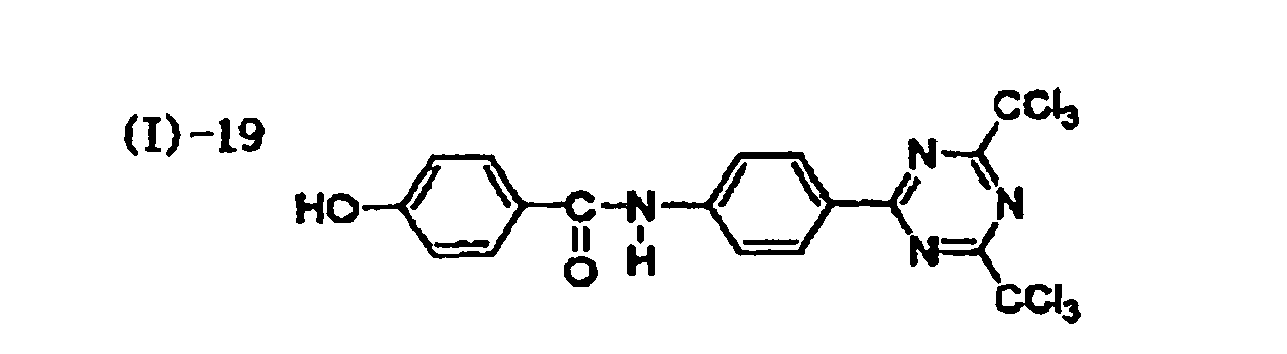


- The carbonyl compounds described above include, for example, benzophenone derivatives, e.g., benzophenone, Michler's ketone, 2-methylbenzophenone, 3-methylbenzophenone, 4-methylbenzophenone, 2-chlorobenzophenone, 4-bromobenzophenone or 2-carboxybenzophenone, acetophenone derivatives, e.g., 2,2-dimethoxy-2-phenylacetophenone, 2,2-diethoxyacetophenone, 1-hydroxycyclohexylphenylketone, α-hydroxy-2-methylphenylpropane, 1-hydroxy-1-methylethyl-(p-isopropylphenyl)ketone, 1-hydroxy-1-(p-dodecylphenyl)ketone, 2-methyl-(4'-(methylthio)phenyl)-2-morpbolino-1-propane or 1,1,1,-trichloromethyl-(p-butylphenyl)ketone, thioxantone derivatives, e.g., thioxantone, 2-ethylthioxantone, 2-isopropylthioxantone, 2-chlorothioxantone, 2,4-dimetylthioxantone, 2,4-dietylthioxantone or 2,4-diisopropylthioxantone, and benzoic acid ester derivatives, e.g., ethyl p-dimethylaminobenzoate or ethyl p-diethylaminobenzoate.
- The azo compounds described above include, for example, azo compounds described in
JP-A-8-108621 - The organic peroxides described above include, for example, trimethylcyclohexanone peroxide, acetylacetone peroxide, 1,1-bis(tert-butylperoxy)-3,3,5-trimethylcyclohexane, 1,1-bis(tert-butylperoxy)cyclohexane, 2,2-bis(tert-butylperoxy)butane, tert-butylhydroperoxide, cumene hydroperoxide, diisopropylbenzene hydroperoxide, 2,5-dimethylhexane-2,5-dihydroperoxide, 1,1,3,3-tetramethylbutyl hydroperoxide, tert-butylcumyl peroxide, dicumyl peroxide, 2,5-dimethyl-2,5-di(tert-butylperoxy)hexane, 2,5-oxanoyl peroxide, peroxy succinic acid, benzoyl peroxide, 2,4-dichlorobenzoyl peroxide, diisopropylperoxy dicarbonate, di-2-ethylhexylperoxy dicarbonate, di-2-ethoxyethylperoxy dicarbonate, dimethoxyisopropylperoxy dicarbonate, di(3-methyl-3-methoxybutyl)peroxy dicarbonate, tert-butylperoxy acetate, tert-butylperoxy pivalate, tert-butylperoxy neodecanoate, tert-butylperoxy octanoate, tert-butylperoxy laurate, tersyl carbonate, 3,3',4,4'-tetra(tert-butylperoxycarbonyl)benzophenone, 3,3',4,4'-tetra(tert-hexylperoxycarbonyl)benzophenone, 3,3',4,4'-tetra(p-isopropylcumylperoxycarbonyl)benzophenone, carbonyl di(tert-butylperoxydihydrogen diphthalate) and carbonyl di(tert-hexylperoxydihydrogen diphthalate).
- The metallocene compounds described above include, for example, various titanocene compounds described in
JP-A-59-152396 JP-A-61-151197 JP-A-63-41484 JP-A-2-249 JP-A-2-4705 JP-A-5-83588 JP-A-1-304453 JP-A-1-152109 - The hexaarylbiimidazole compounds described above include, for example, various compounds described in
JP-B-6-29285 U.S. Patents 3,479,185 ,4,311,783 and4,622,286 , specifically, for example, 2,2'-bis(o-chlorophenyl)-4,4',5,5'-tetraphenylbiimidazole, 2,2'-bis(o-bromophenyl)-4,4',5,5'-tetraphenylbiimidazole, 2,2'-bis(o,p-dichlorophenyl)-4,4',5,5'-tetraphenylbiimidazole, 2,2'-bis(o-chlorophenyl)-4,4',5,5'-tetra(m-methoxyphenyl)biimidazole, 2,2'-bis(o,o'-dichlorophenyl)-4,4',5,5'-tetraphenylbiimidazole, 2,2'-bis(o-nitrophenyl)-4,4',5,5'-tetraphenylbiimidazole, 2,2'-bis(o-methylphenyl)-4,4',5,5'-tetraphenylbiimidazole and 2,2'-bis(o-trifluoromethylphenyl)-4,4',5,5'-tetraphenylbiimidazole. - The organic boron compounds described above include, for example, organic boric acid salts described in
JP-A-62-143044 JP-A-62-150242 JP-A-9-188685 JP-A-9-188686 JP-A-9-188710 JP-A-2000-131837 JP-A-2002-107916 2764769 JP-A-2002-116539 JP-A-6-157623 JP-A-6-175564 JP-A-6-175561 JP-A-6-175554 JP-A-6-175553 JP-A-9-188710 JP-A-6-348011 JP-A-7-128785 JP-A-7-140589 JP-A-7-306527 JP-A-7-292014 - The disulfone compounds described above include, for example, compounds described in
JP-A-61-166544 JP-A-2002-328465 - The oxime ester compounds described above include, for example, compounds described in J. C. S. Perkin II. 1653-1660 (1979), J. C. S. Perkin II, 156-162 (1979), Journal of Photopolymer Science and Technology, 202-232 (1995) and
JP-A-2000-66385 JP-A-2000-80068 


- The onium salt compounds described above include onium salts, for example, diazonium salts described in S. I. Schlesinger, Photogr. Sci. Eng., 18, 387 (1974) and T. S. Bal et al., Polymer, 21, 423 (1980), ammonium salts described in
U.S. Patent 4,069,055 andJP-A-4-365049 U.S. Patents 4,069,055 and4,069,056 , iodonium salts described in European Patent104,143 U.S. Patents 339,049 and410,201 ,JP-A-2-150848 JP-A-2-296514 370,693 390,214 233,567 297,443 and 297,442 U.S. Patents 4,933,377 ,161,811 ,410,201 ,339,049 ,4,760,013 ,4,734,444 and2,833,827 and German Patents2,904,626 ,3,604,580 and3,604,581 , selenonium salts described in J.V. Crivello et al., Macromolecules, 10 (6), 1307 (1977) and J.V. Crivello et al., J. Polymer Sci., Polymer Chem. Ed., 17, 1047 (1979), and arsonium salts described in C.S. Wen et al., Teh, Proc. Conf. Rad. Curing ASIA, p. 478, Tokyo, Oct. (1988). - In the invention, the onium salt compound functions not as an acid generator, but as an ionic radical polymerization initiator.
- The onium salt compounds preferably used include onium salts represented by the following formulae (RI-I) to (RI-III):


- In formula (RI-I), Ar11 represents an aryl group having 20 or less carbon atoms, which may have 1 to 6 substituents. Preferable examples of the substituent include an alkyl group having 12 or less carbon atoms, an alkenyl group having 12 or less carbon atoms, an alkynyl group having 12 or less carbon atoms, an aryl group having 12 or less carbon atoms, an alkoxy group having 12 or less carbon atoms, an aryloxy group having 12 or less carbon atoms, a halogen atom, an alkylamino group having 12 or less carbon atoms, a dialkylimino group having 12 or less carbon atoms, an alkylamido group or arylamido group having 12 or less carbon atoms, a carbonyl group, a carboxyl group, a cyano group, a sulfonyl group, an thioalkyl group having 12 or less carbon atoms and an thioaryl group having 12 or less carbon atoms. Z11 - represents a monovalent anion. Specific examples of the monovalent anion include a halogen ion, a perchlorate ion, a hexafluorophosphate ion, a tetrafluoroborate ion, a sulfonate ion, a sulfinate ion, a thosulfonate ion and a sulfate ion. Among them, a perchlorate ion, a hexafluorophosphate ion, a tetrafluoroborate ion, a sulfonate ion and a sulfinate ion are preferred in view of stability.
- In the formula (RI-II), Ar21 and Ar22 each independently represents an aryl group having 20 or less carbon atoms, which may have 1 to 6 substituents. Preferable examples of the substituent include an alkyl group having 12 or less carbon atoms, an alkenyl group having 12 or less carbon atoms, an alkynyl group having 12 or less carbon atoms, an aryl group having 12 or less carbon atoms, an alkoxy group having 12 or less carbon atoms, an aryloxy group having 12 or less carbon atoms, a halogen atom, an alkylamino group having 12 or less carbon atoms, a dialkylimino group having 12 or less carbon atoms, an alkylamido group or arylamido group having 12 or less carbon atoms, a carbonyl group, a carboxyl group, a cyano group, a sulfonyl group, an thioalkyl group having 12 or less carbon atoms and an thioaryl group having 12 or less carbon atoms. Z21 - represents a monovalent anion. Specific examples of the monovalent anion include a halogen ion, a perchlorate ion, a hexafluorophosphate ion, a tetrafluoroborate ion, a sulfonate ion, a sulfinate ion; a thosulfonate ion, a sulfate ion and a carboxylate ion. Among them, a perchlorate ion, a hexafluorophosphate ion, a tetrafluoroborate ion, a sulfonate ion, a sulfinate ion and a carboxylate ion are preferred in view of stability and reactivity.
- In the formula (RI-III), R31, R32 and R33 each independently represents an aryl group having 20 or less carbon atoms, which may have 1 to 6 substituents, an alkyl group, an alkenyl group or an alkynyl group. Among them, the aryl group is preferred in view of reactivity and stability. Preferable examples of the substituent include an alkyl group having 12 or less carbon atoms, an alkenyl group having 12 or less carbon atoms, an alkynyl group having 12 or less carbon atoms, an aryl group having 12 or less carbon atoms, an alkoxy group having 12 or less carbon atoms, an aryloxy group having 12 or less carbon atoms, a halogen atom, an alkylamino group having 12 or less carbon atoms, a dialkylimino group having 12 or less carbon atoms, an alkylamido group or arylamido group having 12 or less carbon atoms, a carbonyl group, a carboxyl group, a cyano group, a sulfonyl group, an thioalkyl group having 12 or less carbon atoms and an thioaryl group having 12 or less carbon atoms. Z31 - represents a monovalent anion. Specific examples of the monovalent anion include a halogen ion, a perchlorate ion, a hexafluorophosphate ion, a tetrafluoroborate ion, a sulfonate ion, a sulfinate ion, a thosulfonate ion, a sulfate ion and a carboxylate ion. Among them, a perchlorate ion, a hexafluorophosphate ion, a tetrafluoroborate ion, a sulfonate ion, a sulfinate ion and a carboxylate ion are preferred in view of stability and reactivity. Carboxylate ions described in
JP-A-2001-343742 JP-A-2002-148790 - Specific examples of the onium salt represented by any on of formulae (RI-I) to (RI-III) are set forth below, but the invention should not be construed as being limited thereto.

PF6 - (N-2)

CIO4 - (N-4)
PF6 - (N-5)

BF4 - (N-7)

CIO4 - (N-9)


PF6 - (N-12)

CIO4 - (N-14)

PF6 - (N-16)


PF6 - (I-2)





CIO4 - (I-14)
PF6 - (I-13)

CF3COO- (I-17)
CF3SO3 - (I-18)



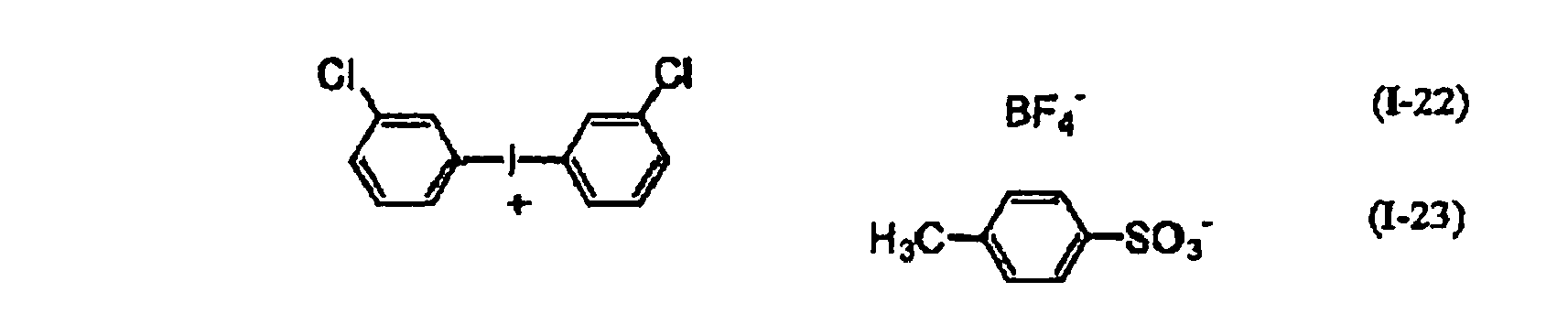


CIO4 - (S-3)


CF3SO3 - (S-6)


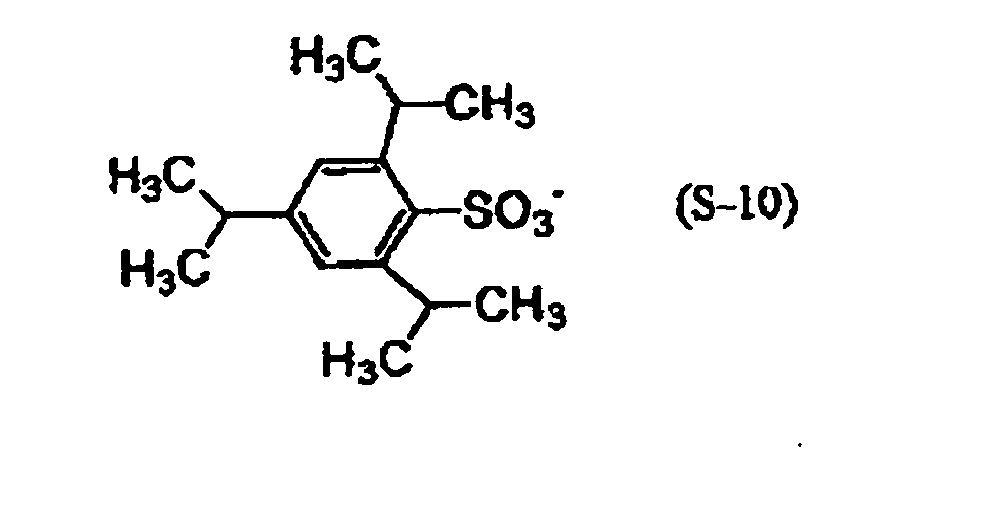


BF4 - (S-16)
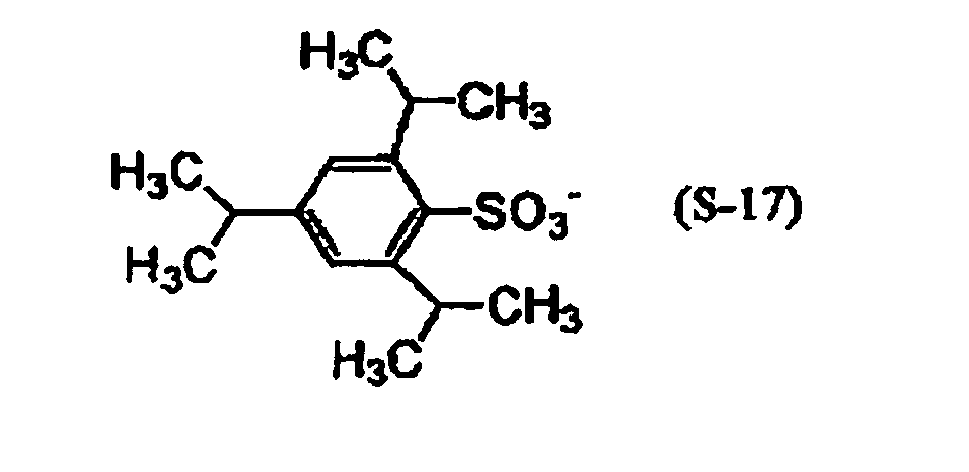

- As the polymerization initiator, particularly, from the standpoint of reactivity and stability, the organic halogen compounds, metallocene compounds, hexaarylbiimidazole compounds, organic boron compounds, oxime ester compounds and onium salt compounds are preferable and the organic halogen compounds, metallocene compounds, hexaarylbiimidazole compounds and onium salt compounds are more preferable.
- The polymerization initiators may be used individually or in combination of two or more thereof. The content of the polymerization initiator is preferably from 0.1 to 50% by weight, more preferably from 0.5 to 30% by weight, still more preferably from 0.8 to 20% by weight, based on the total solid content of the photosensitive layer.
- The polymerizable compound for use in the photosensitive layer according to the invention is an addition-polymerizable compound having at least one ethylenically unsaturated double bond, and it is selected from compounds having at least one, preferably two or more, terminal ethylenically unsaturated double bonds. Such compounds are widely known in the art and they can be used in the invention without any particular limitation. The polymerizable compound has a chemical form, for example, a monomer, a prepolymer, specifically, a dimer, a trimer or an oligomer, or a copolymer thereof or a mixture thereof. Examples of the polymerizable compound include compounds represented by the following formulae (1) to (5):

- In formula (1), R1 to R3 each independently represents a monovalent organic group. R1 preferably includes, for example, a hydrogen atom or an alkyl group. Among them, a hydrogen atom, a methyl group or a group formed by substituting one hydrogen atom of methyl group with a hydroxy group, an alkoxy group, an acyloxy group, an amino group, an acylamino group, a thiol group, an alkylthio group, an acylthio group, a sulfo group, a sulfonic acid group or a carboxyl group is more preferable because of high radical reactivity. R2 and R3 each independently preferably includes, for example, a hydrogen atom, a halogen atom, an amino group, a carboxyl group, an alkoxycarbonyl group, a sulfo group, a nitro group, a cyano group, an alkyl group, an aryl group, an alkoxy group, an aryloxy group, an alkylamino group, an arylamino group, an alkylsulfonyl group and an arylsulfonyl group. Among them, a hydrogen atom, a carboxyl group, an alkoxycarbonyl group, an alkyl group or an aryl group is preferable because of high radical reactivity.
- X represents an oxygen atom, a sulfur atom, -N(R12)- or -C(R)2R13)-, and R12 and R13 each represents a monovalent organic group. The monovalent organic group represented by R12 or R13 includes, for example, an alkyl group. R12 or R13 is preferably a hydrogen atom, a methyl group, an ethyl group or an isopropyl group because of high radical reactivity. R12 or R13 may be combined with an atom constituting L to from a ring.
- Examples of the substituent capable of being introduced into the organic group include an alkyl group, an alkenyl group, an alkynyl group, an aryl group, an alkoxy group, an aryloxy group, a halogen atom, an amino group, an alkylamino group, an arylamino group, a carboxyl group, an alkoxycarbonyl group, a sulfo group, a nitro group, a cyano group, an amido group, an allcylsulfonyl group and an arylsulfonyl group.
- L represents an n-valent organic group constituted from hydrogen, fluorine, chlorine, bromine, iodine, carbon, nitrogen, oxygen, boron, sulfur, phosphorus, silicon, lithium, sodium, potassium, magnesium, calcium, aluminum, scandium, titanium, vanadium, chromium, manganese, iron, cobalt, nickel, zinc, gallium, germanium, silver, palladium, lead, zirconium, rhodium, tin, platinum or tungsten. L is preferably an n-valent organic group constituted from hydrogen, fluorine, chlorine, bromine, iodine, carbon, nitrogen, oxygen, boron, sulfur, phosphorus, silicon, lithium, sodium, potassium, magnesium or calcium, more preferably an n-valent organic group constituted from hydrogen, fluorine, chlorine, bromine, iodine, carbon, nitrogen, oxygen, boron, sulfur, phosphorus or silicon.
n represents a natural number and is preferably from 1 to 100, more preferably from 2 to 80, still more preferably from 3 to 60. - Specific examples of the polymerizable compound represented by formula (1) include (a) an unsaturated carboxylic acid (for example, acrylic acid, methacrylic acid, itaconic acid, crotonic acid, isocrotonic acid, 2-hydroxymethylacrylic acid, α-bromoacrylic acid, fumaric acid, mesaconic acid or maleic acid), (b) an ester thereof and (c) an amide thereof, and (d) an ester of an unsaturated carboxylic acid with an aliphatic polyhydric alcohol compound and (e) an amide of an unsaturated carboxylic acid with an aliphatic polyvalent amine compound are preferably used. Further, (f) an addition reaction product of an unsaturated carboxylic acid ester or amide having a nucleophilic substituent, for example, a hydroxy group, an amino group or a mercapto group, with a monofunctional or polyfunctional isocyanate or epoxy, or a dehydration condensation reaction product of the unsaturated carboxylic acid ester or amide with a monofunctional or polyfunctional carboxylic acid is also preferably used. Moreover, (g) an addition reaction product of an unsaturated carboxylic acid ester or amide having an electrophilic substituent, for example, an isocyanate group or an epoxy group with a monofunctional or polyfunctional alcohol, amine or thiol, or (h) a substitution reaction product of an unsaturated carboxylic acid ester or amide having a releasable substituent, for example, a halogen atom or a tosyloxy group with a monofunctional or polyfunctional alcohol, amine or thiol is also preferably used. In addition, compounds in which the unsaturated carboxylic acid described above is replaced by an unsaturated ketone (for example, vinyl methyl ketone or vinyl ethyl ketone) can also be used.
- Specific examples of the monomer, which is an ester of an aliphatic polyhydric alcohol compound with an unsaturated carboxylic acid, include, as an acrylic acid ester, for example, ethylene glycol diacrylate, triethylene glycol diacrylate, propylene glycol diacrylate, trimethylolpropane triacrylate, hexanediol diacrylate, 1,4-cyclohexanediol diacrylate, pentaerythritol triacrylate, pentaerythritol tetraacrylate, dipentaerythritol hexaacrylate, sorbitol tetraacrylate, sorbitol hexaacrylate, tri(acryloyloxyethyl) isocyanurate, isocyanuric acid ethylene oxide (EO) modified triacrylate and polyester acrylate oligomer.
- As an methacrylic acid ester, for example, tetramethylene glycol dimethacrylate, triethylene glycol dimethacrylate, trimethylolpropane trimethacrylate, pentaerythritol trimethacrylate, pentaerythritol tetramethacrylate, dipentaerythritol hexamethacrylate, sorbitol trimethacrylate, sorbitol tetramethacrylate, bis[p-(3-methacryloxy-2-hydroxypropoxy)phenyl]dimethylmethane or bis[p-(methacryloxyethoxy)phenyl]dimethylmethane is exemplified.
- As an itaconic acid ester, for example, ethylene glycol diitaconate, tetramethylene glycol diitaconate, pentaerythritol diitaconate or sorbitol tetraitaconate is exemplified. As a crotonic acid ester, for example, ethylene glycol dicrotonate, tetramethylene glycol dicrotonate, pentaerythritol dicrotonate or sorbitol tetracrotonate is exemplified. As an isocrotonic acid ester, for example, ethylene glycol diisocrotonate, pentaerythritol diisocrotonate or sorbitol tetraisocrotonate is exemplified. As a maleic acid ester, for example, ethylene glycol dimaleate, pentaerythritol dimaleate or sorbitol tetramaleate is exemplified.
- Other examples of the ester, which can be preferably used, include aliphatic alcohol esters described in
JP-B-51-47334 JP-A-57-196231 JP-A-59-5240 JP-A-59-5241 JP-A-2-226149 JP-A-1-165613 - The above-described ester monomers can also be used as a mixture.
- Specific examples of the monomer, which is an amide of an aliphatic polyvalent amine compound with an unsaturated carboxylic acid, include methylene bisacrylamide, methylene bismethacrylamide, 1,6-hexamethylene bisacrylamide, 1,6-hexamethylene bismethacrylamide, diethylenetriamine trisacrylamide, xylylene bisacrylamide and xylylene bismethacrylamide. Other preferable examples of the amide monomer include amides having a cyclohexylene structure described in
JP-B-54-21726 - Urethane type addition-polymerizable compounds produced using an addition reaction between an isocyanate and a hydroxy group are also preferably used, and specific examples thereof include vinylurethane compounds having two or more polymerizable vinyl groups per molecule obtained by adding a vinyl monomer containing a hydroxy group represented by formula (VM) shown below to a polyisocyanate compound having two or more isocyanate groups per molecule, described in
JP-B-48-41708
CH2=C(R4)COOCH2CH(R5)OH (VM)
wherein R4 and R5 each independently represents H or CH3. - Also, urethane acrylates described in
JP-A-51-37193 JP-B-2-32293 JP-B-2-16765 JP-B-58-49860 JP-B-56-17654 JP-B-62-39417 JP-B-62-39418 JP-A-63-277653 JP-A-63-260909 JP-A-1-105238 - Other examples include polyfunctional acrylates and methacrylates, for example, polyester acrylates and epoxy acrylates obtained by reacting an epoxy resin with (meth)acrylic acid, described in
JP-A-48-64183 JP-B-49-43191 JP-B-52-30490 JP-B-46-43946 JP-B-1-40337 JP-B-1-40336 JP-A-2-25493 JP-A-61-22048 
- In formula (2), R1 to R5 each independently represents a monovalent organic group. R1 to R5 each independently preferably includes, for example, a hydrogen atom, a halogen atom, an amino group, a dialkylamino group, a carboxyl group, an alkoxycarbonyl group, a sulfo group, a nitro group, a cyano group, an alkyl group, an aryl group, an alkoxy group, an aryloxy group, an alkylamino group, an arylamino group, an alkylsulfonyl group and an arylsulfonyl group. Among them, a hydrogen atom, a carboxyl group, an alkoxycarbonyl group, an alkyl group or an aryl group is preferable. Alternatively, appropriate two of R1 to R5 may be combined with each other to form a ring, or any one of R1 to R5 may be combined with an atom constituting L to from a ring.
- Examples of the substituent capable of being introduced into the organic group include those described in formula (1). Y represents an oxygen atom, a sulfur atom, -N(R12)- or -C(R12R13)-. R12 and R13 have the same meanings as R12 and R13 defined in formula (1), respectively. Preferable examples of R12 and R13 are also same as those described in formula (1), respectively.
- L and n have the same meanings as L and n defined in formula (1), respectively. Preferable examples of L and n are also same as those described in formula (1), respectively.
- Specific examples of the polymerizable compound represented by formula (2) include an ester compound of an alcohol having an unsaturated double bond (for example, ally alcohol, ethylene glycol monoallyl ether, 3-butene-1-ol, 2-cyclohexene-1-ol or retinol) with a monofunctional or polyfunctional carboxylic acid (for example, acetic acid, benzoic acid, maleic acid, tricarbaric acid, 1,3,5-cyclohexanetricarboxylic acid or 1,2,4-benzenetricarboxylic acid), a urethane compound of the alcohol having an unsaturated double bond with a monofunctional or polyfunctional iso(thio)cyanate (for example, butyl isocyanate, 1,3-bis(isocyanatomethyl)cyclohexane, 4,4'-methylenebis(cyclohexylisocyanate), isohoron diisocyanate, allyl isothiocyanate, phenyl isothiocyanate, phenyl isocyanate or 4,4'-methylenebis(phenyl isocyanate), an ether compound of the alcohol having an unsaturated double bond with a monofunctional or polyfunctional alcohol (for example, ethanol, ethylene glycol, polyethylene glycol, propylene glycol, cyclohexane diol, inositol, glycerol, trimethylol propane, pentaerythritol, xylitol, dextrin, phenol or bisphenol A), an addition reaction product of the alcohol having an unsaturated double bond with a monofunctional or polyfunctional epoxy compound (for example, ethylene glycol diglycidyl ether, cyclohexene oxide, neopentyl glycol diglycidyl ether or tris(2,3-epoxypropyl)isocyanurate), a substitution reaction product of the alcohol having an unsaturated double bond with a monofunctional or polyfunctional halogenated alkyl (for example, 1,4-dibromobutane or bis(2-bromoethyl) maleate) or a sulfonic acid (for example, methanesulfonic acid, camphorsulfonic acid or toluenesulfonic acid) ester of a monofunctional or polyfunctional alcohol, a substitution reaction product of a halogenated alkyl having an unsaturated double bond (for example, allyl bromide, 4-bromo-1-butene or 3-chloro-2-methylpropene) or a sulfonic acid ester of an alcohol having an unsaturated double bond with a nucleophilic compound, for example, a monofunctional or polyfunctional alcohol, a monofunctional or polyfunctional amine (for example, butylamine, ethylenediamine, triethylamine, pentaethylenehexamine, 2,2'-oxybis(ethylamine), morpholine, piperazine, pyridine, proline or 4,4'-methylenedianiline), a monofunctional or polyfunctional phosphine, a monofunctional or polyfunctional thiol, a monofunctional or polyfunctional carbonyl compound or a monofunctional or polyfunctional carboxylate, an amide of an amine having an unsaturated double bond (for example, allylamine, triallylamine, geranylamine or N-ethyl-2-methylallylamine) with a monofunctional or polyfunctional carboxylic acid, a urea of the amine having an unsaturated double bond with a monofunctional or polyfunctional isocyanate, a substitution reaction product of the amine having an unsaturated double bond with a monofunctional or polyfunctional halogenated alkyl or a sulfonic acid ester of a monofunctional or polyfunctional alcohol, an imine of the amine having an unsaturated double bond with a monofunctional or polyfunctional carbonyl compound, a sulfonamide of the amine having an unsaturated double bond with a monofunctional or polyfunctional sulfonic acid, a urethane of an iso(thio)cyanate having an unsaturated double bond (for example, allyl isocyanate or allyl isothiocyanate) with a monofunctional or polyfunctional alcohol, a urea of the iso(thio)cyanate having an unsaturated double bond with a monofunctional or polyfunctional amine, an amide of the iso(thio)cyanate having an unsaturated double bond with a monofunctional or polyfunctional carboxylic acid, an addition reaction product of the iso(thio)cyanate having an unsaturated double bond with a monofunctional or polyfunctional thiol, and an addition reaction product of the iso(thio)cyanate having an unsaturated double bond with a monofunctional or polyfunctional iso(thio)cyanate.

- In formula (3), R1 to R3 each independently represents a monovalent organic group. R1 to R3 each independently preferably includes, for example, a hydrogen atom, a halogen atom, an amino group, a dialkylamino group, a carboxyl group, an alkoxycarbonyl group, a sulfo group, a nitro group, a cyano group, an alkyl group, an aryl group, an alkoxy group, an aryloxy group, an alkylamino group, an arylamino group, an alkylsulfonyl group and an arylsulfonyl group. Among them, a hydrogen atom, a carboxyl group, an alkoxycarbonyl group, an alkyl group or an aryl group is preferable. Alternatively, appropriate two of R1 to R3 may be combined with each other to form a ring, or any one of R1 to R3 may be combined with an atom constituting L to from a ring.
- Examples of the substituent capable of being introduced into the organic group include those described in formula (1). Z represents an oxygen atom, a sulfur atom, -N(R12)- or -C(R12R13)-. R12 and R13 have the same meanings as R12 and R13 defined in formula (1), respectively. Preferable examples of R12 and R13 are also same as those described in formula (1), respectively.
- L and n have the same meanings as L and n defined in formula (1), respectively. Preferable examples ofL and n are also same as those described in formula (1), respectively.
- Specific examples of the polymerizable compound represented by formula (3) include a monofunctional or polyfunctional carboxylic acid vinyl ester (for example, vinyl acetate, isopropenyl acetate or trivinyl 1,3,5-cyclohexanetricarboxylate), a vinyl ether (for example, 1,4-cyclohexanedimethanol divinyl ether or trimethylolpropane trivinyl ether), an ester of a vinyl ether alcohol (for example, ethylene glycol monovinyl ether or diethylene glycol monovinyl ether) with a monofunctional or polyfunctional carboxylic acid, a urethane of the vinyl ether alcohol with a monofunctional or polyfunctional iso(thio)cyanate, a substitution product of the vinyl ether alcohol with a monofunctional or polyfunctional halogenated alkyl or a sulfonic acid ester of a monofunctional or polyfunctional alcohol, an addition product of the vinyl ether alcohol with a monofunctional or polyfunctional epoxy, a substitution reaction product of a vinyl ether of halogenated alkyl (for example, 2-chloromethyl vinyl ether) or a vinyl ether sulfonic acid ester (for example, vinyloxyethyl p-toluenesulfonate) with a nucleophilic compound, for example, a monofunctional or polyfunctional alcohol, a monofunctional or polyfunctional amine, a monofunctional or polyfunctional phosphine, a monofunctional or polyfunctional thiol, a monofunctional or polyfunctional carbonyl compound or a monofunctional or polyfunctional carboxylate, an amide of a vinyl ether amine (for example, 3-amino-1-propanol vinyl ether or 2-(diethylamino)ethanol vinyl ether) with a monofunctional or polyfunctional carboxylic acid, a urea of the vinyl ether amine with a monofunctional or polyfunctional iso(thioxyanate, a substitution product of the vinyl ether amine with a monofunctional or polyfunctional halogenated alkyl, a sulfonamide of the vinyl ether amine with a monofunctional or polyfunctional sulfonic acid, and a monofunctional or polyfunctional vinyl amide (for example, N-vinyl carbazole, N-vinyl pyrrolidinone or N-vinyl phtalimide).

- In formula (4), R1 to R3 each independently represents a monovalent organic group. R1 to R3 each independently preferably includes, for example, a hydrogen atom, a halogen atom, an amino group, a dialkylamino group, a carboxyl group, an alkoxycarbonyl group, a sulfo group, a nitro group, a cyano group, an alkyl group, an aryl group, an alkoxy group, an aryloxy group, an alkylamino group, an arylamino group, an alkylsulfonyl group and an arylsulfonyl group. Among them, a hydrogen atom, a carboxyl group, an alkoxycarbonyl group, an alkyl group or an aryl group is preferable. R4 to R8 each independently represents a monovalent organic group or a divalent organic group connecting to L. The monovalent organic group for any one of R4 to R8 preferably includes those described for the monovalent organic group for any one of R1 to R3 above. The divalent organic group for any one of R4 to R8 preferably includes divalent organic groups constituted from hydrogen, carbon, oxygen, nitrogen, sulfur, halogen, silicon or phosphorus. Alternatively, appropriate two of R4 to R8 may be combined with each other to form a ring, or any one of R4 to R8 may be combined with an atom constituting L to from a ring.
- Examples of the substituent capable of being introduced into the organic group include those described in formulae (1).
- L and n have the same meanings as L and n defined in formula (1), respectively. Preferable examples of L and n are also same as those described in formula (1), respectively.
- Specific examples of the polymerizable compound represented by formula (4) include an ester of a styrene containing a carboxylic acid (for example, p-styrenecarboxylic acid) or a styrene containing a sulfonic acid (for example, p-styrenesulfonic acid) with a monofunctional or polyfunctional alcohol, an amide of the styrene containing a carboxylic acid or sulfonic acid with a monofunctional or polyfunctional amine, an ester of a styrene containing a hydroxy group (for example, p-hydroxymethylstyrene, 2-hydroxyethyl p-styrenecarboxylate or 2-hydroxyethyl p-styrenesulfonate) with a monofunctional or polyfunctional carboxylic acid, a urethane of the styrene containing a hydroxy group with a monofunctional or polyfunctional iso(thio)cyanate, a substitution product of the styrene containing a hydroxy group with a monofunctional or polyfunctional halogenated alkyl or a sulfonic acid ester of a monofunctional or polyfunctional alcohol, an addition product of the styrene containing a hydroxy group with a monofunctional or polyfunctional epoxy, a substitution reaction product of a styrene containing a halogenated alkyl group (for example, p-chloromethylstyrene or 2-chloroethyl p-styrenecarboxylate) or a styrene containing a sulfonic acid ester group (for example, p-tosyloxymethylstyrene) with a nucleophilic compound, for example, a monofunctional or polyfunctional alcohol, a monofunctional or polyfunctional amine, a monofunctional or polyfunctional phosphine, a monofunctional or polyfunctional thiol, a monofunctional or polyfunctional carbonyl compound or a monofunctional or polyfunctional carboxylate, an amide of a styrene containing an amino group (for example, p-aminomethylstyrene) with a monofunctional or polyfunctional carboxylic acid, a urea of the styrene containing an amino group with a monofunctional or polyfunctional iso(thio)cyanate, a substitution product of the styrene containing an amino group with a monofunctional or polyfunctional halogenated alkyl, a sulfonamide of the styrene containing an amino group with a monofunctional or polyfunctional sulfonic acid.

- In formula (5), R1 to R3 each independently represents a monovalent organic group. R1 to R3 each independently preferably includes, for example, a hydrogen atom, a halogen atom, an amino group, a dialkylamino group, a carboxyl group, an alkoxycarbonyl group, a sulfo group, a nitro group, a cyano group, an alkyl group, an aryl group, an alkoxy group, an aryloxy group, an alkylamino group, an arylamino group, an alkylsulfonyl group and an arylsulfonyl group. Among them, a hydrogen atom, a carboxyl group, an alkoxycarbonyl group, an alkyl group or an aryl group is preferable. R5 each independently represents a monovalent organic group. The monovalent organic group for R5 preferably includes those described for the monovalent organic group for any one of R1 to R3 above. Alternatively, R5 may from a ring together with L.
- Examples of the substituent capable of being introduced into the organic group include those described in formula (1). W represents an oxygen atom, a sulfur atom, -N(R)2)- or -C(R12R13)-. R12 and R13 have the same meanings as R12 and R13 defined in formula (1), respectively. Preferable examples of R12 and R13 are also same as those described in formula (1), respectively.
- L and n have the same meanings as L and n defined in formula (1), respectively. Preferable examples of L and n are also same as those described in formula (1), respectively.
- Specific examples of the polymerizable compound represented by formula (5) include an ester of a vinylphosphonic acid (for example, vinylphosphonic acid, or methyl 2-phosphonoacrylate) with a monofunctional or polyfunctional alcohol, an amide of the vinylphosphonic acid with a monofunctional or polyfunctional amine, an ester of a vinylphosphonic acid containing a hydroxy group (for example, bis(2-hydroxyethyl) vinylphosphonic acid) with a monofunctional or polyfunctional carboxylic acid, a urethane of the vinylphosphonic acid containing a hydroxy group with a monofunctional or polyfunctional iso(thio)cyanate, a substitution product of the vinylphosphonic acid containing a hydroxy group with a monofunctional or polyfunctional halogenated alkyl or a sulfonic acid ester of a monofunctional or polyfunctional alcohol, an addition product of the vinylphosphonic acid containing a hydroxy group with a monofunctional or polyfunctional epoxy, a substitution reaction product of a vinylphosphonic acid containing a halogenated alkyl group (for example, bis(2-bromoethyl) vinylphosphonic acid) or a vinylphosphonic acid containing a sulfonic acid ester group (for example, p-tosyloxyethyl vinylphosphonic acid) with a nucleophilic compound, for example, a monofunctional or polyfunctional alcohol, a monofunctional or polyfunctional amine, a monofunctional or polyfunctional phosphine, a monofunctional or polyfunctional thiol, a monofunctional or polyfunctional carbonyl compound or a monofunctional or polyfunctional carboxylate.
- Details of the method of using the polymerizable compound, for example, selection of the structure, individual or combination use or an amount added, can be appropriately determined in accordance with the characteristic design of the lithographic printing plate precursor. For instance, the compound is selected from the following standpoints.
- In view of the sensitivity, a structure having a large content of unsaturated group per molecule is preferred and in many cases, a difunctional or more functional compound is preferred. Also, in order to increase the strength of the image area, that is, cured layer, a trifunctional or more functional compound is preferred. A combination use of compounds different in the functional number or in the kind of polymerizable group (for example, an acrylic acid ester, a methacrylic acid ester, a styrene compound or a vinyl ether compound) is an effective method for controlling both the sensitivity and strength.
- The selection and use method of the polymerizable compound are also important factors for the compatibility and dispersibility with other components (for example, a binder polymer, a polymerization initiator or a coloring agent) in the photosensitive layer. For instance, the compatibility may be improved in some cases by using the compound of low purity or using two or more kinds of the compounds in combination. A specific structure may be selected for the purpose of improving an adhesion property to a sup port, a protective layer or the like described hereinafter.
- The polymerizable compound is used preferably in a range of 5 to 80% by weight, more preferably in a range of 25 to 75% by weight, based on the total solid content of the photosensitive layer. The polymerizable compounds may be used individually or in combination of two or more thereof. The method of using the polymerizable compound can be adequately selected by taking account of the degree of polymerization inhibition due to oxygen, resolution, anti-fogging property, change in refractive index, surface tackiness and the like.
- The binder polymer for use in the photosensitive layer according to the invention is preferably a binder polymer having a hydrophilic group from the standpoint of developing property in a developer having pH of 2 to 8.
- The hydrophilic group is selected from monovalent and divalent or more valent hydrophilic groups, and preferably includes, for example, a hydroxy group, a sulfonic acid group, an alkylene oxy group (for example, an ethylene oxy group or a propylene oxy group), a primary amino group, a secondary amino group, a tertiary amino group, a salt formed by neutralization of the amino group with an acid, a quaternary ammonium group, an amido group, an ether group, a salt formed by neutralization of an acid, for example, carboxylic acid, sulfonic acid or phosphoric acid and a heterocyclic group containing a positively charged nitrogen atom. Especially, a primary amino group, a secondary amino group, a tertiary amino group, a salt formed by neutralization of the amino group with an acid, a quaternary ammonium group, an amido group, a hydroxy group, a repeating unit of -CH2CH2O-, a repeating unit of -CH2CH2NH- and a pyridinium group are preferable, and a tertiary amino group, a salt formed by neutralization of a tertiary amino group with an acid and a quaternary ammonium group are most preferable.
- As the binder polymer, a polymer having a structure represented by formula <1> or <2> shown below is preferable. The binder polymer having a group represented by formula <1> or <2> shown below in its side chain may be any appropriate compound as long as it is a polymer compound including a repeating unit containing the structure represented by formula <1> or <2>.
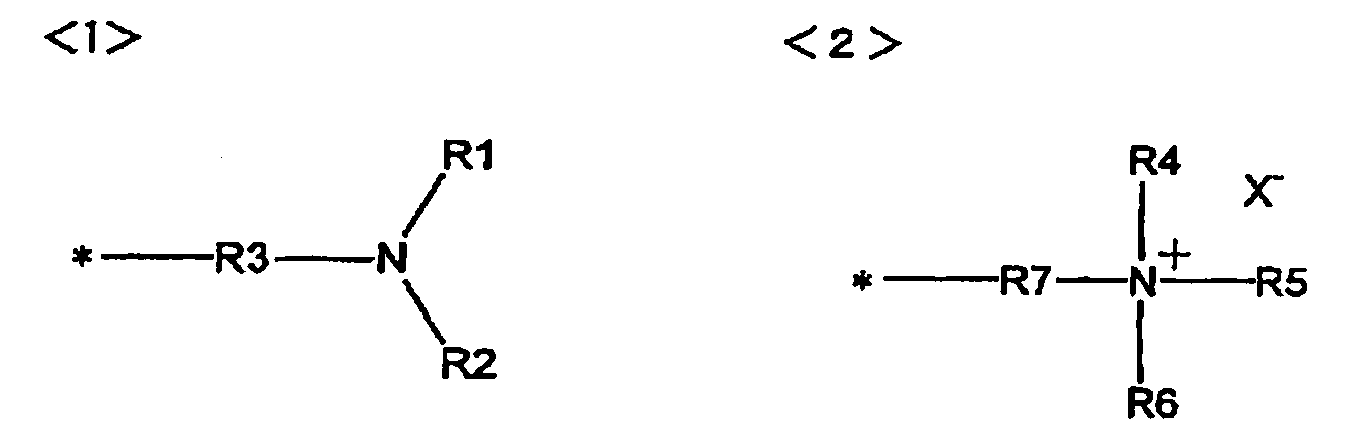
- In formulae <1> and <2>, R1, R2 and R4 to R6 each independently represents a monovalent organic group, R3 and R7 each represents a single bond or a divalent organic group, or appropriate two of R1 to R3 or appropriate two of R4 to R7 may be combined with each other to form a ring, or appropriate one of R1 to R3 or appropriate one of R4 to R7 may form a double bond between the nitrogen atom, in this case R1 or R2 in formula <1> or one of R4 to R6 in formula <2> is not present, X represents an anion, and * represents a position connecting to the binder polymer.
- In formulae <1> and <2>, the monovalent organic group is a monovalent substituent comprising at least one atom selected from hydrogen, carbon, oxygen, nitrogen, sulfur, phosphorus, halogen and silicon. The divalent organic group is a divalent connecting group comprising at least one atom selected from hydrogen, carbon, oxygen, nitrogen, sulfur, phosphorus, halogen and silicon. The monovalent substituent comprising at least one atom selected from hydrogen, carbon, oxygen, nitrogen, sulfur, phosphorus, halogen and silicon includes substituents formed from -H, -F, -Cl, -Br, -I, >C<, =C<, ≡C-, -O-, O=, -N<, -N=, =N, -S-, S=, >S<, ≡S≡, -P<, ≡P<, >Si<, =Si<, ≡Si- and combinations thereof. Examples of the monovalent substituent include a hydrogen atom, an alkyl group (for example, a methyl group, an ethyl group, a cyclohexyl group, a chloromethyl group, a methoxyethoxyethyl group, an allyloxymethyl group, an N-(methoxyphenyl)carbamoylethyl group or a p-methylbenzyl group), an aryl group (for example, a phenyl group, a biphenyl group or a naphthyl group), a heteroaryl group (for example, a group derived from a hetero ring, for example, thiophene, furan, pyran, pyrrole, pyrazole, isothiazole, isoxazole, pyrazine, pyrimidine, carbazole, acridine, furazane or phenoxazine), an alkenyl group (for example, a vinyl group, a 1-propenyl group or a 2-chloro-1-ethenyl group), an alkynyl group (for example, an ethynyl group, a 1-propynyl group or a trimethylsilylethynyl group), a halogen atom (for example, -F, -Br, -Cl or -I), a hydroxy group, an alkoxy group, an aryloxy group, a mercapto group, an acyl group, a sulfo group (-SO3H) and its conjugated base group (hereinafter referred to as a "sulfonato group"), a phosphono group (-PO3H2) and its conjugated base group (hereinafter referred to as a "phosphonato group"), a phosphonooxy group (-OPO3H2) and its conjugated base group (hereinafter referred to as a "phosphonatooxy group"), a cyano group and a nitro group. Among the above-described groups, a hydrogen atom, an alkyl group, an aryl group, an alkenyl group, an alkynyl group, a halogen atom, an alkoxy group and an acyl group are preferable. The divalent connecting group is nor particularly restricted and preferably includes an alkylene group, an arylene group and a connecting group containing a hetero atom, for example, an ester bond, an amido bond or an ether bond, and combinations thereof.
- In formula <1>, it is preferred that R1 and R2 each independently represents a hydrogen atom, an alkyl group or an aryl group from the standpoint of the developing property in a developer having pH of 2.0 to 8.0. The total number of carbon numbers included in R1 and R2 is preferably from 0 to 24, more preferably from 0 to 12. When the total number of carbon atoms included in R1 and R2 is 0, both R1 and R2 represent hydrogen atoms.
- In formula <2>, it is preferred that R4, R5 and R6 each independently represents a hydrogen atom, an alkyl group or an aryl group from the standpoint of the developing property in a developer having pH of 2.0 to 8.0. The total number of carbon atoms included in R4, R5 and R6 is preferably from 0 to 36, more preferably from 0 to 18. When the total number of carbon atoms included in R4, R5 and R6 is 0, R4, R5 and R6 all represent hydrogen atoms.
- In formulae <1> and <2>, specific examples of the anion represented by X- include a halogen anion, a halogen oxoacid anion (for example, ClO4 -, IO3 - or BrO3 -), a halogeno complex anion (for example, BF4 -, PF6 - or AlCl4 -), a sulfate anion, a nitrate anion, a phosphate anion, a borate anion, a carboxylate anion, a sulfonate anion, a phosphonate anion and a metal complex anion (for example, [Fe(CN)6]-). Among them, a halogen anion, a halogeno complex anion, a borate anion, a carboxylate anion and a sulfonate anion are preferable, and a halogeno complex anion, a borate anion and a sulfonate anion are more preferable from the standpoint of the developing property in a developer having pH of 2.0 to 8.0.
- The case where R1, R2 and R4 to R6 each independently represents a monovalent organic group and R3 and R7 each represents a single bond or a divalent organic group in formulae <1> and <2>, specifically, amino groups and ammonium groups are particularly preferable. The binder polymer including an amino group and/or ammonium group (hereinafter appropriately referred to as a "specific binder polymer") may be an appropriate compound as long as it is a polymer including an amino group and/or ammonium group in the main chain and/or side chain thereof. Preferably, it is a polymer including an amino group and/or ammonium group in the side chain thereof.
- The binder polymer is preferably a copolymer. The ratio of the copolymerization component having a hydrophilic group described above is preferably from 1 to 70% by mole based on the total copolymerization component of the copolymer from the standpoint of the developing property. In consideration of the compatibility between the developing property and printing durability, the ratio is more preferably from 1 to 50% by mole, still more preferably from 1 to 30% by mole.
- It is preferred that the binder polymer for use in the invention does not substantially contain a carboxylic acid group or a phosphoric acid group in view of the developing property and stain resistance.
- An acid value (acid content per g of polymer, indicated by the chemical equivalent number) of the binder polymer is preferably 0.3 meq/g or less, more preferably 0.1 meq/g or less.
- The binder polymer for use in the invention is preferably insoluble in water and an aqueous solution having a pH of 10 or more. The solubility (binder polymer concentration at the saturation dissolution) of the binder polymer in water or an aqueous solution having a pH of 10 or more is preferably 10% by weight or less, more preferably 1.0% by weight or less. The temperature for measuring the above-described solubility is 25°C which is ordinary temperature at the plate making.
- As the skeleton of the binder polymer, a polymer selected from an acrylic resin, a polyvinyl acetal resin, a polyvinyl alcohol resin, a polyurethane resin, a polyamide resin, an epoxy resin, a methacrylic resin, a styrene resin and a polyester resin is preferable. Among them, a vinyl copolymer, for example, an acrylic resin, a methacrylic resin or a styrene resin and a polyurethane resin are particularly preferable.
- The binder polymer for use in the invention preferably has a crosslinkable group. The term "crosslinkable group" as used herein means a group capable of crosslinking the binder polymer in the process of a radical polymerization reaction which is caused in the photosensitive layer, when the lithographic printing plate precursor is exposed to light The crosslinkable group is not particularly restricted as long as it has such a function and includes, for example, an ethylenically unsaturated bonding group, an amino group or an epoxy group as a functional group capable of conducting an addition polymerization reaction. Also, a functional group capable of forming a radical upon irradiation with light may be used and such a crosslinkable group includes, for example, a thiol group and a halogen atom. Among them, the ethylenically unsaturated bonding group is preferable.
- In the binder polymer having a crosslinkable group, for example, a free radical (a polymerization initiating radical or a propagating radical in the process of polymerization of the polymerizable compound) is added to the crosslinkable functional group to cause an addition-polymerization between polymers directly or through a polymerization chain of the polymerizable compound, as a result, crosslinking is formed between polymer molecules to effect curing. Alternatively, an atom (for example, a hydrogen atom on the carbon atom adjacent to the crosslinkable functional group) in the polymer is withdrawn by a free radical to produce a polymer radical and the polymer radicals combine with each other to form crosslinking between polymer molecules to effect curing. The crosslinkable group is not particularly restricted as long as it has a radical polymerizable unsaturated double bond in its side chain. The crosslinkable group preferably includes a (meth)acryloyl group, an ally group and a styryl group and the (meth)acryloyl group is particularly preferably in view of the printing durability.
- The content of the crosslinkable group (content of radical-polymerizable unsaturated double bond determined by iodine titration) in the binder polymer is preferably from 0.01 to 10.0 mmol, more preferably from 0.05 to 5.0 mmol, still more preferably from 0.1 to 2.0 mmol, per g of the binder polymer.
- From the standpoint of improvement in the printing durability, it is preferred that the crosslinkable group is present near the hydrophilic group and both the hydrophilic group and the crosslinkable group may be present in the same polymerization unit.
- In the case where the binder polymer is an acrylic resin, it is preferred that the binder polymer has a unit of alkyl (meth)acrylate or aralkyl (meth)acrylate besides the unit having a hydrophilic group, the unit having a crosslinkable group or the unit having a hydrophilic group and a crosslinkable group. The alkyl group in the alkyl (meth)acrylate is preferably an alkyl group having from 1 to 5 carbon atoms and more preferably a methyl group. The aralkyl (meth)acrylate includes, for example, benzyl (meth)acrylate.
- In the case where the binder polymer is a urethane resin, it is preferred that the binder polymer has a hydrophobic unit besides the unit having a hydrophilic group, the unit having a crosslinkable group or the unit having a hydrophilic group and a crosslinkable group. The hydrophobic unit includes an unit including an alkyl group having 5 or more carbon atoms, an alkylene group having 5 or more carbon atoms, an aryl group or an arylene group, and a unit including an alkylene group having 5 or more carbon atoms or an arylene group in its main chain skeleton is particularly preferable from the standpoint of the printing durability.
- The binder polymer preferably has a weight average molecular weight of 5,000 or more, more preferably from 10,000 to 300,000, and a number average molecular weight of 1,000 or more, more preferably from 2,000 to 250,000. The polydispersity (weight average molecular weight/number average molecular weight) is preferably from 1.1 to 10.
- The binder polymer may be any of a random polymer, a block polymer, a graft polymer and the like.
- The binder polymers may be used individually or in combination of two or more thereof. The content of the binder polymer is preferably from 5 to 75% by weight, more preferably from 10 to 70% by weight, still more preferably from 10 to 60% by weight, based on the total solid content of the photosensitive layer from the standpoint of good strength of the image area and good image-forming property.
- The total content of the polymerizable compound and the binder polymer is preferably 80% by weight or less based on the total solid content of the photosensitive layer. When it exceeds 80% by weight, decrease in the sensitivity and deterioration in the developing property may be caused sometimes. The total content is more preferably from 35 to 75% by weight.
- Specific examples of the binder polymer for use in the invention are set forth below, but the invention should not be construed as being limited thereto. In the tables below, the molecular weight is a weight average molecular weight (Mw) measured by gel permeation chromatography (GPC) and determined using polystyrene as a standard substance.
Polymer No. Structure of Binder Polymer (% by mole) Molecular Weight P-1 
80000 P-2 
72000 Polymer No. Diisocyanate Compound Used (% by mole) Diol Compound Used (% by mole) Molecular Weight P-3 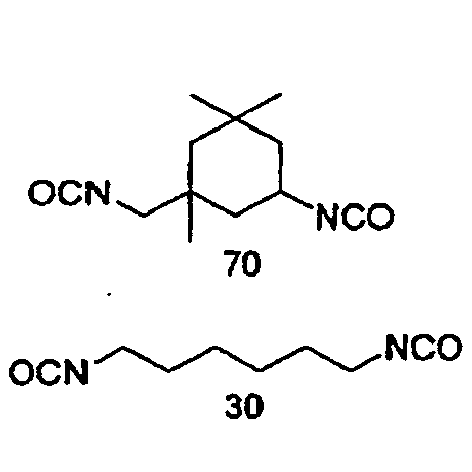

60000 Polymer No. Structure of Binder Polymer (% by mole) Molecular Weight P-4 
50000 P-5 
60000 P-6 
65000 P-7 
60000 P-8 
63000 P-9 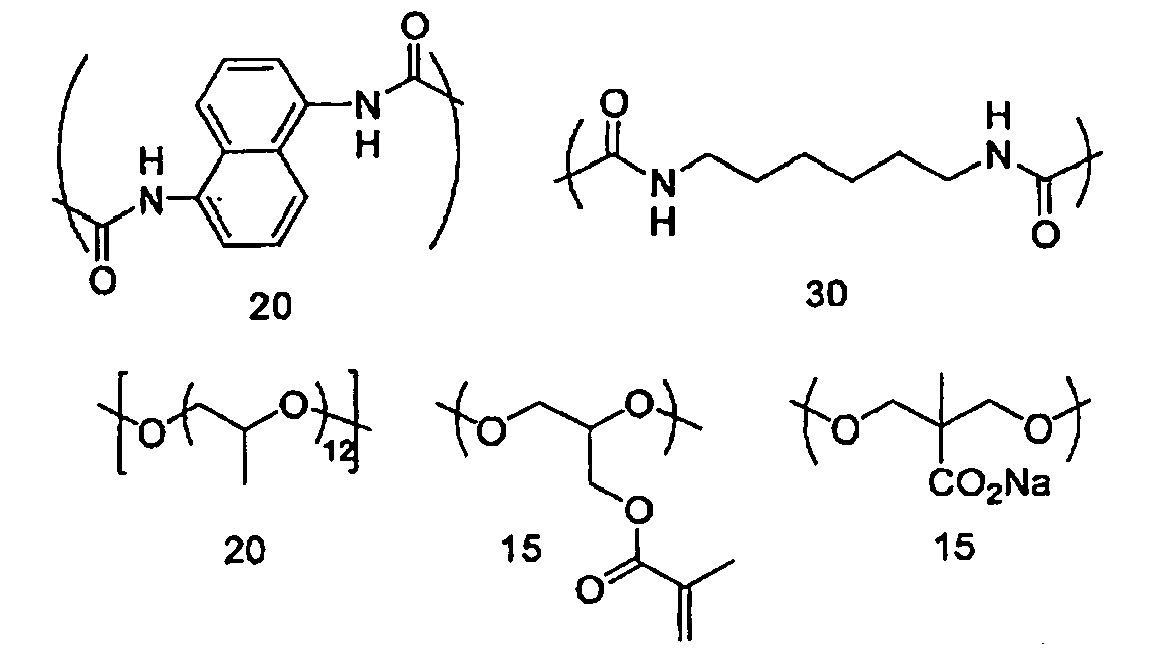
60000 Polymer No. Structure of Binder Composition Ratio Molecular Weight P-10 
90/10 70000 P-11 
90/5/5 80000 P-12 
60/35/5 80000 Polymer No. Diisocyanate Compound Used (% by mole) Diol Compound Used (% by mole) Molecular Weight P-13 
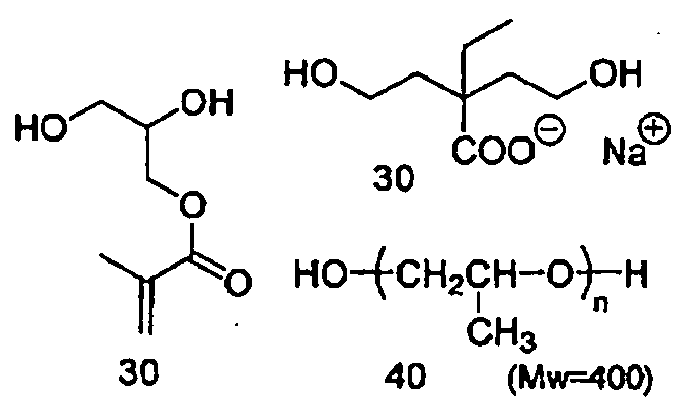
57000 Polymer No. Structure of Binder Composition Ratio Molecular Weight P-14 
90/10 70000 P-15 
90/10 58000 P-16 
90/10 90000 P-17 
70/30 62000 P-18 
70/30 58000 P-19 
50/25/25 49000 Polymer No. Structure of Diisocyanate/ Dicarboxylic acid Structure of Diol/Diamine Molecular weight P-20 

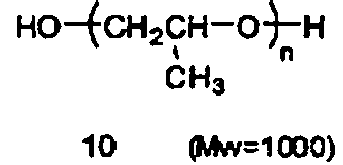


59000 P-21 


59000 P-22 


62000 P-23 


53000 Polymer No. Structure of Binder (% by mole) Molecular Weight P-24 
80000 P-25 
100000 - Specific examples of the specific binder polymer including the structure represented by formula <1> or <2> in its repeating unit are set forth below, but the invention should not be construed as being limited thereto.
- In the tables below, the molecular weight is a weight average molecular weight (Mw) measured by gel permeation chromatography (GPC) and determined using polystyrene as a standard substance.
- Further, with respect to Polymers PB-1 to PB-50b shown below, the numeral attached to the compound means a reaction ratio (% by mole) of each constituting component Also, "PPG" and "PEG" mean polypropylene glycol and polyethylene glycol, respectively and the subsequent numeral means an average molecular weight. For example, "PPG1000" means polypropylene glycol having an average molecular weight of 1,000.
Composition Ratio Moleclar Weight PA-1 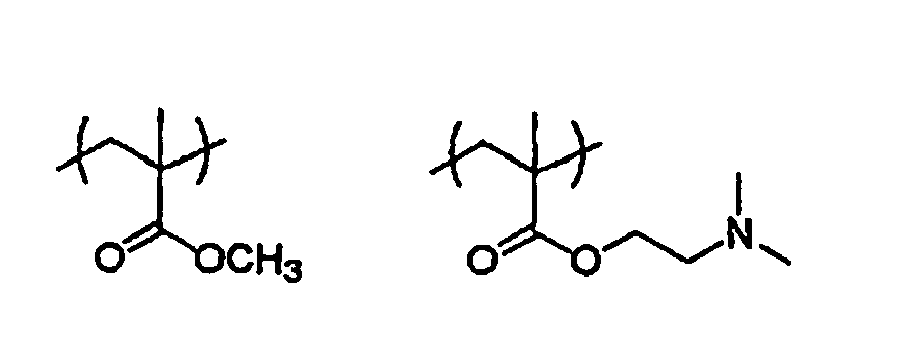
90/10 70000 PA-2 
90/10 70000 PA-3 
80/20 60000 PA-4 
80/20 60000 PA-5 
90/5/5 60000 PA-6 
90/5/5 60000 PA-7 
95/5 70000 PA-8 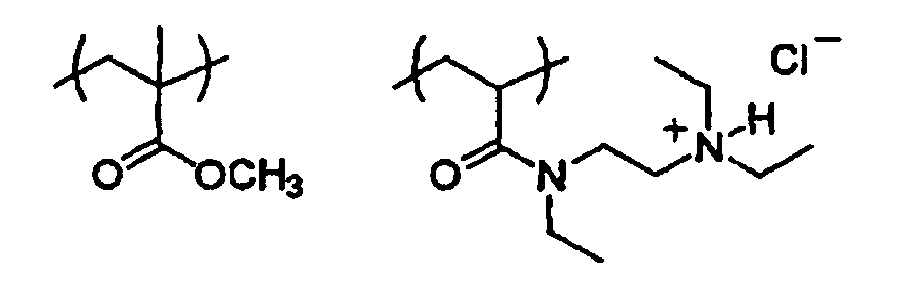
95/5 70000 PA-9 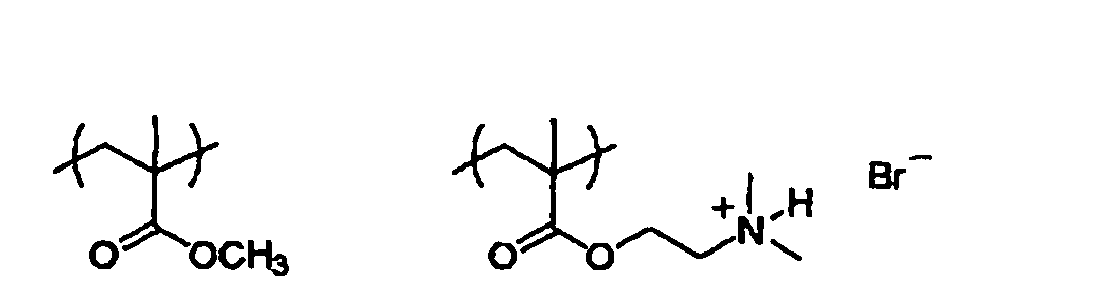
90/10 70000 PA-10 
90/10 52000 PA-11 
90/10 58000 PA-12 
90/10 49000 PA-13 
90/10 50000 PA-14 
90/10 63000 PA-15 
90/10 80000 PA-16 
90/10 65000 PA-17 
90/10 60000 PA-18 
80/20 65000 PA-19 
90/10 90000 PA-20 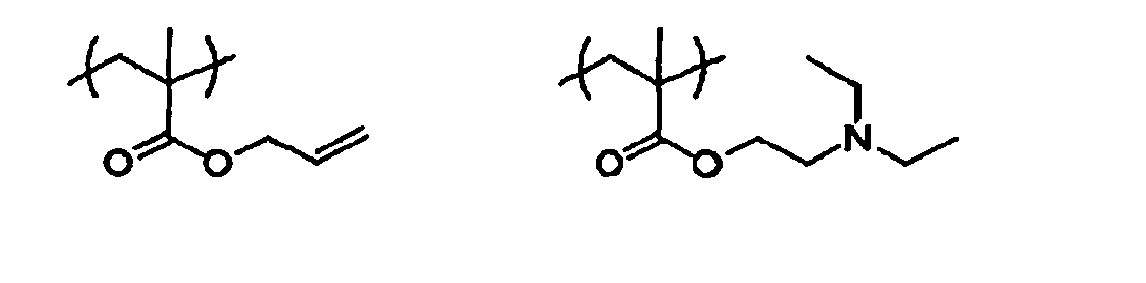
80/20 64000 PA-21 
70/30 77000 PA-22 
60/35/5 80000 PA-23 
60/35/5 72000 PA-24 
80/10/10 90000 PA-25 
60/20/20 53000 PA-26 
80/20 57000 PA-27 
70/30 48000 PA-28 
60/40 81000 PA-29 
50/50 70000 PA-30 
50/50 72000 PA-31 
50/50 72000 PA-32 
50/50 65000 PA-33 
50/50 65000 PA-34 
60/40 50000 PA-35 
70/30 62000 PA-36 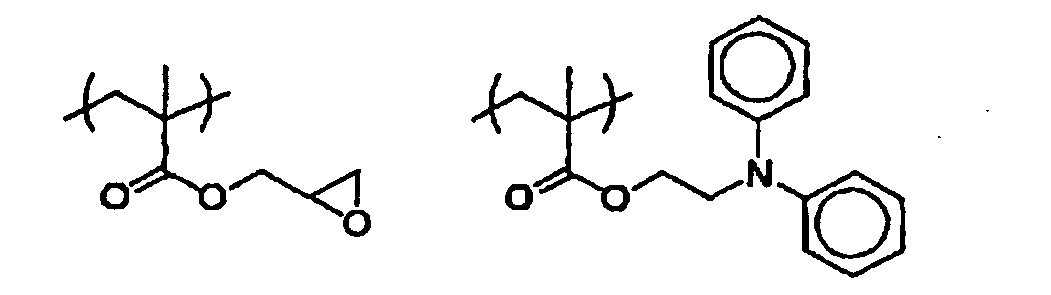
30/70 71000 PA-37 
30/70 71000 PA-38 
60/40 65000 PA-39 
70/30 70000 PA-40 
70/30 58000 PA-38 
60/40 65000 PA-39 
70/30 70000 PA-40 
70/30 58000 PA-41 
65/35 60000 PA-42 
60/40 57000 PA-43 
60/40 65000 PA-44 
50/25/25 49000 PA-45 
50/50 71000 PA-48 
60/40 65000 PA-47 
70/30 69000 PA-48 
70/30 60000 PA-49 
70/30 55000 PA-50 
70/30 50000 PA-51 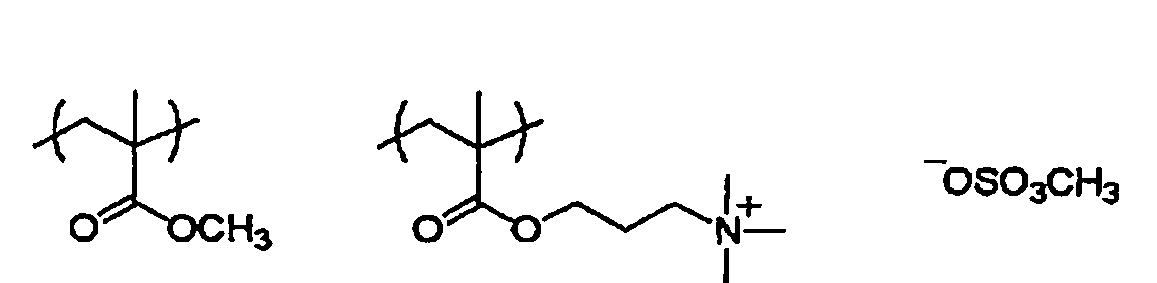
70/30 63000 PA-52 
70/30 58000 PA-53 
70/30 60000 PA-51 
70/30 63000 PA-52 
70/30 58000 PA-53 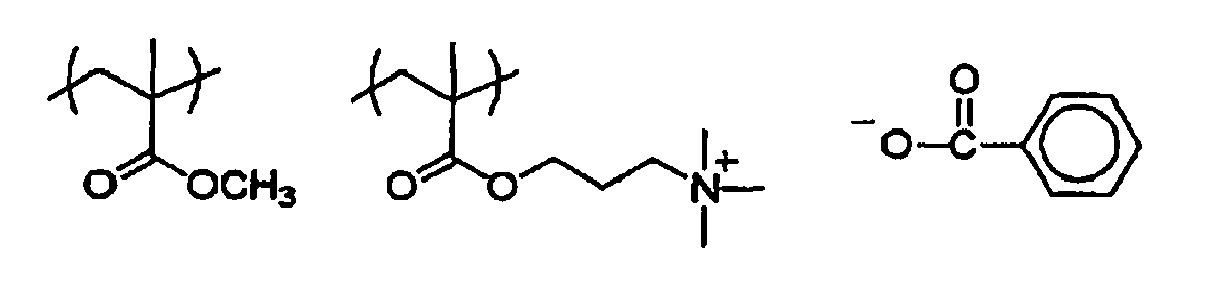
70/30 60000 PA-54 
60/40 58000 PA-55 
70/15/15 60000 PA-56 
50/50 55000 PA-57 
45/55 60000 PA-58 
80/20 70000 PA-59 
50/50 60000 PA-60 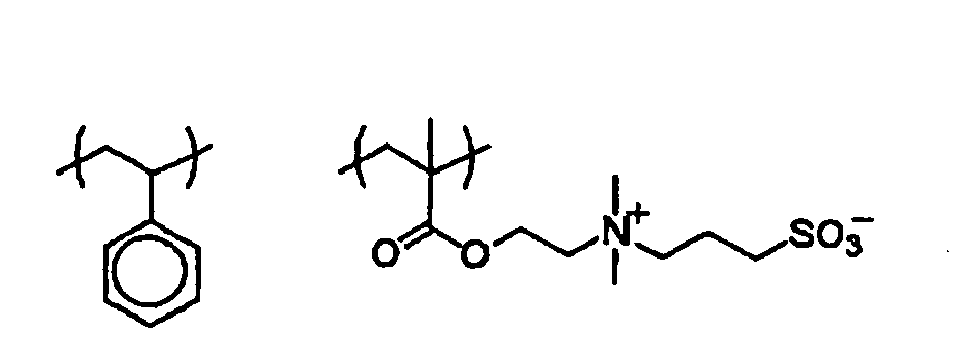
60/40 69000 PA-61 
40/60 80000 PA-62 
40/60 73000 PA-63 
80/20 50000 PA-64 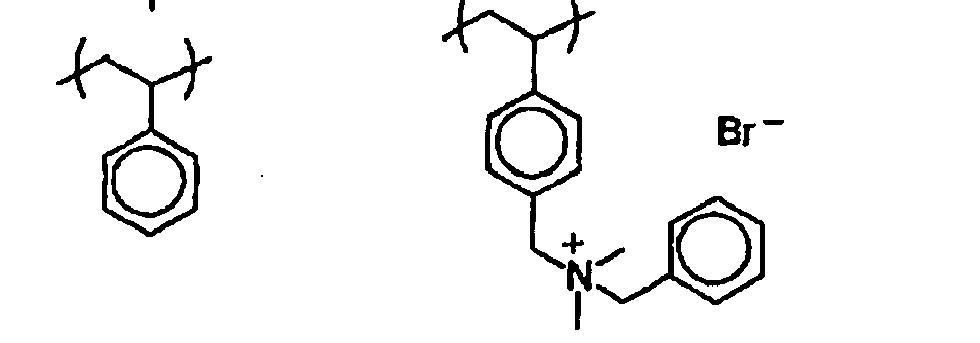
50/50 40000 PA-65 
70/30 50000 PA-66 
80/20 44000 PA-67 
50/50 55000 PA-68 
30/70 58000 


- The use of the binder polymer having an amino group and/or ammonium group as described above in the photosensitive layer in the invention is advantageous in that the adhesion property between the photosensitive layer and the protective layer containing an acid-modified polyvinyl alcohol according to the invention is improved and the scratch resistance of the protective layer is increased. This is believed to be caused by electrostatic interaction or acid-base interaction between a cation or base of the binder polymer and an anion or acid group of the acid-modified polyvinyl alcohol.
- Into the photosensitive layer according to the invention, various other constituting components (additives) of the photosensitive layer may further be incorporated, if desired. These constituting components will be described below.
- A co-sensitizer can be used in the photosensitive layer. The co-sensitizer is an additive which can further increase the sensitivity of the photosensitive layer when added to the photosensitive layer. The operation mechanism of the co-sensitizer is not quite clear but may be considered to be mostly based on the following chemical process. Specifically, the co-sensitizer reacts with various intermediate active species (for example, a radical, a peroxide, an oxidizing agent or a reducing agent) generated during the process of photo-reaction initiated by light absorption of the polymerization initiator and subsequent addition-polymerization reaction to produce new active radicals. The co-sensitizers are roughly classified into (a) a compound which is reduced to produce an active radical, (b) a compound which is oxidized to produce an active radical and (c) a compound which reacts with a radical having low activity to convert it into a more highly active radical or acts as a chain transfer agent. However, in many cases, a common view about that an individual compound belongs to which type is not present.
- An active radical is considered to be generated by the reductive cleavage of the carbon-halogen bond. Specific examples of the compound preferably used include a trihalomethyl-s-triazine and a trihalomethyloxadiazole.
- An active radical is considered to be generated by the reductive cleavage of the nitrogen-nitrogen bond. Specific examples of the compound preferably used include a hexaarylbiimidazole.
- An active radical is considered to be generated by the reductive cleavage of the oxygen-oxygen bond. Specific examples of the compound preferably used include an organic peroxide.
- An active radical is considered to be generated by the reductive cleavage of a carbon-hetero bond or oxygen-nitrogen bond. Specific examples of the compound preferably used include a diaryliodonium salt, a triarylsulfonium salt and an N-alkoxypyridinium (azinium) salt.
- An active radical is considered to be generated by the oxidative cleavage of a carbon-hetero bond. Specific examples of the compound preferably used include a triaryl alkyl borate.
- An active radical is considered to be generated by the oxidative cleavage of a C-X bond on the carbon adjacent to nitrogen, wherein X is preferably, for example, a hydrogen atom, a carboxy group, a trimethylsilyl group or a benzyl group. Specific examples of the compound include an ethanolamine, an N-phenylglycine and an N-trimethylsilylmethylaniline.
- A compound in which the nitrogen atom of the above-described amine is replaced by a sulfur atom or a tin atom is considered to generate an active radical in the same manner. Also, a compound having an S-S bond is known to effect sensitization by the cleavage of the S-S bond.
- An active radical can be generated by the oxidative cleavage of carbonyl-α-carbon bond. The compound in which the carbonyl is converted into an oxime ether also shows the similar function. Specific examples of the compound include an 2-alkyl-1-[4-(alkylthio)phenyl]-2-morpholinopronone-1 and an oxime ether obtained by a reaction of the 2-alkyl-1-[4-(alkylthio)phenyl]-2-morphohnopronone-1 with a hydroxyamine and subsequent etherification of the N-OH and an oxime ester obtained by subsequent esterification of the N-OH.
- An active radical can be reductively generated. Specific examples of the compound include sodium arylsulfinate.
- For example, a compound having SH, PH, SiH or GeH in its molecule is used as the compound which reacts with a radical to convert it into a more highly active radical or acts as a chain transfer agent. The compound donates hydrogen to a low active radical species to generate a radical or is oxidized and deprotonized to generate a radical.
- The chain transfer agent contributes to improvements in the sensitivity and preservation stability. A thiol compound (for example, a 2-mercaptobenzimidazole) is preferably used as the chain transfer agent. Among them, a thiol compound represented by formula (T) shown below is particularly preferably used. By using the thiol compound represented by formula (T) as the chain transfer agent, a problem of the odor and decrease in sensitivity due to evaporation of the compound from the photosensitive layer or diffusion thereof into other layers are avoided and a lithographic printing plate precursor which is excellent in preservation stability and exhibits high sensitivity and good printing durability is obtained.

- In formula (T), R represents a hydrogen atom, an alkyl group or an aryl group, A represents an atomic group necessary for forming a 5-membered or 6-membered hetero ring containing a carbon atom together with the N=C-N linkage, and A may have a substituent.
- Compounds represented by any one of formulae (TA) and (TB) shown below are more preferably used.

- In formulae (TA) and (TB), R represents a hydrogen atom, an alkyl group or an aryl group, and X represents a hydrogen atom, a halogen atom, an alkoxy group, an alkyl group or an aryl group.
- Specific examples of the compound represented by formula (T) are set forth below, but the invention should not be construed as being limited thereto.


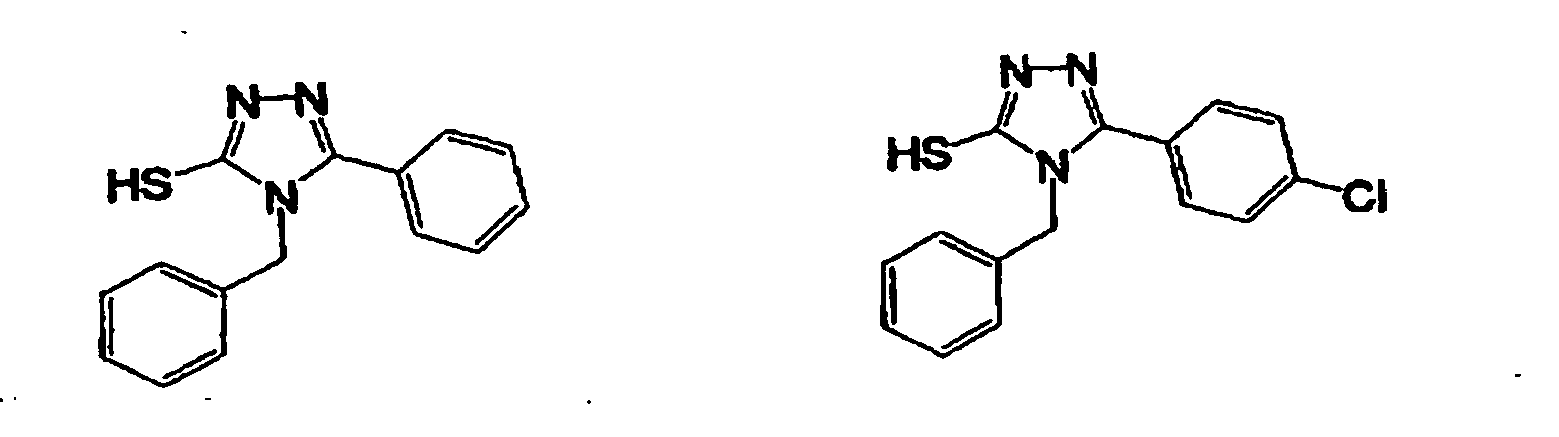


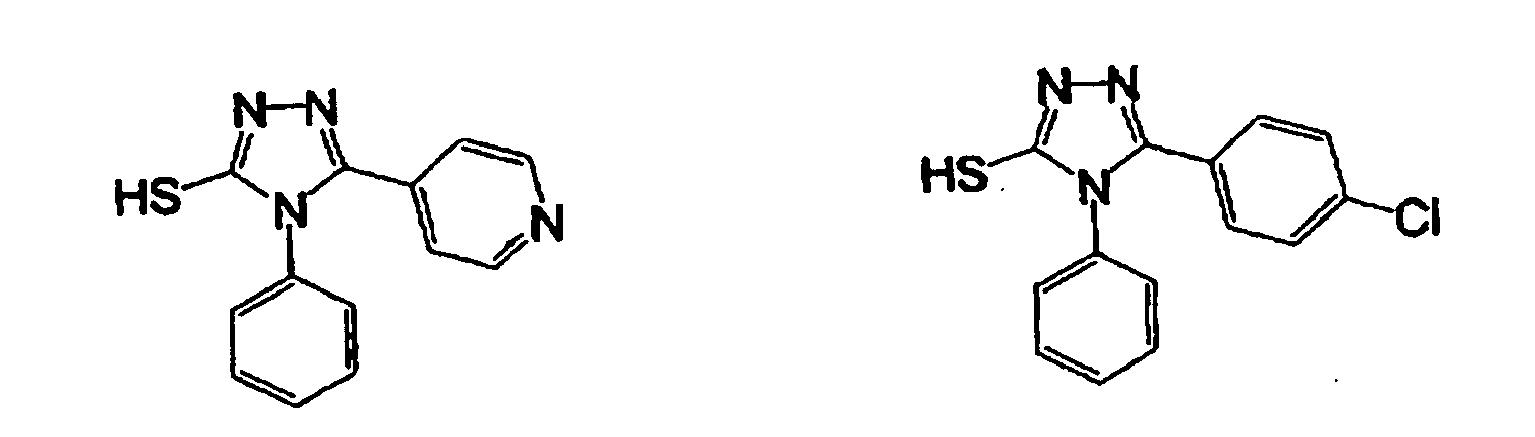


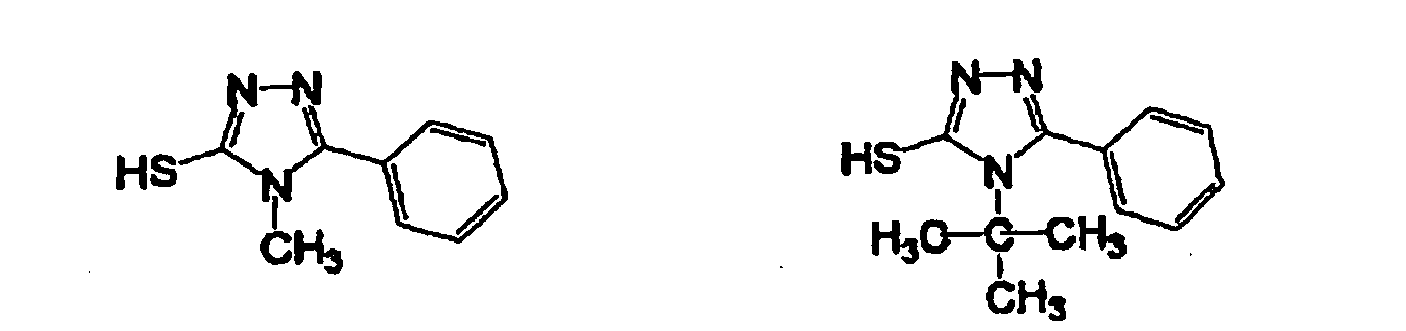


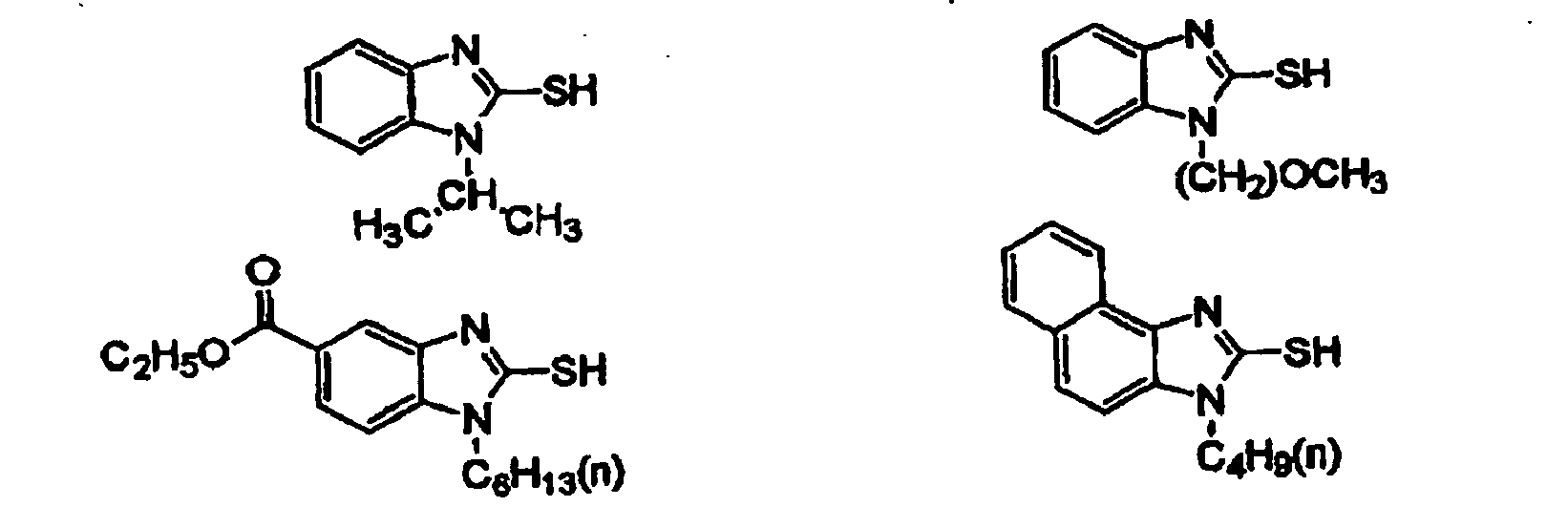


- The amount of the chain transfer agent used is preferably from 0.01 to 20% by weight, more preferably from 0.1 to 15% by weight, still more preferably from 1.0 to 10% by weight, based on the total solid content of the photosensitive layer.
- Other specific examples of the co-sensitizer include compounds described, for example, in
JP-A-9-236913 
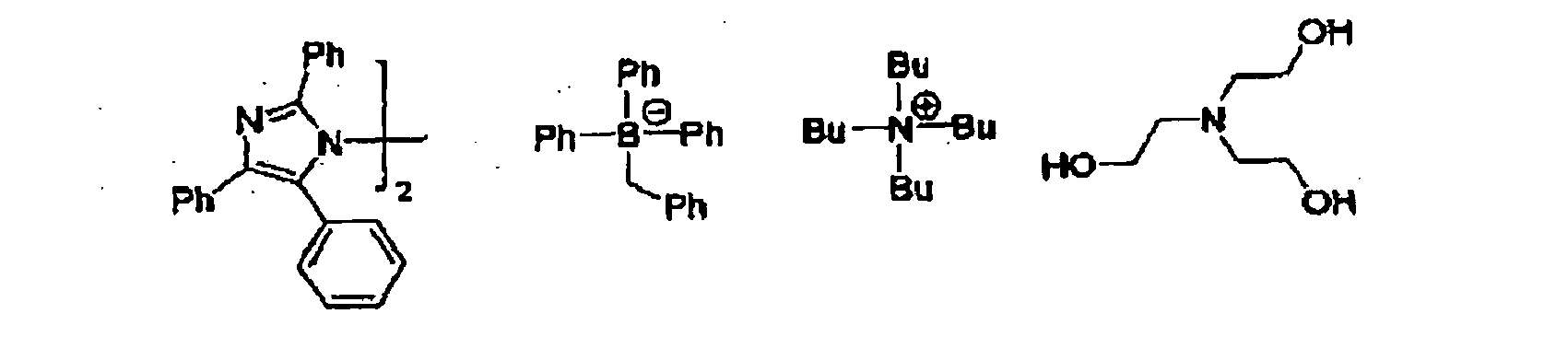


- The co-sensitizers may be used individually or in combination of two or more thereof. The amount of the co-sensitizer used is ordinarily from 0.05 to 100 parts by weight, preferably from 1 to 80 parts by weight, more preferably from 3 to 50 parts by weight, per 100 parts by weight of the polymerizable compound.
- Into the photosensitive layer, a surfactant can be incorporated in order to progress the developing property and to improve the state of surface coated. The surfactant includes, for example, a nonionic surfactant, an anionic surfactant, a cationic surfactant, an amphoteric surfactant and a fluorine-based surfactant.
- The nonionic surfactant for use in the invention is not particular restricted, and nonionic surfactants hitherto known can be used. Examples of the nonionic surfactant include polyoxyethylene alkyl ethers, polyoxyethylene alkyl phenyl ethers, polyoxyethylene polystyryl phenyl ethers, polyoxyethylene polyoxypropylene alkyl ethers, glycerin fatty acid partial esters, sorbitan fatty acid partial esters, pentaerythritol fatty acid partial esters, propylene glycol monofatty acid esters, sucrose fatty acid partial esters, polyoxyethylene sorbitan fatty acid partial esters, polyoxyethylene sorbitol fatty acid partial esters, polyethylene glycol fatty acid esters, polyglycerol fatty acid partial esters, polyoxyethylenated castor oils, polyoxyethylene glycerol fatty acid partial esters, fatty acid diethanolamides, N,N-bis-2-hydroxyalkylamines, polyoxyethylene alkylamines, triethanolamine fatty acid esters, trialylamine oxides, polyethylene glycols and copolymers of polyethylene glycol and polypropylene glycol.
- The anionic surfactant for use in the invention is not particularly restricted and anionic surfactants hitherto known can be used. Examples of the anionic surfactant include fatty acid salts, abietic acid salts, hydroxyalkanesulfonic acid salts, alkanesulfonic acid salts, dialkylsulfosuccinic ester salts, straight-chain alkylbenzenesulfonic acid salts, branched alkylbenzenesulfonic acid salts, alkylnaphthalenesulfonic acid salts, alkylphenoxy polyoxyethylene propylsulfonic acid salts, polyoxyethylene allcylsuifophenyl ether salts, N-methyl-N-oleyltaurine sodium salt, N-alkylsulfosuccinic monoamide disodium salts, petroleum sulfonic acid salts, sulfated beef tallow oil, sulfate ester slats of fatty acid alkyl ester, alkyl sulfate ester salts, polyoxyethylene alkyl ether sulfate ester salts, fatty acid monoglyceride sulfate ester salts, polyoxyethylene alkyl phenyl ether sulfate ester salts, polyoxyethylene styrylphenyl ether sulfate ester salts, alkyl phosphate ester salts, polyoxyethylene alkyl ether phosphate ester salts, polyoxyethylene alkyl phenyl ether phosphate ester salts, partial saponification products of styrene/maleic anhydride copolymer, partial saponification products of olefin/maleic anhydride copolymer and naphthalene sulfonate formalin condensates.
- The cationic surfactant for use in the invention is not particularly restricted and cationic surfactants hitherto known can be used. Examples of the cationic surfactant include alkylamine salts, quaternary ammonium salts, polyoxyethylene alkylamine salts and polyethylene polyamine derivatives.
- The amphoteric surfactant for use in the invention is not particularly restricted and amphoteric surfactants hitherto known can be used. Examples of the amphoteric surfactant include carboxybetaines, aminocarboxylic acids, sulfobetaines, aminosulfuric esters and imidazolines.
- With respect to the surfactants described above, the term "polyoxyethylene" can be replaced with "polyoxyalkylene", for example, polyoxymethylene, polyoxypropylene or polyoxybutylene, and such surfactants can also be used in the invention.
- Further, a preferable surfactant includes a fluorine-based surfactant containing a perfluoroalkyl group in its molecule. Examples of the fluorine-based surfactant include an anionic type, for example, perfluoroalkyl carboxylates, perfluoroalkyl sulfonates or perfluoroalkyl phosphates; an amphoteric type, for example, perfluoroalkyl betaines; a cationic type, for example, perfluoroalkyl trimethyl ammonium salts; and a nonionic type, for example, perfluoroalkyl amine oxides; perfluoroalkyl ethylene oxide adducts, oligomers having a perfluoroalkyl group and a hydrophilic group, oligomers having a perfluoroalkyl group and an oleophilic group, oligomers having a perfluoroalkyl group, a hydrophilic group and an oleophilic group or urethanes having a perfluoroalkyl group and an oleophilic group. Further, fluorine-based surfactants described in
JP-A-62-170950 JP-A-62-226143 JP-A-60-168144 - The surfactants may be used individually or in combination of two or more thereof The content of the surfactant is preferably from 0.001 to 10% by weight, more preferably from 0.01 to 7% by weight, based on the total solid content of the photosensitive layer.
- Into the photosensitive layer, a hydrophilic polymer can be incorporated in order to improve the developing property and dispersion stability of microcapsule.
- Preferable examples of the hydrophilic polymer include those having a hydrophilic group, for example, a hydroxy group, a carboxyl group, a carboxylate group, a hydroxyethyl group, a polyoxyethyl group, a hydroxypropyl group, a polyoxypropyl group, an amino group, an aminoethyl group, an aminopropyl group, an ammonium group, an amido group, a carboxymethyl group, a sulfonic acid group and a phosphoric acid group.
- Specific examples of the hydrophilic polymer include gum arabic, casein, gelatin, a starch derivative, carboxymethyl cellulose or sodium salt thereof, cellulose acetate, sodium alginate, a vinyl acetate-maleic acid copolymer, a styrene-maleic acid copolymer, polyacrylic acid or salt thereof, polymethacrylic acid or salt thereof, a homopolymer or copolymer of hydroxyethyl methacrylate, a homopolymer or copolymer of hydroxyethyl acrylate, a homopolymer or copolymer of hydroxypropyl methacrylate, a homopolymer or copolymer of hydroxypropyl acrylate, a homopolymer or copolymer of hydroxybutyl methacrylate, a homopolymer or copolymer of hydroxybutyl acrylate, polyethylene glycol, a hydroxypropylene polymer, polyvinyl alcohol, a hydrolyzed polyvinyl acetate having a hydrolysis degree of 60% by mole or more, preferably 80% by mole or more, polyvinyl formal, polyvinyl butyral, polyvinyl pyrrolidone, a homopolymer or polymer of acrylamide, a homopolymer or copolymer of methacrylamide, a homopolymer or copolymer of N-methylolacrylamide, polyvinyl pyrrolidone, an alcohol-soluble nylon, and a polyether of 2,2-bis(4-hydroxyphenyl)propane with epichlorohydrin.
- The weight average molecular weight of the hydrophilic polymer is preferably s 5,000 or more, more preferably from 10,000 to 300,000. The hydrophilic polymer may be any of a random polymer, a block polymer, a graft polymer and the like. The content of the hydrophilic polymer is preferably 20% by weight or less, more preferably 10% by weight or less, based on the total solid content of the photosensitive layer.
- Into the photosensitive layer, a dye having large absorption in the visible light region can be used as a coloring agent for the image. Specific examples thereof include Oil Yellow #101, Oil Yellow #103, Oil Pink #312, Oil Green BG, Oil Blue BOS, Oil Blue #603, Oil Black BY, Oil Black BS, Oil Black T-505 (produced by Orient Chemical Industry Co., Ltd.), Victoria Pure Blue, Crystal Violet (CI42555), Methyl Violet (CI42535), Ethyl Violet, Rhodamine B (CI45170B), Malachite Green (CI42000), Methylene Blue (CI52015), and dyes described in
JP-A-62-293247 - It is preferable to add the coloring agent, because the image area and the non-image area after the image formation can be easily distinguished. The amount of the coloring agent added is preferably from 0.01 to 10% by weight based on the total solid content of the photosensitive layer.
- To the photosensitive layer, a compound capable of undergoing discoloration with an acid or a radical can be added in order to form a print-out image. As such a compound, for example, various dyes, e.g., diphenylmethane-based, triphenylmethane-based, thiazine-based, oxazine-based, xanthene-based, anthraquinone-based, iminoquinone-based, azo-based and azomethine-based dyes are effectively used.
- Specific examples thereof include dyes, for example, Brilliant Green, Ethyl Violet, Methyl Green, Crystal Violet, Basic Fuchsine, Methyl Violet 2B, Quinaldine Red, Rose Bengale, Metanil Yellow, Thymolsulfophthalein, Xylenol Blue, Methyl Orange, Paramethyl Red, Congo Red, Benzopurpurine 4B, α-Naphthyl Red, Nile Blue 2B, Nile Blue A, Methyl Violet, Malachite Green, Parafuchsine, Victoria Pure Blue BOH (produced by Hodogaya Chemical Co., Ltd.), Oil Blue #603, Oil Pink #312, Oil Red 5B, Oil Scarlet #308, Oil Red OG, Oil Red RR and Oil Green #502 (produced by Orient Chemical Industry Co., Ltd.), Spiron Red BEH Special (produced by Hodogaya Chemical Co., Ltd.), m-Cresol Purple, Cresol Red, Rhodamine B, Rhodamine 6G, Sulforhodamine B, Auramine, 4-p-diethylaminophenyliminonaphthoquinone, 2-carboxyanilino-4-p-diethylaminophenyliminonaphthoquinone, 2-carboxystearylamino-4-p-N,N-bis(hydroxyethyl)aminophenyliminonaphthoquinone, 1-phenyl-3-methyl-4-p-diethylaminophenylimino-5-pyrazolone and 1-β-naphthyl-4-p-diethylaminophenylimino-5-pyrazolone, and leuco dyes, for example, p,p',p"-hexamethyltriaminotriphenyl methane (leuco Crystal Violet) and Pergascript Blue SRB (produced by Ciba Geigy).
- Other preferable examples include leuco dyes known as a material for heat-sensitive paper or pressure-sensitive paper. Specific examples thereof include Crystal Violet Lactone, Malachite Green Lactone, Benzoyl Leuco Methylene Blue, 2-(N-phenyl-N-methylamino)-6-(N-p-tolyl-N-ethyl)aminofluorane, 2-anilino-3-methyl-6-(N-ethyl-p-toluidino)fluorane, 3,6-dimethoxyfluorane, 3-(N,N-diethylamino)-5-methyl-7-(N,N-dibenzylamino)fluorane, 3-(N-cyclohexyl-N-methylamino)-6-methyl-7-anilinofluorane, 3-(N,N-diethylamino)-6-methyl-7-anilinofluorane, 3-(N,N-diethylamino)-6-methyl-7-xylidino-fluorane, 3-(N,N-diethylamino)-6-methyl-7-chlorofluorane, 3-(N,N-diethylamino)-6-methoxy-7-aminofluorane, 3-(N,N-diethylamino)-7-(4-chloroanilino)fluorane, 3-(N,N-diethylamino)-7-chlorofluorane, 3-(N,N-diethylamino)-7-benzylaminofluorane, 3-(N,N-diethylamino)-7,8-benzofluorane, 3-(N,N-dibutylamino)-6-methyl-7-anilinofluorane, 3-(N,N-dibutylamino)-6-methyl-7-xylidinofluorane, 3-piperidino-6-methyl-7-anilinofluorane, 3-pyrrolidino-6-methyl-7-anilinofluorane, 3,3-bis(1-ethyl-2-methylindol-3-yl)phthalide, 3,3-bis(1-n-butyl-2-methylindol-3-yl)phthalide, 3,3-bis(p-dimethylaminophenyl)-6-dimethylaminnophthalide, 3-(4-diethylamino-2-ethoxyphenyl)-3-(1-ethyl-2-methylindol-3-yl)-4-phthalide and 3-(4-diethylaminophenyl)-3-(1-ethyl-2-methylindol-3-yl)phthalide.
- The amount of the compound capable of undergoing discoloration with an acid or a radical added is preferably from 0.01 to 15% by weight based on the total solid content of the photosensitive layer.
- To the photosensitive layer, a small amount of a thermal polymerization inhibitor is preferably added in order to prevent the polymerizable compound from undergoing undesirable thermal polymerization during the production or preservation of the photosensitive layer.
- Preferable examples of the thermal polymerization inhibitor include hydroquinone, p-methoxyphenol, di-tert-butyl-p-cresol, pyrogallol, tert-butyl catechol, benzoquinone, 4,4'-thiobis(3-methyl-6-tert-butylphenol), 2,2'-methylenebis(4-methyl-6-tert-butylphenol) and N-nitroso-N-phenylhydroxylamine aluminum salt.
- The amount of the thermal polymerization inhibitor added is preferably from about 0.01 to about 5% by weight based on the total solid content of the photosensitive layer.
- To the photosensitive layer, a higher fatty acid derivative, for example, behenic acid or behenic acid amide may be added and localized on the surface of the photosensitive layer during the process of drying after coating in order to avoid polymerization inhibition due to oxygen. The amount of the higher fatty acid derivative added is preferably from about 0.1 to about 10% by weight based on the total solid content of the photosensitive layer.
- The photosensitive layer may contain a plasticizer. Preferable examples of the plasticizer include a phthalic acid ester, for example, dimethyl phthalate, diethyl phthalate, dibutyl phthalate, diisobutyl phthalate, diocyl phthalate, octyl capryl phthalate, dicyclohexyl phthalate, ditridecyl phthalate, butyl benzyl phthalate, diisodecyl phthalate or diallyl phthalate; a glycol ester, for example, dimethyl glycol phthalate, ethyl phthalylethyl glycolate, methyl phthalylethyl glycolate, butyl phthalylbutyl glycolate or triethylene glycol dicaprylic acid ester, a phosphoric acid ester, for example, tricresyl phosphate or triphenyl phosphate; an aliphatic dibasic acid ester, for example, diisobutyl adipate, dioctyl adipate, dimethyl sebacate, dibutyl sebacate, dioctyl azelate or dibutyl maleate; polyglycidyl methacrylate, triethyl citrate, glycerin triacetyl ester and butyl laurate. The content of the plasticizer is preferably about 30% by weight or less based on the total solid content of the photosensitive layer.
- The photosensitive layer may contain fine inorganic particle in order to increase strength of the cured layer in the image area. The fine inorganic particle preferably includes, for example, silica, alumina, magnesium oxide, titanium oxide, magnesium carbonate, calcium alginate and a mixture thereof. Even if the fine inorganic particle has no light-to-heat converting property, it can be used, for example, for strengthening the film or enhancing interface adhesion property due to surface roughening. The average particle size of the fine inorganic particle is preferably from 5 nm to 10 µm, more preferably from 0.5 to 3µm, from the standpoint of the dispersion stability in the photosensitive layer, retention of sufficient film strength and formation of the non-image area excellent in hydrophilicity and preventing from the occurrence of stain at the printing. The fine inorganic particle is easily available as a commercial product, for example, colloidal silica dispersion. The content of the fine inorganic particle is preferably 20% by weight or less, more preferably 10% by weight or less, based on the total solid content of the photosensitive layer.
- The photosensitive layer may contain a hydrophilic low molecular weight compound in order to improve the developing property. Examples of the hydrophilic low molecular weight compound include a water-soluble organic compound, for example, a glycol compound, e.g., ethylene glycol, diethylene glycol, triethylene glycol, propylene glycol, dipropylene glycol or tripropylene glycol, or an ether or ester derivative thereof, a polyhydroxy compound, e.g., glycerine or pentaerythritol, an organic amine, e.g., triethanol amine, diethanol amine or monoethanol amine, or a salt thereof, an organic sulfonic acid, e.g., toluene sulfonic acid or benzene sulfonic acid, or a salt thereof, an organic phosphonic acid, e.g., phenyl phosphonic acid, or a salt thereof, an organic carboxylic acid, e.g., tartaric acid, oxalic acid, citric acid, maleic acid, lactic acid, gluconic acid or an amino acid, or a salt thereof, and an organic quaternary ammonium salt, e.g., tetraethyl amine hydrochloride.
- Several embodiments can be employed in order to form the photosensitive layer. One embodiment is a method of dissolving the constituting components of photosensitive layer in an appropriate solvent to coat as described, for example, in
JP-A-2002-287334 JP-A-2001-277740 JP-A-2001-277742 - As a method for microencapsulation of the constituting components of photosensitive layer, known methods can be used. Methods of producing the microcapsule include, for example, a method of utilizing coacervation described in
U.S. Patents 2,800,457 and2,800,458 , a method of using interfacial polymerization described inU.S. Patent 3,287,154 ,JP-B-38-19574 JP-B-42-446 U.S. Patents 3,418,250 and3,660,304 , a method of using an isocyanate polyol wall material described inU.S. Patent 3,796,669 , a method of using an isocyanate wall material described inU.S. Patent 3,914,511 , a method of using a urea-formaldehyde-type or urea-formaldehyde-resorcinol-type wall-forming material described inU.S. Patens 4,001,140 ,4,087,376 and4,089,802 , a method of using a wall material, for example, a melamine-formaldehyde resin or hydroxycellulose described inU.S. Patent 4,025,445 , an in-situ method by monomer polymerization described inJP-B-36-9163 JP-B-51-9079 930,422 U.S. Patent 3,111,407 , and an electrolytic dispersion cooling method described in British Patents952,807 967,074 - A preferable microcapsule wall used in the invention has three-dimensional crosslinkage and has a solvent-swellable property. From this point of view, a preferable wall material of the microcapsule includes polyurea, polyurethane, polyester, polycarbonate, polyamide and a mixture thereof, and polyurea and polyurethane are particularly preferred. Further, a compound having a crosslinkable functional group, for example, an ethylenically unsaturated bond may be introduced into the microcapsule wall.
- The average particle size of the microcapsule is preferably from 0.01 to 3.0 µm, more preferably from 0.05 to 2.0 µm, still more preferably from 0.10 to 1.0 µm from the standpoint of good resolution and good preservation stability.
- Further, an embodiment of incorporating the constituting components of photosensitive layer described above, particularly preferably, the infrared absorbing agent, into fine resin particles is also used according to the invention.
- The embodiment is performed by dissolving the constituting components of photosensitive layer in a solvent and mixing the resulting solution with a polymer solution (preferably an aqueous polymer solution) using, for example, a homogenizer to prepare a dispersion of fine resin particles for use.
- As the solvent used, ethyl acetate, methyl ethyl ketone (MEK), diisopropyl ether, dichloromethane, chloroform, toluene, dichloroethane and mixed solvents thereof are exemplified. The solvents may be used individually or as a mixture.
- As the polymer, polyvinyl alcohol (PVA), polyacrylic acid, sodium polyacrylate, polyacrylamide, polymethacrylic acid, sodium polymethacrylate, polymethacrylamide, polystyrenesulfonic acid, sodium polystyrenesulufonate, acrylic acid/methyl acrylate copolymer, methacrylic acid/methyl methacrylate copolymer and styrene/sodium styrenesulufonate copolymer are exemplified.
- The solid concentration of the coating solution for photosensitive layer is preferably from 1 to 50% by weight.
- The photosensitive layer may also be formed by preparing plural coating solutions by dispersing or dissolving the same or different constituting components into the same or different solvents and conducting repeatedly the coating and drying plural times.
- The coating amount of the photosensitive layer (solid content) may be varied according to the use, but ordinarily, it is preferably from 0.3 to 3.0 g/m2 in consideration of good sensitivity, good film property of the photosensitive layer and the like.
- Various methods can be used for the coating of the photosensitive layer. Examples of the coating method include bar coater coating, spin coating, spray coating, curtain coating, dip coating, air knife coating, blade coating and roll coating.
- The support for use in the lithographic printing plate precursor according to the invention is not particularly restricted as long as it is a dimensionally stable plate-like hydrophilic support. The support includes, for example, paper, paper laminated with plastic (for example, polyethylene, polypropylene or polystyrene), a metal plate (for example, aluminum, zinc or copper plate), a plastic film (for example, cellulose diacetate, cellulose triacetate, cellulose propionate, cellulose butyrate, cellulose acetate butyrate, cellulose nitrate, polyethylene terephthalate, polyethylene, polystyrene, polypropylene, polycarbonate or polyvinyl acetal film) and paper or a plastic film laminated or deposited with the metal described above. Preferable examples of the support include a polyester film and an aluminum plate. Among them, the aluminum plate is preferred since it has good dimensional stability and is relatively inexpensive.
- The aluminum plate includes a pure aluminum plate, an alloy plate comprising aluminum as a main component and containing a trace amount of hetero elements and a thin film of aluminum or aluminum alloy laminated with plastic. The hetero element contained in the aluminum alloy includes, for example, silicon, iron, manganese, copper, magnesium, chromium, zinc, bismuth, nickel and titanium. The content of the hetero element in the aluminum alloy is preferably 10% by weight or less. Since completely pure aluminum is difficult to be produced in view of the refining technique, an aluminum alloy plate containing a slight amount of hetero element is preferably used. The composition of the aluminum plate is not limited and those materials known and used conventionally can be appropriately utilized. The thickness of the aluminum plate is preferably from 0.1 to 0.6 mm, more preferably from 0.15 to 0.4 mm, still more preferably from 0.2 to 0.3 mm.
- The aluminum plate is preferably subjected to a surface treatment, for example, roughening treatment or anodizing treatment. The surface treatment facilitates improvement in the hydrophilic property and ensures the adhesion property between the photosensitive layer and the support. In advance of the roughening treatment of the aluminum plate, a degreasing treatment, for example, with a surfactant, an organic solvent or an aqueous alkaline solution is conducted for removing rolling oil on the surface thereof, if desired.
- The roughening treatment of the surface of the aluminum plate is conducted by various methods and includes, for example, mechanical roughening treatment, electrochemical roughening treatment (roughening treatment of electrochemically dissolving the surface) and chemical roughening treatment (roughening treatment of chemically dissolving the surface selectively). As the method of the mechanical roughening treatment, a known method, for example, a ball graining method, a brush graining method, a blast graining method or a buff graining method can be used. The electrochemical roughening treatment method includes, for example, a method of conducting it by passing alternating current or direct current in an electrolytic solution containing an acid, for example, hydrochloric acid or nitric acid. Also, a methods of using a mixed acid described in
JP-A-54-63902 - The aluminum plate after the roughening treatment is then subjected, if desired, to an alkali etching treatment using an aqueous solution, for example, of potassium hydroxide or sodium hydroxide and further subjected to a neutralizing treatment, and then subjected to an anodizing treatment in order to enhance the abrasion resistance, if desired.
- For the anodizing treatment of the aluminum plate, various electrolytes capable of forming porous oxide film can be used. Ordinarily, sulfuric acid, hydrochloric acid, oxalic acid, chromic acid or a mixed acid thereof is used. The concentration of the electrolyte can be appropriately determined depending on the kind of the electrolyte.
- Since the conditions of the anodizing treatment are varied depending on the electrolyte used, they cannot be defined generally. However, it is ordinarily preferred that electrolyte concentration in the solution is from 1 to 80% by weight, liquid temperature is from 5 to 70°C, current density is from 5 to 60 A/dm2, voltage is from 1 to 100 V, and electrolysis time is from 10 seconds to 5 minutes. The amount of the anodized film formed is preferably from 1.0 to 5.0 g/m2, more preferably from 1.5 to 4.0 g/m2, from the standpoint of good printing durability, good scratch resistance in the non-image area and the like.
- The aluminum plate subjected to the surface treatment and having the anodized film is used as it is as the support. However, in order to more improve the adhesion property to a layer provided thereon, hydrophilicity, resistance to stain, heat insulating property or the like, a known treatment, for example, a treatment for enlarging micropores or a sealing treatment of micropores of the anodized film described in
JP-A-2001-253181 JP-A-2001-322365 - As the sealing treatment, a sealing treatment with water vapor, a sealing treatment with an aqueous solution containing an inorganic fluorine compound, for example, fluorozirconic acid alone or sodium fluoride, a sealing treatment with steam having added thereto lithium chloride or a sealing treatment with hot water may be employed. Among them, the sealing treatment with an aqueous solution containing an inorganic fluorine compound, the sealing treatment with water vapor and the sealing treatment with hot water are preferred.
- The hydrophilizing treatment includes an alkali metal silicate method described in
U.S. Patents 2,714,066 ,3,181,461 ,3,280,734 and3,902,734 . In the method, the support is subjected to an immersion treatment or an electrolytic treatment in an aqueous solution, for example, of sodium silicate. In addition, the hydrophilizing treatment includes, for example, a method of treating with potassium fluorozirconate described inJP-B-36-22063 U.S. Patents 3,276,868 ,4,153,461 and4,689,272 . - In the case of using a support having a surface of insufficient hydrophilicity, for example, a polyester film, it is desirable to coat a hydrophilic layer thereon to make the surface sufficiently hydrophilic. Examples of the hydrophilic layer preferably includes a hydrophilic layer formed by coating a coating solution containing a colloid of oxide or hydroxide of at least one element selected from beryllium, magnesium, aluminum, silicon, titanium, boron, germanium, tin, zirconium, iron, vanadium, antimony and a transition metal described in
JP-A-2001-199175 JP-A-2002-79772 - Further, in the case of using, for example, a polyester film as the support, it is preferred to provide an antistatic layer on the hydrophilic layer side, opposite side to the hydrophilic layer or both sides. When the antistatic layer is provided between the support and the hydrophilic layer, it also contributes to improve the adhesion property of the hydrophilic layer to the support. As the antistatic layer, a polymer layer having fine particles of metal oxide or a matting agent dispersed therein described in
JP-A-2002-79772 - The center line average roughness of support is preferably from 0.10 to 1.2 µm from the standpoint of good adhesion property to the photosensitive layer, good printing durability, good resistance to stain and the like. The color density of the support is preferably from 0.15 to 0.65 in terms of the reflection density value from the standpoint of good image-forming property by preventing halation at the image exposure, good aptitude for plate inspection after development and the like.
- In the lithographic printing plate precursor according to the invention, an undercoat layer may be provided between the photosensitive layer and the support, if desired. The undercoat layer has the function of strengthening the adhesion property between the support and the photosensitive layer in the exposed area and the function of facilitating separation of the photosensitive layer from the support in the unexposed area, thereby improving the developing property. Further, in the case where the image exposure is conducted with an infrared laser, since the undercoat layer can act as a heat insulating layer, heat generated upon the image exposure with laser does not diffuse into the support and is efficiently utilized to achieve advantageous increase in the sensitivity.
- As the compound for the undercoat layer, specifically, a silane coupling agent having an addition-polymerizable ethylenic double bond reactive group described in
JP-A-10-282679 JP-A-2-304441 - In the undercoat layer, a known resin having a hydrophilic group can also be used. Specific examples of the resin include gum arabic, casein, gelatin, a starch derivative, carboxy methyl cellulose or sodium salt thereof, cellulose acetate, sodium alginate, a vinyl acetate-maleic acid copolymer, a styrene-maleic acid copolymer, polyacrylic acid or salt thereof, polymethacrylic acid or salt thereof, a homopolymer or copolymer of hydroxyethyl methacrylate, a homopolymer or copolymer of hydroxyethyl acrylate, a homopolymer or copolymer of hydroxypropyl methacrylate, a homopolymer or copolymer of hydroxypropyl acrylate, a homopolymer or copolymer of hydroxybutyl methacrylate, a homopolymer or copolymer of hydroxybutyl acrylate, a polyethylene glycol, a hydroxypropylene polymer, a polyvinyl alcohol, a hydrolyzed polyvinyl acetate having a hydrolysis degree of 60% by mole or more, preferably 80% by mole or more, polyvinyl formal, polyvinyl butyral, polyvinyl pyrrolidone, a homopolymer or copolymer of acrylamide, a homopolymer or polymer of methacrylamide, a homopolymer or copolymer of N-methylolacrylamide, polyvinyl pyrrolidone, an alcohol-soluble nylon, a polyether of 2,2-bis-(4-hydroxyphenyl)propane and epichlorohydrin.
- The polymer compound for use in the undercoat layer preferably has adsorptivity to the surface of support. Whether the adsorptivity to the surface of support is present or not can be judged, for example, by the following method.
- Specifically, a test compound is dissolved in a solvent in which the test compound is easily soluble to prepare a coating solution, and the coating solution is coated and dried on a support so as to have the coating amount after drying of 30 mg/m2. After thoroughly washing the support coated with the test compound using the solvent in which the test compound is easily soluble, the residual amount of the test compound that has not been removed by the washing is measured to calculate the adsorption amount to the support For measurement of the residual amount, the amount of the residual test compound may be directly determined, or it may be calculated from the amount of the test compound dissolved in the washing solution. The determination for the compound can be performed, for example, by fluorescent X-ray measurement, reflection spectral absorbance measurement or liquid chromatography measurement. The compound having the adsorptivity to support means a compound that remains by 1 mg/m2 or more even after conducting the washing treatment described above.
- Impartation of the adsorptivity to the surface of support to the polymer compound can be performed by introduction of the adsorbing group into the polymer compound. The adsorbing group to the surface of support is a functional group capable of forming a chemical bond (for example, an ionic bond, a hydrogen bond, a coordinate bond or a bond with intermolecular force) with a substance (for example, metal or metal oxide) or a functional group (for example, a hydroxy group) present on the surface of support. The adsorbing group is preferably an acid group or a cationic group.
- The acid group preferably has an acid dissociation constant (pKa) of 7 or less. Examples of the acid group include a phenolic hydroxy group, a carboxyl group, -SO3H, -OSO3H, -PO3H2, -OPO3H2, -CONHSO2-, -SO2NHSO2- and -COCH2COCH3. Among them, a phosphoric acid group (-OPO3H2 or -PO3H2) is particularly preferred. The acid group may be the form of a metal salt.
- The cationic group is preferably an onium group. Examples of the onium group include an ammonium group, a phosphonium group, an arsonium group, a stibonium group, an oxonium group, a sulfonium group, a selenonium group, a stannonium group and iodonium group. Among them, the ammonium group, phosphonium group and sulfonium group are preferred, the ammonium group and phosphonium group are more preferred, and the ammonium group is most preferred.
- In order to introduce the adsorbing group into the polymer compound, a monomer having the adsorbing group is used. Preferable examples of the monomer having the adsorbing group include compounds represented by the following formula (VII) or (VIII):

- In formulae (VII) and (VIII), R1, R2 and R3 each independently represents a hydrogen atom, a halogen atom or an alkyl group having from 1 to 6 carbon atoms. R1 and R2 and R3 each independently represents preferably a hydrogen atom or an alkyl group having from 1 to 6 carbon atoms, more preferably a hydrogen atom or an alkyl group having from 1 to 3 carbon atoms, and most preferably a hydrogen atom or a methyl group. It is particularly preferred that R2 and R3 each represents a hydrogen atom.
- X represents an oxygen atom (-O-) or imino group (-NH-). Preferably, X represents an oxygen atom.
- L represents a divalent connecting group. It is preferred that L represents a divalent aliphatic group (for example, an alkylene group, an alkenylene group or an alkinylene group), a divalent aromatic group (for example, an arylene group), a divalent heterocyclic group or a combination of each of theses groups with an oxygen atom (-O-), a sulfur atom (-S-), an imino group (-NH-), a substituted imino group (-NR-, wherein R represents an aliphatic group, an aromatic group or a heterocyclic group) or a carbonyl group (-CO-).
- The aliphatic group may form a cyclic structure or a branched structure. The number of carbon atoms of the aliphatic group is preferably from 1 to 20, more preferably from 1 to 15, most preferably from 1 to 10. It is preferred that the aliphatic group is a saturated aliphatic group rather than an unsaturated aliphatic group. The aliphatic group may have a substituent. Examples of the substituent include a halogen atom, a hydroxy group, an aromatic group and a heterocyclic group.
- The number of carbon atoms of the aromatic group is preferably from 6 to 20, more preferably from 6 to 15, most preferably from 6 to 10. The aromatic group may have a substituent. Examples of the substituent include a halogen atom, a hydroxy group, an aliphatic group, an aromatic group and a heterocyclic group.
- It is preferred that the heterocyclic group has a 5-membered or 6-membered ring as the hetero ring. Other heterocyclic ring, an aliphatic ring or an aromatic ring may be condensed to the heterocyclic ring. The heterocyclic group may have a substituent. Examples of the substituent include a halogen atom, a hydroxy group, an oxo group (=O), a thioxo group (=S), an imino group (=NH), a substituted imino group (=N-R, where R represents an aliphatic group, an aromatic group or a heterocyclic group), an aliphatic group, an aromatic group and a heterocyclic group.
- It is preferred that L represents a divalent connecting group containing a plurality of polyoxyalkylene structures. It is more preferred that the polyoxyalkylene structure is a polyoxyethylene structure. Specifically, it is preferred that L contains -(OCH2CH2)n- (n is an integer of 2 or more).
- Z represents a functional group adsorbing to the surface of support. The adsorptive functional group is the same as that described above.
- Y represents a carbon atom or a nitrogen atom. In the case where Y is a nitrogen atom and L is connected to Y to form a quaternary pyridinium group, Z is not mandatory, because the quaternary pyridinium group itself exhibits the adsorptivity.
- Representative examples of the monomer represented by formula (VII) or (VIII) are set forth below.

- It is preferred that the polymer compound for use in the undercoat layer further has a hydrophilic group. Examples of the hydrophilic group includes a hydroxy group, a carboxyl group, a carboxylate group, a hydroxyethyl group, a polyoxyethyl group, a hydroxypropyl group, a polyoxypropyl group, an amino group, an aminoethyl group, an aminopropyl group, an ammonium group, an amido group, a carboxymethyl group, a sulfonic acid group and a phosphoric acid group.
- In the case of using the binder polymer containing a cationic group in its side chain in the photosensitive layer according to the invention, as the hydrophilic group of the polymer compound for undercoat layer which interacts with the cationic group, an anionic group, for example, a carboxyl group, a carboxylate group, a sulfonic acid group or a phosphoric acid group is preferable.
- It is preferred that the polymer compound for undercoat layer used in the invention further has a crosslinkable group. The crosslinkable group acts to improve the adhesion property to the image area. In order to impart the crosslinking property to the polymer compound for undercoat layer, introduction of a crosslinkable functional group, for example, an ethylenically unsaturated bond into the side chain of the polymer or introduction by formation of a salt structure between a polar substituent of the polymer compound and a compound containing a substituent having a counter charge to the polar substituent of the polymer compound and an ethylenically unsaturated bond is used.
- Examples of the monomer having the ethylenically unsaturated bond in the molecule thereof include a monomer of an ester or amide of acrylic acid or methacrylic acid, wherein the ester or amide residue (R in -COOR or -CONHR) has the ethylenically unsaturated bond.
- Examples of the residue (R described above) having an ethylenically unsaturated bond include -(CH2)nCR1=CR2R3, -(CH2O)nCH2CR1=CR2R3, -(CH2CH2O)nCH2CR1=CR2R3, -(CH2)nNH-CO-O-CH2CR1=CR2R3, -(CH2)n-O-CO-CR1=CR2R3 and -(CH2CH2O)2-X (wherein R1 to R3 each represents a hydrogen atom, a halogen atom or an alkyl group having from 1 to 20 carbon atoms, an aryl group, alkoxy group or aryloxy group, or R1 and R2 or R1 and R3 may be combined with each other to form a ring. n represents an integer of 1 to 10. X represents a dicyclopentadienyl residue).
- Specific examples of the ester residue include -CH2CH=CH2, -CH2CH2O-CH2CH=CH2, -CH2C(CH3)=CH2, -CH2CH=CH-C6H5, -CH2CH2OCOCHH-C6H5, -CH2CH2-NHCOO-CH2CH=CH2 and -CH2CH2O-X (wherein X represents a dicyclopentadienyl residue).
- Specific examples of the amide residue include -CH2CH=CH2, -CH2CH2O-Y (wherein Y represents a cyclohexene residue) and -CH2CH2OCO-CH=CH2.
- The content of the crosslinkable group (content of the radical polymerizable unsaturated double bond determined by iodine titration) in the polymer compound for undercoat layer is preferably from 0.1 to 10.0 mmol, more preferably from 1.0 to 7.0 mmol, most preferably from 2.0 to 5.5 mmol, based on 1 g of the polymer compound. In the range described above, preferable compatibility between the sensitivity and stain resistance and good preservation stability can be achieved.
- As the polymer compound for undercoat layer, a polymer including a monomer unit having an adsorbing group and a monomer unit having a hydrophilic group is preferable and a polymer including a monomer unit having an adsorbing group, a monomer unit having a hydrophilic group and a monomer unit having a crosslinkable group is particularly preferable.
- Specific examples of the polymer compound for undercoat layer are set forth below, but the invention should not be construed as being limited thereto.





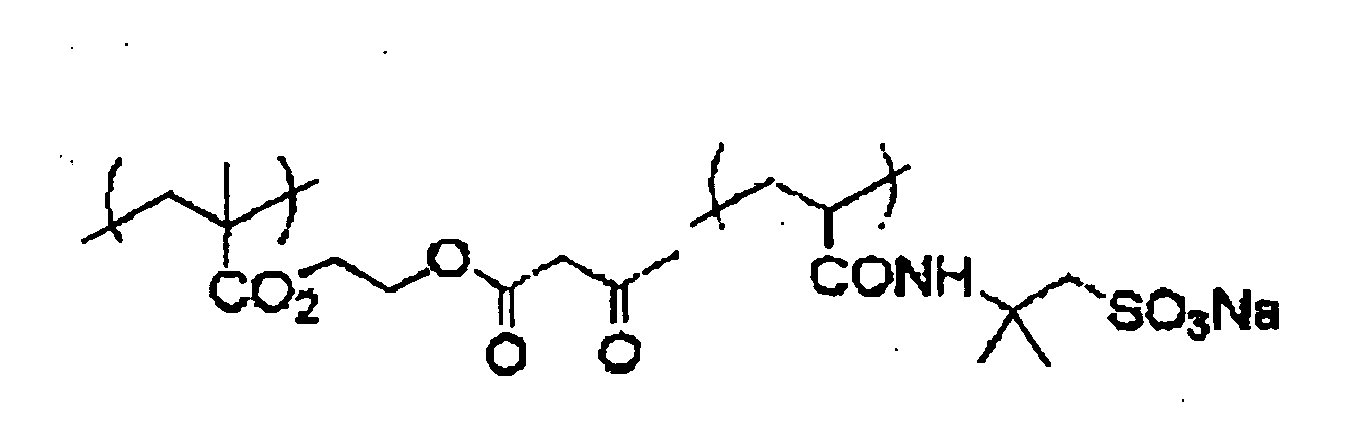


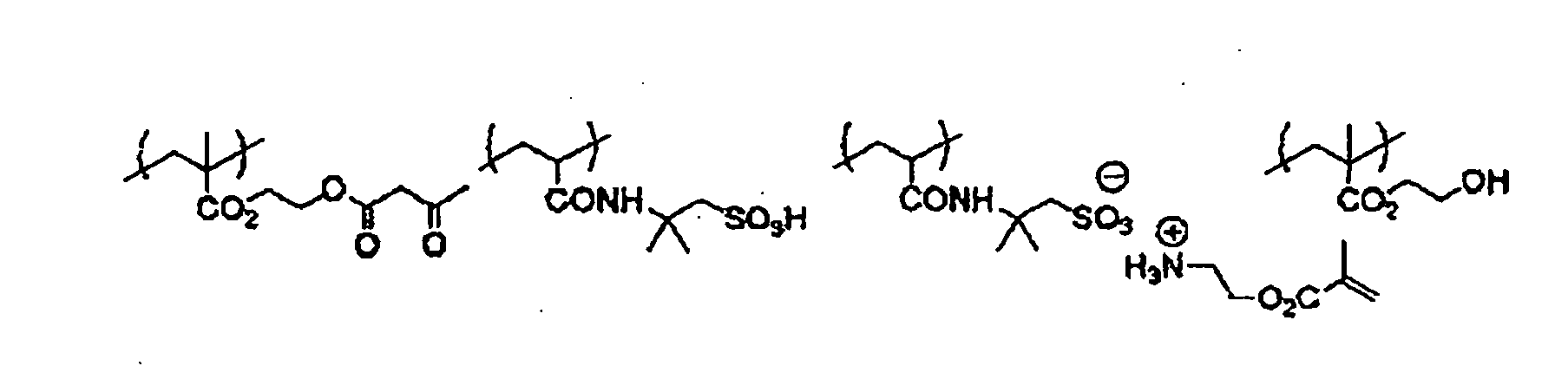


- Further, a copolymer including a repeating unit having an ethylenically unsaturated bond or the like described in
JP-A-2005-125749 - The weight average molecular weight of the polymer compound for undercoat layer is preferably 5,000 or more, more preferably from 10,000 to 300,000. The number average molecular weight of the polymer compound is preferably 1,000 or more, more preferably from 2,000 to 250,000. The polydispersity (weight average molecular weight/number average molecular weight) thereof is preferably from 1.1 to 10.
- The polymer compound for undercoat layer may be any of a random polymer, a block polymer, a graft polymer and the like, and is preferably a random polymer.
- The polymer compounds for undercoat layer may be used individually or in a mixture of two or more thereof.
- The coating amount (solid content) of the undercoat layer is preferably from 0.1 to 100 mg/m2, more preferably from 1 to 30 mg/m2.
- After applying the surface treatment to the support or forming the undercoat layer on the support, a backcoat layer can be provided on the back surface of the support, if desired.
- The backcoat layer preferably includes, for example, a coating layer comprising an organic polymer compound described in
JP-A-5-45885 JP-A-6-35174 - The method of preparing a lithographic printing plate according to the invention is described in detail below.
- According to the method of preparing a lithographic printing plate of the invention, the lithographic printing plate precursor according to the invention is imagewise exposed and then removing the protective layer and the unexposed area of the photosensitive layer in the presence of a developer having pH of 2 to 8 to form an image on the hydrophilic support.
- The lithographic printing plate precursor is imagewise exposed through a transparent original having a line image, a halftone dot image or the like, or imagewise exposed, for example, by scanning of laser beam based on digital data. The desirable wavelength of the exposure light source is from 350 to 450 nm.
- As for the available laser light source of 350 to 450 nm, the followings can be used.
- A gas laser, for example, Ar ion laser (364 nm, 351 nm, 10 mW to 1 W), Kr ion laser (356 nm, 351 nm, 10 mW to 1 W) and He-Cd laser (441 nm, 325 nm, 1 mW to 100 mW); a solid laser, for example, a combination of Nd:YAG (YVO4) with SHG crystalsxtwice (355 nm, 5 mW to 1 W) and a combination of Cr:LiSAF with SHG crystal (430 nm, 10 mW); a semiconductor laser system, for example, a KNbO3 ring resonator (430 nm, 30 mW), a combination of a waveguide-type wavelength conversion element with an AlGaAs or InGaAs semiconductor (380 nm to 450 nm, 5 mW to 100 mW), a combination of a waveguide-type wavelength conversion element with an AlGaInP or AlGaAs semiconductor (300 nm to 350 nm, 5 mW to 100 mW), and AlGaInN (350 nm to 450 nm, 5 mW to 30 mW); a pulse laser, for example, N2 laser (337 nm, pulse 0.1 to 10 mJ) and XeF (351 nm,
pulse 10 to 250 mJ) can be used. Among the light sources, the AlGaInN semiconductor laser (commercially available InGaN semiconductor laser, 400 to 410 nm, 5 to 30 mW) is particularly preferable in view of the wavelength characteristics and cost. - As for the exposure apparatus for the lithographic printing plate precursor of scanning exposure system, the exposure mechanism includes an internal drum system, an external drum system and a flat bed system. As the light source, among the light sources described above, those capable of conducting continuous oscillation can be preferably utilized. In practice, the exposure apparatuses described below are particularly preferable in view of the relationship between the sensitivity of lithographic printing plate precursor (hereinafter, also referred to as a "photosensitive material") and the time for plate making.
- ·A single beam to triple beam exposure apparatus of internal drum system, using one or more gas or solid laser light sources so as to provide a semiconductor laser having a total output of 20 mW or more
- ·A multi-beam (from 1 to 10 beams) exposure apparatus of flat bed system, using one or more semiconductor, gas or solid lasers so as to provide a total output of 20 mW or more
- ·A multi-beam (from 1 to 9 beams) exposure apparatus of external drum system, using one or more semiconductor, gas or solid lasers so as to provide a total output of 20 mW or more
- -A multi-beam (10 or more beams) exposure apparatus of external drum system, using one or more semiconductor or solid lasers so as to provide a total output of 20 mW or more
- As for the laser direct drawing-type lithographic printing plate precursor, the following equation (eq 1) is ordinarily established among the sensitivity X (J/cm2) of photosensitive material, the exposure area S (cm2) of photosensitive material, the power q (W) of one laser light source, the number n of lasers and the total exposure time t (s):

- i) In the case of the internal drum (single beam) system
The following equation (eq 2) is ordinarily established among the laser revolution number f (radian/s), the sub-scanning length Lx (cm) of photosensitive material, the resolution Z (dot/cm) and the total exposure time t (s):
- ii) In the case of the external drum (multi-beam) system
The following equation (eq 3) is ordinarily established among the drum revolution number F (radian/s), the sub-scanning length Lx (cm) of photosensitive material, the resolution Z (dot/cm), the total exposure time t (s) and the number (n) of beams:
- iii) In the case of the flat bed (multi-beam) system
The following equation (eq 4) is ordinarily established among the revolution number H (radian/s) of polygon mirror, the sub-scanning length Lx (cm) of photosensitive material, the resolution Z (dot/cm), the total exposure time t (s) and the number (n) of beams:
- When the resolution (2,560 dpi) required for a practical printing plate precursor, the plate size (A1/B1, sub-scanning length: 42 inch), the exposure condition of about 20 sheets/hour and the photosensitive characteristics (photosensitive wavelength, sensitivity: about 0.1 mJ/cm2) of the lithographic printing plate precursor according to the invention are substituted for the above equations, it can be understood that the lithographic printing plate precursor according to the invention is preferably combined with a multi-beam exposure system using a laser having a total output of 20 mW or more, and on taking account of operability, cost and the like, it is most preferably combined with an external drum system semiconductor laser multi-beam (10 or more beams) exposure apparatus.
- The imagewise exposure of the lithographic printing plate precursor can also conducted with an infrared laser. The infrared laser for use in the invention is not particularly restricted and, for example, a solid laser or semiconductor laser emitting an infrared ray having a wavelength of 760 to 1,200 nm is preferably exemplified. The output of the infrared laser is preferably 100 mW or more. Further, in order to shorten the exposure time, it is preferred to use a multibeam laser device. The exposure time per pixel is preferably within 20 microseconds, and the irradiation energy is preferably from 10 to 300 mJ/cm2.
- Other examples of the exposure light source which can be used in the invention include an ultra-high pressure mercury lamp, a high pressure mercury lamp, a medium pressure mercury lamp, a low pressure mercury lamp, a chemical lamp, a carbon arc lamp, a xenon lamp, a metal halide lamp, various visible or ultraviolet laser lamps, a fluorescent lamp, a tungsten lamp and sunlight.
- The developer for use in the invention is an aqueous solution having pH of 2 to 8. For instance, the developer is preferably water alone or an aqueous solution containing water as a main component (containing 60% by weight or more of water). Particularly, an aqueous solution having the same composition as conventionally known dampening water, an aqueous solution containing a surfactant (for example, an anionic, nonionic or cationic surfactant) or an aqueous solution containing a water-soluble polymer compound is preferable. An aqueous solution containing both a surfactant and a water-soluble polymer compound is especially preferable. The pH of the developer is preferably from 3 to 8, more preferably from 4 to 7.
- The anionic surfactant for use in the developer includes, for example, fatty acid salts, abietic acid salts, hydroxyalkanesulfonic acid salts, alkanesulfonic acid salts, dialkylsulfosur-cinic acid salts, straight-chain alkylbenzenesulfonic acid salts, branched alkylbenzenesulfonic acid salts, alkylnaphthalenesulfonic acid salts, alkylphenoxypolyoxyethylene propylsulfonic acid salts, polyoxyethylene alkylsulfophenyl ether salts, N-methyl-N-oleyltaurine sodium salt, N-alkylsulfosuccinic acid monoamide disodium salts, petroleum sulfonic acid salts, sulfated castor oil, sulfated beef tallow oil, sulfate ester slats of fatty acid alkyl ester, alkyl sulfate ester salts, polyoxyethylene alkyl ether sulfate ester salts, fatty acid monoglyceride sulfate ester salts, polyoxyethylene alkyl phenyl ether sulfate ester salts, polyoxyethylene styryl phenyl ether sulfate ester salts, alkyl phosphate ester salts, polyoxyethylene alkyl ether phosphate ester salts, polyoxyethylene alkyl phenyl ether phosphate ester salts, partially saponified products of styrene-maleic anhydride copolymer, partially saponified products of olefin-maleic anhydride copolymer and naphthalene sulfonate formalin condensates. Of the compounds, dialkylsulfosuccinic acid salts, alkyl sulfate ester salts and alkylnaphthalenesulfonic acid salts are particularly preferably used.
- The cationic surfactant for use in the developer is not particularly limited and conventionally known cationic surfactants can be used. Examples of the cationic surfactant include alkylamine salts, quaternary ammonium salts, polyoxyethylene alkyl amine salts and polyethylene polyamine derivatives.
- The nonionic surfactant for use in the developer includes, for example, polyethylene glycol type higher alcohol ethylene oxide addacts, alkylphenol ethylene oxide addacts, fatty acid ethylene oxide addacts, polyhydric alcohol fatty acid ester ethylene oxide addacts, higher alkylamine ethylene oxide addacts, fatty acid amide ethylene oxide addacts, ethylene oxide addacts of fat, polypropylene glycol ethylene oxide addacts, dimethylsiloxane-ethylene oxide block copolymers, dimethylsiloxane-(propylene oxide-ethylene oxide) block copolymers, fatty acid esters of polyhydric alcohol type glycerol, fatty acid esters of pentaerythritol, fatty acid esters of sorbitol and sorbitan, fatty acid esters of sucrose, alkyl ethers of polyhydric alcohols and fatty acid amides of alkanolamines.
- Among them, ethylene oxide addacts of sorbitol and/or sorbitan fatty acid esters, polypropylene glycol ethylene oxide addacts, dimethylsiloxane-ethylene oxide block copolymers, dimethylsiloxane-(propylene oxide-ethylene oxide) block copolymers and fatty acid esters of polyhydric alcohols are more preferable. The nonionic surfactant is preferred from the standpoint of foam depressing property.
- Further, from the standpoint of stable solubility in water or opacity, with respect to the nonionic surfactant used in the developer, the HLB (hydrophile-lipophile balance) value thereof is preferably 6 or more, more preferably 8 or more.
- Moreover, an oxyethylene adduct of acetylene glycol type or acetylene alcohol type or a surfactant, for example, a fluorine-based surfactant or a silicon-based surfactant can also be used.
- It is preferred that the developer for use in the invention contains a surfactant including a nitrogen atom. As the surfactant including a nitrogen atom, any compound represented by formulae <3> to <6> shown below is preferable.


- In formula <3>, R8 represents an alkyl group, R9 and R10 each represents a hydrogen atom or an alkyl group, R11 represent an alkylene group, and A represents a carboxylic acid ion group.
- In formula <4>, R12 represents a hydrogen atom or an alkyl group, R13 and R14 each represents an alkylene group or a polyalkylene oxide group, and B and C each represents a hydroxy group, a carboxylic acid group or a carboxylate group.
- In formula <5>, R15 and R16 each represents a hydrogen atom or an alkyl group, R17 represents an alkylene group, and D represents a carboxylic acid group or a carboxylate group.
- In formula <6>, R18, R19 and R20 each represents a hydrogen atom or an alkyl group, provided that not all of R18, R19 and R20 represent a hydrogen atom.
- In formulae <3> to <6>, the alkyl group represented by any one of R8 to R10, R12, R15, R16, and R18 to R20 may be a straight chain or branched structure, may contain a connecting group in the chain thereof and may have a substituent. As the connecting group, a connecting group containing a hetero atom, for example, an ester bond, an amido bond or an ether bond is preferable. As the substituent, for example, -COO-, -OH, -COOH or -COO-M+ (wherein M+ represents a cation, for example, a metal ion or an ammonium ion) is preferable. The alkylene group represented by any one of R11, R13, R14 and R17 may be a straight chain or branched structure, may contain a connecting group in the chain thereof and may have a substituent. As the connecting group, a connecting group containing a hetero atom, for example, an ester bond, an amido bond or an ether bond is preferable. As the substituent, for example, -COO-, -OH, -COOH or -COO-M+ (wherein M+ represents a cation, for example, a metal ion or an ammonium ion) is preferable. In the polyalkylene oxide group represented by R13 or R14, as the number of repeating units increases, the hydrophilicity increases and the stability in water tends to increase. The number of repeating units is preferably from 2 to 30, more preferably from 5 to 20. When both R13 and R14 represent polyalkylene oxide groups respectively, the number of repeating units may be the same or different
- In the surfactant including a nitrogen atom represented by any one of formulae <3> to <6>, as the total number of carbon atoms increases, the hydrophobic portion becomes large and dissolution of the surfactant in an aqueous developer becomes difficult. In such a case, the dissolution is improved by adding a dissolution auxiliary agent for assisting dissolution, for example, an alcohol. However, when the total number of carbon atoms excessively increases, the surfactant can not be dissolved in the proper amount in some cases. Therefore, the total number of carbon atoms included in R8 to R11 in formula <3> is preferably from 8 to 25, more preferably from 11 to 21. The total number of carbon atoms included in R12 to R14 in formula <4> is preferably from 8 to 25, more preferably from 11 to 22. The total number of carbon atoms included in R15 to R17 in formula <5> is preferably from 8 to 30, more preferably from 9 to 23. The total number of carbon atoms included in R18 to R20 in formula <6> is preferably from 8 to 22, more preferably from 10 to 20.
- Also, the total number of carbon atoms in the surfactant may be influenced by the component of the photosensitive layer, especially, a binder polymer. When the binder polymer having high hydrophilicity is used, it tends to be preferable that the total number of carbon atoms is relatively small. On the other hand, when the binder having low hydrophilicity is used, it tends to be preferable that the total number of carbon atoms is relatively large.
- Specific representative examples of the surfactant represented by any one of formulae <3> to <6> are set forth below, but the invention should not be construed as being limited thereto.
W-1 
m+n=20 W-2 
m+n=10 W-3 
m+n=20 W-4 
m+n=10 W-5 
m+n=20 W-6 
m+n=10 W-7 
W-8 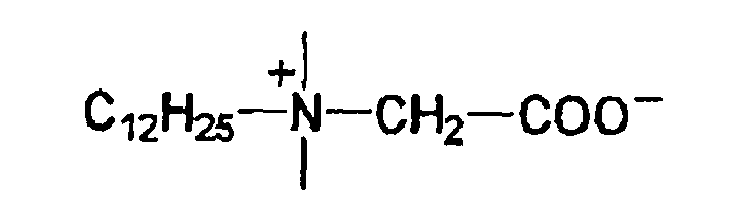
W-9 
W-10 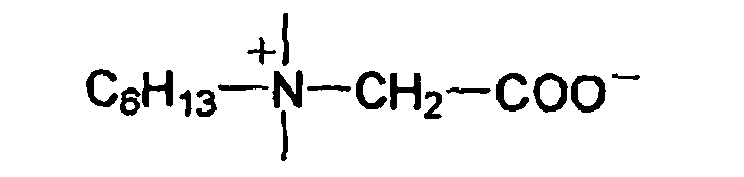
W-11 
W-12 
W-19 
W-20 
W-21 
W-22 
W-23 
W-24 
W-25 
W-26 
W-27 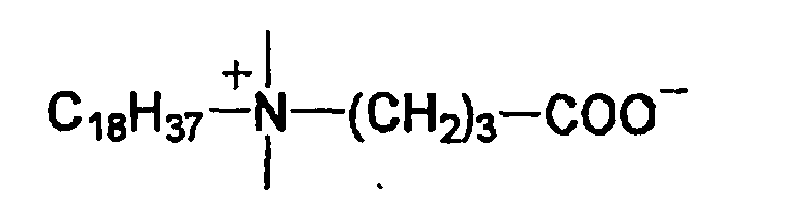
W-28 
W-29 
- When the developer containing the surfactant including a nitrogen atom described above is used in the development processing of the lithographic printing plate precursor having the photosensitive layer containing the binder polymer having an amino group and/or ammonium group, particularly preferable effects can be achieved. Specifically, since the developer is able to disperse stably the binder polymer removed from the non-image area of the photosensitive layer, it is prevented that the binder polymer precipitates in the developer and that the binder polymer re-adsorbs on the non-image area to cause printing stain.
- The surfactants may be used individually or in combination of two or more thereof. The amount of the surfactant in the developer is preferably from 0.01 to 20% by weight, more preferably from 1 to 15% by weight.
- The water-soluble polymer compound for use in the developer includes, for example, soybean polysaccharide, modified starch, gum arabic, dextrin, a cellulose derivative (for example, carboxymethyl cellulose, carboxyethyl cellulose or methyl cellulose) or a modified product thereof, pllulan, polyvinyl alcohol or a derivative thereof, polyvinyl pyrrolidone, polyacrylamide, an acrylamide copolymer, a vinyl methyl ether/maleic anhydride copolymer, a vinyl acetate/maleic anhydride copolymer and a styrene/maleic anhydride copolymer.
- As the soybean polysaccharide, those known can be used. For example, as a commercial product, Soyafive (trade name, produced by Fuji Oil Co., Ltd.) is available and various grade products can be used. The soybean polysaccharide preferably used has viscosity in a range of 10 to 100 mPa/sec in a 10% by weight aqueous solution thereof.
- As the modified starch, known modified starch can be used. The modified starch can be prepared, for example, by a method wherein starch, for example, of corn, potato, tapioca, rice or wheat is decomposed, for example, with an acid or an enzyme to an extent that the number of glucose residue per molecule is from 5 to 30 and then oxypropylene is added thereto in an alkali.
- Two or more of the water-soluble polymer compounds may be used in combination. The content of the water-soluble polymer compound is preferably from 0.1 to 20% by weight, more preferably from 0.5 to 10% by weight, in the developer.
- The developer may contain an organic solvent. The organic solvent include, for example, an aliphatic hydrocarbon (e.g., hexane, heptane, Isopar E, Isopar H, Isopar G (produced by Esso Chemical Co., Ltd.), gasoline or kerosene), an aromatic hydrocarbon (e.g., toluene or xylene), a halogenated hydrocarbon (methylene dichloride, ethylene dichloride, trichlene or monochlorobenzene) and a polar solvent.
- Examples of the polar solvent include an alcohol (e.g., methanol, ethanol, propanol, isopropanol, benzyl alcohol, ethylene glycol monomethyl ether, 2-ethyoxyethanol, diethylene glycol monoethyl ether, diethylene glycol monohexyl ether, triethylene glycol monomethyl ether, propylene glycol monoethyl ether, propylene glycol monomethyl ether, polyethylene glycol monomethyl ether, polypropylene glycol, tetramethylene glycol, ethylene glycol monobutyl ether, ethylene glycol monobenzyl ether, ethylene glycol monophenyl ether, methyl phenyl carbinol, n-amyl alcohol or methylamyl alcohol), a ketone (e.g., acetone, methyl ethyl ketone, ethyl butyl ketone, methyl isobutyl ketone or cyclohexanone), an ester (e.g., ethyl acetate, propyl acetate, butyl acetate, amyl acetate, benzyl acetate, methyl lactate, butyl lactate, ethylene glycol monobutyl acetate, polyethylene glycol monomethyl ether acetate, diethylene glycol acetate, diethyl phthalate or butyl levulinate) and others (e.g., triethyl phosphate, tricresyl phosphate, N-phenylethanolamine or N-phenyldiethanolamine).
- Further, when the organic solvent is insoluble in water, it may be employed by being solubilized in water using a surfactant or the like. In the case where the developer contains the organic solvent, the concentration of the organic solvent is desirably less than 40% by weight in view of safety and inflammability.
- The developer may further contain an antiseptic agent, a chelating agent, a defoaming agent, an organic acid, an inorganic acid, an inorganic salt or the like.
- As the antiseptic agent, for example, phenol or a derivative thereof, formalin, an imidazole derivative, sodium dehydroacetate, a 4-isothiazolin-3-one derivative, benzisotiazolin-3-one, a benzotriazole derivative, an amidine guanidine derivative, a quaternary ammonium salt, a pyridine derivative, a quinoline derivative, a guanidine derivative, diazine, a triazole derivative, oxazole, an oxazine derivative and a nitro bromo alcohol, e.g., 2-bromo-2-nitropropane-1,3-diol, 1,1-dibromo-1-nitro-2-ethanol or 1,1-dibromo-1-nitro-2-propanol are preferably used.
- As the chelating agent, for example, ethylenediaminetetraacetic acid, potassium salt thereof, sodium salt thereof; diethylenetriaminepentaacetic acid, potassium salt thereof, sodium salt thereof; triethylenetetraminehexaacetic acid, potassium salt thereof, sodium salt thereof; hydroxyethylethylenediaminetriacetic acid, potassium salt thereof, sodium salt thereof; nitrilotriacetic acid, sodium salt thereof, organic phosphonic acids, for example, 1-hydroxyethane-1,1-diphosphonic acid, potassium salt thereof, sodium salt thereof; aminotri(methylenephosphonic acid), potassium salt thereof, sodium salt thereof; and phophonoalkanetricarboxylic acids are illustrated. A salt of an organic amine is also effectively used in place of the sodium salt or potassium salt in the chelating agents.
- As the defoaming agent, for example, a conventional silicone-based self-emulsifying type or emulsifying type defoaming agent or a nonionic surfactant having HLB of 5 or less is used. The silicone defoaming agent is preferably used. Any of emulsifying dispersing type and solubilizing type can be used.
- As the organic acid, for example, citric acid, acetic acid, oxalic acid, malonic acid, salicylic acid, caprylic acid, tartaric acid, malic acid, lactic acid, levulinic acid, p-toluenesulfonic acid, xylenesulfonic acid, phytic acid and an organic phosphonic acid are illustrated. The organic acid can also be used in the form of an alkali metal salt or an ammonium salt.
- As the inorganic acid and inorganic salt, for example, phosphoric acid, methaphosphoric acid, ammonium primary phosphate, ammonium secondary phosphate, sodium primary phosphate, sodium secondary phosphate, potassium primary phosphate, potassium secondary phosphate, sodium tripolyphosphate, potassium pyrophosphate, sodium hexamethaphosphate, magnesium nitrate, sodium nitrate, potassium nitrate, ammonium nitrate, sodium sulfate, potassium sulfate, ammonium sulfate, sodium sulfite, ammonium sulfite, sodium hydrogen sulfate and nickel sulfate are illustrated.
- The developer can be used at an appropriate temperature, and the developer temperature is preferably from 10 to 50°C.
- The developer described above can be used as a developer and a development replenisher for an exposed negative type lithographic printing plate precursor, and it is preferably applied to an automatic processor described hereinafter. In the case of conducting the development processing using an automatic processor, the developer becomes fatigued in accordance with the processing amount, and hence the processing ability may be restored using a replenisher or a fresh developer. Such a replenishment system can be preferably applied to the method of preparing a lithographic printing plate according to the invention.
- The development processing using the developer having pH of 2 to 8 according to the invention is preferably performed by an automatic processor equipped with a supplying means for the developer and a rubbing member. As the automatic processor, there are illustrated an automatic processor in which a lithographic printing plate precursor after image exposure is subjected to a rubbing treatment while it is transporting described in
JP-A-2-220061 JP-A-60-59351 U.S. Patents 5,148,746 and5,568,768 and British Patent2,297,719 - The rotating brush roller which can be used in the invention can be appropriately selected by taking account, for example, of scratch resistance of the image area and nerve strength of the support of the lithographic printing plate precursor. As for the rotating brush roller, a known rotating brush roller produced by implanting a brush material in a plastic or metal roller can be used. For example, a rotating brush roller described in
JP-A-58-159533 JP-A-3-100554 JP-U-B-62-167253 - As the brush material, a plastic fiber (for example, a polyester-based synthetic fiber, e.g., polyethylene terephthalate or polybutylene terephthalate, a polyamide-based synthetic fiber, e.g., nylon 6.6 or nylon 6.10, a polyacrylic synthetic fiber, e.g., polyacrylonitrile or polyalkyl (meth)acrylate, and a polyolefin-based synthetic fiber, e.g., polypropylene or polystyrene) can be used. For instance, a brush material having a fiber bristle diameter of 20 to 400 µm and a bristle length of 5 to 30 mm can be preferably used.
- The outer diameter of the rotating brush roller is preferably from 30 to 200 mm, and the peripheral velocity at the tip of the brush rubbing the plate surface is preferably from 0.1 to 5 m/sec. It is preferred to use a plurality of the rotating brush rollers.
- The rotary direction of the rotating brush roller may be the same direction or the opposite direction with respect to the transporting direction of the lithographic printing plate precursor, but when two or more rotating brush rollers are used in an automatic processor as shown in
Fig. 1 , it is preferred that at least one rotating brush roller rotates in the same direction and at least one rotating brush roller rotates in the opposite direction with respect to the transporting direction. By such arrangement, the photosensitive layer in the non-image area can be more steadily removed. Further, a technique of rocking the rotating brush roller in the rotation axis direction of the brush roller is also effective. - In the invention, the lithographic printing plate after the development processing may be subsequently subjected to water washing, a drying and an oil-desensitization treatment, if desired. In the oil-desensitization treatment, a known oil-desensitizing solution can be used.
- Further, in the method of preparing a lithographic printing plate from the lithographic printing plate precursor according to the invention, the entire surface of the lithographic printing plate precursor may be heated, if desired, before or during the exposure or between the exposure and the development By the heating, the image-forming reaction in the photosensitive layer is accelerated and advantages, for example, improvement in the sensitivity and printing durability and stabilization of the sensitivity are achieved. For the purpose of increasing the image strength and printing durability, it is also effective to perform entire after-heating or entire exposure of the image after the development. Ordinarily, the heating before the development is preferably performed under a mild condition of 150°C or lower. When the temperature is too high, a problem may arise sometimes in that the non-image area is also fogged. On the other hand, the heating after the development can be performed using very strong conditions. Ordinarily, the heat treatment is carried out in a temperature range of 200 to 500°C. When the temperature is too low, a sufficient effect of strengthening the image may not be obtained, whereas when it is excessively high, problems of deterioration of the support and thermal decomposition of the image area may occur sometimes.
- In the invention, although the development processing can be carried out just after the exposure step, the heat treatment step may intervene between the exposure step and the development step as described above. The heat treatment is effective for increasing the printing durability and improving uniformity of the image curing degree in the entire surface of printing plate precursor. The conditions of the heat treatment can be appropriately determined in a range for providing such effects. Examples of the heating means include a conventional convection oven, an IR irradiation apparatus, an IR laser, a microwave apparatus or a Wisconsin oven. Specifically, the heat treatment can be conducted by maintaining the lithographic printing plate precursor at a plate surface temperature ranging from 70 to 150°C for a period of one second to 5 minutes, preferably at 80 to 140°C for 5 seconds to one minute, more preferably at 90 to 130°C for 10 to 30 seconds. In the above-described range, the effects described above are efficiently achieved and an adverse affect, for example, change in shape of the lithographic printing plate precursor due to the heat can be preferably avoided.
- According to the invention, the development processing step is conducted after the exposure step, preferably after the exposure step and the heat treatment step to prepare a lithographic printing plate. It is preferable that a plate setter used in the exposure step, a heat treatment means used in the heat treatment step and a development apparatus used in the development processing step are connected with each other and the lithographic printing plate precursor is subjected to automatically continuous processing. Specifically, a plate making line wherein the plate setter and the development apparatus are connected with each other by transport means, for example, a conveyer is illustrated. Also, the heat treatment means may be placed between the plate setter and the development apparatus or the heat treatment means and the development apparatus may constitute a unit apparatus.
- In case where the lithographic printing plate precursor used is apt to be influenced by surrounding light under a working environment, it is preferable that the plate making line is blinded by a filter, a cover or the like.
- After the image formation, the entire surface of lithographic printing plate may be exposed to active ray, for example, ultraviolet light to accelerate curing of the image area. As a light source for the entire surface exposure, for example, a carbon arc lamp, a mercury lamp, a gallium lamp, a metal halide lamp, a xenon lamp, a tungsten lamp or various laser beams are exemplified. In order to obtain sufficient printing durability, the amount of the entire surface exposure is preferably 10 mJ/cm2 or more, more preferably 100 mJ/cm2 or more.
- Heating may be performed at the same time with the entire surface exposure. By performing the heating, further improvement in the printing durability is recognized. Examples of the heating means include a conventional convection oven, an IR irradiation apparatus, an IR laser, a microwave apparatus or a Wisconsin oven.The plate surface temperature at the heating is preferably from 30 to 150°C, more preferably from 35 to 130°C, still more preferably from 40 to 120°C.
- The present invention will be described in more detail with reference to the following examples, but the invention should not be construed as being limited thereto.
- An aluminum plate (material: JIS A1050) having a thickness of 0.3 mm was dipped in an aqueous 10% by weight sodium hydroxide solution at 60°C for 25 seconds to effect etching, washed with running water, neutralized and cleaned with an aqueous 20% by weight nitric acid solution and then washed with water. The aluminum plate was subjected to an electrolytic surface roughening treatment in an aqueous 1 % by weight nitric acid solution using an alternating current with a sinusoidal waveform at an anode time electricity of 300 coulomb/dm2. Subsequently, the aluminum plate was dipped in an aqueous 1% by weight sodium hydroxide solution at 40°C for 5 seconds, dipped in an aqueous 30% by weight sulfuric acid solution at 60°C for 40 seconds to effect a desmut treatment, and then subjected to an anodizing treatment in an aqueous 20% by weight sulfuric acid solution for 2 minutes at a current density of 2 A/dm2 to form an anodic oxide film having a thickness of 2.7 g/m2. The center line average roughness (Ra) of the thus-treated aluminum plate was measured using a stylus having a diameter of 2 µm and found to be 0.25 µm (Ra indication according to JIS B0601).
- Then, Undercoat Solution (1) shown below was coated using a bar and dried in an oven at 80°C for 10 seconds to prepare a support having an undercoat layer having a dry coating amount of 10 mg/m2.
-
Undercoat Compound (1) shown below (molecular weight: 100,000) 0.017 g Methanol 9.00 g Water 1.00 g -

- On the aluminum support having the undercoat layer prepared above, Coating Solution (1) for Photosensitive Layer having the composition shown below was coated using a bar and dried in an oven at 100°C for 44 seconds to form a photosensitive layer having a dry coating amount of 1.3 g/m2. On the photosensitive layer, Coating Solution (1) for Protective Layer having the composition shown below was coated using a bar and dried in an oven at 125°C for 70 seconds to form a protective layer having a dry coating amount of 1.25 g/m2, thereby preparing Lithographic Printing Plate Precursors (1) to (7).
-
Binder Polymer shown in Table 1 below 0.45 g Polymerizable Compound (1) 0.52 g (PLEX 6661-O, produced by Degussa Japan) Sensitizing Dye (1) shown below 0.04 g Polymerization Initiator (1) shown below 0.08 g Co-Sensitizer (1) shown below 0.05 g Dispersion of ε-phthalocyanine pigment 0.40 g [pigment: 15 parts by weight; dispersing agent (Polymer (1) shown below): 10 parts by weight; solvent (cyclohexanone/methoxypropyl acetate/1-methoxy-2-propanol =15 parts by weight/20 parts by weight/40 parts by weight)] Thermal polymerization inhibitor 0.006 g (N-nitrosophenylhydroxylamine aluminum salt) Fluorine-Based Surfactant (1) shown below 0.002 g 1-Methoxy-2-propanol 8.0 g Methyl ethyl ketone 8.0 g -


-
Dispersion of Mica shown below 0.6 g Sulfonic acid-modified polyvinyl alcohol [Goseran CKS-50, produced by Nippon Synthetic Chemical Industry Co., Ltd. (saponification degree: 99% by mole; average polymerization degree: 300; modification degree: about 0.4% by mole)] 0.8 g Vinyl pyrrolidone/vinyl acetate (1/1) copolymer (molecular weight: 70,000) 0.001 g Surfactant (Emalex 710, produced by Nihon Emulsion Co., Ltd.) 0.002 g Water 13 g - In 368 g of water was added 32 g of synthetic mica (SOMASIF ME-100, produced by CO-OP Chemical Co., Ltd.; aspect ratio: 1,000 or more) and the mixture was dispersed using a homogenizer until the average particle diameter (measured by a laser scattering method) became 0.5 µm to obtain Dispersion of Mica.
- Each of Lithographic Printing Plate Precursors (1) to (7) was subjected to image exposure by Violet Semiconductor Laser Plate Setter Vx9600 (equipped with InGaN semiconductor laser; emission: 405 nm ± 10 nm/output: 30 mW) produced by FUJIFILM Electronic Imaging, Ltd. As for the image, halftone dots of 50% were drawn using an FM screen (TAFFETA 20, produced by Fuji Film Co., Ltd.) in a plate surface exposure amount of 0.05 mJ/cm2 and at resolution of 2,438 dpi.
- Then, the exposed lithographic printing plate precursor was pre-heated at 100°C for 30 seconds and subjected to development processing in an automatic development processor having a structure shown in
Fig. 1 using each of Developers (1) to (8) having the composition shown below. The pH of each developer was adjusted to 4.5 using phosphoric acid and sodium hydroxide. The automatic development processor had two rotating brush rollers. The first brush roller used was a brush roller having an outer diameter of 50 mm and being implanted with fiber of polybutylene terephthalate (bristle diameter: 200 µm, bristle length: 17 mm), and the brush roller was rotated at 200 rpm in the same direction as the transporting direction (peripheral velocity at the tip of brush: 0.52 m/sec). The second brush roller used was a brush roller having an outer diameter of 50 mm and being implanted with fiber of polybutylene terephthalate (bristle diameter: 200µm, bristle length: 17 mm), and the brush roller was rotated at 200 rpm in the opposite direction to the transporting direction (peripheral velocity at the tip of brush: 0.52 m/sec). The transportation of the lithographic printing plate precursor was performed at transporting speed of 100 cm/min. - The developer was supplied on the surface of the lithographic printing plate precursor by showering from a spray pipe using a circulation pump. The tank volume for the developer was 10 liters.
-
Water 100 g Surfactant shown in Table 1 below 10 g Gum arabic 10 g Ammonium primary phosphate 0.1 g Citric acid 0.1 g Tetrasodium ethylenediaminetetraacetate 0.1 g 2-Bromo-2-nitropropane-1,3-diol 0.001 g 2-Methyl-4-isothiazolin-3-one 0.001 g - The lithographic printing plate thus-obtained was mounted on a printing machine, SOR-M, produced by Heidelberg, and printing was performed at a printing speed of 6,000 sheets per hour using dampening water (EU-3 (etching solution, produced by Fuji Film Co., Ltd.))/water/isopropyl alcohol = 1/89/10 (by volume ratio)) and TRANS-G (N) black ink (produced by Dai-Nippon Ink & Chemicals, Inc.).
- With respect to Lithographic Printing Plate Precursors (1) to (7) described above, the developing property, processing property and scratch resistance were evaluated in the following manner.
- The lithographic printing plate was subjected to the printing in the manner described above. On the 1,000th printed material, unevenness of halftone dot image (unevenness of ink density) due to stain in the non-image area was evaluated. The evaluation was conducted according to the following criteria:
- ×: Case where the unevenness of ink density occurred in the halftone dot image.
- △: Case where although the slight unevenness of ink density occurred in the halftone dot image, it was at the acceptable level.
- ○: Case where no unevenness of ink density occurred in the halftone dot image and good image was obtained.
- After the lithographic printing plate precursor was subjected to development processing as described above in an amount of 500 m2, the occurrence of scum adhered on the tank wall of the automatic development processor was visually observed. The scum occurred was mainly caused by the binder of the protective layer. The evaluation was conducted according to the following criteria:
- ○: Case where the scum did not occur.
- △: Case where the occurrence of scum was at the acceptable level.
- x: Case where the occurrence of scum was severe.
- The surface of the lithographic printing plate precursor was scratched using a scratch testing machine equipped with a sapphire needle having a diameter of 4.0 mmΦ while applying the load of 200 g and the lithographic printing plate precursor was then subjected to the exposure, development and printing in the manner described above and evaluated whether the normal printing image could be formed. When the strength of the protective layer is insufficient, the scratch occurs in the protective layer and the oxygen blocking property becomes insufficient or the photosensitive layer is also scratched together with the protective layer and the image-forming property is deteriorated in the scratched area. The evaluation was conducted according to the following criteria:
- ○: Case where the image formation was normal.
- △: Case where the image formation was at the acceptable level.
- x: Case where the image formation was poor.
- The results obtained are shown in Table 1.
TABLE 1 Lithographic Printing Plate Precursor Binder Polymer of Photosensitive Layer Developer Surfactant Developing Property Processing Property Scratch Resistance Example 1 (1) PB-33 (1) W-8 ○ ○ ○ Example 2 (2) PB-22 (1) W-8 ○ ○ ○ Example 3 (3) PB-22b (1) W-8 ○ ○ ○ Example 4 (4) PA-11 (1) W-8 ○ ○ ○ Example 5 (5) PA-1 (1) W-8 ○ ○ ○ Example 6 (6) PA-20 (1) W-8 ○ ○ ○ Example 7 (1) PB-33 (2) W-4 ○ ○ ○ Example 8 (1) PB-33 (3) W-20 ○ ○ ○ Example 9 (1) PB-33 (4) W-24 ○ ○ ○ Example 10 (1) PB-33 (5) W-28 ○ ○ ○ Example 11 (7) PU-A (1) W-8 △ ○ △ Example 12 (1) PB-33 (6) (1) △ △ ○ Example 13 (1) PB-33 (7) (2) △ △ ○ Example 14 (1) PB-33 (8) (3) △ △ ○ - The structures of Binder Polymer PU-A in the photosensitive layer and Surfactants (1) to (3) are shown below. Other binder polymers and surfactants are same as those described as the specific examples hereinbefore.
-

- Surfactant (1): Polyoxyethylene naphthyl ether (average number of oxyethylene: n = 13) (Newcol B 13, produced by Nippon Nyukazai Co., Ltd.)
- Surfactant (2): Polyoxyethylene naphthyl ether sulfate ester salt (average number of oxyethylene: n = 4) (Newcol B4SN, produced by Nippon Nyukazai Co., Ltd.)
- Surfactant (3): Alkyl diphenyloxide disulfonate (Dowfax 3B2, produced by Dow Chemical Co.)
- As is apparent from the results shown in Table 1, the method of preparing a lithographic printing palate according to the invention is excellent in the developing property and the processing property wherein the occurrence of scum in the developer is prevented.
- Lithographic Printing Plate Precursors (8) to (11) were prepared in the same manner as in Lithographic Printing Plate Precursor (1) except for changing Coating Solution (1) for Protective Layer to Coating Solutions (2) to (5) for Protective Layer, respectively.
-
Dispersion of Mica shown above 0.6 g Sulfonic acid-modified polyvinyl alcohol [Goseran CKS-50, produced by Nippon Synthetic Chemical Industry Co., Ltd. (saponification degree: 99% by mole; average polymerization Amount shown in Table 2 degree: 300; modification degree: about 0.4% by mole)] Unmodified polyvinyl alcohol [PVA 105, produced by Kuraray Co., Ltd. (saponification degree: 98% by mole; average polymerization degree: 500) Amount shown in Table 2 Vinyl pyrrolidone/vinyl acetate (1/1) copolymer (molecular weight: 70,000) 0.001 g Surfactant (Emalex 710, produced by Nihon Emulsion Co., Ltd.) 0.002 g Water 13 g TABLE 2 Lithographic Printing Plate Precursor Coating Solution for Protective Layer Sulfonic Acid-Modified Polyvinyl Alcohol Unmodified Polyvinyl Alcohol (8) (2) 0.6 g 0.2 g (9) (3) 0.45 g 0.35 g (10) (4) 0.2 g 0.6 g (11) (5) 0 g 0.8 g - Lithographic Printing Plate Precursor (12) was prepared in the same manner as in Lithographic Printing Plate Precursor (1) except for changing the sulfonic acid-modified polyvinyl alcohol in Coating Solution (1) for Protective Layer to carboxy-modified polyvinyl alcohol SK-5102, produced by Kuraray Co., Ltd. (saponification degree: 98% by mole; average polymerization degree: 200; modification degree: 3% by mole) to prepare Coating Solution (6) for Protective Layer.
- Lithographic Printing Plate Precursor (13) was prepared in the same manner as in Lithographic Printing Plate Precursor (1) except for changing the amount of the dispersion of mica in Coating Solution (1) for Protective Layer to 2.0 g to prepare Coating Solution (7) for Protective Layer.
- Lithographic Printing Plate Precursor (14) was prepared in the same manner as in Lithographic Printing Plate Precursor (1) except for changing the amount of the dispersion of mica in Coating Solution (1) for Protective Layer to 5.0 g to prepare Coating Solution (8) for Protective Layer.
- Lithographic Printing Plate Precursor (15) was prepared in the same manner as in Lithographic Printing Plate Precursor (1) except for changing the amount of the dispersion of mica in Coating Solution (1) for Protective Layer to 9.0 g to prepare Coating Solution (9) for Protective Layer.
- Lithographic Printing Plate Precursors (16), (17) and (18) were prepared in the same manner as in Lithographic Printing Plate Precursor (1) except for changing the dry coating amount of the protective layer to 0.45 g/m2, 1.0 g/m2 and 2.0 g/m2, respectively.
- With respect to Lithographic Printing Plate Precursors (8) to (18), the developing property, processing property and scratch resistance were evaluated in the same manner as in Example 1. The results obtained are shown in Table 3.
TABLE 3 Lithographic Printing Plate Precursor Developing Property Processing Property Scratch Resistance Example 15 (8) ○ ○ ○ Example 16 (9) ○ △ ○ Comparative Example 1 (10) △ × △ Comparative Example 2 (11) × × × Example 17 (12) ○ ○ ○ Example 18 (13) ○ ○ ○ Example 19 (14) ○ ○ ○ Example 20 (15) △ ○ ○ Example 21 (16) ○ ○ △ Example 22 (17) ○ ○ ○ Example 23 (18) △ ○ ○ - As is apparent from the results shown in Table 3, the method of preparing a lithographic printing palate according to the invention is excellent in the developing property and the processing property wherein the occurrence of scum in the developer is prevented
- Lithographic Printing Plate Precursor (1) was subjected to image exposure by Violet Semiconductor Laser Plate Setter Vx9600 (equipped with InGaN semiconductor laser; emission: 405 nm ± 10 nm/output: 30 mW) produced by FUJIFILM Electronic Imaging, Ltd.
wherein the semiconductor laser had been replaced by that having the output of 100 mW. As for the image, halftone dots of 50% were drawn using an FM screen (TAFFETA 20, produced by Fuji Film Co., Ltd.) in a plate surface exposure amount of 0.25 mJ/cm2 and at resolution of 2,438 dpi. - Then, without conducting the pre-heating, the exposed lithographic printing plate precursor was subjected to the development processing in the automatic development processor having a structure shown in
Fig. 1 using Developer (1) in the same manner as in Example 1. The developing property, processing property and scratch resistance were evaluated in the same manner as in Example 1 and as a result, the good results same as in Example 1 were obtained. - Lithographic Printing Plate Precursor (1) was subjected to image exposure in the same manner as in Example 1 and within 30 seconds subjected to the development processing using an automatic development processor (LP1250PLX, produced by Fuji Film Co., Ltd.) having the construction shown in
Fig. 2 . The automatic development processor was composed of a pre-heating unit, a pre-water washing unit, a developing unit, a water washing unit and a finishing unit in this order. The heating condition in the pre-heating unit was at 100°C for 10 seconds. In the developing bath, Developer (1) was supplied. To the pre-water washing unit, water washing unit and finishing unit was not supplied any liquid and only their transporting functions were used. The developing property, processing property and scratch resistance were evaluated in the same manner as in Example 1 other than the development processing described above and as a result, the good results same as in Example 1 were obtained. - Lithographic Printing Plate Precursor (1) was subjected to image exposure in the same manner as in Example 1 and within 30 seconds subjected to the development processing using an automatic development processor (LP1250PLX, produced by Fuji Film Co., Ltd.) having the construction shown in
Fig. 2 . The automatic development processor was composed of a pre-heating unit, a pre-water washing unit, a developing unit, a water washing unit and a finishing unit in this order. The heating condition in the pre-heating unit was at 100°C for 10 seconds. In the developing bath, Developer (1) was supplied. In the pre-water washing unit, water was circulated and removal of the protective layer was conducted before the lithographic printing plate precursor was introduced into the developing unit. To the water washing unit and finishing unit was not supplied any liquid and only their transporting functions were used. The developing property, processing property and scratch resistance were evaluated in the same manner as in Example 1 other than the development processing described above and as a result, the good results same as in Example 1 were obtained.
Claims (15)
- A method for preparing a lithographic printing plate comprising:exposing imagewise a lithographic printing plate precursor comprising, in the following order, a hydrophilic support, a photosensitive layer containing (A) a sensitizing dye, (B) a polymerization initiator, (C) a polymerizable compound and (D) a binder polymer and a protective layer containing at least one acid-modified polyvinyl alcohol in an amount of 50% by weight or more based on a total solid content of the protective layer; andremoving the protective layer and an unexposed area of the photosensitive layer with a developer having pH of from 2 to 8.
- The method for preparing a lithographic printing plate as claimed in Claim 1,
wherein the acid-modified polyvinyl alcohol is a carboxy-modified or sulfonic acid-modified polyvinyl alcohol. - The method for preparing a lithographic printing plate as claimed in Claim 1 or 2,
wherein the protective layer further contains an inorganic stratiform compound in an amount of from 3 to 50% by weight based on a total solid content of the protective layer. - The method for preparing a lithographic printing plate as claimed in any one of Claims 1 to 3, wherein the binder polymer has a group represented by the following formula <1> or <2>:
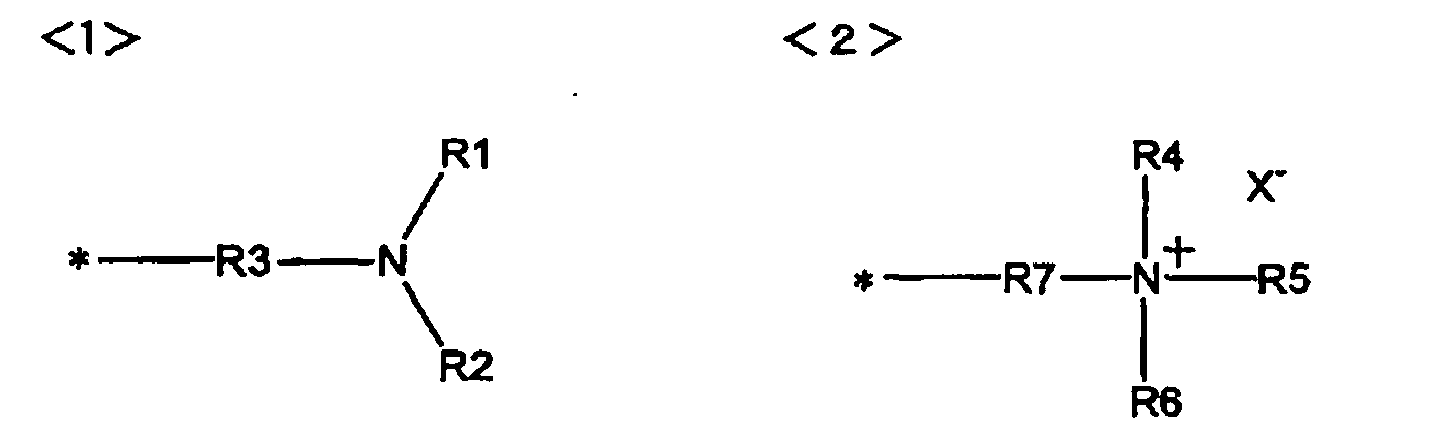
- The method for preparing a lithographic printing plate as claimed in any one of Claims 1 to 4, wherein the developer comprises a surfactant represented by one of the following formulae <3> to <6>:
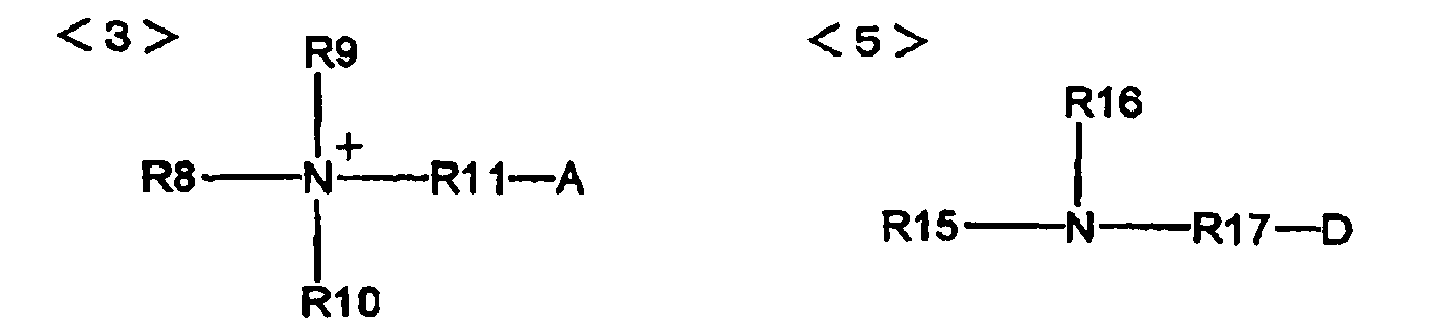

- The method for preparing a lithographic printing plate as claimed in any one of Claims 1 to 5, wherein the removal of the protective layer and an unexposed area of the photosensitive layer is conducted by an automatic processor.
- The method for preparing a lithographic printing plate as claimed in Claim 6,
wherein the lithographic printing plate precursor is exposed imagewise with laser of 350 to 450 nm, subjected to a heat treatment process, and then without undergoing any water washing process, subjected to removal of the protective layer and an unexposed area of the photosensitive layer by an automatic processor equipped with a rubbing member. - The method for preparing a lithographic printing plate as claimed in Claim 7,
wherein the rubbing member comprises at least two rotating brush rollers. - The method for preparing a lithographic printing plate as claimed in any one of Claims 1 to 8, wherein the polymerization initiator is a hexaarylbiimidazole compound.
- A lithographic printing plate precursor comprising, in the following order:a hydrophilic support;a photosensitive layer comprising (A) a sensitizing dye, (B) a polymerization initiator, (C) a polymerizable compound and (D) a binder polymer, anda protective layer comprising at least one acid-modified polyvinyl alcohol in an amount of 50% by weight or more based on a total solid content of the protective layer,wherein the protective layer and an unexposed area of the photosensitive layer are removable with a developer having pH of from 2 to 8.
- The lithographic printing plate precursor as claimed in Claim 10, wherein the acid-modified polyvinyl alcohol is a carboxy-modified or sulfonic acid-modified polyvinyl alcohol.
- The lithographic printing plate precursor as claimed in Claim 10 or 11, wherein the protective layer further comprises an inorganic stratiform compound in an amount of from 3 to 50% by weight based on a total solid content of the protective layer.
- The lithographic printing plate precursor as claimed in any one of Claims 10 to 12, wherein the binder polymer has a group represented by the following formula <1> or <2>:

- The lithographic printing plate precursor as claimed in any one of Claims 10 to 13, wherein the polymerization initiator is a hexaarylbiimidazole compound.
- The lithographic printing plate precursor as claimed in any one of Claims 10 to 14, wherein the photosensitive layer further comprises a chain transfer agent
Applications Claiming Priority (1)
| Application Number | Priority Date | Filing Date | Title |
|---|---|---|---|
| JP2007318693A JP2009139852A (en) | 2007-12-10 | 2007-12-10 | Preparation method of lithographic printing plate and lithographic printing plate precursor |
Publications (1)
| Publication Number | Publication Date |
|---|---|
| EP2070696A1 true EP2070696A1 (en) | 2009-06-17 |
Family
ID=40318595
Family Applications (1)
| Application Number | Title | Priority Date | Filing Date |
|---|---|---|---|
| EP08021463A Withdrawn EP2070696A1 (en) | 2007-12-10 | 2008-12-10 | Method of preparing lithographic printing plate and lithographic printing plate precursor |
Country Status (3)
| Country | Link |
|---|---|
| US (1) | US20090148792A1 (en) |
| EP (1) | EP2070696A1 (en) |
| JP (1) | JP2009139852A (en) |
Families Citing this family (6)
| Publication number | Priority date | Publication date | Assignee | Title |
|---|---|---|---|---|
| JP5150287B2 (en) * | 2008-02-06 | 2013-02-20 | 富士フイルム株式会社 | Preparation method of lithographic printing plate and lithographic printing plate precursor |
| WO2013141222A1 (en) * | 2012-03-19 | 2013-09-26 | Jsr株式会社 | Resist pattern forming method and photoresist composition |
| KR102149795B1 (en) * | 2013-12-13 | 2020-08-31 | 삼성전기주식회사 | Resist film and methods of forming a pattern |
| JP6561126B2 (en) | 2015-08-27 | 2019-08-14 | 富士フイルム株式会社 | Photosensitive composition, image forming method, and film forming method |
| CN110366585B (en) | 2017-02-24 | 2022-04-29 | 富士胶片株式会社 | Photocurable ink composition and image forming method |
| CN110573582B (en) | 2017-04-26 | 2022-04-19 | 富士胶片株式会社 | Photocurable ink composition and image forming method |
Citations (182)
| Publication number | Priority date | Publication date | Assignee | Title |
|---|---|---|---|---|
| GB434875A (en) | 1933-02-08 | 1935-09-05 | Bela Gasper | An improved method of producing multi-colour photographic images on coloured and differently sensitized multi-layer photographic material |
| US2714066A (en) | 1950-12-06 | 1955-07-26 | Minnesota Mining & Mfg | Planographic printing plate |
| US2800458A (en) | 1953-06-30 | 1957-07-23 | Ncr Co | Oil-containing microscopic capsules and method of making them |
| US2800457A (en) | 1953-06-30 | 1957-07-23 | Ncr Co | Oil-containing microscopic capsules and method of making them |
| US2833827A (en) | 1955-01-17 | 1958-05-06 | Bayer Ag | Tri (3, 5-di lower alkyl-4-hydroxy phenyl)-sulfonium chlorides and method of preparing same |
| JPS369163B1 (en) | 1959-09-01 | 1961-06-30 | ||
| GB930422A (en) | 1958-12-22 | 1963-07-03 | Upjohn Co | Process of the encapsulation of particulate material |
| US3111407A (en) | 1960-02-26 | 1963-11-19 | Ibm | Methods for making record materials |
| GB952807A (en) | 1961-09-05 | 1964-03-18 | Ncr Co | Process for manufacturing minute capsules having waxy material walls |
| GB967074A (en) | 1960-02-23 | 1964-08-19 | Metallurg De Prayon Sa | Process and apparatus for the production of zinc by the reduction of zinc oxides in a multiple-retort furnace |
| US3181461A (en) | 1963-05-23 | 1965-05-04 | Howard A Fromson | Photographic plate |
| US3276868A (en) | 1960-08-05 | 1966-10-04 | Azoplate Corp | Planographic printing plates |
| US3280734A (en) | 1963-10-29 | 1966-10-25 | Howard A Fromson | Photographic plate |
| US3287154A (en) | 1963-04-24 | 1966-11-22 | Polaroid Corp | Pressure responsive record materials |
| JPS42446B1 (en) | 1963-10-21 | 1967-01-13 | ||
| US3418250A (en) | 1965-10-23 | 1968-12-24 | Us Plywood Champ Papers Inc | Microcapsules, process for their formation and transfer sheet record material coated therewith |
| US3458311A (en) | 1966-06-27 | 1969-07-29 | Du Pont | Photopolymerizable elements with solvent removable protective layers |
| US3479185A (en) | 1965-06-03 | 1969-11-18 | Du Pont | Photopolymerizable compositions and layers containing 2,4,5-triphenylimidazoyl dimers |
| JPS4643946B1 (en) | 1967-11-09 | 1971-12-27 | ||
| US3660304A (en) | 1968-06-04 | 1972-05-02 | Fuji Photo Film Co Ltd | Method of producing oily liquid-containing microcapsules |
| JPS4836281A (en) | 1971-09-03 | 1973-05-28 | ||
| JPS4864183A (en) | 1971-12-09 | 1973-09-05 | ||
| JPS4841708B1 (en) | 1970-01-13 | 1973-12-07 | ||
| US3796669A (en) | 1970-04-28 | 1974-03-12 | Fuji Photo Film Co Ltd | Process for the production of oily liquid-containing microcapsules and the microcapsules produced thereby |
| JPS4943191B1 (en) | 1969-07-11 | 1974-11-19 | ||
| US3881924A (en) | 1971-08-25 | 1975-05-06 | Matsushita Electric Industrial Co Ltd | Organic photoconductive layer sensitized with trimethine compound |
| US3902734A (en) | 1974-03-14 | 1975-09-02 | Twm Mfg Co | Frames for axle suspension systems |
| US3905815A (en) | 1971-12-17 | 1975-09-16 | Minnesota Mining & Mfg | Photopolymerizable sheet material with diazo resin layer |
| US3914511A (en) | 1973-10-18 | 1975-10-21 | Champion Int Corp | Spot printing of color-forming microcapsules and co-reactant therefor |
| JPS519079B1 (en) | 1967-11-29 | 1976-03-23 | ||
| JPS5137193A (en) | 1974-09-25 | 1976-03-29 | Toyo Boseki | |
| JPS5147334B1 (en) | 1970-11-02 | 1976-12-14 | ||
| US4025445A (en) | 1975-12-15 | 1977-05-24 | Texaco Inc. | Boron amide lubricating oil additive |
| JPS5230490B2 (en) | 1972-03-21 | 1977-08-09 | ||
| US4069055A (en) | 1974-05-02 | 1978-01-17 | General Electric Company | Photocurable epoxy compositions containing group Va onium salts |
| US4069056A (en) | 1974-05-02 | 1978-01-17 | General Electric Company | Photopolymerizable composition containing group Va aromatic onium salts |
| JPS53133428A (en) | 1977-04-25 | 1978-11-21 | Hoechst Ag | Radiation sensitive copying constitute |
| US4153461A (en) | 1967-12-04 | 1979-05-08 | Hoechst Aktiengesellschaft | Layer support for light-sensitive material adapted to be converted into a planographic printing plate |
| JPS5463902A (en) | 1977-10-31 | 1979-05-23 | Fuji Photo Film Co Ltd | Method of making offset printing plate |
| DE2904626A1 (en) | 1978-02-08 | 1979-08-09 | Minnesota Mining & Mfg | TRIARYLSULFONIUM COMPLEX SALTS, METHOD FOR THE PRODUCTION THEREOF AND PHOTOPOLYMERIZABLE MIXTURES CONTAINING THESE SALTS |
| JPS5532070A (en) | 1978-08-29 | 1980-03-06 | Fuji Photo Film Co Ltd | Photosensitive resin composition |
| JPS5549729A (en) | 1978-10-06 | 1980-04-10 | Nec Corp | Data transfer system |
| JPS5617654B2 (en) | 1970-12-28 | 1981-04-23 | ||
| US4283475A (en) | 1979-08-21 | 1981-08-11 | Fuji Photo Film Co., Ltd. | Pentamethine thiopyrylium salts, process for production thereof, and photoconductive compositions containing said salts |
| US4311783A (en) | 1979-08-14 | 1982-01-19 | E. I. Du Pont De Nemours And Company | Dimers derived from unsymmetrical 2,4,5,-triphenylimidazole compounds as photoinitiators |
| US4327169A (en) | 1981-01-19 | 1982-04-27 | Eastman Kodak Company | Infrared sensitive photoconductive composition, elements and imaging method using trimethine thiopyrylium dye |
| JPS57196231A (en) | 1981-05-20 | 1982-12-02 | Hoechst Ag | Mixture able to be polymerized by radiation and copying material mainly composed thereof |
| JPS58112793A (en) | 1981-12-28 | 1983-07-05 | Ricoh Co Ltd | Optical information recording member |
| JPS58112792A (en) | 1981-12-28 | 1983-07-05 | Ricoh Co Ltd | Optical information recording medium |
| JPS58125246A (en) | 1982-01-22 | 1983-07-26 | Ricoh Co Ltd | Laser recording medium |
| JPS58159533A (en) | 1982-02-01 | 1983-09-21 | Toray Ind Inc | Developing brush flocked with crimped yarn having irregular sectional shapes |
| JPS58173696A (en) | 1982-04-06 | 1983-10-12 | Canon Inc | Optical recording medium |
| JPS58181051A (en) | 1982-04-19 | 1983-10-22 | Canon Inc | Organic photoconductor |
| JPS58181690A (en) | 1982-04-19 | 1983-10-24 | Canon Inc | Optical recording medium |
| JPS5849860B2 (en) | 1973-12-07 | 1983-11-07 | ヘキスト アクチェンゲゼルシャフト | Kouji Yugosei Fuchsia Yazairiyo |
| JPS58194595A (en) | 1982-05-10 | 1983-11-12 | Canon Inc | optical recording medium |
| JPS58220143A (en) | 1982-06-16 | 1983-12-21 | Canon Inc | Organic film |
| JPS58224793A (en) | 1982-06-25 | 1983-12-27 | Nec Corp | Optical recording medium |
| JPS595241A (en) | 1982-06-21 | 1984-01-12 | ヘキスト・アクチエンゲゼルシヤフト | Radiation polymerizable mixture |
| JPS595240A (en) | 1982-06-21 | 1984-01-12 | ヘキスト・アクチエンゲゼルシヤフト | Radiation polymerizable mixture |
| JPS5941363A (en) | 1982-08-31 | 1984-03-07 | Canon Inc | Pyrylium dye, thiopyrylium dye and its preparation |
| JPS5948187A (en) | 1982-09-10 | 1984-03-19 | Nec Corp | Photo recording medium |
| EP0104143A1 (en) | 1982-09-18 | 1984-03-28 | Ciba-Geigy Ag | Photopolymerizable compositions containing diaryliodosyl salts |
| JPS5973996A (en) | 1982-10-22 | 1984-04-26 | Nec Corp | Optical recording medium |
| JPS5984248A (en) | 1982-11-05 | 1984-05-15 | Canon Inc | organic film |
| JPS5984249A (en) | 1982-11-05 | 1984-05-15 | Canon Inc | organic film |
| JPS5984356A (en) | 1982-11-05 | 1984-05-16 | Ricoh Co Ltd | How to create an optical disc master |
| US4456370A (en) | 1982-11-08 | 1984-06-26 | Xerox Corporation | Charge control system |
| JPS5928329B2 (en) | 1978-05-08 | 1984-07-12 | イ− アイ デユポン ド ネモア−ス アンド コンパニ− | Photopolymerizable composition |
| JPS59146061A (en) | 1983-02-09 | 1984-08-21 | Canon Inc | Organic film |
| JPS59146063A (en) | 1983-02-09 | 1984-08-21 | Canon Inc | Organic film |
| JPS59152396A (en) | 1983-02-11 | 1984-08-31 | チバ−ガイギ− アクチエンゲゼルシヤフト | Metallocene, manufacture and photopolymerizable composition containing same |
| JPS59216146A (en) | 1983-05-24 | 1984-12-06 | Sony Corp | Electrophotographic sensitive material |
| US4491628A (en) | 1982-08-23 | 1985-01-01 | International Business Machines Corporation | Positive- and negative-working resist compositions with acid generating photoinitiator and polymer with acid labile groups pendant from polymer backbone |
| JPS6052940A (en) | 1983-09-02 | 1985-03-26 | Nec Corp | Optical recording medium |
| JPS6059351A (en) | 1983-09-12 | 1985-04-05 | Toray Ind Inc | Developing method of lithographic printing plate requiring no damping water |
| JPS6063744A (en) | 1983-08-23 | 1985-04-12 | Nec Corp | Optical information recording medium |
| JPS6078787A (en) | 1983-10-07 | 1985-05-04 | Ricoh Co Ltd | Optical information recording medium |
| JPS60168144A (en) | 1984-02-13 | 1985-08-31 | Japan Synthetic Rubber Co Ltd | Peeling soluting composition |
| JPS60239736A (en) | 1984-05-14 | 1985-11-28 | Fuji Photo Film Co Ltd | Photosensitive composition |
| JPS6122048A (en) | 1984-06-08 | 1986-01-30 | ヘキスト・アクチエンゲゼルシヤフト | Polymerizable compound, manufacture and radiation sensitive copying layer |
| JPS61151197A (en) | 1984-12-20 | 1986-07-09 | チバ‐ガイギー アーゲー | Titanocenes and radiation-curable composition containing same |
| JPS61166544A (en) | 1985-01-18 | 1986-07-28 | Fuji Photo Film Co Ltd | Photosolubilizable composition |
| JPS61169835A (en) | 1985-01-22 | 1986-07-31 | Fuji Photo Film Co Ltd | Photosolubilizable composition |
| JPS61169837A (en) | 1985-01-22 | 1986-07-31 | Fuji Photo Film Co Ltd | Photosolubilizable composition |
| US4622286A (en) | 1985-09-16 | 1986-11-11 | E. I. Du Pont De Nemours And Company | Photoimaging composition containing admixture of leuco dye and 2,4,5-triphenylimidazolyl dimer |
| JPS6258241A (en) | 1985-09-09 | 1987-03-13 | Fuji Photo Film Co Ltd | Photosensitive composition |
| JPS62143044A (en) | 1985-11-20 | 1987-06-26 | サイカラー・インコーポレーテッド | Photosetting composition containing dye borate complex and photosensitive material using the same |
| JPS62150242A (en) | 1985-11-20 | 1987-07-04 | サイカラー・インコーポレーテッド | Photosensitive material containing ion dye compound as initiator |
| JPS62170950A (en) | 1986-01-23 | 1987-07-28 | Fuji Photo Film Co Ltd | Photosensitive composition |
| DE3604580A1 (en) | 1986-02-14 | 1987-08-20 | Basf Ag | CURABLE MIXTURES CONTAINING N-SULFONYLAMINOSULFONIUM SALTS AS CATIONICALLY EFFECTIVE CATALYSTS |
| DE3604581A1 (en) | 1986-02-14 | 1987-08-20 | Basf Ag | 4-Acylbenzylsulphonium salts, their preparation, and photocurable mixtures and recording materials containing these compounds |
| JPS6239418B2 (en) | 1978-05-20 | 1987-08-22 | Hoechst Ag | |
| JPS6239417B2 (en) | 1978-05-20 | 1987-08-22 | Hoechst Ag | |
| US4689272A (en) | 1984-02-21 | 1987-08-25 | Hoechst Aktiengesellschaft | Process for a two-stage hydrophilizing post-treatment of aluminum oxide layers with aqueous solutions and use thereof in the manufacture of supports for offset printing plates |
| JPS62212401A (en) | 1986-03-14 | 1987-09-18 | Fuji Photo Film Co Ltd | Photopolymerizable composition |
| JPS62226143A (en) | 1986-03-27 | 1987-10-05 | Fuji Photo Film Co Ltd | Photosensitive composition |
| JPS62167253U (en) | 1986-04-14 | 1987-10-23 | ||
| JPS62293247A (en) | 1986-06-12 | 1987-12-19 | Fuji Photo Film Co Ltd | Photosensitive printing plate |
| JPS6341484A (en) | 1986-08-01 | 1988-02-22 | チバ−ガイギ− ア−ゲ− | Titanocene, its production and composition containing the same |
| JPS6370243A (en) | 1986-09-11 | 1988-03-30 | Fuji Photo Film Co Ltd | Photosensitive composition |
| US4756993A (en) | 1986-01-27 | 1988-07-12 | Fuji Photo Film Co., Ltd. | Electrophotographic photoreceptor with light scattering layer or light absorbing layer on support backside |
| US4760013A (en) | 1987-02-17 | 1988-07-26 | International Business Machines Corporation | Sulfonium salt photoinitiators |
| JPS63260909A (en) | 1987-03-28 | 1988-10-27 | ヘキスト・アクチエンゲゼルシヤフト | Photopolymerizable mixture and recording material produced therefrom |
| JPS63277653A (en) | 1987-03-28 | 1988-11-15 | ヘキスト・アクチエンゲゼルシヤフト | Polymerizable compound, radiation polymerizable mixture and radiation polymerizable recording material |
| JPS63298339A (en) | 1987-05-29 | 1988-12-06 | Fuji Photo Film Co Ltd | Photosensitive composition |
| EP0297443A2 (en) | 1987-07-01 | 1989-01-04 | BASF Aktiengesellschaft | Light sensitive mixture for light sensitive coating materials |
| EP0297442A1 (en) | 1987-07-01 | 1989-01-04 | BASF Aktiengesellschaft | Sulfonium salts comprising groups which are labile in acid environment |
| JPH01105238A (en) | 1987-03-28 | 1989-04-21 | Hoechst Ag | Photopolymerizable mixture and photopolymerizable material |
| JPH01152109A (en) | 1987-12-09 | 1989-06-14 | Toray Ind Inc | Photopolymerizable composition |
| JPH01165613A (en) | 1987-11-16 | 1989-06-29 | Hoechst Ag | Polymerizable compound, radiation polymerizable mixture thereof and radiation polymerized recording material |
| JPH0140337B2 (en) | 1979-12-29 | 1989-08-28 | Hoechst Ag | |
| JPH0140336B2 (en) | 1979-12-29 | 1989-08-28 | Hoechst Ag | |
| JPH01304453A (en) | 1988-06-02 | 1989-12-08 | Toyobo Co Ltd | Photopolymerizable composition |
| JPH02249A (en) | 1987-12-01 | 1990-01-05 | Ciba Geigy Ag | Titanocene and photopolymerizable composition containing it |
| JPH024705A (en) | 1988-03-24 | 1990-01-09 | Dentsply Internatl Inc | Titanate initiator for a photosetting composition |
| JPH0225493A (en) | 1988-05-21 | 1990-01-26 | Hoechst Ag | Alkenylphosphonic ester and alkenylphoshinic ester, production thereof, radiation polymerizable mixture containing the same and recording material |
| JPH0216765B2 (en) | 1980-09-29 | 1990-04-18 | Hoechst Ag | |
| EP0370693A2 (en) | 1988-11-21 | 1990-05-30 | Eastman Kodak Company | Novel onium salts and the use thereof as photoinitiators |
| JPH02150848A (en) | 1988-12-02 | 1990-06-11 | Hitachi Ltd | Photobleachable radiation-sensitive composition and pattern formation method using the same |
| US4933377A (en) | 1988-02-29 | 1990-06-12 | Saeva Franklin D | Novel sulfonium salts and the use thereof as photoinitiators |
| JPH0232293B2 (en) | 1980-12-22 | 1990-07-19 | Hoechst Ag | |
| JPH02220061A (en) | 1989-02-21 | 1990-09-03 | Fuji Photo Film Co Ltd | Developer scum removing device for waterless planographic plate |
| JPH02226149A (en) | 1988-12-22 | 1990-09-07 | Hoechst Ag | Photopolymerizing compound, photopolymerizing mixture containing the same and photopolymerizing copying material manufactured therefrom |
| EP0390214A2 (en) | 1989-03-31 | 1990-10-03 | E.F. Johnson Company | Method and apparatus for a distributive wide area network for a land mobile transmission trunked communication system |
| JPH02296514A (en) | 1989-05-12 | 1990-12-07 | Matsushita Electric Ind Co Ltd | Vehicle suspension control device |
| JPH02304441A (en) | 1989-05-18 | 1990-12-18 | Fuji Photo Film Co Ltd | Photosensitive planographic printing plate |
| JPH03100554A (en) | 1989-09-13 | 1991-04-25 | Fuji Photo Film Co Ltd | Brush for development |
| US5041358A (en) | 1989-04-17 | 1991-08-20 | International Business Machines Corporation | Negative photoresist and use thereof |
| JPH03296759A (en) | 1990-04-17 | 1991-12-27 | Fuji Photo Film Co Ltd | Photopolymerizable composition |
| US5148746A (en) | 1988-08-19 | 1992-09-22 | Presstek, Inc. | Print-head and plate-cleaning assembly |
| US5156938A (en) | 1989-03-30 | 1992-10-20 | Graphics Technology International, Inc. | Ablation-transfer imaging/recording |
| JPH04365049A (en) | 1991-06-12 | 1992-12-17 | Fuji Photo Film Co Ltd | Photosensitive composition material |
| JPH0513514B2 (en) | 1985-09-10 | 1993-02-22 | Fuji Photo Film Co Ltd | |
| JPH0545885A (en) | 1991-08-19 | 1993-02-26 | Fuji Photo Film Co Ltd | Photosensitive planographic printing plate |
| JPH0519702B2 (en) | 1985-09-05 | 1993-03-17 | Fuji Photo Film Co Ltd | |
| JPH0583588A (en) | 1991-09-24 | 1993-04-02 | Omron Corp | Image processing device |
| JPH0635174A (en) | 1992-07-16 | 1994-02-10 | Fuji Photo Film Co Ltd | Photosensitive planographic printing plate and processing method for the same |
| JPH0629285B2 (en) | 1983-10-14 | 1994-04-20 | 三菱化成株式会社 | Photopolymerizable composition |
| JPH06157623A (en) | 1992-08-14 | 1994-06-07 | Toyo Ink Mfg Co Ltd | Polymerizable composition and polymerization method |
| JPH06175553A (en) | 1992-12-03 | 1994-06-24 | Toyo Ink Mfg Co Ltd | Holographic recording medium and volume phase hologram manufacturing method using the same |
| JPH06175564A (en) | 1992-12-04 | 1994-06-24 | Toyo Ink Mfg Co Ltd | Hologram recording material and production of volume phase type hologram by using the recording material |
| JPH06175554A (en) | 1992-12-03 | 1994-06-24 | Toyo Ink Mfg Co Ltd | Method for manufacturing volume phase hologram |
| JPH06175561A (en) | 1992-12-04 | 1994-06-24 | Toyo Ink Mfg Co Ltd | Hologram recording medium and production of volume phase type hologram by using the recording medium |
| JPH06348011A (en) | 1993-06-04 | 1994-12-22 | Toyo Ink Mfg Co Ltd | Photopolymerizable composition |
| JPH07128785A (en) | 1993-11-02 | 1995-05-19 | Konica Corp | Material and method for forming image |
| JPH07140589A (en) | 1993-11-19 | 1995-06-02 | Konica Corp | Image forming material and image forming method |
| JPH07292014A (en) | 1994-04-25 | 1995-11-07 | Nippon Paint Co Ltd | Near infrared photopolymerizable composition |
| JPH07306527A (en) | 1994-05-11 | 1995-11-21 | Konica Corp | Image forming material and image forming method |
| JPH08108621A (en) | 1994-10-06 | 1996-04-30 | Konica Corp | Image recording medium and image forming method using the medium |
| GB2297719A (en) | 1995-02-11 | 1996-08-14 | Heidelberger Druckmasch Ag | Device for cleaning printing units of a rotary printing machine. |
| US5568768A (en) | 1995-05-04 | 1996-10-29 | Presstek, Inc. | Cleaning apparatus for offset plates |
| JPH09188685A (en) | 1995-11-24 | 1997-07-22 | Ciba Geigy Ag | Borate auxiliary initiator for photo polymerization |
| JPH09188686A (en) | 1995-11-24 | 1997-07-22 | Ciba Geigy Ag | Borate salt for photo polymerization initiator stable in acidic medium |
| JPH09188710A (en) | 1995-11-24 | 1997-07-22 | Ciba Geigy Ag | Borate photoinitiator derived from monoborane |
| JPH09236913A (en) | 1996-02-29 | 1997-09-09 | Fuji Photo Film Co Ltd | Photopolymerizable composition |
| JP2764769B2 (en) | 1991-06-24 | 1998-06-11 | 富士写真フイルム株式会社 | Photopolymerizable composition |
| JP2000066385A (en) | 1998-08-18 | 2000-03-03 | Ciba Specialty Chem Holding Inc | Sulfonyl oximes for i-line photoresists with high sensitivity and high resist thickness |
| JP2000080068A (en) | 1998-06-26 | 2000-03-21 | Ciba Specialty Chem Holding Inc | New O-acyl oxime photoinitiator |
| JP2000131837A (en) | 1998-08-17 | 2000-05-12 | Mitsubishi Chemicals Corp | Photopolymerizable composition, photopolymerizable lithographic printing plate, and image forming method |
| JP2001133969A (en) | 1999-11-01 | 2001-05-18 | Fuji Photo Film Co Ltd | Negative type original plate of planographic printing plate |
| JP2001199175A (en) | 2000-01-19 | 2001-07-24 | Fuji Photo Film Co Ltd | Support of lithographic printing plate |
| JP2001253181A (en) | 2000-03-09 | 2001-09-18 | Fuji Photo Film Co Ltd | Original plate for positive type heat sensitive lithographic printing |
| JP2001277742A (en) | 2000-01-27 | 2001-10-10 | Fuji Photo Film Co Ltd | Original plate for lithographic printing plate |
| JP2001277740A (en) | 2000-01-27 | 2001-10-10 | Fuji Photo Film Co Ltd | Original plate for lithographic printing plate |
| JP2001322365A (en) | 2000-05-16 | 2001-11-20 | Fuji Photo Film Co Ltd | Original plate for heat-sensitive lithographic printing |
| JP2001343742A (en) | 2000-05-30 | 2001-12-14 | Fuji Photo Film Co Ltd | Thermosensitive composition, and original plate of planographic printing plate using the same |
| JP2002079772A (en) | 2000-09-05 | 2002-03-19 | Fuji Photo Film Co Ltd | Original film for lithographic printing plate, method of making lithographic printing plate using the same and method of printing |
| JP2002091016A (en) | 2000-09-12 | 2002-03-27 | Fuji Photo Film Co Ltd | Method for producing planographic printing plate |
| JP2002107916A (en) | 2000-09-27 | 2002-04-10 | Fuji Photo Film Co Ltd | Original plate for planographic printing plate |
| JP2002116539A (en) | 2000-10-11 | 2002-04-19 | Fuji Photo Film Co Ltd | Original plate of planographic printing plate |
| JP2002148790A (en) | 2000-09-04 | 2002-05-22 | Fuji Photo Film Co Ltd | Heat sensitive composition, lithographic printing master plate which uses the same and sulfonium salt compound |
| US20020092436A1 (en) | 2000-07-14 | 2002-07-18 | Mitsumasa Tsuchiya | Developing solution for photosensitive lithographic printing plate, plate-making method of lithographic printing plate, and photosensitive lithographic printing plate |
| JP2002278057A (en) | 2001-01-15 | 2002-09-27 | Fuji Photo Film Co Ltd | Negative type image recording material and cyanine dye |
| JP2002287334A (en) | 2001-03-26 | 2002-10-03 | Fuji Photo Film Co Ltd | Original plate of planographic printing plate and planographic prirting method |
| JP2002328465A (en) | 2001-04-27 | 2002-11-15 | Fuji Photo Film Co Ltd | Original plate of planographic printing plate |
| JP3622063B2 (en) | 1995-11-20 | 2005-02-23 | 光洋精工株式会社 | Hydraulic control valve |
| JP2005125749A (en) | 2003-09-30 | 2005-05-19 | Fuji Photo Film Co Ltd | Planographic printing plate precursor and planographic printing method |
| JP3819574B2 (en) | 1997-12-25 | 2006-09-13 | 三洋電機株式会社 | Manufacturing method of semiconductor device |
| EP1939692A2 (en) * | 2006-12-28 | 2008-07-02 | FUJIFILM Corporation | Method for preparation of lithographic printing plate |
| EP1947514A2 (en) * | 2007-01-17 | 2008-07-23 | FUJIFILM Corporation | Method for preparation of lithographic printing plate |
| EP1975710A2 (en) * | 2007-03-30 | 2008-10-01 | FUJIFILM Corporation | Plate-making method of lithographic printing plate precursor |
Family Cites Families (13)
| Publication number | Priority date | Publication date | Assignee | Title |
|---|---|---|---|---|
| US5786127A (en) * | 1996-08-15 | 1998-07-28 | Western Litho Plate & Supply Co. | Photosensitive element having an overcoat which increases photo-speed and is substantially impermeable to oxygen |
| JP4524129B2 (en) * | 2004-03-23 | 2010-08-11 | 富士フイルム株式会社 | Planographic printing plate precursor |
| US7745090B2 (en) * | 2004-08-24 | 2010-06-29 | Fujifilm Corporation | Production method of lithographic printing plate, lithographic printing plate precursor and lithographic printing method |
| JP4945103B2 (en) * | 2004-08-24 | 2012-06-06 | 富士フイルム株式会社 | Planographic printing plate preparation method, planographic printing plate precursor, and planographic printing method |
| JP4393408B2 (en) * | 2005-03-16 | 2010-01-06 | 富士フイルム株式会社 | Negative type planographic printing plate precursor |
| JP4574506B2 (en) * | 2005-03-23 | 2010-11-04 | 富士フイルム株式会社 | Planographic printing plate precursor and its plate making method |
| JP4792326B2 (en) * | 2005-07-25 | 2011-10-12 | 富士フイルム株式会社 | Planographic printing plate preparation method and planographic printing plate precursor |
| JP4911457B2 (en) * | 2005-12-02 | 2012-04-04 | 富士フイルム株式会社 | Planographic printing plate preparation method and planographic printing plate precursor |
| EP1793275B1 (en) * | 2005-12-02 | 2013-07-03 | Fujifilm Corporation | Method for preparation of lithographic printing plate and lithographic printing plate precursor |
| US20070212641A1 (en) * | 2006-03-13 | 2007-09-13 | Fujifilm Corporation | Lithographic printing plate precursor and method for preparation of lithographic printing plate |
| JP2007245497A (en) * | 2006-03-15 | 2007-09-27 | Fujifilm Corp | Manufacturing defect inspection method for lithographic printing plate precursor |
| JP2007272143A (en) * | 2006-03-31 | 2007-10-18 | Fujifilm Corp | Planographic printing plate precursor and laminates thereof |
| JP2008020610A (en) * | 2006-07-12 | 2008-01-31 | Fujifilm Corp | Planographic printing plate precursor |
-
2007
- 2007-12-10 JP JP2007318693A patent/JP2009139852A/en not_active Abandoned
-
2008
- 2008-12-10 US US12/331,468 patent/US20090148792A1/en not_active Abandoned
- 2008-12-10 EP EP08021463A patent/EP2070696A1/en not_active Withdrawn
Patent Citations (185)
| Publication number | Priority date | Publication date | Assignee | Title |
|---|---|---|---|---|
| GB434875A (en) | 1933-02-08 | 1935-09-05 | Bela Gasper | An improved method of producing multi-colour photographic images on coloured and differently sensitized multi-layer photographic material |
| US2714066A (en) | 1950-12-06 | 1955-07-26 | Minnesota Mining & Mfg | Planographic printing plate |
| US2800458A (en) | 1953-06-30 | 1957-07-23 | Ncr Co | Oil-containing microscopic capsules and method of making them |
| US2800457A (en) | 1953-06-30 | 1957-07-23 | Ncr Co | Oil-containing microscopic capsules and method of making them |
| US2833827A (en) | 1955-01-17 | 1958-05-06 | Bayer Ag | Tri (3, 5-di lower alkyl-4-hydroxy phenyl)-sulfonium chlorides and method of preparing same |
| GB930422A (en) | 1958-12-22 | 1963-07-03 | Upjohn Co | Process of the encapsulation of particulate material |
| JPS369163B1 (en) | 1959-09-01 | 1961-06-30 | ||
| GB967074A (en) | 1960-02-23 | 1964-08-19 | Metallurg De Prayon Sa | Process and apparatus for the production of zinc by the reduction of zinc oxides in a multiple-retort furnace |
| US3111407A (en) | 1960-02-26 | 1963-11-19 | Ibm | Methods for making record materials |
| US3276868A (en) | 1960-08-05 | 1966-10-04 | Azoplate Corp | Planographic printing plates |
| GB952807A (en) | 1961-09-05 | 1964-03-18 | Ncr Co | Process for manufacturing minute capsules having waxy material walls |
| US3287154A (en) | 1963-04-24 | 1966-11-22 | Polaroid Corp | Pressure responsive record materials |
| US3181461A (en) | 1963-05-23 | 1965-05-04 | Howard A Fromson | Photographic plate |
| JPS42446B1 (en) | 1963-10-21 | 1967-01-13 | ||
| US3280734A (en) | 1963-10-29 | 1966-10-25 | Howard A Fromson | Photographic plate |
| US3479185A (en) | 1965-06-03 | 1969-11-18 | Du Pont | Photopolymerizable compositions and layers containing 2,4,5-triphenylimidazoyl dimers |
| US3418250A (en) | 1965-10-23 | 1968-12-24 | Us Plywood Champ Papers Inc | Microcapsules, process for their formation and transfer sheet record material coated therewith |
| US3458311A (en) | 1966-06-27 | 1969-07-29 | Du Pont | Photopolymerizable elements with solvent removable protective layers |
| JPS4643946B1 (en) | 1967-11-09 | 1971-12-27 | ||
| JPS519079B1 (en) | 1967-11-29 | 1976-03-23 | ||
| US4153461A (en) | 1967-12-04 | 1979-05-08 | Hoechst Aktiengesellschaft | Layer support for light-sensitive material adapted to be converted into a planographic printing plate |
| US3660304A (en) | 1968-06-04 | 1972-05-02 | Fuji Photo Film Co Ltd | Method of producing oily liquid-containing microcapsules |
| JPS4943191B1 (en) | 1969-07-11 | 1974-11-19 | ||
| JPS4841708B1 (en) | 1970-01-13 | 1973-12-07 | ||
| US3796669A (en) | 1970-04-28 | 1974-03-12 | Fuji Photo Film Co Ltd | Process for the production of oily liquid-containing microcapsules and the microcapsules produced thereby |
| JPS5147334B1 (en) | 1970-11-02 | 1976-12-14 | ||
| JPS5617654B2 (en) | 1970-12-28 | 1981-04-23 | ||
| US3881924A (en) | 1971-08-25 | 1975-05-06 | Matsushita Electric Industrial Co Ltd | Organic photoconductive layer sensitized with trimethine compound |
| JPS4836281A (en) | 1971-09-03 | 1973-05-28 | ||
| JPS4864183A (en) | 1971-12-09 | 1973-09-05 | ||
| US3905815A (en) | 1971-12-17 | 1975-09-16 | Minnesota Mining & Mfg | Photopolymerizable sheet material with diazo resin layer |
| JPS5230490B2 (en) | 1972-03-21 | 1977-08-09 | ||
| US3914511A (en) | 1973-10-18 | 1975-10-21 | Champion Int Corp | Spot printing of color-forming microcapsules and co-reactant therefor |
| JPS5849860B2 (en) | 1973-12-07 | 1983-11-07 | ヘキスト アクチェンゲゼルシャフト | Kouji Yugosei Fuchsia Yazairiyo |
| US3902734A (en) | 1974-03-14 | 1975-09-02 | Twm Mfg Co | Frames for axle suspension systems |
| US4069055A (en) | 1974-05-02 | 1978-01-17 | General Electric Company | Photocurable epoxy compositions containing group Va onium salts |
| US4069056A (en) | 1974-05-02 | 1978-01-17 | General Electric Company | Photopolymerizable composition containing group Va aromatic onium salts |
| JPS5137193A (en) | 1974-09-25 | 1976-03-29 | Toyo Boseki | |
| US4025445A (en) | 1975-12-15 | 1977-05-24 | Texaco Inc. | Boron amide lubricating oil additive |
| JPS53133428A (en) | 1977-04-25 | 1978-11-21 | Hoechst Ag | Radiation sensitive copying constitute |
| JPS5463902A (en) | 1977-10-31 | 1979-05-23 | Fuji Photo Film Co Ltd | Method of making offset printing plate |
| DE2904626A1 (en) | 1978-02-08 | 1979-08-09 | Minnesota Mining & Mfg | TRIARYLSULFONIUM COMPLEX SALTS, METHOD FOR THE PRODUCTION THEREOF AND PHOTOPOLYMERIZABLE MIXTURES CONTAINING THESE SALTS |
| JPS5928329B2 (en) | 1978-05-08 | 1984-07-12 | イ− アイ デユポン ド ネモア−ス アンド コンパニ− | Photopolymerizable composition |
| JPS6239417B2 (en) | 1978-05-20 | 1987-08-22 | Hoechst Ag | |
| JPS6239418B2 (en) | 1978-05-20 | 1987-08-22 | Hoechst Ag | |
| JPS5532070A (en) | 1978-08-29 | 1980-03-06 | Fuji Photo Film Co Ltd | Photosensitive resin composition |
| JPS5549729A (en) | 1978-10-06 | 1980-04-10 | Nec Corp | Data transfer system |
| US4311783A (en) | 1979-08-14 | 1982-01-19 | E. I. Du Pont De Nemours And Company | Dimers derived from unsymmetrical 2,4,5,-triphenylimidazole compounds as photoinitiators |
| US4283475A (en) | 1979-08-21 | 1981-08-11 | Fuji Photo Film Co., Ltd. | Pentamethine thiopyrylium salts, process for production thereof, and photoconductive compositions containing said salts |
| JPH0140337B2 (en) | 1979-12-29 | 1989-08-28 | Hoechst Ag | |
| JPH0140336B2 (en) | 1979-12-29 | 1989-08-28 | Hoechst Ag | |
| JPH0216765B2 (en) | 1980-09-29 | 1990-04-18 | Hoechst Ag | |
| JPH0232293B2 (en) | 1980-12-22 | 1990-07-19 | Hoechst Ag | |
| JPS57142645A (en) | 1981-01-19 | 1982-09-03 | Eastman Kodak Co | Infrared sensitive photoconductive element |
| US4327169A (en) | 1981-01-19 | 1982-04-27 | Eastman Kodak Company | Infrared sensitive photoconductive composition, elements and imaging method using trimethine thiopyrylium dye |
| JPS57196231A (en) | 1981-05-20 | 1982-12-02 | Hoechst Ag | Mixture able to be polymerized by radiation and copying material mainly composed thereof |
| JPS58112792A (en) | 1981-12-28 | 1983-07-05 | Ricoh Co Ltd | Optical information recording medium |
| JPS58112793A (en) | 1981-12-28 | 1983-07-05 | Ricoh Co Ltd | Optical information recording member |
| JPS58125246A (en) | 1982-01-22 | 1983-07-26 | Ricoh Co Ltd | Laser recording medium |
| JPS58159533A (en) | 1982-02-01 | 1983-09-21 | Toray Ind Inc | Developing brush flocked with crimped yarn having irregular sectional shapes |
| JPS58173696A (en) | 1982-04-06 | 1983-10-12 | Canon Inc | Optical recording medium |
| JPS58181051A (en) | 1982-04-19 | 1983-10-22 | Canon Inc | Organic photoconductor |
| JPS58181690A (en) | 1982-04-19 | 1983-10-24 | Canon Inc | Optical recording medium |
| JPS58194595A (en) | 1982-05-10 | 1983-11-12 | Canon Inc | optical recording medium |
| JPS58220143A (en) | 1982-06-16 | 1983-12-21 | Canon Inc | Organic film |
| JPS595240A (en) | 1982-06-21 | 1984-01-12 | ヘキスト・アクチエンゲゼルシヤフト | Radiation polymerizable mixture |
| JPS595241A (en) | 1982-06-21 | 1984-01-12 | ヘキスト・アクチエンゲゼルシヤフト | Radiation polymerizable mixture |
| JPS58224793A (en) | 1982-06-25 | 1983-12-27 | Nec Corp | Optical recording medium |
| US4491628A (en) | 1982-08-23 | 1985-01-01 | International Business Machines Corporation | Positive- and negative-working resist compositions with acid generating photoinitiator and polymer with acid labile groups pendant from polymer backbone |
| JPS5941363A (en) | 1982-08-31 | 1984-03-07 | Canon Inc | Pyrylium dye, thiopyrylium dye and its preparation |
| JPS5948187A (en) | 1982-09-10 | 1984-03-19 | Nec Corp | Photo recording medium |
| EP0104143A1 (en) | 1982-09-18 | 1984-03-28 | Ciba-Geigy Ag | Photopolymerizable compositions containing diaryliodosyl salts |
| JPS5973996A (en) | 1982-10-22 | 1984-04-26 | Nec Corp | Optical recording medium |
| JPS5984356A (en) | 1982-11-05 | 1984-05-16 | Ricoh Co Ltd | How to create an optical disc master |
| JPS5984249A (en) | 1982-11-05 | 1984-05-15 | Canon Inc | organic film |
| JPS5984248A (en) | 1982-11-05 | 1984-05-15 | Canon Inc | organic film |
| US4456370A (en) | 1982-11-08 | 1984-06-26 | Xerox Corporation | Charge control system |
| JPS59146063A (en) | 1983-02-09 | 1984-08-21 | Canon Inc | Organic film |
| JPS59146061A (en) | 1983-02-09 | 1984-08-21 | Canon Inc | Organic film |
| JPS59152396A (en) | 1983-02-11 | 1984-08-31 | チバ−ガイギ− アクチエンゲゼルシヤフト | Metallocene, manufacture and photopolymerizable composition containing same |
| JPS59216146A (en) | 1983-05-24 | 1984-12-06 | Sony Corp | Electrophotographic sensitive material |
| JPS6063744A (en) | 1983-08-23 | 1985-04-12 | Nec Corp | Optical information recording medium |
| JPS6052940A (en) | 1983-09-02 | 1985-03-26 | Nec Corp | Optical recording medium |
| JPS6059351A (en) | 1983-09-12 | 1985-04-05 | Toray Ind Inc | Developing method of lithographic printing plate requiring no damping water |
| JPS6078787A (en) | 1983-10-07 | 1985-05-04 | Ricoh Co Ltd | Optical information recording medium |
| JPH0629285B2 (en) | 1983-10-14 | 1994-04-20 | 三菱化成株式会社 | Photopolymerizable composition |
| JPS60168144A (en) | 1984-02-13 | 1985-08-31 | Japan Synthetic Rubber Co Ltd | Peeling soluting composition |
| US4689272A (en) | 1984-02-21 | 1987-08-25 | Hoechst Aktiengesellschaft | Process for a two-stage hydrophilizing post-treatment of aluminum oxide layers with aqueous solutions and use thereof in the manufacture of supports for offset printing plates |
| JPS60239736A (en) | 1984-05-14 | 1985-11-28 | Fuji Photo Film Co Ltd | Photosensitive composition |
| JPS6122048A (en) | 1984-06-08 | 1986-01-30 | ヘキスト・アクチエンゲゼルシヤフト | Polymerizable compound, manufacture and radiation sensitive copying layer |
| JPS61151197A (en) | 1984-12-20 | 1986-07-09 | チバ‐ガイギー アーゲー | Titanocenes and radiation-curable composition containing same |
| JPS61166544A (en) | 1985-01-18 | 1986-07-28 | Fuji Photo Film Co Ltd | Photosolubilizable composition |
| JPS61169837A (en) | 1985-01-22 | 1986-07-31 | Fuji Photo Film Co Ltd | Photosolubilizable composition |
| JPS61169835A (en) | 1985-01-22 | 1986-07-31 | Fuji Photo Film Co Ltd | Photosolubilizable composition |
| JPH0519702B2 (en) | 1985-09-05 | 1993-03-17 | Fuji Photo Film Co Ltd | |
| JPS6258241A (en) | 1985-09-09 | 1987-03-13 | Fuji Photo Film Co Ltd | Photosensitive composition |
| JPH0513514B2 (en) | 1985-09-10 | 1993-02-22 | Fuji Photo Film Co Ltd | |
| US4622286A (en) | 1985-09-16 | 1986-11-11 | E. I. Du Pont De Nemours And Company | Photoimaging composition containing admixture of leuco dye and 2,4,5-triphenylimidazolyl dimer |
| JPS62150242A (en) | 1985-11-20 | 1987-07-04 | サイカラー・インコーポレーテッド | Photosensitive material containing ion dye compound as initiator |
| JPS62143044A (en) | 1985-11-20 | 1987-06-26 | サイカラー・インコーポレーテッド | Photosetting composition containing dye borate complex and photosensitive material using the same |
| JPS62170950A (en) | 1986-01-23 | 1987-07-28 | Fuji Photo Film Co Ltd | Photosensitive composition |
| US4756993A (en) | 1986-01-27 | 1988-07-12 | Fuji Photo Film Co., Ltd. | Electrophotographic photoreceptor with light scattering layer or light absorbing layer on support backside |
| DE3604580A1 (en) | 1986-02-14 | 1987-08-20 | Basf Ag | CURABLE MIXTURES CONTAINING N-SULFONYLAMINOSULFONIUM SALTS AS CATIONICALLY EFFECTIVE CATALYSTS |
| US4734444A (en) | 1986-02-14 | 1988-03-29 | Basf Aktiengesellschaft | Curable mixtures containing N-sulfonylaminosulfonium salts as cationically active catalysts |
| EP0233567A2 (en) | 1986-02-14 | 1987-08-26 | BASF Aktiengesellschaft | Curable compositions containing N-sulfonylaminosulfonium salts as cationically active catalysts |
| DE3604581A1 (en) | 1986-02-14 | 1987-08-20 | Basf Ag | 4-Acylbenzylsulphonium salts, their preparation, and photocurable mixtures and recording materials containing these compounds |
| JPS62212401A (en) | 1986-03-14 | 1987-09-18 | Fuji Photo Film Co Ltd | Photopolymerizable composition |
| JPS62226143A (en) | 1986-03-27 | 1987-10-05 | Fuji Photo Film Co Ltd | Photosensitive composition |
| JPS62167253U (en) | 1986-04-14 | 1987-10-23 | ||
| JPS62293247A (en) | 1986-06-12 | 1987-12-19 | Fuji Photo Film Co Ltd | Photosensitive printing plate |
| JPS6341484A (en) | 1986-08-01 | 1988-02-22 | チバ−ガイギ− ア−ゲ− | Titanocene, its production and composition containing the same |
| JPS6370243A (en) | 1986-09-11 | 1988-03-30 | Fuji Photo Film Co Ltd | Photosensitive composition |
| US4760013A (en) | 1987-02-17 | 1988-07-26 | International Business Machines Corporation | Sulfonium salt photoinitiators |
| JPS63277653A (en) | 1987-03-28 | 1988-11-15 | ヘキスト・アクチエンゲゼルシヤフト | Polymerizable compound, radiation polymerizable mixture and radiation polymerizable recording material |
| JPH01105238A (en) | 1987-03-28 | 1989-04-21 | Hoechst Ag | Photopolymerizable mixture and photopolymerizable material |
| JPS63260909A (en) | 1987-03-28 | 1988-10-27 | ヘキスト・アクチエンゲゼルシヤフト | Photopolymerizable mixture and recording material produced therefrom |
| JPS63298339A (en) | 1987-05-29 | 1988-12-06 | Fuji Photo Film Co Ltd | Photosensitive composition |
| EP0297442A1 (en) | 1987-07-01 | 1989-01-04 | BASF Aktiengesellschaft | Sulfonium salts comprising groups which are labile in acid environment |
| EP0297443A2 (en) | 1987-07-01 | 1989-01-04 | BASF Aktiengesellschaft | Light sensitive mixture for light sensitive coating materials |
| JPH01165613A (en) | 1987-11-16 | 1989-06-29 | Hoechst Ag | Polymerizable compound, radiation polymerizable mixture thereof and radiation polymerized recording material |
| JPH02249A (en) | 1987-12-01 | 1990-01-05 | Ciba Geigy Ag | Titanocene and photopolymerizable composition containing it |
| JPH01152109A (en) | 1987-12-09 | 1989-06-14 | Toray Ind Inc | Photopolymerizable composition |
| US4933377A (en) | 1988-02-29 | 1990-06-12 | Saeva Franklin D | Novel sulfonium salts and the use thereof as photoinitiators |
| JPH024705A (en) | 1988-03-24 | 1990-01-09 | Dentsply Internatl Inc | Titanate initiator for a photosetting composition |
| JPH0225493A (en) | 1988-05-21 | 1990-01-26 | Hoechst Ag | Alkenylphosphonic ester and alkenylphoshinic ester, production thereof, radiation polymerizable mixture containing the same and recording material |
| JPH01304453A (en) | 1988-06-02 | 1989-12-08 | Toyobo Co Ltd | Photopolymerizable composition |
| US5148746A (en) | 1988-08-19 | 1992-09-22 | Presstek, Inc. | Print-head and plate-cleaning assembly |
| EP0370693A2 (en) | 1988-11-21 | 1990-05-30 | Eastman Kodak Company | Novel onium salts and the use thereof as photoinitiators |
| JPH02150848A (en) | 1988-12-02 | 1990-06-11 | Hitachi Ltd | Photobleachable radiation-sensitive composition and pattern formation method using the same |
| JPH02226149A (en) | 1988-12-22 | 1990-09-07 | Hoechst Ag | Photopolymerizing compound, photopolymerizing mixture containing the same and photopolymerizing copying material manufactured therefrom |
| JPH02220061A (en) | 1989-02-21 | 1990-09-03 | Fuji Photo Film Co Ltd | Developer scum removing device for waterless planographic plate |
| US5156938A (en) | 1989-03-30 | 1992-10-20 | Graphics Technology International, Inc. | Ablation-transfer imaging/recording |
| EP0390214A2 (en) | 1989-03-31 | 1990-10-03 | E.F. Johnson Company | Method and apparatus for a distributive wide area network for a land mobile transmission trunked communication system |
| US5041358A (en) | 1989-04-17 | 1991-08-20 | International Business Machines Corporation | Negative photoresist and use thereof |
| JPH02296514A (en) | 1989-05-12 | 1990-12-07 | Matsushita Electric Ind Co Ltd | Vehicle suspension control device |
| JPH02304441A (en) | 1989-05-18 | 1990-12-18 | Fuji Photo Film Co Ltd | Photosensitive planographic printing plate |
| JPH03100554A (en) | 1989-09-13 | 1991-04-25 | Fuji Photo Film Co Ltd | Brush for development |
| JPH03296759A (en) | 1990-04-17 | 1991-12-27 | Fuji Photo Film Co Ltd | Photopolymerizable composition |
| JPH04365049A (en) | 1991-06-12 | 1992-12-17 | Fuji Photo Film Co Ltd | Photosensitive composition material |
| JP2764769B2 (en) | 1991-06-24 | 1998-06-11 | 富士写真フイルム株式会社 | Photopolymerizable composition |
| JPH0545885A (en) | 1991-08-19 | 1993-02-26 | Fuji Photo Film Co Ltd | Photosensitive planographic printing plate |
| JPH0583588A (en) | 1991-09-24 | 1993-04-02 | Omron Corp | Image processing device |
| JPH0635174A (en) | 1992-07-16 | 1994-02-10 | Fuji Photo Film Co Ltd | Photosensitive planographic printing plate and processing method for the same |
| JPH06157623A (en) | 1992-08-14 | 1994-06-07 | Toyo Ink Mfg Co Ltd | Polymerizable composition and polymerization method |
| JPH06175553A (en) | 1992-12-03 | 1994-06-24 | Toyo Ink Mfg Co Ltd | Holographic recording medium and volume phase hologram manufacturing method using the same |
| JPH06175554A (en) | 1992-12-03 | 1994-06-24 | Toyo Ink Mfg Co Ltd | Method for manufacturing volume phase hologram |
| JPH06175561A (en) | 1992-12-04 | 1994-06-24 | Toyo Ink Mfg Co Ltd | Hologram recording medium and production of volume phase type hologram by using the recording medium |
| JPH06175564A (en) | 1992-12-04 | 1994-06-24 | Toyo Ink Mfg Co Ltd | Hologram recording material and production of volume phase type hologram by using the recording material |
| JPH06348011A (en) | 1993-06-04 | 1994-12-22 | Toyo Ink Mfg Co Ltd | Photopolymerizable composition |
| JPH07128785A (en) | 1993-11-02 | 1995-05-19 | Konica Corp | Material and method for forming image |
| JPH07140589A (en) | 1993-11-19 | 1995-06-02 | Konica Corp | Image forming material and image forming method |
| JPH07292014A (en) | 1994-04-25 | 1995-11-07 | Nippon Paint Co Ltd | Near infrared photopolymerizable composition |
| JPH07306527A (en) | 1994-05-11 | 1995-11-21 | Konica Corp | Image forming material and image forming method |
| JPH08108621A (en) | 1994-10-06 | 1996-04-30 | Konica Corp | Image recording medium and image forming method using the medium |
| GB2297719A (en) | 1995-02-11 | 1996-08-14 | Heidelberger Druckmasch Ag | Device for cleaning printing units of a rotary printing machine. |
| US5568768A (en) | 1995-05-04 | 1996-10-29 | Presstek, Inc. | Cleaning apparatus for offset plates |
| JP3622063B2 (en) | 1995-11-20 | 2005-02-23 | 光洋精工株式会社 | Hydraulic control valve |
| JPH09188710A (en) | 1995-11-24 | 1997-07-22 | Ciba Geigy Ag | Borate photoinitiator derived from monoborane |
| JPH09188686A (en) | 1995-11-24 | 1997-07-22 | Ciba Geigy Ag | Borate salt for photo polymerization initiator stable in acidic medium |
| JPH09188685A (en) | 1995-11-24 | 1997-07-22 | Ciba Geigy Ag | Borate auxiliary initiator for photo polymerization |
| JPH09236913A (en) | 1996-02-29 | 1997-09-09 | Fuji Photo Film Co Ltd | Photopolymerizable composition |
| JP3819574B2 (en) | 1997-12-25 | 2006-09-13 | 三洋電機株式会社 | Manufacturing method of semiconductor device |
| JP2000080068A (en) | 1998-06-26 | 2000-03-21 | Ciba Specialty Chem Holding Inc | New O-acyl oxime photoinitiator |
| JP2000131837A (en) | 1998-08-17 | 2000-05-12 | Mitsubishi Chemicals Corp | Photopolymerizable composition, photopolymerizable lithographic printing plate, and image forming method |
| JP2000066385A (en) | 1998-08-18 | 2000-03-03 | Ciba Specialty Chem Holding Inc | Sulfonyl oximes for i-line photoresists with high sensitivity and high resist thickness |
| JP2001133969A (en) | 1999-11-01 | 2001-05-18 | Fuji Photo Film Co Ltd | Negative type original plate of planographic printing plate |
| JP2001199175A (en) | 2000-01-19 | 2001-07-24 | Fuji Photo Film Co Ltd | Support of lithographic printing plate |
| JP2001277742A (en) | 2000-01-27 | 2001-10-10 | Fuji Photo Film Co Ltd | Original plate for lithographic printing plate |
| JP2001277740A (en) | 2000-01-27 | 2001-10-10 | Fuji Photo Film Co Ltd | Original plate for lithographic printing plate |
| JP2001253181A (en) | 2000-03-09 | 2001-09-18 | Fuji Photo Film Co Ltd | Original plate for positive type heat sensitive lithographic printing |
| JP2001322365A (en) | 2000-05-16 | 2001-11-20 | Fuji Photo Film Co Ltd | Original plate for heat-sensitive lithographic printing |
| JP2001343742A (en) | 2000-05-30 | 2001-12-14 | Fuji Photo Film Co Ltd | Thermosensitive composition, and original plate of planographic printing plate using the same |
| US20020092436A1 (en) | 2000-07-14 | 2002-07-18 | Mitsumasa Tsuchiya | Developing solution for photosensitive lithographic printing plate, plate-making method of lithographic printing plate, and photosensitive lithographic printing plate |
| JP2002148790A (en) | 2000-09-04 | 2002-05-22 | Fuji Photo Film Co Ltd | Heat sensitive composition, lithographic printing master plate which uses the same and sulfonium salt compound |
| JP2002079772A (en) | 2000-09-05 | 2002-03-19 | Fuji Photo Film Co Ltd | Original film for lithographic printing plate, method of making lithographic printing plate using the same and method of printing |
| JP2002091016A (en) | 2000-09-12 | 2002-03-27 | Fuji Photo Film Co Ltd | Method for producing planographic printing plate |
| JP2002107916A (en) | 2000-09-27 | 2002-04-10 | Fuji Photo Film Co Ltd | Original plate for planographic printing plate |
| JP2002116539A (en) | 2000-10-11 | 2002-04-19 | Fuji Photo Film Co Ltd | Original plate of planographic printing plate |
| JP2002278057A (en) | 2001-01-15 | 2002-09-27 | Fuji Photo Film Co Ltd | Negative type image recording material and cyanine dye |
| JP2002287334A (en) | 2001-03-26 | 2002-10-03 | Fuji Photo Film Co Ltd | Original plate of planographic printing plate and planographic prirting method |
| JP2002328465A (en) | 2001-04-27 | 2002-11-15 | Fuji Photo Film Co Ltd | Original plate of planographic printing plate |
| JP2005125749A (en) | 2003-09-30 | 2005-05-19 | Fuji Photo Film Co Ltd | Planographic printing plate precursor and planographic printing method |
| EP1939692A2 (en) * | 2006-12-28 | 2008-07-02 | FUJIFILM Corporation | Method for preparation of lithographic printing plate |
| EP1947514A2 (en) * | 2007-01-17 | 2008-07-23 | FUJIFILM Corporation | Method for preparation of lithographic printing plate |
| EP1975710A2 (en) * | 2007-03-30 | 2008-10-01 | FUJIFILM Corporation | Plate-making method of lithographic printing plate precursor |
Non-Patent Citations (19)
| Title |
|---|
| "Newest Application on Technologies for Pigments", 1986, CMC PUBLISHING CO., LTD. |
| C.S. WEN ET AL., TEH, PROC. CONF. RAD. CURING ASIA, October 1988 (1988-10-01), pages 478 |
| GANRYO BINRAN: "Handbook of the Newest Pigments", 1977, PIGMENT TECHNOLOGY SOCIETY OF JAPAN |
| INSATSU INK GIJUTSU: "Printing Ink Technology", 1984, CMC PUBLISHING CO., LTD. |
| J. C. S. PERKIN II, 1979, pages 156 - 162 |
| J. C. S. PERKIN II, 1979, pages 1653 - 1660 |
| J.V. CRIVELLO ET AL., J. POLYMER SCI., POLYMER CHEM. ED., vol. 17, 1979, pages 1047 |
| J.V. CRIVELLO ET AL., MACROMOLECULES, vol. 10, no. 6, 1977, pages 1307 |
| JOURNAL OF PHOTOPOLYMER SCIENCE AND TECHNOLOGY, 1995, pages 202 - 232 |
| L.G. BROOKER ET AL., J. AM. CHEM. SOC., vol. 73, 1951, pages 5326 - 5358 |
| MARTIN KUNZ, RAD TECH '98, PROCEEDING, 19 April 1998 (1998-04-19) |
| NIPPON SECCHAKU KYOKAISHI, JOURNAL OF JAPAN ADHESION SOCIETY, vol. 20, no. 7, 1984, pages 300 - 308 |
| S. I. SCHLESINGER, PHOTOGR. SCI. ENG., vol. 18, 1974, pages 387 |
| SAISHIN GANRVO OVOU GIJUTSU: "Newest Application on Technologies for Pigments", 1986, CMC PUBLISHING CO., LTD. |
| SAISHIN GANRYO OYO GIJUTSU: "Newest Application on Technologies for Pigments", 1986, CMC PUBLISHING CO., LTD. |
| SAIWAI SHOBO; INSATSU INK GIJUTSU: "Printing Ink Technology", 1984, CMC PUBLISHING CO., LTD., article "Properties and Applications of Metal Soap" |
| SENRYO BINRAN: "Dye Handbook", 1970, THE SOCIETY OF SYNTHETIC ORGANIC CHEMISTRY, JAPAN |
| T. S. BAL ET AL., POLYMER, vol. 21, 1980, pages 423 |
| WAKABAYASHI ET AL., BULL. CHEM. SOC. JAPAN, vol. 42, 1969, pages 2924 |
Also Published As
| Publication number | Publication date |
|---|---|
| US20090148792A1 (en) | 2009-06-11 |
| JP2009139852A (en) | 2009-06-25 |
Similar Documents
| Publication | Publication Date | Title |
|---|---|---|
| EP1916568B1 (en) | Use of a developing solution for lithographic printing plates and production method of lithographic printing plate | |
| EP2006738B1 (en) | Lithographic printing plate precursor | |
| EP1630618B1 (en) | Method for producing a lithographic printing plate | |
| EP2042312B1 (en) | Processing method of lithographic printing plate precursor | |
| EP1975710B1 (en) | Plate-making method of lithographic printing plate precursor | |
| EP1621339B1 (en) | Plate-making method of lithographic printing plate | |
| EP1755002B1 (en) | Manufacturing method of lithographic printing plates | |
| EP2070696A1 (en) | Method of preparing lithographic printing plate and lithographic printing plate precursor | |
| US7811742B2 (en) | Lithographic printing plate precursor | |
| JP2007233321A (en) | Development processing solution for lithographic printing plate and plate making method of lithographic printing plate | |
| EP1645912B1 (en) | Lithographic printing method | |
| EP2088468B1 (en) | Method of preparing lithographic printing plate and lithographic printing plate precursor | |
| EP2105800B1 (en) | Processing solution for preparing lithographic printing plate and processing method of lithographic printing plate precursor | |
| US7985535B2 (en) | Image-forming method and lithographic printing plate precursor | |
| EP2078984A1 (en) | Lithographic printing plate precursor, method of preparing lithographic printing plate and lithographic printing method | |
| EP2101218B1 (en) | Method for preparing a lithographic printing plate | |
| JP2009139739A (en) | Planographic printing plate manufacturing method, planographic printing plate precursor, and laminate of planographic printing plate precursor | |
| JP2009236970A (en) | Plate-making method of lithographic printing plate, and lithographic printing plate precursor | |
| JP2009210639A (en) | Developing liquid for planographic printing plate and platemaking method of planographic printing plate | |
| JP2009237380A (en) | Planographic printing plate precursor, method for making planographic printing plate, and planographic printing method | |
| JP2009210638A (en) | Developing liquid for planographic printing plate and platemaking method of planographic printing plate | |
| JP2009080320A (en) | Development processing solution for lithographic printing plate and plate making method of lithographic printing plate |
Legal Events
| Date | Code | Title | Description |
|---|---|---|---|
| PUAI | Public reference made under article 153(3) epc to a published international application that has entered the european phase |
Free format text: ORIGINAL CODE: 0009012 |
|
| AK | Designated contracting states |
Kind code of ref document: A1 Designated state(s): AT BE BG CH CY CZ DE DK EE ES FI FR GB GR HR HU IE IS IT LI LT LU LV MC MT NL NO PL PT RO SE SI SK TR |
|
| AX | Request for extension of the european patent |
Extension state: AL BA MK RS |
|
| 17P | Request for examination filed |
Effective date: 20091217 |
|
| AKX | Designation fees paid |
Designated state(s): AT BE BG CH CY CZ DE DK EE ES FI FR GB GR HR HU IE IS IT LI LT LU LV MC MT NL NO PL PT RO SE SI SK TR |
|
| 17Q | First examination report despatched |
Effective date: 20110719 |
|
| STAA | Information on the status of an ep patent application or granted ep patent |
Free format text: STATUS: THE APPLICATION IS DEEMED TO BE WITHDRAWN |
|
| 18D | Application deemed to be withdrawn |
Effective date: 20111130 |