EP2055693A1 - Verfahren zur Herstellung von substituierten und unsubstituierten Cyclohexanonmonoketalen - Google Patents
Verfahren zur Herstellung von substituierten und unsubstituierten Cyclohexanonmonoketalen Download PDFInfo
- Publication number
- EP2055693A1 EP2055693A1 EP07119476A EP07119476A EP2055693A1 EP 2055693 A1 EP2055693 A1 EP 2055693A1 EP 07119476 A EP07119476 A EP 07119476A EP 07119476 A EP07119476 A EP 07119476A EP 2055693 A1 EP2055693 A1 EP 2055693A1
- Authority
- EP
- European Patent Office
- Prior art keywords
- formula
- optionally
- compounds
- solvent
- mol
- Prior art date
- Legal status (The legal status is an assumption and is not a legal conclusion. Google has not performed a legal analysis and makes no representation as to the accuracy of the status listed.)
- Ceased
Links
Classifications
-
- C—CHEMISTRY; METALLURGY
- C07—ORGANIC CHEMISTRY
- C07C—ACYCLIC OR CARBOCYCLIC COMPOUNDS
- C07C45/00—Preparation of compounds having >C = O groups bound only to carbon or hydrogen atoms; Preparation of chelates of such compounds
- C07C45/61—Preparation of compounds having >C = O groups bound only to carbon or hydrogen atoms; Preparation of chelates of such compounds by reactions not involving the formation of >C = O groups
- C07C45/62—Preparation of compounds having >C = O groups bound only to carbon or hydrogen atoms; Preparation of chelates of such compounds by reactions not involving the formation of >C = O groups by hydrogenation of carbon-to-carbon double or triple bonds
-
- C—CHEMISTRY; METALLURGY
- C07—ORGANIC CHEMISTRY
- C07C—ACYCLIC OR CARBOCYCLIC COMPOUNDS
- C07C45/00—Preparation of compounds having >C = O groups bound only to carbon or hydrogen atoms; Preparation of chelates of such compounds
- C07C45/61—Preparation of compounds having >C = O groups bound only to carbon or hydrogen atoms; Preparation of chelates of such compounds by reactions not involving the formation of >C = O groups
- C07C45/67—Preparation of compounds having >C = O groups bound only to carbon or hydrogen atoms; Preparation of chelates of such compounds by reactions not involving the formation of >C = O groups by isomerisation; by change of size of the carbon skeleton
- C07C45/673—Preparation of compounds having >C = O groups bound only to carbon or hydrogen atoms; Preparation of chelates of such compounds by reactions not involving the formation of >C = O groups by isomerisation; by change of size of the carbon skeleton by change of size of the carbon skeleton
-
- C—CHEMISTRY; METALLURGY
- C07—ORGANIC CHEMISTRY
- C07D—HETEROCYCLIC COMPOUNDS
- C07D317/00—Heterocyclic compounds containing five-membered rings having two oxygen atoms as the only ring hetero atoms
- C07D317/08—Heterocyclic compounds containing five-membered rings having two oxygen atoms as the only ring hetero atoms having the hetero atoms in positions 1 and 3
- C07D317/72—Heterocyclic compounds containing five-membered rings having two oxygen atoms as the only ring hetero atoms having the hetero atoms in positions 1 and 3 spiro-condensed with carbocyclic rings
-
- C—CHEMISTRY; METALLURGY
- C07—ORGANIC CHEMISTRY
- C07D—HETEROCYCLIC COMPOUNDS
- C07D319/00—Heterocyclic compounds containing six-membered rings having two oxygen atoms as the only ring hetero atoms
- C07D319/04—1,3-Dioxanes; Hydrogenated 1,3-dioxanes
- C07D319/08—1,3-Dioxanes; Hydrogenated 1,3-dioxanes condensed with carbocyclic rings or ring systems
-
- C—CHEMISTRY; METALLURGY
- C25—ELECTROLYTIC OR ELECTROPHORETIC PROCESSES; APPARATUS THEREFOR
- C25B—ELECTROLYTIC OR ELECTROPHORETIC PROCESSES FOR THE PRODUCTION OF COMPOUNDS OR NON-METALS; APPARATUS THEREFOR
- C25B3/00—Electrolytic production of organic compounds
- C25B3/01—Products
- C25B3/07—Oxygen containing compounds
-
- C—CHEMISTRY; METALLURGY
- C25—ELECTROLYTIC OR ELECTROPHORETIC PROCESSES; APPARATUS THEREFOR
- C25B—ELECTROLYTIC OR ELECTROPHORETIC PROCESSES FOR THE PRODUCTION OF COMPOUNDS OR NON-METALS; APPARATUS THEREFOR
- C25B3/00—Electrolytic production of organic compounds
- C25B3/20—Processes
- C25B3/25—Reduction
-
- C—CHEMISTRY; METALLURGY
- C07—ORGANIC CHEMISTRY
- C07C—ACYCLIC OR CARBOCYCLIC COMPOUNDS
- C07C2601/00—Systems containing only non-condensed rings
- C07C2601/12—Systems containing only non-condensed rings with a six-membered ring
- C07C2601/14—The ring being saturated
Definitions
- the present invention relates to a novel process for preparing and isolating known substituted and unsubstituted 1,4-cyclohexanone monoketals.
- Substituted and unsubstituted cyclohexanone monoketals are important starting materials for the synthesis of plant protection and active pharmaceutical ingredients such as the migraine therapeutic frovatriptan.
- R 1 , R 2 , R 3 , R 4 independently of one another are preferably hydrogen or methyl, ethyl, isopropyl, t-butyl or cyclopropyl,
- R 5 and R 6 are independently of each other preferably methyl, ethyl, i-propyl, t-butyl or cyclopropyl, cyclobutyl, cyclopentyl, or cyclohexyl or
- R 5 and R 6 together preferably represent -CH 2 -, -CH 2 CH 2 -, -CH 2 CH 2 CH 2 -, -CH 2 CH 2 CH 2 CH 2 -, -CHCH 3 CH 2 CH 3 CH 2 CH - or -CH 2 C (CH 3 ) 2 CH 2 -.
- R 1 , R 2 , R 3 , R 4 independently of one another particularly preferably represent hydrogen, methyl or ethyl
- R 5 and R 6 independently of one another particularly preferably represent methyl, ethyl, isopropyl or tert-butyl or
- R 5 and R 6 together are particularly preferred for -CH 2 -, -CH 2 CH 2 -, -CH 2 CH 2 CH 2 -, -CHCH 3 CH 2 CHCH 3 CH 2 - or -CH 2 C (CH 3 ) 2 CH 2 -.
- R 1 , R 2 , R 3 , R 4 independently of one another very particularly preferably represent hydrogen or methyl (highlighted for hydrogen),
- R 5 and R 6 independently of one another very particularly preferably for methyl, or
- R 5 and R 6 together are very particularly preferably -CH 2 CH 2 - or -CH 2 CH 2 CH 2 -.
- the compound of the formula (I-1) by hydrogenation of the compound of the formula (II-1) in the presence of a suitable metal catalyst, an optional solvent and optionally an additive.
- the compound of formula (1-2) by hydrogenation of the compound of the formula (II-2) in the presence of a suitable metal catalyst, optionally a solvent and optionally an additive.
- the compounds of the formula (II) are obtained by monodectetization of bisketals by known methods of ketal hydrolysis in the presence of a catalytic amount of an organic compound or inorganic acid or in a solvent mixture ( Protective Groups in Organic Synthesis, T. Greene and P. Wuts, Wiley-Interscience ).
- minor component (A) is preferred at high pressures, in polar solvents and longer reaction times and can thus be reduced or even completely avoided by adjusting the reaction conditions.
- the hydrogenation of the compounds of formula (II) is carried out at atmospheric pressure or overpressure with hydrogen in the presence of an active metal catalyst, a non-polar solvent and an additive such as a base.
- Suitable catalytically active metal compounds are all catalysts known to the person skilled in the art for this purpose. Preferably, these compounds are the metals of the 8th to 10th subgroup of the periodic table. Preference is given to metal catalysts of palladium.
- any palladium (II) compounds, palladium (0) compounds and palladium can be used on any conventional inorganic support material such as alumina, silica, zirconia, titania or carbon, more preferably palladium on activated carbon ,
- Suitable bases may be any of the inorganic and organic bases which are suitable for this purpose, for example alkali metal acetates, alkali metal and alkaline earth metal carbonates or bicarbonates, borax or organic bases such as trialkylamines, for example 1,5-diazabicyclo [5.4.0] undecarboxylic acid. 7-ene, triethylamine, tri-n-butylamine or diisopropylethylamine or a mixture thereof. Preference is given to the use of triethylamine, tri-n-butylamine or diisopropylethylamine.
- the stoichiometry of the base used can vary widely and is generally not particularly limited.
- the molar ratio of the base to the educt can be, for example, 0.001 to 5, in particular 0.01 to 2, especially 0.01 to 0.1.
- the use of larger amounts of base is basically possible, but offers no advantages.
- Water and all organic compounds known to the person skilled in the art can be used as the solvent.
- examples thereof are dioxane, tetrahydrofuran, methyl tetrahydrofuran, ethylene glycol dimethyl ether, 1,2-dimethoxyethane, ethyl acetate, acetone, tert-butyl methyl ketone, xylene, toluene, alcohols such as methanol or mixtures thereof.
- the solvents can be used in pure form or product-containing or saturated with product. Preference is given to toluene, ethyl acetate and methyl tetrahydrofuran as solvent.
- the hydrogenation is preferably carried out at a temperature of 0-150 ° C, more preferably at 20 to 100 ° C, wherein the hydrogen pressure is usually from 1 to 150 bar, preferably from 5 to 100 bar. A reaction time of 0.01 to 100 hours is usually sufficient.
Landscapes
- Chemical & Material Sciences (AREA)
- Organic Chemistry (AREA)
- Chemical Kinetics & Catalysis (AREA)
- Engineering & Computer Science (AREA)
- Electrochemistry (AREA)
- Materials Engineering (AREA)
- Metallurgy (AREA)
- Low-Molecular Organic Synthesis Reactions Using Catalysts (AREA)
- Organic Low-Molecular-Weight Compounds And Preparation Thereof (AREA)
- Heterocyclic Carbon Compounds Containing A Hetero Ring Having Oxygen Or Sulfur (AREA)
Abstract
Die vorliegende Erfindung betrifft ein Verfahren zur Herstellung und Isolierung bekannter substituierter und unsubstituierter 1,4-Cyclohexanonmonoketale der Formel (I).
Die Verbindungen (I) werden durch Hydrierung von Verbindungen der Formel (II) in Gegenwart eines geeigneten Metallkatalysators, gegebenenfalls eines Lösungsmittels und gegebenenfalls eines Additives hergestellt.
Die Verbindungen (I) werden durch Hydrierung von Verbindungen der Formel (II) in Gegenwart eines geeigneten Metallkatalysators, gegebenenfalls eines Lösungsmittels und gegebenenfalls eines Additives hergestellt.
Description
- Die vorliegende Erfindung betrifft ein neues Verfahren zur Herstellung und Isolierung bekannter substituierter und unsubstituierter 1,4-Cyclohexanonmonoketale.
- Substituierte und unsubstituierte Cyclohexanonmonoketale sind wichtige Ausgangsstoffe für die Synthese von Pflanzenschutz- und Pharmawirkstoffen wie beispielsweise dem Migränetherapeutikum Frovatriptan.
- Zur Herstellung von Cyclohexanonmonoketalen sind in der Literatur eine Reihe verschiedener Verfahren bekannt:
- Beispielsweise wird in
US2004/0230063 die schwefelsäurekatalysierte Monoketalisierung von 1,4-Cyclohexandion mit einem Äquivalent Neopentylglykol beschrieben, wobei ein schwer trennbares Gemisch aus Dion, Monoketal und Bisketal entsteht. Daraus resultieren sehr aufwendige Aufarbeitungen, was für einen ökonomischen Prozess im technischen Maßstab sehr nachteilig ist. Auch die Verwendung anderer Diole ermöglicht keine selektive Monoketalisierung und Vereinfachung der Aufarbeitung. - In J. Org. Chem. 1983 48, 129-131 wird die Monoketalisierung von 1,4-Cyclohexandion mit 1,4-Butandiol beschrieben, wobei auch hier ein Gemisch aus Mono- und Bisketal erhalten wird. Darüber hinaus beträgt die isolierte Ausbeute nach einer aufwendigen Aufarbeitung lediglich 59 % d. Th. und zudem ist die Reaktion schwer im technischen Maßstab durchführbar. Weiterhin zu erwähnen ist, dass die Ausgangsverbindung 1,4-Cyclohexandion ein teurer Baustein ist.
- Eine weitere Methode zur Herstellung von Monoketalen wird in einer Umsetzung von 1,4,9,12-Tetraoxadispiro[4.2.4.2]tetradecan mit 1,4-Cyclohexandion in Bull. Soc. Chim. Fr. 1983, 3-4, 87-88 beschrieben. Allerdings ist die Ausbeute für dieses Verfahren mit 74 % angegeben und erfordert eine sehr aufwendige und im technischen Maßstab teure Aufarbeitung.
- Ferner werden in der Literatur kontrollierte Monodeketalisierungen von Bisketalen beschrieben. Beispielsweise wird in Synthesis 1987, 37-40 über die Monodeketalisierung ohne Lösungsmittel mittels Eisen(III)chlorid auf Kieselgel berichtet. Hierbei ist bemerkenswert, da das Bisketal 1,4,9,12-Tetraoxadispiro[4.2.4.2]tetradecan ein Feststoff ist. Auch dieses Verfahren besitzt somit die oben geschilderten Nachteile und die technische Realisierung eines solchen Verfahrens ist daher schwer praktikabel.
- Im Hinblick auf die vorstehend geschilderten Nachteile und Probleme besteht dringend Bedarf für ein vereinfachtes, technisch und ökonomisch durchführbares Verfahren zur selektiven Herstellung von substituierten und unsubstituierten 1,4-Cyclohexanonmonoketalen im technischen Maßstab.
- Es wurde gefunden, dass man Verbindungen der Formel (I)

- R1, R2, R3, R4 unabhängig voneinander für Wasserstoff oder für jeweils gegebenenfalls einfach oder mehrfach substituiertes C1-C4-Alkyl oder Cyclopropyl stehen,
- R5 und R6 unabhängig voneinander für C1-C8-Alkyl oder für Cycloalkyl stehen, oder
- R5 und R6 gemeinsam für -CH2-, -CH2CH2-, -CH2CH2CH2-, -CH2CH2CH2CH2-, -CHCH3CH2CH CH3CH2-, -CH2C(CH3)2CH2, CH2OCH2-, -CH2OCH2CH2- oder -CH2CH2OCH2-stehen
- R1, R2, R3, R4, R5, R6 die oben angegebenen Bedeutungen haben
- In den allgemeinen Formeln (I) und (II) stehen die Substituenten
- R1, R2, R3, R4 unabhängig voneinander bevorzugt für Wasserstoff oder für Methyl, Ethyl, i-Propyl, t-Butyl oder Cyclopropyl,
- R5 und R6 unabhängig voneinander bevorzugt für Methyl, Ethyl, i-Propyl, t-Butyl oder für Cyclopropyl, Cyclobutyl, Cyclopentyl, oder Cyclohexyl oder
- R5 und R6 gemeinsam bevorzugt für -CH2-, -CH2CH2-, -CH2CH2CH2-, -CH2CH2CH2CH2-, -CHCH3CH2CH CH3CH2- oder -CH2C(CH3)2CH2-.
- In den allgemeinen Formeln (I) und (II) stehen die Substituenten
- R1, R2, R3, R4 unabhängig voneinander besonders bevorzugt für Wasserstoff, Methyl oder Ethyl,
- R5 und R6 unabhängig voneinander besonders bevorzugt für Methyl, Ethyl, i-Propyl oder t-Butyl oder
- R5 und R6 gemeinsam besonders bevorzugt für -CH2-, -CH2CH2-, -CH2CH2CH2-, -CHCH3CH2CHCH3CH2- oder -CH2C(CH3)2CH2-.
- In den allgemeinen Formeln (I) und (II) stehen die Substituenten
- R1, R2, R3, R4 unabhängig voneinander ganz besonders bevorzugt für Wasserstoff oder Methyl, (hervorgehoben für Wasserstoff),
- R5 und R6 unabhängig voneinander ganz besonders bevorzugt für Methyl, oder
- R5 und R6 gemeinsam ganz besonders bevorzugt für -CH2CH2- oder -CH2CH2CH2-.
- Die oben aufgeführten allgemeinen oder in Vorzugsbereichen aufgeführten Restedefinitionen bzw. Erläuterungen können untereinander, also auch zwischen den jeweiligen Bereichen und Vorzugsbereichen beliebig kombiniert werden.
- Insbesondere bevorzugt ist die Verbindung der Formel (I-1)


- Weiterhin insbesondere bevorzugt ist die Verbindung der Formel (1-2)


- Weiterhin insbesondere bevorzugt ist die Verbindung der Formel (I-3)


- Die Verbindungen der Formeln (I) und (II) sind literaturbekannt.
- Man erhält die Verbindungen der Formel (II) durch Monodeketalisierung von Bisketalen nach bekannten Methoden der Ketalhydrolyse in Gegenwart einer katalytischen Menge einer organischen oder anorganischen Säure oder in einem Lösungsmittelgemisch (Protective Groups in Organic Synthesis, T. Greene and P. Wuts, Wiley-Interscience).
- Die Hydrierung von Verbindungen der Formel (II) ist bisher in der Literatur auf sterisch sehr anspruchsvolle, stabile und vergleichsweise sehr teure cyclische Ketale beschränkt. Ein derartiges Verfahren beschreibt March et. al. in Tetrahedron Asymmetry 2003, 14, 2021-2032. Dabei wird über die palladiumkatalysierte Hydrierung von 2,3-Diphenylspiro[4.5]deca-6,9-dien-8-on in Toluol 2,3-Diphenylspiro[4.5]decan-8-on erhalten.
- Bei der Hydrierung von Verbindungen der Formel (II) mit sehr teuren cyclischen Ketalen können nach Stand der Technik Nebenkomponenten, beispielsweise (A) und (B) in Schema 1, entstehen.
- Es wurde nun überraschenderweise gefunden, dass auch sehr preiswerte und leicht verfügbare und somit industriell interessante Verbindungen der Formel (II) wie z. B. 4,4-Dimethoxycyclohexa-2,5-dien-1-on der Formel (II-1) oder 1,4-Dioxaspiro[4.5]deca-6,9-dien-8-on (II-2) oder 1,5-Dioxaspiro[5.5]undeca-7,10-dien-9-on (II-3) unter sehr milden Reaktionsbedingungen in Substanz oder in einem Lösungsmittel hydriert werden können.
- Überraschenderweise wurde ebenfalls gefunden, dass sich die Bildung der Nebenkomponente der Formel (B) gemäß dem Schema 1 unter Zusatz einer Base und in geeigneten Lösungsmitteln wie beispielsweise Toluol, Methyl-Tetrahydrofuran oder Essigsäureethylester vermeiden bzw. auf Spuren reduzieren lässt. Mögliche Nebenkomponenten der Formel (B) können nach der Hydrierung bei der anschließenden Aufarbeitung mit Natriumhydroxid-Lösung entfernt werden.
- Die Bildung von Nebenkomponente (A) wird bei hohen Drücken, in polaren Lösungsmitteln und längeren Reaktionszeiten bevorzugt und kann damit durch Einstellung der Reaktionsbedingungen reduziert oder sogar vollständig vermieden werden.

- Somit ist es nach dem erfindungsgemäßen Verfahren möglich, die Bildung der Nebenkomponenten zu vermeiden bzw. stark zu reduzieren. Die Verbindungen der Formel (I) lassen sich daher in sehr guten Ausbeuten und Selektivitäten herstellen.
- Die Hydrierung der Verbindungen der Formel (II) erfolgt bei Normaldruck oder Überdruck mit Wasserstoff in Gegenwart eines aktiven Metallkatalysators, eines unpolaren Lösungsmittels und eines Additives wie beispielsweise einer Base.
- Als katalytisch aktive Metallverbindungen können alle dem Fachmann für diesen Zweck geläufige Katalysatoren in Betracht kommen. Vorzugsweise sind diese Verbindungen der Metalle der 8 bis 10. Nebengruppe des Periodensystems. Bevorzugt sind Metallkatalysatoren aus Palladium. Als Palladiumkatalysatoren bzw. -präkatalysatoren können beliebige Palladium(II)-verbindungen, Palladium(0)-verbindungen und Palladium auf einem beliebigen üblichen anorganischen Trägermaterial, wie beispielsweise Aluminiumoxid, Siliciumdioxid, Zirkondioxid, Titandioxid oder Kohlenstoff, besonders bevorzugt Palladium auf Aktivkohle, eingesetzt werden. Für das vorliegende Verfahren hat sich gezeigt, dass eine Menge von 0.0001 bis 5 mol% der katalytisch aktiven Metallverbindung (berechnet auf das Metall), bevorzugt 0.001 bis 3 mol% bezogen auf das Edukt ausreichen.
- Als geeignete Basen können alle dem Fachmann für diesen Zweck in Frage kommenden anorganischen und organischen Basen wie beispielsweise Alkaliacetate, Alkali- und Erdalkalicarbonate, oder -hydrogencarbonate, Borax oder organische Basen wie Trialkylamine, beispielsweise 1,5-Diazabicyclo[5.4.0]undec-7-en, Triethylamin, Tri-n-butylamin oder Diisopropylethylamin oder ein Gemisch derselben verwendet werden. Bevorzugt ist der Einsatz von Triethylamin, Tri-n-butylamin oder Diisopropylethylamin. Für das vorliegende Verfahren kann die Stöchiometrie der eingesetzten Base in weiten Bereichen variieren und unterliegt im Allgemeinen keiner besonderen Beschränkung. So kann das molare Verhältnis der Base zu dem Edukt beispielsweise 0.001 bis 5, insbesondere 0.01 bis 2, speziell 0.01 bis 0.1 betragen. Der Einsatz größerer Mengen Base ist grundsätzlich möglich, bietet jedoch keine Vorteile.
- Als Lösungsmittel können Wasser sowie alle dem Fachmann geläufigen organischen Verbindungen eingesetzt werden. Beispiele dafür sind Dioxan, Tetrahydrofuran, Methyl-Tetrahydrofuran, Ethylenglykoldimethylether, 1,2-Dimethoxyethan, Essigsäureethylester, Aceton, tert.-Butylmethylketon, Xylol, Toluol, Alkohole, wie z.B. Methanol oder Gemische davon. Die Lösungsmittel können in reiner Form oder produktenthaltende bzw. mit Produkt gesättigt eingesetzt werden. Bevorzugt sind Toluol, Essigsäureethylester und Methyl-Tetrahydrofuran als Lösungsmittel.
- Die Hydrierung wird vorzugsweise bei einer Temperatur von 0-150 °C, besonders bevorzugt bei 20 bis 100 °C durchgeführt, wobei der Wasserstoffdruck üblicherweise von 1 bis 150 bar, vorzugsweise von 5 bis 100 bar beträgt. Eine Reaktionszeit von 0.01 bis 100 Stunden ist gewöhnlich ausreichend.
- Die nachfolgenden Ausführungsbeispiele erläutern die Erfindung. Die Erfindung ist nicht auf die Beispiele beschränkt.
- 104 g (0.753 mol) 1,4-Dimethoxybenzol und 8 g (0.143 mol) Kaliumhydroxid werden in 500 ml Methanol gelöst. Anschließend wird in die Reaktionslösung eine platinierte Titananode und eine Nickelkathode eingetaucht. Die Reaktionsmischung wird bei Raumtemperatur in einer nicht getrennten Planschliffzelle bei 0.65 A und einer Zellspannung von 22 V mittels eines Laborpotentiostats TG 96 elektrolysiert. Die Umsetzung wird gaschromatographisch verfolgt. Nach Beendigung der Reaktion wird das Lösungsmittel unter vermindertem Druck weitgehend entfernt, der Rückstand in tert.-Butylmethylether aufgenommen und mit Wasser gewaschen. Man erhält 144 g (0.698 mol, 97 % Reinheit, 92.8 % Ausbeute) 3,3,6,6-Tetramethoxycyclohexa-1,4-dion.
- 120 g (0.6 mol) 3,3,6,6-Tetramethoxycyclohexa-1,4-dion werden in einer Mischung von 480 ml Tetrahydrofuran, 60 ml Wasser und 6 ml Essigsäure 6 Stunden bei 70 °C gerührt. Nach vollständiger Monohydrolyse wird das Tetrahydrofuran im Vakuum abgezogen. Der wässrige Rückstand wird mit 100 ml NaHCO3-Lösung versetzt und 2x mit 300 ml tert.-Butylmethylether extrahiert. Die vereinigten organischen Extrakte werden mit Na2SO4 getrocknet, über basischem Aluminiumoxid filtriert und einrotiert. Man erhält 88.4 g (0.562 mol, 98 % Reinheit, 95.7 % Ausbeute) 4,4-Dimethoxycyclohexa-2,5-dien-1-on (II-1).
- 154 g (0.958 mol, 95.7 % Reinheit) 4,4-Dimethoxycyclohexa-2,5-dien-1-on (II-1) und 10.8 g (0.083 mol) N,N-Diisopropylethylamin werden in 800 ml Methyl-Tetrahydrofuran gelöst und über 1.54 g Palladium 5 % auf Aktivkohle mit 100 bar Wasserstoff bis zur Druckkonstanz hydriert. Der Autoklav wird gekühlt, so dass die Reaktionstemperatur nicht über 30 °C steigt. Die Reaktionsmischung wird über Kieselgur abfiltriert. Nach Entfernung des Lösungsmittels erhält man 153 g (91.9 % Reinheit, 92 % Ausbeute) 4,4-Dimethoxycyclohexanon (I-1).
- 1000 g (5 mol) 3,3,6,6-Tetramethoxycyclohexa-1,4-dion werden in 2000 ml 1,2-Ethandiol suspendiert. Bei 5 °C werden 0.6 g p-Toluolsulfonsäure zugegeben und die Suspension wird bei 5 °C noch 2 Stunden nachgerührt. Die Umsetzung wird gaschromatographisch verfolgt. Zur Vervollständigung der Fällung wird die Reaktionsmischung auf 0 °C abgekühlt. Der Feststoff wird abfiltriert, mit 1000 ml kaltem Wasser gewaschen und im Vakuum bei Raumtemperatur getrocknet. Man erhält 876 g (4.46 mol, 100 % Reinheit, 89 % Ausbeute) 1,4,9,12-Tetraoxadispiro[4.2.4.2]tetradeca-6,13-dien.
- 813 g (4.12 mol) 1,4,9,12-Tetraoxadispiro[4.2.4.2]tetradeca-6,13-dien werden in einer Mischung von 1600 ml Tetrahydrofuran, 1600 ml Wasser und 32 ml Essigsäure 6 Stunden bei 64 °C gerührt. Die Umsetzung wird gaschromatographisch verfolgt. Nach vollständiger Monohydrolyse wird das Tetrahydrofuran im Vakuum abgezogen. Der wässrige Rückstand wird 2x mit 1000 ml Toluol extrahiert. Die vereinigten organischen Extrakte werden mit 20 g K2CO3 verrührt, mit Na2SO4 getrocknet und einrotiert. Man erhält 570 g (3.74 mol, 91 % Ausbeute) 1,4-Dioxaspiro[4.5]deca-6,9-dien-8-on (II-2).
- 10 g (0.66 mol) 1,4-Dioxaspiro[4.5]deca-6,9-dien-8-on und 0.7 g (5.4 mmol) N,N-Diisopropylethylamin werden in 200 ml Methyl-Tetrahydrofuran gelöst und über 0.1 g Palladium 5 % auf Aktivkohle mit 100 bar Wasserstoff bis zur Druckkonstanz hydriert. Der Autoklav wird gekühlt, so dass die Reaktionstemperatur nicht über 30 °C steigt. Die Reaktionsmischung wird über Kieselgur abfiltriert. Nach Entfernung des Lösungsmittels erhält man 9.4 g (91 % Ausbeute) 1,4-dioxaspiro[4.5]decan-8-on (1-2).
- 50 g (0.25 mol) 3,3,6,6-Tetramethoxycyclohexa-1,4-dion werden in 500 ml 1,3-Propandiol suspendiert. Bei 0 °C werden 50 mg p-Toluolsulfonsäure zugegeben und die Suspension wird bei 0 °C noch 3 Stunden nachgerührt. Zur Vervollständigung der Fällung wird 300 ml gesättigter NaHCO3-Lösung zugegeben. Der Feststoff wird abfiltriert, mit 200 ml kaltem Wasser gewaschen und im Vakuum bei Raumtemperatur getrocknet. Man erhält 46.1 g (0.207 mol, 82.3 % Ausbeute) 1,5,10,14-Tetraoxa-dispiro[5.2.5.2]hexadeca-7,15-dien.
- 95.2 g (0.425 mol) 1,5,10,14-Tetraoxadispiro[5.2.5.2]hexadeca-7,15-dien werden in einer Mischung von 340 ml Tetrahydrofuran, 170 ml Wasser und 5.1 ml Essigsäure 7 Stunden bei 70 °C gerührt. Nach vollständiger Monohydrolyse wird das Tetrahydrofuran im Vakuum abgezogen. Der wässrige Rückstand wird mit 100 ml NaHCO3-Lösung versetzt und 2x mit 300 ml tert.-Butylmethylether extrahiert. Die vereinigten organischen Extrakte werden mit Na2SO4 getrocknet, über basischem Aluminiumoxid filtriert und einrotiert. Man erhält 58.0 g (0.35 mol, 83.8 % Ausbeute) 1,5-Dioxaspiro[5.5]undeca-7,10-dien-9-on.
- 58 g (0.35 mol) 1,5-Dioxaspiro[5.5]undeca-7,10-dien-9-on (II-3) und 5.8 ml Triethylamin werden in 2 1 Toluol gelöst und über 5.8 g Palladium 10 % auf Aktivkohle mit 100 bar Wasserstoff bis zur Druckkonstanz hydriert. Der Autoklav wird gekühlt, so dass die Reaktionstemperatur nicht über 20 °C steigt. Die Reaktionsmischung wird über Kieselgur abfiltriert und nach Entfernung des Lösungsmittels erhält man 51.6 g (0.3 mol, 86.7 % Ausbeute) 1,5-Dioxaspiro[5.5]undecan-9-on.

Claims (2)
- Verfahren zur Herstellung von Verbindungen der Formel (I)
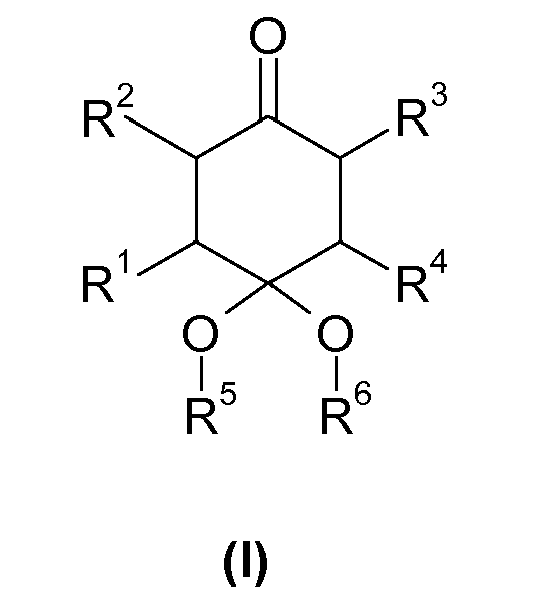 R1, R2, R3, R4 unabhängig voneinander für Wasserstoff oder für jeweils gegebenenfalls einfach oder mehrfach substituiertes C1-C4-Alkyl oder Cyclopropyl stehen,R5 und R6 unabhängig voneinander für C1-C8-Alkyl oder für Cycloalkyl stehen, oderR5 und R6 gemeinsam für -CH2-, -CH2CH2-, -CH2CH2CH2-, -CH2CH2CH2CH2-, - CHCH3CH2CHCH3CH2-, -CH2C(CH3)2CH2-, -CH2OCH2-, -CH2OCH2CH2-, - CH2CH2OCH2- stehendadurch gekennzeichnet, dass man
Verbindungen der Formel (II)
R1, R2, R3, R4, R5, R6 die oben angegebenen Bedeutungen haben
in Gegenwart eines geeigneten Metallkatalysators, gegebenenfalls eines Lösungsmittels und gegebenenfalls eines Additives hydriert. - Verfahren zur Herstellung von Verbindungen der Formel (I) gemäß Anspruch 1, dadurch gekennzeichnet, dass eine organische Base als Additiv eingesetzt wird.
Priority Applications (10)
| Application Number | Priority Date | Filing Date | Title |
|---|---|---|---|
| EP07119476A EP2055693A1 (de) | 2007-10-29 | 2007-10-29 | Verfahren zur Herstellung von substituierten und unsubstituierten Cyclohexanonmonoketalen |
| KR1020107010162A KR20100074263A (ko) | 2007-10-29 | 2008-10-16 | 치환 및 비치환된 사이클로헥사논 모노케탈의 제조방법 |
| CN200880113501A CN101842342A (zh) | 2007-10-29 | 2008-10-16 | 制备取代和未取代的环己酮单缩酮的方法 |
| EP08844044A EP2207763A1 (de) | 2007-10-29 | 2008-10-16 | Verfahren zur herstellung von substituierten und unsubstituierten cyclohexanonmonoketalen |
| US12/738,316 US20100217018A1 (en) | 2007-10-29 | 2008-10-16 | Method for the Production of Substituted and Unsubstituted Cyclohexanone Monoketals |
| PCT/EP2008/008766 WO2009056233A1 (de) | 2007-10-29 | 2008-10-16 | Verfahren zur herstellung von substituierten und unsubstituierten cyclohexanonmonoketalen |
| MX2010003946A MX2010003946A (es) | 2007-10-29 | 2008-10-16 | Procedimiento para la preparacion de ciclohexanonamonocetales sustituidos y no sustituidos. |
| BRPI0818474-7A BRPI0818474A2 (pt) | 2007-10-29 | 2008-10-16 | processo para a preparação de monocetais de ciclo-hexanona |
| TW097141264A TW200927718A (en) | 2007-10-29 | 2008-10-28 | Process for preparing substituted and unsubstituted cyclohexanone monoketals |
| IL204778A IL204778A0 (en) | 2007-10-29 | 2010-03-28 | Method for the production of substituted and unsubstituted cyclohexanone monoketals |
Applications Claiming Priority (1)
| Application Number | Priority Date | Filing Date | Title |
|---|---|---|---|
| EP07119476A EP2055693A1 (de) | 2007-10-29 | 2007-10-29 | Verfahren zur Herstellung von substituierten und unsubstituierten Cyclohexanonmonoketalen |
Publications (1)
| Publication Number | Publication Date |
|---|---|
| EP2055693A1 true EP2055693A1 (de) | 2009-05-06 |
Family
ID=39247026
Family Applications (2)
| Application Number | Title | Priority Date | Filing Date |
|---|---|---|---|
| EP07119476A Ceased EP2055693A1 (de) | 2007-10-29 | 2007-10-29 | Verfahren zur Herstellung von substituierten und unsubstituierten Cyclohexanonmonoketalen |
| EP08844044A Withdrawn EP2207763A1 (de) | 2007-10-29 | 2008-10-16 | Verfahren zur herstellung von substituierten und unsubstituierten cyclohexanonmonoketalen |
Family Applications After (1)
| Application Number | Title | Priority Date | Filing Date |
|---|---|---|---|
| EP08844044A Withdrawn EP2207763A1 (de) | 2007-10-29 | 2008-10-16 | Verfahren zur herstellung von substituierten und unsubstituierten cyclohexanonmonoketalen |
Country Status (9)
| Country | Link |
|---|---|
| US (1) | US20100217018A1 (de) |
| EP (2) | EP2055693A1 (de) |
| KR (1) | KR20100074263A (de) |
| CN (1) | CN101842342A (de) |
| BR (1) | BRPI0818474A2 (de) |
| IL (1) | IL204778A0 (de) |
| MX (1) | MX2010003946A (de) |
| TW (1) | TW200927718A (de) |
| WO (1) | WO2009056233A1 (de) |
Families Citing this family (1)
| Publication number | Priority date | Publication date | Assignee | Title |
|---|---|---|---|---|
| CN108070875B (zh) * | 2016-11-11 | 2019-06-18 | 万华化学集团股份有限公司 | 一种4-氧代异佛尔酮的制备方法 |
Citations (3)
| Publication number | Priority date | Publication date | Assignee | Title |
|---|---|---|---|---|
| EP0008741A1 (de) * | 1978-09-11 | 1980-03-19 | BASF Aktiengesellschaft | Verfahren zur Herstellung von Carbonylverbindungen |
| US4203923A (en) * | 1974-11-26 | 1980-05-20 | Allied Chemical Corporation | Method for promotion of phenol hydrogenation |
| EP0024651A1 (de) * | 1979-08-24 | 1981-03-11 | BASF Aktiengesellschaft | Verfahren zur Herstellung von olefinisch ungesättigten Carbonylverbindungen und Alkoholen |
Family Cites Families (1)
| Publication number | Priority date | Publication date | Assignee | Title |
|---|---|---|---|---|
| US7049448B2 (en) * | 2002-09-13 | 2006-05-23 | Dr. Reddy's Laboratories Limited | Process for the preparation of monoketals of 1,4-cyclohexanedione including 1, 4-cyclohexanedione mono-2,2-dimethyl trimethylene ketal |
-
2007
- 2007-10-29 EP EP07119476A patent/EP2055693A1/de not_active Ceased
-
2008
- 2008-10-16 KR KR1020107010162A patent/KR20100074263A/ko not_active Withdrawn
- 2008-10-16 EP EP08844044A patent/EP2207763A1/de not_active Withdrawn
- 2008-10-16 CN CN200880113501A patent/CN101842342A/zh active Pending
- 2008-10-16 MX MX2010003946A patent/MX2010003946A/es not_active Application Discontinuation
- 2008-10-16 BR BRPI0818474-7A patent/BRPI0818474A2/pt not_active Application Discontinuation
- 2008-10-16 US US12/738,316 patent/US20100217018A1/en not_active Abandoned
- 2008-10-16 WO PCT/EP2008/008766 patent/WO2009056233A1/de not_active Ceased
- 2008-10-28 TW TW097141264A patent/TW200927718A/zh unknown
-
2010
- 2010-03-28 IL IL204778A patent/IL204778A0/en unknown
Patent Citations (3)
| Publication number | Priority date | Publication date | Assignee | Title |
|---|---|---|---|---|
| US4203923A (en) * | 1974-11-26 | 1980-05-20 | Allied Chemical Corporation | Method for promotion of phenol hydrogenation |
| EP0008741A1 (de) * | 1978-09-11 | 1980-03-19 | BASF Aktiengesellschaft | Verfahren zur Herstellung von Carbonylverbindungen |
| EP0024651A1 (de) * | 1979-08-24 | 1981-03-11 | BASF Aktiengesellschaft | Verfahren zur Herstellung von olefinisch ungesättigten Carbonylverbindungen und Alkoholen |
Non-Patent Citations (6)
Also Published As
| Publication number | Publication date |
|---|---|
| WO2009056233A1 (de) | 2009-05-07 |
| IL204778A0 (en) | 2010-11-30 |
| MX2010003946A (es) | 2010-06-01 |
| KR20100074263A (ko) | 2010-07-01 |
| EP2207763A1 (de) | 2010-07-21 |
| TW200927718A (en) | 2009-07-01 |
| CN101842342A (zh) | 2010-09-22 |
| BRPI0818474A2 (pt) | 2020-08-11 |
| US20100217018A1 (en) | 2010-08-26 |
Similar Documents
| Publication | Publication Date | Title |
|---|---|---|
| EP2816042B1 (de) | 6-oxabicyclo[3,2,0]hepta als Zwischenprodukte | |
| DE2453648C3 (de) | Verfahren zur Herstellung von 1α-Hydroxycholesterinen sowie 1α,2α-Epoxy-6β sulfonyloxyderivate des 5α-Cholestan-3-ons als Zwischenprodukte | |
| WO2009056233A1 (de) | Verfahren zur herstellung von substituierten und unsubstituierten cyclohexanonmonoketalen | |
| EP1241157B1 (de) | Verfahren zur Herstellung von 2,7-Dimethyl-2,4,6-octatrienal-monoacetalen | |
| US4290960A (en) | Preparation of 2,5-dimethyl-4-hydroxy-2,3-dihydrofuran-3-one | |
| EP0709367B1 (de) | Verfahren zur Herstellung von N-Alkenylcarbonsäureamiden | |
| DE69623117T2 (de) | Verfahren zur herstellung von 4-hydroxy-2-pyrrolidon | |
| JP5965659B2 (ja) | エーテル化合物の製造方法 | |
| EP0487731A1 (de) | Optisch aktive epoxycyclohexanderivate, optisch aktive epoxycyclohexanonderivate sowie verfahren zur herstellung | |
| EP0219091B1 (de) | Pyranderivate und ein Verfahren zu ihrer Herstellung | |
| US4496767A (en) | Process for preparing 2-cyclopentenone derivatives | |
| DE69202564T2 (de) | Verfahren zur Herstellung von 1,3-Dioxan-4,6-Dionderivaten. | |
| EP0761655B1 (de) | Verfahren zur Herstellung von N-Alkenylcarbaminsäureestern | |
| DE102004012577A1 (de) | Verfahren zur Herstellung von Astaxanthin | |
| DE1593855B1 (de) | Verfahren zur Herstellung von 2,3-Dihydro-2,2-dimethyl-7-benzofuranol | |
| EP3762351A1 (de) | Verfahren zur herstellung von springen | |
| IE43363B1 (en) | Cyclopropane derivatives | |
| JP4428086B2 (ja) | 1−アセトキシ−3−(3,4−メチレンジオキシフェニル)プロペン誘導体の製法 | |
| EP0582929A1 (de) | Verfahren zur Herstellung von Aminophenylacetaten | |
| US3026328A (en) | Processes for converting l-threo-5-amino-6-phenyl dioxane to the corresponding l-erythro dioxane | |
| DE4428901A1 (de) | Verfahren zur Herstellung von N-Alkenylcarbonsäureamiden | |
| EP4175950A1 (de) | Neue verfahren zur herstellung von cis-cedrandiol | |
| DE19836477A1 (de) | Verfahren zur Herstellung von 1,3-Dimethyl-imidazolium-4carboxylat | |
| AT354656B (de) | Verfahren zur herstellung von hydroxy- cholesterinen | |
| DE1593855C (de) | Verfahren zur Herstellung von 2,3-Dihydro-2,2-dimethyl-7-benzofuranol |
Legal Events
| Date | Code | Title | Description |
|---|---|---|---|
| PUAI | Public reference made under article 153(3) epc to a published international application that has entered the european phase |
Free format text: ORIGINAL CODE: 0009012 |
|
| AK | Designated contracting states |
Kind code of ref document: A1 Designated state(s): AT BE BG CH CY CZ DE DK EE ES FI FR GB GR HU IE IS IT LI LT LU LV MC MT NL PL PT RO SE SI SK TR |
|
| AX | Request for extension of the european patent |
Extension state: AL BA HR MK RS |
|
| STAA | Information on the status of an ep patent application or granted ep patent |
Free format text: STATUS: THE APPLICATION HAS BEEN REFUSED |
|
| 18R | Application refused |
Effective date: 20090716 |