EP2052293B1 - Antireflective composition for photoresists - Google Patents
Antireflective composition for photoresists Download PDFInfo
- Publication number
- EP2052293B1 EP2052293B1 EP07789633A EP07789633A EP2052293B1 EP 2052293 B1 EP2052293 B1 EP 2052293B1 EP 07789633 A EP07789633 A EP 07789633A EP 07789633 A EP07789633 A EP 07789633A EP 2052293 B1 EP2052293 B1 EP 2052293B1
- Authority
- EP
- European Patent Office
- Prior art keywords
- polymer
- composition
- substituted
- photoresist
- alkyl
- Prior art date
- Legal status (The legal status is an assumption and is not a legal conclusion. Google has not performed a legal analysis and makes no representation as to the accuracy of the status listed.)
- Active
Links
Images
Classifications
-
- G—PHYSICS
- G03—PHOTOGRAPHY; CINEMATOGRAPHY; ANALOGOUS TECHNIQUES USING WAVES OTHER THAN OPTICAL WAVES; ELECTROGRAPHY; HOLOGRAPHY
- G03F—PHOTOMECHANICAL PRODUCTION OF TEXTURED OR PATTERNED SURFACES, e.g. FOR PRINTING, FOR PROCESSING OF SEMICONDUCTOR DEVICES; MATERIALS THEREFOR; ORIGINALS THEREFOR; APPARATUS SPECIALLY ADAPTED THEREFOR
- G03F7/00—Photomechanical, e.g. photolithographic, production of textured or patterned surfaces, e.g. printing surfaces; Materials therefor, e.g. comprising photoresists; Apparatus specially adapted therefor
- G03F7/004—Photosensitive materials
- G03F7/09—Photosensitive materials characterised by structural details, e.g. supports, auxiliary layers
-
- G—PHYSICS
- G03—PHOTOGRAPHY; CINEMATOGRAPHY; ANALOGOUS TECHNIQUES USING WAVES OTHER THAN OPTICAL WAVES; ELECTROGRAPHY; HOLOGRAPHY
- G03F—PHOTOMECHANICAL PRODUCTION OF TEXTURED OR PATTERNED SURFACES, e.g. FOR PRINTING, FOR PROCESSING OF SEMICONDUCTOR DEVICES; MATERIALS THEREFOR; ORIGINALS THEREFOR; APPARATUS SPECIALLY ADAPTED THEREFOR
- G03F7/00—Photomechanical, e.g. photolithographic, production of textured or patterned surfaces, e.g. printing surfaces; Materials therefor, e.g. comprising photoresists; Apparatus specially adapted therefor
- G03F7/004—Photosensitive materials
- G03F7/09—Photosensitive materials characterised by structural details, e.g. supports, auxiliary layers
- G03F7/091—Photosensitive materials characterised by structural details, e.g. supports, auxiliary layers characterised by antireflection means or light filtering or absorbing means, e.g. anti-halation, contrast enhancement
-
- Y—GENERAL TAGGING OF NEW TECHNOLOGICAL DEVELOPMENTS; GENERAL TAGGING OF CROSS-SECTIONAL TECHNOLOGIES SPANNING OVER SEVERAL SECTIONS OF THE IPC; TECHNICAL SUBJECTS COVERED BY FORMER USPC CROSS-REFERENCE ART COLLECTIONS [XRACs] AND DIGESTS
- Y10—TECHNICAL SUBJECTS COVERED BY FORMER USPC
- Y10S—TECHNICAL SUBJECTS COVERED BY FORMER USPC CROSS-REFERENCE ART COLLECTIONS [XRACs] AND DIGESTS
- Y10S438/00—Semiconductor device manufacturing: process
- Y10S438/942—Masking
- Y10S438/948—Radiation resist
- Y10S438/952—Utilizing antireflective layer
Definitions
- the present invention relates to a novel antireflective coating composition and its use in image processing by forming a thin layer of the novel antireflective coating composition between a reflective substrate and a photoresist coating.
- Such compositions are particularly useful in the fabrication of semiconductor devices by photolithographic techniques.
- Photoresist compositions are used in microlithography processes for making miniaturized electronic components such as in the fabrication of computer chips and integrated circuits.
- a thin coating of film of a photoresist composition is first applied to a substrate material, such as silicon wafers used for making integrated circuits.
- the coated substrate is then baked to evaporate any solvent in the photoresist composition and to fix the coating onto the substrate.
- the baked coated surface of the substrate is next subjected to an image-wise exposure to radiation.
- This radiation exposure causes a chemical transformation in the exposed areas of the coated surface.
- Visible light, ultraviolet (UV) light, electron beam and X-ray radiant energy are radiation types commonly used today in microlithographic processes.
- the coated substrate is treated with a developer solution to dissolve and remove either the radiation-exposed or the unexposed areas of the photoresist.
- bottom antireflective coating provides the best solution for the elimination of reflectivity.
- the bottom antireflective coating is applied to the substrate prior to coating with the photoresist and prior to exposure.
- the photoresist is exposed imagewise and developed.
- the antireflective coating in the exposed area is then etched, typically in gaseous plasma, and the photoresist pattern is thus transferred to the substrate.
- the etch rate of the antireflective film should be relatively high in comparison to the photoresist so that the antireflective film is etched without excessive loss of the photoresist film during the etch process.
- Antireflective coatings must also possess the correct absorption and refractive index at the wavelength of exposure to achieve the desired lithographic properties.
- antireflective coating that functions well at exposures less than 230 nm.
- Such antireflective coatings need to have high etch rates and be sufficiently absorbing with the correct refractive index to act as antireflective coatings.
- novel antireflective coatings of the present invention comprising a novel polyester polymer based on a unique chemical structure, have been found to have good dry etching properties, which enable a good image transfer from the photoresist to the substrate, and also good absorption characteristics to prevent reflective notching and line width variations or standing waves, particularly at 193 nm.
- the antireflective coating of the present invention has a relatively high etch rate such that the antireflective coating is removed with minimal loss in the thickness of the photoresist layer. Additionally, substantially no intermixing is present between the antireflective coating and the photoresist film.
- the antireflective coatings also have good solution stability and form particularly thin films with good coating quality, the latter being particularly advantageous for lithography. When the antireflective coating is used with a photoresist in the imaging process, clean images are obtained with good lithographic properties.
- WO 2005/097867 A1 discloses a process for making a polyester where a dianhydride reacts with a diol.
- the resulting polyester can further react with a compound selected from aromatic oxides, aliphatic oxides, alkylene carbonates, alcohols, and mixtures thereof.
- the invention relates to an antireflective coating composition for a photoresist layer comprising a polymer, a crosslinking agent and an acid generator, where the polymer comprises at least one unit of structure 2, where, B is a single bond or C 1 -C 6 nonaromatic aliphatic moiety, R' and R" are independently selected from hydrogen, Z and W-OH, where Z is a (C 1 -C 20 ) hydrocarbyl moiety and W is a (C 1 -C 20 ) hydrocarbyl linking moiety, and, Y' is independently a (C 1 -C 20 ) hydrocarbyl linking moiety.
- the invention further relates to a process for imaging the antireflective coating composition.
- the present invention relates to a novel antireflective coating composition
- a polymer comprising a polymer, a crosslinking agent and an acid generator.
- the present invention further relates to a process for using the novel composition, particularly at 193nm.
- the polymer of the present invention contains at least one unit selected from structure 2, where, B is a single bond or C 1 -C 6 nonaromatic aliphatic moiety, R' and R" are independently selected from hydrogen, Z and W-OH, where Z is a (C 1 -C 20 ) hydrocarbyl moiety and W is a (C 1 -C 20 ) hydrocarbyl linking moiety, and, Y' is independently a (C 1 -C 20 ) hydrocarbyl linking moiety.
- B is selected from a single bond and a C 1 -C 6 alkylene which may be linear or branched. In another embodiment B is a single bond.
- R' and R" are independently selected from hydrogen, Z and W-OH, where Z is a (C 1 -C 20 ) hydrocarbyl moiety and W is a (C 1 -C 20 ) hydrocarbyl linking moiety, and, Y' is independently a (C 1 -C 20 ) hydrocarbyl linking moiety.
- the polymer may be derived from at least one aliphatic dianhydride and may include other aliphatic and or/aromatic dianhydrides.
- One or a mixture of diols may be used to react with the dianhydride(s) to form the polymer.
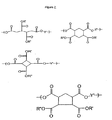
- aromatic dianhydrides are pyromellitic dianhydride, 3,6-diphenylpyromellitic dianhydride, 3,6-bis(trifluoromethyl)pyromellitic dianhydride, 3,6-bis(methyl)pyromellitic dianhydride, 3,6-diiodopyromellitic dianhydride, 3,6-dibromopyromellitic dianhydride, 3,6-dichloropyromellitic dianhydride, 3,3',4,4'-benzophenonetetracarboxylic acid dianhydride, 2,3,3',4'-benzophenonetetracarboxylic acid dianhydride, 2,2',3,3'-benzophenone tetracarboxylic acid dianhydride, 3,3',4,4'-biphenyltetracarboxylic acid dianhydride, 2,3,3'4'-biphenyltetracarboxylic acid dianhydride, 2,
- Y' is a hydrocarbyl moiety.
- Y' is derived from the diol reactant to form the polymer. More than one type of diol may be used to form the polymer.
- R' and R" are independently selected from hydrogen, Z and W-OH, where Z is a (C 1 -C 20 ) hydrocarbyl moiety and W is a (C 1 -C 20 ) hydrocarbyl linking moiety, and, Y' is independently a (C 1 -C 20 ) hydrocarbyl linking moiety.
- R' and R" are W or W-OH
- R' and R" are derived from the reaction of the free carboxylic acid and the end capping reactant.
- hydrocarbyl or “hydrocarbyl substituent” or “hydrocarbyl group” or “hydrocarbyl linking moiety” or “hydrocarbyl moeity” is used in its ordinary sense, which is well-known to those skilled in the art. Specifically, it refers to a group having carbon atom(s) directly attached to the molecule and having predominantly hydrocarbon character. Examples of hydrocarbyl groups include:
- hydrocarbyl groups are substituted or unsubstituted aliphatic (C 1 -C 20 ) alkylene group, substituted or unsubstituted aliphatic (C 1 -C 20 ) alkyl group, substituted or unsubstituted aliphatic (C 1 -C 20 ) cycloalkyl group, substituted or unsubstituted thia-alkylene aliphatic (C 1 -C 20 ) group, substituted or unsubstituted cycloalkylene, substituted or unsubstituted benzyl, alkoxy alkylene, alkoxyaryl, aryl, substituted aryl, substituted or unsubstituted aliphatic (C 1 -C 20 ) alkylenearyl, hetero cycloalkylene, heteroaryl, oxocyclohexyl, cyclic lactone, hydroxy alkyl, hydroxyalkoxyl, alkoxy alkyl, alkoxy
- aliphatic refers to a predominantly hydrocarbon chain which is nonaromatic. Aliphatic may be linear, branched, cyclic or mixtures of thereof.
- Substituted or unsubstituted alkylene or thiaalkylene (C 1 -C 20 ) group means an alkylene or a thiaalkylene group which is predominantly a hydrocarbon chain that may be linear or branched containing up to 20 carbon atoms, and where the substituents are those which do not typically change the hydrocarbon nature of the chain and may be all organic compounds known to those of ordinary skill in the art, such as ether, alkyl, ester, hydroxyl, alkynol, cyano, nitro, acyl, halogen (chloro or bromo), phenyl and substituted phenyl.
- a thiaalkylene group contains one or more sulfur groups in the chain.
- An example of aliphatic substituted or unsubstituted thia-alkylene (C 1 -C 20 ) group is without limitation, 3, 6-dithia-1, 8-octylene.
- Alkyl means linear or branched alkyl having the desirable number of carbon atoms and valence.
- the alkyl group is generally aliphatic and may be cyclic or acyclic (i.e. noncyclic). Suitable acyclic groups can be methyl, ethyl, n-or iso-propyl, n-,iso, or tert-butyl, linear or branched pentyl, hexyl, heptyl, octyl, decyl, dodecyl, tetradecyl and hexadecyl. Unless otherwise stated, alkyl refers to 1-20 carbon atom moiety.
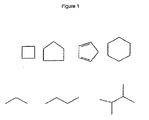
- the cyclic alkyl groups may be mono cyclic or polycyclic. Suitable example of mono-cyclic alkyl groups include substituted cyclopentyl, cyclohexyl, and cycloheptyl groups. The substituents may be any of the acyclic alkyl groups described herein. Suitable bicyclic alkyl groups include substituted bicycle[2.2.1]heptane, bicyclo[2.2.2]octane, bicyclo[3.2.1]octane, bicyclo[3.2.2]nonane, and bicyclo[3.3.2]decane.
- tricyclic alkyl groups examples include tricyclo[5.4.0.0.2,9]undecane, tricyclo[4.2.1.2.7,9]undecane, tricyclo[5.3.2.0.4,9]dodecane, and tricyclo[5.2.1.0.2,6]decane.
- the cyclic alkyl groups may have any of the acyclic alkyl groups as substituents.
- Alkylene groups are divalent alkyl groups derived from any of the alkyl groups mentioned hereinabove. When referring to alkylene groups, these include an alkylene chain substituted with (C 1 -C 6 ) alkyl groups in the main carbon chain of the alkylene group. Alkylene groups can also include one or more alkyne or alkene groups in the alkylene moiety, where alkyne refers to a triple bond and alkene refers to double bond. Essentially an alkylene is a divalent hydrocarbon group as the backbone.
- a divalent acyclic group may be methylene, 1,1- or 1,2-ethylene, 1,1-, 1,2-, or 1,3 propylene, 2,5-dimethyl-2,5-hexene, 2,5-dimethyl-2,5-hex-3-yne.
- a divalent cyclic alkyl group may be 1,2- or 1,3-cyclopentylene, 1,2-, 1,3-, or 1,4-cyclohexylene.
- a divalent tricyclo alkyl groups may be any of the tricyclic alkyl groups mentioned herein above.
- Aryl or aromatic groups contain 6 to 24 carbon atoms including phenyl, tolyl, xylyl, naphthyl, anthracyl, biphenyls, bis-phenyls, tris-phenyls. These aryl groups may further be substituted with any of the appropriate substituents e.g. alkyl, alkoxy, acyl or aryl groups mentioned hereinabove. Similarly, appropriate polyvalent aryl groups as desired may be used in this invention. Representative examples of divalent aryl groups include phenylenes, xylylenes, naphthylenes, biphenylenes.
- Alkoxy means straight or branched chain alkoxy having 1 to 20 carbon atoms, and includes, for example, methoxy, ethoxy, n-propoxy, isopropoxy, n-butoxy, isobutoxy, tert-butoxy, pentyloxy, hexyloxy, heptyloxy, octyloxy, nonanyloxy, decanyloxy, 4-methylhexyloxy, 2-propylheptyloxy, and 2-ethyloctyloxy.
- Aralkyl means aryl groups with attached substituents.
- the substituents may be any such as alkyl, alkoxy, acyl, etc.
- Examples of monovalent aralkyl having 7 to 24 carbon atoms include phenylmethyl, phenylethyl, diphenylmethyl, 1,1- or 1,2-diphenylethyl, 1,1-, 1,2-, 2,2-, or 1,3-diphenylpropyl.
- Appropriate combinations of substituted aralkyl groups as described herein having desirable valence may be used as a polyvalent aralkyl group.
- Alkylenearyl means an aliphatic alkylene moeity with pendant aryl groups. Examples are 1-phenyl-1,2-ethylene and 1-phenylpropylene.
- the term "substituted" is contemplated to include all permissible substituents of organic compounds.
- the permissible substituents include acyclic and cyclic, branched and unbranched, carbocyclic and heterocyclic, aromatic and non-aromatic substituents of organic compounds.
- Illustrative substituents include, for example, those described hereinabove.
- the permissible substituents can be one or more and the same or different for appropriate organic compounds.
- the heteroatoms such as nitrogen may have hydrogen substituents and/or any permissible substituents of organic compounds described herein which satisfy the valencies of the heteroatoms. This invention is not intended to be limited in any manner by the permissible substituents of organic compounds.
- Halogen refers to fluorine, chlorine and bromine, although fluorine and chlorine are preferred.
- Y' is derived from the diol or similar compounds to form the polymer.
- Y' may be exemplified by (C 1 -C 20 ) substituted or unsubstituted alkylene, substituted or unsubstituted thia-alkylene aliphatic (C 1 -C 20 ) group, substituted or unsubstituted cycloalkylene, substituted or unsubstituted benzyl, alkoxy alkylene, alkoxyaryl, alkyleneester substituted with an absorbing chromophore such as phenyl, naphthyl or anthracyl, substituted aryl, hetero cycloalkylene, heteroalkyl, heteroaryl, oxocyclohexyl, cyclic lactone, benzyl, substituted benzyl, hydroxy alkyl, hydroxyalkoxyl, alkoxy alkyl, alkoxyaryl, alkylenearyl, alkylaryl,
- More specific examples are methylene (-CH 2 -), ethylene (CH 2 CH 2 ), propylene, butylene, 1-phenyl-1,2-ethylene, neopentylene, ethylenephenylate, 2-bromo-2-nitro-1,3-propylene, 2-bromo-2-methyl-1,3-propylene, polyethyleneglycol, 1-phenylate-1,2-ethylene, 1-benzylate-1,2-ethylene, -CH 2 OCH 2 -, -CH 2 CH 2 OCH 2 CH 2 -, -CH 2 CH 2 SCH 2 CH 2 -, or -CH 2 CH 2 SCH 2 CH 2 SCH 2 CH 2 -, phenyl derivative, naphthyl derivative, anthracyl derivatives, propylenephenyl acetate, 2-propylenephenyl acetate (-CH 2 CH 2 (CH 2 CO 2 CH 2 Ph), propylene phenyl ether (-CH 2 CH 2 (CH 2 OPh), propylene phenolate (-CH 2
- Some of the monomers which may be used to synthesize the polymer of the present invention and which can represent the Y' component are, preferably, diols, and glycols, examples of which are, ethylene glycol, diethylene glycol, propylene glycol, 1-phenyl-1,2-ethanediol, 2-bromo-2-nitro-1,3-propane diol, 2-methyl-2-nitro-1,3-propanediol, diethylbis(hydroxymethyl)malonate, and 3,6-dithia-1,8-octanediol.
- aromatic diols examples include 2,6-bis(hydroxymethyl)-p-cresol and 2,2'-(1,2-phenylenedioxy)-diethanol, 1,4-benzenedimethanol, 1-phenylate-1,2-ethanediol derived from the reaction of phenylacetic acid and glycidol, reaction product of glycidol and phenol, reaction product of glycidol and benzoic acid, reaction product of glycidol and naphthoic acid, reaction product of glycidol andanthracene carboxylic acid.
- Others are reaction product of glycidol and phthalimide, reaction product of glycidol and succinimide, and reaction product of glycidol and sorbic acid.
- the polymer of the present invention may have one or more of the pendant carboxyl groups derived from the dianhydride present as a free acid or capped with a capping group.
- at least one of R' and R" is represented by Z and/or W-OH as shown in structure 1 and 2.
- Z is represented by a hydrocarbyl group as described previously and exemplified by substituted or unsubstituted aliphatic (C 1 -C 20 ) alkyl group, substituted or unsubstituted aliphatic (C 1 -C 20 ) cycloalkyl group, substituted or unsubstituted aliphatic (C 1 -C 20 ) aryl group, and substituted or unsubstituted aliphatic (C 1 -C 20 ) alkylenearyl group.
- W may be exemplified by a hydrocarbyl linking group as described previously and exemplified by substituted or unsubstituted aliphatic (C 1 -C 20 ) alkylene group, substituted or unsubstituted aliphatic (C 1 -C 20 ) cycloalkylene group, substituted or unsubstituted aliphatic (C 1 -C 20 ) aryl group, and substituted or unsubstituted aliphatic (C 1 -C 20 ) alkylenearyl group.
- the alcohol capping group, W-OH may be further exemplified by methanol, ethanol, propanol, isopropanol, 1-butanol, isobutanol, 2-methyl-2-butanol, 2-methyl-1-butanol, 3-methyl-1-butanol, tertiary butanol, cyclopentanol, cyclohexanol, 1-hexanol, 1-heptanol, 2-heptanol, 3-heptanol, 1-n-octanol, 2-n-octanol, I-phenyl-1-ethanol.
- Examples of the hydroxyl-forming compound useful for reacting with the carboxylic acid, where the carboxylic acid group is derived from the dianhydride, and forming the W-OH group include aromatic oxide, aliphatic oxide, alkylene carbonate, and can be further exemplified by styrene oxide, propylene oxide, ethylene carbonate.
- aromatic oxides include: styrene oxide, 1,2-epoxy-phenoxypropane, glycidyl-2-methylphenyl ether, (2,3-epoxypropyl)benzene, 1-phenylpropylene oxide, stilbene oxide, 2- (or 3- or 4-)halo(chloro, fluoro, bromo, iodo) stilbene oxide, benzyl glycidyl ether, C 1-10 straight or branched chain alkyl(e.g., methyl, ethyl, propyl, butyl, sec-butyl, tert-butyl, pentyl, hexyl, heptyl)phenyl glycidyl ether, 4- halo(chloro, fluoro, bromo, iodo)phenyl glycidyl ether, glycidyl 4-C 1-10 straight or branched chain alkoxy(e.g., meth
- Examples of aliphatic oxides include ethylene oxide, propylene oxide, butylene oxides, including isobutylene oxide, 1,2-butylene oxide and 2,3-butylene oxide, pentylene oxide, cyclohexene oxide, decyl glycidyl ether, and dodecyl glycidyl ether.
- Examples of alkylene carbonates include those compounds having the formula where R 40 is C 2 -C 4 alkyl where the aliphatic ring carbons are unsubstituted or substituted with a group selected from C 1 -C 10 alkyl, C 1 -C 10 aryl, or C 6 -C 15 aralkyl group.
- Examples of alkylene carbonates are ethylene carbonate, propylene carbonate, and butylene carbonates.
- the polymers of this invention may be prepared by any of the standard polymerization methods known in the art, especially condensation polymerization techniques.
- the polymer may be synthesized using solution, emulsion, bulk, suspension polymerization.
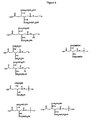
- a dianhydride is condensed with a diol or a similar compound, at elevated temperatures, and optionally in the presence of an acid, to give a polyester.
- the polyester polymer may be reacted further to modify the substituents in the polymer.
- the resulting carboxylic acid substituent derived from the dianhydride may be in the free acid form, may be reacted to give an ester, or be attached to another polymer chain, or be mixtures of these or other substituents.
- the free carboxylic acid is reacted to form an ester.
- the acid group in the polymer is partially esterified.
- the polymer is fully esterified, that is, the polymer does not contain any free acid.
- the diols are typically condensed with at least one aliphatic dianhydride.
- a linear polyester is first prepared by the reaction of a dianhydride and a diol in a suitable solvent.
- the polymer may be obtained by reacting one dianhydride and one diol or by reacting mixtures of different dianhydrides and/or diols, where at least one dianhydride is an aliphatic dianhydride.
- the polyester is isolated by precipitation into a non-solvent.
- the polyester may be further modified by reacting the free carboxylic acid groups with capping compounds such as alcohols, alkene oxide or carbonates.
- the reaction of the polyester with the capping compound may be done prior to isolation of the polymer or after the isolation of the polymer.
- the final polymer may be isolated and dried.
- the polymer of the present composition is partially crosslinked to increase the molecular weight.
- the polymer may be reacted further with a compound which comprises a group or groups capable of crosslinking the polymer, or crosslinked using a crosslinking agent, such as those taught in the present application.
- Crosslinking of the polymer may be facilitated by techniques well know to those skilled in the art, for example by heating and/or catalysis. The extent of crosslinking is determined by the desired physical and chemical properties of the polymer.
- the crosslinked polymer is then formulated into an antireflective coating composition of the present invention.
- the weight average molecular weight of the polymer may range from about 1500 to about 180,000, preferably from about 4,000 to about 60,000 and more preferably from about 10,000 to about 30,000. When the weight average molecular weight is below 1,500, then good film forming properties are not obtained for the antireflective coating and when the weight average molecular weight is too high, then properties such as solubility, storage stability may be compromised.
- the antireflective coating composition comprises a polymer, a crosslinking agent, an acid generator, and a solvent composition.
- crosslinking agents can be used in the composition of the present invention. Any suitable crosslinking agents that can crosslink the polymer in the presence of an acid may be used. Examples, without limitation, of such crosslinking agents are resins containing melamines, methylols, glycoluril, polymeric glycolurils, benzoguanamine, urea, hydroxy alkyl amides, epoxy and epoxy amine resins, blocked isocyanates, and divinyl monomers. Monomeric melamines like hexamethoxymethyl melamine; glycolurils like tetrakis(methoxymethyl)glycoluril; and aromatic methylols, like 2,6 bishydroxymethyl p-cresol may be used.
- crosslinking agents disclosed in US 2006/0058468 where the crosslinking agent is a polymer obtained by reacting at least one glycoluril compound with at least one reactive compound containing at least one hydroxy group and/or at least one acid group may be used.
- the thermal acid generator (TAG) used in the present invention may be any one or more that upon heating generates an acid which can react with the polymer and propagate crosslinking of the polymer present in the invention, particularly preferred is a strong acid such as a sulfonic acid.
- the thermal acid generator is activated at above 90°C and more preferably at above 120°C, and even more preferably at above 150°C.
- the photoresist film is heated for a sufficient length of time to react with the coating.
- thermal acid generators are metal-free iodonium and sulfonium salts.
- TAGs are nitrobenzyl tosylates, such as 2-nitrobenzyl tosylate, 2,4-dinitrobenzyl tosylate, 2,6-dinitrobenzyl tosylate, 4-nitrobenzyl tosylate; benzenesulfonates such as 2-trifluoromethyl-6-nitrobenzyl 4-chlorobenzenesulfonate, 2-trifluoromethyl-6-nitrobenzyl 4-nitro benzenesulfonate; phenolic sulfonate esters such as phenyl, 4-methoxybenzenesulfonate; alkyl ammonium salts of organic acids, such as triethylammonium salt of 10-camphorsulfonic acid.
- benzenesulfonates such as 2-trifluoromethyl-6-nitrobenzyl 4-chlorobenzenesulfonate, 2-trifluoromethyl-6-nitrobenzyl 4-nitro benzenesulfonate
- lodonium salts can be exemplified by iodonium fluorosulfonates, iodonium tris(fluorosulfonyl)methide, iodonium bis(fluorosulfonyl)methide, iodonium bis(fluorosulfonyl)imide, iodonium quaternary ammonium fluorosulfonate, iodonium quaternary ammonium tris(fluorosulfonyl)methide, and iodonium quaternary ammonium bis(fluorosulfonyl)imide.
- TAG aromatic (anthracene, naphthalene or benzene derivatives) sulfonic acid amine salts
- TAG aromatic (anthracene, naphthalene or benzene derivatives) sulfonic acid amine salts
- the TAG will have a very low volatility at temperatures between 170-220°C.
- TAGs are those sold by King Industries under Nacure and CDX names.
- TAG's are Nacure 5225, and CDX-2168E, which is a dodecylbenzene sulfonic acid amine salt supplied at 25-30% activity in propylene glycol methyl ether from King Industries, Norwalk, Conn. 06852, USA.
- the novel composition may further contain a photoacid generator, examples of which without limitation, are onium salts, sulfonate compounds, nitrobenzyl esters, triazines, etc.
- a photoacid generator examples of which without limitation, are onium salts, sulfonate compounds, nitrobenzyl esters, triazines, etc.
- the preferred photoacid generators are onium salts and sulfonate esters of hydoxyimides, specifically diphenyl iodnium salts, triphenyl sulfonium salts, dialkyl iodonium salts, triakylsulfonium salts, and mixtures thereof.
- the amount of the polymer in the present composition can vary from about 95 weight % to about 50 weight %, preferably about 85 weight % to about 70 weight % and more preferably about 80 weight % to about 70 weight %, relative to the solid portion of the composition.
- the amount of the crosslinker in the present composition can vary from 5 weight % to about 50 weight %, preferably 15 weight % to about 30 weight % relative to the solid portion of the composition.
- the amount of the acid generator in the present composition can vary from 0.1 weight % to about 5 weight %, preferably 0.5 weight % to about 3 weight % and more preferably 1 weight % to about 2 weight %, relative to the solid portion of the composition.
- Typical solvents used as mixtures or alone, that can be used for the present composition, without limitation, are propylene glycol monomethyl ether acetate (PGMEA), propylene gycol monomethyl ether (PGME), and ethyl lactate (EL), 2-heptanone, cyclopentanone, cyclohexanone, and gamma butyrolactone, but PGME, PGMEA and EL or mixtures thereof are preferred. Solvents with a lower degree of toxicity, good coating and solubility properties are generally preferred.
- the antireflective coating composition comprises the copolymer, crosslinker and acid generator of the instant invention and a suitable solvent or mixtures of solvents.
- Other components may be added to enhance the performance of the coating, e.g. monomeric dyes, lower alcohols, surface leveling agents, adhesion promoters, antifoaming agents, etc.
- Other polymers such as, novolaks, polyhydroxystyrene, polymethylmethacrylate and polyarylates, may be added to the composition, providing the performance is not negatively impacted.
- the amount of this polymer is kept below 50 weight % of the total solids of the composition, more preferably 20 weight %, and even more preferably below 10 weight %.
- the optical characteristics of the antireflective coating are optimized for the exposure wavelength and other desired lithographic characteristics.
- the absorption parameter (k) of the novel composition for 193 nm exposure ranges from about 0.1 to about 1.0, preferably from about 0.2 to about 0.75, more preferably from about 0.25 to about 0.65 as measured using ellipsometry.
- the value of the refractive index (n) ranges from about 1.25 to about 2.5, preferably from about 1.3 to about 2.0, and more preferably from about 1.5 to about 2.0. Due to the good absorption characteristics of this composition at 193 nm, very thin antireflective films of the order of about 40 nm may be used.
- the antireflective coating composition is coated on the substrate using techniques well known to those skilled in the art, such as dipping, spin coating or spraying.
- the film thickness of the antireflective coating ranges from about 15 nm to about 200 nm.
- the coating is further heated on a hot plate or convection oven for a sufficient length of time to remove any residual solvent and induce crosslinking, and thus insolubilizing the antireflective coating to prevent intermixing between the antireflective coatings.
- the preferred range of temperature is from 90°C to 250°C. If the temperature is below 90°C then insufficient loss of solvent or insufficient amount of crosslinking takes place, and at temperatures above 300°C the composition may become chemically unstable.
- a film of photoresist is then coated on top of the uppermost antireflective coating and baked to substantially remove the photoresist solvent.
- An edge bead remover may be applied after the coating steps to clean the edges of the substrate using processes well known in the art.
- the substrates over which the antireflective coatings are formed can be any of those typically used in the semiconductor industry. Suitable substrates include, without limitation, silicon, silicon substrate coated with a metal surface, copper coated silicon wafer, copper, substrate coated with antireflective coating, aluminum, polymeric resins, silicon dioxide, metals, doped silicon dioxide, silicon nitride, tantalum, polysilicon, ceramics, aluminum/copper mixtures; gallium arsenide and other such Group 3B/5B compounds.
- the substrate may comprise any number of layers made from the materials described above.
- Photoresists can be any of the types used in the semiconductor industry, provided the photoactive compound in the photoresist and the antireflective coating absorb at the exposure wavelength used for the imaging process.
- Photoresists for 248 nm have typically been based on substituted polyhydroxystyrene and its copolymers/onium salts, such as those described in US 4,491,628 and US 5,350,660 .
- photoresists for exposure below 200 nm require non-aromatic polymers since aromatics are opaque at this wavelength.
- US 5,843,624 and US 6,866,984 disclose photoresists useful for 193 nm exposure.
- polymers containing alicyclic hydrocarbons are used for photoresists for exposure below 200 nm.
- Alicyclic hydrocarbons are incorporated into the polymer for many reasons, primarily since they have relatively high carbon to hydrogen ratios which improve etch resistance, they also provide transparency at low wavelengths and they have relatively high glass transition temperatures.
- US 5,843,624 discloses polymers for photoresist that are obtained by free radical polymerization of maleic anhydride and unsaturated cyclic monomers. Any of the known types of 193nm photoresists may be used, such as those described In US 6,447,980 and US 6,723,488 .
- One class of 157 nm fluoroalcohol photoresists is derived from polymers containing groups such as fluorinated-norbomenes, and are homopolymerized or copolymerized with other transparent monomers such as tetrafluoroethylene ( US 6,790,587 , and US 6,849,377 ) using either metal catalyzed or radical polymerization. Generally, these materials give higher absorbencies but have good plasma etch resistance due to their high alicyclic content.
- the photoresist is imagewise exposed.
- the exposure may be done using typical exposure equipment.
- the exposed photoresist is then developed in an aqueous developer to remove the treated photoresist.
- the developer is preferably an aqueous alkaline solution comprising, for example, tetramethyl ammonium hydroxide.
- the developer may further comprise surfactant(s).
- An optional heating step can be incorporated into the process prior to development and after exposure.
- the process of coating and imaging photoresists is well known to those skilled in the art and is optimized for the specific type of resist used.
- the patterned substrate can then be dry etched with an etching gas or mixture of gases, in a suitable etch chamber to remove the exposed portions of the antireflective film, with the remaining photoresist acting as an etch mask.
- etching gases are known in the art for etching organic antireflective coatings, such as those comprising CF 4 , CF 4 /O 2 , CF 4 / CHF 3 , O 2 or Cl 2 /O 2 .
- the invention also relates to a process for forming an image comprising,
- the photoresist is preferably imagewise exposed at wavelengths between 130 nm to 250 nm.
- the photoresist preferably comprises a polymer and a photoactive compound.
- the antireflective coating preferably is baked at temperatures greater than 90°C.
- the refractive index (n) and the absorption (k) values of the antireflective coating in the Examples below were measured on a J. A. Woollam VASETM302 ellipsometer.
- the molecular weight of the polymers was measured on a Gel Permeation Chromatograph.
- the reaction solution was cooled to room temperature and slowly poured into large amount of water in a high speed blender.
- the polymer was collected and washed thoroughly with water. Finally the polymer was dried in a vacuum oven. 720 g of polymer was obtained with a weight average molecular weight (MW) of about 20,000 g/mol.
- reaction solution was cooled to room temperature and slowly poured into large amount of water in a high speed blender.
- the polymer was collected and washed thoroughly with water. Finally the polymer was dried in a vacuum oven. 410 g of polymer was obtained with a MW of about 30,000 g/mol.
- An antireflective coating composition was made by dissolving 8.69g of polymer from synthesis example 1, 2.174g of tetrakis (methoxymethyl)glycoluril (MX-270 available from Sanwa Chemicals, Hiratsuka, Japan), 0.087g triethylammonium salts of p-toluenesulfonic acid in 167.73g PGMEA and 71.89g PGME. The solution was filtered through 0.2 ⁇ m filter.
- n (193nm) 1.858
- k(193nm) 0.342.
- the performance of the anti-reflective coating formulation was evaluated using AZ ® AX1120P photoresist (product of AZ Electronic Materials USA Corp., Somerville, NJ, USA). About 78nm thick antireflective coating film was coated and baked at 200°C for 60 seconds on a silicon wafer with the anti-reflective coating formulation of this Example. Then a 270 nm thick AZ ® EXP AX1120P photoresist solution was coated and baked at 130°C for 60 seconds. The wafer was then imagewise exposed using a Nikon NSR-S306D Scanner with 0.78NA, under 2/3 annular illumination of 0.56/0.85sigma with 6% HTPSM mask.
- the exposed wafer was baked at 130°C for 60 seconds and developed using a 2.38 wt % aqueous solution of tetramethyl ammonium hydroxide for 60 seconds.
- an exposure dose of 30mJ/cm 2 the line and space patterns at 90nm 1:1 pitch were observed under scanning electron microscope and showed no standing waves, indicating the efficacy of the bottom anti-reflective coating.
- the depth of focus for the above patterns at the above dose was greater than 0.35 ⁇ m.
- An antireflective coating composition was made by dissolving 3.45g of polymer from synthesis example 1, 3.45g of polymer from synthesis example 5, 0.069g triethylammonium salts of p-Toluenesulfonic acid in 110.17g PGMEA and 47.22g PGME. The solution was filtered through 0.2pm filter.
- n(193nm) 1.858
- k(193nm) 0.372.
- the performance of the anti-reflective coating formulation was evaluated using AZ ® AX1120P photoresist (product of AZ Electronic Materials USA Corp., Branchburg, NJ). About 78nm thick film was coated and baked at 200°C for 60 seconds on a silicon wafer with the anti-reflective coating formulation of this Example. Then a 270 nm thick AZ ® EXP AX1120P photoresist solution was coated and baked at 130°C for 60 seconds. The wafer was then imagewise exposed using a Nikon NSR-S306D Scanner with 0.78NA, under 2/3 annular illumination of 0.56/0.85sigma with 6% HTPSM mask.
- the exposed wafer was baked at 130°C for 60 seconds and developed using a 2.38 wt % aqueous solution of tetramethyl ammonium hydroxide for 60 seconds.
- an exposure dose of 30mJ/cm 2 the line and space patterns at 90nm 1:1 pitch were observed under scanning electron microscope and showed no standing waves indicating the efficacy of the bottom anti-reflective coating.
- the depth of focus for the above patterns at above dose was greater than 0.35 ⁇ m.
- An antireflective coating composition was prepared by dissolving 2.4 g of polymer from synthesis example 2, 1.2 g of polymer from synthesis 7 and 0.048 g triethylammonium salt of 10-camphorsulfonic acid in 180 g PGMEA. The solution was filtered through 0.2 ⁇ m filter.
- the performance of the anti-reflective coating formulation was evaluated using AZ ® EXP AX1120P photoresist (available from AZ Electronic Materials, Somerville, NJ).
- An antireflective film from the above solution was coated on a thin layer AZ ® ArF-1C5D BARC (available from AZ Electronic Materials, Somerville, NJ) on a silicon wafer and baked at 200°C for 90 seconds.
- the antireflective film was found to have (n) value of 1.77 and (k) value of 0.16.
- AZ ® EXP AX1120P photoresist a 270 nm film was coated and baked at 130°C for 60 seconds. The wafer was then imagewise exposed using a 193 nm exposure tool.
- the exposed wafer was baked at 130°C for 60 seconds and developed using a 2.38 wt % aqueous solution of tetramethyl ammonium hydroxide for 60 seconds.
- the line and space patterns when observed under scanning electron microscope showed no standing waves, indicating the efficacy of the bottom anti-reflective coating.
- An antireflective coating composition was prepared by dissolving 2.4 g of polymer from synthesis example 2, 1.2g of polymer from synthesis example 6 and 0.048 g triethylammonium salt of 10-camphorsulfonic acid in 180 g PGMEA. The solution was filtered through 0.2 ⁇ m filter.
- the performance of the anti-reflective coating formulation was evaluated using AZ ® EXP AX1120P photoresist (available from AZ Electronic Materials, Somerville, NJ).
- An antireflective coating film from the above solution was coated on a thin layer of AZ ® ArF-1 C5D BARC (available from AZ Electronic Materials, Somerville, NJ) coated on a silicon wafer and baked at 200°C for 90 seconds.
- the antireflective film was found to have (n) value of 1.75 and (k) value of 0.20.
- AZ ® EXP AX1120P photoresist a 270 nm film was coated and baked at 130°C for 60 seconds. The wafer was then imagewise exposed using a 193 nm exposure tool.
- the exposed wafer was baked at 130°C for 60 seconds and developed using a 2.38 wt % aqueous solution of tetramethyl ammonium hydroxide for 60 seconds.
- the line and space patterns when observed under a scanning electron microscope showed no standing waves indicating the efficacy of the bottom anti-reflective coating.
Landscapes
- Engineering & Computer Science (AREA)
- Architecture (AREA)
- Structural Engineering (AREA)
- Physics & Mathematics (AREA)
- General Physics & Mathematics (AREA)
- Materials For Photolithography (AREA)
- Paints Or Removers (AREA)
- Addition Polymer Or Copolymer, Post-Treatments, Or Chemical Modifications (AREA)
- Polyesters Or Polycarbonates (AREA)
Applications Claiming Priority (2)
| Application Number | Priority Date | Filing Date | Title |
|---|---|---|---|
| US11/502,706 US7638262B2 (en) | 2006-08-10 | 2006-08-10 | Antireflective composition for photoresists |
| PCT/IB2007/002340 WO2008017954A2 (en) | 2006-08-10 | 2007-08-07 | Antireflective composition for photoresists |
Publications (2)
| Publication Number | Publication Date |
|---|---|
| EP2052293A2 EP2052293A2 (en) | 2009-04-29 |
| EP2052293B1 true EP2052293B1 (en) | 2013-03-13 |
Family
ID=38740457
Family Applications (1)
| Application Number | Title | Priority Date | Filing Date |
|---|---|---|---|
| EP07789633A Active EP2052293B1 (en) | 2006-08-10 | 2007-08-07 | Antireflective composition for photoresists |
Country Status (8)
| Country | Link |
|---|---|
| US (1) | US7638262B2 (enExample) |
| EP (1) | EP2052293B1 (enExample) |
| JP (1) | JP5453615B2 (enExample) |
| KR (1) | KR101441705B1 (enExample) |
| CN (1) | CN101501572A (enExample) |
| MY (1) | MY145421A (enExample) |
| TW (1) | TWI417668B (enExample) |
| WO (1) | WO2008017954A2 (enExample) |
Families Citing this family (22)
| Publication number | Priority date | Publication date | Assignee | Title |
|---|---|---|---|---|
| US7824844B2 (en) * | 2007-01-19 | 2010-11-02 | Az Electronic Materials Usa Corp. | Solvent mixtures for antireflective coating compositions for photoresists |
| US20080286689A1 (en) * | 2007-05-14 | 2008-11-20 | Hong Zhuang | Antireflective Coating Compositions |
| US20090035704A1 (en) * | 2007-08-03 | 2009-02-05 | Hong Zhuang | Underlayer Coating Composition Based on a Crosslinkable Polymer |
| US8039201B2 (en) * | 2007-11-21 | 2011-10-18 | Az Electronic Materials Usa Corp. | Antireflective coating composition and process thereof |
| US8435721B2 (en) * | 2008-02-21 | 2013-05-07 | Nissan Chemical Industries, Ltd. | Resist underlayer film forming composition and forming method of resist pattern using the same |
| US8329387B2 (en) | 2008-07-08 | 2012-12-11 | Az Electronic Materials Usa Corp. | Antireflective coating compositions |
| US8221965B2 (en) * | 2008-07-08 | 2012-07-17 | Az Electronic Materials Usa Corp. | Antireflective coating compositions |
| KR100997502B1 (ko) * | 2008-08-26 | 2010-11-30 | 금호석유화학 주식회사 | 개환된 프탈릭 언하이드라이드를 포함하는 유기 반사 방지막 조성물과 이의 제조방법 |
| US20100092894A1 (en) * | 2008-10-14 | 2010-04-15 | Weihong Liu | Bottom Antireflective Coating Compositions |
| US8551686B2 (en) * | 2009-10-30 | 2013-10-08 | Az Electronic Materials Usa Corp. | Antireflective composition for photoresists |
| US8507192B2 (en) | 2010-02-18 | 2013-08-13 | Az Electronic Materials Usa Corp. | Antireflective compositions and methods of using same |
| US8465902B2 (en) | 2011-02-08 | 2013-06-18 | Az Electronic Materials Usa Corp. | Underlayer coating composition and processes thereof |
| KR102115442B1 (ko) | 2012-04-23 | 2020-05-28 | 브레우어 사이언스 인코포레이션 | 감광성의 현상제-가용성 하부 반사-방지 코팅 재료 |
| US9170494B2 (en) | 2012-06-19 | 2015-10-27 | Az Electronic Materials (Luxembourg) S.A.R.L. | Antireflective compositions and methods of using same |
| KR102011446B1 (ko) | 2013-02-26 | 2019-10-14 | 삼성전자주식회사 | 반도체 소자의 박막 패턴 형성 방법 |
| KR101982103B1 (ko) | 2015-08-31 | 2019-05-27 | 롬 앤드 하스 일렉트로닉 머트어리얼즈 엘엘씨 | 오버코팅된 포토레지스트와 함께 사용하기 위한 코팅 조성물 |
| WO2017130896A1 (ja) | 2016-01-26 | 2017-08-03 | 株式会社Adeka | 熱酸発生剤およびこれを用いたレジスト組成物 |
| KR102487404B1 (ko) * | 2017-07-26 | 2023-01-12 | 에스케이이노베이션 주식회사 | 바닥반사 방지막 형성용 중합체 및 이를 포함하는 바닥반사 방지막 형성용 조성물 |
| KR102288386B1 (ko) | 2018-09-06 | 2021-08-10 | 삼성에스디아이 주식회사 | 레지스트 하층막용 조성물 및 이를 이용한 패턴 형성 방법 |
| DE102020131427B4 (de) * | 2020-05-21 | 2024-03-28 | Taiwan Semiconductor Manufacturing Co., Ltd. | Photoresistzusammensetzung und Herstellungsverfahren von Photoresiststruktur |
| KR102675074B1 (ko) * | 2020-11-20 | 2024-06-12 | 삼성에스디아이 주식회사 | 레지스트 하층막용 조성물 및 이를 이용한 패턴형성방법 |
| CN116814119A (zh) * | 2023-07-03 | 2023-09-29 | 长鑫存储技术有限公司 | 底部抗反射涂层组合物、图案形成方法 |
Family Cites Families (21)
| Publication number | Priority date | Publication date | Assignee | Title |
|---|---|---|---|---|
| US452192A (en) * | 1891-05-12 | Magazine-gun | ||
| US3474058A (en) | 1966-01-19 | 1969-10-21 | Nat Distillers Chem Corp | Compositions comprising ethylene-vinyl acetate copolymer,fatty acid salt and fatty acid amide |
| US4200729A (en) | 1978-05-22 | 1980-04-29 | King Industries, Inc | Curing amino resins with aromatic sulfonic acid oxa-azacyclopentane adducts |
| US4251665A (en) | 1978-05-22 | 1981-02-17 | King Industries, Inc. | Aromatic sulfonic acid oxa-azacyclopentane adducts |
| US4491628A (en) | 1982-08-23 | 1985-01-01 | International Business Machines Corporation | Positive- and negative-working resist compositions with acid generating photoinitiator and polymer with acid labile groups pendant from polymer backbone |
| JP2547607B2 (ja) * | 1988-04-06 | 1996-10-23 | 富士写真フイルム株式会社 | 感光性組成物 |
| DE69125634T2 (de) | 1990-01-30 | 1998-01-02 | Wako Pure Chem Ind Ltd | Chemisch verstärktes Photolack-Material |
| US5187019A (en) | 1991-09-06 | 1993-02-16 | King Industries, Inc. | Latent catalysts |
| US5843624A (en) | 1996-03-08 | 1998-12-01 | Lucent Technologies Inc. | Energy-sensitive resist material and a process for device fabrication using an energy-sensitive resist material |
| US6808859B1 (en) | 1996-12-31 | 2004-10-26 | Hyundai Electronics Industries Co., Ltd. | ArF photoresist copolymers |
| US5935760A (en) * | 1997-10-20 | 1999-08-10 | Brewer Science Inc. | Thermosetting polyester anti-reflective coatings for multilayer photoresist processes |
| US6849377B2 (en) | 1998-09-23 | 2005-02-01 | E. I. Du Pont De Nemours And Company | Photoresists, polymers and processes for microlithography |
| US6790587B1 (en) | 1999-05-04 | 2004-09-14 | E. I. Du Pont De Nemours And Company | Fluorinated polymers, photoresists and processes for microlithography |
| WO2001098834A1 (en) | 2000-06-21 | 2001-12-27 | Asahi Glass Company, Limited | Resist composition |
| US6447980B1 (en) | 2000-07-19 | 2002-09-10 | Clariant Finance (Bvi) Limited | Photoresist composition for deep UV and process thereof |
| KR100776551B1 (ko) | 2001-02-09 | 2007-11-16 | 아사히 가라스 가부시키가이샤 | 레지스트 조성물 |
| US6723488B2 (en) | 2001-11-07 | 2004-04-20 | Clariant Finance (Bvi) Ltd | Photoresist composition for deep UV radiation containing an additive |
| US7264913B2 (en) | 2002-11-21 | 2007-09-04 | Az Electronic Materials Usa Corp. | Antireflective compositions for photoresists |
| TW200533692A (en) * | 2003-11-06 | 2005-10-16 | Showa Denko Kk | Curable polyester having an oxetanyl group at end and process for preparing the same, resist composition, jet printing ink composition, curing methods and uses thereof |
| US7081511B2 (en) | 2004-04-05 | 2006-07-25 | Az Electronic Materials Usa Corp. | Process for making polyesters |
| US7691556B2 (en) * | 2004-09-15 | 2010-04-06 | Az Electronic Materials Usa Corp. | Antireflective compositions for photoresists |
-
2006
- 2006-08-10 US US11/502,706 patent/US7638262B2/en active Active
-
2007
- 2007-07-12 TW TW096125444A patent/TWI417668B/zh active
- 2007-08-07 MY MYPI20090489A patent/MY145421A/en unknown
- 2007-08-07 JP JP2009523369A patent/JP5453615B2/ja active Active
- 2007-08-07 WO PCT/IB2007/002340 patent/WO2008017954A2/en not_active Ceased
- 2007-08-07 KR KR1020097003758A patent/KR101441705B1/ko active Active
- 2007-08-07 CN CNA2007800297425A patent/CN101501572A/zh active Pending
- 2007-08-07 EP EP07789633A patent/EP2052293B1/en active Active
Also Published As
| Publication number | Publication date |
|---|---|
| KR101441705B1 (ko) | 2014-09-18 |
| CN101501572A (zh) | 2009-08-05 |
| US20080038659A1 (en) | 2008-02-14 |
| TWI417668B (zh) | 2013-12-01 |
| MY145421A (en) | 2012-02-15 |
| JP5453615B2 (ja) | 2014-03-26 |
| KR20090038020A (ko) | 2009-04-17 |
| WO2008017954A3 (en) | 2008-04-10 |
| EP2052293A2 (en) | 2009-04-29 |
| WO2008017954A2 (en) | 2008-02-14 |
| TW200811602A (en) | 2008-03-01 |
| JP2010500607A (ja) | 2010-01-07 |
| US7638262B2 (en) | 2009-12-29 |
Similar Documents
| Publication | Publication Date | Title |
|---|---|---|
| EP2052293B1 (en) | Antireflective composition for photoresists | |
| US8551686B2 (en) | Antireflective composition for photoresists | |
| EP2300518B1 (en) | Antireflective coating compositions | |
| JP5332046B2 (ja) | 架橋可能なポリマーに基づく下層膜用組成物 | |
| US20080286689A1 (en) | Antireflective Coating Compositions | |
| EP1563343B1 (en) | Antireflective compositions for photoresists | |
| WO2008038131A1 (en) | Antireflective coating compositions | |
| EP2126633B1 (en) | Antireflective coating compositions comprising solvent mixtures for photoresists |
Legal Events
| Date | Code | Title | Description |
|---|---|---|---|
| PUAI | Public reference made under article 153(3) epc to a published international application that has entered the european phase |
Free format text: ORIGINAL CODE: 0009012 |
|
| 17P | Request for examination filed |
Effective date: 20090303 |
|
| AK | Designated contracting states |
Kind code of ref document: A2 Designated state(s): AT BE BG CH CY CZ DE DK EE ES FI FR GB GR HU IE IS IT LI LT LU LV MC MT NL PL PT RO SE SI SK TR |
|
| AX | Request for extension of the european patent |
Extension state: AL BA HR MK RS |
|
| DAX | Request for extension of the european patent (deleted) | ||
| RBV | Designated contracting states (corrected) |
Designated state(s): DE FR GB IT NL |
|
| 17Q | First examination report despatched |
Effective date: 20100211 |
|
| R17C | First examination report despatched (corrected) |
Effective date: 20100302 |
|
| GRAP | Despatch of communication of intention to grant a patent |
Free format text: ORIGINAL CODE: EPIDOSNIGR1 |
|
| GRAS | Grant fee paid |
Free format text: ORIGINAL CODE: EPIDOSNIGR3 |
|
| GRAA | (expected) grant |
Free format text: ORIGINAL CODE: 0009210 |
|
| AK | Designated contracting states |
Kind code of ref document: B1 Designated state(s): DE FR GB IT NL |
|
| REG | Reference to a national code |
Ref country code: GB Ref legal event code: FG4D |
|
| REG | Reference to a national code |
Ref country code: DE Ref legal event code: R096 Ref document number: 602007029069 Country of ref document: DE Effective date: 20130508 |
|
| REG | Reference to a national code |
Ref country code: NL Ref legal event code: VDEP Effective date: 20130313 |
|
| PG25 | Lapsed in a contracting state [announced via postgrant information from national office to epo] |
Ref country code: NL Free format text: LAPSE BECAUSE OF FAILURE TO SUBMIT A TRANSLATION OF THE DESCRIPTION OR TO PAY THE FEE WITHIN THE PRESCRIBED TIME-LIMIT Effective date: 20130313 |
|
| PLBE | No opposition filed within time limit |
Free format text: ORIGINAL CODE: 0009261 |
|
| STAA | Information on the status of an ep patent application or granted ep patent |
Free format text: STATUS: NO OPPOSITION FILED WITHIN TIME LIMIT |
|
| 26N | No opposition filed |
Effective date: 20131216 |
|
| REG | Reference to a national code |
Ref country code: DE Ref legal event code: R097 Ref document number: 602007029069 Country of ref document: DE Effective date: 20131216 |
|
| GBPC | Gb: european patent ceased through non-payment of renewal fee |
Effective date: 20130807 |
|
| PG25 | Lapsed in a contracting state [announced via postgrant information from national office to epo] |
Ref country code: GB Free format text: LAPSE BECAUSE OF NON-PAYMENT OF DUE FEES Effective date: 20130807 |
|
| REG | Reference to a national code |
Ref country code: DE Ref legal event code: R082 Ref document number: 602007029069 Country of ref document: DE Representative=s name: PATENTANWAELTE ISENBRUCK BOESL HOERSCHLER LLP, DE |
|
| REG | Reference to a national code |
Ref country code: FR Ref legal event code: TP Owner name: MERCK PATENT GMBH, DE Effective date: 20150204 |
|
| REG | Reference to a national code |
Ref country code: DE Ref legal event code: R082 Ref document number: 602007029069 Country of ref document: DE Representative=s name: PATENTANWAELTE ISENBRUCK BOESL HOERSCHLER LLP, DE Effective date: 20150223 Ref country code: DE Ref legal event code: R081 Ref document number: 602007029069 Country of ref document: DE Owner name: MERCK PATENT GMBH, DE Free format text: FORMER OWNER: AZ ELECTRONIC MATERIALS USA CORP., SOMERVILLE, N.J., US Effective date: 20150223 |
|
| REG | Reference to a national code |
Ref country code: FR Ref legal event code: PLFP Year of fee payment: 10 |
|
| REG | Reference to a national code |
Ref country code: FR Ref legal event code: PLFP Year of fee payment: 11 |
|
| REG | Reference to a national code |
Ref country code: FR Ref legal event code: PLFP Year of fee payment: 12 |
|
| PGFP | Annual fee paid to national office [announced via postgrant information from national office to epo] |
Ref country code: FR Payment date: 20190711 Year of fee payment: 13 Ref country code: IT Payment date: 20190821 Year of fee payment: 13 |
|
| PG25 | Lapsed in a contracting state [announced via postgrant information from national office to epo] |
Ref country code: IT Free format text: LAPSE BECAUSE OF NON-PAYMENT OF DUE FEES Effective date: 20200807 Ref country code: FR Free format text: LAPSE BECAUSE OF NON-PAYMENT OF DUE FEES Effective date: 20200831 |
|
| P01 | Opt-out of the competence of the unified patent court (upc) registered |
Effective date: 20230518 |
|
| PGFP | Annual fee paid to national office [announced via postgrant information from national office to epo] |
Ref country code: DE Payment date: 20250724 Year of fee payment: 19 |