EP2028656B1 - Optical recording medium having write once metal reflection film - Google Patents
Optical recording medium having write once metal reflection film Download PDFInfo
- Publication number
- EP2028656B1 EP2028656B1 EP07745419A EP07745419A EP2028656B1 EP 2028656 B1 EP2028656 B1 EP 2028656B1 EP 07745419 A EP07745419 A EP 07745419A EP 07745419 A EP07745419 A EP 07745419A EP 2028656 B1 EP2028656 B1 EP 2028656B1
- Authority
- EP
- European Patent Office
- Prior art keywords
- reflective film
- write once
- recording medium
- mark
- recorded
- Prior art date
- Legal status (The legal status is an assumption and is not a legal conclusion. Google has not performed a legal analysis and makes no representation as to the accuracy of the status listed.)
- Expired - Fee Related
Links
Images









Classifications
-
- G—PHYSICS
- G11—INFORMATION STORAGE
- G11B—INFORMATION STORAGE BASED ON RELATIVE MOVEMENT BETWEEN RECORD CARRIER AND TRANSDUCER
- G11B7/00—Recording or reproducing by optical means, e.g. recording using a thermal beam of optical radiation by modifying optical properties or the physical structure, reproducing using an optical beam at lower power by sensing optical properties; Record carriers therefor
- G11B7/24—Record carriers characterised by shape, structure or physical properties, or by the selection of the material
- G11B7/241—Record carriers characterised by shape, structure or physical properties, or by the selection of the material characterised by the selection of the material
- G11B7/252—Record carriers characterised by shape, structure or physical properties, or by the selection of the material characterised by the selection of the material of layers other than recording layers
- G11B7/258—Record carriers characterised by shape, structure or physical properties, or by the selection of the material characterised by the selection of the material of layers other than recording layers of reflective layers
- G11B7/259—Record carriers characterised by shape, structure or physical properties, or by the selection of the material characterised by the selection of the material of layers other than recording layers of reflective layers based on silver
-
- G—PHYSICS
- G11—INFORMATION STORAGE
- G11B—INFORMATION STORAGE BASED ON RELATIVE MOVEMENT BETWEEN RECORD CARRIER AND TRANSDUCER
- G11B7/00—Recording or reproducing by optical means, e.g. recording using a thermal beam of optical radiation by modifying optical properties or the physical structure, reproducing using an optical beam at lower power by sensing optical properties; Record carriers therefor
- G11B7/007—Arrangement of the information on the record carrier, e.g. form of tracks, actual track shape, e.g. wobbled, or cross-section, e.g. v-shaped; Sequential information structures, e.g. sectoring or header formats within a track
- G11B7/00736—Auxiliary data, e.g. lead-in, lead-out, Power Calibration Area [PCA], Burst Cutting Area [BCA], control information
-
- G—PHYSICS
- G11—INFORMATION STORAGE
- G11B—INFORMATION STORAGE BASED ON RELATIVE MOVEMENT BETWEEN RECORD CARRIER AND TRANSDUCER
- G11B7/00—Recording or reproducing by optical means, e.g. recording using a thermal beam of optical radiation by modifying optical properties or the physical structure, reproducing using an optical beam at lower power by sensing optical properties; Record carriers therefor
- G11B7/24—Record carriers characterised by shape, structure or physical properties, or by the selection of the material
- G11B7/241—Record carriers characterised by shape, structure or physical properties, or by the selection of the material characterised by the selection of the material
- G11B7/252—Record carriers characterised by shape, structure or physical properties, or by the selection of the material characterised by the selection of the material of layers other than recording layers
- G11B7/254—Record carriers characterised by shape, structure or physical properties, or by the selection of the material characterised by the selection of the material of layers other than recording layers of protective topcoat layers
-
- G—PHYSICS
- G11—INFORMATION STORAGE
- G11B—INFORMATION STORAGE BASED ON RELATIVE MOVEMENT BETWEEN RECORD CARRIER AND TRANSDUCER
- G11B7/00—Recording or reproducing by optical means, e.g. recording using a thermal beam of optical radiation by modifying optical properties or the physical structure, reproducing using an optical beam at lower power by sensing optical properties; Record carriers therefor
- G11B7/24—Record carriers characterised by shape, structure or physical properties, or by the selection of the material
- G11B7/241—Record carriers characterised by shape, structure or physical properties, or by the selection of the material characterised by the selection of the material
- G11B7/252—Record carriers characterised by shape, structure or physical properties, or by the selection of the material characterised by the selection of the material of layers other than recording layers
- G11B7/257—Record carriers characterised by shape, structure or physical properties, or by the selection of the material characterised by the selection of the material of layers other than recording layers of layers having properties involved in recording or reproduction, e.g. optical interference layers or sensitising layers or dielectric layers, which are protecting the recording layers
-
- Y—GENERAL TAGGING OF NEW TECHNOLOGICAL DEVELOPMENTS; GENERAL TAGGING OF CROSS-SECTIONAL TECHNOLOGIES SPANNING OVER SEVERAL SECTIONS OF THE IPC; TECHNICAL SUBJECTS COVERED BY FORMER USPC CROSS-REFERENCE ART COLLECTIONS [XRACs] AND DIGESTS
- Y10—TECHNICAL SUBJECTS COVERED BY FORMER USPC
- Y10T—TECHNICAL SUBJECTS COVERED BY FORMER US CLASSIFICATION
- Y10T428/00—Stock material or miscellaneous articles
- Y10T428/21—Circular sheet or circular blank
Definitions
- the present invention relates to an optical recording medium having a write once metal reflective film, in particular, an optical recording medium having a write once metal reflective film with which an illegally duplicated copy may be effectively determined or excluded.
- Optical disks as optical recording media are widely used around the world as package media, because a large number of replica substrates may be manufactured in a short time at low cost from one stamper by plastic injection molding.
- CDs Compact Discs
- DVDs Digital Versatile Discs
- CDs Compact Discs
- DVDs Digital Versatile Discs
- duplicated disks called pirated disks have been prepared by illegally copying recorded data of ROM disks sold as package media, and violation of copyrights is a problem.
- Pirated disks are generally manufactured as duplicated disks from a stamper prepared by a mastering process based on a signal reproduced from a normal disk.
- pirated disks are manufactured by copying a signal reproduced from a normal disk to a recordable disk.
- the aforementioned recording of a mark on the reflective film is performed by laser irradiation using recording power higher than reproduction laser power.
- a change in reflectance due to the mark is so slight that there is no influence on reproduction of main data recorded with a combination of pits and lands.
- auxiliary data is prevented from being reproduced in normal reproduction of the main data.
- the auxiliary data itself is reproduced by providing a separate reproduction system, sampling many parts provided with such a slight change in reflectance in a reproduction signal of the main data, and determining an integrated value of these, for example.
- a position on which a mark as auxiliary data should be formed is determined by a predetermined algorithm in an auxiliary data recording device and a reproduction device. Therefore, a normal reproduction device may appropriately reproduce an identification as auxiliary data, because a position on which a mark should be recorded may be specified by the same algorithm as used in recording.
- a stamper is prepared by directly transferring a physical shape of a substrate of a ROM disk. Specifically, in the method, a cover layer and a reflective film of a normal disk are separated from a substrate to expose a shape of pits and lands formed on the substrate, and the exposed irregular shape is physically transferred to duplicate a content recorded on the disk.
- an identification of an individual disk is recorded with a mark formed on a reflective film.
- a mark (identification) formed on a reflective film may not be transferred by the aforementioned physical transfer method in which it is necessary to separate a cover layer and a reflective film from a substrate. Therefore, it is assumed that the manufacture of pirated disks may be prevented.
- a mark is actually recorded on a reflective film by irradiation with a relatively high power laser. Therefore, deformation corresponding to the mark on a substrate itself such as local thermal expansion may occur on the disk substrate due to heating of the recorded part when the intended mark is recorded.
- a mark that should be formed only on a reflective film may also be physically transferred to a substrate, and auxiliary data may be duplicated together with main data by the physical transfer to the substrate.
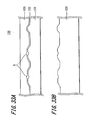
- FIG. 33A shows a cross-sectional structure of an optical disk 100 having a mark formed on a reflective film as described above.
- the optical disk 100 includes a reflective film 102 and a cover layer 103 formed on a substrate 101.
- An irregular cross-sectional shape formed between the substrate 101 and the reflective film 102 is a part on which main data is recorded with a combination of pits and lands.
- a mark as auxiliary data as indicated by a symbol X is recorded on a reflective film on a predetermined pit or land.
- the figure shows an example where the mark X is recorded on the reflective film 102 on a predetermined land.
- a land refers to a part optically close to a source of light incident on an irregular surface on an optical recording medium such as an optical disk, that is, a part having a shape projected to a light incidence side.
- the reflective film 102 is irradiated with a relatively high power laser, and deformation due to thermal expansion or the like with the increase in temperature may occur in a place X on which the mark is formed.
- a recessed dent is transferred to a surface of the substrate 101 in contact with the reflective film 102 by this deformation.
- a recessed shape corresponding to a mark that should be formed only on the reflective film 102 is transferred to a surface of the substrate 101 as shown in FIG. 33B .
- the recessed part transferred in this manner has a reflectance slightly decreased from that of another land.
- a mark as auxiliary data is directly reproduced in a replica (replicated) substrate prepared by directly transferring such a recessed shape of the substrate 101.
- a reflective film and a cover layer are stacked on such a replica substrate in the same manner as in a typical manufacturing process, a pirated disk may be manufactured in which main data and auxiliary data recorded on a normal disk are entirely copied.
- Patent Document 1 Japanese Patent No.
- EP 1 122 723 A1 teaches an optical recording medium (see for example title or abstract) using a reflective film having the composition Ag100-x-zXxZz, the X being at least one element selected from Ge, Ti, Ni, Si, Tb, Fe, C, Al, and Au, the composition rate x of an element or elements X in the Ag-alloy being selected as 5 ⁇ x ⁇ 50 (at%), the Z being at least one element beside the X selected from those elements and the composition rate z of an element or elements Z in the Ag-alloy being selected as 0 ⁇ z ⁇ 5 [at%]. Further, to a reflective film an Ag alloy film having the formula Ag100-x-yXxZz as still another element Z e.g.
- Japanese Patent Application No. 2005-205439 an application claiming priority based on Japanese Patent Application No. 2005-30272
- the present applicant has previously proposed a reproduction device, a reproduction method, a recording device, a recording method, a method of manufacturing an optical disk, and an optical disk recording medium, where reproduction in a manner such as polarity inversion different from that of a normal copy is performed on a so-called pirated optical recording medium prepared by illegal duplication even when auxiliary data for duplication prevention or detection is physically transferred as described above.
- the present invention provides an optical recording medium having a write once metal reflective film, where a pirated copy may be detected, reproduction of the pirated copy may be refused, and characteristics of the pirated copy may greatly deteriorate, as a result of further extensive studies based on the above-described proposal so that transferred auxiliary data more surely exhibits properties differing from those of auxiliary data in a normal copy.
- the present invention further provides an optical recording medium having a write once metal reflective film, where long-term storage reliability of the above optical recording medium is increased by greatly improving weatherability of its reflective film.
- the optical recording medium having a write once metal reflective film includes at least a write once metal reflective film and a cover layer stacked and formed on a substrate.
- Main data is recorded on the substrate with a combination of pits and lands
- the write once metal reflective film allows write once recording by thermal recording with irradiation of laser light
- auxiliary data is recorded with a mark formed by irradiating the write once metal reflective film with write once recording laser light
- a reproduction signal level in a part on which the mark is formed is increased for the lands having a predetermined length
- the mark is formed in an optical disk recording medium prepared by physically transferring a surface shape of the pits and lands of the substrate, so that a reproduction signal level in a part on which the mark is formed is decreased.
- the optical recording medium is characterized in that the write once metal reflective film is formed of an Ag alloy film of Ag 1oo - x - y X x Cu y (x, y: at%), the X is at least one element among elements of Ti, W, Ta, V, Mo, Nb and Zr, and a composition y of Cu in the Ag alloy film is selected to be 2 ⁇ y ⁇ 13 [at%].
- the optical recording medium having a write once metal reflective film according to the present invention having the aforementioned configuration is characterized in that the write once metal reflective film is formed of the Ag alloy film of Ag 100-x-y X x Cu y , the X is Ti, a composition x of Ti in the Ag alloy film is selected to be 4.5 ⁇ x ⁇ 17 [at%], and a composition y of Cu in the Ag alloy film is selected to be 2 ⁇ y ⁇ 13 [at%].
- the optical recording medium having a write once metal reflective film according to the present invention having the aforementioned configuration is characterized in that the write once metal reflective film is formed of the Ag alloy film of Ag 100-y X x Cu y , the X is W, a composition x of W in the Ag alloy film is selected to be 2.5 ⁇ x ⁇ 11 [at%], and a composition y of Cu in the Ag alloy film is selected to be 2 ⁇ y ⁇ 13 [at%].
- the optical recording medium having a write once metal reflective film according to the present invention having the aforementioned configuration is characterized in that the write once metal reflective film is formed of the Ag alloy film of Ag 100-x-y X x CU y , the X is Ta, a composition x of Ta in the Ag alloy film is selected to be 0.61 ⁇ x ⁇ 10.5 [at%], and a composition y of Cu in the Ag alloy film is selected to be 2 ⁇ y ⁇ 13 [ant%].
- the optical recording medium having a write once metal reflective film according to the present invention having the aforementioned configuration is characterized in that the write once metal reflective film is formed of the Ag alloy film of Ag 100-x-y X x Cu y, the X is at least two elements among Ti, W, Ta, V, Mo, Nb and Zr, a total composition x of X in the Ag alloy film is selected to be 0.6 ⁇ x ⁇ 17 [at%], and a composition y of Cu in the Ag alloy film is selected to be 2 ⁇ y ⁇ 13 [at%].
- auxiliary data in a normal optical recording medium and auxiliary data in a pirated optical recording medium may be surely reverse in polarity to each other as a result of specifying an element X in the Ag alloy of the aforementioned write once metal reflective film having an Ag alloy composition of Ag 100-x-y X x Cu y containing Cu and specifying its composition ratio.
- a reproduction signal level is increased in the aforementioned normal copy according to the present invention and a reproduction signal level is decreased in an illegally duplicated copy called a pirated copy, when a mark is recorded on a land.
- an "optical recording medium prepared by physically transferring a shape of a substrate” refers to an optical recording medium prepared by depositing a reflective film on a replica substrate prepared based on a stamper prepared by physically transferring a shape of a substrate, or an optical recording medium prepared by depositing a reflective film again on a substrate from which a reflective film has been separated.
- a mark for a normal copy may be formed as recorded auxiliary data on a write once metal reflective film, and an optical recording medium may be formed so that a reproduction signal level is increased in a part on which the mark is formed in the normal copy and a reproduction signal level is decreased in a part on which the mark is formed in a pirated copy.
- the optical recording medium having a write once metal reflective film According to the optical recording medium having a write once metal reflective film according to the present invention, weatherability of a reflective film used for reproducing main data and recording and reproducing auxiliary data may be improved, so that long-term storage reliability of an optical recording medium is improved.
- the optical recording medium having a write once metal reflective film According to the optical recording medium having a write once metal reflective film according to the present invention, a part of Ag is replaced by Cu in the Ag alloy reflective film.
- the Ag is replaced by Cu at 2 to 13 at%, a reflectance is not decreased despite the replacement with Cu and durability may be improved.
- FIG. 1 is a schematic cross-sectional view of an example of a read-only ROM optical disk 100 illustrated as an embodiment of the optical recording medium according to the present invention.
- the optical disk 100 employs a disk structure and a format complying with a disk called Blu-ray disc, for example.
- the optical disk 100 includes a write once metal reflective film 102 and a cover layer 103 stacked on a substrate 101.
- the substrate 101 is a plastic substrate formed of polycarbonate, for example.
- a surface of the substrate 101 in contact with the write once metal reflective film 102 is provided with an irregular cross-sectional shape.
- a recessed cross-section is a pit P
- a projected cross-section is a land L.
- the cover layer 103 is irradiated with laser light 105, and a cross-section projected to an incidence side of the laser light 105 is the land L.
- Main data information is recorded with a combination of the pits P and the lands L, specifically, with a length of the pits P and a length of the lands L.
- the write once metal reflective film 102 is stacked on an irregular surface of the substrate 101 on which the pits P and the lands L are formed.
- the cover layer 103 formed of polycarbonate or the like is further stacked on the write once metal reflective film 102.
- the write once metal reflective film 102 is stacked on the substrate 101 and accordingly provided with an irregular cross-sectional shape corresponding to a shape of the pits P and the lands L.
- the write once metal reflective film 102 receives reflected light corresponding to the irregularity when irradiated with the laser light 105 focused by an objective lens 104 through the cover layer 103 as shown in the figure.
- the write once metal reflective film 102 is formed of an Ag alloy film of Ag 100-x-y X x CU y (x, y: at%).
- the X is at least one element among elements of Ti, W, Ta, V, Mo, Nb and Zr, and a composition y of Cu in the Ag alloy film is selected to be 2 ⁇ y ⁇ 13 [at%].
- composition y of Cu replacing Ag is selected to be 2 ⁇ y ⁇ 13 [at%].
- a composition x of Ti in the Ag alloy film is selected to be 4.5 ⁇ x ⁇ 17 [at%].
- a composition x of W in the Ag alloy film is selected to be 2.5 ⁇ x ⁇ 11 [at%].
- a composition x of Ta in the Ag alloy film is selected to be 0.6 ⁇ x 10.5 [at%].
- composition of the Ag alloy film of Ag 100-x-y X x Cu y which is a composition of the write once metal reflective film
- a total composition x of X in the Ag alloy film is selected to be 0.6 ⁇ x ⁇ 17 [at%].
- FIG. 2 is a view describing a manufacturing process for the optical disk 100.
- a formatting step S11 for user data is performed first.
- the formatting step S11 is performed using a computer, for example.
- content data (user data) that should be recorded on the optical disk 100 is converted to obtain a formatted data sequence complying with a predetermined standard.
- the conversion is performed to obtain a data sequence complying with the Blu-ray disc standard described later in FIG. 3 .
- addition of an error detection code and an error correcting code to user data, interleaving of user data and the like are also performed.
- variable length modulation step S12 is performed.
- variable length modulation is performed on the data sequence generated at the formatting step S11.
- RLL (1,7) PP (Parity preserve/prohibit, RLL: Run Length Limited) modulation and NRZI (Non Return to Zero Inverse) modulation are performed.
- the "0"/"1" pattern of the data sequence obtained at the variable length modulation step S12 is actually a pattern of pits and lands formed on the disk 100.
- Data obtained by formatting and variable length modulation of user data as described above is herein called main data.
- a master preparation step S13 is performed.
- the master preparation step 513 is performed using a known mastering apparatus.
- a photoresist is applied to a glass master first.
- the glass master to which the photoresist is applied in this manner is rotationally driven and is irradiated in that state with laser light modulated according to the main data generated in the variable length modulation step S12 to develop the photoresist, so that an irregular pattern is formed along a recording track. In other words, pits and lands are formed.
- the glass master on which the pits and lands are formed is electrolytically plated, and the plating is separated to prepare a metal master D14.
- a disk forming step S15 is performed using the metal master D14 obtained in this manner.
- a stamper is first prepared based on the metal master D14. Then, the stamper is placed in a molding die, and the substrate 101 is formed of a transparent resin such as a polycarbonate or acrylic resin using an injection molding machine. The pattern of pits and lands according to the main data generated in the previous modulation step S12 is formed along a recording track on the substrate 101.
- the write once metal reflective film 102 is stacked on the substrate 101 by vapor deposition, sputtering or the like using a metal alloy target for depositing the write once metal reflective film according to the present invention, and the cover layer 103 is further stacked on the write once metal reflective film 102. Accordingly, an optical disk (main data recorded disk) D16 is formed first on which only main data is recorded.
- an auxiliary data recording step S17 is performed. Specifically, auxiliary data is recorded in addition to the main data recorded with the aforementioned pattern of pits and lands.
- unique serial number information for example, is recorded as auxiliary data that is actual data prepared to form a data content on each disk D16 on which the main data has been recorded. Accordingly, a unique identification (identification number) is added to each optical disk 100 prepared at the auxiliary data recording step S17.
- An error correcting code is also added as the auxiliary data, for example, in addition to an identification as actual data. Error correction for the identification may be performed during reproduction by adding the error correcting signal.
- Auxiliary data is recorded as described later by forming a mark in a specific position in a specific section of the main data formed with pits and lands by irradiating the reflective film 102 with laser light using recording power.
- Auxiliary data contains an identification and an error correcting code in this case; however, other data may also be added to the auxiliary data.
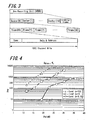
- FIG. 3 is a view showing a data structure of main data recorded on the optical disk 100 manufactured by the above manufacturing process.
- one recording unit called RUB is defined as shown in the figure.
- One RUB includes 16 sectors and two linking frames.
- the linking frame is provided as a buffer area between the RUBs.
- one sector forms one address unit.
- Each sector includes 31 frames as shown in the figure.
- One frame is formed with data of 1932 channel bits.
- the optical recording medium having a write once metal reflective film according to the present invention which has the aforementioned main data recorded and is subjected to recording of auxiliary data.
- the present invention is not limited to these embodiments, obviously.
- the substrate 101 is prepared having an irregular pattern of pits and lands of main data formed on a surface.
- the reflective film 102 formed of an Ag alloy film represented by Ag 100-x W x [at%] is deposited and formed on the substrate 101 by simultaneous sputtering of Ag and W so that the alloy film, that is, the reflective film 102 has a thickness of 40 nm in this case.
- the reflective film formed of an Ag alloy film represented by Ag 100-x Ti x [at%] is deposited on the same substrate 101 as in Example 1 by simultaneous sputtering of Ag and Ti.
- the reflective film formed of an Ag alloy film represented by Ag 90 Ti 5 V 5 [at%] is deposited on the same substrate 101 as in Example 1 by simultaneous sputtering of Ag, Ti and V.
- the reflective film has a thickness of 40 nm.
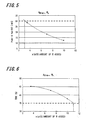
- Amplitude (Amp) along the vertical axis indicates a value of a reproduction signal RF obtained by integrating values obtained by subtracting a value for a part on which a mark is not recorded from a value for a part on which a mark is recorded. As the value is higher, the value of reproduction signal RF is higher in a part on which a mark is recorded.
- Amp ⁇ 300 is defined as a value at which an auxiliary data signal is suitably detected.
- Pw (mW) along the horizontal axis indicates recording laser power.
- the recording conditions set for obtaining the experimental results shown in FIG. 4 are as follows. A mark is recorded on a 6T land as a land having a predetermined length in the optical disk 100.
- the reflective film 102 of the optical disk 100 is the aforementioned AgW alloy film having a thickness of 40 nm.
- the optical disk 100 (main data recorded disk D16) has a structure complying with a Blu-ray disc illustrated in the embodiment and having a track pitch Tp of 320 nm, a 1T length of 78 nm, a pit width of Tp/3 and a pit depth of ⁇ /5.
- minimum necessary recording power is 18 mW at a W content of 7 [at%]
- minimum necessary recording power is 12.5 mW at a W content of 10 [at%].
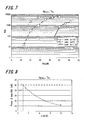
- FIG. 5 shows plotted values of minimum recording power necessary for suitably detecting an auxiliary data signal relative to the W content in the AgW alloy film.
- a value of necessary recording power is increased as a W content is decreased.
- the recording power may not be indefinitely increased and is desirable to be as small as possible from the viewpoint of mass production and economical efficiency in the manufacture of normal optical disks.
- its upper limit is estimated as 30 mW.
- a W content at which a suitable signal is detectable even when auxiliary data is recorded using laser power at 30 mW or less is 3 [at%] or more.
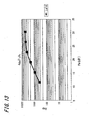
- FIG. 6 shows reflectance characteristics of main data reproduction signals in three optical disks each having a W content of 3.5, 7 or 10 [at%].
- R8H is a maximum reflectance of a signal defined in the Blu-ray disc standard and corresponding to a longest mark (8T mark) of main data. It is assumed that in a read-only Blu-ray disc having a single information layer (single layer disk), this value is required to be 35% or more.
- R8H is decreased as a W content is increased, and a W content satisfying R8H ⁇ 35% is 11 [at%] or less.
- a disk having an AgW alloy with a W content of 3 to 11 [at%] may provide suitable main data and auxiliary data signals.
- Example 2 Contents of elements added for providing suitable main data and auxiliary data signals are also determined for Example 2 (AgTa alloy) and Example 3 (AgTi alloy) in the same manner as for Example 1.
- Data of these Examples 2 and 3 are shown in FIGS. 7 to 9 and FIGS. 10 to 12 .
- optical disks of Examples 2 and 3 may also provide suitable main data and auxiliary data signals when each reflective film formed of an AgTa alloy has a Ta content x of 1.1 to 10.5 [at%] and each reflective film formed of an AgTi alloy has a Ti content x of 5 to 17 [at%].
- an optical disk of Example 4 may also be provided with a reproduction signal level increased in a part on which a mark is formed as shown in FIG. 13 .
- an optical disk that is, an optical recording medium having a write once metal reflective film, where a mark is formed so that a reproduction signal level is increased in a part on which the mark is formed on the aforementioned land having a predetermined length, and a reproduction signal level is decreased in a part on which the mark is formed in an optical disk generated by physically transferring a shape of the substrate 101 of the optical disk 100.
- an experiment is performed to verify that a normal disk and a pirated disk are reverse in auxiliary data signal polarity to each other, using an optical disk of Examples 1 and 2 having an additive element content of 10 [at%] and an optical disk of Example 3 having an additive element content of 7 [at%].
- the reflective film 102 and the cover layer 103 are separated from the optical disk 100 as a normal copy for which it is verified that an auxiliary data signal is recorded and reproduced.
- the separation is performed using a method of dissolving the reflective film 102 by a wet process and removing the cover layer 103 at the same time.
- the substrate 101 from which the reflective film 102 and the cover layer 103 are separated in this manner is sufficiently dried.
- the reflective film 102 and the cover layer 103 are newly formed.
- the reflective film 102 is formed of an Ag alloy-sputtered film having a total amount of the element added to Ag of 1 [at%] or less.
- FIGS. 14 , 15 and 16 are graphs each comparatively showing auxiliary data signal polarities of a normal optical disk and a pirated optical disk of Ag 100-x X x .
- a solid curve and a broken curve show plotted results of measuring an auxiliary data reproduction signal relative to recording laser power in a normal optical disk (normal copy) and a pirated optical disk (pirated copy), respectively. Polarity is inversed in any case.
- Examples 5 and 6 there are studied characteristics of a reproduction signal level in a normal disk and characteristics of a reproduction signal level in a pirated disk prepared from the normal disk by physical transfer, specifically, physical transfer of a substrate shape, in a part on which a mark is recorded when recording is performed on a land using an Ag alloy.
- a polycarbonate disk substrate is prepared having a flat mirror surface and having a diameter of 120 mm and a thickness of 1.1 mm.
- a thin film that is, a reflective film formed of an Ag alloy containing 6.8 at% of Ti is deposited thereon with a thickness of 40 nm.
- a polycarbonate film having a thickness of 0.1 mm is caused to adhere to the thin film using a UV-curable resin which is then cured by UV irradiation to form a cover layer, thereby preparing a disk.
- the disk structure is the same as the basic structure of a read-only Blu-ray disc.
- the disk is heated by irradiation with laser light having a oval spot shape with a minor axis of about 1 ⁇ m and a major axis of about 200 ⁇ m and having a wavelength of 810 nm from the cover layer side.
- the heating by laser light irradiation is performed at a disk rotational speed of 3 m/sec.
- irradiation laser power is about 10 mW/ ⁇ n 2 .
- a heated region on the disk is a ring-shaped region having a radius of about 35 mm to about 45 mm and a width of about 10 mm.
- Example 5 The same polycarbonate substrate as in Example 5 is prepared.
- a thin film that is, a reflective film having a thickness of 40 nm formed of an Ag alloy containing 10.0 at% of Ta is deposited thereon.
- a polycarbonate film having a thickness of 0.1 mm is caused to adhere to the thin film using a UV-curable resin which is then cured by UV irradiation to form a cover layer, thereby preparing a disk in the same manner as in Example 5.
- the disk is heated by irradiation with laser light having a oval spot shape with a minor axis of about 1 ⁇ m and a major axis of about 200 ⁇ n and having a wavelength of 810 nm from the cover layer side.
- a disk rotational speed is 6 m/sec.
- Irradiation laser power is about 5 mW/ ⁇ m 2 .
- a heated region by the laser light irradiation on the disk is a ring-shaped region having a radius of about 35 mm to about 45 mm and a width of about 10 mm.
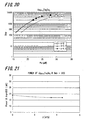
- Reflectances of a region not heated by the aforementioned laser light irradiation (non-heated) and a region irradiated with laser light (heated) are measured in the aforementioned disks of Examples 5 and 6, respectively. The results are shown in Table 1 of FIG. 17 . In this measurement, reflectances at wavelengths of 410 nm, 670 nm and 790 nm are measured using a spectroscopic ellipsometer.
- a reflectance in the heated region that is, a part on which auxiliary data is recorded, is higher than a reflectance in the non-heated region at any measurement wavelength.
- FIG. 18 is a view showing results of simulating a relation between an output of a differential signal between a region on which auxiliary data is recorded and a region on which auxiliary data is not recorded and a reflectance and a mark depth of a recorded mark.
- the FIG. 68 shows a differential contour, and a depth of a recorded mark is indicated along the vertical axis. A value at which a reflectance is not changed is indicated as "1" along the horizontal axis.
- a depth of a mark is a depth of a dent by local deformation in a heated part by auxiliary data recording on a reflective film formed on a polycarbonate substrate, for example, in an optical recording medium.
- the dent is measured to have a depth of about 7 nm by observation of its cross-section using a transmission electron microscope, for example.
- a reflectance is increased after recording (after heating) in the optical disk having an Ag alloy film according to the present invention.
- output polarity of a differential signal indicated by a point P1 is + (plus), for example.
- the write once metal reflective film is formed of Ag 100-x X x not containing Cu.
- the optical recording medium according to the present invention having a composition of Ag 100-x-y X x Cu y containing Cu, that is, having a write once metal reflective film containing Cu will be described with reference to its embodiments. It is found from the embodiments that a write once metal reflective film containing Cu within a specific composition range reduces a lower limit of a preferable composition range of a constituent element X in the aforementioned write once metal reflective film not containing Cu and widens the range. The reason will be described in the following embodiments.
- the substrate 101 is prepared having an irregular pattern of pits and lands of main data formed on a surface.
- the substrate 101 is prepared having an irregular pattern of pits and lands of main data formed on a surface.
- a symbol "o” corresponds to an initial characteristic
- a symbol "D” represents a reflectance characteristic after completion of an accelerated test at 80°C and 85% (relative humidity) for 200 hours.
- R8H is a maximum reflectance of a signal defined in the Blu-ray disc standard and corresponding to a longest mark (8T mark) of main data.
- the lower limit of an amount of Ta added which is provided in Example 2 may be further decreased by addition of Cu.
- an auxiliary line shown in FIG. 22 passing through a symbol " ⁇ " and following a curve passing through a symbol " ⁇ " when y 0, an effect of reducing the lower limit of an amount of Ta added by replacing Ag by Cu is at least 0.5 [at%].
- a preferable composition range of an amount of Ta added is widened by 0.5 [at%] and has a lower limit of 0.6% or more by addition of Cu.
- FIGS. 23 and 24 show an effect of replacing Ag by Cu in a case where an element X is W or Ti in relation to FIGS. 5 and 11 as in a relation between FIG. 8 and FIG. 22 .
- a characteristic of the write once metal reflective film newly improved compared to that of the above film having a composition containing Cu or not containing Cu that is, an effect of suppressing growth of coarse Ag particles easily occurring in an Ag alloy film (hereinafter referred to as hillock).
- FIG. 25A A disk having the same configuration as in the aforementioned Embodiments with an Ag 96 Ta 4 or Ag 96- ⁇ Ta 4 (Cu, Sn, Ge, Nd, Mn, Au) a thin film was prepared to evaluate hillock generation behavior after an environmental test (accelerated test) at 80°C and 85% for 96 hours.
- the upper and lower photographs of FIG. 25A are a 5000 x SEM (scanning electron microscope) photograph and a 200000 x SEM photograph of a write once metal reflective film formed of AgTa 4.0 CU 4.0 , respectively.
- the upper and lower photographs of FIG. 25B are a 5000 x SEM photograph and a 200000 x SEM photograph of a write once metal reflective film formed of AgTa 4.0 not containing Cu, respectively.
- a sample having an Ag 100-x-y Ta x Cu y thin film was prepared to evaluate hillock generation behavior after an environmental test at 80°C and 85% for 96 hours.
- a 40 nm thin film having the aforementioned composition is formed on a polycarbonate substrate, and a protective layer such as a cover is not formed thereon.
- FIG. 26 is 5000 x SEM photographs showing surfaces of these four samples after an environmental test (accelerated test). In FIG.
- a sample having a Cu amount of less than 2 at% may be compared with a sample having a Cu amount of 2 at% or more for each X.
- FIG. 27 is 5000 ⁇ SEM photographs showing surfaces of these four samples after an accelerated test in the above environmental test. The cases of Samples 5 and 6 are shown on the upper left and the upper right, and the cases of Samples 7 and 8 are shown on the lower left and the lower right.
- Results of measuring a change in reflectance R by the aforementioned accelerated test in Samples 1 to 8 shown in FIGS. 26 and 27 are shown at the bottom of the SEM photographs. From the results of Samples 2 to 6 and Sample 8 according to the present invention other than Samples 1 and 7 as comparative examples and the results in the aforementioned Embodiments 3, 4 and 5, it is found that hillock easily generated in an Ag alloy film may be controlled only by addition of Cu, and its amount added is preferably 2 at% or more. This corresponds to a lower limit of a Cu amount of 2 at% provided from the aforementioned Embodiments 1 and 2.
- FIG. 32 is a configuration diagram of an example of the auxiliary data recording device.
- a unique identification is recorded on each optical disk 100 as a data content of auxiliary data.
- the auxiliary data recording device 50 records auxiliary data having a different pattern for each optical disk 100 (D16) mounted thereon.
- a section on which auxiliary data is recorded is determined in advance on the optical disk D16, and a position into which each mark is inserted is previously determined within this section.
- the auxiliary data recording device 50 may record a mark in such a predetermined specific position.
- the optical disk D16 mounted on a turntable is rotationally driven by a spindle motor 51 according to a predetermined rotational driving system.
- An optical pickup OP reads a recording signal (main data) from the optical disk D16 rotationally driven in this manner.
- the optical pickup OP includes a laser diode LD forming a laser light source; an objective lens 52 for focusing and applying laser light onto a recording surface of the optical disk 100; and a photodetector PD detecting light reflected from the optical disk D16 after the laser light irradiation.
- Reflected light information detected by the photodetector PD in the optical pickup OP is converted to an electric signal in an I-V conversion circuit 53 and then supplied to a matrix circuit 54.
- the matrix circuit 54 generates a reproduction signal RF, a tracking error signal TE and a focus error signal FE based on the reflected light information from the I-V conversion circuit 53.
- a servo circuit 55 controls a tracking drive signal TD and a focus drive signal FD output from a biaxial drive circuit 56 based on the tracking error signal TE and the focus error signal FE from the matrix circuit 54.
- the tracking drive signal TD and the focus drive signal FD are supplied to a biaxial mechanism (not shown) holding the objective lens 52 in the optical pickup OP.
- the objective lens 52 is driven in a tracking direction and a focusing direction in response to these signals.
- the servo circuit 55 performs controlling based on the tracking error signal TE and the focus error signal FE, so that a beam spot of laser light applied to the optical disk D16 traces a pit sequence (recording track) formed on the optical disk D16 and is maintained in an appropriate focusing state.
- the reproduction signal RF generated in the matrix circuit 54 is supplied to a binarization circuit 57 and converted to "0"/"1" binary data here.
- the binary data is supplied to a synchronous detection circuit 58 and a PLL (Phase Locked Loop) circuit 59.
- the PLL circuit 59 generates a clock CLK synchronous with the supplied binary data and supplies it as a necessary operating clock for each part.
- the clock CLK is also supplied as an operating clock for the binarization circuit 57 and the synchronous detection circuit 58, an address detection circuit 60 and an auxiliary data generating circuit 61 described as follows.
- the synchronous detection circuit 58 detects a sync pattern inserted into each frame shown in FIG. 3 above from the supplied binary data. Specifically, it detects a 9T section which is a sync pattern in this case to perform frame synchronization detection. A frame synchronization signal is supplied to each part that needs the signal such as the address detection circuit 60.
- the address detection circuit 60 detects address information based on the frame synchronization signal and the supplied binary data.
- the detected address information is supplied to a controller (not shown) totally controlling the auxiliary data recording device 50 and is used for seeking or the like.
- the address information is also supplied to a write pulse generating circuit 63 in the auxiliary data generating circuit 61.
- the auxiliary data generating circuit 61 includes the write pulse generating circuit 63 and a RAM (Random Access Memory) 62.
- the auxiliary data generating circuit 61 generates a write pulse signal Wrp for recording auxiliary data that should be recorded on the optical disk D16 in a later-described form of FIG. 29 , based on input auxiliary data and the address information supplied from the address detection circuit 60 and the clock CLK supplied from the PLL circuit 59.
- a laser power control part 64 controls laser power of the laser diode LD in the optical pickup OP based on the write pulse signal Wrp output from the auxiliary data generating circuit 61. Specifically, the laser power control part 64 in this case performs control so that laser output with reproduction power may be obtained when the write pulse signal Wrp is at an L (low) level. Control is performed so that laser output is recording power when the write pulse signal Wrp is at an H (high) level. Laser irradiation with recording power is performed by the control of laser power control part 64, so that a mark is formed on the reflective film 102 in a part subjected to the laser irradiation. In this manner, auxiliary data is recorded on the optical disk D16 with a mark formed on the reflective film 102.
- FIG. 29 is a view for describing a form of recording auxiliary data which is intended to be realized through an operation of the auxiliary data generating circuit 61.
- FIG. 29 shows a case where "0" is recorded as a one-bit code forming auxiliary data and a case where "1" is recorded as such a one-bit code, respectively.
- a code expression method it is first assumed that adjacent odd-numbered (odd) and even-numbered (even) lands having a predetermined length and present in main data form one pair.
- FIG. 29 shows an example where a mark is recorded on a 5T land as a land having a predetermined length. There is described here a case where a mark is formed on a land having a predetermined length; however, a mark may be formed on a pit having a predetermined length.
- one address unit is assigned as a section for recording a one-bit code forming auxiliary data.
- a mark is recorded as shown in the figure, so that an identical code is expressed for each pair of adjacent odd-numbered and even-numbered lands having a predetermined length in one address unit. Specifically, when a code "0" is recorded, a mark is recorded only on an odd-numbered land having a predetermined length in one address unit, as shown in the figure. When a code "1" is recorded, a mark is recorded only on an even-numbered land having a predetermined length in one address unit.
- the reproduction signal RF is sampled for each pair of adjacent odd-numbered and even-numbered lands having a predetermined length in one address unit, and a value of the reproduction signal RF sampled in the even-numbered land is subtracted from a value of the reproduction signal RF sampled in the odd-numbered land ("odd - even").
- a reproduction signal level of a recorded mark is higher than a reproduction signal level in a part on which a mark is not recorded.
- a positive value is obtained for each pair of adjacent lands having a predetermined length, ideally.
- a reproduction signal level is increased in a part on which a mark is formed. Therefore, actually, a negative value is detected when a mark is recorded only in an odd-numbered land, and a positive value is detected when a mark is recorded only in an even-numbered land.
- an identical recording pattern is repeatedly recorded within a specific section, and one value is determined based on the plurality of identical recording patterns during reproduction. Therefore, a change in reflectance provided by mark recording may be only slight. Since a change in reflectance caused by mark recording may be slight as described above, a recorded mark may be prevented from affecting binarization of main data.
- a mark is recorded by the same method as described above for other codes forming auxiliary data. That is, in this case, auxiliary data is recorded for address units as many as codes forming the auxiliary data.
- a section in which auxiliary data is recorded in this manner (hereinafter also referred to as auxiliary data recording section) is previously determined between the auxiliary data recording device 50 and a reproduction device. Accordingly, the auxiliary data recording device 50 is configured so that the aforementioned mark recording is performed on a plurality of address units as such an auxiliary data recording section previously determined.
- binarization of main data may not be appropriately performed.
- a mark is recorded on an edge of a land having a predetermined length as described above, a wrong land length (or pit length) may be detected in binarization, because a reflectance tends to be higher in a part on which a mark is recorded. Therefore, a mark is recorded in a center of a target land for recording. According to this, since the resulting edge may be obtained as usual, binarization is not affected.
- the write pulse generating circuit 63 in the auxiliary data generating circuit 61 shown in FIG. 28 generates the write pulse signal Wrp at a timing shown in FIG. 29 .
- the write pulse signal Wrp is generated corresponding to a code "0" to be at an H level only in a center of an odd-numbered land having a predetermined length.
- the write pulse signal Wrp is generated corresponding to a code "1" to be at an H level only in a center of an even-numbered land having a predetermined length.
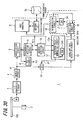
- FIG. 30 is a block diagram showing a configuration of a reproduction device 1.
- FIG. 30 shows mainly a part used for reproduction of auxiliary data and omits a configuration of a demodulation system in a stage subsequent to binarization in a configuration of a main data reproduction system, in particular. Description of an inverting circuit 15 and a determination circuit 16 is also omitted.
- the optical disk 100 mounted on a turntable (not shown) is rotationally driven by a spindle motor 2 according to a predetermined rotational driving system.
- an optical pickup OP shown in the figure reads a recording signal (main data) from the optical disk 100 rotationally driven in this manner.
- the optical pickup OP in this case also includes a laser diode forming a laser light source; an objective lens for focusing and applying laser light onto a recording surface of the optical disk 100; a biaxial mechanism holding the objective lens to be displaceable in a tracking direction and a focusing direction; a photodetector detecting light reflected from the optical disk 100 after the laser light irradiation, although they are omitted in the figure.
- the optical disk 100 is irradiated with laser light having reproduction power.
- Reflected light information detected by the photodetector in the optical pickup OP is converted to an electric signal in an I-V conversion circuit 3 and then supplied to a matrix circuit 4.
- the matrix circuit 4 generates a reproduction signal RF based on the reflected light information received from the I-V conversion circuit 3.
- the matrix circuit 4 also generates a tracking error signal TE and a focus error signal FE, although they are not shown in the figure. They are supplied to a servo circuit (not shown) and are used for tracking servo control and focus servo control, respectively.
- the reproduction signal RF generated in the matrix circuit 4 is supplied to a binarization circuit 5 and is also branched and supplied to a later-described A/D converter 11.
- the binarization circuit 5 converts the supplied reproduction signal RF to "0"/"1" binary data.
- the binary data is supplied to a PLL circuit 8, a synchronous detection circuit 9 and an address detection circuit 10.
- the binary data is also supplied to a detection pulse generating circuit 12a in a later-described detection pulse generating part 12.
- the PLL circuit 8 generates a clock CLK synchronous with the supplied binary data and supplies it as a necessary operating clock for each part.
- the clock CLK in this case is also supplied to the detection pulse generating circuit 12a (not shown).
- the synchronous detection circuit 9 detects a sync part inserted into each frame shown in FIG. 3 above from the supplied binary data. Specifically, the circuit detects a 9T section that is a sync pattern in this case to perform frame synchronization detection. A frame synchronization signal is supplied to each part that needs the signal such as the address detection circuit 10.
- the address detection circuit 10 detects address information from the supplied binary data based on the frame synchronization signal.
- the detected address information is supplied to a controller (not shown) totally controlling the reproduction device 1 and used for seeking or the like.
- the address information is also supplied to the detection pulse generating circuit 12a in the detection pulse generating part 12.
- the optical pickup OP, the I-V conversion circuit 3, the matrix circuit 4, the binarization circuit 5, the PLL circuit 8, the synchronous detection circuit 9 and the address detection circuit 10 are parts also used when main data recorded on the optical disk 100 is reproduced. In other words, in these parts, a configuration of a main data reproduction system is also used for reproduction of auxiliary data.
- the detection pulse generating part 12 generates a detection pulse Dp indicating a detection point according to a mark recording method determined to be common to that in the above auxiliary data recording device 50 for reproduction of identification as auxiliary data.
- the detection pulse generating part 12 includes the detection pulse generating circuit 12a and a RAM 12b.
- the detection pulse generating circuit 12a generates the detection pulse Dp based on information stored in the RAM 12b.
- the generated detection pulse Dp is supplied to the A/D converter 11.
- the reproduction signal RF from the matrix circuit 4 is supplied to the A/D converter 11.
- the A/D converter 11 samples the supplied reproduction signal RF at a timing indicated by the detection pulse signal Dp and supplies the value to an auxiliary data detection circuit 13.
- the auxiliary data detection circuit 13 performs a predetermined operation on the value supplied from the A/D converter 11 to detect each value of auxiliary data. Specifically, in this case, each value of auxiliary data is detected based on a result of performing an operation corresponding to the aforementioned "odd - even", for example.
- auxiliary data detected in the auxiliary data detection circuit 13 is supplied to an ECC (Error Correcting Code) circuit 14.
- Auxiliary data in this case contains an identification and an error correcting code.
- the ECC circuit 14 performs error correction based on the error correcting code in the auxiliary data to reproduce the identification.
- the reproduced identification is supplied to a host computer 6 shown in the figure.
- the host computer 6 transmits a command to a controller (not shown) totally controlling the reproduction device 1 to direct various operations. For example, a command directing reproduction of main data recorded on the optical disk 100 is transmitted. Accordingly, main data reproduced from the optical disk 100 is binarized in the binarization circuit 5 and then demodulated (RLL1-7PP demodulation) in a demodulation system (not shown) or subjected to error correction, and is supplied to the host computer 6.
- a network interface 7 is provided for the host computer 6 to perform data communication through a required network. This makes it possible to perform data communication between the host computer 6 and an external apparatus, in particular, an administrative server 70 shown in the figure through a predetermined network such as Internet.
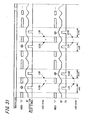
- FIG. 31 shows a mark recording state in a case where "0" and "1" are assigned to one address unit on the optical disk 100 as a one-bit value of auxiliary data, respectively.
- this figure shows a case where pits and lands as main data are formed in an identical pattern.
- auxiliary data is recorded by assigning one-bit information to each address unit in a predetermined auxiliary data recording section on the optical disk 100.
- a code expression method in this case, a case where a mark is recorded on an odd-numbered land having a predetermined length is defined as "0", and a case where a mark is recorded on an even-numbered land having a predetermined length is defined as "1".
- a code is "0" as shown in the figure, a mark is recorded only on an odd-numbered land having a predetermined length in the address unit.
- a code is "1"
- a mark is recorded only on an even-numbered land having a predetermined length in the address unit.
- a part on which a mark is formed is a part on which a reflectance is slightly increased, for example. Therefore, as shown in the figure, a level of waveform of the reproduction signal RF is increased in a part on which a mark is recorded. In reproduction of auxiliary data, each value is determined based on such a slight increase in reflectance in a part on which a mark is recorded.
- each mark is recorded in a center of a land having a predetermined length.
- a level is increased only in the center of the land on which the mark is recorded, and an edge waveform is obtained as usual. Accordingly, as described above, binarization of main data may be prevented from being affected.
- An increase in value of the reproduction signal RF in a part on which a mark is recorded may be detected by determining a difference from a value of the reproduction signal RF in a part on which a mark is not recorded, for example.
- a mark is recorded only on an odd-numbered land when a code is '0
- a mark is recorded only on an even-numbered land when a code is "1" as described above.
- an even-numbered land necessarily forms a part on which a mark is not recorded when a code is "0”
- an odd-numbered land necessarily forms a part on which a mark is not recorded when a code is "1".
- the detection pulse generating part 12 shown in FIG. 30 generates the detection pulse signal Dp as a signal for indicating a sampling timing for the "odd - even” calculation.
- a signal having an H level only in a center of a land having a predetermined length obtained in main data may be generated to be sufficient as the detection pulse Dp for the aforementioned "odd - even" calculation.
- a detection pulse Dp it is sufficient to generate a corresponding timing from a content of main data recorded in an auxiliary data recording section on the optical disk 100, as in the case of generation of the write pulse signal Wrp for the aforementioned auxiliary data recording device 50.
- the reproduction device 1 since the reproduction device 1 is not used for the manufacture of an optical disk unlike the auxiliary data recording device 50, a content recorded on the optical disk 100 may not be previously stored in the device. Accordingly, the reproduction device 1 reads main data in an auxiliary data recording section from the mounted optical disk 100, and the main data is stored in the device and used for generating the detection pulse signal Dp.
- the reproduction device 1 includes the RAM 12b in a detection pulse generating part 12 shown in FIG. 30 as a memory for storing main data in an auxiliary data recording section read in this manner.
- Main data having data structure as shown in FIG. 32 read corresponding to each address is stored.
- a data sequence indicating "1" only at corresponding timings and indicating "0" at all other timings is generated based on a content of main data in a recording section stored in the RAM 12b in this manner, as in the aforementioned generation of the write pulse signal Wrp.
- the detection pulse Dp based on a data sequence generated in this manner is generated and supplied to the A/D converter 11.
- a value of the reproduction signal RF may be sampled at an appropriate timing shown in FIG. 31 by sampling a value of the reproduction signal RF using the A/D converter 11 at a timing indicated by the detection pulse signal Dp.
- the optical recording medium according to the present invention when a composition of its reflective film is selected, an optical recording medium may be surely obtained in which reproduction may be performed in a part of the reflective film on which auxiliary data is recorded at a reproduction level higher than in a part on which auxiliary data is not recorded. Therefore, according to the optical recording medium according to the present invention, as initially described with reference to FIG. 33 , reading of auxiliary data may be substantially unable, when a pirated disk is prepared by separating a cover layer and a reflective film from the optical recording medium and transferring, from a substrate 101 having a dent caused by thermal deformation occurring in formation of an auxiliary data mark, an irregularity on a surface of the substrate including the dent caused by the auxiliary data mark.
- a reproduction level in a recorded mark formed with a dent shown in FIG. 33B is decreased from that in a part on which a mark is not recorded, it is impossible to obtain a pirated disk having normal auxiliary data in which a reproduction level is increased in auxiliary data as in the aforementioned optical recording medium according to the present invention. Alternatively, a pirated copy may be immediately determined.
- the optical recording medium having a write once metal reflective film according to the present invention may cause inversion of polarity of a reproduction signal in a pirated copy by illegal copying. Therefore, it is possible to determine a pirated optical recording medium and furthermore to make it unable to reproduce in a pirated optical recording medium, for example, and violation of copyrights may be effectively prevented.
- the optical recording medium having a write once metal reflective film according to the present invention employs an Ag alloy film in which hillock generation is suppressed and which has excellent weatherability. Therefore, long-term data storage reliability may be significantly improved.
- metal alloy reflective films having various elements added to an Ag alloy have been proposed as reflective films in optical recording media.
- the present invention may provide an optical recording medium, in which polarity of a reproduction signal may be significantly inverted in a pirated copy by illegal copying in reproduction of write once recorded auxiliary data, and which has a write once metal reflective film having excellent long-term storage reliability and excellent weatherability.
- an optical disk is mainly mentioned; however, a substrate shape and the like are not limited.
- 1 reproduction device 2 spindle motor, 3 1-V conversion circuit, 4 matrix circuit, 5 binarization circuit, 6. host computer, 7 network interface, 8 PLL circuit, 9 synchronous detection circuit, 10 address detection circuit, 11 A/D converter, 12 detection pulse generating part, 12a detection pulse generating circuit, 12b RAM, 13 auxiliary data detection circuit, 14 ECC circuit, 15 inverting circuit, 16 determination circuit, 70 administrative server, 100 optical recording medium (optical recording medium (disk) having write once metal reflective film), 101 substrate, 102 reflective film, 103 cover layer, 104 objective lens, 105 laser light
Landscapes
- Optical Record Carriers And Manufacture Thereof (AREA)
- Optical Recording Or Reproduction (AREA)
- Manufacturing Optical Record Carriers (AREA)
Applications Claiming Priority (2)
| Application Number | Priority Date | Filing Date | Title |
|---|---|---|---|
| JP2006166311A JP4262730B2 (ja) | 2006-06-15 | 2006-06-15 | 追記記録可能な金属反射膜を有する光記録媒体 |
| PCT/JP2007/062165 WO2007145336A1 (ja) | 2006-06-15 | 2007-06-15 | 追記記録可能な金属反射膜を有する光記録媒体 |
Publications (3)
| Publication Number | Publication Date |
|---|---|
| EP2028656A1 EP2028656A1 (en) | 2009-02-25 |
| EP2028656A4 EP2028656A4 (en) | 2010-11-03 |
| EP2028656B1 true EP2028656B1 (en) | 2011-11-09 |
Family
ID=38831849
Family Applications (1)
| Application Number | Title | Priority Date | Filing Date |
|---|---|---|---|
| EP07745419A Expired - Fee Related EP2028656B1 (en) | 2006-06-15 | 2007-06-15 | Optical recording medium having write once metal reflection film |
Country Status (8)
| Country | Link |
|---|---|
| US (1) | US8187689B2 (https=) |
| EP (1) | EP2028656B1 (https=) |
| JP (1) | JP4262730B2 (https=) |
| KR (1) | KR100997913B1 (https=) |
| CN (1) | CN101467210B (https=) |
| AT (1) | ATE533152T1 (https=) |
| TW (1) | TW200828282A (https=) |
| WO (1) | WO2007145336A1 (https=) |
Families Citing this family (5)
| Publication number | Priority date | Publication date | Assignee | Title |
|---|---|---|---|---|
| JP4694543B2 (ja) * | 2007-08-29 | 2011-06-08 | 株式会社コベルコ科研 | Ag基合金スパッタリングターゲット、およびその製造方法 |
| JP4833942B2 (ja) * | 2007-08-29 | 2011-12-07 | 株式会社コベルコ科研 | Ag基合金スパッタリングターゲット |
| JP5396160B2 (ja) | 2009-05-29 | 2014-01-22 | ソニー株式会社 | 光記録媒体 |
| CN103433622A (zh) * | 2013-08-22 | 2013-12-11 | 广西容县风采印业有限公司 | 塑料薄膜激光标刻的方法 |
| GB2581172B (en) * | 2019-02-06 | 2022-01-05 | Opsydia Ltd | Laser machining inside materials |
Family Cites Families (11)
| Publication number | Priority date | Publication date | Assignee | Title |
|---|---|---|---|---|
| JP3454410B2 (ja) | 1997-12-26 | 2003-10-06 | ソニー株式会社 | 光ディスク記録装置、光ディスク記録方法、光ディスク及び光ディスク再生装置 |
| US6905750B2 (en) * | 1998-06-22 | 2005-06-14 | Target Technology Company, Llc | Metal alloys for the reflective or the semi-reflective layer of an optical storage medium |
| US6852384B2 (en) * | 1998-06-22 | 2005-02-08 | Han H. Nee | Metal alloys for the reflective or the semi-reflective layer of an optical storage medium |
| JP2000228032A (ja) * | 1999-02-08 | 2000-08-15 | Teijin Ltd | 光情報媒体 |
| EP1054395B1 (en) | 1999-05-17 | 2007-06-27 | Sony Corporation | Optical disc recording apparatus, optical disc recording methods, and optical discs |
| JP4433654B2 (ja) | 1999-07-22 | 2010-03-17 | ソニー株式会社 | 光記録媒体 |
| DE60137714D1 (de) * | 2000-12-28 | 2009-04-02 | Sony Corp | Optisches aufzeichnungsmedium |
| JP4170132B2 (ja) * | 2003-04-14 | 2008-10-22 | 松下電器産業株式会社 | 光記録媒体 |
| JP2005030272A (ja) | 2003-07-10 | 2005-02-03 | Toyota Motor Corp | 内燃機関の排気浄化装置 |
| JP2005050497A (ja) * | 2003-07-16 | 2005-02-24 | Ricoh Co Ltd | 光記録媒体 |
| JP2005205439A (ja) | 2004-01-21 | 2005-08-04 | Hitachi Constr Mach Co Ltd | 油圧ショベルのブームとその製造方法 |
-
2006
- 2006-06-15 JP JP2006166311A patent/JP4262730B2/ja not_active Expired - Fee Related
-
2007
- 2007-06-15 CN CN2007800220137A patent/CN101467210B/zh not_active Expired - Fee Related
- 2007-06-15 AT AT07745419T patent/ATE533152T1/de active
- 2007-06-15 EP EP07745419A patent/EP2028656B1/en not_active Expired - Fee Related
- 2007-06-15 US US12/303,408 patent/US8187689B2/en not_active Expired - Fee Related
- 2007-06-15 KR KR1020087028266A patent/KR100997913B1/ko not_active Expired - Fee Related
- 2007-06-15 WO PCT/JP2007/062165 patent/WO2007145336A1/ja not_active Ceased
- 2007-06-15 TW TW096121894A patent/TW200828282A/zh not_active IP Right Cessation
Also Published As
| Publication number | Publication date |
|---|---|
| KR20090005200A (ko) | 2009-01-12 |
| JP4262730B2 (ja) | 2009-05-13 |
| CN101467210A (zh) | 2009-06-24 |
| CN101467210B (zh) | 2011-06-08 |
| TWI352344B (https=) | 2011-11-11 |
| JP2007335003A (ja) | 2007-12-27 |
| EP2028656A1 (en) | 2009-02-25 |
| WO2007145336A1 (ja) | 2007-12-21 |
| KR100997913B1 (ko) | 2010-12-03 |
| TW200828282A (en) | 2008-07-01 |
| US20090252914A1 (en) | 2009-10-08 |
| US8187689B2 (en) | 2012-05-29 |
| ATE533152T1 (de) | 2011-11-15 |
| EP2028656A4 (en) | 2010-11-03 |
Similar Documents
| Publication | Publication Date | Title |
|---|---|---|
| EP2028656B1 (en) | Optical recording medium having write once metal reflection film | |
| US7803444B2 (en) | Optical disk and method or producing optical disk | |
| JP4201006B2 (ja) | 光記録媒体 | |
| CN100397500C (zh) | 评价装置、评价方法和光盘制造方法 | |
| AU2006211660B2 (en) | Optical disc recording medium, reproduction device and method and recording device and method for the recording medium | |
| JP5396160B2 (ja) | 光記録媒体 | |
| JP4453567B2 (ja) | 記録装置、記録方法、ディスク製造方法 | |
| JP4277812B2 (ja) | 光ディスク記録媒体、ディスク製造方法 | |
| CN101151664B (zh) | 光盘记录介质、用于该记录介质的再现装置和方法以及记录装置和方法 | |
| HK1110986A (en) | Optical disc recording medium, reproduction device and method and recording device and method for the recording medium | |
| JP2007242181A (ja) | 光ディスク記録媒体、光ディスク製造方法 | |
| JP2007048413A (ja) | 再生装置、再生方法、記録装置、記録方法、光ディスク製造方法、光ディスク記録媒体 |
Legal Events
| Date | Code | Title | Description |
|---|---|---|---|
| PUAI | Public reference made under article 153(3) epc to a published international application that has entered the european phase |
Free format text: ORIGINAL CODE: 0009012 |
|
| 17P | Request for examination filed |
Effective date: 20081203 |
|
| AK | Designated contracting states |
Kind code of ref document: A1 Designated state(s): AT BE BG CH CY CZ DE DK EE ES FI FR GB GR HU IE IS IT LI LT LU LV MC MT NL PL PT RO SE SI SK TR |
|
| AX | Request for extension of the european patent |
Extension state: AL BA HR MK RS |
|
| DAX | Request for extension of the european patent (deleted) | ||
| RBV | Designated contracting states (corrected) |
Designated state(s): AT DE FR GB |
|
| A4 | Supplementary search report drawn up and despatched |
Effective date: 20101004 |
|
| GRAP | Despatch of communication of intention to grant a patent |
Free format text: ORIGINAL CODE: EPIDOSNIGR1 |
|
| RIC1 | Information provided on ipc code assigned before grant |
Ipc: G11B 7/24 20060101ALI20110428BHEP Ipc: G11B 7/258 20060101AFI20110428BHEP |
|
| GRAS | Grant fee paid |
Free format text: ORIGINAL CODE: EPIDOSNIGR3 |
|
| GRAA | (expected) grant |
Free format text: ORIGINAL CODE: 0009210 |
|
| AK | Designated contracting states |
Kind code of ref document: B1 Designated state(s): AT DE FR GB |
|
| REG | Reference to a national code |
Ref country code: GB Ref legal event code: FG4D |
|
| REG | Reference to a national code |
Ref country code: DE Ref legal event code: R096 Ref document number: 602007018621 Country of ref document: DE Effective date: 20120209 |
|
| PGFP | Annual fee paid to national office [announced via postgrant information from national office to epo] |
Ref country code: DE Payment date: 20120622 Year of fee payment: 6 |
|
| PGFP | Annual fee paid to national office [announced via postgrant information from national office to epo] |
Ref country code: FR Payment date: 20120705 Year of fee payment: 6 Ref country code: GB Payment date: 20120622 Year of fee payment: 6 |
|
| PLBE | No opposition filed within time limit |
Free format text: ORIGINAL CODE: 0009261 |
|
| STAA | Information on the status of an ep patent application or granted ep patent |
Free format text: STATUS: NO OPPOSITION FILED WITHIN TIME LIMIT |
|
| 26N | No opposition filed |
Effective date: 20120810 |
|
| REG | Reference to a national code |
Ref country code: DE Ref legal event code: R097 Ref document number: 602007018621 Country of ref document: DE Effective date: 20120810 |
|
| PGFP | Annual fee paid to national office [announced via postgrant information from national office to epo] |
Ref country code: AT Payment date: 20120613 Year of fee payment: 6 |
|
| REG | Reference to a national code |
Ref country code: AT Ref legal event code: MM01 Ref document number: 533152 Country of ref document: AT Kind code of ref document: T Effective date: 20130615 |
|
| GBPC | Gb: european patent ceased through non-payment of renewal fee |
Effective date: 20130615 |
|
| REG | Reference to a national code |
Ref country code: FR Ref legal event code: ST Effective date: 20140228 |
|
| REG | Reference to a national code |
Ref country code: DE Ref legal event code: R119 Ref document number: 602007018621 Country of ref document: DE Effective date: 20140101 |
|
| PG25 | Lapsed in a contracting state [announced via postgrant information from national office to epo] |
Ref country code: DE Free format text: LAPSE BECAUSE OF NON-PAYMENT OF DUE FEES Effective date: 20140101 Ref country code: GB Free format text: LAPSE BECAUSE OF NON-PAYMENT OF DUE FEES Effective date: 20130615 |
|
| PG25 | Lapsed in a contracting state [announced via postgrant information from national office to epo] |
Ref country code: AT Free format text: LAPSE BECAUSE OF NON-PAYMENT OF DUE FEES Effective date: 20130615 Ref country code: FR Free format text: LAPSE BECAUSE OF NON-PAYMENT OF DUE FEES Effective date: 20130701 |