FIELD OF THE INVENTION
-
This invention relates to a nuclear conditional male sterility system in Brassica napus. Embodiments of the invention provide for the prebasic female (MsMsrfrf), the maintainer line (msmsrfrf), the basic female line (Msmsrfrf), and hybrid lines. Provided are further methods for the production of those lines. Further embodiments of the invention relate to markers associated to the sterility, fertility and maintainer alleles and the use of those markers in providing a hybrid system.
BACKGROUND OF THE INVENTION
-
Oilseed from Brassica plants is an increasingly important crop. As a source of vegetable oil, it presently ranks behind only soybeans and palm in commercial importance and it is comparable with sunflowers. The oil is used both as a salad and cooking oil, and play an increasingly important role in biofuels (biodiesel).
-
In its original form, Brassica oil, known as rapeseed oil, was harmful to humans due to its relatively high level of erucic acid. Erucic acid is commonly present in native cultivars in concentrations of 30-50% by weight based upon the total fatty acid content. This problem was overcome when plant scientists identified a germplasm of low erucic acid (Stefansson, 1983). Although these varieties with less than 2% of erucic acid in their total fatty acid profile (single zero quality) yielded edible oil, the continuing presence of sulfur compounds called glucosinolates called glucosinolates (GSLs) in the high protein meal remained a major constraint to further market expansion. Wide acceptance of rapeseed meal for animal nutrition is hampered by the presence in the seed of GSLs. Furthermore, glucosinolates are also undesirable since they can lead to the production of antinutritional breakdown products (e.g., thiocyanates, isothiocyanate and nitrite) upon enzymatic cleavage during oil extraction and digestion when acted upon by the endogenous enzyme myrosinase upon crushing. In consequence, so-called "double-low" varieties (low in erucic acid in the oil and low in glucosinolates in the solid meal after oil extraction) were developed, which have an erucic acid content of less than 2% by weight based upon the total fatty acid content, and a glucosinolate content of less than 30 µmol/gram of the oil-free meal. These high quality forms of rape, first developed in Canada, are known as canola. At present the maximum threshold set by European law is 25 µmol total glucosinolate (GSL) per gram (g) of seed at 8.5% moisture, as measured by HPLC (EU decree 2294/92). Doublelow spring canola varieties cultivated in Canada need to have GSL levels of less than 30 µmoles GSLs per gram of air-dried oil-free meal at 0% moisture, as measured by TMS. The GSL levels of commonly cultivated double zero oilseed rape varieties in Europe and Canada varies significantly below the threshold levels at 60% of the official threshold level or even lower. Many countries are requiring even lower levels of glucosinolates in order to register canola varieties.
-
In addition, plant scientists have attempted to improve the fatty acid profile for rapeseed oil (Röbbelen 1984; Ratledge 1984; Röbbelen 1975; Rakow 1973).
-
Especially winter oilseed rape (Brassica napus L. ssp. oleifera (Metzg.), Brassicaceae) is an important crop for the production of oilseed in temperate agricultural regions. In Germany in 2006 approximately 1.5 million hectares (12% of the total agricultural area) were sown with oilseed rape.
-
Oilseed rape is a predominantly self-pollinated crop with about one-third outcrossing (Becker 1992). Breeding of rapeseed plants have been centered on open-pollinated seeds by taking advantage of high self-compatibility affinity of said plants. The significant heterosis for seed yield in oilseed rape has created interest in the development of hybrid cultivars (Riaz 2001). Heterosis means the growth and yield advantage of hybrids in comparison to their parents gained by the crossing of two genetically different, homozygote genotypes leading (Schull 1922). Rapeseed hybrids always show a significant heterosis in yield. Considerable heterosis for seed yield in F1 hybrids of oilseed rape (Brassica napus L.) has been reported by various authors at the beginning of hybrid breeding in rapeseed (Schuster 1969; Röbbelen 1985; Grant & Beversdorf 1985; Lefort-Buson 1987; Brandle & McVetty 1989; Paulmann & Frauen 1991; Stefansson 1983; Brandle & McVetty 1990; Shen 2005). Principally the heterosis level in spring type rapeseed can be as high as 20% to 30%, and in winter about 30% to 40%.
-
An effective production of hybrid seeds requires both the identification of heterotic groups (genetic districts genepools; Melchinger and Gumber 1998, Becker and Link 2000) and a method for targeted crossing of those heterotic groups.
-
In winter oilseed rape the first hybrid varieties that were registered in Europe are hybrid-line-associations using the INRA ogura system and fully restored hybrids using the MSL system (see below for details). However, in comparison to elite inbred lines the heterosis effect is still moderate. The relatively low gain in yield is however not caused by the inefficiency of the hybrid system but by the lack of genetic diverse gene pools in rapeseed in consequence of decades of inbreeding and governmental regulations (e.g., glucosinolate or erucic acid content), which still cause limited germplasm variability.
-
More diverse gene pools will lead to higher heterosis effects but their development was initiated only recently. Nevertheless, a commercially functional hybrid system is the predominant prerequisite for achieving significant yield increases in rapeseed in the future. Those increases are not only required by the increased demand for food purpose but the rapidly increasing demand in biofuels (bio-diesel).
-
Beside chemical induced male sterility (CHA), three genetics based hybrid system principles have been explored in Brassica varieties: Breeders use self-incompatible (SI), cytoplasmic male sterile (CMS), and nuclear male sterile (NMS; formerly also genetic male sterility, GMS) Brassica plants as the female parent (for review of hybrid systems in vegetables see Kumar et al. 2004). SI plants are not able to self pollinate due to their genetic constitution and CMS and NMS female plants are incapable of producing pollen. Thus, all these plants must be cross-pollinated by a male parent. In using these plants, breeders are attempting to improve the efficiency of seed production and the quality of the F1 hybrids and to reduce the breeding costs. When hybridisation is conducted without using Si, CMS or NMS plants, it is more difficult to obtain and isolate the desired traits in the progeny (F1 generation) because the parents are capable of undergoing both cross-pollination and self-pollination.
-
A simple and efficient pollination control system is the key step for utilizing heterosis and commercial hybrid seed production. If one of the parents is a SI, CMS or NMS plant that is incapable of producing pollen, only cross pollination will occur. By eliminating the pollen of one parental variety in a cross, a plant breeder is assured of obtaining hybrid seed of uniform quality, provided that the parents are of uniform quality and the breeder conducts a single cross.
-
Self-incompatibility systems: So far no commercially useable SI system for rapeseed has been developed.
CA 2,143,781 describes a hybrid breeding method for crop plants in the family Brassicaceae in which an F1 seed is produced by crossing the female parent of a self-incompatible male sterile line with a male parent. However, the main question for SI is the reproduction of SI parent lines in large scale, which makes this system difficult for commercial applications.
-
Cytoplasmic male sterility (CMS): CMS is a maternally inherited phenomenon, the genetic determinants of which are located in genome of the cytoplasmic organelles, the mitochondria. Such plants are severely impaired in their ability to produce functional pollen grains. Restorer genes for CMS systems are dominant nuclear genes, which suppress male sterile effects of the cytoplasm. The expression of male sterility in cms plants is the result of incompatibility between recessive nuclear gene (called maintainer allele; rf) and male sterile specific cytoplasmic genome.
-
-
The Polima cytoplasmic male sterility (Pol CMS) system has been used mainly in hybrid rapeseed production in China. However, because of its inherent limitations, such as instability of the sterility, the limited number the limited number of restorers and potential negative influence of the cytoplasm, use of hybrids with single CMS cytoplasm over large areas is not ideal. The main disadvantage of pol CMS is the instability of male sterility under high temperature. The male sterile lines could become partial fertile at relative lower or higher temperature situations (Yang and Fu, 1987).
-
The Ogura (ogu; Ogura 1968; Pelletier 1983; Heyn 1976) and the Kosena system rely on a radish-derived CMS gene. A fertility restorer for Ogura cytoplasmic male sterile plants has been transferred from Raphanus sativus (radish) to Brassica (Pelletier 1987), because the rapeseed lacks in Rf allele corresponding to said CMS gene. The Ogura system is described in
EP599042 ,
EP671121 , and
WO2005074671 . The restorer allele originating from radish is phenotypically described (
WO 92/05251 ; Delourme 1991). Initial Ogura restorer material showed reduced female fertility and a high content of glucosinolates closely linked to its fertility restoring gene, which were overcome through lengthy backcrossing (Delourme 1991, Renard 1997).
EP1493328 describes a method of producing a double low restorer lines of Brassica napus for Ogura cytoplasmic male sterility. Although the glucosinolate content is reduced in those lines after laborious backcrossing, there seem to be some inherent problems associated to the Rf alleles such as yield drag under higher temperatures, a decrease seed set, and a reduced number of ovules per silique (Pellan-Delourme 1988; Delourme 1994), lower seed yields, poor disease resistances and lodging susceptibility. Some of those properties have a close linkage to the restorer allele (Delourme 1994, 1995) and data suggest that certain of those properties may be endogenous to the restorer allele and may not be able to overcome by breeding of even transgenic approaches with the isolated restorer allele.
-
One inherent disadvantage of the CMS system is the propagation of a homozygous female CMS line. Since the male-sterile, female CMS A-line cannot self-pollinate, it must be maintained by crossing said A-line with a maintainer B-line that is male fertile and genetically identical to the A-Line. The result of this cross is a male-sterile CMS A-line.
-
Nuclear male sterility (NMS): Nuclear male sterility (earlier termed as genic male sterility gms) is controlled by the gene(s) from the nuclear compartment. Most of the naturally occurring or induced male sterile mutants are recessive in nature with few exceptions in cole vegetables (e.g. cabbage and broccoli) and genetically transformed male sterile lines (Kaul 1988, Williams 1997). Certain mutants, which although produce functional pollen, pollen fail to self fertilize, either due to non-dehiscence of pollen or their special flower morphology e.g. positional sterility in tomato (Atanassova, 1999) and functional male sterility in eggplant (Phatak and Jaworski, 1989). The occurrence of predominantly recessive male sterility indicates that gms is the result of mutation in any gene(s) controlling microsporogenesis (pollen development process), stamen development or microgametogenesis (male gamete development process).
-
NMS systems have the advantage of complete and stable sterility with almost no negative cytoplasmic effects. Several kinds of NMS mutants have been discovered in Brassica napus and the sterility of these mutants has been reported to be controlled by one gene (Takagi 1970; Mathias 1985; Hu 2000), two genes (Li 1985, 1988, 1993, 1995; Hou 1990; Tu 1997a), three genes (Chen 1998; Wang 2001) and one gene with multiple alleles (Song 2005). However the systems are practically difficult to handle and often demonstrate high sensibility to environmental effects such as heat. Thus, compared with the CMS system, application of the dominant NMS method in rapeseed production is far behind, mainly due to the complicated fertility inheritance and the difficulties in distinguishing the different genotypes in a segregating population. The breeding procedure for a homozygous two- type line is very complicated, and the identification of the different genotypes (Ms Rf) with expected traits in backcross or selfed generations is laborious and time-consuming with traditional breeding methodology.
-
In China, 3 NMS systems have been used in hybrid breeding, and a few hybrids have been registered. Although a recessive NMS has advantages (needs only two lines) it also has the fatal shortcoming of being difficult to drive a whole male sterile population. Since gms is maintained through backcrossing, in hybrid seed production field, 50% male fertile segregants (Msms) need to be identified and removed before they shed pollen. The removal of the 50% male fertile plants from the female lines can be realized for example by marker-assisted selection (Tu et al.; Studies on the recessive genic male sterility and its genetic markers in Rapeseed (Brassica napus L.); http://www.regional.org.au/au/gcirc/4/87.htm; 10th rapeseed congress, Canberra Australia 1999). These methods however, are expensive, cost, and labor extensive, and commercially not competitive. Because of more tedious maintenance process and non-availability of suitable marker gene among the vegetable crops, utilization of gms is restricted only in few vegetables. No system in rapeseed has been developed. The identification of fertilizing cytoplasm for specific nuclear male sterile gene (Horner and Palmer, 1995), is an interesting research area, which upon success, may provide opportunity for most efficient utilization of gms lines, like cms line.
-
One special form of the nuclear ms systems are the transgenic male sterility systems., for which early developments were made in the beginning of 1990's (Mariani 1992). These systems have become possible because of the isolation, cloning and characterization of anther or pollen specific genes and promoter sequences (Williams 1997). However, transgenic systems have to undergo a lengthy and costly governmental approval process, which puts those systems into a significant competitive advantage in comparison to other systems.
-
Environmental sensitive male sterility (ENMS) systems: Certain nms lines in plants are conditional mutants, meaning thereby in a particular environment male sterile mutant plants turn into male fertile. After determination of critical environment (usually temperature or photoperiod) for sterility and fertility expression, such GMS mutants are classified under environmental sensitive nuclear male sterile (enms) lines. In vegetable crops, mostly temperature sensitive enms lines have been reported (Table 1). From practical application viewpoint, it is necessary to identify critical temperature or photoperiod for the fertility/sterility expression in temperature and photoperiod sensitive genetic male sterility, respectively.
Table 1: Environmental sensitive male sterility mutants in vegetables | |
| Vegetable | Mutant | Reference |
| Cabbage | TGMS, PGMS | Rundfeldt, 1961 |
| Brussels sprout | TGMS | Nieuwhof, 1968 |
| Broccoli | TGMS | Dickson, 1970 |
| Pepper | TGMS, TCMS | Daskalov, 1972; Shifriss, 1997* |
| Carrot | TGMS | Kaul, 1988 |
| Tomato | TGMS | Rick, 1948; Sawhney, 1983 |
TGMS-Thermo sensitive genic male sterility
PGMS-Photoperiod sensitive genic male sterility
*TCMS-Thermo sensitive cytoplasmic male sterility |
-
Hybrid seed production using enms line is more attractive because of the ease in seed multiplication of male sterile line. Seeds of enms line can be multiplied in an environment where it expresses male fertility trait while hybrid seeds can be produced in other environment, where it expresses male sterility..
-
NPZ ("Norddeutsche Pflanzenzucht Lembke") MSL system: The MSL-system (Male Sterility Lembke) is a private system owned by NPZ/Lembke, currently commercialized in Europe (Pinochet and Bertrand, 2000). In 2006, those hybrids covered an area of about 1.15 million ha in Europe (therefrom 850,000 ha in Germany (Frauen 2007). The MSL-system is claimed to be based on a spontaneous mutation and selection in the NPZ breeding station in 1984 (Frauen, Ernährungsdienst; Nr. 46, 1999, p.13; Paulmann, Frauen 1998; Proceedings of the 10th International Rapeseed Congress 1999; http://www.regional.org.au/au/gcirc/4/258.htm). In Germany the first restored MSL-hybrid varieties were approved in 1996 (Frauen and Baer 1996) and demonstrate and increased yield of approx. 12 % in comparison with elite conventional non-hybrid varieties. All known conventional rapeseed cultivars and lines are restorer lines for this male sterility system. The system is described as an alternative CMS system (Frauen; Ernährungsdienst, Nr. 046, 19.6.1999, p. 13; "Hybridrapsfiebel", Rapool promotion material), which uses a fertile maintainer line for the propagation of a sterile mother line to derive fully restored hybrids. This and the claim that the system originates from a spontaneous mutation suggest that it is different from other known sterility systems. Neither the parental lines of the MSL system nor the method of the preparation of the hybrid seed are known to the public but kept as a trade secret. This limits the use of the MSL system and its applications to a broader spectrum of rapeseed varieties.
-
MS Takagi: Takagi (1970) induced in the Japanese variety ,Murasaki natane' male sterility by gamma-irradiation mutagenesis. This system was described by Takagi as monogen recessive. Theis (1990) describes in his Ph.D. dissertation (p.14-18) that ms Takagi is controlled by two genes, one which is a homozygote recessive male sterility gene and one which is dominant "modifier gene". Theis describes that ms Takagi is sterile under normal field conditions but may revert to fertility under a one week temperature treatment (38°C day temperature / 18°C night temperature) after 7 to 10 days (p.49). Theis (1990; p.55) further proposes the production of a 100% fertile parental line by pollination of sterile plants with poll of sterile, temperature treated plants. However, no commercial use of this system is known in the public and no commercially viable hybrid system has been developed thereof. Neither Takagi nor Theis describe homozygous lines for the sterility gene or the modifier gene. Denis et al. describe for nuclear male sterility systems with reference to the Takagi system that one reason for the difficulties of this system is that the absence of marker genes does not permit the sorting of male-sterile or -fertile plants in the progeny, which are required for providing homozygous lines (for detailed discussion see also below).
-
As mentioned above, only three MS systems are currently employed: The NPZ MSL system, for which the genetic is not commonly known, the transgenic InVigor™ hybrid canola system (Bayer CropScience), which is transgenic and therefore linked to high regulatory costs and public concern, and the Ogura system, which because of certain agronomical disadvantages linked to the restorer allele is also not optimal. Furthermore, these few systems are limited in number. Additional systems would be beneficial not only from economic perspective but also for agricultural reasons: Large use of a single hybrid system in a crop like rapeseed would render the population vulnerable against diseases which can more easily spread in uniform genetic populations. Utilization of several hybrid systems in parallel would allow for larger genetic variation and would reduce this vulnerability.
-
The problem of the present invention is therefore to provide an alternative commercially viable new nuclear male sterility hybrid system in rapeseed, which produces commercially viable rapeseed meal and oil and a convenient and cost-efficient methods to produce hybrid seed (preferably with an glucosinolate content of not more than 25 µmol per gram of air dry seed at 9% humidity), and which does not have the disadvantages of the currently used systems.
-
This problem is solved by the present invention.
DESCRPTION OF THE DRAWINGS
-
-
Fig. 1:
- Restored hybrid system (RHS) inheritance and variety development. Breeding scheme for the fixation of the Ms line and maintainer line and the subsequent crossing scheme for the hybrid system. The upper part of the scheme describes the fixation of the MsMsrfrf genotype (prebasic female line) and the msmsrfrf genotype (maintainer line). The lower part describes the crossing scheme for providing hybrid seed by first providing a basic female line (Msmsrfrf) by crossing the prebasic female line (MsMsrfrf) and the maintainer line (msmsrfrf), and then providing hybrid seed by crossing the basic female (Msmsrfrf) line with a restorer line (msmsRfRf).
-
Fig. 2:
- Picture demonstrating the white-striped / white-blotched phenotype of the conditionally male sterile plants (after temperature induced re-fertilization) in comparison to flowers of male fertile plants.
- A: White-striped / white-blotched phenotype of the conditionally male sterile Brassica napus plant after high temperature induced refertilization.
- B: Comparison of white-striped / white-blotched flowers (male sterile Brassica napus plant; left flower) with normal flowers of male fertile Brassica napus plant (right flower).
- C: Same as A, which white areas marked by overlaid hatched sections
- D: Same as B, which white areas marked by overlaid hatched sections
- E: Flower of male fertile Brassica napus plant.
-
Fig. 3:
- Picture demonstrating the bud abortion phenotype of the conditionally male sterile Brassica napus plants.
- A: Sterile shoots of male sterile plants with bud abortion
- B-D: Shoots of male sterile plants after heat treatment having sterile and fertile flowers on the same shoot
- E: Shoots of male sterile plants with pods after heat-treatment fertilization and selfing
-
Fig. 4:
-
- A: Profile of a BSA candidate marker displaying a polymorphism linked to the sterility and then to the segregation of the Ms allele. (alt: 1). The size of the fragment displayed in the fertile bulks is the same as the one observed for the fertile parent. Whereas, sterile bulks displayed two fragments: the one observed for the sterile parent and the one observed for the fertile parent. This observation is consistent with the expectation because sterile plants can be both homozygous or heterozygous for the Ms allele.
- B: Agarose profile of the amplification products obtained in fertile (F) and sterile (S) lines by the combination of primers HiNK6702 and 6707 (SEQ ID NO: 13 and 14 respectively).
-
Fig. 5:
- Typical SNP plot obtained for marker SR0002A with the homozygous sterile (MsMs), heterozygous sterile (Msms) and homozygous fertile (msms) plants segregating in three different clouds according to the type of fluorescence transmit and their intensity.
-
Fig. 6:
- Marker Sequence NR1116. Underlined are forward and reverse primers for the SSR amplification. The SSR itself is in bold letters. At the 5'-end of the sequence some nucleotides could not be clearly identified and are marked with "N" with may represent either A,T,C or G.
-
Fig. 7:
- Marker Sequence NR2525. Underlined are forward and reverse primers for the SSR amplification. The SSR itself is in bold letters.
-
Fig. 8:
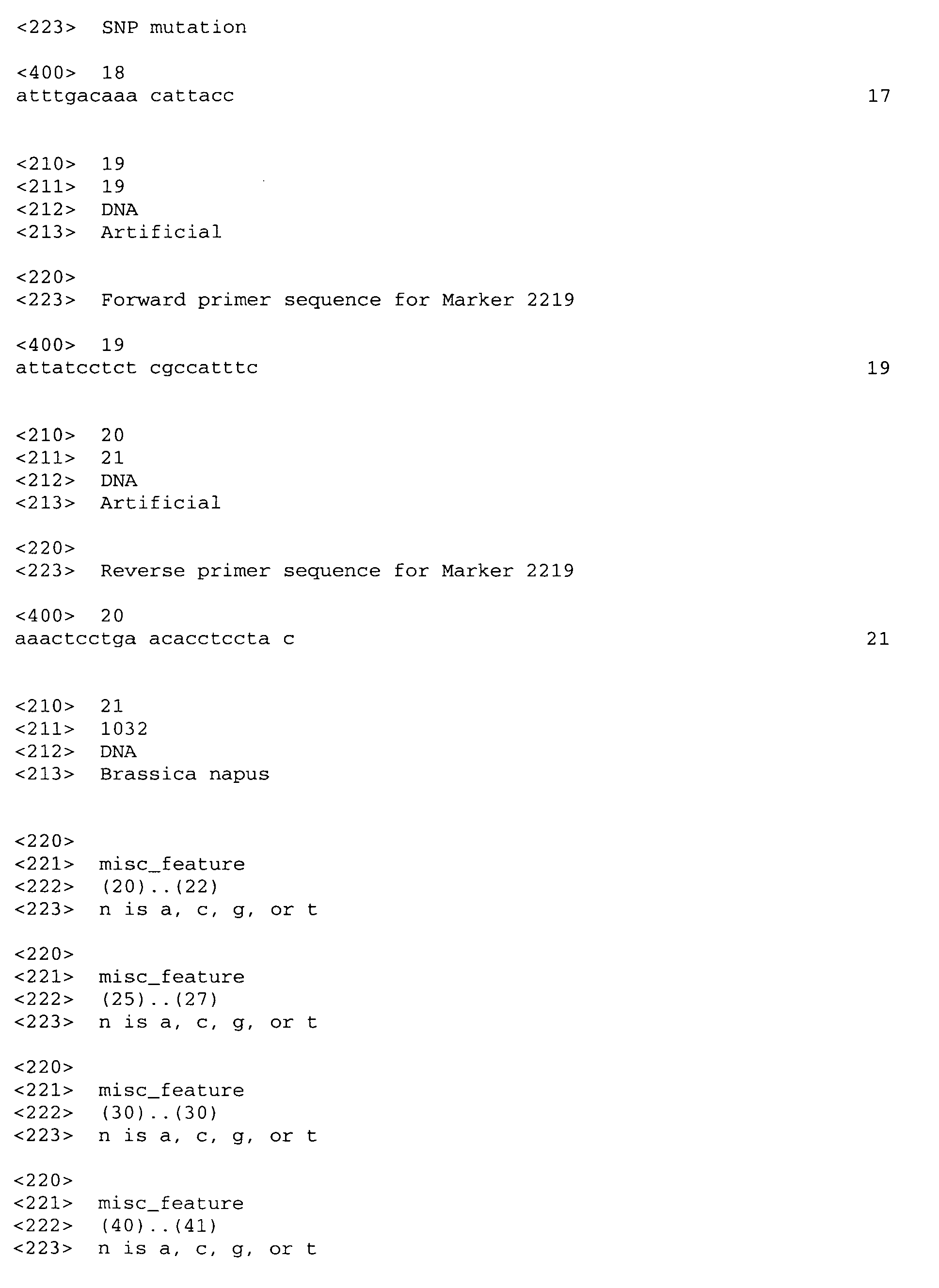
- Marker Sequence NR2219. Underlined are forward and reverse primers for the SSR amplification. The SSR itself is in bold letters.
-
Fig. 9:
-
- A: SNP Consensus Sequence 1 (SEO ID NO: 3)
- B: SNP Consensus Sequence 2 (SEQ ID NO: 6)
Presented are the consensus sequences of the fertile and sterile allels. Mutated areas are in (brackets) and present both the nucleotides for the fertile and the sterile haplotype (se examples for details). The bold letters at the 5'-end of Consensus Sequence 1 mark the 3'-end of the SSR repeat.
-
Fig. 10:
- TagMan Assay basic principle (from: Pre-Developed TaqMan® Assay Reagents Allelic Discrimination Protocol; Part Number 4312214 Rev. C 5/2005; Applied Biosystems)
DEFINITIONS
-
It is to be understood that this invention is not limited to the particular methodology, protocols, cell lines, plant species or genera, constructs, and reagents described as such. It is also to be understood that the terminology used herein is for the purpose of describing particular embodiments only, and is not intended to limit the scope of the present invention, which will be limited only by the appended claims. It must be noted that as used herein and in the appended claims, the singular forms "a," "and," and "the" include plural reference unless the context clearly dictates otherwise. Thus, for example, reference to "a plant" is a reference to one or more plants and includes equivalents thereof known to those skilled in the art, and so forth. As used herein, the word "or" means any one member of a particular list and also includes any combination of members of that list (i.e., includes also "and").
-
The term "about" is used herein to mean approximately, roughly, around, or in the region of. When the term "about" is used in conjunction with a numerical range, it modifies that range by extending the boundaries above and below the numerical values set forth. In general, the term "about" is used herein to modify a numerical value above and below the stated value by a variance of 20 percent, preferably 10 percent up or down (higher or lower). With regard to a temperature the term "about" means ± 1.0 °C, preferably ± 0.5°C. Where the term about is used in the context of this invention (e.g., in combinations with temperature or molecular weight values) the exact value (i.e., without "about") is preferred.
-
The term "allele(s)" means any of one or more alternative forms of a gene, all of which alleles relate to at least one trait or characteristic. In a diploid cell, the two alleles of a given gene occupy corresponding loci on a pair of homologous chromosomes. In some instances (e.g., for QTLs) it is more accurate to refer to "haplotype" (i.e. an allele of a chromosomal segment) in stead of "allele", however, in those instances, the term "allele" should be understood to comprise the term "haplotype". If two individuals possess the same allele at a particular locus, the alleles are termed "identical by descent" if the alleles were inherited from one common ancestor (i.e., the alleles are copies of the same parental allele). The alternative is that the alleles are "identical by state" (i.e., the alleles appear the same but are derived from two different copies of the allele). Identity by descent information is useful for linkage studies; both identity by descent and identity by state information can be used in association studies such as those described herein, although identity by descent information can be particularly useful.
-
The term "backcrossing" is understood within the scope of the invention to refer to a process in which a hybrid progeny is repeatedly crossed back to one of the parents
-
The term "Brassica", means the genus Brassica, very particularly the species napus (oilseed rape), campestris (beet), oleracea cv Tastie (cabbage), oleracea cv Snowball Y (cauliflower) and oleracea cv Emperor (broccoli).
-
The term "Brassica napus" or "oilseed rape" means plants, seeds, plant parts, cells of Brassica napus, and comprises the annual spring type, the biannual winter type, and the biannual intermediate type oilseed rape. Annual or biannual in this context indicates whether the variety if grown over the vegetative winter period. Generally, winter-type rapeseed is grown in North Western Europe, whereas spring-types are grown in Canada, China, India, Australia and South America mainly. Oilseed rape is derived from interspecific hybridization of B. oleracea and B. campestris. In consequence the term also comprises any re-synthesis conducted from these two species. One preferred spring-type oilseed rape is canola-type rapeseed. Representative winter rape varieties that include the genetic means for the expression of low glucosinolate content and that are commercially available in Europe, for example, include, CAPITOL, cv. CAMPALA, cv. CALIFORNIUM (available from Dekalb, brand of Monsanto), cv. LORENZ, cv. OASE (available from RAPOOL). Representative spring rape varieties that include the genetic means for the expression of low glucosinolate content and that are commercially available in Canada, for example, include cv. BULLET, cv. GARRISON and cv. KRISTANA (each available from Svalof Weibull). Other winter rape varieties that include the genetic means for the expression of low glucosinolate content and that are commercially available in Europe include cv. APEX, cv. NK FAIR, cv. VIKING, cv. BILLY, cv. LADOGA, and cv. CASTILLE. Such low levels of glucosinolates in the oilseed Brassica serve to impart increased commercial value to the meal.
-
The term "Brassica napus-specific DNA sequence" indicates a polynucleotide sequence having a nucleotide sequence homology of more than 80%, preferably more than 85%, more preferably more than 90%, even more preferably more than 95%, still more preferably more than 97%, most preferably more than 99% with a sequence of the genome of the species Brassica napus (or any of the two species Brassica napus was generated (synthesized) from namely Brassica rapa and Brassica oleracea) that shows the greatest similarity to it.
-
The term "Canola" means a Brassica napus yielding oil that contains less than 2% erucic acid, and the solid component of the seed must contain less than 30 micro-moles of any one or any mixture of 3-butenyl glucosinolate, 4-pentenyl glucosinolate, -hydroxy-3 butenyl glucosinolate, and 2-hydroxy-4-pentenyl glucosinolate per gram of air-dry, oil-free solid.
-
The term "chromosome" is used herein in its art-recognised meaning of the self-replicating genetic structure in the cellular nucleus containing the cellular DNA and bearing in its nucleotide sequence the linear array of genes.
-
The term "conditionally male sterile" means a phenotype of male sterility (i.e., an incapability to produce fertile pollen), which can be induced and/or repressed by certain conditions. In consequence, by said certain conditions a plant can be "switched" from a male sterile to a male fertile phenotype. Male sterility can be caused by various factors and can be expressed for example in a complete lack of male organs (anthers), degenerated pollen, infertile pollen etc. Based on the intensity of the condition the "switch" from male sterility or male fertility may be complete or incomplete. Most preferably in the context of the present invention the term "conditionally male sterile" means a temperature-dependent male sterile and thereby means a nuclear male sterile phenotype, wherein the sterility is temperature dependent and can be reverted to fertility at a temperature of more than 35°C (preferably between 35°C and 43°C, more preferably between 37°C and 40°C, most preferably at about 39°C; preferably with an exposure for the preferred heat treatment time as specified herein and a subsequent growing at ambient temperature, as defined herein).
-
A "gene" is defined herein as a hereditary unit consisting of a sequence of DNA that occupies a specific location on a chromosome and that contains the genetic instruction for a particular characteristics or trait in an organism.
-
"Genetic engineering", "transformation" and "genetic modification" are all used herein as synonyms for the transfer of isolated and cloned genes into the DNA, usually the chromosomal DNA or genome, of another organism.
-
The term "genotype" refers to the genetic constitution of a cell or organism. An individual's "genotype for a set of genetic markers" includes the specific alleles, for one or more genetic marker loci, present in the individual. As is known in the art, a genotype can relate to a single locus or to multiple loci, whether the loci are related or unrelated and/or are linked or unlinked. In some embodiments, an individual's genotype relates to one or more genes that are related in that the one or more of the genes are involved in the expression of a phenotype of interest (e.g., a quantitative trait as defined herein). Thus, in some embodiments a genotype comprises a summary of one or more alleles present within an individual at one or more genetic loci of a quantitative trait. In some embodiments, a genotype is expressed in terms of a haplotype (defined herein below).
-
The term "germplasm" refers to the totality of the genotypes of a population or other group of individuals (e.g., a species). The term "germplasm" can also refer to plant material; e.g., a group of plants that act as a repository for various alleles. The phrase "adapted germplasm" refers to plant materials of proven genetic superiority; e.g., for a given environment or geographical area, while the phrases "non-adapted germplasm," "raw germplasm," and "exotic germplasm" refer to plant materials of unknown or unproven genetic value; e.g., for a given environment or geographical area; as such, the phrase "non-adapted germplasm" refers in some embodiments to plant materials that are not part of an established breeding population and that do not have a known relationship to a member of the established breeding population.
-
The term "glucosinolates" means are sulfur-based compounds that remain in the solid component of the seed - the solid meal - after the seed has been ground and its oil has been extracted. Their structure includes glucose in combination with aliphatic hydrocarbons (3-butenyl glucosinolate, 4-pentenyl glucosinolate, 2-hydroxy-3-butenyl glucosinolate, and 2-hydroxy-4-pentenyl glucosinolate) or aromatic hydrocarbons (3-indoylmethyl glucosinolate, 1-methoxy-3-indoyl methyl glucosinolate). Aliphatic glucosinolates are also known as alkenyl glucosinolates. Aromatic glucosinolates are also known as indoles. The term "total glucosinolate content" means the sum of all glucosinolates comprised in the indicated material e.g., in the meal or the dry seed. Total glucosinolate content can be indicated in µmol (glucosinolates) per gram of seed (or air dry seed at for example 9% humidity) or meal.
-
The term "haplotype" refers to the set of alleles an individual inherited from one parent. A diploid individual thus has two haplotypes. The term "haplotype" can be used in a more limited sense to refer to physically linked and/or unlinked genetic markers (e.g., sequence polymorphisms) associated with a phenotypic trait. The phrase "haplotype block" (sometimes also referred to in the literature simply as a haplotype) refers to a group of two or more genetic markers that are physically linked on a single chromosome (or a portion thereof). Typically, each block has a few common haplotypes, and a subset of the genetic markers (i.e., a "haplotype tag") can be chosen that uniquely identifies each of these haplotypes.
-
The terms "homology", "sequence similarity' or "sequence identity" of nucleotide or amino acid sequences means a degree of identity or similarity of two or more sequences and may be determined conventionally by using known software or computer programs such as the BestFit or Gap pairwise comparison programs (GCG Wisconsin Package, Genetics Computer Group, 575 Science Drive, Madison, Wis. 53711). BestFit uses the local homology algorithm of Smith and Waterman, Advances in Applied Mathematics 2:482-489 (1981), to find the best segment of identity or similarity between two sequences. Sequence comparison between two or more polynucleotides or polyaminoacid sequences is generally performed by comparing portions of the two sequences over a comparison window to identify and compare local regions of sequence similarity. The comparison window is generally from about 20 to 200 contiguous nucleotides. Gap performs global alignments: all of one sequence with all of another similar sequence using the method of Needleman and Wunsch, J. Mol. Biol. 48:443-453 (1970). When using a sequence alignment program such as BestFit, to determine the degree of DNA sequence homology, similarity or identity, the default setting may be used, or an appropriate scoring matrix may be selected to optimize identity, similarity or homology scores. Similarly, when using a program such as BestFit to determine sequence identity, similarity or homology between two different amino acid sequences, the default settings may be used, or an appropriate scoring matrix, such as blosum45 or blosum80, may be selected to optimize identity, similarity or homology scores.
-
"Homologous recombination" is the exchange ("crossing over") of DNA fragments between two DNA molecules or chromatids of paired chromosomes over in a region of identical nucleotide sequences. A "recombination event" is herein understood to mean a meiotic crossing-over.
-
The term "heterozygous" means a genetic condition existing when different alleles reside at corresponding loci on homologous chromosomes.
-
The term "homozygous" means a genetic condition existing when identical alleles reside at corresponding loci on homologous chromosomes.
-
The term "hybrid", "hybrid plant," and "hybrid progeny" in the context of plant breeding refers to a plant that is the offspring of genetically dissimilar parents produced by crossing plants of different lines or breeds or species, including but not limited to the cross between two inbred lines (e.g., a genetically heterozygous or mostly heterozygous individual). The phrase "single cross F1 hybrid" refers to an F1 hybrid produced from a cross between two inbred lines.
-
The term "hybrid" in the context of nucleic acids refers to a double-stranded nucleic acid molecule, or duplex, formed by hydrogen bonding between complementary nucleotide bases. The terms "hybridise" or "anneal" refer to the process by which single strands of nucleic acid sequences form double-helical segments through hydrogen bonding between complementary bases.
-
The phrase "inbred line" refers to a genetically homozygous or nearly homozygous population. An inbred line, for example, can be derived through several cycles of brother/sister breedings or of selfing. In some embodiments, inbred lines breed true for one or more phenotypic traits of interest. An "inbred", "inbred individual", or "inbred progeny" is an individual sampled from an inbred line. The term "inbred" means a substantially homozygous individual or line.
-
The terms "introgression", "introgressed" and "introgressing" refer to both a natural and artificial process whereby genomic regions of one species, variety or cultivar are moved into the genome of another species, variety or cultivar, by crossing those species. The process may optionally be completed by backcrossing to the recurrent parent.
-
The term "linkage", and grammatical variants thereof, refers to the tendency of alleles at different loci on the same chromosome to segregate together more often than would be expected by chance if their transmission were independent, in some embodiments as a consequence of their physical proximity.
-
The phrase "linkage disequilibrium" (also called "allelic association") refers to a phenomenon wherein particular alleles at two or more loci tend to remain together in linkage groups when segregating from parents to offspring with a greater frequency than expected from their individual frequencies in a given population. For example, a genetic marker allele and a QTL allele can show linkage disequilibrium when they occur together with frequencies greater than those predicted from the individual allele frequencies. Linkage disequilibrium can occur for several reasons including, but not limited to the alleles being in close proximity on a chromosome
-
The term "linkage group" refers to all of the genes or genetic traits that are located on the same chromosome. Within the linkage group, those loci that are close enough together will exhibit linkage in genetic crosses. Since the probability of crossover increases with the physical distance between genes on a chromosome, genes whose locations are far removed from each other within a linkage group may not exhibit any detectable linkage in direct genetic tests. The term "linkage group" is mostly used to refer to genetic loci that exhibit linked behaviour in genetic systems where chromosomal assignments have not yet been made. Thus, in the present context, the term "linkage group" is synonymous to (the physical entity of) chromosome.
-
The term "locus" refers to a position (e.g., of a gene, a genetic marker, or the like) on a chromosome of a given species.
-
The terms "molecular marker" or "genetic marker" refer to an indicator that is used in methods for visualizing differences in characteristics of nucleic acid sequences. It refers to a feature of an individual's genome (e.g., a nucleotide or a polynucleotide sequence that is present in an individual's genome) that is associated with one or more loci of interest. In some embodiments, a genetic marker is polymorphic in a population of interest, or the locus occupied by the polymorphism, depending on context. Genetic markers include, for example, single nucleotide polymorphisms (SNPs), indels (i.e., insertions/deletions), simple sequence repeats (also named microsatellite markers; SSRs), restriction fragment length polymorphisms (RFLPs), random amplified polymorphic DNAs (RAPDs), cleaved amplified polymorphic sequence (CAPS) markers, Diversity Arrays Technology (DArT) markers, and amplified fragment length polymorphisms (AFLPs), among many other examples. Additional markers include insertion mutations, sequence- characterized amplified regions (SCARs), or isozyme markers or combinations of the markers described herein which defines a specific genetic and chromosomal location. Genetic markers can, for example, be used to locate genetic loci containing alleles that contribute to variability in expression of phenotypic traits on a chromosome. The phrase "genetic marker" can also refer to a polynucleotide sequence complementary to a genomic sequence, such as a sequence of a nucleic acid used as probes. A genetic marker can be physically located in a position on a chromosome that is within or outside of to the genetic locus with which it is associated (i.e., is intragenic or extragenic, respectively). Stated another way, whereas genetic markers are typically employed when the location on a chromosome of the gene that corresponds to the locus of interest has not been identified and there is a non-zero rate of recombination between the genetic marker and the locus of interest, the presently disclosed subject matter can also employ genetic markers that are physically within the boundaries of a genetic locus (e.g., inside a genomic sequence that corresponds to a gene such as, but not limited to a polymorphism within an intron or an exon of a gene). In some embodiments of the presently disclosed subject matter, the one or more genetic markers comprise between one and ten markers, and in some embodiments the one or more genetic markers comprise more than ten genetic markers.
-
The term "Marker-based selection" is understood within the scope of the invention to refer to the use of genetic markers to detect one or more nucleic acids from the plant, where the nucleic acid is associated with a desired trait to identify plants that carry genes for desirable (or undesirable) traits, so that those plants can be used (or avoided) in a selective breeding program.
-
The term "microsatellite or SSRs (simple sequence repeats) marker" is understood within the scope of the invention to refer to a type of genetic marker that consists of numerous repeats of short sequences of DNA bases, which are found at loci throughout the plant's DNA and have a likelihood of being highly polymorphic.
-
The phrase "nucleic acid" refers to any physical string of monomer units that can be corresponded to a string of nucleotides, including a polymer of nucleotides (e.g., a typical DNA or RNA polymer), modified oligonucleotides (e.g., oligonucleotides comprising bases that are not typical to biological RNA or DNA, such as 2'-O-methylated oligonucleotides), and the like. In some embodiments, a nucleic acid can be single-stranded, double-stranded, multi-stranded, or combinations thereof. Unless otherwise indicated, a particular nucleic acid sequence of the presently disclosed subject matter optionally comprises or encodes complementary sequences, in addition to any sequence explicitly indicated.
-
The phrase "phenotypic trait" refers to the appearance or other detectable characteristic of an individual, resulting from the interaction of its genome with the environment.
-
The term "plurality" refers to more than one. Thus, a "plurality of individuals" refers to at least two individuals. In some embodiments, the term plurality refers to more than half of the whole. For example, in some embodiments a "plurality of a population" refers to more than half the members of that population.
-
The term "progeny" refers to the descendant(s) of a particular cross. Typically, progeny result from breeding of two individuals, although some species (particularly some plants and hermaphroditic animals) can be selfed (i.e., the same plant acts as the donor of both male and female gametes). The descendant(s) can be, for example, of the F1, the F2, or any subsequent generation.
-
The phrase "qualitative trait" refers to a phenotypic trait that is controlled by one or a few genes that exhibit major phenotypic effects. Because of this, qualitative traits are typically simply inherited. Examples in plants include, but are not limited to, flower color, cob color, and disease resistance such as Northern corn leaf blight resistance.
-
"PCR (polymerase chain reaction)" is understood within the scope of the invention to refer to a method of producing relatively large amounts of specific regions of DNA, thereby making possible various analyses that are based on those regions.
-
"Phenotype" is understood within the scope of the invention to refer to a distinguishable characteristic(s) of a genetically controlled trait.
-
A "plant" is any plant at any stage of development, particularly a seed plant.
-
A "plant cell" is a structural and physiological unit of a plant, comprising a protoplast and a cell wall. The plant cell may be in form of an isolated single cell or a cultured cell, or as a part of higher organized unit such as, for example, plant tissue, a plant organ, or a whole plant.
-
"Plant cell culture" means cultures of plant units such as, for example, protoplasts, cell culture cells, cells in plant tissues, pollen, pollen tubes, ovules, embryo sacs, zygotes and embryos at various stages of development.
-
"Plant material" refers to leaves, stems, roots, flowers or flower parts, fruits, pollen, egg cells, zygotes, seeds, cuttings, cell or tissue cultures, or any other part or product of a plant.
-
A "plant organ" is a distinct and visibly structured and differentiated part of a plant such as a root, stem, leaf, flower bud, or embryo.
-
"Plant tissue" as used herein means a group of plant cells organized into a structural and functional unit. Any tissue of a plant in planta or in culture is included. This term includes, but is not limited to, whole plants, plant organs, plant seeds, tissue culture and any groups of plant cells organized into structural and/or functional units. The use of this term in conjunction with, or in the absence of, any specific type of plant tissue as listed above or otherwise embraced by this definition is not intended to be exclusive of any other type of plant tissue.
-
The term "plant part" indicates a part of a plant, including single cells and cell tissues such as plant cells that are intact in plants, cell clumps and tissue cultures from which plants can be regenerated. Examples of plant parts include, but are not limited to, single cells and tissues from pollen, ovules, leaves, embryos, roots, root tips, anthers, flowers, fruits, stems shoots, and seeds; as well as pollen, ovules, leaves, embryos, roots, root tips, anthers, flowers, fruits, stems, shoots, scions, rootstocks, seeds, protoplasts, calli, and the like.
-
"Polymorphism" is understood within the scope of the invention to refer to the presence in a population of two or more different forms of a gene, genetic marker, or inherited trait.
-
The term "population" means a genetically heterogeneous collection of plants sharing a common genetic derivation.
-
The term "predominately male sterile" means that means that in a population of at least 100 plants not more than 10 %, preferably 5 %, more preferably 1 % of the flowers on all of those plants have functional male organs producing fertile pollen. It has to be understood that an individual plant can have both fertile and sterile flowers.
-
Preferably, not more than 10 %, preferably 5 %, more preferably 1 % of the flowers on an individual plant have functional male organs producing fertile pollen.
-
The term "probe" refers to a single-stranded oligonucleotide sequence that will form a hydrogen-bonded duplex with a complementary sequence in a target nucleic acid sequence analyte or its cDNA derivative.
-
The term
"primer" as used herein refers to an oligonucleotide which is capable of annealing to the amplification target allowing a DNA polymerase to attach, thereby serving as a point of initiation of DNA synthesis when placed under conditions in which synthesis of primer extension product is induced, i.e., in the presence of nucleotides and an agent for polymerization such as DNA polymerase and at a suitable temperature and pH. The (amplification) primer is preferably single stranded for maximum efficiency in amplification. Preferably, the primer is an oligodeoxyribonucleotide. The primer must be sufficiently long to prime the synthesis of extension products in the presence of the agent for polymerization. The exact lengths of the primers will depend on many factors, including temperature and composition (A/T en G/C content) of primer. A pair of bi-directional primers consists of one forward and one reverse primer as commonly used in the art of DNA amplification such as in PCR amplification. It will be understood that "primer", as used herein, may refer to more than one primer, particularly in the case where there is some ambiguity in the information regarding the terminal sequence(s) of the target region to be amplified. Hence, a "primer" includes a collection of primer oligonucleotides containing sequences representing the possible variations in the sequence or includes nucleotides which allow a typical base pairing. The oligonucleotide primers may be prepared by any suitable method. Methods for preparing oligonucleotides of specific sequence are known in the art, and include, for example, cloning and restriction of appropriate sequences, and direct chemical synthesis. Chemical synthesis methods may include, for example, the phospho di- or tri-ester method, the diethylphosphoramidate method and the solid support method disclosed in e.g.
US 4,458,066 . The primers may be labeled, if desired, by incorporating means detectable by for instance spectroscopic, fluorescence, photochemical, biochemical, immunochemical, or chemical means. Template-dependent extension of the oligonucleotide primer(s) is catalyzed by a polymerizing agent in the presence of adequate amounts of the four deoxyribonucleotide triphosphates (dATP, dGTP, dCTP and dTTP, i.e. dNTPs) or analogues, in a reaction medium which is comprised of the appropriate salts, metal cations, and pH buffering system. Suitable polymerizing agents are enzymes known to catalyze primer- and template-dependent DNA synthesis. Known DNA polymerases include, for example, E. coli DNA polymerase I or its Klenow fragment, T4 DNA polymerase, and Taq DNA polymerase. The reaction conditions for catalyzing DNA synthesis with these DNA polymerases are known in the art. The products of the synthesis are duplex molecules consisting of the template strands and the primer extension strands, which include the target sequence. These products, in turn, serve as template for another round of replication. In the second round of replication, the primer extension strand of the first cycle is annealed with its complementary primer; synthesis yields a "short" product which is bound on both the 5'- and the 3'-ends by primer sequences or their complements. Repeated cycles of denaturation, primer annealing, and extension result in the exponential accumulation of the target region defined by the primers. Sufficient cycles are run to achieve the desired amount of polynucleotide containing the target region of nucleic acid. The desired amount may vary, and is determined by the function which the product polynucleotide is to serve. The PCR method is well described in handbooks and known to the skilled person. After amplification by PCR, the target polynucleotides may be detected by hybridization with a probe polynucleotide which forms a stable hybrid with that of the target sequence under stringent to moderately stringent hybridization and wash conditions. If it is expected that the probes will be essentially completely complementary (i.e., about 99% or greater) to the target sequence, stringent conditions will be used. If some mismatching is expected, for example if variant strains are expected with the result that the probe will not be completely complementary, the stringency of hybridization may be lessened. However, conditions are chosen which rule out nonspecific/adventitious binding. Conditions which affect hybridization, and which select against nonspecific binding are known in the art, and are described in, for example, Sambrook and Russell, 2001. Generally, lower salt concentration and higher temperature increase the stringency of hybridization conditions. "PCR primer" is preferably understood within the scope of the invention to refer to relatively short fragments of single-stranded DNA used in the PCR amplification of specific regions of DNA.
-
The term "offspring" plant refers to any plant resulting as progeny from a vegetative or sexual reproduction from one or more parent plants or descendants thereof. For instance an offspring plant may be obtained by cloning or selfing of a parent plant or by crossing two parent plants and include selfings as well as the F1 or F2 or still further generations. An F1 is a first-generation offspring produced from parents at least one of which is used for the first time as donor of a trait, while offspring of second generation (F2) or subsequent generations (F3, F4, etc.) are specimens produced from selfings of F1's, F2's etc. An FI may thus be (and usually is) a hybrid resulting from a cross between two true breeding parents (true-breeding is homozygous for a trait), while an F2 may be (and usually is) an offspring resulting from self-pollination of said FI hybrids.
-
"Recombination" is the exchange of information between two homologous chromosomes during meiosis. The frequency of double recombination is the product of the frequencies of the single recombinants. For instance, a recombinant in a 10 cM area can be found with a frequency of 10%, and double recombinants are found with a frequency of 10% x 10% = 1 % (1 centimorgan is defined as 1% recombinant progeny in a testcross).
-
The term "RHS" or "restored hybrid system" means the nuclear male sterility based hybrid system of this invention.
-
The phrases "sexually crossed" and "sexual reproduction" in the context of the presently disclosed subject matter refers to the fusion of gametes to produce progeny (e.g., by fertilization, such as to produce seed by pollination in plants). A "sexual cross" or "cross-fertilization" is in some embodiments fertilization of one individual by another (e.g., cross-pollination in plants). The term "selfing" refers in some embodiments to the production of seed by self-fertilization or self-pollination; i.e., pollen and ovule are from the same plant.
-
"Selective breeding" is understood within the scope of the invention to refer to a program of breeding that uses plants that possess or display desirable traits as parents.
-
The terms "stringent conditions" or "stringent hybridization conditions" includes reference to conditions under which a polynucleotide will hybridize to its target sequence, to a detectably greater degree than other sequences (e.g., at least 2-fold over background). Stringent conditions are sequence-dependent and will be different in different circumstances. By controlling the stringency of the hybridization and/or washing conditions, target sequences can be identified which are 100% complementary to the probe (homologous probing). Alternatively, stringency conditions can be adjusted to allow some mismatching in sequences so that lower degrees of similarity are detected (heterologous probing). Typically, stringent conditions will be those in which the salt concentration is less than approximately 1.5 M Na ion, typically about 0.01 to 1.0 M Na ion (or other salts) at pH 7.0 to 8.3 and the temperature is at least about 30° C. for short probes (e.g., 10 to 50 nucleotides) and at least about 60° C. for long probes (e.g., greater than 50 nucleotides). Stringent conditions also may be achieved with the addition of destabilizing agents such as formamide. Exemplary low stringency conditions include hybridization with a buffer solution of 30 to 35% formamide, 1 M NaCl, 1% SDS (w/v; sodium dodecyl sulphate) at 37° C., and a wash in 1 x to 2xSSC (20xSSC=3.0 M NaCl/0.3 M trisodium citrate) at 50 to 55° C. Exemplary moderate stringency conditions include hybridization in 40 to 45% formamide, 1 M NaCl, 1% SDS at 37° C., and a wash in 0.5x to 1×SSC at 55 to 60° C. Exemplary high stringency conditions include hybridization in 50% formamide, 1 M NaCl, 1% SDS at 37°C, and a wash in 0.1 xSSC at 60 to 65° C. Specificity is typically the function of post-hybridization washes, the critical factors being the ionic strength and temperature of the final wash solution. For DNA-DNA hybrids, the Tm can be approximated from the equation of Meinkoth and Wahl (Anal. Biochem., 138:267-284, 1984): Tm=81.5° C+16.6 (log M)+0.41 (% GC)-0.61 (% form)-500/L; where M is the molari monovalent cations, % GC is the percentage of guanosine and cytosine nucleotides in the DNA, % form is the percentage of formamide in the hybridization solution, and L is the length of the hybrid in base pairs. The Tm is the temperature (under defined ionic strength and pH) at which 50% of a complementary target sequence hybridizes to a perfectly matched probe. Tm is reduced by about 1°C. for each 1% of mismatching; thus, Tm, hybridization and/or wash conditions can be adjusted to hybridize to sequences of the desired identity. For example, if sequences with approximately 90% identity are sought, the Tm can be decreased 10° C. Generally, stringent conditions are selected to be about 5° C. lower than the thermal melting point (Tm) for the specific sequence and its complement at a defined ionic strength and pH. However, severely stringent conditions can utilize hybridization and/or wash at 1, 2, 3, or 4° C lower than the thermal melting point (Tm); moderately stringent conditions can utilize a hybridization and/or wash at 6, 7, 8, 9, or 10° C. lower than the thermal melting point (Tm); low stringency conditions can utilize a hybridization and/or wash at 11, 12, 13, 14, 15, or 20° C lower than the thermal melting point (Tm). Using the equation, hybridization and wash compositions, and desired Tm, those of ordinary skill will understand that variations in the stringency of hybridization and/or wash solutions are inherently described. If the desired degree of mismatching results in a Tm of less than 45° C (aqueous solution) or 32° C (formamide solution), it is preferred to increase the SSC concentration so that a higher temperature can be used. An extensive guide to the hybridization of nucleic acids is found in Tijssen, Laboratory Techniques in Biochemistry and Molecular Biology-Hybridization with Nucleic Acid Probes, Part I, ); and Current Protocols in Molecular Biology, ). Methods of stringent hybridization are known in the art which conditions can be calculated by means known in the art. This is disclosed in Sambrook et al., Molecular Cloning: A Laboratory Manual, 2nd Ed., Cold Spring Harbor Laboratory Press, 1989, Cold Spring Harbor, N.Y. and Current Protocols in Molecular Biology, Ausebel et al, eds., John Wiley and Sons, Inc., 2000. Methods of determining percent sequence identity are known in the art, an example of which is the GCG computer sequence analysis software (GCG, Inc, Madison Wis.).
-
"Tester plant" is understood within the scope of the invention to refer to a plant used to characterize genetically a trait in a plant to be tested. Typically, the plant to be tested is crossed with a "tester" plant and the segregation ratio of the trait in the progeny of the cross is scored.
-
The term "tester" refers to a line or individual with a standard genotype, known characteristics, and established performance. A "tester parent" is an individual from a tester line that is used as a parent in a sexual cross. Typically, the tester parent is unrelated to and genetically different from the individual to which it is crossed. A tester is typically used to generate F1 progeny when crossed to individuals or inbred lines for phenotypic evaluation.
-
The phrase "topcross combination" refers to the process of crossing a single tester line to multiple lines. The purpose of producing such crosses is to determine phenotypic performance of hybrid progeny; that is, to evaluate the ability of each of the multiple lines to produce desirable phenotypes in hybrid progeny derived from the line by the tester cross.
-
The term "variety" or "cultivar" means a group of similar plants that by structural or genetic features and/or performance can be distinguished from other varieties within the same species.
DETAILED DESCRIPTION OF THE INVENTION
-
The invention provides a commercially viable system for the production of hybrid seed of Brassica napus. This system employs a dominant nuclear male sterility gene. Fertility can be restored by a dominant restorer allele. The inventive contributions comprise but are not limited to:
- 1. Providing a conditionally nuclear male sterile line, which comprises the male sterility gene in a homozygous form (genotype MsMsrfrf). The provision of this line is possible by the provision of a genetic marker for the male sterility gene as part of this invention.
- 2. Providing a method to propagate the conditionally male sterile line in an unchanged form by inducing fertility via a specific heat-treatment.
- 3. Providing a Brassica napus maintainer line, which neither comprises the nuclear male sterility gene nor a functional copy of the restorer allele (genotype msmsrfrf).
-
Since propagation of the female line in all hybrid systems is the major quantity limiting and costly step, the current system provides the female line in a 2-step procedure: First, it was found that the present system is an environmental sensitive nuclear male sterility (enms) system. Although most of these systems are commercially not viable, because sterility can be accidentally lost under field growing conditions, the current system can be switched on and off by a high temperature treatment, which is unlikely to occur under conditions where rapeseed in normally grown. Utilization of this system provides sufficient amounts of the prebasic female by an inventive selfing procedure utilizing the enms properties.
-
In a second step the prebasic female is crossed with the maintainer line (msmsrfrf) to yield of a sterile basic female comprising the male sterility gene in a heterozygous form (genotype Msmsrfrf).
-
It is an special advantage of the hybrid system of this invention, that virtually every available rapeseed line is comprising a function restorer allele and can be used a male line to be combined with the female line to produce hybrid seed.
-
One of the most hindering difficulties in providing a commercially feasible nuclear male sterility hybrid system is the propagation and multiplication of the female plant. In most systems only propagation starting from of a plant heterozygous for the Ms allele is feasible. This leads to the need of extracting all those plants which in consequence of the selfing lack the Ms allele entirely. It is those advantageous to provide a conditional sterile system, wherein the fertility/sterility can be switched on/off based on a factor which is not present under normal growing conditions and wherein the distribution of fertility/sterility is nearly complete. No such system, which is commercially feasible, has been described so far.
-
Although, the genetics of the hybrid system of the present invention were isolated from lines, which could not be clearly linked to a Takagi germplasm, there are some phenotypic indications to assume at least a similarity of the genetics. However, the original Takagi lines are not readily available so a detailed comparison was not possible to perform. Even if the genetics in the Takagi germplasm would be identical to the one described herein, neither the original disclosure by Takagi nor the related subsequent work of Theis provide an enabling disclosure for the invention described hereunder. Without understanding the exact genetic of a hybrid system its reduction to a commercially viable process is not feasible. Theis describes the Takagi system as follows: Male sterile plants were only present, if plants homozygote to the recessive male sterility (ms) gene also comprised the modifying gene (md) non-homozygote recessive. In consequence Theis is postulating a recessive male sterility gene and a dominant modifier gene. However, the findings by the inventors are completely different: Separation of the two genes underlying the Takagi system, which became possible by the provision of markers, demonstrated a dominant male sterility gene (Ms) gene and a recessive restorer allele (rf allele). Restoration of fertility is possible by a dominant restorer allele (Rf allele), which is present in all non-Takagi based lines (virtually all publicly Brassica napus lines). Obviously, Theis never segregated the two genes nor did he provide lines, which were homozygote for the genes (as demonstrated by the segregation patters in his crossing experiments). The gene which Theis wrongly named the ms allele is as demonstrated in the context of this invention not able as such to provide a male sterile phenotype. In contrast, it is only the inactive form of a restorer allele (rf). The gene which Theis named the modifying gene is in fact the male sterility gene. This is not surprising based on the fact that without markers such segregation analysis can be very troublesome. Other phenotypic properties linked to the Ms allele are not suitable to differentiate between heterozygous and homozygous form. In consequence, Theis is providing misleading information which would have precluded the person skilled in the art from developing a commercially viable hybrid system. Furthermore, a recessive male sterility gene is linked to many difficulties in a commercial hybrid system. Also from this angle Theis is teaching away from a commercial application of the Takagi system.
-
Furthermore, providing a homozygous male sterile line would still not lead to a commercially viable system. Two important problems needed to be solved: First, the problem of propagation of the homozygous ms line, which renders all other nuclear male sterility systems known until today commercially non-viable. A second the problem of up-scaling to a commercial scale. The problem of propagation of the homozygous ms line (prebasic female) has been solved by the system of the invention by providing an conditionally, heat-inducible refertilization procedure. This procedure allows for an easy propagation of the prebasic line.
-
Although, the prebasic female can principally be directly employed as a female for the production of hybrid seed, the heat treatment procedure would not be suitable to provide quantities of said line to provide sufficient quantities. Therefore, the method of the invention employs an up-scaling step, in which the conditionally male sterile line is crossed with a maintainer line to provide again male sterile seed. This seed is heterogeneous for the male sterility gene, but has still the conditionally male sterile phenotype. This propagation has only become possible by providing a maintainer line, which does have neither a functional ms allele nor a functional restorer allele. This up-scaling procedure is required for a commercially viable system.
-
Interestingly and being a special inventive and advantageous feature of the invention, the fertility restorer allele is present in all non-Takagi lines i.e. in virtually all available Brassica napus lines. This is beneficial because this means that virtually all lines can be used as male lines in the hybrid seed production process, without the need to introgress a restorer allele. This is a significant advantage in comparison to for example the Ogura system and it is a striking similarity to the NPZ MSL system, which genetic is publicly unknown.
1. Method of providing the prebasic female plant and seed
-
A first embodiment of the inventions relates to a method of producing or multiplying seed of a conditionally (high temperature modulated) male sterile Brassica napus line with the genotype MsMsrfrf (suitable as pre-basic female for the production of Brassica napus hybrid seed), said method comprising the steps of
- a) providing a Brassica napus plant with the genotype MsMsrfrf, which genotype is present in the Brassica napus seed deposited under Deposit Number NCIMB 41480, wherein said Brassica napus plant is
- i. homozygous for the male sterility gene (Ms allele) obtainable from the Brassica napus seed deposited under Deposit Number NCIMB 41480, and
- ii. homozygous for the maintainer allele (dysfunctional restorer allele; rf allele) obtainable from the Brassica napus seed deposited under Deposit Number NCIMB 41480 or 4148, and
- ii. predominantly male sterile when exposed before and/or during flowering to a temperature of less than 28°C (preferably less than 25°C, more preferably less than 20°C, but at least at a temperature, which allows for normal growing such as at least 12°C, preferably at least 14°C, more preferably at least 16°C), and
- iii. reverting to a predominantly male fertile phenotype when exposed before and/or during flowering to a temperature of higher than 35°C (preferably between 35°C and 43°C, more preferably between 37°C and 40°C, most preferably at about 39°C; preferably with an exposure for the preferred heat treatment time as specified below (e.g., step b) and a subsequent growing at ambient temperature, as defined below (e.g., step c)), and
- b) exposing said Brassica napus plant before and/or during flowering for at least 4 hours (preferably at least 8 or 12 hours, more preferably at least 24 or 36 hours, even more preferably at least 48 or 96 hours, most preferably at least 112 hours,) to a temperature of about 35°C to about 43 °C (preferably about 36 to about 42°C, more preferably about 37°C to about 41 °C, even more preferably about 38 to about 40°C, most preferably about 39°C), and
- c) exposing said heat-treated Brassica napus plant to a temperature of less than 33°C (preferably less than 30°C, more preferably less than 28°C, even more preferably at a temperature between 16 and 25°C, most preferably between 18 and 20°C) until development of male fertile flowers, and
- d) allowing for self pollination of said Brassica napus plants with said male fertile flowers, letting the seed develop, and harvesting the seed of said conditionally male sterile Brassica napus line with the genotype MsMsrfrf.
-
The term "genotype MsMsrfrf" means that a plant homozygous for the dominant Ms allele and homozygous for the recessive maintainer allele (dysfunctional restorer allele; rf allele). This genotype might be present in any genetic background of a Brassica plant, preferably a Brassica napus plant, with the provision that no copy a functional restorer allele (Rf allele) is present.
-
The Brassica napus plant homozygous for the Ms allele represents a contribution of this invention. Thus, another embodiment of the invention relates to a conditionally male sterile Brassica napus plant with the genotype MsMsrfrf, which genotype is obtainable from the Brassica napus seed deposited under Deposit Number NCIMB 41480, wherein said female Brassica napus plant is
- i. homozygous for the male sterility gene (Ms allele) obtainable from the Brassica napus seed deposited under Deposit Number NCIMB 41480, and
- ii. homozygous to the maintainer allele (dysfunctional restorer allele; rf allele) obtainable from the Brassica napus seed deposited under Deposit Number NCIMB 41480 or 41481, and
- iii. predominantly male sterile when exposed before and/or during flowering to a temperature of less than 28°C (preferably less than 25°C, more preferably less than 20°C, but at least at a temperature, which allows for normal growing such as at least 12°C, preferably at least 14°C, more preferably at least 16°C), and
- iv. reverting to a predominantly male fertile phenotype when exposed before and/or during flowering to a temperature of higher than 35°C (preferably between 35°C and 43°C, more preferably between 37°C and 40°C, most preferably at about 39°C; preferably with an exposure for the preferred heat treatment time as specified herein and a subsequent growing at ambient temperature, as defined herein).
-
Preferably, said plant is obtainable from the seed produced by the method for the production of prebasic female seed of the invention. Another embodiment relates to seed, which grow said conditionally male sterile Brassica napus plant with the genotype MsMsrfrf, parts of said plant, and the use of said plant in a hybrid seed production process. Preferably, the genetic background of said plant is not a hybrid, more preferably it is an inbred Brassica napus line. Preferably said part is selected from the group comprising seeds, microspores, protoplasts, cells, ovules, pollen, vegetative parts, cotyledons, zygotes.
-
The pre-basic male sterile line of the invention preferably has a total glucosinolate content of not more than 50 µmol per gram of air-dry seed at 9% humidity (less than 40 µmol, more preferably between 5 and 35 µmol, most preferably between 10 and 25 µmol per gram). It has to be noted that the heat-treatment utilized in the propagation of the prebasic female under heat-chamber conditions increases the glucosinolate content to level which in some cases increase 30 µmol per gram. However, this is not based on the genetics of the line but the environmental stress and the glucosinolate levels in the grain yielded from the hybrid plants of the invention (F2 seed) are at commercial levels (having a total glucosinolate content of not more than 25 µmol per gram of air-dry seed at 9% humidity (preferably between 1 and 22 µmol, more preferably between 5 and 20 µmol, most preferably between 8 and 17 µmol per gram)
1.1 The Ms allele, its associated phenotype and marker
-
The term "obtainable" with regard to a deposit made under the Budapest treaty regulations and referring to the Ms, Rf, ms, rf allele or any genotype comprising a combination thereof means that these genes or genotypes can be obtained from said deposited material but can also be obtained from other material. The sequence of the genes obtained from other material may vary from the sequence of the gene in the deposited material ("variant"). Thus the term "Ms allele" comprises the gene obtainable from the deposited material but also the variants thereof. Accordingly, in one preferred embodiment of the invention the Ms allele is the Ms allele present in the seed deposited under Deposit Number NCIMB 41480 or a genetic variant thereof, which refers essentially the same phenotype than the Ms allele present in the seed deposited under Deposit Number NCIMB 41480. "Essentially the same phenotype" means the property to refer a conditionally (preferably a high temperature modulate) nuclear male sterile phenotype.
-
Preferably, if obtained from other sources the origin of said other source is the mutated line provided by Takagi (1970). It has to be understood that although the Ms allele is obtainable from the Brassica napus seed deposited under Deposit Number NCIMB 41480 other sources may exist from which said Ms allele can be obtained (in identical or varying form). Identity and/or similarity of the genes and genotypes provided in the context of this invention (whether obtained from the deposit or from other sources) can be demonstrated by one or more of the properties linked to said genes or genotypes described below.
-
The most characteristic and unique property of the Ms allele utilized in the context of this invention is the fact that fertility can be restored by virtually any available Brassica napus line publicly available (other than lines resulting from a Takagi germplasm) but not by the maintainer line for which seeds are deposited under Deposit Number NCIMB 41481. The maintainer line comprises the maintainer allele (dysfunctional restorer allele) in a homozygous form (rfrf) while a "normal" Brassica napus plant comprises the restorer in a functional form (RfRf). Other than a germplasm derived from the Takagi germplasm there are no known lines which would not comprise at least one functional copy of the Rf allele. In consequence virtually all available rapeseed lines at the date of the invention are found to be restorer lines. The combination of the two genes Ms and rf, which presumably present a double mutation in the Takagi germplasm, only together result in a functional hybrid system. This also means that by the deposited material the presence of the Ms or the rf allele can be easily determined. A male sterile line based on the Ms allele can be "maintained" in its male sterile phenotype by crossing with the maintainer line for which seeds are deposited under Deposit Number NCIMB 41481 but can be reverted to fertility by crossing of any restorer line (for examples see below).
-
In consequence the Ms allele is linked to a male sterile phenotype which can be restored (at least in part of the following generation) to fertility by any plant comprising at least one dominant Rf allele (Restorer plants) but not by the plants derived from seed deposited under Deposit Number NCIMB 41481 (maintainer). Thus, preferably, the Ms allele is characterized by referring a nuclear male sterile phenotype, which
- a) is restored temporarily to fertility by an exposure to a temperature of higher than 35°C (preferably between 35°C and 43°C, more preferably between 37°C and 40°C, most preferably at about 39°C; preferably with an exposure for the preferred heat treatment time as specified herein and a subsequent growing at ambient temperature, as defined herein),
- b) is restored to fertility in at least part of the F1 plants obtained from crossing a plant with the genotype MsMsrfrf or Msmsrfrf with any Brassica napus plant comprising at least one dominant Rf allele (or in all F1 plants obtained from crossing a plant with the genotype MsMsrfrf or Msmsrfrf with a Brassica napus plant homozygous for the Rf allele; i.e. with the genotype RfRf), and
- c) is maintained in the F1 plants obtained from crossing a plant with the genotype MsMsrfrf (e.g., a plant with a male sterile phenotype referred by said Ms allele) with the plants derived from seed deposited under Deposit Number NCIMB 41481.
-
A temporarily restoration of fertility means that only the flowers induced during the high temperature treatment develop into male fertile flowers but that flowers induced either before or thereafter develop only into male sterile flowers, even if developing on the same plant. Thus, as the high temperature treatment is temporary, also the fertility restoration is temporary and correlates with the duration and length of the high temperature treatment.
-
Thus by crossing a male sterile plant with
- a) any fertile, inbred Brassica napus plant comprising at least one Rf allele, preferably being homozygous for the Rf allele (Restorer plant) and
- b) the plants derived from seed deposited under Deposit Number NCIMB 41481 the presence or absence of the Ms allele can be unambiguously identified.
-
"Restorer plants" or "Restorer line" means any fertile, inbred Brassica napus plant comprising at least one Rf allele, preferably being homozygous for the Rf allele. Restorer plants include all fertile, inbred (open-pollinated, non-hybrid) Brassica napus lines commercialized as seed for growing, preferably at the priority date of this invention. No exception has been found by the inventors. Suitable Restorer lines also include those on the OECD variety list of December 2006 (OECD List of varieties eligible for certification - 2006/2007; Dec. 2006;
http://www.oecd.org/dataoecd/1/44/33999447. PDF;
http://www.oecd.org/document/14/0,2340,en_2649_33909_2485070_1_1_1_1,00.htm I), preferably non-hybrid lines commercialized as seed for growing (for oil production), more preferably those, which are not marked as d (inbred as long as they represent hybrid parental lines) or b (hybrid) on said OECD list.
-
While this property is unique to the hybrid system provided hereunder there are other properties which are linked to or associated with the Ms allele. In a preferred embodiment of the invention the conditionally male sterile phenotype and/or the Ms allele is linked to and/or associated with one or more of the characteristics selected from the group consisting of
- I. a phenotype of bud abortion in a plant with a male sterile phenotype referred by the Ms allele,
- II. a phenotype of white-striped or white blotched petals in a plant with a male sterile phenotype referred by the Ms allele,
- III. a Ms allele marker in both fertile and sterile plants comprising at least one copy of the Ms allele.
-
In another preferred embodiment of the invention the conditionally male sterile phenotype and/or the Ms allele is linked to and/or associated with one or more of the marker (Ms allele marker) selected from the group ("MS gene marker group") consisting of
- I. the markers selected from the group of polymorphisms (mutations) in the NR1116 markers region consisting of
- a) the single nucleotide polymorphism marker having an A at the position corresponding to position 85 in SEQ ID NO:3,
- b) the single nucleotide polymorphism marker having a G at the position corresponding to position 87 in SEQ ID NO:3,
- c) the single nucleotide polymorphism marker having an A at the position corresponding to position 139 in SEQ ID NO:3,
- d) the single nucleotide polymorphism marker C at the position corresponding to position 214 in SEQ ID NO:3,
- e) the single nucleotide polymorphism marker having a G at the position corresponding to position 218 in SEQ ID NO:3,
- f) the single nucleotide polymorphism marker having a G at the position corresponding to position 277 in SEQ ID NO:3,
- g) the single nucleotide polymorphism marker having an A at the position corresponding to position 286 in SEQ ID NO:3,
- h) the single nucleotide polymorphism marker having a T at the position corresponding to position 312 in SEQ ID NO:3,
- i) the single nucleotide polymorphism marker having a T at the position corresponding to position 319 in SEQ ID NO:3,
- j) the single nucleotide polymorphism marker C at the position corresponding to position 359 in SEQ ID NO:3,
- k) the deletion mutation 5'- TTGGTGAACAATC -3' at the position corresponding to 221 in SEQ ID NO:3
- l) the insertion mutation 5'- GAA -3' at the position corresponding to 328-330 in SEQ ID NO:3
- II. the markers selected from the group of polymorphisms (mutations) in the NR2525 markers region consisting of
- a) the single nucleotide polymorphism marker having a A at the position corresponding to position 60 in SEQ ID NO: 6,
- b) the single nucleotide polymorphism marker having a T at the position corresponding to position 92 in SEQ ID NO:6,
- c) the single nucleotide polymorphism marker having a T at the position corresponding to position 105 in SEQ ID NO: 6,
- d) the single nucleotide polymorphism marker C at the position corresponding to position 158 in SEQ ID NO: 6,
- e) the single nucleotide polymorphism marker having a T at the position corresponding to position 431 in SEQ ID NO: 6,
- f) the single nucleotide deletion mutation at the position corresponding to position 82 in SEQ ID NO: 6,
- g) the deletion mutation 5'- TGAGCAAAA -3' at the position corresponding to position 17 to 25 in SEQ ID NO:6,
- III. the markers selecting from the group of SNP markers consisting of
- a) a positive signal in a SNP assay (preferably a TaqMan® based SNP assay) using a SNP-probe (SNP-Probe 1) comprising the nucleotide sequence described by SEQ ID NO: 12 (sterile allele specific probe HiNK6701) and a negative signal using a SNP-probe (SNP-Probe 2) comprising the nucleotide sequence described by SEQ ID NO: 11 (fertile allele specific probe HiNK6700),
- b) a positive signal in a SNP assay (preferably a TaqMan® based SNP assay) using a SNP-probe (SNP-Probe 3) comprising the nucleotide sequence described by SEQ ID NO: 17 (sterile allele specific probe HiNK6775) and a negative signal using a SNP-probe (SNP-Probe 3) comprising the nucleotide sequence described by SEQ ID NO: 18 (fertile allele specific probe HiNK6776),
- IV. the markers selected from the group of SSR markers consisting of:
- a) a PCR fragment with an apparent molecular weight of 96.7 (+/- 1.0) bp resulting from a PCR reaction with the primer pair SEQ ID NO: 1 and 2
- b) a PCR fragment with an apparent molecular weight of 192.8 (+/- 0.3) bp resulting from a PCR reaction with the primer pair SEQ ID NO: 4 and 5
-
Preferably, there are at last 1, 2, 3, 4, 5 , 6, 7, 8, 9, 10, 11, or 12 of the mutations of group I., more preferably at least the mutations at the position corresponding to position 214 (T/C) and 218 (T/G) in SEQ ID NO: 3. Preferably, there are at last 1, 2, 3, 4, 5 , 6, or 7 of the mutations of group II., more preferably at least the mutations at the position corresponding to position 158 in SEQ ID NO: 6.
-
The term "SNP" or "single nucleotide polymorphism" means a nucleotide (preferably a DNA) sequence variation occurring when a single nucleotide (preferably A, T, C, or G) in preferably the genome (or other shared sequence) differs between members of a species or between paired chromosomes or alleles in an individual. For example, two sequenced DNA fragments from different individuals, AAGCCTA to AAGCTTA, contain a difference in a single nucleotide. In this case one can say that there are two alleles : C and T. Single nucleotide polymorphisms may fall within coding sequences of genes, noncoding regions of genes, or in the intergenic regions between genes. SNP's within a coding sequence may not necessarily change the amino acid sequence of the protein that is produced, due to degeneracy of the genetic code.
-
A SNP in which both forms lead to the same polypeptide sequence is termed synonymous (sometimes called a silent mutation) - if a different polypeptide sequence is produced they are non-synonymous. SNP's that are not in protein coding regions may still have consequences for gene splicing, transcription factor binding, or the sequence of non-coding RNA. However, a SNP may have as such no functional relevancy at all but might be only "linked" or associated with a certain phenotype and/or genotype (i.e., segregates with a certain probability with said genotype and/or phenotype). The term "SNP-probe" means a probe which is suitable to detect a SNP, more preferably a labeled probe, suitable for automated detected (as described below).
-
The phrase "position corresponding to position X in SEQ ID NO: Y" indicates the sequence described by SEO ID NO: Y is a consensus sequence. The corresponding sequence in a concrete plant (in which the presence or absence of the SNP is to be detected) will be (in most cases) different to said consensus sequence. However, in a preferred embodiment the sequence identity in an alignment of said consensus sequence to said sequence in said concrete plant can be aligned. Sequence alignment means is a way of arranging the primary sequences of nucleotides (e.g., DNA) to identify regions of similarity that may be a consequence of functional, structural, or evolutionary relationships between the sequences. Aligned sequences of nucleotide residues are typically represented as rows within a matrix. Gaps are inserted between the residues so that residues with identical or similar characters are aligned in successive columns. A sequence alignment can be produced for example by the ClustalW or BLAST program. If two sequences in an alignment share a common ancestor, mismatches can be interpreted as point mutations and gaps as indels (that is, insertion or deletion mutations) introduced in one or both lineages in the time since they diverged from one another. Accordingly, the sequence in said concrete plant may differ in consequence of deletion and mutations in length to the consensus sequence. In consequence, also the absolute position of a specific SNP (as measured from the start of the sequence) may differ. However, when aligned in a proper way those positions are still matched with each other. The phrase "position corresponding to position X in SEQ ID NO: Y" indicates this fact and thus means that - although in the sequence as obtained from a concrete plant - the absolute position might be different, in the alignment to the consensus sequence ("Y") it would still match the indicated position (X").
-
The term "SNP assay" means any of the methods known in the art which is suitable to detect or visualize a single nucleotide polymorphism. These methods can be forex-ample based on hybridization. Several applications have been developed that interrogate SNPs by hybridizing complementary DNA probes to the SNP site (Rapley & Harbron 2004). Such methods include Dynamic allele-specific hybridization (DASH). Other methods for SNP detection include the use of molecular beacons that make use of a specifically engineered single-stranded oligonucleotide probe comprising a fluorophore and a fluorescence quencher (Abravaya et al. 2003). SNPs can also be detected by high density oligonucleotide SNP arrays comprising hundreds of thousands of probes are arrayed on a small chip, allowing for a large number of SNPs to be interrogated simultaneously (Rapley & Harbron 2004). Furthermore, a broad range of enzymes including DNA ligase, DNA polymerase and nucleases have been employed to generate high-fidelity SNP genotyping methods. Another method is based on restriction fragment length polymorphism (RFLP). Various SNP detection methods based on PCR have been developed. Such methods include the tetra-primer ARMS-PCR, which employs two pairs of primers to amplify two alleles in one PCR reaction. Flap endonuclease (FEN) is an endonuclease that catalyzes structure-specific cleavage. This cleavage is highly sensitive to mismatches and can be used to interrogate SNPs with a high degree of specificity (Olivier 2005). In the basic Invader assay, a FEN called cleavase is combined with two specific oligonucleotide probes, that together with the target DNA, can form a tripartite structure recognized by cleavase (Olivier 2005).
-
Primer extension is a two step process that first involves the hybridization of a probe to the bases immediately upstream of the SNP nucleotide followed by a 'mini-sequencing' reaction, in which DNA polymerase extends the hybridized primer by adding a base that is complementary to the SNP nucleotide. This incorporated base is detected and determines the SNP allele (Syvanen 2001; Rapley & Harbron 2004). Illumina Incorporated's Infinium assay is an example of a whole-genome genotyping pipeline that is based on primer extension method. In the Infinium assay, over 100,000 SNPs can be genotyped. The assay uses hapten-labelled nucleotides in a primer extension reaction (Gunderson et al. 2006). Oligonucleotide ligase assay utilizes DNA ligase, which catalyzes the ligation of the 3' end of a DNA fragment to the 5' end of a directly adjacent DNA fragment. This mechanism can be used to interrogate a SNP by hybridizing two probes directly over the SNP polymorphic site (Rapley & Harbron 2004).
-
Most preferred in the context of this invention is the use of the TaqMan® assay for the detection of SNPs. The term "TaqMan® assay" in general means a quantitative real time PCR method using a dual-labelled fluorogenic probe (TaqMan probe; Heid 1996). The TaqMan Real-time PCR measures accumulation of a product via the fluorophore during the exponential stages of the PCR, rather than at the end point as in conventional PCR. The exponential increase of the product is used to determine the threshold cycle, CT, i.e. the number of PCR cycles at which a significant exponential increase in fluorescence is detected, and which is directly correlated with the number of copies of DNA template present in the reaction. Different from regular PCR, in TaqMan real-time PCR a probe is added to the reaction, i.e., a single-stranded oligonucleotide complementary to a segment of 20-60 nucleotides within the DNA template and located between the two primers. A fluorescent reporter or fluorophore (e.g., 6-carboxyfluorescein, acronym: FAM, or tetrachlorofluorescin, acronym: TET) and quencher (e.g., tetramethylrhodamine, acronym: TAMRA, of dihydrocyclopyrroloindole tripeptide "minor groove binder", acronym: MGB) are covalently attached to the 5' and 3' ends of the probe, respectively (Ktyayin 2000). The close proximity between fluorophore and quencher attached to the probe inhibits fluorescence from the fluorophore. During PCR, as DNA synthesis commences, the 5' to 3' exonuclease activity of the Taq polymerase degrades that proportion of the probe that has annealed to the template. Degradation of the probe releases the fluorophore from it and breaks the close proximity to the quencher, thus relieving the quenching effect and allowing fluorescence of the fluorophore. Hence, fluorescence detected in the real-time PCR thermal cycler is directly proportional to the fluorophore released and the amount of DNA template present in the PCR.
-
More specifically for SNP detection, Taq DNA polymerase's 5'-nuclease activity is used in the Taqman assay for SNP genotyping. The Taqman assay is performed concurrently with a PCR reaction and the results can be read in real-time as the PCR reaction proceeds (McGuigan & Ralston 2002). The assay requires forward and reverse PCR primers that will amplify a region that includes the SNP polymorphic site. Allele discrimination is achieved using FRET combined with one or two allele-specific probes (preferred SNP-probes, such as the SNP-
Probe 1, 2, 3 or 4) that hybridize to the SNP polymorphic site. The probes (e.g., the SNP-
Probe 1, 2, 3 or 4) will preferably have a fluorophore linked to the 5' end of their nucleic acid core sequence and a quencher molecule linked to their 3' end. While the probe is intact, the quencher will remain in close proximity to the fluorophore, eliminating the fluorophore's signal. During the PCR amplification step, if the allele-specific probe is perfectly complementary to the SNP allele, it will bind to the target DNA strand and then get degraded by 5'-nuclease activity of the Taq polymerase as it extends the DNA from the PCR primers. The degradation of the probe results in the separation of the fluorophore from the quencher molecule, generating a detectable signal. If the allele-specific probe is not perfectly complementary, it will have lower melting temperature and not bind as efficiently. This prevents the nuclease from acting on the probe (McGuigan & Ralston 2002). The Taqman assay is based on PCR, and is relatively simple to implement. The Taqman assay can be multiplexed by combining the detection of up to seven SNPs in one reaction. (Syvanen 2001). See also Affymetrix (2007) Genome-Wide Human SNP Array 5.0. [online] Address: http://www.affymetrix.com/products/arrays/specific/genome_wide/genome_wide_snp_ 5.affx. Retrieved on February 27th, 2007. Reagents and detailed protocol for TaqMan based SNP detection are available and described (
US 5,876,930 ; Livak et al., 1995; Pre-Developed TaqMan® Assay Reagents Allelic Discrimination Protocol; Part Number 4312214 Rev. C 5/2005; Applied Biosystems).
-
Additional SNP detection assays are based on physical properties of DNA, single strand conformation polymorphism, employ temperature gradient gel electrophoresis or denaturing high performance liquid chromatography, high-resolution melting of the entire amplicon, or sequencing.
-
The term "PCR fragment" means a nucleic acid fragment (preferably a DNA fragment) obtained from amplification of a target DNA (e.g., a genomic DNA) by utilizing one or more primers, a DNA polymerase (preferably a heat-stable DNA polymerase) and one or more cycles of amplification. The polymerase chain reaction (PCR) is a biochemistry and molecular biology technique for exponentially amplifying DNA, via enzymatic replication. As PCR is an in vitro technique, it can be performed without restrictions on the form of DNA, and it can be extensively modified to perform a wide array of genetic manipulations.
-
The term "apparent molecular weight" means the molecular weight of a molecule (e.g., a DNA fragment) as measured in comparison to a molecular weight standard. For example, the weight can be measure by gel (e.g., agarose or polyacrylamide gel) electrophoresis (in flatbed gels, capillaries or otherwise as known in the art). Preferably molecular weight determination is done by using DNA sequencer and fluorescence labeled probes as standard. More specifically as used in the context of this invention the apparent molecular weight means the weight determined in comparison to the GeneScan™ 500 ROX™ Size Standard (a ROX™ dye-labeled size standard for the reproducible sizing of fragment analysis data) by using a 3700 DNA Analyzer or equivalent. GeneScan™ 500 ROX™ Size Standard is designed for sizing DNA fragments in the 35-500 nucleotides range and provides 16 single-stranded labeled fragment of: 35, 50, 75, 100, 139, 150, 160, 200, 250, 300, 340, 350, 400, 450, 490 and 500 nucleotides. The sizing curve generated from these short fragments make the GeneScan™ 500 ROX™ Size Standard ideal for a variety of fragment analysis applications such as Microsatellites, Fragment Length Polymorphisms and Relative Fluorescent Quantitation. Each of the DNA fragments is labeled with the ROX™ fluorophore which results in a single peak when run under denaturing conditions.
-
In another preferred embodiment the Ms allele, the ms allele, and/or the male sterile phenotype is further characterized by being localized on the Brassica napus Chromosome N7, preferably between the marker sequences NR1116 (e.g., SEQ ID NO: 21) and NR 2525 (e.g., SEQ ID NO: 22), more preferably with a distance of 2.8 cM to NR1116 and 6.0 cM to NR2525, even more preferably between the SNP markers SR0002A and SR20003B, most preferably approximately with a distance of 2.8 cM to SR0002A and 3.3 cM to SR0003B.
-
The term "marker sequence NR1116" means the sequence as described by SEQ ID NO: 21 and variants thereof which
- i) have a sequence identity of at least 80% to or
- ii) hybridize under stringent conditions to or
- iii) comprise at least 25 consecutive nucleotides of
the sequences described by SEQ ID NO: 21.
-
The term "marker sequence NR2525" means the sequence as described by SEQ ID NO: 21 and variants thereof which
- i) have a sequence identity of at least 80% to or
- ii) hybridize under stringent conditions to or
- iii) comprise at least 25 consecutive nucleotides of
the sequences described by SEQ ID NO: 22.
-
The term "SNP marker SR0002A" means the fragment comprising a SNP mutation as amplified by the primer pair described by SEQ ID NO: 8 and 10, which - preferably - results for the fertile allele in a negative signal in a SNP assay (preferably a TaqMan® based SNP assay) using SNP-Probe 1 comprising the nucleotide sequence described by SEQ ID NO: 12 (sterile allele specific probe HiNK6701) and - preferably - a positive signal using SNP-Probe 2 comprising the nucleotide sequence described by SEQ ID NO: 11 (fertile allele specific probe HiNK6700) (and the other way round for the sterile allele).
-
The term "SNP marker SR0003B" means the fragment comprising a SNP mutation as amplified by the primer pair described by SEQ ID NO: 15 and 16, which - preferably - results for the fertile allele in a negative signal in a SNP assay (preferably a TaqMan® based SNP assay) using SNP-Probe 3 comprising the nucleotide sequence described by SEQ ID NO: 17 (sterile allele specific probe HiNK6775) and - preferably - a negative signal using SNP-Probe 3 comprising the nucleotide sequence described by SEQ ID NO: 18 (fertile allele specific probe HiNK6776) (and the other way round for the sterile allele).
-
Thus, the male sterility gene (Ms allele) is linked in a homozygous form to a male sterile phenotype which
- can be restored to fertility by crossing with any plant comprising at least one dominant functional Rf allele (Restorer allele),
- and can be maintained by crossing with plants derived from the seed deposited under Deposit Number NCIMB 41481 (Maintainer line),
and wherein said Ms allele is selected from the group comprising of
- a) the Ms allele as obtainable from the Brassica napus seed deposited under Deposit Number NCIMB 41480, and
- b) variants thereof, which have the same phenotypic property (i.e., regarding the male sterility).
-
More preferably said Ms allele is the Ms allele, which in the seed deposited under Deposit Number NCIMB 41480 is linked and/or associated with one or more of the characteristics selected from the group consisting of:
- I. a phenotype of bud abortion in a plant with a male sterile phenotype referred by the Ms allele,
- II. one or more of the markers selected from the MS gene marker group (as defined above) in both fertile and sterile plants comprising at least one copy of the Ms allele,
- III. a phenotype of white-striped or white blotched petals in a plant with a male sterile phenotype referred by the Ms allele,
or a variant of said Ms allele, which exhibits a conditionally male sterile phenotype with the same restoring properties.
-
In consequence in a preferred embodiment the Brassica napus plant with the genotype MsMsrfrf is
- i. homozygous for the male sterility gene (Ms allele) linked to a male sterile phenotype which
- can be restored to fertility by crossing with any plant comprising at least one dominant functional Rf allele (Restorer),
- and can be maintained by crossing with plants derived from the seed deposited under Deposit Number NCIMB 41481 (Maintainer).
and wherein said Ms allele is selected from the group comprising of
- a) the Ms allele as obtainable from the Brassica napus seed deposited under Deposit Number NCIMB 41480, and
- b) variants thereof, which have the same phenotypic property.
-
More preferably said Ms allele is the Ms allele, which in the seed deposited under Deposit Number NCIMB 41480 is linked and/or associated with one or more of the characteristics selected from the group consisting of:
- I. a phenotype of bud abortion in a plant with a male sterile phenotype referred by the Ms allele,
- II. one or more of the markers selected from the MS gene marker group (as defined above) in both fertile and sterile plants comprising at least one copy of the Ms allele,
- III. a phenotype of white-striped or white blotched petals in a plant with a male sterile phenotype referred by the Ms allele,
or a variant thereof, which , which exhibits a conditionally male sterile phenotype with the same restoring properties.
-
While the linkage to the Ms allele marker (characteristic II.; as defined above) is present in both fertile and sterile plants comprising the Ms gene (i.e. irrespective of the presence or absence of the Rf allele), the phenotypic properties of bud abortion and white-striped or white blotched petals (characteristic I. and III., respectively) are only observable in a sterile phenotype (i.e., in absence of the Rf allele). This observation allows for an easy discrimination of sterile and fertile plants.
-
It has to be understood that although in the deposited seed the Ms allele is linked to the an Ms allele marker (characteristic II.; as defined above) and/or to the phenotypic properties of bud abortion and/or white-striped or white blotched petals (characteristic I. and III., respectively) there might be circumstance under which said linkage might be lost or is broken intentionally or unintentionally during a breeding program. The likelihood of breaking said linkage depends from the distance of the marker to the Ms allele. It is well known to the person skilled in the art how to break linkage between a marker and a linked gene. However, it is possible by additional marker analysis, phenotype analysis, and or hybridization experiments to demonstrate identity of the Ms allele in such modified lines with the Ms allele in the deposited seed. For the phenotype of white-striped or white blotched petals (characteristic III.) it is so far unclear whether this is directly caused by the Ms allele or by a gene closely linked thereto. There are certain lines where this phenotype cannot be observed or is not clearly expressed. However, it is known also that such phenotypes can be masked by other phenotypes such has high-level expression of carotinoids in petals. So far no segregation of the male sterile phenotype and the bud abortion phenotype (characteristic I.) has been found. In consequence, it is likely that this phenotype is either closely linked to or directly cause by the Ms allele.
-
The term "variant" when used with regard to the Ms or ms allele means genetic variations which preferably does not affect the functionality of the Ms allele but which may affect its sequence. During propagation of an original line (e.g., the original Takagi line) it may happen that certain sequence polymorphisms or somaclonal variations occur in the genetic sequence of the Ms allele without affection its function. Such variations may be in functionally non-relevant regions of the gene such as introns. Preferably the genetic identity of a variant of the Ms allele and/or the ms allele is higher than 90%, preferably 95%, more preferably 98% in comparison to the Ms allele as obtainable from the seed deposited under Deposit Number NCIMB 41480 or the ms allele as obtainable from the seed deposited under Deposit Number NCIMB 41481. By other means a variant preferably still hybridizes under stringent conditions (preferably medium string conditions, more preferably high stringent conditions) with the Ms allele as obtainable from the seed deposited under Deposit Number NCIMB 41480. Since it can not be ruled out (in fact it is likely) the Ms allele is a dysfunctional copy of the ms allele (which may present a functional gene involved in pollen or anther development in Brassica napus), the term variant with regard to the Ms allele also comprises other dysfunctional forms of the ms allele (or a variant thereof as defined above) as long as those can be maintained in sterility by the Maintainer line as deposited under Deposit Number NCIMB 41481. Such variations may vary from the Ms allele as obtainable from the seed deposited under Deposit Number NCIMB 41480 for example by different mutations, deletions, truncations etc.
1.2 The rf allele and its phenotype
-
The term "maintainer allele", "dysfunctional restorer allele" or "rf allele" means the absence of the functional restorer allele (Rf allele) and - more specifically - a rf allele as obtainable from the Brassica napus seed deposited under Deposit Number NCIMB 41480 and/or 41481 and variants thereof. This rf allele is preferably linked to and characterized by the phenotypic properties of
- a) not being capable to revert to fertility the male sterile phenotype caused by the Ms allele, and
- b) being capable to maintain the male sterile phenotype caused by the Ms allele.
-
It has to be understood that although the maintainer allele (dysfunctional restorer allele; rf allele or rf) is obtainable from the Brassica napus seed deposited under Deposit Number NCIMB 41480 and/or 41481 other sources may exist from which said rf allele can be obtained.
-
The maintainer allele (rf allele) is linked to a male sterility maintaining phenotype, which in a homozygous form allows the male sterile phenotype caused by the Ms to be expressed. Said male sterility maintaining phenotype can by reversed by at least one functional, dominant Rf allele. Said Rf allele is obtainable from any non-Takagi based germplasm. Other than a germplasm derived from the Takagi germplasm there are no known lines which would not comprise at least one function copy of the Rf allele. In consequence virtually all available rapeseed lines at the date of the invention are found to be restorer lines.
-
In another preferred embodiment the rf allele, the Rf allele, and/or the male sterility maintaining phenotype is further characterized by being localized on the Brassica napus Chromosome N19, preferably linked to the marker sequences NR2219 (e.g., SEQ ID NO: 23), more preferably with a distance of 7.9 cM to NR2219. The term "marker sequence NR2219" means the sequence as described by SEQ ID NO: 23 and variants thereof which
- i) have a sequence identity of at least 80% to or
- ii) hybridize under stringent conditions to or
- iii) comprise at least 25 consecutive nucleotides of
the sequences described by SEQ ID NO: 23.
-
Thus, the maintainer allele (rf allele) is linked in a homozygous form to a male sterility maintaining phenotype which
- a) is not capable to restore fertility of plant comprising at least one Ms allele,
- b) is capable to maintain sterility of plant comprising at least one Ms allele,
and wherein said rf allele is selected from the group comprising of
- a) the rf allele as obtainable from the Brassica napus seed deposited under Deposit Number NCIMB 41480 or 41481, and
- b) variants thereof, which have the same phenotypic property regarding the restoring and maintaining of the male sterility caused by the Ms allele.
-
In another preferred embodiment of the invention the conditionally male sterility maintaining phenotype and/or the rf allele is linked and/or associated to one or more of the markers selected from the group ("rf allele marker group") consisting of the SSR markers consisting of a PCR fragment with an apparent molecular weight of 240.8 (+/- 0.4) bp resulting from a PCR reaction with the pair of primers described by SEQ ID NO: 19 and 20.
-
In consequence in a preferred embodiment the Brassica napus plant with the genotype MsMsrfrf or msmsrfrf is
- ii. homozygous for the maintainer allele (rf allele) linked in a homozygous form to a male sterility maintaining phenotype which
- is not capable to restore fertility of plant comprising at least one Ms allele,
- is capable to maintain sterility of plant comprising at least one Ms allele,
- is linked one or more of the markers selected from the rf allele marker group (as defined above),
wherein said rf allele is selected from the group comprising of
- a) the rf allele as obtainable from the Brassica napus seed deposited under Deposit Number NCIMB 41480 or 41481, and
- b) variants thereof, which have the same phenotypic property
-
The term "variant" when used with regard to the rf or Rf allele means genetic variations which preferably does not affect the functionality of the rf allele but which may affect its sequence. During propagation of an original line (e.g., the original Takagi line) it may happen that certain sequence polymorphism or somaclonal variations occur in the genetic sequence of the rf allele without affection its function. Such variations may be in functionally non-relevant regions of the gene such as introns. Preferably the genetic identity of a variant of the rf allele and/or the Rf allele is higher than 90%, preferably 95%, more preferably 98% in comparison to the rf allele as obtainable from the seed deposited under Deposit Number NCIMB 41481 or the Rf allele as obtainable from any Restorer line. By other means a variant preferably still hybridizes under stringent conditions (preferably medium string conditions, more preferably high stringent conditions) with the rf allele as obtainable from the seed deposited under Deposit Number NCIMB 41480. Since it can not be ruled out (in fact it is likely) the rf allele is a dysfunctional form of the Rf allele (which may present a functional gene involved in pollen or anther development in Brassica napus), the term variant with regard to the rf allele also comprises other dysfunctional forms of the Rf allele (or a variant thereof as defined above) as long as those can maintain the sterility of a male sterile Ms line as deposited under Deposit Number NCIMB 41480. Such variations may vary from the rf allele as obtainable from the seed deposited under Deposit Number NCIMB 41480 or 41481 for example by different mutations, deletions, truncations etc.
1.3 Preferred Combination
-
This in an especially preferred embodiment the inventions relates to a method of producing or multiplying seed of a conditionally male sterile Brassica napus line with the genotype MsMsrfrf (suitable as pre-basic female for the production of Brassica napus hybrid seed), said method comprising the steps of
- a) providing a Brassica napus plant with the genotype MsMsrfrf, which genotype is obtainable from the Brassica napus seed deposited under Deposit Number NCIMB 41480, wherein said Brassica napus plant is
- i. homozygous for the male sterility gene (Ms allele) linked to a male sterile phenotype which can be restored to fertility by crossing with any plant comprising at least one dominant functional Rf allele (Restorer gene), and can be maintained by crossing with plants derived from the seed deposited under Deposit Number NCIMB 41481 (Maintainer), and wherein said Ms allele is selected from the group comprising of
- I) the Ms allele obtainable from the Brassica napus seed deposited under Deposit Number NCIMB 41480, and
- II) variants thereof, which have the essentially the same phenotypic property (i.e. refer a nuclear conditionally male sterile phenotype), and wherein preferably said Ms allele is the Ms allele, which in the seed deposited under Deposit Number NCIMB 41480 is linked and/or associated with one or more of the characteristics selected from the group consisting of:
- I. a phenotype of bud abortion in a plant with a male sterile phenotype referred by the Ms allele
- II. one or more of the markers selected from the MS gene marker group (as defined above) in both fertile and sterile plants comprising at least one copy of the Ms allele,
- III. a phenotype of white-striped or white blotched petals in a plant with a male sterile phenotype referred by the Ms allele,
or a variant thereof, which refers a nuclear conditionally male sterile phenotype (maintainable by the Maintainer line (as defined above), but restorable to fertility by any plant comprising an Rf allel; and thus as the same essential phenotypic property), - ii. homozygous for the maintainer allele (dysfunctional restorer allele; rf allele) wherein said maintainer allele (rf allele) is linked in a homozygous form to a male sterility maintaining phenotype which is not capable to restore fertility of plant comprising at least one Ms allele, and is capable to maintain sterility of plant comprising at least one Ms allele, and wherein said rf allele is selected from the group comprising of
- I) the rf allele as obtainable from the Brassica napus seed deposited under Deposit Number NCIMB 41480 or 41481, and
- II) variants thereof, which have the same phenotypic property, and wherein preferably said rf allele is the rf allele, which in the seed deposited under Deposit Number NCIMB 41480 is linked and/or associated with one or more of the markers selected from the rf allele marker group (as defined above),
or a variant of said rf allele, which has the essentially the same phenotypic property (i.e.; maintains the nuclear conditionally male sterile phenotype referred by the Ms gene) - iii. predominantly male sterile when exposed before and/or during flowering to a temperature of less than 28°C (preferably less than 25°C, more preferably less than 20°C, but at least at a temperature, which allows for normal growing such as at least 12°C, preferably at least 14°C, more preferably at least 16°C), and
- iv. reverting to a predominantly male fertile phenotype when exposed before and/or during flowering to a temperature of higher than 35°C (preferably between 35°C and 43°C, more preferably between 37°C and 40°C, most preferably at about 39°C; preferably with an exposure for the preferred heat treatment time as specified herein and a subsequent growing at ambient temperature, as defined herein),
- b) exposing said Brassica napus plant before and/or during flowering for at least 4 hours (preferably at least 8 or 12 hours, more preferably at least 24 or 36 hours, even more preferably at least 48 or 96 hours, most preferably at least 112 hours,) to a temperature of about 35 to 43 °C (preferably about 36°C to about 42°C, more preferably about 37°C to about 41 °C, even more preferably about 38°C to about 40°C, most preferably about 39°C), and
- c) exposing said heat-treated Brassica napus plant to a temperature of less than 33°C (preferably less than 30°C, more preferably less than 28°C, even more preferably at a temperature between 14°C and 25°C, most preferably between 18°C and 20°C) until development of male fertile flowers, and
- d) allowing for self pollination of said Brassica napus plants with said male fertile flowers, letting the seed develop, and harvesting the seed of said conditionally male sterile Brassica napus line with the genotype MsMsrfrf.
-
The Brassica napus plant homozygous for the Ms allele represents a contribution of this invention. Thus, another embodiment of the invention relates to a conditionally male sterile Brassica napus plant with the genotype MsMsrfrf, which genotype is obtainable from the Brassica napus seed deposited under Deposit Number NCIMB 41480, wherein said female Brassica napus plant is
- i. homozygous for the male sterility gene (Ms allele) linked to a male sterile phenotype which can be restored to fertility by crossing with any plant comprising at least one functional Rf allele (Restorer allele), and can be maintained by crossing with plants derived from the seed deposited under Deposit Number NCIMB 41481 (Maintainer), and wherein said Ms allele is selected from the group comprising of
- I) the Ms allele as obtainable from the Brassica napus seed deposited under Deposit Number NCIMB 41480, and
- II) variants thereof, which refers a nuclear conditionally male sterile phenotype (maintainable by the Maintainer line (as defined above), but restorable to fertility by any plant comprising an Rf allele; and thus as the same essential phenotypic property).
and wherein preferably said Ms allele is linked and/or associated with one or more of the characteristics selected from the group consisting of:
- I. a phenotype of bud abortion in a plant with a male sterile phenotype referred by the Ms allele
- II. one or more of the markers selected from the MS gene marker group (as defined above) in both fertile and sterile plants comprising at least one copy of the Ms allele,
- III. a phenotype of white-striped or white blotched petals in a plant with a male sterile phenotype referred by the Ms allele,
- ii. homozygous for the maintainer allele (dysfunctional restorer allele; rf allele) wherein said maintainer allele (rf allele) is linked in a homozygous form to a male sterility maintaining phenotype which is not capable to restore fertility of plant comprising at least one Ms allele, and is capable to maintain sterility of plant comprising at least one Ms allele, and wherein said rf allele is selected from the group comprising of
- I) the rf allele as obtainable from the Brassica napus seed deposited under Deposit Number NCIMB 41480 or 41481, and
- II) variants thereof, which have the same phenotypic property (i.e.; maintain the nuclear conditionally male sterile phenotype referred by the Ms gene).
- iii. homozygous for the male sterility gene (Ms allele) obtainable from the Brassica napus seed deposited under Deposit Number NCIMB 41480, and
- iv. homozygous to the maintainer allele (dysfunctional restorer allele; rf allele) obtainable from the Brassica napus seed deposited under Deposit Number NCIMB 41480 or 41481, and
- v. predominantly male sterile when exposed before and/or during flowering to a temperature of less than 28°C (preferably less than 25°C, more preferably less than 20°C; but at least at a temperature which allows for normal growing such as at least 12°C, preferably at least 14°C, more preferably at least 16°C), and
- v. reverting to a predominantly male fertile phenotype when exposed before and/or during flowering to a temperature of higher than 35°C (preferably between 35°C and 43°C, more preferably between 37°C and 40°C, most preferably at about 39°C; preferably with an exposure for the preferred heat treatment time as specified herein and a subsequent growing at ambient temperature, as defined herein).
1.4 The heat treatment step
-
The propagation of the pre-basic female line (genotype MsMsrfrf) is conducted with a heat-induced fertility induction.
-
The "switch" between predominantly male sterile and predominately male fertile means preferable, that not all plants and/or not all flowers at an individual plant have the same phenotype (sterility / fertility). So to a certain degree fertile and sterile flowers can occur in parallel. However, preferably the male conditionally male sterile plants of the invention (prebasic or basic female plants) have at a single plant to a degree of more than 80% (preferably 90%, more preferably 95%, even more preferably 98%) male sterile flowers at a temperature of less than 30°C (most preferably do no show any fertile flowers on substantially all plants), but produce male fertile flowers to a degree of more than 20% (preferably 40%, more preferably 60%, most preferably 80%) at a temperature of higher than 35°C.
-
The male sterile phenotype a plant comprising the Ms allele (and no Rf allele) can be reverted to a male fertile phenotype by a high temperature exposure of preferably about 35 to 43 °C (more preferably between 37°C and 40°C, most preferably at about 39°C). At a temperature before and during flowering of less than 28°C, preferably less than 25°C, more preferably 20°C there is only a male sterile phenotype. However at a temperature before and/or during flowering of higher than 35°C fertile flowers develop. An optimal flower development - heat stress ratio is at approximately 39°C. Heat exposure can be conducted in heat chambers (Redeker Kaeltetechnik; D-32791 Lage, Germany), with temperature (tolerance ±1°C) and humidity control.
-
The term "exposure" in relation to the high temperature treatment means a treatment to high temperature preferably under otherwise optimal growing conditions such as high humdity (>80%), fertilizer and crop protection treatment etc..
-
Exposure is preferably for at least 4 hours, preferably at least 8 or 12 hours, more preferably at least 24 or 36 hours, even more preferably at least 48 or 96 hours, most preferably at least 112 hours ("heat treatment time"). The heat treatment time can be continuous or interrupted with periods at normal (ambient) temperature (preferably at about 19°C to 22°C). Preferably the heat treatment time is applied over a period of 1 to 14 days, more preferably between about 3 and 10 days, even more preferably between 4 and 9 days, or between 5 and 8 days, most preferably about 7 days. As described above the heat treatment does not necessarily mean a treatment at a high temperature over the entire time. To avoid excessive temperature stress in one preferred embodiment the heat treatment for fertilization of the prebasic female is done with a day temperature / night temperature variation. This lowers the heat stress on the plants. Preferably during day time the heat is increased (as defined above) while at night time the heat is lowered to a temperature of less than 33°C, preferably less than 30°C, more preferably less than 28°C, even more preferably at a temperature between 16 and 25°C, most preferably between 19 and 22°C. Preferably, the heat treatment time is equally distributed over the above indicated period by adjusting it to a day:night rhythm. The the day:night ratio is between from about 0.5:1 to about 3:1, preferably from about 1:1 to about 2.5:1, more preferably from about 1.2:1 to about 2.0:1, most preferably it is about 1.8:1 (preferably with a day night temperature of 39°C (day temperature) to 21.5°C (night temperature)). In one preferred embodiment the day:night regime is regulated by artificial light in a heat treatment / growing chamber. Preferably artificial day light of at least 10000 lux is used.
-
Depending on the temperature and the length of the exposure a plant may comprise both fertile and sterile flowers. However, if heat exposure is stopped prior to the end of the flowering process additional male sterile flowers can be developed in addition to the male fertile one. However, preferably the temperature and the length of exposure is adjusted to produce prebasic plants with more than 30% (preferably more than 50%) male fertile flowers.
-
After the heat exposure and after development of fertile flowers has been induced the plants can be transferred to "normal" conditions (in general a temperature of less than 28°C) - for example in greenhouses) and the development of this flowers will continue (although no further fertile flowers will be induced, the already induced buds will open as fertile flowers). Preferably the heat-treated Brassica napus plant are transferred to an environment with a temperature of less than 33°C, preferably less than 30°C, more preferably less than 28°C, even more preferably at a temperature between 16 and 25°C, most preferably between 18°C and 20°C) until development of male fertile flowers. Typically plants are kept under these conditions for about 5 to 14 days (preferably 5 to 7 days) until male fertile flowers develop.
-
The so obtained fertile Ms pre-basic plants are "selfed" i.e., they are allowed to self-pollinate. Such self-pollination can occur with or without human interference. It is however preferred that no crosspollination with other Brassica plants occurs. In consequence the plants or the fertile flowers are kept isolated from different pollinators. Selfing can be increased by e.g. brush-mediated pollen transfer or other methods known in the art. After successful pollination (selfing), the heat-treated "fertilized" plants can be used either only as male line (pollinator) in combination with a non-heat treated line of the same genotype as male sterile female line. Alternatively the heat treated line can be employed as a single line i.e., representing both the female and male line. Both procedures are herein understood as self-pollination based on the identical genetic background. After pollination the pollinated plants are allowed to develop mature seeds, which are harvested as known to the person skilled in the art and stored for further use (e.g., for production of basic female seed).
2. Production of basic seed
-
Principally the prebasic female line would already be suitable as female line directly for the production of hybrid seed. However, although the multiplication via the heat treatment step can be performed on rather large scale (either in climatized chambers or by growing under natural conditions providing sufficient heat before or during the flowering developmental stage for male fertility induction) it is commercially less attractive because of the additional costs resulting from the specialist equipment of the heat-chambers, or - under natural conditions - the low and/or uncontrollable seed yields. It is therefore an inventive contribution of the present invention to provide a step of multiplication of the male sterile phenotype, line and seed without heat treatment. This can be achieved by crossing the prebasic female line with a maintainer line, which does not comprise the Ms allele but comprises only the maintainer allele (dysfunctional restorer allele; Maintainer line; genotype msmsrfrf). Such crossing results in a line which is still male sterile but only comprises one copy of the Ms allele. This crossing of the prebasic female and the Maintainer as a male can be used to provide basic seed (i.e., seed of the basic female) on commercial scale.
-
Thus, another preferred embodiment relates to a method for producing seed for a conditionally male sterile Brassica napus line with the genotype Msmsrfrf suitable as basic female for the production of Brassica napus hybrid seed, said method comprising the steps of
- a) providing as a female plant a pre-basic Brassica napus plant with the genotype MsMsrfrf, which genotype is obtainable from the Brassica napus seed deposited under Deposit Number NCIMB 41480, wherein said female Brassica napus plant is
- i. homozygous for the male sterility gene (Ms allele) obtainable from the Brassica napus seed deposited under Deposit Number NCIMB 41480, and
- ii. homozygous for the maintainer allele (dysfunctional restorer allele; rf allele) obtainable from the Brassica napus seed deposited under Deposit Number NCIMB 41480 or 41481, and
- iii. predominantly male sterile when exposed before and/or during flowering to a temperature of less than 28°C (preferably less than 25°C, more preferably less than 20°C, but at least at a temperature, which allows for normal growing such as at least 12°C, preferably at least 14°C, more preferably at least 16°C), and
- iv. reverting to a predominantly male fertile phenotype when exposed before and/or during flowering to a temperature of higher than 35°C (preferably between 35°C and 43°C, more preferably between 37°C and 40°C, most preferably at about 39°C; preferably with an exposure for the preferred heat treatment time as specified herein and a subsequent growing at ambient temperature, as defined herein), and
- b) providing as a male plant a male fertile maintainer Brassica napus plant with the genotype msmsrfrf, which genotype is present the Brassica napus seed deposited under Deposit Number NCIMB 41481, wherein said Brassica napus plant is
- i. homozygous for the dysfunctional male sterility gene (ms allele) obtainable from the Brassica napus seed deposited under NCIMB Deposit Number NCIMB 41481, and
- ii. homozygous to the maintainer allele (dysfunctional restorer allele; rf allele) obtainable from the Brassica napus seed deposited under Deposit Number NCIMB 41481, and
- iii. predominantly male fertile, and
- iv. optionally having a total glucosinolate content of not more than 25 µmol per gram (preferably between 1 and 22 µmol, more preferably between 5 and 20 µmol, most preferably between 8 and 17 µmol per gram) of air-dry seed at 9% humidity.
- c) allowing the male plant of b) to pollinate the female plant of a) letting the seed develop (preferably until maturity), and harvesting the seed for the basic female plant.
-
The Ms allele and rf allele are defined as above with the same preferences as for the prebasic female line. The dysfunctional male sterility gene (ms allele) is defined below.
-
Preferably, the male line and the female line employed in the production of the basic female seed are based on an identical genetic background. More preferably, said male line and said female lines are provided by introgression of the respective genes for the hybrid system into an inbred Brassica napus line followed by at least one (preferably 2, 3 or 4) backcrossing against said line. For example, introgression can comprise one or more methods selected from a group consisting of isolation and transformation, conventional breeding, pedigree breeding, crossing, self-pollination, haploidy, double-haploid technology, embryo rescue, single seed descent, marker assisted breeding, induced mutagenesis, and backcrossing.
-
In one preferred embodiment the production of the basic female seed can be realized by growing the respective female and the male plants in alternating stripes, where the pollinator (the male fertile line) is discarded after pollination. Good pollination conditions are preferred for a sufficient yield on the female line. The relation of mother and pollinator should be preferably 2:1, 3:1, or 4:1, with 3:1 being preferred. The ration can be set by using sawing machines with a 2/3 setup. 3 to 5 bee hives per hectare are useful if production is performed in fields.
-
It it is intended to produce prebeasic seed with a uniform Msmsrfrf genotype, preferably, if performed in the field, the production of the basic female seed is carried out under conditions and/or at locations where the temperature does not increase beyond 33°C, preferably 30°C. For winter oilseed rape which is planted in early spring this is normally not critical in most locations. For spring-type oilseed rape (e.g., canola) locations with more ambient temperature conditions (Sweden, Canada) are preferred. However, a production at higher temperature is not disadvantageous at this stage. It would only cause - when a temperature of 35°C is exceeded - that the prebasic female line can self-pollinate and that the produced basic seed comprises a certain level of prebasic seed. However, both prebasic seed and basic seed are equally well suited to grow a female plant for the production of hybrid seed. In consequence a temperature control for the production of the prebasic female line is merely optionally and more linked to high seed yield (which gets reduced at higher temperature) but to preventing fertilization of the prebasic female.
-
To avoid crosspollination with pollen from other than the maintainer line, the field for the production of the basic seed is kept separate from other Brassica napus, preferably other Brassica plantings as such. The isolation distance is at least 500 m, preferably 1 km, more preferably 2 km, most preferably 5 km.
-
It has been found that the male plants are in comparison to the sterile female plants employed in these production steps delayed in the flowering. To allow for optimal pollination it is therefore preferred to synchronize the flowering of the male and the female plant by one ore more of the methods selected from the group consisting of:
- i. cut-back that the male plant (i.e. the flowering part) to delay flowering until flowering of the female plant (preferably the plant is cut back immediately after start of flowering by approximately 30 cm using an electric or mechanical cutter),
- ii. treatment of the flowering plant with growth and or ripening delaying chemicals (such as Folicur™, a fungicide with growth-regulating properties).
-
It is preferred that the production of the basic female seed and/or hybrid seed is conducted at a temperature of less than 33°C, preferably less than 28°C, more preferably less than 25°C.
-
The propagation effect from the prebasic to the basic seed is in general approximately 1:500 to 1:1000.
-
The basic female plant resulting from this process represents another inventive subject of the present invention. Thus, another embodiment of the invention relates to a conditionally male sterile Brassica napus plant with the genotype Msmsrfrf, wherein said female Brassica napus plant is
- i. heterozygous for the male sterility gene (Ms allele) obtainable from the Brassica napus seed deposited under Deposit Number NCIMB 41480, and
- ii. homozygous to the dysfunctional restorer allele (rf allele) obtainable from the Brassica napus seed deposited under Deposit Number NCIMB 41480 or 41481, and
- iii. predominantly male sterile when exposed before and/or during flowering to a temperature of less than 28°C (preferably less than 25°C, more preferably less than 20°C, but at least at a temperature, which allows for normal growing such as at least 12°C, preferably at least 14°C, more preferably at least 16°C), and
- iv. reverting to a predominantly male fertile phenotype when exposed before and/or during flowering to a temperature of higher than 35°C (preferably between 35°C and 43°C, more preferably between 37°C and 40°C, most preferably at about 39°C; preferably with an exposure for the preferred heat treatment time as specified herein and a subsequent growing at ambient temperature, as defined herein), and
- v. optionally having a total glucosinolate content of not more than 25 µmol per gram of air dry seed at 9% humidity (preferably between 1 and 22 µmol, more preferably between 5 and 20 µmol, most preferably between 8 and 17 µmol per gram),
-
The Ms allele and rf allele are defined as above with the same preferences as for the prebasic female line. The dysfunctional male sterility gene (ms allele) is defined below.
-
Preferably, the conditionally male sterile Brassica napus plant with the genotype Msmsrfrf is
- i. heterozygous for the male sterility gene (Ms allele) linked to a male sterile phenotype which can be restored to fertility by crossing with any plant comprising at least one dominant functional Rf allele (Restorer), and can be maintained by crossing with plants derived from the seed deposited under Deposit Number NCIMB 41481 (Maintainer), and wherein said Ms allele is selected from the group comprising of
- I) the Ms allele as obtainable from the Brassica napus seed deposited under Deposit Number NCIMB 41480, and
- II) variants thereof, which refer a nuclear conditionally male sterile phenotype (maintainable by the Maintainer line (as defined above), but restorable to fertility by any plant comprising an Rf allele; and thus as the same essential phenotypic property).
and wherein preferably said Ms allele is linked and/or associated with one or more of the characteristics selected from the group consisting of:
- I. a phenotype of bud abortion in a plant with a male sterile phenotype referred by the Ms allele, and
- II. one or more of the markers selected from the MS gene marker group (as defined above) in both fertile and sterile plants comprising at least one copy of the Ms allele, and
- III. a phenotype of white-striped or white blotched petals in a plant with a male sterile phenotype referred by the Ms allele,
- ii. homozygous for the maintainer allele (dysfunctional restorer allele; rf allele) wherein said maintainer allele (rf allele) is linked in a homozygous form to a male sterility maintaining phenotype which is not capable to restore fertility of plant comprising at least one Ms allele, and is capable to maintain sterility of plant comprising at least one Ms allele, and wherein said rf allele is selected from the group comprising of
- I) the rf allele as obtainable from the Brassica napus seed deposited under Deposit Number NCIMB 41480 or 41481, and
- II) variants thereof, which have the same phenotypic property (i.e.; maintain the nuclear conditionally male sterile phenotype referred by the Ms allele).
- iii. predominantly male sterile when exposed before and/or during flowering to a temperature of less than 28°C (preferably less than 25°C, more preferably less than 20°C, but at least at a temperature, which allows for normal growing such as at least 12°C, preferably at least 14°C, more preferably at least 16°C), and
- iv. reverting to a predominantly male fertile phenotype when exposed before and/or during flowering to a temperature of higher than 35°C (preferably between 35°C and 43°C, more preferably between 37°C and 40°C, most preferably at about 39°C; preferably with an exposure for the preferred heat treatment time as specified herein and a subsequent growing at ambient temperature, as defined herein), and
- v. optionally having a total glucosinolate content of not more than 25 µmol per gram of air dry seed at 9% humidity (preferably between 1 and 22 µmol, more preferably between 5 and 20 µmol, most preferably between 8 and 17 µmol per gram),
-
The plant heterozygous for the male sterility allele (Ms allele) obtainable from the Brassica napus seed deposited under Deposit Number NCIMB 41480, is on the other hand heterozygous for the fertility allele (dysfunctional male sterility allele; ms allele). For detailed definition see below.
-
Preferably, the conditionally male sterile Brassica napus plant with the genotype Msmsrfrf is suitable as a basic female seed in a production system for hybrids seed. Preferably, said plant is obtainable from the seed produced by the method for the production of basic female seed of the present invention. Another embodiment relates to seed which grow said conditionally male sterile Brassica napus plant with the genotype Msmsrfrf, parts of said plant, and the use of said plant in a hybrid seed production process. Preferably, the genetic background of said plant is not a hybrid, more preferably it is a inbred. Preferably said part is selected from the group comprising seeds, microspores, protoplasts, cells, ovules, pollen, vegetative parts, cotyledons, zygotes. Other preferred embodiments of the invention relate to the plant components employed in the hybrid seed production system of the invention: The prebasic female, the maintainer line, the basic female, and the resulting hybrid plants, and the seeds growing said plants.
-
The production of basic seed is preferably performed in field by using the conditionally male sterile prebasic female and the maintainer line. Preferably the two lines are planted in stripes (as described by Sauermann und Lamp, Landpost 7.6.1997; p.36 re.). Only the seed obtained on the male sterile female prebasic line are harvested. The maintainer is only used a pollinator and is removed after flowering, and disposed.
2.1 Maintainer line
-
Another embodiment of the invention relates to a male fertile Brassica napus plant with the genotype msmsrfrf, which genotype is present the Brassica napus seed deposited under Deposit Number NCIMB 41481, wherein said Brassica napus plant is
- i. homozygous for the fertility allele (dysfunctional male sterility allele; ms allele) obtainable from the Brassica napus seed deposited under Deposit Number NCIMB 41481, and
- ii. homozygous to the maintainer allele (dysfunctional restorer allele; rf allele) obtainable from the Brassica napus seed deposited under Deposit Number NCIMB 41481, and
- iii. predominantly male fertile, and
- iv. optionally having a total glucosinolate content of not more than 25 µmol per gram (preferably between 1 and 22 µmol, more preferably between 5 and 20 µmol, most preferably between 8 and 17 µmol per gram) of air-dry seed at 9% humidity yielding said plant.
-
The rf allele is defined as above with the corresponding preferences.
2.2 The ms allele, its associated phenotype and marker
-
The terms "ms allele", "fertility allele", or "dysfunctional male sterility allele" mean the absence of the functional male sterility allele (Ms allele or Ms gene) and - more specifically - a ms allele as obtainable from the Brassica napus seed deposited under Deposit Number NCIMB 41481 and variants of said allele referring essentially the same phenotype (i.e. a male fertile phenotype). This ms allele is preferably linked to and characterized by the phenotypic properties of
- a) not being capable to revert to fertility the male sterile phenotype caused by the Ms allele, and
- b) not being capable to refer a male sterile phenotype in absence of a Ms allele.
-
While these properties are unique to the ms allele there are other properties which are linked to or associated with the ms allele. In a preferred embodiment of the invention the ms allele is linked to a ms allele marker ("ms allele marker") selected from the group ("ms allele marker group") consisting of
- I. the markers selected from the group of polymorphisms (mutations) in the NR1116 markers region consisting of
- a) the single nucleotide polymorphism marker having a G at the position corresponding to position 85 in SEQ ID NO:3,
- b) the single nucleotide polymorphism marker having an A at the position corresponding to position 87 in SEQ ID NO:3,
- c) the single nucleotide polymorphism marker having a T at the position corresponding to position 139 in SEQ ID NO:3,
- d) the single nucleotide polymorphism marker having a T at the position corresponding to position 214 in SEQ ID NO:3,
- e) the single nucleotide polymorphism marker having a T at the position corresponding to position 218 in SEQ ID NO:3,
- f) the single nucleotide polymorphism marker having a A at the position corresponding to position 277 in SEQ ID NO:3,
- g) the single nucleotide polymorphism marker having a G at the position corresponding to position 286 in SEQ ID NO:3,
- h) the single nucleotide polymorphism marker having an A at the position corresponding to position 312 in SEQ ID NO:3,
- i) the single nucleotide polymorphism marker having a C at the position corresponding to position 319 in SEQ ID NO:3,
- j) the single nucleotide polymorphism marker having a T at the position corresponding to position 359 in SEQ ID NO:3,
- k) the insertion mutation 5'- TTGGTGAACAATC -3' at the position corresponding to 221 in SEQ ID NO:3
- l) the deletion mutation 5'- GAA -3' at the position corresponding to 328-330 in SEQ ID NO:3
- II. the markers selected from the group of polymorphisms (mutations) in the NR2525 markers region consisting of
- a) the single nucleotide polymorphism marker having a C at the position corresponding to position 60 in SEQ ID NO: 6,
- b) the single nucleotide polymorphism marker having a C at the position corresponding to position 92 in SEQ ID NO:6,
- c) the single nucleotide polymorphism marker having a C at the position corresponding to position 105 in SEQ ID NO: 6,
- d) the single nucleotide polymorphism marker having an A at the position corresponding to position 158 in SEQ ID NO: 6,
- e) the single nucleotide polymorphism marker having a C at the position corresponding to position 431 in SEQ ID NO: 6,
- f) the single nucleotide polymorphism marker having a T at the position corresponding to position 82 in SEQ ID NO: 6,
- g) the insertion mutation 5'- TGAGCAAAA -3' at the position corresponding to position 17 to 25 in SEQ ID NO:6,
- III. the markers selecting from the group of SNP markers consisting of
- a) a positive signal using a SNP-probe (SNP-Probe 2) comprising the nucleotide sequence described by SEQ ID NO: 11 (fertile allele specific probe HiNK6700), and - preferably - a negative signal in a SNP assay (preferably a TaqMan® based SNP assay) using a SNP-probe (SNP-Probe 1) comprising the nucleotide sequence described by SEQ ID NO: 12 (sterile allele specific probe HiNK6701)
- b) a positive signal using SNP-Probe 4 comprising the nucleotide sequence described by SEQ ID NO: 18 (fertile allele specific probe HiNK6776), and - preferably - a negative signal in a SNP assay (preferably a TaqMan® based SNP assay) using SNP-Probe 3 comprising the nucleotide sequence described by SEQ ID NO: 17 (sterile allele specific probe HiNK6775)
- IV. the markers selected from the group of SSR markers consisting of:
- a) a PCR fragment with an apparent molecular weight selected from the group of apparent weight consisting of 94 (+/- 0.9) bp, 110.4 (+/- 0.5) bp, 112.3 (+/- 0.4) bp, and 116.3 (+/- 0.4) bp resulting from a PCR reaction with the primer pair SEQ ID NO: 1 and 2
- b) a PCR fragment with an apparent molecular weight of 183.8 (+/- 0.4) bp or no fertile allele associated PCR fragment resulting from a PCR reaction with the primer pair SEQ ID NO: 4 and 5.
-
Preferably, there are at last 1, 2, 3, 4, 5 , 6, 7, 8, 9, 10, 11, or 12 of the mutations of group I., more preferably at least the mutations at the position corresponding to position 214 (T/C) and 218 (T/G) in SEQ ID NO: 3. Preferably, there are at last 1, 2, 3, 4, 5 , 6, or 7 of the mutations of group II., more preferably at least the mutations at the position corresponding to position 158 in SEQ ID NO: 6. It has to be noted, that the markers associated to the ms allele are - in contrast to the Ms allele - much more diverse. In consequence, there might be more or band with different apparent molecular weights as indicated above. The reason is rather simple: While the Ms allele resulted from one single germplasm source which was not submitted to frequent subsequent genetic modifications, the ms allele is a Brassica napus "natural allele" which is present in different genetic backgrounds and its genetic environment was affected by numerous breeding activities. Thus, a significantly higher variability of the associated markers is available.
-
It has to be understood that although the fertility allele (dysfunctional male sterility allele; ms allele or ms) is obtainable from the Brassica napus seed deposited under Deposit Number NCIMB 41481 other sources may exist from which said ms allele can be obtained. In fact the presence of the ms allele is rather rule than the exception and should be present in virtually all Brassica napus germplasm (other than germplasm derived from the Takagi germplasm).
-
The fertility allele (dysfunctional male sterility allele; ms allele) in a homozygous form is linked to a male fertile phenotype. In a heterozygous form (i.e., in combination with the Ms allele) it allows the male sterile phenotype caused by the Ms to be expressed in the presence of a homozygous rf allele (rfrf; or - other words - the absence of the Rf allele). Said ms allele is present in any non-Takagi based germplasm. Other than a germplasm derived from the Takagi germplasm there are no known lines which would not comprise at least one function copy of the ms allele. Thus, the fertility allele (dysfunctional male sterility allele; ms allele) is linked in a homozygous form to a male fertile phenotype and wherein preferably said ms allele is selected from the group comprising of
- a) the ms allele as present in the Brassica napus seed deposited under Deposit Number NCIMB 41481, and
- b) variants thereof, which have the same phenotypic property.
-
Preferably said male fertile Brassica napus plant with the genotype msmsrfrf is suitable as a maintainer line in the production process for basic female seed of this invention. Another embodiment relates to seed which grow said male fertile Brassica napus plant with the genotype msmsrfrf, parts of said plant, and the use of said plant in a hybrid seed production process. Preferably, the genetic background of said plant is not a hybrid, more preferably it is a inbred.
-
Preferably said male fertile Brassica napus plant with the genotype msmsrfrf is suitable as a maintainer line in the production process for basic female seed of this invention. Another embodiment relates to seed which grow said male fertile Brassica napus hybrid plant with the genotype MsmsRfrf or msmaRfrf, parts of said plant, and the use of said plant for growing Brassica napus grain for the production of oil.
3. Hybrid seed production
-
Another embodiment of the invention relates to a method for producing fertile hybrid seed of Brassica napus, said method comprising the steps of
- a) providing as a female plant a conditionally male sterile Brassica napus plant with the genotype Msmsrfrf or MsMsrfrf (preferably Msmsrfrf), wherein said female Brassica napus plant is
- i. heterozygous or homozygous (preferably heterozygous) for the male sterility allele (Ms allele) obtainable from the Brassica napus seed deposited under Deposit Number NCIMB 41480, and
- ii. homozygous to the dysfunctional restorer allele (rf allele) obtainable from the Brassica napus seed deposited under Deposit Number NCIMB 41480 or 41481, and
- iii. predominantly male sterile when exposed before and/or during flowering to a temperature of less than 28°C (preferably less than 25°C, more preferably less than 20°C, but at least at a temperature, which allows for normal growing such as at least 12°C, preferably at least 14°C, more preferably at least 16°C), and
- iv. reverting to a predominantly male fertile phenotype when exposed before and/or during flowering to a temperature of higher than 35°C (preferably between 35°C and 43°C, more preferably between 37°C and 40°C, most preferably at about 39°C; preferably with an exposure for the preferred heat treatment time as specified herein and a subsequent growing at ambient temperature, as defined herein), and
- v. optionally having a total glucosinolate content of not more than 25 µmol per gram (preferably between 1 and 22 µmol, more preferably between 5 and 20 µmol, most preferably between 8 and 17 µmol per gram) of air-dry seed at 9% humidity.
- b) providing as a male plant a male fertile Brassica napus plant ("Restorer line"; as defined below) with the genotype RfRf,
- i. homozygous to the functional restorer allele (Rf allele), which preferably is obtainable from any fertile, inbred Brassica napus line commercialized as seed for growing, and
- ii. predominantly male fertile, and
- iii. optionally having a total glucosinolate content of not more than 25 µmol per gram (preferably between 1 and 22 µmol, more preferably between 5 and 20 µmol, most preferably between 8 and 17 µmol per gram) of air-dry seed at 9% humidity.
- c) allowing the male plant of b) to pollinate the female plant of a), letting the seed develop (preferably until maturity), and harvesting said hybrid seed.
-
The term "Restorer line " means any Brassica plant (preferably Brassica napus plant) which is homozygous for the Rf gene (genotype RfRf). Regarding the Ms gene such plant may have any combination of the ms and Ma allele, although preferably it has a msms genotype (since this is the "natural" fertile allele phenotype). In consequence, the Restorer line may have a genotype selected from the group consistsing of msmsRfRf, MsmsRfRf, and MsMsrfrf. Preferably the Restorer line is homozygous for the fertility allele (dysfunctional male sterility allele; ms allele), which preferably is obtainable from any fertile, inbred Brassica napus line commercialized as seed for growing ("Restorer line"; as defined below) or the seed as deposited under Deposit Number NCIMB 41481.
-
Preferably, the male line and the female line employed in the production of the hybrid seed are based on an genetically diverse backgrounds. Genetic distance can be measured by the use of molecular markers as described for example in Knaak, 1996.
-
Another embodiment of the invention relates to a male fertile Brassica napus hybrid plant with the genotype MsMsRfrf, MsmsRfrf or msmsRfrf, wherein said Brassica napus plant is
- i. heterozygous for the functional restorer allele (Rf allele) and to the maintainer allele (dysfunctional restorer allele; rf allele) and
- ii. predominantly male fertile, and
- iii. optionally (but preferably) yielding a grain (F2 seed; preferably when cross pollination by different Brassica varieties is essentially absent) with a total glucosinolate content of not more than 25 µmol per gram (preferably between 1 and 22 µmol, more preferably between 5 and 20 µmol, most preferably between 8 and 17 µmol per gram) of air-dry seed at 9% humidity.
-
Another embodiment of the invention relates to a part of said hybrid Brassica plant of the invention. Preferably said part is selected from the group comprising seeds, microspores, protoplasts, cells, ovules, pollen, vegetative parts, cotyledons, zygotes.
-
In one preferred embodiment the production of the hybrid seed can be realized by growing the respective female and the male plants in alternating stripes, where the pollinator (the male fertile line) is discarded after pollination. Good pollination conditions are preferred for a sufficient yield on the female line. The relation of mother and pollinator should be preferably 3:1 and 3 to 5 bee hives per hectare are useful if production is performed in fields. The seed production in alternating strips is the preferred to get high hybridity levels. Nevertheless it is also possible (although not yet accepted in some countries) to produce hybrid seed after mixing female (mother) line and pollinator (male line). The advantage of mixed production is a reduction of production costs.
-
It has been found that the male plants are in comparison to the sterile female plants employed in these production steps earlier in the flowering. To allow for optimal pollination it is therefore preferred that the male plant is cut-back to delay flowering until flowering of the female plant. It is preferred that the production of the basic female seed and/or hybrid seed is conducted at a temperature of less than 33°C, preferably less than 28°C, more preferably less than 25°C.
-
In generating hybrid plants, it is preferred that the basic female parent that is crossbred with a restorer both have a glucosinolate level that is sufficiently low to ensure that the grain (or seed produced from growing) of the F1 hybrid plants has glucosinolate levels within regulatory levels. The glucosinolate level of the seed harvested from the F1 hybrid is roughly the average (or slightly (e.g., 10 to 20%) below the average) of the glucosinolate levels of the female parent and of the male parent. The glucosinolate level of the hybrid grain (F2) is reflective of the genotype of the F1 hybrid. For example, if the objective is to obtain hybrid grain (F2) having a glucosinolate level of less than 25 µmol/gram (preferably less than 20 µmol/gram), and the male parent (restorer) has a glucosinolate level of 15 µmol/gram, the female parent preferably has a glucosinolate level of less than 25 µmol/gram.
3.1 Restorer Lines and the Rf allele
-
The term "restorer allele", or "Rf allele" or means the allele with dominantly is capable to
- a) restore fertility in the F1 plants obtained from crossing with the Brassica napus plant grown from seed deposited under Deposit Number NCIMB 41480, and
- b) restore fertility in the F1 plants obtained from crossing with the Brassica napus plant grown from the seed obtained from crossing of the Brassica napus plant obtained from the seed deposited under Deposit Number NCIMB 41480 as a female plant and the Brassica napus plant obtained from the seed deposited under Deposit Number NCIMB 41481 as a male plant.
-
The Rf allele is obtainable from any non-Takagi based germplasm. Other than a germplasm derived from the Takagi germplasm there are no known fertile, inbred Brassica napus lines, which would not comprise at least one functional copy of the Rf allele. In consequence virtually all available fertile, inbred Brassica napus lines at the date of the invention are found to be restorer lines (i.e., comprise the Rf allele) (ADD).
-
Thus, the maintainer allele (rf allele) is selected from the group comprising of the Rf alleles obtainable from any fertile, inbred Brassica napus line commercialized as seed for growing ("Restorer line") (excluding any hybrid lines or parental lines thereof), preferably lines commercially available at the priority date of this invention, more preferably a line selected from the group consisting of Bounty, Cyclone, Delta, Ebony, Garrison, Impact, Legacy, Legend, Profit, Quantum, Campala, Pollen, Grizzly, Expert, Aviso, NK Jetix, Oase, Smart, NK Fair, NK Nemax, Ladoga, Cooper, Billy, Lorenz, Aurum, Lilian, Californium, Lisek, Orkan, Winner, Licorne, Castille, Fortis, and fertile, inbred Brassica napus lines which have the before mentioned varieties in their pedigree. Suitable Restorer lines also include those on the OECD variety list of December 2006 (OECD List of varieties eligible for certification - 2006/2007; Dec. 2006;
http://www.oecd.org/dataoecd/1/44/33999447.PDF;
http://www.oecd.org/document/14/0.2340.en_2649_33909_2485070_1_1_1_1,00.htm I), preferably non-hybrid lines commercialized as seed for growing (for oil production), more preferably those, which are not marked as d (inbred as long as they represent hybrid parental lines) or b (hybrid) on said OECD list.
-
The fertility restoring phenotype and/or the Rf allele is linked to and/or associated with one or more of the markers selected from the group ("Rf allele marker group") consisting of the group of SSR markers consisting of the absence of the PCR fragment with an apparent molecular weight of 240.8 (+/- 0.4) bp resulting from a PCR reaction with the primer pair SEQ ID NO: 19 and 20.
-
It has to be noted, that it is possible for the marker associated with the Rf allele (in contrast to the rf allele) to be more diverse. In consequence, there might be more or bands with different apparent molecular weights. The reason is rather simple: While the rf allele resulted from one single germplasm source which was not submitted to frequent subsequent genetic modifications, the Rf allele is a Brassica napus "natural allele" which is present in different genetic backgrounds and its genetic environment was affected by numerous breeding activities. Thus, a higher variability of the associated markers is possible.
-
In one preferred embodiment the methods of multiplying the prebasic seed, production of basic female seed and the production of hybrid seed are conducted in an integrated production process. Thus, preferably, another embodiment of the invention relates to a method for the production of Brassica napus hybrid seed which yields Brassica napus plants producing seeds (or grain (i.e., seeds for non-growing purpose); optionally but preferably with a total glucosinolate content of not more than 25 µmol per gram, preferably between 1 and 22 µpmol, more preferably between 5 and 20 µmol, most preferably between 8 and 17 µmol per gram) of air-dry seed at 9% humidity), wherein said method comprises a method of propagation of the prebasic female seed (as defined above), a method of production of the basic female seed (as defined above), and a method for the production of hybrid seed (as defined above).
4. Markers for the Ms, ms, rf, Rf allele and use of marker techniques
-
Molecular markers can be used for the visualization of differences in nucleic acid sequences. This visualization is possible - for example - due to DNA-DNA hybridization techniques after digestion with a restriction enzyme (RFLP) and/or due to techniques using the polymerase chain reaction (e.g. STS, microsatellites, AFLP). The markers identified herein may be used is various aspects of the invention as will be illustrated below. Aspects of the invention are not limited to the use of the markers identified herein. It is stressed that the aspects may also make use of markers not explicitly disclosed herein or even yet to be identified.
-
Molecular markers i.e. SNP and SSR are used in the hybrid breeding program and in the development of the inbred lines used therein to follow the heritance of alleles (e.g., the Ms, ms, Rf, rf allele) or to estimate genetic distances of selected breeding lines. By marker assisted backcrossing of selected lines into the hybrid system of this invention (or vice versa) the backcrossing steps can be reduced from five to three backcross generations.
-
There are several types of molecular markers that may be used in marker-based selection including restriction fragment length polymorphism (RFLP), random amplification of polymorphic DNA (RAPD), amplified restriction fragment length polymorphism (AFLP), single sequence repeats (SSR) and single nucleotide polymorphisms SNPs. RFLP involves the use of restriction enzymes to cut chromosomal DNA at specific short restriction sites, polymorphisms result from duplications or deletions between the sites or mutations at the restriction sites. RAPD utilizes low stringency polymerase chain reaction (PCR) amplification with single primers of arbitrary sequence to generate strain-specific arrays of anonymous DNA fragments. The method requires only tiny DNA samples and analyses a large number of polymorphic loci. AFLP requires digestion of cellular DNA with a restriction enzyme before using PCR and selective nucleotides in the primers to amplify specific fragments. One especially preferred method utilizes SSR marker analysis based on DNA micro-satellites (short-repeat) sequences that are widely dispersed throughout the genome of eukaryotes, which are selectively amplified to detect variations in simple sequence repeats. Only tiny DNA samples are required for an SSR analysis. Also preferred are SNPs markers, which use PCR extension assays that efficiently pick up point mutations. The procedure requires little DNA per sample. One or two of the above methods may be used in a typical marker-based selection breeding program.
-
The most preferred method of achieving amplification of nucleotide fragments that span a polymorphic region of the plant genome for marker assisted selection employs the polymerase chain reaction ("PCR") (Mullis 1986), using primer pairs involving a backward primer and a forward primer that are capable of hybridizing to the proximal sequences that define a polymorphism in its double-stranded form. Alternative methods may be employed to amplify such fragments, such as the "Ligase Chain Reaction" ("LCR") (Barany 1991), which uses two pairs of oligonucleotide probes to exponentially amplify a specific target. The sequences of each pair of oligonucleotides are selected to permit the pair to hybridize to abutting sequences of the same strand of the target. Such hybridization forms a substrate for a template-dependent ligase. As with PCR, the resulting products thus serve as a template in subsequent cycles and an exponential amplification of the desired sequence is obtained. LCR can be performed with oligonucleotides having the proximal and distal sequences of the same strand of a polymorphic site. In one embodiment, either oligonucleotide will be designed to include the actual polymorphic site of the polymorphism. In such an embodiment, the reaction conditions are selected such that the oligonucleotides can be ligated together only if the target molecule either contains or lacks the specific nucleotide that is complementary to the polymorphic site present on the oligonucleotide. Alternatively, the oligonucleotides may be selected such that they do not include the polymorphic site (see,
WO 90/01069 ).
-
A further method that may alternatively be employed is the "Oligonucleotide Ligation Assay" ("OLA") (Landegren 1988)). The OLA protocol uses two oligonucleotides that are designed to be capable of hybridizing to abutting sequences of a single strand of a target. OLA, like LCR, is particularly suited for the detection of point mutations. Unlike LCR, however, OLA results in "linear" rather than exponential amplification of the target sequence. Nickerson et al. have described a nucleic acid detection assay that combines attributes of PCR and OLA (Nickerson 1990). In this method, PCR is used to achieve the exponential amplification of target DNA, which is then detected using OLA. In addition to requiring multiple, and separate, processing steps, one problem associated with such combinations is that they inherit all of the problems associated with PCR and OLA. Schemes based on ligation of two (or more) oligonucleotides in the presence of a nucleic acid having the sequence of the resulting "di-oligonucleotide," thereby amplifying the di-oligonucleotide, are also known (Wu 1989), and may be readily adapted to the purposes of the present invention.
-
In one embodiment, a molecular marker is a DNA fragment amplified by PCR, e.g. a SSR marker. In one embodiment, the presence or absence of an amplified DNA fragment is indicative of the presence or absence of the trait itself or of a particular allele of the trait. In one embodiment, a difference in the length of an amplified DNA fragment is indicative of the presence of a particular allele of a trait, and thus enables to distinguish between different alleles of a trait. In a specific embodiment of the invention simple sequence repeat (SSR) markers are used to identify invention-relevant alleles in the parent plants and/or the ancestors thereof, as well as in the progeny plants resulting from a cross of said parent plants. Simple sequence repeats are short, repeated DNA sequences and present in the genomes of all eukaryotes and consists of several to over a hundred repeats of a 1 to 4 nucleotide motifs. Since the number of SSRs present at a particular location in the genome often differs among plants, SSRs can be analyzed to determine the absence or presence of specific alleles.
-
In one aspect, the invention relates to an oligonucleotide primers selected from the group of sequences described by SEQ ID NO: 1, 2, 4, 5, 7, 8, 9, 10, 11, 12, 13, 14, 15, 16, 17, 18, 19, and 20. These primers are preferably employed as either a pair of PCR oligonucleotide primers consisting of a forward primer and a reverse primer or as a SNP mutation-detecting probe. Preferably, the primer pair for the amplification of an SSR markers consists of the primers described by SEQ ID NO: 1 and 2 (primer pair 1), SEQ ID NO: 4 and 5 (primer pair 2), or SEQ ID NO: 19 and 20 (primer pair 3). Preferably, the primer pair for the amplification of an SNP marker fragment (i.e., a fragment which comprises the SNP mutation) consists of the primers described by SEQ ID NO: 8 and 10 (primer pair 4), or SEQ ID NO: 15 and 16 (primer pair 5). Other primer pairs provided herein are also potentially suitable as marker sequences (e.g., for RFLP markers) such as the primers described by SEQ ID NO: 13 and 14 (primer pair 6), or SEQ ID NO: 7 and 8 (primer pair 7). A probe suitable for the detection of single nucleotide polymorphism (SNP) may comprising as the nucleic acid part a sequence selected from the group of sequences described by SEQ ID NO: 11, 12, 17, and 19.
-
The regions comprising the SSR and the SNPs have been sequenced. There are substantial mutational differences between those sequences which are linked to the respective alleles (e.g., the MS allele, ms allele, Rf allele, rf allele) and the associated phenotypes. In consequence those regions present an inventive feature of the invention because the allow for identification of further markers and/or the development of primers for the sequencing of the adjacent genome, which may comprise the respective MS allele, ms allele, Rf allele, rf allele. For sequence comparison the varying regions for sterile and fertile plants have been aligned to create a consensus sequence (SEQ ID NO: 3 and 6 respectively). This sequence can be preferably employed in detecting corresponding sequences in so far not analyzed Brassica napus germplasm. In consequence another embodiment of the invention relates to an isolated nucleotide sequence selected from the group consisting of
- a) sequences which
- i) have a sequence identity of at least 80% to or
- ii) hybridize under stringent conditions to or
- iii) comprise at least 25 consecutive nucleotides of
a consensus sequence selected from the group consisting of the sequences described by SEQ ID NO: 3 and 6,
- b) sequences which
- i) have a sequence identity of at least 80% to or
- ii) hybridize under stringent conditions to or
- iii) comprise at least 25 consecutive nucleotides of
a sequence selected from the group consisting of the sequences described by SEQ ID NO: 21, 22, and 23.
-
The sequences disclosed in the present inventions are especially useful in marker assisted breeding and selection. Thus another embodiment of the invention relates to a method of using a nucleic acid sequence of the invention (or fragments thereof that share between 90% and 99%, particularly between 95% and 98% sequence identity with said nucleotide sequences) in marker-based selection for introgressing an alleles selected from the group consisting of the Ms allele, ms allele, Rf allele, and/or Rf allele into a Brassica germplasm lacking said set of alleles.
-
The male sterility referring or maintaining plants of the present invention may for instance have the genotype MsMsrfrf, Msmsrfrf, or msmsrfrf, while the hybrid plants of the invention have the genotype of MsmsrfRf, or msmsrfRf, wherein Ms, ms, rf, Rf have the meaning as described above. The present invention thus also provides methods for selecting a plant of the species Brassica napus exhibiting a male sterility referring or maintaining phenotype detecting in said plant the presence on the Ms and/or rf allele as defined herein. In a preferred method of the invention for selecting such a plant the method comprises:
- i) obtaining plant material from a plant or a plant population to be tested and extracting DNA from said material;
- ii) analyzing the DNA sample obtained in step i) to determine the presence / absence of the Ms allele, ms allele, rf allele and/or Rf allele by using a nucleic acid sequence of the invention.
More preferably step b) comprises detecting in said sample of genomic DNA at least one molecular marker linked to a Ms allele, ms allele, rf allele, or Rf allele, more preferably detecting at least two molecular markers from said group wherein one marker detects the Ms allele or ms allele and the other marker detects the rf allele or Rf allele.
The analysis may be conducted in various ways and may comprise for example the following steps:
- a) identifying the at least one marker locus using a pair of PCR oligonucleotide primers consisting of a forward primer and a reverse primer exhibiting a nucleotide sequence as given in any of SEQ ID NO: 1, 2, 4, 5, 7, 8, 9, 10, 11, 12, 13, 14, 15, 16, 17, 18, 19, or 20, and
- b) identifying the marker allele by determining the molecular weight of the PCR amplification product obtained in step 1, and
- iii) identifying a plant or plants with the desired profile using the data of the marker analysis.
-
DNA samples can be obtained from suitable plant material such as leaf tissue by extracting DNA using known techniques.
-
The step of detecting a molecular marker (step b) may in a preferred embodiment, comprise the use of a set of bi-directional primers that were used in the SSR method to produce the amplification product that later proved to be a suitable marker for the Ms, ms, Rf, or rf allele. Such a set of primers is herein referred to as the primers that define the SSR marker or marker-specific primers. Bi-directional means that the orientation of the primers is such that one functions as the forward and one as the reverse primer in an amplification reaction of nucleic acid. The step of detecting a molecular marker (step b) may also comprise the performance of a nucleic acid amplification reaction on said genomic DNA to detect one or more of the Ms, ms, Rf, or rf allele. This can suitable be done by performing a PCR reaction using a set of marker-specific primers. In a preferred embodiment, said step b) comprises the use of at least one set of primers defining an SSR marker for said alleles, or a set of primers which specifically hybridize under stringent conditions with a nucleic acid sequence of an SSR marker for said alleles.
-
Primers that flank a region containing SSRs or SNPs linked to a allele of the invention disclosed herein are then used to amplify the DNA sample using the polymerase chain reaction (PCR) method well-known to those skilled in the art. Basically, the method of PCR amplification involves use of a pair of primers comprising two short oligonucleotide primer sequences flanking the DNA segment to be amplified. Repeated cycles of heating and denaturation of the DNA are followed by annealing of the primers to their complementary sequences at low temperatures, and extension of the annealed primers with DNA polymerase. The primers hybridize to opposite strands of the DNA target sequences. Hybridization refers to annealing of complementary DNA strands, where complementary refers to the sequence of the nucleotides such that the nucleotides of one strand can bond with the nucleotides on the opposite strand to form double stranded structures. The primers are oriented so that DNA synthesis by the polymerase proceeds bidirectionally across the nucleotide sequence between the primers. This procedure effectively doubles the amount of that DNA segment in one cycle. Because the PCR products are complementary to, and capable of binding to, the primers, each successive cycle doubles the amount of DNA synthesized in the previous cycle. The result of this procedure is exponential accumulation of a specific target fragment, that is approximately 2n, where n is the number of cycles. Through PCR amplification millions of copies of the DNA segment flanked by the primers are made.
-
For SSRs differences in the number of repeated sequences between the flanking primers in different alleles are reflected in length variations of the amplified DNA fragments. These variations can be detected by electrophoretically separating the amplified DNA fragments on gels. By analyzing the gel it can be determined whether the plant contains the desired allele in a homozygous or heterozygous state or whether the desired allele is absent from the plant genome.
-
Marker analysis can be done early in plant development using DNA samples extracted from leaf tissue of very young plants. This allows to identify plants with a desirable genetic make-up early in the breeding cycle and to discard plants that do not contain the desired, invention-relevant alleles prior to pollination thus reducing the size of the breeding population. Further, by using molecular markers, a distinction can be made between homozygous plants that carry two copies of the desired, invention-relevant allele and heterozygous plants that carry only one copy.
-
The step of detecting an amplified DNA fragment having the predicted length or the predicted nucleic acid sequence may be performed by standard gel- electrophoresis techniques or by using automated DNA sequencers. The methods need not be described here as they are well known to the skilled person.
-
The markers of the invention can also be used to map the alleles of the invention to certain locations in the Brassica napus genome. In general, the location of a certain trait gene (e.g., the Ms or rf allele) can be indicated by a contiguous string of markers that exhibit statistical correlation to the phenotypic trait. Once a marker is found outside that string (i.e. one that has a LOD-score below a certain threshold, indicating that the marker is so remote that recombination in the region between that marker and the gene (or allele) occurs so frequently that the presence of the marker does not correlate in a statistically significant manner to the presence of the phenotype) the boundaries of the gene (or allele) are set. Thus, it is also possible to indicate the location of the gene (or allele) by other markers located within that specified region.
-
It has to be noted (as indicated above) that, when said alleles of the invention (e.g., the Ms allele or the rf allele) are introgressed into another genetic background (i.e. into the genome of another plant species or another Brassica napus variety), some markers may no longer be found in the offspring although the trait is present therein, indicating that such markers are outside the genomic region that represents the specific trait in the original parent line only and that the new genetic background has a different genomic organization. Such markers of which the absence indicates the successful introduction of the genetic element in the offspring are called "trans markers" and may be equally suitable in MAS procedures under the present invention.
-
The nucleotide sequence of the Ms or rf allele of the present invention may for instance be resolved by determining the nucleotide sequence of one or more markers associated with said alleles (e.g., the nucleic acid sequences disclosed hereunder) and designing internal primers for said marker sequences that may then be used to further determine the sequence the gene outside of said marker sequences.
-
In embodiments of such methods for detecting the presence of a Ms allele, ms allele, Rf allele, or rf allele in a suspected male sterility referring or maintaining plant (or a hybrid plant), the method may also comprise the steps of providing a oligonucleotide or polynucleotide capable of hybridizing under stringent hybridization conditions to a nucleic acid sequence of a marker linked to said Ms allele, ms allele, Rf allele, or rf allele contacting said oligonucleotide or polynucleotide with digested genomic nucleic acid of said suspected plant, and determining the presence of specific hybridization of said oligonucleotide or polynucleotide to said digested genomic nucleic acid. Preferably said method is performed on a nucleic acid sample obtained from said suspected plant, although in situ hybridization methods may also be employed. Alternatively, and in a more preferred embodiment, the skilled person may, once the nucleotide sequence of the Ms allele, ms allele, Rf allele, or rf allele has been determined, design specific hybridization probes or oligonucleotides capable of hybridizing under stringent hybridization conditions to the nucleic acid sequence of said Ms allele, ms allele, Rf allele, or rf allele and may use such hybridization probes in methods for detecting the presence of a Ms allele, ms allele, Rf allele, or rf allele of the invention in a suspected Brassica napus plant.
-
In a further embodiment, the invention relates to a method of detecting a Brassica plant containing a Ms allele for nuclear male sterility, comprising the steps of:
- a) obtaining a sample from a Brassica plant;
- b) detecting in said sample a DNA fragment that can be identified using at least one Ms allele marker (as defined above).
-
In one embodiment, the invention relates to a method of detecting a Brassica plant containing a restorer allele (Rf), comprising the steps of:
- a) obtaining a sample from a Brassica plant;
- b) detecting in said sample a DNA fragment that can be identified using at least one Rf allele marker (as defined above).
-
In a further embodiment, the invention relates to a method of detecting a Brassica plant containing a ms allele (associated with nuclear male fertility), comprising the steps of:
- a) obtaining a sample from a Brassica plant;
- b) detecting in said sample a DNA fragment that can be identified using at least one ms allele marker (as defined above).
-
In one embodiment, the invention relates to a method of detecting a Brassica plant containing a maintainer allele (rf), comprising the steps of:
- a) obtaining a sample from a Brassica plant;
- b) detecting in said sample a DNA fragment that can be identified using at least one rf allele marker (as defined above).
-
In another embodiment, the method of detecting a Brassica plant (with the Ms, Rf, ms, or rf allele) according to the invention, further comprises the step of c) selecting said Brassica plant, or a part thereof, containing said DNA fragment. In still another embodiment, the method of detecting a Brassica plant according to the invention, further comprises the step of d) selfing said Brassica plant containing said DNA fragment. In still another embodiment, the method of detecting a Brassica plant according to the invention, further comprises the step of e) crossing said Brassica plant with another Brassica plant.
5. Agricultural and industrial use of the plants of the invention
-
The plants of the present invention - especially the hybrid plant - and/or the products obtained therefrom can be utilized for agricultural and/or industrial purpose (e.g., in the food and feed industry).
-
Thus, another embodiment of the invention relates to agricultural processes based on using the hybrid seed of the invention. One embodiment relates to a method for growing and/or producing Brassica napus grain or seeds comprising the steps of
- a) sowing a hybrid seed of the invention or a hybrid seed provided by the method of the invention and
- b) g rowing a hybrid Brassica napus plant from said seed, and
- c) harvesting the mature seed or grain from said plant.
-
Yet another embodiment of the invention relates to the use of the hybrid seed of the invention in such a process.
-
Under certain circumstance it might be economically viable to replant seed harvested from hybrid Brassica plants (e.g., if those seeds yield high value specialty oils). Thus, another embodiment of the invention relates to a method of using a Brassica napus plant comprising the steps of harvesting seed from a Brassica hybrid plant of the invention (or grown from the seed as provided by the method of producing hybrid seed of the invention), and, planting said seed to produce progeny. Preferably, said harvested seed has a glucosinolate content of not more than 25 µmol per gram (preferably between 1 and 22 µmol, more preferably between 5 and 20 µmol, most preferably between 8 and 17 µmol per gram) of air-dry seed at 9% humidity. More preferably said replanted seed is at least heterozygous for the dysfunctional restorer allele (rf allele) or at least heterozygous for the male sterility allele (Ms allele), i.e., has a phenotype selected from group consisting of MsmsRfRf, MsMsRfrf, MsMsrfrf, msmsrfrf, msmsRfrf. The method of replanting may be repeated and may thus include the step of repeating the step of planting the harvested seed of the progeny plants.
-
Another embodiment of the invention relates to oil producing processes using the hybrid seed of the invention, especially the plants grown therefrom and/or the oil obtained thereof. Thus, one embodiment relates to a method for producing rapeseed (Brassica napus) oil and meal (preferably meal that is essentially oil-free, i.e. has an oil content of less than 10% preferably less than 5%, more preferably less than 2%) comprising the steps of
- a) sowing a hybrid seed provided the invention or provided by the method of the invention and
- b) growing the hybrid Brassica napus plant from said seed, and
- c) harvesting the mature seed or grain from said plant,
- d) crushing said seed or grain and separating or extracting the oil from the meal (and preferably further comprising the step of separating the oil from the meal).
-
The method for producing oil and meal results in both products (oil and meal), which result as separated products from the process and have different utility. Oil is used in the food and feed industry for various purposes. The meal is used for feed purpose or for the production of bio-gas. Representative uses of the meal include feed for livestock. Representative uses of the oil include salad, frying, cooking, spraying, and viscous-food product applications. Handling and inventory considerations are greatly simplified since the endogenous vegetable meal and oil of the present invention fulfills the requirements for a wide variety of end uses. Each of these benefits is achieved in a straightforward manner in an endogenous product that inherently possesses superior health and nutritional properties.
-
"Seed" means the seed material harvested from the Brassica napus plants which is suitable and/or designated for further planting. "Grain" means the seed material harvested from the Brassica napus plants which is not suitable (commercially or practically) and/or not designated for further planting.
-
Yet another embodiment of the invention relates to the use of the hybrid seed of the invention in such a process.
-
Another embodiment relates to a method for the production of Brassica napus (rapeseed) oil and meal comprising the steps of
- a) providing rapeseed grain which is at least heterozygous for the dysfunctional restorer allele (rf allele) or at least heterozygous for the male sterility allele (Ms allele), and
- b) crushing said seed and separating or extracting the oil.
-
In one preferred embodiment, the oil has a fatty acid profile selected from the group of preferred profiles described below.
-
Another embodiment of the invention relates a Brassica napus meal, which is substantially oil free and which is produced using the oilseed of any of the plants of the invention. Another embodiment of the invention relates to a method of providing a Brassica napus meal, by crushing a oilseed of any of the plants of the invention. Preferably said oilseed is at least heterozygous for the dysfunctional restorer allele (rf allele) or at least heterozygous for the male sterility allele (Ms allele), i.e., has a phenotype selected from group consisting of MsmsRfRf, MsMsRfrf, MsMsrfrf, msmsrfrf, msmsRfrf.
-
Yet another embodiment of the invention relates to a method for conducting a seed business by:
- a) providing the seed of the basic female of the invention (e.g., an inbred Brassica napus plant with the genotype Msmsrfrf) to a breeder in interest of producing hybrid rapeseed,
- b) allowing said breeder under license to create Brassica napus hybrid seed by crossing said basic female with an inbred, male fertile Brassica napus line accessible to said breeder (i.e. a Restorer line available to said breeder, which preferably is not based on a Takagi germplasm).
6. Combination of the hybrid system with genetic backgrounds and other traits
-
Principally, the prebasic female, basic female, maintainer, and/or the hybrid plant can be combined with any genetic background of Brassica napus. However, preferably these plants (especially the hybrid plants) have one or more properties selected from the group consisting of yellow seed coat color, herbicide resistance, resistance against biotic stress (e.g., pathogen resistance against for example insects, fungi, bacteria, nematodes, virus etc.), and resistance against abiotic stress (e.g., draught, salt, heat, frost). Additional traits which are commercially desirable are those which would reduce the cost of production of the Brassica crop (input traits) or which would increase the quality of the Brassica crop or the oil or meal derived therefrom (output traits). Input traits can be selected from the group consisting of herbicide resistance, insect resistance, disease resistance, stress resistance (such as draught, cold, heat, or salt resistance). Output traits can be preferably selected from specific desirable oil or fatty acid profiles.
-
Pathogen resistance traits include but are not limited to
- a) monogenic Rlm7Phoma resistance (Leptosphaeria maculans); such trait is accessible from the Brassica napus varieties cv. Roxet, and Caiman;
- b) Clubroot resistance (Plasmodiophora brassicae); such trait is accessible from the Brassica napus variety cv. Tosca, and cv. Mendel;
- c) TUYV virus resistance (Turnip Yellows Virus); such trait is accessible from the Brassica napus variety cv. Caletta:
-
A person skilled in the art could use the Brassica plant of this invention to develop a Brassica plant, which is a Ms prebasic or basic female, a maintainer or a restorer of fertility for the Ms nuclear male sterility, and produces oilseeds, which preferably have low glucosinolate content and any other desirable trait.
-
Also the meal and oil yielded from the plants and seeds of the invention may have various properties depending on the intended use. Such use may be industrial, feed or food. Use for food purpose may include use as frying oil, for the production of spreads, as cooking oil, or as salad oil. All these intended uses are linked to preferred fatty acid profiles. Preferably, the Brassica plants of the invention and/or the seed of said plants and/or the seed obtained from said plants are of canola quality.
6.1. Oil Profile Traits
-
The prebasic, basic, maintainer, and hybrid plants of the invention in one preferred embodiment yield a grain with an oil content of more than 40%, preferably more than 42%, most preferably more than 44%.
-
The edible endogenous vegetable oil of the Brassica oilseeds contains fatty acids and other traits that are controlled by genetic means (
W091/15578 ;
US 5,387,758 ). Preferably erucic acid of the Brassica oilseed intended for human or animal consumption is included in a low concentration of no more than 2 percent by weight based upon the total fatty acid content that is controlled by genetic means in combination with the other recited components as specified. The genetic means for the expression of such erucic acid trait can be derived from numerous commercially available canola varieties having good agronomic characteristics, such as Bounty, Cyclone, Delta, Ebony, Garrison, Impact, Legacy, Legend, Profit, Quantum, Campala, Pollen, Grizzly, Expert, Aviso, NK Jetix, Oase, Smart, NK Fair, NK Nemax, Ladoga, Cooper, Billy, Lorenz, Aurum, Lilian, Californium, Lisek, Orkan, Winner, Licorne, Castille, Fortis.
-
In one preferred embodiment the hybrid Brassica napus plant of the invention yields (or the basic, prebasic, or maintainer line used for its breeding) produce a specialty oil profile. For a review of preferred specialty oil profiles in Brassicas see Scarth R and Tang JH Modification of Brassica Oil Using Conventional and Transgenic Approaches; Crop Sci. 46:1225-1236 (2006), and the references cited therein; hereby all incorporated in its entirety by reference.
-
Rapeseed oil produced by traditional Brassica oilseed cultivars typically has a fatty acid composition of 5% palmitic (C16:0), 1% stearic (C18:0), 15% oleic (C18:1), 14%linoleic (C18:2), 9% linolenic (C18:3), and 45% erucic acid (C22:1) (Ackman, 1990). C22:1 is a nutritionally undesirable fatty acid and has been reduced to very low levels in Brassica oil for edible uses. Low C22:1 Brassica oil has a nutritionally desirable fatty acid profile, with low saturated fatty acids and significant levels of C18:3, an omega-3 fatty acid (Eskin et al., 1996). C22:1 does have significant value in industrial applications and, for these uses, it is desirable to increase the 45% level in traditional rapeseed oil as high as possible to improve the economical competitiveness of the high erucic acid rapeseed (HEAR) oil and its derivatives. In addition to the common fatty acids in Brassica oil, members of the plant kingdom produce more than 200 unusual fatty acids, particularly in nonagronomic plants (van de Loo et al., 1993; Thelen and Ohlrogge, 2002; Jaworski and Cahoon, 2003). Many of these fatty acids have nutritional benefits or industrial uses. However, most of these plants have limited potential of domestication. Because of the relatively low cost and renewable nature of oilseed production, oilseed crops including Brassica oilseeds can be modified to produce the novel fatty acids as an alternative source to petroleum-derived industrial feedstock (Cahoon, 2003; Thelen and Ohlrogge, 2002).
-
Conventional breeding has contributed to the development of four major types of Brassica oils with altered fatty acid compositions aimed for different markets (Burton et al., 2004; Przybylski, 2005). These developments were the result of plant breeding using natural and artificially induced mutations within Brassica species.
-
Low Erucic Acid: The selection and development of Brassica oils low in C22:1 was initiated in 1950s, following the identification of potential human health concerns in animal feeding studies with rapeseed oil high in C22:1. Animal studies showed diets high in C22:1 rapeseed oil was associated with myocardial damage characterized by fatty deposits around the heart and kidneys and muscle lesions in the heart. Mutants with low levels of C22:1 in the seed oil were first identified from a German spring-type B. napus forage cultivar Liho in 1959 (Stefansson et al., 1961). The low C22:1 plants were backcrossed with adapted cultivars. In North America and Europe, there has been a complete conversion of the commercial production from traditional rapeseed and low erucic acid varieties to canola quality varieties.
-
High Erucic Acid and Super High Erucic Acid: Although undesirable nutritionally, high C22:1 oils and C22:1 derivatives have more than 200 potential industrial applications, e.g., as an additive in lubricants and solvents, as a softener in textiles, and the amide derivative is used in the manufacture of polymers, high temperature fluidity lubricants, surfactants, plasticizers, surface coatings, and pharmaceuticals (Scarth 2006) and more than 1000 patents for applications of C22:1 have been issued (Mietkiewska et al., 2004). To compete with petroleum-based products, it is desirable to increase the C22:1 level to as high a level as possible to reduce the cost of purification. The first High Erucic Acid Rapeseed (HEAR) cultivar with a low glucosinolate content are available such as cv. Hero (Scarth et al., 1991, 1992), cv. Mercury (54% C22:1; Scarth et al., 1995a), cv. Castor and MilleniUM01 (C22:1 55%; McVetty et al. 1998, 1999). Furtehr suitable varieties with a high erucic acid content are cv. Hearty, Maruca, Maplus. The goal of increasing the C22:1 level has been approached by re-synthesizing B. napus by crossing selected lines of the two ancestral diploids, B. rapa and B. oleracea (Taylor et al., 1995). Resynthesized plants can accumulate levels of C22:1 up to 60% (Lühs and Friedt 1995). The genes and allels involved in C22:1 synthesis are known (Scarth 2006) thus both directed (marker assisted breeding) and/or transgenic approaches to increase the C22:1 content are possible. Super high erucic acid rapeseed (SHEAR) oil with a greater than 80% C22:1 level is desired to reduce the cost of producing this fatty acid and its derivatives as a renewable, environment friendly industrial feedstock. The potential of using FAE genes from high-C22:1 accumulating species to increase C22:1 accumulation in Brassica seed oil was demonstrated by a 90%increase in the C22:1 level with the expression of a nasturtium (Tropaeolum majus L.) FAE gene (Mietkiewska et al., 2004).
-
Low Linolenic Acid C18:3 and C18:2, together with their longer-chain and more unsaturated derivatives, are the two series of essential polyunsaturated fatty acids (PUFA) n-3 and n-6 fatty acids, respectively, required for human development and health. However, the increased number of double bonds in the chemical structures of the PUFA makes them susceptible to oxidation. Oxidation rates of C18:2 and C18:3 are approximately 10 and 25 times higher, respectively, than that of C18:1. Therefore, oils high in C18:2 and C18:3 deteriorate more rapidly on exposure to air, especially at high temperatures, resulting in shortened shelf life of the oil and making the oil less healthy for human consumption. Normally, less stable oils are hydrogenated to enhance the stability, but the hydrogenation process causes the formation of trans fatty acids, which are concern about their physiological functions. In addition, hydrogenation increases the cost of processing commodity oils. The first low C18:3 canola vaieties are available such as cv. Stellar (3% C18:3), line 'M11' (Röbbelen and Nitsch, 1975), cv. Apollo (Scarth et al., 1995b). The genes and alleles involved in C22:1 synthesis are known (Scarth 2006) thus both directed (marker assisted breeding) and/or transgenic approaches to increase the C22:1 content are possible.
-
High and Very High Oleic Acid Oils with high C18:1 and low C18:3 levels possess a higher oxidative stability without the requirement of partial hydrogenation and produce less undesirable products during deep frying. High oleic acid oils have equivalent heat stability to saturated fats and are suitable replacements for them in commercial food-service applications that require long-life stability. Lines with high oleic content of 80 to 90% C18:1 are described (Vilkki and Tanhuanpää, 1995; Rücker and Röbbelen, 1995; Schierholt and Becker, 1999; Wong et al., 1991). Commercially available are cv. Clear Valley 75 and MONOLA with 70 to 75% C18:1 and reduced C18:3 level (Scarth and McVetty, 1999). High C18:1 mutation has been associated to the fad2 gene in B. napus (Laga et al., 2004). In B. juncea, two QTLs together could account for 32.2% variation in the C18:1 level (Sharma et al., 2002). Considerable progress has been made in developing very high C18:1 oilseed by engineering of the D12-desaturase and FatB thioesterase. Transgenic B. napus could accumulate as high as 89% C18:1 with the PUFA fraction being reduced in the seed oils by sense or antisense D12-desaturase constructs (reviewed in Scarth 2006). Especially preferred are combinations of high oleic and low linoleic oil profiles which result in oils which very good frying quality. Such traits are present for example in the variety cv. Splendor.
-
Low and Very Low Saturated Fatty Acids C16:0 is the major contributor to the total saturated fatty acid level of vegetable oils including Brassica oil. C16:0, as well as the shorter chain fatty acids C8:0 to C14:0, are widely reported to raise plasma total cholesterol (TC) and low density lipoprotein cholesterol (LDL-C) levels in animals and humans. Canola oil is the only commercial vegetable oil meeting the criteria of the low saturated oils (<7%) as defined in the labeling regulations in the USA and Canada. It is desirable to further reduce the saturated fatty acid level to achieve zero saturated fat levels. Lines with further reduced levels of less than 6% are described (Raney et al., 1999). An alternate approach to "traditional" breeding to decrease the saturate level is the regulation of the expression of a number of genes, including KAS, desaturases, and thioesterases (Dehesh, 2004; Scarth 2006). Transgenic Brassica with a total level of saturated below 3.4%, compared with around 6.0% in nontransformed B. napus plants are described (Dehesh, 2004).
-
High Levels of Short and Medium Chain Fatty Acids (High Lauric Acid, High Caprylic Acid and Capric Acid) Plants oils rich in short and medium chain fatty acids (SMCFA) are useful in a number of food and nonfood industries. Current commercial sources of SMCFA are coconut and palm kernel oils. Brassica seed oil has traces of SMCFA with hardly detectable levels of C8:0, C10:0 and C12:0. By transgenic approaches employing various genes significant levels can be obtained. The transgenic plants produced seed oil with up to 56 mol% C12:0 (Voelker et al., 1996). The seed oil of the Bay-FatB transformed B. napus plants was similar to the composition of coconut and palm kernel oils in the level of SMCFA (Voelker et al., 1996), which are used in food products such as in chocolates, candy coatings, confections, nondairy creamers, low-fat margarines, soaps, detergents, and cosmetics. Up to 40% C8:0 and C10:0, were obtained in Brassica following transformation with the Cuphea FatB2 thioesterase gene (Dehesh et al., 1996).
-
High Palmitic Acid Significant increases in the C16:0 level of seed oil were observed in transgenic plants expressing FatB thioesterase and KAS from MCFA-accumulating plant species. Transgenic plants expressing the Cuphea Ch FatB1 gene have the C16:0 level of up to 34 mol% (Jones et al., 1995). Similar levels of C16:0 were found in the seed oils of transgenic B. napus plants expressing FatB genes from elm (Ulmus americana L.) and nutmeg (Myristica fragrans Houtt.) (Voelker et al., 1997).
-
High Stearic Acid Vegetable oils with high saturated fatty acid levels have applications in the manufacture of solid fat food products, such as margarine and shortening, saving the cost of hydrogenation and avoiding the production of unwanted trans fatty acid. C18:0 has an advantage over other forms of saturated fatty acids because it either reduces or has no effect on serum lipoprotein cholesterol. Canola cultivars have only 1.1 to 2.5% C18:0 in the seed oil. No natural or induced high C18:0 Brassica germplasm has been reported. However, the genes controlling the C18:0 level are described (reviewed in Scarth 2006). B. napus cv.Westar producing seed oil with up to 10.1% C18:0 is described (Hitz et al., 1995). Expression of a FatA gene from mangosteen increased the C18:0 level of B. napus cv. Quantum to more than 22% (Hawkins and Kridl, 1998).
-
Expression of a mutated mangosteen FatA from site-specific mutagenesis led to a 55 to 68% increase in the C18:0 level compared with the wild-type FatA version (Facciotti et al., 1999). A second strategy is the overexpression of D9- desaturase, the enzyme which directs the carbon flux to C18:1-ACP production. A reduced D9-desaturase activity should result in higher C18:0 accumulation (Knutzon et al., 1992). Antisense suppression using B. rapa D9-desaturase gene increased the C18:0 level to greater than 32% in transgenic B. rapa and to 40% in B. napus (Knutzon et al., 1992), although sense suppression with a soybean D9-desaturase was not as effective in B. napus (Hitz et al., 1995). A third strategy is simultaneous manipulation of the activities of the two enzymes. Overexpression of FatA thioesterase and downregulation of D9-desaturase increased the C18:0 level up to 45%, higher than separately expressing the FatA thioesterase transgene (11% C18:0) and the D9-desaturase transgene (13% C18:0) (Töpfer et al., 1995). Down-regulation of both FatA and FatB in B. napus and B. juncea with a dual silencing construct containing inverted repeats of the target genes was initiated (Pandian et al., 2004). An additional approach for developing high C18:0 Brassica oil could be the downregulation of the activities of both D9 and D12 desaturases, as shown in cottonseed engineered with a hairpin RNA silencing constructs for the two desaturases which increased cottonseed C18:0 level from 2 to 3% to 40% (Liu et al., 2002).
-
Polyunsaturated Fatty Acids (PUFA): Gamma-linolenic acid (GLA) is a PUFA in the n-6 family of essential fatty acids. GLA is one of nutritionally important polyunsaturated fatty acids in human and animal diets. Genes for expression of these fatty acid are described (reviewed in Scarth 2006). Very-Long-Chain Polyunsaturated Fatty Acids (VLCPUFA) have 20 or 22 carbon atoms with four to six interrupted double bonds, including fatty acids with important therapeutic and nutritional benefits in humans, such as arachidonic (ARA), eicosapentaenoic (EPA), and docosahexaenoic acid (DHA). Brassica species like other higher plants do not produce very long chain PUFAs such as ARA, EPA and DHA. GLA and ALA are not widely encountered in higher plants. To develop oilseeds for ARA and EPA, at least three genes have to be introduced (Abbadi et al., 2004). The feasibility of engineering ARA pathway was demonstrated in tobacco (Huang et al. 2004). Conjugated fatty acids are polyunsaturated fatty acids with double bonds which are not separated by a methylene unit. Oils rich in conjugated fatty acids (such as calendic acid) have superior properties as drying oils in coating applications. Expression of a gene from pot marigold (Calendula officinalis L.) encoding an enzyme that introduces conjugated double bonds into polyunsaturated fatty acids resulted in the accumulation of calendic acid to 20 to 25% of the total fatty acids in soybean oil (Cahoon et al., 2001). Epoxy fatty acids such as vernolic acid, are produced by monooxygenases and divergent forms of di-iron desaturases (Hatanaka et al., 2004) and are valuable raw materials for the production of resins, glues, plastics, polymers etc..
-
Other Novel Fatty Acids "Novel" or "unusual" fatty acids are defined broadly as fatty acids that have chemical structures different from those commonly found fatty acids in major oilseed crops (Jaworski and Cahoon, 2003). Unusual monounsaturated fatty acids are produced by special desaturases which insert the double bond into an unusual position in the acyl chain, rather than between carbons 8 and 9 as seen in the common fatty acid C18:1. Plant oils rich in petroselinic or palmitoleic acid could be used as alternatives to petroleum in the production of biodegradable lubricants, surfactants, and plastic precursors.
-
Furthermore, in an preferred embodiment Brassica plant grown from the hybrid seed yields seeds, which after harvesting and crushing yield an oil with a profile selected from the group comprising of seed yields a Brassica napus plant which further has
- a) an erucic acid content of less the 2%,
- b) an erucic acid level of more than 45%
- c) an oleic acid content of more than 70%
- d) an alpha-linoleic acid content of less than 8%
- e) a linolenic acid content of less than 8%
- f) a content of saturated fatty acids of less than 10%
- g) a stearic acid content of more than 20% (preferably 20 to 35%)
- h) a content of short and medium chain fatty acids (preferably selected from group consisting of lauric acid, caprylic acid and capric acid) of more than 10%, preferably more than 20%.
- i) a palmitic acid content of more than 20%, preferably more than 30%.
- j) a content of polyunsaturated fatty acids (preferably long-chain polyunsaturated fatty acids selected from the group consisting of arachidonic (ARA), eicosapentaenoic (EPA), and docosahexaenoic acid (DHA), or conjugated polyunsaturated fatty acids such as conjugated linoleic acid (CLA)) of more than 10%, preferably more than 20%.
6.2 Herbicide Resistance Traits
-
In another preferred embodiment of the invention, the Brassica napus plants of the invention further comprises a herbicide resistance trait. Herbicide resistance could include, for example, resistance to the herbicide glyphosate, sold by Monsanto under the trade mark ROUNDUP™. Glyphosate is a popular herbicide as it accumulates only in growing parts of plants and has little or no soil residue.
-
If desired, a genetic means for tolerance to a herbicide when applied at a rate which is capable of destroying rape plants which lack said genetic means optionally may also be incorporated in the rape plants of the present invention as described in commonly assigned
US 5,387,758 herein incorporated by reference. There are two genes involved in glyphosate resistance in canola. One is for an enzyme which detoxifies the herbicide: it is called GOX, glyphosate oxidoreductase. The other is a mutant target gene, for a mutant form of EPSP synthase. Basically, the genes are introduced into a plant cell, such as a plant cell of this invention carrying the a genetic component of the Ms system, and then the plant cell grown into a Brassica plant.
-
Another preferred herbicide resistance, which is both available as transgenic and na-rural-mutant genotype is the resistance to the family of imidazoline and/or sulfonurea herbicides (e.g., PURSUIT™). Resistance to the imidazolines is conferred by the gene AHAS or ALS. One skilled in the art could introduce the mutant form of AHAS present in any CLEARFIELD™ rapeseed into a Brassica plant which also a genetic component of the Ms system of the invention. Alternatively, one could introduce a modified form of the AHAS gene with a suitable promoter into a rapeseed plant cell through any of several methods. Basically, the genes are introduced into a plant cell, such as a plant cell of this invention carrying the any genetic component of the Ms system of the invention, and then the plant cell grown into a Brassica plant.
7. General technologies
7.1 Trait and Gene Introgression
-
The Ms allele, ms allele, Rf allele, rf allele of the invention (or any combination thereof) can be introgressed into any genetic background of Brassica napus and other Brassica varieties.
Transgenic Technologies
-
According to another aspect of the present invention, a nucleic acid (preferably DNA) sequence comprising at the genomic sequence for the Ms and/or the rf allele may be used for the production of a transgenic hybrid system. Said nucleic acid sequence may be derived from the seed deposited under Deposit Number NCIMB 41480 or 41481. The present invention also relates to a method of producing a male sterile Brassica napus plant with the genotype MsMsrfrf or a Brassica napus maintainer plant with the genotype msmsrfrf comprising the steps of performing a method for detecting the presence of the Ms allele and/or rf allele associated with male sterility and/or maintaining male sterility in a Brassica napus plant according to invention as described above, and transferring a nucleic acid sequence comprising at least one Ms allele or rf allele thus detected, or a male sterility referring or maintaining part thereof, from said donor plant to a recipient plant (preferably a Brassica plant, more preferably a Brassica napus plant). The transfer of said nucleic acid sequence may be performed by any of the methods known in the art including Agrobacterium mediated gene transfer or microparticle mediated gene transfer.
Non-Transgenic Technologies
-
A preferred embodiment of such a method comprises the transfer by introgression of said nucleic acid sequence from a basic female or maintainer Brassica napus plant (e.g., the plants derived from the seed deposited under Deposit Number NCIMB 41480 or 41481) by crossing said plants. This transfer may thus suitably be accomplished by using traditional breeding techniques.
-
In every generation, the presence or absence of the Ms allele and/or rf allele are determined. Due to the male sterile phenotype in every generation the presence or absence of the restorer allele can be easily detected, for example, by fertility scoring. After the last backcross generation a selfing step is preferred. In the following generation molecular markers are used as described in this invention to select plants homozygous for the Ms allele and/or rf allele. These plants represent the prebasic female (MsMsrfrf) or the maintainer line (msmsrfrf), which can be used to produce hybrid seed.
-
Ms alleles and/or rf alleles are preferably introgressed into commercial Brassica napus varieties by using marker-assisted selection (MAS) or marker-assisted breeding (MAB) as described above. MAS and MAB involves the use of one or more of the molecular markers for the identification and selection of those offspring plants that contain one or more of the genes that encode for the desired trait. In the present instance, such identification and selection is based on selection of the Ms allele and/or rf allele or markers associated therewith. Brassica napus plants developed according to this embodiment can advantageously derive a majority of their traits from the recipient plant, and derive the male sterility referring or maintaining property from the donor plant (i.e., the basic female or the maintainer line).
-
In one method, which is referred to as pedigree breeding, a donor Brassica napus plant that exhibits male sterility referring or maintaining properties (e.g, a prebasic female plant or maintainer plant of the invention) is crossed with a recipient Brassica napus plant lacking said characteristics but that preferably exhibits commercially desirable characteristics, such as, but not limited to, disease resistance, insect resistance, valuable oil and/or meal characteristics, etc. The resulting plant population (representing the Fi hybrids) is then self-pollinated and set seeds (F2 seeds). The F2 plants grown from the F2 seeds are then screened for male sterility referring or maintaining properties. The population can be screened in a number of different ways. First, the population can be screened by evaluating sterility or fertility of the lines or their property to maintain sterility, respectively. Second, marker-assisted selection can be performed using one or more of the hereinbefore-described molecular markers to identify those progeny that comprise a Ms allele and/or rf allele. Other methods, referred to hereinabove by methods for detecting the presence of a Ms allele and/or rrf allele by associated phenotypes may be used. Also, marker-assisted selection can be used to confirm the results obtained from the quantitative bioassays, and therefore, several methods may also be used in combination.
-
The present invention further includes a method of introgressing the Ms allele and/or the rf allele comprising the steps of obtaining a Brassica plant containing the Ms allele and/or the rf allele, for example, the Brassica inbred lines deposited under Deposit Number NCIMB 41480 or 41481, respectively, crossing this plant with another Brassica plant and selecting seed containing the Ms allele and/or rf allele. The resulting F1 plants are crossed with the recurrent parent to replace more of the genome of the Brassica inbred line, particularly between 80 to 99.5% of the genome, more particularly between 90% and 99% of the genome, but especially between 95% and 98% of the genome. A plant comprising the Ms allele and/or the rf allele is at least backcrossed two times against the variety with the target genetic background. In the 2nd backcrossing parallel selfing of the fertile female (comprises Rf allele from the fertile variety with the target background) is done to result BC0S1 plants. Only plants which comprise the Ms and rf allele (result in sterile plants after selfing) are utilized in subsequent breeding steps. The process of selfing and parallel crossing is performed in each BC generation. Alternatively the presence/absence of the Ms allele and/or rf allele can be traced with marker technology.
-
Inbred male sterile basic female lines or maintainer lines can be developed using the techniques of recurrent selection and backcrossing, selfing and/or dihaploids or any other technique used to make parental lines. In a method of recurrent selection and backcrossing, the male sterility referring or maintaining genotype can be introgressed into a target recipient plant (the recurrent parent) by crossing the recurrent parent with a first donor plant, which differs from the recurrent parent and is referred to herein as the "non-recurrent parent". The recurrent parent is a plant that is lacking the male sterility referring or maintaining properties and preferably possesses commercially desirable characteristics, such as, but not limited to (additional) disease resistance, insect resistance, valuable oil or meal characteristics, etc. The non-recurrent parent exhibits male sterility referring or maintaining properties and comprises a nucleic acid sequence that encodes for the Ms allele and/or rf allele. The non-recurrent parent can be any plant variety or inbred line that is cross-fertile with the recurrent parent. The progeny resulting from a cross between the recurrent parent and non-recurrent parent are backcrossed to the recurrent parent. The resulting plant population is then screened for the desired characteristics, which screening may occur in a number of different ways. For instance, the population can be screened using phenotypic pathology screens or quantitative bioassays as known in the art. Alternatively, in stead of using bioassays, marker- assisted selection (MAS) can be performed using one or more of the hereinbefore described molecular markers, hybridization probes or polynucleotides to identify those progeny that comprise a nucleic acid sequence encoding for the Ms allele and/or rf allele. Also, MAS can be used to confirm the results obtained from the quantitative bioassays. The markers defined herein are therefore ultimately suitable to select proper offspring plants by genotypic screening.
-
Following screening, the Brassica napus plants that exhibit a male sterility referring or maintaining phenotype or, more preferably, genotype and thus comprise the requisite nucleic acid sequence encoding for the Ms allele and/or rf allele are then selected and backcrossed to the recurrent parent for a number of generations in order to allow for the Brassica napus plant to become increasingly inbred. This process can be performed for two to five or more generations. In principle the progeny resulting from the process of crossing the recurrent parent with the male sterility referring or maintaining non-recurrent parent are heterozygous for the Ms allele or rf allele. Homozygous plants can be obtained by selfing of this plants and assessing the genotype of the subsequent generation by either marker analysis or further selfing an monitoring of the phenotype segregation pattern.
-
In general, a method of introducing a desired male sterility referring or maintaining trait into a Brassica napus variety comprises the steps of:
- (a) crossing an inbred Brassica napus parent with another Brassica napus plant that comprises the Ms allele and/or the rf allele, to produce FI progeny plants;
- (b) selecting said F1 progeny plants that have the desired Ms allele and/or rf allele to produce selected F1 progeny plants, preferably using molecular markers as defined herein;
- (c) backcrossing the selected progeny plants with said inbred Brassica napus parent plant to produce backcross progeny plants;
- (d) selecting for backcross progeny plants that have the desired Ms allele and/or rf allele and morphological and physiological characteristics of said inbred Brassica napus plant, wherein said selection comprises the isolation of genomic DNA and testing said DNA for the presence of at least one molecular marker for the Ms allele and/or rf allele, preferably as described herein;
- (e) repeating steps (c) and (d) two or more times in succession to produce selected third or higher backcross progeny plants; and
- (f) optionally selfing selected backcross progeny in order to identify homozygous plants.
-
As indicated, the last backcross generation may be selfed in order to provide for homozygous pure breeding (inbred) progeny for male sterility referring or maintaining plants. Thus, the result of recurrent selection, backcrossing and selfing is the production of lines that are genetically homogenous for the Ms allele and/or rf allele as well as for other genes associated with traits of commercial interest.
-
In an alternative embodiment for producing a male sterile or maintainer Brassica plant protoplast fusion can be used for the transfer of the Ms allele or rf allele of the invention to a recipient plant. By this means the hybrid system of the invention can be utilized in other species, preferably in other Brassica species such as Brassica oleracea. Protoplast fusion is an induced or spontaneous union, such as a somatic hybridization, between two or more protoplasts (cells of which the cell walls are removed by enzymatic treatment) to produce a single bi- or multi-nucleate cell. The fused cell, that may even be obtained with plant species that cannot be interbreeded in nature, is tissue cultured into a hybrid plant exhibiting the desirable combination of traits. More specifically, a first protoplast can be obtained from a Brassica napus plant of the invention (e.g., the plants derived from the seed deposited under Deposit Number NCIMB 41480 or 41481). A second protoplast can be obtained from a second Brassica napus, other Brassica specie or other plant variety, preferably a Brassica line that comprises commercially valuable characteristics, such as, but not limited to disease resistance, insect resistance, valuable fruit characteristics, etc. The protoplasts are then fused using traditional protoplast fusion procedures, which are known in the art.
-
Alternatively, embryo rescue may be employed in the transfer of a nucleic acid comprising the Ms and/or rf allele as described herein from a donor plant to a recipient plant. Embryo rescue can be used as a procedure to isolate embryo's from crosses wherein plants fail to produce viable seed. In this process, the fertilized ovary or immature seed of a plant is tissue cultured to create new plants (Pierik, 1999).
-
In addition or alternatively other techniques can be utilized in gene and trait introgressions. Such techniques can involve the use of double-haploid technology (Fletcher 1998), which can significantly increase the speed of inbred generation for the pre-basic and the maintainer line. For the prebasic line it is required to utilize a heat-treatment procedure because otherwise microspores become aborted.
7.2 Creating distinct gene pools
-
The utilization of a maximum heterosis effect and a long-term successful heterosis breeding require parents wiht a high genetic difference. The narrow genetic basis of oilseed rape is a limiting factor of increasing hybrid performance on the long run. By introducing resynthesized genotypes (Girke A., Dissertation Göttingen, im Mai 2002; Neue Genpools aus resynthetisiertem Raps (Brassica napus L.) für die Hybridzüchtung) and using reciprocal recurrent selection procedures the genetic basis has to be extended step by step. Especially in winter-type canola a narrow genetic correlation ( r=0,87) of the existing commercial varieties can be observed (Girke, 2002).
-
Parental lines with a genetic distance lower than a fixed minimum are not worthwhile to be tested in the field. The distance can be tested by isoenzyme analysis (Mündges et al. 1990) or more conveniently by markers (RFLP: Beckmann, Soller 1983; Botstein et al. 1980; RAPD (Random Amplified Polymorphic DNA): WILLIAMS et al. 1990; Förster, Knaak 1995). This reduces the work of yield trials.
7.3 Use in Breeding
-
The plants of the invention can be used for various breeding activities including but not limited to:
- a) Selfing Down Of Hybrid: Low glucosinolate hybrids containing the new Ms allele and/or rf allele were grown out. Fertile plants were self pollinated, some with bags, others by brushing pollen manually. F2 seed was harvested from these F1 plants and planted as a population. Fertile plants from the population were selected and grown as F3 rows, thereby providing starting material for breeding approaches such as pedigree breeding, recurrent selection and others.
- b) As parent in traditional breeding: Lines containing the Ms allele and/or rf allele were crossed with other germplasm lines as part of the breeding program. The F1 from these crosses was grown out. Fertile plants were self pollinated and resultant F2 seed harvested. Fertile plants from the F2 population were selected, harvested and grown as F3 rows, thereby providing starting material for breeding approaches such as pedigree breeding, recurrent selection and others.
- c) As parent in doubled haploid: A source of the Ms allele and/or rf allele was crossed to improved germplasm. The resulting hybrids, underwent microspore culture to produce doubled haploid restorer lines. Microspore culture methods utilized were similar to those described by Chen et al (1994) and Mollers et al (1994). Thus another embodiment of the invention relates to a method of producing a Brassica napus plant of the invention (e.g., a basic, prebasic, or maintainer line) comprising:
- i. selecting a fertile parent with microspores comprising a allele selected from the group consisting of the Ms allele, ms allele, rf allele, and Rf allele;
- ii. culturing selected microspores forming haploids and inducing double haploids;
- iii. testing the double haploids progeny for the phenotype associated with said allele or the presence of the allele by markers ; and
- iv. selecting progeny which are positive for presence of said.
- d) As source in backcross program: Material containing the Ms allele and/or rf allele was crossed to selected inbred lines. Fertile plants were emasculated and crossed again to the inbred line (recurrent parent). Resulting fertiles were backcrossed again to the inbred line. At any generation, selfing down of material could begin to produce new restorer lines. These projects exemplify a backcrossing program to bring the Ms allele and/or rf allele into superior germplasm. Marker analysis (as described above) can be employed.
-
These and other objects and advantages of the invention will be apparent to those skilled in the art from a reading of the following description and appended claims.
Deposit
-
A seed sample of Brassica napus inbred line 07055001 (male sterile pre-basic seed line; genotype MsMsrfrf) was deposited with NCIMB, Ltd. (NCIMB Ltd ; Ferguson Building, Craibstone Estate, Bucksburn, Aberdeen, AB21 9YA, UK; Tel: +44 (0) 1224 711100 Fax: +44 (0) 1224 711299), on 16th May 2007, Deposit Number NCIMB 41480.
-
A seed sample of Brassica napus inbred line 04058001 ("Maintainer Line"; genotype msmsrfrf) was deposited with NCIMB, Ltd. (NCIMB Ltd ; Ferguson Building, Craibstone Estate, Bucksburn, Aberdeen, AB21 9YA, UK; Tel: +44 (0) 1224 711100 Fax: +44 (0) 1224 711299) on 16th May 2007, Deposit Number NCIMB 41481.
Examples:
-
The following examples are intended to provide illustrations of the application of the present invention and are not intended to completely define or otherwise limit the scope of the invention.
Example 1: GSL Analysis
-
The glucosinolate (GSL) content of the Brassica seeds is monitored throughout the breeding program. Glucosinolate content is given in µlmol/g of seed at 9% humidity. The glucosinolate analysis can be performed using state in the art technology such as, for example, HPLC or near-infrared reflectance spectroscopy (NIRS). Using the NIRS method, it is possible to analyze samples of undestroyed Brassica seed on their quality components oil, protein and glucosinolate.
-
The glucosinolate levels discussed herein are determined in accordance with two standard procedures, namely (1) high performance liquid chromatography (HPLC), as described in ISO 9167-1:1992(E), for quantification of total, intact glucosinolates, and (2) gas-liquid chromatography for quantification of trimethylsilyl (TMS) derivatives of extracted and purified desulfoglucosinolates, as described by Sosulski and Dabrowski (1984). Both the HPLC and TMS methods for determining the glucosinolate levels discussed herein involve analysis of the solid component of the seed after crushing and oil extraction, (i.e., the de-fatted or oil-free meal). More specifically the glucosinolate analysis is performed using the near-infrared reflectance spectroscopy. Using this method, it is possible to analyze samples of undestroyed Brassica seed on their quality components oil, protein and glucosinolate. The analyses are performed on a FOSS NIR Systems Model 5000-c. Glucosinolate analysis is described in P. Williams and D. Sobering,(1992) In: Hildrum K. , Isaksson T. , Naes T. and Tandberg A. (eds.) Near Infra-red Spectroscopy. Bridging the gap between Data Analysis and NIR Applications. Horwood Chichester,UK : 41-446.
-
There are at least two well known methods of testing for glucosinolate. The first test is for quantitative glucosinolate analysis using high performance liquid chromatography. This test is cited in ISO Method 9167-1:1992. Rapeseed--Determination of glucosinolates content--Part 1: Method using high-performance liquid chromatography, International Organization for Standardization, Geneva.
Example 2: Method for Determining Fatty Acid Profile
-
The fatty acid concentrations discussed herein are determined in accordance with a standard procedure wherein the oil is removed from the Brassica oilseeds by crushing and is extracted as fatty acid methyl esters following reaction with methanol and sodium methoxide. Next the resulting ester is analyzed for fatty acid content by gas liquid chromatography using a capillary column which allows separation on the basis of the degree of unsaturation and chain length. This analysis procedure is described in the work of J.K. Daun et al, 1983, which is herein incorporated by reference.
Example 3: Development of homozygous prebasic male sterile lines
-
Male sterile Takagi germplasm Brassica napus plants were pollinated with pollen of the Brassica napus variety Zenith. The F1 progeny of this cross was male fertile. Plants of those were crossed in the greenhouse with male fertile plants of the variety Smart after hand emasculation. F1 plants were raised out of each plant's crossing seeds in the greenhouse. All plants showed a male fertile phenotype. Individual plants out of this population were selfed by isolation of single plants with plastic bags (Cryovac Crispac Beutel Super Micro Lochung 360 x 830 mm, Supplier: Baumann Saatzuchtbedarf D-74638 Waldenburg). F2 selfing descendants were tested in the greenhouse on male sterility/fertility. Eight of ten populations were fertile, two of ten populations showed segregation for sterility/fertility. Sterile plants from these populations were selfed under high temperature conditions as described in Example 9. F3 populations of those sterile plants were again grown in the greenhouse and selfed. Three populations showed only sterile plants, 10 populations segregated into sterile and fertile plants. The sterile plants from the non segregating populations were selfed under heat treatment. According to the inheritance scheme given in figure 1 and confirmed by marker analysis these plants exhibit the genotype MSMSrfrf. Two hundred and sixty-four F4 plants were raised in the greenhouse. They all showed the male sterile phenotype. After heat treatment 232 g of seeds could be harvested from all plants together.
Example 4: Development of maintainer lines
-
The fertile plants out of the F3 population segregating populations from Example 3 were selfed as they are exhibiting rfrf msms (Fig. 1). Testcrosses with plants of the completely sterile F3 populations were carried out. Five different crosses were evaluated with 16 plants each. All plants showed a male sterile phenotype, proving that the crossing was rfrfMSMS x rfrfmsms as presumed. The absence of the RF allele in the maintainer line is crucial. To secure this it is essential to have markers for this allele. Cross pollination from restorer lines cannot be detected because there is no phenotypic difference between maintainer and restorer.
Example 5: Identification of molecular marker linked to the RHS sterility allele (Ms allele)
-
A bulk segregant analysis (BSA) (Michelmore et al., 1991) experiment was run on a F2 population of 162 individuals segregating for the RHS sterility. This population is derived from the cross between an RHS-sterile line (ID: 03550015-34; as presented also by the seeds as deposited under deposited under Deposit Number NCIMB 41480) and the corresponding RHS-fertile maintainer line (ID: 03560006-08; as presented also by the seeds as deposited under deposited under Deposit Number NCIMB 41481). The segregation for sterility after crossing with fertile lines fitted to the 3:1 ratio expected for single dominant gene. A set of 762 microsatellite markers (SSR) was tested for polymorphism between both parental lines, sterile and fertile bulks of plants. Two different fertile and sterile bulks were analyzed. Bulks consisted in a leave sample mix of 10 plants. The BSA disclosed five SSR markers showing polymorphism between the two parental lines as well as between the sterile and fertile bulks (Fig. 4-A).
-
These five SSR markers were subsequently genotyped across the whole F2 population and mapped using Mapmaker/Exp (version 3.0b). The mapping results confirmed markers NR1116 (SSR amplified by oligonucleotide primers SEQ ID NO: 1 and 2; SSR region (MR1116, NMS0528) described by SEQ ID NO: 21; see also Fig. 6 for location of primers, SSR, and mutations) and NR2525 (SSR amplified by oligonucleotide primers SEQ ID NO: 4 and 5; SSR region described by SEQ ID NO: 22; see also Fig. 7 for location of primers, SSR, and mutations) to be closely linked the sterility allele (Ms) on chromosome N7 (Table 2).
- NR1116 forward primer sequence:
5'-TCTTCAAGGGATTCATTCGG-3' (SEQ ID NO: 1) - NR1116 reverse primer sequence:
5'-GAAACTTCGTCGAATCCTCG-3' (SEQ ID NO: 2) - NR2525 forward primer sequence:
5'-ATTACCATTTCCAACGAATCT-3' (SEQ ID NO: 4) - NR2525 reverse primer sequence:
5'-GTCTCTTTCTCAACTCTTGTATC-3' (SEQ ID NO: 5)
-
The amplified NR1116 linked SSR is a GA/CA repeat with approximately 20 repeated units. The observed allele size in RHS- Ms mapping population (using a ABI 3700 sequencer) is for the RHS- sterile line (0355015-34): 96.7 (+/- 1) bp (sterile haplotype) and for the RHS-maintainer line (03560006-08): 112.3 (+/- 0.4) bp (fertile haplotype).
-
The amplified NR2525 linked SSR is a AG repeat with approximately 20 repeated units. The observed allele size in RHS- Ms mapping population (using a ABI 3700 sequencer) is for the RHS- sterile line (0355015-34): 192.8 (+/- 0.3) bp (sterile haplotype) and no band for the RHS-maintainer line (03560006-08) (fertile haplotype). It has to be noted that there was a dominant scoring, another fragment of size 194.6 (+/- 0.5) bp was found but not scored because it is considered as another loci.
-
The genotype of the Ms allele was assessed according to the phenotype: sterile plant can be 'Msms' or 'MsMs' but fertile plant are always 'msms'. Therefore the Ms allele was mapped as a dominant marker. In fact NR1116 and NR2525 map at either side of the Ms trait at a genetic distance of 2.8 cM and 6.0 cM respectively.
-
The experimental conditions for bulk segregant analysis or for mapping of the SSR markers consisted of routine protocols for people skilled in the art of molecular markers. For Bulk segregant analysis the PCR is realized with 5
µl of DNA diluted 30 times after DNA isolation step. PCR mix added to DNA is done with 10X buffer from Sigma Corp at 1X, 1.65 mM of MgCl2 from Sigma Corp, 0.25 mM of Eurodio dNTP, 0,033 U/
µl of Sigma Jump start taq DNA polymerase, 412 nM of each primers, and molecular biology grade water (Eurobio) qsp 5 µl. The PCR amplifications were run in reaction volumes of 10
µl in 384 well plates on GeneAMP PCR System 9700 instruments from Applied Biosystems Inc. using Jumpstart
Taq DNA polymerase from Sigma Corp. PCR conditions typically consisted of 2 min at 94°C, 40 amplification cycles of 15 seconds at 94 °C and 45 seconds at 59 °C, and 2 min at 72 °C. The 10
µl of PCR products, amplified with the non labeled primers, were loaded on 3 % resophor Agarose 1000 (from Invitrogen Corp.) gel. For SSR mapping purpose, each amplification primer comprised at least one primer labeled with HEX (5'-Hexachloro-fluorescein), NED (Benzofluorotrichlorocarboxy-fluorescein) or FAM (carboxy fluorescein) in order to allow for fluorescent detection on a ABI 3700 sequencer to resolve and score length polymorphisms. The PCR is also realized with 5
µl of DNA diluted 30 times. PCR mix added to DNA is done with 10X buffer from Sigma Corp at 1X, 1.65 mM of MgCl2 from Sigma Corp, 0.25 mM of Eurodio dNTP, 0,0397 U/
µl of Sigma Jump start taq DNA polymerase, 202 nM of each primers, and molecular biology grade water (Eurobio) qsp 5
µl. The PCR amplifications were run in reaction volumes of 10
µl in 384 well plates on GeneAMP PCR System 9700 instruments from Applied Biosystems Inc. using Jumpstart
Taq DNA polymerase from Sigma Corp. PCR conditions typically consisted of 2 min at 94°C, 40 amplification cycles of 15 seconds at 94 °C and 45 seconds at 59 °C, and 2 min at 72 °C.
Table 2: Chromosome N7, Ms allele Mapmaker/exp (version 3.0b) mapping results. The genetic distance between markers is estimated in centimorgan (cM) and is directly proportional to the number of recombinant found in the population. | Loci | Genetic distance between locii |
| NR1116 | 2.8 cM |
| Ms allele | 6.0 cM |
| N R2525 | ---- |
| Sum of genetic distances | 8.8 cM |
The distances are essentially the same for the Ms and the ms allele.
-
The genotype of the Ms allele was assessed according to the phenotype: sterile plant can be 'Msms' or 'MsMs' but fertile plant are always 'msms'. Therefore the Ms allele was mapped as a dominant marker. In fact NR1116 and NR2525 map at either side of the Ms trait at a genetic distance of 2.8 cM respectively 6.0 cM. The experimental conditions for bulk segregant analysis or for mapping of the SSR markers consisted of routine protocols for people skilled in the art of molecular markers. The PCR amplifications were run in reaction volumes of 10 µl in 384 well plates on GeneAMP PCR System 9700 instruments from Applied Biosystems Inc. using Jumpstart Taq DNA polymerase from Sigma Corp. PCR conditions typically consisted of 2 min at 94°C, 40 amplification cycles of 15 seconds at 94 °C and 45 seconds at 59 °C, and 2 min at 72 °C. For bulk segregant analysis 10 µl of PCR products, amplified with non labeled primers, were loaded on 3 % resophor Agarose 1000 (from Invitrogen Corp.) gel. For mapping each amplification primer comprised at least one primer labeled with HEX, NED or FAM in order to allow for fluorescent detection on a ABI 3700 sequencer to resolve and score length polymorphisms.
Example 6: Conversion of SSR markers into SNP markers.
-
In order to convert the SSR markers into SNP markers that are considered more versatile for marker-assisted breeding, the amplification products of the SSR markers were sequenced across a panel comprising both homozygous sterile (MsMs) and homozygous fertile or maintainer (msms) lines, eight each. Each combination of sterile and maintainer line represents a different genetic background. BLAST analysis using the nucleotide sequence of NR1116 (SEQ ID NO: 21) as query against the genomic survey sequence database (GSS) at NCBI showed strong sequence homology between NR1116 and a GSS fragment from Brassica oleracea with accession number BH708933. The homology extends over a length of approximately 0.4 Kb immediately downstream of the microsatellite motif and allowed for the design of putatively A genome (Brassica rapa)-specific primers HiNK6440 and 6442 (SEQ ID NO: 7 and 8, respectively). According to the sterile and fertile haplotype there is a larger deletion in the sterile plant and in consequence sterile fragment is smaller.
- Oligonucleotide primer HiNK6440:
5'-GTTCACTTCTCATCTTCTTCCAG-3' (SEQ ID NO: 7) - Oligonucleotide primer HiNK6442:
5'-TCCTGGCAATCAGACAATACTT-3' (SEQ ID NO: 8)
-
Sequence analysis of the amplification products obtained in MsMs and msms lines revealed two haplotypes that showed correlation with the sterility trait. Table 3 summarizes the position of the polymorphic positions that distinguish both haplotypes; the consensus sequence is listed as SEQ ID NO: 3.
-
The SNPs at position 214 (T/C) and 218 (T/G) were selected to develop a TaqMan® assay using the Primer Express 2.0 software distributed by Applied Biosystems Inc. and following the corresponding instructions. The sequences of primers and probes corresponding to this assay referred to as SR0002A are listed in Table 4.
Table 4: Definition of SR0002A TaqMan® SNP: PCR primer and fluorescent probe sequences. Fluorochrome: FAM (carboxy fluorescein); VIC (Applied Biosystems proprietary name). MGB: minor groove binder. NFQ: non fluorescent quencher | NR1116 | SR0002A TaqMan® | |
HiNK6441
SEQ ID: 8 | 5'GAGAGAGACACTTCGATGAATATAG 3' | PCR primer |
HiNK6697
SEQ ID: 10 | 5' ACACACGCTTCTTCGTCTAGT 3' | PCR primer |
HiNK6700
SEQ ID: 11 | VIC-CGAAT T CGA T TCTC-MGB-NFQ | Fertile allele specific probe |
HiNK6701
SEQ ID: 12 | FAM-CGAAT C CGA G TCTC-MGB-NFQ | Sterile allele specific probe |
-
The sequence of microsatellite marker NR2525 is published under accession number BZ061557 (SEQ ID NO: 22; the sequence is from Brassica oleracea, one of the ancestors of B.napus and has been surprisingly conserved - at least for the SSR primer sequence - in the B.napus genome). In order to survey this sequence fragment for allelic variability correlated to the male sterility trait, PCR primers were designed to the sequence flanking the microsatellite motif.
- Oligonucleotide primer HiNK6702:
5'-AGTAACATCAGCGGGGAAC-3' (SEQ ID NO: 13) - Oligonucleotide primer HiNK6707:
5'-TTTAAGAGCATTGGAACTCTCC-3' (SEQ ID NO: 14)
-
The combination of primers HiNK6702 and 6707 (SEQ ID NO: 13 and 14 respectively) showed two amplification products that probably correspond to the A and C genome; the larger fragment of 0.6 Kb revealed monomorphic, but the smaller fragment showed a length polymorphism correlated to the sterility trait in a number of different genetic backgrounds, 0.5 Kb for the fertile allele versus 0.4 Kb for the sterile allele (
Fig. 4B). Sequence analysis of this polymorphic fragment across the panel of MsMs and msms lines revealed three haplotypes (Table 5), as expected one single haplotype for the sterile Ms allele (haplotype B), and two haplotypes for the fertile ms allele (haplotypes A and C).
-
The consensus sequence for the three haplotypes is listed as SEQ ID NO: 6. As illustrated by the alignment of the haplotypes, the sterile allele can be distinguished from the fertile at a number of positions including the SNP at position 158 that was targeted for the design of a TaqMan® assay as described above. The sequences of primers and probes of this assay that is referred to as SR0003B are listed in Table 6.
Table 6: Definition of SR0003B TaqMan® SNP: PCR primer and fluorescent probe sequences. Fluorochrome: FAM (carboxy fluorescein); VIC (Applied Biosystems proprietary name). MGB: minor groove binder. NFQ: non fluorescent quencher | NR2525 | SR0003B TaqMan® | |
HiNK6771
SEQ ID: 15 | 5' TTTACAACACAAAGGGCTTTCTGC 3' | PCR primer |
HiNK6772
SEQ ID: 16 | 5' TGTAGGCCGTGAACTTGTCGGATTG 3' | PCR primer |
HiNK6775
SEQ ID: 17 | FAM -ATTTGACA C ACATTACC - MGB - NFQ | Sterile allele specific probe |
HiNK6776
SEQ ID: 18 | VIC - ATTTGACA A ACATTACC - MGB - NFQ | Fertile allele specific probe |
-
The TaqMan® assays derived from both NR1116 and NR2525 were typically run in reaction volumes of 10
µl in 384 well plates on GeneAMP PCR System 9700 instruments from Applied Biosystems Inc. using Platinum
Taq polymerase and the corresponding enzyme mix from Invitrogen Corp. PCR conditions typically consisted of a primary denaturation of 2 minutes at 94 °C, followed by 40 amplification cycles of 15 seconds at 94 °C and 60 seconds at 62 °C. The assay is conducted as known in the art and includes amplification of the target sequence with the primers HiNK6771 and HiNK6772, subsequent hybridization of the probes, followed by the quantification of the fluorescent signal release by the probe. The fluorescent FAM and VIC signals were subsequently quantified at a 7900HT Sequence Detection System for Applied Biosystems Inc using the SDS 2.1 software package.
Fig. 5 shows a typical plot obtained for marker SR0002A with the homozygous sterile (MsMs), heterozygous sterile (Msms) and homozygous fertile (msms) plants segregating in three different clouds. Using the above experimental protocol, both markers were mapped in the F2 population segregating for the sterility trait as described in example 1. As expected based on the mapping position of the original SSR markers, the SNP assays SR0003B and SR0002A map at either side of the Ms trait at a distance of 2.8 cM respectively 3.3 cM relative to the Ms trait (Table 7). It will be evident to people skilled in the art that the combined use of both markers will allow for the reliable genotyping of the Ms trait as described in Example 1 in oilseed rape.
Table 7: Chromosome N7, Ms allele Mapmaker/exp (version 3.0b) mapping results. The genetic distance between marker is estimated in centimorgan (cM) and is directly proportional to the number of recombinant found in the population. | Loci | Genetic distance between locii |
| NR1116 | 0.0 cM |
| SR0002A | 2.8 cM |
| Ms allele | 3.3 cM |
| SR0003B | 2.2 cM |
| NR2525 | ------ |
| Sum of genetic distances | 8.3 cM |
| Ms and ms allele show essentially the same distances. |
-
It will be evident to people skilled in the art that the combined use of both markers will allow for the reliable genotyping of the Ms trait as described in Example 1 in oilseed rape.
Example 7: Identification of molecular marker linked to the RHS restorer allele (Rf allele)
-
A bulk segregant analysis (BSA) (Michelmore et al., 1991) was done on a F2 population of 190 individuals segregating for the RHS fertility. This population is derived from the cross between an RHS- sterile line (MsMsrfrf) (ID: 5056504; which genotype can be obtained by crossing of the plants obtainable from the seed as deposited under deposited under Deposit Number NCIMB 41480 (prebasic female) with plants obtainable from the seeds as deposited under deposited under Deposit Number NCIMB 41481; maintainer line) and a restorer line (msmsRfRf) (ID: NK FAIR). The fertility segregation fitted the 3:1 ratio expected for single dominant gene segregation. A set of 1225 microsatellite markers (SSR) was tested for polymorphism between parental lines, sterile and fertile bulks of plants. Three different fertile and sterile bulks were analyzed. Bulks consisted in a leave sample mix of 10 plants. The BSA disclosed 37 putative SSR linked to the sterility, then with different parental marker profile between sterile and fertile bulk of plants. These thirty three SSR were genotyped on the whole F2 population and mapped using Mapmaker/Exp (version 3.0b). Mapping results displayed one SSR, NR2219 (PRIMER ID N°3, SEQ ID N°3) closely linked the fertility gene (Rf) on chromosome N19 (Table 8). The genotype of the Rf allele was assessed according to the phenotype: fertile plant can be 'Rfrf' or 'RfRf' but sterile plant are always 'rfrf'. Therefore the Rf allele was mapped as a dominant marker. In fact, NR2219 is mapped at a genetic distance of 7.9 cM of the Rf trait. The experimental conditions for bulk segregant analysis or for mapping of the SSR markers consisted of routine protocols for people skilled in the art of molecular markers.
-
For Bulk segregant analysis the PCR is realized with 5 µl of DNA diluted 30 times after DNA isolation step. PCR mix added to DNA is done with 10X buffer from Sigma Corp at 1X, 1.65 mM of MgCl2 from Sigma Corp, 0.25 mM of Eurodio dNTP, 0,033 U/µl of Sigma Jump start taq DNA polymerase, 412 nM of each primers, and molecular biology grade water (Eurobio) qsp 5 µl. The PCR amplifications were run in reaction volumes of 10 µl in 384 well plates on GeneAMP PCR System 9700 instruments from Applied Biosystems Inc. using Jumpstart Taq DNA polymerase from Sigma Corp. PCR conditions typically consisted of 2 min at 94°C, 40 amplification cycles of 15 seconds at 94 °C and 45 seconds at 59 °C, and 2 min at 72 °C. The 10 µl of PCR products, amplified with the non labeled primers, were loaded on 3 % resophor Agarose 1000 (from Invitrogen Corp.) gel.
-
For SSR mapping purpose, each amplification primer comprised at least one primer labeled with HEX (5'-Hexachloro-fluorescein), NED (Benzofluorotrichlorocarboxy-fluorescein) or FAM (carboxy fluorescein) in order to allow for fluorescent detection on a ABI 3700 sequencer to resolve and score length polymorphisms. The PCR is also realized with 5 µl of DNA diluted 30 times. PCR mix added to DNA is done with 10X buffer from Sigma Corp at 1 X, 1.65 mM of MgCl2 from Sigma Corp, 0.25 mM of Eurodio dNTP, 0,0397 U/µl of Sigma Jump start taq DNA polymerase, 202 nM of each primers, and molecular biology grade water (Eurobio) qsp 5 µl. The PCR amplifications were run in reaction volumes of 10 µl in 384 well plates on GeneAMP PCR System 9700 instruments from Applied Biosystems Inc. using Jumpstart Taq DNA polymerase from Sigma Corp. PCR conditions typically consisted of 2 min at 94°C, 40 amplification cycles of 15 seconds at 94 °C and 45 seconds at 59 °C, and 2 min at 72 °C.
- NR2219 forward primer sequence:
5'-ATTATCCTCTCGCCATTTC-3' (SEQ ID NO: 19) - NR2219 reverse primer sequence:
5'-AAACTCCTGAACACCTCCTAC-3' (SEQ ID NO: 20)
-
The amplified NR2219 linked SSR is a TA repeat with approximately 27 repeated units. The observed allele size in RHS- Ms mapping population (using a ABI 3700 sequencer) is for the RHS- sterile line (ID: 05056504; basic female) 240.8 (+/- 0.4) bp (rf allele; non-restorer = maintainer allele) and no band for the restorer line (NK FAIR: RF gene; restorer allele). It has to be noticed that there was a dominant scoring in the segregating population: the presence of the allele 240.8 (+/- 0.4) correspond to both homozygous and heterozygous status of the rf allele whereas the absence of the allele 240.8 (+/- 0.4) correspond to the homozygous status of the Rf allele.
Table 8: Chromosome N19, Rf allele Mapmaker/exp (version 3.0b) mapping results. The genetic distance between marker is estimated in centimorgan (cM) and is directly proportional to the number of recombinant found in the population | Loci | Genetic distance |
| NR2219 / Rf allele | 7.9 cM |
-
The distance is essentially the same for both the rf and the Rf allele.
-
The genotype of the Rf allele was assessed according to the phenotype: fertile plant can be 'Rfrf' or 'RfRf' but sterile plant are always 'rfrf'. Therefore the Rf allele was mapped as a dominant marker. In fact, NR2219 is mapped at a genetic distance of 7.9 cM of the Rf trait.
-
The experimental conditions for bulk segregant analysis or for mapping of the SSR markers consisted of routine protocols for people skilled in the art of molecular markers. The PCR amplifications were run in reaction volumes of 10 µl in 384 well plates on GeneAMP PCR System 9700 instruments from Applied Biosystems Inc. using Jumpstart Taq DNA polymerase from Sigma Corp. PCR conditions typically consisted of 2 min at 94°C, 40 amplification cycles of 15 seconds at 94 °C and 45 seconds at 59 °C, and 2 min at 72 °C.
-
For bulk segregant analysis 10 µl of PCR products, amplified with non labeled primers, were loaded on 3 % resophor Agarose 1000 (from Invitrogen Corp.) gel.
-
For mapping each amplification primer comprised at least one primer labeled with HEX, NED or FAM in order to allow for fluorescent detection on a ABI 3700 sequencer to resolve and score length polymorphisms.
Example 8: Marker selection for sterile and fertile plants in RHS system segregating population.
-
One possibility to determine if a plant, for example F2 coming from a cross between an RHS-sterile line and a restorer line, is sterile or fertile, would be to test this plant with markers linked to Ms (described in examples 1 and 2) and Rf alleles (described in example 3).
Example 8.1: Prediction of the Ms-genotype
-
The genotype of NR1116, NR2525, SR0002A and SR0003B markers allowed the prediction of the Ms-genotype (Table 9;
Fig. 5).
Table 9: Characteristic of alleles underscored for NR1116 and NR2525, and assignment of Ms and ms allele. 'Ms' is the sterile allele of the sterility gene and 'ms' is the fertile allele of the sterility gene. The allele sizes given have been scored on ABI 3700 sequencer. Calibration of the apparent fragment weight was made against the molecular weight standard ROX 500 (Applied Biosystems). | Loci | Ms/ms allele | Allele size (bp) |
| NR1116 | ms | 94 (+/- 0.9) |
| Ms | 96.7 (+/- 1) |
| ms | 110.4 (+/- 0.5) |
| ms | 112.3 (+/- 0.4) |
| ms | 116.3 (+/- 0.4) |
| NR2525 | ms | 183.8 (+/- 0.4) |
| Ms | 192.8 (+/- 0.3) |
| - | 194.6 (+/- 0.5) |
-
If there are only sterile alleles, you can predict that the plant is homozygous for the sterility (MsMs). If there are both sterile and fertile alleles, you can predict that the plant is heterozygous for the sterility (Msms). And if there are only fertile alleles, you can predict that the plant is homozygous for the fertility (msms).
Example 8.2: Prediction of the Rf-genotype
-
The genotype of NR2219 marker allowed the prediction of the Rf-genotype (Table 10). If the 'rf' allele is present, one can predict that the plant is homozygous (rfrf) or heterozygous (Rfrf) for the sterility. If the 'rf' allele is absent, one can predict that the plant is homozygous for the fertility (RfRf).
Table 10: Characteristic of alleles underscored for NR2219 and assignment of Rf and rf allele. 'Rf' is the fertile allele of the restorer allele and 'rf' is the sterile allele of the restorer allele. The allele sizes given have been scored on ABI 3700 sequencer. Calibration of the apparent fragment weight was made against the molecular weight standard ROX 500 (Applied Biosystem) | Loci | Rf/rf allele | Allele size (bp) |
| NR2219 | Rf | Absence of 240.8 (+/- 0.4) |
| rf | 240.8 (+/- 0.4) |
Example 8.3: Prediction of sterile and fertile phenotype
-
According to the predicted Ms-genotype and Rf-genotype, one can predict the sterility or fertility of the plant (Table 11). As the restorer allele (Rf) is dominant on the sterility gene (Ms), each time you have the fertility allele at Rf the plant is fertile. The sterility can be achieved only if the fertility allele at Rf is absent and the sterility allele at Ms is present.
Table 11: Determination of sterile and fertile phenotype according to the genotype at the sterility gene (Ms) and restorer allele (Rf). | Phenotype | Rf-genotype | Ms-genotype |
| fertile | RfRf | MsMs |
| fertile | RfRf | Msms |
| fertile | RfRf | msms |
| fertile | Rfrf | MsMs |
| fertile | Rfrf | Msms |
| fertile | Rfrf | msms |
| fertile | rfrf | msms |
| sterile | rfrf | Msms |
| sterile | rfrf | MsMs |
Example 9: Selfing of RHS male sterile plants:
-
To achieve pollen production of RHS sterile plants are preferably treated with a 38°C day (16 hours) and approx. 20°C night temperature (8 hours) for 7 days after opening of the first flower. This treatment was conducted in an air-conditioned room (Manufacturer of the air condition: www.redeker-kaeltetechnik.de), which was equipped with eight 400 W Phillips SON-TP 400W Agro greenhouse lamps. After one week heat treatment the plants were returned into the greenhouse and cultivated under the natural conditions of at least 18°C day and 14°C night temperature. 7 to 14 days after the described heat treatment the plants showed flowers with enlarged anthers. Those anthers could release pollen. The pollen was used to pollinate sterile and fertile flowers of the same plant. Adjacent plants were isolated using plastic bags (Cryovac Crispac Beutel Super Micro Lochung 360 x 830 mm, Supplier: Baumann Saatzuchtbedarf D-74638 Waldenburg) to prevent uncontrolled pollination. They showed normal pod development and seeds could be harvested after drying out of the plants as with normal fertile rapeseed plants.
Example 10: Production of heterozygous female basic seed lines
-
Seeds of F4 male fertile plants and F4 male sterile plants from Example 9 were sown in isolation tents. Tents are 20 m long and 8 m wide. Cover material was insect prove net with 16 x 10 strands. The design was one row male followed by 6 rows female, four rows male, 6 rows female and again one row male. Each row was sown with approx 1.5 g single plant self seed. The tents were covered before flowering started. Female plants were selected for male fertile plants before flowering. Beside all care during the selfing process cross pollination by restorer pollen from the greenhouse could not be excluded completely. Male fertile plants could be detected as they did not exhibit the bud abortion phenotype of the male sterile ones. Male sterile plants start flowering later than the fertile ones due to the bud abortion. In order to synchronize flowering the fertile plants were delayed for flowering by cutting back the main shoot at begin of flowering manually. After flowering the two pollinator rows at the border of the tent were removed. The 2 plots of 6 rows female and the 4 rows of male were separated manually to avoid mixing of seed. After ripening the male sterile female and the male fertile maintainer were harvested separately. Seed yield of the basic seed female in one tent was in 2005 11,9 kg uncleaned seed. The maintainer in the same tent yielded 8.9 kg.
-
Prebasic seed production can also be done in a field production. Therefore the minimum distance to the next rapeseed field must be 5 km. It has also to be assured that there are no fertile rapeseed or cruciferous plants which may cross pollinate with rapeseed in a circle of 5 km. Important is to check the road borders where often rapeseed plants can grow.
Example 11: Hybrid development
-
Hybrids are produced in open field production. The female is a basic seed female as described in example 4. Restorer is any conventional rapeseed line. The technique is strip-growing, with a border of at least 3m of restorer around the field. Within the field the ration is between 1:3 to 1:4 male:female with 1 stripe being between 2.5 to 4 m depending on the drilling machine of the farmer. Before flowering 50% of the restorer has to be topped at about 50 cm height. This can be done by every conventional grass cutter. Before flowering the male sterile plants need to be selected for male fertile plants as described in example 4. It has to be secured that the amount of fertile plants in the sterile stripes does not exceed 0.2% in total to secure a hybridity rate of above 90%. Isolation distance has to be 200m. It is essential to control the environmental temperature during flowering. If the temperature exceeds 20 °C the female plants have to be checked for fertile flowers in the following three weeks. After flowering the pollinator has to be removed to secure the purity of the harvested F1 hybrid seed.
Example 12: Hybrid performance
-
Hybrids were tested in yield trials in different countries. Trials were carried out in at least 3 replications with at least 15 m
2 plot size. The plots were harvested and plot yield was recalculated in dt/ha. Seeds were analyzed using NIRS technology on a FOSS NIR Systems Model 5000-c. The principle of those analyses is described in
Williams, P. and Sobering, D. (1992) In: Hildrum, K.; Isaksson, T. and Tandberg A. (eds.) Near infra-red Spectroscopy. Bridging the Gap between Data Analysis and NIR Applications. Horwood Chinchester, UK: 41-446. The results of those trials in Germany and Poland are given in Table 12 (RNX: Various hybrid seeds of the present invention; msl: NPZ msl-based hybrid seeds; Ogura: Inra Ogura hybrid seeds). The performance in relative seed yield is at least as good if not better than the performance of the currently available hybrid systems.
Table 12: Performance of RHS hybrids in 2006 in Germany, Poland and France. | Variety | No. of locations | System | abs seed yield in dt/ha | rel seed yield | Oil content % in seed at 9% moisture | Protein content % in seed at 9% moisture | GSL content µmol per g seed at 9% moisture |
| Germany | |
| TAURUS | 7 | msl | 49.3 | 101.8 | 43.0 | 19.3 | 11.1 |
| Elektra | 7 | msl | 48.0 | 99.0 | 42.0 | 19.6 | 11.0 |
| RNX 3401 | 7 | RHS | 51.3 | 105.9 | 41.8 | 20.2 | 10.9 |
| RNX 3402 | 7 | RHS | 50.8 | 104.8 | 41.4 | 19.9 | 11.4 |
| RNX 3501 | 7 | RHS | 48.6 | 100.2 | 40.4 | 20.4 | 13.0 |
| RNX 3504 | 7 | RHS | 52.6 | 108.5 | 40.9 | 19.7 | 11.9 |
| RNX 3505 | 7 | RHS | 51.1 | 105.4 | 40.6 | 20.3 | 11.3 |
| RNX 3506 | 7 | RHS | 50.5 | 104.2 | 40.8 | 20.0 | 11.1 |
| Poland | |
ES
SAPHIR | 4 | INRA
Ogura | 46.09 | 96.33 | 43.1 | 18.8 | 33.4 |
| Elektra | 4 | msl | 46.98 | 98.18 | 44.4 | 17.9 | 12.7 |
| RNX 3401 | 4 | RHS | 47.89 | 100.09 | 44.2 | 17.7 | 11.3 |
| RNX 3402 | 4 | RHS | 48.62 | 101.61 | 44.6 | 17.5 | 13.7 |
| RNX 3403 | 4 | RHS | 48.83 | 102.05 | 44.3 | 17.8 | 14.3 |
| RNX 3404 | 4 | RHS | 49.43 | 103.30 | 44.3 | 17.9 | 13.6 |
| RNX 3405 | 4 | RHS | 45.89 | 95.90 | 41.8 | 19.0 | 12.0 |
| RNX 3407 | 4 | RHS | 44.97 | 93.99 | 43.4 | 18.6 | 16.6 |
| RNX 3501 | 4 | RHS | 48.15 | 100.63 | 42.6 | 18.3 | 12.3 |
| RNX 3502 | 4 | RHS | 47.99 | 100.30 | 43.9 | 18.8 | 14.9 |
| RNX 3504 | 4 | RHS | 49.32 | 103.08 | 43.0 | 18.0 | 12.2 |
| RNX 3505 | 4 | RHS | 49.74 | 103.95 | 43.2 | 18.6 | 11.0 |
| RNX 3506 | 4 | RHS | 48.28 | 100.90 | 43.2 | 18.1 | 9.8 |
| RNX 3507 | 4 | RHS | 48.49 | 101.34 | 42.3 | 18.4 | 12.1 |
REFERENCES
-
All publications, patents and patent applications are herein incorporated by reference in their entirety to the same extent as if each individual publication, patent or patent application was specifically and individually indicated to be incorporated by reference in its entirety.
- 1. Abbadi, A., F. Domergue, J. Bauer, J.A. Napier, R. Welti, U. Zähringer, P. Cirpus, and E. Heinz. 2004. Plant Cell 16:2734-2748.
- 2. Abravaya K., Huff J., Marshall R., Merchant B., Mullen C., Schneider G., and Robinson J. (2003) Clin Chem Lab Med. 41:468-474.
- 3. Ackman, R.G. 1990. Canola fatty acids- an ideal mixture for health, nutrition, and food use. p. 81-98. In F. Shahidi (ed.) Canola and rapeseed: Production, chemistry, nutrition, and processing technology. Van Nostrand Reinhold, New York.
- 4. Aherne FX, A.J. Lewis. The nutritive value of faba beans and low glucosinolate rapeseed meal for swine. Adv. Exp. Med. Biol. 1978, 105, pp 453-471.
- 5. Atanassova B. 1999. Functional male sterility (ps-2) in tomato (Lycopersicon esculentum) and its application in breeding and hybrid seed production. Euphytica 107: 13-21.
- 6. Barany, Proc. Natl. Acad. Sci.(U.S.A.) 88:189 193 (1991)
- 7. Becker H.C., Damgaard C., Karlsson B. (1992) Theor. Appl. Genet. 84, 303-306.
- 8. Becker, H. C. and Link, W. 2000: Heterosis and hybrid breeding. Vortr. Pflanzenzüchtg. 48: 319-327.
- 9. Brandle, J. E. and McVetty, P. B. E. (1990): Canadian Journal of Plant Science 70: 935-940.
- 10. Brandle, J.E. and McVetty, P.B.E. (1989): Crop Science, 29: 1191-1195.
- 11. Burton, J.W., J.F. Miller, B.A. Vick, R. Scarth, and C.C. Holbrook. 2004. Altering fatty acid composition in oil seed crops. Adv. Agron. 4:273-306.
- 12. Cahoon, E.B. 2003. AgBioForum, 6:11-13.
- 13. Cahoon, E.B., K.G. Ripp, S.E. Hall, and A.J. Kinney. 2001. J. Biol. Chem. 276:2637-2643.
- 14. Chen, F. X., B. C. Hu, C. Li, Q. S. Li, W. S. Chen, and M. L. Zhang, 1998: Genetic studies on GMS in Brassica napus L. I. Inheritance of recessive GMS line 9012A. Acta Agron. Sin. 24, 431-438.
- 15. Daskalov S. 1972. Proc. Eucarpia Meet. Capsicum 7: 202-210.
- 16. Daun JK et al, J. Amer. Oil Chem. Soc., 60:1751-1754 (1983)
- 17. Dehesh, K. 2004. United States Patent Application 20040132189 .
- 18. Dehesh, K., A. Jones, D.S. Knutzon, and T.A. Voelker. 1996. Plant J. 9:167-172.
- 19. Delourme R, A. Bouchereau, N. Hubert, M. Renard, B.S. Landry. Theoretical Applied Genetics, vol. 88, pp. 741-748, 1994.
- 20. Delourme R. and F. Eber. Theoretical and Applied Genetics vol. 85, pp222-228, 1992.
- 21. Delourme R., F. Eber, M. Renard. "Breeding Double Low Restorer Lines in Radish Cytoplasmic Male Sterility of Rapeseed (Brassica Napus L.)." Proc. 9th Int. Rapeseed Conf. Cambridge. England (1995).
- 22. Delourme R., F. Eber, M. Renard. "Radish Cytoplasmic Male Sterility in Rapeseed: Breeding Restorer Lines with a Good Female Fertility." Proc 8th Int. Rapeseed Conf., Saskatoon, Canada. 1506-1510 (1991).
- 23. Dickson MH. 1970. J. Amer. Soc. Hort. Sci. 95: 13-14.
- 24. Eskin, N.A.M., B.E. McDonald, R. Przybylski, L.J. Malcolmson, R. Scarth, T. Mag, K. Ward, and D. Adolph. 1996. Canola oil. p. 1-96. In Y. H. Hui (ed.) Edible oil and fat products: Oil and oil seeds. John Wiley & Sons Inc., New York.
- 25. Facciotti, M.T., P.B. Bertain, and L. Yuan. 1999. 17:593-597.
- 26. Fletcher, R.; Coventry,J.and Scott, L.S. (1998): Doubled Haploid Technology for Spring and Winter Brassica napus. Revised Edition. University of Guelph Toronto, Department of Plant Agriculture, Technical Bulletin, OAC Publication.
- 27. Frauen M, J. Noack, A. Girke, W. Paulmann (2007): Ten years experience of development and cultivation of winter oilseed rape hybrids in Europe based on the MSL system Poc. 12.th. Int. Rapeseed Congress, Wuhan, China (2007)
- 28. Frauen, M., and A. Baer (1996) GCIRC Bulletin 12:47-51.
- 29. Fu TD (1981) Eucarpia Cruciferae Newsl 6 : 6D7
- 30. Girke A., Ph.D Thesis (Dissertation) Göttingen, May 2002 " Neue Genpools aus resynthetisiertem Raps (Brassica napus L.) für die Hybridzüchtung"
- 31. Grant, I. and Beversdorf, W.D. (1985): Canadian Journal of Genetics and Cytology, 27: 472-478.
- 32. Gunderson K.L., Steemers F.J., Ren H., et al. (2006) Methods Enzymol. 410:359-76
- 33. Hatanaka, T., R. Shimizu, and D. Hildebrand. 2004. Phytochemistry 65:2189-2196.
- 34. Hawkins, D.J., and J.C. Kridl. 1998. Plant J. 13: 743-752.
- 35. Heid CA, Stevens J, Livak KJ, Williams PM (1996). Genome Res 6: 986-994
- 36. Hitz, W.D., C.J. Mauvis, K.G. Ripp, and R.J. Reiter. 1995. The use of cloned rapeseed genes for the cytoplasmic fatty acid desaturases and the plastid acyl-ACP thioesterases to alter relative levels of polyunsaturated and saturated fatty acids in rapeseed oil. p. 470-472. In Proc. 9th Int. Rapeseed Cong.: Rapeseed today and tomorrow, Cambridge, UK.
- 37. Horner HT and Palmer RG. 1995.. Crop Sci. 35:1527-1535.
- 38. Hou, G. Z., H. Wang, and R. M. Zhang, 1990: Genetic study on genicmale sterility (GMS) material No. 117A in Brassica napus L. .
- 39. Hu SW et al. (2000) Acta Agriculturae Boreali-orientalis Sinica 9:90-94
- 40. Huang, Y.S., S.L. Pereira, and A.E. Leonard. 2004. Biochimie 86:793-798.
- 41. International Standard ISO 9167-1:1992(E). "Rapeseed - Determination of glucosinolates content - Part 1: Method using high-performance liquid chromatography."
- 42. Jaworski, J., and E.B. Cahoon. 2003. Curr. Opin. Plant Biol. 6:178-184.
- 43. Jones, A., H.M. Davies, and T.A. Voelker. 1995. Plant Cell 7:359-371.
- 44. Kaul MLH. 1988. Male Sterility in Higher Plants. Monographs on Theor. Appl. Genet. 10, Springer-Verlag, Berlin.
- 45. Knaak, C. 1996. Schätzung genetischer Distanzen mittels RFLP zur Identifikation von Genpools für die Hybridzüchtung bei Winterraps. Diss. Univ. Göttingen. Cuvillier Verlag Göttingen
- 46. Knutzon, D.S., G.A. Thompson, S.E. Radke, W.B. Johnson, V.C. Knauf, and J.C. Kridl. 1992. Proc. Natl. Acad. Sci. USA 89:2624-2628.
- 47. Kumar, Sanjeet, and P. K. Singh. Journal of New Seeds; Vol. 6, No. 4, 2004, pp. 300-407. "Mechanisms for Hybrid Development in Vegetables."
- 48. Kutyavin IV, Afonina IA, Mills A, Gorn VV, Lukhtanov EA, Belousov ES, Singer MJ, Walburger DK, Lokhov SG, Gall AA, Dempcy R, Reed MW, Meyer RB, Hedgpeth J (2000). Nucleic Acids Res 28: 655-661
- 49. Laga, B., J. Seurinck, T. Verhoye, and B. Lambert. 2004.. Pflanzenschutz-Nachrichten Bayer 57:87-92.
- 50. Landegren et al., Science 241:1077 1080 (1988)
- 51. Lardy GP, and M.S. Kerley. J. Anim. Sci. (1994), 72: 1936-1942.
- 52. Lefort-Buson, M., Guillot-Lemoine, B. and Dattee Y. (1987): Genome, 29: 413-418
- 53. Li SL, Y. X. Qian, and Z. H. Wu, 1985: .
- 54. Li SL, Y. X. Qian, Z. H. Wu, and B. R. Stefansson, 1988: Can. J. Plant Sci. 68, 1115-1118.
- 55. Li SL, Z. J. Zhou, and X. R. Zhou, 1993: Acta Agriculturae Shanghai 9, 1-7.
- 56. Li SL, Z. J. Zhou, and X. R. Zhou, 1995: .
- 57. Liu, Q., S.P. Singh, and A.G. Green. 2002. Plant Physiol. 129:1732-1743.
- 58. Livak, K.J., Marmaro, J., and Todd, J.A. 1995. Nat. Genet. 9:341-342.
- 59. Lühs, W., and W. Friedt. 1995. Breeding high-erucic acid rapeseed by means of Brassica napus resynthesis. p. 449-451. In Proc. 9th Int. Rapeseed Cong. (GCIRC), Cambridge, UK.
- 60. Makaroff (1989 Journal of Biol. Chem. 264: 11706-11713
- 61. Mariani C et al. (1992) Nature 357:384-387
- 62. Mathias R (1985) Z Pflanzenzüchtg. 94:170-173
- 63. McGuigan F.E., Ralston S.H. (2002) Psychiatr Genet. 12(3):133-6.
- 64. McVetty, P.B.E., R. Scarth, and S.R. Rimmer. 1999. MillenniUM01 summer rape. Can. J. Plant Sci. 79:251-252.
- 65. McVetty, P.B.E., S.R. Rimmer, and R. Scarth. 1998. Can. J. Plant Sci. 78:305-306.
- 66. Melchinger, A. E., und Gumber, R. K.1998: Overview of Heterosis and Heterotic Groups in Agronomic Crops. In: Concepts and Breeding of Heterosis in Crop Plants. Crop Science Society of America, Madison, USA.
- 67. Mietkiewska, E., E.M. Giblin, S. Wang, D.L. Barton, J. Dirpaul, J.M. Brost, V. Katavic, andD.C. Taylor. 2004. Plant Physiol. 136:2665-2675.
- 68. Mullis et al., Cold Spring Harbor Symp. Quant. Biol. 51:263 273 (1986)
- 69. Nickerson et al., Proc. Natl. Acad. Sci.(U.S.A.) 87:8923 8927 (1990)
- 70. Nieuwhof M. 1968. Euphytica 17: 265-273.
- 71. Ogura, H. 1968. Studies on the new male sterility in Japanese radish, with special reference on the utilization of this sterility towards the practical raising of hybrid seeds. Mem Fac Agric Kagoshima Univ. 6: 39-78.
- 72. Olivier M. (2005) Mutat Res. 573(1-2):103-10.
- 73. Pandian, A., Q. Liu, C. Hurlestone, S. Singh, P. Salisbury, and A. Green. 2004. Development of nutritionally superior Brassica napus and B. juncea oils using RNAi-mediated gene silencing. 4th lnt. Crop Sci. Cong. Available at http://www.cropscience.org.au/ icsc2004/poster/5/1/3/703_pandiana.htm (verified 23 January 2006).
- 74. Paulmann, W. and Frauen, M. (1991): Einsatz von biotechnologischen Verfahren in der praktischen Rapszüchtung. Bericht der Arbeitstagung Saatzuchtleiter, Gumpenstein, 173-182
- 75. Pellan-Delourme, R. and Renard, M. 1988. Genome 30:234-238.
- 76. Pellan-Delourme, R., Eber, F., Renard, M. 1987. Male fertility restoration in Brassica napus with radish cytoplasmic male sterility.Proc. 7th Int. Rapeseed Conf., Poznan, Poland: 199-203.
- 77. Pelletier G., C. Primard. "Molecular. Phenotypic and Genetic Characterization of Mitochondrial Recombinants in Rapeseed." Proc. 7 th Int. Rapeseed Conf. Poznau. Poland 113-118 (1987).
- 78. Pelletier, G., C. Primard, F. Vedel, P. Chetrit, R. Remy, P. Rousselle and M. Renard. 1983. Mol Gen Genet. 191: 244-250.
- 79. Phatak SC and Jaworski CA. 1989. HortScience 24:1050.
- 80. Pinochet X et al. (2000) OCL-Leagineux Corps Gras Lipides 7:11-16
- 81. Pierik R (1999) In vitro culture of higher plants. Kluwer Academic Publishers, Dordrecht
- 82. Pleines, S., and W. Friedt. 1989. Genetic control of linolenic acid concentration in seed oil of rapeseed (Brassica napus L.). Theor. Appl. Genet. 78:793-797.
- 83. Przybylski, R. 2005. Canola oil:physical and chemical properties. Available at Canola Council of Canada http://www.canola-council.org/ oil_tech.html (verified 23 January 2006). Rakow, G. 2004. Species origin and economic importance of Brassica. p. 3-11. In E.C. Pua and C.J. Douglas (ed.). Biotechnology in Agriculture and Forestry, Vol. 54 Brassica. Springer-Verlag Berlin Heidelberg, New York.
- 84. Rakow, G. and D.I. McGregor. J. Am. Oil Chem. Soc. 50(10): 400403, (1973).
- 85. Raney, J.P., G.F.W. Rakow, and T.V. Olson. 1999. Identification of Brassica napus germplasm with seed oil low in saturated fat. In Proc. 10th Int. Rapeseed Cong.: New horizons for an old crop, Canberra, Australia. Available at http://www.regional.org.au/au/ gcirc/4/502.htm (verfied 23 January 2006).
- 86. Rapley R., Harbron S. (Eds.) (2004) Chichester. John Wiley & Sons Ltd.
- 87. Ratledge, Colin, Dawson, Peter and Rattray, James. 1984. Biotechnology for the Oils and Fats Industry. American Oil Chemists' Society, Champaign. 328pp
- 88. Renard, M., Delourme, R., Vallée, P. and Pierre, J. 1997: Acta Hortculturae 459: 583-591.
- 89. Riaz A., Li G., Quresh Z., Swati M.S., Quiros C.F. (2001) Plant Breed. 120, 411-15.
- 90. Rick CM. 1948. Hilgardia 18: 599-633.
- 91. Röbbelen, G. (1985): Züchtung von Hybridraps. Bericht der Arbeitstagung Saatzuchtleiter, Gumpenstein, 173-185
- 92. Röbbelen, G., and A. Nitsch. 1975. Z. Pflanzenzüchtg. 75:93-105.
- 93. Röbbelen, Gerhard. "Changes and Limitations of Breeding for Improved Polyenic Fatty Acids Content in Rapeseed." (Chapter 10) in "Biotechnology for the Oils and Fats Industry" edited by Colin Ratledge, Peter Dawson and James Rattray, American Oil Chemists' Society, (1984).
- 94. Rücker, B., and G. Röbbelen. 1995. Development of high oleic acid winter rapeseed. p. 389-391. In Proc. 9th Int. Rapeseed Cong., Cambridge, UK.
- 95. Rundfeldt H. 1961. Z Pflanzenzucht 44: 30-62.
- 96. Sambrook J and Russell DW (2001) Molecular Cloning: A Laboratory Manual. Cold Spring Harbor Laboratory Press, Cold Spring Harbor, New York.
- 97. Sauermann und Lamp, Landpost 7.6.1997; p.36 re.
- 98. Sawhney VK. 1983. J. Hered. 74: 51-54.
- 99. Scarth, R., and P.B.E. McVetty. 1999. Designer oil canola- a review of new food-grade Brassica oils with focus on high oleic, low linolenic types. In N. Wratten and P.A. Salisbury (ed.) Proc. 10th Int. Rapeseed Cong., Canberra, Australia. http://www.regional.org.au/ au/gcirc/4/57.htm (verified 23 January 2006).
- 100. Scarth, R., P.B.E. McVetty, and S.R. Rimmer. 1995a. Mercury high erucic acid low glucosinolate summer rape. Can. J. Plant Sci. 75: 205-206.
- 101. Scarth, R., P.B.E. McVetty, S.A. Rimmer, and B.R. Stefansson. 1991. Hero summer rape. Can. J. Plant Sci. 71:865-866.
- 102. Scarth, R., P.B.E. McVetty, S.R. Rimmer, and J. Daun. 1992. Breeding for special oil quality in canola/rapeseed: The University of Manitoba program. p. 171-176. In S.L. MacKenzie and D.C. Taylor (ed.) Seed oils for the future. AOCS Press, Champaign, IL.
- 103. Scarth, R., S.R. Rimmer, and P.B.E. McVetty. 1995b. Apollo low linolenic summer rape. Can. J. Plant Sci. 75:203-204.
- 104. Schierholt, A., and H.C. Becker. 1999. Genetic and environmental variability of high oleic acid content in winter oilseed rape. In Proc 10th Int. Rapeseed Cong., Canberra, Australia. Available at http://www.regional.org.au/au/gcirc/4/363.htm (verified 23 January 2006).
- 105. Schuster, W. (1969): Vergleich von zwei Zuchtverfahren in der Erhaltungszüchtung von Winterraps.Zeitschrift für Pflanzenzüchtung 62: 47-62
- 106. Sernyk, J. L. and Stefansson, B. R. (1983): Heterosis in summer rape. Canadian Journal of Plant Science 63: 407-413.
- 107. Sharma, R., R.A. Aggarwal, R. Kumar, T. Mohapatra, and R.P. Sharma. 2002. Construction of an RAPD linkage map and localization of QTLs for oleic acid level using recombinant inbreds in mustard (Brassica juncea). Genome 45:467-472.
- 108. Shen JX et al. (2005) Plant Breed 124:111-116
- 109. Shifriss C. 1997. Euphytica 93: 83-88.
- 110. Shull, G. H., 1922: Über die Heterozygotie mit Rücksicht auf den praktischen Züchtungserfolg. Beiträge zur Pflanzenzücht., 5. Heft, 134-158
- 111. Stefansson, B.R. "The Development of Improved Rapeseed Cultivars." (Chapter 6) in "High and Low Erucic Acid Rapeseed Oils" edited by John K.G. Kramer, John K.G., Frank D. Sauer. and Wallace J. Pigden. Academic Press Canada, Toronto (1983).
- 112. Stefansson, B.R., F.W. Hougen, and R.K. Downey. 1961. Note on the isolation of rape plants with seed oil free from erucic acid. Can. J. Plant Sci. 41:218-219.
- 113. Syvanen A.C. (2001) Nat Rev Genet. 2(12):930-42.
- 114. Takagi, Y. (1970): Monogenic recessive male sterility in oil rape (Brassica napus L.) induced by gamma irradiation. Zeitschrift für Pflanzenzüchtung 64: 242-247.
- 115. Taylor, D.C., D.L. Barton, E.M. Giblin, S.L. MacKenzie, C.G.J. van den Berg, and P.B.E. McVetty. 1995. Microsomal lyso-phosphatidic acid acyltransferase from a Brassica oleracea cultivar incorporates erucic acid into the sn-2 position of seed triacylglcerols. Plant Physiol. 109:409-420.
- 116. Theis R (1990) Thesis, University of Goettingen, Germany
- 117. Thelen, J.J., and J.B. Ohlrogge. 2002. Metabolic engineering of fatty acid biosynthesis in plants. Metab. Eng. 4:12-21.
- 118. Töpfer, R., N. Martini, and J. Schell. 1995. Science 268:681-686.
- 119. Tu, J. X., T. D. Fu, and Y. L. Zheng, 1997a: Analysis on inheritance and isolocus of the rapeseed GMS 90-2441 A (B. napus L.). J. Huazhong Agri. Univ. 16, 255-258.
- 120. Tu, J. X., Y. L. Zheng, and T. D. Fu, 1997b: RAPD markers linked to genetic male sterile gene of rapeseed. J. Huazhong Agri. Univ. 16, 112-117.
- 121. US 5,254,802 .
- 122.van de Loo, F.J., B.G. Fox, and C. Somerville. 1993. Unusual fatty acids. p. 91-126. In T.S. Moore Jr (ed.) Lipid metabolism in plants. CRC, Boca Raton, FL. Vilkki, J.P., and P.K. Tanhuanpää. 1995. Breeding of high oleic acid spring turnip rape in Finland. p. 386-388. In Proc. 9th Int. Rapeseed Cong., Cambridge, UK.
- 123. Voelker, T.A., A. Jones, A.M. Cranmer, H.M. Davies, and D.S. Knutzon. 1997. Plant Physiol. 114:669-677.
- 124. Voelker, T.A., T.R. Hayes, A.M. Cranmer, J.C. Turner, and H.M. Davies. 1996. Plant J. 9:229-241.
- 125. Wang, H., X. H. Tang, and Z. X. Zhao, 2001: Genetic study on ecotype genetic male sterile of H90s in Brassica napus L. Chinese J. Oil Crop Sci. 23, 11-15.
- 126. Weight PAL, R.K. Scougall, D.W.F. Shannon and J.W. Wells. Role of glucosinolates in the causation of liver haemorrhages in laying hens fed water-extracted or heat-treated rapeseed cakes. Res. Vet. Sci. (1987) 43, pp 313-319.
- 127. Williams ME, Lecmans J and Michiels F. 1997. Male sterility through recombinant DNA technology. In: Shivanna KR and Sawhney VK (eds), Pollen Biotechnology for Crop Production and Improvement. Cambridge Univ. Press, pp. 237-257.
- 128. Williams ME, Leemans J, Michiels F (1997) Male sterility through recombinant DNA technology. In KR Shivanna, VK Sawhney, eds, Pollen Biotechnology for Crop Production and Improvement. Cambridge University Press, Cambridge, UK, pp 237-257
- 129. Wong, R., J.D. Patel, I. Grant, J. Parker, D. Charne, M. Elhalwagy, and E. Sys. 1991. The development of high oleic canola. p. 53. In Abstracts, 8th Int. Rapeseed Cong., Saskatoon, Canada.
- 130. Wu et al., Genomics 4:560 569 (1989)
- 131. Yang G S and Fu T D. Environment effects on the cytoplasmic male sterility of rapeseed (Brassica napus and Brassica campestris). Oil Crops of China, 1987; 3:15-19
- 132.Beckmann, J. S. and Soller, M. 1983: Theor. Appl. Genet. 67: 35-43.
- 133. Botstein, D., White, R. L., Skolnik, M. and Davis, R. W. 1980: J. Hum. Genet. 32: 314-331
- 134. Williams, J. G. K., Kubelik, A. R., Kenneth, J. L., Rafalski, J. A. und Tingey, S. V. 1990: Nucl. Acids Res. 18: 6531-6535.
- 135. Förster, J. und Knaak, C. 1995: Estimation of the genetic distance of 21 winter rapeseed varieties by RAPD analyss in comparison to RFLP results. Proc. 9th Int. Rapeseed Congress, 4 - 7 July 1995, Cambridge, UK.
- 136. Mollers C., M.C.M. lqbal and G. Robbelen. 1994 Euphytica 75: 95-104.
- 137. Chen , Z.Z., S. Snyder, Z.G. Fan and W.H. Loh. 1994 Plant Breeding 113: 217-221