EP2010104B1 - Kalziumphosphatpolymerverbunddstoff und verfahren - Google Patents
Kalziumphosphatpolymerverbunddstoff und verfahren Download PDFInfo
- Publication number
- EP2010104B1 EP2010104B1 EP07756046.4A EP07756046A EP2010104B1 EP 2010104 B1 EP2010104 B1 EP 2010104B1 EP 07756046 A EP07756046 A EP 07756046A EP 2010104 B1 EP2010104 B1 EP 2010104B1
- Authority
- EP
- European Patent Office
- Prior art keywords
- bone
- composite
- yarns
- calcium phosphate
- plla
- Prior art date
- Legal status (The legal status is an assumption and is not a legal conclusion. Google has not performed a legal analysis and makes no representation as to the accuracy of the status listed.)
- Active
Links
- 239000001506 calcium phosphate Substances 0.000 title claims description 189
- QORWJWZARLRLPR-UHFFFAOYSA-H tricalcium bis(phosphate) Chemical compound [Ca+2].[Ca+2].[Ca+2].[O-]P([O-])([O-])=O.[O-]P([O-])([O-])=O QORWJWZARLRLPR-UHFFFAOYSA-H 0.000 title claims description 188
- 235000011010 calcium phosphates Nutrition 0.000 title claims description 182
- 229910000389 calcium phosphate Inorganic materials 0.000 title claims description 181
- 239000002131 composite material Substances 0.000 title claims description 172
- 238000000034 method Methods 0.000 title claims description 70
- 229920001523 phosphate polymer Polymers 0.000 title 1
- 229920001432 poly(L-lactide) Polymers 0.000 claims description 136
- 229920000642 polymer Polymers 0.000 claims description 97
- 210000000988 bone and bone Anatomy 0.000 claims description 85
- 238000000576 coating method Methods 0.000 claims description 80
- 239000000835 fiber Substances 0.000 claims description 78
- 239000011248 coating agent Substances 0.000 claims description 69
- 239000002904 solvent Substances 0.000 claims description 38
- 239000003102 growth factor Substances 0.000 claims description 32
- 230000015556 catabolic process Effects 0.000 claims description 28
- 238000006731 degradation reaction Methods 0.000 claims description 28
- 238000002844 melting Methods 0.000 claims description 26
- 238000000748 compression moulding Methods 0.000 claims description 24
- 230000008018 melting Effects 0.000 claims description 24
- 239000000463 material Substances 0.000 claims description 22
- 229910052500 inorganic mineral Inorganic materials 0.000 claims description 21
- 239000011707 mineral Substances 0.000 claims description 21
- 239000011159 matrix material Substances 0.000 claims description 20
- 239000002245 particle Substances 0.000 claims description 20
- 229920005594 polymer fiber Polymers 0.000 claims description 18
- 230000008439 repair process Effects 0.000 claims description 17
- 238000005452 bending Methods 0.000 claims description 13
- XLYOFNOQVPJJNP-UHFFFAOYSA-N water Substances O XLYOFNOQVPJJNP-UHFFFAOYSA-N 0.000 claims description 13
- 238000012377 drug delivery Methods 0.000 claims description 9
- 230000006835 compression Effects 0.000 claims description 8
- 238000007906 compression Methods 0.000 claims description 8
- JVTAAEKCZFNVCJ-REOHCLBHSA-N L-lactic acid Chemical compound C[C@H](O)C(O)=O JVTAAEKCZFNVCJ-REOHCLBHSA-N 0.000 claims description 4
- 238000003618 dip coating Methods 0.000 claims description 4
- 230000003278 mimic effect Effects 0.000 claims description 4
- 238000005096 rolling process Methods 0.000 claims description 4
- 238000011049 filling Methods 0.000 claims description 3
- 239000011230 binding agent Substances 0.000 claims description 2
- 230000001413 cellular effect Effects 0.000 claims description 2
- 238000007607 die coating method Methods 0.000 claims description 2
- 230000007928 solubilization Effects 0.000 claims description 2
- 238000005063 solubilization Methods 0.000 claims description 2
- 239000000725 suspension Substances 0.000 claims description 2
- 239000003124 biologic agent Substances 0.000 claims 1
- HEMHJVSKTPXQMS-UHFFFAOYSA-M Sodium hydroxide Chemical compound [OH-].[Na+] HEMHJVSKTPXQMS-UHFFFAOYSA-M 0.000 description 105
- 229920001610 polycaprolactone Polymers 0.000 description 77
- 239000000243 solution Substances 0.000 description 66
- XYJRXVWERLGGKC-UHFFFAOYSA-D pentacalcium;hydroxide;triphosphate Chemical compound [OH-].[Ca+2].[Ca+2].[Ca+2].[Ca+2].[Ca+2].[O-]P([O-])([O-])=O.[O-]P([O-])([O-])=O.[O-]P([O-])([O-])=O XYJRXVWERLGGKC-UHFFFAOYSA-D 0.000 description 65
- 229910052588 hydroxylapatite Inorganic materials 0.000 description 59
- 229920000954 Polyglycolide Polymers 0.000 description 45
- 239000004633 polyglycolic acid Substances 0.000 description 44
- 229920000747 poly(lactic acid) Polymers 0.000 description 42
- 238000002791 soaking Methods 0.000 description 37
- -1 poly(lactic acid) Polymers 0.000 description 36
- 239000012890 simulated body fluid Substances 0.000 description 36
- 238000010276 construction Methods 0.000 description 34
- 230000008021 deposition Effects 0.000 description 28
- 238000012360 testing method Methods 0.000 description 28
- 230000003592 biomimetic effect Effects 0.000 description 26
- 229920002463 poly(p-dioxanone) polymer Polymers 0.000 description 26
- 239000000622 polydioxanone Substances 0.000 description 26
- 239000007943 implant Substances 0.000 description 24
- 239000000203 mixture Substances 0.000 description 24
- 230000001965 increasing effect Effects 0.000 description 23
- 239000003814 drug Substances 0.000 description 21
- VBICKXHEKHSIBG-UHFFFAOYSA-N 1-monostearoylglycerol Chemical compound CCCCCCCCCCCCCCCCCC(=O)OCC(O)CO VBICKXHEKHSIBG-UHFFFAOYSA-N 0.000 description 20
- 229940079593 drug Drugs 0.000 description 20
- YXFVVABEGXRONW-UHFFFAOYSA-N Toluene Chemical compound CC1=CC=CC=C1 YXFVVABEGXRONW-UHFFFAOYSA-N 0.000 description 18
- 230000006911 nucleation Effects 0.000 description 18
- 238000010899 nucleation Methods 0.000 description 18
- 230000008569 process Effects 0.000 description 18
- 235000010755 mineral Nutrition 0.000 description 17
- 239000011575 calcium Substances 0.000 description 16
- 230000035876 healing Effects 0.000 description 16
- 238000001727 in vivo Methods 0.000 description 16
- XEKOWRVHYACXOJ-UHFFFAOYSA-N Ethyl acetate Chemical compound CCOC(C)=O XEKOWRVHYACXOJ-UHFFFAOYSA-N 0.000 description 15
- OYPRJOBELJOOCE-UHFFFAOYSA-N Calcium Chemical compound [Ca] OYPRJOBELJOOCE-UHFFFAOYSA-N 0.000 description 14
- 229910052791 calcium Inorganic materials 0.000 description 14
- ZCCIPPOKBCJFDN-UHFFFAOYSA-N calcium nitrate Chemical compound [Ca+2].[O-][N+]([O-])=O.[O-][N+]([O-])=O ZCCIPPOKBCJFDN-UHFFFAOYSA-N 0.000 description 14
- 230000000694 effects Effects 0.000 description 14
- 125000004122 cyclic group Chemical group 0.000 description 13
- 238000005530 etching Methods 0.000 description 13
- 229920006381 polylactic acid film Polymers 0.000 description 13
- 210000004027 cell Anatomy 0.000 description 12
- 238000000338 in vitro Methods 0.000 description 12
- 239000010410 layer Substances 0.000 description 12
- 238000004519 manufacturing process Methods 0.000 description 12
- 102000004169 proteins and genes Human genes 0.000 description 12
- 108090000623 proteins and genes Proteins 0.000 description 12
- 230000015572 biosynthetic process Effects 0.000 description 11
- 239000002729 catgut Substances 0.000 description 11
- 238000013461 design Methods 0.000 description 11
- 230000007062 hydrolysis Effects 0.000 description 11
- 238000006460 hydrolysis reaction Methods 0.000 description 11
- 230000011164 ossification Effects 0.000 description 11
- 238000003756 stirring Methods 0.000 description 11
- 239000008367 deionised water Substances 0.000 description 10
- 229940075507 glyceryl monostearate Drugs 0.000 description 10
- 230000012010 growth Effects 0.000 description 10
- 239000001788 mono and diglycerides of fatty acids Substances 0.000 description 10
- 108010049931 Bone Morphogenetic Protein 2 Proteins 0.000 description 9
- 102100024506 Bone morphogenetic protein 2 Human genes 0.000 description 9
- 102000008186 Collagen Human genes 0.000 description 9
- 108010035532 Collagen Proteins 0.000 description 9
- 229910001424 calcium ion Inorganic materials 0.000 description 9
- 229920001436 collagen Polymers 0.000 description 9
- 238000002389 environmental scanning electron microscopy Methods 0.000 description 9
- 239000010408 film Substances 0.000 description 9
- 229920000728 polyester Polymers 0.000 description 9
- 239000000758 substrate Substances 0.000 description 9
- CSCPPACGZOOCGX-UHFFFAOYSA-N Acetone Chemical compound CC(C)=O CSCPPACGZOOCGX-UHFFFAOYSA-N 0.000 description 8
- WYURNTSHIVDZCO-UHFFFAOYSA-N Tetrahydrofuran Chemical compound C1CCOC1 WYURNTSHIVDZCO-UHFFFAOYSA-N 0.000 description 8
- 238000013270 controlled release Methods 0.000 description 8
- 210000001519 tissue Anatomy 0.000 description 8
- 102000004887 Transforming Growth Factor beta Human genes 0.000 description 7
- 108090001012 Transforming Growth Factor beta Proteins 0.000 description 7
- 238000004458 analytical method Methods 0.000 description 7
- FUFJGUQYACFECW-UHFFFAOYSA-L calcium hydrogenphosphate Chemical compound [Ca+2].OP([O-])([O-])=O FUFJGUQYACFECW-UHFFFAOYSA-L 0.000 description 7
- 238000013001 point bending Methods 0.000 description 7
- 238000012545 processing Methods 0.000 description 7
- 230000002459 sustained effect Effects 0.000 description 7
- ZRKFYGHZFMAOKI-QMGMOQQFSA-N tgfbeta Chemical compound C([C@H](NC(=O)[C@H](C(C)C)NC(=O)CNC(=O)[C@H](CCC(O)=O)NC(=O)[C@H](CCCNC(N)=N)NC(=O)[C@H](CC(N)=O)NC(=O)[C@H](CC(C)C)NC(=O)[C@H]([C@@H](C)O)NC(=O)[C@H](CCC(O)=O)NC(=O)[C@H]([C@@H](C)O)NC(=O)[C@H](CC(C)C)NC(=O)CNC(=O)[C@H](C)NC(=O)[C@H](CO)NC(=O)[C@H](CCC(N)=O)NC(=O)[C@@H](NC(=O)[C@H](C)NC(=O)[C@H](C)NC(=O)[C@@H](NC(=O)[C@H](CC(C)C)NC(=O)[C@@H](N)CCSC)C(C)C)[C@@H](C)CC)C(=O)N[C@@H]([C@@H](C)O)C(=O)N[C@@H](C(C)C)C(=O)N[C@@H](CC=1C=CC=CC=1)C(=O)N[C@@H](C)C(=O)N1[C@@H](CCC1)C(=O)N[C@@H]([C@@H](C)O)C(=O)N[C@@H](CC(N)=O)C(=O)N[C@@H](CCC(O)=O)C(=O)N[C@@H](C)C(=O)N[C@@H](CC=1C=CC=CC=1)C(=O)N[C@@H](CCCNC(N)=N)C(=O)N[C@@H](C)C(=O)N[C@@H](CC(C)C)C(=O)N1[C@@H](CCC1)C(=O)N1[C@@H](CCC1)C(=O)N[C@@H](CCCNC(N)=N)C(=O)N[C@@H](CCC(O)=O)C(=O)N[C@@H](CCCNC(N)=N)C(=O)N[C@@H](CO)C(=O)N[C@@H](CCCNC(N)=N)C(=O)N[C@@H](CC(C)C)C(=O)N[C@@H](CC(C)C)C(O)=O)C1=CC=C(O)C=C1 ZRKFYGHZFMAOKI-QMGMOQQFSA-N 0.000 description 7
- BHPQYMZQTOCNFJ-UHFFFAOYSA-N Calcium cation Chemical compound [Ca+2] BHPQYMZQTOCNFJ-UHFFFAOYSA-N 0.000 description 6
- 241000699670 Mus sp. Species 0.000 description 6
- ZMXDDKWLCZADIW-UHFFFAOYSA-N N,N-Dimethylformamide Chemical compound CN(C)C=O ZMXDDKWLCZADIW-UHFFFAOYSA-N 0.000 description 6
- 229920002988 biodegradable polymer Polymers 0.000 description 6
- 239000004621 biodegradable polymer Substances 0.000 description 6
- 238000009792 diffusion process Methods 0.000 description 6
- 239000012153 distilled water Substances 0.000 description 6
- 238000002513 implantation Methods 0.000 description 6
- 238000011068 loading method Methods 0.000 description 6
- 238000005259 measurement Methods 0.000 description 6
- 239000004254 Ammonium phosphate Substances 0.000 description 5
- 108010007726 Bone Morphogenetic Proteins Proteins 0.000 description 5
- 102000007350 Bone Morphogenetic Proteins Human genes 0.000 description 5
- CTQNGGLPUBDAKN-UHFFFAOYSA-N O-Xylene Chemical compound CC1=CC=CC=C1C CTQNGGLPUBDAKN-UHFFFAOYSA-N 0.000 description 5
- 229910000148 ammonium phosphate Inorganic materials 0.000 description 5
- 235000019289 ammonium phosphates Nutrition 0.000 description 5
- 229940112869 bone morphogenetic protein Drugs 0.000 description 5
- 238000009954 braiding Methods 0.000 description 5
- MNNHAPBLZZVQHP-UHFFFAOYSA-N diammonium hydrogen phosphate Chemical compound [NH4+].[NH4+].OP([O-])([O-])=O MNNHAPBLZZVQHP-UHFFFAOYSA-N 0.000 description 5
- 239000002657 fibrous material Substances 0.000 description 5
- 230000007774 longterm Effects 0.000 description 5
- 230000007246 mechanism Effects 0.000 description 5
- 210000000963 osteoblast Anatomy 0.000 description 5
- 239000000843 powder Substances 0.000 description 5
- 230000035755 proliferation Effects 0.000 description 5
- 239000000126 substance Substances 0.000 description 5
- 239000008096 xylene Substances 0.000 description 5
- HEDRZPFGACZZDS-UHFFFAOYSA-N Chloroform Chemical compound ClC(Cl)Cl HEDRZPFGACZZDS-UHFFFAOYSA-N 0.000 description 4
- VEXZGXHMUGYJMC-UHFFFAOYSA-N Hydrochloric acid Chemical compound Cl VEXZGXHMUGYJMC-UHFFFAOYSA-N 0.000 description 4
- TWRXJAOTZQYOKJ-UHFFFAOYSA-L Magnesium chloride Chemical compound [Mg+2].[Cl-].[Cl-] TWRXJAOTZQYOKJ-UHFFFAOYSA-L 0.000 description 4
- WCUXLLCKKVVCTQ-UHFFFAOYSA-M Potassium chloride Chemical compound [Cl-].[K+] WCUXLLCKKVVCTQ-UHFFFAOYSA-M 0.000 description 4
- FAPWRFPIFSIZLT-UHFFFAOYSA-M Sodium chloride Chemical compound [Na+].[Cl-] FAPWRFPIFSIZLT-UHFFFAOYSA-M 0.000 description 4
- 230000008901 benefit Effects 0.000 description 4
- 239000012620 biological material Substances 0.000 description 4
- OSGAYBCDTDRGGQ-UHFFFAOYSA-L calcium sulfate Chemical compound [Ca+2].[O-]S([O-])(=O)=O OSGAYBCDTDRGGQ-UHFFFAOYSA-L 0.000 description 4
- 239000000969 carrier Substances 0.000 description 4
- 239000012876 carrier material Substances 0.000 description 4
- 239000003795 chemical substances by application Substances 0.000 description 4
- 230000001054 cortical effect Effects 0.000 description 4
- 239000013078 crystal Substances 0.000 description 4
- 239000000945 filler Substances 0.000 description 4
- 230000004927 fusion Effects 0.000 description 4
- 239000003292 glue Substances 0.000 description 4
- JVTAAEKCZFNVCJ-UHFFFAOYSA-N lactic acid Chemical compound CC(O)C(O)=O JVTAAEKCZFNVCJ-UHFFFAOYSA-N 0.000 description 4
- 239000000155 melt Substances 0.000 description 4
- 229920005615 natural polymer Polymers 0.000 description 4
- 230000024121 nodulation Effects 0.000 description 4
- 239000002244 precipitate Substances 0.000 description 4
- 238000001556 precipitation Methods 0.000 description 4
- 230000000717 retained effect Effects 0.000 description 4
- SUKJFIGYRHOWBL-UHFFFAOYSA-N sodium hypochlorite Chemical compound [Na+].Cl[O-] SUKJFIGYRHOWBL-UHFFFAOYSA-N 0.000 description 4
- 229920001059 synthetic polymer Polymers 0.000 description 4
- YLQBMQCUIZJEEH-UHFFFAOYSA-N tetrahydrofuran Natural products C=1C=COC=1 YLQBMQCUIZJEEH-UHFFFAOYSA-N 0.000 description 4
- 238000005406 washing Methods 0.000 description 4
- 208000010392 Bone Fractures Diseases 0.000 description 3
- 229910002651 NO3 Inorganic materials 0.000 description 3
- 208000027418 Wounds and injury Diseases 0.000 description 3
- 239000002253 acid Substances 0.000 description 3
- 230000002378 acidificating effect Effects 0.000 description 3
- 238000000540 analysis of variance Methods 0.000 description 3
- 229910052586 apatite Inorganic materials 0.000 description 3
- 239000007864 aqueous solution Substances 0.000 description 3
- 230000033558 biomineral tissue development Effects 0.000 description 3
- 239000007853 buffer solution Substances 0.000 description 3
- 125000003178 carboxy group Chemical group [H]OC(*)=O 0.000 description 3
- 150000007942 carboxylates Chemical group 0.000 description 3
- 239000011247 coating layer Substances 0.000 description 3
- 229920001577 copolymer Polymers 0.000 description 3
- 238000005137 deposition process Methods 0.000 description 3
- 238000009826 distribution Methods 0.000 description 3
- 238000001523 electrospinning Methods 0.000 description 3
- 230000001939 inductive effect Effects 0.000 description 3
- 230000003993 interaction Effects 0.000 description 3
- 150000002500 ions Chemical class 0.000 description 3
- 229910052751 metal Inorganic materials 0.000 description 3
- 239000002184 metal Substances 0.000 description 3
- VSIIXMUUUJUKCM-UHFFFAOYSA-D pentacalcium;fluoride;triphosphate Chemical class [F-].[Ca+2].[Ca+2].[Ca+2].[Ca+2].[Ca+2].[O-]P([O-])([O-])=O.[O-]P([O-])([O-])=O.[O-]P([O-])([O-])=O VSIIXMUUUJUKCM-UHFFFAOYSA-D 0.000 description 3
- NBIIXXVUZAFLBC-UHFFFAOYSA-K phosphate Chemical compound [O-]P([O-])([O-])=O NBIIXXVUZAFLBC-UHFFFAOYSA-K 0.000 description 3
- 210000002381 plasma Anatomy 0.000 description 3
- 229920000307 polymer substrate Polymers 0.000 description 3
- 230000009467 reduction Effects 0.000 description 3
- 230000001105 regulatory effect Effects 0.000 description 3
- 229910001415 sodium ion Inorganic materials 0.000 description 3
- 238000009987 spinning Methods 0.000 description 3
- 229910001220 stainless steel Inorganic materials 0.000 description 3
- 238000001356 surgical procedure Methods 0.000 description 3
- GBNXLQPMFAUCOI-UHFFFAOYSA-H tetracalcium;oxygen(2-);diphosphate Chemical compound [O-2].[Ca+2].[Ca+2].[Ca+2].[Ca+2].[O-]P([O-])([O-])=O.[O-]P([O-])([O-])=O GBNXLQPMFAUCOI-UHFFFAOYSA-H 0.000 description 3
- 230000001225 therapeutic effect Effects 0.000 description 3
- 238000004804 winding Methods 0.000 description 3
- JKMHFZQWWAIEOD-UHFFFAOYSA-N 2-[4-(2-hydroxyethyl)piperazin-1-yl]ethanesulfonic acid Chemical compound OCC[NH+]1CCN(CCS([O-])(=O)=O)CC1 JKMHFZQWWAIEOD-UHFFFAOYSA-N 0.000 description 2
- AJTVSSFTXWNIRG-UHFFFAOYSA-N 2-[bis(2-hydroxyethyl)amino]ethanesulfonic acid Chemical compound OCC[NH+](CCO)CCS([O-])(=O)=O AJTVSSFTXWNIRG-UHFFFAOYSA-N 0.000 description 2
- UXVMQQNJUSDDNG-UHFFFAOYSA-L Calcium chloride Chemical compound [Cl-].[Cl-].[Ca+2] UXVMQQNJUSDDNG-UHFFFAOYSA-L 0.000 description 2
- BVKZGUZCCUSVTD-UHFFFAOYSA-L Carbonate Chemical compound [O-]C([O-])=O BVKZGUZCCUSVTD-UHFFFAOYSA-L 0.000 description 2
- 229920001661 Chitosan Polymers 0.000 description 2
- 235000019739 Dicalciumphosphate Nutrition 0.000 description 2
- LFQSCWFLJHTTHZ-UHFFFAOYSA-N Ethanol Chemical compound CCO LFQSCWFLJHTTHZ-UHFFFAOYSA-N 0.000 description 2
- WSFSSNUMVMOOMR-UHFFFAOYSA-N Formaldehyde Chemical compound O=C WSFSSNUMVMOOMR-UHFFFAOYSA-N 0.000 description 2
- 238000005033 Fourier transform infrared spectroscopy Methods 0.000 description 2
- 206010061218 Inflammation Diseases 0.000 description 2
- 239000004698 Polyethylene Substances 0.000 description 2
- 241000700159 Rattus Species 0.000 description 2
- PLXBWHJQWKZRKG-UHFFFAOYSA-N Resazurin Chemical compound C1=CC(=O)C=C2OC3=CC(O)=CC=C3[N+]([O-])=C21 PLXBWHJQWKZRKG-UHFFFAOYSA-N 0.000 description 2
- XUIMIQQOPSSXEZ-UHFFFAOYSA-N Silicon Chemical compound [Si] XUIMIQQOPSSXEZ-UHFFFAOYSA-N 0.000 description 2
- PMZURENOXWZQFD-UHFFFAOYSA-L Sodium Sulfate Chemical compound [Na+].[Na+].[O-]S([O-])(=O)=O PMZURENOXWZQFD-UHFFFAOYSA-L 0.000 description 2
- UIIMBOGNXHQVGW-DEQYMQKBSA-M Sodium bicarbonate-14C Chemical compound [Na+].O[14C]([O-])=O UIIMBOGNXHQVGW-DEQYMQKBSA-M 0.000 description 2
- 229920001963 Synthetic biodegradable polymer Polymers 0.000 description 2
- 238000002441 X-ray diffraction Methods 0.000 description 2
- 229920006125 amorphous polymer Polymers 0.000 description 2
- 238000013459 approach Methods 0.000 description 2
- 238000003556 assay Methods 0.000 description 2
- 230000000975 bioactive effect Effects 0.000 description 2
- 230000002051 biphasic effect Effects 0.000 description 2
- 230000008468 bone growth Effects 0.000 description 2
- 230000010478 bone regeneration Effects 0.000 description 2
- 239000000872 buffer Substances 0.000 description 2
- 239000001110 calcium chloride Substances 0.000 description 2
- 229910001628 calcium chloride Inorganic materials 0.000 description 2
- 238000004364 calculation method Methods 0.000 description 2
- 238000013130 cardiovascular surgery Methods 0.000 description 2
- 230000004663 cell proliferation Effects 0.000 description 2
- 230000008859 change Effects 0.000 description 2
- 238000006243 chemical reaction Methods 0.000 description 2
- 150000001875 compounds Chemical class 0.000 description 2
- 239000000470 constituent Substances 0.000 description 2
- 230000006378 damage Effects 0.000 description 2
- 230000007547 defect Effects 0.000 description 2
- 230000002950 deficient Effects 0.000 description 2
- 229910000390 dicalcium phosphate Inorganic materials 0.000 description 2
- 229940038472 dicalcium phosphate Drugs 0.000 description 2
- 235000019700 dicalcium phosphate Nutrition 0.000 description 2
- RBLGLDWTCZMLRW-UHFFFAOYSA-K dicalcium phosphate dihydrate Substances O.O.[Ca+2].[Ca+2].[O-]P([O-])([O-])=O RBLGLDWTCZMLRW-UHFFFAOYSA-K 0.000 description 2
- ZPWVASYFFYYZEW-UHFFFAOYSA-L dipotassium hydrogen phosphate Chemical compound [K+].[K+].OP([O-])([O-])=O ZPWVASYFFYYZEW-UHFFFAOYSA-L 0.000 description 2
- 235000019797 dipotassium phosphate Nutrition 0.000 description 2
- 229910000396 dipotassium phosphate Inorganic materials 0.000 description 2
- 239000003937 drug carrier Substances 0.000 description 2
- 238000001035 drying Methods 0.000 description 2
- 238000005516 engineering process Methods 0.000 description 2
- 238000002474 experimental method Methods 0.000 description 2
- 238000001125 extrusion Methods 0.000 description 2
- 239000004744 fabric Substances 0.000 description 2
- 230000002349 favourable effect Effects 0.000 description 2
- PCHJSUWPFVWCPO-UHFFFAOYSA-N gold Chemical compound [Au] PCHJSUWPFVWCPO-UHFFFAOYSA-N 0.000 description 2
- 238000004442 gravimetric analysis Methods 0.000 description 2
- 210000001564 haversian system Anatomy 0.000 description 2
- 230000001976 improved effect Effects 0.000 description 2
- 238000010348 incorporation Methods 0.000 description 2
- 238000002354 inductively-coupled plasma atomic emission spectroscopy Methods 0.000 description 2
- 230000004054 inflammatory process Effects 0.000 description 2
- 230000010354 integration Effects 0.000 description 2
- 239000004310 lactic acid Substances 0.000 description 2
- 235000014655 lactic acid Nutrition 0.000 description 2
- 229910001629 magnesium chloride Inorganic materials 0.000 description 2
- 235000011147 magnesium chloride Nutrition 0.000 description 2
- 238000010603 microCT Methods 0.000 description 2
- 230000000877 morphologic effect Effects 0.000 description 2
- 238000010172 mouse model Methods 0.000 description 2
- 239000002105 nanoparticle Substances 0.000 description 2
- 230000003287 optical effect Effects 0.000 description 2
- 230000000399 orthopedic effect Effects 0.000 description 2
- 230000001582 osteoblastic effect Effects 0.000 description 2
- 229910052585 phosphate mineral Inorganic materials 0.000 description 2
- 229920003023 plastic Polymers 0.000 description 2
- 239000004033 plastic Substances 0.000 description 2
- 229920000573 polyethylene Polymers 0.000 description 2
- 239000002861 polymer material Substances 0.000 description 2
- 239000001103 potassium chloride Substances 0.000 description 2
- 235000011164 potassium chloride Nutrition 0.000 description 2
- 238000002360 preparation method Methods 0.000 description 2
- 238000003825 pressing Methods 0.000 description 2
- 239000000047 product Substances 0.000 description 2
- 230000002829 reductive effect Effects 0.000 description 2
- 238000011160 research Methods 0.000 description 2
- 239000011347 resin Substances 0.000 description 2
- 229920005989 resin Polymers 0.000 description 2
- 229910052710 silicon Inorganic materials 0.000 description 2
- 239000010703 silicon Substances 0.000 description 2
- 238000000235 small-angle X-ray scattering Methods 0.000 description 2
- 239000011780 sodium chloride Substances 0.000 description 2
- 235000002639 sodium chloride Nutrition 0.000 description 2
- 229910052938 sodium sulfate Inorganic materials 0.000 description 2
- 235000011152 sodium sulphate Nutrition 0.000 description 2
- 238000010186 staining Methods 0.000 description 2
- 238000007619 statistical method Methods 0.000 description 2
- 238000013268 sustained release Methods 0.000 description 2
- 239000012730 sustained-release form Substances 0.000 description 2
- 229920002994 synthetic fiber Polymers 0.000 description 2
- 238000009864 tensile test Methods 0.000 description 2
- 229910000391 tricalcium phosphate Inorganic materials 0.000 description 2
- 235000019731 tricalcium phosphate Nutrition 0.000 description 2
- 229940078499 tricalcium phosphate Drugs 0.000 description 2
- FHVDTGUDJYJELY-UHFFFAOYSA-N 6-{[2-carboxy-4,5-dihydroxy-6-(phosphanyloxy)oxan-3-yl]oxy}-4,5-dihydroxy-3-phosphanyloxane-2-carboxylic acid Chemical compound O1C(C(O)=O)C(P)C(O)C(O)C1OC1C(C(O)=O)OC(OP)C(O)C1O FHVDTGUDJYJELY-UHFFFAOYSA-N 0.000 description 1
- 102000002260 Alkaline Phosphatase Human genes 0.000 description 1
- 108020004774 Alkaline Phosphatase Proteins 0.000 description 1
- VHUUQVKOLVNVRT-UHFFFAOYSA-N Ammonium hydroxide Chemical compound [NH4+].[OH-] VHUUQVKOLVNVRT-UHFFFAOYSA-N 0.000 description 1
- 238000000035 BCA protein assay Methods 0.000 description 1
- 108010049870 Bone Morphogenetic Protein 7 Proteins 0.000 description 1
- 102100022544 Bone morphogenetic protein 7 Human genes 0.000 description 1
- 208000018084 Bone neoplasm Diseases 0.000 description 1
- 229910014497 Ca10(PO4)6(OH)2 Inorganic materials 0.000 description 1
- 102000005701 Calcium-Binding Proteins Human genes 0.000 description 1
- 108010045403 Calcium-Binding Proteins Proteins 0.000 description 1
- 241000282472 Canis lupus familiaris Species 0.000 description 1
- 102000012422 Collagen Type I Human genes 0.000 description 1
- 108010022452 Collagen Type I Proteins 0.000 description 1
- 206010010149 Complicated fracture Diseases 0.000 description 1
- 208000032170 Congenital Abnormalities Diseases 0.000 description 1
- 206010010629 Congenital spinal fusion Diseases 0.000 description 1
- 102000004190 Enzymes Human genes 0.000 description 1
- 108090000790 Enzymes Proteins 0.000 description 1
- 239000004593 Epoxy Substances 0.000 description 1
- 102000010834 Extracellular Matrix Proteins Human genes 0.000 description 1
- 108010037362 Extracellular Matrix Proteins Proteins 0.000 description 1
- 102000009123 Fibrin Human genes 0.000 description 1
- 108010073385 Fibrin Proteins 0.000 description 1
- BWGVNKXGVNDBDI-UHFFFAOYSA-N Fibrin monomer Chemical compound CNC(=O)CNC(=O)CN BWGVNKXGVNDBDI-UHFFFAOYSA-N 0.000 description 1
- 206010017076 Fracture Diseases 0.000 description 1
- 239000007995 HEPES buffer Substances 0.000 description 1
- KDXKERNSBIXSRK-UHFFFAOYSA-N Lysine Natural products NCCCCC(N)C(O)=O KDXKERNSBIXSRK-UHFFFAOYSA-N 0.000 description 1
- 239000004472 Lysine Substances 0.000 description 1
- 241001465754 Metazoa Species 0.000 description 1
- 241000699666 Mus <mouse, genus> Species 0.000 description 1
- BPQQTUXANYXVAA-UHFFFAOYSA-N Orthosilicate Chemical compound [O-][Si]([O-])([O-])[O-] BPQQTUXANYXVAA-UHFFFAOYSA-N 0.000 description 1
- 241000283973 Oryctolagus cuniculus Species 0.000 description 1
- 229910019142 PO4 Inorganic materials 0.000 description 1
- 241001494479 Pecora Species 0.000 description 1
- 239000005708 Sodium hypochlorite Substances 0.000 description 1
- 206010070863 Toxicity to various agents Diseases 0.000 description 1
- 239000007983 Tris buffer Substances 0.000 description 1
- DPKHZNPWBDQZCN-UHFFFAOYSA-N acridine orange free base Chemical compound C1=CC(N(C)C)=CC2=NC3=CC(N(C)C)=CC=C3C=C21 DPKHZNPWBDQZCN-UHFFFAOYSA-N 0.000 description 1
- 230000002411 adverse Effects 0.000 description 1
- 238000007605 air drying Methods 0.000 description 1
- 229940072056 alginate Drugs 0.000 description 1
- 229920000615 alginic acid Polymers 0.000 description 1
- 235000010443 alginic acid Nutrition 0.000 description 1
- 229920003232 aliphatic polyester Polymers 0.000 description 1
- 229910052782 aluminium Inorganic materials 0.000 description 1
- XAGFODPZIPBFFR-UHFFFAOYSA-N aluminium Chemical compound [Al] XAGFODPZIPBFFR-UHFFFAOYSA-N 0.000 description 1
- LFVGISIMTYGQHF-UHFFFAOYSA-N ammonium dihydrogen phosphate Chemical compound [NH4+].OP(O)([O-])=O LFVGISIMTYGQHF-UHFFFAOYSA-N 0.000 description 1
- 239000000908 ammonium hydroxide Substances 0.000 description 1
- 238000000137 annealing Methods 0.000 description 1
- 239000003242 anti bacterial agent Substances 0.000 description 1
- 229940088710 antibiotic agent Drugs 0.000 description 1
- 230000009286 beneficial effect Effects 0.000 description 1
- DZBUGLKDJFMEHC-UHFFFAOYSA-N benzoquinolinylidene Natural products C1=CC=CC2=CC3=CC=CC=C3N=C21 DZBUGLKDJFMEHC-UHFFFAOYSA-N 0.000 description 1
- 239000012867 bioactive agent Substances 0.000 description 1
- 239000005313 bioactive glass Substances 0.000 description 1
- 238000006065 biodegradation reaction Methods 0.000 description 1
- 230000004071 biological effect Effects 0.000 description 1
- 230000005540 biological transmission Effects 0.000 description 1
- 239000003519 biomedical and dental material Substances 0.000 description 1
- 230000014461 bone development Effects 0.000 description 1
- 239000006227 byproduct Substances 0.000 description 1
- YYRMJZQKEFZXMX-UHFFFAOYSA-L calcium bis(dihydrogenphosphate) Chemical compound [Ca+2].OP(O)([O-])=O.OP(O)([O-])=O YYRMJZQKEFZXMX-UHFFFAOYSA-L 0.000 description 1
- 229940043430 calcium compound Drugs 0.000 description 1
- 150000001674 calcium compounds Chemical class 0.000 description 1
- IDMLRIMDYVWWRJ-UHFFFAOYSA-N calcium crimson Chemical compound CC(=O)OCOC(=O)CN(CC(=O)OCOC(C)=O)C1=CC=CC=C1OCCOC1=CC(NS(=O)(=O)C=2C=C(C(C=3C4=CC=5CCCN6CCCC(C=56)=C4OC4=C5C6=[N+](CCC5)CCCC6=CC4=3)=CC=2)S([O-])(=O)=O)=CC=C1N(CC(=O)OCOC(C)=O)CC(=O)OCOC(C)=O IDMLRIMDYVWWRJ-UHFFFAOYSA-N 0.000 description 1
- AXCZMVOFGPJBDE-UHFFFAOYSA-L calcium dihydroxide Chemical compound [OH-].[OH-].[Ca+2] AXCZMVOFGPJBDE-UHFFFAOYSA-L 0.000 description 1
- 239000000920 calcium hydroxide Substances 0.000 description 1
- 229910001861 calcium hydroxide Inorganic materials 0.000 description 1
- 229910001576 calcium mineral Inorganic materials 0.000 description 1
- ZBZJARSYCHAEND-UHFFFAOYSA-L calcium;dihydrogen phosphate;hydrate Chemical compound O.[Ca+2].OP(O)([O-])=O.OP(O)([O-])=O ZBZJARSYCHAEND-UHFFFAOYSA-L 0.000 description 1
- 150000001732 carboxylic acid derivatives Chemical class 0.000 description 1
- 125000002843 carboxylic acid group Chemical group 0.000 description 1
- 238000004113 cell culture Methods 0.000 description 1
- 230000024245 cell differentiation Effects 0.000 description 1
- 239000000919 ceramic Substances 0.000 description 1
- 229910010293 ceramic material Inorganic materials 0.000 description 1
- 238000012512 characterization method Methods 0.000 description 1
- 239000003153 chemical reaction reagent Substances 0.000 description 1
- 229940045110 chitosan Drugs 0.000 description 1
- 238000000975 co-precipitation Methods 0.000 description 1
- 239000000515 collagen sponge Substances 0.000 description 1
- 238000005056 compaction Methods 0.000 description 1
- 230000000052 comparative effect Effects 0.000 description 1
- 238000009734 composite fabrication Methods 0.000 description 1
- 238000004624 confocal microscopy Methods 0.000 description 1
- 230000001276 controlling effect Effects 0.000 description 1
- 238000001816 cooling Methods 0.000 description 1
- 238000002425 crystallisation Methods 0.000 description 1
- 230000008025 crystallization Effects 0.000 description 1
- 230000003247 decreasing effect Effects 0.000 description 1
- 239000007857 degradation product Substances 0.000 description 1
- 230000000593 degrading effect Effects 0.000 description 1
- 230000001419 dependent effect Effects 0.000 description 1
- 238000000113 differential scanning calorimetry Methods 0.000 description 1
- 230000004069 differentiation Effects 0.000 description 1
- 230000003467 diminishing effect Effects 0.000 description 1
- 238000007598 dipping method Methods 0.000 description 1
- 238000006073 displacement reaction Methods 0.000 description 1
- 231100000673 dose–response relationship Toxicity 0.000 description 1
- 238000001962 electrophoresis Methods 0.000 description 1
- 230000002708 enhancing effect Effects 0.000 description 1
- 230000007613 environmental effect Effects 0.000 description 1
- 125000004185 ester group Chemical group 0.000 description 1
- 238000013401 experimental design Methods 0.000 description 1
- 210000002744 extracellular matrix Anatomy 0.000 description 1
- 238000007765 extrusion coating Methods 0.000 description 1
- 229950003499 fibrin Drugs 0.000 description 1
- 239000012634 fragment Substances 0.000 description 1
- 125000000524 functional group Chemical group 0.000 description 1
- 230000002068 genetic effect Effects 0.000 description 1
- 239000010931 gold Substances 0.000 description 1
- 229910052737 gold Inorganic materials 0.000 description 1
- 238000003306 harvesting Methods 0.000 description 1
- 230000036541 health Effects 0.000 description 1
- 239000013029 homogenous suspension Substances 0.000 description 1
- 229920002674 hyaluronan Polymers 0.000 description 1
- 238000001027 hydrothermal synthesis Methods 0.000 description 1
- 125000002887 hydroxy group Chemical group [H]O* 0.000 description 1
- 230000028993 immune response Effects 0.000 description 1
- 238000012606 in vitro cell culture Methods 0.000 description 1
- 238000010874 in vitro model Methods 0.000 description 1
- 238000011534 incubation Methods 0.000 description 1
- 230000006698 induction Effects 0.000 description 1
- 208000015181 infectious disease Diseases 0.000 description 1
- 208000014674 injury Diseases 0.000 description 1
- 238000003780 insertion Methods 0.000 description 1
- 230000037431 insertion Effects 0.000 description 1
- 238000011835 investigation Methods 0.000 description 1
- 238000005342 ion exchange Methods 0.000 description 1
- 230000000670 limiting effect Effects 0.000 description 1
- 210000002901 mesenchymal stem cell Anatomy 0.000 description 1
- 239000007769 metal material Substances 0.000 description 1
- 150000002739 metals Chemical class 0.000 description 1
- 239000003607 modifier Substances 0.000 description 1
- 235000019691 monocalcium phosphate Nutrition 0.000 description 1
- 229910000150 monocalcium phosphate Inorganic materials 0.000 description 1
- 238000000465 moulding Methods 0.000 description 1
- 230000007935 neutral effect Effects 0.000 description 1
- 229910000392 octacalcium phosphate Inorganic materials 0.000 description 1
- 229920000620 organic polymer Polymers 0.000 description 1
- 239000003960 organic solvent Substances 0.000 description 1
- 230000004072 osteoblast differentiation Effects 0.000 description 1
- 230000000278 osteoconductive effect Effects 0.000 description 1
- 230000002138 osteoinductive effect Effects 0.000 description 1
- 201000008968 osteosarcoma Diseases 0.000 description 1
- 230000001590 oxidative effect Effects 0.000 description 1
- 230000001575 pathological effect Effects 0.000 description 1
- 239000010452 phosphate Substances 0.000 description 1
- 235000021317 phosphate Nutrition 0.000 description 1
- 229940085991 phosphate ion Drugs 0.000 description 1
- 229920000515 polycarbonate Polymers 0.000 description 1
- 239000004417 polycarbonate Substances 0.000 description 1
- 229920000570 polyether Polymers 0.000 description 1
- 239000004626 polylactic acid Substances 0.000 description 1
- 239000011148 porous material Substances 0.000 description 1
- 239000002243 precursor Substances 0.000 description 1
- 230000002035 prolonged effect Effects 0.000 description 1
- 230000001737 promoting effect Effects 0.000 description 1
- 230000005855 radiation Effects 0.000 description 1
- 238000011069 regeneration method Methods 0.000 description 1
- 230000003252 repetitive effect Effects 0.000 description 1
- 238000007127 saponification reaction Methods 0.000 description 1
- 238000004626 scanning electron microscopy Methods 0.000 description 1
- 229920006126 semicrystalline polymer Polymers 0.000 description 1
- 239000007787 solid Substances 0.000 description 1
- 238000000807 solvent casting Methods 0.000 description 1
- 239000007921 spray Substances 0.000 description 1
- 239000010935 stainless steel Substances 0.000 description 1
- 239000012086 standard solution Substances 0.000 description 1
- 210000001562 sternum Anatomy 0.000 description 1
- 230000004936 stimulating effect Effects 0.000 description 1
- 230000000638 stimulation Effects 0.000 description 1
- 239000006228 supernatant Substances 0.000 description 1
- 230000008093 supporting effect Effects 0.000 description 1
- 238000006557 surface reaction Methods 0.000 description 1
- 238000004381 surface treatment Methods 0.000 description 1
- 230000002195 synergetic effect Effects 0.000 description 1
- 230000009897 systematic effect Effects 0.000 description 1
- YIGWVOWKHUSYER-UHFFFAOYSA-F tetracalcium;hydrogen phosphate;diphosphate Chemical compound [Ca+2].[Ca+2].[Ca+2].[Ca+2].OP([O-])([O-])=O.[O-]P([O-])([O-])=O.[O-]P([O-])([O-])=O YIGWVOWKHUSYER-UHFFFAOYSA-F 0.000 description 1
- 229940124597 therapeutic agent Drugs 0.000 description 1
- 229920001169 thermoplastic Polymers 0.000 description 1
- 239000004416 thermosoftening plastic Substances 0.000 description 1
- 239000010409 thin film Substances 0.000 description 1
- 238000002233 thin-film X-ray diffraction Methods 0.000 description 1
- 230000008733 trauma Effects 0.000 description 1
- VQNBUJAEBQLLKU-UHFFFAOYSA-H tricalcium;diphosphate;hydrate Chemical compound O.[Ca+2].[Ca+2].[Ca+2].[O-]P([O-])([O-])=O.[O-]P([O-])([O-])=O VQNBUJAEBQLLKU-UHFFFAOYSA-H 0.000 description 1
- LENZDBCJOHFCAS-UHFFFAOYSA-N tris Chemical compound OCC(N)(CO)CO LENZDBCJOHFCAS-UHFFFAOYSA-N 0.000 description 1
- 230000037314 wound repair Effects 0.000 description 1
Images





Classifications
-
- A—HUMAN NECESSITIES
- A61—MEDICAL OR VETERINARY SCIENCE; HYGIENE
- A61F—FILTERS IMPLANTABLE INTO BLOOD VESSELS; PROSTHESES; DEVICES PROVIDING PATENCY TO, OR PREVENTING COLLAPSING OF, TUBULAR STRUCTURES OF THE BODY, e.g. STENTS; ORTHOPAEDIC, NURSING OR CONTRACEPTIVE DEVICES; FOMENTATION; TREATMENT OR PROTECTION OF EYES OR EARS; BANDAGES, DRESSINGS OR ABSORBENT PADS; FIRST-AID KITS
- A61F2/00—Filters implantable into blood vessels; Prostheses, i.e. artificial substitutes or replacements for parts of the body; Appliances for connecting them with the body; Devices providing patency to, or preventing collapsing of, tubular structures of the body, e.g. stents
- A61F2/02—Prostheses implantable into the body
- A61F2/28—Bones
-
- A—HUMAN NECESSITIES
- A61—MEDICAL OR VETERINARY SCIENCE; HYGIENE
- A61F—FILTERS IMPLANTABLE INTO BLOOD VESSELS; PROSTHESES; DEVICES PROVIDING PATENCY TO, OR PREVENTING COLLAPSING OF, TUBULAR STRUCTURES OF THE BODY, e.g. STENTS; ORTHOPAEDIC, NURSING OR CONTRACEPTIVE DEVICES; FOMENTATION; TREATMENT OR PROTECTION OF EYES OR EARS; BANDAGES, DRESSINGS OR ABSORBENT PADS; FIRST-AID KITS
- A61F2/00—Filters implantable into blood vessels; Prostheses, i.e. artificial substitutes or replacements for parts of the body; Appliances for connecting them with the body; Devices providing patency to, or preventing collapsing of, tubular structures of the body, e.g. stents
- A61F2/02—Prostheses implantable into the body
- A61F2/30—Joints
- A61F2/3094—Designing or manufacturing processes
- A61F2/30965—Reinforcing the prosthesis by embedding particles or fibres during moulding or dipping
-
- A—HUMAN NECESSITIES
- A61—MEDICAL OR VETERINARY SCIENCE; HYGIENE
- A61L—METHODS OR APPARATUS FOR STERILISING MATERIALS OR OBJECTS IN GENERAL; DISINFECTION, STERILISATION OR DEODORISATION OF AIR; CHEMICAL ASPECTS OF BANDAGES, DRESSINGS, ABSORBENT PADS OR SURGICAL ARTICLES; MATERIALS FOR BANDAGES, DRESSINGS, ABSORBENT PADS OR SURGICAL ARTICLES
- A61L27/00—Materials for grafts or prostheses or for coating grafts or prostheses
- A61L27/14—Macromolecular materials
- A61L27/20—Polysaccharides
-
- A—HUMAN NECESSITIES
- A61—MEDICAL OR VETERINARY SCIENCE; HYGIENE
- A61L—METHODS OR APPARATUS FOR STERILISING MATERIALS OR OBJECTS IN GENERAL; DISINFECTION, STERILISATION OR DEODORISATION OF AIR; CHEMICAL ASPECTS OF BANDAGES, DRESSINGS, ABSORBENT PADS OR SURGICAL ARTICLES; MATERIALS FOR BANDAGES, DRESSINGS, ABSORBENT PADS OR SURGICAL ARTICLES
- A61L27/00—Materials for grafts or prostheses or for coating grafts or prostheses
- A61L27/40—Composite materials, i.e. containing one material dispersed in a matrix of the same or different material
- A61L27/42—Composite materials, i.e. containing one material dispersed in a matrix of the same or different material having an inorganic matrix
- A61L27/425—Composite materials, i.e. containing one material dispersed in a matrix of the same or different material having an inorganic matrix of phosphorus containing material, e.g. apatite
-
- A—HUMAN NECESSITIES
- A61—MEDICAL OR VETERINARY SCIENCE; HYGIENE
- A61F—FILTERS IMPLANTABLE INTO BLOOD VESSELS; PROSTHESES; DEVICES PROVIDING PATENCY TO, OR PREVENTING COLLAPSING OF, TUBULAR STRUCTURES OF THE BODY, e.g. STENTS; ORTHOPAEDIC, NURSING OR CONTRACEPTIVE DEVICES; FOMENTATION; TREATMENT OR PROTECTION OF EYES OR EARS; BANDAGES, DRESSINGS OR ABSORBENT PADS; FIRST-AID KITS
- A61F2/00—Filters implantable into blood vessels; Prostheses, i.e. artificial substitutes or replacements for parts of the body; Appliances for connecting them with the body; Devices providing patency to, or preventing collapsing of, tubular structures of the body, e.g. stents
- A61F2/02—Prostheses implantable into the body
- A61F2/30—Joints
- A61F2/30767—Special external or bone-contacting surface, e.g. coating for improving bone ingrowth
-
- A—HUMAN NECESSITIES
- A61—MEDICAL OR VETERINARY SCIENCE; HYGIENE
- A61F—FILTERS IMPLANTABLE INTO BLOOD VESSELS; PROSTHESES; DEVICES PROVIDING PATENCY TO, OR PREVENTING COLLAPSING OF, TUBULAR STRUCTURES OF THE BODY, e.g. STENTS; ORTHOPAEDIC, NURSING OR CONTRACEPTIVE DEVICES; FOMENTATION; TREATMENT OR PROTECTION OF EYES OR EARS; BANDAGES, DRESSINGS OR ABSORBENT PADS; FIRST-AID KITS
- A61F2/00—Filters implantable into blood vessels; Prostheses, i.e. artificial substitutes or replacements for parts of the body; Appliances for connecting them with the body; Devices providing patency to, or preventing collapsing of, tubular structures of the body, e.g. stents
- A61F2/02—Prostheses implantable into the body
- A61F2/30—Joints
- A61F2/3094—Designing or manufacturing processes
-
- A—HUMAN NECESSITIES
- A61—MEDICAL OR VETERINARY SCIENCE; HYGIENE
- A61F—FILTERS IMPLANTABLE INTO BLOOD VESSELS; PROSTHESES; DEVICES PROVIDING PATENCY TO, OR PREVENTING COLLAPSING OF, TUBULAR STRUCTURES OF THE BODY, e.g. STENTS; ORTHOPAEDIC, NURSING OR CONTRACEPTIVE DEVICES; FOMENTATION; TREATMENT OR PROTECTION OF EYES OR EARS; BANDAGES, DRESSINGS OR ABSORBENT PADS; FIRST-AID KITS
- A61F2/00—Filters implantable into blood vessels; Prostheses, i.e. artificial substitutes or replacements for parts of the body; Appliances for connecting them with the body; Devices providing patency to, or preventing collapsing of, tubular structures of the body, e.g. stents
- A61F2/02—Prostheses implantable into the body
- A61F2/30—Joints
- A61F2/46—Special tools for implanting artificial joints
- A61F2/468—Testing instruments for artificial joints
-
- A—HUMAN NECESSITIES
- A61—MEDICAL OR VETERINARY SCIENCE; HYGIENE
- A61F—FILTERS IMPLANTABLE INTO BLOOD VESSELS; PROSTHESES; DEVICES PROVIDING PATENCY TO, OR PREVENTING COLLAPSING OF, TUBULAR STRUCTURES OF THE BODY, e.g. STENTS; ORTHOPAEDIC, NURSING OR CONTRACEPTIVE DEVICES; FOMENTATION; TREATMENT OR PROTECTION OF EYES OR EARS; BANDAGES, DRESSINGS OR ABSORBENT PADS; FIRST-AID KITS
- A61F2/00—Filters implantable into blood vessels; Prostheses, i.e. artificial substitutes or replacements for parts of the body; Appliances for connecting them with the body; Devices providing patency to, or preventing collapsing of, tubular structures of the body, e.g. stents
- A61F2/02—Prostheses implantable into the body
- A61F2/28—Bones
- A61F2002/2817—Bone stimulation by chemical reactions or by osteogenic or biological products for enhancing ossification, e.g. by bone morphogenetic or morphogenic proteins [BMP] or by transforming growth factors [TGF]
-
- A—HUMAN NECESSITIES
- A61—MEDICAL OR VETERINARY SCIENCE; HYGIENE
- A61F—FILTERS IMPLANTABLE INTO BLOOD VESSELS; PROSTHESES; DEVICES PROVIDING PATENCY TO, OR PREVENTING COLLAPSING OF, TUBULAR STRUCTURES OF THE BODY, e.g. STENTS; ORTHOPAEDIC, NURSING OR CONTRACEPTIVE DEVICES; FOMENTATION; TREATMENT OR PROTECTION OF EYES OR EARS; BANDAGES, DRESSINGS OR ABSORBENT PADS; FIRST-AID KITS
- A61F2/00—Filters implantable into blood vessels; Prostheses, i.e. artificial substitutes or replacements for parts of the body; Appliances for connecting them with the body; Devices providing patency to, or preventing collapsing of, tubular structures of the body, e.g. stents
- A61F2/02—Prostheses implantable into the body
- A61F2/30—Joints
- A61F2002/30001—Additional features of subject-matter classified in A61F2/28, A61F2/30 and subgroups thereof
- A61F2002/30003—Material related properties of the prosthesis or of a coating on the prosthesis
- A61F2002/30004—Material related properties of the prosthesis or of a coating on the prosthesis the prosthesis being made from materials having different values of a given property at different locations within the same prosthesis
- A61F2002/30032—Material related properties of the prosthesis or of a coating on the prosthesis the prosthesis being made from materials having different values of a given property at different locations within the same prosthesis differing in absorbability or resorbability, i.e. in absorption or resorption time
-
- A—HUMAN NECESSITIES
- A61—MEDICAL OR VETERINARY SCIENCE; HYGIENE
- A61F—FILTERS IMPLANTABLE INTO BLOOD VESSELS; PROSTHESES; DEVICES PROVIDING PATENCY TO, OR PREVENTING COLLAPSING OF, TUBULAR STRUCTURES OF THE BODY, e.g. STENTS; ORTHOPAEDIC, NURSING OR CONTRACEPTIVE DEVICES; FOMENTATION; TREATMENT OR PROTECTION OF EYES OR EARS; BANDAGES, DRESSINGS OR ABSORBENT PADS; FIRST-AID KITS
- A61F2/00—Filters implantable into blood vessels; Prostheses, i.e. artificial substitutes or replacements for parts of the body; Appliances for connecting them with the body; Devices providing patency to, or preventing collapsing of, tubular structures of the body, e.g. stents
- A61F2/02—Prostheses implantable into the body
- A61F2/30—Joints
- A61F2002/30001—Additional features of subject-matter classified in A61F2/28, A61F2/30 and subgroups thereof
- A61F2002/30003—Material related properties of the prosthesis or of a coating on the prosthesis
- A61F2002/3006—Properties of materials and coating materials
- A61F2002/30062—(bio)absorbable, biodegradable, bioerodable, (bio)resorbable, resorptive
-
- A—HUMAN NECESSITIES
- A61—MEDICAL OR VETERINARY SCIENCE; HYGIENE
- A61F—FILTERS IMPLANTABLE INTO BLOOD VESSELS; PROSTHESES; DEVICES PROVIDING PATENCY TO, OR PREVENTING COLLAPSING OF, TUBULAR STRUCTURES OF THE BODY, e.g. STENTS; ORTHOPAEDIC, NURSING OR CONTRACEPTIVE DEVICES; FOMENTATION; TREATMENT OR PROTECTION OF EYES OR EARS; BANDAGES, DRESSINGS OR ABSORBENT PADS; FIRST-AID KITS
- A61F2/00—Filters implantable into blood vessels; Prostheses, i.e. artificial substitutes or replacements for parts of the body; Appliances for connecting them with the body; Devices providing patency to, or preventing collapsing of, tubular structures of the body, e.g. stents
- A61F2/02—Prostheses implantable into the body
- A61F2/30—Joints
- A61F2002/30001—Additional features of subject-matter classified in A61F2/28, A61F2/30 and subgroups thereof
- A61F2002/30108—Shapes
- A61F2002/30199—Three-dimensional shapes
- A61F2002/30224—Three-dimensional shapes cylindrical
-
- A—HUMAN NECESSITIES
- A61—MEDICAL OR VETERINARY SCIENCE; HYGIENE
- A61F—FILTERS IMPLANTABLE INTO BLOOD VESSELS; PROSTHESES; DEVICES PROVIDING PATENCY TO, OR PREVENTING COLLAPSING OF, TUBULAR STRUCTURES OF THE BODY, e.g. STENTS; ORTHOPAEDIC, NURSING OR CONTRACEPTIVE DEVICES; FOMENTATION; TREATMENT OR PROTECTION OF EYES OR EARS; BANDAGES, DRESSINGS OR ABSORBENT PADS; FIRST-AID KITS
- A61F2/00—Filters implantable into blood vessels; Prostheses, i.e. artificial substitutes or replacements for parts of the body; Appliances for connecting them with the body; Devices providing patency to, or preventing collapsing of, tubular structures of the body, e.g. stents
- A61F2/02—Prostheses implantable into the body
- A61F2/30—Joints
- A61F2002/30001—Additional features of subject-matter classified in A61F2/28, A61F2/30 and subgroups thereof
- A61F2002/30108—Shapes
- A61F2002/30199—Three-dimensional shapes
- A61F2002/30224—Three-dimensional shapes cylindrical
- A61F2002/30235—Three-dimensional shapes cylindrical tubular, e.g. sleeves
-
- A—HUMAN NECESSITIES
- A61—MEDICAL OR VETERINARY SCIENCE; HYGIENE
- A61F—FILTERS IMPLANTABLE INTO BLOOD VESSELS; PROSTHESES; DEVICES PROVIDING PATENCY TO, OR PREVENTING COLLAPSING OF, TUBULAR STRUCTURES OF THE BODY, e.g. STENTS; ORTHOPAEDIC, NURSING OR CONTRACEPTIVE DEVICES; FOMENTATION; TREATMENT OR PROTECTION OF EYES OR EARS; BANDAGES, DRESSINGS OR ABSORBENT PADS; FIRST-AID KITS
- A61F2/00—Filters implantable into blood vessels; Prostheses, i.e. artificial substitutes or replacements for parts of the body; Appliances for connecting them with the body; Devices providing patency to, or preventing collapsing of, tubular structures of the body, e.g. stents
- A61F2/02—Prostheses implantable into the body
- A61F2/30—Joints
- A61F2002/30001—Additional features of subject-matter classified in A61F2/28, A61F2/30 and subgroups thereof
- A61F2002/30108—Shapes
- A61F2002/30199—Three-dimensional shapes
- A61F2002/30291—Three-dimensional shapes spirally-coiled, i.e. having a 2D spiral cross-section
- A61F2002/30293—Cylindrical body made by spirally rolling up a sheet or a strip around itself
-
- A—HUMAN NECESSITIES
- A61—MEDICAL OR VETERINARY SCIENCE; HYGIENE
- A61F—FILTERS IMPLANTABLE INTO BLOOD VESSELS; PROSTHESES; DEVICES PROVIDING PATENCY TO, OR PREVENTING COLLAPSING OF, TUBULAR STRUCTURES OF THE BODY, e.g. STENTS; ORTHOPAEDIC, NURSING OR CONTRACEPTIVE DEVICES; FOMENTATION; TREATMENT OR PROTECTION OF EYES OR EARS; BANDAGES, DRESSINGS OR ABSORBENT PADS; FIRST-AID KITS
- A61F2/00—Filters implantable into blood vessels; Prostheses, i.e. artificial substitutes or replacements for parts of the body; Appliances for connecting them with the body; Devices providing patency to, or preventing collapsing of, tubular structures of the body, e.g. stents
- A61F2/02—Prostheses implantable into the body
- A61F2/30—Joints
- A61F2002/30001—Additional features of subject-matter classified in A61F2/28, A61F2/30 and subgroups thereof
- A61F2002/30667—Features concerning an interaction with the environment or a particular use of the prosthesis
- A61F2002/30677—Means for introducing or releasing pharmaceutical products, e.g. antibiotics, into the body
-
- A—HUMAN NECESSITIES
- A61—MEDICAL OR VETERINARY SCIENCE; HYGIENE
- A61F—FILTERS IMPLANTABLE INTO BLOOD VESSELS; PROSTHESES; DEVICES PROVIDING PATENCY TO, OR PREVENTING COLLAPSING OF, TUBULAR STRUCTURES OF THE BODY, e.g. STENTS; ORTHOPAEDIC, NURSING OR CONTRACEPTIVE DEVICES; FOMENTATION; TREATMENT OR PROTECTION OF EYES OR EARS; BANDAGES, DRESSINGS OR ABSORBENT PADS; FIRST-AID KITS
- A61F2/00—Filters implantable into blood vessels; Prostheses, i.e. artificial substitutes or replacements for parts of the body; Appliances for connecting them with the body; Devices providing patency to, or preventing collapsing of, tubular structures of the body, e.g. stents
- A61F2/02—Prostheses implantable into the body
- A61F2/30—Joints
- A61F2/30767—Special external or bone-contacting surface, e.g. coating for improving bone ingrowth
- A61F2/30907—Nets or sleeves applied to surface of prostheses or in cement
- A61F2002/30909—Nets
- A61F2002/30914—Details of the mesh structure, e.g. disposition of the woven warp and weft wires
-
- A—HUMAN NECESSITIES
- A61—MEDICAL OR VETERINARY SCIENCE; HYGIENE
- A61F—FILTERS IMPLANTABLE INTO BLOOD VESSELS; PROSTHESES; DEVICES PROVIDING PATENCY TO, OR PREVENTING COLLAPSING OF, TUBULAR STRUCTURES OF THE BODY, e.g. STENTS; ORTHOPAEDIC, NURSING OR CONTRACEPTIVE DEVICES; FOMENTATION; TREATMENT OR PROTECTION OF EYES OR EARS; BANDAGES, DRESSINGS OR ABSORBENT PADS; FIRST-AID KITS
- A61F2/00—Filters implantable into blood vessels; Prostheses, i.e. artificial substitutes or replacements for parts of the body; Appliances for connecting them with the body; Devices providing patency to, or preventing collapsing of, tubular structures of the body, e.g. stents
- A61F2/02—Prostheses implantable into the body
- A61F2/30—Joints
- A61F2/3094—Designing or manufacturing processes
- A61F2/30942—Designing or manufacturing processes for designing or making customized prostheses, e.g. using templates, CT or NMR scans, finite-element analysis or CAD-CAM techniques
- A61F2002/30957—Designing or manufacturing processes for designing or making customized prostheses, e.g. using templates, CT or NMR scans, finite-element analysis or CAD-CAM techniques using a positive or a negative model, e.g. moulds
-
- A—HUMAN NECESSITIES
- A61—MEDICAL OR VETERINARY SCIENCE; HYGIENE
- A61F—FILTERS IMPLANTABLE INTO BLOOD VESSELS; PROSTHESES; DEVICES PROVIDING PATENCY TO, OR PREVENTING COLLAPSING OF, TUBULAR STRUCTURES OF THE BODY, e.g. STENTS; ORTHOPAEDIC, NURSING OR CONTRACEPTIVE DEVICES; FOMENTATION; TREATMENT OR PROTECTION OF EYES OR EARS; BANDAGES, DRESSINGS OR ABSORBENT PADS; FIRST-AID KITS
- A61F2210/00—Particular material properties of prostheses classified in groups A61F2/00 - A61F2/26 or A61F2/82 or A61F9/00 or A61F11/00 or subgroups thereof
- A61F2210/0004—Particular material properties of prostheses classified in groups A61F2/00 - A61F2/26 or A61F2/82 or A61F9/00 or A61F11/00 or subgroups thereof bioabsorbable
-
- A—HUMAN NECESSITIES
- A61—MEDICAL OR VETERINARY SCIENCE; HYGIENE
- A61F—FILTERS IMPLANTABLE INTO BLOOD VESSELS; PROSTHESES; DEVICES PROVIDING PATENCY TO, OR PREVENTING COLLAPSING OF, TUBULAR STRUCTURES OF THE BODY, e.g. STENTS; ORTHOPAEDIC, NURSING OR CONTRACEPTIVE DEVICES; FOMENTATION; TREATMENT OR PROTECTION OF EYES OR EARS; BANDAGES, DRESSINGS OR ABSORBENT PADS; FIRST-AID KITS
- A61F2230/00—Geometry of prostheses classified in groups A61F2/00 - A61F2/26 or A61F2/82 or A61F9/00 or A61F11/00 or subgroups thereof
- A61F2230/0063—Three-dimensional shapes
- A61F2230/0069—Three-dimensional shapes cylindrical
-
- A—HUMAN NECESSITIES
- A61—MEDICAL OR VETERINARY SCIENCE; HYGIENE
- A61F—FILTERS IMPLANTABLE INTO BLOOD VESSELS; PROSTHESES; DEVICES PROVIDING PATENCY TO, OR PREVENTING COLLAPSING OF, TUBULAR STRUCTURES OF THE BODY, e.g. STENTS; ORTHOPAEDIC, NURSING OR CONTRACEPTIVE DEVICES; FOMENTATION; TREATMENT OR PROTECTION OF EYES OR EARS; BANDAGES, DRESSINGS OR ABSORBENT PADS; FIRST-AID KITS
- A61F2230/00—Geometry of prostheses classified in groups A61F2/00 - A61F2/26 or A61F2/82 or A61F9/00 or A61F11/00 or subgroups thereof
- A61F2230/0063—Three-dimensional shapes
- A61F2230/0091—Three-dimensional shapes helically-coiled or spirally-coiled, i.e. having a 2-D spiral cross-section
-
- A—HUMAN NECESSITIES
- A61—MEDICAL OR VETERINARY SCIENCE; HYGIENE
- A61F—FILTERS IMPLANTABLE INTO BLOOD VESSELS; PROSTHESES; DEVICES PROVIDING PATENCY TO, OR PREVENTING COLLAPSING OF, TUBULAR STRUCTURES OF THE BODY, e.g. STENTS; ORTHOPAEDIC, NURSING OR CONTRACEPTIVE DEVICES; FOMENTATION; TREATMENT OR PROTECTION OF EYES OR EARS; BANDAGES, DRESSINGS OR ABSORBENT PADS; FIRST-AID KITS
- A61F2250/00—Special features of prostheses classified in groups A61F2/00 - A61F2/26 or A61F2/82 or A61F9/00 or A61F11/00 or subgroups thereof
- A61F2250/0014—Special features of prostheses classified in groups A61F2/00 - A61F2/26 or A61F2/82 or A61F9/00 or A61F11/00 or subgroups thereof having different values of a given property or geometrical feature, e.g. mechanical property or material property, at different locations within the same prosthesis
- A61F2250/003—Special features of prostheses classified in groups A61F2/00 - A61F2/26 or A61F2/82 or A61F9/00 or A61F11/00 or subgroups thereof having different values of a given property or geometrical feature, e.g. mechanical property or material property, at different locations within the same prosthesis differing in adsorbability or resorbability, i.e. in adsorption or resorption time
-
- A—HUMAN NECESSITIES
- A61—MEDICAL OR VETERINARY SCIENCE; HYGIENE
- A61F—FILTERS IMPLANTABLE INTO BLOOD VESSELS; PROSTHESES; DEVICES PROVIDING PATENCY TO, OR PREVENTING COLLAPSING OF, TUBULAR STRUCTURES OF THE BODY, e.g. STENTS; ORTHOPAEDIC, NURSING OR CONTRACEPTIVE DEVICES; FOMENTATION; TREATMENT OR PROTECTION OF EYES OR EARS; BANDAGES, DRESSINGS OR ABSORBENT PADS; FIRST-AID KITS
- A61F2310/00—Prostheses classified in A61F2/28 or A61F2/30 - A61F2/44 being constructed from or coated with a particular material
- A61F2310/00005—The prosthesis being constructed from a particular material
- A61F2310/00179—Ceramics or ceramic-like structures
- A61F2310/00293—Ceramics or ceramic-like structures containing a phosphorus-containing compound, e.g. apatite
-
- A—HUMAN NECESSITIES
- A61—MEDICAL OR VETERINARY SCIENCE; HYGIENE
- A61F—FILTERS IMPLANTABLE INTO BLOOD VESSELS; PROSTHESES; DEVICES PROVIDING PATENCY TO, OR PREVENTING COLLAPSING OF, TUBULAR STRUCTURES OF THE BODY, e.g. STENTS; ORTHOPAEDIC, NURSING OR CONTRACEPTIVE DEVICES; FOMENTATION; TREATMENT OR PROTECTION OF EYES OR EARS; BANDAGES, DRESSINGS OR ABSORBENT PADS; FIRST-AID KITS
- A61F2310/00—Prostheses classified in A61F2/28 or A61F2/30 - A61F2/44 being constructed from or coated with a particular material
- A61F2310/00005—The prosthesis being constructed from a particular material
- A61F2310/00365—Proteins; Polypeptides; Degradation products thereof
-
- A—HUMAN NECESSITIES
- A61—MEDICAL OR VETERINARY SCIENCE; HYGIENE
- A61F—FILTERS IMPLANTABLE INTO BLOOD VESSELS; PROSTHESES; DEVICES PROVIDING PATENCY TO, OR PREVENTING COLLAPSING OF, TUBULAR STRUCTURES OF THE BODY, e.g. STENTS; ORTHOPAEDIC, NURSING OR CONTRACEPTIVE DEVICES; FOMENTATION; TREATMENT OR PROTECTION OF EYES OR EARS; BANDAGES, DRESSINGS OR ABSORBENT PADS; FIRST-AID KITS
- A61F2310/00—Prostheses classified in A61F2/28 or A61F2/30 - A61F2/44 being constructed from or coated with a particular material
- A61F2310/00389—The prosthesis being coated or covered with a particular material
- A61F2310/00592—Coating or prosthesis-covering structure made of ceramics or of ceramic-like compounds
- A61F2310/00796—Coating or prosthesis-covering structure made of a phosphorus-containing compound, e.g. hydroxy(l)apatite
-
- A—HUMAN NECESSITIES
- A61—MEDICAL OR VETERINARY SCIENCE; HYGIENE
- A61L—METHODS OR APPARATUS FOR STERILISING MATERIALS OR OBJECTS IN GENERAL; DISINFECTION, STERILISATION OR DEODORISATION OF AIR; CHEMICAL ASPECTS OF BANDAGES, DRESSINGS, ABSORBENT PADS OR SURGICAL ARTICLES; MATERIALS FOR BANDAGES, DRESSINGS, ABSORBENT PADS OR SURGICAL ARTICLES
- A61L2430/00—Materials or treatment for tissue regeneration
- A61L2430/02—Materials or treatment for tissue regeneration for reconstruction of bones; weight-bearing implants
-
- A—HUMAN NECESSITIES
- A61—MEDICAL OR VETERINARY SCIENCE; HYGIENE
- A61L—METHODS OR APPARATUS FOR STERILISING MATERIALS OR OBJECTS IN GENERAL; DISINFECTION, STERILISATION OR DEODORISATION OF AIR; CHEMICAL ASPECTS OF BANDAGES, DRESSINGS, ABSORBENT PADS OR SURGICAL ARTICLES; MATERIALS FOR BANDAGES, DRESSINGS, ABSORBENT PADS OR SURGICAL ARTICLES
- A61L27/00—Materials for grafts or prostheses or for coating grafts or prostheses
- A61L27/40—Composite materials, i.e. containing one material dispersed in a matrix of the same or different material
- A61L27/44—Composite materials, i.e. containing one material dispersed in a matrix of the same or different material having a macromolecular matrix
- A61L27/46—Composite materials, i.e. containing one material dispersed in a matrix of the same or different material having a macromolecular matrix with phosphorus-containing inorganic fillers
Definitions
- the present invention relates generally to biomaterials for bone replacement. More particularly, the present invention relates to a mineral polymer composite.
- BMPs Bone Morphogenetic Proteins
- BMP-2 induces bone formation in vivo by stimulating differentiation of mesenchymal stem cells toward an osteoblastic lineage, thereby increasing the number of differentiated osteoblasts capable of forming bone.
- the stimulation of BMP on osteoblast differentiation plays a major role in bone healing.
- regulatory agencies in the U.S., Europe, Canada and Australia have approved devices containing BMP-2 and BMP-7 as bone-graft substitutes for the treatment of long bone fractures and interbody fusions of the spine.
- BMP-2 Despite its strong osteoinductive activity, clinical use of BMP-2 has been hampered by the lack of suitable delivery systems. An efficacious delivery system is needed to have sustained BMP release with appropriate dosing at the defect site. Both in vitro and in vivo studies have suggested that a dose response can be produced to affect the cell activities and the bone formation rate. The longer the release time of the BMP-2, the more fully the cells expressed sustained osteoblastic traits in vitro and the more bone formation in vivo. Thus, there is a pressing need to develop a synthetic carrier that has high initial structural integrity and sustained release of single or multiple agents known to induce bone regeneration. At the same time, these materials should undergo slow controlled resorption, eliminating the need for subsequent surgical removal. Such materials could have great clinical value when incorporated into medical devices.
- Metallic materials have been widely used due to their high mechanical strength.
- the high strength of metallic implants normally reduces the stress in the surrounding materials (stress shielding), which weakens the adjacent bones.
- metal implants may release ions, which can cause adverse tissue reactions.
- bone fixation devices composed of metal have a number of known problems such as stress shielding at the implant site and possible removal in a second surgery.
- absorbable implants for bone fixation have been developed to provide strength for healing and biodegradation for eventual replacement of the device with bone tissue.
- Design of bone fixation devices must consider tensile and bending strengths, their respective elastic modulus, biocompatibility, ability to support new bone growth, 3-dimensional structure and density, porosity and rate of degradation.
- Natural bone has a bending modulus in the range of about 3 to 30 MPa. An optimum bone fixation device is expected to be near or in this range for desired clinical utility. Although this has been generally recognized as a factor it has not been successfully put into practice.
- polymer-based implants In contrast to metallic implants, polymer-based implants have a more stable bone/implant interface during physiological loading. In addition, some polymers are biodegradable in vivo, and can be gradually replaced by living tissue, which is the best repair for defects. Unfortunately, polymers have relatively poor mechanical properties, which greatly restrict their usefulness in many applications. A second drawback arises because nearly all polymeric materials are bioinert, so they are consequently not osteoconductive, resulting in poor surface continuity. In order to achieve the osteoconductivity of the polymeric material, calcium phosphate, a bioactive ceramic material, is added to the polymer matrix to produce calcium phosphate-reinforced polymer composites. Most of these composites still have the low mechanical strength as pure polymer materials. Thus, there is a pressing need to identify novel calcium phosphate-reinforced polymer composites with sufficient mechanical strength for load-bearing skeletal implants.
- CaP Calcium phosphate
- polymer composites were originally envisioned as biomaterials for bone replacement on the basis of producing appropriate mechanical compatibility, as well as the required biocompatibility. According to published reports, up to 50 wt% of CaP was incorporated into the polymer matrix to achieve sufficiently high values of elastic modulus. Unfortunately, the composites lacked sufficient toughness for use in different applications.
- bone is a nano carbonated hydroxyapatite (calcium phosphate) reinforced fibrous collagen composite.
- the calcium phosphate crystals which take the form of platelets, are embedded within the collagen fiber matrix and are aligned along the fibers.
- These mineral-containing fibrils are arranged into lamellar sheets, which run helically with respect to the major axis of the cylindrical osteons.
- the preferential orientation of bone minerals and the interfacial bonding between the mineral and collagen fibers play an important role in determining the overall mechanical performance of the bone.
- the stiffness or average elastic modulus of bone is variable, but lies in the range of 3 to 30 GPa. At least three basic features must be addressed in device design: the property match between bone and the material of construction, the interface between this material and the bone, and the long-term stability of the overall assembly in the in-vivo environment.
- Natural bone development and regeneration are regulated by a series of growth factors, so it is often desirable to deliver more than one of multiple exogenous growth factors during bone formation and repair. It has been found that a combination of BMP-2 and transforming growth factor- ⁇ (TGF- ⁇ ) greatly enhanced bone healing compared to BMP-2 or TGF- ⁇ delivered separately.
- TGF- ⁇ transforming growth factor- ⁇
- most drug delivery systems are not able to systematically control the delivery multiple growth factors.
- sequential delivery can be designed into a carrier system. To achieve a maximum benefit, it is best to mimic nature's delivery of multiple growth factors in a programmed, sequential manner. Thus, the type and delivery kinetics of growth factors, and the type of carrier material all play a decisive role in the therapeutic success of any bone-repair process.
- Xiaoyan et al. J. of biomedical material research, vol. 57, 2001, 141 discloses a composite bone repair material comprising poly(lactic acid) fibers coated with calcium phosphate.
- the fiber can be first braided before being immersed into an SBF solution or they can be directly immersed in the SBF solution.
- a novel CaP-reinforced biodegradable polymer continuous-yarn composite is needed that features a biomimetic coating on the yarns to gain a high modulus. Furthermore, a new calcium fibrous polymer composite with a Young's modulus matched to natural bone, sufficient mechanical strength to support reasonable loads during the healing process, excellent biocompatibility, capability of controlled release of drugs, good osteoconductivity and osteoinductivity to enhance both bone formation and ingrowth, appropriate degradation rate, and capability of being replaced by natural bone in the long-term, is needed. Furthermore, it is desirable to provide a calcium mineral coated biodegradable yarn composite.
- a bone-repair composite as defined in claim 1.
- the novel calcium phosphate/polymer fiber composite consists of many components with different degradation rates, such as polymer fibers, calcium phosphate, and low-melting temperature polymer coatings, all of which can be used as drug carrier materials.
- the biodegradable polymer fibers including poly(L-lactic) acid (PLLA), polyglycolic acid (PGA), polydioxanone (PDO) are coated with a thin layer of calcium phosphate. They can then be braided using a method according to one embodiment to fabricate sutures.
- the braids are coated with a layer of low-melting temperature biodegradable polymer.
- braids are woven or knitted to form sheet-shaped composites.
- the unique design and fabrication sequence make it possible to use the composite as a sophisticated drug delivery system featuring designed release of more than one drug.
- the drugs are those that are suitable for varied bone repair applications, such as long-bone repair, spinal fusion, sternal bone closure, maxillofacial fixation and the like, although other drugs such as antibiotics are also feasible.
- the ratio of the core to the sheath is provided to maximize the mechanical strength of the bone-repair composite to mimic the mammalian bone.
- the bending modulus of the bone-repair composite is at least 3 GPa, wherein the bending modulus of the bone-repair composite is similar to a cortical bone.
- the bone-repair composite can be subjected to a hot compression molding at an elevated temperature, whereby melting the polymers having a lower melting temperature, and thus binding the polymers having a higher melting temperature with the polymers having a lower melting temperature.
- the bone-repair composite can be subjected to a cold compression molding using a solvent, wherein the solvent is vaporized to melt the sheath, thus binding the sheath to the core, wherein the solvent is selected from a group of solvents, such as toluene, xylene, ethyl acetate, and acetone.
- the second group of polymers includes a low-temperature melting polymer or a binding polymer.
- the bone-repair composite is unidirectional or multidirectional.
- the bone-repair composite further includes filling materials including drugs or bioactive agents, wherein the filling material is used as a binding material or for drug release.
- the polymer is selected from a group consisting of poly(L-lactic) acid (PLLA), polyglycolic acid (PGA), poly( ⁇ -caprolactone) (PCL), and PDO.
- the calcium phosphate compound layer is selected from a group consisting of ion-substituted apatite, calcium phosphate, carbonate hydroxyapatite, fluorinated hydroxyapatite, chlorinated hydroxyapatite, silicon-containing hydroxyapatite, tricalcium phosphate, tetracalcium phosphate, monotite, dicalcium phosphate, dicalcium phosphate dihydrate, octocalcium phosphate, calcium phosphate monohydrate, alpha-tricalcium phosphate, beta-tricalcium phosphate, amorphous calcium phosphate, biphasic calcium phosphate, tetracalcium phosphate, calcium deficient hydroxyapatite, precipitated hydroxyapatite, oxyapatite
- the calcium phosphate compound layer is fully or partially aligned to a fiber axis or a polymer crystallites.
- the calcium phosphate compound layer is anchored to the polymer surface by electrostatic coordinative, or chemical tethering.
- the bone-repair composite is formed by varying the ratio of the core and the sheath.
- a method for making a bone repair synthetic composite according to claim 9. can further include the use of elevated temperature in combination with solvent.
- the use of solvent in a pultrusion process allows the composite to achieve a high calcium phosphate mineral concentration to reach an optimal level of modulus.
- the inner core structure is formed by assembling a plurality of yarns together; rolling a mesh structure, wherein the mesh structure is knitted, woven, non-woven, braided, stacked, flocked, or felted; or rolling the plurality of yarns and the mesh structure together.
- a tertiary structure of a desired shape is formed by binding a plurality of the secondary structures or the primary structures with a binding material.
- the inner core is designed to facilitate water access rate and cellular access rate both longitudinally and laterally, wherein the longitude access is controlled by time, degradation, and/or solubilization of the inner core, wherein the lateral access is controlled by braid density, coating, or binder of the binding material.
- the surface modifying chemical is alkaline, acidic, oxidizing, ionic or electrostatic.
- the mineral layer is either hydrodynamically aligned/coated or randomly applied onto the polymer fiber by dip or die coating of the polymer fiber using suspension of mineral particles in solvents or polymer solutions.
- the mineral is coated using an alternating soaking technique, a simulated body fluid technique, supersaturated calcium phosphate solutions, dip coating, sol-gel coating, electrophoresis, electrochemical coating, extrusion coating, pultrusion or brush-on coating methods.
- An embodiment in accordance with the present invention provides a method for making a bone repair synthetic composite with calcium phosphate and absorbable fibrous materials. After a few coating cycles, a desired amount of calcium phosphate is coated onto the fibrous materials. The fibrous materials are then assembled into a unidirectional composite using a poly( ⁇ -caprolactone) matrix. Furthermore, growth factors may be incorporated within the absorbable fibrous materials, such that the release of the growth factors may be controlled through the various degradation rates of the fibrous materials.
- Natural bone is a complex hierarchical structure of mineralized collagen consisting of an orderly deposition of hydroxyapatite [Ca 10 (PO 4 ) 6 (OH) 2 ] (calcium phosphate) within a type I collagen matrix.
- hydroxyapatite [Ca 10 (PO 4 ) 6 (OH) 2 ]
- Recent efforts for fabricating new functional biomaterials involved mimicking these hierarchical structures, albeit using complex chemistry and tedious procedures.
- Calcium phosphates mainly as a hydroxyapatite coating on polymer surfaces, not only enhance tissue compatibility, but also can be deployed as hard-tissue generation matrix.
- the term "calcium compound,” “calcium phosphate compound,” “calcium phosphate mineral compound” or “calcium phosphate” can be minerals or substances which can include some combination or compound including a form of calcium phosphate, including, but not limited to, ion-substituted apatite, calcium phosphate, carbonate hydroxyapatite, fluorinated hydroxyapatite, chlorinated hydroxyapatite, silicon-containing hydroxyapatite, monocalcium phosphate, monocalcium phosphate monohydrate, amorphous calcium phosphate, biphasic calcium phosphate, calcium deficient hydyroxyapatite, oxyapatite, precipitated hydroxyapatite, bone-like apatite, tricalcium phosphate, tetracalcium phosphate, monetite, dicalcium phosphate, dicalcium phosphate dihydrate, octacalcium phosphate, alpha-tricalc
- Poly-L-lactic acid (PLLA) yarn is prepared by melt extrusion of thoroughly dried PLLA resin.
- the yarn can be produced in a range of deniers by varying the number of filaments and the denier per filament.
- undrawn 30 filament PLLA is collected on a bobbin then drawn about five times its original length with heat in the range of about 100 to 110°C to give 120 denier yarn with a tensile strength in the range of about 3.8 to 4.2 grams per denier.
- the drawing can be done in either one or more stages.
- the PLLA yarn can be used to fabricate composites either directly with minimal strength enhancing steps or indirectly through a braided suture structure that might involve annealing or hot-stretching to enhance strength and resorption characteristics.
- Yarns can be processed as is on skeins or after plying and overbraiding with a small sheath to keep the yarn in place but not interfere with coating steps.
- forty ends of 135 denier yarn is plied together and used as a core in an eight carrier braider with two bobbins of 120 denier PLLA yarn and a gear ration of 82/72 to obtain a braid with about 4 to 5 picks per inch.
- PLLA fiber provides a retained strength profile that is well suited for orthopedic applications.
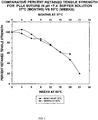
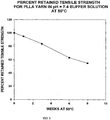
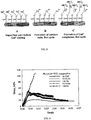
- Fully processed PLLA suture will retain about 50 to 60% of its original tensile strength after eighteen months at 37°C in buffer solution. In accelerated in vitro testing at 50°C it has been found that one week at 50°C corresponds to about one month at 37°C (see FIG. 1 ).
- unprocessed PLLA yarn is tested at 50°C (see FIG. 2 ) it retains about 50 to 60% of its initial strength at eight weeks which corresponds to about eight months at 37°C.
- a key step in the fabrication of these composites is the nucleation and growth of CaP on the supporting polymer matrix.
- a biomimetic deposition process was developed wherein the polymer substrates were soaked in simulated body fluid (SBF).
- SBF contains ions such as Na + , K + , Ca 2+ or Mg 2+ with concentration and pH similar to that of human blood plasma.
- Contact of SBF with a surface can lead to the formation of calcium phosphate on the surface.
- Other coating methods, such as plasma spray and co-precipitation can also be used.
- an inherent drawback of the biomimetic coating method using SBF is the amount of time required to deposit a large quantity of calcium phosphate (normally a few days to a few weeks), because the driving force for precipitation is small.
- polymer fibers were coated with CaP utilizing a cyclic-soaking technique, which permits controlled fabrication of composites with higher mechanical properties.
- a cyclic soaking technique was used for the nucleation and growth mechanism of CaP on poly(lactic acid) (PLA) fibers at room temperature.
- the deposition of CaP on the polymer surface was characterized using gravimetric measurements and environmental scanning electron microscopy (ESEM) images.
- PLA poly-lactic acid
- T g ⁇ 55 °C, T m ⁇ 175 °C Commercially available poly-lactic acid (PLA) yarn
- PPA poly-lactic acid
- T g ⁇ 55 °C, T m ⁇ 175 °C Commercially available poly-lactic acid (PLA) yarn
- Each yarn contained about 30 filaments, with the filaments having an average diameter of 24.5 ⁇ m.
- the PLA yarn was wound around a rectangular, using a custom-built winding machine that allowed for the control of winding speed and tension. During this stage, care was taken to avoid overlapping of the yarn on the frame. A linear spinning rate of 20 cm/min and a tension of approximately 6 N were used for all the experiments.
- the yarn was then soaked in 1 N NaOH for 1 min. at 25 °C to saponify the surfaces of fibers. The soaked yarn was rinsed in distilled water and air-dried.
- the saponification process was checked in several ways.
- water contact angles of the treated PLA films were measured by the sessile drop technique (advancing angles) using a contact angle measurement apparatus (Rame-hart Model 100, USA).
- PLA yarn was dissolved in chloroform and solvent cast at room temperature to obtain a thin film which was hot-pressed (Model 2731, Carver Laboratory Press, USA) at 150 °C for about 2 min. under a hydraulic pressure of 100 MPa to remove any bubbles formed during solvent casting.
- the PLA film thus obtained was cut into 1 cm 2 pieces and treated with 1 N NaOH for 1 min at room temperature.
- the treated films were rinsed twice in distilled water and dried.
- a 5- ⁇ L water drop was placed on the surface of each PLA film (NaOH treated and untreated), and the contact angle was measured to determine the wettability of the specimen. All measurements were recorded at room temperature and each test was repeated five times on different films.
- CaP was deposited on the hydrolyzed PLA yarn using a cyclic soaking technique as follows: 100 mL of calcium nitrate (99% pure, Sigma) and 164 mL of ammonium orthophosphate (99% pure, Sigma) solutions were prepared at a concentration of 1 N, and the pH of each solution was brought up to 12 by adding ammonium hydroxide (Sigma, ACS reagent). The solutions were kept at room temperature while stirring vigorously. The treated yarn was initially soaked in the calcium nitrate solution for a set amount of time from about 0.5 h to about 1 h at room temperature. Then the yarn was washed in distilled water with simultaneous stirring and air-drying.
- a cyclic soaking technique as follows: 100 mL of calcium nitrate (99% pure, Sigma) and 164 mL of ammonium orthophosphate (99% pure, Sigma) solutions were prepared at a concentration of 1 N, and the pH of each solution was brought up to 12 by adding ammonium hydroxide (Sigma, ACS
- the stirring rate during washing was varied between 80-800 rpm for 0.5 or 1 h to determine its effect on the amount and quality of CaP deposited on the yarn.
- the dried yarn was soaked in ammonium phosphate solution for the same amount of time, washed and dried in the same fashion as that for calcium nitrate solution.
- the amount of CaP deposited on the yarn was measured gravimetrically after each cycle. This cyclic soaking process was repeated six times, beyond which the deposited CaP was observed to detach from the PLA yarn.
- Fresh solutions of calcium nitrate and ammonium phosphate were used for each cycle, to avoid the deposition of CaP particles suspended in the used solutions.
- a Carver Laboratory Press (Model 2731, USA) was used for compression molding of composites. Initially, the parallel platens in the hot-press were heated to about 55 °C and maintained for about 30 min.
- a custom-made, three-piece aluminum rectangular mold containing six slots each of 4 cm x 0.5 cm x 0.5 cm dimensions was stacked with PLA yarn coated with CaP and PCL and held at 55 °C for about 2 min. under a hydraulic pressure of about 150 MPa. Finally, the mold was cooled to room temperature under the same pressure and the specimens were detached from the mold. Typically, specimens prepared using this mold had dimensions of 4 cm ⁇ 0.5 cm ⁇ 0.2 cm with the specimen thickness varying slightly for different types of composites.
- Poly(lactic acid) yarn dissolved in chloroform was solvent-cast at room temperature and hot-pressed at about 150 °C for about 2 min. to obtain a smooth film of 0.5-mm thickness.
- the PLA film was hydrolyzed in 1 N NaOH for 1 min, washed multiple times in distilled water and air-dried. CaP was deposited on the hydrolyzed PLA film using the same cyclic-soaking technique as employed for PLA yarn (see [0052]).
- the gold-coated surfaces of the as-received PLA yarn, as-pressed PLA film, PLA yarn and film after hydrolysis and after each cycle of biomineralization were observed using an environmental scanning electron microscope (Philips ESEM 2020) operating at 20 kV.
- An X-ray diffractometer (Brüker AXS D 5005) with a Ni-filtered Cu-K ⁇ radiation was used for the X-ray defraction (XRD) measurements after the CaP powder was isolated by dissolving the CaP-coated yarn in tetrahydrofuran (THF) and repeatedly washing the residuals with ethanol. Data was collected using a scan speed of 1.0 °/min and a scan step of 0.02°.
- a three-point bending test (ASTM D790) was used to measure the flexural modulus and flexural strength at break of the fabricated composites.
- An Instron test machine (1011 Instron Instruments, UK) with a 50-N load cell was employed with a cross-head speed of 1 mm/min. The ratio of length to thickness of the specimen was 16. The flexural stress and strain were calculated from the load and deflection data collected on a data acquisition system.
- Six specimens were tested for each type of composite (explained in Table 2) with a three-level full-factorial experimental design with no repetitions.
- the observed decrease in the diameter of the polyester yarn was likely due to hydrolysis at multiple points on the polymer chains near the surface, reducing the polymer to smaller fragments which were soluble in the solution.
- Surface hydrolysis of polyesters is known to result in enhanced hydrophilicity, indicative of an increase in the amount of carboxylic acid and hydroxyl groups on the surface, which corresponds to the reduction in contact angle from 81.6° to 75.4° for the NaOH-treated PLA films.
- carboxylic acid groups can promote the nucleation of CaP on substrates.
- rougher surfaces might facilitate rapid growth of CaP compared to the smooth surfaces.
- higher concentration of NaOH or higher soaking time contributes to further increase of surface functionalization, it might result in faster degradation or bulk hydrolysis of PLA yarn.
- the net amount of CaP deposition was found to increase with soaking repetitions as well as with soaking time for each repetition. As shown in FIG. 4 , the amount of deposited CaP increased with soak time. The amount of CaP deposited for 1-h soak time was larger than that for 0.5-h soak time at all repetitions. Gravimetric analysis indicated that around 35 wt% of CaP was deposited after 6 cycles each at 1-h soaking time.
- Table 2 details the amount of CaP deposited on the yarn with increasing number of cycles and soaking time for each cycle. Even higher number of cycles resulted in the detachment of CaP from the yarn.
- Table 2 Repetition cycles wt% CaP deposition Flexural modulus, GPa 0.5-h soak time 1-h soak time 0.5-h soak time 1-h soak time 1 7.8 9.45 - - 2 12.4 17.4 - - 3 16.5 23.7 - - 4 19.2 29.4 - - 5 22.4 33.6 3.94 4.66 6 23.3 35.1 6.45 7.89
- the composite's shape, thickness, and size and the testing speed can be varied when applying the three-point bending test. Furthermore, the tension test can also be used to test the toughness of the composite. Annex A1 of ASTM D 882 provides a description for the tension test.
- the macroscopic structure of the CaP deposited on the PLA yarn obtained from 1-h deposition time cycles was analyzed by ESEM. Compared to the plain hydrolyzed yarn shown in FIG. 3b , heterogeneous nuclei of CaP can be seen clearly on the surface of the yarn as shown in FIG. 5a . As the repetition cycles increased, the deposition on the fibers increased and the morphology of the yarn changed progressively as shown in FIG. 5a-d . These findings are in qualitative agreement with the gravimetric analysis of the deposit on the yarn. From the images in FIG. 5 , it can be observed that the CaP was not coated uniformly on the entire surface of the yarn after first cycle.
- FIG. 7a represents the film which was partially hydrolyzed and coated with calcium phosphate and the distinction between the coated and the non-coated areas can be clearly seen.
- the CaP grown on PLA film displayed a thin, platelet-like crystalline morphology as shown in FIG. 7e similar to the calcium phosphate deposited via the biomimetic process using SBF.
- FIG. 8 is a schematic of the mechanism of nucleation and growth of CaP on the hydrolyzed polyester yarn surface.
- FIG. 8a hydrolysis of polyester surface exposed the carboxyl groups on the surface containing sodium ions.
- FIG. 8b during the first soaking cycle in calcium nitrate solution, Na + ions are replaced with Ca 2+ ions leading to the formation of -(COO) 2 Ca, with-COOCa + NO 3 - as by-product (not shown).
- FIG. 8c depicts the formation of bonds between HPO 4 2- and Ca 2+ during the first soaking cycle.
- FIG. 9 depicts tensile stress-strain curves of the composites fabricated at various conditions.
- the flexural properties of the composites are shown in FIG. 10 .
- Table 2 describes the notation used for the composites prepared at various soaking times and cycles.
- the composites prepared with 1-h soaking time and 6 repetitions (1-h-6x) exhibited a modulus value of 7.9 GPa while those prepared with 0.5-h soaking time and 5 repetitions (0.5-h-5x) showed 3.9 GPa.
- all the composites tested in this study demonstrated modulus values in the range 2.4-7.9 GPa, which are at the lower end of the 3-30 GPa range of the bending modulus of human physiologic bone.
- the rule of mixtures provides the simplest method for the estimation of the mechanical properties of the composites in terms of its constituents.
- the parallel model based on iso -strain and the series model based on the iso -stress assumptions have been usually employed.
- the parallel model (Eq. 2) provides the upper-limit value of the modulus E p
- the series model (Eq. 3) gives the lower-limit E s .
- E p ⁇ E f + 1 ⁇ ⁇ E m
- E s ⁇ / E f + 1 ⁇ ⁇ / E m ⁇ 1
- ⁇ is the volume fraction of the filler in the composite
- E f and E m are the moduli of filler and matrix in the composite, respectively.
- the predicted modulus values from the models were calculated taking into account the modulus of pure PLA-PCL composite with no filler (2.45 GPa as observed for the PLA-PCL composite in this study) as E m and the modulus of CaP (50 GPa) as E f , density of PLA-PCL as 1.3 and density of CaP as 3.16.
- the moduli of the composites observed in this study fall within the upper and lower bounds calculated using the parallel and series models.
- the bending moduli and flexural strength at yield ofthe composites tested in the present study are significantly higher than the values reported in literature for PLA-CaP composites.
- An important factor contributing for the observed increase in the bending yield strength of these composites, compared to the conventional PLA-CaP composites, is the unidirectional alignment of PLA yarn coupled with the CaP particles surrounding them. It can be expected that by increasing the CaP content in the composites, higher modulus can be achieved. For example, calculations indicate that modulus values in the range of 10-15 GPa are possible, depending upon the level of each component.
- drawn PLLA yarns are treated with sodium hydroxide.
- 500 mL sodium hydroxide solution with a chosen molar concentration (0.100-1.00 mol/L) was prepared with sodium hydroxide 1 mol/L solution and de-ionized water at room temperature.
- a certain amount of drawn PLLA yarns were dipped into prepared sodium hydroxide solution for certain amount of time (2-60 min) at chosen temperature.
- the treated drawn PLLA yarns were taken out of the sodium hydroxide solution and washed with de-ionized water 3-5 times before being wiped dry and left in the air over night.
- a SBF solution is prepared by adding sodium chloride, sodium bicarbonate, potassium chloride, potassium hydrogen phosphate, magnesium chloride, 4-(2-hydroxyethyl)-1-piperazineethanesulfonic acid, calcium chloride and sodium sulfate into de-ionized water under sufficient stirring. Then, hydrochloric acid solution was added and the pH value of the solution was adjusted to around 6.0-7.0. Next, sodium hydroxide treated drawn PLLA yarns were dipped into prepared SBF solution and warmed up to certain temperature (40-60 °C) under the biomimetic coating procedure.
- the treated drawn PLLA yarns were coated with calcium phosphate after 1-6 h and taken out of SBF solution. Then, the coated drawn PLLA yarns were washed with de-ionized water for several times. Lastly, the coated and washed drawn PLLA yarns were air dried overnight.
- undrawn PLLA yarns were treated with sodium hydroxide.
- a certain amount of sodium hydroxide solution (20-500 mL) with molar concentration 0.500 mol/L was prepared.
- a certain amount of undrawn PLLA yarns were dipped into prepared sodium hydroxide solution for 10 min at room temperature.
- treated undrawn PLLA yarns were taken out of the sodium hydroxide solution and washed with de-ionized water 3-5 times before being wiped dry and air dried over night.
- a SBF solution is prepared by adding sodium chloride, sodium bicarbonate, potassium chloride, potassium hydrogen phosphate, magnesium chloride, an appropriate buffer like HEPES or Tris, calcium chloride and sodium sulfate into de-ionized under sufficient stirring. Then, hydrochloric acid solution was added and the pH value of the solution was adjusted to around 6.0-8.0. Next, sodium hydroxide treated undrawn PLLA yarns were dipped into prepared SBF solution and heated up to certain temperature (40-60 °C).
- the treated undrawn PLLA yarns were coated with calcium phosphate after 1-4 h and taken out of SBF solution. Then, the coated undrawn PLLA yarns were washed with de-ionized water for several times. Lastly, the coated and washed undrawn PLLA yarns were air dried over night.
- the etching process can be carried out in sodium hypochlorite or calcium hydroxide solutions and then similarly coated with biomimetic calcium phosphate.
- Figures 11, 12 and 13 show the effect of treatment time on the Young's modulus of drawable PLLA filament before and after the biomimetic hydroxyapatite coating.
- FIG. 11 demonstrates the effect of etching time on the Young's modulus of PLLA drawable single fiber before and after HA coating.
- FIG. 12 is a chart showing the stiffening effect of HA coating on unaligned fibers.
- FIG 13 demonstrates the effect of etching time on the tensile stress of PLLA drawable single fibers before and after HA coating.
- undrawn PLLA yarns and drawn PLLA yarns were conducted. First, undrawn PLLA yarns with 3-4 cm length were warmed up in water bath to 55-65 °C. They were drawn to double length in the water bath, wiped dry and left in the air for 10 min. Next, a 20mL of sodium hydroxide solution with a molar concentration of 0.500 mol/L were prepared. Then, a same length of undrawn PLLA yarns and newly drawn PLLA yarns were dipped into the prepared sodium hydroxide solution for 10 min at room temperature. The treated PLLA yarns were taken out of the sodium hydroxide solution and washed with de-ionized water 3-5 times before being wiped dry and air dried over night.
- a SBF solution was prepared. Then, the sodium hydroxide treated PLLA yarns were dipped into the prepared SBF solution and heated up to a certain temperature (40-60 °C). Extra SBF solution was also heated up at the same time. The treated PLLA yarns were coated with calcium phosphate after 0.5-1.0 h and taken out of SBF solution.
- the PLLA yarns coated after the first cycle were drawn in hot water bath (60 °C) again to certain length and put back into extra SBF solution.
- the second cycle 0.5-1.0 h
- PLLA yarns were taken out of SBF solution.
- the coated PLLA yarns were washed with de-ionized water for several times and air dried over night.
- FIG. 14 demonstrates alkaline-treated drawn yarn with biomimetic coating.
- the drawn yarn was treated in 0.5 mol/L of sodium hydroxide for 60 minutes at 70°C and was then treated with the biomimetic method.
- a homogenous calcium phosphate coating layer is formed on the surface of the alkaline-treated PLLA yarns using the biomimetic coating process.
- the drawn yarn was treated in 1.0 mol/L of sodium hydroxide for 30 minutes at 25°C before subjecting the yarn to the biomimetic solution.
- the calcium phosphate coating layer is not homogenously coated on the drawn yarn. Therefore, the longer soaking time, NaOH concentration, and/or the elevated temperature facilitate the preparation of the drawn yarn for the biomimetic coating.
- FIG. 15 depicts a comparison of the alkaline-treated undrawn PLLA yarns with drawing and without drawing.
- the alkaline-treated PLLA yarns were not subject to drawing.
- calcium phosphate particles were coated on the PLLA yarns.
- the alkaline-treated PLLA yarns were drawn from 2cm to 4 cm. It is noted that the calcium phosphate particles on the PLLA yarns are aligned and distributed on the drawn yarn. There are numerous benefits on coating the undrawn yarns with calcium phosphate.
- the surface of the undrawn PLLA yarns can be modified more easily than the fully drawn yarns; thicker and denser calcium phosphate can be formed on these undrawn yarns; increased axial alignment of calcium phosphate coating can be achieved; these coated undrawn yarns can be coated again upon drawing to obtain thicker and denser calcium phosphate coating; and other agents for degradation or enhanced bone growth can be coated upon drawing.
- the simplest picture of deposition of CaP on the yarn is one involving the random nucleation of crystals at equivalent sites that cover the yarn surface. Once the crystal is started, it grows in proportion to the time it is exposed to the solutions.
- the deposition rate of CaP is proportional to the number of active sites and the mass per cycle, w , deposited at each active site.
- the rate for the latter turns out to be a diminishing function of soaking time (see section 3.2) that needs to be determined empirically.
- Monetite was successfully deposited onto the hydrolyzed polyester substrate using a cyclic soaking method from aqueous solutions of calcium nitrate and ammonium phosphate.
- the amount of CaP formed increased with increasing repetitions and soaking time at each repetition.
- a heterogeneous nucleation and growth mechanism was proposed to explain the observed phenomena of CaP deposition on the polyester surface.
- the composites prepared using this technique demonstrated flexural modulus in the range 2.4-7.9 GPa, which are at the lower end of the 3-30 GPa range of the bending modulus of human physiologic bone.
- Biomimetic coating technique was used on both drawn and undrawn yarns to generate homogeneous calcium phosphate coating.
- the present invention also demonstrates that the use of a sodium hydroxide under a certain concentration and temperature facilitates the uniform coating of calcium phosphate. Furthermore, the orientation of the coated calcium phosphate particles on the undrawn yarn can change upon drawing.
- the yarns were washed with de-ionized water after each coating cycle. Finally, the CaP-coated yarns were coated with poly( ⁇ -caprolactone) solution in tetrahydrofuran (THF), dried, and compression molded at an elevated temperature to form rectangular bars.
- THF tetrahydrofuran
- a new bone-repair synthetic composite material which provides a sustained steady localized controlled release of more than one growth factor and also has sufficient mechanical strength during the bone healing process, is needed.
- the new material can be described as an calcium phosphate/polymer composite consisting of hydroxyapatite, various thermoplastic binding resins, and a combination of biodegradable polymer fibers, which can be used as separate compartments for delivering different growth factors or delivering the same growth factor with different release rates.
- the invention provides an effective path for medical-device manufacturers to follow for designing highly functional devices for specific applications, such as long-bone repair, spinal fusion, sternal bone closure, and maxillofacial fixation. Aside from the pursuit of the stated goals, the understanding of polymer-based composite systems will be advanced, as the braiding process provides the opportunity to control precisely the deviation of the composite structure from uniaxiallity and thus the deviation of mechanical properties from those of the ideal uniaxial structure.
- growth factor carriers include, but not limited to, hydroxyapatite (calcium phosphate), synthetic polymers, demineralized bone, and collagen-based materials.
- Natural polymers include collagen, hyaluronans, fibrin, chitosan, alginate and other animal- or plant-derived polymers.
- collagen sponge has become the most commonly specified natural polymer for use as a delivery carrier.
- Synthetic polymers such as poly(L-lactic) acid (PLLA), polyglycolic acid (PGA), poly (D,L-lactide-co-glycolide) (PLGA), polydioxanone (PDO) and poly( ⁇ -caprolactone) (PCL), are examples for localized release of growth factors, such as BMP and TGF- ⁇ .
- semi-crystalline PLLA fiber has been used in sutures, while amorphous PLA copolymers have been used in bone grafts and as drug carriers.
- synthetic absorbable polymers like PLA are their degradation by hydrolysis to acidic products, which can accelerate the degradation rate of the polymer and induce local inflammation at the implantation site.
- the degradation of calcium phosphate forms alkaline products that neutralize the acidic degradation products (lactic acid) of the polymer.
- the degradation rate of the polymer can be tailored to achieve the optimum BMP release rate by altering the polymer molecular weight and/or polymer composition.
- the degradation rate of 50:50 glycolide-lactide copolymer can be higher than that of PLA.
- PCL is one semi-crystalline synthetic absorbable polymer that can be processed at low temperatures because of its low cost, extended resorption time and availability at low molecular weight.
- Proteins are normally incorporated into polymers at room temperature. BMPs are highly sensitive to thermal processing and some types of chemical exposure, so the major challenge in developing the BMP carrier material is to incorporate sufficient BMP into the structure of the material without compromising the biological activity of the proteins. Unlike most of the ceramics and metals, amorphous polymer materials can often be processed at low temperatures, which make it easy to incorporate proteins into the polymer structure without harming the protein.
- the release of the protein from the amorphous polymer matrix involves both diffusion of the protein through the matrix and degradation of the matrix polymer. If the protein is incorporated into the structure of the polymer, the protein release rate is largely dependent on the degradation rate of the polymeric matrix, as the diffusivity of one polymer in another is very low. It has been demonstrated that with increasing degradation rate of a lactic acid/lysine copolymer matrix, the release rate of the protein increases.
- a novel composite is fabricated for bone-repair applications using innovative processing techniques. Two approaches are employed to fabricate bar- and sheet-shaped composites, respectively.
- FIG. 16 The novel process of fabricating the composites is shown schematically in FIG. 16 .
- Different biodegradable polymer fibers 102 FIG. 16a
- the polymer fibers 102 are braided into braids 108 ( FIG. 16d ). These braids can either be coated with hydroxyapatite or non-coated.
- Some of the polymer fibers 102 are coated with hydroxyapatite using a biomimetic method and then with a thin layer of a low melting polymer to form coated fibers 104 ( FIG. 16b, 16c ) which is used to form the center core of the braid 118, as shown in FIGS.
- uncoated polymer fibers 102 braided in a sheath over it ( FIG. 17 ).
- Some of the secondary unidirectional structures can then be compression molded ( FIG. 16e ) to give a rod/bar-shaped composite ( FIG. 16f ) or used to form a mesh ( FIG. 16g, 16h ).
- the uncoated yarn 12 or the coated yarn 104 can also be used to make a mesh without the coating of the low-temperature polymer.
- the thus-fabricated composites are suitable for varied applications, such as long-bone repair, spinal fusion, sternal bone closure, and maxillofacial fixation.
- low melting temperature polymers includes polymers with a melting point below 175 °C, semi-crystalline polymers, PCL, polydioxanone, copolymers of PCL with PGA, PDO, TMC or PLA (L or D,L), non-crystalline polymers, PLA-PGA (50:50), poly-D,L-lactic acid, or any polymers having a lower melting temperature than the core structure.
- the details of the each processing step are described as follows:
- Two synthetic biodegradable polymer fibers poly(L-lactic acid) (PLLA) and polyglycolic acid (PGA)
- one natural polymer catgut
- one polymer coating the mixture of poly( ⁇ -caprolactone) (PCL) and glyceryl monostearate
- one calcium phosphate coating mainly hydroxyapatite (calcium phosphate)
- the melting temperature, mechanical properties, and degradation rate of these materials are listed in the following table. Table 3.
- Figure 18 shows the flexural strength and Young's modulus of pure PCL, PCL-coated PLLA, and both PCL- and CaP-coated PLLA.
- the PCL-coated PLLA has much higher strength and Young's modulus than those of pure PCL.
- the composite With the addition of calcium phosphate in the system, the composite became much stiffer and stronger. Its Young's modulus was at the lower end of that of cortical bone, 3-30 GPa. However, the composite is still too weak to be used at load-bearing applications.
- biomimetic approach is employed to apply bone-like carbonated calcium phosphate onto the surface of the polymer yarns.
- the biomimetic coating method produces a calcium phosphate layer on the surface of various biomaterials in simulated body fluid (SBF), which has identical ion concentrations to human blood plasma at body pH (7.4) and temperature (36.5°C).
- a biomimetic method is used to homogenously precipitate nano-calcium phosphate on the surface-modified polymer yarns to achieve a strong calcium phosphate coating.
- the novel processing technique is employed to co-braid the PCL yarns with PLLA, PGA or PDO yarns.
- This unique design has the following advantages: (1) instead of using yarns, the braids are bound together using PCL to minimize the PCL to PLLA ratio; (2) it allows to precisely control the amount and the distribution of PLC in the PLLA (or PGA, PDO) fibers; (3) the PCL automatically distributes in a uniform fashion between the fibers when it melts.
- the bonding strength between the calcium phosphate coating and a polymer can be improved substantially by pretreatment of the polymer surface with either an alkaline or an acid solution to form polar groups that are confined substantially to the surface of the polymer. It has also been found that calcium phosphate precipitates may align along the fiber axis when carboxylate groups are present on the surface of the uniaxially stretched polymer fibers. As the synthetic polymer yarns used in this study have been prepared through extensive uniaxial stretching during the spinning process, they can be treated with acid or base to render carboxyl or carboxylate binding sites that induces the nucleation of calcium phosphate nano-particles with a preferential orientation.
- the yarns are dipped quickly into an acid, a base or a sequential combination of both solutions to attain the necessary surface treatment without modifying the polymer unfavorably.
- the pretreated yarns are soaked in the SBF solution for various periods, to attain composites with varying calcium phosphate loadings, including no exposure to SBF (zero loading).
- Such-obtained calcium phosphate precipitations orientate along the polymer fiber axis, which mimics the structure of the aligned calcium phosphate nano-particles on collagen fibrils in natural bone.
- the surface properties of the composite before and after soaking in the SBF are thoroughly characterized by a series of techniques, including thin-film-XRD to examine the surface phase distribution, and Fourier transform infra-red (FTIR) to determine the surface functional groups. Surface morphology changes are monitored by scanning electron microscope. The calcium and phosphate ion concentrations in SBF, before and after soaking, are measured by inductively coupled plasma atomic emission spectroscopy (ICP-AES).
- ICP-AES inductively coupled plasma atomic emission spectroscopy
- the data obtained from samples containing 9, 31, and 43 wt% HA is shown in Table 4.
- the data suggest that the flexural modulus increases with HA concentration in spite of the concomitant decrease in PLA content.
- the data did not show any correlation between HA wt% and flexural strength of the composite.
- the data shows that the flexural strength increases greatly from 44 MPa to 146 MPa when the wt% of PLA fibers was increased.
- the strain data shows no significant difference between 9 and 43 wt% HA samples but at 31 wt% the maximum strain percent was quite low in comparison to the other samples. Data such as this suggests that a balance should be found between HA and PLA wt% in order to maximize flexural modulus and strength.
- Pre-formed or calcium phosphate precurors can be directly coated onto PLA fibers.
- a hydrothermal method is used to make the HA, then the particles are used with PCL to coat over the fibers.
- other calcium phosphates can be used.
- the HA particles used in the composite were prepared by reacting of 200 mL calcium nitrate solution (2 g/dL) and 600 mL ammonium phosphate solution (2 g/dL). After drying, the precipitate was ground into powder, which has an average particle size of 120 nm and is shown in Figure 19 . Ten mg of ground HA powder was then added into 10 mL PCL (Dow, MW 80,000) acetone solution (1% wt/wt), which was used to dip-coat the PLA fiber strand composed of 30 fibers with a 22- ⁇ m diameter for each fiber.
- PCL Low, MW 80,000
- the stress-strain curve of the composite under small strain ( ⁇ 1%) is shown in Figure 20
- the Young's modulus is 6.5 GPa for linear region (0 ⁇ 0.001%).
- PLA-PCL-HA composite A pultrusion process was also used to prepare the PLA-PCL-HA composite. PLA fibers were pulled through a tapered die filled with molten PCL-HA mixture, which has an HA : PCL volume ratio ranges from 0.1 ⁇ 0.2. The apparatus used for the pultrusion is shown in Figure 21 . The tensile test results were listed in Table 5. Table 5. Tensile test results of pultruded composite Composition (volume %) Young's modulus (GPa) PLA PCL HA 0.09 0.82 0.09 1.1 0.18 0.74 0.08 1.9 0.09 0.76 0.15 1.2 0.20 0.66 0.14 2.2
- Hydroxyapatite particles can also be aligned along the PLLA melt spun yarn by electrospinning HA particles in a solution of PLLA in dimethylformamide over melt spun PLLA yarn as shown in Figure 22 .
- the process is carried out by first winding PLLA yarn onto a grounded rotating wheel or drum and then electrospinning filaments containing HA particles over the PLLA yarn.
- HA particles with aspect ratios greater than about 4:1 tend to align themselves within the PLLA electrospun filaments.
- the amount of alignment of the HA particles with the PLLA yarn will be proportional to the alignment of the electrospun yarn with the melt spun yarn. Samples prepared by this method can then be coated and hot pressed.
- sample III exhibited higher HA/PLLA weight ratio than that of sample II, indicating that a longer coating time gives a thicker coating.
- Table 6 Comparison of composition and three point bending results of sample I, II and III 3PB Beam PLLA wt% HA wt% PCLGA wt% Max flexural stress/ MPa Flexural Modulus/ GPa I 74.04 9.92 16.04 132 5.4 II 77.66 6.743 15.60 87 4.2 III 70.13 6.86 23.02 45 3.8
- acetone solution for 5-10 min, whose concentration was 10% w/v.
- PLLA/HA/PCLGA composites were dried under vacuum for 24 h, after which the composites were hot pressed using a flat die to form beams for three point bending tests.
- the flexural stress and modulus of the PLLA/HA/PCLGA composite beams with a dimension of 30.0mm ⁇ 5.3mm ⁇ 2.0mm are tested with a three-point bending test.
- the flexural stress of sample I was found to be 132.2 MPa and its modulus is 5.4 GPa. Comparing these values with those of sample II, it could be found that, with similar weight percentage of PCLGA coating, sample I with higher amount of HA demonstrated better mechanical properties (higher flexural stress and modulus).
- sample II with lower amount of PCLGA demonstrated better mechanical properties, which could be attributed to much lower flexural strength and modulus of the amorphous PCLGA coating layer.
- a "braid” shall include any structure using a combination of elements that are arranged with an inner element and an outer element.
- a typical structure of a braid consists of the center part, the core 118, and the outside part, the sheath 120. This configuration and the technology for its manufacture are adapted to create a novel composite for delivering growth factors during bone repair.
- the advantage of braiding is that it allows precise placement of different fibers within the composite and variation of the fiber ratios over a large range.
- the fibers at the core 118 are coated with calcium phosphate before braiding.
- the sheath 120 is subjected to substantial twisting, bending and sliding during the braiding, so it is not coated with calcium phosphate.
- the core is assembled with the sheath of yarn braided over its surface to form a tubular braid (see FIG. 17(a), (b), (c) ), which is used as a building block for constructing different implants or devices.
- the polymer yarns with or without calcium phosphate coating form a primary unit of the braided structure, as show in FIGS. 17(a), (b), (c) .
- the primary units form the core 118 and the sheath 120 of the braids, which are the secondary units of the structure.
- the calcium phosphate-coated yarns form the core 118, while the uncoated ones form the sheath 120.
- the sheath 120 may be subjected to substantial torsion and bending during the braiding, so it is not coat with calcium phosphate.
- the core secondary units are assembled with the sheath secondary unit braided over its surfaces, which is the tertiary unit of the structure.
- the tertiary unit is used as a building block for constructing different implants or devices.
- the composition of the primary unit is adjusted to achieve the mechanical and chemical properties meeting the requirements for different load bearing skeletal implants.
- FIG. 23 is a flowchart outlining an exemplary operation according to the present disclosure for the construction of the novel composite.
- the process starts at step 202, where the primary units, PLLA, PGA, PCL, and PDO yarns 102 are gathered.
- the primary units are coated with hydroxyapatite (CaP) to form coated fibers 104, and in turn form the core secondary units 118.
- the primary units can form a sheath 120.
- the sheath 120 is not coated with hydroxyapatite (CaP).
- step 208 an appropriate ratio of core secondary structure and the sheath secondary structure (from steps 204 and 206) are braided together to form a tertiary unit.
- step 210 the tertiary unit is dip-coated with PLC mixture and compression molded in elevated temperature.
- step 212 the tertiary unit is subjected to mechanical testing.
- Fibers Four synthetic biodegradable polymer fibers, poly(L-lactic acid) (PLLA), polyglycolic acid (PGA), poly( ⁇ -caprolactone) (PCL) and polydioxanone (PDO), are used as in construction of the composites.
- the melting temperature, mechanical properties, degradation rate and accessibility to solvents of these fibers are listed in Table 7.
- the combination of these polymers covers a wide range of chemical, physical and morphological variables. Table 7.
- the melting temperature, degradation rate, and accessibility to solvents of PGA, PDO, PLLA, PCL, and collagen fibers are listed in Table 7.
- PGA PDO PLLA PCL Melting temperature °C 225 109 175 60 Young's Modulus (GPa) 7.0 1.5 6.0-7.0 0.4
- Solvents Toluene Non-solvent Non-solvent Non-solvent Solvent Xylene Non-solvent Non-solvent Non-solvent Solvent Ethyl acetate Non-solvent Non-solvent Non-solvent Solvent Acetone Non-solvent Non-solvent Non-solvent Solvent
- FIGS. 17(a), (b), and (c) depict the composite construction of a novel composite.
- a combination of catgut, PGA, and PLLA fibers 102/104 form the core of the braid 118, and the PLLA fibers form the sheath 120 of the suture braid 130.
- the large cylinders represent polymer braids 130 and small cylinders represent polymer yarns 102.
- FIG. 17a is a composite construction which does not form part of the present invention composed of: a combination of PCL-coated PLLA 104, catgut 102b, and PGA 102c fibers form the core 118, PLLA 102 forms the sheath 120, and the braid 130 is then coated with PCL mixture 134.
- FIG. 17b illustrates that a porous structure at the core 118 is formed due to the early degradation of the catgut 102b.
- FIG. 17c further illustrates that with increasing the implantation time, PGA (102c) at the core degrades and creates more channels (white) in the structure.
- the fibers 102 are pre-coated with calcium phosphate as described above.
- the fibers at the core are coated with a mixture of PCL and glyceryl monostearate (T m ⁇ 50-70°C). It is found that adding glyceryl monostearate in PCL increased the porosity of the composite, which could be used to controlled release of proteins. This is the first time the use of PCL and glyceryl monostearate mixture as a coating on polymer fibers for this purpose. In the rest of the constructions, the core is polymer-coating free.
- the PCL mixture is dissolved in an organic solvent, such as toluene, xylene, or ethyl acetate, which does not attack PLLA, PGA, or catgut fibers.
- an organic solvent such as toluene, xylene, or ethyl acetate, which does not attack PLLA, PGA, or catgut fibers.
- the thickness of the coating is controlled by adjusting the concentration of the dipping solution, the coating speed, and the number of passes through the coating bath.
- the amount of the glyceryl monostearate in PCL is adjusted depending on the drug release rate requested.
- the ratio of core to sheath is maximized to improve the mechanical strength of the construction.
- the fibers at the core are aligned along the fiber axis providing a high Young's modulus contribution, while those in the sheath lie at an angle to the axis leading to reduction in contribution to the mechanical stiffness and strength of the composite.
- the preponderance of the fibers are in the core; thus, the braid still yields the composites with high mechanical strength.
- they are then coated with a layer of the mixture of PCL and glyceryl monostearate.
- the glyceryl monostearate acts as a crystallization modifier for the PCL.
- the polymer braids can be cut into the length of the compression mold, stacked up, and subjected to compression molding between 50-70°C.
- the slow-degrading polymer fibers such as PLLA and PGA
- the fast-degrading fibers such as catgut
- FIG. 24b the fast-degrading fibers
- PGA will start to degrade, and create a more porous structure at the core and thereby inducing more bone ingrowth.
- the core secondary unit 118 is coated with calcium phosphate, while the sheath 120 is calcium phosphate-free.
- the ratio of core to sheath is maximized to improve the mechanical strength of the construction.
- the fibers at the core are aligned along the fiber axis providing a high Young's modulus contribution, while those in the sheath lie at an angle to the axis leading to reduction in contribution to the mechanical strength of the composite.
- the calcium phosphate-coated yarns at the core mimics the highly organized structure of osteon in natural bone, where collagen fibrils are aligned with nano-calcium phosphate platelets orientated along the fibril axis.
- the composite yields the polymer braids with a maximum mechanical strength.
- both the core 118 and the sheath 120 of the braid 130 are fabricated using a combination of the four polymer yarns available, PLLA, PCL, PDO and PGA. This yields composites with different microstructures, mechanical properties and drug release rates for load-bearing skeletal implants.
- Two composite fabrication techniques are employed to prepare the composites: hot compression molding and cold compression molding. In all of the experiments, a slot mold with positive displacement is used to make uniaxial composite samples. In an alternative embodiment, flow of the matrix material along the aligned fibers is allowed, leading to higher orientation of both the matrix and the fibers.
- the polymer braids with various combinations at both the core and the sheath are cut into the length of the compression mold, stacked up, and subjected to hot compression molding.
- a compression molding temperature of 60-70°C can be used.
- FIGS. 24 (a-d) depict various composite constructions after compressive molding (large cylinders represent polymer braids and small cylinders represent polymer yarns): (a) PLLA 102a as the core 118 and PCL 140 as the sheath 120, (b) a combination of PLLA 102a and PGA 102c or PDO 102d as the core 118 and PCL 140 as the sheath 120, (c) PLLA 102a as the core 118 and PGA 102c or PDO 102d as the sheath 120, and (d) PLLA 102a as the core 118 and the combination of PGA 102c and PDO 102d as the sheath 120. (c) and (d) do not fall within the scope of the present invention.
- the calcium phosphate-coated PLLA yarns 102a can be the core 118 of the braid 130, while the PCL yarns 140 can be the sheath 120.
- This design is the most basic construction among all the proposed structures.
- the PCL at the sheath melts, penetrate into the calcium phosphate coating, and act as a "glue” to provide strong bonding of the calcium phosphate-coated PLLA braids.
- the PLLA braids retain their structural integrity, become aligned, and bind together through the PCL melt ( FIG 24a ).
- a combination of calcium phosphate-coated PLLA 102a and PGA 102c (or PDO 102d) yarns can be used as the core 118, while the PCL 140 yarns can form the sheath 120, as shown in FIG. 24b .
- a similar aligned structure is formed after compression molding as described in Construction one.
- the PGA (or PDO) yarns at the core will degrade much faster than PLLA when the composite is implanted in vivo, thereby resulting in many hollow column channels in the structure. These columns will facilitate the early stage bone ingrowth, while the PLLA yarns will remain structurally sound and loose strength over the long-term.
- the calcium phosphate-coated PLLA 102a yarns form the core 118 of the braid 130, while the uncoated PGA 102c can be the sheath 120, as shown in FIG. 24c .
- PCL dissolves in toluene, xylene, or ethyl acetate, which is a non-solvent for both PLLA and PGA.
- the braids are dip-coated with PCL, and dried in air. After compression molding, the PCL binds the polymer braids together.
- a hollow shell around the PLLA core can be gradually formed due to the fast degradation of the PGA yarns, and the bone tissue can gradually grow into the shell during this period.
- the thickness of the shell can be controlled to achieve the optimum space to facilitate bone-ingrowth.
- the PLLA core will remain aligned and supply the long-term mechanical strength for the implant. The whole implant will be finally replaced by the natural bone in approximately 2 years.
- the calcium phosphate-coated PLLA yarns 102a form the core 118 and a combination of PGA 102c and PDO 102d yarns form the sheath 120 of the construction, as shown in FIG. 24d .
- the braids are dip-coated with PCL. After compression molding, the PCL binds all the braids together, while PGA and PDO remain holding the PLLA yarns at the core. After implanting in vivo for about two weeks, PGA will degrade, which will create a porous sheath to facilitate bone ingrowth. In the meantime, the PDO sheath will remain in place for an extra of two weeks, which will allow more time for bone tissue ingrowth.
- the softened PCL sheath can bind all the polymer braids together during cold compression molding at temperatures much lower than 60°C.
- the cold compression molding can also be employed to form the structure in the rest of the constructions as the three solvents listed above are also non-solvent for PGA and PDO.
- the PLLA fibers can also be woven or knitted into a piece of cloth, and then coated with calcium phosphate.
- the growth factors can be incorporated into the lattice structure of the calcium phosphate coating or directly deposit on the surface of the coating.
- the growth factor-loaded fabric can be inserted at the interface of the sternal bones to improve their closure after the cardiovascular surgery.
- the sternal bone of the patient is cut into half during the cardiovascular surgery, and stainless steel wires are normally used to hold the sternum together during the bone healing process.
- the patient suffers a lot of pain due to the use of the stainless steel wire. Plus, the stainless steel wire may cause inflammation at the surgery site. Consequently, the healing process is long and painful for the patient.
- high strength polyethylene suture is used in combination with the present invention, not only the pain of the patient will be reduced due to the use of the high strength polyethylene suture, but also the bone healing rate will be accelerated significantly due to composite insertion.
- the crystallinity of the PLLA and PGA phases in the resulting composite can be investigated by XRD and differential scanning calorimetry (DSC). As appropriate, transmission electron microscope (TEM) and small-angle x-ray scattering (SAXS) analyses can be added to characterize the calcium phosphate alignment and distribution in the polymer and crystalline morphology of the polymer. The surface morphology of the composite can be assessed using environmental scanning electron microscopy (ESEM).
- TEM transmission electron microscope
- SAXS small-angle x-ray scattering
- the synergistic effect of using bone-like calcium phosphate precipitated on the surface of highly aligned polymer fibers, appropriate calcium phosphate loadings, and optimum processing conditions should improve the mechanical properties of the composite dramatically.
- the tensile and flexural tests can be conducted on the composites according to ASTM D638 and D790-02, respectively, and the Young's modulus and Poisson's ratio can be determined. Before mechanical testing, the samples can be cut into standard geometries for each test. The data can be compared with the mechanical properties of the cortical bone (tensile strength: 60-160 MPa; Young's modulus: 3-30 GPa; shear modulus: 3.5 GPa; Poisson's ratio: 0.25) as well as with other composites designed for orthopedic applications.
- ALP Alkaline phosphatase
- mineral deposition mineral deposition
- bone nodule formation are three important markers at different stages of bone formation in vitro.
- ALP, calcium deposition, and bone nodule formation assays are performed to reveal the optimum combination of polymers for bone formation.
- a rat osteosarcoma cell line can be used in the proposed study, as the cells are calcified easily in vitro.
- the interactions between osteoblasts and different composites can be investigated.
- Cell attachment, proliferation and ALP activities can be performed on the surface of the composites.
- Tissue culture plastics can be used as controls, which have cells alone in the culture without any composite.
- the cell attachment can be carried out at different time points, such as 1, 3, 5 and 8 hours, using an alamarBlue fluorescent dyeTM technique. An optimum time point for cell attachment can be determined.
- osteoblasts undergo a high level of proliferation.
- the rate of proliferation can indicate the success of a substrate at promoting osteoblast growth.
- the same alamarBlue dyeTM technique can be utilized in assessing the cell proliferation rate.
- Osteoblast proliferation can be determined on days 1,3, and 7.
- the cell morphology can be observed using scanning electron microscopy (SEM). After a slightly longer incubation period, such as 17-21 days, calcium deposition proceeds.
- the calcium measurements can be undertaken using calcium crimson (a dye that stains calcium) and acridine orange staining followed by confocal microscopy observation. Bone nodule formation can be detected using von Kossa staining. Images can be taken using an optical microscope.
- a statistical analysis can also be conducted. Statistical significance can be determined using a one-way of variance (ANOVA) to compare means between groups, with a P value of less than 0.05 being considered significant.
- ANOVA one-way of variance
- two drug-delivery systems single- and multi-drug are disclosed.
- Both in vitro and in vivo studies are carried out to demonstrate a sustained and stable controlled release of drugs, as needed for optimum bone healing.
- a single drug delivery system is investigated to learn about the release properties of the composites and their components, with the aim of achieving an optimum drug release profile.
- both single- and multiple-drug delivery systems are studied.
- Growth factor(s) are incorporated into different compartments of the composite to provide sequential release. This unique characteristic of the system can be used to design a more sophisticated drug-release system. A systematic study is carried out to investigate the effect of the degradation rate, the drug incorporation method, and the crystallinity of the polymers on the drug release rate of the constructed composites.
- BMP-2 may be released by one of the following three carriers: 1) polymer fibers, 2) PCL mixture coatings, and 3) calcium phosphate coatings. A total dose of 21 ⁇ g rhBMP-2 is placed on each implant based on previous experience.
- the polymer fibers including PLLA, PGA, and catgut fibers
- the BMP is directly deposited on the surface of these fibers and the release profile of the BMP is measured by BCA protein assay.
- BES N,N-bis(2-hydroxyethyl)-2-aminoethanesulfonic acid
- the BMP is added to the coating solution and applied on the surface of BMP-free PLLA fibers.
- the glyceryl monostearate content in PCL vary between 0-10 wt% to alter the protein release rate in the coating. The release rate is increased with the content of glyceryl monostearate in the PCL as the porosity of the coating increases.
- BMP is incorporated into its lattice structure to create a sustained release profile. Briefly, BMP is added into the simulated body fluid solution, and co-precipitate with the calcium phosphate on the surface of the polymer.
- a sustained steady controlled release profile may be designed using sequential release of the growth factor from different components of the composite.
- a low dose of BMP can be incorporated into a component with a fast releasing rate, such as catgut and PGA. Since a low dose is used, the "burst release" of the BMP won't create a local overdose effect.
- the rest of the BMP can be incorporated into a component with a slow releasing rate, such as the calcium phosphate or the PCL mixture coating. It is hypothesize that a two-step sequential release can ensure a steady release started from day 0, and can last for up to 8 weeks. Such created release profile can be ideal for the human bone healing, which normally takes 2-3 months. It should be noted that drug release rate of the fast-degrading polymer may slow down due to the PCL mixture coating on its surface.
- the proposed composites are at one time complex and simple.
- the geometry comprising yarns of different compositions and braids of different constructions embedded in a matrix with various filler loadings, is a complication.
- the macro sample size and the pseudo one-dimensional geometry are simplifying aspects of the problems of measuring and modeling degradation and drug-release kinetics.
- the high molecular weight of the growth factor is also a simplification in that it is hypothesized its solubility and diffusivity in the matrix will be vanishingly low.
- release profiles i.e., release rate vs. time
- release rate vs. time The release profiles, i.e., release rate vs. time, of the composites can vary significantly, but the studies cited here were essentially "take what you get” from the point of view of controlling the profile in a predictive fashion. In addition, the added complication of diffusion limitations brought about by growing bone tissue has not been addressed adequately.
- growth factor release rate can be precisely controlled because of the flexibility in composition and structure.
- cylindrical composite rods can be subjected to one-dimensional degradation by capping the rod ends with epoxy.
- the rod can be sectioned and its morphology studied with spatially resolved surface techniques and the standard portfolio of morphological analyses using scanning electron microscope, optical microscope and atomic force microscope, as appropriate.
- bulk properties molecular weight, drug concentration
- the composite with the optimum release profile and reasonable mechanical strength will be used for the in vivo studies. Once it is certain that BMP is being stored and released from the three different compartments of the composite, as determined with in vitro tests, then single vs. multiple agent delivery can be compared in vivo. Applying current understanding of normal wound repair, combinations of growth factors have great potential to enhance healing as bone formation and repair are regulated by many factors, including extracellular matrix and several growth factors. In natural, these growth factors participate in the bone repair at different sequences. A preliminary in vivo study will be carried out using a mouse model. Sixty mice each will receive four implants (two controls and two specimens) placed directly at both the calvarie and ectopic sites.
- mice receive rhBMP-2 alone, 20 receive the combination of bothrhBMP-2 and TGF- ⁇ with rhBMP-2 releasing first, and the rest 20 also receive the combination of the two drugs but with TGF- ⁇ releasing first.
- a dose of 21 ⁇ g of rhBMP-2 is placed on each implant, which receives rhBMP-2 alone, while 21 ⁇ g of rhBMP-2 and 2 ⁇ g TGF- ⁇ are placed on the implant for combined release based on previous research.
- the mice are sacrificed at 1, 2, 21, and 42 days after implant placement, and 5 mice at each time point are used in the study, for a total of 60 mice.
- Samples containing the implants and surrounding tissues are harvested and fixed in 10% neutral-buffered formalin. Following fixation, the samples are analyzed by computer-aided microtomography (microCT) at a resolution of 12 ⁇ m ( ⁇ CT40, Scanco Medical AG, Bassersorf, Switzerland) to assess the amount of new bone height, volume, bone mineral density and microarchitecture of new bone adjacent to each test implant for this study.
- microCT computer-aided microtomography
- the factors are examined using straight-forward factorial designs that are analyzed using standard analysis of variance (ANOVA) and multi-variant linear modeling methods.
Landscapes
- Health & Medical Sciences (AREA)
- Chemical & Material Sciences (AREA)
- Animal Behavior & Ethology (AREA)
- Veterinary Medicine (AREA)
- Oral & Maxillofacial Surgery (AREA)
- Transplantation (AREA)
- Life Sciences & Earth Sciences (AREA)
- Engineering & Computer Science (AREA)
- General Health & Medical Sciences (AREA)
- Public Health (AREA)
- Medicinal Chemistry (AREA)
- Epidemiology (AREA)
- Vascular Medicine (AREA)
- Biomedical Technology (AREA)
- Dermatology (AREA)
- Heart & Thoracic Surgery (AREA)
- Orthopedic Medicine & Surgery (AREA)
- Cardiology (AREA)
- Composite Materials (AREA)
- Materials Engineering (AREA)
- Inorganic Chemistry (AREA)
- Manufacturing & Machinery (AREA)
- Materials For Medical Uses (AREA)
- Prostheses (AREA)
- Chemical Kinetics & Catalysis (AREA)
- Polymers & Plastics (AREA)
- Organic Chemistry (AREA)
- Multicomponent Fibers (AREA)
Claims (15)
- Verbundmaterial zur Knochenreparatur, umfassend:
einen Kern (118), wobei der Kern (118) eine erste Primäreinheit ist, die eine Kombination aus einem ersten Satz von Fäden (102) beinhaltet, die mit einer Calciumphosphat-Mineralschicht überzogen sind, wobei der erste Satz von Fäden aus einer ersten Gruppe von einem oder mehreren Polymeren, ausgewählt aus PLLA, PGA und PDO, hergestellt wird; und eine Hülle (120), wobei die Hülle (120) eine zweite primäre Einheit ist, die eine Kombination eines zweiten Satzes von Fäden (102) aus PCL beinhaltet, wobei das Verbundmaterial durch Bedecken des Kerns mit der Hülle hergestellt wird und das Verbundmaterial formgepresst wird, damit sich die Hülle mit dem Kern verbinden kann. - Verbundmaterial zur Knochenreparatur nach Anspruch 1, wobei das Verbundmaterial einen Biegemodul aufweist, der mit dem eines Säugetierknochens vergleichbar ist.
- Verbundmaterial zur Knochenreparatur nach Anspruch 2, wobei das Verhältnis des Kerns (118) zu der Hülle (120) vorgesehen ist, um die mechanische Festigkeit des Verbundmaterials zur Knochenreparatur zu maximieren, um den Säugetierknochen nachzuahmen.
- Knochenreparatur nach Anspruch 1, wobei die Hülle (120) Füllmaterialien als Hilfsmittel bei der Arzneimittelabgabe, Porosität oder Kohäsion in dem Verbundmaterial enthält.
- Verbundmaterial zur Knochenreparatur nach Anspruch 1, wobei das Verbundmaterial bei einer erhöhten Temperatur einer Heißverformung unterzogen wird, wodurch die Polymere mit einer niedrigeren Schmelztemperatur geschmolzen werden und so die Polymere mit einer höheren Schmelztemperatur mit den Polymeren mit einer niedrigeren Schmelztemperatur verbunden werden.
- Verbundmaterial zur Knochenreparatur nach Anspruch 1, wobei das Verbundmaterial einem Kaltpressverfahren unter Verwendung eines Lösungsmittels unterzogen wird, wobei das Lösungsmittel verdampft wird, um die Hülle (120) zu schmelzen und so die Hülle (120) an den Kern (118) zu binden.
- Verbundmaterial zur Knochenreparatur nach Anspruch 1, wobei das Verbundmaterial einer erhöhten Temperatur mit einem Lösungsmittel ausgesetzt ist, wobei die Hülle (120) geschmolzen wird und sich an den Kern (118) bindet.
- Verbundmaterial zur Knochenreparatur nach einem der vorhergehenden Ansprüche, wobei die Calciumphosphat-Mineralschicht vollständig oder teilweise auf eine Faserachse oder einen Polymerkristalliten ausgerichtet ist.
- Verfahren zur Herstellung eines synthetischen Verbundmaterials zur Knochenreparatur, umfassend die Schritte: Bilden einer inneren Kernstruktur (118) mit einem ersten Satz von Fäden, wobei der erste Satz von Fäden aus einer ersten Gruppe von einem oder mehreren Polymeren, ausgewählt aus PLLA, PGA und PDO, hergestellt ist, wobei die Struktur des inneren Kerns (118) eine erste Primäreinheit ist; Beschichten des ersten Satzes von Fäden mit einer Calciumphosphat-Mineralschicht; Bilden einer Struktur der Außenhülle (120) mit einem zweiten Satz von Fäden aus PCL, wobei die Struktur der Außenhülle (120) eine zweite Primäreinheit ist; Bilden einer Sekundärstruktur durch Kombinieren eines geeigneten Verhältnisses der Struktur des inneren Kerns (118) zu der Struktur der äußeren Hülle (120); Schneiden der Sekundärstruktur in eine Länge einer Pressform; Anordnen der Sekundärstruktur in der Pressform; und Formpressen der Sekundärstruktur bei einer erhöhten Temperatur, um mindestens das PCL zu einer Polymermatrix zu schmelzen, die die Sekundärstruktur bindet, um eine Tertiärstruktur mit der mechanischen Festigkeit eines Säugetierknochens zu erzeugen.
- Verfahren nach Anspruch 9, wobei die Struktur des inneren Kerns (118) gebildet wird durch:
Zusammensetzen einer Vielzahl von Fäden; Walzen einer Gewebestruktur, wobei die Gewebestruktur gestrickt, gewebt, nicht gewebt, geflochten, gestapelt, beflockt oder gefilzt ist; oder Zusammenrollen der Vielzahl der Fäden und der Gewebestruktur. - Verfahren nach Anspruch 9, wobei der innere Kern (1180) so gestaltet ist, dass die Wasserzugangsrate und die zelluläre Zugangsrate sowohl in Längs- als auch in Querrichtung erleichtert wird.
- Verfahren nach Anspruch 11, wobei der Längenzugang durch Zeit, Abbau und/oder Solubilisierung des inneren Kerns (118) gesteuert wird und/oder
wobei der seitliche Zugang durch Geflechtdichte, Beschichtung oder Bindemittel des Bindematerials gesteuert wird. - Verfahren nach Anspruch 11, wobei die Mineralschicht hydrodynamisch auf die Polymerfaser durch Tauch- oder Düsenbeschichtung der Polymerfaser unter Verwendung einer Suspension von Calciumphosphatpartikeln in Lösungsmitteln oder Polymerlösungen ausgerichtet/beschichtet wird.
- Verfahren nach Anspruch 11, wobei dem Kern (118) Wachstumsfaktoren oder andere biologische Agenzien hinzugefügt werden.
- Verfahren nach Anspruch 9, ferner umfassend das Ziehen des beschichteten Fadens zur Bildung eines beschichteten gezogenen Fadens, wobei die Calciumphosphatpartikel entlang des beschichteten gezogenen Fadens orientiert sind.
Applications Claiming Priority (2)
| Application Number | Priority Date | Filing Date | Title |
|---|---|---|---|
| US79451806P | 2006-04-25 | 2006-04-25 | |
| PCT/US2007/010114 WO2007127295A2 (en) | 2006-04-25 | 2007-04-25 | Calcium phosphate polymer composite and method |
Publications (3)
| Publication Number | Publication Date |
|---|---|
| EP2010104A2 EP2010104A2 (de) | 2009-01-07 |
| EP2010104A4 EP2010104A4 (de) | 2011-05-18 |
| EP2010104B1 true EP2010104B1 (de) | 2018-09-05 |
Family
ID=38656178
Family Applications (1)
| Application Number | Title | Priority Date | Filing Date |
|---|---|---|---|
| EP07756046.4A Active EP2010104B1 (de) | 2006-04-25 | 2007-04-25 | Kalziumphosphatpolymerverbunddstoff und verfahren |
Country Status (6)
| Country | Link |
|---|---|
| US (2) | US20070255422A1 (de) |
| EP (1) | EP2010104B1 (de) |
| JP (2) | JP5538881B2 (de) |
| CN (1) | CN101495065B (de) |
| CA (1) | CA2650542C (de) |
| WO (1) | WO2007127295A2 (de) |
Families Citing this family (86)
| Publication number | Priority date | Publication date | Assignee | Title |
|---|---|---|---|---|
| KR101377900B1 (ko) | 2005-10-13 | 2014-03-27 | 신세스 게엠바하 | 약물-함침 용기 |
| AU2007325001B2 (en) * | 2006-11-30 | 2014-04-10 | Smith & Nephew, Inc. | Fiber reinforced composite material |
| CA2680586A1 (en) * | 2007-03-26 | 2008-10-02 | Mei Wei | Electrospun apatite/polymer nano-composite scaffolds |
| US8703180B1 (en) * | 2007-10-23 | 2014-04-22 | Abbott Cardiovascular Systems Inc. | Multiple growth factor compositions, methods of fabrication, and methods of treatment |
| US9149563B2 (en) * | 2007-11-06 | 2015-10-06 | The University Of Connecticut | Calcium phosphate/structural protein composites and method of preparation thereof |
| WO2009061887A2 (en) * | 2007-11-06 | 2009-05-14 | University Of Connecticut | Ceramic/structural protein composites and method of preparation thereof |
| EP2249886A4 (de) * | 2008-02-07 | 2013-05-22 | Tufts College | 3-dimensionale seiden-hydroxylapatit-zusammensetzungen |
| US12279964B2 (en) | 2008-12-18 | 2025-04-22 | 4Web, Llc | Implants having bone growth promoting agents and methods of using such implants to repair bone structures |
| US20100292795A1 (en) * | 2009-05-13 | 2010-11-18 | Jensen Ole T | Biomedical implant surface topography |
| US9265633B2 (en) | 2009-05-20 | 2016-02-23 | 480 Biomedical, Inc. | Drug-eluting medical implants |
| AU2010249558A1 (en) * | 2009-05-20 | 2011-12-08 | Arsenal Medical, Inc. | Medical implant |
| US8992601B2 (en) | 2009-05-20 | 2015-03-31 | 480 Biomedical, Inc. | Medical implants |
| US8888840B2 (en) * | 2009-05-20 | 2014-11-18 | Boston Scientific Scimed, Inc. | Drug eluting medical implant |
| US9309347B2 (en) | 2009-05-20 | 2016-04-12 | Biomedical, Inc. | Bioresorbable thermoset polyester/urethane elastomers |
| US20110319987A1 (en) | 2009-05-20 | 2011-12-29 | Arsenal Medical | Medical implant |
| US20100310623A1 (en) * | 2009-06-05 | 2010-12-09 | Laurencin Cato T | Synergetic functionalized spiral-in-tubular bone scaffolds |
| US20110046241A1 (en) * | 2009-08-24 | 2011-02-24 | Keizer Timothy S | Calcium based carrier particles |
| US20110046239A1 (en) * | 2009-08-24 | 2011-02-24 | Keiser Bruce A | Calcium based carrier particles |
| US20110046240A1 (en) * | 2009-08-24 | 2011-02-24 | Keizer Timothy S | Calcium-based carrier particles |
| US20110046238A1 (en) * | 2009-08-24 | 2011-02-24 | Keiser Bruce A | Calcium based carrier particles |
| US20110076396A1 (en) * | 2009-09-28 | 2011-03-31 | Limin Guan | Method of forming a calcium phosphate coating within a porous material |
| KR101241642B1 (ko) * | 2010-07-27 | 2013-03-11 | 순천향대학교 산학협력단 | 멀티-패스 압출공정을 이용한 인공골의 제조방법 |
| US11207109B2 (en) | 2010-10-20 | 2021-12-28 | 206 Ortho, Inc. | Method and apparatus for treating bone fractures, and/or for fortifying and/or augmenting bone, including the provision and use of composite implants, and novel composite structures which may be used for medical and non-medical applications |
| US10525169B2 (en) | 2010-10-20 | 2020-01-07 | 206 Ortho, Inc. | Method and apparatus for treating bone fractures, and/or for fortifying and/or augmenting bone, including the provision and use of composite implants, and novel composite structures which may be used for medical and non-medical applications |
| US11291483B2 (en) | 2010-10-20 | 2022-04-05 | 206 Ortho, Inc. | Method and apparatus for treating bone fractures, and/or for fortifying and/or augmenting bone, including the provision and use of composite implants |
| US11484627B2 (en) | 2010-10-20 | 2022-11-01 | 206 Ortho, Inc. | Method and apparatus for treating bone fractures, and/or for fortifying and/or augmenting bone, including the provision and use of composite implants, and novel composite structures which may be used for medical and non-medical applications |
| WO2015095745A1 (en) | 2010-10-20 | 2015-06-25 | 206 Ortho, Inc. | Method and apparatus for treating bone fractures, and/or for fortifying and/or augmenting bone, including the provision and use of composite implants, and novel composite structures which may be used for medical and non-medical applications |
| WO2012054742A2 (en) | 2010-10-20 | 2012-04-26 | BIOS2 Medical, Inc. | Implantable polymer for bone and vascular lesions |
| US11058796B2 (en) | 2010-10-20 | 2021-07-13 | 206 Ortho, Inc. | Method and apparatus for treating bone fractures, and/or for fortifying and/or augmenting bone, including the provision and use of composite implants, and novel composite structures which may be used for medical and non-medical applications |
| CA2833023C (en) | 2011-04-11 | 2020-07-21 | Induce Biologics Inc. | System and method for multiphasic release of growth factors |
| TWI590843B (zh) | 2011-12-28 | 2017-07-11 | 信迪思有限公司 | 膜及其製造方法 |
| WO2013130877A1 (en) | 2012-02-29 | 2013-09-06 | 206 Ortho, Inc. | Method and apparatus for treating bone fractures, including the use of composite implants |
| WO2013142763A1 (en) | 2012-03-22 | 2013-09-26 | University Of Connecticut | Biomimetic scaffold for bone regeneration |
| KR101370023B1 (ko) | 2012-04-06 | 2014-03-06 | 서울대학교산학협력단 | 합성고분자 나노섬유메시와 mta를 포함하는 치수질환 치료용 조성물 |
| CN104220046A (zh) * | 2012-04-11 | 2014-12-17 | 感应生物制品股份有限公司 | 用于生长因子多相释放的体系和方法 |
| AU2013341718B2 (en) * | 2012-09-18 | 2017-11-23 | Novabone Products, Llc | Bioglass with glycosaminoglycans |
| CA2889063C (en) * | 2012-09-25 | 2021-10-26 | 4Web, Inc. | Programmable implants and methods of using programmable implants to repair bone structures |
| US12115071B2 (en) | 2012-09-25 | 2024-10-15 | 4Web, Llc | Programmable intramedullary implants and methods of using programmable intramedullary implants to repair bone structures |
| EP2962702B1 (de) | 2013-02-26 | 2019-12-18 | Nicem Ltd | Naht zur herstellung eines medizinischen instruments mit vernähtem teil, verfahren zur verwendung sowie damit genähtes medizinisches instrument |
| US10238772B2 (en) * | 2013-03-15 | 2019-03-26 | The Curators Of The University Of Missouri | Biodegradable composite scaffold for repairing defects in load-bearing bones |
| EP3795635A1 (de) | 2013-05-23 | 2021-03-24 | 206 ORTHO, Inc. | Vorrichtung zur behandlung von knochenbrüchen und/oder zur stärkung und/oder vermehrung von knochen einschliesslich der bereitstellung und verwendung zusammengesetzter implantate |
| CA2916249C (en) | 2013-06-21 | 2021-07-13 | DePuy Synthes Products, Inc. | Films and methods of manufacture |
| TWI504374B (zh) * | 2013-08-01 | 2015-10-21 | Luke Lu | Bone connection material |
| CN103800944B (zh) * | 2014-02-24 | 2015-11-25 | 李陵江 | 一种植骨填充材料及其制备方法 |
| CN103893828B (zh) * | 2014-02-28 | 2016-01-20 | 广西医科大学 | 一种改善磷酸钙骨水泥韧性的方法 |
| US9895354B2 (en) | 2014-04-04 | 2018-02-20 | University Of Kentucky Research Foundation | Bilayered calcium sulfate/calcium phosphate space-making composites with multiple drug delivery capabilities |
| KR101425036B1 (ko) | 2014-06-17 | 2014-08-04 | 순천향대학교 산학협력단 | 표면 변형된 뼈 조직 재생용 지지체의 제조방법 |
| AU2015320722A1 (en) * | 2014-09-23 | 2017-04-13 | Cytex Therapeutics, Inc. | Articular cartilage repair |
| US10279081B2 (en) | 2014-10-24 | 2019-05-07 | Allosource | Composite grafts, systems, and methods |
| WO2016094539A1 (en) | 2014-12-09 | 2016-06-16 | Rutgers, The State University Of New Jersey | Three-dimensional scaffold for bone regeneration |
| TWI624250B (zh) * | 2014-12-19 | 2018-05-21 | 艾固美美國科技有限公司 | 生物活性玻璃纖維牙植體 |
| US10238507B2 (en) | 2015-01-12 | 2019-03-26 | Surgentec, Llc | Bone graft delivery system and method for using same |
| AU2016226095B2 (en) * | 2015-03-03 | 2020-07-09 | Trs Holdings Llc | Coating scaffolds |
| CN104988623A (zh) * | 2015-06-23 | 2015-10-21 | 张家港市华阳针纺织品有限公司 | 一种低收缩率复合纱线的制备方法 |
| CN104988625A (zh) * | 2015-06-23 | 2015-10-21 | 张家港市华阳针纺织品有限公司 | 一种高强度复合纱线的制备方法 |
| AU2015401221B2 (en) | 2015-06-30 | 2020-05-21 | University Of South Florida | Osteoconductive and osteoinductive implant for augmentation, stabilization, or defect reconstruction |
| CA2938576A1 (en) | 2015-08-12 | 2017-02-12 | Howmedica Osteonics Corp. | Methods for forming scaffolds |
| US11331191B2 (en) | 2015-08-12 | 2022-05-17 | Howmedica Osteonics Corp. | Bioactive soft tissue implant and methods of manufacture and use thereof |
| JP2018534956A (ja) * | 2015-09-10 | 2018-11-29 | イコナノ ベンチャー パートナーズ, エルエルシー | ポリマー電界紡糸塞栓形成デバイスおよび使用の方法 |
| US11007305B1 (en) * | 2016-04-11 | 2021-05-18 | Theracell, Inc. | Bone grafts with controlled release calcium |
| WO2017188435A1 (ja) * | 2016-04-28 | 2017-11-02 | 国立大学法人名古屋工業大学 | エレクトロスピニング法を用いて生分解性繊維からなる骨再生用材料を製造するための方法 |
| EP4356938A3 (de) | 2016-05-02 | 2024-07-24 | Howmedica Osteonics Corp. | Bioaktives weichgewebeimplantat und verfahren zur herstellung und verwendung davon |
| US11666239B2 (en) | 2017-03-14 | 2023-06-06 | University Of Connecticut | Biodegradable pressure sensor |
| CN107050528B (zh) * | 2017-05-05 | 2018-02-16 | 重庆工程职业技术学院 | 具有骨修复的仿骨材料的制备方法 |
| CN107320782B (zh) * | 2017-07-15 | 2018-09-04 | 深圳市立心科学有限公司 | 可吸收的生物医用聚乳酸复合材料及其制备方法 |
| CN109876191B (zh) * | 2017-07-15 | 2020-04-03 | 深圳市立心科学有限公司 | 可吸收的生物医用复合材料及其制备方法 |
| CN107536659B (zh) * | 2017-08-23 | 2019-09-17 | 湖南碳康生物科技有限公司 | 一种一体化碳纤维复合材料人工骨及其制备方法 |
| US10022233B1 (en) * | 2017-12-04 | 2018-07-17 | Duke University | Orthopedic implant for sustained drug release |
| CN107982572A (zh) * | 2017-12-07 | 2018-05-04 | 东华大学 | 一种部分可吸收运动医学骨科缝合线及其制备方法 |
| US11116647B2 (en) | 2018-04-13 | 2021-09-14 | Surgentec, Llc | Bone graft delivery system and method for using same |
| US10687828B2 (en) | 2018-04-13 | 2020-06-23 | Surgentec, Llc | Bone graft delivery system and method for using same |
| US11678989B2 (en) * | 2019-03-01 | 2023-06-20 | University Of Connecticut | Biodegradable piezoelectric nanofiber scaffold for bone or tissue regeneration |
| US11826495B2 (en) | 2019-03-01 | 2023-11-28 | University Of Connecticut | Biodegradable piezoelectric ultrasonic transducer system |
| PT115407B (pt) | 2019-03-28 | 2021-04-09 | Universidade Do Porto | Estrutura protésica biofuncionalizada com arquitetura de núcleo-invólucro para reparação total ou parcial de tendões ou ligamentos humanos |
| EP4057943A4 (de) | 2019-11-15 | 2023-12-13 | 4-web, Inc. | Piezoelektrische beschichtete implantate und verfahren zur verwendung von piezoelektrischen beschichteten implantaten zur reparatur von knochenstrukturen |
| WO2021183626A1 (en) | 2020-03-10 | 2021-09-16 | University Of Connecticut | Therapeutic bandage |
| US12491290B2 (en) | 2020-06-08 | 2025-12-09 | University Of Connecticut | Biodegradable piezoelectric composite materials |
| WO2022011173A1 (en) | 2020-07-08 | 2022-01-13 | 4Web, Inc. | Implants having bone growth promoting agents contained within biodegradable materials |
| CN112121228B (zh) * | 2020-10-19 | 2021-04-09 | 山东第一医科大学附属省立医院(山东省立医院) | 骨缺损腔填充植入体 |
| US20250195722A1 (en) * | 2020-11-13 | 2025-06-19 | 206 Ortho, Inc. | Elongated composite for an implant |
| DE202022101351U1 (de) | 2022-03-14 | 2022-04-14 | Thüringisches Institut für Textil- und Kunststoff-Forschung Rudolstadt e.V. | Hochgefüllte prekeramische Fasern als Basismaterial für die Herstellung von Knochenersatzkörpern |
| CN114887114B (zh) * | 2022-04-24 | 2023-04-07 | 中山大学附属第八医院(深圳福田) | 一种级联抗菌兼促成骨钛基金属材料及其制备方法和应用 |
| CN115068689B (zh) * | 2022-06-17 | 2024-01-19 | 北京邦塞科技有限公司 | 骨填充囊袋及其制备方法和应用 |
| CN115944788B (zh) * | 2023-01-13 | 2024-04-12 | 浙江大学 | 一种通过阵列编织和三重浸渍工艺制得的骨修复三维柔性纤维支架材料 |
| WO2024229225A1 (en) | 2023-05-02 | 2024-11-07 | Bio-Rad Laboratories, Inc. | Polymer-hydroxyapatite composite membranes |
| TW202448682A (zh) * | 2023-05-18 | 2024-12-16 | 美商尼藍寶股份有限公司 | 將陶瓷材料沈積至聚合物基板 |
Family Cites Families (102)
| Publication number | Priority date | Publication date | Assignee | Title |
|---|---|---|---|---|
| US3739773A (en) * | 1963-10-31 | 1973-06-19 | American Cyanamid Co | Polyglycolic acid prosthetic devices |
| US3620218A (en) * | 1963-10-31 | 1971-11-16 | American Cyanamid Co | Cylindrical prosthetic devices of polyglycolic acid |
| US3463158A (en) * | 1963-10-31 | 1969-08-26 | American Cyanamid Co | Polyglycolic acid prosthetic devices |
| BE758156R (fr) * | 1970-05-13 | 1971-04-28 | Ethicon Inc | Element de suture absorbable et sa |
| JPS5115014A (en) * | 1974-07-23 | 1976-02-06 | Toray Industries | Boshihikitorihoho |
| GB1581171A (en) * | 1976-04-08 | 1980-12-10 | Bison North America Inc | Alignment plate construction for electrostatic particle orientation |
| US4186448A (en) * | 1976-04-16 | 1980-02-05 | Brekke John H | Device and method for treating and healing a newly created bone void |
| NL7704659A (nl) * | 1976-05-12 | 1977-11-15 | Battelle Institut E V | Beendervervangings-, beenderverbindings- of prothesenverankeringsmateriaal. |
| US4097935A (en) * | 1976-07-21 | 1978-07-04 | Sterling Drug Inc. | Hydroxylapatite ceramic |
| FR2439003A1 (fr) * | 1978-10-20 | 1980-05-16 | Anvar | Nouvelles pieces d'osteosynthese, leur preparation et leur application |
| US4329743A (en) * | 1979-04-27 | 1982-05-18 | College Of Medicine And Dentistry Of New Jersey | Bio-absorbable composite tissue scaffold |
| DE2917446A1 (de) * | 1979-04-28 | 1980-11-06 | Merck Patent Gmbh | Chirurgisches material |
| CH644748A5 (de) * | 1980-06-03 | 1984-08-31 | Sulzer Ag | Sehnen- und/oder baenderersatzmaterial. |
| US4338926A (en) * | 1980-11-21 | 1982-07-13 | Howmedica, Inc. | Bone fracture prosthesis with controlled stiffness |
| DE3479402D1 (en) * | 1984-06-12 | 1989-09-21 | Oscobal Ag | Method of producing a bone replacement material |
| DE3433210C1 (de) * | 1984-09-10 | 1986-06-05 | Hans Dr.med. Dr.med.dent. 8000 München Scheicher | Mittel zur Fuellung von Knochen- und Zahndefekten,zum Knochenaufbau,fuer Knochenkontaktschichten und fuer Knochen- und Zahnwurzelersatz und Verwendung von Carbonatapatit fuer diesen Zweck |
| US4659617A (en) * | 1984-09-11 | 1987-04-21 | Toa Nenryo Kogyo Kabushiki Kaisha | Fibrous apatite and method for producing the same |
| US4629464A (en) * | 1984-09-25 | 1986-12-16 | Tdk Corporation | Porous hydroxyapatite material for artificial bone substitute |
| WO1986003733A1 (fr) * | 1984-12-18 | 1986-07-03 | Kanto Kagaku Kabushiki Kaisha | Apatite du type phosphore-cacium possedant de nouvelles proprietes, et son procede de production |
| US4698375A (en) * | 1985-02-19 | 1987-10-06 | The Dow Chemical Company | Composites of unsintered calcium phosphates and synthetic biodegradable polymers useful as hard tissue prosthetics |
| FI75493C (fi) * | 1985-05-08 | 1988-07-11 | Materials Consultants Oy | Sjaelvarmerat absorberbart osteosyntesmedel. |
| US4755184A (en) * | 1986-01-09 | 1988-07-05 | Mark Silverberg | Bone augmentation implant |
| JPS62221358A (ja) * | 1986-03-20 | 1987-09-29 | 東燃株式会社 | 骨欠損部及び空隙部充填材 |
| US4830994A (en) * | 1986-03-31 | 1989-05-16 | The Dow Chemical Company | Greenware binder |
| FI80605C (fi) * | 1986-11-03 | 1990-07-10 | Biocon Oy | Benkirurgisk biokompositmaterial. |
| FI81498C (fi) * | 1987-01-13 | 1990-11-12 | Biocon Oy | Kirurgiska material och instrument. |
| US4820664A (en) * | 1987-01-20 | 1989-04-11 | Clemson University | Piggy back method for producing ceramic fibers and non-circular ceramic fibers in particular |
| US4736500A (en) * | 1987-07-09 | 1988-04-12 | Milliken Research Corporation | System to draw and texturize partially oriented yarn |
| JP2587664B2 (ja) * | 1987-12-28 | 1997-03-05 | タキロン株式会社 | 生体内分解吸収性の外科用材料 |
| US5047031A (en) * | 1988-04-20 | 1991-09-10 | Norian Corporation | In situ calcium phosphate minerals method |
| US5053212A (en) * | 1988-04-20 | 1991-10-01 | Norian Corporation | Intimate mixture of calcium and phosphate sources as precursor to hydroxyapatite |
| US4849193A (en) * | 1988-05-02 | 1989-07-18 | United States Gypsum Company | Process of preparing hydroxylapatite |
| JPH085712B2 (ja) * | 1988-09-15 | 1996-01-24 | 旭光学工業株式会社 | 配向性リン酸カルシウム系化合物成形体及び焼結体並びにそれらの製造方法 |
| US4963151A (en) * | 1988-12-28 | 1990-10-16 | Trustees Of The University Of Pennsylvania | Reinforced bone cement, method of production thereof and reinforcing fiber bundles therefor |
| ES2183807T3 (es) * | 1988-12-29 | 2003-04-01 | Genzyme Corp | Mezclas absorbibles para liberacion controlada. |
| DE3900708A1 (de) * | 1989-01-12 | 1990-07-19 | Basf Ag | Implantatmaterialien |
| EP0442256B1 (de) * | 1990-02-14 | 1996-05-29 | MAN Ceramics GmbH | Knochenimplantat |
| US5492697A (en) * | 1990-03-05 | 1996-02-20 | Board Of Regents, Univ. Of Texas System | Biodegradable implant for fracture nonunions |
| US5164187A (en) * | 1990-04-05 | 1992-11-17 | Norian Corporation | Hydroxyapatite prosthesis coatings |
| US5425769A (en) * | 1990-04-23 | 1995-06-20 | Snyders, Jr.; Robert V. | Composition of material for osseous repair |
| US5196212A (en) * | 1990-05-08 | 1993-03-23 | Knoblach Gerald M | Electric alignment of fibers for the manufacture of composite materials |
| US6908466B1 (en) * | 1990-06-28 | 2005-06-21 | Bonutti Ip, Llc | Surgical devices having a biodegradable material with a therapeutic agent |
| US5263985A (en) * | 1990-08-14 | 1993-11-23 | Pfizer Hospital Products Group, Inc. | Bone growth stimulator |
| JP2686684B2 (ja) * | 1991-08-27 | 1997-12-08 | 寅雄 大塚 | 水酸化アパタイトを充填し生体内溶解性繊維により編機されたチューブ網編成物 |
| US7060287B1 (en) * | 1992-02-11 | 2006-06-13 | Bioform Inc. | Tissue augmentation material and method |
| JPH0798650B2 (ja) * | 1993-01-11 | 1995-10-25 | 工業技術院長 | 板状水酸アパタイトの製造方法 |
| US5626861A (en) * | 1994-04-01 | 1997-05-06 | Massachusetts Institute Of Technology | Polymeric-hydroxyapatite bone composite |
| AU3795395A (en) * | 1994-11-30 | 1996-06-06 | Ethicon Inc. | Hard tissue bone cements and substitutes |
| US6287341B1 (en) * | 1995-05-19 | 2001-09-11 | Etex Corporation | Orthopedic and dental ceramic implants |
| US6027742A (en) * | 1995-05-19 | 2000-02-22 | Etex Corporation | Bioresorbable ceramic composites |
| US6039762A (en) * | 1995-06-07 | 2000-03-21 | Sdgi Holdings, Inc. | Reinforced bone graft substitutes |
| US6364909B1 (en) * | 1995-07-18 | 2002-04-02 | Iowa State University Research Foundation, Inc. | Method of restructuring bone |
| US5652056A (en) * | 1995-08-25 | 1997-07-29 | Pepin; John N. | Hydroxyapatite filament |
| JP3239127B2 (ja) * | 1995-12-25 | 2001-12-17 | タキロン株式会社 | 複合化された高強度インプラント材料及びその製造方法 |
| US5716413A (en) * | 1995-10-11 | 1998-02-10 | Osteobiologics, Inc. | Moldable, hand-shapable biodegradable implant material |
| US5783217A (en) * | 1995-11-07 | 1998-07-21 | Etex Corporation | Low temperature calcium phosphate apatite and a method of its manufacture |
| JP2000504950A (ja) * | 1996-01-15 | 2000-04-25 | ビー・テイー・ジー・インターナシヨナル・リミテツド | コンパクトなバイオ材料 |
| US5846356A (en) * | 1996-03-07 | 1998-12-08 | Board Of Trustees Operating Michigan State University | Method and apparatus for aligning discontinuous fibers |
| CN1311113C (zh) * | 1996-05-14 | 2007-04-18 | 东丽株式会社 | 自然分解性纤维及其制品 |
| CA2268156C (en) * | 1996-10-16 | 2007-05-29 | Etex Corporation | Bioceramic compositions |
| US6602293B1 (en) * | 1996-11-01 | 2003-08-05 | The Johns Hopkins University | Polymeric composite orthopedic implant |
| US6013591A (en) * | 1997-01-16 | 2000-01-11 | Massachusetts Institute Of Technology | Nanocrystalline apatites and composites, prostheses incorporating them, and method for their production |
| US6214008B1 (en) * | 1997-04-16 | 2001-04-10 | White Spot Ag | Biodegradable osteosynthesis implant |
| WO1998053768A1 (en) * | 1997-05-30 | 1998-12-03 | Osteobiologics, Inc. | Fiber-reinforced, porous, biodegradable implant device |
| GB9717433D0 (en) * | 1997-08-19 | 1997-10-22 | Univ Nottingham | Biodegradable composites |
| US6255359B1 (en) * | 1997-12-23 | 2001-07-03 | Board Of Regents Of The University Of Texas System | Permeable compositions and methods for their preparation |
| JP2002500065A (ja) * | 1998-01-06 | 2002-01-08 | バイオアミド・インコーポレイテッド | 生体吸収性繊維およびそれから製造される強化コンポジット |
| JPH11206871A (ja) * | 1998-01-27 | 1999-08-03 | Bmg:Kk | 生体内分解吸収性の骨固定材およびその製造方法 |
| DE19812714A1 (de) * | 1998-03-24 | 1999-09-30 | Merck Patent Gmbh | Verfahren zur Herstellung von mineralisierten Kollagenfibrillen und deren Verwendung als Knochenersatzwerkstoff |
| JP2002512182A (ja) * | 1998-04-20 | 2002-04-23 | ジェンザイム・コーポレーション | ポリマーブレンドから蛋白質のドラックデリバリー |
| US7022522B2 (en) * | 1998-11-13 | 2006-04-04 | Limin Guan | Macroporous polymer scaffold containing calcium phosphate particles |
| JP3571560B2 (ja) * | 1998-11-27 | 2004-09-29 | タキロン株式会社 | 濃度傾斜材料 |
| US6409764B1 (en) * | 1998-12-03 | 2002-06-25 | Charles F. White | Methods and articles for regenerating bone or peridontal tissue |
| US6383519B1 (en) * | 1999-01-26 | 2002-05-07 | Vita Special Purpose Corporation | Inorganic shaped bodies and methods for their production and use |
| US6767928B1 (en) * | 1999-03-19 | 2004-07-27 | The Regents Of The University Of Michigan | Mineralization and biological modification of biomaterial surfaces |
| US6296645B1 (en) * | 1999-04-09 | 2001-10-02 | Depuy Orthopaedics, Inc. | Intramedullary nail with non-metal spacers |
| CN1378445B (zh) * | 1999-08-06 | 2013-02-06 | 得克萨斯系统大学评议会 | 药物释放生物可降解纤维植入物 |
| US6458162B1 (en) * | 1999-08-13 | 2002-10-01 | Vita Special Purpose Corporation | Composite shaped bodies and methods for their production and use |
| AU6132700A (en) * | 1999-09-30 | 2001-04-05 | Chienna B.V. | Polymers loaded with bioactive agents |
| KR100371559B1 (ko) * | 2000-04-03 | 2003-02-06 | 주식회사 경원메디칼 | 생체적합적 골재생을 촉진하는 골대체 및 재생소재용칼슘포스페이트 인조골 |
| WO2001078974A2 (en) * | 2000-04-12 | 2001-10-25 | Advanced Cerametrics, Inc. | Large-area fiber composite with high fiber consistency |
| US6591197B2 (en) * | 2000-05-02 | 2003-07-08 | Sikorsky Aircraft Corporation | Fiber orientation verification for a composite article |
| CN1106861C (zh) * | 2000-05-19 | 2003-04-30 | 清华大学 | 纳米相钙磷盐/胶原/聚乳酸骨复合多孔材料的制备方法 |
| US6599516B1 (en) * | 2000-09-14 | 2003-07-29 | Etex Corporation | Malleable implant containing solid element that resorbs or fractures to provide access channels |
| AU2001294186A1 (en) * | 2000-10-16 | 2002-04-29 | Asahi Kasei Kabushiki Kaisha | Apatite-reinforced resin composition |
| US6558709B2 (en) * | 2001-01-05 | 2003-05-06 | Howmedica Osteonics Corp. | Calcium phosphate composition and method of preparing same |
| US6793725B2 (en) * | 2001-01-24 | 2004-09-21 | Ada Foundation | Premixed calcium phosphate cement pastes |
| JP4790917B2 (ja) * | 2001-02-23 | 2011-10-12 | 独立行政法人科学技術振興機構 | 人工椎体 |
| US6949251B2 (en) * | 2001-03-02 | 2005-09-27 | Stryker Corporation | Porous β-tricalcium phosphate granules for regeneration of bone tissue |
| TWI267378B (en) * | 2001-06-08 | 2006-12-01 | Wyeth Corp | Calcium phosphate delivery vehicles for osteoinductive proteins |
| US6747121B2 (en) * | 2001-09-05 | 2004-06-08 | Synthes (Usa) | Poly(L-lactide-co-glycolide) copolymers, methods for making and using same, and devices containing same |
| US6596338B2 (en) * | 2001-10-24 | 2003-07-22 | Howmedica Osteonics Corp. | Antibiotic calcium phosphate coating |
| WO2003055418A1 (en) * | 2001-12-21 | 2003-07-10 | Lagow Richard J | Calcium phosphate bone replacement materials and methods of use thereof |
| US6955716B2 (en) * | 2002-03-01 | 2005-10-18 | American Dental Association Foundation | Self-hardening calcium phosphate materials with high resistance to fracture, controlled strength histories and tailored macropore formation rates |
| WO2005007802A2 (en) * | 2002-03-15 | 2005-01-27 | The Trustees Of The University Of Pennsylvania | Fibrous composite for tissue engineering |
| US7049348B2 (en) * | 2002-07-06 | 2006-05-23 | Kensey Nash Corporation | Resorbable structure for treating and healing of tissue defects |
| JP2004160157A (ja) * | 2002-09-24 | 2004-06-10 | Unitika Ltd | 骨修復材料およびその製造方法 |
| US20040156878A1 (en) * | 2003-02-11 | 2004-08-12 | Alireza Rezania | Implantable medical device seeded with mammalian cells and methods of treatment |
| US6974862B2 (en) * | 2003-06-20 | 2005-12-13 | Kensey Nash Corporation | High density fibrous polymers suitable for implant |
| FI120333B (fi) * | 2003-08-20 | 2009-09-30 | Bioretec Oy | Huokoinen lääketieteellinen väline ja menetelmä sen valmistamiseksi |
| US7357810B2 (en) * | 2003-12-18 | 2008-04-15 | Ethicon, Inc. | High strength suture with absorbable core and suture anchor combination |
| JP2005066354A (ja) * | 2004-10-01 | 2005-03-17 | Takiron Co Ltd | 複合化された骨接合材 |
-
2007
- 2007-04-25 CN CN200780020477.4A patent/CN101495065B/zh active Active
- 2007-04-25 WO PCT/US2007/010114 patent/WO2007127295A2/en not_active Ceased
- 2007-04-25 JP JP2009507796A patent/JP5538881B2/ja active Active
- 2007-04-25 US US11/790,345 patent/US20070255422A1/en not_active Abandoned
- 2007-04-25 EP EP07756046.4A patent/EP2010104B1/de active Active
- 2007-04-25 CA CA2650542A patent/CA2650542C/en active Active
-
2013
- 2013-12-20 JP JP2013264675A patent/JP5694497B2/ja active Active
-
2017
- 2017-02-01 US US15/421,983 patent/US10166104B2/en active Active
Non-Patent Citations (1)
| Title |
|---|
| None * |
Also Published As
| Publication number | Publication date |
|---|---|
| WO2007127295A3 (en) | 2008-11-27 |
| CN101495065A (zh) | 2009-07-29 |
| CN101495065B (zh) | 2014-07-23 |
| JP5694497B2 (ja) | 2015-04-01 |
| JP2009535101A (ja) | 2009-10-01 |
| WO2007127295A2 (en) | 2007-11-08 |
| EP2010104A2 (de) | 2009-01-07 |
| US10166104B2 (en) | 2019-01-01 |
| CA2650542A1 (en) | 2007-11-08 |
| CA2650542C (en) | 2016-09-13 |
| JP5538881B2 (ja) | 2014-07-02 |
| EP2010104A4 (de) | 2011-05-18 |
| JP2014111130A (ja) | 2014-06-19 |
| US20070255422A1 (en) | 2007-11-01 |
| US20170348104A1 (en) | 2017-12-07 |
Similar Documents
| Publication | Publication Date | Title |
|---|---|---|
| EP2010104B1 (de) | Kalziumphosphatpolymerverbunddstoff und verfahren | |
| CN114340689B (zh) | 复合材料、包括其的植入物、复合材料的用途以及制备复合材料和医疗装置的方法 | |
| Prasadh et al. | Unraveling the mechanical strength of biomaterials used as a bone scaffold in oral and maxillofacial defects | |
| CN1032191C (zh) | 新型外科材料和装置 | |
| US7964206B2 (en) | Porous medical device and method for its manufacture | |
| Sahoo et al. | Nanocomposites for bone tissue regeneration | |
| Dorozhkin | Calcium orthophosphate-based biocomposites and hybrid biomaterials | |
| Canal et al. | Fibre-reinforced calcium phosphate cements: a review | |
| EP0289562B1 (de) | Chirurgisches biokompositmaterial und dessen herstellung | |
| Khoddami et al. | Poly (lactic acid)(PLA) nanofibers for bone tissue engineering | |
| JPH11506948A (ja) | 骨に対して生体活性を有するガラス繊維及びセラミック繊維を使用する複合材料 | |
| Maadani et al. | Effects of PLGA coating on biological and mechanical behaviors of tissue engineering scaffolds | |
| Agrawal et al. | Osteoinductive and osteoconductive biomaterials | |
| CN116685363A (zh) | 包括镁合金的植入物及其制备方法 | |
| Altunordu et al. | Improvement of bioactivity with dual bioceramic incorporation to nanofibrous PCL scaffolds | |
| Babaremu et al. | Behavioral characteristics of magnesium as a biomaterial for surface engineering application | |
| Yang et al. | A study on in vitro and in vivo bioactivity of nano hydroxyapatite/polymer biocomposite | |
| Niemelä et al. | Bioactive glass and biodegradable polymer composites | |
| Chen et al. | Comparison and preparation of multilayered polylactic acid fabric strengthen calcium phosphate-based bone substitutes for orthopedic applications | |
| Rana et al. | Ceramic nanofiber composites | |
| Ren | Development of melt electrospun composite scaffolds for bone regeneration | |
| Chae | Bio-inspired calcium phosphate/biopolymer nanocomposite fibrous scaffolds for hard tissue regeneration | |
| Dziak et al. | Recent patents on nanoceramics and bone regeneration and repair | |
| Pereira Lobato Costa | PLA-PCL textile reinforced composites for connective tissues applications | |
| Quinaz | Viscoelastic behaviour of polyvinyl alcohol fibres reinforced with hydroxyapatite crystals for biomedical applications: a study of the effect of fibres architecture on the mechanical response |
Legal Events
| Date | Code | Title | Description |
|---|---|---|---|
| PUAI | Public reference made under article 153(3) epc to a published international application that has entered the european phase |
Free format text: ORIGINAL CODE: 0009012 |
|
| 17P | Request for examination filed |
Effective date: 20081110 |
|
| AK | Designated contracting states |
Kind code of ref document: A2 Designated state(s): AT BE BG CH CY CZ DE DK EE ES FI FR GB GR HU IE IS IT LI LT LU LV MC MT NL PL PT RO SE SI SK TR |
|
| AX | Request for extension of the european patent |
Extension state: AL BA HR MK RS |
|
| DAX | Request for extension of the european patent (deleted) | ||
| REG | Reference to a national code |
Ref country code: DE Ref legal event code: R079 Ref document number: 602007056023 Country of ref document: DE Free format text: PREVIOUS MAIN CLASS: A61F0002280000 Ipc: A61L0027460000 |
|
| A4 | Supplementary search report drawn up and despatched |
Effective date: 20110415 |
|
| RIC1 | Information provided on ipc code assigned before grant |
Ipc: A61L 27/46 20060101AFI20110408BHEP Ipc: A61F 2/28 20060101ALI20110408BHEP Ipc: A61L 27/20 20060101ALI20110408BHEP |
|
| 17Q | First examination report despatched |
Effective date: 20120223 |
|
| STAA | Information on the status of an ep patent application or granted ep patent |
Free format text: STATUS: EXAMINATION IS IN PROGRESS |
|
| GRAP | Despatch of communication of intention to grant a patent |
Free format text: ORIGINAL CODE: EPIDOSNIGR1 |
|
| STAA | Information on the status of an ep patent application or granted ep patent |
Free format text: STATUS: GRANT OF PATENT IS INTENDED |
|
| INTG | Intention to grant announced |
Effective date: 20180326 |
|
| GRAS | Grant fee paid |
Free format text: ORIGINAL CODE: EPIDOSNIGR3 |
|
| GRAA | (expected) grant |
Free format text: ORIGINAL CODE: 0009210 |
|
| STAA | Information on the status of an ep patent application or granted ep patent |
Free format text: STATUS: THE PATENT HAS BEEN GRANTED |
|
| AK | Designated contracting states |
Kind code of ref document: B1 Designated state(s): AT BE BG CH CY CZ DE DK EE ES FI FR GB GR HU IE IS IT LI LT LU LV MC MT NL PL PT RO SE SI SK TR |
|
| REG | Reference to a national code |
Ref country code: GB Ref legal event code: FG4D |
|
| REG | Reference to a national code |
Ref country code: CH Ref legal event code: EP |
|
| REG | Reference to a national code |
Ref country code: AT Ref legal event code: REF Ref document number: 1037107 Country of ref document: AT Kind code of ref document: T Effective date: 20180915 |
|
| REG | Reference to a national code |
Ref country code: IE Ref legal event code: FG4D |
|
| REG | Reference to a national code |
Ref country code: DE Ref legal event code: R096 Ref document number: 602007056023 Country of ref document: DE |
|
| REG | Reference to a national code |
Ref country code: NL Ref legal event code: MP Effective date: 20180905 |
|
| REG | Reference to a national code |
Ref country code: LT Ref legal event code: MG4D |
|
| PG25 | Lapsed in a contracting state [announced via postgrant information from national office to epo] |
Ref country code: SE Free format text: LAPSE BECAUSE OF FAILURE TO SUBMIT A TRANSLATION OF THE DESCRIPTION OR TO PAY THE FEE WITHIN THE PRESCRIBED TIME-LIMIT Effective date: 20180905 Ref country code: GR Free format text: LAPSE BECAUSE OF FAILURE TO SUBMIT A TRANSLATION OF THE DESCRIPTION OR TO PAY THE FEE WITHIN THE PRESCRIBED TIME-LIMIT Effective date: 20181206 Ref country code: FI Free format text: LAPSE BECAUSE OF FAILURE TO SUBMIT A TRANSLATION OF THE DESCRIPTION OR TO PAY THE FEE WITHIN THE PRESCRIBED TIME-LIMIT Effective date: 20180905 Ref country code: LT Free format text: LAPSE BECAUSE OF FAILURE TO SUBMIT A TRANSLATION OF THE DESCRIPTION OR TO PAY THE FEE WITHIN THE PRESCRIBED TIME-LIMIT Effective date: 20180905 Ref country code: BG Free format text: LAPSE BECAUSE OF FAILURE TO SUBMIT A TRANSLATION OF THE DESCRIPTION OR TO PAY THE FEE WITHIN THE PRESCRIBED TIME-LIMIT Effective date: 20181205 |
|
| REG | Reference to a national code |
Ref country code: AT Ref legal event code: MK05 Ref document number: 1037107 Country of ref document: AT Kind code of ref document: T Effective date: 20180905 |
|
| PG25 | Lapsed in a contracting state [announced via postgrant information from national office to epo] |
Ref country code: LV Free format text: LAPSE BECAUSE OF FAILURE TO SUBMIT A TRANSLATION OF THE DESCRIPTION OR TO PAY THE FEE WITHIN THE PRESCRIBED TIME-LIMIT Effective date: 20180905 Ref country code: ES Free format text: LAPSE BECAUSE OF FAILURE TO SUBMIT A TRANSLATION OF THE DESCRIPTION OR TO PAY THE FEE WITHIN THE PRESCRIBED TIME-LIMIT Effective date: 20180905 |
|
| PG25 | Lapsed in a contracting state [announced via postgrant information from national office to epo] |
Ref country code: IS Free format text: LAPSE BECAUSE OF FAILURE TO SUBMIT A TRANSLATION OF THE DESCRIPTION OR TO PAY THE FEE WITHIN THE PRESCRIBED TIME-LIMIT Effective date: 20190105 Ref country code: RO Free format text: LAPSE BECAUSE OF FAILURE TO SUBMIT A TRANSLATION OF THE DESCRIPTION OR TO PAY THE FEE WITHIN THE PRESCRIBED TIME-LIMIT Effective date: 20180905 Ref country code: NL Free format text: LAPSE BECAUSE OF FAILURE TO SUBMIT A TRANSLATION OF THE DESCRIPTION OR TO PAY THE FEE WITHIN THE PRESCRIBED TIME-LIMIT Effective date: 20180905 Ref country code: CZ Free format text: LAPSE BECAUSE OF FAILURE TO SUBMIT A TRANSLATION OF THE DESCRIPTION OR TO PAY THE FEE WITHIN THE PRESCRIBED TIME-LIMIT Effective date: 20180905 Ref country code: EE Free format text: LAPSE BECAUSE OF FAILURE TO SUBMIT A TRANSLATION OF THE DESCRIPTION OR TO PAY THE FEE WITHIN THE PRESCRIBED TIME-LIMIT Effective date: 20180905 Ref country code: PL Free format text: LAPSE BECAUSE OF FAILURE TO SUBMIT A TRANSLATION OF THE DESCRIPTION OR TO PAY THE FEE WITHIN THE PRESCRIBED TIME-LIMIT Effective date: 20180905 Ref country code: AT Free format text: LAPSE BECAUSE OF FAILURE TO SUBMIT A TRANSLATION OF THE DESCRIPTION OR TO PAY THE FEE WITHIN THE PRESCRIBED TIME-LIMIT Effective date: 20180905 Ref country code: IT Free format text: LAPSE BECAUSE OF FAILURE TO SUBMIT A TRANSLATION OF THE DESCRIPTION OR TO PAY THE FEE WITHIN THE PRESCRIBED TIME-LIMIT Effective date: 20180905 |
|
| PG25 | Lapsed in a contracting state [announced via postgrant information from national office to epo] |
Ref country code: SK Free format text: LAPSE BECAUSE OF FAILURE TO SUBMIT A TRANSLATION OF THE DESCRIPTION OR TO PAY THE FEE WITHIN THE PRESCRIBED TIME-LIMIT Effective date: 20180905 Ref country code: PT Free format text: LAPSE BECAUSE OF FAILURE TO SUBMIT A TRANSLATION OF THE DESCRIPTION OR TO PAY THE FEE WITHIN THE PRESCRIBED TIME-LIMIT Effective date: 20190105 |
|
| REG | Reference to a national code |
Ref country code: DE Ref legal event code: R097 Ref document number: 602007056023 Country of ref document: DE |
|
| PLBE | No opposition filed within time limit |
Free format text: ORIGINAL CODE: 0009261 |
|
| STAA | Information on the status of an ep patent application or granted ep patent |
Free format text: STATUS: NO OPPOSITION FILED WITHIN TIME LIMIT |
|
| PG25 | Lapsed in a contracting state [announced via postgrant information from national office to epo] |
Ref country code: DK Free format text: LAPSE BECAUSE OF FAILURE TO SUBMIT A TRANSLATION OF THE DESCRIPTION OR TO PAY THE FEE WITHIN THE PRESCRIBED TIME-LIMIT Effective date: 20180905 |
|
| 26N | No opposition filed |
Effective date: 20190606 |
|
| PG25 | Lapsed in a contracting state [announced via postgrant information from national office to epo] |
Ref country code: SI Free format text: LAPSE BECAUSE OF FAILURE TO SUBMIT A TRANSLATION OF THE DESCRIPTION OR TO PAY THE FEE WITHIN THE PRESCRIBED TIME-LIMIT Effective date: 20180905 |
|
| REG | Reference to a national code |
Ref country code: CH Ref legal event code: PL |
|
| REG | Reference to a national code |
Ref country code: BE Ref legal event code: MM Effective date: 20190430 |
|
| PG25 | Lapsed in a contracting state [announced via postgrant information from national office to epo] |
Ref country code: LU Free format text: LAPSE BECAUSE OF NON-PAYMENT OF DUE FEES Effective date: 20190425 Ref country code: MC Free format text: LAPSE BECAUSE OF FAILURE TO SUBMIT A TRANSLATION OF THE DESCRIPTION OR TO PAY THE FEE WITHIN THE PRESCRIBED TIME-LIMIT Effective date: 20180905 |
|
| PG25 | Lapsed in a contracting state [announced via postgrant information from national office to epo] |
Ref country code: CH Free format text: LAPSE BECAUSE OF NON-PAYMENT OF DUE FEES Effective date: 20190430 Ref country code: LI Free format text: LAPSE BECAUSE OF NON-PAYMENT OF DUE FEES Effective date: 20190430 |
|
| PG25 | Lapsed in a contracting state [announced via postgrant information from national office to epo] |
Ref country code: BE Free format text: LAPSE BECAUSE OF NON-PAYMENT OF DUE FEES Effective date: 20190430 |
|
| PG25 | Lapsed in a contracting state [announced via postgrant information from national office to epo] |
Ref country code: TR Free format text: LAPSE BECAUSE OF FAILURE TO SUBMIT A TRANSLATION OF THE DESCRIPTION OR TO PAY THE FEE WITHIN THE PRESCRIBED TIME-LIMIT Effective date: 20180905 |
|
| PG25 | Lapsed in a contracting state [announced via postgrant information from national office to epo] |
Ref country code: IE Free format text: LAPSE BECAUSE OF NON-PAYMENT OF DUE FEES Effective date: 20190425 |
|
| PG25 | Lapsed in a contracting state [announced via postgrant information from national office to epo] |
Ref country code: CY Free format text: LAPSE BECAUSE OF FAILURE TO SUBMIT A TRANSLATION OF THE DESCRIPTION OR TO PAY THE FEE WITHIN THE PRESCRIBED TIME-LIMIT Effective date: 20180905 |
|
| PG25 | Lapsed in a contracting state [announced via postgrant information from national office to epo] |
Ref country code: HU Free format text: LAPSE BECAUSE OF FAILURE TO SUBMIT A TRANSLATION OF THE DESCRIPTION OR TO PAY THE FEE WITHIN THE PRESCRIBED TIME-LIMIT; INVALID AB INITIO Effective date: 20070425 Ref country code: MT Free format text: LAPSE BECAUSE OF FAILURE TO SUBMIT A TRANSLATION OF THE DESCRIPTION OR TO PAY THE FEE WITHIN THE PRESCRIBED TIME-LIMIT Effective date: 20180905 |
|
| PGFP | Annual fee paid to national office [announced via postgrant information from national office to epo] |
Ref country code: GB Payment date: 20240429 Year of fee payment: 18 |
|
| PGFP | Annual fee paid to national office [announced via postgrant information from national office to epo] |
Ref country code: DE Payment date: 20240429 Year of fee payment: 18 |
|
| PGFP | Annual fee paid to national office [announced via postgrant information from national office to epo] |
Ref country code: FR Payment date: 20240425 Year of fee payment: 18 |