EP2003756B1 - Gasisolierte elektrische stromvorrichtung - Google Patents
Gasisolierte elektrische stromvorrichtung Download PDFInfo
- Publication number
- EP2003756B1 EP2003756B1 EP06730831.2A EP06730831A EP2003756B1 EP 2003756 B1 EP2003756 B1 EP 2003756B1 EP 06730831 A EP06730831 A EP 06730831A EP 2003756 B1 EP2003756 B1 EP 2003756B1
- Authority
- EP
- European Patent Office
- Prior art keywords
- vessel
- flange
- gas
- insulated
- shape
- Prior art date
- Legal status (The legal status is an assumption and is not a legal conclusion. Google has not performed a legal analysis and makes no representation as to the accuracy of the status listed.)
- Ceased
Links
Images




Classifications
-
- H—ELECTRICITY
- H02—GENERATION; CONVERSION OR DISTRIBUTION OF ELECTRIC POWER
- H02B—BOARDS, SUBSTATIONS OR SWITCHING ARRANGEMENTS FOR THE SUPPLY OR DISTRIBUTION OF ELECTRIC POWER
- H02B13/00—Arrangement of switchgear in which switches are enclosed in, or structurally associated with, a casing, e.g. cubicle
- H02B13/02—Arrangement of switchgear in which switches are enclosed in, or structurally associated with, a casing, e.g. cubicle with metal casing
- H02B13/035—Gas-insulated switchgear
- H02B13/045—Details of casing, e.g. gas tightness
-
- H—ELECTRICITY
- H02—GENERATION; CONVERSION OR DISTRIBUTION OF ELECTRIC POWER
- H02G—INSTALLATION OF ELECTRIC CABLES OR LINES, OR OF COMBINED OPTICAL AND ELECTRIC CABLES OR LINES
- H02G5/00—Installations of bus-bars
- H02G5/06—Totally-enclosed installations, e.g. in metal casings
- H02G5/066—Devices for maintaining distance between conductor and enclosure
- H02G5/068—Devices for maintaining distance between conductor and enclosure being part of the junction between two enclosures
Definitions
- the present invention relates to a gas-insulated power apparatus in which contiguous vessels are coupled by way of flanges of respectives thereof and a power conductor insulated from the vessel by an insulating gas is included in the vessel.
- gas-insulated apparatus of a gas-insulated opening/closing apparatus a gas-insulated transformation apparatus, a gas-insulated bus or the like, a plurality of vessels are connected in airtight, and a power apparatus main body of a circuit breaker, a disconnecting switch, a grounding switch, a power conductor or the like is included in the hermetically closed vessel connected in airtight and enclosed with an insulating gas.
- a vessel of a gas-insulated bus led from the gas-insulated opening/closing apparatus or the like is coupled to a vessel of the gas-insulted opening/closing apparatus by fastening flange portions of respectives thereof by a bolt (Patent reference 1).
- Patent reference 1 a vessel of a gas-insulated bus led from the gas-insulated opening/closing apparatus or the like is coupled to a vessel of the gas-insulted opening/closing apparatus by fastening flange portions of respectives thereof by a bolt
- Patent reference 1 a vessel of the gas-insulted opening/closing apparatus by fastening flange portions of respectives thereof by a bolt
- a bellows in series coupling is used for the vessel per se of the gas-insulated bus in order to absorb thermal elongation/contraction of the gas-insulated bus per se (for example, refer to Patent Reference 2).
- Patent Reference 1 FR2048513 and JP356152519U .
- Patent Reference 2 JP-A-2003-51440 ( Fig. 1 and explanation thereof)
- the vessel of the gas-insulated bus led out from the gas-insulated opening/closing apparatus or the like is coupled with the vessel of the gas-insulated opening/closing apparatus by fastening the respective flanges by the bolt
- a direction of leading out the gas-insulated bus also referred to as angle swinging
- the vessel, the flange or the like is designed for each product specification.
- the invention has been carried out in view of the above-described actual situation, it is a principal object thereof to realize a mechanism having a degree of freedom capable of dealing therewith without depending only on a design for each product specification and it is other object thereof to realize a mechanism capable of being used as a substitute for the bellows.
- a gas-insulated power apparatus of the invention is a gas-insulated power apparatus in which contiguous vessels are coupled by way of flanges of respectives thereof and power conductors insulated from the vessels by an insulating gas are included in the vessels, wherein the contiguous vessels are coupled by squeezing a flange of the vessel on one side to be coupled by a pressing member screwed to a flange of the vessel on other side and a flange of the vessel on other side, and positions of the vessel on one side and the vessel on other side to be coupled relative to each other in a peripheral direction of the flange can be shifted, further comprising a branch pipe vessel and a lubricant as defined in claim 1.
- the contiguous vessels are coupled by way of the flanges of the respectives, and the power conductors insulated from the vessels by the insulating gas are included in the vessels, the contiguous vessels are coupled by squeezing the flange of the vessel on one side to be coupled by the pressing member screwed to the flange of the vessel on other side and the flange of the vessel on other side, and therefore, the positions of the vessel on one side and the vessel on other side to be coupled relative to each other in the peripheral direction of the flange can be shifted, and therefore, integration or installation of various products can flexibly be dealt with without depending only on design for respective product specifications.
- the gas-insulated power apparatus comprising the first and the second vessels including the power conductors insulated by the gas and the connection vessel for connecting the first vessel and the second vessel, wherein at least one of coupling of the first vessel and the connection vessel contiguous to each other and coupling of the second vessel and the connection vessel contiguous to each other is carried out by squeezing the flange of the vessel on one side to be coupled by the pressing member screwed to the flange of the vessel on other side and the flange of the vessel on other side, and therefore, the positions of the first vessel and the second vessel relative to each other can be permitted to change, and therefore, integration or installation of various products can flexibly be dealt with without depending only on design for respective product specifications, further, the invention can be used as a substitute for a bellows.
- FIG. 1 illustrates views showing an example of an essential portion of a gas-insulated power apparatus
- Fig. 1(a) is a vertical sectional side view
- Fig. 1(b) is a cross-sectional plane view viewing a section at a line Ib-Ib of Fig. 1(a) in an arrow mark direction.
- Fig. 1(a) and Fig. 1(b) the same portion are attached with the same notations.
- FIG. 1(a) and Fig. 1(b) there is exemplified an example of a gas-insulated power apparatus 1 in which contiguous vessels 11, 12 are coupled by way of flanges 111, 121 of respectives thereof, and power conductors 112, 122 insulated from the vessels 11, 12 by an insulating gas 13 are included in the corresponding vessels 11, 12, and the contiguous vessels 11, 12 are coupled by squeezing the flange 111 of the vessel 11 on one side to be coupled by a pressing member 14 screwed to the flange 121 of the vessel 12 on other side and the flange 121 of the vessel 12 on other side.
- the vessels 11, 12 are constituted by a ring-like shape, and the respective flanges 111, 121 are constituted by a ring-like shape.
- a plurality of pieces 141, 142 are arranged in a ring-like shape along the flanges 111, 121 in the ring-like shape.
- the power conductors 112, 122 at inside of the respective vessels 11, 12 are coaxially arranged, the coaxial power conductors 112, 122 are connected by an in-vessel power conductor connector 151 of a tulip contact or the like permitting the power conductors 112, 122 to elongate and contract in an axial direction and permitting the power conductors 112, 122 to pivot in a peripheral direction.
- the power conductors 112, 122 at inside of the vessels 11, 12 are insulated from the vessels 11, 12 by a column-like insulating spacer 1131 attached to an end portion hermetically closing lid 113 of the at least one vessel 11.
- a branch pipe shape vessel 16 is connected to the at least one vessel 11, the power conductor 112 at inside of the vessel 11 is connected with a power conductor 161 at inside of the branch pipe shape vessel 16 by way of a power conductor connector 152 at inside of the branch pipe shape vessel permitting the power conductor 161 at inside of the branch pipe shape vessel 16 to elongate and contract in an axial direction, and the power conductor 161 at inside of the branch pipe shape vessel 16 is insulated from the branch pipe shape vessel 16 and the vessel 11 by the column-like insulating spacer 1131 for insulating the power conductor 112 at inside of the vessel 11 from the vessel 11.
- the gas-insulated apparatus when viewed by changing a view point, includes the vessels 12, 16 including the power conductors 122, 161 insulated by the gas and the connecting vessel 11 for connecting the first vessel 12 and the branch pipe vessel 16, and at least one of coupling of the first vessel 12 and the connecting vessel 11 contiguous to each other and coupling of the branch pipe vessel 16 and the connecting vessel 11 contiguous to each other is carried out by squeezing the flange 111 of the vessel 11 on one side to be coupled by the pressing member 14 screwed to the flange 121 of the vessel 12 on other side and the flange 121 of the vessel 12 on other side.
- All of the included power conductors 112, 122, 161 of respectives of the first vessel 12, the branch pipe vessel 16, and the connecting vessel 11 are insulated from the corresponding vessels 11, 12, 16 by the column-like insulating spacer 1131 attached to the end portion hermetically closing lid 113 of the vessel 11.
- the two flanges 111, 121 are permitted to slide relative to each other in a peripheral direction and airtightness between the two flanges 111, 121 is maintained.
- the flange 121 and the pressing member 14 which are squeezing and the flange 111 which is squeezed comprise different kinds of metals.
- the flange 121 and the pressing member 14 which are squeezing comprise, for example, a ferrous conductive metal
- the flange 111 which is squeezed comprises, for example, an aluminum species conductive metal.
- a semi solid state lubricant of grease or the like is coated at portions of the flange 111 of the vessel 11 on one side and the flange 121 of the vessel 12 on other side brought into press contact with each other.
- the semi solid state lubricant coated at the portions of the flange 111 of the vessel 11 on one side and the flange 121 of the vessel 12 on other side brought into press contact with each other maintains the airtightness between the two flanges 111, 121 further excellently.
- a lubrication layer of coating of, for example, almite plating, teflon (registered trademark) or the like may be applied to the portions of the flange 111 of the vessel 11 on one side and the flange 121 of the vessel 12 on other side brought into press contact with each other.
- the lubrication layer applied to the portions brought into press contact with each other permits the two flanges 111, 121 to slide relative to each other further smoothly in peripheral directions of the two flanges 111, 121 under the state of squeezing the flange 111 of the vessel 11 on one side by the pressing member 14 screwed to the flange 121 of the vessel 12 on other side and the flange 121 of the vessel 12 on other side while maintaining the airtightness.
- the respective pressing members 141, 142 in a shape of a circular arc or a C-like shape constituting the pressing member 14 in the ring-like shape are screwed to the flange 121 of the vessel on other side (the first vessel) 12 by respectively by a plurality of pieces of bolts 17.
- the bolts 17 penetrate the respective pressing members 141, 142 without being screwed therewith and screwed to the flange 121 of the vessel on other side (the first vessel) 12. That is, the bolts 17 penetrate bolt through holes 1411, 1421 provided at the respective pressing members 141, 142 movably and pivotably and screwed to screw holes 1211 constituting female screws provided at the flange 121 of the vessel on other side (the first vessel) 12.
- the pressing member 14 in the ring-like shape is constituted by the plurality of divided pressing members 141, 142, and the pressing members 141, 142 of respective divided structures are mounted to the flange 121 of the vessel on other side (which is also the first vessel) 12 attachably and detachably by the bolts (fastening members) 17.
- the pressing members 141, 142 can be mounted as described above after adjusting relative positions in the peripheral direction of the contiguous vessels 11, 12 to predetermined positions, or after adjusting the swing angle of the vessel (which is also the branch pipe shape vessel) 16 relative to the vessel 12, and a degree of freedom of design or installation of the vessels 11, 12, 16 is extremely promoted.
- the contiguous vessels 11, 12 are pivoted relative to each other in the peripheral direction.
- the power conductors 112, 122 at inside thereof are relatively pivoted in the peripheral direction.
- the relative pivoting in the peripheral direction of the power conductors 112, 122 is permitted by the in-vessel power conductor connector 151 of a tulip contact or the like.
- a gap g1 is formed between respective large diameter inner peripheral faces of the pressing members 141, 142 and an outer peripheral face of the flange 111 of the vessel 11 on one side, and the gap g1 permits the pressing members 141, 142 and the flange 111 of the vessel 11 on one side to thermally elongate and contract in diameter directions of respectives thereof.
- a gap g2 is formed between respective small diameter inner peripheral faces of the pressing members 141, 142 and an outer peripheral face of the vessel 11 on one side, and the gap g2 permits the pressing members 141, 142 and the vessel 11 on one side to thermally elongate and contract in diameter directions of respectives thereof.
- a gap g3 is formed between respective end faces 1412, 1422 in the peripheral direction of the pressing members 141, 142 and the gap g3 permits the pressing members 141, 142 to thermally elongate and contract in the diameter direction and thermally elongate and contract in the peripheral direction.
- the branch pipe shape vessel 16 is, for example, a gas-insulated connection conductor from a bushing lead out bus, an elongated gas-insulated bus, a gas-insulated switch to a feed line or the like.
- FIG. 2 illustrates views showing other example of an essential portion of a gas-insulated power apparatus
- Fig. 2(a) is a vertical sectional side view
- Fig. 2(b) is a cross-sectional plane view viewing a section at a line IIb-IIb of Fig. 2(a) in an arrow mark direction.
- Fig. 2(a) and Fig. 2(b) portions the same as or corresponding to those of Fig. 1(a), Fig. 1(b) are attached with the same notations and Embodiment 2 of the invention will be explained as follows mainly of a point different from that of Embodiment 1 of the invention.
- the pressing member 14 is constituted by a shape of a continuous ring in correspondence with the flange 111 in the ring-like shape and is fitted to the vessel 11 on one side before integrally attaching the flange 111 to the vessel on one side (the connecting vessel) 11 by welding or the like.
- the pressing member 14 according to Embodiment 2 of the invention is constituted not by the structure divided into a plurality of pieces as in the pressing member 14 of Embodiment 1 of the invention but by a continuous integrated structure.
- the gaps g1, g2 are provided, and therefore, even when the pressing member 14 is fitted to the vessel 11 on one side before integrally attaching the flange 111 to the vessel 11 on one side, similar to the case of Embodiment 1 of the invention, before the vessel on other side (the first vessel) 12 being screwed to the flange 121 by the bolt 17, the vessel on other side (the first vessel) 12 and the flange 121 thereof can be pivoted around the vessel 11 on one side and the flange 111.
- the through hole bolt 1411 of the pressing member 14 can easily be matched to the screw hole 1211 of the flange 121 of the vessel 12 on other side, and the respective bolts 17 can easily and firmly be inserted to the respective bolt through holes 1411 and screwed to the respective screw holes 1211. That is, the invention can flexibly deal with integration or installation of various products without depending on only design of respective product specifications.
- Embodiment 3 of the invention will be explained in reference to Fig. 3 showing a still other example of an essential portion of a gas-insulated power apparatus as follows. Further, in Fig. 3 , portions the same as or corresponding to those of Fig. 1 , Fig. 2 are attached with the same notations and Embodiment 3 of the invention will be explained as follows with regard to a point different from those of Embodiments 1, 2 of the invention.
- Embodiment 1 of the invention in bringing the flange 111 of the vessel 11 on one side and the flange 121 of the vessel 12 on other side into press contact with each other, the two flanges 111, 121 are permitted to slide relative to each other in the peripheral direction, and the airtightness between the two flanges 111, 121 is maintained. Further, as described above, the grease coated at the portion of bringing the flange 111 of the vessel 11 on one side and the flange 121 of the vessel 12 on other side into press contact with each other maintains the airtightness between the two flanges 111, 121 further excellently. In order to maintain the airtightness further excellently, according to Embodiment 3 of the invention, one O ring 121R is arranged at the sliding face 1112 as exemplified in Fig. 3 .
- the O ring 121R is attached to the flange 121 of the vessel 12 on other side a wall thickness of which is thicker than that of the flange 111 of the vessel 11 on one side, and surrounds the power conductor 112 or 122, and the in-vessel power conductor connector 151.
- Embodiment 4 of the invention will be explained in reference to Fig. 4 showing a still other example of an essential portion of a gas-insulated power apparatus as follows. Further, in Fig. 4 , portions the same as or corresponding to those of Fig. 1 , Fig. 2 , Fig. 3 are attached with the same notations, and Embodiment 4 of the invention will be explained as follows mainly with regard to a point different from those of Embodiments 1, 2, 3 of the invention.
- Embodiment 3 of the invention in order to further improve the airtightness between the two flanges 111, 121, there is exemplified a case of arranging the one O ring 121R at the sliding face 1112, according to Embodiment 4 of the invention, as exemplified in Fig. 4 , a plurality of pieces of O rings 121R1, 121R2 are arranged at the sliding face 1112.
- the O ring 121R2 on an outer side concentrically surrounds the O ring 121R1 on an inner side.
- a plurality of pieces of O rings 121R1, 121R2 are concentrically arranged at the sliding face 1112, and therefore, the airtightness is further improved than in the case of arranging the one O ring 121R at the sliding face 1112.
- Embodiment 5 of the invention will be explained in reference to Fig. 5 showing a still other example of an essential portion of a gas-insulated power apparatus as follows. Further, in Fig. 5 , portions the same as or corresponding to those of Fig. 1 , Fig. 2 , Fig. 3, Fig. 4 are attached with the same notations, and Embodiment 5 of the invention will be explained as follows mainly with regard to a point different from those of Embodiments 1, 2, 3, 4 of the invention.
- Embodiment 5 of the invention is an example when the flange 111 which is squeezed is pivotably fitted to a fitting recess 1212 of the flange 121 which is squeezing.
- the squeezed flange 111 and the squeezing flange 121 are pivoted relative to each other at the surrounding of an axis center thereof for adjusting the swing angle or the like.
- Embodiment 5 of the invention the operability of the pivoting operation for the adjustment or the like (That is, integrating operation or the adjusting operation in installing at a cite or the like) is promoted, an integration accuracy, an installation adjustment accuracy or the like is promoted.
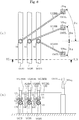
- Embodiment 6 is an example when the invention is applied to a case of connecting 3 phase buses and a bushing by a bushing lead out bus
- Fig. 6(a) is a plane view thereof
- Fig. 6(b) is a side view viewed from VIb-VIb line of Fig. 6(a) in an arrow mark direction.
- Fig. 6 portions the same as or corresponding to those of Fig. 1 , Fig. 2 , Fig. 3, Fig. 4, Fig. 5 are attached with the same notations and Embodiment 6 of the invention will be explained mainly with regard to a point different from those of Embodiments 1, 2, 3, 4, 5 of the invention.
- a U phase gas-insulated bus UGIB and a V phase gas-insulated bus VGIB and a W phase gas-insulated bus WGIB which are respectively prolonged are laid at an installed location of a substation or the like to extend in parallel.
- a U phase bushing UBsg and a V phase bushing VBsg and a W phase bushing WBsg are provided to align to be spaced apart from each other by sufficient leakage distances.
- the U phase gas-insulated bus UGIB and the V phase gas-insulated bus VGIB and the W phase gas-insulated bus WGIB which are respectively prolonged are laid such that a direction of aligning the U phase bushing UBsg, the U phase bushing VBsg, the U phase bushing WBsg and the direction of extending the U phase gas-insulated bus UGIB and the V phase gas-insulated bus VGIB and the W phase gas-insulated bus WGIB constitute the same direction.
- the respective phase gas-insulated buses UGIB, VGIB, WGIB include bus conductors UB, VB, WB insulated by the gas 13.
- a front end OHTL of each of the U phase bushing UBsg, the V phase bushing VBsg, the W phase bushing WBsg is connected to an overhead transmission line or a transformer bushing.
- U phase gas-insulated bus UGIB and the U phase bushing UBsg are connected by way of a gas-insulted connection bus UGIBBB by a bushing lead out bus UGIBB of U phase constituting a gas-insulated bus.
- V phase gas-insulated bus VGIB and the V phase bushing VBsg are connected by way of a gas-insulated connection bus VGIBBB of V phase by a bushing lead out bus VGIBB of V phase constituting a gas-insulated bus
- W phase gas-insulated bus WGIB and the W phase bushing WBsg are connected by way of a gas-insulated connection bus WGIBBB by a bushing lead out bus WGIBB constituting a gas-insulated bus.
- the gas-insulated connection buses UGIBBB, VGIBBB, WGIBBB each includes the first vessel (the other vessel) 12, the connection vessel (the one vessel) 11, the pressing member 14, the flange 121 of the first vessel (the other vessel) 12, the flange 111 of the connection vessel (the one vessel) 11, and the bolt 17 exemplified in Figs.1 through 5 .
- the flanges 121 of respective U, V, W phases are coupled to be fixed to the gas-insulated buses UGIB, VGIB, WGIB of respective corresponding U, V, W phases by way of the corresponding first vessels (the other vessels) 12.
- the bushing lead out buses UGIBB, VGIBB, WGIBB of the respective phases correspond to the second vessels (branch pipe shape vessels) 16 exemplified in Figs.1 through 5 .
- Embodiment 6 similar to, for example, the case of Fig. 1 or Fig. 2 , before the other vessel (the first vessel) 12 is screwed to the flange 121 by the bolt 17, the other vessel (the first vessel) 12 and the flange 121 thereof can be pivoted around the one vessel 11 and the flange 111.
- the through hole 1411 of the pressing member 14 can easily be matched to the screw hole 1211 of the flange 121 of the other vessel 12, and the respective bolts 17 can easily and firmly be inserted to the respective through holes 1411 and screwed to the respective screw holes 1211. That is, integration or installation of various products can flexibly be dealt with without depending on only design of respective product specifications.
- a swing angle ⁇ c of the U phase bushing lead out bus UGIBB, a swing angle ⁇ b of the V phase bushing lead out bus VGIBB, and a swing angle ⁇ a of the W phase bushing lead out bus WGIBB differ between those in design and those in installation at an actual cite, as described above, before the other vessel (the first vessel) 12 is screwed to the flange 121 by the bolt 17, the other vessel (the first vessel) 12 and the flange 121 thereof can be pivoted around the one vessel 11 and the flange 111.
- the swing angles can easily be adjusted. Further, the adjustment can be carried out even after the other vessel (the first vessel) 12 is screwed to the flange 121 by the bolt 17, depending on the degree of the screwing.
- Embodiment 7 is an example when the invention is applied to a connection between a prolonged first gas-insulated bus and a prolonged second gas-insulated bus
- Fig. 7 (a) is a plane view of the example
- Fig. 7(b) is a front view viewed from VIIb-VIIb line of Fig. 7(a) in an arrow mark direction
- Fig. 7(c) is a side view viewed from VIIc-VIIc line of Fig. 7(a) in an arrow mark direction.
- Fig. 7 portions the same as or corresponding to those of Fig. 1 , Fig. 2 , Fig. 3, Fig. 4, Fig. 5 , Fig. 6 are attached with the same notations and Embodiment 7 of the invention will be explained as follows mainly with regard to a point different from those of Embodiments 1, 2, 3, 4, 5, 6 of the invention.
- a prolonged first gas-insulated bus LGIB1 and a prolonged second gas-insulated bus LGIB2 are not arranged on the same axis line but arranged such that respective axis lines of the gas-insulated buses LGIB1, LGIB2 are shifted from each other.
- connection vessel GIBC intersects with directions of extending the first and the second gas-insulated buses LGIB1, LGIB2 in an extending direction thereof and integrally includes branch pipe shape vessels GIBC1, GIBC2 at both end portions of an outer periphery thereof.
- connection vessel GIBC includes end portion hermetically closing lids GIBC3, GIBC4 at both ends thereof.
- the end portion hermetically closing lids GIBC3, GIBC4 hermetically close inside of the connection vessel GIBC from outside.
- connection conductor GIBC5 insulated by the gas 13 at inside of the connection vessel GIBC is supported by the end portion hermetically closing lid GIBC3 by a column-like insulated support member GIBC6 at one end portion thereof and supported by the end portion hermetically closing lid GIBC4 by a column-like insulated support member GIBC7 at other end thereof.
- the one vessel 11, the pressing member 14, the flange 111 of the one vessel 11 and the like exemplified in Figs.1 through 5 are coupled to the flanges 121 by the bolts 17.
- the first and the second gas-insulated buses LGIB1, LGIB2 correspond to the second vessels (branch pipe shape vessels) 16 exemplified in Figs.1 through 5 and coupled to the corresponding vessels 11 on one side by way of the flanges LGIB11, LGIB21.
- the one vessel 11 and the flange 111 thereof can relatively be pivoted around the pressing member 14 and the flange 121 and the axis centers.
- the flange 121 and the pressing member 14 which are squeezing and the flange 111 which is squeezed are constituted by different metals, and a semi solid state lubricant of grease or the like is coated on the sliding face 1112 between the two flanges 111, 121 constituting portions at which the flange 111 and the flange 121 are brought into press contact with each other (refer to also Fig. 1(a) , Fig. 2(a) , Fig. 3 through Fig. 5 ).
- first gas-insulated bus LGIB1 and the prolonged second gas-insulated bus LGIB2 are prolonged, even when the buses are thermally elongated and contracted by a considerable amount by an environmental temperature change, according to the above-described constitution of Embodiment 7, thermal elongation and contraction of the first and the second gas-insulated buses LGIB1, LGIB2 can be absorbed by relatively pivoting the vessel 11 and the flange 111 and the pressing member 14 and the flange 121.
- Fig. 7 (a) when the first and the second gas-insulated buses LGIB1, LGIB2 are elongated in a direction of an arrow mark A by elevating an environmental temperature, while pivoting the vessel 11 and the flange 111 and the pressing member 14 and the flange 121 relative to each other as described above, the respective vessels 11, 11 in correspondence with the first and the second gas-insulated buses LGIB1, LGIB2, and the connection vessel GIBC are pivoted in an arrow mark B direction centering on a center O in a longitudinal direction thereof.
- bus connection device BCD having the above-described structure different from a bellows.
- the bus connection device BCD is a portion excluding the first and the second gas-insulated buses LGIB1, LGIB2 in Fig. 7(a), Fig. 7(b), Fig. 7(c) .
- the contiguous vessels 11, GIBC are coupled by squeezing the flange 111 of the vessel 11 on one side to be coupled by the pressing member 14 screwed to the flange 121 of the vessel GIBC on other side and the flange 121 of the vessel GIBC on other side and the flange 121 of the vessel GIBC on other side.
- Embodiment 7 includes the first and the second vessels 11, 11 including the gas-insulated power conductors, and the connection vessel GIBC for connecting the first vessel 11 in correspondence with the first gas-insulated bus LGIB1 and the second vessel 11 in correspondence with the second gas-insulated bus LGIB2, and the first vessel 11 (in correspondence with the first gas-insulated bus LGIB1) and the connection vessel GIBC contiguous to each other are coupled and the second vessel 11 (in correspondence with the second gas-insulated bus LGIB2) and the connection vessel GIBC contiguous to each other are coupled by squeezing the flange 111 of the vessel 11 on one side to be coupled by the pressing member 14 screwed to the flange 121 of the vessel GIBC on other side to be coupled and the flange 121 of the vessel GIBC on other side.
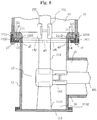
- Embodiment 8 of the invention will be explained in reference to Fig. 8 showing an example of an essential portion of a gas-insulated power apparatus as follows. Further, in Fig. 8 , portions the same as or corresponding to those of Fig. 1 , Fig. 2 , Fig. 3, Fig. 4, Fig. 5 , Fig. 6 , Fig. 7 are attached with the same notations and Embodiment 8 of the invention will be explained as follows mainly with regard to a point different from those of Embodiments 1, 2, 3, 4, 5, 6, 7 of the invention.
- Embodiment 8 of the invention is an example in which in a gas-insulated power apparatus coupling the contiguous vessels 11, 12 by squeezing the flange 111 of the vessel 11 on one side to be coupled by the pressing member 14 screwed to the flange 121 of the vessel 12 on other side and the flange 121 of the vessel 12 on other side, the column-like insulating spacer 1131 is attached to the lower end portion hermetically closing lid 113 of the vessel 11 on one side, a bottom chamber 1132 surrounding a root portion of the column-like insulating spacer 1131 is formed and the bottom chamber 1132 is made to constitute a well-known particle trap.
- the particle trap is a portion of catching a particle of a metal small piece generated in integration and remaining at inside of the vessels 11, 12, 16, a contact metal powder scattered from a contact of the circuit breaker by operating the circuit breaker.
- the bottom chamber 1132 constituting the particle trap is formed to surround the root portion of the column-like insulated spacer 1131 attached to the lower end portion hermetically closing lid 113, and therefore, the bottom chamber 1132 can be disposed on a lower side of the branch pipe shape vessel 16, and therefore, the bottom chamber 1132 is disposed at a position on a lower side of an upper end portion or a middle portion of the column-like insulated spacer 1131 determined in relation to a position of the inner power conductor 161 of the branch pipe shape vessel 16. Therefore, the particle trap constituting the bottom chamber 1132 according to Embodiment 8 can effectively catch the particle without effecting an influence so much on an insulating function of the column-like insulating spacer 1131.
- Embodiment 9 is other example when the invention is applied to the case of connecting the 3 phase buses and a bushing by a bushing lead out bus
- Fig. 9(a) is a plane view thereof
- Fig. 9(b) is a side view viewing a portion surrounded by a one-dotted chain line of Fig. 9(a) from a VIb-VIb line in an arrow mark direction.
- Fig. 9 portions the same as or corresponding to those of Fig. 1 through Fig. 8 are attached with the same notations and Embodiment 9 of the invention will be explained as follows mainly with regard to a point different from those of Embodiments 1 through 8 of the invention.
- Embodiment 6 mentioned above is the example when the gas-insulated buses UGIB, VGIB, WGIB independent from each other in respective phases of U, V, W are laid, as exemplified in Fig. 9 , the example of Embodiment 9 is an example when a so-to-speak 3 phase summarized bus UVWGIB in which the bus conductors UB, VB, WB of respective phases of U, V, W are included in a common vessel is laid.
- the first vessels (the vessels on other side) 12, 12, 12 of respective phases U, V, W are coupled to top portions of a vessel UVWGIBC of the 3 phase summarized bus UVWGIB, and the respective vessels 12, 12, 12 of respective phases U, V, W are disposed at the same height.
- a direction of aligning the first vessels (vessels on other side) 12, 12, 12 of respective phases U, V, W is in parallel with the direction of aligning the bushings UBsg, VBsg, WBsg of respective phases.
- the power conductor 122 at inside of the first vessel (the vessel on other side) 12 of U phase is connected to the bus conductor UB of U phase
- the power conductor 122 at inside of the first vessel (the vessel on other side) 12 of V phase is connected to the bus conductor VB of V phase
- the power conductor 122 at inside of the first vessel (the vessel on other side) 12 of W phase is connected to the bus conductor WB of W phase respectively at inside of the vessel UVWGIBC of the 3 phase summarized bus UVWGIB by way of tulip contacts or the like.
Landscapes
- Engineering & Computer Science (AREA)
- Power Engineering (AREA)
- Installation Of Bus-Bars (AREA)
- Gas-Insulated Switchgears (AREA)
Claims (17)
- Gasisolierte Leistungsvorrichtung, umfassend ein erstes und zweites angrenzendes Gefäß (11, 12), welche über jeweilige Flansche (111, 121) hiervon gekoppelt sind, und Leistungsleiter (112, 122), welche in den Gefäßen (11, 12) enthalten sind und gegen die Gefäße durch ein Isoliergas (13) isoliert sind,
wobei das erste und zweite angrenzende Gefäß (11, 12) gekoppelt sind, indem der Flansch (111) von dem zweiten Gefäß (11) an einer Seite gequetscht wird, um durch ein Druckelement (14) gekoppelt zu werden, welches mit einem Flansch (121) des ersten Gefäßes (12) an der anderen Seite und dem Flansch (121) des ersten Gefäßes (12) an der anderen Seite verschraubt ist, dadurch gekennzeichnet, dass
ein Gefäß (16) in der Form eines verzweigten Rohres, welches einen hierin angeordneten Leistungsleiter enthält und hiergegen durch das Isoliergas isoliert ist, mit zumindest einem von dem ersten und zweiten angrenzenden Gefäß (11, 12) verbunden ist, und
wobei ein Schmiermittel zwischen dem Flansch (121) von dem ersten Gefäß (12) und dem Flansch (111) von dem zweiten Gefäß (11) bereitgestellt ist, um eine Luftabdichtung zwischen dem Flansch (121) von dem ersten Gefäß (12) und dem Flansch (111) von dem zweiten Gefäß (11) beizubehalten, und um zu ermöglichen, dass der Flansch (121) von dem ersten Gefäß (12) und der Flansch (111) von dem zweiten Gefäß (11) in Relation zueinander in einer Umfangsrichtung der Flansche (111, 121) gleiten. - Gasisolierte Leistungsvorrichtung nach Anspruch 1, dadurch gekennzeichnet, dass jedes der Gefäße (11, 12) durch eine röhrenförmige Gestalt gebildet ist und jeder der Flansche (111, 121) ringförmig ausgebildet ist, und wobei eine Mehrzahl von Stücken der Druckelemente (141, 142) entlang der Flansche (111, 121) in der ringförmigen Form ringförmig angeordnet sind.
- Gasisolierte Leistungsvorrichtung nach Anspruch 1, dadurch gekennzeichnet, dass jedes der Gefäße (11, 12) durch eine röhrenförmige Gestalt gebildet ist und jeder der Flansche (111, 121) ringförmig ausgebildet ist, und wobei das Druckelement (14) durch eine Form eines durchgehenden Ringes in Übereinstimmung mit den Flanschen (111, 121) in der ringförmigen Form ausgebildet ist, und vor dem Anbringen des Flansches (111) an das zweite Gefäß (11) an das zweite Gefäß (11) angebracht wird.
- Gasisolierte Leistungsvorrichtung nach einem der Ansprüche 1 bis 3, dadurch gekennzeichnet, dass der gequetschte Flansch (111) schwenkbar an einer passenden Ausnehmung (1212) des Quetschflansches (121) angebracht ist.
- Gasisolierte Leistungsvorrichtung nach einem der Ansprüche 1 bis 4, dadurch gekennzeichnet, dass die Leistungsleiter (112, 122) an einer Innenseite der jeweiligen Gefäße (11, 12) koaxial angeordnet sind, wobei die koaxialen Leistungsleiter (112, 122) durch einen innerhalb des Gefäßes befindlichen Leistungsleiterverbinder (151) verbunden sind, wodurch es ermöglicht wird, dass sich die Leistungsleiter (112, 122) in einer Axialrichtung verlängern und zusammenziehen, und ermöglicht wird, dass die Leistungsleiter (112, 122) in einer Umfangsrichtung schwenken.
- Gasisolierte Leistungsvorrichtung nach einem der Ansprüche 1 bis 4, dadurch gekennzeichnet, dass die Leistungsleiter (112, 122) an einer Innenseite des Gefäßes (11, 12) durch einen säulenartigen isolierten Abstandshalter (1131) gegen die Gefäße (11, 12) isoliert sind, welcher an einem Endabschnitt eines hermetisch schließenden Deckels (113) von zumindest einem der Gefäße (11, 12) angebracht ist.
- Gasisolierte Leistungsvorrichtung nach Anspruch 6, dadurch gekennzeichnet, dass ein Gefäß (16) in der Form einer verzweigten Röhre mit dem zweiten Gefäß (11) verbunden ist;
wobei der Leistungsleiter (161) an einer Innenseite des Gefäßes (16) in der Form einer verzweigten Röhre innerhalb des zweiten Gefäßes (11) mit dem Leistungsleiter (112) mittels eines Leistungsleiterverbinders (152) an einer Innenseite des Gefäßes in der Form einer verzweigten Röhre verbunden ist, wodurch es ermöglicht wird, dass sich der Leistungsleiter (161) an einer Innenseite des Gefäßes (16) in der Form einer verzweigten Röhre in einer Axialrichtung verlängert und zusammenzieht;
wobei der Leistungsleiter (161) an einer Innenseite des Gefäßes (16) in der Form einer verzweigten Röhre durch den säulenartigen isolierten Abstandshalter (1131) gegen das Gefäß (16) in der Form einer verzweigten Röhre und das zweite Gefäß (11) isoliert ist, um den Leistungsleiter (112) an einer Innenseite des zweiten Gefäßes (11) gegen das zweite Gefäß (11) zu isolieren. - Gasisolierte Leistungsvorrichtung nach Anspruch 6, dadurch gekennzeichnet, dass eine Teilchenfalle (1132) durch Anbringen des säulenartigen isolierten Abstandshalters (1131) an einem unteren Endabschnitt des hermetisch schließenden Deckels (113) des zweiten Gefäßes (11) gebildet wird.
- Gasisolierte Leistungsvorrichtung nach Anspruch 1, dadurch gekennzeichnet, dass das Gefäß (16) in der Form einer verzweigten Röhre im Wesentlichen orthogonal zu den koaxial gekoppelten ersten und zweiten Gefäß (11, 12) steht.
- Gasisolierte Leistungsvorrichtung nach Anspruch 9, dadurch gekennzeichnet, dass jedes der Gefäße (11, 12) röhrenförmig ausgebildet ist und jeder der Flansche (111, 121) ringförmig ausgebildet ist, und wobei eine Mehrzahl von Stücken der Druckelemente (141, 142) entlang der Flansche (111, 121) in der ringförmigen Form ringförmig angeordnet sind.
- Gasisolierte Leistungsvorrichtung nach Anspruch 9, dadurch gekennzeichnet, dass jedes der Gefäße (11, 12) röhrenförmig ausgebildet ist und jeder der Flansche (111, 121) ringförmig ausgebildet ist, und wobei das Druckelement durch eine Form eines durchgehenden Ringes in Übereinstimmung mit den Flanschen (111, 121) in der ringförmigen Form gebildet ist und vor dem Anbringen des Flansches (111) an das Gefäß (11) an das zweite Gefäß (11) angebracht wird.
- Gasisolierte Leistungsvorrichtung nach einem der Ansprüche 9 bis 11, dadurch gekennzeichnet, dass der gequetschte Flansch (111) schwenkbar an einer passenden Ausnehmung (1212) des Quetschflansches (121) angebracht ist.
- Gasisolierte Leistungsvorrichtung nach einem der Ansprüche 9 bis 12, dadurch gekennzeichnet, dass jeder der jeweiligen Leistungsleiter (161, 112, 122), welche in dem Gefäß (16) in der Form einer verzweigten Röhre, dem ersten Gefäß (12) und dem zweiten Gefäß (11) enthalten sind, durch einen säulenartigen isolierten Abstandshalter (1131), welcher an einem Endabschnitt eines hermetisch schließenden Deckels (113) des Gefäßes angebracht ist, gegen die entsprechenden Gefäße (16, 12, 11) isoliert ist.
- Gasisolierte Leistungsvorrichtung nach einem der Ansprüche 9 bis 13, dadurch gekennzeichnet, dass, indem der Flansch (111) von dem zweiten Gefäß (11) an einer Seite und der Flansch (121) von dem ersten Gefäß (12) an einer weiteren Seite miteinander in Druckkontakt gebracht werden, ermöglicht wird, dass die zwei Flansche (111, 121) in Relation zueinander in einer Umfangsrichtung gleiten und eine Luftabdichtung zwischen den zwei Flanschen (111, 121) beibehalten wird.
- Gasisolierte Leistungsvorrichtung nach Anspruch 14, dadurch gekennzeichnet, dass eine Schmiermittelschicht an einem Abschnitt angelegt ist, an dem der Flansch (111) von dem zweiten Gefäß (11) an einer Seite und der Flansch (121) von dem ersten Gefäß (12) an einer weiteren Seite miteinander in Druckkontakt gebracht werden.
- Gasisolierte Leistungsvorrichtung nach Anspruch 14, dadurch gekennzeichnet, dass ein Einbetten eines O-Ringes (121R, 121R1, 121R2) und/oder ein Beschichten mit einem Schmiermittel an dem Abschnitt durchgeführt werden, an dem der Flansch (111) von dem zweiten Gefäß (11) an einer Seite und der Flansch (121) von dem ersten Gefäß (12) an einer weiteren Seite miteinander in Druckkontakt gebracht werden.
- Gasisolierte Leistungsvorrichtung nach einem der Ansprüche 9 bis 13, dadurch gekennzeichnet, dass der Flansch (121) und das Druckelement (14), welche gequetscht werden, und der Flansch (111), welcher gequetscht wird, unterschiedliche Metalle enthalten.
Applications Claiming Priority (1)
| Application Number | Priority Date | Filing Date | Title |
|---|---|---|---|
| PCT/JP2006/306883 WO2007116480A1 (ja) | 2006-03-31 | 2006-03-31 | ガス絶縁電力機器 |
Publications (3)
| Publication Number | Publication Date |
|---|---|
| EP2003756A1 EP2003756A1 (de) | 2008-12-17 |
| EP2003756A4 EP2003756A4 (de) | 2011-11-23 |
| EP2003756B1 true EP2003756B1 (de) | 2018-04-25 |
Family
ID=38580789
Family Applications (1)
| Application Number | Title | Priority Date | Filing Date |
|---|---|---|---|
| EP06730831.2A Ceased EP2003756B1 (de) | 2006-03-31 | 2006-03-31 | Gasisolierte elektrische stromvorrichtung |
Country Status (5)
| Country | Link |
|---|---|
| US (1) | US8519293B2 (de) |
| EP (1) | EP2003756B1 (de) |
| JP (1) | JP4940230B2 (de) |
| CN (1) | CN101496246B (de) |
| WO (1) | WO2007116480A1 (de) |
Families Citing this family (8)
| Publication number | Priority date | Publication date | Assignee | Title |
|---|---|---|---|---|
| JP5523903B2 (ja) * | 2010-04-07 | 2014-06-18 | 株式会社東芝 | ガス絶縁母線 |
| JP4741037B1 (ja) * | 2010-11-15 | 2011-08-03 | 三菱電機株式会社 | ガス絶縁母線 |
| DE102011004032A1 (de) | 2011-02-14 | 2012-08-16 | Siemens Aktiengesellschaft | Längenveränderbare Kapselungsgehäuseanordnung |
| JP4781493B1 (ja) * | 2011-02-28 | 2011-09-28 | 三菱電機株式会社 | ガス絶縁母線 |
| US9530594B2 (en) * | 2014-04-24 | 2016-12-27 | Abb Schweiz Ag | Integrated particle trap in a tank of a dead tank circuit breaker |
| WO2017162533A1 (en) * | 2016-03-24 | 2017-09-28 | Abb Schweiz Ag | Electrical circuit breaker device with particle trap |
| CN106410656B (zh) * | 2016-06-28 | 2018-08-14 | 湖南长高电气有限公司 | 一种气体绝缘金属封闭开关设备的拐弯导体 |
| JPWO2025041199A1 (de) * | 2023-08-18 | 2025-02-27 |
Family Cites Families (26)
| Publication number | Priority date | Publication date | Assignee | Title |
|---|---|---|---|---|
| DE1927784A1 (de) * | 1969-05-30 | 1970-12-03 | Siemens Ag | Metallgekapselte Hochspannungsschaltanlage |
| JPS507739B1 (de) | 1969-12-17 | 1975-03-28 | ||
| JPS5148269B2 (de) * | 1971-12-22 | 1976-12-20 | ||
| US4079746A (en) | 1975-12-24 | 1978-03-21 | Keystone International, Inc. | Valve assembly having adapter means |
| JPS5297431U (de) * | 1976-01-20 | 1977-07-21 | ||
| JPS53111273A (en) * | 1977-03-09 | 1978-09-28 | Matsushita Electronics Corp | Mamufacture of magnetron anode |
| JPS589479Y2 (ja) | 1978-06-05 | 1983-02-21 | 日新電機株式会社 | 管路気中送電線路の接続装置 |
| DE3011657C2 (de) * | 1980-03-26 | 1982-05-27 | Eumuco Aktiengesellschaft für Maschinenbau, 5090 Leverkusen | Vorrichtung zur Durchführung des Wechsels von Schermessern an Scheren u.dgl. |
| JPS6111950Y2 (de) | 1980-04-16 | 1986-04-15 | ||
| JPS6349044Y2 (de) | 1981-03-25 | 1988-12-16 | ||
| JPS59183582A (ja) * | 1983-04-04 | 1984-10-18 | Konishiroku Photo Ind Co Ltd | 電子スチルカメラ |
| JPS619112A (ja) * | 1984-06-20 | 1986-01-16 | 三菱電機株式会社 | 電気絶縁装置 |
| JPH033122U (de) | 1989-01-31 | 1991-01-14 | ||
| JPH033122A (ja) * | 1989-05-31 | 1991-01-09 | Toshiba Corp | 焦点検出装置 |
| DE4318074A1 (de) | 1993-06-01 | 1994-12-08 | Abb Patent Gmbh | Gekapselte gasisolierte Schaltanlage mit Kabelendverschluß |
| JPH09126321A (ja) * | 1995-10-30 | 1997-05-13 | Haniyuuda Tekko:Kk | 圧力容器蓋のシール構造 |
| JPH1047483A (ja) * | 1996-08-06 | 1998-02-20 | Haniyuuda Tekko:Kk | 圧力容器のシール構造 |
| DE29614799U1 (de) * | 1996-08-13 | 1996-10-24 | Siemens AG, 80333 München | Hochspannungsschaltanlage |
| JPH10172372A (ja) | 1996-12-13 | 1998-06-26 | Hitachi Ltd | 通電用導体の接触子 |
| JP3432407B2 (ja) * | 1998-01-21 | 2003-08-04 | 三菱電機株式会社 | ガス絶縁開閉装置と変圧器の接続装置 |
| JPH11218220A (ja) * | 1998-02-03 | 1999-08-10 | Hanyuda Tekko:Kk | 圧力容器のシール構造 |
| JP2002051440A (ja) | 2000-07-31 | 2002-02-15 | Sumitomo Electric Ind Ltd | 管路気中送電線路の伸縮吸収構造及び伸縮吸収方法 |
| JP2002051415A (ja) * | 2000-08-02 | 2002-02-15 | Toshiba Corp | 複合形ガス絶縁開閉装置 |
| AU763276B2 (en) * | 2001-02-07 | 2003-07-17 | Hitachi Limited | Gas insulated switchgear |
| JP2003051440A (ja) | 2001-08-07 | 2003-02-21 | Nikon Corp | レチクル及びレチクル評価方法 |
| JP4312058B2 (ja) * | 2004-01-14 | 2009-08-12 | 三菱電機株式会社 | ガス容器の接続構造 |
-
2006
- 2006-03-31 CN CN200680041730XA patent/CN101496246B/zh not_active Expired - Fee Related
- 2006-03-31 JP JP2008509631A patent/JP4940230B2/ja not_active Expired - Fee Related
- 2006-03-31 EP EP06730831.2A patent/EP2003756B1/de not_active Ceased
- 2006-03-31 WO PCT/JP2006/306883 patent/WO2007116480A1/ja not_active Ceased
- 2006-03-31 US US12/083,194 patent/US8519293B2/en not_active Expired - Fee Related
Non-Patent Citations (1)
| Title |
|---|
| None * |
Also Published As
| Publication number | Publication date |
|---|---|
| EP2003756A4 (de) | 2011-11-23 |
| JPWO2007116480A1 (ja) | 2009-08-20 |
| WO2007116480A1 (ja) | 2007-10-18 |
| US20090266796A1 (en) | 2009-10-29 |
| EP2003756A1 (de) | 2008-12-17 |
| CN101496246B (zh) | 2012-07-18 |
| US8519293B2 (en) | 2013-08-27 |
| CN101496246A (zh) | 2009-07-29 |
| JP4940230B2 (ja) | 2012-05-30 |
Similar Documents
| Publication | Publication Date | Title |
|---|---|---|
| US8895884B2 (en) | Tank type vacuum circuit breaker | |
| US8519293B2 (en) | Gas-insulated power apparatus | |
| CN104584348B (zh) | 气体绝缘的开关设备 | |
| US20020113040A1 (en) | Gas circuit breaker | |
| US10347447B2 (en) | Tank type vacuum circuit breaker | |
| US5589674A (en) | Metal-encapsulated, gas-insulated switching installation | |
| US9082572B2 (en) | Tank type vacuum circuit breaker | |
| JP2024007522A (ja) | 少なくとも1つの摺動可能ねじを有するモジュールコネクタ、およびそのようなモジュールコネクタを有する接続アセンブリ | |
| KR20110005534A (ko) | 분리가능한 초전도 케이블용 종단접속함의 단말 구조체 | |
| US6677532B2 (en) | Isolated phase bus duct joint assembly | |
| CN101933208A (zh) | 有封闭外壳的装置 | |
| EP2865061B1 (de) | Kronenlose kappenanordnung | |
| EP3280016B1 (de) | Gasisoliertes schaltgetriebe | |
| US7728235B2 (en) | Electrical power feed thru for aircraft fuselages | |
| CN101507069A (zh) | 带有封装壳体的连接模块 | |
| KR101168181B1 (ko) | 고전압 회로 차단기 및 차단기 배열체 | |
| CN102474088A (zh) | 气体绝缘母线 | |
| CN1214559A (zh) | 电耦合元件 | |
| WO1996021962A3 (de) | Wandleranordnung am feldanschluss von gekapselten mittelspannungs-schaltanlagen | |
| EP2961015B1 (de) | Kopplungselement zum Zusammenkoppeln der Gehäuse von zwei gasisolierten elektrischen Elementen | |
| CN210379998U (zh) | 气体绝缘金属封闭开关设备分相主母线用可拆断口装置 | |
| CA2502806A1 (en) | Telescopic switch | |
| EP4191809A1 (de) | Kabelmodul, gasisolierte vorrichtung und verfahren zur herstellung eines kabelmoduls | |
| WO2023217426A1 (en) | Bent unit and gas-insulated transmission line | |
| JP2002252910A (ja) | ガス中終端接続部 |
Legal Events
| Date | Code | Title | Description |
|---|---|---|---|
| PUAI | Public reference made under article 153(3) epc to a published international application that has entered the european phase |
Free format text: ORIGINAL CODE: 0009012 |
|
| 17P | Request for examination filed |
Effective date: 20080508 |
|
| AK | Designated contracting states |
Kind code of ref document: A1 Designated state(s): CH DE FR LI |
|
| DAX | Request for extension of the european patent (deleted) | ||
| RBV | Designated contracting states (corrected) |
Designated state(s): CH DE FR LI |
|
| REG | Reference to a national code |
Ref country code: DE Ref legal event code: R079 Ref document number: 602006055231 Country of ref document: DE Free format text: PREVIOUS MAIN CLASS: H02B0013020000 Ipc: H02B0013045000 |
|
| A4 | Supplementary search report drawn up and despatched |
Effective date: 20111025 |
|
| RIC1 | Information provided on ipc code assigned before grant |
Ipc: H02B 13/045 20060101AFI20111020BHEP |
|
| 17Q | First examination report despatched |
Effective date: 20160203 |
|
| GRAP | Despatch of communication of intention to grant a patent |
Free format text: ORIGINAL CODE: EPIDOSNIGR1 |
|
| INTG | Intention to grant announced |
Effective date: 20170327 |
|
| GRAS | Grant fee paid |
Free format text: ORIGINAL CODE: EPIDOSNIGR3 |
|
| GRAJ | Information related to disapproval of communication of intention to grant by the applicant or resumption of examination proceedings by the epo deleted |
Free format text: ORIGINAL CODE: EPIDOSDIGR1 |
|
| GRAL | Information related to payment of fee for publishing/printing deleted |
Free format text: ORIGINAL CODE: EPIDOSDIGR3 |
|
| GRAP | Despatch of communication of intention to grant a patent |
Free format text: ORIGINAL CODE: EPIDOSNIGR1 |
|
| INTC | Intention to grant announced (deleted) | ||
| INTG | Intention to grant announced |
Effective date: 20170922 |
|
| GRAA | (expected) grant |
Free format text: ORIGINAL CODE: 0009210 |
|
| AK | Designated contracting states |
Kind code of ref document: B1 Designated state(s): CH DE FR LI |
|
| REG | Reference to a national code |
Ref country code: CH Ref legal event code: EP |
|
| REG | Reference to a national code |
Ref country code: DE Ref legal event code: R096 Ref document number: 602006055231 Country of ref document: DE |
|
| REG | Reference to a national code |
Ref country code: DE Ref legal event code: R097 Ref document number: 602006055231 Country of ref document: DE |
|
| PLBE | No opposition filed within time limit |
Free format text: ORIGINAL CODE: 0009261 |
|
| STAA | Information on the status of an ep patent application or granted ep patent |
Free format text: STATUS: NO OPPOSITION FILED WITHIN TIME LIMIT |
|
| 26N | No opposition filed |
Effective date: 20190128 |
|
| PGFP | Annual fee paid to national office [announced via postgrant information from national office to epo] |
Ref country code: DE Payment date: 20190319 Year of fee payment: 14 Ref country code: CH Payment date: 20190314 Year of fee payment: 14 |
|
| PGFP | Annual fee paid to national office [announced via postgrant information from national office to epo] |
Ref country code: FR Payment date: 20190213 Year of fee payment: 14 |
|
| REG | Reference to a national code |
Ref country code: DE Ref legal event code: R119 Ref document number: 602006055231 Country of ref document: DE |
|
| REG | Reference to a national code |
Ref country code: CH Ref legal event code: PL |
|
| PG25 | Lapsed in a contracting state [announced via postgrant information from national office to epo] |
Ref country code: FR Free format text: LAPSE BECAUSE OF NON-PAYMENT OF DUE FEES Effective date: 20200331 Ref country code: DE Free format text: LAPSE BECAUSE OF NON-PAYMENT OF DUE FEES Effective date: 20201001 Ref country code: CH Free format text: LAPSE BECAUSE OF NON-PAYMENT OF DUE FEES Effective date: 20200331 Ref country code: LI Free format text: LAPSE BECAUSE OF NON-PAYMENT OF DUE FEES Effective date: 20200331 |