EP2000419A2 - Sac destiné à la réception d'aliments, comprenant une couture de perforation - Google Patents
Sac destiné à la réception d'aliments, comprenant une couture de perforation Download PDFInfo
- Publication number
- EP2000419A2 EP2000419A2 EP08010253A EP08010253A EP2000419A2 EP 2000419 A2 EP2000419 A2 EP 2000419A2 EP 08010253 A EP08010253 A EP 08010253A EP 08010253 A EP08010253 A EP 08010253A EP 2000419 A2 EP2000419 A2 EP 2000419A2
- Authority
- EP
- European Patent Office
- Prior art keywords
- bag
- side edge
- line
- weakness
- perforation
- Prior art date
- Legal status (The legal status is an assumption and is not a legal conclusion. Google has not performed a legal analysis and makes no representation as to the accuracy of the status listed.)
- Ceased
Links
- 230000003313 weakening effect Effects 0.000 claims description 113
- 239000000463 material Substances 0.000 claims description 21
- 235000013305 food Nutrition 0.000 claims description 20
- 238000004519 manufacturing process Methods 0.000 claims description 15
- 238000000034 method Methods 0.000 claims description 13
- 239000002131 composite material Substances 0.000 claims description 11
- 238000004806 packaging method and process Methods 0.000 claims description 11
- 229920003023 plastic Polymers 0.000 claims description 7
- 235000015173 baked goods and baking mixes Nutrition 0.000 claims description 6
- 235000012771 pancakes Nutrition 0.000 claims description 6
- 235000013550 pizza Nutrition 0.000 claims description 6
- 239000004033 plastic Substances 0.000 claims description 5
- 235000015220 hamburgers Nutrition 0.000 claims description 4
- 238000005520 cutting process Methods 0.000 claims description 2
- 238000004080 punching Methods 0.000 claims description 2
- 235000002595 Solanum tuberosum Nutrition 0.000 claims 1
- 244000061456 Solanum tuberosum Species 0.000 claims 1
- 230000003750 conditioning effect Effects 0.000 claims 1
- 230000037406 food intake Effects 0.000 claims 1
- 239000011888 foil Substances 0.000 description 6
- 235000021485 packed food Nutrition 0.000 description 4
- 235000021487 ready-to-eat food Nutrition 0.000 description 4
- 229910052782 aluminium Inorganic materials 0.000 description 3
- XAGFODPZIPBFFR-UHFFFAOYSA-N aluminium Chemical compound [Al] XAGFODPZIPBFFR-UHFFFAOYSA-N 0.000 description 3
- 229910052751 metal Inorganic materials 0.000 description 3
- 239000002184 metal Substances 0.000 description 3
- 239000002985 plastic film Substances 0.000 description 3
- 241000196324 Embryophyta Species 0.000 description 2
- 239000000853 adhesive Substances 0.000 description 2
- 230000001070 adhesive effect Effects 0.000 description 2
- 230000009286 beneficial effect Effects 0.000 description 2
- 238000010276 construction Methods 0.000 description 2
- 230000006378 damage Effects 0.000 description 2
- 238000003825 pressing Methods 0.000 description 2
- 230000002441 reversible effect Effects 0.000 description 2
- 238000009736 wetting Methods 0.000 description 2
- 240000007594 Oryza sativa Species 0.000 description 1
- 235000007164 Oryza sativa Nutrition 0.000 description 1
- 238000004026 adhesive bonding Methods 0.000 description 1
- 230000002411 adverse Effects 0.000 description 1
- 230000007423 decrease Effects 0.000 description 1
- 238000001035 drying Methods 0.000 description 1
- 235000013410 fast food Nutrition 0.000 description 1
- 230000001788 irregular Effects 0.000 description 1
- 239000002650 laminated plastic Substances 0.000 description 1
- 239000002651 laminated plastic film Substances 0.000 description 1
- 238000012858 packaging process Methods 0.000 description 1
- 239000000123 paper Substances 0.000 description 1
- 229920006255 plastic film Polymers 0.000 description 1
- 230000002035 prolonged effect Effects 0.000 description 1
- 235000009566 rice Nutrition 0.000 description 1
- 238000000926 separation method Methods 0.000 description 1
Images



Classifications
-
- B—PERFORMING OPERATIONS; TRANSPORTING
- B65—CONVEYING; PACKING; STORING; HANDLING THIN OR FILAMENTARY MATERIAL
- B65D—CONTAINERS FOR STORAGE OR TRANSPORT OF ARTICLES OR MATERIALS, e.g. BAGS, BARRELS, BOTTLES, BOXES, CANS, CARTONS, CRATES, DRUMS, JARS, TANKS, HOPPERS, FORWARDING CONTAINERS; ACCESSORIES, CLOSURES, OR FITTINGS THEREFOR; PACKAGING ELEMENTS; PACKAGES
- B65D75/00—Packages comprising articles or materials partially or wholly enclosed in strips, sheets, blanks, tubes or webs of flexible sheet material, e.g. in folded wrappers
- B65D75/52—Details
- B65D75/58—Opening or contents-removing devices added or incorporated during package manufacture
- B65D75/5805—Opening or contents-removing devices added or incorporated during package manufacture for tearing a side strip parallel and next to the edge, e.g. by means of a line of weakness
-
- A—HUMAN NECESSITIES
- A47—FURNITURE; DOMESTIC ARTICLES OR APPLIANCES; COFFEE MILLS; SPICE MILLS; SUCTION CLEANERS IN GENERAL
- A47G—HOUSEHOLD OR TABLE EQUIPMENT
- A47G21/00—Table-ware
- A47G21/001—Holders or wrappers as eating aids for fast food, e.g. hamburgers
-
- B—PERFORMING OPERATIONS; TRANSPORTING
- B65—CONVEYING; PACKING; STORING; HANDLING THIN OR FILAMENTARY MATERIAL
- B65D—CONTAINERS FOR STORAGE OR TRANSPORT OF ARTICLES OR MATERIALS, e.g. BAGS, BARRELS, BOTTLES, BOXES, CANS, CARTONS, CRATES, DRUMS, JARS, TANKS, HOPPERS, FORWARDING CONTAINERS; ACCESSORIES, CLOSURES, OR FITTINGS THEREFOR; PACKAGING ELEMENTS; PACKAGES
- B65D85/00—Containers, packaging elements or packages, specially adapted for particular articles or materials
- B65D85/30—Containers, packaging elements or packages, specially adapted for particular articles or materials for articles particularly sensitive to damage by shock or pressure
- B65D85/36—Containers, packaging elements or packages, specially adapted for particular articles or materials for articles particularly sensitive to damage by shock or pressure for bakery products, e.g. biscuits
Definitions
- the present invention relates to a bag for holding foods, in particular unbaked or baked baked goods, baked baked goods, pizza, pizza pancakes, pancakes, crepes, burgers, fritters, sandwiches and the like, comprising a front side with an opening-side edge and a bottom-side edge a first side edge and a second, opposite side edge and a rear side with an opening-side edge and a bottom-side edge and with a first side edge or a second, opposite side edge, wherein the front side and the rear side at least partially directly or indirectly in the region of their bottom edges Region of their respective adjoining first and / or second side edges are at least partially directly or indirectly connected.
- Bags for containing food are well known and are used in a variety of forms and for a variety of purposes.
- the US 5,335,996 to take a packaging bag for hamburger or similar fast food products.
- Perforation lines are provided along and adjacent to the side edges from the opening end to the bottom end on the front side of this packaging bag, so that the front side can be completely torn open. With such bags, the packaged food product should be removed again without destruction.
- a bag for food for example rice
- a perforation seam running centrally on the front side from the opening end to the bottom end.
- JP 2004 142 165 A a sandwich packaging with perforation lines on the back. Similar to the bag according to the US 5,335,996 the purpose of the perforation is to avoid damage or deformation of the packaged sandwich when unpacked.
- the generic packaging bags for ready-to-eat foods still leave something to be desired, in particular with regard to their operating safety and reliable handling, as well as with regard to their production.
- weak points or predetermined breaking points are installed in a packaging bag. These perforation seams have to be sufficiently strong on the one hand so as not to break down immediately during the packaging process, and on the other hand to be sufficiently weak to reliably prevent the bag from being torn or ruptured at a location other than that intended although also after prolonged contact with a greasy, warm and / or moist food product.
- a bag for holding food especially of ready-to-eat foods, has been found in which the bag has at least one first line of weakness, in particular perforation, on the front side and the bag has at least one second line of weakness, in particular perforation, which is substantially rectified from or spaced from the opening-side end of front and back to the or towards the bottom end of the front and back, and / or that the bag has at least a third line of weakness, in particular perforation, on the front, and that the bag has at least a fourth line of weakness, in particular perforation, at the rear, which is substantially rectified from or spaced from the first side edge of front and back to or in the direction of the second side edge of front and back e and / or that the pouch has at least one fifth line of weakness, in particular perforation, at the front, and that the pouch has at least one sixth line of weakness, in particular perforation, substantially rectified by or spaced from the opening end of the front and back Back side to the or in the direction of the first or second side
- the bags according to the invention therefore each have at least one weakening line on the front and back, which are rectified and accordingly cooperate in such a way that a portion of the bag containing at least a portion of the bag Front and a section of the back, can be reliably and accurately demolished.
- this succeeds particularly reliably when the lines of weakness on the front and rear sides extend over the entire length (from the bottom-side edge to the opening-side edge) or the entire width (from the first side edge to the second side edge).
- Such a portion of the bag releasing the article therein, eg food, can also be removed by, for example, starting the weakening lines of front and back together on the respective bottom edge and extending towards the respective opening side edges, without that the weakening lines extend to the opening-side edge of the front and back.
- the bag section can then be torn off even in the areas which no longer have weakening lines.
- the weakening lines can also start at the respective opening-side edge of the front and back sides and interact in the manner described, without having to extend to the respective bottom-side edge of the front or rear side.
- the weakening line on the front or rear side extends from the bottom to the opening-side edge, while the hereby cooperating weakening line on the rear or front side extends from the bottom or opening-side edge in the direction of the opening edge. or bottom edge extends without reaching this, as described above.
- a bag lie in the unfilled state front and back to each other. Rectified first and second or third and fourth or fifth and sixth or seventh and eighth lines of weakness of the front and back cover this regularly a common or overlapping bag area or are arranged side by side or are at least partially superimposed. If the respectively rectified weakening lines lie next to each other at least in sections, they preferably have an average distance of not more than 30 mm, preferably not more than 15 mm.
- a line of weakness extending in the sense of the invention in the direction of an edge is not completely carried out up to this edge, but ends previously spaced from this edge.
- this weakening line preferably terminates at a distance of at least 50 mm, in particular at least 15 mm, and preferably at least 5 mm, from the respective edge of the front or rear side. If a line of weakness begins at a distance from an edge, the distance to it is e.g. at least 50 mm, in particular at least 15 mm and preferably at least 5 mm.
- a weakening line which extends from the bottom or opening-side edge of the front or rear side in the direction of the opening-side or bottom-side edge preferably has a longitudinal extent of at least a quarter, in particular at least one third and particularly preferably at least half of the longitudinal extent of Front or back side between the bottom and side edges.
- a line of weakness extending from the first or second side edge toward the second and first side edges of the front and / or rear side preferably has a length extension of at least one third, and more preferably at least half the width extension of front and / or back sides. or backside between the first and second margin.
- the first and second or the third and fourth or the fifth and sixth or the seventh and eighth lines of weakness do not necessarily have to be parallel and / or to cover one another.
- the parallel alignment is one of the preferred embodiments.
- Rectified lines of weakness can be e.g. also intersect one or more times, but can also be spaced from each other or run side by side on the front or back, without crossing, as long as the safe and reliable tearing of a bag section along both rectified lines of weakness takes place.
- the lines of weakness or perforation can basically be mounted in any desired form on the front and / or back, as long as an inventive Purpose, eg a bag section unproblematic and reliable to be able to remove from the bag, is achieved.
- the weakening lines or perforations may be wavy or have a zigzag pattern.
- the weakening lines or perforation seams are preferably arranged along a straight line.
- front and back are preferably substantially completely interconnected along their respective mutual abutment areas.
- bottom edges or ends of the front and back abut each other and are substantially completely interconnected or integrally merge into each other to form in this way the bag bottom.
- a weakening line or perforation seam in the sense of the present invention can be embodied in many ways. Such weakening lines and perforation seams and / or lines and their production are familiar to the expert. Weakening lines and perforation seams in the sense of the present invention are also those which are due to a partial weakening of the material, for example the use of thinner or weaker material in regions, without having successive perforations or punches. A line of weakness or perforation according to the present invention thus permits reliable tearing of a portion of the front and back of the bag along that seam. Weakening lines in the sense of the present invention can be very thin, but also relatively wide, for example in the form of a weakening bar, comprising e.g.
- a width of a line of weakness on one and the same side and / or the width of rectified lines of weakness may also vary.
- a line of weakness in the sense of the present invention, when e.g. present as perforation, may also be interrupted once or several times.
- the bag has at least one first or second weakening line, in particular perforated seam, at the front and rear side, which essentially extend from the bottom end of the front or rear side extend to the opening-side end of the front or rear side, and / or that the bag has at least one first or second weakening line, front and back, respectively;
- perforation seam which extend substantially from the bottom end of the front or rear side toward the opening-side end of the front or rear side, and / or that the bag front and back respectively at least one first and second Weakening line, in particular perforated seam, which extend substantially from the opening end of the front or rear side toward the bottom end of the front or rear side, and / or that the bag has at least one first weakening line, in particular perforation seam, on the front side, that extends substantially from the opening-side end of the front side toward the bottom-side end of the rear side and that the rear side has at least
- the bag has at least one third or fourth weakening line, in particular perforated seam, at the front and rear sides, which essentially extends from the first side edge to the second side edge extend, and / or that the bag front and back respectively at least a third or fourth weakening line, in particular perforation, has substantially from the first side edge of the front or back in the direction of the second side edge of front or Rear side or from the second side edge of the front or back in the direction of the first side edge front or back cover extend, and / or that the bag has at least one third weakening line, in particular perforation seam, on the front side, which extends substantially from the second side edge in the direction of the first side edge, and in that the back side has at least one fourth weakening line, in particular perforation seam, which essentially differs from the second weakening line the first side edge extends in the direction of the second side edge, and / or that the
- the rectified lines of weakness are not over the entire length or width of the bag, tearing of a unitary bag section may also occur make it possible by grasping and pulling apart the bag at the opposite sides divided by the lines of weakness.
- the lines of weakness are not deliberately torn at the respective ends, but the lines of weakness preferably dissolve in the central region.
- the substantially rectified first and second weakening lines of the front and rear sides run essentially parallel to the first and / or second side edge of the front or rear side.
- the rectified weakening lines or perforation seams of the front and rear sides in the ready-to-use state lie, at least in sections, substantially on the same line.
- the lines of weakness or perforation of the front and back are at least partially adjacent to each other or one above the other, if you put the front and back in the finished bag against each other.
- the rectified lines of weakness or perforation of the front and back are not substantially on the same line.
- these lines of weakness or perforations from the front and back can be slightly offset from each other, for example, in the range of about 1 mm to 15 mm.
- the lines of weakness or perforation of the front and back are on average not more than 10 mm offset from each other.
- one, two, three or more weakening lines or perforation seams may be present, preferably immediately next to one another.
- the weakening lines or perforation seams of the front and rear sides preferably extend substantially parallel to the longitudinal axis of the front or rear side.
- the respective rectified lines of weakness on the front and back for example, the first and second lines of weakness of the front and back are arranged such that a portion of the bag without can be further demolished by tearing along these cooperating lines of weakness.
- the weakening lines on the bottom or opening-side end of the front and rear sides particularly preferably merge into one another or rest against one another. According to the invention, one can also speak of cooperating first and second, third and fourth, fifth and sixth or seventh and eighth lines of weakness or lines of weakness.
- the substantially rectified third and fourth lines of weakness of the front and rear sides extend essentially parallel to the bottom edge and / or the opening edge of the front and rear sides.
- the weakening line or perforation seam of the front side and / or the perforation seam of the rear side can extend substantially centrally between the opposite side edges from the respective bottom end, in particular to the opening end of the front or rear side.
- the front and back weakening line or perforations may also be beneficial for the front and back weakening line or perforations to be further spaced from the adjacent second side edges of the front and back than from the first one adjacent to each other Side margins of front and back.
- first, second, and / or third front and back weakening lines may be spaced farther from the second side edges of the front and back faces than the first side edges of the front and back faces, respectively.
- the first and second weakening lines or perforation seams of the front and back substantially have a distance from the first side edge of front and back, which is in the range of 1/8 to 3/8 of the width of Bag lies.
- each of the third and fourth front and back weakening lines of the front and rear sides are further spaced from the bottom edges or the opening side edges of the front and back than from the opening side or bottom edges of front and back.
- each of the third and fourth front and back weakening lines may be substantially at a distance from the opening side edge or the bottom edge of the front and back sides, in the range of 1/8 to 3/8 of the length of the bag lies.
- the first and second lines of weakening of the front and back can preferably be arranged in the region which is folded in each case from the inner fold of the first side wall element, in particular the side gusset of the first side wall element, extending to the inner fold of the second side wall element, in particular the side fold of the second side wall element.
- the lines of weakness may also be slightly in the area of the front or back overlapping the folded gusset, for example up to 10 mm, preferably not more than 5 mm apart from the inner edge of the gusset.
- front and back sides of the bag according to the invention can be dimensioned and constructed such that their respective opening edges lie at approximately the same height, as is known from conventional bags.
- the opening edge or the opening end of the front side of the bag is below the opening edge of the back. It can be provided that the longitudinal extent of the back, measured from the bottom end to the opening end, is greater than the longitudinal extent of the front, measured from the bottom end to the opening end.
- the portion of the back side extending from the opening end of the front side to the opening end of the back side may be used to cover or wrap or roll up the packaged food from above.
- This protruding portion of the back can thus serve as a cover or closure of the bag.
- such bags are of particular advantage, in which the longitudinal extent of the back, measured from the bottom end to the opening end, at least twice, in particular at least three times, is as large as the longitudinal extent of the front, measured from the bottom end to the opening end.
- the line of weakness extends over the entire length of the shorter front side from the bottom to the opening side edge, while the hereby cooperating weakening line of the back extends from the bottom edge in the direction of the opening side edge, without this to reach.
- the weakening line on the back side in exactly the same length as the weakening line on the shorter front side.
- the weakening line of the backside may also be made shorter or, preferably, longer than the weakening line of the shorter front side without again reaching the opening side edge of the rear side.
- the information for the front can also apply vice versa for the back and the information for the back and vice versa for the front.
- Bags according to the invention are preferably based essentially on a plastic, paper and / or composite paper material.
- a plastic material preferably a transparent plastic film material, for example made of PP, PE or PET.
- the front side and / or the rear side can also be equipped with at least one viewing window made of a transparent plastic film material.
- the perforation seam also, if required structurally, run through the viewing window material.
- the viewing window may also be an integral part of the composite paper material. This is achieved by partially omitting the paper web, whereby the film layer of the composite paper material is exposed.
- Laminated paper materials are generally laminates of paper and plastic film webs which have been laminated on one another.
- Laminated paper materials in the context of the present invention also include laminates of paper and metal foil webs, for example aluminum foil webs, or laminates from paper, plastic and metal foil webs, for example aluminum foil webs, or laminates of plastic and metal foil webs, for example aluminum foil webs.
- the wall materials used for the bag can also identify a whole or in sections in a regular or irregular pattern a variety, in particular at least 15, perforations, slots, tears.
- These openings are generally intended to increase the breathability of the bag so that, for example, warm, moist air can escape from the sealed bag and fresh or cool, relatively dry air can enter the bag into the packaged food product. In this way, it is possible on the one hand to prevent wetting through, ie a sticky consistency, and on the other hand drying out of the packaged products.
- the described wall openings are at an average distance of their 5 to 25 mm, for example 10 mm, before. These openings may, for example, have an average area of 0.5 to 2 m 2 .
- the bags according to the invention may also comprise a bag bottom element which connects the, in particular the bottom end of, the front side with the rear side, in particular the bottom end, the bottom element having at least one ninth line of weakness, in particular perforation, which in Operative connection with the first or second weakening line of front and back stands.
- the weakening line or perforation seam of the bottom element connects the weakening lines or perforation seams of front and back at their bottom ends.
- the bags according to the invention can be provided with side wall elements between the first side edges of front and back and / or the second side edges of front and back.
- the side elements can represent gussets, which extend from the bottom end of the front and back. It is also possible that the side walls comprise at least two or more gussets.
- the first side wall element has at least one tenth weakening line, in particular perforation seam, which is in operative connection with the third and / or fourth weakening line of front and Rear side and / or that the second side wall element has at least one eleventh line of weakness, in particular perforation, which is in operative connection with the third or fourth weakening line of the front and back.
- the bag according to the invention is formed essentially in one piece.
- step c) precedes process step b) or that process steps b) and c) are carried out essentially simultaneously.
- first and second weakening lines are spaced such that they are substantially rectified in the finished bag on the front and back, respectively, and the substantially rectified lines of weakness of the front and back sides are in particular at least Sectionally, in particular for the most part, extend over overlapping, opposing areas of front and back.
- first and the second weakening line are so spaced from each other on the continuous web, that they are arranged in the finished bag on the front or on the back so that they are to bring to each other substantially to the plant and especially on the same line.
- Dividing lines in the sense of the invention are e.g. Lines of weakness that may be basically implemented, such as the lines of weakness described above. Although regularly mounted transversely to the continuous web and to the transport direction of the continuous web, they do not represent predetermined breaking points during regular transport of the continuous web. Only with additional stress separation takes place along the endless web into separate segments, from which subsequently the final pocket is formed.
- the one-piece design of the bag according to the invention allows extremely efficient mass production, even if this bag is to be executed with side walls, such as gussets.
- a paper web spaced from the first side edge and parallel to it can be continuously provided with a perforated seam by means of a suitable tool.
- the paper web can be cut or punched into rectangular segments, whereupon a portion of the bag is turned over to form a preferably perpendicular to the side edges extending fold, which forms the bottom edge of the front and back.
- the folded first and second side edges of front and Back can then be attached to each other, eg glued.
- the perforation seams of the front and back can be easily superimposed.
- FIG. 1 is a schematic plan view of a bag 1 according to the invention can be seen.
- the bag 1 is a gusseted bag which is shown in the folded state.
- the front side 2 has an opening-side edge 4, a bottom-side edge 6, and the opposing first and second side edges 8 and 10.
- the bag has a back 12 having an opening-side end 14, a bottom-side end 16, and opposing first and second side edges 18 and 20.
- the bottom side edges 6 and 18 of front and back substantially coincide and form an envelope fold.
- the substantially one-piece, the bag 1 forming film web has been folded so that the front and back 2 and 12 come to rest on each other.
- the bag is made of a composite paper made of a paper layer and a laminated plastic film layer. While the paper layer faces the observer at the front side 2, the portion 30 of the rear side 12 which is not covered by the front side, faces the laminated plastic material.
- the side edges of front and back side gussets join. Here are in the side edge regions where the gussets 22 and 24 of the back 12 coincide with the gussets 26 and 28 of the front 2 together, preferably by means of gluing.
- the gussets 26 and 28 are, as they are present on the inside of the front side 2 and thus covered by this, have been identified by dotted lines 27 and 29 respectively.
- the bag can be easily unfolded to accommodate even larger food products extending, for example, from the first side edge to the second side edge of the bag.
- the front and back sides 2 and 12 are not uniform in dimension. Rather, the opening-side end 14 of the rear side 12 projects far beyond the opening-side end 4 of the front side 2.
- This additional provided by the back 12 section 30 can be used to cover the present in the bag food product or to wrap, whereby at least partially creates a multi-layered construction of the package. This multi-ply has proven to be very beneficial, especially in moist or very greasy foods, but can be safely prevented by wetting moisture or leakage of fat.
- perforation seams 32 and 34 are present on the front side 2 and the back side 12 of the bag 1. Both perforations extend in the illustrated embodiment of the respective bottom side to the opening side end of the front and back. If you put the front and back 2 and 12 together, come in the illustrated embodiment, the perforation seams 32 and 34 substantially to the plant, ie they are superimposed. Perforation seams 32 and 34 are substantially parallel to the front and back side edges and spaced farther from the second side edges of front and back than from the first side edges of front and back. If a food product is now present in the bag 1, advantageously wrapped with the section 30, the food can be partially uncovered by simply tearing off a bag section along the perforation seams.
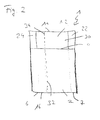
- FIG. 2 shows an alternative embodiment of a bag 1 according to the invention, in which unlike the bag according to FIG. 1 the front side 2 occupies a larger area relative to the rear side 12, as a result of which the free section 30 of the rear side 12 decreases.
- FIGS. 3 a) to e) disclose by way of example and in simplified form the production process of a bag 1 according to the invention, as in FIG. 1 shown.
- a so-called continuous composite paper web 3 is provided ( Fig. 3a )), in which via a suitable perforation a parallel to the side edges extending perforation 33 is inserted ( Fig. 3b )).
- the marginal areas of the composite paper web are also automatically folded over or folded in order to form side gussets ( FIG. 3 c) ).
- the steps 3 b) and 3 c) can also be carried out in the reverse order or at the same time.
- the film web 3 is severed in the manner perpendicular to the side edges that substantially rectangular sections 5 obtained become with a length extension, which corresponds to the sum of front and back length (see FIG. 3 d) ). Then, a portion of the separated film web to form an envelope fold 7, (whose position is indicated by dashes in Fig. 3d )). In the area in which the gussets 23 and 25 of the separated film web come to rest on each other, an adhesive has been applied at least in sections beforehand. By pressing on each other in each case in area superimposed gussets, a sufficient bond to form a bag according to the invention is produced ( Fig. 3e )). Since the separated film web has not been folded in the middle, a protruding portion 30 remains at the back 12. As could be shown, the bag 1 according to the invention can be obtained via only four process steps.
- FIGS. 4 a) to f) exemplify in simplified form an alternative manufacturing process of a bag 1 according to the invention.
- a so-called endless composite paper web 3 is made available ( Fig. 3a ) into which transverse perforation seams 40 are inserted by means of a suitable perforation tool from the first side edge to the opposite second side edge ( Fig. 4b ).
- a parallel to the side edge extending perforation 33 is inserted via another perforation tool ( Fig. 4c ).
- Steps 4 b) and 4 c) can also be implemented in reverse order.
- a next step individual, substantially rectangular sections 5 are separated from the continuous web along the perforation seams 40, for example by means of tensile stress.
- the tensile stress acting on the bottom reproduced perforation 40 can be selectively increased, resulting in a tearing off to form a so-called blunt edge.
- the edges created in this manufacturing process are usually not suitable to produce cuts to the operator or the user.
- the separated sections 5 can then be formed to form an envelope fold 7 (whose position is indicated by dashes in FIG FIG. 4 e) be marked).
- an adhesive has been previously applied at least in sections.
- FIG. 4 f By pressing the superimposed side edges together, a sufficient bond is produced to form a bag according to the invention ( FIG. 4 f) , Since the separated film web has not been folded in the middle, remains protruding portion 30 at the back 12. Unlike the bag according to FIG. 3 e) the bag has according to FIG. 3 f ) not over gussets.
Landscapes
- Engineering & Computer Science (AREA)
- Mechanical Engineering (AREA)
- Food Science & Technology (AREA)
- Bag Frames (AREA)
- Packages (AREA)
- Bakery Products And Manufacturing Methods Therefor (AREA)
Priority Applications (4)
| Application Number | Priority Date | Filing Date | Title |
|---|---|---|---|
| DK12004536.4T DK2535295T3 (en) | 2007-06-06 | 2008-06-05 | Pose for taking foodstuffs and which contains a perforation seam |
| EP12004536.4A EP2535295B1 (fr) | 2007-06-06 | 2008-06-05 | Sac destiné à la réception d'aliments, comprenant des lignes de perforation |
| PL12004536T PL2535295T3 (pl) | 2007-06-06 | 2008-06-05 | Torba do przyjmowania artykułów spożywczych, obejmująca perforowany szew |
| DKBA201200180U DK201200180U3 (da) | 2007-06-06 | 2012-11-12 | Pose til optagelse af levnedsmidler og indeholdende en perforeringssøm |
Applications Claiming Priority (1)
| Application Number | Priority Date | Filing Date | Title |
|---|---|---|---|
| DE102007026807A DE102007026807B4 (de) | 2007-06-06 | 2007-06-06 | Beutel zur Aufnahme von Lebensmitteln, enthaltend eine Schwächungslinie, Verfahren zur Herstellung solcher Beutel und deren Verwendung für die Verpackung oderAufnahme von Lebensmitteln |
Related Child Applications (1)
| Application Number | Title | Priority Date | Filing Date |
|---|---|---|---|
| EP12004536.4A Division EP2535295B1 (fr) | 2007-06-06 | 2008-06-05 | Sac destiné à la réception d'aliments, comprenant des lignes de perforation |
Publications (2)
| Publication Number | Publication Date |
|---|---|
| EP2000419A2 true EP2000419A2 (fr) | 2008-12-10 |
| EP2000419A3 EP2000419A3 (fr) | 2009-02-18 |
Family
ID=39765043
Family Applications (2)
| Application Number | Title | Priority Date | Filing Date |
|---|---|---|---|
| EP12004536.4A Revoked EP2535295B1 (fr) | 2007-06-06 | 2008-06-05 | Sac destiné à la réception d'aliments, comprenant des lignes de perforation |
| EP08010253A Ceased EP2000419A3 (fr) | 2007-06-06 | 2008-06-05 | Sac destiné à la réception d'aliments, comprenant une couture de perforation |
Family Applications Before (1)
| Application Number | Title | Priority Date | Filing Date |
|---|---|---|---|
| EP12004536.4A Revoked EP2535295B1 (fr) | 2007-06-06 | 2008-06-05 | Sac destiné à la réception d'aliments, comprenant des lignes de perforation |
Country Status (6)
| Country | Link |
|---|---|
| EP (2) | EP2535295B1 (fr) |
| AT (1) | AT13550U1 (fr) |
| DE (1) | DE102007026807B4 (fr) |
| DK (2) | DK2535295T3 (fr) |
| ES (1) | ES2523820T3 (fr) |
| PL (1) | PL2535295T3 (fr) |
Cited By (4)
| Publication number | Priority date | Publication date | Assignee | Title |
|---|---|---|---|---|
| EP2371728A1 (fr) * | 2010-03-31 | 2011-10-05 | Weber Verpackungen Friedrich Weber Nachf. GmbH & Co. KG | Sachet de papier |
| WO2012035043A1 (fr) | 2010-09-14 | 2012-03-22 | Luc Sergers | Cornet de frites |
| EP2578509A1 (fr) * | 2011-10-07 | 2013-04-10 | Weber Verpackungen Friedrich Weber Nachf. GmbH & Co. KG | Sachet d'emballage pour aliments |
| US9180999B2 (en) | 2013-08-16 | 2015-11-10 | Deja S. Castro | Perforated bags |
Families Citing this family (1)
| Publication number | Priority date | Publication date | Assignee | Title |
|---|---|---|---|---|
| DE102012107671A1 (de) | 2012-08-21 | 2014-06-12 | Eller Foodpackaging Gmbh | Beutel zur Aufnahme eines Brötchens, Sandwiches oder dergleichen |
Citations (4)
| Publication number | Priority date | Publication date | Assignee | Title |
|---|---|---|---|---|
| US5335996A (en) | 1993-07-08 | 1994-08-09 | Bagcraft Corporation Of America | Openable bag construction |
| US5988882A (en) | 1997-09-08 | 1999-11-23 | Bagcraft Packaging, L.L.C. | Openable bag construction |
| JP2003335348A (ja) | 2002-05-15 | 2003-11-25 | Nobuhiro Kawabata | 食品等の包装袋 |
| JP2004142165A (ja) | 2002-10-22 | 2004-05-20 | Toyobo Co Ltd | 圧縮成形用材料 |
Family Cites Families (8)
| Publication number | Priority date | Publication date | Assignee | Title |
|---|---|---|---|---|
| US3570751A (en) * | 1969-07-03 | 1971-03-16 | Wyomissing Corp | Tear-open package |
| US4777054A (en) * | 1986-11-06 | 1988-10-11 | Perfect Holdings, Ltd. | Easy open package |
| US4915235A (en) * | 1989-05-12 | 1990-04-10 | International Paper Company | Tear panel french fry carton |
| GB2283007A (en) * | 1993-10-19 | 1995-04-26 | Mars Inc | Boil-in-bag sachet with tear-off strip |
| FR2771718A1 (fr) * | 1997-12-03 | 1999-06-04 | Dupuy Francois Chaygneaud | Conditionnement, notamment sachet, a ouverture facilitee, procede de fabrication et installation pour la mise en oeuvre dudit procede |
| US6679629B1 (en) * | 1999-11-23 | 2004-01-20 | Aparellaje Electrico, S.A. | Device for manually opening flexible packages |
| NZ507233A (en) * | 2000-10-02 | 2003-06-30 | Michael Clements Markham | Multi-layered bag and method of manufacture |
| DE102005033774A1 (de) * | 2005-07-15 | 2007-01-18 | Helmut Obieglo | Aufnahmeeinrichtung für Stoffe und Medien, insbesondere Frittentüte |
-
2007
- 2007-06-06 DE DE102007026807A patent/DE102007026807B4/de not_active Revoked
-
2008
- 2008-06-05 PL PL12004536T patent/PL2535295T3/pl unknown
- 2008-06-05 EP EP12004536.4A patent/EP2535295B1/fr not_active Revoked
- 2008-06-05 DK DK12004536.4T patent/DK2535295T3/en active
- 2008-06-05 ES ES12004536.4T patent/ES2523820T3/es active Active
- 2008-06-05 AT ATGM439/2012U patent/AT13550U1/de not_active IP Right Cessation
- 2008-06-05 EP EP08010253A patent/EP2000419A3/fr not_active Ceased
-
2012
- 2012-11-12 DK DKBA201200180U patent/DK201200180U3/da not_active IP Right Cessation
Patent Citations (4)
| Publication number | Priority date | Publication date | Assignee | Title |
|---|---|---|---|---|
| US5335996A (en) | 1993-07-08 | 1994-08-09 | Bagcraft Corporation Of America | Openable bag construction |
| US5988882A (en) | 1997-09-08 | 1999-11-23 | Bagcraft Packaging, L.L.C. | Openable bag construction |
| JP2003335348A (ja) | 2002-05-15 | 2003-11-25 | Nobuhiro Kawabata | 食品等の包装袋 |
| JP2004142165A (ja) | 2002-10-22 | 2004-05-20 | Toyobo Co Ltd | 圧縮成形用材料 |
Cited By (5)
| Publication number | Priority date | Publication date | Assignee | Title |
|---|---|---|---|---|
| EP2371728A1 (fr) * | 2010-03-31 | 2011-10-05 | Weber Verpackungen Friedrich Weber Nachf. GmbH & Co. KG | Sachet de papier |
| WO2012035043A1 (fr) | 2010-09-14 | 2012-03-22 | Luc Sergers | Cornet de frites |
| BE1019648A5 (fr) * | 2010-09-14 | 2012-09-04 | Segers Luc | Cornet de frites avec trous d'aeration et compartiment a sauce integre. |
| EP2578509A1 (fr) * | 2011-10-07 | 2013-04-10 | Weber Verpackungen Friedrich Weber Nachf. GmbH & Co. KG | Sachet d'emballage pour aliments |
| US9180999B2 (en) | 2013-08-16 | 2015-11-10 | Deja S. Castro | Perforated bags |
Also Published As
| Publication number | Publication date |
|---|---|
| ES2523820T3 (es) | 2014-12-01 |
| DE102007026807B4 (de) | 2011-03-24 |
| AT13550U1 (de) | 2014-03-15 |
| EP2535295B1 (fr) | 2014-08-27 |
| EP2535295A1 (fr) | 2012-12-19 |
| DK201200180U3 (da) | 2013-01-25 |
| EP2000419A3 (fr) | 2009-02-18 |
| DE102007026807A1 (de) | 2008-12-11 |
| DK2535295T3 (en) | 2014-12-08 |
| DK201200180U1 (da) | 2013-01-11 |
| PL2535295T3 (pl) | 2015-02-27 |
Similar Documents
| Publication | Publication Date | Title |
|---|---|---|
| EP0274514B1 (fr) | Emballage pour articles en pieces et son procede de fabrication | |
| EP0577615B1 (fr) | Emballage en forme de sachet tubulaire | |
| DE19504157A1 (de) | Beutel | |
| EP0162291A1 (fr) | Emballage pour marchandises en colis | |
| EP3901054A1 (fr) | Sac destiné à contenir une pluralité d'articles hygiéniques et son procédé de fabrication | |
| CH620651A5 (fr) | ||
| EP2535295B1 (fr) | Sac destiné à la réception d'aliments, comprenant des lignes de perforation | |
| DE1913600B2 (de) | Zigarettenpackung aus Schichtstoff | |
| DE2827803B2 (de) | Verpackung für mit einer Kruste überzogene Backwaren und Verfahren zu ihrer Herstellung | |
| DE2623404C3 (de) | Quaderförmige, leicht zu öffnende Packung, die aus flexiblem bzw. biegbarem schlauchförmigen Verpackungsmaterial gebildet ist | |
| EP0542158B1 (fr) | Emballage pour paquets de cigarettes, ainsi que le flan associé et la méthode et le dispositif pour la fabrication de l'emballage | |
| DE4013918C2 (fr) | ||
| DE3008807C2 (fr) | ||
| WO1991013005A1 (fr) | Emballage en sac, notamment en sac en forme de tuyau | |
| EP3166779B1 (fr) | Empilement formé de sachets | |
| EP0490822B1 (fr) | Emballage en forme de sac tubulaire avec assistance au déchirage | |
| CH426632A (de) | Behälter zur Aufnahme einer Rolle von Folienmaterial | |
| EP2371728B1 (fr) | Sachet en papier | |
| DE202007019411U1 (de) | Beutel zur Aufnahme von Lebensmitteln, enthaltend eine Schwächungslinie | |
| DE69005600T2 (de) | Verfahren zum Herstellen einer Verpackung, die so hergestellte Verpackung und Vorrichtung zur Durchführung des Verfahrens. | |
| EP2700592A2 (fr) | Sac destiné à recevoir un petit pain, des sandwichs ou analogues | |
| DE2229935C2 (de) | Verpackung mit leicht zu öffnender Ausgußtülle | |
| DE202024104320U1 (de) | Verpackungsbogen für ein Lebensmittel und Verpackung eines Lebensmittels | |
| EP2210818B1 (fr) | Sachet à soufflet latéral doté d'une base repliable et section de bande de matériau équipée et appropriée à la fabrication dudit sachet à soufflet latéral | |
| DE69701333T2 (de) | Weichpackung mit Aufhängevorrichtung |
Legal Events
| Date | Code | Title | Description |
|---|---|---|---|
| PUAI | Public reference made under article 153(3) epc to a published international application that has entered the european phase |
Free format text: ORIGINAL CODE: 0009012 |
|
| AK | Designated contracting states |
Kind code of ref document: A2 Designated state(s): AT BE BG CH CY CZ DE DK EE ES FI FR GB GR HR HU IE IS IT LI LT LU LV MC MT NL NO PL PT RO SE SI SK TR |
|
| AX | Request for extension of the european patent |
Extension state: AL BA MK RS |
|
| PUAL | Search report despatched |
Free format text: ORIGINAL CODE: 0009013 |
|
| AK | Designated contracting states |
Kind code of ref document: A3 Designated state(s): AT BE BG CH CY CZ DE DK EE ES FI FR GB GR HR HU IE IS IT LI LT LU LV MC MT NL NO PL PT RO SE SI SK TR |
|
| AX | Request for extension of the european patent |
Extension state: AL BA MK RS |
|
| 17P | Request for examination filed |
Effective date: 20090813 |
|
| AKX | Designation fees paid |
Designated state(s): AT BE BG CH CY CZ DE DK EE ES FI FR GB GR HR HU IE IS IT LI LT LU LV MC MT NL NO PL PT RO SE SI SK TR |
|
| 17Q | First examination report despatched |
Effective date: 20100616 |
|
| RAP1 | Party data changed (applicant data changed or rights of an application transferred) |
Owner name: PAPIER-METTLER INHABER MICHAEL METTLER E.K. |
|
| STAA | Information on the status of an ep patent application or granted ep patent |
Free format text: STATUS: THE APPLICATION HAS BEEN REFUSED |
|
| 18R | Application refused |
Effective date: 20141023 |
|
| P01 | Opt-out of the competence of the unified patent court (upc) registered |
Effective date: 20230331 |