EP2000387B1 - Verfahren zur Datenkommunikation zwischen auf einem Gleisnetz befindlichen Schienenfahrzeugen und einer Zielsenke - Google Patents
Verfahren zur Datenkommunikation zwischen auf einem Gleisnetz befindlichen Schienenfahrzeugen und einer Zielsenke Download PDFInfo
- Publication number
- EP2000387B1 EP2000387B1 EP08008931.1A EP08008931A EP2000387B1 EP 2000387 B1 EP2000387 B1 EP 2000387B1 EP 08008931 A EP08008931 A EP 08008931A EP 2000387 B1 EP2000387 B1 EP 2000387B1
- Authority
- EP
- European Patent Office
- Prior art keywords
- gateway
- network
- mobile
- rail
- vehicle
- Prior art date
- Legal status (The legal status is an assumption and is not a legal conclusion. Google has not performed a legal analysis and makes no representation as to the accuracy of the status listed.)
- Active
Links
Images



Classifications
-
- B—PERFORMING OPERATIONS; TRANSPORTING
- B61—RAILWAYS
- B61L—GUIDING RAILWAY TRAFFIC; ENSURING THE SAFETY OF RAILWAY TRAFFIC
- B61L15/00—Indicators provided on the vehicle or train for signalling purposes
- B61L15/0018—Communication with or on the vehicle or train
- B61L15/0027—Radio-based, e.g. using GSM-R
-
- B—PERFORMING OPERATIONS; TRANSPORTING
- B61—RAILWAYS
- B61L—GUIDING RAILWAY TRAFFIC; ENSURING THE SAFETY OF RAILWAY TRAFFIC
- B61L15/00—Indicators provided on the vehicle or train for signalling purposes
- B61L15/0072—On-board train data handling
-
- B—PERFORMING OPERATIONS; TRANSPORTING
- B61—RAILWAYS
- B61L—GUIDING RAILWAY TRAFFIC; ENSURING THE SAFETY OF RAILWAY TRAFFIC
- B61L27/00—Central railway traffic control systems; Trackside control; Communication systems specially adapted therefor
- B61L27/40—Handling position reports or trackside vehicle data
-
- H—ELECTRICITY
- H04—ELECTRIC COMMUNICATION TECHNIQUE
- H04L—TRANSMISSION OF DIGITAL INFORMATION, e.g. TELEGRAPHIC COMMUNICATION
- H04L12/00—Data switching networks
- H04L12/66—Arrangements for connecting between networks having differing types of switching systems, e.g. gateways
Definitions
- the invention relates to a method for data communication between rail vehicles located on a rail network and a target sink, wherein each rail vehicle forms a mobile node of a known self-configuring radio network for data communication, whose nodes communicate with each other using topology-based routing methods, and each rail vehicle via a mobile ( de-) activatable gateway to the gateway into another telecommunication network has.
- Such a list of cars then includes - in addition to the train number - both the identification number of the leading traction vehicle and all identification numbers of the attached car.
- the car list is a table for referencing between the physical identifiers for designating the individual vehicles and the abstract identifier "train number" to designate a train.
- transponders for example according to RFID technology. These transponders can contain both vehicle and consignment data and are read out at checkpoints. It is obvious that such approaches either at low control point density do not meet the requirements of a logistically satisfying real-time monitoring or require a large enough control point density large investments in the infrastructure of the control stations or read-out devices.
- Self-configuring radio networks for data communication are known in the form of mobile ad-hoc networks ("MANet”) or "vehicular ad hoc networks”("VANet”) from the prior art.
- the topology-based routing methods which are also known per se from the state of the art, do not require precise information about the positions of the nodes of the mobile ad hoc network. Instead, information about the neighborhood relationships - that is, which nodes have a direct connection with each other and thus can communicate with each other without the interposition of other nodes - is sufficient.
- the individual nodes send out data sets in cyclical sequence with information on the identity of the node as well as on the identity of the neighboring nodes.
- Such a mobile ad-hoc network for example, teaches the EP 1 289 197 A1 .
- the travelers who are on board a bus or train form such a mobile ad hoc network that can connect to external networks, eg mobile telecommunication systems, via a mobile router on board the train.
- WO 2005/1055536 A1 is a system for controlling the completeness of a train consisting of several cars known in which a plurality of test and monitoring computers, each associated with a specific bogie of the train, meshed into a radio-based network, so that their operating and / or Monitoring data on a locomotive of the train set arranged master computer can be made available for the purpose of monitoring.
- the data from this master computer can be fixed to the railway lines installed gateways from where it is possible to forward to an office via an Internet-based network.
- mobile ad-hoc network or "MANet”
- These mobile terminals are usually mobile phones, small computers or laptops.
- the basic idea of such a self-configuring network is that the mobile terminals can establish communication links with one another without the existence of a superordinate infrastructure.
- Each device referred to in the MANet as a "node" not only serves as a transmitting and receiving station, but also as a router for data transmission between other participants.
- the expenses for the infrastructure of such a self-configuring network are significantly lower than for the infrastructure of a comparatively rigid and hierarchically structured conventional telecommunications network, for example a mobile radio network according to the GSM standard. Since all nodes of a self-configuring network are constantly in motion and the relative positions of the individual nodes to each other and thus the topology of the network constantly change, however, complex routing procedures are necessary. In the process, updated routing tables, which are required as a basis for the forwarding of data packets, are generated continuously for each node. In this way, an almost arbitrarily large network can be created, which also allows communication between each other far away nodes. With sufficiently tightly meshed networks, the failure of a single node for the communication relationships of the other nodes to each other is essentially uncritical.
- this research project offers suggestions for exchanging data between Internet applications and vehicles that can be selected via the location coordinate, such as the transmission of up-to-date information to vehicles entering a defined geographical area (eg advertising offers for vehicles entering the parking lot of a hardware store; inner-city traffic situation to vehicles that are in access to a city area, etc.).
- a communication relationship between a vehicle and a stationary communication station on the roadside is also considered.
- These fixed communication stations can also be used as a gateway, for example for connection to the Internet or for coupling to other networks, etc.
- mobile nodes ie vehicles that are each part of a mobile ad-hoc network
- the research project proposes applications in which data is collected from the individual vehicles and further processed by "Service Centers". The conclusions drawn from these processed data are then transmitted back to the vehicles. In this way, conclusions about the presence of traffic jams on certain road sections are to be drawn, for example, from standstill reports transmitted by the vehicles.
- this information should only be exchanged between closely adjacent vehicles (following vehicles, vehicles in the opposite direction, etc.).
- this data can only be made accessible to a higher-level system (eg for traffic control) if the above-mentioned gateways were installed along all roads, but this requires considerable investment.
- the basic idea of the invention is thus based on the fact that all rail vehicles on a rail network equipped to participate as nodes of a mobile ad hoc network and within the technological limits of the radio carrier medium used for the ad hoc network maximum to each other spaced, first meshed to a mobile ad-hoc network (this could be the case, for example, if several previously isolated and spread over the area standing individual cars are assembled into a train) and gain the gateway to another telecommunications network via a gateway , Depending on whether at least one participating in this mobile ad-hoc network rail vehicle in the spatial influence of a fixed or locally installed gateway, the locally installed gateway is part of the routing table of this rail vehicle and thus for all others on ad -hoc network participating nodes as a starting point for data communication towards a data sink or target sink located outside of this ad-hoc network usable.
- This special constellation in itself corresponds to the already known prior art and is not the subject of the present invention.
- the object of the invention is that in all other cases where no contact is given to a locally installed gateway, a data communication between the mobile ad hoc network and another telecommunication network is possible.
- a node is to be determined from the total amount of all mobile nodes of a common ad-hoc mobile network whose mobile gateway associated therewith is activated for the purpose of a gateway into a further telecommunications network.
- This object is achieved in conjunction with the preamble of claim 1 according to the invention that determined by each node of a self-configuring radio network state information on their own operating status and each integrated into a cyclically transmitted by this node record.
- the invention thus allows a significant reduction in investment costs for the construction of stationary infrastructure facilities, since locally installed gateways are provided only in such closed spatial areas in which a high density of individual vehicles (ie: many vehicles in a limited space) can be found and thus a good time utilization of the or the locally installed gateways is to be expected.
- Such areas are train formation facilities and stations in which newly starting trains are assembled or incoming trains are resolved.
- these closed spatial areas are referred to simply as "station areas”.
- each vehicle communicates with at least one locally installed gateway.
- the data received from the gateway can then be forwarded together with this position information, for example, to a higher-level data processing system, where these data can then be processed and further processed for the purpose of the shipment or running path tracking of individual vehicles.
- a higher-level data processing system where these data can then be processed and further processed for the purpose of the shipment or running path tracking of individual vehicles.
- Each individual node - ie each individual rail vehicle - continues to send data packets of this train in a cyclical manner.
- At least one new, smaller ad hoc mobile network thus separates - with the train leaving - the entire train train or its train parts extended from the station area after completion of this detachment process.
- a single mobile gateway for the gateway can be sufficient.
- sufficiently large technological gaps ie technologically equipped vehicle are separated by the interim series of non-equipped individual cars so far that no connection by means of an ad-hoc network is possible
- the mobile gateway function of a train is activated only at the exit of a train station on the free route.
- the operation of the inventive system is simpler and less expensive if the gateways associated with the rail vehicles are deactivated in the coverage areas of the fixed gateways.
- the invention makes it possible that with a gap-like coverage of a station area by stationary gateways such rail vehicles, which are positioned in such a cover gap, take over the function of an auxiliary gateway.
- auxiliary gateways such rail vehicles, which are positioned in such a cover gap.
- a target sink come, for example, systems for determining the position of rail vehicles into consideration, but also logistic systems for tracking or charge monitoring.
- the invention makes it possible for such target sinks to collect the data (state information, etc.) at low cost from data sources distributed in a distributed manner over the surface.
- data sources distributed in a distributed manner over the surface.
- the interrogation of sensible charge or vehicle conditions e.g. the interrogation of sensible charge or vehicle conditions (temperature in the transport container, temperatures in the axle bearings, transport containers properly closed etc ...) conceivable. All sensors required for this purpose of a single rail vehicle or cargo container can be connected in a star shape to a concentrator associated with this rail vehicle or cargo container.
- This concentrator then forms the gateway of the sensor network of the individual vehicle, which couples the sensor data into the data communication of the mobile ad hoc network.
- the gateway of the sensor network forms a node of the ad-hoc network composed of several vehicles or cargo containers.
- the power of the associated mobile gateway is determined, compared with the state information received from other nodes of the same radio network on the power of other mobile gateways and the state information the best recognized power supply are each integrated into a cyclically transmitted by this node record.
- a first mobile node is notified of the status of a second mobile node.
- the first node recognizes that its own specific status is worse, for example, than that of the second node, and therefore reports the second vehicle as a potential mobile gateway into the network.
- the entire self-configuring network is permeated with the status information of the best possible node.
- This recursive method for determining the mobile gateway to be activated terminates as soon as only a single vehicle identity is communicated in the network.
- this can be done, for example, by detecting and evaluating the state of charge of battery-powered power supplies.
- mobile nodes with on-board power generation that is, for example, traction vehicles
- traction vehicles preferably serve as a carrier vehicle for the mobile gateway of an ad hoc network to be activated.
- the selection of the mobile gateway with the lowest energy-related probability of failure is achieved.
- the skilled person it is also conceivable for the skilled person to base other selection criteria on the determination of the mobile gateway to be activated. This could, for example, be the maximum possible data transmission rate of each gateway or gateways with special rating features (flat rate, etc.).
- An advantageous embodiment of the invention provides that the mobile gateway of each mobile node of a self-configuring radio network is activated in the absence of communication link between this mobile node and a locally installed gateway.
- a temporal decoupling is made possible in the transition from communication via the locally installed gateway to the communication via an activated mobile gateway, so that the activation of the mobile gateway does not necessarily have to connect seamlessly to the communication via the locally installed gateway.
- each mobile node exiting the geographic reach of the locally installed gateway would first activate its associated mobile gateway. This is done until, in this self-configuring radio network, e.g. the expiry of a predefinable time constant .DELTA.T initiates the determination of a mobile node serving as a common gateway for the entire self-configuring radio network.
- the invention provides for the formation of a number of individual sub-ad hoc networks which communicate with each other via a locally installed gateway or have their own mobile gateway.
- the invention therefore further provides that the data communication running via each gateway is supplemented by an identification data for the unique identification of the self-configuring radio network belonging to the gateway.
- the individual data streams of the sub-ad hoc networks can be made distinguishable from each other.
- This forms the technical basis both for a strict separation of the data streams (eg if the data originating from rail vehicles of different transporters within a single train are to be assigned to different data sinks) as well as for an aggregation or combination of associated data streams (eg if within a train of a first Transporteurs individual vehicles of a second "foreign" transporter are queued and thus for the first and / or second transporter in each case several partial data streams must be aggregated).
- output data from sensors of a vehicle-specific sensor network can be received by each mobile node of the self-configuring radio network, evaluated, and the evaluation results in each case integrated into a data record transmitted cyclically by this node.
- Each mobile node serves as a concentrator of a vehicle-related sensor network.
- driving state Driving state
- Another application could provide RFID transponders (which in the context of this invention should also be considered a "sensor") on the respective faces of the carrier vehicles of all mobile nodes (eg mounted in the area of the respective buffer planks). In this way, the directional identity of each neighbor vehicle can be made available in each node.
- information about the field strength of each message received from neighboring nodes and / or information about the current own is provided by each mobile node of the self-configuring radio network in a cyclical manner determined geographical position of the node and each integrated into a cyclically transmitted by this node record.
- the field strengths of all communication relationships between each individual mobile node and / or their current geographical positions are detected and made available for evaluation.
- satellite-based location technologies such as GPS, GLONAS or GALILEO, are suitable for this purpose.
- the invention then provides that in a node of each self-configuring radio network from the data received from the other mobile nodes of the same radio network under evaluation of each data element to the field strength or evaluation of output data of the sensors of the respective vehicle sensor networks, the series sequence with This node in the form of a train association connected further mobile node or rail vehicles is determined. If, as in the above example ("RFID transponder"), the directionally exact identity of each neighboring vehicle is available in each node, then the sequence of all individual vehicles or mobile nodes can easily be determined for the entire train. In this way, not only the ranking of the vehicles can be detected within the train but also the Switzerland gleichschreibwachung done. When Switzerlandschreibwachung the inventive method checks whether the identity of the last train in the train remains unchanged during the train ride.
- the invention determines the occupancy of the rail network with rail vehicles in a node of each self-configuring radio network from the data received from the other mobile nodes of the same radio network records evaluating each data element to the field strength and / or the current geographical position of each node becomes.
- the neighborhood relationships determined in the mobile ad hoc network formed by the rail vehicles can thus be set more effectively in relation to one another and mapped onto a track plan stored in the system. If the individual rail vehicles according to an embodiment of the present invention still in addition equipped with their own device for determining their own position (eg by GPS), this can be done even more effectively.
- the invention makes sense if the determination of the sequence of sequences and / or the occupancy of the rail network is carried out in the node assigned to the respectively activated gateway of the self-configuring network.
- a node of the self-configuring radio network becomes the master, executing the computation / discovery activities for all other nodes of the same network and making it available for further use in downstream target sinks.
- the evaluation would be possible in a downstream central system, which receives the data on the respective activated gateway, processed and returned to the mobile node.
- this variant would be associated with a higher communication effort for data transmission, eg via a paid mobile network.
- the invention further provides that the determination of the series sequence and / or the occupancy of the rail network in a reserved exclusively for evaluation purposes node of the self-configuring network takes place.
- an employee could be equipped with a handheld device that logs in as a node to the self-configuring wireless network, and the o.g. Performs evaluations.
- a wagon master can grasp the composition and ranking of train vehicles assembled into train assemblies in train formation systems and transfer them to downstream data processing systems.
- FIG. 1 is a fictitious starting situation with three in the track field of a defined geographical area (99) (hereinafter referred to as "station area") parked (non-powered) vehicles (A, B, C) shown.
- These vehicles are non-powered goods wagons, which - as shown in the following process steps - to be assembled into a train network and sent to the drive to another destination station.
- the vehicles are equipped with short-range radio modules which are suitable for setting up a self-configuring radio network or mobile ad-hoc network (MANet) or vehicular-ad-hocnetwork (VANet).
- MANet mobile ad-hoc network
- VANet vehicular-ad-hocnetwork
- a mobile gateway is installed on each vehicle, which can be activated or deactivated separately and can be distinguished by using different identifiers from a locally installed gateway as well as from the mobile gateways of the individual vehicles.
- the station area (99) comprising a plurality of tracks and switches is illuminated by two locally installed gateways (1, 2), which are also to act as nodes in a MANet set up by the vehicles.
- this illumination e.g. due to topographic conditions - incomplete.
- the vehicle C is in such a coverage gap and thus has no opportunity to get in touch with one of the two locally installed gateways in a MANet directly.
- the vehicle A is located in a station area and within the geographical range (1.1) of the gateway 1. Since the vehicle A thus has direct contact with a locally installed gateway, the mobile gateway (3) installed on the vehicle A remains deactivated. In this way, unnecessary communication links are saved, which contributes to the reduction of communication costs.
- the vehicle B is located in a station area and within the geographical range (2.1) of the gateway 2. Since the vehicle B is in contact with a locally installed gateway, the mobile gateway (4) installed on the vehicle B remains disabled. In this way, unnecessary communication links are saved, which contributes to the reduction of communication costs.
- the vehicle C is located in a station area but neither within the geographical range (1.1) of the gateway 1 nor in the geographic range (2.1) of the gateway 2. Since the vehicle C has no contact with a locally installed gateway is to check via an algorithm whether the vehicle C is in contact with a locally installed gateway via the switching activity of the MANet (so-called "multi-hop switch") or the mobile gateway (5) installed on the vehicle C is activated.
- MANet switching activity of the MANet (so-called "multi-hop switch") or the mobile gateway (5) installed on the vehicle C is activated.
- all nodes - e.g. by sending out HELLO packets - information about the neighborhood relationships of the respective nodes.
- the nodes assigned to the locally installed gateways are identified by means of a special identifier as "gateways", that is, as network output points for data transmission to external networks or data processing systems.
- the vehicle A can only communicate with the local gateway 1.
- the better field strength decides whether data communication with gateway 1 or with gateway 2 takes place.
- From vehicle C data communication with a gateway can take place via the switching activity of the MANet (so-called "multi-hop switching").
- a data packet to be sent from the vehicle C to the superordinate data processing system is first transmitted to the vehicle A or vehicle B, and from there to one of the two local Gateways 1 and 2 transferred.
- the exact transmission path is not predefined here and depends in particular on the respective signal strength.
- the vehicles (A, B, C) send out data packets with details of their identity, which possibly arrive at one of the local gateways (1, 2) using a mulit-hop exchange, and from there - supplemented by the location coordinates of the each transferring gateways - be forwarded to a higher-level data processing system for Laufweg- or shipment tracking.
- the accuracy of the position determination determined in this way therefore essentially depends on the density of locations of local gateways and the size of their geographical coverage areas. If the vehicles according to a particular embodiment of the invention have their own devices for determining position, then this location information is part of the content of the data packet sent by the vehicles.
- the location coordinate of the respective locally installed gateway is no longer relevant in this case for the data transmission to the parent Laufweg- or tracking system.
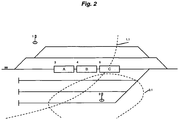
- FIG. 2 shows a representation of the situation after compilation of the vehicles to a train, the vehicles are still on a track within the station area. All three vehicles (A, B, C) are now within the geographical range (1.1) of the gateway 1.
- a data communication emanating from the vehicles would now run via the local gateway 1.
- FIG. 3 now couples an additional (powered) vehicle F (hereinafter referred to as "locomotive”) to this date from the vehicles A, B. and C existing train bandage.
- This traction vehicle F is also within the geographical range (1.1) of the gateway 1.
- a mobile gateway (8) is installed, which is distinguishable by using different identifiers of a locally installed gateway.
- the mobile gateway (8) installed on traction vehicle F remains deactivated. In this way, unnecessary communication links are saved, which contributes to the reduction of communication costs.
- the exemplary embodiment is based on a traction vehicle without a mobile gateway, since such equipment of the traction vehicle is not of particular relevance to the invention.
- FIG. 4 shows the extension of the engine F and the non-powered vehicles A, B, C, D and E from the station area (99) to the free track (98).
- This is a train with technically homogeneous equipped individual vehicles (ie eg vehicles of a single adjuster). All vehicles (A, B, C, D, E, F) have already left the geographical range (1.1) of the local gateway 1.
- the installed on the vehicle A mobile gateway (3) is activated when the vehicle A extends from the geographical range (1.1) of the local gateway 1 and the gateway 1 is thus removed from the routing table of the vehicle A.
- the geographical range (3.1) of the mobile gateway 3 extends to the vehicles F, B and C.
- the installed on the vehicle B mobile gateway (4) is activated when the vehicle B extends from the geographical range (1.1) of the local gateway 1 and the gateway 1 is thus removed from the routing table of the vehicle B.
- the geographic range (4.1) of the mobile gateway 4 extends to the vehicles F, A, C and D.
- the installed on the vehicle C mobile gateway (5) is activated as soon as the vehicle C extends from the geographical range (1.1) of the local gateway 1 and the gateway 1 is thus removed from the routing table of the vehicle C.
- the geographical range (5.1) of the mobile gateway 5 extends to the vehicles F, A, B, D and E.
- the installed on the vehicle D mobile gateway (6) is activated when the vehicle D extends from the geographical range (1.1) of the local gateway 1 and the gateway 1 is thus removed from the routing table of the vehicle D.
- the geographical range (6.1) of the mobile gateway 6 extends to the vehicles A, B, C and E.
- the installed on the vehicle E mobile gateway (7) is activated as soon as the vehicle E extends from the geographical range (1.1) of the local gateway 1 and the gateway 1 is thus removed from the routing table of the vehicle E.
- the geographical range (7.1) of the mobile gateway 7 extends to the vehicles B, C and D.
- all nodes - e.g. by sending out HELLO packets - information about the neighborhood relationships of the respective nodes.
- each vehicle has the possibility of higher-level communication through the installed and activated mobile gateway.
- the invention provides that, after the expiry of a freely selectable period ⁇ T, the determination of a mobile gateway common to all mobile nodes of the MANET is initiated. For this determination, e.g. Determines remaining battery capacity of all mobile gateways and determines the gateway with the highest remaining capacity to the only active mobile gateway. While all other mobile gateways are deactivated, this selected mobile gateway is activated or remains activated.
- a mobile node having a permanent power supply for traction purposes e.g., a traction vehicle incorporated as a mobile node in the network
- the represented MANet distributed train-bus system
- the vehicle B assumes the function of the gateway in the MANet and the mobile gateway (4) installed on the vehicle B remains activated.
- the geographic range (4.1) of the mobile gateway 4 extends to the vehicles F, A, C and D.
- the mobile gateway (3) installed on the vehicle A, the mobile gateway (5) installed on the vehicle C, the mobile gateway (6) installed on the vehicle D and the mobile gateway (7) installed on the vehicle E are deactivated.
- Data communication from the vehicle E to the MAN's gateway to vehicle B can only take place by means of multi-hop switching in the MANET.
- the vehicle E thus transmits, for example, data packets with information about its identity, which, using mulit-hop switching via the nodes C or D (in each individual case decides the respective current field strength) to the mobile gateway installed on the vehicle B ( 4), and from there to a higher-level data processing system for Laufweg- or shipment tracking are passed.
- this location information is part of the content of the data packets sent by the vehicles, thereby increasing the accuracy of a position determination of the nodes within a track network carried out with the data communication method according to the invention.
- a particular embodiment of the invention also provides, as an alternative or in addition thereto, that each node (ie, each vehicle) can detect the field strength of each message received from neighboring nodes, and this information becomes a constituent part of the data packet sent by the vehicle. In this way, using the method according to the invention for data communication from the field strength information, the order of the rail vehicles carried by the train can be determined.
- the inaccuracies in the position determination can be reduced without autarkic position determination of each vehicle carried along (A, B, C, D, E). It is recognized, for example, that the vehicle D is behind the vehicle B two carriage lengths within a train.
- the individual carriage lengths are known either via the identity of the individual nodes (for example, stored in the form of a table or derivable by means of an algorithm from the identities) or, simplifying, an average Carriage length based.
- FIG. 6 shows an embodiment with a traction unit (F), which has no mobile gateway, as well as a heterogeneous train (ie, different technically equipped vehicles of different owners).
- a trip of a train formed from the traction vehicle F and the non-driven vehicles A, B, C and D is shown on a free route (98).
- the vehicles A, B and D of a first owner "A” each have an on-board ad-hoc network (20, 21, 23), the different individual sensors of each vehicle (eg vibration sensor, axle bearing temperature sensor, cargo space temperature sensor, etc .. .) linked together.
- the vehicle C of a second owner "B” has a similar on-board ad hoc network (22).
- Each on-board ad hoc network (20, 21, 22, 23) has one concentrator each.
- At least three MANs are formed using the method according to the invention for data communication:
- separate part-ad hoc networks are formed for additions which exclusively comprise vehicles of a single owner (24, 25).
- the assignment can be made clearly on the different identifiers of the mobile gateways by this identifier is extended by a date to identify the vehicle owner.
- each separate partial ad hoc network for the vehicles of a consignee may result (these vehicles are then in the train by gaps with non-equipped vehicles or separate vehicles from each other) and / or a separate part ad hoc network, for example, comprises only a single vehicle. It is necessary that each separate partial ad hoc network that is forming has its own gateway.
- the above-mentioned concentrators of in-vehicle ad hoc networks behave as nodes within the separate sub-ad hoc networks.
- the determination of the gateway to be activated in each case for each separate sub-ad hoc network is carried out in accordance with the in FIG. 4 and 5 described embodiment.
- the comprehensive distributed train-bus system (26) which includes all equipped with a corresponding system technology vehicles and according to the in FIG. 4 and 5 described embodiment works. By combining several separate partial ad hoc networks, unnecessary communication links are saved, which helps reduce communication costs.
- the vehicle B takes over both the function of the gateway in the overarching ad hoc network (26) in terms of the distributed train-bus system and the function of the gateway in the part-ad hoc network (24).
- FIG. 7 is the encounter of the train F driven train with another train - consisting of traction unit I and the car G and H - shown.
- the vehicle B has a mobile gateway (4) with the geographical range (4.1).
- the vehicle H has a mobile gateway (9) with the geographical range (9.1). Due to the short distance of the tracks to each other, there is an overlap of the ranges (4.1) and (9.1) when both trains meet.
- the mobile gateway (9) is also listed in the routing table of the oncoming vehicles A, B and C.
- the vehicles A, B and C would be considered for a short time as a participant of belonging to the vehicle H ad hoc network.
- the vehicles G and H would also be regarded as components of the ad hoc network associated with the vehicle B.
- misses are eliminated.
- each of the vehicles B and C would have to remain in the area of influence of the mobile gateway (9) of vehicle H for longer than a defined period of time DELTA T, so that it is actually considered as belonging to its ad hoc network and thus also to its train association.
- the actual time values, variables etc. for such plausibility checks are empirically determinable and very much dependent on the respective framework conditions of the specific application.
Landscapes
- Engineering & Computer Science (AREA)
- Mechanical Engineering (AREA)
- Computer Networks & Wireless Communication (AREA)
- Signal Processing (AREA)
- Small-Scale Networks (AREA)
- Mobile Radio Communication Systems (AREA)
Priority Applications (1)
| Application Number | Priority Date | Filing Date | Title |
|---|---|---|---|
| PL08008931T PL2000387T3 (pl) | 2007-05-25 | 2008-05-14 | Sposób transmisji danych między znajdującymi się w sieci kolejowej pojazdami szynowymi a źródłem docelowym |
Applications Claiming Priority (1)
| Application Number | Priority Date | Filing Date | Title |
|---|---|---|---|
| DE102007024731 | 2007-05-25 |
Publications (3)
| Publication Number | Publication Date |
|---|---|
| EP2000387A2 EP2000387A2 (de) | 2008-12-10 |
| EP2000387A3 EP2000387A3 (de) | 2017-05-03 |
| EP2000387B1 true EP2000387B1 (de) | 2019-07-03 |
Family
ID=39691108
Family Applications (1)
| Application Number | Title | Priority Date | Filing Date |
|---|---|---|---|
| EP08008931.1A Active EP2000387B1 (de) | 2007-05-25 | 2008-05-14 | Verfahren zur Datenkommunikation zwischen auf einem Gleisnetz befindlichen Schienenfahrzeugen und einer Zielsenke |
Country Status (4)
| Country | Link |
|---|---|
| EP (1) | EP2000387B1 (pl) |
| DE (1) | DE102008016868B4 (pl) |
| ES (1) | ES2747275T3 (pl) |
| PL (1) | PL2000387T3 (pl) |
Families Citing this family (8)
| Publication number | Priority date | Publication date | Assignee | Title |
|---|---|---|---|---|
| DE102007060269A1 (de) * | 2007-12-14 | 2009-06-18 | Knorr-Bremse Systeme für Schienenfahrzeuge GmbH | Verfahren zur Identifikation von Funk-Kommunikationseinrichtungen in einem Ad-hoc-Netzwerk |
| FR2945013B1 (fr) * | 2009-04-30 | 2016-08-12 | Alstom Transport Sa | Procede de transfert de donnees d'alerte entre un vehicule ferroviaire en panne et un centre de controle,dispositif associe |
| EP3010777B1 (en) | 2013-06-17 | 2023-11-08 | International Electronic Machines Corp. | Vehicle group monitoring |
| DE102014203666A1 (de) * | 2014-02-28 | 2015-09-03 | Siemens Aktiengesellschaft | Verfahren und Anordnung zum Betreiben funkzugbeeinflusster spurgebundener Fahrzeuge |
| EP3000688A1 (en) * | 2014-09-26 | 2016-03-30 | Siemens Rail Automation S.A.U. | System and method for checking the integrity of a multi-unit vehicle |
| DE102018210550A1 (de) * | 2018-06-28 | 2020-01-02 | Siemens Aktiengesellschaft | Vorrichtung und Verfahren zum Speichern von schienenverkehrsrelevanten Zustandsdaten in einer verteilten Datenbank |
| DE102018212126A1 (de) | 2018-07-20 | 2020-01-23 | Siemens Aktiengesellschaft | Betriebsverfahren für Fahrzeuge |
| WO2022218827A1 (de) | 2021-04-14 | 2022-10-20 | Siemens Mobility GmbH | Steuerung einer datenübertragung zwischen einem spurgebun-denen fahrzeug und einer landseitigen einrichtung mittels der landseitigen einrichtung |
Family Cites Families (5)
| Publication number | Priority date | Publication date | Assignee | Title |
|---|---|---|---|---|
| EP1289197B1 (en) * | 2001-08-29 | 2016-09-28 | Sony Deutschland GmbH | A method and units to enhance mobile communication networks with ad-hoc scenarios |
| DE10339769A1 (de) * | 2003-08-27 | 2005-04-07 | Siemens Ag | Verfahren zum Aufbauen einer Datenverbindung zwischen einem IP-basierten Kommunikationsnetz und einem Adhoc-Netz und Netzverbindungseinrichtung |
| EP1747135A4 (en) * | 2004-05-03 | 2008-11-12 | Sti Global Ltd | INTEGRATED INTEGRITY SYSTEM OF A TRAIN |
| DE102005034488A1 (de) * | 2005-07-20 | 2007-01-25 | Railion Deutschland Ag | Autonome Laufverfolgung und Disposition von Güterwagen mittels Satellitenortung und Sensorik |
| DE102007060269A1 (de) * | 2007-12-14 | 2009-06-18 | Knorr-Bremse Systeme für Schienenfahrzeuge GmbH | Verfahren zur Identifikation von Funk-Kommunikationseinrichtungen in einem Ad-hoc-Netzwerk |
-
2008
- 2008-04-02 DE DE102008016868.8A patent/DE102008016868B4/de not_active Expired - Fee Related
- 2008-05-14 EP EP08008931.1A patent/EP2000387B1/de active Active
- 2008-05-14 PL PL08008931T patent/PL2000387T3/pl unknown
- 2008-05-14 ES ES08008931T patent/ES2747275T3/es active Active
Non-Patent Citations (1)
| Title |
|---|
| None * |
Also Published As
| Publication number | Publication date |
|---|---|
| ES2747275T3 (es) | 2020-03-10 |
| PL2000387T3 (pl) | 2019-12-31 |
| EP2000387A2 (de) | 2008-12-10 |
| DE102008016868B4 (de) | 2016-05-04 |
| EP2000387A3 (de) | 2017-05-03 |
| DE102008016868A1 (de) | 2008-12-04 |
Similar Documents
| Publication | Publication Date | Title |
|---|---|---|
| DE102008016868B4 (de) | Verfahren zur Datenkommunikation zwischen auf einem Gleisnetz befindlichen Schienenfahrzeugen und einer Zielsenke | |
| DE69519555T2 (de) | Steuer- und Managementanlage einer Flotte von Fahrzeugen | |
| EP2188167B1 (de) | Verfahren zum betreiben eines fahrzeugverbands, kommunikationseinrichtungen, triebfahrzeug, fahrzeug sowie fahrzeugverband | |
| DE60223018T2 (de) | Verkehrsverwaltungsystem auf der Basis von Paketvermittlung mit Synchronisationseinrichtung zwischen Paketen und Objekten | |
| EP3275764B1 (de) | Zugleitsystem | |
| EP3036886B1 (de) | Filterung von infrastrukturbeschreibungsnachrichten | |
| DE19509696C2 (de) | Verfahren zur gegenseitigen Kontaktaufnahme zwischen Zügen und Einrichtung zur Durchführung des Verfahrens | |
| DE4214067C2 (de) | Verfahren zur Überwachung des Transports von Gütern zu vorbestimmten Abnahmestellen | |
| DE10018967C1 (de) | Funkbasiertes Zugsicherungssystem für ein von einer Mehrzahl von Zügen befahrbares Bahn-Streckennetz | |
| US9561811B2 (en) | Railroad control system having onboard management | |
| EP0631268B1 (de) | Verfahren und Vorrichtung zur Früherkennung und Meldung von Fehler- und Gefahrenquellen in schienengebundenen und schienenlosen Fahrzeugen des öffentlichen Nahverkehrs | |
| EP2907327A1 (de) | Verfahren und vorrichtung zur kommunikation zwischen verkehrsteilnehmern und verkehrsinfrastruktur auf grundlage eines ad-hoc drahtlos-kraftfahrzeug-kommunikationssystems zur verkehrssteuerung | |
| EP3126207A1 (de) | Fahrerlaubnis für ein schienenfahrzeug | |
| EP3089904A1 (de) | Verfahren und anordnung zum betreiben funkzugbeeinflusster spurgebundener fahrzeuge | |
| EP1674371B1 (de) | Verfahren und Vorrichtung zur Zugsignalisierung | |
| DE112021006193T5 (de) | Fahrtsteuerungssystem für Fahrzeuge | |
| DE102012208646A1 (de) | Verfahren zur Kommunikation innerhalb eines nach Art des ad-hoc zusammenwirkenden, insbesondere Drahtlos-, Kraftfahrzeugkommunikationssystems, Einrichtung der Verkehrsinfrastruktur sowie Verkehrsteilnehmereinrichtung | |
| DE102010023559A1 (de) | Verfahren und Einrichtung zum Überwachen einer Strecke | |
| EP3381766B1 (de) | Verfahren zur kollisionsvermeidung von schienenfahrzeugen | |
| EP1972894B1 (de) | Verfahren, computergestützte Vorrichtung und System zur Wegstreckenbestimmung | |
| CH693731A5 (de) | Kommunikationseinrichtung für funkgestützte Bahndienste. | |
| DE102020121114A1 (de) | Verfahren und System zum Aufbauen einer digitalen Umgebungskarte für Verkehrsteilnehmer sowie Kraftfahrzeug für das System | |
| EP4287155B1 (de) | Verfahren zur erfassung einer verkehrssituation in einem geographischen gebiet durch übermitteln eines nachrichteninhalts, telekommunikationsnetz oder system, verkehrsteilnehmer, computerprogramm und computerlesbares medium | |
| DE102020207179A1 (de) | Steuern eines Verkehrsflusses | |
| DE102006061811A1 (de) | Verfahren zum Orten eines Fahrzeugs |
Legal Events
| Date | Code | Title | Description |
|---|---|---|---|
| PUAI | Public reference made under article 153(3) epc to a published international application that has entered the european phase |
Free format text: ORIGINAL CODE: 0009012 |
|
| AK | Designated contracting states |
Kind code of ref document: A2 Designated state(s): AT BE BG CH CY CZ DE DK EE ES FI FR GB GR HR HU IE IS IT LI LT LU LV MC MT NL NO PL PT RO SE SI SK TR |
|
| AX | Request for extension of the european patent |
Extension state: AL BA MK RS |
|
| RAP1 | Party data changed (applicant data changed or rights of an application transferred) |
Owner name: DB SCHENKER RAIL DEUTSCHLAND AG Owner name: DB SYSTEL GMBH |
|
| REG | Reference to a national code |
Ref country code: DE Ref legal event code: R079 Ref document number: 502008016831 Country of ref document: DE Free format text: PREVIOUS MAIN CLASS: B61L0027000000 Ipc: B61L0015000000 |
|
| PUAL | Search report despatched |
Free format text: ORIGINAL CODE: 0009013 |
|
| AK | Designated contracting states |
Kind code of ref document: A3 Designated state(s): AT BE BG CH CY CZ DE DK EE ES FI FR GB GR HR HU IE IS IT LI LT LU LV MC MT NL NO PL PT RO SE SI SK TR |
|
| AX | Request for extension of the european patent |
Extension state: AL BA MK RS |
|
| RIC1 | Information provided on ipc code assigned before grant |
Ipc: H04L 12/66 20060101ALI20170330BHEP Ipc: B61L 15/00 20060101AFI20170330BHEP Ipc: B61L 27/00 20060101ALI20170330BHEP |
|
| STAA | Information on the status of an ep patent application or granted ep patent |
Free format text: STATUS: REQUEST FOR EXAMINATION WAS MADE |
|
| 17P | Request for examination filed |
Effective date: 20170522 |
|
| RBV | Designated contracting states (corrected) |
Designated state(s): AT BE BG CH CY CZ DE DK EE ES FI FR GB GR HR HU IE IS IT LI LT LU LV MC MT NL NO PL PT RO SE SI SK TR |
|
| AKX | Designation fees paid |
Designated state(s): AT BE BG CH CY CZ DE DK EE ES FI FR GB GR HR HU IE IS IT LI LT LU LV MC MT NL NO PL PT RO SE SI SK TR |
|
| AXX | Extension fees paid |
Extension state: MK Extension state: BA Extension state: AL Extension state: RS |
|
| RAP1 | Party data changed (applicant data changed or rights of an application transferred) |
Owner name: DB SYSTEL GMBH Owner name: DB CARGO AG |
|
| RAP1 | Party data changed (applicant data changed or rights of an application transferred) |
Owner name: DEUTSCHE BAHN AG Owner name: DB SYSTEL GMBH |
|
| GRAP | Despatch of communication of intention to grant a patent |
Free format text: ORIGINAL CODE: EPIDOSNIGR1 |
|
| STAA | Information on the status of an ep patent application or granted ep patent |
Free format text: STATUS: GRANT OF PATENT IS INTENDED |
|
| INTG | Intention to grant announced |
Effective date: 20190121 |
|
| GRAS | Grant fee paid |
Free format text: ORIGINAL CODE: EPIDOSNIGR3 |
|
| GRAA | (expected) grant |
Free format text: ORIGINAL CODE: 0009210 |
|
| STAA | Information on the status of an ep patent application or granted ep patent |
Free format text: STATUS: THE PATENT HAS BEEN GRANTED |
|
| RAP1 | Party data changed (applicant data changed or rights of an application transferred) |
Owner name: DEUTSCHE BAHN AG |
|
| AK | Designated contracting states |
Kind code of ref document: B1 Designated state(s): AT BE BG CH CY CZ DE DK EE ES FI FR GB GR HR HU IE IS IT LI LT LU LV MC MT NL NO PL PT RO SE SI SK TR |
|
| REG | Reference to a national code |
Ref country code: GB Ref legal event code: FG4D Free format text: NOT ENGLISH |
|
| REG | Reference to a national code |
Ref country code: CH Ref legal event code: EP Ref country code: AT Ref legal event code: REF Ref document number: 1150631 Country of ref document: AT Kind code of ref document: T Effective date: 20190715 |
|
| REG | Reference to a national code |
Ref country code: IE Ref legal event code: FG4D Free format text: LANGUAGE OF EP DOCUMENT: GERMAN |
|
| REG | Reference to a national code |
Ref country code: DE Ref legal event code: R096 Ref document number: 502008016831 Country of ref document: DE |
|
| REG | Reference to a national code |
Ref country code: CH Ref legal event code: NV Representative=s name: VALIPAT S.A. C/O BOVARD SA NEUCHATEL, CH |
|
| REG | Reference to a national code |
Ref country code: NL Ref legal event code: FP |
|
| REG | Reference to a national code |
Ref country code: LT Ref legal event code: MG4D |
|
| PG25 | Lapsed in a contracting state [announced via postgrant information from national office to epo] |
Ref country code: NO Free format text: LAPSE BECAUSE OF FAILURE TO SUBMIT A TRANSLATION OF THE DESCRIPTION OR TO PAY THE FEE WITHIN THE PRESCRIBED TIME-LIMIT Effective date: 20191003 Ref country code: BG Free format text: LAPSE BECAUSE OF FAILURE TO SUBMIT A TRANSLATION OF THE DESCRIPTION OR TO PAY THE FEE WITHIN THE PRESCRIBED TIME-LIMIT Effective date: 20191003 Ref country code: SE Free format text: LAPSE BECAUSE OF FAILURE TO SUBMIT A TRANSLATION OF THE DESCRIPTION OR TO PAY THE FEE WITHIN THE PRESCRIBED TIME-LIMIT Effective date: 20190703 Ref country code: PT Free format text: LAPSE BECAUSE OF FAILURE TO SUBMIT A TRANSLATION OF THE DESCRIPTION OR TO PAY THE FEE WITHIN THE PRESCRIBED TIME-LIMIT Effective date: 20191104 Ref country code: LT Free format text: LAPSE BECAUSE OF FAILURE TO SUBMIT A TRANSLATION OF THE DESCRIPTION OR TO PAY THE FEE WITHIN THE PRESCRIBED TIME-LIMIT Effective date: 20190703 Ref country code: HR Free format text: LAPSE BECAUSE OF FAILURE TO SUBMIT A TRANSLATION OF THE DESCRIPTION OR TO PAY THE FEE WITHIN THE PRESCRIBED TIME-LIMIT Effective date: 20190703 Ref country code: CZ Free format text: LAPSE BECAUSE OF FAILURE TO SUBMIT A TRANSLATION OF THE DESCRIPTION OR TO PAY THE FEE WITHIN THE PRESCRIBED TIME-LIMIT Effective date: 20190703 Ref country code: FI Free format text: LAPSE BECAUSE OF FAILURE TO SUBMIT A TRANSLATION OF THE DESCRIPTION OR TO PAY THE FEE WITHIN THE PRESCRIBED TIME-LIMIT Effective date: 20190703 |
|
| PG25 | Lapsed in a contracting state [announced via postgrant information from national office to epo] |
Ref country code: GR Free format text: LAPSE BECAUSE OF FAILURE TO SUBMIT A TRANSLATION OF THE DESCRIPTION OR TO PAY THE FEE WITHIN THE PRESCRIBED TIME-LIMIT Effective date: 20191004 Ref country code: LV Free format text: LAPSE BECAUSE OF FAILURE TO SUBMIT A TRANSLATION OF THE DESCRIPTION OR TO PAY THE FEE WITHIN THE PRESCRIBED TIME-LIMIT Effective date: 20190703 Ref country code: IS Free format text: LAPSE BECAUSE OF FAILURE TO SUBMIT A TRANSLATION OF THE DESCRIPTION OR TO PAY THE FEE WITHIN THE PRESCRIBED TIME-LIMIT Effective date: 20191103 |
|
| REG | Reference to a national code |
Ref country code: ES Ref legal event code: FG2A Ref document number: 2747275 Country of ref document: ES Kind code of ref document: T3 Effective date: 20200310 |
|
| PG25 | Lapsed in a contracting state [announced via postgrant information from national office to epo] |
Ref country code: TR Free format text: LAPSE BECAUSE OF FAILURE TO SUBMIT A TRANSLATION OF THE DESCRIPTION OR TO PAY THE FEE WITHIN THE PRESCRIBED TIME-LIMIT Effective date: 20190703 |
|
| PG25 | Lapsed in a contracting state [announced via postgrant information from national office to epo] |
Ref country code: RO Free format text: LAPSE BECAUSE OF FAILURE TO SUBMIT A TRANSLATION OF THE DESCRIPTION OR TO PAY THE FEE WITHIN THE PRESCRIBED TIME-LIMIT Effective date: 20190703 Ref country code: EE Free format text: LAPSE BECAUSE OF FAILURE TO SUBMIT A TRANSLATION OF THE DESCRIPTION OR TO PAY THE FEE WITHIN THE PRESCRIBED TIME-LIMIT Effective date: 20190703 Ref country code: DK Free format text: LAPSE BECAUSE OF FAILURE TO SUBMIT A TRANSLATION OF THE DESCRIPTION OR TO PAY THE FEE WITHIN THE PRESCRIBED TIME-LIMIT Effective date: 20190703 |
|
| PG25 | Lapsed in a contracting state [announced via postgrant information from national office to epo] |
Ref country code: SK Free format text: LAPSE BECAUSE OF FAILURE TO SUBMIT A TRANSLATION OF THE DESCRIPTION OR TO PAY THE FEE WITHIN THE PRESCRIBED TIME-LIMIT Effective date: 20190703 Ref country code: IS Free format text: LAPSE BECAUSE OF FAILURE TO SUBMIT A TRANSLATION OF THE DESCRIPTION OR TO PAY THE FEE WITHIN THE PRESCRIBED TIME-LIMIT Effective date: 20200224 |
|
| REG | Reference to a national code |
Ref country code: DE Ref legal event code: R097 Ref document number: 502008016831 Country of ref document: DE |
|
| PLBE | No opposition filed within time limit |
Free format text: ORIGINAL CODE: 0009261 |
|
| STAA | Information on the status of an ep patent application or granted ep patent |
Free format text: STATUS: NO OPPOSITION FILED WITHIN TIME LIMIT |
|
| PG2D | Information on lapse in contracting state deleted |
Ref country code: IS |
|
| 26N | No opposition filed |
Effective date: 20200603 |
|
| PG25 | Lapsed in a contracting state [announced via postgrant information from national office to epo] |
Ref country code: SI Free format text: LAPSE BECAUSE OF FAILURE TO SUBMIT A TRANSLATION OF THE DESCRIPTION OR TO PAY THE FEE WITHIN THE PRESCRIBED TIME-LIMIT Effective date: 20190703 |
|
| PG25 | Lapsed in a contracting state [announced via postgrant information from national office to epo] |
Ref country code: MC Free format text: LAPSE BECAUSE OF FAILURE TO SUBMIT A TRANSLATION OF THE DESCRIPTION OR TO PAY THE FEE WITHIN THE PRESCRIBED TIME-LIMIT Effective date: 20190703 |
|
| PG25 | Lapsed in a contracting state [announced via postgrant information from national office to epo] |
Ref country code: LU Free format text: LAPSE BECAUSE OF NON-PAYMENT OF DUE FEES Effective date: 20200514 |
|
| PG25 | Lapsed in a contracting state [announced via postgrant information from national office to epo] |
Ref country code: MT Free format text: LAPSE BECAUSE OF FAILURE TO SUBMIT A TRANSLATION OF THE DESCRIPTION OR TO PAY THE FEE WITHIN THE PRESCRIBED TIME-LIMIT Effective date: 20190703 Ref country code: CY Free format text: LAPSE BECAUSE OF FAILURE TO SUBMIT A TRANSLATION OF THE DESCRIPTION OR TO PAY THE FEE WITHIN THE PRESCRIBED TIME-LIMIT Effective date: 20190703 |
|
| PGFP | Annual fee paid to national office [announced via postgrant information from national office to epo] |
Ref country code: NL Payment date: 20220518 Year of fee payment: 15 |
|
| PGFP | Annual fee paid to national office [announced via postgrant information from national office to epo] |
Ref country code: IT Payment date: 20220531 Year of fee payment: 15 Ref country code: IE Payment date: 20220517 Year of fee payment: 15 Ref country code: GB Payment date: 20220523 Year of fee payment: 15 Ref country code: FR Payment date: 20220523 Year of fee payment: 15 Ref country code: ES Payment date: 20220617 Year of fee payment: 15 Ref country code: DE Payment date: 20220519 Year of fee payment: 15 |
|
| PGFP | Annual fee paid to national office [announced via postgrant information from national office to epo] |
Ref country code: PL Payment date: 20220506 Year of fee payment: 15 Ref country code: CH Payment date: 20220523 Year of fee payment: 15 Ref country code: BE Payment date: 20220518 Year of fee payment: 15 Ref country code: AT Payment date: 20220517 Year of fee payment: 15 |
|
| REG | Reference to a national code |
Ref country code: DE Ref legal event code: R119 Ref document number: 502008016831 Country of ref document: DE |
|
| REG | Reference to a national code |
Ref country code: CH Ref legal event code: PL |
|
| REG | Reference to a national code |
Ref country code: NL Ref legal event code: MM Effective date: 20230601 |
|
| REG | Reference to a national code |
Ref country code: AT Ref legal event code: MM01 Ref document number: 1150631 Country of ref document: AT Kind code of ref document: T Effective date: 20230514 |
|
| GBPC | Gb: european patent ceased through non-payment of renewal fee |
Effective date: 20230514 |
|
| REG | Reference to a national code |
Ref country code: BE Ref legal event code: MM Effective date: 20230531 |
|
| PG25 | Lapsed in a contracting state [announced via postgrant information from national office to epo] |
Ref country code: LI Free format text: LAPSE BECAUSE OF NON-PAYMENT OF DUE FEES Effective date: 20230531 Ref country code: CH Free format text: LAPSE BECAUSE OF NON-PAYMENT OF DUE FEES Effective date: 20230531 Ref country code: AT Free format text: LAPSE BECAUSE OF NON-PAYMENT OF DUE FEES Effective date: 20230514 |
|
| REG | Reference to a national code |
Ref country code: IE Ref legal event code: MM4A |
|
| PG25 | Lapsed in a contracting state [announced via postgrant information from national office to epo] |
Ref country code: NL Free format text: LAPSE BECAUSE OF NON-PAYMENT OF DUE FEES Effective date: 20230601 |
|
| PG25 | Lapsed in a contracting state [announced via postgrant information from national office to epo] |
Ref country code: IE Free format text: LAPSE BECAUSE OF NON-PAYMENT OF DUE FEES Effective date: 20230514 |
|
| PG25 | Lapsed in a contracting state [announced via postgrant information from national office to epo] |
Ref country code: IT Free format text: LAPSE BECAUSE OF NON-PAYMENT OF DUE FEES Effective date: 20230514 Ref country code: IE Free format text: LAPSE BECAUSE OF NON-PAYMENT OF DUE FEES Effective date: 20230514 Ref country code: DE Free format text: LAPSE BECAUSE OF NON-PAYMENT OF DUE FEES Effective date: 20231201 Ref country code: GB Free format text: LAPSE BECAUSE OF NON-PAYMENT OF DUE FEES Effective date: 20230514 |
|
| PG25 | Lapsed in a contracting state [announced via postgrant information from national office to epo] |
Ref country code: FR Free format text: LAPSE BECAUSE OF NON-PAYMENT OF DUE FEES Effective date: 20230531 Ref country code: BE Free format text: LAPSE BECAUSE OF NON-PAYMENT OF DUE FEES Effective date: 20230531 |
|
| REG | Reference to a national code |
Ref country code: ES Ref legal event code: FD2A Effective date: 20240628 |
|
| PG25 | Lapsed in a contracting state [announced via postgrant information from national office to epo] |
Ref country code: ES Free format text: LAPSE BECAUSE OF NON-PAYMENT OF DUE FEES Effective date: 20230515 |
|
| PG25 | Lapsed in a contracting state [announced via postgrant information from national office to epo] |
Ref country code: ES Free format text: LAPSE BECAUSE OF NON-PAYMENT OF DUE FEES Effective date: 20230515 |
|
| PG25 | Lapsed in a contracting state [announced via postgrant information from national office to epo] |
Ref country code: PL Free format text: LAPSE BECAUSE OF NON-PAYMENT OF DUE FEES Effective date: 20230514 |
|
| PG25 | Lapsed in a contracting state [announced via postgrant information from national office to epo] |
Ref country code: PL Free format text: LAPSE BECAUSE OF NON-PAYMENT OF DUE FEES Effective date: 20230514 |