EP1997696A2 - Gurtbuchse für einen Sicherheitsgurt und Montageverfahren dafür - Google Patents
Gurtbuchse für einen Sicherheitsgurt und Montageverfahren dafür Download PDFInfo
- Publication number
- EP1997696A2 EP1997696A2 EP08009293A EP08009293A EP1997696A2 EP 1997696 A2 EP1997696 A2 EP 1997696A2 EP 08009293 A EP08009293 A EP 08009293A EP 08009293 A EP08009293 A EP 08009293A EP 1997696 A2 EP1997696 A2 EP 1997696A2
- Authority
- EP
- European Patent Office
- Prior art keywords
- belt
- combiner
- bushing
- safety
- hole
- Prior art date
- Legal status (The legal status is an assumption and is not a legal conclusion. Google has not performed a legal analysis and makes no representation as to the accuracy of the status listed.)
- Withdrawn
Links
Images



Classifications
-
- B—PERFORMING OPERATIONS; TRANSPORTING
- B60—VEHICLES IN GENERAL
- B60R—VEHICLES, VEHICLE FITTINGS, OR VEHICLE PARTS, NOT OTHERWISE PROVIDED FOR
- B60R22/00—Safety belts or body harnesses in vehicles
- B60R22/18—Anchoring devices
-
- B—PERFORMING OPERATIONS; TRANSPORTING
- B60—VEHICLES IN GENERAL
- B60R—VEHICLES, VEHICLE FITTINGS, OR VEHICLE PARTS, NOT OTHERWISE PROVIDED FOR
- B60R22/00—Safety belts or body harnesses in vehicles
- B60R22/18—Anchoring devices
- B60R2022/1812—Connections between seat belt and buckle tongue
-
- Y—GENERAL TAGGING OF NEW TECHNOLOGICAL DEVELOPMENTS; GENERAL TAGGING OF CROSS-SECTIONAL TECHNOLOGIES SPANNING OVER SEVERAL SECTIONS OF THE IPC; TECHNICAL SUBJECTS COVERED BY FORMER USPC CROSS-REFERENCE ART COLLECTIONS [XRACs] AND DIGESTS
- Y10—TECHNICAL SUBJECTS COVERED BY FORMER USPC
- Y10T—TECHNICAL SUBJECTS COVERED BY FORMER US CLASSIFICATION
- Y10T29/00—Metal working
- Y10T29/49—Method of mechanical manufacture
- Y10T29/49826—Assembling or joining
-
- Y—GENERAL TAGGING OF NEW TECHNOLOGICAL DEVELOPMENTS; GENERAL TAGGING OF CROSS-SECTIONAL TECHNOLOGIES SPANNING OVER SEVERAL SECTIONS OF THE IPC; TECHNICAL SUBJECTS COVERED BY FORMER USPC CROSS-REFERENCE ART COLLECTIONS [XRACs] AND DIGESTS
- Y10—TECHNICAL SUBJECTS COVERED BY FORMER USPC
- Y10T—TECHNICAL SUBJECTS COVERED BY FORMER US CLASSIFICATION
- Y10T292/00—Closure fasteners
- Y10T292/08—Bolts
- Y10T292/1043—Swinging
- Y10T292/1051—Spring projected
- Y10T292/1052—Operating means
- Y10T292/1053—Lever and push or pull rod
-
- Y—GENERAL TAGGING OF NEW TECHNOLOGICAL DEVELOPMENTS; GENERAL TAGGING OF CROSS-SECTIONAL TECHNOLOGIES SPANNING OVER SEVERAL SECTIONS OF THE IPC; TECHNICAL SUBJECTS COVERED BY FORMER USPC CROSS-REFERENCE ART COLLECTIONS [XRACs] AND DIGESTS
- Y10—TECHNICAL SUBJECTS COVERED BY FORMER USPC
- Y10T—TECHNICAL SUBJECTS COVERED BY FORMER US CLASSIFICATION
- Y10T292/00—Closure fasteners
- Y10T292/08—Bolts
- Y10T292/1043—Swinging
- Y10T292/1051—Spring projected
- Y10T292/1052—Operating means
- Y10T292/1059—Lever
Definitions
- the present invention relates to a belt bushing for safety belt and an assembling method thereof, and more particularly, to a belt bushing for safety belt added to a belt combiner combining a safety belt and increasing a tensile strength of the safety belt, preventing belt cutting, and reducing a manufacturing cost of the belt combiner, and an assembling method thereof.
- a safety belt is to firmly support a human body to prevent injury as well as keep life.
- a combination structure of such as a variety of belt combiners combining a belt that is, a belt combiner for safety device, a belt combiner firmly fixed to a car frame, and a belt combiner for buckle.
- a safety belt 20 for vehicle is wound at both sides in through-holes 11 of belt combiners 10, respectively, and is firmly combined and supported by sewing, etc.
- the belt combiner 10 is formed to have more than a predetermined strength and be thin to the maximum in consideration of material limitation and cost saving and winds and combines the safety belt 20.
- a spontaneous tensile pressure is transmitted to an end of the belt combiner 10 of a thin plate shape as it is.
- the end of the belt combiner 10 serves as an edge of a knife and thus, does damage to the wound safety belt 20 by a little.
- the safety belt 20 may not guarantee safety because it does not withstand a pressure of about 1,600 kgf/cm 2 or more and thus is cut.
- the belt combiner 10 should be thickened to thereby increase a curvature radius for winding the safety belt 20 and increase a tensile pressure.
- the belt combiner 10 cannot be recklessly thickened because of a thickness limitation of material as above.
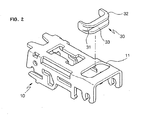
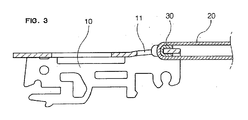
- a separate belt bushing 30 shown in FIGS. 1 to 3 is manufactured and fitted into the through-hole 11 of the belt combiner 10 to wind the safety belt 20.
- a curvature radius of the wound safety belt 20 increases, a tensile pressure applied to the safety belt 20 is decentralized, and a concern about a damage of the safety belt 20 is reduced.
- the belt bushing 30 includes a reinforcement 31, reinforcement supports 32, and a combination groove 33.
- the reinforcement 31 is formed in a straight-line shape and get in contact with a frame of the through-hole 11 of the belt combiner 10 at the side of which the safety belt 20 is wound.
- the reinforcement supports 32 are bent outward at upper and lower ends of the reinforcement 31 and form an approximately " ⁇ " shape with the reinforcement 31.
- the combination groove 33 is provided between the reinforcement 31 and the reinforcement support 32.
- the belt bushing 30 and the belt combiner 10 each are manufactured separately and are conveyed for each assembly process.
- the frame of the through-hole 11 of the belt combiner 10 is inserted into the combination groove 33 of the belt bushing 30 to combine the safety belt 20.
- the reinforcement 31 gets in contact with an inner surface of the through-hole 11, and the reinforcement supports 32 get in contact with one-side upper and lower surfaces of the belt combiner 10.
- the curvature radius of the safety belt 20 is increased, the tensile pressure applied to the safety belt 20 is decentralized by the belt bushing 30, and the concern about safety belt 20 cutting caused by the belt combiner 10 is reduced.
- the belt bushing 30 and the belt combiner 10 each are manufactured, processed in painting and coating processes, and kept in safe in a separate way as well as they each are conveyed for assembly process in a separate way to fit the belt bushing 30 into the through-hole 11 of the belt combiner 10. Therefore, many manufacturing processes and long time are required and a unit cost increases.
- An aspect of exemplary embodiments of the present invention is to address at least the problems and/or disadvantages and to provide at least the advantages described below. Accordingly, an aspect of exemplary embodiments of the present invention is to decentralize a tensile strength applied to a safety belt, thereby preventing cutting of the safety belt.
- Another aspect of exemplary embodiments of the present invention is to simultaneously perform part of processes of manufacturing a belt combiner and a belt bushing, thereby reducing a manufacturing cost as well as enabling assembly between the belt combiner and the belt bushing by automation process.
- a belt bushing for safety belt combined to a through-hole of a belt combiner and winding the safety belt.
- the belt bushing gets in contact and combined to all four-side inner circumference surfaces of the through-hole of the belt combiner.
- the belt bushing may have a " ⁇ " shaped section.
- the belt bushing may include a support wall and top and bottom reinforcements.
- the support wall is provided at four sides, has a belt insertion hole inside, and gets in contact and is combined to the inner circumference surfaces of the through-hole of the belt combiner.
- the top and bottom reinforcements are outward bent and are integrally installed in succession at upper and lower sides of the support wall.
- the support wall gets in contact with the inner circumference surfaces of the through-hole of the belt combiner.
- the top and bottom reinforcements get firmly in contact and are combined to upper and lower surfaces of the belt combiner.
- an assembly method of a belt bushing for safety belt includes providing the belt bushing by forming a support wall at four sides such that it has a belt insertion hole inside, outward bending the support wall at upper side, and forming a top reinforcement; inserting and positioning the belt bushing in a through-hole of the belt combiner such that the support wall gets in contact with an inner circumference surface of the through-hole and the top reinforcement is adhered to an upper surface of the belt combiner; and instantaneously pressing the inserted belt bushing at upper and lower sides by a press, outward bending the support wall at lower side, and forming a top reinforcement at the lower side of the support wall such that it gets in contact and combined to the lower surface of the belt combiner.
- the belt combiner combined to the belt bushing may be integrally processed by painting and coating processes and may be improved in producibility.
- FIG. 1 is a perspective diagram illustrating a partial cutout of a state where a belt bushing and a safety belt are combined to a belt combiner according to the conventional art
- FIG. 2 is a perspective diagram illustrating a state where a belt bushing is separated from a belt combiner according to the conventional art
- FIG. 3 is a side cross-sectional diagram illustrating a partial cutout of a state where a belt bushing and a safety belt are combined to a belt combiner according to the conventional art
- FIG. 4 is a perspective diagram illustrating a partial cutout of a state where a belt bushing and a safety belt are combined to a belt combiner according to the present invention
- FIG. 5 is a perspective diagram illustrating a state where a belt bushing is separated from a belt combiner according to the present invention.
- FIG. 6 is a side cross-sectional diagram illustrating a partial cutout of a state where a belt bushing and a safety belt are combined to a belt combiner according to the present invention.
- FIG. 4 is a perspective diagram illustrating a partial cutout of a state where a belt bushing and a safety belt are combined to a belt combiner according to the present invention.
- FIG. 5 is a perspective diagram illustrating a state where the belt bushing is separated from the belt combiner according to the present invention.
- FIG. 6 is a side cross-sectional diagram illustrating a partial cutout of a state where the belt bushing and the safety belt are combined to the belt combiner according to the present invention.
- the present invention provides a belt bushing 100 added to a belt combiner 10 firmly supporting a safety belt 20 of a variety of forms and structures and withstanding even a high tensile strength.
- the following description will be made for an example of a belt combiner 10 and a safety belt 20 used for a rear seat of a car, but is not intended to limit the scope of the present invention.
- the present invention provides a belt bushing combined to a belt combiner 10 similar with the conventional art.
- the same elements as those of the conventional art are denoted by the same reference numerals in the following description.
- the belt bushing 100 is provided in a form in which a support wall 120 having a belt insertion hole 110 inside is in contact with four-side inner circumference surfaces of a through-hole 11 of the belt combiner 10.
- Top and bottom reinforcements 130 are bent outside of the belt insertion hole 110 by a predetermined width at upper and lower sides of the support wall 120.
- the support wall 120 and the top and bottom reinforcements 130 have an approximately " ⁇ " shaped section.
- the support wall 120 of the belt bushing 100 is gently curved outside of the belt insertion hole 110. This is desirable for securing stability at the time of winding the safety belt 20.
- the belt combiner 10 having the through-hole 11 and the inventive belt bushing 100 are separately manufactured, respectively.
- the inventive belt bushing 100 only one of upper and lower ends (an upper end in the drawings) of the support wall 120 having the belt insertion hole 110 inside is first manufactured in a form in which the reinforcement 130 is bent outside by a predetermined width.
- a support wall 120 portion of the belt bushing 100 is inserted into the through-hole 11 of the belt combiner 10 and gets in contact with an inner surface of the through-hole 11.
- the inserted belt bushing 100 is positioned such that the reinforcement 130 is caught by an upper surface of the belt combiner 10 outside of the through-hole 11.
- the belt bushing 100 combined as above is instantaneously pressed at upper and lower sides by a great pressure using a press (not shown), etc. By doing so, a lower portion of the support wall 120 is bent and widened outside of the through-hole 10.
- the bottom reinforcement 130 is integrally installed in succession at a lower side of the support wall 120 and thus, the belt bushing 100 has an approximately " ⁇ " shaped section.
- the resultant is integrally moved and is processed by remaining processes such as a painting process and a coating process at the same time.
- the safety belt 20 gets in contact and combined to a curved inner circumference surface of the support wall 120 of the belt bushing 100 with a curvature radius being larger than that of the belt combiner 10.
- a tensile strength is improved about 2,200 kgf/cm 2 to 2,300 kgf/cm 2 .
- the present invention has an advantage that a curvature radius of a safety belt wound on a belt combiner is increased and a tensile strength of the belt is improved, thereby reducing a concern about cutting of the belt, stability is guaranteed because there is not a concern about releasing a belt bushing from the belt combiner, and there is not a concern about occurrence of a noise between the belt bushing and the belt combiner in use.
- the present invention is very economical in that the belt bushing can be assembled in automation process, thereby improving workability and a work is concurrently performed in painting and coating processes with the belt bushing being integrally combined to the belt combiner, thereby reducing work process and cost.
Landscapes
- Engineering & Computer Science (AREA)
- Mechanical Engineering (AREA)
- Body Structure For Vehicles (AREA)
- Automotive Seat Belt Assembly (AREA)
- Fluid-Damping Devices (AREA)
Applications Claiming Priority (1)
| Application Number | Priority Date | Filing Date | Title |
|---|---|---|---|
| KR20070053934 | 2007-06-01 |
Publications (2)
| Publication Number | Publication Date |
|---|---|
| EP1997696A2 true EP1997696A2 (de) | 2008-12-03 |
| EP1997696A3 EP1997696A3 (de) | 2011-04-20 |
Family
ID=39671741
Family Applications (1)
| Application Number | Title | Priority Date | Filing Date |
|---|---|---|---|
| EP20080009293 Withdrawn EP1997696A3 (de) | 2007-06-01 | 2008-05-20 | Gurtbuchse für einen Sicherheitsgurt und Montageverfahren dafür |
Country Status (3)
| Country | Link |
|---|---|
| US (1) | US7597358B2 (de) |
| EP (1) | EP1997696A3 (de) |
| JP (1) | JP2008296895A (de) |
Cited By (1)
| Publication number | Priority date | Publication date | Assignee | Title |
|---|---|---|---|---|
| CN104875710A (zh) * | 2015-04-30 | 2015-09-02 | 宜兴市奥华汽配有限公司 | 一种尼龙浸塑端片带保护器 |
Families Citing this family (1)
| Publication number | Priority date | Publication date | Assignee | Title |
|---|---|---|---|---|
| KR20190067278A (ko) * | 2014-01-27 | 2019-06-14 | 가부시키가이샤 엔슈 | 벨트 부착구 |
Family Cites Families (11)
| Publication number | Priority date | Publication date | Assignee | Title |
|---|---|---|---|---|
| JPS5521694Y2 (de) * | 1974-09-27 | 1980-05-24 | ||
| JPS5216737A (en) * | 1975-07-30 | 1977-02-08 | Toyota Motor Corp | Tongue plate mechanism of safety seat belt |
| US3959855A (en) * | 1975-10-29 | 1976-06-01 | Fisher Robert C | Shoulder strap bracket |
| JPH0275253U (de) * | 1988-11-25 | 1990-06-08 | ||
| EP0327968B1 (de) * | 1988-02-08 | 1993-08-11 | Nippon Seiko Kabushiki Kaisha | Steg zur Befestigung eines Sicherheitsgurtverschlusses |
| JP3247548B2 (ja) * | 1994-06-14 | 2002-01-15 | タカタ株式会社 | シートベルト装置用スリップアンカー |
| JPH09267711A (ja) * | 1996-02-01 | 1997-10-14 | Tokai Rika Co Ltd | バックル支持装置 |
| JP4072584B2 (ja) * | 1999-05-12 | 2008-04-09 | オートリブ株式会社 | シートベルト装置 |
| US6526630B2 (en) * | 2000-02-07 | 2003-03-04 | Nsk Autoliv Co. Ltd. | Seat belt device |
| US6502861B2 (en) * | 2000-04-25 | 2003-01-07 | Breed Automotive Technology, Inc. | Seat belt guide |
| JP2003011777A (ja) * | 2001-06-28 | 2003-01-15 | Tokai Rika Co Ltd | スルーアンカ |
-
2007
- 2007-09-25 JP JP2007247881A patent/JP2008296895A/ja active Pending
-
2008
- 2008-05-13 US US12/119,835 patent/US7597358B2/en not_active Expired - Fee Related
- 2008-05-20 EP EP20080009293 patent/EP1997696A3/de not_active Withdrawn
Cited By (1)
| Publication number | Priority date | Publication date | Assignee | Title |
|---|---|---|---|---|
| CN104875710A (zh) * | 2015-04-30 | 2015-09-02 | 宜兴市奥华汽配有限公司 | 一种尼龙浸塑端片带保护器 |
Also Published As
| Publication number | Publication date |
|---|---|
| US7597358B2 (en) | 2009-10-06 |
| EP1997696A3 (de) | 2011-04-20 |
| JP2008296895A (ja) | 2008-12-11 |
| US20080296882A1 (en) | 2008-12-04 |
Similar Documents
| Publication | Publication Date | Title |
|---|---|---|
| US8091318B2 (en) | Formed part for vehicle body structural member | |
| US20080098554A1 (en) | Wiper blade assembly | |
| JP4009153B2 (ja) | フロントエンドパネル | |
| US8911004B2 (en) | Vehicular center pillar and vehicle | |
| US8033587B2 (en) | Frame molding fastening structure | |
| JP2000117334A (ja) | 押出し材の曲げ加工方法 | |
| EP1914100A1 (de) | Scheibenrahmen für eine Fahrzeugtür | |
| US20180044968A1 (en) | Window regulator for vehicle | |
| US8998263B1 (en) | Vehicle structural support assembly with a split inner panel | |
| EP1997696A2 (de) | Gurtbuchse für einen Sicherheitsgurt und Montageverfahren dafür | |
| US6840565B2 (en) | Door frame for a vehicle | |
| EP1529670B1 (de) | Fahrzeugtürrahmen und Verfahren zu seiner Herstellung | |
| US7410210B2 (en) | Supporting structure of roof corner for large vehicle | |
| US6478364B2 (en) | Motor vehicle door | |
| KR101365656B1 (ko) | 강선 압연을 이용한 웨더스트립용 심재의 제조 방법 및 이에 의해 제조된 웨더스트립용 심재 | |
| JPH11223280A (ja) | 配管固定用バンド | |
| CN221315914U (zh) | 汽车集成式安全拉手安装支架 | |
| JP6037772B2 (ja) | 庇 | |
| CN110920490A (zh) | 适用于面套卡接的加强部件及面套卡接结构 | |
| KR200229697Y1 (ko) | 텅 | |
| CN220281329U (zh) | 支架及车辆 | |
| WO2009053830A2 (en) | Suspension arm | |
| US20250302021A1 (en) | Fishing rod | |
| JPH105860A (ja) | 鋼帯の巻取り方法および巻取り緩衝材 | |
| JP4521325B2 (ja) | 合成樹脂パネルの取付構造 |
Legal Events
| Date | Code | Title | Description |
|---|---|---|---|
| PUAI | Public reference made under article 153(3) epc to a published international application that has entered the european phase |
Free format text: ORIGINAL CODE: 0009012 |
|
| 17P | Request for examination filed |
Effective date: 20080520 |
|
| AK | Designated contracting states |
Kind code of ref document: A2 Designated state(s): AT BE BG CH CY CZ DE DK EE ES FI FR GB GR HR HU IE IS IT LI LT LU LV MC MT NL NO PL PT RO SE SI SK TR |
|
| AX | Request for extension of the european patent |
Extension state: AL BA MK RS |
|
| PUAL | Search report despatched |
Free format text: ORIGINAL CODE: 0009013 |
|
| AK | Designated contracting states |
Kind code of ref document: A3 Designated state(s): AT BE BG CH CY CZ DE DK EE ES FI FR GB GR HR HU IE IS IT LI LT LU LV MC MT NL NO PL PT RO SE SI SK TR |
|
| AX | Request for extension of the european patent |
Extension state: AL BA MK RS |
|
| RIC1 | Information provided on ipc code assigned before grant |
Ipc: A44B 11/25 20060101ALI20110311BHEP Ipc: B60R 22/18 20060101AFI20080813BHEP |
|
| AKX | Designation fees paid |
Designated state(s): AT BE BG CH CY CZ DE DK EE ES FI FR GB GR HR HU IE IS IT LI LT LU LV MC MT NL NO PL PT RO SE SI SK TR |
|
| STAA | Information on the status of an ep patent application or granted ep patent |
Free format text: STATUS: THE APPLICATION IS DEEMED TO BE WITHDRAWN |
|
| 18D | Application deemed to be withdrawn |
Effective date: 20111021 |