EP1997644A2 - Fluoreszente nicht überlappende Punktdesignmuster für Substrate zur Einbettung von Informationen in Druckdokumente - Google Patents
Fluoreszente nicht überlappende Punktdesignmuster für Substrate zur Einbettung von Informationen in Druckdokumente Download PDFInfo
- Publication number
- EP1997644A2 EP1997644A2 EP08157085A EP08157085A EP1997644A2 EP 1997644 A2 EP1997644 A2 EP 1997644A2 EP 08157085 A EP08157085 A EP 08157085A EP 08157085 A EP08157085 A EP 08157085A EP 1997644 A2 EP1997644 A2 EP 1997644A2
- Authority
- EP
- European Patent Office
- Prior art keywords
- substrate
- dot design
- pattern
- dot
- image
- Prior art date
- Legal status (The legal status is an assumption and is not a legal conclusion. Google has not performed a legal analysis and makes no representation as to the accuracy of the status listed.)
- Granted
Links
- 239000000758 substrate Substances 0.000 title claims abstract description 111
- 238000013461 design Methods 0.000 claims abstract description 80
- 230000001629 suppression Effects 0.000 claims abstract description 29
- 230000003287 optical effect Effects 0.000 claims abstract description 13
- 239000003795 chemical substances by application Substances 0.000 claims abstract description 10
- 238000005282 brightening Methods 0.000 claims abstract description 9
- 239000003086 colorant Substances 0.000 claims description 113
- 239000000203 mixture Substances 0.000 claims description 33
- 238000005286 illumination Methods 0.000 claims description 18
- 230000004044 response Effects 0.000 claims description 6
- 230000000295 complement effect Effects 0.000 claims description 4
- 238000000034 method Methods 0.000 description 21
- 238000013459 approach Methods 0.000 description 18
- 238000007639 printing Methods 0.000 description 15
- 239000007787 solid Substances 0.000 description 14
- 239000001060 yellow colorant Substances 0.000 description 13
- 238000005259 measurement Methods 0.000 description 11
- 239000000976 ink Substances 0.000 description 9
- 238000010521 absorption reaction Methods 0.000 description 6
- 238000012512 characterization method Methods 0.000 description 5
- 239000000463 material Substances 0.000 description 5
- 238000009877 rendering Methods 0.000 description 5
- 238000009826 distribution Methods 0.000 description 3
- 239000000975 dye Substances 0.000 description 3
- 230000006872 improvement Effects 0.000 description 3
- 238000005457 optimization Methods 0.000 description 3
- 230000003595 spectral effect Effects 0.000 description 3
- 230000000007 visual effect Effects 0.000 description 3
- TZCXTZWJZNENPQ-UHFFFAOYSA-L barium sulfate Chemical compound [Ba+2].[O-]S([O-])(=O)=O TZCXTZWJZNENPQ-UHFFFAOYSA-L 0.000 description 2
- 230000008901 benefit Effects 0.000 description 2
- 230000008859 change Effects 0.000 description 2
- 238000001514 detection method Methods 0.000 description 2
- 230000000694 effects Effects 0.000 description 2
- 230000001747 exhibiting effect Effects 0.000 description 2
- 238000003384 imaging method Methods 0.000 description 2
- 239000003112 inhibitor Substances 0.000 description 2
- 230000000873 masking effect Effects 0.000 description 2
- 230000008569 process Effects 0.000 description 2
- 238000012545 processing Methods 0.000 description 2
- 238000001429 visible spectrum Methods 0.000 description 2
- 241000288030 Coturnix coturnix Species 0.000 description 1
- 230000004075 alteration Effects 0.000 description 1
- 230000003190 augmentative effect Effects 0.000 description 1
- 229940092690 barium sulfate Drugs 0.000 description 1
- 230000009286 beneficial effect Effects 0.000 description 1
- 230000005540 biological transmission Effects 0.000 description 1
- 230000000052 comparative effect Effects 0.000 description 1
- 230000009977 dual effect Effects 0.000 description 1
- 238000002474 experimental method Methods 0.000 description 1
- 238000002189 fluorescence spectrum Methods 0.000 description 1
- 238000009472 formulation Methods 0.000 description 1
- 239000007788 liquid Substances 0.000 description 1
- 238000004519 manufacturing process Methods 0.000 description 1
- 238000012986 modification Methods 0.000 description 1
- 230000004048 modification Effects 0.000 description 1
- 238000007645 offset printing Methods 0.000 description 1
- 239000000049 pigment Substances 0.000 description 1
- 238000001228 spectrum Methods 0.000 description 1
- 238000003860 storage Methods 0.000 description 1
- 239000000126 substance Substances 0.000 description 1
- 238000012549 training Methods 0.000 description 1
Images



Classifications
-
- B—PERFORMING OPERATIONS; TRANSPORTING
- B42—BOOKBINDING; ALBUMS; FILES; SPECIAL PRINTED MATTER
- B42D—BOOKS; BOOK COVERS; LOOSE LEAVES; PRINTED MATTER CHARACTERISED BY IDENTIFICATION OR SECURITY FEATURES; PRINTED MATTER OF SPECIAL FORMAT OR STYLE NOT OTHERWISE PROVIDED FOR; DEVICES FOR USE THEREWITH AND NOT OTHERWISE PROVIDED FOR; MOVABLE-STRIP WRITING OR READING APPARATUS
- B42D25/00—Information-bearing cards or sheet-like structures characterised by identification or security features; Manufacture thereof
- B42D25/30—Identification or security features, e.g. for preventing forgery
- B42D25/36—Identification or security features, e.g. for preventing forgery comprising special materials
- B42D25/378—Special inks
- B42D25/387—Special inks absorbing or reflecting ultraviolet light
-
- B—PERFORMING OPERATIONS; TRANSPORTING
- B41—PRINTING; LINING MACHINES; TYPEWRITERS; STAMPS
- B41M—PRINTING, DUPLICATING, MARKING, OR COPYING PROCESSES; COLOUR PRINTING
- B41M3/00—Printing processes to produce particular kinds of printed work, e.g. patterns
- B41M3/14—Security printing
- B41M3/144—Security printing using fluorescent, luminescent or iridescent effects
-
- B—PERFORMING OPERATIONS; TRANSPORTING
- B42—BOOKBINDING; ALBUMS; FILES; SPECIAL PRINTED MATTER
- B42D—BOOKS; BOOK COVERS; LOOSE LEAVES; PRINTED MATTER CHARACTERISED BY IDENTIFICATION OR SECURITY FEATURES; PRINTED MATTER OF SPECIAL FORMAT OR STYLE NOT OTHERWISE PROVIDED FOR; DEVICES FOR USE THEREWITH AND NOT OTHERWISE PROVIDED FOR; MOVABLE-STRIP WRITING OR READING APPARATUS
- B42D25/00—Information-bearing cards or sheet-like structures characterised by identification or security features; Manufacture thereof
-
- B—PERFORMING OPERATIONS; TRANSPORTING
- B42—BOOKBINDING; ALBUMS; FILES; SPECIAL PRINTED MATTER
- B42D—BOOKS; BOOK COVERS; LOOSE LEAVES; PRINTED MATTER CHARACTERISED BY IDENTIFICATION OR SECURITY FEATURES; PRINTED MATTER OF SPECIAL FORMAT OR STYLE NOT OTHERWISE PROVIDED FOR; DEVICES FOR USE THEREWITH AND NOT OTHERWISE PROVIDED FOR; MOVABLE-STRIP WRITING OR READING APPARATUS
- B42D25/00—Information-bearing cards or sheet-like structures characterised by identification or security features; Manufacture thereof
- B42D25/20—Information-bearing cards or sheet-like structures characterised by identification or security features; Manufacture thereof characterised by a particular use or purpose
- B42D25/29—Securities; Bank notes
-
- B—PERFORMING OPERATIONS; TRANSPORTING
- B42—BOOKBINDING; ALBUMS; FILES; SPECIAL PRINTED MATTER
- B42D—BOOKS; BOOK COVERS; LOOSE LEAVES; PRINTED MATTER CHARACTERISED BY IDENTIFICATION OR SECURITY FEATURES; PRINTED MATTER OF SPECIAL FORMAT OR STYLE NOT OTHERWISE PROVIDED FOR; DEVICES FOR USE THEREWITH AND NOT OTHERWISE PROVIDED FOR; MOVABLE-STRIP WRITING OR READING APPARATUS
- B42D25/00—Information-bearing cards or sheet-like structures characterised by identification or security features; Manufacture thereof
- B42D25/30—Identification or security features, e.g. for preventing forgery
- B42D25/333—Watermarks
-
- Y—GENERAL TAGGING OF NEW TECHNOLOGICAL DEVELOPMENTS; GENERAL TAGGING OF CROSS-SECTIONAL TECHNOLOGIES SPANNING OVER SEVERAL SECTIONS OF THE IPC; TECHNICAL SUBJECTS COVERED BY FORMER USPC CROSS-REFERENCE ART COLLECTIONS [XRACs] AND DIGESTS
- Y10—TECHNICAL SUBJECTS COVERED BY FORMER USPC
- Y10T—TECHNICAL SUBJECTS COVERED BY FORMER US CLASSIFICATION
- Y10T428/00—Stock material or miscellaneous articles
- Y10T428/24—Structurally defined web or sheet [e.g., overall dimension, etc.]
- Y10T428/24802—Discontinuous or differential coating, impregnation or bond [e.g., artwork, printing, retouched photograph, etc.]
Definitions
- the present invention in various embodiments relates generally to the useful manipulation of fluorescence found in substrates and particularly most paper substrates as commonly utilized in various printer and electrostatographic print environments. More particularly, the teachings provided herein relate to at least one realization of fluorescence watermarks.
- UV ultra-violet
- UV ultra-violet
- U.S. Patent No. 5,286,286 to Winnik et al. which is herein incorporated by reference in its entirety for its teachings.
- Another approach taken to provide a document for which copy control is provided by digital watermarking includes as an example U.S. Patent No. 5,734,752 to Knox , where there is illustrated a method for generating watermarks in a digitally reproducible document which are substantially invisible when viewed including the steps of: (1) producing a first stochastic screen pattern suitable for reproducing a gray image on a document; (2) deriving at least one stochastic screen description that is related to said first pattern; (3) producing a document containing the first stochastic screen; (4) producing a second document containing one or more of the stochastic screens in combination, whereby upon placing the first and second document in superposition relationship to allow viewing of both documents together, correlation between the first stochastic pattern on each document occurs everywhere within the documents where the first screen is used, and correlation does not occur where the area where the derived stochastic screens occur and the image placed therein using the derived stochastic screens becomes visible.
- a fluorescent mark indicator comprising a substrate containing optical brightening agents and a first dot design to fill a first pattern printed as an image upon the substrate.
- the first dot design is further comprised of substantially non-overlapping primary colorants arranged so as to provide a relatively high paper coverage, the resultant first dot design thus having a property of high suppression of substrate fluorescence.
- the fluorescent mark indicator further comprises a second dot design to fill a complementary pattern printed as an image upon the substrate in substantially close spatial proximity to the printed first pattern.
- the second dot design is further comprised of primary colorants arranged to create a relatively low paper coverage while having substantially similar average color appearance as the first dot design under normal light.
- the resultant second dot design will thus have the property of low suppression of substrate fluorescence, such that the resultant printed substrate image suitably exposed to an ultra-violet light source, will yield a discernable pattern evident as a fluorescent mark.
- the perceived color signal under UV light predicted by the second printer model is based upon luminance or a direct correlate thereof.
- the second printer model predicts UV luminance by calculating the fractional area coverage of the paper substrate.
- the second printer model predicts UV luminance as a weighted average of the UV luminance of solid C, M, Y, K and bare substrate, wherein the weights in the weighted average calculation are derived from fractional area coverage of C, M, Y, K and bare substrate.
- the fractional area coverage of C, M, Y, K and bare substrate are obtained from characterization measurements obtained for the case of normal light.
- a fluorescent mark indicator comprising a substrate containing optical brightening agents and a first dot design to fill a first pattern printed as an image upon the substrate.
- the first dot design further comprised of substantially non-overlapping colorants including at least the colorant yellow, arranged so as to provide a relatively high paper coverage, the resultant first dot design thus having a property of high suppression of substrate fluorescence.
- the fluorescent mark indicator further comprises a second dot design to fill a complementary pattern printed as an image upon the substrate in substantially close spatial proximity to the printed first pattern.
- the second dot design is comprised of colorants with a minimized amount of yellow, the resultant second dot design thus having a property of low suppression of substrate fluorescence, such that the resultant printed substrate image suitably exposed to an ultra-violet light source, will yield a discernable pattern evident as a fluorescent mark.
- the fluorescent mark indicator further comprises where the substrate is paper.
- the fluorescent mark indicator further comprises where the primary colorants are comprised of CMYK.
- the fluorescent mark indicator further comprises where the primary colorants are comprised of Red, Green and Blue.
- the fluorescent mark indicator further comprises where the primary colorants are further comprised by the additional Neugebauer primaries Red, Green and Blue.
- the fluorescent mark indicator further comprises where the first dot design and the second dot design colorant mixtures are a close metameric color match under normal illumination but remain visually distinct in their response under ultra-violet light.
- the first dot design and the second dot design colorant mixtures are derived from a first printer model that predicts a perceived color signal under normal light and a second printer model that predicts a perceived color signal under UV light.
- the perceived color signal under UV light predicted by the second printer model is based upon luminance or a direct correlate thereof.
- the second printer model predicts UV luminance by calculating the fractional area coverage of the paper substrate.
- the second printer model predicts UV luminance as a weighted average of the UV luminance of solid C, M, Y, K and bare substrate, wherein the weights in the weighted average calculation are derived from fractional area coverage of C, M, Y, K and bare substrate.
- the fractional area coverage of C, M, Y, K and bare substrate are obtained from characterization measurements obtained for the case of normal light.
- a fluorescent mark indicator comprising a substrate containing optical brightening agents and a first dot design pattern printed as an image upon the substrate.
- the first dot design pattern further comprised of substantially non-overlapping colorants including at least the colorant yellow, the resultant first dot design pattern having a property of high suppression of substrate fluorescence.
- the fluorescent mark indicator further comprises a second dot design pattern printed as an image upon the substrate in substantially close spatial proximity to the printed first dot design pattern.
- the second dot design pattern is comprised of colorants with a minimized amount of yellow, including at least the colorant black, and thus the resultant second dot design pattern has the property of low suppression of substrate fluorescence, such that the resultant printed substrate image suitably exposed to an ultra-violet light source, will yield a discernable pattern evident as a fluorescent mark.
- the fluorescent mark indicator further comprises where the substrate is paper.
- the fluorescent mark indicator further comprises where the primary colorants are comprised of CMYK.
- the fluorescent mark indicator further comprises where the primary colorants are comprised of Red, Green and Blue.
- fluorescent mark indicator further comprises where the primary colorants are further comprised by the additional Neugebauer primaries Red, Green and Blue.
- the fluorescent mark indicator further comprises where the second dot design pattern is further comprised of overlapping colorants.
- FIGURE 1 schematically depicts the resultant observable light from a substrate and colorant patch thereupon.
- FIGURE 2 shows a graph of normalized radiance and reflectance as a function of wavelength for a solid yellow colorant, a fluorescent substrate, and a diffuse reflector.
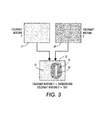
- FIGURE 3 provides depiction of one approach utilizing colorant or colorant mixtures as applied in the rendering of an example alphanumeric character.
- FIGURE 4 provides schematical depiction of a dot design which maximizes the suppression of substrate florescence for a given grayscale level.
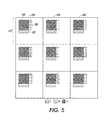
- FIGURE 5 provides schematical depiction of a dot design which minimizes the suppression of substrate florescence for a grayscale level matching that of Figure 4 .
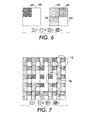
- FIGURE 6 provides schematical depiction of two schematical dot designs one of which utilizing CMY minimizes the suppression of substrate florescence, and the other utilizing B maximizes the suppression of substrate florescence each at the same grayscale level.
- FIGURE 7 provides depiction of a "+" sign employing the dot designs of Figure 6 .
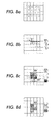
- FIGURE 8 provides schematical depiction of a dot filling-order pattern and three example colorant fills.
- FIGURE 9 provides schematical depiction of an alternative quadrant dot filling-order pattern, and two colorant fill examples based on that quadrant dot filling-order.
- data refers herein to physical signals that indicate or include information.
- a "digital image” is by extension an image represented by a collection of digital data.
- An image may be divided into “segments,” each of which is itself an image.
- a segment of an image may be of any size up to and including the whole image.
- image object or “object” as used herein is believed to be considered in the art generally equivalent to the term “segment” and will be employed herein interchangeably. In the event that one term or the other is deemed to be narrower or broader than the other, the teaching as provided herein and claimed below is directed to the more broadly determined definitional term, unless that term is otherwise specifically limited within the claim itself.
- each element of data may be called a "pixel”, which is common usage in the art and refers to a picture element.
- Each pixel has a location and value,
- Each pixel value is a bit in a "binary form” of an image, a gray scale value in a “gray scale form” of an image, or a set of color space coordinates in a "color coordinate form” of an image, the binary form, gray scale form, and color coordinate form each being a two-dimensional array defining an image.
- An operation performs "image processing” when it operates on an item of data that relates to part of an image.
- Contrast is used to denote the visual difference between items, data points, and the like. It can be measured as a color difference or as a luminance difference or both.
- a digital color printing system is an apparatus arrangement suited to accepting image data and rendering that image data upon a substrate.
- Figure 1 shows how the human eye of an observer 10 will respond to the reflectance characteristics of bare paper substrate 20 versus the reflectance characteristics of a patch 25 of suitably selected colorant or colorant mixture 30 as deposited upon the same substrate 20.
- the "I” term depicted as dashed arrows 40 represents incident light directed from light source 50.
- the "R” term depicted as dashed arrows 60 represents normal reflection, while the “F” term depicted as solid arrows 70 represents the radiated fluorescence from substrate 20 caused by the UV component in the incident light from light source 50.
- incident light 40 when it strikes an open area of the substrate 20 provides amounts both of normal light reflection as well as radiated fluorescence.
- patch 25 of suitably selected deposited colorant mixture 30 there can be significantly less radiated fluorescence 70, than there is of normal reflection 60 depending on the colorant or colorant mixture chosen.
- a suitably selected colorant 30 providing significantly less radiated fluorescence is a yellow toner as employed in electrostatographic, ink-jet, and wax based printing apparatus.
- other colorants or colorant mixtures may be selected for rendering which do not suppress the radiated fluorescence of the substrate 20 as strongly, such as for example a cyan or magenta colorant.
- Figure 2 provides a graph of light wavelength versus normalized radiance/reflectance.
- the spectrum data here was obtained by placing a typical substrate in a light booth illuminated with purely UV light, and measuring the reflected radiance with a Photoresearch PR705 spectroradiometer.
- the figure also includes the spectral radiance from a non-fluorescent barium-sulfate diffuse reflector. It is clearly seen that the fluorescence spectrum has most of its energy in the shorter (or "blue") wavelengths.
- Figure 2 by examining the radiance of a fluorescent substrate (as represented by the solid trace line here), it can be seen that the normalized radiance of a typical white substrate 20 peaks at approximately 436 nanometers.
- OBA optical brightening agents
- OBA optical brightening agents
- U.S. Patent No. 3,900,608 to Dierkes et al. U.S. Patent No. 5,371,126 to Strickler ; and U.S. Patent No. 6,773,549 to Burkhardt , each of which is hereby incorporated by reference in its entirety for its teaching.
- paper is now often marketed with a numeric indication of its brilliance.
- Virtually all xerographic substrates contain some amount of OBAs. Indeed it should be noted that other colored paper substrates have been found to exhibit similar properties in differing amounts. Yellow paper in particular has been empirically found to be comparable to many white paper substrates.
- the solid yellow colorant (as indicated by the dotted line in Figure 2 ) provides very low radiance/reflectance of the light fluorescing in the paper substrate for the range below approximately 492 nanometers. In effect a yellow colorant deposited upon a fluorescing substrate masks the fluorescing of that substrate where so deposited.
- the response for a diffuse reflector (indicated in Figure 2 as a dashed line). As noted above the response for other colorants differs from the yellow colorant.
- a listing of the approximate comparative quality of the C, M, Y, and K, colorants as to their UV masking and perceived relative luminance characteristics is provided in the following table: Toner Colorant UV Absorption/Fluorescence Suppression Blue Absorption Perceived Intensity Absorption or Perceived Luminance Impact Black High High High Cyan Low-medium Low High Magenta Low-medium Medium Medium Yellow High High Low
- UV-based watermarking technique that as taught herein uses only common consumables.
- the technique is based on the following observations: 1) common substrates used in digital printing contain optical brighteners that cause fluorescence; 2) the standard colorants act as an effective blocker of UV-induced emission, with the yellow colorant commonly being the strongest inhibitor; 3) the yellow colorant in addition to being a strong inhibitor of UV-induced emission, also exhibits very low luminance contrast under normal illumination. This is because yellow absorbs in the blue regime of the visible spectrum, and blue does not contribute significantly to perceived luminance.
- the technique as taught herein works by finding colorant mask patterns that produce similar R (normal reflection) and thus are hard to distinguish from each other under normal light, while also providing very dissimilar F (radiated fluorescence) and thus displaying a high contrast from one another under UV light.
- this makes the yellow colorant mixtures in patterns combined with distraction patterns in close proximity ideal candidates for embedding information in a document printed on a typical substrate.
- the yellow watermark pattern is difficult to visually separate from the distraction pattern.
- the watermark is revealed due to the fact that yellow colorant mixture pattern exhibits high contrast against the fluorescent substrate. Since the technique uses only common substrates and colorants, it is a cost-effective way of ensuring security markings in short-run/customized digital printing environments. Additionally, there are a wide variety of UV light sources, many of them inexpensive and portable, thus making the detection of a fluorescence mark in the field easy and convenient.
- the proposed technique is distinct from the conventional offset approach in that instead of fluorescence emission being added via application of special inks, fluorescence emission from the substrate is being subtracted or suppressed using yellow or some other colorant or colorant mixture.
- the technique described herein is the logical 'inverse' of existing methods; rather than adding fluorescent materials to parts of a document, a selective suppression or masking of the substrate fluorescence effect is employed instead.
- Luminance dynamic range obtained from yellow on white paper under different illuminants Y paper /Y yellow Substrate 1 (high fluorescence)
- Substrate 2 low fluorescence
- D50 Daylight
- Figure 3 provides depiction for application of the principle teachings enumerated above.
- a colorant mixture-1 is selected and applied to patch area 33, which here is arranged in this example as the alphanumeric symbol "O".
- a colorant mixture-2 is selected and applied to patch area 32 arranged here in substantially close spatial proximity to patch area 33, and thereby effecting a background around patch area 33.
- Both colorant mixture-1 and mixture-2 are comprised of suitably selected colorant or colorant mixtures 31 and 30 respectively.
- Each colorant mixture 31 or 30 may be either a single CMYK colorant or any mixture of CMYK colorants. They will however, not both be comprised of the same identical single colorant or colorant mixture. Indeed for example, in one embodiment, colorant mixture 31 will be selected so as to provide higher fluorescence suppression than that selected for colorant mixture 30. However, in a preferred arrangement the colorant mixtures 30 and 31 will be selected most optimally to match each other closely in their average color under normal light, while at the same time differing in their average fluorescence suppression. Thus, under normal illumination, area 32 will look to a human observer as a constant or quasi constant color, while under UV illumination area 32 would separate into two distinct areas represented by colorant mixtures 30 and 31, exhibiting a clear visual contrast.
- an approximate 50% grayscale gray colorant mixture may be realized with a halftone of black colorant only. This may then be matched against a colorant mixture comprising a high amount of yellow mixed with enough cyan and magenta to yield a similar approximate 50% grayscale gray colorant mixture.
- this matched mixture will provide much higher absorption of UV or suppression of native substrate fluorescence.
- two colorant mixtures may be realized which while appearing quite nearly identical under normal viewing illumination, will never-the-less appear quite different under UV lighting.
- an UV encryption scheme that directly optimizes primary (C, M, Y, K) dot patterns, rather than contone values. This yields a marked simplicity and improvement over the previous and the above-mentioned methods in the ability to match colors under normal illumination, while showing visible contrast under UV light.
- Each pattern comprises a mosaic of solid non-overlapping primaries C, M, Y, K, and bare paper.
- a first empirical model is derived that predicts the color of these patterns under normal light.
- a second empirical model is derived that predicts luminance under UV light.
- the UV luminance is predicted by considering only the fractional area coverage of bare paper.
- FIGS. 4 through 9 provide depiction of further example embodiments.
- the arrangement here is intended to make any casual observation of a fluorescent mark more difficult to discern by the lay observer. This is achieved as a consequence flowing from the introduction of two different directly optimized primary (C, M, Y, K) dot patterns arranged in a mosaic being utilized, rather than an approach based on contone values. This yields a marked improvement in simplicity of implementation as well as an improvement over the above-described methods in the ability to consistently provide matched colors under normal illumination, while showing visible contrast under UV light.
- C, M, Y, K directly optimized primary
- Figure 4 depicts as shown schematically, one such mosaic of solid non-overlapping C, M, Y, K dots and bare paper (P).
- An array 400 of dots 410 are arranged.
- the array pattern is depicted only as a three by three, nine cell arrangement in this drawing for illustrative purposes, but as will be self evident to one skilled in the art, this repeating array would be expanded or contracted as needed to fill a given patch area, as for example the patch area portions of area 30, be it either patch area 32 or patch area 33.
- Dot 410 is provided with relatively larger area proportions of cyan 420, magenta 430 and yellow 440, no black, and as a result correspondingly less bare paper area.
- the bare paper area here will defined as the area within the delineated box 450 minus the combined area of cyan 420, magenta 430 and yellow 440.
- dot 410 of Figure 4 will minimize or suppress the UV florescence of a paper substrate while the dot 510 of Figure 5 will by way of minimum paper coverage and the absence of yellow 440 allow the highest level of UV florescence for a given substrate.
- these two dot designs will under normal room lighting, look the same to the unaided eye, and appear to be the same grayscale.
- a florescence mark may be rendered which shall be viable under UV light but not normal room lighting.
- dot design pattern embodiment uses a successive filling vector halftoning approach. With this method, we begin at the center of a halftone cell, and move gradually towards the periphery, filling in one colorant at a time according to its fractional area coverage.
- This dot design pattern embodiment is illustrated in Figure 6 where two identically sized cells 600 and 610 are rendered using only K (650) in 600 or a combination of the colorants C (640), M (630) and Y (620) in 610 that in this simplified drawing will both yield identical visual stimulus under the standard illuminant, but a significantly different response under UV illumination, as described above.
- a UV mark can now be encoded by selecting or toggling between two different cell design renderings as is depicted by example in Figure 7 .
- the background pattern is composed of background cell 710 and the desired image signal is composed of foreground cell 700.
- the desired image signal in this Figure 7 example being a "+" sign.
- the five foreground cells 700 delineating the "+” sign are not visible.
- the five foreground cells 700 will appear markedly different, in this case "brighter" than the surrounding patch formed from background cells 710.
- Figure 9a shows a simplification of the filling scheme described above, where here, the colorants are filled independent of each other, and with each colorant starting at its own quadrant of the cell. Note that fill numbers higher than 9 have been omitted in the figure since they would protrude into a neighboring cell, nevertheless, in an actual implementation, all colorants can have, as in this example, 36 pixel locations filled.
- the advantage of this structure is that any boundary line between the different colorants is minimized. Since boundary lines between different elements are often the cause of non-linearity's and instabilities, this can be beneficial in some printing systems. However, as will also be obvious for those skilled in the art that there is the disadvantage of an increase in the irregularity of the overall outline.
- Figure 9b provides depiction of one example of such a quadrant fill dot design for suppressing the UV florescence of a substrate much as example dot 410 of Figure 4 as described above did.
- Figure 9c provides depiction of one example of such a quadrant fill dot design allowing the UV florescence of a substrate much as example dot 510 of Figure 5 did above.
- an empirical model may be derived that predicts the average color (e.g. CIELAB) of an arbitrary CMYKP combination under normal light.
- a dense target of color patches that satisfy constraints 1 a and 1 b is printed and measured.
- the color of an arbitrary CMYKP combination (satisfying constraints 1 a and 1b and built with the same spatial dot scheme) can be predicted from the target training samples by any known fitting or regression technique. Distance-weighted regression was used in one exemplary embodiment. Note that the constraint of zero-overlap greatly restricts the attainable color space of the available CMYK combinations, and thus simplifies the characterization problem.
- luminance under UV light is measured for only solid C, M, Y, K patches and bare paper.
- a simple printer model is then used to predict UV luminance for arbitrary CMYK combinations.
- the printer model predicts overall luminance as a weighted average of the luminance measurements of solid C, M, Y, K.
- the weights are derived from the C, M, Y, K fractional area coverage amounts, which can in turn be estimated from input C, M, Y, K digital amounts using known techniques.
- P1 and P2 we first determine P1 to be a colorant combination that satisfies 1a and 1 b, as well as the following:
- Constraint (2) is included so that paper area coverage can be used as a reliable indicator of UV luminance.
- Constraint (3) is chosen based on the intuition that UV contrast is largely obtained by a differential in paper area coverage, which in turn is effected by trading off pure K vs. a combination of C, M, Y.
- the pure primary colorants CMYK are augmented by the additional Neugebauer primaries Red, Green and Blue, modifying constraint formula 1a above accordingly.
- the above-described two colorant combinations the first being of high suppression of substrate UV fluorescence and second being of low suppression of substrate UV fluorescence, can now be found by selecting the high suppression of substrate UV fluorescence as described above, whereas the case of low suppression of substrate UV fluorescence is modified to maximally replace the pure colorants C, M, Y preferably with Neugebauer primaries Red, Green and Blue, under the maintained requirement that the difference between the two colorant combinations under normal illumination is below the threshold defined for the application.
- This fluorescent mark comprises a substrate containing optical brightening agents, and a first dot design pattern printed as an image upon the substrate.
- the first dot design pattern has as a characteristic, the property of high suppression of substrate fluorescence.
- a second dot design pattern exhibiting as a characteristic the low suppression of substrate fluorescence is printed in close spatial proximity to the first colorant mixture dot design pattern, such that the resulting rendered substrate suitably exposed to an ultra-violet light source, will yield a discernable pattern evident as a fluorescence mark.
Landscapes
- Business, Economics & Management (AREA)
- Accounting & Taxation (AREA)
- Finance (AREA)
- Credit Cards Or The Like (AREA)
- Printing Methods (AREA)
- Accessory Devices And Overall Control Thereof (AREA)
- Cleaning In Electrography (AREA)
- Editing Of Facsimile Originals (AREA)
Applications Claiming Priority (1)
| Application Number | Priority Date | Filing Date | Title |
|---|---|---|---|
| US11/754,702 US8821996B2 (en) | 2007-05-29 | 2007-05-29 | Substrate fluorescent non-overlapping dot patterns for embedding information in printed documents |
Publications (3)
| Publication Number | Publication Date |
|---|---|
| EP1997644A2 true EP1997644A2 (de) | 2008-12-03 |
| EP1997644A3 EP1997644A3 (de) | 2015-08-05 |
| EP1997644B1 EP1997644B1 (de) | 2016-11-09 |
Family
ID=39745498
Family Applications (1)
| Application Number | Title | Priority Date | Filing Date |
|---|---|---|---|
| EP08157085.5A Ceased EP1997644B1 (de) | 2007-05-29 | 2008-05-28 | Fluoreszente nicht überlappende Punktdesignmuster für Substrate zur Einbettung von Informationen in Druckdokumente |
Country Status (3)
| Country | Link |
|---|---|
| US (1) | US8821996B2 (de) |
| EP (1) | EP1997644B1 (de) |
| JP (1) | JP5253881B2 (de) |
Cited By (5)
| Publication number | Priority date | Publication date | Assignee | Title |
|---|---|---|---|---|
| WO2011154764A1 (en) * | 2010-06-10 | 2011-12-15 | Arjowiggins Security | Secure structure |
| CN103680296A (zh) * | 2012-09-17 | 2014-03-26 | 殷德深 | 防伪说明书 |
| EP2803497A1 (de) * | 2013-05-13 | 2014-11-19 | KBA-NotaSys SA | Gedrucktes Sicherheitsmerkmal, Gegenstand mit diesem gedruckten Sicherheitsmerkmal und Herstellungsverfahren dafür |
| CN105324250A (zh) * | 2013-08-07 | 2016-02-10 | 卡巴-诺塔赛斯有限公司 | 印刷安全特征,包含此种印刷安全特征的物体,以及其生产方法 |
| EP4401397A1 (de) * | 2023-01-11 | 2024-07-17 | Roger D. Hersch | Halbtonrasterung von nebeneinanderliegenden gruppierten verteilten punkten |
Families Citing this family (41)
| Publication number | Priority date | Publication date | Assignee | Title |
|---|---|---|---|---|
| US8277908B2 (en) * | 2006-05-11 | 2012-10-02 | Xerox Corporation | Substrate fluorescence mask for embedding information in printed documents |
| US8283004B2 (en) * | 2006-05-11 | 2012-10-09 | Xerox Corporation | Substrate fluorescence pattern mask for embedding information in printed documents |
| US7800785B2 (en) * | 2007-05-29 | 2010-09-21 | Xerox Corporation | Methodology for substrate fluorescent non-overlapping dot design patterns for embedding information in printed documents |
| US8460781B2 (en) * | 2007-06-05 | 2013-06-11 | Xerox Corporation | Infrared encoding of security elements using standard xerographic materials |
| US8455087B2 (en) * | 2007-06-05 | 2013-06-04 | Xerox Corporation | Infrared encoding of security elements using standard xerographic materials with distraction patterns |
| US8009329B2 (en) * | 2007-11-09 | 2011-08-30 | Xerox Corporation | Fluorescence-based correlation mark for enhanced security in printed documents |
| US7903291B2 (en) * | 2008-01-14 | 2011-03-08 | Xerox Corporation | UV encryption via intelligent halftoning |
| US8085434B2 (en) * | 2008-03-21 | 2011-12-27 | Xerox Corporation | Printer characterization for UV encryption applications |
| US8111432B2 (en) * | 2008-04-21 | 2012-02-07 | Xerox Corporation | Infrared watermarking of photographic images by matched differential black strategies |
| US20100157377A1 (en) * | 2008-12-18 | 2010-06-24 | Xerox Corporation | Uv fluorescence encoded background images using adaptive halftoning into disjoint sets |
| US9892585B2 (en) * | 2009-08-25 | 2018-02-13 | Xerox Corporation | Magnetic watermarking of a printed substrate by metameric rendering |
| JP2011109639A (ja) * | 2009-10-20 | 2011-06-02 | Canon Inc | 画像処理装置及びその制御方法 |
| JP5764892B2 (ja) * | 2010-09-22 | 2015-08-19 | 大日本印刷株式会社 | 不可視情報の重畳された印刷物 |
| US8797602B2 (en) | 2011-03-23 | 2014-08-05 | Xerox Corporation | UV and IR specialty imaging methods and systems |
| JP5799426B2 (ja) * | 2011-10-27 | 2015-10-28 | 独立行政法人 国立印刷局 | 発光印刷物 |
| US8941886B2 (en) * | 2012-06-19 | 2015-01-27 | Eastman Kodak Company | Spectral edge marking for steganography or watermarking |
| US10051156B2 (en) | 2012-11-07 | 2018-08-14 | Xerox Corporation | System and method for producing correlation and gloss mark images |
| US9193201B2 (en) | 2013-09-18 | 2015-11-24 | Xerox Corporation | System and method for producing color shifting or gloss effect and recording medium with color shifting or gloss effect |
| US9118870B2 (en) | 2013-09-18 | 2015-08-25 | Xerox Corporation | System and method for producing color shifting or gloss effect and recording medium with color shifting or gloss effect |
| US9083896B2 (en) | 2013-09-18 | 2015-07-14 | Xerox Corporation | System and method for producing color shifting or gloss effect and recording medium with color shifting or gloss effect |
| US9088736B2 (en) | 2013-09-18 | 2015-07-21 | Xerox Corporation | System and method for producing color shifting or gloss effect and recording medium with color shifting or gloss effect |
| US9100592B2 (en) | 2013-09-18 | 2015-08-04 | Xerox Corporation | System and method for producing color shifting or gloss effect and recording medium with color shifting or gloss effect |
| US9106847B2 (en) | 2013-09-18 | 2015-08-11 | Xerox Corporation | System and method for producing color shifting or gloss effect and recording medium with color shifting or gloss effect |
| US9319557B2 (en) | 2013-09-18 | 2016-04-19 | Xerox Corporation | System and method for producing color shifting or gloss effect and recording medium with color shifting or gloss effect |
| US9082068B1 (en) | 2014-05-06 | 2015-07-14 | Xerox Corporation | Color shift printing without using special marking materials |
| JP6576081B2 (ja) * | 2015-04-06 | 2019-09-18 | 共同印刷株式会社 | 光学読取媒体 |
| US9736330B2 (en) | 2015-05-19 | 2017-08-15 | Xerox Corporation | Method and system for applying a content-variable watermark to a document |
| US9961230B2 (en) | 2015-05-26 | 2018-05-01 | Xerox Corporation | Method and system for applying a watermark to a document |
| US9674392B1 (en) | 2015-11-25 | 2017-06-06 | Xerox Corporation | System and method for producing seesaw gloss effect and recording medium with seesaw gloss effect |
| US9516190B1 (en) | 2015-11-25 | 2016-12-06 | Xerox Corporation | System and method for producing seesaw gloss effect and recording medium with seesaw gloss effect |
| US9674391B1 (en) | 2015-11-25 | 2017-06-06 | Xerox Corporation | System and method for producing seesaw gloss effect and recording medium with seesaw gloss effect |
| US9538041B1 (en) | 2015-11-25 | 2017-01-03 | Xerox Corporation | System and method for producing seesaw gloss effect and recording medium with seesaw gloss effect |
| US9756212B2 (en) | 2015-11-25 | 2017-09-05 | Xerox Corporation | System and method for producing seesaw gloss effect and recording medium with seesaw gloss effect |
| US9614995B1 (en) | 2016-05-02 | 2017-04-04 | Xerox Corporation | System and method for generating vector based correlation marks and vector based gloss effect image patterns for rendering on a recording medium |
| US9661186B1 (en) | 2016-06-02 | 2017-05-23 | Xerox Corporation | System and method for rendering gloss effect image patterns on a recording medium |
| US9781294B1 (en) | 2016-08-09 | 2017-10-03 | Xerox Corporation | System and method for rendering micro gloss effect image patterns on a recording medium |
| US10009503B1 (en) | 2017-05-11 | 2018-06-26 | Xerox Corporation | Overlapped vector patterned two layer correlation marks |
| US10855878B2 (en) | 2018-03-23 | 2020-12-01 | Xerox Corporation | Segmentation hiding layer for vector pattern correlation marks |
| US10882347B1 (en) | 2019-09-16 | 2021-01-05 | Xerox Corporation | Security marks based on print job image |
| US11014391B2 (en) | 2019-09-16 | 2021-05-25 | Xerox Corporation | Security marks based on print job image with uniform printed background |
| JP7898925B2 (ja) * | 2022-04-27 | 2026-08-03 | キヤノン株式会社 | 印刷装置、カラーキャリブレーションの方法、及びプログラム |
Citations (8)
| Publication number | Priority date | Publication date | Assignee | Title |
|---|---|---|---|---|
| US3611430A (en) | 1968-08-08 | 1971-10-05 | Cambridge Ind Instr Ltd | Recording pen |
| US3900608A (en) | 1971-10-23 | 1975-08-19 | Bayer Ag | Preparations of optical brighteners |
| US4186020A (en) | 1974-11-04 | 1980-01-29 | A. B. Dick Company | Fluorescent ink for automatic identification |
| US5256192A (en) | 1992-05-15 | 1993-10-26 | Dataproducts Corporation | Solvent based fluorescent ink compositions for ink jet printing |
| US5286286A (en) | 1991-05-16 | 1994-02-15 | Xerox Corporation | Colorless fast-drying ink compositions for printing concealed images detectable by fluorescence |
| US5371126A (en) | 1993-04-14 | 1994-12-06 | Sandoz Ltd. | Processing aid for paper making |
| US5734752A (en) | 1996-09-24 | 1998-03-31 | Xerox Corporation | Digital watermarking using stochastic screen patterns |
| US6773549B1 (en) | 1999-09-23 | 2004-08-10 | Stora Enso Publication Paper Gmbh & Co., Kg | Method for producing an enameled, optically brightened printing paper |
Family Cites Families (57)
| Publication number | Priority date | Publication date | Assignee | Title |
|---|---|---|---|---|
| US3614430A (en) | 1969-03-10 | 1971-10-19 | Pitney Bowes Alpex | Fluorescent-ink-imprinted coded document and method and apparatus for use in connection therewith |
| US3870528A (en) * | 1973-12-17 | 1975-03-11 | Ibm | Infrared and visible dual dye jet printer ink |
| DE2905765A1 (de) * | 1979-02-15 | 1980-09-04 | Basf Ag | Papierstreichmassen |
| JPS55159154U (de) * | 1979-05-02 | 1980-11-15 | ||
| JPS5725364A (en) * | 1980-07-22 | 1982-02-10 | Showa Kagaku Kogyo Kk | Dyestuff salt |
| DE3273665D1 (en) * | 1981-07-30 | 1986-11-13 | Gao Ges Automation Org | Method for rastering half-tone images |
| US4440846A (en) * | 1981-11-12 | 1984-04-03 | Mead Corporation | Photocopy sheet employing encapsulated radiation sensitive composition and imaging process |
| JPS58134782A (ja) * | 1982-02-05 | 1983-08-11 | Kyodo Printing Co Ltd | 照合用印刷物 |
| US4603970A (en) * | 1982-07-09 | 1986-08-05 | Fuji Xerox Co., Ltd. | Apparatus for inhibiting copying of confidential documents |
| US4604065A (en) * | 1982-10-25 | 1986-08-05 | Price/Stern/Sloan Publishers, Inc. | Teaching or amusement apparatus |
| JPH02194989A (ja) | 1989-01-24 | 1990-08-01 | Agency Of Ind Science & Technol | 情報の付与方法 |
| US5484292A (en) * | 1989-08-21 | 1996-01-16 | Mctaggart; Stephen I. | Apparatus for combining audio and visual indicia |
| JPH0378795A (ja) * | 1989-08-22 | 1991-04-03 | Toshiba Corp | 文書作成装置 |
| JP3036767B2 (ja) * | 1989-12-28 | 2000-04-24 | キヤノン株式会社 | 印刷装置および方法 |
| JPH03261596A (ja) * | 1990-03-10 | 1991-11-21 | Dainippon Printing Co Ltd | カード及びカード識別方法 |
| EP0603117B1 (de) * | 1992-12-03 | 1996-12-27 | Ciba-Geigy Ag | Verfahren zur Herstellung fälschungssicherer farbiger Druckerzeugnisse |
| CA2123456C (en) * | 1993-05-24 | 1998-09-15 | William Berson | Document authentication system utilizing a transparent label |
| US6057858A (en) * | 1996-08-07 | 2000-05-02 | Desrosiers; John J. | Multiple media fonts |
| AUPO289296A0 (en) * | 1996-10-10 | 1996-10-31 | Securency Pty Ltd | Self-verifying security documents |
| JPH10166667A (ja) | 1996-12-09 | 1998-06-23 | King Jim Co Ltd | 文字印刷装置 |
| US5790703A (en) * | 1997-01-21 | 1998-08-04 | Xerox Corporation | Digital watermarking using conjugate halftone screens |
| JPH10251570A (ja) | 1997-03-11 | 1998-09-22 | Dainippon Printing Co Ltd | 蛍光発光インキ及び蛍光画像形成物 |
| US6138913A (en) * | 1997-11-05 | 2000-10-31 | Isotag Technology, Inc. | Security document and method using invisible coded markings |
| US6106021A (en) * | 1998-02-02 | 2000-08-22 | Verify First Technologies, Inc. | Security papers with unique relief pattern |
| US6252971B1 (en) * | 1998-04-29 | 2001-06-26 | Xerox Corporation | Digital watermarking using phase-shifted stoclustic screens |
| US7099019B2 (en) * | 1999-05-25 | 2006-08-29 | Silverbrook Research Pty Ltd | Interface surface printer using invisible ink |
| JP2000335145A (ja) * | 1999-06-01 | 2000-12-05 | Toshiba Corp | 個人認証媒体及びその製造方法 |
| US6731785B1 (en) * | 1999-07-26 | 2004-05-04 | Cummins-Allison Corp. | Currency handling system employing an infrared authenticating system |
| US6526155B1 (en) * | 1999-11-24 | 2003-02-25 | Xerox Corporation | Systems and methods for producing visible watermarks by halftoning |
| US7286682B1 (en) * | 2000-08-31 | 2007-10-23 | Xerox Corporation | Show-through watermarking of duplex printed documents |
| US6731409B2 (en) * | 2001-01-31 | 2004-05-04 | Xerox Corporation | System and method for generating color digital watermarks using conjugate halftone screens |
| EP1421705A4 (de) * | 2001-08-07 | 2009-08-05 | Pacific Holographics Inc | System und verfahren zum codieren und decodieren eines bildes oder dokuments und dadurch codiertes dokument |
| US7213757B2 (en) * | 2001-08-31 | 2007-05-08 | Digimarc Corporation | Emerging security features for identification documents |
| US7224489B2 (en) * | 2001-09-25 | 2007-05-29 | Xerox Corporation | Font characteristic driven halftoning |
| US7180635B2 (en) * | 2002-05-30 | 2007-02-20 | Xerox Corporation | Halftone image gloss control for glossmarks |
| US7092128B2 (en) * | 2002-05-30 | 2006-08-15 | Xerox Corporation | Application of glossmarks for graphics enhancement |
| US7148999B2 (en) * | 2002-06-27 | 2006-12-12 | Xerox Corporation | Variable glossmark |
| US7126721B2 (en) * | 2002-06-27 | 2006-10-24 | Xerox Corporation | Protecting printed items intended for public exchange with glossmarks |
| US7198382B2 (en) * | 2002-09-26 | 2007-04-03 | Donovan Louise D | Wand with light sources for reading or viewing indicia |
| US7218785B2 (en) * | 2002-10-09 | 2007-05-15 | Xerox Corporation | Systems for spectral multiplexing of source images to provide a composite image, for rendering the composite image, and for spectral demultiplexing of the composite image |
| US7215817B2 (en) * | 2003-08-20 | 2007-05-08 | Xerox Corporation | System and method for digital watermarking in a calibrated printing path |
| US7070252B2 (en) * | 2003-08-20 | 2006-07-04 | Xerox Corporation | System and method for digital watermarking in a calibrated printing path |
| US7706565B2 (en) * | 2003-09-30 | 2010-04-27 | Digimarc Corporation | Multi-channel digital watermarking |
| JP4334329B2 (ja) | 2003-12-05 | 2009-09-30 | 日立オムロンターミナルソリューションズ株式会社 | 記録媒体 |
| US20050152040A1 (en) * | 2004-01-09 | 2005-07-14 | Goggins Timothy P. | Digitally imaged lenticular products incorporating a special effect feature |
| US7324241B2 (en) * | 2004-09-29 | 2008-01-29 | Xerox Corporation | Variable data differential gloss images |
| JP4529828B2 (ja) * | 2005-07-19 | 2010-08-25 | 富士ゼロックス株式会社 | 文書改ざん防止装置 |
| US7589865B2 (en) * | 2005-12-21 | 2009-09-15 | Xerox Corporation | Variable differential gloss font image data |
| US7580153B2 (en) * | 2005-12-21 | 2009-08-25 | Xerox Corporation | Printed visible fonts with attendant background |
| US8283004B2 (en) * | 2006-05-11 | 2012-10-09 | Xerox Corporation | Substrate fluorescence pattern mask for embedding information in printed documents |
| US8277908B2 (en) * | 2006-05-11 | 2012-10-02 | Xerox Corporation | Substrate fluorescence mask for embedding information in printed documents |
| US8980504B2 (en) * | 2006-05-11 | 2015-03-17 | Xerox Corporation | Substrate fluorescence mask utilizing a multiple color overlay for embedding information in printed documents |
| US7800785B2 (en) * | 2007-05-29 | 2010-09-21 | Xerox Corporation | Methodology for substrate fluorescent non-overlapping dot design patterns for embedding information in printed documents |
| US7852515B2 (en) * | 2007-06-05 | 2010-12-14 | Xerox Corporation | Infrared encoding for embedding multiple variable data information collocated in printed documents |
| US8455087B2 (en) * | 2007-06-05 | 2013-06-04 | Xerox Corporation | Infrared encoding of security elements using standard xerographic materials with distraction patterns |
| US8460781B2 (en) * | 2007-06-05 | 2013-06-11 | Xerox Corporation | Infrared encoding of security elements using standard xerographic materials |
| US8009329B2 (en) * | 2007-11-09 | 2011-08-30 | Xerox Corporation | Fluorescence-based correlation mark for enhanced security in printed documents |
-
2007
- 2007-05-29 US US11/754,702 patent/US8821996B2/en active Active
-
2008
- 2008-05-22 JP JP2008134532A patent/JP5253881B2/ja not_active Expired - Fee Related
- 2008-05-28 EP EP08157085.5A patent/EP1997644B1/de not_active Ceased
Patent Citations (8)
| Publication number | Priority date | Publication date | Assignee | Title |
|---|---|---|---|---|
| US3611430A (en) | 1968-08-08 | 1971-10-05 | Cambridge Ind Instr Ltd | Recording pen |
| US3900608A (en) | 1971-10-23 | 1975-08-19 | Bayer Ag | Preparations of optical brighteners |
| US4186020A (en) | 1974-11-04 | 1980-01-29 | A. B. Dick Company | Fluorescent ink for automatic identification |
| US5286286A (en) | 1991-05-16 | 1994-02-15 | Xerox Corporation | Colorless fast-drying ink compositions for printing concealed images detectable by fluorescence |
| US5256192A (en) | 1992-05-15 | 1993-10-26 | Dataproducts Corporation | Solvent based fluorescent ink compositions for ink jet printing |
| US5371126A (en) | 1993-04-14 | 1994-12-06 | Sandoz Ltd. | Processing aid for paper making |
| US5734752A (en) | 1996-09-24 | 1998-03-31 | Xerox Corporation | Digital watermarking using stochastic screen patterns |
| US6773549B1 (en) | 1999-09-23 | 2004-08-10 | Stora Enso Publication Paper Gmbh & Co., Kg | Method for producing an enameled, optically brightened printing paper |
Cited By (15)
| Publication number | Priority date | Publication date | Assignee | Title |
|---|---|---|---|---|
| WO2011154764A1 (en) * | 2010-06-10 | 2011-12-15 | Arjowiggins Security | Secure structure |
| CN103680296A (zh) * | 2012-09-17 | 2014-03-26 | 殷德深 | 防伪说明书 |
| CN105263718A (zh) * | 2013-05-13 | 2016-01-20 | 卡巴-诺塔赛斯有限公司 | 印刷安全特征,包含此种印刷安全特征的物体,以及其生产方法 |
| EP2803498A1 (de) * | 2013-05-13 | 2014-11-19 | KBA-NotaSys SA | Gedrucktes Sicherheitsmerkmal, Gegenstand mit diesem gedruckten Sicherheitsmerkmal und Herstellungsverfahren dafür |
| WO2014184739A3 (en) * | 2013-05-13 | 2015-01-22 | Kba-Notasys Sa | Printed security feature, object comprising such a printed security feature, and process of producing the same |
| WO2014184738A3 (en) * | 2013-05-13 | 2015-03-05 | Kba-Notasys Sa | Printed security feature, object comprising such a printed security feature, and process of producing the same |
| EP2803497A1 (de) * | 2013-05-13 | 2014-11-19 | KBA-NotaSys SA | Gedrucktes Sicherheitsmerkmal, Gegenstand mit diesem gedruckten Sicherheitsmerkmal und Herstellungsverfahren dafür |
| CN105263718B (zh) * | 2013-05-13 | 2017-03-29 | 卡巴-诺塔赛斯有限公司 | 印刷安全特征,包含此种印刷安全特征的物体,以及其生产方法 |
| US9751355B2 (en) | 2013-05-13 | 2017-09-05 | Kba-Notasys Sa | Printed security feature, object comprising such a printed security feature, and process of producing the same |
| US9908361B2 (en) | 2013-05-13 | 2018-03-06 | Kba-Notasys Sa | Printed security feature, object comprising such a printed security feature, and process of producing the same |
| RU2649747C2 (ru) * | 2013-05-13 | 2018-04-04 | КБА-НотаСис СА | Печатный защитный элемент, объект, содержащий такой печатный элемент, и способ его производства |
| RU2652052C2 (ru) * | 2013-05-13 | 2018-04-24 | КБА-НотаСис СА | Печатный защитный элемент, объект, содержащий такой печатный защитный элемент, и способ его производства |
| CN105324250A (zh) * | 2013-08-07 | 2016-02-10 | 卡巴-诺塔赛斯有限公司 | 印刷安全特征,包含此种印刷安全特征的物体,以及其生产方法 |
| CN105324250B (zh) * | 2013-08-07 | 2017-03-08 | 卡巴-诺塔赛斯有限公司 | 印刷安全特征,包含此种印刷安全特征的物体,以及其生产方法 |
| EP4401397A1 (de) * | 2023-01-11 | 2024-07-17 | Roger D. Hersch | Halbtonrasterung von nebeneinanderliegenden gruppierten verteilten punkten |
Also Published As
| Publication number | Publication date |
|---|---|
| US8821996B2 (en) | 2014-09-02 |
| US20080299333A1 (en) | 2008-12-04 |
| JP5253881B2 (ja) | 2013-07-31 |
| JP2008296580A (ja) | 2008-12-11 |
| EP1997644A3 (de) | 2015-08-05 |
| EP1997644B1 (de) | 2016-11-09 |
Similar Documents
| Publication | Publication Date | Title |
|---|---|---|
| EP1997644B1 (de) | Fluoreszente nicht überlappende Punktdesignmuster für Substrate zur Einbettung von Informationen in Druckdokumente | |
| EP1997642B1 (de) | Verfahren für fluoreszente nicht überlappende Punktdesignmuster für Substrate zur Einbettung von Informationen in Druckdokumente | |
| US8283004B2 (en) | Substrate fluorescence pattern mask for embedding information in printed documents | |
| US8277908B2 (en) | Substrate fluorescence mask for embedding information in printed documents | |
| US8460781B2 (en) | Infrared encoding of security elements using standard xerographic materials | |
| US8455087B2 (en) | Infrared encoding of security elements using standard xerographic materials with distraction patterns | |
| US7852515B2 (en) | Infrared encoding for embedding multiple variable data information collocated in printed documents | |
| US8179570B2 (en) | Generating image embedded with UV fluorescent watermark by combining binary images generated using different halftone strategies | |
| EP1961577B1 (de) | Substratfluoreszenz-Maske und Herstellungsverfahren | |
| US9085190B2 (en) | Synthesis of authenticable halftone images with non-luminescent halftones illuminated by an adjustable luminescent emissive layer | |
| US7127112B2 (en) | Systems for spectral multiplexing of source images to provide a composite image, for rendering the composite image, and for spectral demultiplexing of the composite image by use of an image capture device | |
| JP5372530B2 (ja) | 知的ハーフトーン化によるuv暗号化 | |
| US20130181435A1 (en) | Synthesis of authenticable halftone images with non-luminescent halftones illuminated by a luminescent emissive layer | |
| JP4863118B2 (ja) | 画像形成体 | |
| Rossier et al. | Hiding patterns with daylight fluorescent inks | |
| JPH0920063A (ja) | 印刷物 |
Legal Events
| Date | Code | Title | Description |
|---|---|---|---|
| PUAI | Public reference made under article 153(3) epc to a published international application that has entered the european phase |
Free format text: ORIGINAL CODE: 0009012 |
|
| AK | Designated contracting states |
Kind code of ref document: A2 Designated state(s): AT BE BG CH CY CZ DE DK EE ES FI FR GB GR HR HU IE IS IT LI LT LU LV MC MT NL NO PL PT RO SE SI SK TR |
|
| AX | Request for extension of the european patent |
Extension state: AL BA MK RS |
|
| PUAL | Search report despatched |
Free format text: ORIGINAL CODE: 0009013 |
|
| AK | Designated contracting states |
Kind code of ref document: A3 Designated state(s): AT BE BG CH CY CZ DE DK EE ES FI FR GB GR HR HU IE IS IT LI LT LU LV MC MT NL NO PL PT RO SE SI SK TR |
|
| AX | Request for extension of the european patent |
Extension state: AL BA MK RS |
|
| 17P | Request for examination filed |
Effective date: 20160205 |
|
| RBV | Designated contracting states (corrected) |
Designated state(s): AT BE BG CH CY CZ DE DK EE ES FI FR GB GR HR HU IE IS IT LI LT LU LV MC MT NL NO PL PT RO SE SI SK TR |
|
| AKX | Designation fees paid |
Designated state(s): DE FR GB |
|
| AXX | Extension fees paid |
Extension state: MK Extension state: AL Extension state: RS Extension state: BA |
|
| REG | Reference to a national code |
Ref country code: DE Ref legal event code: R079 Ref document number: 602008047249 Country of ref document: DE Free format text: PREVIOUS MAIN CLASS: B42D0015000000 Ipc: B42D0025000000 |
|
| GRAP | Despatch of communication of intention to grant a patent |
Free format text: ORIGINAL CODE: EPIDOSNIGR1 |
|
| RIC1 | Information provided on ipc code assigned before grant |
Ipc: B42D 25/00 20140101AFI20160620BHEP Ipc: B41M 3/14 20060101ALI20160620BHEP Ipc: B42D 25/333 20140101ALI20160620BHEP Ipc: B42D 25/387 20140101ALI20160620BHEP Ipc: B42D 25/29 20140101ALI20160620BHEP |
|
| INTG | Intention to grant announced |
Effective date: 20160704 |
|
| GRAS | Grant fee paid |
Free format text: ORIGINAL CODE: EPIDOSNIGR3 |
|
| GRAA | (expected) grant |
Free format text: ORIGINAL CODE: 0009210 |
|
| AK | Designated contracting states |
Kind code of ref document: B1 Designated state(s): DE FR GB |
|
| REG | Reference to a national code |
Ref country code: GB Ref legal event code: FG4D |
|
| REG | Reference to a national code |
Ref country code: DE Ref legal event code: R096 Ref document number: 602008047249 Country of ref document: DE |
|
| REG | Reference to a national code |
Ref country code: FR Ref legal event code: PLFP Year of fee payment: 10 |
|
| REG | Reference to a national code |
Ref country code: DE Ref legal event code: R097 Ref document number: 602008047249 Country of ref document: DE |
|
| PLBE | No opposition filed within time limit |
Free format text: ORIGINAL CODE: 0009261 |
|
| STAA | Information on the status of an ep patent application or granted ep patent |
Free format text: STATUS: NO OPPOSITION FILED WITHIN TIME LIMIT |
|
| 26N | No opposition filed |
Effective date: 20170810 |
|
| REG | Reference to a national code |
Ref country code: FR Ref legal event code: PLFP Year of fee payment: 11 |
|
| PGFP | Annual fee paid to national office [announced via postgrant information from national office to epo] |
Ref country code: DE Payment date: 20200421 Year of fee payment: 13 Ref country code: FR Payment date: 20200422 Year of fee payment: 13 |
|
| PGFP | Annual fee paid to national office [announced via postgrant information from national office to epo] |
Ref country code: GB Payment date: 20200423 Year of fee payment: 13 |
|
| REG | Reference to a national code |
Ref country code: DE Ref legal event code: R119 Ref document number: 602008047249 Country of ref document: DE |
|
| GBPC | Gb: european patent ceased through non-payment of renewal fee |
Effective date: 20210528 |
|
| PG25 | Lapsed in a contracting state [announced via postgrant information from national office to epo] |
Ref country code: GB Free format text: LAPSE BECAUSE OF NON-PAYMENT OF DUE FEES Effective date: 20210528 Ref country code: DE Free format text: LAPSE BECAUSE OF NON-PAYMENT OF DUE FEES Effective date: 20211201 |
|
| PG25 | Lapsed in a contracting state [announced via postgrant information from national office to epo] |
Ref country code: FR Free format text: LAPSE BECAUSE OF NON-PAYMENT OF DUE FEES Effective date: 20210531 |