EP1995229B1 - An alkylated hydroxyaromatic compound substantially free of endocrine disruptive chemicals and method of making the same - Google Patents
An alkylated hydroxyaromatic compound substantially free of endocrine disruptive chemicals and method of making the same Download PDFInfo
- Publication number
- EP1995229B1 EP1995229B1 EP08251077A EP08251077A EP1995229B1 EP 1995229 B1 EP1995229 B1 EP 1995229B1 EP 08251077 A EP08251077 A EP 08251077A EP 08251077 A EP08251077 A EP 08251077A EP 1995229 B1 EP1995229 B1 EP 1995229B1
- Authority
- EP
- European Patent Office
- Prior art keywords
- carbon atoms
- hydroxyaromatic compound
- branched
- alkyl group
- alkylated
- Prior art date
- Legal status (The legal status is an assumption and is not a legal conclusion. Google has not performed a legal analysis and makes no representation as to the accuracy of the status listed.)
- Active
Links
Images
Classifications
-
- C—CHEMISTRY; METALLURGY
- C07—ORGANIC CHEMISTRY
- C07C—ACYCLIC OR CARBOCYCLIC COMPOUNDS
- C07C39/00—Compounds having at least one hydroxy or O-metal group bound to a carbon atom of a six-membered aromatic ring
- C07C39/02—Compounds having at least one hydroxy or O-metal group bound to a carbon atom of a six-membered aromatic ring monocyclic with no unsaturation outside the aromatic ring
- C07C39/06—Alkylated phenols
-
- A—HUMAN NECESSITIES
- A61—MEDICAL OR VETERINARY SCIENCE; HYGIENE
- A61P—SPECIFIC THERAPEUTIC ACTIVITY OF CHEMICAL COMPOUNDS OR MEDICINAL PREPARATIONS
- A61P43/00—Drugs for specific purposes, not provided for in groups A61P1/00-A61P41/00
-
- C—CHEMISTRY; METALLURGY
- C07—ORGANIC CHEMISTRY
- C07C—ACYCLIC OR CARBOCYCLIC COMPOUNDS
- C07C37/00—Preparation of compounds having hydroxy or O-metal groups bound to a carbon atom of a six-membered aromatic ring
- C07C37/11—Preparation of compounds having hydroxy or O-metal groups bound to a carbon atom of a six-membered aromatic ring by reactions increasing the number of carbon atoms
- C07C37/14—Preparation of compounds having hydroxy or O-metal groups bound to a carbon atom of a six-membered aromatic ring by reactions increasing the number of carbon atoms by addition reactions, i.e. reactions involving at least one carbon-to-carbon unsaturated bond
-
- C—CHEMISTRY; METALLURGY
- C07—ORGANIC CHEMISTRY
- C07C—ACYCLIC OR CARBOCYCLIC COMPOUNDS
- C07C39/00—Compounds having at least one hydroxy or O-metal group bound to a carbon atom of a six-membered aromatic ring
- C07C39/02—Compounds having at least one hydroxy or O-metal group bound to a carbon atom of a six-membered aromatic ring monocyclic with no unsaturation outside the aromatic ring
- C07C39/10—Polyhydroxy benzenes; Alkylated derivatives thereof
-
- C—CHEMISTRY; METALLURGY
- C10—PETROLEUM, GAS OR COKE INDUSTRIES; TECHNICAL GASES CONTAINING CARBON MONOXIDE; FUELS; LUBRICANTS; PEAT
- C10M—LUBRICATING COMPOSITIONS; USE OF CHEMICAL SUBSTANCES EITHER ALONE OR AS LUBRICATING INGREDIENTS IN A LUBRICATING COMPOSITION
- C10M129/00—Lubricating compositions characterised by the additive being an organic non-macromolecular compound containing oxygen
- C10M129/02—Lubricating compositions characterised by the additive being an organic non-macromolecular compound containing oxygen having a carbon chain of less than 30 atoms
- C10M129/04—Hydroxy compounds
- C10M129/10—Hydroxy compounds having hydroxy groups bound to a carbon atom of a six-membered aromatic ring
-
- C—CHEMISTRY; METALLURGY
- C10—PETROLEUM, GAS OR COKE INDUSTRIES; TECHNICAL GASES CONTAINING CARBON MONOXIDE; FUELS; LUBRICANTS; PEAT
- C10M—LUBRICATING COMPOSITIONS; USE OF CHEMICAL SUBSTANCES EITHER ALONE OR AS LUBRICATING INGREDIENTS IN A LUBRICATING COMPOSITION
- C10M2207/00—Organic non-macromolecular hydrocarbon compounds containing hydrogen, carbon and oxygen as ingredients in lubricant compositions
- C10M2207/02—Hydroxy compounds
- C10M2207/023—Hydroxy compounds having hydroxy groups bound to carbon atoms of six-membered aromatic rings
-
- C—CHEMISTRY; METALLURGY
- C10—PETROLEUM, GAS OR COKE INDUSTRIES; TECHNICAL GASES CONTAINING CARBON MONOXIDE; FUELS; LUBRICANTS; PEAT
- C10M—LUBRICATING COMPOSITIONS; USE OF CHEMICAL SUBSTANCES EITHER ALONE OR AS LUBRICATING INGREDIENTS IN A LUBRICATING COMPOSITION
- C10M2207/00—Organic non-macromolecular hydrocarbon compounds containing hydrogen, carbon and oxygen as ingredients in lubricant compositions
- C10M2207/02—Hydroxy compounds
- C10M2207/023—Hydroxy compounds having hydroxy groups bound to carbon atoms of six-membered aromatic rings
- C10M2207/026—Hydroxy compounds having hydroxy groups bound to carbon atoms of six-membered aromatic rings with tertiary alkyl groups
-
- C—CHEMISTRY; METALLURGY
- C10—PETROLEUM, GAS OR COKE INDUSTRIES; TECHNICAL GASES CONTAINING CARBON MONOXIDE; FUELS; LUBRICANTS; PEAT
- C10N—INDEXING SCHEME ASSOCIATED WITH SUBCLASS C10M RELATING TO LUBRICATING COMPOSITIONS
- C10N2030/00—Specified physical or chemical properties which is improved by the additive characterising the lubricating composition, e.g. multifunctional additives
- C10N2030/64—Environmental friendly compositions
Definitions
- the present invention is directed to an alkylated hydroxyaromatic compound and a method of making the alkylated hydroxyaromatic compound.
- the compound is prepared by reacting at least one hydroxyaromatic compound with a propylene oligomer in the presence of an acid catalyst.
- the resulting branched chain alkylated hydroxyaromatic compound has been determined to be substantially free of endocrine disruptive chemicals when the effects were quantified on pubertal development and thyroid function in the intact juvenile female rat.
- Typical commercial catalysts include phosphoric acid/kieselguhr, aluminum halides, boron trifluoride, antimony chloride, stannic chloride, zinc chloride, onium poly(hydrogen fluoride), hydrogen fluoride, solid acid catalysts such as acidic sulfonic acid ion exchange resins, for example Amberlysts®, solid acid clays and acidic zeolitic materials.
- Alkylation with lower molecular weight olefins, such as propylene can be carried out in the liquid or vapor phase. For alkylations with higher olefins, such as C 16+ olefins, the alkylations are done in the liquid phase.
- endocrine disruptors can mimic or block chemicals naturally found in the body, thereby altering the body's ability to produce hormones, interfering with the ways hormones travel through the body, and altering the concentration hormones reaching hormone receptors.
- Endocrine disruptors and natural estrogens share a common mechanism of action. In normal cases, estrogenic activity is produced by binding natural estrogen to an estrogen receptor (ER) within the nucleus of the cell, followed by transcriptional activation of these occupied ERs.
- ER estrogen receptor
- SERMs selective estrogen receptor modulators
- Examples of suspected endocrine disruptors may include, for example: Dioxin, Polychlorinated biphenyls (PCBs), Polybromated biphenyls (PBBs), Hexachlorobenzene (HCB), Pentachlorophenol (PCP), 2,4,5-Trichlorophenoxy acetic acid (2,4,5-T), 2,4-Dichlorophenoxyacetic acid (2,4-D), alkylphenols such as Nonylphenol or Octylphenol, Bisphenol A, Di-2-ethylhexyl phthalate (DEHP), butylbenzyl phthalate (BBP), Di-n-butyl phthalate (DBP), Dicylclohexyl phthalate (DCHP), Diethyl phthalate (DEP), Benzo (a) pyrene, 2,4-Dichlorophenol (2,4-DPC), Di(2-ethylhexyl)adipate, Benzophenone, P-Nitroto
- Alkylphenols and products produced by them have come under increased scrutiny due to their association as potential endocrine disruptive components, which is namely due to the weak estrogenic activity of base alkylphenol as well as degradation intermediates of the alkylphenols products.
- Alkylphenols commercially are used in herbicides, gasoline additives, dyestuffs, polymer additives, surfactants, lubricating oil additives and antioxidants.
- alkylphenol alkoxylates such as ethoxylated nonylphenol, have been criticized for having poor biodegradability, high aquatic toxicity of the by-products of the biodegradation of the phenol portion, and there is an increasing concern that these chemicals may act as endocrine disruptors.
- alkoxylated alkylphenols Concern over the environmental and health impact of alkoxylated alkylphenols has led to governmental restriction on the use of these surfactants in Europe, as well as voluntary industrial restrictions in the United States. Many industries have attempted to replace these preferred alkoxylated alkylphenol surfactants with alkoxylated linear and branched alkyl primary and secondary alcohols, but have encountered problems with odor, performance, formulating, and increased costs. The odor and some of the performance difficulties of the alkoxylated alkyl alcohols are related to the residual free alcohol, which is the portion of the reactant alcohol that does not react with alkylene oxide during the alkoxylation step.
- EP-A-1760135 discloses a lubricating oil composition displaying reduced endocrine disruption response, comprising a major amount of an oil of lubricating viscosity; and a detergent comprising an unsulfurized alkali or alkaline earth metal salt of a reaction product of (1) an olefin having at least 10 carbon atoms, wherein greater than 80 mole % of the olefin is a linear C 20 -C 30 n-alpha olefin, wherein less than 10 mole % of the olefin is a linear olefin of less than 20 carbon atoms, and wherein less than 5 mole % of the olefin is branched chain olefin of 18 carbons or less, and (2) a hydroxyaromatic compound.
- CS-A-226912 describes alkyl-substituted phenols and a method of preparing them from a substituted phenol.
- alkylxylene sulfonate composition prepared by alkylating a para-xylene reactant (or mixture of xylene isomers containing at least about 25 wt% para-xylene), sulfonating the resulting alkylate, and, optionally, converting the product alkylxylene sulfonic acid(s) into the salts.
- the alkylation may be carried out in a manner known for analogous compounds, e.g., by a Friedel-Crafts reactions using alkyl halide, alkanol, or alkene reactant, in the presence of a Lewis acid catalyst.
- the catalyst is hydrogen fluouride or an activated clay.
- Arnoldy, U.S. Patent No. 7,157,613 discloses a process for producing branched olefins from a mixed linear olefin/paraffin isomerisation feed comprising linear olefins.
- U.S. Patent No. 7,087,777 disclose a process for preparing branched olefins comprising 0.5% or less quaternary aliphatic carbon atoms, which process comprises dehydrogenating an isoparaffinic composition over a suitable catalyst which isoparaffinic composition comprises paraffins having a carbon number in the range of from 7 to 35, of which paraffins at least a portion of the molecules is branched, the average number of branches per paraffin molecule being at least 0.7 and the branching comprising methyl and optionally ethyl branches, and which isoparaffinic composition may be obtained by hydrocracking and hydroisomerization of a paraffinic wax.
- Matsugi et al., U.S. Patent No. 7,022,763 disclose a branched olefin copolymer and a method for making said copolymer.
- the branched moiety is formed by radical polymerization reaction or anion polymerization reaction.
- 6,765,106 disclose a process for preparing branched olefins comprising 0.5% or less quaternary aliphatic carbon atoms, which process comprises dehydrogenating an isoparaffinic composition over a suitable catalyst which isoparaffinic composition comprises paraffins having a carbon number in the range of from 7 to 35, of which paraffins at least a portion of the molecules is branched, the average number of branches per paraffin molecule being at least 0.7 and the branching comprising methyl and optionally ethyl branches, and which isoparaffinic composition may be obtained by hydrocracking and hydroisomerization of a paraffinic wax.
- Harris et al., U.S. Patent No. 5,922,922 disclose an alkylated aromatic hydrocarbon that is produced having the following properties: (a) less than 40 wt% of the alkylated aromatic hydrocarbon is 2-aryl; and (b) at least 20 wt.% of the alkylated aromatic hydrocarbon is a monoaklylate.
- U.S. Patent No. 4,973,764 disclose a process for alkylating phenols wherein phenols are alkylated with the olefin component of a thermally cracked sulfur containing petroleum distillate derived from residua in the presence of an acid catalyst to provide monoalkylphenols which have an average of less than two alkyl branches in the said alkyl group.
- U.S. Patent No. 4,912,264 disclose a process for producing hydroxyl-containing alkylated aromatic compounds by the liquid phase reaction of an aromatic compound having at least one hydroxyl group with an alkylating agent in the presence of a heteropoly acid and water.
- U.S. Patent No. 4,475,001 discloses a process for alkylating phenolic compounds to produce ortho- or para-monoalkylated phenols or 2,4- or 2,6-dialkylated phenols.
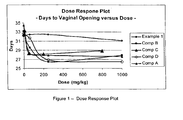
- Figure 1 is a dose response plot to assess pubertal development in juvenile female rats.
- the data in Figure 1 demonstrate sensitivity of the assay to differentiate among the compounds tested in capability to disrupt endocrine function as measured by sexual maturation.
- the present invention is directed to an alkylated hydroxyaromatic compound having the following structure:
- the alkylated hydroxyaromatic compound is prepared by a process comprising reacting at least one hydroxyaromatic compound with a branched olefinic propylene oligomer having from 20 to 80 carbon atoms in the presence of an acid catalyst, to provide said alkylated hydroxyaromatic compound wherein R 2 is an alkyl group having 1 to 5 carbon atoms, R 1 is a branched alkyl group of at least 18 carbon atoms having an average of one branch every 2 carbon atoms wherein each branch contains 1 to 2 carbon atoms, and R 3 is either hydrogen or an alkyl group.
- the at least one hydroxyaromatic compound is phenol.
- the present invention is directed to a process for alkylating an hydroxyaromatic compound comprising reacting at least one hydroxyaromatic compound with a branched olefinic propylene oligomer having from 20 to 80 carbon atoms in the presence of a acid catalyst, wherein the resulting product comprises an alkylated hydroxyaromatic compound having the structure depicted above.
- the present invention is directed to a lubricating oil composition
- a lubricating oil composition comprising:
- Olefins refers to a class of unsaturated aliphatic hydrocarbons having one or more carbon-carbon double bonds, obtained by a number of processes. Those containing one double bond are called monoalkenes, and those with two double bonds are called dienes, alkyldienes, or diolefins. Alpha olefins are particularly reactive because the double bond is between the first and second carbons. Examples are 1-octene and 1-octadecene, which are used as the starting point for medium-biodegradable surfactants. Linear and branched olefins are also included in the definition of olefins.
- Partially branched linear olefins refers to a class of linear olefins comprising less than one alkyl branch per straight chain containing the double bond, wherein the alkyl branch may be a methyl group or higher. Partially branched linear olefins may also contain double-bond isomerized olefin.
- Branched Olefins refers to a class of olefins comprising one or more alkyl branches per linear straight chain containing the double bond, wherein the alkyl branch may be a methyl group or higher.
- Non-Hydroxyl Containing Aromatic Compounds The term “non-hydroxyl containing aromatic compounds” refers to aromatic compounds that do not have any hydroxyl groups either on the aromatic ring or on any substituent group(s).
- Unsubstituted Aromatic Compounds refers to aromatic compounds that do not have any substituents attached to the aromatic ring(s). These compounds may be monocyclic, bicyclic or polycyclic. Examples of such compounds include, but are not limited to, benzene, naphthalene and the like.
- Monosubstituted Aromatic Compounds - The term “monosubstituted compounds” refers to aromatic compounds that have one substituent attached to the aromatic ring. These compounds may be monocyclic, bicyclic or polycyclic. Examples of such compounds include, but are not limited to, aromatic compounds with one of the following substituents: -OR, -R, -X, -NH 2 , -NHR or -NR 2 and the like, wherein R is an alkyl group and X is a halide.
- Disubstituted Aromatic Compounds - The term "disubstituted compounds" refers to aromatic compounds that have two substituents attached to the aromatic ring(s).
- the aromatic compounds may be monocyclic, bicyclic or polycyclic. Examples of such compounds include, but are not limited to, aromatic compounds with two substituents selected from the following: -OR, - R, -X, -NH 2 , -NHR or -NR 2 and the like, wherein R is an alkyl group and X is a halide.
- the at least one hydroxyaromatic compound is phenol.
- the at least one hydroxyaromatic compound or a mixture of hydroxyaromatic compounds may be used for the alkylation reaction in the present invention.
- the hydroxyaromatic compounds that may be alkylated in accordance with the process of the present invention include mononuclear monohydroxy and polyhydroxy aromatic hydrocarbons having 1 to 4, and preferably 1 to 3, hydroxyl groups.
- Suitable hydroxyaromatic compounds include phenol, catechol, resorcinol, hydroquinone, pyrogallol, cresol, and the like.
- the at least one hydroxyaromatic compound or the mixture of hydroxyaromatic compounds employed in the present invention is prepared by methods that are well known in the art.
- the olefins employed in this invention are branched chain olefins derived from the polymerization of propylene.
- the olefin may be a mixture of branched olefins.
- the olefins may also be substituted with other functional groups, such as hydroxy groups, carboxylic acid groups, heteroatoms, and the like, provided that such groups do not react with the acidic ionic liquid catalyst.
- the mixture of olefins is selected from propylene oligomers with carbon numbers ranging from 20 carbon atoms to 80 carbon atoms.
- the mixture of olefins is selected from propylene oligomers with carbon numbers ranging from 20 to 60 carbon atoms, more preferred from 20 to 40 carbon atoms.
- the branched olefin is attached to the hydroxyaromatic compound such that the benzylic carbon atom attached to the hydroxaromatic ring is substituted with one alkyl group having 1 to 5 carbon atoms and a second alkyl group of at least 18 carbon atoms having an average of one branch every 2 carbon atoms wherein each branch contains 1 to 2 carbon atoms.
- the alkylated aromatic compound may be prepared using acid catalysts (Bronsted or Lewis acids).
- the acid catalyst comprises hydrochloric acid, hydrofluoric acid, hydrobromic acid, sulfuric acid, perchloric acid, trifluoromethane sulfonic acid, fluorosulfonic acid, Amberlyst® 36 sulfonic acid, which may be purchased from Rohm and Haas, nitric acid or the like.
- the alkylation process may be carried out in a batch or continuous process.
- the acid catalyst may be recycled or regenerated when used in a batch process or a continuous process.
- the acid catalyst may be regenerated after it becomes deactivated (i.e., the catalyst has lost all or some portion of its catalytic activity). Methods that are well known in the art may be used to regenerate the deactivated hydrofluoric acid catalyst.
- the olefinic oligomers employed in the present invention are synthesized by oligomerizing propylene in the presence of an acid catalyst.
- the olefinic oligomer has a carbon range of from about 20 to about 80.
- the olefin oligomer may be prepared by reacting the propylene monomer with the acidic ionic liquid catalyst, as described herein, in a continuous, batch or semi-batch reaction process at from about -20°C to about 100°C and a pressure of atmospheric pressure to about 1000 psig (7 MPa). These process conditions are not limiting. Optimization of process conditions in the oligomerization of the olefin is within the scope of this invention.
- the alkylation process is carried out by charging a hydrocarbon feed comprising the at least one hydroxyaromatic compound or a mixture of hydroxyaromatic compounds, a mixture of olefin compounds (i.e., polypropylene oligomers) and an acid catalyst to a reaction zone in which agitation is maintained.
- the resulting mixture is held in the alkylation zone under alkylation conditions for a time sufficient to allow substantial conversion (i.e., at least 70 mole% of the olefin has reacted) of the olefin to hydroxyaromatic alkylate.
- reaction mixture is removed from the alkylation zone and fed to a liquid-liquid separator to allow hydrocarbon products to separate from the acid catalyst which may be recycled to the reactor in a closed loop cycle.
- hydrocarbon product is further treated to remove excess un-reacted hydroxyaromatic compounds and optionally olefinic compounds from the desired alkylate product.
- the excess hydroxyaromatic compounds can also be recycled to the reactor.
- reactor configurations may be used for the reactor zone. These include, but are not limited to, batch and continuous stirred tank reactors, reactor riser configurations, ebulating or fixed bed reactors, and other reactor configurations that are well known in the art. Many such reactors are known to those skilled in the art and are suitable for the alkylation reaction. In batch or semi-batch reactors, agitation is critical for the alkylation reaction and can be provided by rotating impellers, with or without baffles, static mixers, kinetic mixing in risers, or any other agitation devices that are well known in the art.
- the alkylation process may be carried out at temperatures from about 0°C to about 200°C.
- the process is carried out under sufficient pressure that a substantial portion of the feed components remain in the liquid phase.
- a pressure of 0 to 150 psig (1 ⁇ 1 MPa) is satisfactory to maintain feed and products in the liquid phase.
- the residence time in the reactor is a time that is sufficient to convert a substantial portion of the olefin to alkylate product.
- the time required is from about 30 seconds to about 300 minutes.
- a more precise residence time may be determined by those skilled in the art using batch stirred tank reactors to measure the kinetics of the alkylation process.
- the at least one hydroxyaromatic compound or mixture of hydroxyaromatic compounds and the mixture of olefins may be injected separately into the reaction zone or may be mixed prior to injection. Both single and multiple reaction zones may be used with the injection of the hydroxyaromatic compounds and the mixture of olefins into one, several, or all reaction zones. The reaction zones need not be maintained at the same process conditions.
- the hydrocarbon feed for the alkylation process may comprise a mixture of hydroxyaromatic compounds and a mixture olefins in which the molar ratio of hydroxyaromatic compounds to olefins is from about 0.5:1 to about 50:1 or more.
- the molar ratio of hydroxyaromatic compounds to olefin is > 1.0
- an excess of hydroxyaromatic compounds is used to increase reaction rate and improve product selectivity.
- the excess un-reacted hydroxyaromatic in the reactor effluent can be separated, e.g. by distillation, and recycled to the reactor.
- One embodiment of the alkylation process is a continuous process with closed loop catalyst recycle.
- a hydrocarbon feed comprising hydroxyaromatic compound(s) or a mixture of hydroxyaromatic compounds and a mixture of olefin(s) is charged continuously to a reactor.
- the hydroxyaromatic compound(s) and mixture of olefin(s) may be charged by separately.
- an amount of fresh acid catalyst is charged through to the reactor.
- the hydrocarbon feed and acidic ionic liquid catalyst are maintained in the reactor with agitation under alkylation process conditions for a sufficient time in order for a substantial amount of the mixture of olefins in the feed charge to react and form an hydroxyaromatic alkylate compound.
- the hydrocarbon product stream containing the hydroxyaromatic alkylate compound and excess un-reacted hydroxyaromatic is charged to a product separation section.
- product separation excess hydroxyaromatic compounds are distilled off and returned to the reactor, leaving an alkylated hydroxyaromatic compound.
- the resulting product is an alkylated hydroxyaromatic compound having the following structure: wherein R 1 is a branched alkyl group of at least 18 carbon atoms having an average of at least one branch every 2 carbon atoms wherein each branch contains 1 to 2 carbon atoms, R 2 is an alkyl group having 1 to 5 carbon atoms, and R 3 is either hydrogen or an alkyl group.
- the resulting product will be a mixture of ortho and para isomers.
- the product will contain 1 to 99% ortho isomer and 99 to 1% para isomer, and preferably, 5 to 70% ortho and 95 to 30% para isomer.
- reaction mixture was held at 130°C for 2 hours and then cooled to room temperature, diluted with 1 liter of hexane and washed with aqueous saturated sodium bicarbonate solution.
- the organic layer was dried over anhydrous magnesium sulfate, gravity filtered and the solvent removed under vacuum with to afford 806 gm of a brown oil.
- a portion (775 gm) of this brown oil was fractionally vacuum distilled (10"x2" unpacked Vigreux column at 1.0 Torr and temperature programmed from 151 to 204 °C) to remove any remaining unreacted phenol and yielded 725 gm of a second brown oil.
- Branched dodecyl phenol calcium salt was prepared from the alkylation of phenol with a mixture of branched chain C 10 -C 15 olefin derived primarily from propylene tetramer and the resulting alkylphenol had the following carbon distribution: Carbon Number Wt% ⁇ C 9 0 C 10,11 6.6 C 12 82.7 C 13+ 10.7
- the mixture was then heated to approximately 270°C in approximately 1 hour and held at this temperature with stirring for 8 hours.
- the mixture was then cooled to 200°C overnight and then raised the temperature to 280°C and held there for 4 hours.
- the mixture was then cooled to 230°C and maintained at this temperature overnight.
- the mixture was then cooled to approximately 150°C and filtered through a sintered glass Buchner funnel containing Celite® filter aid (dried overnight at 120°C) into a dry filter flask with the aid of vacuum over approximately 3.5 hours.
- the resulting light honey colored liquid contained 3.82 % calcium. This reaction was repeated and the combined products were a honey colored liquid containing 3.82 % calcium.
- Branched pentadecylphenol calcium salt was prepared from the alkylation of phenol with a branched chain C 14 -C 18 olefin derived primarily from propylene pentamer.
- a 2-liter round bottom flask equipped with a mechanical stirred, Dean Stark trap fitted with a condenser under an atmosphere of dry nitrogen was charged with 705 gm (2.32 moles) of a C 15 branched alkylphenol followed by 500 gm of Chevron RLOP 100N oil. This mixture was cooled to approximately 13°C using an ice bath and then 48.8 gm (1.16 moles) of calcium hydride (98% obtained from Aldrich Chemical Company) was added in approximately 10 gram portions with stirring.
- the reaction was then heated to 100°C over 50 minutes and then heated to 200°C for over 140 minutes and held at 200°C for approximately 18 hours and then heated to 280°C over 1 hour and held at 280°C for 8.5 hours and then cooled to 230°C and held at 230°C for approximately 14 hours.
- the reaction was then cooled to 150°C and filtered through a dry, hot (150°C) 600 mL Buchner funnel containing a filter bed of Celite and maintained between 110°C and 120°C with the aid of a vacuum to afford a product containing 3.51 wt% calcium.
- Branched, principally, C 12 or branched dodecyl phenol was prepared from the alkylation of phenol with a branched chain C 10 -C 15 olefin derived from propylene tetramer and the resulting alkylphenol had the following carbon distribution: Carbon Number Wt% ⁇ C 10 1 C 11 18 C 12 59 C 13 17 C 14 4 ⁇ C 15 1
- a glass, three-neck, round bottom flask fitted with a mechanical stirrer, water condenser and thermometer was charged with 896 gm ( ⁇ 2.7 moles) of propylene tetramer dimer and 82.4 gm of Amberlyst® 36 sulfonic acid ion exchange resin. This mixture was heated to 90 °C with stirring and then 753 gm (8.0 moles) of phenol was charged to the reactor. The temperature of the reaction was increased to 120°C and held for 24 hours. The temperature of the reaction was then increased to 130 °C for 1.5 hours and then allowed to cool to room temperature. The reaction mixture was then filtered with the aid of vacuum through a glass fritted Buchner funnel.
- the resulting filtrate (1721 gm) was fractionally vacuum distilled (10" x 2" Vigreux column, 10-50 Torr, temperature programmed from 111 to 180°C) to remove unreacted phenol and afforded 1079 gm a bottoms product.
- the female pubertal assay is an apical assay that may detect chemicals with biological activity upon the hypothalamic-pituitary-gonadal/thyroidal axes. Chemicals what act directly upon the female gonads, such as those described as estrogen mimics, would also be detected in a simpler assay known as the uterotrophic assay. The uterotrophic assay is specific for estrogenicity. However, the female pubertal assay should detect both chemicals that act directly upon the female gonads as well as chemicals that act upon other components in these endocrine axes.
- the assay is conducted as follows. Suitable female rats, 21 days of age, within the weight range were weaned and randomized into four treatment groups. Each treatment group consisted of fifteen females. Dosage levels were determined and dose volumes were based on daily body weight. Animals were orally dosed with a test compound or the vehicle (Mazola® corn oil) beginning on day 22 and continuing through 41 days of age. A separate vehicle control group dosed with corn oil was run concurrently with each component. Clinical signs were observed twice daily during the experimental period with body weights recorded daily. Beginning with postnatal day "PND" PND 25, animals were examined for vaginal perforation. The day of complete vaginal perforation was identified as the age of vaginal opening, and body weight was recorded on that day.
- Thyroid Stimulating Hormone Thyroid Stimulating Hormone
- Thyrroxine T 4
- Uterine, ovary, liver, pituitary, kidney, thyroid and adrenal weights were collected.
- Body weights, body weight gains, organ weights (wet and blotted) luminal fluid weights, mean day of acquisition of vaginal perforation, mean age of first estrous and estrous cycle length was analyzed using statistical methods, such as by a parametric one-way analysis of variance, (ANOVA) to determine intergroup differences.
- ANOVA parametric one-way analysis of variance
- Example 1 even at very high dosages, showed no evidence of endocrine disruption as measured by a decrease in days to vaginal opening (See Table 1 and Figure 1 ) or decrease in body weight at sexual maturation. (See Table 1).
- Comparative Examples A, B, C and D showed evidence of endocrine disruption.
- the Comparative Examples A, B, C and D exhibited a decreasing trend in body weight, with a significant effect at high dose rates, similar decreasing trends were also noted for regarding the average postnatal day of vaginal opening. It should also be noted that potency does not vary greatly between the free alkylphenol and the calcium salt (See Comparative Examples A and C).
Landscapes
- Chemical & Material Sciences (AREA)
- Organic Chemistry (AREA)
- Chemical Kinetics & Catalysis (AREA)
- General Chemical & Material Sciences (AREA)
- Health & Medical Sciences (AREA)
- Oil, Petroleum & Natural Gas (AREA)
- Pharmacology & Pharmacy (AREA)
- General Health & Medical Sciences (AREA)
- Medicinal Chemistry (AREA)
- Nuclear Medicine, Radiotherapy & Molecular Imaging (AREA)
- Engineering & Computer Science (AREA)
- Life Sciences & Earth Sciences (AREA)
- Animal Behavior & Ethology (AREA)
- Bioinformatics & Cheminformatics (AREA)
- Public Health (AREA)
- Veterinary Medicine (AREA)
- Organic Low-Molecular-Weight Compounds And Preparation Thereof (AREA)
- Low-Molecular Organic Synthesis Reactions Using Catalysts (AREA)
- Lubricants (AREA)
- Catalysts (AREA)
Applications Claiming Priority (1)
| Application Number | Priority Date | Filing Date | Title |
|---|---|---|---|
| US11/741,687 US8207380B2 (en) | 2007-04-27 | 2007-04-27 | Alkylated hydroxyaromatic compound substantially free of endocrine disruptive chemicals and method of making the same |
Publications (3)
| Publication Number | Publication Date |
|---|---|
| EP1995229A2 EP1995229A2 (en) | 2008-11-26 |
| EP1995229A3 EP1995229A3 (en) | 2009-04-22 |
| EP1995229B1 true EP1995229B1 (en) | 2012-08-29 |
Family
ID=39816934
Family Applications (1)
| Application Number | Title | Priority Date | Filing Date |
|---|---|---|---|
| EP08251077A Active EP1995229B1 (en) | 2007-04-27 | 2008-03-26 | An alkylated hydroxyaromatic compound substantially free of endocrine disruptive chemicals and method of making the same |
Country Status (6)
| Country | Link |
|---|---|
| US (1) | US8207380B2 (enExample) |
| EP (1) | EP1995229B1 (enExample) |
| JP (2) | JP5710857B2 (enExample) |
| CN (1) | CN101306985B (enExample) |
| CA (1) | CA2629557C (enExample) |
| SG (1) | SG147396A1 (enExample) |
Families Citing this family (26)
| Publication number | Priority date | Publication date | Assignee | Title |
|---|---|---|---|---|
| US7943796B2 (en) * | 2008-07-31 | 2011-05-17 | Chevron Oronise Company LLC | Lubricating oil additive and lubricating oil composition containing same |
| US8486877B2 (en) * | 2009-11-18 | 2013-07-16 | Chevron Oronite Company Llc | Alkylated hydroxyaromatic compound substantially free of endocrine disruptive chemicals |
| US8580717B2 (en) * | 2009-11-24 | 2013-11-12 | Chevron Oronite Company Llc | Process for making an overbased, sulfurized salt of an alkylated hydroxyaromatic compound |
| JP2013518970A (ja) * | 2010-02-03 | 2013-05-23 | シェブロン・オロナイト・カンパニー・エルエルシー | 潤滑油添加剤およびそれを含む潤滑油組成物 |
| US8704006B2 (en) * | 2010-12-10 | 2014-04-22 | Chevron Oronite Company Llc | Skewed and middle attached linear chain alkylphenol and method of making the same |
| US20140228265A1 (en) | 2011-10-20 | 2014-08-14 | The Lubrizol Corporation | Bridged Alkylphenol Compounds |
| SG11201404656RA (en) | 2012-02-08 | 2014-09-26 | Lubrizol Corp | Method of preparing a sulfurized alkaline earth metal dodecylphenate |
| EP2682451B1 (en) | 2012-07-06 | 2015-11-18 | Infineum International Limited | Detergent modification |
| CN111825818B (zh) | 2013-10-17 | 2023-11-21 | Si集团有限公司 | 原位烷基苯酚-醛树脂 |
| HK1222190A1 (zh) | 2013-10-17 | 2017-06-23 | Si Group, Inc. | 通過水楊酸穩定的改性烷基苯酚-醛樹脂 |
| CN106103673A (zh) | 2014-01-10 | 2016-11-09 | 路博润公司 | 润滑内燃机的方法 |
| US20160326452A1 (en) | 2014-01-10 | 2016-11-10 | The Lubrizol Corporation | Method of lubricating an internal combustion engine |
| WO2015183685A1 (en) | 2014-05-28 | 2015-12-03 | The Lubrizol Corporation | Alkylphenol detergents |
| KR102608828B1 (ko) | 2015-02-26 | 2023-11-30 | 더루브리졸코오퍼레이션 | 방향족 세제 및 이의 윤활 조성물 |
| JP5960311B2 (ja) * | 2015-03-06 | 2016-08-02 | シェブロン・オロナイト・カンパニー・エルエルシー | 潤滑油添加剤およびそれを含む潤滑油組成物 |
| BR112017019385A2 (pt) | 2015-03-09 | 2018-04-24 | Lubrizol Corp | método de lubrificação de um motor de combustão interna |
| WO2017087384A1 (en) | 2015-11-17 | 2017-05-26 | The Lubrizol Corporation | Toxicologically acceptable alkylphenol detergents as friction modifiers in automotive lubricating oils |
| CA3007127A1 (en) | 2015-12-15 | 2017-06-22 | The Lubrizol Corporation | Sulfurized catecholate detergents for lubricating compositions |
| EP3472278A1 (en) | 2016-06-17 | 2019-04-24 | The Lubrizol Corporation | Lubricating compositions |
| SG11201810337PA (en) | 2016-06-17 | 2018-12-28 | Lubrizol Corp | Lubricating compositions |
| SG11201810335VA (en) | 2016-06-17 | 2018-12-28 | Lubrizol Corp | Polyisobutylene-substituted phenol, derivatives thereof, and lubricating compositions containing the polyisobutylene-substituted phenol and its derivatives |
| EP3472277A1 (en) | 2016-06-17 | 2019-04-24 | The Lubrizol Corporation | Lubricating compositions |
| US10260019B2 (en) | 2016-06-30 | 2019-04-16 | The Lubrizol Corporation | Hydroxyaromatic succinimide detergents for lubricating compositions |
| CN111433331A (zh) * | 2017-12-04 | 2020-07-17 | 路博润公司 | 烷基酚清洁剂 |
| CN111479908A (zh) | 2017-12-15 | 2020-07-31 | 路博润公司 | 烷基酚清洁剂 |
| WO2021161199A1 (en) * | 2020-02-14 | 2021-08-19 | Chevron Oronite Company Llc | Alkyl-substituted hydroxyaromatic compounds with highly- structured alkyl branches |
Family Cites Families (21)
| Publication number | Priority date | Publication date | Assignee | Title |
|---|---|---|---|---|
| JPS509779B1 (enExample) * | 1966-08-25 | 1975-04-16 | ||
| CS226912B1 (cs) | 1981-11-02 | 1984-04-16 | Pac Jiri | Substituované fenoly |
| US4708809A (en) * | 1982-06-07 | 1987-11-24 | The Lubrizol Corporation | Two-cycle engine oils containing alkyl phenols |
| DE3368606D1 (en) * | 1982-12-13 | 1987-02-05 | Shell Int Research | Alkylxylene sulphonate compounds, their preparation and use |
| US4475001A (en) * | 1983-03-17 | 1984-10-02 | Koppers Company, Inc. | Process for alkylating phenolic compounds to produce ortho- or para-monoalkylated phenols or 2,4- or 2,6-dialkylated phenols |
| JPS60228438A (ja) * | 1984-04-27 | 1985-11-13 | Osuka Kagaku Kk | モノアルキルフェノールの製造方法 |
| US4643838A (en) * | 1985-09-18 | 1987-02-17 | Chevron Research Company | Normally liquid C18 to C24 monoalkyl catechols |
| JP2548934B2 (ja) * | 1986-06-10 | 1996-10-30 | 住友化学工業株式会社 | ヒドロキシ含有アルキル芳香族化合物の製造法 |
| JPH02500978A (ja) * | 1986-10-24 | 1990-04-05 | エクソン リサーチ アンド エンヂニアリング コムパニー | 分解石油留出物によるフェノールアルキル化経由アルキルフェノールおよびそれらの誘導体 |
| US4973764A (en) * | 1986-10-24 | 1990-11-27 | Exxon Research And Engineering Company | Alkylphenols and derivatives thereof via phenol alkylation by cracked petroleum distillates |
| US5663457A (en) * | 1996-02-16 | 1997-09-02 | The Lubrizol Corporation | Methods for preparing alkylated hydroxyaromatics |
| CA2204461C (en) * | 1996-05-14 | 2006-07-04 | Thomas V. Harris | Process for producing an alkylated, non-oxygen-containing aromatic hydrocarbon |
| US6191317B1 (en) * | 1999-08-31 | 2001-02-20 | Huntsman Petrochemical Corporation | Process for preparation of polyalkyl hydroxyaromatics |
| US6670513B1 (en) * | 1999-12-03 | 2003-12-30 | Chevron Oronite Company, Llc | Process for producing alkylated hydroxyl-containing aromatic compounds |
| US6765106B2 (en) * | 2001-02-15 | 2004-07-20 | Shell Oil Company | Process for preparing a branched olefin, a method of using the branched olefin for making a surfactant, and a surfactant |
| MXPA04001319A (es) * | 2001-08-17 | 2004-05-20 | Shell Int Research | Proceso de produccion de olefinas ramificadas a partir de una fuente de olefinas/parafinas lineales. |
| JP4208543B2 (ja) * | 2002-10-11 | 2009-01-14 | 三井化学株式会社 | 分岐型極性基含有オレフィン共重合体 |
| US7041864B2 (en) | 2002-12-11 | 2006-05-09 | Shell Oil Company | Linear and branched olefin production from cyclic olefin feedstocks |
| US7041884B2 (en) * | 2003-01-09 | 2006-05-09 | Syngenta Participations Ag | Inbred maize line 291B |
| US8188020B2 (en) | 2003-12-22 | 2012-05-29 | Chevron Oronite S.A. | Lubricating oil composition containing an alkali metal detergent |
| US7435709B2 (en) | 2005-09-01 | 2008-10-14 | Chevron Oronite Company Llc | Linear alkylphenol derived detergent substantially free of endocrine disruptive chemicals |
-
2007
- 2007-04-27 US US11/741,687 patent/US8207380B2/en active Active
-
2008
- 2008-03-26 EP EP08251077A patent/EP1995229B1/en active Active
- 2008-04-21 CA CA2629557A patent/CA2629557C/en not_active Expired - Fee Related
- 2008-04-22 SG SG200803075-1A patent/SG147396A1/en unknown
- 2008-04-24 JP JP2008114308A patent/JP5710857B2/ja active Active
- 2008-04-25 CN CN200810142815.8A patent/CN101306985B/zh active Active
-
2014
- 2014-11-14 JP JP2014231949A patent/JP2015052008A/ja not_active Abandoned
Also Published As
| Publication number | Publication date |
|---|---|
| JP2015052008A (ja) | 2015-03-19 |
| CA2629557C (en) | 2016-06-21 |
| US8207380B2 (en) | 2012-06-26 |
| JP2008273967A (ja) | 2008-11-13 |
| JP5710857B2 (ja) | 2015-04-30 |
| SG147396A1 (en) | 2008-11-28 |
| CN101306985A (zh) | 2008-11-19 |
| EP1995229A2 (en) | 2008-11-26 |
| CA2629557A1 (en) | 2008-10-27 |
| EP1995229A3 (en) | 2009-04-22 |
| CN101306985B (zh) | 2014-06-25 |
| US20080269351A1 (en) | 2008-10-30 |
Similar Documents
| Publication | Publication Date | Title |
|---|---|---|
| EP1995229B1 (en) | An alkylated hydroxyaromatic compound substantially free of endocrine disruptive chemicals and method of making the same | |
| EP2501668B1 (en) | Alkylated hydroxyaromatic compound substantially free of endocrine disruptive chemicals | |
| EP2319903B1 (en) | Linear alkyphenol derived detergent substantially free of endocrine disruptive chemicals | |
| EP2649031B1 (en) | Skewed and middle attached linear chain alkylphenol and method of making the same | |
| US5208390A (en) | Process for alkylating aromatic polyols with higher carbon number alpha olefin oligomers | |
| JP3537483B2 (ja) | 芳香族化合物のアルキル化方法 | |
| EP3063128B1 (en) | Process for preparing a para-linear alkyl-substituted hydroxyaromatic compound | |
| US20020198420A1 (en) | Mono-alkylation process for the preparation of anionic surfactants | |
| US3267152A (en) | Mixed salts of titanium as ortho-alkylation catalysts |
Legal Events
| Date | Code | Title | Description |
|---|---|---|---|
| PUAI | Public reference made under article 153(3) epc to a published international application that has entered the european phase |
Free format text: ORIGINAL CODE: 0009012 |
|
| AK | Designated contracting states |
Kind code of ref document: A2 Designated state(s): AT BE BG CH CY CZ DE DK EE ES FI FR GB GR HR HU IE IS IT LI LT LU LV MC MT NL NO PL PT RO SE SI SK TR |
|
| AX | Request for extension of the european patent |
Extension state: AL BA MK RS |
|
| PUAL | Search report despatched |
Free format text: ORIGINAL CODE: 0009013 |
|
| AK | Designated contracting states |
Kind code of ref document: A3 Designated state(s): AT BE BG CH CY CZ DE DK EE ES FI FR GB GR HR HU IE IS IT LI LT LU LV MC MT NL NO PL PT RO SE SI SK TR |
|
| AX | Request for extension of the european patent |
Extension state: AL BA MK RS |
|
| 17P | Request for examination filed |
Effective date: 20091019 |
|
| 17Q | First examination report despatched |
Effective date: 20091113 |
|
| AKX | Designation fees paid |
Designated state(s): DE FR GB NL |
|
| REG | Reference to a national code |
Ref country code: DE Ref legal event code: R079 Ref document number: 602008018341 Country of ref document: DE Free format text: PREVIOUS MAIN CLASS: C07C0037140000 Ipc: C07C0039080000 |
|
| GRAJ | Information related to disapproval of communication of intention to grant by the applicant or resumption of examination proceedings by the epo deleted |
Free format text: ORIGINAL CODE: EPIDOSDIGR1 |
|
| GRAP | Despatch of communication of intention to grant a patent |
Free format text: ORIGINAL CODE: EPIDOSNIGR1 |
|
| GRAP | Despatch of communication of intention to grant a patent |
Free format text: ORIGINAL CODE: EPIDOSNIGR1 |
|
| RIC1 | Information provided on ipc code assigned before grant |
Ipc: C07C 39/02 20060101ALI20120217BHEP Ipc: C07C 39/06 20060101ALI20120217BHEP Ipc: C07C 37/14 20060101ALI20120217BHEP Ipc: C07C 39/10 20060101ALI20120217BHEP Ipc: C07C 39/08 20060101AFI20120217BHEP |
|
| GRAS | Grant fee paid |
Free format text: ORIGINAL CODE: EPIDOSNIGR3 |
|
| GRAA | (expected) grant |
Free format text: ORIGINAL CODE: 0009210 |
|
| AK | Designated contracting states |
Kind code of ref document: B1 Designated state(s): DE FR GB NL |
|
| REG | Reference to a national code |
Ref country code: GB Ref legal event code: FG4D |
|
| REG | Reference to a national code |
Ref country code: DE Ref legal event code: R096 Ref document number: 602008018341 Country of ref document: DE Effective date: 20121025 |
|
| REG | Reference to a national code |
Ref country code: NL Ref legal event code: T3 |
|
| PLBE | No opposition filed within time limit |
Free format text: ORIGINAL CODE: 0009261 |
|
| STAA | Information on the status of an ep patent application or granted ep patent |
Free format text: STATUS: NO OPPOSITION FILED WITHIN TIME LIMIT |
|
| 26N | No opposition filed |
Effective date: 20130530 |
|
| REG | Reference to a national code |
Ref country code: DE Ref legal event code: R097 Ref document number: 602008018341 Country of ref document: DE Effective date: 20130530 |
|
| REG | Reference to a national code |
Ref country code: FR Ref legal event code: PLFP Year of fee payment: 9 |
|
| PGFP | Annual fee paid to national office [announced via postgrant information from national office to epo] |
Ref country code: NL Payment date: 20160310 Year of fee payment: 9 |
|
| REG | Reference to a national code |
Ref country code: FR Ref legal event code: PLFP Year of fee payment: 10 |
|
| REG | Reference to a national code |
Ref country code: NL Ref legal event code: MM Effective date: 20170401 |
|
| PG25 | Lapsed in a contracting state [announced via postgrant information from national office to epo] |
Ref country code: NL Free format text: LAPSE BECAUSE OF NON-PAYMENT OF DUE FEES Effective date: 20170401 |
|
| REG | Reference to a national code |
Ref country code: FR Ref legal event code: PLFP Year of fee payment: 11 |
|
| REG | Reference to a national code |
Ref country code: DE Ref legal event code: R082 Ref document number: 602008018341 Country of ref document: DE Representative=s name: HL KEMPNER PATENTANWAELTE, SOLICITORS (ENGLAND, DE Ref country code: DE Ref legal event code: R082 Ref document number: 602008018341 Country of ref document: DE Representative=s name: HL KEMPNER PATENTANWALT, RECHTSANWALT, SOLICIT, DE Ref country code: DE Ref legal event code: R082 Ref document number: 602008018341 Country of ref document: DE Representative=s name: HL KEMPNER PARTG MBB, DE |
|
| P01 | Opt-out of the competence of the unified patent court (upc) registered |
Effective date: 20230522 |
|
| PGFP | Annual fee paid to national office [announced via postgrant information from national office to epo] |
Ref country code: DE Payment date: 20250204 Year of fee payment: 18 |
|
| PGFP | Annual fee paid to national office [announced via postgrant information from national office to epo] |
Ref country code: FR Payment date: 20250210 Year of fee payment: 18 |
|
| PGFP | Annual fee paid to national office [announced via postgrant information from national office to epo] |
Ref country code: GB Payment date: 20250130 Year of fee payment: 18 |