EP1985691B1 - Wärmeableitende Silikonfettzusammensetzung - Google Patents
Wärmeableitende Silikonfettzusammensetzung Download PDFInfo
- Publication number
- EP1985691B1 EP1985691B1 EP08251309A EP08251309A EP1985691B1 EP 1985691 B1 EP1985691 B1 EP 1985691B1 EP 08251309 A EP08251309 A EP 08251309A EP 08251309 A EP08251309 A EP 08251309A EP 1985691 B1 EP1985691 B1 EP 1985691B1
- Authority
- EP
- European Patent Office
- Prior art keywords
- powder
- composition
- heat
- isoparaffin
- silicone grease
- Prior art date
- Legal status (The legal status is an assumption and is not a legal conclusion. Google has not performed a legal analysis and makes no representation as to the accuracy of the status listed.)
- Not-in-force
Links
Images
Classifications
-
- H—ELECTRICITY
- H10—SEMICONDUCTOR DEVICES; ELECTRIC SOLID-STATE DEVICES NOT OTHERWISE PROVIDED FOR
- H10W—GENERIC PACKAGES, INTERCONNECTIONS, CONNECTORS OR OTHER CONSTRUCTIONAL DETAILS OF DEVICES COVERED BY CLASS H10
- H10W40/00—Arrangements for thermal protection or thermal control
- H10W40/20—Arrangements for cooling
- H10W40/25—Arrangements for cooling characterised by their materials
- H10W40/251—Organics
-
- C—CHEMISTRY; METALLURGY
- C10—PETROLEUM, GAS OR COKE INDUSTRIES; TECHNICAL GASES CONTAINING CARBON MONOXIDE; FUELS; LUBRICANTS; PEAT
- C10M—LUBRICATING COMPOSITIONS; USE OF CHEMICAL SUBSTANCES EITHER ALONE OR AS LUBRICATING INGREDIENTS IN A LUBRICATING COMPOSITION
- C10M107/00—Lubricating compositions characterised by the base-material being a macromolecular compound
- C10M107/20—Lubricating compositions characterised by the base-material being a macromolecular compound containing oxygen
-
- C—CHEMISTRY; METALLURGY
- C10—PETROLEUM, GAS OR COKE INDUSTRIES; TECHNICAL GASES CONTAINING CARBON MONOXIDE; FUELS; LUBRICANTS; PEAT
- C10M—LUBRICATING COMPOSITIONS; USE OF CHEMICAL SUBSTANCES EITHER ALONE OR AS LUBRICATING INGREDIENTS IN A LUBRICATING COMPOSITION
- C10M107/00—Lubricating compositions characterised by the base-material being a macromolecular compound
- C10M107/50—Lubricating compositions characterised by the base-material being a macromolecular compound containing silicon
-
- C—CHEMISTRY; METALLURGY
- C10—PETROLEUM, GAS OR COKE INDUSTRIES; TECHNICAL GASES CONTAINING CARBON MONOXIDE; FUELS; LUBRICANTS; PEAT
- C10M—LUBRICATING COMPOSITIONS; USE OF CHEMICAL SUBSTANCES EITHER ALONE OR AS LUBRICATING INGREDIENTS IN A LUBRICATING COMPOSITION
- C10M111/00—Lubrication compositions characterised by the base-material being a mixture of two or more compounds covered by more than one of the main groups C10M101/00 - C10M109/00, each of these compounds being essential
- C10M111/04—Lubrication compositions characterised by the base-material being a mixture of two or more compounds covered by more than one of the main groups C10M101/00 - C10M109/00, each of these compounds being essential at least one of them being a macromolecular organic compound
-
- C—CHEMISTRY; METALLURGY
- C10—PETROLEUM, GAS OR COKE INDUSTRIES; TECHNICAL GASES CONTAINING CARBON MONOXIDE; FUELS; LUBRICANTS; PEAT
- C10M—LUBRICATING COMPOSITIONS; USE OF CHEMICAL SUBSTANCES EITHER ALONE OR AS LUBRICATING INGREDIENTS IN A LUBRICATING COMPOSITION
- C10M169/00—Lubricating compositions characterised by containing as components a mixture of at least two types of ingredient selected from base-materials, thickeners or additives, covered by the preceding groups, each of these compounds being essential
- C10M169/02—Mixtures of base-materials and thickeners
-
- C—CHEMISTRY; METALLURGY
- C10—PETROLEUM, GAS OR COKE INDUSTRIES; TECHNICAL GASES CONTAINING CARBON MONOXIDE; FUELS; LUBRICANTS; PEAT
- C10M—LUBRICATING COMPOSITIONS; USE OF CHEMICAL SUBSTANCES EITHER ALONE OR AS LUBRICATING INGREDIENTS IN A LUBRICATING COMPOSITION
- C10M2201/00—Inorganic compounds or elements as ingredients in lubricant compositions
- C10M2201/04—Elements
- C10M2201/041—Carbon; Graphite; Carbon black
- C10M2201/0416—Carbon; Graphite; Carbon black used as thickening agents
-
- C—CHEMISTRY; METALLURGY
- C10—PETROLEUM, GAS OR COKE INDUSTRIES; TECHNICAL GASES CONTAINING CARBON MONOXIDE; FUELS; LUBRICANTS; PEAT
- C10M—LUBRICATING COMPOSITIONS; USE OF CHEMICAL SUBSTANCES EITHER ALONE OR AS LUBRICATING INGREDIENTS IN A LUBRICATING COMPOSITION
- C10M2201/00—Inorganic compounds or elements as ingredients in lubricant compositions
- C10M2201/06—Metal compounds
- C10M2201/0606—Metal compounds used as thickening agents
-
- C—CHEMISTRY; METALLURGY
- C10—PETROLEUM, GAS OR COKE INDUSTRIES; TECHNICAL GASES CONTAINING CARBON MONOXIDE; FUELS; LUBRICANTS; PEAT
- C10M—LUBRICATING COMPOSITIONS; USE OF CHEMICAL SUBSTANCES EITHER ALONE OR AS LUBRICATING INGREDIENTS IN A LUBRICATING COMPOSITION
- C10M2201/00—Inorganic compounds or elements as ingredients in lubricant compositions
- C10M2201/06—Metal compounds
- C10M2201/061—Carbides; Hydrides; Nitrides
- C10M2201/0616—Carbides; Hydrides; Nitrides used as thickening agents
-
- C—CHEMISTRY; METALLURGY
- C10—PETROLEUM, GAS OR COKE INDUSTRIES; TECHNICAL GASES CONTAINING CARBON MONOXIDE; FUELS; LUBRICANTS; PEAT
- C10M—LUBRICATING COMPOSITIONS; USE OF CHEMICAL SUBSTANCES EITHER ALONE OR AS LUBRICATING INGREDIENTS IN A LUBRICATING COMPOSITION
- C10M2201/00—Inorganic compounds or elements as ingredients in lubricant compositions
- C10M2201/06—Metal compounds
- C10M2201/062—Oxides; Hydroxides; Carbonates or bicarbonates
- C10M2201/0626—Oxides; Hydroxides; Carbonates or bicarbonates used as thickening agents
-
- C—CHEMISTRY; METALLURGY
- C10—PETROLEUM, GAS OR COKE INDUSTRIES; TECHNICAL GASES CONTAINING CARBON MONOXIDE; FUELS; LUBRICANTS; PEAT
- C10M—LUBRICATING COMPOSITIONS; USE OF CHEMICAL SUBSTANCES EITHER ALONE OR AS LUBRICATING INGREDIENTS IN A LUBRICATING COMPOSITION
- C10M2201/00—Inorganic compounds or elements as ingredients in lubricant compositions
- C10M2201/10—Compounds containing silicon
- C10M2201/1013—Compounds containing silicon used as thickening agents
-
- C—CHEMISTRY; METALLURGY
- C10—PETROLEUM, GAS OR COKE INDUSTRIES; TECHNICAL GASES CONTAINING CARBON MONOXIDE; FUELS; LUBRICANTS; PEAT
- C10M—LUBRICATING COMPOSITIONS; USE OF CHEMICAL SUBSTANCES EITHER ALONE OR AS LUBRICATING INGREDIENTS IN A LUBRICATING COMPOSITION
- C10M2203/00—Organic non-macromolecular hydrocarbon compounds and hydrocarbon fractions as ingredients in lubricant compositions
- C10M2203/02—Well-defined aliphatic compounds
- C10M2203/0213—Well-defined aliphatic compounds used as thickening agents
-
- C—CHEMISTRY; METALLURGY
- C10—PETROLEUM, GAS OR COKE INDUSTRIES; TECHNICAL GASES CONTAINING CARBON MONOXIDE; FUELS; LUBRICANTS; PEAT
- C10M—LUBRICATING COMPOSITIONS; USE OF CHEMICAL SUBSTANCES EITHER ALONE OR AS LUBRICATING INGREDIENTS IN A LUBRICATING COMPOSITION
- C10M2203/00—Organic non-macromolecular hydrocarbon compounds and hydrocarbon fractions as ingredients in lubricant compositions
- C10M2203/02—Well-defined aliphatic compounds
- C10M2203/022—Well-defined aliphatic compounds saturated
-
- C—CHEMISTRY; METALLURGY
- C10—PETROLEUM, GAS OR COKE INDUSTRIES; TECHNICAL GASES CONTAINING CARBON MONOXIDE; FUELS; LUBRICANTS; PEAT
- C10M—LUBRICATING COMPOSITIONS; USE OF CHEMICAL SUBSTANCES EITHER ALONE OR AS LUBRICATING INGREDIENTS IN A LUBRICATING COMPOSITION
- C10M2227/00—Organic non-macromolecular compounds containing atoms of elements not provided for in groups C10M2203/00, C10M2207/00, C10M2211/00, C10M2215/00, C10M2219/00 or C10M2223/00 as ingredients in lubricant compositions
- C10M2227/04—Organic non-macromolecular compounds containing atoms of elements not provided for in groups C10M2203/00, C10M2207/00, C10M2211/00, C10M2215/00, C10M2219/00 or C10M2223/00 as ingredients in lubricant compositions having a silicon-to-carbon bond, e.g. organo-silanes
-
- C—CHEMISTRY; METALLURGY
- C10—PETROLEUM, GAS OR COKE INDUSTRIES; TECHNICAL GASES CONTAINING CARBON MONOXIDE; FUELS; LUBRICANTS; PEAT
- C10M—LUBRICATING COMPOSITIONS; USE OF CHEMICAL SUBSTANCES EITHER ALONE OR AS LUBRICATING INGREDIENTS IN A LUBRICATING COMPOSITION
- C10M2229/00—Organic macromolecular compounds containing atoms of elements not provided for in groups C10M2205/00, C10M2209/00, C10M2213/00, C10M2217/00, C10M2221/00 or C10M2225/00 as ingredients in lubricant compositions
- C10M2229/04—Siloxanes with specific structure
- C10M2229/041—Siloxanes with specific structure containing aliphatic substituents
-
- C—CHEMISTRY; METALLURGY
- C10—PETROLEUM, GAS OR COKE INDUSTRIES; TECHNICAL GASES CONTAINING CARBON MONOXIDE; FUELS; LUBRICANTS; PEAT
- C10M—LUBRICATING COMPOSITIONS; USE OF CHEMICAL SUBSTANCES EITHER ALONE OR AS LUBRICATING INGREDIENTS IN A LUBRICATING COMPOSITION
- C10M2229/00—Organic macromolecular compounds containing atoms of elements not provided for in groups C10M2205/00, C10M2209/00, C10M2213/00, C10M2217/00, C10M2221/00 or C10M2225/00 as ingredients in lubricant compositions
- C10M2229/04—Siloxanes with specific structure
- C10M2229/041—Siloxanes with specific structure containing aliphatic substituents
- C10M2229/0415—Siloxanes with specific structure containing aliphatic substituents used as base material
-
- C—CHEMISTRY; METALLURGY
- C10—PETROLEUM, GAS OR COKE INDUSTRIES; TECHNICAL GASES CONTAINING CARBON MONOXIDE; FUELS; LUBRICANTS; PEAT
- C10M—LUBRICATING COMPOSITIONS; USE OF CHEMICAL SUBSTANCES EITHER ALONE OR AS LUBRICATING INGREDIENTS IN A LUBRICATING COMPOSITION
- C10M2229/00—Organic macromolecular compounds containing atoms of elements not provided for in groups C10M2205/00, C10M2209/00, C10M2213/00, C10M2217/00, C10M2221/00 or C10M2225/00 as ingredients in lubricant compositions
- C10M2229/04—Siloxanes with specific structure
- C10M2229/046—Siloxanes with specific structure containing silicon-oxygen-carbon bonds
-
- C—CHEMISTRY; METALLURGY
- C10—PETROLEUM, GAS OR COKE INDUSTRIES; TECHNICAL GASES CONTAINING CARBON MONOXIDE; FUELS; LUBRICANTS; PEAT
- C10N—INDEXING SCHEME ASSOCIATED WITH SUBCLASS C10M RELATING TO LUBRICATING COMPOSITIONS
- C10N2010/00—Metal present as such or in compounds
- C10N2010/04—Groups 2 or 12
-
- C—CHEMISTRY; METALLURGY
- C10—PETROLEUM, GAS OR COKE INDUSTRIES; TECHNICAL GASES CONTAINING CARBON MONOXIDE; FUELS; LUBRICANTS; PEAT
- C10N—INDEXING SCHEME ASSOCIATED WITH SUBCLASS C10M RELATING TO LUBRICATING COMPOSITIONS
- C10N2010/00—Metal present as such or in compounds
- C10N2010/06—Groups 3 or 13
-
- C—CHEMISTRY; METALLURGY
- C10—PETROLEUM, GAS OR COKE INDUSTRIES; TECHNICAL GASES CONTAINING CARBON MONOXIDE; FUELS; LUBRICANTS; PEAT
- C10N—INDEXING SCHEME ASSOCIATED WITH SUBCLASS C10M RELATING TO LUBRICATING COMPOSITIONS
- C10N2020/00—Specified physical or chemical properties or characteristics, i.e. function, of component of lubricating compositions
- C10N2020/01—Physico-chemical properties
- C10N2020/02—Viscosity; Viscosity index
-
- C—CHEMISTRY; METALLURGY
- C10—PETROLEUM, GAS OR COKE INDUSTRIES; TECHNICAL GASES CONTAINING CARBON MONOXIDE; FUELS; LUBRICANTS; PEAT
- C10N—INDEXING SCHEME ASSOCIATED WITH SUBCLASS C10M RELATING TO LUBRICATING COMPOSITIONS
- C10N2020/00—Specified physical or chemical properties or characteristics, i.e. function, of component of lubricating compositions
- C10N2020/01—Physico-chemical properties
- C10N2020/055—Particles related characteristics
- C10N2020/06—Particles of special shape or size
-
- C—CHEMISTRY; METALLURGY
- C10—PETROLEUM, GAS OR COKE INDUSTRIES; TECHNICAL GASES CONTAINING CARBON MONOXIDE; FUELS; LUBRICANTS; PEAT
- C10N—INDEXING SCHEME ASSOCIATED WITH SUBCLASS C10M RELATING TO LUBRICATING COMPOSITIONS
- C10N2030/00—Specified physical or chemical properties which is improved by the additive characterising the lubricating composition, e.g. multifunctional additives
- C10N2030/08—Resistance to extreme temperature
-
- C—CHEMISTRY; METALLURGY
- C10—PETROLEUM, GAS OR COKE INDUSTRIES; TECHNICAL GASES CONTAINING CARBON MONOXIDE; FUELS; LUBRICANTS; PEAT
- C10N—INDEXING SCHEME ASSOCIATED WITH SUBCLASS C10M RELATING TO LUBRICATING COMPOSITIONS
- C10N2030/00—Specified physical or chemical properties which is improved by the additive characterising the lubricating composition, e.g. multifunctional additives
- C10N2030/74—Noack Volatility
-
- C—CHEMISTRY; METALLURGY
- C10—PETROLEUM, GAS OR COKE INDUSTRIES; TECHNICAL GASES CONTAINING CARBON MONOXIDE; FUELS; LUBRICANTS; PEAT
- C10N—INDEXING SCHEME ASSOCIATED WITH SUBCLASS C10M RELATING TO LUBRICATING COMPOSITIONS
- C10N2040/00—Specified use or application for which the lubricating composition is intended
- C10N2040/14—Electric or magnetic purposes
-
- C—CHEMISTRY; METALLURGY
- C10—PETROLEUM, GAS OR COKE INDUSTRIES; TECHNICAL GASES CONTAINING CARBON MONOXIDE; FUELS; LUBRICANTS; PEAT
- C10N—INDEXING SCHEME ASSOCIATED WITH SUBCLASS C10M RELATING TO LUBRICATING COMPOSITIONS
- C10N2040/00—Specified use or application for which the lubricating composition is intended
- C10N2040/14—Electric or magnetic purposes
- C10N2040/16—Dielectric; Insulating oil or insulators
-
- C—CHEMISTRY; METALLURGY
- C10—PETROLEUM, GAS OR COKE INDUSTRIES; TECHNICAL GASES CONTAINING CARBON MONOXIDE; FUELS; LUBRICANTS; PEAT
- C10N—INDEXING SCHEME ASSOCIATED WITH SUBCLASS C10M RELATING TO LUBRICATING COMPOSITIONS
- C10N2040/00—Specified use or application for which the lubricating composition is intended
- C10N2040/14—Electric or magnetic purposes
- C10N2040/17—Electric or magnetic purposes for electric contacts
-
- C—CHEMISTRY; METALLURGY
- C10—PETROLEUM, GAS OR COKE INDUSTRIES; TECHNICAL GASES CONTAINING CARBON MONOXIDE; FUELS; LUBRICANTS; PEAT
- C10N—INDEXING SCHEME ASSOCIATED WITH SUBCLASS C10M RELATING TO LUBRICATING COMPOSITIONS
- C10N2050/00—Form in which the lubricant is applied to the material being lubricated
- C10N2050/10—Form in which the lubricant is applied to the material being lubricated semi-solid; greasy
Definitions
- This invention relates to heat dissipating silicone grease compositions which are effectively applicable and stable during storage in a rigorous environment. Methods of use are a further aspect.
- the heat conductive materials generally take two forms, a sheet form which is easy to handle and a paste form commonly known as heat dissipating grease. While the heat dissipating grease suffers from a problem of cumbersome handling, one approach for overcoming the problem is to fill a syringe with the grease so that the grease may be applied by a dispensing machine. When it is desired to apply the grease to a member having a relatively large area, a printing technique using a metal screen or stencil is more efficient and accurate in applying the grease than the dispensing machine. The printing technique uses a squeegee in combination with a metal plate of stainless steel or the like having a desired pattern cut out. By moving the squeegee, the heat-dissipating grease is spread over the metal plate and thus coated onto a heat sink or similar member. The coating operation becomes difficult as the grease increases its viscosity.
- An object of the invention is to provide a heat-conductive silicone grease composition for heat dissipation which does not lose its applicability by a printing method such as metal screen printing even when the lid of the container is kept open at room temperature.
- EP-A-1535988 also discloses that the composition may contain an alkoxysilane of the general formula (3) described later.
- a preferred dispersion solvent is an isoparaffin of boiling point from 80°C to 260°C such as Isosol-400, also used in EP-A-1535988 .
- An object of the invention is to provide a heat-conductive silicone grease composition for heat dissipation which does not lose its applicability by a printing method such as metal screen printing even when the lid of the container is kept open at room temperature.
- the inventors have found that when a heat-dissipating silicone grease composition comprising organopolysiloxanes (A) and (B) as defined below and a heavy loading of a heat conductive filler is diluted with a minor amount of an isoparaffin compound having a boiling point of more than 260°C and not more than 360°C, the resulting composition exhibits only a minimal change of viscosity, a high shelf stability at room temperature, and effective application.
- the invention provides a heat dissipating silicone grease composition comprising, in % by weight, as essential components,
- an organosilane having the general formula (3) or a partial hydrolytic condensate thereof may be compounded in an amount of 0.1 to 10 parts by weight per 100 parts by weight of components (A) to (D) combined.
- R 4 is a substituted or unsubstituted alkyl radical of 6 to 20 carbon atoms
- R 5 is a substituted or unsubstituted monovalent hydrocarbon radical of 1 to 20 carbon atoms
- R 6 is an alkyl radical of 1 to 6 carbon atoms
- c is an integer of 1 to 3
- d is an integer of 0 to 2
- c+d is an integer of 1 to 3.
- the heat-dissipating silicone grease composition of the invention is easily applicable to heat sinks or similar members as a thin uniform coating by a printing method such as metal screen printing. Since a high boiling solvent is used as the diluent, the composition is drastically increased in shelf stability at room temperature. Since the heat-dissipating silicone grease composition of high boiling solvent dilution experiences no or little viscosity buildup when the lid of the container is kept open during use, the composition is easy to handle on field use. Simply by effecting a volatilizing step on a thin coating of the composition, the coating is converted to a film having a heat dissipation capability.
- composition of the invention consists essentially of components (A) to (D) while the amounts of these components are expressed in % by weight, provided that the sum of components (A) to (D) is 100% by weight. As to the percent amount, the composition is equivalent to the sum of components (A) to (D).
- component (A) is an organopolysiloxane represented by the general formula (1).
- R 1 is at least one radical selected from substituted or unsubstituted monovalent hydrocarbon radicals of 1 to 18 carbon atoms.
- alkyl radicals such as methyl, ethyl, propyl, pentyl, hexyl, heptyl, octyl, nonyl, decyl, dodecyl, tetradecyl, hexadecyl and octadecyl, cycloalkyl radicals such as cyclopentyl and cyclohexyl, alkenyl radicals such as vinyl and allyl, aryl radicals such as phenyl and tolyl, aralkyl radicals such as 2-phenylethyl and 2-methyl-2-phenylethyl, and halogenated hydrocarbon radicals such as 3,3,3-trifluoropropyl, 2-(perfluorobutyl)ethyl, 2-(perfluorooctyl)ethyl and p-chlorophenyl.
- alkyl radicals such as methyl, ethyl, propy
- methyl, phenyl, and alkyl radicals of 6 to 14 carbon atoms are preferred.
- the subscript "a” is a positive number from 1.8 to 2.2, and preferably from 1.9 to 2.2, when the viscosity required as silicone grease compositions is taken into account.
- the organopolysiloxane (A) should have a kinematic viscosity of 50 to 500,000 mm 2 /s at 25°C. If the kinematic viscosity is lower than 50 mm 2 /s, the resulting grease composition is prone to oil bleeding. If the kinematic viscosity is higher than 500,000 mm 2 /s, the resulting grease composition becomes less spreadable. A kinematic viscosity of 100 to 10,000 mm 2 /s at 25°C is preferred.
- kinematic viscosity is measured at 25°C by an Ostwald viscometer.
- Component (A) is present in an amount of 0 to 30% by weight based on the composition. More than 30 wt% of component (A) leads to a lower heat conductivity. The preferred amount of component (A) is 0 to 15 wt%.
- component (A) Preferred illustrative examples of component (A) are given below. Throughout the specification, Me stands for methyl.
- Component (B) is an organopolysiloxane represented by the general formula (2).
- R 2 is each independently a substituted or unsubstituted monovalent hydrocarbon radical
- R 3 is each independently an alkyl, akoxyalkyl, alkenyl or acyl radical
- n is an integer of 5 to 100
- "b" is an integer of 1 to 3.
- Component (B) serves to maintain the flow and impart ease of handling to the composition even when the composition is heavily loaded with heat conductive filler (C) in order to provide a highly heat conductive silicone composition.
- Organopolysiloxanes (B) may be used alone or in a mixture of two or more. Either one or both of components (A) and (B) may be used.
- R 2 is each independently a substituted or unsubstituted monovalent hydrocarbon radical.
- hydrocarbon radicals are preferably of 1 to 18 carbon atoms, and include straight alkyl, branched alkyl, cyclic alkyl, alkenyl, aryl, aralkyl, and halogenated alkyl radicals.
- straight alkyl radicals are methyl, ethyl, propyl, hexyl, and octyl.
- Exemplary of branched alkyl radicals are isopropyl, isobutyl, tert-butyl, and 2-ethylhexyl.
- Exemplary of cyclic alkyl radicals are cyclopentyl and cyclohexyl.
- Exemplary alkenyl radicals include vinyl and allyl.
- Exemplary aryl radicals include phenyl and tolyl.
- Exemplary aralkyl radicals include 2-phenylethyl and 2-methyl-2-phenylethyl.
- Exemplary halo-alkyl radicals include 3,3,3-trifluoropropyl, 2-(nonafluorobutyl)ethyl, and 2-(heptadecafluorooctyl)ethyl.
- R 2 is methyl or phenyl.
- R 3 is each independently an alkyl, akoxyalkyl, alkenyl or acyl radical, preferably of 1 to 5 carbon atoms.
- exemplary alkyl radicals include straight, branched and cyclic alkyl radicals as exemplified for R 2 .
- Exemplary alkoxyalkyl radicals include methoxyethyl and methoxypropyl.
- exemplary acyl radicals include acetyl and octanoyl.
- R 3 is alkyl, with methyl and ethyl being more preferred.
- the subscript n is an integer of 5 to 100, and "b" is an integer of 1 to 3, and preferably 3.
- the organopolysiloxane (B) generally has a kinematic viscosity of 10 to 10,000 mm 2 /s at 25°C. If the kinematic viscosity is lower than 10 mm 2 /s, the resulting grease composition may be prone to oil bleeding. If the kinematic viscosity is higher than 10,000 mm 2 /s, the resulting grease composition may become less flowable. A kinematic viscosity of 10 to 5,000 mm 2 /s at 25°C is preferred.
- Component (B) is present in an amount of 0 to 30% by weight based on the composition. More than 30% by weight of component (B) leads to a lower heat conductivity. The preferred amount of component (B) is 0 to 15% by weight.
- the sum of components (A) and (B) should be in a range of 3 to 30% by weight based on the composition. If the sum is less than 3 wt%, the resulting composition loses grease nature and becomes less spreadable. If the sum is more than 30 wt%, the composition becomes less heat conductive.
- component (B) Preferred illustrative examples of component (B) are given below.
- Component (C) is a heat conductive filler.
- the filler should have a thermal conductivity of at least 10 W/m°C. If filler material of thermal conductivity less than 10 W/m°C is used, the silicone grease composition also has a lower than desired thermal conductivity.
- the heat conductive filler include aluminum powder, copper powder, silver powder, nickel powder, gold powder, alumina powder, zinc oxide powder, magnesium oxide powder, aluminum nitride powder, boron nitride powder, silicon nitride powder, diamond powder and carbon powder. Any desired filler can be used as long as the material thereof has conductivity of at least 10 W/m°C. A powder of one type or a mixture of two or more types may be used.
- the silicone grease composition should contain 60 to 96.9% by weight, and preferably 80 to 95% by weight of the heat conductive filler. Less than 60% by weight of the heat conductive filler fails to provide the desired heat conductivity whereas a composition with more than 96.9% by weight of the filler loses grease nature and becomes less spreadable.
- the heat conductive filler is typically particulate and may be of any desired shape including irregular and spherical shapes.
- the heat conductive filler has an average particle size in the range of 0.1 to 100 ⁇ m. With an average particle size of less than 0.1 ⁇ m, the composition loses grease nature and becomes less spreadable. If the average particle size is more than 100 ⁇ m, the grease composition loses uniformity.
- the "average particle size” is a volume average value D 50 (particle diameter when the cumulative volume reaches 50%, or median diameter) on particle size distribution measurement by the laser light diffraction method.
- Component (D) is an isoparaffin diluent whose boiling point is in the range 270°C to 350°C for safety, hygiene and printing efficiency.
- a diluent with a boiling point below 260°C will volatilise off during room-temperature use in some service environments.
- Heat-dissipating silicone grease composition diluted with isoparaffin diluent of boiling point in the range 270°C to 350°C) maintains its viscosity substantially constant when the container lid is kept open at room temperature, because the diluent volatilises little.
- This is a significant advantage.
- this advantage can be combined with practical usefulness as an applicable grease, because we find that a coating of the silicone grease - typically thinly coated by screen printing - readily assumes its heat-dissipating properties by volatilisation, e.g. by adding a simple step of heating, e.g. at 70°C to 90°C, to promote volatilisation.
- the isoparaffin is present in an amount of 0.1 to 10% by weight and preferably 0.5 to 5% by weight of the composition. Less than 0.1 wt% of isoparaffin fails to fully reduce the viscosity of the silicone grease composition. If the amount of isoparaffin is more than 10 wt%, the filler will settle down fast, which is detrimental to the shelf stability of the silicone grease composition.
- the silicone grease composition is thinly coated onto a heat sink or other member by a printing method such as metal screen printing, and the coating is heated for volatilizing off the diluent.
- a highly heat conductive coating of silicone grease composition which is heavily loaded with a heat conductive filler can be readily formed as a uniform thin film independent of the service environment, as opposed to the prior art compositions which are prohibited from heavy loading.
- the organosilane is effective for improving the moisture resistance of heat conductive filler through physical and chemical adsorption to the filler surface, and thus effective for helping the silicone grease composition to maintain its thermal properties in a humid environment.
- R 4 is a substituted or unsubstituted monovalent alkyl radical of 6 to 20 carbon atoms. Examples include hexyl, octyl, decyl, dodecyl, tetradecyl, hexadecyl and octadecyl, with those alkyl radicals of 6 to 14 carbon atoms being preferred.
- R 5 is a substituted or unsubstituted monovalent hydrocarbon radical of 1 to 20 carbon atoms or a mixture thereof, and preferably different from R 4 .
- Examples include alkyl radicals such as methyl, ethyl, propyl, hexyl, octyl, decyl, dodecyl, tetradecyl, hexadecyl and octadecyl, cycloalkyl radicals such as cyclopentyl and cyclohexyl, alkenyl radicals such as vinyl and allyl, aryl radicals such as phenyl and tolyl, aralkyl radicals such as 2-phenylethyl and 2-methyl-2-phenylethyl, and halogenated hydrocarbon radicals such as 3,3,3-trifluoropropyl, 2-(perfluorobutyl)ethyl, 2-(perfluorooctyl)ethyl
- R 6 is an alkyl radical of 1 to 6 carbon atoms such as methyl, ethyl, propyl, butyl and pentyl or a mixture thereof. Inter alia, methyl and ethyl are preferred.
- the subscript c is an integer of 1 to 3
- d is an integer of 0 to 2
- the sum of c+d is equal to 1, 2 or 3, and preferably equal to 1.
- the amount of organosilane added is 0.1 to 10 parts by weight per 100 parts by weight of the composition consisting of components (A) to (D). Less than 0.1 pbw of the organosilane fails to provide the heat conductive filler with water resistance whereas more than 10 pbw of the organosilane exerts no further effect and is uneconomical.
- the grease composition of the invention is prepared by mixing components (A) to (D) and optionally, organosilane on a mixer.
- useful mixers or kneaders include Tri-Mix ® mixer, Twin-Mix ® mixer, and planetary mixer (all Inoue Mfg., Inc.), Ultra Mixer ® (Mizuho Industry K.K.), and Hivis Disper Mix ® mixer (Primix Corp.).
- the silicone grease composition is coated onto a heat sink or other heat-dissipating member, preferably to a coating thickness of 100 to 120 ⁇ m. It is then desirably heated, i.e. above ambient temperature, e.g. at from 70°C to 90°C or 80°C to 90°C, e.g. for from 30 to 45 minutes, for volatilisation to form the heat-dissipating grease coat.
- compositions were examined by the following tests.
- a silicone grease composition was coated onto a heat sink. Applicability was examined on both a fresh composition and an aged composition after open exposure at room temperature for 15 days.
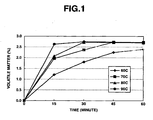
- Example 1 in Table 1 Using a metal screen, the silicone grease composition of Example 1 in Table 1 was coated onto an aluminum plate to form a plurality of coatings dimensioned 25 mm x 25 mm x 120 ⁇ m (thick). The coatings were allowed to stand at different temperatures while monitoring the changes of volatile matter with the lapse of time. The results are plotted in FIG. 1 . From the test results, the step of heating at 80°C for 45 minutes is selected for volatilization.
- the thickness of a silicone grease composition layer was computed by measuring the overall thickness of a test piece having the grease layer between a pair of aluminum plates by a micrometer (Mitsutoyo Co., Ltd.) and subtracting the thickness of two aluminum plates from the overall thickness. In this way, several test pieces having grease layers with different thickness were prepared. Where the volatilizing step is necessary, a small mass of the composition was rested on an aluminum plate and heated at 80°C for 45 minutes, before test pieces having grease layers with different thickness were prepared. The thermal resistance (mm 2 -K/W) of the silicone grease composition was measured at 25°C using the test piece and a thermal resistance analyzer based on the laser flash method (xenon flash lamp analyzer LFA447 NanoFlash ® by Netzsch GmbH). For each grease composition, the thermal resistance values of grease are plotted as a function of thickness to draw a straight line, and a heat conductivity was computed from the reciprocal of a gradient of that line.
- the absolute viscosity of a composition was measured at 25°C by a Malcom viscometer (Type PC-1T). A 500-g portion of each composition was weighed and placed in a beaker, which was kept open at 25°C. A change of viscosity with the lapse of time was monitored, with the results shown in Tables 1 and 2.
- Heat dissipating silicone grease compositions were prepared by feeding the predetermined amounts of the components shown in Tables 1 and 2 to a 5-liter planetary mixer (trade name of Inoue Mfg. Inc.), and agitating them at room temperature for one hour. The properties of these (fresh) silicone grease compositions were tested, with the results shown in Tables 1 and 2. The silicone grease compositions were subjected to open exposure at 25°C for 15 days. The results of viscosity monitoring and the applicability of the aged compositions are also shown in Tables 1 and 2.
- Organosilane-1 C 10 H 21 Si(OCH 3 ) 3
Landscapes
- Chemical & Material Sciences (AREA)
- Chemical Kinetics & Catalysis (AREA)
- General Chemical & Material Sciences (AREA)
- Oil, Petroleum & Natural Gas (AREA)
- Organic Chemistry (AREA)
- Health & Medical Sciences (AREA)
- Emergency Medicine (AREA)
- Lubricants (AREA)
- Cooling Or The Like Of Semiconductors Or Solid State Devices (AREA)
- Compositions Of Macromolecular Compounds (AREA)
Claims (9)
- Wärmeableitende Siliconfettzusammensetzung, umfassend:(A) 0 bis 30 % eines Organopolysiloxans der allgemeinen Formel (1):
R1 aSiO(4-1)/2 (1)
worin R1 zumindest ein Rest ist, der aus substituierten oder unsubstituierten einwertigen Kohlenwasserstoffresten mit 1 bis 18 Kohlenstoffatomen ausgewählt ist und "a" eine positive Zahl von 1,8 bis 2,2 ist, mit einer kinematischen Viskosität bei 25 °C von 50 bis 500.000 mm2/s.(B) 0 bis 30 % eines Organopolysiloxans der allgemeinen Formel (2): (C) 60 bis 96,9 % eines wärmeleitenden Füllstoffs mit einer Wärmeleitfähigkeit von zumindest 10 W/m°C,(D) 0,1 bis 10 % Isoparaffin, wobei der Siedepunkt des Isoparaffins im Bereich von 270°C bis 350 °C liegt und wobei die Organopolysiloxankomponente (A) und/ oder (B) im Isoparaffin dispergierbar oder löslich ist/sind,
wobei die Prozentwerte Gew.-% sind, die sich auf die Summe der Komponenten (A) bis (D) als 100 % beziehen. - Zusammensetzung nach Anspruch 1, die 0,5 bis 5 % des Isoparaffins (D) enthält.
- Zusammensetzung nach Anspruch 1 oder 2, worin die Menge des wärmeleitenden Füllstoffs 80 bis 95 % beträgt.
- Zusammensetzung nach einem der vorangegangenen Ansprüche, worin der wärmeleitende Füllstoff Aluminiumpulver, Kupferpulver, Silberpulver, Nickelpulver, Goldpulver, Aluminiumoxidpulver, Zinkoxidpulver, Magnesiumoxidpulver, Aluminiumnitridpulver, Bornitridpulver, Siliciumnitridpulver, Diamantpulver oder Kohlenstoffpulver ist.
- Zusammensetzung nach einem der vorangegangenen Ansprüche, worin die Menge der Komponente (A) 0 bis 15 Gew.-% beträgt.
- Zusammensetzung nach einem der vorangegangenen Ansprüche, die weiters 0,1 bis 10 Gewichtsteile eines Organosilans der allgemeinen Formel (3):
R4 cR5 dSi(OR6)4-c-d (3)
worin R4 ein substituierter oder unsubstituierter Alkylrest mit 6 bis 20 Kohlenstoffatomen ist, R5 ein substituierter oder unsubstituierter einwertiger Kohlenwasserstoffrest mit 1 bis 20 Kohlenstoffatomen ist, R6 ein Alkylrest mit 1 bis 5 Kohlenstoffatomen ist, c eine ganze Zahl von 1 bis 3 ist, d eine ganze Zahl von 0 bis 2 ist und c+d eine ganze Zahl von 1 bis 3 ist, oder eines partiellen hydrolytischen Kondensats davon pro 100 Gewichtsteile der Komponenten (A) bis (D) zusammen umfasst. - Verfahren, umfassend das Aufbringen einer Siliconfettzusammensetzung nach einem der Ansprüche 1 bis 6 auf ein wärmeableitendes Element, beispielsweise einen Kühlkörper, in Form einer Schicht und das Verdampfen des Isoparaffinverdünners, um eine wärmeableitende Fettschicht zu bilden.
- Verfahren nach Anspruch 7, wobei die Schicht durch Metallsiebdruck aufgebracht wird.
- Verfahren nach Anspruch 7 oder 8, wobei die Schicht auf 70 °C bis 90 °C erhitzt wird, um den Isoparaffinverdünner zu verdampfen.
Applications Claiming Priority (1)
| Application Number | Priority Date | Filing Date | Title |
|---|---|---|---|
| JP2007116598A JP2008274036A (ja) | 2007-04-26 | 2007-04-26 | 放熱用シリコーングリース組成物 |
Publications (2)
| Publication Number | Publication Date |
|---|---|
| EP1985691A1 EP1985691A1 (de) | 2008-10-29 |
| EP1985691B1 true EP1985691B1 (de) | 2011-09-28 |
Family
ID=39521929
Family Applications (1)
| Application Number | Title | Priority Date | Filing Date |
|---|---|---|---|
| EP08251309A Not-in-force EP1985691B1 (de) | 2007-04-26 | 2008-04-03 | Wärmeableitende Silikonfettzusammensetzung |
Country Status (6)
| Country | Link |
|---|---|
| US (1) | US7786056B2 (de) |
| EP (1) | EP1985691B1 (de) |
| JP (1) | JP2008274036A (de) |
| KR (1) | KR101426091B1 (de) |
| CN (1) | CN101294066B (de) |
| TW (1) | TWI433924B (de) |
Families Citing this family (21)
| Publication number | Priority date | Publication date | Assignee | Title |
|---|---|---|---|---|
| JP4993135B2 (ja) * | 2008-07-08 | 2012-08-08 | 信越化学工業株式会社 | 熱伝導性シリコーン組成物 |
| JP5388329B2 (ja) * | 2008-11-26 | 2014-01-15 | 株式会社デンソー | 放熱用シリコーングリース組成物 |
| US8618211B2 (en) * | 2009-03-16 | 2013-12-31 | Dow Corning Corporation | Thermally conductive grease and methods and devices in which said grease is used |
| US20100275440A1 (en) * | 2009-05-01 | 2010-11-04 | Sara Naomi Paisner | Highly conductive thermal interface and no pump-out thermal interface greases and method therefore |
| JP2011179468A (ja) | 2010-03-03 | 2011-09-15 | Dow Corning Toray Co Ltd | 高粘性流体用ディスペンサー |
| JP5472055B2 (ja) * | 2010-11-19 | 2014-04-16 | 信越化学工業株式会社 | 熱伝導性シリコーングリース組成物 |
| JP2014105283A (ja) * | 2012-11-28 | 2014-06-09 | Shin Etsu Chem Co Ltd | 熱伝導性シリコーングリース組成物 |
| CN103614097A (zh) * | 2013-11-19 | 2014-03-05 | 常熟市长江胶带有限公司 | 防水胶带 |
| KR102219782B1 (ko) | 2014-02-06 | 2021-02-23 | 도레이첨단소재 주식회사 | 열전도성 복합 시트 |
| KR102141722B1 (ko) | 2014-02-13 | 2020-08-05 | 도레이첨단소재 주식회사 | 열전도성 시트용 점착제 조성물 및 이로부터 제조된 열전도성 시트 |
| KR101653369B1 (ko) | 2014-11-24 | 2016-09-01 | 도레이첨단소재 주식회사 | 열전도성 점착제 조성물 및 이로부터 제조된 열전도성 박막 점착시트 |
| CN105062076A (zh) * | 2015-08-13 | 2015-11-18 | 深圳市国创珈伟石墨烯科技有限公司 | 一种石墨烯导热硅脂及其制备方法 |
| JP6879690B2 (ja) | 2016-08-05 | 2021-06-02 | スリーエム イノベイティブ プロパティズ カンパニー | 放熱用樹脂組成物、その硬化物、及びこれらの使用方法 |
| CN108148554A (zh) * | 2016-12-02 | 2018-06-12 | 臻鼎科技股份有限公司 | 散热片填充组合物、散热片及其制作方法 |
| CN111315825B (zh) * | 2017-11-09 | 2021-12-14 | 信越化学工业株式会社 | 导热性硅脂组合物 |
| WO2019181713A1 (ja) * | 2018-03-23 | 2019-09-26 | 信越化学工業株式会社 | シリコーン組成物 |
| JP6866877B2 (ja) * | 2018-05-31 | 2021-04-28 | 信越化学工業株式会社 | 低熱抵抗シリコーン組成物 |
| JP7001071B2 (ja) | 2019-01-10 | 2022-01-19 | 信越化学工業株式会社 | 熱伝導性シリコーン組成物 |
| CN111669956B (zh) | 2019-03-06 | 2024-04-02 | 天津莱尔德电子材料有限公司 | 热管理和/或电磁干扰减轻材料以及相关装置和方法 |
| KR102645250B1 (ko) * | 2020-10-28 | 2024-03-11 | 다우 실리콘즈 코포레이션 | 비경화성 열전도성 점액성 실리콘 물질 |
| CN116731689B (zh) * | 2023-08-14 | 2023-10-27 | 南方电网调峰调频(广东)储能科技有限公司 | 电子元器件的基于硅油的浸没式冷却液 |
Family Cites Families (14)
| Publication number | Priority date | Publication date | Assignee | Title |
|---|---|---|---|---|
| JP3195277B2 (ja) | 1997-08-06 | 2001-08-06 | 信越化学工業株式会社 | 熱伝導性シリコーン組成物 |
| US6136758A (en) * | 1998-08-17 | 2000-10-24 | Shin-Etsu Chemical Co., Ltd. | Aluminum nitride powder and thermally conductive grease composition using the same |
| JP3417885B2 (ja) | 1998-08-17 | 2003-06-16 | 信越化学工業株式会社 | 窒化アルミニウム粉末 |
| JP2930298B1 (ja) | 1998-08-18 | 1999-08-03 | 信越化学工業株式会社 | 熱伝導性グリース組成物 |
| JP3948642B2 (ja) | 1998-08-21 | 2007-07-25 | 信越化学工業株式会社 | 熱伝導性グリース組成物及びそれを使用した半導体装置 |
| JP2000114438A (ja) | 1998-09-30 | 2000-04-21 | Shin Etsu Chem Co Ltd | 半導体装置 |
| JP2000109373A (ja) * | 1998-10-02 | 2000-04-18 | Shin Etsu Chem Co Ltd | 放熱用シリコーングリース組成物及びそれを使用した半導体装置 |
| JP4130091B2 (ja) * | 2002-04-10 | 2008-08-06 | 信越化学工業株式会社 | 放熱用シリコーングリース組成物 |
| JP4219793B2 (ja) * | 2003-11-25 | 2009-02-04 | 信越化学工業株式会社 | 放熱用シリコーングリース組成物 |
| TWI385246B (zh) | 2004-05-21 | 2013-02-11 | 信越化學工業股份有限公司 | 聚矽氧烷潤滑油組成物 |
| JP2005330426A (ja) * | 2004-05-21 | 2005-12-02 | Shin Etsu Chem Co Ltd | 放熱用シリコーングリース組成物 |
| JP4725708B2 (ja) * | 2004-10-12 | 2011-07-13 | 信越化学工業株式会社 | 放熱部品 |
| JP4634891B2 (ja) | 2005-08-18 | 2011-02-16 | 信越化学工業株式会社 | 熱伝導性シリコーングリース組成物およびその硬化物 |
| JP4933094B2 (ja) * | 2005-12-27 | 2012-05-16 | 信越化学工業株式会社 | 熱伝導性シリコーングリース組成物 |
-
2007
- 2007-04-26 JP JP2007116598A patent/JP2008274036A/ja active Pending
-
2008
- 2008-03-31 US US12/059,138 patent/US7786056B2/en not_active Expired - Fee Related
- 2008-04-03 EP EP08251309A patent/EP1985691B1/de not_active Not-in-force
- 2008-04-24 TW TW097115083A patent/TWI433924B/zh not_active IP Right Cessation
- 2008-04-25 CN CN2008100960034A patent/CN101294066B/zh not_active Expired - Fee Related
- 2008-04-25 KR KR1020080038673A patent/KR101426091B1/ko not_active Expired - Fee Related
Also Published As
| Publication number | Publication date |
|---|---|
| CN101294066A (zh) | 2008-10-29 |
| US7786056B2 (en) | 2010-08-31 |
| CN101294066B (zh) | 2013-09-04 |
| JP2008274036A (ja) | 2008-11-13 |
| US20080269084A1 (en) | 2008-10-30 |
| TWI433924B (zh) | 2014-04-11 |
| EP1985691A1 (de) | 2008-10-29 |
| KR20080096453A (ko) | 2008-10-30 |
| KR101426091B1 (ko) | 2014-07-31 |
| TW200907045A (en) | 2009-02-16 |
Similar Documents
| Publication | Publication Date | Title |
|---|---|---|
| EP1985691A1 (de) | Wärmeableitende Silikonfettzusammensetzung | |
| EP1535988B1 (de) | Wärmeleitfähige Silikonfettzusamensetzung | |
| US11186798B2 (en) | Thermally conductive silicone grease composition | |
| EP1803798B1 (de) | Wärmeleitende Silikonfettzusammensetzung | |
| EP1600494B1 (de) | Silikonfett-Zusammensetzung | |
| JP4634891B2 (ja) | 熱伝導性シリコーングリース組成物およびその硬化物 | |
| US8802763B2 (en) | Curable organopolysiloxane composition and semiconductor device | |
| CN100569858C (zh) | 硅脂组合物 | |
| EP3910026A1 (de) | Wärmeleitfähige silikonzusammensetzung | |
| WO2024024498A1 (ja) | 熱伝導性シリコーン組成物及びその製造方法 | |
| EP4474429A1 (de) | Wärmeleitfähige silikonzusammensetzung und herstellungsverfahren dafür | |
| JP2023160267A (ja) | 熱伝導性シリコーン組成物 |
Legal Events
| Date | Code | Title | Description |
|---|---|---|---|
| PUAI | Public reference made under article 153(3) epc to a published international application that has entered the european phase |
Free format text: ORIGINAL CODE: 0009012 |
|
| AK | Designated contracting states |
Kind code of ref document: A1 Designated state(s): AT BE BG CH CY CZ DE DK EE ES FI FR GB GR HR HU IE IS IT LI LT LU LV MC MT NL NO PL PT RO SE SI SK TR |
|
| AX | Request for extension of the european patent |
Extension state: AL BA MK RS |
|
| 17P | Request for examination filed |
Effective date: 20090203 |
|
| 17Q | First examination report despatched |
Effective date: 20090317 |
|
| AKX | Designation fees paid |
Designated state(s): DE FR GB |
|
| GRAP | Despatch of communication of intention to grant a patent |
Free format text: ORIGINAL CODE: EPIDOSNIGR1 |
|
| GRAC | Information related to communication of intention to grant a patent modified |
Free format text: ORIGINAL CODE: EPIDOSCIGR1 |
|
| GRAS | Grant fee paid |
Free format text: ORIGINAL CODE: EPIDOSNIGR3 |
|
| GRAA | (expected) grant |
Free format text: ORIGINAL CODE: 0009210 |
|
| AK | Designated contracting states |
Kind code of ref document: B1 Designated state(s): DE FR GB |
|
| REG | Reference to a national code |
Ref country code: GB Ref legal event code: FG4D |
|
| REG | Reference to a national code |
Ref country code: DE Ref legal event code: R096 Ref document number: 602008010113 Country of ref document: DE Effective date: 20111201 |
|
| PLBE | No opposition filed within time limit |
Free format text: ORIGINAL CODE: 0009261 |
|
| STAA | Information on the status of an ep patent application or granted ep patent |
Free format text: STATUS: NO OPPOSITION FILED WITHIN TIME LIMIT |
|
| 26N | No opposition filed |
Effective date: 20120629 |
|
| REG | Reference to a national code |
Ref country code: DE Ref legal event code: R097 Ref document number: 602008010113 Country of ref document: DE Effective date: 20120629 |
|
| PGFP | Annual fee paid to national office [announced via postgrant information from national office to epo] |
Ref country code: GB Payment date: 20130403 Year of fee payment: 6 |
|
| PGFP | Annual fee paid to national office [announced via postgrant information from national office to epo] |
Ref country code: FR Payment date: 20130625 Year of fee payment: 6 |
|
| GBPC | Gb: european patent ceased through non-payment of renewal fee |
Effective date: 20140403 |
|
| REG | Reference to a national code |
Ref country code: FR Ref legal event code: ST Effective date: 20141231 |
|
| PG25 | Lapsed in a contracting state [announced via postgrant information from national office to epo] |
Ref country code: GB Free format text: LAPSE BECAUSE OF NON-PAYMENT OF DUE FEES Effective date: 20140403 |
|
| PG25 | Lapsed in a contracting state [announced via postgrant information from national office to epo] |
Ref country code: FR Free format text: LAPSE BECAUSE OF NON-PAYMENT OF DUE FEES Effective date: 20140430 |
|
| PGFP | Annual fee paid to national office [announced via postgrant information from national office to epo] |
Ref country code: DE Payment date: 20190319 Year of fee payment: 12 |
|
| REG | Reference to a national code |
Ref country code: DE Ref legal event code: R119 Ref document number: 602008010113 Country of ref document: DE |
|
| PG25 | Lapsed in a contracting state [announced via postgrant information from national office to epo] |
Ref country code: DE Free format text: LAPSE BECAUSE OF NON-PAYMENT OF DUE FEES Effective date: 20201103 |