EP1985193A1 - Perücke - Google Patents
Perücke Download PDFInfo
- Publication number
- EP1985193A1 EP1985193A1 EP06732072A EP06732072A EP1985193A1 EP 1985193 A1 EP1985193 A1 EP 1985193A1 EP 06732072 A EP06732072 A EP 06732072A EP 06732072 A EP06732072 A EP 06732072A EP 1985193 A1 EP1985193 A1 EP 1985193A1
- Authority
- EP
- European Patent Office
- Prior art keywords
- hair
- weft
- sheet
- wig
- materials
- Prior art date
- Legal status (The legal status is an assumption and is not a legal conclusion. Google has not performed a legal analysis and makes no representation as to the accuracy of the status listed.)
- Granted
Links
Images




Classifications
-
- A—HUMAN NECESSITIES
- A41—WEARING APPAREL
- A41G—ARTIFICIAL FLOWERS; WIGS; MASKS; FEATHERS
- A41G3/00—Wigs
-
- A—HUMAN NECESSITIES
- A41—WEARING APPAREL
- A41G—ARTIFICIAL FLOWERS; WIGS; MASKS; FEATHERS
- A41G3/00—Wigs
- A41G3/0066—Planting hair on bases for wigs
-
- A—HUMAN NECESSITIES
- A41—WEARING APPAREL
- A41G—ARTIFICIAL FLOWERS; WIGS; MASKS; FEATHERS
- A41G3/00—Wigs
- A41G3/0083—Filaments for making wigs
-
- D—TEXTILES; PAPER
- D01—NATURAL OR MAN-MADE THREADS OR FIBRES; SPINNING
- D01F—CHEMICAL FEATURES IN THE MANUFACTURE OF ARTIFICIAL FILAMENTS, THREADS, FIBRES, BRISTLES OR RIBBONS; APPARATUS SPECIALLY ADAPTED FOR THE MANUFACTURE OF CARBON FILAMENTS
- D01F6/00—Monocomponent artificial filaments or the like of synthetic polymers; Manufacture thereof
- D01F6/28—Monocomponent artificial filaments or the like of synthetic polymers; Manufacture thereof from copolymers obtained by reactions only involving carbon-to-carbon unsaturated bonds
- D01F6/40—Modacrylic fibres, i.e. containing 35 to 85% acrylonitrile
-
- D—TEXTILES; PAPER
- D01—NATURAL OR MAN-MADE THREADS OR FIBRES; SPINNING
- D01F—CHEMICAL FEATURES IN THE MANUFACTURE OF ARTIFICIAL FILAMENTS, THREADS, FIBRES, BRISTLES OR RIBBONS; APPARATUS SPECIALLY ADAPTED FOR THE MANUFACTURE OF CARBON FILAMENTS
- D01F6/00—Monocomponent artificial filaments or the like of synthetic polymers; Manufacture thereof
- D01F6/58—Monocomponent artificial filaments or the like of synthetic polymers; Manufacture thereof from homopolycondensation products
- D01F6/60—Monocomponent artificial filaments or the like of synthetic polymers; Manufacture thereof from homopolycondensation products from polyamides
Definitions
- the present invention relates to a wig to be worn to a head in full or in part, and more specifically, to a wig comprising a wig base and curled hair materials fixed to the wig base.
- hair materials used for wigs have generally been straight hairs.
- hair styles there are a variety of hair styles.
- an elegant and unique fashionableness in hair styles as well as increase of hair in volume is quite often required, and it is difficult to meet such requirements of various hair styles with straight hairs, which only provide a rather low flexibility,.
- a hair material is folded into two, the folded portion is fastened to the front portion of a wig base, the hair material is curled or turned over toward in the outward direction, and then the curled hair material is set to wave from the front side toward the rear side of the wig base.
- the folded portion 1a of each hair material 1 is already fixed to a wig base 2 as shown in Fig. 21 , so it is impossible to secure a sufficient length for the remaining hair piece 1b to impart curl thereto.
- the hair piece 1b can not be sufficiently wound around a curl imparting means 3 such as a rod or a curler, and it is likely to result in loose curl, making it rather difficult to impart a predetermined curl diameter.
- imparting curl through post-processing is the same way as perming the natural hair, it takes time and effort, resulting in a rather low efficiency.
- the present invention has been made in view of the above problem. It is an object of the present invention to provide a wig allowing orientation of the curl of a hair material in a predetermined direction after being fastened to a wig base even in the case of hair material curled in advance. Another object of the present invention is to provide a wig capable of maintaining the curl imparted to the hair pieces for a long period of time.
- a wig according to the present invention comprises a wig base to be worn to a head; and a large number of hair materials fastened to the wig base, each being a pair of hair pieces folded into two, wherein curls are imparted in advance to the pair of hair pieces before being fastened to the wig base, wherein a folded portion of the pair of hair pieces is fixed to the wig base while tips of the pair of hair pieces are being oriented to a predetermined direction with respect to the wig base, thereby the curls of the pair of hair pieces are oriented to a predetermined direction after being fixed to the wig base.
- the fixation of the hair material to the wig base can be effected by fastening, transplanting, etc.
- the hair material is fixed to the wig base by fastening the folded portion between the two hair pieces to a filament of the net.
- the hair material is fixed to the wig base by fastening or transplanting the folded portion between the two hair pieces to the filament.
- the curls of the pair of hair pieces may be imparted by a method comprising the steps of applying a first cold permanent liquid to the weft containing a predetermined number of the hair materials in each of a predetermined number of pitches and impregnating a sheet of non-woven fabric with water; placing the weft on the sheet and combing the weft to thereby uniformly distribute the hair materials on the sheet; winding the weft and the sheet integrally around a pipe; keeping them in this state sealed in a bag for a predetermined period of time; applying a second cold permanent liquid to the hair materials extracted from the bag after the predetermined period of time has elapsed; winding the weft and the sheet integrally around the pipe; keeping them in this state for further predetermined period of time; and washing in water the weft wound off after the further predetermined period of time has elapsed.
- the curls of the pair of hair pieces may be imparted by a method comprising the steps of applying a conditioner for chemical fibers to the weft containing a predetermined number of the hair materials in each of a predetermined number of pitches; placing the weft on a sheet of one of non-woven fabric and paper and combing the weft to thereby uniformly distribute the hair materials on the sheet; winding the weft and the sheet integrally around a pipe; and heating them in this state for a predetermined period of time.
- the curls of the pair of hair pieces may be imparted by a method comprising the steps of impregnating the weft containing a predetermined number of the hair materials in each of a predetermined number of pitches and a sheet of non-woven fabric with an aqueous solution of silicon emulsion; placing the weft on the sheet and combing the weft to thereby uniformly distribute the hair materials on the sheet; winding the weft and the sheet integrally around a pipe and covering them with an aluminum foil; and heating them in this state for a predetermined period of time.
- the curls of the pair of hair pieces may be imparted by a method comprising the steps of: immersing the weft containing a predetermined number of the hair materials in each of a predetermined number of pitches and a sheet of non-woven fabric in an aqueous solution of silicon emulsion; placing the weft on the sheet material and combing the weft to thereby uniformly distribute the hair materials on the sheet material; winding the weft and the sheet integrally around a pipe and drying them; and heating them in this state for a predetermined period of time.
- the third and fourth steps of the just prior embodiment may be replaced with the steps of: winding the weft and the sheet integrally around a pipe and covering them with an aluminum foil; and heating them in this state for a predetermined period of time.
- hairs of synthetic resin such as acrylic resin, modacrylic resin or polyamide resin.
- a filament or a sheet-shaped base obtained by knitting synthetic fibers (chemical fibers), vegetable fibers, animal fibers, etc. into a net-like form.
- synthetic fibers such as nylon or polyester.
- non-woven fabric, paper, etc. are suitable.
- a plurality of hair materials cut in a predetermined length are preferably arranged at intervals, and sewn together at appropriate positions in the length direction of the hair materials to form a sewn bundle.
- the lateral width of the weft is too large, it is rather difficult to apply uniform tension to the winding pipe member in the operation of winding it around the winding pipe member. It is thus desirable for the lateral width of the weft to be 20 cm or less.
- a conditioner is applied to the weft to improve the texture thereof.
- a conditioner for chemical fibers containing 20 to 30 % of a surface-active agent composed of nonions, cations or a mixture thereof.
- the content of the surface-active agent exceeds 30 %, the surface of the hair material 10 becomes sticky or the tone thereof is changed during the heat treatment after the imparting of curl.
- the content of the surface-active agent is less than 20 %, an improvement in texture after the imparting of curl is hardly to be observed.
- the direction of the curl of the hair pieces is determined depending upon the direction in which the hair materials are fastened to the wig base, and a predetermined hair design results. For example, when the hair materials are fixed to the wig base in a state in which they are aligned in the same direction, the curl of the hair pieces of these hair materials is aligned in the same direction. When a large number of hair materials are fastened to the wig base in fixed amounts in different directions, the curls of the hair pieces of these hair materials are oriented in different directions. Thus, through appropriate selection of hair material fixing directions with respect to the wig base, it is possible to obtain wigs for a variety of hair designs.
- the hair materials are fixed to the wig base with their directions determined, so the direction of the curl of the hair pieces is determined.
- the hair material attachment it is possible to apply the wig not only to a basic hair design, but also to a complicated hair design with intermingled curl directions, making it possible to attain a hair design of high degree of freedom.
- the curl direction is not fixed even if the hair materials are combed and which is rather poor in terms of design, it is possible to obtain a product that is more perfect as such.
- Fig. 1 is a plan view illustrating the operation of fastening a hair material to a wig base according to a first embodiment of the present invention.
- Fig. 2 is a perspective view of a wig according to the first embodiment of the present invention.
- Fig. 3 is a perspective view of a weft according to the first embodiment of the present invention.
- Fig. 4 is a perspective view of a single hair material according to the first embodiment of the present invention.
- Fig. 5 is a front view of a hair material as fastened to a wig base according to the first embodiment of the present invention.
- Fig. 6 is a plan view illustrating the operation of fastening a hair material to a wig base according to a second embodiment of the present invention.
- Fig. 1 is a plan view illustrating the operation of fastening a hair material to a wig base according to a first embodiment of the present invention.
- Fig. 2 is a perspective view of a wig according to the first embodiment
- FIG. 7 is a perspective view illustrating the operation of blending hair materials common to third to seventh embodiments of the present invention.
- Fig. 8 is a plan view of sewn weft common to the third to seventh embodiments of the present invention.
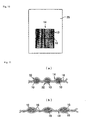
- Fig. 9 is a plan view of a weft common to the third to seventh embodiments of the present invention as placed on a sheet material.
- Fig. 10 is a plan view of a weft common to the third to seventh embodiments of the present invention placed on a sheet material as combed.
- Fig. 11 is a sectional view of a weft common to the third to seventh embodiments of the present invention placed on a sheet material.
- Fig. 8 is a plan view of sewn weft common to the third to seventh embodiments of the present invention.
- Fig. 9 is a plan view of a weft common to the third to seventh embodiments of the present invention as placed on a sheet material.
- Fig. 10 is a plan view of
- FIG. 12 is a plan view illustrating how weft common to the third to seventh embodiments of the present invention and a sheet material are wound around a pipe member.
- Fig. 13 is a sectional view showing a weft common to the third to seventh embodiments of the present invention and a sheet material as wound around a pipe member.
- Fig. 14 is a perspective view showing a weft common to the third to seventh embodiments of the present invention and a sheet material as wound around a pipe member.
- Fig. 15 is a front view of a hair material common to the third to seventh embodiments of the present invention as fastened to a filament of a wig base.
- Fig. 16 is a plan view of hair materials drawn out of weft common to the third to seventh embodiments of the present invention.
- FIG. 17 is a longitudinal sectional view of a hair material composed of straight-chain aliphatic polyamide according to a fifth embodiment of the present invention.
- Fig. 18 is a perspective view of a pipe member according to a fifth embodiment of the present invention as covered with an aluminum foil.
- Fig. 19 is a schematic sectional view of an artificial hair material of a core-sheath structure according to a sixth embodiment of the present invention.
- Fig. 20 is a schematic view showing asperities of an artificial hair material according to the sixth embodiment of the present invention.
- Fig. 21 is a schematic view showing how a conventional hair material is curled.
- Fig. 22 is a schematic view showing how conventional hair materials are fastened to a wig base.
- FIGS. 1 through 5 show the first embodiment of the present invention.
- FIGs. 1(a) through 1(e) are plan views illustrating the operation of fastening a hair material to a filament of a wig base in the form of a net
- Fig. 2 is a perspective view of a wig
- Fig. 3 is a perspective view of a weft
- Figs. 4(a) through 4(d) are perspective views of a single hair material
- Fig. 5 is a front view of hair materials as fastened to a filament of a wig base.
- a large number of hair materials 10 are fastened to a wig base 12 as hair 11 to form a wig 13 as shown in Fig. 2 .
- the hair materials human hairs or synthetic resin hairs are used.
- curl is imparted to hair pieces 10a, 10b beforehand.
- large number of hair materials 10 are fastened to the wig base 12, there is formed a hair design in which the hair 11 equally parted in the middle is curled symmetrically.
- the wig base 12 is composed of an artificial skin or a net of synthetic resin shaped into a head configuration.
- the hair materials 10 are fastened to filaments 15 forming a net constituting the wig base 12.
- the weft 14 is obtained by sewing together a plurality of hair materials 10 cut in a predetermined length at a predetermined longitudinal position with a sewing thread 16.
- the weft is wound around a cylindrical member such as a pipe member (not shown) and is subjected to heat treatment, so curl is imparted to the hair pieces 10a, 10b of the hair materials 10 as shown in Fig. 2 .
- a hair material 10 is drawn out of the weft 14 whose hair pieces 10a, 10b are thus curled beforehand.
- the hair material 10 thus drawn out is folded into two to form a pair of hair pieces 10a, 10b curled in the same direction and a folded portion 10c folded between the hair pieces 10a, 10b.
- the hair pieces 10 thus folded into two are classified into, as shown in Fig. 2 , right-hand side curl hair pieces for use on the right-hand side with respect to the middle parting portion of the wig 13 and left-hand side curl hair pieces for use on the left-hand side with respect to the middle parting portion so as to be fastened to the wig base 12.
- the right-hand curl hair piece 10 is retained with the tips of the hair pieces 10a, 10b on the right-hand side and the curved folded portion 10c on the left-hand side.
- the two hair pieces 10a, 10b are curled so as to be wound around the left index finger.
- the left-hand curl hair piece 10 is retained with the tips of the hair pieces 10a, 10b on the left-hand side and the curved folded portion 10c on the right-hand side.
- the two hair pieces 10a, 10b are curled so as to be wound around the left thumb.
- the hair pieces 10a, 10b are shown as held between fingers for the sake of convenience to facilitate the understanding of the hair piece curling direction, in reality, the hair materials 10 are fastened to the wig base 12 while being grasped by a mechanical grasping means.
- the folded portion 10c of the hair material 10 is situated on the lower side (a side to be worn to a head) of the filament 15, and the hair pieces are caused to cross each other so that one hair piece 10a comes over the other hair piece 10b as shown in Fig. 1(a) , thereby forming a first loop portion 17 on the inner side of the folded portion 10c.
- the folded portion 10c is brought in the direction of the filament 15, and one hair piece 10a is passed through the first loop portion 17 while being folded as shown in Fig. 1(c) , so a curved portion 10d is formed in the middle portion of one hair piece 10a drawn out of the first loop portion 17, and a second loop portion 19 is formed on the inner side of the curved portion 10d.
- the other hair piece 10b is passed through the second loop portion 19 so as to be wound around one hair piece 10a from the outside, and as shown in Fig. 1(e) , the hair pieces 10a, 10b are pulled in opposite directions each other, and the filament 15 is bound by a knot 20, so the hair material 10 is fastened to the filament 15.
- the hair material 10 of this embodiment having right-hand curl in the hair pieces 10a, 10b is fastened to the filament 15 in this way.
- the hair pieces 10a, 10b are oriented with their curls aligned to the right with respect to the filament 15 of the wig base.
- the left-hand curl hair material 10 shown in Figs. 4(c) and 4(d) are also fastened to the filament 15 by the same process as that for the right-hand curl hair material 10 described above, and as shown in Fig. 5(b) , the hair pieces 10a, 10b are oriented with their curls aligned to the left.
- the folded portion 10c is fastened to the filament 15 through mechanical operation of the crochet 18 while grasping the tips of the previously curled hair pieces 10a, 10b by a separate grasping means such that they are oriented in a predetermined direction, i.e., either to the right or to the left, with respect to the wig base 12, so it is possible to easily obtain a wig 11 of a design in which the right-hand curl and left-hand curl imparted to the hair pieces 10a, 10b are orderly parted on the right-hand and left-hand sides of the wig base 12.
- Figs. 6(a) through 6(c) are plan views for illustrating the operation of fastening a previously curled hair material to a wig base.
- the hair material 10, the wig base 12, the filament 15, and the crochet 18 are the same as those of the first embodiment.
- the folded portion 10c of the hair material 10 is situated on the lower side (head side) of the filament 15, and the hair pieces are caused to cross each other such that one hair piece 10a comes over the other hair piece 10b, forming a first loop portion 21 on the inner side of the folded portion 10c.
- the folded portion 10c is wound from the lower side to the upper side of the filament 15, and the other hair piece 10b is passed through the loop portion 21. Further, the entire other hair piece 10b is drawn out of the loop portion 21, and the hair pieces 10a, 10b are pulled each other in opposite directions, and the filament 15 is bound by a knot 22, so the hair material 10 is fastened to the filament 15.
- a net-shaped wig base using filament is adopted
- a sheet-like member composed of an artificial skin or the like formed of synthetic resin
- a large number of through-holes are provided in the sheet-like member, and two through-holes, i.e., a first through-hole and a second through-hole are used per hair material, the hair material being fastened regarding these through-holes as both sides of the filament of the first and second embodiments.
- the fixation of the hair material can also be effected by transplanting, in which case the sheet-like member is pierced by the folded portion of the hair material, and a detachment preventing means is provided at the tip of the folded portion protruding from the lower side of the sheet-like member.
- Figs. 7 through 16 show the third embodiment.
- Fig. 7 is a perspective view illustrating the operation of blending hair materials
- Fig. 8 is a plan view of a sewn weft
- Fig. 9 is a plan view of a weft as placed on a sheet material
- Fig. 10 is a plan view of a weft placed on a sheet material as combed
- Fig. 11 is a sectional view of a weft on a sheet material
- Fig. 12 is a plan view illustrating how hair a tuft and a sheet material are wound around a pipe member
- Fig. 13 is a sectional view showing a weft and a sheet material as wound around a pipe member
- Fig. 13 is a sectional view showing a weft and a sheet material as wound around a pipe member
- FIG. 14 is a perspective view showing, like Fig. 13 , hair a tuft and a sheet material as wound around a pipe member
- Fig. 15 is a front view of a hair material as fastened to a filament
- Fig. 16 is a plan view of hair materials drawn out of hair a tuft.
- the third embodiment shown in Figs. 7 through 16 is suitable for imparting curl to human hairs as the hair materials 10 (including human hairs from which the cuticles have been removed and which have undergone bleaching and dyeing processes so as to be suitable for use in a wig).
- a hair bundle 30 formed by a plurality of hair materials 10 composed of human hairs of a plurality of desired colors is applied to a hair comber 31, and the hair bundle 30 is repeatedly combed by a teeth 31a of the hair comber 31 to thereby effect blending on the hair materials 10 of a plurality of colors to a sufficient degree.
- the hair bundle 30 is disentangled into unit hairs by putting it through the hair comber 31.
- the blended hair bundle 30 is cut in a predetermined length. This predetermined length is a reference length in fastening the hair materials 10 to the wig base 12.
- Fig. 8(a) is a plan view of a weft 14 prepared by sewing together an appropriate amount by weight of the hair materials 10 cut in a predetermined length at a predetermined longitudinal position
- Fig. 8(b) is an enlarge view of the weft 14.
- the weft 14 thus formed has a plurality of sewn bundles 32.
- a lateral width 6L of the weft 14 shown in Fig. 8(a) is too large, it is rather difficult to apply a uniform tension to an aluminum pipe member 33 in the operation described below of winding the weft 14 around the pipe member 33, so it is desirable for the width to be 20cm or less.
- Sewing marks 34 of sewing thread 16 are left in the hair materials 10 in the process described below (see Fig. 16 ), so the position where the sewing marks 34 of the sewing thread 16 are left constitutes the folding position in fastening the hair materials 10 to the wig base 12.
- the weft 14 thus formed it is desirable for the weft 14 thus formed to contain 8 to 10 sewn bundles 32 per centimeter, and it is desirable for each sewn bundle 32 to contain 12 to 27 hair materials 10. If the number of sewn bundles 32 per centimeter were less than eight, the pitch of the sewn bundles 32 would be too large, making it impossible to uniformly distribute the hair materials 10 shown in Fig. 10 . Further, it would be difficult to wind the hair materials 10 around the pipe member 33 at a fixed angle. Further, when combing the weft 14 prior to the winding so as to make it straight, the hair materials 10 would be likely to be detached to the sewn bundles 32.
- Figs. 9 and 11(a) show a state in which a first cold permanent liquid has been sufficiently applied to the weft 14 formed as described above and in which the weft 14 has been placed at a predetermined position on a sheet material 35 moistened and spread on a working table.
- the weft 14 is combed so as to make it straight, so the hair materials 10 are aligned in a row with no gap therebetween as shown in Figs. 10 and 11 (b) , thereby reducing the thickness of the weft 14.
- the sheet material 35 serves as a guide when winding the weft 14 around the pipe member 33. At the time of use, it is moistened and spread over and held in intimate contact with the working table so as to involve no wrinkles.
- non-woven fabric is preferable since it increases in surface frictional force when moistened to prevent slippage. When it involves slippage when moistened, it may cause spinning or generate a gap between the weft and the aluminum pipe member 33 around which it is wound, resulting in loose curl.
- the material of the non-woven fabric for the sheet material 35 rayon or polyester is preferable. More preferably, a weight per unit area [metuske] of 18 to 30 g/m 2 is adopted. When the weight per unit area [metuske] is 18 g/m 2 or less, the density of the sheet material is rather small, and the cold permanent liquid applied to the weft 14 is easily vaporized, making it impossible to impart curl to a sufficient degree. Further, at the time of operation of winding it around the pipe member 33, the sheet material 35 is likely to suffer damage when tension is applied thereto.
- the thickness of the sheet material 35 is rather large, so that when it is wound around the pipe member 33, a rather large diameter results as the winding diameter increases, and the tuft 14 is likely to assume loose curl, which is weaker than curl of a predetermined configuration.
- an aluminum pipe member 33 with a circular sectional configuration is placed at one end of the sheet material 35, and the weft 14 and the sheet material 35 are wound integrally around the pipe 33 while applying tension thereto, as shown in Figs. 13 and 14 , fixing the outer center and both side ends of the tuft 14 by a fixing means 36, such as an adhesive tape or a rubber band.
- a fixing means 36 such as an adhesive tape or a rubber band.
- a second cold permanent liquid are directly applied to the sheet material 35 in the outer periphery of the pipe member 33 extracted from the plastic bag, or to the disentangled weft 14 from the pipe member 33.
- the weft 14 and the sheet material 35 are wound around the pipe member 33 again and fixed by the fixing means 36 before being left to stand for 15 minutes at room temperature.
- the fixing means 36 is released, and washing in flowing water is effected while gradually releasing the weft 14 and the sheet 35 wound around the pipe member 33, and the sheet material 35 is spread over the working table so as to involve no wrinkles.
- the washed weft 14 is arranged at a predetermined position on the sheet material 35, and hair rinse or conditioner is applied to the weft 14.
- the application of the rinse or conditioner is effected for the purpose of achieving an improvement in terms of texture since the texture of the hair materials 13 that have undergone treatment with the cold permanent liquid is rather hard.
- the weft 14 is combed by the same process as that of Fig. 10 , and the hair materials 10 are uniformly distributed so as to involve no gaps therebetween and to be aligned in a row, thereby reducing the thickness of the weft 14.
- the weft 14 and the sheet material 35 are integrally wound around the pipe material 33.
- the weft 14 and the sheet material 35 are fixed in position by a fixing means 36, such as an adhesive tape or a rubber band, and the pipe member 33 is wrapped up in a towel or the like to remove surplus water from the sheet material 35. After that, they are left to stand at room temperature until the sheet material 35 wound around the pipe member 33 is completely dried, or dried in a dryer at a temperature of approximately 90°C.
- the sheet material 35 and the weft 14 are extracted.
- Fig. 15 shows a single hair material 10 thus curled.
- Each hair material 10 has a sewing mark 34 at the position where sewing has been effected with the sewing thread 16.
- the middle points in the length direction of the hair materials 10 are sewn together, the length of the hair pieces 10a, 10b of each hair material 10 fastened to a filament 15 of the wig base 12 is half the total length of the hair material 10 as shown in Fig. 15(a) .
- the position at which the sewing is effected with the sewing thread 16 is not restricted to the position where the total length of the hair material 10 is equally divided.
- the hair pieces 10a, 10b differ in length as shown in Fig. 15(b) , and when it is fastened to the filament 15 of the wig base 12, it is possible to obtain an outward appearance different from that obtained by effecting sewing at the position equally dividing the hair material as shown in Fig. 15(a) .
- the hair material 10 is formed of an acrylic resin or a modacrylic resin (copolymer of acrylic resin and vinyl chloride) or the like. It is suitable for imparting curl to chemical fiber hairs of low heat resistance and exhibiting a softening temperature of 100°C or less.
- a conditioner for chemical fibers is applied to the weft 14, and the weft 14 is placed at a predetermined position on the sheet material 35 spread on the working table.
- the sheet material 35 serves as a guide in winding the weft 14 around the pipe member 33, and when in use, it is spread over and held in intimate contact with the working table so as to involve no wrinkles.
- the weft 14 is combed so as to make it straight, so the hair materials 10 are aligned in a row with no gap therebetween as shown in Figs. 10 and 11(b) , thereby reducing the thickness of the weft 14.
- non-woven fabric or paper is suitable.
- the weight per unit area [metuske] thereof is 40 to 50 g/m 2 .
- the density of the sheet material 35 is rather low, and heat is allowed to be conducted quickly at the time of heat treatment to impart curl.
- the uppermost layer of the weft 14 wound around the aluminum pipe member 33 is excessively heated, and shrinkage occurs in the portion, resulting in a rather poor outward appearance, which leads to a product of no commercial value.
- the weight per unit area [metuske] is 50 g/m 2 or more
- the thickness of the non-woven fabric or paper increases, so that when wound around the pipe member 33, it increases in diameter as the winding diameter increases.
- the weft 14 is likely to result in loose curl, which is weaker than curl of a predetermined configuration.
- the density of the non-woven fabric or paper is rather high, so that the heat is cut off at the time of heat treatment to impart curl, and the requisite heat for curling is not applied, which is likely to lead to so-called loose curl, which is weaker than curl of a predetermined configuration.
- the conditioner for chemical fibers applied to the weft 14 is used for the purpose of achieving an improvement in terms of texture since chemical fiber hairs become harder after the imparting of curl.
- As the conditioner it is desirable to adopt one containing 20 to 30 % of a surface-active agent composed of nonions or cations or a mixture thereof.
- the content of the surface-active agent exceeds 30 %, the surface of the hair materials 10 become sticky of a change in tone is involved in the heat treatment after the imparting of curl.
- the content of the surface-active agent is 20 % or less, the effect of improving the texture after the imparting of curl is hardly to be observed.
- the aluminum pipe member 33 of a circular sectional configuration is placed at one end of the sheet material 35, and they are wound integrally around the pipe member 33 while applying tension to the weft 14 and the sheet material 35, fixing the outside center and both side ends of the tuft 14 in position by the fixing means 36, such as an adhesive tape or a rubber band, as shown in Figs. 13 and 14 .
- the pipe member 33 around which the weft 14 and the sheet material 35 have been wound is put in a dryer set at a temperature of approximately 90°C, and heat treatment is conducted for approximately one hour. After that, the pipe member 33 is extracted and allowed to cool itself. Finally, the weft 14 is removed from the sheet material 35.
- This embodiment is superior in imparting curl to the hair pieces 10a, 10b of a hair material 10 that is formed of polyamide, in particular, a straight-chain aliphatic polyamide.
- the coloring of the hair material be effected by mixing in the raw material, that the surface of the hair material be composed of spherulites, blasts or a combination thereof to form asperities 10e on the surface of the artificial hair material 10 to thereby suppress the gloss thereof, and that the shrinkage rate of the hair material be 2 to 5 %.
- the processes of Figs. 7 and 8 are the same as those of the third and fourth embodiments.
- the weft 14 and the sheet material 35 are immersed in an aqueous solution of silicon emulsion.
- the sheet material 35 a non-woven fabric of a weight per unit area [metuske] of 18 to 30 g/m 2 is suitably used.
- the weight per unit area [metuske] is 18 g/m 2 or less, the impregnation amount of the silicon emulsion aqueous solution is small, and it is rather difficult to fix the skin on the surface of the hair material uniformly and at a predetermined film pressure.
- the sheet material is likely to suffer damage when tension is applied thereto while winding it around the pipe member 33.
- the weight per unit area [metuske] is 30 g/m 2 or more, the thickness of the sheet material 35 increases, so that when it is wound around the pipe member 33, its diameter increases as the winding diameter increases, with the result that the weft 14 is likely to assume loose curl, which is weaker than curl of a predetermined configuration.
- the non-woven fabric for the sheet material 35 it is desirable to adopt one that increases in surface friction force when moistened to thereby prevent slippage. If the surface of the sheet material 35 is slippery when moistened, spinning occurs when it is wound around the aluminum pipe member 33, and a gap is generated between the pipe member 33 and the weft 14 wound around it, which leads to loose curl.
- the material of the non-woven fabric is preferably rayon or polyester, as described above, with the weight per unit area [metuske] thereof being preferably 18 to 30 g/m 2 .
- the silicon emulsion is used for the purpose of imparting curl to the hair material 10 and imparting smoothness and a deep color effect to the hair material surface.
- an anionic discoloring epoxy silicon is preferable, and an aqueous solution concentration of 1 to 2 % is preferable since it involves no discoloration or sticky texture after the imparting of curl.
- Figs. 9 and 11(a) subsequent to Figs. 7 and 8 , the weft 14 and the sheet material 35 are immersed in an aqueous solution of silicon emulsion and are then lightly squeezed.
- Fig. 9 shows how the sheet material 35 is spread over the working table so as to involve no wrinkles, with the weft 14 being placed at a predetermined position on the sheet material 35.
- the weft 14 is combed so as to make it straight.
- the hair materials 10 are aligned in a row so as to involve no gap therebetween, thereby reducing the thickness of the weft 14.
- the aluminum pipe member 33 with a circular sectional configuration is placed at one end of the sheet material 35, and the weft 14 and the sheet material 35 are integrally wound around the pipe member 33 while applying tension thereto, fixing the outside center and both side ends of the weft 14 in position by the fixing means 36, such as an adhesive tape or a rubber band, as shown in Figs. 13 and 14 .
- the pipe member 33 around which the weft 14 and the sheet material 35 are wound is covered with a towel or the like to wipe away surplus silicon emulsion aqueous solution.
- the outer side of the weft 14, the sheet material 35, and the pipe member 33 as a whole is covered with an aluminum foil 37, and is put in a dryer set at a temperature of 160 to 170°C to conduct heat treatment for 40 to 60 minutes. After the heat treatment, the whole is extracted from the dryer, and allowed to cool itself. Finally, the weft 14 is extracted.
- the covering with the aluminum foil 37 in this embodiment is effected for the purpose of obtaining a curl of high retaining property at lower temperature by continuously applying moist air and dry air in a single heat treatment. That is, for 20 to 30 minutes after the whole is put in the dryer, the evaporation of the water of the silicon emulsion aqueous solution with which the weft 14 and the sheet material 35 are impregnated is suppressed by the influence of the materials of the aluminum pipe member 33 and the aluminum foil 37, so that the weft 14 is subjected to heat treatment at high temperature and high humidity. When, thereafter, the water has been evaporated, the heat treatment is conducted in a dry state.
- the fifth embodiment it is possible to apply moist air and dry air continuously with ease, without using any special device, through a combination of the material and weight per unit area [metuske] of the non-woven fabric wound together with the weft 14, the aluminum pipe member 33, and the aluminum foil 37, and through adjustment of the temperature and time of the heat treatment, thereby making it possible to obtain a curl of still higher retaining property.
- This embodiment is suitable for an artificial hair described below. That is, an artificial hair of a core/sheath structure is preferable, with the core portion being formed of a semi-aromatic polyamide with a phenylene unit in the main chain, and the sheath portion being formed of a straight-chain aliphatic polyamide of methylene chain bonding.
- the sheath/core weight ratio ranges from 30/70 to 10/90, and the hair thickness ranges from 40 to 80 ⁇ m.
- Fig. 19 is a schematic sectional view of the artificial hair material of the sheath/core structure. Further, as shown in Fig. 20(a) , the surface of the artificial hair material 10 is preferably roughened by blast shot or the like to form asperities 10f to thereby suppress gloss. As shown in Fig. 20(b) , which is an enlarged view, the asperities 10f are preferably formed to such a degree that the maximum difference in height between the protrusions and recesses, indicated at 38, is approximately 1.3 ⁇ m.
- the processes of Figs. 7 and 8 are the same as those of the fifth embodiment.
- the weft 14 and the sheet material 35 around the pipe member 33 are immersed in an aqueous solution of silicon emulsion. Apart from imparting curl, this aqueous solution of silicon emulsion is used for the purpose of fixing a film with smoothness to the surface of the hair materials 10.
- the sheet material 35 a non-woven fabric of rayon or polyester of a weight per unit area [metuske] of 18 to 30 g/m 2 is preferable.
- the impregnation amount of the silicon emulsion aqueous solution is small, and it is rather difficult to fix the skin on the surface of the hair material uniformly and at a predetermined film pressure.
- the sheet material is likely to suffer damage when tension is applied thereto while winding it around the pipe member 33.
- the weight per unit area [metuske] is 30 g/m 2 or more, the thickness of the sheet material 35 increases, so that when it is wound around the pipe member 33, its diameter increases as the winding diameter increases, with the result that the weft 14 is likely to assume loose curl, which is weaker than curl of a predetermined configuration.
- the non-woven fabric for the sheet material 35 it is desirable to adopt one that increases in surface friction force when moistened to thereby prevent slippage. If the surface of the sheet material 35 is slippery when moistened, spinning occurs when it is wound around the aluminum pipe member 33, and a gap is generated between the pipe member 33 and the weft 14 wound around it, which leads to loose curl.
- the material of the non-woven fabric is preferably rayon or polyester, in addition, with the weight per unit area [metuske] thereof being preferably 18 to 30 g/m 2 .
- Figs. 9 and 11(a) subsequent to Figs. 7 and 8 , the weft 14 and the sheet material 35 are immersed in an aqueous solution of silicon emulsion and are then lightly squeezed.
- Fig. 9 shows how the sheet material 35 is spread over the working table so as to involve no wrinkles, with the weft 14 being placed at a predetermined position on the sheet material 35.
- the weft 14 is combed so as to make it straight.
- the hair materials 10 are aligned in a row so as to involve no gap therebetween, thereby reducing the thickness of the weft 14.
- the aluminum pipe member 33 with a circular sectional configuration is placed at one end of the sheet material 35, and the weft 14 and the sheet material 35 are integrally wound around the pipe member 33 while applying tension thereto, fixing the outside center and both side ends of the weft 14 in position by the fixing means 36, such as an adhesive tape or a rubber band, as shown in Figs. 13 and 14 .
- the pipe member 33 around which the weft 14 and the sheet material 35 are wound is covered with a towel or the like to wipe away surplus silicon emulsion aqueous solution.
- the pipe member 33 around which the weft 14 and the sheet material 35 are wound is put in a dryer set at a temperature of 100°C or less, and dried to evaporate the water therein, solely leaving silicon on the weft 14 and the sheet material 35.
- the pipe member 33 around which the weft 14 and the sheet material 35 are wound is put in a dryer set at a temperature of 180°C, and heat treatment is conducted for two hours, thereby imparting curl to the hair materials 10 and fixing a coating film to the surface of the hair materials 10.
- the whole is extracted from the dryer, and allowed to cool itself.
- the weft 14 is extracted.
- the seventh embodiment in the seventh embodiment, in the process of the sixth embodiment shown in Fig. 14 , the weft 14 and the sheet material 35 are wound around the pipe member 33, and in the process shown in Fig. 15 , the entire pipe member 33 is covered with the aluminum foil 37. This is put in a dryer set at a temperature of 180°C, and heat treatment is conducted for two hours, thereby imparting curl to the hair materials 10, and at the same time, fixing a coating film to the surface of the hair materials 10. After the heat treatment, the whole is extracted from the dryer, and allowed to cool itself. Finally, the weft 14 is extracted.
- the wig of the present invention is useful as a hair volume increasing means for covering a hair receding head portion, or especially as a fashion item for ladies, or as a medical covering means for a head that has undergone operation. Further, it is useful as a stage makeup means for performing arts or the like.
Landscapes
- Engineering & Computer Science (AREA)
- Textile Engineering (AREA)
- Chemical & Material Sciences (AREA)
- Chemical Kinetics & Catalysis (AREA)
- General Chemical & Material Sciences (AREA)
- Treatment Of Fiber Materials (AREA)
- Woven Fabrics (AREA)
- Food-Manufacturing Devices (AREA)
- Nonwoven Fabrics (AREA)
- Adornments (AREA)
- Hair Curling (AREA)
- Ropes Or Cables (AREA)
Applications Claiming Priority (2)
| Application Number | Priority Date | Filing Date | Title |
|---|---|---|---|
| JP2006036149A JP4756694B2 (ja) | 2006-02-14 | 2006-02-14 | かつらの製造方法 |
| PCT/JP2006/308165 WO2007094086A1 (ja) | 2006-02-14 | 2006-04-12 | かつら |
Publications (3)
| Publication Number | Publication Date |
|---|---|
| EP1985193A1 true EP1985193A1 (de) | 2008-10-29 |
| EP1985193A4 EP1985193A4 (de) | 2012-05-02 |
| EP1985193B1 EP1985193B1 (de) | 2016-03-02 |
Family
ID=38371277
Family Applications (1)
| Application Number | Title | Priority Date | Filing Date |
|---|---|---|---|
| EP06732072.1A Not-in-force EP1985193B1 (de) | 2006-02-14 | 2006-04-12 | Perücke |
Country Status (13)
| Country | Link |
|---|---|
| US (1) | US20090165810A1 (de) |
| EP (1) | EP1985193B1 (de) |
| JP (1) | JP4756694B2 (de) |
| KR (1) | KR20080092987A (de) |
| CN (1) | CN101404904B (de) |
| AU (1) | AU2006338411B2 (de) |
| CA (1) | CA2642531A1 (de) |
| DK (1) | DK1985193T3 (de) |
| HR (1) | HRP20080393A2 (de) |
| NO (1) | NO20083526L (de) |
| RU (1) | RU2391031C2 (de) |
| TW (1) | TWI404510B (de) |
| WO (1) | WO2007094086A1 (de) |
Families Citing this family (19)
| Publication number | Priority date | Publication date | Assignee | Title |
|---|---|---|---|---|
| JP4883554B2 (ja) * | 2005-09-27 | 2012-02-22 | 株式会社アデランス | 増毛具及びその製造方法 |
| CN101374432B (zh) * | 2006-01-30 | 2011-06-08 | 株式会社环球焕发 | 人工毛发、具有人工毛发的假发以及人工毛发的制造方法 |
| AU2007344158A1 (en) * | 2007-01-15 | 2008-07-24 | Unihair Co., Ltd | Wig and method for manufacturing the wig |
| NL1033299C2 (nl) * | 2007-01-29 | 2008-07-30 | Euro Hair Fashion B V | Haarstuk voorzien van een golfvormige weefband. |
| CN101868159B (zh) * | 2007-11-20 | 2013-06-26 | 株式会社环球焕发 | 假发及其制造方法 |
| US20120073592A1 (en) * | 2010-09-24 | 2012-03-29 | Jesse Koenig | Method and System for Creating Personalized Human Hair Extensions Using Hair Color |
| CN103099365B (zh) * | 2011-11-10 | 2016-12-07 | 青岛海森林进出口有限公司 | 一种用于网状材料的毛发结扣构件及其制造方法 |
| JP5918543B2 (ja) * | 2012-01-11 | 2016-05-18 | 株式会社アートネイチャー | かつらの製造方法 |
| JP5941693B2 (ja) * | 2012-02-13 | 2016-06-29 | 株式会社アートネイチャー | かつら用毛髪の製造方法、及び、かつらの製造方法 |
| JP5247930B1 (ja) * | 2012-12-17 | 2013-07-24 | 株式会社スヴェンソン | 結毛材及び結着方法 |
| US9220329B1 (en) | 2014-09-17 | 2015-12-29 | Shake-N-Go Fashion, Inc. | Packaging for hairpieces |
| US10045580B2 (en) * | 2015-04-09 | 2018-08-14 | Sun Taiyang Co., Ltd. | Hair roll-up package |
| US9486023B1 (en) | 2015-08-18 | 2016-11-08 | Shake-N-Go Fashion, Inc. | Artificial hair apparatus and method |
| CN205492717U (zh) * | 2016-03-26 | 2016-08-24 | 新华锦集团山东海川工艺发制品有限公司 | 一种无胶纯发丝发帘 |
| CN107841807A (zh) * | 2016-09-21 | 2018-03-27 | 天津工业大学 | 一种人发纤维纱及其制备方法以及以此纱线制作的假发 |
| JP2022078360A (ja) * | 2019-01-31 | 2022-05-25 | 株式会社アデランス | 人工毛髪用繊維を製造する方法、及び人工毛髪を製造する方法 |
| JP6998340B2 (ja) * | 2019-05-09 | 2022-01-18 | 隆喜 平野 | 葉脈状エクステンション |
| JP7368193B2 (ja) * | 2019-11-15 | 2023-10-24 | Juki株式会社 | 毛髪供給装置 |
| JP7645522B1 (ja) | 2023-12-04 | 2025-03-14 | 有限会社特許増毛協会 | 増毛用の人工毛及び増毛方法 |
Family Cites Families (15)
| Publication number | Priority date | Publication date | Assignee | Title |
|---|---|---|---|---|
| US3057015A (en) * | 1955-12-22 | 1962-10-09 | David & David Inc | Method for making simulated curly hair |
| US3688779A (en) * | 1970-05-28 | 1972-09-05 | Frank Greco | Hairpiece |
| US3670741A (en) * | 1970-08-04 | 1972-06-20 | Jitsuo Utsunomiya | Method of making artificial hair pieces |
| JPS5416267B2 (de) * | 1972-05-17 | 1979-06-21 | ||
| US3910291A (en) * | 1972-10-02 | 1975-10-07 | Nak Yang Kim | Artificial hair and method for manufacturing the same |
| FR2431845A1 (fr) * | 1978-07-25 | 1980-02-22 | Fulgoni Jean Claude | Procede perfectionne pour effectuer des permanentes et moyens de mise en oeuvre de ce procede |
| JPS6293903U (de) * | 1985-12-04 | 1987-06-16 | ||
| JPS6440606A (en) * | 1987-08-07 | 1989-02-10 | Art Neichiyaa Kansai Kk | Wig |
| JPH0768642B2 (ja) * | 1989-12-31 | 1995-07-26 | 株式会社アデランス | かつら |
| JPH0436905U (de) * | 1990-07-18 | 1992-03-27 | ||
| KR940008157B1 (ko) * | 1992-11-23 | 1994-09-07 | 동안물산 주식회사 | 캡이 없는 외줄 웨프트 가발과 그 제조방법 |
| US6056946A (en) * | 1997-10-03 | 2000-05-02 | Helene Curtis, Inc. | Heat-mediated conditioning from leave-on hair care compositions containing silicone |
| JP2002047152A (ja) * | 2000-07-28 | 2002-02-12 | Kao Corp | パーマネントウェーブ及び染毛用シート |
| JP2005152370A (ja) * | 2003-11-26 | 2005-06-16 | Kao Corp | 毛髪処理方法及び毛髪処理器具 |
| US7331351B1 (en) * | 2005-05-18 | 2008-02-19 | Teruyoshi Asai | Wigs and methods of wig manufacture |
-
2006
- 2006-02-14 JP JP2006036149A patent/JP4756694B2/ja not_active Expired - Fee Related
- 2006-04-12 HR HR20080393A patent/HRP20080393A2/xx not_active Application Discontinuation
- 2006-04-12 US US12/279,231 patent/US20090165810A1/en not_active Abandoned
- 2006-04-12 AU AU2006338411A patent/AU2006338411B2/en not_active Ceased
- 2006-04-12 CA CA002642531A patent/CA2642531A1/en not_active Abandoned
- 2006-04-12 RU RU2008133361/12A patent/RU2391031C2/ru not_active IP Right Cessation
- 2006-04-12 EP EP06732072.1A patent/EP1985193B1/de not_active Not-in-force
- 2006-04-12 DK DK06732072.1T patent/DK1985193T3/en active
- 2006-04-12 KR KR1020087022134A patent/KR20080092987A/ko not_active Ceased
- 2006-04-12 CN CN2006800539627A patent/CN101404904B/zh not_active Expired - Fee Related
- 2006-04-12 WO PCT/JP2006/308165 patent/WO2007094086A1/ja not_active Ceased
- 2006-05-10 TW TW095116601A patent/TWI404510B/zh not_active IP Right Cessation
-
2008
- 2008-08-13 NO NO20083526A patent/NO20083526L/no not_active Application Discontinuation
Also Published As
| Publication number | Publication date |
|---|---|
| JP4756694B2 (ja) | 2011-08-24 |
| HRP20080393A2 (hr) | 2008-11-30 |
| US20090165810A1 (en) | 2009-07-02 |
| CA2642531A1 (en) | 2007-08-23 |
| EP1985193B1 (de) | 2016-03-02 |
| CN101404904A (zh) | 2009-04-08 |
| KR20080092987A (ko) | 2008-10-16 |
| AU2006338411A1 (en) | 2007-08-23 |
| EP1985193A4 (de) | 2012-05-02 |
| WO2007094086A1 (ja) | 2007-08-23 |
| NO20083526L (no) | 2008-09-15 |
| TWI404510B (zh) | 2013-08-11 |
| TW200730102A (en) | 2007-08-16 |
| RU2008133361A (ru) | 2010-03-20 |
| CN101404904B (zh) | 2011-04-06 |
| RU2391031C2 (ru) | 2010-06-10 |
| AU2006338411B2 (en) | 2011-03-10 |
| JP2007217802A (ja) | 2007-08-30 |
| DK1985193T3 (en) | 2016-04-18 |
Similar Documents
| Publication | Publication Date | Title |
|---|---|---|
| EP1985193B1 (de) | Perücke | |
| JP4650650B2 (ja) | 自毛活用型かつら | |
| JP3498301B2 (ja) | 着色毛髪の製造方法及び着色毛髪 | |
| US20050098191A1 (en) | Hair extension attachment | |
| CN101868159A (zh) | 假发及其制造方法 | |
| TWI423772B (zh) | 假髮 | |
| RU2404691C2 (ru) | Устройство для увеличения количества волос и способ его изготовления | |
| US20240245183A1 (en) | Device and method for shaping and treating keratin fibres such as the hair | |
| JP6374667B2 (ja) | かつら、かつらの製造方法及び毛髪セット | |
| CN117770561A (zh) | 一种发帘及其制备工艺 | |
| WO2006011350A1 (ja) | 人形頭髪用繊維およびそれを用いてなる人形頭髪 | |
| JPH07503872A (ja) | パーマネントウェーブをかけるときに髪の束を巻付けるための方法およびこの方法で使用される保持帯片と巻付け棒 | |
| KR100365175B1 (ko) | 모피사의제조방법및그모피를사용한모피제품 | |
| JPH09324314A (ja) | かつら及び人工毛 | |
| CN217298180U (zh) | 立绒织物 | |
| JP2018159168A (ja) | かつら | |
| RU210724U1 (ru) | Устройство для завивки волос | |
| US20250311801A1 (en) | Hair weft and preparation process thereof | |
| US20250302133A1 (en) | Hair weft and preparation process thereof | |
| US12336580B2 (en) | Hair weft and preparation process thereof | |
| JP2001081619A (ja) | 付け毛およびその製造方法 | |
| CN112584721A (zh) | 假发 | |
| RU2418553C2 (ru) | Парик и способ его изготовления | |
| JPH11123284A (ja) | 人形頭髪 | |
| JPH0310795Y2 (de) |
Legal Events
| Date | Code | Title | Description |
|---|---|---|---|
| PUAI | Public reference made under article 153(3) epc to a published international application that has entered the european phase |
Free format text: ORIGINAL CODE: 0009012 |
|
| 17P | Request for examination filed |
Effective date: 20080908 |
|
| AK | Designated contracting states |
Kind code of ref document: A1 Designated state(s): AT BE BG CH CY CZ DE DK EE ES FI FR GB GR HU IE IS IT LI LT LU LV MC NL PL PT RO SE SI SK TR |
|
| A4 | Supplementary search report drawn up and despatched |
Effective date: 20120404 |
|
| RIC1 | Information provided on ipc code assigned before grant |
Ipc: A41G 3/00 20060101AFI20120329BHEP |
|
| DAX | Request for extension of the european patent (deleted) | ||
| 17Q | First examination report despatched |
Effective date: 20140103 |
|
| GRAP | Despatch of communication of intention to grant a patent |
Free format text: ORIGINAL CODE: EPIDOSNIGR1 |
|
| INTG | Intention to grant announced |
Effective date: 20150805 |
|
| GRAS | Grant fee paid |
Free format text: ORIGINAL CODE: EPIDOSNIGR3 |
|
| RAP1 | Party data changed (applicant data changed or rights of an application transferred) |
Owner name: UNIHAIR CO., LTD. |
|
| RAP1 | Party data changed (applicant data changed or rights of an application transferred) |
Owner name: ADERANS CO., LTD. |
|
| RAP1 | Party data changed (applicant data changed or rights of an application transferred) |
Owner name: ADERANS COMPANY LIMITED |
|
| GRAA | (expected) grant |
Free format text: ORIGINAL CODE: 0009210 |
|
| AK | Designated contracting states |
Kind code of ref document: B1 Designated state(s): AT BE BG CH CY CZ DE DK EE ES FI FR GB GR HU IE IS IT LI LT LU LV MC NL PL PT RO SE SI SK TR |
|
| REG | Reference to a national code |
Ref country code: GB Ref legal event code: FG4D |
|
| REG | Reference to a national code |
Ref country code: FR Ref legal event code: PLFP Year of fee payment: 11 |
|
| REG | Reference to a national code |
Ref country code: AT Ref legal event code: REF Ref document number: 777351 Country of ref document: AT Kind code of ref document: T Effective date: 20160315 Ref country code: CH Ref legal event code: EP |
|
| REG | Reference to a national code |
Ref country code: IE Ref legal event code: FG4D |
|
| REG | Reference to a national code |
Ref country code: NL Ref legal event code: FP |
|
| REG | Reference to a national code |
Ref country code: DE Ref legal event code: R096 Ref document number: 602006048077 Country of ref document: DE |
|
| REG | Reference to a national code |
Ref country code: DK Ref legal event code: T3 Effective date: 20160414 |
|
| REG | Reference to a national code |
Ref country code: SE Ref legal event code: TRGR |
|
| REG | Reference to a national code |
Ref country code: LT Ref legal event code: MG4D |
|
| REG | Reference to a national code |
Ref country code: AT Ref legal event code: MK05 Ref document number: 777351 Country of ref document: AT Kind code of ref document: T Effective date: 20160302 |
|
| PG25 | Lapsed in a contracting state [announced via postgrant information from national office to epo] |
Ref country code: ES Free format text: LAPSE BECAUSE OF FAILURE TO SUBMIT A TRANSLATION OF THE DESCRIPTION OR TO PAY THE FEE WITHIN THE PRESCRIBED TIME-LIMIT Effective date: 20160302 Ref country code: FI Free format text: LAPSE BECAUSE OF FAILURE TO SUBMIT A TRANSLATION OF THE DESCRIPTION OR TO PAY THE FEE WITHIN THE PRESCRIBED TIME-LIMIT Effective date: 20160302 Ref country code: GR Free format text: LAPSE BECAUSE OF FAILURE TO SUBMIT A TRANSLATION OF THE DESCRIPTION OR TO PAY THE FEE WITHIN THE PRESCRIBED TIME-LIMIT Effective date: 20160603 |
|
| PG25 | Lapsed in a contracting state [announced via postgrant information from national office to epo] |
Ref country code: LV Free format text: LAPSE BECAUSE OF FAILURE TO SUBMIT A TRANSLATION OF THE DESCRIPTION OR TO PAY THE FEE WITHIN THE PRESCRIBED TIME-LIMIT Effective date: 20160302 Ref country code: LT Free format text: LAPSE BECAUSE OF FAILURE TO SUBMIT A TRANSLATION OF THE DESCRIPTION OR TO PAY THE FEE WITHIN THE PRESCRIBED TIME-LIMIT Effective date: 20160302 Ref country code: AT Free format text: LAPSE BECAUSE OF FAILURE TO SUBMIT A TRANSLATION OF THE DESCRIPTION OR TO PAY THE FEE WITHIN THE PRESCRIBED TIME-LIMIT Effective date: 20160302 Ref country code: PL Free format text: LAPSE BECAUSE OF FAILURE TO SUBMIT A TRANSLATION OF THE DESCRIPTION OR TO PAY THE FEE WITHIN THE PRESCRIBED TIME-LIMIT Effective date: 20160302 |
|
| PG25 | Lapsed in a contracting state [announced via postgrant information from national office to epo] |
Ref country code: EE Free format text: LAPSE BECAUSE OF FAILURE TO SUBMIT A TRANSLATION OF THE DESCRIPTION OR TO PAY THE FEE WITHIN THE PRESCRIBED TIME-LIMIT Effective date: 20160302 Ref country code: IS Free format text: LAPSE BECAUSE OF FAILURE TO SUBMIT A TRANSLATION OF THE DESCRIPTION OR TO PAY THE FEE WITHIN THE PRESCRIBED TIME-LIMIT Effective date: 20160702 |
|
| PG25 | Lapsed in a contracting state [announced via postgrant information from national office to epo] |
Ref country code: PT Free format text: LAPSE BECAUSE OF FAILURE TO SUBMIT A TRANSLATION OF THE DESCRIPTION OR TO PAY THE FEE WITHIN THE PRESCRIBED TIME-LIMIT Effective date: 20160704 Ref country code: SK Free format text: LAPSE BECAUSE OF FAILURE TO SUBMIT A TRANSLATION OF THE DESCRIPTION OR TO PAY THE FEE WITHIN THE PRESCRIBED TIME-LIMIT Effective date: 20160302 Ref country code: CZ Free format text: LAPSE BECAUSE OF FAILURE TO SUBMIT A TRANSLATION OF THE DESCRIPTION OR TO PAY THE FEE WITHIN THE PRESCRIBED TIME-LIMIT Effective date: 20160302 Ref country code: RO Free format text: LAPSE BECAUSE OF FAILURE TO SUBMIT A TRANSLATION OF THE DESCRIPTION OR TO PAY THE FEE WITHIN THE PRESCRIBED TIME-LIMIT Effective date: 20160302 |
|
| REG | Reference to a national code |
Ref country code: CH Ref legal event code: PL |
|
| REG | Reference to a national code |
Ref country code: DE Ref legal event code: R097 Ref document number: 602006048077 Country of ref document: DE |
|
| PG25 | Lapsed in a contracting state [announced via postgrant information from national office to epo] |
Ref country code: IT Free format text: LAPSE BECAUSE OF FAILURE TO SUBMIT A TRANSLATION OF THE DESCRIPTION OR TO PAY THE FEE WITHIN THE PRESCRIBED TIME-LIMIT Effective date: 20160302 |
|
| PLBE | No opposition filed within time limit |
Free format text: ORIGINAL CODE: 0009261 |
|
| STAA | Information on the status of an ep patent application or granted ep patent |
Free format text: STATUS: NO OPPOSITION FILED WITHIN TIME LIMIT |
|
| REG | Reference to a national code |
Ref country code: IE Ref legal event code: MM4A |
|
| PG25 | Lapsed in a contracting state [announced via postgrant information from national office to epo] |
Ref country code: CH Free format text: LAPSE BECAUSE OF NON-PAYMENT OF DUE FEES Effective date: 20160430 Ref country code: LI Free format text: LAPSE BECAUSE OF NON-PAYMENT OF DUE FEES Effective date: 20160430 |
|
| 26N | No opposition filed |
Effective date: 20161205 |
|
| PG25 | Lapsed in a contracting state [announced via postgrant information from national office to epo] |
Ref country code: BG Free format text: LAPSE BECAUSE OF FAILURE TO SUBMIT A TRANSLATION OF THE DESCRIPTION OR TO PAY THE FEE WITHIN THE PRESCRIBED TIME-LIMIT Effective date: 20160602 Ref country code: SI Free format text: LAPSE BECAUSE OF FAILURE TO SUBMIT A TRANSLATION OF THE DESCRIPTION OR TO PAY THE FEE WITHIN THE PRESCRIBED TIME-LIMIT Effective date: 20160302 |
|
| REG | Reference to a national code |
Ref country code: FR Ref legal event code: PLFP Year of fee payment: 12 |
|
| PG25 | Lapsed in a contracting state [announced via postgrant information from national office to epo] |
Ref country code: IE Free format text: LAPSE BECAUSE OF NON-PAYMENT OF DUE FEES Effective date: 20160412 |
|
| PGFP | Annual fee paid to national office [announced via postgrant information from national office to epo] |
Ref country code: TR Payment date: 20170301 Year of fee payment: 12 |
|
| REG | Reference to a national code |
Ref country code: FR Ref legal event code: PLFP Year of fee payment: 13 |
|
| PG25 | Lapsed in a contracting state [announced via postgrant information from national office to epo] |
Ref country code: CY Free format text: LAPSE BECAUSE OF FAILURE TO SUBMIT A TRANSLATION OF THE DESCRIPTION OR TO PAY THE FEE WITHIN THE PRESCRIBED TIME-LIMIT Effective date: 20160302 Ref country code: HU Free format text: LAPSE BECAUSE OF FAILURE TO SUBMIT A TRANSLATION OF THE DESCRIPTION OR TO PAY THE FEE WITHIN THE PRESCRIBED TIME-LIMIT; INVALID AB INITIO Effective date: 20060412 |
|
| PG25 | Lapsed in a contracting state [announced via postgrant information from national office to epo] |
Ref country code: MC Free format text: LAPSE BECAUSE OF FAILURE TO SUBMIT A TRANSLATION OF THE DESCRIPTION OR TO PAY THE FEE WITHIN THE PRESCRIBED TIME-LIMIT Effective date: 20160302 Ref country code: LU Free format text: LAPSE BECAUSE OF NON-PAYMENT OF DUE FEES Effective date: 20160412 |
|
| PGFP | Annual fee paid to national office [announced via postgrant information from national office to epo] |
Ref country code: DK Payment date: 20190425 Year of fee payment: 14 |
|
| PGFP | Annual fee paid to national office [announced via postgrant information from national office to epo] |
Ref country code: BE Payment date: 20200318 Year of fee payment: 15 |
|
| PGFP | Annual fee paid to national office [announced via postgrant information from national office to epo] |
Ref country code: FR Payment date: 20200319 Year of fee payment: 15 |
|
| PGFP | Annual fee paid to national office [announced via postgrant information from national office to epo] |
Ref country code: DE Payment date: 20200416 Year of fee payment: 15 Ref country code: NL Payment date: 20200424 Year of fee payment: 15 |
|
| PGFP | Annual fee paid to national office [announced via postgrant information from national office to epo] |
Ref country code: SE Payment date: 20200415 Year of fee payment: 15 Ref country code: GB Payment date: 20200423 Year of fee payment: 15 |
|
| REG | Reference to a national code |
Ref country code: DK Ref legal event code: EBP Effective date: 20200430 |
|
| PG25 | Lapsed in a contracting state [announced via postgrant information from national office to epo] |
Ref country code: DK Free format text: LAPSE BECAUSE OF NON-PAYMENT OF DUE FEES Effective date: 20200430 |
|
| REG | Reference to a national code |
Ref country code: DE Ref legal event code: R119 Ref document number: 602006048077 Country of ref document: DE |
|
| REG | Reference to a national code |
Ref country code: SE Ref legal event code: EUG |
|
| REG | Reference to a national code |
Ref country code: NL Ref legal event code: MM Effective date: 20210501 |
|
| GBPC | Gb: european patent ceased through non-payment of renewal fee |
Effective date: 20210412 |
|
| REG | Reference to a national code |
Ref country code: BE Ref legal event code: MM Effective date: 20210430 |
|
| PG25 | Lapsed in a contracting state [announced via postgrant information from national office to epo] |
Ref country code: SE Free format text: LAPSE BECAUSE OF NON-PAYMENT OF DUE FEES Effective date: 20210413 Ref country code: GB Free format text: LAPSE BECAUSE OF NON-PAYMENT OF DUE FEES Effective date: 20210412 Ref country code: FR Free format text: LAPSE BECAUSE OF NON-PAYMENT OF DUE FEES Effective date: 20210430 Ref country code: DE Free format text: LAPSE BECAUSE OF NON-PAYMENT OF DUE FEES Effective date: 20211103 |
|
| PG25 | Lapsed in a contracting state [announced via postgrant information from national office to epo] |
Ref country code: NL Free format text: LAPSE BECAUSE OF NON-PAYMENT OF DUE FEES Effective date: 20210501 |
|
| PG25 | Lapsed in a contracting state [announced via postgrant information from national office to epo] |
Ref country code: TR Free format text: LAPSE BECAUSE OF NON-PAYMENT OF DUE FEES Effective date: 20180412 |
|
| PG25 | Lapsed in a contracting state [announced via postgrant information from national office to epo] |
Ref country code: BE Free format text: LAPSE BECAUSE OF NON-PAYMENT OF DUE FEES Effective date: 20210430 |