EP1977971A2 - Verfahren zur Enttankung von Raumfahrzeugen - Google Patents
Verfahren zur Enttankung von Raumfahrzeugen Download PDFInfo
- Publication number
- EP1977971A2 EP1977971A2 EP07025058A EP07025058A EP1977971A2 EP 1977971 A2 EP1977971 A2 EP 1977971A2 EP 07025058 A EP07025058 A EP 07025058A EP 07025058 A EP07025058 A EP 07025058A EP 1977971 A2 EP1977971 A2 EP 1977971A2
- Authority
- EP
- European Patent Office
- Prior art keywords
- tank
- temperature
- nitrogen
- inert gas
- concentration
- Prior art date
- Legal status (The legal status is an assumption and is not a legal conclusion. Google has not performed a legal analysis and makes no representation as to the accuracy of the status listed.)
- Granted
Links
Images
Classifications
-
- B—PERFORMING OPERATIONS; TRANSPORTING
- B64—AIRCRAFT; AVIATION; COSMONAUTICS
- B64G—COSMONAUTICS; VEHICLES OR EQUIPMENT THEREFOR
- B64G1/00—Cosmonautic vehicles
- B64G1/22—Parts of, or equipment specially adapted for fitting in or to, cosmonautic vehicles
- B64G1/40—Arrangements or adaptations of propulsion systems
- B64G1/402—Propellant tanks; Feeding propellants
-
- B—PERFORMING OPERATIONS; TRANSPORTING
- B64—AIRCRAFT; AVIATION; COSMONAUTICS
- B64G—COSMONAUTICS; VEHICLES OR EQUIPMENT THEREFOR
- B64G5/00—Ground equipment for vehicles, e.g. starting towers, fuelling arrangements
Definitions
- the invention relates to a method for the complete emptying of liquid containers for spacecraft filled with mixed oxide of the type MON (Mixed Oxides of Nitrogen).
- MON Mated Oxides of Nitrogen
- the Mixed Oxides of Nitrogen type MON-X are formed by the solution (mixture) of gaseous nitrogen monoxide, NO, with a mass fraction of X% in liquid N 2 O 4 . They are characterized by their varying proportion of NO (X in mass percent), which also provides effective protection against stress corrosion cracking of existing titanium or its alloys tanks.
- the chemical principle of this protection is that the nitrogen dioxide, NO 2 , to NO and atomic oxygen, O; dissociates, with an addition of NO shifts the equilibrium to the nitrogen dioxide, NO 2 , and as a result, the proportions of atomic oxygen are reduced.
- the lower-boiling NO component which has a substantially higher vapor pressure than N 2 O 4 (NTO)
- NTO N 2 O 4
- the object of the invention is to provide a method of the type mentioned in such a way that even titanium tanks, which are refueled with the oxidizer MON-X can be re-fueled without the risk of the occurrence of stress corrosion cracking again.
- the invention solves this problem by a method with the steps according to the characterizing part of patent claim 1.
- NTO corrosive N 2 O 4
- NO 2 steam monomeric nitrogen dioxide
- the separation process causes temperature controlled first liquid separation by the primary condensation of NO 2 and then of NO. After a further decrease in temperature, the solid deposition or de-sublimation of the NO takes place.
- the two processes do not take place serially on several cold stages, ie temporally simultaneously and in flow direction one behind the other, but instead take place one after the other on one or two cold stages.
- This separation process can thus be selectively adjusted to the substance to be separated primarily by first the condensation temperature is selected so that only the vapor of the higher boiling component nitrogen dioxide, NO 2 , is condensed along its vapor pressure curve between the triple point and the critical point to liquid and thereby the main amount of the NTO can be deducted liquid.
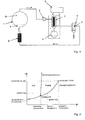
- a tank 1 for a spacecraft are in addition to the tank 1, a gas pump 2, a condensation stage consisting of a condenser 3 with a condensate tank 4 and an associated cryostat 5, a de-sublimator 6 with a reservoir of liquid nitrogen 7 and a heat exchanger 8 are provided.
- the illustration shows the tank originally filled with a liquid in the form of Mixed Oxides of Nitrogen, MON, after being drained to a residual quantity of 9 non-drainable liquid by draining the contents of the tank so that there is a gas-filled void above the liquid residue 9 10 has formed.
- a NO 2 partial pressure remains in the tank 1, which corresponds to the selected temperature T 1 according to the NO 2 vapor pressure curve. If the amount of the deposition of nitrogen dioxide, NO 2 , approaches zero or if the NO 2 concentration reaches a predetermined limit, the next step takes place.
- the temperature is lowered to a second target temperature T 2 ⁇ -164 ° C and ⁇ -93.2 ° C to remove the nitrogen Monoxide, NO, to condense.
- T 2 ⁇ -164 ° C and ⁇ -93.2 ° C The liquid state range applicable to the NO again results from the in Fig. 2 illustrated typical vapor pressure curve in conjunction with the above table values.
- a determination of remaining in the tank 1 residual concentrations of nitrogen monoxide, NO made. If the gas phase circulating continuously in the arrangement, which consists predominantly of the inert gas with a residual content of NO, has reached a constant concentration end value for the NO corresponding to the condensation temperature, the tank 1 can be decontaminated. This can be done in two different ways.
- the circulation is stopped and it is decanted for the purpose of decontamination by means of a vacuum pump, the remaining NO / inert gas mixture to the attainable pump pressure. Subsequently, by flooding with inert gas and, if necessary, by controlled rinsing the required for the maintenance of the MAK value residual concentration of NO produced.
- the remaining NO is de-sublimated by means of the liquid nitrogen cold stage 6, 7 at a third target temperature T 3 corresponding to 78 K or -195 ° C, and thus the lowest possible residual concentration is reached Balance produced. Subsequently, the system is recirculated under the control of the residual concentrations of nitrogen monoxide, NO, until the residual concentration required to maintain the MAK value is reached.
Landscapes
- Engineering & Computer Science (AREA)
- Remote Sensing (AREA)
- Aviation & Aerospace Engineering (AREA)
- Chemical & Material Sciences (AREA)
- Combustion & Propulsion (AREA)
- Physics & Mathematics (AREA)
- Astronomy & Astrophysics (AREA)
- General Physics & Mathematics (AREA)
- Filling Or Discharging Of Gas Storage Vessels (AREA)
Abstract
Description
- Die Erfindung betrifft ein Verfahren zur restlosen Entleerung von mit Oxidator-Mischungen vom Typ MON (Mixed Oxides of Nitrogen) befüllten Flüssigkeitstanks für Raumfahrzeuge.
- Im Falle eines Startabbruchs oder einer Startverschiebung über eine maximal zulässige Zeitdauer hinaus müssen bereits befüllte Tanksysteme von Raketenstufen oder Satelliten wieder restlos entleert werden. Für diese Flüssig-Enttankung. Trocknung und eine sich anschließende Dekontamination von evakuierbaren Tanks werden in der Regel sogenannte Vakuum-Drying-Units eingesetzt. Nach einem grobem Ablassen der Treibstoff- bzw. Oxidator-Flüssigkeit wird bei diesen mit Hilfe von Vakuumpumpen ein Unterdruck in den Tanks erzeugt, um ein schnelles Verdampfen und effektives Abpumpen verbliebener Restmengen zu erreichen. Der Unterdruck muß hinreichend niedrig sein, um den Siededruck der Flüssigkeit zu erreichen, d.h., der absolute Druck muss bei der gegebenen Tank- und Flüssigkeitstemperatur unterhalb des Gleichgewichts-Drucks gemäß der Siedekurve, dem sogenannten Druck-Temperatur (p-T)-Diagramm, liegen. Nicht-evakuierbare Tanks werden durch einen Spülprozeß, auch als Ventilations-Prozeß bezeichnet, getrocknet und dekontaminiert.
- Diese bekannten Enttankungsverfahren sind für die meisten Flüssig-Treibstoffe, wie Hydrazin und Hydrazin-Derivate, geeignet, ebenso wie für den Oxidator NTO (N2O4). Für Oxidator-Mischungen vom Typ MON, die sogenannten Mixed Oxides of Nitrogen, ist jedoch weder der Abpump-Prozeß noch der Ventilations-Prozeß geeignet. Die Mixed Oxides of Nitrogen vom Typ MON-X entstehen durch die Lösung (Mischung) gasförmigen Stickstoff-Monoxids, NO, mit einem Masseanteil von X % in flüssigem N2O4. Sie zeichnen sich durch ihren variierenden NO-Anteil (X in Masse-Prozenten) aus, der zugleich einen wirksamen Schutz gegenüber Spannungsrißkorrosion der aus Titan bzw. dessen Legierungen bestehenden Tanks bietet. Das chemische Prinzip dieses Schutzes besteht darin, daß das Stickstoffdioxid, NO2, zu NO und atomarem Sauerstoff, O; dissoziiert, wobei eine Zugabe von NO das Gleichgewicht zum Stickstoffdioxid, NO2, verschiebt und in Folge dessen die Anteile atomaren Sauerstoffs reduziert werden.
- Beim Evakuieren der Flüssigkeit MON-X würde zunächst die niedriger siedende NO- Komponente, die einen wesentlich höheren Dampfdruck als N2O4 (NTO) aufweist, verdampfen und dadurch aus dem System entfernt. Damit würde jedoch der wichtige und unverzichtbare Schutz des Titan-Werkstoffs, aus dem der Tank besteht, gegen Spannungsrißkorrosion verloren gehen und der Tank müßte vor dem Start zur Vermeidung eines vorzeitigen Versagens infolge dieser Schadensart ausgetauscht werden.
- Aus der Veröffentlichung "Decontamination of MMH- and NTO/MON-propellant tanks", JOKELA K., KÄLSCH I., 4th International Spacecraft Propulsion Conference, 2-9 June, 2004, Cagliari, Sardinia, Italy ist bereits ein Verfahren zur Entleerung von mit Oxidator-Mischungen vom Typ MON befüllten Flüssigkeitstanks für Raumfahrzeuge bekannt. Hierbei ist es bekannt, daß der Tank zuerst bis auf eine Restmenge entleert und dann mit einem Inert-Gas gespült wird.
- Aufgabe der Erfindung ist es, ein Verfahren der eingangs genannten Art derart auszubilden, daß auch Titan-Tanks, die mit dem Oxidator MON-X betankt sind, ohne die Gefahr des Auftretens von Spannungsrißkorrosion wieder enttankt werden können.
- Die Erfindung löst diese Aufgabe durch ein Verfahren mit den Schritten gemäß dem Kennzeichen des Patentanspruchs 1.
- Die Enttankung und Dekontamination der Titan-Tanks, die mit dem Oxidator MON-X betankt wurden, erfolgt bei dem erfindungsgemäßen Verfahren nicht durch eine Evakuierung, sondern durch einen selektiven, primär auf das korrosiv wirkende N2O4 (NTO) bzw. auf das im Dampf monomere Stickstoffdioxid, NO2, gerichteten Abtrennprozeß. Dies geschieht gemäß der Erfindung durch eine in einer vorgegebenen Reihenfolge stattfindende, selektive Abtrennung der Dampfphasen, bei der zunächst das Stickstoffdioxid, NO2, durch Kondensation flüssig abgeschieden wird und daraufhin eine nur noch geringe Konzentration an NO2 im Restgas NO verbleibt. Nach Absenkung der Kondensationstemperatur erfolgt weiterhin das Abscheiden des NO wobei gleich zu Beginn die restlichen Mengen des NO2 abgeschieden werden. Dadurch bleibt die schützende gasförmige NO-Komponente bis zum Abschluß der Dekontamination in dem Kreislauf zirkulierend vorhanden. Da der Tank nach diesem Schritt trocken ist, kann er anschießend dekontaminiert werden.
- Der Abtrennprozeß bewirkt dabei temperaturgesteuert zunächst eine Flüssigkeits-Abscheidung durch die primäre Kondensation von NO2 und anschließend von NO. Nach einer weiteren Temperatursenkung erfolgt die Feststoff-Abscheidung oder De-Sublimation des NO. Um die Stufen-Belastung bei der De-Sublimation niedrig zu halten, finden die beiden Prozesse nicht seriell auf mehreren Kalt-Stufen, d.h. zeitlich gleichzeitig und in Flußrichtung hintereinander, sondern zeitlich gestaffelt nacheinander auf einer bzw. zwei Kalt-Stufen statt. Dieser Trennprozeß ist damit auf den primär abzuscheidenden Stoff selektiv einstellbar, indem zunächst die Kondensations-Temperatur so gewählt wird, dass nur der Dampf der höher siedenden Komponente Stickstoffdioxid, NO2, entlang ihrer Dampfdruckkurve zwischen dem Tripelpunkt und dem kritischen Punkt zu Flüssigkeit kondensiert wird und dadurch die Hauptmenge des NTO flüssig abgezogen werden kann. Nach der Trocknung des Tanks noch verbleibender Dampf, bestehend aus NO und geringen Mengen NO2, wird nun in einem zweiten Schritt bei abgesenkter Temperatur entlang der NO-Dampfdruckkurve kondensiert. Anschließend wird zwecks Dekontamination in einer Flüssigstickstoff-Stufe dann noch verbliebenes restliches NO de-sublimiert.
- Die Vorteile der Erfindung liegen somit darin, daß mit dem erfindungsgemäßen Prozeß Titan-Tanks durchgängig und das Tankmaterial ständig gegen Korrosion schützend von der korrosiv wirkenden Komponente NTO und nachfolgend zudem von der NO-Gasphase entsorgt und dekontaminiert werden können. Nach dem Unterschreiten der jeweiligen MAK-Werte können die Tanks anschließend in offenem Zustand gehandhabt werden.
- Nachfolgend soll das erfindungsgemäße Verfahren anhand eines in der Zeichnung dargestellten Ausführungsbeispiels näher erläutert werden. Es zeigen
- Fig. 1:
- eine schematische Darstellung einer Anordnung zur selektiven Enttankung eines Tanks für ein Raumfahrzeug und
- Fig. 2:
- eine typische Siedekurve in Form eines Druck-Temperatur-Diagramms
- Bei der in
Fig. 1 schematisch dargestellten Anordnung zur selektiven Enttankung eines Tanks 1 für ein Raumfahrzeug sind zusätzlich zum Tank 1 eine Gaspumpe 2, eine Kondensationsstufe, bestehend aus einem Kondensor 3 mit einem Kondensattank 4 und einem zugeordneten Kryostaten 5, ein De-Sublimator 6 mit einem Reservoir an flüssigem Stickstoff 7 und ein Wärmetauscher 8 vorgesehen. Die Darstellung zeigt den ursprünglich mit einer Flüssigkeit in Form von Mixed Oxides of Nitrogen, MON, befüllten Tank, nachdem er bis auf eine Restmenge 9 nicht drainierbarer Flüssigkeit entleert wurde, indem der Tankinhalt abgelassen wurde, so daß sich über dem Flüssigkeitsrest 9 ein gasgefüllter Leerraum 10 gebildet hat. - Gemäß dem hier beschriebenen Verfahren wird nunmehr durch Abblasen der Druck im Tank 1 auf den herrschenden Umgebungsdruck von einem bar abgesenkt und im weiteren Verlauf des Verfahrens durch die Zugabe eines Inertgases, im Fall des hier beschriebenen Ausführungsbeispiels Stickstoff, N2, konstant bei diesem Druck gehalten. Die Dampfphase 10 über der Restmenge 9 der Flüssigkeit wird mittels der Zirkulationspumpe 2, im Fall des hier beschriebenen Ausführungsbeispiels einer Membranpumpe, über die Kondensationsstufe 3 geleitet. Die Temperatur muß dabei möglichst niedrig sein und zur Kondensation des Stickstoffdioxides, NO2, in Form einer Flüssigabscheidung führen. Da sie jedoch noch nicht zur Fest-Abscheidung (De-Sublimation) führen soll, muß gemäß der nachfolgenden Tabelle, die sich aus
Fig. 2 ergibt und die Zustandstemperaturen angibt, die Zieltemperatur bei T1≥- 11,2 °C liegen.Stoff Tripelpunkt (°C) Kritischer Punkt (°C) NO (Stickstoff-Monoxid) -164 -93,2 NO2 / N2O4 (Stickstoff-Tetroxid) -11,2 158 - Nach dem Ende der Flüssigabscheidung verbleibt im Tank 1 ein NO2-Partialdruck, der gemäß der NO2-Dampfdruckkurve der gewählten Temperatur T1 entspricht. Läuft die Menge der zeitlichen Abscheidung von Stickstoffdioxid, NO2, gegen Null oder erreicht die NO2-Konzentration einen vorgegebenen Grenzwert, so erfolgt der nächste Schritt.
- In diesem Schritt wird nach dem Entfernen der Hauptmenge an NTO (Stickstoff-Tetroxid, N2 O4) in flüssiger Form die Temperatur auf eine zweite Zieltemperatur T2 ≥ -164°C und < -93,2 °C abgesenkt, um das Stickstoff-Monoxid, NO, zu kondensieren. Der für das NO zutreffende Flüssigkeits-Zustandsbereich ergibt sich wiederum aus der in
Fig. 2 dargestellten typischen Dampfdruckkurve in Verbindung mit den obigen Tabellenwerten. - Als nächste Maßnahme wird eine Bestimmung der im Tank 1 verbliebenen Restkonzentrationen an Stickstoff-Monoxid, NO, vorgenommen. Hat die in der Anordnung stetig zirkulierende Gasphase, die vorwiegend aus dem Inertgas mit einem Restgehalt an NO besteht, einen konstanten, der Kondensationtemperatur entsprechenden Konzentrationsendwert für das NO erreicht, so kann der Tank 1 dekontaminiert werden. Dies kann auf zwei verschiedene Weisen geschehen.
- Bei einem vakuum-kompatiblen Tank wird die Zirkulation beendet und es wird zwecks Dekontamination mittels einer Vakuumpumpe das verbleibende NO/Inertgas-Gemisch bis zum erreichbaren Pumpenenddruck evakuiert. Anschließend wird durch Fluten mit Inertgas und, falls erforderlich, durch kontrolliertes Spülen die für die Einhaltung des MAK-Wertes erforderliche Restkonzentration an NO hergestellt.
- Bei einem nicht vakuum-kompatiblen Tank wird das verbliebene NO mittels der Flüssigstickstoff-Kaltstufe 6, 7 bei einer dritten Zieltemperatur T3, die 78 K oder -195°C entspricht, de-sublimiert und es wird auf diese Weise die kleinstmögliche Restkonzentration bis zum Gleichgewicht hergestellt. Anschließend wird das System unterständiger Kontrolle der Restkonzentrationen an Stickstoff-Monoxid, NO, bis zum Erreichen der für die Einhaltung des MAK-Wertes erforderlichen Restkonzentration umgepumpt.
Claims (8)
- Verfahren zur Entleerung von mit Oxidator-Mischungen vom Typ MON (Mixed Oxides of Nitrogen) befüllten Flüssigkeitstanks für Raumfahrzeuge, gekennzeichnet durch die folgenden Schritte:- der Tank (1) wird bis auf eine Restmenge (9) an nicht drainierbarer Flüssigkeit entleert,- der Druck im Tank (1) wird auf den Umgebungsdruck abgesenkt und anschließend durch Zugabe von Inertgas bei diesem Druck konstant gehalten,- eine entstandene Dampfphase (10) über der Restmenge (9) der Flüssigkeit wird über eine Kondensationsstufe (3 - 5) geleitet, wobei zunächst eine erste Temperatur (T1) derart gewählt wird, daß sie zur Kondensation von Stickstoffdioxid (NO2), nicht jedoch zu dessen Fest-Abscheidung führt.- sobald die Menge der Abscheidung von Stickstoffdioxid (NO2) oder dessen Konzentration in der Dampfphase (10) einen vorgegebenen Minimalwert erreicht hat, wird die Temperatur auf eine zweite Temperatur (T2) abgesenkt, bei der in der Dampfphase (10) enthaltenes Stickstoff-Monoxid (NO) kondensiert wird,- sobald die Konzentration des Stickstoff-Monoxides (NO) in der Dampfphase (10) einen vorgegebenen Minimalwert erreicht hat, wird der Tank (1) dekontaminiert.
- Verfahren nach Anspruch 1 zur Entleerung eines vakuum-kompatiblen Tanks, dadurch gekennzeichnet, daß zur Dekontamination die Zirkulation über die Kondensationsstufe (3 - 5) beendet und das verbleibende NO/Inertgas-Gemisch bis auf einen erreichbaren minimalen Enddruck evakuiert wird und daß anschließend durch Spülen mit einem Inertgas eine vorgebbare Restkonzentration an Stickstoff-Monoxid (NO) eingestellt wird.
- Verfahren nach Anspruch 2, dadurch gekennzeichnet, daß die Evakuierung mittels einer Vakuumpumpe erfolgt.
- Verfahren nach Anspruch 2 oder 3, dadurch gekennzeichnet, daß der Tank (1) kontinuierlich mit dem Inertgas gespült wird.
- Verfahren nach Anspruch 1 zur Entleerung eines nicht vakuum-kompatiblen Tanks, dadurch gekennzeichnet, daß zur Dekontamination das verbliebene Stickstoff-Monoxid (NO) auf eine dritte Temperatur (T3) abgekühlt und bei dieser Temperatur de-sublimiert wird und daß das verbleibende NO/Inertgas-Gemisch unter Kontrolle der Konzentration an Stickstoff-Monoxid (NO) bis zum Erreichen einer vorgebbare Restkonzentration umgewälzt wird.
- Verfahren nach einem der Ansprüche 1 bis 5, dadurch gekennzeichnet, daß die erste Temperatur (T1) wenigstens -11,2 °C beträgt.
- Verfahren nach einem der Ansprüche 1 bis 6, dadurch gekennzeichnet, daß die zweite Temperatur (T2) wenigstens -164 °C aber höchstens -93,2 °C beträgt.
- Verfahren nach einem der Ansprüche 1 bis 7, dadurch gekennzeichnet, dass die dritte Temperatur (T3) - 195°C (78 K) beträgt.
Applications Claiming Priority (1)
| Application Number | Priority Date | Filing Date | Title |
|---|---|---|---|
| DE102007016716A DE102007016716B3 (de) | 2007-04-07 | 2007-04-07 | Verfahren zur Enttankung von Raumfahrzeugen |
Publications (3)
| Publication Number | Publication Date |
|---|---|
| EP1977971A2 true EP1977971A2 (de) | 2008-10-08 |
| EP1977971A3 EP1977971A3 (de) | 2016-03-09 |
| EP1977971B1 EP1977971B1 (de) | 2017-02-01 |
Family
ID=39277944
Family Applications (1)
| Application Number | Title | Priority Date | Filing Date |
|---|---|---|---|
| EP07025058.4A Active EP1977971B1 (de) | 2007-04-07 | 2007-12-22 | Verfahren zur Enttankung von Raumfahrzeugen |
Country Status (2)
| Country | Link |
|---|---|
| EP (1) | EP1977971B1 (de) |
| DE (1) | DE102007016716B3 (de) |
Cited By (1)
| Publication number | Priority date | Publication date | Assignee | Title |
|---|---|---|---|---|
| CN119460186A (zh) * | 2024-11-15 | 2025-02-18 | 西安交通大学 | 一种低温推进剂多途径过冷加注系统及方法 |
Family Cites Families (3)
| Publication number | Priority date | Publication date | Assignee | Title |
|---|---|---|---|---|
| US5562130A (en) * | 1995-03-16 | 1996-10-08 | Olin Corporation | Hazardous chemical transfer module |
| AU6765398A (en) * | 1997-03-24 | 1998-10-20 | Science Applications International Corporation | Radiation shielding materials and containers incorporating same |
| US20040126286A1 (en) * | 2002-06-19 | 2004-07-01 | Deruyter John C. | Method and apparatus for reducing a nitrogen oxide |
-
2007
- 2007-04-07 DE DE102007016716A patent/DE102007016716B3/de not_active Expired - Fee Related
- 2007-12-22 EP EP07025058.4A patent/EP1977971B1/de active Active
Non-Patent Citations (1)
| Title |
|---|
| JOKELA K.; KÄLSCH I.: "Decontamination of MMH- and NTO/MON-propellant tanks", INTERNATIONAL SPACECRAFT PROPULSION CONFERENCE, 2 June 2004 (2004-06-02) |
Cited By (1)
| Publication number | Priority date | Publication date | Assignee | Title |
|---|---|---|---|---|
| CN119460186A (zh) * | 2024-11-15 | 2025-02-18 | 西安交通大学 | 一种低温推进剂多途径过冷加注系统及方法 |
Also Published As
| Publication number | Publication date |
|---|---|
| DE102007016716B3 (de) | 2008-05-15 |
| EP1977971B1 (de) | 2017-02-01 |
| EP1977971A3 (de) | 2016-03-09 |
Similar Documents
| Publication | Publication Date | Title |
|---|---|---|
| DE2316831C3 (de) | Verfahren und Anlage zur Behandlung von Abgasen, die radioaktive Verunreinigungen, insbesondere Krypton- und Xenonnuklide, enthalten | |
| DE3316705A1 (de) | Extraktion von pflanzenstoffen unter verwendung von kohlendioxid | |
| WO2013079149A1 (de) | Verfahren zum vorbereiten des wiederstarts einer brennstoffzelle | |
| EP0595004A1 (de) | Verfahren zur Sterilisierung und Rückgewinnung eines Sterilisiergases | |
| EP0532851A2 (de) | Verdampfungswärmetauscher | |
| EP1977971B1 (de) | Verfahren zur Enttankung von Raumfahrzeugen | |
| WO1995006762A2 (de) | Dampfphasenreinigung | |
| EP0167914A1 (de) | Anlage zur Metallpulver-Herstellung durch Edelgas- oder Stickstoffverdüsung | |
| DE69823952T2 (de) | Verfahren zum Plattieren | |
| DE2104356A1 (de) | Thermische Entgasung des Primärkühlmittels von Kernreaktoren | |
| WO2008052777A1 (de) | Verfahren zum abkühlen supraleitender magnete | |
| DE102013103192A1 (de) | Verfahren sowie Füllsystem zum Füllen von Behältern | |
| DE2020871B2 (de) | Verfahren und Vorrichtung zur Vakuumentgasung von Flüssigkeiten | |
| EP1885894B1 (de) | Verfahren zur chargenweisen wärmebehandlung von glühgut | |
| EP4406881B1 (de) | Verfahren zur verfüllung von kavernen | |
| DE4408784A1 (de) | Behandlung von Materialien mit verflüssigten oder überkritischen Gasen | |
| DE102024132043A1 (de) | Verfahren zum Entladen eines LCO2-Emittentenspeichertanks in einen LCO2- Speichertank an Bord eines Schiffes sowie betreffendes System und Schiff | |
| DE2454821A1 (de) | Verdunstungskuehlvorrichtung fuer einen plattenkuehler | |
| DE2616369A1 (de) | Verfahren zum trocknen feuchtigkeitshaltiger koerper | |
| DE659554C (de) | Verfahren zur Herstellung von Elektronenroehren | |
| WO2010006830A1 (de) | Verfahren und vorrichtung zur herstellung von vakuumschaltröhren oder baugruppen von vakuumschaltröhren und vakuumschaltröhre | |
| DE102023200399A1 (de) | Verfahren und vorrichtung zur gasversorgung bei strahlbasierter materialbearbeitung | |
| DE2135769C3 (de) | Verfahren zum raschen Herstellen von ungesättigtem Dampf, der reich an einem mit Wasser mischbaren, aber weniger flüchtigen Stoff als Wasser ist | |
| DE2536874A1 (de) | Verfahren und vorrichtung zur dekontamination von spaltgashaltigem abgas | |
| DE1519567A1 (de) | Verfahren und Vorrichtung zur physikalischen Trennung zweier Stoffe |
Legal Events
| Date | Code | Title | Description |
|---|---|---|---|
| PUAI | Public reference made under article 153(3) epc to a published international application that has entered the european phase |
Free format text: ORIGINAL CODE: 0009012 |
|
| AK | Designated contracting states |
Kind code of ref document: A2 Designated state(s): AT BE BG CH CY CZ DE DK EE ES FI FR GB GR HU IE IS IT LI LT LU LV MC MT NL PL PT RO SE SI SK TR |
|
| AX | Request for extension of the european patent |
Extension state: AL BA HR MK RS |
|
| PUAL | Search report despatched |
Free format text: ORIGINAL CODE: 0009013 |
|
| AK | Designated contracting states |
Kind code of ref document: A3 Designated state(s): AT BE BG CH CY CZ DE DK EE ES FI FR GB GR HU IE IS IT LI LT LU LV MC MT NL PL PT RO SE SI SK TR |
|
| AX | Request for extension of the european patent |
Extension state: AL BA HR MK RS |
|
| RIC1 | Information provided on ipc code assigned before grant |
Ipc: B64G 1/40 20060101AFI20160201BHEP Ipc: B64G 5/00 20060101ALI20160201BHEP |
|
| 17P | Request for examination filed |
Effective date: 20160713 |
|
| GRAP | Despatch of communication of intention to grant a patent |
Free format text: ORIGINAL CODE: EPIDOSNIGR1 |
|
| RIC1 | Information provided on ipc code assigned before grant |
Ipc: B64G 1/40 20060101AFI20160824BHEP Ipc: B64G 5/00 20060101ALI20160824BHEP |
|
| INTG | Intention to grant announced |
Effective date: 20160907 |
|
| AKX | Designation fees paid |
Designated state(s): AT BE BG CH CY CZ DE DK EE ES FI FR GB GR HU IE IS IT LI LT LU LV MC MT NL PL PT RO SE SI SK TR |
|
| AXX | Extension fees paid |
Extension state: HR Extension state: MK Extension state: BA Extension state: AL Extension state: RS |
|
| GRAS | Grant fee paid |
Free format text: ORIGINAL CODE: EPIDOSNIGR3 |
|
| STAA | Information on the status of an ep patent application or granted ep patent |
Free format text: STATUS: GRANT OF PATENT IS INTENDED |
|
| GRAA | (expected) grant |
Free format text: ORIGINAL CODE: 0009210 |
|
| STAA | Information on the status of an ep patent application or granted ep patent |
Free format text: STATUS: THE PATENT HAS BEEN GRANTED |
|
| AK | Designated contracting states |
Kind code of ref document: B1 Designated state(s): AT BE BG CH CY CZ DE DK EE ES FI FR GB GR HU IE IS IT LI LT LU LV MC MT NL PL PT RO SE SI SK TR |
|
| REG | Reference to a national code |
Ref country code: GB Ref legal event code: FG4D Free format text: NOT ENGLISH |
|
| REG | Reference to a national code |
Ref country code: CH Ref legal event code: EP Ref country code: AT Ref legal event code: REF Ref document number: 865327 Country of ref document: AT Kind code of ref document: T Effective date: 20170215 |
|
| REG | Reference to a national code |
Ref country code: IE Ref legal event code: FG4D Free format text: LANGUAGE OF EP DOCUMENT: GERMAN |
|
| REG | Reference to a national code |
Ref country code: DE Ref legal event code: R096 Ref document number: 502007015420 Country of ref document: DE |
|
| REG | Reference to a national code |
Ref country code: NL Ref legal event code: MP Effective date: 20170201 |
|
| REG | Reference to a national code |
Ref country code: LT Ref legal event code: MG4D |
|
| PG25 | Lapsed in a contracting state [announced via postgrant information from national office to epo] |
Ref country code: GR Free format text: LAPSE BECAUSE OF FAILURE TO SUBMIT A TRANSLATION OF THE DESCRIPTION OR TO PAY THE FEE WITHIN THE PRESCRIBED TIME-LIMIT Effective date: 20170502 Ref country code: IS Free format text: LAPSE BECAUSE OF FAILURE TO SUBMIT A TRANSLATION OF THE DESCRIPTION OR TO PAY THE FEE WITHIN THE PRESCRIBED TIME-LIMIT Effective date: 20170601 Ref country code: FI Free format text: LAPSE BECAUSE OF FAILURE TO SUBMIT A TRANSLATION OF THE DESCRIPTION OR TO PAY THE FEE WITHIN THE PRESCRIBED TIME-LIMIT Effective date: 20170201 Ref country code: LT Free format text: LAPSE BECAUSE OF FAILURE TO SUBMIT A TRANSLATION OF THE DESCRIPTION OR TO PAY THE FEE WITHIN THE PRESCRIBED TIME-LIMIT Effective date: 20170201 |
|
| PG25 | Lapsed in a contracting state [announced via postgrant information from national office to epo] |
Ref country code: LV Free format text: LAPSE BECAUSE OF FAILURE TO SUBMIT A TRANSLATION OF THE DESCRIPTION OR TO PAY THE FEE WITHIN THE PRESCRIBED TIME-LIMIT Effective date: 20170201 Ref country code: PL Free format text: LAPSE BECAUSE OF FAILURE TO SUBMIT A TRANSLATION OF THE DESCRIPTION OR TO PAY THE FEE WITHIN THE PRESCRIBED TIME-LIMIT Effective date: 20170201 Ref country code: SE Free format text: LAPSE BECAUSE OF FAILURE TO SUBMIT A TRANSLATION OF THE DESCRIPTION OR TO PAY THE FEE WITHIN THE PRESCRIBED TIME-LIMIT Effective date: 20170201 Ref country code: NL Free format text: LAPSE BECAUSE OF FAILURE TO SUBMIT A TRANSLATION OF THE DESCRIPTION OR TO PAY THE FEE WITHIN THE PRESCRIBED TIME-LIMIT Effective date: 20170201 Ref country code: BG Free format text: LAPSE BECAUSE OF FAILURE TO SUBMIT A TRANSLATION OF THE DESCRIPTION OR TO PAY THE FEE WITHIN THE PRESCRIBED TIME-LIMIT Effective date: 20170501 Ref country code: ES Free format text: LAPSE BECAUSE OF FAILURE TO SUBMIT A TRANSLATION OF THE DESCRIPTION OR TO PAY THE FEE WITHIN THE PRESCRIBED TIME-LIMIT Effective date: 20170201 Ref country code: PT Free format text: LAPSE BECAUSE OF FAILURE TO SUBMIT A TRANSLATION OF THE DESCRIPTION OR TO PAY THE FEE WITHIN THE PRESCRIBED TIME-LIMIT Effective date: 20170601 |
|
| PG25 | Lapsed in a contracting state [announced via postgrant information from national office to epo] |
Ref country code: EE Free format text: LAPSE BECAUSE OF FAILURE TO SUBMIT A TRANSLATION OF THE DESCRIPTION OR TO PAY THE FEE WITHIN THE PRESCRIBED TIME-LIMIT Effective date: 20170201 Ref country code: CZ Free format text: LAPSE BECAUSE OF FAILURE TO SUBMIT A TRANSLATION OF THE DESCRIPTION OR TO PAY THE FEE WITHIN THE PRESCRIBED TIME-LIMIT Effective date: 20170201 Ref country code: SK Free format text: LAPSE BECAUSE OF FAILURE TO SUBMIT A TRANSLATION OF THE DESCRIPTION OR TO PAY THE FEE WITHIN THE PRESCRIBED TIME-LIMIT Effective date: 20170201 Ref country code: RO Free format text: LAPSE BECAUSE OF FAILURE TO SUBMIT A TRANSLATION OF THE DESCRIPTION OR TO PAY THE FEE WITHIN THE PRESCRIBED TIME-LIMIT Effective date: 20170201 |
|
| REG | Reference to a national code |
Ref country code: DE Ref legal event code: R097 Ref document number: 502007015420 Country of ref document: DE |
|
| PG25 | Lapsed in a contracting state [announced via postgrant information from national office to epo] |
Ref country code: DK Free format text: LAPSE BECAUSE OF FAILURE TO SUBMIT A TRANSLATION OF THE DESCRIPTION OR TO PAY THE FEE WITHIN THE PRESCRIBED TIME-LIMIT Effective date: 20170201 |
|
| PLBE | No opposition filed within time limit |
Free format text: ORIGINAL CODE: 0009261 |
|
| STAA | Information on the status of an ep patent application or granted ep patent |
Free format text: STATUS: NO OPPOSITION FILED WITHIN TIME LIMIT |
|
| REG | Reference to a national code |
Ref country code: FR Ref legal event code: PLFP Year of fee payment: 11 |
|
| 26N | No opposition filed |
Effective date: 20171103 |
|
| REG | Reference to a national code |
Ref country code: DE Ref legal event code: R082 Ref document number: 502007015420 Country of ref document: DE Representative=s name: ELBPATENT-MARSCHALL & PARTNER MBB, DE Ref country code: DE Ref legal event code: R081 Ref document number: 502007015420 Country of ref document: DE Owner name: ARIANEGROUP GMBH, DE Free format text: FORMER OWNER: ASTRIUM GMBH, 85521 OTTOBRUNN, DE |
|
| PG25 | Lapsed in a contracting state [announced via postgrant information from national office to epo] |
Ref country code: SI Free format text: LAPSE BECAUSE OF FAILURE TO SUBMIT A TRANSLATION OF THE DESCRIPTION OR TO PAY THE FEE WITHIN THE PRESCRIBED TIME-LIMIT Effective date: 20170201 |
|
| REG | Reference to a national code |
Ref country code: CH Ref legal event code: PL |
|
| REG | Reference to a national code |
Ref country code: IE Ref legal event code: MM4A |
|
| PG25 | Lapsed in a contracting state [announced via postgrant information from national office to epo] |
Ref country code: MT Free format text: LAPSE BECAUSE OF FAILURE TO SUBMIT A TRANSLATION OF THE DESCRIPTION OR TO PAY THE FEE WITHIN THE PRESCRIBED TIME-LIMIT Effective date: 20170201 Ref country code: LU Free format text: LAPSE BECAUSE OF NON-PAYMENT OF DUE FEES Effective date: 20171222 |
|
| REG | Reference to a national code |
Ref country code: BE Ref legal event code: MM Effective date: 20171231 |
|
| PG25 | Lapsed in a contracting state [announced via postgrant information from national office to epo] |
Ref country code: IE Free format text: LAPSE BECAUSE OF NON-PAYMENT OF DUE FEES Effective date: 20171222 |
|
| PG25 | Lapsed in a contracting state [announced via postgrant information from national office to epo] |
Ref country code: LI Free format text: LAPSE BECAUSE OF NON-PAYMENT OF DUE FEES Effective date: 20171231 Ref country code: CH Free format text: LAPSE BECAUSE OF NON-PAYMENT OF DUE FEES Effective date: 20171231 Ref country code: BE Free format text: LAPSE BECAUSE OF NON-PAYMENT OF DUE FEES Effective date: 20171231 |
|
| REG | Reference to a national code |
Ref country code: AT Ref legal event code: MM01 Ref document number: 865327 Country of ref document: AT Kind code of ref document: T Effective date: 20171222 |
|
| PG25 | Lapsed in a contracting state [announced via postgrant information from national office to epo] |
Ref country code: AT Free format text: LAPSE BECAUSE OF NON-PAYMENT OF DUE FEES Effective date: 20171222 |
|
| PG25 | Lapsed in a contracting state [announced via postgrant information from national office to epo] |
Ref country code: HU Free format text: LAPSE BECAUSE OF FAILURE TO SUBMIT A TRANSLATION OF THE DESCRIPTION OR TO PAY THE FEE WITHIN THE PRESCRIBED TIME-LIMIT; INVALID AB INITIO Effective date: 20071222 Ref country code: MC Free format text: LAPSE BECAUSE OF FAILURE TO SUBMIT A TRANSLATION OF THE DESCRIPTION OR TO PAY THE FEE WITHIN THE PRESCRIBED TIME-LIMIT Effective date: 20170201 |
|
| PG25 | Lapsed in a contracting state [announced via postgrant information from national office to epo] |
Ref country code: CY Free format text: LAPSE BECAUSE OF NON-PAYMENT OF DUE FEES Effective date: 20170201 |
|
| PG25 | Lapsed in a contracting state [announced via postgrant information from national office to epo] |
Ref country code: TR Free format text: LAPSE BECAUSE OF FAILURE TO SUBMIT A TRANSLATION OF THE DESCRIPTION OR TO PAY THE FEE WITHIN THE PRESCRIBED TIME-LIMIT Effective date: 20170201 |
|
| P01 | Opt-out of the competence of the unified patent court (upc) registered |
Effective date: 20230612 |
|
| PGFP | Annual fee paid to national office [announced via postgrant information from national office to epo] |
Ref country code: DE Payment date: 20251211 Year of fee payment: 19 |
|
| PGFP | Annual fee paid to national office [announced via postgrant information from national office to epo] |
Ref country code: GB Payment date: 20251219 Year of fee payment: 19 |
|
| PGFP | Annual fee paid to national office [announced via postgrant information from national office to epo] |
Ref country code: IT Payment date: 20251223 Year of fee payment: 19 |
|
| PGFP | Annual fee paid to national office [announced via postgrant information from national office to epo] |
Ref country code: FR Payment date: 20251222 Year of fee payment: 19 |