EP1975160A1 - Polymerizable compound, polymer, ink composition, printed articles and inkjet recording method - Google Patents
Polymerizable compound, polymer, ink composition, printed articles and inkjet recording method Download PDFInfo
- Publication number
- EP1975160A1 EP1975160A1 EP20080005793 EP08005793A EP1975160A1 EP 1975160 A1 EP1975160 A1 EP 1975160A1 EP 20080005793 EP20080005793 EP 20080005793 EP 08005793 A EP08005793 A EP 08005793A EP 1975160 A1 EP1975160 A1 EP 1975160A1
- Authority
- EP
- European Patent Office
- Prior art keywords
- group
- meth
- ink composition
- pigment
- acrylate
- Prior art date
- Legal status (The legal status is an assumption and is not a legal conclusion. Google has not performed a legal analysis and makes no representation as to the accuracy of the status listed.)
- Granted
Links
- 150000001875 compounds Chemical class 0.000 title claims abstract description 152
- 239000000203 mixture Substances 0.000 title claims description 143
- 229920000642 polymer Polymers 0.000 title claims description 78
- 238000000034 method Methods 0.000 title claims description 22
- 125000000217 alkyl group Chemical group 0.000 claims abstract description 25
- 125000001424 substituent group Chemical group 0.000 claims abstract description 24
- 125000004435 hydrogen atom Chemical group [H]* 0.000 claims abstract description 12
- 125000002947 alkylene group Chemical group 0.000 claims abstract description 11
- 125000000843 phenylene group Chemical group C1(=C(C=CC=C1)*)* 0.000 claims abstract description 4
- 125000000547 substituted alkyl group Chemical group 0.000 claims abstract description 4
- 239000000049 pigment Substances 0.000 claims description 285
- 239000000178 monomer Substances 0.000 claims description 79
- 229920000578 graft copolymer Polymers 0.000 claims description 53
- 229920001577 copolymer Polymers 0.000 claims description 52
- 239000003505 polymerization initiator Substances 0.000 claims description 22
- 230000005855 radiation Effects 0.000 claims description 19
- 239000002253 acid Substances 0.000 claims description 7
- 230000001678 irradiating effect Effects 0.000 claims description 4
- 125000002091 cationic group Chemical group 0.000 claims description 2
- -1 poly(ethyleneimine) Polymers 0.000 description 240
- 239000000976 ink Substances 0.000 description 173
- NIXOWILDQLNWCW-UHFFFAOYSA-M Acrylate Chemical compound [O-]C(=O)C=C NIXOWILDQLNWCW-UHFFFAOYSA-M 0.000 description 154
- 125000004432 carbon atom Chemical group C* 0.000 description 45
- RTZKZFJDLAIYFH-UHFFFAOYSA-N ether Substances CCOCC RTZKZFJDLAIYFH-UHFFFAOYSA-N 0.000 description 44
- 239000002270 dispersing agent Substances 0.000 description 35
- 230000000052 comparative effect Effects 0.000 description 33
- HRPVXLWXLXDGHG-UHFFFAOYSA-N Acrylamide Chemical compound NC(=O)C=C HRPVXLWXLXDGHG-UHFFFAOYSA-N 0.000 description 29
- 229920003229 poly(methyl methacrylate) Polymers 0.000 description 27
- 239000004926 polymethyl methacrylate Substances 0.000 description 26
- 150000001252 acrylic acid derivatives Chemical class 0.000 description 22
- 239000002245 particle Substances 0.000 description 22
- 239000002609 medium Substances 0.000 description 21
- 125000003118 aryl group Chemical group 0.000 description 20
- 239000002585 base Substances 0.000 description 19
- 239000000975 dye Substances 0.000 description 17
- 239000003999 initiator Substances 0.000 description 17
- 239000002202 Polyethylene glycol Substances 0.000 description 16
- 229920001223 polyethylene glycol Polymers 0.000 description 16
- FNYWFRSQRHGKJT-UHFFFAOYSA-N 3-ethyl-3-[(3-ethyloxetan-3-yl)methoxymethyl]oxetane Chemical compound C1OCC1(CC)COCC1(CC)COC1 FNYWFRSQRHGKJT-UHFFFAOYSA-N 0.000 description 15
- QYKIQEUNHZKYBP-UHFFFAOYSA-N Vinyl ether Chemical class C=COC=C QYKIQEUNHZKYBP-UHFFFAOYSA-N 0.000 description 15
- 238000001723 curing Methods 0.000 description 14
- TXBCBTDQIULDIA-UHFFFAOYSA-N 2-[[3-hydroxy-2,2-bis(hydroxymethyl)propoxy]methyl]-2-(hydroxymethyl)propane-1,3-diol Chemical compound OCC(CO)(CO)COCC(CO)(CO)CO TXBCBTDQIULDIA-UHFFFAOYSA-N 0.000 description 13
- 239000006185 dispersion Substances 0.000 description 13
- 238000007639 printing Methods 0.000 description 13
- 125000001997 phenyl group Chemical group [H]C1=C([H])C([H])=C(*)C([H])=C1[H] 0.000 description 12
- 239000011347 resin Substances 0.000 description 12
- 229920005989 resin Polymers 0.000 description 12
- 230000015572 biosynthetic process Effects 0.000 description 10
- 150000003254 radicals Chemical class 0.000 description 10
- 238000003786 synthesis reaction Methods 0.000 description 10
- 239000004793 Polystyrene Substances 0.000 description 9
- 238000005227 gel permeation chromatography Methods 0.000 description 9
- 229920001451 polypropylene glycol Polymers 0.000 description 9
- 229920002223 polystyrene Polymers 0.000 description 9
- 239000004593 Epoxy Substances 0.000 description 8
- WOBHKFSMXKNTIM-UHFFFAOYSA-N Hydroxyethyl methacrylate Chemical compound CC(=C)C(=O)OCCO WOBHKFSMXKNTIM-UHFFFAOYSA-N 0.000 description 8
- 0 O=[*+]N(C(c1cccc2c1c1ccc2)=O)C1=O Chemical compound O=[*+]N(C(c1cccc2c1c1ccc2)=O)C1=O 0.000 description 8
- NRCMAYZCPIVABH-UHFFFAOYSA-N Quinacridone Chemical compound N1C2=CC=CC=C2C(=O)C2=C1C=C1C(=O)C3=CC=CC=C3NC1=C2 NRCMAYZCPIVABH-UHFFFAOYSA-N 0.000 description 8
- PPBRXRYQALVLMV-UHFFFAOYSA-N Styrene Chemical compound C=CC1=CC=CC=C1 PPBRXRYQALVLMV-UHFFFAOYSA-N 0.000 description 8
- 238000004040 coloring Methods 0.000 description 8
- 125000001495 ethyl group Chemical group [H]C([H])([H])C([H])([H])* 0.000 description 8
- 229910052757 nitrogen Inorganic materials 0.000 description 8
- IEQIEDJGQAUEQZ-UHFFFAOYSA-N phthalocyanine Chemical compound N1C(N=C2C3=CC=CC=C3C(N=C3C4=CC=CC=C4C(=N4)N3)=N2)=C(C=CC=C2)C2=C1N=C1C2=CC=CC=C2C4=N1 IEQIEDJGQAUEQZ-UHFFFAOYSA-N 0.000 description 8
- 239000002244 precipitate Substances 0.000 description 8
- 238000003756 stirring Methods 0.000 description 8
- 239000000126 substance Substances 0.000 description 8
- 229960000834 vinyl ether Drugs 0.000 description 8
- IISBACLAFKSPIT-UHFFFAOYSA-N Bisphenol A Natural products C=1C=C(O)C=CC=1C(C)(C)C1=CC=C(O)C=C1 IISBACLAFKSPIT-UHFFFAOYSA-N 0.000 description 7
- LYCAIKOWRPUZTN-UHFFFAOYSA-N Ethylene glycol Chemical compound OCCO LYCAIKOWRPUZTN-UHFFFAOYSA-N 0.000 description 7
- GWEVSGVZZGPLCZ-UHFFFAOYSA-N Titan oxide Chemical compound O=[Ti]=O GWEVSGVZZGPLCZ-UHFFFAOYSA-N 0.000 description 7
- 150000004056 anthraquinones Chemical class 0.000 description 7
- 150000008365 aromatic ketones Chemical class 0.000 description 7
- XCJYREBRNVKWGJ-UHFFFAOYSA-N copper(II) phthalocyanine Chemical compound [Cu+2].C12=CC=CC=C2C(N=C2[N-]C(C3=CC=CC=C32)=N2)=NC1=NC([C]1C=CC=CC1=1)=NC=1N=C1[C]3C=CC=CC3=C2[N-]1 XCJYREBRNVKWGJ-UHFFFAOYSA-N 0.000 description 7
- 125000002496 methyl group Chemical group [H]C([H])([H])* 0.000 description 7
- 238000006116 polymerization reaction Methods 0.000 description 7
- 230000035945 sensitivity Effects 0.000 description 7
- 230000001235 sensitizing effect Effects 0.000 description 7
- ZWEHNKRNPOVVGH-UHFFFAOYSA-N 2-Butanone Chemical compound CCC(C)=O ZWEHNKRNPOVVGH-UHFFFAOYSA-N 0.000 description 6
- 125000004442 acylamino group Chemical group 0.000 description 6
- 125000003545 alkoxy group Chemical group 0.000 description 6
- 125000004397 aminosulfonyl group Chemical group NS(=O)(=O)* 0.000 description 6
- PYKYMHQGRFAEBM-UHFFFAOYSA-N anthraquinone Natural products CCC(=O)c1c(O)c2C(=O)C3C(C=CC=C3O)C(=O)c2cc1CC(=O)OC PYKYMHQGRFAEBM-UHFFFAOYSA-N 0.000 description 6
- 125000004104 aryloxy group Chemical group 0.000 description 6
- 125000003917 carbamoyl group Chemical group [H]N([H])C(*)=O 0.000 description 6
- 239000002612 dispersion medium Substances 0.000 description 6
- 239000000463 material Substances 0.000 description 6
- VLKZOEOYAKHREP-UHFFFAOYSA-N n-Hexane Chemical compound CCCCCC VLKZOEOYAKHREP-UHFFFAOYSA-N 0.000 description 6
- ADTJPOBHAXXXFS-UHFFFAOYSA-N n-[3-(dimethylamino)propyl]prop-2-enamide Chemical compound CN(C)CCCNC(=O)C=C ADTJPOBHAXXXFS-UHFFFAOYSA-N 0.000 description 6
- IJGRMHOSHXDMSA-UHFFFAOYSA-N nitrogen Substances N#N IJGRMHOSHXDMSA-UHFFFAOYSA-N 0.000 description 6
- 125000004805 propylene group Chemical group [H]C([H])([H])C([H])([*:1])C([H])([H])[*:2] 0.000 description 6
- 239000000243 solution Substances 0.000 description 6
- 229920002818 (Hydroxyethyl)methacrylate Polymers 0.000 description 5
- WMYINDVYGQKYMI-UHFFFAOYSA-N 2-[2,2-bis(hydroxymethyl)butoxymethyl]-2-ethylpropane-1,3-diol Chemical compound CCC(CO)(CO)COCC(CC)(CO)CO WMYINDVYGQKYMI-UHFFFAOYSA-N 0.000 description 5
- VGGSQFUCUMXWEO-UHFFFAOYSA-N Ethene Chemical compound C=C VGGSQFUCUMXWEO-UHFFFAOYSA-N 0.000 description 5
- 239000005977 Ethylene Substances 0.000 description 5
- RTAQQCXQSZGOHL-UHFFFAOYSA-N Titanium Chemical compound [Ti] RTAQQCXQSZGOHL-UHFFFAOYSA-N 0.000 description 5
- XLOMVQKBTHCTTD-UHFFFAOYSA-N Zinc monoxide Chemical compound [Zn]=O XLOMVQKBTHCTTD-UHFFFAOYSA-N 0.000 description 5
- 230000002378 acidificating effect Effects 0.000 description 5
- 150000003926 acrylamides Chemical class 0.000 description 5
- 239000000654 additive Substances 0.000 description 5
- 125000004453 alkoxycarbonyl group Chemical group 0.000 description 5
- 125000004414 alkyl thio group Chemical group 0.000 description 5
- 125000005110 aryl thio group Chemical group 0.000 description 5
- 125000001797 benzyl group Chemical group [H]C1=C([H])C([H])=C(C([H])=C1[H])C([H])([H])* 0.000 description 5
- 229910052799 carbon Inorganic materials 0.000 description 5
- 239000003086 colorant Substances 0.000 description 5
- 125000000664 diazo group Chemical group [N-]=[N+]=[*] 0.000 description 5
- 230000000694 effects Effects 0.000 description 5
- 238000001914 filtration Methods 0.000 description 5
- 230000006872 improvement Effects 0.000 description 5
- 239000007788 liquid Substances 0.000 description 5
- 239000012860 organic pigment Substances 0.000 description 5
- 150000002921 oxetanes Chemical class 0.000 description 5
- 125000003566 oxetanyl group Chemical group 0.000 description 5
- 125000002080 perylenyl group Chemical group C1(=CC=C2C=CC=C3C4=CC=CC5=CC=CC(C1=C23)=C45)* 0.000 description 5
- CSHWQDPOILHKBI-UHFFFAOYSA-N peryrene Natural products C1=CC(C2=CC=CC=3C2=C2C=CC=3)=C3C2=CC=CC3=C1 CSHWQDPOILHKBI-UHFFFAOYSA-N 0.000 description 5
- 125000001436 propyl group Chemical group [H]C([*])([H])C([H])([H])C([H])([H])[H] 0.000 description 5
- QQONPFPTGQHPMA-UHFFFAOYSA-N propylene Natural products CC=C QQONPFPTGQHPMA-UHFFFAOYSA-N 0.000 description 5
- 230000002829 reductive effect Effects 0.000 description 5
- 239000007787 solid Substances 0.000 description 5
- 239000002904 solvent Substances 0.000 description 5
- 229910052717 sulfur Inorganic materials 0.000 description 5
- 239000010936 titanium Substances 0.000 description 5
- 229910052719 titanium Inorganic materials 0.000 description 5
- DTGKSKDOIYIVQL-WEDXCCLWSA-N (+)-borneol Chemical group C1C[C@@]2(C)[C@@H](O)C[C@@H]1C2(C)C DTGKSKDOIYIVQL-WEDXCCLWSA-N 0.000 description 4
- 125000000954 2-hydroxyethyl group Chemical group [H]C([*])([H])C([H])([H])O[H] 0.000 description 4
- JFGQHAHJWJBOPD-UHFFFAOYSA-N 3-hydroxy-n-phenylnaphthalene-2-carboxamide Chemical compound OC1=CC2=CC=CC=C2C=C1C(=O)NC1=CC=CC=C1 JFGQHAHJWJBOPD-UHFFFAOYSA-N 0.000 description 4
- PXKLMJQFEQBVLD-UHFFFAOYSA-N Bisphenol F Natural products C1=CC(O)=CC=C1CC1=CC=C(O)C=C1 PXKLMJQFEQBVLD-UHFFFAOYSA-N 0.000 description 4
- KAKZBPTYRLMSJV-UHFFFAOYSA-N Butadiene Chemical compound C=CC=C KAKZBPTYRLMSJV-UHFFFAOYSA-N 0.000 description 4
- FBPFZTCFMRRESA-FSIIMWSLSA-N D-Glucitol Natural products OC[C@H](O)[C@H](O)[C@@H](O)[C@H](O)CO FBPFZTCFMRRESA-FSIIMWSLSA-N 0.000 description 4
- KFZMGEQAYNKOFK-UHFFFAOYSA-N Isopropanol Chemical compound CC(C)O KFZMGEQAYNKOFK-UHFFFAOYSA-N 0.000 description 4
- 229920003171 Poly (ethylene oxide) Polymers 0.000 description 4
- WYURNTSHIVDZCO-UHFFFAOYSA-N Tetrahydrofuran Chemical compound C1CCOC1 WYURNTSHIVDZCO-UHFFFAOYSA-N 0.000 description 4
- HEDRZPFGACZZDS-MICDWDOJSA-N Trichloro(2H)methane Chemical compound [2H]C(Cl)(Cl)Cl HEDRZPFGACZZDS-MICDWDOJSA-N 0.000 description 4
- ZJCCRDAZUWHFQH-UHFFFAOYSA-N Trimethylolpropane Chemical compound CCC(CO)(CO)CO ZJCCRDAZUWHFQH-UHFFFAOYSA-N 0.000 description 4
- WYGWHHGCAGTUCH-ISLYRVAYSA-N V-65 Substances CC(C)CC(C)(C#N)\N=N\C(C)(C#N)CC(C)C WYGWHHGCAGTUCH-ISLYRVAYSA-N 0.000 description 4
- MCMNRKCIXSYSNV-UHFFFAOYSA-N Zirconium dioxide Chemical compound O=[Zr]=O MCMNRKCIXSYSNV-UHFFFAOYSA-N 0.000 description 4
- 125000002252 acyl group Chemical group 0.000 description 4
- 125000001931 aliphatic group Chemical group 0.000 description 4
- 150000001346 alkyl aryl ethers Chemical class 0.000 description 4
- 125000004390 alkyl sulfonyl group Chemical group 0.000 description 4
- 125000004391 aryl sulfonyl group Chemical group 0.000 description 4
- 150000001721 carbon Chemical group 0.000 description 4
- 238000006243 chemical reaction Methods 0.000 description 4
- 238000009833 condensation Methods 0.000 description 4
- 230000005494 condensation Effects 0.000 description 4
- 230000008021 deposition Effects 0.000 description 4
- GYZLOYUZLJXAJU-UHFFFAOYSA-N diglycidyl ether Chemical compound C1OC1COCC1CO1 GYZLOYUZLJXAJU-UHFFFAOYSA-N 0.000 description 4
- FJKIXWOMBXYWOQ-UHFFFAOYSA-N ethenoxyethane Chemical compound CCOC=C FJKIXWOMBXYWOQ-UHFFFAOYSA-N 0.000 description 4
- 229910052736 halogen Inorganic materials 0.000 description 4
- 125000005843 halogen group Chemical group 0.000 description 4
- 238000010438 heat treatment Methods 0.000 description 4
- 125000004051 hexyl group Chemical group [H]C([H])([H])C([H])([H])C([H])([H])C([H])([H])C([H])([H])C([H])([H])* 0.000 description 4
- GWVMLCQWXVFZCN-UHFFFAOYSA-N isoindoline Chemical compound C1=CC=C2CNCC2=C1 GWVMLCQWXVFZCN-UHFFFAOYSA-N 0.000 description 4
- QJGQUHMNIGDVPM-UHFFFAOYSA-N nitrogen group Chemical group [N] QJGQUHMNIGDVPM-UHFFFAOYSA-N 0.000 description 4
- 125000003854 p-chlorophenyl group Chemical group [H]C1=C([H])C(*)=C([H])C([H])=C1Cl 0.000 description 4
- WXZMFSXDPGVJKK-UHFFFAOYSA-N pentaerythritol Chemical compound OCC(CO)(CO)CO WXZMFSXDPGVJKK-UHFFFAOYSA-N 0.000 description 4
- 229920001485 poly(butyl acrylate) polymer Polymers 0.000 description 4
- 239000011541 reaction mixture Substances 0.000 description 4
- 150000003839 salts Chemical class 0.000 description 4
- 239000000600 sorbitol Substances 0.000 description 4
- 238000003860 storage Methods 0.000 description 4
- 125000004434 sulfur atom Chemical group 0.000 description 4
- OGIDPMRJRNCKJF-UHFFFAOYSA-N titanium oxide Inorganic materials [Ti]=O OGIDPMRJRNCKJF-UHFFFAOYSA-N 0.000 description 4
- 229920002554 vinyl polymer Polymers 0.000 description 4
- XDWRKTULOHXYGN-UHFFFAOYSA-N 1,3-bis(ethenoxy)-2,2-bis(ethenoxymethyl)propane Chemical compound C=COCC(COC=C)(COC=C)COC=C XDWRKTULOHXYGN-UHFFFAOYSA-N 0.000 description 3
- CZAVRNDQSIORTH-UHFFFAOYSA-N 1-ethenoxy-2,2-bis(ethenoxymethyl)butane Chemical compound C=COCC(CC)(COC=C)COC=C CZAVRNDQSIORTH-UHFFFAOYSA-N 0.000 description 3
- UZKWTJUDCOPSNM-UHFFFAOYSA-N 1-ethenoxybutane Chemical compound CCCCOC=C UZKWTJUDCOPSNM-UHFFFAOYSA-N 0.000 description 3
- OSSNTDFYBPYIEC-UHFFFAOYSA-N 1-ethenylimidazole Chemical compound C=CN1C=CN=C1 OSSNTDFYBPYIEC-UHFFFAOYSA-N 0.000 description 3
- 238000005160 1H NMR spectroscopy Methods 0.000 description 3
- KGIGUEBEKRSTEW-UHFFFAOYSA-N 2-vinylpyridine Chemical compound C=CC1=CC=CC=N1 KGIGUEBEKRSTEW-UHFFFAOYSA-N 0.000 description 3
- VPWNQTHUCYMVMZ-UHFFFAOYSA-N 4,4'-sulfonyldiphenol Chemical compound C1=CC(O)=CC=C1S(=O)(=O)C1=CC=C(O)C=C1 VPWNQTHUCYMVMZ-UHFFFAOYSA-N 0.000 description 3
- KFDVPJUYSDEJTH-UHFFFAOYSA-N 4-ethenylpyridine Chemical compound C=CC1=CC=NC=C1 KFDVPJUYSDEJTH-UHFFFAOYSA-N 0.000 description 3
- NLHHRLWOUZZQLW-UHFFFAOYSA-N Acrylonitrile Chemical compound C=CC#N NLHHRLWOUZZQLW-UHFFFAOYSA-N 0.000 description 3
- LCFVJGUPQDGYKZ-UHFFFAOYSA-N Bisphenol A diglycidyl ether Chemical compound C=1C=C(OCC2OC2)C=CC=1C(C)(C)C(C=C1)=CC=C1OCC1CO1 LCFVJGUPQDGYKZ-UHFFFAOYSA-N 0.000 description 3
- FBPFZTCFMRRESA-JGWLITMVSA-N D-glucitol Chemical compound OC[C@H](O)[C@@H](O)[C@H](O)[C@H](O)CO FBPFZTCFMRRESA-JGWLITMVSA-N 0.000 description 3
- WSFSSNUMVMOOMR-UHFFFAOYSA-N Formaldehyde Chemical compound O=C WSFSSNUMVMOOMR-UHFFFAOYSA-N 0.000 description 3
- CERQOIWHTDAKMF-UHFFFAOYSA-N Methacrylic acid Chemical compound CC(=C)C(O)=O CERQOIWHTDAKMF-UHFFFAOYSA-N 0.000 description 3
- OKKJLVBELUTLKV-UHFFFAOYSA-N Methanol Chemical compound OC OKKJLVBELUTLKV-UHFFFAOYSA-N 0.000 description 3
- ZMANZCXQSJIPKH-UHFFFAOYSA-N Triethylamine Chemical compound CCN(CC)CC ZMANZCXQSJIPKH-UHFFFAOYSA-N 0.000 description 3
- XTXRWKRVRITETP-UHFFFAOYSA-N Vinyl acetate Chemical compound CC(=O)OC=C XTXRWKRVRITETP-UHFFFAOYSA-N 0.000 description 3
- 125000003647 acryloyl group Chemical group O=C([*])C([H])=C([H])[H] 0.000 description 3
- 239000000981 basic dye Substances 0.000 description 3
- 239000012965 benzophenone Substances 0.000 description 3
- 230000001588 bifunctional effect Effects 0.000 description 3
- XUCHXOAWJMEFLF-UHFFFAOYSA-N bisphenol F diglycidyl ether Chemical compound C1OC1COC(C=C1)=CC=C1CC(C=C1)=CC=C1OCC1CO1 XUCHXOAWJMEFLF-UHFFFAOYSA-N 0.000 description 3
- 150000001642 boronic acid derivatives Chemical class 0.000 description 3
- 238000001816 cooling Methods 0.000 description 3
- 125000000113 cyclohexyl group Chemical group [H]C1([H])C([H])([H])C([H])([H])C([H])(*)C([H])([H])C1([H])[H] 0.000 description 3
- 125000000058 cyclopentadienyl group Chemical group C1(=CC=CC1)* 0.000 description 3
- PPSZHCXTGRHULJ-UHFFFAOYSA-N dioxazine Chemical compound O1ON=CC=C1 PPSZHCXTGRHULJ-UHFFFAOYSA-N 0.000 description 3
- ZSWFCLXCOIISFI-UHFFFAOYSA-N endo-cyclopentadiene Natural products C1C=CC=C1 ZSWFCLXCOIISFI-UHFFFAOYSA-N 0.000 description 3
- 230000007613 environmental effect Effects 0.000 description 3
- 238000011156 evaluation Methods 0.000 description 3
- 239000001023 inorganic pigment Substances 0.000 description 3
- 230000003993 interaction Effects 0.000 description 3
- 125000000959 isobutyl group Chemical group [H]C([H])([H])C([H])(C([H])([H])[H])C([H])([H])* 0.000 description 3
- PXZQEOJJUGGUIB-UHFFFAOYSA-N isoindolin-1-one Chemical compound C1=CC=C2C(=O)NCC2=C1 PXZQEOJJUGGUIB-UHFFFAOYSA-N 0.000 description 3
- 238000005259 measurement Methods 0.000 description 3
- 125000000956 methoxy group Chemical group [H]C([H])([H])O* 0.000 description 3
- YDKNBNOOCSNPNS-UHFFFAOYSA-N methyl 1,3-benzoxazole-2-carboxylate Chemical compound C1=CC=C2OC(C(=O)OC)=NC2=C1 YDKNBNOOCSNPNS-UHFFFAOYSA-N 0.000 description 3
- 125000001570 methylene group Chemical group [H]C([H])([*:1])[*:2] 0.000 description 3
- 125000004170 methylsulfonyl group Chemical group [H]C([H])([H])S(*)(=O)=O 0.000 description 3
- 125000004108 n-butyl group Chemical group [H]C([H])([H])C([H])([H])C([H])([H])C([H])([H])* 0.000 description 3
- SLCVBVWXLSEKPL-UHFFFAOYSA-N neopentyl glycol Chemical compound OCC(C)(C)CO SLCVBVWXLSEKPL-UHFFFAOYSA-N 0.000 description 3
- 125000004433 nitrogen atom Chemical group N* 0.000 description 3
- 235000019645 odor Nutrition 0.000 description 3
- 150000001451 organic peroxides Chemical class 0.000 description 3
- 125000000951 phenoxy group Chemical group [H]C1=C([H])C([H])=C(O*)C([H])=C1[H] 0.000 description 3
- JEXVQSWXXUJEMA-UHFFFAOYSA-N pyrazol-3-one Chemical compound O=C1C=CN=N1 JEXVQSWXXUJEMA-UHFFFAOYSA-N 0.000 description 3
- 230000009467 reduction Effects 0.000 description 3
- 241000894007 species Species 0.000 description 3
- 125000000391 vinyl group Chemical group [H]C([*])=C([H])[H] 0.000 description 3
- XLYOFNOQVPJJNP-UHFFFAOYSA-N water Substances O XLYOFNOQVPJJNP-UHFFFAOYSA-N 0.000 description 3
- 239000012463 white pigment Substances 0.000 description 3
- 235000014692 zinc oxide Nutrition 0.000 description 3
- 239000011787 zinc oxide Substances 0.000 description 3
- SKYXLDSRLNRAPS-UHFFFAOYSA-N 1,2,4-trifluoro-5-methoxybenzene Chemical compound COC1=CC(F)=C(F)C=C1F SKYXLDSRLNRAPS-UHFFFAOYSA-N 0.000 description 2
- CYIGRWUIQAVBFG-UHFFFAOYSA-N 1,2-bis(2-ethenoxyethoxy)ethane Chemical compound C=COCCOCCOCCOC=C CYIGRWUIQAVBFG-UHFFFAOYSA-N 0.000 description 2
- YXIWHUQXZSMYRE-UHFFFAOYSA-N 1,3-benzothiazole-2-thiol Chemical compound C1=CC=C2SC(S)=NC2=C1 YXIWHUQXZSMYRE-UHFFFAOYSA-N 0.000 description 2
- XQBHAZDVLGNSOJ-UHFFFAOYSA-N 1-(4-ethenylphenyl)-n,n-dimethylmethanamine Chemical compound CN(C)CC1=CC=C(C=C)C=C1 XQBHAZDVLGNSOJ-UHFFFAOYSA-N 0.000 description 2
- DNJRKFKAFWSXSE-UHFFFAOYSA-N 1-chloro-2-ethenoxyethane Chemical compound ClCCOC=C DNJRKFKAFWSXSE-UHFFFAOYSA-N 0.000 description 2
- GXZPMXGRNUXGHN-UHFFFAOYSA-N 1-ethenoxy-2-methoxyethane Chemical compound COCCOC=C GXZPMXGRNUXGHN-UHFFFAOYSA-N 0.000 description 2
- YQTCQNIPQMJNTI-UHFFFAOYSA-N 2,2-dimethylpropan-1-one Chemical group CC(C)(C)[C]=O YQTCQNIPQMJNTI-UHFFFAOYSA-N 0.000 description 2
- WYGWHHGCAGTUCH-UHFFFAOYSA-N 2-[(2-cyano-4-methylpentan-2-yl)diazenyl]-2,4-dimethylpentanenitrile Chemical compound CC(C)CC(C)(C#N)N=NC(C)(C#N)CC(C)C WYGWHHGCAGTUCH-UHFFFAOYSA-N 0.000 description 2
- XFEJHTOVNZKSKW-UHFFFAOYSA-N 2-[[3-hydroxy-2,2-bis(hydroxymethyl)propoxy]methyl]-2-(hydroxymethyl)propane-1,3-diol;propanoic acid Chemical compound CCC(O)=O.OCC(CO)(CO)COCC(CO)(CO)CO XFEJHTOVNZKSKW-UHFFFAOYSA-N 0.000 description 2
- 125000004200 2-methoxyethyl group Chemical group [H]C([H])([H])OC([H])([H])C([H])([H])* 0.000 description 2
- 125000004204 2-methoxyphenyl group Chemical group [H]C1=C([H])C(*)=C(OC([H])([H])[H])C([H])=C1[H] 0.000 description 2
- WADSJYLPJPTMLN-UHFFFAOYSA-N 3-(cycloundecen-1-yl)-1,2-diazacycloundec-2-ene Chemical compound C1CCCCCCCCC=C1C1=NNCCCCCCCC1 WADSJYLPJPTMLN-UHFFFAOYSA-N 0.000 description 2
- DSSAWHFZNWVJEC-UHFFFAOYSA-N 3-(ethenoxymethyl)heptane Chemical compound CCCCC(CC)COC=C DSSAWHFZNWVJEC-UHFFFAOYSA-N 0.000 description 2
- IWTYTFSSTWXZFU-UHFFFAOYSA-N 3-chloroprop-1-enylbenzene Chemical compound ClCC=CC1=CC=CC=C1 IWTYTFSSTWXZFU-UHFFFAOYSA-N 0.000 description 2
- UWFHYGTWXNRUDH-UHFFFAOYSA-N 3-ethyl-3-[4-[(3-ethyloxetan-3-yl)methoxy]butoxymethyl]oxetane Chemical compound C1OCC1(CC)COCCCCOCC1(CC)COC1 UWFHYGTWXNRUDH-UHFFFAOYSA-N 0.000 description 2
- JLBJTVDPSNHSKJ-UHFFFAOYSA-N 4-Methylstyrene Chemical compound CC1=CC=C(C=C)C=C1 JLBJTVDPSNHSKJ-UHFFFAOYSA-N 0.000 description 2
- 125000000590 4-methylphenyl group Chemical group [H]C1=C([H])C(=C([H])C([H])=C1*)C([H])([H])[H] 0.000 description 2
- 125000006418 4-methylphenylsulfonyl group Chemical group 0.000 description 2
- NIXOWILDQLNWCW-UHFFFAOYSA-N Acrylic acid Chemical class OC(=O)C=C NIXOWILDQLNWCW-UHFFFAOYSA-N 0.000 description 2
- 239000004925 Acrylic resin Substances 0.000 description 2
- 229920000178 Acrylic resin Polymers 0.000 description 2
- LCGLNKUTAGEVQW-UHFFFAOYSA-N Dimethyl ether Chemical compound COC LCGLNKUTAGEVQW-UHFFFAOYSA-N 0.000 description 2
- VZCYOOQTPOCHFL-OWOJBTEDSA-N Fumaric acid Chemical compound OC(=O)\C=C\C(O)=O VZCYOOQTPOCHFL-OWOJBTEDSA-N 0.000 description 2
- RRHGJUQNOFWUDK-UHFFFAOYSA-N Isoprene Chemical compound CC(=C)C=C RRHGJUQNOFWUDK-UHFFFAOYSA-N 0.000 description 2
- SECXISVLQFMRJM-UHFFFAOYSA-N N-Methylpyrrolidone Chemical compound CN1CCCC1=O SECXISVLQFMRJM-UHFFFAOYSA-N 0.000 description 2
- 238000005481 NMR spectroscopy Methods 0.000 description 2
- 125000000738 acetamido group Chemical group [H]C([H])([H])C(=O)N([H])[*] 0.000 description 2
- 125000002777 acetyl group Chemical group [H]C([H])([H])C(*)=O 0.000 description 2
- 230000002411 adverse Effects 0.000 description 2
- AOADSHDCARXSGL-ZMIIQOOPSA-M alkali blue 4B Chemical compound CC1=CC(/C(\C(C=C2)=CC=C2NC2=CC=CC=C2S([O-])(=O)=O)=C(\C=C2)/C=C/C\2=N\C2=CC=CC=C2)=CC=C1N.[Na+] AOADSHDCARXSGL-ZMIIQOOPSA-M 0.000 description 2
- 125000002877 alkyl aryl group Chemical group 0.000 description 2
- MWPLVEDNUUSJAV-UHFFFAOYSA-N anthracene Chemical compound C1=CC=CC2=CC3=CC=CC=C3C=C21 MWPLVEDNUUSJAV-UHFFFAOYSA-N 0.000 description 2
- 239000012298 atmosphere Substances 0.000 description 2
- 125000005235 azinium group Chemical group 0.000 description 2
- 239000011324 bead Substances 0.000 description 2
- 125000000043 benzamido group Chemical group [H]N([*])C(=O)C1=C([H])C([H])=C([H])C([H])=C1[H] 0.000 description 2
- ZYGHJZDHTFUPRJ-UHFFFAOYSA-N benzo-alpha-pyrone Natural products C1=CC=C2OC(=O)C=CC2=C1 ZYGHJZDHTFUPRJ-UHFFFAOYSA-N 0.000 description 2
- XJHABGPPCLHLLV-UHFFFAOYSA-N benzo[de]isoquinoline-1,3-dione Chemical compound C1=CC(C(=O)NC2=O)=C3C2=CC=CC3=C1 XJHABGPPCLHLLV-UHFFFAOYSA-N 0.000 description 2
- ISAOCJYIOMOJEB-UHFFFAOYSA-N benzoin Chemical class C=1C=CC=CC=1C(O)C(=O)C1=CC=CC=C1 ISAOCJYIOMOJEB-UHFFFAOYSA-N 0.000 description 2
- RWCCWEUUXYIKHB-UHFFFAOYSA-N benzophenone Chemical compound C=1C=CC=CC=1C(=O)C1=CC=CC=C1 RWCCWEUUXYIKHB-UHFFFAOYSA-N 0.000 description 2
- 125000003236 benzoyl group Chemical group [H]C1=C([H])C([H])=C(C([H])=C1[H])C(*)=O 0.000 description 2
- 230000000740 bleeding effect Effects 0.000 description 2
- WERYXYBDKMZEQL-UHFFFAOYSA-N butane-1,4-diol Chemical compound OCCCCO WERYXYBDKMZEQL-UHFFFAOYSA-N 0.000 description 2
- 125000004106 butoxy group Chemical group [*]OC([H])([H])C([H])([H])C(C([H])([H])[H])([H])[H] 0.000 description 2
- 125000000484 butyl group Chemical group [H]C([*])([H])C([H])([H])C([H])([H])C([H])([H])[H] 0.000 description 2
- 125000004744 butyloxycarbonyl group Chemical group 0.000 description 2
- 150000001735 carboxylic acids Chemical class 0.000 description 2
- 229910052801 chlorine Inorganic materials 0.000 description 2
- 125000001309 chloro group Chemical group Cl* 0.000 description 2
- 235000001671 coumarin Nutrition 0.000 description 2
- 150000004775 coumarins Chemical class 0.000 description 2
- 125000004093 cyano group Chemical group *C#N 0.000 description 2
- PESYEWKSBIWTAK-UHFFFAOYSA-N cyclopenta-1,3-diene;titanium(2+) Chemical class [Ti+2].C=1C=C[CH-]C=1.C=1C=C[CH-]C=1 PESYEWKSBIWTAK-UHFFFAOYSA-N 0.000 description 2
- 230000006866 deterioration Effects 0.000 description 2
- 239000012954 diazonium Substances 0.000 description 2
- 150000001989 diazonium salts Chemical class 0.000 description 2
- SZXQTJUDPRGNJN-UHFFFAOYSA-N dipropylene glycol Chemical compound OCCCOCCCO SZXQTJUDPRGNJN-UHFFFAOYSA-N 0.000 description 2
- 239000012153 distilled water Substances 0.000 description 2
- 229920001971 elastomer Polymers 0.000 description 2
- 238000005516 engineering process Methods 0.000 description 2
- 150000002148 esters Chemical class 0.000 description 2
- UIWXSTHGICQLQT-UHFFFAOYSA-N ethenyl propanoate Chemical compound CCC(=O)OC=C UIWXSTHGICQLQT-UHFFFAOYSA-N 0.000 description 2
- 125000001301 ethoxy group Chemical group [H]C([H])([H])C([H])([H])O* 0.000 description 2
- 125000003754 ethoxycarbonyl group Chemical group C(=O)(OCC)* 0.000 description 2
- 125000004705 ethylthio group Chemical group C(C)S* 0.000 description 2
- HOXINJBQVZWYGZ-UHFFFAOYSA-N fenbutatin oxide Chemical compound C=1C=CC=CC=1C(C)(C)C[Sn](O[Sn](CC(C)(C)C=1C=CC=CC=1)(CC(C)(C)C=1C=CC=CC=1)CC(C)(C)C=1C=CC=CC=1)(CC(C)(C)C=1C=CC=CC=1)CC(C)(C)C1=CC=CC=C1 HOXINJBQVZWYGZ-UHFFFAOYSA-N 0.000 description 2
- 229910052731 fluorine Inorganic materials 0.000 description 2
- 125000001153 fluoro group Chemical group F* 0.000 description 2
- 125000002485 formyl group Chemical group [H]C(*)=O 0.000 description 2
- 125000000524 functional group Chemical group 0.000 description 2
- 125000003055 glycidyl group Chemical group C(C1CO1)* 0.000 description 2
- 125000000623 heterocyclic group Chemical group 0.000 description 2
- 125000003707 hexyloxy group Chemical group [H]C([H])([H])C([H])([H])C([H])([H])C([H])([H])C([H])([H])C([H])([H])O* 0.000 description 2
- WGCNASOHLSPBMP-UHFFFAOYSA-N hydroxyacetaldehyde Natural products OCC=O WGCNASOHLSPBMP-UHFFFAOYSA-N 0.000 description 2
- 235000019239 indanthrene blue RS Nutrition 0.000 description 2
- 238000002347 injection Methods 0.000 description 2
- 239000007924 injection Substances 0.000 description 2
- 229910052740 iodine Inorganic materials 0.000 description 2
- ZFSLODLOARCGLH-UHFFFAOYSA-N isocyanuric acid Natural products OC1=NC(O)=NC(O)=N1 ZFSLODLOARCGLH-UHFFFAOYSA-N 0.000 description 2
- 125000001449 isopropyl group Chemical group [H]C([H])([H])C([H])(*)C([H])([H])[H] 0.000 description 2
- RYZCLUQMCYZBJQ-UHFFFAOYSA-H lead(2+);dicarbonate;dihydroxide Chemical compound [OH-].[OH-].[Pb+2].[Pb+2].[Pb+2].[O-]C([O-])=O.[O-]C([O-])=O RYZCLUQMCYZBJQ-UHFFFAOYSA-H 0.000 description 2
- IIPYXGDZVMZOAP-UHFFFAOYSA-N lithium nitrate Chemical compound [Li+].[O-][N+]([O-])=O IIPYXGDZVMZOAP-UHFFFAOYSA-N 0.000 description 2
- 235000010187 litholrubine BK Nutrition 0.000 description 2
- 125000000040 m-tolyl group Chemical group [H]C1=C([H])C(*)=C([H])C(=C1[H])C([H])([H])[H] 0.000 description 2
- 238000004519 manufacturing process Methods 0.000 description 2
- 239000012528 membrane Substances 0.000 description 2
- NYGZLYXAPMMJTE-UHFFFAOYSA-M metanil yellow Chemical group [Na+].[O-]S(=O)(=O)C1=CC=CC(N=NC=2C=CC(NC=3C=CC=CC=3)=CC=2)=C1 NYGZLYXAPMMJTE-UHFFFAOYSA-M 0.000 description 2
- 125000001160 methoxycarbonyl group Chemical group [H]C([H])([H])OC(*)=O 0.000 description 2
- XJRBAMWJDBPFIM-UHFFFAOYSA-N methyl vinyl ether Chemical compound COC=C XJRBAMWJDBPFIM-UHFFFAOYSA-N 0.000 description 2
- 125000002816 methylsulfanyl group Chemical group [H]C([H])([H])S[*] 0.000 description 2
- LQNUZADURLCDLV-UHFFFAOYSA-N nitrobenzene Chemical compound [O-][N+](=O)C1=CC=CC=C1 LQNUZADURLCDLV-UHFFFAOYSA-N 0.000 description 2
- SNQQPOLDUKLAAF-UHFFFAOYSA-N nonylphenol Chemical class CCCCCCCCCC1=CC=CC=C1O SNQQPOLDUKLAAF-UHFFFAOYSA-N 0.000 description 2
- 125000003261 o-tolyl group Chemical group [H]C1=C([H])C(*)=C(C([H])=C1[H])C([H])([H])[H] 0.000 description 2
- 230000003287 optical effect Effects 0.000 description 2
- 150000002894 organic compounds Chemical class 0.000 description 2
- 239000003960 organic solvent Substances 0.000 description 2
- 229910052760 oxygen Inorganic materials 0.000 description 2
- 125000004430 oxygen atom Chemical group O* 0.000 description 2
- NFHFRUOZVGFOOS-UHFFFAOYSA-N palladium;triphenylphosphane Chemical compound [Pd].C1=CC=CC=C1P(C=1C=CC=CC=1)C1=CC=CC=C1.C1=CC=CC=C1P(C=1C=CC=CC=1)C1=CC=CC=C1.C1=CC=CC=C1P(C=1C=CC=CC=1)C1=CC=CC=C1.C1=CC=CC=C1P(C=1C=CC=CC=1)C1=CC=CC=C1 NFHFRUOZVGFOOS-UHFFFAOYSA-N 0.000 description 2
- 230000002093 peripheral effect Effects 0.000 description 2
- 125000006678 phenoxycarbonyl group Chemical group 0.000 description 2
- 125000003356 phenylsulfanyl group Chemical group [*]SC1=C([H])C([H])=C([H])C([H])=C1[H] 0.000 description 2
- 125000003170 phenylsulfonyl group Chemical group C1(=CC=CC=C1)S(=O)(=O)* 0.000 description 2
- FSDNTQSJGHSJBG-UHFFFAOYSA-N piperidine-4-carbonitrile Chemical compound N#CC1CCNCC1 FSDNTQSJGHSJBG-UHFFFAOYSA-N 0.000 description 2
- 239000002985 plastic film Substances 0.000 description 2
- 229920002037 poly(vinyl butyral) polymer Polymers 0.000 description 2
- 229920001610 polycaprolactone Polymers 0.000 description 2
- 239000004632 polycaprolactone Substances 0.000 description 2
- 229920000139 polyethylene terephthalate Polymers 0.000 description 2
- 229920000098 polyolefin Polymers 0.000 description 2
- 230000002265 prevention Effects 0.000 description 2
- 239000000047 product Substances 0.000 description 2
- 125000001501 propionyl group Chemical group O=C([*])C([H])([H])C([H])([H])[H] 0.000 description 2
- BBEAQIROQSPTKN-UHFFFAOYSA-N pyrene Chemical compound C1=CC=C2C=CC3=CC=CC4=CC=C1C2=C43 BBEAQIROQSPTKN-UHFFFAOYSA-N 0.000 description 2
- FYNROBRQIVCIQF-UHFFFAOYSA-N pyrrolo[3,2-b]pyrrole-5,6-dione Chemical compound C1=CN=C2C(=O)C(=O)N=C21 FYNROBRQIVCIQF-UHFFFAOYSA-N 0.000 description 2
- IZMJMCDDWKSTTK-UHFFFAOYSA-N quinoline yellow Chemical compound C1=CC=CC2=NC(C3C(C4=CC=CC=C4C3=O)=O)=CC=C21 IZMJMCDDWKSTTK-UHFFFAOYSA-N 0.000 description 2
- 239000007870 radical polymerization initiator Substances 0.000 description 2
- 238000011160 research Methods 0.000 description 2
- 239000005060 rubber Substances 0.000 description 2
- 230000000087 stabilizing effect Effects 0.000 description 2
- 125000004079 stearyl group Chemical group [H]C([*])([H])C([H])([H])C([H])([H])C([H])([H])C([H])([H])C([H])([H])C([H])([H])C([H])([H])C([H])([H])C([H])([H])C([H])([H])C([H])([H])C([H])([H])C([H])([H])C([H])([H])C([H])([H])C([H])([H])C([H])([H])[H] 0.000 description 2
- 125000000472 sulfonyl group Chemical group *S(*)(=O)=O 0.000 description 2
- 150000003568 thioethers Chemical class 0.000 description 2
- JOUDBUYBGJYFFP-FOCLMDBBSA-N thioindigo Chemical compound S\1C2=CC=CC=C2C(=O)C/1=C1/C(=O)C2=CC=CC=C2S1 JOUDBUYBGJYFFP-FOCLMDBBSA-N 0.000 description 2
- VZCYOOQTPOCHFL-UHFFFAOYSA-N trans-butenedioic acid Natural products OC(=O)C=CC(O)=O VZCYOOQTPOCHFL-UHFFFAOYSA-N 0.000 description 2
- QXJQHYBHAIHNGG-UHFFFAOYSA-N trimethylolethane Chemical compound OCC(C)(CO)CO QXJQHYBHAIHNGG-UHFFFAOYSA-N 0.000 description 2
- 239000012855 volatile organic compound Substances 0.000 description 2
- 239000001993 wax Substances 0.000 description 2
- DGVVWUTYPXICAM-UHFFFAOYSA-N β‐Mercaptoethanol Chemical compound OCCS DGVVWUTYPXICAM-UHFFFAOYSA-N 0.000 description 2
- KZFMOINJHMONLW-FOCLMDBBSA-N (2e)-4,7-dichloro-2-(4,7-dichloro-3-oxo-1-benzothiophen-2-ylidene)-1-benzothiophen-3-one Chemical compound S\1C(C(=CC=C2Cl)Cl)=C2C(=O)C/1=C1/C(=O)C(C(Cl)=CC=C2Cl)=C2S1 KZFMOINJHMONLW-FOCLMDBBSA-N 0.000 description 1
- UNMJLQGKEDTEKJ-UHFFFAOYSA-N (3-ethyloxetan-3-yl)methanol Chemical compound CCC1(CO)COC1 UNMJLQGKEDTEKJ-UHFFFAOYSA-N 0.000 description 1
- PGSHZSDDBWTHDU-UHFFFAOYSA-N (3-oxobutan-2-ylideneamino) 4-methylbenzenesulfonate Chemical compound CC(=O)C(C)=NOS(=O)(=O)C1=CC=C(C)C=C1 PGSHZSDDBWTHDU-UHFFFAOYSA-N 0.000 description 1
- MRUDPRFGMHTPFJ-UHFFFAOYSA-N (3-oxobutan-2-ylideneamino) acetate Chemical compound CC(=O)ON=C(C)C(C)=O MRUDPRFGMHTPFJ-UHFFFAOYSA-N 0.000 description 1
- SKCKRZWCOYHBEC-UHFFFAOYSA-N (3-oxobutan-2-ylideneamino) benzoate Chemical compound CC(=O)C(C)=NOC(=O)C1=CC=CC=C1 SKCKRZWCOYHBEC-UHFFFAOYSA-N 0.000 description 1
- JFFCVOSCPLKMLG-UHFFFAOYSA-N (3-oxobutan-2-ylideneamino) propanoate Chemical compound CCC(=O)ON=C(C)C(C)=O JFFCVOSCPLKMLG-UHFFFAOYSA-N 0.000 description 1
- HQLZSJJJXHJANW-UHFFFAOYSA-N (3-oxopentan-2-ylideneamino) acetate Chemical compound CCC(=O)C(C)=NOC(C)=O HQLZSJJJXHJANW-UHFFFAOYSA-N 0.000 description 1
- LRIUTQPZISVIHK-FNORWQNLSA-N (3e)-tetradeca-1,3-diene Chemical compound CCCCCCCCCC\C=C\C=C LRIUTQPZISVIHK-FNORWQNLSA-N 0.000 description 1
- PVPBBTJXIKFICP-UHFFFAOYSA-N (7-aminophenothiazin-3-ylidene)azanium;chloride Chemical compound [Cl-].C1=CC(=[NH2+])C=C2SC3=CC(N)=CC=C3N=C21 PVPBBTJXIKFICP-UHFFFAOYSA-N 0.000 description 1
- MJYFYGVCLHNRKB-UHFFFAOYSA-N 1,1,2-trifluoroethyl 2-methylprop-2-enoate Chemical compound CC(=C)C(=O)OC(F)(F)CF MJYFYGVCLHNRKB-UHFFFAOYSA-N 0.000 description 1
- GPHWXFINOWXMDN-UHFFFAOYSA-N 1,1-bis(ethenoxy)hexane Chemical compound CCCCCC(OC=C)OC=C GPHWXFINOWXMDN-UHFFFAOYSA-N 0.000 description 1
- CGXVUIBINWTLNT-UHFFFAOYSA-N 1,2,3-tris(ethenoxy)propane Chemical compound C=COCC(OC=C)COC=C CGXVUIBINWTLNT-UHFFFAOYSA-N 0.000 description 1
- BVOMRRWJQOJMPA-UHFFFAOYSA-N 1,2,3-trithiane Chemical compound C1CSSSC1 BVOMRRWJQOJMPA-UHFFFAOYSA-N 0.000 description 1
- USGYMDAUQBQWFU-UHFFFAOYSA-N 1,2,5,6-diepoxycyclooctane Chemical compound C1CC2OC2CCC2OC12 USGYMDAUQBQWFU-UHFFFAOYSA-N 0.000 description 1
- RBACIKXCRWGCBB-UHFFFAOYSA-N 1,2-Epoxybutane Chemical compound CCC1CO1 RBACIKXCRWGCBB-UHFFFAOYSA-N 0.000 description 1
- ZXHDVRATSGZISC-UHFFFAOYSA-N 1,2-bis(ethenoxy)ethane Chemical compound C=COCCOC=C ZXHDVRATSGZISC-UHFFFAOYSA-N 0.000 description 1
- LXSVCBDMOGLGFA-UHFFFAOYSA-N 1,2-bis(ethenoxy)propane Chemical compound C=COC(C)COC=C LXSVCBDMOGLGFA-UHFFFAOYSA-N 0.000 description 1
- LFKLPJRVSHJZPL-UHFFFAOYSA-N 1,2:7,8-diepoxyoctane Chemical compound C1OC1CCCCC1CO1 LFKLPJRVSHJZPL-UHFFFAOYSA-N 0.000 description 1
- YHMYGUUIMTVXNW-UHFFFAOYSA-N 1,3-dihydrobenzimidazole-2-thione Chemical compound C1=CC=C2NC(S)=NC2=C1 YHMYGUUIMTVXNW-UHFFFAOYSA-N 0.000 description 1
- MWZJGRDWJVHRDV-UHFFFAOYSA-N 1,4-bis(ethenoxy)butane Chemical compound C=COCCCCOC=C MWZJGRDWJVHRDV-UHFFFAOYSA-N 0.000 description 1
- DYUWIMGIHNMKSD-UHFFFAOYSA-N 1-(2-chloroethoxy)-2-ethenoxyethane Chemical compound ClCCOCCOC=C DYUWIMGIHNMKSD-UHFFFAOYSA-N 0.000 description 1
- AYMDJPGTQFHDSA-UHFFFAOYSA-N 1-(2-ethenoxyethoxy)-2-ethoxyethane Chemical compound CCOCCOCCOC=C AYMDJPGTQFHDSA-UHFFFAOYSA-N 0.000 description 1
- UNMYKPSSIFZORM-UHFFFAOYSA-N 1-(2-ethenoxyethoxy)butane Chemical compound CCCCOCCOC=C UNMYKPSSIFZORM-UHFFFAOYSA-N 0.000 description 1
- VRIINBPYPJEAHP-UHFFFAOYSA-N 1-(2-methylprop-2-enoyloxy)cyclohexane-1,2-dicarboxylic acid Chemical compound CC(=C)C(=O)OC1(C(O)=O)CCCCC1C(O)=O VRIINBPYPJEAHP-UHFFFAOYSA-N 0.000 description 1
- KLWGMEDURRDUPO-UHFFFAOYSA-N 1-(ethenoxymethyl)-4-methylcyclohexane Chemical compound CC1CCC(COC=C)CC1 KLWGMEDURRDUPO-UHFFFAOYSA-N 0.000 description 1
- AWOGBOARESKNBA-UHFFFAOYSA-N 1-[(3-ethyloxetan-3-yl)methoxy]propan-2-ol Chemical compound CC(O)COCC1(CC)COC1 AWOGBOARESKNBA-UHFFFAOYSA-N 0.000 description 1
- MCVHEVPSMITDCZ-UHFFFAOYSA-N 1-butyl-3-ethenylbenzene Chemical compound CCCCC1=CC=CC(C=C)=C1 MCVHEVPSMITDCZ-UHFFFAOYSA-N 0.000 description 1
- QOVCUELHTLHMEN-UHFFFAOYSA-N 1-butyl-4-ethenylbenzene Chemical compound CCCCC1=CC=C(C=C)C=C1 QOVCUELHTLHMEN-UHFFFAOYSA-N 0.000 description 1
- PNEWSCXZLUPKET-UHFFFAOYSA-N 1-chloro-4-ethenoxybutane Chemical compound ClCCCCOC=C PNEWSCXZLUPKET-UHFFFAOYSA-N 0.000 description 1
- SAMJGBVVQUEMGC-UHFFFAOYSA-N 1-ethenoxy-2-(2-ethenoxyethoxy)ethane Chemical compound C=COCCOCCOC=C SAMJGBVVQUEMGC-UHFFFAOYSA-N 0.000 description 1
- HWCLMKDWXUGDKL-UHFFFAOYSA-N 1-ethenoxy-2-ethoxyethane Chemical compound CCOCCOC=C HWCLMKDWXUGDKL-UHFFFAOYSA-N 0.000 description 1
- LAYAKLSFVAPMEL-UHFFFAOYSA-N 1-ethenoxydodecane Chemical compound CCCCCCCCCCCCOC=C LAYAKLSFVAPMEL-UHFFFAOYSA-N 0.000 description 1
- YAOJJEJGPZRYJF-UHFFFAOYSA-N 1-ethenoxyhexane Chemical compound CCCCCCOC=C YAOJJEJGPZRYJF-UHFFFAOYSA-N 0.000 description 1
- MIMKRVLJPMYKID-UHFFFAOYSA-N 1-ethenoxynonane Chemical compound CCCCCCCCCOC=C MIMKRVLJPMYKID-UHFFFAOYSA-N 0.000 description 1
- HAVHPQLVZUALTL-UHFFFAOYSA-N 1-ethenoxypropan-2-ol Chemical compound CC(O)COC=C HAVHPQLVZUALTL-UHFFFAOYSA-N 0.000 description 1
- OVGRCEFMXPHEBL-UHFFFAOYSA-N 1-ethenoxypropane Chemical compound CCCOC=C OVGRCEFMXPHEBL-UHFFFAOYSA-N 0.000 description 1
- UWSDKZHEJAHBPU-UHFFFAOYSA-N 1-ethenyl-3-(2-ethylhexyl)benzene Chemical compound CCCCC(CC)CC1=CC=CC(C=C)=C1 UWSDKZHEJAHBPU-UHFFFAOYSA-N 0.000 description 1
- XHUZSRRCICJJCN-UHFFFAOYSA-N 1-ethenyl-3-ethylbenzene Chemical compound CCC1=CC=CC(C=C)=C1 XHUZSRRCICJJCN-UHFFFAOYSA-N 0.000 description 1
- NTNWNMJBZYLXDJ-UHFFFAOYSA-N 1-ethenyl-3-hexylbenzene Chemical compound CCCCCCC1=CC=CC(C=C)=C1 NTNWNMJBZYLXDJ-UHFFFAOYSA-N 0.000 description 1
- JZHGRUMIRATHIU-UHFFFAOYSA-N 1-ethenyl-3-methylbenzene Chemical compound CC1=CC=CC(C=C)=C1 JZHGRUMIRATHIU-UHFFFAOYSA-N 0.000 description 1
- VKHPZPZWJZQGQS-UHFFFAOYSA-N 1-ethenyl-3-octylbenzene Chemical compound CCCCCCCCC1=CC=CC(C=C)=C1 VKHPZPZWJZQGQS-UHFFFAOYSA-N 0.000 description 1
- CYAOHDYNSBNYPZ-UHFFFAOYSA-N 1-ethenyl-3-propylbenzene Chemical compound CCCC1=CC=CC(C=C)=C1 CYAOHDYNSBNYPZ-UHFFFAOYSA-N 0.000 description 1
- GLJYMOUMOYMEJM-UHFFFAOYSA-N 1-ethenyl-4-(2-ethylhexyl)benzene Chemical compound CCCCC(CC)CC1=CC=C(C=C)C=C1 GLJYMOUMOYMEJM-UHFFFAOYSA-N 0.000 description 1
- GRFNSWBVXHLTCI-UHFFFAOYSA-N 1-ethenyl-4-[(2-methylpropan-2-yl)oxy]benzene Chemical compound CC(C)(C)OC1=CC=C(C=C)C=C1 GRFNSWBVXHLTCI-UHFFFAOYSA-N 0.000 description 1
- WHFHDVDXYKOSKI-UHFFFAOYSA-N 1-ethenyl-4-ethylbenzene Chemical compound CCC1=CC=C(C=C)C=C1 WHFHDVDXYKOSKI-UHFFFAOYSA-N 0.000 description 1
- LCNAQVGAHQVWIN-UHFFFAOYSA-N 1-ethenyl-4-hexylbenzene Chemical compound CCCCCCC1=CC=C(C=C)C=C1 LCNAQVGAHQVWIN-UHFFFAOYSA-N 0.000 description 1
- UAJRSHJHFRVGMG-UHFFFAOYSA-N 1-ethenyl-4-methoxybenzene Chemical compound COC1=CC=C(C=C)C=C1 UAJRSHJHFRVGMG-UHFFFAOYSA-N 0.000 description 1
- HLRQDIVVLOCZPH-UHFFFAOYSA-N 1-ethenyl-4-octylbenzene Chemical compound CCCCCCCCC1=CC=C(C=C)C=C1 HLRQDIVVLOCZPH-UHFFFAOYSA-N 0.000 description 1
- VVTGQMLRTKFKAM-UHFFFAOYSA-N 1-ethenyl-4-propylbenzene Chemical compound CCCC1=CC=C(C=C)C=C1 VVTGQMLRTKFKAM-UHFFFAOYSA-N 0.000 description 1
- FJUZLASLOXMNBC-UHFFFAOYSA-N 1-methoxy-2-(2-methoxyethenoxy)ethene Chemical compound COC=COC=COC FJUZLASLOXMNBC-UHFFFAOYSA-N 0.000 description 1
- XLPJNCYCZORXHG-UHFFFAOYSA-N 1-morpholin-4-ylprop-2-en-1-one Chemical compound C=CC(=O)N1CCOCC1 XLPJNCYCZORXHG-UHFFFAOYSA-N 0.000 description 1
- HECLRDQVFMWTQS-RGOKHQFPSA-N 1755-01-7 Chemical compound C1[C@H]2[C@@H]3CC=C[C@@H]3[C@@H]1C=C2 HECLRDQVFMWTQS-RGOKHQFPSA-N 0.000 description 1
- AZXGXVQWEUFULR-UHFFFAOYSA-N 2',4',5',7'-tetrabromofluorescein Chemical compound OC(=O)C1=CC=CC=C1C1=C2C=C(Br)C(=O)C(Br)=C2OC2=C(Br)C(O)=C(Br)C=C21 AZXGXVQWEUFULR-UHFFFAOYSA-N 0.000 description 1
- CISIJYCKDJSTMX-UHFFFAOYSA-N 2,2-dichloroethenylbenzene Chemical compound ClC(Cl)=CC1=CC=CC=C1 CISIJYCKDJSTMX-UHFFFAOYSA-N 0.000 description 1
- PTSBFVMVQZLXTA-UHFFFAOYSA-N 2,2-diethylhexane-1,1-diol Chemical compound CCCCC(CC)(CC)C(O)O PTSBFVMVQZLXTA-UHFFFAOYSA-N 0.000 description 1
- HVALXGQKZGPYKQ-UHFFFAOYSA-N 2,2-dimethylpropane-1,3-diol 2-prop-2-enoylperoxypropyl prop-2-enoate Chemical compound OCC(C)(C)CO.C=CC(=O)OCC(C)OOC(=O)C=C HVALXGQKZGPYKQ-UHFFFAOYSA-N 0.000 description 1
- CZZVAVMGKRNEAT-UHFFFAOYSA-N 2,2-dimethylpropane-1,3-diol;3-hydroxy-2,2-dimethylpropanoic acid Chemical compound OCC(C)(C)CO.OCC(C)(C)C(O)=O CZZVAVMGKRNEAT-UHFFFAOYSA-N 0.000 description 1
- PUGOMSLRUSTQGV-UHFFFAOYSA-N 2,3-di(prop-2-enoyloxy)propyl prop-2-enoate Chemical class C=CC(=O)OCC(OC(=O)C=C)COC(=O)C=C PUGOMSLRUSTQGV-UHFFFAOYSA-N 0.000 description 1
- ZFFMLCVRJBZUDZ-UHFFFAOYSA-N 2,3-dimethylbutane Chemical group CC(C)C(C)C ZFFMLCVRJBZUDZ-UHFFFAOYSA-N 0.000 description 1
- ZJWDJIVISLUQQZ-UHFFFAOYSA-N 2,4-dimethylpentane-1,5-diol Chemical compound OCC(C)CC(C)CO ZJWDJIVISLUQQZ-UHFFFAOYSA-N 0.000 description 1
- STMDPCBYJCIZOD-UHFFFAOYSA-N 2-(2,4-dinitroanilino)-4-methylpentanoic acid Chemical compound CC(C)CC(C(O)=O)NC1=CC=C([N+]([O-])=O)C=C1[N+]([O-])=O STMDPCBYJCIZOD-UHFFFAOYSA-N 0.000 description 1
- BQDBORJXHYJUIV-UHFFFAOYSA-N 2-(2-bromophenyl)-2-[2-(2-bromophenyl)-4,5-diphenylimidazol-2-yl]-4,5-diphenylimidazole Chemical compound BrC1=CC=CC=C1C1(C2(N=C(C(=N2)C=2C=CC=CC=2)C=2C=CC=CC=2)C=2C(=CC=CC=2)Br)N=C(C=2C=CC=CC=2)C(C=2C=CC=CC=2)=N1 BQDBORJXHYJUIV-UHFFFAOYSA-N 0.000 description 1
- OAYXUHPQHDHDDZ-UHFFFAOYSA-N 2-(2-butoxyethoxy)ethanol Chemical compound CCCCOCCOCCO OAYXUHPQHDHDDZ-UHFFFAOYSA-N 0.000 description 1
- MYSSRTPFZFYMLM-UHFFFAOYSA-N 2-(2-chlorophenyl)-2-[2-(2-chlorophenyl)-4,5-bis(3-methoxyphenyl)imidazol-2-yl]-4,5-bis(3-methoxyphenyl)imidazole Chemical compound COC1=CC=CC(C=2C(=NC(N=2)(C=2C(=CC=CC=2)Cl)C2(N=C(C(=N2)C=2C=C(OC)C=CC=2)C=2C=C(OC)C=CC=2)C=2C(=CC=CC=2)Cl)C=2C=C(OC)C=CC=2)=C1 MYSSRTPFZFYMLM-UHFFFAOYSA-N 0.000 description 1
- GBOJZXLCJZDBKO-UHFFFAOYSA-N 2-(2-chlorophenyl)-2-[2-(2-chlorophenyl)-4,5-diphenylimidazol-2-yl]-4,5-diphenylimidazole Chemical compound ClC1=CC=CC=C1C1(C2(N=C(C(=N2)C=2C=CC=CC=2)C=2C=CC=CC=2)C=2C(=CC=CC=2)Cl)N=C(C=2C=CC=CC=2)C(C=2C=CC=CC=2)=N1 GBOJZXLCJZDBKO-UHFFFAOYSA-N 0.000 description 1
- WULAHPYSGCVQHM-UHFFFAOYSA-N 2-(2-ethenoxyethoxy)ethanol Chemical compound OCCOCCOC=C WULAHPYSGCVQHM-UHFFFAOYSA-N 0.000 description 1
- BBBUAWSVILPJLL-UHFFFAOYSA-N 2-(2-ethylhexoxymethyl)oxirane Chemical compound CCCCC(CC)COCC1CO1 BBBUAWSVILPJLL-UHFFFAOYSA-N 0.000 description 1
- GYQVIILSLSOFDA-UHFFFAOYSA-N 2-(2-methylphenyl)-2-[2-(2-methylphenyl)-4,5-diphenylimidazol-2-yl]-4,5-diphenylimidazole Chemical compound CC1=CC=CC=C1C1(C2(N=C(C(=N2)C=2C=CC=CC=2)C=2C=CC=CC=2)C=2C(=CC=CC=2)C)N=C(C=2C=CC=CC=2)C(C=2C=CC=CC=2)=N1 GYQVIILSLSOFDA-UHFFFAOYSA-N 0.000 description 1
- FNHQLSVILKHZNI-UHFFFAOYSA-N 2-(2-nitrophenyl)-2-[2-(2-nitrophenyl)-4,5-diphenylimidazol-2-yl]-4,5-diphenylimidazole Chemical compound [O-][N+](=O)C1=CC=CC=C1C1(C2(N=C(C(=N2)C=2C=CC=CC=2)C=2C=CC=CC=2)C=2C(=CC=CC=2)[N+]([O-])=O)N=C(C=2C=CC=CC=2)C(C=2C=CC=CC=2)=N1 FNHQLSVILKHZNI-UHFFFAOYSA-N 0.000 description 1
- JAHNSTQSQJOJLO-UHFFFAOYSA-N 2-(3-fluorophenyl)-1h-imidazole Chemical compound FC1=CC=CC(C=2NC=CN=2)=C1 JAHNSTQSQJOJLO-UHFFFAOYSA-N 0.000 description 1
- OEPOKWHJYJXUGD-UHFFFAOYSA-N 2-(3-phenylmethoxyphenyl)-1,3-thiazole-4-carbaldehyde Chemical compound O=CC1=CSC(C=2C=C(OCC=3C=CC=CC=3)C=CC=2)=N1 OEPOKWHJYJXUGD-UHFFFAOYSA-N 0.000 description 1
- YSUQLAYJZDEMOT-UHFFFAOYSA-N 2-(butoxymethyl)oxirane Chemical compound CCCCOCC1CO1 YSUQLAYJZDEMOT-UHFFFAOYSA-N 0.000 description 1
- UIUSRIAANRCPGF-UHFFFAOYSA-N 2-(ethenoxymethyl)oxolane Chemical compound C=COCC1CCCO1 UIUSRIAANRCPGF-UHFFFAOYSA-N 0.000 description 1
- FWLHAQYOFMQTHQ-UHFFFAOYSA-N 2-N-[8-[[8-(4-aminoanilino)-10-phenylphenazin-10-ium-2-yl]amino]-10-phenylphenazin-10-ium-2-yl]-8-N,10-diphenylphenazin-10-ium-2,8-diamine hydroxy-oxido-dioxochromium Chemical compound O[Cr]([O-])(=O)=O.O[Cr]([O-])(=O)=O.O[Cr]([O-])(=O)=O.Nc1ccc(Nc2ccc3nc4ccc(Nc5ccc6nc7ccc(Nc8ccc9nc%10ccc(Nc%11ccccc%11)cc%10[n+](-c%10ccccc%10)c9c8)cc7[n+](-c7ccccc7)c6c5)cc4[n+](-c4ccccc4)c3c2)cc1 FWLHAQYOFMQTHQ-UHFFFAOYSA-N 0.000 description 1
- MJNGDTGKCWWIOP-UHFFFAOYSA-N 2-[(3-ethyloxetan-3-yl)methoxy]ethanol Chemical compound OCCOCC1(CC)COC1 MJNGDTGKCWWIOP-UHFFFAOYSA-N 0.000 description 1
- SNAGVRNJNARVRV-UHFFFAOYSA-N 2-[(3-ethyloxetan-3-yl)methoxymethyl]oxolane Chemical compound C1CCOC1COCC1(CC)COC1 SNAGVRNJNARVRV-UHFFFAOYSA-N 0.000 description 1
- HHRACYLRBOUBKM-UHFFFAOYSA-N 2-[(4-tert-butylphenoxy)methyl]oxirane Chemical compound C1=CC(C(C)(C)C)=CC=C1OCC1OC1 HHRACYLRBOUBKM-UHFFFAOYSA-N 0.000 description 1
- SYEWHONLFGZGLK-UHFFFAOYSA-N 2-[1,3-bis(oxiran-2-ylmethoxy)propan-2-yloxymethyl]oxirane Chemical compound C1OC1COCC(OCC1OC1)COCC1CO1 SYEWHONLFGZGLK-UHFFFAOYSA-N 0.000 description 1
- OADIZUFHUPTFAG-UHFFFAOYSA-N 2-[2-(2-ethylhexoxy)ethoxy]ethanol Chemical compound CCCCC(CC)COCCOCCO OADIZUFHUPTFAG-UHFFFAOYSA-N 0.000 description 1
- AOBIOSPNXBMOAT-UHFFFAOYSA-N 2-[2-(oxiran-2-ylmethoxy)ethoxymethyl]oxirane Chemical compound C1OC1COCCOCC1CO1 AOBIOSPNXBMOAT-UHFFFAOYSA-N 0.000 description 1
- BXYWKXBAMJYTKP-UHFFFAOYSA-N 2-[2-[2-[2-(3-sulfanylpropanoyloxy)ethoxy]ethoxy]ethoxy]ethyl 3-sulfanylpropanoate Chemical compound SCCC(=O)OCCOCCOCCOCCOC(=O)CCS BXYWKXBAMJYTKP-UHFFFAOYSA-N 0.000 description 1
- TXHZNLCKXHJYNX-UHFFFAOYSA-N 2-[2-[2-[2-[2-[2-[2-[2-(2-methoxyethoxy)ethoxy]ethoxy]ethoxy]ethoxy]ethoxy]ethoxy]ethoxy]ethyl 2-methylprop-2-enoate Chemical compound COCCOCCOCCOCCOCCOCCOCCOCCOCCOC(=O)C(C)=C TXHZNLCKXHJYNX-UHFFFAOYSA-N 0.000 description 1
- VLJFHOQFPSGZPC-UHFFFAOYSA-N 2-[2-hydroxy-5-(2-methylprop-2-enoyloxy)pentoxy]carbonylbenzoic acid Chemical compound CC(=C)C(=O)OCCCC(O)COC(=O)C1=CC=CC=C1C(O)=O VLJFHOQFPSGZPC-UHFFFAOYSA-N 0.000 description 1
- SHKUUQIDMUMQQK-UHFFFAOYSA-N 2-[4-(oxiran-2-ylmethoxy)butoxymethyl]oxirane Chemical compound C1OC1COCCCCOCC1CO1 SHKUUQIDMUMQQK-UHFFFAOYSA-N 0.000 description 1
- WTYYGFLRBWMFRY-UHFFFAOYSA-N 2-[6-(oxiran-2-ylmethoxy)hexoxymethyl]oxirane Chemical compound C1OC1COCCCCCCOCC1CO1 WTYYGFLRBWMFRY-UHFFFAOYSA-N 0.000 description 1
- DSKYSDCYIODJPC-UHFFFAOYSA-N 2-butyl-2-ethylpropane-1,3-diol Chemical compound CCCCC(CC)(CO)CO DSKYSDCYIODJPC-UHFFFAOYSA-N 0.000 description 1
- SBYMUDUGTIKLCR-UHFFFAOYSA-N 2-chloroethenylbenzene Chemical compound ClC=CC1=CC=CC=C1 SBYMUDUGTIKLCR-UHFFFAOYSA-N 0.000 description 1
- 125000001340 2-chloroethyl group Chemical group [H]C([H])(Cl)C([H])([H])* 0.000 description 1
- OYUNTGBISCIYPW-UHFFFAOYSA-N 2-chloroprop-2-enenitrile Chemical compound ClC(=C)C#N OYUNTGBISCIYPW-UHFFFAOYSA-N 0.000 description 1
- 125000001731 2-cyanoethyl group Chemical group [H]C([H])(*)C([H])([H])C#N 0.000 description 1
- MPGABYXKKCLIRW-UHFFFAOYSA-N 2-decyloxirane Chemical compound CCCCCCCCCCC1CO1 MPGABYXKKCLIRW-UHFFFAOYSA-N 0.000 description 1
- IELQNQLDZIHBPK-UHFFFAOYSA-N 2-ethenoxy-1-ethoxy-1-methoxyethane Chemical compound CCOC(OC)COC=C IELQNQLDZIHBPK-UHFFFAOYSA-N 0.000 description 1
- PGYJSURPYAAOMM-UHFFFAOYSA-N 2-ethenoxy-2-methylpropane Chemical compound CC(C)(C)OC=C PGYJSURPYAAOMM-UHFFFAOYSA-N 0.000 description 1
- VUIWJRYTWUGOOF-UHFFFAOYSA-N 2-ethenoxyethanol Chemical compound OCCOC=C VUIWJRYTWUGOOF-UHFFFAOYSA-N 0.000 description 1
- OUELSYYMNDBLHV-UHFFFAOYSA-N 2-ethenoxyethylbenzene Chemical compound C=COCCC1=CC=CC=C1 OUELSYYMNDBLHV-UHFFFAOYSA-N 0.000 description 1
- WVQHODUGKTXKQF-UHFFFAOYSA-N 2-ethyl-2-methylhexane-1,1-diol Chemical compound CCCCC(C)(CC)C(O)O WVQHODUGKTXKQF-UHFFFAOYSA-N 0.000 description 1
- NLGDWWCZQDIASO-UHFFFAOYSA-N 2-hydroxy-1-(7-oxabicyclo[4.1.0]hepta-1,3,5-trien-2-yl)-2-phenylethanone Chemical class OC(C(=O)c1cccc2Oc12)c1ccccc1 NLGDWWCZQDIASO-UHFFFAOYSA-N 0.000 description 1
- FLFWJIBUZQARMD-UHFFFAOYSA-N 2-mercapto-1,3-benzoxazole Chemical compound C1=CC=C2OC(S)=NC2=C1 FLFWJIBUZQARMD-UHFFFAOYSA-N 0.000 description 1
- CTHJQRHPNQEPAB-UHFFFAOYSA-N 2-methoxyethenylbenzene Chemical compound COC=CC1=CC=CC=C1 CTHJQRHPNQEPAB-UHFFFAOYSA-N 0.000 description 1
- BTOVVHWKPVSLBI-UHFFFAOYSA-N 2-methylprop-1-enylbenzene Chemical compound CC(C)=CC1=CC=CC=C1 BTOVVHWKPVSLBI-UHFFFAOYSA-N 0.000 description 1
- AAMHBRRZYSORSH-UHFFFAOYSA-N 2-octyloxirane Chemical compound CCCCCCCCC1CO1 AAMHBRRZYSORSH-UHFFFAOYSA-N 0.000 description 1
- FMFHUEMLVAIBFI-UHFFFAOYSA-N 2-phenylethenyl acetate Chemical compound CC(=O)OC=CC1=CC=CC=C1 FMFHUEMLVAIBFI-UHFFFAOYSA-N 0.000 description 1
- 125000003903 2-propenyl group Chemical group [H]C([*])([H])C([H])=C([H])[H] 0.000 description 1
- HGCHXPWVBFSUDT-UHFFFAOYSA-N 3-(2-butoxyethoxymethyl)-3-ethyloxetane Chemical compound CCCCOCCOCC1(CC)COC1 HGCHXPWVBFSUDT-UHFFFAOYSA-N 0.000 description 1
- SLJFKNONPLNAPF-UHFFFAOYSA-N 3-Vinyl-7-oxabicyclo[4.1.0]heptane Chemical compound C1C(C=C)CCC2OC21 SLJFKNONPLNAPF-UHFFFAOYSA-N 0.000 description 1
- WKXMZIDBVDIVME-UHFFFAOYSA-N 3-[(3-ethyloxetan-3-yl)methoxy]-2,2-bis[(3-ethyloxetan-3-yl)methoxymethyl]propan-1-ol Chemical compound C1OCC1(CC)COCC(CO)(COCC1(CC)COC1)COCC1(CC)COC1 WKXMZIDBVDIVME-UHFFFAOYSA-N 0.000 description 1
- MKNOYISMZFDLQP-UHFFFAOYSA-N 3-[1-[2-(oxetan-3-yl)butoxy]butan-2-yl]oxetane Chemical compound C1OCC1C(CC)COCC(CC)C1COC1 MKNOYISMZFDLQP-UHFFFAOYSA-N 0.000 description 1
- FVGDNYRHKDREFL-UHFFFAOYSA-N 3-ethyl-3-(1-phenoxyethoxymethyl)oxetane Chemical compound C=1C=CC=CC=1OC(C)OCC1(CC)COC1 FVGDNYRHKDREFL-UHFFFAOYSA-N 0.000 description 1
- BIDWUUDRRVHZLQ-UHFFFAOYSA-N 3-ethyl-3-(2-ethylhexoxymethyl)oxetane Chemical compound CCCCC(CC)COCC1(CC)COC1 BIDWUUDRRVHZLQ-UHFFFAOYSA-N 0.000 description 1
- PWGAXPBJOGFFMY-UHFFFAOYSA-N 3-ethyl-3-(2-methylpropoxymethoxymethyl)oxetane Chemical compound CC(C)COCOCC1(CC)COC1 PWGAXPBJOGFFMY-UHFFFAOYSA-N 0.000 description 1
- DWFIEBGQPZWYND-UHFFFAOYSA-N 3-ethyl-3-(phenylmethoxymethyl)oxetane Chemical compound C=1C=CC=CC=1COCC1(CC)COC1 DWFIEBGQPZWYND-UHFFFAOYSA-N 0.000 description 1
- DILMQZOSIJKYHA-UHFFFAOYSA-N 3-ethyl-3-[(2,3,4,5,6-pentabromophenoxy)methyl]oxetane Chemical compound BrC=1C(Br)=C(Br)C(Br)=C(Br)C=1OCC1(CC)COC1 DILMQZOSIJKYHA-UHFFFAOYSA-N 0.000 description 1
- FQUZJULGTSCUDF-UHFFFAOYSA-N 3-ethyl-3-[(2,3,4,5,6-pentachlorophenoxy)methyl]oxetane Chemical compound ClC=1C(Cl)=C(Cl)C(Cl)=C(Cl)C=1OCC1(CC)COC1 FQUZJULGTSCUDF-UHFFFAOYSA-N 0.000 description 1
- PBXYBVUSKINNJL-UHFFFAOYSA-N 3-ethyl-3-[(2,3,4-tribromophenoxy)methyl]oxetane Chemical compound C=1C=C(Br)C(Br)=C(Br)C=1OCC1(CC)COC1 PBXYBVUSKINNJL-UHFFFAOYSA-N 0.000 description 1
- JCBNYALMACLNBI-UHFFFAOYSA-N 3-ethyl-3-[(3-fluorophenyl)methoxymethyl]oxetane Chemical compound FC1=CC(=CC=C1)COCC1(COC1)CC JCBNYALMACLNBI-UHFFFAOYSA-N 0.000 description 1
- PENKVNGNXDMJKV-UHFFFAOYSA-N 3-ethyl-3-[(4-methoxyphenyl)methoxymethyl]oxetane Chemical compound C=1C=C(OC)C=CC=1COCC1(CC)COC1 PENKVNGNXDMJKV-UHFFFAOYSA-N 0.000 description 1
- SLNCKLVYLZHRKK-UHFFFAOYSA-N 3-ethyl-3-[2-[(3-ethyloxetan-3-yl)methoxy]ethoxymethyl]oxetane Chemical compound C1OCC1(CC)COCCOCC1(CC)COC1 SLNCKLVYLZHRKK-UHFFFAOYSA-N 0.000 description 1
- ARTCZOWQELAGLQ-UHFFFAOYSA-N 3-ethyl-3-[2-[2-[2-[(3-ethyloxetan-3-yl)methoxy]ethoxy]ethoxy]ethoxymethyl]oxetane Chemical compound C1OCC1(CC)COCCOCCOCCOCC1(CC)COC1 ARTCZOWQELAGLQ-UHFFFAOYSA-N 0.000 description 1
- UXEOSBGULDWPRJ-UHFFFAOYSA-N 3-ethyl-3-[5-[(3-ethyloxetan-3-yl)methoxy]pentoxymethyl]oxetane Chemical compound C1OCC1(CC)COCCCCCOCC1(CC)COC1 UXEOSBGULDWPRJ-UHFFFAOYSA-N 0.000 description 1
- GBDPVIKGIRHANI-UHFFFAOYSA-N 3-ethyl-3-[6-[(3-ethyloxetan-3-yl)methoxy]hexoxymethyl]oxetane Chemical compound C1OCC1(CC)COCCCCCCOCC1(CC)COC1 GBDPVIKGIRHANI-UHFFFAOYSA-N 0.000 description 1
- HPINXYMPRYQBGF-UHFFFAOYSA-N 3-ethyl-3-[[3-[(3-ethyloxetan-3-yl)methoxy]-2,2-bis[(3-ethyloxetan-3-yl)methoxymethyl]propoxy]methyl]oxetane Chemical compound C1OCC1(CC)COCC(COCC1(CC)COC1)(COCC1(CC)COC1)COCC1(CC)COC1 HPINXYMPRYQBGF-UHFFFAOYSA-N 0.000 description 1
- LMIOYAVXLAOXJI-UHFFFAOYSA-N 3-ethyl-3-[[4-[(3-ethyloxetan-3-yl)methoxymethyl]phenyl]methoxymethyl]oxetane Chemical compound C=1C=C(COCC2(CC)COC2)C=CC=1COCC1(CC)COC1 LMIOYAVXLAOXJI-UHFFFAOYSA-N 0.000 description 1
- KLBVIRPOVIVOLL-UHFFFAOYSA-N 3-hydroxy-4-[[4-[4-[[2-hydroxy-3-[(2-methoxyphenyl)carbamoyl]naphthalen-1-yl]diazenyl]-3-methoxyphenyl]-2-methoxyphenyl]diazenyl]-N-(2-methoxyphenyl)naphthalene-2-carboxamide Chemical compound COc1ccccc1NC(=O)c1cc2ccccc2c(N=Nc2ccc(cc2OC)-c2ccc(N=Nc3c(O)c(cc4ccccc34)C(=O)Nc3ccccc3OC)c(OC)c2)c1O KLBVIRPOVIVOLL-UHFFFAOYSA-N 0.000 description 1
- QOXOZONBQWIKDA-UHFFFAOYSA-N 3-hydroxypropyl Chemical group [CH2]CCO QOXOZONBQWIKDA-UHFFFAOYSA-N 0.000 description 1
- CEBRPXLXYCFYGU-UHFFFAOYSA-N 3-methylbut-1-enylbenzene Chemical compound CC(C)C=CC1=CC=CC=C1 CEBRPXLXYCFYGU-UHFFFAOYSA-N 0.000 description 1
- ZTHJQCDAHYOPIK-UHFFFAOYSA-N 3-methylbut-2-en-2-ylbenzene Chemical compound CC(C)=C(C)C1=CC=CC=C1 ZTHJQCDAHYOPIK-UHFFFAOYSA-N 0.000 description 1
- ACRSJMISSHCALU-UHFFFAOYSA-N 3-methylbuta-1,3-dienylbenzene Chemical compound CC(=C)C=CC1=CC=CC=C1 ACRSJMISSHCALU-UHFFFAOYSA-N 0.000 description 1
- MECNWXGGNCJFQJ-UHFFFAOYSA-N 3-piperidin-1-ylpropane-1,2-diol Chemical compound OCC(O)CN1CCCCC1 MECNWXGGNCJFQJ-UHFFFAOYSA-N 0.000 description 1
- HYYPKCMPDGCDHE-UHFFFAOYSA-N 4-(7-oxabicyclo[4.1.0]heptan-4-ylmethyl)-7-oxabicyclo[4.1.0]heptane Chemical compound C1CC2OC2CC1CC1CC2OC2CC1 HYYPKCMPDGCDHE-UHFFFAOYSA-N 0.000 description 1
- BGNGWHSBYQYVRX-UHFFFAOYSA-N 4-(dimethylamino)benzaldehyde Chemical compound CN(C)C1=CC=C(C=O)C=C1 BGNGWHSBYQYVRX-UHFFFAOYSA-N 0.000 description 1
- FWTBRYBHCBCJEQ-UHFFFAOYSA-N 4-[(4-phenyldiazenylnaphthalen-1-yl)diazenyl]phenol Chemical compound C1=CC(O)=CC=C1N=NC(C1=CC=CC=C11)=CC=C1N=NC1=CC=CC=C1 FWTBRYBHCBCJEQ-UHFFFAOYSA-N 0.000 description 1
- IMDQDSLAUVKLAO-UHFFFAOYSA-N 4-[2-(4-carboxy-7-oxabicyclo[4.1.0]heptan-4-yl)ethyl]-7-oxabicyclo[4.1.0]heptane-4-carboxylic acid Chemical compound C1CC2OC2CC1(C(O)=O)CCC1(C(=O)O)CC2OC2CC1 IMDQDSLAUVKLAO-UHFFFAOYSA-N 0.000 description 1
- YFLRTUOBKDGQDO-UHFFFAOYSA-N 4-[2-(7-oxabicyclo[4.1.0]heptan-4-ylmethoxy)ethoxymethyl]-7-oxabicyclo[4.1.0]heptane Chemical compound C1CC2OC2CC1COCCOCC1CC2OC2CC1 YFLRTUOBKDGQDO-UHFFFAOYSA-N 0.000 description 1
- HMBNQNDUEFFFNZ-UHFFFAOYSA-N 4-ethenoxybutan-1-ol Chemical compound OCCCCOC=C HMBNQNDUEFFFNZ-UHFFFAOYSA-N 0.000 description 1
- VHEKFTULOYIMSU-UHFFFAOYSA-N 4-ethenylbenzenesulfonyl chloride Chemical compound ClS(=O)(=O)C1=CC=C(C=C)C=C1 VHEKFTULOYIMSU-UHFFFAOYSA-N 0.000 description 1
- SXIFAEWFOJETOA-UHFFFAOYSA-N 4-hydroxy-butyl Chemical group [CH2]CCCO SXIFAEWFOJETOA-UHFFFAOYSA-N 0.000 description 1
- IYHIFXGFKVJNBB-UHFFFAOYSA-N 5-chloro-2-[(2-hydroxynaphthalen-1-yl)diazenyl]-4-methylbenzenesulfonic acid Chemical compound C1=C(Cl)C(C)=CC(N=NC=2C3=CC=CC=C3C=CC=2O)=C1S(O)(=O)=O IYHIFXGFKVJNBB-UHFFFAOYSA-N 0.000 description 1
- FDWQGNULGGFFDP-UHFFFAOYSA-N 5-ethenyl-7-oxabicyclo[4.1.0]heptane Chemical compound C=CC1CCCC2OC12 FDWQGNULGGFFDP-UHFFFAOYSA-N 0.000 description 1
- ZRDSGWXWQNSQAN-UHFFFAOYSA-N 6-diazo-n-phenylcyclohexa-2,4-dien-1-amine Chemical compound [N-]=[N+]=C1C=CC=CC1NC1=CC=CC=C1 ZRDSGWXWQNSQAN-UHFFFAOYSA-N 0.000 description 1
- XAYDWGMOPRHLEP-UHFFFAOYSA-N 6-ethenyl-7-oxabicyclo[4.1.0]heptane Chemical compound C1CCCC2OC21C=C XAYDWGMOPRHLEP-UHFFFAOYSA-N 0.000 description 1
- RBHIUNHSNSQJNG-UHFFFAOYSA-N 6-methyl-3-(2-methyloxiran-2-yl)-7-oxabicyclo[4.1.0]heptane Chemical compound C1CC2(C)OC2CC1C1(C)CO1 RBHIUNHSNSQJNG-UHFFFAOYSA-N 0.000 description 1
- YXALYBMHAYZKAP-UHFFFAOYSA-N 7-oxabicyclo[4.1.0]heptan-4-ylmethyl 7-oxabicyclo[4.1.0]heptane-4-carboxylate Chemical compound C1CC2OC2CC1C(=O)OCC1CC2OC2CC1 YXALYBMHAYZKAP-UHFFFAOYSA-N 0.000 description 1
- CAKHDJPNOKXIED-UHFFFAOYSA-N 7-oxabicyclo[4.1.0]heptan-5-ylmethyl 2-methylprop-2-enoate Chemical compound CC(=C)C(=O)OCC1CCCC2OC12 CAKHDJPNOKXIED-UHFFFAOYSA-N 0.000 description 1
- ISRHJUURKPOCPC-UHFFFAOYSA-N 7-oxabicyclo[4.1.0]heptan-5-ylmethyl prop-2-enoate Chemical compound C=CC(=O)OCC1CCCC2OC12 ISRHJUURKPOCPC-UHFFFAOYSA-N 0.000 description 1
- ZCYVEMRRCGMTRW-UHFFFAOYSA-N 7553-56-2 Chemical group [I] ZCYVEMRRCGMTRW-UHFFFAOYSA-N 0.000 description 1
- RGCKGOZRHPZPFP-UHFFFAOYSA-N Alizarin Natural products C1=CC=C2C(=O)C3=C(O)C(O)=CC=C3C(=O)C2=C1 RGCKGOZRHPZPFP-UHFFFAOYSA-N 0.000 description 1
- 229920002799 BoPET Polymers 0.000 description 1
- WKBOTKDWSSQWDR-UHFFFAOYSA-N Bromine atom Chemical group [Br] WKBOTKDWSSQWDR-UHFFFAOYSA-N 0.000 description 1
- WNVDZDLVUGYYKK-HBGYKRQNSA-K C.I. Pigment Yellow 100 Chemical compound OC(=O)C1=NN(C(=O)C1\N=N\c1ccc(cc1)S(=O)(=O)O[Al](OS(=O)(=O)c1ccc(cc1)\N=N\C1C(=O)N(N=C1C(O)=O)c1ccc(cc1)S(O)(=O)=O)OS(=O)(=O)c1ccc(cc1)\N=N\C1C(=O)N(N=C1C(O)=O)c1ccc(cc1)S(O)(=O)=O)c1ccc(cc1)S(O)(=O)=O WNVDZDLVUGYYKK-HBGYKRQNSA-K 0.000 description 1
- SIIUCZGVLNNCPO-UHFFFAOYSA-N C1=C2C(C=C(Cl)C(C3=O)Cl)=C3C=C(C=C3)C2=C2C3=CC3=C(C=CC=C4)C4=CC4=CC=C1C2=C34 Chemical compound C1=C2C(C=C(Cl)C(C3=O)Cl)=C3C=C(C=C3)C2=C2C3=CC3=C(C=CC=C4)C4=CC4=CC=C1C2=C34 SIIUCZGVLNNCPO-UHFFFAOYSA-N 0.000 description 1
- APCPLZLIOPVBFL-UHFFFAOYSA-N C=Cc(cc1)ccc1S(=O)=O Chemical compound C=Cc(cc1)ccc1S(=O)=O APCPLZLIOPVBFL-UHFFFAOYSA-N 0.000 description 1
- CZMAEVKITVSOPP-UHFFFAOYSA-N CN(C(c1c2c3cccc2ccc1)=O)C3=O Chemical compound CN(C(c1c2c3cccc2ccc1)=O)C3=O CZMAEVKITVSOPP-UHFFFAOYSA-N 0.000 description 1
- IHQLQWGSVGZVRF-JBZHPUCOSA-N C[C@@H]1C=C(C=C)C=CC1C(N(C(c1c2c3cccc2ccc1)=O)C3=O)=O Chemical compound C[C@@H]1C=C(C=C)C=CC1C(N(C(c1c2c3cccc2ccc1)=O)C3=O)=O IHQLQWGSVGZVRF-JBZHPUCOSA-N 0.000 description 1
- RYGMFSIKBFXOCR-UHFFFAOYSA-N Copper Chemical compound [Cu] RYGMFSIKBFXOCR-UHFFFAOYSA-N 0.000 description 1
- SJIXRGNQPBQWMK-UHFFFAOYSA-N DEAEMA Natural products CCN(CC)CCOC(=O)C(C)=C SJIXRGNQPBQWMK-UHFFFAOYSA-N 0.000 description 1
- RWSOTUBLDIXVET-UHFFFAOYSA-N Dihydrogen sulfide Chemical class S RWSOTUBLDIXVET-UHFFFAOYSA-N 0.000 description 1
- BRLQWZUYTZBJKN-UHFFFAOYSA-N Epichlorohydrin Chemical compound ClCC1CO1 BRLQWZUYTZBJKN-UHFFFAOYSA-N 0.000 description 1
- GXBYFVGCMPJVJX-UHFFFAOYSA-N Epoxybutene Chemical compound C=CC1CO1 GXBYFVGCMPJVJX-UHFFFAOYSA-N 0.000 description 1
- 241000692870 Inachis io Species 0.000 description 1
- CERQOIWHTDAKMF-UHFFFAOYSA-M Methacrylate Chemical compound CC(=C)C([O-])=O CERQOIWHTDAKMF-UHFFFAOYSA-M 0.000 description 1
- NPKSPKHJBVJUKB-UHFFFAOYSA-N N-phenylglycine Chemical compound OC(=O)CNC1=CC=CC=C1 NPKSPKHJBVJUKB-UHFFFAOYSA-N 0.000 description 1
- 241000123069 Ocyurus chrysurus Species 0.000 description 1
- FQYUMYWMJTYZTK-UHFFFAOYSA-N Phenyl glycidyl ether Chemical compound C1OC1COC1=CC=CC=C1 FQYUMYWMJTYZTK-UHFFFAOYSA-N 0.000 description 1
- 229930182556 Polyacetal Natural products 0.000 description 1
- 239000004698 Polyethylene Substances 0.000 description 1
- OFOBLEOULBTSOW-UHFFFAOYSA-N Propanedioic acid Natural products OC(=O)CC(O)=O OFOBLEOULBTSOW-UHFFFAOYSA-N 0.000 description 1
- 229920001800 Shellac Polymers 0.000 description 1
- XUIMIQQOPSSXEZ-UHFFFAOYSA-N Silicon Chemical compound [Si] XUIMIQQOPSSXEZ-UHFFFAOYSA-N 0.000 description 1
- 229910002370 SrTiO3 Inorganic materials 0.000 description 1
- 244000028419 Styrax benzoin Species 0.000 description 1
- 235000000126 Styrax benzoin Nutrition 0.000 description 1
- AWMVMTVKBNGEAK-UHFFFAOYSA-N Styrene oxide Chemical compound C1OC1C1=CC=CC=C1 AWMVMTVKBNGEAK-UHFFFAOYSA-N 0.000 description 1
- 235000008411 Sumatra benzointree Nutrition 0.000 description 1
- GSEJCLTVZPLZKY-UHFFFAOYSA-N Triethanolamine Chemical compound OCCN(CCO)CCO GSEJCLTVZPLZKY-UHFFFAOYSA-N 0.000 description 1
- SLGBZMMZGDRARJ-UHFFFAOYSA-N Triphenylene Natural products C1=CC=C2C3=CC=CC=C3C3=CC=CC=C3C2=C1 SLGBZMMZGDRARJ-UHFFFAOYSA-N 0.000 description 1
- 239000007983 Tris buffer Substances 0.000 description 1
- BZHJMEDXRYGGRV-UHFFFAOYSA-N Vinyl chloride Chemical compound ClC=C BZHJMEDXRYGGRV-UHFFFAOYSA-N 0.000 description 1
- 229910000004 White lead Inorganic materials 0.000 description 1
- QCWXUUIWCKQGHC-UHFFFAOYSA-N Zirconium Chemical compound [Zr] QCWXUUIWCKQGHC-UHFFFAOYSA-N 0.000 description 1
- DPQRMIPRAHPPNE-UHFFFAOYSA-N [(1-oxo-1-phenylpropan-2-ylidene)amino] acetate Chemical compound CC(=O)ON=C(C)C(=O)C1=CC=CC=C1 DPQRMIPRAHPPNE-UHFFFAOYSA-N 0.000 description 1
- ZNZDJSGUWLGTLA-UHFFFAOYSA-N [(1-oxo-1-phenylpropan-2-ylidene)amino] benzoate Chemical compound C=1C=CC=CC=1C(=O)C(C)=NOC(=O)C1=CC=CC=C1 ZNZDJSGUWLGTLA-UHFFFAOYSA-N 0.000 description 1
- YMOONIIMQBGTDU-VOTSOKGWSA-N [(e)-2-bromoethenyl]benzene Chemical compound Br\C=C\C1=CC=CC=C1 YMOONIIMQBGTDU-VOTSOKGWSA-N 0.000 description 1
- MPIAGWXWVAHQBB-UHFFFAOYSA-N [3-prop-2-enoyloxy-2-[[3-prop-2-enoyloxy-2,2-bis(prop-2-enoyloxymethyl)propoxy]methyl]-2-(prop-2-enoyloxymethyl)propyl] prop-2-enoate Chemical class C=CC(=O)OCC(COC(=O)C=C)(COC(=O)C=C)COCC(COC(=O)C=C)(COC(=O)C=C)COC(=O)C=C MPIAGWXWVAHQBB-UHFFFAOYSA-N 0.000 description 1
- MAHXNHGMCSURBE-UHFFFAOYSA-N [4-[2-(dimethylamino)benzoyl]phenyl]-[2-(dimethylamino)phenyl]methanone Chemical compound CN(C)C1=CC=CC=C1C(=O)C1=CC=C(C(=O)C=2C(=CC=CC=2)N(C)C)C=C1 MAHXNHGMCSURBE-UHFFFAOYSA-N 0.000 description 1
- MZVQCMJNVPIDEA-UHFFFAOYSA-N [CH2]CN(CC)CC Chemical group [CH2]CN(CC)CC MZVQCMJNVPIDEA-UHFFFAOYSA-N 0.000 description 1
- 239000002250 absorbent Substances 0.000 description 1
- 230000002745 absorbent Effects 0.000 description 1
- 238000010521 absorption reaction Methods 0.000 description 1
- 230000001133 acceleration Effects 0.000 description 1
- DPKHZNPWBDQZCN-UHFFFAOYSA-N acridine orange free base Chemical compound C1=CC(N(C)C)=CC2=NC3=CC(N(C)C)=CC=C3C=C21 DPKHZNPWBDQZCN-UHFFFAOYSA-N 0.000 description 1
- 150000001251 acridines Chemical class 0.000 description 1
- 150000001253 acrylic acids Chemical class 0.000 description 1
- 229920000122 acrylonitrile butadiene styrene Polymers 0.000 description 1
- 239000004676 acrylonitrile butadiene styrene Substances 0.000 description 1
- 150000008360 acrylonitriles Chemical class 0.000 description 1
- 230000009471 action Effects 0.000 description 1
- 125000004423 acyloxy group Chemical group 0.000 description 1
- 230000004931 aggregating effect Effects 0.000 description 1
- 238000004220 aggregation Methods 0.000 description 1
- 230000002776 aggregation Effects 0.000 description 1
- HFVAFDPGUJEFBQ-UHFFFAOYSA-M alizarin red S Chemical compound [Na+].O=C1C2=CC=CC=C2C(=O)C2=C1C=C(S([O-])(=O)=O)C(O)=C2O HFVAFDPGUJEFBQ-UHFFFAOYSA-M 0.000 description 1
- 239000003513 alkali Substances 0.000 description 1
- 150000001336 alkenes Chemical class 0.000 description 1
- 125000004848 alkoxyethyl group Chemical group 0.000 description 1
- 125000004849 alkoxymethyl group Chemical group 0.000 description 1
- XYLMUPLGERFSHI-UHFFFAOYSA-N alpha-Methylstyrene Chemical compound CC(=C)C1=CC=CC=C1 XYLMUPLGERFSHI-UHFFFAOYSA-N 0.000 description 1
- 229910052782 aluminium Inorganic materials 0.000 description 1
- XAGFODPZIPBFFR-UHFFFAOYSA-N aluminium Chemical compound [Al] XAGFODPZIPBFFR-UHFFFAOYSA-N 0.000 description 1
- 150000001412 amines Chemical class 0.000 description 1
- 125000004103 aminoalkyl group Chemical group 0.000 description 1
- SOIFLUNRINLCBN-UHFFFAOYSA-N ammonium thiocyanate Chemical compound [NH4+].[S-]C#N SOIFLUNRINLCBN-UHFFFAOYSA-N 0.000 description 1
- 230000003321 amplification Effects 0.000 description 1
- PGEHNUUBUQTUJB-UHFFFAOYSA-N anthanthrone Chemical compound C1=CC=C2C(=O)C3=CC=C4C=CC=C5C(=O)C6=CC=C1C2=C6C3=C54 PGEHNUUBUQTUJB-UHFFFAOYSA-N 0.000 description 1
- 229910052787 antimony Inorganic materials 0.000 description 1
- 239000003963 antioxidant agent Substances 0.000 description 1
- 230000003078 antioxidant effect Effects 0.000 description 1
- 238000000149 argon plasma sintering Methods 0.000 description 1
- 229910052785 arsenic Inorganic materials 0.000 description 1
- 125000003710 aryl alkyl group Chemical group 0.000 description 1
- QVGXLLKOCUKJST-UHFFFAOYSA-N atomic oxygen Chemical compound [O] QVGXLLKOCUKJST-UHFFFAOYSA-N 0.000 description 1
- CIZVQWNPBGYCGK-UHFFFAOYSA-N benzenediazonium Chemical class N#[N+]C1=CC=CC=C1 CIZVQWNPBGYCGK-UHFFFAOYSA-N 0.000 description 1
- 229960002130 benzoin Drugs 0.000 description 1
- DZBUGLKDJFMEHC-UHFFFAOYSA-N benzoquinolinylidene Natural products C1=CC=CC2=CC3=CC=CC=C3N=C21 DZBUGLKDJFMEHC-UHFFFAOYSA-N 0.000 description 1
- 230000005540 biological transmission Effects 0.000 description 1
- NENAMKMSJOINIR-UHFFFAOYSA-N bis(2,4,4-trimethylpentan-2-yl) 4-[3,4-bis(2,4,4-trimethylpentan-2-ylperoxycarbonyl)benzoyl]benzene-1,2-dicarboperoxoate Chemical compound C1=C(C(=O)OOC(C)(C)CC(C)(C)C)C(C(=O)OOC(C)(C)CC(C)(C)C)=CC=C1C(=O)C1=CC=C(C(=O)OOC(C)(C)CC(C)(C)C)C(C(=O)OOC(C)(C)CC(C)(C)C)=C1 NENAMKMSJOINIR-UHFFFAOYSA-N 0.000 description 1
- ITXCLKMRLHBUEP-UHFFFAOYSA-N bis(2-methylbutan-2-yl) 4-[3,4-bis(2-methylbutan-2-ylperoxycarbonyl)benzoyl]benzene-1,2-dicarboperoxoate Chemical compound C1=C(C(=O)OOC(C)(C)CC)C(C(=O)OOC(C)(C)CC)=CC=C1C(=O)C1=CC=C(C(=O)OOC(C)(C)CC)C(C(=O)OOC(C)(C)CC)=C1 ITXCLKMRLHBUEP-UHFFFAOYSA-N 0.000 description 1
- YGWAFVKXCAQAGJ-UHFFFAOYSA-N bis(2-methylpentan-2-yl) 4-[3,4-bis(2-methylpentan-2-ylperoxycarbonyl)benzoyl]benzene-1,2-dicarboperoxoate Chemical compound C1=C(C(=O)OOC(C)(C)CCC)C(C(=O)OOC(C)(C)CCC)=CC=C1C(=O)C1=CC=C(C(=O)OOC(C)(C)CCC)C(C(=O)OOC(C)(C)CCC)=C1 YGWAFVKXCAQAGJ-UHFFFAOYSA-N 0.000 description 1
- VRZQMDDQCTXMKG-UHFFFAOYSA-N bis(2-phenylpropan-2-yl) 4-[3,4-bis(2-phenylpropan-2-ylperoxycarbonyl)benzoyl]benzene-1,2-dicarboperoxoate Chemical compound C=1C=CC=CC=1C(C)(C)OOC(=O)C1=CC=C(C(=O)C=2C=C(C(C(=O)OOC(C)(C)C=3C=CC=CC=3)=CC=2)C(=O)OOC(C)(C)C=2C=CC=CC=2)C=C1C(=O)OOC(C)(C)C1=CC=CC=C1 VRZQMDDQCTXMKG-UHFFFAOYSA-N 0.000 description 1
- DJUWPHRCMMMSCV-UHFFFAOYSA-N bis(7-oxabicyclo[4.1.0]heptan-4-ylmethyl) hexanedioate Chemical compound C1CC2OC2CC1COC(=O)CCCCC(=O)OCC1CC2OC2CC1 DJUWPHRCMMMSCV-UHFFFAOYSA-N 0.000 description 1
- LMMDJMWIHPEQSJ-UHFFFAOYSA-N bis[(3-methyl-7-oxabicyclo[4.1.0]heptan-4-yl)methyl] hexanedioate Chemical compound C1C2OC2CC(C)C1COC(=O)CCCCC(=O)OCC1CC2OC2CC1C LMMDJMWIHPEQSJ-UHFFFAOYSA-N 0.000 description 1
- 229910052797 bismuth Inorganic materials 0.000 description 1
- 239000001055 blue pigment Substances 0.000 description 1
- 238000010504 bond cleavage reaction Methods 0.000 description 1
- 239000001058 brown pigment Substances 0.000 description 1
- 244000309464 bull Species 0.000 description 1
- MPMBRWOOISTHJV-UHFFFAOYSA-N but-1-enylbenzene Chemical compound CCC=CC1=CC=CC=C1 MPMBRWOOISTHJV-UHFFFAOYSA-N 0.000 description 1
- 125000006226 butoxyethyl group Chemical group 0.000 description 1
- CQEYYJKEWSMYFG-UHFFFAOYSA-N butyl acrylate Chemical compound CCCCOC(=O)C=C CQEYYJKEWSMYFG-UHFFFAOYSA-N 0.000 description 1
- 239000006229 carbon black Substances 0.000 description 1
- 125000002915 carbonyl group Chemical group [*:2]C([*:1])=O 0.000 description 1
- 125000003178 carboxy group Chemical group [H]OC(*)=O 0.000 description 1
- 238000010538 cationic polymerization reaction Methods 0.000 description 1
- 239000003093 cationic surfactant Substances 0.000 description 1
- 239000012986 chain transfer agent Substances 0.000 description 1
- 230000008859 change Effects 0.000 description 1
- PZTQVMXMKVTIRC-UHFFFAOYSA-L chembl2028348 Chemical compound [Ca+2].[O-]S(=O)(=O)C1=CC(C)=CC=C1N=NC1=C(O)C(C([O-])=O)=CC2=CC=CC=C12 PZTQVMXMKVTIRC-UHFFFAOYSA-L 0.000 description 1
- ZLFVRXUOSPRRKQ-UHFFFAOYSA-N chembl2138372 Chemical compound [O-][N+](=O)C1=CC(C)=CC=C1N=NC1=C(O)C=CC2=CC=CC=C12 ZLFVRXUOSPRRKQ-UHFFFAOYSA-N 0.000 description 1
- ONTQJDKFANPPKK-UHFFFAOYSA-L chembl3185981 Chemical compound [Na+].[Na+].CC1=CC(C)=C(S([O-])(=O)=O)C=C1N=NC1=CC(S([O-])(=O)=O)=C(C=CC=C2)C2=C1O ONTQJDKFANPPKK-UHFFFAOYSA-L 0.000 description 1
- VYXSBFYARXAAKO-WTKGSRSZSA-N chembl402140 Chemical compound Cl.C1=2C=C(C)C(NCC)=CC=2OC2=C\C(=N/CC)C(C)=CC2=C1C1=CC=CC=C1C(=O)OCC VYXSBFYARXAAKO-WTKGSRSZSA-N 0.000 description 1
- 239000003795 chemical substances by application Substances 0.000 description 1
- 239000011248 coating agent Substances 0.000 description 1
- 238000000576 coating method Methods 0.000 description 1
- 239000000084 colloidal system Substances 0.000 description 1
- 239000011246 composite particle Substances 0.000 description 1
- 150000004696 coordination complex Chemical class 0.000 description 1
- 229910052802 copper Inorganic materials 0.000 description 1
- 239000010949 copper Substances 0.000 description 1
- AFYCEAFSNDLKSX-UHFFFAOYSA-N coumarin 460 Chemical compound CC1=CC(=O)OC2=CC(N(CC)CC)=CC=C21 AFYCEAFSNDLKSX-UHFFFAOYSA-N 0.000 description 1
- 150000001896 cresols Chemical class 0.000 description 1
- LDHQCZJRKDOVOX-NSCUHMNNSA-N crotonic acid Chemical compound C\C=C\C(O)=O LDHQCZJRKDOVOX-NSCUHMNNSA-N 0.000 description 1
- LRZCOABZEULHCP-UHFFFAOYSA-N cyclohexane;methanol Chemical class OC.C1CCCCC1 LRZCOABZEULHCP-UHFFFAOYSA-N 0.000 description 1
- ZWAJLVLEBYIOTI-UHFFFAOYSA-N cyclohexene oxide Chemical compound C1CCCC2OC21 ZWAJLVLEBYIOTI-UHFFFAOYSA-N 0.000 description 1
- FWFSEYBSWVRWGL-UHFFFAOYSA-N cyclohexene oxide Natural products O=C1CCCC=C1 FWFSEYBSWVRWGL-UHFFFAOYSA-N 0.000 description 1
- FOTKYAAJKYLFFN-UHFFFAOYSA-N decane-1,10-diol Chemical compound OCCCCCCCCCCO FOTKYAAJKYLFFN-UHFFFAOYSA-N 0.000 description 1
- 125000002704 decyl group Chemical group [H]C([H])([H])C([H])([H])C([H])([H])C([H])([H])C([H])([H])C([H])([H])C([H])([H])C([H])([H])C([H])([H])C([H])([H])* 0.000 description 1
- 125000006612 decyloxy group Chemical group 0.000 description 1
- 238000001514 detection method Methods 0.000 description 1
- 150000001993 dienes Chemical class 0.000 description 1
- LXCYSACZTOKNNS-UHFFFAOYSA-N diethoxy(oxo)phosphanium Chemical compound CCO[P+](=O)OCC LXCYSACZTOKNNS-UHFFFAOYSA-N 0.000 description 1
- 125000004177 diethyl group Chemical group [H]C([H])([H])C([H])([H])* 0.000 description 1
- XXJWXESWEXIICW-UHFFFAOYSA-N diethylene glycol monoethyl ether Chemical compound CCOCCOCCO XXJWXESWEXIICW-UHFFFAOYSA-N 0.000 description 1
- 239000000539 dimer Substances 0.000 description 1
- 125000000118 dimethyl group Chemical group [H]C([H])([H])* 0.000 description 1
- IQDGSYLLQPDQDV-UHFFFAOYSA-N dimethylazanium;chloride Chemical compound Cl.CNC IQDGSYLLQPDQDV-UHFFFAOYSA-N 0.000 description 1
- 238000002845 discoloration Methods 0.000 description 1
- VPWFPZBFBFHIIL-UHFFFAOYSA-L disodium 4-[(4-methyl-2-sulfophenyl)diazenyl]-3-oxidonaphthalene-2-carboxylate Chemical compound [Na+].[Na+].[O-]S(=O)(=O)C1=CC(C)=CC=C1N=NC1=C(O)C(C([O-])=O)=CC2=CC=CC=C12 VPWFPZBFBFHIIL-UHFFFAOYSA-L 0.000 description 1
- RAGZEDHHTPQLAI-UHFFFAOYSA-L disodium;2',4',5',7'-tetraiodo-3-oxospiro[2-benzofuran-1,9'-xanthene]-3',6'-diolate Chemical compound [Na+].[Na+].O1C(=O)C2=CC=CC=C2C21C1=CC(I)=C([O-])C(I)=C1OC1=C(I)C([O-])=C(I)C=C21 RAGZEDHHTPQLAI-UHFFFAOYSA-L 0.000 description 1
- 238000009826 distribution Methods 0.000 description 1
- 150000002019 disulfides Chemical class 0.000 description 1
- KGGOIDKBHYYNIC-UHFFFAOYSA-N ditert-butyl 4-[3,4-bis(tert-butylperoxycarbonyl)benzoyl]benzene-1,2-dicarboperoxoate Chemical compound C1=C(C(=O)OOC(C)(C)C)C(C(=O)OOC(C)(C)C)=CC=C1C(=O)C1=CC=C(C(=O)OOC(C)(C)C)C(C(=O)OOC(C)(C)C)=C1 KGGOIDKBHYYNIC-UHFFFAOYSA-N 0.000 description 1
- YMRYNEIBKUSWAJ-UHFFFAOYSA-N ditert-butyl benzene-1,3-dicarboperoxoate Chemical compound CC(C)(C)OOC(=O)C1=CC=CC(C(=O)OOC(C)(C)C)=C1 YMRYNEIBKUSWAJ-UHFFFAOYSA-N 0.000 description 1
- WNAHIZMDSQCWRP-UHFFFAOYSA-N dodecane-1-thiol Chemical compound CCCCCCCCCCCCS WNAHIZMDSQCWRP-UHFFFAOYSA-N 0.000 description 1
- 125000003438 dodecyl group Chemical group [H]C([H])([H])C([H])([H])C([H])([H])C([H])([H])C([H])([H])C([H])([H])C([H])([H])C([H])([H])C([H])([H])C([H])([H])C([H])([H])C([H])([H])* 0.000 description 1
- 238000004043 dyeing Methods 0.000 description 1
- 238000002296 dynamic light scattering Methods 0.000 description 1
- 239000003480 eluent Substances 0.000 description 1
- YQGOJNYOYNNSMM-UHFFFAOYSA-N eosin Chemical compound [Na+].OC(=O)C1=CC=CC=C1C1=C2C=C(Br)C(=O)C(Br)=C2OC2=C(Br)C(O)=C(Br)C=C21 YQGOJNYOYNNSMM-UHFFFAOYSA-N 0.000 description 1
- 239000003822 epoxy resin Substances 0.000 description 1
- IINNWAYUJNWZRM-UHFFFAOYSA-L erythrosin B Chemical compound [Na+].[Na+].[O-]C(=O)C1=CC=CC=C1C1=C2C=C(I)C(=O)C(I)=C2OC2=C(I)C([O-])=C(I)C=C21 IINNWAYUJNWZRM-UHFFFAOYSA-L 0.000 description 1
- 235000012732 erythrosine Nutrition 0.000 description 1
- 229940011411 erythrosine Drugs 0.000 description 1
- 239000004174 erythrosine Substances 0.000 description 1
- AZDCYKCDXXPQIK-UHFFFAOYSA-N ethenoxymethylbenzene Chemical compound C=COCC1=CC=CC=C1 AZDCYKCDXXPQIK-UHFFFAOYSA-N 0.000 description 1
- BIUZXWXXSCLGNK-UHFFFAOYSA-N ethenoxymethylcyclohexane Chemical compound C=COCC1CCCCC1 BIUZXWXXSCLGNK-UHFFFAOYSA-N 0.000 description 1
- HOYUQSOBHNSRER-UHFFFAOYSA-N ethenyl cyanate Chemical class C=COC#N HOYUQSOBHNSRER-UHFFFAOYSA-N 0.000 description 1
- 229940052303 ethers for general anesthesia Drugs 0.000 description 1
- PLYDMIIYRWUYBP-UHFFFAOYSA-N ethyl 4-[[2-chloro-4-[3-chloro-4-[(3-ethoxycarbonyl-5-oxo-1-phenyl-4h-pyrazol-4-yl)diazenyl]phenyl]phenyl]diazenyl]-5-oxo-1-phenyl-4h-pyrazole-3-carboxylate Chemical compound CCOC(=O)C1=NN(C=2C=CC=CC=2)C(=O)C1N=NC(C(=C1)Cl)=CC=C1C(C=C1Cl)=CC=C1N=NC(C(=N1)C(=O)OCC)C(=O)N1C1=CC=CC=C1 PLYDMIIYRWUYBP-UHFFFAOYSA-N 0.000 description 1
- YDMWUMUNUXUYKT-UHFFFAOYSA-N ethyl [(1-oxo-1-phenylpropan-2-ylidene)amino] carbonate Chemical compound CCOC(=O)ON=C(C)C(=O)C1=CC=CC=C1 YDMWUMUNUXUYKT-UHFFFAOYSA-N 0.000 description 1
- 229940093476 ethylene glycol Drugs 0.000 description 1
- 125000000816 ethylene group Chemical group [H]C([H])([*:1])C([H])([H])[*:2] 0.000 description 1
- 125000006125 ethylsulfonyl group Chemical group 0.000 description 1
- 230000005281 excited state Effects 0.000 description 1
- 238000005562 fading Methods 0.000 description 1
- 230000002349 favourable effect Effects 0.000 description 1
- GVEPBJHOBDJJJI-UHFFFAOYSA-N fluoranthrene Natural products C1=CC(C2=CC=CC=C22)=C3C2=CC=CC3=C1 GVEPBJHOBDJJJI-UHFFFAOYSA-N 0.000 description 1
- GNBHRKFJIUUOQI-UHFFFAOYSA-N fluorescein Chemical compound O1C(=O)C2=CC=CC=C2C21C1=CC=C(O)C=C1OC1=CC(O)=CC=C21 GNBHRKFJIUUOQI-UHFFFAOYSA-N 0.000 description 1
- 239000001530 fumaric acid Substances 0.000 description 1
- 239000011521 glass Substances 0.000 description 1
- 230000005484 gravity Effects 0.000 description 1
- 239000001056 green pigment Substances 0.000 description 1
- 235000019382 gum benzoic Nutrition 0.000 description 1
- 150000002367 halogens Chemical class 0.000 description 1
- LNEPOXFFQSENCJ-UHFFFAOYSA-N haloperidol Chemical compound C1CC(O)(C=2C=CC(Cl)=CC=2)CCN1CCCC(=O)C1=CC=C(F)C=C1 LNEPOXFFQSENCJ-UHFFFAOYSA-N 0.000 description 1
- XXMIOPMDWAUFGU-UHFFFAOYSA-N hexane-1,6-diol Chemical compound OCCCCCCO XXMIOPMDWAUFGU-UHFFFAOYSA-N 0.000 description 1
- 125000005935 hexyloxycarbonyl group Chemical group 0.000 description 1
- 229920001519 homopolymer Polymers 0.000 description 1
- 229910052739 hydrogen Inorganic materials 0.000 description 1
- 239000000852 hydrogen donor Substances 0.000 description 1
- XMBWDFGMSWQBCA-UHFFFAOYSA-N hydrogen iodide Chemical class I XMBWDFGMSWQBCA-UHFFFAOYSA-N 0.000 description 1
- 125000002887 hydroxy group Chemical group [H]O* 0.000 description 1
- 125000002768 hydroxyalkyl group Chemical group 0.000 description 1
- 238000003384 imaging method Methods 0.000 description 1
- 230000001771 impaired effect Effects 0.000 description 1
- UHOKSCJSTAHBSO-UHFFFAOYSA-N indanthrone blue Chemical compound C1=CC=C2C(=O)C3=CC=C4NC5=C6C(=O)C7=CC=CC=C7C(=O)C6=CC=C5NC4=C3C(=O)C2=C1 UHOKSCJSTAHBSO-UHFFFAOYSA-N 0.000 description 1
- 230000005764 inhibitory process Effects 0.000 description 1
- 230000000977 initiatory effect Effects 0.000 description 1
- 239000010954 inorganic particle Substances 0.000 description 1
- 238000011835 investigation Methods 0.000 description 1
- 238000010884 ion-beam technique Methods 0.000 description 1
- 125000001972 isopentyl group Chemical group [H]C([H])([H])C([H])(C([H])([H])[H])C([H])([H])C([H])([H])* 0.000 description 1
- 238000007561 laser diffraction method Methods 0.000 description 1
- 229910021514 lead(II) hydroxide Inorganic materials 0.000 description 1
- 230000007774 longterm Effects 0.000 description 1
- VZCYOOQTPOCHFL-UPHRSURJSA-N maleic acid Chemical compound OC(=O)\C=C/C(O)=O VZCYOOQTPOCHFL-UPHRSURJSA-N 0.000 description 1
- 239000011976 maleic acid Substances 0.000 description 1
- 230000000873 masking effect Effects 0.000 description 1
- 239000006224 matting agent Substances 0.000 description 1
- 238000000691 measurement method Methods 0.000 description 1
- QSHDDOUJBYECFT-UHFFFAOYSA-N mercury Chemical compound [Hg] QSHDDOUJBYECFT-UHFFFAOYSA-N 0.000 description 1
- 229910052753 mercury Inorganic materials 0.000 description 1
- DZVCFNFOPIZQKX-LTHRDKTGSA-M merocyanine Chemical compound [Na+].O=C1N(CCCC)C(=O)N(CCCC)C(=O)C1=C\C=C\C=C/1N(CCCS([O-])(=O)=O)C2=CC=CC=C2O\1 DZVCFNFOPIZQKX-LTHRDKTGSA-M 0.000 description 1
- 229910052751 metal Inorganic materials 0.000 description 1
- 239000002184 metal Substances 0.000 description 1
- 150000002736 metal compounds Chemical class 0.000 description 1
- 150000002739 metals Chemical class 0.000 description 1
- 125000005641 methacryl group Chemical group 0.000 description 1
- HRDXJKGNWSUIBT-UHFFFAOYSA-N methoxybenzene Chemical group [CH2]OC1=CC=CC=C1 HRDXJKGNWSUIBT-UHFFFAOYSA-N 0.000 description 1
- MPHUYCIKFIKENX-UHFFFAOYSA-N methyl 2-ethenylbenzoate Chemical compound COC(=O)C1=CC=CC=C1C=C MPHUYCIKFIKENX-UHFFFAOYSA-N 0.000 description 1
- CXKWCBBOMKCUKX-UHFFFAOYSA-M methylene blue Chemical compound [Cl-].C1=CC(N(C)C)=CC2=[S+]C3=CC(N(C)C)=CC=C3N=C21 CXKWCBBOMKCUKX-UHFFFAOYSA-M 0.000 description 1
- LVHBHZANLOWSRM-UHFFFAOYSA-N methylenebutanedioic acid Natural products OC(=O)CC(=C)C(O)=O LVHBHZANLOWSRM-UHFFFAOYSA-N 0.000 description 1
- 229960000907 methylthioninium chloride Drugs 0.000 description 1
- 239000012778 molding material Substances 0.000 description 1
- 125000004573 morpholin-4-yl group Chemical group N1(CCOCC1)* 0.000 description 1
- 125000006518 morpholino carbonyl group Chemical group [H]C1([H])OC([H])([H])C([H])([H])N(C(*)=O)C1([H])[H] 0.000 description 1
- 125000006203 morpholinoethyl group Chemical group [H]C([H])(*)C([H])([H])N1C([H])([H])C([H])([H])OC([H])([H])C1([H])[H] 0.000 description 1
- BZFWSDQZPYVFHP-UHFFFAOYSA-N n,n-dimethyl-4-methylsulfanylaniline Chemical compound CSC1=CC=C(N(C)C)C=C1 BZFWSDQZPYVFHP-UHFFFAOYSA-N 0.000 description 1
- 229940088644 n,n-dimethylacrylamide Drugs 0.000 description 1
- YLGYACDQVQQZSW-UHFFFAOYSA-N n,n-dimethylprop-2-enamide Chemical compound CN(C)C(=O)C=C YLGYACDQVQQZSW-UHFFFAOYSA-N 0.000 description 1
- XRNUXNYQNLZYRP-UHFFFAOYSA-N n-[(4-ethenylphenyl)methyl]-n-hexylhexan-1-amine Chemical compound CCCCCCN(CCCCCC)CC1=CC=C(C=C)C=C1 XRNUXNYQNLZYRP-UHFFFAOYSA-N 0.000 description 1
- BVWUEIUNONATML-UHFFFAOYSA-N n-benzylethenamine Chemical class C=CNCC1=CC=CC=C1 BVWUEIUNONATML-UHFFFAOYSA-N 0.000 description 1
- 125000001280 n-hexyl group Chemical group C(CCCCC)* 0.000 description 1
- OBJNZHVOCNPSCS-UHFFFAOYSA-N naphtho[2,3-f]quinazoline Chemical compound C1=NC=C2C3=CC4=CC=CC=C4C=C3C=CC2=N1 OBJNZHVOCNPSCS-UHFFFAOYSA-N 0.000 description 1
- 125000001624 naphthyl group Chemical group 0.000 description 1
- 125000005146 naphthylsulfonyl group Chemical group C1(=CC=CC2=CC=CC=C12)S(=O)(=O)* 0.000 description 1
- 239000000025 natural resin Substances 0.000 description 1
- 229910052759 nickel Inorganic materials 0.000 description 1
- PXHVJJICTQNCMI-UHFFFAOYSA-N nickel Substances [Ni] PXHVJJICTQNCMI-UHFFFAOYSA-N 0.000 description 1
- 125000000018 nitroso group Chemical group N(=O)* 0.000 description 1
- 239000002736 nonionic surfactant Substances 0.000 description 1
- 229920003986 novolac Polymers 0.000 description 1
- 238000003199 nucleic acid amplification method Methods 0.000 description 1
- 125000002347 octyl group Chemical group [H]C([*])([H])C([H])([H])C([H])([H])C([H])([H])C([H])([H])C([H])([H])C([H])([H])C([H])([H])[H] 0.000 description 1
- 125000005447 octyloxy group Chemical group [H]C([H])([H])C([H])([H])C([H])([H])C([H])([H])C([H])([H])C([H])([H])C([H])([H])C([H])([H])O* 0.000 description 1
- 239000013307 optical fiber Substances 0.000 description 1
- 239000001053 orange pigment Substances 0.000 description 1
- 239000011368 organic material Substances 0.000 description 1
- 150000002902 organometallic compounds Chemical class 0.000 description 1
- 230000001590 oxidative effect Effects 0.000 description 1
- 239000001301 oxygen Substances 0.000 description 1
- 125000005704 oxymethylene group Chemical group [H]C([H])([*:2])O[*:1] 0.000 description 1
- 238000004806 packaging method and process Methods 0.000 description 1
- 239000003973 paint Substances 0.000 description 1
- FZUGPQWGEGAKET-UHFFFAOYSA-N parbenate Chemical compound CCOC(=O)C1=CC=C(N(C)C)C=C1 FZUGPQWGEGAKET-UHFFFAOYSA-N 0.000 description 1
- 230000000149 penetrating effect Effects 0.000 description 1
- 230000035515 penetration Effects 0.000 description 1
- HVAMZGADVCBITI-UHFFFAOYSA-M pent-4-enoate Chemical compound [O-]C(=O)CCC=C HVAMZGADVCBITI-UHFFFAOYSA-M 0.000 description 1
- QSGNIZYSOOADSE-UHFFFAOYSA-N penta-1,4-dienylbenzene Chemical compound C=CCC=CC1=CC=CC=C1 QSGNIZYSOOADSE-UHFFFAOYSA-N 0.000 description 1
- DGBWPZSGHAXYGK-UHFFFAOYSA-N perinone Chemical compound C12=NC3=CC=CC=C3N2C(=O)C2=CC=C3C4=C2C1=CC=C4C(=O)N1C2=CC=CC=C2N=C13 DGBWPZSGHAXYGK-UHFFFAOYSA-N 0.000 description 1
- 230000000737 periodic effect Effects 0.000 description 1
- 239000005011 phenolic resin Substances 0.000 description 1
- 150000002989 phenols Chemical class 0.000 description 1
- GVKCHTBDSMQENH-UHFFFAOYSA-L phloxine B Chemical compound [Na+].[Na+].[O-]C(=O)C1=C(Cl)C(Cl)=C(Cl)C(Cl)=C1C1=C2C=C(Br)C(=O)C(Br)=C2OC2=C(Br)C([O-])=C(Br)C=C21 GVKCHTBDSMQENH-UHFFFAOYSA-L 0.000 description 1
- 229910052698 phosphorus Inorganic materials 0.000 description 1
- 150000003018 phosphorus compounds Chemical class 0.000 description 1
- 229920002120 photoresistant polymer Polymers 0.000 description 1
- 230000000704 physical effect Effects 0.000 description 1
- 229940110337 pigment blue 1 Drugs 0.000 description 1
- CLYVDMAATCIVBF-UHFFFAOYSA-N pigment red 224 Chemical compound C=12C3=CC=C(C(OC4=O)=O)C2=C4C=CC=1C1=CC=C2C(=O)OC(=O)C4=CC=C3C1=C42 CLYVDMAATCIVBF-UHFFFAOYSA-N 0.000 description 1
- 229940099800 pigment red 48 Drugs 0.000 description 1
- 229940104573 pigment red 5 Drugs 0.000 description 1
- 125000000587 piperidin-1-yl group Chemical group [H]C1([H])N(*)C([H])([H])C([H])([H])C([H])([H])C1([H])[H] 0.000 description 1
- 229920003023 plastic Polymers 0.000 description 1
- 239000004033 plastic Substances 0.000 description 1
- 229920006255 plastic film Polymers 0.000 description 1
- 229920000058 polyacrylate Polymers 0.000 description 1
- 229920006122 polyamide resin Polymers 0.000 description 1
- 229920000767 polyaniline Polymers 0.000 description 1
- 239000004417 polycarbonate Substances 0.000 description 1
- 229920000515 polycarbonate Polymers 0.000 description 1
- 229920005668 polycarbonate resin Polymers 0.000 description 1
- 239000004431 polycarbonate resin Substances 0.000 description 1
- 229920000647 polyepoxide Polymers 0.000 description 1
- 229920001225 polyester resin Polymers 0.000 description 1
- 239000004645 polyester resin Substances 0.000 description 1
- 229920006324 polyoxymethylene Polymers 0.000 description 1
- 229920005749 polyurethane resin Polymers 0.000 description 1
- 229920002451 polyvinyl alcohol Polymers 0.000 description 1
- ZNNZYHKDIALBAK-UHFFFAOYSA-M potassium thiocyanate Chemical compound [K+].[S-]C#N ZNNZYHKDIALBAK-UHFFFAOYSA-M 0.000 description 1
- 229940116357 potassium thiocyanate Drugs 0.000 description 1
- HJWLCRVIBGQPNF-UHFFFAOYSA-N prop-2-enylbenzene Chemical compound C=CCC1=CC=CC=C1 HJWLCRVIBGQPNF-UHFFFAOYSA-N 0.000 description 1
- 125000002572 propoxy group Chemical group [*]OC([H])([H])C(C([H])([H])[H])([H])[H] 0.000 description 1
- KXXXUIKPSVVSAW-UHFFFAOYSA-K pyranine Chemical compound [Na+].[Na+].[Na+].C1=C2C(O)=CC(S([O-])(=O)=O)=C(C=C3)C2=C2C3=C(S([O-])(=O)=O)C=C(S([O-])(=O)=O)C2=C1 KXXXUIKPSVVSAW-UHFFFAOYSA-K 0.000 description 1
- 235000012752 quinoline yellow Nutrition 0.000 description 1
- 229940051201 quinoline yellow Drugs 0.000 description 1
- 239000004172 quinoline yellow Substances 0.000 description 1
- 238000003847 radiation curing Methods 0.000 description 1
- 238000010526 radical polymerization reaction Methods 0.000 description 1
- 230000036632 reaction speed Effects 0.000 description 1
- WPPDXAHGCGPUPK-UHFFFAOYSA-N red 2 Chemical compound C1=CC=CC=C1C(C1=CC=CC=C11)=C(C=2C=3C4=CC=C5C6=CC=C7C8=C(C=9C=CC=CC=9)C9=CC=CC=C9C(C=9C=CC=CC=9)=C8C8=CC=C(C6=C87)C(C=35)=CC=2)C4=C1C1=CC=CC=C1 WPPDXAHGCGPUPK-UHFFFAOYSA-N 0.000 description 1
- 238000012552 review Methods 0.000 description 1
- PYWVYCXTNDRMGF-UHFFFAOYSA-N rhodamine B Chemical compound [Cl-].C=12C=CC(=[N+](CC)CC)C=C2OC2=CC(N(CC)CC)=CC=C2C=1C1=CC=CC=C1C(O)=O PYWVYCXTNDRMGF-UHFFFAOYSA-N 0.000 description 1
- 229940043267 rhodamine b Drugs 0.000 description 1
- 239000004576 sand Substances 0.000 description 1
- 238000000790 scattering method Methods 0.000 description 1
- 238000004062 sedimentation Methods 0.000 description 1
- 229910052711 selenium Inorganic materials 0.000 description 1
- ZLGIYFNHBLSMPS-ATJNOEHPSA-N shellac Chemical compound OCCCCCC(O)C(O)CCCCCCCC(O)=O.C1C23[C@H](C(O)=O)CCC2[C@](C)(CO)[C@@H]1C(C(O)=O)=C[C@@H]3O ZLGIYFNHBLSMPS-ATJNOEHPSA-N 0.000 description 1
- 239000004208 shellac Substances 0.000 description 1
- 229940113147 shellac Drugs 0.000 description 1
- 235000013874 shellac Nutrition 0.000 description 1
- 238000004904 shortening Methods 0.000 description 1
- 229910052710 silicon Inorganic materials 0.000 description 1
- 239000010703 silicon Substances 0.000 description 1
- APSBXTVYXVQYAB-UHFFFAOYSA-M sodium docusate Chemical group [Na+].CCCCC(CC)COC(=O)CC(S([O-])(=O)=O)C(=O)OCC(CC)CCCC APSBXTVYXVQYAB-UHFFFAOYSA-M 0.000 description 1
- STZCRXQWRGQSJD-UHFFFAOYSA-N sodium;4-[[4-(dimethylamino)phenyl]diazenyl]benzenesulfonic acid Chemical compound [Na+].C1=CC(N(C)C)=CC=C1N=NC1=CC=C(S(O)(=O)=O)C=C1 STZCRXQWRGQSJD-UHFFFAOYSA-N 0.000 description 1
- VEALVRVVWBQVSL-UHFFFAOYSA-N strontium titanate Chemical compound [Sr+2].[O-][Ti]([O-])=O VEALVRVVWBQVSL-UHFFFAOYSA-N 0.000 description 1
- RGZQGGVFIISIHZ-UHFFFAOYSA-N strontium titanium Chemical compound [Ti].[Sr] RGZQGGVFIISIHZ-UHFFFAOYSA-N 0.000 description 1
- 125000006296 sulfonyl amino group Chemical group [H]N(*)S(*)(=O)=O 0.000 description 1
- 150000003464 sulfur compounds Chemical class 0.000 description 1
- 230000001629 suppression Effects 0.000 description 1
- 229910052714 tellurium Inorganic materials 0.000 description 1
- HPBNICVODIHXKB-UHFFFAOYSA-N tert-butyl 4-ethenylbenzoate Chemical compound CC(C)(C)OC(=O)C1=CC=C(C=C)C=C1 HPBNICVODIHXKB-UHFFFAOYSA-N 0.000 description 1
- 125000000999 tert-butyl group Chemical group [H]C([H])([H])C(*)(C([H])([H])[H])C([H])([H])[H] 0.000 description 1
- YLQBMQCUIZJEEH-UHFFFAOYSA-N tetrahydrofuran Natural products C=1C=COC=1 YLQBMQCUIZJEEH-UHFFFAOYSA-N 0.000 description 1
- 125000000383 tetramethylene group Chemical group [H]C([H])([*:1])C([H])([H])C([H])([H])C([H])([H])[*:2] 0.000 description 1
- 150000004897 thiazines Chemical class 0.000 description 1
- 150000003573 thiols Chemical class 0.000 description 1
- YRHRIQCWCFGUEQ-UHFFFAOYSA-N thioxanthen-9-one Chemical group C1=CC=C2C(=O)C3=CC=CC=C3SC2=C1 YRHRIQCWCFGUEQ-UHFFFAOYSA-N 0.000 description 1
- 235000010215 titanium dioxide Nutrition 0.000 description 1
- 229950003937 tolonium Drugs 0.000 description 1
- HNONEKILPDHFOL-UHFFFAOYSA-M tolonium chloride Chemical compound [Cl-].C1=C(C)C(N)=CC2=[S+]C3=CC(N(C)C)=CC=C3N=C21 HNONEKILPDHFOL-UHFFFAOYSA-M 0.000 description 1
- LDHQCZJRKDOVOX-UHFFFAOYSA-N trans-crotonic acid Natural products CC=CC(O)=O LDHQCZJRKDOVOX-UHFFFAOYSA-N 0.000 description 1
- 238000012546 transfer Methods 0.000 description 1
- PWBHRVGYSMBMIO-UHFFFAOYSA-M tributylstannanylium;acetate Chemical compound CCCC[Sn](CCCC)(CCCC)OC(C)=O PWBHRVGYSMBMIO-UHFFFAOYSA-M 0.000 description 1
- 125000003258 trimethylene group Chemical group [H]C([H])([*:2])C([H])([H])C([H])([H])[*:1] 0.000 description 1
- 125000005580 triphenylene group Chemical group 0.000 description 1
- WLOQLWBIJZDHET-UHFFFAOYSA-N triphenylsulfonium Chemical class C1=CC=CC=C1[S+](C=1C=CC=CC=1)C1=CC=CC=C1 WLOQLWBIJZDHET-UHFFFAOYSA-N 0.000 description 1
- UJMBCXLDXJUMFB-UHFFFAOYSA-K trisodium;5-oxo-1-(4-sulfonatophenyl)-4-[(4-sulfonatophenyl)diazenyl]-4h-pyrazole-3-carboxylate Chemical compound [Na+].[Na+].[Na+].[O-]C(=O)C1=NN(C=2C=CC(=CC=2)S([O-])(=O)=O)C(=O)C1N=NC1=CC=C(S([O-])(=O)=O)C=C1 UJMBCXLDXJUMFB-UHFFFAOYSA-K 0.000 description 1
- ROVRRJSRRSGUOL-UHFFFAOYSA-N victoria blue bo Chemical compound [Cl-].C12=CC=CC=C2C(NCC)=CC=C1C(C=1C=CC(=CC=1)N(CC)CC)=C1C=CC(=[N+](CC)CC)C=C1 ROVRRJSRRSGUOL-UHFFFAOYSA-N 0.000 description 1
- 229920001567 vinyl ester resin Polymers 0.000 description 1
- 125000001834 xanthenyl group Chemical class C1=CC=CC=2OC3=CC=CC=C3C(C12)* 0.000 description 1
- 229910052726 zirconium Inorganic materials 0.000 description 1
- INRGAWUQFOBNKL-UHFFFAOYSA-N {4-[(Vinyloxy)methyl]cyclohexyl}methanol Chemical compound OCC1CCC(COC=C)CC1 INRGAWUQFOBNKL-UHFFFAOYSA-N 0.000 description 1
Classifications
-
- C—CHEMISTRY; METALLURGY
- C07—ORGANIC CHEMISTRY
- C07D—HETEROCYCLIC COMPOUNDS
- C07D221/00—Heterocyclic compounds containing six-membered rings having one nitrogen atom as the only ring hetero atom, not provided for by groups C07D211/00 - C07D219/00
- C07D221/02—Heterocyclic compounds containing six-membered rings having one nitrogen atom as the only ring hetero atom, not provided for by groups C07D211/00 - C07D219/00 condensed with carbocyclic rings or ring systems
- C07D221/04—Ortho- or peri-condensed ring systems
- C07D221/06—Ring systems of three rings
-
- C—CHEMISTRY; METALLURGY
- C07—ORGANIC CHEMISTRY
- C07D—HETEROCYCLIC COMPOUNDS
- C07D471/00—Heterocyclic compounds containing nitrogen atoms as the only ring hetero atoms in the condensed system, at least one ring being a six-membered ring with one nitrogen atom, not provided for by groups C07D451/00 - C07D463/00
- C07D471/02—Heterocyclic compounds containing nitrogen atoms as the only ring hetero atoms in the condensed system, at least one ring being a six-membered ring with one nitrogen atom, not provided for by groups C07D451/00 - C07D463/00 in which the condensed system contains two hetero rings
- C07D471/06—Peri-condensed systems
-
- C—CHEMISTRY; METALLURGY
- C07—ORGANIC CHEMISTRY
- C07D—HETEROCYCLIC COMPOUNDS
- C07D471/00—Heterocyclic compounds containing nitrogen atoms as the only ring hetero atoms in the condensed system, at least one ring being a six-membered ring with one nitrogen atom, not provided for by groups C07D451/00 - C07D463/00
- C07D471/12—Heterocyclic compounds containing nitrogen atoms as the only ring hetero atoms in the condensed system, at least one ring being a six-membered ring with one nitrogen atom, not provided for by groups C07D451/00 - C07D463/00 in which the condensed system contains three hetero rings
- C07D471/16—Peri-condensed systems
-
- C—CHEMISTRY; METALLURGY
- C09—DYES; PAINTS; POLISHES; NATURAL RESINS; ADHESIVES; COMPOSITIONS NOT OTHERWISE PROVIDED FOR; APPLICATIONS OF MATERIALS NOT OTHERWISE PROVIDED FOR
- C09D—COATING COMPOSITIONS, e.g. PAINTS, VARNISHES OR LACQUERS; FILLING PASTES; CHEMICAL PAINT OR INK REMOVERS; INKS; CORRECTING FLUIDS; WOODSTAINS; PASTES OR SOLIDS FOR COLOURING OR PRINTING; USE OF MATERIALS THEREFOR
- C09D11/00—Inks
- C09D11/02—Printing inks
- C09D11/10—Printing inks based on artificial resins
- C09D11/101—Inks specially adapted for printing processes involving curing by wave energy or particle radiation, e.g. with UV-curing following the printing
Definitions
- the present invention relates to a polymerizable compound and a polymer.
- the present invention relates to a novel polymerizable compound that is very useful industrially, and a polymer that comprises a copolymer unit derived from the polymerizable compound and is used as a pigment dispersant to be used for color filters, inkjet ink, etc.
- the present invention also relates to an ink composition suitably used for inkjet recording, a printed article using the ink composition, and an inkjet recording method using the ink composition.
- the present invention relates to: an ink composition suitable for inkjet recording, the ink composition being superior in the dispersibility of a colorant so that it has excellent coloring property, being cured by irradiation with an active radiation ray without generating volatile components and enabling the formation of a high quality image; a printed article obtained using the ink composition, and an inkjet recording method using the ink composition.
- an image recording method for forming an image on a recording medium such as paper based on image data signals
- a recording medium such as paper based on image data signals
- an electrophotographic system there are an electrophotographic system, sublimation-type and melt-type thermal transfer systems, an inkjet system, etc.
- the inkjet system is applicable to an inexpensive apparatus, and performs direct image formation on a recording medium by ejecting ink only to image areas where ink deposition is necessary; therefore, the inkjet system uses ink effectively, thus reducing the running cost. Further, the inkjet system generates less noise and is a superior image recording system.
- the inkjet system enables printing on recording media that do not absorb water, such as plastic sheets and metallic plates, as well as on paper.
- an inkjet recording ink that can be cured by irradiation with an active radiation ray is used.
- sharp images can be formed by curing ink droplets by irradiation with an active radiation ray immediately after printing.
- the curable ink composition in such an inkjet recording ink that can be cured is required to have high dispersibility of a pigment, and stability over time.
- Reduction in the pigment size is necessary for imparting clear tone and high tinting strength to the ink composition.
- ejected droplets of the inkjet ink exert a significant influence on the sharpness of images; therefore, the ejection quantity of the ink droplets needs to be small, and the size of the pigment particles contained in the ink has to be smaller than the thickness of the film formed by curing of the ink.
- the size of the pigment particles is reduced so as to achieve higher tinting strength, the pigment particles are hard to disperse, and pigment aggregates are easily formed.
- Another problem is created in that the viscosity of the ink composition is increased by the addition of a dispersant.
- the formation of the pigment aggregates and the increase in the viscosity of the ink composition both adversely affect ink ejection property, and such an ink composition is not preferred.
- the ink composition When an ink composition is used in inkjet recording, the ink composition is contained in a cartridge.
- the ink composition in the cartridge is heated at ejection and cooled at a non-ejection time and at storage; in this way, the ink composition undergoes repeated temperature changes (heating-cooling).
- This temperature changes also adversely affect the pigment dispersibility, and the pigment dispersibility is deteriorated with time, causing problems that pigment aggregates are easily formed, or the increase in the viscosity of the ink composition easily occurs.
- an ink composition using a pigment derivative as a dispersant (see, for example, Japanese Patent Application Laid-Open (JP-A) Nos. 2003-119414 and 2004-18656 ); an ink composition that uses a polymer having a basic group as a dispersant for a specific pigment such as a phthalocyanine-based or quinacridone-based pigment (see, for example, JP-A No. 2003-321628 ); and an ink composition which is free of organic solvent and contains a dispersant such as poly(ethyleneimine)-poly(12-hydroxystearic acid) graft polymer and a specific monomer that dissolves the dispersant (see, for example, JP-A No. 2004-131589 ) have been proposed.
- JP-A Japanese Patent Application Laid-Open
- the dispersion stability of pigments is actually improved owing to the function of the dispersant.
- the size of the pigment used in the ink composition is not sufficiently small, and there is a room for improvement of dispersibility of finer pigment particles.
- the ink composition also has a problem in that the dispersion stability upon long-term storage or upon repeated temperature changes is still insufficient.
- an object of the present invention is to solve the conventional problems and to achieve the following objects.
- an object of the present invention is to provide (1) a novel polymerizable compound that is very useful industrially, (2) a polymer that includes a copolymer unit derived from the polymerizable compound and is used as a pigment dispersant which improves the dispersibility of a fine pigment and stability thereof, (3) an ink composition suitable for inkjet recording, which can form a high quality image with clear tone and high tinting strength and can be cured by irradiation with an active radiation ray without generating volatile components, (4) a printed article obtained using the ink composition, and (5) an inkjet recording method using the ink composition.
- Means for solving the above-mentioned problems are as follows. Specifically,
- the present invention can solve the conventional problems and can achieve the above object.
- the present invention can provide an ink composition suitable for inkjet recording which is superior in the dispersibility of fine pigments and in the stability of the dispersion, enables the formation of a high quality image having a sharp color tone and high tinting strength, and can be cured by irradiation with an active radiation ray.
- the present invention can provide a printed article with a high quality image which was obtained using the ink composition that can be cured by irradiation with an active radiation ray and provide a sharp color tone and high tinting strength.
- the polymerizable compound of the present invention is represented by the following formula (1).
- R 1 represents a hydrogen atom, or a substituted or unsubstituted alkyl group.
- the alkyl group has preferably 1 to 12 carbon atoms, more preferably 1 to 8 carbon atoms, still more preferably 1 to 4 carbon atoms.
- Examples of the alkyl group include a methyl group, an ethyl group, a propyl group, an n-butyl group, an i-butyl group, a t-butyl group, an n-hexyl group, a cyclohexyl group, a 2-hydroxyethyl group, a 3-hydroxypropyl group, a 2-hydroxypropyl group, and a 2-methoxyethyl group.
- R 2 represents an alkylene group and has preferably 1 to 12 carbon atoms, more preferably 1 to 8 carbon atoms, still more preferably 1 to 4 carbon atoms.
- alkylene group include a methylene group, an ethylene group, a propylene group, a trimethylene group, and a tetramethylene group.
- n each independently represent 0 or 1.
- R 3 and R 4 represent a monovalent substituent.
- R 3 and R 4 may be bound to each other to form a ring structure.
- the monovalent substituent for R 3 or R 4 is preferably an alkyl group, an aryl group, a halogen atom, an alkoxy group, an aryloxy group, an alkylthio group, an arylthio group, an alkoxycarbonyl group, an acylamino group, a carbamoyl group, a cyano group, an alkylsulfonyl group, an arylsulfonyl group, an acyl group, or a sulfamoyl group, and more preferably, a halogen atom, an alkyl group, an aryl group, an alkoxy group, an aryloxy group, an alkylthio group, an arylthio group, an acylamino group, or a sulfonylamino group.
- the substituent represented by R 3 or R 4 may be unsubstituted or substituted.
- an alkyl group, an aryl group, a halogen atom, an alkoxy group, an aryloxy group, an alkoxycarbonyl group, an acyloxy group, an acylamino group, a carbamoyl group, a cyano group, a carboxyl group, a sulfonyl group, and a heterocyclic residue are preferable.
- the alkyl group for R 3 or R 4 is preferably an alkyl group having 1 to 30 total carbon atoms, more preferably, an alkyl group having 1 to 20 total carbon atoms. Specifically, a methyl group, an ethyl group, a butyl group, a hexyl group, an octyl group, a 2-ethylhexyl group, a 3,5,5-trimethylhexyl group, a dodecyl group, an octadecyl group, a benzyl group, a (4-ethoxyphenyl) methyl group, an N,N-diethyl carbamoyl methyl group, an N,N-dibutyl carbamoyl methyl group, a 1-(N,N-dibutyl carbamoyl) ethyl group, a 2-methoxy ethyl group, a 1-methyl-2-phenoxyethyl group, a (4
- the aryl group for R 3 or R 4 is preferably an aryl group having 6 to 30 total carbon atoms, more preferably, an aryl group having 1 to 20 total carbon atoms.
- a phenyl group, a 2-methylphenyl group, a 3-methylphenyl group, a 4-methylphenyl group, a 4-phenylphenoxy group, a 4-chlorophenyl group, a 2-methoxyphenyl group, a 3-ethoxyphenyl group, a 4-butoxyphenyl group, a 2,4-diethoxyphenyl group, a 2,5-dibutoxyphenyl group, a 4-phenoxyphenyl group, a naphthyl group, a 4-dibutyl carbamoyl phenyl group and a 4-dibutyl sulfamoyl phenyl group are preferable, and a phenyl group, a 2-methylphenyl group, a 3-methylphenyl group
- the halogen atom for R 3 or R 4 is preferably a fluorine atom, a chlorine atom, a bromine atom or an iodine atom, and more preferably a fluorine atom or a chlorine atom.
- the alkoxy group for R 3 or R 4 is preferably an alkoxy group having 1 to 30 total carbon atoms, more preferably, an alkoxy group having 1 to 20 total carbon atoms.
- a methoxy group, an ethoxy group, a propoxy group, a butoxy group, a hexyloxy group, a 2-ethylhexyloxy group, a 3,5,5-trimethyl hexyloxy group, an octyloxy group, a decyloxy group, a 2-phenoxyethoxy group, a 2-(3,5-di-t-butylphenoxy) ethoxy group, a dibutyl carbamoyl methoxy group, a hexadecyloxy group and an octadecyloxy group are preferable, and a methoxy group, an ethoxy group, a butoxy group, a hexyloxy group, a 2-ethyl
- the aryloxy group for R 3 or R 4 is preferably an aryloxy group having 6 to 30 total carbon atoms, more preferably, an aryloxy group having 6 to 20 total carbon atoms.
- a phenoxy group, a tolyloxy group, a 4-chlorophenyloxy group, a 4-acetamide phenyloxy group, a 2-butoxyphenyloxy group, a 2-benzoyl aminophenyloxy group, a 2,5-dimethoxy-4-nitrophenyloxy group and a 3-octyloxy phenyloxy group are preferable, and a phenoxy group, a tolyloxy group, a 4-chlorophenyloxy group, a 4-acetamide phenyloxy group, a 2-butoxyphenyloxy group and a 2,5-dimethoxy-4-nitrophenyloxy group are more preferable.
- the alkylthio group for R 3 or R 4 is preferably an alkylthio group having 1 to 30 total carbon atoms, more preferably, an alkylthio group having 1 to 20 total carbon atoms.
- the arylthio group for R 3 or R 4 is preferably an arylthio group having 6 to 30 total carbon atoms, more preferably, an arylthio group having 6 to 20 total carbon atoms.
- a phenylthio group, a tolylthio group, a 4-chlorophenylthio group, a 4-acetamide phenylthio group, a 2-butoxyphenylthio group, a 2-benzoyl aminophenylthio group, a 2,5-dimethoxy-4-nitrophenylthio group, a 3-octyloxy phenylthio group are preferable, and a phenylthio group, a tolylthio group, a 4-chlorophenylthio group, a 4-acetamide phenylthio group, a 2-butoxyphenylthio group and a 2,5-dimethoxy-4-nitrophenylthio group are more preferable.
- the alkoxycarbonyl group for R 3 or R 4 is preferably an alkoxycarbonyl group having 2 to 30 total carbon atoms, more preferably, an alkoxycarbonyl group having 2 to 20 total carbon atoms.
- a methoxycarbonyl group, an ethoxycarbonyl group, a butoxycarbonyl group, a phenoxycarbonyl group, a (2-ethylhexyl) oxycarbonyl group, a hexyloxycarbonyl group, an octyloxycarbonyl group, a (4-methoxyphenyl) oxycarbonyl group are preferable, and a methoxycarbonyl group, an ethoxycarbonyl group, a butoxycarbonyl group and a phenoxycarbonyl group are more preferable.
- the acylamino group for R 3 or R 4 is preferably an acylamino group having 1 to 30 total carbon atoms, more preferably, an acylamino group having 1 to 20 total carbon atoms.
- a formylamino group, an acetylamino group, a butyrylamino group, a lauroylamino group, a benzoylamino group, a toluoylamino group, a phenoxyacetyl group, a (4-methoxyphenoxy)acetyl group, a 2',4'-dichlorobenzoylamino group, a 2',4'-di-t-amylbenzoylamino group, an acetylmethylamino group, a benzoylmethylamino group and an acetylbenzylamino group are preferable, and an acetylamino group, a butyrylamino group, a be
- the carbamoyl group for R 3 or R 4 is preferably a carbamoyl group having 1 to 30 total carbon atoms, more preferably, a carbamoyl group having 1 to 20 total carbon atoms.
- the alkylsulfonyl group for R 3 or R 4 is preferably an alkylsulfonyl group having 1 to 30 total carbon atoms, more preferably, an alkylsulfonyl group having 1 to 20 total carbon atoms.
- a methylsulfonyl group, an ethylsulfonyl group, a butylsulfonyl group, a hexylsulfonyl group and a benzylsulfonyl group are preferable, and a methylsulfonyl group and a benzylsulfonyl group are more preferable.
- the arylsulfonyl group for R 3 or R 4 is preferably an arylsulfonyl group having 1 to 30 total carbon atoms, more preferably, an arylsulfonyl group having 1 to 20 total carbon atoms.
- a phenylsulfonyl group, a 4-methylphenylsulfonyl group, a naphthylsulfonyl group, a 4-methoxysulfonyl group and a 4-chlorophenyl sulfonylgroup are preferable, and a methyl sulfonyl group, a phenyl sulfonyl group and a 4-methylphenyl sulfonyl group are more preferable.
- the acyl group for R 3 or R 4 is preferably an acyl group having 1 to 30 total carbon atoms, more preferably, an acyl group having 1 to 20 total carbon atoms.
- a formyl group, an acetyl group, a propionyl group, a pivaloyl group, a butyloyl group, a 4-phenoxy butyloyl group, a benzoyl group, a (4-ethoxyphenyl) carbonyl group, a (2-buthoxyphenyl) carbonyl group and a (4-chlorophenyl) carbonyl group are preferable, and a formyl group, an acetyl group, a propionyl group, a pivaloyl group, a benzoyl group and a (4-chlorophenyl) carbonyl group are more preferable.
- the sulfamoyl group for R 3 or R 4 is preferably a sulfamoyl group having 1 to 30 total carbon atoms, more preferably, a sulfamoyl group having 1 to 20 total carbon atoms.
- a sulfamoyl group, an N-phenyl sulfamoyl group, an N,N-dimethyl sulfamoyl group, an N,N-diethyl sulfamoyl group, an N,N-dibutyl sulfamoyl group, an N,N-dihexyl sulfamoyl group, an N,N-diphenyl sulfamoyl group, an N-methyl-N-phenyl sulfamoyl group, an N-ethyl-N-phenyl sulfamoyl group, an N-methyl-N-tolyl sulfamoyl group, a morpholino sulfonyl group, a piperidino sulfonyl group and an N,N-bis (2-methoxyethyl) sulfonyl group are preferable, and a morpholino
- polymerizable compound of the present invention is preferably represented by the following formula (2).
- R 3 and R 4 represent a monovalent substituent.
- R 3 and R 4 may be bound to each other to form a ring structure.
- Preferable examples of the substituent are the same as those described above in formula (1).
- the polymer of the present invention is a polymer that comprises a copolymer unit derived from the polymerizable compound (monomer) represented by the above formula (1) or formula (2).
- the polymer is preferably a graft copolymer that contains, as a copolymer unit, a polymerizable oligomer having an ethylenically unsaturated double bond at its terminal.
- Such a polymerizable oligomer having an ethylenically unsaturated double bond at its terminal is a compound having a given molecular mass and is therefore called a macromonomer.
- the polymerizable oligomer contains a polymer chain moiety and a polymerizable functional group moiety at a terminal of the polymer chain.
- the polymerizable functional group moiety has an ethylenically unsaturated double bond.
- the group having an ethylenically unsaturated double bond is preferably present at only one of the terminals of the polymer chain.
- the group having an ethylenically unsaturated double bond is preferably a (meth)acryloyl group or a vinyl group, and more preferably a (meth)acryloyl group.
- the polystyrene-equivalent number-average molecular mass (Mn) of the macromonomer is preferably in the range of 1,000 to 10,000, more preferably in the range of 2,000 to 9,000.
- the polymer chain moiety is generally a homopolymer or copolymer formed from at least one monomer selected from the group consisting of alkyl (meth)acrylates, styrene and derivatives thereof, acrylonitrile, vinyl acetate, and butadiene, or is polyethylene oxide, polypropylene oxide, and polycaprolactone.
- the polymerizable oligomer is preferably an oligomer represented by the following formula (3).
- R 11 and R 13 each independently represent a hydrogen atom or a methyl group.
- R 12 represents an alkylene group having 1 to 12 carbon atoms (preferably an alkylene group having 2 to 4 carbon atoms, may have a substituent (for example, a hydroxyl group) and may be bound to each other via e.g. an ester bond, ether bond or amide bond).
- Y represents a phenyl group, a phenyl group with an alkyl group having 1 to 4 carbon atoms, or -COOR 14 (where R 14 represents an alkyl group having 1 to 6 carbon atoms, a phenyl group, or an arylalkyl group having 7 to 10 carbon atoms), and q is from 20 to 200.
- Y is preferably a phenyl group or -COOR 14 (where R 14 is an alkyl group having 1 to 12 carbon atoms.).
- polymerizable oligomer examples include polymers in which a (meth)acryloyl group is bound to one terminal of polymethyl (meth)acrylate, poly-n-butyl (meth)acrylate, poly-i-butyl (meth)acrylate or polystyrene.
- the polymerizable oligomer may be not only polymerizable oligomers represented by the formula (3) but also polymerizable oligomers represented by the following formula (4).
- R 21 represents a hydrogen atom or a methyl group
- R 22 represents an alkylene group having 1 to 8 carbon atoms
- X 21 represents -OR 23 or -OCOR 24 , where R 23 and R 24 represent a hydrogen atom, an alkyl group or an aryl group.
- n denotes a number from 2 to 200.
- R 21 represents a hydrogen atom or a methyl group.
- R 22 represents an alkylene group having 1 to 8 carbon atoms, is preferably an alkylene group having 1 to 6 carbon atoms and is more preferably an alkylene group having 2 to 3 carbon atoms.
- X 21 represents -OR 23 or -OCOR 24 , where R 23 represents a hydrogen atom, an alkyl group having 1 to 18 carbon atoms, a phenyl group or a phenyl group substituted with an alkyl group having 1 to 18 carbon atoms.
- R 24 represents an alkyl group having 1 to 18 carbon atoms.
- n denotes a number 2 to 200, preferably 5 to 100 and more preferably 10 to 100.
- Examples of the polymerizable oligomer represented by the formula (4) include polyethylene glycol mono(meth)acrylate, polypropylene glycol mono(meth)acrylate, polyethylene glycol polypropylene glycol mono(meth)acrylate and polytetramethylene glycol monomethacrylate. These materials may be commercially available products or may be those synthesized properly.
- the polymerizable monomers represented by the formula (4) are commercially available. Examples of these commercially available products include methoxypolyethylene glycol methacrylate (trade name: NK ESTER M-40G, M-90G and M-230G (manufactured by Toagosei Co., Ltd.); trade name: BLENMER-PME-100, PME-200, PME-400, PME-1000, PME-2000 and PME-4000 (manufactured by NOF CORPORATION)), polyethylene glycol monomethacrylate (trade name: BLENMER-PE-90, PE-200 and PE-350, manufactured by NOF CORPORATION), polypropylene glycol monomethacrylate (trade name: BLENMER-PP-500, PP-800 and PP-1000, manufactured by NOF CORPORATION), polyethylene glycol polypropylene glycol monomethacrylate (trade name: BLENMER-70PEP-370B, manufactured by NOF CORPORATION), polyethylene
- the polymer for use in the present invention may be a copolymer with a monomer having a nitrogen atom.
- the monomer having a nitrogen atom include N,N-dimethylaminoethyl(meth)acrylate, N,N-dimethylaminopropyl(meth)acrylate, 1-(N,N-dimethylamino)-1,1-dimethylmethyl(meth)acrylate, N,N-dimethylaminohexyl(meth)acrylate, N,N-diethylaminoethyl(meth)acrylate, N,N-diisopropylaminoethyl(meth)acrylate, N,N-di-n-butylaminoethyl(meth)acrylate, N,N-di-i-butylaminoethyl(meth)acrylate, morpholinoethyl(meth)acrylate, piperidinoethyl(meth)acryl
- N,N-dimethylaminoethyl(meth)acrylate, N,N-dimethylaminopropyl(meth)acrylate, 3-(N,N-diethylamino)propyl(meth)acrylamide, 3-(N,N-dimethylamino)propyl(meth)acrylamide, 2-vinylpyridine, 4-vinylpyridine, and N-vinylimidazole are preferable.
- the polymer for use in the present invention may be a copolymer with other monomers copolymerizable with these polymers.
- the other monomers copolymerizable with these polymers may include unsaturated carboxylic acids (for example, (meth)acrylic acids, crotonic acid, itaconic acid, maleic acid and fumaric acid), aromatic vinyl compounds (for example, styrene, ⁇ -methylstyrene, vinyltoluene, 2-vinylpyridine, 4-vinylpyridine and N-vinylimidazole), alkyl(meth)acrylates (for example, methyl(meth)acrylate, ethyl(meth)acrylate, n-butyl(meth)acrylate and i-butyl(meth)acrylate), alkylaryl(meth)acrylates (for example, benzyl(meth)acrylate), substituted alkyl(meth)acrylates (for example, glycidyl(me
- the polymer of the present invention is preferably a copolymer that comprises a copolymer unit derived from the polymerizable compound represented by the above formula (1) or (2) and a repeating unit given from the polymerizable oligomer (macromonomer), or a copolymer that comprises a repeating unit represented by the above formula (1), a repeating unit given from the polymerizable oligomer (macromonomer) and a repeating unit given from a monomer having a nitrogen atom.
- the above copolymer preferably contains the repeating unit represented by the formula (1) in a ratio 5% by weight to 70% by weight (particularly, 5% by weight to 30% by weight) based on all repeating units.
- the above copolymer preferably contains the repeating unit given from the polymerizable oligomer (macromonomer) in a ratio 30% by weight to 95% by weight (particularly, 50% by weight to 90% by weight) based on all repeating units.
- the above copolymer preferably contains the repeating unit derived from the above monomer containing nitrogen containing group in a ratio 5% by weight to 80% by weight (particularly, 5% by weight to 50% by weight) based on all repeating units.
- the quantity of the repeating units derived from the additional monomer is preferably in the range of 5% by weight to 30% by weight based on the total quantity of the repeating units in the copolymer.
- the weight-average molecular mass (Mw) of the copolymer is preferably in the range of 1,000 to 200,000, more preferably in the range of 10,000 to 100,000. This weight-average molecular mass is a polystyrene equivalent weight-average molecular mass determined by gel permeation chromatography (carrier: tetrahydrofuran).
- the structure of the copolymer can be analyzed, for example, by performing 1H-NMR measurement (a measurement using Mercury (300 MHz) manufactured by Varian, Inc.).
- graft copolymer examples of the graft copolymer that can be suitably used for the polymer of the present invention will be shown below; however, these examples are not intended to limit the present invention.
- Such graft copolymers can be obtained by radical polymerization, in a solvent, of the polymerizable oligomer and, optionally, the monomer having a nitrogen-containing group and/ or other additional monomers.
- a radical polymerization initiator is used in general.
- a chain transfer agent e.g., 2-mercaptoethanol and dodecyl mercaptan
- the ink composition of the present invention comprises, in addition to the polymer, at least (a) other polymerizable compound and (b) a pigment, and may comprise other components as necessary.
- the polymers of the present invention may be used alone, or two or more may be used in combination.
- the content of the polymer in the ink composition is preferably 1% by mass to 100% by mass, more preferably 5% by mass to 50% by mass based on the amount of pigment to be added.
- a known pigment dispersant may be used together in addition to the polymer of the present invention insofar as the effect of the present invention is not impaired.
- the amount of the known pigment dispersant to be added is preferably 50% by mass or less based on the polymer of the present invention.
- the polymer of the present invention is used as a pigment dispersant.
- the structure having high affinity to a pigment due to a van-der-waals interaction ensures good adsorbing ability with respect to the pigment, making it possible to obtain a stable dispersant. Since the polymer is a high-molecular compound having a specified repeating structure, the steric repulsive effect of a high-molecular chain enables high dispersion stability.
- the pigment include organic pigments such as a phthalocyanine base, insoluble azo base, azo lake base, anthraquinone base, quinacridone base, dioxazine base, diketopyrrolopyrrole base, anthrapyrimidine base, anthanthrone base, indanthrone base, flavanthrone base, perinone base, perylene base, thioindigo base and quinophthalone base.
- organic pigments such as a phthalocyanine base, insoluble azo base, azo lake base, anthraquinone base, quinacridone base, dioxazine base, diketopyrrolopyrrole base, anthrapyrimidine base, anthanthrone base, indanthrone base, flavanthrone base, perinone base, perylene base, thioindigo base and quinophthalone base.
- the ink composition of the present invention is cured through the function of other polymerizable compound (a) when some energy is applied thereto.
- the ink composition of the present invention contains (c) a polymerization initiator and is cured by irradiation with an active energy ray.
- the active energy ray is not particularly limited as long as it can impart energy which can generate initiating species in the ink composition by irradiation therewith.
- the energy ray include a wide range of energy rays such as ⁇ -rays, ⁇ -rays, X-rays, ultraviolet rays, visible rays and electron rays.
- the ink composition of the present invention is preferably an ink composition which can be cured by irradiation with ultraviolet rays as the radiation ray.
- the curable ink composition of the present invention comprises other polymerizable compound (a).
- Any polymerizable compound may be used as the other polymerizable compound (a) without any particular limitation as long as it causes a polymerization reaction and is cured by supplying some energy.
- any of a monomer, oligomer and polymer may be used, in particular, various known polymerizable monomers known as a photo-cationic polymerizable monomer or photo-radical polymerizable monomer are preferable which causes a polymerization reaction by initiator species generated from the polymerization initiator (c) which is added as desired.
- the polymerizable compounds may be used alone or two or more may be used in combination with the intention of adjusting, for example, reaction speed, ink properties and the properties of a cured film. Also, the polymerizable compounds may be either a monofunctional compound or a multifunctional compound.
- Examples of cation-polymerizable monomers that can be used as the other polymerizable compound (a) include the epoxy compounds, vinyl ether compounds, and oxetane compounds described in JP-A Nos. 6-9714 , 2001-31892 , 2001-40068 , 2001-55507 , 2001-310938 , 2001-310937 and 2001-220526 .
- Examples of monofunctional epoxy compounds that can be used as the cation-polymerizable monomer include phenyl glycidyl ether, p-tert-butylphenyl glycidyl ether, butyl glycidyl ether, 2-ethylhexyl glycidyl ether, allyl glycidyl ether, 1,2-butylene oxide, 1,3-butadiene monoxide, 1,2-epoxydodecane, epichlorohydrin, 1,2-epoxydecane, styrene oxide, cyclohexene oxide, 3-methacryloyloxymethylcyclohexene oxide, 3-acryloyloxymethylcyclohexene oxide, and 3-vinylcyclohexene oxide.
- aromatic epoxides and alicyclic epoxides are preferable since they are advantageous in respect of the curing rate, alicyclic epoxides are more preferable.
- Examples of monofunctional vinyl ether compounds that can be used as the cation-polymerizable monomer include methyl vinyl ether, ethyl vinyl ether, propyl vinyl ether, n-butyl vinyl ether, t-butyl vinyl ether, 2-ethylhexyl vinyl ether, n-nonyl vinyl ether, lauryl vinyl ether, cyclohexyl vinyl ether, cyclohexyl methyl vinyl ether, 4-methylcyclohexylmethyl vinyl ether, benzyl vinyl ether, dicyclopentenyl vinyl ether, 2-dicyclopentenoxy ethyl vinyl ether, methoxyethyl vinyl ether, ethoxyethyl vinyl ether, butoxyethyl vinyl ether, methoxyethoxyethyl vinyl ether, ethoxyethoxyethyl vinyl ether, methoxy polyethylene glycol vinyl ether, tetrahydrofurfuryl vinyl
- a di- or trivinyl ether compound is preferable from the viewpoint of curing properties, adhesion to a recording medium, and the surface hardness of an image formed, and a divinyl ether compound is particularly preferable.
- the oxetane compound that can be used as the cation-polymerizable monomer refers to a compound having an oxetane ring.
- Such an oxetane compound may be selected arbitrarily from known oxetane compounds, for example, those described in JP-A Nos. 2001-220526 , 2001-310937 , and 2003-341217 .
- the compound having an oxetane ring is preferably a compound having 1 to 4 oxetane rings in its structure.
- Examples of monofunctional oxetanes that can be used as the cation-polymerizable monomer include 3-ethyl-3-hydroxymethyl oxetane, 3-(meth)allyloxymethyl-3-ethyl oxetane, (3-ethyl-3-oxetanylmethoxy)methyl benzene, 4-fluoro-[1-(3-ethyl-3-oxetanylmethoxy)methyl] benzene, 4-methoxy-[1-(3-ethyl-3-oxetanylmethoxy)methyl] benzene, [1-(3-ethyl-3-oxetanylmethoxy)ethyl]phenyl ether, isobutoxymethyl(3-ethyl-3-oxetanylmethyl) ether, isobornyloxyethyl(3-ethyl-3-oxetanylmethyl) ether, isobornyl
- Examples of multifunctional oxetanes that can be used as the cation-polymerizable monomer include 3,7-bis(3-oxetanyl)-5-oxa-nonane, 3,3'-(1,3-(2-methylenyl) propanediylbis (oxymethylene)) bis-(3-ethyloxetane), 1,4-bis[(3-ethyl-3-oxetanylmethoxy)methyl] benzene, 1,2-bis[(3-ethyl-3-oxetanylmethoxy)methyl] ethane, 1,3-bis[(3-ethyl-3-oxetanylmethoxy)methyl] propane, ethylene glycol bis(3-ethyl-3-oxetanylmethyl) ether, dicyclopentenyl bis(3-ethyl-3-oxetanylmethyl) ether, triethylene glycol bis(3-ethyl-3-oxet
- oxetane compounds as the cation-polymerizable monomer, a compound having one or two oxetane rings is preferable from the viewpoint of the viscosity and adhesiveness of the ink composition.
- the ink composition of the present invention as a cation-polymerizable monomer, only one compound may be used, or two or more compounds may be used in combination. From the viewpoint of effective suppression of shrinkage upon curing, it is preferable to use a combination of at least one oxetane compound and at least one compound selected from epoxy compounds and vinyl ether compounds.
- the other polymerizable compound (a) may be selected from a wide variety of known radical polymerizable monomers that undergo polymerization reaction in the presence of an initiator species generated from a photoradical initiator.
- radical polymerizable monomers examples include (meth)acrylates, (meth)acrylamides, and aromatic vinyls.
- (meth)acrylate is occasionally used to mean “acrylate” and/ or “methacrylate”
- (meth)acryl is occasionally used to mean “acryl” and/or "methacryl”.
- Examples of (meth)acrylates that can be used as the radical polymerizable monomer include monofunctional (meth)acrylates, bifunctional (meth)acrylates, trifunctional (meth)acrylates, tetrafunctional (meth)acrylates, pentafunctional (meth)acrylates, and hexafunctional (meth)acrylates.
- Examples of monofunctional (meth)acrylates include hexyl (meth)acrylate, 2-ethylhexyl (meth)acrylate, tert-octyl (meth)acrylate, isoamyl (meth)acrylate, decyl (meth)acrylate, isodecyl (meth)acrylate, stearyl (meth)acrylate, isostearyl (meth)acrylate, cyclohexyl (meth)acrylate, 4-n-butylcyclohexyl (meth)acrylate, bornyl (meth)acrylate, isobornyl (meth)acrylate, benzyl (meth)acrylate, 2-ethylhexyldiglycol (meth)acrylate, butoxyethyl (meth)acrylate, 2-chloroethyl (meth)acrylate, 4-bromobutyl (meth)acrylate, cyanoethyl (meth)acrylate
- bifunctional (meth)acrylates include 1,6-hexanediol di(meth)acrylate, 1,10-decanediol di(meth)acrylate, neopentyl glycol di(meth)acrylate, 2,4-dimethyl-1,5-pentanediol di(meth)acrylate, butylethylpropanediol (meth)acrylate, ethoxylated cyclohexane methanol di(meth)acrylate, polyethylene glycol di(meth)acrylate, oligoethylene glycol di(meth)acrylate, ethylene glycol di(meth)acrylate, 2-ethyl-2-butyl-butanediol di(meth)acrylate, hydroxypivalic acid neopentyl glycol di(meth)acrylate, EO-modified bisphenol A di(meth)acrylate, bisphenol F polyethoxy di(meth)acrylate, polypropy
- trifunctional (meth)acrylates include trimethylolpropane tri(meth)acrylate, trimethylolethane tri(meth)acrylate, trimethylolpropane alkylene oxide-modified tri(meth)acrylate, pentaerythritol tri(meth)acrylate, dipentaerythritol tri(meth)acrylate, trimethylolpropane tri((meth)acryloyloxypropyl) ether, isocyanuric acid alkylene oxide-modified tri(meth)acrylate, propionic acid dipentaerythritol tri(meth)acrylate, tri((meth)acryloyloxyethyl) isocyanurate, hydroxypival aldehyde-modified dimethylolpropane tri(meth)acrylate, sorbitol tri(meth)acrylate, propoxylated trimethylolpropane tri(meth)acrylate, and ethoxylated gly
- tetrafunctional (meth)acrylates include pentaerythritol tetra(meth)acrylate, sorbitol tetra(meth)acrylate, ditrimethylolpropane tetra(meth)acrylate, propionic acid dipentaerythritol tetra(meth)acrylate, and ethoxylated pentaerythritol tetra(meth)acrylate.
- pentafunctional (meth)acrylates examples include sorbitol penta(meth)acrylate and dipentaerythritol penta(meth)acrylate.
- hexafunctional (meth)acrylates examples include dipentaerythritol hexa(meth)acrylate, sorbitol hexa(meth)acrylate, phosphazene alkylene oxide-modified hexa(meth)acrylate, and caprolactone-modified dipentaerythritol hexa(meth)acrylate.
- (meth)acrylamides that can be used as the radical polymerizable monomer include (meth)acrylamide, N-methyl (meth)acrylamide, N-ethyl (meth)acrylamide, N-propyl (meth)acrylamide, N-n-butyl (meth)acrylamide, N-t-butyl (meth)acrylamide, N-butoxymethyl (meth)acrylamide, N-isopropyl (meth)acrylamide, N-methylol (meth)acrylamide, N,N-dimethyl (meth)acrylamide, N,N-diethyl (meth)acrylamide, and (meth)acryloyl morpholine.
- radical polymerizable monomer in the present invention examples include vinyl esters [vinyl acetate, vinyl propionate, vinyl versate etc.], allyl esters [allyl acetate etc.], halogen-containing monomers [vinylidene chloride, vinyl chloride etc.], vinyl ethers [methyl vinyl ether, butyl vinyl ether, hexyl vinyl ether, methoxy vinyl ether, 2-ethyl hexyl vinyl ether, methoxyethyl vinyl ether, cyclohexyl vinyl ether, chloroethyl vinyl ether, triethyleneglycol divinyl ether etc.] and vinyl cyanides [(meth)acrylonitrile etc.], and olefins [ethylene, propylene etc.].
- the radical polymerizable monomer in the present invention is preferably (meth)acrylates or (meth)acrylamides from the viewpoint of the curing rate, and more preferably a tetrafunctional or higher-functional (meth)acrylate from the viewpoint of the curing rate. From the viewpoint of the viscosity of the ink composition, it is preferable to use a combination of a multifunctional (meth)acrylate such as described above and a monofunctional or bifunctional (meth)acrylate or (meth)acrylamide.
- Appropriate amount of the other polymerizable compound (a) in the ink composition is 50% by mass to 95% by mass, based on the total solid content of the composition; preferably, the content of the other polymerizable compound (a) in the ink composition is 60% by mass to 92% by mass, still preferably 70% by mass to 90% by mass, based on the total solid content of the composition
- the ink composition of the present invention contains a pigment as an essential component. Owing to the function of the polymer, fine pigment particles with a small particle diameter are dispersed uniformly and stably in the ink composition, which allows the formation of sharp images excellent in coloring property.
- the pigment is not particularly limited and may be appropriately selected from a wide variety of known pigments and dyes according to the purpose. Because the pigment is contained as a colorant, the images obtained by using the ink composition of the present invention are excellent in weather resistance.
- the pigment contained in the ink composition of the present invention is not particularly limited.
- Organic pigments and inorganic pigments that are usually available on the market and also, pigments obtained by dyeing resin particles with dyes may be used.
- commercially available pigment dispersants and surface treated pigments for example, those obtained by dispersing pigments in an insoluble resin as a dispersion medium or those obtained by grafting a resin on the surface of a pigment may be used insofar as they do not impair the effect of the present invention.
- pigments examples include the pigments described, for example, in Seijiro Itoh, "Dictionary of Pigments” (2000), W. Herbst and K. Hunger, “Industrial Organic Pigments”, and JP-A Nos. 2002-12607 , 2002-188025 , 2003-26978 , and 2003-342503 .
- Examples of the organic and inorganic pigments contained in the ink composition of the present invention include the following.
- Examples of pigments of yellow color include: monoazo pigments such as C.I. Pigment Yellow 1 (Fast Yellow G, etc.) and C.I. Pigment Yellow 74; disazo pigments such as C.I. Pigment Yellow 12 (Disazo Yellow, etc.), C.I. Pigment Yellow 17, C.I. Pigment Yellow 97, C.I. Pigment Yellow 3, C.I. Pigment Yellow 16, C.I. Pigment Yellow 83, ⁇ C.I. Pigment Yellow 155, and C.I. Pigment Yellow 219; non-benzidine azo pigments such as C.I. Pigment Yellow 180; azolake pigments such as C.I.
- Pigment Yellow 100 (tartrazine yellow lake, etc.); condensation azo pigments such as C.I. Pigment Yellow 95 (Condensation Azo Yellow, etc.), C.I. Pigment Yellow 93, C.I. Pigment Yellow 94, C.I. Pigment Yellow 128, and C.I. Pigment Yellow 166; acidic-dye lake pigments such as C.I. Pigment Yellow 115 (quinoline yellow lake, etc.); basic-dye lake pigments such as C.I. Pigment Yellow 18 (thioflavin lake, etc.); anthraquinone pigments such as C.I. Pigment Yellow 24 (fravantrone yellow, etc.); quinophtharone pigments such as C.I.
- Pigment Yellow 110 (quinophtharone yellow, etc.); isoindoline pigments such as C.I. Pigment Yellow 139 (isoindoline yellow, etc.); pyrazolone pigments such as C.I. Pigment Yellow 60 (pyrazolone yellow, etc.); acetolone pigments such as C.I. Pigment Yellow 120, C.I. Pigment Yellow 154, C.I. Pigment Yellow 167, C.I. Pigment Yellow 151, C.I. Pigment Yellow 175, C.I. Pigment Yellow 180, C.I. Pigment Yellow 181, and C.I. Pigment Yellow 194; metal-complex-salt pigments such as C.I. Pigment Yellow 150; nitroso pigments such as C.I. Pigment Yellow 153 (nickel nitroso yellow, etc.); and metal-complex-salt azomethine pigments such as C.I. Pigment Yellow 117 (copper azomethine yellow, etc.).
- pigments of red or magenta color examples include: monoazo pigments such as C.I. Pigment Red 3 (toluidine red, etc.); B-naphthol pigments such as C.I. Pigment Red 1, C.I. Pigment Red 4, and C.I. Pigment Red 6; disazo pigments such as C.I. Pigment Red 38 (Pyrazolone Red B, etc.); azolake pigments such as C.I. Pigment Red 53:1 (Lake Red C, etc.), C.I. Pigment Red 57:1 (Brilliant Carmine 6B, etc.), C.I. Pigment Red 52:1, and C.I.
- Pigment Red 48 (B-oxynaphthoic acid Lake, etc.); condensation azo pigments such as C.I. Pigment Red 144, C.I. Pigment Red 166, C.I. Pigment Red 220, C.I. Pigment Red 214, C.I. Pigment Red 221, and C.I. Pigment Red 242 (Condensation Azo Red, etc.); acidic dye lake pigments such as C.I. Pigment Red 174 (Phloxine B Lake, etc.) and C.I. Pigment Red 172 (Erythrosine Lake, etc.); basic dye lake pigments such as C.I.
- Pigment Red 81 (Rhodamine 6G' Lake, etc.); anthraquinone pigments such as C.I. Pigment Red 177 (dianthraquinolyl red, etc.); thioindigo pigments such as C.I. Pigment Red 88 (Thioindigo Bordeaux, etc.); perynone pigments such as C.I. Pigment Red 194 (perynone red, etc.); perylene pigments such as C.I. Pigment Red 149, C.I. Pigment Red 179, C.I. Pigment Red 178, C.I. Pigment Red 190, C.I. Pigment Red 224, and C.I. Pigment Red 123; quinacridone pigments such as C.I.
- Pigment Violet 19 (unsubstituted quinacridone), C.I. Pigment Red 122, C.I. Pigment Red 262, C.I. Pigment Red 207, and C.I. Pigment Red 209; isoindolinone pigments such as C.I. Pigment Red 180 (Isoindolinone Red 2BLT, etc.); alizarin lake pigments such as C.I. Pigment Red 83 (madder lake, etc.); naphtholone pigments such as C.I. Pigment Red 171, C.I. Pigment Red 175, C.I. Pigment Red 176, C.I. Pigment Red 185, and C.I. Pigment Red 208; naphthol AS lake pigments such as C.I.
- Pigment Red 247 naphthol AS pigments such as C.I. Pigment Red 2, C.I. Pigment Red 5, C.I. Pigment Red 21, C.I. Pigment Red 170, C.I. Pigment Red 187, C.I. Pigment Red 256, C.I. Pigment Red 268, and C.I. Pigment Red 269; and diketopyrrolopyrrole pigments such as C.I. Pigment Red 254, C.I. Pigment Red 255, C.I. Pigment Red 264, and C.I. Pigment Red 272.
- blue or cyan pigments examples include disazo pigments such as C.I. Pigment Blue 25 (dianisidine blue, etc.); phthalocyanine pigments such as C.I. pigment blue 15, C.I. pigment blue 15:1, C.I. pigment blue 15:2, C.I. pigment blue 15:3, C.I. pigment blue 15:4, C.I. pigment blue 15:6, and C.I. pigment blue 16 (phthalocyanine blue, etc.); acidic dye lake pigments such as C.I. pigment blue 24 (peacock blue lake, etc.); basic dye lake pigments such as C.I. Pigment Blue 1 (Victoria Pure Blue BO Lake, etc.); anthraquinone pigments such as C.I. pigment blue 60 (indanthron blue, etc.); and alkali blue pigments such as C.I. Pigment Blue 18 (alkali blue V-5:1).
- disazo pigments such as C.I. Pigment Blue 25 (dianisidine blue, etc.
- phthalocyanine pigments such as C.
- green pigments examples include phthalocyanine pigments such as C.I. Pigment Green 7 (phthalocyanine green) and C.I. Pigment Green 36 (phthalocyanine green); and azo metal complex pigments such as C.I. Pigment Green 8 and C.I. Pigment Green 10.
- orange pigments examples include isoindoline pigments such as C.I. Pigment Orange 66 (isoindoline orange); anthraquinone pigments such as C.I. Pigment Orange 51 (dichloropyranthron orange); B-naphthol pigments such as C.I. Pigment Orange 2, C.I. Pigment Orange 3, and C.I. Pigment Orange 5; naphthol AS pigments such as C.I. Pigment Orange 4, C.I. Pigment Orange 22, C.I. Pigment Orange 24, C.I. Pigment Orange 38, and C.I. Pigment Orange 74; isoindolinone pigments such as C.I. Pigment Orange 61; perynone pigments such as C.I.
- Pigment Orange 43 disazo pigments such as C.I. Pigment Orange 15 and C.I. Pigment Orange 16; quinacridone pigments such as C.I. Pigment Orange 48 and C.I. Pigment Orange 49; acetolone pigments such as C.I. Pigment Orange 36, C.I. Pigment Orange 62, C.I. Pigment Orange 60, C.I. Pigment Orange 64, and C.I. Pigment Orange 72; and pyrazolone pigments such as C.I. Pigment Orange 13 and C.I. Pigment Orange 34.
- disazo pigments such as C.I. Pigment Orange 15 and C.I. Pigment Orange 16
- quinacridone pigments such as C.I. Pigment Orange 48 and C.I. Pigment Orange 49
- acetolone pigments such as C.I. Pigment Orange 36, C.I. Pigment Orange 62, C.I. Pigment Orange 60, C.I. Pigment Orange 64, and C.I. Pigment Orange 72
- brown pigments examples include naphtholone pigments such as C.I. Pigment Brown 25 and C.I. Pigment Brown 32.
- violet pigments examples include naphtholone pigments such as C.I. Pigment Violet 32; perylene pigments such as C.I. Pigment Violet 29; naphthol AS pigments such as C.I. Pigment Violet 13, C.I. Pigment Violet 17, and C.I. Pigment Violet 50; and dioxazine pigments such as C.I. Pigment Violet 23 and C.I. Pigment Violet 37.
- black pigments examples include indazine pigments such as carbon black, titanium black, and C.I. Pigment Black 1 (aniline black); and perylene pigments such as C.I. Pigment Black 31 and C.I. Pigment Black 32.
- white pigments include basic lead carbonate (2PbCO 3 Pb(OH) 2 , so-called silver white), zinc oxide (ZnO, so-called zinc white), titanium oxide (TiO 2 , so-called titanium white), and strontium titanate (SrTiO 3 , so-called titanium strontium white).
- the inorganic particles to be used for white pigment may be particles of a simple substance, or may be an oxide of, for example, silicon, aluminum, zirconium, or titanium, or composite particles with an organometallic compound or an organic compound.
- titanium oxide Since titanium oxide has a lower specific gravity and a higher refractive index than other white pigments and is more stable chemically or physically, titanium oxide has a greater masking and coloring potential as a pigment, and is further excellent in resistance to acid or alkali and other environmental factors. Thus, the use of titanium oxide as a white pigment is preferable. Of course, other white pigment (including white pigments other than those described above) may be used as necessary.
- dispersing machines such as a ball mill, a sand mill, an attriter, a roll mill, a jet mill, a homogenizer, a paint shaker, a kneader, an agitator, a Henschel mixer, a colloid mill, an ultrasonic wave homogenizer, a pearl mill, and a wet jet mill, can be used.
- the pigment is dispersed, it is preferable to add the polymer of the present invention.
- a synergist suitable for the pigment may be used as a dispersing aid as necessary.
- the dispersing aid is preferably added in an amount of 1 part by mass to 50 parts by mass based on 100 parts by mass of the pigment.
- a solvent may be added as the dispersion medium for various components such as pigment, or the other polymerizable compound (a), which is a low-molecular-mass component, may be used as a solvent-free dispersion medium.
- the ink composition according to the present invention is preferably free of solvent because the composition is preferably a radiation-curable ink that is cured after applied onto a recording medium. If the solvent remains in the cured ink image, solvent resistance may be deteriorated and a problem of VOC (Volatile Organic Compound) may occur.
- the dispersion medium is preferably a other polymerizable compound (a), particularly preferably a polymerizable compound having the lowest viscosity, in view of the improvement in the dispersibility and handling property of the ink composition.
- the average particle diameter of the pigment to be used is preferably in the range of about 0.01 ⁇ m to 0.4 ⁇ m, more preferably in the range of 0.02 ⁇ m to 0.2 ⁇ m.
- the maximum particle diameter may be 3 ⁇ m, preferably 1 ⁇ m; such a maximum particle diameter can be achieved by appropriate selections of the pigment (b), the dispersant, the dispersing medium, the dispersion conditions, and the filtration conditions.
- the particle diameter of the pigment in the ink composition can be measured by a known measurement method. Specifically, the particle diameter can be measured by a centrifugal-sedimentation light-transmission method, an X-ray transmission method, a laser diffraction/scattering method, or a dynamic light scattering method.
- the amount of the pigment in the ink composition is preferably 1% by mass to 20% by mass, more preferably 2% by mass to 10% by mass, in terms of solid content.
- the amount of the pigment in the ink composition is preferably 1% by mass to 30% by mass, more preferably 2% by mass to 25% by mass, in terms of solid content.
- the ink composition of the present invention preferably contains a radical polymerization initiator or a cation polymerization initiator and more preferably contains a photopolymerization initiator.
- the photopolymerization initiator in the present invention is a compound that is changed chemically through the action of light or an interaction with a sensitizing dye put in an electron excited state to produce at least one of a radical, an acid and a base.
- the photopolymerization initiator may be selected appropriately from initiators having sensitivity to the activated ray for irradiation, such as UV ray at 400 nm to 200 nm, far UV ray, g-line, h-line, i-line, KrF excimer laser light, ArF excimer laser light, electron ray, X-ray, molecular beam, or ion beam.
- initiators having sensitivity to the activated ray for irradiation such as UV ray at 400 nm to 200 nm, far UV ray, g-line, h-line, i-line, KrF excimer laser light, ArF excimer laser light, electron ray, X-ray, molecular beam, or ion beam.
- any of common photopolymerization initiators known in the art may be used. Examples thereof are described, for example, in Bruce M. Monroe et al., Chemical Revue, 93,435 (1993 ); R. S. Davidson, Journal of Photochemistry and biology A: Chemistry, 73, 81 (1993 ); J. P. Faussier, "Photoinitiated Polymerization-Theory and Applications”: Rapra Review vol. 9, Report, Rapra Technology (1998 ); and M. Tsunooka et al., Prog. Polym. Sci., 21,1 (1996 ).
- photopolymerization initiators include (i) aromatic ketones, (ii) aromatic onium salt compounds, (iii) organic peroxides, (iv) hexaarylbiimidazole compounds, (v) ketoxime ester compounds, (vi) borate compounds, (vii) azinium compounds, (viii) metallocene compounds, (ix) active ester compounds, and (x) compounds containing a carbon-halogen bond.
- acylphosphine oxide may also be used as the photopolymerization initiator.
- aromatic onium salt compounds (ii) include aromatic onium salts of the elements in Groups V, VI and VII in the periodic table, specifically, aromatic onium salts of N, P, As, Sb, Bi, O, S, Se, Te, and I.
- aromatic onium salts described in EP Patent No. 104143 , U.S. Patent No. 4837124 , and JP-A Nos. 2-150848 and 2-96514 ; the sulfonium salts described in EP Patent Nos. 370693 , 233567 , 297443 , 297442 , 279210 , and 422570 and U.S. Patent Nos.
- diazonium salts e.g., benzene diazonium salts which may have one or more substituted groups
- diazonium salt resins e.g., formaldehyde resins of diazodiphenylamine
- N-alkoxypyridinium salts e.g., those described in U.S. Patent No. 4,743,528 , JP-A Nos. 63-138345 , 63-142345 , and 63-142346 , and JP-B No.
- the aromatic onium salt compound (ii) generates a radical or an acid as an active species.
- organic peroxides (iii) include almost all organic compounds having one or more oxygen-oxygen bonds in the molecule; and preferable examples thereof include peroxide esters such as 3,3',4,4'-tetra-(t-butylperoxycarbonyl)benzophenone, 3,3',4,4'-tetra-(t-amylperoxycarbonyl)benzophenone, 3,3',4,4'-tetra-(t-hexylperoxycarbonyl)benzophenone, 3,3',4,4'-tetra-(t-octylperoxycarbonyl)benzophenone, 3,3',4,4'-tetra-(cumylperoxycarbonyl)benzophenone, 3,3',4,4'-tetra-(p-isopropyl cumylperoxycarbonyl)benzophenone, and di-t-butyl diperoxyisophthalate.
- peroxide esters such as 3,3',4,4'
- hexaarylbiimidazole compounds (iv) include the Rofin dimers described in JP-B Nos. 45-37377 and 44-86516 , such as 2,2'-bis(o-chlorophenyl)-4,4',5,5'-tetraphenylbiimidazole, 2,2'-bis(o-bromophenyl)-4,4',5,5'-tetraphenylbiimidazole, 2,2'-bis(o-,p-dichlorophenyl)-4,4',5,5'-tetraphenylbiimidazole, 2,2'-bis(o-chlorophenyl)-4,4',5,5'-tetra(m-methoxyphenyl)biimidazole, 2,2'-bis(o-,o'-dichlorophenyl)-4,4',5,5'-tetraphenylbiimidazole, 2,2'-bis(o
- ketoxime ester compounds (v) examples include 3-benzoyloxyiminobutan-2-one, 3-acetoxyiminobutan-2-one, 3-propionyloxyiminobutan-2-one, 2-acetoxyiminopentane-3-one, 2-acetoxyimino-1-phenylpropan-1-one, 2-benzoyloxyimino-1-phenylpropan-1-one, 3-p-toluenesulfonyloxyiminobutan-2-one, and 2-ethoxycarbonyloxyimino-1-phenylpropan-1-one.
- borate compounds (vi) examples include the compounds described in U.S. Patent Nos. 3,567,453 and 4,343,891 , and EP Patent No. 109,772 and 109,773 .
- Examples of the azinium compounds (vii) include the compounds containing an N-O bond described in JP-A Nos. 63-138345 , 63-142345 , 63-142346 , and 63-143537 , and JP-B No. 46-42363 .
- Examples of the metallocene compounds (viii) include the titanocene compounds described in JP-A Nos. 59-152396 , 61-151197 , 63-41484 , 2-249 , and 2-4705 and the iron-allene complexes described in JP-A Nos. 1-304453 and 1-152109 .
- titanocene compounds examples include di-cyclopentadienyl-Ti-dichloride, di-cyclopentadienyl-Ti-bisphenyl, di-cyclopentadienyl-Ti-bis-2,3,4,5,6-pentafluorophen-1-yl, di-cyclopentadienyl-Ti-bis-2,3,5,6-tetrafluorophen-1-yl, di-cyclopentadienyl-Ti-bis-2,4,6-trifluorophen-1-yl, di-cyclopentadienyl-Ti-2,6-difluorophen-1-yl, di-cyclopentadienyl-Ti-bis-2,4-difluorophen-1-yl, di-methylcyclopentadienyl-Ti-bis-2,3,4,5,6-pentafluorophen-1-yl, di-methylcyclopentadienyl-Ti-bis-2,
- Examples of the active ester compounds (ix) include nitrobenzyl ester compounds described in EP Patent Nos. 0290750 , 046083 , 156153 , 271851 , and 0388343 , U.S. Patent Nos. 3,901,710 and 4,181,531 , and JP-A Nos. 60-198538 and 53-133022 ; iminosulfonate compounds described in EP Patent Nos. 0199672 , 84515 , 199672 , 044115 , and 0101122 , U.S. Patent Nos. 4,618,564 , 4,371,605 , and 4,431,774 , and JP-A Nos. 64-18143 , 2-245756 and 4-365048 ; and compounds described in JP-B Nos. 62-6223 and 63-14340 , and JP-A No. 59-174831 .
- Examples of the compounds (x) containing a carbon-halogen bond include compounds described in Wakabayashi et al., Bull. Chem. Soc. Japan, 42, 2924 (1969 ), compounds described in British Patent No. 1388492 , compounds described in JP-A No. 53-133428 , and compounds described in German Patent No. 3337024 .
- Examples of the compounds containing a carbon-halogen bond include compounds described in F. C. Schaefer et al., J. Org. Chem. 29,1527 (1964 ), compounds described in JP-A No. 62-58241 , compounds described in JP-A No. 5-281728 , compounds described in German Patent No. 2641100 , compounds described in German Patent No. 3333450 , compounds described in German Patent No. 3021590 , and compounds described in German Patent No. 3021599 .
- the content of the photopolymerization initiator in the ink composition is preferably 0.1% by mass to 20% by mass, more preferably 0.5% by mass to 10% by mass, most preferably 1% by mass to 7% by mass, based on the total solid content in the ink composition.
- a sensitizing dye may be added for the purpose of improving the sensitivity of the photopolymerization initiator.
- the sensitizing dye those are preferable that belong to the following compound classes and have absorption wavelengths in the range of 350 nm to 450 nm.
- the sensitizing dye examples include multinuclear aromatics (e.g., pyrene, perylene, triphenylene, and anthracene), xanthenes (e.g., fluorescein, eosin, erythrosine, rhodamine B, and Rose Bengal), cyanines (e.g., thiacarbocyanine and oxacarbocyanine), merocyanines (e.g., merocyanine and carbomerocyanine), thiazines (e.g., thionine, methylene blue, and toluidine blue), acridines (e.g., acridine orange, chloroflavin, and acryflavin), anthraquinones (e.g., anthraquinone), squaliums (e.g., squalium), and coumarins (e.g., 7-diethylamino-4-methyl coumarin
- a 1 represents a sulfur atom or -NR 50 -
- R 50 represents an alkyl group or an aryl group
- L 2 represents a nonmetallic atomic group which, together with A 1 and the carbon atom adjacent thereto, forms a basic nucleus of a dye
- R 51 and R 52 each independently represent a hydrogen atom or a monovalent nonmetallic atomic group
- R 51 and R 52 may be bound to each other to form an acidic nucleus of a dye
- W represents an oxygen atom or a sulfur atom.
- Ar 1 and Ar 2 each independently represent an aryl group, and are bound to each other via a linkage -L 3 - which represents -O- or -S-.
- W has the same definition as in formula (IX).
- a 2 represents a sulfur atom or NR 59
- L 4 represents a nonmetallic atomic group which, together with A 2 and the carbon atom adjacent thereto, forms a basic nucleus of a dye
- R 53 , R 54 , R 55 , R 56 , R 57 and R 58 each independently represent a monovalent nonmetallic atomic group
- R 59 represents an alkyl group or an aryl group.
- a 3 and A 4 each independently represent -S- or -NR 62 - or -NR 63 -.
- R 62 and R 63 each independently represent a substituted or unsubstituted alkyl group or a substituted or unsubstituted aryl group.
- L 5 represents a nonmetallic atomic group which, together with A 3 and the carbon atom adjacent thereto, forms a basic nucleus of a dye.
- L 6 represents a nonmetallic atomic group which, together with A 4 and the carbon atom adjacent thereto, forms a basic nucleus of a dye.
- R 60 and R 61 each independently represent a hydrogen atom or a monovalent nonmetallic atomic group, or R 60 and R 61 are bound to each other to form an aliphatic or aromatic ring.
- R 66 represents an optionally substituted aromatic cycle or heterocycle
- a 5 represents an oxygen atom, a sulfur atom, or -NR 67 -.
- R 64 , R 65 , and R 67 each independently represent a hydrogen atom or a monovalent nonmetallic atomic group.
- R 67 and R 64 may be bonded to each other to form an aliphatic or aromatic ring.
- R 65 and R 67 may be bonded to each other to form an aliphatic or aromatic ring.
- a known compound that has a function of further improving the sensitivity or suppressing the inhibition of polymerization by oxygen may be added as a cosensitizer.
- cosensitizer examples include the amines described, for example, in M. R. Sander et al., "Journal of Polymer Society" 10, p. 3173, (1972 ), JP-B No. 44-20189 , JP-A Nos. 51-82102 , 52-134692 , 59-138205 , 60-84305 , 62-18537 , and 64-33104 and Research Disclosure 33825; and specific examples thereof include triethanolamine, ethyl p-dimethylaminobenzoate, p-formyldimethylaniline, and p-methylthiodimethylaniline.
- cosensitizer examples include thiols and sulfides, for example, the thiol compounds described in JP-A No. 53-702 , JP-B No. 55-500806 , and JP-A No. 5-142772 , and the disulfide compounds described in JP-A No. 56-75643 ; and specific examples thereof include 2-mercaptobenzothiazole, 2-mercaptobenzoxazole, 2-mercaptobenzimidazole, 2-mercapto-4(3H)-quinazoline, and b-mercaptonaphthalene.
- cosensitizer examples include amino acid compounds (e.g., N-phenylglycine), the organic metal compounds described in JP-B No. 48-42965 (e.g., tributyltin acetate), the hydrogen donors described in JP-B No. 55-34414 , the sulfur compounds described in JP-A No. 6-308727 (e.g., trithiane), the phosphorus compounds described in JP-A No. 6-250387 (e.g., diethyl phosphite), and the Si-H and Ge-H compounds described in JP-A No. 6-191605 .
- amino acid compounds e.g., N-phenylglycine
- the organic metal compounds described in JP-B No. 48-42965 e.g., tributyltin acetate
- the hydrogen donors described in JP-B No. 55-34414 the hydrogen donors described in JP-B No. 55-34414
- the ink composition according to the present invention may further contain various additives according to the purpose.
- an ultraviolet absorbent may be added to the ink composition according to the present invention, for the improvement in the weather resistance of the obtained image and prevention of the discoloration of the image.
- an antioxidant may be added to improve the stability of the ink composition.
- Other usable additives include: an organic or metal-complex-based anti-fading agent; a conductive salt for the control of the ejection properties, such as potassium thiocyanate, lithium nitrate, ammonium thiocyanate, or dimethylamine hydrochloride salt; and a trace amount of an organic solvent for the improvement of the adhesion to the recording medium.
- an organic or metal-complex-based anti-fading agent such as potassium thiocyanate, lithium nitrate, ammonium thiocyanate, or dimethylamine hydrochloride salt
- a trace amount of an organic solvent for the improvement of the adhesion to the recording medium.
- the ink composition according to the present invention may further contain a polymer compound selected from various polymer compounds for the purpose of the adjustment of the film physical properties.
- polymer compounds include acrylic polymers, polyvinylbutyral resins, polyurethane resins, polyamide resins, polyester resins, epoxy resins, phenol resins, polycarbonate resins, polyvinylbutyral resins, polyvinylformal resins, shellac, vinyl resins, acrylic resins, rubber resin, waxes, and other natural resins. Two or more polymer compounds may be used simultaneously.
- One or more substances selected from nonionic surfactants, cationic surfactants, and organic fluorocompounds may be added to the ink composition of the present invention in order to control the liquid properties.
- the ink composition of the present invention may contain other additives as necessary, for example, leveling additives, matting agents, waxes for controlling the film properties, and tackifiers, which do not inhibit polymerization, for improving the adhesion to recording media such as polyolefin and PET.
- leveling additives for example, leveling additives, matting agents, waxes for controlling the film properties, and tackifiers, which do not inhibit polymerization, for improving the adhesion to recording media such as polyolefin and PET.
- the ink composition of the present invention has a viscosity of preferably 30 mPa ⁇ s or less and more preferably 20 mPa ⁇ s or less at the temperature of injection taking injection ability into account. It is preferable to control and determine the ratio of the composition properly such that the viscosity of the ink composition falls in the above range. It is to be noted that the viscosity of the ink at 25°C (room temperature) is 200 mPa ⁇ s or less and preferably 100 mPa ⁇ s.
- the surface tension of the ink composition according to the present invention is preferably 20 mN/m to 30 mN/m and more preferably 23 mN/m to 28 mN/m.
- the surface tension is preferably 20 mN/m or more in view of the prevention of bleeding and penetration, and 30 mN/m or less in view of the wettability.
- the ink composition of the present invention prepared in this manner is suitably used as an inkjet recording ink.
- the recording can be conducted by applying the ink composition on a recording medium by printing using an inkjet printer, and then irradiating the applied ink composition with a radiation ray to cure the composition.
- the image portion has been cured by irradiation with radiation rays such as ultraviolet rays and the printed articles are therefore superior in the strength of the image portion. Therefore, the ink composition of the present invention may be used in various applications such as the formation of the ink receptor layer (image portion) of a planographic printing plate, besides image formation using ink.
- the inkjet recording method it is preferable to eject the ink composition after the viscosity of ink composition is lowered to 30 mPa ⁇ s or less by heating to 40°C to 80°C, and in this manner, it is possible to realize highly stable ejection.
- Radiation-curable ink compositions are usually more viscous than aqueous inks.
- fluctuation in the viscosity of radiation-curable ink compositions caused by the fluctuation in temperature during printing is larger.
- the fluctuation in the viscosity of ink composition exerts significant influences on the droplet size and the droplet ejection speed, causing deterioration in image quality, and thus, it is necessary to keep the temperature of the ink composition as constant as possible during printing.
- the inkjet recording apparatus may have an ink-temperature stabilizing device.
- the ink-temperature stabilizing device maintains a constant temperature of the ink composition in all the piping systems and members from the ink tank (from the intermediate tank if such an intermediate tank is present) to the ejection face on the nozzles.
- the temperature can be controlled by any method without limitation. For example, it is preferable to control heating conditions according to the flow rate of the ink composition and the environmental temperature based on the information supplied from plural temperature sensors provided to the respective pipes.
- the heat unit to be heated is preferably insulated thermally such that the unit is not affected by the environmental temperature.
- the heat unit is thermally insulated from the other portions, and the total heat capacity of the heating unit is small, whereby the printer starting-up time required for heating is shortened and the heat energy loss is reduced.
- An active radiation-curable ink composition can be obtained by adding the photopolymerization initiator as the polymerization initiator (c) to the ink composition of the present invention.
- JP-A No. 60-132767 A basic method of the irradiation is disclosed in JP-A No. 60-132767 . Specifically, light sources are disposed at both sides of a head unit, and the head unit and the light sources are scanned in the shuttle mode. The ink composition is irradiated with the active radiation ray after a predetermined period from the deposition of the ink composition on the recording medium. The ink composition is cured using another light source that is not driven.
- WO 99/54415 discloses an irradiation method comprising using an optical fiber and an irradiation method comprising irradiating the recording area with UV rays by directing a collimated rays to a mirror surface on the sidewall of head unit. These irradiation methods may be used in the present invention.
- the ink composition it is desirable to heat the ink composition to a predetermined temperature and adjust the period between the deposition of the ink composition on the recording medium and the irradiation with radiation rays to 0.01 second to 0.5 second, preferably 0.01 second to 0.3 second, and more preferably 0.01 second to 0.15 second. It becomes possible to prevent bleeding of the deposited ink composition before curing, by shortening the period between the deposition of the ink composition on the recording medium and the irradiation with radiation rays to such an extremely short period. Further, even when the recording medium is porous, the ink composition is irradiated before penetrating deep into the recording medium.
- the inkjet recording method and the ink composition of the present invention provides significant synergy effects.
- the viscosity of the ink composition at 25°C is 200 mPa ⁇ s or less, significant effects can be obtained.
- By employing such an inkjet recording method it is possible to maintain the dot diameter of the deposited ink composition constant and obtain an image with improved quality, on any of various recording media different in surface wettability. In order to obtain a color image, it is preferable to form images in the order from a color lower in lightness.
- the inkjet recording apparatus used in the present invention is not particularly limited, and a commercial inkjet recording apparatus can be used.
- the recording on recording media printed articles
- the recording on recording media can be conducted by a commercial inkjet recording apparatus.
- the ink composition of the present invention is repeatedly heated and cooled, reduction in pigment dispersibility is avoided, excellent coloring property is achieved over a long period, and the deterioration of the ejection property caused by the aggregation of the pigment is also avoided owing to the function of the specific polymer that contains a copolymer unit derived from the monomers represented by the formula (1) to (3) even when the ink composition is stored under such temperature conditions.
- the recording medium to which the ink composition according to the present invention is applicable is not particularly limited, and examples thereof include ordinary papers such as non-coated paper, coated paper, and corrugated paper, various non-absorptive resin materials for use in so-called soft packaging, and resin films thereof in the film shape.
- various plastic films include PET film, OPS film, OPP film, ONy film, PVC film, PE film, and TAC film.
- other plastics usable as the material of the recording medium include polycarbonate, acrylic resins, ABS, polyacetal, PVA, and rubbers.
- metals and glasses are also usable as the recording media. Recording media having a large area may also be used.
- the ink composition of the present invention is used to print on a recording medium by an inkjet printer and then, preferably, the ink composition applied by printing is irradiated with an active radiation ray and cured, whereby the printed articles of the present invention can be obtained.
- the printed article of the present invention has a high quality image superior in coloring property and sharpness and is also superior in the weather resistance of the image because the ink used for image formation contains fine pigment particles uniformly and stably in a dispersed state.
- the ink composition of the invention is therefore applied in a wide range of fields.
- graft copolymer 1 A copolymer of the monomer represented by M-1, and polymethylmethacrylate having a methacryloyl group at its terminal).
- V-65 2,2-azobis(2,4-dimethylvaleronitrile)
- V-65 2,2-azobis(2,4-dimethylvaleronitrile)
- the resulting reaction solution was poured into 1,000 mL of hexane with stirring, and the precipitates produced were heated and dried to obtain a graft copolymer 2
- the above listed graft copolymer 8 A copolymer of the monomer represented by M-1, 3-(N,N-dimethylamino)propyl acrylamide, and polymethylmethacrylate having a methacryloyl group at its terminal).
- a graft copolymer 3 (the above listed graft copolymer 2: A copolymer of the monomer represented by M-1, and polyethylene glycol mono(meth)acrylate) was obtained in the same way as in the synthetic example of graft copolymer 1 except that the "polymethyl methacrylate having a methacryloyl group at one terminal" of the synthetic example of graft copolymer 1 was changed to "methoxypolyethylene glycol methacrylate" (NK ESTER M-230G, manufactured by Shin-Nakamura Chemical Co., Ltd.).
- a graft copolymer 4 (the above listed graft copolymer 4: A copolymer of the monomer represented by M-1, and polybutyl acrylate having a methacryloyl group at its terminal) was obtained in the same way as in the synthetic example of graft copolymer 1 except that the "polymethyl methacrylate having a methacryloyl group at one terminal" of the synthetic example of graft copolymer 1 was changed to "polybutyl acrylate having a methacryloyl group at one terminal" (AB-6, manufactured by Toagosei Co., Ltd.).
- a graft copolymer 5 (the above listed graft copolymer 5: A copolymer of the monomer represented by M-3, and polymethylmethacrylate having a methacryloyl group at its terminal) was obtained in the same way as in the synthetic example of graft copolymer 1 except that M-1 of the synthetic example of graft copolymer 1 was changed to M-3.
- a graft copolymer 6 (the above listed graft copolymer 16: A copolymer of the monomer represented by M-1, methacrylic acid, and polymethylmethacrylate having a methacryloyl group at its terminal) was obtained in the same way as in the synthetic example of graft copolymer 2 except that the "3-(N,N-dimethylaminopropyl acrylamide)" of the synthetic example of graft copolymer 2 was changed to "methacrylic acid".
- Graft copolymer 1 (the graft copolymer 1 listed above: copolymer of the monomer, represented by M-1, and polymethylmethacrylate having a methacryloyl group at its terminal) was dissolved in other polymerizable compounds (a), (i) and (ii), and the mixture was placed together with a pigment (b) in a Motor Mill M50 (manufactured by Eiger Co., Ltd.) to disperse the mixture at a peripheral speed of 9 m/s for 6 hours by using zirconia beads 0.65 mm in diameter, thereby obtaining a reaction mixture of active energy ray-curable ink.
- a the graft copolymer 1 listed above: copolymer of the monomer, represented by M-1, and polymethylmethacrylate having a methacryloyl group at its terminal
- Active energy ray-curable type inkjet inks of Examples 2 to 6 were obtained in the same way as in Example 1 except that the graft copolymer 1 used in Example 1 was changed to the graft copolymers 2 to 6, respectively, prepared in the synthetic examples.
- An active energy ray-curable type inkjet ink of Comparative Example 1 was obtained in the same way as in Example 1 except that a commercially available pigment dispersant "SOLSPERSE 24000GR" (manufactured by Lubrizol Japan Ltd.) was used instead of the graft copolymer 1 used in Example 1.
- An active energy ray-curable type inkjet ink of Comparative Example 2 was obtained in the same way as in Example 1 except that a commercially available pigment dispersant "SOLSPERSE 32000" (manufactured by Lubrizol Japan Ltd.) was used instead of the graft copolymer 1 used in Example 1.
- Inkjet ink compositions of Example 7 and Comparative Examples 3 and 4 were obtained in the same way as in Example 2 and Comparative Examples 1 and 2, respectively, except that the quinacridone base pigment PV-19 (b) was changed to PY-128.
- Example 8 and Comparative Examples 5 and 6 were obtained in the same way as in Example 2 and Comparative Examples 1 and 2, respectively, except that the other polymerizable compound (a) and polymerization initiator (c) were changed to the following compounds.
- Example 9 and Comparative Examples 7 and 8 were obtained in the same way as in Example 8 and Comparative Examples 5 and 6, respectively, except that the quinacridone base pigment PV-19 was changed to a phthalocyanine-based pigment PB15:3.
- the polymer of the present invention shown below (graft copolymer 2) was dissolved in the following polymerizable compounds (a), and the mixture was placed together with the following pigment (b) in a Motor Mill M50 (manufactured by Eiger Co., Ltd.) to disperse the mixture at a peripheral speed of 5 m/ s for 5 hours by using zirconia beads 0.65 mm in diameter, thereby obtaining a reaction mixture of active energy ray-curable ink. Then, a polymerization initiator (c) was added to the reaction mixture and mixed mildly, followed by filtration under pressure using a membrane filter to obtain an inkjet ink of Example 10.
- An inkjet ink of Comparative Example 9 was obtained in the same way as in Example 10 except that the polymer of the present invention (graft copolymer 2) used in Example 10 was changed to a commercially available pigment dispersant "SOLSPERSE 24000GR" (manufactured by Lubrizol Japan Ltd.).
- Example 11 and Comparative Example 10 were obtained in the same way as in Example 10 and Comparative Example 9, respectively, except that the pigment (b) used in Example 10 and Comparative Example 9 was changed to acetolone pigment (PY-120, Novoperm Yellow H2G, manufactured by Clariant(Japan)K.K.).
- acetolone pigment PY-120, Novoperm Yellow H2G, manufactured by Clariant(Japan)K.K.
- Example 12 An inkjet ink of Example 12 was obtained in the same way as in Example 10 except that the polymerizable compound (a), pigment (b), polymerization initiator (c) used in Example 10 were changed to following compounds.
- An inkjet ink of Comparative Example 11 was obtained in the same way as in Example 12 except that the polymer of the present invention (graft copolymer 2) used in Example 12 was changed to a commercially available pigment dispersant "SOLSPERSE 24000GR" (manufactured by Lubrizol Japan Ltd.).
- the viscosity of each inkjet ink at 40°C was measured with an E-type viscometer.
- the volumetric average particle diameter D50 of each inkjet ink was measured using a light-scattering diffraction type particle size distribution measuring device (LA910, manufactured by Horiba, Ltd.) to carry out evaluation.
- LA910 light-scattering diffraction type particle size distribution measuring device
- the obtained ink compositions were applied to art paper by printing using an inkjet printer (printing density: 300 dpi, dotting frequency: 4 kHz, number of nozzles: 64) and then exposed to light by using a Deep UV lamp (SP-7, manufactured by Ushio Inc.) under an energy condition of 100 mJ/cm 2 to obtain a print sample.
- an inkjet printer printing density: 300 dpi, dotting frequency: 4 kHz, number of nozzles: 64
- SP-7 Deep UV lamp
- a cured coating film was touched with fingers to evaluate the presence of a sticky feel according to the following standard.
- the ink composition of the present invention was cured with high sensitivity when irradiated with a radiation ray, and it could therefore form a non-sticky high quality image. Even in the case where it was stored for a long time, the dispersibility and dispersion stability of the pigment were both satisfactory without any increase in viscosity associated with a reduction in the dispersibility of the pigment.
- the polymer of the present invention comprises, as a basic building block, a site interacting with a pigment, and a graft chain (macromonomer).
- the site interacting with a pigment indicates the polymerizable compound of the present invention, and, according to necessity, also includes a basic monomer or acidic monomer (those which interact with acidic or basic site of the pigment surface).
- the graft chain (macromonomer) has a higher affinity for a dispersion medium than for a pigment and functions as a steric repulsive site that prevents the particles from aggregating in the dispersion liquid. Thus, it is necessary to select a graft chain depending on the dispersion medium.
- the ink composition of the present invention can be suitably used in usual printing to form a sharp image with excellent coloring property, thus giving a high-quality printed material.
- the ink composition of the present invention can be suitably used also in the production of resists, color filters, and optical disks, and is useful also as an optical molding material.
- the ink composition of the present invention can be suitably used also for the production of a printed material having a large area.
Landscapes
- Chemical & Material Sciences (AREA)
- Organic Chemistry (AREA)
- Life Sciences & Earth Sciences (AREA)
- Engineering & Computer Science (AREA)
- Materials Engineering (AREA)
- Wood Science & Technology (AREA)
- Inks, Pencil-Leads, Or Crayons (AREA)
- Ink Jet Recording Methods And Recording Media Thereof (AREA)
- Ink Jet (AREA)
- Other In-Based Heterocyclic Compounds (AREA)
- Nitrogen Condensed Heterocyclic Rings (AREA)
- Graft Or Block Polymers (AREA)
- Addition Polymer Or Copolymer, Post-Treatments, Or Chemical Modifications (AREA)
- Macromonomer-Based Addition Polymer (AREA)
Abstract
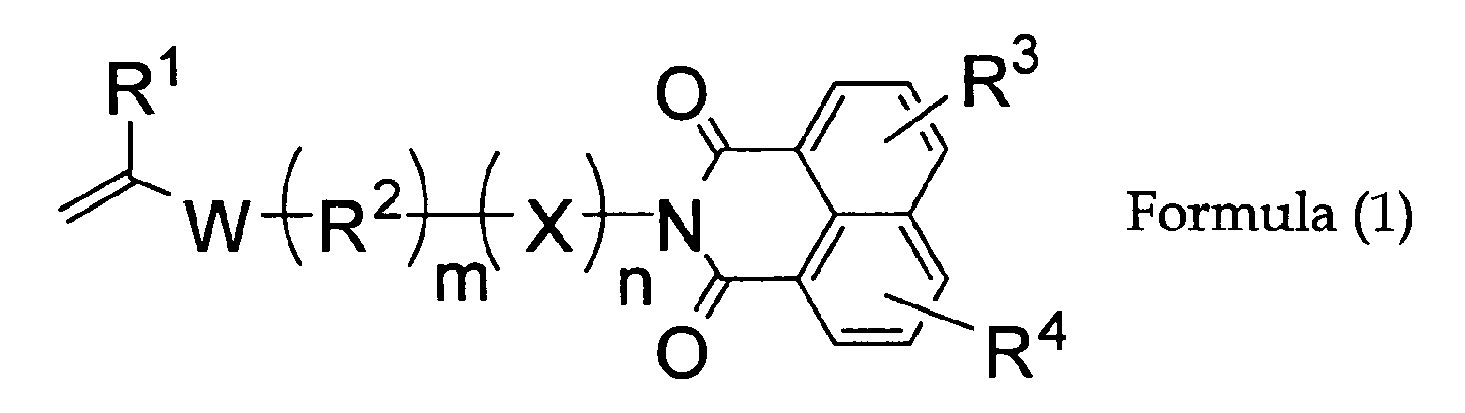
Description
- The present invention relates to a polymerizable compound and a polymer. In particular, the present invention relates to a novel polymerizable compound that is very useful industrially, and a polymer that comprises a copolymer unit derived from the polymerizable compound and is used as a pigment dispersant to be used for color filters, inkjet ink, etc. The present invention also relates to an ink composition suitably used for inkjet recording, a printed article using the ink composition, and an inkjet recording method using the ink composition. In particular, the present invention relates to: an ink composition suitable for inkjet recording, the ink composition being superior in the dispersibility of a colorant so that it has excellent coloring property, being cured by irradiation with an active radiation ray without generating volatile components and enabling the formation of a high quality image; a printed article obtained using the ink composition, and an inkjet recording method using the ink composition.
- As an image recording method for forming an image on a recording medium such as paper based on image data signals, there are an electrophotographic system, sublimation-type and melt-type thermal transfer systems, an inkjet system, etc. In particular, the inkjet system is applicable to an inexpensive apparatus, and performs direct image formation on a recording medium by ejecting ink only to image areas where ink deposition is necessary; therefore, the inkjet system uses ink effectively, thus reducing the running cost. Further, the inkjet system generates less noise and is a superior image recording system.
- The inkjet system enables printing on recording media that do not absorb water, such as plastic sheets and metallic plates, as well as on paper. In the inkjet system, it is an important target to achieve higher printing speed and higher printing quality, and the time that liquid droplets take to dry and cure after printing has significant influence on the sharpness of the image. In one inkjet system, an inkjet recording ink that can be cured by irradiation with an active radiation ray is used. According to this system, sharp images can be formed by curing ink droplets by irradiation with an active radiation ray immediately after printing.
- In order to form highly accurate images with excellent coloring properties, the curable ink composition in such an inkjet recording ink that can be cured is required to have high dispersibility of a pigment, and stability over time. Reduction in the pigment size is necessary for imparting clear tone and high tinting strength to the ink composition. In particular, ejected droplets of the inkjet ink exert a significant influence on the sharpness of images; therefore, the ejection quantity of the ink droplets needs to be small, and the size of the pigment particles contained in the ink has to be smaller than the thickness of the film formed by curing of the ink. However, when the size of the pigment particles is reduced so as to achieve higher tinting strength, the pigment particles are hard to disperse, and pigment aggregates are easily formed. Another problem is created in that the viscosity of the ink composition is increased by the addition of a dispersant. The formation of the pigment aggregates and the increase in the viscosity of the ink composition both adversely affect ink ejection property, and such an ink composition is not preferred.
- When an ink composition is used in inkjet recording, the ink composition is contained in a cartridge. The ink composition in the cartridge is heated at ejection and cooled at a non-ejection time and at storage; in this way, the ink composition undergoes repeated temperature changes (heating-cooling). This temperature changes also adversely affect the pigment dispersibility, and the pigment dispersibility is deteriorated with time, causing problems that pigment aggregates are easily formed, or the increase in the viscosity of the ink composition easily occurs.
- Accordingly, there is a demand for an ink composition having sufficient fluidity and excellent stability of the pigment dispersion over time, in which fine colorant particles are dispersed stably. Various proposals have been made concerning dispersants for achieving stable pigment dispersion liquids.
- In order to improve compatibility with the pigment, an ink composition using a pigment derivative as a dispersant (see, for example, Japanese Patent Application Laid-Open (JP-A) Nos.
2003-119414 2004-18656 JP-A No. 2003-321628 JP-A No. 2004-131589 - In these ink compositions, the dispersion stability of pigments is actually improved owing to the function of the dispersant. However, the size of the pigment used in the ink composition is not sufficiently small, and there is a room for improvement of dispersibility of finer pigment particles. Further, the ink composition also has a problem in that the dispersion stability upon long-term storage or upon repeated temperature changes is still insufficient.
- An object of the present invention is to solve the conventional problems and to achieve the following objects. Specifically, an object of the present invention is to provide (1) a novel polymerizable compound that is very useful industrially, (2) a polymer that includes a copolymer unit derived from the polymerizable compound and is used as a pigment dispersant which improves the dispersibility of a fine pigment and stability thereof, (3) an ink composition suitable for inkjet recording, which can form a high quality image with clear tone and high tinting strength and can be cured by irradiation with an active radiation ray without generating volatile components, (4) a printed article obtained using the ink composition, and (5) an inkjet recording method using the ink composition.
- As a result of dedicated investigations conducted by the present inventors, they have found a polymerizable compound having a specific nitrogen-containing heterocyclic structure, and have found that use of the polymer that includes a copolymer unit derived from the polymerizable compound (monomer) as a pigment dispersant can solve the problems, and thus the present invention has been made.
- Means for solving the above-mentioned problems are as follows. Specifically,
- <1> A polymerizable compound represented by the following formula (1):

- <2> The polymerizable compound according to the <1>, which is represented by the following formula (2):

- <3> A polymer including a copolymer unit derived from a monomer represented by formula (1).
- <4> The polymer according to the <3>, further including a copolymer unit derived from a monomer represented by formula (2).
- <5> The polymer according to one of the <3> and <4>, wherein the polymer is a graft copolymer containing, as a copolymer unit, a polymerizable oligomer (macromonomer) having an ethylenically unsaturated double bond at a terminal thereof.
- <6> An ink composition including: the polymer of any one of the <3> to <5>; a polymerizable compound (a); and a pigment (b).
- <7> The ink composition according to the <6>, further including a polymerization initiator (c).
- <8> The ink composition according to the <7>, wherein the polymerizable compound (a) is a radical polymerizable compound, and the polymerization initiator (c) is a photo-radical generator.
- <9> The ink composition according to the <7>, wherein the polymerizable compound (a) is a cationic polymerizable compound, and the polymerization initiator (c) is a photo-acid generator.
- <10> The ink composition according to any one of the <6> to <9>, which is used for inkjet recording.
- <11> A printed article obtained by curing the ink composition of any one of the <6> to <10>.
- <12> An inkjet recording method including: ejecting the ink composition of any one of the <6> to <10> on a recording medium using an inkjet printer; and irradiating the ink composition ejected with an active radiation ray to cure the ink composition.
- The present invention can solve the conventional problems and can achieve the above object. By using a high-molecular compound that gives excellent dispersibility and dispersion stability, the present invention can provide an ink composition suitable for inkjet recording which is superior in the dispersibility of fine pigments and in the stability of the dispersion, enables the formation of a high quality image having a sharp color tone and high tinting strength, and can be cured by irradiation with an active radiation ray.
- In addition, the present invention can provide a printed article with a high quality image which was obtained using the ink composition that can be cured by irradiation with an active radiation ray and provide a sharp color tone and high tinting strength.
- The present invention will be described in detail below.
- The polymerizable compound of the present invention is represented by the following formula (1).

- In the formula (1), R1 represents a hydrogen atom, or a substituted or unsubstituted alkyl group. The alkyl group has preferably 1 to 12 carbon atoms, more preferably 1 to 8 carbon atoms, still more preferably 1 to 4 carbon atoms. Examples of the alkyl group include a methyl group, an ethyl group, a propyl group, an n-butyl group, an i-butyl group, a t-butyl group, an n-hexyl group, a cyclohexyl group, a 2-hydroxyethyl group, a 3-hydroxypropyl group, a 2-hydroxypropyl group, and a 2-methoxyethyl group.
- R2 represents an alkylene group and has preferably 1 to 12 carbon atoms, more preferably 1 to 8 carbon atoms, still more preferably 1 to 4 carbon atoms. Examples of the alkylene group include a methylene group, an ethylene group, a propylene group, a trimethylene group, and a tetramethylene group.
- W represents -CO-, -C(=O)O-, -CONH-, -OC(=O)-, or a phenylene group.
- X represents -CO-, -NHCO-, -OC(=O)-, -CH(OH)CH2-, or -SO2-.
- m and n each independently represent 0 or 1.
- R3 and R4 represent a monovalent substituent. R3 and R4 may be bound to each other to form a ring structure.
- The monovalent substituent for R3 or R4 is preferably an alkyl group, an aryl group, a halogen atom, an alkoxy group, an aryloxy group, an alkylthio group, an arylthio group, an alkoxycarbonyl group, an acylamino group, a carbamoyl group, a cyano group, an alkylsulfonyl group, an arylsulfonyl group, an acyl group, or a sulfamoyl group, and more preferably, a halogen atom, an alkyl group, an aryl group, an alkoxy group, an aryloxy group, an alkylthio group, an arylthio group, an acylamino group, or a sulfonylamino group.
- The substituent represented by R3 or R4 may be unsubstituted or substituted. For the substituent that can be introduced into the substituent, an alkyl group, an aryl group, a halogen atom, an alkoxy group, an aryloxy group, an alkoxycarbonyl group, an acyloxy group, an acylamino group, a carbamoyl group, a cyano group, a carboxyl group, a sulfonyl group, and a heterocyclic residue are preferable.
- The alkyl group for R3 or R4 is preferably an alkyl group having 1 to 30 total carbon atoms, more preferably, an alkyl group having 1 to 20 total carbon atoms. Specifically, a methyl group, an ethyl group, a butyl group, a hexyl group, an octyl group, a 2-ethylhexyl group, a 3,5,5-trimethylhexyl group, a dodecyl group, an octadecyl group, a benzyl group, a (4-ethoxyphenyl) methyl group, an N,N-diethyl carbamoyl methyl group, an N,N-dibutyl carbamoyl methyl group, a 1-(N,N-dibutyl carbamoyl) ethyl group, a 2-methoxy ethyl group, a 1-methyl-2-phenoxyethyl group, a (4-chlorophenyl) methyl group and a (2,4-dichlorophenyl) methyl group are preferable, and an ethyl group, a butyl group, a hexyl group, a benzyl group, an N,N-diethyl carbamoyl methyl group, an N,N-dibutyl carbamoyl methyl group, a 1-(N,N-dibutyl carbamoyl) ethyl group, a 1-methyl-2-phenoxyethyl group, a (4-chlorophenyl) methyl group and a (2,4-dichlorophenyl) methyl group are more preferable.
- The aryl group for R3 or R4 is preferably an aryl group having 6 to 30 total carbon atoms, more preferably, an aryl group having 1 to 20 total carbon atoms. Specifically, a phenyl group, a 2-methylphenyl group, a 3-methylphenyl group, a 4-methylphenyl group, a 4-phenylphenoxy group, a 4-chlorophenyl group, a 2-methoxyphenyl group, a 3-ethoxyphenyl group, a 4-butoxyphenyl group, a 2,4-diethoxyphenyl group, a 2,5-dibutoxyphenyl group, a 4-phenoxyphenyl group, a naphthyl group, a 4-dibutyl carbamoyl phenyl group and a 4-dibutyl sulfamoyl phenyl group are preferable, and a phenyl group, a 2-methylphenyl group, a 3-methylphenyl group, a 4-methylphenyl group, a 4-chlorophenyl group, a 2-methoxyphenyl group, a 3-ethoxyphenyl group and a 4-butoxyphenyl group are more preferable.
- The halogen atom for R3 or R4 is preferably a fluorine atom, a chlorine atom, a bromine atom or an iodine atom, and more preferably a fluorine atom or a chlorine atom.
- The alkoxy group for R3 or R4 is preferably an alkoxy group having 1 to 30 total carbon atoms, more preferably, an alkoxy group having 1 to 20 total carbon atoms. For the substituent, a methoxy group, an ethoxy group, a propoxy group, a butoxy group, a hexyloxy group, a 2-ethylhexyloxy group, a 3,5,5-trimethyl hexyloxy group, an octyloxy group, a decyloxy group, a 2-phenoxyethoxy group, a 2-(3,5-di-t-butylphenoxy) ethoxy group, a dibutyl carbamoyl methoxy group, a hexadecyloxy group and an octadecyloxy group are preferable, and a methoxy group, an ethoxy group, a butoxy group, a hexyloxy group, a 2-ethyl hexyloxy group, a 3,5,5-trimethyl hexyloxy group, a 2-phenoxyethoxy group and a dibutyl carbamoyl methoxy group are more preferable.
- The aryloxy group for R3 or R4 is preferably an aryloxy group having 6 to 30 total carbon atoms, more preferably, an aryloxy group having 6 to 20 total carbon atoms. For the substituent, a phenoxy group, a tolyloxy group, a 4-chlorophenyloxy group, a 4-acetamide phenyloxy group, a 2-butoxyphenyloxy group, a 2-benzoyl aminophenyloxy group, a 2,5-dimethoxy-4-nitrophenyloxy group and a 3-octyloxy phenyloxy group are preferable, and a phenoxy group, a tolyloxy group, a 4-chlorophenyloxy group, a 4-acetamide phenyloxy group, a 2-butoxyphenyloxy group and a 2,5-dimethoxy-4-nitrophenyloxy group are more preferable.
- The alkylthio group for R3 or R4 is preferably an alkylthio group having 1 to 30 total carbon atoms, more preferably, an alkylthio group having 1 to 20 total carbon atoms. For the substituent, a methylthio group, an ethylthio group, a butylthio group, a hexylthio group, a 2-ethylhexylthio group, a 3,5,5-trimethylhexylthio group, an octylthio group, a decylthio group, a 2-phenoxyethylthio group, a 2-(3,5-di-t-butylphenoxy) ethylthio group, a dibutyl carbamoyl methylthio group, a hexadecylthio group and an octadecylthio group are preferable, and a methylthio group, an ethylthio group, a butylthio group, a hexylthio group, a 2-ethylhexylthio group, a 3,5,5-trimethylhexylthio group, a 2-phenoxyethylthio group and a dibutyl carbamoyl methylthio group are more preferable.
- The arylthio group for R3 or R4 is preferably an arylthio group having 6 to 30 total carbon atoms, more preferably, an arylthio group having 6 to 20 total carbon atoms. For the substituent, a phenylthio group, a tolylthio group, a 4-chlorophenylthio group, a 4-acetamide phenylthio group, a 2-butoxyphenylthio group, a 2-benzoyl aminophenylthio group, a 2,5-dimethoxy-4-nitrophenylthio group, a 3-octyloxy phenylthio group are preferable, and a phenylthio group, a tolylthio group, a 4-chlorophenylthio group, a 4-acetamide phenylthio group, a 2-butoxyphenylthio group and a 2,5-dimethoxy-4-nitrophenylthio group are more preferable.
- The alkoxycarbonyl group for R3 or R4 is preferably an alkoxycarbonyl group having 2 to 30 total carbon atoms, more preferably, an alkoxycarbonyl group having 2 to 20 total carbon atoms. For the substituent, a methoxycarbonyl group, an ethoxycarbonyl group, a butoxycarbonyl group, a phenoxycarbonyl group, a (2-ethylhexyl) oxycarbonyl group, a hexyloxycarbonyl group, an octyloxycarbonyl group, a (4-methoxyphenyl) oxycarbonyl group are preferable, and a methoxycarbonyl group, an ethoxycarbonyl group, a butoxycarbonyl group and a phenoxycarbonyl group are more preferable.
- The acylamino group for R3 or R4 is preferably an acylamino group having 1 to 30 total carbon atoms, more preferably, an acylamino group having 1 to 20 total carbon atoms. For the substituent, a formylamino group, an acetylamino group, a butyrylamino group, a lauroylamino group, a benzoylamino group, a toluoylamino group, a phenoxyacetyl group, a (4-methoxyphenoxy)acetyl group, a 2',4'-dichlorobenzoylamino group, a 2',4'-di-t-amylbenzoylamino group, an acetylmethylamino group, a benzoylmethylamino group and an acetylbenzylamino group are preferable, and an acetylamino group, a butyrylamino group, a benzoylamino group, a toluoylamino group, a phenoxyacetyl group, a 2',4'-di-t-amylbenzoylamino group, an acetylmethylamino group, a benzoylmethylamino group and an acetylbenzylamino group are more preferable.
- The carbamoyl group for R3 or R4 is preferably a carbamoyl group having 1 to 30 total carbon atoms, more preferably, a carbamoyl group having 1 to 20 total carbon atoms. For the substituent, a carbamoyl group, an N-phenylcarbamoyl group, an N-butylcarbamoyl group, an N-octylcarbamoyl group, an N,N-dimethylcarbamoyl group, an N,N-diethylcarbamoyl group, an N,N-dibutylcarbamoyl group, an N,N-dihexylcarbamoyl group, an N,N-diphenylcarbamoyl group, an N-methyl-N-phenylcarbamoyl group, an N-ethyl-N-phenylcarbamoyl group, an N-methyl-N-tolylcarbamoyl group, a morpholinocarbonyl group, a piperidinocarbonyl group and an N,N-bis(2-methoxyethyl)carbamoyl group are preferable, and an N-butylcarbamoyl group, an N-octylcarbamoyl group, an N-phenylcarbamoyl group, an N,N-diethylcarbamoyl group, an N,N-dibutylcarbamoyl group and an N-methyl-N-phenylcarbamoyl group are more preferable.
- The alkylsulfonyl group for R3 or R4 is preferably an alkylsulfonyl group having 1 to 30 total carbon atoms, more preferably, an alkylsulfonyl group having 1 to 20 total carbon atoms. For the substituent, a methylsulfonyl group, an ethylsulfonyl group, a butylsulfonyl group, a hexylsulfonyl group and a benzylsulfonyl group are preferable, and a methylsulfonyl group and a benzylsulfonyl group are more preferable.
- The arylsulfonyl group for R3 or R4 is preferably an arylsulfonyl group having 1 to 30 total carbon atoms, more preferably, an arylsulfonyl group having 1 to 20 total carbon atoms. For the substituent, a phenylsulfonyl group, a 4-methylphenylsulfonyl group, a naphthylsulfonyl group, a 4-methoxysulfonyl group and a 4-chlorophenyl sulfonylgroup are preferable, and a methyl sulfonyl group, a phenyl sulfonyl group and a 4-methylphenyl sulfonyl group are more preferable.
- The acyl group for R3 or R4 is preferably an acyl group having 1 to 30 total carbon atoms, more preferably, an acyl group having 1 to 20 total carbon atoms. For the substituent, a formyl group, an acetyl group, a propionyl group, a pivaloyl group, a butyloyl group, a 4-phenoxy butyloyl group, a benzoyl group, a (4-ethoxyphenyl) carbonyl group, a (2-buthoxyphenyl) carbonyl group and a (4-chlorophenyl) carbonyl group are preferable, and a formyl group, an acetyl group, a propionyl group, a pivaloyl group, a benzoyl group and a (4-chlorophenyl) carbonyl group are more preferable.
- The sulfamoyl group for R3 or R4 is preferably a sulfamoyl group having 1 to 30 total carbon atoms, more preferably, a sulfamoyl group having 1 to 20 total carbon atoms. For the substituent, a sulfamoyl group, an N-phenyl sulfamoyl group, an N,N-dimethyl sulfamoyl group, an N,N-diethyl sulfamoyl group, an N,N-dibutyl sulfamoyl group, an N,N-dihexyl sulfamoyl group, an N,N-diphenyl sulfamoyl group, an N-methyl-N-phenyl sulfamoyl group, an N-ethyl-N-phenyl sulfamoyl group, an N-methyl-N-tolyl sulfamoyl group, a morpholino sulfonyl group, a piperidino sulfonyl group and an N,N-bis (2-methoxyethyl) sulfonyl group are preferable, and a sulfamoyl group, an N-phenyl sulfamoyl group, an N,N-dibutyl sulfamoyl group, an N,N-diphenyl sulfamoyl group and an N-methyl-N-phenyl sulfamoyl group are more preferable.
- In addition, the polymerizable compound of the present invention is preferably represented by the following formula (2).

- In formula (2), R3 and R4 represent a monovalent substituent. R3 and R4 may be bound to each other to form a ring structure. Preferable examples of the substituent are the same as those described above in formula (1).
- Preferable specific examples of the compound represented by formula (1) or formula (2) will be given below. The present invention is not limited to these examples.
-


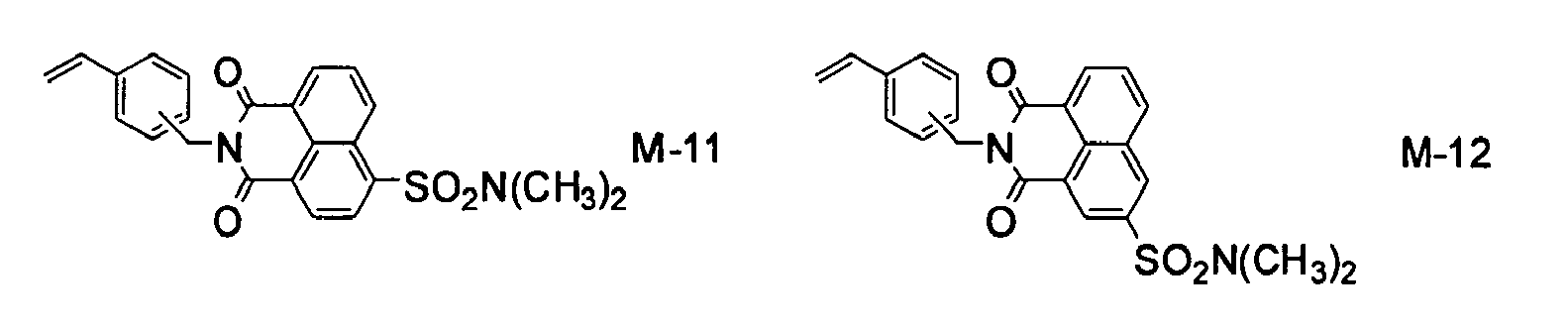


- The polymer of the present invention is a polymer that comprises a copolymer unit derived from the polymerizable compound (monomer) represented by the above formula (1) or formula (2).
- The polymer is preferably a graft copolymer that contains, as a copolymer unit, a polymerizable oligomer having an ethylenically unsaturated double bond at its terminal.
- Such a polymerizable oligomer having an ethylenically unsaturated double bond at its terminal is a compound having a given molecular mass and is therefore called a macromonomer.
- The polymerizable oligomer contains a polymer chain moiety and a polymerizable functional group moiety at a terminal of the polymer chain. The polymerizable functional group moiety has an ethylenically unsaturated double bond. From the viewpoint of obtaining the desired graft copolymer, the group having an ethylenically unsaturated double bond is preferably present at only one of the terminals of the polymer chain. The group having an ethylenically unsaturated double bond is preferably a (meth)acryloyl group or a vinyl group, and more preferably a (meth)acryloyl group.
- The polystyrene-equivalent number-average molecular mass (Mn) of the macromonomer is preferably in the range of 1,000 to 10,000, more preferably in the range of 2,000 to 9,000.
- The polymer chain moiety is generally a homopolymer or copolymer formed from at least one monomer selected from the group consisting of alkyl (meth)acrylates, styrene and derivatives thereof, acrylonitrile, vinyl acetate, and butadiene, or is polyethylene oxide, polypropylene oxide, and polycaprolactone.
- The polymerizable oligomer is preferably an oligomer represented by the following formula (3).

- In the formula (3), R11 and R13 each independently represent a hydrogen atom or a methyl group. R12 represents an alkylene group having 1 to 12 carbon atoms (preferably an alkylene group having 2 to 4 carbon atoms, may have a substituent (for example, a hydroxyl group) and may be bound to each other via e.g. an ester bond, ether bond or amide bond). Y represents a phenyl group, a phenyl group with an alkyl group having 1 to 4 carbon atoms, or -COOR14 (where R14 represents an alkyl group having 1 to 6 carbon atoms, a phenyl group, or an arylalkyl group having 7 to 10 carbon atoms), and q is from 20 to 200. Y is preferably a phenyl group or -COOR14 (where R14 is an alkyl group having 1 to 12 carbon atoms.).
- Preferable examples of the polymerizable oligomer (macromonomer) include polymers in which a (meth)acryloyl group is bound to one terminal of polymethyl (meth)acrylate, poly-n-butyl (meth)acrylate, poly-i-butyl (meth)acrylate or polystyrene. Examples of commercially available polymerizable oligomers include a polystyrene oligomer having a methacryloyl group at one terminal (Mn = 6,000, trade name: AS-6, manufactured by Toagosei Co., Ltd.), a polymethyl methacrylate oligomer having a methacryloyl group at one terminal (Mn = 6,000, trade name: AA-6, manufactured by Toagosei Co., Ltd.), and a poly-n-butylacrylate oligomer having a methacryloyl group at one terminal (Mn =6,000, trade name: AB-6, manufactured by Toagosei Co., Ltd.).
- The polymerizable oligomer may be not only polymerizable oligomers represented by the formula (3) but also polymerizable oligomers represented by the following formula (4).

- In the above formula (4), R21 represents a hydrogen atom or a methyl group, and R22 represents an alkylene group having 1 to 8 carbon atoms. X21 represents -OR23 or -OCOR24, where R23 and R24 represent a hydrogen atom, an alkyl group or an aryl group. n denotes a number from 2 to 200.
- In the formula (4), R21 represents a hydrogen atom or a methyl group. R22 represents an alkylene group having 1 to 8 carbon atoms, is preferably an alkylene group having 1 to 6 carbon atoms and is more preferably an alkylene group having 2 to 3 carbon atoms. X21 represents -OR23 or -OCOR24, where R23 represents a hydrogen atom, an alkyl group having 1 to 18 carbon atoms, a phenyl group or a phenyl group substituted with an alkyl group having 1 to 18 carbon atoms. R24 represents an alkyl group having 1 to 18 carbon atoms. Also, n denotes a number 2 to 200, preferably 5 to 100 and more preferably 10 to 100.
- Examples of the polymerizable oligomer represented by the formula (4) include polyethylene glycol mono(meth)acrylate, polypropylene glycol mono(meth)acrylate, polyethylene glycol polypropylene glycol mono(meth)acrylate and polytetramethylene glycol monomethacrylate. These materials may be commercially available products or may be those synthesized properly.
- The polymerizable monomers represented by the formula (4) are commercially available. Examples of these commercially available products include methoxypolyethylene glycol methacrylate (trade name: NK ESTER M-40G, M-90G and M-230G (manufactured by Toagosei Co., Ltd.); trade name: BLENMER-PME-100, PME-200, PME-400, PME-1000, PME-2000 and PME-4000 (manufactured by NOF CORPORATION)), polyethylene glycol monomethacrylate (trade name: BLENMER-PE-90, PE-200 and PE-350, manufactured by NOF CORPORATION), polypropylene glycol monomethacrylate (trade name: BLENMER-PP-500, PP-800 and PP-1000, manufactured by NOF CORPORATION), polyethylene glycol polypropylene glycol monomethacrylate (trade name: BLENMER-70PEP-370B, manufactured by NOF CORPORATION), polyethylene glycol polytetramethylene glycol monomethacrylate (trade name: BLENMER-55PET-800, manufactured by NOF CORPORATION) and polypropylene glycol polytetramethylene glycol monomethacrylate (trade name: BLENMER-NHK-5050, manufactured by NOF CORPORATION).
- Further; the polymer for use in the present invention may be a copolymer with a monomer having a nitrogen atom. Examples of the monomer having a nitrogen atom include N,N-dimethylaminoethyl(meth)acrylate, N,N-dimethylaminopropyl(meth)acrylate, 1-(N,N-dimethylamino)-1,1-dimethylmethyl(meth)acrylate, N,N-dimethylaminohexyl(meth)acrylate, N,N-diethylaminoethyl(meth)acrylate, N,N-diisopropylaminoethyl(meth)acrylate, N,N-di-n-butylaminoethyl(meth)acrylate, N,N-di-i-butylaminoethyl(meth)acrylate, morpholinoethyl(meth)acrylate, piperidinoethyl(meth)acrylate,1-pyrrolidinoethyl(meth)acrylate, N,N-methyl-2-pyrrolidylaminoethyl(meth)acrylate and N,N-methylphenylaminoethyl(meth)acrylate (the monomers mentioned above are (meth)acrylates); dimethyl(meth)acrylamide, diethyl(meth)acrylamide, diisopropyl (meth)acrylamide, di-n-butyl(meth)acrylamide, di-i-butyl(meth)acrylamide, morpholino(meth)acrylamide, piperidino(meth)acrylamide, N-methyl-2-pyrrolidyl(meth)acrylamide and N,N-methylphenyl(meth)acrylamide (the monomers mentioned above are (meth)acrylamides); 2-(N,N-dimethylamino)ethyl(meth)acrylamide, 2-(N,N-diethylamino)ethyl(meth)acrylamide, 3-(N,N-diethylamino)propyl(meth)acrylamide, 3-(N,N-dimethylamino)propyl(meth)acrylamide, 1-(N,N-dimethylamino)-1,1-dimethylmethyl(meth)acrylamide and 6-(N,N-diethylamino)hexyl(meth)acrylamide (the monomers mentioned above are aminoalkyl(meth)acrylamides); p-vinylbenzyl-N,N-dimethylamine, p-vinylbenzyl-N,N-diethylamirte, and p-vinylbenzyl-N,N-dihexylamine (the monomers mentioned above are vinylbenzylamines); and 2-vinylpyridine, 4-vinylpyridine, and N-vinylimidazole. Among these, N,N-dimethylaminoethyl(meth)acrylate, N,N-dimethylaminopropyl(meth)acrylate, 3-(N,N-diethylamino)propyl(meth)acrylamide, 3-(N,N-dimethylamino)propyl(meth)acrylamide, 2-vinylpyridine, 4-vinylpyridine, and N-vinylimidazole are preferable.
- Further, the polymer for use in the present invention may be a copolymer with other monomers copolymerizable with these polymers. Examples of the other monomers copolymerizable with these polymers may include unsaturated carboxylic acids (for example, (meth)acrylic acids, crotonic acid, itaconic acid, maleic acid and fumaric acid), aromatic vinyl compounds (for example, styrene, α-methylstyrene, vinyltoluene, 2-vinylpyridine, 4-vinylpyridine and N-vinylimidazole), alkyl(meth)acrylates (for example, methyl(meth)acrylate, ethyl(meth)acrylate, n-butyl(meth)acrylate and i-butyl(meth)acrylate), alkylaryl(meth)acrylates (for example, benzyl(meth)acrylate), substituted alkyl(meth)acrylates (for example, glycidyl(meth)acrylate and 2-hydroxyethyl(meth)acrylate), vinyl carboxylates (for example, vinyl acetate and vinyl propionate), vinyl cyanates (for example, (meth)acrylonitrile and α-chloroacrylonitrile) and aliphatic conjugate dienes (for example, 1,3-butadiene and isoprene). Among these compounds, unsaturated carboxylic acids, alkyl(meth)acrylates, alkylaryl(meth)acrylates, vinyl carboxylates and aromatic vinyl compounds are preferable.
- The polymer of the present invention is preferably a copolymer that comprises a copolymer unit derived from the polymerizable compound represented by the above formula (1) or (2) and a repeating unit given from the polymerizable oligomer (macromonomer), or a copolymer that comprises a repeating unit represented by the above formula (1), a repeating unit given from the polymerizable oligomer (macromonomer) and a repeating unit given from a monomer having a nitrogen atom. The above copolymer preferably contains the repeating unit represented by the formula (1) in a ratio 5% by weight to 70% by weight (particularly, 5% by weight to 30% by weight) based on all repeating units. In addition, the above copolymer preferably contains the repeating unit given from the polymerizable oligomer (macromonomer) in a ratio 30% by weight to 95% by weight (particularly, 50% by weight to 90% by weight) based on all repeating units. The above copolymer preferably contains the repeating unit derived from the above monomer containing nitrogen containing group in a ratio 5% by weight to 80% by weight (particularly, 5% by weight to 50% by weight) based on all repeating units.
- When the additional monomer copolymerizable with these repeating units is used, the quantity of the repeating units derived from the additional monomer is preferably in the range of 5% by weight to 30% by weight based on the total quantity of the repeating units in the copolymer. The weight-average molecular mass (Mw) of the copolymer is preferably in the range of 1,000 to 200,000, more preferably in the range of 10,000 to 100,000. This weight-average molecular mass is a polystyrene equivalent weight-average molecular mass determined by gel permeation chromatography (carrier: tetrahydrofuran).
- The structure of the copolymer can be analyzed, for example, by performing 1H-NMR measurement (a measurement using Mercury (300 MHz) manufactured by Varian, Inc.).
- Examples of the graft copolymer that can be suitably used for the polymer of the present invention will be shown below; however, these examples are not intended to limit the present invention.
- 1) A copolymer of the monomer, represented by M-1 of the exemplary compounds, and polymethylmethacrylate having a methacryloyl group at its terminal
- 2) A copolymer of the monomer, represented by M-1 of the exemplary compounds, and polyethylene glycol mono(meth)acrylate
- 3) A copolymer of the monomer, represented by M-1 of the exemplary compounds, and polycaprolactone having a methacryloyl group at its terminal
- 4) A copolymer of the monomer, represented by M-1 of the exemplary compounds, and polybutyl acrylate having a methacryloyl group at its terminal
- 5) A copolymer of the monomer, represented by M-3 of the exemplary compounds, and polymethylmethacrylate having a methacryloyl group at its terminal
- 6) A copolymer of the monomer, represented by M-4 of the exemplary compounds, and polymethylmethacrylate having a methacryloyl group at its terminal
- 7) A copolymer of the monomer, represented by M-5 of the exemplary compounds, and polyethylene glycol mono(meth)acrylate
- 8) A copolymer of the monomer, represented by M-1 of the exemplary compounds, 3-(N,N-dimethylamino)propyl acrylamide, and polymethylmethacrylate having a methacryloyl group at its terminal
- 9) A copolymer of the monomer, represented by M-1 of the exemplary compounds, p-vinylbenzyl-N,N-dimethylamine, and polymethylmethacrylate having a methacryloyl group at its terminal
- 10) A copolymer of the monomer, represented by M-1 of the exemplary compounds, 3-(N,N-dimethylamino)propyl acrylamide, and polybutyl acrylate having a methacryloyl group at its terminal
- 11) A copolymer of the monomer, represented by M-1 of the exemplary compounds, 3-(N,N-dimethylamino)ethyl (meth)acrylate, and polymethylmethacrylate having a methacryloyl group at its terminal
- 12) A copolymer of the monomer, represented by M-1 of the exemplary compounds, 2-(N,N-dimethylamino)ethyl (meth)acrylate, and polymethylmethacrylate having a methacryloyl group at its terminal
- 13) A copolymer of the monomer, represented by M-1 of the exemplary compounds, 3-(N,N-dimethylamino)propyl acrylamide, polymethylmethacrylate having a methacryloyl group at its terminal, and polyethylene glycol mono(meth)acrylate
- 14) A copolymer of the monomer, represented by M-1 of the exemplary compounds, N,N-dimethylacrylamide, and polymethylmethacrylate having a methacryloyl group at its terminal
- 15) A copolymer of the monomer, represented by M-1 of the exemplary compounds, methyl (meth)acrylate, and polymethylmethacrylate having a methacryloyl group at its terminal
- 16) A copolymer of the monomer, represented by M-1 of the exemplary compounds, methacrylic acid, and polymethylmethacrylate having a methacryloyl group at its terminal
- 17) A copolymer of the monomer, represented by M-1 of the exemplary compounds, cyclohexyl (meth)acrylate, and polymethylmethacrylate having a methacryloyl group at its terminal
- 18) A copolymer of the monomer, represented by M-1 of the exemplary compounds, 2-hydroxyethyl (meth)acrylate, and polymethylmethacrylate having a methacryloyl group at its terminal
- 19) A copolymer of the monomer, represented by M-7 of the exemplary compounds, 3-(N,N-dimethylamino)propyl acrylamide, and polymethylmethacrylate having a methacryloyl group at its terminal
- 20) A copolymer of the monomer, represented by M-12 of the exemplary compounds, 3-(N,N-dimethylamino)propyl acrylamide, and polymethylmethacrylate having a methacryloyl group at its terminal
- 21) A copolymer of the monomer, represented by M-13 of the exemplary compounds, 3-(N,N-dimethylamino)ethyl (meth)acrylate, and polymethylmethacrylate having a methacryloyl group at its terminal
- Such graft copolymers can be obtained by radical polymerization, in a solvent, of the polymerizable oligomer and, optionally, the monomer having a nitrogen-containing group and/ or other additional monomers. In this polymerization, a radical polymerization initiator is used in general. In addition to the initiator, a chain transfer agent (e.g., 2-mercaptoethanol and dodecyl mercaptan) may be further added for the synthesis of the graft copolymer.
- The ink composition of the present invention comprises, in addition to the polymer, at least (a) other polymerizable compound and (b) a pigment, and may comprise other components as necessary.
- In the ink composition of the present invention, the polymers of the present invention may be used alone, or two or more may be used in combination. The content of the polymer in the ink composition is preferably 1% by mass to 100% by mass, more preferably 5% by mass to 50% by mass based on the amount of pigment to be added.
- In the ink composition of the present invention, a known pigment dispersant may be used together in addition to the polymer of the present invention insofar as the effect of the present invention is not impaired. The amount of the known pigment dispersant to be added is preferably 50% by mass or less based on the polymer of the present invention.
- It is preferable that the polymer of the present invention is used as a pigment dispersant. The structure having high affinity to a pigment due to a van-der-waals interaction ensures good adsorbing ability with respect to the pigment, making it possible to obtain a stable dispersant. Since the polymer is a high-molecular compound having a specified repeating structure, the steric repulsive effect of a high-molecular chain enables high dispersion stability.
- Specific examples of the pigment include organic pigments such as a phthalocyanine base, insoluble azo base, azo lake base, anthraquinone base, quinacridone base, dioxazine base, diketopyrrolopyrrole base, anthrapyrimidine base, anthanthrone base, indanthrone base, flavanthrone base, perinone base, perylene base, thioindigo base and quinophthalone base.
- The ink composition of the present invention is cured through the function of other polymerizable compound (a) when some energy is applied thereto. Preferably, the ink composition of the present invention contains (c) a polymerization initiator and is cured by irradiation with an active energy ray. The active energy ray is not particularly limited as long as it can impart energy which can generate initiating species in the ink composition by irradiation therewith. The energy ray include a wide range of energy rays such as α-rays, γ-rays, X-rays, ultraviolet rays, visible rays and electron rays. Among these energy rays, ultraviolet rays and electron rays are preferable, and ultraviolet rays are more preferable, from the viewpoint of curing sensitivity and the availability of equipment. Therefore, the ink composition of the present invention is preferably an ink composition which can be cured by irradiation with ultraviolet rays as the radiation ray.
- The curable ink composition of the present invention comprises other polymerizable compound (a). Any polymerizable compound may be used as the other polymerizable compound (a) without any particular limitation as long as it causes a polymerization reaction and is cured by supplying some energy. Though any of a monomer, oligomer and polymer may be used, in particular, various known polymerizable monomers known as a photo-cationic polymerizable monomer or photo-radical polymerizable monomer are preferable which causes a polymerization reaction by initiator species generated from the polymerization initiator (c) which is added as desired.
- The polymerizable compounds may be used alone or two or more may be used in combination with the intention of adjusting, for example, reaction speed, ink properties and the properties of a cured film. Also, the polymerizable compounds may be either a monofunctional compound or a multifunctional compound.
- Examples of cation-polymerizable monomers that can be used as the other polymerizable compound (a) include the epoxy compounds, vinyl ether compounds, and oxetane compounds described in
JP-A Nos. 6-9714 2001-31892 2001-40068 2001-55507 2001-310938 2001-310937 2001-220526 - Examples of monofunctional epoxy compounds that can be used as the cation-polymerizable monomer include phenyl glycidyl ether, p-tert-butylphenyl glycidyl ether, butyl glycidyl ether, 2-ethylhexyl glycidyl ether, allyl glycidyl ether, 1,2-butylene oxide, 1,3-butadiene monoxide, 1,2-epoxydodecane, epichlorohydrin, 1,2-epoxydecane, styrene oxide, cyclohexene oxide, 3-methacryloyloxymethylcyclohexene oxide, 3-acryloyloxymethylcyclohexene oxide, and 3-vinylcyclohexene oxide.
- Examples of polyfunctional epoxy compounds that can be used as the cation-polymerizable monomer include bisphenol A diglycidyl ether, bisphenol F diglycidyl ether, bisphenol S diglycidyl ether, brominated bisphenol A diglycidyl ether, brominated bisphenol F diglycidyl ether, brominated bisphenol S diglycidyl ether, epoxy novolak resin, hydrogenated bisphenol A diglycidyl ether, hydrogenated bisphenol F diglycidyl ether, hydrogenated bisphenol S diglycidyl ether, 3,4-epoxycyclohexyl methyl-3',4'-epoxycyclohexane carboxylate, 2-(3,4-epoxycyclohexyl-5,5-spiro-3,4-epoxy) cyclohexane-metha-dioxane, bis(3,4-epoxycyclohexylmethyl)adipate, vinylcyclohexene oxide, 4-vinylepoxycyclohexane, bis(3,4-epoxy-6-methylcyclohexylmethyl) adipate, 3,4-epoxy-6-methylcyclohexyl-3',4'-epoxy-6'-methylcyclohexane carboxylate, methylenebis(3,4-epoxycyclohexane), dicylopentadiene diepoxide, ethyleneglycol di(3,4-epoxycyclohexylmethyl) ether, ethylenebis(3,4-epoxycyclohexane carboxylate), dioctyl epoxyhexahydrophthalate, di-2-ethylhexyl epoxyhexahydrophthalate, 1,4-butanediol diglycidyl ether, 1,6-hexanediol diglycidyl ether, glycerin triglycidyl ether, trimethylolpropane triglycidyl ether, polyethylene glycol diglycidyl ether, polypropylene glycol diglycidyl ethers, 1,1,3-tetradecadiene dioxide, limonene dioxide, 1,2,7,8-diepoxy octane, and 1,2,5,6-diepoxy cyclooctane.
- Among these epoxy compounds, aromatic epoxides and alicyclic epoxides are preferable since they are advantageous in respect of the curing rate, alicyclic epoxides are more preferable.
- Examples of monofunctional vinyl ether compounds that can be used as the cation-polymerizable monomer include methyl vinyl ether, ethyl vinyl ether, propyl vinyl ether, n-butyl vinyl ether, t-butyl vinyl ether, 2-ethylhexyl vinyl ether, n-nonyl vinyl ether, lauryl vinyl ether, cyclohexyl vinyl ether, cyclohexyl methyl vinyl ether, 4-methylcyclohexylmethyl vinyl ether, benzyl vinyl ether, dicyclopentenyl vinyl ether, 2-dicyclopentenoxy ethyl vinyl ether, methoxyethyl vinyl ether, ethoxyethyl vinyl ether, butoxyethyl vinyl ether, methoxyethoxyethyl vinyl ether, ethoxyethoxyethyl vinyl ether, methoxy polyethylene glycol vinyl ether, tetrahydrofurfuryl vinyl ether, 2-hydroxyethyl vinyl ether, 2-hydroxypropyl vinyl ether, 4-hydroxybutyl vinyl ether, 4-hydroxymethyl cyclohexylmethyl vinyl ether, diethylene glycol monovinyl ether, polyethylene glycol vinyl ether, chloroethyl vinyl ether, chlorobutyl vinyl ether, chloroethoxyethyl vinyl ether, phenylethyl vinyl ether, and phenoxy polyethylene glycol vinyl ether.
- Examples of multifunctional vinyl ether compounds that can be used as the cation-polymerizable monomer include: divinyl ethers such as ethylene glycol divinyl ether, diethylene glycol divinyl ether, triethylene glycol divinyl ether, polyethylene glycol divinyl ether, propylene glycol divinyl ether, butylene glycol divinyl ether, hexane diol divinyl ether, bisphenol A alkylene oxide divinyl ether, and bisphenol F alkylene oxide divinyl ether; and multifunctional vinyl ethers such as trimethylolethane trivinyl ether, trimethylolpropane trivinyl ether, ditrimethylolpropane tetravinyl ether, glycerin trivinyl ether, pentaerythritol tetravinyl ether, dipentaerythritol pentavinyl ether, dipentaerythritol hexavinyl ether, ethylene oxide-added trimethylolpropane trivinyl ether, propylene oxide-added trimethylolpropane trivinyl ether, ethylene oxide-added ditrimethylolpropane tetravinyl ether, propylene oxide-added ditrimethylolpropane tetravinyl ether, ethylene oxide-added pentaerythritol tetravinyl ether, propylene oxide-added pentaerythritol tetravinyl ether, ethylene oxide-added dipentaerythritol hexavinyl ether, and propylene oxide-added dipentaerythritol hexavinyl ether.
- Among the multifunctional vinyl ether compounds described above, a di- or trivinyl ether compound is preferable from the viewpoint of curing properties, adhesion to a recording medium, and the surface hardness of an image formed, and a divinyl ether compound is particularly preferable.
- The oxetane compound that can be used as the cation-polymerizable monomer refers to a compound having an oxetane ring. Such an oxetane compound may be selected arbitrarily from known oxetane compounds, for example, those described in
JP-A Nos. 2001-220526 2001-310937 2003-341217 - Examples of monofunctional oxetanes that can be used as the cation-polymerizable monomer include 3-ethyl-3-hydroxymethyl oxetane, 3-(meth)allyloxymethyl-3-ethyl oxetane, (3-ethyl-3-oxetanylmethoxy)methyl benzene, 4-fluoro-[1-(3-ethyl-3-oxetanylmethoxy)methyl] benzene, 4-methoxy-[1-(3-ethyl-3-oxetanylmethoxy)methyl] benzene, [1-(3-ethyl-3-oxetanylmethoxy)ethyl]phenyl ether, isobutoxymethyl(3-ethyl-3-oxetanylmethyl) ether, isobornyloxyethyl(3-ethyl-3-oxetanylmethyl) ether, isobornyl(3-ethyl-3-oxetanylmethyl) ether, 2-ethylhexyl(3-ethyl-3-oxetanylmethyl) ether, ethyldiethylene glycol(3-ethyl-3-oxetanylmethyl) ether, dicyclopentadiene (3-ethyl-3-oxetanylmethyl) ether, dicyclopentenyloxyethyl (3-ethyl-3-oxetanylmethyl) ether, dicyclopentenyl (3-ethyl-3-oxetanylmethyl) ether, tetrahydrofurfuryl (3-ethyl-3-oxetanylmethyl) ether, tetrabromophenyl (3-ethyl-3-oxetanylmethyl) ether, 2-tetrabromophenoxyethyl (3-ethyl-3-oxetanylmethyl) ether, tribromophenyl (3-ethyl-3-oxetanylmethyl) ether, 2-tribromophenoxyethyl (3-ethyl-3-oxetanylmethyl) ether, 2-hydroxyethyl (3-ethyl-3-oxetanylmethyl) ether, 2-hydroxypropyl (3-ethyl-3-oxetanylmethyl) ether, butoxyethyl (3-ethyl-3-oxetanylmethyl) ether, pentachlorophenyl (3-ethyl-3-oxetanylmethyl) ether, pentabromophenyl (3-ethyl-3-oxetanylmethyl) ether, and bornyl(3-ethyl-3-oxetanylmethyl) ether.
- Examples of multifunctional oxetanes that can be used as the cation-polymerizable monomer include 3,7-bis(3-oxetanyl)-5-oxa-nonane, 3,3'-(1,3-(2-methylenyl) propanediylbis (oxymethylene)) bis-(3-ethyloxetane), 1,4-bis[(3-ethyl-3-oxetanylmethoxy)methyl] benzene, 1,2-bis[(3-ethyl-3-oxetanylmethoxy)methyl] ethane, 1,3-bis[(3-ethyl-3-oxetanylmethoxy)methyl] propane, ethylene glycol bis(3-ethyl-3-oxetanylmethyl) ether, dicyclopentenyl bis(3-ethyl-3-oxetanylmethyl) ether, triethylene glycol bis(3-ethyl-3-oxetanylmethyl) ether, tetraethylene glycol bis(3-ethyl-3-oxetanylinethyl) ether, tricyclodecanediyldimethylene (3-ethyl-3-oxetanylmethyl) ether, trimethylolpropane tris(3-ethyl-3-oxetanylmethyl) ether, 1,4-bis(3-ethyl-3-oxetanylmethoxy) butane, 1,6-bis(3-ethyl-3-oxetanylmethoxy) hexane, pentaerythritol tris(3-ethyl-3-oxetanylmethyl) ether, pentaerythritol tetrakis(3-ethyl-3-oxetanylmethyl) ether, polyethylene glycol bis(3-ethyl-3-oxetanylmethyl) ether, dipentaerythritol hexakis(3-ethyl-3-oxetanylmethyl) ether, dipentaerythritol pentakis(3-ethyl-3-oxetanylmethyl) ether, dipentaerythritol tetrakis(3-ethyl-3-oxetanylmethyl) ether, caprolactone-modified dipentaerythritol hexakis(3-ethyl-3-oxetanylmethyl) ether, caprolactone-modified dipentaerythritol pentakis(3-ethyl-3-oxetanylmethyl) ether, ditrimethylolpropane tetrakis(3-ethyl-3-oxetanylmethyl) ether, EO-modified bisphenol A bis(3-ethyl-3-oxetanylmethyl) ether, PO-modified bisphenol A bis(3-ethyl-3-oxetanylmethyl) ether, EO-modified hydrogenated bisphenol A bis(3-ethyl-3-oxetanylmethyl) ether, PO-modified hydrogenated bisphenol A bis(3-ethyl-3-oxetanylmethyl) ether, and EO-modified bisphenol F (3-ethyl-3-oxetanylmethyl) ether.
- Such compounds having an oxetane ring are described in detail in columns [0021] to [0084] of
JP-A 2003-341217 - Among the oxetane compounds as the cation-polymerizable monomer, a compound having one or two oxetane rings is preferable from the viewpoint of the viscosity and adhesiveness of the ink composition.
- In the ink composition of the present invention, as a cation-polymerizable monomer, only one compound may be used, or two or more compounds may be used in combination. From the viewpoint of effective suppression of shrinkage upon curing, it is preferable to use a combination of at least one oxetane compound and at least one compound selected from epoxy compounds and vinyl ether compounds.
- In the present invention, the other polymerizable compound (a) may be selected from a wide variety of known radical polymerizable monomers that undergo polymerization reaction in the presence of an initiator species generated from a photoradical initiator.
- Examples of such radical polymerizable monomers include (meth)acrylates, (meth)acrylamides, and aromatic vinyls. In the specification, the term "(meth)acrylate" is occasionally used to mean "acrylate" and/ or "methacrylate", and the term "(meth)acryl" is occasionally used to mean "acryl" and/or "methacryl".
- Examples of (meth)acrylates that can be used as the radical polymerizable monomer include monofunctional (meth)acrylates, bifunctional (meth)acrylates, trifunctional (meth)acrylates, tetrafunctional (meth)acrylates, pentafunctional (meth)acrylates, and hexafunctional (meth)acrylates.
- Examples of monofunctional (meth)acrylates include hexyl (meth)acrylate, 2-ethylhexyl (meth)acrylate, tert-octyl (meth)acrylate, isoamyl (meth)acrylate, decyl (meth)acrylate, isodecyl (meth)acrylate, stearyl (meth)acrylate, isostearyl (meth)acrylate, cyclohexyl (meth)acrylate, 4-n-butylcyclohexyl (meth)acrylate, bornyl (meth)acrylate, isobornyl (meth)acrylate, benzyl (meth)acrylate, 2-ethylhexyldiglycol (meth)acrylate, butoxyethyl (meth)acrylate, 2-chloroethyl (meth)acrylate, 4-bromobutyl (meth)acrylate, cyanoethyl (meth)acrylate, benzyl (meth)acrylate, butoxymethyl (meth)acrylate, 3-methoxybutyl (meth)acrylate, alkoxymethyl (meth)acrylate, alkoxyethyl (meth)acrylate, 2-(2-methoxyethoxy)ethyl (meth)acrylate, 2-(2-butoxyethoxy)ethyl (meth)acrylate, 2,2,2-tetrafluoroethyl (meth)acrylate, 1H,1H,2H,2H-perfluorodecyl (meth)acrylate, 4-butylphenyl (meth)acrylate, phenyl (meth)acrylate, 2,4,5-tetramethylphenyl (meth)acrylate, 4-chlorophenyl (meth)acrylate, phenoxymethyl (meth)acrylate, phenoxyethyl (meth)acrylate, glycidyl (meth)acrylate, glycidyloxybutyl (meth)acrylate, glycidyloxyethyl (meth)acrylate, glycidyloxypropyl (meth)acrylate, tetrahydrofurfuryl (meth)acrylate, hydroxyalkyl (meth)acrylate, 2-hydroxyethyl (meth)acrylate, 3-hydroxypropyl (meth)acrylate, 2-hydroxypropyl (meth)acrylate, 2-hydroxybutyl (meth)acrylate, 4-hydroxybutyl (meth)acrylate, 3-hydroxybutyl (meth)acrylate, dimethylaminoethyl (meth)acrylate, diethylaminoethyl (meth)acrylate, dimethylaminopropyl (meth)acrylate, diethylaminopropyl (meth)acrylate, trimethoxysilylpropyl (meth)acrylate, trimethylsilylpropyl (meth)acrylate, polyethylene oxide monomethyl ether (meth)acrylate, oligoethylene oxide monomethyl ether (meth)acrylate, polyethylene oxide (meth)acrylate, oligoethylene oxide (meth)acrylate, oligoethylene oxide monoalkyl ether (meth)acrylate, polyethylene oxide monoalkyl ether (meth)acrylate, dipropylene glycol (meth)acrylate, polypropylene oxide monoalkyl ether (meth)acrylate, oligopropylene oxide monoalkyl ether (meth)acrylate, 2-methacryloyloxytylsuccinic acid, 2-methacryloyloxyhexahydrophthalic acid, 2-methacryloyloxyethyl-2-hydroxypropyl phthalate, butoxydiethylene glycol (meth)acrylate, trifluoroethyl (meth)acrylate, perfluorooctylethyl (meth)acrylate, 2-hydroxy-3-phenoxypropyl (meth)acrylate, EO-modified phenol (meth)acrylate, EO-modified cresol (meth)acrylate, EO-modified nonyl phenol (meth)acrylate, PO-modified nonyl phenol (meth)acrylate, EO-modified 2-ethylhexyl (meth)acrylate, dicyclopentenyl (meth)acrylate, and dicyclopentanyl (meth)acrylate.
- Examples of bifunctional (meth)acrylates include 1,6-hexanediol di(meth)acrylate, 1,10-decanediol di(meth)acrylate, neopentyl glycol di(meth)acrylate, 2,4-dimethyl-1,5-pentanediol di(meth)acrylate, butylethylpropanediol (meth)acrylate, ethoxylated cyclohexane methanol di(meth)acrylate, polyethylene glycol di(meth)acrylate, oligoethylene glycol di(meth)acrylate, ethylene glycol di(meth)acrylate, 2-ethyl-2-butyl-butanediol di(meth)acrylate, hydroxypivalic acid neopentyl glycol di(meth)acrylate, EO-modified bisphenol A di(meth)acrylate, bisphenol F polyethoxy di(meth)acrylate, polypropylene glycol di(meth)acrylate, oligopropylene glycol di(meth)acrylate, 1,4-butanediol di(meth)acrylate, 2-ethyl-2-butylpropanediol di(meth)acrylate, 1,9-nonane di(meth)acrylate, propoxylated ethoxylated bisphenol A di(meth)acrylate, tricyclodecane di(meth)acrylate, neopentyl glycol propyleneoxy diacrylate, dipropylene glycol di(meth)acrylate, and propoxylated neopentyl glycol di(meth)acrylate.
- Examples of trifunctional (meth)acrylates include trimethylolpropane tri(meth)acrylate, trimethylolethane tri(meth)acrylate, trimethylolpropane alkylene oxide-modified tri(meth)acrylate, pentaerythritol tri(meth)acrylate, dipentaerythritol tri(meth)acrylate, trimethylolpropane tri((meth)acryloyloxypropyl) ether, isocyanuric acid alkylene oxide-modified tri(meth)acrylate, propionic acid dipentaerythritol tri(meth)acrylate, tri((meth)acryloyloxyethyl) isocyanurate, hydroxypival aldehyde-modified dimethylolpropane tri(meth)acrylate, sorbitol tri(meth)acrylate, propoxylated trimethylolpropane tri(meth)acrylate, and ethoxylated glycerin triacrylate.
- Examples of tetrafunctional (meth)acrylates include pentaerythritol tetra(meth)acrylate, sorbitol tetra(meth)acrylate, ditrimethylolpropane tetra(meth)acrylate, propionic acid dipentaerythritol tetra(meth)acrylate, and ethoxylated pentaerythritol tetra(meth)acrylate.
- Examples of pentafunctional (meth)acrylates include sorbitol penta(meth)acrylate and dipentaerythritol penta(meth)acrylate.
- Examples of hexafunctional (meth)acrylates include dipentaerythritol hexa(meth)acrylate, sorbitol hexa(meth)acrylate, phosphazene alkylene oxide-modified hexa(meth)acrylate, and caprolactone-modified dipentaerythritol hexa(meth)acrylate.
- Examples of (meth)acrylamides that can be used as the radical polymerizable monomer include (meth)acrylamide, N-methyl (meth)acrylamide, N-ethyl (meth)acrylamide, N-propyl (meth)acrylamide, N-n-butyl (meth)acrylamide, N-t-butyl (meth)acrylamide, N-butoxymethyl (meth)acrylamide, N-isopropyl (meth)acrylamide, N-methylol (meth)acrylamide, N,N-dimethyl (meth)acrylamide, N,N-diethyl (meth)acrylamide, and (meth)acryloyl morpholine.
- Examples of aromatic vinyls that can be used as the radical polymerizable monomer include styrene, methyl styrene, dimethyl styrene, trimethyl styrene, ethyl styrene, isopropyl styrene, chloromethyl styrene, methoxy styrene, acetoxy styrene, chlorostyrene, dichlorostyrene, bromostyrene, methyl vinylbenzoate, 3-methyl styrene, 4-methyl styrene, 3-ethyl styrene, 4-ethyl styrene, 3-propyl styrene, 4-propyl styrene, 3-butyl styrene, 4-butyl styrene, 3-hexyl styrene, 4-hexyl styrene, 3-octyl styrene, 4-octyl styrene, 3-(2-ethylhexyl) styrene, 4-(2-ethylhexyl) styrene, allyl styrene, isopropenyl styrene, butenyl styrene, octenyl styrene, 4-t-butoxycarbonyl styrene, 4-methoxy styrene, and 4-t-butoxy styrene.
- Examples of the radical polymerizable monomer in the present invention include vinyl esters [vinyl acetate, vinyl propionate, vinyl versate etc.], allyl esters [allyl acetate etc.], halogen-containing monomers [vinylidene chloride, vinyl chloride etc.], vinyl ethers [methyl vinyl ether, butyl vinyl ether, hexyl vinyl ether, methoxy vinyl ether, 2-ethyl hexyl vinyl ether, methoxyethyl vinyl ether, cyclohexyl vinyl ether, chloroethyl vinyl ether, triethyleneglycol divinyl ether etc.] and vinyl cyanides [(meth)acrylonitrile etc.], and olefins [ethylene, propylene etc.].
- Among these, the radical polymerizable monomer in the present invention is preferably (meth)acrylates or (meth)acrylamides from the viewpoint of the curing rate, and more preferably a tetrafunctional or higher-functional (meth)acrylate from the viewpoint of the curing rate. From the viewpoint of the viscosity of the ink composition, it is preferable to use a combination of a multifunctional (meth)acrylate such as described above and a monofunctional or bifunctional (meth)acrylate or (meth)acrylamide.
- Appropriate amount of the other polymerizable compound (a) in the ink composition is 50% by mass to 95% by mass, based on the total solid content of the composition; preferably, the content of the other polymerizable compound (a) in the ink composition is 60% by mass to 92% by mass, still preferably 70% by mass to 90% by mass, based on the total solid content of the composition
- The ink composition of the present invention contains a pigment as an essential component. Owing to the function of the polymer, fine pigment particles with a small particle diameter are dispersed uniformly and stably in the ink composition, which allows the formation of sharp images excellent in coloring property.
- The pigment is not particularly limited and may be appropriately selected from a wide variety of known pigments and dyes according to the purpose. Because the pigment is contained as a colorant, the images obtained by using the ink composition of the present invention are excellent in weather resistance.
- The pigment contained in the ink composition of the present invention is not particularly limited. Organic pigments and inorganic pigments that are usually available on the market and also, pigments obtained by dyeing resin particles with dyes may be used. In addition, commercially available pigment dispersants and surface treated pigments, for example, those obtained by dispersing pigments in an insoluble resin as a dispersion medium or those obtained by grafting a resin on the surface of a pigment may be used insofar as they do not impair the effect of the present invention.
- Examples of these pigments include the pigments described, for example, in Seijiro Itoh, "Dictionary of Pigments" (2000), W. Herbst and K. Hunger, "Industrial Organic Pigments", and
JP-A Nos. 2002-12607 2002-188025 2003-26978 2003-342503 - Examples of the organic and inorganic pigments contained in the ink composition of the present invention include the following. Examples of pigments of yellow color include: monoazo pigments such as C.I. Pigment Yellow 1 (Fast Yellow G, etc.) and C.I. Pigment Yellow 74; disazo pigments such as C.I. Pigment Yellow 12 (Disazo Yellow, etc.), C.I. Pigment Yellow 17, C.I. Pigment Yellow 97, C.I. Pigment Yellow 3, C.I. Pigment Yellow 16, C.I. Pigment Yellow 83,□C.I. Pigment Yellow 155, and C.I. Pigment Yellow 219; non-benzidine azo pigments such as C.I. Pigment Yellow 180; azolake pigments such as C.I. Pigment Yellow 100 (tartrazine yellow lake, etc.); condensation azo pigments such as C.I. Pigment Yellow 95 (Condensation Azo Yellow, etc.), C.I. Pigment Yellow 93, C.I. Pigment Yellow 94, C.I. Pigment Yellow 128, and C.I. Pigment Yellow 166; acidic-dye lake pigments such as C.I. Pigment Yellow 115 (quinoline yellow lake, etc.); basic-dye lake pigments such as C.I. Pigment Yellow 18 (thioflavin lake, etc.); anthraquinone pigments such as C.I. Pigment Yellow 24 (fravantrone yellow, etc.); quinophtharone pigments such as C.I. Pigment Yellow 110 (quinophtharone yellow, etc.); isoindoline pigments such as C.I. Pigment Yellow 139 (isoindoline yellow, etc.); pyrazolone pigments such as C.I. Pigment Yellow 60 (pyrazolone yellow, etc.); acetolone pigments such as C.I. Pigment Yellow 120, C.I. Pigment Yellow 154, C.I. Pigment Yellow 167, C.I. Pigment Yellow 151, C.I. Pigment Yellow 175, C.I. Pigment Yellow 180, C.I. Pigment Yellow 181, and C.I. Pigment Yellow 194; metal-complex-salt pigments such as C.I. Pigment Yellow 150; nitroso pigments such as C.I. Pigment Yellow 153 (nickel nitroso yellow, etc.); and metal-complex-salt azomethine pigments such as C.I. Pigment Yellow 117 (copper azomethine yellow, etc.).
- Examples of pigments of red or magenta color include: monoazo pigments such as C.I. Pigment Red 3 (toluidine red, etc.); B-naphthol pigments such as C.I. Pigment Red 1, C.I. Pigment Red 4, and C.I. Pigment Red 6; disazo pigments such as C.I. Pigment Red 38 (Pyrazolone Red B, etc.); azolake pigments such as C.I. Pigment Red 53:1 (Lake Red C, etc.), C.I. Pigment Red 57:1 (Brilliant Carmine 6B, etc.), C.I. Pigment Red 52:1, and C.I. Pigment Red 48 (B-oxynaphthoic acid Lake, etc.); condensation azo pigments such as C.I. Pigment Red 144, C.I. Pigment Red 166, C.I. Pigment Red 220, C.I. Pigment Red 214, C.I. Pigment Red 221, and C.I. Pigment Red 242 (Condensation Azo Red, etc.); acidic dye lake pigments such as C.I. Pigment Red 174 (Phloxine B Lake, etc.) and C.I. Pigment Red 172 (Erythrosine Lake, etc.); basic dye lake pigments such as C.I. Pigment Red 81 (Rhodamine 6G' Lake, etc.); anthraquinone pigments such as C.I. Pigment Red 177 (dianthraquinolyl red, etc.); thioindigo pigments such as C.I. Pigment Red 88 (Thioindigo Bordeaux, etc.); perynone pigments such as C.I. Pigment Red 194 (perynone red, etc.); perylene pigments such as C.I. Pigment Red 149, C.I. Pigment Red 179, C.I. Pigment Red 178, C.I. Pigment Red 190, C.I. Pigment Red 224, and C.I. Pigment Red 123; quinacridone pigments such as C.I. Pigment Violet 19 (unsubstituted quinacridone), C.I. Pigment Red 122, C.I. Pigment Red 262, C.I. Pigment Red 207, and C.I. Pigment Red 209; isoindolinone pigments such as C.I. Pigment Red 180 (Isoindolinone Red 2BLT, etc.); alizarin lake pigments such as C.I. Pigment Red 83 (madder lake, etc.); naphtholone pigments such as C.I. Pigment Red 171, C.I. Pigment Red 175, C.I. Pigment Red 176, C.I. Pigment Red 185, and C.I. Pigment Red 208; naphthol AS lake pigments such as C.I. Pigment Red 247; naphthol AS pigments such as C.I. Pigment Red 2, C.I. Pigment Red 5, C.I. Pigment Red 21, C.I. Pigment Red 170, C.I. Pigment Red 187, C.I. Pigment Red 256, C.I. Pigment Red 268, and C.I. Pigment Red 269; and diketopyrrolopyrrole pigments such as C.I. Pigment Red 254, C.I. Pigment Red 255, C.I. Pigment Red 264, and C.I. Pigment Red 272.
- Examples of blue or cyan pigments include disazo pigments such as C.I. Pigment Blue 25 (dianisidine blue, etc.); phthalocyanine pigments such as C.I. pigment blue 15, C.I. pigment blue 15:1, C.I. pigment blue 15:2, C.I. pigment blue 15:3, C.I. pigment blue 15:4, C.I. pigment blue 15:6, and C.I. pigment blue 16 (phthalocyanine blue, etc.); acidic dye lake pigments such as C.I. pigment blue 24 (peacock blue lake, etc.); basic dye lake pigments such as C.I. Pigment Blue 1 (Victoria Pure Blue BO Lake, etc.); anthraquinone pigments such as C.I. pigment blue 60 (indanthron blue, etc.); and alkali blue pigments such as C.I. Pigment Blue 18 (alkali blue V-5:1).
- Examples of green pigments include phthalocyanine pigments such as C.I. Pigment Green 7 (phthalocyanine green) and C.I. Pigment Green 36 (phthalocyanine green); and azo metal complex pigments such as C.I. Pigment Green 8 and C.I. Pigment Green 10.
- Examples of orange pigments include isoindoline pigments such as C.I. Pigment Orange 66 (isoindoline orange); anthraquinone pigments such as C.I. Pigment Orange 51 (dichloropyranthron orange); B-naphthol pigments such as C.I. Pigment Orange 2, C.I. Pigment Orange 3, and C.I. Pigment Orange 5; naphthol AS pigments such as C.I. Pigment Orange 4, C.I. Pigment Orange 22, C.I. Pigment Orange 24, C.I. Pigment Orange 38, and C.I. Pigment Orange 74; isoindolinone pigments such as C.I. Pigment Orange 61; perynone pigments such as C.I. Pigment Orange 43; disazo pigments such as C.I. Pigment Orange 15 and C.I. Pigment Orange 16; quinacridone pigments such as C.I. Pigment Orange 48 and C.I. Pigment Orange 49; acetolone pigments such as C.I. Pigment Orange 36, C.I. Pigment Orange 62, C.I. Pigment Orange 60, C.I. Pigment Orange 64, and C.I. Pigment Orange 72; and pyrazolone pigments such as C.I. Pigment Orange 13 and C.I. Pigment Orange 34.
- Examples of brown pigments include naphtholone pigments such as C.I. Pigment Brown 25 and C.I. Pigment Brown 32.
- Examples of violet pigments include naphtholone pigments such as C.I. Pigment Violet 32; perylene pigments such as C.I. Pigment Violet 29; naphthol AS pigments such as C.I. Pigment Violet 13, C.I. Pigment Violet 17, and C.I. Pigment Violet 50; and dioxazine pigments such as C.I. Pigment Violet 23 and C.I. Pigment Violet 37.
- Examples of black pigments include indazine pigments such as carbon black, titanium black, and C.I. Pigment Black 1 (aniline black); and perylene pigments such as C.I. Pigment Black 31 and C.I. Pigment Black 32.
- Examples of white pigments include basic lead carbonate (2PbCO3Pb(OH)2, so-called silver white), zinc oxide (ZnO, so-called zinc white), titanium oxide (TiO2, so-called titanium white), and strontium titanate (SrTiO3, so-called titanium strontium white). The inorganic particles to be used for white pigment may be particles of a simple substance, or may be an oxide of, for example, silicon, aluminum, zirconium, or titanium, or composite particles with an organometallic compound or an organic compound.
- Since titanium oxide has a lower specific gravity and a higher refractive index than other white pigments and is more stable chemically or physically, titanium oxide has a greater masking and coloring potential as a pigment, and is further excellent in resistance to acid or alkali and other environmental factors. Thus, the use of titanium oxide as a white pigment is preferable. Of course, other white pigment (including white pigments other than those described above) may be used as necessary.
- For dispersing the pigment, dispersing machines such as a ball mill, a sand mill, an attriter, a roll mill, a jet mill, a homogenizer, a paint shaker, a kneader, an agitator, a Henschel mixer, a colloid mill, an ultrasonic wave homogenizer, a pearl mill, and a wet jet mill, can be used.
- When the pigment is dispersed, it is preferable to add the polymer of the present invention.
- A synergist suitable for the pigment may be used as a dispersing aid as necessary. The dispersing aid is preferably added in an amount of 1 part by mass to 50 parts by mass based on 100 parts by mass of the pigment.
- In the ink composition, a solvent may be added as the dispersion medium for various components such as pigment, or the other polymerizable compound (a), which is a low-molecular-mass component, may be used as a solvent-free dispersion medium. The ink composition according to the present invention is preferably free of solvent because the composition is preferably a radiation-curable ink that is cured after applied onto a recording medium. If the solvent remains in the cured ink image, solvent resistance may be deteriorated and a problem of VOC (Volatile Organic Compound) may occur. Thus, the dispersion medium is preferably a other polymerizable compound (a), particularly preferably a polymerizable compound having the lowest viscosity, in view of the improvement in the dispersibility and handling property of the ink composition.
- A pigment having a smaller diameter is more excellent in coloring properties. Therefore, the average particle diameter of the pigment to be used is preferably in the range of about 0.01 µm to 0.4 µm, more preferably in the range of 0.02 µm to 0.2 µm. The maximum particle diameter may be 3 µm, preferably 1 µm; such a maximum particle diameter can be achieved by appropriate selections of the pigment (b), the dispersant, the dispersing medium, the dispersion conditions, and the filtration conditions. By controlling the particle diameter, clogging in a head nozzle can be prevented, and the storage stability of ink, the transparency of ink, and the curing sensitivity can be secured. Because the polymer excellent in dispersibility and stability is used in the present invention, a uniform and stable dispersion can be obtained even when fine pigment particles are used.
- The particle diameter of the pigment in the ink composition can be measured by a known measurement method. Specifically, the particle diameter can be measured by a centrifugal-sedimentation light-transmission method, an X-ray transmission method, a laser diffraction/scattering method, or a dynamic light scattering method.
- When the pigment is an organic pigment, the amount of the pigment in the ink composition is preferably 1% by mass to 20% by mass, more preferably 2% by mass to 10% by mass, in terms of solid content. When the pigment is an inorganic pigment, the amount of the pigment in the ink composition is preferably 1% by mass to 30% by mass, more preferably 2% by mass to 25% by mass, in terms of solid content.
- In the ink composition of the present invention, various additives may be used additionally according to the purpose, in addition to the above-described essential components. These optional components are described.
- The ink composition of the present invention preferably contains a radical polymerization initiator or a cation polymerization initiator and more preferably contains a photopolymerization initiator.
- The photopolymerization initiator in the present invention is a compound that is changed chemically through the action of light or an interaction with a sensitizing dye put in an electron excited state to produce at least one of a radical, an acid and a base.
- The photopolymerization initiator may be selected appropriately from initiators having sensitivity to the activated ray for irradiation, such as UV ray at 400 nm to 200 nm, far UV ray, g-line, h-line, i-line, KrF excimer laser light, ArF excimer laser light, electron ray, X-ray, molecular beam, or ion beam.
- For the photopolymerization initiator, any of common photopolymerization initiators known in the art may be used. Examples thereof are described, for example, in Bruce M. Monroe et al., Chemical Revue, 93,435 (1993); R. S. Davidson, Journal of Photochemistry and biology A: Chemistry, 73, 81 (1993); J. P. Faussier, "Photoinitiated Polymerization-Theory and Applications": Rapra Review vol. 9, Report, Rapra Technology (1998); and M. Tsunooka et al., Prog. Polym. Sci., 21,1 (1996). Compounds favorably used in chemical amplification photoresists and for photocationic polymerization are described in Japanese Research Association for Organic Electronics Materials Ed., "Organic Materials for Imaging" (published by Bun-Shin Shuppan (1993), pp. 187 to 192), and those compounds can be used. The compounds that undergo oxidative or reductive bond cleavage through the interaction with the electronically-excited state of sensitizing dye are also known, and described, for example in F. D. Saeva, Topics in Current Chemistry, 156,59 (1990); G. G. Maslak, Topics in Current Chemistry, 168, 1 (1993); H. B. Shuster et al., JACS, 112, 6329 (1990); and I. D. F. Eaton et al., JACS, 102, 3298 (1980).
- Examples of such photopolymerization initiators include (i) aromatic ketones, (ii) aromatic onium salt compounds, (iii) organic peroxides, (iv) hexaarylbiimidazole compounds, (v) ketoxime ester compounds, (vi) borate compounds, (vii) azinium compounds, (viii) metallocene compounds, (ix) active ester compounds, and (x) compounds containing a carbon-halogen bond.
- In addition, acylphosphine oxide may also be used as the photopolymerization initiator.
- For the aromatic ketones (i), the compounds each having a benzophenone or thioxanthone skeleton described, for example in "Radiation Curing in Polymer Science and Technology" J. P. Fouassier and J. F. Rabek (1993), pp. 77 to 117 are preferable; and α-thio benzophenone compounds described in Japanese Patent Application Publication (JP-B) No.
47-6416 JP-B No. 47-3981 JP-B No. 47-22326 JP-B No. 47-23664 JP-A No. 57-30704 JP-B No. 60-26483 JP-B No. 60-26403 JP-A No. 62-81345 JP-B No. 1-34242 U.S. Patent No. 4,318,791 , andEP Patent No. 0284561A1 ; p-di(dimethylaminobenzoyl)benzene described inJP-A No. 2-211452 JP-A No. 61-194062 JP-B No. 2-9597 JP-B No. 2-9596 JP-B No. 63-61950 JP-B No. 59-42864 JP-B Nos. 60-8047 63-40799 JP-A Nos. 3-101686 5-345790 6-298818 - Examples of the aromatic onium salt compounds (ii) include aromatic onium salts of the elements in Groups V, VI and VII in the periodic table, specifically, aromatic onium salts of N, P, As, Sb, Bi, O, S, Se, Te, and I. For example, the iodonium salts described in
EP Patent No. 104143 U.S. Patent No. 4837124 , andJP-A Nos. 2-150848 2-96514 EP Patent Nos. 370693 233567 297443 297442 279210 422570 U.S. Patent Nos. 3902144 ,4933377 ,4760013 ,4734444 , and2833827 ; diazonium salts (e.g., benzene diazonium salts which may have one or more substituted groups); diazonium salt resins (e.g., formaldehyde resins of diazodiphenylamine); N-alkoxypyridinium salts (e.g., those described inU.S. Patent No. 4,743,528 ,JP-A Nos. 63-138345 63-142345 63-142346 JP-B No. 46-42363 JP-B Nos. 52-147277 52-14278 52-14279 - Examples of the organic peroxides (iii) include almost all organic compounds having one or more oxygen-oxygen bonds in the molecule; and preferable examples thereof include peroxide esters such as 3,3',4,4'-tetra-(t-butylperoxycarbonyl)benzophenone, 3,3',4,4'-tetra-(t-amylperoxycarbonyl)benzophenone, 3,3',4,4'-tetra-(t-hexylperoxycarbonyl)benzophenone, 3,3',4,4'-tetra-(t-octylperoxycarbonyl)benzophenone, 3,3',4,4'-tetra-(cumylperoxycarbonyl)benzophenone, 3,3',4,4'-tetra-(p-isopropyl cumylperoxycarbonyl)benzophenone, and di-t-butyl diperoxyisophthalate.
- Examples of the hexaarylbiimidazole compounds (iv) include the Rofin dimers described in
JP-B Nos. 45-37377 44-86516 - Examples of the ketoxime ester compounds (v) include 3-benzoyloxyiminobutan-2-one, 3-acetoxyiminobutan-2-one, 3-propionyloxyiminobutan-2-one, 2-acetoxyiminopentane-3-one, 2-acetoxyimino-1-phenylpropan-1-one, 2-benzoyloxyimino-1-phenylpropan-1-one, 3-p-toluenesulfonyloxyiminobutan-2-one, and 2-ethoxycarbonyloxyimino-1-phenylpropan-1-one.
- Examples of the borate compounds (vi) include the compounds described in
U.S. Patent Nos. 3,567,453 and4,343,891 , andEP Patent No. 109,772 109,773 - Examples of the azinium compounds (vii) include the compounds containing an N-O bond described in
JP-A Nos. 63-138345 63-142345 63-142346 63-143537 JP-B No. 46-42363 - Examples of the metallocene compounds (viii) include the titanocene compounds described in
JP-A Nos. 59-152396 61-151197 63-41484 2-249 2-4705 JP-A Nos. 1-304453 1-152109 - Examples of the titanocene compounds include di-cyclopentadienyl-Ti-dichloride, di-cyclopentadienyl-Ti-bisphenyl, di-cyclopentadienyl-Ti-bis-2,3,4,5,6-pentafluorophen-1-yl, di-cyclopentadienyl-Ti-bis-2,3,5,6-tetrafluorophen-1-yl, di-cyclopentadienyl-Ti-bis-2,4,6-trifluorophen-1-yl, di-cyclopentadienyl-Ti-2,6-difluorophen-1-yl, di-cyclopentadienyl-Ti-bis-2,4-difluorophen-1-yl, di-methylcyclopentadienyl-Ti-bis-2,3,4,5,6-pentafluorophen-1-yl, di-methylcyclopentadienyl-Ti-bis-2,3,5,6-tetrafluorophen-1-yl, di-methylcyclopentadienyl-Ti-bis-2,4-difluorophen-1-yl, bis(cyclopentadienyl)-bis(2,6-difluoro-3-(pyr-1-yl)phenyl)titanium, bis(cyclopentadienyl) bis[2,6-difluoro-3-(methyl sulfonamide)phenyl]titanium, and bis(cyclopentadienyl) bis[2,6-difluoro-3-(N-butylbiaroyl-amino)phenyl)titanium.
- Examples of the active ester compounds (ix) include nitrobenzyl ester compounds described in
EP Patent Nos. 0290750 ,046083 156153 271851 0388343 ,U.S. Patent Nos. 3,901,710 and4,181,531 , andJP-A Nos. 60-198538 53-133022 EP Patent Nos. 0199672 ,84515 199672 044115 0101122 ,U.S. Patent Nos. 4,618,564 ,4,371,605 , and4,431,774 , andJP-A Nos. 64-18143 2-245756 4-365048 JP-B Nos. 62-6223 63-14340 JP-A No. 59-174831 - Examples of the compounds (x) containing a carbon-halogen bond include compounds described in Wakabayashi et al., Bull. Chem. Soc. Japan, 42, 2924 (1969), compounds described in British Patent No.
1388492 JP-A No. 53-133428 3337024 . - Further examples of the compounds containing a carbon-halogen bond include compounds described in F. C. Schaefer et al., J. Org. Chem. 29,1527 (1964), compounds described in
JP-A No. 62-58241 JP-A No. 5-281728 2641100 , compounds described in German Patent No.3333450 , compounds described in German Patent No.3021590 , and compounds described in German Patent No.3021599 . - Preferable specific examples of the compounds represented by (i) to (x) described above are shown below.


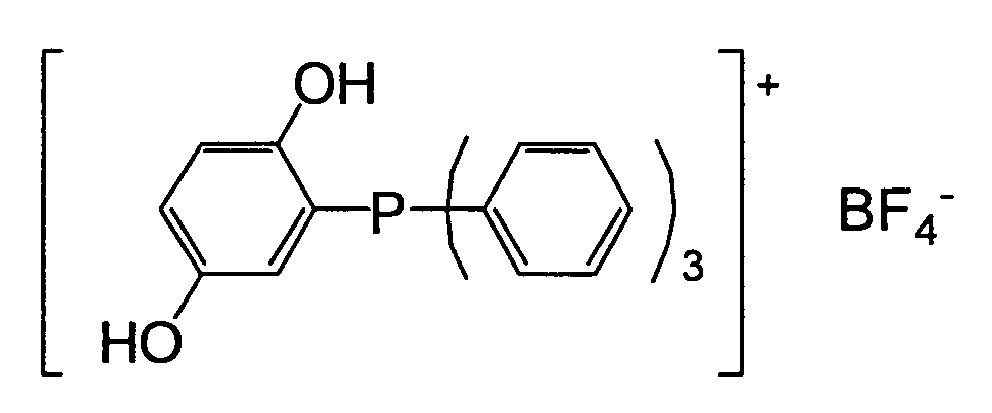


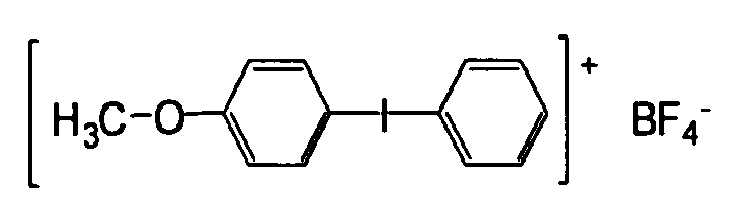


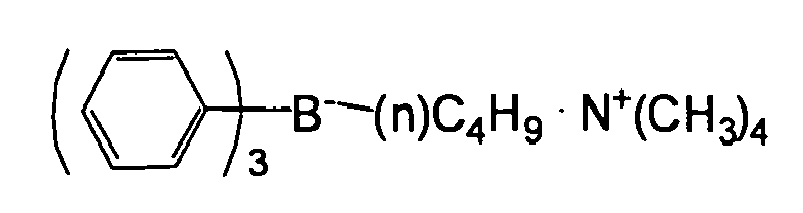


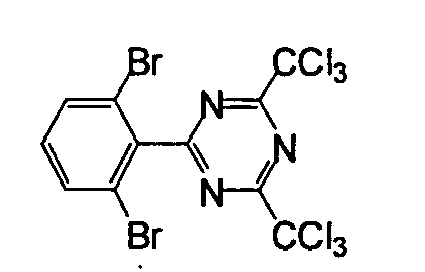


- Only one photopolymerization initiator may be used, or two or more photopolymerization initiators may be used in combination. The content of the photopolymerization initiator in the ink composition is preferably 0.1% by mass to 20% by mass, more preferably 0.5% by mass to 10% by mass, most preferably 1% by mass to 7% by mass, based on the total solid content in the ink composition.
- In the present invention, a sensitizing dye may be added for the purpose of improving the sensitivity of the photopolymerization initiator. For the sensitizing dye, those are preferable that belong to the following compound classes and have absorption wavelengths in the range of 350 nm to 450 nm.
- Examples of the sensitizing dye include multinuclear aromatics (e.g., pyrene, perylene, triphenylene, and anthracene), xanthenes (e.g., fluorescein, eosin, erythrosine, rhodamine B, and Rose Bengal), cyanines (e.g., thiacarbocyanine and oxacarbocyanine), merocyanines (e.g., merocyanine and carbomerocyanine), thiazines (e.g., thionine, methylene blue, and toluidine blue), acridines (e.g., acridine orange, chloroflavin, and acryflavin), anthraquinones (e.g., anthraquinone), squaliums (e.g., squalium), and coumarins (e.g., 7-diethylamino-4-methyl coumarin).
- For the sensitizing dye, compounds represented by the following formulae (IX) to (XIII) are more preferable.

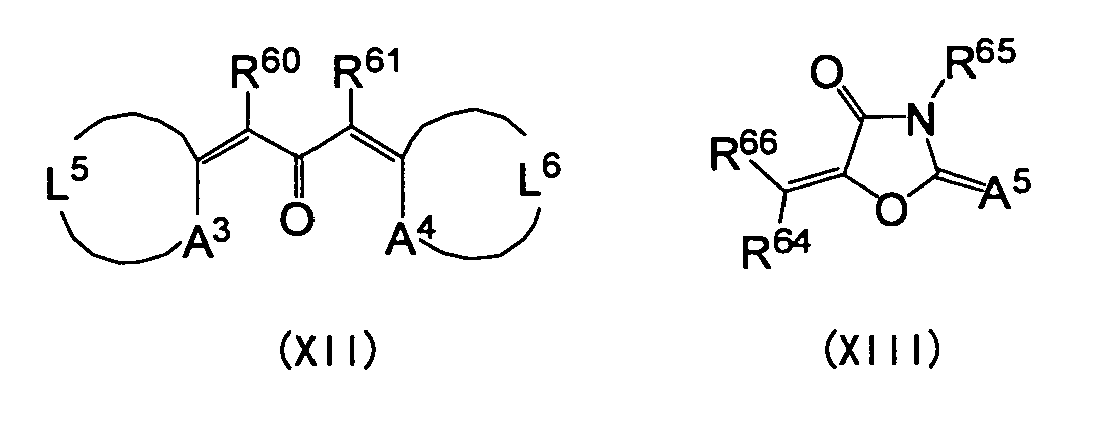
- In formula (IX), A1 represents a sulfur atom or -NR50-, R50 represents an alkyl group or an aryl group, L2 represents a nonmetallic atomic group which, together with A1 and the carbon atom adjacent thereto, forms a basic nucleus of a dye, R51 and R52 each independently represent a hydrogen atom or a monovalent nonmetallic atomic group, R51 and R52 may be bound to each other to form an acidic nucleus of a dye, and W represents an oxygen atom or a sulfur atom.
- In formula (X), Ar1 and Ar2 each independently represent an aryl group, and are bound to each other via a linkage -L3- which represents -O- or -S-. W has the same definition as in formula (IX).
- In formula (XI), A2 represents a sulfur atom or NR59, L4 represents a nonmetallic atomic group which, together with A2 and the carbon atom adjacent thereto, forms a basic nucleus of a dye, R53, R54, R55, R56, R57 and R58 each independently represent a monovalent nonmetallic atomic group, and R59 represents an alkyl group or an aryl group.
- In formula (XII), A3 and A4 each independently represent -S- or -NR62- or -NR63-. R62 and R63 each independently represent a substituted or unsubstituted alkyl group or a substituted or unsubstituted aryl group. L5 represents a nonmetallic atomic group which, together with A3 and the carbon atom adjacent thereto, forms a basic nucleus of a dye. L6 represents a nonmetallic atomic group which, together with A4 and the carbon atom adjacent thereto, forms a basic nucleus of a dye. R60 and R61 each independently represent a hydrogen atom or a monovalent nonmetallic atomic group, or R60 and R61 are bound to each other to form an aliphatic or aromatic ring.
- In formula (XIII), R66 represents an optionally substituted aromatic cycle or heterocycle, A5 represents an oxygen atom, a sulfur atom, or -NR67-. R64, R65, and R67 each independently represent a hydrogen atom or a monovalent nonmetallic atomic group. R67 and R64 may be bonded to each other to form an aliphatic or aromatic ring. R65 and R67 may be bonded to each other to form an aliphatic or aromatic ring.
- Preferable specific examples of the compounds represented by formulae (IX) to (XIII) include exemplary compounds (A-1) to (A-24) shown below.


- To the ink composition of the present invention, a known compound that has a function of further improving the sensitivity or suppressing the inhibition of polymerization by oxygen may be added as a cosensitizer.
- Examples of the cosensitizer include the amines described, for example, in M. R. Sander et al., "Journal of Polymer Society" 10, p. 3173, (1972),
JP-B No. 44-20189 JP-A Nos. 51-82102 52-134692 59-138205 60-84305 62-18537 64-33104 - Other examples of the cosensitizer include thiols and sulfides, for example, the thiol compounds described in
JP-A No. 53-702 JP-B No. 55-500806 JP-A No. 5-142772 JP-A No. 56-75643 - Yet other examples of the cosensitizer include amino acid compounds (e.g., N-phenylglycine), the organic metal compounds described in
JP-B No. 48-42965 JP-B No. 55-34414 JP-A No. 6-308727 JP-A No. 6-250387 JP-A No. 6-191605 - In addition to the essential components, the other polymerizable compound (a) and (b) pigment, a preferable optional component, the polymerization initiator (c), and the sensitizing dye and cosensitizer that can be used together with the polymerization initiator (c), the ink composition according to the present invention may further contain various additives according to the purpose. For example, an ultraviolet absorbent may be added to the ink composition according to the present invention, for the improvement in the weather resistance of the obtained image and prevention of the discoloration of the image. In addition, an antioxidant may be added to improve the stability of the ink composition.
- Other usable additives include: an organic or metal-complex-based anti-fading agent; a conductive salt for the control of the ejection properties, such as potassium thiocyanate, lithium nitrate, ammonium thiocyanate, or dimethylamine hydrochloride salt; and a trace amount of an organic solvent for the improvement of the adhesion to the recording medium.
- The ink composition according to the present invention may further contain a polymer compound selected from various polymer compounds for the purpose of the adjustment of the film physical properties. Examples of polymer compounds include acrylic polymers, polyvinylbutyral resins, polyurethane resins, polyamide resins, polyester resins, epoxy resins, phenol resins, polycarbonate resins, polyvinylbutyral resins, polyvinylformal resins, shellac, vinyl resins, acrylic resins, rubber resin, waxes, and other natural resins. Two or more polymer compounds may be used simultaneously.
- One or more substances selected from nonionic surfactants, cationic surfactants, and organic fluorocompounds may be added to the ink composition of the present invention in order to control the liquid properties.
- The ink composition of the present invention may contain other additives as necessary, for example, leveling additives, matting agents, waxes for controlling the film properties, and tackifiers, which do not inhibit polymerization, for improving the adhesion to recording media such as polyolefin and PET.
- The ink composition of the present invention has a viscosity of preferably 30 mPa·s or less and more preferably 20 mPa·s or less at the temperature of injection taking injection ability into account. It is preferable to control and determine the ratio of the composition properly such that the viscosity of the ink composition falls in the above range. It is to be noted that the viscosity of the ink at 25°C (room temperature) is 200 mPa·s or less and preferably 100 mPa·s. By setting the viscosity high at room temperature, even if a porous recording medium is used, it is possible to prevent permeation of ink into the recording medium, reduce the amount of an uncured monomer, and decrease odors, and further, blurring of dots when ink droplets are impacted can be suppressed, resulting in improved image quality. When the viscosity of the ink at 25°C is higher than 200 mPa·s, a problem arises concerning the delivery of the ink liquid.
- The surface tension of the ink composition according to the present invention is preferably 20 mN/m to 30 mN/m and more preferably 23 mN/m to 28 mN/m. When the ink is used for recording on various recording media such as polyolefin, PET, coated paper, and non-coated paper, the surface tension is preferably 20 mN/m or more in view of the prevention of bleeding and penetration, and 30 mN/m or less in view of the wettability.
- The ink composition of the present invention prepared in this manner is suitably used as an inkjet recording ink. The recording can be conducted by applying the ink composition on a recording medium by printing using an inkjet printer, and then irradiating the applied ink composition with a radiation ray to cure the composition.
- In the printed articles obtained by the ink, the image portion has been cured by irradiation with radiation rays such as ultraviolet rays and the printed articles are therefore superior in the strength of the image portion. Therefore, the ink composition of the present invention may be used in various applications such as the formation of the ink receptor layer (image portion) of a planographic printing plate, besides image formation using ink.
- Next, an inkjet recording method and an inkjet recording apparatus, which are suitably adopted in the present invention, will be described below.
- In the inkjet recording method, it is preferable to eject the ink composition after the viscosity of ink composition is lowered to 30 mPa·s or less by heating to 40°C to 80°C, and in this manner, it is possible to realize highly stable ejection. Radiation-curable ink compositions are usually more viscous than aqueous inks. Thus, generally, fluctuation in the viscosity of radiation-curable ink compositions caused by the fluctuation in temperature during printing is larger. The fluctuation in the viscosity of ink composition exerts significant influences on the droplet size and the droplet ejection speed, causing deterioration in image quality, and thus, it is necessary to keep the temperature of the ink composition as constant as possible during printing. It is preferable to control the ink composition temperature within 5°C from the set temperature, more preferably 2°C from the set temperature, and most preferably 1°C from the set temperature.
- The inkjet recording apparatus may have an ink-temperature stabilizing device. The ink-temperature stabilizing device maintains a constant temperature of the ink composition in all the piping systems and members from the ink tank (from the intermediate tank if such an intermediate tank is present) to the ejection face on the nozzles.
- The temperature can be controlled by any method without limitation. For example, it is preferable to control heating conditions according to the flow rate of the ink composition and the environmental temperature based on the information supplied from plural temperature sensors provided to the respective pipes. The heat unit to be heated is preferably insulated thermally such that the unit is not affected by the environmental temperature. Preferably, the heat unit is thermally insulated from the other portions, and the total heat capacity of the heating unit is small, whereby the printer starting-up time required for heating is shortened and the heat energy loss is reduced.
- An active radiation-curable ink composition can be obtained by adding the photopolymerization initiator as the polymerization initiator (c) to the ink composition of the present invention.
- Conditions of the irradiation of the ink composition with an active radiation ray will be described below. A basic method of the irradiation is disclosed in
JP-A No. 60-132767 WO 99/54415 - Further, in the present invention, it is desirable to heat the ink composition to a predetermined temperature and adjust the period between the deposition of the ink composition on the recording medium and the irradiation with radiation rays to 0.01 second to 0.5 second, preferably 0.01 second to 0.3 second, and more preferably 0.01 second to 0.15 second. It becomes possible to prevent bleeding of the deposited ink composition before curing, by shortening the period between the deposition of the ink composition on the recording medium and the irradiation with radiation rays to such an extremely short period. Further, even when the recording medium is porous, the ink composition is irradiated before penetrating deep into the recording medium. Thus, the amount of the remaining unreacted monomer is reduced and consequently the odor is also reduced. The combination of the inkjet recording method and the ink composition of the present invention provides significant synergy effects. In particular when the viscosity of the ink composition at 25°C is 200 mPa·s or less, significant effects can be obtained. By employing such an inkjet recording method, it is possible to maintain the dot diameter of the deposited ink composition constant and obtain an image with improved quality, on any of various recording media different in surface wettability. In order to obtain a color image, it is preferable to form images in the order from a color lower in lightness. When an ink of lower lightness is deposited, the radiation rays are unlikely to reach the inks located at the bottom; therefore, curing sensitivity and improvement in adhesiveness are likely to be deteriorated, and the residual monomer is likely to be increased to cause odor. Although it is possible to eject inks of all colors and then conduct the irradiation at the same time, it is preferable to irradiate the image with radiation rays after each color ink is deposited, in view of the acceleration of curing.
- The inkjet recording apparatus used in the present invention is not particularly limited, and a commercial inkjet recording apparatus can be used. In other words, in the present invention, the recording on recording media (printed articles) can be conducted by a commercial inkjet recording apparatus.
- In the preferable ejecting conditions described above, although the ink composition of the present invention is repeatedly heated and cooled, reduction in pigment dispersibility is avoided, excellent coloring property is achieved over a long period, and the deterioration of the ejection property caused by the aggregation of the pigment is also avoided owing to the function of the specific polymer that contains a copolymer unit derived from the monomers represented by the formula (1) to (3) even when the ink composition is stored under such temperature conditions.
- The recording medium to which the ink composition according to the present invention is applicable is not particularly limited, and examples thereof include ordinary papers such as non-coated paper, coated paper, and corrugated paper, various non-absorptive resin materials for use in so-called soft packaging, and resin films thereof in the film shape. Examples of such various plastic films include PET film, OPS film, OPP film, ONy film, PVC film, PE film, and TAC film. Examples of other plastics usable as the material of the recording medium include polycarbonate, acrylic resins, ABS, polyacetal, PVA, and rubbers. In addition, metals and glasses are also usable as the recording media. Recording media having a large area may also be used.
- The ink composition of the present invention is used to print on a recording medium by an inkjet printer and then, preferably, the ink composition applied by printing is irradiated with an active radiation ray and cured, whereby the printed articles of the present invention can be obtained. The printed article of the present invention has a high quality image superior in coloring property and sharpness and is also superior in the weather resistance of the image because the ink used for image formation contains fine pigment particles uniformly and stably in a dispersed state. The ink composition of the invention is therefore applied in a wide range of fields.
- The present invention will be explained in more detail by way of Examples, which are not intended to limit the present invention.
- 355.0 g of 1,8-naphthalimide was dissolved in 1,500 mL of N-methylpyrrolidone, and 0.57 g of nitrobenzene was added at 25°C. 301.4 g of diazabicycloundecene (DBU) was added dropwise to the mixture. After stirring for 30 minutes, 412.1 g of chloromethylstyrene was added dropwise to the mixture, which was then heated at 60°C with stirring for 4 hours. 2.7 L of isopropanol and 0.9 L of distilled water were added to this reaction solution and stirred while cooling to 5°C. The resulting precipitates were separated by filtration and washed with 1.2 L of isopropanol to obtain 544.0 g of polymerizable compound M-1.
- From NMR data shown below, the compound obtained was confirmed to be polymerizable compound M-1.
1H-NMR (300MHz, CDCl3, δ): 8.61 (d,2H), 8.21 (d,2H), 7.75 (t,2H), 7.25-7.60 (m,4H), 6.66 (m,1H), 5.73 (dd,1H), 5.38 (s,2H), 5.20 (dd,1H). - 19.7 g of 1,8-naphthalimide was dissolved in 100 mL of N-methylpyrrolidone, 11.1 g of triethylamine was added and stirred. 20.2 g of 4-vinylbenzene sulfonyl chloride was added dropwise to the mixture and stirred for 2 hours. 500 mL of distilled water was added to this reaction solution and stirred while cooling to 5°C. The resulting precipitates were separated by filtration and washed with methanol to obtain 20.0 g of polymerizable compound M-3.
- From NMR data shown below, the compound obtained was confirmed to be polymerizable compound M-3.
1H-NMR (300MHz, CDCl3, δ): 8.61 (d, 2H), 8.21 (d, 2H), 8.01 (d, 2H), 7.75 (t, 2H), 7.60 (d, 2H), 6.76 (m,1H), 5.93 (dd,1H), 5.58 (dd,1H), 5.40 (d, 2H). - 2.0 g of M-1,18.0 g of polymethyl methacrylate having a methacryloyl group at one terminal (AA-6, manufactured by Toagosei Co., Ltd.), and 20 g of methyl ethyl ketone were introduced into a three-neck flask in which the atmosphere was substituted with nitrogen, stirred with a stirrer (Three-one Motor, manufactured by Shinto Scientific Co., Ltd.) and heated to raise the temperature to 78°C with nitrogen flowing in the flask. 27 mg of 2,2-azobis(2,4-dimethylvaleronitrile) (V-65, manufactured by Wako Pure Chemical Industries, Ltd.) was added to the above solution and heated at 78°C with stirring for 2 hours. After 2 hours, 27 mg of V-65 was further added and heated with stirring for 3 hours. The resulting reaction solution was poured into 1,000 mL of hexane with stirring, and the precipitates produced were heated and dried to obtain a graft copolymer 1 (the above listed graft copolymer 1: A copolymer of the monomer represented by M-1, and polymethylmethacrylate having a methacryloyl group at its terminal).
- The weight average molecular mass (polystyrene standard) of the graft copolymer 1, determined by GPC, was 31,500. Thus, it was confirmed that polymer was obtained.
- For GPC, Shodex GPC KF-804 (Showa Denko K.K.) was used as a column, and THF was used as an eluent. Measurement was performed at a flow rate of 0.8 mL/ min and a column temperature of 40°C, and refractive index (RI) detection was used.
- 2.0 g of M-1, 2.0 g of 3-(N,N-dimethylaminopropyl acrylamide), 16.0 g of polymethyl methacrylate having a methacryloyl group at one terminal (AA-6, manufactured by Toagosei Co., Ltd.), and 20 g of methyl ethyl ketone were introduced into a three-neck flask in which the atmosphere was substituted with nitrogen, stirred with a stirrer (Three-one Motor, manufactured by Shinto Scientific Co., Ltd.) and heated to raise the temperature to 78°C with nitrogen flowing in the flask. 27 mg of 2,2-azobis(2,4-dimethylvaleronitrile) (V-65, manufactured by Wako Pure Chemical Industries, Ltd.) was added to the above solution and heated at 78°C with stirring for 2 hours. After 2 hours, 27 mg of V-65 was further added and heated with stirring for 3 hours. The resulting reaction solution was poured into 1,000 mL of hexane with stirring, and the precipitates produced were heated and dried to obtain a graft copolymer 2 (the above listed graft copolymer 8: A copolymer of the monomer represented by M-1, 3-(N,N-dimethylamino)propyl acrylamide, and polymethylmethacrylate having a methacryloyl group at its terminal).
- The weight average molecular mass (polystyrene standard) of the graft copolymer 2, determined by GPC, was 56,600. Thus, it was confirmed that polymer was obtained.
- A graft copolymer 3 (the above listed graft copolymer 2: A copolymer of the monomer represented by M-1, and polyethylene glycol mono(meth)acrylate) was obtained in the same way as in the synthetic example of graft copolymer 1 except that the "polymethyl methacrylate having a methacryloyl group at one terminal" of the synthetic example of graft copolymer 1 was changed to "methoxypolyethylene glycol methacrylate" (NK ESTER M-230G, manufactured by Shin-Nakamura Chemical Co., Ltd.).
- The weight average molecular mass (polystyrene standard) of the graft copolymer 3, determined by GPC, was 24,500. Thus, it was confirmed that polymer was obtained.
- A graft copolymer 4 (the above listed graft copolymer 4: A copolymer of the monomer represented by M-1, and polybutyl acrylate having a methacryloyl group at its terminal) was obtained in the same way as in the synthetic example of graft copolymer 1 except that the "polymethyl methacrylate having a methacryloyl group at one terminal" of the synthetic example of graft copolymer 1 was changed to "polybutyl acrylate having a methacryloyl group at one terminal" (AB-6, manufactured by Toagosei Co., Ltd.).
- The weight average molecular mass (polystyrene standard) of the graft copolymer 4, determined by GPC, was 28,800. Thus, it was confirmed that polymer was obtained.
- A graft copolymer 5 (the above listed graft copolymer 5: A copolymer of the monomer represented by M-3, and polymethylmethacrylate having a methacryloyl group at its terminal) was obtained in the same way as in the synthetic example of graft copolymer 1 except that M-1 of the synthetic example of graft copolymer 1 was changed to M-3.
- The weight average molecular mass (polystyrene standard) of the graft copolymer 5, determined by GPC, was 18,700. Thus, it was confirmed that polymer was obtained.
- A graft copolymer 6 (the above listed graft copolymer 16: A copolymer of the monomer represented by M-1, methacrylic acid, and polymethylmethacrylate having a methacryloyl group at its terminal) was obtained in the same way as in the synthetic example of graft copolymer 2 except that the "3-(N,N-dimethylaminopropyl acrylamide)" of the synthetic example of graft copolymer 2 was changed to "methacrylic acid".
- The weight average molecular mass (polystyrene standard) of the graft copolymer 6, determined by GPC, was 19,800. Thus, it was confirmed that polymer was obtained.
- Graft copolymer 1 (the graft copolymer 1 listed above: copolymer of the monomer, represented by M-1, and polymethylmethacrylate having a methacryloyl group at its terminal) was dissolved in other polymerizable compounds (a), (i) and (ii), and the mixture was placed together with a pigment (b) in a Motor Mill M50 (manufactured by Eiger Co., Ltd.) to disperse the mixture at a peripheral speed of 9 m/s for 6 hours by using zirconia beads 0.65 mm in diameter, thereby obtaining a reaction mixture of active energy ray-curable ink. Then, the polymerization initiator (c) was added to the reaction mixture and mixed mildly, followed by filtration under pressure using a membrane filter to obtain an active energy ray-curable type inkjet ink of Example 1. The amounts of graft copolymer 1, other polymerizable compounds (a), (i) and (ii), pigment (b), and polymerization initiator (c) added are shown below.
· Graft copolymer 1 1.5 g - (a) Other polymerizable compound:
- (i) propoxylated neopentyl glycol diacrylate (NPGPODA, manufactured by Sartomer Company, Inc.) 60.0 g
- (ii) caprolactone-modified dipentaerythritol hexaacrylate (DPCA-60, manufactured by Nippon Kayaku Co., Ltd.) 27.5 g
- (b) Pigment: quinacridone base pigment PV-19 5.0 g
- (c) Polymerization initiator: acylphosphine oxide compound (LucirinTPO-L, manufactured by BASF) 5.0 g
- Active energy ray-curable type inkjet inks of Examples 2 to 6 were obtained in the same way as in Example 1 except that the graft copolymer 1 used in Example 1 was changed to the graft copolymers 2 to 6, respectively, prepared in the synthetic examples.
- An active energy ray-curable type inkjet ink of Comparative Example 1 was obtained in the same way as in Example 1 except that a commercially available pigment dispersant "SOLSPERSE 24000GR" (manufactured by Lubrizol Japan Ltd.) was used instead of the graft copolymer 1 used in Example 1.
- An active energy ray-curable type inkjet ink of Comparative Example 2 was obtained in the same way as in Example 1 except that a commercially available pigment dispersant "SOLSPERSE 32000" (manufactured by Lubrizol Japan Ltd.) was used instead of the graft copolymer 1 used in Example 1.
- Inkjet ink compositions of Example 7 and Comparative Examples 3 and 4 were obtained in the same way as in Example 2 and Comparative Examples 1 and 2, respectively, except that the quinacridone base pigment PV-19 (b) was changed to PY-128.
- Inkjet inks of Example 8 and Comparative Examples 5 and 6 were obtained in the same way as in Example 2 and Comparative Examples 1 and 2, respectively, except that the other polymerizable compound (a) and polymerization initiator (c) were changed to the following compounds.
- (a) Other polymerizable compound:
- (i) oxetane compound (OXT-221, manufactured by Toagosei Co., Ltd.) 70.0 g
- (ii) epoxy compound (Celoxide 3000, manufactured by Daicel Chemical Industries, Ltd.) 17.5 g
- (c) Polymerization initiator: triphenylsulfonium salt (UVI-6992, manufactured by Dow Chemical) 5.0 g
- Inkjet inks of Example 9 and Comparative Examples 7 and 8 were obtained in the same way as in Example 8 and Comparative Examples 5 and 6, respectively, except that the quinacridone base pigment PV-19 was changed to a phthalocyanine-based pigment PB15:3.
- The polymer of the present invention shown below (graft copolymer 2) was dissolved in the following polymerizable compounds (a), and the mixture was placed together with the following pigment (b) in a Motor Mill M50 (manufactured by Eiger Co., Ltd.) to disperse the mixture at a peripheral speed of 5 m/ s for 5 hours by using zirconia beads 0.65 mm in diameter, thereby obtaining a reaction mixture of active energy ray-curable ink. Then, a polymerization initiator (c) was added to the reaction mixture and mixed mildly, followed by filtration under pressure using a membrane filter to obtain an inkjet ink of Example 10.
- · (b) Pigment [acetolone pigment PO-36 KENALAKE ORANGE HPRLO, manufactured by Albion Colours] 4.0 g
- · Polymer of the present invention [graft copolymer 2 obtained in the synthetic example] 1.2 g
- · (a) Polymerizable compound [propoxylated neopentyl glycol diacrylate (NPGPODA, manufactured by Sartomer Company, Inc. 40.0 g
- · (a) Polymerizable compound [dipropylene glycol diacrylate (DPGDA, manufactured by DAICEL-CYTEC Company Ltd.] 49.8 g
- · (c) Polymerization initiator [acylphosphine oxide compound (LucirinTPO-L: manufactured by BASF)] 5.0 g
- An inkjet ink of Comparative Example 9 was obtained in the same way as in Example 10 except that the polymer of the present invention (graft copolymer 2) used in Example 10 was changed to a commercially available pigment dispersant "SOLSPERSE 24000GR" (manufactured by Lubrizol Japan Ltd.).
- Inkjet inks of Example 11 and Comparative Example 10 were obtained in the same way as in Example 10 and Comparative Example 9, respectively, except that the pigment (b) used in Example 10 and Comparative Example 9 was changed to acetolone pigment (PY-120, Novoperm Yellow H2G, manufactured by Clariant(Japan)K.K.).
- An inkjet ink of Example 12 was obtained in the same way as in Example 10 except that the polymerizable compound (a), pigment (b), polymerization initiator (c) used in Example 10 were changed to following compounds.
- · (b) Pigment [Dioxazine pigment PV-23, Hostaperm Violet BL] 3.0 g
- Polymer of the present invention [graft copolymer 2 obtained in the synthetic example]) 0.9 g
- · (a) Polymerizable compound [propoxylated neopentyl glycol diacrylate] (NPGPODA, manufactured by Sartomer Company, Inc.) 40.0 g
- · (a) Polymerizable compound [dipropylene glycol diacrylate (DPGDA, manufactured by DAICEL-CYTEC Company Ltd. 50.6 g
- · (c) Polymerization initiator [acylphosphine oxide compound (LucirinTPO-L: manufactured by BASF] 5.5 g
- An inkjet ink of Comparative Example 11 was obtained in the same way as in Example 12 except that the polymer of the present invention (graft copolymer 2) used in Example 12 was changed to a commercially available pigment dispersant "SOLSPERSE 24000GR" (manufactured by Lubrizol Japan Ltd.).
- The obtained inkjet inks were evaluated according to the following methods.
The results are shown in Table 1. - The viscosity of each inkjet ink at 40°C was measured with an E-type viscometer.
- A: 30 mPa·s or less.
- B: exceeding 30 mPa s and less than 100 mPa·s.
- C: 100 mPa·s or more (practically problematic level with regard to jetting ability).
- The state of dispersion of each inkjet ink after being stored at 25°C for one month and after being stored at 60°C for 24 hours was evaluated visually and according to viscosity change.
- A: No precipitate is generated, and an increase in viscosity is not observed.
- B: No precipitate is generated, and although a slight increase in viscosity is observed, it is a non-problematic level with regard to jetting ability.
- C: No precipitate is generated, but an increase in viscosity is observed, which is a practically problematic.
- D: Precipitates are generated.
- The volumetric average particle diameter D50 of each inkjet ink was measured using a light-scattering diffraction type particle size distribution measuring device (LA910, manufactured by Horiba, Ltd.) to carry out evaluation.
- A: D50 is less than 100 nm.
- B: D50 is 100 nm or more and less than 200 nm.
- C: D50 is 200 nm or more.
- The obtained ink compositions were applied to art paper by printing using an inkjet printer (printing density: 300 dpi, dotting frequency: 4 kHz, number of nozzles: 64) and then exposed to light by using a Deep UV lamp (SP-7, manufactured by Ushio Inc.) under an energy condition of 100 mJ/cm2 to obtain a print sample.
- A cured coating film was touched with fingers to evaluate the presence of a sticky feel according to the following standard.
- A: No sticky feel.
- B: Slightly sticky.
- C: Very sticky.
- As is clear from Table 1, the ink composition of the present invention was cured with high sensitivity when irradiated with a radiation ray, and it could therefore form a non-sticky high quality image. Even in the case where it was stored for a long time, the dispersibility and dispersion stability of the pigment were both satisfactory without any increase in viscosity associated with a reduction in the dispersibility of the pigment.
- On the other hand, although the comparative examples using commercially available high molecular dispersant had favorable pigment dispersibility initially, they were deteriorated, particularly, in storage under a high-temperature condition (stability (60°C)), showing that they had characteristics at a practically problematic level.
- In the Examples described above, only data of Examples, in which polymers 1 to 6 were used as a pigment dispersant, are shown. However, it can be presumed that when the polymers of the present invention other than the polymers 1 to 6 are used as a pigment dispersant, they also have dispersion performance as the polymers 1 to 6 do. The reason for this is that the polymer of the present invention comprises, as a basic building block, a site interacting with a pigment, and a graft chain (macromonomer). Here, the site interacting with a pigment indicates the polymerizable compound of the present invention, and, according to necessity, also includes a basic monomer or acidic monomer (those which interact with acidic or basic site of the pigment surface). The graft chain (macromonomer) has a higher affinity for a dispersion medium than for a pigment and functions as a steric repulsive site that prevents the particles from aggregating in the dispersion liquid. Thus, it is necessary to select a graft chain depending on the dispersion medium.
- The ink composition of the present invention can be suitably used in usual printing to form a sharp image with excellent coloring property, thus giving a high-quality printed material. The ink composition of the present invention can be suitably used also in the production of resists, color filters, and optical disks, and is useful also as an optical molding material.
- In addition, since the application of the inkjet recording method makes it possible to form a high-quality image directly even on a non-absorptive recording medium based on digital data, the ink composition of the present invention can be suitably used also for the production of a printed material having a large area.
| Pigment dispersant | Evaluation of ink composition | |||||
| Viscosity | Stability (Room temperature) | Stability (60°C) | Particle Curability diameter | |||
| Example 1 | Polymer 1 | A | A | A | A | A |
| Example 2 | Polymer 2 | A | A | A | A | A |
| Example 3 | Polymer 3 | A | A | A | A | A |
| Example 4 | Polymer 4 | A | A | A | A | A |
| Example 5 | Polymer 5 | A | A | A | A | A |
| Example 6 | Polymer 6 | A | A | B | A | A |
| Comparative Example 1 | Commercially available dispersant 24000GR | A | C | C | A | A |
| Comparative Example 2 | Commercially available dispersant 32000 | A | A | C | A | A |
| Example 7 | Polymer 2 | A | A | A | A | A |
| Comparative Example 3 | Commercially available dispersant 24000GR | C | C | D | C | A |
| Comparative Example 4 | Commercially available dispersant 32000 | B | C | C | B | A |
| Example 8 | Polymer 2 | A | A | A | A | A |
| Comparative Example 5 | Commercially available dispersant 24000GR | A | C | C | B | A |
| Comparative Example 6 | Commercially available dispersant 32000 | A | B | C | B | A |
| Example 9 | Polymer 2 | A | A | A | A | A |
| Comparative Example 7 | Commercially available dispersant 24000GR | C | C | D | C | A |
| Comparative Example 8 | Commercially available dispersant 32000 | B | B | D | B | A |
| Example 10 | Polymer 2 | A | A | A | A | A |
| Comparative Example 9 | Commercially available dispersant 24000GR | B | C | D | B | A |
| Example 11 | Polymer 2 | A | B | B | A | A |
| Comparative Example 10 | Commercially available dispersant 24000GR | C | C | D | C | A |
| Example 12 | Polymer 2 | A | A | A | A | A |
| Comparative Example 11 | Commercially available dispersant 24000GR | C | C | D | A | A |
Claims (12)
- A polymerizable compound represented by the following formula (1):

- The polymerizable compound according to claim 1, which is represented by the following formula (2):

- A polymer comprising a copolymer unit derived from a monomer represented by formula (1).
- The polymer according to claim 3, further comprising a copolymer unit derived from a monomer represented by formula (2).
- The polymer according to one of claims 3 and 4, wherein the polymer is a graft copolymer containing, as a copolymer unit, a polymerizable oligomer (macromonomer) having an ethylenically unsaturated double bond at a terminal thereof.
- An ink composition comprising:the polymer of any one of claims 3 to 5;a polymerizable compound (a); anda pigment (b).
- The ink composition according to claim 6, further comprising a polymerization initiator (c).
- The ink composition according to claim 7, wherein the polymerizable compound (a) is a radical polymerizable compound, and the polymerization initiator (c) is a photo-radical generator.
- The ink composition according to claim 7, wherein the polymerizable compound (a) is a cationic polymerizable compound, and the polymerization initiator (c) is a photo-acid generator.
- The ink composition according to any one of claims 6 to 9, which is used for inkjet recording.
- A printed article obtained by curing the ink composition of any one of claims 6 to 10.
- An inkjet recording method comprising:ejecting the ink composition of any one of claims 6 to 10 on a recording medium using an inkjet printer; andirradiating the ink composition ejected with an active radiation ray to cure the ink composition.
Applications Claiming Priority (2)
| Application Number | Priority Date | Filing Date | Title |
|---|---|---|---|
| JP2007095456 | 2007-03-30 | ||
| JP2007294571 | 2007-11-13 |
Publications (2)
| Publication Number | Publication Date |
|---|---|
| EP1975160A1 true EP1975160A1 (en) | 2008-10-01 |
| EP1975160B1 EP1975160B1 (en) | 2013-01-16 |
Family
ID=39588043
Family Applications (1)
| Application Number | Title | Priority Date | Filing Date |
|---|---|---|---|
| EP20080005793 Ceased EP1975160B1 (en) | 2007-03-30 | 2008-03-27 | Polymerizable compound, polymer, ink composition, printed articles and inkjet recording method |
Country Status (3)
| Country | Link |
|---|---|
| US (1) | US8173226B2 (en) |
| EP (1) | EP1975160B1 (en) |
| JP (1) | JP5306681B2 (en) |
Cited By (3)
| Publication number | Priority date | Publication date | Assignee | Title |
|---|---|---|---|---|
| CN102516988A (en) * | 2011-11-28 | 2012-06-27 | 大连理工大学 | A kind of polymerizable fluorescent dye, its preparation method and application |
| EP2894205A1 (en) * | 2014-01-09 | 2015-07-15 | Canon Kabushiki Kaisha | Ink jet ink and ink jet recording method |
| CN106133984A (en) * | 2014-03-28 | 2016-11-16 | 住友精化株式会社 | Addition agent of non-aqueous electrolyte, nonaqueous electrolytic solution and electrical storage device |
Families Citing this family (9)
| Publication number | Priority date | Publication date | Assignee | Title |
|---|---|---|---|---|
| FR2927077B1 (en) * | 2008-01-31 | 2012-05-25 | Commissariat Energie Atomique | 1,8-NAPHTHALIMIDE DERIVATIVES AS SCINTILLATION AGENTS, IN PARTICULAR FOR THE DISCRIMINATION BETWEEN FAST NEUTRONS AND GAMMA RAYS |
| JP5414367B2 (en) * | 2008-06-02 | 2014-02-12 | 富士フイルム株式会社 | Pigment dispersion and ink composition using the same |
| TWI507425B (en) * | 2010-06-14 | 2015-11-11 | Nippon Steel & Sumikin Chem Co | An ultraviolet-curing resin composition for use in an ink-jet printing method, and an optical element |
| JP2013249417A (en) * | 2012-06-01 | 2013-12-12 | Fujifilm Corp | Dispersion composition, polymerizable composition using same, light-blocking color filter, solid-state imaging element, liquid crystal display device, wafer-level lens, and imaging unit |
| JP6739334B2 (en) * | 2013-11-04 | 2020-08-12 | ルブリゾル アドバンスド マテリアルズ, インコーポレイテッド | Acrylic dispersant having condensed aromatic imide anchor group |
| CN108440711B (en) * | 2018-03-19 | 2020-08-07 | 陕西科技大学 | A kind of aqueous naphthalimide fluorescent polymer emulsion and preparation method thereof |
| EP4269513A4 (en) | 2020-12-25 | 2024-05-22 | artience Co., Ltd. | Ultraviolet radiation curing type inkjet ink |
| CN113735772B (en) * | 2021-09-22 | 2024-04-09 | 四川羽玺新材料股份有限公司 | A fluorescent functional monomer, a pressure-sensitive adhesive capable of timely detecting coating defects and a preparation method thereof |
| WO2026015683A1 (en) * | 2024-07-10 | 2026-01-15 | The Board Of Trustees Of The Leland Stanford Junior University | Compounds, compositions, and methods for treating metabolic disorders |
Citations (124)
| Publication number | Priority date | Publication date | Assignee | Title |
|---|---|---|---|---|
| US2833827A (en) | 1955-01-17 | 1958-05-06 | Bayer Ag | Tri (3, 5-di lower alkyl-4-hydroxy phenyl)-sulfonium chlorides and method of preparing same |
| JPS4420189B1 (en) | 1965-06-03 | 1969-08-30 | ||
| JPS4537377B1 (en) | 1965-06-03 | 1970-11-27 | ||
| US3567453A (en) | 1967-12-26 | 1971-03-02 | Eastman Kodak Co | Light sensitive compositions for photoresists and lithography |
| JPS4642363B1 (en) | 1968-10-09 | 1971-12-15 | ||
| JPS473981B1 (en) | 1968-06-11 | 1972-02-03 | ||
| JPS476416B1 (en) | 1968-04-16 | 1972-02-23 | ||
| JPS4722326B1 (en) | 1968-07-26 | 1972-06-22 | ||
| JPS4723664B1 (en) | 1968-07-26 | 1972-07-01 | ||
| JPS4842965B1 (en) | 1968-04-02 | 1973-12-15 | ||
| GB1388492A (en) | 1971-09-03 | 1975-03-26 | Minnesota Mining & Mfg | Chromophore-substituted halomethyl-s-triazines |
| US3902144A (en) | 1973-04-26 | 1975-08-26 | Siemens Ag | Resilient mounting arrangement for the non-movable magnetic member of an electromagnetic switching apparatus |
| US3901710A (en) | 1972-08-26 | 1975-08-26 | Agfa Gevaert Ag | Photographic material comprising a light-sensitive 1,4-dihydropyridine derivative |
| JPS5182102A (en) | 1974-12-10 | 1976-07-19 | Basf Ag | Insatsuinki oyobi hifukuzairyonotameno hikarijugokanonaketsugozai |
| JPS5214278B2 (en) | 1974-05-02 | 1977-04-20 | ||
| JPS5214279B2 (en) | 1974-05-02 | 1977-04-20 | ||
| JPS5214727B2 (en) | 1973-02-12 | 1977-04-23 | ||
| JPS52134692A (en) | 1976-05-04 | 1977-11-11 | Fuji Photo Film Co Ltd | Photopolymerizable composition |
| JPS53702A (en) | 1975-12-23 | 1978-01-06 | Dynachem Corp | Adhesion promoting agent for polymerized film |
| DE2641100A1 (en) | 1976-09-13 | 1978-03-16 | Hoechst Ag | LIGHT SENSITIVE COPY LAYER |
| JPS53133022A (en) | 1977-04-23 | 1978-11-20 | Du Pont | Light sensitive element |
| JPS53133428A (en) | 1977-04-25 | 1978-11-21 | Hoechst Ag | Radiation sensitive copying constitute |
| US4181531A (en) | 1978-04-07 | 1980-01-01 | E. I. Du Pont De Nemours And Company | Positive non-silver systems containing nitrofuryldihydropyridine |
| JPS5534414B2 (en) | 1972-06-02 | 1980-09-06 | ||
| JPS55500806A (en) | 1978-10-19 | 1980-10-16 | ||
| JPS5675643A (en) | 1979-11-07 | 1981-06-22 | Hoechst Ag | Photopolymerizable mixture and photopolymerizable copying material using same |
| DE3021590A1 (en) | 1980-06-09 | 1981-12-17 | Hoechst Ag, 6000 Frankfurt | 4-HALOGEN-5- (HALOGENMETHYL-PHENYL) -OXAZOLE DERIVATIVES, A METHOD FOR THE PRODUCTION THEREOF AND THEIR RADIO-SENSITIVE MEASURES |
| DE3021599A1 (en) | 1980-06-09 | 1981-12-24 | Hoechst Ag, 6000 Frankfurt | 2- (HALOGENMETHYL-PHENYL) -4-HALOGENOXAZOL DERIVATIVES, A METHOD FOR THE PRODUCTION THEREOF AND MEASURES CONTAINING THE RADIATION-SENSITIVITY |
| EP0044115A1 (en) | 1980-07-14 | 1982-01-20 | Akzo N.V. | Thermosetting coating composition containing a blocked acid catalyst |
| EP0046083A2 (en) | 1980-08-11 | 1982-02-17 | Minnesota Mining And Manufacturing Company | Photolabile blocked surfactants and compositions containing the same |
| JPS5730704A (en) | 1980-06-24 | 1982-02-19 | Bayer Ag | Photopolymerizable mixture containing aroylphosphoric acid ester as photoinitiator |
| US4318791A (en) | 1977-12-22 | 1982-03-09 | Ciba-Geigy Corporation | Use of aromatic-aliphatic ketones as photo sensitizers |
| US4343891A (en) | 1980-05-23 | 1982-08-10 | Minnesota Mining And Manufacturing Company | Fixing of tetra (hydrocarbyl) borate salt imaging systems |
| US4371605A (en) | 1980-12-09 | 1983-02-01 | E. I. Du Pont De Nemours And Company | Photopolymerizable compositions containing N-hydroxyamide and N-hydroxyimide sulfonates |
| EP0084515A2 (en) | 1982-01-11 | 1983-07-27 | Ciba-Geigy Ag | Acid-curable composition containing a blocked catalyst, and a curing method |
| US4431774A (en) | 1981-09-14 | 1984-02-14 | Ciba-Geigy Corporation | Process for the curing of stoving lacquers |
| EP0101122A1 (en) | 1982-08-09 | 1984-02-22 | Akzo N.V. | Thermosetting coating composition containing a blocked acid as catalyst |
| EP0104143A1 (en) | 1982-09-18 | 1984-03-28 | Ciba-Geigy Ag | Photopolymerizable compositions containing diaryliodosyl salts |
| EP0109773A2 (en) | 1982-10-25 | 1984-05-30 | Minnesota Mining And Manufacturing Company | Dispersed imaging systems with tetra(hydrocarbyl) borate salts |
| EP0109772A2 (en) | 1982-10-25 | 1984-05-30 | Minnesota Mining And Manufacturing Company | Fixing of tetra(hydrocarbyl)borate salt imaging systems |
| JPS59138205A (en) | 1983-01-20 | 1984-08-08 | チバ−ガイギ− アクチエンゲゼルシヤフト | Coating composition and curing method |
| JPS59152396A (en) | 1983-02-11 | 1984-08-31 | チバ−ガイギ− アクチエンゲゼルシヤフト | Metallocene, manufacture and photopolymerizable composition containing same |
| JPS59174831A (en) | 1983-03-24 | 1984-10-03 | Fuji Photo Film Co Ltd | Photopolymerizable composition |
| JPS5942864B2 (en) | 1979-04-13 | 1984-10-18 | 京セラミタ株式会社 | Method for preparing a projection manuscript and electrostatic photographic transfer film used therein |
| JPS608047B2 (en) | 1978-07-14 | 1985-02-28 | バスフ アクチェン ゲゼルシャフト | Photocurable polyester resin composition |
| DE3333450A1 (en) | 1983-09-16 | 1985-04-11 | Hoechst Ag, 6230 Frankfurt | CARBONYL METHYLENE HETEROCYCLES CONTAINING TRIHALOGEN METHYL GROUPS, METHOD FOR THE PRODUCTION THEREOF AND LIGHT-SENSITIVE MIXTURE THAT CONTAINS THESE COMPOUNDS |
| DE3337024A1 (en) | 1983-10-12 | 1985-04-25 | Hoechst Ag, 6230 Frankfurt | LIGHT SENSITIVE COMPOUNDS HAVING TRICHLORMETHYL GROUPS, METHOD FOR THE PRODUCTION THEREOF AND LIGHT SENSITIVE MIXTURE CONTAINING THESE COMPOUNDS |
| JPS6084305A (en) | 1983-08-30 | 1985-05-13 | バスフ アクチェン ゲゼルシャフト | Photopolymerizable mixture |
| JPS6026403B2 (en) | 1977-05-17 | 1985-06-24 | メルク・パテント・ゲゼルシヤフト・ミツト・ベシユレンクテル・ハフツング | Photosensitizer for photopolymerization of unsaturated compounds |
| JPS6026483B2 (en) | 1972-07-28 | 1985-06-24 | チバ・ガイギ−・アクチエンゲゼルシヤフト | Sensitizer for polymerization-based photopolymerization reactions containing unsaturated compounds |
| JPS60132767A (en) | 1983-12-21 | 1985-07-15 | Seikosha Co Ltd | Inkjet printer |
| EP0156153A1 (en) | 1984-03-22 | 1985-10-02 | Maschinenfabrik Rieter Ag | Yarn quality monitoring system |
| JPS60198538A (en) | 1984-03-22 | 1985-10-08 | Toshiba Corp | Positive type resist material |
| JPS61151197A (en) | 1984-12-20 | 1986-07-09 | チバ‐ガイギー アーゲー | Titanocenes and radiation-curable composition containing same |
| JPS61194062A (en) | 1985-02-21 | 1986-08-28 | メルク・パテント・ゲゼルシヤフト・ミツト・ベシユレンクテル・ハフツング | Photopolymerization initiator using thio-substituted ketone compound |
| US4618564A (en) | 1984-05-25 | 1986-10-21 | Ciba-Geigy Corporation | Process for production of positive images using sulfonic acid precursors |
| EP0199672A1 (en) | 1985-04-12 | 1986-10-29 | Ciba-Geigy Ag | Oxime sulphonates containing reactive groups |
| JPS6218537A (en) | 1985-07-16 | 1987-01-27 | ザ・ミ−ド・コ−ポレ−シヨン | Image forming material using photosensitive microcapsule containing third amine as coinitiator |
| JPS626223B2 (en) | 1979-03-06 | 1987-02-09 | Fuji Photo Film Co Ltd | |
| JPS6258241A (en) | 1985-09-09 | 1987-03-13 | Fuji Photo Film Co Ltd | Photosensitive composition |
| JPS6281345A (en) | 1985-09-28 | 1987-04-14 | チバ―ガイギー アクチェンゲゼルシャフト | Copolymerizable photoinitiator |
| EP0233567A2 (en) | 1986-02-14 | 1987-08-26 | BASF Aktiengesellschaft | Curable compositions containing N-sulfonylaminosulfonium salts as cationically active catalysts |
| JPS6341484A (en) | 1986-08-01 | 1988-02-22 | チバ−ガイギ− ア−ゲ− | Titanocene, its production and composition containing the same |
| JPS6314340B2 (en) | 1980-09-17 | 1988-03-30 | Fuji Photo Film Co Ltd | |
| US4743528A (en) | 1986-11-21 | 1988-05-10 | Eastman Kodak Company | Enhanced imaging composition containing an azinium activator |
| JPS63138345A (en) | 1986-11-21 | 1988-06-10 | イーストマン コダック カンパニー | Photographic image forming system |
| JPS63142346A (en) | 1986-11-21 | 1988-06-14 | イーストマン コダック カンパニー | Negative type photoresist |
| JPS63143537A (en) | 1986-11-21 | 1988-06-15 | イーストマン コダック カンパニー | Negative type photoresist |
| EP0271851A2 (en) | 1986-12-16 | 1988-06-22 | E.I. Du Pont De Nemours And Company | Light sensitive mixtures for making repeatedly tonable layers |
| US4760013A (en) | 1987-02-17 | 1988-07-26 | International Business Machines Corporation | Sulfonium salt photoinitiators |
| JPS6340799B2 (en) | 1978-07-14 | 1988-08-12 | Basf Ag | |
| EP0284561A2 (en) | 1987-03-26 | 1988-09-28 | Ciba-Geigy Ag | Alpha-aminoacetophenones as photo initiators |
| EP0290750A2 (en) | 1987-03-19 | 1988-11-17 | Xytronyx, Inc. | Systems for the visualization of exposure to ultraviolet radiation and for the utilization of ultraviolet radiation to effect color changes |
| JPS6361950B2 (en) | 1981-03-16 | 1988-11-30 | ||
| EP0297443A2 (en) | 1987-07-01 | 1989-01-04 | BASF Aktiengesellschaft | Light sensitive mixture for light sensitive coating materials |
| EP0297442A1 (en) | 1987-07-01 | 1989-01-04 | BASF Aktiengesellschaft | Sulfonium salts comprising groups which are labile in acid environment |
| JPS6418143A (en) | 1987-07-14 | 1989-01-20 | Nippon Kayaku Kk | Photosensitive resin composition |
| JPS6433104A (en) | 1987-06-25 | 1989-02-03 | Ciba Geigy Ag | Photopolymerizable composition |
| US4837124A (en) | 1986-02-24 | 1989-06-06 | Hoechst Celanese Corporation | High resolution photoresist of imide containing polymers |
| JPH01152109A (en) | 1987-12-09 | 1989-06-14 | Toray Ind Inc | Photopolymerizable composition |
| JPH01304453A (en) | 1988-06-02 | 1989-12-08 | Toyobo Co Ltd | Photopolymerizable composition |
| JPH02249A (en) | 1987-12-01 | 1990-01-05 | Ciba Geigy Ag | Titanocene and photopolymerizable composition containing it |
| JPH024705A (en) | 1988-03-24 | 1990-01-09 | Dentsply Internatl Inc | Titanate initiator for a photosetting composition |
| JPH029596B2 (en) | 1980-05-27 | 1990-03-02 | Basf Ag | |
| JPH029597B2 (en) | 1980-09-15 | 1990-03-02 | Basf Ag | |
| JPH0296514A (en) | 1988-03-01 | 1990-04-09 | Alza Corp | Method and means for reducing sensitization and stimulation of percutaneous drug administration |
| EP0370693A2 (en) | 1988-11-21 | 1990-05-30 | Eastman Kodak Company | Novel onium salts and the use thereof as photoinitiators |
| JPH02150848A (en) | 1988-12-02 | 1990-06-11 | Hitachi Ltd | Photobleachable radiation-sensitive composition and pattern formation method using the same |
| US4933377A (en) | 1988-02-29 | 1990-06-12 | Saeva Franklin D | Novel sulfonium salts and the use thereof as photoinitiators |
| JPH02211452A (en) | 1988-12-01 | 1990-08-22 | Polychrome Corp | Light initiator |
| EP0388343A2 (en) | 1989-03-14 | 1990-09-19 | International Business Machines Corporation | Chemically amplified photoresist |
| JPH02245756A (en) | 1989-03-20 | 1990-10-01 | Hitachi Ltd | Pattern forming material containing acid precursor and pattern forming method using same |
| WO1991002032A1 (en) * | 1989-08-11 | 1991-02-21 | Hoechst Aktiengesellschaft | Perylene compounds containing sulphonic groups, process for preparing them and their use |
| EP0422570A2 (en) | 1989-10-10 | 1991-04-17 | International Business Machines Corporation | Ultraviolet light sensitive photoinitiator compositions, use thereof and radiation sensitive compositions |
| JPH03101686A (en) | 1989-08-04 | 1991-04-26 | Ciba Geigy Ag | Mono-and di-acylphosphineoxide |
| JPH04365048A (en) | 1991-06-12 | 1992-12-17 | Fuji Photo Film Co Ltd | Photosensitive composition material |
| JPH05142772A (en) | 1991-11-26 | 1993-06-11 | Fuji Photo Film Co Ltd | Photopolymerizable composition |
| JPH05281728A (en) | 1992-04-01 | 1993-10-29 | Fuji Photo Film Co Ltd | Photopolymerizable composition |
| JPH05345790A (en) | 1991-09-23 | 1993-12-27 | Ciba Geigy Ag | Alkylbisacylphosphine oxide |
| JPH069714A (en) | 1992-06-29 | 1994-01-18 | Sumitomo Chem Co Ltd | Photopolymerizable composition and production of light control board |
| JPH06191605A (en) | 1992-12-25 | 1994-07-12 | Iyo Tekko Kk | Box type pallet |
| JPH06250387A (en) | 1993-03-01 | 1994-09-09 | Sumitomo Chem Co Ltd | Process for producing quinonediazide sulfonate and radiation-sensitive resin composition containing quinonediazide sulfonate obtained by the process |
| JPH06298818A (en) | 1993-03-18 | 1994-10-25 | Ciba Geigy Ag | Curable composition containing bis-acylphosphine oxide photo-initiator |
| JPH06308727A (en) | 1993-04-19 | 1994-11-04 | Fuji Photo Film Co Ltd | Photopolymerizable composition |
| WO1999054415A1 (en) | 1998-04-15 | 1999-10-28 | Nof Corporation | Method for formation of coating film and coating composition |
| JP2001031892A (en) | 1999-07-23 | 2001-02-06 | Toyo Ink Mfg Co Ltd | UV curable coating composition and use thereof |
| JP2001040068A (en) | 1999-07-27 | 2001-02-13 | Asahi Denka Kogyo Kk | Photopolymerizable composition |
| JP2001055507A (en) | 1999-08-19 | 2001-02-27 | Kansai Paint Co Ltd | Active energy ray-curable composition and method for forming its film |
| JP2001167885A (en) * | 1999-09-29 | 2001-06-22 | Konica Corp | Organic electroluminescent element |
| JP2001220526A (en) | 2000-02-09 | 2001-08-14 | Brother Ind Ltd | Energy ray curable composition for ink jet recording system |
| JP2001310938A (en) | 2000-04-28 | 2001-11-06 | Showa Denko Kk | Polymerizable composition, its cured product and production method |
| JP2001310937A (en) | 2000-04-27 | 2001-11-06 | Hitachi Chem Co Ltd | Curable oxetane composition, its curing method and cured product obtained by the same |
| JP2002012607A (en) | 2000-06-28 | 2002-01-15 | Mitsubishi Chemicals Corp | Photopolymerizable composition, photopolymerizable colored composition and color filter |
| JP2002188025A (en) | 2000-10-10 | 2002-07-05 | Toyo Ink Mfg Co Ltd | Active energy ray-curable inkjet ink |
| JP2003026978A (en) | 1998-09-08 | 2003-01-29 | Ricoh Co Ltd | Recording liquid |
| JP2003119414A (en) | 2001-10-15 | 2003-04-23 | Toyo Ink Mfg Co Ltd | Active energy ray-curable inkjet ink |
| JP2003321628A (en) | 2002-04-30 | 2003-11-14 | Dainippon Ink & Chem Inc | UV-curable cyan ink composition for inkjet recording |
| JP2003342503A (en) | 2002-05-28 | 2003-12-03 | Konica Minolta Holdings Inc | Black ink for ink-jet recording and method for forming image |
| JP2003341217A (en) | 2002-05-24 | 2003-12-03 | Konica Minolta Holdings Inc | Image forming method, printed matter and recording device |
| JP2004018656A (en) | 2002-06-14 | 2004-01-22 | Toyo Ink Mfg Co Ltd | Active energy ray-curable inkjet ink composition |
| US20040016370A1 (en) * | 2002-07-26 | 2004-01-29 | 3M Innovative Properties Company | Functional fluorescent dyes |
| WO2004029028A2 (en) * | 2002-09-20 | 2004-04-08 | Basf Aktiengesellschaft | 9-cyano-substituted perylene-3,4-dicarboxylic acid monoimides as dyestuffs |
| JP2004131589A (en) | 2002-10-10 | 2004-04-30 | Konica Minolta Holdings Inc | Ultraviolet-curing ink-jet composition, method for producing the same and method for forming image |
| WO2005102250A1 (en) * | 2004-03-25 | 2005-11-03 | L'oreal | Composition comprising a monomer compound exhibiting an optical property, method making use of said composition, a monomer compound and a polymer containing said monomer compound and the use thereof |
Family Cites Families (11)
| Publication number | Priority date | Publication date | Assignee | Title |
|---|---|---|---|---|
| JPS492118B2 (en) * | 1971-09-22 | 1974-01-18 | ||
| JP3307206B2 (en) * | 1995-08-15 | 2002-07-24 | 富士ゼロックス株式会社 | Electrophotographic photoreceptor |
| DE19805121A1 (en) * | 1998-02-09 | 1999-08-12 | Basf Ag | Process for the preparation of dye-containing, aqueous polymer dispersions |
| GB0104240D0 (en) * | 2001-02-21 | 2001-04-11 | Clariant Int Ltd | Copolymer composition having pigment like properties |
| JP4080364B2 (en) * | 2002-03-29 | 2008-04-23 | 大日本印刷株式会社 | Radical generator and photosensitive resin composition |
| JP4382364B2 (en) * | 2002-04-24 | 2009-12-09 | 株式会社東芝 | Liquid ink |
| JP3977207B2 (en) * | 2002-08-30 | 2007-09-19 | キヤノン株式会社 | Method for producing electrophotographic photosensitive member |
| WO2006005823A1 (en) * | 2004-06-08 | 2006-01-19 | L'oreal | Dispersion of ethylene polymer particles, composition containing same and treatment method |
| JP3895340B2 (en) * | 2004-07-29 | 2007-03-22 | 東芝テック株式会社 | Inkjet ink, printed matter, and inkjet printing method |
| JP4642892B2 (en) | 2007-11-09 | 2011-03-02 | 富士フイルム株式会社 | Pigment composition, aqueous pigment dispersion, method for producing aqueous pigment dispersion, water-based ink for inkjet recording |
| US20090214797A1 (en) | 2008-02-25 | 2009-08-27 | Fujifilm Corporation | Inkjet ink composition, and inkjet recording method and printed material employing same |
-
2008
- 2008-03-19 JP JP2008071548A patent/JP5306681B2/en active Active
- 2008-03-20 US US12/052,047 patent/US8173226B2/en not_active Expired - Fee Related
- 2008-03-27 EP EP20080005793 patent/EP1975160B1/en not_active Ceased
Patent Citations (128)
| Publication number | Priority date | Publication date | Assignee | Title |
|---|---|---|---|---|
| US2833827A (en) | 1955-01-17 | 1958-05-06 | Bayer Ag | Tri (3, 5-di lower alkyl-4-hydroxy phenyl)-sulfonium chlorides and method of preparing same |
| JPS4420189B1 (en) | 1965-06-03 | 1969-08-30 | ||
| JPS4537377B1 (en) | 1965-06-03 | 1970-11-27 | ||
| US3567453A (en) | 1967-12-26 | 1971-03-02 | Eastman Kodak Co | Light sensitive compositions for photoresists and lithography |
| JPS4842965B1 (en) | 1968-04-02 | 1973-12-15 | ||
| JPS476416B1 (en) | 1968-04-16 | 1972-02-23 | ||
| JPS473981B1 (en) | 1968-06-11 | 1972-02-03 | ||
| JPS4722326B1 (en) | 1968-07-26 | 1972-06-22 | ||
| JPS4723664B1 (en) | 1968-07-26 | 1972-07-01 | ||
| JPS4642363B1 (en) | 1968-10-09 | 1971-12-15 | ||
| GB1388492A (en) | 1971-09-03 | 1975-03-26 | Minnesota Mining & Mfg | Chromophore-substituted halomethyl-s-triazines |
| JPS5534414B2 (en) | 1972-06-02 | 1980-09-06 | ||
| JPS6026483B2 (en) | 1972-07-28 | 1985-06-24 | チバ・ガイギ−・アクチエンゲゼルシヤフト | Sensitizer for polymerization-based photopolymerization reactions containing unsaturated compounds |
| US3901710A (en) | 1972-08-26 | 1975-08-26 | Agfa Gevaert Ag | Photographic material comprising a light-sensitive 1,4-dihydropyridine derivative |
| JPS5214727B2 (en) | 1973-02-12 | 1977-04-23 | ||
| US3902144A (en) | 1973-04-26 | 1975-08-26 | Siemens Ag | Resilient mounting arrangement for the non-movable magnetic member of an electromagnetic switching apparatus |
| JPS5214278B2 (en) | 1974-05-02 | 1977-04-20 | ||
| JPS5214279B2 (en) | 1974-05-02 | 1977-04-20 | ||
| JPS5182102A (en) | 1974-12-10 | 1976-07-19 | Basf Ag | Insatsuinki oyobi hifukuzairyonotameno hikarijugokanonaketsugozai |
| JPS53702A (en) | 1975-12-23 | 1978-01-06 | Dynachem Corp | Adhesion promoting agent for polymerized film |
| JPS52134692A (en) | 1976-05-04 | 1977-11-11 | Fuji Photo Film Co Ltd | Photopolymerizable composition |
| DE2641100A1 (en) | 1976-09-13 | 1978-03-16 | Hoechst Ag | LIGHT SENSITIVE COPY LAYER |
| JPS53133022A (en) | 1977-04-23 | 1978-11-20 | Du Pont | Light sensitive element |
| JPS53133428A (en) | 1977-04-25 | 1978-11-21 | Hoechst Ag | Radiation sensitive copying constitute |
| JPS6026403B2 (en) | 1977-05-17 | 1985-06-24 | メルク・パテント・ゲゼルシヤフト・ミツト・ベシユレンクテル・ハフツング | Photosensitizer for photopolymerization of unsaturated compounds |
| JPH0134242B2 (en) | 1977-12-22 | 1989-07-18 | Ciba Geigy | |
| US4318791A (en) | 1977-12-22 | 1982-03-09 | Ciba-Geigy Corporation | Use of aromatic-aliphatic ketones as photo sensitizers |
| US4181531A (en) | 1978-04-07 | 1980-01-01 | E. I. Du Pont De Nemours And Company | Positive non-silver systems containing nitrofuryldihydropyridine |
| JPS6340799B2 (en) | 1978-07-14 | 1988-08-12 | Basf Ag | |
| JPS608047B2 (en) | 1978-07-14 | 1985-02-28 | バスフ アクチェン ゲゼルシャフト | Photocurable polyester resin composition |
| JPS55500806A (en) | 1978-10-19 | 1980-10-16 | ||
| JPS626223B2 (en) | 1979-03-06 | 1987-02-09 | Fuji Photo Film Co Ltd | |
| JPS5942864B2 (en) | 1979-04-13 | 1984-10-18 | 京セラミタ株式会社 | Method for preparing a projection manuscript and electrostatic photographic transfer film used therein |
| JPS5675643A (en) | 1979-11-07 | 1981-06-22 | Hoechst Ag | Photopolymerizable mixture and photopolymerizable copying material using same |
| US4343891A (en) | 1980-05-23 | 1982-08-10 | Minnesota Mining And Manufacturing Company | Fixing of tetra (hydrocarbyl) borate salt imaging systems |
| JPH029596B2 (en) | 1980-05-27 | 1990-03-02 | Basf Ag | |
| DE3021599A1 (en) | 1980-06-09 | 1981-12-24 | Hoechst Ag, 6000 Frankfurt | 2- (HALOGENMETHYL-PHENYL) -4-HALOGENOXAZOL DERIVATIVES, A METHOD FOR THE PRODUCTION THEREOF AND MEASURES CONTAINING THE RADIATION-SENSITIVITY |
| DE3021590A1 (en) | 1980-06-09 | 1981-12-17 | Hoechst Ag, 6000 Frankfurt | 4-HALOGEN-5- (HALOGENMETHYL-PHENYL) -OXAZOLE DERIVATIVES, A METHOD FOR THE PRODUCTION THEREOF AND THEIR RADIO-SENSITIVE MEASURES |
| JPS5730704A (en) | 1980-06-24 | 1982-02-19 | Bayer Ag | Photopolymerizable mixture containing aroylphosphoric acid ester as photoinitiator |
| EP0044115A1 (en) | 1980-07-14 | 1982-01-20 | Akzo N.V. | Thermosetting coating composition containing a blocked acid catalyst |
| EP0046083A2 (en) | 1980-08-11 | 1982-02-17 | Minnesota Mining And Manufacturing Company | Photolabile blocked surfactants and compositions containing the same |
| JPH029597B2 (en) | 1980-09-15 | 1990-03-02 | Basf Ag | |
| JPS6314340B2 (en) | 1980-09-17 | 1988-03-30 | Fuji Photo Film Co Ltd | |
| US4371605A (en) | 1980-12-09 | 1983-02-01 | E. I. Du Pont De Nemours And Company | Photopolymerizable compositions containing N-hydroxyamide and N-hydroxyimide sulfonates |
| JPS6361950B2 (en) | 1981-03-16 | 1988-11-30 | ||
| US4431774A (en) | 1981-09-14 | 1984-02-14 | Ciba-Geigy Corporation | Process for the curing of stoving lacquers |
| EP0084515A2 (en) | 1982-01-11 | 1983-07-27 | Ciba-Geigy Ag | Acid-curable composition containing a blocked catalyst, and a curing method |
| EP0101122A1 (en) | 1982-08-09 | 1984-02-22 | Akzo N.V. | Thermosetting coating composition containing a blocked acid as catalyst |
| EP0104143A1 (en) | 1982-09-18 | 1984-03-28 | Ciba-Geigy Ag | Photopolymerizable compositions containing diaryliodosyl salts |
| EP0109772A2 (en) | 1982-10-25 | 1984-05-30 | Minnesota Mining And Manufacturing Company | Fixing of tetra(hydrocarbyl)borate salt imaging systems |
| EP0109773A2 (en) | 1982-10-25 | 1984-05-30 | Minnesota Mining And Manufacturing Company | Dispersed imaging systems with tetra(hydrocarbyl) borate salts |
| JPS59138205A (en) | 1983-01-20 | 1984-08-08 | チバ−ガイギ− アクチエンゲゼルシヤフト | Coating composition and curing method |
| JPS59152396A (en) | 1983-02-11 | 1984-08-31 | チバ−ガイギ− アクチエンゲゼルシヤフト | Metallocene, manufacture and photopolymerizable composition containing same |
| JPS59174831A (en) | 1983-03-24 | 1984-10-03 | Fuji Photo Film Co Ltd | Photopolymerizable composition |
| JPS6084305A (en) | 1983-08-30 | 1985-05-13 | バスフ アクチェン ゲゼルシャフト | Photopolymerizable mixture |
| DE3333450A1 (en) | 1983-09-16 | 1985-04-11 | Hoechst Ag, 6230 Frankfurt | CARBONYL METHYLENE HETEROCYCLES CONTAINING TRIHALOGEN METHYL GROUPS, METHOD FOR THE PRODUCTION THEREOF AND LIGHT-SENSITIVE MIXTURE THAT CONTAINS THESE COMPOUNDS |
| DE3337024A1 (en) | 1983-10-12 | 1985-04-25 | Hoechst Ag, 6230 Frankfurt | LIGHT SENSITIVE COMPOUNDS HAVING TRICHLORMETHYL GROUPS, METHOD FOR THE PRODUCTION THEREOF AND LIGHT SENSITIVE MIXTURE CONTAINING THESE COMPOUNDS |
| JPS60132767A (en) | 1983-12-21 | 1985-07-15 | Seikosha Co Ltd | Inkjet printer |
| JPS60198538A (en) | 1984-03-22 | 1985-10-08 | Toshiba Corp | Positive type resist material |
| EP0156153A1 (en) | 1984-03-22 | 1985-10-02 | Maschinenfabrik Rieter Ag | Yarn quality monitoring system |
| US4618564A (en) | 1984-05-25 | 1986-10-21 | Ciba-Geigy Corporation | Process for production of positive images using sulfonic acid precursors |
| JPS61151197A (en) | 1984-12-20 | 1986-07-09 | チバ‐ガイギー アーゲー | Titanocenes and radiation-curable composition containing same |
| JPS61194062A (en) | 1985-02-21 | 1986-08-28 | メルク・パテント・ゲゼルシヤフト・ミツト・ベシユレンクテル・ハフツング | Photopolymerization initiator using thio-substituted ketone compound |
| EP0199672A1 (en) | 1985-04-12 | 1986-10-29 | Ciba-Geigy Ag | Oxime sulphonates containing reactive groups |
| JPS6218537A (en) | 1985-07-16 | 1987-01-27 | ザ・ミ−ド・コ−ポレ−シヨン | Image forming material using photosensitive microcapsule containing third amine as coinitiator |
| JPS6258241A (en) | 1985-09-09 | 1987-03-13 | Fuji Photo Film Co Ltd | Photosensitive composition |
| JPS6281345A (en) | 1985-09-28 | 1987-04-14 | チバ―ガイギー アクチェンゲゼルシャフト | Copolymerizable photoinitiator |
| US4734444A (en) | 1986-02-14 | 1988-03-29 | Basf Aktiengesellschaft | Curable mixtures containing N-sulfonylaminosulfonium salts as cationically active catalysts |
| EP0233567A2 (en) | 1986-02-14 | 1987-08-26 | BASF Aktiengesellschaft | Curable compositions containing N-sulfonylaminosulfonium salts as cationically active catalysts |
| US4837124A (en) | 1986-02-24 | 1989-06-06 | Hoechst Celanese Corporation | High resolution photoresist of imide containing polymers |
| JPS6341484A (en) | 1986-08-01 | 1988-02-22 | チバ−ガイギ− ア−ゲ− | Titanocene, its production and composition containing the same |
| JPS63138345A (en) | 1986-11-21 | 1988-06-10 | イーストマン コダック カンパニー | Photographic image forming system |
| JPS63143537A (en) | 1986-11-21 | 1988-06-15 | イーストマン コダック カンパニー | Negative type photoresist |
| JPS63142345A (en) | 1986-11-21 | 1988-06-14 | イーストマン コダック カンパニー | High image forming composition containing azinium activating agent |
| US4743528A (en) | 1986-11-21 | 1988-05-10 | Eastman Kodak Company | Enhanced imaging composition containing an azinium activator |
| JPS63142346A (en) | 1986-11-21 | 1988-06-14 | イーストマン コダック カンパニー | Negative type photoresist |
| EP0271851A2 (en) | 1986-12-16 | 1988-06-22 | E.I. Du Pont De Nemours And Company | Light sensitive mixtures for making repeatedly tonable layers |
| EP0279210A1 (en) | 1987-02-17 | 1988-08-24 | International Business Machines Corporation | Sulfonium salt photoinitiators |
| US4760013A (en) | 1987-02-17 | 1988-07-26 | International Business Machines Corporation | Sulfonium salt photoinitiators |
| EP0290750A2 (en) | 1987-03-19 | 1988-11-17 | Xytronyx, Inc. | Systems for the visualization of exposure to ultraviolet radiation and for the utilization of ultraviolet radiation to effect color changes |
| EP0284561A2 (en) | 1987-03-26 | 1988-09-28 | Ciba-Geigy Ag | Alpha-aminoacetophenones as photo initiators |
| JPS6433104A (en) | 1987-06-25 | 1989-02-03 | Ciba Geigy Ag | Photopolymerizable composition |
| EP0297442A1 (en) | 1987-07-01 | 1989-01-04 | BASF Aktiengesellschaft | Sulfonium salts comprising groups which are labile in acid environment |
| EP0297443A2 (en) | 1987-07-01 | 1989-01-04 | BASF Aktiengesellschaft | Light sensitive mixture for light sensitive coating materials |
| JPS6418143A (en) | 1987-07-14 | 1989-01-20 | Nippon Kayaku Kk | Photosensitive resin composition |
| JPH02249A (en) | 1987-12-01 | 1990-01-05 | Ciba Geigy Ag | Titanocene and photopolymerizable composition containing it |
| JPH01152109A (en) | 1987-12-09 | 1989-06-14 | Toray Ind Inc | Photopolymerizable composition |
| US4933377A (en) | 1988-02-29 | 1990-06-12 | Saeva Franklin D | Novel sulfonium salts and the use thereof as photoinitiators |
| JPH0296514A (en) | 1988-03-01 | 1990-04-09 | Alza Corp | Method and means for reducing sensitization and stimulation of percutaneous drug administration |
| JPH024705A (en) | 1988-03-24 | 1990-01-09 | Dentsply Internatl Inc | Titanate initiator for a photosetting composition |
| JPH01304453A (en) | 1988-06-02 | 1989-12-08 | Toyobo Co Ltd | Photopolymerizable composition |
| EP0370693A2 (en) | 1988-11-21 | 1990-05-30 | Eastman Kodak Company | Novel onium salts and the use thereof as photoinitiators |
| JPH02211452A (en) | 1988-12-01 | 1990-08-22 | Polychrome Corp | Light initiator |
| JPH02150848A (en) | 1988-12-02 | 1990-06-11 | Hitachi Ltd | Photobleachable radiation-sensitive composition and pattern formation method using the same |
| EP0388343A2 (en) | 1989-03-14 | 1990-09-19 | International Business Machines Corporation | Chemically amplified photoresist |
| JPH02245756A (en) | 1989-03-20 | 1990-10-01 | Hitachi Ltd | Pattern forming material containing acid precursor and pattern forming method using same |
| JPH03101686A (en) | 1989-08-04 | 1991-04-26 | Ciba Geigy Ag | Mono-and di-acylphosphineoxide |
| WO1991002032A1 (en) * | 1989-08-11 | 1991-02-21 | Hoechst Aktiengesellschaft | Perylene compounds containing sulphonic groups, process for preparing them and their use |
| EP0422570A2 (en) | 1989-10-10 | 1991-04-17 | International Business Machines Corporation | Ultraviolet light sensitive photoinitiator compositions, use thereof and radiation sensitive compositions |
| JPH04365048A (en) | 1991-06-12 | 1992-12-17 | Fuji Photo Film Co Ltd | Photosensitive composition material |
| JPH05345790A (en) | 1991-09-23 | 1993-12-27 | Ciba Geigy Ag | Alkylbisacylphosphine oxide |
| JPH05142772A (en) | 1991-11-26 | 1993-06-11 | Fuji Photo Film Co Ltd | Photopolymerizable composition |
| JPH05281728A (en) | 1992-04-01 | 1993-10-29 | Fuji Photo Film Co Ltd | Photopolymerizable composition |
| JPH069714A (en) | 1992-06-29 | 1994-01-18 | Sumitomo Chem Co Ltd | Photopolymerizable composition and production of light control board |
| JPH06191605A (en) | 1992-12-25 | 1994-07-12 | Iyo Tekko Kk | Box type pallet |
| JPH06250387A (en) | 1993-03-01 | 1994-09-09 | Sumitomo Chem Co Ltd | Process for producing quinonediazide sulfonate and radiation-sensitive resin composition containing quinonediazide sulfonate obtained by the process |
| JPH06298818A (en) | 1993-03-18 | 1994-10-25 | Ciba Geigy Ag | Curable composition containing bis-acylphosphine oxide photo-initiator |
| JPH06308727A (en) | 1993-04-19 | 1994-11-04 | Fuji Photo Film Co Ltd | Photopolymerizable composition |
| WO1999054415A1 (en) | 1998-04-15 | 1999-10-28 | Nof Corporation | Method for formation of coating film and coating composition |
| JP2003026978A (en) | 1998-09-08 | 2003-01-29 | Ricoh Co Ltd | Recording liquid |
| JP2001031892A (en) | 1999-07-23 | 2001-02-06 | Toyo Ink Mfg Co Ltd | UV curable coating composition and use thereof |
| JP2001040068A (en) | 1999-07-27 | 2001-02-13 | Asahi Denka Kogyo Kk | Photopolymerizable composition |
| JP2001055507A (en) | 1999-08-19 | 2001-02-27 | Kansai Paint Co Ltd | Active energy ray-curable composition and method for forming its film |
| JP2001167885A (en) * | 1999-09-29 | 2001-06-22 | Konica Corp | Organic electroluminescent element |
| JP2001220526A (en) | 2000-02-09 | 2001-08-14 | Brother Ind Ltd | Energy ray curable composition for ink jet recording system |
| JP2001310937A (en) | 2000-04-27 | 2001-11-06 | Hitachi Chem Co Ltd | Curable oxetane composition, its curing method and cured product obtained by the same |
| JP2001310938A (en) | 2000-04-28 | 2001-11-06 | Showa Denko Kk | Polymerizable composition, its cured product and production method |
| JP2002012607A (en) | 2000-06-28 | 2002-01-15 | Mitsubishi Chemicals Corp | Photopolymerizable composition, photopolymerizable colored composition and color filter |
| JP2002188025A (en) | 2000-10-10 | 2002-07-05 | Toyo Ink Mfg Co Ltd | Active energy ray-curable inkjet ink |
| JP2003119414A (en) | 2001-10-15 | 2003-04-23 | Toyo Ink Mfg Co Ltd | Active energy ray-curable inkjet ink |
| JP2003321628A (en) | 2002-04-30 | 2003-11-14 | Dainippon Ink & Chem Inc | UV-curable cyan ink composition for inkjet recording |
| JP2003341217A (en) | 2002-05-24 | 2003-12-03 | Konica Minolta Holdings Inc | Image forming method, printed matter and recording device |
| JP2003342503A (en) | 2002-05-28 | 2003-12-03 | Konica Minolta Holdings Inc | Black ink for ink-jet recording and method for forming image |
| JP2004018656A (en) | 2002-06-14 | 2004-01-22 | Toyo Ink Mfg Co Ltd | Active energy ray-curable inkjet ink composition |
| US20040016370A1 (en) * | 2002-07-26 | 2004-01-29 | 3M Innovative Properties Company | Functional fluorescent dyes |
| WO2004029028A2 (en) * | 2002-09-20 | 2004-04-08 | Basf Aktiengesellschaft | 9-cyano-substituted perylene-3,4-dicarboxylic acid monoimides as dyestuffs |
| JP2004131589A (en) | 2002-10-10 | 2004-04-30 | Konica Minolta Holdings Inc | Ultraviolet-curing ink-jet composition, method for producing the same and method for forming image |
| WO2005102250A1 (en) * | 2004-03-25 | 2005-11-03 | L'oreal | Composition comprising a monomer compound exhibiting an optical property, method making use of said composition, a monomer compound and a polymer containing said monomer compound and the use thereof |
Non-Patent Citations (23)
| Title |
|---|
| "Organic Materials for Imaging", 1993, BUN-SHIN SHUPPAN, article "Japanese Research Association for Organic Electronics Materials Ed.", pages: 187 - 192 |
| AUSTRALIAN JOURNAL OF CHEMISTRY, vol. 57, no. 9, 2004, pages 885 - 894 * |
| BRUCE M. MONROE ET AL., CHEMICAL REVUE, vol. 93, 1993, pages 435 |
| DATABASE BEILSTEIN BEILSTEIN INSTITUTE FOR ORGANIC CHEMISTRY, FRANKFURT-MAIN, DE; XP002487960, Database accession no. BRN: 10195975 * |
| DATABASE BEILSTEIN BEILSTEIN INSTITUTE FOR ORGANIC CHEMISTRY, FRANKFURT-MAIN, DE; XP002487961, Database accession no. BRN: 9232054 * |
| DATABASE BEILSTEIN BEILSTEIN INSTITUTE FOR ORGANIC CHEMISTRY, FRANKFURT-MAIN, DE; XP002487962, Database accession no. BRN: 1490580 * |
| DATABASE BEILSTEIN BEILSTEIN INSTITUTE FOR ORGANIC CHEMISTRY, FRANKFURT-MAIN, DE; XP002487963, Database accession no. BRN: 8965407 * |
| F. C. SCHAEFER ET AL., J. ORG. CHEM., vol. 29, 1964, pages 1527 |
| F. D. SAEVA, TOPICS IN CURRENT CHEMISTRY, vol. 156, 1990, pages 59 |
| G. G. MASLAK, TOPICS IN CURRENT CHEMISTRY, vol. 168, 1993, pages 1 |
| H. B. SHUSTER ET AL., JACS, vol. 112, 1990, pages 6329 |
| I. D. F. EATON ET AL., JACS, vol. 102, 1980, pages 3298 |
| J. P. FAUSSIER: "Photoinitiated Polymerization-Theory and Applications", REPORT, RAPRA TECHNOLOGY, vol. 9, 1998 |
| J. P. FOUASSIER; J. F. RABEK, RADIATION CURING IN POLYMER SCIENCE AND TECHNOLOGY, 1993, pages 77 - 117 |
| JOURNAL OF CHEMICAL PHYSICS, vol. 114, no. 5, 2001, pages 6739 - 6743 * |
| JOURNAL OF MATERIALS CHEMISTRY, vol. 12, no. 5, 2002, pages 1262 - 1267 * |
| M. R. SANDER ET AL., JOURNAL OF POLYMER SOCIETY, vol. 10, 1972, pages 3173 |
| M. TSUNOOKA ET AL., PROG. POLYM. SCI., vol. 21, 1996, pages 1 |
| R. S. DAVIDSON, JOURNAL OF PHOTOCHEMISTRY AND BIOLOGY A: CHEMISTRY, vol. 73, 1993, pages 81 |
| W. HERBST; K. HUNGER: "Industrial Organic Pigments", DICTIONARY OF PIGMENTS, 2000 |
| WAKABAYASHI ET AL., BULL. CHEM. SOC. JAPAN, vol. 42, 1969, pages 2924 |
| WÖLL D ET AL: "Radical Polymerization Tracked by Single Molecule Spectroscopy", ANGEW. CHEM. INT. ED., vol. 47, 11 January 2008 (2008-01-11), pages 783 - 787, XP002487959 * |
| YUKI GOSEI KAGAKU KYOKAISHI, vol. 30, 1972, pages 897 * |
Cited By (6)
| Publication number | Priority date | Publication date | Assignee | Title |
|---|---|---|---|---|
| CN102516988A (en) * | 2011-11-28 | 2012-06-27 | 大连理工大学 | A kind of polymerizable fluorescent dye, its preparation method and application |
| CN102516988B (en) * | 2011-11-28 | 2014-04-09 | 大连理工大学 | A kind of polymerizable fluorescent dye, its preparation method and application |
| EP2894205A1 (en) * | 2014-01-09 | 2015-07-15 | Canon Kabushiki Kaisha | Ink jet ink and ink jet recording method |
| US9365733B2 (en) | 2014-01-09 | 2016-06-14 | Canon Kabushiki Kaisha | Ink jet ink and ink jet recording method |
| CN106133984A (en) * | 2014-03-28 | 2016-11-16 | 住友精化株式会社 | Addition agent of non-aqueous electrolyte, nonaqueous electrolytic solution and electrical storage device |
| EP3131153A4 (en) * | 2014-03-28 | 2018-02-21 | Sumitomo Seika Chemicals CO. LTD. | Additive for non-aqueous electrolyte, non-aqueous electrolyte, and power storage device |
Also Published As
| Publication number | Publication date |
|---|---|
| JP2009137930A (en) | 2009-06-25 |
| US8173226B2 (en) | 2012-05-08 |
| US20080241416A1 (en) | 2008-10-02 |
| EP1975160B1 (en) | 2013-01-16 |
| JP5306681B2 (en) | 2013-10-02 |
Similar Documents
| Publication | Publication Date | Title |
|---|---|---|
| EP1739141B1 (en) | Ink composition, image forming method and printed article | |
| EP1975160B1 (en) | Polymerizable compound, polymer, ink composition, printed articles and inkjet recording method | |
| EP1975211B1 (en) | Ink composition and image recording method and image recorded matter using same | |
| EP2100925B1 (en) | Pigment composition, ink composition, printed article, inkjet recording method and polyallylamine derivative | |
| EP2130881B1 (en) | Pigment dispersion and ink composition using the same | |
| US20060194029A1 (en) | Ink composition, inkjet recording method using the same, and printed material | |
| EP1816173A1 (en) | Manufacturing method of nonaqueous pigment dispersion liquid, and ink composition, ink jet recording composition, image forming method and recorded material using the same | |
| JP5260943B2 (en) | Particle dispersion and ink composition, and image recording method and image recorded material using the same | |
| JP2010077203A (en) | Pigment dispersion and ink composition prepared by using the same | |
| JP5215641B2 (en) | Ink composition, and image recording method and image recorded material using the same | |
| US8039542B2 (en) | Pigment dispersion and ink composition using the same | |
| JP2006241194A (en) | Ink composition, method for forming image and printed material by using the same | |
| JP5215642B2 (en) | Ink composition, and image recording method and image recorded material using the same | |
| JP2009286901A (en) | Pigment dispersion and ink composition using the same | |
| JP2009235133A (en) | Pigment dispersion and ink composition using the same | |
| JP5171218B2 (en) | Ink composition, image recording method using the ink composition, and printed matter using the ink composition | |
| JP5255260B2 (en) | Ink composition, inkjet recording method, and printed matter | |
| JP5053045B2 (en) | Ink composition, printed matter, and inkjet recording method | |
| JP2006241191A (en) | Ink composition, method for inkjet-recording and printed material by using the same | |
| JP2006241193A (en) | Ink composition, method for inkjet-recording and printed material by using the same | |
| JP4963805B2 (en) | Ink composition, image forming method using the same, and printed matter |
Legal Events
| Date | Code | Title | Description |
|---|---|---|---|
| PUAI | Public reference made under article 153(3) epc to a published international application that has entered the european phase |
Free format text: ORIGINAL CODE: 0009012 |
|
| AK | Designated contracting states |
Kind code of ref document: A1 Designated state(s): AT BE BG CH CY CZ DE DK EE ES FI FR GB GR HR HU IE IS IT LI LT LU LV MC MT NL NO PL PT RO SE SI SK TR |
|
| AX | Request for extension of the european patent |
Extension state: AL BA MK RS |
|
| 17P | Request for examination filed |
Effective date: 20090401 |
|
| AKX | Designation fees paid |
Designated state(s): DE GB |
|
| 17Q | First examination report despatched |
Effective date: 20110419 |
|
| GRAP | Despatch of communication of intention to grant a patent |
Free format text: ORIGINAL CODE: EPIDOSNIGR1 |
|
| GRAS | Grant fee paid |
Free format text: ORIGINAL CODE: EPIDOSNIGR3 |
|
| GRAA | (expected) grant |
Free format text: ORIGINAL CODE: 0009210 |
|
| AK | Designated contracting states |
Kind code of ref document: B1 Designated state(s): DE GB |
|
| REG | Reference to a national code |
Ref country code: GB Ref legal event code: FG4D |
|
| REG | Reference to a national code |
Ref country code: DE Ref legal event code: R096 Ref document number: 602008021655 Country of ref document: DE Effective date: 20130314 |
|
| PLBE | No opposition filed within time limit |
Free format text: ORIGINAL CODE: 0009261 |
|
| STAA | Information on the status of an ep patent application or granted ep patent |
Free format text: STATUS: NO OPPOSITION FILED WITHIN TIME LIMIT |
|
| 26N | No opposition filed |
Effective date: 20131017 |
|
| REG | Reference to a national code |
Ref country code: DE Ref legal event code: R097 Ref document number: 602008021655 Country of ref document: DE Effective date: 20131017 |
|
| PGFP | Annual fee paid to national office [announced via postgrant information from national office to epo] |
Ref country code: DE Payment date: 20180313 Year of fee payment: 11 Ref country code: GB Payment date: 20180321 Year of fee payment: 11 |
|
| REG | Reference to a national code |
Ref country code: DE Ref legal event code: R119 Ref document number: 602008021655 Country of ref document: DE |
|
| GBPC | Gb: european patent ceased through non-payment of renewal fee |
Effective date: 20190327 |
|
| PG25 | Lapsed in a contracting state [announced via postgrant information from national office to epo] |
Ref country code: DE Free format text: LAPSE BECAUSE OF NON-PAYMENT OF DUE FEES Effective date: 20191001 Ref country code: GB Free format text: LAPSE BECAUSE OF NON-PAYMENT OF DUE FEES Effective date: 20190327 |