EP1961538A2 - Automatisches system zur überwachung der mischung von konglomeraten - Google Patents
Automatisches system zur überwachung der mischung von konglomeraten Download PDFInfo
- Publication number
- EP1961538A2 EP1961538A2 EP06847054A EP06847054A EP1961538A2 EP 1961538 A2 EP1961538 A2 EP 1961538A2 EP 06847054 A EP06847054 A EP 06847054A EP 06847054 A EP06847054 A EP 06847054A EP 1961538 A2 EP1961538 A2 EP 1961538A2
- Authority
- EP
- European Patent Office
- Prior art keywords
- mixer
- lorry
- concrete mix
- plasticity
- information
- Prior art date
- Legal status (The legal status is an assumption and is not a legal conclusion. Google has not performed a legal analysis and makes no representation as to the accuracy of the status listed.)
- Withdrawn
Links
- 238000012544 monitoring process Methods 0.000 title abstract description 11
- 239000004567 concrete Substances 0.000 claims abstract description 114
- 238000004891 communication Methods 0.000 claims abstract description 34
- 238000004519 manufacturing process Methods 0.000 claims abstract description 18
- 239000000203 mixture Substances 0.000 claims description 77
- 238000000034 method Methods 0.000 claims description 24
- 238000007599 discharging Methods 0.000 claims description 13
- 230000006870 function Effects 0.000 claims description 11
- 238000004364 calculation method Methods 0.000 claims description 10
- 230000015654 memory Effects 0.000 claims description 8
- 230000008569 process Effects 0.000 claims description 8
- 238000005259 measurement Methods 0.000 claims description 7
- 230000001133 acceleration Effects 0.000 claims description 5
- 238000001514 detection method Methods 0.000 claims description 3
- 230000007246 mechanism Effects 0.000 claims description 2
- 238000005070 sampling Methods 0.000 claims 4
- 230000010365 information processing Effects 0.000 claims 1
- 230000003993 interaction Effects 0.000 claims 1
- 239000004570 mortar (masonry) Substances 0.000 abstract 1
- 238000012384 transportation and delivery Methods 0.000 description 10
- 239000000463 material Substances 0.000 description 9
- 230000007423 decrease Effects 0.000 description 8
- 230000008901 benefit Effects 0.000 description 6
- 238000005516 engineering process Methods 0.000 description 6
- 238000012545 processing Methods 0.000 description 6
- 238000013461 design Methods 0.000 description 5
- 238000009434 installation Methods 0.000 description 5
- 239000002184 metal Substances 0.000 description 4
- 230000005540 biological transmission Effects 0.000 description 3
- 238000010200 validation analysis Methods 0.000 description 3
- 230000008859 change Effects 0.000 description 2
- 230000002596 correlated effect Effects 0.000 description 2
- 238000012217 deletion Methods 0.000 description 2
- 230000037430 deletion Effects 0.000 description 2
- 230000001419 dependent effect Effects 0.000 description 2
- 230000010354 integration Effects 0.000 description 2
- 230000002093 peripheral effect Effects 0.000 description 2
- 238000004064 recycling Methods 0.000 description 2
- 239000004576 sand Substances 0.000 description 2
- 238000003860 storage Methods 0.000 description 2
- 239000000126 substance Substances 0.000 description 2
- 230000002123 temporal effect Effects 0.000 description 2
- 238000012360 testing method Methods 0.000 description 2
- 239000002699 waste material Substances 0.000 description 2
- XLYOFNOQVPJJNP-UHFFFAOYSA-N water Substances O XLYOFNOQVPJJNP-UHFFFAOYSA-N 0.000 description 2
- 230000003936 working memory Effects 0.000 description 2
- 241000272476 Gyps Species 0.000 description 1
- 101100172132 Mus musculus Eif3a gene Proteins 0.000 description 1
- 239000000654 additive Substances 0.000 description 1
- 230000003321 amplification Effects 0.000 description 1
- 238000004458 analytical method Methods 0.000 description 1
- FFBHFFJDDLITSX-UHFFFAOYSA-N benzyl N-[2-hydroxy-4-(3-oxomorpholin-4-yl)phenyl]carbamate Chemical compound OC1=C(NC(=O)OCC2=CC=CC=C2)C=CC(=C1)N1CCOCC1=O FFBHFFJDDLITSX-UHFFFAOYSA-N 0.000 description 1
- 239000004568 cement Substances 0.000 description 1
- 239000011083 cement mortar Substances 0.000 description 1
- 239000003795 chemical substances by application Substances 0.000 description 1
- 230000002860 competitive effect Effects 0.000 description 1
- 238000012937 correction Methods 0.000 description 1
- 230000000875 corresponding effect Effects 0.000 description 1
- 230000007547 defect Effects 0.000 description 1
- 238000009826 distribution Methods 0.000 description 1
- 230000000694 effects Effects 0.000 description 1
- 238000010616 electrical installation Methods 0.000 description 1
- 239000012634 fragment Substances 0.000 description 1
- 230000002452 interceptive effect Effects 0.000 description 1
- 239000011431 lime mortar Substances 0.000 description 1
- 238000007726 management method Methods 0.000 description 1
- 239000007769 metal material Substances 0.000 description 1
- 238000005065 mining Methods 0.000 description 1
- 238000003199 nucleic acid amplification method Methods 0.000 description 1
- 238000012015 optical character recognition Methods 0.000 description 1
- 230000003287 optical effect Effects 0.000 description 1
- 239000002245 particle Substances 0.000 description 1
- 239000000843 powder Substances 0.000 description 1
- 238000003908 quality control method Methods 0.000 description 1
- 239000002994 raw material Substances 0.000 description 1
- 230000000384 rearing effect Effects 0.000 description 1
- 239000011435 rock Substances 0.000 description 1
- 229910001220 stainless steel Inorganic materials 0.000 description 1
- 239000010935 stainless steel Substances 0.000 description 1
- 238000005496 tempering Methods 0.000 description 1
- 238000005303 weighing Methods 0.000 description 1
Images


Classifications
-
- B—PERFORMING OPERATIONS; TRANSPORTING
- B28—WORKING CEMENT, CLAY, OR STONE
- B28C—PREPARING CLAY; PRODUCING MIXTURES CONTAINING CLAY OR CEMENTITIOUS MATERIAL, e.g. PLASTER
- B28C7/00—Controlling the operation of apparatus for producing mixtures of clay or cement with other substances; Supplying or proportioning the ingredients for mixing clay or cement with other substances; Discharging the mixture
- B28C7/02—Controlling the operation of the mixing
-
- B—PERFORMING OPERATIONS; TRANSPORTING
- B01—PHYSICAL OR CHEMICAL PROCESSES OR APPARATUS IN GENERAL
- B01F—MIXING, e.g. DISSOLVING, EMULSIFYING OR DISPERSING
- B01F35/00—Accessories for mixers; Auxiliary operations or auxiliary devices; Parts or details of general application
- B01F35/20—Measuring; Control or regulation
- B01F35/21—Measuring
- B01F35/213—Measuring of the properties of the mixtures, e.g. temperature, density or colour
-
- B—PERFORMING OPERATIONS; TRANSPORTING
- B01—PHYSICAL OR CHEMICAL PROCESSES OR APPARATUS IN GENERAL
- B01F—MIXING, e.g. DISSOLVING, EMULSIFYING OR DISPERSING
- B01F35/00—Accessories for mixers; Auxiliary operations or auxiliary devices; Parts or details of general application
- B01F35/20—Measuring; Control or regulation
- B01F35/21—Measuring
- B01F35/2136—Viscosity
-
- B—PERFORMING OPERATIONS; TRANSPORTING
- B28—WORKING CEMENT, CLAY, OR STONE
- B28C—PREPARING CLAY; PRODUCING MIXTURES CONTAINING CLAY OR CEMENTITIOUS MATERIAL, e.g. PLASTER
- B28C5/00—Apparatus or methods for producing mixtures of cement with other substances, e.g. slurries, mortars, porous or fibrous compositions
- B28C5/42—Apparatus specially adapted for being mounted on vehicles with provision for mixing during transport
- B28C5/4203—Details; Accessories
- B28C5/4206—Control apparatus; Drive systems, e.g. coupled to the vehicle drive-system
- B28C5/422—Controlling or measuring devices
-
- B—PERFORMING OPERATIONS; TRANSPORTING
- B28—WORKING CEMENT, CLAY, OR STONE
- B28C—PREPARING CLAY; PRODUCING MIXTURES CONTAINING CLAY OR CEMENTITIOUS MATERIAL, e.g. PLASTER
- B28C7/00—Controlling the operation of apparatus for producing mixtures of clay or cement with other substances; Supplying or proportioning the ingredients for mixing clay or cement with other substances; Discharging the mixture
- B28C7/02—Controlling the operation of the mixing
- B28C7/022—Controlling the operation of the mixing by measuring the consistency or composition of the mixture, e.g. with supply of a missing component
-
- B—PERFORMING OPERATIONS; TRANSPORTING
- B60—VEHICLES IN GENERAL
- B60P—VEHICLES ADAPTED FOR LOAD TRANSPORTATION OR TO TRANSPORT, TO CARRY, OR TO COMPRISE SPECIAL LOADS OR OBJECTS
- B60P3/00—Vehicles adapted to transport, to carry or to comprise special loads or objects
- B60P3/16—Vehicles adapted to transport, to carry or to comprise special loads or objects for carrying mixed concrete, e.g. having rotatable drums
-
- G—PHYSICS
- G01—MEASURING; TESTING
- G01N—INVESTIGATING OR ANALYSING MATERIALS BY DETERMINING THEIR CHEMICAL OR PHYSICAL PROPERTIES
- G01N3/00—Investigating strength properties of solid materials by application of mechanical stress
- G01N3/32—Investigating strength properties of solid materials by application of mechanical stress by applying repeated or pulsating forces
- G01N3/38—Investigating strength properties of solid materials by application of mechanical stress by applying repeated or pulsating forces generated by electromagnetic means
-
- G—PHYSICS
- G08—SIGNALLING
- G08G—TRAFFIC CONTROL SYSTEMS
- G08G1/00—Traffic control systems for road vehicles
- G08G1/123—Traffic control systems for road vehicles indicating the position of vehicles, e.g. scheduled vehicles; Managing passenger vehicles circulating according to a fixed timetable, e.g. buses, trains, trams
-
- G—PHYSICS
- G08—SIGNALLING
- G08G—TRAFFIC CONTROL SYSTEMS
- G08G1/00—Traffic control systems for road vehicles
- G08G1/20—Monitoring the location of vehicles belonging to a group, e.g. fleet of vehicles, countable or determined number of vehicles
Definitions
- the present invention is intended for the sector relating so the manufacture, transportation and distribution of products such as concrete, cement mortar, lime mortar or any similar product.
- products such as concrete, cement mortar, lime mortar or any similar product.
- crete mixes namely, masses formed by fragments of rocks, sand and/or other substances, which may be mixed with bonding materials, which may be dry-mixed or wet-mixed with water and/or additives and which may be subject to chemical/physical conditions which may cause them to set after a given period of time has lapsed.
- Concrete mixes are usually supplied in metered amounts, premixed in specialized factories and transported under given mixing conditions in concrete-mixer lorries. These lorries act as moving mixers from the moment they are filled at the production plant until delivery at the site.
- the concrete mixes are transported under the appropriate conditions which ensure that they are correctly mixed by means of mixing in the mixer. If the revolving drum of the lorry does not rotate sufficiently rapidly, the components which form the mix will separate, with the result, for example in the case of concrete, that the stones remain at the bottom, the cement and fines remain in the middle and the water remains at the top, inside the revolving drum, with the consequent negative effect on the product.
- the present invention it is possible to know at all times the conditions in which the concrete mix is being loaded, mixed, transported and delivered to the customer, as well as to obtain information about its plasticity. It is possible to monitor the number of revolutions at which the concrete mix has travelled whilst being mixed continuously during charging, transportation and discharging, information is provided regarding the plasticity of the transported concrete mix.
- a great novelty of the present invention is that, was a result thereof, it is able to provide the customer with the means for knowing the volume and the plasticity of the concrete mix of each lorry arriving.
- the reality today is that in most cases the customer does not have the means for being able to measure whether the volume of concrete ordered is being delivered. By means of the present invention it is possible to do this.
- the consistency or plasticity or degree of "tempering" as it is referred to in Latin America is an important characteristic of the concrete mix because it relates to the ease of application and handling thereof on site. Depending on where the concrete mix is to be deposited, it is advisable that it should have one consistency rather than another. For this reason, it is a characteristic of the product and the customers define which consistency they require when they place an order for concrete. It is very important for the concrete manufacturers to verify correctly that their product has this characteristic, in order to meet the customers' requirements. Normally the production plants have control systems which ensure that the consistency is correct at the time of manufacture. The problem is that this consistency may be altered during transportation if there are no systems such as that described for monitoring it at all times.
- the concrete mix is usually purchased by volume in cubic metres and not by weight. This is due to the fact that it is easier for the customer to check the volume purchased rather than the weight. If, for example, a customer needs to build some concrete pillars, he knows beforehand the volume of concrete which will be needed by performing a calculation as to the cubic meterage of his pillars, When the ordered concrete is laid, it should fill the pillars in accordance with his meterage calculations.
- the invention presented here is based on an electronic sensor which is installed integrally with the mixer so that it notates together therewith, as shown at (1) in Figure 1 .
- the sensor has a microprocessor which detects, processes and records information from the mixer and transmits it via radio or other equivalent wireless series transmission means to other devices with which it communicates, such as, for example, a mobile handset terminal which a user may have, as shown at (2) in Figure 1 .
- the sensor has internally a battery supplying electric power which allows it to be autonomous for long periods of time.
- the invention also considers the possibility of providing the sensor optionally, on the outside thereof, with photovoltaic cells supplying it with electrical energy from the sunlight, thus making it unnecessary to replace the battery since it is recharged when the lorry is in use during the daytime.
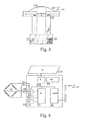
- the sensor has a blade (1), as shown in Figure 3 , which is made of metallic material. Strain-gauge strips (2) are mounted on said blade, as shown in Figure 3 , and are connected in the form of a Wheatstone bridge (3), shown in Figure 4 , so that they act as a load cell and are able to measure the forces acting on the blade inside the revolving drum during its dynamic contact with the concrete mix.
- This strain-gauge bridge is connected to an electronic board (4), as shown in Figure 4 , which by means of an analogue/digital converter (5) shown in Figure 4 acquires a signal from the bridge and sends it to the microprocessor (6) of the board, shown in Figure 4 , for processing thereof.
- the electronic board is provided, moreover, with one or more accelerometers (7), as shown in Figure 4 , which enable it to detect variations in speed along the axes XYZ, namely in the three physical dimensions of space.
- the information supplied by these accelerometers is detected by the microprocessor.
- the board is provided with a wireless series communications controller (8), shown in Figure 4 , which allows it to transmit or receive the information to other devices or from other devices for subsequent processing thereof.
- the board has a battery (9), shown in Figure 4 , for supplying electric power to the electronics, and a power controller (10), see Figure 4 , which manages the consumption levels and the power supplied by the photovoltaic cell (11), see Figure 4 , in order to recharge the battery making use of the periods of light.
- the engineering design is such that the sensor may operate 24 hours a day with at least two hours of solar recharging.
- the boreholes which must be formed in the mixer for holding the sensor may be provided with a thread for fixing the sensor by means of screws, although it is more advisable to fix said device using rivets since, apart from being cheaper and easier to fit, it avoids using screws which may come loose due to the vibrations of the lorry. It is necessary to choose suitably the position for forming this cut such that it does not coincide with the inner vanes of the mixer which move the concrete mix. It is also important to choose suitably the longitudinal position of the sensor so that it maintains a maximum range when measuring the volume of the concrete mix. Moreover it is necessary to orient suitably the sensor so that it does not confuse the mixing state with the discharging state.
- more than one sensor may be installed if one sensor alone is unable to manage the entire filling range of the drum. It may happen that, depending on where the sensor is installed, only the top part of the filled area or only the bottom part, in some types of mixers is detected. In such cases it is advisable to install a top sensor and a bottom sensor.
- the wireless communication protocols which are designed for implementation in the sensor microprocessors envisage operation in multi-point and cooperative mode such that they share the information and supply consensual values to the external devices which use said information.
- the sensor blade being situated inside the mixer, is in contact with the concrete mix and when the mixer rotates, upon mixing of the concrete, the blade is subject to flexural forces which are measured by the electronic device by means of deformation of the strain-gauge strips. In this way it is possible to obtain with this device the variables which are of interest for monitoring the concrete mix.
- This variable is detected automatically depending on the signal supplied by the blade with reference to the rest position. At rest, the blade will supply a signal of +/- various millivolts. If mixing is being performed, the concrete mix will apply pressure on one side of the blade, while if discharging is taking place, the pressure will be exerted on the blade on the opposite side. In other words, in one case the signal in millivolts will be greater than that in the rest state, while in the other case it will be less. When the sensor is installed in the mixer, the direction will bye respected such that the signal is greater during mixing and less during discharging than in the rest state. A mark as indicated by (3) in Figure 3 , or the like, will indicate to the installation engineer which 15 the correct direction of installation.
- the direction of rotation may also be automatically detected using the information supplied by the X, Y and Z axis accelerometers, based on the evolution in the position of the sensor.
- the evolution of the sensor along the YZ axis indicates a direction of rotation as follows:
- This feature has the advantage of providing a method for detecting when the revolving drum of the lorry is completely empty. Obviously, if rotation is detected via the accelerometers and the blade force signal does not vary, this means that the lorry has an empty load of concrete mix,
- This variable is automatically detected depending on the signal supplied by the blade.
- the blades rotating integrally with the mixer When the blades rotating integrally with the mixer, is at the top of the drum, it will lose contact with the concrete mix, resulting in it no longer being subject to forces. Therefore if the evolution of the signal generated by the blade over time is analysed, it will be seen that cyclically there will be a period of time during which the blade will be subject to forces and another period where it is not, namely when it is situated at the highest vertical levels. If the number of times per minute that there are time periods not subject to force is measured, the revolutions per minute or the revolving drum will be obtained.
- the revolutions may also be detected automatically using the information supplied by the accelerometers along the YZ axes, based on the evolution in the position of the sensor. Whenever Z or Y passes through a maximum point or passes through a minimum point, one revolution may be counted.
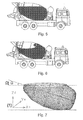
- Figure 8 shows a front view of the lorry drum or mixer and as (1) it is possible to see the position of the sensor.
- Figure 9 shows a cross-section of said view in the position where the sensor is installed.
- a circle has been drawn, although the shape is more similar to that of an ellipse.
- the shaded part represents the volume occupied by the concrete mix.
- the mixer were a horizontal cylinder, it would be possible to apply a mathematical formula for calculating the volume depending on the angles ⁇ detected by the sensor. However, this is not possible since the container is a set of conical shapes electrically welded and inclined with respect to an axis of rotation which is not horizontal, as indicated by (2) in Figure 7 .
- the height of the sensor when rotating integrally with the drum describes a cycloid over time (plotting the time along the axes of the abscissae) and via the accelerometers it is possible to detect the maximum values of the cycloid,
- Figure 5 shows a lateral cross-section through the mixer filled with concrete, but with the mixer at rest.
- Figure 6 shows the same cross-section, but with the mixer in movement, mixing the concrete.
- the inner vanes of the mixer move the concrete in the longitudinal direction inwards when mixing is performed and outwards when discharging occurs, so that these movements alter the above calculation.
- the volume is closely related to ⁇ and dependent to a certain extent on ⁇ and ⁇ .
- the sensor is able to provide an objective variable for the volume, depending on the values which it detects which allow it to deduce ⁇ , ⁇ and ⁇ beforehand.
- the sensor blade according to the present invention will also be subject to a greater force F as indicated by (3) in Figure 11 , the greater the plasticity, so that both variables may be correlated with each other.
- F the force which both variables may be correlated with each other.
- the advantage is that with the present invention the volume and the angle ⁇ are also known. In fact, ⁇ can be correlated better than F with the plasticity.
- the invention presented here has a wireless information transmission means, it is able to implement this function by sending a unique identifier together with the information about the drum via said means. In those locations where automatic Identification of the lorry is required, it is sufficient to position receivers which receive this information and process it.
- the invention communicates via radio or any other wireless communication means with other devices. Communication may be both point-to-point as well as point-to-multi-point or via network such that a set of devices is able to share information in a wireless local area network environment.
- the invention will send to other devices via the wireless communication channel at least the following information:
- This is a piece of equipment which has a viewing screen, also called display installed in a visible part of to the lorry, or inside the driver's cab, or externally, which displays dynamically the information generated buy the sensor.
- this device communicates with the sensor by means of the abovementioned wireless communication system and receives from the sensor the information relating to the concrete mix.
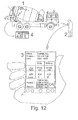
- the viewer may be supervised by the customer, or by any other person concerned, in order to check whether the order requirements in terms of volume and plasticity of the concrete mix have been satisfied. See (4) in Figure 12 for an example of a possible embodiment.
- An on-board computer equipped with GPS device for detecting the position and gyps, GSM, CDMA, TDNA, radio or other modem communicates with the sensor by means of an analogue comunications system to which the sensor has access and receives information therefrom.
- the on-board computer stores this Information in its internal memory in the manner of a data recorder and sends it, depending on how it is configured, periodically, or upon request, to a central server. In this way it is possible to have access to on-line information about the concrete mix in the central offices or in any other location of interest for the business transaction.
- On-board computers on mixer lorries are neither a novelty nor form the subject of this patent. They are merely mentioned here as another device which may be connected by means of wireless communication to the present invention. For this purpose it is sufficient to equip the on-board computer with the sensor communication means and implement the sensor communication protocols in the logic of said computer.
- This device will detect the presence of the lorry automatically when the lorry enters its coverage area in the vicinity of the factory loading zone. This is possible because the sensor includes a unique identifier among the data which it sends. This identifier may be associated with the registration number of the lorry.
- This factory terminal will have other wired or wireless communication means for communicating with the concrete production, mining and metering equipment or other information system which might be required. Through these means it re-transmits all the information which it receives from the sensor to the production system. Since the sensor transmits the plasticity value, the production system may use this variable in the manner of a plasticity meter at the time of production of the concrete mix and make suitable corrections to ensure that this requirement in the order is met.
- This functional capability which shall be referred to as "remote plasticity meter", although it is s useful for all the manufacturing plants, is of more interest for dry-method plants since wet-method plants usually have wattmeters which act as plasticity meters.
- Concrete plants may be of the dry-method type or wet-method type. They are referred to as being of the wet-method type when they have a mixer which mixes the concrete before unloading it into the lorry. This type of plant usually equips the mixers with plasticity meters which provide an indication of this characteristic so that it may be adjusted to the requirements of the order.
- dry-method plants do not have a mixer, so that they simply discharge the metered quantities for mixing inside the lorry mixer. Since in this case the plant does not have a mixer, nor does it have a plasticity meter, so that it is not possible to measure whether the concrete mix being produced has the plasticity required by the customer.
- factory terminal Another contribution of the factory terminal to the process is that it allows the factory production system to be informed as to whether the lorry is returning there with concrete mix, namely, whether the lorry is not totally empty before it receives the next load. In fact, since it maintains a communication protocol with the sensor, the latter informs it of the existing volume in the drum and this information is retransmitted by the factory terminal to the production system.
- the lorry may not discharge all of the concrete mix at the customer's site because the customer ordered more than calculated and so there is a surplus. In these cases, the lorry returns the concrete mix inside the drum to the plant. At present the driver informs the plant in such circumstances, giving an approximate idea of the amount of material which remains inside the drum of his lorry. It may happen that this surplus material can be used for another order placed by another customer or that this is not possible. If there is no alternative use for this material, it is discharged in the recycling unit at the plant or, should this not be possible because the plant has no recycling unit, or for whatever other reason, then the only remaining option is to empty the lorry at a waste tip.
- the production system will fill the lorry adjusting the metered amount to the type and quantity of surplus material, based on the driver's estimates.
- the advantage offered by the invention presented here is that this operation of filling the lorries which return with surplus material can be detected and performed automatically with greater accuracy since the indication of the volume of the surplus material supplied by the sensor is a objective and therefore more reliable than the subjective estimate of the volume provided by the driver. This is important because said subjective element creates more uncertainty as regards the total volume which the lorry may hold once filled, with the problems which may arise with the customer should the lorry have the wrong volume, as already explained in the previous paragraphs.
- the customer is able to check the plasticity and the volume of the concrete mix when this product is received on-site, as indicated by (2) in Figure 12 , which shows the customer giving approval for the arrival of the concrete mix in a lorry.
- the reference (3) in Figure 12 shows an amplification of possible use of the terminal being used by the customer indicated by (2) in the same figure.
- This equipment may be based on existing electronic devices commonly found on the market to which a wireless communication means similar to that of the sensor has been added, together with an application which performs the function described, or may be based on an electronic application specifically developed for this purpose.
- the reference number (3) in Figure 12 illustrates an example of the functional capacity offered by this terminal.
- the sensor installed on the lorry establishes communication with said terminal and sends it the information regarding the concrete mix being transported.
- the customer is able to read this information on the screen of his terminal.
- the application installed on this terminal may be interactive. In this case not only does it show the information regarding the order, but it also requests validation from the customer. It is also feasible to implement a means for measuring the degree of satisfaction of the customer both as regards quality of the product delivered and as regards the service provided by the driver of the lorry performing the delivery. This information regarding validation by the customer for the delivery and the degree of satisfaction expressed both for the product received and the service provided by the driver during delivery may be transmitted back to the concrete manufacturer in various ways:
- this customer terminal it is also possible to implement a mechanism for measuring the degree of satisfaction of the customer both as regards the product delivered to him and as regards the service at the time of delivery.
- the sensor maintains two-way comunication with this terminal and said terminal has an application which performs this consultation and sends it to the sensor.
- Figure 3 shows a possible mechanical embodiment of the present invention, As indicated by (1) in Figure 3 , it consists of a metal blade made or stainless steel.
- the blade form shown in Figure 3 is preferred, with the aim of trying to prevent as far as possible the possibility or the concrete mix adhering to the blade.
- This blade has four strain-gauge strips connected in the form of a Wheatstone bridge as indicated by (3) in Figure 4 .
- the blade is mounted in a circular metal housing so that the end where the strain-gauge strips are connected remains on the inside, with a level of protection equivalent to IP67 or greater, while the other end where the blade is mounted remains on the outside has shown in Figure 2 .
- the bridge formed by the strain gauge strips is connected to an electronic, board which is also installed inside the metal housing, as indicated by (4) in Figure 3 .
- the electronic board comprises the following functional units:
- a possible design of the lorry viewer is based on an electronic board which has the following functional units:
- the microprocessor will have an application (firmware) which receives information from the sensor and displays on the LCD the cubic meterage of the concrete mix transported and its plasticity.
- the equipment indicates the plasticity with reference to the test IRAM 1536 which uses Abrams cone.
- a possible design of the Customer terminal is based on the use of a standard electronic device which may be a PDA with a Bluetooth communications protocol. As can be seen in (3) in Figure 12 , this graphics terminal will detect automatically the presence of the lorry, establishing communication with the sensor in order to exchange information. The sensor will send the terminal following data to be displayed on the screen:
- the customer may validate this delivery via the terminal and, if desired, may also indicate the degree of satisfaction. This may be done at any moment while the lorry is on-site and may also be repeated several times if the customer change opinion.
- the terminal makes a distinction between satisfaction in respect of the quality of the product which was delivered to the customer and the service provided; the aim is to evaluate the opinion of the person served by the lorry driver who delivered the concrete, i.e. whether the driver acted, professionally and was helpful or not.
- the terminal shows six "emoticons", as can be seen in (3) in Figure 12 and the customer simply has to select one for the product and another one for the level of service and press OK.
- This information is then sent to the sensor which downloads it to the next factory terminal which it encounters and associated with the identifier of the order to which this information relates.
- the factory terminal re-transmits this information to the information systems on the concrete manufacturer for processing by them. Obviously their concern is to make sure that this information reaches the commercial. department and, if the customer expresses any dissatisfaction, to inform the sales agent responsible for this customer so that he/she can immediately contact them.
- a novel system which allows one to record automatically the degree of satisfaction of customers for each of the deliveries performed by the supplier, both as regards the product and as regards the level of service, has thus been illustrated.
Landscapes
- Engineering & Computer Science (AREA)
- Chemical & Material Sciences (AREA)
- Physics & Mathematics (AREA)
- Mechanical Engineering (AREA)
- Health & Medical Sciences (AREA)
- Dispersion Chemistry (AREA)
- General Physics & Mathematics (AREA)
- Chemical Kinetics & Catalysis (AREA)
- Public Health (AREA)
- Transportation (AREA)
- Structural Engineering (AREA)
- Radar, Positioning & Navigation (AREA)
- Electromagnetism (AREA)
- Life Sciences & Earth Sciences (AREA)
- Analytical Chemistry (AREA)
- Biochemistry (AREA)
- General Health & Medical Sciences (AREA)
- Immunology (AREA)
- Pathology (AREA)
- Remote Sensing (AREA)
- Preparation Of Clay, And Manufacture Of Mixtures Containing Clay Or Cement (AREA)
- Accessories For Mixers (AREA)
Applications Claiming Priority (2)
| Application Number | Priority Date | Filing Date | Title |
|---|---|---|---|
| ES200502936A ES2281267B1 (es) | 2005-11-28 | 2005-11-28 | Sistema de monitorizacion del amasado de conglomerados. |
| PCT/ES2006/000639 WO2007060272A2 (es) | 2005-11-28 | 2006-11-17 | Sistema automático de monitorización del amasado de conglomerados |
Publications (1)
| Publication Number | Publication Date |
|---|---|
| EP1961538A2 true EP1961538A2 (de) | 2008-08-27 |
Family
ID=38067577
Family Applications (1)
| Application Number | Title | Priority Date | Filing Date |
|---|---|---|---|
| EP06847054A Withdrawn EP1961538A2 (de) | 2005-11-28 | 2006-11-17 | Automatisches system zur überwachung der mischung von konglomeraten |
Country Status (4)
| Country | Link |
|---|---|
| US (1) | US9833928B2 (de) |
| EP (1) | EP1961538A2 (de) |
| ES (1) | ES2281267B1 (de) |
| WO (1) | WO2007060272A2 (de) |
Cited By (15)
| Publication number | Priority date | Publication date | Assignee | Title |
|---|---|---|---|---|
| ITGE20090041A1 (it) * | 2009-06-19 | 2010-12-20 | Arminio Mini | Dispositivo per il rilevamento della fluidita' del calcestruzzo nelle betoniere. |
| EP2296854A4 (de) * | 2008-05-28 | 2012-02-08 | Katzeff Berman Dully | Messung des betonsetzmasses und steuersystem |
| FR2964745A1 (fr) * | 2010-09-15 | 2012-03-16 | Ijinus | Dispositif de mesure d'au moins un parametre relatif a la rotation d'une toupie d'un camion |
| CN102529784A (zh) * | 2012-02-24 | 2012-07-04 | 三一重工股份有限公司 | 一种自动卸料系统及混凝土搅拌车 |
| US8311678B2 (en) | 2010-06-23 | 2012-11-13 | Verifi Llc | Method for adjusting concrete rheology based upon nominal dose-response profile |
| GB2496294A (en) * | 2011-10-28 | 2013-05-08 | Brinsley Mcfarlane | System monitoring rotational direction of mixing drum mounted on a vehicle |
| CN104503409A (zh) * | 2014-12-23 | 2015-04-08 | 江苏东交工程检测有限公司 | 一种水泥混凝土质量远程管控系统和方法 |
| WO2015057380A1 (en) | 2013-10-18 | 2015-04-23 | W.R. Grace & Co. -Conn. | Fast response time in slump monitoring systems |
| US9199391B2 (en) | 2009-10-07 | 2015-12-01 | I.B.B. Rheologie Inc. | Probe and method for obtaining rheological property value |
| EP2977163A1 (de) | 2013-01-11 | 2016-01-27 | Katzeff-Berman, Dully | Betonmischungsmesssensor, -system und -verfahren |
| US9789629B2 (en) | 2010-06-23 | 2017-10-17 | Verifi Llc | Method for adjusting concrete rheology based upon nominal dose-response profile |
| CN108627216A (zh) * | 2018-05-11 | 2018-10-09 | 华北水利水电大学 | 一种水泥仓物料实时监测装置及监测方法 |
| US10520410B2 (en) | 2009-10-07 | 2019-12-31 | Command Alkon Incorporated | Probe and method for obtaining rheological property value |
| EP3828839A1 (de) * | 2019-11-28 | 2021-06-02 | Cube | Vorrichtung zur kontrolle eines fahrmischers, der einen rührkessel umfasst |
| US11331829B2 (en) | 2019-08-01 | 2022-05-17 | Gcp Applied Technologies Inc. | Rotated concrete volume determination |
Families Citing this family (46)
| Publication number | Priority date | Publication date | Assignee | Title |
|---|---|---|---|---|
| US20090177482A1 (en) * | 2008-01-07 | 2009-07-09 | Granruth Michael D | Method of improving concrete production by monitoring weather conditions |
| US8557070B2 (en) | 2009-09-14 | 2013-10-15 | Joel A. Stanley | Method of mounting objects to polymeric membranes |
| JP5785825B2 (ja) * | 2011-09-02 | 2015-09-30 | カヤバ工業株式会社 | ミキサ車 |
| MX345937B (es) | 2011-12-12 | 2017-02-27 | Verifi Llc | Gestion multivariada del aire atrapado y reologia en mezclas cementosas. |
| US9254583B2 (en) | 2012-01-23 | 2016-02-09 | Quipip, Llc | Systems, methods and apparatus for providing comparative statistical information for a plurality of production facilities in a closed-loop production management system |
| US9836801B2 (en) | 2012-01-23 | 2017-12-05 | Quipip, Llc | Systems, methods and apparatus for providing comparative statistical information in a graphical format for a plurality of markets using a closed-loop production management system |
| US9550312B2 (en) | 2012-10-15 | 2017-01-24 | Verifi Llc | Treating and reporting volume of concrete in delivery vehicle mixing drum |
| CA2887601C (en) | 2012-10-15 | 2020-08-25 | Verifi Llc | Sneak water detection for concrete delivery vehicles |
| JP6097621B2 (ja) * | 2013-03-29 | 2017-03-15 | Kyb株式会社 | ミキサ車 |
| CN103593556B (zh) * | 2013-09-11 | 2016-09-28 | 上海绿地建设(集团)有限公司 | 一种计算混凝土搅拌运输车数量的方法 |
| US10184928B2 (en) | 2014-01-29 | 2019-01-22 | Quipip, Llc | Measuring device, systems, and methods for obtaining data relating to condition and performance of concrete mixtures |
| US9194855B2 (en) | 2014-02-28 | 2015-11-24 | Quipip, Llc | Systems, methods and apparatus for providing to a driver of a vehicle carrying a mixture real-time information relating to a characteristic of the mixture |
| JP6483990B2 (ja) * | 2014-10-02 | 2019-03-13 | Kyb株式会社 | ミキサ車 |
| WO2016123228A1 (en) | 2015-01-30 | 2016-08-04 | Quipip, Llc | Systems, apparatus and methods for testing and predicting the performance of concrete mixtures |
| US10744676B2 (en) * | 2015-09-18 | 2020-08-18 | Schwing America, Inc. | Concrete mixer and controls therefor for controlling drum rotation |
| ITUA20162508A1 (it) * | 2016-04-12 | 2017-10-12 | Safecertifiedstructure Ingegneria S R L | Metodo e dispositivo d’indagine per la misurazione di tensioni in una struttura di agglomerato |
| EP3442762B1 (de) * | 2016-04-15 | 2021-08-04 | Verifi LLC | Exzentrische ablagerungsdetektion in betontrommeln |
| US10987829B2 (en) | 2016-06-17 | 2021-04-27 | Oshkosh Corporation | Concrete drum control, property prediction, and monitoring systems and methods |
| EP3507585B1 (de) * | 2016-08-31 | 2021-07-28 | Command Alkon Incorporated | Rheologische sonde |
| MY197224A (en) | 2016-09-26 | 2023-06-06 | Verifi Llc | Pre-pour slump maximization of delivered concrete |
| EP3558611B1 (de) * | 2016-12-22 | 2020-11-18 | Command Alkon Incorporated | Verfahren und systeme zur handhabung von frischem beton |
| EP4227055A1 (de) | 2017-02-21 | 2023-08-16 | Verifi LLC | Verfahren zur überwachung von betonbestandteilen |
| PT3664925T (pt) | 2017-08-11 | 2024-04-16 | Gcp Applied Tech Inc | Medição de água cinzenta |
| US11726076B2 (en) | 2017-08-22 | 2023-08-15 | Cidra Concrete Systems Inc. | Techniques for monitoring slump characteristic of concrete in a rotating container or drum |
| EP3673245B1 (de) * | 2017-08-22 | 2024-10-09 | Cidra Corporate Services LLC | System zur bestimmung des volumens und / oder der viskosität von beton in einem rotierenden behälter |
| WO2019070715A1 (en) | 2017-10-03 | 2019-04-11 | Command Alkon Incorporated | METHOD AND SYSTEM FOR MIXING CONCRETE CONSTITUENTS IN A DRUM |
| JP6894834B2 (ja) * | 2017-12-12 | 2021-06-30 | Kyb株式会社 | 生コンクリート状態表示方法及び生コンクリート状態表示プログラム |
| JP6894833B2 (ja) * | 2017-12-12 | 2021-06-30 | Kyb株式会社 | 生コンクリート量表示方法及び生コンクリート量表示プログラム |
| CA3086587A1 (en) | 2017-12-22 | 2019-06-27 | Verifi Llc | Managing concrete mix design catalogs |
| US11402312B2 (en) * | 2018-02-08 | 2022-08-02 | Command Alkon Incorporated | Methods and systems for handling fresh concrete based on hydraulic pressure and on rheological probe pressure |
| US11042745B2 (en) | 2018-04-23 | 2021-06-22 | Oshkosh Corporation | Refuse vehicle control system |
| CN112955417A (zh) | 2018-08-29 | 2021-06-11 | Gcp应用技术有限公司 | 水泥质组合物中的未水化强度 |
| JP7132811B2 (ja) * | 2018-09-28 | 2022-09-07 | Kyb株式会社 | ミキサドラム状態表示装置 |
| MX2020000670A (es) | 2019-01-17 | 2020-11-06 | Oshkosh Corp | Sistema de sensor de concreto. |
| WO2020231728A1 (en) | 2019-05-10 | 2020-11-19 | Gcp Applied Technologies Inc. | Instrument for direct measurement of air content in a liquid using a resonant electroacoustic transducer |
| US11230217B2 (en) * | 2019-07-02 | 2022-01-25 | Command Alkon Incorporated | Device and method for determining cleanliness of a rotating drum of a fresh concrete mixer truck |
| EP4007651A4 (de) | 2019-08-01 | 2023-08-02 | GCP Applied Technologies Inc. | Koordinierte betonabgabe und -platzierung |
| US12420450B2 (en) * | 2020-01-24 | 2025-09-23 | IP Holding Company LLC | Containerized concrete batch plant |
| US20210229322A1 (en) * | 2020-01-24 | 2021-07-29 | Neal Johnson | Containerized concrete batch plant |
| US12017381B2 (en) * | 2020-02-05 | 2024-06-25 | Oshkosh Corporation | Systems and methods for controlling discharge of a mixer drum |
| WO2021240433A1 (en) * | 2020-05-27 | 2021-12-02 | Subbiah Muthukumaran | A smart cooking aid stirrer in a mixing vessel to mix ingredients to prepare food |
| CA3186657A1 (en) | 2020-06-08 | 2021-12-16 | Gcp Applied Technologies Inc. | Adjusting concrete mixes and mix designs using diagnostic delta data curve |
| MX2022015781A (es) * | 2020-06-12 | 2023-01-19 | Tirso Chavez | Aparato movil de mezcla continua. |
| US20240018046A1 (en) | 2020-10-02 | 2024-01-18 | Gcp Applied Technologies Inc. | Early strength slag-based cementitious binder |
| JP7768654B2 (ja) * | 2021-03-31 | 2025-11-12 | 住友重機械工業株式会社 | 作業機械及び作業機械の支援システム |
| US11312039B1 (en) * | 2021-05-06 | 2022-04-26 | Command Alkon Incorporated | System and method for monitoring fresh concrete being handled in a concrete mixer using trained data processing engines |
Family Cites Families (16)
| Publication number | Priority date | Publication date | Assignee | Title |
|---|---|---|---|---|
| US3382724A (en) * | 1965-01-04 | 1968-05-14 | North American Rockwell | Three axis accelerometer |
| US3640121A (en) * | 1970-03-09 | 1972-02-08 | Julian J Mercier | Slump indicator |
| US4337516A (en) * | 1980-06-26 | 1982-06-29 | United Technologies Corporation | Sensor fault detection by activity monitoring |
| US4327437A (en) * | 1980-07-30 | 1982-04-27 | Nasa | Reconfiguring redundancy management |
| AUPN296495A0 (en) * | 1995-05-15 | 1995-06-08 | Boral Resources (Vic) Pty Limited | Concrete mixing |
| US5844152A (en) * | 1997-02-28 | 1998-12-01 | Thompson Equipment Company, Inc. | Serviceable measuring device |
| GB2329027B (en) * | 1997-09-02 | 2001-12-19 | Tarmac Uk Ltd | Method of checking the slump of a ready-mix concrete load |
| EP0924040A1 (de) * | 1997-12-17 | 1999-06-23 | Esi Elettrosistemi S.r.l. | Vorrichtung zum Messen der Dichte einer Flüssigkeit während des Mischens in einem rotierenden Behälter |
| US6227039B1 (en) * | 1998-01-06 | 2001-05-08 | Moshe Te'eni | System and method for controlling concrete production |
| US7006902B2 (en) * | 1999-07-30 | 2006-02-28 | Oshkosh Truck Corporation | Control system and method for an equipment service vehicle |
| US6484079B2 (en) * | 2000-04-28 | 2002-11-19 | Rmc Industries Corporation | Methods and systems for remotely monitoring sensor data in delivery vehicles |
| GB2392502B (en) * | 2002-08-31 | 2007-02-21 | Hymix Ltd | Monitoring a concrete mixer |
| US20040143478A1 (en) * | 2003-01-18 | 2004-07-22 | Ward Andrew David | Method and process for capuring, storing, processing and displaying customer satisfaction information |
| US7089816B2 (en) * | 2004-01-13 | 2006-08-15 | Halliburton Energy Services, Inc. | Method and apparatus for testing cement slurries |
| EP1720689B1 (de) * | 2004-02-13 | 2017-03-22 | Verifi LLC | Verfahren und system zum berechnen und melden von absetzungen in lieferfahrzeugen |
| US20070046479A1 (en) * | 2005-08-26 | 2007-03-01 | Applied Sensor Research & Development Corporation | Concrete maturity monitoring system using passive wireless surface acoustic wave temperature sensors |
-
2005
- 2005-11-28 ES ES200502936A patent/ES2281267B1/es not_active Expired - Lifetime
-
2006
- 2006-11-17 WO PCT/ES2006/000639 patent/WO2007060272A2/es not_active Ceased
- 2006-11-17 US US12/085,471 patent/US9833928B2/en active Active
- 2006-11-17 EP EP06847054A patent/EP1961538A2/de not_active Withdrawn
Non-Patent Citations (1)
| Title |
|---|
| See references of WO2007060272A3 * |
Cited By (21)
| Publication number | Priority date | Publication date | Assignee | Title |
|---|---|---|---|---|
| EP2296854A4 (de) * | 2008-05-28 | 2012-02-08 | Katzeff Berman Dully | Messung des betonsetzmasses und steuersystem |
| US8858061B2 (en) | 2008-05-28 | 2014-10-14 | Dully Katzeff-Berman | Concrete slump measurement and control system |
| ITGE20090041A1 (it) * | 2009-06-19 | 2010-12-20 | Arminio Mini | Dispositivo per il rilevamento della fluidita' del calcestruzzo nelle betoniere. |
| EP2486385B1 (de) | 2009-10-07 | 2016-05-11 | I.B.B. Rheologie Inc. | Rotierbare zylindrischer behälter mit einer einheit für rheologischen proben |
| US10520410B2 (en) | 2009-10-07 | 2019-12-31 | Command Alkon Incorporated | Probe and method for obtaining rheological property value |
| EP2486385B2 (de) † | 2009-10-07 | 2019-06-19 | Command Alkon Incorporated | Rotierbare zylindrischer behälter mit einer einheit für rheologischen proben |
| US9199391B2 (en) | 2009-10-07 | 2015-12-01 | I.B.B. Rheologie Inc. | Probe and method for obtaining rheological property value |
| US8311678B2 (en) | 2010-06-23 | 2012-11-13 | Verifi Llc | Method for adjusting concrete rheology based upon nominal dose-response profile |
| US9789629B2 (en) | 2010-06-23 | 2017-10-17 | Verifi Llc | Method for adjusting concrete rheology based upon nominal dose-response profile |
| FR2964745A1 (fr) * | 2010-09-15 | 2012-03-16 | Ijinus | Dispositif de mesure d'au moins un parametre relatif a la rotation d'une toupie d'un camion |
| GB2496294A (en) * | 2011-10-28 | 2013-05-08 | Brinsley Mcfarlane | System monitoring rotational direction of mixing drum mounted on a vehicle |
| GB2496294B (en) * | 2011-10-28 | 2018-12-19 | Mcphee Bros Blantyre Ltd | Improved indication system |
| CN102529784A (zh) * | 2012-02-24 | 2012-07-04 | 三一重工股份有限公司 | 一种自动卸料系统及混凝土搅拌车 |
| EP2977163A1 (de) | 2013-01-11 | 2016-01-27 | Katzeff-Berman, Dully | Betonmischungsmesssensor, -system und -verfahren |
| WO2015057380A1 (en) | 2013-10-18 | 2015-04-23 | W.R. Grace & Co. -Conn. | Fast response time in slump monitoring systems |
| CN104503409A (zh) * | 2014-12-23 | 2015-04-08 | 江苏东交工程检测有限公司 | 一种水泥混凝土质量远程管控系统和方法 |
| CN108627216A (zh) * | 2018-05-11 | 2018-10-09 | 华北水利水电大学 | 一种水泥仓物料实时监测装置及监测方法 |
| CN108627216B (zh) * | 2018-05-11 | 2020-05-22 | 华北水利水电大学 | 一种水泥仓物料实时监测装置及监测方法 |
| US11331829B2 (en) | 2019-08-01 | 2022-05-17 | Gcp Applied Technologies Inc. | Rotated concrete volume determination |
| EP3828839A1 (de) * | 2019-11-28 | 2021-06-02 | Cube | Vorrichtung zur kontrolle eines fahrmischers, der einen rührkessel umfasst |
| FR3103948A1 (fr) * | 2019-11-28 | 2021-06-04 | Cube | Dispositif de suivi d’un camion malaxeur comportant une cuve agitatrice |
Also Published As
| Publication number | Publication date |
|---|---|
| WO2007060272A2 (es) | 2007-05-31 |
| WO2007060272A3 (es) | 2007-07-05 |
| US20090171595A1 (en) | 2009-07-02 |
| US9833928B2 (en) | 2017-12-05 |
| ES2281267B1 (es) | 2008-09-01 |
| ES2281267A1 (es) | 2007-09-16 |
Similar Documents
| Publication | Publication Date | Title |
|---|---|---|
| EP1961538A2 (de) | Automatisches system zur überwachung der mischung von konglomeraten | |
| US6484079B2 (en) | Methods and systems for remotely monitoring sensor data in delivery vehicles | |
| US20020015354A1 (en) | Methods and systems for remotely monitoring sensor data in delivery vehicles | |
| EP3055976B1 (de) | Verfahren und systeme für eine universelle drahtlose plattform zur anlagenüberwachung | |
| US20120288328A1 (en) | Integrated Paving Process Control For A Paving Operation | |
| US20070084283A1 (en) | Safety tank level gauging system | |
| US20090040049A1 (en) | Method for Processing Data Relating to a Cylinder of Fluid under Pressure | |
| US11397909B2 (en) | Long term sensor monitoring for remote assets | |
| EP2860987B1 (de) | Verfahren und Systeme zur dynamischen Arbeitsablaufpriorisierung und Aufgabenverarbeitung | |
| CN105501884A (zh) | 一种矿山产能远程监测与服务系统 | |
| CN103020795A (zh) | 仓库智能计量管理方法及系统 | |
| KR101507966B1 (ko) | 시간대별 유량의 자동 측정 변경과 멀티 데이터 통신이 가능한 전자기식 수도미터 | |
| US10935187B2 (en) | Remote contents monitoring | |
| US20230030683A1 (en) | Measuring device for process automation in the industrial environment | |
| AU2022221485A1 (en) | System and Method for Monitoring the Operation of One or More Trucks | |
| AU2015101392A4 (en) | Grease bin | |
| CN120106119B (zh) | 一种挖掘机给卡车装车斗数的监测系统、方法和电子设备 | |
| RU208864U1 (ru) | Встроенное устройство удаленного контроля аккумуляторной батареи | |
| CN213522159U (zh) | 一种地磅监管系统 | |
| CA3048536C (en) | Long term sensor monitoring for remote assets | |
| CN109250531B (zh) | 一种基于物联网和移动支付的散料输送的客户管理系统 | |
| WO2017035451A1 (en) | Distributed utility resource planning and forecast | |
| JP2025101466A (ja) | 対価支払いシステム、対価支払い通知装置および対価支払い方法 | |
| GB2502646A (en) | Short-range communication device transmitting distance or availability information from a vehicle to a mobile device | |
| CN114993372A (zh) | 带有现场显示装置的自给式测量装置 |
Legal Events
| Date | Code | Title | Description |
|---|---|---|---|
| PUAI | Public reference made under article 153(3) epc to a published international application that has entered the european phase |
Free format text: ORIGINAL CODE: 0009012 |
|
| 17P | Request for examination filed |
Effective date: 20080619 |
|
| AK | Designated contracting states |
Kind code of ref document: A2 Designated state(s): AT BE BG CH CY CZ DE DK EE ES FI FR GB GR HU IE IS IT LI LT LU LV MC NL PL PT RO SE SI SK TR |
|
| 17Q | First examination report despatched |
Effective date: 20091009 |
|
| STAA | Information on the status of an ep patent application or granted ep patent |
Free format text: STATUS: THE APPLICATION IS DEEMED TO BE WITHDRAWN |
|
| 18D | Application deemed to be withdrawn |
Effective date: 20100420 |