EP1957404B1 - Method for manufacturing limnpo4 - Google Patents
Method for manufacturing limnpo4 Download PDFInfo
- Publication number
- EP1957404B1 EP1957404B1 EP06822955A EP06822955A EP1957404B1 EP 1957404 B1 EP1957404 B1 EP 1957404B1 EP 06822955 A EP06822955 A EP 06822955A EP 06822955 A EP06822955 A EP 06822955A EP 1957404 B1 EP1957404 B1 EP 1957404B1
- Authority
- EP
- European Patent Office
- Prior art keywords
- solution
- dispersion solution
- source
- limnpo
- manufacturing
- Prior art date
- Legal status (The legal status is an assumption and is not a legal conclusion. Google has not performed a legal analysis and makes no representation as to the accuracy of the status listed.)
- Not-in-force
Links
- 238000000034 method Methods 0.000 title claims abstract description 35
- 238000004519 manufacturing process Methods 0.000 title claims abstract description 27
- 229910000668 LiMnPO4 Inorganic materials 0.000 claims abstract description 65
- 239000006185 dispersion Substances 0.000 claims abstract description 61
- 239000011572 manganese Substances 0.000 claims abstract description 45
- 239000002904 solvent Substances 0.000 claims abstract description 24
- 239000002244 precipitate Substances 0.000 claims abstract description 23
- IPJKJLXEVHOKSE-UHFFFAOYSA-L manganese dihydroxide Chemical compound [OH-].[OH-].[Mn+2] IPJKJLXEVHOKSE-UHFFFAOYSA-L 0.000 claims abstract description 16
- 230000002194 synthesizing effect Effects 0.000 claims abstract description 16
- 238000010438 heat treatment Methods 0.000 claims abstract description 9
- 230000001376 precipitating effect Effects 0.000 claims abstract description 9
- 239000007774 positive electrode material Substances 0.000 claims description 18
- MHAJPDPJQMAIIY-UHFFFAOYSA-N Hydrogen peroxide Chemical group OO MHAJPDPJQMAIIY-UHFFFAOYSA-N 0.000 claims description 8
- 239000006258 conductive agent Substances 0.000 claims description 8
- 238000002156 mixing Methods 0.000 claims description 7
- 150000003138 primary alcohols Chemical group 0.000 claims description 6
- 150000003333 secondary alcohols Chemical class 0.000 claims description 6
- 239000000243 solution Substances 0.000 description 69
- XLYOFNOQVPJJNP-UHFFFAOYSA-N water Substances O XLYOFNOQVPJJNP-UHFFFAOYSA-N 0.000 description 28
- 229910001868 water Inorganic materials 0.000 description 15
- 238000002441 X-ray diffraction Methods 0.000 description 13
- 239000008367 deionised water Substances 0.000 description 13
- 229910021641 deionized water Inorganic materials 0.000 description 13
- WMFOQBRAJBCJND-UHFFFAOYSA-M Lithium hydroxide Chemical compound [Li+].[OH-] WMFOQBRAJBCJND-UHFFFAOYSA-M 0.000 description 12
- LRHPLDYGYMQRHN-UHFFFAOYSA-N N-Butanol Chemical compound CCCCO LRHPLDYGYMQRHN-UHFFFAOYSA-N 0.000 description 12
- 229910052744 lithium Inorganic materials 0.000 description 10
- QTBSBXVTEAMEQO-UHFFFAOYSA-N Acetic acid Chemical compound CC(O)=O QTBSBXVTEAMEQO-UHFFFAOYSA-N 0.000 description 9
- WHXSMMKQMYFTQS-UHFFFAOYSA-N Lithium Chemical compound [Li] WHXSMMKQMYFTQS-UHFFFAOYSA-N 0.000 description 9
- 238000005259 measurement Methods 0.000 description 8
- KFZMGEQAYNKOFK-UHFFFAOYSA-N Isopropanol Chemical compound CC(C)O KFZMGEQAYNKOFK-UHFFFAOYSA-N 0.000 description 6
- PQVSTLUFSYVLTO-UHFFFAOYSA-N ethyl n-ethoxycarbonylcarbamate Chemical compound CCOC(=O)NC(=O)OCC PQVSTLUFSYVLTO-UHFFFAOYSA-N 0.000 description 6
- GLXDVVHUTZTUQK-UHFFFAOYSA-M lithium hydroxide monohydrate Substances [Li+].O.[OH-] GLXDVVHUTZTUQK-UHFFFAOYSA-M 0.000 description 6
- 229940040692 lithium hydroxide monohydrate Drugs 0.000 description 6
- BDERNNFJNOPAEC-UHFFFAOYSA-N propan-1-ol Chemical compound CCCO BDERNNFJNOPAEC-UHFFFAOYSA-N 0.000 description 6
- 229910000387 ammonium dihydrogen phosphate Inorganic materials 0.000 description 5
- 238000001035 drying Methods 0.000 description 5
- 239000000203 mixture Substances 0.000 description 5
- 229910001305 LiMPO4 Inorganic materials 0.000 description 4
- 150000001875 compounds Chemical class 0.000 description 4
- OAICVXFJPJFONN-UHFFFAOYSA-N Phosphorus Chemical compound [P] OAICVXFJPJFONN-UHFFFAOYSA-N 0.000 description 3
- 150000001298 alcohols Chemical class 0.000 description 3
- LFVGISIMTYGQHF-UHFFFAOYSA-N ammonium dihydrogen phosphate Chemical compound [NH4+].OP(O)([O-])=O LFVGISIMTYGQHF-UHFFFAOYSA-N 0.000 description 3
- 239000006229 carbon black Substances 0.000 description 3
- 238000009770 conventional sintering Methods 0.000 description 3
- 229940082328 manganese acetate tetrahydrate Drugs 0.000 description 3
- CESXSDZNZGSWSP-UHFFFAOYSA-L manganese(2+);diacetate;tetrahydrate Chemical compound O.O.O.O.[Mn+2].CC([O-])=O.CC([O-])=O CESXSDZNZGSWSP-UHFFFAOYSA-L 0.000 description 3
- 239000000463 material Substances 0.000 description 3
- 235000019837 monoammonium phosphate Nutrition 0.000 description 3
- 229910052698 phosphorus Inorganic materials 0.000 description 3
- 239000011574 phosphorus Substances 0.000 description 3
- 238000010298 pulverizing process Methods 0.000 description 3
- 238000005245 sintering Methods 0.000 description 3
- 239000002002 slurry Substances 0.000 description 3
- OKTJSMMVPCPJKN-UHFFFAOYSA-N Carbon Chemical compound [C] OKTJSMMVPCPJKN-UHFFFAOYSA-N 0.000 description 2
- KMTRUDSVKNLOMY-UHFFFAOYSA-N Ethylene carbonate Chemical compound O=C1OCCO1 KMTRUDSVKNLOMY-UHFFFAOYSA-N 0.000 description 2
- VEXZGXHMUGYJMC-UHFFFAOYSA-N Hydrochloric acid Chemical compound Cl VEXZGXHMUGYJMC-UHFFFAOYSA-N 0.000 description 2
- QIGBRXMKCJKVMJ-UHFFFAOYSA-N Hydroquinone Chemical compound OC1=CC=C(O)C=C1 QIGBRXMKCJKVMJ-UHFFFAOYSA-N 0.000 description 2
- NBIIXXVUZAFLBC-UHFFFAOYSA-N Phosphoric acid Chemical compound OP(O)(O)=O NBIIXXVUZAFLBC-UHFFFAOYSA-N 0.000 description 2
- QAOWNCQODCNURD-UHFFFAOYSA-N Sulfuric acid Chemical compound OS(O)(=O)=O QAOWNCQODCNURD-UHFFFAOYSA-N 0.000 description 2
- 239000004809 Teflon Substances 0.000 description 2
- 229920006362 Teflon® Polymers 0.000 description 2
- 239000002253 acid Substances 0.000 description 2
- 238000007796 conventional method Methods 0.000 description 2
- 238000001027 hydrothermal synthesis Methods 0.000 description 2
- PMQJYWORJJEMQC-UHFFFAOYSA-N manganese;dihydrate Chemical compound O.O.[Mn] PMQJYWORJJEMQC-UHFFFAOYSA-N 0.000 description 2
- BDAGIHXWWSANSR-UHFFFAOYSA-N methanoic acid Natural products OC=O BDAGIHXWWSANSR-UHFFFAOYSA-N 0.000 description 2
- 239000010450 olivine Substances 0.000 description 2
- 229910052609 olivine Inorganic materials 0.000 description 2
- 229920002981 polyvinylidene fluoride Polymers 0.000 description 2
- 239000000843 powder Substances 0.000 description 2
- OSWFIVFLDKOXQC-UHFFFAOYSA-N 4-(3-methoxyphenyl)aniline Chemical compound COC1=CC=CC(C=2C=CC(N)=CC=2)=C1 OSWFIVFLDKOXQC-UHFFFAOYSA-N 0.000 description 1
- YZCKVEUIGOORGS-OUBTZVSYSA-N Deuterium Chemical compound [2H] YZCKVEUIGOORGS-OUBTZVSYSA-N 0.000 description 1
- 229910032387 LiCoO2 Inorganic materials 0.000 description 1
- 229910003005 LiNiO2 Inorganic materials 0.000 description 1
- 229910001290 LiPF6 Inorganic materials 0.000 description 1
- 229910002097 Lithium manganese(III,IV) oxide Inorganic materials 0.000 description 1
- 229910015818 MPO4 Inorganic materials 0.000 description 1
- 229910021380 Manganese Chloride Inorganic materials 0.000 description 1
- GLFNIEUTAYBVOC-UHFFFAOYSA-L Manganese chloride Chemical compound Cl[Mn]Cl GLFNIEUTAYBVOC-UHFFFAOYSA-L 0.000 description 1
- 229910019142 PO4 Inorganic materials 0.000 description 1
- 239000002033 PVDF binder Substances 0.000 description 1
- FAPWRFPIFSIZLT-UHFFFAOYSA-M Sodium chloride Chemical group [Na+].[Cl-] FAPWRFPIFSIZLT-UHFFFAOYSA-M 0.000 description 1
- QCWXUUIWCKQGHC-UHFFFAOYSA-N Zirconium Chemical compound [Zr] QCWXUUIWCKQGHC-UHFFFAOYSA-N 0.000 description 1
- 239000006230 acetylene black Substances 0.000 description 1
- 239000011149 active material Substances 0.000 description 1
- 229910052782 aluminium Inorganic materials 0.000 description 1
- XAGFODPZIPBFFR-UHFFFAOYSA-N aluminium Chemical compound [Al] XAGFODPZIPBFFR-UHFFFAOYSA-N 0.000 description 1
- 229910000147 aluminium phosphate Inorganic materials 0.000 description 1
- 239000011230 binding agent Substances 0.000 description 1
- 230000005540 biological transmission Effects 0.000 description 1
- 230000015572 biosynthetic process Effects 0.000 description 1
- 239000003638 chemical reducing agent Substances 0.000 description 1
- 238000004891 communication Methods 0.000 description 1
- 229910052802 copper Inorganic materials 0.000 description 1
- 238000010586 diagram Methods 0.000 description 1
- IEJIGPNLZYLLBP-UHFFFAOYSA-N dimethyl carbonate Chemical compound COC(=O)OC IEJIGPNLZYLLBP-UHFFFAOYSA-N 0.000 description 1
- YWEUIGNSBFLMFL-UHFFFAOYSA-N diphosphonate Chemical compound O=P(=O)OP(=O)=O YWEUIGNSBFLMFL-UHFFFAOYSA-N 0.000 description 1
- 230000000694 effects Effects 0.000 description 1
- 239000003792 electrolyte Substances 0.000 description 1
- 230000007613 environmental effect Effects 0.000 description 1
- 238000001914 filtration Methods 0.000 description 1
- 239000011888 foil Substances 0.000 description 1
- 235000019253 formic acid Nutrition 0.000 description 1
- 229910002804 graphite Inorganic materials 0.000 description 1
- 239000010439 graphite Substances 0.000 description 1
- 229910052742 iron Inorganic materials 0.000 description 1
- -1 lithium transition metal Chemical class 0.000 description 1
- 229910052748 manganese Inorganic materials 0.000 description 1
- 239000011565 manganese chloride Substances 0.000 description 1
- CNFDGXZLMLFIJV-UHFFFAOYSA-L manganese(II) chloride tetrahydrate Chemical compound O.O.O.O.[Cl-].[Cl-].[Mn+2] CNFDGXZLMLFIJV-UHFFFAOYSA-L 0.000 description 1
- 239000012528 membrane Substances 0.000 description 1
- 229910052751 metal Inorganic materials 0.000 description 1
- 239000002184 metal Substances 0.000 description 1
- 229910001510 metal chloride Inorganic materials 0.000 description 1
- 239000002905 metal composite material Substances 0.000 description 1
- 239000011259 mixed solution Substances 0.000 description 1
- RVTZCBVAJQQJTK-UHFFFAOYSA-N oxygen(2-);zirconium(4+) Chemical compound [O-2].[O-2].[Zr+4] RVTZCBVAJQQJTK-UHFFFAOYSA-N 0.000 description 1
- DLYUQMMRRRQYAE-UHFFFAOYSA-N phosphorus pentoxide Inorganic materials O1P(O2)(=O)OP3(=O)OP1(=O)OP2(=O)O3 DLYUQMMRRRQYAE-UHFFFAOYSA-N 0.000 description 1
- 238000002464 physical blending Methods 0.000 description 1
- 239000002994 raw material Substances 0.000 description 1
- 230000009257 reactivity Effects 0.000 description 1
- 239000007787 solid Substances 0.000 description 1
- 229910052596 spinel Inorganic materials 0.000 description 1
- 239000011029 spinel Substances 0.000 description 1
- 239000000126 substance Substances 0.000 description 1
- 238000003786 synthesis reaction Methods 0.000 description 1
- 229910052723 transition metal Inorganic materials 0.000 description 1
- 229910052720 vanadium Inorganic materials 0.000 description 1
- 238000005406 washing Methods 0.000 description 1
- 229910052726 zirconium Inorganic materials 0.000 description 1
- 229910001928 zirconium oxide Inorganic materials 0.000 description 1
Images

Classifications
-
- C—CHEMISTRY; METALLURGY
- C01—INORGANIC CHEMISTRY
- C01B—NON-METALLIC ELEMENTS; COMPOUNDS THEREOF; METALLOIDS OR COMPOUNDS THEREOF NOT COVERED BY SUBCLASS C01C
- C01B25/00—Phosphorus; Compounds thereof
- C01B25/16—Oxyacids of phosphorus; Salts thereof
- C01B25/26—Phosphates
- C01B25/45—Phosphates containing plural metal, or metal and ammonium
-
- C—CHEMISTRY; METALLURGY
- C01—INORGANIC CHEMISTRY
- C01B—NON-METALLIC ELEMENTS; COMPOUNDS THEREOF; METALLOIDS OR COMPOUNDS THEREOF NOT COVERED BY SUBCLASS C01C
- C01B25/00—Phosphorus; Compounds thereof
- C01B25/16—Oxyacids of phosphorus; Salts thereof
- C01B25/26—Phosphates
- C01B25/37—Phosphates of heavy metals
- C01B25/377—Phosphates of heavy metals of manganese
-
- H—ELECTRICITY
- H01—ELECTRIC ELEMENTS
- H01M—PROCESSES OR MEANS, e.g. BATTERIES, FOR THE DIRECT CONVERSION OF CHEMICAL ENERGY INTO ELECTRICAL ENERGY
- H01M10/00—Secondary cells; Manufacture thereof
- H01M10/05—Accumulators with non-aqueous electrolyte
-
- H—ELECTRICITY
- H01—ELECTRIC ELEMENTS
- H01M—PROCESSES OR MEANS, e.g. BATTERIES, FOR THE DIRECT CONVERSION OF CHEMICAL ENERGY INTO ELECTRICAL ENERGY
- H01M10/00—Secondary cells; Manufacture thereof
- H01M10/05—Accumulators with non-aqueous electrolyte
- H01M10/052—Li-accumulators
-
- H—ELECTRICITY
- H01—ELECTRIC ELEMENTS
- H01M—PROCESSES OR MEANS, e.g. BATTERIES, FOR THE DIRECT CONVERSION OF CHEMICAL ENERGY INTO ELECTRICAL ENERGY
- H01M4/00—Electrodes
- H01M4/02—Electrodes composed of, or comprising, active material
-
- H—ELECTRICITY
- H01—ELECTRIC ELEMENTS
- H01M—PROCESSES OR MEANS, e.g. BATTERIES, FOR THE DIRECT CONVERSION OF CHEMICAL ENERGY INTO ELECTRICAL ENERGY
- H01M4/00—Electrodes
- H01M4/02—Electrodes composed of, or comprising, active material
- H01M4/13—Electrodes for accumulators with non-aqueous electrolyte, e.g. for lithium-accumulators; Processes of manufacture thereof
- H01M4/136—Electrodes based on inorganic compounds other than oxides or hydroxides, e.g. sulfides, selenides, tellurides, halogenides or LiCoFy
-
- H—ELECTRICITY
- H01—ELECTRIC ELEMENTS
- H01M—PROCESSES OR MEANS, e.g. BATTERIES, FOR THE DIRECT CONVERSION OF CHEMICAL ENERGY INTO ELECTRICAL ENERGY
- H01M4/00—Electrodes
- H01M4/02—Electrodes composed of, or comprising, active material
- H01M4/36—Selection of substances as active materials, active masses, active liquids
- H01M4/58—Selection of substances as active materials, active masses, active liquids of inorganic compounds other than oxides or hydroxides, e.g. sulfides, selenides, tellurides, halogenides or LiCoFy; of polyanionic structures, e.g. phosphates, silicates or borates
-
- H—ELECTRICITY
- H01—ELECTRIC ELEMENTS
- H01M—PROCESSES OR MEANS, e.g. BATTERIES, FOR THE DIRECT CONVERSION OF CHEMICAL ENERGY INTO ELECTRICAL ENERGY
- H01M4/00—Electrodes
- H01M4/02—Electrodes composed of, or comprising, active material
- H01M4/36—Selection of substances as active materials, active masses, active liquids
- H01M4/58—Selection of substances as active materials, active masses, active liquids of inorganic compounds other than oxides or hydroxides, e.g. sulfides, selenides, tellurides, halogenides or LiCoFy; of polyanionic structures, e.g. phosphates, silicates or borates
- H01M4/5825—Oxygenated metallic salts or polyanionic structures, e.g. borates, phosphates, silicates, olivines
-
- H—ELECTRICITY
- H01—ELECTRIC ELEMENTS
- H01M—PROCESSES OR MEANS, e.g. BATTERIES, FOR THE DIRECT CONVERSION OF CHEMICAL ENERGY INTO ELECTRICAL ENERGY
- H01M4/00—Electrodes
- H01M4/02—Electrodes composed of, or comprising, active material
- H01M4/13—Electrodes for accumulators with non-aqueous electrolyte, e.g. for lithium-accumulators; Processes of manufacture thereof
- H01M4/139—Processes of manufacture
- H01M4/1397—Processes of manufacture of electrodes based on inorganic compounds other than oxides or hydroxides, e.g. sulfides, selenides, tellurides, halogenides or LiCoFy
-
- H—ELECTRICITY
- H01—ELECTRIC ELEMENTS
- H01M—PROCESSES OR MEANS, e.g. BATTERIES, FOR THE DIRECT CONVERSION OF CHEMICAL ENERGY INTO ELECTRICAL ENERGY
- H01M4/00—Electrodes
- H01M4/02—Electrodes composed of, or comprising, active material
- H01M4/62—Selection of inactive substances as ingredients for active masses, e.g. binders, fillers
- H01M4/624—Electric conductive fillers
-
- Y—GENERAL TAGGING OF NEW TECHNOLOGICAL DEVELOPMENTS; GENERAL TAGGING OF CROSS-SECTIONAL TECHNOLOGIES SPANNING OVER SEVERAL SECTIONS OF THE IPC; TECHNICAL SUBJECTS COVERED BY FORMER USPC CROSS-REFERENCE ART COLLECTIONS [XRACs] AND DIGESTS
- Y02—TECHNOLOGIES OR APPLICATIONS FOR MITIGATION OR ADAPTATION AGAINST CLIMATE CHANGE
- Y02E—REDUCTION OF GREENHOUSE GAS [GHG] EMISSIONS, RELATED TO ENERGY GENERATION, TRANSMISSION OR DISTRIBUTION
- Y02E60/00—Enabling technologies; Technologies with a potential or indirect contribution to GHG emissions mitigation
- Y02E60/10—Energy storage using batteries
Definitions
- the invention relates to a method for manufacturing LiMnPO 4 , which enables to obtain LiMnPO 4 which has an excellent crystalline and a high purity at a temperature lower than that in a conventional method.
- lithium secondary batteries are put into practical use and widely commercialized.
- electric cars are urged to develop.
- lithium secondary batteries are under study.
- positive electrode active materials such as LiCoO 2 and LiNiO 2 having a layered rock salt structure, LiMn 2 O 4 having the spinel structure and lithium transition metal composite oxides obtained by partially substituting the above compounds with other elements are well known.
- the invention mainly intends to obtain LiMnPO 4 which has an excellent crystalline and a high purity at a temperature lower than a temperature in a conventional sintering method.
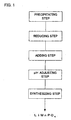
- a method for manufacturing LiMnPO 4 characterized by comprising the steps of: precipitating for obtaining precipitate of manganese hydroxide (Mn(OH) x ) by adding a precipitant to a Mn source solution in which a Mn source is dissolved; reducing for obtaining a reduced dispersion solution by dispersing the precipitate in a reducing solvent; adding for obtaining an added dispersion solution by adding a Li source solution and a P source solution to the reduced dispersion solution; pH adjusting for adjusting the pH of the added dispersion solution in the range of 3 to 6 to obtain a pH-adjusted dispersion solution; and synthesizing for synthesizing by reacting the pH-adjusted dispersion solution by a heating under pressure condition is provided.
- Mn(OH) x manganese hydroxide
- LiMnPO 4 having an excellent crystalline and a high purity can be obtained. Furthermore, in the above synthesis process, when for instance an autoclave or the like is used to carry out the hydrothermal synthesis, LiMnPO 4 can be obtained at a temperature lower than a temperature in a conventional sintering method, thereby preferably resulting in cutting energy.
- the reducing solvent is preferably a hydrogen peroxide solution, or a primary alcohol or a secondary alcohol. This is because LiMnPO 4 which has an excellent crystalline and a high purity can be obtained.
- a method for manufacturing a positive electrode active material characterized in that LiMnPO 4 obtained according to the method for manufacturing LiMnPO 4 and a conductive agent are blended is provided.
- the method for manufacturing LiMnPO 4 according to the invention is a method of obtaining LiMnPO 4 by carrying out the steps of precipitating, reducing, adding, pH adjusting and synthesizing.
- the precipitating step in the invention is a step to obtain manganese hydroxide (Mn(OH) x ) by adding a precipitant in a Mn source solution in which a Mn source is dissolved,
- a Mn source solution used in the step is obtained by dissolving a Mn source in a solvent.
- the Mn source as far as it contains Mn and reacts with a precipitant described later to form manganese hydroxide, is not particularly restricted.
- manganese acetate tetrahydrate C 4 H 6 O 4 Mn ⁇ 4H 2 O
- manganese chloride tetrahydrate MnCl 2 ⁇ 4H 2 O
- compounds represented by such as Mn(OOCR) 2 R represents -CH 2 OH or -CH 2 CH 2 OH
- a solvent that can be used in the Mn source solution as far as it can dissolve the Mn source, there is no particular restriction.
- water and alcohols can be cited, and water being particularly preferably used.
- a concentration of the Mn source solution though different depending on the kind of the Mn source and solvent, it is for instance in the range of 0.1 to 0.4 mol/l, particularly preferably in the range of 0.1 to 0.3 mol/l. This is because, in both cases when the concentration is excessively high or excessively low, desired manganese hydroxide may not be obtained.
- the precipitant as far as it reacts with the Mn source to obtain manganese hydroxide, there is no particular restriction.
- lithium hydroxide monohydrate LiOH ⁇ H 2 O
- the precipitant may be added directly to the Mn source solution or a solution obtained by dissolving the precipitant in a solvent such as water may be added to the Mn source solution.
- precipitate of manganese hydroxide (Mn(OH) x ) is obtained by adding the precipitant to the Mn source solution,.
- the precipitate is filtered, washed with water and or the like to be used in the reducing step.
- Manganese hydroxide precipitate obtained in the step is in some cases in slurry state.
- the reducing step in the invention is a step to obtain a reduced dispersion solution by dispersing the precipitate of manganese hydroxide (Mn(OH) x ) obtained in the precipitating step in a reducing solvent. According to the step, manganese hydroxide (Mn (OH) x ) is considered converted to divalent manganese hydroxide (Mn (OH) 2 ).
- a reducing solvent used in the step is not particularly restricted.
- hydrogen peroxide solution, primary alcohol, secondary alcohol, hydroquinone, and sugar can be cited.
- hydrogen peroxide solution, primary alcohol and secondary alcohol are preferable.
- the primary alcohol for instance, 1-butanol and 1-propanol or the like can be cited.
- the secondary alcohol for instance, 2-propanol or the like can be cited.
- the precipitate of the manganese hydroxide (Mn(OH) x ) is dissolved in water in advance, followed by preferably adding the reducing solvent to the dispersion solution.
- the reducing solvent is preferably added gradually to the dispersion solution.
- the adding step in the invention is a step of obtaining an added dispersion solution by adding a Li source solution and P (phosphorus) source solution to the reduced dispersion solution obtained in the reducing step. Owing to the step, all materials constituting LiMnPO 4 are contained in the dispersion solution.
- the Li source solution used in the step is obtained by dissolving a Li source in a solvent.
- Li source As the Li source, as far as it contains Li and can obtain LiMnPO 4 through a synthesizing step described later, there is no particular restriction. For instance, lithium hydroxide monohydrate (LiOH ⁇ H 2 O) or the like can be cited.
- the solvent that is used in the Li source solution is not particularly restricted.
- water and alcohols or the like can be cited, and water being particularly desirable.
- the P (phosphorus) source solution used in the step is obtained by dissolving a P (phosphorus) source in a solvent.
- the P source as far as it contains P and can obtain LiMnPO 4 through a synthesizing step described later, is not particularly restricted.
- ammonium dihydrogen phosphate (H 6 NO 9 P) and phosphorus pentoxide (P 2 O 5 ) or the like can be cited.
- the solvent that is used in the P source solution as far as it can dissolve the P source, there is no particular restriction.
- water and alcohols or the like can be cited, and water being particularly preferable.
- the pH adjusting step in the invention is a step of obtaining a pH adjusted dispersion solution by adjusting the pH of the added dispersion solution obtained in the adding step to the range of 3 to 6.
- the pH of the added dispersion solvent obtained in the adding step is normally 7 or more. Accordingly, in the step, an acid is added to adjust the pH.
- the acid that is used in the pH adjusting step as far as the pH of the added dispersion solution can be adjusted in the above range, is not particularly restricted.
- acetic acid, hydrochloric acid, formic acid, sulfuric acid, and phosphoric acid or the like can be cited.
- the synthesizing step in the step is a step in which the pH adjusted dispersion solution obtained from the pH adjusting step is allowed to react by a heating under pressure condition. Owing to the step, precipitate of LiMnPO 4 can be obtained.
- a heating temperature in the step though varying depending on a composition of the pH adjusted dispersion solution, namely, - kinds or the like of the Mn source, Li source, P source and solvent, and furthermore depending on a pressurizing pressure described later, is, for instance, in the range of 120 to 250°C and preferably in the range of 150 to 200°C.
- the pressure in the step though varying depending on the composition or the like of the pH adjusted dispersion solution and furthermore on the heating temperature, is in the range of 5 to 10 atm and preferably in the range of 6 to 9 atm.
- a method of carrying out the step, as far as it can realize the above heating under pressure condition and can obtain desired LiMnPO 4 , is not particularly restricted.
- a hydrothermal synthesis with an autoclave can be cited.
- the autoclave there is no particular restriction; that is, commercially available one can be used.
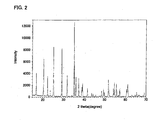
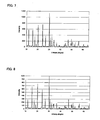
- LiMnPO 4 Owing to the above synthesizing step, precipitate of LiMnPO 4 is obtained, followed by filtering, washing and drying, and thereby LiMnPO 4 powder is obtained. Furthermore, the crystallinity of LiMnPO 4 obtained in the invention can be judged by measuring an X-ray diffraction pattern. Applications of LiMnPO 4 obtained according to the invention are not particularly restricted. For instance, it can be used as a positive electrode active material of lithium secondary batteries.
- the method for manufacturing the positive electrode active material according to the invention is characterized in blending LiMnPO 4 obtained according to the method for manufacturing the LiMnPO 4 and a conductive agent.
- LiMnPO 4 used in the invention being obtained according to a manufacturing method described in the "A. Method for manufacturing LiMnPO 4 ", is omitted from describing here.
- the conductive agent used in the invention is not particularly restricted.
- graphite or carbon black such as acetylene black can be cited.
- the conductive agent is added in the range of 5 to 25 parts by weight, preferably in the range of 10 to 20 parts by weight to 100 parts by weight of LiMnPO 4 .
- an amount of the conductive agent is less than necessary, the electrical conductivity may not be sufficiently improved, and, when it is more than necessary, since an amount of LiMnPO 4 becomes relatively less, the performance as the positive electrode active material may be deteriorated.
- a method of blending the LiMnPO 4 and the conductive agent is not particularly restricted.
- the physical blending is preferable and the mechanical blending is particularly preferable.
- a ball mill pulverizing method or the like can be cited.
- applications of the positive electrode active material obtained according to the invention are not particularly restricted. However, it can be used in, for instance, lithium secondary batteries.
- a Mn source solution was obtained by dissolving 0.02 mol of manganese acetate tetrahydrate (C 4 H 6 O 4 Mn ⁇ (4H 2 O) 4 ) in 100 ml of deionized water.
- a precipitant was obtained by dissolving 0.04 mol of lithium hydroxide monohydrate (LiOH ⁇ H 2 O) in 100 ml of deionized water.
- LiOH ⁇ H 2 O lithium hydroxide monohydrate
- the obtained precipitate was filtered and washed with deionized water. Thereafter, the precipitate was transferred in a 1L beaker, 100 ml of deionized water was added, 10 ml of 15% hydrogen peroxide solution was gradually dropped, followed by agitating for 3 minutes, and thereby a reduced dispersion solution was obtained.
- the pH-adjusted dispersion solution was transferred in a Teflon coated autoclave and allowed reacting at a temperature in the range of 150 to 200°C for two days. Thereafter, the dispersion solution was cooled and filtered, obtained light brown precipitate was washed with deionized water, followed by drying in air at 60°C overnight, and thereby LiMnPO 4 was obtained.
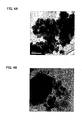
- LiMnPO 4 was observed with a transmission electron microscope (TEM). TEM photographs thereof are shown in FIGS. 3A and 3B .
- LiMnPO 4 obtained according to the example 1 was transferred in a 250 ml zirconium oxide container, followed by ball-mill pulverizing for 1 hour with 20 zirconium balls having a diameter of 10 mm. Thereafter, carbon black was added, followed by further pulverizing with a ball mill for 3 hours, and thereby a positive electrode active material having a composition of LiMnPO 4 /C was obtained.
- FIGS. 4A and 4B TEM photographs of the obtained positive electrode active material are shown in FIGS. 4A and 4B .
- the positive electrode active material obtained according to the example 2 carbon black (trade name: C55, manufactured by Shawiniga Corp) and a binder (polyvinylidene difluoride, PVDF) were dissolved in N-methyl-2-pyrolydinone at a mass ratio of 90:5: 5, and thereby a positive electrode composition was obtained.
- the positive electrode composition was coated on an aluminum foil that is a current collector, followed by drying in air at 100°C for 1 hour, further followed by heating at 120°C for 30 minutes with a hot plate, and thereby N-methyl-2-pyrolydinone was evaporated. Furthermore, by drying overnight at 160°C under a reduced pressure, a positive electrode was obtained.
- a lithium secondary battery By use of the positive electrode obtained according to the example 3, with a Li metal as a negative electrode and Microporous Celgard membrane (manufactured by Celgard Inc.) as a separator, a lithium secondary battery was prepared.
- As an electrolyte one obtained by adding 1 M of LiPF 6 to a mixed solution in which ethylene carbonate (EC) and dimethyl carbonate (DMC) were blended at a ratio of 1:1 was used.
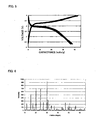
- the lithium secondary battery was charged at a current density of 0.03mA/cm 2 until a terminal voltage of 4.7 V was obtained. Thereafter, at a current density of 0.03 mA/cm 2 , discharge was carried out until a terminal voltage of 2.3 V was obtained. The charge/discharge cycle was repeated for three times. Results are shown in FIG. 5 .
- a Mn source solution was obtained by dissolving 0.02 mol of manganese acetate tetrahydrate (C 4 H 6 O 4 Mn ⁇ (4H 2 O) 4 ) in 100 ml of deionized water.
- a precipitant was obtained by dissolving 0.04 mol of lithium hydroxide monohydrate (LiOH ⁇ H 2 O) in 100 ml of deionized water.
- LiOH ⁇ H 2 O lithium hydroxide monohydrate
- the obtained precipitate was filtered and washed with deionized water. Thereafter, the precipitate was transferred in a 1L beaker, 100 ml of 1-butanol was added, followed by agitating for 3 minutes, and thereby a reduced dispersion solution was obtained.
- the pH-adjusted dispersion solution was transferred to a Teflon coated autoclave and allowed reacting at a temperature of 170°C for two days. Thereafter, the dispersion solution was cooled and filtered, obtained light brown precipitate was washed with deionized water, followed by drying in air at 60°C overnight, and thereby LiMnPO 4 was obtained. An X-ray diffraction pattern of the obtained LiMnPO 4 was measured. The measurement conditions were same as those of the example 1. An X-ray diffraction pattern obtained by the measurement is shown in FIG. 6 . Furthermore, the unit lattice parameters of the obtained LiMnPO 4 were same as that of the example 1. From the results, it is confirmed that LiMnPO 4 has an excellent crystalline.
Landscapes
- Chemical & Material Sciences (AREA)
- Organic Chemistry (AREA)
- Inorganic Chemistry (AREA)
- Chemical Kinetics & Catalysis (AREA)
- Electrochemistry (AREA)
- General Chemical & Material Sciences (AREA)
- Engineering & Computer Science (AREA)
- Manufacturing & Machinery (AREA)
- Materials Engineering (AREA)
- Crystallography & Structural Chemistry (AREA)
- Battery Electrode And Active Subsutance (AREA)
- Secondary Cells (AREA)
- Inorganic Compounds Of Heavy Metals (AREA)
Applications Claiming Priority (2)
| Application Number | Priority Date | Filing Date | Title |
|---|---|---|---|
| JP2005314054A JP5084131B2 (ja) | 2005-10-28 | 2005-10-28 | LiMnPO4の製造方法 |
| PCT/JP2006/322037 WO2007049815A2 (en) | 2005-10-28 | 2006-10-27 | Method for manufacturing limnpo4 |
Publications (2)
| Publication Number | Publication Date |
|---|---|
| EP1957404A2 EP1957404A2 (en) | 2008-08-20 |
| EP1957404B1 true EP1957404B1 (en) | 2011-08-03 |
Family
ID=37968229
Family Applications (1)
| Application Number | Title | Priority Date | Filing Date |
|---|---|---|---|
| EP06822955A Not-in-force EP1957404B1 (en) | 2005-10-28 | 2006-10-27 | Method for manufacturing limnpo4 |
Country Status (6)
| Country | Link |
|---|---|
| US (1) | US7749658B2 (enExample) |
| EP (1) | EP1957404B1 (enExample) |
| JP (1) | JP5084131B2 (enExample) |
| KR (1) | KR100984421B1 (enExample) |
| CN (1) | CN101296863B (enExample) |
| WO (1) | WO2007049815A2 (enExample) |
Families Citing this family (25)
| Publication number | Priority date | Publication date | Assignee | Title |
|---|---|---|---|---|
| WO2006131873A2 (en) * | 2005-06-06 | 2006-12-14 | High Power Lithium S.A. | Lithium rechargeable electrochemical cell |
| EP1989747B1 (en) * | 2006-02-14 | 2017-04-12 | Dow Global Technologies LLC | Lithium manganese phosphate positive material for lithium secondary battery |
| EP1901388A1 (en) * | 2006-09-14 | 2008-03-19 | High Power Lithium S.A. | Overcharge and overdischarge protection in lithium-ion batteries |
| US20080303004A1 (en) * | 2007-06-08 | 2008-12-11 | Conocophillips Company | Method for producing lithium transition metal polyanion powders for batteries |
| EP2015382A1 (en) | 2007-07-13 | 2009-01-14 | High Power Lithium S.A. | Carbon coated lithium manganese phosphate cathode material |
| JP5272756B2 (ja) * | 2008-02-12 | 2013-08-28 | 株式会社Gsユアサ | リチウム二次電池用正極活物質、リチウム二次電池用正極及びリチウム二次電池、並びに、その製造方法 |
| TWI474970B (zh) | 2008-12-29 | 2015-03-01 | Basf Se | 於水熱條件下合成鋰-金屬-磷酸鹽 |
| US20110008233A1 (en) * | 2009-07-10 | 2011-01-13 | Semiconductor Energy Laboratory Co., Ltd. | Positive electrode active material |
| KR101748406B1 (ko) * | 2009-08-07 | 2017-06-16 | 가부시키가이샤 한도오따이 에네루기 켄큐쇼 | 양극 활물질의 제작 방법 |
| US7931985B1 (en) | 2010-11-08 | 2011-04-26 | International Battery, Inc. | Water soluble polymer binder for lithium ion battery |
| US8076026B2 (en) * | 2010-02-05 | 2011-12-13 | International Battery, Inc. | Rechargeable battery using an aqueous binder |
| JP5820566B2 (ja) * | 2010-02-17 | 2015-11-24 | 株式会社Gsユアサ | 正極材料の製造方法 |
| JP5917027B2 (ja) | 2010-06-30 | 2016-05-11 | 株式会社半導体エネルギー研究所 | 電極用材料の作製方法 |
| US20110143206A1 (en) * | 2010-07-14 | 2011-06-16 | International Battery, Inc. | Electrode for rechargeable batteries using aqueous binder solution for li-ion batteries |
| KR101219395B1 (ko) * | 2010-07-15 | 2013-01-11 | 전자부품연구원 | 리튬이차전지용 양극재료 및 그의 제조방법 |
| US8102642B2 (en) * | 2010-08-06 | 2012-01-24 | International Battery, Inc. | Large format ultracapacitors and method of assembly |
| TWI468338B (zh) * | 2010-09-03 | 2015-01-11 | Showa Denko Kk | 鋰金屬磷酸鹽之製造方法 |
| JP5557715B2 (ja) * | 2010-12-06 | 2014-07-23 | 株式会社日立製作所 | リチウムイオン二次電池用正極材料およびその製造方法,リチウムイオン二次電池用正極活物質,リチウムイオン二次電池用正極,リチウムイオン二次電池 |
| JP5673275B2 (ja) | 2011-03-23 | 2015-02-18 | 住友大阪セメント株式会社 | リチウムイオン電池用正極活物質とその製造方法及びリチウムイオン電池用電極並びにリチウムイオン電池 |
| EP2693538A4 (en) | 2011-03-28 | 2015-05-06 | Univ Hyogo | ELECTRODE MATERIAL FOR A SECONDARY BATTERY, METHOD FOR PRODUCING THE ELECTRODE MATERIAL FOR A SECONDARY BATTERY AND SECONDARY BATTERY |
| JP6143216B2 (ja) * | 2012-08-29 | 2017-06-07 | 株式会社デンソー | 非水電解質二次電池用正極活物質の製造方法 |
| CN104781965B (zh) | 2012-11-12 | 2018-01-16 | 三井造船株式会社 | 电极材料和电极材料的生产方法 |
| US9673454B2 (en) | 2013-02-18 | 2017-06-06 | Semiconductor Energy Laboratory Co., Ltd. | Sodium-ion secondary battery |
| KR101624317B1 (ko) | 2014-09-01 | 2016-06-07 | 한국생산기술연구원 | 이차전지용 양극소재 제조방법 |
| CN110371940A (zh) * | 2019-09-04 | 2019-10-25 | 井冈山大学 | 一种LiMnPO4前驱体模板Li3PO4空心微球及其制备方法和应用 |
Family Cites Families (6)
| Publication number | Priority date | Publication date | Assignee | Title |
|---|---|---|---|---|
| JPH1125983A (ja) | 1997-07-04 | 1999-01-29 | Japan Storage Battery Co Ltd | リチウム電池用活物質 |
| EP1094532A1 (en) | 1999-04-06 | 2001-04-25 | Sony Corporation | Method for manufacturing active material of positive plate and method for manufacturing nonaqueous electrolyte secondary cell |
| CA2796903C (en) * | 2000-04-25 | 2015-03-31 | Sony Corporation | Positive electrode active material and non-aqueous electrolyte cell |
| EP1261050A1 (en) | 2001-05-23 | 2002-11-27 | n.v. Umicore s.a. | Lithium transition-metal phosphate powder for rechargeable batteries |
| JP4475882B2 (ja) | 2003-03-31 | 2010-06-09 | 国立大学法人九州大学 | 2次電池用正極材料の製造方法、および2次電池 |
| CN1571195A (zh) * | 2004-05-13 | 2005-01-26 | 复旦大学 | 用于薄膜锂离子电池的纳米阴极材料及其制备方法 |
-
2005
- 2005-10-28 JP JP2005314054A patent/JP5084131B2/ja not_active Expired - Fee Related
-
2006
- 2006-10-27 EP EP06822955A patent/EP1957404B1/en not_active Not-in-force
- 2006-10-27 CN CN2006800400811A patent/CN101296863B/zh not_active Expired - Fee Related
- 2006-10-27 KR KR1020087012720A patent/KR100984421B1/ko not_active Expired - Fee Related
- 2006-10-27 US US12/084,200 patent/US7749658B2/en not_active Expired - Fee Related
- 2006-10-27 WO PCT/JP2006/322037 patent/WO2007049815A2/en not_active Ceased
Also Published As
| Publication number | Publication date |
|---|---|
| JP5084131B2 (ja) | 2012-11-28 |
| CN101296863A (zh) | 2008-10-29 |
| WO2007049815A3 (en) | 2007-11-15 |
| WO2007049815A2 (en) | 2007-05-03 |
| JP2007119304A (ja) | 2007-05-17 |
| EP1957404A2 (en) | 2008-08-20 |
| CN101296863B (zh) | 2011-06-01 |
| KR20080065676A (ko) | 2008-07-14 |
| KR100984421B1 (ko) | 2010-09-30 |
| US7749658B2 (en) | 2010-07-06 |
| US20090184296A1 (en) | 2009-07-23 |
Similar Documents
| Publication | Publication Date | Title |
|---|---|---|
| EP1957404B1 (en) | Method for manufacturing limnpo4 | |
| EP2357693B2 (en) | Positive electrode for lithium secondary battery, and lithium secondary battery | |
| EP1150367B1 (en) | Positive electrode active material and non-aqueous elecrolyte cell | |
| US8313863B2 (en) | Synthesis of nanoparticles of lithium metal phosphate positive material for lithium secondary battery | |
| JP5473894B2 (ja) | Liベースの電池に使用するための室温単相Li挿入/抽出材料 | |
| US8865349B2 (en) | Method of producing positive electrode active material and nonaqueous electrolyte battery using the same | |
| JP5442744B2 (ja) | オリビン構造を有するリン酸リチウム鉄及びその分析方法 | |
| US9543573B2 (en) | Method of producing iron phosphate, lithium iron phosphate, electrode active substance, and secondary battery | |
| KR20100060362A (ko) | 리튬 이차 전지용 양극 활물질, 이의 제조방법 및 이를 포함하는 리튬 이차 전지 | |
| JP2009218205A (ja) | リチウム二次電池用正極活物質、リチウム二次電池用正極及びリチウム二次電池、並びに、その製造方法 | |
| EP2985823B1 (en) | Positive active material for rechargeable lithium battery, method of preparing same, and rechargeable lithium battery including same | |
| EP3731313A1 (en) | Positive pole active material for lithium secondary battery and manufacturing method thereof, lithium secondary battery | |
| US20140295281A1 (en) | Lithiated Manganese Phosphate and Composite Material Comprising Same | |
| EP2919302A1 (en) | Positive electrode active material, lithium battery, and manufacturing method for positive electrode active material | |
| CN102224622B (zh) | 高电流密度下具有改善的循环性能的电池的阴极材料 | |
| KR100972054B1 (ko) | 활물질의 제조방법 | |
| WO2011096236A1 (ja) | 複合酸化物の製造方法、リチウムイオン二次電池用正極活物質およびリチウムイオン二次電池 | |
| KR101545717B1 (ko) | 아연 망간 산화물의 제조방법 | |
| JP2002321919A (ja) | リチウムマンガン複合酸化物及びリチウム二次電池 | |
| US20230249983A1 (en) | Li-rich transition metal oxides material | |
| KR20160019328A (ko) | 리튬 이차 전지용 양극 활물질, 이의 제조 방법 및 이를 포함하는 리튬 이차 전지 |
Legal Events
| Date | Code | Title | Description |
|---|---|---|---|
| PUAI | Public reference made under article 153(3) epc to a published international application that has entered the european phase |
Free format text: ORIGINAL CODE: 0009012 |
|
| 17P | Request for examination filed |
Effective date: 20080415 |
|
| AK | Designated contracting states |
Kind code of ref document: A2 Designated state(s): CH DE FR LI |
|
| RBV | Designated contracting states (corrected) |
Designated state(s): CH DE FR LI |
|
| RAP1 | Party data changed (applicant data changed or rights of an application transferred) |
Owner name: TOYOTA JIDOSHA KABUSHIKI KAISHA Owner name: DOW GLOBAL TECHNOLOGIES INC. |
|
| GRAP | Despatch of communication of intention to grant a patent |
Free format text: ORIGINAL CODE: EPIDOSNIGR1 |
|
| RAP1 | Party data changed (applicant data changed or rights of an application transferred) |
Owner name: TOYOTA JIDOSHA KABUSHIKI KAISHA Owner name: DOW GLOBAL TECHNOLOGIES LLC |
|
| GRAS | Grant fee paid |
Free format text: ORIGINAL CODE: EPIDOSNIGR3 |
|
| GRAA | (expected) grant |
Free format text: ORIGINAL CODE: 0009210 |
|
| AK | Designated contracting states |
Kind code of ref document: B1 Designated state(s): CH DE FR LI |
|
| REG | Reference to a national code |
Ref country code: CH Ref legal event code: EP |
|
| REG | Reference to a national code |
Ref country code: CH Ref legal event code: NV Representative=s name: NOVAGRAAF INTERNATIONAL SA |
|
| REG | Reference to a national code |
Ref country code: DE Ref legal event code: R096 Ref document number: 602006023557 Country of ref document: DE Effective date: 20111013 |
|
| PLBE | No opposition filed within time limit |
Free format text: ORIGINAL CODE: 0009261 |
|
| STAA | Information on the status of an ep patent application or granted ep patent |
Free format text: STATUS: NO OPPOSITION FILED WITHIN TIME LIMIT |
|
| 26N | No opposition filed |
Effective date: 20120504 |
|
| REG | Reference to a national code |
Ref country code: DE Ref legal event code: R097 Ref document number: 602006023557 Country of ref document: DE Effective date: 20120504 |
|
| REG | Reference to a national code |
Ref country code: FR Ref legal event code: PLFP Year of fee payment: 11 |
|
| PGFP | Annual fee paid to national office [announced via postgrant information from national office to epo] |
Ref country code: FR Payment date: 20160919 Year of fee payment: 11 |
|
| PGFP | Annual fee paid to national office [announced via postgrant information from national office to epo] |
Ref country code: CH Payment date: 20161013 Year of fee payment: 11 Ref country code: DE Payment date: 20161018 Year of fee payment: 11 |
|
| REG | Reference to a national code |
Ref country code: DE Ref legal event code: R119 Ref document number: 602006023557 Country of ref document: DE |
|
| REG | Reference to a national code |
Ref country code: CH Ref legal event code: PL |
|
| REG | Reference to a national code |
Ref country code: FR Ref legal event code: ST Effective date: 20180629 |
|
| PG25 | Lapsed in a contracting state [announced via postgrant information from national office to epo] |
Ref country code: DE Free format text: LAPSE BECAUSE OF NON-PAYMENT OF DUE FEES Effective date: 20180501 Ref country code: CH Free format text: LAPSE BECAUSE OF NON-PAYMENT OF DUE FEES Effective date: 20171031 Ref country code: LI Free format text: LAPSE BECAUSE OF NON-PAYMENT OF DUE FEES Effective date: 20171031 |
|
| PG25 | Lapsed in a contracting state [announced via postgrant information from national office to epo] |
Ref country code: FR Free format text: LAPSE BECAUSE OF NON-PAYMENT OF DUE FEES Effective date: 20171031 |