EP1952688A1 - Ölsuspensionskonzentrat mit mikrogekaspelten und mit nicht mikrogekaspelten agrochemischen Wirkstoffen - Google Patents
Ölsuspensionskonzentrat mit mikrogekaspelten und mit nicht mikrogekaspelten agrochemischen Wirkstoffen Download PDFInfo
- Publication number
- EP1952688A1 EP1952688A1 EP07001380A EP07001380A EP1952688A1 EP 1952688 A1 EP1952688 A1 EP 1952688A1 EP 07001380 A EP07001380 A EP 07001380A EP 07001380 A EP07001380 A EP 07001380A EP 1952688 A1 EP1952688 A1 EP 1952688A1
- Authority
- EP
- European Patent Office
- Prior art keywords
- methyl
- oder
- alkyl
- ethyl
- und
- Prior art date
- Legal status (The legal status is an assumption and is not a legal conclusion. Google has not performed a legal analysis and makes no representation as to the accuracy of the status listed.)
- Withdrawn
Links
- 0 *CC(C(*)=NN1C(NS(c2c(*)[s]cc2C(*)=O)(=O)=O)=O)C1=O Chemical compound *CC(C(*)=NN1C(NS(c2c(*)[s]cc2C(*)=O)(=O)=O)=O)C1=O 0.000 description 1
Classifications
-
- A—HUMAN NECESSITIES
- A01—AGRICULTURE; FORESTRY; ANIMAL HUSBANDRY; HUNTING; TRAPPING; FISHING
- A01N—PRESERVATION OF BODIES OF HUMANS OR ANIMALS OR PLANTS OR PARTS THEREOF; BIOCIDES, e.g. AS DISINFECTANTS, AS PESTICIDES OR AS HERBICIDES; PEST REPELLANTS OR ATTRACTANTS; PLANT GROWTH REGULATORS
- A01N25/00—Biocides, pest repellants or attractants, or plant growth regulators, characterised by their forms, or by their non-active ingredients or by their methods of application, e.g. seed treatment or sequential application; Substances for reducing the noxious effect of the active ingredients to organisms other than pests
- A01N25/02—Biocides, pest repellants or attractants, or plant growth regulators, characterised by their forms, or by their non-active ingredients or by their methods of application, e.g. seed treatment or sequential application; Substances for reducing the noxious effect of the active ingredients to organisms other than pests containing liquids as carriers, diluents or solvents
- A01N25/04—Dispersions, emulsions, suspoemulsions, suspension concentrates or gels
-
- A—HUMAN NECESSITIES
- A01—AGRICULTURE; FORESTRY; ANIMAL HUSBANDRY; HUNTING; TRAPPING; FISHING
- A01N—PRESERVATION OF BODIES OF HUMANS OR ANIMALS OR PLANTS OR PARTS THEREOF; BIOCIDES, e.g. AS DISINFECTANTS, AS PESTICIDES OR AS HERBICIDES; PEST REPELLANTS OR ATTRACTANTS; PLANT GROWTH REGULATORS
- A01N25/00—Biocides, pest repellants or attractants, or plant growth regulators, characterised by their forms, or by their non-active ingredients or by their methods of application, e.g. seed treatment or sequential application; Substances for reducing the noxious effect of the active ingredients to organisms other than pests
- A01N25/26—Biocides, pest repellants or attractants, or plant growth regulators, characterised by their forms, or by their non-active ingredients or by their methods of application, e.g. seed treatment or sequential application; Substances for reducing the noxious effect of the active ingredients to organisms other than pests in coated particulate form
- A01N25/28—Microcapsules or nanocapsules
-
- A—HUMAN NECESSITIES
- A01—AGRICULTURE; FORESTRY; ANIMAL HUSBANDRY; HUNTING; TRAPPING; FISHING
- A01N—PRESERVATION OF BODIES OF HUMANS OR ANIMALS OR PLANTS OR PARTS THEREOF; BIOCIDES, e.g. AS DISINFECTANTS, AS PESTICIDES OR AS HERBICIDES; PEST REPELLANTS OR ATTRACTANTS; PLANT GROWTH REGULATORS
- A01N43/00—Biocides, pest repellants or attractants, or plant growth regulators containing heterocyclic compounds
- A01N43/48—Biocides, pest repellants or attractants, or plant growth regulators containing heterocyclic compounds having rings with two nitrogen atoms as the only ring hetero atoms
- A01N43/56—1,2-Diazoles; Hydrogenated 1,2-diazoles
-
- A—HUMAN NECESSITIES
- A01—AGRICULTURE; FORESTRY; ANIMAL HUSBANDRY; HUNTING; TRAPPING; FISHING
- A01N—PRESERVATION OF BODIES OF HUMANS OR ANIMALS OR PLANTS OR PARTS THEREOF; BIOCIDES, e.g. AS DISINFECTANTS, AS PESTICIDES OR AS HERBICIDES; PEST REPELLANTS OR ATTRACTANTS; PLANT GROWTH REGULATORS
- A01N47/00—Biocides, pest repellants or attractants, or plant growth regulators containing organic compounds containing a carbon atom not being member of a ring and having no bond to a carbon or hydrogen atom, e.g. derivatives of carbonic acid
- A01N47/08—Biocides, pest repellants or attractants, or plant growth regulators containing organic compounds containing a carbon atom not being member of a ring and having no bond to a carbon or hydrogen atom, e.g. derivatives of carbonic acid the carbon atom having one or more single bonds to nitrogen atoms
- A01N47/28—Ureas or thioureas containing the groups >N—CO—N< or >N—CS—N<
- A01N47/38—Ureas or thioureas containing the groups >N—CO—N< or >N—CS—N< containing the group >N—CO—N< where at least one nitrogen atom is part of a heterocyclic ring; Thio analogues thereof
Definitions
- Oil suspension concentrate with microencapsulated and non-microencapsulated agrochemical active ingredients Oil suspension concentrate with microencapsulated and non-microencapsulated agrochemical active ingredients
- the invention relates to oil suspension concentrates for crop protection and agrochemical active substances contained therein, which may be present in both encapsulated and non-encapsulated form.
- Microcapsules are characterized in that the capsule shell is a wall of polymers which physically separates the two liquid phases outside and inside the capsule.
- the term "microcapsule” is therefore to be distinguished from other forms of formulation such as, for example, emulsion, microsphere, liposome, since these do not have the characteristic of the physical separation of liquids by a wall made of polymers.
- oil-in-water microencapsulation there is an oil-in-water emulsion, i. the water-immiscible or water-insoluble material is surrounded by the polymer material of the microcapsule.
- the aqueous phase is inside the microcapsule. It is therefore also referred to as "inverse microencapsulation”.
- the present invention utilizes predominantly water-in-oil microencapsulation unless the multi-microencapsulation process is employed.
- multi-microencapsulation a distinction is made between “water-in-oil-in-water microencapsulation” and “water-in-oil-in-oil microencapsulation”.
- water-in-oil-in-water microencapsulation a distinction is made between “water-in-oil-in-water microencapsulation” and "water-in-oil-in-oil microencapsulation”.
- the implementation of both techniques is possible, with the water-in-oil-in-oil microencapsulation in the foreground.
- microencapsulation For the forms of microencapsulation mentioned, corresponding production methods are known. These are in different areas, e.g. Food production, pharmacy, dyestuff chemistry, agrochemicals, etc. used.
- the formation of the microcapsules takes place from the monomers and prepolymers contained in the oil droplets under the influence of heat and / or by pH change and / or by mechanical stirring.
- the respective treatment causes the polymerization of the monomer or the prepolymers.
- the EP 1 282 353 A1 discloses the combination of crop protection agents with organic or inorganic carrier materials for controlled release of the active ingredients, including the use of oil-in-water microencapsulation.
- the disclosed combinations allow for the suppression of antagonization of other drugs in admixture therewith and, at the same time, eliminate the need for time and labor intensive splinter applications.
- the problem of chemical incompatibility between active substances is not the subject of EP 1 282 353 A1 ,
- Water-in-oil microcapsules are prepared from a water-in-oil emulsion by the "water-in-oil process". Such a method is in the US patent US 4,157,983 disclosed. A corresponding process using two monomers and prepolymers is disclosed in the patent US 4,534,783 disclosed.
- a process for multiple microencapsulation is described in US Pat WO 2005/058476 A1 disclosed. It is a continuous process for microencapsulation of water-in-oil-in-water by in situ interfacial polymerization of the corresponding emulsion.
- the active compounds included in the microcapsules are beneficial to health and suitable for other biological purposes.
- the use of the method for the formulation of agrochemical active substances or for the solution of the problem of chemical incompatibility between agrochemical active ingredients is not provided for.
- WO 98/28957 A Another special procedure for "water-in-oil microencapsulation" is in WO 98/28957 A disclosed.
- the wall of the microcapsules is formed in the presence of an active surface proton transfer proton catalyst by in situ self-condensation of the prepolymers, which are located at the interface between aqueous and organic phase in the aqueous phase, by supplying heat.
- the active substance which according to the doctrine of WO 98/28957 A can also consist of a pesticide.
- the organic phase as a bioactive material may also contain a pesticide.
- Oil-soluble herbicides include EPTC, butylates, cycloates, molinates, vernolates, acetochlor, metolachlor, alachlor, butachlor, propachlor and trifluralin.
- the hydrolysis sensitivity always has to be considered when formulating active substances from the class of sulfonylureas.
- Their chemical stability is very well ensured by the previously established Forumull fürstechniken if the sulfonylureas are used as a single active ingredient or in combination with other sulfonylureas or with safener.
- the formulation of sulfonylureas remains a challenge In combination with active substances or excipients whose structure has an acid function and / or free OH groups.
- Agents known for their hydrolysis-inducing potential over sulfonylureas are e.g. Glufosinate and glyphosate.
- the low pH of glyphosate ( ⁇ 7) is detrimental to those sulfonylureas that are stable in the basic range.
- the chemical incompatibility of drugs is a complex problem.
- the stability of the active ingredient after dilution of the concentrate in the spray tank can be a problem.
- the crystallization must be prevented and the distributability and the biological activity of the active ingredient must be ensured.
- the object of the present invention was to provide an improved, liquid crop protection agent formulation having at least two agrochemical active ingredients, wherein each active ingredient, in particular the chemically unstable active ingredients contained in the formulation, and the formulation as a whole, a high chemical and physical stability and a have high biological effectiveness and crop plant compatibility.
- the core idea of the alternatives is to protect the more hydrolysis-sensitive active ingredient in the case of a combination of active ingredients by microencapsulating another active ingredient possibly having a hydrolysis-inducing potential.
- ⁇ lsuspenslonskonzentrate which contain at least two different agrochemical active ingredients, of which at least one is water-soluble and is present inside a microcapsule. At least one further active ingredient dispersed or dissolved in the oil phase is likewise encapsulated.
- At least two active substances which differ, for example, in their solubility and / or in their hydrolysis sensitivity are microencapsulated.
- the hydrolysis-sensitive active ingredient is additionally protected, in front of the active ingredient, which is also present in microencapsulated form due to its hydrolysis-inducing potential.
- the additional microencapsulation of the active ingredients dispersed or dissolved better in the oil phase can additionally have the advantage that, due to the delayed release of the differently encapsulated active ingredients, splinter applications can be avoided.
- an oil suspension concentrate which contains at least two different agrochemical active ingredients, at least one of which is present in the interior of a microcapsule and at least one in non-encapsulated form in the oil phase, wherein the present in non-encapsulated form in the oil phase active ingredient Acetolactate synthase (ALS) inhibitor.
- ALS Acetolactate synthase
- the third alternative uses an oil suspension concentrate containing at least two different agrochemically active compounds, at least one of which is present inside a microcapsule and at least one in an unencapsulated form in the oil phase, where the microencapsulated agent is an acetolactate synthase (ALS) inhibitor and the active ingredient having high hydrolysis-inducing potential is present in non-encapsulated form in the oil phase. That According to the approach of the third alternative, the additional microencapsulation of the hydrolysis-inducing active ingredients is dispensed with.
- ALS acetolactate synthase
- the active ingredients in accordance with the multi-microencapsulation process in WO 2005/058476 A1 have been treated and are available in the appropriate form.
- the hydrolysis-inducing active substances are present in the interior of the capsule core for the purpose of protecting the hydrolysis-sensitive active substance (s).
- the most sensitive to hydrolysis active ingredient, however, is in the oil phase of the oil suspension concentrate, because there is the best protected.
- the class of compounds of the sulfonylureas belongs to their mode of action according to the group of ALS inhibitors. These inhibit the enzyme acetolactate synthase (ALS) and thus the protein synthesis in the plants.
- ALS acetolactate synthase
- oil suspension concentrate oil dispersion
- OD oil dispersion
- One or more active substances or safeners are suspended in the organic solvent. In this case, further active ingredients or safeners may be dissolved in the organic solvent.
- agrochemical active ingredient in the context of this invention includes herbicides, plant growth regulators, safeners. That the ⁇ lsuspenslonskonzentrate invention may also contain one or more safeners, wherein in addition to the active ingredient and the safener may be present in microencapsulated form. Possible safeners are mentioned below by way of example in connection with the agrochemical active ingredients.
- the oil suspension concentrates according to the invention may contain one or more inorganic salts as well as customary auxiliaries and additives.
- herbicides are, for example, ALS inhibitors (acetolactate synthetase inhibitors) or herbicides from the group of carbamates, thiocarbamates, haloacetanilides, substituted phenoxy, naphthoxy and phenoxyphenoxycarboxylic acid derivatives and heteroaryloxy-phenoxyalkanecarboxylic acid derivatives, such as quinolyloxy, quinoxalyl oxy-, pyridyloxy, Benzoxazolyloxy- and Benzthiazolyloxyphenoxyalkancarbonklareester, cyclo-hexanedione derivatives, imidazolinones, phosphorus-containing herbicides, for example, glufosinate-type or glyphosate-type, pyrimidinyloxy-pyridinecarboxylic acid derivatives, pyrimidyloxy-benzoic acid derivatives, triazolopyrimidine-sulfonamide derivatives and S- (N-ary
- the herbicides are from the group of the carbamates, Thiocarbamates, Halogenacetanilide not provided as in the oil phase active ingredients.
- carbamates, thiocarbamates, haloacetanilides may be present in the aqueous phase inside the microcapsules contained in the oil suspension concentrate.
- the agrochemical active substances can also be growth regulators. Examples of these are terbufos, cyclanilides and thidiazuron.
- the herbicides (plant growth regulators) of groups A to X are, for example, from the above-mentioned publications and / or from " The Pesticide Manual ", 12th Edition (2000) and 13th Edition (2003 ) The British Crop Protection Council, "Agricultural Chemicals Book II - Herbicides -", by WT Thompson, Thompson Publications, Fresno CA, USA 1990 and " Farm Chemicals Handbook '90', Meister Publishing Company, Willoughby OH, USA, 1990 , known.
- radicals in the formulas (S-II) to (S-VIII) can each be straight-chain or branched in the carbon skeleton.
- Alkyl radicals even in the composite meanings such as alkoxy, haloalkyl, etc., preferably have 1 to 4 carbon atoms and, for example, methyl, ethyl, n- or i-propyl, n-, i-, t- or 2-butyl.
- Alkenyl and alkynyl radicals have the meaning of the possible unsaturated radicals corresponding to the alkyl radicals;
- Alkenyl means, for example, allyl, 1-methylprop-2-en-1-yl, 2-methyl-prop-2-en-1-yl, but-2-en-1-yl, but-3-en-1-yl , 1-methyl-but-3-en-1-yl and 1-methyl-but-2-en-1-yl.
- Alkynyl means, for example, propargyl, but-2-yn-1-yl, but-3-yn-1-yl, 1-methylbut-3-yn-1-yl.
- (C 1 -C 4 ) -alkyl is the abbreviation for alkyl having 1 to 4 carbon atoms; The same applies to other general remainder definitions with areas given in brackets for the possible number of C atoms.
- Cycloalkyl is preferably a cyclic alkyl radical having 3 to 8, preferably 3 to 7, particularly preferably 3 to 6, C atoms, for example cyclopropyl, cyclobutyl, cyclopentyl and cyclohexyl. Cycloalkenyl and cycloalkynyl refer to corresponding unsaturated compounds.
- Halogen is fluorine, chlorine, bromine or iodine.
- Haloalkyl, haloalkenyl and haloalkynyl by halogen preferably by fluorine, chlorine and / or bromine, in particular by fluorine or chlorine, partially or completely substituted alkyl, alkenyl or alkynyl, for example OF 3 , CHF 2 , CH 2 F, CF 2 CF 3 , CH 2 CHFCl, CCl 3 , CHCl 2 , CH 2 CH 2 Cl
- haloalkoxy is eg OCF 3 , OCHF 2 , OCH 2 F, OCF 2 CF 3 , OCH 2 CF 3 and OCH 2 CH 2 Cl.
- halogen-substituted radicals eg OCF 3 , OCHF 2 , OCH 2 F, OCF 2 CF 3 , OCH 2 CF 3 and OCH 2 CH 2 Cl.
- a hydrocarbon radical can be an aromatic or an alliphatic hydrocarbon radical, where an aliphatic hydrocarbon radical is generally a straight-chain or branched saturated or unsaturated hydrocarbon radical, preferably having 1 to 18, particularly preferably 1 to 12, carbon atoms, e.g. Alkyl, alkenyl or alkynyl.
- aliphatic hydrocarbon radical alkyl, alkenyl or alkynyl having up to 12 carbon atoms Preferably, aliphatic hydrocarbon radical alkyl, alkenyl or alkynyl having up to 12 carbon atoms; the same applies to an aliphatic hydrocarbon radical in a Kohlenwasserstoffoxyrest.
- Aryl is generally a mono-, bi- or polycyclic aromatic system having preferably 6-20 C atoms, preferably 6 to 14 C atoms, more preferably 6 to 10 C atoms, e.g. Phenyl, naphthyl, tetrahydronaphthyl, indenyl, indanyl, pantalenyl and fluorenyl, more preferably phenyl.
- Heterocyclic ring, heterocyclic radical or heterocyclyl means a mono-, bi- or polycyclic ring system which is saturated, unsaturated and / or aromatic and one or more, preferably 1 to 4, heteroatoms, preferably from the group N, S and O, contains.
- saturated heterocycles having 3 to 7 ring atoms and one or two heteroatoms from the group N, O and S, wherein the chalcogens are not adjacent.
- Particularly preferred are monocyclic rings having 3 to 7 ring atoms and a heteroatom from the group N, O and S, and morpholine, dioxolane, piperazine, imidazoline and oxazolidine.
- Very particularly preferred saturated heterocycles are oxirane, pyrrolidone, morpholine and tetrahydrofuran.
- partially unsaturated heterocycles having 5 to 7 ring atoms and one or two heteroatoms from the group N, O and S.
- Very particular preferred partially unsaturated heterocycles are pyrazoline, imidazoline and isoxazoline.
- heteroaryl e.g. mono- or bicyclic aromatic heterocycles having 5 to 6 ring atoms containing one to four heteroatoms from the group N, O, S, wherein the chalcogens are not adjacent.
- monocyclic aromatic heterocycles having 5 to 6 ring atoms which contain a heteroatom from the group, N, O and S, and pyrimidine, pyrazine, pyridazine, oxazole, thiazole, thiadiazole, oxadiazole, pyrazole, triazole and isoxazole.
- pyrazole, thiazole, triazole and furan is particularly preference is given to pyrazole, thiazole, triazole and furan.
- Substituted radicals such as substituted hydrocarbon radicals, for example substituted alkyl, alkenyl, alkynyl, aryl, such as phenyl and arylalkyl, such as benzyl, or substituted heterocyclyl, represent a substituted radical derived from the unsubstituted radical, where the substituents are preferably one or more, preferably 1, 2 or 3 , in the case of Cl and F also up to the maximum possible number, substituents from the group halogen, alkoxy, haloalkoxy, alkylthio, hydroxy, amino, nitro, carboxy, cyano, azido, alkoxycarbonyl, alkylcarbonyl, formyl, carbamoyl, mono- and dialkylaminocarbonyl , substituted amino such as acylamino, mono- and dialkylamino and alkylsulfinyl, haloalkylsulfinyl, alkylsulfon
- Substituents from the group halogen for example fluorine or chlorine, (C 1 -C 4 ) alkyl, preferably methyl or ethyl, (C 1 -C 4 ) haloalkyl, preferably trifluoromethyl, (C 1 -C 4 ) alkoxy, preferably methoxy or ethoxy , (C 1 -C 4 ) haloalkoxy, nitro and cyano.
- substituents methyl, methoxy and chlorine are particularly preferred.
- Mono- or disubstituted amino means a chemically stable radical from the group of substituted amino radicals which are N-substituted by, for example, one or two identical or different radicals from the group consisting of alkyl, alkoxy, acyl and aryl; preferably monoalkylamino, dialkylamino, acylamino, arylamino, N-alkyl-N-arylamino and N-heterocycles.
- alkyl radicals having 1 to 4 carbon atoms are preferred.
- Aryl is preferably phenyl.
- Substituted aryl is preferably substituted phenyl.
- acyl the definition below applies, preferably (C 1 -C 4 ) alkanoyl. The same applies to substituted hydroxylamino or hydrazino.
- Optionally substituted phenyl is preferably phenyl which is unsubstituted or mono- or polysubstituted, preferably up to three times, in the case of halogens such as Cl and F also up to five times, by identical or different radicals from the group halogen, (C 1 -C 4 ) -alkyl, (C 1 -C 4 ) alkoxy, (C 1 -C 4 ) haloalkyl, (C 1 -C 4 ) haloalkoxy and nitro, for example o-, m- and p-tolyl, dimethylphenols, 2-, 3- and 4-chlorophenyl, 2-, 3- and 4-trifluoro and trichlorophenyl, 2,4-, 3,5-, 2,5- and 2,3-dichlorophenyl, o-, mund p-methoxyphenyl.
- halogens such as Cl and F also up to five times
- An acyl radical is the radical of an organic acid having preferably up to 6 C atoms, for example the radical of a carboxylic acid and radicals derived therefrom, such as the thiocarboxylic acid, optionally N-substituted iminocarboxylic acids, or the radical of carbonic acid monoesters, optionally N-substituted carbamic acids, sulfonic acids , Sulfinic acids, phosphonic acids, phosphinic acids.
- Acyl is, for example, formyl, alkylcarbonyl, such as (C 1 -C 4 alkyl) carbonyl, phenylcarbonyl, where the phenyl ring may be substituted, for example as indicated above for phenyl, or alkyloxycarbonyl, phenyloxycarbonyl, benzyloxycarbonyl, alkylsulfonyl, alkylsulfinyl or N-alkyl -1-iminoalkyl.
- alkylcarbonyl such as (C 1 -C 4 alkyl) carbonyl
- phenylcarbonyl where the phenyl ring may be substituted, for example as indicated above for phenyl, or alkyloxycarbonyl, phenyloxycarbonyl, benzyloxycarbonyl, alkylsulfonyl, alkylsulfinyl or N-alkyl -1-iminoalkyl.
- stereoisomers having the same topological linkage of the atoms and mixtures thereof.
- Such compounds contain one or more asymmetric C atoms or double bonds, which are not specified separately in the general formulas are.
- the possible defined by their specific spatial form possible stereoisomers, such as enantiomers, diastereomers, Z and E isomers can be obtained by conventional methods from mixtures of stereoisomers or prepared by stereoselective reactions in combination with the use of stereochemically pure starting materials.
- the compounds of the formula (S-II) are, for example, from EP-A-0333139 ( ZA-89/1960 ) EP-A-0269806 ( US 4,891,057 ) EP-A-0346620 ( AU-A-89/34951 ) EP-A-0174562 .
- EP-A-0346620 ( WO-A-91/08202 ) WO-A-91/07874 or WO-A-95/07897 ( ZA 94/7120 ) and the literature cited therein, or can be prepared by or analogously to the processes described therein.
- the compounds of formula (S-III) are made EP-A-0086750 .
- EP-A-094 349 US 4,902,340
- EP-A-0191736 US 4,881,986
- EP-A-0492366 and literature cited therein or can be prepared by or analogously to the processes described therein.
- Some compounds are also in EP-A-0582198 and WO-A-02134048 described.
- the compounds of formula (S-IV) are known from numerous patent applications, for example US 4,021,224 and US 4,021,229 , Compounds of subgroup b) are still off CN-A-87/102789 .
- EP-A-365484 as well as The Pesticide Manual, 11th to 13th Edition, British Crop Protection Council and the Royal Society of Chemistry (1997 ), known.
- the compounds of subgroup c) are in the WO 97/45016 subgroup d) in the WO-A-99/16744 (especially in EP-A-365484 ).
- the cited documents contain detailed information on preparation processes and starting materials and name preferred compounds. These documents are expressly referred to, they are by quotation as part of this description.
- the safeners of the above groups a) to e) reduce or prevent the phytotoxic effects which can occur when using the herbicidal compositions according to the invention in crops without impairing the effectiveness of the herbicides against harmful plants.
- the field of application of the herbicides can be significantly extended and in particular by the use of safeners, the use of herbicides, which have so far only limited or could be used with insufficient success, ie of combinations without Safener in low Doslerept with little broader effect led to insufficient control of harmful plants.
- Particularly preferred safeners in the formulations according to the invention include: 4-dichloroacetyl-1-oxa-4-aza-spiro [4,5] -decane (AD-67), 1-dichloroacetyl-hexahydro-3,3,8a trimethylpyrrolo [1,2-a] pyrimidine-6 (2H) -one (dicyclonone, BAS-145138), 4-dichloroacetyl-3,4-dihydro-3-methyl-2H-1,4-benzoxazine (Benoxacor), Cloquintocet, 5-chloro-quinoline-8-oxy-acetic acid (1-methyl-hexyl ester) (cloquintocet-mexyl), ⁇ - (cyanomethoxyimino) -phenylacetonitrile (cyometrinil), 2,2-dichloro-N- (2-oxo -2- (2-propenylamino) ethyl) -N- (2-propen
- herbicides are combined, e.g. Fenoxaprop-p-ethyl + loxyniloctanoate, diclofopmethyl + bramoxyniloctanoate, CMPP + bromoxyniloctanoate, MCPA + loxyniloctanoate, bromoxyniloctanoate + bromoxynil heptanoate, bromoxyniloctanoate + bromoxynil heptanoate + MCPA, bromoxynil octanoate + bromoxynil heptanoate + 2,4-D, phenmedipham + desmedipham, phenmedipham + desmedipham + ethofumesate, metamitron + ethofumesate, phenmedipham + ethofumesate + metamitron, fenoxaprop-p-ethyl + iodos
- the weight ratio safener: herbicide can vary within wide limits and is preferably in the range from 1: 100 to 100: 1, in particular from 1: 100 to 50: 1, very particularly preferably from 1:10 to 10: 1
- Herbicide (s) and safener (s) are usually dependent on the type of herbicide and / or the safener used and on the nature of the plant stock to be treated.
- the agrochemically active compounds may also be bactericides, for example bronopol, dichlorophen, nitrapyrin, nickel dimethyldithecarbamate, kasugamycin, octhilinone, furancarboxylic acid, oxytetracycline, probenazole, streptomycin, tecloftalam, copper sulphate and other copper preparations.
- bactericides for example bronopol, dichlorophen, nitrapyrin, nickel dimethyldithecarbamate, kasugamycin, octhilinone, furancarboxylic acid, oxytetracycline, probenazole, streptomycin, tecloftalam, copper sulphate and other copper preparations.
- fungicides bactericides listed above are known from " The Pesticide Manual, 12th Edition (2000) and 13th Edition (2003), The British Crop Protection Council or the literature references listed after the individual active ingredients.
- insecticides listed above are known, for example, from " The Pesticide Manual, 12th Edition (2000) and 13th Edition (2003), The British Crop Protection Council or the literature references listed after the individual active ingredients.
- a particular embodiment of the invention is the joint application of insecticides (acaricides, nematicides) as agrochemical active ingredients, either together or in succession.
- agrochemically active compounds are used according to solubility in the present invention.
- the criterion of water-soluble or oil-soluble can be seen from any active ingredient in the literature, for example, are solubilities of agrochemical active ingredients, for example, In " The Pesticide Manual, 12th Edition (2000), 13th Edition (2003) and 14th Edition (2006), The British Crop Protection Council , listed.
- the sulfonylureas contained as component in the oil suspension concentrates according to the invention are always understood to mean all forms of use, such as acids, esters, salts and isomers, such as stereoisomers and optical isomers.
- their salts are always to be understood, for example with inorganic and / or organic counterions.
- sulfonylureas can form salts in which the hydrogen of the -SO 2 -NH group is replaced by a cation suitable for agriculture.
- salts are, for example, metal salts, in particular alkali metal salts or alkaline earth metal salts, in particular sodium and potassium salts, or else ammonium salts or salts with organic amines.
- salt formation can take place by addition of an acid to basic groups, such as, for example, amino and alkylamino.
- Suitable acids for this purpose are strong inorganic and organic acids, for example HCl, HBr, H 2 SO 4 or HNO 3 .
- esters are the alkyl esters, in particular the C 1 -C 10 -alkyl esters such as methyl esters.
- acyl radical means the radical of an organic acid which is formed formally by cleavage of an OH group from the organic acid, for example the radical of a carboxylic acid and radicals derived therefrom, such as the thiocarboxylic acid, optionally substituted iminocarboxylic acids or the radicals of carbonic acid monoesters, optionally N-substituted carbamic acids, sulfonic acids, sulfinic acids, phosphonic acids, phosphinic acids.
- An acyl radical is preferably formyl or acyl from the group CO-R z , CS-R z , CO-OR z , CS-OR z , CS-SR z , SOR z or SO 2 R z , where R z are each a C 1 -C 10 .
- Hydrocarbon radical such as C 1 -C 10 -alkyl or C 6 -C 10 -aryl which is unsubstituted or substituted, for example by one or more substituents from the group halogen such as F, Cl, Br, l, alkoxy, haloalkoxy, hydroxy, Amino, nitro, cyano or alkylthio, or R z denotes aminocarbonyl or aminosulfonyl, where the latter two radicals are unsubstituted, N-monosubstituted or N, N-disubstituted, for example by substituents from the group alkyl or aryl.
- halogen such as F, Cl, Br, l, alkoxy, haloalkoxy, hydroxy
- Amino, nitro, cyano or alkylthio or R z denotes aminocarbonyl or aminosulfonyl, where the latter two radicals are unsubstituted, N-mono
- Acyl is, for example, formyl, haloalkylcarbonyl, alkylcarbonyl such as (C 1 -C 4 ) alkylcarbonyl, phenylcarbonyl, where the phenyl ring may be substituted, or alkyloxycarbonyl, such as (C 1 -C 4 ) alkyloxycarbonyl, phenyloxycarbonyl, benzyloxycarbonyl, alkylsulfonyl, such as (C 1 -C 4 ) alkylsulfonyl, alkylsulfinyl, such as C 1 -C 4 (alkylsulfinyl), N-alkyl-1-iminoalkyl, such as N- (C 1 -C 4 ) -1-imino (C 1 -C 4 ) alkyl and other residues of organic acids.
- alkylcarbonyl such as (C 1 -C 4 ) alkylcarbonyl, phen
- a hydrocarbon radical means a straight-chain, branched or cyclic and saturated or unsaturated aliphatic or aromatic hydrocarbon radical, for example alkyl, alkenyl, alkynyl, cycloalkyl, cycloalkenyl or aryl.
- a hydrocarbon radical preferably has 1 to 40 C atoms, preferably 1 to 30 C atoms; particularly preferably a hydrocarbon radical is alkyl, alkenyl or alkynyl having up to 12 C atoms or cycloalkyl having 3, 4, 5, 6 or 7 ring atoms or phenyl.
- Aryl means a mono-, bi- or polycyclic aromatic system, for example phenyl, naphthyl, tetrahydronaphthyl, indenyl, indanyl, pentalenyl, fluorenyl and the like, preferably phenyl.
- a heterocyclic radical or ring may be saturated, unsaturated or heteroaromatic and unsubstituted or substituted; it preferably contains one or more heteroatoms in the ring, preferably from the group N, O and S: it is preferably an aliphatic heterocyclyl radical having 3 to 7 ring atoms or a heteroaromatic radical having 5 or 6 ring atoms and contains 1, 2 or 3 heteroatoms.
- the heterocyclic radical may be, for example, a heteroaromatic radical or ring (heteroaryl), e.g.
- a mono-, bi- or polycyclic aromatic system in which at least one ring contains one or more heteroatoms for example pyridyl, pyrimidinyl, pyridazinyl, pyrazinyl, triazinyl, thienyl, thiazolyl, oxazolyl, furyl, pyrrolyl, pyrazolyl and imidazolyl a partially or fully hydrogenated radical such as oxiranyl, oxetanyl, pyrrolidyl, piperidyl, piperazinyl, triazolyl, dioxolanyl, morpholinyl, tetrahydrofuryl.
- heteroatoms for example pyridyl, pyrimidinyl, pyridazinyl, pyrazinyl, triazinyl, thienyl, thiazolyl, oxazolyl, furyl, pyrrolyl, pyrazolyl and imid
- Suitable substituents for a substituted heterocyclic radical are the substituents mentioned below in question, in addition also oxo.
- the oxo group may also be attached to the hetero ring atoms, which may exist in different oxidation states, e.g. at N and S, occur.
- Substituted radicals such as substituted hydrocarbon radicals, for example substituted alkyl, alkenyl, alkynyl, aryl, phenyl and benzyl, or substituted heterocyclyl or heteroaryl, represent, for example, a substituted radical derived from the unsubstituted radical, where the substituents are, for example, one or more, preferably 1, 2 or 3 3 radicals from the group halogen, alkoxy, haloalkoxy, alkylthio, hydroxy, amino, nitro, carboxy, cyano, azido, alkoxycarbonyl, alkylcarbonyl, formyl, carbamoyl, mono- and dialkylaminocarbonyl, substituted amino, such as acylamino, mono- and dialkylamino, and Alkylsulfinyl, haloalkylsulfinyl, alkylsulfonyl, haloalkylsulfonyl and,
- radicals with C atoms those having 1 to 4 C atoms, in particular 1 or 2 C atoms, are preferred.
- Optionally substituted phenyl is preferably phenyl which is unsubstituted or mono- or polysubstituted, preferably up to three times by identical or different radicals, preferably from the group halogen, (C 1 -C 4 ) -alkyl, (C 1 -C 4 ) -alkoxy, ( C 1 -C 4 ) haloalkyl, (C 1 -C 4 ) haloalkoxy and nitro, zBo-, m- and p-tolyl, dimethylphenyl, 2-, 3- and 4-chlorophenyl, 2-, 3- and 4 Trifluoro- and trichlorophenyl, 2,4-, 3,5-, 2,5- and 2,3-dichlorophenyl, o-, m- and p-methoxyphenyl.
- Cycloalkyl means a carbocyclic saturated ring system preferably having 3-6 C atoms, e.g. Cyclopropyl, cyclobutyl, cyclopentyl or cyclohexyl.
- the carbon-containing radicals such as alkyl, alkoxy, haloalkyl, haloalkoxy, alkylamino and alkylthio and the corresponding unsaturated and / or substituted radicals in the carbon skeleton in each case be straight-chain or branched. Unless specifically stated, these radicals are the lower carbon skeletons, e.g. with 1 to 6 C atoms or with unsaturated groups having 2 to 6 C atoms, preferred.
- Alkyl radicals also in the composite meanings such as alkoxy, haloalkyl, etc., mean e.g.
- Alkynyl means e.g. Propargyl, but-2-yn-1-yl, but-3-yn-1-yl, 1-methyl-but-3-yn-1-yl.
- Halogen is, for example, fluorine, chlorine, bromine or iodine.
- Haloalkyl, -alkenyl and -alkynyl by halogen preferably by fluorine, chlorine and / or bromine, in particular by fluorine or chlorine, tellively or completely substituted alkyl, Alkenyl or alkynyl, eg CF 3 , CHF 2 , CH 2 F, CF 3 CF 2 , CH 2 FCHCl, CCl 3 , CHCl 2 , CH 2 CH 2 Cl;
- Haloalkoxy is, for example, OCF 3 , OCHF 2 , OCH 2 F, CF 3 CF 2 O, OCH 2 CF 3 and OCH 2 CH 2 Cl; the same applies to haloalkenyl and other halogen-substituted radicals.
- one or more surfactants may be present in the formulations according to the invention as component c). These may be monomeric or polymeric (eg, graft polymers).
- components c) are surfactants based on silicone, such as trisiloxane surfactants, derivatives of polydimethylsiloxanes and / or silicone oils, or sugar-based surfactants, such as Atplus 309 ® F (Uniqema).
- components c) are (C 4 -C 30 ) (poly) alkylene oxide adducts which may, for example, be branched, linear, saturated or unsaturated, in particular of fatty alcohols and / or fatty acids or fatty acid esters.
- Examples of (poly) alkylene oxide adducts are Soprophor CY8 ® (Rhodia), Genapol ® X-060, Genapol ® X-080, Genapol ® X-150; Genapol® X-200, Sapogenat T ® 300, Sapogenat T ® 500, Genapol ® T 200, Genapol T ® 800, or Genagen MEE ® (Methylesterethoxylate, Clariant) and other terminally capped surfactants having a methyl, ethyl, n-propyl -, i-propyl, n-butyl, tert-butyl, i-butyl, sec-butyl or acetyl group as end grouping, for example Genapol ® X-060 methyl ether or Genapol ® X-150 methyl ether.
- component c) are in the continuous phase of the formulation insoluble components, for example anionogenic surfactants, such as Hostapur ® OSB (Clariant), moisten ® IS (Clariant), Galoryl DT 201 ® (CFPI), Tamol ® (BASF) or Morwet ® D 425 (Witco) may be used.
- anionogenic surfactants such as Hostapur ® OSB (Clariant), moisten ® IS (Clariant), Galoryl DT 201 ® (CFPI), Tamol ® (BASF) or Morwet ® D 425 (Witco) may be used.
- (Poly) alkylene oxide adducts in the context of this description are reaction products of alkoxylatable starting materials such as alcohols, amines, carboxylic acids such as fatty acids, hydroxy- or amino-functional carboxylic acid esters (for example triglycerides based on castor oil) or carboxylic acid amides with alkylene oxides, where the (poly) alkylene oxide adducts have at least one alkylene oxide unit but in general are polymeric, ie have 2-200, preferably 5-150 alkylene oxide units. In the alkylene oxide units, ethylene oxide, propylene oxide and butylene oxide units, especially ethylene oxide units, are preferred.
- the described (poly) alkylene oxide adducts can be made from identical or different alkylene oxides, for example from blocky or random arranged ethylene oxide and propylene oxide, so that the present application also includes such mixed alkylene oxide adducts.
- component c) may also contain non-surfactant polymers, e.g. Polyvinyl alcohols, polyacrylates, polymalinates or polyethylene oxides.
- non-surfactant polymers e.g. Polyvinyl alcohols, polyacrylates, polymalinates or polyethylene oxides.
- the polymers contained as component c) may be inorganic (e.g., silicates, phosphates) or organic, cationic, anionic, or neutral, synthetic, or naturally occurring.
- polycarboxylic can act as a solvent and are z.
- alkyl esters of lower molecular weight dl tri-, tetra or higher functional carboxylic acids, preferably with 2-20 C-atoms in question.
- polymeric polycarboxylic acids preferably having molecular weights of up to 2000 g / mol.
- polycarboxylic acids are oxalic, malonic, succinic, glutaric, adipic, pimellnic, sebacic, azelaic, suberic, maleic, phthalic, terephthalic, mellitic, trimellitic, polymaleic, polyacrylic - And polymethacrylic acid and co- or terpolymers containing maleic, acrylic and / or methacrylic acid units.
- alkyl alcohols preferably monofunctional alkyl alcohols having 1-20 C atoms in question.
- alkyl alcohols are methyl, ethyl, n-propyl, iso-propyl, n-butyl, sec-butyl, iso-butyl or tert-butyl alcohol.
- polycarboxylic acid alkyl esters examples include oxalic acid esters such as dimethyl oxalate, diethyl oxalate, di-n-propyl oxalic acid, di-isopropyl oxate and methyl oxalate.
- Malonic acid esters such as dimethyl malonate, diethyl malonate, malonic acid di-n-propyl ester, malonic acid di-isopropyl ester and methyl malonate
- succinic acid esters such as succinic acid dimethyl ester, succinic acid diethyl ester, succinic di-n-propyl ester, succinic di-isopropyl ester and Succinic acid methyl ethyl ester
- glutaric acid esters such as glutaric acid dimethyl ester, glutaric acid diethyl ester, glutaric acid di-n-propyl ester, glutaric acid di-isopropyl ester and methyl glutarate
- adipic acid esters such as dimethyl adipate, diethyl adipate, adipic acid di-n-propyl ester, adipic acid di isopropyl ester and adipic acid methyl ethyl ester
- the polycarboxylic acid alkyl esters are obtainable, for example, by reacting the free carboxylic acids with the alcohols, the esters being e.g. can be obtained by the reaction of "activated" polycarboxylic acids such as polycarboxylic acid anhydrides or polycarboxylic acid (poly) chlorides with the alcohols by known esterification methods.
- the liquid formulations according to the invention may contain as component e) various agrochemicals. These are, for example, growth regulators or fertilizers.
- component f) may also contain customary formulation auxiliaries, such as defoamers, antifreeze agents, evaporation inhibitors, preservatives, fragrances, dyes, stabilizers, water scavengers or thickeners.
- Preferred formulation auxiliaries are antifreeze agents and evaporation inhibitors such as glycerol, for example in an amount of 2 to 10 wt .-%, and preservatives, for example Mergal K9N ® (Riedel) or Cobate ® C.
- Tank-mix components may also be present in the formulations according to the invention as component g).
- adjuvants such as Tankmlsch Telmion ® (Hoechst) or vegetable oils such as Actirob B ® (Novance) or Hasten ® (Victorian Chemicals), inorganic compounds such as fertilizers, eg. As ammonium sulfate, ammonium nitrate, ammonium hydrogen sulfate, ureas or hydrotropes.
- the active ingredient content of the formulations according to the invention can generally be between 0.001% by weight and 80% by weight, and in individual cases, in particular when using several active substances, higher loadings are also possible.
- auxiliaries and additives which can be used for the preparation of the formulations according to the invention are known in principle and are described, for example, in: McCutcheon's "Detergents and Emulsifiers Annual", MC Publ. Corp., Ridgewood NJ . Sisley and Wood, "Encyclopedia of Surface Active Agents, Chem., Publ. Co., Inc., NY 1964 ; Schönfeldt, "Grenz vomitepte ⁇ thylenoxidaddukte", Wiss. Publishing Company, Stuttgart 1976 ; Winnacker-Kuchler, "Chemical Technology", Volume 7, C. Hanser Verlag, Kunststoff, 4th edition 1986 ,
- the present invention thus also encompasses the processes described for the preparation of the formulations according to the invention.
- the formulations according to the invention are physically and chemically stable formulations which, when diluted with water, give spray mixtures having physically-favorable application properties.
- the formulations of the invention have favorable biological properties and are widely used, for. B. to combat undesirable plant growth.
- the preparation of the microcapsules can be prepared analogously to known processes.
- the preparation of the encapsulated aqueous solutions or suspensions are preferably prepared starting from a water-in-oil emulsion with the addition of polymerizable components, if appropriate in the presence of suitable surface-active components, see, for example US 4,157,983 and US 4,534,783 ,
- formulations according to the invention can be prepared, for example, as follows (exemplary embodiment):
- An organic phase was prepared by dissolving dodecylbenzenesulfonic acid and nonionic alkylarylphenol in kerosene as a solvent.
- the aqueous phase was prepared by dissolving glyphosate and urea / formaldehyde prepolymers in water. The two phases were then combined to form a water-in-oil emulsion with stirring. Thereafter, the temperature was raised to 40 ° C and stirring continued for 2 or more hours. The resulting product was cooled to give a suspension of microcapsules in the organic phase, the microcapsules enclosing the aqueous medium.
- microcapsules which include agrochemical active substances dissolved or dispersed in the oil phase can be carried out analogously according to the known methods,
- the water-soluble and microencapsulated agrochemical active ingredients are mixed with the agrochemical active substances dissolved or dispersed in the oil phase to give the oil suspension concentrate according to the invention.
- the preparation of the oil suspension concentrates according to the invention is also provided. These can be prepared by known methods. The milling and mixing of the components is carried out as far as this is compatible with the formation or presence of the microcapsules according to the known methods.
- the oil suspension concentrates according to the invention may optionally be diluted in the usual way (for example by means of water), e.g. to suspensions, emulsions, suspoemulsions or solutions, preferably to emulsions. It may be advantageous to obtain spray mixtures which contain further agrochemical active compounds (for example, coupling components in the form of corresponding formulations) and / or customary auxiliaries and additives, for example those used in the art. self-emulsifying oils such as vegetable oils or paraffin oils and / or fertilizers. The present invention therefore also relates to such herbicidal compositions, based on the oil suspension concentrates according to the invention.
- agrochemical active compounds for example, coupling components in the form of corresponding formulations
- auxiliaries and additives for example those used in the art.
- self-emulsifying oils such as vegetable oils or paraffin oils and / or fertilizers.
- the present invention therefore also relates to such herbicidal compositions, based on the oil suspension concentrates
- herbicidal compositions according to the invention have excellent herbicidal activity against a broad spectrum of economically important monocotyledonous and dicotyledonous harmful plants, including species which are resistant to herbicidal active compounds such as glyphosate, glufosinate, atrazine or imidazolinone herbicides. Even difficult to control perennial weeds, which expel from rhizomes, rhizomes or other permanent organs, are well detected by the active ingredients.
- the application can be used in pre-sowing, pre-emergence or post-emergence.
- the application is carried out on the accumulated harmful plants (for example, weeds or unwanted crops), in particular before emergence of the (desired) crops.
- harmful plants for example, weeds or unwanted crops
- some representatives of the monocotyledonous and dicotyledonous weed flora can be mentioned, which can be controlled by the compounds according to the invention, without the intention of limiting them to certain species.
- the spectrum of activity extends to species such as e.g. Abutilon spp., Amaranthus spp., Chenopodium spp ,, Chrysanthemum spp., Galium spp., Ipomoea spp., Kochia spp., Lamium spp., Matricaria spp., Pharitis spp., Polygonum spp., Sida spp., Sinapis spp , Solanum spp., Stellaria spp., Veronica spp. and Viola spp., Xanthium spp., on the annual side, as well as Convolvulus, Cirsium, Rumex, and Artemisia in perennial weeds.
- species such as e.g. Abutilon spp., Amaranthus spp., Chenopodium spp ,, Chrysanthemum spp., Galium spp., Ipomo
- herbicidal compositions according to the invention are applied to the surface of the earth before germination, either the emergence of the weed seedlings is completely prevented or the weeds grow up to the cotyledon stage, but then cease their growth and finally die completely after three to four weeks.
- the herbicidal compositions according to the invention are distinguished by a rapidly onset and long-lasting herbicidal action.
- the rainfastness of the active ingredients in the combinations according to the invention is generally favorable.
- a particular advantage is the fact that the used and effective dosages of compounds (a) can be set so low that their soil effect is optimally low. Thus, their use is not only possible in sensitive cultures, but groundwater contamination is virtually avoided.
- the combination of active substances according to the invention enables a considerable reduction in the required application rate of the active ingredients.
- the agents according to the invention have in some cases outstanding growth-regulatory properties in the crop plants. They have a regulating effect on the plant's own metabolism and can thus be used to specifically influence plant constituents and facilitate harvesting, such as, for example, B. be used by triggering desiccation and stunted growth. Furthermore, they are also suitable for the general control and inhibition of unwanted vegetative growth, without killing the plants. Inhibition of vegetative growth plays an important role in many monocotyledonous and dicotyledonous cultures, as storage can be reduced or completely prevented.
- transgenic plants are usually characterized by particular advantageous properties, in addition to the resistance to the inventive compositions, for example, by resistance to plant diseases or pathogens of plant diseases like certain insects or microorganisms like fungi, bacteria or viruses.
- Other special properties relate to z. B, the crop in terms of quantity, quality, shelf life, composition and special ingredients.
- transgenic plants are known with increased starch content or altered quality of the starch or those with other fatty acid composition of the crop,
- pre-emergence and post-emergence treatment will control a relatively broad spectrum of harmful plants, e.g. on annual and perennial monocotyledonous or dicotyledonous weeds and on unwanted crops.
- the application rates are generally lower, z. B. in the range of 0.001 g to 100 g AS / ha, preferably 0.005 g to 50 g AS / ha, more preferably 0.01 g to 9 g AS / ha.
- the sulfonylurea-containing oil suspension concentrates are suitable, for example, for controlling harmful plants in crops, for example in economically important crops, for example, monocotyledonous crops such as cereals (eg wheat, barley, rye, oats), rice, corn, millet or dicotyledonous crops such as sugar beet, rapeseed , Cotton, sunflowers and legumes, eg of the genera Glycine (eg Glycine max. (Soya) as non-transgenic Glycine max. (Eg conventional strains like STS strains) or transgenic Glycine max.
- monocotyledonous crops such as cereals (eg wheat, barley, rye, oats), rice, corn, millet or dicotyledonous crops such as sugar beet, rapeseed , Cotton, sunflowers and legumes, eg of the genera Glycine (eg Glycine max. (Soya) as non-transgenic Glycine max
- Phaseolus Phaseolus, Pisum, Vicia and Arachis, or vegetable crops from various botanical groups such as potato, leek, cabbage, carrot, tomato, onion, as well as permanent and plantation crops such as pome and stone fruit, soft fruit, wine, Hevea , Bananas, sugar cane, coffee, tea, citrus, nut plantations, roses, palm tree crops and forest crops.
- these cultures are also preferred.
- tolerant mutant cultures and tolerant transgenic crops are of particular interest, preferably maize, rice, cereals, oilseed rape and soybeans, in particular soy, which are resistant to imidazolinone herbicides, glufosinates or glyphosate.
- the oil suspension concentrates may also be used non-selectively to control undesired plant growth, e.g. in permanent and plantation crops, on roadsides, squares, industrial plants, airfields or railway facilities, or for so-called burn-down application, e.g. in crops, e.g. monocotyledonous crops such as cereals (e.g., wheat, barley, rye, oats), rice, corn, millet, or dicotyledonous crops such as sugar beet, oilseed rape, cotton, sunflowers, and legumes, e.g. of the genera Glycine (eg Glycine max. (soy) as non-transgenic Glycine max.
- crops e.g. monocotyledonous crops such as cereals (e.g., wheat, barley, rye, oats), rice, corn, millet, or dicotyledonous crops such as sugar beet, oilseed rape, cotton, sunflowers, and legume
- Table 1 shows the composition of an oil suspension concentrate according to the invention
- A Glyphosate isopropylammonium salt (encapsulated) 18
- B Flufenacet (solved) 7.2
- B iodosulfuron-methyl-sodium (dispersed) 0.1
- B Mefenpyr diethyl (dissolved) 0.3
- - (g) Auxiliaries and additives 74.4
Landscapes
- Life Sciences & Earth Sciences (AREA)
- General Health & Medical Sciences (AREA)
- Health & Medical Sciences (AREA)
- Zoology (AREA)
- Agronomy & Crop Science (AREA)
- Pest Control & Pesticides (AREA)
- Plant Pathology (AREA)
- Engineering & Computer Science (AREA)
- Dentistry (AREA)
- Wood Science & Technology (AREA)
- Environmental Sciences (AREA)
- Toxicology (AREA)
- Dispersion Chemistry (AREA)
- Chemical & Material Sciences (AREA)
- Agricultural Chemicals And Associated Chemicals (AREA)
- Manufacturing Of Micro-Capsules (AREA)
Abstract
Die vorüegende Erfindung betrifft somit ein Olsuspensionskonzentrat, enthaltend
(a) ein oder mehrere agrochemische Wirkstoffe in der Wasser-Phase in verkapselter Form in der Öl-Phase vorliegend, und
(b) ein oder mehrere agrochemische Wirkstoffe in der Öl-Phase, optional verkapselt,
sowie übliche Hilfs- und Zusatzstoffe.
Description
- Ölsuspensionskonzentrat mit mikrogekapselten und mit nicht mikrogekapselten agrochemischen Wirkstoffen
- Allgemein betrifft die Erfindung Ölsuspensionskonzentrate für den Pflanzenschutz und darin enthaltene agrochemische Wirkstoffe, die sowohl in gekapselter als auch in nicht gekapselter Form vorliegen können.
- Mikrokapseln zeichnen sich dadurch aus, dass die Kapselhülle eine Wand aus Polymeren ist, welche die beiden Flüssigkeitsphasen außerhalb und innerhalb der Kapsel physikalisch trennt. Der Begriff "Mikrokapsel" ist daher von anderen Formulierungsformen wie z.B, Emulsion, Mikrokugel, Liposom zu unterscheiden, da diese das Merkmal der physikalischen Trennung von Flüssigkelten durch eine aus Polymeren bestehende Wand nicht aufweisen.
- Man unterscheidet die "Öl-in-Wasser Mikroverkapselung" und die "Wasser-in-Öl Mikroverkapselung".
- Bei der Öl-in-Wasser Mikroverkapselung liegt eine Emulsion von Öl-in-Wasser vor, d.h. das nicht mit Wasser mischbare oder nicht wasserlösliche Material ist vom Polymermaterial der Mikrokapsel umgeben. Dagegen ist bei der Wasser-in-Öl Mikroverkapselung die wässrige Phase im Inneren der Mikrokapsel. Sie wird daher auch als "Inverse-Mikroverkapselung" bezeichnet.
- Die vorliegende Erfindung nutzt vorwiegend die Wasser-in-Öl Mikroverkapselung, es sei denn das Verfahren der Multi-Mikroverkapselung wird eingesetzt. Bei der Multi-Mikroverkapselung ist zwischen der "Wasser-in-Öl-in-Wasser-Mikroverkapselung" und der "Wasser-in-Öl-in-Öl-Mikroverkapselung" zu unterscheiden. Im Rahmen der Erfindung Ist prinzipiell die Umsetzung beider Techniken möglich, wobei die Wasser-in-Öl-in-Öl-Mikroverkapselung im Vordergrund steht.
- Für die genannten Formen der Mikroverkapselung sind entsprechende Herstellungsverfahren bekannt. Diese werden in unterschiedlichen Bereichen, z.B. Lebensmittelproduktion, Pharmazie, Farbstoffchemie, Agrochemie usw. eingesetzt.
- Bei der Öl-in-Wasser Mikroverkapselung erfolgt die Bildung der Mikrokapseln ausgehend von einer Öl-in-Wasser-Emulsion aus den in den Öl-Tröpfchen enthalten Monomeren und Vorpolymeren unter dem Einfluss von Wärme und/oder durch pH-Änderung und/oder durch mechanisches Rühren. Die jeweilige Behandlung verursacht die Polymerisierung der Monomer bzw. der Vorpolymere. Verfahren dieser Art sind z.B. in den Patenten
US 4,285,720 undUS 4,956,129 offenbart. - Die
EP 1 282 353 A1 offenbart die Kombination von Pflanzenschutzmitteln mit organischen oder anorganischen Trägermateriallen zur kontrollierten Freisetzung der Wirkstoffe, wobei auch die Verwendung der Öl-in-Wasser Mikroverkapselung vorgesehen ist. Die offenbarten Kombinationen gestatten die Unterdrückung der Antagonisierung anderer Wirkstoffe in Mischungen mit diesen und machen gleichzeitig die Anwendung von zeit- und arbeitsintensiven Splittapplikationen überflüssig. Das Problem der chemischen Inkompatibilität zwischen Wirkstoffen ist nicht Gegenstand derEP 1 282 353 A1 . - Wasser-in-Öl Mikrokapseln werden ausgehend von einer Wasser-in-Öl Emulsion durch das "Wasser-in-Öl Verfahren" hergestellt. Ein solches Verfahren ist lm US Patent
US 4,157,983 offenbart. Ein entsprechendes Verfahren unter Verwendung von zwei Monomeren und Vorpolymeren ist in dem PatentUS 4,534,783 offenbart. - Ein Verfahren zur mehrfachen Mikroverkapselung, das so genannte kontinuierliche Multi-Mikroverkapselungsverfahren, wird in der
WO 2005/058476 A1 offenbart. Dabei handelt es sich um ein kontinuierliches Verfahren zur Mikroverkapselung Wasser-in-Öl-in-Wasser durch in situ-Grenzflächenpolymerisation der entsprechenden Emulsion. Die In den Mikrokapseln eingeschlossenen aktiven Verbindungen sind gesundheitsfördernd und für andere biologische Zwecke geeignet. Der Einsatz des Verfahrens zur Formulierung von agrochemischen Wirkstoffen bzw. zur Lösung des Problems der chemischen Inkompatibiliät zwischen agrochemischen Wirkstoffen ist dabei nicht vorgesehen. - Ein weiteres besonderes Verfahren zur "Wasser-in-Öl Mikroverkapselung" ist in
WO 98/28957 A WO 98/28957 A WO 98/28957 A WO 98/28957 A - Der Kongressbeitrag "Reverse Phase Microcapsule Suspension of Glyphosate Isopropylamine Salt in Hydrocarbon Fluids in Combination with Herbicidal Partners" aus dem Jahr 2002 (10th IUPAC International Congress on the Chemistry of Crop Protection Basel 2002, präsentiert von P.Y. Guyomar, Exxon Mobil Chemical, Book of Abstracts Topics 1-4, Vol. 1, 4c.19) offenbart den Einsatz des wassergelösten Herbizides Glyphosat in mikrogekapselter Form (Glyphosate Capsule Suspension (CS) In oil fluids) in Kombination mit dem neben den Mikrokapseln in der Ölphase vorliegenden öllöslichen Herbizid Lactofen. Nachgewiesen wurde die Lagerbarkeit der Glyphosate-Lactofen-Formulierung über drei Monate und, dass im Spritztank keine der Co-Herbizid-Inkompatibilität zwischen den konkret genannten Herbiziden auftrat.
- Der genannte Kongressbeitrag spricht allgemein die Inkompatibilität zweier Herbizide an. Mit Lactofen wird für die Ölphase ein Co-Herbizid vorgeschlagen, das sich durch eine geringe Wasserlöslichkeit, d.h. durch eine hohe Löslichkeit in Öl und zugleich eine geringe Hydrolyseempfindlichkeit auszeichnet. Eine differenziertere Betrachtung bzw. Lösungsansätze für das vielschichtige Problem der chemischen Inkompatibilität, insbesondere beim Einsatz hydrolyseempfindlicher Co-Herbizide wird daher in dem Kongressbeitrag nicht offenbart.
- Grundsätzlich gilt, dass bei der Formulierung von Wirkstoffen aus der Klasse der Sulfonylharnstoffe stets auch deren Hydrolysempfindlichkeit zu berücksichtigen ist. Sehr gut sichergestellt ist deren chemische Stabilität durch die bislang etablierten Forumullerungstechniken, sofern die Sulfonylharnstoffe als Einzelwirkstoff oder in Kombination mit anderen Sulfonylharnstoffen oder auch mit Safener eingesetzt werden. Eine Herausforderung bleibt jedoch die Formulierung von Sulfonlyhamstoffen In Kombination mit Wirk- oder Hilfstoffen, deren Struktur eine Säurefunktion und/oder freie OH-Gruppen aufweisen. Wirkstoffe die für ihr hydrolyseinduzierendes Potential gegenüber Sulfonylhamstoffen bekannt sind, sind z.B. Glufosinate und Glyphosate. Der niedrige pH von Glyphosate (< 7) ist für solche Sulfonylharnstoffe, die im basischen Bereich stabil sind, schädlich.
- Die chemischen Inkompatibiltät von Wirkstoffen ist ein vielschichtiges Problem. Neben der Gebindestabilität bzw. Lagerstabilität kann die Stabilität des Wirkstoffs nach der Verdünnung des Konzentrats im Spritztank ein Problem sein. Bis zur Ausbringung des Wirkstoffs durch Versprühen muss das Auskristallisieren verhindert werden und die Verteilbarkeit sowie die biologische Aktivität des Wirkstoffs gewährleistet sein.
- Die Aufgabe der vorliegenden Erfindung bestand darin, eine verbesserte, flüssige Pflanzenschutzmittelformulierung mit mindestens zwei agrochemischen Wirkstoffen zur Verfügung zu stellen, wobei jeder Wirkstoff, insbesondere die in der Formulierung enthaltenen chemisch instabilen Wirkstoffe, sowie die Formulierung insgesamt, eine hohe chemische und physikalische Stabilität sowie eine hohe biologische Effektivität und Kulturpflanzenverträglichkeit aufweisen.
- Hierzu gehört auch allgemein die Vermeidung von antagonistischer Minderwirkung oder Überdosierung welche die Anwendung von Splittapplikationen sonst erforderlich machen.
- Überraschenderweise wurde nun gefunden, dass diese Aufgabe durch das spezielle Ölsuspensionskonzentrat der vorliegenden Erfindung gelöst wird.
- Die vorliegende Erfindung betrifft somit ein Ölsuspensionskonzentrat, enthaltend
- (a) ein oder mehrere agrochemische Wirkstoffe in der Wasser-Phase, in verkapselter Form in der Öl-Phase vorliegend, und
- (b) ein oder mehrere agrochemische Wirkstoffe in der Öl-Phase, optional verkapselt,
- Als besondere Ausführungsformen der Erfindung werden drei Alternativen vorgeschlagen.
- Der Kerngedanke besteht bei den Alternativen darin, Im Falle der Kombination von Wirkstoffen den eher hydrolyseempfindlichen Wirkstoff zu schützen, indem ein anderer Wirkstoff, der möglicherweise ein hydrolyseinduzierendes Potential aufweist, in mikrogekapselter Form vorliegt.
- Nach der ersten Alternative werden Ölsuspenslonskonzentrate vorgeschlagen, die mindestens zwei unterschiedliche agrochemische Wirkstoffe enthalten, von denen mindestens einer wasserlöslich ist und im Inneren einer Mikrokapsel vorliegt. Mindestens ein weiterer in der Ölphase dispergiert oder gelöst vorliegender Wirkstoff ist ebenfalls gekapselt.
- D.h. bei dieser ersten Alternative sind mindestens zwei Wirkstoffe, die sich z.B. in Ihrer Löslichkeit und/oder in ihrer Hydrolyseempfindlichkeit unterscheiden, mikrogekapselt. Dadurch wird der hydrolyseempfindliche Wirkstoff zusätzlich geschützt, vor dem Wirkstoff, der aufgrund seines hydrolyseinduzierenden Potentials ebenfalls in mikrogekapselter Form vorliegt.
- Die zusätzliche Mikroverkapselung der besser in der Ölphase dispergiert oder gelöst vorliegenden Wirkstoffe kann zudem den Vorteil haben, dass aufgrund der verzögerten Freisetzung der unterschiedlich verkapselten Wirkstoffe Splittapplikationen vermieden werden können.
- In der zweiten Alternative wird ein Ölsuspensionskonzentrat eingesetzt, das mindestens zwei unterschiedliche agrochemische Wirkstoffe enthält, von denen mindestens einer im Inneren einer Mikrokapsel vorliegt und mindestens einer in nicht gekapselter Form in der Ölphase vorliegt, wobei der in nicht gekapselter Form in der Ölphase vorliegende Wirkstoff ein Acetolactatsynthase(ALS)-Hemmer ist. D.h. gemäß dem Ansatz der zweiten Alternative wird auf die zusätzliche Mikroverkapselung der in der Ölphase dispergiert oder gelöst vorliegende Wirkstoffe verzichtet.
- In der dritten Alternative wird ein Ölsuspensionskonzentrat eingesetzt, das mindestens zwei unterschiedliche agrochemische Wirkstoffe enthält, von denen mindestens einer im Inneren einer Mikrokapsel vorliegt und mindestens einer in nicht gekapselter Form in der Ölphase vorliegt, wobei der mikroverkapselter Wirkstoff ein Acetolactatsynthase(ALS)-Hemmer ist und der Wirkstoff mit hohem hydrolysinduzierendem Potential in nicht gekapselter Form in der Ölphase vorliegt. D.h. gemäß dem Ansatz der dritten Alternative wird auf die zusätzliche Mikroverkapselung der hydrolyseinduzierenden Wirkstoffe verzichtet.
- Nach einem zusätzlichen unabhängigen Lösungsansatz ist vorgesehen, dass die Wirkstoffe gemäß dem Multi-Mikroverkapselungsverfahren in
WO 2005/058476 A1 behandelt wurden und in entsprechender Form vorliegen. Zum Schutz des bzw. der hydrolyseempfindlichen Wirkstoffe liegen im Fall der Wasser-in-Öl-in-Öl-Mikroverkapselung die hydrolyseinduzierenden Wirkstoffe im Inneren des Kapselkerns vor. Der hydrolyseempfindlichste Wirkstoff liegt dagegen in der Ölphase des Ölsuspensionskonzentrates vor, weil der dort am besten geschützt ist. - Die Verbindungsklasse der Sulfonylharnstoffe gehört ihrem Wirkmechanismus nach zur Gruppe der ALS-Hemmer. Diese hemmen das Enzym Acetolactatsynthase (ALS) und damit die Proteinsynthese In den Pflanzen.
- Nachfolgend werden die zur Beschreibung der Erfindung verwendeten Definitionen näher erläutert.
- Unter dem Begriff Ölsuspensionskonzentrat (OD, Öldispersion) wird ein Suspensionskonzentrat auf Basis organischer mit Wasser nicht mischbarer Lösungsmittel verstanden. Dabei sind ein oder mehrere Wirkstoffe oder Safener in dem organischen Lösungsmittel suspendiert. Dabei können weitere Wirkstoffe oder Safener in dem organischen Lösungsmittel gelöst sein.
- Der Begriff agrochemische Wirkstoff im Sinne dieser Erfindung umfasst Herbizide, Pflanzenwuchsregulatoren, Safener. D.h. die erfindungsgemäßen Ölsuspenslonskonzentrate können auch einen oder mehrere Safener enthalten, wobei neben dem Wirkstoff auch der Safener in mikrogekapselter Form vorliegen kann. Mögliche Safener sind im Zusammenhang mit den agrochemischen Wirkstoffen nachfolgend beispielhaft genannt. Weiterhin können die erfindungsgemäßen Ölsuspensionskonzentrate eines oder mehrere anorganische Salze sowie übliche Hilfs- und Zusatzstoffe enthalten.
- Beispiele für einzelne agrochemische Wirkstoffe sind:
- Beispiele für Herbizide sind z.B. ALS-Inhibitoren (Acetolactat-Synthetase-Inhibitoren) oder Herbizide aus der Gruppe der Carbamate, Thiocarbamate, Halogenacetanilide, substituierte Phenoxy-, Naphthoxy- und Phenoxyphenoxycarbonsäure-Derivate sowie Heteroaryloxy-phenoxyalkancarbonsäure-Derivate, wie Chinolyloxy-, Chinoxalyl-oxy-, Pyridyloxy-, Benzoxazolyloxy- und Benzthiazolyloxyphenoxyalkancarbonsäureester, Cyclo-hexandionabkömmlinge, Imidazolinone, Phosphor-haltige Herbizide, z.B. vom Glufosinate-Typ oder vom Glyphosate-Typ, Pyrimidinyloxy-pyridincarbonsäure-Derivate, Pyrimidyloxy-benzoesäure-Derivate, Triazolopyrimidin-sulfonamid-Derivate sowie S-(N-Aryl-N-alkylcarbamoylmethyl)-dithiophosphorsäureester, Harnstoffe sowie Hydroxybenzonitrile, Dabei sind im Falle der vorliegenden Erfindung die Herbizide aus der Gruppe der Carbamate, Thiocarbamate, Halogenacetanilide nicht als in der Ölphase vorliegende Wirkstoffe vorgesehen. In der wässrigen Phase im Inneren der Mikrokapseln, die im Ölsuspenslonskonzentrat enthalten sind, können dagegen Carbamate, Thiocarbamate, Halogenacetanilide vorliegen.
- Bei den herbiziden Wirkstoffen aus der Gruppe der ALS-Inhibitoren, wie Sulfonylharnstoffe, sind im Sinne der vorliegenden Erfindung neben den neutralen Verbindungen stets auch deren Salze mit anorganischen und/oder organischen Gegenionen zu verstehen. So können z.B. Sulfonylharnstoffe z.B. Salze bilden, bei denen der Wasserstoff der -SO2-NH-Gruppe durch ein für die Landwirtschaft geeignetes Kation ersetzt ist. Diese Salze sind beispielsweise Metallsalze, insbesondere Alkalimetallsalze oder Erdalkalimetallsalze, insbesondere Natrium- und Kaliumsalze, oder auch Ammoniumsalze oder Salze mit organischen Aminen. Ebenso kann Salzbildung durch Anlagerung einer Säure an basischen Gruppen, wie z.B. Amino und Alkylamino, erfolgen. Geeignete Säuren hierfür sind starke anorganische und organische Säuren, beispielsweise HCl, HBr, H2SO4 oder HNO3.
A) Bevorzugte ALS-Inhibitoren entstammen aus der Reihe der Sulfonylharnstoffe und/oder ihrer Salze, z.B. Pyrimidin- oder Trlazinylaminocarbonyl-[benzol-, pyridin-, pyrazol-, thiophen- und (alkylsulfonyl)-alkylamino-]-sulfamide,
Solche geeigneten Sulfonylharnstoffe sind beispielsweise
A1) Phenyl- und Benzylsulfonylharnstoffe und verwandte Verbindungen, z.B.
1-(2-Chlorphenylsulfonyl)-3-(4-methoxy-6-methyl-1,3,5-triazin-2-yl)-harnstoff (Chlorsulfuron),
1-(2-Ethoxycarbony)phenylsulfonyl)-3-(4-chlor-6-methoxypyrimidin-2-yl)-harnstoff (Chlorimuron-ethyl),
1-(2-Methoxypheny)sulfonyl)-3-(4-methoxy-6-methy)-1,3,5-triazin-2-yl)-harnstoff (Metsulfuron-methyl),
1-(2-Chlorethoxyphenylsulfonyl)-3-(4-methoxy-6-methyl-1,3,5-triazin-2-yl)-harnstoff (Triasulfuron),
1-(2-Methoxycarbonylphenylsulfonyl)-3-(4,6-dimethylpyrimidin-2-yl)-hamstoff (Sulfumeturon-methyl),
1-(2-Methoxycarbony)phenylsulfonyl)-3-(4-methoxy-6-methyl-1,3,5-triazin-2-yl)-3-methylhamstoff (Tribenuron-methyl),
1-(2-Methoxycarbonylbenzylsulfonyl)-3-(4,6-dimethoxypyrimidin-2-yl)-harnstoff (Bensulfuron-methyl),
1-(2-Methoxycarbonylphenylsulfonyl)-3-(4,6-bis-(difluormethoxy)pyrimidin-2-yl)-hamstoff, (Prirnisulfuron-methyl),
3-(4-Ethyl-6-methoxy-1,3,5-triazin-2-yl)-1-(2,3-dihydro-1,1-dioxo-2-methylbenzo-[b]thlophen-7-sulfonyl)-harnstoff (EP-A 0 079 683 ),
3-(4-Ethoxy-6-ethyl-1,3,5-triazin-2-yl)-1-(2,3-dihydro-1,1-dioxo-2-methylbenzo[b]-thlophen-7-sulfonyl)harnstoff (EP-A 0 079 683 ),
3-(4-Methoxy-6-methyl-1,3,5-triazin-2-yl)-1-(2-methoxycarbonyl-5-jod-phenylsulfonyl)-hamstoff (Iodosulfuron-methyl und dessen Natriumsalz,WO 92/13845
CGA-277476, (s. Brighton Crop Prot. Conf. - Weeds -1995, S. 79),
Methyl-2-[3-(4,6-dimethoxypyrimidin-2-yl)ureidosulfonyl]-4-methansulfon-amidomethyl-benxoat (Mesosulfuron-methyl,WO 95/10507
N,N-Dimethyl-2-[3-(4,6-dimethoxypyrimidin-2-yl)ureidosulfonyl]-4-formylaminobenzamid (Foramsulfuron,WO 95/01344
A2) Thienylsulfonylhamstoffe, z.B.
1-(2-Methoxycarbonylthlophen-3-yl)-3-(4-methoxy-6-methyl-1,3,5-triazin-2-yl)hamstoff (Thifensulfuron-methyl);
A3) Pyrazolylsulfonylharnstoffe, z.B.
1-(4-Ethoxycarbonyl-1-methylpyrazol-5-yl-sulfonyl)-3-(4,6-dimethoxypyrimidin-2-yl)harnstoff (Pyrazosulfuron-methyl);
Methyl-3-chlor-5-(4,6-dimethoxypyrimidin-2-ylcarbamoylsulfamoyl)-1-methyl-pyrazol-4-carboxylat (EP-A 0 282 613 );
5-(4,6-Dimethylpyrimidin-2-yl-carbamoylsulfamoyl)-1-(2-pyridyl)-pyrazol-4-carbonsäuremethylester (NC-330, s. Brighton Crop Prot. Conference 'Weeds' 1991, Vol. 1, S. 45 ff.).
DPX-A8947, Azimsulfuron, (s. Brighton Crop Prot. Conf. 'Weeds' 1995, S. 65);
A4) Sulfondiamid-Derivate, z.B.
3-(4,6-Dimethoxypyrimidin-2-yl)-1-(N-methyl-N-methylsulfonylaminosulfonyl)-harnstoff (Amidosulfuron) und dessen Strukturanaloge (EP-A 0131 258 und Z. Pfl. Krankh. Pfl. Schutz, Sonderheft XII, 489-497 (1990));
A5) Pyridylsulfonylharnstoffe, z.B.
1-(3-N,N-Dimethylaminocarbonylpyridin-2-ylsulfonyl)-3-(4,6-dimethoxypyrimidin-2-yl)-harnstoff (Nicosulfuron),
1-(3-Ethylsulfonylpyridin-2-ylsulfonyl)-3-(-(4,6-dimethoxypyrimidin-2-yl)-harntoff (Rimsulfuron),
2-[3-(4,6-Dimethoxypyrimidin-2-yl)-ureidosulfonyl]-6-trifluomethyl-3-pyridincarbonsäuremethylester, Natriumsalz (DPX-KE 459, Flupyrsulfuron, s. Brighton Crop Prot. Conf. Weeds, 1995, S. 49),
Pyridyisulfonylhamstoffe, wie sie z.B. InDE-A 40 00 503 undDE-A 40 30 577 beschrieben sind, vorzugsweise solche der Formel
- E
- CH oder N, vorzugsweise CH,
- R20
- lod oder NR25R26,
- R21
- Wasserstoff, Halogen, Cyano, (C1-C3)-Alkyl, (C1-C3)-Alkoxy, (C1-C3)-Halogenalkyl, (C1-C3)-Halogenalkoxy, (C1-C3)-Alkylthio, (C1-C3)-Alkoxy-(C1-C3)-alkyl, (C1-C3)-Alkoxy-carbonyl, Mono- oder Di-((C1-C3)-alkyl)-amino, (C1-C3)-Alkylsulfinyl oder -sulfonyl, SO2-NRxRy oder CO-NRxRy, insbesondere Wasserstoff,
- Rx, Ry
- unabhängig voneinander Wasserstoff, (C1-C3)-Alkyl, (C1-C3)-Alkenyl, (C1-C3)-Alkinyl oder zusammen -(CH2)4-, -(CH2)5- oder -(CH2)2-O-(CH2)2-,
- n
- 0,1,2 oder 3, vorzugsweise 0 oder 1 ist,
- R22
- Wasserstoff oder CH3,
- R23
- Halogen, (C1-C2)-Alkyl, (C1-C2)-Alkoxy, (C1-C2)-Halogenalkyl, insbesondere CF3, (C1-C2)-Halogenalkoxy, vorzugsweise OCHF2 oder OCH2CF3,
- R24
- (C1-C2)-Alkyl, (C1-C2)-Halogenalkoxy, vorzugsweise OCHF2, oder (C1-C2)-Alkoxy,
- R25
- (C1-C4)-Alkyl,
- R26
- (C1-C4)-Alkylsulfonyl oder
- R25 und R26
- gemeinsam eine Kette der Formel -(CH2)3SO2- oder -(CH2)4SO2-bedeuten, z.B. 3-(4,6-Dimethoxypyrimiden-2-yl)-1-(3-N-methylsulfonyl-N-methyl-aminopyridin-2-yl)-sulfonylharnstoff, oder deren Salze;
- A
- für Stickstoff oder eine CR11-Gruppierung steht,
wobei
R11 für Wasserstoff, Alkyl, Halogen und Haloalkyl steht, - R1
- für Wasserstoff oder einen gegebenenfalls substituierten Rest aus der Reihe Alkyl, Alkoxy, Alkoxyalkyl, Alkenyl, Alkinyl, Cycloalkyl, Cycloalkylalkyl, Aralkyl und Aryl steht,
- R2
- für Wasserstoff, Halogen oder für jeweils gegebenenfalls durch Halogen substituiertes Alkyl, Alkoxy, Alkylthio, Alkylamino oder Dialkylamino mit jeweils 1 bis 6 Kohlenstoffatomen steht,
- R3
- für Wasserstoff, Halogen oder für jeweils gegebenenfalls durch Halogen substituiertes Alkyl, Alkoxy, Alkylthio, Alkylamino oder Dialkylamino mit jeweils 1 bis 6 Kohlenstoffatomen steht,
- R4 - R7
- unabhängig voneinander für Wasserstoff, Halogen, Cyano, Thiocyanato oder für jeweils gegebenenfalls durch Halogen substituiertes Alkyl, Alkoxy, Alkylthio, Alkylsulfinyl, Alkylsulfonyl, Alkylamino, Alkylcarbonyl, Alkoxycarbonyl, Alkylaminocarbonyl mit jeweils 1 bis 3 Kohlenstoffatomen stehen,
- R8
- für Wasserstoff, Halogen, Cyano, Thiocyanato oder für jeweils gegebenenfalls durch Halogen substituiertes Alkyl, Alkoxy, Alkylthio, Alkylsulfinyl, Alkylsulfonyl, Alkylamino, Alkylcarbonyl, Alkoxycarbonyl, Alkylaminocarbonyl mit jeweils 1 bis 3 Kohlenstoffatomen steht,
- A
- für Stickstoff oder eine CH-Gruppierung steht,
- R1
- für Wasserstoff oder einen gegebenenfalls durch Halogen substituierten Rest aus der Reihe Alkyl, Alkoxy, Alkoxyalkyl, Alkenyl und Alkinyl mit jeweils bis zu 3 Kohlenstoffatomen steht,
- R2
- für Wasserstoff, Halogen oder für jeweils gegebenenfalls durch Halogen substituiertes Alkyl, Alkoxy, Alkylthio, Alkylamino oder Dialkylamino mit jeweils 1 bis 3 Kohlenstoffatomen in den Alkylresten steht,
- R3
- für Wasserstoff, Halogen oder für jeweils gegebenenfalls durch Halogen substituiertes Alkyl, Alkoxy, Alkylthio, Alkylamino oder Dialkylamino mit jeweils 1 bis 3 Kohlenstoffatomen in den Alkylresten steht,
- R4 - R7
- unabhängig voneinander für Wasserstoff, Halogen, Cyano, Thiocyanato oder für jeweils gegebenenfalls durch Halogen substituiertes Alkyl, Alkoxy, Alkylthio, Alkylsulfinyl, Alkylsulfonyl, Alkylamino, Alkylcarbonyl, Alkoxy-carbonyl oder Alkylaminocarbonyl mit jeweils 1 bis 3 Kohlenstoffatomen in den Alkylresten steht,
- R8
- für Wasserstoff, Halogen, Cyano, Thiocyanato oder für jeweils gegebenenfalls durch Halogen substituiertes Alkyl, Alkoxy, Alkylthio, Alkylsulfinyl, Alkylsulfonyl, Alkylamino, Alkylcarbonyl, Alkoxycarbonyl oder Alkylamino-carbonyl mit jeweils 1 bis 3 Kohlenstoffatomen in den Alkylresten steht.
- A
- für Stickstoff oder eine CH-Gruppierung steht,
- R1
- für Wasserstoff, Methyl, Ethyl, Methoxy, Methoxymethyl oder Ethoxy steht,
- R2
- für Wasserstoff, Chlor, Methyl, Ethyl, Trifluoromethyl, Methoxy, Ethoxy, Difluoromethoxy, Methylthio, Methylamino oder Dimethylamino steht,
- R3
- für Wasserstoff, Chlor, Methyl, Ethyl, Trifluoromethyl, Methoxy, Ethoxy, Difluoromethoxy, Methylthio, Methylamino oder Dimethylamino steht,
- R4 - R7
- unabhängig voneinander für Wasserstoff, Fluor, Chlor, Cyano, oder für jeweils gegebenenfalls durch Chlor oder Fluor substituiertes Methyl, Methylthio, Methylsulfinyl, Methylsulfonyl, Methoxycarbonyl und Ethoxycarbonyl steht, vorzugsweise für Wasserstoff,
- R8
- für Wasserstoff, Fluor, Chlor, Brom, Cyano oder für jeweils gegebenenfalls durch Chlor oder Fluor substituiertes Methyl, Methoxy, Ethoxy, Methylthio, Ethylthio, Methylsulfinyl, Ethylsulfinyl, Methylsulfonyl, Ethylsulfonyl, Methyl- oder Dimethylamino steht, vorzugsweise für Wasserstoff.
- A
- für Stickstoff steht,
- R1
- für Wasserstoff oder Methyl steht,
- R2
- für Wasserstoff, Chlor, Methyl, Ethyl, Trifluoromethyl, Methoxy, Ethoxy, Difluoromethoxy, Methylthio, Methylamino oder Dimethylamino steht,
- R3
- für Wasserstoff, Chlor, Methyl, Ethyl, Trifluoromethyl, Methoxy, Ethoxy, Difluoromethoxy, Methylthio, Methylamino oder Dimethylamino steht,
- R4 - R7
- für Wasserstoff steht,
- R8
- für Wasserstoff steht.
- A
- für eine CH-Gruppierung steht,
- R1
- für Wasserstoff oder Methyl steht,
- R2
- für Wasserstoff, Chlor, Methyl, Ethyl, Trifluoromethyl, Methoxy, Ethoxy, Difluoromethoxy, Methylthio, Methylamino oder Dimethylamino steht,
- R3
- für Wasserstoff, Chlor, Methyl, Ethyl, Trifluoromethyl, Methoxy, Ethoxy, Difluoromethoxy, Methylthio, Methylamino oder Dimethylamino steht,
- R4 - R7
- für Wasserstoff steht,
- R8
- für Wasserstoff steht.
- Smp.:=
- Schmelzpunkt
- (+) =
- Der angegebene Schmelzpunkt (Smp.) bezieht sich jeweils auf das entsprechende Natriumsalz, d.h. die entsprechende Verbindung, worin der Wasserstoff der -SO2-NH-Gruppe durch Natrium ersetzt ist.
- E
- CH oder N, vorzugsweise CH,
- R27
- Ethoxy, Propoxy oder Isopropoxy,
- R28
- Halogen, NO2, CF3, CN, (C1-C4)-Alkyl, (C1-C4)-Alkoxy, (C1-C4)-Alkylthio oder (C1-C3)-Alkoxy-carbonyl, vorzugsweise in 6-Position am Phenylring,
- n
- 0, 1, 2 oder 3, vorzugsweise 0 oder 1,
- R29
- Wasserstoff, (C1-C4)-Alkyl oder (C3-C4)-Alkenyl,
- R30, R31
- unabhängig voneinander Halogen, (C1-C2)-Alkyl, (C1-C2)-Alkoxy, (C1-C2)-Halogenalkyl, (C1-C2)-Halogenalkoxy oder (C1-C2)-Alkoxy-(C1-C2)-alkyl, vorzugsweise OCH3 oder CH3, bedeuten, z.B. 3-(4,6-Dimethoxypyrimidin-2-yl)-1-(2-ethoxyphenoxy)-sulfynylharnstoff, oder deren Salze;
- Q1
- für O (Sauerstoff) oder S (Schwefel) steht,
- Q2
- für O (Sauerstoff) oder S (Schwefel) steht,
- R1
- für gegebenenfalls durch Cyano, Halogen oder C1-C4-Alkoxy substituiertes Alkyl mit 1 bis 6 Kohlenstoffatomen, für jeweils gegebenenfalls durch Cyano oder Halogen substituiertes Alkenyl oder Alkinyl mit jeweils 2 bis 6 Kohlenstoffatomen, für jeweils gegebenenfalls durch Cyano, Halogen oder C1-C4-Alkyl substituiertes Cycloalkyl oder Cycloalkylalkyl mit jeweils 3 bis 6 Kohlenstoffatomen in der Cycloalkylgruppe und gegebenenfalls 1 bis 4 Kohlenstoffatomen im Alkylteil, für jeweils gegebenenfalls durch Nitro, Cyano, Halogen, C1-C4-Alkyl oder C1-C4-Alkoxy substituiertes Aryl oder Arylalkyl mit jeweils 6 oder 10 Kohlenstoffatomen in der Arylgruppe und gegebenenfalls 1 bis 4 Kohlenstoffatomen im Alkylteil, oder für jeweils gegebenenfalls durch Nitro, Cyano, Halogen, C1-C4-Alkyl oder C1-C4-Alkoxy substituiertes Heterocyclyl oder Heterocyclylalkyl mit jeweils bis zu 6 Kohlenstoffatomen und zusätzlich 1 bis 4 Stickstoffatomen und/oder 1 bis 2 Sauerstoff oder Schwefelatomen in der Heterocyclylgruppe und gegebenenfalls 1 bis 4 Kohlenstoffatomen im Alkylteil steht,
- R2
- für Wasserstoff, C1-C4-Alkyl, Cyano, Nitro, Halogen, für jeweils gegebenenfalls durch Cyano, Halogen oder C1-C4-Alkoxy substituiertes Alkyl, Alkoxy, Alkoxycarbonyl, Alkylthio, Alkylsulfinyl oder Alkylsulfonyl mit jeweils 1 bis 6 Kohlenstoffatomen in der Alkylgruppe, oder für jeweils gegebenenfalls durch Cyano oder Halogen substituiertes Alkenyl, Alkinyl, Alkenyloxy oder Alkinyloxy mit jeweils 2 bis 6 Kohlenstoffatomen in der Alkenyl- oder Alkinylgruppe steht,
- R3
- für Wasserstoff, Hydroxy, Mercapto, Amino, Cyano, Fluor, Chlor, Brom, Iod, für gegebenenfalls durch Fluor, Chlor, Brom, Cyano, C1-C4-Alkoxy, C1-C4-Alkylcarbonyl oder C1-C4-Alkoxy-carbonyl substituiertes Alkyl mit 1 bis 6 Kohlenstoffatomen, für jeweils gegebenenfalls durch Fluor, Chlor und/oder Brom substituiertes Alkenyl oder Alkinyl mit jeweils 2 bis 6 Kohlenstoffatomen, für jeweils gegebenenfalls durch Fluor, Chlor, Cyano, C1-C4-Alkoxy oder C1-C4-Alkoxy-carbonyl substituiertes Alkoxy, Alkylthio, Alkylamino oder Alkylcarbonylamino mit jeweils 1 bis 6 Kohlenstoffatomen in der Alkylgruppe, für Alkenyloxy, Alkinyloxy, Alkenylthio, Alkinylthio, Alkenylamino oder Alkinylamino mit jeweils 3 bis 6 Kohlenstoffatomen in der Alkenyl- oder Alkinylgruppe, für Dialkylamino mit jeweils 1 bis 4 Kohlenstoffatomen in den Alkylgruppen, für jeweils gegebenenfalls durch Methyl und/oder Ethyl substituiertes Aziridino, Pyrrolidino, Piperidino oder Morpholino, für jeweils gegebenenfalls durch Fluor, Chlor, Brom, Cyano und/oder C1-C4-Alkyl substituiertes Cycloalkyl, Cycloalkenyl, Cycloalkyloxy, Cycloalkylthio, Cycloalkylamino, Cycloalkylalkyl, Cycloalkylalkoxy, Cycloalkylalkylthio oder Cycloalkylalkylamiiio mit jeweils 3 bis 6 Kohlenstoffatomen in der Cycloalkyl-bzw. Cycloalkenylgruppe und gegebenenfalls 1 bis 4 Kohlenstoffatomen im Alkylteil, oder für jeweils gegebenenfalls durch Fluor, Chlor, Brom, Cyano, Nitro, C1-C4-Alkyl, Trifluormethyl, C1-C4-Alkoxy und/oder C1-C4-Alkoxycarbonyl substituiertes Aryl, Arylalkyl, Aryloxy, Arylalkoxy, Arylthio, Arylalkylthio, Arylamino oder Arylalkylamino mit jeweils 6 oder 10 Kohlenstoffatomen in der Arylgruppe und gegebenenfalls 1 bis 4 Kohlenstoffatomen im Alkylteil steht,
- R4
- für Wasserstoff, C1-C4-Alkyl, Hydroxy, Amino, Cyano, für C2-C10-Alkyliden-amino, für gegebenenfalls durch Fluor, Chlor, Brom, Cyano, C1-C4-Alkoxy, C1-C4-Alkylcarbonyl oder C1-C4-Alkoxy-carbonyl substituiertes Alkyl mit 1 bis 6 Kohlenstoffatomen, für jeweils gegebenenfalls durch Fluor, Chlor und/oder Brom substituiertes Alkenyl oder Alkinyl mit jeweils 2 bis 6 Kohlenstoffatomen, für jeweils gegebenenfalls durch Fluor, Chlor, Brom, Cyano, C1-C4-Alkoxy oder C1-C4-Alkoxy-carbonyl substituiertes Alkoxy, Alkylamino oder Alkylcarbonylamino mit jeweils 1 bis 6 Kohlenstoffatomen in der Alkylgruppe, für Alkenyloxy mit 3 bis 6 Kohlenstoffatomen, für Dialkylamino mit jeweils 1 bis 4 Kohlenstoffatomen in den Alkylgruppen, für jeweils gegebenenfalls durch Fluor, Chlor, Brom, Cyano und/oder C1-C4-Alkyl substituiertes Cycloalkyl, Cycloalkylamino oder Cycloalkylalkyl mit jeweils 3 bis 6 Kohlenstoffatomen in der Alkylgruppe und gegebenenfalls 1 bis 4 Kohlenstoffatomen im Alkylteil, oder für jeweils gegebenenfalls durch Fluor, Chlor, Brom, Cyano, Nitro, C1-C4-Alkyl, Trifluormethyl und/oder C1-C4-Alkoxy substituiertes Aryl oder Arylalkyl mit jeweils 6 oder 10 Kohlenstoffatomen in der Arylgruppe und gegebenenfalls 1 bis 4 Kohlenstoffatomen im Alkylteil steht, oder
- R3 und R4
- zusammen für gegebenenfalls verzweigtes Alkandiyl mit 3 bis 6 Kohlenstoffatomen stehen,
- B1) Phenoxyphenoxy- und Benzyloxyphenoxy-carbonsäure-Derivate, z.B. 2-(4-(2,4-Dichlorphenoxy)-phenoxy)-propionsäuremethylester (Diclofop-methyl),
2-(4-(4-Brom-2-chlorphenoxy)-phenoxy)-propionsäuremethylester (DE-A 26 01 548 ),
2-(4-(4-Brom-2-fluorphenoxy)-phenoxy)-propionsäuremethylester (US-A 4,808,750 ),
2-(4-(2-Chlor-4-trifluormethylphenoxy)-phenoxy)-propionsäuremethylester (DE-A 24 33 067 ),
2-(4-(2-Fluor-4-trifluormethylphanoxy)-phenoxy)-propionsäuremethylester (US-A 4,808,750 ),
2-(4-(2,4-Dichforbenzyl)-phenoxy)-propionsäuremethylester (DE-A 24 17 487 ),
4-(4-(4-Trifluormethylphenoxy)-phenoxy)-pent-2-en-säureethylester,
2-(4-(4-Trifluormethylphonoxy)-phenoxy)-propionsäuremethylester (DE-A 24 33 067 ); - B2) "Einkernige" Heteroaryloxyphenoxy-alkancarbonsäure-Derivate, z.B.
2-(4-(3,5-Dichlorpyridyl-2-oxy)-phenoxy)-propionsäureethylester (EP-A 0 002 925 ),
2-(4-(3,5-Dichlorpyridyl-2-oxy)-phenoxy)-propionsäurepropargylester (EP-A 0 003114 ),
2-(4-(3-Chfor-5-trifluormethyl-2-pyridyloxy)-phenoxy)-propionsäuremethylester (EP-A 0 003 890 ),
2-(4-(3-Chlor-5-trifluormethyl-2-pyridyloxy)-phenoxy)-propionsäureethylester (EP-A 0 003 890 ),
2-(4-(5-Chlor-3-fluor-2-pyridyloxy)-phenoxy)-propionsäurepropargylester (EP-A 0191 736 ),
2-(4-(5-Trifluormethyl-2-pyridyloxy)-phenoxy)-propionsäurebutylester (Fluazifop-butyl); - B3) "Zweikernige" Heteroaryloxyphenoxy-alkancarbonsäure-Derivate, z.B.
2-(4-(6-Chlor-2-chinoxalyloxy)-phenoxy)-propionsäuremethylester und -ethylester (Quizalofopmethyl und Quizalofopethyl),
2-(4-(6-Fluor-2-chinoxalyloxy)-phenoxy)-propionsäuremethylester (s. J. Pest. Sci. Vol. 10, 61 (1985)),
2-(4-(6-Chlor-2-chinoxalyloxy)-phenoxy)-propionsäure-2-isopropylidenaminooxy-ethylester (Propaquizafop),
2-(4-(6-Chlorbenzoxazol-2-yl-oxy)-phenoxy)-propionsäureethylester (Fenoxaprop-ethyl), dessen D(+) Isomer (Fenoxaprop-P-ethyl) und 2-(4-(6-Chlorbenzthiazol-2-yloxy)-phenoxy)-propionsäureethylester (DE-A 26 40 730 ),
2-(4-(6-Chlorchinoxalyloxy)-phenoxy)-propionsäure-tetrahydro-2-furylmethylester (EP-A 0 323 727 ); - Z1 einen Rest der Formel -OM, -NHCH(CH3)CONHCH(CH3)CO2M oder -NHCH(CH3)CONHCH[CH2CH(CH3)2]CO2M und
- M = H oder ein Salz bildendes Kation bedeuten,
- Z2
- einen Rest der Formel CN oder CO2R1 bedeutet, in dem R1 = Q oder ein Salz bildendes Kation ist und dabei Q = H, Alkyl, Alkenyl, Alkoxyalkyl oder C6-C10-Aryl, das unsubstituiert oder substituiert ist und vorzugsweise unsubstituiert oder durch einen oder mehrere Reste aus der Gruppe Alkyl, Alkoxy, Halogen, CF3, NO2 und CN substituiert ist, und
- R2,R3
- jeweils unabhängig voneinander H, Alkyl, C6-C10-Aryl, das unsubstituiert oder substituiert ist und vorzugsweise unsubstituiert oder durch einen oder mehrere Reste aus der Gruppe Alkyl, Alkoxy, Halogen, CF3, NO2 und CN substituiert ist, oder Biphenyl oder ein Salz bildendes Kation bedeuten.
- Glufosinate und dessen Ammoniumsalz in racemischer Form, d.h. 2-Amino-4-[hydroxy(methyl)phosphinoyl]-butansäure bzw. dessen Ammoniumsalz,
- das L-Enantiomer von Glufosinate und dessen Ammoniumsalz,
- Bilanafos/Bialaphos, d.h. L-2-Amino-4-[hydroxy(methyl)phosphinoyl]-butanoyl-L-alaninyl-L-alanin und dessen Natriumsalz
- Glyphosate.
- Die agrochemischen Wirkstoffe können auch Wachstumsregulatoren sein. Beispiele hierfür sind Terbufos, Cyclanilide und Thidiazuron.
- Die Herbizide (Pflanzenwuchsregulatoren) der Gruppen A bis X sind beispielsweise aus den oben jeweils genannten Schriften und/oder aus "The Pesticide Manual", 12. Auflage (2000) und 13. Auflage (2003), The British Crop Protection Council, "Agricultural Chemicals Book II - Herbicides -", by W.T. Thompson, Thompson Publications, Fresno CA, USA 1990 und "Farm Chemicals Handbook '90", Meister Publishing Company, Willoughby OH, USA,1990, bekannt.
- Die agrochemischen Wirkstoffe können auch Safener sein. Beispiele hierfür sind unter anderem:
- a) Verbindungen der Formeln (S-II) bis (S-IV),

- n'
- ist eine natürliche Zahl von 0 bis 5, vorzugsweise 0 bis 3;
- T
- ist eine (C1 oder C2)-Alkandiylkette, die unsubstituiert oder mit einem oder zwei (C1-C4)Alkylresten oder mit [(C1-C3)-Alkoxy]-carbonyl substituiert ist;
- W
- ist ein unsubstitulerter oder substituierter divalenter heterocyclischer Rest aus der Gruppe der teilungesättigten oder aromatischen Fünfring-Heterocyclan mit 1 bis 3 Heteroringatomen des Typs N oder O, wobei mindestens ein N-Atom und höchstens ein O-Atom im Ring enthalten ist, vorzugsweise ein Rest aus der Gruppe (W1) bis (W4),

- m'
- ist 0 oder 1;
- R17, R19
- sind gleich oder verschieden Halogen, (C1-C4)Alkyl, (C1-C4)Alkoxy, Nitro oder (C1-C4)Haloalkyl,
- R18,
- R20 sind gleich oder verschieden OR24, SR24 oder NR24R26 oder ein gesättigter oder ungesättigter 3- bis 7-gliedriger Heterocyclus mit mindestens einem N-Atom und bis zu 3 Heteroatomen, vorzugsweise aus der Gruppe O und S, der über das N-Atom mit der Carbonylgruppe in (S-II) bzw. (S-III) verbunden ist und unsubstituiert oder durch Reste aus der Gruppe (C1-C4)Alkyl, (C1-C4)Alkoxy oder gegebenenfalls substituiertes Phenyl substituiert ist, vorzugsweise ein Rest der Formel OR24, NHR25 oder N(CH3)2, insbesondere der Formel OR24;
- R24
- ist Wasserstoff oder ein unsubstituierter oder substituierter aliphatischer Kohlenwasserstoffrest, vorzugsweise mit insgesamt 1 bis 18 C-Atomen;
- R25
- ist Wasserstoff, (C1-C6)Alkyl, (C1-C6)Alkoxy oder substituiertes oder unsubstituiertes Phenyl;
- Rx
- ist H, (C1-C8)Alkyl, C1-C8(Haloalkyl), (C1-C4)Alkoxy(C1-C8)Alkyl, Cyano oder COOR26, worin R26 Wasserstoff, (C1-C8)Alkyl, (C1-C8)Haloalkyl, (C1-C4)Alkoxy-(C1-C4)alkyl, (C1-C6)Hydroxyalkyl, (C3-C12)Cycloalkyl oder Tri-(C1-C4)-alkylsilyl ist;
- R27,
- R28, R29 sind gleich oder verschieden Wasserstoff, (C1-C8)Alkyl, (C1-C8)Haloalkyl, (C3-C12)Cycloalkyl oder substituiertes oder unsubstituiertes Phenyl;
- R21
- ist (C1-C4)Alkyl, (C1-C4)Haloalkyl, (C2-C4)Alkenyl, (C2-C4)Haloalkenyl, (C3-C7)Cycloalkyl, vorzugsweise Dichlormethyl;
- R22, R23
- ist gleich oder verschieden Wasserstoff, (C1-C4)Alkyl, (C2-C4)Alkenyl, (C2-C4)Alkinyl, (C1-C4)Haloalkyl, (C2-C4)Haloalkenyl, (C1-C4)Alkylcarbamoyl-(C1-C4)alkyl, (C2-C4)Alkenylcarbamoyl-(C1-C4)alkyl, (C1-C4)Alkoxy-(C1-C4)alkyl, Dioxolanyl-(C1-C4)alkyl, Thiazolyl, Furyl, Furylalkyl, Thienyl, Plperidyl, substituiertes oder unsubstituiertes Phenyl, oder R22 und R23 bilden zusammen einen substituierten oder unsubstituierten heterocyclischen Ring, vorzugsweise einen Oxazolldin-, Thiazolidin-, Piperidin-, Morpholin-, Hexahydropyrimidin- oder Benzoxazinring;
- Verbindungen vom Typ der Dichlorphenylpyrazolin-3-carbonsäure (d.h. der Formel (S-II), worin W = (W1) und (R17)n' = 2,4-Cl2), vorzugsweise Verbindungen wie 1-(2,4-Dichlorphenyl)-6-(ethoxycarbonyl)-5-methyl-2-pyrazolin-3-carbonsäureethylester (II-1, Mefenpyr-diethyl), Mefenpyr-dimethyl und Mefenpyr (II-0), und verwandte Verbindungen, wie sie in der
WO-A-91/07874 - Derivate der Dichlorphenylpyrazoloarbonsäure (d.h. der Formel (S-II), worin W = (W2) und (R17)n' = 2,4-Cl2 ist), vorzugsweise Verbindungen wie 1-(2,4-Dichlorphenyl)-5-methyl-pyrazol-3-carbonsäureethylester (II-2), 1-(2,4-Dichlorphenyl)-5-isopropyl-pyrazol-3-carbonsäureethylester (II-3), 1-(2,4-Dichlorphenyl)-5-(1,1-dimethyl-ethyl)pyrazol-3-carbonsäureethylester (II-4), 1-(2,4-Dichlorphenyl)-5-phenyl-pyrazol-3-carbonsäureethylester (II-5) und verwandte Verbindungen, wie sie in
EP-A-0333131 undEP-A-0269806 beschrieben sind; - Verbindungen vom Typ der Triazolcarbonsäuren (d.h. der Formel (S-II), worin W = (W3) und (R17)n' = 2,4-Cl2 ist), vorzugsweise Verbindungen wie Fenchlorazol-ethyl, d.h. 1-(2,4-Dichlorphenyl)-5-trichlormethyl-(1H)-1,2,4-triazol-3-carbonsäureethylester (II-6), und verwandte Verbindungen (siehe
EP-A-0174582 undEP-A-0346620 ); - Verbindungen vom Typ der 5-Benzyl- oder 5-Phenyl-2-isoxazolin-3-carbonsäure oder der 5,5-Diphenyl-2-Isoxazolin-3-carbonsäure wie Isoxadifen (II-12), (worin W = (W4) ist), vorzugsweise Verbindungen wie 5-(2,4-Dichlorbenzyl)-2-isoxazolin-3-carbonsäureethylester (II-7) oder 5-Phenyl-2-isoxazolin-3-carbonsäureuthylester (11.8) und verwandte Verbindungen, wie sie in
WO-A- 91/08202 WO-A-95/07897 - Verbindungen vom Typ der 8-Chinolinoxyessigsäure, z.B. solche der Formel (S-III), worin (R19)n' = 5-Cl, R20 = OR24 und T = CH2 ist, vorzugsweise die Verbindungen (5-Chlor-8-chinolinoxy)essigsäure-(1-methylhexyl)-sster (III-1, Cloquintocet-mexyl), (5-Chlor-8-chinolinoxy)essigsäure-(1,3-dimethyl-but-1-yl)-ester (III-2), (5-Chlor-8-chinolinoxy)essigsäure-4-allyl-oxy-butylester (III-3), (5-Chior-8-chinolinoxy)essigsäure-1-allyloxy-prop-2-ylester (III-4), (5-Chlor-8-chinolinoxy)essigsäureethylester (III-5), (5-Chlor-8-chinolinoxy)essigsäuremethylester (III-6), (5-Chlor-8-chinollnoxy)essigsäureallylester (III-7), (5-Chlor-8-chinolinoxy)essigsäure-2-(2-propyliden-iminoxy)-1-ethylester (III-8), (5-Chlor-8-chinolinoxy)essigsäure-2-oxo-prop-1-ylester (III-9), (5-Chlor-8-chinolinoxy)essigsäure (III-10) und dessen Salze wie sie z.B. in der
WO-A-02/34048 EP-A-0860750 ,EP-A-0094349 undEP-A-0191736 oderEP-A-0492366 beschrieben sind. - Verbindungen vom Typ der (5-Chlor-8-chinolinoxy)-malonsäure, d.h. der Formel (S-III), worin (R19)n' = 5-Cl, R20 = OR24, T = -CH(COO-Alkyl)- ist, vorzugsweise die Verbindungen (5-Chlor-8-chinolinoxy)-malonsäure-diethylester (III-11), (5-Chlor-8-chinolinoxy)-malonsäurediallylester, (5-Chlor-8-chinolinoxy)-malonsäure. methyl-ethylester und verwandte Verbindungen, wie sie in
EP-A-0582198 beschrieben sind. - Verbindungen vom Typ der Dichloracetamide, d.h. der Formel (S-IV), vorzugsweise: N,N-Diallyl-2,2-dichloracetamid (Dichlormid (IV-1), aus
US 4,137,070 ), 4-Dichloracetyl-3,4-dihydro-3-methyl-2H-1,4-benzoxazin (IV-2, Benoxacor, ausEP 0149974 ), N1,N2-Diallyl-N2-dichloracetylglycinamid (DKA-24 (IV-3), aus HU 2143821), 4-Dichloracetyl-1-oxa-4-aza-spiro[4,5]decan (AD-67), 2,2-Dichlor-N-(1,3-dioxolan-2-ylmethyl)-N-(2-propenyl)acetamid (PPG-1292), 3-Dichloracetyl-2,2,6-trimethyloxazolidin (R-29148, IV-4), 3-Dichloracetyl-2,2-dimethyl-5-phenyloxazolidin, 3-Dichloracetyl-2,2-dimethyl-5-(2-thienyl)oxazolidin, 3-Dichloracetyl-5-(2-furanyl)-2,2-dimethyloxazolidin (Furilazole (IV-5), MON 13900), 1-Dichloracetyl-hexahydro-3,3,8a-trimethylpyrrolo[1,2-a]pyrimidin-6(2H)-on (Dicyclonon, BAS 145138),
- b) eine oder mehreren Verbindungen aus Gruppe:
- 1,8-Naphthalsäureanhydrid, Methyl-diphenylmethoxyacetat, 1-(2-Chlorbenzyl)-3-(1-methyl-1-phenylethyl)harnstoff (Cumyluron), O,O-Diethyl S-2-ethylthioethyl phosphordithioat (Disulfoton), 4-Chlorphonyl-methylcarbamat (Mephenate), O,O-Dlethyl-O-phenylphosphorotioat (Dietholate), 4-Carboxy-3,4-dihydro-2H-1-benzopyran-4-essigsäure (CL-304415, CAS-Regno: 31541-57-8), Cyanomethoxyimino(phenyl)acetonitril (Cyometrinil), 1,3-Dioxolan-2-ylmethoxyimino(phenyl)acetonitril (Oxabetrinil), 4'-Chlor-2,2,2-trifluoracetophenon-O-1,3-dioxolan-2-ylmethyloxim (Fluxofenim), 4,B-Dichlon2-phenylpyrimidin (Fenclorim), Banzyl-2-chlor-4-trifluormethyl-1,3-thiazol-5-carboxylat (Flurazole), 2-Dichlormethyl. 2-methyl-1,3-dioxolan (MG-191), N-(4-Methylphenyl)-N'-(1-methyl-1-phenylethyl)harnstoff (Dymron), (2,4-Dichlorphenoxy)essigsäure (2,4-D), (4-Chlorphenoxy)essigsäure, (R,S)-2-(4-Chlor-o-tolyloxy)propionsäure (Mecoprop), 4-(2,4-Dichlorphenoxy)buttersäure (2,4-DB), (4-Chlor-o-tolyloxy)essigsäure (MCPA), 4-(4-Chlor-o-tolyloxy)buttersäure, 4-(4-Chlorphenoxy)buttersäure, 3,6-Dichlor-2-methoxybenzoesäure (Dicamba), 1-(Ethoxycarbonyl)ethyl 3,6-dichlor-2-methoxybenzoat (Lactidichlor) sowie deren Salze und Ester, vorzugsweise (C1-C8);
- c) N-Acylsulfonamide der Formel (S-V) und ihre Salze,

- R30
- Wasserstoff, einen Kohlenwasserstoffrest, einen Kohlenwasserstoffoxyrest, einen Kohlenwasserstoffthiorest oder einen Heterocyclylrest, der vorzugsweise über ein C-Atom gebunden ist, wobei jeder der letztgenannten 4 Reste unsubstituiert oder durch einen oder mehrere gleiche oder verschiedene Reste aus der Gruppe Halogen, Cyano, Nitro, Amino, Hydroxy, Carboxy, Formyl, Carbonamid, Sulfonamid und Reste der Formel -Za-Ra substituiert ist,
wobei jeder Kohlenwasserstoffteil vorzugsweise 1 bis 20 C-Atome aufweist und ein C-haltiger Rest R30 inklusive Substituenten vorzugsweise 1 bis 30 C-Atome aufweist; - R31
- Wasserstoff oder (C1-C4)-Alkyl, vorzugsweise Wasserstoff, oder
- R30 und R31
- zusammen mit der Gruppe der Formel -CO-N- den Rest eines 3- bis 8-gliedrigen gesättigten oder ungesättigten Rings;
- R32
- gleich oder verschieden Halogen, Cyano, Nitro, Amino, Hydroxy, Carboxy, Formyl, CONH2, SO2NH2 oder einen Rest der Formel -Zb-Rb;
- R33
- Wasserstoff oder (C1-C4)-Alkyl, vorzugsweise H;
- R34
- gleich oder verschieden Halogen, Cyano, Nitro, Amino, Hydroxy, Carboxy, CHO, CONH2, SO2NH2 oder einen Rest der Formel -Zc-Rc;
- Ra
- einen Kohlenwasserstoffrest oder einen Heterocyclylrest, wobei jeder der beiden letztgenannten Reste unsubstituiert oder durch einen oder mehrere gleiche oder verschiedene Reste aus der Gruppe Halogen, Cyano, Nitro, Amino, Hydroxy, Mono- und Di-[(C1-C4)-alkyl]-amino substituiert ist, oder einen Alkylrest, in dem mehrere, vorzugsweise 2 oder 3, nicht benachbarte CH2-Gruppen jeweils durch ein Sauerstoffatom ersetzt sind;
- Rb,Rc
- gleich oder verschieden einen Kohlenwasserstoffrest oder einen Heterocyclylrest, wobei jeder der beiden letztgenannten Reste unsubstituiert oder durch einen oder mehrere gleiche oder verschiedene Reste aus der Gruppe Halogen, Cyano, Nitro, Amino, Hydroxy, Phosphoryl, Halogen-(C1-C4)-alkoxy, Mono- und Di-[(C1-C4)-alkyl]-amino substituiert ist, oder einen Alkylrest, in dem mehrere, vorzugsweise 2 oder 3, nicht benachbarte CH2-Gruppen jeweils durch ein Sauerstoffatom ersetzt sind;
- Z8
- eine divalente Gruppe der Formel -O-, -S-, -CO-, -CS-, -CO-O-, -CO-S-, -O-CO-, -S-CO-, -SO-, -SO2-, -NR*-, -CO-NR*-, -NR*-CO-, -SO2-NR*- oder -NR*-SO2-, wobei die rechts angegebene Bindung der jeweiligen divalenten Gruppe die Bindung zum Rest Ra ist und wobei die R* in den letztgenannten 5 Resten unabhängig voneinander jeweils H, (C1-C4)-Alkyl oder Halo-(C1-C4)-alkyl bedeuten;
- Zb, Zc,
- unabhängig voneinander eine direkte Bindung oder eine divalente Gruppe der Formel -O-, -S-, -CO-, -CS-, -CO-O-, -CO-S-, -O-CO-, -S-CO-, -SO-, -SO2-, -NR*-, -SO2-NR*-, -NR*-SO2-, -CO-NR*- oder-NR*-CO-, wobei die rechts angegebene Bindung der jeweiligen divalenten Gruppe die Bindung zum Rest Rb bzw. Rc Ist und wobei die R* in den letztgenannten 5 Resten unabhängig voneinander jeweils H, (C1-C4)-Alkyl oder Halo-(C1-C4)-alkyl bedeuten;
- n
- eine ganze Zahl von 0 bis 4, vorzugsweise 0,1 oder 2, Insbesondere 0 oder 1, und
- m
- eine ganze Zahl von 0 bis 5, vorzugsweise 0, 1, 2 oder 3, insbesondere 0, 1 oder 2; bedeuten;
- R30 = H3C-O-CH2-, R31 = R33 = H, R34 = 2-OMe ist (V-1),
- R30= H3C-O-CH2-, R31 = R33 = H, R34 = 2-OMe-5-Cl ist (V-2),
- R30= Cyclopropyl, R31= R33= H, R34 = 2-OMe ist (V-3),
- R30 = Cyclopropyl, R31= R33= H, R34 = 2-OMe-5-Cl ist (V-4),
- R30= Cyclopropyl, R31= R33= H, R34 = 2-Me ist (V-5),
- R30= tert. Butyl, R31= R33 = H, R34 = 2-OMe ist (V-6).
- d) Acylsulfamoylbenzoesäureamide der allgemeinen Formel (S-VI), gegebenenfalls auch in Salzform,

- X3
- CH oder N;
- R35
- Wasserstoff, Heterocyclyl oder einen Kohlenwasserstoffrest, wobei die beiden letztgenannten Reste gegebenenfalls durch einen oder mehrere, gleiche oder verschiedene Reste aus der Gruppe Halogen, Cyano, Nitro, Amino, Hydroxy, Carboxy, CHO, CONH2, SO2NH2 und Za-Ra substituiert sind;
- R36
- Wasserstoff, Hydroxy, (C1-C6)-Alkyl, (C2-C6)-Alkenyl, (C2-C6)-Alkinyl,- (C1-C6)-Alkoxy, (C2-C6)-Alkenyloxy, wobei die fünf letztgenannten Reste gegebenenfalls durch einen oder mehrere, gleiche oder verschiedene Reste aus der Gruppe Halogen, Hydroxy, (C1-C4)-Alkyl, (C1-C4)-Alkoxy und (C1-C4)-Alkylthio substituiert sind, oder
- R35 und R36
- zusammen mit dem sie tragenden Stickstoffatom einen 3- bis 8-gliedrlgen gesättigten oder ungesättigten Ring;
- R37
- Halogen, Cyano, Nitro, Amino, Hydroxy, Carboxy, CHO, CONH2, SO2NH2 oder Zb-Rb;
- R38
- Wasserstoff, (C1-C4)-Alkyl, (C2-C4)-Alkenyl oder (C2-C4)-Alkinyl;
- R39
- Halogen, Cyano, Nitro, Amino, Hydroxy, Carboxy, Phosphoryl, CHO, CONH2, SO2NH oder Zc-Rc;
- Ra
- einen (C2-C20)-Alkylrest, dessen Kohlenstoffkette ein- oder mehrfach durch Sauerstoffatome unterbrochen ist, Heterocyclyl oder einen Kohlenwasserstoffrest, wobei die zwei letztgenannten Reste gegebenenfalls durch einen oder mehrere, gleiche oder verschiedene Reste aus der Gruppe Halogen, Cyano, Nitro, Amino, Hydroxy, Mono- und Di-[(C1-C4)-alkyl]-amino substituiert sind;
- Rb, Rc
- gleich oder verschieden einen (C2-C20)-Alkylrest, dessen Kohlenstoffkette ein- oder mehrfach durch Sauerstoffatome unterbrochen ist, Heterocyclyl oder einen Kohlenwasserstoffrest, wobei die zwei letztgenannten Reste gegebenenfalls durch einen oder mehrere, gleiche oder verschiedene Reste aus der Gruppe Halogen, Cyano, Nitro, Amino, Hydroxy, Phosphoryl, (C1-C4)-Haloalkoxy, Mono- und Di-[(C1-C4)-alkyl]-amino substituiert sind;
- Za
- eine divalente Einheit aus der Gruppe O, S, CO, CS, C(O)O, C(O)S, SO, SO2, NRd, C(O)NRd oder SO2NRd;
- Zb, Zc
- gleich oder verschieden eine direkte Bindung oder eine divalente Einheit aus der Gruppe O, S, CO, CS, C(O)O, C(O)S, SO, SO2, NRd, SO2NRd oder C(O)NRd;
- Rd
- Wasserstoff, (C1-C4)-Alkyl oder (C1-C4)-Haloalkyl;
- n
- eine ganze Zahl von 0 bis 4, und
- m
- für den Fall, dass X für CH steht, eine ganze Zahl von 0 bis 5, und für den Fall, dass X für N steht, eine ganze Zahl von 0 bis 4 bedeuten;
- X3
- CH;
- R35
- Wasserstoff, (C1-C6)-Alkyl, (C3-C6)-Cycloalkyl, (C2-C6)-Alkenyl, (C5-C6)-Cycloalkenyl, Phenyl oder 3- bis 6-gliedriges Heterocyclyl mit bis zu drei Heteroatomen aus der Gruppe Stickstoff, Sauerstoff und Schwefel, wobei die sechs letztgenannten Reste gegebenenfalls durch einen oder mehrere, gleiche oder verschiedene Substituenten aus der Gruppe Halogen, (C1-C6)-Alkoxy, (C1-C6)-Haloalkoxy, (C1-C2)-Alkylsulfinyl, (C1-C2)-Alkylsulfonyl, (C3-C6)-Cycloalkyl, (C1-C4)-Alkoxycarbonyl, (C1-C4)-Alkylcarbonyl und Phenyl und im Falle cyclischer Reste auch (C1-C4)-Alkyl und (C1-C4)-Haloalkyl substituiert sind;
- R36
- Wasserstoff, (C1-C6)-Alkyl, (C2-C6)-Alkenyl, (C2-C6)-Alkinyl, wobei die drei letztgenannten Reste gegebenenfalls durch einen oder mehrere, gleiche oder verschiedene Substituenten aus der Gruppe Halogen, Hydroxy, (C1-C4)-Alkyl, (C1-C4)-Alkoxy und (C1-C4)-Alkylthio substituiert sind;
- R37
- Halogen, (C1-C4)-Haloalkyl, (C1-C4)-Haloalkoxy, Nitro, (C1-C4)-Alkyl, (C1-C4)-Alkoxy, (C1-C4)-Alkylsulfonyl, (C1-C4)-Alkoxycarbonyl oder (C1-C4)-Alkylcarbonyl;
- R38
- Wasserstoff;
- R39
- Halogen, Nitro, (C1-C4)-Alkyl, (C1-C4)-Haloalkyl, (C1-C4)-Haloalkoxy, (C3-C6)-Cycloalkyl, Phenyl, (C1-C4)-Alkoxy, Cyano, (C1-C4)-Alkylthio, (C1-C4)-Alkylsulfinyl, (C1-C4)-Alkylsulfonyl, (C1-C4)-Alkoxycarbonyl oder (C1-C4)-Alkylcarbonyl;
- n
- 0, 1 oder 2 und
- m
- 1 oder 2 bedeuten.
WO-A-99/16744 
- R21 =
- Cyclo-Propyl und R22 = H ist(S3-1 = 4-Cyclopropylaminocarbonyl-N-(2-methoxybenzoyl)benzolsulfonamid; Cyprosuifamide);
- R21 =
- Cyclo-Propyl und R22 = 5-Cl ist (S3-2),
- R21 =
- Ethyl und R22 = H ist (S3-3),
- R21 =
- iso-Propyl und R22 = 5-Cl ist (S3-4) und
- R21 =
- iso-Propyl und R22 = H ist (S3-5 = 4-iso-propylaminocarbonyl-N-(2-methoxybenzoyl)benzolsulfonamid);
- e) Verbindungen vom Typ der N-Acylsulfamoylphenylharnstoffe der Formel (S-VIII), die z.B. bekannt sind aus der
EP-A-365484 
- A
- für einen Rest aus der Gruppe


- Rα und Rβ
- unabhängig voneinander für Wasserstoff, C1-C8-Alkyl, C3-C8-Cycloalkyl, C3-C6-Alkenyl, C3-C6-Alkinyl,

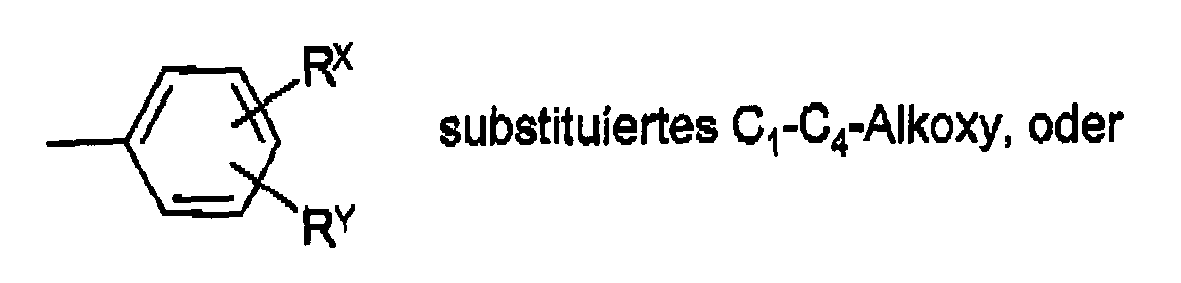
- Rα und Rβ
- gemeinsam für eine C4-C6-Alkylenbrücke oder eine durch Sauerstoff, Schwefel, SO, SO2, NH oder -N(C1-C4-Alkyl)- unterbrochene C4-C6-Alkylenbrücke,
- Rγ
- für Wasserstoff oder C1-C4-Alkyl,
- Ra und Rb
- unabhängig voneinander für Wasserstoff, Halogen, Cyan, Nitro, Trifluormethyl, C1-C4-Alkyl, C1-C4-Alkoxy, C1-C4-Alkylthio, C1-C4-Alkylsulfinyl, C1-C4-Alkylsulfonyl, -COORj, -CONRkRm, -CORn, -SO2NRkRm oder-OSO2-C1-C4-Alkyl, oder Ra und Rb gemeinsam für eine C3-C4-Alkylenbrücke, die durch Halogen oder C1-C4-Alkyl substituiert sein kann, oder eine C3-C4-Alkenylenbrücke, die durch Halogen oder C1-C4-Alkyl substituiert sein kann, oder eine C4-Alkadienylenbrücke, die durch Halogen oder C1-C4-Alkyl substituiert sein kann, und
- Rg und
- Rh unabhängig voneinander für Wasserstoff, Halogen, C1-C4-Alkyl, Trifluormethyl, Methoxy, Methylthio oder -COORj stehen, wobei
- Rc
- Wasserstoff, Halogen, C1-C4-Alkyl oder Methoxy,
- Rd
- Wasserstoff, Halogen, Nitro, C1-C4-Alkyl, C1-C4-Alkoxy, C1-C4-Alkylthio, C1-C4-Alkylsulfinyl, C1-C4-Alkylsulfonyl, -COORj oder -CONRkRm,
- Re
- Wasserstoff, Halogen, C1-C4-Alkyl, -COORj, Trifluormethyl oder Methoxy, oder Rd und Re gemeinsam für eine C3-C4-Alkylenbrücke,
- Rf
- Wasserstoff, Halogen oder C1-C4-Alkyl,
- RX und
- RY unabhängig voneinander Wasserstoff, Halogen, C1-C4-Alkyl, C1-C4-Alkoxy, C1-C4-Alkylthio, -COOR4, Trifluormethyl, Nitro oder Cyan,
- RJ, Rk
- und Rm unabhängig voneinander Wasserstoff oder C1-C4-Alkyl,
- Rk und Rm
- gemeinsam eine C4-C6-Alkylenbrücke oder eine durch Sauerstoff, NH oder -N(C1-C4-Alkyl)- unterbrochene C4-C6-Alkylenbrücke, und
- Rn
- C1-C4-Alkyl, Phenyl oder durch Halogen, C1-C4-Alkyl, Methoxy, Nitro oder Trifluormethyl substituiertes Phenyl bedeuten;
1-[4-(N-2-Methoxybenzoylsulfamoyl)phenyl]-3-methylharnstoff,
1-[4-(N-2-Methoxybenzoylsulfamoyl)phenyl]-3,3dimethylharnstoff,
1-[4-(N-4,5-Dimethylbenzoylsulfamoyl)phenyl]-3-methylharnstoff,
1-[4-(N-Naphthoylsulfamoyl)phenyl]-3,3-dimethylharnstoff,
einschließlich der Stereoisomeren und der in der Landwirtschaft gebräuchlichen Salze. - Sofern es im Einzelnen nicht anders definiert wird, gelten für die Reste in den Formeln zu (S-II) bis (S-VIII) im Allgemeinen die folgenden Definitionen. Die Reste Alkyl, Alkoxy, Haloalkyl, Haloalkoxy, Alkylamino und Alkylthio sowie die entsprechenden ungesättigten und/oder substituierten Reste können im Kohlenstoffgerüst jeweils geradkettig oder verzweigt sein.
- Alkylreste, auch in den zusammengesetzten Bedeutungen wie Alkoxy, Haloalkyl usw. haben vorzugsweise 1 bis 4 C-Atome und, bedeuten z.B. Methyl, Ethyl, n- oder i-Propyl, n-, i-, t- oder 2-Butyl. Alkenyl- und Alkinylreste haben die Bedeutung der den Alkylresten entsprechenden möglichen ungesättigten Reste; Alkenyl bedeutet z.B. Allyl, 1-Methylprop-2-en-1-yl, 2-Methyl-prop-2-en-1-yl, But-2-en-1-yl, But-3-en-1-yl, 1-Methyl-but-3-en-1-yl und 1-Methyl-but-2-en-1-yl. Alkinyl bedeutet z.B. Propargyl, But-2-in-1-yl, But-3-in-1-yl, 1-Methyl-but-3-in-1-yl. "(C1-C4)-Alkyl" ist die Kurzschreibweise für Alkyl mit 1 bis 4 C-Atomen; entsprechendes gilt für andere allgemeine Restedefinitionen mit in Klammem angegebenen Bereichen für die mögliche Anzahl von C-Atomen.
- Cycloalkyl bedeutet bevorzugt einen cyclischen Alkylrest mit 3 bis 8, vorzugsweise 3 bis 7, besonders bevorzugt 3 bis 6 C-Atomen, beispielsweise Cyclopropyl, Cyclobutyl, Cyclopentyl und Cyclohexyl. Cycloalkenyl und Cycloalkinyl bezeichnen entsprechende ungesättigte Verbindungen.
- Halogen bedeutet Fluor, Chlor, Brom oder lod. Haloalkyl, Haloalkenyl und Haloalkinyl bedeuten durch Halogen, vorzugsweise durch Fluor, Chlor und/oder Brom, insbesondere durch Fluor oder Chlor, teilweise oder vollständig substituiertes Alkyl, Alkenyl oder Alkinyl, z.B. OF3, CHF2, CH2F, CF2CF3, CH2CHFCl, CCl3, CHCl2, CH2CH2Cl, Haloalkoxy ist z.B. OCF3, OCHF2, OCH2F, OCF2CF3, OCH2CF3 und OCH2CH2Cl. Entsprechendes gilt für sonstige Halogen substituierte Reste.
- Ein Kohlenwasserstoffrest kann ein aromatischer oder ein allphatischer Kohlenwasserstoffrest sein, wobei ein aliphatischer Kohlenwasserstoffrest im allgemeinen ein geradkettiger oder verzweigter gesättigter oder ungesättigter Kohlenwasserstoffrest ist, vorzugsweise mit 1 bis 18, besonders bevorzugt 1 bis 12 C-Atomen, z.B. Alkyl, Alkenyl oder Alkinyl.
- Vorzugsweise bedeutet aliphatischer Kohlenwasserstoffrest Alkyl, Alkenyl oder Alkinyl mit bis zu 12 C-Atomen; entsprechendes gilt für einen aliphatischen Kohlenwasserstoffrest in einem Kohlenwasserstoffoxyrest.
- Aryl ist im allgemeinen ein mono-, bi- oder polycyclisches aromatisches System mit vorzugsweise 6-20 C-Atomen, bevorzugt 6 bis 14 C-Atomen, besonders bevorzugt 6 bis 10 C-Atomen, z.B. Phenyl, Naphthyl, Tetrahydronaphthyl, Indenyl, Indanyl, Pantalenyl und Fluorenyl, besonders bevorzugt Phenyl.
- Heterocyclischer Ring, heterocyclischer Rest oder Heterocyclyl bedeutet ein mono-, bi- oder polycyclisches Ringsystem, das gesättigt, ungesättigt und/oder aromatisch ist und eine oder mehrere, vorzugsweise 1 bis 4, Heteroatome, vorzugsweise aus der Gruppe N, S und O, enthält.
- Bevorzugt sind gesättigte Heterocyclen mit 3 bis 7 Ringatomen und einem oder zwei Heteroatomen aus der Gruppe N, O und S, wobei die Chalcogene nicht benachbart sind. Besonders bevorzugt sind monocyclische Ringe mit 3 bis 7 Ringatomen und einem Heteroatom aus der Gruppe N, O und S, sowie Morpholin, Dioxolan, Piperazin, Imidazolin und Oxazolidin. Ganz besonders bevorzugte gesättigte Heterocyclen sind Oxiran, Pyrrolidon, Morpholin und Tetrahydrofuran.
- Bevorzugt sind auch teilweise ungesättigte Heterocyclen mit 5 bis 7 Ringatomen und einem oder zwei Heteroatomen aus der Gruppe N, O und S. Besonders bevorzugt sind teilweise ungesättigte Heterocyclen mit 5 bis 6 Ringatomen und einem Heteroatom aus der Gruppe N, O und S. Ganz besonders bevorzugte teilweise ungesättigte Heterocyclen sind Pyrazolin, Imidazolin und Isoxazolin.
- Ebenso bevorzugt ist Heteroaryl, z.B. mono- oder bicyclische aromatische Heterocyclen mit 5 bis 6 Ringatomen, die ein bis vier Heteroatome aus der Gruppe N, O, S enthalten, wobei die Chalcogene nicht benachbart sind. Besonders bevorzugt sind monocyclische aromatische Heterocyclen mit 5 bis 6 Ringatomen, die ein Heteroatom aus der Gruppe, N, O und S enthalten, sowie Pyrimidin, Pyrazin, Pyridazin, Oxazol, Thiazol, Thiadiazol, Oxadiazol, Pyrazol, Triazol und Isoxazol. Ganz besonders bevorzugt sind Pyrazol, Thiazol, Triazol und Furan.
- Substituierte Reste, wie substituierte Kohlenwasserstoffreste, z.B. substituiertes Alkyl, Alkenyl, Alkinyl, Aryl wie Phenyl und Arylalkyl wie Benzyl, oder substituiertes Heterocyclyl, bedeuten einen vom unsubstituierten Grundkörper abgeleiteten substituierten Rest, wobei die Substituenten vorzugsweise einen oder mehrere, vorzugsweise 1, 2 oder 3, im Falle von Cl und F auch bis zur maximal möglichen Anzahl, Substituenten aus der Gruppe Halogen, Alkoxy, Haloalkoxy, Alkylthio, Hydroxy, Amino, Nitro, Carboxy, Cyano, Azido, Alkoxycarbonyl, Alkylcarbonyl, Formyl, Carbamoyl, Mono- und Dialkylaminocarbonyl, substituiertes Amino wie Acylamino, Mono- und Dialkylamino und Alkylsulfinyl, Haloalkylsulfinyl, Alkylsulfonyl, Haloalkylsulfonyl und, im Falle cyclischer Reste, auch Alkyl und Haloalkyl sowie den genannten gesättigten kohlenwasserstoffhaltigen Substituenten entsprechende ungesättigte aliphatische Substituenten, vorzugsweise Alkenyl, Alkinyl, Alkenyloxy, Alkinyloxy, bedeuten. Bei Resten mit C-Atomen sind solche mit 1 bis 4 C-Atomen, insbesondere 1 oder 2 C-Atomen, bevorzugt. Bevorzugt sind in der Regel Substituenten aus der Gruppe Halogen, z.B. Fluor oder Chlor, (C1-C4)Alkyl, vorzugsweise Methyl oder Ethyl, (C1-C4)Haloalkyl, vorzugsweise Trifluormethyl, (C1-C4)Alkoxy, vorzugsweise Methoxy oder Ethoxy, (C1-C4)Haloalkoxy, Nitro und Cyano. Besonders bevorzugt sind dabei die Substituenten Methyl, Methoxy und Chlor.
- Mono- oder disubstituiertes Amino bedeutet einen chemisch stabilen Rest aus der Gruppe der substituierten Aminoreste, welche beispielsweise durch einen oder zwei gleiche oder verschiedene Reste aus der Gruppe Alkyl, Alkoxy, Acyl und Aryl N-substituiert sind; vorzugsweise Monoalkylamino, Dialkylamino, Acylamino, Arylamino, N-Alkyl-N-Arylamino sowie N-Heterocyclen. Dabei sind Alkylreste mit 1 bis 4 C-Atomen bevorzugt. Aryl Ist dabei vorzugsweise Phenyl. Substituiertes Aryl ist dabei vorzugsweise substituiertes Phenyl. Für Acyl gilt dabei die weiter unten genannte Definition, vorzugsweise (C1-C4)Alkanoyl. Entsprechendes gilt für substituiertes Hydroxylamino oder Hydrazino.
- Gegebenenfalls substituiertes Phenyl ist vorzugsweise Phenyl, das unsubstituiert oder ein- oder mehrfach, vorzugsweise bis zu dreifach, bei Halogen wie Cl und F auch bis zu fünffach, durch gleiche oder verschiedene Reste aus der Gruppe Halogen, (C1-C4)Alkyl, (C1-C4)Alkoxy, (C1-C4)Haloalkyl, (C1-C4)Haloalkoxy und Nitro substituiert ist, z.B. o-, m- und p-Tolyl, Dimethylphenyle, 2-, 3- und 4-Chlorphenyl, 2-, 3- und 4-Trifluor- und -Trichlorphenyl, 2,4-, 3,5-, 2,5- und 2,3-Dichlorphenyl, o-, mund p-Methoxyphenyl.
- Ein Acylrest bedeutet den Rest einer organischen Säure mit vorzugsweise bis zu 6 C-Atomen, z.B. den Rest einer Carbonsäure und Reste davon abgeleiteter Säuren wie der Thiocarbonsäure, gegebenenfalls N-substituierter Iminocarbonsäuren, oder der Rest von Kohlensäuremonoestern, gegebenenfalls N-substituierter Carbaminsäuren, Sulfonsäuren, Sulfinsäuren, Phosphonsäuren, Phosphinsäuren. Acyl bedeutet beispielsweise Formyl, Alkylcarbonyl, wie (C1-C4-Alkyl)-carbonyl, Phenylcarbonyl, wobei der Phenylring substituiert sein kann, z.B. wie oben für Phenyl angegeben, oder Alkyloxycarbonyl, Phenyloxycarbonyl, Benzyloxycarbonyl, Alkylsulfonyl, Alkylsulfinyl oder N-Alkyl-1-iminoalkyl.
- Von den Formeln (S-II) bis (S-VIII) umfasst sind auch alle Stereoisomeren, welche die gleiche topologische Verknüpfung der Atome aufweisen, und deren Gemische. Solche Verbindungen enthalten ein oder mehrere asymmetrische C-Atome oder auch Doppelbindungen, die in den allgemeinen Formeln nicht gesondert angegeben sind. Die durch ihre spezifische Raumform definierten möglichen Stereoisomeren, wie Enantiomere, Diastereomere, Z- und E-Isomere, können nach üblichen Methoden aus Gemischen der Stereoisomeren erhalten oder auch durch stereoselektive Reaktionen in Kombination mit dem Einsatz von stereochemisch reinen Ausgangsstoffen hergestellt werden.
- Die Verbindungen der Formel (S-II) sind z.B. aus
EP-A-0333139 (ZA-89/1960 EP-A-0269806 (US 4,891,057 ),EP-A-0346620 (AU-A-89/34951 EP-A-0174562 ,EP-A-0346620 (WO-A-91/08202 WO-A-91/07874 WO-A-95/07897 ZA 94/7120 EP-A-0086750 ,EP-A-094349 US 4,902,340 ),EP-A-0191736 (US 4,881,986 ) undEP-A-0492366 und dort zitierter Literatur bekannt oder können nach oder analog den dort beschriebenen Verfahren hergestellt werden. Einige Verbindungen sind ferner inEP-A-0582198 undWO A-02134048 US 4,021,224 undUS 4,021,229 . Verbindungen der Untergruppe b) sind weiterhin ausCN-A-87/102789 ,EP-A-365484 WO-A-97/45016 WO-A-99/16744 EP-A-365484 - Die Safener der vorstehenden Gruppen a) bis e) reduzieren oder unterbinden phytotoxische Effekte, die beim Einsatz der herbiziden Mittel gemäß der Erfindung in Nutzpflanzenkulturen auftreten können, ohne die Wirksamkeit der Herbizide gegen Schadpflanzen zu beeinträchtigen. Hierdurch kann das Einsatzgebiet der Herbizide erheblich erweitert werden und insbesondere ist durch die Verwendung von Safenern der Einsatz von Herbiziden, die bislang nur beschränkt oder mit nicht ausreichendem Erfolg eingesetzt werden konnten, d.h. von Kombinationen, die ohne Safener in niedrigen Doslerungen mit wenig Breitenwirkung zu nicht ausreichender Kontrolle der Schadpflanzen führten.
- Besonders bevorzugt sind als Safener in den erfindungsgemäßen Formulierungen unter anderem: 4-Dichloracetyl-1-oxa-4-aza-spiro[4,5]-decan (AD-67), 1-Dichloracetyl-hexahydro-3,3,8a-trimethylpyrrolo[1,2-a]-pyrimidin-6(2H)-on (Dicyclonon, BAS-145138), 4-Dichloracetyl-3,4-dihydro-3-methyl-2H-1,4-benzoxazin (Benoxacor), Cloquintocet, 5-Chlor-chinolin-8-oxy-essigsäure-(1-methyl-hexylester) (Cloquintocet-mexyl), α-(Cyanomethoxyimino)-phenylacetonitril (Cyometrinil), 2,2-Dichlor-N-(2-oxo-2-(2-propenylamino)-ethyl)-N-(2-propenyl)-acetamid (DKA-24), 2,2-Dichlor-N,N-di-2-propenyl-acetamid (Dichlormid), N-(4-Methyl-phenyl)-N'-(1-methyl-1-phenyl-ethyl)-hamstoff (Dymron), 4,6-Dichlor-2-phenyl-pyrimidin (Fenclorim), 1-(2,4-Dichlor-phenyl)-5-trichlormethyl-1H-1,2,4-triazol-3-carbonsäure-ethylester (Fenchlorazol-ethyl), 2-Chlor-4-trifluormethyl-thiazol-5-carbonsäure-phenylmethylester (Flurazole), 4-Chlor-N-(1,3-dioxolan-2-yl-methoxy)-α-trifluoracetophenonoxim (Fluxofenim), 3-Dichloracetyl-5-(2-furanyl)-2,2-dimethyl-oxazolidin (Furilazole, MON-13900), Ethyl-4,5-dihydro-5,5-diphenyl-3-isoxazolcarboxylat (lsoxadifen-ethyl), Diethyl-1-(2,4-dichlorphenyl)-4,5-dihydro-5-methyl-1H-pyrazol-3,5-dicarboxylat (Mefenpyr-diethyl), 2-Dichlormethyl-2-methyl-1,3-dioxolan (MG-191), 1,8-Naphthalsäureanhydrid, α-(1,3-Dioxolan-2-yl-methoximino)-phenylacetonitril (Oxabetrinil), 2,2-Dichlor-N-(1,3-dioxolan-2-yl-methyl)-N-(2-propenyl)-acetamid (PPG-1292), 3-Dichloracetyl-2,2-dimethyl-oxazolidin (R-28725), 3-Dichloracetyl-2,2,5-trimethyl-oxazolidin (R-29148), 1-(2-Chlor-phenyl)-5-phenyl-1H-pyrazol-3-carbonsäure-methylester, 4-Cyclopropylaminocarbonyl-N-(2-methoxybenzoyl)benzolsulfonamid (Cyprosulfamide), 4-iso-propylaminocarbonyl-N-(2-methoxybenzoyl)benzolsulfonamid und N-(2-Methoxy-benzoyl)-4-[(methylamino-carbonyl)-amino]-benzolsulfonamid,
- Ganz besonders bevorzugt sind die Safenern Mefenpyr-diethyl, Cloquintocet-mexyl, Isoxadifen-ethyl, 4-Cyclopropylaminocarbonyl-N-(2-methoxybenzoyl)benzolsulfonamid (Cyprosulfamide), 4-iso-propylaminocarbonyl-N-(2-methoxybenzoyl)benzolsulfonamid oder Fenchlorazol-ethyl; insbesondere ganz besonders bevorzugt sind Mefenpyr-diethyl, Cloqulntocet-mexyl oder Isoxadifen-ethyl.
- Bevorzugte Herbizid-Safener-Mischungen sind Kombinationen der folgenden Verbindungen miteinander:
- a) Verbindungen, die als ACCase-Inhibitoren wirksam sind, wie Alloxydim, Butroxydim, Clethodim, Clodinafop-propargyl, Cycloxydim, Cyhalofop-butyl, Diclofop-methyl, Fenoxaprop, Fenoxaprop-ethyl, Fenoxaprop-P, Fenoxaprop-P-ethyl, Fluazifop, Fluazifop-P-butyl, Fluazifop-butyl, Haloxyfop, Haloxyfop-P, Haloxyfop-etotyl, Haloxyfop-P-methyl, Metamifop, Profoxydim, Propaquizafop, Quizalofop-P-tefuryl, Quizalofop-P-ethyl, Sethoxydim, Tepraloxydim, Tralkoxydim und Isoxapyrifop,
- b) Verbindungen, die als p-Hydroxyphenyl pyruvate dioxygenase (HPPD)-Inhibitoren wirksam sind, wie Benzobicyclon, Benzofenap, Isoxaflutole und dessen Diketonitrile, Mesotrione, Pyrazolynate, Pyrazoxyfen, Sulcotrione und Isoxachlortole,
- c) Verbindungen verschiedener Wirkstoffgruppen, wie Atrazin, Acetochlor, Aclonifen, Alachlor, Amidochlor, Amidosulfuron, Azimsulfuron, Bentazon, Bensulfuron(-methyl), Bromoxynil(-octanoat/-heptanoat), Butachlor, Bispyribac, Chlorsulfuron, Chlorimuron, Clomazone, Clopyralid, Cinosulfuron, Cyclosulfamuron, 2,4-D-Ester, 2,4-DB-Ester, 2,4-DP-Ester, CMPP-Ester, MCPA-Ester, MCPB, EPTC, Desmedipham, Diflufenican, Dicamba, Ethoxysulfuron, Ethofumesat, Flazasulfuron, Florasulam, Flucarbazone, Flumetsulam, Flufenacet, Fluoroglykofen, Fluroxypyr, Flupyrsulfuron, Foramsulfuron, Flumioxazin, Flumiclorac, Fomesafen, Glufosinate, Glyphosate, Imazapyr, Imazosulfuron, iodosulfuron, Iodosulfuron-methyl, Ioxynil(-octanoat), Lactofen, Halosulfuron, Imazamox, Imazapic, Imazapyr, Imazethapyr, Imazaquin, Metosulam, Mesosulfuron(-methyl), (S-)Metolachlor, Metsulfuron-methyl, Metamitron, Nicosulfuron, Oxyfluorfen, Pendimethalin, Phenmedipham, Picloram, Pinoxaden, Primisulfuron-methyl, Prosulfuron, Propanil, Propoxycarbazone, Pyrazosulfuron(-methyl), Rimsulfuron, Sulfentrazone, Sulfosulfuron, Sulfometuron, Terbuthylazin, Thifensulfuron, Triasulfuron, Tribenuron, Triclopyr, Triflusulfuron-methyl, Trifluralin, Tritosulfuron, Topramezone, Oxazinon, Oxadiargyl, Metribuzin, und deren Salze, z.B. die Natriumsalze.
- d) Verbindungen, die als Safener wirksam sind, wie AD 67 (4-(dichloroacetyl)-1-oxa-4-azaspiro[4.5]decane), Benoxacor, CL 304,415 (4-carboxymethylchroman-4-carboxylic acid), Cloquintocet, Cloquintocet-mexyl, Cyprosulfamide, Dichlormid, Dicyclonon, DKA-24 (N1 ,N2-diallyl-N2-dichloroacetylglycinamide), Fenchlorazole, Fenchlorazole-ethyl, Fenclorim, Flurazole, Fluxofenim, Furilazole, Isoxadifen-ethyl, Mefenpyr-diethyl, MG 191 (2-dichloromethyl-2-methyl-1,3-dioxolane), Naphthalsäureanhydrid (naphthalene-1,8-dicarboxylic anhydride), Oxabetrinil and TI-35 (1-dichloroacetylazepane).
- In einer weiteren Ausführungsform können z.B. verschiedene Herbizide miteinander kombiniert werden, z.B. Fenoxaprop-p-ethyl + loxynil-octanoat, Diclofop-methyl + Bramoxynil-octanoat, CMPP + Bromoxynil-octanoat, MCPA + loxynil-octanoat, Bromoxynil-octanoat + Bromoxynil-heptanoat, Bromoxynil-octanoat + Bromoxynil-heptanoat + MCPA, Bromoxynil-octanoat + Bromoxynil-heptanoat+ 2,4-D, Phenmedipham + Desmedipham, Phenmedipham + Desmedipham + Ethofumesate, Metamitron + Ethofumesate, Phenmedipham + Ethofumesate + Metamitron, Fenoxaprop-p-ethyl + Iodosulfuron-methyl-natrium, Fenoxaprop-p-ethyl + Diclofop-methyl, Fenoxaprop-p-ethyl + Iodosulfuron-methyl-natrium + Diclofop-methyl.
- Als besonders bevorzugt sind die Kombinationen aus: Foramsulfuron + Iodosulfuron-methyl-sodium + Isoxadifen-ethyl, Iodosulfuron-methyl-sodium +Isoxadifen-ethyl, Foramsulfuron + Isoxadifen-ethyl, Fenoxaprop-P-ethyl + Ethoxysulfuron + Isoxadifen-ethyl, Ethoxysulfuron + Isoxadifen-ethyl, Fenoxaprop-P-ethyl + Isoxadifen-ethyl, Iodosulfuron-methyl-sodium + Mesosulfuron-methyl + Mefenpyr-diethyl, Mesosulfuron-methyl + Mefenpyr-diethyl, lodosulfuron-methyl-sodium + Mefenpyr-diethyl, Fenoxaprop-P-ethyl + Mefenpyr-diethyl, Fenoxaprop-P-ethyl + Diclofop-methyl + Mefenpyr-diethyl, Diclofop-methyl + Mefenpyr-diethyl, Diclofop-methyl + Sethoxydim + Mefenpyr-diethyl, Sethoxydim + Mefenpyr-diethyl, Fenoxaprop-P-ethyl + Isoproturon + Mefenpyr-diethyl, isoproturon + Mefenpyr-diethyl, Clodinafop-propargyl + Cloquintocet-mexyl, Fenoxaprop-ethyl + Fenchlorazole-ethyl, Fenoxaprop-P-ethyl + Fenchlorazole-ethyl, Flucarbazone + Cyprosulfamide, Foramsulfuron + Cyprosulfamide, lodosulfuron(-methyl) + Cyprosulfamide, Metosulam + Cyprosulfamide, Metsulfuron(methyl) + Cyprosulfamide, Nicosulfuron + Cyprosulfamide, Primisulfuron(methyl) + Cyprosulfamide, Prosulfuron + Cyprosulfamide + Cyprosulfamide, Thifensulfuron + Cyprosulfamide, Tribenuron + Cyprosulfamide, Cloransulam-methyl + Cyprosulfamide, Chlorimuron + Cyprosulfamide, Ethoxysulfuron + Cyprosulfamide, Flazasulfuron + Cyprosulfamide, Florasulam + Cyprosulfamide, Flumetsulam + Cyprosulfamide, Halosulfuron + Cyprosulfamide, Imazamox + Cyprosulfamide, Imazapic + Cyprosulfamide, Imazapyr + Cyprosulfamide, Imazethapyr + Cyprosulfamide, Mesosulfuron + Cyprosulfamide, Propoxycarbazone + Cyprosulfamide, Sulfosulfuron + Cyprosulfamide, Amidosulfuron + Cyprosulfamide, Chlorsulfuron + Cyprosulfamide, Imazaquin + Cyprosulfamide, Triasulfuron + Cyprosulfamide, Sulfometuron + Cyprosulfamide, Cyclosulfamuron + Cyprosulfamide, Flupyrsulfuron + Cyprosulfamide, Pyrazosulfuron+ Cyprosulfamide, Azimsulfuron + Cyprosulfamide, Bensulfuron + Cyprosulfamide, Bispyribac + Cyprosulfamide, Rimsulfuron + Cyprosulfamide, Tritosulfuron + Cyprosulfamide, Sulcotrione + Cyprosulfamide, Clomazone + Cyprosulfamide, Mesotrione + Cyprosulfamide, Topramezone + Cyprosulfamide, Metribuzin + Cyprosulfamide, Bentazon + Cyprosulfamide, Bromoxynil + Cyprosulfamide, Propanil + Cyprosulfamide, Atrazin + Cyprosulfamide, Terbuthylazin + Cyprosulfamide, EPTC + Cyprosulfamide, Tepraloxydim + Cyprosulfamide, Clethodim + Cyprosulfamide, Alloyxdim + Cyprosulfamlde, Sethoxydim + Cyprosulfamide, Tralkoxydim + Cyprosulfamide, Clodinafop-propargyl + Cyprosulfamide, Cyhalofop-butyl + Cyprosulfamide, Dielofop-methyl + Cyprosulfamide, Fenoxaprop-P-ethyl + Cyprosulfamide, Fluazifop-P-butyl + Cyprosulfamide, Haloxyfop-methyl + Cyprosulfamide, Haloxyfop-etotyl + Cyprosulfamide, Haloxyfop-R-methyl + Cyprosulfamide, Haloxyfop-ethoxyethyl + Cyprosulfamide, Propaquizafop + Cyprosulfamide, Quizalofop-P-tefuryl + Cyprosulfamide, Quizalofop-P-ethyl + Cyprosulfamide, Acetochlor + Cyprosulfamide, S-Metolachlor + Cyprosulfamide, Flumioxazin + Cyprosulfamide, Flumiclorac + Cyprosulfamide, Fomesafen + Cyprosulfamide, Sulfentrazone + Cyprosulfamide, Dicamba + Cyprosulfamide, MCPA + Cyprosulfamide, MCPB + Cyprosulfamide, 2,4-D + Cyprosulfamide, Clopyralid + Cyprosulfamide, Fluroxypyr + Cyprosulfamide, Picloram + Cyprosulfamide, Triclopyr + Cyprosulfamide, Glufosinate + Cyprosulfamide, Glyphosate + Cyprosulfamide und Pendimethalin + Cyprosulfamide.
- Das Gewichtsverhältnis Safener : Herbizid kann innerhalb weiter Grenzen variieren und liegt vorzugsweise im Bereich von 1 : 100 bis 100 : 1, insbesondere von 1 : 100 bis 50 : 1, ganz besonders bevorzugt 1 : 10 bis 10 : 1. Die jeweils optimalen Mengen an Herbizid(en) und Safener(n) sind üblicherweise vom Typ des Herbizids und/oder vom verwendeten Safener sowie von der Art des zu behandelnden Pflanzenbestandes abhängig.
- Fungizide
- Die agrochemischen Wirkstoffe können auch Fungizide sein, beispielsweise
- Inhibitoren der Nucleinsäure Synthese, insbesondere
Benalaxyl, Benalaxyl-M, Bupirimat, Chiralaxyl, Clozylacon, Dimethirimol, Ethirimol, Furalaxyl, Hymexazol, Metalaxyl, Metalaxyl-M, Ofurace, Oxadixyl, Oxolinsäure - Inhibitoren der Mitose und Zellteilung, insbesondere
Benomyl, Carbendazim, Diethofencarb, Fuberidazole, Pencycuron, Thiabendazol, Thiophanat-methyl, Zoxamid - Inhibitoren der Atmungskette Komplex I, Insbesondere
Diflumetorim - Inhibitoren der Atmungskette Komplex II, insbesondere
Boscalid, Carboxin, Fenfuram, Flutolanil, Furametpyr, Mepronil, Oxycarboxin, Penthiopyrad, Thifluzamid - Inhibitoren der Atmungskette Komplex III, insbesondere
Azoxystrobin, Cyazofamid, Dimoxystrobin, Enestrobin, Famoxadon, Fenamidon, Fluoxastrobin, Kresoximmethyl, Metominostrobin, Orysastrobin, Pyraclostrobin, Picoxystrobin, Trifloxystrobin - Entkoppler, insbesondere
Dinocap, Fluazinam - Inhibitoren der ATP Produktion, insbesondere
Fentinacetat, Fentinchlorid, Fentinhydroxid, Silthiofam - Inhibitoren der Aminosäure- und Proteinbiosynthese, insbesondere
Andoprim, Blasticidin-S, Cyprodinil, Kasugamycin, Kasugamycinhydrochlorid Hydrat, Mepanipyrim; Pyrimethanil - Inhibitoren der Signal-Transduktion, insbesondere
Fenpiclonil, Fludioxonil, Quinoxyfen - Inhibitoren der Fett- und Membran Synthese, insbesondere
Chlozolinat, Iprodion, Procymidon, Vinclozolin
Ampropylfos, Kalium-Ampropylfos, Edifenphos, Iprobenfos (IBP), Isoprothlolan,
Pyrazophos
Tolclofos-methyl, Biphenyl
lodocarb, Propamocarb, Propamocarb hydrochlorid - Inhibitoren der Ergosterol Biosynthese, insbesondere
Fenhexamid,
Azaconazol, Bitertanol, Bromuconazol, Cyproconazol, Diclobutrazol, Difenoconazol, Diniconazol, Diniconazol-M, Epoxiconazol, Etaconazol, Fenbuconazol, Fluquinconazol, Flusilazol, Flutriafol, Furconazol, Furconazol-cis, Hexaconazol, Imibenconazol, Ipconazol, Metconazol, Myclobutanil, Paclobutrazol, Penconazol, Propiconaxol, Prothioconazol, Simeconazol, Tebuconazol, Tetraconazol, Triadimefon, Triadimenol, Triticonazol, Uniconazol, Voriconazol, Imazalil, Imazalilsulfat, Oxpoconazol, Fenarimol, Flurprimidol, Nuarimol, Pyrifenox, Triforin, Pefurazoat, Prochloraz, Triflumizol, Viniconazol, Aldimorph, Dodemorph, Dodemorphacetat, Fenpropimorph, Tridemorph, Fenpropidin, Spiroxamin,
Naftifin, Pyributicarb, Terbinafin - Inhibitoren der Zellwand Synthese, insbesondere
Benthiavalicarb, Bialaphos, Dimethomorph, Flumorph, Iprovalicarb, Polyoxins, Polyoxorim, Validamycin A - Inhibitoren der Melanin Biosynthese, insbesondere
Capropamid, Diclocymet, Fenoxanil, Phtalid, Pyroquilon, Tricyclazol - Resistenzinduktoren, insbesondere
Acibenzolar-S-methyl, Probenazol, Tiadinil - Multisite, insbesondere
Captafol, Captan, Chlorothalonil, Kupfersalze wie: Kupferhydroxid, Kupfemaphthenat, Kupferoxychlorid, Kupfersulfat, Kupferoxid, Oxin-Kupfer und Bordeaux Mischung, Dichlofluanid, Dithianon, Dodin, Dodin freie Base, Ferbam, Folpet, Fluorofolpet, Guazatin, Guazatinacetat, Iminoctadin, Iminoctadinalbesilat, Iminoctadintriacetat, Mankupfer, Mancozeb, Maneb, Metiram, Metiram Zink, Propineb, Schwefel und Schwefalpräparate enthaltend Calciumpolysulphid, Thiram, Tolylfluanid, Zineb, Ziram - Fungizide mit unbekannten Mechanismus, insbesondere
Amibromdol, Benthiazol, Bethoxazin, Capsimycin, Carvon, Chinomethionat, Chloropicrin, Cufraneb, Cyflufenamid, Cymoxanil, Dazomet, Debacarb, Diclomezine, Dichlorophen, Didoran, Difenzoquat, Difenzoquat Methylsulphat, Diphenylamin, Ethaboxam, Ferimzon, flumetover, Flusulfamid, Fluopicolid, Fluoroimid, Hexachlorobenzol, 8-Hydroxychinolinsulfat, lrumamycin, Methasulphocarb, Metrafenon, Methyl Isothiocyanat, Mildlomycin, Natamycin, Nickel dimethyldithiocarbamat, Nitrothal-isopropyl, Octhilinon, Oxamocarb, Oxyfenthiin, Pentachlorophenol und Salze, 2-Phenylphenol und Salze, Piperalin, Propanosin-Natrium, Proquinazid, Pyrrolnitrin, Quintozen, Tecloftalam, Tecnazen, Triazoxid, Trichlamid, Zarilamid und 2,3,6,6-Tetrachlor-4-(methylsulfonyl)-pyridin, N-(4-Chlor-2-nitrophenyl)-N-ethyl-4-methyl-benzenesulfonamid, 2-Amino-4-methyl-N-phenyl-5-thiazolecarboxamid, 2-Chlor-N-(2,3-dihydro-1,1,3-trimethyl-1H-inden-4-yl)-3-pyridincarboxamid, 3-[5-(4-Chlorphenyl)-2,3-dimethylisoxazolidin-3-yl]pyridin, cis-1-(4-Chlorphenyl)-2-(1H-1,2,4-triazol-1-yl)-cycloheptanol, 2,4-Dihydro-5-methoxy-2-methyl-4-[[[[1-[3-(trifluoromethyl)-phenyl]-ethyliden]-amino]-oxy]-methyl]-phenyl]-3H-1,2,3-triazol-3-on (185336-79-2), Methyl 1-(2,3-dihydro-2,2-dimethyl-1H-inden-1-yl)-1H imidazole-5-carboxylat, 3,4,5-Trichlor-2,6-pyridindicarbonitril, Methyl 2-[[[cyclopropyl[(4-methoxyphenyl) imino]methyl]thio]methyl]-alpha.-(methoxymethylen)- benzacetat, 4-Chlor-alpha-propinyloxy-N-[2-[3-methoxy-4-(2-propinyloxy)phenyl]ethyl]-benzacetamide, (2S)-N-[2-[4-[[3-(4-chlorophenyl)-2-propinyl]oxy]-3-methoxyphenyl]ethyl]-3-methyl-2-[(methylsulfonyl)amino]-butanamid, 5-Chlor-7-(4-methylpiperidin-1-yl)-6-(2,4,6-trifluorophenyl)[1,2,4]triazolo[1,5-a]pyrimidin, 5-Chlor-6-(2,4,6-trifluorophenyl)-N-[(1R)-1,2,2-trimethylpropyl][1,2,4]triazolo[1,5-a]pyrimidin-7-amin, 5-Chlor-N-[(1R)-1,2-dimethylpropyl]-6-(2,4,6-trifluorophenyl) [1,2,4]triazolo[1,5-a]pyrimidin-7-amine, N-[1-(5-Brom-3-chloropyridin-2-yl)ethyl]-2,4-dichloronicotinamid, N-(5-Brom-3-chlorpyridin-2-yl)methyl-2,4-dichlomicotinamid, 2-Butoxy-6-iod-3-propyl-benzopyranon-4-on, N-{(Z)-[(cyclopropylmethoxy) imino][6-(difluormethoxy)-2,3-difluorphenyl]methyl}-2-benzacetamid, N-(3-Ethyl-3,5,5-trimethyl-cyclohexyl)-3-formylamino-2-hydroxy-benzamid, 2-[[[[1-[3(1Fluor-2-phenylethyl)oxy] phenyl] ethyliden]amino]oxy]methyl]-alpha-(methoxyimino)-N-methyl-alphaE-benzacetamid, N-{2-[3-Chlor-5-(trifluormethyl)pyridin-2-yl]ethyl}-2-(trifluoromethyl)benzamid, N-(3',4'-dichlor-5-fluorbiphenyl-2-yl)-3-(difluormethyl)-1-methyl-1H-pyrazol-4-carboxamid, N-(6-Methoxy-3-pyridinyl)-cyclopropan carboxamid, 1-[(4-Methoxyphenoxy)methyl]-2,2-dimethylpropyl-1H-imidazol-1- carbonsäure, O-[1-[(4-Methoxyphenoxy)methyl]-2,2-dimethylpropyl]-1H-imidazol-1- carbothioic acid, 2-(2-{[6-(3-Chlor-2-methylphenoxy)-5-fluorpyrimidin-4-yl]oxy}phenyl)-2-(methoxyimino)-N-methylacetamid - Die agrochemischen Wirkstoffe können auch Bakterizide sein, beispielsweise Bronopol, Dichlorophen, Nitrapyrin, Nickel-Dimethyldithlocarbamat, Kasugamycin, Octhilinon, Furancarbonsäure, Oxytetracyclin, Probenazol, Streptomycin, Tecloftalam, Kupfersulfat und andere Kupfer-Zubereitungen.
- Die vorstehend aufgeführten Fungizide (Bakterizide) sind z.B. bekannt aus "The Pesticide Manual", 12. Auflage (2000) und 13. Auflage (2003), The British Crop Protection Council oder den nach den einzelnen Wirkstoffen aufgeführten Literaturstellen.
- Die agrochemischen Wirkstoffe können auch Insektizide / Akarizide und/oder Nematizide sein, beispielsweise
- Acetylcholinesterase (AChE) Inhibitoren
Carbamate,
zum Beispiel Alanycarb, Aldicarb, Aldoxycarb, Allyxycarb, Aminocarb, Bendiocarb, Benfuracarb, Bufencarb, Butacarb, Butocarboxim, Butoxycarboxim, Carbaryl, Carbofuran, Carbosulfan, Cloethocarb, Dimetilan, Ethiofencarb, Fenobucarb, Fenothiocarb, Formetanate, Furathiocarb, Isoprocarb, Metam-sodium, Methiocarb, Methomyl, Metolcarb, Oxamyl, Pirimicarb, Promecarb, Propoxur, Thiodicarb, Thiofanox, Trimethacarb, XMC, Xylylcarb, Triazamate
Organophosphate,
zum Beispiel Acephate, Azamethiphos, Azinphos (-methyl, -ethyl), Bromophos-ethyl, Bromfenvinfos (-methyl), Butathiofos, Cadusafos, Carbophenothion, Chlorethoxyfos, Chlorfenvinphos, Chlormephos, Chlorpyrifos
(-methyl/-ethyl), Coumaphos, Cyanofenphos, Cyanophos, Chlorfenvinphos, Demeton-S-methyl, Demeton-S-methylsulphon, Dialifos, Diazinon, Dichlofenthion, Dichlorvos/DDVP, Dicrotophos, Dimethoate, Dimethylvinphos, Dioxabenzofos, Disulfoton, EPN, Ethion, Ethoprophos, Etrimfos, Famphur, Fenamiphos, Fenitrothion, Fensulfothion, Fenthion, Flupyrazofos, Fonofos, Formothion, Fosmethilan, Fosthiazate, Heptenophos, Iodofenphos, Iprobenfos, Isazofos, Isofenphos, Isopropyl O-salicylate, Isoxathion, Malathion, Mecarbam, Methacrifos, Methamidophos, Methidathion, Mevinphos, Monocrotophos, Naled, Omethoate, Oxydemeton-methyl, Parathion (-methyl/ -ethyl), Phenthoate, Phorate, Phosalone, Phosmet, Phosphamidon, Phosphocarb, Phoxim, Pirimiphos (-methyl/-ethyl), Profenofos, Propaphos, Propetamphos, Prothiofos, Prothoate, Pyraclofos, Pyridaphenthion, Pyridathion, Quinalphos, Sebufos, Sulfotep, Sulprofos, Tebupirimfos, Temephos, Terbufos, Tetrachlorvinphos, Thiometon, Triazophos, Triclorfon, Vamidothion - Natrium-Kanal-Modulatoren / Spannungsabhängige Natrium-Kanal-Blocker
Pyrethroide,
zum Beispiel Acrinathrin, Allethrin (d-cis-trans, d-trans), Beta-Cyfluthrin, Bifenthrin, Bioallethrin, Bioallethrin-S-cyclopentyl-isomer, Bioethanomethrin, Biopermethrin, Bioresmethrin, Chiovaporthrin, Cis-Cypermethrin, Cis-Resmethrin, Cis-Permethrin, Clocythrin, Cycloprothrin, Cyfluthrin, Cyhalothrin, Cypermethrin (alpha-, beta-, theta-, zeta-), Cyphenothrin, Deltamethrin, Empenthrin (1R-isomer), Esfenvalerate, Etofenprox, Fenfluthrin, Fenpropathrin, Fenpyrithrin, Fenvalerate, Flubrocythrinate, Flucythrinate, Flufenprox, Flumethrin, Fluvalinate, Fubfenprox, Gamma-Cyhalothrin, Imiprothrin, Kadethrin, Lambda- Cyhalothrin, Metofluthrin, Permethrin (cls-, trans-), Phenothrin (1 R-trans isomer), Prallethrin, Profluthrin, Protrifenbute, Pyresmethrin, Resmethrin, RU 15525, Silafluofen, Tau-Fluvalinate, Tefluthrin, Terallethrin, Tetramethrin (-1 R- isomer), Tralomethrin, Transfluthrin, ZXI 8901, Pyrethrins (pyrethrum)
DDT
Oxadiazine,
zum Beispiel Indoxacarb
Semicarbazon,
zum Beispiel Metaflumizon (BAS3201) - Acetylcholin-Rezeptor-Agonisten/-Antagonisten
Chloronicotinyle,
zum Beispiel Acetamiprid, Clothianidin, Dinotefuran, Imidacloprid, Nitenpyram, Nithiazine, Thiacloprid, Thiamethoxam
Nicotine, Bensultap, Cartap - Acetylcholin-Rezeptor-Modulatoren
Spinosyne,
zum Beispiel Spinosad - GABA-gesteuerte Chlorid-Kanal-Antagonisten
Organochlorine,
zum Beispiel Camphechlor, Chlordane, Endosulfan, Gamma-HCH, HCH,
Heptachlor, Lindane, Methoxychlor Flprole,
zum Beispiel Acetoprole, Ethiprole, Fipronil, Pyrafluprole, Pyriprole, Vaniliprole - Chforid-Kanal-Aktivatoren
Mectine,
zum Beispiel Abamectin, Emamectin, Emamectin-benzoate, Ivermectin, Lepimectin, Milbemycin - Juvenilhormon-Mimetika,
zum Beispiel Diofenolan, Epofenonane, Fenoxycarb, Hydroprene, Kinoprene, Methoprene, Pyriproxifen, Triprene - Ecdysonagonisten/disruptoren
Diacylhydrazine,
zum Beispiel Chromafenozide, Halofenozide, Methoxyfenozide, Tebufenozide - Inhibitoren der Chitinbiosynthese
Benzoylharnstoffe,
zum Beispiel Bistrifluron, Chlofluazuron, Diflubenzuron, Fluazuron, Flucycloxuron, Flufenoxuron, Hexaflumuron, Lufenuron, Novaluron, Noviflumuron, Penfluron, Teflubenzuron, Triflumuron Buprofezin
Cyromazine - Inhibitoren der oxidativen Phosphoryllerung, ATP-Disruptoren
Diafenthiuron
Organozinnverbindungen,
zum Beispiel Azocyclotin, Cyhexatin, Fenbutatin-oxide - Entkoppler der oxidativen Phoshorylierung durch Unterbrechung des H-Protongradienten
Pyrrole,
zum Beispiel Chlorfenapyr Dinitrophenole,
zum Beispiel Binapacyrl, Dinobuton, Dinocap, DNOC - Site-I-Elektronentransportinhibitoren
METI's,
zum Beispiel Fenazaquin, Fenpyroximate, Pyrimidifen, Pyridaben, Tebufenpyrad, Tolfenpyrad
Hydramethylnon
Dicofol - Site-II-Elektronentransportinhibitoren
Rotenone - Site-III-Elektronentransportinhibitoren
Acequinocyl, Fluacrypyrim - Mikroblelle Disruptoren der Insektendarmmembran
Bacillus thuringiensis-Stämme - Inhibitoren der Fettsynthese
Tetronsäuren,
zum Beispiel Spirodiclofen, Spiromesifen
Tetramsäuren,
zum Beispiel Spirotetramat
Carboxamide,
zum Beispiel Flonicamid
Oktopaminerge Agonisten,
zum Beispiel Amitraz - Inhibitoren der Magnesium-stimulierten ATPase,
Propargite
Nereistoxin-Analoge,
zum Beispiel Thiocyclam hydrogen oxalate, Thiosultap-sodium - Agonisten des Ryanodin-Rezeptors,
Benzoesäuredicarboxamide,
zum Beispiel Flubendlamid
Anthranilamide,
zum Beispiel DPX E2Y45 (3-bromo-N-{4-chloro-2-methyl-6-[(methylamino)carbonyl]henyl}-1-(3-ohloropydin-2-yl)-1H-pyrazole-5-carboxamide) - Biologika, Hormone oder Pheromone
Azadirachtin, Bacillus spec., Beauveria spec., Codlemone, Metarrhizium spec., Paecilomyces spec., Thuringiensin, Verticillium spec. - Wirkstoffe mit unbekannten oder nicht spezifischen Wirkmechanismen
Fraßhemmer,
zum Beispiel Cryolite, Flonicamid, Pymetrozine
Milbenwachstumsinhibitoren,
zum Beispiel Clofentezine, Etoxazole, Hexythiazox
Amidoflumet, Benclothiaz, Benzoximate, Bifenazate, Bromopropylate, Buprofezin, Chinomethionat, Chlordimeform, Chlorobenzilate, Chloropicrin, Clothiazoben, Cycloprene, Cyflumetofen, Dicyclanil, Fenoxacrim, Fentrifanil, Flubenzimine, Flufenerim, Flutenzin, Gossyplure, Hydramethylnone, Japonilure, Metoxadiazone, Petroleum, Piperonyl butoxide, Potassium oleate, Pyridalyl, Sulfluramid, Tetradifon, Tetrasul, Triarathene,Verbutin. - Die vorstehend aufgeführten Insektizide (Akarizide, Nematizide) sind z.B. bekannt aus "The Pesticide Manual", 12. Auflage (2000) und 13. Auflage (2003), The British Crop Protection Council oder den nach den einzelnen Wirkstoffen aufgeführten Literaturstellen.
- Eine besondere Ausführungsform der Erfindung ist die gemeinsame Applikation von Insektiziden (Akariziden, Nematiziden) als agrochemischen Wirkstoffen, entweder zusammen oder hintereinander.
- Die oben genannten agrochemischen Wirkstoffe werden entsprechend über Löslichkeit in vorliegender Erfindung eingesetzt. Das Kriterium wasserlöslich bzw. öllöslich kann von jedem Wirkstoff in der Fachliteratur eingesehen werden, z.B. sind Löslichkeiten agrochemischer Wirkstoffe beispielsweise In "The Pesticide Manual", 12. Auflage (2000), 13. Auflage (2003) und 14. Auflage (2006), The British Crop Protection Council, verzeichnet.
- Unter den in den erfindungsgemäßen Ölsuspensionskonzentraten als Komponente enthaltenen Sulfonylharnstoffen werden im Sinne der vorliegenden Erfindung stets sämtliche Anwendungsformen wie Säuren, Ester, Salze und Isomere wie Stereoisomere und optische Isomere verstanden. So sind neben den neutralen Verbindungen stets auch deren Salze, z.B. mit anorganischen und/oder organischen Gegenionen zu verstehen. So können Sulfonylharnstoffe z.B. Salze bilden, bei denen der Wasserstoff der -SO2-NH-Gruppe durch ein für die Landwirtschaft geeignetes Kation ersetzt ist. Diese Salze sind beispielsweise Metallsalze, insbesondere Alkalimetallsalze oder Erdalkalimetallsalze, insbesondere Natrium- und Kaliumsalze, oder auch Ammoniumsalze oder Salze mit organischen Aminen. Ebenso kann Salzbildung durch Anlagerung einer Säure an basischen Gruppen, wie z.B. Amino und Alkylamino, erfolgen. Geeignete Säuren hierfür sind starke anorganische und organische Säuren, beispielsweise HCl, HBr, H2SO4 oder HNO3.
- Bevorzugte Ester sind die Alkylester, insbesondere die C1-C10-Alkylester wie Methylester.
- Soweit in dieser Beschreibung der Begriff Acylrest verwendet wird, bedeutet dieser den Rest einer organischen Säure, der formal durch Abspaltung einer OH-Gruppe aus der organischen Säure entsteht, z.B, der Rest einer Carbonsäure und Reste davon abgeleiteter Säuren wie der Thiocarbonsäure, gegebenenfalls N-substituierten Iminocarbonsäuren oder die Reste von Kohlensäuremonoestern, gegebenenfalls N-substituierter Carbaminsäuren, Sulfonsäuren, Sulfinsäuren, Phosphonsäuren, Phosphinsäuren.
- Ein Acylrest ist bevorzugt Formyl oder Acyl aus der Gruppe CO-Rz, CS-Rz, CO-ORz, CS-ORz, CS-SRz, SORz oder SO2Rz, wobei Rz jeweils einen C1-C10. Kohlenwasserstoffrest wie C1-C10-Alkyl oder C6-C10-Aryl bedeutet, der unsubstituiert oder substituiert ist, z.B. durch einen oder mehrere Substituenten aus der Gruppe Halogen wie F, Cl, Br, l, Alkoxy, Haloalkoxy, Hydroxy, Amino, Nitro, Cyano oder Alkylthio, oder Rz bedeutet Aminocarbonyl oder Aminosulfonyl, wobei die beiden letztgenannten Reste unsubstituiert, N-monosubstituiert oder N,N-disubstituiert sind, z.B. durch Substituenten aus der Gruppe Alkyl oder Aryl.
Acyl bedeutet beispielsweise Formyl, Halogenalkylcarbonyl, Alkylcarbonyl wie (C1-C4)Alkylcarbonyl, Phenylcarbonyl, wobei der Phenylring substituiert seln kann, oder Alkyloxycarbonyl, wie (C1-C4) Alkyloxycarbonyl, Phenyloxycarbonyl, Benzyloxycarbonyl, Alkylsulfonyl, wie (C1-C4)Alkylsulfonyl, Alkylsulfinyl, wie C1-C4 (Alkylsulfinyl), N-Alkyl-1-iminoalkyl, wie N-(C1-C4)-1-imino-(C1-C4)alkyl und andere Reste von organischen Säuren. - Ein Kohlenwasserstoffrest bedeutet ein geradkettiger, verzweigter oder cyclischer und gesättigter oder ungesättigter aliphatischer oder aromatischer Kohlenwasserstoffrest, z.B. Alkyl, Alkenyl, Alkinyl, Cycloalkyl, Cycloalkenyl oder Aryl. Ein Kohlenwasserstoffrest weist bevorzugt 1 bis 40 C-Atome, vorzugsweise 1 bis 30 C-Atome auf; besonders bevorzugt bedeutet ein Kohlenwasserstoffrest Alkyl, Alkenyl oder Alkinyl mit bis zu 12 C-Atomen oder Cycloalkyl mit 3, 4, 5, 6 oder 7 Ringatomen oder Phenyl. Aryl bedeutet ein mono-, bi- oder polycyclisches aromatisches System, beispielsweise Phenyl, Naphthyl, Tetrahydronaphthyl, Indenyl, Indanyl, Pentalenyl, Fluorenyl und ähnliches, vorzugsweise Phenyl.
- Ein heterocyclischer Rest oder Ring (Heterocyclyl) kann gesättigt, ungesättigt oder heteroaromatisch und unsubstituiert oder substituiert sein; er enthält vorzugsweise ein oder mehrere Heteroatome im Ring, vorzugsweise aus der Gruppe N, O und S: vorzugsweise ist er ein aliphatischer Heterocyclylrest mit 3 bis 7 Ringatomen oder ein heteroaromatischer Rest mit 5 oder 6 Ringatomen und enthält 1, 2 oder 3 Heteroatome. Der heterocyclische Rest kann z.B, ein heteroaromatischer Rest oder Ring (Heteroaryl) sein, wie z.B. ein mono-, bi- oder-polycyclisches aromatisches System, in dem mindestens 1 Ring ein oder mehrere Heteroatome enthält, beispielsweise Pyridyl, Pyrimidinyl, Pyridazinyl, Pyrazinyl, Triazinyl, Thienyl, Thiazolyl, Oxazolyl, Furyl, Pyrrolyl, Pyrazolyl und Imidazolyl, oder ist ein partiell oder vollständig hydrierter Rest wie Oxiranyl, Oxetanyl, Pyrrolidyl, Piperidyl, Piperazinyl, Triazolyl, Dioxolanyl, Morpholinyl, Tetrahydrofuryl. Bevorzugt sind Pyrimidinyl und Triazinyl. Als Substituenten für einen substituierten heterocyclischen Rest kommen die weiter unten genannten Substituenten in Frage, zusätzlich auch Oxo. Die Oxogruppe kann auch an den Heteroringatomen, die in verschiedenen Oxidationsstufen existieren können, z.B. bei N und S, auftreten.
- Substituierte Reste, wie substituierte Kohlenwasserstoffreste, z.B. substituiertes Alkyl, Alkenyl, Alkinyl, Aryl, Phenyl und Benzyl, oder substituiertes Heterocyclyl oder Heteroaryl, bedeuten beispielsweise einen vom unsubstituierten Grundkörper abgeleiteten substituierten Rest, wobei die Substituenten beispielsweise einen oder mehrere, vorzugsweise 1, 2 oder 3 Reste aus der Gruppe Halogen, Alkoxy, Haloalkoxy, Alkylthio, Hydroxy, Amino, Nitro, Carboxy, Cyano, Azido, Alkoxycarbonyl, Alkylcarbonyl, Formyl, Carbamoyl, Mono- und Dialkylaminocarbonyl, substituiertes Amino, wie Acylamino, Mono- und Dialkylamino, und Alkylsulfinyl, Haloalkylsulfinyl, Alkylsulfonyl, Haloalkylsulfonyl und, im Falle cyclischer Reste, auch Alkyl und Haloalkyl sowie den genannten gesättigten kohlenwasserstoffhaltigen Resten entsprechende ungesättigte aliphatische Reste, wie Alkenyl, Alkinyl, Alkenyloxy, Alkinyloxy etc. bedeuten. Bei Resten mit C-Atomen sind solche mit 1 bis 4 C-Atomen, insbesondere 1 oder 2 C-Atomen, bevorzugt. Bevorzugt sind in der Regel Substituenten aus der Gruppe Halogen, z.B. Fluor und Chlor, (C1-C4)Alkyl, vorzugsweise Methyl oder Ethyl, (C1-C4)Haloalkyl, vorzugsweise Trifluormethyl, (C1-C4)Alkoxy, vorzugsweise Methoxy oder Ethoxy, (C1-C4)Haloalkoxy, Nitro und Cyano. Besonders bevorzugt sind dabei die Substituenten Methyl, Methoxy und Chlor.
- Gegebenenfalls substituiertes Phenyl ist vorzugsweise Phenyl, das unsubstituiert oder ein- oder mehrfach, vorzugsweise bis zu dreifach durch gleiche oder verschiedene Reste, vorzugsweise aus der Gruppe Halogen, (C1-C4)Alkyl, (C1-C4)Alkoxy, (C1-C4)Halogenalkyl, (C1-C4)Halogenalkoxy und Nitro substituiert ist, z.B.o-, m- und p-Tolyl, Dimethylphenyl, 2-, 3- und 4-Chlorphenyl, 2-, 3- und 4-Trifluor- und -Trichlorphenyl, 2,4-, 3,5-, 2,5- und 2,3-Dichlorphenyl, o-, m- und p-Methoxyphenyl.
- Cycloalkyl bedeutet ein carbocyclisches, gesättigtes Ringsystem vorzugsweise mit 3-6 C-Atomen, z.B. Cyclopropyl, Cyclobutyl, Cyclopentyl oder Cyclohexyl.
- Die kohlenstoffhaltigen Reste wie Alkyl, Alkoxy, Haloalkyl, Haloalkoxy, Alkylamino und Alkylthio sowie die entsprechenden ungesättigten und/oder substituierten Reste im Kohlenstoffgerüst jeweils geradkettig oder verzweigt sein. Wenn nicht speziell angegeben, sind bei diesen Resten die niederen Kohlenstoffgerüste, z.B. mit 1 bis 6 C-Atomen bzw. bei ungesättigten Gruppen mit 2 bis 6 C-Atomen, bevorzugt. Alkylreste, auch in den zusammengesetzten Bedeutungen wie Alkoxy, Haloalkyl usw., bedeuten z.B. Methyl, Ethyl, n- oder i-Propyl, n-, i-, t- oder 2-Butyl, Pentyle, Hexyle, wie n-Hexyl, i-Hexyl und 1,3-Dimethylbutyl, Heptyle, wie n-Heptyl, 1-Methylhexyl und 1,4-Dimethylpentyl; Alkenyl- und Alkinylreste haben die Bedeutung der den Alkylresten entsprechenden möglichen ungesättigten Reste; Alkenyl bedeutet z.B. Allyl, 1-Methylprop-2-en-1-yl, 2-Methyl-prop-2-en-1-yl, But-2-en-1-yl, But-3-en-1-yl, 1-Methyl-but-3-en-1-yl und 1-Methyl-but-2-en-1-yl; Alkinyl bedeutet z.B. Propargyl, But-2-in-1-yl, But-3-in-1-yl, 1-Methyl-but-3-in-1-yl.
- Halogen bedeutet beispielsweise Fluor, Chlor, Brom oder lod. Haloalkyl, -alkenyl und -alkinyl bedeuten durch Halogen, vorzugsweise durch Fluor, Chlor und/oder Brom, insbesondere durch Fluor oder Chlor, tellweise oder vollständig substituiertes Alkyl, Alkenyl bzw. Alkinyl, z.B. CF3, CHF2, CH2F, CF3CF2, CH2FCHCl, CCl3, CHCl2, CH2CH2Cl; Haloalkoxy ist z.B. OCF3, OCHF2, OCH2F, CF3CF2O, OCH2CF3 und OCH2CH2Cl; entsprechendes gilt für Haloalkenyl und andere durch Halogen substituierte Reste.
- Die erfindungsgemäßen Formulierungen enthalten neben den Komponenten a) und b) noch einen oder mehrere Hilfs- und Zusatzstoffe, z.B.:
- (c) Tenside und/oder nicht-tensidische Polymere,
- (d) organische Lösungsmittel,
- (e) Agrochemikallen wie beispielsweise Düngemittel,
- (f) übliche Formulierungshiffsmittel wie Entschäumer, Frostschutzmittel, Verdunstungshemmer, Konservierungsmittel, Riechstoffe, Farbstoffe, Stabilisatoren, Wasserfänger oder Verdicker,
- (g) Tankmischkomponenten.
- So können in den erfindungsgemäß Formulierungen als Komponente c) beispielsweise eines oder mehrere Tenside, z.B. ionogene, nichtionogene oder betainlsche Tenside enthalten sein. Diese können monomerer oder polymerer Natur (z.B. Graft-Polymere) sein. Beispiele für Komponenten c) sind Tenside auf Silikon-Basis wie Trisiloxantenside, Derivate von Polydimethylsiloxanen und/oder Silikonöle oder zuckerbasierte Tenside wie Atplus® 309 F (Uniqema). Weitere Beispiele für Komponenten c) sind (C4-C30) (Poly) Alkylenoxidaddukte, die z.B. verzweigt, linear, gesättigt oder ungesättigt sein können, insbesondere von Fettalkoholen und/oder Fettsäuren bzw. Fettsäureestern. Beispiele für (Poly) Alkylenoxidaddukte sind Soprophor® CY8 (Rhodia), Genapol® X-060, Genapol® X-080, Genapol® X-150; Genapol® X-200, Sapogenat T® 300, Sapogenat T® 500, Genapol® T 200, Genapol T® 800, oder Genagen® MEE (Methylesterethoxylate, Clariant) und andere endgruppenverschlossene Tenside mit einer Methyl-, Ethyl-, n-Propyl-, i-Propyl-, n-Butyl, tert-Butyl, i-Butyl, sec-Butyl oder Acetyl-Gruppe als Endgruppierung, z.B. Genapol® X-060-Methylether oder Genapol® X-150-Methylether.
- Weitere Beispiele für Komponenten c) sind in der kontinuierlichen Phase der Formulierung unlösliche Komponenten, beispielsweise anionogene Tenside wie Hostapur® OSB (Clariant), Netzet® IS (Clariant), Galoryl® DT 201 (CFPI), Tamol® (BASF) oder Morwet® D 425 (Witco) eingesetzt werden. Durch Einarbeitung von in der kontinuierlichen Phase unlöslichen Komponenten oder auch unlöslicher Wirkstoffe in die Formulierungen ergeben sich Dispersionen. Daher umfaßt die vorliegende Erfindung auch Dispersionen,
- Als Komponente c) können auch Sulfosuccinate, z.B. der Formel (III) enthalten sein,

- R1,R2
- unabhängig voneinander gleich oder verschieden ein unsubstituierter oder substituierter C1-C30-Kohlenwasserstoffrest wie C1-C30-Alkyl, oder ein (Poly) Alkylenoxidaddukt bedeuten und
- Mρ
- ein Kation ist, z.B. ein Metallkation wie ein Alkali- oder Erdalkalimetallkation, ein Ammoniumkation wie NH4, Alkyl-, Alkylaryl- oder Poly(arylalkyl)phenyl-ammoniumkation oder deren (Poly) Alkylenoxidaddukte, oder ein aminoterminiertes (Poly) Alkylenoxidaddukt ist.
- (Poly)alkylenoxidaddukte im Sinne dieser Beschreibung sind Umsetzungsprodukte von alkoxylierbaren Ausgangsmaterialien wie Alkoholen, Aminen, Carbonsäuren wie Fettsäuren, hydroxy- oder aminofunktionellen Carbonsäureestem (beispielsweise Triglyceriden auf Ricinusölbasis) oder Carbonsäureamiden mit Alkylenoxiden, wobei die (Poly)alkylenoxidaddukte mindestens eine Alkylenoxid-Einheit aufweisen, im allgemeinen aber polymer sind, d.h. 2-200, vorzugsweise 5-150 Alkylenoxid-Einheiten aufweisen. Bei den Alkylenoxid-Einheiten sind Ethylenoxid-, Propylenoxid- und Butylenoxid-Einheiten, Insbesondere Ethylenoxid-Einheiten bevorzugt. Die beschriebenen (Poly)alkylenoxidaddukte können aus gleichen oder aus verschiedenen Alkylenoxiden, beispielsweise aus blockartig oder statistisch angeordnetem Ethylenoxid und Propylenoxid aufgebaut sein, so daß die vorliegende Anmeldung auch derartige Misch-alkylenoxidaddukte umfaßt.
- Außerdem können als Komponente c) auch nicht-tensidische Polymere enthalten sein, z.B. Polyvinylalkohole, Polyacrylate, Polymalinate oder Polyethylenoxide.
- Die als Komponente c) enthaltenen Polymere können anorganisch (z.B. Silikate, Phosphate) oder organisch, kationisch, anionisch oder neutral, synthetisch oder natürlich vorkommend sein.
- Außerdem können die erfindungsgemäßen Formulierungen als Komponente d) verschiedene organische Lösungsmittel wie unpolare Lösungsmittel, polare protische oder aprotisch dipolare Lösungsmittel und deren Mischungen enthalten. Beispiele für solche organischen Lösungsmittel d) sind
- aliphatische oder aromatische Kohlenwasserstoffe, z.B. Mineralöle, Paraffine oder Toluol, Xylole und Naphthalinderivate, insbesondere 1-Methylnaphthalin, 2-Methylnaphthalin, C6-C16-Aromatengemische wie die Solvesso®-Reihe (ESSO) z.B. mit den Typen Solvesso® 100 (Kp. 162-177 °C), Solvesso® 150 (Kp. 187-207 °C) und Solvesso® 200 (Kp. 219-282 °C) und C6-C20-Aliphaten, die linear oder cyclisch sein können, wie die Produkte der Shellsol®-Reihe, Typen T und K oder BP-n Paraffine,
- halogenierte aliphatische oder aromatische Kohlenwasserstoffe wie Methylenchlorld bzw. Chlorbenzol,
- Ester wie Triacetin (Essigsäuretriglycerid), Butyrolacton, Propylencarbonat, Triethylcitrat und Phthalsäure-(C1-C22)alkylester, speziell Phthalsäure-(C1-C8)alkylester, Maleinsäure-(C1-C13)alkylester.
- Lineare, verzweigte, gesättigte oder ungesättigte C1-C20 Alkohole wie Methanol, Ethanol, n- und iso-Propanol, n-, iso-, sec.- und tert.-Butanol, Tetrahydrofurfurylalkohol, sowie Pentanol, Hexanol, Heptanol
- Ether wie Diethylether, Tetrahydrofuran (THF), Dioxan, Alkylenglykolmonoalkyether und -dialkylether wie z.B. Propylenglykolmonomethylether, speziell Dowanol® PM (Propylenglykolmonomethylether), Propylen-glykolmonoethylether, Ethylenglykolmonomethylether oder - monoethylether, Diglyme und Tetraglyme,
- Amide wie Dimethylformamid (DMF), Dimethylacetamid, Dimethylcapryl/caprin-feftsäureamid und N-Alkylpyrrolidone,
- Ketone wie das wasserlösliche Aceton, aber auch mit Wasser nicht mischbare Ketone wie beispielsweise Cyclohexanon oder Isophoron,
- Nitrile wie Acetonitril, Propionitril, Butyronitril und Benzonitril,
- Sulfoxide und Sulfone wie Dimethylsulfoxid (DMSO) und Sulfolan, sowie
- Öle im allgemeinen, wie Mineralöle oder Öle auf pflanzlicher Basis wie Maiskeimöl, Leinsaatöl und Rapsöl.
- Weiterhin können Polycarbonsäurealkylester als Lösungsmittel wirken und sind z. B. Alkylester niedermolekularer dl-, tri-, tetra- oder auch höherfunktioneller Carbonsäuren, vorzugsweise mit 2-20 C-Atomen in Frage. Ebenso kommen polymere Polycarbonsäuren, vorzugsweise mit Molekulargewichten bis 2000 g/mol in Frage. Beispiele für Polycarbonsäuren sind Oxal-, Malon-, Bernstein-, Glutar-, Adipin-, Pimelln-, Sebacin-, Azelain-, Suberin-, Malein-, Phthal-, Terephthal-, Mellit-, Trimellit-, Polymalein-, Polyacryl- und Polymethacrylsäure sowie Co- bzw. Terpolymere, die Malein-, Acryl- und/oder Methacrylsäureeinheiten enthalten.
- Als Alkoholkomponente der Polycarbonsäurealkylester kommen z.B. Alkylalkohole, vorzugsweise monofunktionelle Alkylalkohole mit 1- 20 C-Atomen in Frage. Beispiele solcher Alkylalkohole sind Methyl-, Ethyl-, n-Propyl-, iso-Propyl-, n-Butyl-, sec.-Butyl-, iso-Butyl- oder tert-Butylalkohol.
- Die Polycarbonsäurealkylester weisen vorzugsweise die nachfolgende Formel (I) auf,
R-O-OC-(CRαRβ)x-CO-O-Rδ (I)
worin - Rα
- und Rβ gleich oder verschieden H, ein unsubstituierter oder substituierter C1-C20-Kohlenwasserstoffrest wie C1-C10-Alkyl oder eine Gruppe (CR'R")y-CO-OR"' sind, worin R' und R" gleich oder verschieden H oder ein unsubstituierter oder substituierter C1-C20-Kohlenwasserstoffrest wie C1-C10-Alkyl sind, y eine ganze Zahl von 0 bis 10 ist und R"' ein unsubstituierter oder substituierter C1-C20-Kohlenwasserstoffrest wie C1-C10 Alkyl ist,
- Rγ und Rδ
- gleich oder verschieden ein unsubstituierter oder substituierter C1-C20-Kohlenwasserstoffrest wie C1-C10 Alkyl ist, und x eine ganze Zahl von 0 bis 20 ist.
- Besonders bevorzugte Polycarbonsäurealkylester sind Diester der nachstehenden Formel (Ia)
Ry-O-OC-(CH2)x-CO-O-Rδ (Ia)
worin - x eine ganze Zahl von 0 bis 20 ist, und
- Rγ und Rδ unabhängig voneinander gleich oder verschieden C1-C6-Alkyl sind.
- Beispiele für Polycarbonsäurealkylester sind Oxalsäureester wie Oxalsäuredimethylester, Oxalsäure-diethylester, Oxalsäure-di-n-propylester, Oxatsäure-di-isopropylester und Oxalsäure-methylethylester. Malonsäureester wie Malonsäuredimethylester, Malonsäure-diethylester, Malonsäure-di-n-propylester, Malonsäure-di-isopropylester und Malonsäure-methylethylester, Bemsteinsäureester wie Bernsteinsäure-dimethylester, Bernsteinsäure-diethylester, Bernsteinsäure-di-n-propylester, Bernsteinsäure-di-isopropylester und Bernsteinsäure-methylethylester, Glutarsäureester wie Glutarsäure-dimethylester, Glutarsäure-diethylester, Glutarsäure-di-n-propylester, Glutarsäure-di-isopropylester und Glutarsäuremethylethylester, und Adipinsäureester wie Adipinsäure-dimethylester, Adipinsäurediethylester, Adipinsäure-di-n-propylester, Adipinsäure-di-isopropylester und Adipinsäure-methylethylester. Bevorzugt sind Adipinsäureester, insbesondere Adipinsäure-dimethylester.
- Die Polycarbonsäurealkylester sind beispielsweise durch Umsetzung der freien Carbonsäuren mit den Alkoholen zugänglich, wobei die Ester z.B. durch Umsetzung "aktivierter" Polycarbonsäuren wie Polycarbonsäure-Anhydriden oder Polycarbonsäure(poly)chloriden mit den Alkoholen nach bekannten Veresterungsmethoden erhalten werden können.
- Die erfindungsgemäßen Flüssigformulierungen, können als Komponente e) verschiedene Agrochemikalien enthalten. Dies sind beispielsweise Wachstumsregulatoren oder Düngemittel.
- In den erfindungsgemäßen flüssigen Formulierungen können als Komponente f) auch übliche Formulierungshilfsmittel wie Entschäumer, Frostschutzmittel, Verdunstungshemmer, Konservierungsmittel, Riechstoffe, Farbstoffe, Stabilisatoren, Wasserfänger oder Verdicker enthalten sein. Bevorzugte Formulierungshilfsmittel sind Frostschutzmittel und Verdunstungshemmer wie Glycerin, z.B. in einer Menge von 2 bis 10 Gew.-% und Konservierungsstoffe, z.B. Mergal® K9N (Riedel) oder Cobate® C.
- Es können in den erfindungsgemäßen Formulierungen als Komponente g) auch Tankmisch-Komponenten enthalten sein. Beispiele hierfür sind Tankmlsch-Adjuvantien wie Telmion® (Hoechst) oder Pflanzenöle wie Actirob B® (Novance) oder Hasten® (Victorian Chemicals), anorganische Verbindungen wie Düngemittel, z. B. Ammoniumsulfat, Ammoniumnitrat, Ammoniumhydrogensulfat, Harnstoffe oder Hydrotropika.
- Der Wirkstoffgehalt der erfindungsgemäßen Formulierungen kann im allgemeinen zwischen 0,001 Gewichtsprozent und 80 Gewichtsprozent betragen, wobei im Einzelfall, insbesondere bei Verwendung mehrerer Wirkstoffe, auch höhere Beladungen möglich sind.
- Die zur Herstellung der erfindungsgemäßen Formulierungen verwendbaren Hilfs- und Zusatzstoffe wie z.B. Tenside und Lösungsmittel sind im Prinzip bekannt und werden beispielsweise beschrieben in: McCutcheon's "Detergents and Emulsifiers Annual", MC Publ. Corp., Ridgewood N.J.; Sisley and Wood, "Encyclopedia of Surface active Agents", Chem, Publ.Co.Inc., N.Y. 1964; Schönfeldt, "Grenzflächenaktive Äthylenoxidaddukte", Wiss. Verlagsgesellschaft, Stuttgart 1976; Winnacker-Küchler, "Chemische-Technologie", Band 7, C.Hanser-Verlag, München, 4. Auflage 1986.
- Die vorliegende Erfindung umfaßt somit auch die zur Herstellung der erfindungsgemäßen Formulierungen beschriebenen Verfahren.
- Die erfindungsgemäßen Formulierungen stellen physikalisch und chemisch stabile Formulierungen dar, welche bei Verdünnung mit Wasser Spritzbrühen mit physikalisch-anwendungstechnisch günstigen Eigenschaften ergeben. Darüber hinaus weisen die erfindungsgemäßen Formulierungen günstige biologische Eigenschaften auf und sind breit einsetzbar, z. B. zur Bekämpfung von unerwünschtem Pflanzenwuchs.
- Die Herstellung der Mikrokapseln kann analog bekannten Verfahren hergestellt werden. Die Herstellung der verkapselten wässrigen Lösungen oder Suspensionen werden bevorzugt ausgehend von einer Wasser-in-Öl-Emulsion unter Zusatz von polymerisierbaren Komponenten, gegebenenfalls in Gegenwart von geeigneten tensidischen Komponenten, hergestellt, siehe beispielsweise
US 4,157,983 undUS 4,534,783 . - Die erfindungsgemäßen Formulierungen lassen sich beispielsweise wie folgt herstellen (Ausführungsbeispiel):
- Eine organische Phase wurde vorbereitet durch das Auflösen von Dodecylbenzolsulfonsäure und nicht-ionischem Alkylarylphenol in Kerosin als Lösungsmittel. Die wässrige Phase wurde vorbereitet durch Auflösen von Glyphosat und Harnstoff/Formaldehydpräpolymeren in Wasser. Die beiden Phasen wurden dann vereinigt und bildeten unter Rühren eine Wasser-in-Ölemulsion. Danach wurde die Temperatur auf 40°C erhöht und das Rühren für 2 oder mehr Stunden fortgesetzt. Das resultierende Produkt wurde gekühlt, um eine Suspension von Mikrokapseln in der organischen Phase zu ergeben, wobei die Mikrokapseln das wässrige Medium umschließen.
- Die Herstellung von Mikrokapseln welche in der Ölphase gelöste oder dispergierte agrochemische Wirkstoffe umschließen kann analog nach den bekannten Methoden erfolgen,
- Abschließend werden die wassergelösten und mikroverkapselten agrochemischen Wirkstoffe mit den in der Ölphase gelösten oder dispergierten agrochemischen Wirkstoffen gemischt, um das erfindungsgemäße Ölsuspensionskonzentrat zu ergeben.
- Im Rahmen der Erfindung ist auch die Herstellung der erfindungsgemäßen Ölsuspensionskonzentrate vorgesehen. Diese können durch bekannte Verfahren hergestellt werden. Das Vermahlen und Vermischen der Komponenten erfolgt soweit dies mit der Bildung bzw. Anwesenheit der Mikrokapseln verträglich ist nach den bekannten Methoden.
- Zur Anwendung können die erfindungsgemäßen Ölsuspensionskonzentrate gegebenenfalls in üblicher Weise verdünnt werden (z.B. mittels Wasser), z.B. zu Suspensionen, Emulsionen, Suspoemulsionen oder Lösungen, vorzugsweise zu Emulsionen. Es kann vorteilhaft sein, erhaltenen Spritzbrühen weitere agrochemische Wirkstoffe (z.B. Tänkmischpartner in Form entsprechender Formulierungen) und/oder zur Anwendung übliche Hilfs- und Zusatzstoffe, z.B. selbstemulgierende Öle wie Pflanzenöle oder Paraffinöle und/oder Düngemittel zuzugeben. Gegenstand der vorliegenden Erfindung sind daher auch solche herbiziden Mittel, auf Basis der erfindungsgemäßen Ölsuspensionskonzentrate.
- Die erfindungsgemäßen Ölsuspensionskonzentrate und die daraus durch Verdünnen erhältlichen Anwendungsformen (zusammen "erfindungsgemäße herbizide Mittel") weisen eine ausgezeichnete herbizide Wirksamkeit gegen ein breites Spektrum wirtschaftlich wichtiger mono- und dikotyler Schadpflanzen auf, einschließlich Arten die resistent sind gegen herbizide Wirkstoffe wie Glyphosate, Glufosinate, Atrazin oder Imidazolinon-Herbizide. Auch schwer bekämpfbare perennierende Unkräuter, die aus Rhizomen, Wurzelstöcken oder anderen Dauerorganen austreiben, werden durch die Wirkstoffe gut erfaßt. Dabei kann die Applikation im Vorsaat-, Vorauflauf- oder Nachauflaufverfahren erfolgen. Bevorzugt erfolgt die Applikation dabei auf die aufgelaufenen Schadpflanzen (z.B. Unkräuter oder unerwünschte Kulturpflanzen), insbesondere vor dem Auflaufen der (erwünschten) Kulturpflanzen. Im einzelnen seien beispielhaft einige Vertreter der mono- und dikotylen Unkrautflora genannt, die durch die erfindungsgemäßen Verbindungen kontrolliert werden können, ohne daß durch die Nennung eine Beschränkung auf bestimmte Arten erfolgen soll.
- Auf der Seite der monokotylen Unkrautarten werden z.B. Avena spp., Alopecurus spp., Brachiaria spp., Digitaria spp., Lolium spp., Echinochloa spp., Panicum spp., Phalaris spp., Poa spp., Setaria spp. sowie Cyperusarten aus der annuellen Gruppe und auf seiten der perennierenden Spezies Agropyron, Cynodon, Imperata sowie Sorghum und auch ausdauernde Cyperusarten gut erfaßt.
- Bei dikotylen Unkrautarten erstreckt sich das Wirkungsspektrum auf Arten wie z.B. Abutilon spp., Amaranthus spp., Chenopodium spp,, Chrysanthemum spp., Galium spp., Ipomoea spp., Kochia spp., Lamium spp., Matricaria spp., Pharbitis spp., Polygonum spp.,Sida spp., Sinapis spp., Solanum spp., Stellaria spp., Veronica spp. und Viola spp., Xanthium spp., auf der annuellen Seite sowie Convolvulus, Cirsium, Rumex und Artemisia bei den perennierenden Unkräutern.
- Werden die erfindungsgemäßen herbiziden Mittel vor dem Keimen auf die Erdoberfläche appliziert, so wird entweder das Auflaufen der Unkrautkeimlinge vollständig verhindert oder die Unkräuter wachsen bis zum Keimblattstadium heran, stellen jedoch dann ihr Wachstum ein und sterben schließlich nach Ablauf von drei bis vier Wochen vollkommen ab.
- Bei Applikation der herbiziden Mittel auf die grünen Pflanzenteile im Nachauflaufverfahren tritt ebenfalls sehr rasch nach der Behandlung ein drastischer Wachstumsstop ein und die Unkrautpflanzen bleiben in dem zum Applikationszeitpunkt vorhandenen Wachstumsstadium stehen oder sterben nach einer gewissen Zeit ganz ab, so daß auf diese Weise eine für die Kulturpflanzen schädliche Unkrautkonkurrenz sehr früh und nachhaltig beseitigt wird. Die erfindungsgemäßen herbiziden Mittel zeichnen sich durch eine schnell einsetzende und lang andauernde herbizide Wirkung aus. Die Regenfestigkeit der Wirkstoffe in den erfindungsgemäßen Kombinationen ist in der Regel günstig. Als besonderer Vorteil fällt ins Gewicht, daß die verwendeten und wirksamen Dosierungen von Verbindungen (a) so gering eingestellt werden können, daß ihre Bodenwirkung optimal niedrig ist. Somit wird deren Einsatz nicht nur in empfindlichen Kulturen erst möglich, sondern Grundwasser-Kontaminationen werden praktisch vermieden. Durch die erfindungsgemäßen Kombination von Wirkstoffen wird eine erhebliche Reduzierung der nötigen Aufwandmenge der Wirkstoffe ermöglicht.
- Die genannten Eigenschaften und Vorteile sind in der praktischen Unkrautbekämpfung gefordert, um landwirtschaftliche Kulturen von unerwünschten Konkurrenzpflanzen freizuhalten und damit die Erträge qualitativ und quantitativ zu sichern und/oder zu erhöhen. Der technische Standard wird durch diese neuen Kombinationen hinsichtlich der beschriebenen Eigenschaften deutlich übertroffen.
- Darüberhinaus weisen die erfindungsgemäßen Mittel teilweise hervorragende wachstumsregulatorische Eigenschaften bei den Kulturpflanzen auf. Sie greifen regulierend in den pflanzeneigenen Stoffwechsel ein und können damit zur gezielten Beeinflussung von Pflanzeninhaltsstoffen und zur Ernteerleichterung wie z,B. durch Auslösen von Desikkation und Wuchsstauchung eingesetzt werden. Desweiteren eignen sie sich auch zur generellen Steuerung und Hemmung von unerwünschtem vegetativem Wachstum, ohne dabei die Pflanzen abzutöten. Eine Hemmung des vegetativen Wachstums spielt bei vielen mono- und dikotylen Kulturen eine große Rolle, da das Lagern hierdurch verringert oder völlig verhindert werden kann.
- Aufgrund ihrer herbiziden und pflanzenwachstumsregulatorischen Eigenschaften können die Mittel zur Bekämpfung von Schadpflanzen in bekannten Pflanzenkulturen oder noch zu entwickelnden toleranten oder gentechnisch veränderten Kulturpflanzen eingesetzt werden. Die transgenen Pflanzen zeichnen sich in der Regel durch besondere vorteilhafte Eigenschaften aus, neben den Resistenzen gegenüber den erfindungsgemäßen Mitteln beispielsweise durch Resistenzen gegenüber Pflanzenkrankheiten oder Erregern von Pflanzenkrankheiten wie bestimmten Insekten oder Mikroorganismen wie Pilzen, Bakterien oder Viren. Andere besondere Eigenschaften betreffen z. B, das Erntegut hinsichtlich Menge, Qualität, Lagerfähigkeit, Zusammensetzung und spezieller Inhaltsstoffe. So sind transgene Pflanzen mit erhöhtem Stärkegehalt oder veränderter Qualität der Stärke oder solche mit anderer Fettsäurezusammensetzung des Ernteguts bekannt,
- Die Aufwandmenge der Herbizide, z.B. im Fall der Pyridyl-Sulfonylharnstoffe, kann in einem weiten Bereich variieren, beispielsweise zwischen 0,001 g und 500 g AS/ha (AS/ha bedeutet dabei im Folgenden "Aktivsubstanz pro Hektar" = bezogen auf 100%igen Wirkstoff). Bei Anwendungen mit Aufwandmengen von 0,01 g bis 200 g AS/ha der Herbizide, wird im Vor- und Nachauflaufverfahren ein relativ breites Spektrum an Schadpflanzen bekämpft, z.B. an annuellen und perennierenden mono- oder dikotylen Unkräutern sowie an unerwünschten Kulturpflanzen. Bei den erfindungsgemäßen Kombinationen liegen die Aufwandmengen in der Regel niedriger, z. B. im Bereich von 0,001 g bis 100 g AS/ha, vorzugsweise 0,005 g bis 50 g AS/ha, besonders bevorzugt 0,01 g bis 9 g AS/ha.
- Die Sulfonylharnstoff enthaltenden Ölsuspensionskonzentrate, sind z.B. zur Bekämpfung von Schadpflanzen in Pflanzenkulturen geeignet, beispielsweise in wirtschaftlich bedeutenden Ackerbaukulturen z.B, monokotylen Ackerbaukulturen wie Getreide (z.B. Weizen, Gerste, Roggen, Hafer), Reis, Mais, Hirse, oder dikotylen Ackerbaukulturen wie Zuckerrübe, Raps, Baumwolle, Sonnenblumen und Leguminosen z.B. der Gattungen Glycine (z.B. Glycine max. (Soja) wie nicht-transgene Glycine max. (z.B. konventionelle Sorten wie STS-Sorten) oder transgene Glycine max. (z.6, RR-Soja oder LL-Soja) und deren Kreuzungen), Phaseolus, Pisum, Vicia und Arachis, oder Gemüsekulturen aus verschiedenen botanischen Gruppen wie Kartoffel, Lauch, Kohl, Karotte, Tomate, Zwiebel, sowie Dauer- und Plantagenkulturen wie Kern- und Steinobst, Beerenobst, Wein, Hevea, Bananen, Zuckerrohr, Kaffee, Tee, Citrus, Nussplantagen, Rosen, Palmenkulturen und Forstkulturen. Für die Anwendung von Herbizid-Kombinationen sind diese Kulturen ebenfalls bevorzugt. Für die Herbizid-Kombinationen sind vor allem gegenüber den Herbiziden tolerante Mutantenkulturen und tolerante transgene Kulturen von besonderem Interesse, vorzugsweise Mais, Reis, Getreide, Raps und Soja, insbesondere Soja, die gegen Imidazolinon-Herbizide, Glufosinate oder Glyphosate resistent sind.
- Die Ölsuspensionskonzentrate können auch nicht-selektiv zur Bekämpfung unerwünschten Pflanzenwuchses eingesetzt werden, z.B. in Dauer- und Plantagenkulturen, an Wegrändern, Plätzen, Industrieanlagen, Flugplätzen oder Eisenbahnanlagen, oder zur sogenannten Burn-Down-Anwendung, z.B. in Ackerbaukulturen z.B. monokotylen Ackerbaukulturen wie Getreide (z.B. Weizen, Gerste, Roggen, Hafer), Reis, Mais, Hirse, oder dikotylen Ackerbaukulturen wie Zuckerrübe, Raps, Baumwolle, Sonnenblumen und Leguminosen z.B. der Gattungen Glycine (z.B. Glycine max. (Soja) wie nicht-transgene Glycine max. (z.B. konventionelle Sorten wie STS-Sorten) oder transgene Glycine max, (z.B. RR-Soja oder LL-Soja) und deren Kreuzungen), Phaseolus, Pisum, Vicia und Arachis, oder Gemüsekulturen aus verschiedenen botanischen Gruppen wie Kartoffel, Lauch, Kohl, Karotte, Tomate, Zwiebel.
- Die Erfindung wird durch das Beispiel näher erläutert, ohne sie dadurch einzuschränken.
- Tabelle 1 zeigt die Zusammensetzung eines erfindungsgemäßen Ölsuspensionskonzentrates
Tabelle 1 Komponente Bezeichnung: Agrochemischer Wirkstoff Gewichtsprozent [Gew.-%] (a) Glyphosate-isopropylammoniumsalz (verkapselt) 18 (b) Flufenacet (gelöst) 7,2 (b) lodosulfuron-methyl-Natrium (dispergiert) 0,1 (b) Mefenpyr-diethyl (gelöst) 0,3 (c) - (g) Hilfs- und Zusatzstoffe 74,4
A6) Als Pyridyl-Suffonylharnstoffe bevorzugt sind Dioxazin-Pyridylsulfonylharnstoffe, insbesondere der allgemeinen Formel (I)
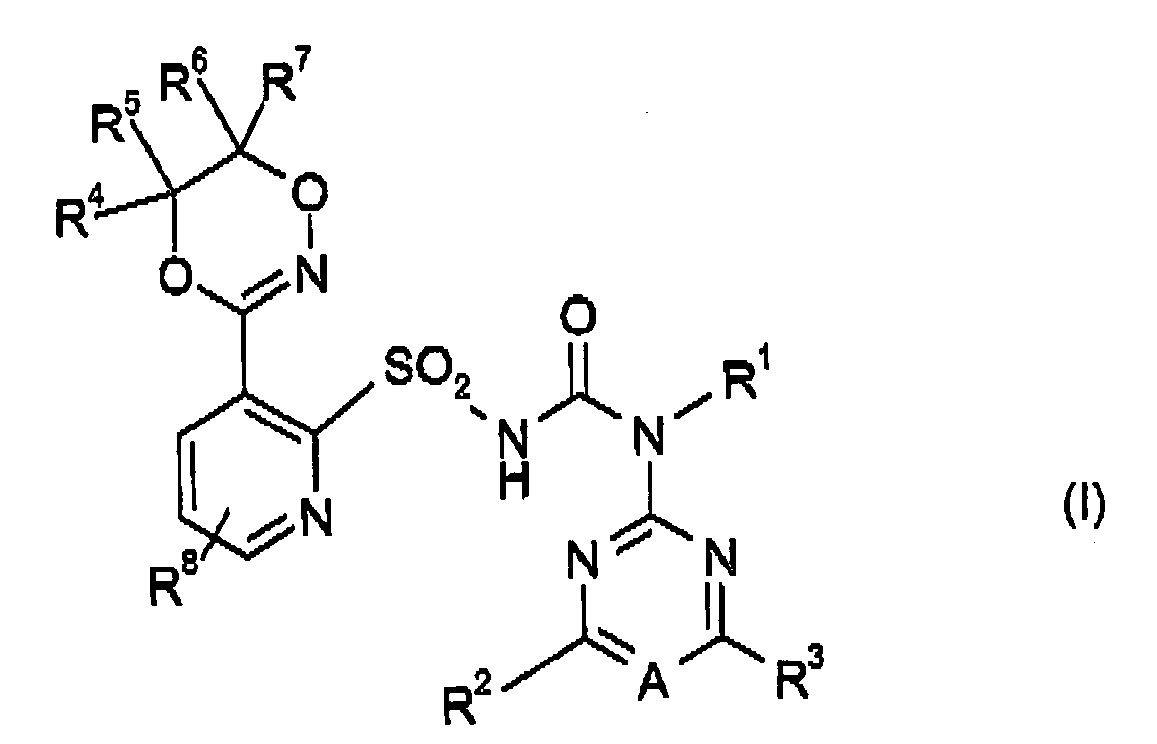
Die Verbindungen der Formel (I) und deren Salze sind bekannt, ebenso wie deren Herstellung, z.B. aus
Bevorzugt sind Verbindungen der Formel (I) und deren Salze,
worin
Insbesondere bevorzugt sind Verbindungen der Formel (I) und deren Salzen,
worin
worin
worin
Die bei den Restedefinitionen genannten Kohlenwasserstoffreste, wie Alkyl, Alkenyl oder Alkinyl, auch in Kombinationen mit Heteroatomen, wie in Alkoxy, Alkylthio, Haloalkyl oder Alkylamino, sind auch dann, wenn dies nicht ausdrücklich angegeben ist, geradkettig oder verzweigt.
Die Pyridylsulfonylharnstoffe, z.B. solche der allgemeinen Formel (I), können auch als Salze vorliegen, z.B. als Metallsalze wie Alkali (z.B. Na, K) -Salze oder als Erdalkali (z.B. Ca, Mg) -Salze oder als Ammonium- oder organische Aminsalze. Man erhält solche Salze in einfacher Weise nach üblichen Salzbildungsmethoden, beispielsweise durch Lösen oder Dispergieren eines Pyridyisulfonylhamstoffs, z.B. der Formel (I), in einem geeigneten Verdünnungsmittel, wie z.B. Methylenchlorid, Aceton, tert.-Butyl-methylether oder Toluol, und Zugabe einer geeigneten Base. Die Salze können dann - gegebenenfalls nach längerem Rühren - durch Einengen oder Absaugen isoliert werden.
Erfindungsgemäß bevorzugt enthaltene herbizide Wirkstoffe a) sind in der nachfolgenden Tabelle 1 genannt, worin folgende Abkürzungen verwendet werden:
| Bsp.- Nr. | R1 | A | R2 | R3 | Smp. (°C) |
| I-1 | H | CH | OCH3 | OC2H5 | 154 |
| I-2 | H | CH | OCH3 | CH3 | |
| I-3 | H | CH | OHC3 | CH3 | 180-181(+) |
| I-4 | H | CH | OCH3 | C2H5 | |
| I-5 | H | CH | OCH3 | CF3 | |
| I-6 | H | CH | OCH3 | OCF2H | |
| I-7 | H | CH | OCH3 | NHCH3 | |
| I-8 | H | CH | OCH3 | N(CH3)2 | 199.5 |
| I-9 | H | CH | OCH3 | Cl | 110-111 |
| I-10 | H | CH | OCH3 | Cl | 175-178(+) |
| I-11 | H | CH | OCH3 | OCH3 | 167-168 |
| I-12 | H | CH | OCH3 | OCH3 | 171-172(+) |
| I-13 | H | CH | OC2H5 | OC2H5 | |
| I-14 | H | CH | OC2H5 | OC2H5 | 152-154(+) |
| I-15 | H | CH | OC2H5 | CH3 | |
| I-16 | H | CH | OC2H5 | C2H5 | |
| I-17 | H | CH | OC2H5 | CF3 | |
| I-18 | H | CH | OC2H5 | OCF2H | |
| I-19 | H | CH | OC2H5 | NHCH3 | |
| I-20 | H | CH | OC2H5 | N(CH3)2 | |
| I-21 | H | CH | OC2H5 | Cl | 158-159 |
| I-22 | H | CH | OC2H6 | Cl | 213(+) |
| I-23 | H | CH | CH3 | CH3 | 153 |
| I-24 | H | CH | CH3 | C2H5 | |
| I-25 | H | CH | CH3 | CF3 | |
| I-26 | H | CH | CH3 | OCF2H | |
| I-27 | H | CH | CH3 | NHCH3 | |
| I-28 | H | CH | CH3 | N(CH3)2 | |
| I-29 | H | CH | CH3 | Cl | 108-109 |
| I-30 | H | CH | CH3 | Cl | >300(+) |
| I-31 | H | CH | C2H5 | C2H5 | |
| I-32 | H | CH | C2H5 | CF3 | |
| I-33 | H | CH | C2H5 | OCF2H | |
| I-34 | H | CH | C2H5 | NHCH3 | |
| I-35 | H | CH | C2H5 | Cl | |
| I-36 | H | CH | CF3 | CF3 | |
| I-37 | H | CH | CF3 | OCF2H | |
| I-38 | H | CH | CF3 | NHCH3 | |
| I-39 | H | CH | CF3 | N(CH3)2 | |
| I-40 | H | CH | CF3 | Cl | |
| I-41 | H | CH | OCF2H | OCF2H | |
| I-42 | H | CH | OCF2H | NHCH3 | |
| I-43 | H | CH | OCF2H | N(CW3)2 | |
| I-44 | H | CH | OCF2H | Cl | |
| I-45 | H | CH | NHCH3 | NHCH3 | |
| I-46 | H | CH | NHCH3 | N(CH3)2 | |
| I-47 | H | CH | NHCH3 | Cl | |
| I-48 | H | CH | N(CH3)2 | N(CH3)2 | |
| I-49 | H | CH | N(CH3)2 | Cl | |
| I-50 | H | CH | Cl | Cl | |
| I-51 | H | N | OCH3 | OCH3 | 255 |
| I-52 | H | N | OCH3 | OCH3 | 159-162(+) |
| I-53 | H | N | OCH3 | OC2H5 | |
| I-54 | H | N | OCH3 | CH3 | |
| I-55 | H | N | OCH3 | C2H5 | |
| I-56 | H | N | OCH3 | CF3 | |
| I-57 | H | N | OCH3 | OCF2H | |
| I-58 | H | N | OCH3 | NHCH3 | |
| I-59 | H | N | OCH3 | N(CH3)2 | |
| I-60 | H | N | OCH3 | N(CH3)2 | 156(+) |
| I-61 | H | N | OCH3 | Cl | |
| I-62 | H | N | OC2H5 | OC2H5 | |
| I-63 | H | N | OC2H5 | CH3 | |
| I-64 | H | N | OC2H5 | C2H5 | |
| I-65 | H | N | OC2H5 | CF3 | |
| I-66 | H | N | 0C2H5 | OCF2H | |
| I-67 | H | N | OC2H5 | NHCH3 | |
| I-68 | H | N | OC2H5 | N(CH3)2 | |
| I-69 | H | N | OC2H5 | Cl | |
| I-70 | H | N | OC2H5 | Cl | 213(+) |
| I-71 | H | N | CH3 | CH3 | |
| I-72 | H | N | CH3 | C2H5 | |
| I-73 | H | N | CH3 | CF3 | |
| I-74 | H | N | CH3 | OCF2H | |
| I-75 | H | N | CH3 | NHCH3 | |
| I-76 | H | N | CH3 | N(CH3)2 | |
| I-77 | H | N | CH3 | Cl | |
| I-78 | H | N | C2H5 | C2H5 | |
| I-79 | H | N | C2H5 | CF3 | |
| I-80 | H | N | C2H5 | OCF2H | |
| I-81 | H | N | C2H5 | NHCH3 | |
| I-82 | H | N | C2H5 | Cl | |
| I-83 | H | N | CF3 | CF3 | |
| I-84 | H | N | CF3 | OCF2H | |
| I-85 | H | N | CF3 | NHCH3 | |
| I-86 | H | N | CF3 | N(CH3)2 | |
| I-87 | H | N | CF3 | CI | |
| I-88 | H | N | OCF2H | OCF2H | |
| I-89 | H | N | OCF2H | NHCH3 | |
| I-90 | H | N | OCF2H | N(CH3)2 | |
| I-91 | H | N | OCF2H | Cl | |
| I-92 | H | N | NHCH3 | NHCH3 | |
| I-93 | H | N | NHCH3 | N(CH3)2 | |
| I-94 | H | N | NHCH3 | Cl | |
| I-95 | H | N | N(CH3)2 | N(CH3)2 | |
| I-96 | H | N | N(CH3)2 | Cl | |
| I-97 | H | N | Cl | Cl | |
| I-98 | CH3 | N | OCH3 | OCH3 | |
| I-99 | CH3 | N | OCH3 | OC2H5 | |
| I-100 | CH3 | N | OCH3 | CH3 | |
| I-101 | CH3 | N | OCH3 | C2H5 | |
| I-102 | CH3 | N | OCH3 | CF3 | |
| I-103 | CH3 | N | OCH3 | OCF2H | |
| I-104 | CH3 | N | OCH3 | NHCH3 | |
| I-105 | CH3 | N | OCH3 | N(CH3)2 | |
| I-106 | CH3 | N | OCH3 | Cl | |
| I-107 | CH3 | N | OC2H5 | OC2H5 | |
| I-108 | CH3 | N | OC2H5 | CH3 | |
| I-109 | CH3 | N | OC2H5 | C2H5 | |
| I-110 | CH3 | N | OC2H5 | CF3 | |
| I-111 | CH3 | N | OC2H5 | OCF2H | |
| I-112 | CH3 | N | OC2H5 | NHCH3 | |
| I-113 | CH3 | N | OC2H5 | N(CH3)2 | |
| I-114 | CH3 | N | OC2H5 | Cl | |
| I-115 | CH3 | N | CH3 | CH3 | |
| I-116 | CH3 | N | CH3 | C2H5 | |
| I-117 | CH3 | N | CH3 | CF3 | |
| I-118 | CH3 | N | CH3 | OCF2H | |
| I-119 | CH3 | N | CH3 | NHCH3 | |
| I-120 | CH3 | N | CH3 | N(CH3)2 | |
| I-121 | CH3 | N | CH3 | Cl | |
| I-122 | CH3 | N | C2H5 | C2H5 | |
| I-123 | CH3 | N | C2H5 | CF3 | |
| I-124 | CH3 | N | C2H5 | OCF2H | |
| I-125 | CH3 | N | C2H5 | NHCH3 | |
| I-126 | CH3 | N | C2H5 | Cl | |
| I-127 | CH3 | N | CF3 | CF3 | |
| I-128 | CH3 | N | CF3 | OCF2H | |
| I-129 | CH3 | N | CF3 | NHCH3 | |
| I-130 | CH3 | N | CF3 | N(CH3)2 | |
| I-131 | CH3 | N | CF3 | Cl | |
| I-132 | CH3 | N | OCF2H | OCF2H | |
| I-133 | CH3 | N | OCF2H | NHCH3 | |
| I-134 | CH3 | N | OCF2H | N(CH3)2 | |
| I-135 | CH3 | N | OCF2H | Cl | |
| I-136 | CH3 | N | NHCH3 | NHCH3 | |
| I-137 | CH3 | N | NHCH3 | N(CH3)2 | |
| I-138 | CH3 | N | NHCH3 | Cl | |
| I-139 | CH3 | N | N(CH3)2 | N(CH3)2 | |
| I-140 | CH3 | N | N(CH3)2 | Cl | |
| I-141 | CH3 | N | Cl | Cl | |
| I-142 | H | N | N(CH3)2 | OCH2CF3 | 158 |
| I-143 | H | CH | Cl | OCH2CF3 | 204-205 |
| I-144 | H | CH | Cl | OCH2CF3 | |
| I-145 | H | CH | Cl | OCH2CF3 | 207(+) |
A7) Alkoxyphenoxysulfonylharnstoffe, wie sie z.B. in

MON 37500, Sulfosulfuron (s. Brighton Crop Prot. Conf. 'Weeds', 1995, S: 57), und andere verwandte Sulfonylharnstoff-Derivate und Mischungen daraus;
Typische Vertreter dieser Wirkstoffe sind unter anderem die nachfolgend aufgeführten Verbindungen: Amidosulfuron, Azimsulfuron, Bensulfuron-Methyl, Chlorimuron-Ethyl, Chlorsulfuron, Cinosulfuron, Cyclosulfamuron, Ethametsulfuron-Methyl, Ethoxysulfuron, Flazasulfuron, Flupyrsulfuron-Methyl-Natrium, Halosulfuron-Methyl, Imazosulfuron, Metsulfuron-Methyl, Nicosulfuron, Oxasulfuron, Primisulfuron-Methyl, Prosulfuron, Pyrazosulfuron-Ethyl, Rimsulfuron, Sulfometuron-Methyl, Sulfosulfuron, Thifensulfuron-Methyl, Triasulfuron, Tribenuron-Methyl, Triflusulfuron-Methyl, lodosulfuron-Methyl und dessen Natriumsalz (
A9) Phenylsulfonylaminocarbonyltriazolinone
Beispiele für Verbindungen aus der Gruppe der sind z.B. Flucarbazone oder Propoxycarbazone und/oder deren Salze.
A10) (Het)Aryl-sulfonyl-aminocarbonyl-triazolinone
Thien-3-yl-sulfonylamino(thio)carbonyl-triazolin(thi)on der allgemeinen Formel (I)
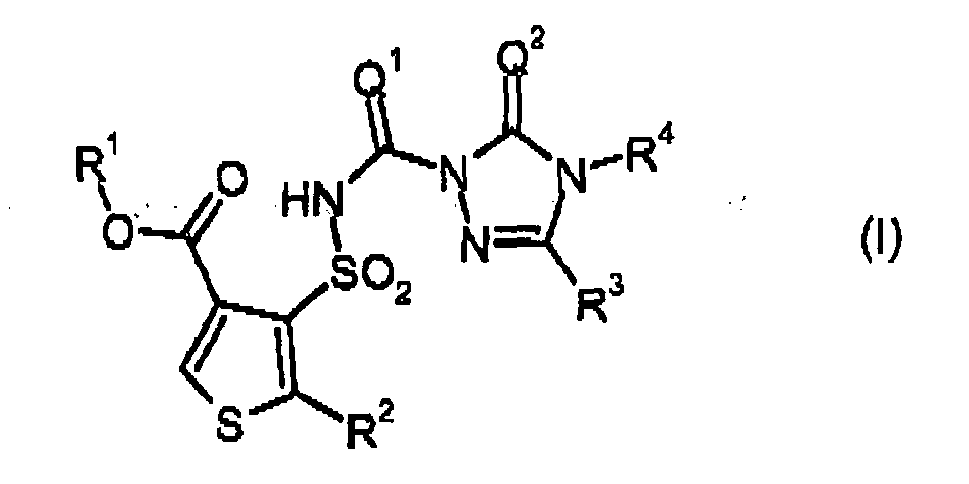
 |
| Nr. | R1 | R2 | R3 | R4 |
| A1 | Ethyl | Ethyl | Ethyl | Ethyl |
| A2 | Ethyl | Ethyl | Ethyl | Methyl |
| A3 | Ethyl | Ethyl | Methyl | Ethyl |
| A4 | Ethyl | Methyl | Ethyl | Ethyl |
| A5 | Methyl | Ethyl | Ethyl | Ethyl |
| A6 | Ethyl | Ethyl | Methyl | Methyl |
| A7 | Methyl | Ethyl | Ethyl | Methyl |
| A8 | Methyl | Methyl | Ethyl | Ethyl |
| A9 | Ethyl | Methyl | Ethyl | Methyl |
| A10 | Methyl | Ethyl | Methyl | Ethyl |
| A11 | Ethyl | Methyl | Methyl | Ethyl |
| A12 | Methyl | Methyl | Methyl | Methyl |
| A13 | Methyl | Methyl | Methyl | Ethyl |
| A14 | Methyl | Methyl | Ethyl | Methyl |
| A15 | Methyl | Ethyl | Methyl | Methyl |
| A16 | Ethyl | Methyl | Methyl | Methyl |
N-Methoxymethyl-2,6-diethyl-chloracetanilid (Alachlor),
N-(3-Methoxyprop-2-yl)-2-methyl-6-ethyl-chloracetanilid (Metolachlor),
N-(3-Methyl-1,2,4-oxadiazol-5-yl-methyl)-chloressigsäure-2,6-dimethylanilid,
N-(2,6-Dimethylphenyl)-N-(1-pyrazolylmethyl)-chloressigsäureamid (Metazachlor);
D) Thlocarbamate, z.B.
S-Ethyl-N,N-dipropylthiocarbamat (EPTC),
S-Ethyl-N,N-diisobutylthiocarbamat (Butylate);
E) Cyclohexandionoxime, z.B.
3-(1-Allyloxyiminobutyl)-4-hydroxy-6,6-dimethyl-2-oxocyclohex-3-encarbonsäuremethylester, (Alloxydim),
2-(1-Ethoxyiminobutyl)-5-(2-ethylthiopropyl)-3-hydroxy-cyclohex-2-en-1-on (Sethoxydim),
2-(1-Ethoxyiminobutyl)-5-(2-phenylthiopropyl)-3-hydroxy-cyclohex-2-en-1-on (Cloproxydim),
2-(1-(3-Chlarallyloxy)-iminobutyl)-5-(2-ethylthiopropyl)-3-hydroxy-cyclohex-2-en-1on,
2-(1-(3-Chlorallyloxy)-iminopropyl)-5-(2-ethylthiopropyl)-3-hydroxy-cyclohex-2-en-1-on (Clethodim),
2-(1-Ethoxyiminobutyl)-3-hydroxy-5-(thian-3-yl)-cyclohex-2-en-on (Cycloxydim),
2-(1-Ethoxyiminopropyl)-5-(2,4,6-trimethylphenyl)-3-hydroxy-cyclohex-2-en-1-on (Tralkoxydim);
F) Imidazolinone, z.B.
2-(4-)sopropyl-4-methyl-5-oxo-2-)midazolin-2-yl)-5-methylbenzoesäure-methylester
und 2-(4-Isopropyl-4-methyl-5-oxo-2-imidazolin-2-yl)-4-methylbenzaesäure (Imazamethabenz),
5-Ethyl-2-(4-isopropyl-4-methyl-5-oxo-2-imidazolin-2-yl)-pyridin-3-carbonsäure (Imazethapyr),
2-(4-Isapropyl-4-methyl-5-oxo-2-imidazolin-2-yl)-chinolin-3-carbonsäure (Imazaquin),
2-(4-Isopropyl-4-methyl-5-oxo-2-imidazolin-2-yl)-pyridin-3-carbonsäure (Imazapyr),
5-Methyl-2-(4-Isopropyl-4-methyl-5-oxo-2-imidazolin-2-yl)-pyridin-3-carbonsäure (Imazethamethapyr);
G) Triazofapyrimidinsulfonamid-Derivate, z.B.
N-(2,6-Difluorphenyl)-7-methyl-1,2,4-triazolo[1,5-c]pyrimidin-2-sulfonamid (Flumetsulam),
N-(2,6-Dichlor-3-methylphenyl)-6,7-dimethoxy-1,2,4-thazolo[1,5-c]pyrimidin-2-sulfonamid,
N-(2,6-Difluorphenyl)-7-fluor-5-methoxy-1,2,4-triazolo[1,5-c]-pyrimidin-2-sulfonamid.
N-(2,6-Dichlor-3-methylphenyl)-7-chlor-5-methoxy-1,2,4-triazolo[1,5-c]-pyrimidin-2-sulfonamid,
N-(2-Chlor-6-methoxycarbonyl)-5,7-dimethyl-1,2,4-triazolo[1,5-c]-pyrimidin-2-sulfonamid (
H) Benzoylcyclohexandione, z.B.
2-(2-Chlor-4-methylsulfonylbenzoyl)-cyclohexan-1,3-dion (SC-0051,
2-(2-Nitro-3-methylsulfonylbenzoyl)-4,4-dimethylcyclohexan-1,3-dion (
I) Pyrimidinyloxy-pyridincarbonsäure- bzw. Pyrimldinyloxybenzoesäure-Derivate, z.B.
3-(4,6-Dimethoxypyrimidin-2-yl)-oxy-pyridin-2-carbonsäurebenzylester (
3-(4,6-Dimethoxypyrimidin-2-yl)-oxy-pyridin-2-carbonsäuremethylester (
2,6-Bis[(4,6-dimethoxypyrimidin-2-yl)-oxy]-benzoesäure (
2,6-Bis[(4,6-dimethoxypyrimidin-2-yl)-oxy]-benzoesäure-1-(ethoxycarbonyl-oxyethyl)-ester (
J) S-(N-Aryl-N-alkyl-carbamoylmethyl)-dithlophosphonsäureester, wie S-[N-(4-Chlorphenyl)-N-isopropyl-carbamoylmethyl]-O,O-dimethy-dithiophosphat (Anilophos).
K) 2,4-Diamino-s-triazine, vorzugsweise Alkylazine.
Bevorzugt sind auch Salze, vorzugsweise Säureadditionssalze der Verbindungen, beispielsweise deren Hydrochloride.
L) phosphorhaltige Herbizide, z.B. eine oder mehrere Verbindungen der Formel (IV) oder deren Derivate wie Salze,


N) Benzofurane, z.B. Benfuresate und Ethofumesate;
O) Phytohormone;
P) Auxine und Auxinanaloga, z.B. 4-Indol-3-buttersäure, Indol-3-essigsäure, 1-Naphthylessigsäure, 2-(1-Naphthyl)acetamid und 2-Naphthyloxyessigsäure;
Q) Zytokinine, z.B. Cythokinin, Kinetin und 6-Benzylaminopurin;
R) Gibberelline, z.B. Gibberillinsäure, Gibberillin A4 und A7;
S) Abzissinsäure- und deren Derivate;
T) Ethylenvorläufer, z.B. Ethephon;
U) Herbizide aus der Gruppe der Fettsäuresynthetase-Inhibitoren;
V) Harnstoffe, z.B. Chlorotoluron, Dimefuron, Diuron, Fluometuron, Isoproturon, Isouron, Karbutilate, Linuron, Methabenzthiazuron, Metobenzuron, Metoxuron, Monolinuron, Neburon, Siduron und Tebuthiuron und
W) Metamitron.
X) Hydroxybenzonitrile, z.B. wie Bromoxynil und loxynil und deren Salze und Ester, wie Bromoxynilactanoat und loxyniloctanoat.
Claims (18)
- Ölsuspensionskonzentrat, enthaltend(a) ein oder mehrere agrochemische Wirkstoffe in der Wasser-Phase, in verkapselter Form in der Öl-Phase vorliegend, und(b) ein oder mehrere agrochemische Wirkstoffe in der Öl-Phase, optional verkapselt,sowie Übliche Hilfs- und Zusatzstoffe.
- Ölsuspensionskonzentrat gemäß Anspruch 1, worin der in der Ölphase in gekapselter oder nicht gekapselter Form dispergiert oder gelöst vorliegende Wirkstoff ein Sulfonylharnstoff, insbesondere ein Phenylsulfonylharnstoff, Heteroarylsulfonharnstoff, ein (Het)Aryl-sulfonylaminocarbonyltriazolinon, oder ein Pyridyl-sulfonylharnstoff ist.
- Ölsuspensionskonzentrat gemäß Anspruch 1, worin der in der Ölphase in gekapselter oder nicht gekapselter Form dispergiert oder gelöst vorliegende Wirkstoff ein Thien-3-yl-sulfonylamin(thio)carbonyltriazolin(thi)on und/oder dessen Salz ist.
- Ölsuspensionskonzentrat gemäß Anspruch 1, worin der in der Ölphase in gekapselter oder nicht gekapselter Form dispergiert oder gelöst vorliegende Wirkstoff ein Phenylsulfonylharnstoff.
- Ölsuspensionskonzentrat gemäß Anspruch 1, worin der in der Ölphase in gekapselter oder nicht gekapselter Form dispergiert oder gelöst vorliegende Wirkstoff ein Dioxazin-Pyridyisulfonylharnstoff und/oder dessen Salz ist.
- Ölsuspensionskonzentrat gemäß Anspruch 1, worin der in der Ölphase in gekapselter oder nicht gekapselter Form dispergiert oder gelöst vorliegende Wirkstoff ein Phenylsulfonylaminocarbonyltriazolinon, insbesondere ein Propoxycarbazon und/oder dessen Salz ist.
- Ölsuspensionskonzentrat enthaltend mindestens zwei unterschiedliche agrochemische Wirkstoffe, von denen mindestens einer im Inneren einer Mikrokapsel vorliegt und mindestens einer in nicht gekapselter Form in der Ölphase vorliegt, dadurch gekennzeichnet, dass der in nicht gekapselter Form in der Ölphase vorliegende Wirkstoff ein phosphorhaltiges Herbizid ist.
- Ölsuspensionskonzentrat enthaltend mindestens zwei unterschiedliche agrochemische Wirkstoffe, worin mindestens ein Wirkstoff wasserlöslich ist und mindestens ein in der Ölphase dispergiert oder gelöst vorliegender Wirkstoff ist und die Wirkstoffe gemäß einem Multi-Mikroverkapselungsverfahren behandelt wurden und in entsprechender Form vorliegen.
- Ölsuspensionskonzentrat gemäß einem der vorliegenden Ansprüche, wobei sich die Mikrokapseln, welche die in der Ölphase dispergiert oder gelöst vorliegenden Wirkstoffe enthalten, in ihren Freisetzungseigenschaften von den Mikrokapseln, welche die wasserlöslichen Wirkstoffe enthalten, unterscheiden.
- Ölsuspensionskonzentrat gemäß einem der vorhergehenden Ansprüche, wobei sich die in der Ölphase vorliegenden Wirkstoffe in ihren chemischen Eigenschaften, insbesondere in ihrer Hydrolyseempfindlichkeit, von den wasserlöslichen Wirkstoffen unterscheiden.
- Ölsuspensionskonzentrat gemäß einem der vorhergehenden Ansprüche, wobei sich in der Ölphase vorliegenden Wirkstoffe in ihrem Schmelzpunkt, von den wasserlöslichen Wirkstoffen unterscheiden.
- Ölsuspensionskonzentrat gemäß einem der vorhergehenden Ansprüche, wobei die in gekapselter Form vorliegenden Wirkstoffe einen Schmelzpunkt > 120 °C aufweisen.
- Verfahren zur Bekämpfung von Schadorganismen, wobei eine wirksame Menge eines Ölsuspensionskonzentrats nach einem oder mehreren der Ansprüche 1 bis 14, auf die Schadorganismen oder die Orte an denen sie auftreten, appliziert wird.
- Verwendung eines Ölsuspensionskonzentrats nach einem oder mehreren der Ansprüche 1 bis 13 zur Verhinderung der zur Verzögerung des chemischen Abbaus, insbesondere der Hydrolyse von Wirkstoffen in agrochemischer Formulierungen.
- Verfahren zur Bekämpfung von Schadpflanzen, wobei eine wirksame Menge eines Ölsuspensionskonzentrats nach einem oder mehreren der Ansprüche 1 bis 13, auf die Schadpflanzen, Teile der Pflanzen, Pflanzensamen oder die Flächen an denen die Pflanzen wachsen appliziert wird,
- Verwendung eines Ölsuspensionskonzentrats nach einem oder mehreren der Anspruche 1 bis 13, zur Bekämpfung von Schadorganismen.
- Verwendung eines Ölsuspensionskonzentrats nach einem oder mehreren der Ansprüche 1 bis 13, zur Bekämpfung von Schadpflanzen.
- Verwendung eines Ölsuspensionskonzentrats nach einem oder mehreren der Ansprüche 1 bis 14, zur Herstellung von Wirkstoff-Formulierungen.
Priority Applications (16)
| Application Number | Priority Date | Filing Date | Title |
|---|---|---|---|
| EP07001380A EP1952688A1 (de) | 2007-01-23 | 2007-01-23 | Ölsuspensionskonzentrat mit mikrogekaspelten und mit nicht mikrogekaspelten agrochemischen Wirkstoffen |
| EA200900855A EA013316B1 (ru) | 2007-01-23 | 2008-01-10 | Масляный суспензионный концентрат с микрокапсулированными агрохимическими биологически активными веществами |
| CN200880002902A CN101621924A (zh) | 2007-01-23 | 2008-01-10 | 具有微囊化的农业化学活性物质的油悬浮剂 |
| UAA200908797A UA96009C2 (ru) | 2007-01-23 | 2008-01-10 | Композиция агрохимически активных веществ в форме концентрата масляной суспензии и способ борьбы с вредными растениями |
| MX2009007824A MX2009007824A (es) | 2007-01-23 | 2008-01-10 | Concentrado para suspension en aceites con sustancias activas agroquimicas microencapsuladas. |
| AU2008209129A AU2008209129A1 (en) | 2007-01-23 | 2008-01-10 | Oil suspension concentrate with micro-encapsulated agrochemical active ingredients |
| CA002676210A CA2676210A1 (en) | 2007-01-23 | 2008-01-10 | Oil suspension concentrate with micro-encapsulated agrochemical active ingredients |
| BRPI0807401-1A BRPI0807401A2 (pt) | 2007-01-23 | 2008-01-10 | Concentrado de suspensão em óleo com substâncias ativas agroquímicas microencápsuladas. |
| KR1020097017487A KR20090113864A (ko) | 2007-01-23 | 2008-01-10 | 마이크로캡슐화 농약 활성 성분을 함유한 오일 현탁 농축물 |
| PCT/EP2008/000126 WO2008089890A2 (de) | 2007-01-23 | 2008-01-10 | Ölsuspensionskonzentrat mit mikrogekapselten agrochemischen wirkstoffen |
| EP08701053A EP2111104A2 (de) | 2007-01-23 | 2008-01-10 | Ölsuspensionskonzentrat mit mikrogekapselten agrochemischen wirkstoffen |
| JP2009546670A JP2010516720A (ja) | 2007-01-23 | 2008-01-10 | マイクロカプセル化された農薬有効成分を含む油懸濁製剤 |
| US12/017,846 US20080176746A1 (en) | 2007-01-23 | 2008-01-22 | Oil suspension concentrate comprising microencapsulated agrochemically active compounds |
| ARP080100257A AR064982A1 (es) | 2007-01-23 | 2008-01-22 | Concentrado de suspension oleosa con principios activos agroquimicos microencapulados |
| EC2009009527A ECSP099527A (es) | 2007-01-23 | 2009-07-20 | Concentrado para suspensión en aceites con sustancias activas agroquímicas microencapsuladas |
| IL199960A IL199960A0 (en) | 2007-01-23 | 2009-07-20 | Oil suspension concentrate with micro-encapsulated agrochemical active ingredients |
Applications Claiming Priority (1)
| Application Number | Priority Date | Filing Date | Title |
|---|---|---|---|
| EP07001380A EP1952688A1 (de) | 2007-01-23 | 2007-01-23 | Ölsuspensionskonzentrat mit mikrogekaspelten und mit nicht mikrogekaspelten agrochemischen Wirkstoffen |
Publications (1)
| Publication Number | Publication Date |
|---|---|
| EP1952688A1 true EP1952688A1 (de) | 2008-08-06 |
Family
ID=38564578
Family Applications (2)
| Application Number | Title | Priority Date | Filing Date |
|---|---|---|---|
| EP07001380A Withdrawn EP1952688A1 (de) | 2007-01-23 | 2007-01-23 | Ölsuspensionskonzentrat mit mikrogekaspelten und mit nicht mikrogekaspelten agrochemischen Wirkstoffen |
| EP08701053A Withdrawn EP2111104A2 (de) | 2007-01-23 | 2008-01-10 | Ölsuspensionskonzentrat mit mikrogekapselten agrochemischen wirkstoffen |
Family Applications After (1)
| Application Number | Title | Priority Date | Filing Date |
|---|---|---|---|
| EP08701053A Withdrawn EP2111104A2 (de) | 2007-01-23 | 2008-01-10 | Ölsuspensionskonzentrat mit mikrogekapselten agrochemischen wirkstoffen |
Country Status (15)
| Country | Link |
|---|---|
| US (1) | US20080176746A1 (de) |
| EP (2) | EP1952688A1 (de) |
| JP (1) | JP2010516720A (de) |
| KR (1) | KR20090113864A (de) |
| CN (1) | CN101621924A (de) |
| AR (1) | AR064982A1 (de) |
| AU (1) | AU2008209129A1 (de) |
| BR (1) | BRPI0807401A2 (de) |
| CA (1) | CA2676210A1 (de) |
| EA (1) | EA013316B1 (de) |
| EC (1) | ECSP099527A (de) |
| IL (1) | IL199960A0 (de) |
| MX (1) | MX2009007824A (de) |
| UA (1) | UA96009C2 (de) |
| WO (1) | WO2008089890A2 (de) |
Cited By (1)
| Publication number | Priority date | Publication date | Assignee | Title |
|---|---|---|---|---|
| WO2012164012A1 (en) * | 2011-06-01 | 2012-12-06 | Syngenta Participations Ag | Herbicidal compositions |
Families Citing this family (20)
| Publication number | Priority date | Publication date | Assignee | Title |
|---|---|---|---|---|
| ES2323399B2 (es) * | 2007-06-19 | 2010-02-26 | Gat Microencapsulation Ag | Suspensiones en aceites de sulfonilureas y combinaciones agroquimicas. |
| US20110053776A1 (en) * | 2009-09-01 | 2011-03-03 | Bahr James T | Blends of micro-encapsulated pesticide formulations |
| CN101715778A (zh) * | 2009-12-08 | 2010-06-02 | 安徽丰乐农化有限责任公司 | 精噁唑禾草灵·氟唑磺隆复配除草剂 |
| GB2483050B (en) * | 2010-08-17 | 2012-12-19 | Rotam Agrochem Int Co Ltd | Herbicidal compositions |
| US20120071320A1 (en) * | 2010-09-17 | 2012-03-22 | Dow Agrosciences Llc | Liquid agricultural formulations of improved stability |
| CN102057900B (zh) * | 2011-01-26 | 2013-05-01 | 河北博嘉农业有限公司 | 噻苯隆油悬浮剂 |
| RU2460296C1 (ru) * | 2011-05-03 | 2012-09-10 | Михаил Аркадьевич Ершов | Способ стимуляции всхожести семян |
| RU2504154C2 (ru) * | 2011-05-12 | 2014-01-20 | Федеральное государственное бюджетное образовательное учреждение высшего профессионального образования "Чувашский государственный педагогический университет им. И.Я. Яковлева" | Стимулятор для предпосевной обработки семян зерновых культур |
| RU2462034C1 (ru) * | 2011-08-12 | 2012-09-27 | Михаил Аркадьевич Ершов | Способ получения стимулятора зерновых культур |
| CN103102307A (zh) * | 2013-03-04 | 2013-05-15 | 黑龙江大学 | 合成唑虫酰胺的方法 |
| WO2015085377A1 (pt) * | 2013-12-11 | 2015-06-18 | Oxiteno S.A. Indústria E Comércio | Alquil éster de ácido policarboxílico derivado de álcool ramificado e linear de fonte vegetal, e, uso de um alquil éster em formulações agroquímicas |
| GB201501793D0 (en) * | 2015-02-03 | 2015-03-18 | Eden Research Plc | Encapsulation of high potency active agents |
| EP4046490A1 (de) * | 2016-01-21 | 2022-08-24 | UPL Limited | Verbesserte herbizidformulierung |
| US12004509B2 (en) * | 2016-11-18 | 2024-06-11 | Indorama Ventures Oxides Australia Pty Limited | Co-formulation comprising a plant growth regulator and an oil, and methods of preparing and using said co-formulation |
| CN108575993A (zh) * | 2018-04-19 | 2018-09-28 | 河北威远生物化工有限公司 | 一种草铵膦可分散微囊油悬浮剂及其制备方法 |
| AR115480A1 (es) * | 2018-06-05 | 2021-01-20 | Monsanto Technology Llc | Composiciones herbicidas |
| US12342817B2 (en) | 2018-06-05 | 2025-07-01 | Monsanto Technology Llc | Herbicidal compositions |
| CN109497057B (zh) * | 2019-01-02 | 2020-02-21 | 中国农业大学 | 防治根结线虫的阿维菌素b2微囊悬浮剂及其制备方法 |
| WO2022034533A1 (en) * | 2020-08-13 | 2022-02-17 | Coromandel International Limited | Insecticidal composition |
| US20240324590A1 (en) * | 2021-08-03 | 2024-10-03 | UPL Corporation Limited | Combinations of triazolinone herbicides with safeners |
Citations (5)
| Publication number | Priority date | Publication date | Assignee | Title |
|---|---|---|---|---|
| WO1997038581A1 (en) * | 1996-04-16 | 1997-10-23 | E.I. Du Pont De Nemours And Company | Herbicidal mixtures |
| US5700475A (en) * | 1995-12-29 | 1997-12-23 | Monsanto Company | Stabilized pesticidal compositions and their use |
| WO1998028975A1 (en) * | 1996-12-31 | 1998-07-09 | Zeneca Limited | Novel water-in-oil microencapsulation process and microcapsules produced thereby |
| WO2001084928A1 (de) * | 2000-05-11 | 2001-11-15 | Bayer Cropscience Gmbh | Kombinationen von pflanzenschutzmitteln mit organischen oder anorganischen trägermaterialien |
| WO2005058476A1 (es) * | 2003-12-18 | 2005-06-30 | Gat Formulation Gmbh | Proceso de multi-microencapsulación continuo para la mejora de la estabilidad y almacenamiento de ingredientes biológicamente activos |
Family Cites Families (5)
| Publication number | Priority date | Publication date | Assignee | Title |
|---|---|---|---|---|
| US4285720A (en) * | 1972-03-15 | 1981-08-25 | Stauffer Chemical Company | Encapsulation process and capsules produced thereby |
| US4157983A (en) * | 1977-07-28 | 1979-06-12 | Champion International Corporation | Process for production of encapsulated water-dispersible materials |
| US4956129A (en) * | 1984-03-30 | 1990-09-11 | Ici Americas Inc. | Microencapsulation process |
| US4534783A (en) * | 1984-01-03 | 1985-08-13 | Monsanto Co. | High concentration encapsulation of water soluble-materials |
| EP1844653B1 (de) * | 2006-03-30 | 2017-07-26 | GAT Microencapsulation GmbH | Neuartige agrochemische Formulierungen mit Mikrokapseln |
-
2007
- 2007-01-23 EP EP07001380A patent/EP1952688A1/de not_active Withdrawn
-
2008
- 2008-01-10 EA EA200900855A patent/EA013316B1/ru not_active IP Right Cessation
- 2008-01-10 MX MX2009007824A patent/MX2009007824A/es unknown
- 2008-01-10 WO PCT/EP2008/000126 patent/WO2008089890A2/de not_active Ceased
- 2008-01-10 EP EP08701053A patent/EP2111104A2/de not_active Withdrawn
- 2008-01-10 JP JP2009546670A patent/JP2010516720A/ja not_active Abandoned
- 2008-01-10 UA UAA200908797A patent/UA96009C2/ru unknown
- 2008-01-10 CA CA002676210A patent/CA2676210A1/en not_active Abandoned
- 2008-01-10 CN CN200880002902A patent/CN101621924A/zh active Pending
- 2008-01-10 BR BRPI0807401-1A patent/BRPI0807401A2/pt not_active IP Right Cessation
- 2008-01-10 AU AU2008209129A patent/AU2008209129A1/en not_active Abandoned
- 2008-01-10 KR KR1020097017487A patent/KR20090113864A/ko not_active Withdrawn
- 2008-01-22 US US12/017,846 patent/US20080176746A1/en not_active Abandoned
- 2008-01-22 AR ARP080100257A patent/AR064982A1/es not_active Application Discontinuation
-
2009
- 2009-07-20 IL IL199960A patent/IL199960A0/en unknown
- 2009-07-20 EC EC2009009527A patent/ECSP099527A/es unknown
Patent Citations (5)
| Publication number | Priority date | Publication date | Assignee | Title |
|---|---|---|---|---|
| US5700475A (en) * | 1995-12-29 | 1997-12-23 | Monsanto Company | Stabilized pesticidal compositions and their use |
| WO1997038581A1 (en) * | 1996-04-16 | 1997-10-23 | E.I. Du Pont De Nemours And Company | Herbicidal mixtures |
| WO1998028975A1 (en) * | 1996-12-31 | 1998-07-09 | Zeneca Limited | Novel water-in-oil microencapsulation process and microcapsules produced thereby |
| WO2001084928A1 (de) * | 2000-05-11 | 2001-11-15 | Bayer Cropscience Gmbh | Kombinationen von pflanzenschutzmitteln mit organischen oder anorganischen trägermaterialien |
| WO2005058476A1 (es) * | 2003-12-18 | 2005-06-30 | Gat Formulation Gmbh | Proceso de multi-microencapsulación continuo para la mejora de la estabilidad y almacenamiento de ingredientes biológicamente activos |
Non-Patent Citations (1)
| Title |
|---|
| EXXONMOBIL CHEMICAL: "ExxonMobil Chemical Presentations At IUPAC: Poster 1 - Reverse Phase Microcapsule Suspensions Of Glyphosate IPA", INTERNET ARTICLE, July 2004 (2004-07-01), XP002455053, Retrieved from the Internet <URL:http://web.archive.org/web/20040720163429/http://www.exactplastomers.com/Public_Industries/Agriculture/News_Useful_Links/Agr_NewsArticle_IUPAC.asp> [retrieved on 20071016] * |
Cited By (2)
| Publication number | Priority date | Publication date | Assignee | Title |
|---|---|---|---|---|
| WO2012164012A1 (en) * | 2011-06-01 | 2012-12-06 | Syngenta Participations Ag | Herbicidal compositions |
| US9072295B2 (en) | 2011-06-01 | 2015-07-07 | Syngenta Participations Ag | Herbicidal compositions |
Also Published As
| Publication number | Publication date |
|---|---|
| AR064982A1 (es) | 2009-05-06 |
| BRPI0807401A2 (pt) | 2014-05-27 |
| MX2009007824A (es) | 2009-07-30 |
| EP2111104A2 (de) | 2009-10-28 |
| KR20090113864A (ko) | 2009-11-02 |
| WO2008089890A2 (de) | 2008-07-31 |
| CA2676210A1 (en) | 2008-07-31 |
| UA96009C2 (ru) | 2011-09-26 |
| JP2010516720A (ja) | 2010-05-20 |
| CN101621924A (zh) | 2010-01-06 |
| AU2008209129A1 (en) | 2008-07-31 |
| EA200900855A1 (ru) | 2009-12-30 |
| ECSP099527A (es) | 2009-08-28 |
| WO2008089890A3 (de) | 2009-05-22 |
| US20080176746A1 (en) | 2008-07-24 |
| EA013316B1 (ru) | 2010-04-30 |
| IL199960A0 (en) | 2010-04-15 |
Similar Documents
| Publication | Publication Date | Title |
|---|---|---|
| EP2111104A2 (de) | Ölsuspensionskonzentrat mit mikrogekapselten agrochemischen wirkstoffen | |
| EP2048945A2 (de) | Neue mikroemulgierbare konzentrate | |
| EP2001296A2 (de) | Herbizide mittel als dispersionen enthaltend diflufenican und flurtamone | |
| DE10258867A1 (de) | Mikroemulsionskonzentrate | |
| CN101262761B (zh) | 乳酸酯用于提高农药作用的用途 | |
| EP1523235A1 (de) | Fluessige adjuvantien | |
| EP1303188A2 (de) | Herbizide mittel | |
| EP2117317A2 (de) | Penetrationsförderer für herbizide und safener | |
| DE10231615A1 (de) | Feste Adjuvantien | |
| EP1844654A1 (de) | Penetrationsförderer für agrochemische Wirkstoffe | |
| EP1891855A1 (de) | Neue Mikroemulsionskonzentrate | |
| DE10258856A1 (de) | Flüssige Adjuvantien | |
| EP1882414A1 (de) | Schmelzgranulate | |
| EP1902616A1 (de) | Herbizide Mittel als Dispersionen enthaltend Diflufenican und Flurtamone | |
| AU2012211399B2 (en) | Herbicidal compositions as dispersions comprising diflufenican and flurtamone |
Legal Events
| Date | Code | Title | Description |
|---|---|---|---|
| PUAI | Public reference made under article 153(3) epc to a published international application that has entered the european phase |
Free format text: ORIGINAL CODE: 0009012 |
|
| AK | Designated contracting states |
Kind code of ref document: A1 Designated state(s): AT BE BG CH CY CZ DE DK EE ES FI FR GB GR HU IE IS IT LI LT LU LV MC NL PL PT RO SE SI SK TR |
|
| AX | Request for extension of the european patent |
Extension state: AL BA HR MK RS |
|
| AKX | Designation fees paid | ||
| STAA | Information on the status of an ep patent application or granted ep patent |
Free format text: STATUS: THE APPLICATION IS DEEMED TO BE WITHDRAWN |
|
| 18D | Application deemed to be withdrawn |
Effective date: 20090207 |
|
| REG | Reference to a national code |
Ref country code: DE Ref legal event code: 8566 |