EP0274634A1 - Synergistic herbicide compositions and method of application - Google Patents
Synergistic herbicide compositions and method of application Download PDFInfo
- Publication number
- EP0274634A1 EP0274634A1 EP87117574A EP87117574A EP0274634A1 EP 0274634 A1 EP0274634 A1 EP 0274634A1 EP 87117574 A EP87117574 A EP 87117574A EP 87117574 A EP87117574 A EP 87117574A EP 0274634 A1 EP0274634 A1 EP 0274634A1
- Authority
- EP
- European Patent Office
- Prior art keywords
- cyclohexanedione
- effective amount
- weight ratio
- herbicidally effective
- dimethyl
- Prior art date
- Legal status (The legal status is an assumption and is not a legal conclusion. Google has not performed a legal analysis and makes no representation as to the accuracy of the status listed.)
- Withdrawn
Links
Classifications
-
- A—HUMAN NECESSITIES
- A01—AGRICULTURE; FORESTRY; ANIMAL HUSBANDRY; HUNTING; TRAPPING; FISHING
- A01N—PRESERVATION OF BODIES OF HUMANS OR ANIMALS OR PLANTS OR PARTS THEREOF; BIOCIDES, e.g. AS DISINFECTANTS, AS PESTICIDES OR AS HERBICIDES; PEST REPELLANTS OR ATTRACTANTS; PLANT GROWTH REGULATORS
- A01N41/00—Biocides, pest repellants or attractants, or plant growth regulators containing organic compounds containing a sulfur atom bound to a hetero atom
- A01N41/02—Biocides, pest repellants or attractants, or plant growth regulators containing organic compounds containing a sulfur atom bound to a hetero atom containing a sulfur-to-oxygen double bond
- A01N41/10—Sulfones; Sulfoxides
Definitions
- Each of the two cyclohexanedione compounds which can be combined to form the synergistic herbicidal compositions of this invention is already known in the art as a herbicide.
- One compound is 2-(2-chloro-4-methanesulfonylbenzoyl)1,3-cyclohexanedione.
- the herbicidal activity of this compound is disclosed in European Patent Publication No. 137,963, published April 4, 1985.
- the other of the two cyclohexanedione compounds which are combined to form the synergistic compositions of this invention is 2-(2-nitrobenzoyl)-4,4-dimethyl-1,3-cyclohexanedione. This compound is disclosed in European Patent Publication No. 186,118, issued July 2, 1986.
- compositions comprising a mixture of the following components:
- Another embodiment of this invention is a method of controlling undesirable weed pests, and this method comprises applying the synergistic compositions of the invention to the locus where control is desired.
- herbicide is used herein to denote a compound which adversely controls or modifies the growth of plants.
- herbicidally effective amount is used to indicate the quantity of such a compound or combination of such compounds which is capable of producing an adversely controlling or modifying effect. Controlling or modifying effects include all deviations from natural development, for example: killing, retardation, leaf burn, chlorosis, dwarfing and the like.
- plants is used to include all undesirable postemergent vegetation, ranging from seedlings to established vegetation.
- test compounds were applied both individually, with and without crop oil, and then combined in tank mixes. These compounds and compositions were evaluated for control of wild proso millet, wooly cupgrass and for crop injury.
- the compounds were applied as liquid solutions with a hand held boom sprayer. The spray was directed between the corn rows so that the pattern intercepted at the base of the corn plant but over the top of the weeds that were present.
- the sprayer was a small plot sprayer, with a backpack unit, calibrated to apply 25.5 or 27, respectively gallons per acre at 30 psi.
- Each of the test compounds were applied at rates which were calculated based on the formulation provided and diluted in water, the amount of water being sufficient to apply a final volume of 25.5 or 27 gallons per acre of the spray solutions containing test compounds or compositions.
- the herbicidal agents were applied post-emergence at the several rates indicated.
- the degree of weed control or crop injury was estimated and recorded as percentage of control compared to the growth of the same species in an untreated check flat of the same age.
- the rating scale ranges from 0 to 100%, where 0 equals no effect with plant growth control equal to the untreated control, and 100% equals complete kill.
- a response is synergistic when an observed value is greater than the calculated value.
- a synergistic response is understood to be one in which the interaction response is greater than the sum of responses from the individual chemical treatments.
- An antagonistic response is the opposite situation.
- Corn tolerance was antagonistic with the tank mix combination excluding Rigo Oil and additive when Rigo Oil was included.
- compositions of this invention will depend upon the weeds to be controlled and the degree of control desired. In general, the compositions of this invention are most efficiently employed at a rate of 0.01 to 50 pounds per acre (0.011 to 56 kilograms per hectare) of the active ingredients, preferably 0.1 to 25 pounds per acre (0.11 to 28 kilograms per hectare).
- compositions of the present invention show synergistic activity as herbicides in controlling the growth of undesirable vegetation when applied to such vegetation in postemergence application.
- the compositions are generally embodied in formulations which contain inert or occasionally active ingredients or diluent carriers in addition to the active compounds. Examples of such ingredients or carriers are water, organic solvents, surface active agents, oil, water-in-oil emulsions, wetting agents, dispersing agents, and emulsifying agents.
- the herbicidal formulations generally take the form of wettable powders, solutions or emulsifiable concentrates.
- Wettable powders are finely divided compositions comprising a particulate carrier impregnated with the herbicidal compound and additionally containing one or more surface active agents.
- the surface active agent promotes rapid dispersion of the powder in aqueous medium to form stable, sprayable suspensions.
- a wide variety of surface active agents can be used, for example, long chain fatty alcohols and alkali metal salts of the sulfated fatty alcohols; salts of sulfonic acid; esters of long chain fatty acids; and polyhydric alcohols, in which the alcohol groups are free, omega-substituted polyethylene glycols of relatively long chain length.
- the herbicidal compositions can also be applied to the foliage in the form of a solution in a suitable solvent.
- Solvents frequently used in herbicidal formulations include kerosene, fuel oil, xylene, petroleum fractions with boiling ranges above xylene, and aromatic petroleum fractions rich in methylated naphthalenes.
- the most preferred formulations are emulsifiable concentrates which consist of an oil solution of the herbicide along with an emulsifying agent. Prior to use the concentrate is diluted with water to form a suspended emulsion of oil droplets.
- the emulsifiers used are usually a mixture of anionic and nonionic surfactants. Other additives such as spreading agents and stickers can be included in the emulsifiable concentrate.
- the formulations described above can be applied to the vegetation sought to be controlled in any conventional manner either before or after the vegetation has emerged from the soil.
- the vegetation can be in any stage of development after emergence, ranging from seedlings to fully grown plants.
- Application can be achieved by any conventional technique such as the use of ground spraying equipment or aircraft-mounted sprayers. Various other application techniques will be apparent to one skilled in the pesticide art.
Landscapes
- Life Sciences & Earth Sciences (AREA)
- Agronomy & Crop Science (AREA)
- Pest Control & Pesticides (AREA)
- Plant Pathology (AREA)
- Health & Medical Sciences (AREA)
- Engineering & Computer Science (AREA)
- Dentistry (AREA)
- General Health & Medical Sciences (AREA)
- Wood Science & Technology (AREA)
- Zoology (AREA)
- Environmental Sciences (AREA)
- Agricultural Chemicals And Associated Chemicals (AREA)
Abstract
A synergistic herbicidal composition comprising a mixture of: (a) a herbicidally effective amount of 2-(2-chloro-4-methanesulfonylbenzoyl)-1,3-cyclohexanedione; and (b) a herbicidally effective amount of 2-(2-nitrobenzoyl)-4,4-dimethyl-1,3-cyclohexanedione; at a weight ratio of (a) to (b) of from about 0.1:1 to about 20:1. Also disclosed is a method of application of the composition.
Description
- The protection of crops from weeds and other vegetation which inhibit crop growth is a constantly recurring problem in agriculture. To help combat this problem researchers in the field of synthetic chemistry have produced an extensive variety of chemicals and chemical formulations effective in the control of such unwanted growth. Chemical herbicides of many types have been disclosed in the literature and a large number are in commercial use.
- In some cases, active herbicides have been shown to be more effective in combination than when applied individually. The result is often termed "synergism," since the combination demonstrates a potency or activity level exceeding that which it would be expected to have, based on a knowledge of the individual potencies of the components. The present invention resides in the discovery that certain cyclohexanediones display this synergism on unwanted vegetation when applied in combination without vegative affect on crops. At higher rates, the crop may in fact be benefitted.
- Each of the two cyclohexanedione compounds which can be combined to form the synergistic herbicidal compositions of this invention is already known in the art as a herbicide. One compound is 2-(2-chloro-4-methanesulfonylbenzoyl)1,3-cyclohexanedione. The herbicidal activity of this compound is disclosed in European Patent Publication No. 137,963, published April 4, 1985.
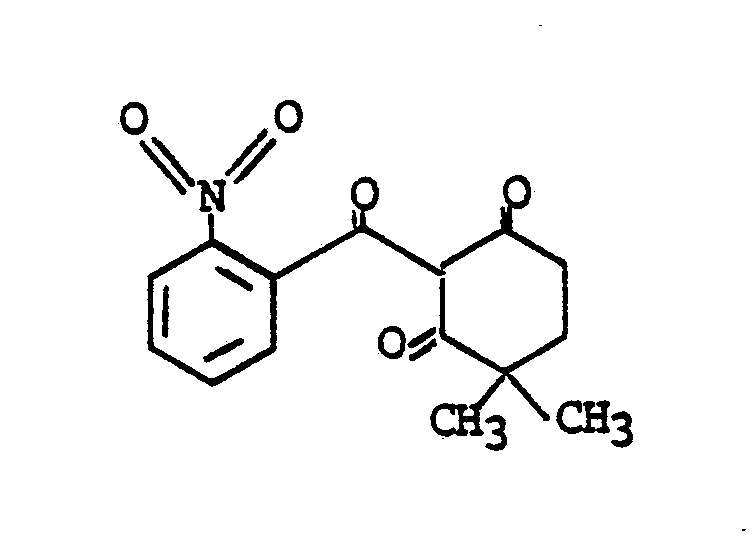
- The other of the two cyclohexanedione compounds which are combined to form the synergistic compositions of this invention is 2-(2-nitrobenzoyl)-4,4-dimethyl-1,3-cyclohexanedione. This compound is disclosed in European Patent Publication No. 186,118, issued July 2, 1986.
- It has now been discovered that synergism in the control of undesirable vegetation is exhibited by compositions comprising a mixture of the following components:
- (a) a herbicidally effective amount of 2-(2-chloro-4-methanesulfonylbenzoyl)-1,3-cyclohexandione having the formula

- (b) a herbicidally effective amount of 2-(2-nitrobenzoyl)-4,-dimethyl-1,3-cyclohexanedione having the formula
- Another embodiment of this invention is a method of controlling undesirable weed pests, and this method comprises applying the synergistic compositions of the invention to the locus where control is desired.
- The terms "synergism" and "synergistic" are used herein to convey the result observed when a combination of herbicides demonstrates a potency in excess of that which the combination would be expected to produce on the basis of the potencies of each herbicide applied individually.
- The term "herbicide" is used herein to denote a compound which adversely controls or modifies the growth of plants. The term "herbicidally effective amount" is used to indicate the quantity of such a compound or combination of such compounds which is capable of producing an adversely controlling or modifying effect. Controlling or modifying effects include all deviations from natural development, for example: killing, retardation, leaf burn, chlorosis, dwarfing and the like. The term "plants" is used to include all undesirable postemergent vegetation, ranging from seedlings to established vegetation.
- These compounds are effectively used in the synergistic compositions of the invention at ratios of Compound (a) to Compound (b) as set forth above, ranging from about 0.01:1 to about 20:1. Preferably, the ratio of Compound (a) to Compound (b) is from about 0.1:1 to about 10:1. Most preferably the ratio of (a) to (b) is 2:1..
- Synergism for the compositions of this invention was measured in accordance with the following test:
- A series of non-irrigated plots of silt loam soil were prepared, each plot being 30 feet long by 6 feet wide. There were three replications for each plot, in what is termed a "randomized complete block" design. Indigenous weeds were evaluated. Along with the weed species were two corn inbreds which were inserted to determine the extent of damage, if any, upon plant species. The corn rows were spaced 38 and 30 inches apart, respectively.
- The test compounds were applied both individually, with and without crop oil, and then combined in tank mixes. These compounds and compositions were evaluated for control of wild proso millet, wooly cupgrass and for crop injury. The compounds were applied as liquid solutions with a hand held boom sprayer. The spray was directed between the corn rows so that the pattern intercepted at the base of the corn plant but over the top of the weeds that were present. The sprayer was a small plot sprayer, with a backpack unit, calibrated to apply 25.5 or 27, respectively gallons per acre at 30 psi. Each of the test compounds were applied at rates which were calculated based on the formulation provided and diluted in water, the amount of water being sufficient to apply a final volume of 25.5 or 27 gallons per acre of the spray solutions containing test compounds or compositions.

- The herbicidal agents were applied post-emergence at the several rates indicated.
- Approximately 10 days after treatment, crop injury was evaluated.
- Approximately 60 days after treatment, each plot of weeds was visually rated for growth control due to all factors of injury.
- The degree of weed control or crop injury was estimated and recorded as percentage of control compared to the growth of the same species in an untreated check flat of the same age. The rating scale ranges from 0 to 100%, where 0 equals no effect with plant growth control equal to the untreated control, and 100% equals complete kill.
- Herbicide interaction responses were evaluated by use of Limpel's formula (Limpel, L.E., et al., 1962, "Weed Control by Dimethyltetrachloroterephthalate Alone and in Certain Combinations," Proc. NEWCC, 16:48-53):
E = X + Y -
where E = expected response
where X = observed (O) value or percent growth control when the herbicide is applied singly; and
Y = observed (O) value or percent growth control when the second herbicide is applied singly. - A response is synergistic when an observed value is greater than the calculated value. A synergistic response is understood to be one in which the interaction response is greater than the sum of responses from the individual chemical treatments. An antagonistic response is the opposite situation.
- In the tables which follow:
E = expected activity
O = observed activity
- In reviewing the above data (Table I), it can be seen that 2-(2-chloro-4-methanesulfonylbenzoyl)-1,3-cyclohexanedione when applied at 1/4 pound per acre gave 23% wild proso millet control, and 2-(2-nitrobenzoyl)-4,4-dimethyl-1,3-cyclohexanedione applied at 1/8 pound per acre gave only 12% control, but when these compounds were tank-mixed and applied at 1/4 pound per acre and 1/8 pound per acre, respectively, 63% control was obtained. Thus, according to Limpel's formula, synergism was present.
- Similar values can be observed when the herbicide compounds were combined with Rigo Oil. In that instance, 87% control was obtained, versus a calculated degree of control of 32.4%.
- Corn tolerance was antagonistic with the tank mix combination excluding Rigo Oil and additive when Rigo Oil was included.
- In reviewing the data from Table 2, it can be seen that 2-(2-chloro-4-methanesulfonylbenzoyl)-1,3-cyclohexanedione when applied at 0.25 lb/A gave 5% woolly cupgrass control and 2-(2-nitrobenzoyl)-4,4-dimethyl-1,3-cyclohexanedione applied at 0.25 lb/A gave 52% control, but when these compounds were tank-mixed and applied at 0.25 lb/A and 0.25 lb/A, respectively, 75% control was obtained. Thus, according to Limpel's Formula, synergism was present.
- Other values were obtained when the herbicide compounds were combined with Rigo Oil. In that instance, 50% control was obtained, versus a calculated degree of 63%, indicating antagonism (Table 2).
- Corn tolerance was additive by the tank-mix without Rigo Oil but antagonism was present with Rigo Oil.
- Application rates for the compositions of this invention will depend upon the weeds to be controlled and the degree of control desired. In general, the compositions of this invention are most efficiently employed at a rate of 0.01 to 50 pounds per acre (0.011 to 56 kilograms per hectare) of the active ingredients, preferably 0.1 to 25 pounds per acre (0.11 to 28 kilograms per hectare).
- The compositions of the present invention show synergistic activity as herbicides in controlling the growth of undesirable vegetation when applied to such vegetation in postemergence application. The compositions are generally embodied in formulations which contain inert or occasionally active ingredients or diluent carriers in addition to the active compounds. Examples of such ingredients or carriers are water, organic solvents, surface active agents, oil, water-in-oil emulsions, wetting agents, dispersing agents, and emulsifying agents. The herbicidal formulations generally take the form of wettable powders, solutions or emulsifiable concentrates.
- Wettable powders are finely divided compositions comprising a particulate carrier impregnated with the herbicidal compound and additionally containing one or more surface active agents. The surface active agent promotes rapid dispersion of the powder in aqueous medium to form stable, sprayable suspensions. A wide variety of surface active agents can be used, for example, long chain fatty alcohols and alkali metal salts of the sulfated fatty alcohols; salts of sulfonic acid; esters of long chain fatty acids; and polyhydric alcohols, in which the alcohol groups are free, omega-substituted polyethylene glycols of relatively long chain length.
- The herbicidal compositions can also be applied to the foliage in the form of a solution in a suitable solvent. Solvents frequently used in herbicidal formulations include kerosene, fuel oil, xylene, petroleum fractions with boiling ranges above xylene, and aromatic petroleum fractions rich in methylated naphthalenes.
- The most preferred formulations are emulsifiable concentrates which consist of an oil solution of the herbicide along with an emulsifying agent. Prior to use the concentrate is diluted with water to form a suspended emulsion of oil droplets. The emulsifiers used are usually a mixture of anionic and nonionic surfactants. Other additives such as spreading agents and stickers can be included in the emulsifiable concentrate.
- The formulations described above can be applied to the vegetation sought to be controlled in any conventional manner either before or after the vegetation has emerged from the soil. The vegetation can be in any stage of development after emergence, ranging from seedlings to fully grown plants. Application can be achieved by any conventional technique such as the use of ground spraying equipment or aircraft-mounted sprayers. Various other application techniques will be apparent to one skilled in the pesticide art.
Claims (12)
1. A synergistic herbicidal composition comprising a mixture of:
(a) a herbicidally effective amount of 2-(2-chloro-4-methanesulfonylbenzoyl)-1,3-cyclohexanedione; and
(b) a herbicidally effective amount of 2-(2-nitrobenzoyl)-4,4-dimethyl-1,3-cyclohexanedione;
at a weight ratio of (a) to (b) of from about 0.1:1 to about 20:1.
at a weight ratio of (a) to (b) of from about 0.1:1 to about 20:1.
2. The composition of Claim 1, wherein the weight ratio of (a) to (b) ranges from about 2 to about 1.
3. A synergistic herbicidal composition comprising a mixture of:
(a) a herbicidally effective amount of 2-(2-chloro-4-methanesulfonylbenzoyl)-1,3-cyclohexanedione;
(b) a herbicidally effective amount of 2-(2-nitrobenzoyl)-4,4-dimethyl-1,3-cyclohexanedione; and
(c) an inert diluent carrier, at a weight ratio of (a) to (b) of from about 0.01:1 to about 20:1.
4. The composition of Claim 3, wherein the weight ratio of (a) to (b) ranges from about 2 to about 1.
5. A method of controlling undesirable vegetation, which comprises the application to said vegetation of a synergistic herbicidal composition comprising
(a) a herbicidally effective amount of 2-(2-chloro-4-methanesulfonylbenzoyl)-1,3-cyclohexanedione;
(b) a herbicidally effective amount of 1-(2-nitrobenzoyl)-4,4-dimethyl-1,3-cyclohexanedione;
at a weight ratio of (a) to (b) of from about 0.1:1 to about 20:1.
at a weight ratio of (a) to (b) of from about 0.1:1 to about 20:1.
6. The method of Claim 5, wherein the weight ratio of (a) to (b) ranges from about 2 to about 1.
7. A method of controlling wild proso millet and woolly cupgrass weed species, which comprises the application to said weed species of a synergistic herbicidal composition comprising
(a) a herbicidally effective amount of 2-(2-chloro-4-methanesulfonylbenzoyl)-1,3-cyclohexanedione;
(b) a herbicidally effective amount of 1-(2-nitrobenzoyl)-4,4-dimethyl-1,3-cyclohexanedione;
at a weight ratio of (a) to (b) of from about 0.1:1 to about 20:1.
at a weight ratio of (a) to (b) of from about 0.1:1 to about 20:1.
8. The method of Claim 7, wherein the weight ratio of (a) to (b) ranges from about 2 to about 1.
9. A process for preparing a synergistic herbicidal composition, comprising mixing
(a) a herbicidally effective amount of 2-(2-chloro-4-methanesulfonylbenzoyl)-1,3-cyclohexanedione; and
(b) a herbicidally effective amount of 2-(2-nitrobenzoyl)-4,4-dimethyl-1,3-cyclohexanedione;
at a weight ratio of (a) to (b) of from about 0.1:1 to about 20:1.
at a weight ratio of (a) to (b) of from about 0.1:1 to about 20:1.
10. The process of Claim 9, wherein the weight ratio of (a) to (b) ranges from about 2 to about 1.
11. A process for preparing a synergistic herbicidal composition, comprising mixing
(a) a herbicidally effective amount of 2-(2-chloro-4-methanesulfonylbenzoyl)-1,3-cyclohexanedione;
(b) a herbicidally effective amount of 2-(2-nitrobenzoyl)-4,4-dimethyl-1,3-cyclohexanedione; and
(c) an inert diluent carrier, at a weight ratio of (a) to (b) of from about 0.01:1 to about 20:1.
12. The process of Claim 11, wherein the weight ratio of (a) to (b) ranges from about 2 to about 1.
Applications Claiming Priority (2)
| Application Number | Priority Date | Filing Date | Title |
|---|---|---|---|
| US93780086A | 1986-12-04 | 1986-12-04 | |
| US937800 | 1986-12-04 |
Publications (1)
| Publication Number | Publication Date |
|---|---|
| EP0274634A1 true EP0274634A1 (en) | 1988-07-20 |
Family
ID=25470425
Family Applications (1)
| Application Number | Title | Priority Date | Filing Date |
|---|---|---|---|
| EP87117574A Withdrawn EP0274634A1 (en) | 1986-12-04 | 1987-11-27 | Synergistic herbicide compositions and method of application |
Country Status (7)
| Country | Link |
|---|---|
| EP (1) | EP0274634A1 (en) |
| CN (1) | CN87107282A (en) |
| AU (1) | AU8206287A (en) |
| BR (1) | BR8706593A (en) |
| HU (1) | HUT48094A (en) |
| PL (1) | PL269238A1 (en) |
| ZW (1) | ZW23287A1 (en) |
Cited By (18)
| Publication number | Priority date | Publication date | Assignee | Title |
|---|---|---|---|---|
| US5318947A (en) * | 1989-10-18 | 1994-06-07 | Hoechst Aktiengesellschaft | Method for controlling harmful plants in rice with 2-benzoyl-1,3-cyclohexanedione derivatives |
| US5447903A (en) * | 1989-10-18 | 1995-09-05 | Hoechst Aktiengesellschaft | Herbicidal active substance combinations |
| JP2003511475A (en) * | 1999-10-22 | 2003-03-25 | アベンティス・クロップサイエンス・ゲゼルシャフト・ミット・ベシュレンクテル・ハフツング | Synergistic herbicidal compositions comprising herbicides from the group of hydroxyphenylpyruvate dioxygenase inhibitors |
| EP1836894A1 (en) | 2006-03-25 | 2007-09-26 | Bayer CropScience GmbH | Novel sulfonamide-containing solid formulations |
| EP1844654A1 (en) | 2006-03-29 | 2007-10-17 | Bayer CropScience GmbH | Penetration enhancer for agrochemicals |
| DE102007013362A1 (en) | 2007-03-16 | 2008-09-18 | Bayer Cropscience Ag | Use of polyalkylene oxide for enhancing penetration of herbicidal agents into plants, for preparing plant protection agents and to combat pests and weeds |
| WO2008155027A3 (en) * | 2007-06-19 | 2009-10-22 | Bayer Cropscience Ag | Synergistic crop-tolerated combinations of herbicides from the benzoylcyclohexandione group for application in rice growing |
| WO2011076731A1 (en) | 2009-12-23 | 2011-06-30 | Bayer Cropscience Ag | Liquid formulation of 2-iodo-n-[(4-methoxy-6-methyl-1,3,5-triazin-2-yl)carbamoyl]benzolsulfonamide |
| WO2012110517A1 (en) | 2011-02-15 | 2012-08-23 | Bayer Cropscience Ag | Synergistic combinations containing a dithiino-tetracarboxamide fungicide and a herbicide, safener or plant growth regulator |
| DE102011080007A1 (en) | 2011-07-28 | 2012-09-13 | Bayer Cropscience Ag | Use of seed treatment agents comprising conazole or triazole fungicides e.g. as safeners for avoiding or reducing phytotoxic effects of herbicides e.g. carbamate, thiocarbamate and haloacetanilide, on crops, preferably cultural crops |
| DE102011079997A1 (en) | 2011-07-28 | 2012-09-13 | Bayer Corpscience Ag | Use of seed treatment agents comprising pyrazole insecticides e.g. as safeners for avoiding or reducing phytotoxic effects of herbicides e.g. carbamate, thiocarbamate and haloacetanilide, on crops, preferably cultural crops |
| DE102011080004A1 (en) | 2011-07-28 | 2012-09-13 | Bayer Cropscience Ag | Use of seed treatment agents, comprising carbamate fungicides as safeners, for preventing or reducing phytotoxic effects of herbicides on useful plants, preferably cultivated plants |
| DE102011080020A1 (en) | 2011-07-28 | 2012-09-13 | Bayer Cropscience Ag | Use of seed treatment agents, comprising dicarboximide fungicides as safeners, for preventing or reducing phytotoxic effects of herbicides on useful plants, preferably cultivated plants |
| DE102011079991A1 (en) | 2011-07-28 | 2012-09-13 | Bayer Crop Science Ag | Use of seed treating-agent comprising nicotinoid insecticide as a safener for avoiding or reducing phytotoxic effects of herbicide on useful plants, preferably crop plants |
| DE102011080010A1 (en) | 2011-07-28 | 2012-10-25 | Bayer Cropscience Ag | Use of seed treatment agents comprising anilide and thiazole fungicides, e.g. as safeners for avoiding or reducing phytotoxic effects of herbicides e.g. carbamate, thiocarbamate and haloacetanilide, on crops, preferably cultural crops |
| DE102011080016A1 (en) | 2011-07-28 | 2012-10-25 | Bayer Cropscience Ag | Use of seed treatment active substance comprising strobilurin fungicides, e.g. as safeners for avoiding or reducing phytotoxic effects of herbicides on useful plants, preferably crop plants, and in crop plants protective agents |
| DE102011080001A1 (en) | 2011-07-28 | 2012-10-25 | Bayer Cropscience Ag | Use of seed treatment active substance comprising carbamate insecticides, e.g. as safeners for avoiding or reducing phytotoxic effects of herbicides on useful plants, preferably crop plants, and in crop plants protective agents |
| WO2014060502A1 (en) | 2012-10-19 | 2014-04-24 | Bayer Cropscience Ag | Active compound combinations comprising carboxamide derivatives |
Citations (2)
| Publication number | Priority date | Publication date | Assignee | Title |
|---|---|---|---|---|
| EP0137963A1 (en) * | 1983-09-16 | 1985-04-24 | Stauffer Chemical Company | Certain 2-(2-substituted Benzoyl)-1,3-Cyclohexanediones |
| EP0186118A2 (en) * | 1984-12-20 | 1986-07-02 | Stauffer Chemical Company | Certain 2-(2'nitrobenzoyl)-1,3-cyclohexanediones |
-
1987
- 1987-11-27 EP EP87117574A patent/EP0274634A1/en not_active Withdrawn
- 1987-12-02 ZW ZW23287A patent/ZW23287A1/en unknown
- 1987-12-03 HU HU544087A patent/HUT48094A/en unknown
- 1987-12-03 CN CN198787107282A patent/CN87107282A/en active Pending
- 1987-12-03 AU AU82062/87A patent/AU8206287A/en not_active Abandoned
- 1987-12-04 PL PL26923887A patent/PL269238A1/en unknown
- 1987-12-07 BR BR8706593A patent/BR8706593A/en unknown
Patent Citations (2)
| Publication number | Priority date | Publication date | Assignee | Title |
|---|---|---|---|---|
| EP0137963A1 (en) * | 1983-09-16 | 1985-04-24 | Stauffer Chemical Company | Certain 2-(2-substituted Benzoyl)-1,3-Cyclohexanediones |
| EP0186118A2 (en) * | 1984-12-20 | 1986-07-02 | Stauffer Chemical Company | Certain 2-(2'nitrobenzoyl)-1,3-cyclohexanediones |
Cited By (23)
| Publication number | Priority date | Publication date | Assignee | Title |
|---|---|---|---|---|
| US5318947A (en) * | 1989-10-18 | 1994-06-07 | Hoechst Aktiengesellschaft | Method for controlling harmful plants in rice with 2-benzoyl-1,3-cyclohexanedione derivatives |
| US5447903A (en) * | 1989-10-18 | 1995-09-05 | Hoechst Aktiengesellschaft | Herbicidal active substance combinations |
| US5650373A (en) * | 1989-10-18 | 1997-07-22 | Hoechst Aktiengesellschaft | Herbicidal active substance combinations comprising a triketone and a second herbicide |
| JP2003511475A (en) * | 1999-10-22 | 2003-03-25 | アベンティス・クロップサイエンス・ゲゼルシャフト・ミット・ベシュレンクテル・ハフツング | Synergistic herbicidal compositions comprising herbicides from the group of hydroxyphenylpyruvate dioxygenase inhibitors |
| EP1836894A1 (en) | 2006-03-25 | 2007-09-26 | Bayer CropScience GmbH | Novel sulfonamide-containing solid formulations |
| EP1844654A1 (en) | 2006-03-29 | 2007-10-17 | Bayer CropScience GmbH | Penetration enhancer for agrochemicals |
| DE102007013362A1 (en) | 2007-03-16 | 2008-09-18 | Bayer Cropscience Ag | Use of polyalkylene oxide for enhancing penetration of herbicidal agents into plants, for preparing plant protection agents and to combat pests and weeds |
| EP2232993A1 (en) * | 2007-06-19 | 2010-09-29 | Bayer CropScience AG | Cultivated plant compatible synergistic herbicidal composition comprising tembotrione, sulcotrione and isoxadifen-ethyl for application in rice cultures |
| EP2232994A1 (en) * | 2007-06-19 | 2010-09-29 | Bayer CropScience AG | Cultivated plant compatible synergistic herbicidal compositions comprising tembotrione and tefuryltrione for application in rice cultures |
| EP2232991A1 (en) * | 2007-06-19 | 2010-09-29 | Bayer CropScience AG | Cultivated plant compatible synergistic herbicidal compositions comprising a herbicide from the group of the benzoylcyclohexanediones in combination with at least two further herbicides for application in the rice cultures |
| WO2008155027A3 (en) * | 2007-06-19 | 2009-10-22 | Bayer Cropscience Ag | Synergistic crop-tolerated combinations of herbicides from the benzoylcyclohexandione group for application in rice growing |
| US8673814B2 (en) | 2007-06-19 | 2014-03-18 | Bayer Cropscience Ag | Synergistic combinations which are compatible with cultivated plants and which comprise herbicides selected from the group consisting of benzoylcyclohexanediones for use in rice crops |
| WO2011076731A1 (en) | 2009-12-23 | 2011-06-30 | Bayer Cropscience Ag | Liquid formulation of 2-iodo-n-[(4-methoxy-6-methyl-1,3,5-triazin-2-yl)carbamoyl]benzolsulfonamide |
| WO2012110517A1 (en) | 2011-02-15 | 2012-08-23 | Bayer Cropscience Ag | Synergistic combinations containing a dithiino-tetracarboxamide fungicide and a herbicide, safener or plant growth regulator |
| DE102011079997A1 (en) | 2011-07-28 | 2012-09-13 | Bayer Corpscience Ag | Use of seed treatment agents comprising pyrazole insecticides e.g. as safeners for avoiding or reducing phytotoxic effects of herbicides e.g. carbamate, thiocarbamate and haloacetanilide, on crops, preferably cultural crops |
| DE102011080004A1 (en) | 2011-07-28 | 2012-09-13 | Bayer Cropscience Ag | Use of seed treatment agents, comprising carbamate fungicides as safeners, for preventing or reducing phytotoxic effects of herbicides on useful plants, preferably cultivated plants |
| DE102011080020A1 (en) | 2011-07-28 | 2012-09-13 | Bayer Cropscience Ag | Use of seed treatment agents, comprising dicarboximide fungicides as safeners, for preventing or reducing phytotoxic effects of herbicides on useful plants, preferably cultivated plants |
| DE102011079991A1 (en) | 2011-07-28 | 2012-09-13 | Bayer Crop Science Ag | Use of seed treating-agent comprising nicotinoid insecticide as a safener for avoiding or reducing phytotoxic effects of herbicide on useful plants, preferably crop plants |
| DE102011080010A1 (en) | 2011-07-28 | 2012-10-25 | Bayer Cropscience Ag | Use of seed treatment agents comprising anilide and thiazole fungicides, e.g. as safeners for avoiding or reducing phytotoxic effects of herbicides e.g. carbamate, thiocarbamate and haloacetanilide, on crops, preferably cultural crops |
| DE102011080016A1 (en) | 2011-07-28 | 2012-10-25 | Bayer Cropscience Ag | Use of seed treatment active substance comprising strobilurin fungicides, e.g. as safeners for avoiding or reducing phytotoxic effects of herbicides on useful plants, preferably crop plants, and in crop plants protective agents |
| DE102011080001A1 (en) | 2011-07-28 | 2012-10-25 | Bayer Cropscience Ag | Use of seed treatment active substance comprising carbamate insecticides, e.g. as safeners for avoiding or reducing phytotoxic effects of herbicides on useful plants, preferably crop plants, and in crop plants protective agents |
| DE102011080007A1 (en) | 2011-07-28 | 2012-09-13 | Bayer Cropscience Ag | Use of seed treatment agents comprising conazole or triazole fungicides e.g. as safeners for avoiding or reducing phytotoxic effects of herbicides e.g. carbamate, thiocarbamate and haloacetanilide, on crops, preferably cultural crops |
| WO2014060502A1 (en) | 2012-10-19 | 2014-04-24 | Bayer Cropscience Ag | Active compound combinations comprising carboxamide derivatives |
Also Published As
| Publication number | Publication date |
|---|---|
| AU8206287A (en) | 1988-06-09 |
| PL269238A1 (en) | 1988-09-29 |
| HUT48094A (en) | 1989-05-29 |
| BR8706593A (en) | 1988-07-19 |
| CN87107282A (en) | 1988-08-03 |
| ZW23287A1 (en) | 1988-03-30 |
Similar Documents
| Publication | Publication Date | Title |
|---|---|---|
| US4528023A (en) | Enhancement of herbicidal activity of tetraaluminum salts of N-phosphonomethylglycine | |
| EP0042854B1 (en) | Herbicidal compositions containing n-(phosphonomethyl)-glycine | |
| EP0350079B1 (en) | Synergistic herbicide combinations and method of application | |
| EP0079774A1 (en) | Inhibiting the antagonism between pyridyloxyphenoxy alkanoate herbicides and benzothiadiazinone herbicides in post-emergent applications | |
| GB1562908A (en) | Insecticidal compostions | |
| JPH06157220A (en) | Herbicidal composition | |
| CA1226746A (en) | Synergistic herbicidal compositions | |
| EP0147683B1 (en) | A method for the control of galium aparine | |
| EP0158445B1 (en) | Synergistic herbicidal compositions | |
| EP0144137A1 (en) | Synergistic herbicidal compositions | |
| EP0150529A2 (en) | Synergistic herbicidal compositions | |
| EP0039535B1 (en) | Synergistic herbicidal compositions and use thereof | |
| EP0238145B1 (en) | Synergistic herbicidal compositions and methods of use. | |
| EP0032832B1 (en) | Synergistic herbicidal compositions and use thereof | |
| EP0146835A2 (en) | Synergistic herbicidal compositions | |
| EP0219143A1 (en) | Synergistic herbicidal compositions and methods of use | |
| EP0218271A1 (en) | Synergistic herbicidal compositions and method | |
| EP0200935A2 (en) | Synergistic herbicidal compositions | |
| NO861338L (en) | SYNERGISTIC HERBICIDE MIXTURES. | |
| HU182991B (en) | Herbicide composition of synergic activity | |
| JPH05262607A (en) | Herbicide composition | |
| TH74396B (en) | Concentrated Aqueous Blend for Crop Protection |
Legal Events
| Date | Code | Title | Description |
|---|---|---|---|
| PUAI | Public reference made under article 153(3) epc to a published international application that has entered the european phase |
Free format text: ORIGINAL CODE: 0009012 |
|
| AK | Designated contracting states |
Kind code of ref document: A1 Designated state(s): AT BE CH DE ES FR GB GR IT LI LU NL SE |
|
| STAA | Information on the status of an ep patent application or granted ep patent |
Free format text: STATUS: THE APPLICATION IS DEEMED TO BE WITHDRAWN |
|
| 18D | Application deemed to be withdrawn |
Effective date: 19890121 |
|
| RIN1 | Information on inventor provided before grant (corrected) |
Inventor name: DROST, DIRK COOPER |