EP1930462A1 - Medien oder Trinkwasser führende Gewerke - Google Patents
Medien oder Trinkwasser führende Gewerke Download PDFInfo
- Publication number
- EP1930462A1 EP1930462A1 EP06124248A EP06124248A EP1930462A1 EP 1930462 A1 EP1930462 A1 EP 1930462A1 EP 06124248 A EP06124248 A EP 06124248A EP 06124248 A EP06124248 A EP 06124248A EP 1930462 A1 EP1930462 A1 EP 1930462A1
- Authority
- EP
- European Patent Office
- Prior art keywords
- fittings
- steel alloy
- content
- drinking water
- use according
- Prior art date
- Legal status (The legal status is an assumption and is not a legal conclusion. Google has not performed a legal analysis and makes no representation as to the accuracy of the status listed.)
- Granted
Links
Images
Classifications
-
- C—CHEMISTRY; METALLURGY
- C22—METALLURGY; FERROUS OR NON-FERROUS ALLOYS; TREATMENT OF ALLOYS OR NON-FERROUS METALS
- C22C—ALLOYS
- C22C38/00—Ferrous alloys, e.g. steel alloys
- C22C38/18—Ferrous alloys, e.g. steel alloys containing chromium
Definitions
- the invention relates to the use of a steel alloy for the production of fittings, in particular screw or plug fittings, fittings or compression connectors for media or drinking water leading trades and fittings, especially screw or plug fittings, fittings or compression connectors.
- high-copper-containing non-ferrous metal alloys such as bronze or gunmetal
- non-ferrous metal alloys are used today for producing media of leading components of, for example, gas or drinking water of leading industries.
- the non-ferrous metal alloys used are subject to stringent requirements, especially in the case of trades intended for drinking water supply.
- the non-ferrous metal alloys must have a particularly high corrosion resistance, since the components in contact with drinking water, for example, should not corrode even after many years of use.
- the components should also be easy to produce and can be mechanically processed well.
- Austenitic steels for example 1.4301 or 1.4401 steels, have been used as stainless steel alloys up to now Although they are characterized by good formability, so that fittings, fittings or compression connectors could be produced economically. However, their corrosion resistance, especially in thick-walled parts that are in constant contact with, for example, drinking water, can be improved.
- ferritic steels which in principle have an equivalent corrosion resistance
- they have not hitherto been used for the production of fittings, fittings and press connectors, since on the one hand they tend to coarse-grained during welding, which leads to a reduced corrosion resistance.
- the production of thick-walled parts, such as fittings is problematic due to the reduced formability of the ferritic steel alloys.
- the present invention seeks to propose the use of a steel alloy, which allows for improved corrosion resistance economical production of fittings, fittings and press connectors.
- the above object is achieved by the use of a steel alloy which, in addition to iron, has the following content percent by weight of alloy components: C ⁇ 0 . 05 % . 11 % ⁇ Cr ⁇ 25 % . Ni ⁇ 5 % . Mn ⁇ 2 % . N ⁇ 0 . 25 % and
- Nickel is considered austenite former and thus determines the proportion of austenitic structure in the steel alloy. At less than 5%, the austenitic portion is about 50% of the steel alloy. The lower the nickel content, the higher the ferritic fraction of the microstructure. About the addition of max. 2% manganese, the formability of the steel alloy can be improved. In contrast, a higher manganese content would worsen the corrosion resistance of the steel alloy. With a nitrogen content of N ⁇ 0.25 wt .-% is achieved that on the one hand by the presence of nitrogen, the resistance to pitting of the steel alloy is improved. On the other hand, limiting the nitrogen content to the stated value does not adversely affect the formability of the steel alloy.
- the steel alloy has a Cr content of 16 % ⁇ Cr ⁇ 23 % in percent by weight. Due to the increased chromium content of the steel alloy in particular the resistance to corrosion can be significantly improved.
- the steel alloy has a titanium content of 0.15% by weight to 0.8% by weight.
- a steel alloy having a nickel content of 1 % ⁇ Ni ⁇ 3 % in weight percent used.
- the proportion between ferritic and austenitic structure is set via the Ni content.
- the proportion of austenitic structure is preferably at most 50%.
- fittings in particular screwed or plug-in fittings, fittings or compression connectors in that they have been produced by the inventive use of a steel alloy.
- fittings in particular screwed or plug-in fittings, fittings or compression connectors in that they have been produced by the inventive use of a steel alloy.
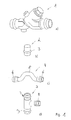
- valve housing 1 shown in FIG. 1a.
- the valve housing 1 belonging to the fittings sometimes has quite high wall thicknesses and can be made of solid material, for example by machining, but also by drop forging the ferritic or ferritic-austenitic steel alloys the above-mentioned alloying ingredients are produced.
- a titanium content of 0.15 wt .-% to 0.8 wt .-% ensured despite the high wall thicknesses a good corrosion resistance of the valve housing 1 against intergranular corrosion.
- the heat input is as low as possible, otherwise the steel alloy tends to strong grain growth and intercrystalline corrosion.
- the valve housing 1 can additionally be stabilized against intergranular corrosion.
- ferritic or ferritic austenitic steel alloy according to the invention is limited in its formability compared to deep drawing steels, the forming capability allows for the production of end caps 2 (FIG. 1b), which were produced by deep drawing from a strip of a corresponding steel alloy, provided that Forming a flow of the material is guaranteed.
- end caps 2 FIG. 1b
- an O-ring groove 3 can be introduced into the end cap 2.
- the press connector 4 consists of a tube with an overbend 5 and two-sided connection ends 6.
- the overbend 5 is produced by bending, whereas the connecting pieces 6 are introduced into the compression connector 4, for example, by an upsetting and widening step but also by using a hydroforming process ,
- the connecting pieces 6 can be pushed onto a corresponding connecting piece, for example a pipe, and pressed with this, so that a tight connection is formed.
- the T-piece 7 shown in Fig. 1d) has at the two opposite terminal ends O-ring grooves 3, which serve for connection, for example with press connectors.
- the T-piece 7 can be made by a hydroforming of a longitudinally welded pipe, the thread 8 is introduced, for example, by machining.
- the thread 8 can also be produced by rolling.
- the upsetting, flanging, necking and widening can be mentioned.
- the use according to the invention of the ferritic or ferritic-austenitic steel alloy not only allows the use of conventional forming techniques, but also results in particularly corrosion-resistant and economically producible fittings, fittings or compression connectors media or drinking water of leading industries.
Landscapes
- Chemical & Material Sciences (AREA)
- Engineering & Computer Science (AREA)
- Materials Engineering (AREA)
- Mechanical Engineering (AREA)
- Metallurgy (AREA)
- Organic Chemistry (AREA)
- Valve Housings (AREA)
- Laser Beam Processing (AREA)
- Pressure Vessels And Lids Thereof (AREA)
- Fuel-Injection Apparatus (AREA)
Abstract
Description
- Die Erfindung betrifft die Verwendung einer Stahllegierung zur Herstellung von Fittings, insbesondere Schraub- oder Steckfittings, Armaturen oder Pressverbinder für Medien oder Trinkwasser führende Gewerke sowie Fittings, insbesondere Schraub- oder Steckfittings, Armaturen oder Pressverbinder.
- Üblicherweise werden heutzutage hoch kupferhaltige Buntmetall-Legierungen, wie Bronze oder Rotguss, zur Herstellung Medien führender Bauteile von beispielsweise Gas oder Trinkwasser führender Gewerke eingesetzt. Die eingesetzten Buntmetall-Legierungen unterliegen, insbesondere bei für die Trinkwasserversorgung vorgesehenen Gewerken, hohen Anforderungen. Einerseits müssen die Buntmetall-Legierungen eine besonders hohe Korrosionsbeständigkeit aufweisen, da die beispielsweise mit Trinkwasser in Kontakt stehenden Bauteile auch bei langjährigem Einsatz nicht korrodieren sollten. Neben einer geringen Migrationsneigung von Metallionen in das Medium sollten die Bauteile auch einfach herstellbar sein und mechanisch gut verarbeitet werden können. Aufgrund der steigenden Rohstoffpreise für Kupfer, dem Hauptbestandteil der bisher verwendeten Buntmetall-Legierungen, werden zunehmend Alternativen gesucht, welche neben guten Verarbeitungseigenschaften ähnlich hohe Korrosionsbeständigkeiten kostengünstig gewährleisten. Als Edelstahl-Legierungen wurden bisher austenitische Stähle, beispielsweise 1.4301 bzw. 1.4401 Stähle verwendet, welche sich zwar durch eine gute Umformbarkeit auszeichnen, so dass Fittings, Armaturen oder Pressverbinder wirtschaftlich hergestellt werden konnten. Allerdings ist deren Korrosionsbeständigkeit, insbesondere bei dickwandigen Teilen, die im ständigen Kontakt beispielsweise mit Trinkwasser bestehen, verbesserungsfähig. Ferritische Stähle, welche prinzipiell eine gleichwertige Korrosionsbeständigkeit aufweisen, sind zwar bekannt, wurden aber bisher nicht zur Herstellung von Fittings, Armaturen und Pressverbindern eingesetzt, da diese einerseits zur Grobkornbildung beim Schweißen neigen, was zu einer verringerten Korrosionsbeständigkeit führt. Andererseits ist die Herstellung dickwandiger Teile, wie beispielsweise Armaturen, aufgrund der verringerten Umformbarkeit der ferritischen Stahllegierungen problematisch.
- Hiervon ausgehend liegt der vorliegenden Erfindung die Aufgabe zugrunde, die Verwendung einer Stahllegierung vorzuschlagen, welche bei verbesserter Korrosionsbeständigkeit eine wirtschaftliche Herstellung von Fittings, Armaturen und Pressverbindern ermöglicht.
- Gemäß einer ersten Lehre der vorliegenden Erfindung wird die oben aufgezeigte Aufgabe durch die Verwendung einer Stahllegierung gelöst, die neben Eisen die folgenden Gehalte an Legierungsbestandteilen in Gewichtsprozent aufweist:


- Es hat sich überraschenderweise gezeigt, dass durch die Verwendung der Stahllegierung mit der angegebenen Zusammensetzung Fittings, Armaturen oder Pressverbindern auf wirtschaftliche Weise hergestellt werden können. Bisher ist man davon ausgegangen, dass entsprechende ferritische oder austenitisch-ferritische Stahllegierungen nicht zur Herstellung von entsprechenden Bauteilen geeignet waren, da diese einerseits hinsichtlich der Umformbarkeit Probleme bereiteten und andererseits bei einem Schweißen stark zu Grobkornbildung neigen, so dass die Korrosionsbeständigkeit in diesen Bereichen nicht mehr gegeben ist. Aufgrund von Fortschritten bei den Schweißverfahren, wie beispielsweise beim Laserschweißen, konnte der Wärmeintrag beim Schweißen so stark reduziert werden, dass eine Verringerung der Korrosionsbeständigkeit nun nahezu nicht mehr auftritt. Darüber hinaus haben Fortschritte im Bereich der Umformverfahren, welche ein Fließen des Werkstoffes ermöglichen, dazu geführt, dass Fittings, Armaturen oder Pressverbindern trotz ihrer Dickwandigkeit und der zu deren Herstellung benötigten hohen Umformgrade wirtschaftlich hergestellt werden können. Bei der erfindungsgemäßen Verwendung einer Stahllegierung wird aufgrund des geringen Kohlenstoffgehalts von max. 0,05 Gew.-% die interkristalline Korrosion der ferritisch oder ferritisch-austenitischen Stahllegierung deutlich verringert. Der Chromanteil von 11 Gew.-% bis 25 Gew.-% führt ebenfalls zu einer Verbesserung der Korrosionsbeständigkeit, wobei höhere Chromgehalte grundsätzlich die Korrosionsbeständigkeit erhöhen. Allerdings wird mit zunehmendem Chromgehalt die Verarbeitung der Stahllegierung zu Fittings, Armaturen und Pressverbindern schwieriger. Nickel gilt als Austenitbildner und bestimmt insofern den Anteil des austenitischen Gefüges in der Stahllegierung. Bei einem Anteil von weniger als 5 % beträgt der austenitische Anteil etwa 50 % der Stahllegierung. Je geringer der Nickelgehalt desto höher ist der ferritische Anteil des Gefüges. Über die Zugabe von max. 2 % Mangan kann die Umformbarkeit der Stahllegierung verbessert werden. Ein höherer Mangananteil würde dagegen die Korrosionsbeständigkeit der Stahllegierung verschlechtern. Mit einem Stickstoffgehalt von N ≤ 0,25 Gew.-% wird erreicht, dass einerseits durch das Vorhandensein von Stickstoff die Beständigkeit gegen Lochfraß der Stahllegierung verbessert wird. Andererseits wird durch die Begrenzung des Stickstoffgehaltes auf den genannten Wert die Umformbarkeit der Stahllegierung nicht negativ beeinträchtigt.
- Gemäß einer nächsten Ausführungsform der erfindungsgemäßen Verwendung weist die Stahllegierung einen Cr-Gehalt von

in Gewichtsprozent auf. Durch den erhöhten Chromgehalt der Stahllegierung kann insbesondere die Beständigkeit gegen Korrosion deutlich verbessert werden. - Um auch bei größeren Wanddicken eine hinreichende Stabilisierung gegen interkristalline Korrosion der Stahllegierung zu erreichen, weist die Stahllegierung einen Titangehalt von 0,15 Gew.-% bis 0,8 Gew.-% auf.
- Eine Beschränkung des Molybdän-Gehaltes auf kleiner oder gleich 0,5 Gew.-% erniedrigt die Kosten bei der Verwendung der Stahllegierung zur Herstellung von Fittings, Armaturen oder Pressverbindern.
- Eine deutliche Verbesserung der Korrosionsbeständigkeit kann jedoch durch die alternative Zugabe von Molybdän erreicht, so dass der Mo-Gehalt in der Stahllegierung auf

in Gewichtsprozent begrenzt ist. - Vorzugsweise wird der Stickstoffgehalt der Stahllegierung auf

in Gewichtsprozent beschränkt, um das Umformverhalten der Stahllegierung zu verbessern. - Gemäß einer nächsten weitergebildeten Ausführungsform der Erfindung wird eine Stahllegierung, die einen Nickelgehalt von

in Gewichtsprozent aufweist, verwendet. Über den Ni-Gehalt wird der Anteil zwischen ferritischem und austenitischem Gefüge eingestellt. Vorzugsweise beträgt der Anteil an austenitischem Gefüge maximal 50 %. Bei ähnlich guter Korrosionsbeständigkeit, wie die der ferritischen Stähle mit sehr geringerem Ni-Gehalt, weist die austenitisch-ferritische Stahllegierung verbesserte Zähigkeitskennwerte und Dauerfestigkeitseigenschaften in korrosivem Medium im Vergleich zu austenitischen Stählen und eine verbesserte Umformbarkeit im Vergleich zu den ferritischen Stahllegierungen auf. - Durch die Verwendung der Stahllegierung zur Herstellung von Fittings, insbesondere Schraub- oder Steckfittings, Armaturen oder Pressverbindern für Druckluftgewerke, Feuerlöschsysteme, Trinkwasserversorgungsgewerke oder Gasleitungen können auf wirtschaftliche Weise sehr korrosionsbeständige Gewerke zur Verfügung gestellt werden.
- Gemäß einer zweiten Lehre der vorliegenden Erfindung wird die oben aufgezeigte Aufgabe durch Fittings, insbesondere Schraub- oder Steckfittings, Armaturen oder Pressverbinder dadurch gelöst, dass diese durch die erfindungsgemäße Verwendung einer Stahllegierung hergestellt worden sind. Hinsichtlich der Vorteile der so hergestellten Fittings, Armaturen und Pressverbinder wird daher auf die vorherigen Ausführungen zur erfindungsgemäßen Verwendung der Stahllegierung verwiesen.
- Es gibt nun eine Vielzahl von Möglichkeiten die erfindungsgemäße Verwendung sowie die erfindungsgemäßen Bauteile auszugestalten und weiterzubilden. Hierzu wird verwiesen auf die dem Patentanspruch 1 nachgeordneten Patentansprüche sowie auf die Beschreibung von Ausführungsbeispielen in Verbindung mit der Zeichnung. Die Zeichnung zeigt in
- Fig. 1 a)-d)
- perspektivische Ansichten von vier Ausführungsbeispielen von erfindungsgemäßen Fittings, Armaturen und Pressverbindern.
- Ein Ausführungsbeispiel für erfindungsgemäße Armaturen ist beispielsweise das in Fig. 1a) gezeigte Ventilgehäuse 1. Das zu den Armaturen zählende Ventilgehäuse 1 weist zum Teil recht hohe Wanddicken auf und kann aus Vollmaterial, beispielsweise zerspanend aber auch durch Gesenkschmieden der ferritischen oder ferritisch-austenitischen Stahllegierungen mit den oben angegebenen Legierungsbestandteilen hergestellt werden.
- Insbesondere ein Titangehalt von 0,15 Gew.-% bis 0,8 Gew.-% gewährleistet trotz der hohen Wanddicken eine gute Korrosionsbeständigkeit des Ventilgehäuses 1 gegen interkristalline Korrosion. Beim Schweißen des erfindungsgemäßen Ventilgehäuses 1 muss darauf geachtet werden, dass der Wärmeeintrag möglichst gering ist, da anderenfalls die Stahllegierung zu starkem Kornwachstum und zur interkristallinen Korrosion neigt. Vorzugsweise wird daher mit Laserschweißverfahren geschweißt, die auf einen möglichst niedrigen Wärmeeintrag optimiert sind. Durch die Zugabe von bis zu 2,5 Gew.-% Molybdän kann das Ventilgehäuse 1 darüber hinaus zusätzlich gegen interkristalline Korrosion stabilisiert werden.
- Zwar ist die erfindungsgemäße ferritische oder ferritischaustenitische Stahllegierung im Vergleich zu Tiefziehstählen in ihrem Umformvermögen beschränkt, dennoch lässt das Umformvermögen die Fertigung von Endkappen 2 (Fig. 1b)) zu, welche durch Tiefziehen aus einem Band aus einer entsprechenden Stahllegierung hergestellt wurde, sofern bei der Umformung ein Fließen des Werkstoffes gewährleistet wird. In einem weiteren Kaltumformschritt kann beispielsweise eine O-Ringnut 3 in die Endkappe 2 eingebracht werden.
- Einen Pressverbinder 4 zeigt die Fig. 1c). Der Pressverbinder 4 besteht aus einem Rohr mit einem Überbogen 5 und beidseitigen Anschlussenden 6. Der Überbogen 5 wird durch Biegen erzeugt, wohingegen die Anschlussstücke 6 beispielsweise durch einen Stauch- und Aufweitungsschritt aber auch durch die Verwendung eines Innenhochdruckumform-Verfahrens in den Pressverbinder 4 eingebracht werden. Die Anschlussstücke 6 können auf ein entsprechendes Anschlussstück, beispielsweise eines Rohres, aufgeschoben werden und mit diesem verpresst werden, so dass eine dichte Verbindung entsteht.
- Das in Fig. 1d) gezeigte T-Stück 7 weist an den beiden gegenüberliegenden Anschlussenden O-Ringnuten 3 auf, welche zur Verbindung, beispielsweise mit Pressverbindern dienen. Beispielsweise kann das T-Stück 7 durch ein Innenhochdruckumformen aus einem längsnahtgeschweißten Rohr hergestellt werden, wobei das Gewinde 8 beispielsweise zerspanend eingebracht wird. Allerdings kann das Gewinde 8 auch durch Rollieren hergestellt werden. Als weitere Umformschritte können das Stauchen, Bördeln, Aushalsen und Aufweiten genannt werden. Die erfindungsgemäße Verwendung der ferritischen oder ferritisch-austenitischen Stahllegierung ermöglicht den Einsatz nicht nur der konventionellen Umformtechniken, sondern ergibt im Ergebnis besonders korrosionsbeständige und wirtschaftlich herstellbare Fittings, Armaturen oder Pressverbinder Medien oder Trinkwasser führender Gewerke.
Claims (9)
- Verwendung einer Stahllegierung zur Herstellung von Fittings, insbesondere Schraub- oder Steckfittings, Armaturen oder Pressverbinder für Medien oder Trinkwasser führende Gewerke,
dadurch gekennzeichnet, dass
die Stahllegierung neben Eisen die folgenden Gehalte an Legierungsbestandteilen in Gewichtsprozent aufweist:


- Verwendung nach Anspruch 1,
dadurch gekennzeichnet, dass
die Stahllegierung einen Cr-Gehalt von
in Gewichtsprozent aufweist. - Verwendung nach Anspruch 1 oder 2,
dadurch gekennzeichnet, dass
die Stahllegierung einen Ti-Gehalt von
in Gewichtsprozent aufweist. - Verwendung nach einem der Ansprüche 1 bis 3,
dadurch gekennzeichnet, dass
die Stahllegierung einen Mo-Gehalt von Mo < 0,5 % in Gewichtsprozent aufweist. - Verwendung nach einem der Ansprüche 1 bis 4,
dadurch gekennzeichnet, dass
die Stahllegierung alternativ einen Mo-Gehalt von
vorzugsweise 1,8 % ≤ Mo ≤ 2,5 %
in Gewichtsprozent aufweist. - Verwendung nach einem der Ansprüche 1 bis 5,
dadurch gekennzeichnet, dass
die Stahllegierung einen N-Gehalt von
N ≤ 0,03 %, vorzugsweise N ≤ 0,015 %
in Gewichtsprozent aufweist. - Verwendung nach einem der Ansprüche 1 bis 6,
dadurch gekennzeichnet, dass
die Stahllegierung einen Ni-Gehalt von
in Gewichtsprozent aufweist. - Verwendung nach einem der Ansprüche 1 bis 7,
dadurch gekennzeichnet, dass
die Stahllegierung zur Herstellung von Fittings, insbesondere Schraub- oder Steckfittings, Armaturen oder Pressverbinder für Druckluftgewerke, Feuerlöschsysteme, Trinkwasserversorgungsgewerke oder Gasleitungen verwendet wird. - Fittings, insbesondere Schraub- oder Steckfittings, Armaturen oder Pressverbinder hergestellt durch die Verwendung einer Stahllegierung nach einem der Ansprüche 1 bis 8.
Priority Applications (5)
| Application Number | Priority Date | Filing Date | Title |
|---|---|---|---|
| PT61242483T PT1930462E (pt) | 2006-11-16 | 2006-11-16 | Acessórios para instalações de condutas de água potável |
| DK06124248.3T DK1930462T3 (en) | 2006-11-16 | 2006-11-16 | Fittings for drinking water installations |
| EP06124248.3A EP1930462B1 (de) | 2006-11-16 | 2006-11-16 | Fittings für Trinkwasser führende Gewerke |
| ES06124248.3T ES2455517T3 (es) | 2006-11-16 | 2006-11-16 | Piezas de empalme para construcciones que conducen agua potable |
| US11/941,496 US20080118388A1 (en) | 2006-11-16 | 2007-11-16 | Fluid or Drinking Water Ducting Systems |
Applications Claiming Priority (1)
| Application Number | Priority Date | Filing Date | Title |
|---|---|---|---|
| EP06124248.3A EP1930462B1 (de) | 2006-11-16 | 2006-11-16 | Fittings für Trinkwasser führende Gewerke |
Publications (2)
| Publication Number | Publication Date |
|---|---|
| EP1930462A1 true EP1930462A1 (de) | 2008-06-11 |
| EP1930462B1 EP1930462B1 (de) | 2014-01-01 |
Family
ID=38016788
Family Applications (1)
| Application Number | Title | Priority Date | Filing Date |
|---|---|---|---|
| EP06124248.3A Active EP1930462B1 (de) | 2006-11-16 | 2006-11-16 | Fittings für Trinkwasser führende Gewerke |
Country Status (5)
| Country | Link |
|---|---|
| US (1) | US20080118388A1 (de) |
| EP (1) | EP1930462B1 (de) |
| DK (1) | DK1930462T3 (de) |
| ES (1) | ES2455517T3 (de) |
| PT (1) | PT1930462E (de) |
Cited By (2)
| Publication number | Priority date | Publication date | Assignee | Title |
|---|---|---|---|---|
| WO2013097978A1 (de) * | 2011-12-27 | 2013-07-04 | Robert Bosch Gmbh | Verfahren zum fügen metallischer bauteile |
| CN111987661A (zh) * | 2020-08-24 | 2020-11-24 | 任珂 | 一种穿戴产品用万向调节结构的加工工艺及万向调节结构 |
Families Citing this family (1)
| Publication number | Priority date | Publication date | Assignee | Title |
|---|---|---|---|---|
| US10811290B2 (en) * | 2018-05-23 | 2020-10-20 | Taiwan Semiconductor Manufacturing Co., Ltd. | Systems and methods for inspection stations |
Citations (6)
| Publication number | Priority date | Publication date | Assignee | Title |
|---|---|---|---|---|
| JPH01180946A (ja) | 1988-01-12 | 1989-07-18 | Sumitomo Metal Ind Ltd | 超純水用配管材料及びその製造方法 |
| JPH08283914A (ja) * | 1995-04-11 | 1996-10-29 | Nippon Steel Corp | ベローズ用フェライト系ステンレス鋼板 |
| JPH08333656A (ja) * | 1995-06-05 | 1996-12-17 | Nippon Steel Corp | ベローズ用フェライト系ステンレス鋼管 |
| JPH09143630A (ja) * | 1995-11-17 | 1997-06-03 | Nippon Steel Corp | 自動車排気系フレキシブルチューブ用フェライト系ステンレス鋼板 |
| WO1999025890A1 (en) * | 1997-11-17 | 1999-05-27 | Ceramic Fuel Cells Limited | A heat resistant steel |
| US20040035501A1 (en) * | 2001-01-18 | 2004-02-26 | Kawasaki Steel Corporation, A Corporation Of Japan | Ferritic stainless steel sheet with excellent workability and method for making the same |
Family Cites Families (5)
| Publication number | Priority date | Publication date | Assignee | Title |
|---|---|---|---|---|
| US4398966A (en) * | 1982-04-28 | 1983-08-16 | Huntington Alloys, Inc. | Corrosion of type 304 stainless steel by laser surface treatment |
| JPH02299722A (ja) * | 1989-05-15 | 1990-12-12 | Makoto Murata | 押し通し曲げ加工方法及び同方法による曲げ加工装置 |
| JPH08300172A (ja) * | 1995-04-28 | 1996-11-19 | Nkk Corp | 溶接鋼管の製造方法 |
| JPH1147969A (ja) * | 1997-08-01 | 1999-02-23 | Kawasaki Steel Corp | 耐食性に優れたラインパイプ用溶接鋼管の製造方法 |
| FR2840835B1 (fr) * | 2002-06-14 | 2004-08-27 | Air Liquide | Utilisation de melanges gazeux helium/azote en soudage laser de tubes en acier inoxydable |
-
2006
- 2006-11-16 EP EP06124248.3A patent/EP1930462B1/de active Active
- 2006-11-16 PT PT61242483T patent/PT1930462E/pt unknown
- 2006-11-16 DK DK06124248.3T patent/DK1930462T3/en active
- 2006-11-16 ES ES06124248.3T patent/ES2455517T3/es active Active
-
2007
- 2007-11-16 US US11/941,496 patent/US20080118388A1/en not_active Abandoned
Patent Citations (6)
| Publication number | Priority date | Publication date | Assignee | Title |
|---|---|---|---|---|
| JPH01180946A (ja) | 1988-01-12 | 1989-07-18 | Sumitomo Metal Ind Ltd | 超純水用配管材料及びその製造方法 |
| JPH08283914A (ja) * | 1995-04-11 | 1996-10-29 | Nippon Steel Corp | ベローズ用フェライト系ステンレス鋼板 |
| JPH08333656A (ja) * | 1995-06-05 | 1996-12-17 | Nippon Steel Corp | ベローズ用フェライト系ステンレス鋼管 |
| JPH09143630A (ja) * | 1995-11-17 | 1997-06-03 | Nippon Steel Corp | 自動車排気系フレキシブルチューブ用フェライト系ステンレス鋼板 |
| WO1999025890A1 (en) * | 1997-11-17 | 1999-05-27 | Ceramic Fuel Cells Limited | A heat resistant steel |
| US20040035501A1 (en) * | 2001-01-18 | 2004-02-26 | Kawasaki Steel Corporation, A Corporation Of Japan | Ferritic stainless steel sheet with excellent workability and method for making the same |
Cited By (3)
| Publication number | Priority date | Publication date | Assignee | Title |
|---|---|---|---|---|
| WO2013097978A1 (de) * | 2011-12-27 | 2013-07-04 | Robert Bosch Gmbh | Verfahren zum fügen metallischer bauteile |
| CN104023901A (zh) * | 2011-12-27 | 2014-09-03 | 罗伯特·博世有限公司 | 用于接合金属构件的方法 |
| CN111987661A (zh) * | 2020-08-24 | 2020-11-24 | 任珂 | 一种穿戴产品用万向调节结构的加工工艺及万向调节结构 |
Also Published As
| Publication number | Publication date |
|---|---|
| ES2455517T3 (es) | 2014-04-15 |
| PT1930462E (pt) | 2014-04-04 |
| DK1930462T3 (en) | 2014-03-24 |
| EP1930462B1 (de) | 2014-01-01 |
| US20080118388A1 (en) | 2008-05-22 |
Similar Documents
| Publication | Publication Date | Title |
|---|---|---|
| DE3221833C2 (de) | ||
| DE10308778B3 (de) | Bleifreie Kupferlegierung und deren Verwendung | |
| DE69604341T3 (de) | Martensitischer. rostfreier stahl mit guter beständigkeit gegen lochfrasskorrosion und mit hoher härte | |
| DE3221857C2 (de) | Eisenlegierung mit erhöhter Widerstandsfähigkeit gegen Spannungsrißkorrosion | |
| DE60214456T2 (de) | Martensitischer rostfreier Stahl mit hoher Härte und guter Korrosionsbeständigkeit | |
| DE60200326T2 (de) | Ferritisches rostfreies Stahlblech mit hervorragender Verformbarkeit und Verfahren zu dessen Herstellung | |
| EP1452612A2 (de) | Bleifreie Kupferlegierung und deren Verwendung | |
| DE60024761T2 (de) | Schweisszusatzwerkstoff und Verfahren zum Herstellen einer Schweissverbindung | |
| AT392654B (de) | Nichtrostender, ausscheidungshaertbarer martensitstahl | |
| EP0123054B1 (de) | Korrosionsbeständiger Chromstahl und Verfahren zu seiner Herstellung | |
| AT409636B (de) | Stahl für kunststoffformen und verfahren zur wärmebehandlung desselben | |
| DE69204348T2 (de) | Rostfreies plattiertes Blech und Verfahren zu seiner Herstellung. | |
| DE69911452T2 (de) | Neue verwendung von rostfreiem stahl in seewasseranwendungen | |
| DE60029917T2 (de) | Schweisszusatzwerkstoff und Verfahren zum Lichtbogenschweissen von niedriggekohlten martensitischen rostfreien Stahl | |
| EP2220407A1 (de) | Leitungsteil aus nickelarmem stahl für eine abgasanlage | |
| DE2447137B2 (de) | Gegen gruebchenkorrosion bestaendige stahllegierung | |
| DE3109796C2 (de) | Verwendung eines ausscheidungshärtbaren rostfreien Stahles als Werkstoff zur Herstellung von Federn | |
| EP2192202A1 (de) | Aluminiumband für lithographische Druckplattenträger mit hoher Biegewechselbeständigkeit | |
| EP2976441B1 (de) | Eisenbasierte formgedächtnislegierung | |
| EP1930462B1 (de) | Fittings für Trinkwasser führende Gewerke | |
| DE69923486T2 (de) | Neue Verwendung eines hochfesten rostfreien Stahls | |
| EP0750686B1 (de) | Korrosions- und verschleissbeständiger hartguss | |
| EP0455625B1 (de) | Hochfeste korrosionsbeständige Duplexlegierung | |
| DE3130179C2 (de) | Ferritischer, hitzebeständiger Stahl | |
| DE60129223T2 (de) | Austenitische legierung |
Legal Events
| Date | Code | Title | Description |
|---|---|---|---|
| PUAI | Public reference made under article 153(3) epc to a published international application that has entered the european phase |
Free format text: ORIGINAL CODE: 0009012 |
|
| AK | Designated contracting states |
Kind code of ref document: A1 Designated state(s): AT BE BG CH CY CZ DE DK EE ES FI FR GB GR HU IE IS IT LI LT LU LV MC NL PL PT RO SE SI SK TR |
|
| AX | Request for extension of the european patent |
Extension state: AL BA HR MK RS |
|
| 17P | Request for examination filed |
Effective date: 20081211 |
|
| 17Q | First examination report despatched |
Effective date: 20090115 |
|
| AKX | Designation fees paid |
Designated state(s): AT BE BG CH CY CZ DE DK EE ES FI FR GB GR HU IE IS IT LI LT LU LV MC NL PL PT RO SE SI SK TR |
|
| RTI1 | Title (correction) |
Free format text: FITTINGS FOR MEDIA OR DRINKING WATER CARRYING ASSEMBLY SECTIONS |
|
| GRAP | Despatch of communication of intention to grant a patent |
Free format text: ORIGINAL CODE: EPIDOSNIGR1 |
|
| INTG | Intention to grant announced |
Effective date: 20130704 |
|
| GRAS | Grant fee paid |
Free format text: ORIGINAL CODE: EPIDOSNIGR3 |
|
| GRAA | (expected) grant |
Free format text: ORIGINAL CODE: 0009210 |
|
| AK | Designated contracting states |
Kind code of ref document: B1 Designated state(s): AT BE BG CH CY CZ DE DK EE ES FI FR GB GR HU IE IS IT LI LT LU LV MC NL PL PT RO SE SI SK TR |
|
| REG | Reference to a national code |
Ref country code: GB Ref legal event code: FG4D Free format text: NOT ENGLISH |
|
| REG | Reference to a national code |
Ref country code: CH Ref legal event code: EP |
|
| REG | Reference to a national code |
Ref country code: IE Ref legal event code: FG4D Free format text: LANGUAGE OF EP DOCUMENT: GERMAN |
|
| REG | Reference to a national code |
Ref country code: AT Ref legal event code: REF Ref document number: 647653 Country of ref document: AT Kind code of ref document: T Effective date: 20140215 |
|
| REG | Reference to a national code |
Ref country code: DE Ref legal event code: R096 Ref document number: 502006013471 Country of ref document: DE Effective date: 20140220 |
|
| REG | Reference to a national code |
Ref country code: CH Ref legal event code: NV Representative=s name: TROESCH SCHEIDEGGER WERNER AG, CH |
|
| REG | Reference to a national code |
Ref country code: DK Ref legal event code: T3 Effective date: 20140320 |
|
| REG | Reference to a national code |
Ref country code: PT Ref legal event code: SC4A Free format text: AVAILABILITY OF NATIONAL TRANSLATION Effective date: 20140331 |
|
| REG | Reference to a national code |
Ref country code: ES Ref legal event code: FG2A Ref document number: 2455517 Country of ref document: ES Kind code of ref document: T3 Effective date: 20140415 |
|
| REG | Reference to a national code |
Ref country code: NL Ref legal event code: T3 |
|
| REG | Reference to a national code |
Ref country code: LT Ref legal event code: MG4D |
|
| PG25 | Lapsed in a contracting state [announced via postgrant information from national office to epo] |
Ref country code: IS Free format text: LAPSE BECAUSE OF FAILURE TO SUBMIT A TRANSLATION OF THE DESCRIPTION OR TO PAY THE FEE WITHIN THE PRESCRIBED TIME-LIMIT Effective date: 20140501 Ref country code: LT Free format text: LAPSE BECAUSE OF FAILURE TO SUBMIT A TRANSLATION OF THE DESCRIPTION OR TO PAY THE FEE WITHIN THE PRESCRIBED TIME-LIMIT Effective date: 20140101 |
|
| PG25 | Lapsed in a contracting state [announced via postgrant information from national office to epo] |
Ref country code: SE Free format text: LAPSE BECAUSE OF FAILURE TO SUBMIT A TRANSLATION OF THE DESCRIPTION OR TO PAY THE FEE WITHIN THE PRESCRIBED TIME-LIMIT Effective date: 20140101 Ref country code: CY Free format text: LAPSE BECAUSE OF FAILURE TO SUBMIT A TRANSLATION OF THE DESCRIPTION OR TO PAY THE FEE WITHIN THE PRESCRIBED TIME-LIMIT Effective date: 20140101 Ref country code: FI Free format text: LAPSE BECAUSE OF FAILURE TO SUBMIT A TRANSLATION OF THE DESCRIPTION OR TO PAY THE FEE WITHIN THE PRESCRIBED TIME-LIMIT Effective date: 20140101 |
|
| PG25 | Lapsed in a contracting state [announced via postgrant information from national office to epo] |
Ref country code: LV Free format text: LAPSE BECAUSE OF FAILURE TO SUBMIT A TRANSLATION OF THE DESCRIPTION OR TO PAY THE FEE WITHIN THE PRESCRIBED TIME-LIMIT Effective date: 20140101 |
|
| REG | Reference to a national code |
Ref country code: DE Ref legal event code: R097 Ref document number: 502006013471 Country of ref document: DE |
|
| PG25 | Lapsed in a contracting state [announced via postgrant information from national office to epo] |
Ref country code: CZ Free format text: LAPSE BECAUSE OF FAILURE TO SUBMIT A TRANSLATION OF THE DESCRIPTION OR TO PAY THE FEE WITHIN THE PRESCRIBED TIME-LIMIT Effective date: 20140101 Ref country code: EE Free format text: LAPSE BECAUSE OF FAILURE TO SUBMIT A TRANSLATION OF THE DESCRIPTION OR TO PAY THE FEE WITHIN THE PRESCRIBED TIME-LIMIT Effective date: 20140101 Ref country code: RO Free format text: LAPSE BECAUSE OF FAILURE TO SUBMIT A TRANSLATION OF THE DESCRIPTION OR TO PAY THE FEE WITHIN THE PRESCRIBED TIME-LIMIT Effective date: 20140101 |
|
| PLBE | No opposition filed within time limit |
Free format text: ORIGINAL CODE: 0009261 |
|
| STAA | Information on the status of an ep patent application or granted ep patent |
Free format text: STATUS: NO OPPOSITION FILED WITHIN TIME LIMIT |
|
| PG25 | Lapsed in a contracting state [announced via postgrant information from national office to epo] |
Ref country code: SK Free format text: LAPSE BECAUSE OF FAILURE TO SUBMIT A TRANSLATION OF THE DESCRIPTION OR TO PAY THE FEE WITHIN THE PRESCRIBED TIME-LIMIT Effective date: 20140101 Ref country code: PL Free format text: LAPSE BECAUSE OF FAILURE TO SUBMIT A TRANSLATION OF THE DESCRIPTION OR TO PAY THE FEE WITHIN THE PRESCRIBED TIME-LIMIT Effective date: 20140101 |
|
| 26N | No opposition filed |
Effective date: 20141002 |
|
| REG | Reference to a national code |
Ref country code: DE Ref legal event code: R097 Ref document number: 502006013471 Country of ref document: DE Effective date: 20141002 |
|
| PG25 | Lapsed in a contracting state [announced via postgrant information from national office to epo] |
Ref country code: SI Free format text: LAPSE BECAUSE OF FAILURE TO SUBMIT A TRANSLATION OF THE DESCRIPTION OR TO PAY THE FEE WITHIN THE PRESCRIBED TIME-LIMIT Effective date: 20140101 |
|
| PG25 | Lapsed in a contracting state [announced via postgrant information from national office to epo] |
Ref country code: BE Free format text: LAPSE BECAUSE OF NON-PAYMENT OF DUE FEES Effective date: 20141130 Ref country code: LU Free format text: LAPSE BECAUSE OF FAILURE TO SUBMIT A TRANSLATION OF THE DESCRIPTION OR TO PAY THE FEE WITHIN THE PRESCRIBED TIME-LIMIT Effective date: 20141116 Ref country code: MC Free format text: LAPSE BECAUSE OF FAILURE TO SUBMIT A TRANSLATION OF THE DESCRIPTION OR TO PAY THE FEE WITHIN THE PRESCRIBED TIME-LIMIT Effective date: 20140101 |
|
| GBPC | Gb: european patent ceased through non-payment of renewal fee |
Effective date: 20141116 |
|
| REG | Reference to a national code |
Ref country code: IE Ref legal event code: MM4A |
|
| PG25 | Lapsed in a contracting state [announced via postgrant information from national office to epo] |
Ref country code: IE Free format text: LAPSE BECAUSE OF NON-PAYMENT OF DUE FEES Effective date: 20141116 Ref country code: GB Free format text: LAPSE BECAUSE OF NON-PAYMENT OF DUE FEES Effective date: 20141116 |
|
| REG | Reference to a national code |
Ref country code: FR Ref legal event code: PLFP Year of fee payment: 10 |
|
| PG25 | Lapsed in a contracting state [announced via postgrant information from national office to epo] |
Ref country code: BG Free format text: LAPSE BECAUSE OF FAILURE TO SUBMIT A TRANSLATION OF THE DESCRIPTION OR TO PAY THE FEE WITHIN THE PRESCRIBED TIME-LIMIT Effective date: 20140101 |
|
| PG25 | Lapsed in a contracting state [announced via postgrant information from national office to epo] |
Ref country code: GR Free format text: LAPSE BECAUSE OF FAILURE TO SUBMIT A TRANSLATION OF THE DESCRIPTION OR TO PAY THE FEE WITHIN THE PRESCRIBED TIME-LIMIT Effective date: 20140402 |
|
| PG25 | Lapsed in a contracting state [announced via postgrant information from national office to epo] |
Ref country code: HU Free format text: LAPSE BECAUSE OF FAILURE TO SUBMIT A TRANSLATION OF THE DESCRIPTION OR TO PAY THE FEE WITHIN THE PRESCRIBED TIME-LIMIT; INVALID AB INITIO Effective date: 20061116 Ref country code: TR Free format text: LAPSE BECAUSE OF FAILURE TO SUBMIT A TRANSLATION OF THE DESCRIPTION OR TO PAY THE FEE WITHIN THE PRESCRIBED TIME-LIMIT Effective date: 20140101 |
|
| REG | Reference to a national code |
Ref country code: FR Ref legal event code: PLFP Year of fee payment: 11 |
|
| REG | Reference to a national code |
Ref country code: DE Ref legal event code: R082 Ref document number: 502006013471 Country of ref document: DE Representative=s name: COHAUSZ & FLORACK PATENT- UND RECHTSANWAELTE P, DE Ref country code: DE Ref legal event code: R081 Ref document number: 502006013471 Country of ref document: DE Owner name: VIEGA TECHNOLOGY GMBH & CO. KG, DE Free format text: FORMER OWNER: VIEGA GMBH & CO. KG, 57439 ATTENDORN, DE |
|
| REG | Reference to a national code |
Ref country code: AT Ref legal event code: PC Ref document number: 647653 Country of ref document: AT Kind code of ref document: T Owner name: VIEGA TECHNOLOGY GMBH & CO. KG, DE Effective date: 20170512 |
|
| REG | Reference to a national code |
Ref country code: NL Ref legal event code: PD Owner name: VIEGA TECHNOLOGY GMBH & CO. KG; DE Free format text: DETAILS ASSIGNMENT: CHANGE OF OWNER(S), ASSIGNMENT; FORMER OWNER NAME: VIEGA GMBH & CO. KG Effective date: 20170412 |
|
| REG | Reference to a national code |
Ref country code: ES Ref legal event code: PC2A Owner name: VIEGA TECHNOLOGY GMBH & CO. KG Effective date: 20170925 |
|
| REG | Reference to a national code |
Ref country code: FR Ref legal event code: TP Owner name: VIEGA TECHNOLOGY GMBH & CO. KG, DE Effective date: 20171013 |
|
| REG | Reference to a national code |
Ref country code: FR Ref legal event code: PLFP Year of fee payment: 12 |
|
| REG | Reference to a national code |
Ref country code: CH Ref legal event code: PUE Owner name: VIEGA TECHNOLOGY GMBH AND CO. KG, DE Free format text: FORMER OWNER: VIEGA GMBH AND CO. KG, DE |
|
| PGFP | Annual fee paid to national office [announced via postgrant information from national office to epo] |
Ref country code: FR Payment date: 20211118 Year of fee payment: 16 Ref country code: ES Payment date: 20211215 Year of fee payment: 16 Ref country code: DK Payment date: 20211123 Year of fee payment: 16 Ref country code: PT Payment date: 20211018 Year of fee payment: 16 Ref country code: AT Payment date: 20211119 Year of fee payment: 16 |
|
| REG | Reference to a national code |
Ref country code: DK Ref legal event code: EBP Effective date: 20221130 |
|
| REG | Reference to a national code |
Ref country code: AT Ref legal event code: MM01 Ref document number: 647653 Country of ref document: AT Kind code of ref document: T Effective date: 20221116 |
|
| PG25 | Lapsed in a contracting state [announced via postgrant information from national office to epo] |
Ref country code: PT Free format text: LAPSE BECAUSE OF NON-PAYMENT OF DUE FEES Effective date: 20230516 Ref country code: AT Free format text: LAPSE BECAUSE OF NON-PAYMENT OF DUE FEES Effective date: 20221116 |
|
| PG25 | Lapsed in a contracting state [announced via postgrant information from national office to epo] |
Ref country code: DK Free format text: LAPSE BECAUSE OF NON-PAYMENT OF DUE FEES Effective date: 20221130 |
|
| PG25 | Lapsed in a contracting state [announced via postgrant information from national office to epo] |
Ref country code: FR Free format text: LAPSE BECAUSE OF NON-PAYMENT OF DUE FEES Effective date: 20221130 |
|
| PGFP | Annual fee paid to national office [announced via postgrant information from national office to epo] |
Ref country code: NL Payment date: 20231121 Year of fee payment: 18 |
|
| REG | Reference to a national code |
Ref country code: ES Ref legal event code: FD2A Effective date: 20231229 |
|
| PG25 | Lapsed in a contracting state [announced via postgrant information from national office to epo] |
Ref country code: ES Free format text: LAPSE BECAUSE OF NON-PAYMENT OF DUE FEES Effective date: 20221117 |
|
| PG25 | Lapsed in a contracting state [announced via postgrant information from national office to epo] |
Ref country code: ES Free format text: LAPSE BECAUSE OF NON-PAYMENT OF DUE FEES Effective date: 20221117 |
|
| PGFP | Annual fee paid to national office [announced via postgrant information from national office to epo] |
Ref country code: IT Payment date: 20231122 Year of fee payment: 18 |
|
| REG | Reference to a national code |
Ref country code: NL Ref legal event code: MM Effective date: 20241201 |
|
| PG25 | Lapsed in a contracting state [announced via postgrant information from national office to epo] |
Ref country code: NL Free format text: LAPSE BECAUSE OF NON-PAYMENT OF DUE FEES Effective date: 20241201 |
|
| PG25 | Lapsed in a contracting state [announced via postgrant information from national office to epo] |
Ref country code: IT Free format text: LAPSE BECAUSE OF NON-PAYMENT OF DUE FEES Effective date: 20241116 |
|
| REG | Reference to a national code |
Ref country code: CH Ref legal event code: U11 Free format text: ST27 STATUS EVENT CODE: U-0-0-U10-U11 (AS PROVIDED BY THE NATIONAL OFFICE) Effective date: 20251201 |
|
| PGFP | Annual fee paid to national office [announced via postgrant information from national office to epo] |
Ref country code: DE Payment date: 20251120 Year of fee payment: 20 |
|
| PGFP | Annual fee paid to national office [announced via postgrant information from national office to epo] |
Ref country code: CH Payment date: 20251201 Year of fee payment: 20 |