EP1930396A1 - Furochromanderivate - Google Patents
Furochromanderivate Download PDFInfo
- Publication number
- EP1930396A1 EP1930396A1 EP07021758A EP07021758A EP1930396A1 EP 1930396 A1 EP1930396 A1 EP 1930396A1 EP 07021758 A EP07021758 A EP 07021758A EP 07021758 A EP07021758 A EP 07021758A EP 1930396 A1 EP1930396 A1 EP 1930396A1
- Authority
- EP
- European Patent Office
- Prior art keywords
- compounds
- formula
- independently
- difluoro
- liquid
- Prior art date
- Legal status (The legal status is an assumption and is not a legal conclusion. Google has not performed a legal analysis and makes no representation as to the accuracy of the status listed.)
- Granted
Links
- SQACXVQZSRFZRH-UHFFFAOYSA-N 3,4-dihydro-2H-furo[2,3-h]chromene Chemical class C1CCOC2=C1C=CC1=C2C=CO1 SQACXVQZSRFZRH-UHFFFAOYSA-N 0.000 title 1
- 150000001875 compounds Chemical class 0.000 claims abstract description 172
- -1 naphthalene-2,6-diyl residue Chemical group 0.000 claims abstract description 126
- 239000004973 liquid crystal related substance Substances 0.000 claims abstract description 65
- 238000000034 method Methods 0.000 claims abstract description 17
- 125000000217 alkyl group Chemical group 0.000 claims abstract description 15
- 229910052736 halogen Inorganic materials 0.000 claims abstract description 14
- 150000002367 halogens Chemical class 0.000 claims abstract description 14
- 125000004434 sulfur atom Chemical group 0.000 claims abstract description 3
- 239000000758 substrate Substances 0.000 claims abstract 2
- 238000002360 preparation method Methods 0.000 claims description 34
- 229910052740 iodine Inorganic materials 0.000 claims description 12
- 230000008569 process Effects 0.000 claims description 7
- 229910052757 nitrogen Inorganic materials 0.000 claims description 6
- 125000004430 oxygen atom Chemical group O* 0.000 claims description 4
- KWKAKUADMBZCLK-UHFFFAOYSA-N 1-octene Chemical group CCCCCCC=C KWKAKUADMBZCLK-UHFFFAOYSA-N 0.000 claims description 2
- 125000005843 halogen group Chemical group 0.000 claims description 2
- 125000004817 pentamethylene group Chemical group [H]C([H])([*:2])C([H])([H])C([H])([H])C([H])([H])C([H])([H])[*:1] 0.000 claims description 2
- 229910052760 oxygen Inorganic materials 0.000 abstract description 2
- 238000004519 manufacturing process Methods 0.000 abstract 2
- QVGXLLKOCUKJST-UHFFFAOYSA-N atomic oxygen Chemical compound [O] QVGXLLKOCUKJST-UHFFFAOYSA-N 0.000 abstract 1
- 239000001301 oxygen Substances 0.000 abstract 1
- 239000000243 solution Substances 0.000 description 76
- IMNFDUFMRHMDMM-UHFFFAOYSA-N N-Heptane Chemical compound CCCCCCC IMNFDUFMRHMDMM-UHFFFAOYSA-N 0.000 description 55
- BZLVMXJERCGZMT-UHFFFAOYSA-N Methyl tert-butyl ether Chemical compound COC(C)(C)C BZLVMXJERCGZMT-UHFFFAOYSA-N 0.000 description 45
- 239000000203 mixture Substances 0.000 description 38
- 229910004298 SiO 2 Inorganic materials 0.000 description 34
- 238000004440 column chromatography Methods 0.000 description 32
- XLYOFNOQVPJJNP-UHFFFAOYSA-N water Substances O XLYOFNOQVPJJNP-UHFFFAOYSA-N 0.000 description 32
- 238000006243 chemical reaction Methods 0.000 description 29
- YXFVVABEGXRONW-UHFFFAOYSA-N Toluene Chemical compound CC1=CC=CC=C1 YXFVVABEGXRONW-UHFFFAOYSA-N 0.000 description 27
- 238000000819 phase cycle Methods 0.000 description 24
- PMZURENOXWZQFD-UHFFFAOYSA-L Sodium Sulfate Chemical compound [Na+].[Na+].[O-]S([O-])(=O)=O PMZURENOXWZQFD-UHFFFAOYSA-L 0.000 description 23
- 229910052938 sodium sulfate Inorganic materials 0.000 description 23
- 235000011152 sodium sulphate Nutrition 0.000 description 23
- 125000004432 carbon atom Chemical group C* 0.000 description 22
- 239000012074 organic phase Substances 0.000 description 21
- VFWCMGCRMGJXDK-UHFFFAOYSA-N 1-chlorobutane Chemical compound CCCCCl VFWCMGCRMGJXDK-UHFFFAOYSA-N 0.000 description 20
- 229910052739 hydrogen Inorganic materials 0.000 description 19
- YMWUJEATGCHHMB-UHFFFAOYSA-N Dichloromethane Chemical compound ClCCl YMWUJEATGCHHMB-UHFFFAOYSA-N 0.000 description 18
- ZMANZCXQSJIPKH-UHFFFAOYSA-N Triethylamine Chemical compound CCN(CC)CC ZMANZCXQSJIPKH-UHFFFAOYSA-N 0.000 description 18
- 230000015572 biosynthetic process Effects 0.000 description 18
- 238000003786 synthesis reaction Methods 0.000 description 18
- LFQSCWFLJHTTHZ-UHFFFAOYSA-N Ethanol Chemical compound CCO LFQSCWFLJHTTHZ-UHFFFAOYSA-N 0.000 description 17
- VLKZOEOYAKHREP-UHFFFAOYSA-N n-Hexane Chemical compound CCCCCC VLKZOEOYAKHREP-UHFFFAOYSA-N 0.000 description 17
- 239000007787 solid Substances 0.000 description 17
- WYURNTSHIVDZCO-UHFFFAOYSA-N tetrahydrofuran Substances C1CCOC1 WYURNTSHIVDZCO-UHFFFAOYSA-N 0.000 description 17
- KDLHZDBZIXYQEI-UHFFFAOYSA-N palladium Substances [Pd] KDLHZDBZIXYQEI-UHFFFAOYSA-N 0.000 description 16
- 239000012043 crude product Substances 0.000 description 15
- 150000003254 radicals Chemical class 0.000 description 15
- VEXZGXHMUGYJMC-UHFFFAOYSA-N Hydrochloric acid Chemical compound Cl VEXZGXHMUGYJMC-UHFFFAOYSA-N 0.000 description 14
- OFBQJSOFQDEBGM-UHFFFAOYSA-N Pentane Chemical compound CCCCC OFBQJSOFQDEBGM-UHFFFAOYSA-N 0.000 description 13
- YUDRVAHLXDBKSR-UHFFFAOYSA-N [CH]1CCCCC1 Chemical compound [CH]1CCCCC1 YUDRVAHLXDBKSR-UHFFFAOYSA-N 0.000 description 12
- 0 *C(CC1)CCC1C(CCc1c(cc(C=C)[o]2)c2c2)Oc1c2F Chemical compound *C(CC1)CCC1C(CCc1c(cc(C=C)[o]2)c2c2)Oc1c2F 0.000 description 11
- 125000003342 alkenyl group Chemical group 0.000 description 11
- 125000000113 cyclohexyl group Chemical group [H]C1([H])C([H])([H])C([H])([H])C([H])(*)C([H])([H])C1([H])[H] 0.000 description 11
- 229910052731 fluorine Inorganic materials 0.000 description 11
- 239000000543 intermediate Substances 0.000 description 11
- 230000000694 effects Effects 0.000 description 10
- 238000005160 1H NMR spectroscopy Methods 0.000 description 9
- 238000005481 NMR spectroscopy Methods 0.000 description 9
- 150000001345 alkine derivatives Chemical group 0.000 description 9
- 239000008346 aqueous phase Substances 0.000 description 9
- 229910052794 bromium Inorganic materials 0.000 description 9
- GGSUCNLOZRCGPQ-UHFFFAOYSA-N diethylaniline Chemical compound CCN(CC)C1=CC=CC=C1 GGSUCNLOZRCGPQ-UHFFFAOYSA-N 0.000 description 9
- 238000002330 electrospray ionisation mass spectrometry Methods 0.000 description 9
- 239000012071 phase Substances 0.000 description 9
- 238000000746 purification Methods 0.000 description 9
- RPEPGIOVXBBUMJ-UHFFFAOYSA-N 2,3-difluorophenol Chemical compound OC1=CC=CC(F)=C1F RPEPGIOVXBBUMJ-UHFFFAOYSA-N 0.000 description 8
- 229910052763 palladium Inorganic materials 0.000 description 8
- 238000001953 recrystallisation Methods 0.000 description 8
- UFHFLCQGNIYNRP-UHFFFAOYSA-N Hydrogen Chemical compound [H][H] UFHFLCQGNIYNRP-UHFFFAOYSA-N 0.000 description 7
- 125000003545 alkoxy group Chemical group 0.000 description 7
- VZWXIQHBIQLMPN-UHFFFAOYSA-N chromane Chemical group C1=CC=C2CCCOC2=C1 VZWXIQHBIQLMPN-UHFFFAOYSA-N 0.000 description 7
- 150000001907 coumarones Chemical class 0.000 description 7
- YFXCNIVBAVFOBX-UHFFFAOYSA-N ethenylboronic acid Chemical class OB(O)C=C YFXCNIVBAVFOBX-UHFFFAOYSA-N 0.000 description 7
- 239000001257 hydrogen Substances 0.000 description 7
- SMQUZDBALVYZAC-UHFFFAOYSA-N salicylaldehyde Chemical class OC1=CC=CC=C1C=O SMQUZDBALVYZAC-UHFFFAOYSA-N 0.000 description 7
- 239000007858 starting material Substances 0.000 description 7
- 125000001140 1,4-phenylene group Chemical group [H]C1=C([H])C([*:2])=C([H])C([H])=C1[*:1] 0.000 description 6
- SEBPXHSZHLFWRL-UHFFFAOYSA-N 3,4-dihydro-2,2,5,7,8-pentamethyl-2h-1-benzopyran-6-ol Chemical compound O1C(C)(C)CCC2=C1C(C)=C(C)C(O)=C2C SEBPXHSZHLFWRL-UHFFFAOYSA-N 0.000 description 6
- LGROAFHOSDDIEW-UHFFFAOYSA-N 6,7-difluoro-5-hydroxy-2-methyl-1-benzofuran-4-carbaldehyde Chemical compound OC1=C(F)C(F)=C2OC(C)=CC2=C1C=O LGROAFHOSDDIEW-UHFFFAOYSA-N 0.000 description 6
- QTBSBXVTEAMEQO-UHFFFAOYSA-N Acetic acid Chemical compound CC(O)=O QTBSBXVTEAMEQO-UHFFFAOYSA-N 0.000 description 6
- OKKJLVBELUTLKV-UHFFFAOYSA-N Methanol Chemical compound OC OKKJLVBELUTLKV-UHFFFAOYSA-N 0.000 description 6
- 238000003477 Sonogashira cross-coupling reaction Methods 0.000 description 6
- 125000004183 alkoxy alkyl group Chemical group 0.000 description 6
- 125000001153 fluoro group Chemical group F* 0.000 description 6
- 238000007306 functionalization reaction Methods 0.000 description 6
- 238000005984 hydrogenation reaction Methods 0.000 description 6
- 125000002496 methyl group Chemical group [H]C([H])([H])* 0.000 description 6
- MZRVEZGGRBJDDB-UHFFFAOYSA-N n-Butyllithium Substances [Li]CCCC MZRVEZGGRBJDDB-UHFFFAOYSA-N 0.000 description 6
- 239000011541 reaction mixture Substances 0.000 description 6
- IANQTJSKSUMEQM-UHFFFAOYSA-N 1-benzofuran Chemical compound C1=CC=C2OC=CC2=C1 IANQTJSKSUMEQM-UHFFFAOYSA-N 0.000 description 5
- MWNLMYDSSYZPAV-UHFFFAOYSA-N 6-fluoro-1-benzofuran-5-ol Chemical class C1=C(F)C(O)=CC2=C1OC=C2 MWNLMYDSSYZPAV-UHFFFAOYSA-N 0.000 description 5
- ZYFZQMHWJSOUOX-UHFFFAOYSA-N 6-fluoro-2,3-dihydro-1-benzofuran-5-ol Chemical class C1=C(F)C(O)=CC2=C1OCC2 ZYFZQMHWJSOUOX-UHFFFAOYSA-N 0.000 description 5
- CPELXLSAUQHCOX-UHFFFAOYSA-M Bromide Chemical compound [Br-] CPELXLSAUQHCOX-UHFFFAOYSA-M 0.000 description 5
- URLKBWYHVLBVBO-UHFFFAOYSA-N Cc1ccc(C)cc1 Chemical compound Cc1ccc(C)cc1 URLKBWYHVLBVBO-UHFFFAOYSA-N 0.000 description 5
- 238000001816 cooling Methods 0.000 description 5
- 239000007788 liquid Substances 0.000 description 5
- DLEDOFVPSDKWEF-UHFFFAOYSA-N lithium butane Chemical compound [Li+].CCC[CH2-] DLEDOFVPSDKWEF-UHFFFAOYSA-N 0.000 description 5
- 229910052751 metal Inorganic materials 0.000 description 5
- 239000002184 metal Substances 0.000 description 5
- 239000003921 oil Substances 0.000 description 5
- 230000003287 optical effect Effects 0.000 description 5
- 230000003647 oxidation Effects 0.000 description 5
- 238000007254 oxidation reaction Methods 0.000 description 5
- WSCPGLHJZDIFQF-UHFFFAOYSA-N 1,2-difluoro-3-prop-2-ynoxybenzene Chemical compound FC1=CC=CC(OCC#C)=C1F WSCPGLHJZDIFQF-UHFFFAOYSA-N 0.000 description 4
- IZFOPMSVNDORMZ-UHFFFAOYSA-N 1-benzofuran-5-ol Chemical class OC1=CC=C2OC=CC2=C1 IZFOPMSVNDORMZ-UHFFFAOYSA-N 0.000 description 4
- ZWEHNKRNPOVVGH-UHFFFAOYSA-N 2-Butanone Chemical compound CCC(C)=O ZWEHNKRNPOVVGH-UHFFFAOYSA-N 0.000 description 4
- RCAHZZZPODFUCP-UHFFFAOYSA-N 4,5-difluoro-2-methyl-7-pentyl-2,7,8,9-tetrahydro-1h-furo[3,2-f]chromene Chemical compound FC1=C2OC(CCCCC)CCC2=C2CC(C)OC2=C1F RCAHZZZPODFUCP-UHFFFAOYSA-N 0.000 description 4
- QRNZFWQQSHQEPE-UHFFFAOYSA-N 4,5-difluoro-7-pentyl-2-(4-propylcyclohexyl)-8,9-dihydro-7h-furo[3,2-f]chromene Chemical compound O1C(CCCCC)CCC(C=2C=3)=C1C(F)=C(F)C=2OC=3C1CCC(CCC)CC1 QRNZFWQQSHQEPE-UHFFFAOYSA-N 0.000 description 4
- SOLUGHBVBLUNBC-UHFFFAOYSA-N 6,7-difluoro-1-benzofuran-5-ol Chemical class FC1=C(F)C(O)=CC2=C1OC=C2 SOLUGHBVBLUNBC-UHFFFAOYSA-N 0.000 description 4
- XBZLTCXFWSZLHA-UHFFFAOYSA-N 6,7-difluoro-2,3-dihydro-1-benzofuran-5-ol Chemical class FC1=C(F)C(O)=CC2=C1OCC2 XBZLTCXFWSZLHA-UHFFFAOYSA-N 0.000 description 4
- YORGWKWDNGTEPV-UHFFFAOYSA-N 7,8-difluoro-5-iodo-2-pentyl-3,4-dihydro-2h-chromen-6-ol Chemical compound OC1=C(F)C(F)=C2OC(CCCCC)CCC2=C1I YORGWKWDNGTEPV-UHFFFAOYSA-N 0.000 description 4
- ZCYVEMRRCGMTRW-UHFFFAOYSA-N 7553-56-2 Chemical compound [I] ZCYVEMRRCGMTRW-UHFFFAOYSA-N 0.000 description 4
- NLXLAEXVIDQMFP-UHFFFAOYSA-N Ammonia chloride Chemical compound [NH4+].[Cl-] NLXLAEXVIDQMFP-UHFFFAOYSA-N 0.000 description 4
- 238000005821 Claisen rearrangement reaction Methods 0.000 description 4
- KWYHDKDOAIKMQN-UHFFFAOYSA-N N,N,N',N'-tetramethylethylenediamine Chemical compound CN(C)CCN(C)C KWYHDKDOAIKMQN-UHFFFAOYSA-N 0.000 description 4
- VYPSYNLAJGMNEJ-UHFFFAOYSA-N Silicium dioxide Chemical compound O=[Si]=O VYPSYNLAJGMNEJ-UHFFFAOYSA-N 0.000 description 4
- 239000004990 Smectic liquid crystal Substances 0.000 description 4
- 239000000654 additive Substances 0.000 description 4
- 125000003302 alkenyloxy group Chemical group 0.000 description 4
- ZADPBFCGQRWHPN-UHFFFAOYSA-N boronic acid Chemical compound OBO ZADPBFCGQRWHPN-UHFFFAOYSA-N 0.000 description 4
- XJHCXCQVJFPJIK-UHFFFAOYSA-M caesium fluoride Chemical compound [F-].[Cs+] XJHCXCQVJFPJIK-UHFFFAOYSA-M 0.000 description 4
- 229910052801 chlorine Inorganic materials 0.000 description 4
- 238000003776 cleavage reaction Methods 0.000 description 4
- 125000004956 cyclohexylene group Chemical group 0.000 description 4
- HQWPLXHWEZZGKY-UHFFFAOYSA-N diethylzinc Chemical compound CC[Zn]CC HQWPLXHWEZZGKY-UHFFFAOYSA-N 0.000 description 4
- 239000011630 iodine Substances 0.000 description 4
- 239000011159 matrix material Substances 0.000 description 4
- 238000002844 melting Methods 0.000 description 4
- 230000008018 melting Effects 0.000 description 4
- 230000005693 optoelectronics Effects 0.000 description 4
- BWHMMNNQKKPAPP-UHFFFAOYSA-L potassium carbonate Chemical compound [K+].[K+].[O-]C([O-])=O BWHMMNNQKKPAPP-UHFFFAOYSA-L 0.000 description 4
- 238000010992 reflux Methods 0.000 description 4
- 230000007017 scission Effects 0.000 description 4
- 239000000126 substance Substances 0.000 description 4
- 238000006467 substitution reaction Methods 0.000 description 4
- FRHUIROUQTWNDZ-UHFFFAOYSA-N 1,2-difluoro-3-oct-1-yn-3-yloxybenzene Chemical compound CCCCCC(C#C)OC1=CC=CC(F)=C1F FRHUIROUQTWNDZ-UHFFFAOYSA-N 0.000 description 3
- CLFRCXCBWIQVRN-UHFFFAOYSA-N 2,5-dihydroxybenzaldehyde Chemical compound OC1=CC=C(O)C(C=O)=C1 CLFRCXCBWIQVRN-UHFFFAOYSA-N 0.000 description 3
- SBTBFSFNGWXVBI-UHFFFAOYSA-N 2-bromo-3,4-dihydro-2h-chromene Chemical compound C1=CC=C2OC(Br)CCC2=C1 SBTBFSFNGWXVBI-UHFFFAOYSA-N 0.000 description 3
- IKVSJMJGAAZJFO-UHFFFAOYSA-N 4,5-difluoro-2-(4-propylcyclohexyl)-2,7,8,9-tetrahydro-1h-furo[3,2-f]chromene Chemical compound C1CC(CCC)CCC1C1OC(C(F)=C(F)C2=C3CCCO2)=C3C1 IKVSJMJGAAZJFO-UHFFFAOYSA-N 0.000 description 3
- NODXGRCIQMSVNX-UHFFFAOYSA-N 4,5-difluoro-2-(4-propylcyclohexyl)-8,9-dihydro-7h-furo[3,2-f]chromene Chemical compound C1CC(CCC)CCC1C1=CC2=C(CCCO3)C3=C(F)C(F)=C2O1 NODXGRCIQMSVNX-UHFFFAOYSA-N 0.000 description 3
- XTYVXOONPMRYJQ-UHFFFAOYSA-N 4,5-difluoro-2-methyl-7-propyl-7h-furo[3,2-f]chromene Chemical compound FC1=C2OC(C)=CC2=C2C=CC(CCC)OC2=C1F XTYVXOONPMRYJQ-UHFFFAOYSA-N 0.000 description 3
- UKLNLKZCFMTVAA-UHFFFAOYSA-N 4,5-difluoro-2-methyl-7-propyl-8,9-dihydro-7h-furo[3,2-f]chromene Chemical compound O1C(CCC)CCC2=C1C(F)=C(F)C1=C2C=C(C)O1 UKLNLKZCFMTVAA-UHFFFAOYSA-N 0.000 description 3
- XCWKIINTZGQWAS-UHFFFAOYSA-N 4,5-difluoro-7-pentyl-2-(4-propylcyclohexyl)-2,7,8,9-tetrahydro-1h-furo[3,2-f]chromene Chemical compound O1C2=C(F)C(F)=C3OC(CCCCC)CCC3=C2CC1C1CCC(CCC)CC1 XCWKIINTZGQWAS-UHFFFAOYSA-N 0.000 description 3
- URFPZMRYKDYGLO-UHFFFAOYSA-N 4,5-difluoro-7-pentyl-2-(4-propylphenyl)-8,9-dihydro-7h-furo[3,2-f]chromene Chemical compound O1C(CCCCC)CCC(C=2C=3)=C1C(F)=C(F)C=2OC=3C1=CC=C(CCC)C=C1 URFPZMRYKDYGLO-UHFFFAOYSA-N 0.000 description 3
- UDBKQUXFWRWDJX-UHFFFAOYSA-N 7,8-difluoro-2-pentyl-2h-chromene Chemical compound FC1=CC=C2C=CC(CCCCC)OC2=C1F UDBKQUXFWRWDJX-UHFFFAOYSA-N 0.000 description 3
- RHCMJRYMNQHSCH-UHFFFAOYSA-N 7,8-difluoro-2h-chromene Chemical compound C1=CCOC2=C(F)C(F)=CC=C21 RHCMJRYMNQHSCH-UHFFFAOYSA-N 0.000 description 3
- XKWPGWIAMUYPQI-UHFFFAOYSA-N 7,8-difluoro-3,4-dihydro-2h-chromene Chemical compound C1CCOC2=C(F)C(F)=CC=C21 XKWPGWIAMUYPQI-UHFFFAOYSA-N 0.000 description 3
- OKYIHGPSKRSMAA-UHFFFAOYSA-N 7,8-difluoro-5-iodo-6-(methoxymethoxy)-2-pentyl-3,4-dihydro-2h-chromene Chemical compound COCOC1=C(F)C(F)=C2OC(CCCCC)CCC2=C1I OKYIHGPSKRSMAA-UHFFFAOYSA-N 0.000 description 3
- FMYQXTZFLPVCLT-UHFFFAOYSA-N 7,8-difluoro-5-iodo-6-(methoxymethoxy)-3,4-dihydro-2h-chromene Chemical compound O1CCCC2=C(I)C(OCOC)=C(F)C(F)=C21 FMYQXTZFLPVCLT-UHFFFAOYSA-N 0.000 description 3
- YDRBVOWUXATORU-UHFFFAOYSA-N 7,8-difluoro-6-(methoxymethoxy)-2-pentyl-3,4-dihydro-2h-chromene Chemical compound COCOC1=C(F)C(F)=C2OC(CCCCC)CCC2=C1 YDRBVOWUXATORU-UHFFFAOYSA-N 0.000 description 3
- CPXXUQZUJDJWML-UHFFFAOYSA-N 7,8-difluoro-6-(methoxymethoxy)-3,4-dihydro-2h-chromene Chemical compound C1CCOC2=C1C=C(OCOC)C(F)=C2F CPXXUQZUJDJWML-UHFFFAOYSA-N 0.000 description 3
- JGFZNNIVVJXRND-UHFFFAOYSA-N N,N-Diisopropylethylamine (DIPEA) Chemical compound CCN(C(C)C)C(C)C JGFZNNIVVJXRND-UHFFFAOYSA-N 0.000 description 3
- ZMXDDKWLCZADIW-UHFFFAOYSA-N N,N-Dimethylformamide Chemical compound CN(C)C=O ZMXDDKWLCZADIW-UHFFFAOYSA-N 0.000 description 3
- 238000013459 approach Methods 0.000 description 3
- 150000005840 aryl radicals Chemical class 0.000 description 3
- 125000001797 benzyl group Chemical group [H]C1=C([H])C([H])=C(C([H])=C1[H])C([H])([H])* 0.000 description 3
- YNHIGQDRGKUECZ-UHFFFAOYSA-L bis(triphenylphosphine)palladium(ii) dichloride Chemical compound [Cl-].[Cl-].[Pd+2].C1=CC=CC=C1P(C=1C=CC=CC=1)C1=CC=CC=C1.C1=CC=CC=C1P(C=1C=CC=CC=1)C1=CC=CC=C1 YNHIGQDRGKUECZ-UHFFFAOYSA-L 0.000 description 3
- 125000000484 butyl group Chemical group [H]C([*])([H])C([H])([H])C([H])([H])C([H])([H])[H] 0.000 description 3
- SERARPRVBWDEBA-GXDHUFHOSA-N chembl1994738 Chemical compound OC1=CC=CC=C1\C=N\NC1=CC=CC=C1 SERARPRVBWDEBA-GXDHUFHOSA-N 0.000 description 3
- 150000008371 chromenes Chemical class 0.000 description 3
- LSXDOTMGLUJQCM-UHFFFAOYSA-M copper(i) iodide Chemical compound I[Cu] LSXDOTMGLUJQCM-UHFFFAOYSA-M 0.000 description 3
- 230000008878 coupling Effects 0.000 description 3
- 238000010168 coupling process Methods 0.000 description 3
- 238000005859 coupling reaction Methods 0.000 description 3
- 125000004122 cyclic group Chemical group 0.000 description 3
- 239000002019 doping agent Substances 0.000 description 3
- 238000006266 etherification reaction Methods 0.000 description 3
- 125000001495 ethyl group Chemical group [H]C([H])([H])C([H])([H])* 0.000 description 3
- 239000000284 extract Substances 0.000 description 3
- 239000011737 fluorine Substances 0.000 description 3
- 239000000463 material Substances 0.000 description 3
- 238000006263 metalation reaction Methods 0.000 description 3
- 230000007935 neutral effect Effects 0.000 description 3
- 125000001147 pentyl group Chemical group C(CCCC)* 0.000 description 3
- 125000001997 phenyl group Chemical group [H]C1=C([H])C([H])=C(*)C([H])=C1[H] 0.000 description 3
- 230000000704 physical effect Effects 0.000 description 3
- VVWRJUBEIPHGQF-MDZDMXLPSA-N propan-2-yl (ne)-n-propan-2-yloxycarbonyliminocarbamate Chemical compound CC(C)OC(=O)\N=N\C(=O)OC(C)C VVWRJUBEIPHGQF-MDZDMXLPSA-N 0.000 description 3
- YORCIIVHUBAYBQ-UHFFFAOYSA-N propargyl bromide Chemical compound BrCC#C YORCIIVHUBAYBQ-UHFFFAOYSA-N 0.000 description 3
- 125000001436 propyl group Chemical group [H]C([*])([H])C([H])([H])C([H])([H])[H] 0.000 description 3
- 230000008707 rearrangement Effects 0.000 description 3
- 238000007363 ring formation reaction Methods 0.000 description 3
- 229920006395 saturated elastomer Polymers 0.000 description 3
- 125000000876 trifluoromethoxy group Chemical group FC(F)(F)O* 0.000 description 3
- 125000000391 vinyl group Chemical group [H]C([*])=C([H])[H] 0.000 description 3
- 229920002554 vinyl polymer Polymers 0.000 description 3
- RYHBNJHYFVUHQT-UHFFFAOYSA-N 1,4-Dioxane Chemical compound C1COCCO1 RYHBNJHYFVUHQT-UHFFFAOYSA-N 0.000 description 2
- ZLGXEEAGBLFFTB-UHFFFAOYSA-N 1-bromoethanol Chemical class CC(O)Br ZLGXEEAGBLFFTB-UHFFFAOYSA-N 0.000 description 2
- MBEZLGBHXUTCKY-UHFFFAOYSA-N 1-ethynyl-4-propylcyclohexane Chemical compound CCCC1CCC(C#C)CC1 MBEZLGBHXUTCKY-UHFFFAOYSA-N 0.000 description 2
- ZIDMZOAQFCFSHA-UHFFFAOYSA-N 3,4-difluoro-2-hydroxybenzaldehyde Chemical compound OC1=C(F)C(F)=CC=C1C=O ZIDMZOAQFCFSHA-UHFFFAOYSA-N 0.000 description 2
- PUMRUSBKNSBTAL-UHFFFAOYSA-N 3,4-dihydro-2h-chromene-2-carbaldehyde Chemical class C1=CC=C2OC(C=O)CCC2=C1 PUMRUSBKNSBTAL-UHFFFAOYSA-N 0.000 description 2
- 125000004975 3-butenyl group Chemical group C(CC=C)* 0.000 description 2
- FRPIVSRSHWSSMI-UHFFFAOYSA-N 4,5-difluoro-2-methyl-7-pentyl-7h-furo[3,2-f]chromene Chemical compound FC1=C2OC(C)=CC2=C2C=CC(CCCCC)OC2=C1F FRPIVSRSHWSSMI-UHFFFAOYSA-N 0.000 description 2
- VHBISGYCARLVLI-UHFFFAOYSA-N 4,5-difluoro-2-methyl-7-pentyl-8,9-dihydro-7h-furo[3,2-f]chromene Chemical compound O1C(CCCCC)CCC2=C1C(F)=C(F)C1=C2C=C(C)O1 VHBISGYCARLVLI-UHFFFAOYSA-N 0.000 description 2
- ODGVUWUJSSWWSJ-UHFFFAOYSA-N 4,5-difluoro-2-methyl-7-propyl-2,7,8,9-tetrahydro-1h-furo[3,2-f]chromene Chemical compound FC1=C2OC(CCC)CCC2=C2CC(C)OC2=C1F ODGVUWUJSSWWSJ-UHFFFAOYSA-N 0.000 description 2
- RYVOZMPTISNBDB-UHFFFAOYSA-N 4-bromo-2-fluorophenol Chemical compound OC1=CC=C(Br)C=C1F RYVOZMPTISNBDB-UHFFFAOYSA-N 0.000 description 2
- MBDDPVPPVBDEAA-UHFFFAOYSA-N 4-bromo-6,7-difluoro-2-methyl-1-benzofuran Chemical compound C1=C(F)C(F)=C2OC(C)=CC2=C1Br MBDDPVPPVBDEAA-UHFFFAOYSA-N 0.000 description 2
- VZZRPLAXZICCEI-UHFFFAOYSA-N 4-bromo-6,7-difluoro-2-methyl-1-benzofuran-5-ol Chemical compound OC1=C(F)C(F)=C2OC(C)=CC2=C1Br VZZRPLAXZICCEI-UHFFFAOYSA-N 0.000 description 2
- QCCHWLWTGCTAGU-UHFFFAOYSA-N 4-bromo-6,7-difluoro-5-(2-methoxyethoxymethoxy)-2-methyl-1-benzofuran Chemical compound COCCOCOC1=C(F)C(F)=C2OC(C)=CC2=C1Br QCCHWLWTGCTAGU-UHFFFAOYSA-N 0.000 description 2
- GZFGOTFRPZRKDS-UHFFFAOYSA-N 4-bromophenol Chemical class OC1=CC=C(Br)C=C1 GZFGOTFRPZRKDS-UHFFFAOYSA-N 0.000 description 2
- XTTFVGXFOFBJFP-UHFFFAOYSA-N 5-bromo-1,2-difluoro-3-prop-2-ynoxybenzene Chemical compound FC1=CC(Br)=CC(OCC#C)=C1F XTTFVGXFOFBJFP-UHFFFAOYSA-N 0.000 description 2
- QAHCQGXGAYRHHW-UHFFFAOYSA-N 5-bromo-2,3-difluorophenol Chemical compound OC1=CC(Br)=CC(F)=C1F QAHCQGXGAYRHHW-UHFFFAOYSA-N 0.000 description 2
- QKTZGVUIYFBODQ-UHFFFAOYSA-N 5-bromo-4-fluoro-2-hydroxybenzaldehyde Chemical compound OC1=CC(F)=C(Br)C=C1C=O QKTZGVUIYFBODQ-UHFFFAOYSA-N 0.000 description 2
- DNICETNVRWDKDW-UHFFFAOYSA-N 6,7-difluoro-5-(2-methoxyethoxymethoxy)-2-methyl-1-benzofuran-4-carbaldehyde Chemical compound COCCOCOC1=C(F)C(F)=C2OC(C)=CC2=C1C=O DNICETNVRWDKDW-UHFFFAOYSA-N 0.000 description 2
- KPRQTFFXFQGZPG-UHFFFAOYSA-N 7,8-difluoro-2-pentyl-3,4-dihydro-2h-chromen-6-ol Chemical compound OC1=C(F)C(F)=C2OC(CCCCC)CCC2=C1 KPRQTFFXFQGZPG-UHFFFAOYSA-N 0.000 description 2
- FAYGLXSWFMOLHU-UHFFFAOYSA-N 7,8-difluoro-2-pentyl-3,4-dihydro-2h-chromene Chemical compound C1=C(F)C(F)=C2OC(CCCCC)CCC2=C1 FAYGLXSWFMOLHU-UHFFFAOYSA-N 0.000 description 2
- ZQVHPGJOBODMFT-UHFFFAOYSA-N 7,8-difluoro-2-pentyl-5-[2-(4-propylcyclohexyl)ethynyl]-3,4-dihydro-2h-chromen-6-ol Chemical compound O1C(CCCCC)CCC2=C1C(F)=C(F)C(O)=C2C#CC1CCC(CCC)CC1 ZQVHPGJOBODMFT-UHFFFAOYSA-N 0.000 description 2
- LKAROKSYQNXXBR-UHFFFAOYSA-N 7,8-difluoro-3,4-dihydro-2h-chromen-6-ol Chemical compound C1CCOC2=C1C=C(O)C(F)=C2F LKAROKSYQNXXBR-UHFFFAOYSA-N 0.000 description 2
- DEIIJBKOIKUOLA-UHFFFAOYSA-N 7,8-difluoro-5-[2-(4-propylcyclohexyl)ethynyl]-3,4-dihydro-2h-chromen-6-ol Chemical compound C1CC(CCC)CCC1C#CC1=C(O)C(F)=C(F)C2=C1CCCO2 DEIIJBKOIKUOLA-UHFFFAOYSA-N 0.000 description 2
- AOOKQXLETMLQNM-UHFFFAOYSA-N 7,8-difluoro-5-iodo-3,4-dihydro-2h-chromen-6-ol Chemical compound O1CCCC2=C(I)C(O)=C(F)C(F)=C21 AOOKQXLETMLQNM-UHFFFAOYSA-N 0.000 description 2
- DYSJQUQJVBYIOT-UHFFFAOYSA-N Cc1ccc(C)c(F)c1F Chemical compound Cc1ccc(C)c(F)c1F DYSJQUQJVBYIOT-UHFFFAOYSA-N 0.000 description 2
- XJUZRXYOEPSWMB-UHFFFAOYSA-N Chloromethyl methyl ether Chemical compound COCCl XJUZRXYOEPSWMB-UHFFFAOYSA-N 0.000 description 2
- VYZAMTAEIAYCRO-UHFFFAOYSA-N Chromium Chemical compound [Cr] VYZAMTAEIAYCRO-UHFFFAOYSA-N 0.000 description 2
- BWLUMTFWVZZZND-UHFFFAOYSA-N Dibenzylamine Chemical compound C=1C=CC=CC=1CNCC1=CC=CC=C1 BWLUMTFWVZZZND-UHFFFAOYSA-N 0.000 description 2
- RTZKZFJDLAIYFH-UHFFFAOYSA-N Diethyl ether Chemical compound CCOCC RTZKZFJDLAIYFH-UHFFFAOYSA-N 0.000 description 2
- ZMVKYCRJCUXBSG-UHFFFAOYSA-N FC1C=COC2=CC(=CC(=C12)F)CCCCC Chemical compound FC1C=COC2=CC(=CC(=C12)F)CCCCC ZMVKYCRJCUXBSG-UHFFFAOYSA-N 0.000 description 2
- YCKRFDGAMUMZLT-UHFFFAOYSA-N Fluorine atom Chemical compound [F] YCKRFDGAMUMZLT-UHFFFAOYSA-N 0.000 description 2
- YLQBMQCUIZJEEH-UHFFFAOYSA-N Furan Chemical compound C=1C=COC=1 YLQBMQCUIZJEEH-UHFFFAOYSA-N 0.000 description 2
- 239000004988 Nematic liquid crystal Substances 0.000 description 2
- XUIMIQQOPSSXEZ-UHFFFAOYSA-N Silicon Chemical compound [Si] XUIMIQQOPSSXEZ-UHFFFAOYSA-N 0.000 description 2
- 238000007295 Wittig olefination reaction Methods 0.000 description 2
- 230000002378 acidificating effect Effects 0.000 description 2
- 150000001299 aldehydes Chemical class 0.000 description 2
- 235000019270 ammonium chloride Nutrition 0.000 description 2
- 230000031709 bromination Effects 0.000 description 2
- 238000005893 bromination reaction Methods 0.000 description 2
- 244000309464 bull Species 0.000 description 2
- OTJZCIYGRUNXTP-UHFFFAOYSA-N but-3-yn-1-ol Chemical compound OCCC#C OTJZCIYGRUNXTP-UHFFFAOYSA-N 0.000 description 2
- 230000008859 change Effects 0.000 description 2
- 229940061627 chloromethyl methyl ether Drugs 0.000 description 2
- 229910052804 chromium Inorganic materials 0.000 description 2
- 239000011651 chromium Substances 0.000 description 2
- ZUOUZKKEUPVFJK-UHFFFAOYSA-N diphenyl Chemical group C1=CC=CC=C1C1=CC=CC=C1 ZUOUZKKEUPVFJK-UHFFFAOYSA-N 0.000 description 2
- 150000002148 esters Chemical class 0.000 description 2
- IMBKASBLAKCLEM-UHFFFAOYSA-L ferrous ammonium sulfate (anhydrous) Chemical compound [NH4+].[NH4+].[Fe+2].[O-]S([O-])(=O)=O.[O-]S([O-])(=O)=O IMBKASBLAKCLEM-UHFFFAOYSA-L 0.000 description 2
- 239000000706 filtrate Substances 0.000 description 2
- 230000022244 formylation Effects 0.000 description 2
- 238000006170 formylation reaction Methods 0.000 description 2
- 239000007789 gas Substances 0.000 description 2
- 150000004795 grignard reagents Chemical class 0.000 description 2
- 230000026030 halogenation Effects 0.000 description 2
- 238000005658 halogenation reaction Methods 0.000 description 2
- 238000010438 heat treatment Methods 0.000 description 2
- 125000003187 heptyl group Chemical group [H]C([*])([H])C([H])([H])C([H])([H])C([H])([H])C([H])([H])C([H])([H])C([H])([H])[H] 0.000 description 2
- 125000004051 hexyl group Chemical group [H]C([H])([H])C([H])([H])C([H])([H])C([H])([H])C([H])([H])C([H])([H])* 0.000 description 2
- 125000004435 hydrogen atom Chemical group [H]* 0.000 description 2
- 230000007062 hydrolysis Effects 0.000 description 2
- 238000006460 hydrolysis reaction Methods 0.000 description 2
- 238000011065 in-situ storage Methods 0.000 description 2
- 230000026045 iodination Effects 0.000 description 2
- 238000006192 iodination reaction Methods 0.000 description 2
- 125000000959 isobutyl group Chemical group [H]C([H])([H])C([H])(C([H])([H])[H])C([H])([H])* 0.000 description 2
- 125000001972 isopentyl group Chemical group [H]C([H])([H])C([H])(C([H])([H])[H])C([H])([H])C([H])([H])* 0.000 description 2
- 125000004184 methoxymethyl group Chemical group [H]C([H])([H])OC([H])([H])* 0.000 description 2
- LCEDQNDDFOCWGG-UHFFFAOYSA-N morpholine-4-carbaldehyde Chemical compound O=CN1CCOCC1 LCEDQNDDFOCWGG-UHFFFAOYSA-N 0.000 description 2
- 125000000843 phenylene group Chemical group C1(=C(C=CC=C1)*)* 0.000 description 2
- 229910000027 potassium carbonate Inorganic materials 0.000 description 2
- NROKBHXJSPEDAR-UHFFFAOYSA-M potassium fluoride Chemical compound [F-].[K+] NROKBHXJSPEDAR-UHFFFAOYSA-M 0.000 description 2
- 239000000376 reactant Substances 0.000 description 2
- 125000002914 sec-butyl group Chemical group [H]C([H])([H])C([H])([H])C([H])(*)C([H])([H])[H] 0.000 description 2
- 229910052710 silicon Inorganic materials 0.000 description 2
- 239000010703 silicon Substances 0.000 description 2
- 239000002904 solvent Substances 0.000 description 2
- 238000003860 storage Methods 0.000 description 2
- 238000012360 testing method Methods 0.000 description 2
- WHRNULOCNSKMGB-UHFFFAOYSA-N tetrahydrofuran thf Chemical compound C1CCOC1.C1CCOC1 WHRNULOCNSKMGB-UHFFFAOYSA-N 0.000 description 2
- 239000010409 thin film Substances 0.000 description 2
- WRECIMRULFAWHA-UHFFFAOYSA-N trimethyl borate Chemical compound COB(OC)OC WRECIMRULFAWHA-UHFFFAOYSA-N 0.000 description 2
- RIOQSEWOXXDEQQ-UHFFFAOYSA-N triphenylphosphine Chemical compound C1=CC=CC=C1P(C=1C=CC=CC=1)C1=CC=CC=C1 RIOQSEWOXXDEQQ-UHFFFAOYSA-N 0.000 description 2
- YHAROSAFXOQKCZ-UHFFFAOYSA-N 1-benzofuran-2-ol Chemical class C1=CC=C2OC(O)=CC2=C1 YHAROSAFXOQKCZ-UHFFFAOYSA-N 0.000 description 1
- LCACDTHKDBXXRO-UHFFFAOYSA-N 1-ethynyl-2-propylbenzene Chemical compound CCCC1=CC=CC=C1C#C LCACDTHKDBXXRO-UHFFFAOYSA-N 0.000 description 1
- HNEGJTWNOOWEMH-UHFFFAOYSA-N 1-fluoropropane Chemical group [CH2]CCF HNEGJTWNOOWEMH-UHFFFAOYSA-N 0.000 description 1
- IIZPXYDJLKNOIY-JXPKJXOSSA-N 1-palmitoyl-2-arachidonoyl-sn-glycero-3-phosphocholine Chemical compound CCCCCCCCCCCCCCCC(=O)OC[C@H](COP([O-])(=O)OCC[N+](C)(C)C)OC(=O)CCC\C=C/C\C=C/C\C=C/C\C=C/CCCCC IIZPXYDJLKNOIY-JXPKJXOSSA-N 0.000 description 1
- JNYKOGUXPNAUIB-UHFFFAOYSA-N 2,3-dihydro-1-benzofuran-5-ol Chemical class OC1=CC=C2OCCC2=C1 JNYKOGUXPNAUIB-UHFFFAOYSA-N 0.000 description 1
- ZFFMLCVRJBZUDZ-UHFFFAOYSA-N 2,3-dimethylbutane Chemical group CC(C)C(C)C ZFFMLCVRJBZUDZ-UHFFFAOYSA-N 0.000 description 1
- 125000004777 2-fluoroethyl group Chemical group [H]C([H])(F)C([H])([H])* 0.000 description 1
- 125000004200 2-methoxyethyl group Chemical group [H]C([H])([H])OC([H])([H])C([H])([H])* 0.000 description 1
- 125000004493 2-methylbut-1-yl group Chemical group CC(C*)CC 0.000 description 1
- 125000005916 2-methylpentyl group Chemical group 0.000 description 1
- MGADZUXDNSDTHW-UHFFFAOYSA-N 2H-pyran Chemical compound C1OC=CC=C1 MGADZUXDNSDTHW-UHFFFAOYSA-N 0.000 description 1
- SJTBRFHBXDZMPS-UHFFFAOYSA-N 3-fluorophenol Chemical compound OC1=CC=CC(F)=C1 SJTBRFHBXDZMPS-UHFFFAOYSA-N 0.000 description 1
- 125000005917 3-methylpentyl group Chemical group 0.000 description 1
- 125000006043 5-hexenyl group Chemical group 0.000 description 1
- YUYNOPHQKJOUPD-UHFFFAOYSA-N 7-fluoro-2,3-dihydro-1-benzofuran-5-ol Chemical class FC1=CC(O)=CC2=C1OCC2 YUYNOPHQKJOUPD-UHFFFAOYSA-N 0.000 description 1
- HBAQYPYDRFILMT-UHFFFAOYSA-N 8-[3-(1-cyclopropylpyrazol-4-yl)-1H-pyrazolo[4,3-d]pyrimidin-5-yl]-3-methyl-3,8-diazabicyclo[3.2.1]octan-2-one Chemical class C1(CC1)N1N=CC(=C1)C1=NNC2=C1N=C(N=C2)N1C2C(N(CC1CC2)C)=O HBAQYPYDRFILMT-UHFFFAOYSA-N 0.000 description 1
- KYNSBQPICQTCGU-UHFFFAOYSA-N Benzopyrane Chemical compound C1=CC=C2C=CCOC2=C1 KYNSBQPICQTCGU-UHFFFAOYSA-N 0.000 description 1
- WKBOTKDWSSQWDR-UHFFFAOYSA-N Bromine atom Chemical compound [Br] WKBOTKDWSSQWDR-UHFFFAOYSA-N 0.000 description 1
- ZMVWDWDKKSSVCR-UHFFFAOYSA-N CCC1CCC2=C3C=C(C)OC3=C(F)C(F)=C2O1 Chemical compound CCC1CCC2=C3C=C(C)OC3=C(F)C(F)=C2O1 ZMVWDWDKKSSVCR-UHFFFAOYSA-N 0.000 description 1
- DDHXLBNKNUBEPA-UHFFFAOYSA-N CCCCCC(CCc1c(CC(C)O2)c2c2N)(Oc1c2N)I Chemical compound CCCCCC(CCc1c(CC(C)O2)c2c2N)(Oc1c2N)I DDHXLBNKNUBEPA-UHFFFAOYSA-N 0.000 description 1
- QYAQTXCMXSNKPI-UHFFFAOYSA-N Cc(ccc(COC1CC1)c1)c1F Chemical compound Cc(ccc(COC1CC1)c1)c1F QYAQTXCMXSNKPI-UHFFFAOYSA-N 0.000 description 1
- 229910021595 Copper(I) iodide Inorganic materials 0.000 description 1
- SNRUBQQJIBEYMU-UHFFFAOYSA-N Dodecane Natural products CCCCCCCCCCCC SNRUBQQJIBEYMU-UHFFFAOYSA-N 0.000 description 1
- 238000006364 Duff aldehyde synthesis reaction Methods 0.000 description 1
- JNCMHMUGTWEVOZ-UHFFFAOYSA-N F[CH]F Chemical compound F[CH]F JNCMHMUGTWEVOZ-UHFFFAOYSA-N 0.000 description 1
- KRHYYFGTRYWZRS-UHFFFAOYSA-M Fluoride anion Chemical compound [F-] KRHYYFGTRYWZRS-UHFFFAOYSA-M 0.000 description 1
- 239000007818 Grignard reagent Substances 0.000 description 1
- MHAJPDPJQMAIIY-UHFFFAOYSA-N Hydrogen peroxide Chemical compound OO MHAJPDPJQMAIIY-UHFFFAOYSA-N 0.000 description 1
- 101100521345 Mus musculus Prop1 gene Proteins 0.000 description 1
- 102100035593 POU domain, class 2, transcription factor 1 Human genes 0.000 description 1
- 101710084414 POU domain, class 2, transcription factor 1 Proteins 0.000 description 1
- ISWSIDIOOBJBQZ-UHFFFAOYSA-N Phenol Chemical compound OC1=CC=CC=C1 ISWSIDIOOBJBQZ-UHFFFAOYSA-N 0.000 description 1
- 108700017836 Prophet of Pit-1 Proteins 0.000 description 1
- 150000001298 alcohols Chemical class 0.000 description 1
- 229910021417 amorphous silicon Inorganic materials 0.000 description 1
- 150000001503 aryl iodides Chemical class 0.000 description 1
- 239000004305 biphenyl Substances 0.000 description 1
- 235000010290 biphenyl Nutrition 0.000 description 1
- GDTBXPJZTBHREO-UHFFFAOYSA-N bromine Substances BrBr GDTBXPJZTBHREO-UHFFFAOYSA-N 0.000 description 1
- 125000004744 butyloxycarbonyl group Chemical group 0.000 description 1
- UHYPYGJEEGLRJD-UHFFFAOYSA-N cadmium(2+);selenium(2-) Chemical compound [Se-2].[Cd+2] UHYPYGJEEGLRJD-UHFFFAOYSA-N 0.000 description 1
- 239000003990 capacitor Substances 0.000 description 1
- 229910052799 carbon Inorganic materials 0.000 description 1
- 229910002091 carbon monoxide Inorganic materials 0.000 description 1
- 125000001309 chloro group Chemical group Cl* 0.000 description 1
- 238000005352 clarification Methods 0.000 description 1
- 229910052681 coesite Inorganic materials 0.000 description 1
- 239000012230 colorless oil Substances 0.000 description 1
- 238000007796 conventional method Methods 0.000 description 1
- 229920001577 copolymer Chemical group 0.000 description 1
- 229910052906 cristobalite Inorganic materials 0.000 description 1
- 239000002178 crystalline material Substances 0.000 description 1
- 238000002425 crystallisation Methods 0.000 description 1
- 230000008025 crystallization Effects 0.000 description 1
- 101150047356 dec-1 gene Proteins 0.000 description 1
- 125000002704 decyl group Chemical group [H]C([H])([H])C([H])([H])C([H])([H])C([H])([H])C([H])([H])C([H])([H])C([H])([H])C([H])([H])C([H])([H])C([H])([H])* 0.000 description 1
- 238000010511 deprotection reaction Methods 0.000 description 1
- 238000011161 development Methods 0.000 description 1
- MHDVGSVTJDSBDK-UHFFFAOYSA-N dibenzyl ether Chemical compound C=1C=CC=CC=1COCC1=CC=CC=C1 MHDVGSVTJDSBDK-UHFFFAOYSA-N 0.000 description 1
- 239000003989 dielectric material Substances 0.000 description 1
- 125000004177 diethyl group Chemical group [H]C([H])([H])C([H])([H])* 0.000 description 1
- 125000004786 difluoromethoxy group Chemical group [H]C(F)(F)O* 0.000 description 1
- UXGNZZKBCMGWAZ-UHFFFAOYSA-N dimethylformamide dmf Chemical compound CN(C)C=O.CN(C)C=O UXGNZZKBCMGWAZ-UHFFFAOYSA-N 0.000 description 1
- 125000003438 dodecyl group Chemical group [H]C([H])([H])C([H])([H])C([H])([H])C([H])([H])C([H])([H])C([H])([H])C([H])([H])C([H])([H])C([H])([H])C([H])([H])C([H])([H])C([H])([H])* 0.000 description 1
- 238000001035 drying Methods 0.000 description 1
- 239000000975 dye Substances 0.000 description 1
- 230000005684 electric field Effects 0.000 description 1
- 150000002170 ethers Chemical class 0.000 description 1
- 125000003754 ethoxycarbonyl group Chemical group C(=O)(OCC)* 0.000 description 1
- 125000005745 ethoxymethyl group Chemical group [H]C([H])([H])C([H])([H])OC([H])([H])* 0.000 description 1
- FAMRKDQNMBBFBR-UHFFFAOYSA-N ethyl n-ethoxycarbonyliminocarbamate Chemical compound CCOC(=O)N=NC(=O)OCC FAMRKDQNMBBFBR-UHFFFAOYSA-N 0.000 description 1
- 238000013213 extrapolation Methods 0.000 description 1
- 238000001914 filtration Methods 0.000 description 1
- 125000003709 fluoroalkyl group Chemical group 0.000 description 1
- VUWZPRWSIVNGKG-UHFFFAOYSA-N fluoromethane Chemical compound F[CH2] VUWZPRWSIVNGKG-UHFFFAOYSA-N 0.000 description 1
- 125000004216 fluoromethyl group Chemical group [H]C([H])(F)* 0.000 description 1
- LDTJUGVTOZBIBN-UHFFFAOYSA-N hept-1-enylboronic acid Chemical compound CCCCCC=CB(O)O LDTJUGVTOZBIBN-UHFFFAOYSA-N 0.000 description 1
- 125000000623 heterocyclic group Chemical group 0.000 description 1
- 239000012212 insulator Substances 0.000 description 1
- 238000011835 investigation Methods 0.000 description 1
- 125000001449 isopropyl group Chemical group [H]C([H])([H])C([H])(*)C([H])([H])[H] 0.000 description 1
- 239000000787 lecithin Substances 0.000 description 1
- 229940067606 lecithin Drugs 0.000 description 1
- 235000010445 lecithin Nutrition 0.000 description 1
- ARNWQMJQALNBBV-UHFFFAOYSA-N lithium carbide Chemical compound [Li+].[Li+].[C-]#[C-] ARNWQMJQALNBBV-UHFFFAOYSA-N 0.000 description 1
- 229910044991 metal oxide Inorganic materials 0.000 description 1
- 150000004706 metal oxides Chemical class 0.000 description 1
- 125000000956 methoxy group Chemical group [H]C([H])([H])O* 0.000 description 1
- 125000001160 methoxycarbonyl group Chemical group [H]C([H])([H])OC(*)=O 0.000 description 1
- 125000001421 myristyl group Chemical group [H]C([*])([H])C([H])([H])C([H])([H])C([H])([H])C([H])([H])C([H])([H])C([H])([H])C([H])([H])C([H])([H])C([H])([H])C([H])([H])C([H])([H])C([H])([H])C([H])([H])[H] 0.000 description 1
- FGNGTWFJQFTFGN-UHFFFAOYSA-N n,n,n',n'-tetramethylethane-1,2-diamine Chemical compound CN(C)CCN(C)C.CN(C)CCN(C)C FGNGTWFJQFTFGN-UHFFFAOYSA-N 0.000 description 1
- PFJNYUPQDGJGRW-UHFFFAOYSA-N n-benzyl-1-phenylmethanamine;2h-chromene Chemical compound C1=CC=C2C=CCOC2=C1.C=1C=CC=CC=1CNCC1=CC=CC=C1 PFJNYUPQDGJGRW-UHFFFAOYSA-N 0.000 description 1
- 125000001400 nonyl group Chemical group [H]C([*])([H])C([H])([H])C([H])([H])C([H])([H])C([H])([H])C([H])([H])C([H])([H])C([H])([H])C([H])([H])[H] 0.000 description 1
- VUGRNZHKYVHZSN-UHFFFAOYSA-N oct-1-yn-3-ol Chemical compound CCCCCC(O)C#C VUGRNZHKYVHZSN-UHFFFAOYSA-N 0.000 description 1
- 125000002347 octyl group Chemical group [H]C([*])([H])C([H])([H])C([H])([H])C([H])([H])C([H])([H])C([H])([H])C([H])([H])C([H])([H])[H] 0.000 description 1
- 125000005740 oxycarbonyl group Chemical group [*:1]OC([*:2])=O 0.000 description 1
- 125000002958 pentadecyl group Chemical group [H]C([*])([H])C([H])([H])C([H])([H])C([H])([H])C([H])([H])C([H])([H])C([H])([H])C([H])([H])C([H])([H])C([H])([H])C([H])([H])C([H])([H])C([H])([H])C([H])([H])C([H])([H])[H] 0.000 description 1
- 125000001148 pentyloxycarbonyl group Chemical group 0.000 description 1
- 229910021420 polycrystalline silicon Inorganic materials 0.000 description 1
- 239000002861 polymer material Substances 0.000 description 1
- 239000011698 potassium fluoride Substances 0.000 description 1
- 235000003270 potassium fluoride Nutrition 0.000 description 1
- 150000003138 primary alcohols Chemical class 0.000 description 1
- TVDSBUOJIPERQY-UHFFFAOYSA-N prop-2-yn-1-ol Chemical compound OCC#C TVDSBUOJIPERQY-UHFFFAOYSA-N 0.000 description 1
- VVWRJUBEIPHGQF-UHFFFAOYSA-N propan-2-yl n-propan-2-yloxycarbonyliminocarbamate Chemical compound CC(C)OC(=O)N=NC(=O)OC(C)C VVWRJUBEIPHGQF-UHFFFAOYSA-N 0.000 description 1
- 125000004742 propyloxycarbonyl group Chemical group 0.000 description 1
- 125000004309 pyranyl group Chemical group O1C(C=CC=C1)* 0.000 description 1
- 238000006798 ring closing metathesis reaction Methods 0.000 description 1
- 239000004065 semiconductor Substances 0.000 description 1
- 239000000741 silica gel Substances 0.000 description 1
- 229910002027 silica gel Inorganic materials 0.000 description 1
- 239000000377 silicon dioxide Substances 0.000 description 1
- 238000010561 standard procedure Methods 0.000 description 1
- 229910052682 stishovite Inorganic materials 0.000 description 1
- 125000001424 substituent group Chemical group 0.000 description 1
- 229910052717 sulfur Inorganic materials 0.000 description 1
- 230000008961 swelling Effects 0.000 description 1
- 230000002194 synthesizing effect Effects 0.000 description 1
- 230000009466 transformation Effects 0.000 description 1
- 230000007704 transition Effects 0.000 description 1
- 125000002889 tridecyl group Chemical group [H]C([*])([H])C([H])([H])C([H])([H])C([H])([H])C([H])([H])C([H])([H])C([H])([H])C([H])([H])C([H])([H])C([H])([H])C([H])([H])C([H])([H])C([H])([H])[H] 0.000 description 1
- 229910052905 tridymite Inorganic materials 0.000 description 1
- 125000002948 undecyl group Chemical group [H]C([*])([H])C([H])([H])C([H])([H])C([H])([H])C([H])([H])C([H])([H])C([H])([H])C([H])([H])C([H])([H])C([H])([H])C([H])([H])[H] 0.000 description 1
Classifications
-
- C—CHEMISTRY; METALLURGY
- C07—ORGANIC CHEMISTRY
- C07D—HETEROCYCLIC COMPOUNDS
- C07D493/00—Heterocyclic compounds containing oxygen atoms as the only ring hetero atoms in the condensed system
- C07D493/02—Heterocyclic compounds containing oxygen atoms as the only ring hetero atoms in the condensed system in which the condensed system contains two hetero rings
- C07D493/04—Ortho-condensed systems
-
- C—CHEMISTRY; METALLURGY
- C09—DYES; PAINTS; POLISHES; NATURAL RESINS; ADHESIVES; COMPOSITIONS NOT OTHERWISE PROVIDED FOR; APPLICATIONS OF MATERIALS NOT OTHERWISE PROVIDED FOR
- C09K—MATERIALS FOR MISCELLANEOUS APPLICATIONS, NOT PROVIDED FOR ELSEWHERE
- C09K19/00—Liquid crystal materials
- C09K19/04—Liquid crystal materials characterised by the chemical structure of the liquid crystal components, e.g. by a specific unit
- C09K19/06—Non-steroidal liquid crystal compounds
- C09K19/34—Non-steroidal liquid crystal compounds containing at least one heterocyclic ring
- C09K19/3402—Non-steroidal liquid crystal compounds containing at least one heterocyclic ring having oxygen as hetero atom
- C09K19/3405—Non-steroidal liquid crystal compounds containing at least one heterocyclic ring having oxygen as hetero atom the heterocyclic ring being a five-membered ring
- C09K2019/3408—Five-membered ring with oxygen(s) in fused, bridged or spiro ring systems
-
- C—CHEMISTRY; METALLURGY
- C09—DYES; PAINTS; POLISHES; NATURAL RESINS; ADHESIVES; COMPOSITIONS NOT OTHERWISE PROVIDED FOR; APPLICATIONS OF MATERIALS NOT OTHERWISE PROVIDED FOR
- C09K—MATERIALS FOR MISCELLANEOUS APPLICATIONS, NOT PROVIDED FOR ELSEWHERE
- C09K19/00—Liquid crystal materials
- C09K19/04—Liquid crystal materials characterised by the chemical structure of the liquid crystal components, e.g. by a specific unit
- C09K19/06—Non-steroidal liquid crystal compounds
- C09K19/34—Non-steroidal liquid crystal compounds containing at least one heterocyclic ring
- C09K19/3402—Non-steroidal liquid crystal compounds containing at least one heterocyclic ring having oxygen as hetero atom
- C09K2019/3422—Non-steroidal liquid crystal compounds containing at least one heterocyclic ring having oxygen as hetero atom the heterocyclic ring being a six-membered ring
- C09K2019/3425—Six-membered ring with oxygen(s) in fused, bridged or spiro ring systems
Definitions
- the present invention relates to furochrome derivatives, preferably mesogenic furochrome derivatives, in particular liquid-crystalline furochromane derivatives, and to these liquid-crystalline media containing these furochromane derivatives. Furthermore, the present invention relates to liquid crystal displays, in particular by means of an active matrix driven liquid crystal displays (AMDs or AM LCDs according to English “active matrix and liquid crystal displays") and in particular so-called VAN (veritcally aligned nematics) liquid crystal displays, an embodiment of ECB ( from English “electrically controlled birefringence”) liquid crystal displays, in which nematic liquid crystals with a negative dielectric anisotropy ( ⁇ ) are used.
- AMDs or AM LCDs according to English "active matrix and liquid crystal displays” and in particular so-called VAN (veritcally aligned nematics) liquid crystal displays
- ECB from English "electrically controlled birefringence" liquid crystal displays, in which nematic liquid crystals with a negative dielectric ani
- liquid crystals are used as dielectrics whose optical properties reversibly change upon application of an electric voltage.
- Electro-optical displays that use liquid crystals as media are known in the art. These liquid crystal displays use various electro-optical effects. The most common of these are the TN effect (English “twisted nematic"), with a homogeneous, nearly planar output orientation of the liquid crystal director and a twisted by about 90 ° nematic structure), the STN effect (English “super-twisted nematic”) and the SBE effect (English: “supertwisted birefringence effect” with a 180 ° or more twisted nematic structure). In these and similar electro-optical effects, liquid-crystalline media with positive dielectric anisotropy ( ⁇ ) are used.
- ASM axially symmetric micro-pixels
- the liquid crystal of each pixel is cylindrically surrounded by a polymer material.
- This mode is particularly suitable for combination with the addressing by plasma channels.
- large-area PA ("plasma-addressed") LCDs with good viewing-angle dependence of the contrast can be realized.
- IPS effect in-plane switching
- dielectrically positive and dielectrically negative liquid-crystal media similar to "guest / host” displays, ie guest / host displays, the dyes depending on related display mode in either dielectrically positive or dielectrically negative media.
- liquid crystal media are used with a large absolute value of the dielectric anisotropy, which usually predominantly and mostly even from liquid crystal compounds with a dielectric anisotropy with the corresponding Sign exist. So for dielectrically positive media from compounds with positive dielectric anisotropy and for dielectrically negative media from compounds with negative dielectric anisotropy.
- the respective types of media typically use at most appreciable amounts of dielectrically neutral liquid crystal compounds.
- Liquid crystal compounds having the dielectric anisotropy sign opposite to the dielectric anisotropy of the medium are generally used extremely sparingly or not at all.
- liquid-crystalline media for MIM displays (English “ metal insultator metal ", Simmons, JG, Phys. Rev. 155, 3, 657-660 and Niwa, JG et al., SID 84 Digest, 304-307, June 1984 ) in which the liquid-crystal media with an active matrix of thin-film transistors be controlled.
- this type of driving which utilizes the non-linear characteristic of the diode circuit, unlike TFT displays, no storage capacitor can be charged together with the electrodes of the liquid crystal display elements (pixels).
- the largest possible basic value of the dielectric constant is required.
- dielectrically positive media as used for example in MIM-TN displays, so the dielectric constant perpendicular to the molecular axis ( ⁇ ⁇ ) must be as large as possible, since it determines the basic capacity of the pixel.
- ⁇ ⁇ the dielectric constant perpendicular to the molecular axis
- EP 0 663 502 and DE 195 21 483 described in the dielectric positive liquid-crystal media, in addition to dielectrically positive compounds, at the same time compounds with negative dielectric anisotropy used.
- STN ads in which eg DE 41 00 287 dielectrically positive liquid-crystal media with dielectrically negative liquid crystal compounds can be used to increase the steepness of the electro-optical characteristic.
- the pixels of the liquid crystal displays can be controlled directly, time-sequentially, ie by time-division multiplexing or they can be controlled by means of a matrix of active elements with non-linear electrical characteristics.
- the most commonly used AMDs use discrete active electronic switching elements, such as three-pole switching elements such as metal oxide silicon (MOS) transistors or thin film transistors (TFTs) or varistors or 2-pole switching elements such as MIM diodes (US Pat. "metal insulator metal"), ring diodes or “back to back” diodes
- TFTs use a variety of semiconductor materials, predominantly silicon, but also cadmium selenide, in particular amorphous silicon or polycrystalline silicon.
- liquid crystal displays having an electric field perpendicular to the liquid crystal layer and liquid crystal media having a negative dielectric anisotropy ( ⁇ ⁇ 0) are preferred.
- the edge orientation of the liquid crystals is homeotropic.
- the liquid crystal director When fully energized, ie when a correspondingly large electrical voltage, the liquid crystal director is oriented parallel to the layer plane.
- Chromanderivate and their use as a component in liquid crystal mixtures are in the document EP 1 491 612 A1 described.
- An object of the present invention is therefore to provide compounds with advantageous properties for use in liquid-crystalline media.
- they should have a negative dielectric anisotropy ( ⁇ ⁇ 0), which makes them particularly suitable for use in liquid-crystalline media for VA displays.
- ⁇ ⁇ 0 negative dielectric anisotropy
- VA TFT displays For example, substances with a high absolute value of the dielectric anisotropy ( ⁇ ), a value of the optical anisotropy ( ⁇ n) corresponding to the respective application and good stability against UV, heat and electrical voltage are required.
- the compounds of the formula I according to the invention are preferably mesogenic compounds and particularly preferably liquid-crystalline compounds.
- L 1 , L 2 , R 1 and R 2 have the meanings given above for the corresponding formula and L 1 and L 2 are preferably F.
- compounds of the formula IA selected from the group of the compounds of the formulas IA-1 to IA-11, preferably of the formulas IA-1 IA-6, particularly preferably of the formulas IA-1 to IA-3, IA-5 and IA -6, in which at least one of the groups R 1 and R 2 is linked directly to the skeleton: wherein the parameters have the respective meanings given above.
- compounds of the formula IB selected from the group of the compounds of the formulas IB-1 to IB-11, preferably of the formulas IB-1 to IB-6, particularly preferably of the formulas IB-1 to IB-3, IB-5 and IB-6, in which at least one of the groups R 1 and R 2 is linked directly to the skeleton: wherein the parameters have the respective meanings given above.
- Compounds of the formula I having branched wing groups R 1 and / or R 2 may occasionally be of importance for better solubility in the customary liquid-crystalline base materials, but in particular as chiral dopants, if they are optically active. Smectic compounds of this type are useful as components of ferroelectric materials. Compounds of the formula I with S A phases are suitable, for example, for thermally addressed displays.
- R 1 and / or R 2 is an alkyl radical and / or an alkoxy radical, this may be straight-chain or branched. Preferably, it is straight-chain, has 2, 3, 4, 5, 6 or 7 carbon atoms and thus preferably ethyl, propyl, butyl, pentyl, hexyl, heptyl, ethoxy, propoxy, butoxy, pentoxy, hexoxy or heptoxy, furthermore methyl , Octyl, nonyl, decyl, Undecyl, dodecyl, tridecyl, tetradecyl, pentadecyl, methoxy, octoxy, nonoxy, decoxy, undecoxy, dodecoxy, tridecoxy or tetradecoxy.
- R 1 and / or R 2 is an alkyl radical in which one CH 2 group has been replaced by -O- and one by -CO-, these are preferably adjacent. Thus, they include an acyloxy group -CO-O- or an oxycarbonyl group -O-CO-. Preferably, these are straight-chain and have 2 to 6 carbon atoms.
- acryloyloxymethyl 2-acryloyloxyethyl, 3-acryloyloxypropyl, 4-acryloyloxybutyl, 5-acryloyloxypentyl, 6-acryloyloxyhexyl, 7-acryloyloxyheptyl, 8-acryloyloxyoctyl, 9-acryloyloxynonyl, 10-acryloyloxydecyl, methacryloyloxymethyl, 2-methacryloyloxyethyl, 3 Methacryloyloxypropyl, 4-methacryloyloxybutyl, 5-methacryloyloxypentyl, 6-methacryloyloxyhexyl, 7-methacryloyloxyheptyl, 8-methacryloyloxyoctyl, 9-methacryloyloxynonyl.
- R 1 and / or R 2 is an alkyl or alkenyl radical which is monosubstituted by CN or CF 3 , this radical is preferably straight-chain. The substitution by CN or CF 3 is in any position.
- R 1 and / or R 2 is an alkyl or alkenyl radical which is at least monosubstituted by halogen
- this radical is preferably straight-chain and halogen is preferably F or Cl.
- halogen is preferably F.
- the resulting radicals also include perfluorinated radicals.
- the fluoro or chloro substituent may be in any position, but preferably in the ⁇ position.
- Branched groups usually contain no more than one chain branch.
- R 1 and / or R 2 is an alkyl radical in which two or more CH 2 groups are replaced by -O- and / or -CO-O-, this may be straight-chain or branched. Preferably, it is branched and has 3 to 12 carbon atoms.
- m and n has the value 0 and the other has a value as defined above, preferably> 0, and media containing these compounds.
- the compounds of the formula I can be present as stereoisomers due to asymmetrically substituted carbon atoms in the ring B.
- the invention relates to all isomers, both in pure form, as a racemate and as a mixture of diastereomers or enantiomers.
- Optically active compounds of the formula I can also be used as dopants in liquid-crystal mixtures.
- the compounds of the formula IA are referred to briefly as compounds 1 and those of the formula IB briefly as compounds 2. Because of the better readability of the formulas, however, the square brackets and the parameters n and m are omitted. As a result, the rings A 1 and A 2 can also have the meaning of a single bond; and, if appropriate, in each case one of the groups A 1 -Z 1 or A 2 -Z 2 also occur twice, wherein the then doubly occurring parameters may each independently have one of the meanings indicated.
- the conversion to the compounds 1 is advantageously carried out in two stages.
- the compounds 9 are initially obtained as intermediates.
- the cyclization then takes place on treatment with diethylzinc [ M. Nakmura, L. Ilies, S. Otsubo, E. Nakamura, Angew. Chem. 2006, 118, 958-961 ; Angew. Chem. Int. Ed. 2006, 45, 944-947 ].
- diethylzinc M. Nakmura, L. Ilies, S. Otsubo, E. Nakamura, Angew. Chem. 2006, 118, 958-961 ; Angew. Chem. Int. Ed. 2006, 45, 944-947 ].
- substituted benzofuran-5-ols 10 are used as central intermediates in the 2-position.
- Type 1 compounds are then obtained by annellation of a pyran ring. Starting from 10, this can be done either via a Claisen rearrangement [ H. Ishii, T. Ishikawa, S. Takeda, S. Ueki, M. Suzuki, Chem. Pharm. Bull. 1992, 40, 1148-1153 ] or a reaction described by Wang and Finn [ Q. Wang, MG Finn, Org. Lett. 2000, 2, 4063-4065 ] respectively.
- the starting materials 14 for a Claisen rearrangement become 10 from Mitsunobu etherification O. Mitsunobu, Synthesis 1981,1 ] with propargyl alcohols 12, which are accessible for example by addition of lithium acetylide to a corresponding aldehyde.
- the aryl-proparygl ethers 14 undergo [3.3] sigmatropic rearrangement to the chromene derivatives 15.
- These may alternatively be synthesized from the salicylaldehyde derivatives 11 .
- the compounds 11 are obtained by suitable formylation (cf., Schemall) of the benzofuran-5-ols 10 .
- the conversion to the chroman 15 is possible via a coupling with vinylboronic acids 13 [ Q. Wang, MG Finn, Org. Lett. 2000, 2, 4063-4065 ]. Finally, the chromium double bond of compounds 15 is selectively hydrogenated under mild conditions.
- Type 2 compounds are obtained directly from type 1 compounds by hydrogenation of the 1,2-double bond (see Scheme III).
- dihydrobenzofuranoles 16 can also be used as starting materials for the synthesis of compounds 2 (see Scheme IV).
- the synthesis can be adapted to the respectively desired compounds of the formula 1 by the choice of suitable reactants 7 and 8 (route A, see Scheme 1) or 10 and 12 or 13 (route B, see Scheme II).
- the compounds of the formula 2 are then obtained either from the compounds 1 (cf., Scheme III) or can be adapted to the particular compounds of the formula 2 by choice of suitable starting materials 16 and 12 or 13 (cf., Scheme IV).
- these 7,8-difluorochromes 22 are prepared from 3,4-difluoro-2-hydroxybenzaldehyde ( 23 ) [ NJ Lawrence, LA Hepworth, D. Rennison, AT McGown, JA Hadfield, J. Fluorine Chem. 2003, 123, 101-108 and E. Marzi, J. Gorecka, M. Schlosser, Synthesis 2004, 1609-1618 ] on one of Wang and Finn [ Q. Wang, MG Finn, Org. Lett. 2000, 2, 4063-4065 ] received reaction. Thereby be obtained from salicylaldehydes and vinyl boronic acids in the presence of dibenzylamine 2 H -Chromene as 24 in high yield. This can then be easily hydrogenated to the corresponding chromans 22 (see above).
- the intermediates 22 thus obtained are functionalized by ortho- metallation and hydrolysis and oxidation of the boronic ester formed in situ to chromanols 25 (see Scheme VI).
- the final halogenation of the 5-position succeeds via the reaction sequence shown in Scheme VI.
- the desired intermediates 26 are obtained.
- This educt 27 is known from known methods of 3-fluorophenol by ortho-selective formylation [ JB Blair et al., J. Med. Chem. 2000, 43, 4701-4710 ] and subsequent bromination [ WA Caroll et al., J. Med. Chem. 2004, 47, 3163-3179 ] accessible.
- the O-heterocycle is preferably fused by a Claisen rearrangement on the Propargylarylether 33 (see Scheme VIII).
- the functionalization of the chromanol 35 succeeds with the same reaction sequence as for the regioisomer 29.
- the intermediates 34 may also be synthesized from the 2-fluoro-4-bromophenol ( 32 ) via the salicylaldehyde 37 . This is via a Duff reaction [ ML Micklatcher, M. Cushman, Synthesis 1999, 1878-1880 ] accessible from 32. The subsequent synthesis of chroman 34 can then be compared to that of Wang and Finn [ Q. Wang, MG Finn, Org. Lett. 2000, 2, 4063-4065 ] and subsequent hydrogenation (Scheme IX).
- Non-fluorinated synthetic building blocks 41 can also be synthesized by the methods described above (Claisen rearrangement or coupling with vinyl boronic acids).
- Suitable, substituted 6,7-difluorobenzofuran-5-ols 46 and 6,7-difluoro-2,3-dihydrobenzofuran-5-ols 47 can be obtained as follows (Scheme XI).
- 2,3-Difluoro-6-halophenols 42 are advantageously synthesized via the already explained reaction sequence of 2,3-difluorophenol ( 20 ).
- the benzofurans 44 substituted in the 2-position are either formed directly in a Sonogashira coupling with a suitable alkyne 8 or obtained via the intermediate 43 and subsequent cyclization with diethylzinc (see Scheme I). These benzofurans 44 can be easily hydrogenated to the corresponding dihydrobenzofurans 45.
- the 6,7-difluorobenzofuran-5-ols 46 or 6,7-difluoro-2,3-dihydrobenzofuran-5-ols 47 required for the reaction sequences shown in Scheme II and Scheme IV are prepared from 44 and 45, respectively, by ortho-metallation , Hydrolysis and oxidation of the boronic ester formed in situ .
- a suitably functionalized benzofuran 60 can be prepared particularly easily via a [3.3] sigmatropic rearrangement starting from 56 are prepared (see Scheme XIII).
- 56 is prepared from 5-bromo-2,3-difluorophenol ( 55 ) and propargyl bromide.
- 55 is prepared from 5-bromo-2,3-difluorophenol ( 55 ) and propargyl bromide.
- R 1 Z 1 A 1 Z 1 A 1 and R 2 A 2 Z 2 A 2 Z 2 contain unsaturated radicals, bridges or ring systems.
- R 1 Z 1 A 1 Z 1 A 1 and R 2 A 2 Z 2 A 2 Z 2 contain unsaturated radicals, bridges or ring systems.
- the Grignard reagent generated from compounds 72 spontaneously cyclizes under the reaction conditions to form a 5-membered heterocycle.
- the pyran fraction is formed with the boronic acid 67 [ RA Batey, AN Avinash, AJ Lough, J. Am. Chem. Soc. 1999, 121, 450-451 ] (see Scheme XV).
- the chromene-CC double bond is hydrogenated and the benzyl ether is cleaved to the corresponding alcohol. Only at higher hydrogen pressure and elevated temperature, the hydrogenation of the 2,3-double bond takes place.
- the alcohols formed are oxidized to the corresponding aldehydes, and compounds 74 and 75 can then be functionalized to compounds 1 and 2 as shown, for example, in Scheme XV.
- Particularly preferred among the compounds IA-1 to IA-11 and IB-1 to IB-11 are those having at least one fluorine substituent in the backbone.
- Preferred compounds of the formulas IA-1 or IB-1 are:
- Preferred compounds of formulas IA-2 and IB-2 are:
- Particularly preferred among compounds IA-2 and IB-2 are those having a cyclohexyl ring.
- Preferred compounds of formulas IA-3 and IB-3 are:
- Particularly preferred among the compounds IB-3 are those having a cyclohexyl ring.
- Preferred compounds of the formulas IA-4 or IB-4 are:
- Preferred compounds of the formulas IA-5 or IB-5 are:
- Preferred among the compounds IA-5 and IB-5 are those having a cyclohexyl ring. Particular preference is given to compounds in which a cyclohexyl ring is linked directly to the skeleton. Very particular preference is given to compounds having two cyclohexyl rings.
- Preferred compounds of formulas IA-6 and IB-6 are:
- Preferred among compounds IA-6 are those having an unsubstituted or substituted 1,4-phenylene ring. Particular preference is given to compounds in which an unsubstituted or substituted 1,4-phenylene ring is linked directly to the skeleton.
- Preferred among compounds IB-6 are those having a cyclohexyl ring. Particular preference is given to compounds in which a cyclohexyl ring is linked directly to the skeleton.
- Preferred compounds of the formula IB-7 are compounds of the formulas in which the skeleton on the left is substituted by a cyclohexyl radical and / or the skeleton is linked on the right hand side to a cyclohexyl radical.
- Preferred compounds of the formula IB-9 are compounds of the formulas in which the skeleton is substituted on the left with a cyclohexyl radical and / or the skeleton is linked on the right with a cyclohexyl radical.
- Preferred among the compounds IA-10 and IB-10 are those having one or more cyclohexyl rings. Particularly preferred are Compounds in which the cyclohexyl ring is linked directly to the skeleton.
- Preferred among compounds IA-11 are those having an unsubstituted or substituted 1,4-phenylene ring. Particular preference is given to compounds in which the unsubstituted or substituted 1,4-phenylene ring is linked directly to the skeleton.
- Preferred among the compounds IB-11 are those having one or more cyclohexyl rings. Particular preference is given to compounds in which the cyclohexyl ring is linked directly to the skeleton.
- Compounds of the formula I according to the invention may be chiral due to their molecular structure and may accordingly occur in different enantiomeric forms. They may therefore be in racemic or optically active form.
- the present invention also provides liquid-crystal media which contain one or more compounds of the formula I.
- the liquid-crystal media preferably comprise one or more compounds of the formula I which contain no biphenyl unit.
- the liquid-crystal media contain one or more compounds of formula I wherein two adjacent rings are directly linked and preferred mean, wherein in the phenylene ring one or more H atoms, independently of one another by F or CN, preferably by F, and one or two unspecified CH 2 groups of the cyclohexylene ring or one of the cyclohexylene rings may be replaced by O atoms.
- the liquid-crystal media contain one or more compounds selected from the group of compounds selected from the group of compounds of formula I-3.
- the liquid-crystal medium preferably contains one or more compounds selected from the group of the compounds of the formulas II-1 to II-3 wherein R 21 , R 22 , Z 12 , Z 22 , and I each have the meaning given above in formula II.
- R 21 is preferably alkyl, preferably having 1-5 C atoms
- R 21 is alkyl or alkoxy, preferably each having 1 to 5 C atoms
- Z 22 and Z 21 if present, a single bond.
- the liquid-crystal medium particularly preferably contains one or more compounds selected from the group of the compounds of the formulas III-1 to III-3: wherein R 31 , R 32 , Z 31 , Z 32 , each have the meaning given above in formula III.
- the liquid-crystal medium contains one or more compounds selected from the group of the compounds of the formulas III-1a to III-1d, III-1e, III-2a to III-2g, III-3a to III-3d and III-4a: in which n and m are each independently of one another 1 to 5 and o and p in each case both independently of one another and also independently of one another denote 0 to 3, wherein R 31 and R 33 each have the meaning given above under formula III, preferably those given under formula III-1, and the phenyl rings, in particular in the compounds III-2g and III-3c may optionally be fluorinated, but not such that the Compounds identical to those of the formula II and their sub-formulas.
- R 31 is preferably n-alkyl having 1 to 5 C atoms, more preferably having 1 to 3 C atoms, and R 32 is n-alkyl or n-alkoxy having 1 to 5 C atoms or alkenyl having 2 to 5 C atoms , Of these, particular preference is given to compounds of the formulas III-1a to III-1d.
- Preferred fluorinated compounds of the formulas III-2g and III-3c are the compounds of the formulas III-2g 'and III-3c' in which R 31 and R 33 each have the meanings given above under formula III, preferably those given under formula III-2g or III-3c.
- the liquid-crystal media according to the invention preferably have nematic phases of at least -20.degree. C. to 80.degree. C., preferably -30.degree. C. to 85.degree. C., and very particularly preferably -40.degree. C. to 100.degree.
- the term means a nematic phase on the one hand, that at low temperatures at the corresponding temperature no smectic phase and no crystallization is observed and on the other hand, that when heating from the nematic phase, no clarification yet.
- the investigation at low temperatures is carried out in a flow viscometer at the appropriate temperature and checked by storage in test cells, a layer corresponding to the electro-optical application, for at least 100 hours. At high temperatures, the clearing point is measured in capillaries by conventional methods.
- liquid-crystal media of the invention are characterized by low optical anisotropies.
- alkyl preferably includes straight-chain and branched alkyl groups having 1 to 7 carbon atoms, in particular the straight-chain groups methyl, ethyl, propyl, butyl, pentyl, hexyl and heptyl. Groups of 2 to 5 carbon atoms are generally preferred.
- alkenyl preferably includes straight-chain and branched alkenyl groups having 2 to 7 carbon atoms, especially the straight-chain groups.
- Particularly preferred alkenyl groups are C 2 to C 7 -1E-alkenyl, C 4 to C 7 -3E-alkenyl, C 5 to C 7 -4-alkenyl, C 6 to C 7 -5-alkenyl and C 7 -6-alkenyl, in particular C 2 to C 7 -1 E-alkenyl, C 4 to C 7 -3 E-alkenyl and C 5 to C 7 -4-alkenyl.
- alkenyl groups are vinyl, 1E-propenyl, 1E-butenyl, 1E-pentenyl, 1E-hexenyl, 1E-heptenyl, 3-butenyl, 3E-pentenyl, 3E-hexenyl, 3E-heptenyl, 4-pentenyl, 4Z-hexenyl , 4E-hexenyl, 4Z-heptenyl, 5-hexenyl, 6-heptenyl and the like. Groups of up to 5 carbon atoms are generally preferred.
- fluoroalkyl preferably includes straight-chain fluoro-end-capped groups, ie, fluoromethyl, 2-fluoroethyl, 3-fluoropropyl, 4-fluorobutyl, 5-fluoropentyl, 6-fluorohexyl and 7-fluoroheptyl. Other positions of the fluorine are not excluded.
- oxaalkyl or alkoxyalkyl preferably comprises straight-chain radicals of the formula C n H 2n-1 -O- (CH 2 ) m , in which n and m are each independently of one another from 1 to 6.
- n is 1 and m is 1 to 6.
- Vinyl-terminated compounds and compounds having a methyl end group have low rotational viscosity.
- dielectrically positive compounds mean those compounds with a ⁇ > 1.5, dielectrically neutral compounds those with -1.5 ⁇ ⁇ ⁇ 1.5 and dielectrically negative compounds those with ⁇ ⁇ -1.5.
- the dielectric anisotropy of the compounds is determined by 10% of the compounds are dissolved in a liquid crystalline host and the capacity of at least one test cell in each case with about 20 micron layer thickness is determined with homeotropic and homogeneous surface orientation at 1 kHz.
- the measuring voltage is typically 0.5 V to 1.0 V, but always less than the capacitive threshold of the respective liquid-crystal mixture.
- the concentration of the compound to be tested is 10%. If the solubility of the compound to be tested is insufficient for this purpose, exceptionally, the concentration used is halved, ie reduced to 5%, 2.5%, etc., until the solubility limit has fallen below.
- threshold voltage usually refers to the optical threshold for 10% relative contrast (V 10 ).
- V 10 the term threshold voltage in the present application is used for the capacitive threshold voltage (V 0 ), also called the Freedericksz threshold, unless explicitly stated otherwise.
- the threshold voltage was determined as capacitive swelling V 0 in cells having a lecithin homeotropically oriented liquid-crystal layer.
- the liquid-crystal media according to the invention may also contain further additives and optionally also chiral dopants in the usual amounts.
- the amount of these additives used is in total 0% to 10%, based on the amount of the total mixture, preferably 0.1% to 6%.
- the concentrations of the individual compounds used are each preferably 0.1 to 3%. The concentration of these and similar additives is not taken into account in the indication of the concentrations and the concentration ranges of the liquid crystal compounds in the liquid-crystal media.
- compositions consist of several compounds, preferably from 3 to 30, more preferably from 6 to 20 and most preferably from 10 to 16 compounds which are mixed in a conventional manner.
- the desired amount of the components used in a lesser amount is dissolved in the components making up the main component, advantageously at elevated temperature. If the selected temperature is above the clearing point of the main component, Thus, the completion of the solution process is particularly easy to observe.
- liquid crystal phases according to the invention can be modified such that they can be used in every type of display known hitherto, and in particular by ECB displays, as well as IPS displays.
- a code for the substituents R 1 , R 2 , L 1 , L 2 and L 3 follows separately from the acronym for the main body with a dash: Code for R 1 , R 2 , L 1 , L 2 , L 3 R 1 R 2 L 1 L 2 L 3 nm C n H 2n + 1 C m H 2m + 1 H H H n Om C n H 2n + 1 OC m H 2m + 1 H H H nO.m OC n H 2n + 1 C m H 2m + 1 H H H nmFF C n H 2n + 1 C m H 2m + 1 F H F nOmFF C n H 2n + 1 OC m H 2m + 1 F H F nO.mFF OC n H 2n + 1 C m H 2m + 1 F H F nO.OmFF OC n H 2n + 1 C m H 2m + 1 F H F nO.OmFF OC n H 2
Landscapes
- Chemical & Material Sciences (AREA)
- Organic Chemistry (AREA)
- Liquid Crystal Substances (AREA)
- Plural Heterocyclic Compounds (AREA)
- Heterocyclic Carbon Compounds Containing A Hetero Ring Having Oxygen Or Sulfur (AREA)
- Heterocyclic Compounds That Contain Two Or More Ring Oxygen Atoms (AREA)
Abstract
Description
- Die vorliegende Erfindung betrifft Furochromanderivate, bevorzugt mesogene Furochromanderivate, insbesondere flüssigkristalline Furochromanderivate, sowie diese Furochromanderivate enthaltende flüssigkristalline Medien. Ferner betrifft die vorliegende Erfindung Flüssigkristallanzeigen, insbesondere mittels einer aktiven Matrix angesteuerte Flüssigkristallanzeigen (AMDs oder AM LCDs nach englisch "active matrix addressed liquid crystal displays") und ganz insbesonders sogenannte VAN (englisch "veritcally aligned nematics") Flüssigkristallanzeigen, einer Ausführungsform von ECB (von englisch "electrically controlled birefringence") Flüssigkristallanzeigen, bei denen nematische Flüssigkristalle mit einer negativen dielektrischen Anisotropie (Δε) verwendet werden.
- In derartigen Flüssigkristallanzeigen werden die Flüssigkristalle als Dielektrika verwendet, deren optische Eigenschaften sich bei Anlegen einer elektrischen Spannung reversibel ändern. Elektrooptische Anzeigen, die Flüssigkristalle als Medien verwenden, sind dem Fachmann bekannt. Diese Flüssigkristallanzeigen verwenden verschiedene elektrooptische Effekte. Die gebräuchlichsten hiervon sind der TN-Effekt (englisch "twisted nematic"), mit einer homogenen, nahezu planaren Ausgangsorientierung des Flüssigkristalldirektors und einer um ca. 90° verdrillten nematischen Struktur), der STN-Effekt (englisch "super-twisted nematic") und der SBE-Effekt (englisch "supertwisted birefringence effect" mit einer 180° oder mehr verdrillten nematischen Struktur). Bei diesen und ähnlichen elektrooptischen Effekten werden flüssigkristalline Medien mit positiver dielektrischer Anisotropie (Δε) verwendet.
- Neben den genannten elektrooptischen Effekten, welche Flüssigkristallmedien mit positiver dielektrischer Anisotropie benötigen, gibt es andere elektrooptische Effekte welche Flüssigkristallmedien mit negativer dielektrischer Anisotropie verwenden, wie z.B. der ECB-Effekt und seine Unterformen DAP (englisch "deformation of aligned phases"), VAN und CSH (englisch "color super homeotropics").
- Ein elektrooptischer Effekt mit hervorragender, kleiner Blickwinkelabhängigkeit des Kontrasts verwendet axial symmetrische Micropixel (ASM von englisch "axially symmetric micro pixel"). Bei diesem Effekt ist der Flüssigkristall jedes Pixels zylinderförmig von einem Polymermaterial umgeben. Dieser Mode eignet sich besonders zur Kombination mit der Adressierung durch Plasmakanäle. So lassen sich insbesondere großflächige PA (englisch "plasma addressed") LCDs mit guter Blickwinkelabhängigkeit des Kontrasts realisieren.
- Der in letzter Zeit verstärkt eingesetzte IPS-Effekt (englisch "in plane switching") kann sowohl dielektrisch positive wie auch dielektrisch negative Flüssigkristallmedien verwenden, ähnlich wie auch "guest/host"-Anzeigen, also Gast/Wirt-Anzeigen, die Farbstoffe je nach verwandtem Anzeigemodus entweder in dielektrisch positiven oder in dielektrisch negativen Medien einsetzen können.
- Da bei Flüssigkristallanzeigen im allgemeinen, also auch bei Anzeigen nach diesen Effekten, die Betriebsspannung möglichst gering sein soll, werden Flüssigkristallmedien mit einem großen Absolutwert der dielektrischen Anisotropie eingesetzt, die in der Regel überwiegend und meist sogar weitestgehend aus Flüssigkristallverbindungen mit einer dielektrischen Anisotropie mit dem entsprechenden Vorzeichen bestehen. Also bei dielektrisch positiven Medien aus Verbindungen mit positiver dielektrischer Anisotropie und bei dielektrisch negativen Medien aus Verbindungen mit negativer dielektrischer Anisotropie. Bei den jeweiligen Arten von Medien (dielektrisch positiv bzw. dielektrisch negativ) werden typischer Weise allenfalls nennenswerte Mengen an dielektrisch neutralen Flüssigkristallverbindungen eingesetzt. Flüssigkristallverbindungen mit dem der dielektrischen Anisotropie des Medium entgegengesetzten Vorzeichen der dielektrischen Anisotropie werden in der Regel äußerst sparsam oder gar nicht eingesetzt.
- Eine Ausnahme bilden hier flüssigkristalline Medien für MIM-Anzeigen (englisch "metal insultator metal", Simmons, J.G., Phys. Rev. 155, 3, 657-660 und Niwa, J.G. et al., SID 84 Digest, 304-307, Juni 1984) bei denen die Flüssigkristallmedien mit einer aktiven Matrix aus Dünnfilmtransistoren angesteuert werden. Bei dieser Art von Ansteuerung, welche die nicht lineare Kennlinie der Diodenschaltung ausnutzt, kann im Gegensatz zu TFT-Anzeigen kein Speicherkondensator gemeinsam mit den Elektroden der Flüssigkristallanzeigeelemente (Pixeln) aufgeladen werden. Somit ist zur Verminderung des Effekts des Spannungsabfalls während des Ansteuerzyklus ein möglichst großer Grundwert der Dielektrizitätskonstante erforderlich. Bei dielektrisch positiven Medien, wie sie z.B. bei MIM-TN-Anzeigen eingesetzt werden, muß also die Dielektrizitätskonstante senkrecht zur Molekülachse (ε┴) möglichst groß sein, da sie die Grundkapazität des Pixels bestimmt. Hierzu werden, wie z.B. in
WO 93/01253 EP 0 663 502 undDE 195 21 483 beschrieben, in den dielektrisch positiven Flüssigkristallmedien, neben dielektrisch positiven Verbindungen, gleichzeitig auch Verbindungen mit negativer dielektrischer Anisotropie eingesetzt. - Eine weitere Ausnahme bilden STN-Anzeigen in denen z.B. nach
DE 41 00 287 dielektrisch positive Flüssigkristallmedien mit dielektrisch negativen Flüssigkristallverbindungen eingesetzt werden um die Steilheit der elektrooptischen Kennlinie zu erhöhen. - Die Bildpunkte der Flüssigkristallanzeigen können direkt angesteuert werden, zeitsequentiell, also im Zeitmultiplexverfahren oder sie können mittels einer Matrix von aktiven Elementen mit nichtlinearen elektrischen Kennlinien angesteuert werden.
- Die bislang gebräuchlichsten AMDs verwenden diskrete aktive elektronische Schaltelemente, wie z.B. dreipolige Schaltelemente wie MOS-Transistoren (englisch "metal oxide silicon") oder Dünnfilmtransistoren (TFTs von englisch "thin film transistors) oder Varistoren oder 2-polige Schaltelemente wie z.B. MIM-Dioden(englisch "metal insulator metal"), Ringdioden oder "back to back"-Dioden. Bei den TFTs werden verschiedene Halbleitermaterialien, überwiegend Silizium, aber auch Cadmiumselenid, verwendet. Insbesondere wird amorphes Silizium oder polykristallines Silizium verwendet.
- Gemäß der vorliegenden Anmeldung sind Flüssigkristallanzeigen mit zur Flüssigkristallschicht senkrechtem elektrischen Feld und Flüssigkristallmedien mit negativer dielektrischer Anisotropie (Δε < 0) bevorzugt. Bei diesen Anzeigen ist die Randorientierung der Flüssigkristalle homeotrop. Im voll durchgeschalteten Zustand, also bei Anliegen einer entsprechend großen elektrischen Spannung, ist der Flüssigkristalldirektor parallel zur Schichtebene orientiert.
- Chromanderivate und ihre Verwendung als Komponente in Flüssigkristallmischungen werden in der Druckschrift
EP 1 491 612 A1 beschrieben. - Die Verwendung von Benzofuranen bzw. Dihydrobenzofuranen in Flüssigkristallmischungen wird in der Druckschrift
DE 199 00 517 A1 beschrieben. - Weiterhin wird in der Literatur [M. Bremer, L. Lietzau, New. J. Chem. 2005, 29, 72-74] darauf hingewiesen, dass in auf der 2,3-Difluorphenyleinheit basierten Flüssigkristallen durch die Einführung einer am aromatischen Ring fixierten Alkoxyseitenkette, wie z.B. in Benzofuranen bzw. Dihydrobenzofuranen, Verbindungen mit einer vergleichsweise höheren Polarität erhalten werden.
- Die Entwicklung auf dem Gebiet der flüssigkristallinen Materialien ist bei weitem noch nicht abgeschlossen. Zur Verbesserung der Eigenschaften flüssigkristalliner Anzeigeelemente ist man ständig bemüht, neue Verbindungen zu entwickeln, die eine Optimierung derartiger Displays ermöglichen.
- Eine Aufgabe der vorliegenden Erfindung ist es daher, Verbindungen mit vorteilhaften Eigenschaften für den Einsatz in flüssigkristallinen Medien zur Verfügung zu stellen. Bevorzugt sollen sie über eine negative dielektrische Anisotropie verfügen (Δε < 0), was sie besonders geeignet macht für den Einsatz in flüssigkristallinen Medien für VA-Displays. Um beispielsweise in VA-TFT-Displays zufriedenstellende Eigenschaften, insbesondere geringe charakteristische Spannungen, zu gewährleisten, werden Substanzen mit einem großen Absolutwert der dielektrischen Anisotropie (Δε), einem der jeweiligen Anwendung entsprechenden Wert der optischen Anisotropie (Δn) und guter Stabilität gegen UV, Wärme und elektrischer Spannung benötigt.
- Dies wird erreicht durch den Einsatz der erfindungsgemäßen Verbindungen der Formel I

- R1 und R2 jeweils unabhängig voneinander H, Halogen, -CN, -SCN, -SF5, -CF3, -CHF2, -CH2F, -OCF3, -OCHF2 oder eine Alkylgruppe mit 1 bis 15 C-Atomen, die optional einfach durch CN oder CF3 oder mindestens einfach durch Halogen substituiert sein kann, wobei jeweils auch eine oder mehrere CH2-Gruppen, jeweils unabhängig voneinander, durch -O-, -S-, -CH=CH-, -CF=CF-, -CF=CH-, -CH=CF-,

- bevorzugt einer der Reste R1 und R2 Alkyl und Alkoxy mit 1 bis 12 C-Atomen, Alkoxyalkyl, Alkenyl oder Alkenyloxy mit 2 bis 12 C-Atomen und der andere, unabhängig vom ersten, ebenfalls Alkyl und Alkoxy mit 1 bis 12 C-Atomen, Alkoxyalkyl, Alkenyl oder Alkenyloxy mit 2 bis 12 C-Atomen oder auch F, Cl, Br, -CN, -SCN, -SF5, -CF3, -CHF2, -CH2F, -OCF3 oder -OCHF2
- >Y1-Y2- >C=CH- oder >CH-CH2-, bevorzugt >C=CH-,
- L1 und L2 jeweils unabhängig voneinander H, Halogen, -CN oder -CF3, bevorzugt H, F oder Cl, besonders bevorzugt H oder F und ganz besonders bevorzugt F,


- (a) einen trans-1,4-Cyclohexylenrest, worin auch eine oder zwei nicht benachbarte CH2-Gruppen durch -O- und/oder -S-ersetzt sein können,
- (b) einen 1,4-Cyclohexenylenrest,
- (c) einen 1,4-Phenylenrest, worin auch eine oder zwei nicht benachbarte CH-Gruppen durch N ersetzt sein können,
- (d) einen Rest ausgewählt aus der Gruppe Naphthalin-2,6-diyl, Decahydronaphthalin-2,6-diyl und 1,2,3,4-Tetrahydronaphthalin-2,6-diyl, oder
- (e) einen Rest ausgewählt aus der Gruppe 1,4-Bicyclo-[2,2,2]-octylen, 1,3-Bicyclo-[1,1,1]-pentylen und Spiro-[3,3]-heptan-2,6-diyl,
- (a) und (b) eine oder mehrere -CH2- Gruppen, unabhängig voneinander, jeweils durch eine -CHF- oder eine -CF2-Gruppe ersetzt sein können und in
- (c) und (d) eine oder mehrere -CH= Gruppen, unabhängig voneinander, jeweils durch eine Gruppe ausgewählt aus der Gruppe -CF=, -CCI=, -CBr=, -C(CN)=, -C(CH3)=, -C(CH2F)=, -C(CHF2)=, -C(OCH3)=, -C(OCHF2)= und -C(OCF3)=, bevorzugt eine -CF= Gruppe, ersetzt sein können und bevorzugt


- Z1 und Z2 jeweils unabhängig voneinander und, wenn mehrfach vorhanden, auch diese unabhängig voneinander, eine Einfachbindung, -CH2-CH2-, -CF2-CH2-, -CH2-CF2-, -CF2-CF2-, -CH=CH-, -CF=CF-, -CF=CH-, -CH=CF-, -C≡C-, -COO-, -OCO-, -CH2O-, -OCH2-, -CF2O-, -OCF2-, oder eine Kombination von zweien dieser Gruppen, wobei keine zwei O-Atome miteinander verbunden sind,
- bevorzugt -(CH2)4-, -CH2-CH2-, -CF2-CF2-, -CH=CH-, -CF=CF-, -C=C-, -CH2O-, -CF2O- oder eine Einfachbindung,
- besonders bevorzugt -CH2O-, -CH2-CH2-, -CF2-CF2-, -CF=CF-, -CF2O- oder eine Einfachbindung, und
- n und m jeweils 0, 1, 2 oder 3, wobei
- (n + m) 0, 1, 2 oder 3, bevorzugt 0, 1 oder 2, besonders bevorzugt 0 oder 1
- Die erfindungsgemäßen Verbindungen der Formel I sind bevorzugt mesogene Verbindungen und besonders bevorzugt flüssigkristalline Verbindungen.
- Besonders bevorzugt sind erfindungsgemäße Verbindungen der Formel I ausgewählt aus den Unterformeln IA und IB (mit IA: >Y1-Y2 - = >C=CH- und IB: >Y1-Y2- = >CH-CH2-):


- Bevorzugt sind Verbindungen der Formel I, bevorzugt ausgewählt aus der Gruppe der Verbindungen der Formeln IA und IB, bei denen die Summe n + m 0, 1 oder 2, besonders bevorzugt 0 oder 1 beträgt.
- Eine bevorzugte Ausführungsform stellen die Verbindungen der Formel I dar, bei denen die Summe n + m 1 beträgt und bevorzugt


- Z1, Z2
- bevorzugt -(CH2)4-, -CH2-CH2-, -CF2-CF2-, -CH=CH-, -CF=CF-, -C≡C-, -O-CH2-, -O-CF2- oder eine Einfachbindung, besonders bevorzugt -O-CH2-, -CH2-CH2-, -CF2-CF2-, -CF=CF-, -O-CF2- oder eine Einfachbindung bedeuten und
- L1, L2, R1 und R2
- die oben bei Formel I gegebenen Bedeutungen haben und
- L1 und L2
- bevorzugt F bedeuten.
- Besonders bevorzugt sind Verbindungen der Formel I, bevorzugt ausgewählt aus der Gruppe der Verbindungen der Formeln IA und IB, bei denen
- n und m
- beide 0 bedeuten und
- L1, L2, R1 und R2 die oben bei der entsprechenden Formel gegebenen Bedeutungen haben und L1und L2 bevorzugt F bedeuten.
- Besonders bevorzugt sind Verbindungen der Formel IA ausgewählt aus der Gruppe der Verbindungen der Formeln IA-1 bis IA-11, bevorzugt der Formeln IA-1 IA-6, besonders bevorzugt der Formeln IA-1 bis IA-3, IA-5 und IA-6, bei denen mindestens eine der Gruppen R1 und R2 direkt mit dem Grundgerüst verknüpft ist:


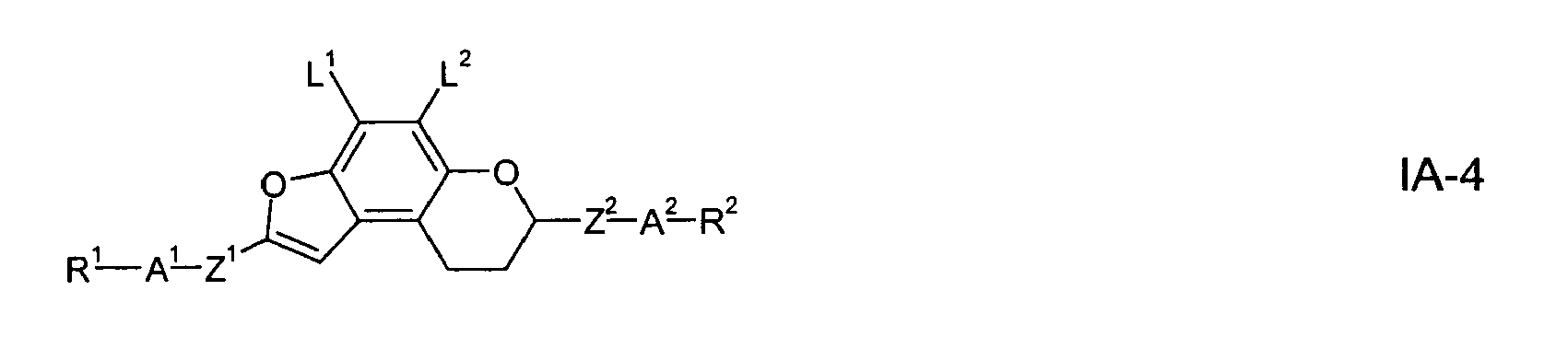


- Hier, wie in der gesamten vorliegenden Anmeldung, wird die Gruppierung der Teilformel I-1

- >Y1-Y2-
- >C=CH- bedeutet,
- Besonders bevorzugt sind Verbindungen der Formel IB ausgewählt aus der Gruppe der Verbindungen der Formeln IB-1 bis IB-11, bevorzugt der Formeln IB-1 bis IB-6, besonders bevorzugt der Formeln IB-1 bis IB-3, IB-5 und IB-6, bei denen mindestens eine der Gruppen R1 und R2 direkt mit dem Grundgerüst verknüpft ist:

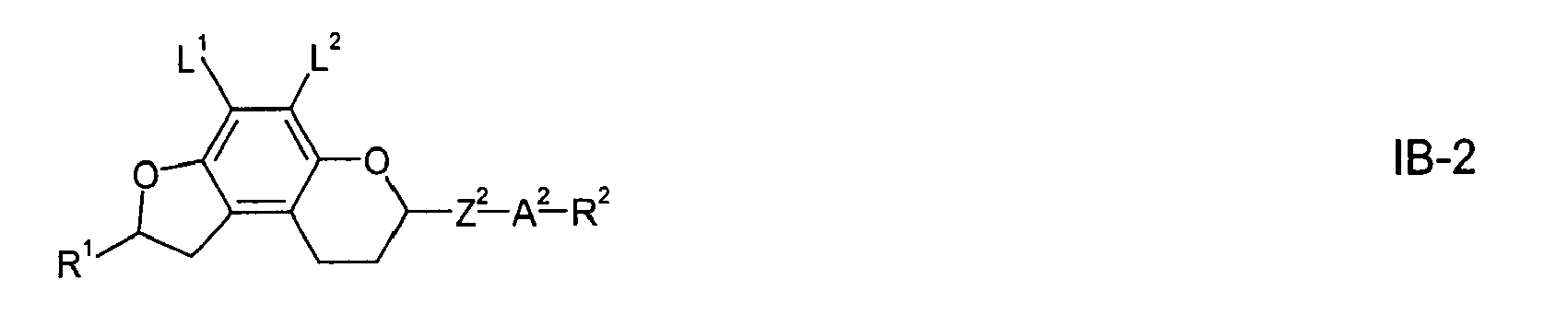
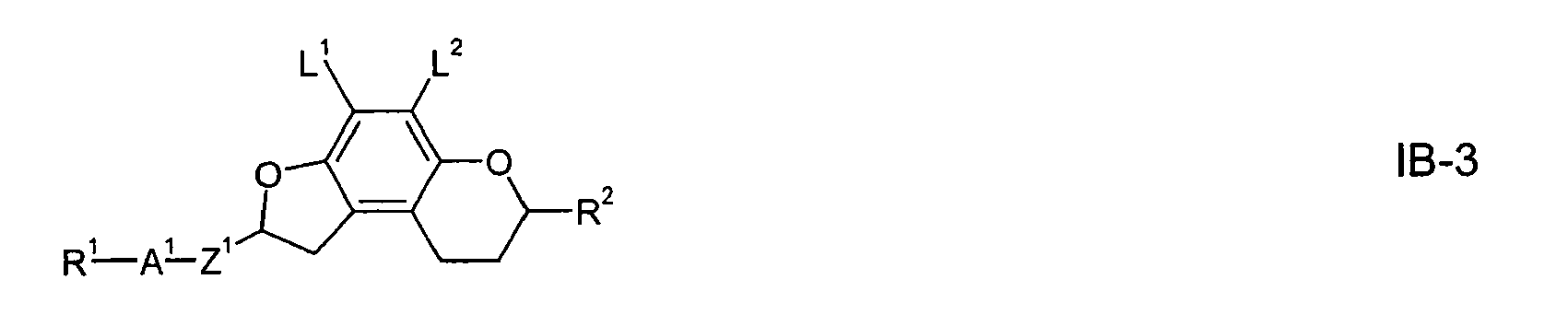


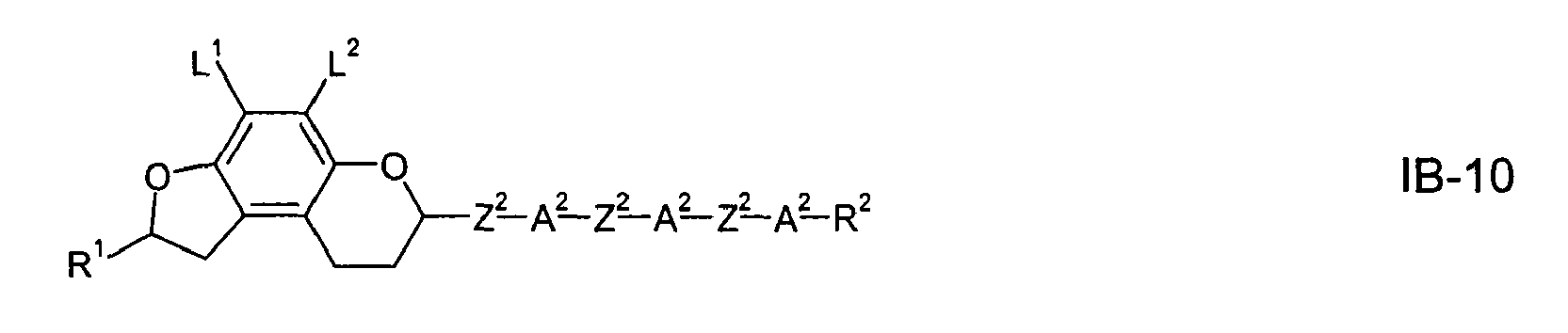

- Besonders bevorzugt sind Verbindungen der Formel I die einen oder mehrere Fluorsubstituenten, ganz besonders bevorzugt zwei Fluorsubstituenten, im Grundgerüst aufweisen.
- Verbindungen der Formel I mit verzweigten Flügelgruppen R1 und/oder R2 können gelegentlich wegen einer besseren Löslichkeit in den üblichen flüssigkristallinen Basismaterialien von Bedeutung sein, insbesondere aber als chirale Dotierstoffe, wenn sie optisch aktiv sind. Smektische Verbindungen dieser Art eignen sich als Komponenten für ferroelektrische Materialien. Verbindungen der Formel I mit SA-Phasen eignen sich beispielsweise für thermisch adressierte Displays.
- Falls R1 und/oder R2 einen Alkylrest und/oder einen Alkoxyrest bedeutet, so kann dieser geradkettig oder verzweigt sein. Vorzugsweise ist er geradkettig, hat 2, 3, 4, 5, 6 oder 7 C-Atome und bedeutet demnach bevorzugt Ethyl, Propyl, Butyl, Pentyl, Hexyl, Heptyl, Ethoxy, Propoxy, Butoxy, Pentoxy, Hexoxy oder Heptoxy, ferner Methyl, Octyl, Nonyl, Decyl, Undecyl, Dodecyl, Tridecyl, Tetradecyl, Pentadecyl, Methoxy, Octoxy, Nonoxy, Decoxy, Undecoxy, Dodecoxy, Tridecoxy oder Tetradecoxy.
- Oxaalkyl, bzw. Alkoxyalkyl bedeutet vorzugsweise geradkettiges 2-Oxapropyl (= Methoxymethyl), 2- (= Ethoxymethyl) oder 3-Oxabutyl (= 2-Methoxyethyl), 2-, 3- oder 4-Oxapentyl, 2-, 3-, 4- oder 5-Oxahexyl, 2-, 3-, 4-, 5- oder 6-Oxaheptyl, 2-, 3-, 4-, 5-, 6- oder 7-Oxaoctyl, 2-, 3-, 4-, 5-, 6-, 7- oder 8-Oxanonyl, 2-, 3-, 4-, 5-, 6-, 7-, 8- oder 9-Oxadecyl.
- Falls R1 und/oder R2 einen Alkylrest bedeutet, in dem eine CH2-Gruppe durch -CH=CH- ersetzt ist, so kann dieser geradkettig oder verzweigt sein. Vorzugsweise ist er geradkettig und hat 2 bis 10 C-Atome. Er bedeutet demnach besonders Vinyl, Prop-1-, oder Prop-2-enyl, But-1-, 2- oder But-3-enyl, Pent-1-, 2-, 3- oder Pent-4-enyl, Hex-1-, 2-, 3-, 4- oder Hex-5-enyl, Hept-1-, 2-, 3-, 4-, 5- oder Hept-6-enyl, Oct-1-, 2-, 3-, 4-, 5-, 6- oder Oct-7-enyl, Non-1-, 2-, 3-, 4-, 5-, 6-, 7- oder Non-8-enyl, Dec-1-, 2-, 3-, 4-, 5-, 6-, 7-, 8- oder Dec-9-enyl.
- Falls R1 und/oder R2 einen Alkylrest bedeutet, in dem eine CH2-Gruppe durch -O- und eine durch -CO- ersetzt ist, so sind diese bevorzugt benachbart. Somit beinhalten diese eine Acyloxygruppe -CO-O- oder eine Oxycarbonylgruppe -O-CO-. Vorzugsweise sind diese geradkettig und haben 2 bis 6 C-Atome. Sie bedeuten demnach besonders Acetyloxy, Propionyloxy, Butyryloxy, Pentanoyloxy, Hexanoyloxy, Acetyloxymethyl, Propionyloxymethyl, Butyryloxymethyl, Pentanoyloxymethyl, 2-Acetyloxyethyl, 2-Propionyloxyethyl, 2-Butyryloxyethyl, 3-Acetyloxypropyl, 3-Propionyloxypropyl, 4-Acetyloxybutyl, Methoxycarbonyl, Ethoxycarbonyl, Propoxycarbonyl, Butoxycarbonyl, Pentoxycarbonyl, Methoxycarbonylmethyl, Ethoxycarbonylmethyl, Propoxycarbonylmethyl, Butoxycarbonylmethyl, 2-(Methoxycarbonyl)ethyl, 2-(Ethoxycarbonyl)ethyl, 2-(Propoxycarbonyl)ethyl, 3-(Methoxycarbonyl)propyl, 3-(Ethoxycarbonyl)propyl, 4-(Methoxycarbonyl)-butyl.
- Falls R1 und/oder R2 einen Alkylrest bedeutet, in dem eine CH2-Gruppe durch unsubstituiertes oder substituiertes -CH=CH- und eine benachbarte CH2-Gruppe durch CO oder CO-O oder O-CO ersetzt ist, so kann dieser geradkettig oder verzweigt sein. Vorzugsweise ist er geradkettig und hat 4 bis 13 C-Atome. Er bedeutet demnach besonders Acryloyloxymethyl, 2-Acryloyloxyethyl, 3-Acryloyloxypropyl, 4-Acryloyloxybutyl, 5-Acryloyloxypentyl, 6-Acryloyloxyhexyl, 7-Acryloyloxyheptyl, 8-Acryloyloxyoctyl, 9-Acryloyloxynonyl, 10-Acryloyloxydecyl, Methacryloyloxymethyl, 2-Methacryloyloxyethyl, 3-Methacryloyloxypropyl, 4-Methacryloyloxybutyl, 5-Methacryloyloxypentyl, 6-Methacryloyloxyhexyl, 7-Methacryloyloxyheptyl, 8-Methacryloyloxyoctyl, 9-Methacryloyloxynonyl.
- Falls R1 und/oder R2 einen einfach durch CN oder CF3 substituierten Alkyl- oder Alkenylrest bedeutet, so ist dieser Rest vorzugsweise geradkettig. Die Substitution durch CN oder CF3 ist in beliebiger Position.
- Falls R1 und/oder R2 einen mindestens einfach durch Halogen substituierten Alkyl- oder Alkenylrest bedeutet, so ist dieser Rest vorzugsweise geradkettig und Halogen ist vorzugsweise F oder Cl. Bei Mehrfachsubstitution ist Halogen vorzugsweise F. Die resultierenden Reste schließen auch perfluorierte Reste ein. Bei Einfachsubstitution kann der Fluor- oder Chlorsubstituent in beliebiger Position sein, vorzugsweise jedoch in ω-Position.
- Verzweigte Gruppen enthalten in der Regel nicht mehr als eine Kettenverzweigung. Bevorzugte verzweigte Reste R sind Isopropyl, 2-Butyl (= 1-Methylpropyl), Isobutyl (= 2-Methylpropyl), 2-Methylbutyl, Isopentyl (= 3-Methylbutyl), 2-Methylpentyl, 3-Methylpentyl, 2-Ethylhexyl, 2-Propylpentyl, Isopropoxy, 2-Methylpropoxy, 2-Methylbutoxy, 3-Methylbutoxy, 2-Methylpentoxy, 3-Methylpentoxy, 2-Ethylhexoxy, 1-Methylhexoxy, 1-Methylheptoxy.
- Falls R1 und/oder R2 einen Alkylrest darstellt, in dem zwei oder mehr CH2-Guppen durch -O- und/oder -CO-O- ersetzt sind, so kann dieser geradkettig oder verzweigt sein. Vorzugsweise ist er verzweigt und hat 3 bis 12 C-Atome. Er bedeutet demnach besonders Bis-carboxy-methyl, 2,2-Bis-carboxy-ethyl, 3,3-Bis-carboxy-propyl, 4,4-Bis-carboxy-butyl, 5,5-Bis-carboxy-pentyl, 6,6-Bis-carboxy-hexyl, 7,7-Bis-carboxy-heptyl, 8,8-Bis-carboxy-octyl, 9,9-Bis-carboxy-nonyl, 10,10-Bis-carboxy-decyl, Bis-(methoxycarbonyl)-methyl, 2,2-Bis-(methoxycarbonyl)-ethyl, 3,3-Bis-(methoxycarbonyl)-propyl, 4,4-Bis-(methoxycarbonyl)-butyl, 5,5-Bis-(methoxycarbonyl)-pentyl, 6,6-Bis-(methoxycarbonyl)-hexyl, 7,7-Bis-(methoxycarbonyl)-heptyl, 8,8-Bis-(methoxycarbonyl)-octyl, Bis-(ethoxycarbonyl)-methyl, 2,2-Bis-(ethoxycarbonyl)-ethyl, 3,3-Bis-(ethoxycarbonyl)-propyl, 4,4-Bis-(ethoxycarbonyl)-butyl, 5,5-Bis-(ethoxycarbonyl)-hexyl.
- Insbesondere bevorzugt sind Verbindungen der Formel I bei denen einer der Parameter m und n den Wert 0 und der andere einen Wert wie oben definiert, bevorzugt > 0 besitzt, sowie diese Verbindungen enthaltende Medien. Besonders bevorzugt ist daher m = 0 und n = 0, 1 oder 2 oder n = 0 und m = 0, 1 oder 2, wobei bevorzugt R1 und/oder R2 Methyl, Ethyl, Propyl, Butyl, Pentyl, Vinyl, 1 E-Propenyl, 1E-Butenyl oder 1E-Pentenyl bedeuten.
- Insbesondere bevorzugt sind auch Verbindungen der Formel I die eine oder mehrere Alkenyl Substituenten tragen.
- Die Verbindungen der Formel I können aufgrund asymmetrisch substituierter Kohlenstoffatome im Ring B als Stereoisomere vorliegen. Gegenstand der Erfindung sind sämtliche Isomere, sowohl in reiner Form, als Racemat und auch als Mischung von Diastereomeren oder Enantiomeren. Optisch aktive Verbindungen der Formel I können auch als Dotierstoffe in Flüssigkristallmischungen verwendet werden.
- In den folgenden Schemata werden die Verbindungen der Formel IA kurz als Verbindungen 1 und die der Formel IB kurz als Verbindungen 2 bezeichnet. Wegen der besseren Lesbarkeit der Formeln wird jedoch auf die eckigen Klammern und die Parameter n und m verzichtet. Dadurch können die Ringe A1 und A2 auch die Bedeutung einer Einfachbindung haben; sowie ggf. jeweils eine der Gruppen A1-Z1 bzw. A2-Z2 auch doppelt auftreten, wobei die dann doppelt auftretenden Parameter jeweils unabhängig voneinander eine der angegebenen Bedeutungen haben können.
- Die Synthese der Verbindungen der Formel I erfolgt konzeptionell auf zwei verschiedenen Wegen. Bei dem ersten Weg, Weg A, (vgl. Schema I) wird das Chromangerüst vorgegeben, und der Furananteil davon ausgehend aufgebaut. Hierfür werden geeignete substituierte 5-Halo-chroman-6-ole 7 (X = Br, I) als Synthesebausteine verwendet. Sonogashira-Kupplung mit entsprechend substituierten terminalen Alkinen 8 verläuft in der Regel mit direkter Cyclisierung und liefert die Verbindungen 1 der Formel I [
DE 199 00 517 A1 und G. A. Gfesser, R. Faghih, Y. L. Bennani, M. P. Curtis, T. A. Esbenshade, A. A. Hancock, M, D. Cowart, Biorg. Med. Chem. Lett. 2005, 15, 2559-2563]. Je nach Beschaffenheit des Alkins 8 wird die Umsetzung zu den Verbindungen 1 vorteilhaft zweistufig durchgeführt. Hier werden unter den Bedingungen der Sonogashira-Kupplung zunächst die Verbindungen 9 als Zwischenprodukte erhalten. Die Cyclisierung erfolgt dann bei Behandlung mit Diethylzink [M. Nakmura, L. Ilies, S. Otsubo, E. Nakamura, Angew. Chem. 2006, 118, 958-961; Angew. Chem. Int. Ed. 2006, 45, 944-947].
- Für den zweiten Weg, Weg B, (vgl. Schema II) werden in 2-Position substituierte Benzofuran-5-ole 10 als zentrale Zwischenstufen verwendet. Verbindungen vom Typ 1 werden dann durch Anellierung eines Pyranringes erhalten. Ausgehend von 10 kann dies entweder über eine Claisen-Umlagerung [H. Ishii, T. Ishikawa, S. Takeda, S. Ueki, M. Suzuki, Chem. Pharm. Bull. 1992, 40, 1148-1153] oder eine von Wang und Finn beschriebene Reaktion [Q. Wang, M. G. Finn, Org. Lett. 2000, 2, 4063-4065] erfolgen.
- Die Edukte 14 für eine Claisen-Umlagerung werden aus 10 durch Mitsunobu-Veretherung [O. Mitsunobu, Synthesis 1981,1] mit Propargylalkoholen 12 erhalten, welche z.B. durch Addition von Lithiumacetylid an einen entsprechenden Aldehyd zugänglich sind. Die Aryl-Proparyglether 14 untergehen beim Erhitzen in N,N-Diethylanilin eine [3.3]-sigmatrope Umlagerung zu den Chromenderivaten 15. Diese können alternativ aus den Salicylaldehydderivaten 11 synthetisiert werden. Die Verbindungen 11 werden durch eine geeignete Formylierung (vgl. Schemall) der Benzofuran-5-ole 10 erhalten. Die Umsetzung zum Chroman 15 gelingt über eine Kupplung mit Vinylboronsäuren 13 [Q. Wang, M. G. Finn, Org. Lett. 2000, 2, 4063-4065]. Abschließend wird die Chromendoppelbindung der Verbindungen 15 unter milden Bedingungen selektiv hydriert.

- Verbindungen vom Typ 2 werden unmittelbar aus Verbindungen vom Typ 1 durch Hydrierung der 1,2-Doppelbindung erhalten (vgl. Schema III).

- Alternativ können für die Synthese der Verbindungen 2 auch Dihydrobenzofuranole 16 als Ausgangsmaterialien herangezogen werden (vgl. Schema IV).

- Die Synthese kann durch die Wahl geeigneter Edukte 7 und 8 (Weg A, vgl. Schema 1) bzw. 10 und 12 oder 13 (Weg B, vgl. Schema II) an die jeweils gewünschten Verbindungen der Formeln 1 angepasst werden. Die Verbindungen der Formel 2 werden dann entweder aus den Verbindungen 1 erhalten (vgl. Schema III) oder können durch Wahl geeigneter Edukte 16 und 12 oder 13 (vgl. Schema IV) an die jeweils gewünschten Verbindungen der Formel 2 angepasst werden.
- Die Ausgangsmaterialien 8 (Weg A, vgl. Schema II), 12 und 13 (Weg B, vgl. Schema II und Schema IV) sind entweder kommerziell erhältlich, oder sie können bereits veröffentlichten Verfahren [z.B. Methoden der Organischen Chemie (Houben-Weyl), Georg Thieme Verlag, Stuttgart, New, York, 4. Aufl. 1993] folgend, synthetisiert werden.
- Das Substitutionsmuster bzgl. der Reste L1 und L2 stellt u.U. besondere Anforderungen an die Synthese der Edukte 7 (Weg A, vgl. Schema I), 10 (Weg B, vgl. Schema II) und 16 (vgl. Schema IV).
- 7,8-Difluor-5-halo-chroman-6-ole 26 (X = Br, I, vgl. Schema VI) werden ausgehend von 2,3-Difluorphenol (20) oder 3,4-Difluor-2-hydroxybenzaldehyd (23) [N. J. Lawrence, L. A. Hepworth, D. Rennison, A. T. McGown, J. A. Hadfield, J. Fluorine Chem. 2003, 123,101-108 und E. Marzi, J. Gorecka, M. Schlosser, Synthesis 2004, 1609-161810] synthetisiert (vgl. Schema V).
- Dazu wird aus 2,3-Difluorphenol (20) und einem Propargylalkohol 12 durch Mitsunobu-Veretherung [O. Mitsunobu, Synthesis 1981, 1-28] zunächst ein Propargyl-Arylether 21 gebildet, der unter geeigneten Reaktionsbedingungen eine thermische [3.3]-sigmatrope Umlagerung zu einem 2H-Chromen eingeht. Diese Chromene können unter schonenden Bedingungen leicht zu den entsprechenden Chromanen 22 hydriert werden.
- Alternativ werden diese 7,8-Difluorchromane 22 aus 3,4-Difluor-2-hydroxybenzaldehyd (23) [N. J. Lawrence, L. A. Hepworth, D. Rennison, A. T. McGown, J. A. Hadfield, J. Fluorine Chem. 2003, 123, 101-108 und E. Marzi, J. Gorecka, M. Schlosser, Synthesis 2004, 1609-1618] über eine von Wang und Finn [Q. Wang, M. G. Finn, Org. Lett. 2000, 2, 4063-4065] beschriebene Reaktion erhalten. Dabei werden aus Salicylaldehyden und Vinylboronsäuren in Gegenwart von Dibenzylamin 2H-Chromene wie 24 mit hoher Ausbeute erhalten. Diese könne dann wiederum leicht zu den entsprechenden Chromanen 22 hydriert werden (s.o.).

- Die so erhaltenen Zwischenprodukte 22 werden durch ortho-Metallierung und Hydrolyse und Oxidation des in situ gebildeten Boronsäureesters zu Chromanolen 25 funktionalisiert (vgl. Schema VI). Die abschließende Halogenierung der 5-Position gelingt über die in Schema VI dargestellte Reaktionsfolge. Die aus den Verbindungen 25 hergestellten MOM-Ether werden mit n-BuLi ortho-metalliert und mit lod (bzw. Brom für X = Br) gequencht [E. Marzi, J. Gorecka, M. Schlosser, Synthesis 2004, 1609-1618 sowie R. C. Ronald, M. R. Winkle, Tetrahedron 1983, 39, 2031-2042 und M. Lang, W. Steglich, Synthesis 2005, 1019-1027]. Nach Abspaltung der MOM-Gruppe werden die gewünschten Zwischenprodukte 26 erhalten.

- 7-Fluor-5-halo-chroman-6-ole 31 (X = Br, I) können aus 5-Brom-4-fluor-2-hydroxy-benzaldehyd (27) [J. B. Blair et al., J. Med. Chem. 2000, 43, 4701-4710 und W. A. Caroll et al., J. Med. Chem. 2004, 47, 3163-3179] synthetisiert werden (vgl. Schema VII). Dieses Edukt 27 ist über literaturbekannte Verfahren aus 3-Fluorphenol durch ortho-selektive Formylierung [J. B. Blair et al., J. Med. Chem. 2000, 43, 4701-4710] und anschließende Bromierung [W. A. Caroll et al., J. Med. Chem. 2004, 47, 3163-3179] zugänglich.

- Ausgehend von 5-Brom-4-fluor-2-hydroxy-benzaldehyd (27) erfolgt der Aufbau der 7-Fluor-chromane 31 (vgl. Schema VII) wiederum vorteilhaft durch die schon beschriebene Kupplung mit Vinylboronsäuren [Q. Wang, M. G. Finn, Org. Lett. 2000, 2, 4063-4065] und anschließender Hydrierung. Die Funktionalisierung zum Chromanol 30 gelingt wie oben beschrieben, diesmal über die aus 29 hervorgehende Grignard-Verbindung. Die abschließende lodierung (bzw. Bromierung) kann wie oben über die MOM-Ether der Verbindungen 30 vorgenommen werden, gelingt aber vorteilhaft auch durch direkte lodierung [G. A. Gfesser, R. Faghih, Y. L. Bennani, M. P. Curtis, T. A. Esbenshade, A. A. Hancock, M, D. Cowart, Biorg. Med. Chem. Lett. 2005, 15, 2559-2563, M. Lang, W. Steglich, Synthesis 2005, 1019-1027 sowie C. W. Holzapfel, D. B. G. Williams, Tetrahedron 1995, 51, 8555-8564, K. J. Edgar, S. N. Falling, J. Org. Chem. 1990, 55, 5287-5291 und R. Johnsson, A. Meijer, U. Ellervik, Tetrahedron 2005, 61, 11567-11663] (bzw. Bromierung [B. F. Bonini, P. Carboni, G. Gottarelli, S. Masiero, G. P., Spada, J. Org. Chem. 1994, 59, 5930-5936]) der Chromanole 30.
- 8-Fluor-5-halo-chroman-6-ole 36 (mit X = Br, I) werden ausgehend von 2-Fluor-4-bromphenol (32) erhalten. Hier wird der O-Heterocyclus bevorzugt durch eine Claisen-Umlagerung über den Propargylarylether 33 anelliert (vgl. SchemaVIII). Die Funktionalisierung zum Chromanol 35 gelingt mit der gleichen Reaktionsfolge wie für das Regioisomer 29. Die Halogenierung von 35 liefert hauptsächlich die gewünschten Isomere 36 (X = Br, I), welche über labortypische Reinigungsverfahren von unerwünschten Regioisomeren abgetrennt werden können.

- Alternativ können die Zwischenprodukte 34 auch ausgehend von 2-Fluor-4-bromphenol (32) über den Salicylaldehyd 37 synthetisiert werden. Dieser ist über eine Duff-Reaktion [M. L. Micklatcher, M. Cushman, Synthesis 1999, 1878-1880] aus 32 zugänglich. Die anschließende Synthese des Chromans 34 kann dann über die von Wang und Finn [Q. Wang, M. G. Finn, Org. Lett. 2000, 2, 4063-4065] beschriebene Prozedur und anschließender Hydrierung erfolgen (Schema IX).

- Nicht fluorierte Synthesebausteine 41 können ebenfalls durch die oben beschriebenen Methoden (Claisen-Umlagerung bzw. Kupplung mit Vinylboronsäuren) synthetisiert werden. Ein besonders bevorzugtes Verfahren geht aus von 2,5-Dihydroxybenzaldehyd (38), welcher nach literaturbekannten Verfahren [Y. Hu, C. Li, B. A. Kulkarni, G. Strobel, E. Lokovsky, R. M. Torczynski, J. A. Porco, Org. Lett. 2001, 3, 1649-1652] zunächst bromiert und selektiv geschützt wird (vgl. Schema X). Nach der zweistufigen Umsetzung zum Chroman 40 wird durch Abspaltung der TBS-Gruppe das Bromid 41 (X = Br) erhalten, welches als Edukt für die folgende Sonogashira-Kupplungen dient. In manchen Fällen ist die Sonogashira-Kupplung mit entsprechenden Aryliodiden 41 (X = I) besonders vorteilhaft. Diese Verbindungen 41 (X = I) sind ebenfalls aus dem Bromochroman 40 über die, in Schema X dargestellte Reaktionsfolge aus Halogen-Metallaustausch, Abfangen mit Iod und Abspaltung der Schutzgruppe mit Fluorid zugänglich.

- Geeignete, substituierte 6,7-Difluorbenzofuran-5-ole 46 und 6,7-Difluor-2,3-dihydrobenzofuran-5-ole 47 können folgendermaßen erhalten werden (Schema XI).

- 2,3-Difluor-6-halophenole 42 werden vorteilhaft über die schon erläuterte Reaktionsfolge aus 2,3-Difluorphenol (20) synthetisiert. Die in der 2-Position substituierten Benzofurane 44 werden entweder direkt in einer Sonogashira-Kupplung mit einem geeignten Alkin 8 gebildet, oder über die Zwischenstufe 43 und anschließender Cyclisierung mit Diethylzink (vgl. Schema I) erhalten. Diese Benzofurane 44 können leicht zu den entsprechenden Dihydrobenzofuranen 45 hydriert werden. Die für die in Schema II und Schema IV dargestellten Reaktionsfolgen erforderlichen 6,7-Difluorbenzofuran-5-ole 46 bzw. 6,7-Difluor-2,3-dihydrobenzofuran-5-ole 47 werden aus 44 bzw. 45 durch ortho-Metallierung, Hydrolyse und Oxidation des in situ gebildeten Boronsäureesters erhalten.
- 6-Fluorbenzofuran-5-ole 53 (mit L1 = H und L2 = F) bzw. 6-Fluor-2,3-dihydrobenzofuran-5-ole 54 (mit L1 = H und L2 = F), 7-Fluorbenzofuran-5-ole 53 (mit L1 = F und L2 = H) bzw. 7-Fluor-2,3-dihydrobenzofuran-5-ole 54 (mit L1 = F und L2 = H) und Benzofuran-5-ole 53 (mit L1 = H und L2 = H) bzw. 2,3-Dihydrobenzofuran-5-ole 54 (mit L1 = H und L2 = H) können auf konzeptionell ähnlichem Wege hergestellt werden. Im Unterschied zu oben werden entsprechende 4-Bromphenole 48 als Edukte gewählt. Die Funktionalisierung zu den Benzofuranolen 53 und 54 erfogt dann nicht durch ortho-Metallierung, sondern über die aus den Verbindungen 51 und 52 erhaltenen Grignard-Reagentien (vgl. Schema XII).

- Für den speziellen Fall, dass R1A1Z1A1Z1 Methyl und L1 und L2 F bedeuten, kann ein geeignet funktionalisiertes Benzofuran 60 besonders einfach über eine [3.3]-sigmatrope Umlagerung ausgehend von 56 hergestellt werden (vgl. Schema XIII). 56 wird aus 5-Brom-2,3-difluorphenol (55) und Propargylbromid hergestellt. Beim Erhitzen in N,N-Diethylanilin in Gegenwart von Cäsiumfluorid [H. Ishii, T. Ishikawa, S. Takeda, S. Ueki, M. Suzuki, T. Harayama, Chem. Pharm. Bull. 1990, 38, 1775-1777 und A. Chilin, P. Rodighiero, A. Guiotto, Synthesis 1998, 309-312] wird das Benzofuran 57 erhalten. Die Funktionalisierung zum Salicyaldehyd 60 gelingt dann über eine Kombination von zuvor schon erläuterten Standardverfahren. Anschließend kann wie oben in Schema II dargestellt verfahren werden.

- Für Verbindungen der Formel I (1 und 2) bei denen R1A1Z1A1Z1 und / oder R2A2Z2A2Z2 insbesondere einen Alkenylrest oder einen anderen einfach oder mehrfach ungesättigten Rest darstellen, sind folgende Verfahren (Schemata XIV bis XVII) besonders bevorzugt.
- Ein erstes bevorzugtes Verfahren, zur Synthese der Verbindungen 1 und 2 bei denen R1A1Z1A1Z1 insbesondere einen oder mehrere Alkenylreste oder einen anderen einfach oder mehrfach ungesättigten Rest darstellen, geht wiederum von 5-Halo-chroman-6-olen 7 aus (Schema XIV).

- Führt man die Sequenz Sonogashira-Kupplung und Ringschluss mit THPgeschütztem Homopropargylakohol 61 [N. G. Kundu, M. Pal, J. S. Mahanty, M. De, J. Chem. Soc. Perkin Trans 1 1997, 19, 2815-2820] durch, so erhält man die Verbindungen 62. Ausgehend hiervon kann nach Spaltung des THP-Ethers und Oxidation des resultierenden primären Alkohols [L. Capuano, S. Drescher, V. Hammerer, M. Hanisch, Chem. Ber. 1988, 121, 2259-2262] die funktionalisierbare Zwischenstufe 64 erhalten werden. Deren Funktionalisierung zu den Verbindungen 1 kann dann z.B. durch Wittig-Olefinierung (vgl. Schema XV) erfolgen. Eine funktionalisierbare Zwischenstufe 65 die auf diese Weise (Wittig-Olefinierung etc.) zu den Verbindungen 2 führt, wird nach Hydrierung von 62 zu 63, anschließender THP-Spaltung und Oxidation erhalten.
- Sollen Verbindungen vom Typ 1 synthetisiert werden, in denen R1Z1A1Z1A1 und R2A2Z2A2Z2 ungesättigte Reste, Brücken oder Ringsysteme enthalten, so können entsprechend substituierte 5-Halo-chroman-6-ole 70 eingesetzt werden. Letztere sind über das folgende Verfahren (vgl. Schema XV), mit den Chroman-2-carbaldehyden 69 als zentrale, funktionalisierbare Zwischenstufen zugänglich. Ausgehend von Salicylaldehyden 66 (Y = H, Br, vgl. Schemata V, VII und IX) erfolgt der Aufbau des Chromens 68 mit der Boronsäure 67 [R. A. Batey, A. N. Avinash, A. J. Lough, J. Am. Chem. Soc. 1999, 121, 450-451]. Nach Hydrierung und Oxidation wird die Zwischenstufe 69 erhalten. Hiervon ausgehend kann dann zunächst die Seitenkette R2A2Z2A2Z2 aufgebaut werden; die nachfolgende Funktionalisierung zu den 5-Halo-chroman-6-olen 70, die dann entsprechend Schema XIV zu den Verbindungen 1 umgesetzt werden können wurde schon beschrieben (vgl. Schemata V, VII und IX).

- Diese Substanzen sind auch geeignet um Verbindungen 2 zu synthetisieren, in denen R1Z1A1Z1A1 und R2A2Z2A2Z2 ungesättigte Reste, Brücken oder Ringsysteme enthalten. Dazu wird, in Anlehnung an die Literaturvorschrift [J. C. González-Gómez, L. Santana, E. Uriarte, Tetrahedron 2005, 61, 4805-4810 und K. J. Hodgetts, Tetrahedron 2005, 61, 6860-6870], folgendes Verfahren benötigt (vgl. Schema XVI).

- Veretherung von 7 (X = Br ist besonders bevorzugt) mit den Bromethanolderivaten 71 liefert die Verbindungen 72 (X = Br). Das aus den Verbindungen 72 generierte Grignard-Reagenz cyclisiert unter den Reaktionsbedingungen spontan unter Bildung eines 5-gliedrigen Heterocyclus.
- Sollen Verbindungen 1 und 2 synthetisiert werden, in denen R2A2Z2A2Z2 ungesättigte Reste, Brücken oder Ringsysteme enthält, so sind Verfahren, die funktionalisierbare Zwischenstufen wie 74 und 75 verwenden, bevorzugt.

- Ausgehend von den bereits zuvor beschriebenen Salicylaldehydderivaten 11 erfolgt der Aufbau des Pyrananteils mit der Boronsäure 67 [R. A. Batey, A. N. Avinash, A. J. Lough, J. Am. Chem. Soc. 1999, 121, 450-451] (vgl. Schema XV). Unter milden Bedingungen (1 atm H2, Raumtemperatur) wird die Chromen-CC-Doppelbindung hydriert, und der Benzylether wird zum entsprechenden Alkohol gespalten. Erst bei höherem Wasserstoffdruck und erhöhter Temperatur erfolgt auch die Hydrierung der 2,3-Doppelbindung. Die gebildeten Alkohole werden zu den entsprechenden Aldehyden oxidiert, und die Verbindungen 74 und 75 können dann, wie beispielsweise in Schema XV dargestellt, zu den Verbindungen 1 und 2 funktionalisiert werden.
- Im Folgenden werden Beispiele für Strukturen bevorzugter Verbindungen der Formel I geordnet nach Unterformel gegeben,
worin - R11 und R22
- die jeweilige unter Formel I für R1 bzw. R2 gegebene Bedeutung haben
- p,
- und im Fall, dass p mehrfach auftritt diese unabhängig voneinander,
0, 1, 2, 3 oder 4, bevorzugt 0, 1 oder 2 und bevorzugt - Besonders bevorzugt unter den Verbindungen IA-1 bis IA-11 bzw. IB-1 bis IB-11 sind solche mit mindestens einem Fluorsubstituenten im Grundgerüst.
- Ganz besonders bevorzugt sind solche Verbindungen mit zwei Fluorsubstituenten im Grundgerüst.
- Bevorzugte Verbindungen der Formeln IA-1 bzw. IB-1 sind:


- Bevorzugte Verbindungen der Formeln IA-2 bzw. IB-2 sind:









- Besonders bevorzugt unter den Verbindungen IA-2 und IB-2 sind solche mit einem Cyclohexylring.
- Bevorzugte Verbindungen der Formeln IA-3 bzw. IB-3 sind:


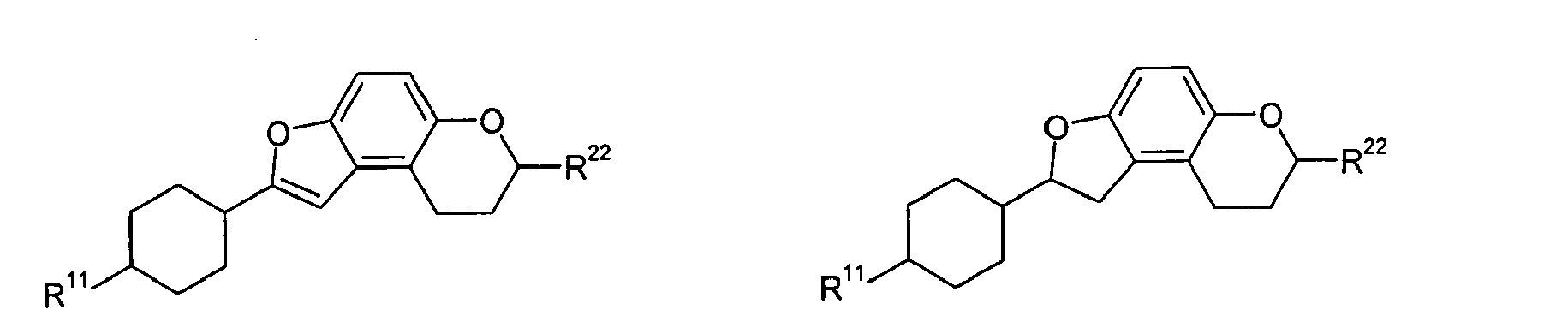


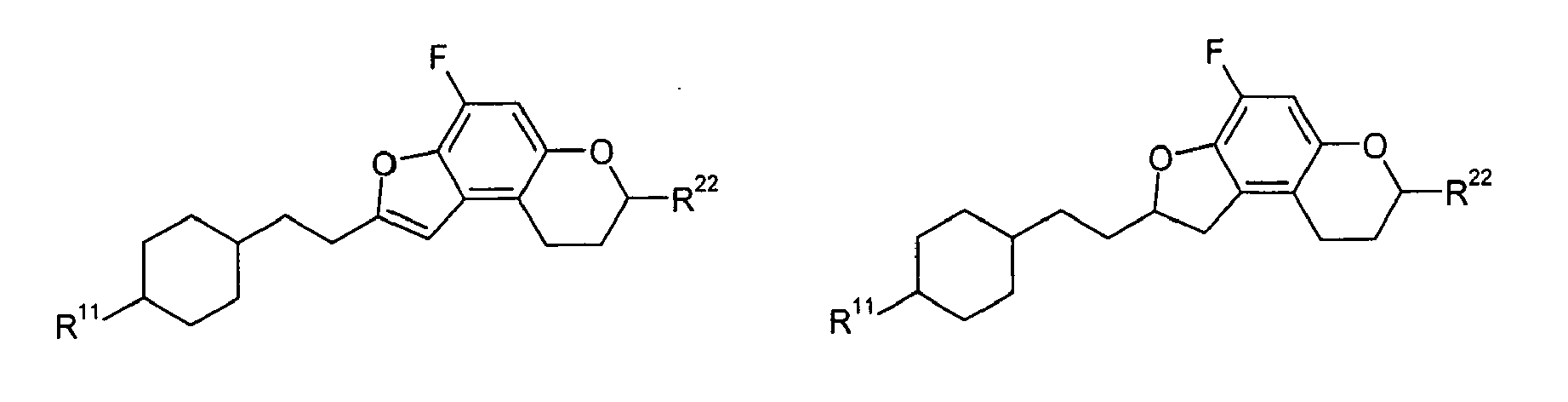


- Unter den Verbindungen der Formeln IA-3 sind Verbindungen mit einem unsubstituierten oder substituierten1,4-Phenylen-Ring bevorzugt.
- Besonders bevorzugt unter den Verbindungen IB-3 sind solche mit einem Cyclohexylring.
- Bevorzugte Verbindungen der Formeln IA-4 bzw. IB-4 sind:


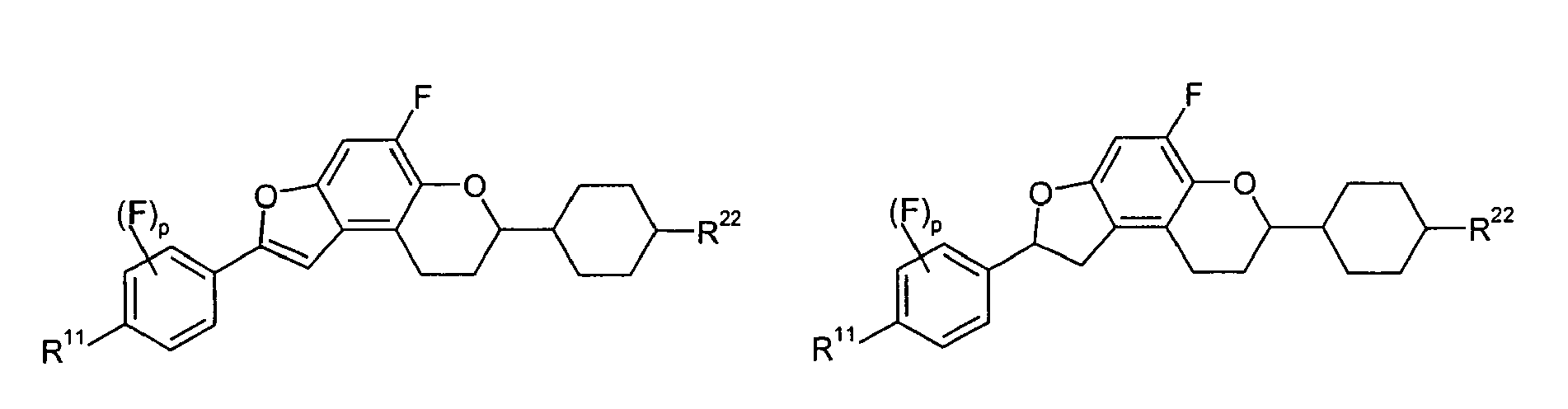
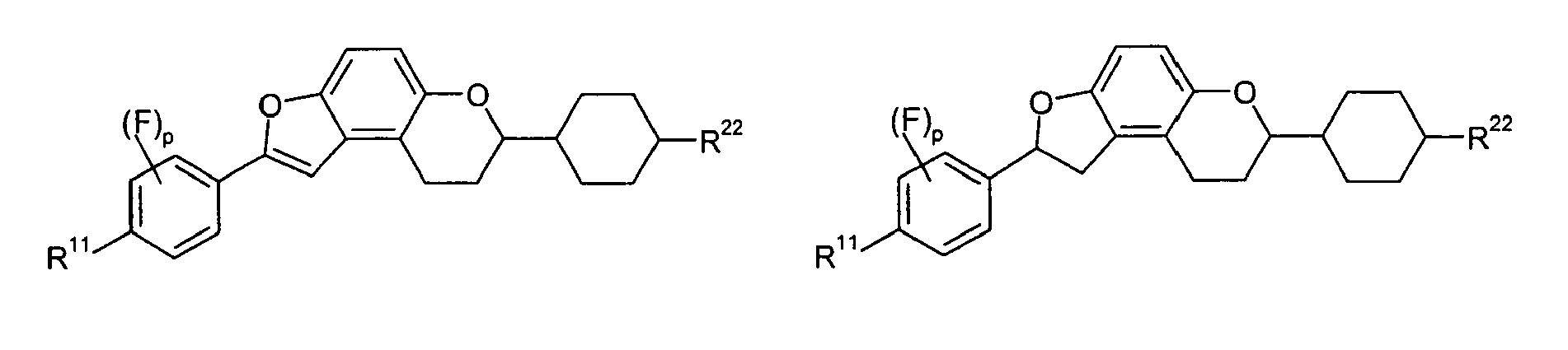


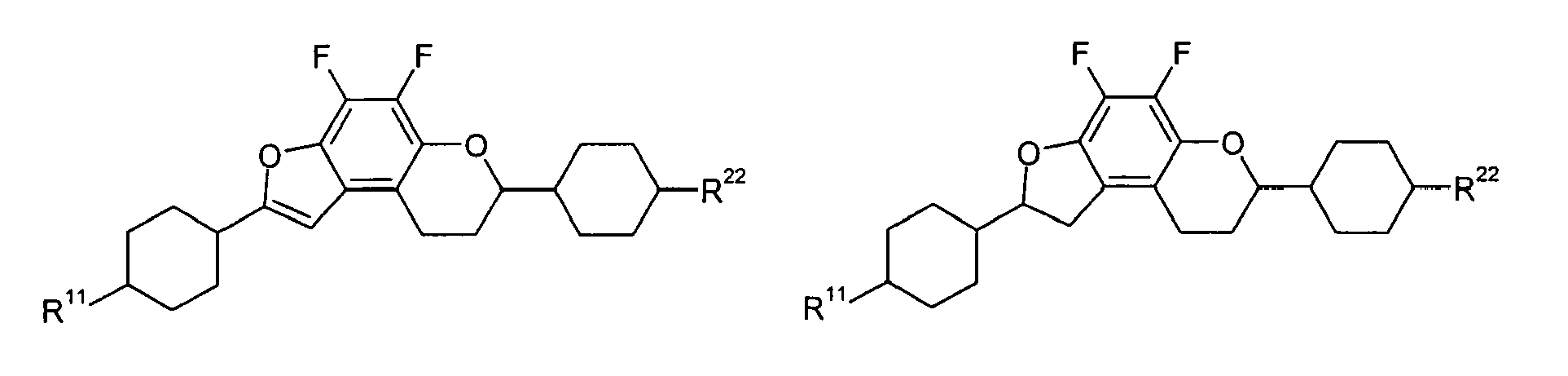


- Unter den Verbindungen der Formel IA-4 sind Verbindungen der Formeln besonders bevorzugt, in denen das Grundgerüst linksseitig mit einem substituierten oder unsubstituierten 1,4-Phenylenring substituiert ist und / oder das Grundgerüst rechtsseitig mit einem Cyclohexylrest verknüpft ist.
- Unter den Verbindungen der Formel IB-4 sind Verbindungen der Formeln bevorzugt, in denen das Grundgerüst linksseitig mit einem Cyclohexylrest substituiert ist und / oder der Grundkörper rechtsseitig mit einem Cyclohexylrest verknüpft ist.
- Bevorzugte Verbindungen der Formeln IA-5 bzw. IB-5 sind:





- Bevorzugt unter den Verbindungen IA-5 und IB-5 sind solche mit einem Cyclohexylring. Besonders bevorzugt sind dabei Verbindungen bei denen ein Cyclohexylring direkt mit dem Grundgerüst verknüpft ist. Ganz besonders bevorzugt sind Verbindungen mit zwei Cyclohexylringen.
- Bevorzugte Verbindungen der Formeln IA-6 bzw. IB-6 sind:

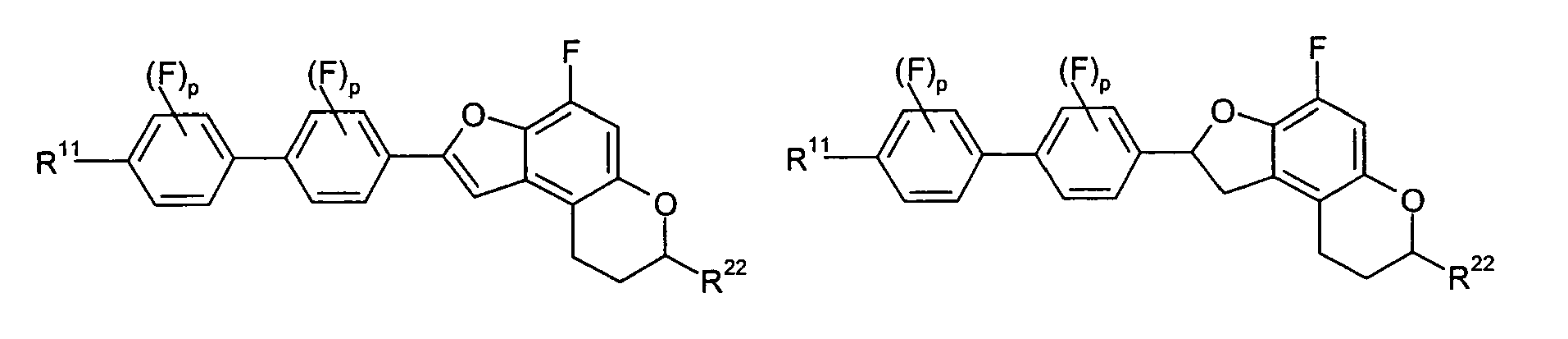


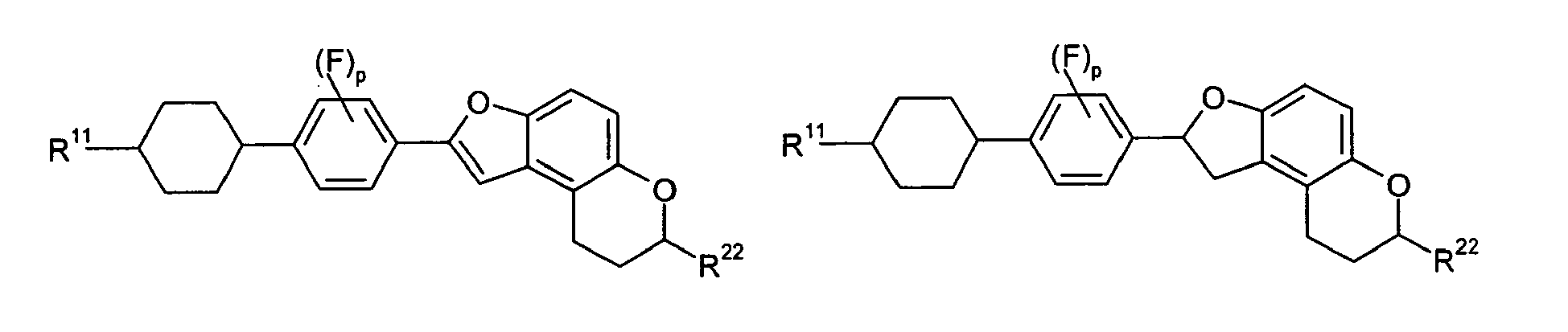


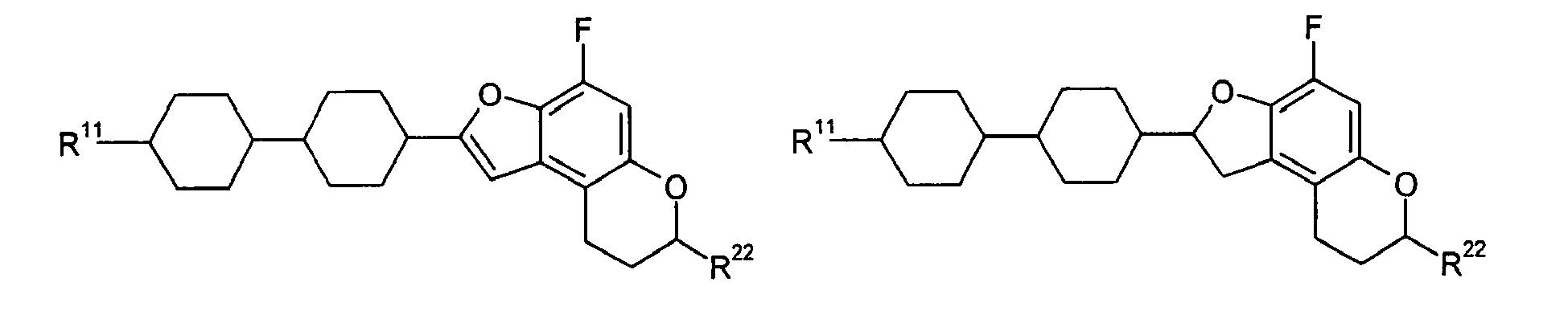


- Bevorzugt unter den Verbindungen IA-6 solche mit einem einem unsubstituierten oder substituierten 1,4-Phenylen-Ring. Besonders bevorzugt sind dabei Verbindungen bei denen ein unsubstituierter oder substituierter 1,4-Phenylen-Ring direkt mit dem Grundgerüst verknüpft ist.
- Bevorzugt unter den Verbindungen IB-6 sind solche mit einem Cyclohexylring. Besonders bevorzugt sind dabei Verbindungen bei denen ein Cyclohexylring direkt mit dem Grundgerüst verknüpft ist.
- Unter den Verbindungen der Formel IA-7 sind Verbindungen der Formeln bevorzugt, in denen das Grundgerüst linksseitig mit einem Arylrest substituiert ist und / oder das Grudgerüst rechtsseitig mit einem Cyclohexylrest verknüpft ist.
- Unter den Verbindungen der Formel IB-7 sind Verbindungen der Formeln bevorzugt, in denen das Grundgerüst linksseitig mit einem Cyclohexylrest substituiert ist und / oder das Grundgerüst rechtsseitig mit einem Cyclohexylrest verknüpft ist.
- Unter den Verbindungen der Formel IA-8 sind Verbindungen der Formeln bevorzugt, in denen das Grundgerüst linksseitig mit einem Arylrest substituiert ist und / oder das Grundgerüst rechtsseitig mit einem Cyclohexylrest verknüpft ist.
- Unter den Verbindungen der Formel IB-8 sind Verbindungen der Formeln bevorzugt, in denen das Grundgerüst linksseitig mit einem Cyclohexylrest substituiert ist und / oder das Grundgerüst rechtsseitig mit einem Cyclohexylrest verknüpft ist.
- Unter den Verbindungen der Formel IA-9 sind Verbindungen der Formeln bevorzugt, in denen das Grundgerüst linksseitig mit einem Arylrest substituiert ist und / oder das Grundgerüst rechtsseitig mit einem Cyclohexylrest verknüpft ist.
- Unter den Verbindungen der Formel IB-9 sind Verbindungen der Formeln bevorzugt, in denen das Grundgerüst linksseitig mit einem Cyclohexylrest substituiert ist und / oder das Grundgerüst rechtsseitig mit einem Cyclohexylrest verknüpft ist.
- Bevorzugt unter den Verbindungen IA-10 und IB-10 sind solche mit einem oder mehreren Cyclohexylringen. Besonders bevorzugt sind dabei Verbindungen bei denen der Cyclohexylring direkt mit dem Grundgerüst verknüpft ist.
- Bevorzugt unter den Verbindungen IA-11 solche mit einem unsubstituierten oder substituierten1,4-Phenylen-Ring. Besonders bevorzugt sind dabei Verbindungen bei denen der unsubstituierte oder substituierte1,4-Phenylen-Ring direkt mit dem Grundgerüst verknüpft ist.
- Bevorzugt unter den Verbindungen IB-11 solche mit einem oder mehreren Cyclohexylringen. Besonders bevorzugt sind dabei Verbindungen bei denen der Cyclohexylring direkt mit dem Grundgerüst verknüpft ist.
- Erfindungsgemäße Verbindungen der Formel I können aufgrund ihrer Molekülstruktur chiral sein und können dementsprechend in verschiedenen enantiomeren Formen auftreten. Sie können daher in racemischer oder in optisch aktiver Form vorliegen.
- Gegenstand der vorliegenden Erfindung sind auch Flüssigkristallmedien, die eine oder mehrere Verbindung(en) der Formel I enthalten.
- In einer bevorzugten Ausführungsform enthalten die Flüssigkristallmedien gemäß der vorliegenden Erfindung
- a) eine oder mehrere dielektrisch negative Verbindung(en) der Formel I

- b) eine oder mehrere dielektrisch negative Verbindung(en) der Formel II

- R21 und R22
- jeweils unabhängig voneinander die oben bei Formel I für R1 gegebene Bedeutung haben,
- Z21 und Z22
- jeweils unabhängig voneinander die oben bei Formel I für Z1 gegebene Bedeutung haben,


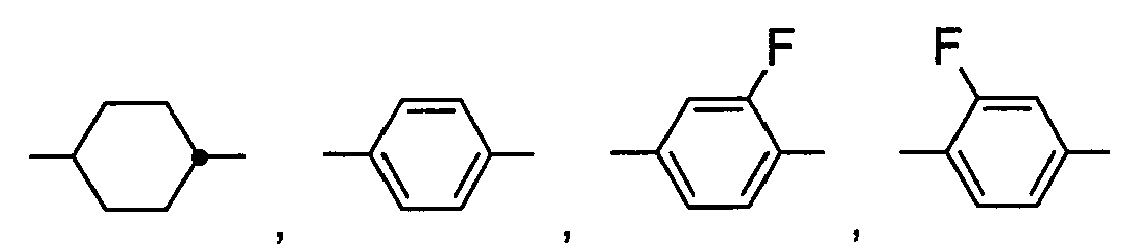


- L21 und L22
- beide C-F oder einer von beiden N und der andere C-F, bevorzugt beide C-F und
- I
- 0, 1 oder 2, bevorzugt 0 oder 1
und optional - c) eine oder mehrere dielektrisch neutrale Verbindung der Formel III

- R31 und R32
- jeweils unabhängig voneinander die oben bei Formel I für R1 gegebene Bedeutung besitzen und
- Z31, Z32 und Z33
- jeweils unabhängig voneinander -CH2CH2-, -CH=CH-, -COO- oder eine Einfachbindung
- o und p
- unabhängig voneinander 0 oder 1
- R31 und R32
- jeweils unabhängig voneinander Alkyl oder Alkoxy mit 1-5 C-Atomen oder Alkenyl mit 2-5 C-Atomen,
- Bevorzugt enthalten die Flüssigkristallmedien eine oder mehrere Verbindungen der Formel I die keine Biphenyleinheit enthalten.
- Besonders bevorzugt enthalten die Flüssigkristallmedien eine oder mehrere Verbindungen der Formel I wobei zwei benachbarte Ringe direkt verknüpft sind und bevorzugt

wobei bei dem Phenylenring ein oder mehrere H-Atome, unabhängig voneinander durch F oder CN, bevorzugt durch F, und eine oder zwei nicht benacbarte CH2-Gruppen des Cyclohexylenrings bzw. eines der Cyclohexylenringe durch O-Atome ersetzt sein können. - In einer bevorzugten Ausführungsform, die mit den gerade beschriebenen Ausführungsformen identisch sein kann, enthalten die Flüssigkristallmedien eine oder mehrere Verbindungen ausgewählt aus der Gruppe der Verbindungen ausgewählt aus der Gruppe der Verbindungen der Formel I-3.
- Bevorzugt enthält das Flüssigkristallmedium eine oder mehrere Verbindungen ausgewählt aus der Gruppe der Verbindungen der Formeln II-1 bis II-3


R21, R22, Z12, Z22,
- Besonders bevorzugt enthält das Flüssigkristallmedium eine oder mehrere Verbindungen ausgewählt aus der Gruppe der Verbindungen der Formeln III-1 bis III-3:


- Insbesondere bevorzugt enthält das Flüssigkristallmedium eine oder mehrere Verbindungen ausgewählt aus der Gruppe der Verbindungen der Formeln III-1a bis III-1d, III-1e, III-2a bis III-2g, III-3a bis III-3d und III-4a:





- Bevorzugte fluorierte Verbindungen der Formeln III-2g und III-3c sind die Verbindungen der Formeln III-2g' und III-3c'


- In der vorliegenden Anmeldung bedeutet, wenn nicht ausdrücklich anders angegeben, der Begriff Verbindungen sowohl eine Verbindung, als auch mehrere Verbindungen.
- Die erfindungsgemäßen Flüssigkristallmedien weisen bevorzugt nematische Phasen von jeweils mindestens von -20°C bis 80°C, bevorzugt von -30°C bis 85°C und ganz besonders bevorzugt von -40°C bis 100°C auf. Hierbei bedeutet der Begriff eine nematische Phase aufweisen einerseits, dass bei tiefen Temperaturen bei der entsprechenden Temperatur keine smektische Phase und keine Kristallisation beobachtet wird und andererseits, dass beim Aufheizen aus der nematischen Phase noch keine Klärung auftritt. Die Untersuchung bei tiefen Temperaturen wird in einem Fließviskosimeter bei der entsprechenden Temperatur durchgeführt sowie durch Lagerung in Testzellen, einer der elektrooptischen Anwendung entsprechenden Schichtdicke, für mindestens 100 Stunden überprüft. Bei hohen Temperaturen wird der Klärpunkt nach üblichen Methoden in Kapillaren gemessen.
- Ferner sind die erfindungsgemäßen Flüssigkristallmedien durch niedrige optische Anisotropien gekennzeichnet.
- Der Ausdruck "Alkyl" umfasst vorzugsweise geradkettige und verzweigte Alkylgruppen mit 1 bis 7 Kohlenstoffatomen, insbesondere die geradkettigen Gruppen Methyl, Ethyl, Propyl, Butyl, Pentyl, Hexyl und Heptyl. Gruppen mit 2 bis 5 Kohlenstoffatomen sind im allgemeinen bevorzugt.
- Der Ausdruck "Alkenyl" umfast vorzugsweise geradkettige und verzweigte Alkenylgruppen mit 2 bis 7 Kohlenstoffatomen, insbesondere die geradkettigen Gruppen. Besonders bevorzugte Alkenylgruppen sind C2 bis C7-1E-Alkenyl, C4 bis C7-3E-Alkenyl, C5 bis C7-4-Alkenyl, C6 bis C7-5-Alkenyl und C7 6-Alkenyl, insbesondere C2 bis C7-1 E-Alkenyl, C4 bis C7-3E-Alkenyl und C5 bis C7-4-Alkenyl. Beispiele weiterer bevorzugter Alkenylgruppen sind Vinyl, 1E-Propenyl, 1E-Butenyl, 1E-Pentenyl, 1E-Hexenyl, 1E-Heptenyl, 3-Butenyl, 3E-Pentenyl, 3E-Hexenyl, 3E-Heptenyl, 4-Pentenyl, 4Z-Hexenyl, 4E-Hexenyl, 4Z-Heptenyl, 5-Hexenyl, 6-Heptenyl und dergleichen. Gruppen mit bis zu 5 Kohlenstoffatomen sind im allgemeinen bevorzugt.
- Der Ausdruck "Fluoralkyl" umfasst vorzugsweise geradkettige Gruppen mit endständigem Fluor, d.h. Fluormethyl, 2-Fluorethyl, 3-Fluorpropyl, 4-Fluorbutyl, 5-Fluorpentyl, 6-Fluorhexyl und 7-Fluorheptyl. Andere Positionen des Fluors sind jedoch nicht ausgeschlossen.
- Der Ausdruck "Oxaalkyl", bzw. Alkoxyalkyl umfasst vorzugsweise geradkettige Reste der Formel CnH2n-1-O-(CH2)m, worin n und m jeweils unabhängig voneinander 1 bis 6 bedeuten. Vorzugsweise ist n 1 und m 1 bis 6.
- Verbindungen mir einer Vinyl-Endgruppe und Verbindungen mit einer Methyl-Endgruppe haben eine geringe Rotationsviskosität.
- In der vorliegenden Anmeldung bedeuten die Begriffe dielektrisch positive Verbindungen solche Verbindungen mit einem Δε > 1,5, dielektrisch neutrale Verbindungen solche mit -1,5 ≤ Δε ≤ 1,5 und dielektrisch negative Verbindungen solche mit Δε < -1,5. Hierbei wird die dielektrische Anisotropie der Verbindungen bestimmt indem 10 % der Verbindungen in einem flüssigkristallinen Host gelöst werden und von dieser Mischung die Kapazität in mindestens jeweils einer Testzelle mit ca. 20 µm Schichtdicke mit homeotroper und mit homogener Oberflächenorientierung bei 1 kHz bestimmt wird. Die Meßspannung beträgt typischerweise 0,5 V bis 1,0 V, jedoch stets weniger als die kapazitive Schwelle der jeweiligen Flüssigkristallmischung.
- Als Wirtsmischung für die Bestimmung der anwendungsrelevanten physikalischen Parameter wird ZLI-4792, von von Merck KGaA, Deutschland, verwendet. Als Ausnahme wird bei der Bestimmung der dielektrischen Anisotropie von dielektrisch negativen Verbindungen ZLI-2857, ebenfalls von Merck KGaA, Deutschland, verwendet. Aus der Änderung der Eigenschaften, z.B. der Dielektrizitätskonstanten, der Wirtsmischung nach Zugabe der zu untersuchenden Verbindung und Extrapolation auf 100 % der eingesetzten Verbindung werden die Werte für die jeweilige zu untersuchende Verbindung erhalten.
- Die eingesetzte Konzentration der zu untersuchenden Verbindung beträgt 10 %. Ist die Löslichkeit der zu untersuchenden Verbindung hierzu nicht ausreichend wird ausnahmsweise die eingesetzte Konzentration solange halbiert, also auf 5 %, 2,5% usw. verringert, bis die Löslichkeitsgrenze unterschritten ist.
- Der Begriff Schwellenspannung bezieht sich üblicherweise auf die optische Schwelle für 10 % relativen Kontrast (V10). In Bezug auf die Flüssigkristallmischungen mit negativer dielektrischer Anisotropie, wird der Begriff Schwellenspannung in der vorliegenden Anmeldung jedoch für die kapazitive Schwellenspannung (V0), auch Freedericksz-Schwelle genannt, verwendet, sofern nicht explizit anders angegeben.
- Alle Konzentrationen in dieser Anmeldung sind, soweit nicht explizit anders vermerkt, in Massenprozent angegeben und beziehen sich auf die entsprechende Gesamtmischung. Alle physikalischen Eigenschaften werden und wurden nach "Merck Liquid Crystals, Physical Properties of Liquid Crystals", Status Nov. 1997, Merck KGaA, Deutschland bestimmt und gelten für eine Temperatur von 20 °C, sofern nicht explizit anders angegeben. Δn wird bei 589 nm und Δε bei 1 kHz bestimmt.
- Bei den Flüssigkristallmedien mit negativer dielektrischer Anisotropie wurde die Schwellenspannung als kapazitive Schwellung V0 in Zellen mit durch Lecithin homeotrop orientierter Flüssigkristallschicht bestimmt.
- Die erfindungsgemäßen Flüssigkristallmedien können bei Bedarf auch weitere Zusatzstoffe und gegebenenfalls auch chirale Dotierstoffe in den üblichen Mengen enthalten. Die eingesetzte Menge dieser Zusatzstoffe beträgt insgesamt 0 % bis 10 % bezogen auf die Menge der gesamten Mischung bevorzugt 0,1 % bis 6 %. Die Konzentrationen der einzelnen eingesetzten Verbindungen betragen jeweils bevorzugt 0,1 bis 3 %. Die Konzentration dieser und ähnlicher Zusatzstoffe wird bei der Angabe der Konzentrationen sowie der Konzentrationsbereiche der Flüssigkristallverbindungen in den Flüssigkristallmedien nicht berücksichtigt.
- Die Zusammensetzungen bestehen aus mehreren Verbindungen, bevorzugt aus 3 bis 30, besonders bevorzugt aus 6 bis 20 und ganz besonders bevorzugt aus 10 bis 16 Verbindungen, die auf herkömmliche Weise gemischt werden. In der Regel wird die gewünschte Menge der in geringerer Menge verwendeten Komponenten in den Komponenten gelöst, die den Hauptbestandteil ausmachen, zweckmäßigerweise bei erhöhter Temperatur. Liegt die gewählte Temperatur über dem Klärpunkt des Hauptbestandteils, so ist die Vervollständigung des Lösungsvorgangs besonders leicht zu beobachten. Es ist jedoch auch möglich, die Flüssigkristallmischungen auf anderen üblichen Wegen, z.B. unter Verwendung von Vormischungen oder aus einem sogenannten "multi bottle" Systemen herzustellen.
- Mittels geeigneter Zusatzstoffe können die erfindungsgemäßen Flüssigkristallphasen derart modifiziert werden, dass sie in jeder bisher bekannt gewordenen Art von Anzeige und insbesondere von ECB-Anzeigen, sowie IPS-Anzeigen einsetzbar sind.
- Die nachstehenden Beispiele dienen zur Veranschaulichung der Erfindung, ohne sie zu beschränken. In den Beispielen sind der Schmelzpunkt T(C,N), der Übergang von der smektischen (S) zur nematischen (N) Phase T(S,N) und Klärpunkt T(N,I) einer Flüssigkristallsubstanz in Grad Celsius angegeben. Die verschiedenen smektischen Phasen werden durch entsprechende Suffixe gekennzeichnet.
- Die Prozentangaben sind, soweit nicht explizit anders gekennzeichnet, vor- und nachstehend Massenprozente und die physikalischen Eigenschaften sind die Werte bei 20 °C, sofern nicht explizit anders angegeben.
- Alle angegebenen Werte für Temperaturen in dieser Anmeldung sind °C und alle Temperaturdifferenzen entsprechend Differenzgrad, sofern nicht explizit anders angegeben.
- In der vorliegenden Anmeldung und insbesondere bei den Synthesebeispielen und -schemata bedeuten:
- Bn
- Benzyl,
- Clp
- Klärpunkt,
- DEAD
- Diethylazodicarboxylat,
- DIAD
- Diisopropylazodicarboxylat,
- DMF
- Dimethylformamid,
- ges.
- gesättigt,
- Lsg.
- Lösung,
- MEM
- 2-Methoxy-ethoxy-methyl,
- MOM
- Methoxy-methyl,
- MTBE
- Methyl-tert-butylether,
- Ph
- Phenyl,
- Schmp.
- Schmelzpunkt,
- SiO2
- Kieselgel,
- TBS
- Dimethyl-tert-butylsilyl,
- THF
- Tetrahydrofuran und
- TMEDA
- Tetramethylethylendiamin.
- In der vorliegenden Anmeldung und in den folgenden Beispielen sind die Strukturen der Flüssigkristallverbindungen durch Abkürzungen, auch Akronyme genannt, angegeben, wobei die Transformation in chemische Formeln gemäß folgender Tabellen A und B erfolgt. Alle Reste CnH2n+1 und CmH2m+1 sind geradkettige Alkylreste mit n bzw. m C-Atomen. Die Codierung gemäß Tabelle B versteht sich von selbst. In Tabelle A ist nur das Akronym für den Grundkörper angegeben. Im Einzelfall folgt getrennt vom Akronym für den Grundkörper mit einem Strich ein Code für die Substituenten R1, R2, L1, L2 und L3:
Code für R1, R2, L1, L2, L3 R1 R2 L1 L2 L3 nm CnH2n+1 CmH2m+1 H H H nOm CnH2n+1 OCmH2m+1 H H H nO.m OCnH2n+1 CmH2m+1 H H H nmFF CnH2n+1 CmH2m+1 F H F nOmFF CnH2n+1 OCmH2m+1 F H F nO.mFF OCnH2n+1 CmH2m+1 F H F nO.OmFF OCnH2n+1 OCmH2m+1 F H F n CnH2n+1 CN H H H nN.F CnH2n+1 CN F H H nN.F.F CnH2n+1 CN F F H nF CnH2n+1 F H H H nF.F CnH2n+1 F F H H nF.F.F CnH2n+1 F F F H nCl CnH2n+1 Cl H H H nCl.F CnH2n+1 Cl F H H nCl.F.F CnH2n+1 Cl F F H nmF CnH2n+1 CmH2m+1 F H H nCF3 CnH2n+1 CF3 H H H nOCF3 CnH2n+1 OCF3 H H H nOCF3.F CnH2n+1 OCF3 F H H nOCF3.F.F CnH2n+1 OCF3 F F H nOCF2 CnH2n+1 OCHF2 H H H nOCF2.F.F CnH2n+1 OCHF2 F F H nS CnH2n+1 NCS H H H rVsN CrH2r+1-CH=CH-CsH2s- CN H H H nEsN CrH2r+1-O-CsH2s- CN H H H nAm CnH2n+1 COOCmH2m+1 H H H nF.Cl CnH2n+1 F Cl H H 


- Die folgenden Beispiele sollen die Erfindung erläutern, ohne sie zu begrenzen. Vor- und nachstehend bedeuten Prozentangaben Gewichtsprozent. Alle Temperaturen sind in Grad Celsius angegeben. Δn bedeutet optische Anisotropie (589 nm, 20 °C), Δε die dielektrische Anisotropie (1 kHz, 20 °C), H.R. die "voltage holding ratio" (bei 100 °C, nach 5 Minuten im Ofen, 1 V). V10, V50 und V90 (die Schwellenspannung, Mittgrauspannung bzw. Sättigungsspannung) sowie V0 (die kapazitive Schwellenspannung) wurden jeweils bei 20 °C bestimmt.
-

- 1.1. Herstellung von 1,2-Difluor-3-prop-2-inyloxy-benzol

- 1.2. Herstellung von 7,8-Difluor-2H-chromen

- 1.3. Herstellung von 7,8-Difluorchroman

1.4. Herstellung von 7,8-Difluor-chroman-6-ol
- 1.5. Herstellung von 7,8-Difluor-6-methoxymethoxy-chroman

- 1.6. Herstellung von 7,8-Difluor-5-iod-6-methoxymethoxy-chroman

- 1.7. Herstellung von 7,8-Difluor-5-iod-chroman-6-ol

- 1.8. Herstellung von 7,8-Difluor-5-(4-propyl-cyclohexylethinyl)-chroman-6-ol

- 1.9. Herstellung von 4,5-Difluor-2-(4-propyl-cyclohexyl)-8,9-dihydro-7H-furo[3,2-f]chromen


19F-NMR (282 MHz, CHCl3): δ = -162,7 (dm, 1 F, J = 19,5 Hz), -166,5 (d, 1 F, J = 19,5 Hz).
MS (EI): m/z(%) = 334 (100, M+), 249 (48). -

- 2.1. Herstellung von 4,5-Difluor-2-(4-propyl-cyclohexyl)-1,7,8,9-tetrahydro-2H-furo[3,2-f]-chromen

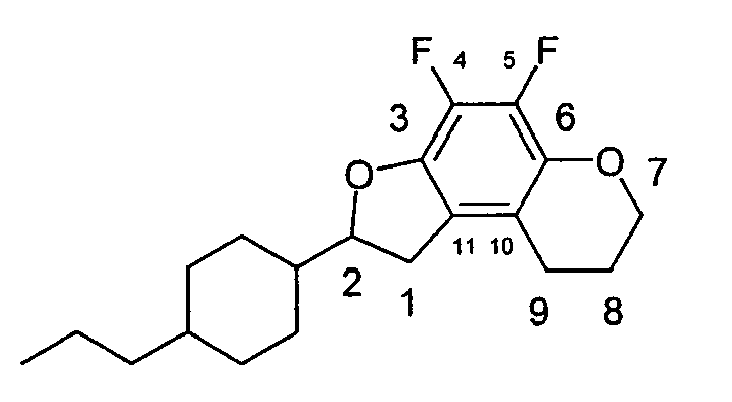
19F-NMR (282 MHz, CHCl3): δ = -162,1 (d, 1 F, J = 19,5 Hz), -163,1 (d, 1 F, J = 19,5 Hz).
MS (EI): m/z(%) = 336 (82, M+), 199 (100). -

- 3.1. Herstellung von 1-(1-Ethinyl-hexyloxy)-2,3-difluor-benzol

- 3.2. Herstellung von 7,8-Difluor-2-pentyl-2H-chromen

- 3.3. Herstellung von 7,8-Difluor-2-pentyl-chroman
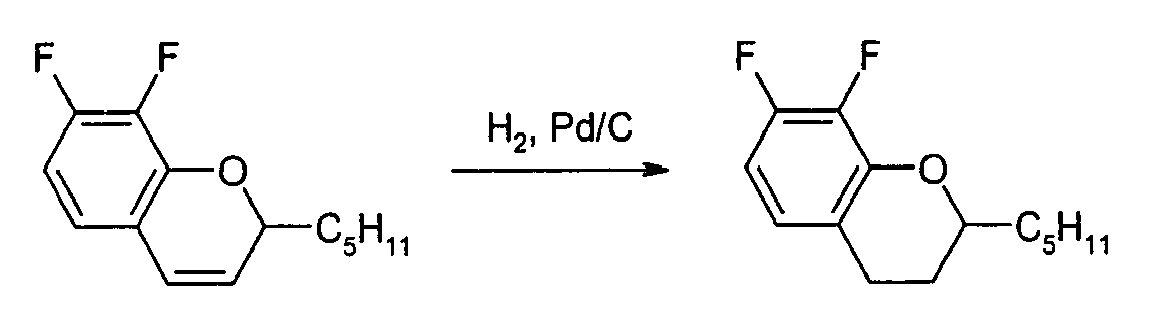
- 3.4. Herstellung von 7,8-Difluor-2-pentyl-chroman-6-ol

- 3.5. Herstellung von 7,8-Difluor-6-methoxymethoxy-2-pentyl-chroman

- 3.6. Herstellung von 7,8-Difluor-5-iod-6-methoxymethoxy-2-pentyl-chroman

- 3.7. Herstellung von 7,8-Difluor-5-iod-2-pentyl-chroman-6-ol

- 3.8. Herstellung von 7,8-Difluor-2-pentyl-5-(4-propyl-cyclohexylethinyl)-chroman-6-ol

- 3.9. Herstellung von 4,5-Difluor-7-pentyl-2-(4-propyl-cyclohexyl)-8,9-dihydro-7H-furo[3,2-f]chromen


19F-NMR (376 MHz, CHCl3): δ = -162,9 (dm, 1 F, J = 19,2 Hz), -166,2 (d, 1 F, J = 19,2 Hz).
MS (EI): m/z(%) = 404 (98, M+), 307 (100). -

- 4.1. Herstellung von 4,5-Difluor-7-pentyl-2-(4-propyl-cyclohexyl)-1,7,8,9-tetrahydro-2H-furo[3,2-f]chromen

1H-NMR (300 MHz, CHCl3): δ = 4,61-4,52 (m,1 H, 2-H), 3,97-3,88 (m, 1 H, 7-H), 3,04-2,94 (m, 1 H, 1-H), 2,84-2,74 (m, 1 H, 1-H), 2,67-2,47 (m, 2H, 9-H), 2,05-1,96 (m, 2H, H aliph. ),1,85-1,66 (m, 4H, H aliph. ), 1,65-1,41 (m, 3H, H aliph. ), 1,39-1,26 (m, 5H, H aliph. ), 1,24-1,01 (m, 4H, H aliph. ), 0,98-0,82 (m, 5H, H aliph. ).
19F-NMR (282 MHz, CHCl3): δ = -161,9 (dm, 1 F, J = 19,2 Hz), -163,8 (d, 1 F, J = 19,2 Hz).
MS (EI): m/z(%) = 406 (100, M+). -

- 5.1. Herstellung von 5-Brom-1,2-difluor-3-prop-2-inyloxy-benzol
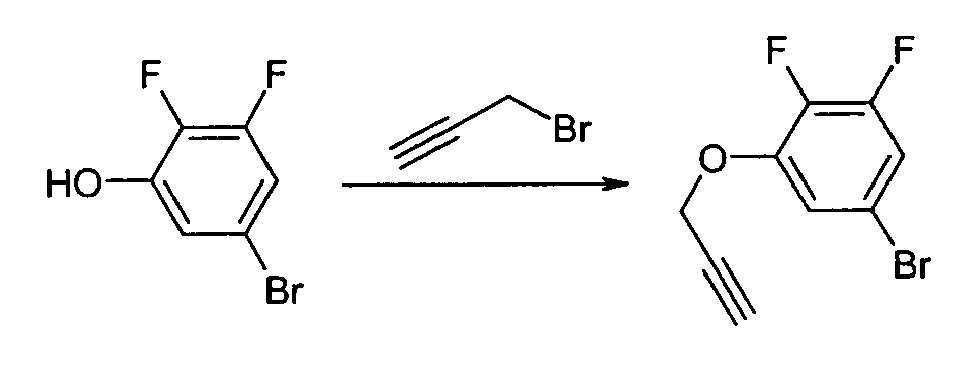
- 5.2. Herstellung von 4-Brom-6,7-difluor-2-methyl-benzofuran

- 5.3. Herstellung von 4-Brom-6,7-difluor-2-methyl-benzofuran-5-ol

- 5.4. Herstellung von 4-Brom-6,7-difluor-5-(2-methoxy-ethoxymethoxy)-2-methyl-benzofuran

- 5.5. Herstellung von 6,7-Difluor-5-(2-methoxy-ethoxymethoxy)-2-methyl-benzofuran-4-carbaldehyd

- 5.6. Herstellung von 6,7-Difluor-5-hydroxy-2-methyl-benzofuran-4-carbaldehyd

- 5.7. Herstellung von 4,5-Difluor-2-methyl-7-propyl-7H-furo[3,2-f]chromen

- 5.8. Herstellung von 4,5-Difluor-2-methyl-7-propyl-8,9-dihydro-7H-furo[3,2-f]chromen


19F-NMR (235 MHz, CHCl3): δ = -164,2 (dm, 1 F, J = 19,5 Hz), -167,4 (d, 1F, J = 19,5 Hz).
MS (EI): m/z(%) = 266 (37, M+), 223 (6, [M - C3H7]+), 197 (100). -

- 6.1. Herstellung von 4,5-Difluor-2-methyl-7-propyl-1,7,8,9-tetrahydro-2H-furo[3,2-f]chromen


19F-NMR (235 MHz, CHCl3): δ = -160,6 (dm, 1 F, J = 19,5 Hz), -162,8 (d, 1F, J = 19,5 Hz).
MS (EI): m/z(%) = 268 (89, M+), 225 (6, [M - C3H7]+), 199 (100). -

- 7.1. Herstellung von 4,5-Difluor-2-methyl-7-pentyl-7H-furo[3,2-f]chromen

- 7.2. Herstellung von 4,5-Difluor-2-methyl-7-pentyl-8,9-dihydro-7H-furo[3,2-f]chromen


19F-NMR (235 MHz, CHCl3): δ = -163,2 (dm, 1 F, J = 19,5 Hz), -166,4 (d, 1F, J = 19,5 Hz).
MS (EI): m/z(%) = 294 (27, M+), 223 (6, [M - C5H11]+), 197 (100). -

- 8.1. Herstellung von 4,5-Difluor-2-methyl-7-pentyl-1,7,8,9-tetrahydro-2H-furo[3,2-f]chromen


19F-NMR (235 MHz, CHCl3): δ = -162,1 (dm, 1 F, J = 19,5 Hz), -164,2 (d, 1F, J = 19,5 Hz).
MS (EI): m/z(%) = 296 (98, M+), 199 (100). -


19F-NMR (282 MHz, CHCl3): δ = -162,5 (dd, 1 F, J = 19,2 Hz, J = 1,9 Hz), - 164,3 (d, 1F, J = 19,2 Hz).
MS (EI): m/z(%) = 398 (100, M+), 301 (97). - Analog zu den Beispielen 1, 3 und 9 werden hergestellt

Nr. R1 R2 Phasensequenz T/°C 10 CH3 CH3 11 CH3 C2H5 12 CH3 n-C3H7 13 CH3 n-C4H9 15 CH3 n-C5H11 16 CH3 n-C6H13 17 CH3 n-C7H15 18 C2H5 CH3 19 C2H5 C2H5 20 C2H5 n-C3H7 21 C2H5 n-C4H9 22 C2H5 n-C5H11 23 C2H5 n-C6H13 24 C2H5 n-C7H15 25 n-C3H7 CH3 26 n-C3H7 C2H5 27 n-C3H7 n-C3H7 28 n-C3H7 n-C4H9 3 n-C3H7 n-C5H11 K 56 N 62 I 29 n-C3H7 n-C6H13 30 n-C3H7 n-C7H15 31 n-C4H9 CH3 32 n-C4H9 C2H5 33 n-C4H9 n-C3H7 34 n-C4H9 n-C4H9 35 n-C4H9 n-C5H11 36 n-C4H9 n-C6H13 37 n-C4H9 n-C7H15 38 n-C5H11 CH3 39 n-C5H11 C2H5 40 n-C5H11 n-C3H7 41 n-C5H11 n-C4H9 42 n-C5H11 n-C5H11 43 n-C5H11 n-C6H13 44 n-C5H11 n-C7H15 45 n-C6H13 CH3 46 n-C6H13 C2H5 47 n-C6H13 n-C3H7 48 n-C6H13 n-C4H9 49 n-C6H13 n-C5H11 50 n-C6H13 n-C6H13 51 n-C6H13 n-C7H15 52 n-C7H15 CH3 53 n-C7H15 C2H5 54 n-C7H15 n-C3H7 55 n-C7H15 n-C4H9 56 n-C7H15 n-C5H11 57 n-C7H15 n-C6H13 58 n-C7H15 n-C7H15 59 CH3O CH3 60 CH3O C2H5 61 CH3O n-C3H7 62 CH3O n-C4H9 63 CH3O n-C5H11 64 CH3O n-C6H13 65 CH3O n-C7H15 66 C2H5O CH3 67 C2H5O C2H5 68 C2H5O n-C3H7 69 C2H5O n-C4H9 70 C2H5O n-C5H11 71 C2H5O n-C6H13 72 C2H5O n-C7H15 73 CH2=CH CH3 74 CH2=CH C2H5 75 CH2=CH n-C3H7 76 CH2=CH n-C4H9 77 CH2=CH n-C5H11 78 CH2=CH n-C6H13 79 CH2=CH n-C7H15 80 CH3-CH=CH CH3 81 CH3-CH=CH C2H5 82 CH3-CH=CH n-C3H7 83 CH3-CH=CH n-C4H9 84 CH3-CH=CH n-C5H11 85 CH3-CH=CH n-C6H13 86 CH3-CH=CH n-C7H15 - Analog zu den Beispielen 1, 3 und 9 werden hergestellt

Nr. R1 R2 Phasensequenz T/°C 87 CH3 CH3 88 CH3 C2H5 89 CH3 n-C3H7 90 CH3 n-C4H9 91 CH3 n-C5H11 92 CH3 n-C6H13 93 CH3 n-C7H15 94 C2H5 CH3 95 C2H5 C2H5 96 C2H5 n-C3H7 97 C2H5 n-C4H9 98 C2H5 n-C5H11 99 C2H5 n-C6H13 100 C2H5 n-C7H15 101 n-C3H7 CH3 102 n-C3H7 C2H5 103 n-C3H7 n-C3H7 104 n-C3H7 n-C4H9 105 n-C3H7 n-C5H11 106 n-C3H7 n-C6H13 107 n-C3H7 n-C7H15 108 n-C4H9 CH3 109 n-C4H9 C2H5 110 n-C4H9 n-C3H7 111 n-C4H9 n-C4H9 112 n-C4H9 n-C5H11 113 n-C4H9 n-C6H13 114 n-C4H9 n-C7H15 115 n-C5H11 CH3 116 n-C5H11 C2H5 117 n-C5H11 n-C3H7 118 n-C5H11 n-C4H9 119 n-C5H11 n-C5H11 120 n-C5H11 n-C6H13 121 n-C5H11 n-C7H15 122 n-C6H13 CH3 123 n-C6H13 C2H5 124 n-C6H13 n-C3H7 125 n-C6H13 n-C4H9 126 n-C6H13 n-C5H11 127 n-C6H13 n-C6H13 128 n-C6H13 n-C7H15 129 n-C7H15 CH3 130 n-C7H15 C2H5 131 n-C7H15 n-C3H7 132 n-C7H15 n-C4H9 133 n-C7H15 n-C5H11 134 n-C7H15 n-C6H13 135 n-C7H15 n-C7H15 136 CH3O CH3 137 CH3O C2H5 138 CH3O n-C3H7 139 CH3O n-C4H9 140 CH3O n-C5H11 141 CH3O n-C6H13 142 CH3O n-C7H15 143 C2H5O CH3 144 C2H5O C2H5 145 C2H5O n-C3H7 146 C2H5O n-C4H9 147 C2H5O n-C5H11 148 C2H5O n-C6H13 149 C2H5O n-C7H15 150 CH2=CH CH3 151 CH2=CH C2H5 152 CH2=CH n-C3H7 153 CH2=CH n-C4H9 154 CH2=CH n-C5H11 155 CH2=CH n-C6H13 156 CH2=CH n-C7H15 157 CH3-CH=CH CH3 158 CH3-CH=CH C2H5 159 CH3-CH=CH n-C3H7 160 CH3-CH=CH n-C4H9 161 CH3-CH=CH n-C5H11 162 CH3-CH=CH n-C6H13 163 CH3-CH=CH n-C7H15 - Analog zu den Beispielen 2 und 4 werden hergestellt

Nr. R1 R2 Phasensequenz T/°C 164 CH3 CH3 165 CH3 C2H5 166 CH3 n-C3H7 167 CH3 n-C4H9 168 CH3 n-C5H11 169 CH3 n-C6H13 170 CH3 n-C7H15 171 C2H5 CH3 172 C2H5 C2H5 173 C2H5 n-C3H7 174 C2H5 n-C4H9 175 C2H5 in-C5H11 176 C2H5 n-C6H13 177 C2H5 n-C7H15 178 n-C3H7 CH3 179 n-C3H7 C2H5 180 n-C3H7 n-C3H7 181 n-C3H7 n-C4H9 4 n-C3H7 n-C5H11 K 101 I 182 n-C3H7 n-C6H13 183 n-C3H7 n-C7H15 184 n-C4H9 CH3 185 n-C4H9 C2H5 186 n-C4H9 n-C3H7 187 n-C4H9 n-C4H9 188 n-C4H9 n-C5H11 189 n-C4H9 n-C6H13 190 n-C4H9 n-C7H15 191 n-C5H11 CH3 192 n-C5H11 C2H5 193 n-C5H11 n-C3H7 208 n-C5H11 n-C4H9 209 n-C5H11 n-C5H11 210 n-C5H11 n-C6H13 211 n-C5H11 n-C7H15 212 n-C6H13 CH3 213 n-C6H13 C2H5 214 n-C6H13 n-C3H7 215 n-C6H13 n-C4H9 216 n-C6H13 n-C5H11 217 n-C6H13 n-C6H13 218 n-C6H13 n-C7H15 219 n-C7H15 CH3 220 n-C7H15 C2H5 221 n-C7H15 n-C3H7 222 n-C7H15 n-C4H9 223 n-C7H15 n-C5H11 224 n-C7H15 n-C6H13 225 n-C7H15 n-C7H15 226 CH3O CH3 227 CH3O C2H5 228 CH3O n-C3H7 229 CH3O n-C4H9 230 CH3O n-C5H11 231 CH3O n-C6H13 232 CH3O n-C7H15 233 C2H5O CH3 234 C2H5O C2H5 235 C2H5O n-C3H7 236 C2H5O n-C4H9 237 C2H5O n-C5H11 238 C2H5O n-C6H13 239 C2H5O n-C7H15 - Analog zu den Beispielen 2 und 4 werden hergestellt

Nr. R1 R2 Phasensequenz T/°C 240 CH3 CH3 241 CH3 C2H5 242 CH3 n-C3H7 243 CH3 n-C4H9 244 CH3 n-C5H11 245 CH3 n-C6H13 246 CH3 n-C7H15 247 C2H5 CH3 248 C2H5 C2H5 249 C2H5 n-C3H7 250 C2H5 n-C4H9 251 C2H5 n-C5H11 252 C2H5 n-C6H13 253 C2H5 n-C7H15 254 n-C3H7 CH3 255 n-C3H7 C2H5 256 n-C3H7 n-C3H7 257 n-C3H7 n-C4H9 258 n-C3H7 n-C5H11 259 n-C3H7 n-C6H13 260 n-C3H7 n-C7H15 261 n-C4H9 CH3 262 n-C4H9 C2H5 263 n-C4H9 n-C3H7 264 n-C4H9 n-C4H9 265 n-C4H9 n-C5H11 266 n-C4H9 n-C6H13 267 n-C4H9 n-C7H15 268 n-C5H11 CH3 269 n-C5H11 C2H5 270 n-C5H11 n-C3H7 271 n-C5H11 n-C4H9 272 n-C5H11 n-C5H11 273 n-C5H11 n-C6H13 274 n-C5H11 n-C7H15 275 n-C6H13 CH3 276 n-C6H13 C2H5 277 n-C6H13 n-C3H7 278 n-C6H13 n-C4H9 279 n-C6H13 n-C5H11 280 n-C6H13 n-C6H13 281 n-C6H13 n-C7H15 282 n-C7H15 CH3 283 n-C7H15 C2H5 284 n-C7H15 n-C3H7 285 n-C7H15 n-C4H9 286 n-C7H15 n-C5H11 287 n-C7H15 n-C6H13 288 n-C7H15 n-C7H15 289 CH3O CH3 290 CH3O C2H5 291 CH3O n-C3H7 292 CH3O n-C4H9 293 CH3O n-C5H11 294 CH3O n-C6H13 295 CH3O n-C7H15 296 C2H5O CH3 297 C2H5O C2H5 298 C2H5O n-C3H7 299 C2H5O n-C4H9 300 C2H5O n-C5H11 300 C2H5O n-C6H13 302 C2H5O n-C7H15 - Analog zu den Beispielen 5 und 7 werden hergestellt

Nr. R2 Phasensequenz T/°C 303 CH3 304 C2H5 5 n-C3H7 K 75 I 305 n-C4H9 7 n-C5H11 K 61 I 306 n-C6H13 307 n-C7H15 - Analog zu den Beispielen 5 und 7 werden hergestellt

Nr. R2 Phasensequenz T/°C 308 CH3 309 C2H5 310 n-C3H7 311 n-C4H9 312 n-C5H11 313 n-C6H13 314 n-C7H15 - Analog zu den Beispielen 6 und 8 werden hergestellt

Nr. R2 Phasensequenz T/°C 315 CH3 316 C2H5 6 n-C3H7 K 87 I 317 n-C4H9 8 n-C5H11 K 76 I 318 n-C6H13 319 n-C7H15 - Analog zu den Beispielen 6 und 8 werden hergestellt

Nr. R2 Phasensequenz T/°C 320 CH3 241 C2H5 321 n-C3H7 322 n-C4H9 323 n-C5H11 324 n-C6H13 325 n-C7H15 - Analog zu den Beispielen 1, 3 und 9 werden hergestellt

Nr. R1 R2 Phasensequenz T/°C 326 C2H5 CH3 327 C2H5 C2H5 328 C2H5 n-C3H7 329 C2H5 n-C4H9 330 C2H5 n-C5H11 331 C2H5 n-C6H13 332 C2H5 n-C7H15 333 n-C3H7 CH3 334 n-C3H7 C2H5 335 n-C3H7 n-C3H7 336 n-C3H7 n-C4H9 337 n-C3H7 n-C5H11 338 n-C3H7 n-C6H13 339 n-C3H7 n-C7H15 340 n-C4H9 CH3 341 n-C4H9 C2H5 342 n-C4H9 n-C3H7 343 n-C4H9 n-C4H9 344 n-C4H9 n-C5H11 345 n-C4H9 n-C6H13 346 n-C4H9 n-C7H15 347 n-C5H11 CH3 348 n-C5H11 C2H5 349 n-C5H11 n-C3H7 350 n-C5H11 n-C4H9 351 n-C5H11 n-C5H11 352 n-C5H11 n-C6H13 353 n-C5H11 n-C7H15 354 n-C6H13 CH3 355 n-C6H13 C2H5 356 n-C6H13 n-C3H7 357 n-C6H13 n-C4H9 358 n-C6H13 n-C5H11 359 n-C6H13 n-C6H13 360 n-C6H13 n-C7H15 361 n-C7H15 CH3 362 n-C7H15 C2H5 363 n-C7H15 n-C3H7 364 n-C7H15 n-C4H9 365 n-C7H15 n-C5H11 366 n-C7H15 n-C6H13 367 n-C7H15 n-C7H15 368 CH2=CH CH3 369 CH2=CH C2H5 370 CH2=CH n-C3H7 371 CH2=CH n-C4H9 372 CH2=CH n-C5H11 373 CH2=CH n-C6H13 374 CH2=CH n-C7H15 375 CH3-CH=CH CH3 376 CH3-CH=CH C2H5 377 CH3-CH=CH n-C3H7 378 CH3-CH=CH n-C4H9 379 CH3-CH=CH n-C5H11 380 CH3-CH=CH n-C6H13 381 CH3-CH=CH n-C7H15 - Analog zu den Beispielen 1, 3 und 9 werden hergestellt
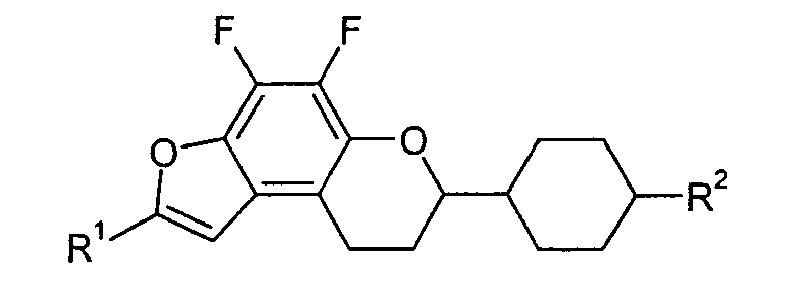
Nr. R1 R2 Phasensequenz T/°C 382 C2H5 CH3 383 C2H5 C2H5 394 C2H5 n-C3H7 395 C2H5 n-C4H9 396 C2H5 n-C5H11 397 C2H5 n-C6H13 398 C2H5 n-C7H15 399 n-C3H7 CH3 390 n-C3H7 C2H5 391 n-C3H7 n-C3H7 392 n-C3H7 n-C4H9 393 n-C3H7 n-C5H11 394 n-C3H7 n-C6H13 395 n-C3H7 n-C7H15 396 n-C4H9 CH3 397 n-C4H9 C2H5 398 n-C4H9 n-C3H7 399 n-C4H9 n-C4H9 400 n-C4H9 n-C5H11 401 n-C4H9 n-C6H13 402 n-C4H9 n-C7H15 403 n-C5H11 CH3 404 n-C5H11 C2H5 405 n-C5H11 n-C3H7 406 n-C5H11 n-C4H9 407 n-C5H11 n-C5H11 408 n-C5H11 n-C6H13 409 n-C5H11 n-C7H15 410 n-C6H13 CH3 411 n-C6H13 C2H5 412 n-C6H13 n-C3H7 413 n-C6H13 n-C4H9 414 n-C6H13 n-C5H11 415 n-C6H13 n-C6H13 416 n-C6H13 n-C7H15 417 n-C7H15 CH3 418 n-C7H15 C2H5 419 n-C7H15 n-C3H7 420 n-C7H15 n-C4H9 421 n-C7H15 n-C5H11 422 n-C7H15 n-C6H13 423 n-C7H15 n-C7H15 424 CH2=CH CH3 425 CH2=CH C2H5 426 CH2=CH n-C3H7 427 CH2=CH n-C4H9 428 CH2=CH n-C5H11 429 CH2=CH n-C6H13 430 CH2=CH n-C7H15 431 CH3-CH=CH CH3 432 CH3-CH=CH C2H5 453 CH3-CH=CH n-C3H7 434 CH3-CH=CH n-C4H9 435 CH3-CH=CH n-C5H11 436 CH3-CH=CH n-C6H13 437 CH3-CH=CH n-C7H15 - Analog zu den Beispielen 2 und 4 werden hergestellt

Nr. R1 R2 Phasensequenz T/°C 438 CH3 n-C7H15 439 C2H5 CH3 440 C2H5 C2H5 441 C2H5 n-C3H7 442 C2H5 n-C4H9 443 C2H5 n-C5H11 444 C2H5 n-C6H13 445 C2H5 n-C7H15 446 n-C3H7 CH3 447 n-C3H7 C2H5 448 n-C3H7 n-C3H7 449 n-C3H7 n-C4H9 450 n-C3H7 n-C5H11 451 n-C3H7 n-C6H13 452 n-C3H7 n-C7H15 453 n-C4H9 CH3 454 n-C4H9 C2H5 455 n-C4H9 n-C3H7 456 n-C4H9 n-C4H9 457 n-C4H9 n-C5H11 458 n-C4H9 n-C6H13 459 n-C4H9 n-C7H15 460 n-C5H11 CH3 461 n-C5H11 C2H5 462 n-C5H11 n-C3H7 463 n-C5H11 n-C4H9 464 n-C5H11 n-C5H11 465 n-C5H11 n-C6H13 466 n-C5H11 n-C7H15 467 n-C6H13 CH3 468 n-C6H13 C2H5 469 n-C6H13 n-C3H7 470 n-C6H13 n-C4H9 471 n-C6H13 n-C5H11 472 n-C6H13 n-C6H13 473 n-C6H13 n-C7H15 474 n-C7H15 CH3 475 n-C7H15 C2H5 476 n-C7H15 n-C3H7 477 n-C7H15 n-C4H9 478 n-C7H15 n-C5H11 479 n-C7H15 n-C6H13 480 n-C7H15 n-C7H15 - Analog zu den Beispielen 2 und 4 werden hergestellt

Nr. R1 R2 Phasensequenz T/°C 481 CH3 n-C7H15 482 C2H5 CH3 483 C2H5 C2H5 484 C2H5 n-C3H7 485 C2H5 n-C4H9 486 C2H5 n-C5H11 487 C2H5 n-C6H13 488 C2H5 n-C7H15 489 n-C3H7 CH3 490 n-C3H7 C2H5 491 n-C3H7 n-C3H7 492 n-C3H7 n-C4H9 493 n-C3H7 n-C5H11 494 n-C3H7 n-C6H13 495 n-C3H7 n-C7H15 496 n-C4H9 CH3 497 n-C4H9 C2H5 498 n-C4H9 n-C3H7 499 n-C4H9 n-C4H9 500 n-C4H9 n-C5H11 501 n-C4H9 n-C6H13 502 n-C4H9 n-C7H15 503 n-C5H11 CH3 504 n-C5H11 C2H5 505 n-C5H11 n-C3H7 586 n-C5H11 n-C4H9 507 n-C5H11 n-C5H11 508 n-C5H11 n-C6H13 509 n-C5H11 n-C7H15 510 n-C6H13 CH3 511 n-C6H13 C2H5 512 n-C6H13 n-C3H7 513 n-C6H13 n-C4H9 514 n-C6H13 n-C5H11 515 n-C6H13 n-C6H13 516 n-C6H13 n-C7H15 517 n-C7H15 CH3 518 n-C7H15 C2H5 519 n-C7H15 n-C3H7 520 n-C7H15 n-C4H9 521 n-C7H15 n-C5H11 522 n-C7H15 n-C6H13 523 n-C7H15 n-C7H15 - Analog zu Beispiel 9 werden hergestellt

Nr. R1 R2 Phasensequenz T/°C 524 CH3 CH3 525 CH3 C2H5 526 CH3 n-C3H7 527 CH3 n-C4H9 528 CH3 n-C5H11 529 CH3 n-C6H13 530 CH3 n-C7H15 531 C2H5 CH3 532 C2H5 C2H5 533 C2H5 n-C3H7 534 C2H5 n-C4H9 535 C2H5 n-C5H11 536 C2H5 n-C6H13 537 C2H5 n-C7H15 538 n-C3H7 CH3 539 n-C3H7 C2H5 540 n-C3H7 n-C3H7 541 n-C3H7 n-C4H9 9 n-C3H7 n-C5H11 Tg -31 K 70 N 79 I 542 n-C3H7 n-C6H13 543 n-C3H7 n-C7H15 544 n-C4H9 CH3 545 n-C4H9 C2H5 546 n-C4H9 n-C3H7 547 n-C4H9 n-C4H9 548 n-C4H9 n-C5H11 549 n-C4H9 n-C6H13 550 n-C4H9 n-C7H15 551 n-C5H11 CH3 552 n-C5H11 C2H5 553 n-C5H11 n-C3H7 554 n-C5H11 n-C4H9 555 n-C5H11 n-C5H11 556 n-C5H11 n-C6H13 557 n-C5H11 n-C7H15 558 n-C6H13 CH3. 559 n-C6H13 C2H5 560 n-C6H13 n-C3H7 561 n-C6H13 n-C4H9 562 n-C6H13 n-C5H11 563 n-C6H13 n-C6H13 564 n-C6H13 n-C7H15 565 n-C7H15 CH3 566 n-C7H15 C2H5 567 n-C7H15 n-C3H7 568 n-C7H15 n-C4H9 569 n-C7H15 n-C5H11 570 n-C7H15 n-C6H13 571 n-C7H15 n-C7H15 572 CH3O CH3 573 CH3O C2H5 574 CH3O n-C3H7 575 CH3O n-C4H9 576 CH3O n-C5H11 577 CH3O n-C6H13 578 CH3O n-C7H15 579 C2H5O CH3 580 C2H5O C2H5 581 C2H5O n-C3H7 582 C2H5O n-C4H9 583 C2H5O n-C5H11 584 C2H5O n-C6H13 599 C2H5O n-C7H15 - Analog zu Beispiel 9 werden hergestellt

Nr. R1 R2 Phasensequenz T/°C 600 CH3 CH3 601 CH3 C2H5 602 CH3 n-C3H7 603 CH3 n-C4H9 604 CH3 n-C5H11 605 CH3 n-C6H13 606 CH3 n-C7H15 607 C2H5 CH3 608 C2H5 C2H5 609 C2H5 n-C3H7 610 C2H5 n-C4H9 611 C2H5 n-C5H11 612 C2H5 n-C6H13 613 C2H5 n-C7H15 614 n-C3H7 CH3 615 n-C3H7 C2H5 616 n-C3H7 n-C3H7 617 n-C3H7 n-C4H9 618 n-C3H7 n-C5H11 619 n-C3H7 n-C6H13 620 n-C3H7 n-C7H15 621 n-C4H9 CH3 622 n-C4H9 C2H5 623 n-C4H9 n-C3H7 624 n-C4H9 n-C4H9 625 n-C4H9 n-C5H11 626 n-C4H9 n-C6H13 627 n-C4H9 n-C7H15 628 n-C5H11 CH3 629 n-C5H11 C2H5 630 n-C5H11 n-C3H7 631 n-C5H11 n-C4H9 632 n-C5H11 n-C5H11 633 n-C5H11 n-C6H13 634 n-C5H11 n-C7H15 635 n-C6H13 CH3 636 n-C6H13 C2H5 637 n-C6H13 n-C3H7 638 n-C6H13 n-C4H9 639 n-C6H13 n-C5H11 640 n-C6H13 n-C6H13 641 n-C6H13 n-C7H15 642 n-C7H15 CH3 643 n-C7H15 C2H5 644 n-C7H15 n-C3H7 645 n-C7H15 n-C4H9 646 n-C7H15 n-C5H11 677 n-C7H15 n-C6H13 648 n-C7H15 n-C7H15 649 CH3O CH3 650 CH3O C2H5 651 CH3O n-C3H7 652 CH3O n-C4H9 653 CH3O n-C5H11 654 CH3O n-C6H13 669 CH3O n-C7H15 670 C2H5O CH3 671 C2H5O C2H5 672 C2H5O n-C3H7 673 C2H5O n-C4H9 674 C2H5O n-C5H11 675 C2H5O n-C6H13 676 C2H5O n-C7H15 - Aus 31 werden analog zu den Beispielen 1, 3 und 9 hergestellt

Nr. R1 R2 Phasensequenz T/°C 677 CH3 CH3 678 CH3 C2H5 679 CH3 n-C3H7 680 CH3 n-C4H9 681 CH3 n-C5H11 682 CH3 n-C6H13 683 CH3 n-C7H15 684 C2H5 CH3 685 C2H5 C2H5 686 C2H5 n-C3H7 687 C2H5 n-C4H9 688 C2H5 n-C5H11 689 C2H5 n-C6H13 690 C2H5 n-C7H15 691 n-C3H7 CH3 692 n-C3H7 C2H5 693 n-C3H7 n-C3H7 694 n-C3H7 n-C4H9 695 n-C3H7 n-C5H11 696 n-C3H7 n-C6H13 697 n-C3H7 n-C7H15 698 n-C4H9 CH3 699 n-C4H9 C2H5 700 n-C4H9 n-C3H7 701 n-C4H9 n-C4H9 702 n-C4H9 n-C5H11 703 n-C4H9 n-C6H13 704 n-C4H9 n-C7H15 705 n-C5H11 CH3 706 n-C5H11 C2H5 707 n-C5H11 n-C3H7 708 n-C5H11 n-C4H9 709 n-C5H11 n-C5H11 710 n-C5H11 n-C6H13 711 n-C5H11 n-C7H15 712 n-C6H13 CH3 713 n-C6H13 C2H5 714 n-C6H13 n-C3H7 715 n-C6H13 n-C4H9 716 n-C6H13 n-C5H11 717 n-C6H13 n-C6H13 718 n-C6H13 n-C7H15 719 n-C7H15 CH3 720 n-C7H15 C2H5 721 n-C7H15 n-C3H7 722 n-C7H15 n-C4H9 723 n-C7H15 n-C5H11 724 n-C7H15 n-C6H13 725 n-C7H15 n-C7H15 726 CH3O CH3 727 CH3O C2H5 728 CH3O n-C3H7 729 CH3O n-C4H9 730 CH3O n-C5H11 731 CH3O n-C6H13 732 CH3O n-C7H15 733 C2H5O CH3 734 C2H5O C2H5 735 C2H5O n-C3H7 736 C2H5O n-C4H9 737 C2H5O n-C5H11 738 C2H5O n-C6H13 739 C2H5O n-C7H15 740 CH2=CH CH3 741 CH2=CH C2H5 742 CH2=CH n-C3H7 743 CH2=CH n-C4H9 744 CH2=CH n-C5H11 745 CH2=CH n-C6H13 746 CH2=CH n-C7H15 747 CH3-CH=CH CH3 748 CH3-CH=CH C2H5 749 CH3-CH=CH n-C3H7 750 CH3-CH=CH n-C4H9 751 CH3-CH=CH n-C5H11 752 CH3-CH=CH n-C6H13 753 CH3-CH=CH n-C7H15 - Aus 36 werden analog zu den Beispielen 1, 3 und 9 hergestellt

Nr. R1 R2 Phasensequenz T/°C 754 CH3 CH3 755 CH3 C2H5 756 CH3 n-C3H7 757 CH3 n-C4H9 758 CH3 n-C5H11 759 CH3 n-C6H13 760 CH3 n-C7H15 761 C2H5 CH3 762 C2H5 C2H5 763 C2H5 n-C3H7 764 C2H5 n-C4H9 765 C2H5 n-C5H11 766 C2H5 n-C6H13 767 C2H5 n-C7H15 768 n-C3H7 CH3 769 n-C3H7 C2H5 770 n-C3H7 n-C3H7 771 n-C3H7 n-C4H9 772 n-C3H7 n-C5H11 773 n-C3H7 n-C6H13 774 n-C3H7 n-C7H15 775 n-C4H9 CH3 776 n-C4H9 C2H5 777 n-C4H9 n-C3H7 778 n-C4H9 n-C4H9 779 n-C4H9 n-C5H11 780 n-C4H9 n-C6H13 781 n-C4H9 n-C7H15 782 n-C5H11 CH3 783 n-C5H11 C2H5 784 n-C5H11 n-C3H7 785 n-C5H11 n-C4H9 786 n-C5H11 n-C5H11 787 n-C5H11 n-C6H13 788 n-C5H11 n-C7H15 789 n-C6H13 CH3 790 n-C6H13 C2H5 791 n-C6H13 n-C3H7 792 n-C6H13 n-C4H9 793 n-C6H13 n-C5H11 794 n-C6H13 n-C6H13 795 n-C6H13 n-C7H15 796 n-C7H15 CH3 797 n-C7H15 C2H5 798 n-C7H15 n-C3H7 799 n-C7H15 n-C4H9 800 n-C7H15 n-C5H11 801 n-C7H15 n-C6H13 802 n-C7H15 n-C7H15 803 CH3O CH3 804 CH3O C2H5 806 CH3O n-C3H7 807 CH3O n-C4H9 808 CH3O n-C5H11 809 CH3O n-C6H13 810 CH3O n-C7H15 811 C2H5O CH3 812 C2H5O C2H5 813 C2H5O n-C3H7 814 C2H5O n-C4H9 815 C2H5O n-C5H11 816 C2H5O n-C6H13 817 C2H5O n-C7H15 818 CH2=CH CH3 819 CH2=CH C2H5 820 CH2=CH n-C3H7 821 CH2=CH n-C4H9 822 CH2=CH n-C5H11 823 CH2=CH n-C6H13 824 CH2=CH n-C7H15 825 CH3-CH=CH CH3 826 CH3-CH=CH C2H5 827 CH3-CH=CH n-C3H7 828 CH3-CH=CH n-C4H9 829 CH3-CH=CH n-C5H11 820 CH3-CH=CH n-C6H13 821 CH3-CH=CH n-C7H15 - Aus 31 werden analog zu den Beispielen 1, 3 und 9 hergestellt

Nr. R1 R2 Phasensequenz T/°C 822 C2H5 CH3 823 C2H5 C2H5 824 C2H5 n-C3H7 825 C2H5 n-C4H9 826 C2H5 n-C5H11 827 C2H5 n-C6H13 828 C2H5 n-C7H15 829 n-C3H7 CH3 830 n-C3H7 C2H5 831 n-C3H7 n-C3H7 832 n-C3H7 n-C4H9 833 n-C3H7 n-C5H11 834 n-C3H7 n-C6H13 835 n-C3H7 n-C7H15 836 n-C4H9 CH3 837 n-C4H9 C2H5 838 n-C4H9 n-C3H7 839 n-C4H9 n-C4H9 840 n-C4H9 n-C5H11 841 n-C4H9 n-C6H13 842 n-C4H9 n-C7H15 843 n-C5H11 CH3 844 n-C5H11 C2H5 845 n-C5H11 n-C3H7 846 n-C5H11 n-C4H9 847 n-C5H11 n-C5H11 848 n-C5H11 n-C6H13 849 n-C5H11 n-C7H15 850 n-C6H13 CH3 851 n-C6H13 C2H5 852 n-C6H13 n-C3H7 853 n-C6H13 n-C4H9 854 n-C6H13 n-C5H11 855 n-C6H13 n-C6H13 856 n-C6H13 n-C7H15 857 n-C7H15 CH3 858 n-C7H15 C2H5 859 n-C7H15 n-C3H7 860 n-C7H15 n-C4H9 861 n-C7H15 n-C5H11 862 n-C7H15 n-C6H13 863 n-C7H15 n-C7H15 864 CH2=CH CH3 865 CH2=CH C2H5 866 CH2=CH n-C3H7 867 CH2=CH n-C4H9 868 CH2=CH n-C5H11 869 CH2=CH n-C6H13 870 CH2=CH n-C7H15 871 CH3-CH=CH CH3 872 CH3-CH=CH C2H5 873 CH3-CH=CH n-C3H7 874 CH3-CH=CH n-C4H9 875 CH3-CH=CH n-C5H11 876 CH3-CH=CH n-C6H13 877 CH3-CH=CH n-C7H15 - Aus 36 werden analog zu den Beispielen 1, 3 und 9 hergestellt

Nr. R1 R2 Phasensequenz T/°C 878 CH3 CH3 879 CH3 C2H5 880 CH3 n-C3H7 881 CH3 n-C4H9 882 CH3 n-C5H11 883 CH3 n-C6H13 884 CH3 n-C7H15 885 C2H5 CH3 886 C2H5 C2H5 887 C2H5 n-C3H7 888 C2H5 n-C4H9 889 C2H5 n-C5H11 890 C2H5 n-C6H13 891 C2H5 n-C7H15 892 n-C3H7 CH3 893 n-C3H7 C2H5 894 n-C3H7 n-C3H7 895 n-C3H7 n-C4H9 896 n-C3H7 n-C5H11 897 n-C3H7 n-C6H13 898 n-C3H7 n-C7H15 899 n-C4H9 CH3 900 n-C4H9 C2H5 901 n-C4H9 n-C3H7 902 n-C4H9 n-C4H9 903 n-C4H9 n-C5H11 904 n-C4H9 n-C6H13 905 n-C4H9 n-C7H15 906 n-C5H11 CH3 907 n-C5H11 C2H5 908 n-C5H11 n-C3H7 909 n-C5H11 n-C4H9 910 n-C5H11 n-C5H11 911 n-C5H11 n-C6H13 912 n-C5H11 n-C7H15 913 n-C6H13 CH3 914 n-C6H13 C2H5 915 n-C6H13 n-C3H7 916 n-C6H13 n-C4H9 917 n-C6H13 n-C5H11 918 n-C6H13 n-C6H13 919 n-C6H13 n-C7H15 920 n-C7H15 CH3 921 n-C7H15 C2H5 922 n-C7H15 n-C3H7 923 n-C7H15 n-C4H9 924 n-C7H15 n-C5H11 925 n-C7H15 n-C6H13 926 n-C7H15 n-C7H15 927 CH2=CH CH3 928 CH2=CH C2H5 929 CH2=CH n-C3H7 930 CH2=CH n-C4H9 931 CH2=CH n-C5H11 932 CH2=CH n-C6H13 933 CH2=CH n-C7H15 934 CH3-CH=CH CH3 935 CH3-CH=CH C2H5 936 CH3-CH=CH n-C3H7 937 CH3-CH=CH n-C4H9 938 CH3-CH=CH n-C5H11 939 CH3-CH=CH n-C6H13 940 CH3-CH=CH n-C7H15 - Aus 31 werden analog zu den Beispielen 1, 3 und 9 hergestellt

Nr. R1 R2 Phasensequenz T/°C 941 C2H5 CH3 942 C2H5 C2H5 943 C2H5 n-C3H7 944 C2H5 n-C4H9 945 C2H5 n-C5H11 946 C2H5 n-C6H13 947 C2H5 n-C7H15 948 n-C3H7 CH3 949 n-C3H7 C2H5 950 n-C3H7 n-C3H7 951 n-C3H7 n-C4H9 952 n-C3H7 n-C5H11 953 n-C3H7 n-C6H13 954 n-C3H7 n-C7H15 955 n-C4H9 CH3 956 n-C4H9 C2H5 957 n-C4H9 n-C3H7 958 n-C4H9 n-C4H9 959 n-C4H9 n-C5H11 960 n-C4H9 n-C6H13 961 n-C4H9 n-C7H15 962 n-C5H11 CH3 963 n-C5H11 C2H5 964 n-C5H11 n-C3H7 965 n-C5H11 n-C4H9 966 n-C5H11 n-C5H11 967 n-C5H11 n-C6H13 968 n-C5H11 n-C7H15 969 n-C6H13 CH3 970 n-C6H13 C2H5 971 n-C6H13 n-C3H7 972 n-C6H13 n-C4H9 973 n-C6H13 n-C5H11 974 n-C6H13 n-C6H13 975 n-C6H13 n-C7H15 976 n-C7H15 CH3 977 n-C7H15 C2H5 978 n-C7H15 n-C3H7 979 n-C7H15 n-C4H9 980 n-C7H15 n-C5H11 981 n-C7H15 n-C6H13 982 n-C7H15 n-C7H15 983 CH2=CH CH3 984 CH2=CH C2H5 985 CH2=CH n-C3H7 986 CH2=CH n-C4H9 987 CH2=CH n-C5H11 988 CH2=CH n-C6H13 989 CH2=CH n-C7H15 990 CH3-CH=CH CH3 991 CH3-CH=CH C2H5 992 CH3-CH=CH n-C3H7 993 CH3-CH=CH n-C4H9 994 CH3-CH=CH n-C5H11 995 CH3-CH=CH n-C6H13 996 CH3-CH=CH n-C7H15 - Aus 36 werden analog zu den Beispielen 1, 3 und 9 hergestellt

Nr. R1 R2 Phasensequenz T/°C 997 CH3 CH3 998 CH3 C2H5 999 CH3 n-C3H7 1000 CH3 n-C4H9 1001 CH3 n-C5H11 1002 CH3 n-C6H13 1003 CH3 n-C7H15 1004 C2H5 CH3 1005 C2H5 C2H5 1006 C2H5 n-C3H7 1007 C2H5 n-C4H9 1008 C2Hs n-C5H11 1009 C2H5 n-C6H13 1010 C2H5 n-C7H15 1011 n-C3H7 CH3 1012 n-C3H7 C2H5 1013 n-C3H7 n-C3H7 1014 n-C3H7 n-C4H9 1015 n-C3H7 n-C5H11 1016 n-C3H7 n-C6H13 1017 n-C3H7 n-C7H15 1018 n-C4H9 CH3 1019 n-C4H9 C2H5 1020 n-C4H9 n-C3H7 1021 n-C4H9 n-C4H9 1022 n-C4H9 n-C5H11 1023 n-C4H9 n-C6H13 1024 n-C4H9 n-C7H15 1025 n-C5H11 CH3 1026 n-C5H11 C2H5 1027 n-C5H11 n-C3H7 1028 n-C5H11 n-C4H9 1029 n-C5H11 n-C5H11 1030 n-C5H11 n-C6H13 1031 n-C5H11 n-C7H15 1032 n-C6H13 CH3 1033 n-C6H13 C2H5 1034 n-C6H13 n-C3H7 1035 n-C6H13 n-C4H9 1036 n-C6H13 n-C5H11 1037 n-C6H13 n-C6H13 1038 n-C6H13 n-C7H15 1039 n-C7H15 CH3 1040 n-C7H15 C2H5 1041 n-C7H15 n-C3H7 1042 n-C7H15 n-C4H9 1043 n-C7H15 n-C5H11 1044 n-C7H15 n-C6H13 1045 n-C7H15 n-C7H15 1046 CH2=CH CH3 1047 CH2=CH C2H5 1048 CH2=CH n-C3H7 1049 CH2=CH n-C4H9 1050 CH2=CH n-C5H11 1051 CH2=CH n-C6H13 1052 CH2=CH n-C7H15 1053 CH3-CH=CH CH3 1054 CH3-CH=CH C2H5 1055 CH3-CH=CH n-C3H7 1056 CH3-CH=CH n-C4H9 1057 CH3-CH=CH n-C5H11 1058 CH3-CH=CH n-C6H13 1059 CH3-CH=CH n-C7H15 - Aus 31 werden analog zu Beispiel 9 hergestellt

Nr. R1 R2 Phasensequenz T/°C 1060 CH3 CH3 1061 CH3 C2H5 1062 CH3 n-C3H7 1063 CH3 n-C4H9 1064 CH3 n-C5H11 1065 CH3 n-C6H13 1066 CH3 n-C7H15 1067 C2H5 CH3 1068 C2H5 C2H5 1069 C2H5 n-C3H7 1070 C2H5 n-C4H9 1071 C2H5 n-C5H11 1072 C2H5 n-C6H13 1073 C2H5 n-C7H15 1074 n-C3H7 CH3 1075 n-C3H7 C2H5 1076 n-C3H7 n-C3H7 1077 n-C3H7 n-C4H9 1078 n-C3H7 n-C5H11 1079 n-C3H7 n-C6H13 1080 n-C3H7 n-C7H15 1081 n-C4H9 CH3 1082 n-C4H9 C2H5 1083 n-C4H9 n-C3H7 1084 n-C4H9 n-C4H9 1085 n-C4H9 n-C5H11 1086 n-C4H9 n-C6H13 1087 n-C4H9 n-C7H15 1088 n-C5H11 CH3 1089 n-C5H11 C2H5 1090 n-C5H11 n-C3H7 1091 n-C5H11 n-C4H9 1092 n-C5H11 n-C5H11 1093 n-C5H11 n-C6H13 1094 n-C5H11 n-C7H15 1095 n-C6H13 CH3 1096 n-C6H13 C2H5 1097 n-C6H13 n-C3H7 1098 n-C6H13 n-C4H9 1099 n-C6H13 n-C5H11 1100 n-C6H13 n-C6H13 1101 n-C6H13 n-C7H15 1102 n-C7H15 CH3 1103 n-C7H15 C2H5 1104 n-C7H15 n-C3H7 1105 n-C7H15 n-C4H9 1106 n-C7H15 n-C5H11 1107 n-C7H15 n-C6H13 1108 n-C7H15 n-C7H15 1109 CH3O CH3 1110 CH3O C2H5 1111 CH3O n-C3H7 1112 CH3O n-C4H9 1113 CH3O n-C5H11 1114 CH3O n-C6H13 1115 CH3O n-C7H15 1116 C2H5O CH3 1117 C2H5O C2H5 1118 C2H5O n-C3H7 1119 C2H5O n-C4H9 1120 C2H5O n-C5H11 1121 C2H5O n-C6H13 1122 C2H5O n-C7H15 - Aus 36 werden analog zu Beispiel 9 hergestellt

Nr. R1 R2 Phasensequenz T/°C 1123 CH3 CH3 1124 CH3 C2H5 1125 CH3 n-C3H7 1126 CH3 n-C4H9 1127 CH3 n-C5H11 1128 CH3 n-C6H13 1129 CH3 n-C7H15 1130 C2H5 CH3 1131 C2H5 C2H5 1132 C2H5 n-C3H7 1133 C2H5 n-C4H9 1134 C2H5 n-C5H11 1135 C2H5 n-C6H13 1136 C2H5 n-C7H15 1137 n-C3H7 CH3 1138 n-C3H7 C2H5 1139 n-C3H7 n-C3H7 1140 n-C3H7 n-C4H9 1141 n-C3H7 n-C5H11 1142 n-C3H7 n-C6H13 1143 n-C3H7 n-C7H15 1144 n-C4H9 CH3 1145 n-C4H9 C2H5 1146 n-C4H9 n-C3H7 1147 n-C4H9 n-C4H9 1144 n-C4H9 n-C5H11 1149 n-C4H9 n-C6H13 1150 n-C4H9 n-C7H15 1151 n-C5H11 CH3 1152 n-C5H11 C2H5 1153 n-C5H11 n-C3H7 1154 n-C5H11 n-C4H9 1155 n-C5H11 n-C5H11 1156 n-C5H11 n-C6H13 1157 n-C5H11 n-C7H15 1158 n-C6H13 CH3 1159 n-C6H13 C2H5 1160 n-C6H13 n-C3H7 1161 n-C6H13 n-C4H9 1162 n-C6H13 n-C5H11 1163 n-C6H13 n-C6H13 1164 n-C6H13 n-C7H15 1165 n-C7H15 CH3 1166 n-C7H15 C2H5 1167 n-C7H15 n-C3H7 1168 n-C7H15 n-C4H9 1169 n-C7H15 n-C5H11 1170 n-C7H15 n-C6H13 1171 n-C7H15 n-C7H15 1172 CH3O CH3 1173 CH3O C2H5 1174 CH3O n-C3H7 1175 CH3O n-C4H9 1176 CH3O n-C5H11 1177 CH3O n-C6H13 1178 CH3O n-C7H15 1179 C2H5O CH3 1180 C2H5O C2H5 1181 C2H5O n-C3H7 1182 C2H5O n-C4H9 1183 C2H5O n-C5H11 1184 C2H5O n-C6H13 1185 C2H5O n-C7H15


Claims (14)
- Verbindung der Formel I
 R1 und R2 jeweils unabhängig voneinander H, Halogen, -CN, -SCN, -SF5, -CF3, -CHF2, -CH2F, -OCF3, -OCHF2 oder eine Alkylgruppe mit 1 bis 15 C-Atomen, die optional einfach durch CN oder CF3 oder mindestens einfach durch Halogen substituiert sein kann, wobei jeweils auch eine oder mehrere CH2-Gruppen, jeweils unabhängig voneinander, durch -O-, -S-, -CH=CH-, -CF=CF-, -CF=CH-, -CH=CF-,
 >Y1-Y2- >C=CH- oder >CH-CH2-L1 und L2 jeweils unabhängig voneinander H, Halogen, -CN oder -CF3,
 (a) einen trans-1,4-Cyclohexylenrest, worin auch eine oder zwei nicht benachbarte CH2-Gruppen durch -O- und/oder -S-ersetzt sein können,(b) einen 1,4-Cyclohexenylenrest,(c) einen 1,4-Phenylenrest, worin auch eine oder zwei nicht benachbarte CH-Gruppen durch N ersetzt sein können,(d) einen Rest ausgewählt aus der Gruppe Naphthalin-2,6-diyl, Decahydronaphthalin-2,6-diyl und 1,2,3,4-Tetrahydronaphthalin-2,6-diyl, oder(e) einen Rest ausgewählt aus der Gruppe 1,4-Bicyclo-[2,2,2]-octylen, 1,3-Bicyclo-[1,1,1]-pentylen und Spiro-[3,3]-heptan-2,6-diyl
wobei in(a) und (b) eine oder mehrere -CH2- Gruppen, unabhängig voneinander, jeweils durch eine -CHF- oder eine -CF2-Gruppe ersetzt sein können und in(c) und (d) eine oder mehrere -CH= Gruppen, unabhängig voneinander, jeweils durch eine Gruppe ausgewählt aus der Gruppe -CF=, -CCI=, -CBr=, -C(CN)=, -C(CH3)=, -C(CH2F)=, -C(CHF2)=, -C(OCH3)=, -C(OCHF2)= und -C(OCF3)= ersetzt sein könnenZ1 und Z2 jeweils unabhängig voneinander und, wenn mehrfach vorhanden, auch diese unabhängig voneinander, eine Einfachbindung, -CH2-CH2-, -CF2-CH2-, -CH2-CF2-, -CF2-CF2-, -CH=CH-, -CF=CF-, -CF=CH-, -CH=CF-, -C≡C-, -COO-, -OCO-, -CH2O-, -OCH2-, -CF2O-, -OCF2-, oder eine Kombination von zweien dieser Gruppen, wobei keine zwei O-Atome miteinander verbunden sind, undn und m jeweils 0, 1, 2 oder 3, wobei(n + m) 0, 1, 2 oder 3,bedeuten. - Verbindung der Formel I nach Anspruch 1, ausgewählt aus der Gruppe der Verbindungen der Formeln IA und IB


- Verbindung nach Anspruch 1 oder 2, dadurch gekennzeichnet, dass L1 und L2 beide F bedeuten.
- Verbindung nach einem oder mehreren der Ansprüche 1 bis 3, dadurch gekennzeichnet, dass Z1 und Z2 eine Einfachbindung bedeuten.
- Verbindung nach einem oder mehreren der Ansprüche 1 bis 4, dadurch gekennzeichnet, dass (m + n) 0 oder 1 bedeutet.
- Flüssigkristallmedium, dadurch gekennzeichnet, dass es eine oder mehrere Verbindungen der Formel I, nach einem oder mehreren der Ansprüche 1 bis 5, enthält.
- Flüssigkristallmedium nach Anspruch 6, dadurch gekennzeichnet, dass es eine nematische Phase aufweist.
- Flüssigkristallmedium nach Anspruch 6 oder 7, dadurch gekennzeichnet, dass es eine oder mehrere dielektrisch negative Verbindungen der Formel II
 R21 und R22 jeweils unabhängig voneinander die in Anspruch 1 bei Formel I für R1 gegebene Bedeutung haben,Z21 und Z22 jeweils unabhängig voneinander die in Anspruch 1 bei Formel I für Z1 gegebene Bedeutung haben,


 L21 und L22 beide C-F oder eines von beiden N und das andere C-F, undI 0 oder 1bedeuten, enthält.
 - Flüssigkristallmedium nach einem oder mehreren der Ansprüche 6 bis 8, dadurch gekennzeichnet, dass es eine oder mehrere Verbindungen der Formel II-1


- Verwendung eines Flüssigkristallmediums nach einem oder mehreren der Ansprüche 6 bis 9 in einer elektrooptischen Anzeige.
- Elektrooptische Anzeige enthaltend ein Flüssigkristallmedium nach einem oder mehreren der Ansprüche 6 bis 9.
- Anzeige nach Anspruch 11, dadurch gekennzeichnet, dass es sich um ein VAN LCD handelt.
- Verfahren zur Herstellung eines Flüssigkristallmediums nach einem oder mehreren der Ansprüche 6 bis 9, dadurch gekennzeichnet, dass eine oder mehrere Verbindungen der Formel I, nach einem oder mehreren der Ansprüche 1 bis 5, mit einer oder mehreren weiteren Verbindungen gemischt wird.
- Verfahren zur Herstellung einer elektrooptischen Anzeige, dadurch gekennzeichnet, dass ein Flüssigkristallmedium wie in einem oder mehreren der Ansprüche der Ansprüche 6 bis 9 definiert zwischen zwei Substrate eingebracht wird.
Priority Applications (1)
| Application Number | Priority Date | Filing Date | Title |
|---|---|---|---|
| EP07021758A EP1930396B1 (de) | 2006-12-04 | 2007-11-09 | Furochromanderivate |
Applications Claiming Priority (2)
| Application Number | Priority Date | Filing Date | Title |
|---|---|---|---|
| EP06025029 | 2006-12-04 | ||
| EP07021758A EP1930396B1 (de) | 2006-12-04 | 2007-11-09 | Furochromanderivate |
Publications (2)
| Publication Number | Publication Date |
|---|---|
| EP1930396A1 true EP1930396A1 (de) | 2008-06-11 |
| EP1930396B1 EP1930396B1 (de) | 2011-07-06 |
Family
ID=39641934
Family Applications (1)
| Application Number | Title | Priority Date | Filing Date |
|---|---|---|---|
| EP07021758A Active EP1930396B1 (de) | 2006-12-04 | 2007-11-09 | Furochromanderivate |
Country Status (6)
| Country | Link |
|---|---|
| US (1) | US7678929B2 (de) |
| EP (1) | EP1930396B1 (de) |
| JP (1) | JP5265180B2 (de) |
| KR (1) | KR101531052B1 (de) |
| AT (1) | ATE515554T1 (de) |
| TW (1) | TWI503403B (de) |
Cited By (5)
| Publication number | Priority date | Publication date | Assignee | Title |
|---|---|---|---|---|
| WO2009068152A1 (de) * | 2007-11-27 | 2009-06-04 | Merck Patent Gmbh | Benzo[f] chromen- und pyrano[3, 2-f] chromen-derivate zur anwendung in flüssigkristallinen medien |
| JP2010006742A (ja) * | 2008-06-26 | 2010-01-14 | Dic Corp | フルオロクロマノール誘導体の製造方法 |
| CN108865175A (zh) * | 2018-05-24 | 2018-11-23 | 西安瑞立电子材料有限公司 | 一种含有二苯并二呋喃类的液晶组合物及其应用 |
| CN109536182A (zh) * | 2018-12-19 | 2019-03-29 | 西安瑞立电子材料有限公司 | 液晶化合物、液晶介质及应用 |
| CN109762577A (zh) * | 2019-02-12 | 2019-05-17 | 西安近代化学研究所 | 一种基于环戊烷并苯并呋喃骨架的液晶化合物、组合物及化合物制备方法 |
Families Citing this family (1)
| Publication number | Priority date | Publication date | Assignee | Title |
|---|---|---|---|---|
| CN103079558B (zh) * | 2010-04-05 | 2025-09-12 | 上海复星医药产业发展有限公司 | IRE-1α抑制剂 |
Citations (9)
| Publication number | Priority date | Publication date | Assignee | Title |
|---|---|---|---|---|
| DE4100287A1 (de) | 1990-01-24 | 1991-07-25 | Merck Patent Gmbh | Supertwist-fluessigkristallanzeigeelement |
| WO1993001253A1 (en) | 1991-07-04 | 1993-01-21 | MERCK Patent Gesellschaft mit beschränkter Haftung | Liquid-crystalline medium |
| EP0663502A1 (de) | 1993-12-30 | 1995-07-19 | CAS DI A.A. CAMPI S.p.A. | Türgriff, betätigt durch Drücken oder Ziehen |
| DE19521483A1 (de) | 1994-06-28 | 1996-01-04 | Merck Patent Gmbh | Flüssigkristallines Medium |
| DE19900517A1 (de) | 1998-01-19 | 1999-07-22 | Merck Patent Gmbh | 2,3-Dihydro-6,7-difluorbenzofuran-Derivate |
| EP1491612A1 (de) | 2003-06-23 | 2004-12-29 | Chisso Petrochemical Corporation | Chromanverbindung, Flüssigkristallzusammensetzung enthaltend die Verbindung und Flüssigkristallanzeigeelement enthaltend die Flüssigkristallzusammensetzung |
| DE102005016985A1 (de) * | 2004-04-26 | 2005-11-10 | Merck Patent Gmbh | as-Indacenderivate |
| DE102005045848A1 (de) * | 2004-10-07 | 2006-04-13 | Merck Patent Gmbh | Chroman-Derivate, Verfahren zu ihrer Herstellung sowie ihre Verwendung |
| DE102005045849A1 (de) * | 2004-10-07 | 2006-04-20 | Merck Patent Gmbh | Verfahren zur Herstellung von benzokondensierten Sauerstoffheterocyclen |
Family Cites Families (4)
| Publication number | Priority date | Publication date | Assignee | Title |
|---|---|---|---|---|
| JPS54130587A (en) * | 1978-03-30 | 1979-10-09 | Otsuka Pharmaceut Co Ltd | Carbostyryl derivative |
| GB9705588D0 (en) * | 1997-03-18 | 1997-05-07 | Anglia Research Foundation | Stable particle in liquid formulations |
| JP5224808B2 (ja) * | 2004-04-26 | 2013-07-03 | メルク パテント ゲゼルシャフト ミット ベシュレンクテル ハフツング | as−インダセン誘導体類 |
| GB0426061D0 (en) * | 2004-11-26 | 2004-12-29 | Pfizer Ltd | Chroman compounds |
-
2007
- 2007-11-09 EP EP07021758A patent/EP1930396B1/de active Active
- 2007-11-09 AT AT07021758T patent/ATE515554T1/de active
- 2007-12-03 US US11/949,145 patent/US7678929B2/en not_active Expired - Fee Related
- 2007-12-03 TW TW096145979A patent/TWI503403B/zh active
- 2007-12-03 KR KR1020070124390A patent/KR101531052B1/ko not_active Expired - Fee Related
- 2007-12-04 JP JP2007313463A patent/JP5265180B2/ja not_active Expired - Fee Related
Patent Citations (9)
| Publication number | Priority date | Publication date | Assignee | Title |
|---|---|---|---|---|
| DE4100287A1 (de) | 1990-01-24 | 1991-07-25 | Merck Patent Gmbh | Supertwist-fluessigkristallanzeigeelement |
| WO1993001253A1 (en) | 1991-07-04 | 1993-01-21 | MERCK Patent Gesellschaft mit beschränkter Haftung | Liquid-crystalline medium |
| EP0663502A1 (de) | 1993-12-30 | 1995-07-19 | CAS DI A.A. CAMPI S.p.A. | Türgriff, betätigt durch Drücken oder Ziehen |
| DE19521483A1 (de) | 1994-06-28 | 1996-01-04 | Merck Patent Gmbh | Flüssigkristallines Medium |
| DE19900517A1 (de) | 1998-01-19 | 1999-07-22 | Merck Patent Gmbh | 2,3-Dihydro-6,7-difluorbenzofuran-Derivate |
| EP1491612A1 (de) | 2003-06-23 | 2004-12-29 | Chisso Petrochemical Corporation | Chromanverbindung, Flüssigkristallzusammensetzung enthaltend die Verbindung und Flüssigkristallanzeigeelement enthaltend die Flüssigkristallzusammensetzung |
| DE102005016985A1 (de) * | 2004-04-26 | 2005-11-10 | Merck Patent Gmbh | as-Indacenderivate |
| DE102005045848A1 (de) * | 2004-10-07 | 2006-04-13 | Merck Patent Gmbh | Chroman-Derivate, Verfahren zu ihrer Herstellung sowie ihre Verwendung |
| DE102005045849A1 (de) * | 2004-10-07 | 2006-04-20 | Merck Patent Gmbh | Verfahren zur Herstellung von benzokondensierten Sauerstoffheterocyclen |
Non-Patent Citations (1)
| Title |
|---|
| M. BREMER; L. LIETZAU, NEW. J. CHEM., vol. 29, 2005, pages 72 - 74 |
Cited By (8)
| Publication number | Priority date | Publication date | Assignee | Title |
|---|---|---|---|---|
| WO2009068152A1 (de) * | 2007-11-27 | 2009-06-04 | Merck Patent Gmbh | Benzo[f] chromen- und pyrano[3, 2-f] chromen-derivate zur anwendung in flüssigkristallinen medien |
| US8303844B2 (en) | 2007-11-27 | 2012-11-06 | Merck Patent Gesellschaft Mit Beschrankter Haftung | Benzo[f]chrome any pyrano[3,2-f]chrome derivatives for use in liquid crystal media |
| JP2010006742A (ja) * | 2008-06-26 | 2010-01-14 | Dic Corp | フルオロクロマノール誘導体の製造方法 |
| CN108865175A (zh) * | 2018-05-24 | 2018-11-23 | 西安瑞立电子材料有限公司 | 一种含有二苯并二呋喃类的液晶组合物及其应用 |
| CN108865175B (zh) * | 2018-05-24 | 2020-05-15 | 石家庄晶奥量新材料有限公司 | 一种含有二苯并二呋喃类的液晶组合物及其应用 |
| CN109536182A (zh) * | 2018-12-19 | 2019-03-29 | 西安瑞立电子材料有限公司 | 液晶化合物、液晶介质及应用 |
| CN109762577A (zh) * | 2019-02-12 | 2019-05-17 | 西安近代化学研究所 | 一种基于环戊烷并苯并呋喃骨架的液晶化合物、组合物及化合物制备方法 |
| CN109762577B (zh) * | 2019-02-12 | 2021-11-23 | 西安近代化学研究所 | 一种基于环戊烷并苯并呋喃骨架的液晶化合物、组合物及化合物制备方法 |
Also Published As
| Publication number | Publication date |
|---|---|
| US7678929B2 (en) | 2010-03-16 |
| TWI503403B (zh) | 2015-10-11 |
| ATE515554T1 (de) | 2011-07-15 |
| KR101531052B1 (ko) | 2015-06-23 |
| JP5265180B2 (ja) | 2013-08-14 |
| JP2008163013A (ja) | 2008-07-17 |
| EP1930396B1 (de) | 2011-07-06 |
| US20080177095A1 (en) | 2008-07-24 |
| KR20080051087A (ko) | 2008-06-10 |
| TW200831649A (en) | 2008-08-01 |
Similar Documents
| Publication | Publication Date | Title |
|---|---|---|
| EP1618101B1 (de) | Benzochromenderivate | |
| EP2052055B1 (de) | Cyclohexen-verbindungen für flüssigkristalline mischungen | |
| EP1891181B1 (de) | Flüssigkristallines medium und flüssigkristallanzeige mit 1,2-difluorethenverbindungen | |
| EP1891059B1 (de) | Pyran-dioxan-derivate und deren verwendung in flüssigkristallinen medien | |
| EP2137154B1 (de) | Pyridin-verbindungen für flüssigkristalline mischungen | |
| EP1454975A2 (de) | Flüssigkristallines Medium | |
| DE102004053279A1 (de) | Benzofuran- und Benzothiophen-Derivate, Verfahren zu ihrer Herstellung sowie ihre Verwendung | |
| EP1930396B1 (de) | Furochromanderivate | |
| EP2258695A2 (de) | Chroman-Derivate sowie ihre Verwendung in Flüssigkristallinen Medien | |
| DE102004020461A1 (de) | Flüssigkristallines Medium | |
| EP1963298B1 (de) | Benzochromenderivate | |
| DE102005031554A1 (de) | Difluorsubstituierte heterocyclische Verbindungen | |
| EP2212308B1 (de) | Benzo[f]chromen- und pyrano[3,2-f]chromen-derivate zur anwendung in flüssigkristallinen medien | |
| EP1963300B1 (de) | Benzochromenderivate zur verwendung in flüssigkristallmedien und als therapeutische wirkstoffe | |
| WO2008092491A1 (de) | Chromanverbindungen zur verwendung als komponenten in flüssigkristallinen medien z.b. in elektrooptischen anzeigeelementen | |
| DE10245653A1 (de) | Oxabicyclooctane | |
| EP1741000A1 (de) | As-indacenderivate | |
| DE102008027972B4 (de) | Naphthofuranderivate | |
| DE102007057679A1 (de) | Stilbenderivate, Flüssigkristallmischungen und Elektro-optische Anzeigen | |
| DE102007033584A1 (de) | Cyclohexen-Verbindungen für flüssigkristalline Mischungen | |
| DE102006057027B4 (de) | Benzochromenderivate | |
| DE102006057250A1 (de) | Benzochromenderivate |
Legal Events
| Date | Code | Title | Description |
|---|---|---|---|
| PUAI | Public reference made under article 153(3) epc to a published international application that has entered the european phase |
Free format text: ORIGINAL CODE: 0009012 |
|
| 17P | Request for examination filed |
Effective date: 20071109 |
|
| AK | Designated contracting states |
Kind code of ref document: A1 Designated state(s): AT BE BG CH CY CZ DE DK EE ES FI FR GB GR HU IE IS IT LI LT LU LV MC MT NL PL PT RO SE SI SK TR |
|
| AX | Request for extension of the european patent |
Extension state: AL BA HR MK RS |
|
| AKX | Designation fees paid |
Designated state(s): AT BE BG CH CY CZ DE DK EE ES FI FR GB GR HU IE IS IT LI LT LU LV MC MT NL PL PT RO SE SI SK TR |
|
| 17Q | First examination report despatched |
Effective date: 20090327 |
|
| R17C | First examination report despatched (corrected) |
Effective date: 20091005 |
|
| GRAP | Despatch of communication of intention to grant a patent |
Free format text: ORIGINAL CODE: EPIDOSNIGR1 |
|
| GRAS | Grant fee paid |
Free format text: ORIGINAL CODE: EPIDOSNIGR3 |
|
| GRAA | (expected) grant |
Free format text: ORIGINAL CODE: 0009210 |
|
| AK | Designated contracting states |
Kind code of ref document: B1 Designated state(s): AT BE BG CH CY CZ DE DK EE ES FI FR GB GR HU IE IS IT LI LT LU LV MC MT NL PL PT RO SE SI SK TR |
|
| REG | Reference to a national code |
Ref country code: GB Ref legal event code: FG4D Free format text: NOT ENGLISH |
|
| REG | Reference to a national code |
Ref country code: CH Ref legal event code: EP |
|
| REG | Reference to a national code |
Ref country code: IE Ref legal event code: FG4D Free format text: LANGUAGE OF EP DOCUMENT: GERMAN |
|
| REG | Reference to a national code |
Ref country code: DE Ref legal event code: R096 Ref document number: 502007007598 Country of ref document: DE Effective date: 20110908 |
|
| REG | Reference to a national code |
Ref country code: NL Ref legal event code: VDEP Effective date: 20110706 |
|
| PG25 | Lapsed in a contracting state [announced via postgrant information from national office to epo] |
Ref country code: SI Free format text: LAPSE BECAUSE OF FAILURE TO SUBMIT A TRANSLATION OF THE DESCRIPTION OR TO PAY THE FEE WITHIN THE PRESCRIBED TIME-LIMIT Effective date: 20110706 |
|
| PG25 | Lapsed in a contracting state [announced via postgrant information from national office to epo] |
Ref country code: IS Free format text: LAPSE BECAUSE OF FAILURE TO SUBMIT A TRANSLATION OF THE DESCRIPTION OR TO PAY THE FEE WITHIN THE PRESCRIBED TIME-LIMIT Effective date: 20111106 Ref country code: NL Free format text: LAPSE BECAUSE OF FAILURE TO SUBMIT A TRANSLATION OF THE DESCRIPTION OR TO PAY THE FEE WITHIN THE PRESCRIBED TIME-LIMIT Effective date: 20110706 Ref country code: SE Free format text: LAPSE BECAUSE OF FAILURE TO SUBMIT A TRANSLATION OF THE DESCRIPTION OR TO PAY THE FEE WITHIN THE PRESCRIBED TIME-LIMIT Effective date: 20110706 Ref country code: PT Free format text: LAPSE BECAUSE OF FAILURE TO SUBMIT A TRANSLATION OF THE DESCRIPTION OR TO PAY THE FEE WITHIN THE PRESCRIBED TIME-LIMIT Effective date: 20111107 Ref country code: LT Free format text: LAPSE BECAUSE OF FAILURE TO SUBMIT A TRANSLATION OF THE DESCRIPTION OR TO PAY THE FEE WITHIN THE PRESCRIBED TIME-LIMIT Effective date: 20110706 Ref country code: FI Free format text: LAPSE BECAUSE OF FAILURE TO SUBMIT A TRANSLATION OF THE DESCRIPTION OR TO PAY THE FEE WITHIN THE PRESCRIBED TIME-LIMIT Effective date: 20110706 |
|
| REG | Reference to a national code |
Ref country code: IE Ref legal event code: FD4D |
|
| PG25 | Lapsed in a contracting state [announced via postgrant information from national office to epo] |
Ref country code: GR Free format text: LAPSE BECAUSE OF FAILURE TO SUBMIT A TRANSLATION OF THE DESCRIPTION OR TO PAY THE FEE WITHIN THE PRESCRIBED TIME-LIMIT Effective date: 20111007 Ref country code: LV Free format text: LAPSE BECAUSE OF FAILURE TO SUBMIT A TRANSLATION OF THE DESCRIPTION OR TO PAY THE FEE WITHIN THE PRESCRIBED TIME-LIMIT Effective date: 20110706 Ref country code: CY Free format text: LAPSE BECAUSE OF FAILURE TO SUBMIT A TRANSLATION OF THE DESCRIPTION OR TO PAY THE FEE WITHIN THE PRESCRIBED TIME-LIMIT Effective date: 20110706 Ref country code: PL Free format text: LAPSE BECAUSE OF FAILURE TO SUBMIT A TRANSLATION OF THE DESCRIPTION OR TO PAY THE FEE WITHIN THE PRESCRIBED TIME-LIMIT Effective date: 20110706 |
|
| PG25 | Lapsed in a contracting state [announced via postgrant information from national office to epo] |
Ref country code: CZ Free format text: LAPSE BECAUSE OF FAILURE TO SUBMIT A TRANSLATION OF THE DESCRIPTION OR TO PAY THE FEE WITHIN THE PRESCRIBED TIME-LIMIT Effective date: 20110706 Ref country code: SK Free format text: LAPSE BECAUSE OF FAILURE TO SUBMIT A TRANSLATION OF THE DESCRIPTION OR TO PAY THE FEE WITHIN THE PRESCRIBED TIME-LIMIT Effective date: 20110706 Ref country code: IE Free format text: LAPSE BECAUSE OF FAILURE TO SUBMIT A TRANSLATION OF THE DESCRIPTION OR TO PAY THE FEE WITHIN THE PRESCRIBED TIME-LIMIT Effective date: 20110706 |
|
| PLBE | No opposition filed within time limit |
Free format text: ORIGINAL CODE: 0009261 |
|
| STAA | Information on the status of an ep patent application or granted ep patent |
Free format text: STATUS: NO OPPOSITION FILED WITHIN TIME LIMIT |
|
| BERE | Be: lapsed |
Owner name: MERCK PATENT G.M.B.H. Effective date: 20111130 |
|
| PG25 | Lapsed in a contracting state [announced via postgrant information from national office to epo] |
Ref country code: RO Free format text: LAPSE BECAUSE OF FAILURE TO SUBMIT A TRANSLATION OF THE DESCRIPTION OR TO PAY THE FEE WITHIN THE PRESCRIBED TIME-LIMIT Effective date: 20110706 Ref country code: EE Free format text: LAPSE BECAUSE OF FAILURE TO SUBMIT A TRANSLATION OF THE DESCRIPTION OR TO PAY THE FEE WITHIN THE PRESCRIBED TIME-LIMIT Effective date: 20110706 Ref country code: IT Free format text: LAPSE BECAUSE OF FAILURE TO SUBMIT A TRANSLATION OF THE DESCRIPTION OR TO PAY THE FEE WITHIN THE PRESCRIBED TIME-LIMIT Effective date: 20110706 |
|
| 26N | No opposition filed |
Effective date: 20120411 |
|
| PG25 | Lapsed in a contracting state [announced via postgrant information from national office to epo] |
Ref country code: MC Free format text: LAPSE BECAUSE OF NON-PAYMENT OF DUE FEES Effective date: 20111130 Ref country code: DK Free format text: LAPSE BECAUSE OF FAILURE TO SUBMIT A TRANSLATION OF THE DESCRIPTION OR TO PAY THE FEE WITHIN THE PRESCRIBED TIME-LIMIT Effective date: 20110706 |
|
| REG | Reference to a national code |
Ref country code: CH Ref legal event code: PL |
|
| GBPC | Gb: european patent ceased through non-payment of renewal fee |
Effective date: 20111109 |
|
| PG25 | Lapsed in a contracting state [announced via postgrant information from national office to epo] |
Ref country code: LI Free format text: LAPSE BECAUSE OF NON-PAYMENT OF DUE FEES Effective date: 20111130 Ref country code: CH Free format text: LAPSE BECAUSE OF NON-PAYMENT OF DUE FEES Effective date: 20111130 |
|
| REG | Reference to a national code |
Ref country code: DE Ref legal event code: R097 Ref document number: 502007007598 Country of ref document: DE Effective date: 20120411 |
|
| REG | Reference to a national code |
Ref country code: FR Ref legal event code: ST Effective date: 20120731 |
|
| PG25 | Lapsed in a contracting state [announced via postgrant information from national office to epo] |
Ref country code: BE Free format text: LAPSE BECAUSE OF NON-PAYMENT OF DUE FEES Effective date: 20111130 |
|
| PG25 | Lapsed in a contracting state [announced via postgrant information from national office to epo] |
Ref country code: GB Free format text: LAPSE BECAUSE OF NON-PAYMENT OF DUE FEES Effective date: 20111109 |
|
| PG25 | Lapsed in a contracting state [announced via postgrant information from national office to epo] |
Ref country code: FR Free format text: LAPSE BECAUSE OF NON-PAYMENT OF DUE FEES Effective date: 20111130 |
|
| PG25 | Lapsed in a contracting state [announced via postgrant information from national office to epo] |
Ref country code: MT Free format text: LAPSE BECAUSE OF FAILURE TO SUBMIT A TRANSLATION OF THE DESCRIPTION OR TO PAY THE FEE WITHIN THE PRESCRIBED TIME-LIMIT Effective date: 20110706 |
|
| PG25 | Lapsed in a contracting state [announced via postgrant information from national office to epo] |
Ref country code: ES Free format text: LAPSE BECAUSE OF FAILURE TO SUBMIT A TRANSLATION OF THE DESCRIPTION OR TO PAY THE FEE WITHIN THE PRESCRIBED TIME-LIMIT Effective date: 20111017 |
|
| PG25 | Lapsed in a contracting state [announced via postgrant information from national office to epo] |
Ref country code: LU Free format text: LAPSE BECAUSE OF NON-PAYMENT OF DUE FEES Effective date: 20111109 |
|
| PG25 | Lapsed in a contracting state [announced via postgrant information from national office to epo] |
Ref country code: BG Free format text: LAPSE BECAUSE OF FAILURE TO SUBMIT A TRANSLATION OF THE DESCRIPTION OR TO PAY THE FEE WITHIN THE PRESCRIBED TIME-LIMIT Effective date: 20111006 |
|
| PG25 | Lapsed in a contracting state [announced via postgrant information from national office to epo] |
Ref country code: TR Free format text: LAPSE BECAUSE OF FAILURE TO SUBMIT A TRANSLATION OF THE DESCRIPTION OR TO PAY THE FEE WITHIN THE PRESCRIBED TIME-LIMIT Effective date: 20110706 |
|
| PG25 | Lapsed in a contracting state [announced via postgrant information from national office to epo] |
Ref country code: HU Free format text: LAPSE BECAUSE OF FAILURE TO SUBMIT A TRANSLATION OF THE DESCRIPTION OR TO PAY THE FEE WITHIN THE PRESCRIBED TIME-LIMIT Effective date: 20110706 |
|
| REG | Reference to a national code |
Ref country code: AT Ref legal event code: MM01 Ref document number: 515554 Country of ref document: AT Kind code of ref document: T Effective date: 20121130 |
|
| PG25 | Lapsed in a contracting state [announced via postgrant information from national office to epo] |
Ref country code: AT Free format text: LAPSE BECAUSE OF NON-PAYMENT OF DUE FEES Effective date: 20121130 |
|
| P01 | Opt-out of the competence of the unified patent court (upc) registered |
Effective date: 20230518 |
|
| PGFP | Annual fee paid to national office [announced via postgrant information from national office to epo] |
Ref country code: DE Payment date: 20240925 Year of fee payment: 18 |