EP1925999A2 - Analoge Funkuhr - Google Patents
Analoge Funkuhr Download PDFInfo
- Publication number
- EP1925999A2 EP1925999A2 EP20070254483 EP07254483A EP1925999A2 EP 1925999 A2 EP1925999 A2 EP 1925999A2 EP 20070254483 EP20070254483 EP 20070254483 EP 07254483 A EP07254483 A EP 07254483A EP 1925999 A2 EP1925999 A2 EP 1925999A2
- Authority
- EP
- European Patent Office
- Prior art keywords
- hand
- time instant
- time
- time code
- reception
- Prior art date
- Legal status (The legal status is an assumption and is not a legal conclusion. Google has not performed a legal analysis and makes no representation as to the accuracy of the status listed.)
- Withdrawn
Links
- 238000010586 diagram Methods 0.000 description 9
- 230000003287 optical effect Effects 0.000 description 3
- 230000010355 oscillation Effects 0.000 description 2
- 230000002159 abnormal effect Effects 0.000 description 1
- 239000000470 constituent Substances 0.000 description 1
- 230000000694 effects Effects 0.000 description 1
- 239000004973 liquid crystal related substance Substances 0.000 description 1
- 238000012986 modification Methods 0.000 description 1
- 230000004048 modification Effects 0.000 description 1
Images


Classifications
-
- G—PHYSICS
- G04—HOROLOGY
- G04C—ELECTROMECHANICAL CLOCKS OR WATCHES
- G04C3/00—Electromechanical clocks or watches independent of other time-pieces and in which the movement is maintained by electric means
- G04C3/14—Electromechanical clocks or watches independent of other time-pieces and in which the movement is maintained by electric means incorporating a stepping motor
-
- G—PHYSICS
- G04—HOROLOGY
- G04R—RADIO-CONTROLLED TIME-PIECES
- G04R20/00—Setting the time according to the time information carried or implied by the radio signal
- G04R20/08—Setting the time according to the time information carried or implied by the radio signal the radio signal being broadcast from a long-wave call sign, e.g. DCF77, JJY40, JJY60, MSF60 or WWVB
Definitions
- the present invention relates to a radio-controlled timepiece correcting a time instant on the basis of a time code received by a radio, and relates especially to an analog radio-controlled timepiece analog-displaying the time instant by time instant hands.
- the radio-controlled timepiece receiving a standard radio signal including the time code denoting a present time instant by the radio, thereby correcting the time instant in an inside of the radio-controlled timepiece.
- a second hand may be stopped at a specified position, in which there is yes/no display of a success in a last time reception, by press-operating an operation switch other than a crown.
- the yes/no in the last time reception may be displayed by the optical element.
- an analog radio-controlled timepiece which has a crown for correcting the time instant and one motor for driving time instant hands (a second hand, an hour hand, a minute hand), and in which the time instant hands are driven by the above motor through train wheels, wherein, in order to inform whether or not the time code included in the standard radio signal was normally received, it is displayed by changing a hand motion interval of the second hand in a case where the time code could be normally received and a case where reception failed (e.g., refer to Patent Documents JP-A-2001-159689 Gazette (Paragraphs [0021] - [0026], Fig.1 , Fig. 2 ) and JP-A-2003-004873 Gazette (Paragraphs [0009] - [0028], Fig.1 - Fig. 4 )).
- the user can recognise the fact that the reception of the time code failed by peforming, in the case where the reception of the time code failed, a hand motion interval different from an ordinary hand motion interval, e.g., the second hand performs a hand motion (two-second hand motion) by gathering for 2 seconds every time 2 seconds elapse, or performing a continuous hand motion at an ordinary time instant display time and a step hand motion at a reception failure time.
- a hand motion interval different from an ordinary hand motion interval e.g., the second hand performs a hand motion (two-second hand motion) by gathering for 2 seconds every time 2 seconds elapse, or performing a continuous hand motion at an ordinary time instant display time and a step hand motion at a reception failure time.
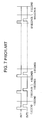
- Fig. 7 is a timing diagram of the 2-second hand motion in a conventional radio-controlled timepiece. As shown in Fig. 7 , under a state failed in the time code reception, every time a time elapses 2 seconds, the second hand is driven by gathering two times on the basis of drive signals OUT 1 and OUT 2. By this, the user can recognize whether or not there failed in the reception of the time code.
- a problem of the present invention is to provide that, in a case displaying the fact that the time code could not be normally received in the analog radio-controlled timepiece, by a simple constitution there is performed the display having no sense of discomfort for the user.
- a problem of the present invention is to make such that, in the case that the time code could not be normally received in the analog radio-controlled timepiece, by the simple constitution there is displayed the fact of the reception failure and the degree of failure.
- an analog radio-controlled timepiece which has a reception means receiving and outputting a time code denoting a present time instant by a radio, a clock means clocking a time instant, a time instant correction means correcting a clocked time instant of the clock means to a time instant corresponding to the time code received by the reception means, a time instant hand having at least a second hand and for displaying the time instant, one motor for rotation-driving the time instant hand, and a control means drive-controlling the motor by a drive signal corresponding to the clocked time instant of the clock means, and in which the clocked time instant of the clock means is corrected at a predetermined timing to the time instant corresponding to the time code received by the reception means, and the clocked time instant of the clock means is displayed by the time instant hand, characterized in that, when the reception means could not normally receive the time code, the control means drive-controls the motor such that the second hand is moved, after being normally moved till a 1st second
- control means drive-controls the motor such that the second hand is moved, after being normally moved till the 1st second position, from the 1st second position till the exact second position in the mode different from the normal hand motion.
- control means drive-controls the motor such that the second hand is stopped after being normally moved till the 1st second position and, when there became a predetermined second time instant, it is fast-forwarded from the 1st second position till the exact second position.
- the 1st second position is a constant position previously determined.
- the 1st second position is a position corresponding to a frequency in which the reception means could not continuously, normally receive the time code.
- control means has a counter means counting the frequency in which the reception means could not continuously, normally receive the time code, and the 1st second position is a second position in which there is subtracted from the exact second position by a second number corresponding to the number in which it could not continuously receive.
- control means drive-controls the motor such that the second hand is stopped after being normally moved till a 2nd second position that is a constant position previously determined and, when there became the predetermined second time instant, it is moved from the 2nd second position till the exact second position in the mode different from the normal hand motion.
- the present invention it becomes possible that, in the case displaying the fact that the time code could not be normally received in the analog radio-controlled timepiece, by the simple constitution there is performed the display having no sense of discomfort for the user.
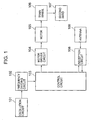
- Fig. 1 is a block diagram of an analog radio-controlled timepiece concerned with an embodiment of the present invention, and is a block diagram used in common to each embodiment mentioned later.
- a radio-controlled timepiece possesses an oscillation circuit 101 outputting a signal of a predetermined frequency, a frequency dividing circuit 102 outputting a time signal becoming a reference of a clock operation by frequency-dividing the signal from the oscillation circuit 101, a control circuit 103 performing, by performing the clock operation basing on the time signal, an output processing of a control signal for a time instant display, a control processing of each constituent element of the radio controlled timepiece, and a later-mentioned processing and the like, a motor driver circuit 104 responding to the control signal from the control circuit 103 to thereby output a motor drive signal, a motor 105 drive-controlled by the motor drive signal and for rotation-driving time instant hands (an hour hand, a minute hand and a second hand 107), a train wheel 106 transmitting a rotation of the motor 105, the time instant hands having the hour hand, the minute hand and the second hand 107, which are rotation-driven by the motor 105 through the train wheel 106, an
- control circuit 103 is clocking a present time instant by counting the time signal, and constitutes a clock means. Further, the control circuit 103 constitutes a time instant correction means which corrects the present time instant that it is clocking to a time instant corresponding to the received time code. Further, the control circuit 103 and the motor driver circuit 104 constitute a control means drive-controlling the motor. Further, the reception circuit 108 and the antenna 109 constitute a reception means receiving the time code by the radio.
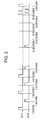
- Fig. 2 is a timing diagram showing an operation of a first embodiment of the present invention.
- Fig. 3 is a flowchart showing processing of the first embodiment of the present invention, and shows mainly the processing of the control circuit 103.
- the radio-controlled timepiece performs the clock operation by the fact that the control circuit 103 counts a timepiece signal from the frequency dividing circuit 102 in an ordinary mode performing the clock operation basing on the timepiece signal from the frequency dividing circuit 102, thereby outputting a control signal, which corresponds to the clocked time instant, to the motor driver circuit 104.
- the motor driver circuit 104 drive-controls the motor 105 by a drive signal corresponding to the control signal.
- the motor 105 performs an ordinary hand motion of the time instant hands by rotation-driving the time instant hands such as the second hand 107 through the train wheel 106, thereby performing an analog display of the present time instant.
- the second hand 107 is step-driven in every 1 second (1-second hand motion).
- the ordinary hand motion there may be constituted such that the second hand 107 is sweep-moved.
- the control circuit 103 causes the reception circuit 108 to perform a reception operation of the standard radio signal by making ON an electric source of the reception circuit 108 at a predetermined timing (e.g., a predetermined time instant in midnight, a time point designated by the user, or the like) .
- the reception circuit 108 outputs the time code included in the standard radio signal received by the antenna 109 to the control circuit 103.
- the control circuit 103 corrects its own clocked time instant to the present time instant corresponding to the time code, and outputs the control signal, which corresponds to the present time instant, to the motor driver circuit 104.
- the motor driver circuit 104 drive-controls the motor 105 by the drive signal corresponding to the control signal, and the motor 105 rotation-drives the time instant hands including the second hand 107 through the train wheel 106, thereby performing an analog display of an accurate present time instant corresponding to the time code.
- the second hand 107 is ordinarily moved.
- the control circuit 103 has in its inside a storage means denoting whether or not the time code could be received normally in a time code reception operation in the last time. If it is judged in the above time instant correction mode that the time code is not normal by performing an error check of the time code from the reception circuit 108, and the like, the control circuit 103 judges that the time code could not be received normally, and stores an information to the effect that the reception failed to the storage means.
- the control circuit 103 judges whether or not the time code could be received normally in the last time (a step S301) and, when it could be received normally in the last time, controls the motor 105 such that a hand motion of the second hand 107 performs an ordinary hand motion that is a hand motion operation performing an ordinary time instant display (a step S306).
- the control circuit 103 judges whether or not a second time instant has elapsed at least 55 seconds (a step S302) and, in a case where it does not elapse at least 55 seconds, there proceeds to the processing step S306, thereby controlling the motor 105 so as to perform the ordinary hand motion.
- the second hand 107 performs the ordinary hand motion from an exact second position (meaning a position in which the second hand coincides with a 12 o'clock position of the hour hand) to a 55-second position.
- the control circuit 103 judges whether or not the second time instant has elapsed at least 59 seconds (a step S303) and, in a case where it has not elapsed at least 59 seconds, controls the motor 105 so as to stop a drive of the second hand 107 (a step S305).
- the second hand 107 stops at the 55-second position till the second time instant elapses 59 seconds after it has elapsed 55 seconds.
- the control circuit 103 controls (fast-forward hand motion) the motor 105 so as to fast-forward the second hand 107 till the exact second position (00-second position) (a step S304).
- the second hand 107 performs the fast-forward hand motion from the 55-second position to the exact second position. Accordingly, although an error of several seconds is generated in the time instant display when the second hand is stopped at the 55-second position, it follows that an accurate time instant is displayed after the second hand rapidly proceeds to the exact second position.
- the second hand 107 since there is constituted such that, in the case where there could be normally received in the time code reception operation in the last time, the second hand 107 is ordinarily moved and, in the case where there failed in the reception, the second hand 107 is stopped at the 55-second position till the second time instant becomes 59 seconds after the second hand 107 is normally moved till the 55-second position, and the second hand 107 is fast-forwarded till the exact second position when the second time instant became 59 seconds, it becomes possible to perform the display having no sense of discomfort for the user by the simple constitution without using an exclusive display part such as light emitting element.
- Fig. 4 is a timing diagram showing an operation of a second embodiment of the present invention.
- FIG. 5 and Fig. 6 are flowcharts showing processing of the second embodiment of the present invention, and shows mainly the processing of the control circuit 103.
- the control circuit 103 performs the clock operation by counting the timepiece signal from the frequency dividing circuit 102, thereby outputting the control signal, which corresponds to the clocked time instant, to the motor driver circuit 104.
- the motor driver circuit 104 drive-controls the motor 105 by the drive signal corresponding to the control signal.
- the motor 105 performs the ordinary hand motion of the time instant hands by rotation-driving the time instant hands such as the second hand 107 through the train wheel 106, thereby performing the analog display of the present time instant by the time instant hands.
- the second hand 107 is step-driven in every one second (1-second hand motion).
- the ordinary hand motion there may be constituted so as to perform the sweep hand motion of the second hand 107.
- the control circuit 103 causes the reception circuit 108 to perform the reception operation of the standard radio signal by making ON the electric source of the reception circuit 108 at the predetermined timing (e.g., the predetermined time instant in midnight, the time point designated by the user, or the like) (a step S601 in Fig. 6 ).
- the reception circuit 108 outputs the time code included in the standard radio signal received by the antenna 109 to the control circuit 103.
- the control circuit 103 sets a second stop counter in an inside of the control circuit 103 to 60, thereby finishing the processing (a step S603).
- the second stop counter constitutes a counter means.
- the control circuit 103 subtracts 1 from a counted value of the second stop counter (a step S604).
- the counted value of the second stop counter is a value obtained by subtracting a number of times which the reception circuit 108 could not normally, continuously receive the time code, from 60, i.e., a value corresponding to the frequency in which the reception circuit 108 could not normally, continuously receive the time code.
- the control circuit 103 finishes the processing (a step S605) and, in a case where it is not at least 20, sets the counted value of the second stop counter to 20, thereby finishing the processing (a step S606).
- this case means the fact that the time code was normally received in the last time, and the control circuit 103 controls the motor 105 such that the second hand 107 always performs the ordinary hand motion (a step 506).
- the control circuit 103 controls the motor 105 such that the second hand 107 stops at a second position corresponding to the counted value of the second stop counter (a step 505).
- the second position in which the second hand 107 stops at this time is a second position (1st second position) corresponding to a frequency in which the reception of the time code continuously failed.
- control circuit 103 controls the motor 105 such that the second hand 107 stops at a 57-second position (a step 504).
- the 57-second position is a constant position (2nd second position) previously determined.
- the control circuit 103 controls the motor 105 such that the second hand 107 stops (a step S508) and, in a case where it was judged that the present time instant was 59 seconds, it drive-controls the motor 105 so as to fast-forward the second hand 107 till the exact second (a step S509).
- the control circuit 103 fast-forwards the second hand 107 by the processing step S509 via the processing steps S503, S504, S507.
- the ordinary hand motion till 57 seconds there are performed the ordinary hand motion till 57 seconds, and the fast-forward hand motion from 57 seconds till the exact second.
- the control circuit 103 fast-forwards the second hand 107 by the processing step S509 via the processing steps S503, S505, S507.
- the ordinary hand motion till 50 seconds and the fast-forward hand motion from 50 seconds till the exact second.
- the 1st second position that is the stop position of the second hand denotes a value corresponding to the continuous reception failure frequency till the last time. Further, in a case where the stop position of the second hand 107 exists in a second position after the 2nd second position (57-second position), there is denoted the fact that the continuous reception failure frequency till the last time is lower than the frequency corresponding to the 2nd second position.
- the analog radio-controlled timepiece concerned with the present second embodiment by altering a position at which the second hand is stopped, in compliance with the continuous reception failure frequency, the user can know how many times reception continuously failed, so that there is brought about an advantage that it is possible to know a reliability of the time instant displayed by the indication hands.
- the present invention can be applied also to the radio-controlled timepiece utilized in countries, such as not only Japan but also the USA, in which there is used the standard radio signal for the time instant correction.
Landscapes
- Physics & Mathematics (AREA)
- General Physics & Mathematics (AREA)
- Electromechanical Clocks (AREA)
- Electric Clocks (AREA)
Applications Claiming Priority (1)
| Application Number | Priority Date | Filing Date | Title |
|---|---|---|---|
| JP2006315520A JP4878275B2 (ja) | 2006-11-22 | 2006-11-22 | アナログ電波時計 |
Publications (2)
| Publication Number | Publication Date |
|---|---|
| EP1925999A2 true EP1925999A2 (de) | 2008-05-28 |
| EP1925999A3 EP1925999A3 (de) | 2009-07-22 |
Family
ID=39228916
Family Applications (1)
| Application Number | Title | Priority Date | Filing Date |
|---|---|---|---|
| EP20070254483 Withdrawn EP1925999A3 (de) | 2006-11-22 | 2007-11-16 | Analoge Funkuhr |
Country Status (4)
| Country | Link |
|---|---|
| US (1) | US7808860B2 (de) |
| EP (1) | EP1925999A3 (de) |
| JP (1) | JP4878275B2 (de) |
| CN (1) | CN101187802A (de) |
Families Citing this family (1)
| Publication number | Priority date | Publication date | Assignee | Title |
|---|---|---|---|---|
| WO2012162887A1 (en) * | 2011-06-01 | 2012-12-06 | Fung Wai Tong | Analog quartz timepiece and method for providing time-correction of the same |
Citations (2)
| Publication number | Priority date | Publication date | Assignee | Title |
|---|---|---|---|---|
| JP2001159689A (ja) | 1999-11-30 | 2001-06-12 | Rhythm Watch Co Ltd | 電波修正時計の受信表示方法及び受信表示装置 |
| JP2003004873A (ja) | 2001-06-26 | 2003-01-08 | Rhythm Watch Co Ltd | 電波時計及びその受信状態表示方法 |
Family Cites Families (9)
| Publication number | Priority date | Publication date | Assignee | Title |
|---|---|---|---|---|
| US4358836A (en) * | 1978-11-20 | 1982-11-09 | Ricoh Watch Co., Ltd. | Electronic watch with an automatic time indication modifier |
| JPS6188179A (ja) * | 1984-10-05 | 1986-05-06 | Seiko Instr & Electronics Ltd | 電池寿命表示付電子時計 |
| DE3439638C1 (de) * | 1984-10-30 | 1986-05-15 | Gebrüder Junghans GmbH, 7230 Schramberg | Autonome Funkuhr |
| EP0751444A1 (de) * | 1995-06-27 | 1997-01-02 | Isa France S.A. | Instrument zur Zeitmessung mit analoger Anzeige, insbesondere Uhr, Uhrwerk oder Pendüle, und Kontrollverfahren zum automatischem Einstellen dieses Instruments |
| US6269055B1 (en) | 1998-11-16 | 2001-07-31 | Quartex, A Division Of Primex, Inc. | Radio-controlled clock movement |
| JP2001296376A (ja) * | 2000-04-14 | 2001-10-26 | Citizen Watch Co Ltd | 時 計 |
| JP3643024B2 (ja) * | 2000-10-16 | 2005-04-27 | リズム時計工業株式会社 | 電波修正時計及びその受信表示方法 |
| JP3603903B2 (ja) * | 2003-03-31 | 2004-12-22 | セイコーエプソン株式会社 | 電波修正時計およびその制御方法 |
| JP4882610B2 (ja) * | 2005-12-20 | 2012-02-22 | セイコーエプソン株式会社 | 電波修正時計および電波修正時計の時刻修正方法 |
-
2006
- 2006-11-22 JP JP2006315520A patent/JP4878275B2/ja not_active Expired - Fee Related
-
2007
- 2007-11-15 US US11/985,524 patent/US7808860B2/en not_active Expired - Fee Related
- 2007-11-16 EP EP20070254483 patent/EP1925999A3/de not_active Withdrawn
- 2007-11-22 CN CNA2007101999906A patent/CN101187802A/zh active Pending
Patent Citations (2)
| Publication number | Priority date | Publication date | Assignee | Title |
|---|---|---|---|---|
| JP2001159689A (ja) | 1999-11-30 | 2001-06-12 | Rhythm Watch Co Ltd | 電波修正時計の受信表示方法及び受信表示装置 |
| JP2003004873A (ja) | 2001-06-26 | 2003-01-08 | Rhythm Watch Co Ltd | 電波時計及びその受信状態表示方法 |
Also Published As
| Publication number | Publication date |
|---|---|
| US20080130420A1 (en) | 2008-06-05 |
| JP4878275B2 (ja) | 2012-02-15 |
| US7808860B2 (en) | 2010-10-05 |
| EP1925999A3 (de) | 2009-07-22 |
| CN101187802A (zh) | 2008-05-28 |
| JP2008128878A (ja) | 2008-06-05 |
Similar Documents
| Publication | Publication Date | Title |
|---|---|---|
| JPS61191981A (ja) | ラジオ時計 | |
| JP5517004B2 (ja) | 表示装置および電子機器 | |
| US20140029387A1 (en) | Analog electronic timepiece | |
| EP1316861A2 (de) | Funkgesteuertes Gerät und dieses benutzende Funkuhr | |
| US20120195169A1 (en) | Date system for a timepiece | |
| EP1925999A2 (de) | Analoge Funkuhr | |
| JP3489892B2 (ja) | 電子時計 | |
| CN113219812B (zh) | 电子钟表和电子钟表的控制方法 | |
| JP6248734B2 (ja) | 電子時計及び時差修正方法 | |
| JP4957407B2 (ja) | 指針式電子時計、およびその運針制御方法 | |
| JP5421944B2 (ja) | 電子時計 | |
| JP3842532B2 (ja) | 自動修正時計 | |
| JP4795142B2 (ja) | 時計のアナログ表示手段と時間カウンタ間の同期化方法 | |
| US11619911B2 (en) | Timepiece movement and timepiece | |
| JP4453110B2 (ja) | カレンダー装置を備えた電子時計 | |
| JP2006258740A (ja) | 電子時計 | |
| JP6472284B2 (ja) | 電子時計 | |
| JP4966042B2 (ja) | アナログ電波時計 | |
| JP4954649B2 (ja) | アナログ電子時計 | |
| JP2013253786A (ja) | アナログ電子時計 | |
| JP6136647B2 (ja) | 電波修正時計および電波修正時計のコード判定方法 | |
| JP3699646B2 (ja) | 目安針付高精度目覚し時計 | |
| JP2012163391A (ja) | 電子時計 | |
| JP2000249777A (ja) | 電波修正時計 | |
| JP5339624B2 (ja) | 目覚し時計 |
Legal Events
| Date | Code | Title | Description |
|---|---|---|---|
| PUAI | Public reference made under article 153(3) epc to a published international application that has entered the european phase |
Free format text: ORIGINAL CODE: 0009012 |
|
| AK | Designated contracting states |
Kind code of ref document: A2 Designated state(s): AT BE BG CH CY CZ DE DK EE ES FI FR GB GR HU IE IS IT LI LT LU LV MC MT NL PL PT RO SE SI SK TR |
|
| AX | Request for extension of the european patent |
Extension state: AL BA HR MK RS |
|
| PUAL | Search report despatched |
Free format text: ORIGINAL CODE: 0009013 |
|
| AK | Designated contracting states |
Kind code of ref document: A3 Designated state(s): AT BE BG CH CY CZ DE DK EE ES FI FR GB GR HU IE IS IT LI LT LU LV MC MT NL PL PT RO SE SI SK TR |
|
| AX | Request for extension of the european patent |
Extension state: AL BA HR MK RS |
|
| AKX | Designation fees paid | ||
| REG | Reference to a national code |
Ref country code: DE Ref legal event code: 8566 |
|
| STAA | Information on the status of an ep patent application or granted ep patent |
Free format text: STATUS: THE APPLICATION IS DEEMED TO BE WITHDRAWN |
|
| 18D | Application deemed to be withdrawn |
Effective date: 20100123 |