EP1920019B1 - Klebeband mit einem träger aus einem spinnvlies, der einseitig mit einem fasergefüllten druckempfindlichen kleber zumindest partiell beschichtet ist - Google Patents
Klebeband mit einem träger aus einem spinnvlies, der einseitig mit einem fasergefüllten druckempfindlichen kleber zumindest partiell beschichtet ist Download PDFInfo
- Publication number
- EP1920019B1 EP1920019B1 EP20060764132 EP06764132A EP1920019B1 EP 1920019 B1 EP1920019 B1 EP 1920019B1 EP 20060764132 EP20060764132 EP 20060764132 EP 06764132 A EP06764132 A EP 06764132A EP 1920019 B1 EP1920019 B1 EP 1920019B1
- Authority
- EP
- European Patent Office
- Prior art keywords
- adhesive tape
- adhesive
- spunbonded
- tape according
- welding
- Prior art date
- Legal status (The legal status is an assumption and is not a legal conclusion. Google has not performed a legal analysis and makes no representation as to the accuracy of the status listed.)
- Expired - Lifetime
Links
Images

Classifications
-
- C—CHEMISTRY; METALLURGY
- C09—DYES; PAINTS; POLISHES; NATURAL RESINS; ADHESIVES; COMPOSITIONS NOT OTHERWISE PROVIDED FOR; APPLICATIONS OF MATERIALS NOT OTHERWISE PROVIDED FOR
- C09J—ADHESIVES; NON-MECHANICAL ASPECTS OF ADHESIVE PROCESSES IN GENERAL; ADHESIVE PROCESSES NOT PROVIDED FOR ELSEWHERE; USE OF MATERIALS AS ADHESIVES
- C09J7/00—Adhesives in the form of films or foils
- C09J7/20—Adhesives in the form of films or foils characterised by their carriers
- C09J7/21—Paper; Textile fabrics
-
- C—CHEMISTRY; METALLURGY
- C09—DYES; PAINTS; POLISHES; NATURAL RESINS; ADHESIVES; COMPOSITIONS NOT OTHERWISE PROVIDED FOR; APPLICATIONS OF MATERIALS NOT OTHERWISE PROVIDED FOR
- C09J—ADHESIVES; NON-MECHANICAL ASPECTS OF ADHESIVE PROCESSES IN GENERAL; ADHESIVE PROCESSES NOT PROVIDED FOR ELSEWHERE; USE OF MATERIALS AS ADHESIVES
- C09J7/00—Adhesives in the form of films or foils
- C09J7/30—Adhesives in the form of films or foils characterised by the adhesive composition
- C09J7/38—Pressure-sensitive adhesives [PSA]
-
- C—CHEMISTRY; METALLURGY
- C08—ORGANIC MACROMOLECULAR COMPOUNDS; THEIR PREPARATION OR CHEMICAL WORKING-UP; COMPOSITIONS BASED THEREON
- C08K—Use of inorganic or non-macromolecular organic substances as compounding ingredients
- C08K7/00—Use of ingredients characterised by shape
- C08K7/02—Fibres or whiskers
-
- C—CHEMISTRY; METALLURGY
- C09—DYES; PAINTS; POLISHES; NATURAL RESINS; ADHESIVES; COMPOSITIONS NOT OTHERWISE PROVIDED FOR; APPLICATIONS OF MATERIALS NOT OTHERWISE PROVIDED FOR
- C09J—ADHESIVES; NON-MECHANICAL ASPECTS OF ADHESIVE PROCESSES IN GENERAL; ADHESIVE PROCESSES NOT PROVIDED FOR ELSEWHERE; USE OF MATERIALS AS ADHESIVES
- C09J2203/00—Applications of adhesives in processes or use of adhesives in the form of films or foils
- C09J2203/302—Applications of adhesives in processes or use of adhesives in the form of films or foils for bundling cables
-
- C—CHEMISTRY; METALLURGY
- C09—DYES; PAINTS; POLISHES; NATURAL RESINS; ADHESIVES; COMPOSITIONS NOT OTHERWISE PROVIDED FOR; APPLICATIONS OF MATERIALS NOT OTHERWISE PROVIDED FOR
- C09J—ADHESIVES; NON-MECHANICAL ASPECTS OF ADHESIVE PROCESSES IN GENERAL; ADHESIVE PROCESSES NOT PROVIDED FOR ELSEWHERE; USE OF MATERIALS AS ADHESIVES
- C09J2301/00—Additional features of adhesives in the form of films or foils
- C09J2301/40—Additional features of adhesives in the form of films or foils characterized by the presence of essential components
- C09J2301/408—Additional features of adhesives in the form of films or foils characterized by the presence of essential components additives as essential feature of the adhesive layer
-
- C—CHEMISTRY; METALLURGY
- C09—DYES; PAINTS; POLISHES; NATURAL RESINS; ADHESIVES; COMPOSITIONS NOT OTHERWISE PROVIDED FOR; APPLICATIONS OF MATERIALS NOT OTHERWISE PROVIDED FOR
- C09J—ADHESIVES; NON-MECHANICAL ASPECTS OF ADHESIVE PROCESSES IN GENERAL; ADHESIVE PROCESSES NOT PROVIDED FOR ELSEWHERE; USE OF MATERIALS AS ADHESIVES
- C09J2400/00—Presence of inorganic and organic materials
- C09J2400/20—Presence of organic materials
- C09J2400/26—Presence of textile or fabric
- C09J2400/263—Presence of textile or fabric in the substrate
-
- C—CHEMISTRY; METALLURGY
- C09—DYES; PAINTS; POLISHES; NATURAL RESINS; ADHESIVES; COMPOSITIONS NOT OTHERWISE PROVIDED FOR; APPLICATIONS OF MATERIALS NOT OTHERWISE PROVIDED FOR
- C09J—ADHESIVES; NON-MECHANICAL ASPECTS OF ADHESIVE PROCESSES IN GENERAL; ADHESIVE PROCESSES NOT PROVIDED FOR ELSEWHERE; USE OF MATERIALS AS ADHESIVES
- C09J2407/00—Presence of natural rubber
-
- C—CHEMISTRY; METALLURGY
- C09—DYES; PAINTS; POLISHES; NATURAL RESINS; ADHESIVES; COMPOSITIONS NOT OTHERWISE PROVIDED FOR; APPLICATIONS OF MATERIALS NOT OTHERWISE PROVIDED FOR
- C09J—ADHESIVES; NON-MECHANICAL ASPECTS OF ADHESIVE PROCESSES IN GENERAL; ADHESIVE PROCESSES NOT PROVIDED FOR ELSEWHERE; USE OF MATERIALS AS ADHESIVES
- C09J2433/00—Presence of (meth)acrylic polymer
-
- C—CHEMISTRY; METALLURGY
- C09—DYES; PAINTS; POLISHES; NATURAL RESINS; ADHESIVES; COMPOSITIONS NOT OTHERWISE PROVIDED FOR; APPLICATIONS OF MATERIALS NOT OTHERWISE PROVIDED FOR
- C09J—ADHESIVES; NON-MECHANICAL ASPECTS OF ADHESIVE PROCESSES IN GENERAL; ADHESIVE PROCESSES NOT PROVIDED FOR ELSEWHERE; USE OF MATERIALS AS ADHESIVES
- C09J2467/00—Presence of polyester
- C09J2467/006—Presence of polyester in the substrate
-
- Y—GENERAL TAGGING OF NEW TECHNOLOGICAL DEVELOPMENTS; GENERAL TAGGING OF CROSS-SECTIONAL TECHNOLOGIES SPANNING OVER SEVERAL SECTIONS OF THE IPC; TECHNICAL SUBJECTS COVERED BY FORMER USPC CROSS-REFERENCE ART COLLECTIONS [XRACs] AND DIGESTS
- Y10—TECHNICAL SUBJECTS COVERED BY FORMER USPC
- Y10T—TECHNICAL SUBJECTS COVERED BY FORMER US CLASSIFICATION
- Y10T428/00—Stock material or miscellaneous articles
- Y10T428/249921—Web or sheet containing structurally defined element or component
- Y10T428/249953—Composite having voids in a component [e.g., porous, cellular, etc.]
- Y10T428/249954—With chemically effective material or specified gas other than air, N, or carbon dioxide in void-containing component
-
- Y—GENERAL TAGGING OF NEW TECHNOLOGICAL DEVELOPMENTS; GENERAL TAGGING OF CROSS-SECTIONAL TECHNOLOGIES SPANNING OVER SEVERAL SECTIONS OF THE IPC; TECHNICAL SUBJECTS COVERED BY FORMER USPC CROSS-REFERENCE ART COLLECTIONS [XRACs] AND DIGESTS
- Y10—TECHNICAL SUBJECTS COVERED BY FORMER USPC
- Y10T—TECHNICAL SUBJECTS COVERED BY FORMER US CLASSIFICATION
- Y10T428/00—Stock material or miscellaneous articles
- Y10T428/25—Web or sheet containing structurally defined element or component and including a second component containing structurally defined particles
-
- Y—GENERAL TAGGING OF NEW TECHNOLOGICAL DEVELOPMENTS; GENERAL TAGGING OF CROSS-SECTIONAL TECHNOLOGIES SPANNING OVER SEVERAL SECTIONS OF THE IPC; TECHNICAL SUBJECTS COVERED BY FORMER USPC CROSS-REFERENCE ART COLLECTIONS [XRACs] AND DIGESTS
- Y10—TECHNICAL SUBJECTS COVERED BY FORMER USPC
- Y10T—TECHNICAL SUBJECTS COVERED BY FORMER US CLASSIFICATION
- Y10T428/00—Stock material or miscellaneous articles
- Y10T428/26—Web or sheet containing structurally defined element or component, the element or component having a specified physical dimension
-
- Y—GENERAL TAGGING OF NEW TECHNOLOGICAL DEVELOPMENTS; GENERAL TAGGING OF CROSS-SECTIONAL TECHNOLOGIES SPANNING OVER SEVERAL SECTIONS OF THE IPC; TECHNICAL SUBJECTS COVERED BY FORMER USPC CROSS-REFERENCE ART COLLECTIONS [XRACs] AND DIGESTS
- Y10—TECHNICAL SUBJECTS COVERED BY FORMER USPC
- Y10T—TECHNICAL SUBJECTS COVERED BY FORMER US CLASSIFICATION
- Y10T428/00—Stock material or miscellaneous articles
- Y10T428/26—Web or sheet containing structurally defined element or component, the element or component having a specified physical dimension
- Y10T428/266—Web or sheet containing structurally defined element or component, the element or component having a specified physical dimension of base or substrate
-
- Y—GENERAL TAGGING OF NEW TECHNOLOGICAL DEVELOPMENTS; GENERAL TAGGING OF CROSS-SECTIONAL TECHNOLOGIES SPANNING OVER SEVERAL SECTIONS OF THE IPC; TECHNICAL SUBJECTS COVERED BY FORMER USPC CROSS-REFERENCE ART COLLECTIONS [XRACs] AND DIGESTS
- Y10—TECHNICAL SUBJECTS COVERED BY FORMER USPC
- Y10T—TECHNICAL SUBJECTS COVERED BY FORMER US CLASSIFICATION
- Y10T428/00—Stock material or miscellaneous articles
- Y10T428/27—Web or sheet containing structurally defined element or component, the element or component having a specified weight per unit area [e.g., gms/sq cm, lbs/sq ft, etc.]
-
- Y—GENERAL TAGGING OF NEW TECHNOLOGICAL DEVELOPMENTS; GENERAL TAGGING OF CROSS-SECTIONAL TECHNOLOGIES SPANNING OVER SEVERAL SECTIONS OF THE IPC; TECHNICAL SUBJECTS COVERED BY FORMER USPC CROSS-REFERENCE ART COLLECTIONS [XRACs] AND DIGESTS
- Y10—TECHNICAL SUBJECTS COVERED BY FORMER USPC
- Y10T—TECHNICAL SUBJECTS COVERED BY FORMER US CLASSIFICATION
- Y10T428/00—Stock material or miscellaneous articles
- Y10T428/28—Web or sheet containing structurally defined element or component and having an adhesive outermost layer
- Y10T428/2813—Heat or solvent activated or sealable
- Y10T428/2817—Heat sealable
Definitions
- the invention relates to an adhesive tape with a carrier made of a spunbonded nonwoven, which is coated on one side with a pressure-sensitive adhesive, for thermal welding such as HF welding or ultrasonic welding on a polymeric substrate.
- Adhesive tapes with a spunbonded carrier are known. These are used for example for the bandaging of wiring harnesses. That's how it describes DE 195 23 494 A1 a self-adhesive tape for bandaging cable harnesses with a band-shaped textile carrier, which consists of spunbonded nonwoven.
- the nonwoven used according to the invention is a spunbonded nonwoven made of polypropylene, which is thermally bonded and embossed with the aid of a calender, the embossing roll having an embossing surface of 10% to 30%, preferably 19%. Due to its special design, the adhesive tape has good hand tearing properties and good rolling properties when used for harness bandaging.
- the component is fastened by a fastening means having a contact surface in that the contact surface consists of a material which can be thermally welded to the carrier material and the fastening means is fastened by thermal welding of the contact surface to the carrier material.
- the term component means smaller attachments such as sensors, lights or electrical lines.
- the thermally welded surface may, for example, be wrapped around the component in a ring shape, so that the component is secured on all sides against slipping.
- the fastening means is then expediently a film which is placed on laid on the carrier material lines and then thermally welded to the manner of a sticking plaster on both sides of the line.
- a cable tie is used with an additional contact surface, which is welded to the carrier material.
- film is also to be understood to mean planar structures in a broader sense, such as, for example, nonwovens, woven or thin-layered boards.
- the wiring harness is formed from a foil and the lines combined by these, wherein either only the lines of the main strand are combined with a substantially parallel to these aligned film, such that the film is wrapped transversely to the lines around them and in the radial direction has protruding and abutting edge portions which are interconnected, or the lines of both the main strand and the branch are combined with a respective substantially parallel to these aligned film, the film used designed according to Legeschema and considerably wider than the next to each other lying horizontally arranged lines.
- film is understood to mean a flat, homogeneous, flexible structure, including paper and textile fabrics made of natural and synthetic fibers such as nonwovens and woven fabrics. The edge areas can be welded or glued.
- Ultrasonic welding is a process for joining plastics. Basically, only thermoplastics can be welded. In principle, but also metals can be welded, which is also used for example in electrical engineering in the wiring of microchips. As with all other welding processes, the material must be melted at the weld site by applying heat. In ultrasonic welding, it is generated by a high-frequency mechanical vibration. The main feature of this method is that the heat required for welding between the components is created by molecular and boundary surface friction in the components. Thus, ultrasonic welding belongs to the group of friction welding.
- the ultrasonic frequency is generated by means of the generator. This converts the mains voltage into a high voltage and high frequency. Through a shielded cable, the electrical energy is transferred to an ultrasonic transducer, the so-called converter.
- the converter works according to the piezoelectric effect, in which the property of certain crystals, which are created with alternating electric field expand and contract. This results in mechanical vibrations, which are transmitted via an amplitude transformation piece to the sonotrode (the so-called welding horn).
- the amplitude of the oscillation can be influenced by the amplitude transformation piece in size.
- the vibrations are transmitted under pressure of 2 to 5 N / mm 2 to the workpiece clamped between the sonotrode and an anvil, whereby the heat required for plasticizing is produced by molecular and boundary surface friction. Due to the local temperature of the plastic begins to soften and the damping coefficient increases. The increase of the damping factor leads to further heat generation, which ensures the effect of a self-accelerating reaction. This process is characterized by very low welding times and thus often high efficiency. After cooling, the welded joint is tight. Since the sonotrode is permanently exposed to ultrasonic vibrations, the demands on the material are very high. In most cases, carbide-coated titanium is therefore used.
- High-frequency welding is a pressure welding process under the influence of heat, which develops on the basis of the ohmic losses in the parts to be joined.
- the two variations in the application of RF current in welding are inductive and conductive energy input.
- conductive HF welding the energy is introduced via busbars or sliding contacts, whereas in the case of the inductive variant this is done by means of an induction coil located above the parts to be joined.
- the high-frequency alternating current flowing through electrodynamic effects on the parts to be joined heats up the connection point and by force application, the parts are positively connected with each other.
- the thermoplastics to be welded must have a dielectric loss factor of d> 0.01
- inductive-energy HF welding in industry is mainly used for the production of longitudinal seam tubes.
- thermal welding processes include hot air welding and hot rod welding.
- Object of the present invention is to provide an adhesive tape which can be thermally welded to the respective substrate and in particular is able to produce a secure connection even on release-agent surfaces, and to improve an adhesive tape so that the disadvantages of the prior art or not at least not to the extent occur.
- the invention relates to an adhesive tape with a carrier of a spunbonded nonwoven, which is coated on one side with a pressure-sensitive adhesive at least partially, preferably over the entire surface, for thermal welding such as HF welding or ultrasonic welding on a polymeric substrate, wherein the adhesive is based on natural rubber or acrylate and wherein the adhesive fibers are added, which do not melt in a thermal welding process.
- the fibers are glass fibers and / or carbon fibers.
- the adhesive tape has as a carrier a spunbonded polyester, in particular polyester and co-polyester fibers, which are further preferably solidified and / or embossed flat with the aid of a calender.
- the proportion of polyester fibers in the carrier is in a further advantageous embodiment of the invention more than 70 wt .-%, preferably more than 80 wt .-%, and to co-polyester fibers of less than 30 wt .-%, preferably less than 20 wt .-%.
- the yarn count, yarn count or denier of a yarn, a fiber or a filament is measured in mass per unit length.
- the yarn count does not say anything about the strength of the yarn or the volume.
- a high yarn count means a smaller mass, a high titer means a larger mass / length ratio.
- the yarn count is measured internationally in Tex (tex) (1 tex equals 1 gram per km).
- the fineness of the fibers is in a further advantageous embodiment of the invention 1 to 4.5 dtex, preferably of 2.2 dtex.
- a calender for embossing the spunbonded fabric preferably a two-roll calender, which consists of at least one smooth roll and / or one gravure roll, is used.
- the gravure roll preferably has an embossing surface of 10 to 30%, preferably 15%.
- the trough depth resulting from the calendering in the embossing of the carrier according to the invention is dependent on several factors during the process of calendering.
- the temperature of the embossing roll, the pressure exerted on the spunbonded web in the nip between the rolls, and the speed at which the spunbond passes through the nip play a crucial role.
- the carrier is formed by a spunbonded polypropylene, which can also be thermally consolidated and embossed by means of a calender.
- the fineness of the nonwoven is 2 dtex to 7 dtex, preferably 4 dtex.
- the calender used is preferably a two-roll calender consisting of a smooth roll and a gravure roll.
- the gravure roll has an embossing surface of 10% to 30%, preferably 19%.
- the depression depth resulting from the calendering in the embossing of the carrier according to the invention is again dependent on a number of factors during the process of calendering.
- the temperature of the embossing roll, the pressure exerted on the spunbonded web in the nip between the rolls, and the speed at which the spunbond passes through the nip play a crucial role.
- the following parameters prove to be particularly advantageous for an optimal design of the spunbonded fabric for further processing: Temperature of the embossing roller: 150 ° C Line pressure: 75 daN / cm Speed: 50 m / min
- the spunbonded is white, but at least brightly colored.
- the melting fiber portions in the spunbonded melt with the polymeric substrate in such a way that an optical assessment of the quality of the weld can be made.
- the measurement of the properties of the spunbonded carrier is carried out according to DIN-EN 29073-3.
- Metallic particles such as metal powders, can be added to the spunbonded backing in order to allow inductive heat to develop in the spunbonded fabric during the welding process.
- the spunbonded web is at least partially coated on one side with a pressure-sensitive adhesive based on natural rubber or acrylate.
- the coating can take the form of one or more strips, but in particular it is full-surface.
- the coating is based on known methods such as coating or lamination process.
- the adhesive is physically, thermally, chemically and / or crosslinked by ESH, preferably chemically.
- ESH ethyl-maleic anhydride
- As an adhesive such is suitable for acrylate with long molecular chains, which has a K value of at least 70, in particular equal to 75 (measured in each case in 1 wt .-% solution in toluene, 25 ° C).
- the K value is determined in particular in analogy to DIN 53 726.
- a 200 L reactor conventional for radical polymerizations is reacted with 2400 g of acrylic acid, 64 kg of 2-ethylhexyl acrylate, 6.4 kg of N-isopropylacrylamide and 53.3 kg Acetone / isopropanol (95: 5).
- the reactor After passing through nitrogen gas with stirring for 45 minutes, the reactor is heated to 58 ° C. and 40 g of 2,2'-azoisobutyronitrile (AIBN) are added. Subsequently, the outer heating bath is heated to 75 ° C and the reaction is carried out constantly at this external temperature. After 1 h reaction time again 40 g of AIBN is added.
- the polymer 1 is diluted down to a solids content of 30% with 60/95 petroleum spirit. Subsequently, 25% by weight (based on the proportion of polymer 1) of rosin (glyceryl ester) Foral TM 85 (Eastman Chemical) and 0.3% by weight (based on the proportion of polymer 1) of aluminum (III) acetylacetonate ( as a 3% solution in isopropanol) and completely dissolved. Subsequently, it is coated from solution with, for example, a comma bar to the substrate and dried for 10 minutes at 120 ° C.
- rosin glyceryl ester
- Foral TM 85 Eastman Chemical
- aluminum (III) acetylacetonate as a 3% solution in isopropanol
- the preferably transparent adhesive is reinforced by mineral fibers such as preferably glass fibers, carbon fibers and / or plastic fibers, but in particular glass fibers.
- the fibers are added to the adhesive to 2 to 5 wt .-%, preferably 3 wt .-%.
- the total thickness of the adhesive layer is 20 to 200 microns, preferably 50 microns, which represents a good balance of isolation on the one hand and costs on the other hand.
- the long molecular chains in combination with the fibers which do not change during the welding process reduce uncontrolled leakage of the self-adhesive composition from the welding zone during welding and avoid the cleaning effort on the sonotrode.
- the fibers reinforce the cohesive bond that sets up after welding.
- the fibers do not melt under the introduction of pressure and ultrasound for welding, so that a brief ultrasonic application does not lead to leakage of the self-adhesive.
- the uncoated backside of the nonwoven backing may be antiadhesive treated.
- a spunbonded polyester Due to its chemical composition and its special fiber mixture, a spunbonded polyester has excellent properties, so that it as a carrier in an adhesive tape is able to form an excellent cohesive connection to a wide variety of polymeric substrates when it is thermowelded, for example under ultrasound application and pressure, and subsequently cures.
- spunbonded nonwovens made of polypropylene can be thermally welded only on chemically similar polymer substrates, ie polyolefin substrates, this leads to similarly excellent results as in polyester spunbonded nonwovens.
- spunbonded nonwovens have higher tensile forces in the longitudinal and transverse direction than comparable nonwovens.
- the adhesive tape according to the invention in its preferred use as a fastening loop shows that the components not only withstand the load when driving vehicles, but especially in the edge region of the weld.
- the preferred bright color of the spunbonded fabric in the area of the weld indicates the quality of the material bond via the discoloration.
- the fibers of the carrier material and the usually dark or black melt colored substrate (if it is thermoplastic). It comes to diffusion and mixing effects, so that the molten mass of the carrier material merges with the mass of the substrate. This leads to a discoloration at the weld, ie the resulting weld appears anthracite.
- the thermoplastic substrate is bright, it is advisable to equip the spunbonded with black. In this case, the welding process leads to a gray weld.
- An excellent weld is characterized by the fact that it has a sufficient width over the desired length and is completely dark or lightly discolored (quasi a different color than the spunbond or the substrate has). Thus, an optical control can be seen directly in the welding.
- the adhesive tape has an excellent damping characteristic due to its preferred embossing. This is due to the special structure of the embossed carrier with highly compressed flat and less dense and particularly flexible shares.
- the adhesive tape combines in its purpose as a fastening loop both excellent tear properties and special damping properties.
- the adhesive tape according to the invention is particularly advantageously used for thermal welding, such as HF welding or ultrasonic welding of components, in particular for welding cables or wire harnesses in the automotive sector.
- the component is partially or completely surrounded by the adhesive tape, so that the component is in contact with the adhesive coating.
- the component can be fixed on the contact surface, on which the adhesive tape is finally fixed by the welding process, by the adhesive coating of the adhesive tape itself.
- the contact surface consists of a material which can be thermally welded to the carrier material, and the adhesive tape is fastened by thermal welding of the contact surface with the same. As a result, the component is fixed on the contact surface at the same time. Since thermal welding is also possible over a certain distance, the manufacturing-technical accessibility of the component is less critical, which simplifies the implementation of the method with automatic welding machines.
- the component which again in particular the wiring harness is meant, radially completely enclosed by the adhesive tape, so that the component is secured on all sides against slipping.
- the adhesive tape can thus form a projecting flag, for example by pressing the open ends of the adhesive tape against one another with the adhesive side. This flag can then be welded.
- thermal welding is that it can be dispensed with separate fastening means or connecting means.
- there is a sufficiently large welding surface for secure attachment available but at the same time, the risk of thermal and / or mechanical damage to the parts to be welded can be reduced because they and the welding surface are sufficiently spaced apart.
- the particular of the adhesive tape according to the invention is that in this two completely different joining techniques are united, namely on the ground (for example, headliner or door inner lining) facing side - preferably caused by ultrasound application - welded joint and on the other, the attachment (for example, harness ) facing side a connection by means of pressure-sensitive adhesive.
- This combination was previously unappreciable, because pressure-sensitive adhesives do not tolerate the introduction of high temperatures; most were uncontrolled and lost stickiness due to progressive polymerization and / or solvent loss.
- the adhesive tape 1 according to the invention is shown in a lateral section.
- the adhesive tape 1 has a spun-bonded backing 11, which is provided on the underside with an adhesive coating 12.
- glass fibers 13 are distributed.
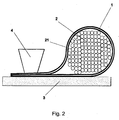
- FIG. 2 is a cross section through a wire harness 2 is shown, which is radially encased by the adhesive tape 1 according to the invention, wherein the adhesive tape 1 is thermally welded to a substrate 3.
- the wiring harness 2 includes a plurality of individual leads 21 completely looped around by the adhesive tape 1, such that the adhesive coating 12 of the adhesive tape 1 is inside. The adhesive coating is therefore in contact with the lines 21.
- the ends of the adhesive tape 1 are glued together and form a so-called flag 5.
- This flag 5 is thermally welded to the desired substrate 3, for example, a headliner in a motor vehicle, in particular by means of ultrasound.
- the sonotrode 4 is placed on the flag 5 with pressure and provides the energy required for the welding process.
- the roof lining is a lining part of a motor vehicle
- the welding takes place on the side facing the vehicle body. Since the attachment from the vehicle interior is not visible, optical impairments of the attachment can be accepted.
- the materials of the adhesive tape carrier 11 and the substrate 3 are selected in such a way that they are thermally welded together. Possible materials are for example polyethylene, polypropylene, polyamide or polyvinyl chloride in question. Preferably, the same material is used, however, due to other production considerations, it may be desirable to use different materials.
Landscapes
- Chemical & Material Sciences (AREA)
- Organic Chemistry (AREA)
- Adhesive Tapes (AREA)
- Adhesives Or Adhesive Processes (AREA)
- Laminated Bodies (AREA)
- Lining Or Joining Of Plastics Or The Like (AREA)
Applications Claiming Priority (2)
| Application Number | Priority Date | Filing Date | Title |
|---|---|---|---|
| DE102005037662A DE102005037662A1 (de) | 2005-08-05 | 2005-08-05 | Klebeband mit einem Träger aus einem Spinnvlies, der einseitig mit einem druckempfindlichen Kleber zumindest partiell beschichtet ist |
| PCT/EP2006/064120 WO2007017332A1 (de) | 2005-08-05 | 2006-07-12 | Klebeband mit einem träger aus einem spinnvlies, der einseitig mit einem fasergefüllten druckempfindlichen kleber zumindest partiell beschichtet ist |
Publications (2)
| Publication Number | Publication Date |
|---|---|
| EP1920019A1 EP1920019A1 (de) | 2008-05-14 |
| EP1920019B1 true EP1920019B1 (de) | 2009-12-02 |
Family
ID=36933522
Family Applications (1)
| Application Number | Title | Priority Date | Filing Date |
|---|---|---|---|
| EP20060764132 Expired - Lifetime EP1920019B1 (de) | 2005-08-05 | 2006-07-12 | Klebeband mit einem träger aus einem spinnvlies, der einseitig mit einem fasergefüllten druckempfindlichen kleber zumindest partiell beschichtet ist |
Country Status (8)
| Country | Link |
|---|---|
| US (1) | US20090075052A1 (enExample) |
| EP (1) | EP1920019B1 (enExample) |
| JP (1) | JP5294856B2 (enExample) |
| CN (1) | CN101233202B (enExample) |
| AT (1) | ATE450585T1 (enExample) |
| DE (2) | DE102005037662A1 (enExample) |
| ES (1) | ES2336141T3 (enExample) |
| WO (1) | WO2007017332A1 (enExample) |
Families Citing this family (22)
| Publication number | Priority date | Publication date | Assignee | Title |
|---|---|---|---|---|
| US11690746B2 (en) | 2004-04-02 | 2023-07-04 | Applied Biokinetics Llc | Pre-cut adhesive supports for anatomical support, pain reduction, or therapeutic treatment |
| DE102005037663A1 (de) * | 2005-08-05 | 2007-02-08 | Tesa Ag | Verwendung eines Klebebandes mit einem Träger aus einem Spinnvlies, der einseitig mit einem druckempfindlichen Kleber zumindest partiell beschichtet ist |
| DE102007038458A1 (de) | 2007-08-14 | 2009-02-19 | Tesa Ag | Verbundelement |
| MX2011002688A (es) * | 2008-09-12 | 2011-04-12 | Critical Pharmaceuticals Ltd | Mejoramientos en la absorcion de agentes terapeuticos a traves de las membranas mucosas o la piel. |
| DE102008055716B4 (de) * | 2008-11-04 | 2014-04-10 | Scherdel Innotec Forschungs- Und Entwicklungs-Gmbh | Fahrwerksteil eines Kraftfahrzeugs sowie Verfahren zum Herstellen desselben |
| DE102008044392A1 (de) * | 2008-12-05 | 2010-06-17 | Tesa Se | Verfahren zur Herstellung einer Schweißverbindung zwischen einem textilen Flächengebilde und einem Kunststoffteil sowie ein durch dieses Verfahren hergestelltes Kunststoffteil und eine Kabelbefestigungseinrichtung |
| DE102010002501A1 (de) | 2010-03-02 | 2011-09-08 | Tesa Se | Verfahren zur Verklebung von Substraten |
| DE102010029658B4 (de) * | 2010-06-02 | 2012-07-12 | Lisa Dräxlmaier GmbH | Verfahren zur Herstellung einer Kabeltülle |
| DE102010022997A1 (de) | 2010-06-08 | 2011-12-08 | Tesa Se | Verfahren zur Herstellung einer Schweißverbindung zwischen einem textilen Flächengebilde und einem Kunststoffteil sowie ein durch dieses Verfahren bearbeitetes Kunststoffteil und eine Kabelbefestigungseinrichtung |
| DE102010031636B4 (de) * | 2010-07-21 | 2012-02-23 | Hilti Aktiengesellschaft | Ankerschiene mit Zugband |
| JP6027007B2 (ja) | 2010-09-30 | 2016-11-16 | スリーエム イノベイティブ プロパティズ カンパニー | 繊維材料を含有する熱溶融処理可能な感圧性接着剤 |
| US8796164B2 (en) | 2010-12-28 | 2014-08-05 | Cytec Technology Corp. | Multilayer and composition gradient structures with improved damping properties |
| FR2993982B1 (fr) * | 2012-07-24 | 2014-08-22 | Snecma | Fixation d'un cable sur une piece au moyen d'un support autoporteur |
| WO2014041895A1 (ja) * | 2012-09-12 | 2014-03-20 | 株式会社オートネットワーク技術研究所 | ワイヤーハーネス用保護材料及びワイヤーハーネス保護材 |
| WO2015171706A1 (en) * | 2014-05-06 | 2015-11-12 | Keene James R | Protective mat and method for protecting a floor from spillage and debris |
| CN104825273A (zh) * | 2015-05-30 | 2015-08-12 | 李孟平 | 一种透气自粘弹性绷带的制备方法 |
| CA3073940A1 (en) | 2017-08-25 | 2019-02-28 | 3M Innovative Properties Company | Adhesive articles permitting damage free removal |
| JP7011820B2 (ja) * | 2018-05-01 | 2022-01-27 | 共同技研化学株式会社 | 粘着テープ及び,粘着テープの製造方法 |
| CN114423647A (zh) * | 2019-09-19 | 2022-04-29 | 电化株式会社 | 绑带 |
| CN113072893A (zh) * | 2021-03-24 | 2021-07-06 | 东莞市美鑫工业胶带有限公司 | 一种耐高温胶带及其制备方法 |
| US11569006B1 (en) | 2021-08-20 | 2023-01-31 | Tesa Se | Cover for a cable harness with different color layers |
| EP4671334A1 (en) * | 2024-06-25 | 2025-12-31 | Neenah, Inc. | MULTI-LAYER STRIP AND METHOD FOR PROTECTING A PAINTED PRODUCT |
Family Cites Families (24)
| Publication number | Priority date | Publication date | Assignee | Title |
|---|---|---|---|---|
| US3062683A (en) * | 1959-07-23 | 1962-11-06 | Minnesota Mining & Mfg | Fiber-reinforced pressure-sensitive adhesives and tapes |
| JPH08325532A (ja) * | 1995-05-29 | 1996-12-10 | Asahi Corp | 両面粘着シート |
| DE19523494C3 (de) * | 1995-06-28 | 2003-05-15 | Tesa Ag | Verwendung eines Klebebandes auf Spinnvliesbasis zur Bandagierung von Kabelbäumen |
| FR2758647B1 (fr) * | 1997-01-22 | 1999-02-26 | Plasto Sa | Gaine pour faisceaux de fils |
| US6136118A (en) * | 1997-08-12 | 2000-10-24 | Thomas & Betts International, Inc. | Ultrasonic tying tool |
| DE19746526A1 (de) * | 1997-10-22 | 1999-04-29 | Volkswagen Ag | Kabelbaum für ein Fahrzeug |
| EP0932234B1 (de) * | 1998-01-23 | 2004-03-31 | Volkswagen Aktiengesellschaft | Verfahren zur Befestigung eines Leitungsstranges auf einem Trägerteil |
| DE29804431U1 (de) * | 1998-03-12 | 1998-07-23 | Certoplast Vorwerk & Sohn GmbH, 42285 Wuppertal | Klebeband |
| PT1123958E (pt) * | 1998-03-12 | 2003-09-30 | Certoplast Vorwerk & Sohn Gmbh | Fita adesiva |
| DE19819442A1 (de) * | 1998-04-30 | 1999-11-04 | Beiersdorf Ag | Trägermaterial für medizinische Zwecke |
| US6436528B1 (en) * | 1998-10-24 | 2002-08-20 | Tesa Ag | Adhesive tape based on a binder-consolidated web |
| US6451146B1 (en) * | 1998-10-24 | 2002-09-17 | Tesa Ag | Adhesive tape based on a web thermally bonded with fusible fibres |
| CN1454249A (zh) * | 2000-10-06 | 2003-11-05 | 3M创新有限公司 | 制造玻璃纤维增强材料的方法 |
| DE10129546A1 (de) * | 2001-06-19 | 2003-06-12 | Tesa Ag | Verwendung eines mindestens einseitig mit einer, kohäsiven Haftmasse beschichtetes Trägermaterial zum Ummanteln von langgestrecktem Gut, wie insbesondere Kabelsätzen |
| DE10144134A1 (de) * | 2001-09-07 | 2003-03-27 | Coroplast Fritz Mueller Gmbh | Montageeinheit zum Ultraschallverschweißen, Verfahren zur Befestigung von elektrischen Leitungen an einem Bauteil und Verwendung eines Vlieswerkstoffes zur Durchführung dieses Verfahrens |
| US6897348B2 (en) * | 2001-12-19 | 2005-05-24 | Kimberly Clark Worldwide, Inc | Bandage, methods of producing and using same |
| US6698928B2 (en) * | 2001-12-21 | 2004-03-02 | Kimberly-Clark Worldwide, Inc. | Flexible packages having reusable pull-tab openers |
| DE10205328A1 (de) * | 2002-02-08 | 2003-08-21 | Delphi Tech Inc | Positioniereinrichtung |
| DE10312031A1 (de) * | 2003-03-18 | 2004-09-30 | Tesa Ag | Schwerentflammbare Haftklebemasse, Verfahren zu ihrer Herstellung sowie ihre Verwendung zur Herstellung eines Haftklebebandes |
| JP4184853B2 (ja) * | 2003-04-04 | 2008-11-19 | 河西工業株式会社 | 車両用内装材 |
| DE10327198A1 (de) * | 2003-06-17 | 2005-01-13 | Tesa Ag | Repulpierbare Haftklebemassen |
| DE102004002279A1 (de) * | 2004-01-16 | 2005-08-04 | Tesa Ag | Orientierte Acrylathaftklebemassen, Verfahren zu ihrer Herstellung und ihre Verwendung |
| DE102004028825B4 (de) * | 2004-06-15 | 2022-07-14 | Coroplast Fritz Müller Gmbh & Co. Kg | Kabelbaum und Verwendung eines technischen Klebebandes |
| DE102005037663A1 (de) * | 2005-08-05 | 2007-02-08 | Tesa Ag | Verwendung eines Klebebandes mit einem Träger aus einem Spinnvlies, der einseitig mit einem druckempfindlichen Kleber zumindest partiell beschichtet ist |
-
2005
- 2005-08-05 DE DE102005037662A patent/DE102005037662A1/de not_active Withdrawn
-
2006
- 2006-07-12 EP EP20060764132 patent/EP1920019B1/de not_active Expired - Lifetime
- 2006-07-12 JP JP2008524463A patent/JP5294856B2/ja not_active Expired - Fee Related
- 2006-07-12 US US11/997,242 patent/US20090075052A1/en not_active Abandoned
- 2006-07-12 DE DE200650005536 patent/DE502006005536D1/de not_active Expired - Lifetime
- 2006-07-12 AT AT06764132T patent/ATE450585T1/de active
- 2006-07-12 ES ES06764132T patent/ES2336141T3/es not_active Expired - Lifetime
- 2006-07-12 WO PCT/EP2006/064120 patent/WO2007017332A1/de not_active Ceased
- 2006-07-12 CN CN2006800280025A patent/CN101233202B/zh not_active Expired - Fee Related
Also Published As
| Publication number | Publication date |
|---|---|
| JP5294856B2 (ja) | 2013-09-18 |
| DE102005037662A1 (de) | 2007-02-08 |
| EP1920019A1 (de) | 2008-05-14 |
| ATE450585T1 (de) | 2009-12-15 |
| ES2336141T3 (es) | 2010-04-08 |
| CN101233202A (zh) | 2008-07-30 |
| CN101233202B (zh) | 2011-12-21 |
| WO2007017332A1 (de) | 2007-02-15 |
| JP2009503210A (ja) | 2009-01-29 |
| US20090075052A1 (en) | 2009-03-19 |
| DE502006005536D1 (de) | 2010-01-14 |
Similar Documents
| Publication | Publication Date | Title |
|---|---|---|
| EP1912779B1 (de) | Verwendung eines klebebandes mit einem träger aus einem spinnvlies, der einseitig mit einem druckempfindlichen kleber zumindest partiell beschichtet ist | |
| EP1920019A1 (de) | Klebeband mit einem träger aus einem spinnvlies, der einseitig mit einem fasergefüllten druckempfindlichen kleber zumindest partiell beschichtet ist | |
| EP2497805B1 (de) | Verwendung eines klebebandes zum ummanteln von kabelsätzen | |
| EP2500389B1 (de) | Klebeband mit laminat-träger gebildet aus einem textilen träger und einer folie zum ummanteln von langgestrecktem gut wie insbesondere kabelsätzen und verfahren zur ummantelung | |
| EP1132927B1 (de) | Verwendung eines Klebebandes als Bandagierungsband für Kabel | |
| EP2564822B1 (de) | Verfahren zur Herstellung einer Materialbahn, aus der elastisch dehnbare Windelverschlusselemente ausstanzbar sind | |
| EP4092092B1 (de) | Klebeband zum ummanteln von langgestrecktem gut wie insbesondere kabelsätzen und verfahren zur ummantelung | |
| EP3540024A1 (de) | Klebeband zum ummanteln von langgestrecktem gut wie insbesondere kabelsätzen und verfahren zur ummantelung | |
| DE10042732A1 (de) | Verfahren zur Ummantelung von langgestrecktem Gut, wie insbesondere Kabelsätzen mit einem Klebeband | |
| DE102005017381A1 (de) | Verfahren zum Ummanteln von langgestrecktem Gut, wie insbesondere Kabelsätzen, mit einer Umhüllung | |
| DE102016204898A1 (de) | Klebeband zum Ummanteln von langgestrecktem Gut wie insbesondere Kabelsätzen und Verfahren zur Ummantelung | |
| EP3613819B1 (de) | Klebeband zum ummanteln von langgestrecktem gut wie insbesondere kabelsätzen und verfahren zur ummantelung | |
| DE102007044322A1 (de) | Doppelseitiges Klebeband zur Befestigung von schützenden Flächengebilden | |
| EP2497807B1 (de) | Verwendung eines klebebandes für die kabelbandagierung | |
| DE102019211874B4 (de) | Klebeband zum Umwickeln von Kabeln und Verwendung | |
| EP4424496A1 (de) | Verfahren zum konfektionieren von textilen klebebändern | |
| EP0460375A2 (de) | Textile Werkstoffbahn zur Herstellung von LKW-Planen od.dgl. | |
| WO2010066646A2 (de) | VERFAHREN ZUR HERSTELLUNG EINER SCHWEIßVERBINDUNG ZWISCHEN EINEM TEXTILEN FLÄCHENGEBILDE UND EINEM KUNSTSTOFFTEIL SOWIE EIN DURCH DIESES VERFAHREN HERGESTELLTES KUNSTSTOFFTEIL UND EINE KABELBEFESTIGUNGSEINRICHTUNG | |
| DE102008021739A1 (de) | Klebeband und Verwendung als Bandagierungsband für Kabelbäume | |
| DE102020212233B4 (de) | Klebeband zum Ummanteln von langgestrecktem Gut wie insbesondere Kabelsätzen und Verwendung des Klebebands zur Ummantelung | |
| DE10144134A1 (de) | Montageeinheit zum Ultraschallverschweißen, Verfahren zur Befestigung von elektrischen Leitungen an einem Bauteil und Verwendung eines Vlieswerkstoffes zur Durchführung dieses Verfahrens | |
| DE102010022997A1 (de) | Verfahren zur Herstellung einer Schweißverbindung zwischen einem textilen Flächengebilde und einem Kunststoffteil sowie ein durch dieses Verfahren bearbeitetes Kunststoffteil und eine Kabelbefestigungseinrichtung | |
| EP4688991A2 (de) | Klebeband zum ummanteln von langgestrecktem gut wie insbesondere kabelsätzen und verfahren zur ummantelung |
Legal Events
| Date | Code | Title | Description |
|---|---|---|---|
| PUAI | Public reference made under article 153(3) epc to a published international application that has entered the european phase |
Free format text: ORIGINAL CODE: 0009012 |
|
| 17P | Request for examination filed |
Effective date: 20080305 |
|
| AK | Designated contracting states |
Kind code of ref document: A1 Designated state(s): AT BE BG CH CY CZ DE DK EE ES FI FR GB GR HU IE IS IT LI LT LU LV MC NL PL PT RO SE SI SK TR |
|
| RIN1 | Information on inventor provided before grant (corrected) |
Inventor name: HOPF, MARTIN |
|
| 17Q | First examination report despatched |
Effective date: 20080523 |
|
| RAP1 | Party data changed (applicant data changed or rights of an application transferred) |
Owner name: TESA SE |
|
| GRAP | Despatch of communication of intention to grant a patent |
Free format text: ORIGINAL CODE: EPIDOSNIGR1 |
|
| DAX | Request for extension of the european patent (deleted) | ||
| GRAS | Grant fee paid |
Free format text: ORIGINAL CODE: EPIDOSNIGR3 |
|
| GRAA | (expected) grant |
Free format text: ORIGINAL CODE: 0009210 |
|
| AK | Designated contracting states |
Kind code of ref document: B1 Designated state(s): AT BE BG CH CY CZ DE DK EE ES FI FR GB GR HU IE IS IT LI LT LU LV MC NL PL PT RO SE SI SK TR |
|
| REG | Reference to a national code |
Ref country code: GB Ref legal event code: FG4D Free format text: NOT ENGLISH |
|
| REG | Reference to a national code |
Ref country code: CH Ref legal event code: EP |
|
| REG | Reference to a national code |
Ref country code: IE Ref legal event code: FG4D |
|
| REF | Corresponds to: |
Ref document number: 502006005536 Country of ref document: DE Date of ref document: 20100114 Kind code of ref document: P |
|
| REG | Reference to a national code |
Ref country code: RO Ref legal event code: EPE |
|
| REG | Reference to a national code |
Ref country code: SE Ref legal event code: TRGR |
|
| REG | Reference to a national code |
Ref country code: NL Ref legal event code: VDEP Effective date: 20091202 |
|
| REG | Reference to a national code |
Ref country code: ES Ref legal event code: FG2A Ref document number: 2336141 Country of ref document: ES Kind code of ref document: T3 |
|
| PG25 | Lapsed in a contracting state [announced via postgrant information from national office to epo] |
Ref country code: FI Free format text: LAPSE BECAUSE OF FAILURE TO SUBMIT A TRANSLATION OF THE DESCRIPTION OR TO PAY THE FEE WITHIN THE PRESCRIBED TIME-LIMIT Effective date: 20091202 Ref country code: LT Free format text: LAPSE BECAUSE OF FAILURE TO SUBMIT A TRANSLATION OF THE DESCRIPTION OR TO PAY THE FEE WITHIN THE PRESCRIBED TIME-LIMIT Effective date: 20091202 |
|
| LTIE | Lt: invalidation of european patent or patent extension |
Effective date: 20091202 |
|
| PG25 | Lapsed in a contracting state [announced via postgrant information from national office to epo] |
Ref country code: LV Free format text: LAPSE BECAUSE OF FAILURE TO SUBMIT A TRANSLATION OF THE DESCRIPTION OR TO PAY THE FEE WITHIN THE PRESCRIBED TIME-LIMIT Effective date: 20091202 Ref country code: CY Free format text: LAPSE BECAUSE OF FAILURE TO SUBMIT A TRANSLATION OF THE DESCRIPTION OR TO PAY THE FEE WITHIN THE PRESCRIBED TIME-LIMIT Effective date: 20091202 Ref country code: PL Free format text: LAPSE BECAUSE OF FAILURE TO SUBMIT A TRANSLATION OF THE DESCRIPTION OR TO PAY THE FEE WITHIN THE PRESCRIBED TIME-LIMIT Effective date: 20091202 Ref country code: SI Free format text: LAPSE BECAUSE OF FAILURE TO SUBMIT A TRANSLATION OF THE DESCRIPTION OR TO PAY THE FEE WITHIN THE PRESCRIBED TIME-LIMIT Effective date: 20091202 |
|
| REG | Reference to a national code |
Ref country code: IE Ref legal event code: FD4D |
|
| PG25 | Lapsed in a contracting state [announced via postgrant information from national office to epo] |
Ref country code: IE Free format text: LAPSE BECAUSE OF FAILURE TO SUBMIT A TRANSLATION OF THE DESCRIPTION OR TO PAY THE FEE WITHIN THE PRESCRIBED TIME-LIMIT Effective date: 20091202 Ref country code: IS Free format text: LAPSE BECAUSE OF FAILURE TO SUBMIT A TRANSLATION OF THE DESCRIPTION OR TO PAY THE FEE WITHIN THE PRESCRIBED TIME-LIMIT Effective date: 20100402 Ref country code: NL Free format text: LAPSE BECAUSE OF FAILURE TO SUBMIT A TRANSLATION OF THE DESCRIPTION OR TO PAY THE FEE WITHIN THE PRESCRIBED TIME-LIMIT Effective date: 20091202 Ref country code: PT Free format text: LAPSE BECAUSE OF FAILURE TO SUBMIT A TRANSLATION OF THE DESCRIPTION OR TO PAY THE FEE WITHIN THE PRESCRIBED TIME-LIMIT Effective date: 20100402 Ref country code: EE Free format text: LAPSE BECAUSE OF FAILURE TO SUBMIT A TRANSLATION OF THE DESCRIPTION OR TO PAY THE FEE WITHIN THE PRESCRIBED TIME-LIMIT Effective date: 20091202 Ref country code: BG Free format text: LAPSE BECAUSE OF FAILURE TO SUBMIT A TRANSLATION OF THE DESCRIPTION OR TO PAY THE FEE WITHIN THE PRESCRIBED TIME-LIMIT Effective date: 20100302 |
|
| PG25 | Lapsed in a contracting state [announced via postgrant information from national office to epo] |
Ref country code: SK Free format text: LAPSE BECAUSE OF FAILURE TO SUBMIT A TRANSLATION OF THE DESCRIPTION OR TO PAY THE FEE WITHIN THE PRESCRIBED TIME-LIMIT Effective date: 20091202 |
|
| PLBE | No opposition filed within time limit |
Free format text: ORIGINAL CODE: 0009261 |
|
| STAA | Information on the status of an ep patent application or granted ep patent |
Free format text: STATUS: NO OPPOSITION FILED WITHIN TIME LIMIT |
|
| PG25 | Lapsed in a contracting state [announced via postgrant information from national office to epo] |
Ref country code: GR Free format text: LAPSE BECAUSE OF FAILURE TO SUBMIT A TRANSLATION OF THE DESCRIPTION OR TO PAY THE FEE WITHIN THE PRESCRIBED TIME-LIMIT Effective date: 20100303 |
|
| 26N | No opposition filed |
Effective date: 20100903 |
|
| BERE | Be: lapsed |
Owner name: TESA SE Effective date: 20100731 |
|
| PG25 | Lapsed in a contracting state [announced via postgrant information from national office to epo] |
Ref country code: DK Free format text: LAPSE BECAUSE OF FAILURE TO SUBMIT A TRANSLATION OF THE DESCRIPTION OR TO PAY THE FEE WITHIN THE PRESCRIBED TIME-LIMIT Effective date: 20091202 |
|
| PG25 | Lapsed in a contracting state [announced via postgrant information from national office to epo] |
Ref country code: MC Free format text: LAPSE BECAUSE OF NON-PAYMENT OF DUE FEES Effective date: 20100731 |
|
| REG | Reference to a national code |
Ref country code: CH Ref legal event code: PL |
|
| PG25 | Lapsed in a contracting state [announced via postgrant information from national office to epo] |
Ref country code: LI Free format text: LAPSE BECAUSE OF NON-PAYMENT OF DUE FEES Effective date: 20100731 Ref country code: CH Free format text: LAPSE BECAUSE OF NON-PAYMENT OF DUE FEES Effective date: 20100731 |
|
| PG25 | Lapsed in a contracting state [announced via postgrant information from national office to epo] |
Ref country code: BE Free format text: LAPSE BECAUSE OF NON-PAYMENT OF DUE FEES Effective date: 20100731 |
|
| PG25 | Lapsed in a contracting state [announced via postgrant information from national office to epo] |
Ref country code: HU Free format text: LAPSE BECAUSE OF FAILURE TO SUBMIT A TRANSLATION OF THE DESCRIPTION OR TO PAY THE FEE WITHIN THE PRESCRIBED TIME-LIMIT Effective date: 20100603 Ref country code: LU Free format text: LAPSE BECAUSE OF NON-PAYMENT OF DUE FEES Effective date: 20100712 |
|
| PG25 | Lapsed in a contracting state [announced via postgrant information from national office to epo] |
Ref country code: TR Free format text: LAPSE BECAUSE OF FAILURE TO SUBMIT A TRANSLATION OF THE DESCRIPTION OR TO PAY THE FEE WITHIN THE PRESCRIBED TIME-LIMIT Effective date: 20091202 |
|
| REG | Reference to a national code |
Ref country code: AT Ref legal event code: MM01 Ref document number: 450585 Country of ref document: AT Kind code of ref document: T Effective date: 20110712 |
|
| PG25 | Lapsed in a contracting state [announced via postgrant information from national office to epo] |
Ref country code: AT Free format text: LAPSE BECAUSE OF NON-PAYMENT OF DUE FEES Effective date: 20110712 |
|
| REG | Reference to a national code |
Ref country code: DE Ref legal event code: R081 Ref document number: 502006005536 Country of ref document: DE Owner name: TESA SE, DE Free format text: FORMER OWNER: TESA SE, 20253 HAMBURG, DE |
|
| REG | Reference to a national code |
Ref country code: FR Ref legal event code: PLFP Year of fee payment: 11 |
|
| REG | Reference to a national code |
Ref country code: FR Ref legal event code: CA Effective date: 20170201 |
|
| REG | Reference to a national code |
Ref country code: FR Ref legal event code: PLFP Year of fee payment: 12 |
|
| PGFP | Annual fee paid to national office [announced via postgrant information from national office to epo] |
Ref country code: RO Payment date: 20170628 Year of fee payment: 12 |
|
| PGFP | Annual fee paid to national office [announced via postgrant information from national office to epo] |
Ref country code: IT Payment date: 20170725 Year of fee payment: 12 Ref country code: IT Payment date: 20170728 Year of fee payment: 12 Ref country code: GB Payment date: 20170719 Year of fee payment: 12 Ref country code: FR Payment date: 20170724 Year of fee payment: 12 Ref country code: CZ Payment date: 20170711 Year of fee payment: 12 |
|
| PGFP | Annual fee paid to national office [announced via postgrant information from national office to epo] |
Ref country code: SE Payment date: 20170719 Year of fee payment: 12 |
|
| GBPC | Gb: european patent ceased through non-payment of renewal fee |
Effective date: 20180712 |
|
| PG25 | Lapsed in a contracting state [announced via postgrant information from national office to epo] |
Ref country code: FR Free format text: LAPSE BECAUSE OF NON-PAYMENT OF DUE FEES Effective date: 20180731 Ref country code: CZ Free format text: LAPSE BECAUSE OF NON-PAYMENT OF DUE FEES Effective date: 20180712 Ref country code: GB Free format text: LAPSE BECAUSE OF NON-PAYMENT OF DUE FEES Effective date: 20180712 Ref country code: RO Free format text: LAPSE BECAUSE OF NON-PAYMENT OF DUE FEES Effective date: 20180712 |
|
| PG25 | Lapsed in a contracting state [announced via postgrant information from national office to epo] |
Ref country code: SE Free format text: LAPSE BECAUSE OF NON-PAYMENT OF DUE FEES Effective date: 20180713 |
|
| PG25 | Lapsed in a contracting state [announced via postgrant information from national office to epo] |
Ref country code: IT Free format text: LAPSE BECAUSE OF NON-PAYMENT OF DUE FEES Effective date: 20180712 |
|
| REG | Reference to a national code |
Ref country code: ES Ref legal event code: FD2A Effective date: 20190917 |
|
| PG25 | Lapsed in a contracting state [announced via postgrant information from national office to epo] |
Ref country code: ES Free format text: LAPSE BECAUSE OF NON-PAYMENT OF DUE FEES Effective date: 20180713 |
|
| PGFP | Annual fee paid to national office [announced via postgrant information from national office to epo] |
Ref country code: DE Payment date: 20250722 Year of fee payment: 20 |
|
| REG | Reference to a national code |
Ref country code: DE Ref legal event code: R071 Ref document number: 502006005536 Country of ref document: DE |