EP1893785B1 - Method for feeding powdered or granular material - Google Patents
Method for feeding powdered or granular material Download PDFInfo
- Publication number
- EP1893785B1 EP1893785B1 EP06751155A EP06751155A EP1893785B1 EP 1893785 B1 EP1893785 B1 EP 1893785B1 EP 06751155 A EP06751155 A EP 06751155A EP 06751155 A EP06751155 A EP 06751155A EP 1893785 B1 EP1893785 B1 EP 1893785B1
- Authority
- EP
- European Patent Office
- Prior art keywords
- powdered
- granular material
- feeding location
- auger
- rotatable auger
- Prior art date
- Legal status (The legal status is an assumption and is not a legal conclusion. Google has not performed a legal analysis and makes no representation as to the accuracy of the status listed.)
- Expired - Lifetime
Links
Images


Classifications
-
- C—CHEMISTRY; METALLURGY
- C23—COATING METALLIC MATERIAL; COATING MATERIAL WITH METALLIC MATERIAL; CHEMICAL SURFACE TREATMENT; DIFFUSION TREATMENT OF METALLIC MATERIAL; COATING BY VACUUM EVAPORATION, BY SPUTTERING, BY ION IMPLANTATION OR BY CHEMICAL VAPOUR DEPOSITION, IN GENERAL; INHIBITING CORROSION OF METALLIC MATERIAL OR INCRUSTATION IN GENERAL
- C23C—COATING METALLIC MATERIAL; COATING MATERIAL WITH METALLIC MATERIAL; SURFACE TREATMENT OF METALLIC MATERIAL BY DIFFUSION INTO THE SURFACE, BY CHEMICAL CONVERSION OR SUBSTITUTION; COATING BY VACUUM EVAPORATION, BY SPUTTERING, BY ION IMPLANTATION OR BY CHEMICAL VAPOUR DEPOSITION, IN GENERAL
- C23C14/00—Coating by vacuum evaporation, by sputtering or by ion implantation of the coating forming material
- C23C14/22—Coating by vacuum evaporation, by sputtering or by ion implantation of the coating forming material characterised by the process of coating
- C23C14/24—Vacuum evaporation
- C23C14/246—Replenishment of source material
-
- C—CHEMISTRY; METALLURGY
- C23—COATING METALLIC MATERIAL; COATING MATERIAL WITH METALLIC MATERIAL; CHEMICAL SURFACE TREATMENT; DIFFUSION TREATMENT OF METALLIC MATERIAL; COATING BY VACUUM EVAPORATION, BY SPUTTERING, BY ION IMPLANTATION OR BY CHEMICAL VAPOUR DEPOSITION, IN GENERAL; INHIBITING CORROSION OF METALLIC MATERIAL OR INCRUSTATION IN GENERAL
- C23C—COATING METALLIC MATERIAL; COATING MATERIAL WITH METALLIC MATERIAL; SURFACE TREATMENT OF METALLIC MATERIAL BY DIFFUSION INTO THE SURFACE, BY CHEMICAL CONVERSION OR SUBSTITUTION; COATING BY VACUUM EVAPORATION, BY SPUTTERING, BY ION IMPLANTATION OR BY CHEMICAL VAPOUR DEPOSITION, IN GENERAL
- C23C16/00—Chemical coating by decomposition of gaseous compounds, without leaving reaction products of surface material in the coating, i.e. chemical vapour deposition [CVD] processes
- C23C16/44—Chemical coating by decomposition of gaseous compounds, without leaving reaction products of surface material in the coating, i.e. chemical vapour deposition [CVD] processes characterised by the method of coating
- C23C16/448—Chemical coating by decomposition of gaseous compounds, without leaving reaction products of surface material in the coating, i.e. chemical vapour deposition [CVD] processes characterised by the method of coating characterised by the method used for generating reactive gas streams, e.g. by evaporation or sublimation of precursor materials
Definitions
- the present invention relates to making devices by vaporizing material and more particularly to controllably feeding material to a heated surface.
- An organic light emitting diode (OLED) device includes a substrate, an anode, a hole-transporting layer made of an organic compound, an organic luminescent layer with suitable dopants, an organic electron-transporting layer, and a cathode.
- OLED devices are attractive because of their low driving voltage, high luminance, wide-angle viewing and capability for full-color flat emission displays. Tang et al. described this multilayer OLED device in their U.S. Patent Nos. 4,769,292 and 4,885,211 .
- a consequence of using single component sources is that many sources are required in order to produce films containing a host and multiple dopants. These sources are arrayed one next to the other with the outer sources angled toward the center to approximate a co-deposition condition.
- the number of linear sources used to co-deposit different materials has been limited to three. This restriction has imposed a substantial limitation on the architecture of OLED devices, increases the necessary size and cost of the vacuum deposition chamber and decreases the reliability of the system.
- the use of separate sources creates a gradient effect in the deposited film where the material in the source closest to the advancing substrate is over represented in the initial film immediately adjacent the substrate while the material in the last source is over represented in the final film surface.
- This gradient co-deposition is unavoidable in prior art sources where a single material is vaporized from each of multiple sources.
- the gradient in the deposited film is especially evident when the contribution of either of the end sources is more than a few percent of the central source, such as when a co-host is used.
- a further limitation of prior art sources is that the geometry of the interior of the vapor manifold changes as the organic material charge is consumed. This change requires that the heater temperature change to maintain a constant vaporization rate and it is observed that the overall plume shape of the vapor exiting the orifices can change as a function of the organic material thickness and distribution in the source, particularly when the conductance to vapor flow in the source with a full charge of material is low enough to sustain pressure gradients from non-uniform vaporization within the source. In this case, as the material charge is consumed, the conductance increases and the pressure distribution and hence overall plume shape improve.
- This object is achieved in a method for metering powdered or granular material onto or in close proximity to a heated surface to vaporize such material, comprising:
- An advantage of this invention is that it provides controlled delivery of powdered or granular material with reduced expenditures of power. Feed uniformity is substantially improved.
- FIG. 1 an apparatus 5 for metering powdered or granular material 10 such as organic material into a heated surface 40 is shown.
- the apparatus 5 is includes a container 15 which holds material 10.
- Material 10 can have one or more components and can be powdered or granular.
- a rotatable auger 20 is disposed in an auger enclosure 22 which in turn is disposed in a material receiving relationship with the container 15.
- the auger enclosure 22 has openings 24 for receiving material 10 from the container 5.
- the rotatable auger 20 moves material 10 along a feed path to a feeding location 30. Rotation of the rotatable auger 20 causes the material 10 to be subject to pressure at the feeding location 30. This pressure forces the material 10 through one or more openings 35 formed in a member 36.
- Member, 36 can be attached to the rotatable auger 20 so that the member 36 rotates with the rotatable auger 20, and carries material 10 into contact with a heated surface 40 where the material 10 is flash evaporated.
- the rotation of member 36 provides agitation or fluidization of material 10 in the proximity to the openings 35, reducing the tendency of the material 10 to compact into an agglomerated solid inside the auger enclosure 22 or heat sink 42 that would restrict material flow.
- the proximity of the feeding location 30 to the heated surface 40 can cause the feeding location to be heated by radiation and the auger enclosure 22 by conduction from the feeding location 30. It can be desirable to coat the feeding location 30 and the openings 35 in member 36 with a thermally insulating layer such as anodization or a thin layer of glass or mica.
- the feeding location 30 can be made of a material of high thermal conductivity and provided with a thermally conductive path to a heat sink 42.
- the heat sink 42 can be a passive device that depends on radiation or convection to a fluid, or it can be an active cooling device such as a Peltier effect chiller. Insulating the feeding location 30 can reduce condensation of vaporized material in the feeding location 30, especially around the openings 35. Providing a conductive path to heat sink 42, reduces thermal exposure of material 10, and thereby improves material lifetime within the auger enclosure 22.
- the apparatus 5 can operate in a closed-loop control mode, in which case a sensor 50 is utilized to measure the vaporization rate of the material 10 as it is evaporated at the heated surface 40.
- the sensor 50 can also be used in measuring the material vaporization rate on a substrate either directly or indirectly.
- a laser can be directed through the plume of evaporated material to directly measure the local concentration of vaporized material.
- crystal rate monitors indirectly measure the vaporization rate by measuring the rate of deposition of the vaporized material on the crystal surface.
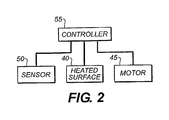
- the apparatus 5 can be operated under closed-loop control which is represented by block diagram.
- the sensor 50 provides data to a controller 55, which in turn determines the rate of revolution of a motor 45.
- the closed loop control can take many forms.
- the controller 55 is a programmable digital logic device, such as a microcontroller, that reads the input of the sensor 50, which can be either analog input or direct digital input.
- the controller 55 is operated by an algorithm that utilizes the sensor input as well as internal or externally derived information about the motor 45 rotational speed and the temperature of the heated surface 40 to determine a new commanded speed for the rotatable auger 20 and a new commanded temperature for the heated surface 40.
- control strategy can employ feedback as well as feedforward.
- control circuit can be implemented as an analog control device, which can implement many of the same classes of algorithm as the digital device.
- FIGS. 3A and 3B show different perspectives of the detail of an alternative embodiment.
- the portion of the embodiment not shown are essentially the same as those of FIG. 1 .
- This embodiment differs in how the material 10 at the end of the rotatable auger 20 is fluidized or agitated.
- a clockwork spring 60 is attached to the rotatable auger 20 so that it rotates with the rotatable auger 20, agitating or fluidized material 10 in the vicinity of the member 36 containing the openings 35.
- the member 36 maybe rigidly affixed to the auger enclosure 22 or may instead be constrained to rotate with the rotatable auger 20.
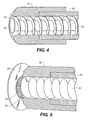
- FIG.4 shows a detail view of yet another embodiment of the invention.
- the rotatable auger 20 terminates in a spreader 65 which rotates with the rotatable auger 20.
- the spreader 65 is a cone-shaped member that spreads the material 10 away from the shaft of the rotatable auger 20 towards the opening 35.
- the single opening 35 is in the form of an annulus and is formed between the spreader 65 on the inside and heat sink 42.
- Heat sink 42 is rigidly attached to the auger enclosure 22.
- the rotation of the spreader 65 within the heat sink 42 sets up a shear in the material, causing agitation and reducing the tendency of the material 10 to compact into an agglomerated solid inside the auger enclosure 22 or the heat sink 42.
- FIG. 5 shows a detail of another embodiment of the invention.
- the openings are provided by a fine screen 75.
- a vibratory actuator 70 imparts vibrational energy to the screen 75 agitating or fluidizing the material 10 in the feeding location 30.
- the direction of the vibration may be co-axial to the rotatable auger 20, perpendicular to the axis of the rotatable auger 20, or both co-axial or perpendicular.
- Fluidized material 10 is forced through the screen 75 by the rotation of the rotatable auger 20. Material 10 passing through the screen 75 then encounters the heated surface 40 which is spaced a short distance from the screen 75. This distance is typically on the order of 50-100 microns, but could be larger or smaller depending on particle size of the material 10 being fed, the size of the openings in the screen 75, and other factors.
Landscapes
- Chemical & Material Sciences (AREA)
- Chemical Kinetics & Catalysis (AREA)
- Engineering & Computer Science (AREA)
- Materials Engineering (AREA)
- Mechanical Engineering (AREA)
- Metallurgy (AREA)
- Organic Chemistry (AREA)
- General Chemical & Material Sciences (AREA)
- Physical Vapour Deposition (AREA)
- Electroluminescent Light Sources (AREA)
- Manufacturing And Processing Devices For Dough (AREA)
Applications Claiming Priority (2)
| Application Number | Priority Date | Filing Date | Title |
|---|---|---|---|
| US11/121,242 US7625602B2 (en) | 2005-05-03 | 2005-05-03 | Controllably feeding powdered or granular material |
| PCT/US2006/015351 WO2006118837A2 (en) | 2005-05-03 | 2006-04-25 | Method for feeding powdered or granular material |
Publications (2)
| Publication Number | Publication Date |
|---|---|
| EP1893785A2 EP1893785A2 (en) | 2008-03-05 |
| EP1893785B1 true EP1893785B1 (en) | 2012-07-11 |
Family
ID=37103274
Family Applications (1)
| Application Number | Title | Priority Date | Filing Date |
|---|---|---|---|
| EP06751155A Expired - Lifetime EP1893785B1 (en) | 2005-05-03 | 2006-04-25 | Method for feeding powdered or granular material |
Country Status (4)
| Country | Link |
|---|---|
| US (1) | US7625602B2 (enExample) |
| EP (1) | EP1893785B1 (enExample) |
| JP (1) | JP5237088B2 (enExample) |
| WO (1) | WO2006118837A2 (enExample) |
Families Citing this family (9)
| Publication number | Priority date | Publication date | Assignee | Title |
|---|---|---|---|---|
| JP5179739B2 (ja) * | 2006-09-27 | 2013-04-10 | 東京エレクトロン株式会社 | 蒸着装置、蒸着装置の制御装置、蒸着装置の制御方法および蒸着装置の使用方法 |
| US7883583B2 (en) * | 2008-01-08 | 2011-02-08 | Global Oled Technology Llc | Vaporization apparatus with precise powder metering |
| US7972443B2 (en) * | 2008-11-14 | 2011-07-05 | Global Oled Technology Llc | Metering of particulate material and vaporization thereof |
| US8062427B2 (en) * | 2008-11-14 | 2011-11-22 | Global Oled Technology Llc | Particulate material metering and vaporization |
| US8048230B2 (en) * | 2008-11-14 | 2011-11-01 | Global Oled Technology Llc | Metering and vaporizing particulate material |
| JP4974036B2 (ja) * | 2009-11-19 | 2012-07-11 | 株式会社ジャパンディスプレイセントラル | 有機el装置の製造方法 |
| CN106119781B (zh) * | 2016-07-27 | 2018-10-30 | 京东方科技集团股份有限公司 | 蒸发装置、蒸镀设备和蒸镀方法 |
| WO2022243403A1 (de) | 2021-05-21 | 2022-11-24 | Merck Patent Gmbh | Verfahren zur kontinuierlichen aufreinigung von mindestens einem funktionalen material und vorrichtung zur kontinuierlichen aufreinigung von mindestens einem funktionalen material |
| CN115595550B (zh) * | 2022-10-24 | 2024-07-23 | 广东振华科技股份有限公司 | 一种af颗粒膜料自动换料连续蒸发镀膜装置及方法 |
Family Cites Families (16)
| Publication number | Priority date | Publication date | Assignee | Title |
|---|---|---|---|---|
| US2447789A (en) | 1945-03-23 | 1948-08-24 | Polaroid Corp | Evaporating crucible for coating apparatus |
| JPS50109182A (enExample) * | 1974-02-07 | 1975-08-28 | ||
| SU779441A1 (ru) | 1978-07-31 | 1980-11-15 | Институт Механики Металлополимерных Систем Ан Белорусской Сср | Дозирующий питатель |
| DE3530106A1 (de) * | 1985-08-23 | 1987-02-26 | Kempten Elektroschmelz Gmbh | Aufdampfgut zum aufdampfen anorganischer verbindungen mittels einer photonen-erzeugenden strahlungsheizquelle in kontinuierlich betriebenen vakuumbedampfungsanlagen |
| US4885211A (en) | 1987-02-11 | 1989-12-05 | Eastman Kodak Company | Electroluminescent device with improved cathode |
| US4769292A (en) | 1987-03-02 | 1988-09-06 | Eastman Kodak Company | Electroluminescent device with modified thin film luminescent zone |
| JPH0645213Y2 (ja) * | 1988-02-08 | 1994-11-16 | 住友電気工業株式会社 | 高精度粉体供給装置 |
| EP0585848A1 (de) * | 1992-09-02 | 1994-03-09 | Hoechst Aktiengesellschaft | Verfahren und Vorrichtung zur chemischen Gasphasenabscheidung dünner Schichten |
| JP2000248358A (ja) * | 1999-03-01 | 2000-09-12 | Casio Comput Co Ltd | 蒸着装置および蒸着方法 |
| IT1310745B1 (it) | 1999-11-26 | 2002-02-22 | Lawer Spa | Dispositivo per l'erogazione dosata di prodotti scorrevoli. |
| JP2003293121A (ja) * | 2002-04-05 | 2003-10-15 | Cluster Ion Beam Technology Kk | 蒸着材料供給手段を備えた蒸着用坩堝 |
| US7118783B2 (en) * | 2002-06-26 | 2006-10-10 | Micron Technology, Inc. | Methods and apparatus for vapor processing of micro-device workpieces |
| US6837939B1 (en) | 2003-07-22 | 2005-01-04 | Eastman Kodak Company | Thermal physical vapor deposition source using pellets of organic material for making OLED displays |
| US7339139B2 (en) * | 2003-10-03 | 2008-03-04 | Darly Custom Technology, Inc. | Multi-layered radiant thermal evaporator and method of use |
| US7288285B2 (en) * | 2004-09-21 | 2007-10-30 | Eastman Kodak Company | Delivering organic powder to a vaporization zone |
| US7213347B2 (en) | 2005-05-03 | 2007-05-08 | Eastman Kodak Company | Metering material to promote rapid vaporization |
-
2005
- 2005-05-03 US US11/121,242 patent/US7625602B2/en active Active
-
2006
- 2006-04-25 WO PCT/US2006/015351 patent/WO2006118837A2/en not_active Ceased
- 2006-04-25 JP JP2008510033A patent/JP5237088B2/ja not_active Expired - Lifetime
- 2006-04-25 EP EP06751155A patent/EP1893785B1/en not_active Expired - Lifetime
Also Published As
| Publication number | Publication date |
|---|---|
| JP5237088B2 (ja) | 2013-07-17 |
| WO2006118837A2 (en) | 2006-11-09 |
| JP2008540829A (ja) | 2008-11-20 |
| US20060251811A1 (en) | 2006-11-09 |
| EP1893785A2 (en) | 2008-03-05 |
| WO2006118837A3 (en) | 2007-04-05 |
| US7625602B2 (en) | 2009-12-01 |
Similar Documents
| Publication | Publication Date | Title |
|---|---|---|
| US7625601B2 (en) | Controllably feeding organic material in making OLEDs | |
| US7288286B2 (en) | Delivering organic powder to a vaporization zone | |
| JP5480332B2 (ja) | 気化ゾーンへの粒子状材料の供給 | |
| US7288285B2 (en) | Delivering organic powder to a vaporization zone | |
| US20110033973A1 (en) | Deposition apparatus for temperature sensitive materials | |
| JP4886694B2 (ja) | 気化ゾーンへの粒子状材料の供給 | |
| US7165340B2 (en) | Feeding organic material to a heated surface | |
| US7625602B2 (en) | Controllably feeding powdered or granular material | |
| EP1877596B1 (en) | Metering material to promote rapid vaporization | |
| US7993459B2 (en) | Delivering particulate material to a vaporization zone | |
| US7398605B2 (en) | Method of feeding particulate material to a heated vaporization surface | |
| JP2012518092A (ja) | 簡易粉末供給及び気化装置 |
Legal Events
| Date | Code | Title | Description |
|---|---|---|---|
| PUAI | Public reference made under article 153(3) epc to a published international application that has entered the european phase |
Free format text: ORIGINAL CODE: 0009012 |
|
| 17P | Request for examination filed |
Effective date: 20071025 |
|
| AK | Designated contracting states |
Kind code of ref document: A2 Designated state(s): DE GB NL |
|
| DAX | Request for extension of the european patent (deleted) | ||
| RBV | Designated contracting states (corrected) |
Designated state(s): DE GB NL |
|
| 17Q | First examination report despatched |
Effective date: 20090128 |
|
| RAP1 | Party data changed (applicant data changed or rights of an application transferred) |
Owner name: GLOBAL OLED TECHNOLOGY LLC |
|
| RAP1 | Party data changed (applicant data changed or rights of an application transferred) |
Owner name: GLOBAL OLED TECHNOLOGY LLC |
|
| GRAP | Despatch of communication of intention to grant a patent |
Free format text: ORIGINAL CODE: EPIDOSNIGR1 |
|
| RIN1 | Information on inventor provided before grant (corrected) |
Inventor name: KOPPE, BRUCE EDWARD Inventor name: REDDEN, NEIL PETER Inventor name: LONG, MICHAEL Inventor name: PALONE, THOMAS WILLIAM |
|
| GRAS | Grant fee paid |
Free format text: ORIGINAL CODE: EPIDOSNIGR3 |
|
| GRAA | (expected) grant |
Free format text: ORIGINAL CODE: 0009210 |
|
| AK | Designated contracting states |
Kind code of ref document: B1 Designated state(s): DE GB NL |
|
| REG | Reference to a national code |
Ref country code: GB Ref legal event code: FG4D |
|
| REG | Reference to a national code |
Ref country code: DE Ref legal event code: R096 Ref document number: 602006030710 Country of ref document: DE Effective date: 20120906 |
|
| REG | Reference to a national code |
Ref country code: NL Ref legal event code: T3 |
|
| PLBE | No opposition filed within time limit |
Free format text: ORIGINAL CODE: 0009261 |
|
| STAA | Information on the status of an ep patent application or granted ep patent |
Free format text: STATUS: NO OPPOSITION FILED WITHIN TIME LIMIT |
|
| 26N | No opposition filed |
Effective date: 20130412 |
|
| REG | Reference to a national code |
Ref country code: DE Ref legal event code: R097 Ref document number: 602006030710 Country of ref document: DE Effective date: 20130412 |
|
| PGFP | Annual fee paid to national office [announced via postgrant information from national office to epo] |
Ref country code: NL Payment date: 20250418 Year of fee payment: 20 |
|
| PGFP | Annual fee paid to national office [announced via postgrant information from national office to epo] |
Ref country code: DE Payment date: 20250422 Year of fee payment: 20 |
|
| PGFP | Annual fee paid to national office [announced via postgrant information from national office to epo] |
Ref country code: GB Payment date: 20250418 Year of fee payment: 20 |
|
| REG | Reference to a national code |
Ref country code: DE Ref legal event code: R071 Ref document number: 602006030710 Country of ref document: DE |
|
| REG | Reference to a national code |
Ref country code: NL Ref legal event code: MK Effective date: 20260424 |
|
| REG | Reference to a national code |
Ref country code: GB Ref legal event code: PE20 Expiry date: 20260424 |
|
| PG25 | Lapsed in a contracting state [announced via postgrant information from national office to epo] |
Ref country code: GB Free format text: LAPSE BECAUSE OF EXPIRATION OF PROTECTION Effective date: 20260424 |