EP1893586B1 - Verfahren zur herstellung von 1-alkyl-3-phenyluracilen - Google Patents
Verfahren zur herstellung von 1-alkyl-3-phenyluracilen Download PDFInfo
- Publication number
- EP1893586B1 EP1893586B1 EP06755248A EP06755248A EP1893586B1 EP 1893586 B1 EP1893586 B1 EP 1893586B1 EP 06755248 A EP06755248 A EP 06755248A EP 06755248 A EP06755248 A EP 06755248A EP 1893586 B1 EP1893586 B1 EP 1893586B1
- Authority
- EP
- European Patent Office
- Prior art keywords
- alkyl
- formula
- phenyluracils
- methyl
- reaction
- Prior art date
- Legal status (The legal status is an assumption and is not a legal conclusion. Google has not performed a legal analysis and makes no representation as to the accuracy of the status listed.)
- Expired - Lifetime
Links
Classifications
-
- C—CHEMISTRY; METALLURGY
- C07—ORGANIC CHEMISTRY
- C07D—HETEROCYCLIC COMPOUNDS
- C07D239/00—Heterocyclic compounds containing 1,3-diazine or hydrogenated 1,3-diazine rings
- C07D239/02—Heterocyclic compounds containing 1,3-diazine or hydrogenated 1,3-diazine rings not condensed with other rings
- C07D239/24—Heterocyclic compounds containing 1,3-diazine or hydrogenated 1,3-diazine rings not condensed with other rings having three or more double bonds between ring members or between ring members and non-ring members
- C07D239/28—Heterocyclic compounds containing 1,3-diazine or hydrogenated 1,3-diazine rings not condensed with other rings having three or more double bonds between ring members or between ring members and non-ring members with hetero atoms or with carbon atoms having three bonds to hetero atoms with at the most one bond to halogen, directly attached to ring carbon atoms
- C07D239/46—Two or more oxygen, sulphur or nitrogen atoms
- C07D239/52—Two oxygen atoms
- C07D239/54—Two oxygen atoms as doubly bound oxygen atoms or as unsubstituted hydroxy radicals
Definitions
- 1-Alkyl-3-phenyluracils of the general formula I are in principle from WO 01/83459 known. Their preparation can according to the in WO 01/83459 given teaching.
- N-alkylations on the free uracil nitrogen atom by reacting a uracil compound with an alkylating agent are described, for example, in US Pat US 4,943,309 described.
- the object of the present invention is to provide a simple and economical process for the preparation of 1-alkyl-3-phenyluracils of the formula I by which undesirable side reactions, such as the formation of dialkylated by-products, are suppressed, and by which simultaneously high yields and high purity of desired product can be achieved.
- the present invention relates to a process for the preparation of 1-alkyl-3-phenyluracilen of the formula I, which comprises the reaction of 3-phenyluracils of the formula II and alkylating agents of the formula III, characterized in that during the entire reaction, the pH by portions Base addition is maintained in a range of 1 to 6 covers.
- the process according to the invention gives 1-alkyl-3-phenyluracils of the formula I in high yields and high purities. This is surprising in view of the fact that the 3-phenyluracil of the formula II used has a reactive NH group on both the uracil ring and in the side chain, which can be alkylated. Thus, those skilled in the art would expect a variety of side reactions, eg, the formation of corresponding N-alkylsulfonamides or mixtures of N-alkylsulfonamides or N-alkyl substituted uracils, including oligomer or polymer formation.
- the 1-alkyl-3-phenyluracils of the formula I can contain one or more chiral centers and are then present as enantiomers or diastereomer mixtures.
- the invention thus provides a process for the preparation of both the pure enantiomers or diastereomers and mixtures thereof.
- the 1-alkyl-3-phenyluracils of the formula I can also be in the form of their agriculturally useful salts, whereby the type of salt generally does not matter.
- the salts of those cations or the acid addition salts of those acids come into consideration whose cations, or anions, do not adversely affect the herbicidal activity of the compounds I.
- alkali metals preferably lithium, sodium and potassium
- the alkaline earth metals preferably calcium and magnesium
- the transition metals preferably manganese, copper, zinc and iron, and ammonium
- Anions of useful acid addition salts are primarily chloride, bromide, fluoride, hydrogen sulfate, sulfate, dihydrogen phosphate, hydrogen phosphate, nitrate, bicarbonate, carbonate, hexafluorosilicate, hexafluorophosphate, benzoate and the anions of C 1 -C 4 alkanoic acids, preferably formate, acetate, Propionate and butyrate.
- the organic moieties mentioned for the substituents R 1 -R 7 or as radicals on phenyl rings represent collective terms for individual listings of the individual group members. All hydrocarbon chains, ie all alkyl, haloalkyl, alkoxy, alkenyl and alkynyl moieties can be straight-chain or be branched. Unless otherwise indicated, halogenated substituents preferably carry one to five identical or different halogen atoms. The meaning halogen in each case represents fluorine, chlorine, bromine or iodine.
- Table 1 No. R 1 R 4 R 5 R 6 Ia1 CH 3 H H CH 3 Ia2 C 2 H 5 H H CH 3 .
- the process according to the invention comprises the reaction of 3-phenyluracils of the formula II and alkylating agents of the formula III characterized in that the pH is maintained in the range from 1 to 6 during the entire reaction by batchwise addition of the base:
- the group L 1 in the alkylating agent of the formula III is a nucleophilically displaceable leaving group, preferably halogen, hydrogensulfate, C1-C6 alkyl sulfate, C 1 -C 6 -Alkylcarbonat, C 1 -C 6 alkylsulfonyloxy, C 1 -C 6 -Halogenalkylsulfonyloxy or phenylsulfonyloxy, wherein the phenyl ring may carry one or more substituents selected from the group consisting of halogen, nitro, C 1 -C 6 -alkyl and C 1 -C 6 -haloalkyl; very preferably halogen, C 1 -C 6 -alkylsulfate, C 1 -C 6 -alkylsulfonyloxy, C 1 -C 6 -haloalkylsulfonyloxy, phenylsulfonyloxy, p
- Preferred alkylating agents are C 1 -C 6 -alkyl halides, di-C 1 -C 6 -alkyl sulfates, di-C 1 -C 6 -alkyl carbonates, C 1 -C 6 -alkylsulfonic acids, C 1 -C 6 -alkylsulfonic acid-C 1 - C 4 -alkyl, C 1 -C 6 -Halogenalkylsulfonklaren, C 1 -C 6 -Halogenalkylsulfonkla-C 1 -C 4 -alkyl or phenyl sulfonic acid-C 1 -C 4 -alkyl, where the phenyl ring can carry one or more substituents from the group consisting of halogen, nitro, C 1 -C 6 -alkyl and C 1 -C 6 -haloalkyl.
- Very preferred alkylating agents are C 1 -C 6 -alkyl halides, di-C 1 -C 6 -alkyl sulfates, C 1 -C 6 -alkylsulfonic acid-C 1 -C 4 -alkyl esters or phenylsulfonic acid-C 1 -C 4 -alkyl esters.
- alkylating agents are C 1 -C 6 -alkyl halides, di-C 1 -C 6 -alkyl sulfates, di-C 1 -C 6 -alkyl carbonates, C 1 -C 6 -alkylsulfonic acid-C 1 -C 4 -alkyl esters or phenylsulfonic acid -C 1 -C 4 alkyl esters.
- alkylating agents are C 1 -C 6 -alkyl halides and di-C 1 -C 6 -alkyl sulfates; extremely preferably di-C 1 -C 6 -alkyl sulfates.
- alkylating agents are C 1 -C 6 -alkyl halides, di-C 1 -C 6 -alkyl sulfates and di-C 1 -C 6 -alkyl carbonates; very preferably C 1 -C 6 -alkyl halides and di-C 1 -C 6 -alkyl sulfates; extremely preferably di-C 1 -C 6 -alkyl sulfates.
- alkylating agents are methylating agents or ethylating agents such as methyl iodide, ethyl iodide, methyl bromide, methyl chloride, ethyl bromide, Ethyl chloride, dimethyl sulfate, diethyl sulfate, C 1 -C 6 -alkylsulfonate or ethyl ester or the methyl or ethyl esters of the abovementioned phenylsulfonic acids.
- methylating agents or ethylating agents such as methyl iodide, ethyl iodide, methyl bromide, methyl chloride, ethyl bromide, Ethyl chloride, dimethyl sulfate, diethyl sulfate, C 1 -C 6 -alkylsulfonate or ethyl ester or the methyl or ethyl esters of
- alkylating agents are methylating agents or ethylating agents such as methyl iodide, ethyl iodide, methyl bromide, methyl chloride, ethyl bromide, ethyl chloride, dimethyl sulfate, dimethyl carbonate, diethyl sulfate, C 1 -C 6 -alkylsulfonate or ethyl ester or the methyl or ethyl esters of the aforementioned phenylsulfonic acids.
- methylating agents or ethylating agents such as methyl iodide, ethyl iodide, methyl bromide, methyl chloride, ethyl bromide, ethyl chloride, dimethyl sulfate, dimethyl carbonate, diethyl sulfate, C 1 -C 6 -alkylsulfonate or ethyl ester or the
- a most preferred methylating agent is dimethylsulfate.
- the alkylating agent can be used both in an equimolar amount, based on the 3-phenyluracils of the formula II, and in a substoichiometric amount or in a superstoichiometric amount.
- the molar ratios for the ratio of 3-phenyluracils of the formula II to alkylating agent III are generally in the range from 1: 1 to 1: 3, preferably 1: 1 to 1: 1.3.
- Suitable bases for the reaction according to the invention are all customary organic and inorganic bases.
- bases are generally inorganic compounds such as alkali metal and alkaline earth metal hydroxides such as lithium hydroxide, sodium hydroxide, potassium hydroxide and calcium hydroxide, alkali metal and alkaline earth metal oxides such as lithium oxide, sodium oxide, calcium oxide and magnesium oxide, alkali metal and alkaline earth metal hydrides such as lithium hydride, sodium hydride, potassium hydride and calcium hydride, alkali metal or Erdalkalimetallfluoride such as cesium fluoride, alkali metal amides such as lithium amide, sodium amide and potassium amide, alkali metal and alkaline earth metal carbonates such as lithium carbonate, sodium carbonate, potassium carbonate and calcium carbonate and alkali metal hydrogencarbonates such as sodium bicarbonate, organometallic compounds, in particular alkali metal alkyls such as methyllithium, butyllithium and phenyllithium, alkylmagnesium halides such as methylmagnesium chloride and alkali metal and alkaline
- Pentoxide and Dimethoxymagnesium also organic bases, eg ammonia, primary amines such as methylamine, ethylamine, hexylamine, aniline, secondary amines such as dimethylamine, diethylamine, tertiary amines such as trimethylamine, triethylamine, diisopropylethylamine, tributylamine, and N-methylpiperidine, pyridine, substituted Pyridines such as collidine, lutidine and 4-dimethylaminopyridine as well as bicyclic Amines such as 1,8-diazabicyclo [5.4.0] undec-7-ene (DBU), 1,5-diazabicyclo [4.3.0] non-5-ene (DBN) or 1,4-diazabicyclo [2.2.2 ] octane (DABCO).
- DBU 1,8-diazabicyclo [5.4.0] undec-7-ene
- DBN 1,5-diaza
- bases selected from alkali metal hydroxides and alkaline earth metal hydroxides such as sodium hydroxide, potassium hydroxide and lithium hydroxide, alkali metal and alkaline earth metal oxides such as calcium oxide, alkali metal and alkaline earth metal carbonates such as lithium carbonate, sodium carbonate, potassium carbonate, cesium carbonate, magnesium carbonate, calcium carbonate, zinc carbonate, alkali metal bicarbonates such as sodium bicarbonate and ammonia or tertiary amines such as triethylamine; particularly preferably selected from alkali metal and alkaline earth metal hydroxides, ammonia and tertiary amines.
- alkali metal hydroxides and alkaline earth metal hydroxides such as sodium hydroxide, potassium hydroxide and lithium hydroxide
- alkali metal and alkaline earth metal oxides such as calcium oxide
- alkali metal and alkaline earth metal carbonates such as lithium carbonate, sodium carbonate, potassium carbonate, cesium carbonate, magnesium carbonate, calcium carbon
- bases selected from alkali metal hydroxides and alkaline earth metal hydroxides such as sodium hydroxide, potassium hydroxide and lithium hydroxide, alkali metal and alkaline earth metal oxides such as calcium oxide, alkali metal and alkaline earth metal carbonates such as lithium carbonate, sodium carbonate, potassium carbonate, cesium carbonate, magnesium carbonate, calcium carbonate and zinc carbonate, as well as alkali metal bicarbonates such as sodium bicarbonate.
- the base used is sodium or potassium hydroxide, sodium or potassium carbonate, or sodium hydrogencarbonate or potassium hydrogencarbonate.
- alkali metal and alkaline earth metal hydroxides preferably alkali metal hydroxides, are used as the base.
- the bases are generally used in equimolar amounts based on the 3-phenyluracils of the formula II, but they can also be used catalytically, in excess or, if appropriate, as solvent.
- the amount of base will usually be not more than 1.3 mol, based on 1 mol of the compound II.
- the pH is maintained in the range from 1 to 6 throughout the reaction by adding the base in portions.
- the pH is preferably in a range from 2 to 6 throughout the reaction by portionwise base addition; very preferably from 3 to 6; more preferably from 4 to 6; held.
- “Portion-wise base addition” means that the base addition occurs during the reaction in individual portions, ie in at least 2 portions, or in several up to many portions, or continuously.
- the pH during the reaction in various ways by portionwise addition of base in the range of 1 to 6 are maintained, these embodiments considered both alone or in combination with each other represent special embodiments of the method according to the invention :
- a pH value between 1 and 6 is set at the beginning of the reaction, which is then kept constant during the reaction at the value set at the beginning.
- the pH value between 1 and 6, which is set at the beginning of the reaction is changed continuously during the reaction to a different pH in the range from 1 to 6.
- the continuous change of the pH during the reaction is repeated, whereby this repetition can take place as often as desired.
- a pH value between 1 and 6 is initially set at the beginning of the reaction, which is initially kept constant at the set value. This is then changed after a partial conversion to another pH in the range 1 to 6, which is then kept constant again at the newly set value.
- This newly adjusted pH can in turn be changed to a different pH in the range 1 to 6 after a partial conversion, i. h., the change of the set pH in the range 1 to 6 after a partial conversion can be repeated as often as desired.
- the pH value set at the beginning of the reaction is changed between 1 and 6 once or several times after each partial conversion to a different pH in the range from 1 to 6, the respectively changed pH value until the next change is kept constant.
- the pH value between 1 and 6, which is set at the beginning of the reaction is changed once after a partial conversion to a different pH in the range from 1 to 6.
- the pH value between 1 and 6 set at the beginning of the reaction may be higher than the pH value set by the pH change or the pH values set by the pH value changes.
- the pH value set at the beginning of the reaction can be between 1 and 6 lower than the pH value set by the pH change or the pH values set by the pH value changes.
- the pH value set at the beginning of the reaction can be between 1 and 6 between the pH values set by the pH value changes.
- the pH value set at the beginning of the reaction is between 1 and 6 higher than the pH value set by the pH change or the pH values set by the pH value changes.
- the pH can be determined by known routine methods, e.g. by periodic or continuous measurement of the pH, to be determined by the skilled person.
- the 3-phenyluracils of the formula II, the alkylating agents of the formula III and the base can be brought into contact with one another in any desired manner, the addition of the base taking place in portions.
- reactants and the base can be introduced separately, simultaneously or successively into the reaction vessel and allowed to react, wherein the addition of the base is carried out in portions.
- the 3-phenyluracils of the formula II and the alkylating agents of the formula III are preferably initially introduced in a reaction vessel, if appropriate with the desired solvent, and then the desired reaction conditions are established by adding the base batchwise.
- reaction of the 3-phenyluracil II with the alkylating agent III is advantageously carried out in the presence of a solvent.
- the solvents used for these reactions are aliphatic, cycloaliphatic or aromatic hydrocarbons, such as pentane, hexane, cyclopentane, cyclohexane, toluene, xylene, chlorinated aliphatic and aromatic hydrocarbons, such as dichloromethane, trichloromethane, 1,2-dichloroethane, 1,1 , 2,2-tetrachloroethane, chlorobenzene, 1,2-, 1,3- or 1,4-dichlorobenzene, chlorotoluenes, dichlorotoluenes, open-chain dialkyl ethers such as diethyl ether, di-n-propyl ether, diisopropyl ether, methyl tert-butyl ether, cyclic ethers, such as tetrahydrofuran, 1,4-dioxane, anisole, glycol ethers,
- Preferred solvents are N, N-dimethylformamide, N-methylpyrrolidone, acetone, dichloromethane, tetrahydrofuran, toluene, chlorobenzene, methyl acetate, ethyl acetate, butyl acetate or mixtures of these solvents.
- the alkylation of the 3-phenyluracils of the formula II is preferably carried out at temperatures between -5 ° C. and 100 ° C., preferably at temperatures between 0 ° C. and 80 ° C. and in particular at temperatures between 20 ° C. and 70 ° C., very preferably between 20 ° C and 60 ° C, through.
- the reaction time can be determined by those skilled in the art in a conventional manner by routine methods such as thin layer chromatography or HPLC.
- the reaction can be carried out at atmospheric pressure, reduced pressure or under elevated pressure, optionally under inert gas, continuously or batchwise.
- the work-up of the reaction mixture to obtain the 1-alkyl-3-phenyluracils of the formula I can be carried out by customary methods.
- the solvent used by conventional methods for example by distillation, remove.
- the 1-alkyl-3-phenyluracils of the formula I can then be taken up in a water-immiscible organic solvent, any impurities are extracted with water which may be acidified, and the solvent is removed under reduced pressure.
- the usual methods such as crystallization, precipitation or chromatography can be used.
- reaction can also be carried out in a multiphase system.
- the reaction is carried out in an aqueous-organic multiphase system in the presence of phase transfer catalysts.
- phase transfer catalysts are quaternary ammonium salts, phosphonium salts, crown ethers or polyglycols.
- Suitable quaternary ammonium salts include, for example Tetra (C 1 -C 18 ) -alkylammonium fluorides, chlorides, bromides, iodides, tetrafluoroborates, diborates, hydrogen sulfates, hydroxides, perchlorates and borates such as tetramethylammonium fluoride tetrahydrate, tetramethylammonium fluoride, tetrabutylammonium fluoride, Tetrabutylammonium fluoride trihydrate, tetramethylammonium chloride, tetraethylammonium chloride, tetrapropylammonium chloride, tetrabutylammonium chloride, dodecyltrimethylammonium chloride, methyltributylammonium chloride, methyltrioctylammonium chloride, methyltricaprylammonium chloride; Tetramethylammonium bromide,
- Suitable phosphonium salts include, for example C 1 -C 18 -alkyltriphenylphosphonium chlorides, bromides, acetates such as methyltriphenylphosphonium bromide, ethyltriphenylphosphonium bromide, ethyltriphenylphosphonium iodide, ethyltriphenylphosphonium acetate, butyltriphenylphosphonium chloride, butyltriphenylphosphonium bromide, Tetra (C 1 -C 18 ) alkylphosphonium chloride or bromide such as tetrabutylphosphonium bromide, Tetraphenylphosphonium chloride or bromide, benzyltriphenylphosphonium chloride or bromide.
- Suitable crown ethers include e.g. 18-crown-6, dibenzo-18-crown-6.
- the phase transfer catalyst is used in an amount of up to 20 mol%, preferably between 1 and 15 mol% and in particular between 2 and 12 mol%, based on the 3-phenyluracil II.
- the multiphase system comprises an aqueous phase and at least one organic liquid phase.
- solid phases can occur.
- the aqueous phase is preferably a solution of bases.
- Suitable bases for this preferred variant of the process according to the invention are all customary organic and inorganic bases as mentioned above, in particular the bases mentioned above as preferred or particularly preferred or very preferred.
- Preferred bases are alkali metal and alkaline earth metal hydroxides such as lithium hydroxide, sodium hydroxide, potassium hydroxide and calcium hydroxide; Alkali metal and alkaline earth metal carbonates such as lithium carbonate, sodium carbonate, potassium carbonate and calcium carbonate and alkali metal bicarbonates such as sodium bicarbonate, into consideration.
- alkali metal or alkaline earth metal hydroxides very preferably alkali metal hydroxides, e.g. Sodium hydroxide.
- the bases are generally used in equimolar amounts based on the 3-phenyluracils of the formula II, but they can also be used catalytically, in excess or, if appropriate, as solvent.
- the amount of base will usually be not more than 1.3 mol, based on 1 mol of the compound II.
- the aqueous phase is most preferably a solution of bases such as e.g. Alkali or alkaline earth metal hydroxides, carbonates, alkali metal bicarbonates, ammonia or water-soluble primary, secondary or tertiary amines in water.
- bases such as e.g. Alkali or alkaline earth metal hydroxides, carbonates, alkali metal bicarbonates, ammonia or water-soluble primary, secondary or tertiary amines in water.
- the aqueous phase is especially preferably a solution of alkali metal or alkaline earth metal hydroxides, carbonates or alkali metal bicarbonates in water.
- aliphatic, cycloaliphatic or aromatic hydrocarbons such as pentane, hexane, cyclopentane, cyclohexane, toluene, xylene, chlorinated aliphatic and aromatic hydrocarbons such as dichloromethane, trichloromethane, 1,2-dichloroethane, 1,1, 2,2-tetrachloroethane, chlorobenzene, 1,2-, 1,3- or 1,4-dichlorobenzene, chlorotoluenes, dichlorotoluenes, open-chain dialkyl ethers such as diethyl ether, di-n-propyl ether, di-isopropyl ether, methyl tert-butyl ether, cyclic Ethers such as tetrahydrofuran (THF) and anisole, aliphatic carboxylic acid C 1 -C 6 alkyl esters such as methyl
- ethyl acetate, n-butyl acetate, chlorobenzene, THF, toluene or mixtures of these solvents are preferred as solvents; are very preferred Ethyl acetate, n-butyl acetate, chlorobenzene and THF mixtures of these solvents, and toluene and THF mixtures of toluene.
- solid phases may occur, e.g. the 1-alkyl-3-phenyluracil of the formula I, the 3-phenyluracil of the formula II, the alkylating agent of the formula III, the base and / or the phase transfer catalyst are not completely dissolved.
- the multiphase system consists of aqueous alkali metal hydroxide solution as aqueous phase, e.g. Sodium hydroxide solution, and as the organic phase of toluene and tetrahydrofuran, or dichloromethane and tetrahydrofuran, chlorobenzene and tetrahydrofuran, or from ethyl acetate or n-butyl acetate.
- the 3-phenyluracils of the formula II, the alkylating agents of the formula III, the base and the optionally phase-transfer catalyst can be brought into contact with one another in any desired manner, with the addition of the base taking place in portions.
- the reactants, the base and optionally the phase transfer catalyst can be introduced separately, simultaneously or successively into the reaction vessel and allowed to react, wherein the addition of the base takes place in portions.
- the 3-phenyluracils of the formula II can be initially charged in one of the abovementioned organic solvents or solvent mixtures. Thereafter, the aqueous solution of the base in portions, the alkylating agent III and optionally the phase transfer catalyst with mixing.
- the 3-phenyluracils of the formula II and the alkylating agents of the formula III and the phase transfer catalyst are preferably initially charged in a reaction vessel with the desired solvent and then the desired reaction conditions are adjusted by adding the base batchwise.
Landscapes
- Chemical & Material Sciences (AREA)
- Organic Chemistry (AREA)
- Organic Low-Molecular-Weight Compounds And Preparation Thereof (AREA)
- Low-Molecular Organic Synthesis Reactions Using Catalysts (AREA)
Abstract
Description
- Die vorliegende Erfindung betrifft ein Verfahren zur Herstellung von 1-Alkyl-3-phenyluracilen der Formel I
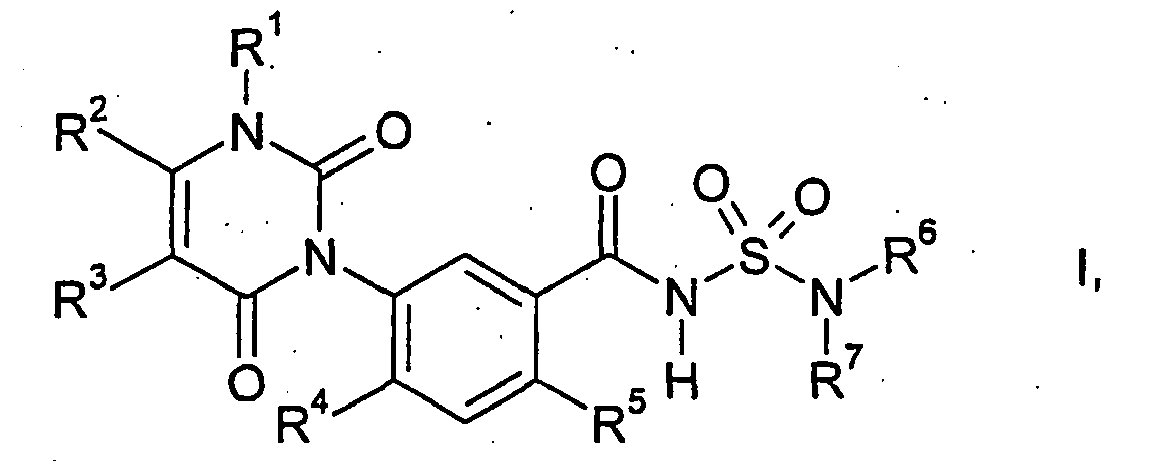
- R1
- C1-C6-Alkyl;
- R2 und R3
- unabhängig voneinander
Wasserstoff, C1-C6-Alkyl oder C1-C6-Halogenalkyl; - R4 und R5
- unabhängig voneinander
Wasserstoff, Halogen, Cyano, C1-C6-Alkyl oder C1-C6-Halogenalkyl; - R6 und R7
- unabhängig voneinander
Wasserstoff, C1-C6-Alkyl, C1-C6-Alkoxy, C3-C6-Alkenyl, C3-C6-Alkynyl C3-C6-Cycloalkyl, C3-C6-Cycloalkenyl, Phenyl oder Benzyl; - 1-Alkyl-3-phenyluracile der allgemeinen Formel I sind prinzipiell aus der
WO 01/83459 WO 01/83459 - N-Alkylierungen am freien Uracilstickstoffatom durch Umsetzung einer Uracilverbindung mit einem Alkylierungsmittel werden z.B. in der
US 4,943,309 beschrieben. - Weiterhin wird die Herstellung von 1-Afkyl-3-phenyluracilen mit einer Sulfamidseitenkette in der
PCT/EP/04/013615 - Nachteilig an diesen Vorgehensweisen ist allerdings, dass aufgrund der leichten Alkylierbarkeit der Sulfamindseitenkette Nebenreaktionen wie z.B. Alkylierung am Sulfonamidsticktoffatom bzw. Bildung von dialkylierten Produkte auftreten.
Entsprechend ist auch schon bekannt, dass Schwefelsäurediamide in einfacher Weise mit Schwefelsäurediestern oder Arensulfonsäureestern in Gegenwart einer Base alkyliert werden (z.B. R. Sowada, J. Prakt. Chem. 25, 88, 1964). - Weiterhin ist im Falle von trisubstituierten Schwefelsäurediamiden die Bildung von tetrasubstituierten Schwefelsäurediamiden bekannt (z.B. B. Unterhalt, E. Seebach, Arch. Pharm. 314, 51, 1981).
- Ebenso können auch Schwefelsäurediamide, bei denen die Amidfunktion bereits einen Acylrest trägt, alkyliert werden (z.B. K. C. C. Bancroft et al., J. Heterocycl. Chem. 15, 1521, 1978; A. Martinez et al., Bioorg. Med. Chem. Lett. 9, 21, 3133, 1999).
- Somit liegt der vorliegenden Erfindung die Aufgabe zugrunde, ein einfaches und wirtschaftliches Verfahren zur Herstellung von 1-Alkyl-3-phenyluracilen der Formel I bereitzustellen, durch das unerwünschte Nebenreaktionen wie z.B. die Bildung von dialkylierten Nebenprodukten unterdrückt werden, und durch das gleichzeitig hohe Ausbeuten und hohe Reinheit an Wertprodukt erzielt werden können.
- Es wurde überraschenderweise gefunden, dass diese Aufgabe durch ein Verfahren gelöst wird, bei dem 3-Phenyluracile der Formel II

und Alkylierungsmittel der Formel III
R1-L1 III,
wobei R1 die oben genannte Bedeutung hat, und
L1 für eine nucleophil verdrängbare Abgangsgruppe steht;
miteinander umgesetzt werden,
dadurch gekennzeichnet, dass während der gesamten Umsetzung der pH-Wert durch portionsweise Basenzugabe in einem Bereich von 1 bis 6 gehalten wird. - Demnach betrifft die vorliegende Erfindung ein Verfahren zur Herstellung 1-Alkyl-3-phenyluracilen der Formel I, das die Umsetzung von 3-Phenyluracilen der Formel II und Alkylierungsmitteln der Formel III, dadurch gekennzeichnet, dass während der gesamten Umsetzung der pH-Wert durch portionsweise Basenzugabe in einem Bereich von 1 bis 6 gehalten wird, umfaßt.
- Nach dem erfindungsgemäßen Verfahren werden 1-Alkyl-3-phenyluracile der Formel I in hohen Ausbeuten und hohen Reinheiten erhalten.
Dies überrascht angesichts der Tatsache, dass das eingesetzte 3-Phenyluracil der Formel II sowohl am Uracilring als auch in der Seitenkette eine reaktive NH-Gruppe aufweist, die alkyliert werden kann.
Somit würde der Fachmann eine Vielzahl von Nebenreaktionen, z.B. die Bildung entsprechender N-Alkylsulfonamide oder Gemische aus N-Alkylsulfonamiden oder N-Alkyl substituierten Uracilen einschließlich Oligomer- oder Polymerbildung erwarten. - Die 1-Alkyl-3-phenyluracile der Formel I können je nach Substitutionsmuster ein oder mehrere Chiralitätszentren enthalten und liegen dann als Enantiomeren oder Diastereomerengemische vor. Gegenstand der Erfindung ist somit ein Verfahren zur Herstellung sowohl der reinen Enantiomere oder Diastereomere als auch deren Gemische.
- Die 1-Alkyl-3-phenyluracile der Formel I können auch in Form ihrer landwirtschaftlich brauchbaren Salze vorliegen, wobei es auf die Art des Salzes in der Regel nicht ankommt. Im allgemeinen kommen die Salze derjenigen Kationen oder die Säureadditionssalze derjenigen Säuren in Betracht, deren Kationen, beziehungsweise Anionen, die herbizide Wirkung der Verbindungen I nicht negativ beeinträchtigen.
- Es kommen als Kationen insbesondere Ionen der Alkalimetalle, vorzugsweise Lithium, Natrium und Kalium, der Erdalkalimetalle, vorzugsweise Calcium und Magnesium, und der Übergangsmetalle, vorzugsweise Mangan, Kupfer, Zink und Eisen, sowie Ammonium, wobei hier gewünschtenfalls ein bis vier Wasserstoffatome durch C1-C4-Alkyl, Hydroxy-C1-C4-alkyl, C1-C4-Alkoxy-C1-C4-alkyl, Hydroxy-C1-C4-alkoxy-C1-C4-alkyl, Phenyl oder Benzyl ersetzt sein können, vorzugsweise Ammonium, Dimethylammonium, Diisopropylammonium, Tetramethylammonium, Tetrabutylammonium, 2-(2-Hydroxyeth-1-oxy)eth-1-ylammonium, Di(2-hydroxyeth-1-yl)ammonium, Trimethylbenzylammonium, des weiteren Phosphoniumionen, Sulfoniumionen, vorzugsweise Tri(C1-C4-alkyl)sulfonium und Sulfoxoniumionen, vorzugsweise Tri(C1-C4-alkyl)sulfoxonium, in Betracht.
- Anionen von brauchbaren Säureadditionsalzen sind in erster Linie Chlorid, Bromid, Fluorid, Hydrogensulfat, Sulfat, Dihydrogenphosphat, Hydrogenphosphat, Nitrat, Hydrogencarbonat, Carbonat, Hexafluorosilikat, Hexafluorophosphat, Benzoat sowie die Anionen von C1-C4-Alkansäuren, vorzugsweise Formiat, Acetat, Propionat und Butyrat.
- Die für die Substituenten R1 - R7 oder als Reste an Phenylringen genannten organischen Molekülteile stellen Sammelbegriffe für individuelle Aufzählungen der einzelnen Gruppenmitglieder dar. Sämtliche Kohlenwasserstoffketten, also alle Alkyl-, Halogenalkyl-, Alkoxy-, Alkenyl- und Alkinyl-Teile können geradkettig oder verzweigt sein. Sofern nicht anders angegeben tragen halogenierte Substituenten vorzugsweise ein bis fünf gleiche oder verschiedene Halogenatome. Die Bedeutung Halogen steht jeweils für Fluor, Chlor, Brom oder lod.
- Ferner bedeuten beispielsweise:
- C1-C4-Alkyl: z.B. Methyl, Ethyl, n-Propyl, 1-Methylethyl, n-Butyl, 1-Methylpropyl, 2-Methylpropyl und 1,1-Dimethylethyl;
- C1-C6-Alkyl: C1-C4-Alkyl wie voranstehend genannt, sowie z.B. n-Pentyl, 1-Methylbutyl, 2-Methylbutyl, 3-Methylbutyl, 2,2-Dimethylpropyl, 1-Ethylpropyl, n-Hexyl, 1,1-Dimethylpropyl, 1,2-Dimethylpropyl, 1-Methylpentyl, 2-Methylpentyl, 3-Methylpentyl, 4-Methylpentyl, 1,1-Dimethylbutyl, 1,2-Dimethylbutyl, 1,3-Dimethylbutyl, 2,2-Dimethylbutyl, 2,3-Dimethylbutyl, 3,3-Dimethylbutyl, 1-Ethylbutyl, 2-Ethylbutyl, 1,1,2-Trimethylpropyl, 1-Ethyl-1-methylpropyl und 1-Ethyl-3-methylpropyl;
- C1-C4-Halogenalkyl: einen C1-C4-Alkylrest wie vorstehend genannt, der partiell oder vollständig durch Fluor, Chlor, Brom und/oder lod substituiert ist, also z.B. Chlormethyl, Dichlormethyl, Trichlormethyl, Fluormethyl, Difluormethyl, Trifluormethyl, Chlorfluormethyl, Dichlorfluormethyl, Chlordifluormethyl, 2-Fluorethyl, 2-Chlorethyl, 2-Bromethyl, 2-Iodethyl, 2,2-Difluorethyl, 2,2,2-Trifluorethyl, 2-Chlor-2-fluorethyl, 2-Chlor-2,2-difluorethyl, 2,2-Dichlor-2-fluorethyl, 2,2,2-Trichlorethyl, Pentafluorethyl, 2-Fluorpropyl, 3-Fluorpropyl, 2,2-Difluorpropyl, 2,3-Difluorpropyl, 2-Chlorpropyl, 3-Chlorpropyl, 2,3-Dichlorpropyl, 2-Brompropyl, 3-Brompropyl, 3,3,3-Trifluorpropyl, 3,3,3-Trichlorpropyl, 2,2,3,3,3-Pentafluorpropyl, Heptafluorpropyl, 1-(Fluormethyl)-2-fluorethyl, 1-(Chlormethyl)-2-chlorethyl, 1-(Brommethyl)-2-bromethyl, 4-Fluorbutyl, 4-Chlorbutyl, 4-Brombutyl und Nonafluorbutyl;
- C1-C6-Halogenalkyl: C1-C4-Halogenalkyl wie voranstehend genannt, sowie z.B. 5-Fluorpentyl, 5-Chlorpentyl, 5-Brompentyl, 5-lodpentyl, Undecafluorpentyl, 6-Fluorhexyl, 6-Chlorhexyl, 6-Bromhexyl, 6-lodhexyl und Tridecafluorhexyl;
- C3-C7-Cycloalkyl: ein monocyclischer gesättigter Kohlenwasserstoff mit 3 bis 7 Ringgliedern, wie z.B. Cyclopropyl, Cyclobutyl, Cyclopentyl, Cyclohexyl oder Cycloheptyl;
- C3-C7-Cycloalkenyl: ein monocyclischer partiell ungesättigter Kohlenwasserstoff mit 3 bis 7 Ringgliedern, wie z.B. Cyctoprop-1-enyl, Cycloprop-2-enyl, Cyclobut-1-enyl, Cyclobut-2-enyl, Cyclobut-1,3-dienyl, Cyclopent-1-enyl, Cyclopent-2-enyl, Cyclopent-3-enyl, Cyclopent-2,4-dienyl, Cyclohex-1-enyl, Cyclohex-2-enyl, Cyclohex-3-enyl; Cyclohex-1,3-dienyl, Cyclohex-1,5-dienyl, Cyclohex-2,4-dienyl, oder Cyclohex-2,5-dienyl.
- C3-C6-Alkenyl: z.B. 1-Propenyl, 2-Propenyl, 1-Methylethenyl, 1-Butenyl, 2-Butenyl, 3-Butenyl, 1-Methyl-1-propenyl, 2-Methyl-1-propenyl, 1-Methyl-2-propenyl, 2-Methyl-2-propenyl, 1-Pentenyl, 2-Pentenyl, 3-Pentenyl, 4-Pentenyl, 1-Methyl-1-butenyl, 2-Methyl-1-butenyl, 3-Methyl-1-butenyl, 1-Methyl-2-butenyl, 2-Methyl-2-butenyl, 3-Methyl-2-butenyl, 1-Methyl-3-butenyl, 2-Methyl-3-butenyl, 3-Methyl-3-butenyl, 1,1-Dimethyl-2-propenyl, 1,2-Dimethyl-1-propenyl, 1,2-Dimethyl-2-propenyl, 1-Ethyl-1-propenyl, 1-Ethyl-2-propenyl, 1-Hexenyl, 2-Hexenyl, 3-Hexenyl, 4-Hexenyl, 5-Hexenyl, 1-Methyl-1-pentenyl, 2-Methyl-1-pentenyl, 3-Methyl-1-pentenyl, 4-Methyl-1-pentenyl, 1-Methyl-2-pentenyl, 2-Methyl-2-pentenyl, 3-Methyl-2-pentenyl, 4-Methyl-2-pentenyl, 1-Methyl-3-pentenyl, 2-Methyl-3pentenyl, 3-Methyl-3-pentenyl, 4-Methyl-3-pentenyl, 1-Methyl-4-pentenyl, 2-Methyl-4-pentenyl, 3-Methyl-4-pentenyl, 4-Methyl-4-pentenyl, 1,1-Dimethyl-2-butenyl, 1,1-Dimethyl-3-butenyl, 1,2-Dimethyl-1-butenyl, 1,2-Dimethyl-2-butenyl, 1,2-Dimethyl-3-butenyl, 1,3-Dimethyl-1-butenyl, 1,3-Dimethyl-2-butenyl, 1,3-Dimethyl-3-butenyl, 2,2-Dimethyl-3-butenyl, 2,3-Dimethyl-1-butenyl, 2,3-Dimethyl-2-butenyl, 2,3-Dimethyl-3-butenyl, 3,3-Dimethyl-1-butenyl, 3,3-Dimethyl-2-butenyl, 1-Ethyl-1-butenyl, 1-Ethyl-2-butenyl, 1-Ethyl-3-butenyl, 2-Ethyl-1-butenyl, 2-Ethyl-2-butenyl, 2-Ethyl-3-butenyl, 1,1,2-Trimethyl-2-propenyl, 1-Ethyl-1-methyl-2-propenyl, 1-Ethyl-2-methyl-1-propenyl und 1-Ethyl-2-methyl-2-propenyl;
- C2-C6-Alkinyl: z.B. Ethinyl, 1-Propinyl, 2-Propinyl, 1-Butinyl, 2-Butinyl, 3-Butinyl, 1-Methyl-2-propinyl, 1-Pentinyl, 2-Pentinyl, 3-Pentinyl, 4-Pentinyl, 1-Methyl-2-butinyl, 1-Methyl-3-butinyl, 2-Methyl-3-butinyl, 3-Methyl-1-butinyl, 1,1-Dimethyl-2-propinyl, 1-Ethyl-2-propinyl, 1-Hexinyl, 2-Hexinyl, 3-Hexinyl, 4-Hexinyl, 5-Hexinyl, 1-Methyl-2-pentinyl, 1-Methyl-3-pentinyl, 1-Methyl-4-pentinyl, 2-Methyl-3-pentinyl, 2-Methyl-4-pentinyl, 3-Methyl-1-pentinyl, 3-Methyl-4-pentinyl, 4-Methyl-1-pentinyl, 4-Methyl-2-pentinyl, 1,1-Dimethyl-2-butinyl, 1,1-Dimethyl-3-butinyl, 1,2-Dimethyl-3-butinyl, 2,2-Dimethyl-3-butinyl, 3,3-Dimethyl-1-butinyl, 1-Ethyl-2-butinyl, 1-Ethyl-3-butinyl, 2-Ethyl-3-butinyl und 1-Ethyl-1-methyl-2-propinyl;
- C1-C4-Alkoxy: z.B. Methoxy, Ethoxy, Propoxy, 1-Methyl-ethoxy, Butoxy, 1-Methylpropoxy, 2-Methylpropoxy und 1,1-Dimethylethoxy;
- C1-C6-Alkoxy: C1-C4-Alkoxy wie voranstehend genannt, sowie z.B. Pentoxy, 1-Methylbutoxy, 2-Methylbutoxy, 3-Methoxylbutoxy, 1,1-Dimethyl-propoxy, 1,2-Dimethylpropoxy, 2,2-Dimethylpropoxy, 1-Ethylpropoxy, Hexoxy, 1-Methylpentoxy, 2-Methylpentoxy, 3-Methylpentoxy, 4-Methylpentoxy, 1,1-Di-methylbutoxy,1,2-Dimethylbutoxy, 1,3-Dimethylbutoxy, 2,2-Dimethylbutoxy, 2,3-Dimethylbutoxy, 3,3-Dimethylbutoxy, 1-Ethylbutoxy, 2-Ethylbutoxy, 1,1,2-Tri-methylpropoxy, 1,2,2-Tri-methylpropoxy, 1-Ethyl-1-methylpropoxy und 1-Ethyl-2-methylpropoxy;
- In einer besonders bevorzugten Ausführungsform des erfindungsgemäßen Verfahrens weisen die Variablen R1 bis R6 die folgenden Bedeutungen, und zwar jeweils für sich allein oder in Kombination, auf:
- R1
- C1-C4-Alkyl,
bevorzugt Methyl, Ethyl, n-Propyl, iso-Propyl,
sehr bevorzugt Methyl; - R2
- Wasserstoff, C1-C4-Alkyl oder C1-C4-Halogenalkyl,
bevorzugt Wasserstoff, Methyl oder C1-C4-Halogenalkyl,
sehr bevorzugt C1-C4-Halogenalkyl;
besonders bevorzugt Difluormethyl oder Trifluormethyl,
außerordentlich bevorzugt Trifluormethyl; - R3
- Wasserstoff, C1-C4-Alkyl oder C1-C4-Halogenalkyl,
bevorzugt Wasserstoff, Methyl oder Trifluormethyl,
sehr bevorzugt Wasserstoff; - R4
- Wasserstoff oder Halogen,
bevorzugt Wasserstoff, Fluor oder Chlor,
sehr bevorzugt Wasserstoff oder Fluor,
besonders bevorzugt Fluor; - R5
- Halogen, Cyano oder C1-C4-Halogenalkyl,
bevorzugt Fluor, Chlor, Cyano oder Trifluormethyl,
ebenso bevorzugt Halogen oder Cyano,
sehr bevorzugt Fluor, Chlor oder Cyano,
besonders bevorzugt Chlor oder Cyano,
außerordentlich bevorzugt Chlor; - R6
- Wasserstoff oder C1-C4-Alkyl,
ebenso bevorzugt C1-C6-Alkyl,
sehr bevorzugt C1-C4-Alkyl,
besonders bevorzugt Methyl, Ethyl, n-Propyl oder iso-Propyl, außerordentlich bevorzugt iso-Propyl; - R7
- Wasserstoff oder C1-C4-Alkyl,
ebenso bevorzugt C1-C6-Alkyl,
sehr bevorzugt C1-C4-Alkyl,
besonders bevorzugt Methyl, Ethyl, n-Propyl oder iso-Propyl, außerordentlich bevorzugt Methyl. - In einer ebenso bevorzugten Ausführungsform des erfindungsgemäßen Verfahrens weist R2 folgende Bedeutungen auf:
- R2
- Wasserstoff oder C1-C6-Halogenalkyl, bevorzugt C1-C6-Halogenalkyl,
sehr bevorzugt C1-C4-Halogenalkyl,
besonders bevorzugt Difluormethyl oder Trifluormethyl,
außerordentlich bevorzugt Trifluormethyl. - In einer ebenso bevorzugten Ausführungsform des erfindungsgemäßen Verfahrens weist R2 folgende Bedeutungen auf:
- R2
- C1-C6-Alkyl oder C1-C6-Halogenalkyl,
bevorzugt C1-C4-Alkyl oder C1-C6-Halogenalkyl,
sehr bevorzugt C1-C4-Halogenalkyl,
besonders bevorzugt Difluormethyl oder Trifluormethyl,
außerordentlich bevorzugt Trifluormethyl. - In einer ebenso bevorzugten Ausführungsform des erfindungsgemäßen Verfahrens weist R4 folgende Bedeutungen auf:
- R4
- Wasserstoff oder Halogen,
bevorzugt Wasserstoff,
ebenso bevorzugt Halogen,
sehr bevorzugt Fluor oder Chlor. - In einer besonders bevorzugten Ausführungsform des erfindungsgemäßen Verfahrens lassen sich 1-Alkyl-3-phenyluracile der Formel I.a (entspricht Formel I mit R2 = CF3, R3 = H und R7 = CH3), insbesondere die 1-Alkyl-3-phenyluracile I.a.1 bis I.a.24 der Tabelle 1 herstellen, wobei die Definitionen der Variablen R1, R4, R5 und R6 nicht nur in Kombination miteinander sondern auch jeweils für sich betrachtet für das erfindungsgemäße Verfahren eine besondere Rolle spielen.

Tabelle 1 Nr. R1 R4 R5 R6 I.a.1 CH3 H H CH3 I.a.2 C2H5 H H CH3. I.a.3 CH3 F H CH3 I.a.4 C2H5 F H CH3 I.a.5 CH3 H Cl CH3 I.a.6 C2H5 H Cl CH3 I.a.7 CH3 F Cl CH3 I.a.8 C2H5 F Cl CH3 I.a.9 CH3 H H C2H5 I.a.10 C2H5 H H C2H5 I.a.11 CH3 F H C2H5 I.a.12 C2H5 F H C2H5 I.a.13 CH3 H Cl C2H5 I.a.14 C2H5 H Cl C2H5 I.a.15 CH3 F Cl C2H5 I.a.16 C2H5 F Cl C2H5 I.a.17 CH3 H H CH(CH3)2 I.a.18 C2H5 H H CH(CH3)2 I.a.19 CH3 F H CH(CH3)2 I.a.20 C2H5 F H CH(CH3)2 I.a.21 CH3 H Cl CH(CH3)2 I.a.22 C2H5 H Cl CH(CH3)2 I.a.23 CH3 F Cl CH(CH3)2 I.a.24 C2H5 F Cl CH(CH3)2 - Das erfindungsgemäße Verfahren umfasst die Umsetzung von 3-Phenyluracilen der Formel II und Alkylierungsmittel der Formel III dadurch gekennzeichnet, dass während der gesamten Umsetzung der pH-Wert durch portionsweise Basenzugabe in einem Bereich von 1 bis 6 gehalten wird:

- Die Gruppe L1 im Alkylierungsmittel der Formel III steht für eine nucleophil verdrängbare Abgangsgruppe,
bevorzugt für Halogen, Hydrogensulfat, C1-C6-Alkylsulfat, C1-C6-Alkylcarbonat, C1-C6-Alkylsulfonyloxy, C1-C6-Halogenalkylsulfonyloxy oder Phenylsulfonyloxy,
wobei der Phenylring einen oder mehrere Substituenten aus der Gruppe Halogen, Nitro, C1-C6-Alkyl und C1-C6-Halogenalkyl tragen kann;
sehr bevorzugt für Halogen, C1-C6-Alkylsulfat, C1-C6-Alkylsulfonyloxy, C1-C6-Halogenalkylsulfonyloxy, Phenylsulfonyloxy, p-Toluolsulfonyloxy, p-Chlorphenylsulfonyloxy, p-Bromphenylsulfonyloxy oder p-Nitrophenylsulfonyloxy;
besonders bevorzugt für Halogen, C1-C6-Alkylsulfat, C1-C6-Alkylsulfonyloxy, C1-C6-Halogenalkylsulfonyloxy oder Phenylsulfonyloxy;
sehr bevorzugt für C1-C6-Alkylsulfat;
außerordentlich bevorzugt für C1-C4-Alkylsulfat;
ebenso besonders bevorzugt für Chlor, Brom oder lod, Methylsulfat, Methylsulfonyloxy, Trifluormethylsulfonyloxy oder Phenylsulfonyloxy.
3-Phenyluracile der Formel II sind ausWO 01/83459 WO 04/39768 - Bevorzugte Alkylierungsmittel sind C1-C6-Alkylhalogenide, Di-C1-C6-alkylsulfate, Di-C1-C6-alkylcarbonate, C1-C6-Alkylsulfonsäuren, C1-C6-Alkylsulfonsäure-C1-C4-alkylester, C1-C6-Halogenalkylsulfonsäuren, C1-C6-Halogenalkylsulfonsäure-C1-C4-alkylester oder Phenylsulfonsäure-C1-C4-alkylester,
wobei der Phenylring einen oder mehrere Substituenten aus der Gruppe Halogen, Nitro, C1-C6-Alkyl und C1-C6-Halogenalkyl tragen kann. - Sehr bevorzugte Alkylierungsmittel sind C1-C6-Alkylhalogenide, Di-C1-C6-alkylsulfate, C1-C6-Alkylsulfonsäure-C1-C4-alkylester oder Phenylsulfonsäure-C1-C4-alkylester.
- Ebenso sehr bevorzugte Alkylierungsmittel sind C1-C6-Alkylhalogenide, Di-C1-C6-alkylsulfate, Di-C1-C6-alkylcarbonate, C1-C6-Alkylsulfonsäure-C1-C4-alkylester oder Phenylsulfonsäure-C1-C4-alkylester.
- Besonders bevorzugte Alkylierungsmittel sind C1-C6-Alkylhalogenide und Di-C1-C6-alkylsulfate; außerordentlich bevorzugt Di-C1-C6-alkylsulfate.
- Ebenso besonders bevorzugte Alkylierungsmittel sind C1-C6-Alkylhalogenide, Di-C1-C6-alkylsulfate und Di-C1-C6-alkylcarbonate; sehr bevorzugt C1-C6-Alkylhalogenide und Di-C1-C6-alkylsulfate; außerordentlich bevorzugt Di-C1-C6-alkylsulfate.
- Insbesonders bevorzugte Alkylierungsmittel sind Methylierungsmittel oder Ethylierungsmittel wie Methyliodid, Ethyliodid, Methylbromid, Methylchlorid, Ethylbromid, Ethylchlorid, Dimethylsulfat, Diethylsulfat, C1-C6-Alkylsulfonsäuremethylester oder -ethylester oder die Methyl- oder Ethylester der zuvor genannten Phenylsulfonsäuren. Ebenso insbesonders bevorzugte Alkylierungsmittel sind Methylierungsmittel oder Ethylierungsmittel wie Methyliodid, Ethyliodid, Methylbromid, Methylchlorid, Ethylbromid, Ethylchlorid, Dimethylsulfat, Dimethylcarbonat, Diethylsulfat, C1-C6-Alkylsulfonsäuremethylester oder -ethylester oder die Methyl- oder Ethylester der zuvor genannten Phenylsulfonsäuren.
- Ein ganz besonders bevorzugtes Methylierungsmittel ist Dimethylsulfat.
- Im erfindungsgemäßen Verfahren kann man das Alkylierungsmittel sowohl in äquimolarer Menge, bezogen auf die 3-Phenyluracile der Formel II, als auch in substöchiometrischer Menge oder überstöchiometrischer Menge einsetzen.
- Üblicherweise setzt man wenigstens eine äquimolare Menge des Alkylierungsmittels III, bezogen auf die 3-Phenyluracile der Formel II ein.
- Die molaren Verhältnisse für das Verhältnis von 3-Phenyluracilen der Formel II zu Alkylierungsmittel III liegen in der Regel im Bereich von 1:1 bis 1:3, vorzugsweise 1:1 bis 1:1,3.
- Als Basen für die erfindungsgemäße Umsetzung kommen alle üblichen organischen und anorganischen Basen in Betracht.
- Als Basen kommen allgemein anorganische Verbindungen wie Alkalimetall- und Erdalkalimetallhydroxide wie Lithiumhydroxid, Natriumhydroxid, Kaliumhydroxid und Calciumhydroxid, Alkalimetall- und Erdalkalimetalloxide wie Lithiumoxid, Natriumoxid, Calciumoxid und Magnesiumoxid, Alkalimetall- und Erdalkalimetallhydride wie Lithiumhydrid, Natriumhydrid, Kaliumhydrid und Calciumhydrid, Alkalimetall- oder Erdalkalimetallfluoride wie Cäsiumfluorid, Alkalimetallamide wie Lithiumamid, Natriumamid und Kaliumamid, Alkalimetall- und Erdalkalimetallcarbonate wie Lithiumcarbonat, Natriumcarbonat, Kaliumcarbonat und Calciumcarbonat sowie Alkalimetallhydrogencarbonate wie Natriumhydrogencarbonat, metallorganische Verbindungen, insbesondere Alkalimetallalkyle wie Methyllithium, Butyllithium und Phenyllithium, Alkylmagnesiumhalogenide wie Methylmagnesiumchlorid sowie Alkalimetall- und Erdalkalimetallalkoholate wie Natriummethanolat, Natriumethanolat, Kaliumethanolat, Kalium- tert.-Butanolat, Kalium-tert.-Pentanolat und Dimethoxymagnesium, außerdem organische Basen, z.B. Ammoniak, primäre Amine wie z.B. Methylamin, Ethylamin, Hexylamin, Anilin, sekundäre Amine wie z.B. Dimethylamin, Diethylamin, tertiäre Amine wie Trimethylamin, Triethylamin, Diisopropylethylamin, Tributylamin, und N-Methylpiperidin, Pyridin, substituierte Pyridine wie Collidin, Lutidin und 4-Dimethylaminopyridin sowie bicyclische Amine wie 1,8-Diazabicyclo[5.4.0]undec-7-en (DBU), 1,5-Diazabicyclo[4.3.0]-non-5-en (DBN) oder 1,4-Diazabicyclo[2.2.2]-octan (DABCO) in Betracht. Bevorzugt sind Basen ausgewählt unter Alkali- und Erdalkalimetallhydroxiden wie Natriumhydroxid, Kaliumhydroxid und Lithiumhydroxid, Alkali- und Erdalkalimetalloxiden wie Calciumoxid, Alkali- und Erdalkalimetallcarbonaten wie Lithiumcarbonat, Natriumcarbonat, Kaliumcarbonat, Cäsiumcarbonat, Magnesiumcarbonat, Calciumcarbonat, Zinkcarbonat, Alkalimetallhydrogencarbonaten wie Natriumhydrogencarbonat sowie Ammoniak oder tertiäre Amine wie Triethylamin;
besonders bevorzugt ausgewählt unter Alkali- und Erdalkalimetallhydroxiden, Ammoniak sowie tertiären Aminen. - Insbesondere bevorzugt sind Basen ausgewählt unter Alkali- und Erdalkalimetallhydroxiden wie Natriumhydroxid, Kaliumhydroxid und Lithiumhydroxid, Alkali- und Erdalkalimetalloxiden wie Calciumoxid, Alkali- und Erdalkalimetallcarbonaten wie Lithiumcarbonat, Natriumcarbonat, Kaliumcarbonat, Cäsiumcarbonat, Magnesiumcarbonat, Calciumcarbonat, Zinkcarbonat sowie Alkalimetallhydrogencarbonaten wie Natriumhydrogencarbonat.
- In einer besonders bevorzugten Ausführungsform des erfindungsgemäßen Verfahrens setzt man als Base Natrium- oder Kaliumhydroxid, Natrium- oder Kaliumcarbonat, oder Natriumhydrogen- oder Kaliumhydrogencarbonat ein.
- In einer sehr bevorzugten Ausführungsform des erfindungsgemäßen Verfahrens setzt man als Base Alkali- und Erdalkalimetallhydroxide, bevorzugt Alkalimetallhydroxide, ein.
- Die Basen werden im allgemeinen in äquimolaren Mengen bezogen auf die 3-Phenyluracile der Formel II eingesetzt, sie können aber auch katalytisch, im Überschuß oder gegebenenfalls als Lösungsmittel verwendet werden.
- Vorzugsweise setzt man wenigstens eine äquimolare Menge an Base, bezogen auf die Verbindung II ein. Die Menge an Base wird in der Regel nicht mehr als 1,3 mol bezogen auf 1 mol der Verbindung II betragen.
- Bei der erfindungsgemäßen Umsetzung wird der pH-Wert während der gesamten Umsetzung durch portionsweise Basenzugabe in einem Bereich von 1 bis 6 gehalten.
- Der pH-Wert wird während der gesamten Umsetzung durch portionsweise Basenzugabe bevorzugt in einem Bereich von 2 bis 6;
sehr bevorzugt von 3 bis 6;
besonders bevorzugt von 4 bis 6;
gehalten. - "Portionsweise Basenzugabe" bedeutet, dass die Basenzugabe während der Umsetzung in einzelnen Portionen erfolgt, d.h. in mindestens 2 Portionen, oder in mehreren bis zu vielen Portionen, oder kontinuierlich.
In besonderen Ausführungsformen des erfindungsgemäßen Verfahrens kann der pH-Wert während der Umsetzung auf verschiedene Art und Weise durch portionsweise Basenzugabe im Bereich von 1 bis 6 gehalten werden, wobei diese Ausführungsformen sowohl für sich alleine betrachtet als auch in Kombination miteinander besondere Ausgestaltungen des erfindungsgemäßen Verfahrens darstellen: - In einer bevorzugten Ausführungsform des erfindungsgemäßen Verfahrens wird zu Beginn der Umsetzung ein pH-Wert zwischen 1 und 6 eingestellt, welcher dann während der Umsetzung konstant auf dem zu Beginn eingestellten Wert gehalten wird.
- In einer weiteren bevorzugten Ausführungsform des erfindungsgemäßen Verfahrens wird der zu Beginn der Umsetzung eingestellte pH-Wert zwischen 1 und 6 während der Umsetzung kontinuierlich zu einem anderen pH-Wert im Bereich 1 bis 6 geändert.
- In einer weiteren bevorzugten Ausführungsform des erfindungsgemäßen Verfahrens wird die kontinuierliche Änderung des pH-Wertes während der Umsetzung wiederholt,
wobei diese Wiederholung beliebig oft erfolgen kann. - In einer weiteren bevorzugten Ausführungsform des erfindungsgemäßen Verfahrens wird zu Beginn der Umsetzung zunächst ein pH-Wert zwischen 1 und 6 eingestellt, welcher zunächst konstant auf dem eingestellten Wert gehalten wird. Dieser wird dann nach einer Teilumsetzung zu einem anderen pH-Wert im Bereich 1 bis 6 geändert, welcher dann wieder konstant auf dem neu eingestellten Wert gehalten wird. Dieser neu eingestellte pH-Wert kann wiederum nach einer Teilumsetzung zu einem anderen pH-Wert im Bereich 1 bis 6 geändert werden, d. h., die Änderung des eingestellten pH-Werts im Bereich 1 bis 6 nach einer Teilumsetzung kann beliebig oft wiederholt werden. Dies bedeutet, dass der zu Beginn der Umsetzung eingestellte pH-Wert zwischen 1 und 6 ein- oder mehrfach jeweils nach einer Teilumsetzung zu einem anderen pH-Wert im Bereich 1 bis 6 geändert wird, wobei der jeweils geänderte pH-Wert bis zur nächsten Änderung konstant gehalten wird.
- In einer insbesonders bevorzugten Ausführungsform des erfindungsgemäßen Verfahrens wird der zu Beginn der Umsetzung eingestellte pH-Wert zwischen 1 und 6 einmal nach einer Teilumsetzung zu einem anderen pH-Wert im Bereich 1 bis 6 geändert.
- Als weitere bevorzugte Ausführungsform sind alle Varianten, welche zwischen den voranstehend genannten bevorzugten Ausführungsformen liegen, möglich, wodurch sich auch pH-Wert-Sprünge im Bereich von 1 bis 6 ergeben können.
- Alle diese bevorzugten Ausführungsformen können beliebig oft miteinander kombiniert werden und/oder beliebig oft wiederholt werden.
- Der zu Beginn der Umsetzung eingestellte pH-Wert zwischen 1 und 6 kann höher liegen als der durch die pH-Wert-Änderung eingestellte pH-Wert bzw. als die durch die pH-Wert-Änderungen eingestellten pH-Werte.
- Weiterhin kann der zu Beginn der Umsetzung eingestellte pH-Wert zwischen 1 und 6 niedriger liegen als der durch die pH-Wert-Änderung eingestellte pH-Wert bzw. als die durch die pH-Wert-Änderungen eingestellten pH-Werte.
- Darüber hinaus kann der zu Beginn der Umsetzung eingestellte pH-Wert zwischen 1 und 6 zwischen den durch die pH-Wert-Änderungen eingestellten pH-Werten liegen.
- Besonders bevorzugt liegt der zu Beginn der Umsetzung eingestellte pH-Wert zwischen 1 und 6 höher als der durch die pH-Wert-Änderung eingestellte pH-Wert bzw. als die durch die pH-Wert-Änderungen eingestellten pH-Werte.
- Der pH-Wert kann durch bekannte Routinemethoden, z.B. durch periodische oder kontinuierliche Messung des pH-Wertes, durch den Fachmann ermittelt werden.
- Zur Umsetzung können die 3-Phenyluracile der Formel II, die Alkylierungsmittel der Formel III und die Base in an sich beliebiger Weise miteinander in Kontakt gebracht werden, wobei die Zugabe der Base portionsweise erfolgt.
- Dies bedeutet, dass die Reaktanden und die Base getrennt, gleichzeitig oder nacheinander in das Reaktionsgefäß eingebracht und zur Reaktion geführt werden können,
wobei die Zugabe der Base portionsweise erfolgt. - Bevorzugt werden die 3-Phenyluracile der Formel II und die Alkylierungsmittel der Formel III in einem Reaktionsgefäß, gegebenenfalls mit dem gewünschten Lösungsmittel, vorlegt und dann durch portionsweise Basenzugabe die gewünschten Reaktionsbedingungen eingestellt.
- Man kann jedoch auch die Hauptmenge oder Gesamtmenge an 3-Phenyluracilen der Formel II und die Alkylierungsmittel der Formel III, gegebenenfalls in einem Lösungsmittel, unter Einstellung der gewünschten Reaktionsbedingungen durch portionsweise Basenzugabe in das Reaktionsgefäß eintragen.
- Die Umsetzung der 3-Phenyluracile II mit dem Alkylierungsmittel III wird vorteilhaft in Gegenwart eines Lösungsmittels durchgeführt.
- Als Lösungsmittel für diese Umsetzungen verwendet man, je nach Temperaturbereich, aliphatische, cycloaliphatische oder aromatische Kohlenwasserstoffe wie Pentan, Hexan, Cyclopentan, Cyclohexan, Toluol, Xylol, chlorierte aliphatische und aromatische Kohlenwasserstoffe wie Dichlormethan, Trichlormethan, 1,2-Dichlorethan, 1,1,2,2-Tetrachlorethan, Chlorbenzol, 1,2-, 1,3- oder 1,4-Dichlorbenzol, Chlortoluole, Dichlortoluole, offenkettige Dialkylether wie Diethylether, Di-n-propylether, Di-isopropylether, Methyl-tert-butylether, cyclische Ether wie Tetrahydrofuran, 1,4-Dioxan, Anisol, Glykolether wie Dimethylglykolether, Diethylglykolether, Diethylenglykoldimethylether, Diethylenglykoldiethylether, C1-C4-Alkohole wie Methanol, Ethanol, n-Propanol, iso-Propanol, n-Butanol, aliphatische Carbonsäure-C1-C6-alkylester wie Methylacetat, Ethylacetat oder n-Butylacetat; Ketone wie Aceton, Methylethylketon, Methylisopropylketon, Methylisobutylketon, Butanon, Carbonate wie Diethylcarbonat und Ethylencarbonat, N,N-Dialkylamide wie N,N-Dimethylformamid oder N,N-Dimethylacetamid, N-Alkyllactame wie N-Methylpyrrolidon, Sulfoxide wie Dimethylsulfoxid, Tetraalkylharnstoffe wie Tetramethylharnstoff, Tetraethylharnstoff, Tetrabutylharnstoffe, Dimethylethylenharnstoff, Dimethylpropylenharnstoff oder Gemische dieser Lösungsmittel.
- Als Lösungsmittel bevorzugt sind N,N-Dimethylformamid, N-Methylpyrrolidon, Aceton, Dichlormethan, Tetrahydrofuran, Toluol, Chlorbenzol, Methylacetat, Ethylacetat, Butylacetat oder Gemische dieser Lösungsmittel.
- Vorzugsweise führt man die Alkylierung der 3-Phenyluracile der Formel II bei Temperaturen zwischen -5°C und 100°C, vorzugsweise bei Temperaturen zwischen 0°C und 80°C und insbesondere bei Temperaturen zwischen 20°C und 70°C, sehr bevorzugt zwischen 20°C und 60°C, durch. Die Reaktionszeit kann der Fachmann in an sich üblicher Weise durch Routinemethoden wie Dünnschichtchromatographie oder HPLC ermitteln.
- Die Umsetzung kann bei Normaldruck, vermindertem Druck oder unter erhöhtem Druck, gegebenenfalls unter Inertgas kontinuierlich oder diskontinuierlich durchgeführt werden.
- Die Aufarbeitung des Reaktionsgemisches zur Gewinnung der 1-Alkyl-3-phenyluracile der Formel I kann nach den hierfür üblichen Methoden erfolgen. In der Regel wird man das verwendete Lösungsmittel nach üblichen Verfahren, beispielsweise destillativ, entfernen. Man kann dann die 1-Alkyl-3-phenyluracile der Formel I in einem mit Wasser nicht mischbaren organischen Lösungsmittel aufnehmen, extrahiert etwaige Verunreinigungen mit gegebenenfalls angesäuertem Wasser, trocknet und entfernt das Lösungsmittel unter vermindertem Druck. Zur weiteren Reinigung kann man die üblichen Verfahren wie Kristallisation, Fällung oder Chromatographie anwenden.
- In einer anderen Variante des erfindungsgemäßen Verfahrens kann die Umsetzung auch in einem Mehrphasensystem durchgeführt werden.
- Diese Variante des erfindungsgemäßen Verfahrens ist bevorzugt.
- Bezüglich Alkylierungsmitteln, pH-Wert, Base, Temperatur, Druck und Aufarbeitung gilt das zuvor gesagte. In der Regel wird man bei Verwendung eines Zweiphasensystems zur Aufarbeitung die Phasen trennen und die Phasen getrennt voneinander nach bekannten Methoden aufarbeiten.
- Vorzugsweise wird die Umsetzung in einem wässrig-organischen Mehrphasensystem in Gegenwart von Phasentransferkatalysatoren durchgeführt.
Beispiele für Phasentransferkatalysatoren sind quartäre Ammoniumsalze, Phosphoniumsalze, Kronenether oder Polyglycole. - Geeignete quartäre Ammoniumsalze umfassen z.B.
Tetra-(C1-C18)-alkylammonium-Fluoride, -Chloride, -Bromide, lodide, -Tetrafluoroborate, -Diborate, Hydrogensulfate, -Hydroxide, -Perchlorate und -Borate wie z.B. Tetramethylammonium-Fluorid-Tetrahydrat, Tetramethylammoniumfluorid, Tetrabutylammoniumfluorid, Tetrabutylammoniumfluorid-Trihydrat, Tetramethylammoniumchlorid, Tetraethylammoniumchlorid, Tetrapropylammoniumchlorid, Tetrabutylammoniumchlorid, Dodecyltrimethylammoniumchlorid, Methyltributylammoniumchlorid, Methyltrioctylammoniumchlorid, Methyltricaprylammonium-Chlorid; Tetramethylammoniumbromid, Tetraethylammonium-Chlorid-Hydrat, Tetraethylammoniumbromid, Tetrapropylammoniumbromid (TPAB), Tetrabutylammoniumbromid (TEAB), Tetrahexylammoniumbromid, Tetraoctylammoniumbromid, Hexadecyltrimethylammoniumbromid (CTAB), Dodecyltrimethylammoniumbromid, Tetrametylammoniumiodid, Tetrabutylammoniumiodid, Tetrahexylammoniumiodid, Tetrabutylammoniumtetrafluoroborat, C12-C14-trimethylammoniumdiborat, Tetrabutylammoniumhydrogensulfat (TBAHS), Tetramethylammoniumhydroxid (TMAOH), Tetraethylammoniumhydroxid, Tetrapropylammoniumhydroxid, Tetrabutylammoniumhydroxid, Tetrabutylammoniumperchlorat, C12-C14-Alkyltrimethylammonium-Borat, C12-C14-Alkyltrimethylammonium-Diborat;
N-Benzyltri-(C1-C18)-alkylammonium-chloride, -bromide oder -fluoride wie z.B. Benzyltrimethylammoniumchlorid (BTMAC), Benzyltriethylammoniumchlorid (BTEAC), Benzyltriethylammoniumbromid, Benzyltributylammoniumchlorid, Benzyltributylammoniumbromid;
Phenyltri-(C1-C18)-alkylammonium-chloride, -bromide oder -fluoride wie z.B. Phenyltrimethylammoniumchlorid (PTMAC);
aromatische Ammoniumsalze wie z.B. Hexadecylpyridiniumchlorid, N,N-Dimethylpiperidiniumhydroxid, Pyridinium-Fluoride, -Chloride oder -Bromide wie z.B. 1-Cetyl-Pyridinium-Chlorid-Monohydrat, Cetyl-Pyridinium-Bromid;
vorzugsweise Tetrabutylammoniumchlorid, Methyltributylammoniumchlorid, Methyltrioctylammoniumchlorid; Tetrabutylammoniumbromid, Tetrahexylammoniumbromid, Tetraoctylammoniumbromid, Tetrabutylammoniumiodid, Tetrahexylammoniumiodid, Tetrabutylammoniumhydrogensulfat und Tetrabutylammoniumhydroxid. - Geeignete Phosphoniumsalze umfassen z.B.
C1-C18-Alkyltriphenylphosphoniumchloride, -bromide, -acetate wie z.B. Methyltriphenylphosphoniumbromid, Ethyltriphenylphosphoniumbromid, Ethyltriphenylphosphoniumiodid, Ethyltriphenylphosphoniumacetat, Butyltriphenylphosphoniumchlorid, Butyltriphenylphosphoniumbromid,
Tetra-(C1-C18)-alkyl-phosphoniumchlorid oder -bromid wie Tetrabutylphosphoniumbromid,
Tetraphenylphosphoniumchlorid oder -bromid, Benzyltriphenylphosphoniumchlorid oder -bromid. - Geeignete Kronenether umfassen z.B. 18-Krone-6, Dibenzo-18-Krone-6.
- Geeignete Polyglycole umfassen z.B. Diethylenglycol-dibutylether (=Butyldiglyme), Tetraethyleneglycol-dimethylether (= Tetraglyme), Triethylenglycol-dimethylether (= Triglyme), Polyglycoldimethylether.
- In der Regel setzt man den Phasentransferkatalysator in einer Menge von bis zu 20 mol-%, vorzugsweise zwischen 1 und 15 mol-% und insbesondere zwischen 2 und 12 mol.-%, bezogen auf die 3-Phenyluracile II ein.
- Das Mehrphasensystem umfasst eine wässrige Phase und wenigstens eine organische flüssige Phase. Daneben können auch feste Phasen auftreten.
Die wässrige Phase ist bevorzugt eine Lösung von Basen. - Als Basen kommen für diese bevorzugte Variante des erfindungsgemäßen Verfahrens alle üblichen organischen und anorganischen Basen wie voranstehend genannt, insbesondere die voranstehend als bevorzugt bzw. besonders oder sehr bevorzugt genannten Basen in Betracht.
- Bevorzugt kommen als Basen Alkalimetall- und Erdalkalimetallhydroxide wie Lithiumhydroxid, Natriumhydroxid, Kaliumhydroxid und Calciumhydroxid; Alkalimetall- und Erdalkalimetallcarbonate wie Lithiumcarbonat, Natriumcarbonat, Kaliumcarbonat und Calciumcarbonat und Alkalimetallhydrogencarbonate wie Natriumhydrogencarbonat, in Betracht.
- Besonders bevorzugt verwendet man Alkali- oder Erdalkalimetallhydroxide, sehr bevorzugt Alkalimetallhydroxide wie z.B. Natriumhydroxid.
- Die Basen werden im allgemeinen in äquimolaren Mengen bezogen auf die 3-Phenyluracile der Formel II eingesetzt, sie können aber auch katalytisch, im Überschuß oder gegebenenfalls als Lösungsmittel verwendet werden.
- Vorzugsweise setzt man wenigstens eine äquimolare Menge an Base, bezogen auf die Verbindung II ein. Die Menge an Base wird in der Regel nicht mehr als 1,3 mol, bezogen auf 1 mol der Verbindung II, betragen.
- Die wässrige Phase ist besonders bevorzugt eine Lösung von Basen wie z.B. Alkali- oder Erdalkalimetallhydroxiden, -carbonaten, Alkalimetallhydrogencarbonaten, Ammoniak oder wasserlöslichen primären, sekundären oder tertiären Aminen in Wasser.
- Die wässrige Phase ist insbesondere vorzugsweise eine Lösung von Alkali- oder Erdalkalihydroxiden, -carbonaten oder Alkalimetallhydrogencarbonaten in Wasser.
- Für die organische Phase kommen vorzugsweise als Lösungsmittel je nach Temperaturbereich aliphatische, cycloaliphatische oder aromatische Kohlenwasserstoffe wie Pentan, Hexan, Cyclopentan, Cyclohexan, Toluol, Xylol, chlorierte aliphatische und aromatische Kohlenwasserstoffe wie Dichlormethan, Trichlormethan, 1,2-Dichlorethan, 1,1,2,2-Tetrachlorethan, Chlorbenzol, 1,2-, 1,3- oder 1,4-Dichlorbenzol, Chlortoluole, Dichlortoluole, offenkettige Dialkylether wie Diethylether, Di-n-propylether, Di-isopropylether, Methyl-tert-butylether, cyclische Ether wie Tetrahydrofuran (THF) und Anisol, aliphatische Carbonsäure-C1-C6-alkylester wie Methylacetat, Ethylacetat oder n-Butylacetat oder Gemische dieser Lösungsmittel in Betracht.
- Für die organische Phase sind Ethylacetat, n-Butylacetat, Chlorbenzol, THF, Toluol oder Gemische dieser Lösungsmittel als Lösungsmittel bevorzugt; sehr bevorzugt sind Ethylacetat, n-Butylacetat, Chlorbenzol und THF-Gemische dieser Lösungsmittel, sowie Toluol und THF-Gemische von Toluol.
- Während der Umsetzung können feste Phasen auftreten, wenn z.B. das 1-Alkyl-3-phenyluracil der Formel I, das 3-Phenyluracil der Formel II, das Alkylierungsmittel der Formel III, die Base und/oder der Phasentransferkatalysator nicht vollständig gelöst sind.
- In einer bevorzugten Ausführungsform des erfindungsgemäßen Verfahrens besteht das Mehrphasensystem als wässrige Phase aus wässriger Alkalimetallhydroxid-Lösung, z.B. Natriumhydroxid-Lösung, und als organische Phase aus Toluol und Tetrahydrofuran, oder Dichlormethan und Tetrahydrofuran, Chlorbenzol und Tetrahydrofuran, oder aus Ethylacetat oder n-Butylacetat.
- Zur Umsetzung können die 3-Phenyluracile der Formel II, die Alkylierungsmittel der Formel III, die Base und der gegebenenfalls Phasentranferkatalysator in an sich beliebiger Weise miteinander in Kontakt gebracht werden, wobei die Zugabe der Base portionsweise erfolgt.
Die Reaktanden, die Base und gegebenenfalls der Phasentransferkatalysator können getrennt, gleichzeitig oder nacheinander in das Reaktionsgefäß eingebracht und zur Reaktion geführt werden, wobei die Zugabe der Base portionsweise erfolgt. - Beispielsweise können die 3-Phenyluracile der Formel II in einem der vorgenannten organischen Lösungsmittel oder Lösungsmittelgemische vorgelegt werden. Danach gibt man die wässrige Lösung der Base portionsweise, das Alkylierungsmittel III und gegebenenfalls den Phasentransferkatalysator unter Durchmischen zu.
- Bevorzugt werden die 3-Phenyluracile der Formel II und die Alkylierungsmittel der Formel III sowie der Phasentransferkatalysator in einem Reaktionsgefäß mit dem gewünschten Lösungsmittel, vorlegt und dann durch portionsweise Basenzugabe die gewünschten Reaktionsbedingungen eingestellt.
- Man kann jedoch auch die Hauptmenge oder Gesamtmenge an 3-Phenyluracilen der Formel II und die Alkylierungsmittel der Formel III sowie gegebenenfalls den Phasentransferkatalysator, gegebenenfalls in einem Lösungsmittel, unter Einstellung der gewünschten Reaktionsbedingungen durch portionsweise Basenzugabe in das Reaktionsgefäß eintragen.
- Die folgenden Beispiele dienen der Erläuterung der Erfindung.
- Unter anderem wurde das Verhältnis von gewünschten 3-Phenyluracilen I zu den entsprechenden dialkylierten Nebenprodukten A bestimmt:

- 12,5 g (24,5 mmol) 2-Chlor-5-[3,6-dihydro-2,6-dioxo-4-(trifluormethyl)-1(2H)-pyrimidinyl]4-fluor-N-{[methyl-(1-methylethyl)amino]sulfonyl}-benzamid, 0,8 g (2,5 mmol) Tetrabutylammoniumbromid (= TBAB) und 3,7 g (29,7 mmol) Dimethylsulfat wurden bei 25 °C in einem Gemisch aus Toluol, Wasser und THF vorgelegt und der Ansatz über 6 h auf 40 °C aufgeheizt. Anschließend stellte man durch Zugabe von wässriger 10 %-iger NaOH-Lösung im Reaktionsgemisch den gewünschten pH-Wert ein.
- Während der ganzen Reaktionsdauer wurde weiterhin wässrige 10 %-ige NaOH-Lösung zugegeben, so dass der pH-Wert über den gesamten Reaktionsverlauf konstant bei dem zuvor eingestellten pH-Wert lag.
Nach beendeter Reaktion wurden die Phasen getrennt, die organische Phase getrocknet und das Lösungsmittel entfernt.
Die Ausbeute sowie das Verhältnis von gewünschtem 3-phenyluracil I zu unerwünschtem Dialkylierungsprodukt A wurde über quantitative HPLC (Symmetry C18 5µm 250 x 4,6 mm von Waters; Wellenlänge: 205 nm; Laufmittel: Gradient aus A (0,1 Vol-% H3PO4 in H2O) und B (0,1 Vol-% H3PO4 in CH3CN); B in 25 min von 35% auf 100% ansteigend, dann in 2 min zurück auf 35%; Fluß: 1 ml/min; ) bzw. qualitative HPLC (Symmetry C18 5µm 250 x 4,6 mm von Waters; Wellenlänge: 220 nm; Laufmittel: 40 Gew.-% Acetonitril / 60 Gew.-% Wasser / 0,1 Gew.-% 85-%ige H3PO4; Fluß: 1,5 ml/min) bestimmt. - Die Ausbeute an 1-Alkyl-3-phenyluracil I.a.23 (RT: 12,0 min; RTEdukt: 10,0 min) sowie das Verhältnis von gewünschtem 3-Phenyluracil I zu unerwünschtem Dialkylierungsprodukt A mit R1 = CH3, R2 = CF3, R3 = H, R4 = F, R5 = Cl, R6 = CH(CH3)2, R7 = CH3; im Folgenden "Dialkylierungsprodukt A.a.23" (RT: 13,4 min) bei unterschiedlichen konstanten pH-Werten können Tabelle 2 entnommen werden:
Tabelle 2 Nr. pH-Wert Ausbeute [%] Verhältnis [%] 1-Alkyl-3-phenyluracil I.a.23 Dialkylierungsprodukt A.a.23 2.1 4 95 99,0 0,9 2.2 4,5 99,0 1,1 2.3 5 94 98,3 1,6 2.4 5,5 96,8 3,1 2.5 6 95 97,0 3,2 2.6 6,5 81 90,5 9,4 2.7 8 31 51,9 48,1 - 40,0 g (0,0785 mol) 2-Chlor-5-[3,6-dihydro-2,6-dioxo-4-(trifluormethyl)-1(2H)-pyrimidinyl]4-fluor-N-{[methyl-(1-methylethyl)amino]sulfonyl}-benzamid, 2,5 g (0,0078 mol) Tetrabutylammoniumbromid (= TBAB) und 12,1 g (0,0957 mol) Dimethylsulfat wurden bei 25 °C in einem Gemisch aus Toluol, Wasser und THF vorgelegt und der Ansatz auf 40 °C aufgeheizt. Anschließend stellte man durch Zugabe von wässriger 10 %-iger NaOH-Lösung im Reaktionsgemisch einen pH-Wert von 5,3 - 5,5 ein. Der Ansatz wurde 1 h bei 40 °C gerührt, dabei wurde weiterhin wässrige 10 %-ige Na-OH-Lösung zugegeben, so dass der pH-Wert konstant bei dem zuvor eingestellten pH-Wert lag. Nach 1 h wurde die Zugabe der wässrigen 10 %-ige NaOH-Lösung gestoppt, woraufhin der pH-Wert auf 4,4 - 4,5 fiel. Man gab weitere 0,9 g (0,0071 mol) Dimethylsulfat zu und ließ 10 h bei einem pH-Wert von 4,4 - 4,5 und 40 °C nachrühren. Nach beendeter Reaktion wurden die Phasen getrennt, die organische Phase getrocknet und das Lösungsmittel entfernt.
- Die Ausbeute sowie das Verhältnis von gewünschtem 1-Alkyl-3-phenyluracil I.a.23 zu unerwünschtem Dialkylierungsprodukt A.a.23 bei variablem pH-Wert wurden wie unter Versuch 1 genannt bestimmt, und können Tabelle 3 entnommen werden:
Tabelle 3 Nr. Reakt.zeit [h] Ausbeute [%] Verhältnis [%] 1-Alkyl-3-phenyluracil I.a.23 Dialkylierungsprodukt A.a.23 3.1 1 99,5 0,5 3.2 10 92,3 98,1 1,9 - 12,5 g (24,5 mmol) 2-Chlor-5-[3,6-dihydro-2,6-dioxo-4-(trifluormethyl)-1 (2H)-pyrimidinyl]4-fluor-N-{[methyl-(1-methylethyl)amino]sulfonyl}-benzamid, 0,8 g (2,5 mmol) Tetrabutylammoniumbromid (= TBAB) und 3,7 g (29,7 mmol) Dimethylsulfat sowie 11,6 g (2,9 mmol) NaOH wurden bei 25 °C in einem Gemisch aus Toluol, Wasser und THF vorgelegt und der Ansatz über 6 h auf 40 °C aufgeheizt. Der pH-Wert betrug am Anfang der Umsetzung 6,3 und am Ende 4,2.
Nach beendeter Reaktion wurden die Phasen getrennt, die organische Phase getrocknet und das Lösungsmittel entfernt. - Die Ausbeute sowie das Verhältnis von gewünschtem 1-Alkyl-3-phenyluracil I.a.23 zu unerwünschtem Dialkylierungsprodukt A.a.23 bei einmaliger Basenzugabe zu Beginn der Umsetzung wurden wie unter Versuch 1 genannt bestimmt, und können Tabelle 4 entnommen werden:
Tabelle 4 Nr. Ausbeute [%] Verhältnis [%] 1-Alkyl-3-phenyluracil I.a.23 Dialkylierungsprodukt A.a.23 4.1 91 94,4 5,5 - 12,5 g (24,5 mmol) 2-Chlor-5-[3,6-dihydro-2,6-dioxo-4-(trifluormethyl)-1(2H)-pyrimidinyl]4-fluor-N-{[methyl-(1-methylethyl)amino]sulfonyl}-benzamid, 0,8 g (2,5 mmol) Tetrabutylammoniumbromid (= TBAB) und 3,7 g (29,7 mmol) Dimethylsulfat wurden bei 25 °C in einem Lösungsmittel oder Lösungsmittelgemisch vorgelegt und der Ansatz auf 40 °C aufgeheizt. Anschließend stellte man durch Zugabe von wässriger 10 %-iger NaOH-Lösung im Reaktionsgemisch einen pH-Wert von 5,3 - 5,5 ein. Während der ganzen Reaktionsdauer wurde weiterhin wässrige 10 %-ige NaOH-Lösung zugegeben, so dass der pH-Wert über den gesamten Reaktionsverlauf konstant bei dem zuvor eingestellten pH-Wert lag.
- Nach beendeter Reaktion wurden die Phasen getrennt, die organische Phase getrocknet und das Lösungsmittel entfernt. Das Verhältnis von gewünschtem 1-Alkyl-3-phenyluracil I.a.23 zu unerwünschtem Dialkylierungsprodukt A.a.23 bei unterschiedlichen Lösungsmitteln wurde wie unter Versuch 1 genannt bestimmt, und kann Tabelle 5 entnommen werden:
Tabelle 5 Nr. Lösungsmittel Rkt.zeit [h] Verhältnis [%] 1-Alkyl-3-phenyluracil I.a.23 Dialkyl.prod. A.a.23 5.1 n-Butylacetat / H2O 6 97,3 2,6 5.2 Methylacetat / H2O 18 98,3 1,6 5.3 Etylacetat / H2O 23 97,2 2,8 5.4 Methylenchlorid / H2O 6,5 95,5 4,5 5.5 Ethylformiat / H2O 20 99,4 0,6 5.6 Hexylacetat / H2O 22 98,4 1,6 5.7 DMSO / H2O 23 99,5 <0,5 5.8 2-Methyl-THF / H2O 20 98,1 1,8 5.9 DMF / H2O1 41 92,6 7,4 5.10 Toluol / DMF / H2O 20 97,3 2,6 5.11 Toluol / DMF / H2O 51 96,7 3,2 5.12 Chlorbenzol / THF / H2O 18 94,0 6,0 5.13 Chlorbenzol / THF / H2O 20 95,0 5,0 5.14 Chlorbenzol / THF / H2O 32 97,2 2,8 5.15 Toluol / H2O2,3 22 91,9 8,1 5.16 THF / H2O2 48 97,9 2,1 1 ohne TBAB, Rkt.temp. 40-60°C
2 pH = 5,0-5,5
3 Rkt.temp = 45 °C - 12,5 g (24,5 mmol) 2-Chlor-5-[3,6-dihydro-2,6-dioxo-4-(trifluormethyl)-1(2H)-pyrimidinyl]4-fluor-N-{[methyl-(1-methylethyl)amino]sulfonyl}-benzamid, 0,8 g (2,5 mmol) Tetrabutylammoniumbromid (= TBAB) und das gewünschte Alkylierungsmittel wurden bei 25 °C in einem Gemisch aus Toluol, Wasser und THF vorgelegt und der Ansatz auf die angegebene Temperatur aufgeheizt. Anschließend stellte man durch Zugabe von wässriger 10 %-iger NaOH-Lösung im Reaktionsgemisch einen pH-Wert von 5,3 - 5,5 ein.
- Während der ganzen Reaktionsdauer wurde weiterhin wässrige 10 %-ige NaOH-Lösung zugegeben, so dass der pH-Wert über den gesamten Reaktionsverlauf konstant bei dem zuvor eingestellten pH-Wert lag. Nach beendeter Reaktion wurden die Phasen getrennt, die organische Phase getrocknet und das Lösungsmittel entfernt.
- Das Verhältnis von gewünschtem 1-Alkyl-3-phenyluracil I.a.23 zu unerwünschtem Dialkylierungsprodukt A.a.23 bei unterschiedlichen Alkylierungsmitteln wurde wie unter Versuch 1 genannt bestimmt, und kann Tabelle 6 entnommen werden:
Tabelle 6 Nr. Äqu. Alkylierungsmittel Rkt.bed. Verhältnis [%] [h] [°C] 1-Alkyl-3-phenylur. I.a.23 Dialkyl.prod. A.a.23 6.1 1,2 Äqu. Dimethylsulfat 6 40 96,8 3,1 6.2 1,5 Äqu. Methyliodid1 6 40 96,2 3,8 6.3 1,5 Äqu. Methyliodid 27 40-70 94,9 5,1 6.4 1,2 Äqu. (H3CO)2CO2 36 125 100 0 1 Lösungsmittel = DMF / H2O - 125 g (0,24 mol) 2-Chlor-5-[3,6-dihydro-2,6-dioxo-4-(trifluormethyl)-1(2H)-pyrimidinyl]4-fluor-N-{[methyl-(1-methylethyl)amino]sulfonyl}-benzamid (0,02 mol) Phasentransferkatalysator und 37 g (0,30 mol) Dimethylsulfat wurden bei 25 °C in einem Gemisch aus Toluol, Wasser und THF vorgelegt und der Ansatz auf 40 °C aufgeheizt. Anschließend stellte man durch Zugabe von wässriger 10 %-iger NaOH-Lösung im Reaktionsgemisch einen pH-Wert von 5,0 - 5,5 ein. Während der ganzen Reaktionsdauer wurde weiterhin wässrige 10 %-ige NaOH-Lösung zugegeben, so dass der pH-Wert über den gesamten Reaktionsverlauf konstant bei dem zuvor eingestellten pH-Wert lag. Nach beendeter Reaktion wurden die Phasen getrennt, die organische Phase getrocknet und das Lösungsmittel entfernt.
- Das Verhältnis von gewünschtem 1-Alkyl-3-phenyluracil I.a.23 zu unerwünschtem Dialkylierungsprodukt A.a.23 bei unterschiedlichen Phasentransferkatalysatoren wurde wie unter Versuch 1 genannt bestimmt, und kann Tabelle 7 entnommen werden:
Tabelle 7 Nr. Phasentransfer-katalsator Rkt. zeit [h] Verhältnis [%] 1-Alkyl-3-phenylur. I.A.23 Dial. A.a.23 7.1 Tetrabutylammoniumchlorid 3 98,7 1,3 7.2 Tetrabutylammoniumchlorid 6 97,8 2,2 7.3 Tetrabutylammoniumbromid 3 98,6 1,4 7.4 Tetrabutylammoniumbromid 6 97,5 2,5 7.5 Tetrabutylammoniumhydroxid 3 96,8 3,2 7.6 Tetrabutylammoniumhydroxid 6 95,1 4,9 7.7 Tetrabutylammoniumhydrogensulfat 3 97,7 2,2 7.8 Tetrabutylammoniumhydrogensulfat 6 94,0 6,0 7.9 Tetrahexylammoniumbromid 3 96,9 3,1 7.10 Tetrahexylammoniumbromid 6 96,2 3,8 7.11 Methyltrioctylammoniumchlorid 3 97,3 2,7 7.12 Methyltrioctylammoniumchlorid 6 95,8 4,0 - 12,5 g (24,5 mmol) 2-Chlor-5-[3,6-dihydro-2,6-dioxo-4-(trifluormethyl)-1(2H)-pyrimidinyl]4-fluor-N-{[methyl-(1-methylethyl)amino]sulfonyl}-benzamid, 0,8 g (2,5 mmol) Tetrabutylammoniumbromid (= TBAB) und 3,7 g (29,7 mmol) Dimethylsulfat wurden bei 25 °C in einem Gemisch aus Toluol, Wasser und THF vorgelegt und der Ansatz auf die angegebene Temperatur aufgeheizt. Anschließend stellte man durch Zugabe von wässriger 10 %-iger NaOH-Lösung im Reaktionsgemisch einen pH-Wert von 5,3 - 5,4 ein.
Während der ganzen Reaktionsdauer wurde weiterhin wässrige 10 %-ige NaOH-Lösung zugegeben, so dass der pH-Wert über den gesamten Reaktionsverlauf konstant bei dem zuvor eingestellten pH-Wert lag. Nach beendeter Reaktion wurden die Phasen getrennt, die organische Phase getrocknet und das Lösungsmittel entfernt. - Die Ausbeute sowie das Verhältnis von gewünschtem 1-Alkyl-3-phenyluracil I.a.23 zu unerwünschtem Dialkylierungsprodukt A.a.23 wurde wie unter Versuch 1 genannt bestimmt, und kann Tabelle 8 entnommen werden:
Tabelle 8 Nr. Temp. [°C] Ausbeute [%] Verhältnis [%] 1-Alkyl-3-Phenyluracil I.a.23 Dialkylierungsprodukt Aa.23 8.1 30 89 99,0 1,0 8.2 50 89 98,7 1,3 8.3 60 86 98,4 1,6 8.4 70 54 99,3 0,7 - 50,0 g (0,98 mol) 2-Chlor-5-[3,6-dihydro-2,6-dioxo-4-(trifluormethyl)-1 (2H)-pyrimidinyl]-4-fluor-N-{[methyl-(1-methylethyl)amino]sulfonyl}-benzamid, 3,2 g (0,0089 mol) Tetrabutylammoniumbromid (= TBAB) und 15,1 g (0,12 mol) Dimethylsulfat wurden bei 25 °C in einem Gemisch aus Toluol, Wasser und THF vorgelegt und der Ansatz auf 40 °C aufgeheizt. Anschließend stellte man durch Zugabe von wässriger 10 %-iger NaOH-Lösung im Reaktionsgemisch einen pH-Wert von 5,3 - 5,5 ein.
Während der ganzen Reaktionsdauer wurde weiterhin wässrige 10 %-ige NaOH-Lösung zugegeben, so dass der pH-Wert über den gesamten Reaktionsverlauf konstant bei dem zuvor eingestellten pH-Wert lag.
Nach beendeter Reaktion wurden die Phasen getrennt, die organische Phase getrocknet und das Lösungsmittel entfernt. - Das Verhältnis von gewünschtem 1-Alkyl-3-phenyluracil I.a.23 zu unerwünschtem Dialkylierungsprodukt A.a.23 wurde wie unter Versuch 1 genannt bestimmt, und kann Tabelle 9 entnommen werden:
Tabelle 9 Nr. Rkt.zeit [h] Verhältnis [%] 1-Alkyl-3-Phenyluracil I.a.23 Dialkylierungsprodukt A.a.23 9.1 0 0 0 9.2 0,5 . 99,4 0,6 9.3 1 99,4 0,6 9.4 1,5 99,0 0,9 9.5 2 98,3 1,7 9.6 2,5 97,5 2,5 9.7 3 97,0 3,0 9.8 3,5 97,0 3,0 - 70,0 g (0,1321 mol) 2-Chlor-5-[3,6-dihydro-2,6-dioxo-4-(trifluormethyl)-1(2H)-pyrimidinyl]-4-fluor-N-{[methyl-(1-methylethyl)amino]sulfonyl}-benzamid, 4,3 g (0,0132 mol) Tetrabutylammoniumbromid (= TBAB) wurden bei 25 °C in einem Gemisch aus Toluol, Wasser und THF vorgelegt und der Ansatz auf 40 °C aufgeheizt. Anschließend stellte man durch Zugabe von wässriger 10 %-iger NaOH-Lösung im Reaktionsgemisch einen pH-Wert von 5,3 - 5,5 ein.
Während der ganzen Reaktionsdauer wurde weiterhin wässrige 10 %-ige NaOH-Lösung zugegeben, so dass der pH-Wert über den gesamten Reaktionsverlauf konstant bei dem zuvor eingestellten pH-Wert lag.
Innerhalb von 8 h wurden 21,0 g (0,17 mol) Dimethylsulfat in Toluol zugetropft.
Nach beendeter Reaktion wurden die Phasen getrennt, die organische Phase getrocknet und das Lösungsmittel entfernt. - Das Verhältnis von gewünschtem 1-Alkyl-3-Phenyluracil I.a.23 zu unerwünschtem Dialkylierungsprodukt A.a.23 wurde wie unter Versuch 1 genannt bestimmt, und kann Tabelle 10 entnommen werden:
Tabelle 10 Nr. Rkt.zeit [h] Verhältnis [%] 1-Alkyl-3-phenyluracil I.a.23 Dialkylierungsprodukt A.a.23 10.1 8 99,0 1,0 10.2 12 96,9 3,0 - 35,0 g (68,6 mmol) 2-Chlor-5-[3,6-dihydro-2,6-dioxo-4-(trifluormethyl)-1(2H)-pyrimidinyl]4-fluor-N-{[methyl-(1-methylethyl)amino]sulfonyl}-benzamid, 2,2 g (6,9 mmol) Tetrabutylammoniumbromid (= TBAB) und 10,6 g (85,1 mmol) Dimethylsulfat wurden bei 25 °C in einem Lösungsmittel oder Lösungsmittelgemisch vorgelegt und der Ansatz auf 40 °C aufgeheizt. Anschließend stellte man durch Zugabe von 10 %-iger wässriger Lösung der Base im Reaktionsgemisch einen pH-Wert von 5,3 - 5,5 ein. Während der ganzen Reaktionsdauer wurde weiterhin 10 %-ige wässrige Lösung der Base zugegeben, so dass der pH-Wert über den gesamten Reaktionsverlauf konstant bei dem zuvor eingestellten pH-Wert lag.
Nach 4 h wurden die Phasen getrennt, die organische Phase getrocknet und das Lösungsmittel entfernt. - Das Verhältnis von gewünschtem 1-Alkyl-3-Phenyluracil I.a.23 zu unerwünschtem Dialkylierungsprodukt A.a.23 bei Reaktionsführung mit unterschiedlichen Basen wurde wie unter Versuch 1 genannt bestimmt, und kann Tabelle 11 entnommen werden:
Tabelle 11 Nr. Base Ausbeute [%] Verhältnis [%] 1-Alkyl-3-Phenyluracil I.a.23 Dialkylierungsprodukt A.a.23 11.1 LiOH 91,8 96,6 3,4 11.2 NaOH 91,9 97,2 2,8 11.3 KOH 92,5 97,4 2,6 11.4 NH3 90,5 96,8 3,2 11.5 N(C2H5)3* 98,4 1,6 11.6 DABCO 99,6 0,4 * der pH-Wert wurde durch Zugabe von 5%iger wässriger Lösung eingestellt
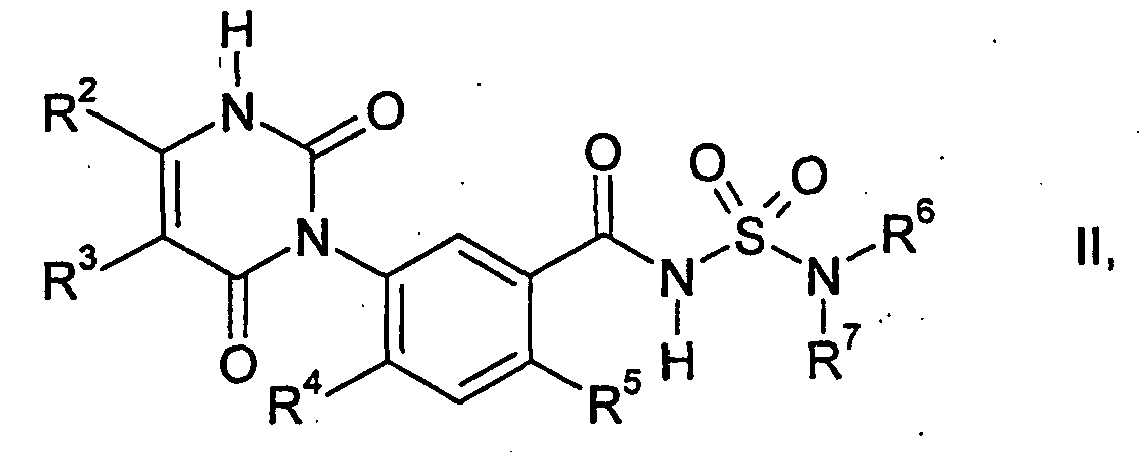
und Alkylierungsmittel der Formel III
R1-L1 III,
wobei R1 die oben genannte Bedeutung hat, und
L1 für Halogen, Hydrogensulfat, C1-C6-Alkylsulfat, C1-C6-Alkylcarbonat, C1-C6-Alkylsulfonyloxy, C1-C6-Halogenalkylsulfonyloxy oder Phenylsulfonyloxy, wobei der Phenylring einen oder mehrere Substituenten aus der Gruppe Halogen, Nitro, C1-C6-Alkyl und C1-C6-Halogenalkyl tragen kann,
steht;
miteinander umgesetzt werden,
dadurch gekennzeichnet, dass während der gesamten Umsetzung der pH-Wert durch portionsweise Basenzugabe in einem Bereich von 1 bis 6 gehalten wird.
Claims (11)
- Verfahren zur Herstellung von 1-Alkyl-3-phenyluracilen der Formel I
 R1 C1-C6-Alkyl;R2 und R3 unabhängig voneinander
Wasserstoff, C1-C6-Akyl oder C1-C6-Halogenalkyl;R4 und R5 unabhängig voneinander
Wasserstoff, Halogen, Cyano, C1-C6-Alkyl oder C1-C6-Halogenalkyl;R6 und R7 unabhängig voneinanderindem 3-Phenyluracile der Formel II
Wasserstoff, C1-C6-Alkyl, C1-C6-Alkoxy, C3-C6-Alkenyl, C3-C6-Alkynyl, C3-C6-Cycloalkyl, C3-C6-Cycloalkenyl, Phenyl oder Benzyl;
und Alkylierungsmittel der Formel III
R1-L1 III,
wobei R1 die oben genannte Bedeutung hat, undL1 für Halogen, Hydrogensulfat, C1-C6-Alkylsulfat, C1-C6-Alkylcarbonat, C1-C6-Alkylsulfonyloxy, C1-C6-Halogenalkylsulfonyloxy oder Phenylsulfonyloxy, wobei der Phenylring einen oder mehrere Substituenten aus der Gruppe Halogen, Nitro, C1-C6-Alkyl und C1-C6-Halogenalkyl tragen kann,steht;
miteinander umgesetzt werden,
dadurch gekennzeichnet, dass während der gesamten Umsetzung der pH-Wert durch portionsweise Basenzugabe in einem Bereich von 1 bis 6 gehalten wird. - Verfahren zur Herstellung von 1-Alkyl-3-phenyluracilen der Formel I gemäß Anspruch 1, dadurch gekennzeichnet, dass das Alkylierungsmittel ausgewählt ist aus der Gruppe C1-C6-Alkylhalogenide, Di-C1-C6-alkylsulfate, C1-C6-Alkylsulfonsäure-C1-C4-alkylester und Phenylsulfonsäure-C1-C4-alkylester.
- Verfahren zur Herstellung von 1-Alkyl-3-phenyluracilen der Formel I gemäß Anspruch 1 oder 2, dadurch gekennzeichnet, dass das Alkylierungsmittel ein Di-C1-C6-alkylsulfat ist.
- Verfahren zur Herstellung von 1-Alkyl-3-phenyluracilen der Formel I gemäß einem der Ansprüche 1 bis 3, dadurch gekennzeichnet, dass während der gesamten Umsetzung der pH-Wert durch portionsweise Basenzugabe in einem Bereich von 3 bis 6 gehalten wird.
- Verfahren zur Herstellung von 1-Alkyl-3-phenyluracilen der Formel I gemäß einem der Ansprüche 1 bis 4, dadurch gekennzeichnet, dass zu Beginn der Umsetzung ein pH-Wert zwischen 1 und 6 eingestellt wird, welcher dann während der Umsetzung konstant auf dem zu Beginn eingestellten Wert gehalten wird.
- Verfahren zur Herstellung von 1-Alkyl-3-phenyluracilen der Formel I gemäß einem der Ansprüche 1 bis 5, dadurch gekennzeichnet, dass der zu Beginn der Umsetzung eingestellte pH-Wert zwischen 1 und 6 während der Umsetzung kontinuierlich zu einem anderen pH-Wert im Bereich 1 bis 6 geändert wird.
- Verfahren zur Herstellung von 1-Alkyl-3-phenyluracilen der Formel I gemäß einem der Ansprüche 1 bis 6, dadurch gekennzeichnet, dass der zu Beginn der Umsetzung konstant eingestellte pH-Wert zwischen 1 und 6 ein- oder mehrfach jeweils nach einer Teilumsetzung zu einem anderen pH-Wert im Bereich 1 bis 6 geändert wird, wobei der jeweils geänderte pH-Wert bis zur nächsten Änderung konstant gehalten wird.
- Verfahren zur Herstellung von 1-Alkyl-3-phenyluracilen der Formel I gemäß einem der Ansprüche 1 bis 7, dadurch gekennzeichnet, dass die Umsetzung in einem wässrig-organischen Mehrphasensystem in Gegenwart von Phasentransferkatalysatoren durchgeführt wird.
- Verfahren zur Herstellung von 1-Alkyl-3-phenyluracilen der Formel I gemäß Anspruch 8, dadurch gekennzeichnet, dass der Phasentransferkatalysator ausgewählt ist aus der Gruppe quartäre Ammoniumsalze, Phosphoniumsalze, Kronenether und Polyglycole.
- Verfahren zur Herstellung von 1-Alkyl-3-phenyluracilen der Formel I gemäß Ansprüchen 8 oder 9, dadurch gekennzeichnet, dass die wässrige Phase eine Lösung von Alkali- oder Erdalkalihydroxiden, -carbonaten oder Alkalimetallhydrogencarbonaten in Wasser ist.
- Verfahren zur Herstellung von 1-Alkyl-3-phenyluracilen der Formel I gemäß einem der Ansprüche 1 bis 10, dadurch gekennzeichnet, dassR2 C1-C4-Halogenalkyl;R3 Wasserstoff;R4 Wasserstoff oder Fluor;R5 Chlor; undR6 und R7 C1-C6-Alkylbedeuten.
Priority Applications (2)
| Application Number | Priority Date | Filing Date | Title |
|---|---|---|---|
| SI200630086T SI1893586T1 (sl) | 2005-05-24 | 2006-05-18 | Postopek za pripravo 1-alkil-3-feniluracilov |
| PL06755248T PL1893586T3 (pl) | 2005-05-24 | 2006-05-18 | Sposób wytwarzania 1-alkilo-3-fenylouracyli |
Applications Claiming Priority (2)
| Application Number | Priority Date | Filing Date | Title |
|---|---|---|---|
| DE102005024448 | 2005-05-24 | ||
| PCT/EP2006/062414 WO2006125746A1 (de) | 2005-05-24 | 2006-05-18 | Verfahren zur herstellung von 1-alkyl-3-phenyluracilen |
Publications (2)
| Publication Number | Publication Date |
|---|---|
| EP1893586A1 EP1893586A1 (de) | 2008-03-05 |
| EP1893586B1 true EP1893586B1 (de) | 2008-09-17 |
Family
ID=36753928
Family Applications (1)
| Application Number | Title | Priority Date | Filing Date |
|---|---|---|---|
| EP06755248A Expired - Lifetime EP1893586B1 (de) | 2005-05-24 | 2006-05-18 | Verfahren zur herstellung von 1-alkyl-3-phenyluracilen |
Country Status (21)
| Country | Link |
|---|---|
| US (1) | US7847097B2 (de) |
| EP (1) | EP1893586B1 (de) |
| JP (1) | JP5005680B2 (de) |
| KR (1) | KR101340792B1 (de) |
| CN (1) | CN101180277B (de) |
| AR (1) | AR054130A1 (de) |
| AT (1) | ATE408604T1 (de) |
| AU (1) | AU2006251185B2 (de) |
| BR (1) | BRPI0609798B1 (de) |
| CA (1) | CA2609050C (de) |
| DE (1) | DE502006001614D1 (de) |
| DK (1) | DK1893586T3 (de) |
| EA (1) | EA012441B1 (de) |
| ES (1) | ES2311283T3 (de) |
| IL (1) | IL186829A (de) |
| MX (1) | MX2007013961A (de) |
| PL (1) | PL1893586T3 (de) |
| SI (1) | SI1893586T1 (de) |
| UA (1) | UA88377C2 (de) |
| WO (1) | WO2006125746A1 (de) |
| ZA (1) | ZA200711016B (de) |
Families Citing this family (42)
| Publication number | Priority date | Publication date | Assignee | Title |
|---|---|---|---|---|
| PE20080859A1 (es) | 2006-10-13 | 2008-09-04 | Basf Ag | Hidratos de 2-cloro-5-[3,6-dihidro-3-metil-2,6-dioxo-4-(trifluorometil)-1-(2h)-pirimidinil]-4-fluor-n-[[metil(1-metiletil)amino]sulfonil]benzamida |
| CL2007002949A1 (es) * | 2006-10-13 | 2008-05-30 | Basf Ag | Forma cristalina del compuesto 2-cloro-5-(3,6-dihidro-3-metil-2,6-dioxo-4-(trifluorometil)-1-(2h)-pirimidinil)-4-fluoro-n-((metil(1-metiletil)amino)sulfonil)benzamida; proceso para la preparacion de dicha forma cristalina; composicion fitoprotectora; |
| BRPI0818408B1 (pt) * | 2007-10-12 | 2024-01-09 | Basf Se | Processos para preparar diamidas sulfúricas e ingredientes herbicidas ativos |
| MX2012002072A (es) | 2009-08-27 | 2012-03-21 | Basf Se | Formulaciones concentradas acuosas que contienen saflufenacilo y glifosato. |
| MX2012001732A (es) | 2009-08-27 | 2012-04-02 | Basf Se | Formulaciones concentradas en suspension acuosa que contienen saflufenacilo. |
| ES2440940T3 (es) | 2009-11-13 | 2014-01-31 | Basf Se | Compuestos de 3-(3,4-dihidro-2H-benzo[1,4]oxazin-6-il)-1H-pirimidin-2,4-diona como herbicidas |
| CN102655748B (zh) | 2009-12-09 | 2015-11-25 | 巴斯夫欧洲公司 | 含有苯嘧磺草胺的液体悬浮浓缩物配制剂 |
| WO2011070054A1 (en) | 2009-12-09 | 2011-06-16 | Basf Se | Liquid suspension concentrate formulations containing saflufenacil and glyphosate |
| WO2015091642A1 (en) | 2013-12-19 | 2015-06-25 | BASF Agro B.V. | Dilute aqueous compositions of saflufenacil |
| CA2971674C (en) | 2015-01-15 | 2023-06-06 | Basf Se | Herbicidal combination comprising saflufenacil and glufosinate |
| BR112017015652B1 (pt) | 2015-01-22 | 2022-06-07 | BASF Agro B.V. | Combinação herbicida, método de controle de vegetação indesejável e método de tratamento por extermínio de vegetação |
| CN107846891B (zh) | 2015-07-10 | 2024-02-20 | 巴斯夫农业公司 | 包含环庚草醚和特异性色素合成抑制剂的除草组合物 |
| WO2017009140A1 (en) | 2015-07-10 | 2017-01-19 | BASF Agro B.V. | Herbicidal composition comprising cinmethylin and acetochlor or pretilachlor |
| BR112018000482B1 (pt) | 2015-07-10 | 2022-11-22 | BASF Agro B.V. | Composição herbicida, uso da composição e método para o controle da vegetação indesejada |
| US11219215B2 (en) | 2015-07-10 | 2022-01-11 | BASF Agro B.V. | Herbicidal composition comprising cinmethylin and specific inhibitors of protoporphyrinogen oxidase |
| AU2016292677B2 (en) | 2015-07-10 | 2020-09-24 | BASF Agro B.V. | Herbicidal composition comprising cinmethylin and specific quinolinecarboxylic acids |
| LT3319434T (lt) | 2015-07-10 | 2019-07-10 | BASF Agro B.V. | Herbicidinė kompozicija, apimanti cinmetiliną ir petoksamidą |
| US10813356B2 (en) | 2015-07-10 | 2020-10-27 | BASF Agro B.V. | Herbicidal composition comprising cinmethylin and dimethenamid |
| CN107846889B (zh) | 2015-07-10 | 2020-12-08 | 巴斯夫农业公司 | 包含环庚草醚和派罗克杀草砜的除草组合物 |
| EA201890259A1 (ru) | 2015-07-10 | 2018-07-31 | Басф Агро Б.В. | Способ борьбы с устойчивыми или толерантными к гербицидам сорняками |
| US11219212B2 (en) | 2015-07-10 | 2022-01-11 | BASF Agro B.V. | Herbicidal composition comprising cinmethylin and imazamox |
| BR112018001400B1 (pt) | 2015-07-24 | 2021-11-09 | Basf Se | Compostos, composição, uso do composto, método para o combate de fungos fitopatogênicos e semente |
| CA2995644C (en) | 2015-09-03 | 2023-10-03 | BASF Agro B.V. | Microparticle compositions comprising saflufenacil |
| MY197583A (en) | 2016-05-24 | 2023-06-26 | Basf Se | Herbicidal uracilpyrid |
| WO2018019845A1 (en) | 2016-07-29 | 2018-02-01 | Basf Se | Method for controlling ppo resistant weeds |
| CA3145690A1 (en) | 2019-08-01 | 2021-02-04 | Basf Se | Herbicidal uracilpyridines |
| CR20220437A (es) | 2020-03-06 | 2022-10-27 | Basf Se | Feniluracilos herbicidas |
| AR124927A1 (es) | 2021-02-24 | 2023-05-17 | Adama Agan Ltd | Composiciones herbicidas que comprenden inhibidores de acetolactato sintasa a base de imidazolinona y usos de los mismos |
| CN116917274A (zh) * | 2021-03-04 | 2023-10-20 | 安道麦阿甘有限公司 | 苯嘧磺草胺-钠和苯嘧磺草胺-钾的固体形式、其制备方法和用途 |
| CA3227501A1 (en) | 2021-08-30 | 2023-03-09 | Rahul Kaduskar | Crystalline forms of methyl 2-[2-[2-bromo-4-fluoro-5-[3-methyl-2,6-dioxo-4-(trifluoromethyl)pyrimidin-1-yl]phenoxy]phenoxy]-2-methoxy-acetate |
| WO2023030934A1 (en) | 2021-08-31 | 2023-03-09 | Basf Se | Herbicidal composition comprising phenyluracils |
| WO2023030935A1 (en) | 2021-08-31 | 2023-03-09 | Basf Se | Method for controlling ppo-i resistant weeds |
| WO2023232507A1 (en) | 2022-05-30 | 2023-12-07 | BASF Agro B.V. | Process for recovering saflufenacil from process streams |
| WO2024012913A1 (en) | 2022-07-13 | 2024-01-18 | BASF Agro B.V. | Herbicidal eode formulation comprising several active ingredients |
| CA3265577A1 (en) | 2022-08-26 | 2024-02-29 | BASF Agro B.V. | AQUEOUS HERBICIDE FORMULATIONS |
| EP4651718A1 (de) | 2022-12-22 | 2025-11-26 | BASF Agro B.V. | Verfahren zur bekämpfung unerwünschter pflanzen mit ppo-herbiziden und kombinationen in herbizidtoleranten kulturpflanzen |
| EP4687448A1 (de) | 2023-03-29 | 2026-02-11 | BASF Agro B.V. | Verfahren zur bekämpfung von parasitärem unkraut (orobache) in protoporphyrinogenoxidase (ppo)-inhibitortolerantem sonnenblumenpflanzen |
| AR132221A1 (es) | 2023-03-30 | 2025-06-04 | Adama Agan Ltd | Proceso para la preparación de derivados de sulfamida |
| WO2025120633A1 (en) | 2023-12-06 | 2025-06-12 | Adama Agan Ltd. | Herbicidal mixtures comprising saflufenacil and fluroxypyr |
| WO2025124942A1 (en) | 2023-12-12 | 2025-06-19 | BASF Agro B.V. | Process for preparing a saflufenacil intermediate |
| WO2025181801A1 (en) | 2024-02-26 | 2025-09-04 | Adama Agan Ltd. | An herbicidal formulation comprising saflufenacil and fluroxypyr |
| WO2026094037A1 (en) | 2024-10-29 | 2026-05-07 | Adama Agan Ltd. | Efficient purification of saflufenacil |
Family Cites Families (6)
| Publication number | Priority date | Publication date | Assignee | Title |
|---|---|---|---|---|
| US4943309A (en) * | 1988-09-06 | 1990-07-24 | Uniroyal Chemical Company, Inc. | Method of defoleating cotton plants employing 3-carbonylphenyl uracil derivatives |
| EP0831091A3 (de) * | 1996-09-23 | 1998-04-15 | Novartis AG | Verfahren zur Herstellung von 3-Aryl-Urazilen |
| NZ517562A (en) * | 2000-05-04 | 2004-09-24 | Basf Ag | Uracil substituted phenyl sulfamoyl carboxamides |
| WO2003024221A1 (en) * | 2001-09-14 | 2003-03-27 | Basf Aktiengesellschaft | Herbicidal mixtures based on 3-phenyluracils |
| MXPA04010748A (es) * | 2002-05-16 | 2005-03-07 | Basf Ag | Metodo para produccion de halogenuros de acido sulfamico. |
| US7737275B2 (en) * | 2003-12-03 | 2010-06-15 | Basf Aktiengesellschaft | Method for producing 3-phenyl(thio)uracils and 3-phenyldithiouracils |
-
2006
- 2006-05-18 BR BRPI0609798-7A patent/BRPI0609798B1/pt active IP Right Grant
- 2006-05-18 WO PCT/EP2006/062414 patent/WO2006125746A1/de not_active Ceased
- 2006-05-18 UA UAA200713919A patent/UA88377C2/ru unknown
- 2006-05-18 AT AT06755248T patent/ATE408604T1/de active
- 2006-05-18 CN CN2006800179852A patent/CN101180277B/zh not_active Expired - Lifetime
- 2006-05-18 SI SI200630086T patent/SI1893586T1/sl unknown
- 2006-05-18 EP EP06755248A patent/EP1893586B1/de not_active Expired - Lifetime
- 2006-05-18 PL PL06755248T patent/PL1893586T3/pl unknown
- 2006-05-18 ES ES06755248T patent/ES2311283T3/es not_active Expired - Lifetime
- 2006-05-18 KR KR1020077029884A patent/KR101340792B1/ko not_active Expired - Lifetime
- 2006-05-18 EA EA200702413A patent/EA012441B1/ru not_active IP Right Cessation
- 2006-05-18 CA CA2609050A patent/CA2609050C/en not_active Expired - Lifetime
- 2006-05-18 DE DE502006001614T patent/DE502006001614D1/de not_active Expired - Lifetime
- 2006-05-18 JP JP2008512809A patent/JP5005680B2/ja not_active Expired - Lifetime
- 2006-05-18 MX MX2007013961A patent/MX2007013961A/es active IP Right Grant
- 2006-05-18 DK DK06755248T patent/DK1893586T3/da active
- 2006-05-18 US US11/913,208 patent/US7847097B2/en not_active Expired - Lifetime
- 2006-05-18 AU AU2006251185A patent/AU2006251185B2/en not_active Expired
- 2006-05-23 AR ARP060102135A patent/AR054130A1/es active IP Right Grant
-
2007
- 2007-10-22 IL IL186829A patent/IL186829A/en active IP Right Grant
- 2007-12-19 ZA ZA200711016A patent/ZA200711016B/xx unknown
Also Published As
| Publication number | Publication date |
|---|---|
| CA2609050A1 (en) | 2006-11-30 |
| CN101180277B (zh) | 2011-07-06 |
| BRPI0609798A2 (pt) | 2011-10-11 |
| KR20080031198A (ko) | 2008-04-08 |
| EA012441B1 (ru) | 2009-10-30 |
| PL1893586T3 (pl) | 2009-03-31 |
| AU2006251185B2 (en) | 2011-04-07 |
| IL186829A (en) | 2012-02-29 |
| ES2311283T3 (es) | 2009-02-01 |
| MX2007013961A (es) | 2008-01-14 |
| WO2006125746A1 (de) | 2006-11-30 |
| IL186829A0 (en) | 2008-02-09 |
| DE502006001614D1 (de) | 2008-10-30 |
| ATE408604T1 (de) | 2008-10-15 |
| CA2609050C (en) | 2013-11-05 |
| JP5005680B2 (ja) | 2012-08-22 |
| US7847097B2 (en) | 2010-12-07 |
| EA200702413A1 (ru) | 2008-04-28 |
| BRPI0609798B1 (pt) | 2015-01-27 |
| EP1893586A1 (de) | 2008-03-05 |
| KR101340792B1 (ko) | 2013-12-11 |
| SI1893586T1 (sl) | 2008-12-31 |
| US20080293941A1 (en) | 2008-11-27 |
| UA88377C2 (ru) | 2009-10-12 |
| AU2006251185A1 (en) | 2006-11-30 |
| AR054130A1 (es) | 2007-06-06 |
| ZA200711016B (en) | 2008-09-25 |
| CN101180277A (zh) | 2008-05-14 |
| DK1893586T3 (da) | 2009-01-05 |
| JP2008545674A (ja) | 2008-12-18 |
Similar Documents
| Publication | Publication Date | Title |
|---|---|---|
| EP1893586A1 (de) | Verfahren zur herstellung von 1-alkyl-3-phenyluracilen | |
| EP2164831B1 (de) | Verfahren zur herstellung n-substituierter (3-dihalomethyl-1-methyl-pyrazol-4-yl)carboxamide | |
| EP2086944B1 (de) | Verfahren zur herstellung von difluormethylpyrazolylcarboxylaten | |
| EP2300417B1 (de) | Verfahren zur herstellung von 2-(aminomethyliden)-4,4-difluor-3-oxobuttersäureestern | |
| EP2885281B1 (de) | Carbamat-benzoxazinones zur herstellung von triazin-benzoxazinone | |
| US20170342022A1 (en) | Processes for the diazotization of 2,5-dichloroanilines | |
| EP1001937B1 (de) | Verfahren zur herstellung von 2-(3-pyrazolyl-oxymethylen)nitrobenzolen | |
| US20120310010A1 (en) | Method for producing sulfonamides | |
| EP1131299B1 (de) | Verfahren zur herstellung von 1-substituierten 5- oder 3-hydroxy-pyrazolen | |
| EP1606246B1 (de) | Verfahren zur hertellung von 2-cyan-3-hydroxy-n-(phenyl)but-2-enamiden | |
| DE102005057681A1 (de) | Verfahren zur Herstellung fluorierter m-Nitro-Benzoesäurechloride | |
| EP1873145B1 (de) | Verfahren zur herstellung eines nikotinsäurederivats oder salzes davon | |
| US20130303760A1 (en) | New Process For The Preparation Of Nitroorotic Acid | |
| WO2020025574A1 (en) | Process for the preparation of 6-(haloalkyl)-2-halo-5-acylpyridines and intermediates for this process | |
| DE69902886T2 (de) | Verfahren zur herstellung von aryloxy- oder alkoxytriazolinonen | |
| EP0948482B1 (de) | Verfahren zur herstellung von trifluoracetessigsäure-aniliden | |
| EP3738959A1 (de) | Herstellung von 6-phenoxy-2-(haloalkyl)-3-acylpyridinen und zwischenprodukten davon | |
| WO2020120284A1 (en) | Preparation of 6-halo-2-(haloalkyl)-3-acylpyridines and intermediates therefor | |
| WO2010069819A1 (de) | Verfahren zur herstellung von piperazindion-derivaten |
Legal Events
| Date | Code | Title | Description |
|---|---|---|---|
| PUAI | Public reference made under article 153(3) epc to a published international application that has entered the european phase |
Free format text: ORIGINAL CODE: 0009012 |
|
| 17P | Request for examination filed |
Effective date: 20071227 |
|
| AK | Designated contracting states |
Kind code of ref document: A1 Designated state(s): AT BE BG CH CY CZ DE DK EE ES FI FR GB GR HU IE IS IT LI LT LU LV MC NL PL PT RO SE SI SK TR |
|
| GRAP | Despatch of communication of intention to grant a patent |
Free format text: ORIGINAL CODE: EPIDOSNIGR1 |
|
| GRAS | Grant fee paid |
Free format text: ORIGINAL CODE: EPIDOSNIGR3 |
|
| GRAA | (expected) grant |
Free format text: ORIGINAL CODE: 0009210 |
|
| DAX | Request for extension of the european patent (deleted) | ||
| AK | Designated contracting states |
Kind code of ref document: B1 Designated state(s): AT BE BG CH CY CZ DE DK EE ES FI FR GB GR HU IE IS IT LI LT LU LV MC NL PL PT RO SE SI SK TR |
|
| REG | Reference to a national code |
Ref country code: GB Ref legal event code: FG4D Free format text: NOT ENGLISH |
|
| REG | Reference to a national code |
Ref country code: CH Ref legal event code: EP |
|
| REG | Reference to a national code |
Ref country code: IE Ref legal event code: FG4D Free format text: LANGUAGE OF EP DOCUMENT: GERMAN |
|
| REF | Corresponds to: |
Ref document number: 502006001614 Country of ref document: DE Date of ref document: 20081030 Kind code of ref document: P |
|
| REG | Reference to a national code |
Ref country code: DK Ref legal event code: T3 |
|
| PG25 | Lapsed in a contracting state [announced via postgrant information from national office to epo] |
Ref country code: LT Free format text: LAPSE BECAUSE OF FAILURE TO SUBMIT A TRANSLATION OF THE DESCRIPTION OR TO PAY THE FEE WITHIN THE PRESCRIBED TIME-LIMIT Effective date: 20080917 |
|
| REG | Reference to a national code |
Ref country code: ES Ref legal event code: FG2A Ref document number: 2311283 Country of ref document: ES Kind code of ref document: T3 |
|
| PG25 | Lapsed in a contracting state [announced via postgrant information from national office to epo] |
Ref country code: LV Free format text: LAPSE BECAUSE OF FAILURE TO SUBMIT A TRANSLATION OF THE DESCRIPTION OR TO PAY THE FEE WITHIN THE PRESCRIBED TIME-LIMIT Effective date: 20080917 |
|
| REG | Reference to a national code |
Ref country code: PL Ref legal event code: T3 |
|
| PG25 | Lapsed in a contracting state [announced via postgrant information from national office to epo] |
Ref country code: BG Free format text: LAPSE BECAUSE OF FAILURE TO SUBMIT A TRANSLATION OF THE DESCRIPTION OR TO PAY THE FEE WITHIN THE PRESCRIBED TIME-LIMIT Effective date: 20081217 |
|
| PG25 | Lapsed in a contracting state [announced via postgrant information from national office to epo] |
Ref country code: RO Free format text: LAPSE BECAUSE OF FAILURE TO SUBMIT A TRANSLATION OF THE DESCRIPTION OR TO PAY THE FEE WITHIN THE PRESCRIBED TIME-LIMIT Effective date: 20080917 Ref country code: PT Free format text: LAPSE BECAUSE OF FAILURE TO SUBMIT A TRANSLATION OF THE DESCRIPTION OR TO PAY THE FEE WITHIN THE PRESCRIBED TIME-LIMIT Effective date: 20090217 Ref country code: IS Free format text: LAPSE BECAUSE OF FAILURE TO SUBMIT A TRANSLATION OF THE DESCRIPTION OR TO PAY THE FEE WITHIN THE PRESCRIBED TIME-LIMIT Effective date: 20090117 |
|
| PLBE | No opposition filed within time limit |
Free format text: ORIGINAL CODE: 0009261 |
|
| STAA | Information on the status of an ep patent application or granted ep patent |
Free format text: STATUS: NO OPPOSITION FILED WITHIN TIME LIMIT |
|
| PG25 | Lapsed in a contracting state [announced via postgrant information from national office to epo] |
Ref country code: EE Free format text: LAPSE BECAUSE OF FAILURE TO SUBMIT A TRANSLATION OF THE DESCRIPTION OR TO PAY THE FEE WITHIN THE PRESCRIBED TIME-LIMIT Effective date: 20080917 |
|
| 26N | No opposition filed |
Effective date: 20090618 |
|
| PG25 | Lapsed in a contracting state [announced via postgrant information from national office to epo] |
Ref country code: MC Free format text: LAPSE BECAUSE OF NON-PAYMENT OF DUE FEES Effective date: 20090531 |
|
| PG25 | Lapsed in a contracting state [announced via postgrant information from national office to epo] |
Ref country code: SE Free format text: LAPSE BECAUSE OF FAILURE TO SUBMIT A TRANSLATION OF THE DESCRIPTION OR TO PAY THE FEE WITHIN THE PRESCRIBED TIME-LIMIT Effective date: 20081217 |
|
| PG25 | Lapsed in a contracting state [announced via postgrant information from national office to epo] |
Ref country code: GR Free format text: LAPSE BECAUSE OF FAILURE TO SUBMIT A TRANSLATION OF THE DESCRIPTION OR TO PAY THE FEE WITHIN THE PRESCRIBED TIME-LIMIT Effective date: 20081218 |
|
| PG25 | Lapsed in a contracting state [announced via postgrant information from national office to epo] |
Ref country code: LU Free format text: LAPSE BECAUSE OF NON-PAYMENT OF DUE FEES Effective date: 20090518 |
|
| PG25 | Lapsed in a contracting state [announced via postgrant information from national office to epo] |
Ref country code: TR Free format text: LAPSE BECAUSE OF FAILURE TO SUBMIT A TRANSLATION OF THE DESCRIPTION OR TO PAY THE FEE WITHIN THE PRESCRIBED TIME-LIMIT Effective date: 20080917 |
|
| PG25 | Lapsed in a contracting state [announced via postgrant information from national office to epo] |
Ref country code: CY Free format text: LAPSE BECAUSE OF FAILURE TO SUBMIT A TRANSLATION OF THE DESCRIPTION OR TO PAY THE FEE WITHIN THE PRESCRIBED TIME-LIMIT Effective date: 20080917 |
|
| PGFP | Annual fee paid to national office [announced via postgrant information from national office to epo] |
Ref country code: SK Payment date: 20130517 Year of fee payment: 8 |
|
| PGFP | Annual fee paid to national office [announced via postgrant information from national office to epo] |
Ref country code: SI Payment date: 20130425 Year of fee payment: 8 |
|
| PGFP | Annual fee paid to national office [announced via postgrant information from national office to epo] |
Ref country code: IE Payment date: 20140523 Year of fee payment: 9 |
|
| PGFP | Annual fee paid to national office [announced via postgrant information from national office to epo] |
Ref country code: FI Payment date: 20140522 Year of fee payment: 9 |
|
| PGFP | Annual fee paid to national office [announced via postgrant information from national office to epo] |
Ref country code: DK Payment date: 20140526 Year of fee payment: 9 |
|
| PG25 | Lapsed in a contracting state [announced via postgrant information from national office to epo] |
Ref country code: SK Free format text: LAPSE BECAUSE OF NON-PAYMENT OF DUE FEES Effective date: 20140518 |
|
| REG | Reference to a national code |
Ref country code: SK Ref legal event code: MM4A Ref document number: E 4201 Country of ref document: SK Effective date: 20140518 |
|
| PG25 | Lapsed in a contracting state [announced via postgrant information from national office to epo] |
Ref country code: SI Free format text: LAPSE BECAUSE OF NON-PAYMENT OF DUE FEES Effective date: 20140519 |
|
| REG | Reference to a national code |
Ref country code: SI Ref legal event code: KO00 Effective date: 20150106 |
|
| PGFP | Annual fee paid to national office [announced via postgrant information from national office to epo] |
Ref country code: CZ Payment date: 20150515 Year of fee payment: 10 |
|
| REG | Reference to a national code |
Ref country code: DK Ref legal event code: EBP Effective date: 20150531 |
|
| PG25 | Lapsed in a contracting state [announced via postgrant information from national office to epo] |
Ref country code: FI Free format text: LAPSE BECAUSE OF NON-PAYMENT OF DUE FEES Effective date: 20150518 |
|
| REG | Reference to a national code |
Ref country code: IE Ref legal event code: MM4A |
|
| PG25 | Lapsed in a contracting state [announced via postgrant information from national office to epo] |
Ref country code: DK Free format text: LAPSE BECAUSE OF NON-PAYMENT OF DUE FEES Effective date: 20150531 Ref country code: IE Free format text: LAPSE BECAUSE OF NON-PAYMENT OF DUE FEES Effective date: 20150518 |
|
| REG | Reference to a national code |
Ref country code: FR Ref legal event code: PLFP Year of fee payment: 11 |
|
| PG25 | Lapsed in a contracting state [announced via postgrant information from national office to epo] |
Ref country code: CZ Free format text: LAPSE BECAUSE OF NON-PAYMENT OF DUE FEES Effective date: 20160518 |
|
| REG | Reference to a national code |
Ref country code: FR Ref legal event code: PLFP Year of fee payment: 12 |
|
| REG | Reference to a national code |
Ref country code: FR Ref legal event code: PLFP Year of fee payment: 13 |
|
| PGFP | Annual fee paid to national office [announced via postgrant information from national office to epo] |
Ref country code: FR Payment date: 20200527 Year of fee payment: 15 Ref country code: ES Payment date: 20200609 Year of fee payment: 15 Ref country code: NL Payment date: 20200526 Year of fee payment: 15 Ref country code: CH Payment date: 20200527 Year of fee payment: 15 |
|
| PGFP | Annual fee paid to national office [announced via postgrant information from national office to epo] |
Ref country code: BE Payment date: 20200527 Year of fee payment: 15 Ref country code: IT Payment date: 20200522 Year of fee payment: 15 |
|
| PGFP | Annual fee paid to national office [announced via postgrant information from national office to epo] |
Ref country code: AT Payment date: 20200522 Year of fee payment: 15 |
|
| PGFP | Annual fee paid to national office [announced via postgrant information from national office to epo] |
Ref country code: DE Payment date: 20200728 Year of fee payment: 15 |
|
| PGFP | Annual fee paid to national office [announced via postgrant information from national office to epo] |
Ref country code: PL Payment date: 20210504 Year of fee payment: 16 Ref country code: HU Payment date: 20210426 Year of fee payment: 16 |
|
| REG | Reference to a national code |
Ref country code: DE Ref legal event code: R119 Ref document number: 502006001614 Country of ref document: DE |
|
| REG | Reference to a national code |
Ref country code: CH Ref legal event code: PL |
|
| REG | Reference to a national code |
Ref country code: NL Ref legal event code: MM Effective date: 20210601 |
|
| REG | Reference to a national code |
Ref country code: AT Ref legal event code: MM01 Ref document number: 408604 Country of ref document: AT Kind code of ref document: T Effective date: 20210518 |
|
| PG25 | Lapsed in a contracting state [announced via postgrant information from national office to epo] |
Ref country code: LI Free format text: LAPSE BECAUSE OF NON-PAYMENT OF DUE FEES Effective date: 20210531 Ref country code: CH Free format text: LAPSE BECAUSE OF NON-PAYMENT OF DUE FEES Effective date: 20210531 Ref country code: AT Free format text: LAPSE BECAUSE OF NON-PAYMENT OF DUE FEES Effective date: 20210518 |
|
| REG | Reference to a national code |
Ref country code: BE Ref legal event code: MM Effective date: 20210531 |
|
| PG25 | Lapsed in a contracting state [announced via postgrant information from national office to epo] |
Ref country code: DE Free format text: LAPSE BECAUSE OF NON-PAYMENT OF DUE FEES Effective date: 20211201 |
|
| PG25 | Lapsed in a contracting state [announced via postgrant information from national office to epo] |
Ref country code: NL Free format text: LAPSE BECAUSE OF NON-PAYMENT OF DUE FEES Effective date: 20210601 Ref country code: FR Free format text: LAPSE BECAUSE OF NON-PAYMENT OF DUE FEES Effective date: 20210531 |
|
| PG25 | Lapsed in a contracting state [announced via postgrant information from national office to epo] |
Ref country code: BE Free format text: LAPSE BECAUSE OF NON-PAYMENT OF DUE FEES Effective date: 20210531 |
|
| PGFP | Annual fee paid to national office [announced via postgrant information from national office to epo] |
Ref country code: GB Payment date: 20220524 Year of fee payment: 17 |
|
| REG | Reference to a national code |
Ref country code: ES Ref legal event code: FD2A Effective date: 20220801 |
|
| PG25 | Lapsed in a contracting state [announced via postgrant information from national office to epo] |
Ref country code: ES Free format text: LAPSE BECAUSE OF NON-PAYMENT OF DUE FEES Effective date: 20210519 |
|
| PG25 | Lapsed in a contracting state [announced via postgrant information from national office to epo] |
Ref country code: HU Free format text: LAPSE BECAUSE OF NON-PAYMENT OF DUE FEES Effective date: 20220519 |
|
| PG25 | Lapsed in a contracting state [announced via postgrant information from national office to epo] |
Ref country code: IT Free format text: LAPSE BECAUSE OF NON-PAYMENT OF DUE FEES Effective date: 20200518 |
|
| P01 | Opt-out of the competence of the unified patent court (upc) registered |
Effective date: 20230404 |
|
| GBPC | Gb: european patent ceased through non-payment of renewal fee |
Effective date: 20230518 |
|
| PG25 | Lapsed in a contracting state [announced via postgrant information from national office to epo] |
Ref country code: GB Free format text: LAPSE BECAUSE OF NON-PAYMENT OF DUE FEES Effective date: 20230518 |
|
| PG25 | Lapsed in a contracting state [announced via postgrant information from national office to epo] |
Ref country code: PL Free format text: LAPSE BECAUSE OF NON-PAYMENT OF DUE FEES Effective date: 20230518 |
|
| PG25 | Lapsed in a contracting state [announced via postgrant information from national office to epo] |
Ref country code: PL Free format text: LAPSE BECAUSE OF NON-PAYMENT OF DUE FEES Effective date: 20221110 |
|
| PG25 | Lapsed in a contracting state [announced via postgrant information from national office to epo] |
Ref country code: IT Free format text: LAPSE BECAUSE OF NON-PAYMENT OF DUE FEES Effective date: 20210518 |